AB 18: Controlled substances.
- Session Year: 2023-2024
- House: Assembly
- Latest Version Date: 2022-12-05
Current Status:
Failed
(2024-02-01: From committee: Filed with the Chief Clerk pursuant to Joint Rule 56.)
Introduced
In Committee
First Chamber
In Committee
Second Chamber
Enacted
Existing law makes it a crime to possess for sale or purchase for purpose of sale, transport, sell, furnish, administer, give away, manufacture, compound, convert, produce, derive, process, or prepare various controlled substances, including, among others, fentanyl, peyote, and various other opiates and narcotics.
This bill would require a person who is convicted of, or who pleads guilty or no contest to, the above crimes to receive a written advisory of the danger of manufacturing or distribution of controlled substances and that, if a person dies as a result of that action, the manufacturer or distributor can be charged with voluntary manslaughter or murder. The bill would require that the fact the advisory was given be on the record and recorded on the abstract of the conviction.
(a)This section shall be known, and may be cited, as Alexandras Law.
(b)The court shall advise a person who is convicted of, or who pleads guilty or no contest to, a violation of Section 11351, 11352, or 11379.6 of the following:
You are hereby advised that the illicit manufacture or distribution of controlled substances, either real or counterfeit, inflicts a grave health risk to those who ingest or are exposed to them. It is extremely dangerous to human life to manufacture or distribute real or counterfeit controlled substances. If you do so, and a person dies as a result of that action, you can be charged with voluntary manslaughter or murder.
(c)The advisory statement shall be provided to the defendant in writing, either on the plea form or after sentencing, and the fact that the advisory was given shall be on the record and recorded in the abstract of the conviction.
REVISIONS: HeadingLine 2.|
Date
|
Status
|
|---|---|
| Feb 1, 2024 | From committee: Filed with the Chief Clerk pursuant to Joint Rule 56. |
| Jan 31, 2024 | Died pursuant to Art. IV, Sec. 10(c) of the Constitution. |
| Dec 18, 2023 | In committee: Set, second hearing. Hearing canceled at the request of author. |
| Feb 14, 2023 | Coauthors revised. |
| Feb 14, 2023 | In committee: Set, first hearing. Failed passage. Reconsideration granted. |
| Jan 26, 2023 | Referred to Com. on PUB. S. |
| Dec 6, 2022 | From printer. May be heard in committee January 5. |
| Dec 5, 2022 | Read first time. To print. |
|
Date
|
Description
|
Location
|
Votes
|
|
|---|---|---|---|---|
| Feb 14, 2023 | Do pass and be re-referred to the Committee on [Appropriations] | Assembly Standing Committee on Public Safety |
Failed |
This list shows positions taken on this bill by organizations on the date displayed, which is linked to the original source.
Positions by individuals are not included.
|
Organization
|
Position
|
Date
|
|---|---|---|
| Aclu California Action | * Against | Feb 14, 2023 |
| American Addiction Institute of Mind and Medicine/ Harm Reduction Institute | ** Against | |
| Anti-Recidivism Coalition | ** Against | |
| Arcadia Police Officers' Association | ** Support | |
| Berkeley Needle Exchange Emergency Distribution | ** Against | |
| Bienestar Human Services | ** Against | |
| Broken No More | ** Against | |
| Burbank Police Officer's Association | * Support | Feb 14, 2023 |
| California Attorneys For Criminal Justice | * Against | Feb 14, 2023 |
| California Capitol Connection | * Support | Feb 14, 2023 |
| California Coalition of School Safety Professionals | * Support | Feb 14, 2023 |
| California District Attorney's Association | * Support | Feb 14, 2023 |
| California Peace Officers Association | * Support | Feb 14, 2023 |
| California Public Defenders Association | * Against | Feb 14, 2023 |
| California State Sheriffs' Association | ** Support | |
| Californians United for a Responsible Budget | ** Against | |
| Care First California | ** Against | |
| City of Rocklin | ** Support | |
| Claremont Police Officer Association | * Support | Feb 14, 2023 |
| Communities United for Restorative Youth Justice | ** Against | |
| Community Agency For Resources Advocacy And Services | ** Against | |
| Corona Police Officers Association | * Support | Feb 14, 2023 |
| Crop Organization | ** Against | |
| Culver City Police Officer Association | * Support | Feb 14, 2023 |
| Delivering Innovation in Supportive Housing | ** Against | |
| Drug Policy Alliance | * Against | Feb 14, 2023 |
| Ella Baker Center For Human Rights | * Against | Feb 14, 2023 |
| Fullerton Police Officer Association | * Support | Feb 14, 2023 |
| Glide | ** Against | |
| HomeRise San Francisco | ** Against | |
| Immigrant Legal Resource Center | ** Against | |
| Inglewood Police Association | * Support | Feb 14, 2023 |
| Initiate Justice | * Against | Feb 14, 2023 |
| Inland Empire Harm Reduction | ** Against | |
| Legal Services for Prisoners with Children | ** Against | |
| Los Angeles County Sheriff'S Department | ** Support | |
| los angeles school police officers association | ** Support | |
| Los Angeles Sheriff's Department | * Support | Feb 14, 2023 |
| mental health advocacy services | ** Against | |
| milpa | ** Against | |
| National Harm Reduction Coalition | ** Against | |
| Orange County District Attorney's Office | * Support | Feb 14, 2023 |
| Orange County Sheriff's Department | ** Support | |
| Placer County County Deputy Sheriff | * Support | Feb 14, 2023 |
| Placer County Deputy Sheriffs' Assocation | ** Support | |
| Police Officers Association of Arcadia | * Support | Feb 14, 2023 |
| Police Officers Association of Newport Beach | * Support | Feb 14, 2023 |
| Police Officers Association of Palos Verdes | * Support | Feb 14, 2023 |
| Police Officers Association of Upland | * Support | Feb 14, 2023 |
| Pomona Police Officers Association | * Support | Feb 14, 2023 |
| Riverside County Sheriff'S Department | * Support | Feb 14, 2023 |
| Riverside Police Officers' Association | * Support | Feb 14, 2023 |
| Riverside Sheriff's Association | * Support | Feb 14, 2023 |
| Rubicon Programs | ** Against | |
| San Diego County District Attorney's Office | ** Support | |
| San Francisco Public Defender | ** Against | |
| San Joaquin County | * Support | Feb 14, 2023 |
| Santa Anna Police Officers Association | * Support | Feb 14, 2023 |
| Sister Warriors Freedom Coalition | ** Against | |
| The Gubbio Project | ** Against | |
| transitions clinic network | ** Against | |
| Treatment on Demand Coalition | ** Against | |
| Youth Justice Coalition | ** Against |
Date of Hearing: February 14, 2023
Counsel: Andrew Ironside
ASSEMBLY COMMITTEE ON
Reginald Byron Jones-Sawyer, Sr., Chair
ABPCA Bill Id:
Author:() – As Ver:
SUMMARY:
Requires the court to advise a person convicted of specified drug offenses that they could be charged with voluntary manslaughter or murder in the future if they manufacture or distribute controlled substances and somebody dies as a result. Specifically, this bill:
- Requires the court to advise a person who is convicted of, or who pleads guilty or no contest to possession for sale, sale, transportation, distribution, or manufacture of a controlled substance that, “You are hereby advised that the illicit manufacture and distribution of controlled substances, either real or counterfeit, inflicts a grave health risk to those who ingest or are exposed to them. It is extremely dangerous to human life to manufacture or distribute real or counterfeit controlled substances. If you do so, and a person dies as a result of that action, you can be charged with voluntary manslaughter or murder.”
- Requires the court to provide the advisory statement to the defendant in writing, either on the plea form or after sentencing.
- Requires that the fact that the advisory statement was given to the defendant to be on the record or recorded in the abstract of the conviction.
EXISTING LAW:
- Provides that murder is the unlawful killing of a human being, or a fetus, with malice aforethought. (Pen. Code, § 187, subd. (a).)
- Provides that malice can be either express or implied:
- Express malice is when there is manifested a deliberate intention to unlawfully take away the life of a fellow creature.
- Implied malice is when no considerable provocation appears, or when the circumstances attending the killing show an abandoned or malignant heart. (Pen. Code, § 188, subd. (a)(1)-(2).)
- Express malice is when there is manifested a deliberate intention to unlawfully take away the life of a fellow creature.
- Provides that manslaughter is the unlawful killing of a human being without malice. (Pen. Code, § 192.)
- Makes it unlawful for a person to possess for sale or purchase for purpose of sale specified controlled substances. (Health & Saf. Code, § 11351.)
- Makes it unlawful for a person to transport, import, sell, furnish, administer, or give away, or offer or attempt to transport, import, sell, furnish, administer, or give away specified controlled substances. (Health & Saf. Code, § 11352.)
- Makes it unlawful for a person to manufacture, compound, convert, produce, derive, process, or prepare, either directly or indirectly by chemical extraction or by means of chemical synthesis any controlled substance. (Health & Saf. Code, § 11379.6.)
FISCAL EFFECT:
Unknown
COMMENTS:
- Author's Statement: According to the author, “Fentanyl abuse has personally impacted my family and community. As a result, I have dedicated my first pieces of legislation to combatting this growing problem. Assembly Bill 18 is a part of a three prong approach that I am working on this year to ensure that we deal with the opioid epidemic - education, treatment, and accountability. Fentanyl in particular is a deadly drug and in order to save lives the Legislature must take swift action. AB 18 will help ensure drug traffickers and dealers understand the severity of their actions. We must hold drug traffickers and dealers accountable.
According to the California Department of Health in 2021 there were 6.843 opioid-related overdose deaths in California, 5.733 of these deaths were related to fentanyl, I am hopeful we can tackle these issues and hold everyone involved in these deaths accountable.” - Advisory Statement in This Bill Mirrors Existing Language in DUI Context: This bill would require the court to advise a person who is convicted of, or who pleads guilty or no contest to, a violation of possession for sale, transporting, importing, selling, furnishing, administering, giving away, or manufacturing specified controlled substances of the following:
You are hereby advised that the illicit manufacture and distribution of controlled substances, either real or counterfeit, inflicts a grave health risk to those who ingest or are exposed to them. It is extremely dangerous to human life to manufacture or distribute real or counterfeit controlled substances. If you do so, and a person dies as a result of that action, you can be charged with voluntary manslaughter or murder.
The author modeled the language in this bill after the language codified by AB 2173 (Parra), Chapter 502, Statutes 2004, which requires the court to provide a person convicted of a reckless driving offense or DUI with the following advisement:
You are hereby advised that being under the influence of alcohol or drugs, or both, impairs your ability to safely operate a motor vehicle. Therefore, it is extremely dangerous to human life to drive while under the influence of alcohol or drugs, or both. If you continue to drive while under the influence of alcohol or drugs, or both, and, as a result of that driving, someone is killed, you can be charged with murder.
(Veh. Code, § 23593.)
With respect to deaths resulting from DUIs, the California Supreme Court held in People v. Watson (1981), 30 Cal.3d 290, 298, in affirming a second degree murder conviction, that “when the conduct in question can be characterized as a wanton disregard for life, and the facts demonstrate a subjective awareness of the risk created, malice may be implied.” The stated intent of AB 2173 (Parra), Chapter 502, Statutes 2004, was to help prosecutors prove implied malice in second-degree murder cases arising out of DUI cases resulting in death by “making it clear that those individuals were aware of the danger they posed to others by drinking and driving as a result of the statement required by this bill which they signed after the original DUI conviction.” (Assem. Com. on Pub. Safety, Analysis of Assem. Bill 2173 (2003-2004 Reg. Sess.) as introduced February 18, 2004, p. 4.) However, the extent to which prosecutors have been successful in proving implied malice and securing second-degree murder convictions in DUI cases resulting in death as a result of the passage of AB 2173 is unclear.
The author intends for the advisory statement required in this bill to make it easier for prosecutors to establish implied malice in a subsequent second-degree murder prosecution of a person convicted of specified drug offenses resulting in the death of another person.
Finally, proponents of the bill have described it as “a statewide Fentanyl Admonishment to be issued to fentanyl dealers and traffickers whose actions result in death.” But the scope of the bill is not so limited. As introduced, this bill would require the advisement to be read to anybody convicted of specified drug offenses related to the distribution and manufacture of controlled substances generally.
- Harsher Sentences for Drug Trafficking Unlikely to Reduce Drug Use or Deter Criminal Conduct: This bill attempts to reduce the number of people dying of overdoses involving controlled substances by deterring people who sell or manufacture drugs with the threat of a potential 15 years to life sentence. However, in a report examining the relationship between prison terms and drug misuse, PEW Charitable Trusts found “[n]o relationship between drug imprisonment rates and states’ drug problems,” finding that “high rates of drug imprisonment did not translate into lower rates of drug use, arrests, or overdose deaths.” (PEW, More Imprisonment Does Not Reduce State Drug Problems (Mar. 2018) p. 5 <https://www.pewtrusts.org/-/media/assets/2018/03/pspp_more_imprisonment_does_not_reduce_state_drug_problems.pdf> [last viewed Feb. 6, 2023].) Put differently, imprisoning more people for longer periods of time for drug trafficking offenses is unlikely to reduce the risk of illicit drugs in our communities.
This may be because of the limited deterrent effect of harsher sentences generally. According the U.S. Department of Justice, “Laws and policies designed to deter crime by focusing mainly on increasing the severity of punishment are ineffective partly because criminals know little about the sanctions for specific crimes. More severe punishments do not ‘chasten’ individuals convicted of crimes, and prisons may exacerbate recidivism.” (National Institute of Justice, U.S. Department of Justice, Five Things About Deterrence (June 5, 2016) <https://nij.ojp.gov/topics/articles/five-things-about-deterrence> [last visited Feb. 2, 2023]; see also http://www.sentencingproject.org/doc/Deterrence%20Briefing%20.pdf. Noting that “[r]esearch to date generally indicates that increases in the certainty of punishment, as opposed to the severity of punishment, are more likely to produce deterrent benefits”].)
Harsher sentences for drug trafficking offenses specifically may be particularly ineffective, in part because of the nature of illicit drug markets. As the National Research Council explains:
For several categories of offenders, an incapacitation strategy of crime prevention can misfire because most or all of those sent to prison are rapidly replaced in the criminal networks in which they participate. Street-level drug trafficking is the paradigm case. Drug dealing is part of a complex illegal market with low barriers to entry. Net earnings are low, and probabilities of eventual arrest and imprisonment are high… Drug policy research has nonetheless shown consistently that arrested dealers are quickly replaced by new recruits….
Despite the risks of drug dealing and the low average profits, many young disadvantaged people with little social capital and limited life chances sell drugs on street corners because it appears to present opportunities not otherwise available. However, [they] … overestimate the benefits of that activity and underestimate the risks. This perception is compounded by peer influences, social pressures, and deviant role models provided by successful dealers who live affluent lives and…avoid arrest… Arrests and imprisonments of easily replaceable offenders create illicit “opportunities” for others. (Cmte. On Causes and Consequence of High Rates of Incarceration, National Research Council, The Growth of Incarceration in the United States: Exploring Causes and Consequences (2014) p. 146.)
According to PEW, “[A] large body of prior research…cast[s] doubt on the theory that stiffer prison terms deter drug misuse, distribution, and other drug-law violations.” (PEW, supra.) PEW concludes:
Putting more drug-law violators behind bars for longer periods of time has generated enormous costs for taxpayers, but it has not yielded a convincing public safety return on those investments. Instead, more imprisonment for drug offenders has meant limited funds are siphoned away from programs, practices, and policies that have been proved to reduce drug use and crime. (Ibid.)
- Individuals Manufacturing and Distributing Controlled Substances: Proponents of this policy claim that it does not target people who use drugs, only the people who deal drugs. (https://www.comstocksmag.com/longreads/special-report-fighting-fentanyl) However, persons who participate in the drug trade often are themselves people who use drugs. According to the National Research Council: “Facing limited opportunities in legal labor markets and already in contact with drug-selling networks, users provide a ready low-wage labor pool for illegal markets.” (https://nap.nationalacademies.org/read/12976/chapter/4 - 24). Indeed, according to a study supplied to the committee by this bill’s author, “[Street-involved youth implicated in the drug trade] appear to be motivated by drug dependence,” finding: “Among participants who reported drug dealing, 263 (85.6%) individuals stated that the main reason that they sold drugs was to pay for their personal drug use.” (Werb et al., Risks surrounding drug trade involvement among street-involved youth, Am. J. Drug Alcohol Abuse (2008) < https://pubmed.ncbi.nlm.nih.gov/19016187/> [last visited Feb. 2, 2023].) Another study found that “White youths who misused prescription drugs were three times more likely to sell drugs, compared to White youths who did not misuse prescription drugs.” (Floyd et al., Adolescent Drug Dealing and Race/Ethnicity: A Population-Based study of the Differential Impact on Substance Use on Involvement in Drug Trade, Amer. J. of Drug & Alcohol Abuse, Vol. 36, No. 2 (Mar. 2010) <https://www.ncbi.nlm.nih.gov/pmc/articles/PMC2871399/ - R7> [last visited Mar. 17, 2022].)
Will an advisory statement about potential murder charges sometime in the future effectively deter somebody already at a relatively high risk of death from illicit drug use? - Argument in Support: According to the California District Attorneys Association, “This bill will provide an important tool to help law enforcement in the prosecution of fentanyl trafficking and related deaths. Fentanyl is a synthetic opioid 100 times more potent than morphine. It can be found in methamphetamine, cocaine, heroin, and vaping products, as well as counterfeit pharmaceutical pills such as Xanax, Percocet, hydrocodone or Oxycodone among others.
“In California, Driving Under the Influence (DUI) offenders are read an advisory in court to inform them that repeated offenses resulting in death can be charged as manslaughter or murder. AB 18 is modeled on this platform, establishing a statewide Fentanyl Admonishment to be issued to fentanyl dealers and traffickers whose actions result in death.” - Argument in Opposition: According to Ella Baker Center for Human Rights: “This bill would validate the unjust practice of charging a person with murder or manslaughter who sold, furnished, shared, or manufactured a controlled substance in the instance of an accidental overdose resulting in death.
“We are in the midst of a tragic increase in drug overdose deaths. Thousands of lives are lost in California every year – each one leaving an irreparable rift in the hearts and lives of their families and friends. These tragedies are best honored by implementing evidence-based solutions that help individuals, families, and communities heal and that prevent additional avoidable deaths. California needs to invest more in evidence based substance use disorder treatment and harm reduction, rather than pursuing expensive and unproductive incarceration policies.
“Our budgets are not unlimited – we should not lock them up in failed policies. The approximate per capita cost of a year in a California state prison is now over $112,600. The approximate cost of a year of methadone treatment for an opioid dependent person is $6,552. The approximate cost of buprenorphine treatment is less than $6,000. It would be healthier, safer and better for public safety to send an additional 17 people to methadone treatment, or 19 people to buprenorphine treatment, than to incarcerate one person for an additional year. Funding a robust, voluntary drug treatment system is a far more intelligent investment.
“Furthermore, increased punishment may have the unintended consequence of worsening our public health crisis, rather than ameliorating it. The number one reason that witnesses to an overdose hesitate to, or do not call 911 or take a person to an emergency room is fear of incarceration for the person seeking to save a life, or even the person suffering the medical crisis. Attempts by legislators or prosecutors to “make an example” out of a person who sold or shared drugs only makes conditions worse, deterring people from seeking the medical attention needed to save a life.
“The war on drugs failed us, failed families, and failed communities. While incarcerating millions of Americans, drugs became more widely available, stronger, and cheaper. It seems completely irrational to replicate that failed policy. For the reasons, among others, Ella Baker Center opposes AB 18 (Patterson).” - Related Legislation:
- SB 13 (Ochoa Bogh), is identical to this bill. SB 13 is currently pending in the Senate Public Safety Committee.
- SB 44 (Umberg), is identical to this bill. SB 44 is currently pending in the Senate Public Safety Committee.
- SB 237 (Grove), increases the punishment for drug trafficking fentanyl. SB 237 is currently pending the Senate Public Safety Committee.
- SB 62 (J. Nguyen), would apply existing weight enhancements increasing the penalty and fine for trafficking substances containing heroin, cocaine base, and cocaine to fentanyl. SB 62 is currently pending in the Senate Public Safety Committee.
- SB 13 (Ochoa Bogh), is identical to this bill. SB 13 is currently pending in the Senate Public Safety Committee.
- Prior Legislation:
- AB 2366 (Jim Patterson), of the 2021-2022 Legislative Session, was substantially similar to this bill. The author pulled AB 2366 before the bill’s scheduled hearing in this committee.
- SB 350 (Melendez), of the 2021-2022 Legislative Session, was substantially similar to this bill. SB 350 failed passage in the Senate Public Safety Committee.
- AB 2246 (Petri-Norris), of the 2021-2022 Legislative Session, would have made possession of two or more grams of fentanyl punishable by imprisonment in a county jail for a period of two, three, or four years; and would make the sale of fentanyl on a social media platform in California punishable by imprisonment in a county jail for a period of three, six, or nine years. AB 2246 failed passage in this committee.
- AB 1955 (J. Nguyen), of the 2021-2022 Legislative Session, would have applied existing weight enhancements increasing the penalty and fine for trafficking substances containing heroin, cocaine base, and cocaine to fentanyl. AB 1955 died in this committee.
- SB 75 (Bates), of the 2021-2022 Legislative Session, was identical to AB 1955 (J. Nguyen), of the same session. SB 75 failed passage in the Senate Public Safety Committee.
- AB 2467 (Patterson), of the 2017-2018 Legislative Session would have increased the punishment for specified drug crimes involving fentanyl. SB 2467 failed passage in this committee.
- AB 3105 (Waldron), of the 2017-2018 Legislative Session, would have made sale of fentanyl punishable by a term of 10 years to life in a case involving 20 grams or more of a mixture or substance containing a detectable amount of fentanyl, as defined, or 5 grams or more of a mixture or substance containing an analogue. AB 3105 failed passage in this committee.
- AB 2366 (Jim Patterson), of the 2021-2022 Legislative Session, was substantially similar to this bill. The author pulled AB 2366 before the bill’s scheduled hearing in this committee.
REGISTERED SUPPORT / OPPOSITION:
Support
Arcadia Police Officers' Association
Burbank Police Officers' Association
California Coalition of School Safety Professionals
California District Attorneys Association
California Peace Officers Association
California State Sheriffs' Association
City of Rocklin
Claremont Police Officers Association
Corona Police Officers Association
Culver City Police Officers' Association
Fullerton Police Officers' Association
Inglewood Police Officers Association
Los Angeles County Sheriff's Department
Los Angeles School Police Officers Association
Newport Beach Police Association
Orange County District Attorney
Orange County Sheriff's Department
Palos Verdes Police Officers Association
Placer County Deputy Sheriffs' Assocation
Pomona Police Officers' Association
Riverside Police Officers Association
Riverside Sheriffs' Association
San Diego County District Attorney's Office
Santa Ana Police Officers Association
Upland Police Officers Association
Opposition
ACLU California Action
American Addiction Institute of Mind and Medicine/ Harm Reduction Institute
Anti-recidivism Coalition (UNREG)
Berkeley Needle Exchange Emergency Distribution
Bienestar Human Services
Broken No More
California Attorneys for Criminal Justice
California Public Defenders Association
Californians United for A Responsible Budget
Care First California
Communities United for Restorative Youth Justice (CURYJ)
Community Agency for Resources, Advocacy and Services
Crop Organization
Delivering Innovation in Supportive Housing
Drug Policy Alliance
Ella Baker Center for Human Rights
Glide
Homerise San Francisco
Immigrant Legal Resource Center
Initiate Justice
Inland Empire Harm Reduction
Legal Services for Prisoners With Children
Mental Health Advocacy Services
Milpa (motivating Individual Leadership for Public Advancement)
National Harm Reduction Coalition
Rubicon Programs
San Francisco Public Defender
Sister Warriors Freedom Coalition
The Gubbio Project
Transitions Clinic Network
Treatment on Demand Coalition
Youth Justice Coalition
Analysis Prepared by:
Discussed in Hearing
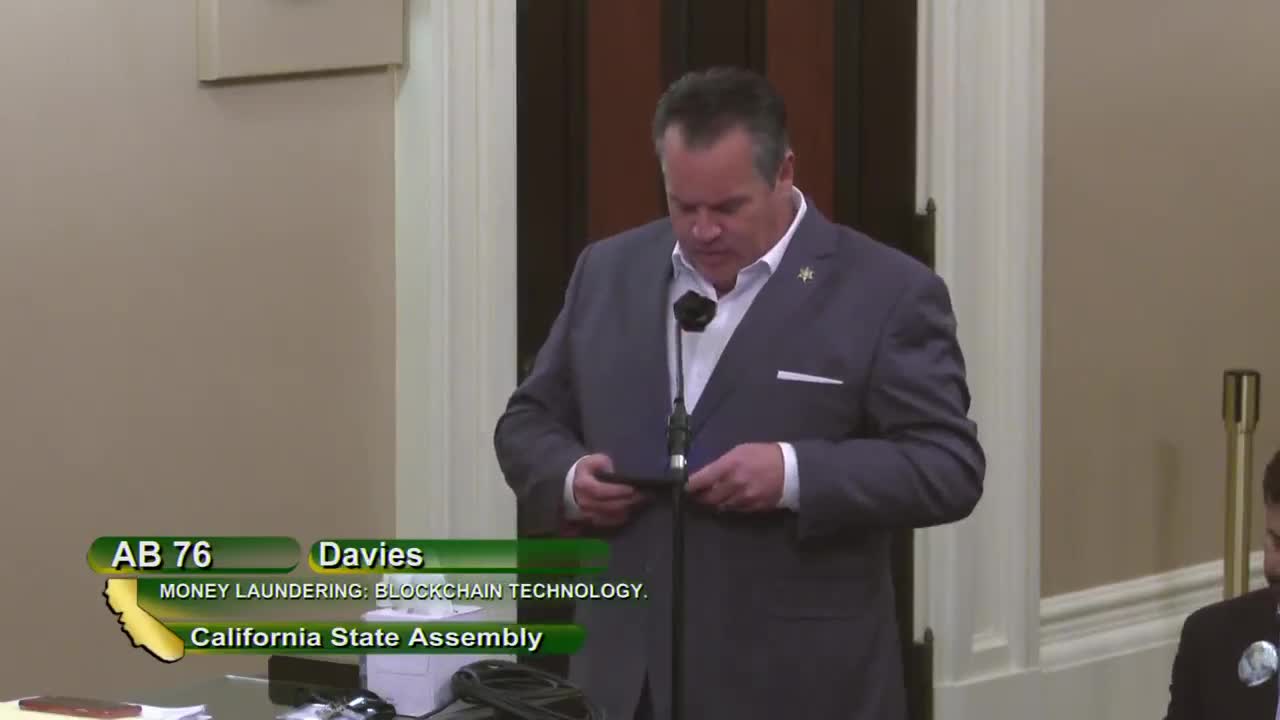 27MIN
Assembly Standing Committee on Public Safety
Bill Author




