AB 1952: Foster care: infant supplement.
- Session Year: 2023-2024
- House: Assembly
- Latest Version Date: 2024-01-29
Current Status:
Failed
(2024-05-16: In committee: Held under submission.)
Introduced
In Committee
First Chamber
In Committee
Second Chamber
Enacted
What does this bill do?
The bill raises the infant supplement — the extra monthly payment for care and supervision of an infant — by $517.24 for children living with a parent who receives AFDC‑FC, Kin‑GAP, or ARC payments. The new amount will be adjusted each year using the California Necessities Index and will be paid only if the state budget provides the funding.
The summary is provided by generative AI which can make mistakes. For original language, please view the details in the table below.
Existing law establishes the Aid to Families with Dependent Children-Foster Care (AFDC-FC) program, under which counties provide payments to foster care providers on behalf of qualified children in foster care. Existing law establishes a schedule of basic rates to be paid for the care and supervision of each foster child. Existing law also establishes the Kinship Guardianship Assistance Payment Program (Kin-GAP), which provides aid on behalf of eligible children who have a kinship guardianship, and the Approved Relative Caregiver Funding Program (ARC), which provides payments to approved relative caregivers who are caring for children and nonminor dependents who are ineligible for AFDC-FC payments.
Existing law requires, when a child is living with a parent who receives AFDC-FC or Kin-GAP benefits, or ARC payments, that the rate paid to the foster care provider on behalf of the parent include an additional amount, known as an infant supplement, for the care and supervision of the child.
This bill would increase the infant supplement by $517.24 monthly, to be adjusted as specified for inflation and subject to an appropriation in the annual Budget Act. To the extent the bill would impose new requirements on counties administering the AFDC-FC or Kin-GAP benefits or ARC payments, this bill would impose a state-mandated local program.
The California Constitution requires the state to reimburse local agencies and school districts for certain costs mandated by the state. Statutory provisions establish procedures for making that reimbursement.
This bill would provide that no reimbursement is required by this act for a specified reason.
(a)If a child is living with a parent who receives AFDC-FC or Kin-GAP benefits, or, on or after July 1, 2017, Approved Relative Caregiver Funding Program (ARC) payments, the rate paid to the provider on behalf of the parent shall include an amount for care and supervision of the child.
(b)For each category of eligible licensed community care facility, as defined in Section 1502 of the Health and Safety Code, the department shall adopt regulations setting forth a uniform rate to cover the cost of care and supervision of the child in each category of eligible licensed community care facility.
(c)(1)On and after July 1, 1998, the uniform rate to cover the cost of care and supervision of a child pursuant to this section shall be increased by 6 percent, rounded to the nearest dollar. The resultant amounts shall constitute the new uniform rate.
(2)(A)On and after July 1, 1999, the uniform rate to cover the cost of care and supervision of a child pursuant to this section shall be adjusted by an amount equal to the California Necessities Index computed pursuant to Section 11453, rounded to the nearest dollar. The resultant amounts shall constitute the new uniform rate, subject to further adjustment pursuant to subparagraph (B).
(B)In addition to the adjustment specified in subparagraph (A), on and after January 1, 2000, the uniform rate to cover the cost of care and supervision of a child pursuant to this section shall be increased by 2.36 percent, rounded to the nearest dollar. The resultant amounts shall constitute the new uniform rate.
(3)Subject to the availability of funds, for the 200001 fiscal year and annually thereafter, these rates shall be adjusted for cost of living pursuant to procedures in Section 11453.
(4)On and after January 1, 2008, the uniform rate to cover the cost of care and supervision of a child pursuant to this section shall be increased by 5 percent, rounded to the nearest dollar. The resulting amount shall constitute the new uniform rate.
(5)Commencing July 1, 2016, the uniform rate to cover the cost of care and supervision of a child pursuant to this section shall be supplemented by an additional monthly amount of four hundred eighty-nine dollars ($489). This monthly supplement shall only be provided if funding for this purpose is appropriated in the annual Budget Act.
(6)Commencing January 1, 2025, the uniform rate to cover the cost of care and supervision of a child pursuant to this section shall be supplemented by an additional monthly amount of five hundred seventeen dollars and twenty-four cents ($517.24), to be adjusted by an amount equal to the California Necessities Index computed pursuant to Section 11453. This monthly supplement shall be provided only if funding for this purpose is appropriated in the annual Budget Act.
(d)(1)(A)Prior to July 1, 2017, and notwithstanding subdivisions (a) to (c), inclusive, the payment made pursuant to this section for care and supervision of a child who is living with a teen parent in a whole family foster home, as defined in Section 11400, shall equal the basic rate for children placed in a licensed or approved home as specified in subdivisions (a) to (d), inclusive, and subdivision (g), of Section 11461.
(B)On or after July 1, 2017, the payment made for care and supervision of a child who is living with a teen parent in a whole family foster home shall be the uniform rate developed pursuant to subdivision (c).
(2)(A)The amount paid for care and supervision of a dependent infant living with a dependent teen parent receiving AFDC-FC benefits in a group home placement shall equal the infant supplement rate for group home placements.
(B)Commencing January 1, 2017, the amount paid for care and supervision of a dependent infant living with a dependent teen parent receiving AFDC-FC benefits in a short-term residential therapeutic program shall equal the infant supplement rate for short-term residential therapeutic programs established by the department.
(3)(A)The caregiver shall provide the county child welfare agency or probation department with a copy of the shared responsibility plan developed pursuant to Section 16501.25 and shall advise the county child welfare agency or probation department of any subsequent changes to the plan. Once the plan has been completed and provided to the appropriate agencies, the payment made pursuant to this section shall be increased by an additional two hundred dollars ($200) per month to reflect the increased care and supervision while the dependent teen parent is placed in the whole family foster home.
(B)A nonminor dependent parent residing in a supervised independent living placement, as defined in subdivision (w) of Section 11400, who develops a written parenting support plan pursuant to Section 16501.26 shall provide the county child welfare agency or probation department with a copy of the plan and shall advise the county child welfare agency or probation department of any subsequent changes to the plan. The payment made pursuant to this section shall be increased by an additional two hundred dollars ($200) per month after all of the following have been satisfied:
(i)The plan has been completed and provided to the appropriate county agency.
(ii)The plan has been approved by the appropriate county agency.
(iii)The county agency has determined that the identified responsible adult meets the criteria specified in Section 16501.27.
(4)In a year in which the payment provided pursuant to this section is adjusted for the cost of living as provided in paragraph (1) of subdivision (c), the payments provided for in this subdivision shall also be increased by the same procedures.
(5)A Kin-GAP relative who, immediately prior to entering the Kin-GAP program, was designated as a whole family foster home shall receive the same payment amounts for the care and supervision of a child who is living with a teen parent they received in foster care as a whole family foster home.
(6)(A)On and after January 1, 2012, and prior to July 1, 2017, the rate paid for a child living with a teen parent in a whole family foster home as defined in Section 11400 shall also be paid for a child living with a nonminor dependent parent who is eligible to receive AFDC-FC or Kin-GAP benefits pursuant to Section 11403.
(B)On and after July 1, 2017, the rate paid for a child living with a teen parent in a whole family foster home as defined in Section 11400 shall also be paid for a child living with a nonminor dependent parent who is eligible to receive AFDC-FC, ARC, or Kin-GAP benefits pursuant to Section 11403.
(e)(1)Commencing January 1, 2022, the rate paid for a pregnant minor or nonminor dependent for the three-month period immediately prior to the month in which the birth is anticipated shall include the amount that would otherwise be paid under this section to cover the care and supervision of a child, if born. Any amount paid pursuant to this subdivision shall be an expectant parent payment used to meet the specialized needs of the pregnant minor or nonminor dependent and to properly prepare for the needs of the infant.
(2)The department shall work with the County Welfare Directors Association of California and the California Statewide Automated Welfare System (CalSAWS) to develop and implement the necessary system changes to implement the expectant parent payment. The payment shall be automated on July 1, 2023, or when the department notifies the Legislature that CalSAWS can perform the necessary automation to implement it, whichever is later.
(3)Prior to the automation of the expectant parent payment in the CalSAWS system, counties shall issue a single payment in one lump sum for an expectant minor or nonminor dependent equal to three times the monthly amount paid pursuant to subdivision (a). The payment shall be issued in the month that is three months prior to the expected due date, or as soon as the county agency becomes aware of the pregnancy, and regardless of the date of entry into foster care or outcome of the pregnancy.
(4)The payment, or payments, made pursuant to this section shall not be prorated and overpayments shall not be established or collected.
SEC. 2.To the extent that this act has an overall effect of increasing the costs already borne by a local agency for programs or levels of service mandated by the 2011 Realignment Legislation within the meaning of Section 36 of Article XIII of the California Constitution, it shall apply to local agencies only to the extent that the state provides annual funding for the cost increase. Any new program or higher level of service provided by a local agency pursuant to this act above the level for which funding has been provided shall not require a subvention of funds by the state or otherwise be subject to Section 6 of Article XIIIB of the California Constitution.
REVISIONS: HeadingLine 2.|
Date
|
Status
|
|---|---|
| May 16, 2024 | In committee: Held under submission. |
| Apr 24, 2024 | In committee: Set, first hearing. Referred to APPR. suspense file. |
| Apr 3, 2024 | Coauthors revised. |
| Apr 3, 2024 | From committee: Do pass and re-refer to Com. on APPR. (Ayes 7. Noes 0.) (April 2). Re-referred to Com. on APPR. |
| Feb 12, 2024 | Referred to Com. on HUM. S. |
| Jan 30, 2024 | From printer. May be heard in committee February 29. |
| Jan 29, 2024 | Read first time. To print. |
|
Date
|
Description
|
Location
|
Votes
|
|
|---|---|---|---|---|
| Apr 2, 2024 | Do pass and be re-referred to the Committee on [Appropriations] | Assembly Standing Committee on Human Services |
Passed |
This list shows positions taken on this bill by organizations on the date displayed, which is linked to the original source.
Positions by individuals are not included.
|
Organization
|
Position
|
Date
|
|---|---|---|
| Alliance for Children's Rights | ** Support | |
| Aspiranet | * Support | Apr 2, 2024 |
| Association Of Regional Center Agencies | * Support | Apr 2, 2024 |
| California Alliance Of Child And Family Services | * Support | Apr 2, 2024 |
| California Catholic Conference | ** Support | |
| California Youth Connection | * Support | Apr 2, 2024 |
| Casa de Amparo | ** Support | |
| First Place for Youth | * Support | Apr 2, 2024 |
| Mary's Path | ** Support | |
| Mary's Path | * Support | Apr 2, 2024 |
| New Beginnings Residential Treatment Facilities | ** Support | |
| St Anne's Family Services | ** Support |
Date of Hearing: April 24, 2024
ASSEMBLY COMMITTEE ON APPROPRIATIONS
Buffy Wicks, Chair
ABPCA Bill Id:AB 1952
Author:(Dixon) – As Introduced Ver:January 29, 2024
Policy Committee: | Human Services | Vote: | 7 - 0 |
|
| ||
|
|
Urgency: No State Mandated Local Program: Yes Reimbursable: No
SUMMARY:
This bill increases the additional rate paid to cover the cost of care and supervision of a child of a foster youth by an additional $517.24 per month, subject to an appropriation in the annual budget act. The bill also requires this rate, known as the infant supplement, be adjusted annually according to the California Necessities Index (CNI).
FISCAL EFFECT:
- Estimated General Fund (GF) costs of approximately $2 million in fiscal year (FY) 2024-25, and $4 million in FY 2025-26, increasing annually thereafter dependent on the CNI, to provide the infant supplement increases to parenting foster youth. This estimate assumes a caseload of 690.
- Estimated GF costs of approximately $150,000 in FY 2024-25 and $300,000 in FY 2025-26 and ongoing for additional county administrative workload, until automation updates are completed. Although these are state-mandated costs, they are not reimbursable, but instead must be funded by the state pursuant to Proposition 30 (2012), which requires legislation that increases costs already borne by a local agency for programs or levels of service mandated by realignment (including child welfare services and foster care) to apply to local agencies only to the extent the state provides annual funding for the cost increase.
- Estimated one-time GF costs of approximately $172,000 in FY 2024-25 to automate payment increases in the California Statewide Automated Welfare System (CalSAWS). Once the automation update is complete, ongoing maintenance costs for payment changes due to the CNI increase are estimated to be about $70,000 annually.
Increases to the infant supplement are typically done through the budget process. The author has submitted a budget request associated with this bill for a one-time allocation of $4.3 million from the General Fund.
According to the Legislative Analyst’s Office, the General Fund faces a structural deficit in the tens of billions of dollars over the next several fiscal years.
COMMENTS:
- Purpose. To better support parenting foster youth, the author seeks to increase the infant supplement rate to account for inflation since 2016, and to provide for automatic annual adjustments going forward. According to the author:
We have a responsibility to support the parenting foster youth in California through continuing to secure sufficient resources relevant to their specialized situations. These young parents are facing immense challenges as they are working towards the prosperity of not only themselves, but their child or children. We need to continue to fight against the traumatic stressors presented to these vulnerable communities as they enter the challenging world of parenthood.
- Background. Existing law establishes the Aid to Families with Dependent Children-Foster Care (AFDC-FC) program, under which counties provide payments to foster care providers on behalf of qualified children in foster care Existing law also establishes the Kinship Guardianship Assistance Payment Program (Kin-GAP), which provides aid on behalf of eligible children who have a kinship guardianship, and the Approved Relative Caregiver Funding Program (ARC), which provides payments to approved relative caregivers who are caring for children and non-minor dependents who are ineligible for AFDC-FC payments.
Existing law requires, when a child is living with a parent who receives AFDC-FC or Kin-GAP benefits, or ARC payments, the rate paid to the foster care provider on behalf of the parent include an additional amount, known as an infant supplement, for the care and supervision of the child. CDSS estimates approximately 690 foster youth received the infant supplement in 2023.
Existing regulations require the infant supplement be used only for the care and supervision of the child of the eligible parent. The rate is expected to cover the cost of all of the baby’s needs, including childcare, clothing, diapers, formula, food, and transportation to all medical visits for the baby. The infant supplement rate varies based on the placement type of the foster youth. The rate was last adjusted in 2016, when it was raised by $489 per month. This adjustment brought the total supplement rate to $900 per month for those in foster family homes and similar settings, and $1,379 per month for foster youth in group home settings (AB 1603, Committee on Budget, Chapter 25, Statutes of 2016).
The infant supplement payment is one of the few foster care rates not automatically increased each year by a CNI-based cost-of-living adjustment. This bill increases the infant supplement by an additional $517.24 per month, to match the rate of inflation since 2016, and requires the amount be adjusted annually thereafter according to the CNI.
Analysis Prepared by: Jennifer Swenson / APPR. / (916) 319-2081
Date of Hearing: April 2, 2024
ASSEMBLY COMMITTEE ON HUMAN SERVICES
Alex Lee, Chair
ABPCA Bill Id:AB 1952 (
Author:Dixon) – As Introduced Ver:January 29, 2024
SUBJECT: Foster care: infant supplement
SUMMARY: Requires, commencing January 1, 2025, the rate to cover the cost of care and supervision of a child of a foster youth to be supplemented by an additional monthly amount of $517.24, if funding is appropriated in the annual Budget Act, to be adjusted by an amount equal to the California Necessities Index (CNI).
EXISTING LAW:
Requires the California Department of Social Services (CDSS), for each category of eligible licensed community care facility, as defined, to adopt regulations setting forth a uniform rate to cover the cost of care and supervision of a child of a foster youth. (Welfare and Institutions Code [WIC] § 11465(b))
- Defines a “community care facility” to mean any facility, place, or building that is maintained and operated to provide nonmedical residential care, day treatment, adult daycare, or foster family agency services for children, adults, or children and adults, including, but not limited to, the physically handicapped, mentally impaired, incompetent persons, and abused or neglected children. (Health and Safety Code [HSC] § 1502(a))
- Requires, if a child is living with a parent who receives Aid to Families with Dependent Children-Foster Care (AFDC-FC) or Kinship Guardian Assistance Payment Program (Kin-GAP) benefits or Approved Relative Caregiver Funding Program (ARC) payments, the rate paid to the provider on behalf of the parent to include an amount for care and supervision of the child. (WIC § 11465(a))
- Requires foster care providers to be paid a per-child, per-month rate in return for the care and supervision of the AFDC-FC child placed with them. Designates CDSS as the single organizational unit whose duty it shall be to administer a state system for establishing rates in the AFDC-FC program. Requires state functions to be performed by CDSS or by delegation of CDSS to county welfare departments or Indian tribes, consortia of tribes, or tribal organizations that have entered into an agreement. (WIC § 11460(a)(1))
- Defines “care and supervision” to include food, clothing, shelter, daily supervision, school supplies, a child’s personal incidentals, liability insurance with respect to a child, reasonable travel to the child’s home for visitation, and reasonable travel for the child to remain in the school in which the child is enrolled at the time of placement. Requires reimbursement for the costs of educational travel, to be made pursuant to procedures determined by CDSS, in consultation with representatives of county welfare and probation directors, and additional stakeholders, as appropriate. (WIC § 11460(b))
- Increased, as of July 1, 1998, the uniform rate to cover the cost of care and supervision of a child by 6%, rounded to the nearest dollar. (WIC § 11465(c)(1))
- Adjusted as of July 1, 1999, the uniform rate to cover the cost of care and supervision of a child by an amount equal to the CNI, rounded to the nearest dollar. (WIC § 11465(c)(2)(A))
- Required, in addition to the adjustment specified in 7) above, on and after January 1, 2000, the new uniform rate to cover the cost of care and supervision of a child to be increased by 2.36%, rounded to the nearest dollar. (WIC § 11465(c)(2)(B))
- Required, on and after January 1, 2008, the new uniform rate to cover the cost of care and supervision of a child to be increased by 5%, rounded to the nearest dollar. (WIC § 11465(c)(2)(B)(4))
- Specifies that on or after July 1, 2017, the payment made for care and supervision of a child who is living with a teen parent in a whole-family foster home shall be the uniform rate developed pursuant to 6) above. (WIC § 11465(d))
- Requires minimum basic standards of adequate care to be distributed to the counties and to be binding upon them. Specifies the standards are determined based on the schedule set forth in existing law, as adjusted for cost-of-living increases or decreases, designed to ensure safe, healthful housing; minimum clothing for health and decency; low-cost adequate food budget meeting recommended dietary allowances of the National Research Council; utilities; other items including household operation, education and incidentals, recreation, personal needs, and insurance; and allowance for essential medical, dental, or other remedial care to the extent not otherwise provided at public expense. (WIC § 11452(a))
- Specifies that nothing shall preclude a county from using a portion of its county funds to increase rates paid to family homes, foster family agencies, group homes, and short-term residential therapeutic programs (STRTPs) within that county, and to make payments for specialized care increments, clothing allowances, or infant supplements to homes within that county, solely at that county’s expense. (WIC § 11460(e))
- Requires the amounts set forth as described in 11) above to be adjusted annually by CDSS to reflect any increases or decreases in the cost of living. Requires these adjustments to become effective July 1 of each year, unless otherwise specified by the Legislature. Requires the cost-of-living adjustment to be calculated by the Department of Finance based on the changes in the CNI, which means the weighted average changes for food, clothing, fuel, utilities, rent, and transportation for low-income consumers, and specifies the steps in which computation of annual adjustments in the CNI shall be made. (WIC § 11453(a))
- Required, commencing July 1, 2016, the uniform rate to cover the cost of care and supervision of a child to be supplemented by an additional monthly amount of $489, as long as funding for this purpose is appropriated in the annual Budget Act. (WIC § 11465(c)(2)(B)(5))
- Encourages, in order to recruit, train, and retain qualified and supportive foster care providers for parenting foster youth, CDSS and local child welfare agencies, in consultation with other interested stakeholders, to collect information to be used to develop a more cost-effective infant supplemental payment rate structure that more adequately reimburses caregivers for the costs of infant care and teen parent mentoring. (WIC § 16004.5(d))
FISCAL EFFECT: Unknown, this bill has not been analyzed by a fiscal committee.
COMMENTS:
Background: Parenting Foster Youth. SB 1178 (Kuehl, Chapter 841, Statutes of 2004) required, to the greatest extent possible, county child welfare agencies, in conjunction with providers and the state, to identify and utilize whole family placements that provide foster care to teen parents and their infants, and other placement models in order to provide supportive family-focused care for minor foster youth and their children. The bill further required, in identifying these placements, county child welfare agencies to work with providers and stakeholders to identify and develop programs and program models designed to meet these goals.
SB 1178 also made findings and declarations related to the urgent need to develop placement resources to permit minor parents and their children to remain together in out-of-home care when the minor parent is removed from the custody of their parents due to abuse or neglect. To address these considerations, SB 1178 encouraged CDSS and local child welfare agencies to collect data on the number of minors in foster care who give birth and the number of minor parents who remain in placement with their minor children and to aggregate the data annually.
According to data from CDSS, there were 740 youth identified in the calendar year of 2023 in the Child Welfare Services/Case Management System who are potential parents between the ages of 11 and 20.
SB 1178 also directed CDSS and local child welfare agencies, to recruit, train, and retain qualified foster care providers for parenting foster youth, in consultation with other stakeholders, to collect information to be used to develop a more cost-effective infant supplemental payment rate structure that more adequately reimburses caregivers for the costs of infant care and teen parent mentoring. Twenty years beyond the establishment of this policy, many providers report they are still struggling to meet the needs of their parenting foster youth under their care.
It should be noted that existing law specifies that nothing precludes a county from using a portion of its county funds to increase rates paid to family homes, foster family agencies, group homes, and STRTPs within that county, and to make payments for specialized care increments, clothing allowances, or infant supplements to homes within that county, solely at that county’s expense.
Foster Care Rate Structure. California state law mandates that CDSS administer a system for establishing rates within the AFDC-FC program. This system is intended to ensure appropriate rates are set to support children in foster care. Specifically, CDSS is responsible for implementing a rate structure that covers various aspects of foster care, including:
- Resource Family Rates: For foster parents (resource families) who provide care for children in their homes;
- Level of Care Resource Family Rates: Considers the specific needs and circumstances of each child;
- Kin-GAP Rates: For kinship caregivers who have legal guardianship of a child;
- Adoption Assistance Program Rates: For adoptive parents who receive assistance;
- Foster Family Agency Rates: For agencies that provide foster care services;
- STRTP Rates: For specialized residential programs;
- Intensive Services (ISFC) Rates: For intensive services provided to children with complex needs;
- Transitional Housing Placement Nonminor Dependent (THP-NMD) Rates: For older youth in transitional housing; and,
- Supervised Independent Living Placements (SILP) Rates: For NMDs as they transition to independent living.
Existing law required, for the 2016-17 fiscal year, CDSS to develop a basic rate in coordination with the development of the foster family agency rate that ensures a child placed in a home-based setting, and a child placed in a certified family home or with a resource family approved by a foster family agency, is eligible for the same basic rate.
The 2022‑23 budget package extended the date that the interim foster care rates would remain operative. These rates are now in effect through December 31, 2024, with final rates expected to be implemented by January 1, 2025.
CDSS convened a number of stakeholder workgroups in the fall of 2022 to provide input into the permanent rate structure. Specifically, four workgroups were convened comprising relevant stakeholders to consider rates for resource families, foster family agencies, ISFC, and STRTPs. CDSS has developed a proposal for the permanent rate structure to be implemented by January 1, 2025, as required by statute, and indicated that the infant supplement is not proposed to be included in their forthcoming rate reform. As part of the April 3, 2024, hearing in the Assembly Budget Subcommittee No. 2 on Human Services, the Governor’s proposal on a permanent rate structure will be discussed generally.
Infant Supplement. The infant supplement is an additional payment tied to the Aid to Families with Dependent Children-Foster Care (AFDC-FC) program, the Kinship Guardian Assistance Payment Program (Kin-GAP), or the Approved Relative Caregiver Funding Program (ARC) to provide for children of parenting foster youth who live with their parent in a foster care setting. While foster youth can continue to be in foster care until they reach the age of 21, their child is not born into the system. Several other categories of parenting foster youth who are living with their child are also eligible for the infant supplement, including probation-supervised youth who are living in foster care, NMDs in extended foster care, and youth in non-related legal guardianships who are receiving AFDC-FC.
According to an All County Information Notice (I-10-20) issued by CDSS in February 2020, both male and female parenting youth can be eligible for an infant supplement, and all eligible teens and NMDs should be regularly screened for current or impending parenthood. The information notice states that a best practice is for social workers/probation officers to ask at monthly visits and to follow up on information that indicates a youth has a child living with them or is expecting a child. When this payment is provided to foster youth before giving birth, it is called the expectant parent payment but is the same non-optional, federally required supplemental uniform payment designed to help with the care and supervision of a child living with a parenting foster youth.
An infant supplement payment is typically given to the youth’s caregiver on their behalf, with the exception of NMDs living in an SILP who receive their payment directly. The SILP is the only foster care placement where the monthly foster care rate is paid directly to the youth. The SILP rate is the “basic rate” which in FY 2022-23 is $1,129 per month and increases annually according to the CNI. Existing regulations state that infant supplements are to be used only for the care and supervision of the child of the eligible parent. The supplement is paid on behalf of the parent who has primary physical custody of the child.
The infant supplement was established in federal law in 1985 and in California in 1986. The rate varies based on the placement type that the foster youth is in, but was originally set at $326 per month for whole family foster homes, and foster family homes and increased to $411 or $890 a month if in a group home placement, where it remained for approximately 20 years. In 2008, the rate was increased by 5% and was not adjusted until 2016, when it was raised to $1,379.00 for residents of STRTPs and $900 per month for those in other settings. It has remained at this rate since.
The infant supplement payment is one of only two foster care rates that are not automatically increased each year by a CNI-based cost-of-living adjustment. This supplement is expected to pay for all of the baby's needs, such as childcare while the teen mom attends high school or works, diapers, clothing, formula, food, parenting classes, supervision, and transportation to all medical visits for the baby.
In July of 2023, CDSS issued All County Letter (ACL) 23-6 to provide the adjusted schedule of rates that reflect the CNI increase of 6.85% for fiscal year 2023-24 effective July 1, 2023. The CNI increase was applicable to out-of-home placements and the AFDC-FC program. The ACL also discussed foster family agencies being provided a one-time 8.8% increase to specified components of certain rate classifications.
The CNI is a measure of price inflation for basic goods such as food and clothing that is relevant for many human services programs. When there are changes to rates based on the CNI, CDSS issues letters and guidelines to inform counties and providers about rate changes and requirements. According to the Legislative Analyst’s Office in November of 2022, the CNI grew by 6.6% in 2021, compared to an average of 3.6% over the previous five years. Because the CNI directly influences foster care rates when the CNI rises, adjustments are made to ensure that support adequately reflects the rising costs of essential goods and services.
This bill proposes to address the issue of rising costs by increasing the supplement by an additional $517.24 per month to match the rate of inflation since 2016. This would increase the total supplement for parenting foster youth in STRTPs from $1,379 to $1,896.24 per month.
Author’s Statement: According to the Author, “We have a responsibility to support the parenting foster youth in California through continuing to secure sufficient resources relevant to their specialized situations. These young parents are facing immense challenges as they are working towards the prosperity of not only themselves, but their child or children. We need to continue to fight against the traumatic stressors presented to these vulnerable communities as they enter the challenging world of parenthood.
“Prioritizing these youths at the beginning of their difficult, yet admirable, journey is necessary in order to promote healthy physical and mental development for generations. [This bill] demonstrates California's dedication to taking the steps needed to combat inflation for those struggling with accessibility issues, specifically regarding infant necessities.
“Increasing the monthly supplement rate for parenting foster youth will not only bring much needed relief among high inflation rates but demonstrate how our state's priorities are focused on assisting and strengthening those who are in vulnerable situations.”
Equity Implications: The provisions of this bill are aimed at addressing the need for additional financial support for providers who are caring for parenting foster youth. The state has a responsibility to support parenting foster youth and to secure sufficient resources to address their specialized situations. These young parents are facing tremendous challenges as they are working toward independence for themselves and their children. A co-sponsor of this bill, an STRTP facility named Mary’s Path, reports that the average age of a teen mom giving birth at a California STRP is 15.5 years of age.
According to Mary's Path, 100% of residents in an STRTP are low income, 66% are Latino, and 33% are Black, which reflects the disproportionality that exists in the child welfare system, both along racial and ethnic lines, but also along income levels. Furthermore, parenting foster youth requires more support and specialized needs. Young adults living in foster care receive minimum if any, familial support compared to their peers, and they face difficulties with unemployment and underemployment, finding safe, affordable housing, and avoiding hunger and homelessness.
These stressors are compounded when young people are parenting, which can cause trauma across multiple generations. Parenting foster youth encounter more challenges than their peers, including accessing childcare. In a recent survey of youth in THP NMDs, only one in five were able to access subsidized childcare.
RELATED AND PRIOR LEGISLATION:
AB 2189 (Friedman) of 2022, would have required the rate paid for a pregnant minor or NMD for the three-month period immediately prior to the month in which the birth is anticipated to include the amount that would otherwise be paid to cover the care and supervision of a child if born. Requires any amount paid to an expectant parent to be used to meet the specialized needs of the pregnant minor or NMD and to properly prepare for the needs of the infant. AB 2189 was vetoed by Governor Newsom due to cost.
AB 153 (Committee on Budget), Chapter 86, Statutes of 2021, was the budget trailer bill that accompanied the appropriations made in the 2021 Budget Act and among other provisions, allowed a pregnant minor or NMD to be eligible for the infant supplement for a specified period before the expected date of birth. Required DSS to develop and implement automated payments for these purposes.
AB 2880 (Ting) of 2020, would have required, subject to an appropriation, the rates paid to a transitional housing provider to be supplemented at a rate based on a percentage of the average foster care expenditures for foster youth according to their age and the county in which the program operates. AB 2880 was set to be heard by the Assembly Human Services Committee but the hearing was postponed by the committee. This policy was subsequently enacted through the Budget Act, AB 79 (Committee on Budget), Chapter 11, Statutes of 2020.
SB 1178 (Kuehl), Chapter 841, Statutes of 2004, required child welfare agencies, in conjunction with providers and the state, to identify and utilize whole family placements and other placement models that provide supportive family-focused care for dependent teens and their children. The bill further required, in identifying these placements, for child welfare agencies to work with providers and stakeholders to identify and develop programs and program models designed to meet these goals.
REGISTERED SUPPORT / OPPOSITION:
Support
Mary's Path (Sponsor)
Alliance for Children's Rights
Aspiranet
Association of Regional Center Agencies
California Alliance of Child and Family Services
California Catholic Conference
Casa De Amparo
First Place for Youth
New Beginnings Residential Treatment Facilities
St Anne's Family Services
Opposition
None on file.
Analysis Prepared by: Jessica Langtry / HUM. S. / (916) 319-2089
Discussed in Hearing
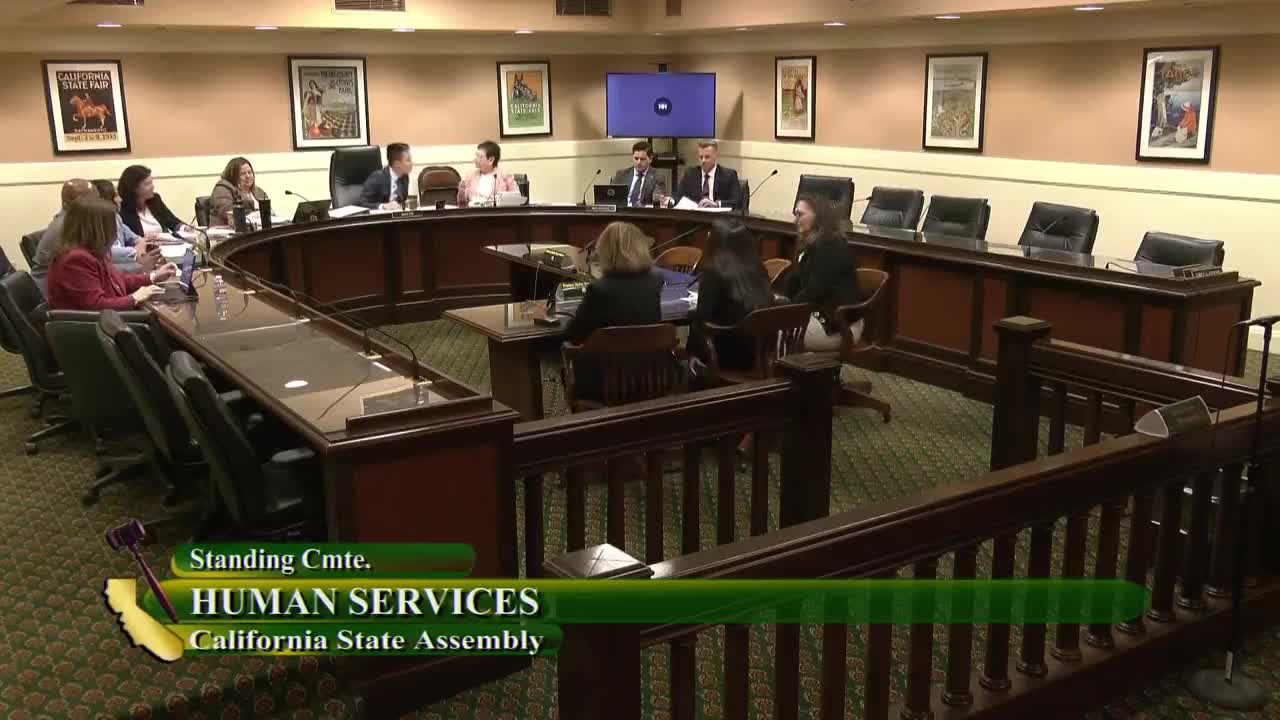 8MIN
Assembly Standing Committee on Human Services
Bill Author