AB 2065: Criminal justice records: offender data.
- Session Year: 2023-2024
- House: Assembly
- Latest Version Date: 2024-04-17
Current Status:
Failed
(2024-05-16: In committee: Held under submission.)
Introduced
In Committee
First Chamber
In Committee
Second Chamber
Enacted
(1)Existing law prohibits the state from seeking a criminal conviction or sentence on the basis of race, ethnicity, or national origin. Existing law authorizes a defendant to file a motion in the trial court or, if judgment has been imposed, to file a petition for writ of habeas corpus to allege a violation of this prohibition or to allege a violation on appeal.
Existing law requires all public records to be made available for inspection to the public, except as specifically exempted. Existing law exempts from disclosure certain records of law enforcement agencies.
This bill would require the disclosure of specified arrest records and data and specified probation reports to a licensed attorney that has submitted a request for such records and declared, under penalty of perjury, that the records are being requested for the purpose of investigating a claim or potential claim under the California Racial Justice Act of 2020, as specified.
By requiring additional duties of local agencies, this bill would impose a state-mandated local program.
By expanding the crime of perjury, this bill would impose a state-mandated local program.
(2)Existing law requires the Judicial Council to collect data on criminal cases statewide relating to the disposition of those cases according to the race and ethnicity of the defendant, and report annually to the Legislature. Existing law additionally requires the Department of Justice to compile specified crime statistics and make that information available to the public, as specified.
This bill would require the Judicial Council to include additional data in their annual report to the Legislature, and to make the data available to the public in a machine-readable format.
The bill would also require the Department of Justice to include additional data in their crime statistics and make those data available to the public in a machine-readable format.
The bill would additionally require the Department of Corrections and Rehabilitation to annually publish specified inmate data and to make those data available to the public in a machine-readable format.
(3)The California Constitution requires local agencies, for the purpose of ensuring public access to the meetings of public bodies and the writings of public officials and agencies, to comply with a statutory enactment that amends or enacts laws relating to public records or open meetings and contains findings demonstrating that the enactment furthers the constitutional requirements relating to this purpose.
This bill would make legislative findings to that effect.
(4)The California Constitution requires the state to reimburse local agencies and school districts for certain costs mandated by the state. Statutory provisions establish procedures for making that reimbursement.
This bill would provide that no reimbursement is required by this act for specified reasons.
Under existing law, a felony is a crime that is punishable with death, or by imprisonment in the state prison, or by imprisonment in a county jail for more than one year. Under existing law, every other crime or public offense is a misdemeanor, except those offenses that are classified as infractions.This bill would make technical, nonsubstantive changes to these provisions.Under existing law, a felony is a crime that is punishable with death, or by imprisonment in the state prison, or by imprisonment in a county jail for more than one year. Under existing law, every other crime or public offense is a misdemeanor, except those offenses that are classified as infractions.
This bill would make technical, nonsubstantive changes to these provisions.
It is the intent of the Legislature in enacting this act to ensure that claims under the California Racial Justice Act of 2020 Section 745 of the Penal Code are resolved efficiently and meaningfully and that counsel for litigants and the courts have access to critical information to analyze and confront racial bias in policing, prosecution, and sentencing.
SEC. 2.Section 745.1 is added to the Penal Code, to read:745.1.(a)Notwithstanding any contrary provision of the California Public Records Act (Division 10 (commencing with Section 7920.000) of Title 1 of the Government Code), the following records shall be promptly disclosed to a California licensed attorney upon request, as provided in this section:
(1)Any and all arrest records or arrest data within the period of time requested that are in the possession of any state or local law enforcement agency, regardless of the date of the arrest or the date of the creation of the record.
(2)Any and all probation reports within the period of time requested that are in the possession of a county probation department or, if no longer in the possession of the probation department, in the possession of the district attorney, regardless of the date they were prepared or submitted. For purposes of this paragraph, a probation report means a presentence report that was prepared and submitted to the court pursuant to subdivision (b) of Section 1203.
(b)Any request made pursuant to subdivision (a) must be made in writing and include a declaration under penalty of perjury that the requester is an attorney licensed in California and the records are being requested for the purpose of assisting in the investigation of a claim or potential claim under Section 745.
(c)In order to protect a privacy right or privilege, the agency in possession of records sought pursuant to this section may, in good faith, petition the court to permit the redaction of information prior to disclosure or subject disclosure to a protective order. If a statutory privilege or constitutional privacy right cannot be adequately protected by redaction or a protective order, the court shall consider if aggregate data can be reasonably provided. If there is no mechanism to adequately protect statutory privilege or constitutional privacy rights, the court shall order the record not to be released. This provision shall not be used to intentionally delay or obstruct the disclosure of records.
(d)As used in this section, law enforcement agency means any city police department, county sheriffs department, or any other department or agency of the state, or any political subdivision thereof, that employs any peace officer as described in Section 830.
SEC. 3.Section 1170.45 of the Penal Code is amended to read:1170.45.(a)The Judicial Council shall collect data on criminal cases statewide relating to the disposition of those cases according to the race and ethnicity of the defendant, and report annually thereon to the Legislature. It is the intent of the Legislature to appropriate funds to the Judicial Council for this purpose.
(b)Commencing on January 1, 2025, the report required by this section shall be disaggregated by county of conviction and shall contain all of the following data: include county-level analysis.
(c)Commencing on January 1, 2025, the Judicial Council shall annually prepare and make available to the public in a machine-readable format the following data, without limitation, for each person convicted of a criminal offense during the calendar year:
(1)The race, ethnicity, gender, and age and gender of the defendant.
(2)The age of the defendant at the time of sentencing.
(2)The offenses
(3)Each offense for which the defendant is charged, was convicted, including the code section for each offense.
(3)The disposition of the cases, including, without limitation, whether a case resulted in a dismissal or a conviction.(4)The county of conviction.
(5)For each convicted offense, the type of sentence imposed, including, but not limited to, a prison term, a jail term, a term of probation and jail, or a term of probation.
(4)The
(6)For each convicted offense, the length of the sentence imposed.
(c)(d)If the number of individuals in any category of offenses or type of disposition for a county offense in paragraph (3) of subdivision (c) in any single county is fewer than 10, the report data shall list those numbers for that offense from that county as fewer than 10 in order to protect personally identifying information. If the number is zero, the data shall list the number as zero.
(d)The data for the report shall be made available to the public in a machine-readable format.SEC. 4.Section 2069 is added to the Penal Code, to read:2069.The department shall annually prepare and make available to the public in a machine-readable format the following data, without limitation, for each person who is currently in department custody or, at any point during the calendar year preceding the release of the data, was in department custody:
(a)The persons county of conviction.
(b)The code sections for the controlling offense and for each other offense for which the person was convicted.
(c)Any sentencing enhancements or alternate sentencing schemes that are part of the persons sentence.
(d)The race, ethnicity, gender, and age of the person.
(e)The total length of the persons sentence and the length of each component of the sentence.
(f)The date of sentencing.
(g)Any special circumstances listed in Section 190.2.
(h)If the number of individuals in any category of offense in subdivision (b) in any single county is fewer than 10, the data shall list those numbers for that offense from that county as fewer than 10 in order to protect personally identifying information. If the number is zero, the data shall list the number as zero.
SEC. 5.Section 13012.3 is added to the Penal Code, to read:13012.3.(a)The information published by the department under Section 13010 shall, in regard to the contents required by subdivision (a) of Section 13012, include, at a minimum, all of the following information for each arrest and disposition reported to the department pursuant to Sections 13150, 13151, and 13151.1:
(1)The arresting agency and county of arrest.
(2)The code section for the offense for which an individual was arrested.
(3)The race, ethnicity, gender, and age of the individual arrested.
(4)The disposition of each arrest. The report shall include whether an arrest resulted in a dismissal and the reason for dismissal, or a conviction.
(5)If an arrest ultimately resulted in a conviction, the report shall include the type of sentence the defendant received, including, but not limited to, a prison term, a jail term, a term of probation and jail term, or a term of probation.
(b)The data for the report shall be made available to the public in a machine-readable format.
(c)If the number of individuals in any category of offense in paragraph (2) of subdivision (a) is fewer than 10 in any single county, the data shall list those numbers for that offense from that county as fewer than 10 in order to protect personally identifying information. If the number is zero, the data shall list the number as zero.
SEC. 6.The Legislature finds and declares that Section 2 of this act, which adds Section 745.1 to the Penal Code, furthers, within the meaning of paragraph (7) of subdivision (b) of Section 3 of Article I of the California Constitution, the purposes of that constitutional section as it relates to the right of public access to the meetings of local public bodies or the writings of local public officials and local agencies. Pursuant to paragraph (7) of subdivision (b) of Section 3 of Article I of the California Constitution, the Legislature makes the following findings:
To ensure that claims under the California Racial Justice Act of 2020 (Chapter 317 of the Statutes of 2020) are resolved efficiently and meaningfully, it is necessary that counsel for litigants and the courts have access to critical information to analyze and confront racial bias in policing, prosecution, and sentencing.
SEC. 7.No reimbursement is required by this act pursuant to Section 6 of Article XIIIB of the California Constitution because the only costs that may be incurred by a local agency or school district under this act would result either from a legislative mandate that is within the scope of paragraph (7) of subdivision (b) of Section 3 of Article I of the California Constitution, or because this act creates a new crime or infraction, eliminates a crime or infraction, or changes the penalty for a crime or infraction, within the meaning of Section 17556 of the Government Code, or changes the definition of a crime within the meaning of Section 6 of Article XIIIB of the California Constitution.
It is the intent of the Legislature in enacting this act to ensure that claims under the California Racial Justice Act of 2020 are resolved efficiently and meaningfully and that counsel for litigants and the courts have access to critical information to analyze and confront racial bias in policing, prosecution, and sentencing.
SEC. 2.Section 745.1 is added to the Penal Code, to read:745.1.(a)Notwithstanding any contrary provision of the California Public Records Act (Division 10 (commencing with Section 7920.000) of Title 1 of the Government Code), the following records shall be promptly disclosed to a California licensed attorney upon request, as provided in this section:
(1)Any and all arrest records or arrest data within the period of time requested that are in the possession of any state or local law enforcement agency, regardless of the date of the arrest or the date of the creation of the record.
(2)Any and all probation reports within the period of time requested that are in the possession of a county probation department or, if no longer in the possession of the probation department, in the possession of the district attorney, regardless of the date they were prepared or submitted. For purposes of this paragraph, a probation report means a presentence report that was prepared and submitted to the court pursuant to subdivision (b) of Section 1203.
(b)Any request made pursuant to subdivision (a) must be made in writing and include a declaration under penalty of perjury that the requester is an attorney licensed in California and the records are being requested for the purpose of assisting in the investigation of a claim or potential claim under Section 745.
(c)In order to protect a privacy right or privilege, the agency in possession of records sought pursuant to this section may, in good faith, petition the court to permit the redaction of information prior to disclosure or subject disclosure to a protective order. If a statutory privilege or constitutional privacy right cannot be adequately protected by redaction or a protective order, the court shall consider if aggregate data can be reasonably provided. If there is no mechanism to adequately protect statutory privilege or constitutional privacy rights, the court shall order the record not to be released. This provision shall not be used to intentionally delay or obstruct the disclosure of records.
(d)As used in this section, law enforcement agency means any city police department, county sheriffs department, or any other department or agency of the state, or any political subdivision thereof, that employs any peace officer as described in Section 830.
SEC. 3.Section 1170.45 of the Penal Code is amended to read:1170.45.(a)The Judicial Council shall collect data on criminal cases statewide relating to the disposition of those cases according to the race and ethnicity of the defendant, and report annually thereon to the Legislature beginning no later than January 1, 1999. Legislature. It is the intent of the Legislature to appropriate funds to the Judicial Council for this purpose.
(b)Commencing on January 1, 2025, the report required by this section shall be disaggregated by county of conviction and shall contain all of the following data:
(1)The race, ethnicity, gender, and age of the defendant.
(2)The offenses for which the defendant is charged, including the code section for each offense.
(3)The disposition of the cases, including, without limitation, whether a case resulted in a dismissal or a conviction.
(4)The length of the sentence imposed.
(c)If the number of individuals in any category of offenses or type of disposition for a county is fewer than 10, the report shall list those numbers as fewer than 10 in order to protect personally identifying information.
(d)The data for the report shall be made available to the public in a machine-readable format.
SEC. 4.Section 2069 is added to the Penal Code, to read:2069.The department shall annually prepare and make available to the public in a machine-readable format the following data, without limitation, for each person who is currently in department custody or, at any point during the calendar year preceding the release of the data, was in department custody:
(a)The persons county of conviction.
(b)The code sections for the controlling offense and for each other offense for which the person was convicted.
(c)Any sentencing enhancements or alternate sentencing schemes that are part of the persons sentence.
(d)The race, ethnicity, gender, and age of the person.
(e)The total length of the persons sentence and the length of each component of the sentence.
(f)The date of sentencing.
(g)Any special circumstances listed in Section 190.2.
SEC. 5.Section 13012.3 is added to the Penal Code, to read:13012.3.(a)The information published by the department under Section 13010 shall, in regard to the contents required by subdivision (a) of Section 13012, include, at a minimum, all of the following information for each arrest and disposition reported to the department pursuant to Sections 13150, 13151, and 13151.1:
(1)The arresting agency and county of arrest.
(2)The code section for the offense for which an individual was arrested.
(3)The race, ethnicity, gender, and age of the individual arrested.
(4)The disposition of each arrest. The report shall include whether an arrest resulted in a dismissal and the reason for dismissal, or a conviction.
(5)If an arrest ultimately resulted in a conviction, the report shall include the type of sentence the defendant received, including, but not limited to, a prison term, a jail term, a term of probation and jail term, or a term of probation.
(b)The data for the report shall be made available to the public in a machine-readable format.
SEC. 6.The Legislature finds and declares that Section 2 of this act, which adds Section 745.1 to the Penal Code, furthers, within the meaning of paragraph (7) of subdivision (b) of Section 3 of Article I of the California Constitution, the purposes of that constitutional section as it relates to the right of public access to the meetings of local public bodies or the writings of local public officials and local agencies. Pursuant to paragraph (7) of subdivision (b) of Section 3 of Article I of the California Constitution, the Legislature makes the following findings:
To ensure that claims under the California Racial Justice Act of 2020 (Chapter 317 of the Statutes of 2020) are resolved efficiently and meaningfully, it is necessary that counsel for litigants and the courts have access to critical information to analyze and confront racial bias in policing, prosecution, and sentencing.
SEC. 7.No reimbursement is required by this act pursuant to Section 6 of Article XIIIB of the California Constitution because the only costs that may be incurred by a local agency or school district under this act would result either from a legislative mandate that is within the scope of paragraph (7) of subdivision (b) of Section 3 of Article I of the California Constitution, or because this act creates a new crime or infraction, eliminates a crime or infraction, or changes the penalty for a crime or infraction, within the meaning of Section 17556 of the Government Code, or changes the definition of a crime within the meaning of Section 6 of Article XIIIB of the California Constitution.
SECTION 1.Section 17 of the Penal Code is amended to read:17.(a)A felony is a crime punishable by death, imprisonment in the state prison, or, notwithstanding any other law, imprisonment in a county jail under the provisions of subdivision (h) of Section 1170. Every other crime or public offense is a misdemeanor except those offenses that are classified as infractions.(b)When a crime is punishable, in the discretion of the court, either by imprisonment in the state prison, imprisonment in a county jail under the provisions of subdivision (h) of Section 1170, or by fine or imprisonment in the county jail, it is a misdemeanor for all purposes under the following circumstances:(1)After a judgment imposing a punishment other than imprisonment in the state prison or imprisonment in a county jail under the provisions of subdivision (h) of Section 1170.(2)When the court, upon committing the defendant to the Division of Juvenile Justice, designates the offense to be a misdemeanor.(3)When the court grants probation to a defendant and at the time of granting probation, or on application of the defendant or probation officer thereafter, the court declares the offense to be a misdemeanor.(4)When the prosecuting attorney files, in a court having jurisdiction over misdemeanor offenses, a complaint specifying that the offense is a misdemeanor unless the defendant, at the time of arraignment or plea, objects to the offense being made a misdemeanor, in which event the complaint shall be amended to charge the felony, and the case shall proceed on the felony complaint.(5)When, at or before the preliminary examination or prior to filing an order pursuant to Section 872, the magistrate determines that the offense is a misdemeanor, in which event the case shall proceed as if the defendant had been arraigned on a misdemeanor complaint.(c)When a defendant is committed to the Division of Juvenile Justice for a crime punishable, in the discretion of the court, either by imprisonment in the state prison or imprisonment in a county jail under the provisions of subdivision (h) of Section 1170 or by fine or imprisonment in the county jail not exceeding one year, the offense shall, upon the discharge of the defendant from the Division of Juvenile Justice, thereafter be deemed a misdemeanor for all purposes.(d)A violation of a code section listed in Section 19.8 is an infraction subject to the procedures described in Sections 19.6 and 19.7 in either of the following cases:(1)The prosecutor files a complaint charging the offense as an infraction unless the defendant, at the time they are arraigned, after being informed of their rights, elects to have the case proceed as a misdemeanor.(2)The court, with the consent of the defendant, determines that the offense is an infraction, in which event the case shall proceed as if the defendant had been arraigned on an infraction complaint.(e)This section does not authorize a judge to relieve a defendant of the duty to register as a sex offender pursuant to Section 290 if the defendant is charged with an offense for which registration as a sex offender is required pursuant to Section 290 and for which the trier of fact has found the defendant guilty.(f)When the court exercises its discretion under this section, an unfulfilled order of restitution or a restitution fine shall not be grounds for denial of a request or application for reduction.(a)A felony is a crime that is punishable with by death, by imprisonment in the state prison, or, notwithstanding any other law, by imprisonment in a county jail under the provisions of subdivision (h) of Section 1170. Every other crime or public offense is a misdemeanor except those offenses that are classified as infractions.
(b)When a crime is punishable, in the discretion of the court, either by imprisonment in the state prison or prison, imprisonment in a county jail under the provisions of subdivision (h) of Section 1170, or by fine or imprisonment in the county jail, it is a misdemeanor for all purposes under the following circumstances:
(1)After a judgment imposing a punishment other than imprisonment in the state prison or imprisonment in a county jail under the provisions of subdivision (h) of Section 1170.
(2)When the court, upon committing the defendant to the Division of Juvenile Justice, designates the offense to be a misdemeanor.
(3)When the court grants probation to a defendant and at the time of granting probation, or on application of the defendant or probation officer thereafter, the court declares the offense to be a misdemeanor.
(4)When the prosecuting attorney files files, in a court having jurisdiction over misdemeanor offenses offenses, a complaint specifying that the offense is a misdemeanor, misdemeanor unless the defendant defendant, at the time of arraignment or plea plea, objects to the offense being made a misdemeanor, in which event the complaint shall be amended to charge the felony felony, and the case shall proceed on the felony complaint.
(5)When, at or before the preliminary examination or prior to filing an order pursuant to Section 872, the magistrate determines that the offense is a misdemeanor, in which event the case shall proceed as if the defendant had been arraigned on a misdemeanor complaint.
(c)When a defendant is committed to the Division of Juvenile Justice for a crime punishable, in the discretion of the court, either by imprisonment in the state prison or imprisonment in a county jail under the provisions of subdivision (h) of Section 1170, 1170 or by fine or imprisonment in the county jail not exceeding one year, the offense shall, upon the discharge of the defendant from the Division of Juvenile Justice, thereafter be deemed a misdemeanor for all purposes.
(d)A violation of any a code section listed in Section 19.8 is an infraction subject to the procedures described in Sections 19.6 and 19.7 in either of the following cases:
(1)The prosecutor files a complaint charging the offense as an infraction unless the defendant, at the time they are arraigned, after being informed of their rights, elects to have the case proceed as a misdemeanor.
(2)The court, with the consent of the defendant, determines that the offense is an infraction, in which event the case shall proceed as if the defendant had been arraigned on an infraction complaint.
(e)This section does not authorize a judge to relieve a defendant of the duty to register as a sex offender pursuant to Section 290 if the defendant is charged with an offense for which registration as a sex offender is required pursuant to Section 290, 290 and for which the trier of fact has found the defendant guilty.
(f)When the court exercises its discretion under this section, an unfulfilled order of restitution or a restitution fine shall not be grounds for denial of a request or application for reduction.
|
Date
|
Status
|
|---|---|
| May 16, 2024 | In committee: Held under submission. |
| May 8, 2024 | In committee: Set, first hearing. Referred to APPR. suspense file. |
| Apr 24, 2024 | From committee: Do pass and re-refer to Com. on APPR. (Ayes 6. Noes 0.) (April 24). Re-referred to Com. on APPR. |
| Apr 18, 2024 | Re-referred to Com. on PUB. S. |
| Apr 17, 2024 | From committee chair, with author's amendments: Amend, and re-refer to Com. on PUB. S. Read second time and amended. |
| Apr 16, 2024 | In committee: Hearing postponed by committee. |
| Mar 19, 2024 | Re-referred to Com. on PUB. S. |
| Mar 18, 2024 | From committee chair, with author's amendments: Amend, and re-refer to Com. on PUB. S. Read second time and amended. |
| Mar 18, 2024 | Referred to Com. on PUB. S. |
| Feb 2, 2024 | From printer. May be heard in committee March 3. |
| Feb 1, 2024 | Read first time. To print. |
|
Date
|
Description
|
Location
|
Votes
|
|
|---|---|---|---|---|
| Apr 24, 2024 | Do pass and be re-referred to the Committee on [Appropriations] | Assembly Standing Committee on Public Safety |
Passed |
This list shows positions taken on this bill by organizations on the date displayed, which is linked to the original source.
Positions by individuals are not included.
|
Organization
|
Position
|
Date
|
|---|---|---|
| ACLU California | * Support | Apr 24, 2024 |
| All of Us or None | * Support | Apr 24, 2024 |
| Alliance for Boys and Men of Color | ** Support | |
| California Alliance for Youth and Community Justice | ** Support | |
| California Coalition for Women Prisoners | ** Support | |
| California District Attorneys Association | ** Against | |
| California for Safety and Justice | ** Support | |
| California Innocence Coalition | ** Support | |
| California Public Defenders Associations | * Support | Apr 24, 2024 |
| Californians United for a Responsible Budget | * Support | Apr 24, 2024 |
| Center on Juvenile and Criminal Justice | ** Support | |
| Communities United for Restorative Youth Justice | ** Support | |
| Cure California | ** Support | |
| East Bay Community Law Center | ** Support | |
| Ella Baker Center For Human Rights | * Support | Apr 24, 2024 |
| Empowering Women Impacted by Incarceration | ** Support | |
| Felony Murder Elimination Project | ** Support | |
| Freedom 4 Youth | ** Support | |
| Friends Committee On Legislation Of California | ** Support | |
| Haywood Burns Institute | ** Support | |
| Initiate Justice | * Support | Apr 24, 2024 |
| Legal Services for Prisoners with Children | * Support | Apr 24, 2024 |
| Milpa Collective | ** Support | |
| NextGen California | ** Support | |
| Peace and Justice Law Center | ** Support | |
| Prosecutors Alliance of California, a Project of Tides Advocacy | ** Support | |
| San Francisco Public Defender's Office | * Support | Apr 24, 2024 |
| Silicon Valley De-Bug | ** Support | |
| Smart Justice California | * Support | Apr 24, 2024 |
| Southeast Asia Resource Action Center | ** Support | |
| University of San Francisco School of Law | Racial Justice Clinic | ** Support | |
| Vera Institute Of Justice | * Support | Apr 24, 2024 |
| Young Women's Freedom Center | ** Support | |
| Youth Leadership Institute | ** Support |
Date of Hearing: May 8, 2024
ASSEMBLY COMMITTEE ON APPROPRIATIONS
Buffy Wicks, Chair
ABPCA Bill Id:AB 2065
Author:(Kalra) – As Amended Ver:April 17, 2024
Policy Committee: | Public Safety | Vote: | 6 - 0 |
|
| ||
|
|
Urgency: No State Mandated Local Program: Yes Reimbursable: No
SUMMARY:
This bill requires disclosure of certain arrest records and probation reports, upon request, to an attorney for the purpose of investigating a claim under to the Racial Justice Act of 2020 (RJA). The bill also requires Judicial Council, the California Department of Corrections and Rehabilitation (CDCR), and the Department of Justice (DOJ) to make available to the public in a machine-readable format specified data about arrests and convictions, including information about the race, ethnicity, gender, and age of arrestees and defendants.
FISCAL EFFECT:
- Workload costs (local funds) to law enforcement agencies to provide arrest records and probation reports to attorneys pursuing RJA claims. These costs are likely not reimbursable due to Proposition 42 (2014), which requires all local governments to comply with the Public Records Act (PRA) and any other act that contains findings demonstrating that the statutory enactment furthers the purposes of disclosure of government information to the public without state reimbursement.
- Costs (Trial Court Trust Fund, General Fund) to Judicial Council, CDCR, and DOJ, of an unknown but significant amount, to collect and report data in the manner required by this bill. As noted below, these requirements may add significant workload costs to each agency, with total costs possibly in the tens of millions of dollars at a minimum. The Governor’s 2024-25 budget proposes $83.1 million ongoing from the General Fund to backfill declining revenue to the Trial Court Trust Fund.
According to the Legislative Analyst’s Office, the General Fund faces a structural deficit in the tens of billions of dollars over the next several fiscal years.
COMMENTS:
- Purpose. According to the author:
Under the RJA, petitioners can demonstrate a statistical showing of disparate treatment between similarly situated people whose primary difference is their race or ethnicity. However, the information needed to establish as such under an RJA violation can be challenging to obtain due to varying data collection and sharing practices across state and local agencies. AB 2065 addresses this gap and reduces the overall burden of records production.
- Background. The California codes contain numerous provisions pertaining to the confidentiality and permissible disclosure of records relating to arrests, convictions, and other criminal case information. In general, investigative records are maintained as confidential and may not be released to the public. However, there are a number of statutory exceptions, and the law is not always clear about what types of aggregate information an agency may release to the public.
This bill specifies certain aggregate data that must be released by the Judicial Council, DOJ, and CDCR on an annual basis. The bill requires the data be released in a machine-readable format so it may be easily processed by members of the public, and specifies certain geographic and demographic breakdowns that must be released. The bill also seeks to make case-specific information more easily available to attorneys pursuing RJA claims – it requires a law enforcement agency to disclose, upon request and after a sufficient demonstration of the validity of the request, specified arrest records and probation reports to an attorney.
As noted in the analysis of this bill by the Assembly Committee on Public Safety, the existing statutory scheme governing data release and disclosure of investigative records is very complex and contains important confidentiality requirements for agencies that maintain criminal justice data and records. Agencies required to release records or data under this bill will likely incur significant workload costs redacting records and determining how to harmonize this bill’s requirements with their existing statutory obligations.
- Prior Legislation. AB 256 (Kalra), Chapter 739, Statutes of 2022, requires a court to order disclosure of specified evidence sought to support a claim under the RJA and permitted use of certain nonstatistical evidence to support a claim under the RJA.
AB 2542 (Kalra), Chapter 317, Statutes of 2020, enacted the RJA, which prohibits the state from seeking or obtaining a conviction or sentence on the basis of race, ethnicity, or national origin, applicable to all cases regardless of the date of conviction.
Analysis Prepared by: Annika Carlson / APPR. / (916) 319-2081
Date of Hearing:
Counsel: Kimberly Horiuchi
ASSEMBLY COMMITTEE ON PUBLIC SAFETY
Kevin McCarty, Chair
ABPCA Bill Id:AB 2065
Author:(Kalra) – As Amended Ver:April 17, 2024
SUMMARY:
Requires disclosure of arrest records, as specified, and probation reports to a licensed attorney who has submitted a request for records and, under penalty of perjury, declared the records are being requested for the purpose of investigating a claim or potential claim pursuant to the Racial Justice Act of 2020 (“RJA”). Specifically, this bill:
California Public Records Act:
- Requires the following records be disclosed pursuant to the California Public Records Act (CPRA), notwithstanding existing restrictions, to a licensed attorney:
- Any and all arrest records or data within the period of time requested that are in the possession of any state or local law enforcement agency, regardless of the date of the arrest or the date of the creation of the record.
- Any and all probation reports within the period of time requested that are in the possession of a county probation department, or, if no longer in the possession of the probation department, in the possession of the district attorney, regardless of the date they were prepared or submitted.
- Any and all arrest records or data within the period of time requested that are in the possession of any state or local law enforcement agency, regardless of the date of the arrest or the date of the creation of the record.
- States a request for records, as defined above, must be made in writing and include a declaration under penalty of perjury that the requestor is an attorney licensed in California and the records are being requested for the purposes of assisting in the investigation of a violation of the RJA.
- Provides that in order to protect a privacy right or privilege, the agency in possession of records sought, as described in (1) may, in good faith, petition the court to permit the redaction of information prior to disclosure or subject disclosure to a protective order.
- Mandates that if a statutory privilege or constitutional privacy right cannot be adequately protected by redaction or a protective order, the court shall consider if aggregate data can be reasonably provided. If there is no mechanism to adequately protect statutory privilege or constitutional privacy right, the court shall order the records not to be disclosed. This restriction shall not be used to intentionally delay or obstruct the disclosure of records.
- Defines “law enforcement agency” as any city police department, county sheriff’s department, or any other department or agency of the state, or any political subdivision, that employees any peace officer, as specified.
Judicial Council
- Requires Judicial Council to collect data on criminal cases statewide relating to the disposition of those cases according to the race and ethnicity of the defendant, and report annually to the Legislature.
- States the intent of the Legislature to appropriate funds to Judicial Council to collect data, as specified in (6).
- States commencing January 1, 2025, the Judicial Council shall annually prepare and make available to the public in a machine-readable format the following data, without limitation, including a county-level analysis for each person convicted of a criminal offense during the calendar year:
- The race, ethnicity, and gender of the defendant.
- The age of the defendant at the time of sentencing.
- Each offense for which the defendant is convicted, including the code section for each offense.
- The county of conviction.
- For each conviction offense, the type of sentence imposed, including, but not limited to, a prison term, a jail term, a term of probation and jail, or terms of probation, and for each conviction offense, the length of the sentence imposed.
- The race, ethnicity, and gender of the defendant.
California Department of Corrections and Rehabilitation
- Requires the California Department of Corrections and Rehabilitation (CDCR) to annually prepare and make available to the public in a machine-readable format, the following data, without limitation, for each person who is currently in CDCR custody, or at any point during the calendar year preceding the release of the data, was in CDCR custody:
- The person’s county of conviction;
- The code sections for the controlling offense and for each offense for which the person was convicted.
- Any sentencing enhancements or alternate sentencing schemes that are part of the person’s sentence.
- The race, ethnicity, gender, and age of the person.
- The total length of the person’s sentence and the length of each component of the sentence.
- The date of the sentencing.
- Any special circumstances, as defined in existing law.
- The person’s county of conviction;
- States if the number of individuals from any of the categories specified in (9) in any single county is fewer than 10, the data shall list those numbers for that offense from the county as fewer than 10” in order to protect personally identifying information. If the number is zero, the data shall list the number as zero.
Department of Justice
- States annual statistics, as specified, published by the Department of Justice (DOJ) must include, at a minimum, all the following information for each arrest and disposition reported to the DOJ:
- The arresting agency and county of arrest.
- The code section for the offense for which an individual was arrested.
- The race, ethnicity, gender, and age of the individual arrested;
- The disposition of each arrest. The report must include whether an arrest resulted in a sentence the defendant received, including, but not limited to a prison term, a term of probation and jail term, or a term of probation.
- If an arrest ultimately resulted in a conviction, the report shall include, the type of probation, and jail term, or term of probation.
- The arresting agency and county of arrest.
- States the number of individuals in any category of offenses specified in (11)(b) is fewer than 10 in any single county, the data shall list those numbers for that offense from that county as “fewer than 10” in order to protect personally identifying information. If the number is zero, the data shall list the number as zero.
EXISTING LAW:
- Establishes the CRJA which prohibits the state from seeking or obtaining a criminal conviction or seeking, obtaining, or imposing a sentence on the basis of race, ethnicity, or national origin. A violation is established if the defendant proves, by a preponderance of the evidence, any of the following:
- The judge, an attorney in the case, a law enforcement officer involved in the case, an expert witness, or juror exhibited bias or animus towards the defendant because of the defendant’s race, ethnicity, or national origin;
- During the trial, in a court and during the proceedings, the judge, an attorney in the case, a law enforcement officer involved in the case, an expert witness, or juror, used racially discriminatory language about the defendant’s race, ethnicity, or national origin, or otherwise exhibited bias or animus towards the defendant because of the defendant’s race, ethnicity, or national origin, whether or not purposeful, except as specified;
- The defendant was charged or convicted of a more serious offense than defendants of other races, ethnicities, or national origins who have engaged in similar conduct and are similarly situated, and the evidence establishes that the prosecution more frequently sought or obtained convictions for more serious offenses against people who share the defendant’s race, ethnicity, or national origin in the county where the convictions were sought or obtained;
- A longer or more severe sentence was imposed on the defendant than was imposed on other similarly situated individuals convicted of the same offense, and longer or more severe sentences were more frequently imposed for that offense on people that share the defendant’s race, ethnicity, or national origin than on defendants of other races, ethnicities, or national origins in the county where the sentence was imposed; or,
- A longer or more severe sentence was imposed on the defendant than was imposed on other similarly situated individuals convicted of the same offense, and longer or more severe sentences were more frequently imposed for the same offense on defendants in cases with victims of one race, ethnicity, or national origin than in cases with victims of other races, ethnicities, or national origins in the county where the sentence was imposed. (Pen. Code, § 745, subd. (a).)
- States that a defendant may file a motion in the trial court, or if judgment has been imposed, may file a petition for writ of habeas corpus or a motion to vacate the conviction or sentence alleging a violation of the CRJA in a court of competent jurisdiction. (Pen. Code, § 745, subd. (b).)
- States that if a motion is filed in the trial court and the defendant makes a prima facie showing of a violation of the CRJA, the court shall hold a hearing. Requires the judge to recuse themselves if the conduct was based in whole or in part on conduct or statements by the judge. (Pen. Code, § 745, subd. (c).)
- Requires a motion made at trial to be made as soon as practicable upon the defendant learning of the violation. An untimely motion may be deemed waived in the court’s discretion. (Pen. Code, § 745, subd. (c).)
- Provides that at the hearing, either party may present evidence, including, but not limited to, statistical evidence, aggregate data, expert testimony, and the sworn testimony of witnesses. The court may also appoint an independent investigator. (Pen. Code, § 745, subd. (c)(1).)
- States the defendant must prove the violation by a preponderance of the evidence but need not prove intentional discrimination. (Pen. Code, § 745, subd. (c)(2).)
- States that, notwithstanding any other law, except for an initiative approved by the voters, if the court finds by a preponderance of evidence a violation of the CRJA, the court shall impose a remedy specific to the violation found from a specified list of remedies. (Pen. Code, § 745, subd. (e).)
- Provides that before a judgment has been entered, the court may declare a mistrial if requested by the defendant, discharge the jury panel and empanel a new jury, or, in the interests of justice, the court may dismiss enhancements, special circumstances, or special allegations, or reduce one or more charges. (Pen. Code, § 745, subd. (e)(1).)
- Provides that after judgment has been entered, the following remedies apply:
- If the court finds that the conviction was sought or obtained in violation of the CRJA, the court shall vacate the conviction and sentence, find that it is legally invalid, and order new proceedings consistent with the CRJA;
- If the court finds the violation was based only on the defendant being charged or convicted of a more serious offense than defendants of other races, ethnicities, or national origins, the court may modify the judgment to impose a lesser included or lesser related offense; and,
- If the court finds that only the sentence was sought or obtained in violation of the CRJA, the court shall vacate the sentence, find that it is legally invalid, and impose a new sentence no greater than the sentence previously imposed. (Pen. Code, § 745, subd. (e)(2).)
- Prohibits imposition of the death penalty where the court finds a violation of the CRJA. (Pen. Code, § 745, subd. (e)(3).)
- Provides that a court is not foreclosed from imposing any other remedies available under the United States Constitution, the California Constitution, or any other law. (Pen. Code, § 745, subd. (e)(4).)
- Specifies that these provisions apply to adjudications and dispositions in the juvenile delinquency system and adjudications to transfer a juvenile case to adult court. (Pen. Code, § 745, subd. (f).)
- Defines “prima facie showing” as meaning that the defendant produces facts that, if true, establish a substantial likelihood that a violation of the CRJA occurred, as specified. (Pen. Code, § 745, subd. (h)(2).)
- Provides that the CRJA applies to all cases in which the judgment is not final. (Pen. Code, § 745, subd. (j)(1).)
- Provides that the CRJA shall also apply retroactively, as follows:
- Commencing January 1, 2023, to all cases in which, at the time of the filing the petition raising a claim of a violation of the CRJA, the petitioner is sentenced to death or to cases in which a motion to vacate a judgment is filed because of actual or potential immigration consequences related to the conviction or sentence, regardless of when the judgment or disposition became final;
- Commencing January 1, 2024, to all cases in which, at the time of the filing of the petition raising a claim of a violation of the CRJA, the petitioner is currently serving a sentence in the state prison or in a county jail on a realigned felony, or committed to DJJ for a juvenile disposition, regardless of when the judgment or disposition became final;
- Commencing January 1, 2025, to all cases raising a claim of a violation of the CRJA in which judgment became final for a felony conviction or juvenile disposition that resulted in commitment to DJJ on or after January 1, 2015; and,
- Commencing January 1, 2026, to all cases raising a claim of a violation of the CRJA in which judgment was for a felony conviction or juvenile disposition that resulted in commitment to DJJ, regardless of when the judgment or disposition became final. (Pen. Code, § 745, subd. (j)(2)-(4).)
- States that for petitions (motions) that are filed in cases for which judgment was entered before January 1, 2021, and only in those cases, if the petition is based on exhibited bias or animus or the use of discriminatory language, as provided, the petitioner shall be entitled to relief as specified, unless the state proves beyond a reasonable doubt that the violation did not contribute to the judgment. (Pen. Code, § 745, subd. (k).)
- States that a writ of habeas corpus may be prosecuted after a judgment has been entered, based on evidence of a violation of the CRJA. Incorporates the same timelines applicable CRJA motions based on finality of judgment and nature of the case. (Pen. Code, § 1473, subd. (f).)
- States that if the petitioner already has a habeas corpus petition on file in state court, but it has not yet been decided, the petitioner may amend the existing petition with a claim that the petitioner’s conviction or sentence was sought, obtained or imposed in violation of the CRJA. (Pen. Code, § 1473, subd. (f).)
- Requires the petition to state if the petitioner requests appointment of counsel, and the court to appoint counsel if the petitioner cannot afford counsel and either the petition alleges facts that would establish a violation of the CRJA or the State Public Defender requests counsel be appointed. Newly appointed counsel may amend a petition filed before their appointment. (Pen. Code, § 1473, subd. (f).)
- Requires the court to review the petition, and if the court determines that the petitioner makes a prima facie showing of entitlement to relief, the court shall issue an order to show cause why relief shall not be granted and hold an evidentiary hearing, unless the state declines to show cause. The defendant may appear remotely, and the court may conduct the hearing through the use of remote technology, unless counsel indicates the defendant’s presence in court is needed. (Pen. Code, § 1473, subd. (f).)
- Allows a person who is no longer in custody to vacate a conviction or sentence based on a violation of the CRJA, as specified. (Pen. Code, § 1473.7, subd. (a)(3).)
- States except as provided in existing law, the CPRA does not require the disclosure of records of complaints to, or investigations conducted by, or records of intelligence information or security procedures of, the office of the Attorney General and the DOJ, the Office of Emergency Services and any state or local police agency, or any investigatory or security files compiled by any other state or local police agency, or any investigatory or security files compiled by any other state or local agency for correctional, law enforcement, or licensing purposes. (Gov. Code, § 7923.600.)
- Mandates any state or local law enforcement agency make public all of the following information, except to the extent that disclosure of a particular item of information would endanger the safety of a person involved in an investigation or would endanger the successful completion of the investigation or a related investigation:
- The full name and occupation of every individual arrested by the agency.
- The individual’s physical description including date of birth, color of eyes and hair, sex, height, and weight.
- The time and date of arrest.
- The time and date of booking.
- The location of the arrest.
- The factual circumstances surrounding the arrest.
- The amount of bail set.
- The time and manner of release or the location where the individual is currently being held.
- All charges the individual is being held upon, including any outstanding warrants from other jurisdictions, parole holds, and probation holds. (Gov. Code, § 7323.610.)
- The full name and occupation of every individual arrested by the agency.
FISCAL EFFECT:
Unknown
COMMENTS:
- Author’s Statement: According to the author: The Racial Justice Act (RJA) and the Racial Justice Act for All were significant steps in addressing racial discrimination and bias in criminal proceedings across the state. Under the RJA, petitioners can demonstrate a statistical showing of disparate treatment between similarly situated people whose primary difference is their race or ethnicity. However, the information needed to establish as such under an RJA violation can be challenging to obtain due to varying data collection and sharing practices across state and local agencies. AB 2065 addresses this gap and reduces the overall burden of records production by requiring the CDCR, the Judicial Council, and the Department of Justice to report disaggregated data by county annually. Furthermore, this bill would require law enforcement agencies to release all arrest records and probation reports, regardless of the date they were prepared, to a licensed attorney investigating a claim under the RJA.
In 2020, the Legislature passed AB 2542 (Kalra), the California Racial Justice Act (RJA), to address racial discrimination and bias in criminal proceedings. Acting upon the promise to ensure all Californians have access to the protections of the RJA, AB 256 (Kalra, 2021) made the law retroactive with a phased-in timeline for individuals to file petitions.
Under existing law, the RJA allows petitioners two paths to relief: 1) show bias directed at the individual or use of “racially discriminatory language” in court or 2) demonstrate a statistical showing of disparate treatment between similarly situated people, as defined in law, from different racial groups, but in the same county where the individual was sentenced.
The information needed to establish an RJA violation can be challenging to obtain, and data requests are time-consuming for state and local agencies. This is partly due to data collection and sharing practices varying by county and agency, with reports only containing aggregate information or breaking down offenses into broad categories that do not provide the required details for an RJA claim. For example, while the Judicial Council is required to report data on criminal case dispositions according to the race and ethnicity of the defendant, they only report statewide information. As a result, individuals repeatedly file records requests with Judicial Council seeking county-specific data to use in RJA litigation.
Additionally, while the RJA provides for discovery from law enforcement agencies after showing “good cause,” this process can be time-consuming, and the results inconsistent due to a lack of clarity in existing law. For example, although police reports contain detailed information about particular offenses that would be relevant to an RJA claim, courts have held that access is limited to only recent reports. In one case, a county denied a request to provide law enforcement records because the information the petitioner sought was 11 months old at the time.
- RJA: In its landmark McCleskey decision, the United States Supreme Court rejected the defendant's claim the Georgia capital punishment statute violates the equal protection clause of the Fourteenth Amendment. The defendant argued “that race has infected the administration of Georgia's statute in two ways: (a) persons who murder whites are more likely to be sentenced to death than persons who murder blacks, and (b) black murderers are more likely to be sentenced to death than white murderers." (McCleskey v. Kemp (1987) 481 U.S. 279, 291-292.) In rejecting the claim, the Court concluded the defendant failed to demonstrate the statute was enacted for, or the decision makers in defendant's case acted with, a discriminatory purpose in applying the Georgia death penalty. (Id. at pp. 297-299.)
However, the Court acknowledged that biased decision making may affect sentencing. (McCleskey v. Kemp, supra, 481 U.S. at p. 309.) However, the Court suggested that the legislature, not the judiciary, was the proper branch to engineer remedies to these systemic problems. (Id. at p. 319.)
In response, the Legislature passed AB 2542 (Kalra), Statutes of 2020, the California RJA, which allows a defendant to seek relief because their case was impacted by racial bias. The RJA allows a defendant to demonstrate racial bias by, among other things, statistical evidence that convictions for an offense were more frequently sought or obtained against people who share the defendant's race, ethnicity or national origin than for defendants of other races, ethnicities or national origin in the county where the convictions were sought or obtained; or longer or more severe sentences were imposed on persons based on their race, ethnicity or national origin or based on the victim's race, ethnicity or national origin.
Racial bias may also be shown by evidence that a judge, law enforcement, or attorney, among others listed persons associated with the defendant's case, exhibited bias towards the defendant, or, in court and during the trial proceedings, used racially discriminatory language or otherwise exhibited bias or animus, based on the defendant's race, ethnicity or national origin. The RJA does not require the discrimination to have been purposeful or to have had a prejudicial impact on the defendant's case.
As originally enacted, the CRJA applied only to judgments of conviction occurring on or before January 1, 2021. AB 256 (Kalra), Chapter 739, Statutes of 2022, created a timeline for retroactive application of the CRJA. AB 256 made additional substantive, technical, and clarifying changes.
These changes included imposing a standard of prejudice for certain petitions (i.e., motions) filed in cases in which the judgment was entered before January 1, 2021. In that subset of cases, in particular, if the petition (motion) is based on exhibited bias or animus or the use of discriminatory language, the petitioner would be entitled to relief unless the state proves beyond a reasonable doubt that the violation did not contribute to the judgment. (Pen. Code, § 745, subd. (k).)
- CPRA: Government Code section 7923.600[1] generally limits disclosure of investigatory materials such as the kinds of arrest and police records authorized by this bill. Specifically, it states:
Except as provided in other sections, as specified, this division does not require the disclosure of records of complaints to, or investigations conducted by, or records of intelligence information or security procedures of, the office of the Attorney General and the Department of Justice, the Office of Emergency Services and any state or local police agency, or any investigatory or security files compiled by any other state or local police agency, or any investigatory or security files compiled by any other state or local agency for correctional, law enforcement, or licensing purposes. (Gov. Code, § 7923.600, subd. (a).)
However, there are specified exceptions, including records pertaining to air or other pollution monitoring data, (Gov. Code, § 7924.510), notice of housing or building code violations (Gov. Code, § 7924.700), and legislative or gubernatorial requests for test questions or material (Gov. Code, 7929.610.)
Government Code section 7923.610 allows for access to state and local arrest information, unless it would endanger public safety, including: (a) the full name and occupation of the person arrested; (b) the person’s physical description, including date of birth, color of eyes, sex, height, and weight; (c) the time and date of the arrest; (d) the time and date of the booking; (e) the location of the arrest; (f) the factual circumstances; (g) the amount of bail set; (h) the time and manner of release or the location where the individual is currently being held; and (i) all charges the individual is being held on, including any outstanding warrants from other jurisdictions, parole holds, and probation holds. (Gov. Code, § 7923.610.)
It is unclear whether the arrest data authorized by this bill would be otherwise prohibited by the CPRA. This bill allows access to arrest records: “Any and all arrest records or data within the period of time requested that are in the possession of any state or local law enforcement agency, regardless of the date of the arrest or the date of the creation of the record.”
CPRA balances the dual concerns for privacy and disclosure by providing for various exemptions that permit public agencies to refuse disclosure of certain public records. For example, the CPRA does not require agencies to permit public inspection of records that are exempted or prohibited from public disclosure pursuant to federal or state law, including Evidence Code provisions relating to privilege. (Gov. Code, § 7927.705.) Also, law enforcement investigatory files typically are categorically exempt from the CPRA's general requirement of disclosure. Gov. Code, § 7923.600. In large part, these exemptions are designed to protect the privacy of persons whose data or documents come into governmental possession. CPRA exemptions are narrowly construed, and the agency opposing disclosure bears the burden of proving an exemption applies. (Castañares v. Superior Court [City of Chula Vista] (2023) 98 Cal.App.5th 295, 305-06.)
Depending on the type of investigative material sought, this bill may be substantially expanding the CPRA and access to records for purposes of investigating a RJA claim. Additionally, there is no limitation on time because the RJA allows a defendant convicted at any time to bring a claim. That may create significant pressures on local law enforcement because the state does not reimburse for compliance with statewide CPRA laws. Proposition 42 was passed by voters on June 3, 2014, and requires all local governments to comply with the Public Records Act and the Brown Act and with any subsequent changes to those acts and eliminated reimbursement to local agencies for costs of complying with the Public Records Act and the Brown Act.
Additionally, considerable redaction may be necessary or the Legislature must amend Penal Code section 1054.2 which largely prohibits defendants having access to the personal identifying information of a witness. Penal Code section 1054.2 states, in part:
(1) No attorney shall disclose or permit to be disclosed to a defendant, members of the defendant’s family, or anyone else, the personal identifying information of a victim or witness whose name is disclosed to the attorney pursuant to existing criminal discovery statutes other than the name of the victim or witness, unless specifically permitted to do so by the court after a hearing and a showing of good cause.
(2) Notwithstanding paragraph (1), an attorney may disclose or permit to be disclosed the personal identifying information of a victim or witness to persons employed by the attorney or to persons appointed by the court to assist in the preparation of a defendant’s case if that disclosure is required for that preparation. Persons provided this information by an attorney shall be informed by the attorney that further dissemination of the information, except as provided by this section, is prohibited. (Pen. Code, § 1054.2, subd. (a)(1-2).)
In this case, presumably attorneys of record are familiar with this prohibition and will provide any confidential information to defendants. However, county district attorney, law enforcement, and probation, may have to redact a substantial number of records to comply with the CPRA requirements set forth herein. It may make more sense to draft a comprehensive discovery statute for RJA claims that allow access to required statistical information, but in a manner that protects the defendant’s right of access and the victim’s and witness’ right to privacy. Otherwise, we may run afoul of existing state laws further frustrating the author’s purpose.
- Data Collection: This bill creates numerous reporting requirements for Judicial Council, CDCR, and DOJ. It requires information specific to individual’s race, national origin, and ethnicity, age, underlying criminal charges, sentencing, and county of conviction, among others. It is not clear from the language that this data would be anonymized so as not reveal the identities of the actual defendants. Publically accessible, one-stop shopping for all criminal convictions in the state by name, would likely result in mass discrimination against incarcerated and formerly incarcerated.
The bill provides that a court may redact or aggregate data to protect privacy rights, but it would seem any posting of this information in a machine-searchable method, on one publically accessible website would naturally violate someone’s privacy rights. (Iloh v. Regents of University of California (2023) 87 Cal.App.5th 513, 523-25 [“CPRA), Gov. Code, § 7920.000 et seq., does not confer an absolute right of access to government records. As part of the CPRA, the Legislature included a provision declaring it was mindful of the right of individuals to privacy. This express policy declaration bespeaks legislative concern for individual privacy as well as disclosure.
While criminal records are largely public, using a county court website to search a name that may or may not yield an accurate result, this bill would create an easily navigated state agency site that will return accurate data about any person. Additionally, it is unclear whether Judicial Council of California has access to the arrest data this bill requires, in particular, the race, ethnicity, and gender of the defendant. Gender is not defined and the courts do not currently track gender – just sex. While a defendant may be a biological woman, if the person is Trans, the record may not be accurate as to gender.
AB 1331 (Bonta), Chapter 581, Statutes of 2019 required, starting January 1, 2021, various entities, including local and state law enforcement agencies and courts, to report specified information related to each arrest made and the disposition of those arrests to DOJ on a weekly basis and prohibited a person from being denied access to de-identified information solely on the basis of that person’s criminal record, unless that person has been convicted of a felony or any other offense that involves moral turpitude, dishonesty, or fraud. However, this information is provided only in an anonymized fashion. However, AB 1331 only requires updating name, aliases, and monikers, race, sex, date of birth, place of birth, by either state or country, height, weight, hair color, eye color, CII number, FBI number, social security number; California operator’s license number; fingerprint classification number, in both the Henry and NCIC systems; address; arresting agency; booking number; date of arrest; offenses charged, in the form of both statutes violated and descriptions of the offense; police disposition, whether they were released, cited and released, turned over to another entity, or a complaint was filed; for each felony or misdemeanor arrest, the incident reporting number; for each misdemeanor or infraction citation, the citation number; and date each charge was referred to a prosecutor, if applicable
According to the author, it does not propose to release any personally identifying information. Indeed, the 1977 Information Practices Act may prohibit releasing personal information about defendants. Enacted in 1977, the IPA generally limits the right of governmental agencies to disclose personal information about an individual and imposes liability on agencies and individuals for improperly disclosing personal information maintained by agencies. (See Civ. Code §§ 1798.1, subd. (c), Civ. Code, § 1798.24, 1798.45, Civ. Code, § 1798.53; Bates v. Franchise Tax Bd. (2004) 124 Cal.App.4th 367, 373; Jennifer M. v. Redwood Women's Health Center (2001) 88 Cal.App.4th 81, 87–88.)
The IPA defines “personal information” as “any information that is maintained by an agency that identifies or describes an individual, including, but not limited to their name, social security number, physical description, home address, home telephone number, education, financial matters, and medical or employment history.
It includes statements made by, or attributed to, the individual. The IPA defines a “record” as “any file or grouping of information about an individual that is maintained by an agency by reference to an identifying particular such as the individual's name, photograph, finger or voice print, or a number or symbol assigned to the individual.” (See Civ. Code, § 1798.3, subd. (g).) It defines “disclose” as “to disclose, release, transfer, disseminate, or otherwise communicate all or any part of any record orally, in writing, or by electronic or any other means to any person or entity.” (§ 1798.3, subd. (c).) The IPA would likely prohibit release of personal information related to gender identity, race, or ethnicity. (See Hurley v. Department of Parks & Recreation (2018) 20 Cal.App.5th 634, 639.) .
This information is normally provided in aggregate data when provided to the public. While DOJ may get personally identifying information from the courts, it does not provide that same information to the public even if a person may find it on a court website. The RJA likely requires additional criminal discovery rules that are different than ordinary criminal discovery pursuant to Penal Code section 1045.1. It may make more sense to enact a comprehensive discovery law for the RJA rather than risk the release of personally identifying data that will either be misused or limited in impact.
Finally, Penal Code section 745, subdivision (d) specifies that a defendant may file a motion requesting disclosure to the defense of all evidence relevant to a potential violation of the RJA. An RJA motion for access to records must describe the type of records or information the defendant seeks and must demonstrate good cause. It also allows for redaction and a protective order. (See Pen. Code, § 745, subd. (d).) This bill does not amend this subdivision, so it is not clear how these two provisions are designed to work in concert. The author may wish to consider a more holistic discovery statute that responds to the needs of a defendant seeking evidence in support of an RJA claim.
- Arguments in Support: According to the Friends Committee on Legislation: In 2020, the Legislature passed AB 2542 (Kalra, Chapter 317) to address racial discrimination and bias in criminal proceedings. Acting upon the promise to ensure all Californians have access to the protections of the RJA, AB 256 (Kalra, Chapter 739, 2022), made the law retroactive with a phased-in timeline for individuals to file petitions. Under existing law, petitioners have two paths to relief: 1) a showing of bias directed at the individual or use of “racially discriminatory language” in court; or, 2) demonstrate a statistical showing of disparate treatment between similarly situated people, as defined in law, from different racial groups, but in the same county where the individual was sentenced.
The information needed to establish and RJA violation can be challenging to obtain, and data requests are time-consuming for state and local agencies. This is partly due to data collection and sharing practices varying by county and agency, with reports only containing aggregate information or breaking down offenses into broad categories that do not provide the required details for an RJA claim. For example, while the Judicial Council is required to report data on criminal case dispositions according to the race and ethnicity of the defendants, they only report statewide information. As a result, individuals repeatedly file records requests with the Judicial Council seeking county-specific data to use in RJA litigation.
AB 2065 improves access to critical data that would aid individuals seeking relief under the Racial Justice Act while reducing the burden of records production for state and local agencies. Specifically, this bill requires the California Department of Corrections and Rehabilitation, the Judicial Council, and the Department of Justice to report disaggregated data by county annually. Furthermore, the bill would require law enforcement agencies to release all arrest records and probation reports, regardless of the date they were prepared, to a licensed attorney investigating and RJA claim. The bill also includes provisions to protect confidential, privileged, and sensitive information. By improving meaningful data access and removing institutional barriers, AB 2065 will ensure that legitimate, statistics based RJA claims can be brought in court while reducing the burden on agencies.
- Arguments in Opposition: According to the California District Attorneys Association: This bill creates changes to 1170.45, 2069, and 13012.3 which require various agencies to share data regarding the race, ethnicity, and gender of all defendants without specifying how such data is to be gathered. This lack of guidance leaves open many questions for the agencies to puzzle out: Do these new data requirements impose upon a court the duty to ask each defendant what race, ethnicity, and gender they identify as? What if a defendant declines to answer? Should such information be made as a best guess by the arresting agency, prosecuting agency, or a judicial officer? If there is disagreement among these sources, whose best guess is to be recorded? These are just some of the procedural oversights that this bill fails to address. These issues are secondary, however, when compared to the changes to the Racial Justice Act.
The CDAA’s primary concern with this bill is its addition of Penal Code section 745.1. This section would create an end-run around the discovery procedures already enshrined in the Racial Justice Act, which require a showing of good cause to obtain discovery. This bill would allow any request for information, over any time period, with no good cause nor any showing that the requested records are actually relevant to an actual client’s issue. The agencies will need to provide these records to any attorney who requests them, potentially imperiling active investigations, violating victims’ privacy rights, violating suspects’ privacy rights (even in closed or sealed cases), and violating juveniles’ privacy rights, just to name a few.
This bill would allow any attorney to access presentence reports created by probation despite the fact that these reports are confidential and that probation is currently prohibited from disclosing them. Though the bill provides for potential redaction, this can only be accomplished if the agency identifies each and every potential privacy right implicated, and then petitions the court to redact documents to prevent dissemination of that confidential information. This bill also provides no mechanism whatsoever to prevent wide dissemination of these records by the requesting attorney once they have been received, further exacerbating the privacy issues implicated by this procedure.
These limitless requests for production and redaction will heavily burden law enforcement agencies and the judiciary with overbroad requests that could have no relevance to any violation of an actual defendant’s rights. These agencies will receive no state funding to comply with these discovery requests, which require them to catalog, produce, and redact all data from any timeframe.
This means that agencies can be required to produce well over 100 years of arrest records, despite the fact that such records have no bearing whatsoever on an analysis of current arrest or prosecution procedures, and therefore no bearing on a claim under the Racial Justice Act. This bill ensures that there is no arbiter to determine whether such a request is seeking only relevant information. Agencies must comply with the request regardless of how overbroad it may be. To give some context as to the cost of such a process, Santa Clara County recently calculated that to produce and redact arrest data and prosecution data for the last 8 years, on a single statutory offense, PC 148(a)(1). Santa Clara calculated that it would take approximately 15,200 hours, and cost the county approximately $760,000.
These numbers were generously conservative in every metric, and do not even factor in the time spent preparing for and appearing in court proceedings. This is for a single request, in a limited time period, for relatively recent data, regarding violations of a single statute. Of course, requests under this new statute could easily encompass lengthy time periods, request data from decades of un-digitized records, and seek arrest data for any number of violations simultaneously, all without any mechanism by the agency to challenge any aspect of the request. It is no exaggeration to say that even a single demand from this proposed scheme could cost an agency tens of millions of dollars to fulfill, and they will have no mechanism whatsoever to petition for a review of such a request.
This analysis only covers a single request for information, let alone the fact that a single agency may receive dozens or hundreds of these requests. The cost to agencies will be staggering. Without state funding to cover such requests, this bill will single-handedly bankrupt law enforcement and probation agencies across the state, affecting smaller agencies even more severely than larger ones.
The good cause requirement currently used by the Racial Justice Act is designed to provide defendants with all discovery that can reasonably be expected to inform a claim under the Racial Justice Act. This bill does away with reasonable oversight, and allows for rampant abuse and exploitation of law enforcement agencies with no limits and no recourse whatsoever. Agencies will have to attempt to comply with this onerous process without any reimbursement from the state government. This will certainly create delays in production of the records and exact a heavy toll on city, county, and state resources, inevitably delaying legitimate claims under the Racial Justice Act. In allowing for such unchecked record requests to grind the system to a halt, this bill harms those it tries to help; true claimants under the Racial justice Act who already have a speedy, meaningful remedy at law.
This bill proposes logistical and budgeting challenges with no guardrails whatsoever, in order to solve a problem that doesn’t exist. Defendants already have a right to all discovery which is relevant to their particular Racial Justice Act claim. This bill will cause confidential information to be disclosed, imperil active criminal investigations, bankrupt local agencies, and delay true claims under the Racial Justice Act which are lost in a deluge of immaterial requests.”
- Prior Legislation:
- AB 256 (Kalra) makes the California Racial Justice Act of 2020 (CRJA), which prohibits the state from seeking or obtaining a conviction or sentence on the basis of race, ethnicity, or national origin, applicable to cases in which judgment was entered prior to January 1, 2021, and makes other technical changes.
- AB 2542 (Kalra), Chapter 317, Statutes of 2020, created the CRJA which prohibits the state from seeking or obtaining a conviction or sentence on the basis of race, ethnicity, or national origin, applicable to all cases regardless of the date of conviction.
- AB 3070 (Weber), Chapter 318, Statutes of 2020, prohibits a party from using a peremptory challenge to remove a prospective juror on the basis of race, ethnicity, gender, and other specified characteristics, and outlines a court procedure for objecting to, evaluating, and resolving improper bias in peremptory challenges.
- AB 1798 (Levine), of the 2019-2020 Legislative Session, would have prohibited a person from being executed pursuant to a judgment that was either sought or obtained on the basis of race – i.e., where race was a significant factor in the decision to either seek or impose the death penalty. AB 1798 was held in the Assembly Committee on Appropriations.
- AB 256 (Kalra) makes the California Racial Justice Act of 2020 (CRJA), which prohibits the state from seeking or obtaining a conviction or sentence on the basis of race, ethnicity, or national origin, applicable to cases in which judgment was entered prior to January 1, 2021, and makes other technical changes.
REGISTERED SUPPORT / OPPOSITION:
Support
Ella Baker Center for Human Rights (Co-Sponsor)
ACLU California Action
Alliance for Boys and Men of Color
California Alliance for Youth and Community Justice
California Coalition for Women Prisoners
California for Safety and Justice
California Innocence Coalition
California Public Defenders Association
Center on Juvenile and Criminal Justice
Communities United for Restorative Youth Justice (CURYJ)
Cure California
East Bay Community Law Center
Empowering Women Impacted by Incarceration
Felony Murder Elimination Project
Freedom 4 Youth
Friends Committee on Legislation of California
Haywood Burns Institute
Initiate Justice
Initiate Justice Action
Milpa Collective
Nextgen California
Peace and Justice Law Center
Prosecutors Alliance of California, a Project of Tides Advocacy
San Francisco Public Defender
Silicon Valley De-bug
Smart Justice California, a Project of Tides Advocacy
Southeast Asia Resource Action Center
University of San Francisco School of Law | Racial Justice Clinic
Young Women's Freedom Center
Youth Leadership Institute
Opposition
California District Attorneys Association
Analysis Prepared by:
Kimberly Horiuchi / PUB. S. / (916) 319-3744
The CPRA was renumbered in 2023 and is now codified at 7920.000, et seq. Former Government Code section 6254, subdivision (f) was re-enacted as Government Code section 7923.600. ↑
Discussed in Hearing
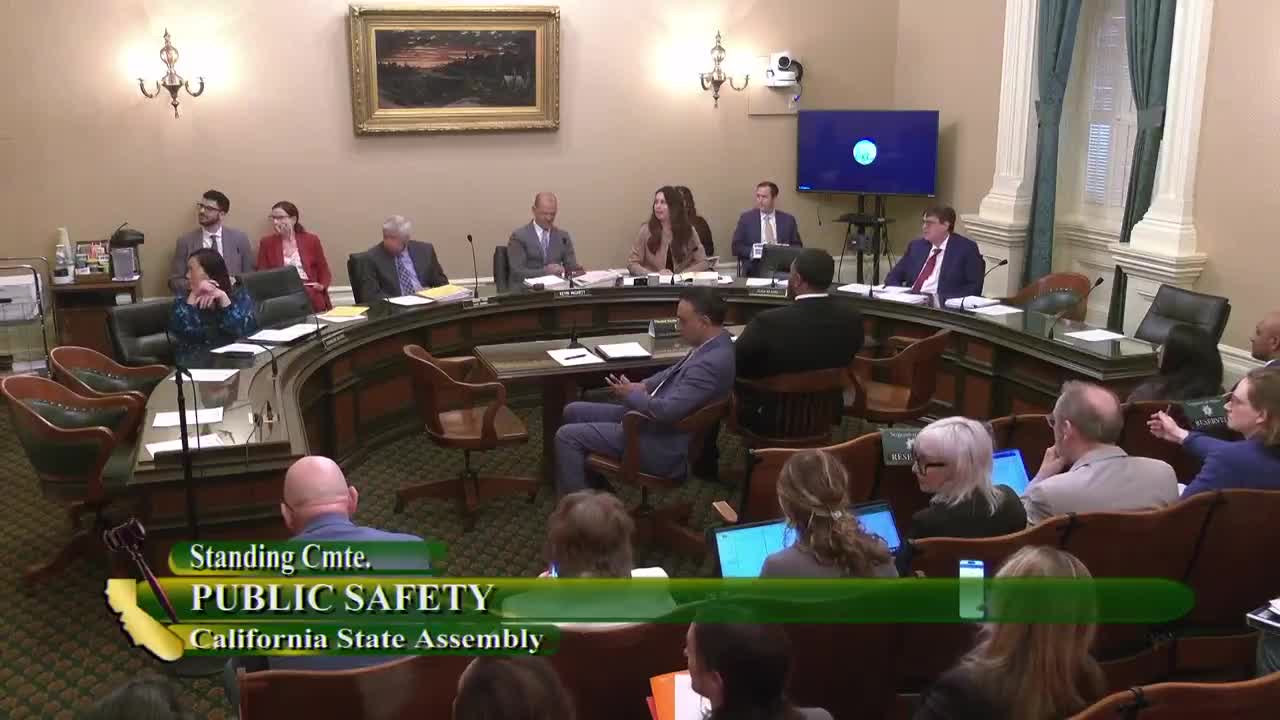 10MIN
Assembly Standing Committee on Public Safety
 16SEC
Assembly Standing Committee on Judiciary
Bill Author

Bill Co-Author(s):