AB 2140: Housing: Building Home Ownership for All Program.
- Session Year: 2023-2024
- House: Assembly
- Latest Version Date: 2024-02-06
Current Status:
Failed
(2024-05-16: In committee: Held under submission.)
Introduced
In Committee
First Chamber
In Committee
Second Chamber
Enacted
What does this bill do?
The bill would require the state Treasurer to develop a framework for a “Building Home Ownership for All” program to make buying homes more affordable for lower- and moderate-income Californians, especially communities harmed by past discrimination. The plan must set regional income and price limits, identify startup funding with only small ongoing state support, describe how to finance and build affordable for‑sale homes, involve small and community developers, streamline approvals, and include financial education. It must also propose a pilot, track results by race, ethnicity, and income, and analyze feasibility, costs, and financial risks.
The summary is provided by generative AI which can make mistakes. For original language, please view the details in the table below.
Existing law defines the duties of the Treasurer, which includes, but is not limited to, keeping an account of all money received and disbursed. Existing law required the Treasurer to, as soon as April 1, 2022, but no later than specified, in consultation with the California Housing Finance Agency and other specified state agencies, develop a framework for the California Dream For All Program in accordance with the goals and intent of the program, including, among other things, making home ownership more affordable by reducing the cost of home ownership by up to 45 percent for lower and moderate-income Californians, and submit a report, as specified, outlining the program framework to the Legislature.
This bill would require the Treasurer, on or before December 31, 2025, and in consultation with the California Housing Finance Agency, the Department of Housing and Community Development, and other stakeholders deemed relevant by those state bodies, to develop a framework for the Building Home Ownership for All Program in accordance with the goals and elements of the program, including, among other things, expanding access to homeownership by making it affordable for lower and moderate-income Californians, and submit a report, as specified, outlining the program framework to the Legislature. The bill would also make findings and declarations related to the program.
The Legislature finds and declares all of the following:
(a)California has a statewide housing crisis, represented by a shortage of nearly 3,500,000 homes.
(b)Californias housing crisis stifles economic growth, contributes to the homelessness epidemic, consumes an ever-growing share of the paychecks of working families, and holds millions of households back from realizing the California dream of home ownership.
(c)Home ownership is still the primary way in which most Americans build wealth and assets. California has the third-highest median home price in the nation and the high cost of housing has pushed what was once a modest goal further and further out of reach for most people of color.
(d)Home ownership rates in California are among the lowest nationwide, and in recent years those numbers have continued downward. Between 2020 and 2022, California home ownership declined by 3.19 percent.
(e)While the home ownership gap is an issue throughout the nation, the African American and Latinx home ownership rate is significantly worse in California. African Americans and Latinx have a home ownership rate across the nation of 42 percent and 47 percent, respectively, whereas that rate in California drops down to 35 percent and 42 percent, respectively.
(f)The Legislative Analysts Office has identified a lack of housing supply as one of the culprits for the severe home ownership gap. The office completed a 2016 housing affordability report, which found that the states housing shortage also makes many Californians, not only low-income residents, more likely to commute longer distances, live in overcrowded housing, and delay or forgo home ownership.
(g)Access to sustainable home ownership can be expanded with fiscal assistance, housing counseling, sound lending, flexible underwriting that ensures the ability to pay, and backing by Federal Housing Administration (FHA) mortgage insurance.
(h)As production has slowed and changed, for-sale inventory has tightened, particularly for entry-level homes.
(i)Higher home prices have translated to less diversity in who is able to purchase a home.
(j)Home ownership is a powerful tool to close the racial and ethnic wealth gap across the State of California and nationwide.
SEC. 2.Section 12335 is added to the Government Code, immediately following Section 12334, to read:12335.(a)The Treasurer shall, on or before December 31, 2025, in consultation with the California Housing Finance Agency, the Department of Housing and Community Development, and other stakeholders determined relevant by those state bodies, develop a framework for the Building Home Ownership for All Program in accordance with the goals and elements of the program and submit a report outlining the program framework to the Legislature in compliance with Section 9795.
(b)The goals of the program shall include, but not be limited to, all of the following:
(1)Expanding access to homeownership by making it affordable for lower and moderate-income Californians, including, but not limited to, those who were impacted by generational barriers to home ownership due to systemic racism, including redlining, those who lost homes during the Great Recession and have not returned to home ownership, and those with substantial higher education student loan debt.
(2)Establishing a program to finance the construction of for-sale housing units at a price that is ultimately affordable to lower and moderate-income Californians.
(3)Evolving the program over time to create a self-sustaining model, including utilizing nongovernmental funding sources.
(4)Ensuring that there is not a reduction in funding to existing rental programs due to enactment of the program.
(c)The framework of the program shall include, but not be limited to, all of the following elements:
(1)Income limits for Californians and price limits for homes eligible for the program, both on a regional basis.
(2)Options for the initial capitalization for the program.
(3)Ongoing state financial support limited to nominal administrative costs.
(4)Program structuring to encourage nongovernmental funding similar to existing programs, including, but not limited to, the Low-Income Housing Tax Credit Program (26 U.S.C. Sec. 42) and the New Markets Tax Credit Program (26 U.S.C. Sec. 45D).
(5)Opportunities to leverage existing federal, state, and local homeownership programs to support the goals of the program.
(6)Integration of the program with existing state housing plans and strategies, including aligning with regional housing needs assessments and plans developed by local governments under existing law.
(7)Opportunities to facilitate the involvement of small development firms, community development corporations, community land trusts, and other community based nonprofit housing developers in the production of these homes, including those owned and operated by members of formerly redlined communities.
(8)Changes to existing law relating to land use and multifamily homeownership that would reduce the cost to construct for-sale single-family and multifamily homes.
(9)Changes to streamline approval processes for housing projects under the program, including projects in areas with high housing demand, to expedite construction and reduce bureaucratic delays.
(10)Quantification of the extent of the racial wealth gap in California.
(11)Potential size, structure, and geography of a pilot project.
(12)Incorporation of financial education and homeownership readiness programs, focusing on communities with lower rates of homeownership.
(13)Monitoring of the impact of the program on expanding access to homeownership through the collection and analysis of data disaggregated by race, ethnicity, and income.
(d)The report shall include, but not be limited to, all of the following:
(1)The structure of the program, including, but not limited to, the administering entity and the financial structure of the program.
(2)The type of financial assistance offered to homebuilders.
(3)An analysis on the feasibility of establishing the program and the financial risks to the state, including, but not limited to, the costs and benefits of the program compared to available alternatives and existing programs, and how those costs and risks compare to the costs and risks to society of continuing current barriers to homeownership for working families and not combating systemic racism and inequities that have kept generations from building wealth and thriving in the middle class.
REVISIONS: HeadingLine 2.|
Date
|
Status
|
|---|---|
| May 16, 2024 | In committee: Held under submission. |
| Apr 17, 2024 | In committee: Set, first hearing. Referred to APPR. suspense file. |
| Mar 20, 2024 | Coauthors revised. |
| Mar 20, 2024 | From committee: Do pass and re-refer to Com. on APPR. (Ayes 8. Noes 0.) (March 20). Re-referred to Com. on APPR. |
| Feb 20, 2024 | Referred to Com. on H. & C.D. |
| Feb 7, 2024 | From printer. May be heard in committee March 8. |
| Feb 6, 2024 | Read first time. To print. |
|
Date
|
Description
|
Location
|
Votes
|
|
|---|---|---|---|---|
| Mar 20, 2024 | Do pass and be re-referred to the Committee on [Appropriations] | Assembly Standing Committee on Housing and Community Development |
Passed |
This list shows positions taken on this bill by organizations on the date displayed, which is linked to the original source.
Positions by individuals are not included.
|
Organization
|
Position
|
Date
|
|---|---|---|
| Habitat For Humanity California | * Support | Mar 20, 2024 |
| Lighthouse Public Affairs | * Support | Mar 20, 2024 |
| SPUR | * Support | Mar 20, 2024 |
| Unidosus | * Support | Mar 20, 2024 |
Date of Hearing: April 17, 2024
ASSEMBLY COMMITTEE ON APPROPRIATIONS
Buffy Wicks, Chair
ABPCA Bill Id:AB 2140
Author:(Juan Carrillo) – As Introduced Ver:February 6, 2024
Policy Committee: | Housing and Community Development | Vote: | 8 - 0 |
|
| ||
|
|
Urgency: No State Mandated Local Program: No Reimbursable: No
SUMMARY:
This bill requires the state Treasurer, in consultation with state housing agencies, to develop a framework for the Building Home Ownership for All Program (Program) and to submit a report to the Legislature outlining the framework and feasibility of the Program.
Specifically, this bill:
- Requires the state Treasurer, by December 31, 2025, in consultation with the California Housing Finance Agency (CalHFA), the Department of Housing and Community Development (HCD), and other stakeholders deemed relevant, to develop a framework for the Program in accordance with specified Program goals and elements and to submit a report outlining the framework and financial feasibility of the Program to the Legislature.
- Requires the goals of the Program to include (a) expanding access to homeownership for lower- and moderate-income Californians, focusing on those impacted by systemic racism, those who lost their homes during the Great Recession, and those with substantial student loan debt, and (b) establishing a program to finance the construction of for-sale housing units at a price affordable to lower- and moderate-income Californians, among other goals.
- Requires the Program framework to include 13 specified elements, including regional income and home price eligibility limits, options for initial capitalization, ongoing state financial support for administrative costs, structuring to encourage nongovernmental funding similar to the Low-Income Housing Tax Credit (LIHTC) Program, and consideration of a pilot project, among additional elements.
- Requires the report to the Legislature to include the structure of the Program, including the financial structure and the administering entity, the type of financial assistance offered to homebuilders, and an analysis of the feasibility of establishing the Program and the financial risks to the state, including a cost/benefit analysis compared to available alternatives.
FISCAL EFFECT:
- The State Treasurer’s Office estimates total General Fund costs of approximately $3 million to develop the framework for the Program and report to the Legislature, per the requirements of the bill. This estimate is based on the recent development of the California Dream for All Program.
- HCD indicates minor and absorbable costs for it consultative role.
- Likely minor and absorbable costs to CalHFA for its consultative role. CalHFA did not respond to the committee’s request for fiscal information.
The above cost estimate is limited to determining the framework and feasibility of the proposed program. Should the Program be determined feasible there would be future General Fund cost pressures to provide funding.
According to the Legislative Analyst’s Office, the General Fund faces a structural deficit in the tens of billions of dollars over the next several fiscal years.
COMMENTS:
- Purpose. The author seeks to ease California’s homeownership gap by directing the state Treasurer to develop a framework for, and study the feasibility of, a large-scale affordable homeownership financing program designed for the construction of affordable for-sale housing units. The program would be modeled after the proposed federal Neighborhood Homes Investment Act and the LIHTC program. According to the author:
Most Californians, and especially communities of color who want to achieve the American Dream and experience the wealth-building benefits of homeownership are blocked by extremely high housing costs. [This bill] is the first, crucial step in creating a new financing program to enable the development of affordable for-sale units throughout California, similar to what the LIHTC program has done for affordable rentals.
- Background. California, like the nation as a whole, has lower homeownership rates among communities of color. According to Census data, 65% of white Californians are homeowners while 59% of Asian/Asian-Americans, 49% of Native/Indigenous descent, 44% of Latino/Hispanic, and 35% of Black Californians are homeowners. Studies indicate multiple reasons for the homeownership gaps in California, including racial discrimination and a lack of affordable housing supply, among others.
The state has established a number of programs, such as MyHome, the California Dream for all Program, and CalHome, to assist and encourage affordable homeownership, primarily by providing down payment and other assistance to low- and moderate-income buyers. CalHOME also provides loans to nonprofit developers to construct single-family homes and provides grants to nonprofit organizations and local governments to make loans to individual homeowners to construct accessory dwelling units (ADUs) or junior ADUs. However, most affordable housing construction financing programs, such as the LIHTC, are available only for rental housing.
The federal Neighborhood Homes Investment Act, pending in Congress, would create a new financing tool for homeownership modeled after the LIHTC. States would receive an allocation of tax credits and developers would sell the tax credits and raise equity to invest in building or acquiring homeownership units. According to the bill’s cosponsors, California Community Builders and UnidosUs:
While the Neighborhood Homes Investment Act would be the first large-scale affordable homeownership financing program in the country, as written it would not be applicable to most neighborhoods in California due to our state’s high land costs and lower rate of vacant and blighted land.
In response to this concern, this bill requires the state Treasurer to study the feasibility of a state-level homeownership financing framework guided by the federal proposal and the LIHTC program.
Analysis Prepared by: Jennifer Swenson / APPR. / (916) 319-2081
Date of Hearing: March 20, 2024
ASSEMBLY COMMITTEE ON HOUSING AND COMMUNITY DEVELOPMENT
Christopher M. Ward, Chair
ABPCA Bill Id:AB 2140 (
Author:Juan Carrillo) – As Introduced Ver:February 6, 2024
SUBJECT: Housing: Building Home Ownership for All Program
SUMMARY: Requires the Treasurer, on or before December 31, 2025, in consultation with the California Housing Finance Agency (CalHFA), the Department of Housing and Community Development (HCD), and other stakeholders, to develop a framework for the Building Home Ownership for All Program in accordance with the goals and elements of the program and submit a report outlining the program framework to the Legislature. Specifically, this bill:
- Require the goals of the program to include, but not be limited to, all of the following:
- Expanding access to homeownership by making it affordable for lower and moderate-income Californians, as specified;
- Establishing a program to finance the construction of for-sale housing units at a price that is ultimately affordable to lower and moderate-income Californians;
- Evolving the program over time to create a self-sustaining model, including utilizing nongovernmental funding sources; and
- Ensuring that there is not a reduction in funding to existing rental programs due to enactment of the program.
- Require the framework of the program to include, but not be limited to, all of the following elements:
- Income limits for Californians and price limits for homes eligible for the program, both on a regional basis;
- Options for the initial capitalization for the program;
- Ongoing state financial support limited to nominal administrative costs;
- Program structuring to encourage nongovernmental funding similar to existing programs, including, but not limited to, the Low-Income Housing Tax Credit Program and the New Markets Tax Credit Program;
- Opportunities to leverage existing federal, state, and local homeownership programs to support the goals of the program;
- Integration of the program with existing state housing plans and strategies, including aligning with regional housing needs assessments and plans developed by local governments under existing law;
- Opportunities to facilitate the involvement of small development firms, community development corporations, community land trusts, and other community based nonprofit housing developers in the production of these homes, including those owned and operated by members of formerly redlined communities;
- Changes to existing law relating to land use and multifamily homeownership that would reduce the cost to construct for-sale single-family and multifamily homes;
- Changes to streamline approval processes for housing projects under the program, including projects in areas with high housing demand, to expedite construction and reduce bureaucratic delays;
- Quantification of the extent of the racial wealth gap in California;
- Potential size, structure, and geography of a pilot project;
- Incorporation of financial education and homeownership readiness programs, focusing on communities with lower rates of homeownership; and
- Monitoring of the impact of the program on expanding access to homeownership through the collection and analysis of data disaggregated by race, ethnicity, and income.
- Requires the report to include, but not be limited to, all of the following:
- The structure of the program, including, but not limited to, the administering entity and the financial structure of the program;
- The type of financial assistance offered to homebuilders; and
- An analysis on the feasibility of establishing the program and the financial risks to the state, including, but not limited to, the costs and benefits of the program compared to available alternatives and existing programs, and how those costs and risks compare to the costs and risks to society of continuing current barriers to homeownership for working families and not combating systemic racism and inequities that have kept generations from building wealth and thriving in the middle class.
EXISTING LAW:
Establishes a number of housing assistance programs for affordable housing at the Department of Housing and Community Development (HCD), including CalHOME, which provides grants to individual homebuyers to purchase a home and loans to nonprofit developers to construct single-family homes. The program also provides grants to nonprofit organizations and local governments to make loans to individual homeowners to construct ADUs or JADUs. (Health and Safety Code (HSC) Section 50650.3)
- Establishes and authorizes CalHFA to make loans to housing sponsors for housing developments and to qualified mortgage lenders, among others. Provides that the primary purpose of CalHFA is to meet the housing needs of persons and families of low- or moderate-income. (Cite)
- Provides that CalHFA is administered by a board of directors and is supervised on a day-to-day basis by an executive director. (Cite)
FISCAL EFFECT: Unknown.
COMMENTS:
Author’s Statement: According to the author, “Most Californians, and especially communities of color who want to achieve the American Dream and experience the wealth-building benefits of homeownership are blocked by extremely high housing costs. AB 2140 is the first, crucial step in creating a new financing program to enable the development of affordable for-sale units throughout California, similar to what the Low Income Housing Tax Credit program has done for affordable rentals. This study is a step in the right direction in making it easier and more affordable for hardworking low- and moderate-income families to own homes near their jobs, schools, and existing communities.”
Disparities in Homeownership: California, like the nation as a whole, has lower homeownership rates among communities of color. According to Census data, 65% of white Californians are homeowners while Asian/Asian-Americans have a homeownership rate that is six percentage points lower at 59%. About one in two Californians of Native/Indigenous descent are homeowners (49%), while the rate of homeownership amongst the Latinx population is 44%. Black Californians have the lowest rate of homeownership across racial/ethnic groups California with only about 1 in 3 owning their home (35%).
For Black Californians who do own homes, racial disparities also exist in the valuation of their assets. Black-owned homes in majority-Black areas of both the San Francisco-Oakland-Hayward Metropolitan Statistical Area (MSA) and the Los Angeles-Long Beach-Anaheim MSA are worth substantially less than equivalent homes with the same structural characteristics and neighborhood amenities in non-majority-Black areas. In the Bay Area, the average devaluation of homes in majority-Black neighborhoods is 22.3%, and in the Los Angeles area it is 17.1%. Differences in credit scores also contribute to racial disparities in homeownership. About 54% of Black Americans report having no credit or a credit score of below 640. About 41% of Latinx Americans report falling into this category as well. In contrast, 37% of white Americans and 18% of Asian Americans report similar credit circumstances. Home Mortgage Disclosure Act (HMDA) data show that Black applicants are denied loans at twice the rate of white applicants, controlling for income and gender. Even when approved for home loans, HMDA data also show that Black and Latinx borrowers are more likely to be offered higher-cost mortgages.
Neighborhood Homes Investment Act: The Neighborhood Homes Investment Act, which has been introduced in Congress, would create a new financing tool for homeownership modeled after the Low Income Housing Tax Credit (LIHTC). LIHTC funds the creation of multifamily rental housing for households at or below 80% of the area median income. States would receive an allocation of tax credits and select sponsors through a competitive process, and developers would sell the tax credits and raise equity to invest in building or acquiring homeownership units.
According to the author, the goal of AB 2140 is to create a framework for a new large scale affordable homeownership financing program similar to what is being proposed at the federal level through the Neighborhood Homes Investment Act.
State Support for Homeownership:
Mortgage Interest Deduction: The mortgage interest deduction is the largest investment the state makes in housing. Homeowners can deduct the mortgage interest on up to $750,000 of qualified residence loans ($375,000 for married individuals filing separately) on their primary home and a second home that they live in part of the year. The mortgage interest deduction costs the state General Fund approximately $5 billion each year.
MyHome: MyHome offers a deferred-payment junior loan of an amount up to the lesser of 3.5% of the purchase price or appraised value to assist with down payment closing costs of a home that is capped at $15,000. There is no cap on the amount of down payment buyers can receive if they are a veteran, school employee, have an income of 80% of AMI or less, and are purchasing a new home, manufactured home, or a home with an ADU. Buyers must be first time homeowners (have not owned a home in the last three years), complete homebuyer education, and meet the income qualifications (which extend to households up to 150% of AMI in high cost areas). CalHFA received $150 million for home purchase assistance from Proposition 1 (2018) bond funds to provide first and junior loan options for low- to moderate-income families, including low to zero interest rate down payment assistance loans. CalHFA issues bonds to fund the mortgages and uses the proceeds of mortgage repayments to repay the bonds. Down payment assistance is funded by voter-approved bonds and through repayment of assistance as buyers sell or refinance their homes. CalHFA provides first-mortgages to buyers who income qualify. CalHFA is not a direct lender but partners with qualified lenders that offer their products.
California Dream for All Program: The 2022-23 State Budget (SB 197 (Committee on Budget)), Chapter 70, established the California Dream for All Program, a revolving shared appreciation loan program designed to increase access to homeownership for low- and moderate-income Californians. The 2022-23 budget included $300 million which was awarded to 2,500 homeowners with an average appreciation loan of $112,000. The 2023-24 budget includes an additional $200 million for the program with a requirement that the program be revamped to focus on providing down payment assistance to homebuyers who would not otherwise be able to purchase a home.
CalHOME: The CalHOME program provides loans and grants to nonprofit corporations and local governments to support homeownership activities. Grants provide down payment assistance to qualified households and loans to fund the construction of ownership units. To qualify, households must be lower income (making 80% of AMI or less); however, grants may be made to households making up to 120% of AMI in areas where the Governor has declared a state of emergency due to a disaster. In 2019, AB 101 (Committee on Budget), Chapter 159, expanded the uses of CalHOME to include grants to local governments or nonprofit corporations to develop and construct ADUs and JADUs. The program makes grants to local agencies that then loan funds to qualifying homeowners who build ADUs or JADUs and rent them out. The program is intended to increase the supply of affordable housing and provide income to lower income homeowners. Although the CalHOME program provides loans to nonprofit corporations that build ownership units for qualifying families, it does not allow nonprofits to construct ADUs or JADUs and sell them as separate units.
Arguments in Support: According to the California Community Builders and UnidosUs, “while the Neighborhood Homes Investment Act would be the first large-scale affordable homeownership financing program in the country, as written it would not be applicable to most neighborhoods in California due to our state’s high land costs and lower rate of vacant and blighted land. Additionally, recognizing the needs of middle-income families, a bipartisan group of federal legislators has introduced the Workforce Housing Tax Credit Act that would create a middle-income housing tax credit, or MIHTC, program for affordable housing serving households of up to 100% of area median income. By studying and evaluating how to adapt and leverage existing programs and build upon national innovation, the legislature can take the important first step in truly building homeownership for all Californians.”
Arguments in Opposition: None on file.
REGISTERED SUPPORT / OPPOSITION:
Support
California Community Builders (Co-Sponsor)
UnidosUS (Co-Sponsor)
Abundant Housing LA
Asian Business Association of Silicon Valley
Bay Area Council
California Forward
California Defense Community Alliance
California YIMBY
Canal Alliance
Casita Coalition
CivicWell
Community Development Inc.
Cornerstone Construction
East Bay Housing Organization
El Concilio California
Faith and Community Empowerment
Habitat for Humanity
Haven Neighborhood Services
Hogar Hispano
League of California Cities
LISC San Diego
MidPen Housing
Montebello Housing Development Corporation
Monterey Bay Economic Partnership
Neighborhood Housing Services of the Inland Empire
People for Housing - Orange County
Power CA Action
PUENTE Learning Center
RestoreLA-CDC
Richmond Neighborhood Housing Services Inc.
San Diego Housing Commission
San Francisco Bay Area Planning and Urban Research Association
Self Help Enterprises
Southern California Black Chamber of Commerce
TentMakers Inc.
The Center by Lendistry
The Two Hundred for Home Ownership
The Unity Council
United Latinos Action
YIMBY Action
Opposition
None on file.
Analysis Prepared by: Lisa Engel / H. & C.D. / (916) 319-2085
Discussed in Hearing
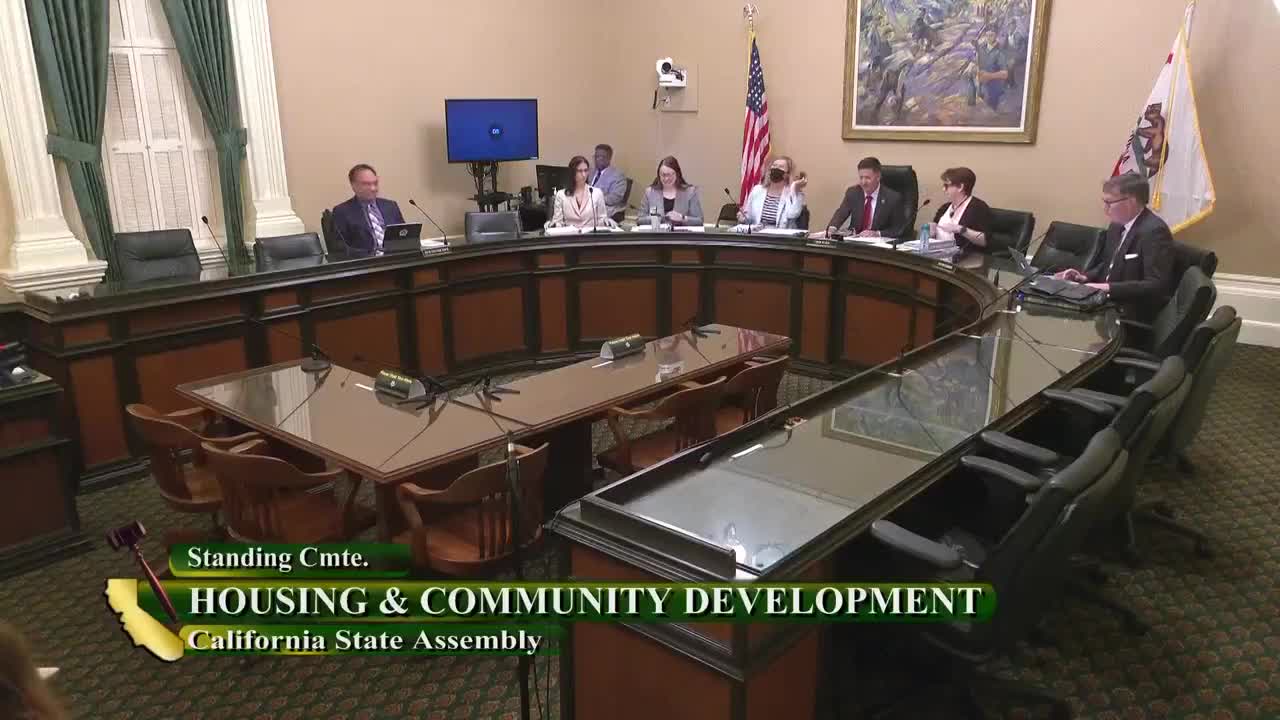 16MIN
Assembly Standing Committee on Housing and Community Development
Bill Author

Bill Co-Author(s):