AB 2517: Water: irrigation districts: long-term maintenance agreements.
- Session Year: 2023-2024
- House: Assembly
- Latest Version Date: 2024-04-17
Current Status:
Failed
(2024-04-18: Re-referred to Com. on APPR.)
Introduced
In Committee
First Chamber
In Committee
Second Chamber
Enacted
Existing law, the Irrigation District Law, provides for the formation of irrigation districts with prescribed powers. The law authorizes an irrigation district to control, distribute, store, spread, sink, treat, purify, recapture, and salvage any water, as specified. Existing law requires the Department of Water Resources to give information so far as it may be practicable to persons contemplating the formation of districts.
This bill would require the department to respond to a request to enter into a long-term maintenance agreement requests from agreement, as defined, with an irrigation districts district within 120 days and to prioritize responding to long-term maintenance agreements agreement requests for waterways that already have existing short-term regular-term maintenance agreements. agreements, as defined.
Existing law, the Irrigation District Law, provides for the formation of irrigation districts with prescribed powers. The law authorizes an irrigation district to control, distribute, store, spread, sink, treat, purify, recapture, and salvage any water, as specified. Existing law requires the Department of Water Resources to give information so far as it may be practicable to persons contemplating the formation of districts.
This bill would require the department to respond to long-term maintenance agreement requests from irrigation districts within 120 days and to prioritize responding to long-term maintenance agreements for waterways that already have existing short-term maintenance agreements.
Existing law authorizes an irrigation district to control, distribute, store, spread, sink, treat, purify, recapture, and salvage any water, including, but not limited to, sewage waters for the beneficial use or uses of the district or its inhabitants or the owners of rights to waters therein. Existing law authorizes a water district, with exceptions, to acquire, control, distribute, store, spread, sink, treat, purify, recycle, recapture, and salvage any water, including sewage and stormwaters, for the beneficial use or uses of the district, its inhabitants, or the owners of rights to water in the district.This bill would state the intent of the Legislature to enact subsequent legislation to streamline the process for water districts and irrigation districts to remove debris in waterways.Existing law authorizes an irrigation district to control, distribute, store, spread, sink, treat, purify, recapture, and salvage any water, including, but not limited to, sewage waters for the beneficial use or uses of the district or its inhabitants or the owners of rights to waters therein. Existing law authorizes a water district, with exceptions, to acquire, control, distribute, store, spread, sink, treat, purify, recycle, recapture, and salvage any water, including sewage and stormwaters, for the beneficial use or uses of the district, its inhabitants, or the owners of rights to water in the district.
This bill would state the intent of the Legislature to enact subsequent legislation to streamline the process for water districts and irrigation districts to remove debris in waterways.
(a)The department shall respond to a request to enter into a long-term maintenance agreement requests from with an irrigation districts district within 120 days.
(b)The department shall prioritize responding to long-term maintenance agreements agreement requests for waterways that already have existing short-term regular-term maintenance agreements.
(c)For purposes of this section, the following definitions apply:
(1)Long-term maintenance agreement means an agreement with a duration of greater than five years.
(2)Regular-term maintenance agreement means an agreement with a duration of five years or fewer.
(a)The department shall respond to long-term maintenance agreement requests from irrigation districts within 120 days.
(b)The department shall prioritize responding to long-term maintenance agreements for waterways that already have existing short-term maintenance agreements.
SECTION 1.It is the intent of the Legislature to enact subsequent legislation to streamline the process for water districts and irrigation districts to remove debris in waterways.It is the intent of the Legislature to enact subsequent legislation to streamline the process for water districts and irrigation districts to remove debris in waterways.
|
Date
|
Status
|
|---|---|
| Apr 18, 2024 | Re-referred to Com. on APPR. |
| Apr 17, 2024 | Read second time and amended. |
| Apr 16, 2024 | From committee: Amend, and do pass as amended and re-refer to Com. on APPR. (Ayes 15. Noes 0.) (April 16). |
| Apr 1, 2024 | Re-referred to Com. on W., P., & W. |
| Mar 21, 2024 | From committee chair, with author's amendments: Amend, and re-refer to Com. on W., P., & W. Read second time and amended. |
| Mar 21, 2024 | Referred to Com. on W., P., & W. |
| Feb 14, 2024 | From printer. May be heard in committee March 15. |
| Feb 13, 2024 | Read first time. To print. |
|
Date
|
Description
|
Location
|
Votes
|
|
|---|---|---|---|---|
| Apr 16, 2024 | Do pass as amended and be re-referred to the Committee on [Appropriations] | Assembly Standing Committee on Water, Parks, and Wildlife |
Passed |
This list shows positions taken on this bill by organizations on the date displayed, which is linked to the original source.
Positions by individuals are not included.
Date of Hearing: April 16, 2024
ASSEMBLY COMMITTEE ON WATER, PARKS, AND WILDLIFE
Diane Papan, Chair
ABPCA Bill Id:AB 2517 (
Author:Vince Fong) – As Amended Ver:March 21, 2024
SUBJECT: Water: water districts: irrigation districts: long-term maintenance agreements
SUMMARY: Requires the Department of Water Resources (DWR) to respond to long-term maintenance agreement requests from irrigation districts within 120 days and to prioritize requests on waterways that have existing short-term agreements.
EXISTING LAW:
- Provides for the formation of an irrigation district to deliver irrigation water and prescribes the process by which an irrigation district may be established (Water Code §§ 20700 – 20982).
- Prescribes the powers and purposes for which an irrigation district may be formed including, the delivery of water for irrigation and the provision of watermaster, drainage, or flood control services (Water Code §§ 22075 – 22235).
- Provides that irrigation districts have the authority to perform all acts necessary to fulfill their purpose (Water Code § 22225).
- Provides that an irrigation district may contract to operate, maintain, or improve ditches and laterals not owned by the district upon petition by at least two-thirds of the landowners to be served under the contract (Water Code § 22234).
FISCAL EFFECT: Unknown. This bill is keyed fiscal.
COMMENTS:
- Purpose of this bill. The author points out that there is no specified timeline for DWR to respond to a request to enter into a maintenance agreement with an irrigation district; as such, “irrigation districts can wait for years at a time before receiving a response or final agreement from DWR for a long-term agreement.” The author argues that “[this bill] will expedite the approval of maintenance agreements so irrigation districts can act swiftly to clear debris from waterways to protect rural communities from excess flooding.”
- Background. California’s more than 90 irrigation districts function under a collection of statutes known as the Irrigation District Law that describe their governance structure and authority. In general, these districts are governed by a five-member board of directors, with each member representing a division within the district. In most cases, registered voters are eligible to vote in district elections, but directors (also referred to as board members) must be voters, landowners, and residents in the division of the district they represent. This landowner requirement reflects the historical role of irrigation districts to exclusively provide irrigation water to agricultural land. However, as California's population has grown, more and more residential and commercial development is encroaching on agricultural land. In response to this growth, many irrigation districts began providing retail water service to residential customers that live within their jurisdictions in the absence of traditional retail water suppliers in the area, or providing electricity services.
Irrigation District Law grants irrigation districts broad authority to perform any act “necessary to furnish sufficient water in the district for any beneficial use” and “in order to put to any beneficial use any water under its control.” In addition to the powers expressly given, an irrigation district has “such implied powers as are necessary to carry out the main purposes of the Irrigation District Law or the irrigation district” [Stimson v. Alessandro Irrigation Dist. (1902) 135 Cal. 389, 393]. - Proposed technical and clarifying amendments. To add clarity and avoid ambiguity, the Committee may wish to ask the author to take the following technical amendments:
20630. (a) The department shall respond to a request to enter into a long-term maintenance agreement with anrequests fromirrigation districts within 120 days.
(b) The department shall prioritize responding to long-term maintenance agreements for waterways that already have existingshort-termregular-term maintenance agreements.
(c) For purposes of this section, the following terms have the following meanings:
(1)“Long-term maintenance agreement” means an agreement with a duration greater than five years.
(2) “Regular-term maintenance agreement” means and agreement with a duration of five years or less. - Related legislation. AB 2505 (Gray), Chapter 23, Statutes of 2022, clarifies that an irrigation district may impose fines under specified existing authority to impose fines for water theft or under any authority granted by Irrigation District Law.
REGISTERED SUPPORT / OPPOSITION:
Support
None on file
Opposition
None on file
Analysis Prepared by: Pablo Garza / W., P., & W. / (916) 319-2096
Discussed in Hearing
 2MIN
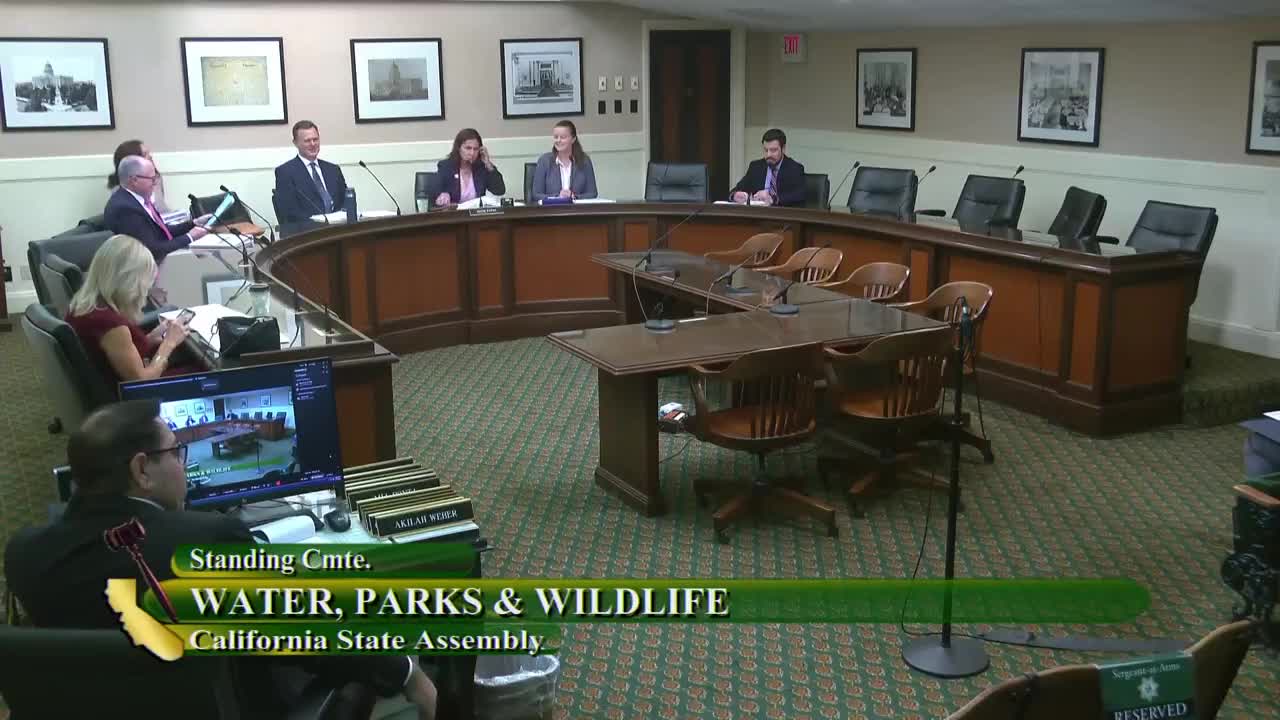
Assembly Standing Committee on Water, Parks, and Wildlife
Bill Author

Bill Co-Author(s):