AB 3037: Sentencing: dismissal of enhancements.
- Session Year: 2023-2024
- House: Assembly
- Latest Version Date: 2024-02-16
Current Status:
Failed
(2024-04-30: From committee: Without further action pursuant to Joint Rule 62(a).)
Introduced
In Committee
First Chamber
In Committee
Second Chamber
Enacted
Existing law generally authorizes a court to dismiss an action in the furtherance of justice. Existing law requires a court to dismiss an enhancement if it is in the furtherance of justice to do so, except if dismissal of that enhancement is prohibited by any initiative statute.
This bill would make the provision relating to the dismissal of enhancements inapplicable to firearms-related enhancements, but would allow the court to dismiss these firearm-related enhancements pursuant to the courts general authority to dismiss an action, as specified.
(a)The judge or magistrate may, either on motion of the court or upon the application of the prosecuting attorney, and in furtherance of justice, order an action to be dismissed. The reasons for the dismissal shall be stated orally on the record. The court shall also set forth the reasons in an order entered upon the minutes if requested by either party or in any case in which the proceedings are not being recorded electronically or reported by a court reporter. A dismissal shall not be made for any cause that would be ground of demurrer to the accusatory pleading.
(b)(1)If the court has the authority pursuant to subdivision (a) to strike or dismiss an enhancement, the court may instead strike the additional punishment for that enhancement in the furtherance of justice in compliance with subdivision (a).
(2)This subdivision does not authorize the court to strike the additional punishment for any enhancement that cannot be stricken or dismissed pursuant to subdivision (a).
(c)(1)(A)Notwithstanding any other law, the court shall dismiss an enhancement if it is in the furtherance of justice to do so, except if dismissal of that enhancement is prohibited by any initiative statute.
(B)Notwithstanding subparagraph (A), the court may, pursuant to subdivision (a), dismiss an enhancement pursuant to Section 12022.53 if it is in the furtherance of justice.
(C)An enhancement imposed pursuant to Section 12022.53 is not subject to subparagraph (A).
(2)In exercising its discretion under this subdivision, the court shall consider and afford great weight to evidence offered by the defendant to prove that any of the mitigating circumstances in subparagraphs (A) to (I) are present. Proof of the presence of one or more of these circumstances weighs greatly in favor of dismissing the enhancement, unless the court finds that dismissal of the enhancement would endanger public safety. Endanger public safety means there is a likelihood that the dismissal of the enhancement would result in physical injury or other serious danger to others.
(A)Application of the enhancement would result in a discriminatory racial impact as described in paragraph (4) of subdivision (a) of Section 745.
(B)Multiple enhancements are alleged in a single case. In this instance, all enhancements beyond a single enhancement shall be dismissed.
(C)The application of an enhancement could result in a sentence of over 20 years. In this instance, the enhancement shall be dismissed.
(D)The current offense is connected to mental illness.
(E)The current offense is connected to prior victimization or childhood trauma.
(F)The current offense is not a violent felony as defined in subdivision (c) of Section 667.5.
(G)The defendant was a juvenile when they committed the current offense or any prior offenses, including criminal convictions and juvenile adjudications, that trigger the enhancement or enhancements applied in the current case.
(H)The enhancement is based on a prior conviction that is over five years old.
(I)Though a firearm was used in the current offense, it was inoperable or unloaded.
(3)While the court may exercise its discretion at sentencing, this subdivision does not prevent a court from exercising its discretion before, during, or after trial or entry of plea.
(4)The circumstances listed in paragraph (2) are not exclusive and the court maintains authority to dismiss or strike an enhancement in accordance with subdivision (a).
(5)For the purposes of subparagraph (D) of paragraph (2), a mental illness is a mental disorder as identified in the most recent edition of the Diagnostic and Statistical Manual of Mental Disorders, including, but not limited to, bipolar disorder, schizophrenia, schizoaffective disorder, or post-traumatic stress disorder but excluding antisocial personality disorder, borderline personality disorder, and pedophilia. A court may conclude that a defendants mental illness was connected to the offense if, after reviewing any relevant and credible evidence, including, but not limited to, police reports, preliminary hearing transcripts, witness statements, statements by the defendants mental health treatment provider, medical records, records or reports by qualified medical experts, or evidence that the defendant displayed symptoms consistent with the relevant mental disorder at or near the time of the offense, the court concludes that the defendants mental illness substantially contributed to the defendants involvement in the commission of the offense.
(6)For the purposes of this subdivision, the following terms have the following meanings:
(A)Childhood trauma means that as a minor the person experienced physical, emotional, or sexual abuse, abuse or physical or emotional neglect. A court may conclude that a defendants childhood trauma was connected to the offense if, after reviewing any relevant and credible evidence, including, but not limited to, police reports, preliminary hearing transcripts, witness statements, medical records, or records or reports by qualified medical experts, the court concludes that the defendants childhood trauma substantially contributed to the defendants involvement in the commission of the offense.
(B)Prior victimization means the person was a victim of intimate partner violence, sexual violence, or human trafficking, or the person has experienced psychological or physical trauma, including, but not limited to, abuse, neglect, exploitation, or sexual violence. A court may conclude that a defendants prior victimization was connected to the offense if, after reviewing any relevant and credible evidence, including, but not limited to, police reports, preliminary hearing transcripts, witness statements, medical records, or records or reports by qualified medical experts, the court concludes that the defendants prior victimization substantially contributed to the defendants involvement in the commission of the offense.
(7)This subdivision shall apply to all sentencings occurring after January 1, 2022.
SEC. 2.Section 12022.53 of the Penal Code is amended to read:12022.53.(a)This section applies to the following felonies:
(1)Section 187 (murder).
(2)Section 203 or 205 (mayhem).
(3)Section 207, 209, or 209.5 (kidnapping).
(4)Section 211 (robbery).
(5)Section 215 (carjacking).
(6)Section 220 (assault with intent to commit a specified felony).
(7)Subdivision (d) of Section 245 (assault with a firearm on a peace officer or firefighter).
(8)Section 261 or former Section 262 (rape).
(9)Section 264.1 (rape or sexual penetration in concert).
(10)Section 286 (sodomy).
(11)Section 287 or former Section 288a (oral copulation).
(12)Section 288 or 288.5 (lewd act on a child).
(13)Section 289 (sexual penetration).
(14)Section 4500 (assault by a life prisoner).
(15)Section 4501 (assault by a prisoner).
(16)Section 4503 (holding a hostage by a prisoner).
(17)Any felony punishable by death or imprisonment in the state prison for life.
(18)Any attempt to commit a crime listed in this subdivision other than an assault.
(b)Notwithstanding any other law, a person who, in the commission of a felony specified in subdivision (a), personally uses a firearm, shall be punished by an additional and consecutive term of imprisonment in the state prison for 10 years. The firearm need not be operable or loaded for this enhancement to apply.
(c)Notwithstanding any other law, a person who, in the commission of a felony specified in subdivision (a), personally and intentionally discharges a firearm, shall be punished by an additional and consecutive term of imprisonment in the state prison for 20 years.
(d)Notwithstanding any other law, a person who, in the commission of a felony specified in subdivision (a), Section 246, or subdivision (c) or (d) of Section 26100, personally and intentionally discharges a firearm and proximately causes great bodily injury, as defined in Section 12022.7, or death, to a person other than an accomplice, shall be punished by an additional and consecutive term of imprisonment in the state prison for 25 years to life.
(e)(1)The enhancements provided in this section shall apply to any person who is a principal in the commission of an offense if both of the following are pled and proved:
(A)The person violated subdivision (b) of Section 186.22.
(B)Any principal in the offense committed any act specified in subdivision (b), (c), or (d).
(2)An enhancement for participation in a criminal street gang pursuant to Chapter 11 (commencing with Section 186.20) of Title 7 of Part 1 shall not be imposed on a person in addition to an enhancement imposed pursuant to this subdivision, unless the person personally used or personally discharged a firearm in the commission of the offense.
(f)Only one additional term of imprisonment under this section shall be imposed per person for each crime. If more than one enhancement per person is found true under this section, the court shall impose upon that person the enhancement that provides the longest term of imprisonment. An enhancement involving a firearm specified in Section 12021.5, 12022, 12022.3, 12022.4, 12022.5, or 12022.55 shall not be imposed on a person in addition to an enhancement imposed pursuant to this section. An enhancement for great bodily injury as defined in Section 12022.7, 12022.8, or 12022.9 shall not be imposed on a person in addition to an enhancement imposed pursuant to subdivision (d).
(g)Notwithstanding any other law, probation shall not be granted to, nor shall the execution or imposition of sentence be suspended for, a person found to come within the provisions of this section.
(h)The court may, in the interest of justice pursuant to subdivision (a) and subparagraph (B) of paragraph (1) of subdivision (c) of Section 1385 and at the time of sentencing, strike or dismiss an enhancement otherwise required to be imposed by this section. The authority provided by this subdivision applies to any resentencing that may occur pursuant to any other law.
(i)The total amount of credits awarded pursuant to Article 2.5 (commencing with Section 2930) of Chapter 7 of Title 1 of Part 3 or pursuant to Section 4019 or any other law shall not exceed 15 percent of the total term of imprisonment imposed on a defendant upon whom a sentence is imposed pursuant to this section.
(j)For the penalties in this section to apply, the existence of any fact required under subdivision (b), (c), or (d) shall be alleged in the accusatory pleading and either admitted by the defendant in open court or found to be true by the trier of fact. When an enhancement specified in this section has been admitted or found to be true, the court shall impose punishment for that enhancement pursuant to this section rather than imposing punishment authorized under any other law, unless another enhancement provides for a greater penalty or a longer term of imprisonment.
(k)When a person is found to have used or discharged a firearm in the commission of an offense that includes an allegation pursuant to this section and the firearm is owned by that person, a coparticipant, or a coconspirator, the court shall order that the firearm be deemed a nuisance and disposed of in the manner provided in Sections 18000 and 18005.
(l)The enhancements specified in this section shall not apply to the lawful use or discharge of a firearm by a public officer, as provided in Section 196, or by any person in lawful self-defense, lawful defense of another, or lawful defense of property, as provided in Sections 197, 198, and 198.5.
|
Date
|
Status
|
|---|---|
| Apr 30, 2024 | From committee: Without further action pursuant to Joint Rule 62(a). |
| Apr 2, 2024 | In committee: Reconsideration refused. |
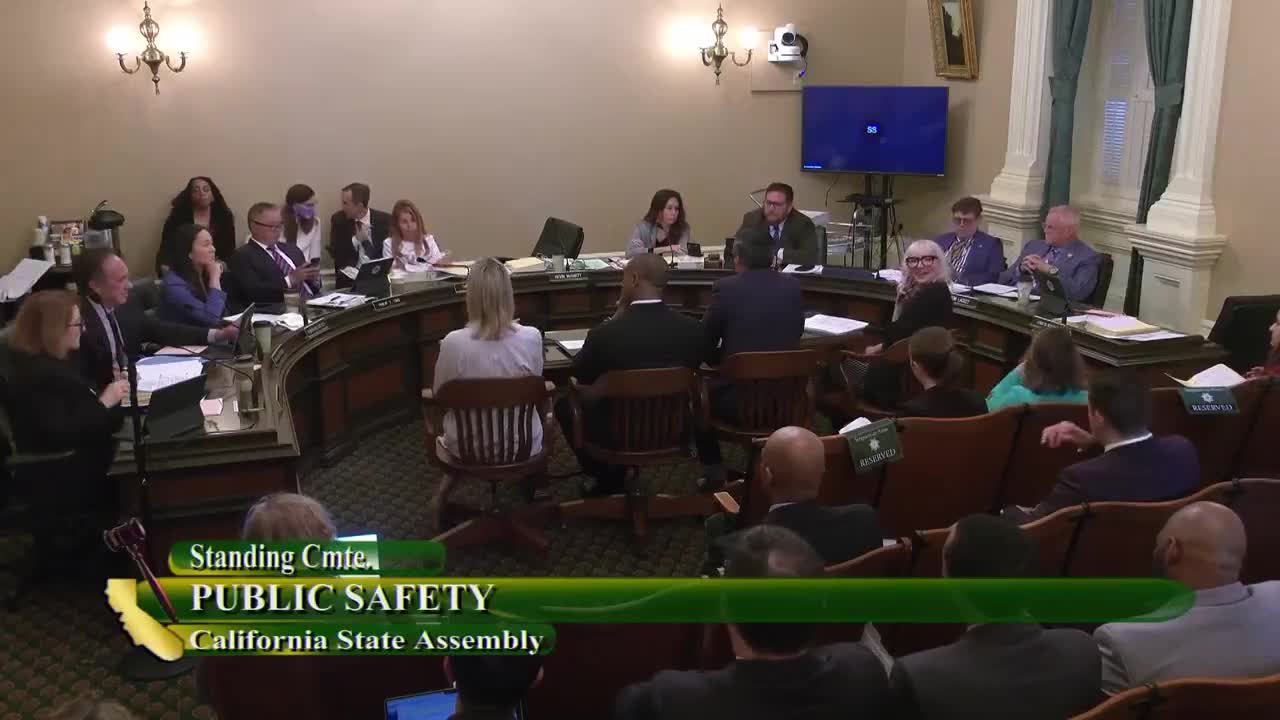
| Apr 2, 2024 | In committee: Set, first hearing. Failed passage. |
| Mar 11, 2024 | Referred to Com. on PUB. S. |
| Feb 17, 2024 | From printer. May be heard in committee March 18. |
| Feb 16, 2024 | Read first time. To print. |
|
Date
|
Description
|
Location
|
Votes
|
|
|---|---|---|---|---|
| Apr 2, 2024 | Reconsideration. | Assembly Standing Committee on Public Safety |
Failed |
|
| Apr 2, 2024 | Do pass and be re-referred to the Committee on [Appropriations] | Assembly Standing Committee on Public Safety |
Failed |
This list shows positions taken on this bill by organizations on the date displayed, which is linked to the original source.
Positions by individuals are not included.
|
Organization
|
Position
|
Date
|
|---|---|---|
| Aclu California Action | * Against | Apr 2, 2024 |
| Arcadia Police Officers' Association | ** Support | |
| Burbank Police Officers' Association | ** Support | |
| California Attorneys For Criminal Justice | ** Against | |
| California Coalition of School Safety Professionals | ** Support | |
| California District Attorneys Association | ** Support | |
| California Narcotic Officers Association | * Support | Apr 2, 2024 |
| California Public Defenders Association | ** Against | |
| California Reserve Peace Officers Association | * Support | Apr 2, 2024 |
| California State Sheriff's Association | * Support | Apr 2, 2024 |
| Californians for Safety and Justice | ** Against | |
| Californians United for a Responsible Budget | ** Against | |
| CLAREMONT POLICE OFFICERS ASSOCIATION | ** Support | |
| Corona Police Officers Association | ** Support | |
| Culver City Police Officers' Association | ** Support | |
| Deputy Sheriffs Association of Monterey County | ** Support | |
| Ella Baker Center For Human Rights | * Against | Apr 2, 2024 |
| Fullerton Police Officers' Association | ** Support | |
| Initiate Justice | * Against | Apr 2, 2024 |
| Legal Services for Prisoners with Children | ** Against | |
| Los Angeles School Police Management Association | ** Support | |
| los angeles school police officers association | ** Support | |
| Murrieta Police Officers' Association | ** Support | |
| Newport Beach Police Association | ** Support | |
| Novato Police Officers Association | ** Support | |
| Palos Verdes Police Officers Association | ** Support | |
| Placer County Deputy Sheriffs' Assocation | ** Support | |
| Pomona Police Officers' Association | ** Support | |
| RIVERSIDE POLICE OFFICERS ASSOCIATION | ** Support | |
| Riverside Sheriff's Association | * Support | Apr 2, 2024 |
| San Bernardino County Police Chiefs | * Support | Apr 2, 2024 |
| San Bernardino County Sheriff'S Department | * Support | Apr 2, 2024 |
| San Bernardino Police Officers Association | * Support | Apr 2, 2024 |
| San Francisco Public Defender | ** Against | |
| Santa Ana Police Officers Association | ** Support | |
| Smart Justice California, a project of Tides Advocacy | ** Against | |
| Upland Police Officers Association | ** Support |
Date of Hearing:
Chief Counsel: Sandy Uribe
ASSEMBLY COMMITTEE ON PUBLIC SAFETY
Kevin McCarty, Chair
ABPCA Bill Id:AB 3037
Author:(Essayli) – As Introduced Ver:February 16, 2024
SUMMARY:
Exempts firearm enhancements listed in the “10-20-life firearm law” from the requirement that a court dismiss an enhancement if it is in the furtherance of justice and does not endanger public safety. Specifically, this bill:
- Provides that a court is not required to dismiss a 10-20-life firearm use enhancement, even if it is in the furtherance of justice to do so.
- Retains court discretion to dismiss these firearm-related enhancements under the court’s general authority to dismiss an action.
EXISTING LAW:
- Provides for the 10-20-life firearm law. A person who personally uses a firearm, whether or not the firearm was operable or loaded, during the commission of certain enumerated offenses[1] is subject to an additional consecutive term of 10 years in prison. If the firearm is personally and intentionally discharged during the crime, the defendant is subject to an additional consecutive term of 20 years in prison. If discharging the firearm results in great bodily injury (GBI) or death, the defendant is subject to an additional, consecutive term of 25-years-to-life in prison.[2] (Pen. Code, § 12022.53, subds. (b)-(d).)
- Provides that if the offense is gang-related, the 10-20-life firearm enhancements shall apply to every principal in the commission of the offense. But, an enhancement for participation in a criminal street gang shall not be imposed in addition to an enhancement under this provision, unless the person personally used or personally discharged a firearm in the commission of the specified offense. (Pen. Code, § 12022.53, subds. (e)(1) & (e)(2).)
- Provides that only one additional term of imprisonment under the 10-20-life firearm law shall be imposed per person per crime. Further, other firearm enhancements shall not be imposed on a person in addition to an enhancement under this provision. (Pen. Code, § 12022.53, subd. (f).)
- Authorizes the court, either on its own motion or upon motion of the district attorney, and in furtherance of justice, to order an action to be dismissed. The reasons for the dismissal must be stated orally on the record, and entered in the minutes, if requested by either party. (Pen. Code, § 1385, subd. (a).)
- Provides that if the court has the authority to strike or dismiss an enhancement, the court may instead strike the additional punishment for that enhancement in the furtherance of justice. (Pen. Code, § 1385, subd. (b)(1).)
- States that, notwithstanding any other law, the sentencing court “shall dismiss” an enhancement “if it is in the furtherance of justice to do so” except if dismissal of that enhancement is prohibited by any initiative statute. (Pen. Code, § 1385, subd. (c)(1).)
- Instructs the court to consider the following factors in determining whether it is in the interests of justice to dismiss an enhancement:
- Application of the enhancement would result in a discriminatory racial impact, as specified;
- Multiple enhancements are alleged in a single case, in which case all enhancements but one shall be dismissed;
- Application of the enhancement could result in a sentence of over 20 years, in which case the enhancement shall be dismissed;
- The current offense is connected to mental illness, as specified;
- The current offense is connected to prior victimization or childhood trauma, as specified;
- The current offense is not a violent felony, as specified;
- The defendant was a juvenile when they committed the current offense or any prior juvenile adjudication that triggers the enhancement or enhancements applied in this case;
- The enhancement is based on a prior conviction that is over five years old;
- Though a firearm was used in the current offense, it was inoperable or unloaded. (Pen. Code, § 1385, subd. (c)(2)(A)-(I).)
- Application of the enhancement would result in a discriminatory racial impact, as specified;
- Requires the court to consider and afford great weight to evidence offered by the defendant to prove that any of the aforementioned mitigating circumstances are present. (Pen. Code, § 1385, subd. (c)(2).)
- States that proof of the presence of one or more of these mitigating circumstances weighs greatly in favor of dismissing the enhancement, unless the court finds that dismissal of the enhancement would “endanger public safety,” meaning that there is a likelihood that the dismissal of the enhancement would result in physical injury or other serious danger to others. (Pen. Code, § 1385, subd. (c)(2).)
FISCAL EFFECT:
Unknown
COMMENTS:
- Author's Statement: According to the author, “California has more than a hundred gun laws in statute yet still experiences significant firearm related crime. When this Legislature essentially eliminated firearm sentencing enhancements in 2021, it was a slap in the face to victims of heinous crimes committed with a firearm. AB 3037 is a smart gun law that takes the thumb off the scale of justice, restoring the ability for judges to sustain firearm-related sentencing enhancements in felony cases involving a gun. It’s long overdue that we punish—and punish harshly—individuals who commit felonies with a firearm.”
- Background of “Use of a Gun and You’re Done” Law (i.e., the 10-20-life Firearm Law): In 1997, the Legislature passed the “Use a Gun and You’re Done” law that significantly increased sentencing enhancements for possessing a gun at the time of committing a specified felony, such as robbery, homicide, or certain sex crimes. Under the law, if someone uses a gun while committing one of the identified crimes, their sentence is extended by 10 years, 20 years, or 25 years-to-life, depending on how the gun was used. Subdivision (b) provides a 10-year enhancement for using a firearm; subdivision (c), a 20-year enhancement for intentionally firing the gun; and subdivision (d), a 25-years-to-life enhancement for intentional discharge causing great bodily injury or death to someone other than an accomplice.
“Often the enhancement for gun use is longer than the sentence for the crime itself. For example, in the case of second-degree robbery, a person could serve a maximum of five years for the robbery and an extra 10 years for brandishing a gun during the robbery, even if the gun was unloaded or otherwise inoperable. Someone convicted of first-degree murder would be sentenced to at least 50 years-to-life if a gun was used, whereas if the murder was carried out using another method – such as strangulation – the sentence would be half the length (25 years-to-life). A judge has no discretion in applying this enhancement; if a gun was used, a judge must apply it.” (California Budget and Policy Center (2015) Sentencing in California: Moving Toward a Smarter, More Cost-Effective Approach.)
Deterrence was a driving factor behind this legislation: “The Legislature finds and declares that substantially longer prison sentences must be imposed on felons who use firearms in the commission of their crimes, in order to protect our citizens and to deter violent crime.” (AB 4 (Bordonaro), Chapter 503, Statutes of 1997.)
In 2017, the Legislature passed SB 620 (Bradford), Chapter 682, Statutes of 2017. This legislation allowed a court, in the interest of justice, to strike or dismiss a firearm enhancement which otherwise adds a state prison term of 10 years, 20 years, or 25-years-to-life depending on the underlying offense and manner of use.
As to the exercise of that judicial discretion, CDCR has informed the committee in the three years preceding the court’s ability to strike an enhancement under the 10-20-Life firearm law, there were 6,255 enhancements imposed under the law on 2,845 offenders[3]; and in the three years after judicial discretion to strike the enhancement was implemented, there were 6,078 enhancements pursuant to the statute imposed on 2,672 offenders. More recent data obtained from CDCR for 2022 and 2023 shows imposition of these enhancements after changes were made, effective January 1, 2022, requiring a court to dismiss an enhancement if it is in the furtherance of justice but does not endanger public safety, discussed below.
Date Range | Number of Offenders | Number of PC 12002.53(b) | Number of PC 12002.53(c) | Number of PC 12002.53(d) | Number of Enhancements |
2015 - 2017 | 2,845 | 3,239 | 1,227 | 1,789 | 6,225 |
2018 - 2021 | 2,672 | 3,089 | 1,181 | 1,808 | 6,078 |
2022 | 547 | 549 | 488 | 205 | 1,104 |
2023 | 581 | 584 | 555 | 285 | 1,228 |
Based on these figures, judges continued to impose these enhancements.
- Courts Have Broad Discretion to Strike Enhancements: Penal Code section 1385 specifies that a judge may, in furtherance of justice, order an action to be dismissed. That provision has been interpreted to allow courts broad discretion to strike prior convictions and enhancements in order to provide individualized sentencing to a defendant. "Section 1385 has long been recognized as an essential tool to enable a trial court 'to properly individualize the treatment of the offender.'" (People v. Tanner (1979), 24 Cal.3d 514, 530.) “It was designed to alleviate ‘mandatory, arbitrary or rigid sentencing procedures [which] invariably lead to unjust results.’" (People v. Dorsey (1972), 28 Cal.App.3d 15, 18.) "Society receives maximum protection when the penalty, treatment or disposition of the offender is tailored to the individual case. Only the trial judge has the knowledge, ability and tools at hand to properly individualize the treatment of the offender." (People v. Williams (1970) 30 Cal.3d 470, 482, citation and internal quotation marks omitted.) One of the purposes of Section 1385 is to ensure that sentences are proportional to a defendant’s conduct.
Effective January 1, 2022, SB 81 (Skinner) Chapter 721, Statutes of 2021, Penal Code section 1385 now requires, instead of just authorizes, a court to dismiss an enhancement if it is in the furtherance of justice to do so, unless any initiative statute prohibits such action. In exercising discretion, the court must give great weight to evidence offered by the defendant to prove any of mitigating circumstances. Proof of mitigating circumstances “weighs greatly” in favor of dismissing the enhancement, unless the court finds that dismissal would endanger public safety. Examples of mitigating circumstances include where: the enhancement would result in discriminatory racial impact; multiple enhancements are alleged in a single case; the enhancement could result in a sentence exceeding 20 years; and the enhancement is based on a prior conviction that is over five years old. The statute allows a court to exercise this discretion before, during, or after trial or entry of plea as well as at sentencing.
This bill would exempt firearm enhancements under the 10-20-life law from the provision requiring dismissal of an enhancement if it is in furtherance of justice, but it would still allow a court to dismiss such an enhancement under the court’s general authority to do so. - Research on the Deterrent Effect and Impact on State Prisons: In a 2014 report, the Little Hoover Commission addressed the disconnect between science and sentencing – that is, putting away offenders for increasingly longer periods of time, with no evidence that lengthy incarceration, for many, brings any additional public safety benefit. (Little Hoover Commission, Sensible Sentencing for a Safer California (2014) at p. 4 https://lhc.ca.gov/sites/lhc.ca.gov/files/Reports/219/Report219.pdf.)
The report also explains how California’s sentencing structure and enhancements contributed to a 20-year state prison building boom, specifically remarking on the “significant sentencing enhancements” of the 10-20-life firearm law. (Little Hoover Commission, supra, at p.9.)
According to the 2020 Annual Report by the Committee on the Revision of the Penal Code, over 80% of the people sentenced to state prison are serving a sentence lengthened by an enhancement, with some of the most common enhancements including firearm-use enhancements. (See Annual Report and Recommendations 2020, Committee on Revision of the Penal Code, at p. 37-38, http://www.clrc.ca.gov/CRPC/Pub/Reports/CRPC_AR2020.pdf.) Citing data provided by the California Department of Correction and Rehabilitation’s Office of Research, the committee noted that these enhancements are applied disproportionately against people of color and people suffering from mental illness. (Id. at p. 38.) - Argument in Support: According to the California District Attorneys Association, “AB 3037 … would restore judicial discretion to apply personal use and discharge firearm sentence enhancements where warranted and provide needed clarification to subdivision (c) of section 1385.
“At present, subdivision (c) states that a trial court must dismiss an enhancement if it is in the furtherance of justice when the application of an enhancement could result in a sentence of over 20 years. Subdivision (a), on the other hand, gives a trial court the discretion to dismiss an enhancement like those under section 12022.53 if the court finds that it is in the interest of justice. But because the enhancements under section 12022.53 carry lengthy terms (e.g., 10, 20, or indeterminate), their application would frequently result in a sentence over 20 years, which would in turn require a trial court to dismiss that same enhancement. Since the enhancement is related to the personal use and discharge of a firearm enhancement, we think judicial discretion is appropriate.
“AB 3037 removes mandatory dismissal for violent felony enhancements, restores a trial court’s discretion, and provides and an important safeguard in sentencing procedures.”
- Argument in Opposition: According to Smart Justice, “Existing law requires a court to dismiss an enhancement if it is in the furtherance of justice to do so, except if dismissal of that enhancement is prohibited by any initiative statute. SB 81 (Skinner), Chapter 721, Statutes of 2021, provided explicit direction to courts regarding dismissal of enhancements in the furtherance of justice and provided guidelines for courts to follow in making those decisions. The language change was a response to a recommendation by the Committee on the Revision of the Penal Code because there was a lack of clarity and guidance as to how
courts should exercise their discretion to dismiss enhancements.
“AB 3037 seeks to carve out from this guidance specific enhancements regarding the use of a firearm. There is no policy reason to make such a distinction and it is important to provide judges consistent guidelines regarding application of enhancements. Under current law, judges are not compelled to dismiss these enhancements but have the discretion to do so when they truly believe it is in the furtherance of justice to do so.”
- Prior Legislation:
- AB 27 (Ta), of the 2023-2024 Legislative Session, would have exempted specified firearm enhancements from the presumption that a court must dismiss an enhancement if it is in the furtherance of justice to do so and does not endanger public safety. AB 27 failed passage in this committee.
- AB 328 (Essayli), of the 2023-2024 Legislative Session, would have prohibited the court from dismissing a firearm enhancement under the 10-20-life law, except as specified. AB 328 failed passage in this committee.
- SB 81 (Skinner), Chapter 721, Statutes of 2021, requires the court to dismiss an enhancement if it is in the furtherance of justice to do so, except if dismissal is prohibited by an initiative statute.
- AB 1509 (Lee), of the 2021-2022 Legislative Session, would have repealed several firearm enhancements, reduced the penalty for using a firearm in the commission of specified crimes from 10 years, 20 years, or 25-years-to-life to one, two, or three years, and authorized recall and resentencing for a person serving a term for these enhancements. AB 1509 was held in the Assembly Appropriations Committee.
- SB 620 (Bradford), Chapter 682, Statutes of 2017, allows a court, in the interest of justice, to strike or dismiss a firearm enhancement which otherwise adds a state prison term of three, four, or 10 years, or five, six, or 10 years, depending on the firearm, or a state prison term of 10 years, 20 years, or 25-years-to-life depending on the underlying offense and manner of use.
- AB 4 (Bordonaro), Chapter 503, Statutes of 1997, provided for the 10-20-life firearm law.
- AB 27 (Ta), of the 2023-2024 Legislative Session, would have exempted specified firearm enhancements from the presumption that a court must dismiss an enhancement if it is in the furtherance of justice to do so and does not endanger public safety. AB 27 failed passage in this committee.
REGISTERED SUPPORT / OPPOSITION:
Support
Arcadia Police Officers' Association
Burbank Police Officers' Association
California Coalition of School Safety Professionals
California District Attorneys Association
California Narcotic Officers' Association
California Reserve Peace Officers Association
California State Sheriffs' Association
Claremont Police Officers Association
Corona Police Officers Association
Culver City Police Officers' Association
Deputy Sheriffs' Association of Monterey County
Fullerton Police Officers' Association
Los Angeles School Police Management Association
Los Angeles School Police Officers Association
Murrieta Police Officers' Association
Newport Beach Police Association
Novato Police Officers Association
Palos Verdes Police Officers Association
Placer County Deputy Sheriffs' Assocation
Pomona Police Officers' Association
Riverside Police Officers Association
Riverside Sheriffs' Association
Santa Ana Police Officers Association
Upland Police Officers Association
Opposition
ACLU California Action
California Attorneys for Criminal Justice
California Public Defenders Association
Californians for Safety and Justice
Californians United for A Responsible Budget
Ella Baker Center for Human Rights
Initiate Justice
Initiate Justice Action
Legal Services for Prisoner With Children
San Francisco Public Defender
Smart Justice California, a Project of Tides Advocacy
Analysis Prepared by:
Sandy Uribe / PUB. S. / (916) 319-3744
The felonies which trigger the enhancements under the 10-20-life firearm law are: murder; mayhem, kidnapping; robbery; carjacking; assault with intent to commit a specified felony; assault with a firearm on a peace officer or firefighter; specified sex offenses; assault by a life prisoner; assault by a prisoner; holding a hostage by a prisoner; any felony punishable by death or life imprisonment; and any attempt to commit one of these crimes other than assault. (Pen. Code, § 12022.53, subd. (a).)
↑The felonies which trigger the 25-to-life enhancement also include discharge of a firearm at an inhabited dwelling and willfully and maliciously discharging a firearm from a motor vehicle. (Pen. Code, § 12022.53, subd. (d).) ↑
The law prohibits imposition of more than one enhancement under the statute per crime, but not per case, since one case may involve multiple crimes charged. (See Pen. Code, § 12022.53, subd. (f).) Therefore, an offender who is convicted of two or more crimes using or discharging the same gun, can receive multiple enhancements under the 10-20-Life Law. (See e.g. People v. Palacios (2007) 41 Cal.4th 720, 733 [Where defendant was convicted of attempted murder, kidnapping for robbery, and kidnapping for carjacking based on a single act against a single victim, the imposition of sentence for three Penal Code section 12022.53 enhancements was proper and did not violate the bar against multiple punishment].)
↑
Discussed in Hearing
 25MIN
Assembly Standing Committee on Public Safety
Bill Author

Bill Co-Author(s):