AB 3094: Crimes: assault.
- Session Year: 2023-2024
- House: Assembly
- Latest Version Date: 2024-04-25
Current Status:
Failed
(2024-05-16: In committee: Held under submission.)
Introduced
In Committee
First Chamber
In Committee
Second Chamber
Enacted
What does this bill do?
This bill makes it a misdemeanor for a person to knowingly give someone chloroform, ether, laudanum, or any controlled substance without that person’s knowledge or consent (a misdemeanor is a less serious crime). It retains a felony penalty when a substance is given to enable someone to commit a felony.
The summary is provided by generative AI which can make mistakes. For original language, please view the details in the table below.
Existing law prohibits a person from administering a controlled substance or anaesthetic anesthetic or intoxicating agent to a person with the intent of enabling themselves or another person to commit a felony.
This bill would make it a crime, punishable by imprisonment in the state prison for 12 months and one day, as a misdemeanor, to knowingly administer chloroform, ether, laudanum, or any controlled substance, without that persons knowledge or consent. By creating a new crime, this bill would impose a state-mandated local program.
The California Constitution requires the state to reimburse local agencies and school districts for certain costs mandated by the state. Statutory provisions establish procedures for making that reimbursement.
This bill would provide that no reimbursement is required by this act for a specified reason.
Existing law prohibits a person from administering a controlled substance or anaesthetic or intoxicating agent to a person with the intent of enabling themselves or another person to commit a felony.
This bill would express the intent of the Legislature to enact legislation relating to assault by the administering of an intoxicating agent.This bill would make it a crime, punishable by imprisonment in the state prison for 12 months and one day, to administer chloroform, ether, laudanum, or any controlled substance, without that persons knowledge or consent. By creating a new crime, this bill would impose a state-mandated local program.
The California Constitution requires the state to reimburse local agencies and school districts for certain costs mandated by the state. Statutory provisions establish procedures for making that reimbursement.
This bill would provide that no reimbursement is required by this act for a specified reason.
Existing law prohibits a person from administering a controlled substance or anaesthetic or intoxicating agent to a person with the intent of enabling themselves or another person to commit a felony.
This bill would express the intent of the Legislature to enact legislation relating to assault by the administering of an intoxicating agent.
(a)Every person guilty of administering to another any chloroform, ether, laudanum, or any controlled substance, anaesthetic, anesthetic, or intoxicating agent, with intent thereby to enable or assist themselves or any other person to commit a felony, is guilty of a felony punishable by imprisonment in the state prison for 16 months, or two or three years.
(b)Every person guilty of knowingly administering to another any chloroform, ether, laudanum, or any controlled substance, without that persons knowledge or consent, is guilty of a felony punishable by imprisonment in the state prison for 12 months and one day. misdemeanor.
SEC. 2.No reimbursement is required by this act pursuant to Section 6 of Article XIIIB of the California Constitution because the only costs that may be incurred by a local agency or school district will be incurred because this act creates a new crime or infraction, eliminates a crime or infraction, or changes the penalty for a crime or infraction, within the meaning of Section 17556 of the Government Code, or changes the definition of a crime within the meaning of Section 6 of Article XIIIB of the California Constitution.
(a)Every person guilty of administering to another any chloroform, ether, laudanum, or any controlled substance, anaesthetic, or intoxicating agent, with intent thereby to enable or assist himself or herself themselves or any other person to commit a felony, is guilty of a felony punishable by imprisonment in the state prison for 16 months, or two or three years.
(b)Every person guilty of administering to another any chloroform, ether, laudanum, or any controlled substance, without that persons knowledge or consent, is guilty of a felony punishable by imprisonment in the state prison for 12 months and one day.
SEC. 2.No reimbursement is required by this act pursuant to Section 6 of Article XIIIB of the California Constitution because the only costs that may be incurred by a local agency or school district will be incurred because this act creates a new crime or infraction, eliminates a crime or infraction, or changes the penalty for a crime or infraction, within the meaning of Section 17556 of the Government Code, or changes the definition of a crime within the meaning of Section 6 of Article XIIIB of the California Constitution.
SECTION 1.It is the intent of the Legislature to enact legislation relating to assault by the administering of an intoxicating agent.It is the intent of the Legislature to enact legislation relating to assault by the administering of an intoxicating agent.
|
Date
|
Status
|
|---|---|
| May 16, 2024 | In committee: Held under submission. |
| May 8, 2024 | In committee: Set, first hearing. Referred to APPR. suspense file. |
| Apr 29, 2024 | Re-referred to Com. on APPR. |
| Apr 25, 2024 | Read second time and amended. |
| Apr 24, 2024 | From committee: Amend, and do pass as amended and re-refer to Com. on APPR. (Ayes 8. Noes 0.) (April 23). |
| Apr 16, 2024 | In committee: Set, first hearing. Hearing canceled at the request of author. |
| Apr 1, 2024 | Re-referred to Com. on PUB. S. |
| Mar 21, 2024 | From committee chair, with author's amendments: Amend, and re-refer to Com. on PUB. S. Read second time and amended. |
| Mar 21, 2024 | Referred to Com. on PUB. S. |
| Feb 17, 2024 | From printer. May be heard in committee March 18. |
| Feb 16, 2024 | Read first time. To print. |
|
Date
|
Description
|
Location
|
Votes
|
|
|---|---|---|---|---|
| Apr 23, 2024 | Do pass as amended and be re-referred to the Committee on [Appropriations] | Assembly Standing Committee on Public Safety |
Passed |
This list shows positions taken on this bill by organizations on the date displayed, which is linked to the original source.
Positions by individuals are not included.
|
Organization
|
Position
|
Date
|
|---|---|---|
| Aclu California Action | * Against | Apr 23, 2024 |
| California Attorneys For Criminal Justice | * Against | Apr 23, 2024 |
| California Police Chiefs Association | * Indeterminate | Apr 23, 2024 |
| California Public Defenders Association | * Against | Apr 23, 2024 |
| Californians United for a Responsible Budget | ** Against | |
| Ella Baker Center For Human Rights | * Against | Apr 23, 2024 |
| San Francisco Public Defender's Office | * Against | Apr 23, 2024 |
Date of Hearing: May 8, 2024
ASSEMBLY COMMITTEE ON APPROPRIATIONS
Buffy Wicks, Chair
ABPCA Bill Id:AB 3094
Author:(Low) – As Amended Ver:April 25, 2024
Policy Committee: | Public Safety | Vote: | 8 - 0 |
|
| ||
|
|
Urgency: No State Mandated Local Program: Yes Reimbursable: No
SUMMARY:
This bill creates a new misdemeanor for knowingly administering to another person chloroform, ether, laudanum, or any controlled substance without that person’s knowledge or consent.
FISCAL EFFECT:
- Costs (Trial Court Trust Fund, General Fund) of an unknown but potentially significant amount to the courts to adjudicate violations of the misdemeanor created by this bill. A defendant charged with a misdemeanor is entitled to no-cost legal representation and a jury trial. Actual court costs will depend on the number of violations and the amount of court time and resources needed to adjudicate each case. It generally costs approximately $1,000 to operate a courtroom for one hour. Although courts are not funded on the basis of workload, increased pressure on the Trial Court Trust Fund may create a need for increased funding for courts from the General Fund. The Governor’s 2024-25 budget proposes $83.1 million ongoing from the General Fund to backfill declining revenue to the Trial Court Trust Fund.
- Costs (local funds, General Fund) to the counties to incarcerate people convicted of the misdemeanor created by this bill. Actual incarceration costs will depend on the number of convictions and the length of each sentence. The average annual cost to incarcerate one person in county jail is approximately $29,000. Although county incarceration costs are generally not considered reimbursable state mandates pursuant to Proposition 30 (2012), overcrowding in county jails creates cost pressure on the General Fund because the state has historically granted new funding to counties to offset overcrowding resulting from 2011 public safety realignment.
According to the Legislative Analyst’s Office, the General Fund faces a structural deficit in the tens of billions of dollars over the next several fiscal years.
COMMENTS:
- Purpose. According to the author, “AB 3094 sends a clear message that non-consensual drugging will not be tolerated in California, promoting a safer and more just society for all.”
- Background. The Penal Code currently contains several offenses that may be charged if a person non-consensually administers a drug to another person, or attempts to do so, or possesses drugs with the intent to do so. It is a felony to administer chloroform, ether, laudanum, or any controlled substance or anesthetic with intent to enable oneself or another person to commit a felony. It is a felony to possess of GHB, ketamine, and other drugs with the intent to commit sexual assault. It is a misdemeanor to administer to any other person any controlled substance classified as a Schedule III, IV, or V narcotic. Finally, battery – the unlawful use of force or violence on another person’s body – is a misdemeanor that likely covers the conduct specified in this bill.
This bill creates a new misdemeanor for knowingly administering to another any chloroform, ether, laudanum, or any controlled substance, without that person’s knowledge or consent. A defendant convicted of this offense may be sentenced to up to six months in county jail, or a fine, or both jail and a fine. Although this bill’s provision appears duplicative of existing law, to the extent it makes it easier for prosecutors to charge and obtain convictions for the conduct it implicates, the bill will likely result in costs to the courts and the counties for adjudication and incarceration.
Analysis Prepared by: Annika Carlson / APPR. / (916) 319-2081
Date of Hearing: April 23, 2024
Counsel: Andrew Ironside
ASSEMBLY COMMITTEE ON
Kevin McCarty, Chair
ABPCA Bill Id:
Author:() – As Ver:
As Proposed to be Amended in Committee
SUMMARY:
Provides that every person guilty of knowingly administering to another any chloroform, ether, laudanum, or any controlled substance, without that person’s knowledge or consent, is guilty of a misdemeanor.
EXISTING LAW:
- Provides administering to another any chloroform, ether, laudanum, or any controlled substance, anesthetic, or intoxicating agent, with intent to enable or assist themselves or any other person to commit a felony, is punishable by imprisonment in the state prison for 16 months, or two or three years. (Pen. Code, § 222.)
- States that rape is an act of sexual intercourse accomplished where a person is prevented from resisting by any intoxicating or anesthetic substance, or any controlled substance, and this condition was known, or reasonably should have been known, by the accused. Rape is generally punishable by imprisonment in state prison for three, six, or eight years. (Pen. Code, §§ 261, subd. (a)(3); 262, subd. (a)(2); 264.)
- Specifies felony penalties for any person who commits an act of sodomy, oral copulation or sexual penetration where the victim is prevented from resisting by any intoxicating or anesthetic substance, or any controlled substance, and this condition was known, or reasonably should have been known, by the accused. (Pen. Code, §§ 286, subd. (i); 288a, subd. (i); 289, subd. (e).)
- Provides that administering a controlled substance is punishable in county jail for three, four, or five years. (Health & Saf. Code, § 11352.)
- Provides that every person who possesses a specified controlled substance with the intent to commit sexual assault is guilty of a felony punishable by imprisonment in county jail for 16 months, 2 years, or 3 years. (Health & Saf. Code, §§ 11377.5, subd. (a) & 13350.5, subd. (a).)
- Provides that every person who willfully combines any poison or harmful substance with any food, drink, medicine, or pharmaceutical product, where the person knows or should have known that it would be consumed by any human being, is guilty of a felony punishable by imprisonment in the state prison for two, four, or five years. (Pen. Code, § 347.)
- Provides that every person who knowingly sells or otherwise disposes of any article of food, drink, drug, or medicine, knowing that it is adulterated or has become tainted, or otherwise unwholesome or unfit to be eaten or drunk, with intent to permit the same to be eaten or drunk, is guilty of a misdemeanor. (Pen. Code, § 383.)
- Provides that every person who adulterates or dilutes any article of food, drink, drug, medicine, spirituous or malt liquor, or wine, with the fraudulent intent to offer or sell the same, is guilty of a misdemeanor. (Pen. Code, § 382.)
- States that a food is “adulterated” if it bears or contains any poisonous or deleterious substance that may render it injurious to health of any person or animal that may consume it. (Health & Saf. Code, § 110545.)
- Provides that every person who attempts to commit any crime, but fails, or is prevented or intercepted in its perpetration, shall be punished by imprisonment in the state prison or in a county jail, respectively for one-half the term of imprisonment prescribed upon a conviction of the offense attempted. (Pen. Code, §§ 21a, 663, 664, subd. (a) & (b).)
FISCAL EFFECT:
Unknown
COMMENTS:
- Author's Statement: According to the author, “I am no stranger when it comes to issues like this. My track record of fighting for survivors' rights, from addressing rape kit backlogs to mending statutory rape laws, highlights the importance of this legislation. AB 3094 sends a clear message that non-consensual drugging will not be tolerated in California, promoting a safer and more just society for all.”
- Need for the bill: This bill provides that every person guilty of knowingly administering to another any controlled substance, without that person’s knowledge or consent, is guilty misdemeanor. According to the author claims that this bill is need to “send[] a clear message that non-consensual drugging will not be tolerated in California[.]” However, non-consensual drugging is already prohibited by existing law.
According to U.S. Department of Health & Human Services Office of Women’s Health, the common date rape drugs include flunitrazepam (Rohypnol), gamma-hydroxybutyric acid (GHB), gamma-butyrolactone (GBL), and ketamine. This reality is reflected by SB 1182 (Galgiani), Chapter 893, Statutes of 2016, which made it felony possession of GHB, ketamine, or flunitrazepam, among other drugs, with the intent to commit sexual assault, a felony. (Health & Saf., §§ 11350.5, subd. (a), 11377.5, subd. (a).)
Rohypnol is Schedule IV controlled substance under California Uniform Controlled Substance Act (UCSA) (Health & Saf., § 11057, subd. (d)(13)); GHB is a Schedule I or Schedule III controlled substance depending on whether or not it is contained in a FDA approved product (Health & Saf., §§ 11054, subd. (e)(3), 11056, subd. (c)(11)); Ketamine is Schedule III (Health & Saf., § 11056, subd. (g)); and GBL is Schedule I (Health & Saf., § 11054, subd. (e)(3)). Subdivision (a) of Health and Safety Code section 11352 states that administering any controlled substance in subdivision (e), among others, of USCA Schedule I, which includes GBL; and subdivision (a) of Health and Safety Code section 11379 prohibits administering “any controlled substance classified in Schedule III, IV, or V and which is not a narcotic drug,” which includes Rohypnol, GHB, and Ketamine. Administering any of these substances is punishable by incarceration in county jail for up to four or five years. (Health & Saf., §§ 11352, subd. (a), 11377, subd. (a).)
It is also a felony to willfully mingles any poison or harmful substance with food, drink, medicine, or pharmaceutical product, punishable by imprisonment in the state prison for two, four, or five years. (Pen. Code, § 347.) A poison is a substance or liquid that is “capable of destroying life.” (People v. Van Deleer (1878) 53 Cal. 147, 149.) Rohypnol, Ketamine, GBH and GBL are “capable” of causing death.[1]
Further, a sentence enhancement can be imposed for an additional three to six years of imprisonment if the victim suffers great bodily injury. (Pen. Code, § 12022.7, subd. (f).) And the California Supreme Court has affirmed that a person administering a drugs to another who later overdoses is sufficient for a great bodily injury enhancement. (People v. Ollo (2019) 11 Cal.5th 682, 690.)
Administering or possessing a drug with the intent to commit another crime is felony. It is a felony to administer to another any chloroform, ether, laudanum, or any controlled substance, anaesthetic, or intoxicating agent, with intent to enable or assist themselves or any other person to commit a felony is punishable for up to three years in state prison. (Pen. Code, § 222.) It is also a felony to possesses specified controlled substances with the intent to commit sexual assault punishable by up to three years in county jail. (Health & Safe. Code, §§ 11377.5, subd. (a) & 13350.5, subd. (a).) It is a misdemeanor to sell or otherwise dispose of any article of food, drink, drug, or medicine, knowing that it is adulterated or has become tainted, with intent that it will be eaten or drunk. (Pen. Code, § 383.) A food or drink is “adulterated” if it contains any poisonous or deleterious substance that may render it injurious to the person who consumes it. (Health & Saf. Code, § 110545.) - Governor's Veto Message to Similar Legislation: SB 333 (Galgiani), of the 2015-2016 Legislative Session, made possession of gamma hydroxybutyric acid (GHB), ketamine, or flunitrazepam, also known as Rohypnol, with the intent to commit sexual assault, as defined, a felony. This bill was among several other criminal justice bills vetoed by the Governor signaling the Governor's push for sentencing reform. According to the Governor's veto message:
Each of these bills creates a new crime - usually by finding a novel way to characterize and criminalize conduct that is already proscribed. This multiplication and particularization of criminal behavior creates increasing complexity without commensurate benefit.
Over the last several decades, California's criminal code has grown to more than 5,000 separate provisions, covering almost every conceivable form of human misbehavior. During the same period, our jail and prison populations have exploded.
Before we keep going down this road, I think we should pause and reflect on how our system of criminal justice could be made more human, more just and more cost-effective.
SB 1182 (Galgiana), which was virtually identical to SB 333, was later passed and signed into law.
As previously noted, this bill appears to duplicate provision of existing law that impose criminal penalties for the conduct proscribed in this bill, creating “increas[ed] complexity without commensurate benefit.”
- Argument in Opposition: According to the San Francisco Public Defender, “While we appreciate the author’s goal of protecting people from the harms of nonconsensual administration of the enumerated substances, we believe existing law already adequately addresses these harms.
“Penal Code section 222, subdivision (a) already punishes anyone who administers to another any chloroform, ether, laudanum, or any controlled substance, anaesthetic, or intoxicating agent with intent to enable or assist themselves or any other person to commit a felony. That crime is a felony, punishable by up to three years in state prison. A person who commits an enumerated sexual offense who administers a controlled substance to the victim in the commission of that offense can be punished by 15-years-to life in prison. (Penal Code, §667.61). It is already a felony for a person to unlawfully administer a controlled substance, punishable by three to five years. (Health and Safety Code, §§ 11352, subd. (a).) These are but a few of the existing laws that already address this behavior.
While it is critical to deter individuals from causing harm by administering substances to other people without their consent, we believe existing law already creates such a deterrent and we believe existing law already adequately punishes this behavior.
“The bill would result in more individuals serving long prison sentences at taxpayers’ expense without adequate justification or safeguards. Currently, imprisoning an individual costs over $100,000 per year. Long sentences do not promote public safety, but they do hurt families. It is very expensive to have a loved one in prison or jail for a long time.” - Related Legislation: AB 2402 (Lowenthal), requires the Department of Public Health (DPH), on or before January 1, 2026, to create and implement a public education campaign to raise awareness of the risks of drink spiking and the availability of drug testing devices.
- Prior Legislation:
- AB 771 (Lowenthal), of the 2023-2024 Legislative Session, would have expanded the felony offense of administering a controlled substance, anaesthetic, or intoxicating agent to another person.
- SB 1182 (Galgiani), Chapter 893, Statutes of 2016, made possession of gamma hydroxybutyric acid (GHB), ketamine, or flunitrazepam, also known as Rohypnol, with the intent to commit sexual assault, as defined, a felony.
- SB 333 (Galgiani), of the 2015-2016 Legislative Session, was identical to SB 1182. SB 333 was vetoed by the Governor.
- AB 46 (Lackey), of the 2015-2016 Legislative Session, was substantially similar to SB 1182. AB 46 was held in suspense in the Committee on Appropriations.
- AB 771 (Lowenthal), of the 2023-2024 Legislative Session, would have expanded the felony offense of administering a controlled substance, anaesthetic, or intoxicating agent to another person.
REGISTERED SUPPORT / OPPOSITION:
Support
None
Oppose
ACLU California Action
California Attorneys for Criminal Justice
California Public Defenders Association
Californians United for A Responsible Budget
Ella Baker Center for Human Rights
San Francisco Public Defender
Analysis Prepared by:
https://www.deadiversion.usdoj.gov/drug_chem_info/gbl.pdf https://www.deadiversion.usdoj.gov/drug_chem_info/ketamine.pdf
https://www.dea.gov/factsheets/rohypnol - :~:text=High%20doses%20of%20Rohypnol%C2%AE%2C%20particularly%20when%20combined%20with,that%20may%20be%20sufficient%20to%20result%20in%20death. ↑
Discussed in Hearing
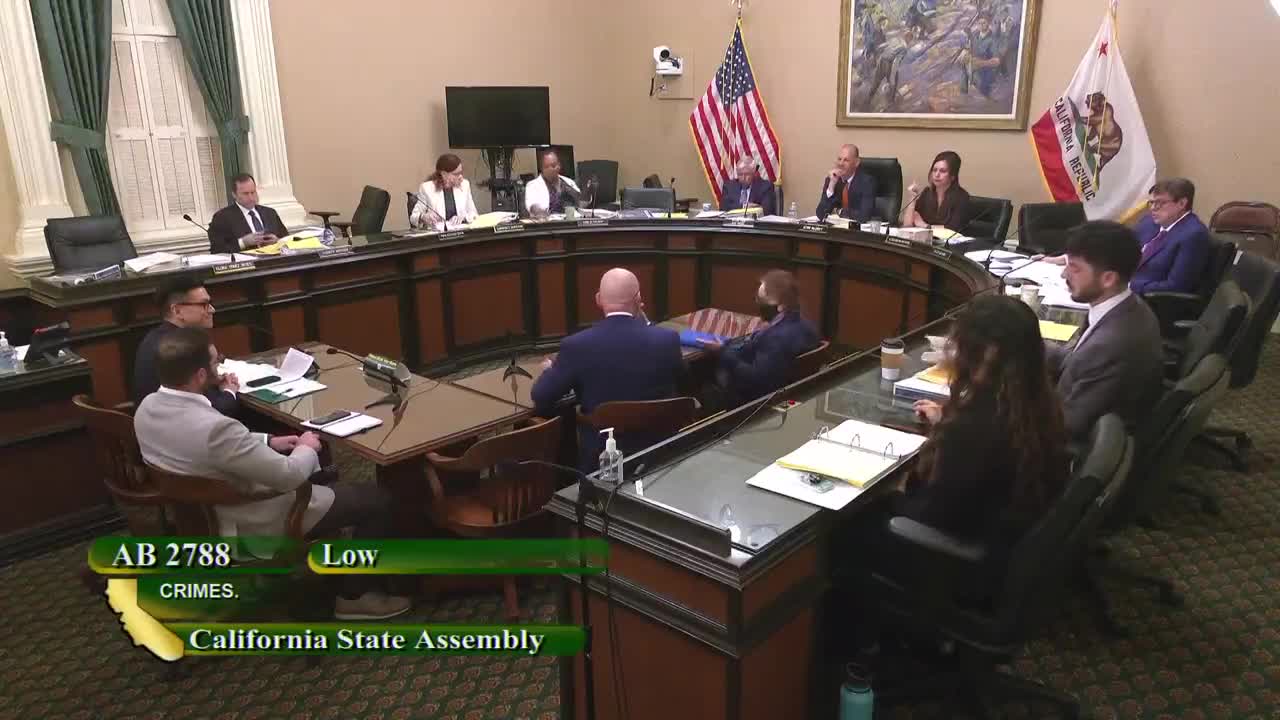 9MIN
Assembly Standing Committee on Public Safety
Bill Author

Bill Co-Author(s):