AB 877: Income taxes: credit: lodging for displaced persons.
- Session Year: 2023-2024
- House: Assembly
- Latest Version Date: 2023-04-20
Current Status:
Failed
(2024-02-01: From committee: Filed with the Chief Clerk pursuant to Joint Rule 56.)
Introduced
In Committee
First Chamber
In Committee
Second Chamber
Enacted
What does this bill do?
This bill creates a temporary tax credit for owners of small hotels, motels, inns, bed-and-breakfasts, and similar short-stay lodging that provide free rooms or rentable units to people displaced during a state or federal emergency. The credit equals 50% of the nightly rate times the number of nights (capped at $2,000 per unit and $10,000 total per emergency), applies only to properties with 50 or fewer units and not run by public agencies or certain funded programs, and requires operators to keep statements from displaced guests and provide them to the state tax board on request.
The summary is provided by generative AI which can make mistakes. For original language, please view the details in the table below.
The Personal Income Tax Law and the Corporation Tax Law allow various credits against the taxes imposed by those laws.
This bill, for taxable years beginning on or after January 1, 2023, 2024, and before January 1, 2028, 2029, would allow a credit against those taxes to a taxpayer operating a hotel, motel, inn, bed and breakfast, or other similar transient lodging, as specified, in an amount equal to 50% of the nightly rate, as defined, of each room unit, as defined, that the taxpayer provides free of charge to displaced persons during a state of emergency declared by the Governor or President, times the number of nights displaced persons occupied the room, unit, not to exceed $2,000 per room and not to exceed $10,000 total per state of emergency declaration. The bill would require a qualified taxpayer claiming the credit to provide to the Franchise Tax Board, upon request, statements with specified information from all displaced persons who occupied a room unit in the qualified lodging free of charge.
Existing law requires any bill authorizing a new tax credit to contain, among other things, specific goals, purposes, and objectives that the tax credit will achieve, detailed performance indicators, and data collection requirements.
The bill would make specified findings detailing the goals, purposes, and objectives of the above-described tax credit, performance indicators for determining whether the credit meets those goals, purposes, and objectives, and data collection requirements.
This bill would take effect immediately as a tax levy.
The Personal Income Tax Law and the Corporation Tax Law allow various credits against the taxes imposed by those laws.
This bill, for taxable years beginning on or after January 1, 2023, and before January 1, 2028, would allow a credit against those taxes to a taxpayer operating a hotel, motel, inn, bed and breakfast, or other similar transient lodging, as specified, located in the state, in an amount equal to 50% of the nightly rate, as defined, of each room that the taxpayer provides free of charge to displaced persons during a state of emergency declared by the Governor or President, times the number of nights displaced persons occupied the room, not to exceed an unspecified amount $2,000 per room per state of emergency declaration. The bill would require a qualified taxpayer claiming the credit to provide to the Franchise Tax Board, upon request, statements with specified information from all displaced persons who occupied a room in the qualified lodging free of charge.
Existing law requires any bill authorizing a new tax credit to contain, among other things, specific goals, purposes, and objectives that the tax credit will achieve, detailed performance indicators, and data collection requirements.
The bill would make specified findings detailing the goals, purposes, and objectives of the above-described tax credit, performance indicators for determining whether the credit meets those goals, purposes, and objectives, and data collection requirements.
This bill would take effect immediately as a tax levy.
The Personal Income Tax Law and the Corporation Tax Law allow various credits against the taxes imposed by those laws.
This bill, for taxable years beginning on or after January 1, 2023, and before January 1, 2028, would allow a credit against those taxes to a taxpayer operating a hotel, motel, inn, bed and breakfast, or other similar transient lodging, as specified, located in the state, in an amount equal to 50% of the nightly rate, as defined, of each room that the taxpayer provides free of charge to displaced persons during a state of emergency declared by the Governor or President, times the number of nights displaced persons occupied the room, not to exceed an unspecified amount per room per state of emergency declaration.
Existing law requires any bill authorizing a new tax credit to contain, among other things, specific goals, purposes, and objectives that the tax credit will achieve, detailed performance indicators, and data collection requirements.
The bill would make specified findings detailing the goals, purposes, and objectives of the above-described tax credit, performance indicators for determining whether the credit meets those goals, purposes, and objectives, and data collection requirements.
This bill would take effect immediately as a tax levy.
(a)For each taxable year beginning on or after January 1, 2023, 2024, and before January 1, 2028, 2029, there shall be allowed a credit against the net tax, as defined in Section 17039, to a qualified taxpayer in an amount equal to 50 percent of qualified expenses incurred by the qualified taxpayer during the taxable year.
(b)For purposes of this section:
(1)(A)Qualified expenses means the rate of each room unit in qualified lodging provided free of charge to displaced persons during a state of emergency declared by the Governor or President, times the number of nights displaced persons occupied the room, unit, not to exceed two thousand dollars ($2,000) per room unit and not to exceed ten thousand dollars ($10,000) total per state of emergency declaration.
(B)Qualified expenses does not include meals or other amenities provided by the qualified taxpayer to displaced persons.
(2)(A)Qualified lodging means a hotel, motel, inn, bed and breakfast, or other similar transient lodging, that satisfies both of the following:
(i)Is located in a county for which a state of emergency has been declared by the Governor or President.
(ii)Has 50 or fewer rooms. units.
(B)Qualified lodging does not include property, lodging, emergency shelters, or other businesses owned or operated by a public agency.
(C)Qualified lodging does not include property, lodging, emergency shelters, or other businesses that are funded by the Project Roomkey and Rehousing Program, the HomeKey grant program, Federal Emergency Management Agency housing vouchers or temporary rental assistance, or other similar federal, state, or local public programs.
(3)Qualified taxpayer means a taxpayer operating qualified lodging in the state.
(4)Rate means the rate of the room unit that would have been charged to other persons at the time the room unit in the qualified lodging was provided free of charge to the displaced person.
(5)Unit means each rentable or bookable space within qualified lodging.
(c)Any deduction otherwise allowed under this part for any amount paid or incurred by the taxpayer upon which the credit is based shall be reduced by the amount of the credit allowed under this section.
(d)In the case where the credit allowed by this section exceeds the net tax, the excess may be carried over to reduce the net tax in the following taxable year, and succeeding seven years, if necessary, until the credit is exhausted.
(e)(1)The Franchise Tax Board may adopt regulations necessary or appropriate to carry out the purposes of this section.
(2)A qualified taxpayer claiming the credit under this section shall provide to the Franchise Tax Board, upon request, statements from all displaced persons who occupied a room unit in the qualified lodging free of charge (A) that the displaced person occupied a room unit in the qualified lodging free of charge and (B) noting the number of nights the displaced person occupied the room. unit.
(3)Chapter 3.5 (commencing with Section 11340) of Part 1 of Division 3 of Title 2 of the Government Code shall not apply to any standard, criterion, procedure, determination, rule, notice, or guideline established or issued by the Franchise Tax Board for the purpose of administering this section.
(f)For purposes of complying with Section 41, the Legislature finds and declares the following:
(1)The specific goal, purpose, and objective that the credit will achieve is to increase access to shelter for displaced persons during declared emergencies, including for natural disasters.
(2)Detailed performance indicators for the Legislature to use in determining whether the credit meets that goal, purpose, and objective are as follows:
(A)The cumulative number of displaced persons given shelter during a declaration of emergency.
(B)The number of qualified taxpayers that are allowed a credit under this section.
(3)The Franchise Tax Board, on or before January 1, 2027, 2028, shall review the effectiveness of the credit and post the review on their internet website. The review shall include, but not be limited to, an analysis of the demand for the credit and the economic impact of the credit.
(g)This section shall remain in effect only until December 1, 2028, 2029, and as of that date is repealed.
SEC. 2.Section 23605 is added to the Revenue and Taxation Code, to read:23605.(a)For each taxable year beginning on or after January 1, 2023, 2024, and before January 1, 2028, 2029, there shall be allowed a credit against the tax, as defined in Section 23036, to a qualified taxpayer in an amount equal to 50 percent of qualified expenses incurred by the qualified taxpayer during the taxable year.
(b)For purposes of this section:
(1)(A)Qualified expenses means the rate of each room unit in qualified lodging provided free of charge to displaced persons during a state of emergency declared by the Governor or President, times the number of nights displaced persons occupied the room, unit not to exceed two thousand dollars ($2,000) per room unit and not to exceed ten thousand dollars ($10,000) total per state of emergency declaration.
(B)Qualified expenses does not include meals or other amenities provided by the qualified taxpayer to displaced persons.
(2)(A)Qualified lodging means a hotel, motel, inn, bed and breakfast, or other similar transient lodging, that satisfies both of the following:
(i)Is located in a county for which a state of emergency has been declared by the Governor or President.
(ii)Has 50 or fewer rooms. units.
(B)Qualified lodging does not include property, lodging, emergency shelters, or other businesses owned or operated by a public agency.
(C)Qualified lodging does not include property, lodging, emergency shelters, or other businesses that are funded by the Project Roomkey and Rehousing Program, the HomeKey grant program, Federal Emergency Management Agency housing vouchers or temporary rental assistance, or other similar federal, state, or local public programs.
(3)Qualified taxpayer means a taxpayer operating qualified lodging in the state.
(4)Rate means the rate of the room unit that would have been charged to other persons at the time the room unit in the qualified lodging was provided free of charge to the displaced person.
(5)Unit means each rentable or bookable space within qualified lodging.
(c)Any deduction otherwise allowed under this part for any amount paid or incurred by the taxpayer upon which the credit is based shall be reduced by the amount of the credit allowed under this section.
(d)In the case where the credit allowed by this section exceeds the tax, the excess may be carried over to reduce the tax in the following taxable year, and succeeding seven years, if necessary, until the credit is exhausted.
(e)(1)The Franchise Tax Board may adopt regulations necessary or appropriate to carry out the purposes of this section.
(2)A qualified taxpayer claiming the credit under this section shall provide to the Franchise Tax Board, upon request, statements from all displaced persons who occupied a room unit in the qualified lodging free of charge (A) that the displaced person occupied a room unit in the qualified lodging free of charge and (B) noting the number of nights the displaced person occupied the room. unit.
(3)Chapter 3.5 (commencing with Section 11340) of Part 1 of Division 3 of Title 2 of the Government Code shall not apply to any standard, criterion, procedure, determination, rule, notice, or guideline established or issued by the Franchise Tax Board for the purpose of administering this section.
(f)For purposes of complying with Section 41, the goal, purpose, objective, performance indicators, and data collection requirements for the credit allowed by this section shall be as specified in subdivision (f) of Section 17052.9.
(g)This section shall remain in effect only until December 1, 2028, 2029, and as of that date is repealed.
SEC. 3.This act provides for a tax levy within the meaning of Article IV of the California Constitution and shall go into immediate effect.
(a)For each taxable year beginning on or after January 1, 2023, and before January 1, 2028, there shall be allowed a credit against the net tax, as defined in Section 17039, to a qualified taxpayer in an amount equal to 50 percent of qualified expenses incurred by the qualified taxpayer during the taxable year.
(b)For purposes of this section:
(1)(A)Qualified expenses means the rate of each room in qualified lodging provided free of charge to displaced persons during a state of emergency declared by the Governor or President, times the number of nights displaced persons occupied the room, not to exceed ____ two thousand dollars ($____) ($2,000) per room per state of emergency declaration.
(B)Qualified expenses does not include meals or other amenities provided by the qualified taxpayer to displaced persons.
(2)(A)Qualified lodging means a hotel, motel, inn, bed and breakfast, or other similar transient lodging lodging, that satisfies both of the following:
(i)Is located in the state. a county for which a state of emergency has been declared by the Governor or President.
(ii)Has 50 or fewer rooms.
(B)Qualified lodging does not include property, lodging, emergency shelters, or other businesses owned or operated by a public agency.
(C)Qualified lodging does not include property, lodging, emergency shelters, or other businesses that are funded by the Project Roomkey and Rehousing Program, the HomeKey grant program, Federal Emergency Management Agency housing vouchers or temporary rental assistance, or other similar federal, state, or local public programs.
(3)Qualified taxpayer means a taxpayer operating qualified lodging in the state.
(4)Rate means the average price per night over the prior 12-month period of a standard room at that qualified lodging. rate of the room that would have been charged to other persons at the time the room in the qualified lodging was provided free of charge to the displaced person.
(c)Any deduction otherwise allowed under this part for any amount paid or incurred by the taxpayer upon which the credit is based shall be reduced by the amount of the credit allowed under this section.
(d)In the case where the credit allowed by this section exceeds the net tax, the excess may be carried over to reduce the net tax in the following taxable year, and succeeding seven years, if necessary, until the credit is exhausted.
(e)(1)The Franchise Tax Board may adopt regulations necessary or appropriate to carry out the purposes of this section.
(2)A qualified taxpayer claiming the credit under this section shall provide to the Franchise Tax Board, upon request, statements from all displaced persons who occupied a room in the qualified lodging free of charge (A) that the displaced person occupied a room in the qualified lodging free of charge and (B) noting the number of nights the displaced person occupied the room.
(2)(3)Chapter 3.5 (commencing with Section 11340) of Part 1 of Division 3 of Title 2 of the Government Code shall not apply to any standard, criterion, procedure, determination, rule, notice, or guideline established or issued by the Franchise Tax Board for the purpose of administering this section.
(f)For purposes of complying with Section 41, the Legislature finds and declares the following:
(1)The specific goal, purpose, and objective that the credit will achieve is to increase access to shelter for displaced persons during declared emergencies, including for natural disasters.
(2)Detailed performance indicators for the Legislature to use in determining whether the credit meets that goal, purpose, and objective are as follows:
(A)The cumulative number of displaced persons given shelter during a declaration of emergency.
(B)The number of qualified taxpayers that are allowed a credit under this section.
(3)The Franchise Tax Board, on or before January 1, 2027, shall review the effectiveness of the credit and post the review on their internet website. The review shall include, but not be limited to, an analysis of the demand for the credit and the economic impact of the credit.
(g)This section shall remain in effect only until December 1, 2028, and as of that date is repealed.
SEC. 2.Section 23605 is added to the Revenue and Taxation Code, to read:23605.(a)For each taxable year beginning on or after January 1, 2023, and before January 1, 2028, there shall be allowed a credit against the tax, as defined in Section 23036, to a qualified taxpayer in an amount equal to 50 percent of qualified expenses incurred by the qualified taxpayer during the taxable year.
(b)For purposes of this section:
(1)(A)Qualified expenses means the rate of each room in qualified lodging provided free of charge to displaced persons during a state of emergency declared by the Governor or President, times the number of nights displaced persons occupied the room, not to exceed ____ two thousand dollars ($____) ($2,000) per room per state of emergency declaration.
(B)Qualified expenses does not include meals or other amenities provided by the qualified taxpayer to displaced persons.
(2)(A)Qualified lodging means a hotel, motel, inn, bed and breakfast, or other similar transient lodging lodging, that satisfies both of the following:
(i)Is located in the state. a county for which a state of emergency has been declared by the Governor or President.
(ii)Has 50 or fewer rooms.
(B)Qualified lodging does not include property, lodging, emergency shelters, or other businesses owned or operated by a public agency.
(C)Qualified lodging does not include property, lodging, emergency shelters, or other businesses that are funded by the Project Roomkey and Rehousing Program, the HomeKey grant program, Federal Emergency Management Agency housing vouchers or temporary rental assistance, or other similar federal, state, or local public programs.
(3)Qualified taxpayer means a taxpayer operating qualified lodging in the state.
(4)Rate means the average price per night over the prior 12-month period of a standard room at that qualified lodging. rate of the room that would have been charged to other persons at the time the room in the qualified lodging was provided free of charge to the displaced person.
(c)Any deduction otherwise allowed under this part for any amount paid or incurred by the taxpayer upon which the credit is based shall be reduced by the amount of the credit allowed under this section.
(d)In the case where the credit allowed by this section exceeds the tax, the excess may be carried over to reduce the tax in the following taxable year, and succeeding seven years, if necessary, until the credit is exhausted.
(e)(1)The Franchise Tax Board may adopt regulations necessary or appropriate to carry out the purposes of this section.
(2)A qualified taxpayer claiming the credit under this section shall provide to the Franchise Tax Board, upon request, statements from all displaced persons who occupied a room in the qualified lodging free of charge (A) that the displaced person occupied a room in the qualified lodging free of charge and (B) noting the number of nights the displaced person occupied the room.
(2)(3)Chapter 3.5 (commencing with Section 11340) of Part 1 of Division 3 of Title 2 of the Government Code shall not apply to any standard, criterion, procedure, determination, rule, notice, or guideline established or issued by the Franchise Tax Board for the purpose of administering this section.
(f)For purposes of complying with Section 41, the goal, purpose, objective, performance indicators, and data collection requirements for the credit allowed by this section shall be as specified in subdivision (f) of Section 17052.9.
(g)This section shall remain in effect only until December 1, 2028, and as of that date is repealed.
SEC. 3.This act provides for a tax levy within the meaning of Article IV of the California Constitution and shall go into immediate effect.
(a)For each taxable year beginning on or after January 1, 2023, and before January 1, 2028, there shall be allowed a credit against the net tax, as defined in Section 17039, to a qualified taxpayer in an amount equal to 50 percent of qualified expenses incurred by the qualified taxpayer during the taxable year.
(b)For purposes of this section:
(1)(A)Qualified expenses means the rate of each room in qualified lodging provided free of charge to displaced persons during a state of emergency declared by the Governor or President, times the number of nights displaced persons occupied the room, not to exceed ____ dollars ($____) per room per state of emergency declaration.
(B)Qualified expenses does not include meals or other amenities provided by the qualified taxpayer to displaced persons.
(2)(A)Qualified lodging means a hotel, motel, inn, bed and breakfast, or other similar transient lodging located in the state.
(B)Qualified lodging does not include property, lodging, emergency shelters, or other businesses owned or operated by a public agency.
(C)Qualified lodging does not include property, lodging, emergency shelters, or other businesses that are funded by the Project Roomkey and Rehousing Program, the HomeKey grant program, Federal Emergency Management Agency housing vouchers or temporary rental assistance, or other similar federal, state, or local public programs.
(3)Qualified taxpayer means a taxpayer operating qualified lodging in the state.
(4)Rate means the average price per night over the prior 12-month period of a standard room at that qualified lodging.
(c)Any deduction otherwise allowed under this part for any amount paid or incurred by the taxpayer upon which the credit is based shall be reduced by the amount of the credit allowed under this section.
(d)In the case where the credit allowed by this section exceeds the net tax, the excess may be carried over to reduce the net tax in the following taxable year, and succeeding seven years, if necessary, until the credit is exhausted.
(e)(1)The Franchise Tax Board may adopt regulations necessary or appropriate to carry out the purposes of this section.
(2)Chapter 3.5 (commencing with Section 11340) of Part 1 of Division 3 of Title 2 of the Government Code shall not apply to any standard, criterion, procedure, determination, rule, notice, or guideline established or issued by the Franchise Tax Board for the purpose of administering this section.
(f)For purposes of complying with Section 41, the Legislature finds and declares the following:
(1)The specific goal, purpose, and objective that the credit will achieve is to increase access to shelter for displaced persons during declared emergencies, including for natural disasters.
(2)Detailed performance indicators for the Legislature to use in determining whether the credit meets that goal, purpose, and objective are as follows:
(A)The cumulative number of displaced persons given shelter during a declaration of emergency.
(B)The number of qualified taxpayers that are allowed a credit under this section.
(3)The Franchise Tax Board, on or before January 1, 2027, shall review the effectiveness of the credit and post the review on their internet website. The review shall include, but not be limited to, an analysis of the demand for the credit and the economic impact of the credit.
(g)This section shall remain in effect only until December 1, 2028, and as of that date is repealed.
SEC. 2.Section 23605 is added to the Revenue and Taxation Code, to read:23605.(a)For each taxable year beginning on or after January 1, 2023, and before January 1, 2028, there shall be allowed a credit against the tax, as defined in Section 23036, to a qualified taxpayer in an amount equal to 50 percent of qualified expenses incurred by the qualified taxpayer during the taxable year.
(b)For purposes of this section:
(1)(A)Qualified expenses means the rate of each room in qualified lodging provided free of charge to displaced persons during a state of emergency declared by the Governor or President, times the number of nights displaced persons occupied the room, not to exceed ____ dollars ($____) per room per state of emergency declaration.
(B)Qualified expenses does not include meals or other amenities provided by the qualified taxpayer to displaced persons.
(2)(A)Qualified lodging means a hotel, motel, inn, bed and breakfast, or other similar transient lodging located in the state.
(B)Qualified lodging does not include property, lodging, emergency shelters, or other businesses owned or operated by a public agency.
(C)Qualified lodging does not include property, lodging, emergency shelters, or other businesses that are funded by the Project Roomkey and Rehousing Program, the HomeKey grant program, Federal Emergency Management Agency housing vouchers or temporary rental assistance, or other similar federal, state, or local public programs.
(3)Qualified taxpayer means a taxpayer operating qualified lodging in the state.
(4)Rate means the average price per night over the prior 12-month period of a standard room at that qualified lodging.
(c)Any deduction otherwise allowed under this part for any amount paid or incurred by the taxpayer upon which the credit is based shall be reduced by the amount of the credit allowed under this section.
(d)In the case where the credit allowed by this section exceeds the tax, the excess may be carried over to reduce the tax in the following taxable year, and succeeding seven years, if necessary, until the credit is exhausted.
(e)(1)The Franchise Tax Board may adopt regulations necessary or appropriate to carry out the purposes of this section.
(2)Chapter 3.5 (commencing with Section 11340) of Part 1 of Division 3 of Title 2 of the Government Code shall not apply to any standard, criterion, procedure, determination, rule, notice, or guideline established or issued by the Franchise Tax Board for the purpose of administering this section.
(f)For purposes of complying with Section 41, the goal, purpose, objective, performance indicators, and data collection requirements for the credit allowed by this section shall be as specified in subdivision (f) of Section 17052.9.
(g)This section shall remain in effect only until December 1, 2028, and as of that date is repealed.
SEC. 3.This act provides for a tax levy within the meaning of Article IV of the California Constitution and shall go into immediate effect.
|
Date
|
Status
|
|---|---|
| Feb 1, 2024 | From committee: Filed with the Chief Clerk pursuant to Joint Rule 56. |
| Jan 31, 2024 | Died pursuant to Art. IV, Sec. 10(c) of the Constitution. |
| May 18, 2023 | In committee: Held under submission. |
| May 18, 2023 | Joint Rule 62(a), file notice suspended. (Page 1580.) |
| May 17, 2023 | In committee: Set, first hearing. Referred to APPR. suspense file. |
| May 2, 2023 | From committee: Do pass and re-refer to Com. on APPR. (Ayes 11. Noes 0.) (May 1). Re-referred to Com. on APPR. |
| Apr 24, 2023 | Re-referred to Com. on REV. & TAX. |
| Apr 20, 2023 | From committee chair, with author's amendments: Amend, and re-refer to Com. on REV. & TAX. Read second time and amended. |
| Mar 28, 2023 | In committee: Set, first hearing. Referred to REV. & TAX. suspense file. |
| Mar 21, 2023 | Re-referred to Com. on REV. & TAX. |
| Mar 20, 2023 | From committee chair, with author's amendments: Amend, and re-refer to Com. on REV. & TAX. Read second time and amended. |
| Feb 23, 2023 | Referred to Com. on REV. & TAX. |
| Feb 15, 2023 | From printer. May be heard in committee March 17. |
| Feb 14, 2023 | Read first time. To print. |
|
Date
|
Description
|
Location
|
Votes
|
|
|---|---|---|---|---|
| May 1, 2023 | Do pass and be re-referred to the Committee on [Appropriations] | Assembly Standing Committee on Revenue and Taxation |
Passed |
This list shows positions taken on this bill by organizations on the date displayed, which is linked to the original source.
Positions by individuals are not included.
|
Organization
|
Position
|
Date
|
|---|---|---|
| California Chamber Of Commerce | ** Support | |
| California Hotel & Lodging Association | ** Support | |
| California Tax Reform Association | ** Against | |
| California Teachers Association | ** Against | |
| California Travel Association | ** Support | |
| Corbin and Kaiser | * Against | Mar 27, 2023 |
| Visit Slo Cal | ** Support |
Date of Hearing: May 17, 2023
ASSEMBLY COMMITTEE ON APPROPRIATIONS
Chris Holden, Chair
ABPCA Bill Id:AB 877
Author:(Addis) – As Amended Ver:April 20, 2023
Policy Committee: | Revenue and Taxation | Vote: | 11 - 0 |
|
| ||
|
|
Urgency: No State Mandated Local Program: No Reimbursable: No
SUMMARY:
This bill allows, for taxable years beginning on or after January 1, 2024, and before January 1, 2029, a tax credit under the Personal Income Tax Law and Corporation Tax Law in an amount equal to 50% of the nightly rate of each unit that a taxpayer operating a hotel or similar transient lodging provides free of charge to displaced persons during a state of emergency.
The total credit amount per taxpayer cannot exceed $2,000 per room and $10,000 per state of emergency declaration and the taxpayer claiming the credit must provide the Franchise Tax Board (FTB) with specified lodging statements upon request.
This bill declares the goals and performance indicators of the tax credit and requires, by January 1, 2028, FTB to review the effectiveness of the credit and post the review online.
FISCAL EFFECT:
- General Fund revenue loss of approximately $4.4 million in fiscal year (FY) 2023-24, $9.0 million in FY 2024-25, and $10 million in FY 2025-26.
- GF costs of an unknown, but potentially significant, amount to FTB to administer the credit and conduct the review.
COMMENTS:
- Purpose. According to the author:
AB 877 creates the Good Neighbor Tax Credit, meant to supplement small businesses that provide invaluable shelter to vulnerable communities during natural disasters. In California, we have all seen the severe effects of natural disasters that continually ravage our state and force people out of their homes. This legislation will help our communities continue to prepare for these tragic events.
- Support and Opposition. This bill is supported by the California Hotel and Lodging Association (CHLA) and other travel and business associations. CHLA argues “California hotels are essential resources in crisis response and, as climate change increases the severity and frequency of our state’s natural disasters, more support-lodging sites will be needed.”
This bill is opposed by the California Tax Reform Association and California Teachers Association (CTA). CTA notes that while this bill is well intended, “CTA does not support this approach, as it would reduce overall funding for education” especially as the state faces a budget deficit.
- Shelter during an Emergency. The author notes this bill was introduced as a response to the devastating winter storms in January 2023 that brought widespread flooding to many parts of California and forced thousands of residents to evacuate their homes. When large amounts of people are evacuated during a natural disaster, there is often a shortage of accommodations, either no-cost shelters provided by disaster relief organizations or market-rate lodging provided by lodging businesses. This bill provides a tax credit to such businesses that provide free units to displaced persons during a state of emergency. However, as noted in the Assembly Revenue and Taxation Committee’s analysis of this bill:
While assisting disaster victims who were forced to evacuate by recent atmospheric rivers is certainly a laudable goal, it is unclear whether there would be an excess of available lodging options that would go unfilled absent the kind of incentive provided by this bill. Given the fixed number of accommodations in a region and the large increase in demand that occurs following disaster evacuations, businesses will likely be able to fill their rooms with paying customers.
Analysis Prepared by: Irene Ho / APPR. / (916) 319-2081
Date of Hearing: May 1, 2023
ASSEMBLY COMMITTEE ON REVENUE AND TAXATION
Jacqui Irwin, Chair
ABPCA Bill Id:AB 877 (
Author:Addis) – As Amended Ver:April 20, 2023
SUSPENSE
Majority vote. Tax levy. Fiscal committee.
SUBJECT: Income taxes: credit: lodging for displaced persons
SUMMARY: Allows, under the Personal Income Tax (PIT) Law and Corporation Tax (CT) Law, a credit for taxpayers that operate a "qualified lodging" facility, as specified, and provide shelter to persons displaced by a natural disaster free of charge, as specified. Specifically, this bill:
- Allows a credit for taxable years beginning on or after January 1, 2024, and before January 1, 2029, equal to 50% of the "qualified expenses" incurred by the "qualified taxpayer" during the taxable year.
- Defines the following for purposes of this credit:
- "Qualified expenses" is the rate of each room in "qualified lodging" provided free of charge to displaced persons during a state of emergency declared by the Governor or President, times the number of nights displaced persons occupied the unit, not to exceed $2,000 per unit and not to exceed $10,000 total per state of emergency declaration. The cost of meals or other amenities provided by the "qualified taxpayer" to displaced persons are not included.
- "Qualified lodging" is a hotel, motel, inn, bed and breakfast, or other similar transient lodging that has 50 or fewer units and is located in a county for which a state of emergency has been declared by the Governor or President. "Qualified lodging" does not include the following:
- Property, lodging, emergency shelters, or other businesses owned or operated by a public agency; and,
- Property, lodging, emergency shelters, or other businesses that are funded by the Project Roomkey and Rehousing Program, the HomeKey grant program, Federal Emergency Management Agency housing vouchers or temporary rental assistance, or other similar federal, state, or local public programs.
- "Qualified taxpayer" is a taxpayer operating qualified lodging in this state.
- "Rate" is the rate of the unit that would have been charged to other persons at the time the room in the qualified lodging was provided free of charge to the displaced person.
- "Unit" is each rentable or bookable space within qualified lodging.
- Provides that any credit amounts in excess of the qualified taxpayer's liability may be carried over for up to eight years, until the credit is exhausted.
- Authorizes the Franchise Tax Board (FTB) to prescribe rules, guidelines, procedures, or other guidance to carry out the purposes of this bill. The Administrative Procedure Act shall not apply to any rule, guideline, or procedure prescribed by the FTB pursuant to this bill.
- Requires a qualified taxpayer claiming the credit to, upon request, provide the FTB with statements from all displaced persons who occupied a room in the qualified lodging free of charge in order to verify both of the following:
- That the displaced person occupied a unit in the qualified lodging free of charge; and,
- The number of nights the displaced person occupied the unit.
- Repeals the credit's statutory provisions on December 1, 2029.
- Finds and declares the following for the purposes of satisfying the requirements of Revenue and Taxation Code (R&TC) Section 41:
- The specific goals, purposes, and objectives of this bill are to provide an additional incentive for individuals to increase access to shelter for displaced persons during declared emergencies, including for natural disasters.
- The detailed performance indicators for the Legislature to use in determining whether the credit meets that goal, purpose, and objective are:
- The cumulative number of displaced persons given shelter during a declaration of emergency; and,
- The number of taxpayers claiming the credit.
- The FTB shall, on or before January 1, 2028, review the effectiveness of the credit and post the review on their website. The review shall include, but not be limited to, an analysis of the demand for the credit and the economic impact of the credit.
- Takes immediate effect as a tax levy.
EXISTING LAW:
- Allows various tax credits under the PIT Law and CT Law. These credits are generally designed to encourage socially beneficial behavior or to provide relief to taxpayers who incur specified expenses.
- Requires any bill authorizing a new credit to contain all of the following:
- Specific goals, purposes, and objectives that the tax credit will achieve;
- Detailed performance indicators for the Legislature to use when measuring whether the tax credit meets the goals, purposes, and objectives stated in the bill; and,
- Data collection requirements to enable the Legislature to determine whether the tax credit is meeting, failing to meet, or exceeding those specific goals, purposes, and objectives. The requirements shall include the specific data and baseline measurements to be collected and remitted in each year the credit is in effect, for the Legislature to measure the change in performance indicators, and the specific taxpayers, state agencies, or other entities required to collect and remit data. (R&TC Section 41.)
FISCAL EFFECT: The FTB estimates General Fund revenue losses of $4.4 million in fiscal year (FY) 2023-24, $9 million in FY 2024-25, and $10 million in FY 2025-26.
COMMENTS:
- The author has provided the following statement in support of this bill:
AB 877 creates the Good Neighbor Tax Credit, meant to supplement small businesses that provide invaluable shelter to vulnerable communities during natural disasters. In California, we have all seen the severe effects of natural disasters that continually ravage our state and force people out of their homes. This legislation will help our communities continue to prepare for these tragic events.
- In support of this bill, the California Hotel & Lodging Association (CHLA) notes, in part:
While many small hotels, motels, and inns provide accommodations at discounted rates to evacuees and people adversely affected by emergency events, a large portion are unable to waive fees altogether for emergency victims due to existing financial obligations. This results in a situation whereby evacuees who, in many cases, are facing incredible expenses to rebuild their lives are forced to cover the additional cost of emergency lodging, even if it is at a discounted rate. CHLA believes that this measure would help put some hoteliers in a position whereby they could afford to completely waive fees for evacuees – helping remove the added cost and stress of lodging expenses.
- In opposition to this bill, the California Tax Reform Association notes, in part:
California is currently projecting upwards of a $22.5 billion shortfall, which the Governor's administration has, thus far, proposed to solve through a series of trigger cuts, delays or deferrals as well as withdrawals or reductions of planned one-time spending. At over 60% of all General Fund revenues, the PIT represents the state's largest revenue source and, in light of the projected budget shortfall, reductions to it must be well considered. These losses would be on top of the billions in General Fund revenue lost annually to longstanding and pre-existing tax expenditure programs that disproportionately benefit high-net worth individuals and corporations.
- Committee Staff Comments:
- What is a "tax expenditure"? Existing law provides various credits, deductions, exclusions, and exemptions for particular taxpayer groups. In the late 1960s, U.S. Treasury officials began arguing that these features of the tax law should be referred to as "expenditures" since they are generally enacted to accomplish some governmental purpose and there is a determinable cost associated with each (in the form of foregone revenues).
As the Department of Finance notes in its annual Tax Expenditure Report, there are several key differences between tax expenditures and direct expenditures. First, tax expenditures are typically reviewed less frequently than direct expenditures. Second, there is generally no control over the amount of revenue losses associated with any given tax expenditure. Finally, it should also be noted that, once enacted, it takes a two-thirds vote to rescind an existing tax expenditure absent a sunset date. This effectively results in a "one-way ratchet" whereby tax expenditures can be conferred by majority vote, but cannot be rescinded, irrespective of their efficacy or cost, without a supermajority vote.
- What problem is this bill attempting to solve? According to the author, this bill was introduced as a response to the devastating winter storms in January 2023 that brought widespread flooding to many parts of California and forced thousands of residents to evacuate their homes. Wildfires in recent years have also prompted mass evacuations across the state and the author points to the impacts of climate change likely leading to additional natural disasters in the future. Following these disasters, entities such as the Red Cross, Federal Emergency Management Agency (FEMA), and other public agencies provide some form of no-cost shelter to evacuees. Alternatively, evacuees who can afford market-rate lodging will seek other accommodations in nearby hotels and motels. When large amounts of people are evacuated during a natural disaster, there is often a shortage of accommodations both in terms of no-cost shelters provided by disaster relief organizations and market-rate lodging provided by lodging businesses.
- An incentive or a reward? Typically, tax credits are provided prospectively as a matter of legislative grace to encourage taxpayers to behave in ways they might not absent a financial incentive. This credit, in turn, is intended to provide a benefit to small lodging facilities that provide no-cost lodging to persons displaced by a disaster. While assisting disaster victims who were forced to evacuate by recent atmospheric rivers is certainly a laudable goal, it is unclear whether there would be an excess of available lodging options that would go unfilled absent the kind of incentive provided by this bill. Given the fixed number of accommodations in a region and the large increase in demand that occurs following disaster evacuations, businesses will likely be able to fill their rooms with paying customers.
- Documentation: As currently drafted, this bill requires taxpayers claiming the credit to provide the FTB with documentation, upon request, verifying the number of nights a displaced person was provided lodging free of charge. While this provision does attempt to provide a mechanism that would enable the state to verify that the intended activity actually took place, there are no requirements for this documentation to be made under penalty of perjury or other safeguards. Additionally, this process of verification could be time and resource intensive to administer.
- Committee's tax expenditure policy: Both R&TC Section 41 and Committee policy require any tax expenditure bill to outline specific goals, purposes, and objectives that the tax expenditure will achieve, along with detailed performance indicators for the Legislature to use when measuring whether the tax expenditure meets those stated goals, purposes, and objectives. A tax expenditure bill will not be eligible for a Committee vote unless it has complied with these requirements.
- What problem is this bill attempting to solve? According to the author, this bill was introduced as a response to the devastating winter storms in January 2023 that brought widespread flooding to many parts of California and forced thousands of residents to evacuate their homes. Wildfires in recent years have also prompted mass evacuations across the state and the author points to the impacts of climate change likely leading to additional natural disasters in the future. Following these disasters, entities such as the Red Cross, Federal Emergency Management Agency (FEMA), and other public agencies provide some form of no-cost shelter to evacuees. Alternatively, evacuees who can afford market-rate lodging will seek other accommodations in nearby hotels and motels. When large amounts of people are evacuated during a natural disaster, there is often a shortage of accommodations both in terms of no-cost shelters provided by disaster relief organizations and market-rate lodging provided by lodging businesses.
In its current form, this bill states that the credit is designed to increase access to shelter for displaced persons during declared emergencies, including for natural disasters. In addition, this bill provides that the credit's effectiveness shall be measured by the cumulative number of displaced persons given shelter during a declaration of emergency and the number of qualified taxpayers claiming the credit.
In addition to the R&TC Section 41 requirements, this Committee's policy also requires that all tax expenditure proposals contain an appropriate sunset provision to be eligible for a vote. According to this policy, an "appropriate sunset provision" means five years, except in the case of a tax expenditure measure providing relief to California veterans, in which case "appropriate sunset provision" shall mean ten years. This bill, as currently drafted, complies with the Committee's policy on sunset dates.
REGISTERED SUPPORT / OPPOSITION:
Support
California Chamber of Commerce
California Hotel & Lodging Association
California Travel Association (CALTRAVEL)
Visit SLO CAL
Oppose
California Tax Reform Association
California Teachers Association
Analysis Prepared by: Wesley Whitaker / REV. & TAX. / (916) 319-2098
Date of Hearing: March 27, 2023
ASSEMBLY COMMITTEE ON REVENUE AND TAXATION
Jacqui Irwin, Chair
ABPCA Bill Id:AB 877 (
Author:Addis) – As Amended Ver:March 20, 2023
Majority vote. Tax levy. Fiscal committee.
SUBJECT: Income taxes: credit: lodging for displaced persons
SUMMARY: Allows, under the Personal Income Tax (PIT) Law and Corporation Tax (CT) Law, a credit for taxpayers who operate a lodging facility, as specified, and provide shelter to persons displaced by a natural disaster free of charge. Specifically, this bill:
- Allows a credit for taxable years beginning on or after January 1, 2023, and before January 1, 2028, in an amount equal to 50 percent of the "qualified expenses" incurred by the "qualified taxpayer" during the taxable year.
- Defines the following for purposes of this credit:
- "Qualified expenses" is the rate of each room in qualified lodging provided free of charge to displaced persons during a state of emergency declared by the Governor or President, times the number of nights displaced persons occupied the room, not to exceed $2,000 per room per state of emergency declaration. The cost of meals or other amenities provided by the "qualified taxpayer" to displaced persons are not included.
- "Qualified lodging" is a hotel, motel, inn, bed and breakfast, or other similar transient lodging that has 50 or fewer rooms and is located in a county for which a state of emergency has been declared by the Governor or President. "Qualified lodging" does not include the following:
- Property, lodging, emergency shelters, or other businesses owned or operated by a public agency; and,
- Property, lodging, emergency shelters, or other businesses that are funded by the Project Roomkey and Rehousing Program, the HomeKey grant program, Federal Emergency Management Agency housing vouchers or temporary rental assistance, or other similar federal, state, or local public programs.
- "Qualified taxpayer" is a taxpayer operating qualified lodging in the state.
- "Rate" is the rate of the room that would have been charged to other persons at the time the room in the qualified lodging was provided free of charge to the displaced person.
- Provides that any credit amounts in excess of the qualified taxpayer's liability may be carried over for up to eight years, until the credit is exhausted.
- Authorizes the Franchise Tax Board (FTB) to prescribe rules, guidelines, procedures, or other guidance to carry out the purposes of this bill. The Administrative Procedure Act shall not apply to any rule, guideline, or procedure prescribed by the FTB pursuant to this bill.
- Requires a qualified taxpayer claiming the credit to, upon request, provide the FTB with statements from all displaced persons who occupied a room in the qualified lodging free of charge in order to verify both of the following:
- That the displaced person occupied a room in the qualified lodging free of charge; and,
- The number of nights the displaced person occupied the room.
- Sunsets the credit's statutory provisions on December 1, 2028.
- Finds and declares the following for the purposes of satisfying the requirements of Revenue and Taxation Code (R&TC) Section 41:
- The specific goals, purposes, and objectives of this bill are to provide an additional incentive for individuals to increase access to shelter for displaced persons during declared emergencies, including for natural disasters.
- The detailed performance indicators for the Legislature to use in determining whether the credit meets that goal, purpose, and objective are:
- The cumulative number of displaced persons given shelter during a declaration of emergency; and,
- The number of taxpayers claiming the credit.
- The FTB shall, on or before January 1, 2027, review the effectiveness of the credit and post the review on their website. The review shall include, but not be limited to, an analysis of the demand for the credit and the economic impact of the credit.
- Takes immediate effect as a tax levy.
EXISTING LAW:
- Allows various tax credits under the PIT Law and CT Law. These credits are generally designed to encourage socially beneficial behavior or to provide relief to taxpayers who incur specified expenses.
- Requires any bill authorizing a new credit to contain all of the following:
- Specific goals, purposes, and objectives that the tax credit will achieve;
- Detailed performance indicators for the Legislature to use when measuring whether the tax credit meets the goals, purposes, and objectives stated in the bill; and,
- Data collection requirements to enable the Legislature to determine whether the tax credit is meeting, failing to meet, or exceeding those specific goals, purposes, and objectives. The requirements shall include the specific data and baseline measurements to be collected and remitted in each year the credit is in effect, for the Legislature to measure the change in performance indicators, and the specific taxpayers, state agencies, or other entities required to collect and remit data. (R&TC Section 41.)
FISCAL EFFECT: The FTB estimates, based on the introduced version of the bill, General Fund revenue losses of $8.8 million in fiscal year (FY) 2023-24, $6.9 million in FY 2024-25, and $7.3 million in FY 2025-26.
COMMENTS:
- The author has provided the following statement in support of this bill:
AB 877 creates the Good Neighbor Tax Credit, meant to supplement small businesses that provide invaluable shelter to vulnerable communities during natural disasters. In California, we have all seen the severe effects of natural disasters that continually ravage our state and force people out of their homes. This legislation will help our communities continue to prepare for these tragic events.
- In support of this bill, the California Hotel & Lodging Association (CHLA) notes, in part:
While many small hotels, motels, and inns provide accommodations at discounted rates to evacuees and people adversely affected by emergency events, a large portion are unable to waive fees altogether for emergency victims due to existing financial obligations. This results in a situation whereby evacuees who, in many cases, are facing incredible expenses to rebuild their lives are forced to cover the additional cost of emergency lodging, even if it is at a discounted rate. CHLA believes that this measure would help put some hoteliers in a position whereby they could afford to completely waive fees for evacuees – helping remove the added cost and stress of lodging expenses.
- In opposition to this bill, the California Tax Reform Association notes, in part:
California is currently projecting upwards of a $22.5 billion shortfall, which the Governor's administration has, thus far, proposed to solve through a series of trigger cuts, delays or deferrals as well as withdrawals or reductions of planned one-time spending. At over 60% of all General Fund revenues, the PIT represents the state's largest revenue source and, in light of the projected budget shortfall, reductions to it must be well considered. These losses would be on top of the billions in General Fund revenue lost annually to longstanding and pre-existing tax expenditure programs that disproportionately benefit high-net worth individuals and corporations.
- Committee Staff Comments:
- What is a "tax expenditure"? Existing law provides various credits, deductions, exclusions, and exemptions for particular taxpayer groups. In the late 1960s, U.S. Treasury officials began arguing that these features of the tax law should be referred to as "expenditures" since they are generally enacted to accomplish some governmental purpose and there is a determinable cost associated with each (in the form of foregone revenues).
As the Department of Finance notes in its annual Tax Expenditure Report, there are several key differences between tax expenditures and direct expenditures. First, tax expenditures are typically reviewed less frequently than direct expenditures. Second, there is generally no control over the amount of revenue losses associated with any given tax expenditure. Finally, it should also be noted that, once enacted, it takes a two-thirds vote to rescind an existing tax expenditure absent a sunset date. This effectively results in a "one-way ratchet" whereby tax expenditures can be conferred by majority vote, but cannot be rescinded, irrespective of their efficacy or cost, without a supermajority vote.
- What problem is this bill attempting to solve? According to the author, this bill was introduced as a response to the devastating winter storms in January 2023 that brought widespread flooding to many parts of California and forced thousands of residents to evacuate their homes. Wildfires in recent years have also prompted mass evacuations across the state and the author points to the impacts of climate change likely leading to additional natural disasters in the future. Following these disasters, entities such as the Red Cross, Federal Emergency Management Agency (FEMA), and other public agencies provide some form of no-cost shelter to evacuees. Alternatively, evacuees who can afford market-rate lodging will seek other accommodations in nearby hotels and motels. When large amounts of people are evacuated during a natural disaster, there is often a shortage of accommodations both in terms of no-cost shelters provided by disaster relief organizations and market-rate lodging provided by lodging businesses.
- An incentive or a reward? Typically, tax credits are provided prospectively as a matter of legislative grace to encourage taxpayers to behave in ways they might not absent a financial incentive. This credit, in turn, is intended to provide a benefit to small lodging facilities that provide no-cost lodging to persons displaced by a disaster and begins providing this credit for taxable years beginning on January 1, 2023. Tax credits with retroactive application, however, cannot incentivize past behavior that has already occurred. Additionally, while assisting disaster victims who were forced to evacuate by recent atmospheric rivers is certainly a laudable goal, it is unclear whether there would be an excess of available lodging options that would go unfilled absent the kind of incentive provided by this bill. Given the fixed number of accommodations in a region and the large increase in demand that occurs following disaster evacuations, businesses will likely be able to fill their rooms with paying customers.
- Implementation Considerations:
- Total credit amount is unlimited: As currently drafted, this bill does not cap the total amount of credit that may be claimed by a taxpayer in either a single taxable year or cumulatively and could present a unique opportunity for taxpayers to drastically reduce their tax liabilities, potentially creating incentives for abuse. In order to better contain the revenue impacts of this credit, the author may wish to consider amending this bill to limit the total amount claimed under this credit.
- Documentation: As currently drafted, this bill requires taxpayers claiming the credit to provide the FTB with documentation, upon request, verifying the number of nights a displaced person was provided lodging free of charge. While this provision does attempt to provide a mechanism that would enable the state to verify that the intended activity actually took place, there are no requirements for this documentation to be made under penalty of perjury or other safeguards. Additionally, this process of verification could be time and resource intensive to administer.
- Total credit amount is unlimited: As currently drafted, this bill does not cap the total amount of credit that may be claimed by a taxpayer in either a single taxable year or cumulatively and could present a unique opportunity for taxpayers to drastically reduce their tax liabilities, potentially creating incentives for abuse. In order to better contain the revenue impacts of this credit, the author may wish to consider amending this bill to limit the total amount claimed under this credit.
- Committee's tax expenditure policy: Both R&TC Section 41 and Committee policy require any tax expenditure bill to outline specific goals, purposes, and objectives that the tax expenditure will achieve, along with detailed performance indicators for the Legislature to use when measuring whether the tax expenditure meets those stated goals, purposes, and objectives. A tax expenditure bill will not be eligible for a Committee vote unless it has complied with these requirements.
- What problem is this bill attempting to solve? According to the author, this bill was introduced as a response to the devastating winter storms in January 2023 that brought widespread flooding to many parts of California and forced thousands of residents to evacuate their homes. Wildfires in recent years have also prompted mass evacuations across the state and the author points to the impacts of climate change likely leading to additional natural disasters in the future. Following these disasters, entities such as the Red Cross, Federal Emergency Management Agency (FEMA), and other public agencies provide some form of no-cost shelter to evacuees. Alternatively, evacuees who can afford market-rate lodging will seek other accommodations in nearby hotels and motels. When large amounts of people are evacuated during a natural disaster, there is often a shortage of accommodations both in terms of no-cost shelters provided by disaster relief organizations and market-rate lodging provided by lodging businesses.
In its current form, this bill states that the credit is designed to increase access to shelter for displaced persons during declared emergencies, including for natural disasters. In addition, this bill provides that the credit's effectiveness shall be measured by the cumulative number of displaced persons given shelter during a declaration of emergency and the number of qualified taxpayers claiming the credit.
In addition to the R&TC Section 41 requirements, this Committee's policy also requires that all tax expenditure proposals contain an appropriate sunset provision to be eligible for a vote. According to this policy, an "appropriate sunset provision" means five years, except in the case of a tax expenditure measure providing relief to California veterans, in which case "appropriate sunset provision" shall mean ten years. This bill, as currently drafted, complies with the Committee's policy on sunset dates.
REGISTERED SUPPORT / OPPOSITION:
Support
California Chamber of Commerce
California Hotel & Lodging Association
California Travel Association (CALTRAVEL)
Visit SLO CAL
Oppose
California Tax Reform Association
Analysis Prepared by: Wesley Whitaker / REV. & TAX. / (916) 319-2098
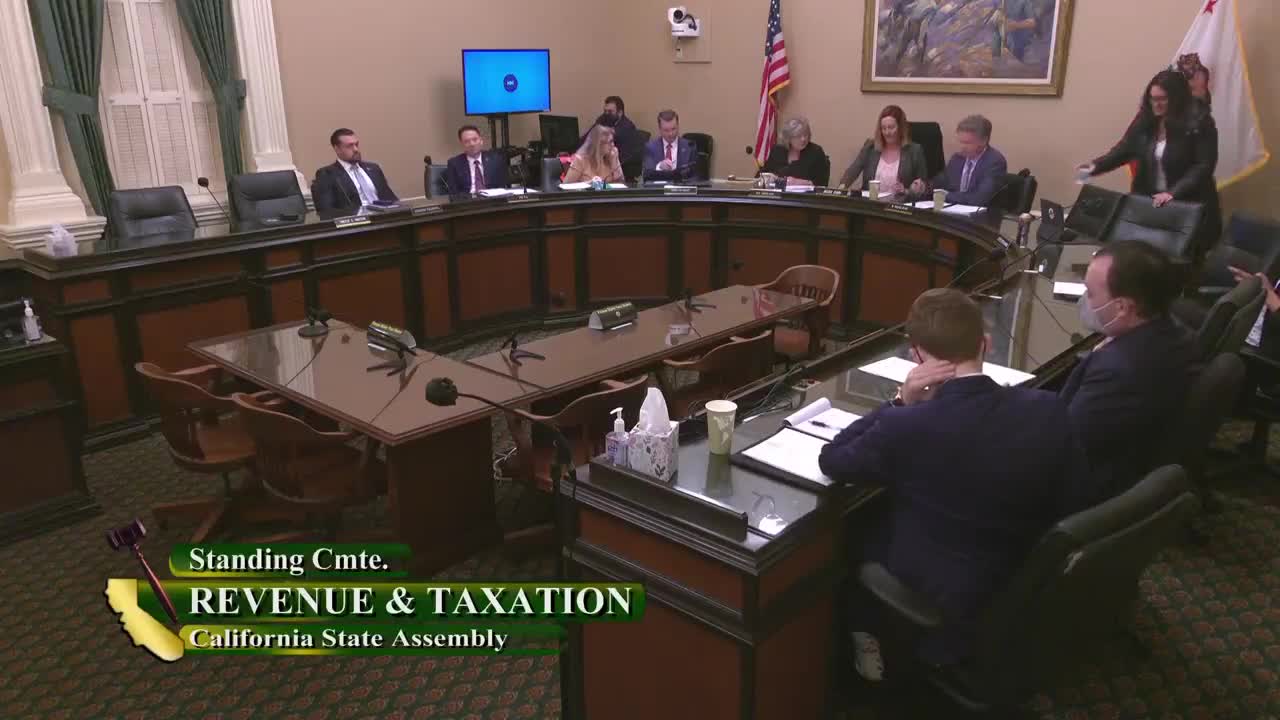
Discussed in Hearing
 8MIN
Assembly Standing Committee on Revenue and Taxation
Bill Author

Bill Co-Author(s):