AB 2600: Immigration: access to legal counsel.
- Session Year: 2025-2026
- House: Assembly
- Latest Version Date: 2026-04-09
Current Status:
In Progress
(2026-05-14: In committee: Held under submission.)
Introduced
In Committee
Awaiting First Chamber Vote
Passed First Chamber
In Committee
Awaiting Second Chamber Vote
Passed Second Chamber
Enacted
What does this bill do?
Subject to available state funding, the bill would require California to provide free legal counsel to low‑income immigrants who are not already represented and who live in, are detained in, have immigration cases in, or otherwise have a significant connection to California. It creates an administrator’s office in the State Department of Social Services to run the program, set eligibility rules, contract with nonprofit legal providers, public defender offices, or qualified private attorneys, provide training and oversight, and report annually to the Legislature.
The summary is provided by generative AI which can make mistakes. For original language, please view the details in the table below.
Existing law, subject to available funding, provides legal counsel to immigrant youth in the State of California. Existing law requires the State Department of Social Services to allocate funding for these purposes, and requires the department to consider whether federal funding has been made available and dispersed to organizations or relevant projects in the state in determining the amount and allocation of contracts awarded. Existing law requires the department to contract with qualified nonprofit legal services organizations, or public defender offices, that meet certain requirements to provide legal counsel to immigrant youth.
This bill would, subject to the availability of funding, similarly provide legal counsel to every covered individual subject to certain immigration proceedings if that individual is not otherwise being provided counsel, as specified. The bill would define a covered individual to include an individual who is not represented by counsel and who satisfies the indigency requirements established by the administrator and one or more of certain specified criteria relating to the connection of them or their immigration case to the State California. The bill would require the department to establish the office of the administrator within the department to oversee implementation of these provisions. The bill would require these the provisions to be implemented by an unnamed the administrator, or their designee, by January 1, 2027, and would specify the duties and authorities of the administrator, or their designee, with regard to implementation, including, among others, the authority to develop and implement a phase-in plan. The bill would require the administrator, or their designee, to contract to provide legal counsel for covered individuals with qualified nonprofit legal services organizations or public defender officers that meet the requirements referred to above, or with private firms or private attorneys who meet the criteria for participation in a private attorney panel. The bill would require the administrator to annually submit a report to the Legislature regarding the implementation of these provisions.
Existing law, subject to available funding, provides legal counsel to immigrant youth in the State of California. Existing law requires the State Department of Social Services to allocate funding for these purposes, and requires the department to consider whether federal funding has been made available and dispersed to organizations or relevant projects in the state in determining the amount and allocation of contracts awarded. Existing law requires the department to contract with qualified nonprofit legal services organizations, or public defender offices, that meet certain requirements to provide legal counsel to immigrant youth.
This bill would, subject to the availability of funding, similarly provide legal counsel to every covered individual subject to certain immigration proceedings if that individual is not otherwise being provided counsel, as specified. The bill would define a covered individual to include an individual who is not represented by counsel and who satisfies the indigency requirements established by the administrator and one or more of certain specified criteria relating to the connection of them or their immigration case to the State California. The bill would require these provisions to be implemented by an unnamed administrator, or their designee, by January 1, 2027, and would specify the duties and authorities of the administrator, or their designee, with regard to implementation, including, among others, the authority to develop and implement a phase-in plan. The bill would require the administrator, or their designee, to contract to provide legal counsel for covered individuals with qualified nonprofit legal services organizations or public defender officers that meet the requirements referred to above, or with private firms or private attorneys who meet the criteria for participation in a private attorney panel. The bill would require the administrator to annually submit a report to the Legislature regarding the implementation of these provisions.
Existing law, the State Bar Act, provides for the licensure and regulation of attorneys by the State Bar of California, a public corporation, governed by a board of trustees. Existing law requires an attorney to maintain short-term deposits of client funds in an Interest on Lawyers Trust Account (IOLTA) and requires the interest and dividends earned on the account to be paid to the State Bar for the funding of certain programs that provide civil legal services without charge to indigent persons.Existing law, the Sargent Shriver Civil Counsel Act, requires legal counsel to be appointed to represent low-income parties in civil matters involving critical issues affecting basic human needs in courts selected by the Judicial Council. The act requires the Judicial Council to develop one or more programs to provide competitive grants to provide legal counsel to low-income persons who require legal services in civil cases involving specific types of civil matters, including, among others, housing-related matters, probate conservatorships, guardianships, and domestic violence and civil harassment restraining orders.This bill would state the intent of the Legislature to enact legislation to provide legal representation to an individual facing removal at state government expense.Existing law, the State Bar Act, provides for the licensure and regulation of attorneys by the State Bar of California, a public corporation, governed by a board of trustees. Existing law requires an attorney to maintain short-term deposits of client funds in an Interest on Lawyers Trust Account (IOLTA) and requires the interest and dividends earned on the account to be paid to the State Bar for the funding of certain programs that provide civil legal services without charge to indigent persons.
Existing law, the Sargent Shriver Civil Counsel Act, requires legal counsel to be appointed to represent low-income parties in civil matters involving critical issues affecting basic human needs in courts selected by the Judicial Council. The act requires the Judicial Council to develop one or more programs to provide competitive grants to provide legal counsel to low-income persons who require legal services in civil cases involving specific types of civil matters, including, among others, housing-related matters, probate conservatorships, guardianships, and domestic violence and civil harassment restraining orders.
This bill would state the intent of the Legislature to enact legislation to provide legal representation to an individual facing removal at state government expense.
(a)Subject to the availability of state funding, the state shall provide legal counsel to every covered individual that is not otherwise being provided counsel pursuant to another provision of this chapter.
(b)(1)An The department shall establish the office of the administrator within the department to oversee implementation of this section.
(2)The administrator, or the administrators designee, shall implement this section no later than January 1, 2027.
(2)(3)The administrator, or the administrators designee, shall do all of the following:
(A)Promulgate regulations and adopt rules, policies, and procedures that are necessary or appropriate to implement this section.
(B)Allocate funding according to this section. In determining the amount and allocation of contracts awarded pursuant to this section, whether federal funding has been made available and dispersed to organizations or relevant projects in the state shall be considered.
(C)Prioritize awards of contracts or grants to qualified nonprofit organizations as described in Section 13301 that have unmet needs despite federal assistance.
(3)(4)The administrator, or the administrators designee, may do all of the following:
(A)Develop and implement a phase-in plan, in accordance with the following:
(i)The phase-in plan shall be developed in collaboration with expert legal services providers from across different regions throughout the state and constituent-based immigrant rights advocacy organizations with expertise in policy advocacy and implementation and regional coalition capacity building with at least five years of experience, to ensure that all covered individuals are advised of their right to counsel and are offered legal services under this section.
(ii)The phase-in plan shall ensure that access to counsel pursuant to this section is prioritized for individuals in the custody of the United States Department of Homeland Security, the United States Department of Health and Human Services, or any federal agency deputized to enforce federal immigration laws, unless those individuals have access to counsel from another source.
(iii)The phase-in plan shall detail efforts to ensure there is sufficient immigration counsel available to provide counsel for all covered individuals and shall include the standards, criteria, and priorities for providing access to counsel under this section if there is not sufficient available immigration counsel.
(B)Ensure independent and high-quality representation of covered individuals by providing training, technical assistance, and mentorship opportunities.
(C)Establish a private attorney panel and the criteria, in addition to the criteria described in paragraph (3) of subdivision (d), for private firms and private attorneys to participate, and provide training and oversight protocols to ensure high-quality representation is provided without cost.
(D)Establish criteria and procedures used to determine whether a person is eligible to receive legal services pursuant to this section, including, but not limited to, requirements related to income and residency, consistent with subdivision (f).
(E)Collect data relating to the number of people evaluated for eligibility for services under this section and subsequently denied services, the reasons for the denials, the results of any review of the denials, the number of people for whom representation pursuant to this section was terminated, and the reasons for the terminations.
(F)Target grants and establish strategic programs in support of innovative and cost-effective solutions that enhance the provision of, and capacity for providing, legal services, including, but not limited to, workforce and capacity-building grants to train new attorneys, Department of Justice-accredited representatives, social workers, law fellows, and legal services staff to work in the area of immigration law.
(G)Target grants to community-based organizations to conduct outreach and provide education and other support, in appropriate languages, to covered individuals and their families, and communities impacted by immigration detention.
(c)Counsel shall be conferred pursuant to this section as follows:
(1)The right to counsel shall begin at the earliest of any of the following events occurring:
(A)The covered individual being taken into immigration custody or into the custody of the United States Department of Health and Human Services.
(B)The covered individuals receipt of a notice to appear in an immigration proceeding in which they are the subject.
(C)The issuance of an immigration detainer, or other document, requesting a county jail or state prison facilitate the transfer of the covered individual from local or state custody to immigration authorities.
(D)Upon the initiation of immigration proceedings against the covered individual.
(2)In the case of an unaccompanied minor, if it is determined by legal counsel that it is in the best interest of the minor for representation to begin upon the minor reunifying or being placed with relatives, representation shall begin at that time.
(3)The right to counsel applies in any proceeding in which a covered individual is seeking an avenue of relief from removal or is challenging their arrest or detention under federal immigration laws, including, but not limited to, in federal immigration proceedings or any related appearances or matters, and any appeals arising from those proceedings, before the United States Department of Homeland Security, federal court, or the Department of Justice, and in any state court proceedings or submitting an affirmative filing for purposes of obtaining any order necessary for or relevant to immigration remedies.
(4)The right to counsel applies throughout the pendency of any of the proceedings identified in paragraphs (1) and (2) unless it is discovered that there was an error in the initial determination that the person meets the definition of a covered individual, in which case representation shall conclude as soon as the person has obtained alternate counsel, or it is reasonably feasible that they could have.
(d)The administrator, or the administrators designee, shall contract to provide legal counsel for covered individuals with any of the following:
(1)A qualified nonprofit legal services organization, as described in Section 13301.
(2)An office of the public defender for the county, as established pursuant to Section 27700 of the Government Code, if the public defender meets all of the following requirements:
(A)The office has an immigration attorney with at least three years of experience representing individuals in removal proceedings and has represented at least 20 individuals in these matters.
(B)The office has an immigration attorney who has conducted trainings on these issues for practitioners beyond their staff.
(C)Any additional requirements imposed by the administrator, or the administrators designee, for an office of public defender for the county to be eligible for a contract.
(3)Private firms or private attorneys who meet the criteria for participation in a private attorney panel established by the administrator, or the administrators designee. In order to participate in the private attorney panel, an attorney shall, at a minimum, satisfy all of the following:
(A)Have at least three years of removal defense experience before the executive office of immigration review.
(B)Have completed at least five merits individual calendar hearings and five bond hearings before the immigration court in the last three years.
(C)Be in good standing with a state bar of the United States and with the Board of Immigration Appeals.
(D)Can show proof of malpractice insurance covering at least two hundred thousand dollars ($200,000) per claim.
(e)The administrator, or the administrators designee, shall require contractors pursuant to this section to maintain adequate legal malpractice insurance as necessary and to indemnify and hold the state harmless from any claims that arise from the legal services provided pursuant to this section.
(f)For the purposes of this section, a covered individual means an individual who is not represented by counsel and who meets both of the following:
(1)Satisfies the indigency criteria established by the administrator.
(2)Satisfies any of the following:
(A)Is a resident of California.
(B)Is detained in California.
(C)Is subject to immigration or deportation proceedings in an immigration court located in California.
(D)Their immigration proceeding has a significant nexus to California, regardless of whether the person is presently in immigration detention outside of California.
(g)(1)The administrator shall annually submit a report to the Legislature and Governor regarding implementation of this section. The report shall address, at a minimum, all of the following:
(A)The criteria and procedures used to determine whether an individual is eligible for legal services under this section.
(B)The number of individuals determined to be eligible to be provided legal counsel under this section who did not receive representation because of a lack of sufficient funding or a lack of available attorneys.
(C)The number of covered individuals provided legal counsel under this section and the outcome of the representation.
(D)A qualitative review of the legal services provided by legal counsel under this section.
(E)The number of participating legal services providers awarded contracts or grants, and the number of legal counsel funded through the contract or grant.
(F)The regions served and identification of regions that are particularly underserved.
(G)An analysis of the immigration enforcement, immigration court, and immigration detention landscape in California, and recommendations for changes in funding to ensure compliance with this section.
(2)A report to be submitted pursuant to paragraph (1) shall be submitted in compliance with Section 9795 of the Government Code.
(a)Subject to the availability of state funding, the state shall provide legal counsel to every covered individual that is not otherwise being provided counsel pursuant to another provision of this chapter.
(b)(1)An administrator, or the administrators designee, shall implement this section no later than January 1, 2027.
(2)The administrator, or the administrators designee, shall do all of the following:
(A)Promulgate regulations and adopt rules, policies, and procedures that are necessary or appropriate to implement this section.
(B)Allocate funding according to this section. In determining the amount and allocation of contracts awarded pursuant to this section, whether federal funding has been made available and dispersed to organizations or relevant projects in the state shall be considered.
(C)Prioritize awards of contracts or grants to qualified nonprofit organizations as described in Section 13301 that have unmet needs despite federal assistance.
(3)The administrator, or the administrators designee, may do all of the following:
(A)Develop and implement a phase-in plan, in accordance with the following:
(i)The phase-in plan shall be developed in collaboration with expert legal services providers from across different regions throughout the state and constituent-based immigrant rights advocacy organizations with expertise in policy advocacy and implementation and regional coalition capacity building with at least five years of experience, to ensure that all covered individuals are advised of their right to counsel and are offered legal services under this section.
(ii)The phase-in plan shall ensure that access to counsel pursuant to this section is prioritized for individuals in the custody of the United States Department of Homeland Security, the United States Department of Health and Human Services, or any federal agency deputized to enforce federal immigration laws, unless those individuals have access to counsel from another source.
(iii)The phase-in plan shall detail efforts to ensure there is sufficient immigration counsel available to provide counsel for all covered individuals and shall include the standards, criteria, and priorities for providing access to counsel under this section if there is not sufficient available immigration counsel.
(B)Ensure independent and high-quality representation of covered individuals by providing training, technical assistance, and mentorship opportunities.
(C)Establish a private attorney panel and the criteria, in addition to the criteria described in paragraph (3) of subdivision (d), for private firms and private attorneys to participate, and provide training and oversight protocols to ensure high-quality representation is provided without cost.
(D)Establish criteria and procedures used to determine whether a person is eligible to receive legal services pursuant to this section, including, but not limited to, requirements related to income and residency, consistent with subdivision (f).
(E)Collect data relating to the number of people evaluated for eligibility for services under this section and subsequently denied services, the reasons for the denials, the results of any review of the denials, the number of people for whom representation pursuant to this section was terminated, and the reasons for the terminations.
(F)Target grants and establish strategic programs in support of innovative and cost-effective solutions that enhance the provision of, and capacity for providing, legal services, including, but not limited to, workforce and capacity-building grants to train new attorneys, Department of Justice-accredited representatives, social workers, law fellows, and legal services staff to work in the area of immigration law.
(G)Target grants to community-based organizations to conduct outreach and provide education and other support, in appropriate languages, to covered individuals and their families, and communities impacted by immigration detention.
(c)Counsel shall be conferred pursuant to this section as follows:
(1)The right to counsel shall begin at the earliest of any of the following events occurring:
(A)The covered individual being taken into immigration custody or into the custody of the United States Department of Health and Human Services.
(B)The covered individuals receipt of a notice to appear in an immigration proceeding in which they are the subject.
(C)The issuance of an immigration detainer, or other document, requesting a county jail or state prison facilitate the transfer of the covered individual from local or state custody to immigration authorities.
(D)Upon the initiation of immigration proceedings against the covered individual.
(2)In the case of an unaccompanied minor, if it is determined by legal counsel that it is in the best interest of the minor for representation to begin upon the minor reunifying or being placed with relatives, representation shall begin at that time.
(3)The right to counsel applies in any proceeding in which a covered individual is seeking an avenue of relief from removal or is challenging their arrest or detention under federal immigration laws, including, but not limited to, in federal immigration proceedings or any related appearances or matters, and any appeals arising from those proceedings, before the United States Department of Homeland Security, federal court, or the Department of Justice, and in any state court proceedings or submitting an affirmative filing for purposes of obtaining any order necessary for or relevant to immigration remedies.
(4)The right to counsel applies throughout the pendency of any of the proceedings identified in paragraphs (1) and (2) unless it is discovered that there was an error in the initial determination that the person meets the definition of a covered individual, in which case representation shall conclude as soon as the person has obtained alternate counsel, or it is reasonably feasible that they could have.
(d)The administrator, or the administrators designee, shall contract to provide legal counsel for covered individuals with any of the following:
(1)A qualified nonprofit legal services organization, as described in Section 13301.
(2)An office of the public defender for the county, as established pursuant to Section 27700 of the Government Code, if the public defender meets all of the following requirements:
(A)The office has an immigration attorney with at least three years of experience representing individuals in removal proceedings and has represented at least 20 individuals in these matters.
(B)The office has an immigration attorney who has conducted trainings on these issues for practitioners beyond their staff.
(C)Any additional requirements imposed by the administrator, or the administrators designee, for an office of public defender for the county to be eligible for a contract.
(3)Private firms or private attorneys who meet the criteria for participation in a private attorney panel established by the administrator, or the administrators designee. In order to participate in the private attorney panel, an attorney shall, at a minimum, satisfy all of the following:
(A)Have at least three years of removal defense experience before the executive office of immigration review.
(B)Have completed at least five merits individual calendar hearings and five bond hearings before the immigration court in the last three years.
(C)Be in good standing with a state bar of the United States and with the Board of Immigration Appeals.
(D)Can show proof of malpractice insurance covering at least two hundred thousand dollars ($200,000) per claim.
(e)The administrator, or the administrators designee, shall require contractors pursuant to this section to maintain adequate legal malpractice insurance as necessary and to indemnify and hold the state harmless from any claims that arise from the legal services provided pursuant to this section.
(f)For the purposes of this section, a covered individual means an individual who is not represented by counsel and who meets both of the following:
(1)Satisfies the indigency criteria established by the administrator.
(2)Satisfies any of the following:
(A)Is a resident of California.
(B)Is detained in California.
(C)Is subject to immigration or deportation proceedings in an immigration court located in California.
(D)Their immigration proceeding has a significant nexus to California, regardless of whether the person is presently in immigration detention outside of California.
(g)(1)The administrator shall annually submit a report to the Legislature and Governor regarding implementation of this section. The report shall address, at a minimum, all of the following:
(A)The criteria and procedures used to determine whether an individual is eligible for legal services under this section.
(B)The number of individuals determined to be eligible to be provided legal counsel under this section who did not receive representation because of a lack of sufficient funding or a lack of available attorneys.
(C)The number of covered individuals provided legal counsel under this section and the outcome of the representation.
(D)A qualitative review of the legal services provided by legal counsel under this section.
(E)The number of participating legal services providers awarded contracts or grants, and the number of legal counsel funded through the contract or grant.
(F)The regions served and identification of regions that are particularly underserved.
(G)An analysis of the immigration enforcement, immigration court, and immigration detention landscape in California, and recommendations for changes in funding to ensure compliance with this section.
(2)A report to be submitted pursuant to paragraph (1) shall be submitted in compliance with Section 9795 of the Government Code.
SECTION 1.It is the intent of the Legislature to enact legislation to provide legal representation to an individual facing removal at state government expense.It is the intent of the Legislature to enact legislation to provide legal representation to an individual facing removal at state government expense.
|
Date
|
Status
|
|---|---|
| May 14, 2026 | In committee: Held under submission. |
| May 14, 2026 | Joint Rule 62(a), file notice suspended. |
| May 14, 2026 | Joint Rule 62(a), file notice suspended. (Page 5030.) |
| May 13, 2026 | In committee: Set, first hearing. Referred to APPR. suspense file. |
| Apr 15, 2026 | From committee: Do pass and re-refer to Com. on APPR. (Ayes 4. Noes 1.) (April 14). Re-referred to Com. on APPR. |
| Apr 13, 2026 | Re-referred to Com. on HUM. S. |
| Apr 9, 2026 | Read second time and amended. |
| Apr 8, 2026 | From committee: Amend, and do pass as amended and re-refer to Com. on HUM. S. (Ayes 9. Noes 3.) (April 7). |
| Mar 24, 2026 | Re-referred to Com. on JUD. |
| Mar 23, 2026 | From committee chair, with author's amendments: Amend, and re-refer to Com. on JUD. Read second time and amended. |
| Mar 23, 2026 | Referred to Coms. on JUD. and HUM. S. |
| Feb 21, 2026 | From printer. May be heard in committee March 23. |
| Feb 20, 2026 | Read first time. To print. |
|
Date
|
Description
|
Location
|
Votes
|
|
|---|---|---|---|---|
| Apr 14, 2026 | Do pass and be re-referred to the Committee on [Appropriations] | Assembly Standing Committee on Human Services |
Passed |
|
| Apr 7, 2026 | Do pass as amended and be re-referred to the Committee on [Human Services] | Assembly Standing Committee on Judiciary |
Passed |
This list shows positions taken on this bill by organizations on the date displayed, which is linked to the original source.
Positions by individuals are not included.
|
Organization
|
Position
|
Date
|
|---|---|---|
| 805 UndocuFund | ** Support | |
| Acacia Center for Justice | ** Support | |
| ACCE Action | ** Support | |
| All Of Us Or None Orange County | ** Support | |
| Alliance for Boys and Men of Color | ** Support | |
| Alliance San Diego | ** Support | |
| Business For Good San Diego | ** Support | |
| California Coalition for Women Prisoners | ** Support | |
| California Domestic Workers Coalition | ** Support | |
| California Healthy Nail Salon Collaborative | ** Support | |
| California Immigrant Policy Center | ** Support | |
| California Immigration Project | ** Support | |
| California Rural Legal Assistance Foundation (CRLA Foundation) | ** Support | |
| Californians for Safety and Justice | ** Support | |
| Californians for Safety and Justice (CSJ) | ** Support | |
| Californians United for a Responsible Budget | ** Support | |
| Center for Empowering Refugees and Immigrants | ** Support | |
| Center for Gender and Refugee Studies-California | ** Support | |
| Center on Juvenile and Criminal Justice | ** Support | |
| Central American Resource Center of California | ** Support | |
| Centro La Familia Advocacy Services | ** Support | |
| Change Begins With Me | ** Support | |
| Change Begins With Me (INDIVISIBLE) | ** Support | |
| Children'S Law Center Of California | ** Support | |
| Coalition for Humane Immigrant Rights (CHIRLA) | ** Support | |
| Communities United for Restorative Youth Justice (CURYJ) | ** Support | |
| Community Action Marin | ** Support | |
| Council on American-Islamic Relations, California | ** Support | |
| Courage California | ** Support | |
| Disability Rights California | ** Support | |
| Diversity in Health | ** Support | |
| East Bay Community Law Center | ** Support | |
| East Bay Sanctuary Covenant | ** Support | |
| Ella Baker Center For Human Rights | ** Support | |
| Empowering Women Impacted by Incarceration | ** Support | |
| End Child Poverty CA | ** Support | |
| End Poverty in California (EPIC) | ** Support | |
| Equality California | ** Support | |
| Families Inspiring Reentry & Reunification 4 Everyone (FIR4E) | ** Support | |
| Friends Committee On Legislation Of California | ** Support | |
| Future Leaders Of America | ** Support | |
| Glide Foundation | ** Support | |
| Greenfield Walking Group | ** Support | |
| Healthy Contra Costa | ** Support | |
| Immigrant Defenders Law Center | ** Support | |
| Immigrant Legal Defense | ** Support | |
| Immigrant Legal Resource Center | ** Support | |
| Immigration Center for Women and Children | ** Support | |
| Indivisible Ca Statestrong | ** Support | |
| Indivisible Mid-Peninsula | ** Support | |
| Kids in Need of Defense | ** Support | |
| Kids in Need of Defense (KIND) | ** Support | |
| LA Defensa | ** Support | |
| LA Raza Community Resource Center | ** Support | |
| Legal Services for Prisoners with Children | ** Support | |
| Los Angeles County | ** Support | |
| Lutheran Office Of Public Policy - California | ** Support | |
| Madera Coalition for Community Justice | ** Support | |
| Majdal Arab Community Center of San Diego | ** Support | |
| NextGen California | ** Support | |
| Oasis Legal Services | ** Support | |
| Orange County Rapid Response Network | ** Support | |
| Pomona Economic Opportunity Center | ** Support | |
| Public Advocates | ** Support | |
| Public Counsel | ** Support | |
| Restoring Hope California | ** Support | |
| San Bernardino Community Service Center, Inc. | ** Support | |
| San Diego Immigrant Rights Consortium | ** Support | |
| Santa Barbara County Immigrant Legal Defense Center | ** Support | |
| Santa Cruz Welcoming Network | ** Support | |
| Services, Immigrant Rights and Education Network (SIREN) | ** Support | |
| Social Justice Collaborative | ** Support | |
| South Asian Network | ** Support | |
| Southeast Asia Resource Action Center (SEARAC) | ** Support | |
| Street Level Health Project | ** Support | |
| Thai Community Development Center | ** Support | |
| The Children's Partnership | ** Support | |
| University Of California Student Association | ** Support | |
| Vera Institute Of Justice | ** Support | |
| Vietnamese American Roundtable | ** Support | |
| Wellstone Democratic Renewal Club | ** Support | |
| World Relief Sacramento | ** Support | |
| Youth Forward | ** Support |
Date of Hearing: May 13, 2026
ASSEMBLY COMMITTEE ON APPROPRIATIONS
Buffy Wicks, Chair
ABPCA Bill Id:AB 2600
Author:(Bonta) – As Amended Ver:April 9, 2026
Policy Committee: | Judiciary | Vote: | 9 - 3 |
Human Services | 4 - 1 | ||
|
|
Urgency: No State Mandated Local Program: No Reimbursable: No
SUMMARY:
This bill requires the state, subject to the availability of funding, to provide legal counsel to every qualified individual in immigration removal proceedings.
Specifically, this bill:
- Requires the Department of Social Services (CDSS) to establish an office of the administrator within the department to oversee implementation, with implementation required no later than January 1, 2027.
- Requires the administrator, or the administrator’s designee, to promulgate regulations, allocate funding (taking into consideration whether federal funding has been awarded to organizations or relevant projects), and prioritize awards to qualified nonprofit organizations with unmet needs despite federal assistance.
- Authorizes the administrator to develop a phase-in plan that prioritizes access to counsel for individuals in federal immigration custody, establish a private attorney panel, set eligibility criteria including indigency and residency requirements, collect and report data, and target grants for workforce capacity-building and community outreach.
- Specifies that the right to counsel begins at the earliest of: (a) the individual being taken into immigration or U.S. Department of Health and Human Services custody, (b) receipt of a notice to appear, (c) the issuance of an immigration detainer, or (d) initiation of immigration proceedings, and applies throughout the pendency of any proceedings, including appeals.
- Defines “covered individual” as an individual who is not represented by counsel, satisfies indigency criteria, and is a California resident, is detained in California, is in immigration proceedings in a California immigration court, or whose proceeding has a significant nexus to California.
- Requires the administrator to contract with qualified nonprofit legal services organizations, eligible county public defender offices, or private firms or attorneys meeting specified panel criteria, and requires contractors to maintain malpractice insurance and indemnify the state.
- Requires the administrator to annually report to the Legislature and Governor on implementation, including eligibility criteria, the number of individuals denied representation due to insufficient funding or attorneys, outcomes of representation, and underserved regions.
FISCAL EFFECT:
- Annual, ongoing costs (General Fund, special funds) to CDSS to provide legal representation to every covered individual. Actual costs will depend on the number of covered individuals in the state each year, and, of those, the number who need legal representation provided by the state. According to the Vera Institute’s Immigration Court Legal Representation Dashboard, as cited in the Assembly Human Services Committee analysis, California has approximately 354,165 people facing deportation proceedings, of whom approximately 27% (approximately 95,600 individuals) lack legal representation. Among the approximately 4,813 individuals in immigration detention in California, approximately 32% (approximately 1,540 individuals) lack legal counsel. CDSS’s Youth Legal Services program is funded at $6.7 million annually to serve 964 cases in FY 2025-26 (an implied per-case cost of approximately $7,000). Applying that rate to the unrepresented population in California, and assuming half of the unrepresented population would need representation provided by the state, annual costs would be in the hundreds of millions of dollars (approximately $335 million on this set of assumptions). Detention defense is generally more resource-intensive per case than the YLS caseload, so the actual per-case cost for AB 2600’s mixed detained and non-detained population is likely higher than $7,000. The state currently funds immigration legal services through the One California / Immigration Services Funding (ISF) Program at $43.6 million ongoing General Fund (LAO, 2025-26 Spending Plan). The 2025-26 state budget added $15 million one-time General Fund to ISF and $10 million one-time General Fund to the Children’s Holistic Immigration Representation Project (CHIRP), with an additional $10 million in one-time Special Session funding for immigration-related services, including removal defense. The author has indicated that existing funding could partially support implementation of this bill, and has separately submitted a budget request for an additional $40 million in FY 2026-27 for immigration legal services that, if funded, may help support implementation.
- Ongoing costs (General Fund) of an unknown amount to CDSS to establish and operate the office of the administrator, including staffing for regulations and rulemaking, contract management, eligibility determinations, private attorney panel administration, workforce and capacity-building grants, data collection, and the annual legislative report. Additional one-time costs of an unknown amount (General Fund) to CDSS for regulations and rulemaking, the initial phase-in plan, and stand-up of the private attorney panel, all of which the bill requires to be operational by January 1, 2027. CDSS was unable to provide a cost estimate at this time.
The Legislative Analyst’s Office has identified a General Fund structural deficit of approximately $35 billion annually beginning in 2027-28.
COMMENTS:
- Purpose. According to the author:
The right to legal counsel in deportation proceedings is essential to upholding Californians’ constitutional rights. [This bill] would help guarantee due process by providing legal counsel for Californians facing deportation, prioritizing people in immigration detention. Beyond due process protection, our state’s economy, now more than ever, depends on the economic contributions of our immigrant communities. A national 2024 report by the Institution of Taxation and Economic Policy highlighted that for every 1 million undocumented immigrants who reside in the country, public services received $8.9 billion in additional tax revenue. With [this bill], we will help keep families together, keep our communities and economies stable, and protect the safety and rights of all Californians.
- Background. Immigration proceedings are civil in nature, and the government does not provide appointed counsel for individuals who cannot afford representation. California currently funds immigration legal services through the One California Program, administered by CDSS, which includes the ISF Program and the YLS Program (formerly the Unaccompanied Undocumented Minors program). The YLS Program provides legal representation to immigrant youth, including unaccompanied minors. The ISF Program funds nonprofit organizations to provide a broad range of immigration legal services. AB 1261 (Bonta), Chapter 655, Statutes 2025, established a statutory right, subject to available state funding, to legal counsel for every immigrant youth in California with a nexus to the state. This bill extends that framework to all qualifying adults and other individuals facing immigration removal proceedings, again subject to the availability of state funding.
The author states that ensuring access to legal representation produces meaningful state-level economic and social benefits, citing research that individuals facing deportation with legal representation are substantially more likely to receive case outcomes that allow them to remain in the United States, with corresponding reductions in family separation, evictions, and child welfare system entries. The author further notes that immigrants represent approximately 27% of California’s population and 33% of its labor force, contributing over $61 billion in combined state and local taxes annually, and cites a 2024 study by the New York City Comptroller projecting that universal access to counsel in immigration proceedings could generate an estimated $8.4 billion in net benefits for federal, state, and local governments. The author argues these economic and fiscal benefits should be considered against the bill’s direct General Fund costs.
The bill authorizes the administrator to prioritize access to counsel for individuals in federal immigration custody. As noted in the Assembly Judiciary Committee’s analysis, individuals in immigration detention generally face more time-sensitive proceedings and have more limited access to legal resources than non-detained individuals. The detained population in California is substantially smaller than the broader population of California residents in immigration proceedings, which suggests that an initial focus on the detained population would be a more bounded fiscal commitment than universal coverage from the outset.
The bill requires the administrator to implement the program by January 1, 2027, including promulgating regulations, establishing eligibility criteria, standing up the private attorney panel, and beginning to allocate contracts. The policy committee’s analysis notes that several of these obligations — particularly developing rules and regulations, setting income and residency criteria, and establishing the private attorney panel — would generally need to be completed before legal representation contracts can be issued.
Analysis Prepared by: Shiran Zohar / APPR. / (916) 319-2081
Date of Hearing: April 14, 2026
ASSEMBLY COMMITTEE ON HUMAN SERVICES
Alex Lee, Chair
ABPCA Bill Id:AB 2600 (
Author:Bonta) – As Amended Ver:April 9, 2026
SUBJECT: Immigration: access to legal counsel
SUMMARY: Requires the state to provide legal counsel to every covered individual who is not otherwise represented, beginning at specified stages of immigration custody or proceedings. Requires the California Department of Social Services (CDSS) to establish the office of the administrator, and requires the administrator to implement the program, contract with qualified legal service providers, establish eligibility criteria, prioritize detained individuals, and annually report on program implementation and outcomes. Specifically, this bill:
- Requires the state, subject to the availability of state funding, to provide legal counsel to every covered individual that is not otherwise being provided counsel.
- Requires CDSS to establish an office of the administrator and requires the administrator, or the administrator’s designee, to implement these provisions no later than January 1, 2027.
- Requires the administrator, or the administrator’s designee, to do all of the following:
- Promulgate regulations and adopt rules, policies, and procedures that are necessary or appropriate to implement these provisions;
- Allocate funding according to these provisions. In determining the amount and allocation of awarded contracts, whether federal funding has been made available and dispersed to organizations or relevant projects in the state shall be considered; and,
- Prioritize awards of contracts or grants to qualified nonprofit organizations that have unmet needs despite federal assistance.
- Authorizes the administrator, or the administrator’s designee, to do all of the following:
- Develop and implement a phase-in plan, in accordance with the following:
- The phase-in plan shall be developed in collaboration with expert legal services providers from across different regions throughout the state and constituent-based immigrant rights advocacy organizations with expertise in policy advocacy and implementation and regional coalition capacity building with at least five years of experience, to ensure that all covered individuals are advised of their right to counsel and are offered legal services;
- The phase-in plan shall ensure that access to counsel is prioritized for individuals in the custody of the United States (U.S.) Department of Homeland Security (DHS), the U.S. Department of Health and Human Services (DHHS), or any federal agency deputized to enforce federal immigration laws, unless those individuals have access to counsel from another source; and,
- The phase-in plan shall detail efforts to ensure there is sufficient immigration counsel available to provide counsel for all covered individuals and shall include the standards, criteria, and priorities for providing access to counsel if there is not sufficient available immigration counsel.
- Ensure independent and high-quality representation of covered individuals by providing training, technical assistance, and mentorship opportunities;
- Establish a private attorney panel and the criteria, in addition to the criteria described in c) of 6) below, for private firms and private attorneys to participate, and provide training and oversight protocols to ensure high-quality representation is provided without cost;
- Establish criteria and procedures used to determine whether a person is eligible to receive legal services, including, but not limited to, requirements related to income and residency, consistent with f) below;
- Collect data relating to the number of people evaluated for eligibility and subsequently denied services, the reasons for the denials, the results of any review of the denials, the number of people for whom representation was terminated, and the reasons for the terminations;
- Target grants and establish strategic programs in support of innovative and cost-effective solutions that enhance the provision of, and capacity for providing, legal services, including, but not limited to, workforce and capacity-building grants to train new attorneys, Department of Justice (DOJ)-accredited representatives, social workers, law fellows, and legal services staff to work in the area of immigration law; and,
- Target grants to community-based organizations to conduct outreach and provide education and other support, in appropriate languages, to covered individuals and their families, and communities impacted by immigration detention.
- Develop and implement a phase-in plan, in accordance with the following:
- Requires counsel to be conferred as follows:
- The right to counsel shall begin at the earliest of any of the following events occurring:
- The covered individual being taken into immigration custody or into the custody of U.S. DHHS;
- The covered individual’s receipt of a notice to appear in an immigration proceeding in which they are the subject;
- The issuance of an immigration detainer, or other document, requesting a county jail or state prison facilitate the transfer of the covered individual from local or state custody to immigration authorities; or,
- Upon the initiation of immigration proceedings against the covered individual.
- In the case of an unaccompanied minor, if it is determined by legal counsel that it is in the best interest of the minor for representation to begin upon the minor reunifying or being placed with relatives, representation shall begin at that time.
- The right to counsel applies in any proceeding in which a covered individual is seeking an avenue of relief from removal or is challenging their arrest or detention under federal immigration laws, including, but not limited to, in federal immigration proceedings or any related appearances or matters, and any appeals arising from those proceedings, before the U.S. DHS, federal court, or the DOJ, and in any state court proceedings or submitting an affirmative filing for purposes of obtaining any order necessary for or relevant to immigration remedies; and,
- The right to counsel applies throughout the pendency of any of the proceedings identified in a) and b) above, unless it is discovered that there was an error in the initial determination that the person meets the definition of a covered individual, in which case representation shall conclude as soon as the person has obtained alternate counsel, or it is reasonably feasible that they could have.
- The right to counsel shall begin at the earliest of any of the following events occurring:
- Requires the administrator, or the administrator’s designee, to contract to provide legal counsel for covered individuals with any of the following:
- A qualified nonprofit legal services organization; or,
- An office of the public defender for the county, if the public defender meets all of the following requirements;
- The office has an immigration attorney with at least three years of experience representing individuals in removal proceedings and has represented at least 20 individuals in these matters;
- The office has an immigration attorney who has conducted trainings on these issues for practitioners beyond their staff; and,
- Any additional requirements imposed by the administrator, or the administrator’s designee, for an office of public defender for the county to be eligible for a contract.
- Private firms or private attorneys who meet the criteria for participation in a private attorney panel established by the administrator, or the administrator’s designee. Requires an attorney, in order to participate in the private attorney panel, to at a minimum, satisfy all of the following:
- Have at least three years of removal defense experience before the executive office of immigration review;
- Have completed at least five merits individual calendar hearings and five bond hearings before the immigration court in the last three years;
- Be in good standing with a state bar of the U.S. and with the Board of Immigration Appeals (BIA); and,
- Can show proof of malpractice insurance covering at least $200,000 per claim;
- Requires the administrator, or the administrator’s designee, to require contractors to maintain adequate legal malpractice insurance as necessary and to indemnify and hold the state harmless from any claims that arise from the legal services provided.
- Defines a “covered individual,” for the purposes of these provisions to mean an individual who is not represented by counsel and who meets both of the following:
- Satisfies the indigency criteria established by the administrator; and,
- Satisfies any of the following:
- Is a resident of California;
- Is detained in California;
- Is subject to immigration or deportation proceedings in an immigration court located in California; or,
- Their immigration proceeding has a significant nexus to California, regardless of whether the person is presently in immigration detention outside of California.
- Requires the administrator to annually submit a report to the Legislature and Governor regarding implementation of these provisions, and requires the report to address, at a minimum, all of the following:
- The criteria and procedures used to determine whether an individual is eligible for legal services;
- The number of individuals determined to be eligible to be provided legal counsel who did not receive representation because of a lack of sufficient funding or a lack of available attorneys;
- The number of covered individuals provided legal counsel and the outcome of the representation;
- A qualitative review of the legal services provided by legal counsel;
- The number of participating legal services providers awarded contracts or grants, and the number of legal counsel funded through the contract or grant;
- The regions served and identification of regions that are particularly underserved; and,
- An analysis of the immigration enforcement, immigration court, and immigration detention landscape in California, and recommendations for changes in funding to ensure compliance with these provisions.
EXISTING LAW:
- Requires CDSS, subject to the availability of funding from the annual Budget Act, to contract with qualified nonprofit legal services organizations to provide legal services to unaccompanied undocumented minors who are transferred to the care and custody of the federal Office of Refugee Resettlement (ORR) and who are present in this state, for the sole purpose of providing legal representation to unaccompanied undocumented minors who are in the physical custody of the federal ORR or who are residing with a family member or other sponsor. (Welfare and Institutions Code [WIC] § 13300(a–b))
- Defines “legal services” to include culturally and linguistically appropriate services provided by attorneys, paralegals, interpreters and other support staff for state court proceedings, federal immigration proceedings, and any appeals arising from those proceedings. (WIC § 13300(d))
- Requires the state, subject to the availability of state funding, to provide legal counsel to every immigrant youth in the State of California. (WIC § 13300.5(a)(1))
- Requires counsel to be conferred as follows:
- Access to counsel shall begin at the time an immigrant youth is designated as unaccompanied by a federal or state agency or identified as such by an immigration attorney;
- Access to counsel may apply in state court proceedings or submitting an affirmative filing for purposes of obtaining any order necessary for, or relevant to, immigration remedies, federal immigration proceedings, any related appearances or matters, and any appeals arising from those proceedings, before the U.S. DHS, federal court, or the DOJ;
- Access to counsel does not need to be provided if the immigrant youth has independent counsel; and,
- Access to counsel applies to a child who has been designated an immigrant youth at any time throughout the pendency of any of the proceedings identified in paragraphs a) and b). If an immigrant youth has been assigned counsel before the immigrant youth reaches 18 years of age, the immigrant youth remains eligible for ongoing access to counsel during the pendency of the proceedings. (WIC 13300.5(b))
- Requires that awarded contracts be executed only with nonprofit legal services organizations that meet all of the following requirements:
- Have at least three years of experience handling asylum, T-Visa, U-Visa, or special immigrant juvenile status (SIJS) cases and have represented at least 25 individuals in these matters;
- Have experience in representing individuals in removal proceedings and asylum applications;
- Have conducted trainings on these issues for practitioners beyond their staff;
- Have experience guiding and supervising the work of attorneys who themselves do not regularly participate in this area of the law but nevertheless work pro bono on the types of cases described in a) above; and,
- Are accredited by the BIA under the U.S. DOJ’s Executive Office for Immigration Review or meet the requirements to receive funding from the Trust Fund Program administered by the State Bar of California. (WIC § 13301(a))
Federal law: Note: For the purposes of referring to federal law accurately, this section uses the term “alien” which is not a term used in the Committee or California, per AB 1096 (Luz Rivas), Chapter 296, Statutes of 2021.
- Establishes the Personal Responsibility and Work Opportunity Reconciliation Act of 1996, restricting eligibility of aliens for many federal benefit programs, including the Temporary Assistance for Needy Families, Social Security Income, Medicaid, and SNAP, except for “qualified aliens.” (Title IV of Public Law 104-193; 8 United States Code [U.S.C.] §§ 1601-1646)
- Defines “unaccompanied alien child” as a child who has no lawful immigration status in the U.S., has not attained 18 years of age, and with respect to whom there is no parent or legal guardian in the U.S. or no parent or legal guardian in the U.S. is available to provide care and physical custody. (6 U.S.C. § 279(g))
FISCAL EFFECT: Unknown, this bill has not been analyzed by a fiscal committee.
COMMENTS:
Background: California’s Immigrant Population. California is home to the largest immigrant population in the U.S., with nearly 11 million immigrants residing in the state, representing about 28% of the state’s total population. According to the Public Policy Institute of California, the vast majority of immigrants in California are lawfully present residents, and in 2023, about 80% of documented immigrants were either naturalized citizens or had other legal statuses, such as lawful permanent residents or visa holders, down from 83% in 2022.[1] Almost half (44%) of California children have at least one immigrant parent.
One California Program. The One California Program includes both the Youth Legal Services (YLS; formerly the Unaccompanied Undocumented Minors [UUM] program) and Immigrant Services Funding Program (ISF). Administered by CDSS, the YLS program provides grants to nonprofits to represent eligible UUMs and other immigrant youth in immigration matters, including applications for asylum, T-visas, U-visas, and SIJS, as well as related administrative and judicial proceedings.
To receive YLS funding, nonprofit organizations must meet specific requirements, including demonstrating at least three years of experience handling asylum, T-visa, U-visa, or SIJS cases and representing at least 25 individuals in those proceedings; experience representing individuals in removal proceeding and asylum applications; experience conducting training for practitioners beyond their own staff; experience supervising attorneys providing pro bono immigration legal services; and, accreditation by the BIA or eligibility for funding through the State Bar’s Trust Fund Program.
On July 1, 2025, CDSS announced $6.7 million in YLS funding for FY 2025-26 awarded to 23 nonprofit organizations to provide immigration legal representation to immigrant youth statewide until June 30, 2026, increasing service capacity from 600 to 964 cases and allocating services across defined regional areas based on need and provider capacity.
Nonprofits seeking funding under the ISF must also meet specified requirements, including at least three years of experience handling the immigration issues for which funding is requested, experience conducting immigration trainings for individuals beyond their staff, accreditation through the U.S. DOJ Office of Legal Access Programs or eligibility for State Bar Trust Fund Program funding, and for organizations providing legal training and technical assistance, at least 10 years of experience providing immigration legal services and technical assistance.
Since 2019, ISF has received ongoing General Fund (GF) support of approximately $45 million annually. In FY 2025-26, CDSS awarded approximately $37 million in ISF to 83 nonprofit organizations. The Governor’s 2026-27 Budget proposes $43.66 million GF to continue funding ISF.
U.S. Immigration and Customs Enforcement (ICE) Detention and Right to Counsel. Immigration detention is a civil detention system operated by the federal government through U.S. ICE for individuals who are in removal (i.e. deportation) proceedings or awaiting immigration court proceedings. Unlike the criminal justice system, immigration detention is civil in nature, meaning individuals are detained for immigration enforcement purposes rather than as punishment for a criminal conviction. While the federal government provides lawyers for people who cannot afford one in criminal court, it does not provide government-appointed counsel in immigration court, including children.
Remaining in immigration detention can create significant barriers to pursuing immigration relief, as individuals often have limited access to legal representation, documents, and communication with family members and attorneys. National data from the Vera Institute’s Immigration Court Legal Representation Dashboard show that, as of February 2026, 3.3 million deportation cases are pending in immigration court, with 55% of detained immigrants lacking legal representation.[2] A study by the American Immigration Council also found that individuals without counsel are ordered removed at a rate of 61.8%, compared to 26.9% for those with representation.[3] For children, more than 860,000 over the past 12 months were facing deportation proceedings, and over 63% of these children did not have an attorney.
The Vera Institute’s Immigration Court Legal Representation Dashboard also shows that California has the third largest immigration court caseload in the country, with 354,165 people facing deportation proceedings, compared to 520,462 cases in Florida and 369,401 cases in Texas. While California has one of the highest caseloads, it also has one of the lowest rates of unrepresented individuals, with 27% of immigrants lacking legal representation. However, the lack of representation is more pronounced among detained immigrants in California, where about 32% of the 4,813 detained individuals do not have legal counsel. Individuals facing deportation proceedings may wait years for a case decision and among cases closed in the past three years, individuals waited on average more than two years to receive even an initial decision.[4]
Right to Counsel for Immigrant Youth. Last year, AB 1261 (Bonta), Chapter 655, Statutes of 2025, required the state, subject to available funding, to provide legal counsel to every UMM residing in, or with a nexus to, California who otherwise lacks a parent or legal guardian able to assist them in immigration proceedings. AB 1261 further specified that access to counsel begins when a youth is designated as unaccompanied by a federal or state agency or identified as such by an immigration attorney, and continues throughout the pendency of immigration proceedings, including related state court matters and appeals. Youth who are assigned counsel prior to turning 18 years of age remain eligible for continued representation until their proceedings conclude.
AB 1261 further required CDSS to allocate funding and prioritize contracts or grants to qualified nonprofit legal services organizations that are either ineligible for federal funding or have unmet needs despite receiving federal assistance and public defender offices to provide representation. AB 1261 was limited to UUM, a population considered among the most vulnerable individuals facing immigration removal proceedings.
This bill builds on AB 1261 by establishing, subject to available state funding, a statewide right to counsel for indigent “covered individuals” facing immigration proceedings and requiring the state to provide legal representation beginning at specified points in custody or proceedings. This bill further directs an administrator to implement the program by January 1, 2027, including setting eligibility criteria, allocating funding, prioritizing individuals in federal immigration custody, and prioritizing contracts to qualified nonprofit providers with unmet needs, among other things.
Author’s Statement: According to the Author, “Due process is a fundamental part of the U.S. Constitution and a foundational value in the United States. However, individuals facing deportation proceedings in court are not guaranteed a lawyer if they cannot afford one, despite the high stakes of indefinite detention, deportation, and permanent family separation. The right to legal counsel in deportation proceedings is essential to upholding Californians’ constitutional rights. [This bill] would help guarantee due process by providing legal counsel for Californians facing deportation, prioritizing people in immigration detention.
“Beyond due process protection, our state’s economy, now more than ever, depends on the economic contributions of our immigrant communities. A national 2024 report by the Institution of Taxation and Economic Policy highlighted that for every 1 million undocumented immigrants who reside in the country, public services received $8.9 billion in additional tax revenue. With [This bill], we will help keep families together, keep our communities and economies stable, and protect the safety and rights of all Californians.”
Equity Implications: Immigrants in removal proceedings, particularly low-income individuals, people of color, and those in detention, are far less likely to have legal representation, which is strongly associated with poorer case outcomes, including higher rates of deportation. By establishing a statewide right to counsel for indigent individuals, this bill may reduce disparities in access to due process and expand access to legal representation, particularly for populations that are disproportionately impacted by immigration enforcement and historically face barriers to accessing counsel.
Double referral: This bill was previously heard in the Assembly Committee on Judiciary on April 7, 2026, and was approved on a 9-3 vote.
Arguments in Support: According to the co-sponsors of this bill, California Immigrant Policy Center, Central American Resource Center, Immigrant Defenders Law Center, Immigrant Legal Defense, Immigrant Legal Resource Center, Immigration Rights and Education Network, and Vera Institute of Justice, and 66 community-based organizations, legal services providers and civil rights organizations, “The right to legal counsel in deportation proceedings is essential to upholding Californians’ constitutional rights. Due process is a fundamental tenet of the U.S. Constitution and a core American value. However, thousands of Californians are detained by ICE every year in for-profit detention facilities under dangerous conditions. Many do not have access to a lawyer to defend their basic rights, despite facing severe consequences such as prolonged detention, deportation, and permanent family separation. Currently, 32% of Californians detained by ICE and facing deportation do not have legal counsel to protect their rights or help them navigate complex legal proceedings. Across the country, hundreds of judges have ruled more than 4,400 times that the Trump administration is detaining immigrants unlawfully, endangering and eroding constitutional rights for all. As the Federal Administration escalates mass raids and deportations, access to legal representation is one of the most important safeguards against unlawful detention, permanent family separation, and constitutional violations.”
Arguments in Opposition: None on file.
RELATED AND PRIOR LEGISLATION:
AB 2500 (C. Rodiguez) of the current legislative year, expands the One California program to allow grant funds to be used to provide immigration bond assistance. AB 2500 is pending to be heard by the Assembly Committee on Human Services on April 14, 2026.
AB 1261 (Bonta), Chapter 665, Statutes of 2025, see comments above.
AB 1096 (L. Rivas), Chapter 296, Statutes of 2021, struck the offensive and dehumanizing term "alien" used to describe a person who is not a citizen or national of the U.S. where it appears in multiple California code sections, and replaced it with other terms that do not include the word "alien," and made other nonsubtantive changes.
REGISTERED SUPPORT / OPPOSITION:
Support
California Immigrant Policy Center (Co-Sponsor)
Central American Resource Center of California (Co-Sponsor)
Immigrant Defenders Law Center (Co-Sponsor)
Immigrant Legal Defense (Co-Sponsor)
Immigrant Legal Resource Center (Co-Sponsor)
Services, Immigrant Rights and Education Network (SIREN) (Co-Sponsor)
Vera Institute of Justice (Co-Sponsor)
805 UndocuFund
Acacia Center for Justice
ACCE Action
All of US or None Orange County
Alliance for Boys and Men of Color
Alliance San Diego
Business for Good San Diego
California Coalition for Women Prisoners
California Domestic Workers Coalition
California Healthy Nail Salon Collaborative
California Immigration Project
California Rural Legal Assistance Foundation (CRLA Foundation)
Californians for Safety and Justice (CSJ)
Californians United for a Responsible Budget
Center for Empowering Refugees and Immigrants
Center for Gender and Refugee Studies-California
Center on Juvenile and Criminal Justice
Centro LA Familia Advocacy Services
Change Begins With Me (INDIVISIBLE)
Children's Law Center of California
Coalition for Humane Immigrant Rights (CHIRLA)
Communities United for Restorative Youth Justice (CURYJ)
Community Action Marin
Council on American-Islamic Relations, California
Courage California
Disability Rights California
Diversity in Health
East Bay Community Law Center
East Bay Sanctuary Covenant
Ella Baker Center for Human Rights
Empowering Women Impacted by Incarceration
End Child Poverty CA
End Poverty in California (EPIC)
Equality California
Families Inspiring Reentry & Reunification 4 Everyone (FIR4E)
Friends Committee on Legislation of California
Future Leaders of America
Glide Foundation
Greenfield Walking Group
Healthy Contra Costa
Immigration Center for Women and Children
Indivisible CA Statestrong
Indivisible Mid-Peninsula
Kids in Need of Defense (KIND)
La Defensa
La Raza Community Resource Center
Legal Services for Prisoners With Children
Los Angeles County
Lutheran Office of Public Policy - California
Madera Coalition for Community Justice
Majdal Arab Community Center of San Diego
NextGen California
Oasis Legal Services
Orange County Rapid Response Network
Pomona Economic Opportunity Center
Public Advocates
Public Counsel
Restoring Hope California
San Bernardino Community Service Center, INC.
San Diego Immigrant Rights Consortium
Santa Barbara County Immigrant Legal Defense Center
Santa Cruz Welcoming Network
Social Justice Collaborative
South Asian Network
Southeast Asia Resource Action Center (SEARAC)
Street Level Health Project
Thai Community Development Center
The Children's Partnership
University of California Student Association
Vietnamese American Roundtable
Wellstone Democratic Renewal Club
World Relief Sacramento
Youth Forward
Four private citizens
Opposition
One private citizen
Analysis Prepared by: Bri-Ann Hernández-Mengual / HUM. S. / (916) 319-2089
https://www.ppic.org/publication/immigrants-in-california/ ↑
https://www.vera.org/ending-mass-incarceration/reducing-incarceration/detention-of-immigrants/advancing-universal-representation-initiative/immigration-court-legal-representation-dashboard ↑
https://civilrighttocounsel.org/major_developments/immigration-study-finds-representation-more-than-halves-immigrant-removal-rate/ ↑
https://www.vera.org/ending-mass-incarceration/reducing-incarceration/detention-of-immigrants/advancing-universal-representation-initiative/immigration-court-legal-representation-dashboard ↑
Date of Hearing: April 7, 2026
ASSEMBLY COMMITTEE ON JUDICIARY
Ash Kalra, Chair
ABPCA Bill Id:AB 2600
Author:(Bonta) – As Amended Ver:March 23, 2026
As Proposed to be Amended
SUBJECT: Immigration: access to legal counsel
KEY ISSUE: SHOULD THE STATE, SUBJECT TO THE AVAILABILITY OF STATE FUNDING, BE REQUIRED TO PROVIDE LEGAL REPRESENTATION TO EVERY QUALIFIED INDIVIDUAL IN IMMIGRATION REMOVAL PROCEEDIngs?
SYNOPSIS
Despite the fact that immigration proceedings involve outcomes that are arguably as impactful, if not in some cases more so, than criminal proceedings, unlike in criminal proceedings, individuals in immigration proceedings are not guaranteed government-appointed attorneys. In recognition of the risk that children face in handling their immigration proceedings on their own, the Legislature enacted AB 1261 (Bonta) Chap. 655, Stats 2025, which required the state to provide legal representation to every child in immigration proceedings who has a connection to California. This measure picks up where AB 1261 left off and requires the state to provide legal representation to every individual in immigration removal proceedings, also subject to the availability of funding. Additionally, the bill seems to establish an “administrator,” tasked with implementing the new program. However, it is not clear where or who the administrator would be. To clarify this issue, the author proposes amendments to establish the office of the administrator within the Department of Social Services (CDSS). This amendment is incorporated into the SUMMARY below and discussed further in the body of this analysis.
This bill is sponsored by the California Immigrant Policy Center (CIPC), the Central American Resource Center, Los Angeles (CARECEN), the Immigrant Defenders Law Center, Immigrant Legal Defense, Immigrant Legal Resource Center (ILRC), the Services, Immigrant Rights and Education Network (SIREN), and the Vera Institute. It also enjoys substantial support from a broad coalition of civil rights advocates. There is no known opposition. Should this bill be approved by this Committee it will be heard next by the Assembly Committee on Human Services.
SUMMARY: Requires the state, subject to the availability of funding, to provide legal counsel to every qualified individual in immigration removal proceedings. Specifically, this bill:
- Requires, subject to the availability of state funding, the state to provide legal counsel to every covered individual that is not otherwise being provided counsel pursuant to another provision of this chapter.
- Requires the Department of Social Services (CDSS) to establish the office of the administrator to oversee implementation of this section.
- Requires an administrator, or the administrator’s designee, to implement this section no later than January 1, 2027.
- Requires the administrator, or the administrator’s designee, to do all of the following:
- Promulgate regulations and adopt rules, policies, and procedures that are necessary or appropriate to implement this section;
- Allocate funding according to this section. In determining the amount and allocation of contracts awarded pursuant to this section, whether federal funding has been made available and dispersed to organizations or relevant projects in the state shall be considered;
- Prioritize awards of contracts or grants to qualified nonprofit organizations as described in Section 13301 that have unmet needs despite federal assistance.
- Authorizes the administrator, or the administrator’s designee, to do all of the following:
- Develop and implement a phase-in plan, in accordance with the following:
- The phase-in plan shall be developed in collaboration with expert legal services providers from across different regions throughout the state and constituent-based immigrant rights advocacy organizations with expertise in policy advocacy and implementation and regional coalition capacity building with at least five years of experience, to ensure that all covered individuals are advised of their right to counsel and are offered legal services under this section;
- The phase-in plan shall ensure that access to counsel pursuant to this section is prioritized for individuals in the custody of the United States Department of Homeland Security, the United States Department of Health and Human Services, or any federal agency deputized to enforce immigration laws, unless those individuals have access to counsel from another source;
- The phase-in plan shall detail efforts to ensure there is sufficient immigration counsel available to provide counsel for all covered individuals and shall include the standards, criteria, and priorities for providing access to counsel under this section if there is not sufficient available immigration counsel.
- Establish a private attorney panel and the criteria, in addition to the criteria for qualifying as a private attorney to provide services, for private firms and private attorneys to participate, and provide training and oversight protocols to ensure high-quality representation is provided without cost.
- Establish criteria and procedures used to determine whether a person is eligible to receive legal services pursuant to this section, including, but not limited to, requirements related to income and residency, consistent with subdivision (f) of this bill.
- Collect data relating to the number of people evaluated for eligibility services under this section and subsequently denied services, the reasons for the denials, the results of any review of the denials, the number of people for whom representation pursuant to this section is terminated, and the reasons for the terminations.
- Target grants and establish strategic programs in support of innovating and cost-effective solutions that enhance the provision of, and capacity for providing, legal services, including, but not limited to, workforce and capacity building grants to train new attorneys, Department of Justice-accredited representatives, social workers, law fellows, and legal services staff to work in the area of immigration law.
- Target grants to community-based organizations to conduct outreach and provide education and other support, in appropriate languages, to covered individuals and their families, and communities impacted by immigration detention.
- Develop and implement a phase-in plan, in accordance with the following:
- Requires counsel to be conferred pursuant to this section as follows:
- The right to counsel shall begin at the earliest of any of the following events occurring:
- The covered individual being taken into immigration custody or into the custody of the United States Department of Health and Human Services;
- The covered individual’s receipt of a notice to appear in an immigration proceeding in which they are the subject;
- The issuance of an immigration detainer, or other document, requesting a county jail or state prison facilitate the transfer of the covered individual from local or state custody to immigration authorities;
- Upon the initiation of immigration proceedings against the covered individual.
- In the case of an unaccompanied minor, if it is determined by legal counsel that it is in the best interest of the minor for representation to begin upon the minor reunifying or being placed with relatives, requires representation to begin at that time.
- Applies the right to counsel in any proceeding in which a covered individual is seeking an avenue of relief from removal or is challenging their arrest or detention under federal immigration laws, including, but not limited to, in federal immigration proceedings or any related appearances or matters, and any appeals arising from those proceedings, before the United States Department of Homeland Security, federal court, or the Department of Justice, and in any state or court proceedings or submitting an affirmative filing for purposes of obtaining any order necessary for or relevant to immigration remedies.
- Applies the right to counsel throughout the pendency of any of the above proceedings unless it is discovered that there was an error in the initial determination that the person meets the definition of a covered individual, in which case requires representation to conclude as soon as the person has obtained alternate counsel, or it is reasonably feasible that they could have.
- The right to counsel shall begin at the earliest of any of the following events occurring:
- Requires the administrator, or the administrator’s designee, to contract to provide legal counsel for covered individuals with any of the following:
- A qualified nonprofit legal services organization, as described in Section 13301;
- An office of the public defender for the county, as established pursuant to section 27700 of the Government Code, if the public defender meets all of the following requirements:
- The office has an immigration attorney with at least three years of experience representing individuals in removal proceedings and has represented at least 20 individuals in these matters;
- The office has an immigration attorney who has conducted trainings on these issues for practitioners beyond their staff;
- Any additional requirements imposed by the administrator, or the administrator’s designee, for an office of public defender for the county to be eligible for a contract.
- Private firms or private attorneys who meet the criteria for participation in a private attorney panel established by the administrator, or the administrator’s designee. Requires an attorney, at a minimum, satisfy all of the following in order to participate in the private attorney panel:
- Have at least three years of removal defense experience before the executive office of immigration review;
- Have completed at least five merits individual calendar hearings and five bond hearings before the immigration court in the last three years;
- Be in good standing with a state bar of the United States and with the Board of Immigration Appeals;
- Can show proof of malpractice insurance covering at least two hundred thousand dollars ($200,000) per claim.
- Requires the administrator, or the administrator’s designee, to require contractors pursuant to this section to maintain adequate legal malpractice insurance as necessary and to indemnify and hold the state harmless form any claims that arise from the legal services provided pursuant to this section.
- Defines a “covered individual” as an individual who is not represented by counsel and who meets both of the following:
- Satisfies the indigency criteria established by the administrator;
- Satisfies any of the following:
- Is a resident of California;
- Is detained in California;
- Is subject to immigration or deportation proceedings in an immigration court located in California;
- Their immigration proceeding has a significant nexus to California, regardless of whether the person is presently in immigration detention outside of California.
- Requires the administrator to annually submit a report to the Legislature and Governor regarding implementation of this section. Requires the report to address, at a minimum, all of the following:
- The criteria and procedures used to determine whether an individual is eligible for legal services under this section;
- The number of individuals determined to be eligible to be provided legal counsel under this section who did not receive representation because of a lack of sufficient funding or a lack of available attorneys;
- The number of covered individuals provided legal counsel under this section and the outcome of the representation;
- A qualitative review of the legal services provided by legal counsel under this section;
- The number of participating legal services providers awarded contracts or grants, and the number of legal counsel funded through the contract or grant;
- The regions served and identification of regions that are particularly underserved;
- An analysis of the immigration enforcement, immigration court, and immigration detention landscape in California, and recommendations for changes in funding to ensure compliance with this section.
- Requires the report to be submitted in compliance with Section 9795 of the Government Code.
EXISTING LAW:
- Directs the Department of Social Services, subject to the availability of funding from the annual Budget Act, to contract with qualified nonprofit legal services organizations to provide legal services to unaccompanied undocumented minors who are transferred to the care and custody of the federal Office of Refugee Resettlement and who are present in this state, for the sole purpose of providing legal representation to unaccompanied undocumented minors who are in the physical custody of the federal Office of Refugee Resettlement or who are residing with a family member or other sponsor. (Welfare and Institutions Code Section 13300 (a) – (b).)
- Defines “legal services” to include culturally and linguistically appropriate services provided by attorneys, paralegals, interpreters and other support staff for state court proceedings, federal immigration proceedings, and any appeals arising from those proceedings. (Welfare and Institutions Code Section 13300 (d).)
- Requires that contracts awarded pursuant to this section be executed only with nonprofit legal services organizations that meet all of the following requirements:
- Have at least three years of experience handling asylum, T-Visa, U-Visa, or special immigrant juvenile status case and have represented at least 25 individuals in these matters;
- Have experience in representing individuals in removal proceedings and asylum applications;
- Have conducted trainings on these issues for practitioners beyond their staff;
- Have experience guiding and supervising the work of attorneys whom themselves do not regularly participate in this area of the law but nevertheless work pro bono on the types of cases described in i).
- Are accredited by the Board of Immigration Appeals under the United States Department of Justice’s Executive Office for Immigration Review or meet the requirements to receive funding from the Trust Fund Program administered by the State Bar of California. (Welfare and Institutions Code Section 13301 (a).)
- Requires the state to provide legal counsel to every immigrant youth in the State of California, subject to the availability of state funding. (Welfare and Institutions Code Section 13300.5 (a).)
FISCAL EFFECT: As currently in print this bill is keyed fiscal.
COMMENTS: Despite the fact that immigration proceedings involve outcomes that are arguably as impactful, if not in some cases more so, than criminal proceedings, unlike in criminal proceedings, individuals in immigration proceedings are not guaranteed government-appointed attorneys. Additionally, unlike criminal proceedings, people facing immigration proceedings are not entitled to present their case to a jury of their peers. The outcome of the proceedings therefore becomes highly dependent on technicalities and the efficacy of the presentation of the person’s legal claim, with little if any attention paid to the humanity of the circumstance. As any attorney who has had any exposure to immigration law may tell you, immigration practice is a highly complex area of law with countless exceptions, contingencies, and statutory requirements that even a seasoned practitioner can struggle to navigate. Finally, unlike a criminal proceeding, immigration hearings are not conducted before an impartial judge but rather before an administrative judge appointed by the executive branch.
In the last year the current administration has made sweeping changes to the Board of Immigration Appeals (BIA), an appellate entity under the executive branch tasked with interpreting immigration laws in reviewing immigration court decisions. In January 2025, the Board consisted of 25 members, 16 of which were appointed by Presidents Obama or Biden. As of March 2026, that number was down to 15, 13 of which are Trump-appointees. Reflecting the way the administration has seemingly stacked the board with friendly appointees, the BIA has overwhelmingly sided with the Trump administration, siding with the Department of Homeland Security in 90% of cases so far in 2026, and in 97% of cases in 2025. Comparatively, between 2021 and 2024 during the Biden administration, the BIA held in favor of DHS in an average of 64% of cases. (Ximena Bustillo and Rahul Mukherjee, An immigration court few have heard of is quietly shaping policy behind the scenes (March 20, 2026) NPR available at: https://www.npr.org/2026/03/20/nx-s1-5707535/trump-immigration-detention-appeals-board-deportation) Because the BIA’s decisions establish precedent that future immigration cases must follow, the changes this administration has enacted on the Board will have long-lasting impacts on immigration proceedings throughout the country.
Under typical circumstances, representing oneself in immigration court is a daunting if not impossible task. The current presidential administration has exponentially exacerbated that difficulty, rendering it nearly impossible to seek immigration relief once in removal proceedings. The proof of this challenge is in the numbers – according to a 2025 report by the American Immigration Council, between 2019 and 2024, just under 27% of immigrants with legal representation were ordered removed from the country. Conversely, of those without representation, nearly 62% lost their deportation case. (Where Can You Win in Immigration Court? (November 20, 2025) American Immigration Council available at: https://www.americanimmigrationcouncil.org/report/immigration-court/.)
As of February 2026, there are approximately 352,150 pending immigration court cases. Of those, over 70% have some form of representation, reflecting California’s robust efforts to provide immigration legal services. However, even with a 70% representation rate, over 100,000 people are still facing their immigration proceedings with no one to help. (Pending Court Cases by Immigrant’s Address, Pending Cases With and Without an Attorney, TRAC Immigration available at: https://tracreports.org/phptools/immigration/addressrep/.)
The One California Program. The One California Program includes both the Youth Legal Services (YLS) (formerly the Unaccompanied Undocumented Minors (UUM) program) and Immigrant Services Fund (ISF) programs. As detailed by the California Department of Social Services (CDSS) which administers the program, the YLS authorizes CDSS to provide grants to qualified nonprofits “to provide legal services to eligible Unaccompanied Undocumented Minors […] and other Immigrant Youth (IY) […] for the purpose of providing legal representation for UUMs and IYs in the filing of, preparation for, and representation in administrative and/or judicial proceedings” for immigration statuses such as asylum, T-Visa, U-Visa, or Special Immigrant Juvenile Status. (Youth Legal Services, California Department of Social Services available at: https://www.cdss.ca.gov/inforesources/immigration/unaccompanied-undocumented-minors.)
Under the One California Program, a qualified nonprofit must meet five distinct requirements to receive YLS grant funding. They must 1) demonstrate a minimum of three years of experience handling asylum, T-Visa, U-Visa or special immigrant juvenile status (SIJS) cases and have represented at least 25 individuals in such proceedings, 2) have experience representing individuals in removal proceedings and asylum applications, 3) have conducted trainings on these issues for practitioners beyond their staff; 4) have experience guiding and supervising the work of attorneys who do not regularly participate in immigration law, but work pro bono in specified immigration proceedings, and 5) be accredited by the Board of Immigration Appeals (BIA) or meet requirements to receive funding from the Trust Fund Program administered by the State Bar. (Welfare and Institutions Code Section 13301.)
A nonprofit seeking grant funding under the ISF program must 1) have three years of experience handling the type of immigration issues for which they are requesting a grant, 2) have conducted trainings on immigration issues for persons beyond their staff, 3) be recognized and accredited by the Office of Legal Access Programs under the USDOJ Office of Immigration Review (OIR) or meet the requirements to receive funding from the State Bar’s Trust Fund program, and 4) for organizations that provide legal training and technical assistance, have at least 10 years of experience conducting immigration legal services and technical assistance sufficient to receive funding from the State Bar’s Trust Fund program. (Welfare and Institutions Code Section 13304.)
AB 1261 (Bonta, 2025) and the state’s obligation to provide legal representation to immigrant children. Last year, the Legislature approved AB 1261 (Bonta) Chap. 655, Stats 2025. AB 1261 sought to ensure that every unaccompanied undocumented minor in California, or whose case had a nexus to California, received legal representation in their immigration proceedings. The bill required the state to provide legal counsel to every immigrant youth in California and authorized the state to contract with certain qualified organizations, including nonprofit organizations and public defenders’ offices, to meet that obligation. Partially in recognition that the state is currently facing a challenging budget, AB 1261 was entirely focused on unaccompanied undocumented minors, arguably the most vulnerable population of immigrants threatened with removal.
This bill picks up where AB 1261 left off. According to the author:
Due process is a fundamental part of the U.S. Constitution and a foundational value in the United States. However, individuals facing deportation proceedings in court are not guaranteed a lawyer if they cannot afford one, despite the high stakes of indefinite detention, deportation, and permanent family separation. The right to legal counsel in deportation proceedings is essential to upholding Californians’ constitutional rights. AB 2600 would help guarantee due process by providing legal counsel for Californians facing deportation, prioritizing people in immigration detention.
Beyond due process protection, our state’s economy, now more than ever, depends on the economic contributions of our immigrant communities. A national 2024 report by the Institution of Taxation and Economic Policy highlighted that for every 1 million undocumented immigrants who reside in the country, public services received $8.9 billion in additional tax revenue. With AB 2600, we will help keep families together, keep our communities and economies stable, and protect the safety and rights of all Californians.
AB 2600 contains two seemingly distinct parts. The first consists of the formation of a new “administrator” and tasks the administrator with developing regulations and rules; developing a phase-in plan; establishing criteria for private attorneys that may seek contracts with the department for provision of immigration services; data collection; and grant evaluation.
The latter provisions of the bill mirrors AB 1261 and would, depending on the availability of funding, require the state to provide every immigrant who is in removal proceedings with an attorney unless they have private retained counsel or are otherwise covered by other programs under the department. AB 2600 would grant the right to counsel at the time a “covered individual” is taken into immigration custody or the custody of the U.S. Department of Health and Human Services (HHS), they receive a notice to appear (NTA) in an immigration proceeding, an immigration detainer or other document is issued requesting state or local law enforcement facilitate their transfer to federal immigration authorities, or when their immigration proceedings are initiated, whichever is first. The bill also defines “covered individual” as someone who is not represented by counsel, satisfies certain indigency criteria, and who satisfies one of four potential grounds to establish a nexus to California. Notably, this bill captures every immigrant in California that is at risk of removal, whether they are currently detained or not. There is no doubt that anyone facing deportation would benefit from an attorney. However, acknowledging the state is facing a budget deficit, and to the extent individuals who are in detention may be in more severe circumstances than those who are not detained, the author may wish to consider focusing this bill on requiring the state to provide legal representation to all detained immigrants. This intent also seems to be suggested by the “phase-in” plan assigned to the administrator, discussed in further detail below, which would include a plan to “ensure that access to counsel is prioritized for individuals in the custody of the Department of Homeland Security (DHS) and HHS[.]”
The administrator. AB 2600 tasks an “administrator” with overseeing implementation of the bill’s provisions. It seems reasonable to task some entity with oversight of AB 2600’s new program, considering the population of individuals who would be eligible for legal representation should it be enacted would be significantly larger than the population captured by AB 1261. However, it seems appropriate to specify where the “administrator” would be housed, at a minimum. Therefore, the author proposes the following amendment to require the department to establish the office of the administrator, which is then tasked with implementation of the bill’s various responsibilities in addition to grant allocation:
13300.6. (a) Subject to the availability of state funding, the state shall provide legal counsel to every covered individual that is not otherwise being provided counsel pursuant to another provision of this chapter.
(b) (1) The department shall establish the office of the administrator to oversee implementation of this section.
New obligations and reporting requirements. Perhaps recognizing how much larger of a task requiring legal representation for nearly all immigrants subject to immigration proceedings may be as compared to providing legal representation solely to unaccompanied minors, this bill also tasks this new administrator with a variety of programmatic responsibilities, and data collection and analysis. First, by January 2027, the administrator is required to do all of the following:
- Promulgate regulations and adopt rules, policies, and procedures that are necessary or appropriate to implement this section;
- Allocate funding according to the section, taking into consideration whether federal funding has already been awarded to organizations or relevant projects in the state;
- Prioritize awards of contracts or grants to qualified nonprofit organizations that have unmet needs despite federal assistance.
The bill further authorizes the administrator to do all of the following:
- Develop and implement a phase-in plan, in collaboration with expert legal services providers throughout the state and “constituent-based immigrant rights advocacy organizations with expertise in policy advocacy and implementation” with at least 5 years of experience. The phase-in plan is required to ensure that access to counsel is prioritized for individuals in the custody of the Department of Homeland Security (DHS) and HHS, and detail efforts to ensure there is sufficient immigration counsel available for all qualified persons, and provide standards and criteria for providing access if there is insufficient counsel available;
- Ensure independent, high-quality representation by providing training, technical assistance, and mentorship opportunities;
- Establish a private attorney panel and the criteria for private firms and individual attorneys to participate, and provide oversight;
- Establish criteria and procedures to determine whether someone is eligible to receive legal services, including income and residency related requirements;
- Collect data on the number of people evaluated for eligibility and subsequently denied services;
- Target grants and establish programs to support innovative and cost-effective solutions to enhance the provision of legal services, including workforce and capacity-building grants to train new attorneys;
- Target grants to community-based organizations to conduct outreach and provide education and other support to qualifying individuals, their families, and communities that have been impacted by immigration detention.
All of these are laudable goals that reflect the devastating impact the Trump administration’s immigration policies have had on California’s communities. However, several are less directly linked to the underlying intent of the bill – namely to require the state to provide legal representation to Californians facing immigration proceedings – than to promoting access to effective legal resources generally. Those that are related to state-provided legal representation in immigration proceedings, such as the phase-in plan, establishing a private attorney panel, and data collection, may take time to develop. Additionally, some of the administrator’s mandates arguably should be completed prior to requiring the state to provide legal representation, such as developing rules and regulations to implement the new representation requirement, setting the criteria for eligibility based on income and residency, and establishing the private attorney panel and criteria for participation by private firms and individual attorneys. Therefore, the author may wish to consider delaying implementation of the mandate to provide representation and delay implementation of some of the administrator’s mandatory reporting requirements until the administrator is established.
If, however, the author chooses not to delay implementation, then it seems unlikely that the newly-established administrator will be able to issue grants on January 1, as would be required. AB 1261 tasked the department with administering grants based on the same criteria identified in the current measure and tasks the department with awarding the relevant grants. Therefore, the author may wish to consider authorizing the department, rather than the administrator, to award grants at least until the administrator has capacity to assume this responsibility.
In the context of the last year and a half, there is no doubt that legal services and access to them is a lifeline for the immigrant community in California. This ambitious and determined bill proposes a new program that could very well serve as a beacon of hope for Californians facing the Goliath of the federal immigration courts.
ARGUMENTS IN SUPPORT: This bill is sponsored by the California Immigrant Policy Center (CIPC), the Central American Resource Center, Los Angeles (CARECEN), the Immigrant Defenders Law Center, Immigrant Legal Defense, Immigrant Legal Resource Center (ILRC), the Services, Immigrant Rights and Education Network (SIREN), and the Vera Institute. It also enjoys substantial support from a broad coalition of civil rights advocates. In support of the bill, the sponsors submit:
The right to legal counsel in deportation proceedings is essential to upholding Californians’ constitutional rights. Due process is a fundamental tenet of the U.S. Constitution and a core American value. However, thousands of Californians are detained by ICE every year in for-profit detention facilities under dangerous conditions. Many do not have access to a lawyer to defend their basic rights, despite facing severe consequences such as prolonged detention, deportation, and permanent family separation.
Currently, 32% of Californians detained by ICE and facing deportation do not have legal counsel to protect their rights or help them navigate complex legal proceedings.7 Across the country, hundreds of judges have ruled more than 4,400 times that the Trump administration is detaining immigrants unlawfully, endangering and eroding constitutional rights for all. As the Federal Administration escalates mass raids and deportations, access to legal representation is one of the most important safeguards against unlawful detention, permanent family separation, and constitutional violations.
Californians are more likely to win their deportation case when they have access to a lawyer. Studies show that people with legal counsel in immigration detention are up to ten times more likely to obtain relief they are eligible for than those without a lawyer. In 2025, California passed Assembly Bill 1261 (Bonta) to help expand access to legal counsel for unaccompanied minors. AB 2600 (Bonta) extends this protection to all Californians facing deportation, truly upholding our state’s longstanding commitment to fairness, equal justice, and due process for all. Subject to the availability of funding, AB 2600 (Bonta) would help guarantee due process by providing state-funded legal counsel for Californians facing deportation. Additionally, the bill would create a new state program providing representation — from qualified nonprofit organizations, public defender offices and private immigration law firms — for Californians detained or facing deportation proceedings and unable to afford a lawyer.
In California, over half of all workers are immigrants or children of immigrants, fueling the fourth-largest economy in the world as workers, business owners, and consumers. Mass deportation policies target Californians based on the color of their skin, the language they speak, or their type of work, destabilizing entire industries and local economies. A June 2025 study found that mass deportation of California's undocumented residents would create a $275 billion deficit in the state's economy, destabilize industries ranging from agriculture to hospitality, disrupt countless small businesses, and could lead to $23 billion in annual lost tax revenue.
By ensuring due process for all Californians, AB 2600 (Bonta) will help keep families together, sustain the livelihood of our communities and economies, and uphold the rights of all Californians.
REGISTERED SUPPORT / OPPOSITION:
Support
California Immigrant Policy Center (co-sponsor)
Central American Resource Center - Carecen - of California (co-sponsor)
Immigrant Defenders Law Center (co-sponsor)
Immigrant Legal Defense (co-sponsor)
Immigrant Legal Resource Center (co-sponsor)
Services, Immigrant Rights and Education Network (SIREN) (co-sponsor)
Vera Institute of Justice (co-sponsor)
805 Undocufund
Acacia Center for Justice
ACCE Action
Alliance for Boys and Men of Color
Alliance San Diego
Business for Good San Diego
California Coalition for Women Prisoners
California Domestic Workers Coalition
California Healthy Nail Salon Collaborative
California Immigration Project
California Rural Legal Assistance Foundation (CRLA Foundation)
Californians for Safety and Justice (CSJ)
Californians United for a Responsible Budget
Center for Empowering Refugees and Immigrants
Center for Gender and Refugee Studies-California
Center on Juvenile and Criminal Justice
Centro LA Familia Advocacy Services
Change Begins With Me (INDIVISIBLE)
Children's Law Center of California
Coalition for Humane Immigrant Rights (CHIRLA)
Communities United for Restorative Youth Justice (CURYJ)
Community Action Marin
Council on American-islamic Relations, California
Courage California
Disability Rights California
Diversity in Health
East Bay Community Law Center
East Bay Sanctuary Covenant
Empowering Women Impacted by Incarceration
End Child Poverty CA
End Poverty in California (EPIC)
Equality California
Friends Committee on Legislation of California
Future Leaders of America
Glide Foundation
Greenfield Walking Group
Healthy Contra Costa
Immigration Center for Women and Children
Indivisible CA Statestrong
Kids in Need of Defense (KIND)
LA Defensa
LA Raza Community Resource Center
Legal Services for Prisoners With Children
Lutheran Office of Public Policy - California
Madera Coalition for Community Justice
Majdal Arab Community Center of San Diego
Nextgen California
Oasis Legal Services
Orange County Rapid Response Network
Pomona Economic Opportunity Center
Public Advocates
Public Counsel
Restoring Hope California
San Bernardino Community Service Center, INC.
San Diego Immigrant Rights Consortium
Santa Barbara County Immigrant Legal Defense Center
Santa Cruz Welcoming Network
Social Justice Collaborative
South Asian Network
Southeast Asia Resource Action Center (SEARAC)
Street Level Health Project
Thai Community Development Center
The Children's Partnership
University of California Student Association
Vietnamese American Roundtable
Wellstone Democratic Renewal Club
World Relief Sacramento
Youth Forward
1 individual
Opposition
None on file
Analysis Prepared by: Manuela Boucher-de la Cadena / JUD. / (916) 319-2334
Discussed in Hearing
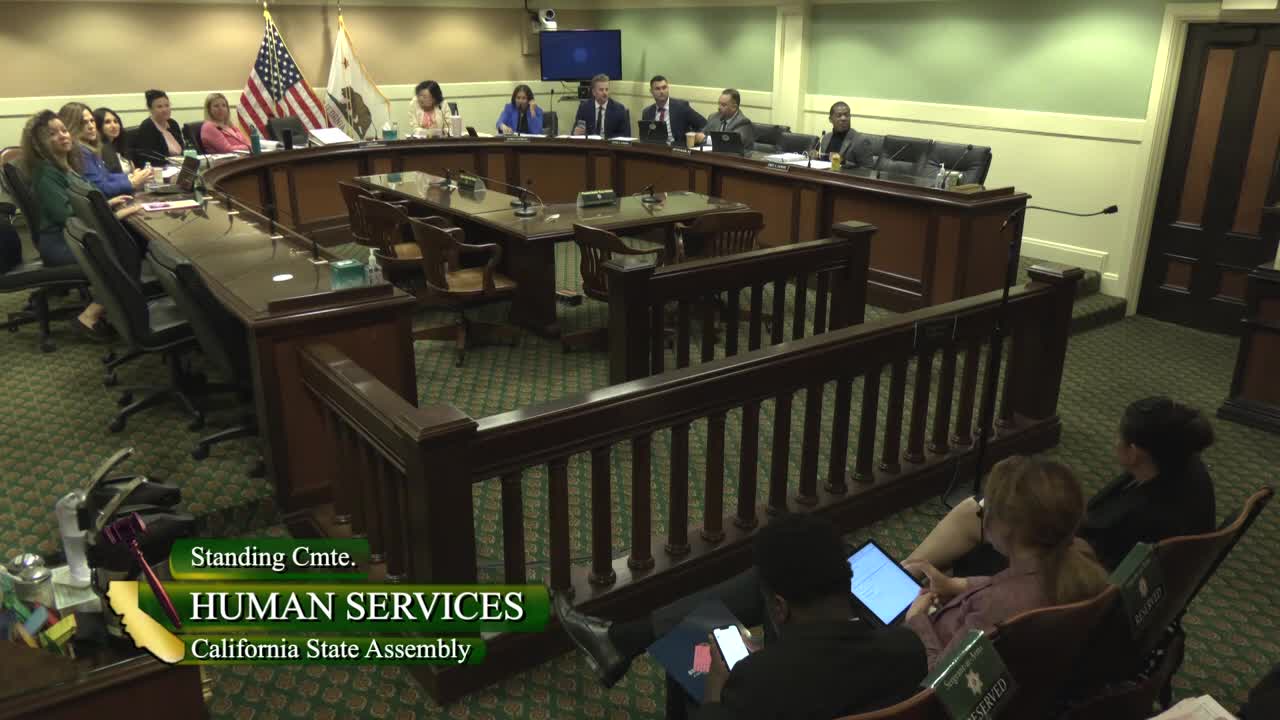 27MIN
Assembly Standing Committee on Human Services
Bill Author