AB 491: California Global Warming Solutions Act of 2006: climate goals: natural and working lands.
- Session Year: 2025-2026
- House: Assembly
- Latest Version Date: 2025-03-26
Current Status:
Failed
(2026-02-02: From committee: Filed with the Chief Clerk pursuant to Joint Rule 56.)
Introduced
In Committee
Awaiting First Chamber Vote
Passed First Chamber
In Committee
Awaiting Second Chamber Vote
Passed Second Chamber
Enacted
The California Global Warming Solutions Act of 2006 establishes the State Air Resources Board as the state agency responsible for monitoring and regulating sources emitting greenhouse gases and requires the state board to ensure that statewide greenhouse gas emissions are reduced to at least 40% below the 1990 level by 2030. The act declares the policy of the state to achieve net zero greenhouse gas emissions as soon as possible, but no later than 2045, and to achieve and maintain net negative greenhouse gas emissions thereafter. The act requires the state board to prepare and approve a scoping plan for achieving the maximum technologically feasible and cost-effective reductions in greenhouse gas emissions and to update the scoping plan at least once every 5 years.
The act also requires the Natural Resources Agency, in collaboration with specified entities, including the state board, to determine an ambitious range of targets for natural carbon sequestration, and for nature-based climate solutions, that reduce greenhouse gas emissions for 2030, 2038, and 2045 to support state goals to achieve carbon neutrality and foster climate adaptation and resilience. The act requires these targets to be integrated into the above-described scoping plan and other state policies.
This bill would specify that it is the goal of the state to achieve each of the targets established by the Natural Resources Agency by the applicable date for the target, with priority given to activities that most rapidly, significantly, and cost effectively increase carbon stocks and net sequestration, protect and support ecosystem function, and reduce emissionns emissions of greenhouse gases. The bill would also revise the definition of natural carbon sequestration for purposes of the above-described provisions.
The California Global Warming Solutions Act of 2006 establishes the State Air Resources Board as the state agency responsible for monitoring and regulating sources emitting greenhouse gases and requires the state board to ensure that statewide greenhouse gas emissions are reduced to at least 40% below the 1990 level by 2030. The act declares the policy of the state to achieve net zero greenhouse gas emissions as soon as possible, but no later than 2045, and to achieve and maintain net negative greenhouse gas emissions thereafter. The act requires the state board to prepare and approve a scoping plan for achieving the maximum technologically feasible and cost-effective reductions in greenhouse gas emissions and to update the scoping plan at least once every 5 years.
The act also requires the Natural Resources Agency, in collaboration with specified entities, including the state board, to determine an ambitious range of targets for natural carbon sequestration, and for nature-based climate solutions, that reduce greenhouse gas emissions for 2030, 2038, and 2045 to support state goals to achieve carbon neutrality and foster climate adaptation and resilience. The act requires these targets to be integrated into the above-described scoping plan and other state policies.
This bill would specify that it is the goal of the state to achieve each of the targets established by the Natural Resources Agency by the applicable date for the target, with priority given to activities that most rapidly, significantly, and cost effectively reduce emissionns of greenhouse gases. The bill would also revise the definition of natural carbon sequestration for purposes of the above-described provisions.
The Legislature finds and declares all of the following:
(a)Californias natural and working lands are essential to mitigating emissions and adapting to climate change. Restoring, maintaining, and conserving these as well-managed lands is a necessary complement to other direct emissions reductions. Climate-smart land management offers near-term, rapid, cost-effective, and large-scale opportunities for enduring reductions in emissions of carbon and other potent greenhouse gases, such as methane.
(b)When lands are degraded, they release more greenhouse gases, increase climate risks to people and nature, and are more vulnerable to future climate change impacts. Lands stressed by climate change threaten food and water security, economic prosperity, and globally significant biodiversity.
(c)In April 2024, the Natural Resources Agency established targets for natural carbon sequestration, and for nature-based climate solutions, as required by Section 38561.5 of the Health and Safety Code, in a document titled Californias Nature-Based Solutions Climate Targets. The targets establish annual goals for nonregulatory climate action across various land types for 2025 through 2045, inclusive.
(d)Improving the health, function, and resilience of our natural and working landscapes will help reduce risks from wildfire, floods, and extreme weather events due to global warming that has already occurred.
SEC. 2.Section 38561.5 of the Health and Safety Code is amended to read:38561.5.(a)For purposes of this section, the following definitions apply:
(1)Natural carbon sequestration means actions that are undertaken on natural and working lands to remove and provide enduring storage of atmospheric greenhouse gases in vegetation and soils or to prevent emissions of greenhouse gases. soils. This shall include preservation, conservation, restoration, and sustainable management of these lands, which may include improved forest management, compost application, cover crops, hedgerows, planned grazing, urban forestry, riparian restoration, restoration of tidal flows to wetlands, and other forms of wetland restoration, among other relevant actions.
(2)Natural lands has the same meaning as set forth in paragraph (2) of subdivision (d) of Section 9001.5 of the Public Resources Code.
(3)Nature-based climate solutions means activities, such as restoration, conservation, and land management actions, that increase net carbon sequestration or reduce greenhouse gas emissions in natural and working lands.
(4)Vulnerable communities has the same meaning as set forth in subdivision (d) of Section 71340 of the Public Resources Code.
(5)Working lands has the same meaning as set forth in paragraph (1) of subdivision (d) of Section 9001.5 of the Public Resources Code.
(b)(1)On or before January 1, 2024, the Natural Resources Agency, in collaboration with the state board, the California Environmental Protection Agency, the Department of Food and Agriculture, the expert advisory committee established pursuant to subdivision (c), and other relevant state agencies, shall determine an ambitious range of targets for natural carbon sequestration, and for nature-based climate solutions, that reduce greenhouse gas emissions for 2030, 2038, and 2045 to support state goals to achieve carbon neutrality and foster climate adaptation and resilience. These targets shall be integrated into the scoping plan prepared pursuant to Section 38561 and other state policies.
(2)Projects and actions developed to achieve the targets established pursuant to paragraph (1) shall support the states efforts to achieve carbon neutrality, take into account climate impacts, increase resilience to climate change impacts, reduce greenhouse gas emissions, and enhance carbon sequestration in a manner that maximizes ecological health and biodiversity, and complements other climate and resources goals.
(3)The state board shall ensure that all emissions reductions from projects and actions developed to achieve the targets established pursuant to paragraph (1) shall be accounted for in a manner that does not result in double counting of emissions reductions, and that all greenhouse gas emissions reductions and removals used for any market-based compliance mechanism are in addition to any reductions and removals that would otherwise occur.
(4)On or before January 1, 2025, the Natural Resources Agency, in consultation with the state board, the California Environmental Protection Agency, and the Department of Food and Agriculture, shall review and update the Natural and Working Lands Climate Smart Strategy established pursuant to Section 39740.2 to achieve the targets established pursuant to paragraph (1).
(5)The review and update pursuant to paragraph (4) shall include all of the following:
(A)Descriptions of the actions and projects undertaken on natural and working lands to date.
(B)Quantified progress on emissions reductions, natural carbon sequestration, and cobenefits.
(C)A description of how the relevant agencies calculated emissions reductions, natural carbon sequestration, and cobenefits.
(D)A summary of the benefits to low-income communities, disadvantaged communities, vulnerable communities, disadvantaged farmers, and Native American tribes.
(E)An evaluation of the efficacy of the priority nature-based solutions, pathways, and priority actions for greenhouse gas reductions, climate resilience, and climate change adaptation.
(F)Identification and description of any barriers to achieving the range of targets pursuant to paragraph (1).
(G)Recommendations to address the barriers identified in subparagraph (F) to achieve the range of targets pursuant to paragraph (1).
(H)Recommendations from the expert advisory committee established pursuant to subdivision (c).
(6)It is the goal of the state to achieve each of the targets established by the Natural Resources Agency pursuant to paragraph (1) by the applicable date for the target, with priority given to activities that most rapidly, significantly, and cost effectively increase carbon stocks and net sequestration, protect and support ecosystem function, and reduce emissions of greenhouse gases.
(c)The Natural Resources Agency and the state board shall jointly establish an expert advisory committee that is composed of university researchers, technical assistance providers, practitioners and other experts in the field of climate change and natural and working lands science and management, and Indigenous and environmental justice representatives, to inform and review modeling and analyses for natural and working lands, to advise state agencies on implementation strategies and standardized accounting, and to provide recommendations on addressing barriers to efficient implementation of this section.
(d)No later than January 1, 2025, the state board shall develop standard methods for state agencies to consistently track greenhouse gas emissions and reductions, carbon sequestration, and, where feasible and in consultation with the Natural Resources Agency and the Department of Food and Agriculture, additional benefits from natural and working lands over time. In estimating and tracking greenhouse gas emissions and reductions and carbon sequestration from natural and working lands, the state board shall take into account, where feasible, both of the following:
(1)Greenhouse gas emissions and reductions of carbon dioxide, methane, and nitrous oxide related to natural and working lands.
(2)Potential impacts of climate change, including, but not limited to, increased fire risk, warming temperatures, and decreasing precipitation, on the ability to reduce greenhouse gas emissions and sequester carbon from natural and working lands.
(e)On or before January 1, 2025, and every two years thereafter, the Natural Resources Agency shall publish data on its internet website on progress made in achieving the targets established pursuant to paragraph (1) of subdivision (b), including on state expenditures made to implement these targets.
The Legislature finds and declares all of the following:
(a)Californias natural and working lands are essential to mitigating emissions and adapting to climate change. Restoring, maintaining, and conserving these as well-managed lands is a necessary complement to other direct emissions reductions. Climate-smart land management offers near-term, rapid, cost-effective, and large-scale opportunities for enduring reductions in emissions of carbon and other potent greenhouse gases, such as methane.
(b)When lands are degraded, they release more greenhouse gases, increase climate risks to people and nature, and are more vulnerable to future climate change impacts. Lands stressed by climate change threaten food and water security, economic prosperity, and globally significant biodiversity.
(c)In April 2024, the Natural Resources Agency established targets for natural carbon sequestration, and for nature-based climate solutions, as required by Section 38561.5 of the Health and Safety Code, in a document titled Californias Nature-Based Solutions Climate Targets. The targets establish annual goals for nonregulatory climate action across various land types for 2025 through 2045, inclusive.
(d)Improving the health, function, and resilience of our natural and working landscapes will help reduce risks from wildfire, floods, and extreme weather events due to global warming that has already occurred.
SEC. 2.Section 38561.5 of the Health and Safety Code is amended to read:38561.5.(a)For purposes of this section, the following definitions apply:
(1)Natural carbon sequestration means actions that are undertaken on natural and working lands to remove and provide enduring storage of atmospheric greenhouse gases in vegetation and soils. soils or to prevent emissions of greenhouse gases. This shall include preservation, conservation, restoration, and sustainable management of these lands, which may include improved forest management, compost application, cover crops, hedgerows, planned grazing, urban forestry, riparian restoration, restoration of tidal flows to wetlands, and other forms of wetland restoration, among other relevant actions.
(2)Natural lands has the same meaning as set forth in paragraph (2) of subdivision (d) of Section 9001.5 of the Public Resources Code.
(3)Nature-based climate solutions means activities, such as restoration, conservation, and land management actions, that increase net carbon sequestration or reduce greenhouse gas emissions in natural and working lands.
(4)Vulnerable communities has the same meaning as set forth in subdivision (d) of Section 71340 of the Public Resources Code.
(5) Working lands(5)Working lands has the same meaning as set forth in paragraph (1) of subdivision (d) of Section 9001.5 of the Public Resources Code.
(b)(1)On or before January 1, 2024, the Natural Resources Agency, in collaboration with the state board, the California Environmental Protection Agency, the Department of Food and Agriculture, the expert advisory committee established pursuant to subdivision (c), and other relevant state agencies, shall determine an ambitious range of targets for natural carbon sequestration, and for nature-based climate solutions, that reduce greenhouse gas emissions for 2030, 2038, and 2045 to support state goals to achieve carbon neutrality and foster climate adaptation and resilience. These targets shall be integrated into the scoping plan prepared pursuant to Section 38561 and other state policies.
(2)Projects and actions developed to achieve the targets established pursuant to paragraph (1) shall support the states efforts to achieve carbon neutrality, take into account climate impacts, increase resilience to climate change impacts, reduce greenhouse gas emissions, and enhance carbon sequestration in a manner that maximizes ecological health and biodiversity, and complements other climate and resources goals.
(3)The state board shall ensure that all emissions reductions from projects and actions developed to achieve the targets established pursuant to paragraph (1) shall be accounted for in a manner that does not result in double counting of emissions reductions, and that all greenhouse gas emissions reductions and removals used for any market-based compliance mechanism are in addition to any reductions and removals that would otherwise occur.
(4)On or before January 1, 2025, the Natural Resources Agency, in consultation with the state board, the California Environmental Protection Agency, and the Department of Food and Agriculture, shall review and update the Natural and Working Lands Climate Smart Strategy established pursuant to Section 39740.2 to achieve the targets established pursuant to paragraph (1).
(5)The review and update pursuant to paragraph (4) shall include all of the following:
(A)Descriptions of the actions and projects undertaken on natural and working lands to date.
(B)Quantified progress on emissions reductions, natural carbon sequestration, and cobenefits.
(C)A description of how the relevant agencies calculated emissions reductions, natural carbon sequestration, and cobenefits.
(D)A summary of the benefits to low-income communities, disadvantaged communities, vulnerable communities, disadvantaged farmers, and Native American tribes.
(E)An evaluation of the efficacy of the priority nature-based solutions, pathways, and priority actions for greenhouse gas reductions, climate resilience, and climate change adaptation.
(F)Identification and description of any barriers to achieving the range of targets pursuant to paragraph (1).
(G)Recommendations to address the barriers identified in subparagraph (F) to achieve the range of targets pursuant to paragraph (1).
(H)Recommendations from the expert advisory committee established pursuant to subdivision (c).
(6)It is the goal of the state to achieve each of the targets established by the Natural Resources Agency pursuant to paragraph (1) by the applicable date for the target, with priority given to activities that most rapidly, significantly, and cost effectively reduce emissions of greenhouse gases.
(c)The Natural Resources Agency and the state board shall jointly establish an expert advisory committee that is composed of university researchers, technical assistance providers, practitioners and other experts in the field of climate change and natural and working lands science and management, and Indigenous and environmental justice representatives, to inform and review modeling and analyses for natural and working lands, to advise state agencies on implementation strategies and standardized accounting, and to provide recommendations on addressing barriers to efficient implementation of this section.
(d)No later than January 1, 2025, the state board shall develop standard methods for state agencies to consistently track greenhouse gas emissions and reductions, carbon sequestration, and, where feasible and in consultation with the Natural Resources Agency and the Department of Food and Agriculture, additional benefits from natural and working lands over time. In estimating and tracking greenhouse gas emissions and reductions and carbon sequestration from natural and working lands, the state board shall take into account, where feasible, both of the following:
(1)Greenhouse gas emissions and reductions of carbon dioxide, methane, and nitrous oxide related to natural and working lands.
(2)Potential impacts of climate change, including, but not limited to, increased fire risk, warming temperatures, and decreasing precipitation, on the ability to reduce greenhouse gas emissions and sequester carbon from natural and working lands.
(e)On or before January 1, 2025, and every two years thereafter, the Natural Resources Agency shall publish data on its internet website on progress made in achieving the targets established pursuant to paragraph (1) of subdivision (b), including on state expenditures made to implement these targets.
|
Date
|
Status
|
|---|---|
| Feb 2, 2026 | From committee: Filed with the Chief Clerk pursuant to Joint Rule 56. |
| Jan 31, 2026 | Died pursuant to Art. IV, Sec. 10(c) of the Constitution. |
| May 23, 2025 | In committee: Held under submission. |
| Apr 9, 2025 | In committee: Set, first hearing. Referred to APPR. suspense file. |
| Mar 27, 2025 | Re-referred to Com. on APPR. |
| Mar 26, 2025 | Read second time and amended. |
| Mar 25, 2025 | From committee: Amend, and do pass as amended and re-refer to Com. on APPR. (Ayes 9. Noes 3.) (March 24). |
| Feb 24, 2025 | Referred to Com. on NAT. RES. |
| Feb 11, 2025 | From printer. May be heard in committee March 13. |
| Feb 10, 2025 | Read first time. To print. |
|
Date
|
Description
|
Location
|
Votes
|
|
|---|---|---|---|---|
| Mar 24, 2025 | Do pass as amended and be re-referred to the Committee on [Appropriations] | Assembly Standing Committee on Natural Resources |
Passed |
This list shows positions taken on this bill by organizations on the date displayed, which is linked to the original source.
Positions by individuals are not included.
|
Organization
|
Position
|
Date
|
|---|---|---|
| 350 Bay Area Action | ** Support | |
| Alianza Coachella Valley | ** Support | |
| American River Conservancy | ** Support | |
| American Rivers | ** Support | |
| Ban SUP | ** Support | |
| Bioenergy Association of California | ** Support | |
| California Cattlemen'S Association | ** Support | |
| California Climate & Agriculture Network | ** Support | |
| California Farm Bureau Federation | ** Against | |
| California Native Plant Society | ** Support | |
| California Native Plant Society, Alta Peak Chapter | ** Support | |
| California Nurses for Environmental Health and Justice | ** Support | |
| California Trout | ** Support | |
| Californians Against Waste | ** Support | |
| Climate Center The | ** Support | |
| Coastal Corridor Alliance | ** Support | |
| Defenders Of Wildlife | ** Support | |
| Endangered Habitats League | ** Support | |
| Environmental Protection Information Center | ** Support | |
| Friends of the Inyo | ** Support | |
| Hills for Everyone | ** Support | |
| Pacific Forest Trust | ** Support | |
| Sequoia Riverlands Trust | ** Support | |
| Sierra Business Council | ** Support | |
| Sierra Consortium | ** Support | |
| Sierra Nevada Alliance | ** Support | |
| The Watershed Research and Training Center | ** Support | |
| Trust for Public Land | ** Support |
Date of Hearing: April 9, 2025
ASSEMBLY COMMITTEE ON APPROPRIATIONS
Buffy Wicks, Chair
ABPCA Bill Id:AB 491
Author:(Connolly) – As Amended Ver:March 26, 2025
Policy Committee: | Natural Resources | Vote: | 9 - 3 |
|
| ||
|
|
Urgency: No State Mandated Local Program: No Reimbursable: No
SUMMARY:
This bill establishes the goal of the state to achieve each of the nature-based solutions (NBS) climate targets established by the California Natural Resources Agency (CNRA) by the applicable date for the target, with priority given to activities that most rapidly, significantly, and cost-effectively increase carbon stocks and net sequestration, protect and support ecosystem function, and reduce emissions of greenhouse gases (GHGs). The bill also revises the definition of “natural carbon sequestration” to require the storage of atmospheric gases in vegetation and soils to be “enduring.”
FISCAL EFFECT:
1) CNRA will likely incur significant one-time and ongoing annual costs to implement this bill.
CNRA estimates one-time costs of approximately $4.4 million and ongoing annual costs of approximately $521,000 for the following activities (General Fund, special fund, or bond funds):
- $2 million (one-time) in research contracts to help CNRA determine what activities most rapidly, significantly, and cost effectively reduce GHG emissions, and to conduct stakeholder engagement. This statewide GHG and economic analysis would cover eight land cover types (such as forests, wetlands, and developed lands), 27 overarching NBS, and dozens of activities. An analysis of this size and scope would involve a broad range of subject matter experts.
- $360,000 (annual) to hire two environmental scientists to provide scientific guidance and technical assistance to CNRA grant programs that fund NBS to meet the goals of this bill, including amending grant guidelines and utilizing GHG quantification methodologies and calculator tools.
- $750,000 in contracts and $472,000 for two limited-term positions each year for the first two years for the development of new regulations and coordination of existing program updates. CNRA notes there are dozens of state grant programs that fund NBS. While some programs whose guidelines are exempt from review by the Office of Administrative Law (OAL) could likely absorb the costs of reviewing and updating their guidelines, CNRA and the many entities housed under the agency would likely have to update or create new regulations through OAL, which is more time intensive and costly.
- $161,000 (ongoing) to hire one position to provide contract management and support.
2) The Air Resources Board (ARB) will incur costs of an unknown but potentially significant amount to amend existing and develop new GHG quantification methodologies and calculator tools to allow for consistent comparison of projects within individual solicitations to determine which projects most rapidly, significantly, and cost effectively reduce GHG emissions.
For its part, ARB estimates ongoing annual costs of approximately $4.7 million (Cost of Implementation Account) for 13 new positions to perform policy analysis to assess and rank the ability of policies, programs, projects, and other actions used to achieve the NBS targets and meet all statutory requirements across all lands and ownership structures; Air Quality Planning and Science Division support for data analysis and modeling; legal review and support, including to support the development of standard methods for tracking and accounting for GHGs emissions, GHG reductions, and carbon sequestration via a regulation or advisory document; administrative and IT support; and other tasks.
COMMENTS:
1) Purpose. According to the author, this bill strengthens the state’s efforts to reduce greenhouse gas emissions “by codifying California’s Nature-Based Solutions Climate Target. Nature-based solutions are important tools needed to help drastically reduce greenhouse gas emissions and help achieve California’s ambitious climate goals.”
2) Background. Healthy landscapes can remove and store carbon, limit future greenhouse gas emissions into the atmosphere, and buffer climate impacts. Unhealthy landscapes have the opposite effect – they release more greenhouse gases than they store and worsen climate risks to people and nature. NBS support the ability of lands to absorb more carbon than they release – a critical tool in the state’s climate arsenal. According to the Newsom administration, as of April 2024, the state has invested approximately $9.6 billion in NBS that combat the effects of climate change. The Proposition 4 climate bond, which was approved by voters in 2024, includes $1.2 billion for a variety of activities related to supporting biodiversity and nature-based climate activities.
As called for in AB 1757 (C. Garcia), Chapter 341, Statutes of 2022, CNRA, ARB, California Environmental Protection Agency, California Department of Food and Agriculture, and more than 40 state agency partners collaborated to develop NBS climate targets for 2030, 2038, and 2045, that contribute to the state’s goals of achieving carbon neutrality no later than 2045 and protecting Californians from the climate crisis. CNRA released its final report with 81 NBS climate targets on April 22, 2024. Examples of targets include, by 2045, 33.5 million acres managed to reduce wildfire risk, mostly through beneficial fire; 11.9 million acres of forest managed for biodiversity protection, carbon storage, and water supply protection; and 4.2 million trees planted to protect California communities from the climate crisis, remove carbon, and increase access to nature where it’s needed most.
This bill makes it the “goal of the state” to achieve these targets. CNRA’s report does not provide a cost estimate for implementation of the NBS targets. Instead, the report notes that meeting the targets “will require time, effort, funding, and collaborative partnerships across many governments and sectors. The pace of implementation will depend upon the feasibility and availability of resources and competing priorities.”
3) Support and Opposition. Writing in support, a coalition of environmental and other organizations writes:
The targets provide important guidance and context for the scale of opportunity to mitigate climate change on natural and working lands and the actions proposed in these climate targets are all voluntary, cooperative, and non-regulatory ways to partner with landowners to advance multiple state goals. The funding available in Prop. 4 positions the state to make substantial progress towards these goals in the coming years.
The California Farm Bureau, while supportive of many of the NBS targets, is opposed to codifying these targets in statute for a number of reasons. The Farm Bureau writes, among other things:
We appreciate that the State aims to make climate-smart land management cost-effective through the implementation of many climate-smart agricultural programs, including the Healthy Soils Program and the State Water Efficiency and Enhancement Program (SWEEP). Unfortunately, however, California has a history of inconsistently funding programs related to carbon sequestration serving the natural and working lands sectors. Before any thought is given to setting ambitious targets like those in the NBS document, it is absolutely critical that unambiguously consistent funding be provided to these programs to help meet the State's overall climate goals.
Analysis Prepared by: Nikita Koraddi / APPR. / (916) 319-2081
Date of Hearing: March 24, 2025
ASSEMBLY COMMITTEE ON NATURAL RESOURCES
Isaac G. Bryan, Chair
ABPCA Bill Id:AB 491 (
Author:Connolly) – As Introduced Ver:February 10, 2025
SUBJECT: California Global Warming Solutions Act of 2006: climate goals: natural and working lands
SUMMARY: Establishes the goal of the state to achieve each of the specified carbon sequestration targets established by the Natural Resources Agency (NRA) for nature-based climate solutions with priority given to activities that most rapidly, significantly, and cost effectively reduce emissions of greenhouse gases (GHG).
EXISTING LAW:
- Requires GHG emissions be reduced pursuant to AB 1279 (Muratsuchi), Chapter 337, Statutes of 2022, to at least 85% below the 1990 level by 2045, and establishes a goal of zero net carbon emissions by 2045, commonly known as carbon neutrality. (Health and Safety Code (HSC) 38500 et seq.)
- Requires, on or before January 1, 2024, NRA, in collaboration with the Air Resources Board (ARB), the California Environmental Protection Agency (CalEPA), the Department of Food and Agriculture (CDFA), the expert advisory committee, and other relevant state agencies, to determine an ambitious range of targets for natural carbon sequestration and for nature-based climate solutions that reduce GHGs for 2030, 2038, and 2045 to support state goals to achieve carbon neutrality and foster climate adaptation and resilience. Requires these targets to be integrated into the Scoping Plan. (HSC 38561.5 (b)(1))
THIS BILL:
- Amends the definition of “natural carbon sequestration” to mean actions that are undertaken on natural and working lands to remove and provide enduring storage of atmospheric GHGs in vegetation and soils or to prevent emissions of GHGs. Provides that this may include improved forest management.
- Establishes the goal of the state to achieve each of the targets established by NRA for natural carbon sequestration and for nature-based climate solutions by the applicable date for the target, with priority given to activities that most rapidly, significantly, and cost effectively reduce emissions of GHGs.
FISCAL EFFECT: Unknown
COMMENTS:
- Author’s statement:
AB 491 would strengthen California’s efforts to reduce greenhouse gas emissions by codifying California’s Nature-Based Solutions Climate Target. Nature-based solutions are important tools needed to help drastically reduce greenhouse gas emissions and help achieve California’s ambitious climate goals. This bill will also harness natural and working lands for climate action, notably integrating short-term actions, like fuel management to reduce fire risks or restoration to promote natural systems, and long-term conservation to ensure these actions deliver benefits.
- Nature-based climate solutions. Natural lands are those lands consisting of forests, grasslands, deserts, freshwater and riparian systems, wetlands, coastal and estuarine areas, watersheds, wildlands, or wildlife habitat, or lands used for recreational purposes such as parks, urban and community forests, trails, greenbelts, and other similar open-space land. Working lands include lands used for farming, grazing, or the production of forest products. Natural and working lands cover approximately 90% of the state’s 105 million acres. Research has shown that these lands have the ability to sequester up to 100 million metric tons of carbon dioxide per year.
AB 1757 (C. Garcia, R. Rivas), Chapter 341, Statutes of 2022, required ARB, by January 1, 2024, with NRA, CalEPA, and CDFA, to determine an ambitious range of targets for natural carbon sequestration, and for nature-based climate solutions, that reduce GHGs for 2030, 2038, and 2045 to support state goals to achieve carbon neutrality and foster climate adaptation and resilience.
Through these goals, the state will establish land management practices that increase the health and resilience of natural systems, which supports their ability to serve as a durable carbon sink (lands that absorb more carbon than they release).The GHG targets were developed to reflect the level of climate action required by science to improve land health and resilience in line with the Scoping Plan’s carbon stock target. The 2022 Scoping Plan’s economic analysis estimated the cost of achieving the carbon stock target is lower than the cost of addressing emissions from California’s fossil fuel-based sectors, and that health cost savings from reduced wildfire smoke emissions is approximately double the cost of achieving 2.3 million acres/year of fuel reduction treatments.
- Forests as carbon sinks. Forests cover 27% of California (28.7 million acres). Including trees, soils, other plant materials, forests currently store the largest proportion of carbon on California’s lands. Although natural and working lands can remove carbon dioxide from the atmosphere and sequester it in soil and vegetation, disturbances such as severe wildfire, land degradation, and conversion can cause these landscapes to emit more carbon dioxide than they store.
One of the largest sources of carbon emissions from California’s lands over the last eight years comes from catastrophic wildfire. Since 2020, more than 7 million acres of California’s lands have burned, with more of these fires being extremely destructive to communities and ecosystems than California has seen historically. Cycles of wildfire are natural to California’s landscapes, but have been disturbed by decades of fire exclusion and disconnection from low-level managed wildfire practiced by Native American tribes. Climate change will continue to compound this challenge and expand wildfire threat, severity, and intensity. Limiting huge, dangerous, and catastrophic wildfires and restoring a natural wildfire regime across the state is one of the most important actions to limit carbon emissions from our landscapes.
The Nature-Based Climate Solutions targets aim to achieve 11.9 million acres of forest managed for carbon storage by 2045. This will be realized through climate smart forest management, including thinning, prescribed burns, active reforestation, and reconnection of the forests to aquatic habitats.
- This bill. AB 491 would add improved forest management to the definition of ‘natural carbon sequestration’ to strengthen the state’s efforts to reduce GHGs by codifying California’s Nature-Based Solutions Climate targets.
- Committee amendments. The Committee may wish to consider amending the bill to clarify priority shall be given to activities that additionally cost effectively increase sequestration.
REGISTERED SUPPORT / OPPOSITION:
Support
350 Bay Area Action
Alianza Coachella Valley
American River Conservancy
American Rivers
Ban Sup (single Use Plastic)
Bioenergy Association of California
California Cattlemen's Association
California Climate & Agriculture Network
California Native Plant Society
California Native Plant Society, Alta Peak Chapter
California Nurses for Environmental Health and Justice
California Trout
Californians Against Waste
Climate Center; the
Coastal Corridor Alliance
Defenders of Wildlife
Endangered Habitats League
Environmental Protection Information Center
Friends of The Inyo
Hills for Everyone
Pacific Forest Trust
Sequoia Riverlands Trust
Sierra Business Council
Sierra Consortium
Sierra Nevada Alliance
The Watershed Research and Training Center
Trust for Public Land
Opposition
California Farm Bureau Federation
Analysis Prepared by: Paige Brokaw / NAT. RES. /
Discussed in Hearing
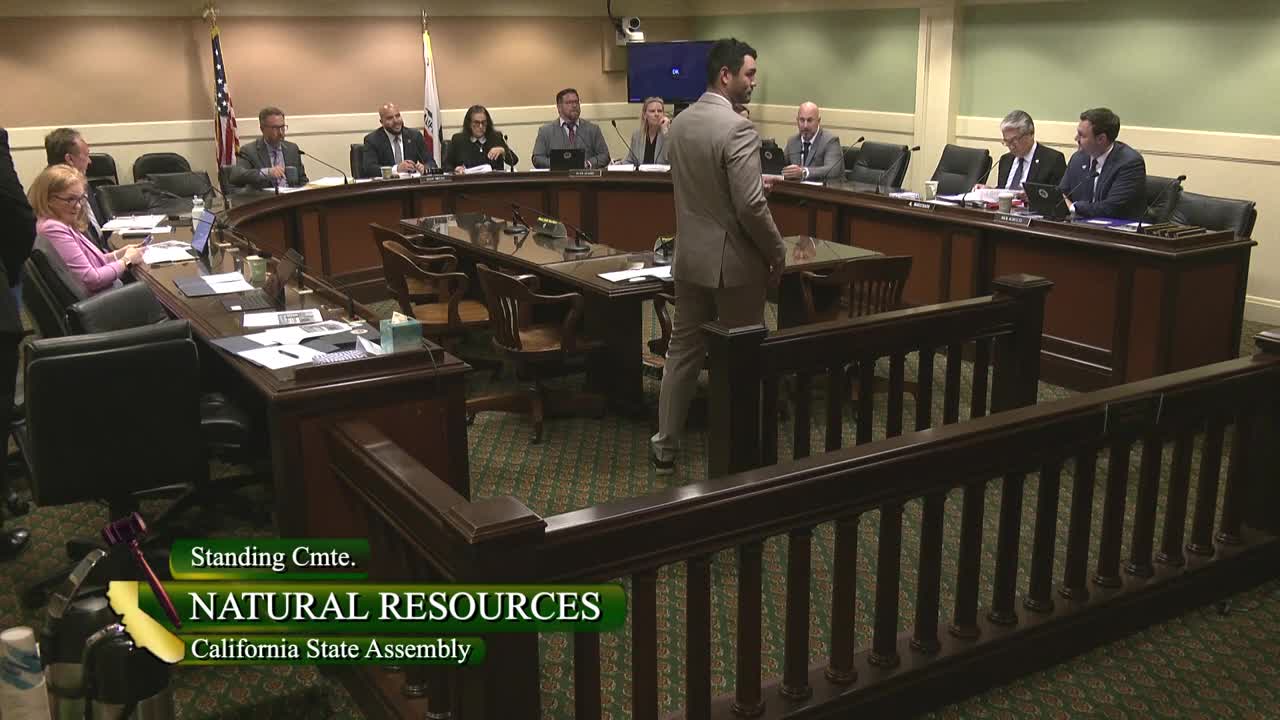 11MIN
Assembly Standing Committee on Natural Resources
Bill Author