AB 591: Emergency services: mutual aid: public works.
- Session Year: 2025-2026
- House: Assembly
- Latest Version Date: 2025-02-12
Current Status:
Failed
(2026-02-02: From committee: Filed with the Chief Clerk pursuant to Joint Rule 56.)
Introduced
In Committee
Awaiting First Chamber Vote
Passed First Chamber
In Committee
Awaiting Second Chamber Vote
Passed Second Chamber
Enacted
Existing law, the California Emergency Services Act, establishes the Office of Emergency Services within the Governors office under the supervision of the Director of Emergency Services and makes the office responsible for the states emergency and disaster response services. The office serves as the State Disaster Council for the purposes of the California Disaster and Civil Defense Master Mutual Aid Agreement. Existing law states it is the purpose of the Legislature to facilitate the rendering of aid to areas stricken by an emergency and to make unnecessary the execution of written agreements customarily entered into by public agencies exercising joint powers, and that emergency plans duly adopted and approved as provided by the Governor shall be effective as satisfying the requirement for mutual aid operational plans provided in the Master Mutual Aid Agreement. Existing law requires outside aid be rendered in accordance with approved emergency plans during any state of war emergency or state of emergency when the need arises in any county, city and county, or city.
This bill would additionally state that it is the purpose of the Legislature to facilitate the rendering of public works resources critical for disaster response and recovery to areas stricken by an emergency. The bill would require that outside aid rendered during any state of war emergency or state of emergency includes public works personnel, equipment, and materials. The bill would also require the Office of Emergency Services, in consultation with relevant local and state public works agencies, to develop and adopt a Public Works Emergency Mutual Aid Plan to ensure the systematic and efficient mobilization of public works resources during emergencies. By imposing requirements on public works agencies, which includes local public works agencies, this bill would create a state-mandated local program.
The California Constitution requires the state to reimburse local agencies and school districts for certain costs mandated by the state. Statutory provisions establish procedures for making that reimbursement.
This bill would provide that, if the Commission on State Mandates determines that the bill contains costs mandated by the state, reimbursement for those costs shall be made pursuant to the statutory provisions noted above.
It is the purpose of the Legislature in enacting this article to facilitate the rendering of aid to areas stricken by an emergency emergency, including public works resources critical for disaster response and recovery, and to make unnecessary the execution of written agreements customarily entered into by public agencies exercising joint powers. Emergency plans duly adopted and approved as provided by the Governor shall be effective as satisfying the requirement for mutual aid operational plans provided in the Master Mutual Aid Agreement.
SEC. 2.Section 8616 of the Government Code is amended to read:8616.During any state of war emergency or state of emergency when the need arises for outside aid in any county, city and county, or city, such aid that aid, including public works personnel, equipment, and materials, shall be rendered in accordance with approved emergency plans.
It shall be the duty of public officials to cooperate to the fullest possible extent in carrying out such plans.
SEC. 3.Section 8619.2 is added to the Government Code, to read:8619.2.The Office of Emergency Services, in consultation with relevant local and state public works agencies, shall develop and adopt a Public Works Emergency Mutual Aid Plan to ensure the systematic and efficient mobilization of public works resources during emergencies.
SEC. 4.If the Commission on State Mandates determines that this act contains costs mandated by the state, reimbursement to local agencies and school districts for those costs shall be made pursuant to Part 7 (commencing with Section 17500) of Division 4 of Title 2 of the Government Code.
|
Date
|
Status
|
|---|---|
| Feb 2, 2026 | From committee: Filed with the Chief Clerk pursuant to Joint Rule 56. |
| Jan 31, 2026 | Died pursuant to Art. IV, Sec. 10(c) of the Constitution. |
| May 23, 2025 | In committee: Held under submission. |
| May 21, 2025 | In committee: Set, first hearing. Referred to APPR. suspense file. |
| May 21, 2025 | Joint Rule 62(a), file notice suspended. (Page 1627.) |
| May 14, 2025 | In committee: Hearing postponed by committee. |
| Apr 29, 2025 | From committee: Do pass and re-refer to Com. on APPR. (Ayes 7. Noes 0.) (April 28). Re-referred to Com. on APPR. |
| Mar 3, 2025 | Referred to Com. on E.M. |
| Feb 13, 2025 | From printer. May be heard in committee March 15. |
| Feb 12, 2025 | Read first time. To print. |
|
Date
|
Description
|
Location
|
Votes
|
|
|---|---|---|---|---|
| Apr 28, 2025 | Do pass and be re-referred to the Committee on [Appropriations] | Assembly Standing Committee on Emergency Management |
Passed |
This list shows positions taken on this bill by organizations on the date displayed, which is linked to the original source.
Positions by individuals are not included.
Date of Hearing: May 21, 2025
ASSEMBLY COMMITTEE ON APPROPRIATIONS
Buffy Wicks, Chair
ABPCA Bill Id:AB 591
Author:(Caloza) – As Introduced Ver:February 12, 2025
Policy Committee: | Emergency Management | Vote: | 7 - 0 |
|
| ||
|
|
Urgency: No State Mandated Local Program: Yes Reimbursable: Yes
SUMMARY:
This bill requires the Office of Emergency Services (OES) to develop and adopt a Public Works Emergency Mutual Aid Plan (Plan) to ensure the systematic and efficient mobilization of public works resources during emergencies.
Specifically, this bill:
- Adds to the findings and declarations of the California Emergency Services Act (CESA) that facilitating the rendering of public works resources critical for disaster response and recovery is part of CESA’s purpose to facilitate the rendering of aid to areas stricken by an emergency.
- Provides that outside aid rendered in accordance with an approved emergency plan during a state of war emergency or state of emergency includes public works personnel, equipment, and materials.
- Requires OES, in consultation with local and state public works agencies, to develop and adopt a Plan to ensure the systematic and efficient mobilization of public works resources during emergencies.
FISCAL EFFECT:
- Costs of approximately $2.5 million in the first year and ongoing costs of approximately $1 million annually thereafter to OES to support a state Public Works Mutual Aid Agreement. OES notes it will need to work through its Standardized Emergency Management System Committee to develop the proposed mutual aid program, necessitating three additional staff positions (one program manager and two senior coordinators), a $1.8 million information technology (IT) service contract, and $200,000 in IT funds to build out and support expanded use of the Standardized Emergency Management System (SEMS) in the first year, after which OES will need two positions (one associate analyst and one staff assistant) and continued IT funds for ongoing program administration and tracking.
Separately, OES anticipates needing a contract, at an initial cost of $500,000 and an ongoing cost of $100,000, to consult with subject matter experts to develop curriculum and create online courses the through California Specialized Training Institute Learning Management System, so public works personnel are trained to assist with disaster response.
- Costs of an unknown amount across local public works agencies to consult with OES on the Plan and across cities and counties to update their existing emergency plans to include public works mutual aid. If the Commission on State Mandates determines this bill’s requirements to be a reimbursable state mandate, the state would need to reimburse these costs to local agencies (General Fund). Cities and counties will also incur cost pressures of an unknown amount to execute the updated plans in response to an emergency.
COMMENTS:
- Purpose. According to the author:
Currently there is no coordinated approach to mobilize public works when disasters strike. As we recently witnessed during the Eaton and Palisades fires, having mutual aid agreements in place like we did for firefighters, saves lives and livelihoods. We need to expand the scope of our mutual aid agreements to include public works personnel who are essential workers during the disaster recovery period. AB 591 closes that gap.
This bill is supported by the City of Glendale Department of Public Works.
- Mutual Aid. California provides and receives mutual aid from other states through the Emergency Management Assistance Compact, a national interstate mutual aid agreement that enables states to share resources, including personnel, equipment, and commodities, during times of disaster. Additionally, the Master Mutual Aid Agreement exists between the State of California, the state’s various departments and agencies, and various political subdivisions, municipal corporations, and public agencies. This bill requires OES to develop and adopt a Plan to ensure the systematic and efficient mobilization of public works resources during emergencies.
- Prior Legislation. AB 2594 (Committee on Emergency Management), of the 2023-24 Legislative Session, would have required OES to prepare a gap analysis of the state’s mutual aid systems every two years. AB 2594 was held on this committee’s suspense file.
Analysis Prepared by: Irene Ho / APPR. / (916) 319-2081
Date of Hearing: April 28, 2025
ASSEMBLY COMMITTEE ON EMERGENCY MANAGEMENT
Rhodesia Ransom, Chair
ABPCA Bill Id:AB 591 (
Author:Caloza) – As Introduced Ver:February 12, 2025
SUBJECT: Emergency services: mutual aid: public works
SUMMARY: Requires the California Office of Emergency Services (Cal OES), in consultation with relevant local and state public works agencies, to develop and adopt a Public Works Emergency Mutual Aid Plan to ensure the systematic and efficient mobilization of public works resources during emergencies. Specifically, this bill:
- Requires the California Office of Emergency Services (Cal OES), in consultation with relevant local and state public works agencies, to develop and adopt a Public Works Emergency Mutual Aid Plan to ensure the systematic and efficient mobilization of public works resources during emergencies.
- Provides that it is the purpose of the Legislature to facilitate the rendering of public works resources critical for disaster response and recovery to areas stricken by an emergency as part of other mutual aid rendered in accordance with approved emergency plans.
EXISTING LAW:
- Establishes the California Office of Emergency Services (Cal OES) within the office of the Governor and makes Cal OES responsible for the state’s emergency and disaster response services for natural, technological, or manmade disasters and emergencies. (Gov. Code Section 8550)
- Authorizes the Governor to proclaim a state of emergency and local officials and local governments to proclaim a local emergency, when specified conditions of disaster or extreme peril to the safety of persons and property exist, and authorizes the Governor or the appropriate local government to exercise certain powers in response to that emergency. (Gov. Code Section 8558)
- Defines “state of emergency” and “local emergency” to mean a duly proclaimed existence of conditions of disaster or of extreme peril to the safety of persons and property within the state or territorial limits of a local government caused by, among other things, a sudden and severe energy shortage. (Gov. Code Section 8558)
- Requires the Standardized Emergency Management System (SEMS) for managing multiagency and multijurisdictional responses to emergencies in California. State agencies are required to use SEMS and local government entities must use SEMS in order to be eligible for any reimbursement of response-related costs under the state’s disaster assistance programs. (Gov. Code Section 8607)
FISCAL EFFECT: Unknown. This bill has not been analyzed by a fiscal committee.
COMMENTS:
Purpose of the bill: According to the author, “AB 591 strengthens California’s disaster response system by ensuring public works resources such as personnel, equipment and materials are included in mutual aid efforts. Currently there is no coordinated approach to mobilize public works when disasters strike. As we recently witnessed during the Eaton and Palisades fires, having mutual aid agreements in place like we did for firefighters, saves lives and livelihoods. We need to expand the scope of our mutual aid agreements to include public works personnel who are essential workers during the disaster recovery period. AB 591 closes that gap.”
Equity impact: According to the author’s staff, “This legislation would affect low-income and disadvantaged communities, areas with limited public works resources. These areas already face bigger challenges, like damaged roads, limited crews, and limited access to clean water and power. This bill ensures that public works personnel, equipment, and materials can be shared more efficiently across cities and counties. By creating a statewide plan, it helps direct aid to the communities that need it most, making disaster recovery faster and fairer for everyone.”
2025 Los Angeles Fires: In January 2025, Los Angeles County experienced the second and third most destructive fires in California history: the Palisades Fire and Eaton Fire. AccuWeather estimates these fires' total damage and economic loss to be between $250 billion and $275 billion. At its height, the fires placed an estimated 331,335 people on an evacuation advisory, with nearly 192,000 residents facing mandatory evacuation and roughly 140,000 subject to warnings. The blazes burned a combined 37,469 acres and leveled entire communities in the Pacific Palisades and Altadena neighborhoods of LA County.
The Eaton Fire became the second most destructive fire in California history after destroying 9,418 buildings, 1,074 structures damaged, and 17 confirmed civilian fatalities. The Palisades Fire is the third most destructive fire in state history, with 6,837 structures destroyed, 973 structures damaged, and 12 confirmed civilian fatalities.
As firefighters were battling the largest conflagrations, additional fires broke out in the Los Angeles area. Crews were able to stop the forward spread and contain the blazes. These fires included the Lidia, Archer, Woodley, Sunset, Kenneth, Hurst, and Auto fires, which burned close to 2,400 acres between them. Two weeks after the initial fires, the Hughes Fire began near Castaic Lake in northern Los Angeles County on January 22 and grew to over 10,000 acres. Firefighters fully contained the fire on January 30 after covering 10,425 acres.
Probability of Strong and/or Major Earthquakes: The United States Geological Survey and other scientists estimate a 72-percent probability that at least one earthquake of Magnitude 6.7 or greater, capable of causing widespread damage, will strike the San Francisco Bay Area before 2044. For the Los Angeles region, the same model forecasts a 60-percent probability that an earthquake of Magnitude 6.7 or greater will occur before 2044.
Strong earthquakes of Magnitude 6 to 6.9 strike California, on average, once every two to three years. An earthquake of this size, such as the 1994 Northridge Earthquake (Magnitude 6.7) or the 1983 Coalinga Earthquake (Magnitude 6.7), is capable of causing significant damage if the epicenter is near a densely populated area. Major earthquakes (Magnitude 7 to 7.9) occur in California about once every 10 years.
According to the Federal Emergency Management Agency’s (FEMA) modeling for major earthquake scenarios in the Bay Area and Southern California, violent shaking in densely populated areas could result in over 50,000 displaced households and over 30,000 individuals requiring short-term shelter.
Floods, storms and climate change: California is also susceptible to catastrophic flooding, winter storms, extreme heat and even hurricanes. The complexity, scope and scale of these risks underscore the need for strong, statewide mutual aid systems.
Public Works in Disasters: Public works resources such as public works personnel, equipment, and materials are necessary to support large-scale disasters of any kind in our State. Disasters are typically beyond the capabilities of most public works agencies. Local equipment may be damaged by the disaster, rendering it out of service. Following a disaster, local public works staff may be affected both emotionally and physically by the event, affecting their ability to safely perform work. Relying on neighboring communities as the only source of assistance is dangerous because they too can be impacted by the same disaster. Routine work such as water shut-offs, treatment plant operations, and sign installation will still need to be completed. As first responders, public works agencies are involved with the disaster from the onset to the end of the recovery phase. During a disaster, public works equipment and manpower will be limited.
Resources that could be available through a statewide Public Works Mutual Aid System include labor crews, debris loading equipment, aerial lift trucks, brush chippers, engineering and technical assistance, pumping and vac truck operations, vehicle maintenance, and operational and command staff.
Emergency Preparedness and Response: Cal OES is responsible for addressing natural, technological, or manmade disasters and emergencies, and preparing the State to prevent, respond to, quickly recover from, and mitigate the effects of both intentional and natural disasters. As part of their overall preparedness mission, Cal OES is required to develop a State Emergency Plan (SEP) and State Hazard Mitigation Plan (SHMP); maintain the Standardized Emergency Management System (SEMS) and the Emergency Management Mutual Aid System (EMMA); and assist counties with their local Emergency Operation Plans (EOP). Cal OES, in coordination with FEMA and local partners, has developed four Catastrophic Plans to augment the State Emergency Plan.
State Emergency Plan: The SEP describes how response to natural or human- caused emergencies occurs in California. The plan is a requirement of the California Emergency Services Act (ESA), and describes methods for conducting emergency operations, the process for rendering mutual aid, emergency services of government agencies, how resources are mobilized, how the public is informed, and how continuity of government is maintained during emergency. The SEP further describes hazard mitigation, as well as preparedness and recovery from disasters. The SEP defines Emergency Support Functions (ESF) which are discipline- specific groups that develop functional annexes to set goals, objectives, operational concepts, capabilities, organization structures, and related policies and procedures. Under the SEP, there are 18 ESFs led by a state agency and represent an alliance of state government and other stakeholders with similar functional responsibilities:
CA EMERGENCY SUPPORT FUNCTIONS LEAD STATE AGENCY
CA-ESF 1 Transportation CA Transportation Agency
CA-ESF 2 Communication Governor’s Office of Emergency Services
CA-ESF 3 Construction and Engineering Government Operations Agency
CA-ESF 4 Fire and Rescue Governor’s Office of Emergency Services
CA-ESF 5 Management Governor’s Office of Emergency Services
CA-ESF 6 Care and Shelter CA Health and Human Services Agency
CA-ESF 7 Resources Government Operations Agency
CA-ESF 8 Public Health and Medical CA Health and Human Services Agency
CA-ESF 9 Search and Rescue Merged with ESF 13 Law and ESF 4 Fire.
CA-ESF 10 Hazardous Materials CA Environmental Protection Agency
CA-ESF 11 Food and Agriculture CA Department of Food and Agriculture
CA-ESF 12 Utilities CA Natural Resources Agency
CA-ESF 13 Law Enforcement Governor’s Office of Emergency Services
CA-ESF 14 Recovery Governor’s Office of Emergency Services
CA-ESF 15 Public Information Governor’s Office of Emergency Services
CA-ESF 16 Evacuation Merged with CA-ESF 13/Law Enforcement
CA-ESF 17 Volunteer/Donations Mgmt. California Volunteers
CA-ESF 18 Cybersecurity Governor’s Office of Emergency Services
Catastrophic Plans: California’s catastrophic plans establish the joint federal and state response to and recovery from catastrophic events. Four Catastrophic Plans exist: the Northern California Catastrophic Flood Response Plan, the Bay Area Earthquake Plan, the Cascadia Subduction Zone Earthquake and Tsunami Response Plan, and the Southern California Catastrophic Earthquake Response Plan. Cal OES trains and exercises for the scenarios outlined in these plans and works with FEMA to update them every five years, ensuring that state and federal agencies are aligned when disaster strikes.
Master Mutual Aid Agreement (MMAA): The Master Mutual Aid Agreement is an agreement
made and entered into by and between the State of California, its various departments and agencies, and the various political subdivisions, municipal corporations, and other public agencies of the State of California to facilitate implementation of Chapter 7 of Division 1 of Title 2 of the Government Code entitled "California Emergency Services Act." Mutual aid agreements and the operational plans that support them, guide the sending and receiving parties in managing and providing effective aid to other operational areas in need. These plans are essential to identify specific resources, tasks, personnel, asset allocations, roles, responsibilities, integration, and actions that mutual aid participants execute respective to their assignments.
CA-ESF 3: Executive Construction and Engineering Annex: Emergency Support Function 3 (ESF-3) focuses on coordinating and providing public works and engineering support during emergencies and disasters, including:
- Assessing and repairing critical infrastructure, such as water and wastewater systems, public buildings, and utilities.
- Ensuring the availability of essential services like clean water and sanitation.
- Coordinating with various agencies, including local public works departments and utility providers, to efficiently restore and maintain infrastructure functionality.
- Managing resources and personnel needed for infrastructure recovery efforts and collaborating with other emergency support functions to ensure a comprehensive and well-coordinated response in California.
As noted above, the California Department of General Services (DGS) implements ESF-3 under the guidance of the California Government Operations Agency (GovOps).
Related Legislation: AB 239 (Harabedian) of this Session. Would establish the State-Led County of Los Angeles Disaster Housing Task Force. (Pending in the Assembly Committee on Appropriations)
AB 1200 (Caloza) of this Session. Requires Cal OES to conduct biennial, statewide tabletop exercises that simulate large-scale disasters and evaluate California’s disaster response capabilities, as specified. (Set to be heard by the Assembly Committee on Emergency Management on April 28, 2025)
AB 1284 (Committee on Emergency Management) of this Session. Requires the Cal OES to develop a state recovery framework and assist local governments in the development of regional recovery frameworks for California’s existing catastrophic plans and plans for Catastrophic Wildfires in the Wildland Urban Interface. (Pending in the Assembly Committee on Appropriations)
REGISTERED SUPPORT / OPPOSITION:
Support
None on file.
Opposition
None on file.
Analysis Prepared by: Mike Dayton / E.M. / (916) 319-3802
Discussed in Hearing
 3MIN
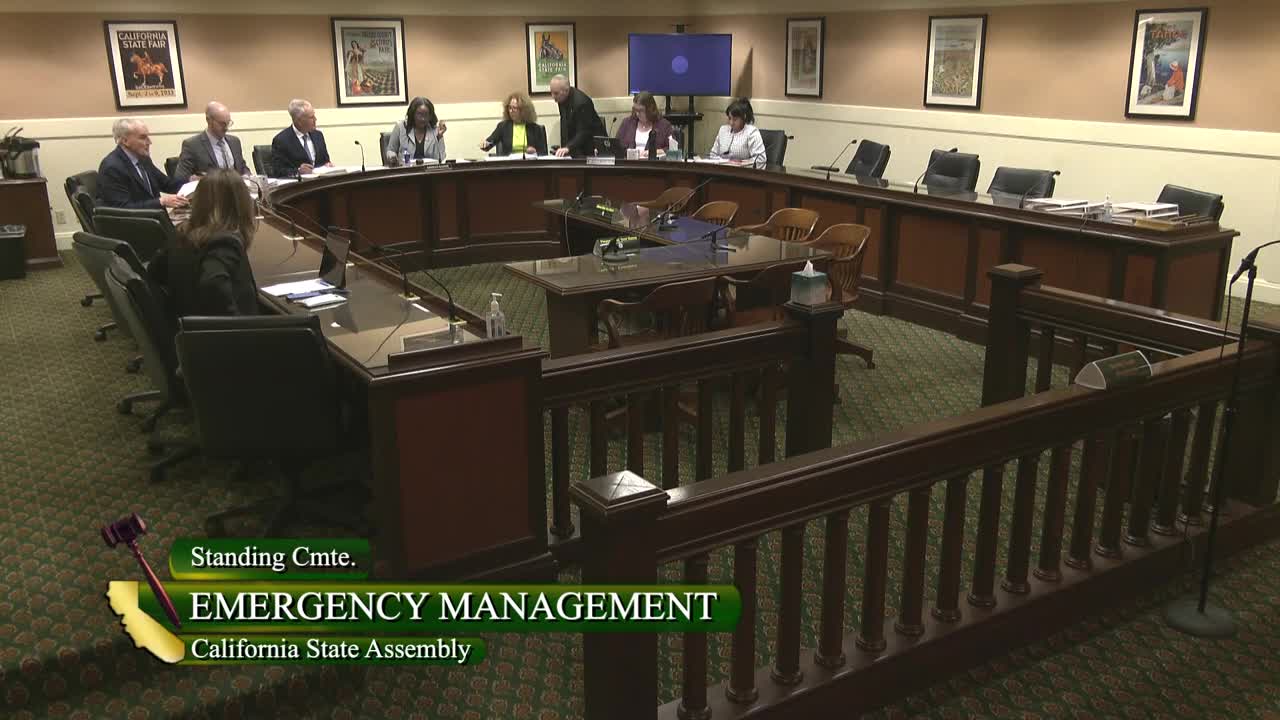
Assembly Standing Committee on Emergency Management
Bill Author

Bill Co-Author(s):