ACR 260: Statutes: gender-neutral language: pronouns.
- Session Year: 2017-2018
- House: Assembly
- Latest Version Date: 2018-09-05
This measure would encourage the Legislature to engage in a coordinated effort to revise existing statutes and introduce new legislation with inclusive language by using gender-neutral pronouns or reusing nouns to avoid the use of gendered pronouns. The measure would also encourage state agencies to engage in similar efforts to use gender-neutral pronouns and avoid the use of gendered pronouns when drafting policies, regulations, and other guidance.
This measure would encourage the Legislature to engage in a coordinated effort to revise existing statutes and introduce new legislation with inclusive language by using gender-neutral pronouns or reusing nouns to avoid the use of gendered pronouns. The measure would also encourage state agencies to engage in similar efforts to use gender-neutral pronouns and avoid the use of gendered pronouns when drafting policies, regulations, and other guidance.
This bill measure would encourage the Legislature to engage in a coordinated effort to revise existing statutes and introduce new legislation with inclusive language by using gender-neutral pronouns or reusing nouns to avoid the use of gendered pronouns. The measure would also encourage state agencies to engage in similar efforts to use gender-neutral pronouns and avoid the use of gendered pronouns when drafting policies, regulations, and other guidance.
This bill would encourage the Legislature to engage in a coordinated effort to revise existing statutes and introduce new legislation with inclusive language by using gender-neutral pronouns or reusing nouns to avoid the use of gendered pronouns.
WHEREAS, California has the highest population of lesbian, gay, bisexual, and transgender (LGBT) people in the United States. It is often the legal gold standard for nondiscrimination policies and laws to protect LGBT individuals in the areas of employment, housing, and education, which other states often emulate in their own policies and laws; and
WHEREAS, One area that has come to the forefront in the last few years is the treatment in this stateand even in the state capitolof transgender people and people who do not identify with the traditional gender binary; and
WHEREAS, Legislatively, this state has done much to address and protect the transgender and nonbinary community, but there are still things transgender and nonbinary people face daily, big and small, that undermine their recognition, representation, and very existence in society; and
WHEREAS, The drafting guidelines of the Office of Legislative Counsel direct drafting the language of legislation in a gender-neutral form. The implementation of the guidelines does an excellent job of reducing the amount of gendered language within codified and uncodified state statutes as legislation is introduced or amended; and
WHEREAS, Gendered language nonetheless persists in state statutes as many older provisions of codified law have not been amended or repealed and thus remain unchanged; and
WHEREAS, The use of the pronouns he or she for individuals is not inclusive of all transgender people, nonbinary people who may not ascribe to a particular or fixed gender, or people who otherwise use different pronouns; and
WHEREAS, One grammatical technique to avoid gendered pronouns is to reuse the noun in lieu of a pronoun. A number of states drafting manuals for legislation recognize this style usage, including the manuals for this state, Connecticut, Montana, and North Dakota; and
WHEREAS, Other usages that address the issue include creating new words to serve as gender-neutral pronouns and expanding the use of the word they to include its use as a singular pronoun. The latter usage is becoming more widespread; and
WHEREAS, Certain writing style guides, including the Chicago Manual of Style and the Associated Press stylebook, have recently accepted the use of they as a singular pronoun in certain cases; and
WHEREAS, The use of they as a singular pronoun is inclusive of transgender or nonbinary persons in addition to persons of the male and female genders; and
WHEREAS, It should be a priority for this state to make sure that the language we use to draft our laws, applicable to all persons, recognizes and represents all persons; now, therefore, be it
Resolved by the Assembly of the State of California, the Senate thereof concurring, That the Legislature should engage in a coordinated effort to revise existing statutes and introduce new legislation with inclusive language by using gender-neutral pronouns or reusing nouns to avoid the use of gendered pronouns; and be it further
RESOLVED, That state agencies should engage in similar efforts to use gender-neutral pronouns and avoid the use of gendered pronouns when drafting policies, regulations, and other guidance; and be it further
Resolved, That the Chief Clerk of the Assembly transmit copies of this resolution to the author for distribution.
WHEREAS, California has the highest population of lesbian, gay, bisexual, and transgender (LGBT) people in the United States. It is often the legal gold standard for nondiscrimination policies and laws to protect LGBT individuals in the areas of employment, housing, and education, which other states often emulate in their own policies and laws; and
WHEREAS, One area that has come to the forefront in the last few years is the treatment in this stateand even in the state capitolof transgender people and people who do not identify with the traditional gender binary; and
WHEREAS, Legislatively, this state has done much to address and protect the transgender and nonbinary community, but there are still things transgender and nonbinary people face daily, big and small, that undermine their recognition, representation, and very existence in society; and
WHEREAS, The drafting guidelines of the Office of Legislative Counsel direct drafting the language of legislation in a gender-neutral form. The implementation of the guidelines does an excellent job of reducing the amount of gendered language within codified and uncodified state statutes as legislation is introduced or amended; and
WHEREAS, Gendered language nonetheless persists in state statutes as many older provisions of codified law have not been amended or repealed and thus remain unchanged; and
WHEREAS, The use of the pronouns he or she for individuals is not inclusive of all transgender people, nonbinary people who may not ascribe to a particular or fixed gender, or people who otherwise use different pronouns; and
WHEREAS, One grammatical technique to avoid gendered pronouns is to reuse the noun in lieu of a pronoun. A number of states drafting manuals for legislation recognize this style usage, including the manuals for this state, Connecticut, Montana, and North Dakota; and
WHEREAS, Other usages that address the issue include creating new words to serve as gender-neutral pronouns and expanding the use of the word they to include its use as a singular pronoun. The latter usage is becoming more widespread; and
WHEREAS, Certain writing style guides, including the Chicago Manual of Style and the Associated Press stylebook, have recently accepted the use of they as a singular pronoun in certain cases; and
WHEREAS, The use of they as a singular pronoun is inclusive of transgender or nonbinary persons in addition to persons of the male and female genders; and
WHEREAS, It should be a priority for this state to make sure that the language we use to draft our laws, applicable to all persons, recognizes and represents all persons; now, therefore, be it
Resolved by the Assembly of the State of California, the Senate thereof concurring, That the Legislature should engage in a coordinated effort to revise existing statutes and introduce new legislation with inclusive language by using gender-neutral pronouns or reusing nouns to avoid the use of gendered pronouns; and be it further
Resolved, That the Chief Clerk of the Assembly transmit copies of this resolution to the author for distribution.
|
Date
|
Status
|
|---|---|
| Sep 5, 2018 | Chaptered by Secretary of State - Res. Chapter 190, Statutes of 2018. |
| Sep 5, 2018 | Enrolled and filed with the Secretary of State at 11:30 a.m. |
| Aug 28, 2018 | In Assembly. Ordered to Engrossing and Enrolling. |
| Aug 28, 2018 | Adopted and to Assembly. |
| Aug 24, 2018 | From committee: Ordered to third reading. |
| Aug 21, 2018 | In Senate. To Com. on RLS. |
| Aug 20, 2018 | Coauthors revised. |
| Aug 16, 2018 | Amended. Ordered to third reading. |
| Aug 15, 2018 | From committee: Amend, and be adopted as amended. (Ayes 7. Noes 0.) (August 14). |
| Aug 6, 2018 | Referred to Com. on JUD. |
| Jun 21, 2018 | From printer. |
| Jun 20, 2018 | Introduced. To print. |
|
Date
|
Description
|
Location
|
Votes
|
|
|---|---|---|---|---|
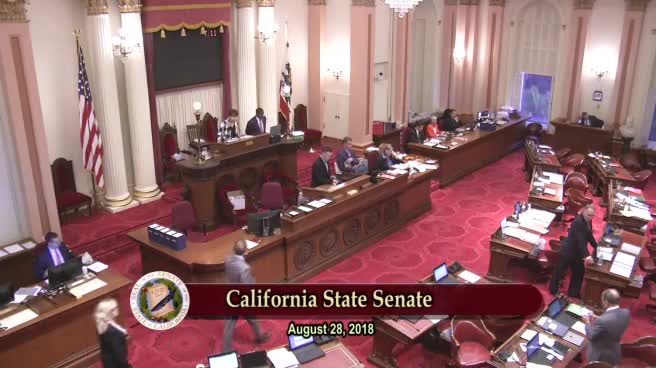
| Aug 28, 2018 | Assembly 3rd Reading ACR260 Low et al. By Wiener | Senate Floor |
Passed |
|
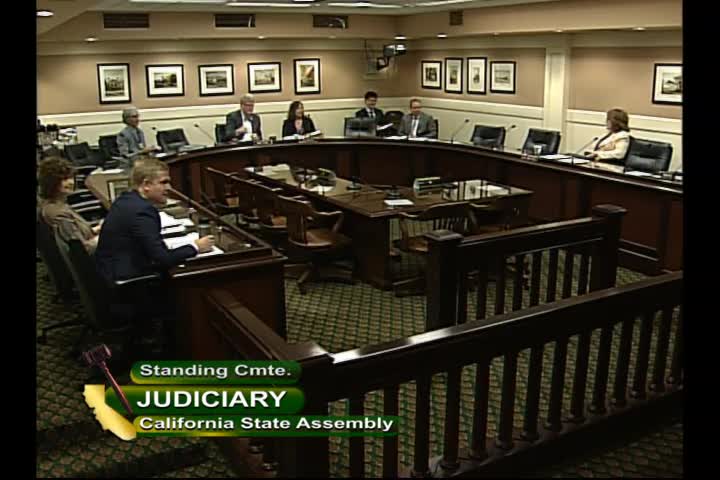
| Aug 14, 2018 | Be adopted as amended. | Assembly Standing Committee on Judiciary |
Passed |
This list shows positions taken on this bill by organizations on the date displayed, which is linked to the original source.
Positions by individuals are not included.
|
Organization
|
Position
|
Date
|
|---|---|---|
| Aclu Center For Advocacy & Policy | ** Support | Aug 24, 2018 |
| Bay Area Municipal Elections Committee | ** Support | Aug 24, 2018 |
Office of Senate Floor Analyses (916) 651-1520 Fax: (916) 327-4478 | ACR 260 |
THIRD READING
Bill No: ACR 260
Amended: 8/16/18 in Assembly
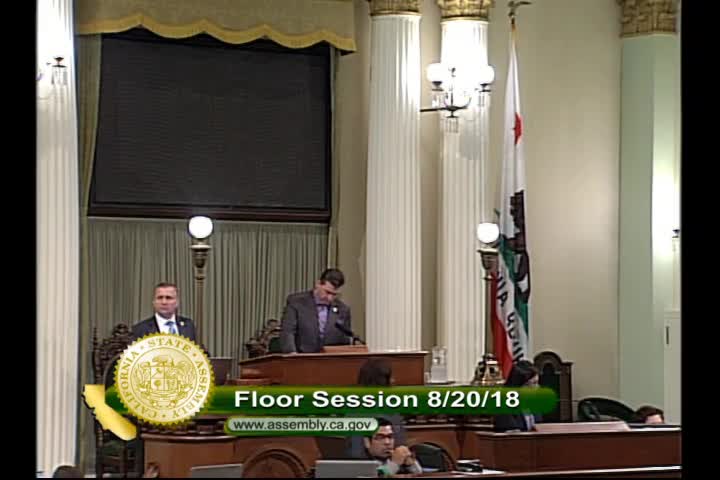
ASSEMBLY FLOOR: Read and adopted, 8/20/18
SUBJECT: Statutes: gender-neutral language: pronouns
DIGEST:
This resolution encourages the Legislature to engage in a coordinated effort to revise existing statutes and introduce new legislation with inclusive language by using gender-neutral pronouns or reusing nouns to avoid the use of gendered pronouns; and encourages state agencies to engage in similar efforts to use gender-neutral pronouns and avoid the use of gendered pronouns when drafting policies, regulations, and other guidance.
ANALYSIS: This resolution makes the following legislative findings:
- California has the highest population of lesbian, gay, bisexual, and transgender (LGBT) people in the United States. It is often the legal “gold standard” for nondiscrimination policies and laws to protect LGBT individuals in the areas of employment, housing, and education, which other states often emulate in their own policies and laws.
- One area that has come to the forefront in the last few years is the treatment in this state—and even in the state capitol—of transgender people and people who do not identify with the traditional gender binary.
- Legislatively, this state has done much to address and protect the transgender and nonbinary community, but there are still things transgender and nonbinary people face daily, big and small, that undermine their recognition, representation, and very existence in society.
- Drafting guidelines of the Office of Legislative Counsel direct drafting the language of legislation in a gender-neutral form. The implementation of the guidelines does an excellent job of reducing the amount of gendered language within codified/uncodified state statutes as legislation is introduced or amended.
- Gendered language nonetheless persists in state statutes as many older provisions of codified law have not been amended or repealed and thus remain unchanged. The use of the pronouns “he” or “she” for individuals is not inclusive of all transgender people, nonbinary people who may not ascribe to a particular or fixed gender, or people who otherwise use different pronouns.
- It should be a priority for this state to make sure that the language we use to draft our laws, applicable to all persons, recognizes and represents all persons.
This resolution encourages the Legislature to engage in a coordinated effort to revise existing statutes and introduce new legislation with inclusive language by using gender-neutral pronouns or reusing nouns to avoid the use of gendered pronouns; and state agencies should engage in similar efforts to use gender-neutral pronouns and avoid the use of gendered pronouns when drafting policies, regulations, and other guidance.
Comments
According to the author, “California is home to the largest LGBTQ population in the country, many of whom identify as non-binary. By using gender-neutral pronouns in legislation and policies moving forward, the State of California celebrates its non-binary community.”
FISCAL EFFECT: Appropriation: No Fiscal Com.: No Local: No
ACLU Center for Advocacy & Policy
Bay Area Municipal Elections Committee
OPPOSITION: (Verified 8/23/18)
None received
Prepared by: Melissa Ward / SFA / (916) 651-1520
8/24/18 15:25:24
ASSEMBLY THIRD READING
ATR Bill Id:ACR 260
Author:(Low)
As Amended Ver:August 16, 2018
Majority vote
Committee | Votes | Ayes | Noes |
Judiciary | 7-0 | Mark Stone, Chau, Chiu, Holden, Kalra, Maienschein, Reyes |
SUMMARY: Encourages the Legislature to engage in a coordinated effort to revise existing statutes and introduce new legislation that is inclusive of all people, including transgender and nonbinary people, by using gender-neutral pronouns. Specifically, this measure:
- Finds that California has the highest population of lesbian, gay, bisexual, and transgender (LGBT) people in the United States, and is often the legal "gold standard" for nondiscrimination policies and laws to protect LGBT individuals in the areas of employment, housing, and education.
- Finds that, legislatively, this state has done much to address and protect the transgender and nonbinary community, but there are still things transgender and nonbinary people face every day that undermine their recognition, representation, and very existence in society.
- Declares that the drafting guidelines of the Office of Legislative Counsel direct drafting the language of legislation in a gender-neutral form, and that the implementation of the guidelines does an excellent job of reducing the amount of gendered language within codified and uncodified state statutes as legislation is introduced or amended.
- Finds that gendered language nonetheless persists in state statutes as many older provisions of codified law have not been amended or repealed and thus remain unchanged.
- Declares that the use of the pronouns "he" or "she" for individuals is not inclusive of all transgender people, nonbinary people who may not ascribe to a particular or fixed gender, or people who otherwise use different pronouns.
- Finds that one grammatical technique to avoid gendered pronouns is to reuse the noun in lieu of a pronoun, and that a number of states' drafting manuals for legislation recognize this style usage, including the manuals for this state, Connecticut, Montana, and North Dakota.
- Finds that other usages include creating new words to serve as gender-neutral pronouns and expanding the use of the word "they" to include its use as a singular pronoun, and that certain writing style guides, including the "Chicago Manual of Style" and the Associated Press stylebook, have recently accepted the use of "they" as a singular pronoun in certain cases.
- Declares that the use of "they" as a singular pronoun is inclusive of transgender or nonbinary persons in addition to persons of the male and female genders.
- Declares that it should be a priority for this state to make sure that the language we use to draft our laws, applicable to all persons, recognizes and represents all persons.
- Calls upon the Legislature to engage in a coordinated effort to revise existing statutes and introduce new legislation with inclusive language by using gender-neutral pronouns or reusing nouns to avoid the use of gendered pronouns.
- Calls upon state agencies to engage in similar efforts to use gender-neutral pronouns and avoid the use of gendered pronouns when drafting policies, regulations, and other guidance.
FISCAL EFFECT: None
COMMENTS: This measure seeks to encourage the Legislature to use gender-neutral pronouns and avoid the use of gendered pronouns when drafting new legislation and revising existing statutes, in order to promote full inclusivity of all people in the written laws that govern our state.
Background on nonbinary designation of gender. Last year, the Legislature passed legislation that, for the first time, provides legal recognition of "nonbinary" as a third gender marker for use on official state documents, including a person's birth certificate, driver's license, and state identification cards. The legislative findings and declarations of that bill, SB 179 (Atkins) Chapter 853, Statutes of 2017, explain that: "Nonbinary is an umbrella term for people with gender identities that fall somewhere outside of the traditional conceptions of strictly either female or male. People with nonbinary gender identities may or may not identify as transgender, may or may not have been born with intersex traits, may or may not use gender-neutral pronouns, and may or may not use more specific terms to describe their genders."
In recent years, several states, including California, have begun to allow individuals to officially designate their gender as nonbinary, rather than male or female. In September 2016, Sara Kelly Keenan – a resident of Santa Cruz – became the first Californian to successfully petition a court to change their legal gender to nonbinary. Keenan identifies as intersex and hails the decision as "a huge opportunity for acceptance and awareness for young nonbinary and intersex and trans people – and for their parents." After receiving the court order, Keenan requested and received an amended birth certificate from the New York City Department of Health and Mental Hygiene. The document states their gender as intersex, and it is believed to be the first such legal document to do so. By February 2017, California had granted legal third-gender status to seven individuals.
Last year, the Legislature made this process easier by enacting SB 179 (Atkins), landmark legislation that for the first time provides legal recognition of "nonbinary" as a third gender marker in California's Codes. More specifically, SB 179 allows people to obtain a new birth certificate from the State Registrar reflecting a change of gender to female, male, or nonbinary—importantly, without having to obtain a court order. As the example of Sara Keenan illustrated, obtaining a court order was a difficult hurdle for many people seeking to make this change. Under the new law, effective January 1, 2019, a court order is no longer necessary if the individual submits an application to change the gender on the birth certificate, as well as an affidavit attesting under penalty of perjury that the request is to conform the individual's legal gender to the individual's gender identity.
In addition, SB 179 also allows an applicant for a driver's license or identification card to choose a gender category of female, male, or nonbinary to appear on the document, and further provides that the applicant's gender choice on an original, renewed, or amended driver's license is not subject to review by the Department of Motor Vehicles.
Other jurisdictions are beginning to recognize a third-gender marker. Internationally, New Zealand, Australia, Nepal, Bangladesh, and Ontario, Canada, among others, recognize a third-gender category. Oregon and the District of Columbia now allow a non-binary gender designation on driver's licenses, and Oregon and Washington state allow people to obtain an amended birth certificate with an nonbinary gender designation.
According to the author, some higher education institutions have also begun to adopt official policies of using gender-neutral language. For example, last year Yale announced it would use the gender-neutral terms "first-year" and "upper-level" instead of "freshman" and "upperclassman" in their official literature and correspondence. (See http://www.dailymail.co.uk /news/article-4891134/Yale-University-latest-adopt-gender-neutral-terms.html.) The University of North Carolina at Chapel Hill, Emory, Cornell, Dartmouth and Columbia have also already adopted gender-neutral language.
Gender-neutral language can help reduce discrimination and change attitudes. A brief review of the scientific literature suggests that gender-neutral language can help achieve more than symbolic change. For example, Swiss researchers performed a critical review of research on "gender-fair language" (GFL) and found, among other things, that "GFL is more frequent and more accepted when it is backed by official regulations and when the use of biased language is sanctioned in some way (e.g., in official publications or texts; [citations omitted])." They also concluded that "Official regulations may stipulate social change by facilitating the internalization of new norms and enforcing their execution. Public discussions over policies also enhance public awareness for GFL (Sczesny, Formanowicz, and Moser. (2016) "Can Gender-Fair Language Reduce Gender Stereotyping and Discrimination?" Frontiers in Psychology 7:25. Accessed at: https://www.frontiersin.org/articles/10.3389/fpsyg.2016.00025/full)
Research comparing gendered languages with more gender-neutral languages suggests that language can actually reinforce gender inequality. In reviewing several studies on this topic, researchers from the University of Michigan found support for the conclusion that gendered language is not benign, and that language bias has real and measurable consequences for individuals and society. They wrote:
Language appears to play a particularly important role in molding individuals' attitudes toward gender and occupation. Research suggests that language-induced stereotyping can be difficult to overcome. Even when explicitly told that masculine generics ("he/him") are meant to include all genders, using male pronouns causes readers to imagine men. For instance, college students who were told to complete sentences about professionals using the gender-neutral they reported picturing fewer men than those who completed sentences using he/him, even though both groups were clearly informed that pronouns referred to men and women. [Internal citations omitted.] (Harris, Biencowe, and Telem. (Dec. 2017.) "What's in a Pronoun? Why Gender-Fair Language Matters." Annals of Surgery 266(6): p. 932-33. Accessed at: https://www.ncbi.nlm.nih.gov/pmc/articles/PMC5774006.)
Previous legislation to replace outdated terminology in the Codes. In recent years, the Legislature has enacted bills to systematically replace outdated and unwanted terminology in the California codes because these terms stigmatized and promoted negative stereotypes about certain groups of people. For example, in 2012 the Legislature passed and the Governor signed two bills, AB 2370 (Mansoor), Chapter 448, Statutes of 2012, and SB 1381 (Pavley), Chapter 457, Statutes of 2012, which systematically deleted numerous references in state law to "mental retardation" or "mentally retarded person" and replaced them with the terms "intellectual disability" or "person with an intellectual disability," respectively. As the author of SB 1381 noted, "As society has become accustomed to casually using the 'R-word' as a way of deflating or condemning something's value, it's shaped the perception of and, undoubtedly, the self-worth of those with intellectual disabilities. The use of the 'R-word' is profoundly hurtful, outdated, and not in current professional use in agencies or association." This Committee's analysis of SB 1381 noted that surveys of mental health advocates, clinicians, families, and other professionals consistently show that the term "mental retardation" is filled with negative connotations and carries a great deal of stigma and hurt, and that replacing this term throughout the Codes would help lessen the stigma and ensure the Codes are not promoting negative stereotypes. (Assembly Judiciary Committee analysis of SB 1381 (June 19, 2012).)
Similarly, this measure seeks to address the use of gendered terminology in the California Codes that proponents contend should be made more inclusive because it does not recognize and represent all people. Specifically, the resolution finds and declares that the use of the pronouns "he" or "she" for individuals is not inclusive of all transgender people, nonbinary people who may not ascribe to a particular or fixed gender, or people who otherwise use different pronouns. To address this, the resolution calls upon the Legislature to engage in a coordinated effort to revise existing statutes and introduce new legislation with inclusive language by using gender-neutral pronouns or reusing nouns to avoid the use of gendered pronouns. Recent amendments expand this by urging state agencies to take similar steps when drafting policies and regulations, which are also expressions of public policy and generally have the force of law.
While this resolution may be useful in highlighting the need to increase the use of gender-neutral language in legislation and the Codes, it is somewhat unusual in that it does not call upon the federal government or any foreign or private entity to take specified actions, as is more common with legislative resolutions. Instead, it encourages the Legislature itself to take certain steps to achieve these objectives. Judiciary Committee staff notes that the Legislature, including its members, staff, and Legislative Counsel, has control over the language of the Codes, including additions and amendments to existing statutes, and is already capable of passing legislation, like the examples previously discussed, that would directly make the kinds of terminology changes in the Codes that the resolution encourages.
Analysis Prepared by: Anthony Lew / JUD. / (916) 319-2334 FN: 0004027
Date of Hearing: August 14, 2018
ASSEMBLY COMMITTEE ON JUDICIARY
Mark Stone, Chair
ABPCA Bill Id:ACR 260
Author:(Low) – As Introduced Ver:June 20, 2018
As Proposed to be Amended
SUBJECT: STATUTES: GENDER-NEUTRAL LANGUAGE: PRONOUNS
KEY ISSUE: in order to avoid the use of gendered pronouns that are not inclusive of all nonbinary people, should the legislature emphasize the use of gender-neutral pronouns in new legislation as well as revise existing statutes to accomplish the same?
SYNOPSIS
In recent years, several states, including California, have begun to allow individuals to officially designate their gender as nonbinary, rather than male or female. The first individuals to do so had to obtain a court order, however, in order to have this gender designation on their birth certificate or driver's license. Last year, the Legislature made this process easier by enacting SB 179 (Atkins), which allows people to obtain a new birth certificate from the State Registrar reflecting a change of gender to female, male, or nonbinary without having to obtain a court order. Proponents of this resolution, including the CA Legislative LGBT Caucus and the ACLU, note that, in addition to California, there are a number of universities, states and other nations that now recognize nonbinary gender status and are taking steps to redraft their rules and laws to be more inclusive and avoid the use of gendered pronouns. In addition, a brief review of the scientific literature (discussed below) suggests that gender-neutral language can help achieve more than symbolic change; for example, by contributing to the reduction of gender stereotyping and discrimination, and helping to reshape cultural norms.
This resolution furthers some of the same objectives as SB 179 by declaring that the use of gendered pronouns (e.g. "he" or "she") is not inclusive of transgender people, nonbinary people, and others, and calls upon the Legislature to engage in a coordinated effort to revise existing statutes and introduce new legislation with inclusive language, by using gender-neutral pronouns or reusing nouns to avoid the use of gendered pronouns. Proposed author's amendments expand this further by also calling upon the state's executive branch departments and agencies to take similar steps when drafting policies and regulations, which are also expressions of public policy and generally have the effect of law. The measure has no known opposition.
SUMMARY: Encourages the Legislature to engage in a coordinated effort to revise existing statutes and introduce new legislation that is inclusive of all people, including transgender and nonbinary people, by using gender-neutral pronouns. Specifically, this measure:
- Finds that California has the highest population of lesbian, gay, bisexual, and transgender (LGBT) people in the United States, and is often the legal “gold standard” for nondiscrimination policies and laws to protect LGBT individuals in the areas of employment, housing, and education.
- Finds that, legislatively, this state has done much to address and protect the transgender and nonbinary community, but there are still things transgender and nonbinary people face every day that undermine their recognition, representation, and very existence in society.
- Declares that the drafting guidelines of the Office of Legislative Counsel direct drafting the language of legislation in a gender-neutral form, and that the implementation of the guidelines does an excellent job of reducing the amount of gendered language within codified and uncodified state statutes as legislation is introduced or amended.
- Finds that gendered language nonetheless persists in state statutes as many older provisions of codified law have not been amended or repealed and thus remain unchanged.
- Declares that the use of the pronouns “he” or “she” for individuals is not inclusive of all transgender people, nonbinary people who may not ascribe to a particular or fixed gender, or people who otherwise use different pronouns.
- Finds that one grammatical technique to avoid gendered pronouns is to reuse the noun in lieu of a pronoun, and that a number of states’ drafting manuals for legislation recognize this style usage, including the manuals for this state, Connecticut, Montana, and North Dakota.
- Finds that other usages include creating new words to serve as gender-neutral pronouns and expanding the use of the word “they” to include its use as a singular pronoun, and that certain writing style guides, including the “Chicago Manual of Style” and the Associated Press stylebook, have recently accepted the use of “they” as a singular pronoun in certain cases.
- Declares that the use of “they” as a singular pronoun is inclusive of transgender or nonbinary persons in addition to persons of the male and female genders.
- Declares that it should be a priority for this state to make sure that the language we use to draft our laws, applicable to all persons, recognizes and represents all persons.
- Calls upon the Legislature to engage in a coordinated effort to revise existing statutes and introduce new legislation with inclusive language by using gender-neutral pronouns or reusing nouns to avoid the use of gendered pronouns.
EXISTING LAW:
- Requires the State Registrar to issue a new birth certificate reflecting a change of gender to female, male, or nonbinary without a court order if the individual submits an application to change the gender on the birth certificate and an affidavit attesting under penalty of perjury that the request is to conform the individual’s legal gender to the individual’s gender identity. (Health & Safety Code Section 103426.)
- Authorizes an individual to file a petition with the superior court in any county to change the individual’s gender to female, male, or nonbinary. (Health & Safety Code Sections 103425 and 103440.)
- Requires, effective January 1, 2019, an applicant for a driver’s license or identification card to choose a gender category of female, male, or nonbinary. (Vehicle Code Sections 12800 and 13005.)
FISCAL EFFECT: As currently in print this measure is keyed non-fiscal.
COMMENTS: This measure seeks to encourage the Legislature to use gender-neutral pronouns and avoid the use of gendered pronouns when drafting new legislation and revising existing statutes, in order to promote full inclusivity of all people in the written laws that govern our state. According to the author:
Much of California’s legal language includes traditional gendered pronouns such as “he” and “she.” However, many citizens do not identify with binary gender definitions, finding themselves fixed or fluctuating along a gender spectrum, or simply removed from the concept of gender. The terms “he” and “she” are also not inclusive to transgender people who are in the process of transitioning genders. By using language that is not inclusive to all citizens, the state of California continues to disenfranchise minorities that have long faced blatant discrimination. This is not reflective of the state’s other inclusive policies or the values of the general electorate. ACR 260 sets the intention for the state to be more inclusive for transgender and gender neutral, and non-binary individuals by adopting the use of gender-neutral pronouns in new legislation, as well as to begin the process of revising existing statutes to use gender-neutral language.
Background on nonbinary designation of gender. Last year, the Legislature passed legislation that, for the first time, provides legal recognition of "nonbinary" as a third gender marker for use on official state documents, including a person’s birth certificate, driver’s license, and state identification cards. The legislative findings and declarations of that bill, SB 179 (Atkins) Ch. 853, Stats. 2017, explain that:
The binary gender designations of female and male fail to adequately represent the diversity of human experience. Nonbinary is an umbrella term for people with gender identities that fall somewhere outside of the traditional conceptions of strictly either female or male. People with nonbinary gender identities may or may not identify as transgender, may or may not have been born with intersex traits, may or may not use gender-neutral pronouns, and may or may not use more specific terms to describe their genders, such as agender, genderqueer, gender fluid, Two Spirit, bigender, pangender, gender nonconforming, or gender variant. Nonbinary gender identities have been recognized by cultures throughout history and around the world, as well as by legal systems in the United States and other countries, medical authorities, and researchers. Studies show that nonbinary people face frequent discrimination, harassment, and violence in areas of life including education, employment, health care, and law enforcement.
In recent years, several states, including California, have begun to allow individuals to officially designate their gender as nonbinary, rather than male or female. In June 2017, an Oregon court became the first in the United States to order a gender change for an individual to non-binary. The plaintiff in that case, Jamie Shupe, was assigned the male gender at birth and subsequently changed their legal gender to female. However, Shupe did not identify as either female or male and challenged the Oregon Department of Motor Vehicles to recognize a third option. Ultimately, Shupe was able to successfully change their gender from female to nonbinary. Later that year, the Oregon Transportation Commission began to allow its residents to select “X” for a non-specified gender when they apply for their driver’s license or state identification card.
In September 2016, Sara Kelly Keenan—a resident of Santa Cruz—became the first Californian to successfully petition a court to change their legal gender to nonbinary. Keenan identifies as intersex and hails the decision as “a huge opportunity for acceptance and awareness for young nonbinary and intersex and trans people—and for their parents.” After receiving the court order, Keenan requested and received an amended birth certificate from the New York City Department of Health and Mental Hygiene. The document states their gender as intersex, and it is believed to be the first such legal document to do so. By February 2017, California had granted legal third-gender status to seven individuals.
Last year, the Legislature made this process easier by enacting SB 179 (Atkins), landmark legislation that for the first time provides legal recognition of "nonbinary" as a third gender marker in California's Codes. More specifically, SB 179 allows people to obtain a new birth certificate from the State Registrar reflecting a change of gender to female, male, or nonbinary—importantly, without having to obtain a court order. As the example of Sara Keenan illustrated, obtaining a court order was a difficult hurdle for many people seeking to make this change. Under the new law, effective January 1, 2019, a court order is no longer necessary if the individual submits an application to change the gender on the birth certificate, as well as an affidavit attesting under penalty of perjury that the request is to conform the individual’s legal gender to the individual’s gender identity.
Until now, people who wanted to obtain a nonbinary gender designation had to get a physician’s affidavit stating that they had undergone treatment for the purpose of gender transition. That’s what A. T. Furuya, a 35-year-old advocate for transgender youth at the San Diego LGBT Community Center, had to do to become one of the first people in the country to obtain a legally designated gender that is neither male nor female.
For A.T., having gender-neutral state-issued documentation means no longer being told by doctors or employers that the gender originally indicated on a birth certificate is all that matters. “They don’t get to decide for you based on what you’re assigned at birth,” A. T. said. “Someone can go into a new job as nonbinary and have paperwork to back that up and there’s no way for the employer to know.” (Christina Caron, "Californians Will Soon Have Nonbinary as a Gender Option on Birth Certificates." New York Times (Oct. 19, 2017). Accessed at: https://www.nytimes.com/2017/10/19/us/birth-certificate-nonbinary-gender-california.html.)
In addition, SB 179 also allows an applicant for a driver’s license or identification card to choose a gender category of female, male, or nonbinary to appear on the document, and further provides that the applicant’s gender choice on an original, renewed, or amended driver’s license is not subject to review by DMV.
Other jurisdictions are beginning to recognize a third-gender marker. Internationally, New Zealand, Australia, Nepal, Bangladesh, and Ontario, Canada, among others, recognize a third-gender category. Oregon and the District of Columbia now allow a non-binary gender designation on driver's licenses, and Oregon and Washington state allow people to obtain an amended birth certificate with an nonbinary gender designation.
According to the author, some higher education institutions have also begun to adopt official policies of using gender-neutral language. For example, last year Yale announced it would use the gender-neutral terms “first-year” and “upper-level” instead of “freshman” and “upperclassman” in their official literature and correspondence. (See http://www.dailymail.co.uk/news/article-4891134/Yale-University-latest-adopt-gender-neutral-terms.html.) The University of North Carolina at Chapel Hill, Emory, Cornell, Dartmouth and Columbia have also already adopted gender-neutral language.
Gender-neutral language can help reduce discrimination and change attitudes. A brief review of the scientific literature suggests that gender-neutral language can help achieve more than symbolic change. For example, Swiss researchers performed a critical review of how the term "gender-fair language" (GFL) contributes to the reduction of gender stereotyping and discrimination.
Over the past decades, a large body of research—based on various experimental methodologies, from storytelling to measuring reaction times—has confirmed the influence of linguistic forms on the accessibility of mental representations of women and men [citation omitted]. Regardless of language structure and of the ease of implementing GFL, a consistent finding is that speakers do not understand masculine forms as referring to both genders equally but that they interpret them in a male-biased way. This underscores the importance of implementing GFL in everyday language and of using it consistently, so that speakers take up this usage in their own texts and utterances.
Moreover, our review suggests that—independent of language structure—GFL is more frequent and more accepted when it is backed by official regulations and when the use of biased language is sanctioned in some way (e.g., in official publications or texts; [citations omitted]). The relationship between policy-making and social change is surely bidirectional. On the one hand, gender equality movements and their demands find their way into legislation. On the other hand, official regulations may stipulate social change by facilitating the internalization of new norms and enforcing their execution. Public discussions over policies also enhance public awareness for GFL (Sczesny, Formanowicz, and Moser. (2016) "Can Gender-Fair Language Reduce Gender Stereotyping and Discrimination?" Frontiers in Psychology 7:25. Accessed at: https://www.frontiersin.org/articles/10.3389/fpsyg.2016.00025/full)
Research comparing gendered languages with more gender-neutral languages suggests that language can actually reinforce gender inequality. In reviewing several studies on this topic, researchers from the University of Michigan found support for the conclusion that gendered language is not benign, and that language bias has real and measurable consequences for individuals and society.
There is growing evidence that societies with gendered language consistently display deeper gender inequality than societies with neutral language. For instance, in the aforementioned study [citation omitted], Russian/Spanish-speaking participants displayed more sexism on the study’s social attitude scale than their English-speaking counterparts. Similarly, using the Global Gender Gap Index which “benchmarks national gender gaps on economic, political, education- and health-based criteria”, Prewitt-Freilino et. al demonstrated that countries where >70% of the population spoke a gendered language scored lower on both the overall index and on economic subscales. In this context, it appears that language not only reflects and defines culture, but actually shapes cultural norms.
Language appears to play a particularly important role in molding individuals’ attitudes toward gender and occupation. Bem and Bem’s landmark study reported that women were significantly less likely to apply for jobs with masculine suffixes (-man versus –person). In a simulated hiring experiment, German-speaking business students rated standardized female applicants as less suitable for high-power positions when the job description used male rather than paired forms. Moreover, research suggests that language-induced stereotyping can be difficult to overcome. Even when explicitly told that masculine generics (“he/him”) are meant to include all genders, using male pronouns causes readers to imagine men. For instance, college students who were told to complete sentences about professionals using the gender-neutral they reported picturing fewer men than those who completed sentences using he/him, even though both groups were clearly informed that pronouns referred to men and women. [Internal citations omitted.] (Harris, Biencowe, and Telem. (Dec. 2017.) "What’s in a Pronoun? Why Gender-Fair Language Matters." Annals of Surgery 266(6): p. 932-33. Accessed at: https://www.ncbi.nlm.nih.gov/pmc/articles/PMC5774006.)
Previous legislation to replace outdated terminology in the Codes. In recent years, the Legislature has enacted bills to systematically replace outdated and unwanted terminology in the California codes because these terms stigmatized and promoted negative stereotypes about certain groups of people. For example, in 2012 the Legislature passed and the Governor signed two bills, AB 2370 (Ch. 448, Stats. 2012) and SB 1381 (Ch. 457, Stats. 2012) which systematically deleted numerous references in state law to “mental retardation” or “mentally retarded person” and replaced them with the terms “intellectual disability” or “person with an intellectual disability,” respectively. As the author of SB 1381 noted, "As society has become accustomed to casually using the 'R-word' as a way of deflating or condemning something’s value, it’s shaped the perception of and, undoubtedly, the self-worth of those with intellectual disabilities. The use of the 'R-word' is profoundly hurtful, outdated and not in current professional use in agencies or association." This Committee's analysis of SB 1381 noted that surveys of mental health advocates, clinicians, families, and other professionals consistently show that the term "mental retardation" is filled with negative connotations and carries a great deal of stigma and hurt, and that replacing this term throughout the Codes would help lessen the stigma and ensure the Codes are not promoting negative stereotypes. (Assembly Judiciary Committee analysis of SB 1381 (June 19, 2012).)
In 2005, the Legislature enacted AB 220 (Ch. 215, Stats. 2005) which changed the term "battered women's syndrome" to "intimate partner battering and its effects" throughout the Penal Code, Family Code, and Code of Civil Procedure. This Committee's analysis of the bill noted that the old term should be changed because, among other things, it pathologized survivors of abuse; focused on survivors' behaviors and psychological responses, rather than on the batterer's abuse; excluded same-sex battering and male victims of abuse; and perpetuated harmful stereotypes about survivors as passive and helpless.
Similarly, this measure seeks to address the use of gendered terminology in the California Codes that proponents contend should be made more inclusive because it does not recognize and represent all people. Specifically, the resolution finds and declares that the use of the pronouns “he” or “she” for individuals is not inclusive of all transgender people, nonbinary people who may not ascribe to a particular or fixed gender, or people who otherwise use different pronouns. To address this, the resolution calls upon the Legislature to engage in a coordinated effort to revise existing statutes and introduce new legislation with inclusive language by using gender-neutral pronouns or reusing nouns to avoid the use of gendered pronouns.
While this resolution may be useful in highlighting the need to increase the use of gender-neutral language in legislation and the Codes, it is somewhat unusual in that it does not call upon the federal government or any foreign or private entity to take specified actions, as is more common with legislative resolutions. Instead, it encourages the Legislature itself to take certain steps to achieve these objectives. Committee staff notes that the Legislature, including its members, staff, and Legislative Counsel, has control over the language of the Codes, including additions and amendments to existing statutes, and is already capable of passing legislation, like the examples previously discussed, that would directly make the kinds of terminology changes in the Codes that the resolution encourages.
Proposed amendments extend to executive branch regulations. As currently in print, the resolution declares that "It should be a priority for this state to make sure that the language we use to draft our laws, applicable to all persons, recognizes and represents all persons" and calls upon the Legislature to use gendered-neutral language in drafting legislation and revising the existing codes. Proposed author's amendments to the resolution expand this by calling upon the state's executive branch departments and agencies to take similar steps when drafting policies and regulations, which are also expressions of public policy and generally applicable in the same way that statutes are. The amendment is:
On page 3, line 4, insert the following:
Resolved, That California departments and agencies engage in similar efforts to use gender-neutral pronouns and avoid the use of gendered pronouns when drafting policies, regulations, and other guidance; and be it further
ARGUMENTS IN SUPPORT: In support of the bill, the ACLU writes: "California is currently home to the highest population of LGBTQ people in the United States and is consistently a leader in its progressive nondiscrimination policies and laws that protect LGBTQ individuals. California should continue on this path to full inclusivity by committing to drafting laws that are applicable to all Californians and making gender-neutral statutes a priority. This resolution is in line with recent changes to California law under SB 179, which legally recognizes a nonbinary gender identity, and will show California's transgender and nonbinary residents that their dignity, respect, and recognition is a priority."
REGISTERED SUPPORT / OPPOSITION:
Support
ACLU, Center for Advocacy and Policy
Opposition
None on file
Analysis Prepared by: Anthony Lew / JUD. / (916) 319-2334
Discussed in Hearing
 3MIN
Senate Floor
 1MIN
Assembly Floor
 3MIN
Assembly Standing Committee on Judiciary
Bill Author

Bill Co-Author(s):