SB 38: Courts: judgeships.
- Session Year: 2017-2018
- House: Senate
- Latest Version Date: 2018-01-23
Existing law specifies the number of judges for the superior court of each county and for each division of each district of the court of appeal. Existing law provides that the Court of Appeal for the 4th Appellate District consists of 3 divisions. Existing law requires that one of these divisions hold its regular sessions in the San Bernardino/Riverside area and further requires this division to have 7 judges.
This bill would increase the number of judges in the division of the 4th Appellate District of the Court of Appeal for the 4th Appellate District located in the San Bernardino/Riverside area to 8 judges. The bill would appropriate $1,202,000 from the General Fund to the judicial branch for the purpose of funding the cost of that new appellate court justice and accompanying staff.
Existing law allocates additional judgeships to the various counties in accordance with uniform standards for factually determining additional need in each county, as approved by the Judicial Council. Existing law requires the Judicial Council to report biennially to the Legislature and the Governor on the factually determined need for new judgeships in each superior court using that uniform criteria for allocation of judgeships. Existing law authorizes 50 additional judges, upon appropriation by the Legislature, to be allocated to the various county superior courts, pursuant to uniform criteria approved by the Judicial Council.This bill would appropriate $14,813,000 from the General Fund to the judicial branch for the purpose of funding the cost of 10 of those 50 judgeships and accompanying staff.Existing law specifies the number of judges for the superior court of each county and for each division of each district of the court of appeal. Existing law provides that the Court of Appeal for the 4th Appellate District consists of 3 divisions. Existing law requires that one of these divisions hold its regular sessions in the San Bernardino/Riverside area and further requires this division to have 7 judges.
This bill would increase the number of judges in the division of the 4th Appellate District of the Court of Appeal located in the San Bernardino/Riverside area to 8 judges. The bill would appropriate $1,202,000 from the General Fund to the judicial branch for the purpose of funding the cost of that new appellate court justice and accompanying staff.
Existing law allocates additional judgeships to the various counties in accordance with uniform standards for factually determining additional need in each county, as approved by the Judicial Council. Existing law requires the Judicial Council to report biennially to the Legislature and the Governor on the factually determined need for new judgeships in each superior court using that uniform criteria for allocation of judgeships. Existing law authorizes 50 additional judges, upon appropriation by the Legislature, to be allocated to the various county superior courts, pursuant to uniform criteria approved by the Judicial Council.
This bill would appropriate $14,813,000 from the General Fund to the judicial branch for the purpose of funding the cost of 10 of those 50 judgeships and accompanying staff.
The Court of Appeal for the Fourth Appellate District consists of three divisions. One division shall hold its regular sessions at San Diego and shall have 10 judges. One division shall hold its regular sessions in the San Bernardino/Riverside area and shall have eight judges. One division shall hold its regular sessions in Orange County and shall have eight judges.
SEC. 2.The sum of sixteen million fifteen thousand dollars ($16,015,000) is hereby appropriated from the General Fund to the judicial branch for the following purposes:(a)The sum of one million two hundred two thousand dollars ($1,202,000) shall be used by the judicial branch to fund the cost of a new appellate court justice and accompanying staff pursuant to Section 69104 of the Government Code.(b)The sum of fourteen million eight hundred thirteen thousand dollars ($14,813,000) shall be used by the judicial branch to fund the cost of 10 of the 50 new judgeships, and accompanying staff, pursuant to Section 69614.2 of the Government Code.The Court of Appeal for the Fourth Appellate District consists of three divisions. One division shall hold its regular sessions at San Diego and shall have 10 judges. One division shall hold its regular sessions in the San Bernardino/Riverside area and shall have seven eight judges. One division shall hold its regular sessions in Orange County and shall have eight judges.
SEC. 2.The sum of sixteen million fifteen thousand dollars ($16,015,000) is hereby appropriated from the General Fund to the judicial branch for the following purposes:
(a)The sum of one million two hundred two thousand dollars ($1,202,000) shall be used by the judicial branch to fund the cost of a new appellate court justice and accompanying staff pursuant to Section 69104 of the Government Code.
(b)The sum of fourteen million eight hundred thirteen thousand dollars ($14,813,000) shall be used by the judicial branch to fund the cost of 10 of the 50 new judgeships, and accompanying staff, pursuant to Section 69614.2 of the Government Code.
|
Date
|
Status
|
|---|---|
| Aug 16, 2018 | August 16 hearing: Held in committee and under submission. |
| Jun 27, 2018 | June 27 set for first hearing. Placed on APPR. suspense file. |
| Jun 12, 2018 | From committee: Do pass and re-refer to Com. on APPR. with recommendation: To consent calendar. (Ayes 9. Noes 0.) (June 12). Re-referred to Com. on APPR. |
| Apr 16, 2018 | Referred to Com. on JUD. |
| Jan 30, 2018 | In Assembly. Read first time. Held at Desk. |
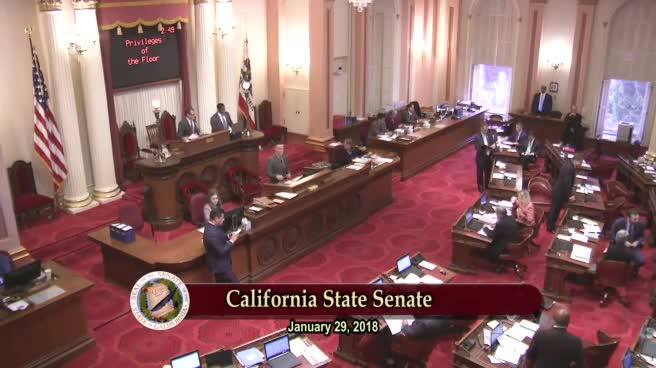
| Jan 29, 2018 | Read third time. Passed. (Ayes 39. Noes 0.) Ordered to the Assembly. |
| Jan 23, 2018 | Read second time and amended. Ordered to third reading. |
| Jan 22, 2018 | From committee: Do pass as amended. (Ayes 7. Noes 0.) (January 18). |
| Jan 17, 2018 | Set for hearing January 18. |
| Jan 16, 2018 | January 16 hearing: Placed on APPR. suspense file. |
| Jan 11, 2018 | Set for hearing January 16. |
| Jan 10, 2018 | From committee: Do pass and re-refer to Com. on APPR. with recommendation: To consent calendar. (Ayes 7. Noes 0.) (January 9). Re-referred to Com. on APPR. |
| Dec 21, 2017 | Set for hearing January 9. |
| Mar 16, 2017 | March 28 set for first hearing canceled at the request of author. |
| Mar 14, 2017 | Set for hearing March 28. |
| Jan 12, 2017 | Referred to Com. on JUD. |
| Dec 6, 2016 | From printer. May be acted upon on or after January 5. |
| Dec 5, 2016 | Introduced. Read first time. To Com. on RLS. for assignment. To print. |
|
Date
|
Description
|
Location
|
Votes
|
|
|---|---|---|---|---|
| Jun 12, 2018 | Do pass and be re-referred to the Committee on [Appropriations] with recommendation: To Consent Calendar | Assembly Standing Committee on Judiciary |
Passed |
|
| Jan 29, 2018 | Senate 3rd Reading SB38 Roth et al. | Senate Floor |
Passed |
|
| Jan 18, 2018 | Do pass as amended | Senate Standing Committee on Appropriations |
Passed |
|
| Jan 16, 2018 | Placed on suspense file | Senate Standing Committee on Appropriations |
Passed |
|
| Jan 9, 2018 | Do pass, but first be re-referred to the Committee on [Appropriations] with the recommendation: To Consent Calendar | Senate Standing Committee on Judiciary |
Passed |
This list shows positions taken on this bill by organizations on the date displayed, which is linked to the original source.
Positions by individuals are not included.
|
Organization
|
Position
|
Date
|
|---|---|---|
| California Chamber Of Commerce | ** Support | Jun 8, 2018 |
| California Judges Association | ** Support | Jun 8, 2018 |
| California Judges Association; Greater Riverside Chambers Of Commerce | ** Support | Jan 8, 2018 |
| Greater Riverside Chambers of Commerce | ** Support | Jan 24, 2018 |
| Judicial Council of California | ** Support | Jan 24, 2018 |
| Riverside County Board of Supervisors | ** Support | Jun 8, 2018 |
Date of Hearing: June 27, 2018
ASSEMBLY COMMITTEE ON APPROPRIATIONS
Lorena Gonzalez Fletcher, Chair
SBPCA Bill Id:SB 38
Author:(Roth) – As Amended Ver:January 23, 2018
Policy Committee: | Judiciary | Vote: | 9 - 0 |
Urgency: No State Mandated Local Program: No Reimbursable: No
SUMMARY:
This bill increases, from seven to eight, the number of judges in the Court of Appeals division that holds its regular sessions in the San Bernardino/Riverside area.
FISCAL EFFECT:
According to Judicial Council, it costs $1,207,000 (General Fund) to support one appellate court justice position, a figure which includes salary, benefits, and operating expenses to support the positon, as well as the staffing resources to aid the justice in their duties.
COMMENTS:
- Background and Purpose. The courts have been chronically underfunded. As statute requires, Judicial Council reports to the Legislature an assessment of its workload needs. In November of 2016, the council had identified “critical need” for judges statewide, particularly in the San Bernardino region. Overall, the assessment identified a need for 189 judges statewide.
Recently, the Legislature has responded, modestly, to this need for judgeships. In 2014, Senator Roth introduced SB 229, which would have appropriated $5 million from the General Fund to pay for 12 superior court judge positions. The bill passed the Legislature but was vetoed by Governor Brown. The governor acknowledged the need for additional judges in many courts. However, he expressed his intention to work with the Judicial Council before authorizing additional funding.
Four years later, and the need for judges remains.
- Related Legislation. The 2018-19 Budget Act (SB 847) includes funding for one appellate court position.
Analysis Prepared by: Jay Dickenson / APPR. / (916) 319-2081
Date of Hearing: June 12, 2018
ASSEMBLY COMMITTEE ON JUDICIARY
Mark Stone, Chair
SBPCA Bill Id:SB 38
Author:(Roth) – As Amended Ver:January 23, 2018
PROPOSED CONSENT
SENATE VOTE: 39-0
SUBJECT: Courts: judgeships
KEY ISSUE: SHOULD THE LEGISLATURE AUTHORIZE AN ADDITIONAL APPELLATE COURT JUSTICE AND ASSIGN THat JUSTICE TO SIT ON THE DIVISION OF THE COURT OF APPEAL FOR THE FOURTH APPELLATE DISTRICT which SERVES THE SAN BERNARDINO AND RIVERSIDE REGION?
SYNOPSIS
This non-controversial bill is the latest in a series of bills seeking to authorize or appropriate funding for additional judicial positions across California. This measure contains aspects of AB 2446 (Obernolte, 2018) that passed this Committee unanimously before it was held on the Assembly Appropriations Committee’s Suspense File in May. This bill is a more limited version of AB 2446 in that it only seeks to authorize, but not fund, one appellate justice for the Court of Appeal for the 4th Appellate District’s Division Two located in the San Bernardino/Riverside area, commonly referred to as the Inland Empire. The Judicial Council, in its most recent needs assessment, notes that the Inland Empire is the fastest growing region in California. Furthermore, the author notes that the Inland Empire appellate district currently handles the largest case load of any district in the state.
This bill seeks to generate progress on the critical judicial needs issue where prior legislation has failed by authorizing a needed judicial position while attempting to minimize the impact to the California Budget and the General Fund. Should this measure pass, however, an additional appropriation by the Legislature would be necessary to fund the judicial officer’s salary, as well as the costs associated with new staff. This measure is supported by the California Judges Association as wells as the California Chamber of Commerce who highlight the need to address the workload of judges in some of California’s fastest growing regions. The Riverside County Board of Supervisors also note that their law enforcement agencies rely on a functioning judicial system, and that the measure is needed to offset current caseloads. This measure received strong bi-partisan support in the California State Senate and has no known opposition.
SUMMARY: Authorizes an additional judge to serve on the Court of Appeal for the Fourth Appellate District. Specifically, this bill:
- Increases the total number of judges authorized to serve on the Court of Appeal for the 4th Appellate District to 26 judges.
- Assigns the additional judge to Division Two of the Court of Appeal for the 4th Appellate District located in the San Bernardino/Riverside area, increasing the total judges in that division to eight.
EXISTING LAW:
- Provides that the Legislature shall prescribe the number of judges and provide for the officers and employees of each superior court. (California Constitution, Article VI, Section 4.)
- Provides that the Legislature may provide for the trial courts to appoint officers such as commissioners to perform subordinate judicial duties. (California Constitution, Article VI, Section 22.)
- Authorizes the courts to appoint subordinate judicial officers, and sets forth their duties and titles. (Government Code Section 71622.)
- Sets forth the specific number of trial court judges in each county. (Government Code Section 9580 et seq.)
- Authorizes 50 new trial court judgeships pursuant to appropriation by the Legislature in 2006-07. Also requires the Judicial Council to update its Judicial Needs Study every other year, based on the most recent prior three years’ filings data, and report that information to the Legislature. (Government Code Section 69614.)
FISCAL EFFECT: As currently in print this bill is keyed fiscal.
COMMENTS: Due to the significant budget constraints that plagued California for much of the early part of this decade, California has not increased the size of the state judiciary to meet the growing demands posed by population growth and the corresponding increase in caseloads being handled by California courts. This bill is the latest in a series of measures seeking to expand the judicial branch and better balance judicial workloads. In support of this measure the author notes:
It has been 12 years since the legislature recognized the need to expand the number of judges available to hear cases of all kinds. Since that time, only 50 of the 150 planned judges were funded, the state’s population increased by 3.75 million people, and despite funding 50 positions California’s need for judicial positions has grown to 188. While this problem is statewide in its scope, nowhere is it worse than the Inland Southern California region made up of Riverside and San Bernardino Counties, which accounts for a full half of California’s judicial need. The corresponding Appellate Court is similarly stretched to its breaking point, with the most-burdened Fourth Appellate District Division Two having to transfer 600 cases to other divisions over the last 5 years. This on top of hearing 2,467 cases in 2016, the most of any single appellate division. The judicial infrastructure needs of the future will eventually come to dwarf this current request, which itself is merely a band aid on the current problem. This is why it is critical that this legislature take up this cause in earnest and start now by authorizing one justice to be appointed in Division Two.
Historically, Courts Were County-Funded Entities and Funding Levels Varied Enormously Across the State: Until the late 1990s, trial courts in California were county entities, funded by the counties. Accordingly, funding levels varied dramatically between counties resulting in different levels of court services across the State. While visiting all 58 county courts, then-Chief Justice Ronald George discovered that chronic under-funding of many courts in the county-based court system substantially impaired access to justice, including “woefully inadequate facilities, insufficient staff, unavailable interpreter services, and antiquated information processing systems.” In his first year as chief justice, Chief Justice George twice had to seek emergency funding from the Legislature in order to prevent the shutdown of some county trial court operations. In 1997, after significant problems came to light with the county-based court funding model, the Legislature passed the Lockyer-Isenberg Trial Court Funding Act, AB 233 (Escutia & Pringle, Chap. 850, Stats. 1997), requiring the state to assume responsibility for funding the courts and helping to ensure equal access to a quality judicial system statewide.
After the state took over funding, the courts received significant funding increases and the historically underfunded counties began to see infusions of new funding from the state. However, most of the state funding continued to be distributed based on the courts' historical allocations, so courts that had been better funded by their counties remained better funded by the state, and courts that had been underfunded by their counties still struggled to generate enough revenue to maintain full access to legal services.
Early success in providing judges to courts to address California’s growing population. Beginning in 2005, the Judicial Council began seeking legislative authorization and funding for additional trial court judges to address judicial shortfalls resulting from population growth. At that time, the Judicial Council reported that the state faced a "judicial gap" that portended a number of troubling long term consequences: a significant decrease in Californians' access to the courts; compromised public safety; an unstable business environment; and, in some courts, enormous backlogs that inhibit fair, timely, and equitable justice. According to the Judicial Council, that judicial gap arose because the number of trial court judges has not kept pace with population growth, and the resulting increased demand on the courts. At the time the Judicial Council noted that, between 1990 and 2000, for example, California's population grew by over 16 percent; yet at the time that the number of new judgeships created by the Legislature grew by less than three percent.
At that time, the Judicial Council pointed out that its uniform and objective assessment criteria contained in its 2001 and 2004 Judicial Needs Studies identified a statewide need for 355 new trial court judgeships. However, in consideration of the state's ongoing budget woes, the Council initially suggested a need for 150 new judgeships over that next three years. In response to the need, the Legislature passed SB 56 (Dunn, Chap. 390, Stats. 2006), which authorized, upon appropriation, 50 new trial court judgeships. Funding for those positions was provided in the budget that year. The next 50 trial court judges were authorized in AB 159 (Jones), Chap. 722, Stats. 2007. However, the requisite funding for those 50 positions, not part of AB 159, was not included in that fiscal year’s budget.
Historic budget woes have undercut numerous attempts to address the Judicial Branch’s staffing shortfalls. Shortly after the passage of AB 159, the financial markets crashed, the Great Recession took hold, and California’s budget woes became a full-blown crisis. Faced with billions of dollars of budget cuts, the funding of the 50 judicial positions authorized by AB 159, and the authorization and funding of the next 50 positions, became luxuries the state could not afford.
As California’s economy and budget approved new attempts funding judicial positions began. Since 2011, several bills have attempted to fund or authorize additional judicial positions including, AB 1313 (Donnelly, 2013), SB 1190 (Jackson, 2014), SB 229 (Roth, 2015), and, most recently, AB 2446 (Obernolte, 2018). All of those measures have failed in the Legislature or been vetoed by the Governor due to cost or failure to adhere to the Judicial Council’s needs assessment process.
Prior amendments dramatically limited the scope of this measure. As this bill moved through the Senate, it was nearly identical to AB 2446 (Obernolte, 2018), which passed this Committee unanimously, and provided one appellate justice, ten superior court judges, and sufficient funding for all of the judicial positions and staff. AB 2446, however, was subsequently held on the Assembly Appropriations Committee’s Suspense File. Although this bill advanced past the Senate Appropriations Committee, it was dramatically scaled back to eliminate all appropriations and the authorization for the ten lower court judicial appointments.
Although this bill is relatively minor, it does authorize a much-needed new judicial officer in one of the most overworked courts in the state. After years of stagnant growth in the judicial ranks, many of the significant impacts that the Judicial Council warned the Legislature would result if courts were not provided with sufficient judicial officers are becoming real, including extremely large judicial caseloads, delayed proceedings, and an unstable business environment as civil litigation languishes for years without resolution. Additionally, as noted in the Judicial Council’s most recent needs assessment, the Inland Empire area of Southern California will be the 10th largest metro area in the nation by 2046. Although limited, by authorizing one additional judge for the appellate courts in this fast growing region, this bill represents modest progress toward lessening California’s extreme deficit of authorized judicial positions.
ARGUMENTS IN SUPPORT: The California Judges Association supports this measure as a first step to addressing the judicial officer shortage in California. They note:
SB 38 will increase by one the number of appellate justices for the Fourth Appellate District in San Bernardino/Riverside Division. The counties of San Bernardino and Riverside continue to suffer from a shortage of judicial officers and reduced access to justice in those communities. The need for an additional justice is particularly acute in the Inland Empire.
Prior Related Legislation: AB 2446 (Obernolte, 2018), would have appropriated $16,015,000 from the General Fund to the judicial branch to create 11 new judgeships and provide the necessary funding for associated judicial staff. The judgeships included the appellate justice proposed by this bill as well as ten superior court judges. That bill passed this Committee on consent and was held on the Assembly Appropriations Committee’s Suspense File.
SB 229 (Roth, 2015) would have appropriated $5,000,000 from the General Fund for the purpose of funding 12 superior court judge positions in judgeships currently authorized by the Legislature. That bill was vetoed by Governor Brown.
SB 1190 (Jackson, 2014) would have provided an unspecified appropriation from the General Fund for an additional judge for the Court of Appeal for the Fourth District in the San Bernardino/ Riverside and an unspecified number of judges previously authorized by AB 159. That bill was held on the Suspense File in the Senate Appropriations Committee.
AB 1313 (Donnelly, 2013) would have allocated up to 12 additional judges each fiscal year to those counties in which the current judicial position allocations are disproportionate to the Judicial Council’s recommendation of assessed judicial need. That bill failed passage in this Committee as it did not follow the existing process for basing judgeships on the Judicial Council’s Update of Judicial Needs Study.
SB 377 (Corbett, 2009), would have, upon appropriation in the Budget Act, established 50 new superior court judgeships. This bill was held under submission in the Senate Committee on Appropriations.
SB 1150 (Corbett, 2008), would have, upon appropriation by the Legislature, established 50 new superior court judgeships in the 2009-10 fiscal year. This bill was held under submission in the Senate Committee on Appropriations.
AB 159 (Jones, Ch. 722, Stats. 2007), authorized 50 additional superior court judgeships and enacted additional reporting requirements regarding the diversity of the applicant pool for judgeships.
SB 56 (Dunn, Ch. 390, Stats. 2006), authorized 50 additional superior court judgeships and required reporting on the diversity of judges and the applicant pool for judgeships.
REGISTERED SUPPORT / OPPOSITION:
Support
California Chamber of Commerce
California Judges Association
Riverside County Board of Supervisors
Opposition
None on file
Analysis Prepared by: Nicholas Liedtke / JUD. / (916) 319-2334
Office of Senate Floor Analyses (916) 651-1520 Fax: (916) 327-4478 | SB |
THIRD READING
Bill No: SB 38
Amended: 8
SENATE JUDICIARY COMMITTEE: 7-0, 1/9/18
AYES: Jackson, Moorlach, Anderson, Hertzberg, Monning, Stern, Wieckowski
SENATE APPROPRIATIONS COMMITTEE: 7-0, 1/18/18
AYES: Lara, Bates, Beall, Bradford, Hill, Nielsen, Wiener
SOURCE: Judicial Council of California
DIGEST:
This bill adds an additional Court of Appeal justice in the San Bernardino/Riverside area.
Existing law:
- Provides that the Legislature shall prescribe the number of judges and provide for the officers and employees of each superior court. (Cal. Const., Art. VI, Sec. 4.)
- Authorizes 50 additional judges to be allocated to the various superior courts pursuant to uniform criteria adopted by the Judicial Council, upon appropriation in the 2007-08 fiscal year. (Gov. Code Sec. 69614.2.)
- Requires that the uniform criteria for determining additional judicial need take into account the following: (a) court filings data averaged over a three-year period; (b) workload standards that represent the average amount of time of bench and non-bench work required to resolve each case type; and (c) a ranking methodology that provides consideration for courts that have the greatest need relative to their current complement of judicial officers. (Gov. Code Sec. 69614.)
- Provides that the Court of Appeal for the Fourth Appellate District consists of three divisions and states that one of the divisions shall hold its regular sessions in the San Bernardino/Riverside area and shall have seven judges. (Gov. Code Sec. 69104.)
This bill increases the number of judges in the San Bernardino/Riverside area from seven to eight.
Comments
Purpose. California is neglecting its poorest and most vulnerable citizens by failing to address an ongoing judge shortage afflicting the state. As we enter the tenth year since AB 159 authorized 50 judges to meet the needs of California, these positions remain unfunded and this critical need has only grown. Since these judges were authorized in 2007, the state has grown by 3 million people, and the Judicial Council reports that California now requires 188.5 judges to provide an adequate judiciary system. Particularly poignant in this ongoing crisis is the stories of San Bernardino County and Riverside County, which with a combined need of 95 judges account for a full half of the entire statewide need. Inland Southern California was plagued by court closures just when statewide population shifts were greatly increasing the region’s demand for judicial resources. For years now, inaction by the state has required some of our citizens to take an entire day off work and drive hours across the state in order to access their closest court house. The underdeveloped public transportation systems in rural California only serve to make it harder for poorer and disabled Californians to access core services and justice, and the impacted nature of the remaining court houses is especially harmful to those with time sensitive matters like family law proceedings.
Adding an additional appellate justice. This bill also increases the number of justices from seven to eight in Division 2 (the San Bernardino/Riverside division) of the Court of Appeal for the Fourth Appellate District. The bill’s sponsor, the Judicial Council of California, writes:
Riverside and San Bernardino counties have experienced significant population growth over the last two decades. A report by the UAnited States Conference of Mayors found that the Riverside-San Bernardino-Ontario metro area is expected to grow from 4.5 million (2017) to 7.2 million people in the next 30 years, making it one of the top 10 largest metro areas by 2046. With that growth comes the need for enhanced infrastructure of many kinds, including courts. In the context of this projected growth, the Fourth Appellate District, which includes the counties of Riverside and Sen Bernardino, has a workload that currently requires the justice proposed in SB 38 to help address significant backlogs and delays in issues on appeal in that district.
It should be noted that although the Judicial Council’s prior recommendation was to add two justices to keep up with population growth and workload needs. The Judicial Council’s Overview of Judicial Branch Legislative Priorities for 2015 notes the intent to “[s]eek funding for one additional justice in FY 2015-2016 and the second additional justice in FY 2016-2017.” However, with the veto of SB 299, an additional justice was not added in FY 2015-2016. Therefore, SB 38 is still seeking to add just one additional justice.
FISCAL EFFECT: Appropriation: Fiscal Com.: Local:
According to the Senate Appropriations Committee, an appellate court justice (with a complement of 4.0 staff) has a one-time initial cost of $1.25 million (General Fund) and an ongoing cost of $1.19 million (General Fund) annually. Committee amendments struck the direct appropriations originally contained in the bill.
California Judges Association
Greater Riverside Chambers of Commerce
Judicial Council of California
OPPOSITION: (Verified 1/18/18)
Prepared by: Marisa Shea / JUD. / (916) 651-4113
1/24/18 15:53:55
**** END ****
SENATE COMMITTEE ON APPROPRIATIONS
Senator Ricardo Lara, Chair
2017 - 2018 Regular Session
SB 38 (Roth) - Courts: judgeships
Version: December 5, 2016 | Policy Vote: JUD. 7 - 0 |
Urgency: No | Mandate: No |
Hearing Date: January 18, 2018 | Consultant: Shaun Naidu |
*********** ANALYSIS ADDENDUM – SUSPENSE FILE ***********
The following information is revised to reflect amendments
adopted by the committee on January 18, 2018
Bill Summary:
SB 38 would add an additional Court of Appeal justice in the San Bernardino/Riverside area.
Fiscal Impact:
An appellate court justice (with a complement of 4.0 staff) has a one-time initial cost of $1.25 million (General Fund) and an ongoing cost of $1.19 million (General Fund) annually.
Committee Amendments:
Strike the direct appropriations from the bill.
-- END --
SENATE COMMITTEE ON APPROPRIATIONS
Senator Ricardo Lara, Chair
2017 - 2018 Regular Session
SB 38 (Roth) - Courts: judgeships
Version: December 5, 2016 | Policy Vote: JUD. 7 - 0 |
Urgency: No | Mandate: No |
Hearing Date: January 16, 2018 | Consultant: Shaun Naidu |
This bill meets the criteria for referral to the Suspense File.
Bill Summary:
SB 38 would add an additional Court of Appeal justice in the San Bernardino/Riverside area and would appropriate $16 million to the judicial branch to fund the cost of the new justice, ten superior court judges, and accompanying staff.
Fiscal Impact:
- Superior Court: A one-time appropriation of $14,813,000 (General Fund) to the judicial branch to fund ten new judgeships already authorized, equaling roughly $1.48 million per judgeship. The 2017-18 average annual cost of one judgeship (including a complement of 8.87 staff) is about $1.6 million.
- Court of Appeal: A one-time appropriation of $1,202,000 (General Fund) to the judicial branch to fund one new appellate court justice. An appellate court justice (with a complement of 4.0 staff) has a one-time initial cost of $1.25 million and an ongoing cost of $1.19 million.
Background:
Existing law requires the Judicial Council to report to the Legislature every even-numbered year on the need for new judgeships in each superior court. In its most recent report, The Need for New Judgeships in the Superior Courts: 2016 Update of the Judicial Needs Assessment, the Judicial Council finds that thirty-one county courts need about 189 judicial officers are needed to meet workload demand. The council also notes, however, that the figures in its report may not reflect current need, as the caseweights used in the assessment are based on 2010 data that does not factor in new judicial workload resulting from legislative and other policy changes (e.g., Proposition 47 (2014)) that occurred subsequently. Nor does it factor in any current workload reductions experienced by the superior court.
According to the 2016 report, Riverside County had a judicial need of 46.8 additional judicial positions, and San Bernardino County had a judicial need of 48.1 additional judicial positions. In the 2017-18 budget, the Legislature reallocated four vacant judgeships from Alameda and Santa Clara counties to Riverside and San Bernardino counties.
Proposed Law:
This bill would:
- Increase the number of justices in the Fourth Appellate District division serving the San Bernardino/Riverside area from seven to eight;
- Appropriate $1.2 million from the General Fund to the judicial branch to fund the cost of the new justice with accompanying staff; and
- Appropriate $14.8 million from the General Fund to the judicial branch to fund the cost of ten of the fifty already-authorized superior court judgeships with accompanying staff.
Related Legislation:
SB 39 (Roth, 2017) would have authorized the reallocation of four vacant judgeships from superior courts with more authorized judgeships than their assessed needs to superior courts with less authorized judgeships than their assessed needs. SB 39 was held on the Suspense File of this Committee.
SB 229 (Roth, 2015) would have appropriated funding for twelve previously-authorized superior court judgeships. SB 229 was vetoed by the governor. An early version of the bill additionally would have increased the number of appellate court justices in the Bernardino/Riverside area from seven to eight. That provision was removed in this Committee.
SB 1190 (Jackson, 2014) would have appropriated funding for fifty previously-authorized judgeships and two new appellate court justices, authorized fifty additional judgeships, and increased the number of appellate justices by two in the San Bernardino/Riverside area. SB 1190 was held on the Suspense File of this Committee.
SB 405 (Corbett, Ch. 705, Stats. 2011) ratified the authority of the Judicial Council to convert ten additional subordinate judicial officer (SJO) positions in eligible superior courts to judgeships in FY 2011-12, where the conversion will result in a judge being assigned to a family law or juvenile law assignment previously presided over by an SJO.
SB 377 (Corbett, 2009) would have, upon appropriation in the Budget Act, established 50 new superior court judgeships. SB 377 was held on the Suspense File of this Committee.
SB 1150 (Corbett, 2008) would have, upon appropriation, established fifty new superior court judgeships in the 2009-10 fiscal year. SB 1150 was held on the Suspense File of this Committee.
AB 159 (Jones, Ch. 722, Stats. 2007) authorized fifty additional superior court judgeships and enacted additional reporting requirements regarding the diversity of the applicant pool for judgeships. It also authorized the conversion of up to 162 SJO positions to judgeship positions upon a voluntary vacancy of the SJO position, up to a maximum of sixteen conversions per fiscal year.
SB 56 (Dunn, Ch. 390, Stats. 2006) authorized fifty additional superior court judgeships and required reporting on the diversity of judges and the applicant pool for judges.
SB 1857 (Burton, Ch. 998, Stats. 2000) created twenty new trial court judgeships and twelve new appellate court judgeships.
AB 1818 (Baca, Ch. 263, Stats. 1996) created twenty-one new trial court judgeships and five new appellate court judgeships.
Staff Comments:
This bill is not a Budget Bill, nor does it contain an urgency clause, so it would take effect on January 1, 2019 if enacted. As the state’s fiscal year begins on July 1 and since, once funded, it takes time to fill a judgeship (requiring vetting of candidates, a gubernatorial appointment, and confirmation by the Commission on Judicial Appointments in the case of a justice), this Committee may wish to explore if the one-time appropriations that would be made by this bill are appropriate amounts.
-- END --
Senator Hannah-Beth Jackson, Chair
2017-2018 Regular Session
Bill No: SB 38 (Author:Roth)
Version: December 5, 2016
Hearing Date: January 9, 2018
Fiscal: Yes
Urgency: No
Consultant: MS
SUBJECT
Courts: judgeships
DESCRIPTION
Existing law authorizes 50 additional judgeships, upon appropriation by the Legislature, to be allocated to the various county superior courts. This bill would appropriate $14,813,000 from the General Fund to be used by the judicial branch to fund the cost of 10 of these 50 authorized superior court judgeships and accompanying staff.
Existing law provides that the Court of Appeal for the Fourth Appellate District consists of three divisions and states that one of the divisions shall hold its regular sessions in the San Bernardino/Riverside area and shall have seven justices. This bill would increase the number of justices from seven to eight in Division 2 of the Court of Appeal for the Fourth Appellate District, providing an appropriation of $1,202,000 from the General Fund to fund this appellate justice and accompanying staff.
BACKGROUND
This bill is the latest in a series of bills to fund new judgeships in California to meet the increased judicial workload. The first bill, SB 56 (Dunn, Chapter 390, Statutes of 2006), authorized the creation of 50 new judgeship positions to be filled pursuant to budget authorization beginning May 2007.
The second bill, AB 159 (Jones, Chapter 722, Statutes of 2007), authorized the creation of an additional 50 new judgeships to be filled pursuant to budget authorization beginning May 2008. AB 159 also authorized the conversion of up to 162 subordinate judicial officer (SJO) positions to judgeship positions upon a voluntary vacancy of the SJO position, up to a maximum of 16 conversions per fiscal year. The third and fourth bills, SB 1150 (Corbett, 2008) and SB 377 (Corbett, 2009), would have authorized 50 new trial court judgeships, but were held in the Senate Appropriations Committee. The fifth bill, SB 1190 (Jackson, 2014), would have funded previously authorized judgeships, authorized 50 additional judgeships, and increased the number of justices in the Fourth Appellate District of the Court of Appeal located in the San Bernardino/Riverside area. That bill was similarly held in the Senate Appropriations committee. The sixth, SB 229 (Roth, 2015) was almost identical to the bill currently considered by this committee and was vetoed by the Governor because he intends to work with the Judicial Council to develop a systemwide approach to balance the workload and distribution of judgeships around the state. The most recent bill, SB 1023 authored by this committee in 2016, would have appropriated $5 million from the General Fund for the purpose of funding 12 of the 50 previously authorized superior court judgeships and accompanying staff.
While the additional judges authorized by SB 56 have been funded, the funding for the 50 judges authorized by AB 159 was deferred to on or after June 1, 2009. That funding was delayed again to July 2009, and then, the funding was made contingent upon reaching the trigger for deferral stimulus funds. As the trigger mark was not met, funding for the judgeships has never been provided.
According to the Judicial Council’s November 2016 report:
“Consistent with reports submitted in previous years, the 2016 Judicial Needs Assessment shows that there is a critical shortage of judges relative to the workload needs in California’s trial courts. Based on the 2016 Judicial Needs Assessment, 31 courts need new judgeships, for a total need of 188.5 [full-time equivalent judicial positions, FTEs]. The need estimate does not include judicial vacancies resulting from retirements, elevations, or other changes that have not yet been filled.” (Jud. Council of Cal., Rep. on the Need for New Judgeships in the Superior Courts: 2016 Update of the Judicial Needs Assessment (Nov. 2016), pp. 2, 3.)
In an effort to help reduce the strain on the courts and ensure Californians’ access to justice, this bill would fund 10 of the previously authorized 50 new judgeships, as well as one additional appellate court justice and accompanying staff for the Fourth Appellate District of the Court of Appeal located in the San Bernardino/Riverside area.
CHANGES TO EXISTING LAW
Existing law provides that the Legislature shall prescribe the number of judges and provide for the officers and employees of each superior court. (Cal. Const., art. VI, Sec. 4.)
Existing law authorizes 50 additional judges to be allocated to the various superior courts pursuant to uniform criteria adopted by the Judicial Council, upon appropriation in the 2007-08 fiscal year. (Gov. Code Sec. 69614.2.)
Existing law requires that the uniform criteria for determining additional judicial need take into account the following: (1) court filings data averaged over a three-year period; (2) workload standards that represent the average amount of time of bench and non-bench work required to resolve each case type; and (3) a ranking methodology that provides consideration for courts that have the greatest need relative to their current complement of judicial officers. (Gov. Code Sec. 69614.)
This bill would appropriate $5 million from the General Fund for the purpose of funding 10 of the 50 previously authorized superior court judgeships and accompanying staff.
This bill would require the Judicial Council to determine the allocation of the funded judgeships pursuant to uniform criteria, as specified in Government Code Section 69614.
Existing law provides that the Court of Appeal for the Fourth Appellate District consists of three divisions and states that one of the divisions shall hold its regular sessions in the San Bernardino/Riverside area and shall have seven judges. (Gov. Code Sec. 69104.)
This bill would increase the number of judges in the San Bernardino/Riverside area from seven to eight.
This bill would appropriate the sum of $1,202,000 from the General Fund to be used by the judicial branch to fund the cost of a new appellate court justice and accompanying staff.
COMMENT
- Stated need for bill
According to the author:
California is neglecting its poorest and most vulnerable citizens by failing to address an ongoing judge shortage afflicting the state. As we enter the tenth year since AB 159 authorized 50 judges to meet the needs of California, these positions remain unfunded and this critical need has only grown. Since these judges were authorized in 2007, the state has grown by 3 million people, and the Judicial Council reports that California now requires 188.5 judges to provide an adequate judiciary system. Particularly poignant in this ongoing crisis is the stories of San Bernardino County and Riverside County, which with a combined need of 95 judges account for a full half of the entire statewide need. Inland Southern California was plagued by court closures just when statewide population shifts were greatly increasing the region’s demand for judicial resources. For years now, inaction by the state has required some of our citizens to take an entire day off work and drive hours across the state in order to access their closest court house. The underdeveloped public transportation systems in rural California only serve to make it harder for poorer and disabled Californians to access core services and justice, and the impacted nature of the remaining court houses is especially harmful to those with time sensitive matters like family law proceedings. SB 38 would fund just 10 of the 188 judges this state needs, but is the critical first step to fully staffing the judiciary, and would make a strong statement that California is serious about providing the level of access and services that Californians deserve.
- Funding 10 of the prior set of 50 authorized judges
Under existing law, the Judicial Council is required to report to the Legislature on or before November 1st of every even-numbered year on the need for new judgeships in each superior court. The most recent report found that a critical need for judgeships remains, with nearly 189 new judgeships needed to meet the workload based need in California’s trial courts. (Jud. Council of Cal., Rep. on the Need for New Judgeships in the Superior Courts: 2016 Update of the Judicial Needs Assessment (Nov. 2016), p. 2.) It should be noted that the total assessed statewide need for judicial officers has decreased since the 2014 Judicial Needs Assessment. The Judicial Council states that “lower overall filing counts in recent years account for the slight decline in statewide assessed judicial need.” (Id.) The Judicial Needs Assessment goes on to suggest that this statewide decrease does not accurately identify the judicial branch’s need, because judgeships are allocated at the individual trial court level. The report goes on to highlight that while one trial court may have more judgeships than needed for existing caseloads, others are still struggling to meet the demands of their district. (Id. at pp.2, 3.) The report asserts that “[t]he public’s right to timely access to justice should not be contingent on the resource levels in the county in which they reside or bring their legal disputes. All Californians deserve to have the proper number of judicial officers for the workload in their jurisdiction.” (Id. at p. 5.)
In response to the continued need for additional judgeships, this bill seeks to fund 10 of the 50 judgeships previously authorized by AB 159 (Jones, Chapter 722, Statutes of 2007). While the addition of those judges would not fully address the needs of the Judicial Branch, those additional judgeships would help increase access to justice at a time when those who use the court system are facing increasing delays and reductions in services offered by local courts.
- Allocation of new judgeships
Under existing law, if 10 of the 50 judgeships authorized by AB 159 are funded, those judgeships would be allocated pursuant to the latest Judicial Needs Assessment approved by the Judicial Council. The criteria for determining additional judicial need must take into account the following: (1) court filings data averaged over a three-year period; (2) workload standards that represent the average amount of time of bench and non-bench work required to resolve each case type; and (3) a ranking methodology that provides consideration for courts that have the greatest need relative to their current complement of judicial officers. (Gov. Code Sec. 69614(b).)
Accordingly, under the current Judicial Needs Assessment, if this bill is chaptered, the 10 judges would be allocated as follows: three to both San Bernardino County and Riverside County; and one each to Kern, Fresno, Sacramento, and San Joaquin Counties. Judicial Council’s Judicial Needs Assessment reports Riverside County needs 46.8 FTEs and San Bernardino needs 48.1 FTEs. Together, these two counties account for a full half of the entire statewide need for judgeships. (Jud. Council of Cal., Rep. on the Need for New Judgeships in the Superior Courts: 2016 Update of the Judicial Needs Assessment (Nov. 2016), p. 4.)
In support, the Greater Riverside Chambers of Commerce states that this bill would work towards meeting the needs of a “historically underserved” region in terms of both the allocation of judgeships and the addition of an eighth appellate court justice. In highlighting the need faced by this region they write:
“[s]ince 1990, Riverside County’s population has risen 90% while the number of funded judicial positions has only increased 31% in that same period. This legislation is a step in the right direction to ease the backlog on case filing and will help prevent court calendars from being overloaded. Bringing in new judgeships to the region will reduce the burden on citizens from having to travel to other metropolitan areas, such as San Diego and Los Angeles, to have their cases heard.”
- Adding an additional appellate justice
The bill would also increase the number of justices from seven to eight in Division 2 (the San Bernardino/Riverside division) of the Court of Appeal for the Fourth Appellate District. The Sponsor, the Judicial Council of California, writes:
Riverside and San Bernardino counties have experienced significant population growth over the last two decades. A report by the UAnited States Conference of Mayors found that the Riverside-San Bernardino-Ontario metro area is expected to grow from 4.5 million (2017) to 7.2 million people in the next 30 years, making it one of the top 10 largest metro areas by 2046. With that growth comes the need for enhanced infrastructure of many kinds, including courts. In the context of this projected growth, the Fourth Appellate District, which includes the counties of Riverside and Sen Bernardino, has a workload that currently requires the justice proposed in SB 38 to help address significant backlogs and delays in issues on appeal in that district.
It should be noted that although the Judicial Council’s prior recommendation was to add two justices to keep up with population growth and workload needs. The Judicial Council’s Overview of Judicial Branch Legislative Priorities for 2015 notes the intent to “[s]eek funding for one additional justice in FY 2015-2016 and the second additional justice in FY 2016-2017.” However, with the veto of SB 299, an additional justice was not added in FY 2015-2016. Therefore, SB 38 is still seeking to add just one additional justice.
- Governor Brown’s veto of SB 229 and Governor’s 2017 Budget
This bill is similar to the enrolled version of SB 229 (Roth, 2015). In vetoing SB 229, Governor Brown Stated:
I am aware that the need for judges in many courts is acute – Riverside and San Bernardino are two clear examples. However, before funding any new positions, I intend to work with the Judicial Council to develop a more systemwide approach to balance the workload and the distribution of judgeships around the state.
In his 2017 budget, the Governor proposes total funding of $3.6 billion for the Judicial Branch. The Governor’s Budget Summary references the Chief Justice’s Commission on the Future of California’s Court System and how the Administration is working with the Chief Justice “on improving access and modernizing court operations through innovative approaches.” (Governor’s Budget Summary 2017-18, Judicial Branch, p. 113.) The Commission’s initial recommendations are expected to be released this spring. Additionally, the Administration proposes to reallocate four vacant superior court judgeships. This change “will shift judgeships to the areas of the state where workload is highest without increasing the overall number of judges.” (Id. at p. 114.)
Support: California Judges Association; Greater Riverside Chambers of Commerce
Opposition: None Known
HISTORY
Source: Judicial Council of California
Related Pending Legislation:
SB 39 (Roth, 2017), among other things, would require that up to five vacant judgeships be allocated from superior courts with more authorized judgeships than their assessed judicial need. This bill would also require that the allocation of vacant judgeships be in accordance with a methodology approved by the Judicial Council, as specified. This bill was held in Senate Appropriations due to language on this matter being included in the Governor’s budget.
AB 414 (Medina, 2017) is almost identical to SB 39. AB 414 is currently pending in the Assembly Judiciary Committee. AB 414 differs from SB 39 in that it would allow the Judicial Council to decide whether a judgeship should be suspended after they notify the court with the vacant judgeship, the Legislature, and the Governor, and provide time and opportunity for public comment. SB 39 would require proposed suspensions be approved by the Governor in compliance with subdivision (c) of Section 16 of Article VI of the California Constitution. This bill remains in the Senate Judiciary Committee because language on this matter was included in the Governor’s budget.
Prior Legislation:
SB 229 (Roth, 2015) See Background.
SB 1190 (Jackson, 2014) See Background.
SB 377 (Corbett, 2009) See Background.
SB 1150 (Corbett, 2008) See Background.
AB 159 (Jones, Ch. 722, Stats. 2007) See Background.
SB 56 (Dunn, Ch. 390, Stats. 2006) See Background.
SB 1857 (Burton, Ch. 998, Stats. 2000) created 20 new trial court judgeships and 12 new appellate court judgeships.
AB 1818 (Baca, Ch. 262, Stats. 1996) created 21 new trial court judgeships and 5 new appellate court judgeships.
**************
Discussed in Hearing
 1H
Assembly Standing Committee on Appropriations
 4MIN
Senate Floor
 12MIN
Senate Standing Committee on Appropriations
Bill Author

Bill Co-Author(s):
