AB 1292: Nursing: distance education nursing program students.
- Session Year: 2023-2024
- House: Assembly
- Latest Version Date: 2023-04-27
Current Status:
Failed
(2024-02-01: From committee: Filed with the Chief Clerk pursuant to Joint Rule 56.)
Introduced
In Committee
First Chamber
In Committee
Second Chamber
Enacted
What does this bill do?
The bill allows California residents enrolled in out‑of‑state private prelicensure distance nursing programs to complete supervised clinical experience in California. Those students must be supervised in person by a California‑licensed registered nurse and be enrolled in a program accredited by an accreditor recognized by the U.S. Department of Education. The bill also bars programs from paying facilities for clinical placements and prevents agencies from scheduling out‑of‑state placements if doing so would take spots needed by in‑state students in nursing programs approved by the California Board of Registered Nursing.
The summary is provided by generative AI which can make mistakes. For original language, please view the details in the table below.
Existing law, the Nursing Practice Act, establishes the Board of Registered Nursing to license and regulate the practice of nursing. The act prohibits a person from engaging in the practice of nursing without an active license but authorizes a student to render nursing services incidental to the students course of study, as specified. The act punishes a violation of its provisions as a misdemeanor.
This bill would additionally authorize a student to render nursing services who if the student is a resident of the state and enrolled in a prelicensure distance education nursing program based at an out-of-state private postsecondary educational institution, as defined, for the purpose of gaining clinical experience in a clinical setting that meets certain criteria, including that the program is accredited by a programmatic accreditation entity recognized by the United States Department of Education. The bill would require a student described above to be supervised by a registered nurse licensed by the board while rendering nursing services. services and would prohibit a clinical agency or facility from scheduling a clinical experience placement with an out-of-state private postsecondary educational institution if the placement is needed to fulfill the clinical experience requirements of an in-state student enrolled in a board-approved nursing program.
Existing law, the Nursing Practice Act, establishes the Board of Registered Nursing to license and regulate the practice of nursing. The act prohibits a person from engaging in the practice of nursing without an active license, license but authorizes a student to render nursing services incidental to the students course of study, as specified. The act punishes a violation of its provisions as a misdemeanor.
This bill would additionally authorize a student to render nursing services who is a resident of the state and enrolled in a prelicensure distance education nursing program based at an out-of-state private postsecondary educational institution, as defined, for the purpose of gaining clinical experience in a clinical setting that meets certain criteria, including that the program is accredited by a programmatic accreditation entity recognized by the United States Department of Education. The bill would require a student described above to be supervised by a registered nurse licensed by the board while rendering nursing services.
This bill would make a nonsubstantive change to those provisions.Existing law, the Nursing Practice Act, establishes the Board of Registered Nursing to license and regulate the practice of nursing. The act prohibits a person from engaging in the practice of nursing without an active license, but authorizes a student to render nursing services incidental to the course of study, as specified.
This bill would make a nonsubstantive change to those provisions.
A student may render nursing services if those services are incidental to the course of study of one of the following:
(a)A student enrolled in a board-approved prelicensure program or school of nursing.
(b)A nurse licensed in another state or country taking a board-approved continuing education course or a postlicensure course.
(c)(1)A student who is a resident of the state and enrolled in a prelicensure distance education nursing program based at an out-of-state private postsecondary educational institution for the purpose of gaining clinical experience in a clinical setting that meets both all of the following criteria:
(A)The program is accredited by a programmatic accreditation entity recognized by the United States Department of Education.
(B)The board has not otherwise approved the program.
(C)The student placement does not impact any students already assigned to the agency or facility.
(D)The prelicensure distance education nursing program does not make a payment to a clinical agency or facility in exchange for clinical experience placements.
(2)A student described by this subdivision shall be supervised in person by a registered nurse licensed by the board pursuant to this chapter while rendering nursing services.
(3)A clinical agency or facility shall not schedule a clinical experience placement with an out-of-state private postsecondary educational institution if the placement is needed to fulfill the clinical experience requirements of an in-state student enrolled in a board-approved nursing program.
(d)For purposes of this section, out-of-state private postsecondary educational institution has the same meaning as defined in Section 94850.5 of the Education Code.
A student may render nursing services if those services are incidental to the course of study of one of the following:
(a)A student enrolled in a board-approved prelicensure program or school of nursing.
(b)A nurse licensed in another state or country taking a board-approved continuing education course or a postlicensure course.
(c)(1)A student who is a resident of the state and enrolled in a prelicensure distance education nursing program based at an out-of-state private postsecondary educational institution for the purpose of gaining clinical experience in a clinical setting that meets both of the following criteria:
(A)The program is accredited by a programmatic accreditation entity recognized by the United States Department of Education.
(B)The board has not otherwise approved the program.
(2)A student described by this subdivision shall be supervised by a registered nurse licensed by the board pursuant to this chapter while rendering nursing services.
(d)For purposes of this section, out-of-state private postsecondary educational institution has the same meaning as defined in Section 94850.5 of the Education Code.
Nursing services may be rendered by a student when these A student may render nursing services if those services are incidental to the course of study of one of the following:
(a)A student enrolled in a board-approved prelicensure program or school of nursing.
(b)A nurse licensed in another state or country taking a board-approved continuing education course or a postlicensure course.
|
Date
|
Status
|
|---|---|
| Feb 1, 2024 | From committee: Filed with the Chief Clerk pursuant to Joint Rule 56. |
| Jan 31, 2024 | Died pursuant to Art. IV, Sec. 10(c) of the Constitution. |
| May 18, 2023 | In committee: Held under submission. |
| May 18, 2023 | Joint Rule 62(a), file notice suspended. (Page 1580.) |
| May 17, 2023 | In committee: Set, first hearing. Referred to APPR. suspense file. |
| May 1, 2023 | Re-referred to Com. on APPR. |
| Apr 27, 2023 | Read second time and amended. |
| Apr 26, 2023 | From committee: Amend, and do pass as amended and re-refer to Com. on APPR. (Ayes 13. Noes 0.) (April 25). |
| Apr 7, 2023 | In committee: Set, first hearing. Hearing canceled at the request of author. |
| Mar 20, 2023 | Re-referred to Com. on B. & P. |
| Mar 16, 2023 | From committee chair, with author's amendments: Amend, and re-refer to Com. on B. & P. Read second time and amended. |
| Mar 16, 2023 | Referred to Com. on B. & P. |
| Feb 17, 2023 | From printer. May be heard in committee March 19. |
| Feb 16, 2023 | Read first time. To print. |
|
Date
|
Description
|
Location
|
Votes
|
|
|---|---|---|---|---|
| Apr 25, 2023 | Do pass as amended and be re-referred to the Committee on [Appropriations] | Assembly Standing Committee on Business and Professions |
Passed |
This list shows positions taken on this bill by organizations on the date displayed, which is linked to the original source.
Positions by individuals are not included.
|
Organization
|
Position
|
Date
|
|---|---|---|
| California Nurses Association | * Against | Apr 25, 2023 |
| Generations Healthcare | * Support | Apr 25, 2023 |
| Nightingale Education Group | ** Support | |
| Nightingale Education group | * Support | Apr 25, 2023 |
Date of Hearing: May 17, 2023
ASSEMBLY COMMITTEE ON APPROPRIATIONS
Chris Holden, Chair
ABPCA Bill Id:AB 1292
Author:(Flora) – As Amended Ver:April 27, 2023
Policy Committee: | Business and Professions | Vote: | 13 - 0 |
|
| ||
|
|
Urgency: No State Mandated Local Program: No Reimbursable: No
SUMMARY:
This bill authorizes a student to render nursing services if the student is a resident of the state and enrolled in a prelicensure distance education nursing program based out-of-state at a private postsecondary institution, as specified. The bill also requires a student, when rendering nursing services, to be supervised by a registered nurse licensed by the Board of Registered Nursing (BRN), among other conditions.
FISCAL EFFECT:
BRN estimates the cost of this bill is $221,000 in fiscal year (FY) 2023-24 and $186,000 in FY 2024-25 (BRN Fund). The BRN will need to develop, implement, and maintain a new process, and will require subject matter expertise in regulation development, vetting and monitoring students to ensure they meet eligibility criteria, vetting of schools to ensure they meet eligibility criteria, and vetting of supervisory registered nurses. The BRN will also need to provide technical assistance for students, schools, and hospitals utilizing the new process. In addition, to accommodate the additional distance learning schools and students authorized by the bill, the BRN will need to update its online licensing questions and text for the specified applications, as well as the back-end processing requirements of its information technology system, which will cost an estimated $5,000, and will be absorbed by redirecting existing resources.
COMMENTS:
- Purpose. This bill is sponsored by Nightingale College. According to the author:
AB 1292 recognizes that for some California residents, online distance nursing education is the best option to pursue a nursing degree. By amending the nurse practice act to allow California residents enrolled in accredited distance nursing education programs to participate in clinical rotations at California facilities conducted by California BRN licensed registered nurses, [this bill] allows them [to] pursue this online education in California. The distance nursing education programs must be fully accredited by a USDOE recognized accrediting entity, and only if space is available at a California health facility.
The reality for these students today is that they are forced to find another state, where they can move to for a number of weeks, to fulfill on-ground practical components of their education. This has to be done at their own expense, forcing them to take time away from their families and their home, in order to complete their nursing degree. Further, these students develop relationships with these health facilities outside of the State and often results in their leaving the State of California to become a nurse in another State when California needs as many nurses as possible.
- Background. Generally, nursing students are required to obtain clinical experience. Existing law prohibits students from providing nursing services without a registered nurse (RN) license, unless they are providing services incidental to the course of study of a BRN-approved course.
- Concerns. The California Nurses Association (CNA) writes in opposition the availability of clinical education slots in California health care facilities for existing nursing students is already impacted. This bill will allow non-California programs to take clinical education slots, exacerbating ongoing difficulties providing nursing students in California programs to access clinical education. In the most recent BRN survey of prelicensure programs in the state, 128 programs reported they were denied access to clinical space in the 2020-21 academic year and 70 programs reported being denied access to clinical space in the academic year prior to the Covid-19 pandemic. CNA asserts this bill will allow nursing students to provide care to patients with only remote supervision by an RN, placing patients in danger. The California Association of Colleges of Nursing shared CNA’s concerns, and added that BRN requires student clinical learning experiences be highly coordinated and concurrently taught with didactic educational programming.
- Current Related Legislation. AB 1577 (Low) requires a general acute care hospital (hospital) to report to the Department of Health Care Access and Information (HCAI), on a quarterly basis, the number of clinical placements filled by the hospital for that quarter, and requires HCAI to categorize the information and post it on the HCAI website. AB 1577 also requires a community college with students enrolled in an approved school of nursing, as defined, to notify HCAI of the number of clinical placements the community college will require for the next academic year. AB 1577 is pending in this committee.
Analysis Prepared by: Allegra Kim / APPR. / (916) 319-2081
Date of Hearing: April 25, 2023
ASSEMBLY COMMITTEE ON BUSINESS AND PROFESSIONS
Marc Berman, Chair
ABPCA Bill Id:AB 1292
Author:(Flora) – As Amended Ver:March 16, 2023
SUBJECT: Nursing: distance education nursing program students.
SUMMARY: Authorizes an unlicensed nursing student who is enrolled in an out-of-state distance education nursing program to provide nursing services that are incidental to the course of study, as specified.
EXISTING LAW:
- Regulates the practice of nursing under the Nursing Practice Act. (Business and Professions Code (BPC) §§ 2700-2838.4)
- Establishes the Board of Registered Nursing (BRN) within the Department of Consumer Affairs (DCA) to administer and enforce the Nursing Practice Act until January 1, 2027. (BPC § 2701)
- Prohibits the practice of nursing without holding a license which is in an active status issued under the Nursing Practice Act, except as otherwise provided, and specifies that every licensee may be known as a registered nurse (RN) and use the title “R.N.” (BPC § 2732)
- Requires an applicant for licensure as an RN to complete the education requirements established by the BRN in a program in this state approved by the BRN or in a school of nursing outside of this state which, in the opinion of the BRN, offers an education that meets the BRN’s requirements. (BPC § 2736)
- Defines “an approved school of nursing” or “an approved nursing program” as one that (1) has been approved by the BRN, (2) gives the course of instruction approved by the BRN, covering not less than two academic years, (3) is affiliated or conducted in connection with one or more hospitals, and (4) is an institution of higher education. (BPC § 2786(a))
- Requires the BRN to determine by regulation the required subjects of instruction for licensure as an RN and (1) include the minimum units of theory and clinical experience necessary to achieve essential clinical competency at the entry level of an RN and (2) require all programs to provide clinical instruction in all phases of the educational process, except as specified. (BPC § 2786(c))
- Authorizes a student to render nursing services if those services are incidental to the course of study of one of the following:
- A student enrolled in a BRN-approved pre-licensure program or school of nursing. (BPC § 2729(a))
- A nurse licensed in another state or country taking a BRN-approved continuing education course or a post-licensure course. (BPC § 2729(b))
- Requires a nursing program to obtain approval from the BRN for the use of any agency or facility for clinical experience, and requires the program to take into consideration the impact that an additional group of students would have on students of other nursing programs already assigned to the agency or facility. (California Code of Regulations, Title 16, § 1427)
- Prohibits an institution of higher education or a private postsecondary school of nursing, or an entity affiliated with the institution or school of nursing, from making a payment to any clinical agency or facility in exchange for clinical experience placements for students enrolled in a nursing program offered by or affiliated with the institution or private postsecondary school of nursing, as specified. (BPC § 2786.4)
- Defines an “out-of-state private postsecondary educational institution” as a private entity without a physical presence in this state that offers distance education to California students for an institutional charge, regardless of whether the institution has affiliated institutions or institutional locations in California. (Education Code § 94850.5)
THIS BILL:
- Authorizes a student who is a resident of this state and enrolled in a pre-licensure distance education nursing program based at an out-of-state private postsecondary educational institution to provide nursing services to gain clinical experience in a clinical setting if the following are met:
- The program is accredited by a programmatic accreditation entity recognized by the United States Department of Education.
- The BRN has not otherwise approved the program.
- Requires a student providing services under this bill to be supervised by an RN while rendering nursing services.
- Specifies that, for purposes of the authorization under this bill, “out-of-state private postsecondary educational institution” means a private entity without a physical presence in this state that offers distance education to California students for an institutional charge, regardless of whether the institution has affiliated institutions or institutional locations in California.
FISCAL EFFECT: Unknown. This bill is keyed fiscal by the Legislative Counsel.
COMMENTS:
Purpose. This bill is sponsored by the Nightingale Education Group. According to the author, “California Nursing Students, who are enrolled in a blended distance education nursing program domiciled outside the State of California, experience difficulties completing their nursing degree. The reality for these students is that they are forced to find another state, where they can move to for a number of weeks, to fulfill on-ground practical components of their education. This has to be done at their own expense, forcing them to take time away from their families and their home, in order to complete their nursing degree. Further, these students develop relationships with these health facilities outside of the State and often results in their leaving the State of California to become a nurse in another State when California needs as many nurses as possible…. Many students choose not to further their education because of limited options in their area. With blended distance education programs, students can enroll in colleges and universities hundreds or thousands of miles from home. Having a strong local nursing workforce is imperative to improving patient care and access across the state and to decreasing the state’s healthcare financial burdens. [This bill] provides an immediate, long- lasting, and much desired solution for creating and keeping a strong nursing workforce of local California nurses.”
Background. Generally in nursing education, nursing students must have clinical experience, which is the opportunity to apply theory to practice. Existing law prohibits students from providing nursing services without an RN license, and therefore gaining clinical experience, unless they are providing services incidental to the course of study of a BRN-approved course. As a result, the sponsors note that California residents enrolled in out-of-state distance education programs that are not BRN-approved must move to other states during their education to obtain the California-required clinical experience. This bill would allow those students to obtain the required clinical experience in California.
Current Related Legislation. AB 1577 (Low), which is pending hearing in the Assembly Health Committee, would require a general acute care hospital, as a condition of licensure, to provide clinical placements for postsecondary education students enrolled in an approved school of nursing or an approved program of nursing education, as defined.
Prior Related Legislation. AB 2684 (Berman), Chapter 413, Statutes of 2022, which was the BRN’s 2022 Sunset Review bill,[1] made several changes to address the lack of clinical placements, including establishing a lower 500 minimum number of clinical experience hours, authorizing clinical placements to take place in the academic term immediately following theory, prohibiting nursing schools and programs from paying for clinical placements, and requiring the BRN to utilize data from available regional or individual institution databases in collecting information related to the number of clinical placement slots available to nursing students.
AB 2288 (Low), Chapter 282, Statutes of 2020, in response to the COVID-19 pandemic, authorized the director of an approved nursing program, during a state of emergency, to make requests to the BRN for the following: 1) the use of a clinical setting without meeting specified requirements; 2) the use of preceptorships without having to maintain specified written policies; 3) the use of clinical simulation up to 50% for medical-surgical and geriatric courses; 4) the use of clinical simulation up to 75% for psychiatric-mental health nursing, obstetrics, and pediatrics courses; and 5) allowing clinical placements to take place in the academic term immediately following theory.
AB 1015 (Blanca Rubio), Chapter 591, Statutes of 2021, required the BRN to incorporate regional forecasts into its biennial analyses of the nursing workforce, develop a plan to address regional areas of shortage identified by its nursing workforce forecast, as specified, and annually collect, analyze, and report information related to the number of clinical placement slots that are available and the location of those clinical placement slots within the state.
ARGUMENTS IN SUPPORT:
Nightingale Education Group (sponsor) writes in support:
On behalf of the Nightingale Education Group, I am writing to express our strong support for [this bill]. Nightingale Education Group is the parent company of Nightingale College, a distance education nursing college headquartered in Salt Lake City, Utah. Nightingale College was established in 2011 and currently serves thousands of pre-licensure nursing students across the country, including over 1,500 California residents.
[This bill] recognizes that for many California residents, distance nursing education is the best, or only, option for pursuing a nursing degree. By amending the nurse practice act to allow California residents enrolled in accredited distance nursing education programs to participate in clinical rotations at California facilities (conducted by California licensed registered nurses), the Legislature will allow these California residents to complete their online nursing education while simultaneously participating in their required hands-on training in their local communities, providing them much-needed experience and exposure to California healthcare systems and removing the need for costly out-of-state travel. [This bill] assures quality and cooperation from distance nursing education programs by mandating full accreditation by a USDOE recognized nursing education accrediting entity and by requiring programs to work together with California healthcare facilities to determine availability for local clinical rotations.
Under the current nursing regulations, the reality for many California residents is that they are forced, while enrolled in distance education programs domiciled outside of California, to fulfill clinical experiential learning requirements in other states, where they are required to relocate for several weeks each semester to fulfill the mandatory on-ground practical components of their education. This creates a costly and cumbersome reality where students must travel at their own expense, leaving their families, homes, and employment, for weeks at a time every semester for the duration of their nursing program. Additionally, during these travel rotations, these students are developing relationships with, and actively being recruited by, healthcare facilities in other states, which often results in the students leaving California after graduation, further adding to California’s already drastic nursing shortage.
The Covid-19 pandemic elevated the nursing shortage to crisis levels while simultaneously increasing interest in distance education. For some California students pursuing nursing careers, work schedules, family life, finances, and other priorities now make distance nursing education programs their only option. Unfortunately, many other students have chosen not to pursue their education at all because options in their local areas are either severely limited or non-existent. [This bill] would allow these students to enroll in readily available blended distance education programs (online education + local on-ground experiential learning), offered by colleges and universities across the country that provide education opportunities meeting the students’ lifestyle and financial needs.
Distance education can provide many benefits for California nursing students including, open enrollment without waiting lists or lottery systems, less expensive education costs relative to traditional on-site counterparts, substantial savings on gas, car maintenance, room and board, and childcare, and many others. In addition to the personal benefits for students, the economic benefits experienced by communities when residents stay and work at local businesses during school and after graduation are immeasurable. Rural communities are especially affected by economic pressures, and due to cost and space constraints, traditional on-site colleges and universities are simply not able to meet the needs of these cities and towns. Distance education programs provide much-needed workforce development options for underserved communities, especially for critical services such as nursing and healthcare.
Having a strong local nursing workforce is imperative to improving patient care and access across California and to decreasing the state’s healthcare financial burdens. [This bill] provides an immediate, long-lasting, and much desired solution for creating and keeping a strong nursing workforce of local California nurses. We strongly support this bill and appreciate your efforts in serving California patients, students, and communities.
ARGUMENTS IN OPPOSITION:
The California Nurses Association writes in opposition:
Direct patient care clinical hours for nursing students is a critical component of nursing education programs. To ensure the quality of nursing programs approved by the [BRN], nursing students must continue to have robust direct patient care clinical education. Indeed, the legislature recently passed a requirement that California-approved nursing programs provide at least 500 direct patient care clinical hours to nursing students. [This bill] would frustrate California’s ability to provide nurses in California-approved nursing programs with necessary and important clinical education. For the reasons detailed below, CNA opposes [this bill].
- The bill allows out-of-state distance education programs that are not approved nursing programs by the California Board of Registered Nursing to place their students in already limited clinical education slots. The availability of clinical education slots in California health care facilities for existing nursing students is already impacted. But [this bill] would allow non-California programs to take clinical education slots, exacerbating ongoing difficulties providing nursing students in California programs to access clinical education. In the most recent [BRN] survey of prelicensure programs in our state, 128 programs reported they were denied access to clinical space in the 2020-2021 academic year with 70 programs reporting being denied access to clinical space in the academic year prior to the Covid-19 pandemic.
- The bill would place patients in danger by allowing nursing students enrolled in out-of-state distance programs to render nursing services through remote supervision. CNA is concerned that [this bill] would allow nursing students to provide care to patients with only remote supervision by an RN, placing patients in danger. Currently, only students enrolled in nursing programs approved by the California BRN can provide, as part of the clinical education of the Board-approved program, nursing services to patients. The California BRN evaluates and monitors clinical education provided, including the supervision of nursing students, as part of its nursing program approval process. [This bill], however, would allow out-of-state distance programs that are not regulated and not regularly evaluated by the California BRN to provide clinical education.
While CNA members sometimes provide support as preceptors to clinical students in the hospital, this bill does not clearly ensure that in-person supervision remains in place for clinical nursing faculty providing supervision of clinical students enrolled in out-of-state distance education programs. It is exceedingly important that supervision of nursing students who render care to patients in clinical education settings is provided in person. The observations made and knowledge acquired during clinical training are the beginning of a vast amount of experiential learning that registered nurses need to provide safe and effective direct care to patients in hospitals, clinics, and community settings. Without regulatory oversight of the California BRN over out-of-state distance nursing programs, it would remain unclear what the quality of supervision of nursing students rendering patient care in California’s patients would be under [this bill].
- [This bill] would further displace students in community college nursing programs from placement into limited clinical education slots. Importantly, the allowance of out-of-state distance education programs to place students in limited clinical education slots would worsen existing difficulties for public nursing programs, particularly community college programs, to place their nursing students in clinical slots. CNA is concerned that allowing distance programs to place students in clinical slots would further disadvantage and displace from clinical education slots affordable community college and other public nursing programs, which have long served as meaningful pathways into the nursing profession for racially, economically, and geographically diverse communities in California.
POLICY ISSUES FOR CONSIDERATION:
- Lack of Clinical Placements. During the BRN’s 2020 Sunset Review, this committee and the Senate Business, Professions and Economic Development Committee raised, and continue to work on, the issue of the availability of clinical placements for nursing students. The availability of student placements for clinical experiences is based on the willingness of clinical facilities, such as hospitals or clinics, to accept and teach students. While there are no requirements that facilities accept students, many willingly accept students because it is necessary for the workforce and can help with recruitment. However, the facilities must have staff that is qualified to teach and supervise students.
As a result, clinical placements are often difficult to find, and even more so during the pandemic when partner facilities were turning students away. Unfortunately, students who are unable to obtain their clinical placements before the end of the term will either have to drop out or receive an incomplete and under either circumstance would have to repeat the course. This bill may complicate that problem by authorizing nursing students who are enrolled in out-of-state distance education programs to compete for already limited clinical placements.
- Pay to Play. Because publicly funded nursing programs, such as community colleges, cannot pay or otherwise provide compensation for clinical placements, existing law prohibits nursing programs from making payments to clinical agencies or facilities in exchange for clinical placements. This bill would not apply the same prohibition on out-of-state programs.
AMENDMENTS:
To address the policy concerns raised above and the remote supervision issue raised by the opposition, the bill should be amended as follows:
On page 2 of the bill, after line 9:
(c) (1) A student who is a resident of the state and enrolled in a prelicensure distance education nursing program based at an out-of-state private postsecondary educational institution for the purpose of gaining clinical experience in a clinical setting that meets both of the following criteria:
(A) The program is accredited by a programmatic accreditation entity recognized by the United States Department of Education.
(B) The board has not otherwise approved the program.
(C) The student placement shall not impact any students already assigned to the agency or facility.
(D) The program shall not make a payment to any clinical agency or facility in exchange for clinical experience placements for students enrolled in a nursing program offered by or affiliated with the institution or private postsecondary school of nursing.
(2) A student described by this subdivision shall be supervised supervised, in-person, by a registered nurse licensed by the board pursuant to this chapter while rendering nursing services.
(3) A clinical agency or facility shall not offer clinical experience placements to an out-of-state private postsecondary educational institution if the placements are needed to fulfill the clinical experience requirements of in-state student enrolled in a board-approved nursing program.
(d) For purposes of this section, “out-of-state private postsecondary educational institution” has the same meaning as defined in Section 94850.5 of the Education Code.
REGISTERED SUPPORT:
Nightingale Education Group (sponsor)
REGISTERED OPPOSITION:
California Nurses Association
Analysis Prepared by: Vincent Chee / B. & P. / (916) 319-3301
The sunset review process provides an opportunity for the DCA, the Legislature, the boards, and interested parties and stakeholders to discuss the performance of the boards, and make recommendations for improvements. Each year, the Assembly Business and Professions Committee and the Senate Business, Professions, and Economic Development Committee hold joint sunset review oversight hearings to review the boards and bureaus. For more information, see the background paper on the BRN’s 2022 Sunset Review, accessible at: https://abp.assembly.ca.gov/jointsunsethearings. ↑
Discussed in Hearing
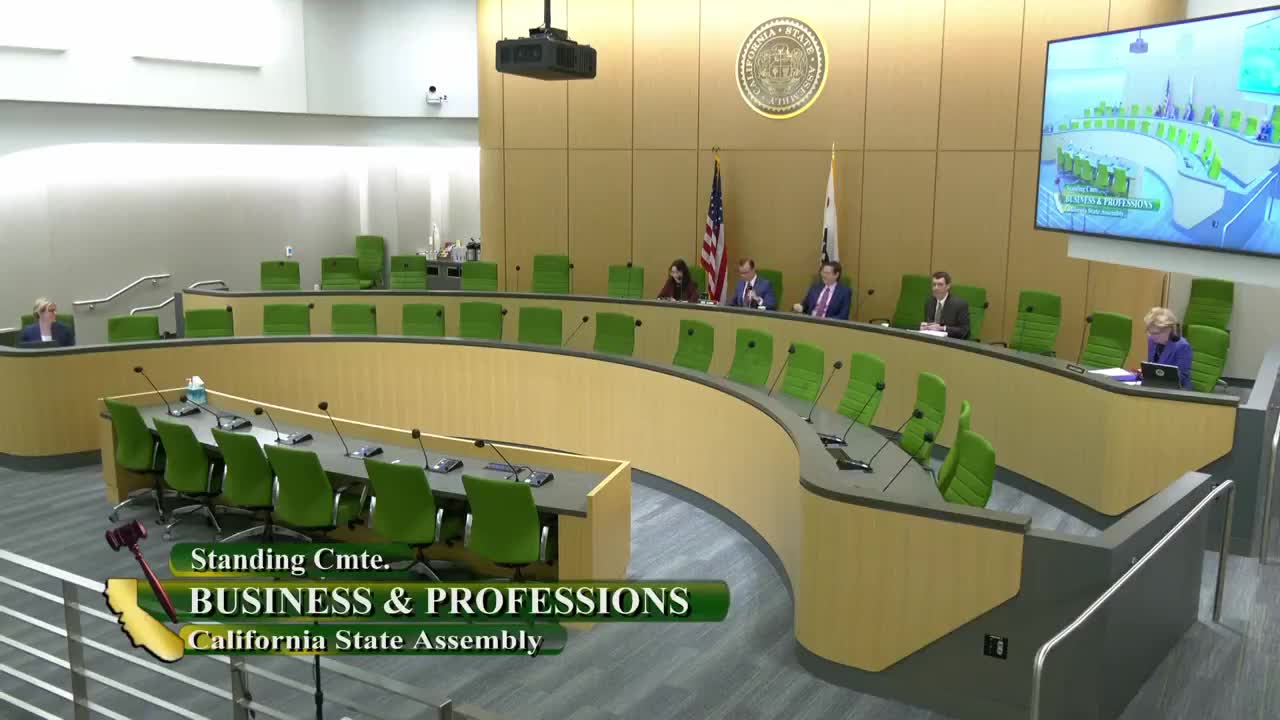 11MIN
Assembly Standing Committee on Business and Professions
Bill Author

Bill Co-Author(s):