AB 1504: Planning and zoning: electric vehicle charging infrastructure: public right-of-way.
- Session Year: 2023-2024
- House: Assembly
- Latest Version Date: 2023-04-11
Current Status:
Failed
(2024-02-01: From committee: Filed with the Chief Clerk pursuant to Joint Rule 56.)
Introduced
In Committee
First Chamber
In Committee
Second Chamber
Enacted
Existing law prescribes various requirements on the review and approval of applications to install electric vehicle charging stations. Existing law requires every city, county, and city and county to administratively approve an application to install electric vehicle charging stations and hydrogen-fueling stations through the issuance of a building permit or similar nondiscretionary permit and requires the review of an application to install an electric vehicle charging station or a hydrogen-fueling station to be limited to the building officials review of whether it meets all health and safety requirements of local, state, and federal law. Existing law prohibits a city, county, or city and county from denying an application for a use permit to install an electric vehicle charging station or a hydrogen-fueling station unless it makes written findings that the proposed installation would have a specific, adverse impact upon the public health or safety, and there is no feasible method to satisfactorily mitigate or avoid the specific, adverse impact. Existing law requires that any conditions imposed on an application to install an electric vehicle charging station or a hydrogen-fueling station be designed to mitigate the specific, adverse impact upon the public health or safety at the lowest cost possible. Existing law defines electric vehicle charging station or charging station for these purposes. Existing law repeals these provisions as they pertain to hydrogen-fueling stations on January 1, 2030.
This bill would provide that electric vehicle charging station includes electric vehicle charging stations installed in the public right-of-way and electric vehicle charging stations installed with a battery storage system. the provisions described above do not apply to applications to install an electric vehicle charging station or hydrogen-fueling station in a public right-of-way. The bill would require local agencies to complete a plan for the installation of electric vehicle charging stations in the public right-of-way that includes, but is not limited to, a permitting process. In developing the plan and permitting process, the bill would require local agencies to take specified actions. The bill, except as specified, would require local agencies with populations of 250,000 or more to comply with these provisions by January 1, 2027, and local agencies with populations of fewer than 250,000 residents to comply with these provisions by January 1, 2029. The bill would define various terms for these purposes. By imposing additional duties on local agencies, this bill would impose a state-mandated local program.
Existing law requires the State Energy Resources Conservation and Development Commission (Energy Commission), working with the State Air Resources Board and the Public Utilities Commission (PUC), to prepare a statewide assessment of the electric vehicle charging infrastructure needed to support the levels of electric vehicle adoption required for the state to meet its goals of putting at least 5,000,000 zero-emission vehicles on California roads by 2030, and of reducing emissions of greenhouse gases to 40% below 1990 levels by 2030. Existing law requires the Energy Commission, as a part of the assessment, to identify workforce development and training resources needed to meet those goals.
This bill would require the Energy Commission, working with the state board and the PUC, to instead prepare a statewide assessment of the electric vehicle charging infrastructure needed to support the levels of light- and heavy-duty electric vehicle adoption required for the state to meet the goals of a specified executive order, a mobile source strategy, and achieving carbon neutrality as soon as possible and no later than 2045. The bill would require that the assessment also analyze different direct current fast charger power levels, and evaluate the impact of certain deployment scenarios on equitable access to publicly available direct current fast chargers, as specified. The bill would require the Energy Commission to also identify workforce development and training resources needed to meet an array of electric vehicle and electric vehicle charger power levels and to achieve a cost-effective and equitable electric vehicle charging network in the state, as specified. The bill would authorize the Energy Commission to use the findings from the assessment to guide its funding allocations for publicly available direct current fast chargers that are intended to serve light-duty electric vehicles.
The bill would include findings that changes proposed by this bill address a matter of statewide concern rather than a municipal affair and, therefore, apply to all cities, including charter cities.
The California Constitution requires the state to reimburse local agencies and school districts for certain costs mandated by the state. Statutory provisions establish procedures for making that reimbursement.
This bill would provide that, if the Commission on State Mandates determines that the bill contains costs mandated by the state, reimbursement for those costs shall be made pursuant to the statutory provisions noted above.
Existing law requires every city, county, and city and county to administratively approve an application to install electric vehicle charging stations through the issuance of a building permit or similar nondiscretionary permit and requires the review of an application to install an electric vehicle charging station to be limited to the building officials review of whether it meets all health and safety requirements of local, state, and federal law. Existing law prohibits a city, county, or city and county from denying an application for a use permit to install an electric vehicle charging station unless it makes written findings that the proposed installation would have a specific, adverse impact upon the public health or safety, and there is no feasible method to satisfactorily mitigate or avoid the specific, adverse impact. Existing law requires that any conditions imposed on an application to install an electric vehicle charging station be designed to mitigate the specific, adverse impact upon the public health or safety at the lowest cost possible. Existing law defines electric vehicle charging station or charging station for these purposes.
This bill would provide that electric vehicle charging station includes electric vehicle charging stations installed in the public right-of-way and electric vehicle charging stations installed with a battery storage system.
(a)The Legislature finds and declares all of the following:
(1)The implementation of consistent statewide standards to achieve the timely and cost-effective installation of electric vehicle charging stations and hydrogen-fueling stations is not a municipal affair, as that term is used in Section 5 of Article XI of the California Constitution, but is instead a matter of statewide concern. Therefore, this section applies to all cities, including charter cities.
(2)It is the intent of the Legislature that local agencies not adopt ordinances that create unreasonable barriers to the installation of zero-emission vehicle infrastructure and not unreasonably restrict the ability of homeowners and agricultural and business concerns to install electric vehicle charging and hydrogen-fueling stations.
(3)It is the policy of the state to promote and encourage the use of electric vehicle charging stations and hydrogen-fueling stations and to limit obstacles to their use.
(4)It is the intent of the Legislature that local agencies comply not only with the language of this section, but also the legislative intent to encourage the installation of electric vehicle charging stations and hydrogen-fueling stations by removing obstacles to, and minimizing costs of, permitting for charging and hydrogen-fueling stations so long as the action does not supersede the building officials authority to identify and address higher priority life-safety situations.
(b)(1)A city, county, or city and county shall administratively approve an application to install electric vehicle charging stations through the issuance of a building permit or similar nondiscretionary permit.
(2)A city, county, or city and county shall administratively approve an application to install hydrogen-fueling stations through the issuance of a building permit or similar nondiscretionary permit. This paragraph shall only apply to an application to install hydrogen-fueling stations on a parcel that satisfies either of the following:
(A)It is zoned for industrial or commercial development and does not contain any residential units.
(B)It was previously developed with service station. For purposes of this subparagraph, service station means any establishment which that offers for sale or sells gasoline or other motor vehicle fuel to the public.
(3)Review of an application to install an electric vehicle charging station or hydrogen-fueling station shall be limited to the building officials review of whether it meets all health and safety requirements of local, state, and federal law. The requirements of local law shall be limited to those standards and regulations necessary to ensure that the electric vehicle charging station or hydrogen-fueling station will not have a specific, adverse impact upon the public health or safety. However, if the building official of the city, county, or city and county makes a finding, based on substantial evidence, that the electric vehicle charging station or hydrogen-fueling station could have a specific, adverse impact upon the public health or safety, the city, county, or city and county may require the applicant to apply for a use permit.
(c)A city, county, or city and county may not deny an application for a use permit to install an electric vehicle charging station or hydrogen-fueling station unless it makes written findings based upon substantial evidence in the record that the proposed installation would have a specific, adverse impact upon the public health or safety, and there is no feasible method to satisfactorily mitigate or avoid the specific, adverse impact. The findings shall include the basis for the rejection of potential feasible alternatives of preventing the adverse impact.
(d)The decision of the building official pursuant to subdivisions (b) and (c) may be appealed to the planning commission of the city, county, or city and county.
(e)Any conditions imposed on an application to install an electric vehicle charging station or hydrogen-fueling station shall be designed to mitigate the specific, adverse impact upon the public health or safety at the lowest cost possible.
(f)(1)An electric vehicle charging station or hydrogen-fueling station shall meet applicable health and safety standards and requirements imposed by state and local permitting authorities.
(2)An electric vehicle charging station shall meet all applicable safety and performance standards established by the California Electrical Code, the Society of Automotive Engineers, the National Electrical Manufacturers Association, and accredited testing laboratories such as Underwriters Laboratories and, where applicable, rules of the Public Utilities Commission regarding safety and reliability, or rules of the Department of Food and Agriculture regarding safety, reliability, weights, and measures.
(3)A hydrogen-fueling station shall meet all of the following, as applicable:
(A)Safety and performance standards established by the Society of Automotive Engineers and accredited nationally recognized testing laboratories.
(B)Any rules established by the State Air Resources Board, Energy Commission, or Department of Food and Agriculture regarding safety, reliability, weights, and measures.
(C)Guidance established by the Governors Office of Business and Economic Development, as outlined in the Hydrogen Station Permitting Guidebook.
(g)(1)On or before September 30, 2016, every city, county, or city and county with a population of 200,000 or more residents, and, on or before September 30, 2017, every city, county, or city and county with a population of less than 200,000 residents, shall, in consultation with the local fire department or district and the utility director, if the city, county, or city and county operates a utility, adopt an ordinance, consistent with the goals and intent of this section, that creates an expedited, streamlined permitting process for electric vehicle charging stations. In developing an expedited permitting process, the city, county, or city and county shall adopt a checklist of all requirements with which electric vehicle charging stations shall comply to be eligible for expedited review.
(2)An application that satisfies the information requirements in the checklist, as determined by the city, county, or city and county, shall be deemed complete. Upon confirmation by the city, county, or city and county of the application and supporting documents being complete and meeting the requirements of the checklist, and consistent with the ordinance, a city, county, or city and county shall, consistent with subdivision (b), approve the application and issue all required permits or authorizations. However, the city, county, or city and county may establish a process to prioritize competing applications for expedited permits. Upon receipt of an incomplete application, a city, county, or city and county shall issue a written correction notice detailing all deficiencies in the application and any additional information required to be eligible for expedited permit issuance. An application submitted to a city, county, or city and county that owns and operates an electric utility shall demonstrate compliance with the utilitys interconnection policies prior to approval.
(3)The checklist and required permitting documentation shall be published on a publicly accessible internet website, if the city, county, or city and county has an internet website, and the city, county, or city and county shall allow for electronic submittal of a permit application and associated documentation, and shall authorize the electronic signature on all forms, applications, and other documentation in lieu of a wet signature by an applicant. In developing the ordinance, the city, county, or city and county may refer to the recommendations contained in the most current version of the Plug-In Electric Vehicle Infrastructure Permitting Checklist of the Zero-Emission Vehicles in California: Community Readiness Guidebook published by the Office of Planning and Research. A city, county, or city and county may adopt an ordinance that modifies the checklists and standards found in the guidebook due to unique climactic, geological, seismological, or topographical conditions. If a city, county, or city and county determines that it is unable to authorize the acceptance of an electronic signature on all forms, applications, and other documents in lieu of a wet signature by an applicant, the city, county, or city and county shall state, in the ordinance required under this subdivision, the reasons for its inability to accept electronic signatures and acceptance of an electronic signature shall not be required.
(h)A city, county, or city and county shall not condition approval for any electric vehicle charging station or hydrogen-fueling station permit on the approval of the station by an association, as that term is defined in Section 4080 of the Civil Code.
(i)The following definitions apply to this section:
(1)A feasible method to satisfactorily mitigate or avoid the specific, adverse impact includes, but is not limited to, any cost-effective method, condition, or mitigation imposed by a city, county, or city and county on another similarly situated application in a prior successful application for a permit.
(2)Electronic submittal means the utilization of one or more of the following:
(A)Email.
(B)The internet.
(C)Facsimile.
(3)Electric vehicle charging station or charging station means any level of electric vehicle supply equipment station that is designed and built in compliance with Article 625 of the California Electrical Code, as it reads on the effective date of this section, and delivers electricity from a source outside an electric vehicle into a plug-in electric vehicle, including, but not limited to, a charging station installed in a public right-of-way and charging station installed with a battery storage system. vehicle.
(4)Hydrogen-fueling station means the equipment used to store and dispense hydrogen fuel to vehicles according to industry codes and standards that is open to the public.
(5)Specific, adverse impact means a significant, quantifiable, direct, and unavoidable impact, based on objective, identified, and written public health or safety standards, policies, or conditions as they existed on the date the application was deemed complete.
(j)This section does not apply to an application to install an electric vehicle charging station or a hydrogen-fueling station in a public right-of-way.
(j)(k)This section shall remain in effect only until January 1, 2030, and as of that date is repealed.
SEC. 2.Section 65850.7 of the Government Code, as added by Section 2 of Chapter 373 of the Statutes of 2022, is amended to read:65850.7.(a)The Legislature finds and declares all of the following:
(1)The implementation of consistent statewide standards to achieve the timely and cost-effective installation of electric vehicle charging stations is not a municipal affair, as that term is used in Section 5 of Article XI of the California Constitution, but is instead a matter of statewide concern. Therefore, this section applies to all cities, including charter cities.
(2)It is the intent of the Legislature that local agencies not adopt ordinances that create unreasonable barriers to the installation of electric vehicle charging stations and not unreasonably restrict the ability of homeowners and agricultural and business concerns to install electric vehicle charging stations.
(3)It is the policy of the state to promote and encourage the use of electric vehicle charging stations and to limit obstacles to their use.
(4)It is the intent of the Legislature that local agencies comply not only with the language of this section, but also the legislative intent to encourage the installation of electric vehicle charging stations by removing obstacles to, and minimizing costs of, permitting for charging stations so long as the action does not supersede the building officials authority to identify and address higher priority life-safety situations.
(b)A city, county, or city and county shall administratively approve an application to install electric vehicle charging stations through the issuance of a building permit or similar nondiscretionary permit. Review of the application to install an electric vehicle charging station shall be limited to the building officials review of whether it meets all health and safety requirements of local, state, and federal law. The requirements of local law shall be limited to those standards and regulations necessary to ensure that the electric vehicle charging station will not have a specific, adverse impact upon the public health or safety. However, if the building official of the city, county, or city and county makes a finding, based on substantial evidence, that the electric vehicle charging station could have a specific, adverse impact upon the public health or safety, the city, county, or city and county may require the applicant to apply for a use permit.
(c)A city, county, or city and county may not deny an application for a use permit to install an electric vehicle charging station unless it makes written findings based upon substantial evidence in the record that the proposed installation would have a specific, adverse impact upon the public health or safety, and there is no feasible method to satisfactorily mitigate or avoid the specific, adverse impact. The findings shall include the basis for the rejection of potential feasible alternatives of preventing the adverse impact.
(d)The decision of the building official pursuant to subdivisions (b) and (c) may be appealed to the planning commission of the city, county, or city and county.
(e)Any conditions imposed on an application to install an electric vehicle charging station shall be designed to mitigate the specific, adverse impact upon the public health or safety at the lowest cost possible.
(f)(1)An electric vehicle charging station shall meet applicable health and safety standards and requirements imposed by state and local permitting authorities.
(2)An electric vehicle charging station shall meet all applicable safety and performance standards established by the California Electrical Code, the Society of Automotive Engineers, the National Electrical Manufacturers Association, and accredited testing laboratories such as Underwriters Laboratories and, where applicable, rules of the Public Utilities Commission regarding safety and reliability, or rules of the Department of Food and Agriculture regarding safety, reliability, weights, and measures.
(g)(1)On or before September 30, 2016, every city, county, or city and county with a population of 200,000 or more residents, and, on or before September 30, 2017, every city, county, or city and county with a population of less than 200,000 residents, shall, in consultation with the local fire department or district and the utility director, if the city, county, or city and county operates a utility, adopt an ordinance, consistent with the goals and intent of this section, that creates an expedited, streamlined permitting process for electric vehicle charging stations. In developing an expedited permitting process, the city, county, or city and county shall adopt a checklist of all requirements with which electric vehicle charging stations shall comply to be eligible for expedited review. An application that satisfies the information requirements in the checklist, as determined by the city, county, or city and county, shall be deemed complete. Upon confirmation by the city, county, or city and county of the application and supporting documents being complete and meeting the requirements of the checklist, and consistent with the ordinance, a city, county, or city and county shall, consistent with subdivision (b), approve the application and issue all required permits or authorizations. However, the city, county, or city and county may establish a process to prioritize competing applications for expedited permits. Upon receipt of an incomplete application, a city, county, or city and county shall issue a written correction notice detailing all deficiencies in the application and any additional information required to be eligible for expedited permit issuance. An application submitted to a city, county, or city and county that owns and operates an electric utility shall demonstrate compliance with the utilitys interconnection policies prior to approval.
(2)The checklist and required permitting documentation shall be published on a publicly accessible internet website, if the city, county, or city and county has an internet website, and the city, county, or city and county shall allow for electronic submittal of a permit application and associated documentation, and shall authorize the electronic signature on all forms, applications, and other documentation in lieu of a wet signature by an applicant. In developing the ordinance, the city, county, or city and county may refer to the recommendations contained in the most current version of the Plug-In Electric Vehicle Infrastructure Permitting Checklist of the Zero-Emission Vehicles in California: Community Readiness Guidebook published by the Office of Planning and Research. A city, county, or city and county may adopt an ordinance that modifies the checklists and standards found in the guidebook due to unique climactic, geological, seismological, or topographical conditions. If a city, county, or city and county determines that it is unable to authorize the acceptance of an electronic signature on all forms, applications, and other documents in lieu of a wet signature by an applicant, the city, county, or city and county shall state, in the ordinance required under this subdivision, the reasons for its inability to accept electronic signatures and acceptance of an electronic signature shall not be required.
(h)A city, county, or city and county shall not condition approval for any electric vehicle charging station permit on the approval of an electric vehicle charging station by an association, as that term is defined in Section 4080 of the Civil Code.
(i)The following definitions apply to this section:
(1)A feasible method to satisfactorily mitigate or avoid the specific, adverse impact includes, but is not limited to, any cost-effective method, condition, or mitigation imposed by a city, county, or city and county on another similarly situated application in a prior successful application for a permit.
(2)Electronic submittal means the utilization of one or more of the following:
(A)Email.
(B)The internet.
(C)Facsimile.
(3)Electric vehicle charging station or charging station means any level of electric vehicle supply equipment station that is designed and built in compliance with Article 625 of the California Electrical Code, as it reads on the effective date of this section, and delivers electricity from a source outside an electric vehicle into a plug-in electric vehicle, including, but not limited to, a charging station installed in a public right-of-way and charging station installed with a battery storage system. vehicle.
(4)Specific, adverse impact means a significant, quantifiable, direct, and unavoidable impact, based on objective, identified, and written public health or safety standards, policies, or conditions as they existed on the date the application was deemed complete.
(j)This section does not apply to an application to install an electric vehicle charging station in a public right-of-way.
(j)(k)This section become operative on January 1, 2030.
SEC. 3.Section 65850.71 of the Government Code is amended to read:65850.71.(a)The Legislature finds and declares both of the following:
(1)An electric vehicle charging station has a significant economic impact in California and is not a municipal affair, as the term is used in Section 5 of Article XI of the California Constitution, but is instead a matter of statewide concern. Therefore, this section applies to all cities, including charter cities.
(2)Table 3 of the Governors Office of Business and Economic Development (GO-Biz) Electric Vehicle Charging Station Permitting Guidebook, published July 2019, recommends best practices for electric vehicle supply equipment permitting that would establish a 15-day timeline and satisfy the intent of Assembly Bill 1236 (Chapter 598 of the Statutes of 2015).
(b)(1)An application to install an electric vehicle charging station submitted to the building official of a city, county, or city and county shall be deemed complete if, after the applicable time period described in paragraph (2) has elapsed, both of the following are true:
(A)The building official of the city, county, or city and county has not deemed the application complete, consistent with the checklist created by the city, county, or city and county pursuant to subdivision (g) of Section 65850.7.
(B)The building official of the city, county, or city and county has not issued a written correction notice detailing all deficiencies in the application and identifying any additional information explicitly necessary for the building official to complete a review limited to whether the electric vehicle charging station meets all health and safety requirements of local, state, and federal law, consistent with subdivisions (b) and (g) of Section 65850.7.
(2)For purposes of paragraph (1), applicable time period means either of the following:
(A)Five business days after submission of the application to the city, county, or city and county, if the application is for at least 1, but not more than 25 electric vehicle charging stations at a single site.
(B)Ten business days after submission of the application to the city, county, or city and county, if the application is for more than 25 electric vehicle charging stations at a single site.
(c)(1)An application to install an electric vehicle charging station shall be deemed approved if the applicable time period described in paragraph (2) has elapsed and all of the following are true:
(A)The building official of the city, county, or city and county has not administratively approved the application pursuant to subdivision (b) of Section 65850.7.
(B)The building official of the city, county, or city and county has not made a finding, based on substantial evidence, that the electric vehicle charging station could have a specific adverse impact upon the public health or safety or required the applicant to apply for a use permit pursuant to subdivision (b) of Section 65850.7.
(C)The building official of the city, county, or city and county has not denied the permit pursuant to subdivision (c) of Section 65850.7.
(D)An appeal has not been made to the planning commission of the city, county, or city and county, pursuant to subdivision (d) of Section 65850.7.
(2)For purposes of paragraph (1), applicable time period means either of the following:
(A)Twenty business days after the application was deemed complete, if the application is for at least 1, but not more than 25 electric vehicle charging stations at a single site.
(B)Forty business days after the application was deemed complete, if the application is for more than 25 electric vehicle charging stations at a single site.
(d)If an electric vehicle charging station and any associated equipment interfere with, reduce, eliminate, or in any way impact the required parking spaces for existing uses, the city, county, or city and county shall reduce the number of required parking spaces for the existing uses by the amount necessary to accommodate the electric vehicle charging station and any associated equipment.
(e)If the electric vehicle charging station is being installed in an area that receives electrical service from a local publicly owned electric utility, this section does not expand or restrict the local publicly owned electric utilitys role and responsibility in providing new electric service to the electric vehicle charging station in a manner consistent with safety, reliability, and engineering requirements.
(f)This section does not apply to an application to install an electric vehicle charging station in a public right-of-way.
(f)(g)This section shall become operative on January 1, 2022, but for every city, county, or city and county with a population of less than 200,000 residents, this section shall apply beginning on January 1, 2023.
SEC. 4.Section 65850.72 is added to the Government Code, to read:65850.72.(a)For purposes of this section, the following definitions apply:
(1)Disadvantaged communities means communities identified as disadvantaged communities pursuant to Section 39711 of the Health and Safety Code.
(2)Electric vehicle charging station or charging station means any level of electric vehicle supply equipment station that is designed and built in compliance with Article 625 of the California Electrical Code (Part 3 of Title 24 of the California Code of Regulations), as it reads on the effective date of this section, and delivers electricity from a source outside an electric vehicle into a plug-in electric vehicle.
(3)Local agency means a city, including a charter city, county, or city and county.
(4)Public right-of-way means the area between property lines of a street, easement, tract, or other area dedicated to the movement of vehicles, pedestrians, or goods.
(b)A local agency shall complete a plan for the installation of electric vehicle charging stations in the public right-of-way that includes, but is not limited to, a permitting process.
(c)In developing the plan and permitting process pursuant to subdivision (b), the local agency shall do all of the following:
(1)Consult with all of the following:
(A)Relevant city or county departments, including, but not limited to, publicly owned electric utilities, building departments, planning departments, and transportation departments.
(B)External stakeholders, including, but not limited to, disability rights advocates and industry stakeholders.
(2)Develop and implement a process to solicit input from the public, including, but not limited to, holding at least two public hearings. These hearings may be consolidated with a regular or special meeting of the governing body of the local agency. If a public hearing held pursuant to this paragraph is consolidated with a regular or special meeting of the governing body that includes other substantive agenda items, the public hearing shall begin at a fixed time regardless of its order on the agenda. The governing body may first conclude any item being discussed or acted upon, including any associated public comment, when that fixed time occurs.
(3)Complete an assessment of existing electric vehicle charging stations in the public right-of-way in the jurisdiction of the local agency.
(4)Complete an assessment of the projected needs for electric vehicle charging stations in the public right-of-way in the jurisdiction of the local agency.
(5)Identify planning and permitting barriers to the installation of electric vehicle charging stations in the public right-of-way in the jurisdiction of the local agency.
(6)Identify, evaluate, and prioritize competing uses in the public right-of-way in the jurisdiction of the local agency, which may include, but are not limited to, any of the following:
(A)Transit, bicycle, and pedestrian uses.
(B)Parking for small businesses.
(C)Street fairs or other events.
(D)Preservation of trees or other plants.
(E)Street furniture, including, but not limited to, a kiosk, trash receptacle, bench, or public toilet.
(7)Complete an equity analysis to determine locations for electric vehicle charging stations in the public right-of-way in the jurisdiction of the local agency that will most effectively and efficiently reduce barriers to equitable access to electric vehicle charging stations in the public right-of-way, including, but not limited to, multiunit developments and disadvantaged communities.
(8)Consider and identify the charging level of electric vehicle charging stations that may be installed in the public right-of-way.
(9)Develop a location, zoning, or siting framework that considers and identifies, at a minimum, the density of the surrounding development and the types of transportation corridors that are required for the installation of electric vehicle charging stations in the public right-of-way.
(10)Develop any site-specific design requirements for electric vehicle charging stations in the public right-of-way.
(11)Consider preselecting locations where electric vehicle charging stations may be installed in the public right-of-way, consistent with the general plan and zoning ordinances of the local agency.
(12)Identify necessary updates to relevant codes or regulations of the local agency.
(13)Consider and identify the entities that will be allowed to install electric vehicle charging stations in the public right-of-way to avoid privatizing public space.
(14)Consider and select ownership or revenue-sharing models the local agency could enter into or allow, including, but not limited to, all of the following:
(A)The electric vehicle charging station being owned and operated by a third party.
(B)The electric vehicle charging station being owned by the local agency and operated by a third party.
(C)The electric vehicle charging station being owned and operated by the local agency.
(D)The electric vehicle charging station providing free charging that is supported by advertising revenue.
(E)The electric vehicle charging station offering leasing or subscription-based charging.
(15)Survey and evaluate models developed by other local agencies for the installation of electric vehicle charging stations in the public right-of-way.
(16)Consider one or more pilot programs the local agency could feasibly implement for the installation of electric vehicle charging stations in the public right-of-way.
(17)Establish parking policies that will apply to the locations where electric vehicle charging stations would be installed in the public right-of-way.
(18)Consider limiting the amount of time a permit for an electric vehicle charging station in the public right-of-way remains valid to prevent permitholders from holding public right-of-way space for long time periods before installing the electric vehicle charging station.
(19)Develop a checklist of all requirements electric vehicle charging stations must comply with to be eligible for a permit in the public right-of-way. Any checklist and required permitting documentation shall be published on a publicly accessible internet website if the local agency has an internet website.
(d)(1)A local agency with a population of 250,000 or more residents shall comply with this section by January 1, 2027.
(2)A local agency with a population of fewer than 250,000 residents shall comply with this section by January 1, 2029.
(e)This section does not apply to a local agency that has completed a plan for the installation of electric vehicle charging stations in the public right-of-way that includes the development of a permitting process and is substantially similar to the provisions of this section by January 1, 2024.
SEC. 5.Section 25229 of the Public Resources Code is amended to read:25229.(a)The commission, working with the State Air Resources Board and the Public Utilities Commission, shall prepare a statewide assessment of the electric vehicle charging infrastructure needed to support the levels of light- and heavy-duty electric vehicle adoption required for the state to meet its goals of putting at least five million zero-emission vehicles on California roads by 2030, and of reducing emissions of greenhouse gases to 40 percent below 1990 levels by 2030. the goals specified in Executive Order No. N-79-20 (September 23, 2020), the mobile source strategy updated pursuant to Section 43024.2 of the Health and Safety Code, and the goal of achieving carbon neutrality as soon as possible and no later than 2045, consistent with Section 38562.2 of the Health and Safety Code.
(b)The assessment shall expand on the commissions electric vehicle infrastructure projections to consider all necessary charging infrastructure, including, but not limited to, the chargers, make-ready electrical equipment, and supporting hardware and software, all vehicle categories, road, highway, and offroad electrification, port and airport electrification, and other programs to accelerate the adoption of electric vehicles to meet the goals described in subdivision (a). The assessment shall examine existing and future infrastructure needs throughout California, including in low-income communities.
(c)The assessment shall analyze different direct current fast charger power levels, including, but not limited to, 50 kilowatts, 100 kilowatts, 150 kilowatts, and 350 kilowatts, to understand the most cost-effective and equitable charging deployment scenarios, including the cost of needed utility infrastructure upgrades, across different use cases necessary to meet the requirements of Executive Order No. N-79-20 (September 23, 2020).
(d)The assessment shall evaluate the impact of the deployment scenarios described in subdivision (c) on equitable access to publicly available direct current fast chargers, including, but not limited to, in rural, low-income, and disadvantaged communities.
(c)(e)As a part of the assessment, the commission, in consultation with stakeholders, shall identify workforce development and training resources needed to meet the goals described in subdivision (a). (a), to meet the array of power levels identified in subdivision (c), and to achieve a cost-effective and equitable electric vehicle charging network in the state. These resources shall include, but are not limited to, qualified apprenticeships, on-the-job training programs, and other training opportunities opportunities, including demonstrated field experience with an array of electric vehicle charging technologies and power levels, including those that may not be covered by the curriculum of the Electric Vehicle Infrastructure Training Program, as described in Section 740.20 of the Public Utilities Code, that build career pipelines in the zero-emission transportation sector and provide long-term employment in disadvantaged communities.
(f)The commission may use the findings from the assessment to guide its funding allocations for publicly available direct current fast chargers that are intended to serve light-duty electric vehicles.
(d)(g)(1)The commission shall regularly seek data and input relating to electric vehicle charging infrastructure from stakeholders, including, but not limited to, the Public Utilities Commission, the State Air Resources Board, electrical corporations, local publicly owned electric utilities, state and local transportation and transit agencies, electric vehicle charging infrastructure companies, environmental groups, and automobile manufacturers.
(2)Data requests shall aim to minimize costs and burdens on stakeholders and to protect driver privacy.
(3)Entities may request, on a case-by-case basis, that the commission classify certain data as sensitive.
(e)(h)The commission shall update the assessment at least once every two years.
SEC. 6.The Legislature finds and declares that Section 4 of this act adding Section 65850.72 to the Government Code addresses a matter of statewide concern rather than a municipal affair as that term is used in Section 5 of Article XI of the California Constitution. Therefore, Section 4 of this act applies to all cities, including charter cities.
SEC. 7.If the Commission on State Mandates determines that this act contains costs mandated by the state, reimbursement to local agencies and school districts for those costs shall be made pursuant to Part 7 (commencing with Section 17500) of Division 4 of Title 2 of the Government Code.
(a)The Legislature finds and declares all of the following:
(1)The implementation of consistent statewide standards to achieve the timely and cost-effective installation of electric vehicle charging stations and hydrogen-fueling stations is not a municipal affair, as that term is used in Section 5 of Article XI of the California Constitution, but is instead a matter of statewide concern. Therefore, this section applies to all cities, including charter cities.
(2)It is the intent of the Legislature that local agencies not adopt ordinances that create unreasonable barriers to the installation of zero-emission vehicle infrastructure and not unreasonably restrict the ability of homeowners and agricultural and business concerns to install electric vehicle charging and hydrogen-fueling stations.
(3)It is the policy of the state to promote and encourage the use of electric vehicle charging stations and hydrogen-fueling stations and to limit obstacles to their use.
(4)It is the intent of the Legislature that local agencies comply not only with the language of this section, but also the legislative intent to encourage the installation of electric vehicle charging stations and hydrogen-fueling stations by removing obstacles to, and minimizing costs of, permitting for charging and hydrogen-fueling stations so long as the action does not supersede the building officials authority to identify and address higher priority life-safety situations.
(b)(1)A city, county, or city and county shall administratively approve an application to install electric vehicle charging stations through the issuance of a building permit or similar nondiscretionary permit.
(2)A city, county, or city and county shall administratively approve an application to install hydrogen-fueling stations through the issuance of a building permit or similar nondiscretionary permit. This paragraph shall only apply to an application to install hydrogen-fueling stations on a parcel that satisfies either of the following:
(A)It is zoned for industrial or commercial development and does not contain any residential units.
(B)It was previously developed with service station. For purposes of this subparagraph, service station means any establishment which offers for sale or sells gasoline or other motor vehicle fuel to the public.
(3)Review of an application to install an electric vehicle charging station or hydrogen-fueling station shall be limited to the building officials review of whether it meets all health and safety requirements of local, state, and federal law. The requirements of local law shall be limited to those standards and regulations necessary to ensure that the electric vehicle charging station or hydrogen-fueling station will not have a specific, adverse impact upon the public health or safety. However, if the building official of the city, county, or city and county makes a finding, based on substantial evidence, that the electric vehicle charging station or hydrogen-fueling station could have a specific, adverse impact upon the public health or safety, the city, county, or city and county may require the applicant to apply for a use permit.
(c)A city, county, or city and county may not deny an application for a use permit to install an electric vehicle charging station or hydrogen-fueling station unless it makes written findings based upon substantial evidence in the record that the proposed installation would have a specific, adverse impact upon the public health or safety, and there is no feasible method to satisfactorily mitigate or avoid the specific, adverse impact. The findings shall include the basis for the rejection of potential feasible alternatives of preventing the adverse impact.
(d)The decision of the building official pursuant to subdivisions (b) and (c) may be appealed to the planning commission of the city, county, or city and county.
(e)Any conditions imposed on an application to install an electric vehicle charging station or hydrogen-fueling station shall be designed to mitigate the specific, adverse impact upon the public health or safety at the lowest cost possible.
(f)(1)An electric vehicle charging station or hydrogen-fueling station shall meet applicable health and safety standards and requirements imposed by state and local permitting authorities.
(2)An electric vehicle charging station shall meet all applicable safety and performance standards established by the California Electrical Code, the Society of Automotive Engineers, the National Electrical Manufacturers Association, and accredited testing laboratories such as Underwriters Laboratories and, where applicable, rules of the Public Utilities Commission regarding safety and reliability, or rules of the Department of Food and Agriculture regarding safety, reliability, weights, and measures.
(3)A hydrogen-fueling station shall meet all of the following, as applicable:
(A)Safety and performance standards established by the Society of Automotive Engineers and accredited nationally recognized testing laboratories.
(B)Any rules established by the State Air Resources Board, Energy Commission, or Department of Food and Agriculture regarding safety, reliability, weights, and measures.
(C)Guidance established by the Governors Office of Business and Economic Development, as outlined in the Hydrogen Station Permitting Guidebook.
(g)(1)On or before September 30, 2016, every city, county, or city and county with a population of 200,000 or more residents, and, on or before September 30, 2017, every city, county, or city and county with a population of less than 200,000 residents, shall, in consultation with the local fire department or district and the utility director, if the city, county, or city and county operates a utility, adopt an ordinance, consistent with the goals and intent of this section, that creates an expedited, streamlined permitting process for electric vehicle charging stations. In developing an expedited permitting process, the city, county, or city and county shall adopt a checklist of all requirements with which electric vehicle charging stations shall comply to be eligible for expedited review.
(2)An application that satisfies the information requirements in the checklist, as determined by the city, county, or city and county, shall be deemed complete. Upon confirmation by the city, county, or city and county of the application and supporting documents being complete and meeting the requirements of the checklist, and consistent with the ordinance, a city, county, or city and county shall, consistent with subdivision (b), approve the application and issue all required permits or authorizations. However, the city, county, or city and county may establish a process to prioritize competing applications for expedited permits. Upon receipt of an incomplete application, a city, county, or city and county shall issue a written correction notice detailing all deficiencies in the application and any additional information required to be eligible for expedited permit issuance. An application submitted to a city, county, or city and county that owns and operates an electric utility shall demonstrate compliance with the utilitys interconnection policies prior to approval.
(3)The checklist and required permitting documentation shall be published on a publicly accessible internet website, if the city, county, or city and county has an internet website, and the city, county, or city and county shall allow for electronic submittal of a permit application and associated documentation, and shall authorize the electronic signature on all forms, applications, and other documentation in lieu of a wet signature by an applicant. In developing the ordinance, the city, county, or city and county may refer to the recommendations contained in the most current version of the Plug-In Electric Vehicle Infrastructure Permitting Checklist of the Zero-Emission Vehicles in California: Community Readiness Guidebook published by the Office of Planning and Research. A city, county, or city and county may adopt an ordinance that modifies the checklists and standards found in the guidebook due to unique climactic, geological, seismological, or topographical conditions. If a city, county, or city and county determines that it is unable to authorize the acceptance of an electronic signature on all forms, applications, and other documents in lieu of a wet signature by an applicant, the city, county, or city and county shall state, in the ordinance required under this subdivision, the reasons for its inability to accept electronic signatures and acceptance of an electronic signature shall not be required.
(h)A city, county, or city and county shall not condition approval for any electric vehicle charging station or hydrogen-fueling station permit on the approval of the station by an association, as that term is defined in Section 4080 of the Civil Code.
(i)The following definitions shall apply to this section:
(1)A feasible method to satisfactorily mitigate or avoid the specific, adverse impact includes, but is not limited to, any cost-effective method, condition, or mitigation imposed by a city, county, or city and county on another similarly situated application in a prior successful application for a permit.
(2)Electronic submittal means the utilization of one or more of the following:
(A)Email.
(B)The internet.
(C)Facsimile.
(3)Electric vehicle charging station or charging station means any level of electric vehicle supply equipment station that is designed and built in compliance with Article 625 of the California Electrical Code, as it reads on the effective date of this section, and delivers electricity from a source outside an electric vehicle into a plug-in electric vehicle. vehicle, including, but not limited to, a charging station installed in a public right-of-way and charging station installed with a battery storage system.
(4)Hydrogen-fueling station means the equipment used to store and dispense hydrogen fuel to vehicles according to industry codes and standards that is open to the public.
(5)Specific, adverse impact means a significant, quantifiable, direct, and unavoidable impact, based on objective, identified, and written public health or safety standards, policies, or conditions as they existed on the date the application was deemed complete.
(j)This section shall remain in effect only until January 1, 2030, and as of that date is repealed.
SEC. 2.Section 65850.7 of the Government Code, as added by Section 2 of Chapter 373 of the Statutes of 2022, is amended to read:65850.7.(a)The Legislature finds and declares all of the following:
(1)The implementation of consistent statewide standards to achieve the timely and cost-effective installation of electric vehicle charging stations is not a municipal affair, as that term is used in Section 5 of Article XI of the California Constitution, but is instead a matter of statewide concern. Therefore, this section applies to all cities, including charter cities.
(2)It is the intent of the Legislature that local agencies not adopt ordinances that create unreasonable barriers to the installation of electric vehicle charging stations and not unreasonably restrict the ability of homeowners and agricultural and business concerns to install electric vehicle charging stations.
(3)It is the policy of the state to promote and encourage the use of electric vehicle charging stations and to limit obstacles to their use.
(4)It is the intent of the Legislature that local agencies comply not only with the language of this section, but also the legislative intent to encourage the installation of electric vehicle charging stations by removing obstacles to, and minimizing costs of, permitting for charging stations so long as the action does not supersede the building officials authority to identify and address higher priority life-safety situations.
(b)A city, county, or city and county shall administratively approve an application to install electric vehicle charging stations through the issuance of a building permit or similar nondiscretionary permit. Review of the application to install an electric vehicle charging station shall be limited to the building officials review of whether it meets all health and safety requirements of local, state, and federal law. The requirements of local law shall be limited to those standards and regulations necessary to ensure that the electric vehicle charging station will not have a specific, adverse impact upon the public health or safety. However, if the building official of the city, county, or city and county makes a finding, based on substantial evidence, that the electric vehicle charging station could have a specific, adverse impact upon the public health or safety, the city, county, or city and county may require the applicant to apply for a use permit.
(c)A city, county, or city and county may not deny an application for a use permit to install an electric vehicle charging station unless it makes written findings based upon substantial evidence in the record that the proposed installation would have a specific, adverse impact upon the public health or safety, and there is no feasible method to satisfactorily mitigate or avoid the specific, adverse impact. The findings shall include the basis for the rejection of potential feasible alternatives of preventing the adverse impact.
(d)The decision of the building official pursuant to subdivisions (b) and (c) may be appealed to the planning commission of the city, county, or city and county.
(e)Any conditions imposed on an application to install an electric vehicle charging station shall be designed to mitigate the specific, adverse impact upon the public health or safety at the lowest cost possible.
(f)(1)An electric vehicle charging station shall meet applicable health and safety standards and requirements imposed by state and local permitting authorities.
(2)An electric vehicle charging station shall meet all applicable safety and performance standards established by the California Electrical Code, the Society of Automotive Engineers, the National Electrical Manufacturers Association, and accredited testing laboratories such as Underwriters Laboratories and, where applicable, rules of the Public Utilities Commission regarding safety and reliability, or rules of the Department of Food and Agriculture regarding safety, reliability, weights, and measures.
(g)(1)On or before September 30, 2016, every city, county, or city and county with a population of 200,000 or more residents, and, on or before September 30, 2017, every city, county, or city and county with a population of less than 200,000 residents, shall, in consultation with the local fire department or district and the utility director, if the city, county, or city and county operates a utility, adopt an ordinance, consistent with the goals and intent of this section, that creates an expedited, streamlined permitting process for electric vehicle charging stations. In developing an expedited permitting process, the city, county, or city and county shall adopt a checklist of all requirements with which electric vehicle charging stations shall comply to be eligible for expedited review. An application that satisfies the information requirements in the checklist, as determined by the city, county, or city and county, shall be deemed complete. Upon confirmation by the city, county, or city and county of the application and supporting documents being complete and meeting the requirements of the checklist, and consistent with the ordinance, a city, county, or city and county shall, consistent with subdivision (b), approve the application and issue all required permits or authorizations. However, the city, county, or city and county may establish a process to prioritize competing applications for expedited permits. Upon receipt of an incomplete application, a city, county, or city and county shall issue a written correction notice detailing all deficiencies in the application and any additional information required to be eligible for expedited permit issuance. An application submitted to a city, county, or city and county that owns and operates an electric utility shall demonstrate compliance with the utilitys interconnection policies prior to approval.
(2)The checklist and required permitting documentation shall be published on a publicly accessible internet website, if the city, county, or city and county has an internet website, and the city, county, or city and county shall allow for electronic submittal of a permit application and associated documentation, and shall authorize the electronic signature on all forms, applications, and other documentation in lieu of a wet signature by an applicant. In developing the ordinance, the city, county, or city and county may refer to the recommendations contained in the most current version of the Plug-In Electric Vehicle Infrastructure Permitting Checklist of the Zero-Emission Vehicles in California: Community Readiness Guidebook published by the Office of Planning and Research. A city, county, or city and county may adopt an ordinance that modifies the checklists and standards found in the guidebook due to unique climactic, geological, seismological, or topographical conditions. If a city, county, or city and county determines that it is unable to authorize the acceptance of an electronic signature on all forms, applications, and other documents in lieu of a wet signature by an applicant, the city, county, or city and county shall state, in the ordinance required under this subdivision, the reasons for its inability to accept electronic signatures and acceptance of an electronic signature shall not be required.
(h)A city, county, or city and county shall not condition approval for any electric vehicle charging station permit on the approval of an electric vehicle charging station by an association, as that term is defined in Section 4080 of the Civil Code.
(i)The following definitions shall apply to this section:
(1)A feasible method to satisfactorily mitigate or avoid the specific, adverse impact includes, but is not limited to, any cost-effective method, condition, or mitigation imposed by a city, county, or city and county on another similarly situated application in a prior successful application for a permit.
(2)Electronic submittal means the utilization of one or more of the following:
(A)Email.
(B)The internet.
(C)Facsimile.
(3)Electric vehicle charging station or charging station means any level of electric vehicle supply equipment station that is designed and built in compliance with Article 625 of the California Electrical Code, as it reads on the effective date of this section, and delivers electricity from a source outside an electric vehicle into a plug-in electric vehicle. vehicle, including, but not limited to, a charging station installed in a public right-of-way and charging station installed with a battery storage system.
(4)Specific, adverse impact means a significant, quantifiable, direct, and unavoidable impact, based on objective, identified, and written public health or safety standards, policies, or conditions as they existed on the date the application was deemed complete.
(j)This section become operative on January 1, 2030.
|
Date
|
Status
|
|---|---|
| Feb 1, 2024 | From committee: Filed with the Chief Clerk pursuant to Joint Rule 56. |
| Jan 31, 2024 | Died pursuant to Art. IV, Sec. 10(c) of the Constitution. |
| May 18, 2023 | In committee: Held under submission. |
| May 18, 2023 | Joint Rule 62(a), file notice suspended. (Page 1580.) |
| May 17, 2023 | In committee: Set, first hearing. Referred to APPR. suspense file. |
| Apr 25, 2023 | From committee: Do pass and re-refer to Com. on APPR. (Ayes 11. Noes 4.) (April 24). Re-referred to Com. on APPR. |
| Apr 20, 2023 | From committee: Do pass and re-refer to Com. on TRANS. (Ayes 6. Noes 2.) (April 19). Re-referred to Com. on TRANS. |
| Apr 12, 2023 | Re-referred to Com. on L. GOV. |
| Apr 11, 2023 | From committee chair, with author's amendments: Amend, and re-refer to Com. on L. GOV. Read second time and amended. |
| Mar 9, 2023 | Referred to Com. on L. GOV. |
| Feb 18, 2023 | From printer. May be heard in committee March 20. |
| Feb 17, 2023 | Read first time. To print. |
|
Date
|
Description
|
Location
|
Votes
|
|
|---|---|---|---|---|
| Apr 24, 2023 | Do pass and be re-referred to the Committee on [Appropriations] | Assembly Standing Committee on Transportation |
Passed |
|
| Apr 19, 2023 | Do pass and be re-referred to the Committee on [Transportation] | Assembly Standing Committee on Local Government |
Passed |
This list shows positions taken on this bill by organizations on the date displayed, which is linked to the original source.
Positions by individuals are not included.
|
Organization
|
Position
|
Date
|
|---|---|---|
| California State ASsociaiton of Counties | * Against | Apr 19, 2023 |
| Flo EV Charging | * Support | Apr 24, 2023 |
| Flo Services Usa | ** Support | |
| League of Califonia Cities | * Against Unless Amend | Apr 24, 2023 |
| Rural County Represenatatives of California | * Against | Apr 19, 2023 |
Date of Hearing: May 17, 2023
ASSEMBLY COMMITTEE ON APPROPRIATIONS
Chris Holden, Chair
ABPCA Bill Id:AB 1504
Author:(McCarty) – As Amended Ver:April 11, 2023
Policy Committee: | Local Government | Vote: | 6 - 2 |
Transportation | 11 - 4 | ||
|
|
Urgency: No State Mandated Local Program: Yes Reimbursable: Yes
SUMMARY:
This bill requires cities and counties to complete a plan for the installation of electric vehicle (EV) charging stations in the public right-of-way, and updates the requirements of the statewide assessment of necessary EV charging infrastructure the California Energy Commission (CEC) prepares pursuant to existing law.
Specifically, this bill:
- Requires a local agency to complete a plan for the installation of EV charging stations in the public right-of-way that includes, but is not limited to, a permitting process.
- Requires a local agency, in developing the plan and permitting process pursuant to 1) above, to follow specified parameters.
- Requires a local agency with a population of 250,000 or more residents to comply with 1) and 2) by January 1, 2027. A local agency with a population of fewer than 250,000 residents must comply by January 1, 2029.
- Provides that 1) and 2), above, do not apply to a local agency that has completed a plan for the installation of EV charging stations in the public right-of-way that includes the development of a permitting process and is substantially similar to the provisions of this section by January 1, 2024.
- Specifies existing provisions of law requiring expedited, ministerial review of a permit for an application to install an EV charging station or a hydrogen-fueling station do not apply to an application for these stations in a public right-of-way.
- Specifies existing provisions of law requiring a local agency to approve a permit for an application to install an EV charging station within specified time frames do not apply to an application for an EV charging station in a public right-of-way.
- Makes the following changes to the statewide assessment the CEC must prepare regarding EV charging infrastructure needed to support the levels of EV adoption required for the state to meet specified targets:
- Specifies the assessment include necessary EV charging infrastructure for both light-and heavy-duty EV adoption.
- Expands the goals the CEC must consider in preparing the assessment to include goals specified in Executive Order (EO) N-79-20, the mobile source strategy, and the goal of achieving carbon neutrality by 2045.
- Requires the assessment to analyze different direct current fast charger (DCFC) power levels to understand the most cost-effective and equitable charging deployment scenarios, including the cost of needed utility infrastructure upgrades.
- Requires the assessment to evaluate the impact of the deployment scenarios on equitable access to publicly available DCFCs, including in rural, low-income, and disadvantaged communities.
- Requires the workforce development component of the assessment to include the array of power levels.
- Authorizes the CEC to use findings from the assessment to guide funding allocations for DCFCs intended to service light-duty EVs.
FISCAL EFFECT:
- The CEC estimates General Fund (GF) costs of approximately $168,500 annually for one staff position to provide the additional detail required in the statewide assessment. The CEC indicates these costs are GF costs because the Energy Resources Programs Account is currently in structural deficit.
- Local costs of an unknown amount, potentially in the millions of dollars statewide, for each city and county to complete a plan for the installation of EV charging stations in the public right-of-way that includes a permitting process. These costs are potentially reimbursable by the state subject to a determination by the Commission on State Mandates.
COMMENTS:
- Purpose. According to the author:
Clean cars are key to California meeting our climate, clean air, and renewable energy goals. In order to meet our ambitious zero emissions vehicle (ZEV) goals, California must ensure fast, accessible, and universal charging infrastructure to support the ZEV transition. Access to charging infrastructure must also consider access and equity. My bill increases access by allowing curbside charging in the city permitting process, giving residents in multi-family dwellings the ability to charge conveniently, further incentivizing folks who live in urban areas to purchase ZEVs. [This bill] will also ask the CEC to consider faster charging infrastructure in assessments with an equity consideration.
- Background. Existing law requires the CEC working with California Air Resources Board and the Public Utilities Commission (PUC), to prepare a statewide assessment of the EV charging infrastructure needed to support the levels of EV adoption required for the state to meet its ZEV targets and greenhouse gas reductions by 2030. This bill modifies the statewide assessment by requiring the CEC to consider the levels of EV charging needed to support both light- and heavy-duty ZEV goals of the EO, as well as the mobile source strategy and the goal of carbon neutrality by 2045. This bill further requires, as part of the assessment, the CEC to evaluate the impact of different DCFC power levels on equitable access to publicly available DCFCs including in rural, low-income, and disadvantaged communities.
Existing law requires every city and county to administratively approve an application to install EV charging stations and hydrogen-fueling stations through the issuance of a building permit or similar nondiscretionary permit and requires the review of an application to be limited to the building official’s review of whether it meets all health and safety requirements of local, state, and federal law. Existing law prohibits a city or county from denying an application for a use permit to install an EV charging station or a hydrogen-fueling station unless it makes written findings. This bill provides that this expedited, ministerial review and approval process does not apply to permit applications for an EV charging station or hydrogen-fueling station in the public right-of-way.
This bill requires local agencies to complete a plan for the installation of EV charging stations in the public right-of-way that includes a permitting process. Cities and counties must do a number of things in developing the plan and permitting process, including assessing the jurisdiction’s existing EV charging stations and its projected need for EV charging stations in the right-of-way. Cities and counties must also complete an equity analysis to determine locations for EV charging stations in the right-of-way that will reduce barriers to equitable access. The bill requires local agencies with populations of 250,000 or more to comply with these provisions by January 1, 2027, and local agencies with populations of fewer than 250,000 residents to comply by January 1, 2029.
- Arguments in Support: FLO EV Charging writes, in support:
Nearly 50% of Californians live in multi-family housing and yet, according to CEC, no more than 33% of these Californians can access home charging and those with the least access are lower-income and residents of color. For these residents, on-street or right-of-way charging, particularly located adjacent to multi-family housing can be a viable alternative to home charging. As such, curbside charging represents a huge opportunity to increase charging access to these Californians.
- Arguments in Opposition. The League of California Cities, the California State Association of Counties, and the Rural County Representatives of California are opposed unless the bill is amended to provide an appropriation or explicit fee authority on EV charging station permitting. The coalition writes:
Existing local regulations are not barriers to EVCS deployment, but rather a process, overseen by engineers, safety, and design professionals to protect the public from hazards. California cities have finite resources but must process EVCS permits, as mandated by state law, with truncated timetables that place them ahead of other permittees with projects related to affordable housing, rebuilding disaster-stricken areas, approving Americans with Disabilities Act improvements, and reviewing rooftop solar panel projects, just to name a few.
- Related Legislation. SB 507 (Gonzalez) expands the scope of information the CEC must consider when assessing the state’s need for EV charging infrastructure. SB 507 is pending in the Senate Appropriations Committee.
Analysis Prepared by: Jennifer Swenson / APPR. / (916) 319-2081
Date of Hearing: April 24, 2023
ASSEMBLY COMMITTEE ON TRANSPORTATION
Laura Friedman, Chair
ABPCA Bill Id:AB 1504 (
Author:McCarty) – As Amended Ver:April 11, 2023
SUBJECT: Planning and zoning: electric vehicle charging infrastructure: public right-of-way
SUMMARY: Updates the requirements of the statewide assessment of necessary electric vehicle (EV) charging infrastructure that the Energy Resources Conservation and Development Commission (also known as the California Energy Commission, CEC) prepares every other year. Specifically, this bill:
- Specifies that the statewide assessment include necessary EV charging infrastructure for both light-and heavy-duty EV adoption.
- Expands the goals that CEC must consider in preparing the assessment to include goals specified in Executive Order (EO) N-79-20, the mobile source strategy, and the goal of achieving carbon neutrality by 2045.
- Requires the assessment to analyze different direct current fast charger (DCFC) power levels to understand the most cost-effective and equitable charging deployment scenarios, including the cost of needed utility infrastructure upgrades.
- Requires the assessment to evaluate the impact of the deployment scenarios on equitable access to publicly available DCFCs, including in rural, low-income, and disadvantaged communities.
- Requires the workforce development component of the assessment to include the array of power levels.
- Authorizes CEC to use findings from the assessment to guide funding allocations for DCFCs intended to service light-duty EVs.
- Requires cities and counties to complete a plan, as specified, for the installation of EV charging stations in the public right-of-way, and makes changes to the statewide assessment of EV charging infrastructure CEC must prepare pursuant to existing law.
EXISTING LAW:
- Requires CEC, working with the California Air Resources Board (CARB) and the Public Utilities Commission (CPUC), to prepare a statewide assessment of the electric vehicle charging infrastructure needed to support the levels of electric vehicle adoption required for the state to meet its goals of putting at least five million zero-emission vehicles (ZEVs) on California roads by 2030, and of reducing greenhouse gas (GHG) emissions to 40% below 1990 levels by 2030. (Public Resources Code (PRC) 25229)
- Establishes CTP, administered by CEC, with funding from vehicle and vessel registration, vehicle identification plates, and smog-abatement fees that provide up to $100 million annually for grants, revolving loans, loan guarantees, and other financial assistance to accelerate the development and deployment of clean, efficient, low carbon alternative fuels and technologies. The fees that fund CTP sunset January 1, 2024. (Health and Safety Code 44272)
- Requires CEC to develop and adopt an investment plan, in consultation with an advisory body and through a public process, to determine priorities for investment of funds and technologies to achieve the goals of the CTP. Requires CEC to submit a draft update each January, coincident with the Governor’s Budget. (HSC 44272.5 and 44272.7)
- Requires CEC, in consultation with CARB, as part of the development of the investment plan, to assess whether charging station infrastructure is disproportionately deployed, and, to use CTP funding to more proportionately deploy new charging station infrastructure, unless CEC makes a finding that the disproportionate deployment is reasonable and furthers state energy or environmental policy. (PRC 25231)
- Requires CARB, no later than January 1, 2021 and every five years after, in consultation with Caltrans, CEC, and the Governor’s Office of Business and Economic Development (GO-Biz), to update the mobile source strategy to include a comprehensive strategy for the deployment of medium duty and heavy-duty vehicles in the state for the purpose of bringing the state into compliance with federal ambient air quality standards and reducing motor vehicle GHG emissions from medium duty and heavy-duty vehicles by 2030 and 2050, respectively. (HSC 43024.2)
- Requires CARB, pursuant to California Global Warming Solutions Act of 2006 (AB 32 (Núñez) Chapter 488, Statutes of 2006), to adopt a statewide GHG emissions limit equivalent to 1990 levels by 2020 and to develop a scoping plan for achieving the maximum technologically feasible and cost effective reductions in GHGs. (HSC 38500)
- Requires, pursuant to SB 32 (Pavley), Chapter 249, Statutes of 2016, that CARB ensure that statewide GHG emissions are reduced to at least 40% below 1990 levels by 2030. (HSC 38566)
- Provides, pursuant to the California Climate Crisis Act (AB 1279 (Muratsuchi), Chapter 337, Statutes of 2022) that it is the policy of the state to do both of the following:
- Achieve net zero GHG emissions as soon as possible but no later than 2045; and,
- Ensure that by 2045, GHG emissions are reduced to at least 85% below 1990 levels. (HSC 38562.2)
FISCAL EFFECT: Unknown
COMMENTS: Since 2006, California has set several goals to reduce greenhouse gas (GHG) emissions, address climate change, and improve the public health of its residents. These goals require incremental progress that will ultimately lead to larger emission reductions, including:
- Reduce GHG emissions to 40% below 1990 levels by 2030. SB 32 (Pavley) Chapter 488, Statutes of 2016.
- Reduce short-lived climate pollutant emissions, such as methane, to 40 to 50% below 2013 levels by 2030. SB 1383 (Lara) Chapter 395, Statutes of 2016.
- Achieve a carbon-neutral economy by 2045. AB 1279 (Muratsuchi), Chapter 337, Statutes of 2022.
Additionally, California has led on the transition to ZEVs, setting specific goals to boost the supply of ZEVs as well as charging and fueling stations, including:
- By 2025
- 1.5 million ZEVs on the road. (EO B-16-12)
- Installation of 200 hydrogen-fueling stations and 250,000 battery-electric vehicle chargers, including 10,000 direct-current fast chargers, by 2025. (EO B-48-18)
- By 2030
- 5 million ZEVs on the road. (EO B-48-18)
- 8 million ZEVs on the road. (California Air Resources Board (CARB) estimate to meet EO N-79-20)
- By 2035
- Transition 100% of new sales of passenger vehicles and trucks to ZEVs. (EO N-79-20)
- Transition 100% of drayage trucks to zero emission. (EO N-79-20)
- Transition 100% of operating off-road vehicles and equipment to zero emission everywhere feasible. (EO N-79-20)
- By 2045
- Transition 100% of operating medium- and heavy-duty trucks and buses to zero emission everywhere feasible. (EO N-79-20)
Nearly 40% of California's GHG emissions are generated by the transportation sector, which includes both the light-duty (passenger) and medium- and heavy-duty fleets. Heavy-duty diesel trucks also contribute to unhealthy levels of ozone, inhalable particulate matter, carbon monoxide, NOx, and sulfur dioxide, affecting local air quality. In the transportation sector, measures to reduce GHG emissions include requiring the use of low carbon fuels, cleaner vehicles, and strategies to promote sustainable communities and improved transportation choices that reduce growth in number of vehicle miles traveled.
ZEV regulations. CARB finalized the Advanced Clean Truck (ACT) regulation in June 2020. ACT accelerates a large-scale transition of zero-emission medium-and heavy-duty vehicles (Class 2b to Class 8 vehicles). One component of the regulation is a manufacturer sales requirement. Manufacturers who certify Class 2b-8 chassis or complete vehicles with combustion engines are required to sell zero-emission trucks as an increasing percentage of their annual California sales from 2024 to 2035. By 2035, zero-emission truck/chassis sales would need to be 55% of Class 2b – 3 truck sales, 75% of Class 4 – 8 straight truck sales, and 40% of truck tractor sales.
To further the transition to a zero-emission fleet, at the end of 2020, Governor Newsom issued EO N-79-20 which requires 100% of medium- and heavy-duty vehicles in the state be zero-emission by 2045 for all operations where feasible and by 2035 for drayage trucks. EO N-79-20 charges CARB with developing and proposing medium- and heavy-duty vehicle regulations requiring increasing volumes of new zero-emission trucks and buses sold and operated in the state towards that goal. EO N-79-20 also requires 100% of in-state sales of new passenger cars and trucks to be zero-emission by 2035, and requires CARB to develop and propose passenger vehicle and truck regulations requiring increasing volumes of new passenger ZEVs sold in the state towards that goal.
AB 2127 (Ting), Chapter 365, Statutes of 2018 requires CEC, working with CARB and CPUC, to prepare a statewide assessment of the EV charging infrastructure needed to support the levels of EV adoption required for the state to meet its goals of putting at least five million ZEVs on California roads by 2030, and of reducing GHG emissions to 40% below 1990 levels by 2030. At the time of AB 2127’s passage, those were the most ambitious and forward looking state goals.
EO-N-79-20 directed CEC to provide an update to the biennial AB 2127 assessment of EV infrastructure considering the level of EV adoption required by the EO.
This bill would build on the existing AB 2127 assessment and codify EO N-79-20’s requirement for CEC to consider the levels of EV charging needed to support both light- and heavy-duty ZEV goals of EO N-79-20. Additionally CEC would be required to consider, in the AB 2127 assessment, the mobile source strategy, as well as the goal of carbon neutrality by 2045. It makes sense for the state to consider the most ambitious and forward looking state goals for ZEVs and the climate when doing a needs assessment for EV charging infrastructure.
This bill requires the assessment to analyze different DCFC power levels to understand the most cost-effective and equitable charging deployment scenarios, including the cost of needed utility infrastructure upgrades. This bill would also require the assessment to evaluate the impact of different DCFC power levels on equitable access to publicly available DCFCs including in rural, low-income, and disadvantaged communities.
There are pros and cons to various charging speeds. Fast chargers, as their name suggests, will complete a charge more quickly, making them ideal for drivers who need to re-fuel mid-trip during a journey. Slow chargers are well suited for locations where a car will be parked for longer periods of time, such as at home, work, or certain retail locations. Lithium ion batteries perform optimally at a mid-range charge. They are not designed to handle high voltages, and frequent use of high-voltage charging can degrade the quality of a battery’s life. An optimal full coverage charging network across the state and regions will likely provide a range of charging solutions. Additionally, EV users that are unable to charge at home will require different solutions than those users who have access to home charging, and only need public charging for limited occasions.
According to the author, “Clean cars are key to California meeting our climate, clean air, and renewable energy goals. In order to meet our ambitious ZEV goals, California must ensure fast, accessible, and universal charging infrastructure to support the ZEV transition. Access to charging infrastructure must also consider access and equity. My [bill] increases access by allowing curbside charging in the city permitting process, giving residents in multi-family dwellings the ability to charge conveniently, further incentivizing folks who live in urban areas to purchase ZEVs. [This bill] will also ask CEC to consider faster charging infrastructure in assessments with an equity consideration.”
In support, FLO EV Charging writes, “Nearly 50% of Californians live in multi-family housing and yet, according to CEC, no more than 33% of these Californians can access home charging and those with the least access are lower-income and residents of color. For these residents, on-street or right-of-way charging, particularly located adjacent to multi-family housing can be a viable alternative to home charging. As such, curbside charging represents a huge opportunity to increase charging access to these Californians.”
In opposition unless amended, the League of California Cities writes, “Existing local regulations are not barriers to electric vehicle charging station (EVCS) deployment, but rather a process, overseen by engineers, safety, and design professionals to protect the public from hazards. California cities have finite resources but must process EVCS permits, as mandated by state law, with truncated timetables that place them ahead of other permittees with projects related to affordable housing, rebuilding disaster-stricken areas, approving Americans with Disabilities Act improvements, and reviewing rooftop solar panel projects, just to name a few.
For these reasons, we must regrettably oppose [this bill], unless amended to be contingent on a future appropriation or contain explicit fee authority on EVCS permitting to recover costs associated with the various requirements proposed by this measure.”
Committee comments: The provisions of this bill related to the jurisdiction of this committee have not raised any concerns from stakeholders. The opposition to this bill is concerned with the permitting provisions, and the author’s office is continuing to work on finding a solution.
Double referral: This bill was double referred to the Assembly Local Government Committee and passed out of that committee on April 19, 2023 on a 6-2 vote. For a more thorough analysis of the impacts this bill has on local government permitting processes, please see that policy committee analysis.
Related and previous legislation: SB 507 (Gonzalez) of this session expands the scope of information CEC must consider when assessing the state’s need for EV charging infrastructure. SB 507 is currently in the Senate Transportation Committee.
AB 241 (Reyes) and SB 84 (Gonzalez) of this session reauthorize fees that fund the Air Quality Improvement Program (AQIP), the Clean Transportation Program (CTP), and the Enhanced Fleet Modernization Program (EFMP) and makes changes to CTP and AQIP. AB 241 is currently in the Assembly Natural Resources Committee. SB 84 is currently in the Senate Environmental Quality Committee.
AB 2700 (McCarty), Chapter 354, Statutes of 2022 requires the CEC, in collaboration with CARB and the CPUC, to annually gather from state agencies specified entities’ fleet data on medium- and heavy-duty vehicles and share that data with electrical corporations and POUs to help inform electrical grid planning efforts to support the state’s anticipated demand for electric vehicle charging.
AB 970 (McCarty), Chapter 710, Statutes of 2021 establishes specific time frames in which local agencies must approve permits for EV charging stations.
REGISTERED SUPPORT / OPPOSITION:
Support
FLO Services USA
Opposition
California State Association of Counties (unless amended)
League of California Cities (unless amended)
Rural County Representatives of California (unless amended)
Analysis Prepared by: Christine Casey / TRANS. / (916) 319-2093
Date of Hearing: April 19, 2023
ASSEMBLY COMMITTEE ON LOCAL GOVERNMENT
Cecilia Aguiar-Curry, Chair
ABPCA Bill Id:AB 1504 (
Author:McCarty) – As Amended Ver:April 11, 2023
SUBJECT: Planning and zoning: electric vehicle charging infrastructure: public right-of-way.
SUMMARY: Requires cities and counties to complete a plan for the installation of electric vehicle (EV) charging stations in the public right-of-way, and makes changes to the statewide assessment of EV charging infrastructure the California Energy Commission (CEC) must prepare pursuant to existing law. Specifically, this bill:
- Requires a local agency to complete a plan for the installation of EV charging stations in the public right-of-way that includes, but is not limited to, a permitting process.
- Requires, in developing the plan and permitting process pursuant to 1), above, the local agency to do all of the following:
- Consult with all of the following:
- Relevant city or county departments, including, but not limited to, publicly owned electric utilities, building departments, planning departments, and transportation departments.
- External stakeholders, including, but not limited to, disability rights advocates and industry stakeholders.
- Develop and implement a process to solicit input from the public, including, but not limited to, holding at least two public hearings. These hearings may be consolidated with a regular or special meeting of the governing body of the local agency. If a public hearing held pursuant to this paragraph is consolidated with a regular or special meeting of the governing body that includes other substantive agenda items, the public hearing shall begin at a fixed time regardless of its order on the agenda. The governing body may first conclude any item being discussed or acted upon, including any associated public comment, when that fixed time occurs.
- Complete an assessment of existing EV charging stations in the public right-of-way in the jurisdiction of the local agency.
- Complete an assessment of the projected needs for EV charging stations in the public right-of-way in the jurisdiction of the local agency.
- Identify planning and permitting barriers to the installation of EV charging stations in the public right-of-way in the jurisdiction of the local agency.
- Identify, evaluate, and prioritize competing uses in the public right-of-way in the jurisdiction of the local agency, which may include, but are not limited to, any of the following:
- Transit, bicycle, and pedestrian uses.
- Parking for small businesses.
- Street fairs or other events.
- Preservation of trees or other plants.
- Street furniture, including, but not limited to, a kiosk, trash receptacle, bench, or public toilet.
- Complete an equity analysis to determine locations for EV charging stations in the public right-of-way in the jurisdiction of the local agency that will most effectively and efficiently reduce barriers to equitable access to EV charging stations in the public right-of-way, including, but not limited to, multiunit developments and disadvantaged communities.
- Consider and identify the charging level of EV charging stations that may be installed in the public right-of-way.
- Develop a location, zoning, or siting framework that considers and identifies, at a minimum, the density of the surrounding development and the types of transportation corridors that are required for the installation of EV charging stations in the public right-of-way.
- Develop any site-specific design requirements for EV charging stations in the public right-of-way.
- Consider preselecting locations where EV charging stations may be installed in the public right-of-way, consistent with the general plan and zoning ordinances of the local agency.
- Identify necessary updates to relevant codes or regulations of the local agency.
- Consider and identify the entities that will be allowed to install EV charging stations in the public right-of-way to avoid privatizing public space.
- Consider and select ownership or revenue-sharing models the local agency could enter into or allow, including, but not limited to, all of the following:
- The EV charging station being owned and operated by a third party.
- The EV charging station being owned by the local agency and operated by a third party.
- The EV charging station being owned and operated by the local agency.
- The EV charging station providing free charging that is supported by advertising revenue.
- The EV charging station offering leasing or subscription-based charging.
- Survey and evaluate models developed by other local agencies for the installation of EV charging stations in the public right-of-way.
- Consider one or more pilot programs the local agency could feasibly implement for the installation of EV charging stations in the public right-of-way.
- Establish parking policies that will apply to the locations where EV charging stations would be installed in the public right-of-way.
- Consider limiting the amount of time a permit for an EV charging station in the public right-of-way remains valid to prevent permit holders from holding public right-of-way space for long time periods before installing the EV charging station.
- Develop a checklist of all requirements EV charging stations must comply with to be eligible for a permit in the public right-of-way. Any checklist and required permitting documentation shall be published on a publicly accessible internet website if the local agency has an internet website.
- Consult with all of the following:
- Requires a local agency with a population of 250,000 or more residents to comply with 1) and 2), above by January 1, 2027. A local agency with a population of fewer than 250,000 residents must comply by January 1, 2029.
- Provides that 1) and 2), above, do not apply to a local agency that has completed a plan for the installation of EV charging stations in the public right-of-way that includes the development of a permitting process and is substantially similar to the provisions of this section by January 1, 2024.
- Provides the following definitions for the purposes of 1) through 4), above:
- “Disadvantaged communities” means communities identified as disadvantaged communities pursuant to Section 39711 of the Health and Safety Code.
- “EV charging station” or “charging station” means any level of EV supply equipment station that is designed and built in compliance with Article 625 of the California Electrical Code (Part 3 of Title 24 of the California Code of Regulations), as it reads on the effective date of this section, and delivers electricity from a source outside an EV into a plug-in EV.
- “Local agency” means a city, including a charter city, county, or city and county.
- “Public right-of-way” means the area between property lines of a street, easement, tract, or other area dedicated to the movement of vehicles, pedestrians, or goods.
- Specifies that existing provisions of law requiring expedited, ministerial review of a permit for an application to install an EV charging station or a hydrogen-fueling station do not apply to an application to install an EV charging station or a hydrogen-fueling station in a public right-of-way.
- Specifies that existing provisions of law requiring a local agency to approve a permit for an application to install an EV charging station within specified time frames do not apply to an application to install an EV charging station in a public right-of-way.
- Makes the following changes to the statewide assessment the CEC must prepare, pursuant to existing law, of EV charging infrastructure needed to support the levels of EV adoption required for the state to meet specified targets:
- Specifies that the assessment shall include light- and heavy-duty EV adoption.
- Deletes the goals of putting at least five million zero-emission vehicles on California roads by 2030, and of reducing emissions of greenhouse gases to 40 percent below 1990 levels by 2030, and replaces them with the goals specified in Executive Order No. N-79-20 (September 23, 2020), the mobile source strategy updated pursuant to Section 43024.2 of the Health and Safety Code, and the goal of achieving carbon neutrality as soon as possible and no later than 2045, consistent with Section 38562.2 of the Health and Safety Code.
- Requires the assessment to analyze different direct current fast charger power levels, including, but not limited to, 50 kilowatts, 100 kilowatts, 150 kilowatts, and 350 kilowatts, to understand the most cost-effective and equitable charging deployment scenarios, including the cost of needed utility infrastructure upgrades, across different use cases necessary to meet the requirements of Executive Order No. N-79-20 (September 23, 2020).
- Requires the assessment to evaluate the impact of the deployment scenarios described in c), above, on equitable access to publicly available direct current fast chargers, including, but not limited to, in rural, low-income, and disadvantaged communities.
- Revises and recasts specified contents of the assessment to require that, as a part of the assessment, the CEC, in consultation with stakeholders, identify workforce development and training resources needed to meet the goals described in b), above, to meet the array of power levels identified in c), above, and to achieve a cost-effective and equitable electric vehicle charging network in the state. These resources shall include, but are not limited to, qualified apprenticeships, on-the-job training programs, and other training opportunities, including demonstrated field experience with an array of electric vehicle charging technologies and power levels, including those that may not be covered by the curriculum of the Electric Vehicle Infrastructure Training Program, as described in Section 740.20 of the Public Utilities Code, that build career pipelines in the zero-emission transportation sector and provide long-term employment in disadvantaged communities.
- Allows the CEC to use the findings from the assessment to guide its funding allocations for publicly available direct current fast chargers that are intended to serve light-duty electric vehicles.
- Specifies that, in regularly seeking data and input relating to EV charging infrastructure from stakeholders, the charging infrastructure companies consulted must be electric vehicle charging infrastructure companies.
- Requires that data requests pursuant to g), above, aim to minimize costs and burdens on stakeholders and to protect driver privacy.
- Allows, pursuant to g), above, entities to request, on a case-by-case basis, that the CEC classify certain data as sensitive.
- Finds and declares that the provisions of this bill requiring local agencies to complete a plan for the installation of EV charging stations in the public right-of-way address a matter of statewide concern rather than a municipal affair as that term is used in Section 5 of Article XI of the California Constitution. Therefore, those provisions apply to all cities, including charter cities.
- Provides that, if the Commission on State Mandates determines that this bill contains costs mandated by the state, reimbursement to local agencies and school districts for those costs shall be made pursuant to current law governing state mandated local costs.
FISCAL EFFECT: This bill is keyed fiscal and contains a state-mandated local program.
COMMENTS:
- Background. California has been steadily expanding its policies supporting the adoption of EV technology and infrastructure, beginning with incentives for purchasing EVs and requirements on automakers to manufacture specified percentages of EVs in relation to their production of conventional cars. This was followed by statutes governing the degree of authority Common Interest Developments (CIDs) can exercise over the installation of EV charging infrastructure, and prohibitions against specified membership and fee requirements for the privilege of using an EV charging station.
In 2012, the Governor issued an Executive Order directing the California Air Resources Board (CARB), the California Energy Commission, the PUC, and other relevant agencies working with the California Plug-In Electric Vehicle Collaborative and the Fuel Cell Partnership to develop benchmarks to help support and facilitate the rapid commercialization of zero emission vehicles (ZEVs). The order directed these agencies to establish benchmarks to help the state's ZEV infrastructure support 1.5 million EVs by 2025. Furthering this goal, the Governor’s Office of Planning and Research and the State Architect published guidelines to address physical accessibility standards and design guidelines for the installation of EV charging stations throughout California.
To further these efforts, at the end of 2020, Governor Newsom issued Executive Order (EO) N-79-20, which requires 100% of in-state sales of new passenger cars and trucks to be zero-emission by 2035. This EO tasks CARB with developing and proposing passenger vehicle and truck regulations requiring increasing volumes of new zero-emission vehicles sold in the State towards that goal. The EO also directs CEC to update the biennial statewide assessment of zero-emission vehicle infrastructure required by AB 2127 (Ting) Chapter 365, Statutes of 2018, to support the level of EV adoption required by the EO.
- AB 1236 of 2015. Responding to the patchwork of California’s EV permitting structure and the uncertainty it posed to installers, AB 1236 (Chiu), Chapter 598, Statutes of 2015, placed significant new requirements into law regarding applications to install EV charging stations. AB 1236 required counties and cities to administratively approve an application to install EV charging stations through the issuance of a building permit or similar nondiscretionary permit, and limited review of an application to whether it meets all health and safety requirements of local, state, and federal law. Requirements of local law were limited to those standards and regulations necessary to ensure that the EV charging station will not have a specific, adverse impact upon the public health or safety. AB 1236 allowed a county or city to require an applicant to apply for a use permit under certain circumstances.
AB 1236 also required local agencies to adopt an ordinance that creates an expedited, streamlined permitting process for EV charging stations. Local agencies must adopt a checklist of all requirements with which EV charging stations must comply to be eligible for expedited review. An application that satisfies the information requirements in the checklist is deemed complete. A local agency must approve the application and issue all required permits once the local agency confirms the application and supporting documents are complete and meet the requirements of the checklist. If a local agency receives an incomplete application, it must issue a written correction notice detailing all deficiencies in the application and any additional information required to be eligible for expedited permit issuance.
- GO-Biz Guidebook. GO-Biz in July 2019 published the first edition of its “EV Charging Station Permitting Guidebook.” The GO-Biz Guidebook notes, “To support California’s ambitious ZEV deployment goals – 5 million ZEVs in California by 2030 – the state is prioritizing the development of infrastructure to support these vehicles, in the form of plug-in EV charging stations and hydrogen fueling stations. At the most fundamental level, infrastructure enables the deployment of ZEVs. When consumers look to buy a new or used car, they need confirmation that it will be able to take them where they want to go. Widespread availability of infrastructure ensures that Californians will have that confidence…Ultimately, a successful transition to zero emissions hinges on success at the local level.”
According to the GO-Biz Guidebook, “Plug-in EVs (PEVs) as a percentage of new passenger car sales continue to increase. PEV sales exceeded 5% of all new passenger car sales in California 2017 and comprised approximately 8% of sales in 2018. In total, well over 600,000 PEVs have been sold in California as of the publishing of this document. With the increasing popularity of ZEVs and increasing ZEV sales, the need for ZEV infrastructure is increasingly important.”
According to the GO-Biz Guidebook, there were 20,653 public chargers in California as of June 25, 2019. This included:
- Level 1 (4–5 miles of range per hour) – 367 chargers at 169 sites;
- Level 2 (12–70 miles of range per hour) – 17,216 chargers at 4,764 sites; and,
- DC Fast (3–20 miles of range per minute) – 3,070 chargers at 685 sites.
- GO-Biz Guidebook’s Findings and Recommendations on Permitting. The GO-Biz Guidebook states, “When AB 1236 was being developed, permitting processes and actual timelines varied widely – in many cases adding considerable delay to the station development process. Delays continue to come from both sides of the equation. Both (local governments) and station developers have reported frustrations with incomplete information…Unfortunately, due to lack of awareness, enforcement, and inconsistent application across the state, a wide variance in permitting processes persists.”
The Guidebook generally recommends as best practices that local agencies determine if an application is complete within five business days, and provide approval to build within 15 business days. It does note, however, that “it is important to consider the unique circumstances of some typical installations.” For fast-charging stations in particular, the Guidebook points out some of the additional considerations not associated with single-family residential charging stations, such as potential requirements for more power, a dedicated power drop, and complex trenching and associated rights-of-way issues.
- AB 970 of 2021. In response to the GO-Biz Guidebook’s recommendations, AB 970 (McCarty), Chapter 710, Statutes of 2021, established specific time frames in which local agencies must complete and approve permits for EV charging stations. Under the bill, an application to install an EV charging station is deemed complete if the building official of the city or county has not either deemed the application complete or written a correction notice detailing the deficiencies in the application within specified time periods. Applications are deemed approved 20 business days after the application was deemed complete for an installation of up to 25 charging stations at a single site, or 40 business days for an installation of more than 25 charging stations, if certain conditions are met.
- EV Charging in the Public Right-of-Way. According to a report issued by Forth in 2020 entitled Right-of-Way Charging: How Cities can Lead the Way, “The electric vehicle (EV) market is booming. By 2030, 18.7 million passenger EVs will be on U.S. roads — and they will require an estimated 9.6 million charging stations to power up. Right-of-way charging will be vital to meet this demand and U.S. cities have a unique opportunity to lead the charge.
“Parking spaces in the right-of-way – the area between neighboring properties, which can include street surfaces, curbs and sidewalks – are valuable and highly visible. When cities decide to install public charging equipment in these areas, it sends a clear, distinct signal of the city’s desire to cut carbon and reduce emissions while simultaneously alleviating range anxiety for potential electric vehicle adopters…
“…to address the climate crisis and support the transition to electric vehicles, cities need to make it easy to find EV charging stations. Yet as recently as 2018, it has been difficult for EV drivers to find public charging in the cities with the highest EV adoption rates…To succeed, the transportation electrification process must begin with top-level leadership.
Specifically, with right-of-way charging, cities have the opportunity to lead the way. To bring EV charging stations online, city leaders should:
- Make sure project goals align with the city’s long-term vision.
- Consider innovative approaches and public-private partnerships.
- Clearly identify areas under consideration.
- Use existing infrastructure when possible.
- Include public feedback to support equity.”
The report contains a number of recommendations and best practices for cities to consider when developing right-of-way charging solutions, including aligning EV right-of-way charging with a city’s long-term vision and strategic plan, understanding impacts and audience before selecting a charging technology, pre-selecting areas where right-of-way charging will be considered, balancing competing demands in the right-of-way, clearly outlining the permit application process and requirements, incorporating public opinion into the permit review process, and others.
A focus on equity considerations has been recommended by a number of local jurisdictions, both in California and elsewhere, that have been developing and implementing policies, plans and permitting processes uniquely for the installation of EV chargers in the public right-of-way. Some of the cities in California that have considered and/or implemented programs for EV charging in the right-of-way include Sacramento, Los Angeles, San Jose and Berkeley.
- Bill Summary. This bill requires cities and counties to complete a plan, including a permitting process, for the installation of EV charging stations in the public right-of-way. Cities and counties must do a number of things in developing the plan and permitting process, such as consulting with internal and external stakeholders, developing a process to solicit input from the public, assessing the jurisdiction’s existing EV charging stations and its projected need for EV charging stations in the right-of-way, and identifying planning and permitting barriers to the installation of EV charging stations in the right-of-way. Cities and counties must also identify competing uses in the right-of-way, and complete an equity analysis to determine locations for EV charging stations in the right-of-way that will reduce barriers to equitable access. The bill requires a number of additional items that must be considered in developing the plan.
This bill also clarifies that the provisions of AB 1236 and AB 970, which require expedited, ministerial review and approval of EV charging station permits within specified timeframes, do not apply to permit applications for EV chargers in the public right-of-way.
Lastly, this bill makes changes to the statewide assessment of EV charging infrastructure the CEC must prepare pursuant to existing law.
This bill is sponsored by the author.
- Author’s Statement. According to the author, “Clean cars are key to California meeting our climate, clean air, and renewable energy goals. In order to meet our ambitious zero emissions vehicle (ZEV) goals, California must ensure fast, accessible, and universal charging infrastructure to support the ZEV transition. Access to charging infrastructure must also consider access and equity. My AB 1504 increases access by allowing curbside charging in the city permitting process, giving residents in multi-family dwellings the ability to charge conveniently, further incentivizing folks who live in urban areas to purchase ZEVs. AB 1504 will also ask the California Energy Commission (CEC) to consider faster charging infrastructure in assessments with an equity consideration.”
- Related Legislation. SB 507 (Gonzalez) expands the scope of information the CEC must consider when assessing the state’s need for EV charging infrastructure. SB 507 is pending in the Senate Transportation Committee.
- Previous Legislation. SB 1291 (Archuleta), Chapter 373, Statutes of 2022, added hydrogen-fueling stations to the provisions of AB 1236.
AB 970 (McCarty), Chapter 710, Statutes of 2021, established specific time frames in which local agencies must approve permits for EV charging stations.
AB 2168 (McCarty) of 2020 was nearly identical to AB 970. AB 2168 was held in this Committee.
AB 1236 (Chiu), Chapter 598, Statutes of 2015, required counties and cities to administratively approve applications to install EV charging stations, and create an expedited, streamlined permitting process for EV charging stations.
AB 2127 (Ting), Chapter 365, Statutes of 2017, required the CEC to conduct a statewide assessment of the EV charging infrastructure needed to support the levels of EV adoption required for the state to meet its goals of putting at least five million ZEVs on California roads by 2030 and of reducing emissions of GHG to 40% below 1990 levels by 2030.
- Arguments in Support. FLO EV Charging writes, “A curbside charger can be installed on-street or in the ROW, mounted on a utility or streetlight pole or stand-alone pedestal. It can be strategically sited near multi-family housing (MFH), commercial buildings, or in neighborhoods without driveways or garages. Cities like Sacramento, Los Angeles and Oakland have recently begun to recognize curbside charging as a key tool to increase equitable access to charging. Level 2 curbside charging can also be a more cost-effective development option for local governments and allow rideshare drivers, for example, to charge overnight when many utility providers offer lower off-peak electricity rates.
“Nearly 50 percent of Californians live in MFH and yet, according to the California Energy Commission, no more than 33 percent of these Californians can access home charging and those with the least access are lower-income and residents of color. For these residents, on-street or ROW charging, particularly located adjacent to MFH can be a viable alternative to home charging. As such, curbside charging represents a huge opportunity to increase charging access to these Californians.”
- Arguments in Opposition. The League of California Cities, opposed to a prior version of the bill, writes, “No matter how large or complex a proposed EVCS system may be, forcing applications through a compressed timeline and deeming them approved, in a few short days, ignores local jurisdiction’s efforts to protect the public. Existing local regulations are not barriers to EVCS deployment, but rather a process, overseen by engineers, safety, and design professionals to protect the public from hazards.
“Additionally, for cities with finite resources, having to focus on certain permit types with very short turnarounds results in fewer resources to expedite other types of permits. AB 1504 would unfairly prioritize EV charging applications for permits over all permittees, including projects related to affordable housing, rebuilding disaster-stricken areas, approving Americans with Disabilities Act improvements, and other state mandates such as rooftop solar panels.”
- Double-Referral. This bill is double-referred to the Transportation Committee.
REGISTERED SUPPORT / OPPOSITION:
Support
FLO EV Charging
Opposition
League of California Cities (prior version)
Analysis Prepared by: Angela Mapp / L. GOV. / (916) 319-3958
Discussed in Hearing
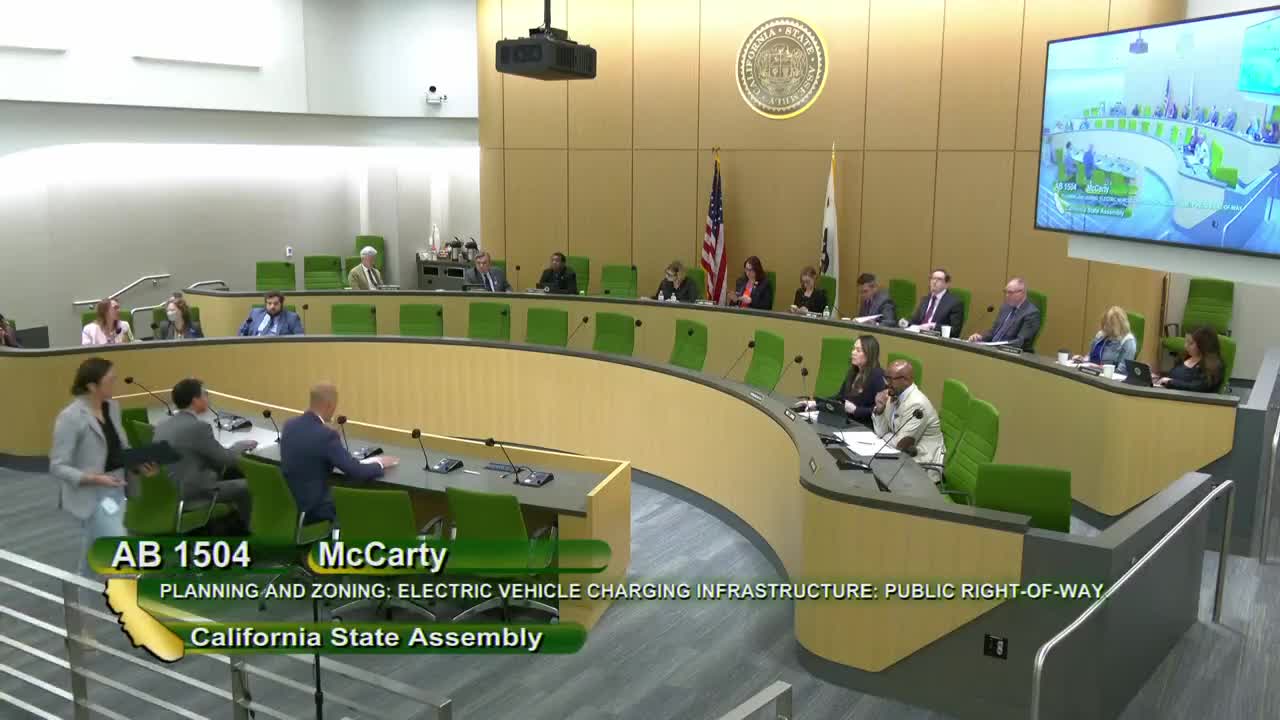 9MIN
Assembly Standing Committee on Transportation
 12MIN
Assembly Standing Committee on Local Government
Bill Author

Bill Co-Author(s):