AB 1882: Disabled veterans.
- Session Year: 2023-2024
- House: Assembly
- Latest Version Date: 2024-04-11
Current Status:
Failed
(2024-05-16: In committee: Held under submission.)
Introduced
In Committee
First Chamber
In Committee
Second Chamber
Enacted
What does this bill do?
This bill broadens who counts as a “disabled veteran” under the Vehicle Code, changing which veterans qualify for vehicle-related benefits. It adds many medical conditions, including not being able to walk without an assistive device (for example a cane, crutch, brace, prosthetic, wheelchair, or help from another person), being unable to walk 200 feet without stopping, severe walking limits from arthritis, neurological or orthopedic problems, loss or loss of use of limbs, severe vision loss or blindness, use of portable oxygen, and certain serious lung or heart conditions.
The summary is provided by generative AI which can make mistakes. For original language, please view the details in the table below.
Existing law defines disabled veteran for purposes of the Vehicle Code as, among other things, a person who, as a result of injury or disease suffered while on active service with the Armed Forces of the United States, has a disability that has been rated at 100% by the Department of Veterans Affairs. Existing law also defines a disabled veteran as a veteran who is unable to move without the aid of an assistant device.
This bill would instead define a disabled veteran as a veteran who cannot walk without the use of an assistant device. The bill would expand the definition of disabled veteran to include a veteran who cannot walk 200 feet without stopping to rest, a veteran who is severely limited in the ability to walk because of an arthritic, neurological, or orthopedic condition, or a veteran who has visual acuity of 20/200 or less, among other conditions, as specified.
Existing law exempts, except as specified, a vehicle that is owned by a disabled veteran, a former American prisoner of war, or a Congressional Medal of Honor recipient, or the surviving spouse of a former American prisoner of war or Congressional Medal of Honor recipient who has elected to retain special license plates, that is of a type subject to registration under the Vehicle Code, and that is not used for hire, compensation, or profit, from certain fees imposed pursuant to the Vehicle Code and a vehicle license fee imposed for the privilege of operating specified vehicles.Commencing January 1, 2027, this bill would additionally exempt a partially disabled veteran, as defined, from these fees.Existing law defines disabled veteran for purposes of the Vehicle Code as, among other things, a person who, as a result of injury or disease suffered while on active service with the Armed Forces of the United States, has a disability that has been rated at 100% by the Department of Veterans Affairs. Existing law also defines a disabled veteran as a veteran who is unable to move without the aid of an assistant device.
This bill would instead define a disabled veteran as a veteran who cannot walk without the use of an assistant device. The bill would expand the definition of disabled veteran to include a veteran who cannot walk 200 feet without stopping to rest, a veteran who is severely limited in the ability to walk because of an arthritic, neurological, or orthopedic condition, or a veteran who has visual acuity of 20/200 or less, among other conditions, as specified.
Existing law requires the Department of Motor Vehicles, upon application and without additional fees, to issue a special license plate or plates to a disabled person, disabled veteran, or an organization or agency involved in the transportation of disabled persons or veterans, as specified, in accordance with procedures adopted by the department. The bill would require the Department of Motor Vehicles, upon application and without additional fees, to issue a special license plate or plates, pursuant to procedures adopted by the department, to a veteran who has a service-connected disability rating at 50% or greater but does not meet the qualifying eligibility criteria for a special plate for disabled veterans.Existing law exempts, except as specified, a vehicle that is owned by a disabled veteran, a former American prisoner of war, or a Congressional Medal of Honor recipient, or the surviving spouse of a former American prisoner of war or Congressional Medal of Honor recipient who has elected to retain special license plates, that is of a type subject to registration under the Vehicle Code, and that is not used for hire, compensation, or profit, from certain fees imposed pursuant to the Vehicle Code and a vehicle license fee imposed for the privilege of operating specified vehicles.
Commencing January 1, 2027, this bill would additionally exempt a partially disabled veteran, as defined, from these fees.
Existing law defines disabled veteran for purposes of the Vehicle Code as, among other things, a person who, as a result of injury or disease suffered while on active service with the Armed Forces of the United States, has a disability that has been rated at 100% by the Department of Veterans Affairs. Existing law also defines a disabled veteran as a veteran who is unable to move without the aid of an assistant device.
This bill would instead define a disabled veteran as a veteran who cannot walk without the use of an assistant device. The bill would expand the definition of disabled veteran to include a veteran who cannot walk 200 feet without stopping to rest, a veteran who is severely limited in the ability to walk because of an arthritic, neurological, or orthopedic condition, or a veteran who has visual acuity of 20/200 or less, among other conditions, as specified.
Existing law requires the Department of Motor Vehicles, upon application and without additional fees, to issue a special license plate or plates to a disabled person, disabled veteran, or an organization or agency involved in the transportation of disabled persons or veterans, as specified, in accordance with procedures adopted by the department.
The bill would require the Department of Motor Vehicles, upon application and without additional fees, to issue a special license plate or plates, pursuant to procedures adopted by the department, to a veteran who has a service-connected disability rating at 50% or greater but does not meet the qualifying eligibility criteria for a special plate for disabled veterans.
A disabled veteran is a person who, as a result of injury or disease suffered while on active service with the armed forces of the United States, suffers any of the following:
(a)Has a disability which has been rated at 100 percent by the Department of Veterans Affairs or the military service from which the veteran was discharged, due to a diagnosed disease or disorder which substantially impairs or interferes with mobility.
(b)Cannot walk without the use of, or assistance from, an assistant device, including a brace, cane, crutch, another person, or a prosthetic device, wheelchair, or similar device.
(c)Has lost, or has lost use of, one or more limbs.
(d)Has suffered permanent blindness, as defined in Section 19153 of the Welfare and Institutions Code.
(e)Has visual acuity of 20/200 or less in the better eye with correcting lenses or visual acuity of more than 20/200 but with a limited field of vision in which the widest diameter of the visual field subtends an angle of 20 degrees or less.
(f)Cannot walk 200 feet without stopping to rest.
(g)Is restricted by lung disease to the extent that the persons forced (respiratory) expiratory volume for one second when measured by spirometry is less than one liter, or the persons arterial oxygen tension (pO2) is less than 60 mm/Hg on room air while the person is at rest.
(h)Has a cardiac condition to the extent that the persons functional limitations are classified in severity as Class III or Class IV according to standards set by the American Heart Association.
(i)Is severely limited in the ability to walk because of an arthritic, neurological, or orthopedic condition.
(j)Has a disorder of the foot that, in the opinion of a physician, limits or impairs the persons ability to walk, or has another debilitating condition that, in the opinion of a physician or a person authorized by applicable law to practice medicine in a hospital or other health facility of the Department of Veterans Affairs, limits or impairs the persons ability to walk.
(k)Uses portable oxygen.
SEC. 2.Section 9105 of the Vehicle Code, as added by Section 2 of Chapter 382 of the Statutes of 2022, is amended to read:9105.(a)Except for fees for duplicate license plates, duplicate certificates, or duplicate cards, the fees specified in this code need not be paid for a vehicle that is of a type subject to registration under this code, and that is not used for transportation for hire, compensation, or profit, when owned by any of the following:(1)A disabled veteran.(2)A former American prisoner of war.(3)The surviving spouse of a former American prisoner of war who has elected to retain the special license plates issued under Section 5101.5.(4)A Congressional Medal of Honor recipient.(5)The surviving spouse of a Congressional Medal of Honor recipient who has elected to retain the special license plates issued under Section 5101.6.(6)A Purple Heart recipient.(7)The surviving spouse of a Purple Heart recipient who has elected to retain the special license plates issued under Section 5101.8.(8)A partially disabled veteran.(b)The exemption granted by subdivision (a) does not extend to more than one vehicle owned by a former American prisoner of war, a disabled veteran, a Purple Heart recipient, or a Congressional Medal of Honor recipient, or a surviving spouse, and applies to the same vehicle as described in subdivision (b) of Section 10783, or subdivision (b) of Section 10783.2, of the Revenue and Taxation Code.(c)(1)The department may require a disabled veteran applying for an exemption under this section to submit a certificate signed by a physician and surgeon, or to the extent that it does not cause a reduction in the receipt of federal aid highway funds, by a nurse practitioner, certified nurse midwife, physician assistant, chiropractor, or optometrist, substantiating the disability.(2)The department may require a person applying for an exemption under this section for either of the following reasons to do any of the following:(A)By reason of the persons status as a former prisoner of war, to show, by satisfactory proof, the persons former prisoner-of-war status.(B)By reason of the persons status of receiving the Congressional Medal of Honor, to show, by satisfactory proof, that the person is a Congressional Medal of Honor recipient.(C)By reason of the persons status of receiving the Purple Heart, to show, by satisfactory proof, that the person is a Purple Heart recipient.(d)For the purposes of this section, the following terms have the following meanings:(1)Partially disabled veteran means a veteran with a service-connected disability rating at 50 percent or greater.(2)Vehicle means any of the following:(A)A passenger motor vehicle.(B)A motorcycle.(C)A commercial motor vehicle of less than 8,001 pounds unladen weight.(e)This section shall become operative on January 1, 2027. REVISIONS: HeadingLine 5.A disabled veteran is any a person who, as a result of injury or disease suffered while on active service with the armed forces of the United States, suffers any of the following:
(a)Has a disability which has been rated at 100 percent by the Department of Veterans Affairs or the military service from which the veteran was discharged, due to a diagnosed disease or disorder which substantially impairs or interferes with mobility.
(b)Cannot walk without the use of, or assistance from, an assistant device, including a brace, cane, crutch, another person, or a prosthetic device, wheelchair, or similar device.
(c)Has lost, or has lost use of, one or more limbs.
(d)Has suffered permanent blindness, as defined in Section 19153 of the Welfare and Institutions Code.
(e)Has visual acuity of 20/200 or less in the better eye with correcting lenses or visual acuity of more than 20/200 but with a limited field of vision in which the widest diameter of the visual field subtends an angle of 20 degrees or less.
(f)Cannot walk 200 feet without stopping to rest.
(g)Is restricted by lung disease to the extent that the persons forced respiratory (respiratory) expiratory volume for one second, second when measured by spirometry, spirometry is less than one liter, or the persons arterial oxygen tension (pO2) is less than 60 millimeters of mercury mm/Hg on room air while the person is at rest.
(h)Has a cardiac condition to the extent that the persons functional limitations are classified in severity as Class III or Class IV according to standards set by the American Heart Association.
(i)Is severely limited in the ability to walk because of an arthritic, neurological, or orthopedic condition.
(j)Has a disorder of the foot that, in the opinion of a physician, limits or impairs the persons ability to walk, or has another debilitating condition that, in the opinion of a physician or a person authorized by applicable law to practice medicine in a hospital or other health facility of the Department of Veterans Affairs, limits or impairs the persons ability to walk.
(k)Uses portable oxygen.
SEC. 2.Section 5007.3 is added to the Vehicle Code, to read:5007.3.(a)The department shall, upon application and without additional fees, issue a special license plate or plates, pursuant to procedures adopted by the department, to a veteran who has a service-connected disability rating at 50 percent or greater but does not meet the qualifying eligibility criteria for a special plate pursuant to Section 5007.(b)The special license plate issued under subdivision (a) shall not depict the International Symbol of Access adopted pursuant to Section 3 of Public Law 100-641, commonly known as the wheelchair symbol.SEC. 2.Section 9105 of the Vehicle Code, as added by Section 2 of Chapter 382 of the Statutes of 2022, is amended to read:9105.(a)Except for fees for duplicate license plates, duplicate certificates, or duplicate cards, the fees specified in this code need not be paid for a vehicle that is of a type subject to registration under this code, and that is not used for transportation for hire, compensation, or profit, when owned by any of the following:
(1)A disabled veteran.
(2)A former American prisoner of war.
(3)The surviving spouse of a former American prisoner of war who has elected to retain the special license plates issued under Section 5101.5.
(4)A Congressional Medal of Honor recipient.
(5)The surviving spouse of a Congressional Medal of Honor recipient who has elected to retain the special license plates issued under Section 5101.6.
(6)A Purple Heart recipient.
(7)The surviving spouse of a Purple Heart recipient who has elected to retain the special license plates issued under Section 5101.8.
(8)A partially disabled veteran.
(b)The exemption granted by subdivision (a) does not extend to more than one vehicle owned by a former American prisoner of war, a disabled veteran, a Purple Heart recipient, or a Congressional Medal of Honor recipient, or a surviving spouse, and applies to the same vehicle as described in subdivision (b) of Section 10783, or subdivision (b) of Section 10783.2, of the Revenue and Taxation Code.
(c)(1)The department may require a disabled veteran applying for an exemption under this section to submit a certificate signed by a physician and surgeon, or to the extent that it does not cause a reduction in the receipt of federal aid highway funds, by a nurse practitioner, certified nurse midwife, physician assistant, chiropractor, or optometrist, substantiating the disability.
(2)The department may require a person applying for an exemption under this section for either of the following reasons to do any of the following:
(A)By reason of the persons status as a former prisoner of war, to show, by satisfactory proof, the persons former prisoner-of-war status.
(B)By reason of the persons status of receiving the Congressional Medal of Honor, to show, by satisfactory proof, that the person is a Congressional Medal of Honor recipient.
(C)By reason of the persons status of receiving the Purple Heart, to show, by satisfactory proof, that the person is a Purple Heart recipient.
(d)For the purposes of this section, the following terms have the following meanings:
(1)Partially disabled veteran means a veteran with a service-connected disability rating at 50 percent or greater.
(d)For the purposes of this section, the term vehicle(2)Vehicle means any of the following:
(1)(A)A passenger motor vehicle.
(2)(B)A motorcycle.
(3)(C)A commercial motor vehicle of less than 8,001 pounds unladen weight.
(e)This section shall become operative on January 1, 2027.
A disabled veteran is any person who, as a result of injury or disease suffered while on active service with the armed forces of the United States, suffers any of the following:
(a)Has a disability which has been rated at 100 percent by the Department of Veterans Affairs or the military service from which the veteran was discharged, due to a diagnosed disease or disorder which substantially impairs or interferes with mobility.
(b)Is so severely disabled as to be unable to move without the aid of an assistant device.(b)Cannot walk without the use of, or assistance from, an assistant device, including a brace, cane, crutch, another person, or a prosthetic device, wheelchair, or similar device.
(c)Has lost, or has lost use of, one or more limbs.
(d)Has suffered permanent blindness, as defined in Section 19153 of the Welfare and Institutions Code.
(e)Has visual acuity of 20/200 or less in the better eye with correcting lenses or visual acuity of more than 20/200 but with a limited field of vision in which the widest diameter of the visual field subtends an angle of 20 degrees or less.
(f)Cannot walk 200 feet without stopping to rest.
(g)Is restricted by lung disease to the extent that the persons forced respiratory expiratory volume for one second, measured by spirometry, is less than one liter, or the arterial oxygen tension is less than 60 millimeters of mercury on room air at rest.
(h)Has a cardiac condition to the extent that the persons functional limitations are classified in severity as Class III or Class IV according to standards set by the American Heart Association.
(i)Is severely limited in the ability to walk because of an arthritic, neurological, or orthopedic condition.
(j)Has a disorder of the foot that, in the opinion of a physician, limits or impairs the persons ability to walk, or has another debilitating condition that, in the opinion of a physician or a person authorized by applicable law to practice medicine in a hospital or other health facility of the Department of Veterans Affairs, limits or impairs the persons ability to walk.
SEC. 2.Section 5007.3 is added to the Vehicle Code, to read:5007.3.(a)The department shall, upon application and without additional fees, issue a special license plate or plates, pursuant to procedures adopted by the department, to a veteran who has a service-connected disability rating at 50 percent or greater but does not meet the qualifying eligibility criteria for a special plate pursuant to Section 5007.
(b)The special license plate issued under subdivision (a) shall not depict the International Symbol of Access adopted pursuant to Section 3 of Public Law 100-641, commonly known as the wheelchair symbol.
|
Date
|
Status
|
|---|---|
| May 16, 2024 | In committee: Held under submission. |
| May 8, 2024 | In committee: Set, first hearing. Referred to APPR. suspense file. |
| Apr 23, 2024 | Coauthors revised. |
| Apr 23, 2024 | From committee: Do pass and re-refer to Com. on APPR. with recommendation: To Consent Calendar. (Ayes 15. Noes 0.) (April 22). Re-referred to Com. on APPR. |
| Apr 15, 2024 | Re-referred to Com. on TRANS. |
| Apr 11, 2024 | From committee chair, with author's amendments: Amend, and re-refer to Com. on TRANS. Read second time and amended. |
| Apr 10, 2024 | From committee: Do pass and re-refer to Com. on TRANS. (Ayes 10. Noes 0.) (April 9). Re-referred to Com. on TRANS. |
| Feb 15, 2024 | Re-referred to Com. on M. & V.A. |
| Feb 14, 2024 | From committee chair, with author's amendments: Amend, and re-refer to Com. on M. & V.A. Read second time and amended. |
| Feb 5, 2024 | Referred to Coms. on M. & V.A. and TRANS. |
| Jan 23, 2024 | From printer. May be heard in committee February 22. |
| Jan 22, 2024 | Read first time. To print. |
|
Date
|
Description
|
Location
|
Votes
|
|
|---|---|---|---|---|
| Apr 22, 2024 | Do pass and be re-referred to the Committee on [Appropriations] with recommendation: To Consent Calendar | Assembly Standing Committee on Transportation |
Passed |
|
| Apr 9, 2024 | Do pass and be re-referred to the Committee on [Transportation] | Assembly Standing Committee on Military and Veterans Affairs |
Passed |
This list shows positions taken on this bill by organizations on the date displayed, which is linked to the original source.
Positions by individuals are not included.
|
Organization
|
Position
|
Date
|
|---|---|---|
| American Ex-prisoners of War | ** Support | |
| American Legion Department of California | ** Support | |
| AMVETS Department of California | * Support | Apr 9, 2024 |
| California Council of Chapters of Military Officers Association of America | ** Support | |
| California State Commanders Veterans Council | ** Support | |
| County of San Joaquin | ** Support | |
| Military Officers Association Of America, California Council Of Chapters | ** Support | |
| Ventura County Chapter of The Military Officers Association of America | ** Support |
Date of Hearing: May 8, 2024
ASSEMBLY COMMITTEE ON APPROPRIATIONS
Buffy Wicks, Chair
ABPCA Bill Id:AB 1882
Author:(Villapudua) – As Amended Ver:April 11, 2024
Policy Committee: | Military and Veterans Affairs | Vote: | 10 - 0 |
Transportation | 15 - 0 | ||
|
|
Urgency: No State Mandated Local Program: No Reimbursable: No
SUMMARY:
This bill revises eligibility criteria for the disabled veteran’s license plate and exempts a partially disabled veteran, as defined, from paying vehicle registration fees.
Specifically, this bill expands the definition of “disabled veteran,” for purposes of establishing eligibility for a disabled veteran license plate or placard, to also include as a person who, as a result of injury or disease suffered while on active service with the Armed Forces of the United States, suffers from any of the following:
- Cannot walk without the use of, or assistance from, an assistant device, including a brace, cane, crutch, another person, or a prosthetic device, wheelchair, or similar device.
- Has visual acuity of 20/200 or less in the better eye with correcting lenses or visual acuity of more than 20/200 but with a limited field of vision, as defined.
- Cannot walk 200 feet without stopping to rest.
- Is restricted by lung disease to the extent that the person’s forced (respiratory) expiratory volume for one second when measured by spirometry is less than one liter, or the person’s arterial oxygen tension (pO2) is less than 60 mm/Hg on room air while the person is at rest.
- Has a cardiac condition to the extent the person’s functional limitations are classified in severity as Class III or Class IV according to standards set by the American Heart Association.
- Is severely limited in the ability to walk because of an arthritic, neurological, or orthopedic condition.
- Has a disorder of the foot that, in the opinion of a physician, limits or impairs the person’s ability to walk, or has another debilitating condition that, in the opinion of a physician or a person authorized by applicable law to practice medicine in a hospital or other health facility of the Department of Veterans Affairs, limits or impairs the person’s ability to walk.
- Uses portable oxygen.
FISCAL EFFECT:
To accommodate the changes made by this bill, the Department of Motor Vehicles (DMV) would need to modify forms and publications and update its website. DMV indicates associated one-time costs will be minor. (Motor Vehicle Account.)
The department anticipates annual revenue loss, of an unknown amount to various funds, but potentially in the high hundreds of thousands of dollars to low millions of dollars. This loss results from a vehicle for which DMV issues a disabled veteran license plate being exempt from the following fees: vehicle registration fee ($74), California Highway Patrol fee ($32), vehicle license fee ($105) and the transportation improvement fee ($76). The DVM reports there are 29,361 disabled veteran plates currently in circulation. A 10% increase in the number of disabled veteran plates would result in revenue loss totaling $842,181 annually.
DMV notes the Motor Vehicle Account, the primary funding account for DMV and the California Highway Patrol (CHP) is facing insolvency. In a recent report the LAO noted that, “Until a plan is put in place to address MVA’s structural deficit, we recommend the Legislature set a high bar for considering approval of any proposals that create additional MVA cost pressures and accelerate the risk of insolvency.”
COMMENTS:
- Purpose. According to the author:
[This bill] addresses a glaring oversight in statute that can make it harder for disabled veterans to qualify for a license plate specifically created for them, compared to a standard disabled person’s license plate. With veterans playing a crucial part to economic growth and increased civic engagement, we should not make it more challenging to qualify for privileges that many other states willingly give. California once was the most populous state for veterans. This policy can help restore the image of this state being a veteran-friendly state to reside in.
- Background. Existing law requires the DMV to issue to a qualifying veteran a disabled veteran placard or license plates. State law allows a vehicle with a disabled veteran license plates or placard to use designated disabled parking spaces.
The law defines a disabled veteran as one who, as a result of injury or disease suffered while on active service with the Armed Forces of the United States, meets any of the following criteria: (a) has been rated at 100% by the Department of Veterans Affairs (CalVet) or the military service from which the veteran was discharged, due to a diagnosed disease or disorder which substantially impairs or interferes with mobility; (b) is so severely disabled as to be unable to move without the aid of an assistant device; (c) has lost, or has lost use of, one or more limbs; and (d) has suffered permanent blindness, as defined in law.
In addition, state law exempts from all fees for duplicate license plates, duplicate certificates, or duplicate cards, for a single vehicle subject to registration and that is not used for transportation for hire, compensation or profit, any of the following: (a) a disabled veteran; (b) a former American prisoner of war; (c) the surviving spouse of a former American prisoner of war who has elected to retain the issued special license plates; (d) a Congressional Medal of Honor recipient; and (e) the surviving spouse of a Congressional Medal of Honor recipient who has elected to retain the issued special license plates.
The U.S. Department of Veterans Affairs (USDVA) assigns disability ratings to veterans in 10-point increments, from 10% to 100%. A 100% disabled veteran is very likely going to depend heavily upon disability compensation from the USDVA.
- Prior Legislation. AB 2837 (C. Garcia), of the 2021-22 Legislative Session, would have reduced the disability rating required to be considered a disabled veteran from 100% to 70% for veterans that meet the definition of “disabled veteran.” AB 2837 was held on the suspense file in this committee.
Analysis Prepared by: Jennifer Swenson / APPR. / (916) 319-2081
Date of Hearing: April 22, 2024
ASSEMBLY COMMITTEE ON TRANSPORTATION
Lori D. Wilson, Chair
ABPCA Bill Id:AB 1882 (
Author:Villapudua) – Amended Ver:April 11, 2024
SUBJECT: Disabled veterans
SUMMARY: Revises eligibility criteria for the disabled veteran’s plate and exempts partially disabled veterans, as defined, from paying vehicle registration fees. Specifically, this bill:
- Defines a “disabled veteran”, for purposes of establishing eligibility for a disabled veteran license plate or placard, as a person who, as a result of injury or disease suffered while on active service with the armed forces of the United States suffers from any of the following:
- Cannot walk without the use of, or assistance from, an assistant device, including a brace, cane, crutch, another person, or a prosthetic device, wheelchair, or similar device;
- Has visual acuity of 20/200 or less in the better eye with correcting lenses or visual acuity of more than 20/200 but with a limited field of vision in which the widest diameter of the visual field subtends an angle of 20 degrees or less;
- Cannot walk 200 feet without stopping to rest;
- Is restricted by lung disease to the extent that the person’s forced (respiratory) expiratory volume for one second when measured by spirometry is less than one liter, or the person’s arterial oxygen tension (pO2) is less than 60 mm/Hg on room air while the person is at rest;
- Has a cardiac condition to the extent that the person’s functional limitations are classified in severity as Class III or Class IV according to standards set by the American Heart Association;
- Is severely limited in the ability to walk because of an arthritic, neurological, or orthopedic condition;
- Has a disorder of the foot that, in the opinion of a physician, limits or impairs the person’s ability to walk, or has another debilitating condition that, in the opinion of a physician or a person authorized by applicable law to practice medicine in a hospital or other health facility of the Department of Veterans Affairs, limits or impairs the person’s ability to walk; and,
- Uses portable oxygen.
- Expands exemption from motor vehicle registration fees to “partially disabled veterans.”
EXISTING LAW:
- For motor vehicle purposes, defines a “disabled veteran” as any person who, as a result of injury or disease suffered while on active service with the armed forces of the United States, suffers any of the following:
- Has a disability which has been rated at 100% by the Department of Veterans Affairs (CalVet) or the military service from which the veteran was discharged, due to a diagnosed disease or disorder which substantially impairs or interferes with mobility;
- Is so severely disabled as to be unable to move without the aid of an assistant device;
- Has lost, or has lost use of, one or more limbs; and,
- Has suffered permanent blindness, as defined in Section 19153 of the Welfare and Institutions Code. (Vehicle Code Section (VEH) 295.7)
- Requires the Department of Motor Vehicles (DMV) to issue to a qualifying veteran a disabled veteran placard or license plates. (VEH 5007)
- Permits a vehicle with a disabled veteran license plate or placard to use designated disabled parking spaces. (VEH 22511.8)
- Except for fees for duplicate license plates, duplicate certificates, or duplicate cards, exempts from fees for a single vehicle subject to registration, and that is not used for transportation for hire, compensation, or profit, any of the following:
- A disabled veteran;
- A former American prisoner of war;
- The surviving spouse of a former American prisoner of war who has elected to retain the issued special license plates issued;
- A Congressional Medal of Honor recipient; and,
- The surviving spouse of a Congressional Medal of Honor recipient who has elected to retain the issued special license plates. (VEH 9105)
FISCAL EFFECT: Unknown
COMMENTS: According to the author, “AB 1882 addresses a glaring oversight in statute that can make it harder for disabled veterans to qualify for a license plate specifically created for them, compared to a standard disabled person’s license plate. A large portion of other states have regulations that mirror or expand upon federal regulations yet California’s seems to make it more stringent. Additionally partially disabled veterans are stuck behind the “all or nothing” privileges that come with a disabled veteran license plate. This bill would remedy that by providing vehicle registration fee waivers to veterans with a 50% service-connected disability. With veterans playing a crucial part to economic growth and increased civic engagement, we should not make it more challenging to qualify for privileges that many other states willingly give. California once was the most populous state for veterans. This policy can help restore the image of this state being a veteran-friendly state to reside in.”
Exemption registration fees: Beyond expanding eligibility for a disability plate, this bill would also exempt newly qualified disabled veterans from having to pay various fees. These include: vehicle registration fee ($65), California Highway Patrol fee ($29), vehicle license fee ($93) and the transportation improvement fee ($70).
American Legion Department of California (AMVETS), writing in support of this bill, argues “The current criteria for Disabled Veteran License Plates are excessively restrictive and fail to recognize the diverse range of disabilities that veterans may experience. By expanding the eligibility criteria, AB 1882 ensures that more disabled veterans can access the privileges they deserve, acknowledging their service and sacrifice.”
Committee concerns: According to the Legislative Analyst Office (LAO), The Motor Vehicle Account (MVA), the primary funding source for DMV, is expected to fully exhaust its reserves and become insolvent in 2025-26. The LAO recommends the Legislature should consider MVA cost pressures when evaluating new proposals. LAO argues that “Until a plan is put in place to address MVA’s structural deficit, we recommend the Legislature set a high bar for considering approval of any proposals that create additional MVA cost pressures and accelerate the risk of insolvency.”
Previous Legislation: AB 2837 (C. Garcia) of 2022 would have reduced the disability rating required to be considered a disabled veteran from 100% to 70% for veterans that meet the definition of “disabled veteran”. That bill was held on suspense in Assembly Appropriations Committee.
AB 459 (Mathis) of 2021 would have provided for partially disabled veterans to receive a prorated vehicle registration fee based on the disability rating they have. That bill was held on suspense in Assembly Appropriations Committee.
REGISTERED SUPPORT / OPPOSITION:
Support
American Ex-Prisoners of War
American Legion Department of California (AMVETS)
California Council of Chapters Military Officers Association of America
California State Commanders Veterans Council
County of San Joaquin
Military Officers Association of America, California Council of Chapters
Ventura County Chapter of The Military Officers Association of America
Opposition
None on file
Analysis Prepared by: David Sforza / TRANS. / (916) 319-2093
Date of Hearing: April 9, 2024
ASSEMBLY COMMITTEE ON MILITARY AND VETERANS AFFAIRS
Pilar Schiavo, Chair
ABPCA Bill Id:AB 1882 (
Author:Villapudua) – As Amended Ver:February 14, 2024
SUBJECT: Vehicles: fee exceptions
SUMMARY: Revises eligibility criteria for the disabled veteran’s plate and exempts partially disabled veterans, as defined, from paying vehicle registration fees. Specifically, this bill:
- Specifies that the definition of “disabled veteran” for purposes of establishing eligibility for a disabled veteran license plate or placard includes a person who, as a result of injury or disease suffered while on active service with the armed forces of the United States:
- Cannot walk without the use of, or assistance from, an assistant device, including a brace, cane, crutch, another person, or a prosthetic device, wheelchair, or similar device.
- Has visual acuity of 20/200 or less in the better eye with correcting lenses or visual acuity of more than 20/200 but with a limited field of vision in which the widest diameter of the visual field subtends an angle of 20 degrees or less.
- Cannot walk 200 feet without stopping to rest.
- Is restricted by lung disease to the extent that the person’s forced (respiratory) expiratory volume for one second when measured by spirometry is less than one liter, or the person’s arterial oxygen tension (pO2) is less than 60 mm/Hg on room air while the person is at rest.
- Has a cardiac condition to the extent that the person’s functional limitations are classified in severity as Class III or Class IV according to standards set by the American Heart Association.
- Is severely limited in the ability to walk because of an arthritic, neurological, or orthopedic condition.
- Has a disorder of the foot that, in the opinion of a physician, limits or impairs the person’s ability to walk, or has another debilitating condition that, in the opinion of a physician or a person authorized by applicable law to practice medicine in a hospital or other health facility of the Department of Veterans Affairs, limits or impairs the person’s ability to walk.
- Uses portable oxygen.
- Expands exemption from motor vehicle registration fees to “partially disabled veterans.”
- Defines “partially disabled veteran” as a veteran with a service-connected disability rating of 50 percent or greater.
EXISTING LAW:
- For motor vehicle purposes, defines a “disabled veteran” as any person who, as a result of injury or disease suffered while on active service with the armed forces of the United States, suffers any of the following:
- Has a disability which has been rated at 100% by the Department of Veterans Affairs (CalVet) or the military service from which the veteran was discharged, due to a diagnosed disease or disorder which substantially impairs or interferes with mobility.
- Is so severely disabled as to be unable to move without the aid of an assistant device.
- Has lost, or has lost use of, one or more limbs; and,
- Has suffered permanent blindness, as defined in Section 19153 of the Welfare and Institutions Code. (Vehicle Code (VC) Section 295.7)
- Requires the Department of Motor Vehicles (DMV) to issue to a qualifying veteran a disabled veteran placard or license plates. (VS Sec. 5007)
- Permits a vehicle with a disabled veteran license plate or placard to use designated disabled parking spaces. (VC Sec. 22511.8)
- Except for fees for duplicate license plates, duplicate certificates, or duplicate cards, exempts from fees for a single vehicle subject to registration, and that is not used for transportation for hire, compensation, or profit, any of the following:
- A disabled veteran.
- A former American prisoner of war.
- The surviving spouse of a former American prisoner of war who has elected to retain the issued special license plates issued.
- A Congressional Medal of Honor recipient; and,
- The surviving spouse of a Congressional Medal of Honor recipient who has elected to retain the issued special license plates. (VC Sec. 9105)
FISCAL EFFECT: This bill has not been analyzed by a fiscal committee.
COMMENTS: The bill’s author states the bill’s purpose is to better conform state statute establishing eligibility criteria for the disabled veterans license plate with federal regulation, with the goal of providing better clarity and guidance to medical providers and prevent denials. Additionally, it is intended to expand eligibility for fee exemptions to partially disabled veterans.
According to the author:
“AB 1882 addresses a glaring oversight in statute that can make it harder for disabled veterans to qualify for a license plate specifically created for them, compared to a standard disabled person’s license plate. A large portion of other states have regulations that mirror or expand upon federal regulations yet California’s seems to make it more stringent. Additionally partially disabled veterans are stuck behind the “all or nothing” privileges that come with a disabled veteran license plate. This bill would remedy that by providing vehicle registration fee waivers to veterans with a 50% service-connected disability. With veterans playing a crucial part to economic growth and increased civic engagement, we should not make it more challenging to qualify for privileges that many other states willingly give. California once was the most populous state for veterans. This policy can help restore the image of this state being a veteran-friendly state to reside in.”
Federal regulations provide guidelines to states for the establishment of a uniform system for handicapped parking for persons with disabilities to enhance access and the safety of persons with disabilities which limit or impair the ability to walk.
Specifically, 23 CFR Section 1235.2 defines “persons with disabilities which limit or impair the ability to walk” to mean persons who, as determined by a licensed physician:
- Cannot walk two hundred feet without stopping to rest; or
- Cannot walk without the use of, or assistance from, a brace, cane, crutch, another person, prosthetic device, wheelchair, or other assistive device; or
- Are restricted by lung disease to such an extent that the person's forced (respiratory) expiratory volume for one second, when measured by spirometry, is less than one liter, or the arterial oxygen tension is less than sixty mm/hg on room air at rest; or
- Use portable oxygen; or
- Have a cardiac condition to the extent that the person's functional limitations are classified in severity as Class III or Class IV according to standards set by the American Heart Association; or
- Are severely limited in their ability to walk due to an arthritic, neurological, or orthopedic condition.
These guidelines were issued in 1991. The state statutes on these criteria were adopted in 1989. They have not been amended since. However, the guidelines are not specific to disabled veterans.
Disability ratings and compensation
Disability ratings are assigned in 10-point increments, from 10 to 100%. The rating is both a measure of disability and the amount of disability compensation paid to the veteran, which is also affected by the size of the veteran’s household, including dependent parents.
It is worth considering the purpose of the fee exemption granted by the Vehicle Code. The disability rating is not a reliable indicator of need. While it is possible, perhaps even likely, for a veteran who is 100-percent disabled to depend solely on disability payments, it is not necessarily the case.
Related legislation
AB 2837 (C. Garcia) of 2022 would have reduced the disability rating required to be considered a disabled veteran from 100% to 70% for veterans that meet the definition of “disabled veteran” for purposes of establishing eligibility for disabled license plates/placards. Held in the Assembly Committee on Appropriations.
REGISTERED SUPPORT / OPPOSITION:
Support
American Ex-prisoners of War
American Legion, Department of California
Amvets, Department of California
California Council of Chapters Military Officers Association of America
California State Commanders Veterans Council
County of San Joaquin
Military Officers Association of America, California Council of Chapters
Ventura County Chapter of The Military Officers Association of America (VCC-MOAA)
Opposition
None on file.
Analysis Prepared by: Christian Burkin / M. & V.A. / (916) 319-3550
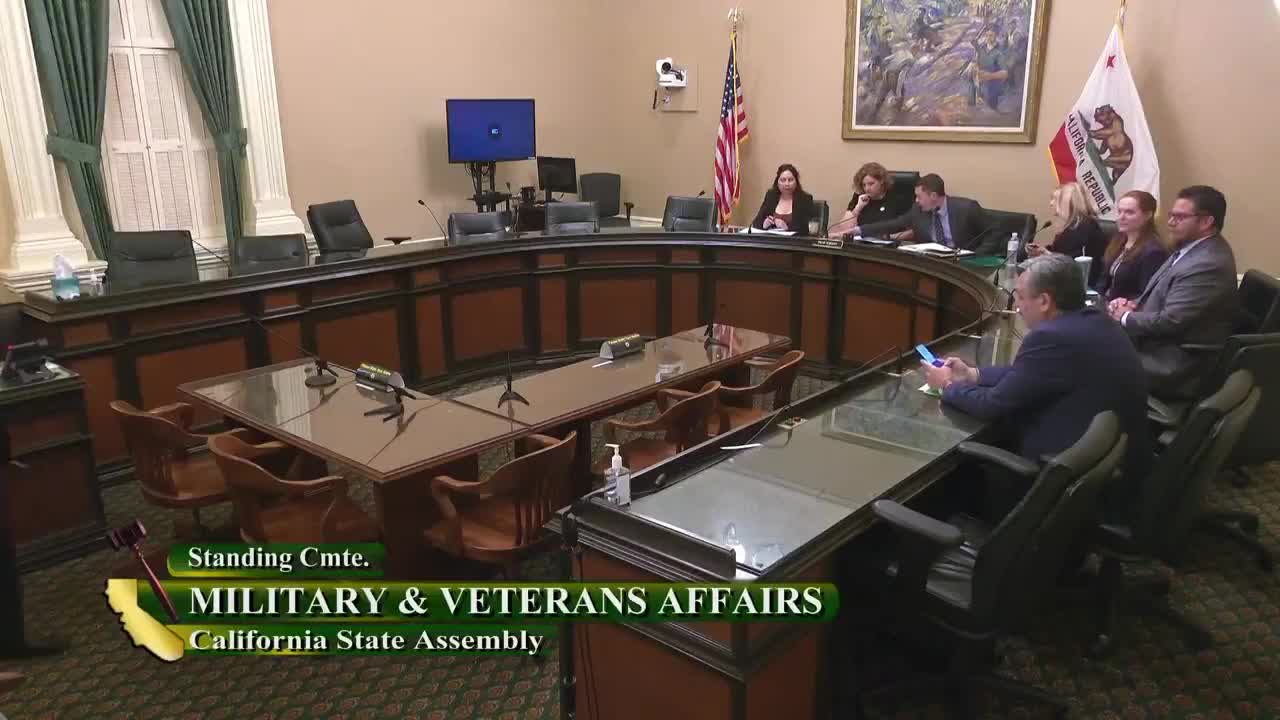
Discussed in Hearing
 1MIN
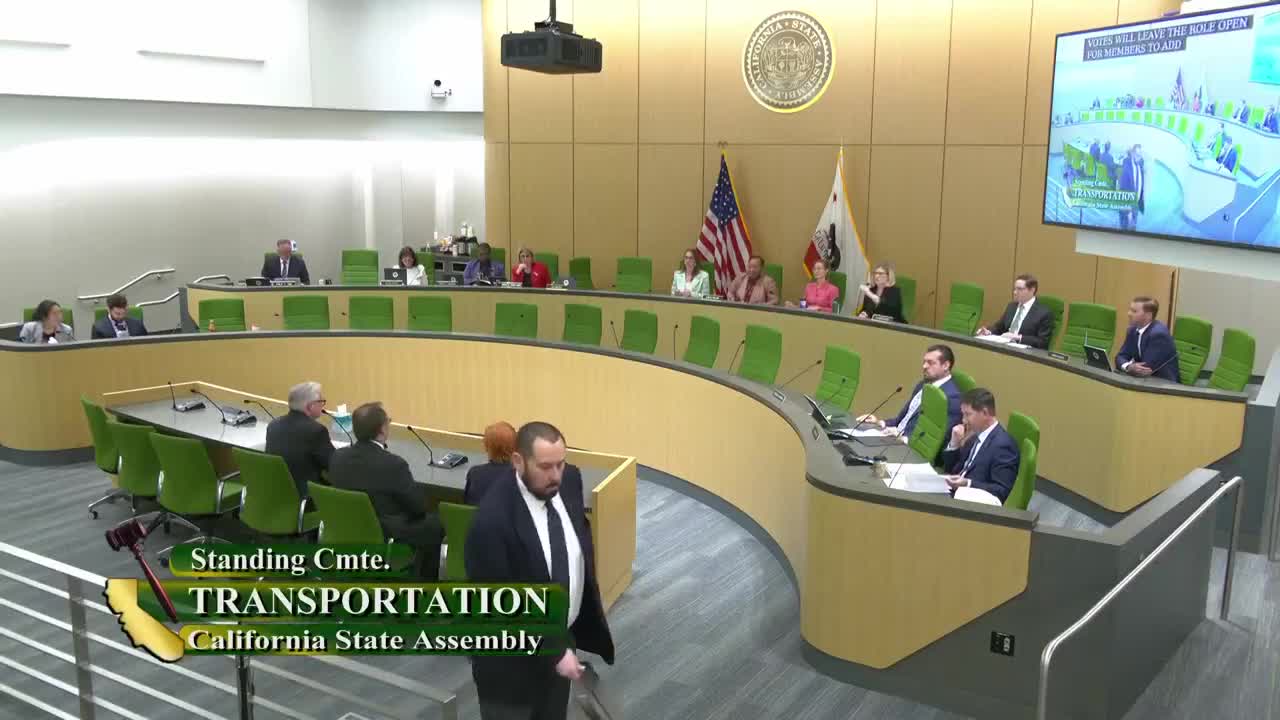
Assembly Standing Committee on Transportation
 7MIN