AB 2657: Social Media Commission.
- Session Year: 2023-2024
- House: Assembly
- Latest Version Date: 2024-03-21
Current Status:
Failed
(2024-05-16: Joint Rule 62(a), file notice suspended. (Page 5215.))
Introduced
In Committee
First Chamber
In Committee
Second Chamber
Enacted
What does this bill do?
The bill creates a statewide Social Media Commission, chaired by the California Health and Human Services Secretary (or designee), to study how social media affects the mental health of children and teens and to make formal policy recommendations to protect youth. The commission is organized into seven five-member subcommittees—parents (by child age), adolescents, educators (by grade range), researchers, tech and data privacy experts, policy experts, and mental health professionals—and will gather research (including a requested University of California briefing) to prepare a report for the Governor and Legislature.
The summary is provided by generative AI which can make mistakes. For original language, please view the details in the table below.
Existing law regulates social media platforms, through various acts, including the Cyberbullying Protection Act, which requires a social media platform to, among other things and subject to specified exceptions, disclose all cyberbullying reporting procedures in the terms of service, and the Online Violence Prevention Act, which requires a social medial platform to, except as specified, clearly and conspicuously state whether it has a mechanism for reporting violent posts that is available to users and nonusers of the platform.
This bill would establish the Social Media Commission and would require the commission to investigate the impacts on the mental health of children and adolescents of the methods and tools used by social media companies and to make recommendations on how best to mitigate these impacts. for the purpose of bringing together a diverse group of experts and invested stakeholders to provide a comprehensive report with formal recommendations for regulation of social media as it relates to child and adolescent mental health and well-being. The bill would require the Secretary of California Health and Human Services, or the secretarys designee, to chair the commission. The bill would require that the commission be composed of 7 subcommittees, including among others, a subcommittee of parents, a subcommittee of adolescents, a subcommittee of educators, and subcommittees of researchers and subject matter experts, as specified.
This bill would request the University of California to send an informational briefing to committee members containing, among other things, a review of research on the outcomes of enacted legislation on adolescent social media use and mental health. The bill would require the commission to meet for the first time on or before March 30, 2025. The bill would require the commission to submit its report to the Legislature and the Governor on or before April 1, 2026.
Existing law regulates social media platforms, through various acts, including the Cyberbullying Protection Act, which requires a social media platform to, among other things and subject to specified exceptions, disclose all cyberbullying reporting procedures in the terms of service, and the Online Violence Prevention Act, which requires a social medial platform to, except as specified, clearly and conspicuously state whether it has a mechanism for reporting violent posts that is available to users and nonusers of the platform.
This bill would establish the Social Media Commission and would require the commission to investigate the impacts on the mental health of children and adolescents of the methods and tools used by social media companies and to make recommendations on how best to mitigate these impacts.
(a)The Legislature finds and declares all of the following:
(1)Social media are internet-based channels that allow users to create profiles and interact, either in real time or asynchronously, with audiences searching for interaction with others or user-generated content.
(2)Mental health is a state of well-being where the individuals can realize their own abilities, cope with life stressors, work productively, and contribute to their community.
(3)Children and adolescents, or individuals collectively referred to as minors, are considered as vulnerable populations with respect to their experience of mental health and their abilities to understand and process mediated content, particularly through social media channels.
(4)Research has demonstrated that social media usage among children and adolescents is associated with poor mental health, including increases in depression and anxiety, and decreases in body image.
(5)More than 20 states have enacted, or are considering, regulations to social media in order to protect the mental health of children and adolescents. This is a timely topic of clear societal interest regarding the health and well-being of the next generation.
(6)Legislation considered across all states has included the following:
(A)Stricter age verifications.
(B)Requiring consent of parents or guardians to open a social media account among those 13 to 17 years of age, inclusive.
(C)Allowing parents or guardians to set limitations on the hours an adolescent user may access their account.
(D)Providing parents or guardians with full access to their childs account and all its content.
(E)Limiting the obtaining and sharing of adolescent users personal information and accounts by social media companies.
(F)Preventing users under 18 years of age from receiving targeted ads.
(G)Banning algorithms and design features which may promote harmful content on adolescent users feeds, including the sale of weapons or drugs, self-harm, and other content.
(H)Blocking all pornographic content from users under 18 years of age.
(I)Requiring that certain apps be blocked entirely to protect user data from foreign companies.
(7)Beyond the United States, countries around the world have enacted various social media regulations to protect the mental health of children and adolescents, including South Korea, the United Kingdom, France, Germany, China, India, and Brazil.
(8)To date, social media use in the United States, with respect to the enforcement of age verifications, limitations on the content to which minors are exposed, the ability of proprietary algorithms to freely recommend content to children and adolescents, and advertising to vulnerable youth, remains largely unregulated.
(b)It is the intent of the Legislature to ensure that social media content and social media companies are regulated in such a way to promote the health and well-being of the vulnerable population of children and adolescents.
SEC. 2.Division 22 (commencing with Section 28000) is added to the Health and Safety Code, to read:22.Social Media28000.(a)There is hereby established the Social Media Commission for the purpose of bringing together a diverse group of experts and invested stakeholders to provide a comprehensive report with formal recommendations for regulation of social media as it relates to child and adolescent mental health and well-being.
(b)(1)The commission shall be composed of seven subcommittees, each with five total members, including one subcommittee chair. Each subcommittee chair shall be responsible for leading meetings and writing the subcommittee recommendation reports.
(2)The subcommittee chairs shall consist of the following:
(A)The Secretary of California Health and Human Services, or the secretarys designee, who shall serve as the chairperson and as subcommittee chair of one of the subcommittees.
(B)Two subcommittee chair members, appointed by the Governor.
(C)Two subcommittee chair members, appointed by the Senate Committee on Rules.
(D)Two subcommittee chair members, appointed by the Speaker of the Assembly.
(3)All appointees shall have appropriate knowledge and experience regarding social media, or other relevant expertise.
(c)Subcommittees shall consist of the following:
(1)A subcommittee of parents, divided into two groups:
(A)The first group shall consist of parents of children 8 to 12 years of age, inclusive.
(B)The second group shall consist of parents of children 13 to 17 years of age, inclusive.
(2)A subcommittee of adolescents 13 to 17 years of age, inclusive.
(3)A subcommittee of educators, divided into two groups:
(A)Educators of pupils in second grade to fifth grade, inclusive.
(B)Educators of pupils in sixth grade to twelfth grade, inclusive.
(4)A subcommittee of researchers with expertise that collectively covers the following subject areas:
(A)Communication.
(B)Human development.
(C)Psychology.
(D)Neuroscience.
(E)Pediatrics.
(5)A subcommittee of media and technology experts in the following subject areas:
(A)Computer science.
(B)Data privacy.
(C)User experience (UX) researchers.
(6)A subcommittee of policy experts in the following subject areas:
(A)Communication law.
(B)Policy research.
(C)Economics.
(7)A subcommittee of mental health professionals, consisting of the following:
(A)Therapists.
(B)Psychiatrists.
(C)Addiction specialists.
28001.(a)The commission shall meet for the first time on or before March 30, 2025, and shall convene meetings at least quarterly at locations that are easily accessible to the public in accordance with the Bagley-Keene Open Meeting Act (Article 9 (commencing with Section 11120) of Chapter 1 of Part 1 of Division 3 of Title 2 of the Government Code).
(b)The University of California is requested to send, prior to the initial subcommittee meeting, an informational briefing to each committees members for review that contains a summary document containing all of the following:
(1)A list and description of proposed, enacted, and failed legislation by each state relating to social media and child or adolescent well-being.
(2)A review of other countries existing legislation relating to social media and child or adolescent well-being.
(3)A review of research on the outcomes of enacted legislation on adolescent social media use and mental health.
(4)A description of the goals and processes of the commission.
(5)A description of the legislative process with respect to the commissions purpose.
(c)(1)Subcommittees shall meet a minimum of two times prior to the first commission-wide chairs meeting.
(2)During the first commission-wide chairs meeting, each subcommittee chair shall share the thoughts of their respective committee and receive feedback from the group.
(3)A final subcommittee meeting shall occur following the commission-wide chairs meeting to discuss any new information or recommendations from other committees. At this final subcommittee meeting, subcommittees shall draft their official recommendation report.
(4)At a final commission-wide chairs meeting, subcommittee chairs shall create a summary of recommendations that will be sent to commission leaders to draft a final report.
(d)The commission may establish advisory committees that include members of the public with relevant knowledge and experience that support stakeholder engagement and an analytical process by which key design options are developed. A member of an advisory committee need not be a member of the commission.
(e)The commission and each advisory committee shall keep official records of all of their proceedings.
28002.(a)On or before April 1, 2026, the commission shall submit a report to the Legislature and the Governor that includes both of the following:
(1)A summary and analysis of the robust, multidisciplinary research and current regulatory practices regarding child and adolescent social media use and mental health with special consideration for parental, youth, and industry perspectives.
(2)A formal set of policy recommendations for legislators on how to effectively regulate social media to enhance youth safety and well-being. The recommendations may also include identifying areas where further investigation is needed to provide ongoing governance recommendations, particularly as technology and research in adolescent well-being co-evolve.
(b)The report to be submitted to the Legislature pursuant to subdivision (a) shall be submitted in compliance with Section 9795 of the Government Code.
SECTION 1.Division 21 (commencing with Section 27000) is added to the Health and Safety Code, to read:21.Social Media27000.(a)The Legislature finds and declares that despite the potential benefits to society of online social networks, there is substantial evidence of adverse mental health impacts on the users of the many tools designed to increase time spent on these networks.(b)There is hereby established the Social Media Commission.(c) The commission shall investigate the impacts on the mental health of children and adolescents of the methods and tools used by social media companies and shall make recommendations on how best to mitigate these impacts.(a)The Legislature finds and declares that despite the potential benefits to society of online social networks, there is substantial evidence of adverse mental health impacts on the users of the many tools designed to increase time spent on these networks.
(b)There is hereby established the Social Media Commission.
(c)The commission shall investigate the impacts on the mental health of children and adolescents of the methods and tools used by social media companies and shall make recommendations on how best to mitigate these impacts.
|
Date
|
Status
|
|---|---|
| May 16, 2024 | In committee: Held under submission. |
| May 16, 2024 | Joint Rule 62(a), file notice suspended. (Page 5215.) |
| May 15, 2024 | In committee: Set, first hearing. Referred to APPR. suspense file. |
| Apr 24, 2024 | From committee: Do pass and re-refer to Com. on APPR. (Ayes 10. Noes 0.) (April 23). Re-referred to Com. on APPR. |
| Apr 10, 2024 | From committee: Do pass and re-refer to Com. on P. & C.P. (Ayes 15. Noes 0.) (April 9). Re-referred to Com. on P. & C.P. |
| Apr 1, 2024 | Re-referred to Com. on HEALTH. |
| Mar 21, 2024 | From committee chair, with author's amendments: Amend, and re-refer to Com. on HEALTH. Read second time and amended. |
| Mar 21, 2024 | Referred to Coms. on HEALTH and P. & C.P. |
| Feb 15, 2024 | From printer. May be heard in committee March 16. |
| Feb 14, 2024 | Read first time. To print. |
|
Date
|
Description
|
Location
|
Votes
|
|
|---|---|---|---|---|
| Apr 23, 2024 | Do pass and be re-referred to the Committee on [Appropriations] | Assembly Standing Committee on Privacy and Consumer Protection |
Passed |
|
| Apr 9, 2024 | Do pass and be re-referred to the Committee on [Privacy and Consumer Protection] | Assembly Standing Committee on Health |
Passed |
This list shows positions taken on this bill by organizations on the date displayed, which is linked to the original source.
Positions by individuals are not included.
|
Organization
|
Position
|
Date
|
|---|---|---|
| American Academy Of Pediatrics, California | ** Support | |
| California Medical Association | * Support | Apr 9, 2024 |
| Children Now | * Support | Apr 23, 2024 |
| Children's Movement of Fresno | * Support | Apr 9, 2024 |
| Daily City Youth Health Center | * Support | Apr 23, 2024 |
| Oakland Privacy | ** Support | |
| Public Health Advocates | * Support | Apr 23, 2024 |
| The Social Changery | * Support | Apr 23, 2024 |
| UC Davis | * Support | Apr 9, 2024 |
| UC Davis Department of Communications | * Support | Apr 23, 2024 |
| Youth Leadership | * Support | Apr 23, 2024 |
| Youth Leadership Institute | * Support | Apr 23, 2024 |
Date of Hearing: May 15, 2024
ASSEMBLY COMMITTEE ON APPROPRIATIONS
Buffy Wicks, Chair
ABPCA Bill Id:AB 2657
Author:(Arambula) – As Amended Ver:March 21, 2024
Policy Committee: | Health | Vote: | 15 - 0 |
Privacy and Consumer Protection | 10 - 0 | ||
|
|
Urgency: No State Mandated Local Program: No Reimbursable: No
SUMMARY:
This bill establishes the Social Media Commission (commission) to provide recommendations for regulation of social media as it relates to child and adolescent mental health and well-being.
Specifically, this bill:
- Establishes the commission to provide recommendations for regulation of social media as it relates to child and adolescent mental health and well-being.
- Requires the commission be chaired by the Secretary of the California Health and Human Services Agency (CalHHS) or their designee, and composed of seven subcommittees, each with five total members, including one subcommittee chair.
- Requires the subcommittee chairs to include the Secretary of California Health and Human Services, or the secretary’s designee, and two chairs to be appointed by each of the Governor, the Senate Committee on Rules, and the Speaker of the Assembly.
- Requires the commission to include subcommittees of the following: parents; adolescents 13 to 17 years of age; educators; researchers; media and technology experts; policy experts; and mental health professionals.
- Requests the University of California (UC) send to members of the commission, prior to the initial subcommittee meeting, an informational briefing with: a description of the goals and processes of the commission, a review of research on outcomes of legislation on adolescent social media use and mental health, a review of other countries’ legislation on relating to social media and child or adolescent well-being, and a description of the legislative process.
- Requires the commission to create a report, as specified, and on or before April 1, 2026, submit the report to the Legislature and the Governor.
FISCAL EFFECT:
One-time General Fund costs of an unknown amount, potentially in the high hundreds of thousands of dollars, to CalHHS to convene the commission and prepare its report, and to UC to prepare the informational briefing.
COMMENTS:
- Purpose. This bill is sponsored by Public Health Advocates and The Children’s Movement Fresno. According to the author:
The promise of social media was to build virtual communities that would bring people together to share information and ideas. In many ways, this promise has been fulfilled. Some platforms have billions of users and act as a digital thread connecting friends and families.
Unfortunately, social media companies have abused their position as facilitators of some of the most personal human interactions by prioritizing screen time and profits over the mental health of their users. Social media’s addictive design exacerbates compulsive and obsessive behaviors detracting from real-world in-person engagement and contributing to social isolation.
Children and adolescents who use social media should be safe from harm. AB 2657 will identify ways to counteract the intentionally addictive design of social media platforms by establishing a commission to investigate the methods used by social media companies and to make recommendations on how to prevent future impacts on the mental health of children and adolescents
- Background. A recent meta-analysis revealed that “while social media can create a sense of community for the user, excessive and increased use of social media, particularly among those who are vulnerable, is correlated with depression and other mental health disorders.” In 2022, concerns about children’s health and its connection to their online activity prompted the Assembly Committee on Privacy and Consumer Protection and the Committee on Arts, Entertainment, Sports, and Tourism to hold a joint informational hearing on “Protecting Kids Online: Challenges & Opportunities in a Digital World.” One of the most notable points made in the informational hearing background paper was the difficulty of disentangling the benefits and harms of youths’ online activity, and the consequent nuance that is required when policymaking in this area.
- Related Legislation.
- AB 1282 (Lowenthal) requires the Mental Health Services Oversight and Accountability Commission on or before July 1, 2026, to report to the relevant policy committees of the Legislature a statewide strategy to understand, communicate, and mitigate mental health risks associated with the use of social media by children and youth. AB 1282 is on the Senate Inactive File.
- AB 2390 (Arambula) establishes the Social Media Harm Reduction Pilot Program. AB 2390 is pending in this committee.
- AB 1282 (Lowenthal) requires the Mental Health Services Oversight and Accountability Commission on or before July 1, 2026, to report to the relevant policy committees of the Legislature a statewide strategy to understand, communicate, and mitigate mental health risks associated with the use of social media by children and youth. AB 1282 is on the Senate Inactive File.
Analysis Prepared by: Allegra Kim / APPR. / (916) 319-2081
Date of Hearing: April 23, 2024
ASSEMBLY COMMITTEE ON PRIVACY AND CONSUMER PROTECTION
Rebecca Bauer-Kahan, Chair
ABPCA Bill Id:AB 2657 (
Author:Arambula) – As Amended Ver:March 21, 2024
SUBJECT: Social Media Commission
SYNOPSIS
A recent report by the Centers for Disease Control points to a significant deterioration in high school students’ mental health in the decade between 2011 and 2021. During that time, the percentage of male high school students who had experienced persistent feelings of sadness or hopelessness during the past year increased from 21% to 29%. For female students, the increase over the same period was tragically higher, from 36% to 57%. A number of studies suggest that social media use may be a contributing factor to young people’s deteriorating mental health.
This bill, co-sponsored by Public Health Advocates and Children’s Movement Fresno, proposes to establish the Social Media Commission (commission) for the purpose of bringing together experts and stakeholders—young people who use social media, educators, parents, and content experts in social media, technology, and mental health—to provide a comprehensive report with formal recommendations for regulation of social media as it relates to child and adolescent mental health and well-being. Proponents argue that a broad diversity of perspectives will result in more well-rounded recommendations to guide the Legislature.
There is no opposition on file. This bill was previously heard by the Assembly Health Committee, where it passed 15-0.
SUMMARY: Establishes the commission and tasks it with producing a comprehensive report for regulating social media as it relates to child and adolescent mental health and well-being. Specifically, this bill:
- Establishes the commission for the purpose of bringing together a diverse group of experts and invested stakeholders to provide a comprehensive report with formal recommendations for regulation of social media as it relates to child and adolescent mental health and well-being.
- Requires the commission to be composed of seven subcommittees, each with five total members, including one subcommittee chair. Requires each subcommittee chair to be responsible for leading meetings and writing the subcommittee recommendation reports.
- Requires the subcommittee chairs to consist of the following:
- The Secretary of California Health and Human Services, or the secretary’s designee, who shall serve as the chairperson and as subcommittee chair of one of the subcommittees.
- Two subcommittee chair members, appointed by the Governor.
- Two subcommittee chair members, appointed by the Senate Committee on Rules.
- Two subcommittee chair members, appointed by the Speaker of the Assembly.
- Requires all appointees to have appropriate knowledge and experience regarding social media, or other relevant expertise.
- Requires subcommittees to consist of the following:
- A subcommittee of parents, divided into two groups:
- Requires the first group to consist of parents of children eight to 12 years of age, inclusive; and,
- Requires the second group to consist of parents of children 13 to 17 years of age, inclusive.
- A subcommittee of adolescents 13 to 17 years of age, inclusive;
- A subcommittee of educators, divided into two groups:
- Educators of pupils in second grade to fifth grade, inclusive; and,
- Educators of pupils in sixth grade to twelfth grade, inclusive.
- A subcommittee of researchers with expertise that collectively covers the following subject areas:
- Communication;
- Human development;
- Psychology;
- Neuroscience;
- Pediatrics;
- A subcommittee of media and technology experts in the following subject areas:
- Computer science;
- Data privacy; and,
- User experience researchers;
- A subcommittee of policy experts in the following subject areas:
- Communication law;
- Policy research; and,
- Economics;
- A subcommittee of mental health professionals, consisting of the following:
- Therapists;
- Psychiatrists; and,
- Addiction specialists.
- A subcommittee of parents, divided into two groups:
- Requires the commission to meet for the first time on or before March 30, 2025, and to convene meetings at least quarterly at locations that are easily accessible to the public.
- Requests the University of California to send, prior to the initial subcommittee meeting, an informational briefing to each committee’s members for review that contains a summary document containing all of the following:
- A list and description of proposed, enacted, and failed legislation by each state relating to social media and child or adolescent well-being;
- A review of other countries’ existing legislation relating to social media and child or adolescent well-being;
- A review of research on the outcomes of enacted legislation on adolescent social media use and mental health;
- A description of the goals and processes of the commission; and,
- A description of the legislative process with respect to the commission’s purpose.
- Requires subcommittees to meet a minimum of two times prior to the first commission-wide chairs’ meeting.
- Requires, during the first commission-wide chairs’ meeting, each subcommittee chair to share the thoughts of their respective committee and receive feedback from the group.
- Requires a final subcommittee meeting to occur following the commission-wide chairs’ meeting to discuss any new information or recommendations from other committees. Requires, at this final subcommittee meeting, subcommittees to draft their official recommendation report.
- Requires, at a final commission-wide chairs’ meeting, subcommittee chairs to create a summary of recommendations that will be sent to commission leaders to draft a final report.
- Permits the commission to establish advisory committees that include members of the public with relevant knowledge and experience that support stakeholder engagement and an analytical process by which key design options are developed.
- Requires the commission and each advisory committee to keep official records of all of their proceedings.
- Requires, on or before April 1, 2026, the commission to submit a report to the Legislature and the Governor that includes both of the following:
- A summary and analysis of the robust, multidisciplinary research and current regulatory practices regarding child and adolescent social media use and mental health with special consideration for parental, youth, and industry perspectives; and,
- A formal set of policy recommendations for legislators on how to effectively regulate social media to enhance youth safety and well-being. Authorizes the recommendations to include identifying areas where further investigation is needed to provide ongoing governance recommendations, particularly as technology and research in adolescent well-being co-evolve.
EXISTING LAW:
- Establishes the California Health and Human Services Agency. (Gov. Code § 12806.)
- Defines “social media platform” as a public or semipublic internet-based service or application that has users in California and that meets both of the following criteria:
- A substantial function of the service or application is to connect users in order to allow them to interact socially with each other within the service or application. (A service or application that provides email or direct messaging services does not meet this criterion based solely on that function.)
- The service or application allows users to do all of the following:
- Construct a public or semipublic profile for purposes of signing into and using the service or application.
- Populate a list of other users with whom an individual shares a social connection within the system.
- Create or post content viewable by other users, including, but not limited to, on message boards, in chat rooms, or through a landing page or main feed that presents the user with content generated by other users. (Bus. & Prof. Code § 22675(e).)
FISCAL EFFECT: As currently in print the bill is keyed fiscal.
COMMENTS:
1) Background. When the Centers for Disease Control released its Youth Risk Behavior Survey Data Summary & Trends Report 2011-2021 earlier this year, the report’s findings resonated nationwide. Among the most concerning results were the following:
- In the decade between 2011 and 2021, the percentage of male high school students who had experienced persistent feelings of sadness or hopelessness during the past year increased from 21% to 29%. For female students, the increase over the same period was tragically higher, from 36% to 57%.
- In 2021, 22% of high school students reported seriously considering attempting suicide during the past year.
- In 2021, 42% of high school students felt so sad or hopeless almost every day for at least two weeks in a row that they stopped doing their usual activities. Female students were more likely than male students to experience persistent feelings of sadness or hopelessness.[1]
The connection between findings such as these and teens’ increased use of technologies such as smartphones and social media applications is increasingly the subject of both research and legislation. A meta-analysis of 20 research studies published worldwide between January 2010 and June 2020 revealed that “while social media can create a sense of community for the user, excessive and increased use of social media, particularly among those who are vulnerable, is correlated with depression and other mental health disorders.”[2] And regulation of social media platforms, with an eye to ensuring children’s well-being online, has been a topic of significant bipartisan interest in the Legislature for several years.
In 2022, concerns about children’s health and its connection to their online activity prompted this Committee and the Assembly Arts, Entertainment, Sports, and Tourism Committee to hold a joint informational hearing on the topic of “Protecting Kids Online: Challenges & Opportunities in a Digital World.” One of the most notable points made in the informational hearing background paper was the difficulty of disentangling the benefits from the harms of youths’ online activity, and the consequent nuance that is required when policymaking in this area:
Though the harms of digital technology are substantial, they are not insurmountable, and are particular to certain types of content, patterns of internet use, and design features. Adequately addressing online media that are problematic to the wellbeing of young people could accordingly allow children to utilize the considerable advantages online media provide over traditional media without endangering their mental and physical health.[3]
2) Author’s statement. According to the author:
The promise of social media was to build virtual communities that would bring people together to share information and ideas. In many ways, this promise has been fulfilled. Some platforms have billions of users and act as a digital thread connecting friends and families.
Unfortunately, social media companies have abused their position as facilitators of some of the most personal human interactions by prioritizing screen time and profits over the mental health of their users. Social media’s addictive design exacerbates compulsive and obsessive behaviors detracting from real-world in-person engagement and contributing to social isolation.
Children and adolescents who use social media should be safe from harm. AB 2657 will identify ways to counteract the intentionally addictive design of social media platforms by establishing a commission to investigate the methods used by social media companies and to make recommendations on how to prevent future impacts on the mental health of children and adolescents.
3) Analysis. Under this bill, the commission, by April 1, 2026 must submit to the Legislature and Governor a report that includes both of the following:
- A summary and analysis of the robust, multidisciplinary research and current regulatory practices regarding child and adolescent social media use and mental health with special consideration for parental, youth, and industry perspectives.
- A formal set of policy recommendations for legislators on how to effectively regulate social media to enhance youth safety and well-being. The recommendations may also include identifying areas where further investigation is needed to provide ongoing governance recommendations, particularly as technology and research in adolescent well-being co-evolve.
The commission is composed of seven subcommittees, each with five members. These subcommittees involve a diverse array of experts and stakeholders—young people who use social media, educators, parents, and content experts in social media, technology, and mental health. These subcommittees can provide the commission perspectives arising from lived experience and expertise, leading to a well-rounded set of conclusions that should assist the Legislature in formulating policy to help young people engage with social media in healthier ways.
According to Youth Leadership Institute, which supports the bill, “[y]outh, parents, researchers, teachers, and government officials are deeply concerned of the safety and well-being of our community. Oftentimes individually we may feel isolated in our worries and solutions are out of reach. Through this approach, this will unify stakeholders and build human-centered approaches to solutions and recommendations.”
Oakland Privacy, in support of the bill, adds:
The commission proposed under AB 2657 will complement other initiatives by the state legislature to reduce harms caused by social media. The commission is an opportunity to address social media harms on teens through a holistic approach, with engagement from various stakeholders including youth. Youth’s perspectives and participation in the discussions and decision-making process is essential and has been implemented in other systems that can impact youth, such as foster youth in the child-welfare system.
To ensure that the fullest array of voices are represented, the author may also wish to consider ensuring that the experts and stakeholders have diverse personal backgrounds reflective of California as a whole. Additionally, it should be noted that this Committee recently passed a similar bill, AB 1282 (Lowenthal, 2023), which would require a similar report from the Mental Health Services Oversight and Accountability Commission. To avoid duplicative efforts, the author is encouraged to work with the author of AB 1282 to find a common approach.
4) Related legislation. AB 1282 (Lowenthal, 2023) requires the Mental Health Services Oversight and Accountability Commission on or before July 1, 2026 to report to the relevant policy committees of the Legislature a statewide strategy to understand, communicate, and mitigate mental health risks associated with the use of social media by children and youth. AB 1282 is currently pending on the Senate Inactive File.
AB 2390 (Arambula, 2024) establishes the Social Media Harm Reduction Pilot Program. The bill is pending in this Committee.
ARGUMENTS IN SUPPORT:
Co-sponsor Pubic Health Advocates writes:
While most people will have a positive experience on social media platforms, there are also risks. Young people spend considerable time daily on social media – averaging 4.8 hours per day – and through a combination of the content they encounter and social media replacing or competing with other activities, 37% of young people describe social media as a major and direct contributor to depression and anxiety. This is higher than traditional adolescent stressors of family and community expectations (18%), school pressure (16%) and bullying (8%).
As the risks are receiving greater attention, there is nationwide momentum to pass legislation to protect youth on social media. It is incumbent upon the state of California to review existing data and develop evidence-informed strategies to protect young people online.
AB 2390 establishes a commission to investigate the methods used by social media companies and to make recommendations on how to prevent future impacts on the mental health of children and adolescents. The design of this commission will ensure input from young people who use social media, educators, parents, and content experts in social media technology and mental health to fully consider the experience and existing research to develop recommendations to guide the California legislature.
The American Academy of Pediatrics writes:
Current laws such as the Cyberbullying Protection Act and the Online Violence Prevention Act have been important in regulating social media platforms. However, the rapidly evolving landscape of social media demands a more comprehensive approach that considers the profound impact these platforms have on the mental health and well-being of young people. The proposed Social Media Commission offers a promising solution by bringing together a diverse group of experts and stakeholders to provide formal recommendations for the regulation of social media. By including subcommittees composed of parents, adolescents, educators, researchers, and subject matter experts, the commission ensures that a wide range of perspectives and experiences will be considered in the decisionmaking process. The commission's focus on child and adolescent mental health and well-being is particularly crucial, given the growing body of research linking excessive social media use to various negative outcomes, including depression, anxiety, and cyberbullying. By empowering the Secretary of California Health and Human Services to chair the commission, AB 2657 demonstrates a commitment to prioritizing the health and safety of our youth. I commend the efforts of the bill’s sponsors in recognizing the importance of proactive measures to address the challenges posed by social media platforms.
REGISTERED SUPPORT / OPPOSITION:
Support
Public Health Advocates (co-sponsor)
Youth Leadership Institute (co-sponsor)
American Academy of Pediatrics, California
Oakland Privacy
Opposition
None on file
Analysis Prepared by: Josh Tosney / P. & C.P. / (916) 319-2200
The full report may be found at https://www.cdc.gov/healthyyouth/data/yrbs/pdf/YRBS_Data-Summary-Trends_Report2023_508.pdf. ↑
Ulvi, et al., Social Media Use and Mental Health: A Global Analysis, Epidemologia (Jan. 11, 2022), available at https://pubmed.ncbi.nlm.nih.gov/36417264/. ↑
The background paper for the informational hearing (background paper), is available at https://privacycp.assembly.ca.gov/sites/privacycp.assembly.ca.gov/files/Background_032922pdf.pdf. ↑
Date of Hearing: April 9, 2024
ASSEMBLY COMMITTEE ON HEALTH
Mia Bonta, Chair
ABPCA Bill Id:AB 2657
Author:((Arambula) – As Amended Ver:March 21, 2024
SUBJECT: Social Media Commission.
SUMMARY: Establishes the Social Media Commission (commission) for the purpose of bringing together a diverse group of experts and invested stakeholders to provide a comprehensive report with formal recommendations for regulation of social media as it relates to child and adolescent mental health and well-being. Specifically, this bill:
- Establishes the commission for the purpose of bringing together a diverse group of experts and invested stakeholders to provide a comprehensive report with formal recommendations for regulation of social media as it relates to child and adolescent mental health and well-being.
- Requires the commission to be composed of seven subcommittees, each with five total members, including one subcommittee chair. Requires each subcommittee chair to be responsible for leading meetings and writing the subcommittee recommendation reports.
- Requires the subcommittee chairs to consist of the following:
- The Secretary of California Health and Human Services, or the secretary’s designee, who shall serve as the chairperson and as subcommittee chair of one of the subcommittees.
- Two subcommittee chair members, appointed by the Governor.
- Two subcommittee chair members, appointed by the Senate Committee on Rules.
- Two subcommittee chair members, appointed by the Speaker of the Assembly.
- Requires all appointees to have appropriate knowledge and experience regarding social media, or other relevant expertise.
- Requires subcommittees to consist of the following:
- A subcommittee of parents, divided into two groups:
- Requires the first group to consist of parents of children eight to 12 years of age, inclusive; and,
- Requires the second group to consist of parents of children 13 to 17 years of age, inclusive.
- A subcommittee of adolescents 13 to 17 years of age, inclusive;
- A subcommittee of educators, divided into two groups:
- Educators of pupils in second grade to fifth grade, inclusive; and,
- Educators of pupils in sixth grade to twelfth grade, inclusive.
- A subcommittee of researchers with expertise that collectively covers the following subject areas:
- Communication;
- Human development;
- Psychology;
- Neuroscience;
- Pediatrics;
- A subcommittee of media and technology experts in the following subject areas:
- Computer science;
- Data privacy; and,
- User experience researchers;
- A subcommittee of policy experts in the following subject areas:
- Communication law;
- Policy research; and,
- Economics;
- A subcommittee of mental health professionals, consisting of the following:
- Therapists;
- Psychiatrists; and,
- Addiction specialists.
- A subcommittee of parents, divided into two groups:
- Requires the commission to meet for the first time on or before March 30, 2025, and to convene meetings at least quarterly at locations that are easily accessible to the public.
- Requests the University of California to send, prior to the initial subcommittee meeting, an informational briefing to each committee’s members for review that contains a summary document containing all of the following:
- A list and description of proposed, enacted, and failed legislation by each state relating to social media and child or adolescent well-being;
- A review of other countries’ existing legislation relating to social media and child or adolescent well-being;
- A review of research on the outcomes of enacted legislation on adolescent social media use and mental health;
- A description of the goals and processes of the commission; and,
- A description of the legislative process with respect to the commission’s purpose.
- Requires subcommittees to meet a minimum of two times prior to the first commission-wide chairs’ meeting.
- Requires, during the first commission-wide chairs’ meeting, each subcommittee chair to share the thoughts of their respective committee and receive feedback from the group.
- Requires a final subcommittee meeting to occur following the commission-wide chairs’ meeting to discuss any new information or recommendations from other committees. Requires, at this final subcommittee meeting, subcommittees to draft their official recommendation report.
- Requires, at a final commission-wide chairs’ meeting, subcommittee chairs to create a summary of recommendations that will be sent to commission leaders to draft a final report.
- Permits the commission to establish advisory committees that include members of the public with relevant knowledge and experience that support stakeholder engagement and an analytical process by which key design options are developed.
- Requires the commission and each advisory committee to keep official records of all of their proceedings.
- Requires, on or before April 1, 2026, the commission to submit a report to the Legislature and the Governor that includes both of the following:
- A summary and analysis of the robust, multidisciplinary research and current regulatory practices regarding child and adolescent social media use and mental health with special consideration for parental, youth, and industry perspectives; and,
- A formal set of policy recommendations for legislators on how to effectively regulate social media to enhance youth safety and well-being. Authorizes the recommendations to include identifying areas where further investigation is needed to provide ongoing governance recommendations, particularly as technology and research in adolescent well-being co-evolve.
EXISTING LAW:
- Establishes the Federal Children’s Online Privacy Protection Act providing parents tools to control what information is collected from their children online. Requires the Federal Trade Commission to develop regulations requiring operators of commercial websites and online services directed to children under 13 or knowingly collecting personal information from children under 13 to: notify parents of their information practices; obtain verifiable parental consent for the collection, use, or disclosure of children’s personal information; let parents prevent further maintenance or use of, or future collection of their child’s personal information; provide parents access to their child’s personal information; not require a child to provide more personal information that is reasonably necessary to participate in activities; and, maintain reasonable procedures to protect the confidentiality, security and integrity of the personal information. [15 United States Code §6501-6506]
- Establishes the California Age-Appropriate Design Code Act requiring a business that provides an online service, product, or feature likely to be accessed by children to comply with specified requirements, including a requirement to configure all default privacy settings offered by the online service, product, or feature to the settings that offer a high level of privacy, unless the business can demonstrate a compelling reason that a different setting is in the best interests of children, and to provide privacy information, terms of service, policies, and community standards concisely, prominently, and using clear language suited to the age of children likely to access that online service, product, or feature. [Civil Code (CIV) §1798.99.28, et seq.]
- Requires a business that provides an online service, product, or feature likely to be accessed by children to complete a Data Protection Impact Assessment for any new, publicly offered, online service, product, or feature likely to be accessed by children and maintain documentation of this assessment as long as the online service, product, or feature is likely to be accessed by children. Requires a business to biennially review all Data Protection Impact Assessments. [CIV §1798.99.31]
- Requires the business’ Data Protection Impact Assessment to identify the purpose of the online service, product, or feature, how it uses children’s personal information, and the risks of material detriment to children that arise from the data management practices of the business, including:
- Whether the design of the online product, service, or feature could harm children, including by exposing children to harmful, or potentially harmful, content on the online product, service, or feature;
- Whether the design of the online product, service, or feature could lead to children experiencing or being targeted by harmful, or potentially harmful, contacts on the online product, service, or feature;
- Whether the design of the online product, service, or feature could permit children to witness, participate in, or be subject to harmful, or potentially harmful, conduct on the online product, service, or feature;
- Whether the design of the online product, service, or feature could allow children to be party to or exploited by a harmful, or potentially harmful, contact on the online product, service, or feature;
- Whether algorithms used by the online product, service, or feature could harm children;
- Whether targeted advertising systems used by the online product, service, or feature could harm children;
- Whether and how the online product, service, or feature uses system design features to increase, sustain, or extend use of the online product, service, or feature by children, including the automatic playing of media, rewards for time spent, and notifications; and,
- Whether, how, and for what purpose the online product, service, or feature collects or processes sensitive personal information of children. [CIV §1798.99.31]
- Establishes the California Children’s Data Protection Working Group, as specified, which is required to deliver a report every two years to the Legislature with recommendations on, at minimum, the following:
- Identifying online services, products, or features likely to be accessed by children;
- Evaluating and prioritizing the best interests of children with respect to their privacy, physical health, and mental health and well-being and evaluating how those interests may be furthered by the design, development, and implementation of an online service, product, or feature;
- Ensuring that age assurance methods used by businesses that provide online services, products, or features likely to be accessed by children are proportionate to the risks that arise from the data management practices of the business, privacy protective, and minimally invasive;
- Assessing and mitigating risks to children that arise from the use of an online service, product, or feature;
- Publishing privacy information, policies, and standards in concise, clear language suited for the age of children likely to access an online service, product, or feature; and,
- How the working group and the Department of Justice may leverage the substantial and growing expertise of the California Privacy Protection Agency in the long-term development of data privacy policies that affect the privacy, rights, and safety of children online. [CIV §1798.99.32]
- Establishes the California Consumer Privacy Act of 2018, which grants to a consumer various rights with respect to personal information, as defined, that is collected by a business, as defined, including the right to request that a business delete personal information about the consumer that the business has collected from the consumer. Authorizes a minor to disaffirm a contract before majority or within a reasonable time afterwards or, in case of the minor’s death within that period, by the minor’s heirs or personal representative. [CIV §1798.199.10]
- Establishes the Privacy Rights for California Minors in the Digital World which prohibits an operator of an internet website, online service, online application, or mobile application from the following:
- Marketing or advertising specified products or services, such as firearms, cigarettes, and alcoholic beverages, on its internet website, online service, online application, or mobile application that is directed to minors;
- Marketing or advertising such products or services to minors who the operator has actual knowledge are using its site, service, or application online and is a minor, if the marketing or advertising is specifically directed to that minor based upon the personal information of the minor; and,
- Knowingly using, disclosing, compiling, or allowing a third party to use, disclose, or compile, the personal information of a minor with actual knowledge that the use, disclosure, or compilation is for the purpose of marketing or advertising such products or services to that minor, where the website, service, or application is directed to minors or there is actual knowledge that a minor is using the website, service, or application. [Business & Professions Code §22580]
FISCAL EFFECT: Unknown. This bill has not yet been analyzed by a fiscal committee.
COMMENTS:
- PURPOSE OF THIS BILL. According to the author, the promise of social media was to build virtual communities that would bring people together to share information and ideas. The author argues that in many ways, this promise has been fulfilled as some platforms have billions of users and act as a digital thread connecting friends and families. The author continues that unfortunately, social media companies have abused their position by prioritizing screen time and profits over the mental health of their users through their addictive design that exacerbates compulsive and obsessive behaviors detracting from real-world in-person engagement and contributing to social isolation. The author continues that teens and adolescents who use social media should be safe from harm. The author concludes that this bill will identify ways to counteract the addictive design of social media platforms by establishing a commission to investigate methods used by companies and recommend how to prevent future impacts on the mental health of children and adolescents.
- BACKGROUND. According to the United States Surgeon General, mental health challenges are the leading cause of disability and poor life outcomes in young people. Research indicates that half of all mental health conditions begin by the age of 14 and more than 75% of mental health challenges develop before a person reaches the age of 24.
- US Centers for Disease Control and Prevention (CDC)’s Youth Risk Behavior Survey Data Summary & Trends Report 2011-2021 (YRBS): According to the YRBS, in 2021, 16% of high school students were electronically bullied, including through texting, Instagram, Facebook, or other social media, during the past year. Female students were more likely than male students to be electronically bullied. American Indian or Alaska Native and white students were more likely than students from most other racial and ethnic groups to be electronically bullied. LGBTQ+ students and students who had any same-sex partners were more likely than their peers to be electronically bullied. The percentage of male students who were electronically bullied increased from 2011 to 2021. The YRBS also reported that in 2021, 42% of high school students felt so sad or hopeless almost every day for at least two weeks in a row that they stopped doing their usual activities. Female students were more likely than male students to experience persistent feelings of sadness or hopelessness. Hispanic and multiracial students were more likely than Asian, Black, and white students to experience persistent feelings of sadness or hopelessness. LGBTQ+ students and students who had any same-sex partners were also more likely than their peers to experience persistent feelings of sadness or hopelessness. Additionally, the survey found that 29% of high school students experienced poor mental health during the past 30 days. Female students were more likely than male students to experience poor mental health. Asian and Black students were less likely than Hispanic and multiracial students to experience poor mental health. Asian students were also less likely than white students to experience poor mental health. LGBTQ+ students and students who had any same-sex partners were more likely than their peers to experience poor mental health. Finally, the survey found that, in 2021, 22% of high school students seriously considered attempting suicide during the past year, 18% of high school students made a suicide plan during the past year, and 10% of high school students attempted suicide one or more times during the past year.
- Impact on Young Girls. In reporting out the YRBS, the CDC stated that teen girls specifically are “engulfed in a growing wave of violence and trauma” experiencing record high levels of violence, sadness, and suicide risk amid significant and “heartbreaking” declines in youth health and wellbeing overall. Overall, the number of psychiatric-related hospital visits among young people increased 31% last year. For young women this number was far more grievous. Suspected suicide attempts in girls increased 50.6% compared to a 3.7% increase in young men. An August 2016 report in the Harvard Health Publication reported that between 1999 and 2014 deaths as a result of suicide rose by 200% among girls age 10 to 14 rising most sharply from 2006 on. According to a researcher with the CDC, "There is no question from this data young people are telling us that they are in crisis. There is this growing wave of violence and trauma that's affecting young people, especially teen girls and LGBTQ+ youth. Social media plays a major role stating that for girls and their social networks, even when they're socializing, they are not socializing in person, they are socializing through their phone or through some type of device rather than in-person.” Social media also exposes girls to all kinds of negative social pressures. Body type expectations and the images that they're shown with the flood of information that we have available to us has detrimental effects and they are being exposed to them earlier and earlier in their lives when their brains are not prepared to deal with this information and know what to do with it.
- Prevalence and Effect of Cyberbullying on Children and Young People: A Scoping Review of Social Media Studies. A literature review of existing publications that examine the health-related effects of cyberbullying via social media among children and adolescents was conducted in 2015. Eleven electronic databases were searched with studies screened by two independent reviewers. The findings included 36 studies in 34 publications. Most were conducted in the United States and sampled middle and high school populations and included adolescents who were 12 to 18 years of age. The review concluded that there is a consistent relationship across studies between cyberbullying and depression among children and adolescents; however the evidence further reflected the effect of cyberbully on other mental health conditions is inconsistent.
- Why Social Media Addiction is a Real Thing and the Dangers Associated with it. A June 10, 2022, publication from Excelsior University reported that the majority of the dangers associated with social media stem from the idea that social media, like recreational drugs, sugar, etc., can be addicting.
- Attachment Styles. Social media allows humans to interact and form relationships on a grander level than ever before possible, connecting users across the globe in real-time. Relationships, whether in person or parasocial, (a one-sided relationship that a media user engages in with a media persona) are based on an individual’s attachment style. Attachment theory is a psychological theory that was developed in the 1950s and hypothesizes that the “affectional tie that individuals develop between themselves and another specific person is not based solely on food, safety, and other survival needs. Humans and other social animals need more—mainly love, affection, and acceptance.” There have been numerous studies that suggest that how people use social media and how much information they make publicly available relates to their attachment style in relationships. If an individual is in healthy and secure relationships, they use social media very differently from those who are in more unhealthy circumstances. Those who have toxic attachment styles use social media in vastly different ways even from each other. If someone has high attachment anxiety, they struggle with abandonment, are overwhelmed by emotion, tend to pursue someone emotionally unavailable, and will likely be over sharers on social media and try to compensate for what they do not find in in-person relationships. Those who have high attachment avoidance, who avoid intimacy, who push others away, and tend to not trust, are not typically active social media users. Both types of attachment anxiety have shown a significant positive association between the attachment and a dysfunctional use of the internet and social media sites. Based on attachment styles, it is fair to assume that those who do not have healthy interpersonal relationships seek them out on the internet, and thus are more susceptible to the dangers that can be associated with parasocial relationships.
- Social Media Addiction and Cyberbullying. The same studies that look at attachment theory as it relates to social media use can also be used to predict social media addiction. Those who are deeply preoccupied about relationships tend to use social media as a therapy tool, a place where they can find the emotional support lacking in their day-to-day lives. When this many people who are like-minded use a platform such as TikTok, where they crave the immediate response and attention you can get uniquely from social media. The age group at risk for social media addiction is young adults and preteens, and given the increased access to technology and social media that this age group has, social media also creates a bigger risk for cyberbullying and mental health concerns. Prior to the rise of social media, cyberbullying existed but was not as widespread. Social media amplifies the effect of cyberbullying. Interestingly, a study by the University of Georgia, published in March of 2021 entitled, “Social Media Addiction Linked to Cyberbullying” suggests that increased hours spent online, and on social media platforms, results in higher social media addiction scores (at least in males), significantly predicting perpetration of cyberbullying.
- Social Media Culture for Youth. Social media is an entirely different culture for many, particularly youth. There is a separate set of societal norms associated with interacting with their peers on social media as opposed to in person. With the anonymity of social media and the ability to avoid retaliation, perpetrators feel less remorse for their actions and are held less accountable with consequences for their behavior. Many feel rewarded from the likes, comments, and shares that their actions on social media receive, even if they are aggressive or bullying in nature, which in turn will cause them to want to continue the behavioral pattern, and this can border on an addiction. In addition, individuals who have certain psychiatric conditions may be more susceptible to internet addiction, and in particular, social media addiction. Individuals with conditions such as obsessive compulsive disorder (OCD), attention hyperactivity deficit disorder (ADHD), or other mood disorders are more likely to report excessive use of social media than their neurotypical peers. A study conducted in Norway suggests that those with ADHD are more likely to engage in excessive social networking as a form of self-medication, similar to those with anxious attachment styles. Whereas, those with OCD are driven to addictive social media use due to a “constant urge to check their networks for updates or fear of missing out.
- School Districts Sue Social Media Companies. Education Week reported on January 31, 2024 that over 200 school districts have sued more than a dozen social media companies over the youth mental health crisis. In California, the San Mateo County School Board was the first of many California school boards and districts to file suit against the tech companies that run Facebook, Instagram, TikTok, Snapchat, WhatsApp, YouTube, and Google. According to a Calmatters report, the plaintiffs argue these platforms – and the algorithms designed to keep kids hooked – have caused unprecedented levels of anxiety, depression, bullying, eating disorders and suicidal ideation. The litigation points to research that has found a host of poor health, behavioral, and emotional outcomes associated with heavy social media use, such as depression, low self-esteem, cyberbullying, eating disorders, sleep deprivation, and more. The social media companies, in response to The San Diego Union-Tribune said they have taken many steps to regulate content for the sake of safety and well-being of their users. This is not the first issue over which school districts have engaged in mass litigation against corporate giants, alleging harm against their students. Hundreds of school districts nationwide had previously sued Juul Labs for its role in the youth vaping epidemic. Juul agreed to a nearly half-billion dollar settlement with six states, including California.
- RELATED LEGISLATION.
- AB 1282 (Lowenthal) requires the Mental Health Services Oversight and Accountability Commission on or before July 1, 2026 to report to the relevant policy committees of the Legislature a statewide strategy to understand, communicate, and mitigate mental health risks associated with the use of social media by children and youth. AB 1282 is currently pending on the Senate Inactive File.
- AB 2390 (Arambula) establishes the Social Media Harm Reduction Pilot Program. AB 2390 is currently pending in Assembly Health Committee.
- SB 764 (Padilla) provides protections to children performing in “vlogs,” monetized content appearing on online platforms, as specified. This includes the establishment of trust accounts for the benefit of those minors and specified accounting practices. SB 764 is pending referral in the Assembly Rules Committee.
- PREVIOUS LEGISLATION.
- AB 1394 (Wicks), Chapter 579, Statutes of 2023, requires social media platforms to provide a mechanism for users to report child sexual abuse material in which they are depicted; provides platforms 30 to 60 days after receiving a report to verify the content of the material and block it from reappearing. Also provides victims of commercial sexual exploitation the right to sue social media platforms for having deployed features that were a substantial factor in causing their exploitation.
- SB 287 (Skinner) of 2023 would have subjected social media platforms to civil liability for damages caused by their designs, algorithms, or features, as provided. SB 287 would have provided a safe harbor where certain auditing practices are carried out. SB 287 was held on the Senate Floor.
- AB 2273 (Wicks), Chapter 320, Statutes of 2022, establishes the California Age-Appropriate Design Code Act which generally requires businesses that provide online services, products, or features likely to be accessed by children to comply with specified standards.
- AB 2408 (Cunningham) of 2022 would have created the Social Media Platform Duty to Children Act prohibiting a social media platform, as defined from using a design, feature, or affordance that the platform knew, or by the exercise of reasonable care should have known, causes a child user, as defined, to become addicted to the platform. AB 2408 was held on the Senate Appropriations suspense file.
- AB 1628 (Ramos), Chapter 432, Statutes of 2022, requires until January 1, 2028, and subject to specified exceptions, a social media platform, as defined, that operates in the state to create and publicly post a policy statement that includes, among other things, the platform’s policy on the use of the platform to illegally distribute a controlled substance, as defined, and a link to the platform’s reporting mechanism for illegal or harmful content or behavior if one exists.
- AB 2879 (Low), Chapter 700, Statutes of 2022, requires a social media platform to disclose all cyberbullying reporting procedures in the platform’s terms of service, and would require a platform to establish a mechanism within its internet-based service that allows an individual, whether or not that individual has a profile on the internet-based service, to report cyberbullying or any content that violates the existing terms of service.
- DOUBLE REFERRAL. This bill is double referred, upon passage of this Committee it will be referred to the Assembly Committee on Privacy and Consumer Protection.
- POLICY COMMENT. This bill has significant overlap with other proposals that this committee has and is considering this legislative session. In order to avoid duplication of efforts, the author may wish to coordinate with other authors to ensure the Legislature is taking a collaborative and intentional approach to this important issue.
REGISTERED SUPPORT / OPPOSITION:
Support
None on file.
Opposition
None on file.
Analysis Prepared by: Riana King / HEALTH / (916) 319-2097
Discussed in Hearing
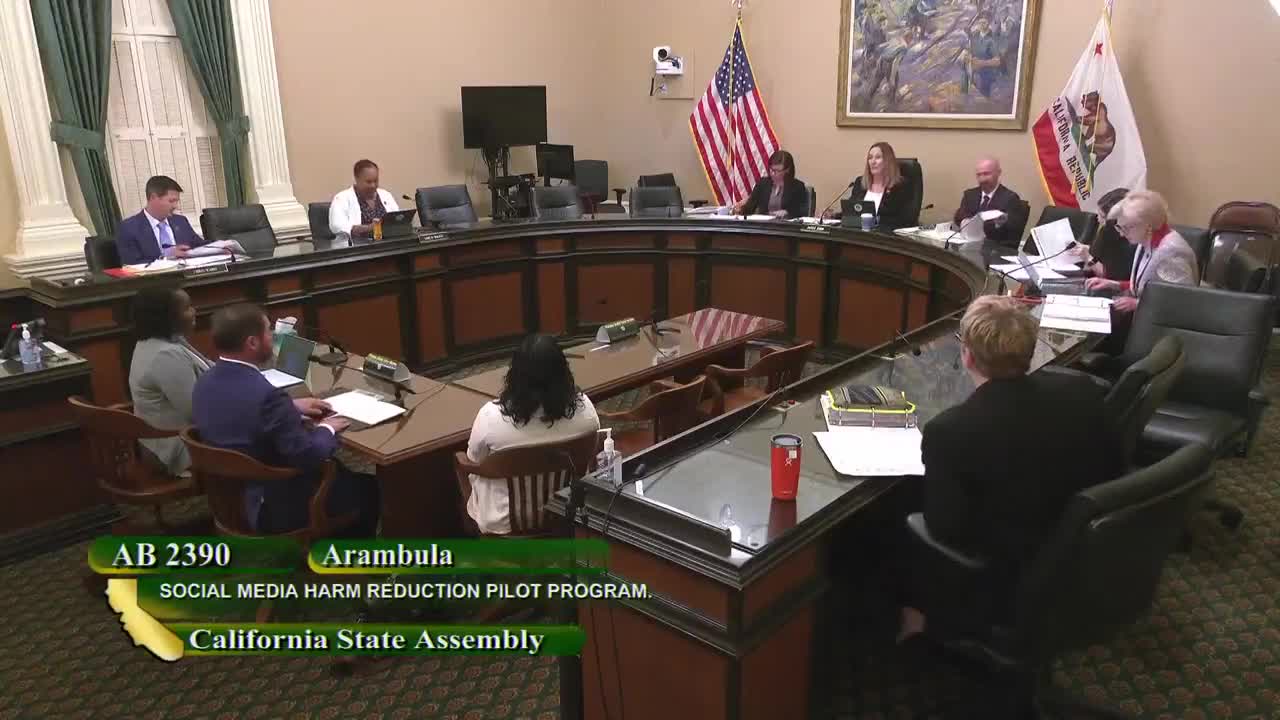 8MIN
Assembly Standing Committee on Privacy and Consumer Protection
 7MIN
Assembly Standing Committee on Health
Bill Author

Bill Co-Author(s):