AB 2683: Public Advocate’s Office: advocating for lower rates.
- Session Year: 2023-2024
- House: Assembly
- Latest Version Date: 2024-04-29
Current Status:
Failed
(2024-05-16: In committee: Held under submission.)
Introduced
In Committee
First Chamber
In Committee
Second Chamber
Enacted
What does this bill do?
This bill broadens the Public Advocates Office’s duty so it must advocate for lower utility rates before the Public Utilities Commission generally, not just in formal general rate cases, while still seeking service that is reliable and safe. It affects the Public Advocates Office, utility customers, and regulated utilities.
The summary is provided by generative AI which can make mistakes. For original language, please view the details in the table below.
Existing law vests the Public Utilities Commission with regulatory authority over public utilities. Existing law establishes within the commission the independent Public Advocates Office to represent and advocate on behalf of the interests of public utility customers and subscribers within the commissions jurisdiction, as provided. Under existing law, the goal of the office is to obtain the lowest possible rate for service consistent with reliable and safe service levels.
This bill would revise and recast the above-described goal to instead require the office to, in every general rate case, to advocate for lower rates before the commission and for service consistent with reliable and safe service levels.
Existing law vests the Public Utilities Commission with regulatory authority over public utilities. Existing law establishes within the commission the independent Public Advocates Office to represent and advocate on behalf of the interests of public utility customers and subscribers within the commissions jurisdiction, as provided. Under existing law, the goal of the office is to obtain the lowest possible rate for service consistent with reliable and safe service levels.
This bill would revise and recast the above-described goal to instead require the office to, in every general rate case, advocate for lower rates before the commission and for service consistent with reliable and safe service levels.
Existing law vests the Public Utilities Commission with regulatory authority over public utilities, as defined. Existing law authorizes the commission to fix the rates and charges for every public utility, and requires that those rates and charges be just and reasonable. Existing law, with certain exceptions, prohibits a public utility from changing any rate, except upon a showing before the commission and a finding by the commission that the new rate is justified.This bill would make nonsubstantive changes to that prohibition.Existing law vests the Public Utilities Commission with regulatory authority over public utilities, as defined. Existing law authorizes the commission to fix the rates and charges for every public utility, and requires that those rates and charges be just and reasonable. Existing law, with certain exceptions, prohibits a public utility from changing any rate, except upon a showing before the commission and a finding by the commission that the new rate is justified.
This bill would make nonsubstantive changes to that prohibition.
(a)There is within the commission an independent Public Advocates Office of the Public Utilities Commission to represent and advocate on behalf of the interests of public utility customers and subscribers within the jurisdiction of the commission. The office shall, in every general rate case, shall advocate for lower rates before the commission and for service consistent with reliable and safe service levels. For revenue allocation and rate design matters, the office shall primarily consider the interests of residential and small commercial customers.
(b)The director of the office shall be appointed by, and serve at the pleasure of, the Governor, subject to confirmation by the Senate.
The director shall annually appear before the appropriate policy committees of the Assembly and the Senate to report on the activities of the office.
(c)The director shall develop a budget for the office that shall be subject to final approval of the Department of Finance. As authorized in the approved budget, the office shall employ personnel and resources, including attorneys and other legal support staff, at a level sufficient to ensure that customer and subscriber interests are effectively represented in all significant proceedings. The office may employ experts necessary to carry out its functions. The director may appoint a lead attorney who shall represent the office, and shall report to and serve at the pleasure of the director. The lead attorney for the office shall obtain adequate legal personnel for the work to be conducted by the office from the commissions attorney appointed pursuant to Section 307. The commissions attorney shall timely and appropriately fulfill all requests for legal personnel made by the lead attorney for the office, if the office has sufficient moneys and positions in its budget for the services requested.
(d)The commission shall develop appropriate procedures to ensure that the existence of the office does not create a conflict of roles for any employee. The procedures shall include, but shall not be limited to, the development of a code of conduct and procedures for ensuring that advocates and their representatives on a particular case or proceeding are not advising decisionmakers on the same case or proceeding.
(e)The office may compel the production or disclosure of any information it deems necessary to perform its duties from any entity regulated by the commission, provided that any objections to any request for information shall be decided in writing by the assigned commissioner or by the president of the commission, if there is no assigned commissioner.
(f)There is hereby created the Public Utilities Commission Public Advocates Office Account in the General Fund. Moneys from the Public Utilities Commission Utilities Reimbursement Account in the General Fund shall be transferred in the annual Budget Act to the Public Utilities Commission Public Advocates Office Account. The funds in the Public Utilities Commission Public Advocates Office Account shall be a budgetary program fund administered and used exclusively by the office in the performance of its duties as determined by the director. The director shall annually submit a staffing report containing a comparison of the staffing levels for each five-year period.
(g)On or before January 10 of each year, the office shall provide to the chairperson of the fiscal committee of each house of the Legislature and to the Joint Legislative Budget Committee all of the following information:
(1)The number of personnel years used during the prior year by the office.
(2)The total dollars expended by the office in the prior year, the estimated total dollars expended in the current year, and the total dollars proposed for appropriation in the following budget year.
(3)Workload standards and measures for the office.
(h)The office shall meet and confer in an informal setting with a regulated entity before issuing a report or pleading to the commission regarding alleged misconduct, or a violation of a law or a commission rule or order, raised by the office in a complaint. The meet and confer process shall be used in good faith to reach agreement on issues raised by the office regarding any regulated entity in the complaint proceeding.
(a)There is within the commission an independent Public Advocates Office of the Public Utilities Commission to represent and advocate on behalf of the interests of public utility customers and subscribers within the jurisdiction of the commission. The goal of the office shall be to obtain the lowest possible rate shall, in every general rate case, advocate for lower rates before the commission and for service consistent with reliable and safe service levels. For revenue allocation and rate design matters, the office shall primarily consider the interests of residential and small commercial customers.
(b)The director of the office shall be appointed by, and serve at the pleasure of, the Governor, subject to confirmation by the Senate.
The director shall annually appear before the appropriate policy committees of the Assembly and the Senate to report on the activities of the office.
(c)The director shall develop a budget for the office that shall be subject to final approval of the Department of Finance. As authorized in the approved budget, the office shall employ personnel and resources, including attorneys and other legal support staff, at a level sufficient to ensure that customer and subscriber interests are effectively represented in all significant proceedings. The office may employ experts necessary to carry out its functions. The director may appoint a lead attorney who shall represent the office, and shall report to and serve at the pleasure of the director. The lead attorney for the office shall obtain adequate legal personnel for the work to be conducted by the office from the commissions attorney appointed pursuant to Section 307. The commissions attorney shall timely and appropriately fulfill all requests for legal personnel made by the lead attorney for the office, provided if the office has sufficient moneys and positions in its budget for the services requested.
(d)The commission shall develop appropriate procedures to ensure that the existence of the office does not create a conflict of roles for any employee. The procedures shall include, but shall not be limited to, the development of a code of conduct and procedures for ensuring that advocates and their representatives on a particular case or proceeding are not advising decisionmakers on the same case or proceeding.
(e)The office may compel the production or disclosure of any information it deems necessary to perform its duties from any entity regulated by the commission, provided that any objections to any request for information shall be decided in writing by the assigned commissioner or by the president of the commission, if there is no assigned commissioner.
(f)There is hereby created the Public Utilities Commission Public Advocates Office Account in the General Fund. Moneys from the Public Utilities Commission Utilities Reimbursement Account in the General Fund shall be transferred in the annual Budget Act to the Public Utilities Commission Public Advocates Office Account. The funds in the Public Utilities Commission Public Advocates Office Account shall be a budgetary program fund administered and utilized used exclusively by the office in the performance of its duties as determined by the director. The director shall annually submit a staffing report containing a comparison of the staffing levels for each five-year period.
(g)On or before January 10 of each year, the office shall provide to the chairperson of the fiscal committee of each house of the Legislature and to the Joint Legislative Budget Committee all of the following information:
(1)The number of personnel years utilized used during the prior year by the office.
(2)The total dollars expended by the office in the prior year, the estimated total dollars expended in the current year, and the total dollars proposed for appropriation in the following budget year.
(3)Workload standards and measures for the office.
(h)The office shall meet and confer in an informal setting with a regulated entity prior to before issuing a report or pleading to the commission regarding alleged misconduct, or a violation of a law or a commission rule or order, raised by the office in a complaint. The meet and confer process shall be utilized used in good faith to reach agreement on issues raised by the office regarding any regulated entity in the complaint proceeding.
SECTION 1.Section 454 of the Public Utilities Code is amended to read:454.(a)Except as provided in Section 455, a public utility shall not change any rate or alter any classification, contract, practice, or rule to result in any new rate, except upon a showing before the commission and a finding by the commission that the new rate is justified. Whenever any electrical, gas, heat, telephone, water, or sewer system corporation files an application to change any rate, other than a change reflecting and passing through to customers only new costs to the corporation that do not result in changes in revenue allocation, for the services or commodities furnished by it, the corporation shall furnish to its customers affected by the proposed rate change notice of its application to the commission for approval of the new rate. This notice requirement does not apply to any rate change proposed by a corporation pursuant to an advice letter submitted to the commission in accordance with commission procedures for this means of submission. The procedures for advice letters may include provision for notice to customers or subscribers on a case-by-case basis, as determined by the commission. The corporation may include the notice with the regular bill for charges transmitted to the customers within 45 days if the corporation operates on a 30-day billing cycle, or within 75 days if the corporation operates on a 60-day billing cycle. If more than one application to change any rate is filed within a single billing cycle, the corporation may combine the notices into a single notice if the applications are separately identified. The notice shall state the amount of the proposed rate change expressed in both dollar and percentage terms for the entire rate change and for each customer classification, a brief statement of the reasons the change is required or sought, and the mailing, and if available, the email address of the commission to which any customer inquiries may be directed regarding how to participate in, or receive further notices regarding the date, time, or place of, any hearing on the application, and the mailing address of the corporation to which any customer inquiries relative to the proposed rate change may be directed.(b)For a water corporation with more than 2,000 service connections, the notice required in subdivision (a) shall include estimated rate impacts on the various customer classes of the corporation. The commission may require the corporation to inform customers in a separate letter or through a bill insert, at the corporations discretion, of the outcome of the general rate case, within 60 days if the corporation operates on a 30-day billing cycle, or within 90 days if the corporation operates on a 60-day billing cycle, of the commissions final decision, including the approved rates and the approved capital projects that will subsequently be executed by way of an advice letter.(c)The commission may adopt rules it considers reasonable and proper for each class of public utility providing for the nature of the showing required to be made in support of proposed rate changes, the form and manner of the presentation of the showing, with or without a hearing, and the procedure to be followed in the consideration thereof. Rules applicable to common carriers may provide for the publication and filing of any proposed rate change together with a written showing in support thereof, giving notice of the filing and showing in support thereof to the public, granting an opportunity for protests thereto, and to the consideration of, and action on, the showing and any protests filed thereto by the commission, with or without hearing. However, the proposed rate change does not become effective until it has been approved by the commission.(d)The commission shall permit individual public utility customers and subscribers affected by a proposed rate change, and organizations formed to represent their interests, to testify at any hearing on the proposed rate change, except that the presiding officer need not allow repetitive or irrelevant testimony and may conduct the hearing in an efficient manner.(a)Except as provided in Section 455, a public utility shall not change any rate or so alter any classification, contract, practice, or rule as to result in any new rate, except upon a showing before the commission and a finding by the commission that the new rate is justified. Whenever any electrical, gas, heat, telephone, water, or sewer system corporation files an application to change any rate, other than a change reflecting and passing through to customers only new costs to the corporation which that do not result in changes in revenue allocation, for the services or commodities furnished by it, the corporation shall furnish to its customers affected by the proposed rate change notice of its application to the commission for approval of the new rate. This notice requirement does not apply to any rate change proposed by a corporation pursuant to an advice letter submitted to the commission in accordance with commission procedures for this means of submission. The procedures for advice letters may include provision for notice to customers or subscribers on a case-by-case basis, as determined by the commission. The corporation may include the notice with the regular bill for charges transmitted to the customers within 45 days if the corporation operates on a 30-day billing cycle, or within 75 days if the corporation operates on a 60-day billing cycle. If more than one application to change any rate is filed within a single billing cycle, the corporation may combine the notices into a single notice if the applications are separately identified. The notice shall state the amount of the proposed rate change expressed in both dollar and percentage terms for the entire rate change as well as and for each customer classification, a brief statement of the reasons the change is required or sought, and the mailing, and if available, the email address of the commission to which any customer inquiries may be directed regarding how to participate in, or receive further notices regarding the date, time, or place of, any hearing on the application, and the mailing address of the corporation to which any customer inquiries relative to the proposed rate change may be directed.
(b)For a water corporation with more than 2,000 service connections, the notice required in subdivision (a) shall include estimated rate impacts on the various customer classes of the corporation. The commission may require the corporation to inform customers in a separate letter or through a bill insert, at the corporations discretion, of the outcome of the general rate case, within 60 days if the corporation operates on a 30-day billing cycle, or within 90 days if the corporation operates on a 60-day billing cycle, of the commissions final decision, including the approved rates and the approved capital projects that will subsequently be executed by way of an advice letter.
(c)The commission may adopt rules it considers reasonable and proper for each class of public utility providing for the nature of the showing required to be made in support of proposed rate changes, the form and manner of the presentation of the showing, with or without a hearing, and the procedure to be followed in the consideration thereof. Rules applicable to common carriers may provide for the publication and filing of any proposed rate change together with a written showing in support thereof, giving notice of the filing and showing in support thereof to the public, granting an opportunity for protests thereto, and to the consideration of, and action on, the showing and any protests filed thereto by the commission, with or without hearing. However, the proposed rate change does not become effective until it has been approved by the commission.
(d)The commission shall permit individual public utility customers and subscribers affected by a proposed rate change, and organizations formed to represent their interests, to testify at any hearing on the proposed rate change, except that the presiding officer need not allow repetitive or irrelevant testimony and may conduct the hearing in an efficient manner.
|
Date
|
Status
|
|---|---|
| May 16, 2024 | In committee: Held under submission. |
| May 16, 2024 | Joint Rule 62(a), file notice suspended. (Page 5215.) |
| May 15, 2024 | In committee: Set, first hearing. Referred to APPR. suspense file. |
| Apr 30, 2024 | Re-referred to Com. on APPR. |
| Apr 29, 2024 | Read second time and amended. |
| Apr 25, 2024 | From committee: Amend, and do pass as amended and re-refer to Com. on APPR. (Ayes 15. Noes 0.) (April 24). |
| Apr 1, 2024 | Re-referred to Com. on U. & E. |
| Mar 21, 2024 | From committee chair, with author's amendments: Amend, and re-refer to Com. on U. & E. Read second time and amended. |
| Mar 21, 2024 | Referred to Com. on U. & E. |
| Feb 15, 2024 | From printer. May be heard in committee March 16. |
| Feb 14, 2024 | Read first time. To print. |
|
Date
|
Description
|
Location
|
Votes
|
|
|---|---|---|---|---|
| Apr 24, 2024 | Do pass as amended and be re-referred to the Committee on [Appropriations] | Assembly Standing Committee on Utilities and Energy |
Passed |
This list shows positions taken on this bill by organizations on the date displayed, which is linked to the original source.
Positions by individuals are not included.
|
Organization
|
Position
|
Date
|
|---|---|---|
| California Communications Association | * Support | Apr 24, 2024 |
| California Water Association | ** Against | |
| Varcomm | ** Support |
Date of Hearing: May 15, 2024
ASSEMBLY COMMITTEE ON APPROPRIATIONS
Buffy Wicks, Chair
ABPCA Bill Id:AB 2683
Author:(Boerner) – As Amended Ver:April 29, 2024
Policy Committee: | Utilities and Energy | Vote: | 15 - 0 |
|
| ||
|
|
Urgency: No State Mandated Local Program: No Reimbursable: No
SUMMARY:
This bill revises and constrains the basic duties of the Public Advocate’s Office (PAO) of the California Public Utilities Commission (CPUC).
Specifically, current law says:
The goal of the office shall be to obtain the lowest possible rate for service consistent with reliable and safe service levels.
This bill makes two significant changes to this statute. First, it removes reference to a “goal” and, instead, asserts “the office shall advocate for lower rates.” Second, and unlike existing law, the bill limits the venue of the office’s advocacy to being “before the commission.”
FISCAL EFFECT:
Unknown. It is possible this bill, by limiting the PAO’s activity to proceedings before the CPUC, will reduce expenditures by the PAO. This is because, arguably, the bill prevents the PAO from advocating in other venues before which it regularly advocates under current law, such as before the Legislature and California Independent System Operator (CAISO).
The effect this bill will have rates—and on the government of the State of California—is unknown. PAO’s effective advocacy, if employed consistent with this bill, would push rates ever lower. However, there is a point, in theory, at least, when rates are just and reasonable and cannot be lower without jeopardizing utility operations, viability or general safety. Presumably, the CPUC would disregard the PAO’s advocacy for ever lower rates, because approving such rates would be contrary to the CPUC’s statutory charge of providing for rates that are just and reasonable.
What’s more, the bill conflicts with existing provisions of statute that the bill leaves unchanged. Specifically, while the bill amends one provision of code to limit the PAO’s activity to only proceedings before the CPUC, another extant provision of code directs the PAO to employ personnel and resources at a level sufficient to ensure that customer and subscriber interests are effectively represented “in all significant proceedings,” not just proceedings before the CPUC. Presumably—the restrictions of this bill notwithstanding—the PAO would continue to advocate before the CAISO and other decision-making bodies. It is not unreasonable to assume a party or parties would challenge the PAO’s authority to advocate before such a body. The predictable result would be legal costs of an unknown, but presumably significant amount, in excess of $150,000.
COMMENTS:
The State Constitution and statute charge the CPUC with regulating the rates of public utilities and certain other entities. No entity subject to CPUC rate regulation may increase the rates it charges its customers unless the CPUC finds the rate increase is justified.
The entities subject to CPUC rate regulation are, generally, large, well-resourced organizations that engage sophisticated professionals to regularly advocate on their behalves before the CPUC. In contrast, many of these regulated entities’ customers—small businesses and residential customers, in particular—often lack the time, knowledge, organization and other resources to effectively advocate for themselves before the CPUC.
In 1996, the Legislature created in statute a division of ratepayer advocate within the CPUC. Statute directed the division of ratepayer advocate to “obtain the lowest possible rate for service consistent with reliable and safe service levels” and directed the CPUC to assign personnel and resources to the division sufficient to “ensure that customer and subscriber interests are fairly represented in all significant proceedings.”
Over the years, the Legislature has refined the advocate’s role and sought to increase its independence from the CPUC. At one point, statute changed the advocate from a division within the CPUC to an office, known as the Office of Ratepayer Advocate (ORA). Statute also attempted to wall off the ORA budget from the CPUC and dedicated resources exclusively to ORA in the performance of its duties, as determined by the director.
Today, statute designates the ratepayer advocate as the “independent” Public Advocate’s Office of the CPUC. The advocate is also known as Cal Advocates. Statute continues to charge the advocate with working to obtain the lowest possible rate for service consistent with reliable and safe service levels and calls upon the advocate to primarily consider the interests of residential and small commercial customers.
Since its inception, the advocate has been led by a director, appointed by, and serving at the pleasure of, the Governor, subject to confirmation by the Senate. Thus, the Governor appoints both the commissioners of the CPUC and the director of the office charged with advocating before the CPUC on behalf of ratepayers.
In August of 2023, the State Auditor release a report that found San Diego Gas and Electric’s (SDG&E) actual rate of return was higher than its authorized rate of return “in nine of the last 10 years, raising questions about the accuracy of SDG&E’s forecasted costs.” The report generally recommended the CPUC and the PAO need to strengthen their processes to better protect customers.
According to the author:
Cal Advocates need to do more to protect consumers. Californians are paying some of the highest rates in the country and show no signs of slowing down. Cal Advocates needs to be empowered to advocate for lower customer rates for Californians to ensure that it is doing the most it can to protect hardworking Californians.
Analysis Prepared by: Jay Dickenson / APPR. / (916) 319-2081
Date of Hearing: April 24, 2024
ASSEMBLY COMMITTEE ON UTILITIES AND ENERGY
Cottie Petrie-Norris, Chair
ABPCA Bill Id:AB 2683 (
Author:Boerner) – As Amended Ver:March 21, 2024
SUBJECT: Public Advocate’s Office: general rate cases: advocating for lower rates
SUMMARY: Requires the Public Advocate’s Office (PAO) to advocate for lower rates in every general rate case (GRC) before the California Public Utilities Commission (CPUC).
EXISTING LAW: Establishes the independent PAO within the CPUC to represent and advocate on behalf of the interests of public utility customers and subscribers for the lowest possible rate and for service consistent with reliable and safe service levels. (Public Utilities Code § 309.5)
FISCAL EFFECT: Unknown. This bill is keyed fiscal and will be referred to the Committee on Appropriations for its review.
BACKGROUND:
General Rate Cases (GRCs) – The CPUC reviews and approves investor-owned utility (IOU) costs and revenues through a variety of public processes. The most notable are the GRC proceedings, which are used to address the costs of operating and maintaining the utility system and the allocation of those costs among customer classes. The CPUC evaluates detailed cost data from both past expenses and utility forecasts of likely future costs, and establishes how much money the utilities are allowed to collect for the first year – called a test year. The GRC decision then prescribes how to adjust the test year budget for inflation and other factors that may affect costs, such as additional capital projects, for the following 3 years, summing to a total of 4 years that each GRC cycle encompasses.
PAO – In 1996, the Legislature passed SB 960 (Leonard, Chapter 856, Statutes of 1996), which created the Public Advocate’s Office (PAO) to advocate on behalf of public utility customers at the CPUC. The PAO’s goal is to obtain the lowest possible rate for service consistent with reliable and safe service levels. For revenue allocation and rate design matters, the office primarily considers the interests of residential and small commercial customers. Though housed in the CPUC, the PAO independently conducts its own evaluations of utility applications, performs its own modelling, and develops its own recommendations and proposals. In 2023, the PAO advocated in 235 proceedings and filed 816 pleadings at the CPUC on behalf of ratepayers.[1]
A recent showcase of the PAO’s efforts is with Pacific Gas & Electric’s (PG&E) latest GRC proceeding. PG&E requested to increase its average annual spending to $16.6 billion by 2026. After review of PG&E’s proposal, the PAO recommended cost reductions, mostly around alternative wildfire mitigation measures, that would cost PG&E ratepayers $3 billion less in annual spending than the PG&E proposal. The CPUC’s final decision fell between these two proposals at $14.3 billion annually for 2023 through 2026.
Rising utility bills – Since 2013, rates have increased across all three investor-owned utilities (IOUs) and exceeded the assumed rate of inflation.[2] Californians currently pay some of the highest utility rates in the country. In March 2023, California had the seventh highest average electricity rates and the tenth highest average residential natural gas prices of any of the states.[3] According to an analysis by the Public Advocate’s Office (PAO), the primary drivers for these electric rate increases, which are visualized in Figure 1, arise from wildfire mitigation work, transmission and distribution investments, and rooftop solar incentives.[4] A recent report by the State Auditor had similar findings to PAO on the causes for increasing electricity rates.3 Wildfire costs, including insurance, was noted as a key factor in increased utility expenses. Decreasing electricity sales due to solar system adoption was noted to have led to IOUs raising rates to recover fixed costs. Further, the audit found increases in IOU operating costs, which may be inclusive of these other categories, as contributing to increased rates; specifically distribution costs for PG&E, administrative costs for Southern California Edison (SCE), and higher property and non-income taxes for San Diego Gas and Electric (SDG&E). In an analysis by the CPUC, increases in natural gas rates in recent years, as seen in Figure 2, were primarily driven by increased commodity prices, which felt upward pressure from gas market conditions, colder winter weather, and gas pipeline infrastructure and storage issues.[5] Due to a mild 2023 winter, natural gas rates have come back down.2 The State Auditor’s report had similar findings to the CPUC on the causes for increasing natural gas rates.3
Figure 1. California IOU electric rates over the Figure 2. California IOU natural gas rates over
recent years2 the recent years2
While the current high electric bills experienced by California customers raise concern, the projection of future rate impacts is even more troubling. Spurred by the climate goals the state has set, the rapid growth in consumer demand of electricity and the transition to clean energy resources necessitates updating and expanding our distribution and transmission systems. According to a May 2023 study by Kevala, Inc. released by the CPUC, “up to $50 billion…in investments are needed by 2035” for distribution grid upgrades.[6] In their 20-Year Outlook, the California Independent System Operator (CAISO) – which operates and plans the majority of high-voltage transmission in the state – estimated total costs arising from needed upgrades and new build of the high-voltage bulk transmission system would be roughly $30 billion dollars by 2045.[7] These costs will be borne by ratepayers. By 2030, bundled residential rates are forecasted by the CPUC to be much higher than they would have been if 2020 rates had grown at the rate of inflation.[8] These forecasts largely attribute this increase to capital expenditures (infrastructure build) and wildfire mitigation. However, these forecasts rely on fairly conservative assumptions about utility expenditures that could underestimate the actual rate increases expected in the future.
COMMENTS:
- Author’s statement. According to the author, “Cal Advocates need to do more to protect consumers. Californians are paying some of the highest rates in the country and show no signs of slowing down. Cal Advocates needs to be empowered to advocate for lower customer rates for Californians to ensure that it is doing the most it can to protect hardworking Californians.”
- Easing the clean energy transition for ratepayers. Electric costs may be likened to an inflated balloon: one can squeeze one side of it to make it smaller, but the result will be expansion in another area. California’s electricity sector, the backbone of its economy and the enabling infrastructure for its response to climate change, is in a period of transition. As noted above, the costs of the transition are already projected to reach into the tens of billions of dollars in this decade. Add to those costs ongoing grid hardening and mitigation work underway, and the cost projections soar higher. As such, it will be necessary to develop policies that ease the transition for customers, particularly for the most vulnerable, to ensure we meet our goals as affordably as possible. Recent efforts both in the Legislature and at the CPUC, including the PAO, have sought more holistic reforms to electric affordability: reforms that either help spread out costs more efficiently, equitably, or over a longer horizon (redistribution); or reforms that lower costs altogether (reduction). Some proposals for redistribution include income-graduated fixed charges, dynamic rates, alternative financing, and reforms to the Net Energy Metering tariffs. Opportunities for reduction might involve alternative sources of funding outside of electric rates and systematic examination of the cost-effectiveness and impacts of existing programs and expenditures; these opportunities would largely require legislative action to implement.
- Are they doing their job? The State Auditor found that the PAO advocated for lower rates than that requested in every electric and gas IOU GRC that they analyzed.3 However, supporters of this bill note that the PAO has, in the case of small rural telephone companies regulated by the CPUC, consistently proposed rates higher than that requested by those utilities since 2015; in the most recent GRC, the PAO recommended $27.50, counter to Sierra Telephone Company’s, Siskiyou Telephone Company’s, and Volcano Telephony Company’s proposed rate of $25.00.[9] Thirteen small rural telephone companies in California are eligible to draw revenue from the California High Cost Fund-A (CHCF-A) Program,[10] a fund supported by an all-end-user surcharge collected by telecommunications companies statewide and aimed towards providing affordable, reliable, and high-quality communications services in rural areas of the state.[11] Increased funding from the CHCF-A program to the telephone companies reduces the cost to those ratepayers. The PAO informed this committee that their advocacy to lower the share of CHCF-A funding is consistent with the required statutory standard for the CHCF-A program, which is to help reach a rate that is reasonably comparable to those paid by customers of urban telephone companies but still sufficient to deliver safe, reliable, and high-quality service.[12] A Federal Communications Commission survey reported that the average monthly rate for urban residents in 2023 was $36.73.[13]
- Can they be doing more? This bill proposes to amend statute from requiring the PAO to “obtain the lowest possible rate” to “advocate for lower rates.” In conversations with the committee, the author has clarified hopes for the PAO to advocate for the reduction of customers’ utility bills. To inform their advocacy, the PAO examines utility operations and estimated utility costs, reviews utility accounts, develops forecasts and analyses of future customer rates, analyzes utility risk assessments, and conducts complex energy and geographic information system modelling to arrive at their proposed rate. Thus, asking for the PAO to defend a rate proposal prescribed with a cap by the Legislature but not supported by their math and modelling may be disingenuous and may diminish the strength of their justification. Adjusting their output might first require adjusting the inputs and assumptions, such as state programs and mandates, that are fed into their analyses. As mentioned above, meeting California’s climate goals will be a lofty and costly task, and many opportunities for reduction would likely require legislative action to implement. Additionally, as noted by California Water Association writing in Opposed Unless Amended, lower rates do not equate to better utility service. A balance must be struck between reliable, safe service and affordability. The existing statutory direction to PAO – to obtain the lowest possible rate – recognizes this necessary balance.
This bill would also require the PAO to advocate in every GRC before the CPUC. The PAO does not currently advocate in every GRC – though they were a party in every GRC the State Auditor reviewed – presumably due to staff and budget constraints. However, they also participate in other proceedings at the CPUC, such as Broadband Infrastructure Deployment proceedings, Energy Resource Recovery Account proceedings, and proceedings on processes to accelerate transmission project development. To provide the PAO leverage in deciding how to best direct their resources and when is appropriate to advocate for lower rates than those proposed by a utility company, the committee recommends striking the requirement for the PAO to advocate as prescribed in every GRC.
- Related legislation.
AB 3247 (Irwin) would require the director of the PAO to be appointed for 4-year terms, with appointment authority alternating between the Speaker of the Assembly, who will make the first four-year appointment, and the President pro Tempore of the Senate, and states the director shall serve at the pleasure of the appointing authority. Status: Assembly Floor – Consent.
REGISTERED SUPPORT / OPPOSITION:
Support
Calcom Association
Varcomm
Oppose Unless Amended
California Water Association
Analysis Prepared by: Kathleen Chen / U. & E. / (916) 319-2083
PAO; 2023 Annual Report. ↑
CPUC; “Utility Costs and Affordability of the Grid of the Future: An Evaluation of Electric Costs, Rates, and Equity Issues Pursuant to P.U. Code Section 913.1”; May 2021. ↑
State Auditor; “Electricity and Natural Gas Rates: The California Public Utilities Commission and Cal Advocates Can Better Ensure That Rate Increases are Necessary”; August 2023. ↑
PAO; “Q4 2023 Electric Rates Report”; https://www.publicadvocates.cpuc.ca.gov/-/media/cal-advocates-website/files/press-room/reports-and-analyses/240119-caladvocates-q4-2023-quarterly-rate-report.pdf; January 2024. ↑
CPUC; “2022 California Electric and Gas Utility Costs Report: AB 67 Annual Report to the Governor and Legislature”; April 2023. ↑
Kevala; “Electrication Impacts Study Part 1: Bottom-Up Load Forecasting and System-Level Electrification Impacts Cost Estimates”; May 2023. ↑
Approximating $11 billion for upgrades; $8 billion for offshore wind integration; and $11 billion for out-of-state wind integration. CAISO, 20-Year Transmission Outlook; January 2022. ↑
Approximately 12% higher for PG&E, 10% for SCE, and 20% for SDG&E. CPUC; “Utility Costs and Affordability of the Grid of the Future: An Evaluation of Electric Costs, Rates, and Equity Issues Pursuant to P.U. Code Section 913.1”; May 2021. ↑
Per data request from the PAO on April 19th, 2024. The CPUC approved residential rates of $26.50, $26.00*, and $27.50 for Sierra, Siskiyou, and Volcano, respectively. *PAO reached a settlement with Siskiyou which agreed to offer a low-income broadband plan. ↑
Only 10 of these 13 small independent telephone companies participate in and receive subsidies from the CHCF-A program. ↑
CPUC; “California High Cost Fund-A”; https://www.cpuc.ca.gov/industries-and-topics/internet-and-phone/california-high-cost-fund-a. ↑
Public Utilities Code § 275.6(c) ↑
DA 22-1338, FCC; “Wireline Competition Bureau and Office of Economics and Analytics Announce Results of 2023 Urban Rate Survey for Fixed Explanatory Notes, and Required Minimum Usage Allowance for Eligible Telecommunications Carriers”; December 2022. ↑
Discussed in Hearing
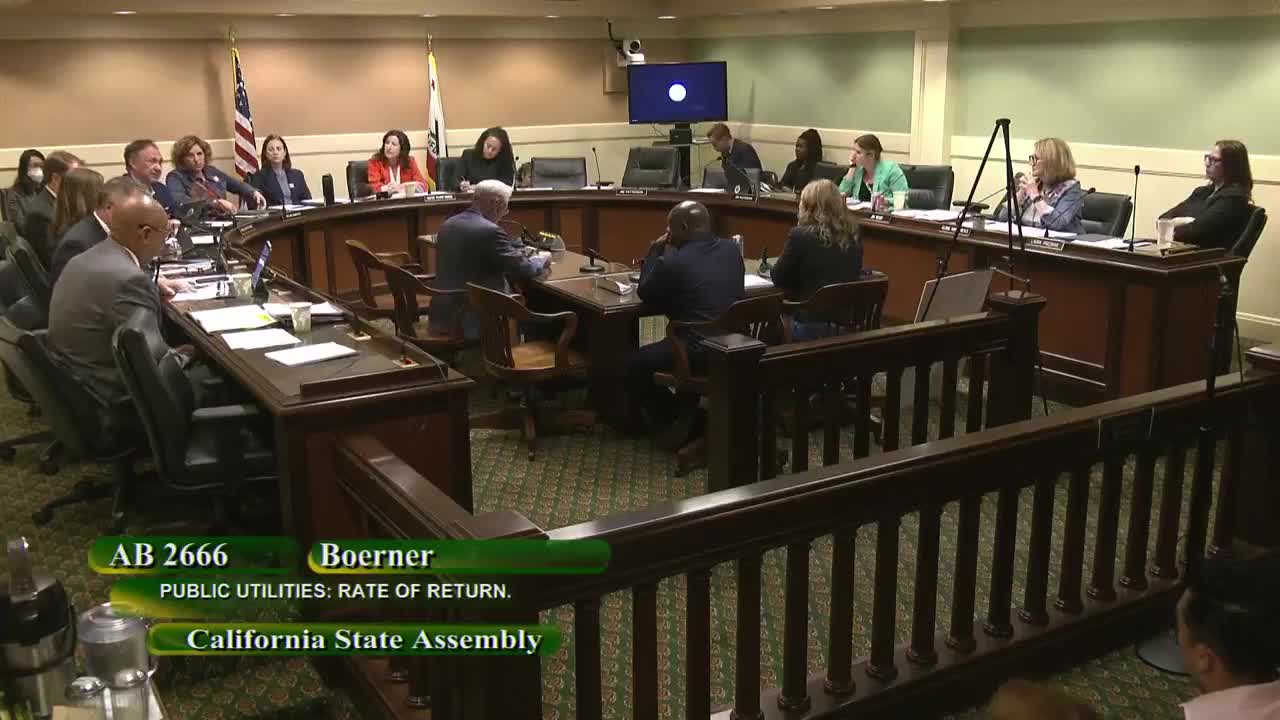 8MIN
Assembly Standing Committee on Utilities and Energy
Bill Author

Bill Co-Author(s):
