AB 3207: The Secure Seniors Protection Act.
- Session Year: 2023-2024
- House: Assembly
- Latest Version Date: 2024-04-25
Current Status:
Failed
(2024-05-16: In committee: Held under submission.)
Introduced
In Committee
First Chamber
In Committee
Second Chamber
Enacted
Existing law, the Mello-Granlund Older Californians Act, establishes the California Department of Aging in the California Health and Human Services Agency and sets forth its mission to provide leadership to the area agencies on aging in developing systems of home- and community-based services that maintain individuals in their own homes or least restrictive homelike environments.
Existing law establishes the State Department of Social Services in the California Health and Human Services Agency. Existing law designates the department as the single state agency with full power to supervise every phase of the administration of public social services, except health care services and medical assistance, as specified.
This bill, the Secure Seniors Online Protection Act, would require the State Department of Social Services to, subject to an appropriation, on or before January 1, 2026, establish and administer a 24 hours per day, 7 days per week, toll-free hotline to assist all Californians in dealing with online scams, as provided. The bill would require the State Department of Social Services to ensure that the program and its staff are equipped to meet the needs of individuals who are 60 years of age and older. The bill would require, on or before January 31, 2027, and annually thereafter, the State Department of Social Services to submit a report to the Legislature and the relevant policy committees containing, among other things, the number of seniors served, the types of problems the program assisted seniors with, and recommendations for improving the program.
The Legislature finds and declares all of the following:
(a)Elderly individuals face a growing risk of becoming a victim of online fraud and theft.
(b)The rise of digital technologies and an increased internet use has exposed seniors to financial scams that have led to substantial losses and harm to their overall well-being.
(c)In 2021, the Federal Bureau of Investigation reported that scams targeting older adults resulted in losses of $1.7 billion.
(d)The United States Senate Special Committee on Aging has concluded that the top scams since 2015 have targeted seniors.
(e)In 2020, the Federal Trade Commissions Consumer Protection Data Spotlight reported that romance scams hit a record high. These scams not only cause monetary problems for seniors, but they also affect them emotionally and mentally.
(f)According to a Comparitech report, there was a 47 percent 47-percent increase in fraud and identity theft reports in 2020, with seniors losing over $3 billion.
(g)California is the state most affected by these scams, with over 12,000 victims 60 years of age and older.
SEC. 2.Chapter 15 (commencing with Section 9900) is added to Division 8.5 of the Welfare and Institutions Code, to read:15.The Secure Seniors Online Protection Act9900.This act shall be known, and may be cited, as the Secure Seniors Online Protection Act.
9901.(a)(1)On or before January 1, 2026, the State Department of Social Services shall establish and administer, a toll-free telephone hotline number to assist all Californians in dealing with online scams.
(2)While the State Department of Social Services shall make this program available to all Californians, the department shall ensure that the program and its staff are equipped to meet the needs of individuals who are 60 years of age and older.
(b)The hotline shall be available 24 hours per day, seven days per week during standard business hours via a toll-free telephone hotline number.
(1)Hotline workers shall be available to respond to all callers.
(2)Hotline services shall be available in English and Spanish.
(3)Hotline workers shall provide callers with information and assistance, as necessary, to address harms resulting from the scam. Where appropriate, hotline workers shall direct callers to the appropriate government authority for review and possible investigation.
(4)Hotline workers shall hold in confidence information disclosed by a caller and may disclose such information only with the informed, written consent of the caller.
9902.For purposes of implementing this chapter, the State Department of Social Services may enter into exclusive or nonexclusive contracts, or amend existing contracts, on a bid or negotiated basis, and may implement changes to existing information technology systems.
9903.(a)On or before January 31, 2027, and annually thereafter, the State Department of Social Services shall submit a report to the Legislature and the relevant policy committees that includes, but is not limited to, all of the following:
(1)The total number of individuals served.
(2)The number of seniors served.
(3)The types of problems that individuals requested help with.
(4)The types of problems that seniors requested help with.
(5)The outcomes for individuals served, if known.
(6)Recommendations to the Legislature on how to improve this program.
(b)The report required by this section shall be submitted in accordance with Section 9795 of the Government Code.
9904.This chapter shall become operative only upon an appropriation by the Legislature.
The Legislature finds and declares all of the following:
(a)Elderly individuals face a growing risk of becoming a victim of online fraud and theft.
(b)The rise of digital technologies and an increased internet use has exposed seniors to financial scams that have led to substantial losses and harm to their overall well-being.
(c)In 2021, the Federal Bureau of Investigation reported that scams targeting older adults resulted in losses of $1.7 billion.
(d)The United States Senate Special Committee on Aging has concluded that the top scams since 2015 have targeted seniors.
(e)In 2020, the Federal Trade Commissions Consumer Protection Data Spotlight reported that romance scams hit a record high. These scams not only cause monetary problems for seniors, but they also affect them emotionally and mentally.
(f)According to a Comparitech report, there was a 47 percent increase in fraud and identity theft reports in 2020, with seniors losing over $3 billion.
(g)California is the state most affected by these scams, with over 12,000 victims 60 years of age and older.
SEC. 2.Chapter 15 (commencing with Section 9900) is added to Division 8.5 of the Welfare and Institutions Code, to read:15.The Secure Seniors Online Protection Act9900.This act shall be known, and may be cited, as the Secure Seniors Online Protection Act.
9901.(a)(1)On or before January 1, 2026, the State Department of Social Services shall establish and administer, a toll-free telephone hotline number to assist all Californians in dealing with online scams.
(2)While the State Department of Social Services shall make this program available to all Californians, the department shall ensure that the program and its staff are equipped to meet the needs of individuals who are 60 years of age and older.
(b)The hotline shall be available 24 hours per day, seven days per week via a toll-free telephone hotline number.
9902.For purposes of implementing this chapter, the State Department of Social Services may enter into exclusive or nonexclusive contracts, or amend existing contracts, on a bid or negotiated basis, and may implement changes to existing information technology systems.
9903.(a)On or before January 31, 2027, and annually thereafter, the State Department of Social Services shall submit a report to the Legislature and the relevant policy committees that includes, but is not limited to, all of the following:
(1)The total number of individuals served.
(2)The number of seniors served.
(3)The types of problems that individuals requested help with.
(4)The types of problems that seniors requested help with.
(5)The outcomes for individuals served, if known.
(6)Recommendations to the Legislature on how to improve this program.
(b)The report required by this section shall be submitted in accordance with Section 9795 of the Government Code.
9904.This chapter shall become operative only upon an appropriation by the Legislature.
|
Date
|
Status
|
|---|---|
| May 16, 2024 | In committee: Held under submission. |
| May 8, 2024 | In committee: Set, first hearing. Referred to APPR. suspense file. |
| Apr 29, 2024 | Re-referred to Com. on APPR. |
| Apr 25, 2024 | Read second time and amended. |
| Apr 24, 2024 | From committee: Amend, and do pass as amended and re-refer to Com. on APPR. with recommendation: To Consent Calendar. (Ayes 11. Noes 0.) (April 23). |
| Apr 17, 2024 | From committee: Do pass and re-refer to Com. on P. & C.P. (Ayes 5. Noes 0.) (April 16). Re-referred to Com. on P. & C.P. |
| Mar 11, 2024 | Referred to Coms. on AGING & L.T.C. and P. & C.P. |
| Feb 17, 2024 | From printer. May be heard in committee March 18. |
| Feb 16, 2024 | Read first time. To print. |
|
Date
|
Description
|
Location
|
Votes
|
|
|---|---|---|---|---|
| Apr 23, 2024 | Do pass as amended, and be re-referred to the Committee on [Appropriations] with recommendation: To Consent Calendar | Assembly Standing Committee on Privacy and Consumer Protection |
Passed |
|
| Apr 16, 2024 | Do pass and be re-referred to the Committee on [Privacy and Consumer Protection] | Assembly Standing Committee on Aging and Long-Term Care |
Passed |
This list shows positions taken on this bill by organizations on the date displayed, which is linked to the original source.
Positions by individuals are not included.
|
Organization
|
Position
|
Date
|
|---|---|---|
| AARP | ** Support | |
| California Credit Union League | ** Support | |
| California Highway Patrol | * Support | Apr 16, 2024 |
| LeadingAge California | ** Support | |
| None | * Support | Apr 16, 2024 |
| Oak Ridge High School | * Support | Apr 16, 2024 |
Date of Hearing: May 8, 2024
ASSEMBLY COMMITTEE ON APPROPRIATIONS
Buffy Wicks, Chair
ABPCA Bill Id:AB 3207
Author:(Joe Patterson) – As Amended Ver:April 25, 2024
Policy Committee: | Aging and Long Term Care | Vote: | 5 - 0 |
Privacy and Consumer Protection | 11 - 0 | ||
|
|
Urgency: No State Mandated Local Program: No Reimbursable: No
SUMMARY:
This bill requires, by January 1, 2026, the California Department of Social Services (CDSS) to establish and administer a toll-free hotline to assist all Californians, particularly seniors, in identifying and addressing scams.
Specifically, this bill:
- Creates, upon an appropriation by the Legislature, the Secure Seniors Protection Act and requires CDSS, by January 1, 2026, to establish and administer a toll-free hotline to assist all Californians in dealing with scams.
- Requires CDSS to ensure the program and its staff are equipped to meet the needs of individuals who are 60 years of age and older.
- Requires the hotline be available during standard business hours via a toll-free hotline number. Hotline workers must be available to respond to all callers and services must be available in English and Spanish.
- Requires hotline workers to provide callers with information and assistance to address harms resulting from a scam and to direct callers to government authorities where appropriate.
- Requires hotline workers to keep information disclosed by a caller confidential, as specified.
- Authorizes CDSS to enter into contracts, or amend existing contracts, and to implement changes to existing information technology systems, for purposes of these provisions.
- Requires CDSS, by January 1, 2027, and annually thereafter, to submit a report to the Legislature and relevant policy committees that details the number of individuals and seniors served; the types of problems for which they requested help; the outcomes, if known; and any recommendations to improve the program.
FISCAL EFFECT:
CDSS estimates ongoing General Fund costs in the hundreds of millions of dollars annually for infrastructure and staff to establish and administer the hotline.
According to the Legislative Analyst’s Office, the General Fund faces a structural deficit in the tens of billions of dollars over the next several fiscal years.
COMMENTS:
- Purpose. According to the author:
Senior citizens are targeted by online scammers at an increasing rate. Unfortunately, these seniors are being exploited by criminals through online fraud and scams. Many of these individuals never formally file a report due to shame and embarrassment. By establishing a hotline dedicated to preventing senior citizen fraud, we can assist these valuable members of society by providing a helpful resource for them to utilize when confronted with a potential fraud or scam.
- Background. The Federal Bureau of Investigation’s (FBI) Internet Crime Complaint Center (IC3) is a central intake point for victims to report fraud. In 2022, total losses reported to the IC3 by elderly victims increased 84% from 2021. Tech and Customer Support schemes continued to be the most common type of fraud reported, with 17,800 complaints filed by victims over the age of 60. Monetary losses due to investment fraud reported by victims over the age of 60 increased over 300%, more than any other kind of fraud, largely due to the rising trend of crypto-investment scams.
In March of 2020, the U.S. Department of Justice launched the National Elder Fraud Hotline to help combat fraud against older Americans and provide services to victims. From its launch through April 2023, the hotline handled 37,047 calls and assisted with or filed 4,440 Federal Trade Commission and FBI IC3 complaint forms. Each caller is assigned a case manager, who remains their point of contact and assists with reporting the crime and connecting them to other resources as needed. The hotline is open Monday through Friday from 10:00 a.m. to 6:00 p.m. and services are available in multiple languages.
California’s senior population is growing faster than any other age group. The California Department of Finance projects about one in four (23.1%) Californians will be over the age of 65 by 2040.
In January of 2021, the Governor released his Master Plan for Aging (MPA), which prioritizes the health and well-being of older Californians and the need for policies that promote healthy aging. The MPA outlines five bold goals and 23 strategies and currently seeks to advance 95 initiatives to build a California for All Ages by 2030. This bill supports these efforts.
The California Credit Union League writes in support:
While the hotline would be available for all Californians, this bill emphasizes the focus on meeting the needs of individuals who are 60 years of age and older. With the rise of digital technology, elderly individuals continue to be more susceptible to becoming victims of online fraud, financial scams, and identity theft. Fraudsters are becoming increasingly savvy and frequently target vulnerable populations like seniors.
Analysis Prepared by: Jennifer Swenson / APPR. / (916) 319-2081
Date of Hearing: April 23, 2024
ASSEMBLY COMMITTEE ON PRIVACY AND CONSUMER PROTECTION
Rebecca Bauer-Kahan, Chair
ABPCA Bill Id:AB 3207 (
Author:Joe Patterson) – As Introduced Ver:February 16, 2024
AS PROPOSED TO BE AMENDED
SUBJECT: The Secure Seniors Online Protection Act
SYNOPSIS
According to the FBI, in 2022, 11,517 Californians over the age of 60 collectively reported $624 million in losses, the most of any state. As the population of seniors expands and the technology used in scams becomes increasingly sophisticated, these eye-popping figures can only be expected to grow.
To help mitigate this issue, this author-sponsored measure would enact the Secure Seniors Online Protection Act, which, upon appropriation, would require the State Department of Social Services (DSS), by January 1, 2026, to establish and administer a 24/7 toll-free hotline to assist Californians in dealing with online scams. While the hotline would be available for all Californians, the bill emphasizes service to individuals who are 60 years of age and older. The bill would also require DSS, beginning in 2027, to submit an annual report detailing the impact of the program and any recommendations for its improvement.
The bill was previously heard in the Committee on Aging and Long-Term Care, and passed by a vote of 5-0. The bill has no registered opposition.
SUMMARY: Requires DSS to establish and administer a 24-hour per day/7-day per week, toll-free hotline to assist Californians, especially those over age 60, in dealing with online scams on or before January 1, 2026. Specifically, this bill:
- Requires that, in making the program available to assist all Californians, DSS must ensure the program and its staff are equipped to meet the needs of individuals who are 60 years of age and older.
- Requires DSS, on or before, January 1, 2027, and annually thereafter, to submit a report to the Legislature and relevant policy committees that details the number of individuals and seniors served; the types of problems for which they requested help; the outcomes, if known; and any recommendations to improve the program.
- Provides that the bill becomes operative only upon appropriation.
EXISTING LAW:
- Establishes the DSS within the California Health and Human Services Agency to administer public social services, except health care services and medical assistance as specified. (Welf. & Inst. Code §§ 10550 et seq.)
- Requires the Secretary of the California Health and Human Services Agency, in coordination with the Director of the California Department on Aging, to lead the development and implementation of the Master Plan for Aging established pursuant to Executive Order N-14-19. (Welf. & Inst. Code § 9850.)
FISCAL EFFECT: As currently in print, the bill is keyed fiscal.
COMMENTS:
1) Author’s statement. According to the author:
Senior citizens are targeted by online scammers at an increasing rate. Unfortunately, these seniors are being exploited by criminals through online fraud and scams. Many of these individuals never formally file a report due to shame and embarrassment. By establishing a 24/7 hotline dedicated to preventing senior citizen fraud, we can assist these valuable members of society by providing a helpful resource for them to utilize when confronted with a potential fraud or scam.
2) Scams and the vulnerability of seniors. Speech and video created by generative artificial intelligence (Gen AI) is driving a new era in scamming. These Gen AI tools are trained on publicly available data – the more data a target has online, the easier it is to develop a passable imitation of them or their loved ones. This is especially true of wealthy clients, whose public appearances, including speeches, are often widely available on the internet.[1]
As an example, a complicated scam utilizing both deepfake video and false audio was recently performed in Hong Kong. A multinational company lost $25.6 million after employees were fooled by deepfake technology, with one incident involving a digitally recreated version of its chief financial officer ordering money transfers in a video conference call. Everyone present on the video call, except the victim, was a fake representation of real people. The scammers applied deepfake technology to turn publicly available video and other footage into convincing versions of the meeting’s participants.[2]
The hotline established under this bill would be available to all Californians, but it is principally intended to help seniors. Because seniors are perceived as more trusting, less adept with technology, and more likely to have assets, they are disproportionately targeted by scammers. Fraudulent telemarketers, for example, direct up to 80% of their calls to seniors.[3] The FBI reports that in 2022, 11, 517 Californians over the age of 60 collectively reported $624 million in losses, the most of the any state.[4] As proponents note, these statistics likely understate the true scale of this issue, as many individuals may be too embarrassed to report that they were scammed.
Meanwhile, the population of seniors is swelling. In California, the population aged 60 years and over is expected to grow more than three times as fast as the total population. By 2030, the state is expected to have nearly 11 million individuals over age 60; by 2060, they will make up nearly one-third of California’s population.[5]
The United States Department of Justice has established a National Elder Fraud Hotline to help seniors who have been defrauded. Callers are assigned a case manager to serve as their point of contact. The hotline is open Monday through Friday from 10:00 a.m. to 6:00 p.m. eastern time. The hotline’s website warns, however, that the hotline’s name and phone number have been used as part of scam, illustrating the challenges of addressing these issues.
3) Analysis. A confluence of factors underscores the need for this bill: the population of seniors is growing rapidly; seniors are most likely to be targeted by scammers; scams have grown increasingly sophisticated; victims of scams are reticent to report to authorities; remedying a scam is complex and challenging. Proponents point to the utility of having additional tools and resources to help elderly Californians avoid falling prey to online scams. The bill is a proactive step in protecting those who are most vulnerable to scams.
To evaluate the effectiveness of the hotline, the bill requires, beginning in 2027 and annually thereafter, DSS to submit a report to the Legislature and relevant policy committees that details the number of individuals and seniors served; the types of problems for which they requested help; the outcomes, if known; and any recommendations to improve the program. This will enable the Legislature to evaluate and, as needed, improve the program.
4) Proposed amendments. To strengthen the effectiveness of the hotline, the author has agreed to amendments that will 1) no longer limit the hotline to online scams, 2) require that a natural person respond to calls, 3) require the hotline to be available in Spanish, 4) clarify the duties of hotline workers in responding to calls, and 5) establish confidentiality provisions to protect the personal information of callers. To offset some of these added costs, amends will change the requirement that the hotline be available 24/7 to standard business hours. The amendments are as follows:
SECTION 1. The Legislature finds and declares all of the following:
(a) Elderly individuals face a growing risk of becoming a victim of online fraud and theft.
(b) The rise of digital technologies and an increased internet use has exposed seniors to financial scams that have led to substantial losses and harm to their overall well-being.
(c) In 2021, the Federal Bureau of Investigation reported that scams targeting older adults resulted in losses of $1.7 billion.
(d) The United States Senate Special Committee on Aging has concluded that the top scams since 2015 have targeted seniors.
(e) In 2020, the Federal Trade Commission’s Consumer Protection Data Spotlight reported that romance scams hit a record high. These scams not only cause monetary problems for seniors, but they also affect them emotionally and mentally.
(f) According to a Comparitech report, there was a 47 percent increase in fraud and identity theft reports in 2020, with seniors losing over $3 billion.
(g) California is the state most affected by these scams, with over 12,000 victims 60 years of age and older.
SEC. 2. Chapter 15 (commencing with Section 9900) is added to Division 8.5 of the Welfare and Institutions Code, to read:
CHAPTER 15. The Secure Seniors Online Protection Act
9900. This act shall be known, and may be cited, as the Secure Seniors Online Protection Act.
9901. (a) (1) On or before January 1, 2026, the State Department of Social Services shall establish and administer, a toll-free telephone hotline number to assist all Californians in dealing with online scams.
(2) While the State Department of Social Services shall make this program available to all Californians, the department shall ensure that the program and its staff are equipped to meet the needs of individuals who are 60 years of age and older.
(b) The hotline shall be available 24 hours per day, seven days per week standard business hours via a toll-free telephone hotline number.
- Hotline workers shall be available to respond to all callers.
- Hotline services shall be available in English and Spanish.
(3) Hotline workers shall provide callers with information and assistance, as necessary, to address harms resulting from the scam. Where appropriate, hotline workers shall direct callers to the appropriate government authority for review and possible investigation.
(4) Hotline workers shall hold in confidence information disclosed by a caller and may disclose such information only with the informed, written consent of the caller.
[. . .]
ARGUMENTS IN SUPORT
California Credit Union League writes:
With the rise of digital technology, elderly individuals continue to be more susceptible to becoming victims of online fraud, financial scams, and identity theft. Fraudsters are becoming increasingly savvy and frequently target vulnerable populations like seniors. According to the Federal Bureau of Investigation, there were more than 88,000 victims of fraud over the age of 60 that reported losses of $3.1 billion in 2022. California was the state most impacted with over 11,500 victims over the age of 60.
REGISTERED SUPPORT / OPPOSITION:
Support
AARP
California Credit Union League
Leadingage California
Opposition
None on file.
Analysis Prepared by: Josh Tosney / P. & C.P. / (916) 319-2200
Emily Flitter and Stacy Cowley, “Voice Deepfakes Are Coming for Your Bank Balance,” New York Times, August 30, 2023, www.nytimes.com/2023/08/30/business/voice-deepfakes-bank-scams.html. ↑
Harvey Kong, “Everyone looked real’: multinational firm’s Hong Kong office loses HK$200 million after scammers stage deepfake video meeting,” South China Morning Post, February 4th, 2024, www.scmp.com/news/hong-kong/law-and-crime/article/3250851/everyone-looked-real-multinational-firms-hongkong-office-loses-hk200-million-after-scammers-stage. ↑
Senior Gateway: Empowering Seniors with Information & Resources, “Avoiding Scams,” https://seniors.insurance.ca.gov/fs/Avoiding-Scams.cfm. ↑
Federal Bureau of Investigation, “Elder Fraud Report 2022,” https://www.ic3.gov/Media/PDF/AnnualReport/2022_IC3ElderFraudReport.pdf. ↑
California Department of Aging, “Facts About California’s Elderly,” https://www.aging.ca.gov/Data_and_Reports/Facts_About_California's_Elderly/. ↑
Date of Hearing: April 16, 2024
ASSEMBLY COMMITTEE ON AGING AND LONG-TERM CARE
Jasmeet Bains, Chair
ABPCA Bill Id:AB 3207 (
Author:Joe Patterson) – As Introduced Ver:February 16, 2024
SUBJECT: The Secure Seniors Online Protection Act (SSOP Act)
SUMMARY: Requires the State Department of Social Services (DSS) to establish and administer a 24-hour per day/7-day per week, toll-free hotline to assist all Californians in dealing with online scams on or before January 1, 2026.
Specifically, this bill:
- Requires DSS to ensure the program and its staff are equipped to meet the needs of individuals 60 years of age and older.
- Requires DSS, on or before, January 1, 2027, and annually therafter, to submit a report to the Legislature and relevant policy committees containing among other things:
- Information on the numbers of seniors served;
- Information on the types of problems and the program assisted seniors with; and,
- Recommendations for improving the program.
- Subjects this bill to an appropriation in the 20242-25 budget.
EXISTING LAW:
- Establishes, in federal law, the Older Americans Act (OAA), which promotes the well-being of Americans 60 years old and above through services and programs designed to meet their needs. (42 United States Code (USC.) § 3001, et seq.)
- Establishes the Mello-Granlund Older Californians Act (Act), which establishes CDA, and sets forth its duties and powers, including, among other things, entering into a contract for the development of information and materials to educate Californians on the concept of “aging in place.” (WIC § 9100 et seq.)
- Establishes the DSS within the California Health and Human Services Agency to administer public social services, except health care services and medical assistance as specified. (WIC § 10550 et seq.)
- Defines “older individual” or “elderly” as a person 60 years of age or older, except where this provision is inconsistent with federal requirements. (WIC § 9018)
- Requires the Secretary of the California Health and Human Services Agency, in coordination with the Director of CDA, to lead the development and implementation of the MPA established pursuant to Executive Order N-14-19. (WIC § 9850)
FISCAL EFFECT: This bill has not yet been analyzed by a fiscal committee.
COMMENTS:
Author’s Statement: “Senior citizens are targeted by online scammers at an increasing rate. Unfortunately, these seniors are being exploited by criminals through online fraud and scams. Many of these individuals never formally file a report due to shame and embarrassment. By establishing a 24/7 hotline dedicated to preventing senior citizen fraud, we can assist these valuable members of society by providing a helpful resource for them to utilize when confronted with a potential fraud or scam.”
BACKGROUND
Nationally, the Federal Bureau of Investigation’s (FBI) Internet Crime Complaint Center (IC3) is a central intake point for victims to report fraud. IC3 shares the complaints it receives with FBI field offices and other law enforcement and regulatory agencies for further investigation or action, as appropriate. IC3 receives thousands of complaints reporting a wide variety of schemes, many of them targeting seniors. These complaints are analyzed and aggregated to identify trends and help develop strategies to combat these schemes and protect potential victims from loss.
In 2022, total losses reported to the IC3 by elderly victims increased 84% from 2021. Tech and Customer Support schemes continued to be the most common type of fraud reported, with 17,800 complaints filed by victims over 60. Monetary losses due to Investment Fraud reported by victims over 60 increased over 300%, more than any other kind of fraud, largely due to the rising trend of crypto-investment scams. In almost every crime type tracked by the IC3, losses involving cryptocurrency increased. Overall, cryptocurrency-related losses reported by the elderly increased by 350%. to the FBI, in 2022, over 92,000 victims over the age of 60 reported losses of $1.7 billion, which represents a 74% increase in losses over losses reported in 2021.[1]
Other statistics highlighted by the Ic3:
- The total number of complaints received in 2022 was 88,262.
- Total losses of $3.1 billion were reported.
- Victims over 60 experienced 84 percent increase in losses from 2021.
- The average loss per victim was $35,101.
- 5,456 victims lost more than $100,000.
Additionally, the Department of Justice houses the Consumer Protection Branch (Branch) prosecuting elder fraud crimes utilizing a multi-state jurisdictional approach. The Branch also serves a critical role in coordinating multi-district and international initiatives, and in advising and training the Elder Justice Coordinators in each U.S. Attorney’s Office. In addition, Branch personnel serve on key DOJ, interagency, and international working groups, helping to devise new approaches to combat elder fraud. Much of this work is done in coordination with the Department’s Elder Justice Initiative.[2]
Additionally, in March of 2020, the US DOJ launched National Elder Fraud Hotline to help combat fraud against older Americans and provide services to victims. From its launch through April 2023, the hotline handled 37,047 calls and assisted with or filed 4,440 Federal Trade Commission and FBI IC3 complaint forms. Callers are assigned a case manager, who remain their point of contact and assists with reporting the crime and connect to other resources as needed. The hotline is open Monday through Friday from 10:00 a.m. to 6:00 p.m. eastern time. Services are available for speakers of multiple languages.[3]
A report by AARP on Elder Financial Exploitation (EFE) found the following:
- Through this kind of exploitation, many victims are stripped of significant part of their retirement savings.
- Getting restitution is nearly impossible, victims often lose not only key resources that can jeopardize their current and future financial security but also a degree of their own dignity.
- Getting at the true financial scope of this immense problem has been elusive. To start, many victims never report because of shame and embarrassment.
- The impact also reaches other parts of society. With a victim’s funds depleted, family caregivers are even more likely to incur costs to provide care.
- The financial industry, unsurprisingly, loses billions of dollars each year to EFE, while taxpayers bear an increased burden in the form of the public programs and other resources needed to assist those victims who are financially devastated.
- Moreover, the cost of EFE extends well beyond financial losses. Victims of these crimes suffer declines in mental health that coincide with the emotional distress of feeling tricked and misled. Physical health of victims is also at stake; evidence links EFE to cardiovascular problems and possibly even earlier death[4]
A report by the National Institute on Aging states “Older adults are often the target of scams. Scammers are savvy and convincing, and their scams are designed to catch people off guard. Common scams aimed at older adults include:
- Government impersonator scams, such as someone posing as a Medicare representative asking for account information
- Fake prize, sweepstakes, and lottery scams, in which you are asked to pay money or provide account information to claim winnings
- Computer tech support scams, in which a scammer tells you that your computer has a problem and wants you to pay for support services to fix it
- The grandparent scam, in which a caller pretends to be a grandchild or other relative in distress[5]
California is projected to be one of the fastest growing States in the nation in total population. In 2016, California comprised 12 percent of the nation's population[6] and is expected to grow 30 percent by the year 2060 (an increase of 11.7 million people.[7] In California, the population aged 60 years and over is expected to grow more than three times as fast as the total population and this growth will vary by region.
The population over age 60 will have an overall increase of 166 percent during the period from 2010 to 2060. More than half the counties will have over a 100 percent increase in this age group. Nearly half of these counties will have growth rates of over 150 percent. These counties are located throughout the central and southern areas of the State. The influence of the 60 and over age group on California is expected to emerge most strongly between 2010 to 2030.
The population over age 85 will increase at an even a faster rate than those over 60 years of age, having an overall increase of 489 percent during the period from 2010 to 2060. Counties can expect to experience even higher growth rates after 2020. In particular, the influence of the 85 and over age group on California will emerge most strongly between 2030 to 2040 as the first of the baby boomers reach 85 years of age.[8]
Master Plan for Aging: In January of 2021, the Governor released his Master Plan for Aging (MPA). The MPA prioritizes the health and well-being of older Californians and the need for policies that promote healthy aging. The MPA serves as a blueprint for state government, local government, the private sector, and philanthropy to prepare the state for the coming demographic changes and continue California’s leadership in aging, disability, and equity.
After work began on the MPA, the COVID-19 pandemic reached California. The virus disproportionately harmed older and other at-risk adults, and it strained aging and disability services that were perpetually underfunded. Worldwide, older adults have experienced unprecedented death rates. California’s diverse population saw disproportionate numbers, particularly among Latino, Black and Asian Pacific Islander communities and those living in nursing homes. The pandemic intensified social isolation.
The work plan laid out in the MPA three years after its release continues to highlight the urgent needs facing California’s older adults, people with disabilities, their families, caregivers, advocates and the workforce supporting these populations..
In 2024-25, the MPA outlines five bold goals and currently seeks to advance 95 initiatives to build a California for All Ages by 2030. Each initiative features a designated area of focus; to deliver, to analyze and to communicate. It also includes a Data Dashboard on Aging to measure progress. AB 3207 can be related to Goal Three of the five bold goals:
- Goal One: Housing for All Ages and Stages
- Goal Two: Health Reimagined
- Goal Three: Inclusion and Equity, Not Isolation
- Goal Four: Caregiving That Works
- Goal Five: Affording Aging
Argument in Support: The California Credit Union League writes in support “While the hotline would be available for all Californians, this bill emphasizes the focus on meeting the needs of individuals who are 60 years of age and older. With the rise of digital technology, elderly individuals continue to be more susceptible to becoming victims of online fraud, financial scams, and identity theft. Fraudsters are becoming increasingly savvy and frequently target vulnerable populations like seniors.”
LeadingAge California, also writes in support, “The state is expected to have over 10.8 million individuals over the age of 60 by 2030 and by 2060 adults 60 and over will make up 30% of California’s population. As the population of older adults increases we need to update California codes to reflect the current terms of use and the needs of a growing population. Additionally, AB 2636 furthers Goal 3: “Inclusion & Equity, Not Isolation” in the Master Plan for Aging by ensuring that older adults are treated with equity and inclusion by updating terminology.”
Argument in Opposition: None.
REGISTERED SUPPORT / OPPOSITION:
Support
California Credit Union League
LeadingAge California
Opposition
None on file.
Analysis Prepared by: Elizabeth Fuller / AGING & L.T.C. / (916) 319-3990
https://www.ic3.gov/Media/PDF/AnnualReport/2022_IC3ElderFraudReport.pdf ↑
https://www.justice.gov/civil/consumer-protection-branch/elder-fraud ↑
https://ovc.ojp.gov/ ↑
https://www.aarp.org/content/dam/aarp/money/scams-and-fraud/2023/true-cost-elder-financial-exploitation.doi.10.26419-2Fppi.00194.001.pdf ↑
https://www.nia.nih.gov/health/safety/beware-scams-targeting-older-adults ↑
http://www.dof.ca.gov/Forecasting/Demographics/Projections ↑
https://aging.ca.gov/Data_and_Reports/Facts_About_California%27s_Elderly/ ↑
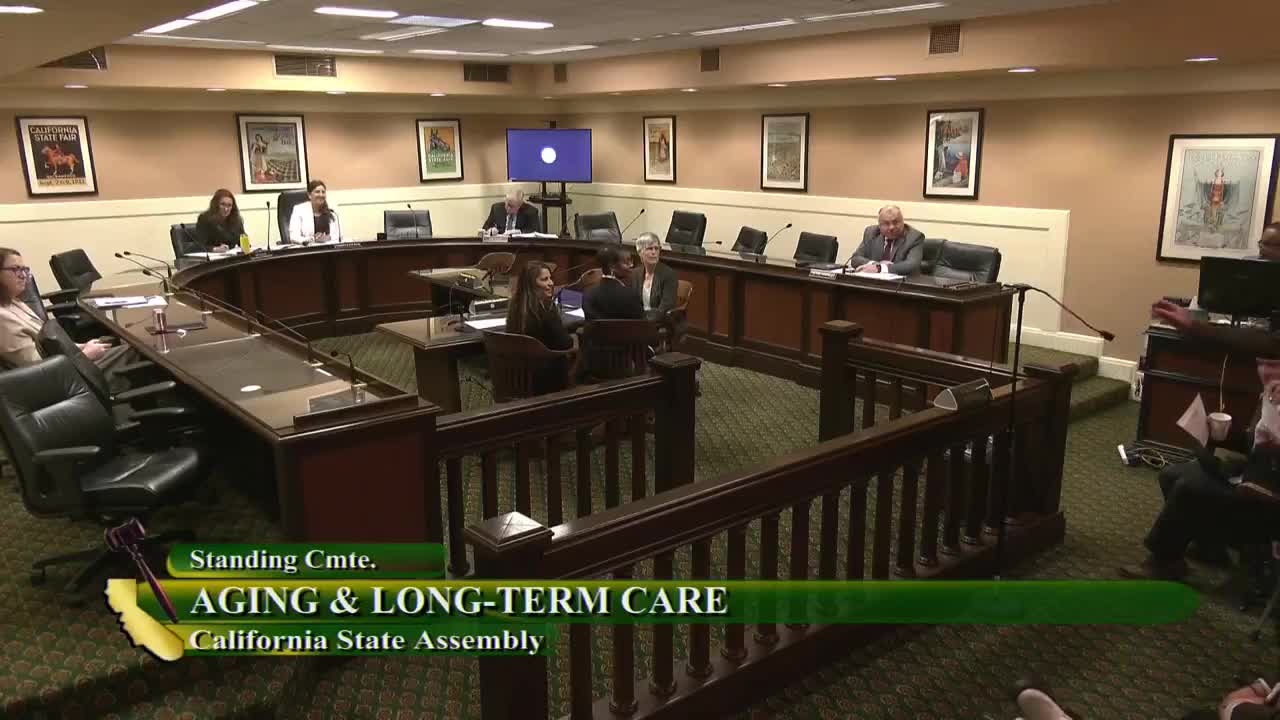
Discussed in Hearing
 12MIN
Assembly Standing Committee on Aging and Long-Term Care
Bill Author
Bill Co-Author(s):