AB 66: Natural Resources Agency: water storage projects: permit approval.
- Session Year: 2023-2024
- House: Assembly
- Latest Version Date: 2023-03-29
Current Status:
Failed
(2024-02-01: From committee: Filed with the Chief Clerk pursuant to Joint Rule 56.)
Introduced
In Committee
First Chamber
In Committee
Second Chamber
Enacted
What does this bill do?
This bill requires the Natural Resources Agency and each department, board, conservancy, and commission in the agency to take all reasonable steps to approve permits for water storage projects funded by the 2014 water bond (Prop 1) and other publicly funded water storage projects within 180 days of receiving a complete application. The rule applies only if the project uses a project labor agreement (a prehire union contract) or requires contractors to use a skilled and trained workforce, and the permitting agency must post online progress updates and an estimated approval time for each application.
The summary is provided by generative AI which can make mistakes. For original language, please view the details in the table below.
Existing law establishes the Natural Resources Agency, composed of departments, boards, conservancies, and commissions responsible for the restoration, protection, and management of the states natural and cultural resources. Existing law establishes in the agency the Department of Water Resources, which manages and undertakes planning with regard to water resources in the state.
This bill would require the agency, and each department, board, conservancy, and commission within the agency, to take all reasonable steps to approve the necessary permits for specified projects that meet certain employment conditions within 180 days from receiving a complete permit application, and would deem those permits approved if approval does not occur within this time period. application. The bill would require the department, board, conservancy, or commission responsible for issuing a permit to post updates on its internet website for each permit application explaining how the permit approval process is progressing and the estimated time until the permit is approved.
Existing law establishes the Natural Resources Agency, composed of departments, boards, conservancies, and commissions responsible for the restoration, protection, and management of the states natural and cultural resources. Existing law establishes in the agency the Department of Water Resources, which manages and undertakes planning with regard to water resources in the state.
This bill would require the agency, and each department, board, conservancy, and commission within the agency, to approve the necessary permits for specified projects that meet certain employment conditions within 180 days from receiving a permit application, and would deem those permits approved if approval does not occur within this time period.
Existing law establishes the Natural Resources Agency, composed of departments, boards, conservancies, and commissions responsible for the restoration, protection, and management of the states natural and cultural resources. Existing law establishes in the agency the Department of Water Resources, which manages and undertakes planning with regard to water resources in the state.
This bill would require the agency, and each department, board, conservancy, and commission within the agency, to approve the necessary permits for specified projects within 180 days from receiving a permit application, and would deem those permits approved if approval does not occur within this time period.
(a)(1)The Natural Resources Agency, and each department, board, conservancy, and commission within the agency, shall take all reasonable steps to approve the necessary permits for projects funded pursuant to the Water Quality, Supply, and Infrastructure Improvement Act of 2014 (Division 26.7 (commencing with Section 79700) of the Water Code) and other water storage projects funded by public funds within 180 days from receiving the a complete permit application.
(2)If the permit approval does not occur within this time period, the permit shall be deemed approved.(b)This section shall apply only if either of the following conditions are met:
(1)All construction work on the project is governed by a project labor agreement.
(2)All contractors and subcontractors performing construction work on the project are required to use a skilled and trained workforce to perform work within an apprenticeable occupation in the building and construction trades.
(c)For purposes of this section, the following definitions apply:
(1)Project labor agreement means a prehire collective bargaining agreement that establishes terms and conditions of employment for a specific construction project or projects and is an agreement described in Section 158 of Title 29 of the United States Code.
(2)Skilled and trained workforce has the same meaning as provided in Section 2601 of the Public Contract Code.
(d)The department, board, conservancy, or commission responsible for issuing a permit as described in this section shall post updates for each permit application on its internet website explaining how the permit approval process is progressing and the estimated time until the permit is approved.
(d)(e)To the extent this section is inconsistent or in conflict with any other provision of law, this section shall prevail.
(a)(1)The Natural Resources Agency, and each department, board, conservancy, and commission within the agency, shall approve the necessary permits for projects funded pursuant to the Water Quality, Supply, and Infrastructure Improvement Act of 2014 (Division 26.7 (commencing with Section 79700) of the Water Code) and other water storage projects funded by public funds within 180 days from receiving the permit application.
(2)If the permit approval does not occur within this time period, the permit shall be deemed approved.
(b)This section shall apply only if either of the following conditions are met:
(1)All construction work on the project is governed by a project labor agreement.
(2)All contractors and subcontractors performing construction work on the project are required to use a skilled and trained workforce to perform work within an apprenticeable occupation in the building and construction trades.
(c)For purposes of this section, the following definitions apply:
(1)Project labor agreement means a prehire collective bargaining agreement that establishes terms and conditions of employment for a specific construction project or projects and is an agreement described in Section 158 of Title 29 of the United States Code.
(2)Skilled and trained workforce has the same meaning as provided in Section 2601 of the Public Contract Code.
(b)(d)To the extent this section is inconsistent or in conflict with any other provision of law, this section shall prevail.
(a)(1)The Natural Resources Agency, and each department, board, conservancy, and commission within the agency, shall approve the necessary permits for projects funded pursuant to the Water Quality, Supply, and Infrastructure Improvement Act of 2014 (Division 26.7 (commencing with Section 79700) of the Water Code) and other water storage projects within 180 days from receiving the permit application.
(2)If the permit approval does not occur within this time period, the permit shall be deemed approved.
(b)To the extent this section is inconsistent or in conflict with any provision of law, this section shall prevail.
|
Date
|
Status
|
|---|---|
| Feb 1, 2024 | From committee: Filed with the Chief Clerk pursuant to Joint Rule 56. |
| Jan 31, 2024 | Died pursuant to Art. IV, Sec. 10(c) of the Constitution. |
| May 18, 2023 | In committee: Held under submission. |
| Apr 19, 2023 | In committee: Set, first hearing. Referred to APPR. suspense file. |
| Mar 30, 2023 | Re-referred to Com. on APPR. |
| Mar 29, 2023 | Read second time and amended. |
| Mar 28, 2023 | From committee: Amend, and do pass as amended and re-refer to Com. on APPR. (Ayes 15. Noes 0.) (March 28). |
| Mar 13, 2023 | Re-referred to Com. on W., P., & W. |
| Mar 9, 2023 | From committee chair, with author's amendments: Amend, and re-refer to Com. on W., P., & W. Read second time and amended. |
| Feb 2, 2023 | Referred to Com. on W., P., & W. |
| Jan 4, 2023 | Read first time. |
| Dec 7, 2022 | From printer. May be heard in committee January 6. |
| Dec 6, 2022 | Introduced. To print. |
|
Date
|
Description
|
Location
|
Votes
|
|
|---|---|---|---|---|
| Mar 28, 2023 | Do pass as amended and be re-referred to the Committee on [Appropriations] | Assembly Standing Committee on Water, Parks, and Wildlife |
Passed |
This list shows positions taken on this bill by organizations on the date displayed, which is linked to the original source.
Positions by individuals are not included.
|
Organization
|
Position
|
Date
|
|---|---|---|
| California Coastkeeper Alliance | ** Against | |
| California State Building Trades | * Indeterminate | Mar 28, 2023 |
| Clean Water Action | ** Against | |
| Defenders Of Wildlife | ** Against | |
| Natural Resources Defense Council | ** Against | |
| Plumbing-Heating-Cooling Contractors Association of California | ** Against | |
| the community water center | * Indeterminate | Mar 28, 2023 |
| Western Electrical Contractors Association | ** Against |
Date of Hearing: April 19, 2023
ASSEMBLY COMMITTEE ON APPROPRIATIONS
Chris Holden, Chair
ABPCA Bill Id:AB 66
Author:(Mathis) – As Amended Ver:March 29, 2023
Policy Committee: | Water, Parks and Wildlife | Vote: | 15 - 0 |
|
| ||
|
|
Urgency: No State Mandated Local Program: No Reimbursable: No
SUMMARY:
This bill requires each entity within the California Natural Resources Agency (CNRA) to take all reasonable steps to approve the necessary permits for specified projects within 180 days and post status updates for each permit application on its website.
Specifically, this bill:
- Requires each department, board, conservancy, and commission within CNRA to take all reasonable steps to approve the necessary permits for projects funded by the Water Quality, Supply, and Infrastructure Improvement Act of 2014 (Proposition 1) and other water storage projects funded by public funds within 180 days from receiving a complete permit application.
- Provides that this bill shall apply only if either of the following conditions are met:
- All construction work on the project is governed by a project labor agreement.
- All contractors and subcontractors working on the project use a skilled and trained workforce to perform work within an apprenticeable occupation in the building and construction trades.
- Requires the department, board, conservancy, or commission responsible for issuing a permit, as specified in this bill, to post updates for each permit application on its website explaining how the permit approval process is progressing and the estimated time until the permit is approved.
- Provides that to the extent this bill is inconsistent or in conflict with any provision of law, this bill shall prevail.
FISCAL EFFECT:
Costs of an unknown but significant amount, likely in the low millions of dollars, for various departments, boards, conservancies, and commissions under CNRA to implement this bill (General Fund, special funds, and bond funds). As an example, the California Coastal Commission (CCC) notes it does not have the capacity to analyze and take all reasonable steps to permit complex projects within 180 days, while ensuring full compliance with the Coastal Act, without additional staff resources. CCC estimates costs of approximately $457,000 for two new positions to implement the requirements of this bill.
COMMENTS:
1) Purpose. According to the author:
AB 66 will expedite and improve both the permit approval process and our state’s water storage, quality, and supply—not only to better prepare for future droughts, but to mitigate the effects of destructive flooding.
2) Background. Voters approved Proposition 1, a $7.5 billion general obligation bond to fund ecosystems and watershed protection and restoration, water supply infrastructure projects, including surface and groundwater storage, and drinking water protection, in November 2014. So far, 1,838 projects have been funded and 760 are completed. According to the state’s bond accountability website, nearly all Proposition 1 funds have been committed or awarded to projects; however, this does not mean all of the funds have been spent, as many bond-funded programs work on a reimbursement basis so that the administering agency reimburses a grant recipient after the work is actually completed. Therefore, this bill would apply not only to the as-yet unspent water storage funding under Proposition 1, but likely to many other yet-to-be completed projects that have received grant awards.
According to the Water, Parks, and Wildlife Committee analysis of this bill, examples of permits that might be implicated by this bill include Lake and Steambed Alteration Agreements and Incidental Take Permits issued by the California Department of Fish and Wildlife, Encroachment Permits issued by the Central Valley Flood Protection Board, and Coastal Development Permits issued by CCC.
State agencies can take several months to finalize permits covered by this bill; however, it is not clear the extent to which permits are responsible for delay in the implementation of projects funded by Proposition 1 and other publicly funded water storage projects. Delay in projects, particularly large infrastructure projects, can be due to a variety of factors including planning and design, environmental review, land acquisition, financing, agreements between project partners and project beneficiaries, and litigation, along with permitting. Further, incomplete or inadequate permit review risks harm to the environment and could jeopardize public safety.
3) Support and Opposition. The Valley Ag Water Coalition writes in support of this bill:
Permits for a number of eligible projects have not been approved since the passage of Proposition 1, creating an unnecessary delay to the construction and development of critically needed water infrastructure projects within California. This bill seeks to expedite the application process of projects funded by Proposition 1, and other water storage projects funded by public funds, to ensure that the available funds can be directed towards improving the state’s much needed infrastructure projects…
A coalition of environmental groups writes in opposition to this bill:
Robust and effective permitting of dams and water storage projects is necessary to ensure that projects are properly designed and do not fail during floods and threaten downstream lives and communities, do not divert water that belongs to other water rights holders, and protect fish and wildlife including salmon – and the thousands of jobs, Native American Tribes, and communities that depend on healthy rivers. Effective permitting is also critical to ensure that the billions of dollars in state taxpayer money results in lasting public benefits, as required by the voter-approved initiative. However, AB 66 pressures agencies to “approve necessary permits” for these projects, rather than the agencies carefully evaluating whether to approve or deny permits for these projects.
Analysis Prepared by: Nikita Koraddi / APPR. / (916) 319-2081
Date of Hearing: March 28, 2023
ASSEMBLY COMMITTEE ON WATER, PARKS, AND WILDLIFE
Rebecca Bauer-Kahan, Chair
ABPCA Bill Id:AB 66 (
Author:Mathis) – As Amended Ver:March 9, 2023
SUBJECT: Natural Resources Agency: water storage projects: permit approval
SUMMARY: Requires departments within the Natural Resources Agency (Resources Agency) to approve permits for publicly-funded water storage projects and projects funded by the Water Quality, Supply, and Infrastructure Project Act (Proposition 1) within 180 days if the projects have a project labor agreement or use a skilled and trained workforce. Specifically, this bill:
- Requires each department, board, conservancy, and commission within the Resources Agency to approve permits for projects funded by Proposition 1 and other water storage projects funded by public funds within 180 days of receiving the application.
- Provides that if the respective permitting agency does not approve a permit for a specified project within 180 days, the permit shall be deemed approved.
- Provides that this bill shall only apply if either of the following conditions are met:
- All construction work on the project is governed by a project labor agreement; or
- All contractors and subcontractors working on the project use a skilled and trained workforce to perform work within an apprenticeable occupation in the building and construction trades.
- Defines “project labor agreement” and “skilled and trained workforce” for purposes of this bill.
- Provides that to the extent this bill is inconsistent or in conflict with any provision of law, this bill shall prevail.
EXISTING LAW:
- Establishes the Resources Agency that consists of various departments, conservancies, boards, and commissions (Government Code § 12805).
- Establishes the Department of Fish and Wildlife (DFW) in the Resources Agency with jurisdiction over the conservation, protection, and management of fish, wildlife, native plants, and habitat necessary for biologically sustainable populations of those species [Fish and Game Code (FGC) § 700; § 1802].
- Prohibits any act which could directly or indirectly take threatened or endangered species listed under the California Endangered Species Act (CESA) (FGC § 2080).
- Permits the take of an endangered or threatened species if it is incidental to an otherwise lawful activity (FGC § 2081).
- Prohibits any entity from diverting or obstructing the natural flow of, or using any material from, the bed, channel, or bank of any river, stream, or lake unless DFW determines the activity will not substantially adversely affect fish and wildlife resources or the entity enters into an agreement with DFW to take reasonable measures to protect fish and wildlife resources [i.e., a Lake and Streambed Alteration Agreement (LSAA)] (FGC § 1602).
- Enacts the California Coastal Act to protect and maintain the coastal zone and its natural and artificial resources, to balance conservation of the coastal zone with the social and economic needs of the people, and maximize public access to the coast [Public Resources Code (PRC) § 30001.5). Establishes the California Coastal Commission to implement the California Coastal Act (PRC § 30300).
- Establishes the Central Valley Flood Protection Board (CV Flood Board) within state government and provides for coordination between Department of Water Resources (DWR) and CV Flood Board in planning, managing, and maintaining the flood control infrastructure known as the State Plan of Flood Control(Water Code §§ 8520 et seq. and 8685 et seq.).
- Enacts Proposition 1 to authorize the issuance of $7.55 billion in general obligation bonds for water storage, environmental protection and restoration, drought response, groundwater management, water recycling, and flood protection (Water Code § 79700 et seq.).
FISCAL EFFECT: Unknown. This bill is keyed fiscal.
COMMENTS:
- Purpose of this bill. The author asserts that critically needed water infrastructure projects that have been awarded funding by Proposition 1 have been unnecessarily delayed because the permits for these projects have not been approved.
- Background. The Resources Agency has a broad mission to protect and manage natural resources in California. Several departments, boards, conservancies, and commissions fall under the Resources Agency and help achieve this mission. These include:
- Six departments: Department of Forestry and Fire Protection (CAL FIRE), Department of Conservation, DFW, Department of Parks and Recreation, DWR, and California Conservation Corps.
- 10 conservancies: Baldwin Hills Conservancy, California Tahoe Conservancy, Coachella Valley Mountains Conservancy, Sacramento-San Joaquin Delta Conservancy, San Diego River Conservancy, San Gabriel and Lower Los Angeles Rivers and Mountains Conservancy, San Joaquin River Conservancy, Santa Monica Mountains Conservancy, Sierra Nevada Conservancy, and State Coastal Conservancy.
- 20 boards and commissions, including: Board of Forestry, California Boating and Waterways Commission, California Coastal Commission, California Energy Commission, California Fish and Game Commission, California State Lands Commission, California Water Commission, CV Flood Board, Delta Protection Commission, Mining and Geology Board, Parks and Recreation Commission, and Wildlife Conservation Board.
Entities within the Resources Agency issue a wide range of permits. While not an exhaustive list, the following would be some of the permits most commonly implicated by this bill:
- LSAAs issued by DFW. These permits are required before a person, agency, or organization takes any action that: 1) diverts or obstructs the natural flow of any river, stream, or lake; 2) changes the bed, channel, or bank of any river, stream, or lake; 3) uses material from any river, stream, or lake; or 4) deposits or disposes of material into any river, stream, or lake. Water storage, floodplain restoration, flood protection, and riparian habitat restoration are all projects that typically need an LSAA. DFW reports that finalizing an LSAA has taken an average of 119 days in recent years, but that the timeline varies widely, largely due to whether or not the applicant submits a complete notification to start the process.
- ITPs issued by DFW. These permits allow a permittee to take a CESA-listed species if such taking is incidental to, and not the purpose of, carrying out an otherwise lawful activity. These permits are most commonly issued for construction, utility, transportation, and other infrastructure-related projects and, in some cases, restoration projects. DFW indicates that the timeline for finalizing an ITP varies widely and notes that a final ITP cannot be issued until the applicant has completed the environmental review under the California Environmental Quality Act (CEQA).
- Encroachment Permits issued by the CV Flood Board. An encroachment permit is required for “every proposal or plan of work” that is located between or in the vicinity of any Federal Project Levees within the State Plan of Flood Control or a designated floodway. Activities requiring this permit include placement, construction, reconstruction, removal, or abandonment of any landscaping, culvert, bridge, conduit, fence, structure, or obstruction as well as the planting, excavation, or removal of vegetation. The Flood Board indicates that it typically takes between 180 to 240 days to finalize an encroachment permit if the application is complete when submitted. In addition, CEQA must be completed before the Flood Board can issue an encroachment permit.
- Coastal Development Permits issued by the Coastal Commission. These permits are the regulatory mechanism by which proposed developments in the coastal zone are brought into compliance with the Coastal Act. “Development” is defined broadly under the Coastal Act, but would include any water infrastructure within the Coastal Zone. The extent of the Coastal Zone varies but can extend up to five miles inland from the shore.
Proposition 1. Voters approved this measure, a $7.55 billion general obligation bond for various water and environmental restoration projects, in November 2014. The funding in Proposition 1 is allocated as follows: $2.7 billion for public benefits of water storage projects (WSIP); $1.5 billion for protecting and restoring lakes, rivers, streams, and watersheds; $900 million for groundwater sustainability; $810 million for drought preparedness; $725 million for water recycling; $520 million for safe drinking water; and $395 million for flood management. According to the bond accountability web site (www.bondaccountability.resources.ca.gov), more than $7.5 billion of these funds have been committed or awarded to projects; however, this does not mean all of the funds have been spent, as many bond-funded programs work on a reimbursement basis so that the administering agency reimburses a grant recipient after the work is actually completed. As such, this bill would apply not only to the yet unspent water storage funding under Proposition 1, but likely to many other yet-to-be completed projects that have received grant awards.
- Suggested committee amendments. As discussed above, the permits covered by this bill can take several months to be finalized; however, it is not clear the extent to which these permits are responsible for delay in the implementation of projects funded by Proposition 1 and other publicly funded water storage projects and the Committee has not been provided with any information to illuminate this question. Delay in projects, particularly large infrastructure projects, can be due to a variety of factors including planning and design, environmental review, land acquisition, financing, agreements between project partners and project beneficiaries, and litigation, along with permitting. Further, the automatic approval mechanism in this bill risks adverse impacts to the environment and could jeopardize public safety. Finally, it is unclear whether the submittal of an incomplete permit application (oftentimes a significant factor in delaying permit approval) would start the 180-day timeline proposed by this bill. Given this, the Committee may wish to consider requesting that the author strike the automatic permit approval provisions of this bill and, instead, add provisions to bring greater transparency to the permit approval process, as follows:
Amendment 1
On page 2, line 5, after “shall” insert: “take all reasonable steps to”
Amendment 2
On page 2, line 9, strike “the” and insert: “a complete”
Amendment 3
On page 2, strike lines 11 and 12.
Amendment 4
On page 2, after “(d)” insert:
“The department, board, conservancy, or commission responsible for issuing a permit pursuant to this section shall post updates on its internet website showing how the permit approval process is progressing and the estimated time until the permit shall be approved. (e)”
- Arguments in support. The State Building and Construction Trades Council of California (Building Trades) supports this bill arguing that a number of permits for projects funded by Proposition 1 have yet to be approved and that this has resulted in unnecessary delays in the construction of critical infrastructure. The Building Trades assert that this bill can help get these “projects up and running, creating hundreds of construction jobs, many in parts of the state where good-paying jobs are in short supply, and help to fix the problems with the state’s water infrastructure.”
- Arguments in opposition. The Natural Resources Defense Council (NRDC) and a handful of environmental and environmental justice organizations oppose this bill arguing that it will “override California law, including bedrock environmental laws and laws regarding dam safety.” NRDC et al. assert that this bill will lead to environmentally destructive, and potentially unsafe, dams being constructed. These groups maintain that robust permitting for water storage projects is needed to “ensure projects are properly designed and do not fail during floods and threaten downstream lives and communities, do not divert water that belongs to other water right holders, and protect fish and wildlife.”
The Western Electrical Contractors Association and the Plumbing-Heating-Cooling Association of California (Contractors Associations) concede that measures to expedite water projects may have merit but oppose this bill due to the inclusion of its requirement that a project must have a project labor agreement (PLA) in order to qualify for the streamlining provided by this bill. The Contractors Associations argue that the PLA provision in this bill “is discriminatory and increases the cost of construction.” - Related legislation. AB 62 (Mathis), current session, sets a goal to increase total water storage by 3.7 million acre-feet (AF) by 2030 and 4 million AF by 2040 and directs the State Water Resources Control Board to consult with DWR to design and implement measures to attain this goal. AB 62 is currently pending before this Committee.
AB 422 (Alanis), current session, requires the Resources Agency to post information regarding progress made towards increasing water storage on its internet website. AB 422 is currently pending before this Committee.
REGISTERED SUPPORT / OPPOSITION:
Support
State Building and Construction Trades Council of California
Opposition
California Coastkeeper Alliance
Clean Water Action
Community Water Center
Defenders of Wildlife
Natural Resources Defense Council
Plumbing-Heating-Cooling Contractors Association of California
Western Electrical Contractors Association
Analysis Prepared by: Pablo Garza / W., P., & W. / (916) 319-2096
Discussed in Hearing
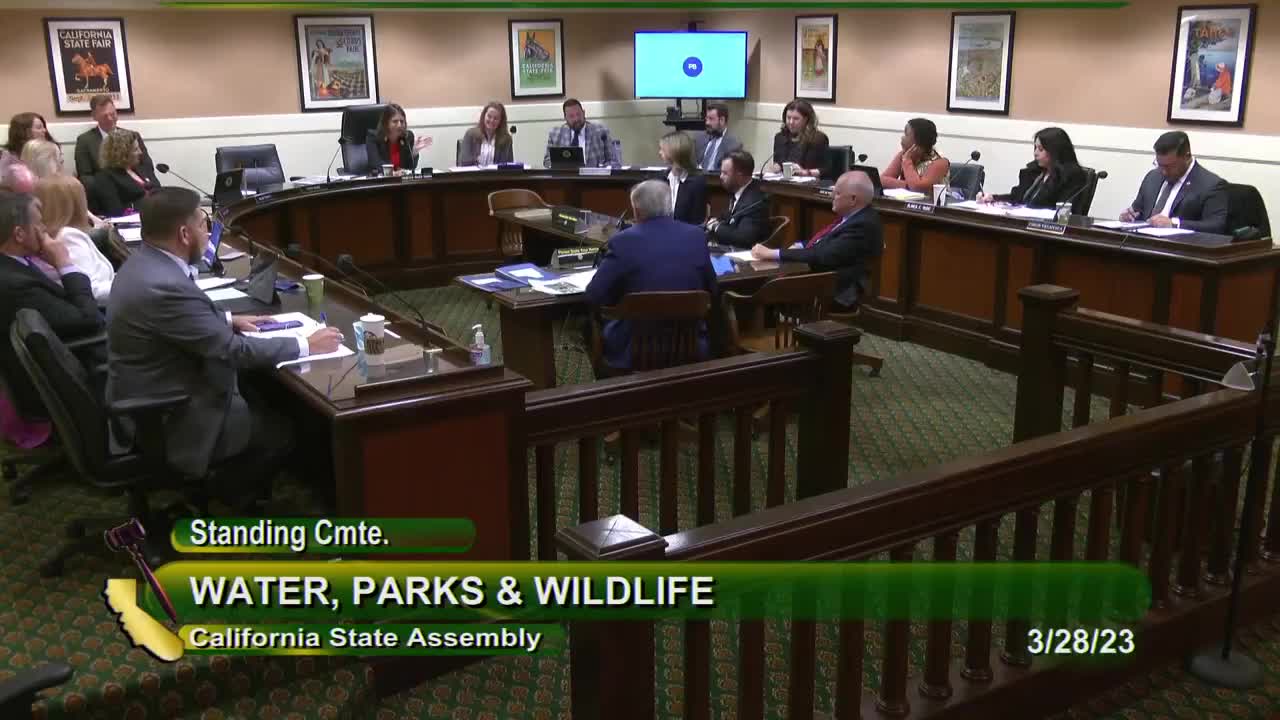 11MIN
Assembly Standing Committee on Water, Parks, and Wildlife
Bill Author