AB 766: Cannabis: invoices: payment.
- Session Year: 2023-2024
- House: Assembly
- Latest Version Date: 2023-04-12
Current Status:
Failed
(2024-02-01: From committee: Filed with the Chief Clerk pursuant to Joint Rule 56.)
Introduced
In Committee
First Chamber
In Committee
Second Chamber
Enacted
What does this bill do?
The bill requires licensed cannabis businesses to pay other licensed cannabis sellers for goods or services within 15 days after the invoice’s final due date. Invoices must set a final due date no later than 30 days after the sale or transfer, and sellers with unpaid invoices totaling $5,000 or more can report nonpayment to the Department of Cannabis Control. After notifying the buyer, the department may issue a warning, citation, or start disciplinary action if payment isn't made within 30 days; reported buyers cannot buy on credit until they pay, and the rule excludes unpaid cannabis excise taxes and sales before January 1, 2024.
The summary is provided by generative AI which can make mistakes. For original language, please view the details in the table below.
The Control, Regulate and Tax Adult Use of Marijuana Act (AUMA), an initiative measure approved as Proposition 64 at the November 8, 2016, statewide general election, authorizes a person who obtains a state license under AUMA to engage in commercial adult-use cannabis activity pursuant to that license and applicable local ordinances. Existing law, the Medicinal and Adult-Use Cannabis Regulation and Safety Act (MAUCRSA), among other things, consolidates the licensure and regulation of commercial medicinal and adult-use cannabis activities. MAUCRSA establishes the Department of Cannabis Control within the Business, Consumer Services, and Housing Agency to administer the act, and requires the department to be under the supervision and control of a director.
Existing law requires every sale or transport of cannabis or cannabis products from one licensee to another licensee to be recorded on a sales invoice or receipt and prescribes the information included on those receipts, including the cost to the purchaser. Existing law provides grounds for disciplinary action under MAUCRSA, including failure to comply with the provisions of MAUCRSA or any rule or regulation adopted pursuant to MAUCRSA.
This bill would, except as specified, require a licensee to pay for goods and services sold or transferred with a total value of at least $5,000 by another licensee no later than 15 days following the final date set forth in the invoice. invoice or invoices. The bill would require a licensee who sold or transferred goods to another licensee and who has not received payment in full 15 days after the final date set forth in the invoice to report the unpaid invoice to the department, as specified. The bill would require the department to notify a licensee of this report, and would require the department to issue a notice of warning, or, in its discretion, issue a citation or commence a disciplinary action against the licensee if the licensee fails to pay the outstanding invoice in full by 30 days after this notification, as specified. specified, and, for multiple failures to comply with these provisions, commence a disciplinary action, as specified. The bill would prohibit the licensee from purchasing goods and services from another licensee on credit until the licensee pays the outstanding invoice in full. The bill would, for purposes of these provisions, prohibit the final date set forth in an invoice for payment of the invoice from being later than 30 calendar days from the date the goods or services are sold or transferred. The bill would specify that these provisions do not apply to an invoice for a sale or transfer made before January 1, 2024.
The Control, Regulate and Tax Adult Use of Marijuana Act (AUMA), an initiative measure approved as Proposition 64 at the November 8, 2016, statewide general election, authorizes a person who obtains a state license under AUMA to engage in commercial adult-use cannabis activity pursuant to that license and applicable local ordinances. Existing law, the Medicinal and Adult-Use Cannabis Regulation and Safety Act (MAUCRSA), among other things, consolidates the licensure and regulation of commercial medicinal and adult-use cannabis activities. MAUCRSA establishes the Department of Cannabis Control within the Business, Consumer Services, and Housing Agency to administer the act, and requires the department to be under the supervision and control of a director.
Existing law requires every sale or transport of cannabis or cannabis products from one licensee to another licensee to be recorded on a sales invoice or receipt and prescribes the information included on those receipts, including the cost to the purchaser. Existing law provides grounds for disciplinary action under MAUCRSA, including failure to comply with the provisions of MAUCRSA or any rule or regulation adopted pursuant to MAUCRSA.
This bill would, except as specified, require a licensee to pay for goods and services sold or transferred by another licensee no later than 15 days following the final date set forth in the invoice. The bill would require a licensee who sold or transferred goods to another licensee and who has not received payment in full 15 days after the final date set forth in the invoice to report the unpaid invoice to the department, as specified. The bill would require the department to notify a licensee of this report, and would require the department to commence a disciplinary action against the licensee if the licensee fails to pay the outstanding invoice in full by 30 days after this notification, as specified. The bill would prohibit the licensee from purchasing goods and services from another licensee on credit until the licensee pays the outstanding invoice in full. The bill would, for purposes of these provisions, prohibit the final date set forth in an invoice for payment of the invoice from being later than 30 calendar days from the date the goods or services are sold or transferred.
Existing law, the Control, Regulate and Tax Adult Use of Marijuana Act (AUMA), approved by the voters at the November 8, 2016, statewide general election, regulates the cultivation, distribution, transport, storage, manufacturing, testing, processing, sale, and use of cannabis for nonmedical purposes by people 21 years of age and older. The existing Medicinal and Adult-Use Cannabis Regulation and Safety Act (MAUCRSA), among other things, consolidates the licensure and regulation of commercial medicinal and adult-use cannabis activities.This bill would state the intent of the Legislature to enact legislation relating to the sale of cannabis, including establishing maximum terms by which cannabis licensees may sell goods on credit.Existing law, the Control, Regulate and Tax Adult Use of Marijuana Act (AUMA), approved by the voters at the November 8, 2016, statewide general election, regulates the cultivation, distribution, transport, storage, manufacturing, testing, processing, sale, and use of cannabis for nonmedical purposes by people 21 years of age and older. The existing Medicinal and Adult-Use Cannabis Regulation and Safety Act (MAUCRSA), among other things, consolidates the licensure and regulation of commercial medicinal and adult-use cannabis activities.
This bill would state the intent of the Legislature to enact legislation relating to the sale of cannabis, including establishing maximum terms by which cannabis licensees may sell goods on credit.
(a)(1)A licensee shall pay for goods and services sold or transferred by another licensee no later than 15 days following the final date set forth in the invoice for the cannabis or cannabis products.
(2)The 15-day period described in paragraph (1) shall commence with the day immediately following the due date of the invoice and shall include all successive days, including Sundays and holidays. When the 15th day from the due date of the invoice falls on Saturday, Sunday, or a legal holiday, the next business day shall be deemed to be the expiration day.
(b)(1)A licensee who sold or transferred goods with a total value of at least five thousand dollars ($5,000) to another licensee and who has not received payment in full 15 days after the final date set forth in the invoice or invoices as required by subdivision (a) shall report the unpaid invoice to the department.
(2)A report made pursuant to paragraph (1) shall include all of the following:
(A)The sale or transfer date of the cannabis or cannabis products.
(B)The invoice due date.
(C)The invoice amount.
(D)The name, address, and license number of the licensee who failed to pay.
(c)(1)The department shall notify a licensee who has been reported pursuant to subdivision (b).
(2)The department shall issue a notice of warning or, in its discretion, issue a citation or commence a disciplinary action in accordance with Chapter 3 (commencing with Section 26030) against a licensee reported pursuant to subdivision (b) if the licensee fails to pay the outstanding invoice in full by 30 days after the department notified the licensee pursuant to paragraph (1).
(3)(A)The department shall commence a disciplinary action in accordance with Chapter 3 (commencing with Section 26030) against a licensee reported pursuant to subdivision (b) if the licensee fails to pay multiple outstanding invoices in full by 30 days after the department notified the licensee pursuant to paragraph (1).
(B)When considering imposition of a penalty in an action commenced pursuant to subparagraph (A), the department shall take into account the frequency and gravity of the licensees failure to pay the outstanding invoices in full by 30 days after the department notified the licensee pursuant to paragraph (1).
(d)A licensee who has been reported pursuant to subdivision (b) shall not purchase goods or services from another licensee on credit until the licensee pays the outstanding invoice in full.
(e)For purposes of this section, the final date set forth in an invoice for payment of the invoice shall not be later than 30 calendar days from the date the goods or services are sold or transferred.
(f)This section does not apply to unpaid cannabis excise tax moneys required to be collected by a distributor.
(g)This section does not apply to an invoice for a sale or transfer made before January 1, 2024.
(a)(1)A licensee shall pay for goods and services sold or transferred by another licensee no later than 15 days following the final date set forth in the invoice for the cannabis or cannabis products.
(2)The 15-day period described in paragraph (1) shall commence with the day immediately following the due date of the invoice and shall include all successive days, including Sundays and holidays. When the 15th day from the due date of the invoice falls on Saturday, Sunday, or a legal holiday, the next business day shall be deemed to be the expiration day.
(b)(1)A licensee who sold or transferred goods to another licensee and who has not received payment in full 15 days after the final date set forth in the invoice as required by subdivision (a) shall report the unpaid invoice to the department.
(2)A report made pursuant to paragraph (1) shall include all of the following:
(A)The sale or transfer date of the cannabis or cannabis products.
(B)The invoice due date.
(C)The invoice amount.
(D)The name, address, and license number of the licensee who failed to pay.
(c)(1)The department shall notify a licensee who has been reported pursuant to subdivision (b).
(2)The department shall commence a disciplinary action in accordance with Chapter 3 (commencing with Section 26030) against a licensee reported pursuant to subdivision (b) if the licensee fails to pay the outstanding invoice in full by 30 days after the department notified the licensee pursuant to paragraph (1).
(d)A licensee who has been reported pursuant to subdivision (b) shall not purchase goods or services from another licensee on credit until the licensee pays the outstanding invoice in full.
(e)For purposes of this section, the final date set forth in an invoice for payment of the invoice shall not be later than 30 calendar days from the date the goods or services are sold or transferred.
(f)This section does not apply to unpaid cannabis excise tax moneys required to be collected by a distributor.
SECTION 1.It is the intent of the Legislature to enact subsequent legislation that would do all of the following:(a)Establish all of the following:(1)Maximum terms by which cannabis licensees may sell goods on credit.(2)With respect to paragraph (1), penalties and a course of action for failure to timely pay invoices.(b)Provide oversight powers to the Department of Cannabis Control to ensure timely payment of goods across the supply chain.It is the intent of the Legislature to enact subsequent legislation that would do all of the following:
(a)Establish all of the following:
(1)Maximum terms by which cannabis licensees may sell goods on credit.
(2)With respect to paragraph (1), penalties and a course of action for failure to timely pay invoices.
(b)Provide oversight powers to the Department of Cannabis Control to ensure timely payment of goods across the supply chain.
|
Date
|
Status
|
|---|---|
| Feb 1, 2024 | From committee: Filed with the Chief Clerk pursuant to Joint Rule 56. |
| Jan 31, 2024 | Died pursuant to Art. IV, Sec. 10(c) of the Constitution. |
| May 18, 2023 | In committee: Hearing postponed by committee. |
| Apr 26, 2023 | In committee: Set, first hearing. Referred to APPR. suspense file. |
| Apr 17, 2023 | Re-referred to Com. on APPR. |
| Apr 12, 2023 | Read second time and amended. |
| Apr 11, 2023 | From committee: Amend, and do pass as amended and re-refer to Com. on APPR. (Ayes 17. Noes 0.) (April 11). |
| Mar 27, 2023 | Re-referred to Com. on B. & P. |
| Mar 23, 2023 | From committee chair, with author's amendments: Amend, and re-refer to Com. on B. & P. Read second time and amended. |
| Mar 23, 2023 | Referred to Com. on B. & P. |
| Feb 14, 2023 | From printer. May be heard in committee March 16. |
| Feb 13, 2023 | Read first time. To print. |
|
Date
|
Description
|
Location
|
Votes
|
|
|---|---|---|---|---|
| Apr 11, 2023 | Do pass as amended and be re-referred to the Committee on [Appropriations] | Assembly Standing Committee on Business and Professions |
Passed |
This list shows positions taken on this bill by organizations on the date displayed, which is linked to the original source.
Positions by individuals are not included.
|
Organization
|
Position
|
Date
|
|---|---|---|
| Albert Einstone's | ** Support | |
| Angeles Emeralds | ** Against | |
| Anresco Laboratories | ** Support | |
| Autumn Brands | ** Support | |
| California Cannabis Industry Association | ** Support | |
| California Cannabis Manufacturers Association | * Support | Apr 11, 2023 |
| California Minority Alliance | ** Against | |
| Cannabis Distribution Association , including | ** Support | |
| CLSICS | ** Support | |
| Coachella Valley Cannabis Alliance | ** Against | |
| Gold Mountain Distribution | ** Support | |
| HERBL Distribution | ** Support | |
| Humble Cannabis Solutions | ** Support | |
| Infinite Chemical Analysis Labs | ** Support | |
| Kiva Confections | * Support | Apr 11, 2023 |
| Local Cannabis Company | ** Support | |
| Lompoc Valley Cannabis Association, Santa Barbara County | ** Support | |
| Long Beach Collective Association | ** Against | |
| Lowell Farms | ** Support | |
| Mammoth Distribution | ** Support | |
| Nabis | * Support | Apr 11, 2023 |
| Node Labs | ** Support | |
| Osiris Ventures DBA Norcal Cannabis | ** Against | |
| Pacific Stone | ** Support | |
| Pure Beauty | ** Support | |
| Rose Los Angeles | ** Support | |
| Rukli Distribution | ** Support | |
| San Francisco Cannabis Retailers Alliance | * Against Unless Amend | Apr 11, 2023 |
| San Francisco Cannabis Retailers alliance | * Against Unless Amend | Apr 11, 2023 |
| Sc Labs | ** Support | |
| Silicon Valley Cannabis Alliance | ** Against | |
| Silicon Valley Cannabis Association | * Against Unless Amend | Apr 11, 2023 |
| Social Equity Los Angeles | ** Against | |
| Statehouse | ** Support | |
| Sunderstorm | ** Support | |
| The Parent Company | ** Support | |
| The United Cannabis Business Association | * Against | Apr 11, 2023 |
| UpNorth Distribution | ** Support |
Date of Hearing: April 26, 2023
ASSEMBLY COMMITTEE ON APPROPRIATIONS
Chris Holden, Chair
ABPCA Bill Id:AB 766
Author:(Ting) – As Amended Ver:April 12, 2023
Policy Committee: | Business and Professions | Vote: | 17 - 0 |
|
| ||
|
|
Urgency: No State Mandated Local Program: No Reimbursable: No
SUMMARY:
This bill requires a commercial cannabis licensee to pay for goods and services sold or transferred by another licensee, no later than 15 days after the date set in the invoice, if the goods and services have a total value of at least $5,000. This bill requires a licensee who is not paid in full within 15 days to report to the Department of Cannabis Control (DCC) the delinquent payment, and requires DCC to take disciplinary action.
FISCAL EFFECT:
DCC estimates it will need at least $10.2 million for the first year and $9.7 million ongoing for various legal, compliance, and administrative staff to implement this bill (Cannabis Control Fund).
DCC states it did not receive requested information from the author and sponsors of the bill on the universe of licensees that currently face the issue of nonpayment for goods and services or data on how prevalent this problem is within the cannabis industry. DCC assumed 40 percent of the existing active licensee population (there were 11,149 licenses at the time of analysis) could be reported to for nonpayment and require DCC to take disciplinary action. DCC will require significant resources to ensure existing resources are not redirected away from core functions of licensing commercial cannabis activity and protecting public health and safety.
DCC states the bill, as written, requires DCC to serve as a contractual arbitrator between licensees and to enforce on those that do not pay their contractual obligations.
COMMENTS:
- Purpose. This bill is sponsored by the Cannabis Distribution Association, California Cannabis Manufacturers Association, and California Cannabis Industry Association. According to the author:
The legal cannabis industry doesn’t have access to traditional credit and financing options that other small businesses are afforded, nor does it have similar oversight and protections around terms of sale. The resulting financial instability has created a debt bubble across the cannabis supply chain, with licensees of all types experiencing ballooning accounts receivable. AB 766 would address the debt crisis in the California cannabis industry by establishing clear terms of sale across the supply chain and by establishing oversight of sales on credit payment. This bill would also restrict the flow of goods to licensees who are defaulting on their credit terms.
The author cites a recent cannabis industry report estimating the unpaid debt bubble is over $600 million across California’s supply chain.
- Retail Cannabis Credit. Because commercial cannabis activity is not legal at the federal level, the legal cannabis industry does not have access to the same banking, credit, or financing options available to other industries. Instead, the cannabis industry is mostly cash-based. According to the sponsors, cannabis businesses instead offer goods on credit to make up for the lack of normal financing options. They also note the credit terms may be extended to 60, 90, 120, or more days for payment. However, because there is no way to verify the creditworthiness of any other cannabis licensee, licensees are at risk of becoming overleveraged, owing more debt than they can pay back. The sponsors state the “debt bubble,” may lead to a destabilization of the industry. This bill is aimed at preventing further overleveraging by requiring licensees to pay within 15 days of the date on the invoice of cannabis products and establishing reporting and disciplinary requirements for licensees who fail to pay. The requirements are loosely based on California “tied-house” restrictions on alcohol manufacturers and the payment timelines between prime contractors and subcontractors.
- Opposition. A coalition of retailers opposes this bill unless it is amended, writing in part:
[W]e…strongly believe that this solution is much too drastic and punitive in nature and will result in greater net negative for the industry and the state of California…
The same challenges have existed in other states where state legal cannabis markets have existed for many years prior to California passing Prop 64, and those states have seen no need to implement such a punitive solution.
- Policy Comment. DCC notes there is an existing legal system in place for businesses to seek a remedy for contract violations and nonpayment of services, and this bill essentially replicates the functions of the civil court system for contract violations within DCC.
Analysis Prepared by: Allegra Kim / APPR. / (916) 319-2081
Date of Hearing: April 11, 2023
ASSEMBLY COMMITTEE ON BUSINESS AND PROFESSIONS
Marc Berman, Chair
ABPCA Bill Id:AB 766
Author:(Ting) – As Amended Ver:March 23, 2023
SUBJECT: Cannabis: invoices: payment.
SUMMARY: Requires a commercial cannabis licensee to pay for goods and services sold or transferred by another licensee no later than 15 days after the date set in the invoice, as specified.
EXISTING LAW:
- Regulates the cultivation, distribution, transport, storage, manufacturing, processing, and sale of medicinal and adult-use cannabis under the Medicinal and Adult-Use Cannabis Regulation and Safety Act and establishes the Department of Cannabis Control (DCC) to administer and enforce the act. (Business and Professions Code (BPC) §§ 26000-26260)
- Establishes 20 types of cannabis licenses, including subtypes, for cultivation, manufacturing, testing, retail, distribution, and microbusiness and requires each licensee except for testing laboratories to clearly designate whether their license is for adult-use or medicinal cannabis. (BPC § 26050)
- Requires every sale or transport of cannabis or cannabis products from one licensee to another licensee to be recorded on a sales invoice or receipt, establishes the procedures for maintaining the invoices and transcripts, and specifies the information required in each invoice or receipt. (BPC § 26161)
- Establishes grounds for disciplinary action against cannabis licensees, including failures to comply with state licensing requirements and local laws and ordinances. (BPC § 26030)
- Regulates the manufacturing, distribution, and sale of alcoholic beverages under the Alcoholic Beverage Control Act. (BPC §§ 23000-23047)
- Requires an alcoholic beverage manufacturer who sold and delivered alcoholic beverages to a retailer and who did not receive payment for the delivery to, after 42 days from the date of delivery to charge the retailer 1 percent of the unpaid balance for the delivery on the 43rd day from date of delivery and an additional 1 percent for every 30 days thereafter. (BPC § 25509(a))
- Requires an alcoholic beverage manufacturer who sold and delivered alcoholic beverages to a retailer and who did not receive payment in full after 30 days of the date of delivery to only sell alcoholic beverages to the retailer for cash or by advance payment until all payments are received for the delivery. (BPC § 25509(b))
- Regulates the business of contract work relating to the modification of land and structures under the Contractors States License Law and establishes the Contractors State License Board to administer and enforce the law. (BPC § 7000–7191)
- Requires a prime contractor or subcontractor to pay to any subcontractor, no later than seven days after receipt of each progress payment, unless otherwise agreed to in writing, the amount owed to the subcontractor, unless there is a good faith dispute over the amount. (BPC § 7108.5(a))
- Makes a violation of the timing requirement on the prime contractor a cause for disciplinary action and subjects the licensee to a penalty, payable to the subcontractor, of 2% of the amount due per month for every month that payment is not made. (BPC § 7108.5(b))
THIS BILL:
- Requires a cannabis licensee to pay for goods and services sold or transferred by another licensee no later than 15 days following the final date set in the invoice for the cannabis products.
- Specifies that the 15-day period commences with the day immediately following the due date of the invoice and includes all successive days, including Sundays and holidays. When the 15th day from the due date of the invoice falls on Saturday, Sunday, or a legal holiday, the expirations day is the next business day.
- Requires a licensee who sold or transferred goods to another licensee and who has not received full payment in the required 15 days after the final date set in the invoice to report the unpaid invoice to the DCC.
- Requires an unpaid invoice report to include all of the following:
- The sale or transfer date of the cannabis or cannabis products.
- The invoice due date.
- The invoice amount.
- The name, address, and license number of the licensee who failed to pay.
- Requires the DCC to notify a licensee who has been reported for failure to pay in full 15 days after the final date set in the invoice.
- Requires the DCC to commence disciplinary action against a licensee reported for failing to pay in full after 15 days if the licensee fails to pay in full after 30 days after the DCC notice.
- Prohibits a licensee reported for failure to pay in full 15 days after the final invoice date from purchasing goods or services from another licensee on credit until the licensee pays the outstanding invoice in full.
- Specifies that, for purposes of the requirements under this bill, the final invoice date for payment of the invoice may not be later than 30 calendar days from the date the goods or services are sold or transferred.
- Clarifies that the provisions of this bill do not apply to unpaid cannabis excise tax moneys required to be collected by a distributor.
FISCAL EFFECT: Unknown. This bill is keyed fiscal by the Legislative Counsel.
COMMENTS:
Purpose. This bill is co-sponsored by the Cannabis Distribution Association, California Cannabis Manufacturers Association, and California Cannabis Industry Association. According to the author, “The legal cannabis industry doesn’t have access to traditional credit and financing options that other small businesses are afforded, nor does it have similar oversight and protections around terms of sale. The resulting financial instability has created a debt bubble across the cannabis supply chain, with licensees of all types experiencing ballooning accounts receivable. [This bill] would address the debt crisis in the California cannabis industry by establishing clear terms of sale across the supply chain and by establishing oversight of sales on credit payment. This bill would also restrict the flow of goods to licensees who are defaulting on their credit terms.”
Background. The Medicinal and Adult Use Cannabis Regulation and Safety Act (MAUCRSA), which incorporates prior cannabis laws, authorizes a person who obtains a state license under MAUCRSA to engage in commercial adult-use cannabis activity under that license and applicable local ordinances. It is unlawful to operate a cannabis business without a license.
The Department of Cannabis Control (DCC) is the California state agency that licenses and regulates cannabis businesses. DCC regulates the:
- Growing of cannabis plants.
- Manufacture of cannabis products.
- Transportation and tracking of cannabis goods throughout the state.
- Sale of cannabis goods.
- Events where cannabis is sold or used.
- Labeling of goods sold at retail.
Retail Cannabis Credit. While commercial cannabis activity is legal at the state level, it is still not at the federal level. As a result, the legal cannabis industry does not have access to the same banking, credit, or financing options available to other industries. Instead, the cannabis industry is mostly cash-based.
According to the sponsors, cannabis businesses will instead offer goods on credit to make up for the lack of normal financing options. They also note the credit terms may be extended to 60, 90, 120, or more days for payment. However, because there is no way to verify the creditworthiness of any other cannabis licensee, licensees are at risk of becoming overleveraged, owing more debt than they can pay back.
The sponsors state that the current system has led to a “debt bubble,” which may lead to a destabilization of the industry. This bill is aimed at preventing further overleveraging by requiring licensees to pay within 15 days of the date on the invoice of cannabis products and establishing reporting and disciplinary requirements for licensees who fail to pay. The requirements are loosely based on California “tied-house” restrictions on alcohol manufacturers and the payment timelines between prime contractors and subcontractors.
ARGUMENTS IN SUPPORT:
The Cannabis Distribution Association, California Cannabis Manufacturers Association, and California Cannabis Industry Association (co-sponsors) write in support:
California’s legal cannabis market is the largest in the world, served by a supply chain comprised of thousands of licensed cultivators, manufacturers, distributors and retailers. Unfortunately, due to the restrictive status of cannabis at the federal level, this massive consumer industry is largely cash-based and extremely capital-limited. As a result of this financial strain, cannabis sales across the supply chain are largely made on credit terms, with licensees agreeing to pay for goods and/or services at a specified later date.
However, California’s cannabis industry does not have the same oversight of sales made on terms that is afforded to other, similar consumer industries. As a result, terms of sale are not honored by some cannabis businesses, with late payment of invoices being commonplace across the supply chain. In some rare instances, licensees refuse to pay invoices altogether. This “culture of nonpayment” that has emerged in California’s cannabis market leaves businesses across the entire industry and supply chain – as well as ancillary businesses that support legal cannabis operators - with outstanding balances and unpaid invoices sometimes totaling hundreds of thousands of dollars. This ballooning debt bubble in the cannabis industry will only continue to grow without proper oversight, putting the entirety of the state’s supply chain at risk of collapse and impacting state revenue decline even further.
There is precedent in other regulated California industries establishing maximum terms of sale across respective licensees, and overseeing the timely payment of goods across supply chains. For example, language in Business and Professions Code1 establishes maximum payment terms between contractors and subcontractors in the construction industry, and grants the Contractors State License Board (CSLB) express oversight and enforcement authority to ensure timely payment for services. In the alcohol industry, “credit laws” governing the timely payment of wholesale invoices are commonplace; California law outlines specific terms that dictate the flow of payments across the alcohol supply chain. Even other regulated cannabis markets have begun to address the issue of outstanding debts and timely payment, including New York’s Office of Cannabis Management (OCM) and Colorado’s Marijuana Enforcement Division (MED). California’s cannabis licensees deserve similar oversight and protection to ensure a timely flow of goods and payment across the supply chain.
[This bill] seeks to provide similar protections for California’s cannabis industry by establishing maximum credit terms that cannabis licensees can sell on, and granting the [DCC] powers to ensure businesses pay for goods and services in a timely manner. Specifically, this bill follows precedent in other states by establishing a maximum credit term of 30 days, with an additional 15 day window for licensees to pay. Licensees who fail to pay within the 15th day of the invoice due date will be reported to the DCC, and once verified, unable to further purchase goods on credit until their outstanding debts are resolved. Additionally, the DCC can take disciplinary action against any licensee that continues to ignore payment terms 30 days after verification of delinquency by the Department. Critically, this bill would apply to all license types in California’s cannabis industry, ensuring timely payment for goods and services regardless of cannabis business type.
Credit laws are a proven, workable way in other California markets, and in other states, to guarantee timely flow of goods and payments across supply chains. Without such protections as outlined in this bill, the state’s cannabis industry faces severe financial uncertainty as the ballooning debt bubble across the supply chain continues to grow.
ARGUMENTS IN OPPOSITION:
A coalition of retailers comprised of the United Cannabis Business Association (UCBA), the Long Beach Collective Association, the Coachella Valley Cannabis Alliance, Social Equity Los Angeles, the San Francisco Cannabis Retailers Alliance, the Angeles Emeralds, the California Minority Alliance, and the Silicon Valley Cannabis Alliance are opposed to this bill unless it is amended, writing:
While we recognize the intent of the bill, we also strongly believe that this solution is much too drastic and punitive in nature and will result in greater net negative for the industry and the state of California, than it would benefit the viability of the industry.
Though the issue of accounts receivable debt amongst the industry is real, the nature of the cannabis industry whereby it is state legal and not federally has been an existing challenge to all cannabis licensees, especially with regards to accessing financial tools such as debt financing.
The same challenges have existed in other states where state legal cannabis markets have existed for many years prior to California passing Prop 64, and those states have seen no need to implement such a punitive solution.
While the problem exists, it is also important to recognize why it exists. Cannabis operators have a responsibility to self regulate on the terms in which they believe are best for their businesses. Those same operators should also have the best understanding of what their limits are in extending those terms to other licensees.
Due to the limited amount of retailers in California’s legal market, it has been common practice for distributors to over extend their offerings as a means of competing in the market, and similarly over incentivize them to take larger quantities of their products for greater value discounts, ultimately obligating the retailers who continue to struggle to sell in a market competing against the massive illicit market. This willing business practice by distributors fails to account for the perishable quality of these goods which have an expiration date.
The viability of the cannabis industry relies on its retailers, and with so very few throughout the state of California having to compete against a large and thriving illicit market. At the time of this letter there are currently more distributors in the state than retail licenses. The viability of the legal market depends on more retailers not less.
We strongly believe that the punitive nature of this bill is not the appropriate tool. We have connected with the sponsors of the bill to offer some recommendations in exploring the proper approach to resolving this issue, but at the time remain unconvinced that involving the state to resolve an issue that was willingly exacerbated by the individual decisions of the operators themselves is not an appropriate involvement at this time.
POLICY ISSUES FOR CONSIDERATION:
Tied-House Restrictions. The provisions of this bill are loosely based on alcohol tied-house restrictions. A tied-house is an alcohol retailer or drinking establishment that has an exclusive contract with a brewery.
Alcohol tied-house restrictions are a vestige of the prohibition era restrictions against vertical integration. In enacting tied-house restrictions, the legislature specifically noted that “it is necessary and proper to require a separation between manufacturing interests, wholesale interests, and retail interests in the production and distribution of alcoholic beverages in order to prevent suppliers from dominating local markets through vertical integration and to prevent excessive sales of alcoholic beverages produced by overly aggressive marketing techniques.”
As such, tied-house restrictions were not a tool to protect the market from overleveraged retailers, but to segregate the market and make it more difficult for suppliers to sell alcohol.
IMPLEMENTATION ISSUES:
Heavy Enforcement. This bill requires the DCC to commence disciplinary action against a licensee who fails to pay an invoice after 45 days. However, as described under the bill, disciplinary action means formal action against a license, including probation, suspension, and revocation. Formal disciplinary actions are normally reserved for egregious violations of a licensing law. They are severe violations that merit threatening the suspension or loss of a license altogether, meaning the loss of an individual's ability to partake in the licensed profession altogether. A failure to pay an invoice within 45 days on its own may not be a strong indication that a licensee should lose their license.
AMENDMENTS:
- To eliminate reporting and discipline of minor violations, amend the bill as follows:
On page 3 of the bill, after line 4:
(b) (1) A licensee who sold or transferred goods with a total value of five thousand dollars ($5,000) to another licensee and who has not received payment in full 15 days after the final date set forth in the invoice or invoices as required by subdivision (a) shall report the unpaid invoice or invoices to the department.
2) To ensure that minor or first-time violations are not prosecuted as formal disciplinary action against a license, amend the bill as follows:
On page 3, after line 1 8:
(2) The department shall commence a issue a notice of warning or, in its discretion, issue a citation or take disciplinary action in accordance with Chapter 3 (commencing with Section 26030) against a licensee reported pursuant to subdivision (b) if the licensee fails to pay the outstanding invoice in full by 30 days after the department notified the licensee pursuant to paragraph (1).
(3) For multiple failures to pay, the department shall commence disciplinary action in accordance with Chapter 3 (commencing with Section 26030), taking into account the frequency and gravity of the failure to pay
3) To clarify that the bill is not retroactive, amend the bill as follows:
On page 3, after line 32:
(g) This section shall only apply to an invoice on a sale or transfer made after January 1, 2024.
REGISTERED SUPPORT:
Cannabis Distribution Association (cosponsor), including:
Mammoth Distribution
Nabis
Kiva Sales & Service
Statehouse
Humble Cannabis Solutions
HERBL Distribution
Lowell Farms
Gold Mountain Distribution
Node Labs
UpNorth Distribution
California Cannabis Industry Assocation (cosponsor)
California Cannabis Manufaturers Association (cosponsor)
Albert Einstone's
Anresco Laboratories
Autumn Brands
Chemistry
CLSICS
Infinite Chemical Analysis Labs
Kiva Confections
Local Cannabis Company
Lompoc Valley Cannabis Association, Santa Barbara County
Pacific Stone
Pure Beauty
Rose Los Angeles
Rukli Distribution
SC Labs
Sunderstorm
The Parent Company
REGISTERED OPPOSITION:
Retailers Coalition (unless amended):
United Cannabis Business Association (UCBA)
Long Beach Collective Association
Coachella Valley Cannabis Alliance
Social Equity Los Angeles
San Francisco Cannabis Retailers Alliance
Angeles Emeralds
California Minority Alliance
Silicon Valley Cannabis Alliance
Osiris Ventures DBA Norcal Cannabis
Analysis Prepared by: Vincent Chee / B. & P. / (916) 319-3301
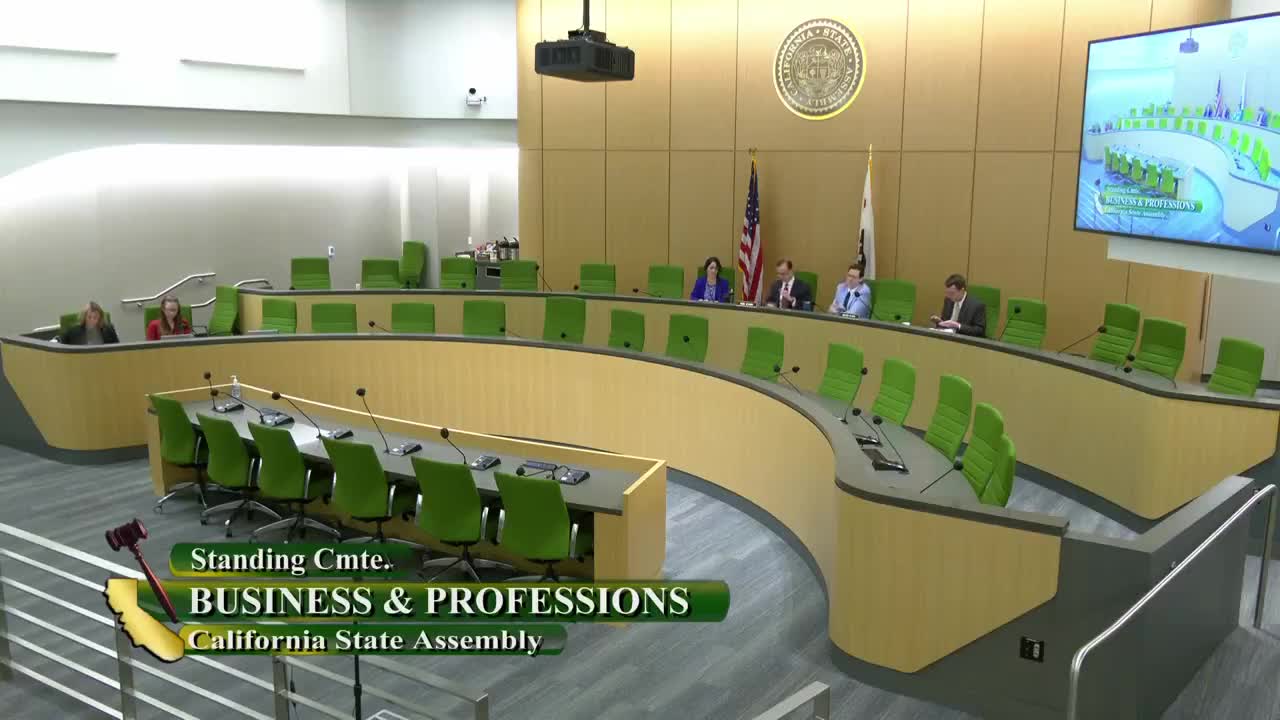
Discussed in Hearing
 11MIN
Assembly Standing Committee on Business and Professions
Bill Author

Bill Co-Author(s):