SB 1079: Youth Housing Bond Act of 2024.
- Session Year: 2023-2024
- House: Senate
- Latest Version Date: 2024-05-16
Current Status:
Failed
(2024-06-26: June 26 set for first hearing canceled at the request of author.)
Introduced
In Committee
First Chamber
In Committee
Second Chamber
Enacted
What does this bill do?
The bill creates the Youth Housing Bond Act of 2024 and authorizes $1 billion in state bonds to fund grants for local agencies, nonprofit groups, or joint ventures to buy, renovate, build, and equip youth centers and housing for homeless and current or former foster youth. It sets $100 million for youth centers and $900 million for youth housing, requires a local match (15% for nonprofits, 25% for local agencies), gives priority to nonprofits, and directs at least half of housing funds to homeless youth while allowing up to half for current or former foster youth.
The summary is provided by generative AI which can make mistakes. For original language, please view the details in the table below.
Existing law, the Veterans and Affordable Housing Bond Act of 2018, which was approved by the voters as Proposition 1 at the November 6, 2018, statewide general election, authorizes the issuance of bonds in the amount of $4,000,000,000 pursuant to the State General Obligation Bond Law and requires the proceeds from the sale of these bonds to be used to finance various housing programs and a specified program for farm, home, and mobilehome purchase assistance for veterans, as provided. Existing law establishes, among various other programs intended to address homelessness in this state, the Homeless Housing, Assistance, and Prevention program for the purpose of providing jurisdictions with one-time grant funds to support regional coordination and expand or develop local capacity to address their immediate homelessness challenges informed by a best-practices framework focused on moving homeless individuals and families into permanent housing and supporting the efforts of those individuals and families to maintain their permanent housing.
This bill would enact the Youth Housing Bond Act of 2024 (bond act), which, if adopted, would authorize the issuance of bonds in the amount of $____ $1,000,000,000 pursuant to the State General Obligation Bond Law to finance the Youth Housing Program, established as part of the bond act. The bill, as a part of the program, would require the Department of Housing and Community Development to make awards to local agencies, nonprofit organization, organizations, and joint ventures for the purpose of acquiring, renovating, constructing, and purchasing equipment for youth centers or youth housing, as those terms are defined.
This bill would provide for submission of the bond act to the voters at the November 5, 2024, statewide general election in accordance with specified law.
This bill would declare that it is to take effect immediately as an urgency statute.
Existing law, the Veterans and Affordable Housing Bond Act of 2018, which was approved by the voters as Proposition 1 at the November 6, 2018, statewide general election, authorizes the issuance of bonds in the amount of $4,000,000,000 pursuant to the State General Obligation Bond Law and requires the proceeds from the sale of these bonds to be used to finance various housing programs and a specified program for farm, home, and mobilehome purchase assistance for veterans, as provided. Existing law establishes, among various other programs intended to address homelessness in this state, the Homeless Housing, Assistance, and Prevention program for the purpose of providing jurisdictions with one-time grant funds to support regional coordination and expand or develop local capacity to address their immediate homelessness challenges informed by a best-practices framework focused on moving homeless individuals and families into permanent housing and supporting the efforts of those individuals and families to maintain their permanent housing.
This bill would enact the Youth Center and Youth Housing Bond Act of 2024 (bond act), which, if adopted, would authorize the issuance of bonds in the amount of $____ pursuant to the State General Obligation Bond Law to finance the Youth Center and Youth Housing Program, established as part of the bond act. The bill, as a part of the program, would require the Department of Housing and Community Development to make awards to local agencies, nonprofit organization, and joint ventures for the purpose of acquiring, renovating, constructing, and purchasing equipment for youth centers or youth housing, as those terms are defined.
This bill would provide for submission of the bond act to the voters at the November 5, 2024, statewide general election in accordance with specified law.
This bill would declare that it is to take effect immediately as an urgency statute.
This part shall be known as the Youth Housing Bond Act of 2024.
53701.For purposes of this part:
(a)Acquiring means obtaining ownership of an existing facility in fee simple for use as a youth center or youth housing.
(b)Altering or renovating means making modifications to an existing facility which are necessary for cost-effective use as a youth center or youth housing, including restoration, repair, expansion, and all related physical improvements.
(c)Applicant means a local agency or nonprofit organization, and any joint venture of local agencies and nonprofit organizations.
(d)Committee means the Youth Housing Finance Committee created pursuant to Section 53719.
(e)Constructing means the purchase or building of a new facility, including the costs of land acquisition and architectural and engineering fees.
(f)Department means the Department of Housing and Community Development.
(g)Equipment means tangible personal property having a useful life of more than one year and an acquisition cost of five thousand dollars ($5,000) or more.
(h)Fund means the 2024 Youth Housing Bond Fund created pursuant to Section 53702.
(i)Nonprofit organization means an institution or organization that is owned and operated by one or more corporations or associations with no part of the net earnings benefiting any private shareholder or individual.
(j)Programs means a variety of services and activities provided in a youth center or youth housing, which include, but are not limited to, all of the following:
(1)Recreation.
(2)Health and fitness.
(3)Delinquency prevention.
(4)Counseling, including counseling for substance use and suicide.
(5)Citizenship and leadership development.
(6)Education.
(7)Youth employment.
(k)Recipient means a local agency, nonprofit organization, or joint venture that receives an award and executes a contract pursuant to Section 53706.
(l)Services means the services provided in youth center or youth housing, including, but not limited to, all of the following:
(1)Food.
(2)Shelter.
(3)Counseling.
(4)Outreach.
(5)Basic health screening, including health screenings for medical and behavioral health.
(6)Referral and linkage to other services offered by public and private agencies.
(7)Long-term planning for reunification with the family or in a suitable home where family reunification is not possible.
(8)Supportive services, including case management, housing retention assistance, and tenancy support services.
(9)Aftercare and follow up services.
(m)State General Obligation Bond Law means the State General Obligation Bond Law (Chapter 4 (commencing with Section 16720) of Part 3 of Division 4 of Title 2 of the Government Code), as it may be amended from time to time.
(n)Youth center means a facility that is equipped to meet the needs of youth, including mental and behavioral health needs, housing, education and employment support, and linkage to other services, where youth ages 12 to 25 years of age, inclusive, gather for programs and services.
(o)Youth housing means a facility that provides a variety of services to current or former foster youth, homeless minors or youth, or minors or youth at risk of homelessness to assist them with their immediate basic needs and to help reunite them with their parents, if appropriate, or, find a suitable home. Youth Youth housing may include, but is not limited to, any of the following:
(1)A transitional housing placement provider licensed pursuant to Section 1559.110.
(2)A transitional living setting, as described in paragraph (3) of subdivision (x) of Section 11400 of the Welfare and Institutions Code.
(3)A Transitional Housing Program-Plus, as defined in subdivision (s) of Section 11400 of the Welfare and Institutions Code, that serves only eligible former foster youth over 18 years of age who have exited from the foster care system on or after their 18th birthday, and that has obtained certification from the applicable county in accordance with subdivision (c) of Section 16522 of the Welfare and Institutions Code.
(4)A transitional housing program as defined in Section 578.3 of Title 24 of the Code of Federal Regulations for homeless youth under 25 years of age.
53702.(a)The 2024 Youth Housing Bond Fund is hereby created within the State Treasury. The proceeds of bonds issued pursuant to this part, except for refunding bonds issued pursuant to Section 53726, shall be deposited in the fund and used to make awards to local agencies, nonprofit organizations, or joint ventures to purchasing purchase equipment and acquire, renovate, and construct youth centers or youth housing, consistent with the requirements of this part.
(b)Notwithstanding Section 13340 of the Government Code, moneys Moneys in the fund are continuously appropriated shall be available to the department upon appropriation by the Legislature for purposes of making awards to local agencies, nonprofit organizations, or joint ventures, or a combination of those entities, in order to purchase equipment and acquire, renovate, and construct youth centers or youth housing, consistent with this part.
53703.The Legislature finds and declares all of the following:
(a)The intent of this part is to address the ongoing need to develop housing to support current and former foster youth and youth experiencing or at risk of homelessness. Annual homelessness counts consistently find that California has the highest number of homeless youth, with over 68% of the homeless youth being unsheltered. The purpose of this chapter is to allow community-based nonprofit organizations with experience in providing youth services to directly apply for a designated pot of funding.
(b)Nonprofit organizations provide support to individuals who are homeless or at-risk of homelessness through targeted services. Invested in improving communities, these organizations are experts in identifying the specific housing needs, gaps, and coordinating efforts to support transition-aged youth as they transition to stable housing.
2.Youth Housing Program53705.(a)Moneys in the fund, up to a limit of ____ one billion dollars ($____), ($1,000,000,000), shall be available for purposes of this part consistent with the following requirements:
(1)____ One hundred million dollars ($____) ($100,000,000) shall be available for youth centers.
(2)____ Nine hundred million dollars ($____) ($900,000,000) shall be available for youth housing.
(3)Any remaining money that has not been awarded under this subdivision within two years of the effective date of this part shall be available for both youth centers and youth housing.
(b)The department may disburse any funds made available to youth centers or youth housing pursuant to this chapter upon execution of awards and contracts pursuant to Section 53706.
(c)The department may use up to 5 percent of the moneys in the fund to pay for the administration of the program consistent with Section 16727 of the Government Code.
(d)Moneys in the fund or other proceeds of the sale of bonds authorized by this part may be used to pay principal of, or redemption premium on, interim debt issued prior to the issuance of bonds authorized by this part.
53706.(a)(1)The department shall make awards to local agencies, nonprofit organization, organizations, or joint ventures, for the purpose of acquiring, renovating, constructing, and purchasing equipment for youth centers or youth housing, consistent with the part.
(2)An applicant that receives an award pursuant to this chapter shall execute a contract with the department that, at a minimum, provides assurances that the youth center or youth housing complies with the requirements of Section 53707, as applicable.
(b)If a local agency, nonprofit organization, or joint venture, is granted an award pursuant to subdivision (a) for youth housing that will provide services for both homeless youth and current or former foster youth, the department shall credit the allocation of bond proceeds awarded to reflect the proportion of funds to be used by the recipient for services for homeless youth and the proportion of funds to be used for services for current or former foster youth.
53707.(a)A recipient that receives an award for the acquisition of a facility to be used as a youth center or youth housing shall ensure that the facility will be used for that purpose for at least 10 years from the date of acquisition.
(b)A recipient that receives an award for the construction of a facility to be used as a youth center or youth housing shall ensure the facility will be used for that purpose for at least 20 years after completion of construction.
(c)A recipient that receives an award for the renovation of an existing facility to be used as a youth center or youth housing shall ensure the facility will be used for that purpose for the following periods:
(1)Not less than three years from the date the contract terminates, where the amount of the award does not exceed five hundred thousand dollars ($500,000).
(2)If the award exceeds five hundred thousand dollars ($500,000), the period of time shall increase one year for each additional hundred thousand dollars ($100,000) or part thereof, to a maximum of eight years.
(3)For awards that exceed one million dollars ($1,000,000), the period of time shall not be less than 10 years.
53708.(a)The department shall be entitled to recapture moneys awarded pursuant to this chapter if, before the conclusion of the applicable time period described in Section 53707, either of the following occurs:
(1)The recipient ceases to be a nonprofit organization.
(2)(A)Except as otherwise provided in subparagraph (B), the applicable facility is no longer used for youth center or youth housing activities.
(B)Notwithstanding any other provision of this section, the department shall not recapture any funds awarded to a local agency that were initially allocated for housing for current or former foster youth pursuant to subdivision (b) of Section 53713, but were expended for housing for homeless youth pursuant to subdivision (c) of Section 53713.
(b)(1)The amount recaptured pursuant to this section shall be the proportion of the current value of the facility equal to the proportion of state funds contributed to the original cost.
(2)The current value of the facility shall be determined by an agreement between the owner of the facility and the department, or by an action in the court in the jurisdiction in which the facility is located.
(c)Funding recaptured pursuant to this section shall be redeposited into the fund and reallocated according to a supplemental process established pursuant to paragraph (2) of subdivision (b) of Section 53713.
53709.A facility altered, acquired, renovated, constructed, or equipped using funds awarded under this part shall not be used for any sectarian instruction or as a place for religious worship.
53710.(a)The department shall issue a request for proposals for youth centers and youth housing within three months of moneys being deposited in the fund for the purposes of this part.
(b)(1)The department, before issuing a request for proposals, shall create an advisory committee to secure advice on the request for proposals and the criteria for reviewing and evaluating proposals.
(2)The advisory committee established pursuant to paragraph (1) shall consist of representatives, including, but not limited to, all of the following:
(A)Stakeholders representing providers of community youth services, including service providers for homeless youth and current or former foster youth.
(B)Two appointees selected by the Speaker of the Assembly.
(C)Two appointees selected by the Senate Rules Committee.
(c)The department shall review and evaluate proposals consistent with the evaluation criteria developed by the department in consultation with the advisory committee pursuant to subdivision (b) and consistent with the priorities established pursuant to Section 53712.
53711.Proposals submitted pursuant to this part for both youth centers and youth housing shall, at a minimum, do all of the following:
(a)Document the need for the applicants proposal.
(b)Contain a written commitment and a plan for the delivery of programs and services designed to meet the needs of the youth of the targeted community.
(c)(1)Include a match for funding consistent with the following, as applicable:
(A)When the applicant is a local agency or joint venture involving a local agency, a match equal to 25 percent of the total amount requested.
(B)When the applicant is a nonprofit organization, a match equal to 15 percent of the total amount requested, requested.
(2)The match for funding required pursuant to this subdivision may be in cash or in kind.
(d)Document the cost effectiveness of the proposal.
(e)Contain a written commitment and plan to develop and implement a process to receive and consider feedback and suggestions from the community served, including a separate mechanism for the youth it serves. A board of directors reflecting broad representation of the community shall satisfy this subdivision.
(f)Document plans to utilize and coordinate with other organizations serving the same youth population, including making the facilities available where possible.
53712.(a)The department shall establish a priority for considering and ranking proposals based on all of the following:
(1)The greatest need in the most heavily populated areas.
(2)The most underserved areas.
(3)The most economically disadvantaged areas, both in urban and rural counties.
(4)The number of youth to be served.
(5)The cost effectiveness of the proposal.
(6)The utilization of, and coordination with, other agencies serving youth.
(7)The applicants experience in program management, particularly in programs serving the needs of youth.
(8)The applicants experience in programs serving youth.
(b)The department shall rank all proposals based on the priority established pursuant to subdivision (a).
(c)After ranking the proposals pursuant to subdivision (a), funds shall be awarded to applicants in the following order of priority:
(1)Nonprofit organizations.
(2)Joint ventures between local agencies and nonprofit organizations.
(3)Local agencies.
(d)The department shall, to the extent possible given the amount of funds available, attempt to ensure a geographically broad distribution of the funds consistent with the program priorities, in order to meet the needs of youth.
53713.(a)For purposes of administering this chapter and the allocation of bond proceeds, the department shall treat funding for youth centers and youth housing as separate programs and shall fund each separately.
(b)(1)Funding for youth housing shall be awarded as follows:
(A)At least 50 percent to housing for homeless youth.
(B)A maximum of 50 percent to housing for current or former foster youth.
(2)Any money that has been awarded to housing for homeless youth or current or former foster youth, and has not been encumbered by July 1, 2028, shall be reallocated according to a supplemental process to be developed by the department. The department shall establish this reallocation process only when the unspent funds accumulated under this chapter equals five million dollars ($5,000,000) or more. The department shall accept new proposals pursuant to this process from all eligible applicants consistent with the requirements of this chapter.
(c)Notwithstanding any other law, a local agency may use any unexpended funds awarded to a housing project for current or former foster youth under subparagraph (B) of paragraph (1) of subdivision (b) for the purpose of acquiring, renovating, constructing, or purchasing equipment for a housing project for homeless youth.
(d)In addition to the input from its advisory committee, the department shall seek the cooperation and advice of the California Interagency Council on Homelessness and other appropriate agencies in the administration of this part.
53714.Notwithstanding any other provision of this part, a local agency that is the recipient of an award pursuant to this part may use funds to establish a local grant program that provides grant awards to nonprofit organizations for the acquisition, renovation, construction, or purchase of equipment for youth housing.
53715.An eligible applicant that is allocated funds for a grant program pursuant to this part shall not use more than 5 percent of the funds allocated for the program to pay the administrative costs of that program.
53716.The Legislature may amend the provisions of this chapter, including the distribution of funding established pursuant to Section 53705, for the purposes of improving the efficiency and effectiveness of the program or to further the goals of the program.
3.Youth Housing Bond Act of 2024 53717.(a)Bonds in the total amount of ____ one billion dollars ($____), ($1,000,000,000) not including the amount of any refunding bonds issued in accordance with Section 53726, may be issued and sold for the purposes expressed in this part and to reimburse the General Obligation Bond Expense Revolving Fund pursuant to Section 16724.5 of the Government Code. The bonds, when sold, issued, and delivered, shall be and constitute a valid and binding obligation of the State of California, and the full faith and credit of the State of California is hereby pledged for the punctual payment of both principal of, and interest on, the bonds as the principal and interest become due and payable.
(b)The Treasurer shall issue and sell the bonds authorized in subdivision (a) in the amount determined by the committee to be necessary or desirable pursuant to Section 53720. The bonds shall be issued and sold upon the terms and conditions specified in a resolution to be adopted by the committee pursuant to Section 16731 of the Government Code.
53718.(a)The bonds authorized by this part shall be prepared, executed, issued, sold, paid, and redeemed as provided in the State General Obligation Bond Law (Chapter 4 (commencing with Section 16720) of Part 3 of Division 4 of Title 2 of the Government Code), as amended from time to time, and all of the provisions of that law apply to the bonds and to this part and are hereby incorporated in this part as though set forth in full in this part.
(b)For purposes of this part, the references to committee in the State General Obligation Bond Law shall mean the Youth Housing Finance Committee created in Section 53719, and the references to board in the State General Obligation Bond Law shall mean the Department of Housing and Community Development.
53719.(a)Solely for the purpose of authorizing the issuance and sale pursuant to the State General Obligation Bond Law of the bonds authorized by this part, the Youth Housing Finance Committee is hereby created.
(b)The committee consists of the Controller, the Treasurer, the Director of Finance, the Director of the Department of Housing and Community Development, and the Director of Social Services. Notwithstanding any other law, any member may designate a representative to act as that member in the members place for all purposes, as though the member were personally present.
(c)The Treasurer shall serve as chairperson of the committee. A majority of the committee may act for the committee.
53720.The committee shall determine by resolution whether or not it is necessary or desirable to issue and sell bonds authorized pursuant to this part in order to carry out the actions specified in this part and, if so, the amount of bonds to be issued and sold. Successive issues of bonds may be authorized and sold to carry out those actions progressively, and it is not necessary that all of the bonds authorized to be issued be sold at any one time.
53721.There shall be collected each year and in the same manner and at the same time as other state revenue is collected, in addition to the ordinary revenues of the state, a sum in an amount required to pay the principal of, and interest on, the bonds becoming due each year. It is the duty of all officers charged by law with any duty in regard to the collection of the revenue to do and perform each and every act that is necessary to collect that additional sum.
53722.Notwithstanding Section 13340 of the Government Code, there is hereby continuously appropriated from the General Fund in the State Treasury, for the purposes of this part and without regard to fiscal years, an amount that equals the total of the following:
(a)The sum annually necessary to pay the principal of, and interest on, bonds issued and sold pursuant to this part, as the principal and interest become due and payable.
(b)The sum necessary to carry out Section 53724.
53723.The board may request the Pooled Money Investment Board to make a loan from the Pooled Money Investment Account, in accordance with Section 16312 of the Government Code, for the purpose of carrying out this part less any amount withdrawn pursuant to Section 53724 and not yet returned to the General Fund. The amount of the request shall not exceed the amount of the unsold bonds that the committee has, by resolution, authorized to be sold for the purpose of carrying out this part, excluding any refunding bonds authorized pursuant to Section 53726, less any amount loaned pursuant to this section and not yet repaid and any amount withdrawn from the General Fund pursuant to Section 53724 and not yet returned to the General Fund. The board shall execute any documents required by the Pooled Money Investment Board to obtain and repay the loan. Any amounts loaned shall be deposited in the fund to be allocated by the board in accordance with this part.
53724.For the purposes of carrying out this part, the Director of Finance may authorize the withdrawal from the General Fund of an amount not to exceed the amount of the unsold bonds that have been authorized by the committee to be sold for the purpose of carrying out this part, excluding any refunding bonds authorized pursuant to Section 53726, less any amount loaned pursuant to Section 53723 and not yet repaid, and any amount withdrawn from the General Fund pursuant to this section and not yet returned to the General Fund. Any amounts withdrawn shall be deposited in the fund. Any moneys made available under this section shall be returned to the General Fund from proceeds received from the sale of bonds for the purpose of carrying out this part.
53725.All moneys deposited in the fund that are derived from premium and accrued interest on bonds sold pursuant to this part shall be reserved in the fund and shall be available for transfer to the General Fund as a credit to expenditures for bond interest, except those amounts derived from premium may be reserved and used to pay the cost of bond issuance before any transfer to the General Fund.
53726.The bonds issued and sold pursuant to this part may be refunded in accordance with Article 6 (commencing with Section 16780) of Chapter 4 of Part 3 of Division 4 of Title 2 of the Government Code, which is a part of the State General Obligation Bond Law. Approval by the voters of the state for the issuance of the bonds described in this part includes the approval of the issuance of any bonds issued to refund any bonds originally issued under this part or any previously issued refunding bonds. Any bond refunded with the proceeds of refunding bonds as authorized by this section may be legally defeased to the extent permitted by law in the manner and to the extent set forth in the resolution, as amended from time to time, authorizing that refunded bond.
53727.Notwithstanding any other provision of this part, or of the State General Obligation Bond Law, if the Treasurer sells bonds pursuant to this part that include a bond counsel opinion to the effect that the interest on the bonds is excluded from gross income for federal tax purposes under designated conditions or is otherwise entitled to any federal tax advantage, the Treasurer may maintain separate accounts for the investment of bond proceeds and for the investment of earnings on those proceeds. The Treasurer may use or direct the use of those proceeds or earnings to pay any rebate, penalty, or other payment required under federal law or take any other action with respect to the investment and use of those bond proceeds or earnings required or desirable under federal law to maintain the tax exempt status of those bonds and to obtain any other advantage under federal law on behalf of the funds of this state.
53728.The proceeds from the sale of bonds authorized by this part are not proceeds of taxes as that term is used in Article XIIIB of the California Constitution, and the disbursement of these proceeds is not subject to the limitations imposed by that article.
SEC. 2.Section 1 of this act shall take effect upon the approval by the voters of the Youth Housing Bond Act of 2024, as set forth in Section 1 of this act.
SEC. 3.(a)(1)Notwithstanding Sections 9040, 9043, 9044, 9061, and 9082 of the Elections Code, or any other law, Section 1 of this act shall be submitted by the Secretary of State to the voters at the next statewide general election following the effective date of this act.
(2)The requirement of Section 9040 of the Elections Code that a measure submitted to the people by the Legislature appear on the ballot of the first statewide election occurring at least 131 days after the adoption of the proposal by the Legislature shall not apply to Section 1 of this act.
(b)The Secretary of State shall include in the ballot pamphlets mailed pursuant to Section 9094 of the Elections Code the information specified in Section 9084 of the Elections Code regarding Section 1 of this act. If that inclusion is not possible, the Secretary of State shall publish a supplemental ballot pamphlet regarding Section 1 of this act to be mailed with the ballot pamphlet. If the supplemental ballot pamphlet cannot be mailed with the ballot pamphlet, the supplemental ballot pamphlet shall be mailed separately.
(c)Notwithstanding Section 9054 of the Elections Code or any other law, the translations of the ballot title and the condensed statement of the ballot title required pursuant to Section 9054 of the Elections Code for Section 1 of this act may be made available for public examination at a later date than the start of the public examination period for the ballot pamphlet.
(d)Notwithstanding Sections 13115 and 13117 of the Elections Code, Section 1 of this act and any other measure placed on the ballot by the Legislature for the next statewide general election after the 131-day deadline set forth in Section 9040 of the Elections Code shall be placed on the ballot, following all other ballot measures, in the order in which they qualified as determined by chapter number.
SEC. 4.This act is an urgency statute necessary for the immediate preservation of the public peace, health, or safety within the meaning of Article IV of the California Constitution and shall go into immediate effect. The facts constituting the necessity are:
In order to maximize the time available for the analysis and preparation of the proposed issuance of bonds pursuant to Section 1 of this act, it is necessary that this act take effect immediately.
This part shall be known as the Youth Center and Youth Housing Bond Act of 2024.
53701.For purposes of this part:
(a)Acquiring means obtaining ownership of an existing facility in fee simple for use as a youth center or youth housing.
(b)Altering or renovating means making modifications to an existing facility which are necessary for cost-effective use as a youth center or youth housing, including restoration, repair, expansion, and all related physical improvements.
(c)Applicant means a local agency or nonprofit organization, and any joint venture of local agencies and nonprofit organizations.
(d)Committee means the Youth Center and Youth Housing Finance Committee created pursuant to Section 53719.
(e)Constructing means the purchase or building of a new facility, including the costs of land acquisition and architectural and engineering fees.
(f)Department means the Department of Housing and Community Development.
(g)Equipment means tangible personal property having a useful life of more than one year and an acquisition cost of five thousand dollars ($5,000) or more.
(h)Fund means the 2024 Youth Center and Youth Housing Bond Fund created pursuant to Section 53702.
(i)Nonprofit organization means an institution or organization that is owned and operated by one or more corporations or associations with no part of the net earnings benefiting any private shareholder or individual.
(j)Programs means a variety of services and activities provided in a youth center or youth housing, which include, but are not limited to, all of the following:
(1)Recreation.
(2)Health and fitness.
(3)Delinquency prevention.
(4)Counseling for problems Counseling, including drug and alcohol abuse counseling for substance use and suicide.
(5)Citizenship and leadership development.
(6)Education.
(7)Youth employment.
(k)Recipient means a local agency, nonprofit organization, or joint venture that receives an award and executes a contract pursuant to Section 53706.
(l)Services means the services provided in youth center or youth housing, including, but not limited to, all of the following:
(1)Food.
(2)Shelter.
(3)Counseling.
(4)Outreach.
(5)Basic health screening. screening, including health screenings for medical and behavioral health.
(6)Referral and linkage to other services offered by public and private agencies.
(7)Long-term planning for reunification with the family or in a suitable home where family reunification is not possible.
(8)Supportive services, including case management, housing retention assistance, and tenancy support services.
(9)Aftercare and follow up services.
(m)State General Obligation Bond Law means the State General Obligation Bond Law (Chapter 4 (commencing with Section 16720) of Part 3 of Division 4 of Title 2 of the Government Code), as it may be amended from time to time.
(n)Youth center means a facility where children, 6 to 17 years of age, inclusive, and 18 years of age if still enrolled in high school, gather for programs and services or youth, 18 to 25 years of age, inclusive, that is equipped to meet the needs of youth, including mental and behavioral health needs, housing, education and employment support, and linkage to other services, where youth ages 12 to 25 years of age, inclusive, gather for programs and services.
(o)Youth housing means a facility that provides a variety of services to current or former foster youth, homeless minors or youth living on the street, youth, or minors or youth at risk of homelessness to assist them with their immediate survival basic needs and to help reunite them with their parents, if appropriate, or, find a suitable home. Youth housing may include include, but is not limited to, any of the following:
(1)A transitional housing placement provider licensed pursuant to Section 1559.110.
(2)A transitional living setting, as described in paragraph (3) of subdivision (x) of Section 11400 of the Welfare and Institutions Code.
(3)A Transitional Housing Program-Plus, as defined in subdivision (s) of Section 11400 of the Welfare and Institutions Code, that serves only eligible former foster youth over 18 years of age who have exited from the foster care system on or after their 18th birthday, and that has obtained certification from the applicable county in accordance with subdivision (c) of Section 16522 of the Welfare and Institutions Code.
(4)A transitional housing program as defined in Section 578.3 of Title 24 of the Code of Federal Regulations for homeless youth under 25 years of age.
53702.(a)The 2024 Youth Center and Youth Housing Bond Fund is hereby created within the State Treasury. The proceeds of bonds issued pursuant to this part, except for refunding bonds issued pursuant to Section 53726, shall be deposited in the fund and used to make awards to local agencies, nonprofit organizations, or joint ventures to purchasing equipment and acquire, renovate, and construct youth centers or youth housing, consistent with the requirements of this part.
(b)Notwithstanding Section 13340 of the Government Code, moneys in the fund are continuously appropriated to the department for purposes of making awards to local agencies, nonprofit organizations, or joint ventures, or a combination of those entities, in order to purchase equipment and acquire, renovate, and construct youth centers or youth housing, consistent with this part.
53703.The Legislature finds and declares all the following:
(a)The intent of this part is to address the ongoing need to develop housing to support current and former foster youth and youth experiencing or at risk of homelessness. Annual homelessness counts consistently find that California has the highest number of homeless youth, with over 68% of the homeless youth being unsheltered. The purpose of this chapter is to allow community-based nonprofit organizations with experience in providing youth services to directly apply for a designated pot of funding.
(b)Nonprofit organizations provide support to individuals who are homeless or at-risk of homelessness through targeted services. Invested in improving communities, these organizations are experts in identifying the specific housing needs, gaps, and coordinating efforts to support transition-aged youth as they transition to stable housing.
2.Youth Center and Youth Housing Program53705.(a)Moneys in the fund, up to a limit of ____ dollars ($____), shall be available for purposes of this part consistent with the following requirements:
(1)____ dollars ($____) shall be available for youth centers.
(2)____ dollars ($____) shall be available for youth housing.
(3)Any remaining money that has not been awarded under this subdivision within two years of the effective date of this part shall be available for both youth centers and youth housing.
(b)The department may disburse any funds made available to youth centers or youth housing pursuant to this chapter upon execution of awards and contracts pursuant to Section 53706.
53706.(a)(1)The department shall make awards to local agencies, nonprofit organization, or joint ventures, for the purpose of acquiring, renovating, constructing, and purchasing equipment for youth centers or youth housing, consistent with the part.
(2)An applicant that receives an award pursuant to this chapter shall execute a contract with the department that, at a minimum, provides assurances that the youth center or youth housing complies with the requirements of Section 53707, as applicable.
(b)If a local agency, nonprofit organization, or joint venture, is granted an award pursuant to subdivision (a) for youth housing that will provide services for both homeless youth and current or former foster youth, the department shall credit the allocation of bond proceeds awarded to reflect the proportion of funds to be used by the recipient for services for homeless youth and the proportion of funds to be used for services for current or former foster youth.
53707.(a)A recipient that receives an award for the acquisition of a facility to be used as a youth center or youth housing shall ensure that the facility will be used for that purpose for at least 10 years from the date of acquisition.
(b)A recipient that receives an award for the construction of a facility to be used as a youth center or youth housing shall ensure the facility will be used for that purpose for at least 20 years after completion of construction.
(c)A recipient that receives an award for the renovation of an existing facility to be used as a youth center or youth housing shall ensure the facility will be used for that purpose for the following periods:
(1)Not less than three years from the date the contract terminates, where the amount of the award does not exceed five hundred thousand dollars ($500,000).
(2)If the award exceeds five hundred thousand dollars ($500,000), the period of time shall increase one year for each additional hundred thousand dollars ($100,000) or part thereof, to a maximum of eight years.
(3)For awards that exceed one million dollars ($1,000,000), the period of time shall not be less than 10 years.
53708.(a)The department shall be entitled to recapture moneys awarded pursuant to this chapter if, before the conclusion of the applicable time period described in Section 53707, either of the following occurs:
(1)The recipient ceases to be a nonprofit organization.
(2)(A)Except as otherwise provided in subparagraph (B), the applicable facility is no longer used for youth center or youth housing activities.
(B)Notwithstanding any other provision of this section, the department shall not recapture any funds awarded to a local agency that were initially allocated for housing for current or former foster youth pursuant to subdivision (b) of Section 53713, but were expended for housing for homeless youth pursuant to subdivision (c) of Section 53713.
(b)(1)The amount recaptured pursuant to this section shall be the proportion of the current value of the facility equal to the proportion of state funds contributed to the original cost.
(2)The current value of the facility shall be determined by an agreement between the owner of the facility and the department, or by an action in the court in the jurisdiction in which the facility is located.
(c)Funding recaptured pursuant to this section shall be redeposited into the fund and reallocated according to a supplemental process established pursuant to paragraph (2) of subdivision (b) of Section 53713.
53709.A facility altered, acquired, renovated, constructed, or equipped using funds awarded under this part shall not be used for any sectarian instruction or as a place for religious worship.
53710.(a)The department shall issue a request for proposals for youth centers and youth housing within three months of moneys being deposited in the fund for the purposes of this part.
(b)(1)The department, before issuing a request for proposals, shall create an advisory committee to secure advice on the request for proposals and the criteria for reviewing and evaluating proposals.
(2)The advisory committee established pursuant to paragraph (1) shall consist of representatives, including, but not limited to, all of the following:
(A)Stakeholders representing providers of community youth services, including service providers for homeless youth and current or former foster youth.
(B)Two appointees selected by the Speaker of the Assembly.
(C)Two appointees selected by the Senate Rules Committee.
(c)The department shall review and evaluate proposals consistent with the evaluation criteria developed by the department in consultation with the advisory committee pursuant to subdivision (b) and consistent with the priorities established pursuant to Section 53712.
53711.Proposals submitted pursuant to this part for both youth centers and youth housing shall, at a minimum, do all of the following:
(a)Document the need for the applicants proposal.
(b)Contain a written commitment and a plan for the delivery of programs and services designed to meet the needs of the youth of the targeted community.
(c)(1)Include a match for funding consistent with the following, as applicable:
(A)When the applicant is a local agency or joint venture involving a local agency, a match equal to 25 percent of the total amount requested.
(B)When the applicant is a nonprofit organization, a match equal to 15 percent of the total amount requested,
(2)The match for funding required pursuant to this subdivision may be in cash or in kind.
(d)Document the cost effectiveness of the proposal.
(e)Contain a written commitment and plan to develop and implement a process to receive and consider feedback and suggestions from the community served, including a separate mechanism for the youth it serves. A board of directors reflecting broad representation of the community shall satisfy this subdivision.
(f)Document plans to utilize and coordinate with other organizations serving the same youth population, including making the facilities available where possible.
53712.(a)The department shall establish a priority for considering and ranking proposals based on all of the following:
(1)The greatest need in the most heavily populated areas.
(2)The most underserved areas.
(3)The most economically disadvantaged areas, both in urban and rural counties.
(4)The number of youth to be served.
(5)The cost effectiveness of the proposal.
(6)The utilization of, and coordination with, other agencies serving youth.
(7)The applicants experience in program management, particularly in programs serving the needs of youth.
(8)The applicants experience in programs serving youth.
(b)The department shall rank all proposals based on the priority established pursuant to subdivision (a).
(c)After ranking the proposals pursuant to subdivision (a), funds shall be awarded to applicants in the following order of priority:
(1)Nonprofit organizations.
(2)Joint ventures between local agencies and nonprofit organizations.
(3)Local agencies.
(d)The department shall, to the extent possible given the amount of funds available, attempt to ensure a geographically broad distribution of the funds consistent with the program priorities, in order to meet the needs of youth.
53713.(a)For purposes of administering this chapter and the allocation of bond proceeds, the department shall treat funding for youth centers and youth housing as separate programs and shall fund each separately.
(b)(1)Funding for youth housing shall be awarded as follows:
(A)At least 50 percent to housing for homeless youth.
(B)A maximum of 50 percent to housing for current or former foster youth.
(2)Any money that has been awarded to housing for homeless youth or current or former foster youth, and has not been encumbered by July 1, 2028, shall be reallocated according to a supplemental process to be developed by the department. The department shall establish this reallocation process only when the unspent funds accumulated under this chapter equals five million dollars ($5,000,000) or more. The department shall accept new proposals pursuant to this process from all eligible applicants consistent with the requirements of this chapter.
(c)Notwithstanding any other law, a local agency may use any unexpended funds awarded to a housing project for current or former foster youth under subparagraph (B) of paragraph (1) of subdivision (b) for the purpose of acquiring, renovating, constructing, or purchasing equipment for a housing project for homeless youth.
(d)In addition to the input from its advisory committee, the department shall seek the cooperation and advice of the California Interagency Council on Homelessness and other appropriate agencies in the administration of this part.
53714.Notwithstanding any other provision of this part, a local agency that is the recipient of an award pursuant to this part may use funds to establish a local grant program that provides grant awards to nonprofit organizations for the acquisition, renovation, construction, or purchase of equipment for youth housing.
53715.An eligible applicant that is allocated funds for a grant program pursuant to this part shall not use more than 5 percent of the funds allocated for the program to pay the administrative costs of that program.
53716.The Legislature may amend the provisions of this chapter, including the distribution of funding established pursuant to Section 53705, for the purposes of improving the efficiency and effectiveness of the program or to further the goals of the program.
3.Youth Center and Youth Housing Bond Act of 2024 53717.(a)Bonds in the total amount of ____ dollars ($____), not including the amount of any refunding bonds issued in accordance with Section 53726, may be issued and sold for the purposes expressed in this part and to reimburse the General Obligation Bond Expense Revolving Fund pursuant to Section 16724.5 of the Government Code. The bonds, when sold, issued, and delivered, shall be and constitute a valid and binding obligation of the State of California, and the full faith and credit of the State of California is hereby pledged for the punctual payment of both principal of, and interest on, the bonds as the principal and interest become due and payable.
(b)The Treasurer shall issue and sell the bonds authorized in subdivision (a) in the amount determined by the committee to be necessary or desirable pursuant to Section 53720. The bonds shall be issued and sold upon the terms and conditions specified in a resolution to be adopted by the committee pursuant to Section 16731 of the Government Code.
53718.(a)The bonds authorized by this part shall be prepared, executed, issued, sold, paid, and redeemed as provided in the State General Obligation Bond Law (Chapter 4 (commencing with Section 16720) of Part 3 of Division 4 of Title 2 of the Government Code), as amended from time to time, and all of the provisions of that law apply to the bonds and to this part and are hereby incorporated in this part as though set forth in full in this part.
(b)For purposes of this part, the references to committee in the State General Obligation Bond Law shall mean the Youth Center and Youth Housing Finance Committee created in Section 53719, and the references to board in the State General Obligation Bond Law shall mean the Department of Housing and Community Development.
53719.(a)Solely for the purpose of authorizing the issuance and sale pursuant to the State General Obligation Bond Law of the bonds authorized by this part, the Youth Center and Youth Housing Finance Committee is hereby created.
(b)The committee consists of the Controller, the Treasurer, the Director of Finance, and the Director of the Department of Housing and Community Development. Development, and the Director of Social Services. Notwithstanding any other law, any member may designate a representative to act as that member in the members place for all purposes, as though the member were personally present.
(c)The Treasurer shall serve as chairperson of the committee. A majority of the committee may act for the committee.
53720.The committee shall determine by resolution whether or not it is necessary or desirable to issue and sell bonds authorized pursuant to this part in order to carry out the actions specified in this part and, if so, the amount of bonds to be issued and sold. Successive issues of bonds may be authorized and sold to carry out those actions progressively, and it is not necessary that all of the bonds authorized to be issued be sold at any one time.
53721.There shall be collected each year and in the same manner and at the same time as other state revenue is collected, in addition to the ordinary revenues of the state, a sum in an amount required to pay the principal of, and interest on, the bonds becoming due each year. It is the duty of all officers charged by law with any duty in regard to the collection of the revenue to do and perform each and every act that is necessary to collect that additional sum.
53722.Notwithstanding Section 13340 of the Government Code, there is hereby continuously appropriated from the General Fund in the State Treasury, for the purposes of this part and without regard to fiscal years, an amount that equals the total of the following:
(a)The sum annually necessary to pay the principal of, and interest on, bonds issued and sold pursuant to this part, as the principal and interest become due and payable.
(b)The sum necessary to carry out Section 53724.
53723.The board may request the Pooled Money Investment Board to make a loan from the Pooled Money Investment Account, in accordance with Section 16312 of the Government Code, for the purpose of carrying out this part less any amount withdrawn pursuant to Section 53724 and not yet returned to the General Fund. The amount of the request shall not exceed the amount of the unsold bonds that the committee has, by resolution, authorized to be sold for the purpose of carrying out this part, excluding any refunding bonds authorized pursuant to Section 53726, less any amount loaned pursuant to this section and not yet repaid and any amount withdrawn from the General Fund pursuant to Section 53724 and not yet returned to the General Fund. The board shall execute any documents required by the Pooled Money Investment Board to obtain and repay the loan. Any amounts loaned shall be deposited in the fund to be allocated by the board in accordance with this part.
53724.For the purposes of carrying out this part, the Director of Finance may authorize the withdrawal from the General Fund of an amount not to exceed the amount of the unsold bonds that have been authorized by the committee to be sold for the purpose of carrying out this part, excluding any refunding bonds authorized pursuant to Section 53726, less any amount loaned pursuant to Section 53723 and not yet repaid, and any amount withdrawn from the General Fund pursuant to this section and not yet returned to the General Fund. Any amounts withdrawn shall be deposited in the fund. Any moneys made available under this section shall be returned to the General Fund from proceeds received from the sale of bonds for the purpose of carrying out this part.
53725.All moneys deposited in the fund that are derived from premium and accrued interest on bonds sold pursuant to this part shall be reserved in the fund and shall be available for transfer to the General Fund as a credit to expenditures for bond interest, except those amounts derived from premium may be reserved and used to pay the cost of bond issuance before any transfer to the General Fund.
53726.The bonds issued and sold pursuant to this part may be refunded in accordance with Article 6 (commencing with Section 16780) of Chapter 4 of Part 3 of Division 4 of Title 2 of the Government Code, which is a part of the State General Obligation Bond Law. Approval by the voters of the state for the issuance of the bonds described in this part includes the approval of the issuance of any bonds issued to refund any bonds originally issued under this part or any previously issued refunding bonds. Any bond refunded with the proceeds of refunding bonds as authorized by this section may be legally defeased to the extent permitted by law in the manner and to the extent set forth in the resolution, as amended from time to time, authorizing that refunded bond.
53727.Notwithstanding any other provision of this part, or of the State General Obligation Bond Law, if the Treasurer sells bonds pursuant to this part that include a bond counsel opinion to the effect that the interest on the bonds is excluded from gross income for federal tax purposes under designated conditions or is otherwise entitled to any federal tax advantage, the Treasurer may maintain separate accounts for the investment of bond proceeds and for the investment of earnings on those proceeds. The Treasurer may use or direct the use of those proceeds or earnings to pay any rebate, penalty, or other payment required under federal law or take any other action with respect to the investment and use of those bond proceeds or earnings required or desirable under federal law to maintain the tax exempt status of those bonds and to obtain any other advantage under federal law on behalf of the funds of this state.
53728.The proceeds from the sale of bonds authorized by this part are not proceeds of taxes as that term is used in Article XIIIB of the California Constitution, and the disbursement of these proceeds is not subject to the limitations imposed by that article.
SEC. 2.Section 1 of this act shall take effect upon the approval by the voters of the Youth Center and Youth Housing Bond Act of 2024, as set forth in Section 1 of this act.
SEC. 3.(a)(1)Notwithstanding Sections 9040, 9043, 9044, 9061, and 9082 of the Elections Code, or any other law, Section 1 of this act shall be submitted by the Secretary of State to the voters at the next statewide general election following the effective date of this act.
(2)The requirement of Section 9040 of the Elections Code that a measure submitted to the people by the Legislature appear on the ballot of the first statewide election occurring at least 131 days after the adoption of the proposal by the Legislature shall not apply to Section 1 of this act.
(b)The Secretary of State shall include in the ballot pamphlets mailed pursuant to Section 9094 of the Elections Code the information specified in Section 9084 of the Elections Code regarding Section 1 of this act. If that inclusion is not possible, the Secretary of State shall publish a supplemental ballot pamphlet regarding Section 1 of this act to be mailed with the ballot pamphlet. If the supplemental ballot pamphlet cannot be mailed with the ballot pamphlet, the supplemental ballot pamphlet shall be mailed separately.
(c)Notwithstanding Section 9054 of the Elections Code or any other law, the translations of the ballot title and the condensed statement of the ballot title required pursuant to Section 9054 of the Elections Code for Section 1 of this act may be made available for public examination at a later date than the start of the public examination period for the ballot pamphlet.
(d)Notwithstanding Sections 13115 and 13117 of the Elections Code, Section 1 of this act and any other measure placed on the ballot by the Legislature for the next statewide general election after the 131-day deadline set forth in Section 9040 of the Elections Code shall be placed on the ballot, following all other ballot measures, in the order in which they qualified as determined by chapter number.
SEC. 4.This act is an urgency statute necessary for the immediate preservation of the public peace, health, or safety within the meaning of Article IV of the California Constitution and shall go into immediate effect. The facts constituting the necessity are:
In order to maximize the time available for the analysis and preparation of the proposed issuance of bonds pursuant to Section 1 of this act, it is necessary that this act take effect immediately.
This part shall be known as the Youth Center and Youth Housing Bond Act of 2024.
53701.For purposes of this part:
(a)Acquiring means obtaining ownership of an existing facility in fee simple for use as a youth center or youth housing.
(b)Altering or renovating means making modifications to an existing facility which are necessary for cost-effective use as a youth center or youth housing, including restoration, repair, expansion, and all related physical improvements.
(c)Applicant means a local agency or nonprofit organization, and any joint venture of local agencies and nonprofit organizations.
(d)Committee means the Youth Center and Youth Housing Finance Committee created pursuant to Section 53719.
(e)Constructing means the purchase or building of a new facility, including the costs of land acquisition and architectural and engineering fees.
(f)Department means the Department of Housing and Community Development.
(g)Equipment means tangible personal property having a useful life of more than one year and an acquisition cost of five thousand dollars ($5,000) or more.
(h)Fund means the 2024 Youth Center and Youth Housing Bond Fund created pursuant to Section 53702.
(i)Nonprofit organization means an institution or organization that is owned and operated by one or more corporations or associations with no part of the net earnings benefiting any private shareholder or individual.
(j)Programs means a variety of services and activities provided in a youth center or youth housing, which include, but are not limited to, all of the following:
(1)Recreation.
(2)Health and fitness.
(3)Delinquency prevention.
(4)Counseling for problems including drug and alcohol abuse and suicide.
(5)Citizenship and leadership development.
(6)Education.
(7)Youth employment.
(k)Recipient means a local agency, nonprofit organization, or joint venture that receives an award and executes a contract pursuant to Section 53706.
(l)Services means the services provided in youth center or youth housing, including, but not limited to, all of the following:
(1)Food.
(2)Shelter.
(3)Counseling.
(4)Outreach.
(5)Basic health screening.
(6)Referral and linkage to other services offered by public and private agencies.
(7)Long-term planning for reunification with the family or in a suitable home where family reunification is not possible.
(m)State General Obligation Bond Law means the State General Obligation Bond Law (Chapter 4 (commencing with Section 16720) of Part 3 of Division 4 of Title 2 of the Government Code), as it may be amended from time to time.
(n)Youth center means a facility where children, 6 to 17 years of age, inclusive, and 18 years of age if still enrolled in high school, gather for programs and services or youth, 18 to 25 years of age, inclusive, gather for programs and services.
(o)Youth housing means a facility that provides a variety of services to current or former foster youth, homeless minors or youth living on the street, or minors or youth at risk of homelessness to assist them with their immediate survival needs and to help reunite them with their parents, if appropriate, or, find a suitable home. Youth housing may include any of the following:
(1)A transitional housing placement provider licensed pursuant to Section 1559.110.
(2)A transitional living setting, as described in paragraph (3) of subdivision (x) of Section 11400 of the Welfare and Institutions Code.
(3)A Transitional Housing Program-Plus, as defined in subdivision (s) of Section 11400 of the Welfare and Institutions Code, that serves only eligible former foster youth over 18 years of age who have exited from the foster care system on or after their 18th birthday, and that has obtained certification from the applicable county in accordance with subdivision (c) of Section 16522 of the Welfare and Institutions Code.
53702.(a)The 2024 Youth Center and Youth Housing Bond Fund is hereby created within the State Treasury. The proceeds of bonds issued pursuant to this part, except for refunding bonds issued pursuant to Section 53726, shall be deposited in the fund and used to make awards to local agencies, nonprofit organizations, or joint ventures to purchasing equipment and acquire, renovate, and construct youth centers or youth housing, consistent with the requirements of this part.
(b)Notwithstanding Section 13340 of the Government Code, moneys in the fund are continuously appropriated to the department for purposes of making awards to local agencies, nonprofit organizations, or joint ventures, or a combination of those entities, in order to purchase equipment and acquire, renovate, and construct youth centers or youth housing, consistent with this part.
53703.The Legislature finds and declares all the following:
(a)The intent of this part is to address the ongoing need to develop housing to support current and former foster youth and youth experiencing or at risk of homelessness. Annual homelessness counts consistently find that California has the highest number of homeless youth, with over 68% of the homeless youth being unsheltered. The purpose of this chapter is to allow community-based nonprofit organizations with experience in providing youth services to directly apply for a designated pot of funding.
(b)Nonprofit organizations provide support to individuals who are homeless or at-risk of homelessness through targeted services. Invested in improving communities, these organizations are experts in identifying the specific housing needs, gaps, and coordinating efforts to support transition-aged youth as they transition to stable housing.
2.Youth Center and Youth Housing Program53705.(a)Moneys in the fund, up to a limit of ____ dollars ($____), shall be available for purposes of this part consistent with the following requirements:
(1)____ dollars ($____) shall be available for youth centers.
(2)____ dollars ($____) shall be available for youth housing.
(3)Any remaining money that has not been awarded under this subdivision within two years of the effective date of this part shall be available for both youth centers and youth housing.
(b)The department may disburse any funds made available to youth centers or youth housing pursuant to this chapter upon execution of awards and contracts pursuant to Section 53706.
53706.(a)(1)The department shall make awards to local agencies, nonprofit organization, or joint ventures, for the purpose of acquiring, renovating, constructing, and purchasing equipment for youth centers or youth housing, consistent with the part.
(2)An applicant that receives an award pursuant to this chapter shall execute a contract with the department that, at a minimum, provides assurances that the youth center or youth housing complies with the requirements of Section 53707, as applicable.
(b)If a local agency, nonprofit organization, or joint venture, is granted an award pursuant to subdivision (a) for youth housing that will provide services for both homeless youth and current or former foster youth, the department shall credit the allocation of bond proceeds awarded to reflect the proportion of funds to be used by the recipient for services for homeless youth and the proportion of funds to be used for services for current or former foster youth.
53707.(a)A recipient that receives an award for the acquisition of a facility to be used as a youth center or youth housing shall ensure that the facility will be used for that purpose for at least 10 years from the date of acquisition.
(b)A recipient that receives an award for the construction of a facility to be used as a youth center or youth housing shall ensure the facility will be used for that purpose for at least 20 years after completion of construction.
(c)A recipient that receives an award for the renovation of an existing facility to be used as a youth center or youth housing shall ensure the facility will be used for that purpose for the following periods:
(1)Not less than three years from the date the contract terminates, where the amount of the award does not exceed five hundred thousand dollars ($500,000).
(2)If the award exceeds five hundred thousand dollars ($500,000), the period of time shall increase one year for each additional hundred thousand dollars ($100,000) or part thereof, to a maximum of eight years.
(3)For awards that exceed one million dollars ($1,000,000), the period of time shall not be less than 10 years.
53708.(a)The department shall be entitled to recapture moneys awarded pursuant to this chapter if, before the conclusion of the applicable time period described in Section 53707, either of the following occurs:
(1)The recipient ceases to be a nonprofit organization.
(2)(A)Except as otherwise provided in subparagraph (B), the applicable facility is no longer used for youth center or youth housing activities.
(B)Notwithstanding any other provision of this section, the department shall not recapture any funds awarded to a local agency that were initially allocated for housing for current or former foster youth pursuant to subdivision (b) of Section 53713, but were expended for housing for homeless youth pursuant to subdivision (c) of Section 53713.
(b)(1)The amount recaptured pursuant to this section shall be the proportion of the current value of the facility equal to the proportion of state funds contributed to the original cost.
(2)The current value of the facility shall be determined by an agreement between the owner of the facility and the department, or by an action in the court in the jurisdiction in which the facility is located.
(c)Funding recaptured pursuant to this section shall be redeposited into the fund and reallocated according to a supplemental process established pursuant to paragraph (2) of subdivision (b) of Section 53713.
53709.A facility altered, acquired, renovated, constructed, or equipped using funds awarded under this part shall not be used for any sectarian instruction or as a place for religious worship.
53710.(a)The department shall issue a request for proposals for youth centers and youth housing within three months of moneys being deposited in the fund for the purposes of this part.
(b)(1)The department, before issuing a request for proposals, shall create an advisory committee to secure advice on the request for proposals and the criteria for reviewing and evaluating proposals.
(2)The advisory committee established pursuant to paragraph (1) shall consist of representatives, including, but not limited to, all of the following:
(A)Stakeholders representing providers of community youth services, including service providers for homeless youth and current or former foster youth.
(B)Two appointees selected by the Speaker of the Assembly.
(C)Two appointees selected by the Senate Rules Committee.
(c)The department shall review and evaluate proposals consistent with the evaluation criteria developed by the department in consultation with the advisory committee pursuant to subdivision (b) and consistent with the priorities established pursuant to Section 53712.
53711.Proposals submitted pursuant to this part for both youth centers and youth housing shall, at a minimum, do all of the following:
(a)Document the need for the applicants proposal.
(b)Contain a written commitment and a plan for the delivery of programs and services designed to meet the needs of the youth of the targeted community.
(c)(1)Include a match for funding consistent with the following, as applicable:
(A)When the applicant is a local agency or joint venture involving a local agency, a match equal to 25 percent of the total amount requested.
(B)When the applicant is a nonprofit organization, a match equal to 15 percent of the total amount requested,
(2)The match for funding required pursuant to this subdivision may be in cash or in kind.
(d)Document the cost effectiveness of the proposal.
(e)Contain a written commitment and plan to develop and implement a process to receive and consider feedback and suggestions from the community served, including a separate mechanism for the youth it serves. A board of directors reflecting broad representation of the community shall satisfy this subdivision.
(f)Document plans to utilize and coordinate with other organizations serving the same youth population, including making the facilities available where possible.
53712.(a)The department shall establish a priority for considering and ranking proposals based on all of the following:
(1)The greatest need in the most heavily populated areas.
(2)The most underserved areas.
(3)The most economically disadvantaged areas, both in urban and rural counties.
(4)The number of youth to be served.
(5)The cost effectiveness of the proposal.
(6)The utilization of, and coordination with, other agencies serving youth.
(7)The applicants experience in program management, particularly in programs serving the needs of youth.
(8)The applicants experience in programs serving youth.
(b)The department shall rank all proposals based on the priority established pursuant to subdivision (a).
(c)After ranking the proposals pursuant to subdivision (a), funds shall be awarded to applicants in the following order of priority:
(1)Nonprofit organizations.
(2)Joint ventures between local agencies and nonprofit organizations.
(3)Local agencies.
(d)The department shall, to the extent possible given the amount of funds available, attempt to ensure a geographically broad distribution of the funds consistent with the program priorities, in order to meet the needs of youth.
53713.(a)For purposes of administering this chapter and the allocation of bond proceeds, the department shall treat funding for youth centers and youth housing as separate programs and shall fund each separately.
(b)(1)Funding for youth housing shall be awarded as follows:
(A)At least 50 percent to housing for homeless youth.
(B)A maximum of 50 percent to housing for current or former foster youth.
(2)Any money that has been awarded to housing for homeless youth or current or former youth, and has not been encumbered by July 1, 2028, shall be reallocated according to a supplemental process to be developed by the department. The department shall establish this reallocation process only when the unspent funds accumulated under this chapter equals five million dollars ($5,000,000) or more. The department shall accept new proposals pursuant to this process from all eligible applicants consistent with the requirements of this chapter.
(c)Notwithstanding any other law, a local agency may use any unexpended funds awarded to a housing project for current or former foster youth under subparagraph (B) of paragraph (1) of subdivision (b) for the purpose of acquiring, renovating, constructing, or purchasing equipment for a housing project for homeless youth.
(d)In addition to the input from its advisory committee, the department shall seek the cooperation and advice of the California Interagency Council on Homelessness and other appropriate agencies in the administration of this part.
53714.Notwithstanding any other provision of this part, a local agency that is the recipient of an award pursuant to this part may use funds to establish a local grant program that provides grant awards to nonprofit organizations for the acquisition, renovation, construction, or purchase of equipment for youth housing.
53715.An eligible applicant that is allocated funds for a grant program pursuant to this part shall not use more than 5 percent of the funds allocated for the program to pay the administrative costs of that program.
53716.The Legislature may amend the provisions of this chapter, including the distribution of funding established pursuant to Section 53705, for the purposes of improving the efficiency and effectiveness of the program or to further the goals of the program.
3.Youth Center and Youth Housing Bond Act of 2024 53717.(a)Bonds in the total amount of ____ dollars ($____), not including the amount of any refunding bonds issued in accordance with Section 53726, may be issued and sold for the purposes expressed in this part and to reimburse the General Obligation Bond Expense Revolving Fund pursuant to Section 16724.5 of the Government Code. The bonds, when sold, issued, and delivered, shall be and constitute a valid and binding obligation of the State of California, and the full faith and credit of the State of California is hereby pledged for the punctual payment of both principal of, and interest on, the bonds as the principal and interest become due and payable.
(b)The Treasurer shall issue and sell the bonds authorized in subdivision (a) in the amount determined by the committee to be necessary or desirable pursuant to Section 53720. The bonds shall be issued and sold upon the terms and conditions specified in a resolution to be adopted by the committee pursuant to Section 16731 of the Government Code.
53718.(a)The bonds authorized by this part shall be prepared, executed, issued, sold, paid, and redeemed as provided in the State General Obligation Bond Law (Chapter 4 (commencing with Section 16720) of Part 3 of Division 4 of Title 2 of the Government Code), as amended from time to time, and all of the provisions of that law apply to the bonds and to this part and are hereby incorporated in this part as though set forth in full in this part.
(b)For purposes of this part, the references to committee in the State General Obligation Bond Law shall mean the Youth Center and Youth Housing Finance Committee created in Section 53719, and the references to board in the State General Obligation Bond Law shall mean the Department of Housing and Community Development.
53719.(a)Solely for the purpose of authorizing the issuance and sale pursuant to the State General Obligation Bond Law of the bonds authorized by this part, the Youth Center and Youth Housing Finance Committee is hereby created.
(b)The committee consists of the Controller, the Treasurer, the Director of Finance, and the Director of the Department of Housing and Community Development. Notwithstanding any other law, any member may designate a representative to act as that member in the members place for all purposes, as though the member were personally present.
(c)The Treasurer shall serve as chairperson of the committee. A majority of the committee may act for the committee.
53720.The committee shall determine by resolution whether or not it is necessary or desirable to issue and sell bonds authorized pursuant to this part in order to carry out the actions specified in this part and, if so, the amount of bonds to be issued and sold. Successive issues of bonds may be authorized and sold to carry out those actions progressively, and it is not necessary that all of the bonds authorized to be issued be sold at any one time.
53721.There shall be collected each year and in the same manner and at the same time as other state revenue is collected, in addition to the ordinary revenues of the state, a sum in an amount required to pay the principal of, and interest on, the bonds becoming due each year. It is the duty of all officers charged by law with any duty in regard to the collection of the revenue to do and perform each and every act that is necessary to collect that additional sum.
53722.Notwithstanding Section 13340 of the Government Code, there is hereby continuously appropriated from the General Fund in the State Treasury, for the purposes of this part and without regard to fiscal years, an amount that equals the total of the following:
(a)The sum annually necessary to pay the principal of, and interest on, bonds issued and sold pursuant to this part, as the principal and interest become due and payable.
(b)The sum necessary to carry out Section 53724.
53723.The board may request the Pooled Money Investment Board to make a loan from the Pooled Money Investment Account, in accordance with Section 16312 of the Government Code, for the purpose of carrying out this part less any amount withdrawn pursuant to Section 53724 and not yet returned to the General Fund. The amount of the request shall not exceed the amount of the unsold bonds that the committee has, by resolution, authorized to be sold for the purpose of carrying out this part, excluding any refunding bonds authorized pursuant to Section 53726, less any amount loaned pursuant to this section and not yet repaid and any amount withdrawn from the General Fund pursuant to Section 53724 and not yet returned to the General Fund. The board shall execute any documents required by the Pooled Money Investment Board to obtain and repay the loan. Any amounts loaned shall be deposited in the fund to be allocated by the board in accordance with this part.
53724.For the purposes of carrying out this part, the Director of Finance may authorize the withdrawal from the General Fund of an amount not to exceed the amount of the unsold bonds that have been authorized by the committee to be sold for the purpose of carrying out this part, excluding any refunding bonds authorized pursuant to Section 53726, less any amount loaned pursuant to Section 53723 and not yet repaid, and any amount withdrawn from the General Fund pursuant to this section and not yet returned to the General Fund. Any amounts withdrawn shall be deposited in the fund. Any moneys made available under this section shall be returned to the General Fund from proceeds received from the sale of bonds for the purpose of carrying out this part.
53725.All moneys deposited in the fund that are derived from premium and accrued interest on bonds sold pursuant to this part shall be reserved in the fund and shall be available for transfer to the General Fund as a credit to expenditures for bond interest, except those amounts derived from premium may be reserved and used to pay the cost of bond issuance before any transfer to the General Fund.
53726.The bonds issued and sold pursuant to this part may be refunded in accordance with Article 6 (commencing with Section 16780) of Chapter 4 of Part 3 of Division 4 of Title 2 of the Government Code, which is a part of the State General Obligation Bond Law. Approval by the voters of the state for the issuance of the bonds described in this part includes the approval of the issuance of any bonds issued to refund any bonds originally issued under this part or any previously issued refunding bonds. Any bond refunded with the proceeds of refunding bonds as authorized by this section may be legally defeased to the extent permitted by law in the manner and to the extent set forth in the resolution, as amended from time to time, authorizing that refunded bond.
53727.Notwithstanding any other provision of this part, or of the State General Obligation Bond Law, if the Treasurer sells bonds pursuant to this part that include a bond counsel opinion to the effect that the interest on the bonds is excluded from gross income for federal tax purposes under designated conditions or is otherwise entitled to any federal tax advantage, the Treasurer may maintain separate accounts for the investment of bond proceeds and for the investment of earnings on those proceeds. The Treasurer may use or direct the use of those proceeds or earnings to pay any rebate, penalty, or other payment required under federal law or take any other action with respect to the investment and use of those bond proceeds or earnings required or desirable under federal law to maintain the tax exempt status of those bonds and to obtain any other advantage under federal law on behalf of the funds of this state.
53728.The proceeds from the sale of bonds authorized by this part are not proceeds of taxes as that term is used in Article XIIIB of the California Constitution, and the disbursement of these proceeds is not subject to the limitations imposed by that article.
SEC. 2.Section 1 of this act shall take effect upon the approval by the voters of the Youth Center and Youth Housing Bond Act of 2024, as set forth in Section 1 of this act.
SEC. 3.(a)(1)Notwithstanding Sections 9040, 9043, 9044, 9061, and 9082 of the Elections Code, or any other law, Section 1 of this act shall be submitted by the Secretary of State to the voters at the next statewide general election following the effective date of this act.
(2)The requirement of Section 9040 of the Elections Code that a measure submitted to the people by the Legislature appear on the ballot of the first statewide election occurring at least 131 days after the adoption of the proposal by the Legislature shall not apply to Section 1 of this act.
(b)The Secretary of State shall include in the ballot pamphlets mailed pursuant to Section 9094 of the Elections Code the information specified in Section 9084 of the Elections Code regarding Section 1 of this act. If that inclusion is not possible, the Secretary of State shall publish a supplemental ballot pamphlet regarding Section 1 of this act to be mailed with the ballot pamphlet. If the supplemental ballot pamphlet cannot be mailed with the ballot pamphlet, the supplemental ballot pamphlet shall be mailed separately.
(c)Notwithstanding Section 9054 of the Elections Code or any other law, the translations of the ballot title and the condensed statement of the ballot title required pursuant to Section 9054 of the Elections Code for Section 1 of this act may be made available for public examination at a later date than the start of the public examination period for the ballot pamphlet.
(d)Notwithstanding Sections 13115 and 13117 of the Elections Code, Section 1 of this act and any other measure placed on the ballot by the Legislature for the next statewide general election after the 131-day deadline set forth in Section 9040 of the Elections Code shall be placed on the ballot, following all other ballot measures, in the order in which they qualified as determined by chapter number.
SEC. 4.This act is an urgency statute necessary for the immediate preservation of the public peace, health, or safety within the meaning of Article IV of the California Constitution and shall go into immediate effect. The facts constituting the necessity are:
In order to maximize the time available for the analysis and preparation of the proposed issuance of bonds pursuant to Section 1 of this act, it is necessary that this act take effect immediately.
|
Date
|
Status
|
|---|---|
| Jun 26, 2024 | June 26 set for first hearing canceled at the request of author. |
| Jun 3, 2024 | Referred to Com. on H. & C.D. |
| May 23, 2024 | In Assembly. Read first time. Held at Desk. |
| May 22, 2024 | Read third time. Urgency clause adopted. Passed. (Ayes 30. Noes 7. Page 4143.) Ordered to the Assembly. |
| May 20, 2024 | Read second time. Ordered to third reading. |
| May 16, 2024 | From committee: Do pass as amended. (Ayes 5. Noes 2. Page 3971.) (May 16). |
| May 16, 2024 | Read second time and amended. Ordered to second reading. |
| May 10, 2024 | Set for hearing May 16. |
| Apr 8, 2024 | April 8 hearing: Placed on APPR suspense file. |
| Apr 2, 2024 | From committee with author's amendments. Read second time and amended. Re-referred to Com. on APPR. |
| Mar 28, 2024 | Set for hearing April 8. |
| Mar 20, 2024 | From committee: Do pass and re-refer to Com. on APPR. (Ayes 9. Noes 1. Page 3350.) (March 19). Re-referred to Com. on APPR. |
| Mar 6, 2024 | Set for hearing March 19. |
| Feb 21, 2024 | Referred to Com. on HOUSING. |
| Feb 13, 2024 | From printer. May be acted upon on or after March 14. |
| Feb 12, 2024 | Introduced. Read first time. To Com. on RLS. for assignment. To print. |
|
Date
|
Description
|
Location
|
Votes
|
|
|---|---|---|---|---|
| May 22, 2024 | Senate 3rd Reading SB1079 Menjivar Urgency Clause | Senate Floor |
Passed |
|
| May 16, 2024 | Do pass as amended | Senate Standing Committee on Appropriations |
Passed |
|
| Apr 8, 2024 | Placed on suspense file | Senate Standing Committee on Appropriations |
Passed |
|
| Mar 19, 2024 | Do pass, but first be re-referred to the Committee on [Appropriations] | Senate Standing Committee on Housing |
Passed |
This list shows positions taken on this bill by organizations on the date displayed, which is linked to the original source.
Positions by individuals are not included.
|
Organization
|
Position
|
Date
|
|---|---|---|
| Alameda County's Youth Advisory Board | ** Support | |
| Alliance for Children's Rights | ** Support | |
| American Academy Of Pediatrics, California | ** Support | |
| ASPIRANET | ** Support | |
| Bill Wilson Center | ** Support | |
| California Academy of Adolescent and Child Psychiatrists | * Support | Mar 19, 2024 |
| California Academy of Child and Adolescent Psychiatry | ** Support | |
| California Alliance of Caregivers | ** Support | |
| California Alliance Of Child And Family Services | ** Support | |
| California Coalition For Youth | ** Support | |
| California Youth Connection | ** Support | |
| Children Now | ** Support | |
| Children'S Law Center Of California | ** Support | |
| Equality California | ** Support | |
| Family Assistance Program | ** Support | |
| Home Start | * Support | Mar 19, 2024 |
| Home Start, Inc. | ** Support | |
| John Burton Advocates for Youth | ** Support | |
| Larkin Street Youth Services | ** Support | |
| Los Angeles LGBT Center | ** Support | |
| National Network for Youth | ** Support | |
| Orangewood Foundation | ** Support | |
| Penny Lane Centers | ** Support | |
| Power CA Action | ** Support | |
| Public Counsel | ** Support | |
| Redwood Community Action Agency | ** Support | |
| Sacramento LGBT Community Center | ** Support | |
| Safe Place For Youth | ** Support | |
| San Diego Youth Services | ** Support | |
| Side by Side | ** Support | |
| Walden Family Services | ** Support | |
| YMCA of San Diego County | ** Support | |
| Youth Law Center | ** Support |
SENATE RULES COMMITTEE Office of Senate Floor Analyses (916) 651-1520 Fax: (916) 327-4478 | SB 1079 |
THIRD READING
Bill No: SB 1079
Author: Menjivar (D)
Amended: 5/16/24
Vote: 27 - Urgency
SENATE HOUSING COMMITTEE: 9-1, 3/19/24
AYES: Skinner, Ochoa Bogh, Blakespear, Caballero, Cortese, Menjivar, Padilla, Umberg, Wahab
NOES: Seyarto
SENATE APPROPRIATIONS COMMITTEE: 5-2, 5/16/24
AYES: Caballero, Ashby, Becker, Bradford, Wahab
NOES: Jones, Seyarto
SUBJECT: Youth Housing Bond Act of 2024
SOURCE: Alliance for Children’s Rights
California Coalition for Youth
DIGEST:
This urgency bill creates the Youth Housing Bond Act of 2024, which would propose the sale of $1 billion of general obligations bonds at the next statewide election for purposes of funding youth housing programs.
ANALYSIS:
Existing law:
- Establishes a number of housing assistance programs for affordable housing at the Department of Housing and Community Development (HCD).
- Authorized, upon approval by the voters as Proposition 1 in the November 6, 2018 general election, the issuance of $3 billion in general obligation (GO) bonds for several affordable housing construction programs at HCD.
- Authorized, upon approval by the voters as Proposition 2 in the November 6, 2018 general election, the issuance of $2 billion in GO bonds for the No Place Like Home Program at HCD.
This bill:
- Defines “services” as the services provided in a youth center or youth housing, including, but not limited to, all of the following: food, shelter, counseling, outreach, basic health screening, referral and linkage to other services, long-term planning for reunification with the family or in a suitable home where family reunification is not possible, supportive services, and aftercare and follow-up services.
- Defines “youth center” as a facility that is equipped to meet the needs of youth, including mental and behavioral health needs, housing, education and employment support, and linkage to other services, where youth ages 12 to 25 years of age, inclusive, gather for programs and services.
- Defines “youth housing” as a facility that provides a variety of services to current or former foster youth, homeless minors or youth, or minors or youth at risk of homelessness to assist them with their immediate basic needs and to help reunite them with their parents, if appropriate, or, find a suitable home. “Youth housing” may include, but is not limited to, any of the following:
- A transitional housing placement provider licensed, as specified.
- A transitional living setting, as specified.
- A Transitional Housing Program-Plus that serves only eligible former foster youth over 18 years of age who have exited from the foster care system on or after their 18th birthday, and that has obtained certification from the applicable county as specified.
- A specified transitional housing program for homeless youth under 25 years of age.
- Creates the Youth Housing Program at HCD. The program shall make awards, up to $1 billion, to local agencies, nonprofit organization, or joint ventures, for the purpose of acquiring, renovating, constructing, and purchasing equipment for youth housing.
- Requires HCD, before issuing a request for proposals, to create an advisory committee to secure advice on the request for proposals and the criteria for reviewing and evaluating proposals.
- Requires proposals for both youth centers and youth housing funding to, at a minimum, do all of the following:
- Document the need for the applicant’s proposal.
- Contain a written commitment and a plan for the delivery of programs and services designed to meet the needs of the youth of the targeted community.
- Include a match for funding consistent with the following, as applicable:
- When the applicant is a local agency or joint venture involving a local agency, a match equal to 25% of the total amount requested.
- When the applicant is a nonprofit organization, a match equal to 15% of the total amount requested.
- Document the cost effectiveness of the proposal.
- Contain a written commitment and plan to develop and implement a process to receive and consider feedback and suggestions from the community served, including a separate mechanism for the youth it serves.
- Document plans to utilize and coordinate with other organizations serving the same youth population, including making the facilities available where possible.
- Requires funding for youth housing to be awarded as follows:
- At least 50% to housing for homeless youth.
- A maximum of 50% to housing for current or former foster youth.
- Requires HCD to establish a priority for considering and ranking proposals based on all of the following:
- The greatest need in the most heavily populated areas.
- The most underserved areas.
- The most economically disadvantaged areas, both in urban and rural counties.
- The number of youth to be served.
- The cost effectiveness of the proposal.
- The utilization of, and coordination with, other agencies serving youth.
- The applicant’s experience in program management, particularly in programs serving the needs of youth.
- The applicant’s experience in programs serving youth.
- Requires the funds to be awarded in the following order of priority: nonprofit organizations, joint ventures between local agencies and nonprofit organizations, and local agencies.
- Prohibits an eligible applicant from using more than 5% of the funds allocated for the program to pay the administrative costs of that program.
Background
State programs for homeless youth and recent housing investments. California’s largest direct funding stream for homeless youth programs comes through the state’s Office of Emergency Services (OES). OES provides around $1 million annually for the Homeless Youth and Exploitation program. In 2016, the Legislature provided $10 million to fund Homeless Youth Emergency Services Pilot projects in four counties to provide crisis intervention and stabilization services. An additional $10 million was provided in the 2017 budget to conduct a Homeless Youth Emergency Services and Housing pilot project in four counties.
Additionally, the Homeless Housing, Assistance, and Prevention (HHAPP) Grant Program, provides funding to CoCs, counties, and large cities, with a set aside for tribal communities and homeless youth. HHAPP funds support regional coordination and expand or develop local capacity to address their immediate homelessness challenges. HHAPP recipients, beginning in Round 3, are required as part of their application for funds, to submit a local homeless action plan, which includes specified outcome goals aimed at preventing and reducing homelessness over a three year period. Applicants are required to engage with the California Interagency Council on Homelessness (Cal-ICH), which administers the program, and encouraged to coordinate plans on a regional basis. HHAPP also requires grantees to use at least 10% of their allocation for services for homeless youth.
In 2018, voters approved Proposition 1, which dedicates $4 billion in GO bonds for housing, including $1 billion to the Cal-Vet Farm and Home Loan Program and $3 billion to housing programs for low- and moderate-income persons. In the same year, voters also approved Proposition 2, which dedicated $2 billion in bond proceeds from the Mental Health Services Act (MHSA). MHSA was approved by voters in 2004 through the passage of Proposition 63 to invest in the development of permanent supportive housing for persons who are in need of mental health services and are experiencing homelessness, chronic homelessness, or are at-risk of chronic homelessness. Additionally, while the votes are still being tallied, the voters will likely approve Proposition 1 (March 2024 ballot), which would create the Behavioral Health Infrastructure Bond Act of 2024, and authorize the issuance of $6.38 billion of GO bonds to be issued to the Department of Health Care Services (DHCS) and HCD for funding community-based treatment and residential care settings, as well as permanent supportive housing, as specified.
Comments
- Author’s statement. “In 2023, California counted 10,173 youth experiencing homelessness on their own, 22% of which were transitional aged youth exiting the foster care system, and another 2,219 who were homeless and parenting on their own. Homelessness among some groups of youth is significantly disproportionate with up to 40% of homeless youth identifying as LGBTQ+. Among racial and ethnic groups, African American youth were especially overrepresented, with an 83% increased risk of having experienced homelessness over youth of other races. Further, data has shown that 50% of the chronically homeless population had their first experience of homelessness when they were under the age of 25. SB 1079 will address the ongoing need to support current and former foster youth along with youth experiencing, or at risk of homelessness, by creating a dedicated funding source to combat homelessness through the Youth Housing Bond Fund. This bill will also allow both public and community based organizations with expertise in youth homelessness to apply for funds, which will significantly increase the housing opportunities for this population. SB 1079 is essential in battling the heart-breaking reality of youth homelessness in California.”
- Who are California’s homeless youth? A homeless youth is defined as a minor younger than 18 or a young adult between 18 and 24 years old who is living individually without shelter. According to the US Department of Housing and Urban Development (HUD), California accounted for one-third of the nation’s homeless youth in 2023 (10,173 people) and 49% of all unsheltered unaccompanied youth (6,934). These numbers may undercount the actual homeless youth population; the National Alliance to End Homelessness notes that homeless youth are particularly difficult to count as they may be afraid or unwilling to enter shelters, and communities typically have few resources, beds, and units dedicated to youth. In addition, youth are often not engaged in traditional homeless assistance programs and congregate in different areas than older individuals experiencing homelessness.
While between 5% and 10% of the general population identify as LGBTQ, LGBTQ youth comprise up to 40% of the homeless youth population. In addition, 33.9% of all homeless youth are African American and 24.4% are Hispanic. Studies by the US Administration on Children, Youth, and Families found that nearly 78% of homeless youth had at least one prior interaction with law enforcement, 62% of homeless youth had been arrested at least once, and nearly 44% had been in a juvenile detention center
Youth who experience homelessness are at a higher risk for poorer health outcomes, including hepatitis, diabetes, sexually transmitted infections, influenza, and dental problems, among others. Fear of interaction with law enforcement, lack of health insurance, difficulties maintaining necessary personal possessions and an address, and concerns about confidentiality exacerbate these issues for young people experiencing homelessness. Homeless youth also experience mental health issues such as post-traumatic stress, depression, anxiety, and psychosis resulting from the stress of living and surviving on the streets. Studies show that between 70% and 90% of homeless youth engage in substance use, and many youth on the streets engage in “survival sex” in exchange for shelter and food; nearly one in five homeless youth have participated in survival sex activities.
- New funds for youth programs. This bill would create a new program at HCD to specifically provide awards for youth housing and youth centers. The funds would be generated from an unspecified number of general obligation bonds, upon approval of the voters at the next general election.
- Authors amendments in Appropriations. Author’s amendments taken in Senate Appropriations Committee do the following:
- Authorize the issuance of $1 billion in general obligation bonds to finance the Youth Housing Program.
- Specify that $100 million would be available for youth centers, and $900 million would be available for youth housing.
- Delete the continuous appropriation in the bill and instead make moneys deposited into the 2024 Youth Housing Fund available to HCD upon appropriation by the Legislature.
- Authorize HCD to use up to 5% of moneys in the 2024 Youth Housing Fund to pay for administration of the Youth Housing Program.
- Authorize moneys in the Fund or other proceeds of bonds to be used to pay principal of, or redemption premium on, interim debt issued prior to the issuance of bonds authorized by the measure.
FISCAL EFFECT: Appropriation: No Fiscal Com.: Yes Local: No
According to the Senate Appropriations Committee:
- Bond costs: Total principal and interest costs of approximately $1.662 billion ($1 billion in principal and $952 million in interest), with average annual debt service payments of $55 million, when all bonds are sold, and assuming a 30-year maturity and an interest rate of 3.65% (the rate secured by the State Treasurer for new 30-year bonds at the most recent sale). If interest rates increase to 5% in the near future, annual debt service would be approximately $65 million and total principal and interest costs over the repayment period would be approximately $1.952 billion. (General Fund)
- Administrative costs: The Department of Housing and Community Development (HCD) estimates costs of approximately $4.18 million and 21.0 PY of new staff for the first year, and costs of approximately $5.93 million and 30.0 PY for the second year and ongoing, to establish and administer this new program. HCD staff would need to develop program guidelines, issue Notices of Funding Availability, and provide administrative assistance during the application phase. After the program has been implemented, HCD staff would also need to conduct long-term management, compliance monitoring, and reporting on projects funded through the new program. (2024 Youth Housing Bond Fund)
- Ballot costs: One-time Secretary of State (SOS) costs in the range of $784,000 to $984,000 in the 2024-25 fiscal year for printing and mailing costs to place the measure on the ballot for the November 5, 2024 statewide primary election. To the extent that it is not possible for the SOS to include this measure in the main Voter Information Guide ballot pamphlet for the November general election, costs for the SOS to generate and mail a supplemental pamphlet to the voters would be significantly higher. An SOS estimate of those one-time costs is unavailable at this time, but would be in the millions. (General Fund)
SUPPORT: (Verified 5/16/24)
Alliance for Children's Rights (co-source)
California Coalition for Youth (co-source)
Alameda County's Youth Advisory Board
American Academy of Pediatrics, California
Aspiranet
Bill Wilson Center
California Academy of Child and Adolescent Psychiatry
California Alliance of Caregivers
California Alliance of Child and Family Services
California Youth Connection (CYC)
Children Now
Children's Law Center of California
Equality California
Family Assistance Program
Home Start, INC
John Burton Advocates for Youth
Larkin Street Youth Services
Los Angeles LGBT Center
National Network for Youth
Orangewood Foundation
Penny Lane Centers
Power CA Action
Public Counsel
Redwood Community Action Agency
Sacramento LGBT Community Center
Safe Place for Youth
San Diego Youth Services
Side by Side
Walden Family Services
YMCA of San Diego County
Youth Law Center
OPPOSITION: (Verified 5/16/24)
Prepared by: Alison Hughes / HOUSING / (916) 651-4124
5/20/24 10:50:25
**** END ****
SENATE COMMITTEE ON APPROPRIATIONS
Senator Anna Caballero, Chair
2023 - 2024 Regular Session
SB 1079 (Menjivar) - Youth Housing Bond Act of 2024
Version: April 2, 2024 | Policy Vote: HOUSING 9 - 1 |
Urgency: Yes | Mandate: No |
Hearing Date: May 16, 2024 | Consultant: Mark McKenzie |
Bill Summary:
SB 1079, an urgency measure, would enact the Youth Housing Bond Act of 2024, which authorizes the sale of an unspecified amount of general obligation bonds for youth center and youth housing purposes, upon approval by voters at the November 5, 2024 statewide general election.
*********** ANALYSIS ADDENDUM – SUSPENSE FILE ***********
The following information is revised to reflect amendments
adopted by the committee on May 16, 2024
Fiscal Impact:
- Bond costs: Total principal and interest costs of approximately $1.662 billion ($1 billion in principal and $952 million in interest), with average annual debt service payments of $55 million, when all bonds are sold, and assuming a 30-year maturity and an interest rate of 3.65% (the rate secured by the State Treasurer for new 30-year bonds at the most recent sale). If interest rates increase to 5% in the near future, annual debt service would be approximately $65 million and total principal and interest costs over the repayment period would be approximately $1.952 billion. (General Fund)
- Administrative costs: The Department of Housing and Community Development (HCD) estimates costs of approximately $4.18 million and 21.0 PY of new staff for the first year, and costs of approximately $5.93 million and 30.0 PY for the second year and ongoing, to establish and administer this new program. HCD staff would need to develop program guidelines, issue Notices of Funding Availability, and provide administrative assistance during the application phase. After the program has been implemented, HCD staff would also need to conduct long-term management, compliance monitoring, and reporting on projects funded through the new program. (2024 Youth Housing Bond Fund)
- Ballot costs: One-time Secretary of State (SOS) costs in the range of $784,000 to $984,000 in the 2024-25 fiscal year for printing and mailing costs to place the measure on the ballot for the November 5, 2024 statewide primary election. To the extent that it is not possible for the SOS to include this measure in the main Voter Information Guide ballot pamphlet for the November general election, costs for the SOS to generate and mail a supplemental pamphlet to the voters would be significantly higher. An SOS estimate of those one-time costs is unavailable at this time, but would be in the millions. (General Fund)
Author Amendments:
- Authorize the issuance of $1 billion in general obligation bonds to finance the Youth Housing Program.
- Specify that $100 million would be available for youth centers, and $900 million would be available for youth housing.
- Delete the continuous appropriation in the bill and instead make moneys deposited into the 2024 Youth Housing Fund available to HCD upon appropriation by the Legislature.
- Authorize HCD to use up to 5% of moneys in the 2024 Youth Housing Fund to pay for administration of the Youth Housing Program.
- Authorize moneys in the Fund or other proceeds of bonds to be used to pay principal of, or redemption premium on, interim debt issued prior to the issuance of bonds authorized by the measure.
-- END --
SENATE RULES COMMITTEE Office of Senate Floor Analyses (916) 651-1520 Fax: (916) 327-4478 | SB 1079 |
THIRD READING
Bill No: SB 1079
Author: Menjivar (D)
Amended: 5/16/24
Vote: 27 - Urgency
SENATE HOUSING COMMITTEE: 9-1, 3/19/24
AYES: Skinner, Ochoa Bogh, Blakespear, Caballero, Cortese, Menjivar, Padilla, Umberg, Wahab
NOES: Seyarto
SENATE APPROPRIATIONS COMMITTEE: 5-2, 5/16/24
AYES: Caballero, Ashby, Becker, Bradford, Wahab
NOES: Jones, Seyarto
SUBJECT: Youth Housing Bond Act of 2024
SOURCE: Alliance for Children’s Rights
California Coalition for Youth
DIGEST:
This bill creates the Youth Housing Bond Act of 2024, which would propose the sale of an unspecified number of general obligations bonds at the next statewide election for purposes of funding youth housing programs.
ANALYSIS:
Existing law:
- Establishes a number of housing assistance programs for affordable housing at the Department of Housing and Community Development (HCD).
- Authorized, upon approval by the voters as Proposition 1 in the November 6, 2018 general election, the issuance of $3 billion in general obligation (GO) bonds for several affordable housing construction programs at HCD.
- Authorized, upon approval by the voters as Proposition 2 in the November 6, 2018 general election, the issuance of $2 billion in GO bonds for the No Place Like Home Program at HCD.
This bill:
- Defines “services” as the services provided in a youth center or youth housing, including, but not limited to, all of the following: food, shelter, counseling, outreach, basic health screening, referral and linkage to other services, long-term planning for reunification with the family or in a suitable home where family reunification is not possible, supportive services, and aftercare and follow-up services.
- Defines “youth center” as a facility that is equipped to meet the needs of youth, including mental and behavioral health needs, housing, education and employment support, and linkage to other services, where youth ages 12 to 25 years of age, inclusive, gather for programs and services.
- Defines “youth housing” as a facility that provides a variety of services to current or former foster youth, homeless minors or youth, or minors or youth at risk of homelessness to assist them with their immediate basic needs and to help reunite them with their parents, if appropriate, or, find a suitable home. “Youth housing” may include, but is not limited to, any of the following:
- A transitional housing placement provider licensed, as specified.
- A transitional living setting, as specified.
- A Transitional Housing Program-Plus that serves only eligible former foster youth over 18 years of age who have exited from the foster care system on or after their 18th birthday, and that has obtained certification from the applicable county as specified.
- A specified transitional housing program for homeless youth under 25 years of age.
- Creates the Youth Housing Program at HCD. The program shall make awards to local agencies, nonprofit organization, or joint ventures, for the purpose of acquiring, renovating, constructing, and purchasing equipment for youth centers or youth housing.
- Requires HCD, before issuing a request for proposals, to create an advisory committee to secure advice on the request for proposals and the criteria for reviewing and evaluating proposals.
- Requires proposals for both youth centers and youth housing funding to, at a minimum, do all of the following:
- Document the need for the applicant’s proposal.
- Contain a written commitment and a plan for the delivery of programs and services designed to meet the needs of the youth of the targeted community.
- Include a match for funding consistent with the following, as applicable:
- When the applicant is a local agency or joint venture involving a local agency, a match equal to 25% of the total amount requested.
- When the applicant is a nonprofit organization, a match equal to 15% of the total amount requested.
- Document the cost effectiveness of the proposal.
- Contain a written commitment and plan to develop and implement a process to receive and consider feedback and suggestions from the community served, including a separate mechanism for the youth it serves.
- Document plans to utilize and coordinate with other organizations serving the same youth population, including making the facilities available where possible.
- Requires funding for youth housing to be awarded as follows:
- At least 50% to housing for homeless youth.
- A maximum of 50% to housing for current or former foster youth.
- Requires HCD to establish a priority for considering and ranking proposals based on all of the following:
- The greatest need in the most heavily populated areas.
- The most underserved areas.
- The most economically disadvantaged areas, both in urban and rural counties.
- The number of youth to be served.
- The cost effectiveness of the proposal.
- The utilization of, and coordination with, other agencies serving youth.
- The applicant’s experience in program management, particularly in programs serving the needs of youth.
- The applicant’s experience in programs serving youth.
- Requires the funds to be awarded in the following order of priority: nonprofit organizations, joint ventures between local agencies and nonprofit organizations, and local agencies.
- Prohibits an eligible applicant from using more than 5% of the funds allocated for the program to pay the administrative costs of that program.
Background
State programs for homeless youth and recent housing investments. California’s largest direct funding stream for homeless youth programs comes through the state’s Office of Emergency Services (OES). OES provides around $1 million annually for the Homeless Youth and Exploitation program. In 2016, the Legislature provided $10 million to fund Homeless Youth Emergency Services Pilot projects in four counties to provide crisis intervention and stabilization services. An additional $10 million was provided in the 2017 budget to conduct a Homeless Youth Emergency Services and Housing pilot project in four counties, which may include rapid rehousing, rental assistance, transitional housing, and supportive housing.
Additionally, the Homeless Housing, Assistance, and Prevention (HHAPP) Grant Program, provides funding to Continuums of Care (CoCs), counties, and large cities, with a set aside for tribal communities and homeless youth. HHAPP funds support regional coordination and expand or develop local capacity to address their immediate homelessness challenges. HHAPP recipients, beginning in Round 3, are required as part of their application for funds, to submit a local homeless action plan, which includes specified outcome goals aimed at preventing and reducing homelessness over a three year period. Applicants are required to engage with the California Interagency Council on Homelessness (Cal-ICH), which administers the program, and encouraged to coordinate plans on a regional basis. HHAPP also requires grantees to use at least 10% of their allocation for services for homeless youth.
In 2018, voters approved Proposition 1, which dedicates $4 billion in GO bonds for housing, including $1 billion to the Cal-Vet Farm and Home Loan Program and $3 billion to housing programs for low- and moderate-income persons. In the same year, voters also approved Proposition 2, which dedicated $2 billion in bond proceeds from the Mental Health Services Act (MHSA). MHSA was approved by voters in 2004 through the passage of Proposition 63 to invest in the development of permanent supportive housing for persons who are in need of mental health services and are experiencing homelessness, chronic homelessness, or are at-risk of chronic homelessness. Additionally, while the votes are still being tallied, the voters will likely approve Proposition 1 (March 2024 ballot), which would create the Behavioral Health Infrastructure Bond Act of 2024, and authorize the issuance of $6.38 billion of GO bonds to be issued to the Department of Health Care Services (DHCS) and HCD for funding community-based treatment and residential care settings, as well as permanent supportive housing, as specified.
Comments
- Author’s statement. “In 2023, California counted 10,173 youth experiencing homelessness on their own, 22% of which were transitional aged youth exiting the foster care system, and another 2,219 who were homeless and parenting on their own. Homelessness among some groups of youth is significantly disproportionate with up to 40% of homeless youth identifying as LGBTQ+. Among racial and ethnic groups, African American youth were especially overrepresented, with an 83% increased risk of having experienced homelessness over youth of other races. Further, data has shown that 50% of the chronically homeless population had their first experience of homelessness when they were under the age of 25. SB 1079 will address the ongoing need to support current and former foster youth along with youth experiencing, or at risk of homelessness, by creating a dedicated funding source to combat homelessness through the Youth Housing Bond Fund. This bill will also allow both public and community based organizations with expertise in youth homelessness to apply for funds, which will significantly increase the housing opportunities for this population. SB 1079 is essential in battling the heart-breaking reality of youth homelessness in California.”
- Who are California’s homeless youth? A homeless youth is defined as a minor younger than 18 or a young adult between 18 and 24 years old who is living individually without shelter. According to the US Department of Housing and Urban Development (HUD), California accounted for one-third of the nation’s homeless youth in 2023 (10,173 people) and 49% of all unsheltered unaccompanied youth (6,934). These numbers may undercount the actual homeless youth population; the National Alliance to End Homelessness notes that homeless youth are particularly difficult to count as they may be afraid or unwilling to enter shelters, and communities typically have few resources, beds, and units dedicated to youth. In addition, youth are often not engaged in traditional homeless assistance programs and congregate in different areas than older individuals experiencing homelessness.
While between 5% and 10% of the general population identify as LGBTQ, LGBTQ youth comprise up to 40% of the homeless youth population. In addition, 33.9% of all homeless youth are African American and 24.4% are Hispanic. Studies by the US Administration on Children, Youth, and Families found that nearly 78% of homeless youth had at least one prior interaction with law enforcement, 62% of homeless youth had been arrested at least once, and nearly 44% had been in a juvenile detention center
Youth who experience homelessness are at a higher risk for poorer health outcomes, including hepatitis, diabetes, sexually transmitted infections, influenza, and dental problems, among others. Fear of interaction with law enforcement, lack of health insurance, difficulties maintaining necessary personal possessions and an address, and concerns about confidentiality exacerbate these issues for young people experiencing homelessness. Homeless youth also experience mental health issues such as post-traumatic stress, depression, anxiety, and psychosis resulting from the stress of living and surviving on the streets. Studies also demonstrate that the rate of psychiatric disorders is twice as high among homeless youth as it is among youth who do not experience housing insecurity. Studies show that between 70% and 90% of homeless youth engage in substance use, and many youth on the streets engage in “survival sex” in exchange for shelter and food; nearly one in five homeless youth have participated in survival sex activities.
- New funds for youth programs. This bill would create a new program at HCD to specifically provide awards to local governments and nonprofits for youth housing and youth centers. The funds would be generated from an unspecified number of general obligation bonds, upon approval of the voters at the next general election.
FISCAL EFFECT: Appropriation: No Fiscal Com.: Yes Local: No
According to the Senate Appropriations Committee:
- Bond costs: Total principal and interest costs would depend upon the amount of bonds authorized by this measure, which is currently unspecified. For illustrative purposes, if the measure authorized the sale of $1 billion in general obligation bonds, the total principal and interest costs to pay off the bonds would be approximately $1.662 billion ($1 billion in principal and $952 million in interest), with average annual debt service payments of $55 million (General Fund), when all bonds are sold, and assuming a 30-year maturity and an interest rate of 3.65% (the rate secured by the State Treasurer for new 30-year bonds at the most recent sale). If interest rates increase to 5% in the near future, annual debt service would be approximately $65 million (General Fund) and total principal and interest costs over the repayment period would be approximately $1.952 billion.
- Administrative costs: The Department of Housing and Community Development (HCD) would incur significant increased staffing and operations costs to administer the new Youth Housing Program established by this measure (2024 Youth Housing Bond Fund or General Fund). HCD typically expends up to 5% of bond proceeds appropriated to the department for its administrative costs. If the measure authorized the sale of $1 billion in general obligation bonds, HCD’s administrative costs over the life of the new program would be up to $50 million in the aggregate. Staff notes that the bill does not explicitly authorize HCD to use bond proceeds for administrative costs, which could result in those costs being borne by the General Fund. See staff comments for a breakdown of projected annual costs and staffing needs.
- Ballot costs: One-time Secretary of State (SOS) costs in the range of $784,000 to $984,000 in the 2024-25 fiscal year for printing and mailing costs to place the measure on the ballot for the November 5, 2024 statewide primary election. To the extent that it is not possible for the SOS to include this measure in the main Voter Information Guide ballot pamphlet for the November general election, costs for the SOS to generate and mail a supplemental pamphlet to the voters would be significantly higher. An SOS estimate of those one-time costs is unavailable at this time, but would be in the millions. (General Fund)
SUPPORT: (Verified 5/16/24)
Alliance for Children's Rights (co-source)
California Coalition for Youth (co-source)
Alameda County's Youth Advisory Board
American Academy of Pediatrics, California
Aspiranet
Bill Wilson Center
California Academy of Child and Adolescent Psychiatry
California Alliance of Caregivers
California Alliance of Child and Family Services
California Youth Connection (CYC)
Children Now
Children's Law Center of California
Equality California
Family Assistance Program
Home Start, INC
John Burton Advocates for Youth
Larkin Street Youth Services
Los Angeles LGBT Center
National Network for Youth
Orangewood Foundation
Penny Lane Centers
Power CA Action
Public Counsel
Redwood Community Action Agency
Sacramento LGBT Community Center
Safe Place for Youth
San Diego Youth Services
Side by Side
Walden Family Services
YMCA of San Diego County
Youth Law Center
OPPOSITION: (Verified 5/16/24)
Prepared by: Alison Hughes / HOUSING / (916) 651-4124
5/18/24 14:05:17
**** END ****
SENATE COMMITTEE ON
Senator Anna Caballero, Chair
2023 - 2024 Regular Session
SB 1079 (Menjivar) - Youth Housing Bond Act of 2024
Version: | Policy Vote: |
Urgency: | Mandate: |
Hearing Date: | Consultant: |
Bill Summary:
SB 1079, an urgency measure, would enact the Youth Housing Bond Act of 2024, which authorizes the sale of an unspecified amount of general obligation bonds for youth center and youth housing purposes, upon approval by voters at the November 5, 2024 statewide general election.
Fiscal Impact:
- Bond costs: Total principal and interest costs would depend upon the amount of bonds authorized by this measure, which is currently unspecified. For illustrative purposes, if the measure authorized the sale of $1 billion in general obligation bonds, the total principal and interest costs to pay off the bonds would be approximately $1.662 billion ($1 billion in principal and $952 million in interest), with average annual debt service payments of $55 million (General Fund), when all bonds are sold, and assuming a 30-year maturity and an interest rate of 3.65% (the rate secured by the State Treasurer for new 30-year bonds at the most recent sale). If interest rates increase to 5% in the near future, annual debt service would be approximately $65 million (General Fund) and total principal and interest costs over the repayment period would be approximately $1.952 billion.
- Administrative costs: The Department of Housing and Community Development (HCD) would incur significant increased staffing and operations costs to administer the new Youth Housing Program established by this measure (2024 Youth Housing Bond Fund or General Fund). HCD typically expends up to 5% of bond proceeds appropriated to the department for its administrative costs. If the measure authorized the sale of $1 billion in general obligation bonds, HCD’s administrative costs over the life of the new program would be up to $50 million in the aggregate. Staff notes that the bill does not explicitly authorize HCD to use bond proceeds for administrative costs, which could result in those costs being borne by the General Fund. See staff comments for a breakdown of projected annual costs and staffing needs.
- Ballot costs: One-time Secretary of State (SOS) costs in the range of $784,000 to $984,000 in the 2024-25 fiscal year for printing and mailing costs to place the measure on the ballot for the November 5, 2024 statewide primary election. To the extent that it is not possible for the SOS to include this measure in the main Voter Information Guide ballot pamphlet for the November general election, costs for the SOS to generate and mail a supplemental pamphlet to the voters would be significantly higher. An SOS estimate of those one-time costs is unavailable at this time, but would be in the millions. (General Fund)
Background:
Existing law, as enacted by SB 1227 (Burton), Chap. 26/2002, establishes the Housing and Emergency Shelter Trust Fund Act of 2002, authorizing the sale of $2.1 billion in general obligation bonds for various affordable housing programs, upon approval by the voters. Subsequently, the 2002 Act was approved by the voters as Proposition 46 in the November 2002 general election. According to HCD, Proposition 46 assisted in the construction of 91,000 units of housing, including 10,000 shelter spaces.
Existing law, as enacted by SB 1689 (Perata), Chap. 27/2006, establishes the Housing and Emergency Shelter Trust Fund Act of 2006, authorizing the sale of $2.85 billion in general obligation bonds for various affordable housing programs, upon approval by the voters. Subsequently, the 2006 Act was approved by the voters as Proposition 1C at the November 2006 general election. HCD notes that 92,000 housing units and 3,000 shelter spaces were constructed with Proposition 1C bond funds.
California has invested significantly in affordable housing construction and rehabilitation in recent years through the passage of one-time discretionary actions in the budget and the passage of additional voter approved bonds. Only in the last few years have the Legislature and Governor allocated General Fund dollars to affordable housing programs. Beginning in 2019, an unprecedented $8 billion from the General Fund has been dedicated to a variety of affordable housing programs. The Veterans and Affordable Housing Bond Act of 2018 (Proposition 1), authorized $3 billion to fund state affordable housing programs and $1 billion for the CalVet program, which provides mortgages to veterans. All of the funding from Proposition 1 was fully allocated by the end of 2023. In addition, Proposition 2 of 2018 authorized the state to issue $2 billion in general obligation bonds against revenues from the Mental Health Services Act for purposes of funding the No Place Like Home Program, which provides investments in the development of permanent supportive housing for persons who are in need of mental health services and are experiencing homelessness, chronic homelessness, or are at-risk of chronic homelessness. Those funds supported the construction of over 7,000 supportive housing units and the funds are now exhausted.
More recently, voters approved Proposition 1 in the March 2024 primary election, which establishes the Behavioral Health Infrastructure Bond Act of 2024, and authorizes the issuance of $6.38 billion in general obligation bonds. Bond proceeds are to be allocated to the Department of Health Care Services (DHCS) and HCD for funding community-based treatment and residential care settings, as well as permanent supportive housing, as specified.
Proposed Law:
SB 1079, an urgency measure, would enact the Youth Housing Bond Act of 2024, which, if adopted by voters at the November 5, 2024 general election, and authorize the issuance of an unspecified amount of general obligation bonds for the purpose of acquiring, renovating, constructing, and purchasing equipment for youth centers and youth housing. Among other things, this bill would do the following:
- Define various terms for purposes of the Bond Act.
- Establish the Youth Housing Program and require HCD to make awards to local agencies, nonprofit organizations, or joint ventures in order to purchase equipment and acquire, renovate, and construct youth centers or youth housing, as specified.
- Create the 2024 Youth Housing Bond Fund within the State Treasury and require the proceeds of bonds issued pursuant to this measure to be deposited in this Fund.
- Require moneys in the Fund to be continuously appropriated to HCD for purposes of the Youth Housing Program.
- Require that an unspecified amount of funding be available for youth centers and youth housing, respectively, and specify that any remaining money not awarded within two years would be available for both youth centers and youth housing.
- Require recipients of awards for the acquisition, construction, or renovation of facilities used as a youth center or youth housing to ensure the facility will be used for that purpose for a specified number of years, respectively, and provides a mechanism for HCD to recapture awarded funds under certain circumstances.
- Require HCD, before issuing a request for proposals, to create a specified advisory committee to secure advice on the request for proposals and the criteria for reviewing and evaluating proposals.
- Require HCD to seek the cooperation and advice of the California Interagency Council on Homelessness and other appropriate agencies, in addition to the advisory committee, in administering the Youth Housing Program.
- Require proposals for both youth centers and youth housing funding to, at a minimum, do all of the following:
- Document the need for the applicant’s proposal.
- Contain a written commitment and a plan for the delivery of programs and services designed to meet the needs of the youth of the targeted community.
- Include a specified match for funding, depending on the applicant type.
- Document the cost effectiveness of the proposal.
- Contain a written commitment and plan to develop and implement a process to receive and consider feedback and suggestions from the community served, including a separate mechanism for the youth it serves.
- Document plans to utilize and coordinate with other organizations serving the same youth population, including making the facilities available where possible.
- Document plans to utilize and coordinate with other organizations serving the same youth population, including making the facilities available where possible.
- Require HCD to establish a priority for considering and ranking proposals based on all of the following:
- The greatest need in the most heavily populated areas.
- The most underserved areas.
- The most economically disadvantaged areas, both in urban and rural counties.
- The number of youth to be served.
- The cost effectiveness of the proposal.
- The utilization of, and coordination with, other agencies serving youth.
- The applicant’s experience in program management, particularly in programs serving the needs of youth.
- The applicant’s experience in programs serving youth.
- Require funds to be awarded in the following order of priority: nonprofit organizations, joint ventures between local agencies and nonprofit organizations, and local agencies.
- Require HCD to treat funding for youth centers and youth housing as separate programs and require at least 50% of funding for youth housing to be awarded to housing for homeless youth and a maximum of 50% of funding to housing for current of former foster youth.
- Prohibit an eligible applicant from using more than 5% of the funds allocated for the program to pay the administrative costs of that program.
- Require the SOS to submit the Youth Housing Bond Act of 2024 to the voters at the next statewide general election following the effective date of this measure, notwithstanding specified provisions of the Elections Code.
- Require the SOS to include the Bond Act in the ballot pamphlet mailed to voters, and specify that if inclusion is not possible, the SOS must publish a supplemental ballot pamphlet to be mailed with the main ballot pamphlet. If the supplemental ballot cannot be mailed with the main ballot pamphlet, the SOS must mail the supplemental ballot separately to voters.
Related Legislation:
AB 1657 (Wicks), an urgency measure that was referred to this Committee’s Suspense file last year, would enact the Affordable Housing Bond Act of 2024, which authorizes the sale of $10 billion in general obligation bonds to finance specified affordable housing and homeownership programs, upon approval by voters at the March 5, 2024 statewide election.
SB 3 (Beall), Chap. 365/2017, authorized the issuance of $4 billion in general obligation bonds for various existing housing programs, including $1 billion for the CalVet Home Loan Program, upon approval by the voters at the 2018 general election. This measure was approved by the voters as Proposition 1 of 2018.
Staff Comments:
The State Treasurer recently sold nearly $2.6 billion in general obligation bonds (including refinancing $1.29 billion in existing bond debt). The all-in interest rate on new 30-year bonds sold on March 27, 2024 was 3.65%. The estimates noted above assume equivalent rates, but also note the difference in debt service costs if the rate rose to historical averages of 5%. Staff notes that interest rates for general obligation bond sales have fluctuated in recent years, with rates as low as 2% in 2021 and as high as 3.93% in September of 2022. California’s GO Bonds are rated Aa2 by Moody’s Investor Service, AA- by S&P Global Ratings, and AA by Fitch Ratings.
AB 1079 would continuously appropriate proceeds from the sale of general obligation bonds to HCD for the Youth Housing Program created by this bill. HCD estimates costs of approximately $4.18 million and 21.0 PY of new staff for the first year, and costs of approximately $5.93 million and 30.0 PY for the second year and ongoing, to establish and administer this new program. HCD staff would need to develop program guidelines, issue Notices of Funding Availability, and provide administrative assistance during the application phase. After the program has been implemented, HCD staff would also need to conduct long-term management, compliance monitoring, and reporting on projects funded through the new program. These figures assume that $1 billion in bond funds would be authorized by this bill, and that $500 million would be available for each of two rounds of funding. The costs and PY needs could ultimately be lower or higher if the bill is amended to authorize the sale of significantly more or less bond funds.
HCD expects total staffing needs to be within the 5% cap for administrative costs that are typically authorized by housing bond measures. Staff notes that SB 1079 does not include explicit authority for HCD to use up to 5% of bond allocations for administrative purposes, but the General Obligation Bond Law authorizes bond proceeds to be used to pay the costs of a state agency for administering a grant or loan program, as specified. (Government Code Sec. 16727). The Committee may wish to consider an amendment to explicitly authorize HCD to use up to 5% of bond proceeds for administrative purposes to ensure that the department’s costs are not funded by the General Fund.
SOS indicates that printing and mailing costs associated with placing a measure on the statewide ballot are estimated to be approximately $123,000 per page, based on the average for the last three elections, and depending on the length of the ballot. These per page costs assume that SB 1079 is enacted with sufficient time to include the Bond Act in the November 4, 2024 general election ballot pamphlet, and the fiscal estimates noted above reflect the addition of 6-8 pages in the Voter Information Guide ballot pamphlet. Actual costs would depend upon the length of the title and summary, analysis by the Legislative Analyst’s Office, proponent and opponent arguments, and text of the proposal. If inclusion of this measure in the Voter Information Guide ballot pamphlet is not possible, AB 1079 requires the SOS to publish a supplemental ballot pamphlet regarding the Youth Housing Bond Act of 2024 which is to be mailed with the main ballot pamphlet. If timing does not allow the supplemental pamphlet to be mailed with the main ballot pamphlet, the bill requires the SOS to mail the supplemental ballot separately. SOS costs to produce and mail a supplemental ballot separate from the main Voter Information Guide ballot pamphlet are unknown at this time, but would be substantially higher than the printing and mailing costs associated with including the Youth Housing Bond Act in the main ballot pamphlet.
Recommended Amendments:
Staff recommends that the bill be amended to specify the amount of general obligation bonds that would be authorized for issuance, if this bond act is adopted, and to specify the amounts available for youth centers and youth housing, respectively, all of which are currently blank in the bill.
Staff notes that the bill would continuously appropriate all moneys in the Youth Housing Bond Fund to HCD for purposes of making awards to eligible applicants for specified purposes. Staff recommends that the bill be amended to delete the continuous appropriation and instead make funds available to HCD upon appropriation by the Legislature in order to maintain legislative oversight over the allocation and expenditure of bond funds.
-- END --
SENATE COMMITTEE ON HOUSING
Senator Nancy Skinner, Chair
2023 - 2024 Regular
Bill No: SB 1079 Hearing Date: 3/19/2024
Author: | Menjivar | ||
Version: | 2/12/2024 Introduced | ||
Urgency: | Yes | Fiscal: | Yes |
Consultant: | Alison Hughes | ||
SUBJECT: Youth Center and Youth Housing Bond Act of 2024
DIGEST: This urgency bill would create the Youth Center and Youth Housing Bond Act of 2024, which would propose the sale of an unspecified number of general obligations bonds at the next statewide election for purposes of funding youth housing programs.
ANALYSIS:
Existing law:
- Establishes a number of housing assistance programs for affordable housing at the Department of Housing and Community Development (HCD).
- Authorized, upon approval by the voters as Proposition 1 in the November 6, 2018 general election, the issuance of $3 billion in general obligation (GO) bonds for several affordable housing construction programs at HCD.
- Authorized, upon approval by the voters as Proposition 2 in the November 6, 2018 general election, the issuance of $2 billion in GO bonds for the No Place Like Home Program at HCD.
This bill:
- Defines “services” as the services provided in a youth center or youth housing, including, but not limited to, all of the following: food, shelter, counseling, outreach, basic health screening, referral and linkage to other services, and long-term planning for reunification with the family or in a suitable home where family reunification is not possible.
- Defines “youth center” as a facility where children, 6 to 17 years of age, inclusive, and 18 years of age if still enrolled in high school, gather for programs and services or youth, 18 to 25 years of age, inclusive, gather for programs and services.
- Defines “youth housing” as a facility that provides a variety of services to current or former foster youth, homeless minors or youth living on the street, or minors or youth at risk of homelessness to assist them with their immediate survival needs and to help reunite them with their parents, if appropriate, or, find a suitable home. “Youth housing” may include any of the following:
- A transitional housing placement provider licensed, as specified.
- A transitional living setting, as specified.
- A Transitional Housing Program-Plus that serves only eligible former foster youth over 18 years of age who have exited from the foster care system on or after their 18th birthday, and that has obtained certification from the applicable county as specified.
- Creates the Youth Center and Youth Housing Program at HCD. The program shall make awards to local agencies, nonprofit organization, or joint ventures, for the purpose of acquiring, renovating, constructing, and purchasing equipment for youth centers or youth housing.
- Requires HCD, before issuing a request for proposals, to create an advisory committee to secure advice on the request for proposals and the criteria for reviewing and evaluating proposals.
- Requires proposals for both youth centers and youth housing funding to, at a minimum, do all of the following:
- Document the need for the applicant’s proposal.
- Contain a written commitment and a plan for the delivery of programs and services designed to meet the needs of the youth of the targeted community.
- Include a match for funding consistent with the following, as applicable:
- When the applicant is a local agency or joint venture involving a local agency, a match equal to 25% of the total amount requested.
- When the applicant is a nonprofit organization, a match equal to 15% of the total amount requested.
- Document the cost effectiveness of the proposal.
- Contain a written commitment and plan to develop and implement a process to receive and consider feedback and suggestions from the community served, including a separate mechanism for the youth it serves.
- Document plans to utilize and coordinate with other organizations serving the same youth population, including making the facilities available where possible.
- Requires funding for youth housing to be awarded as follows:
- At least 50% to housing for homeless youth.
- A maximum of 50% to housing for current or former foster youth.
- Requires HCD to establish a priority for considering and ranking proposals based on all of the following:
- The greatest need in the most heavily populated areas.
- The most underserved areas.
- The most economically disadvantaged areas, both in urban and rural counties.
- The number of youth to be served.
- The cost effectiveness of the proposal.
- The utilization of, and coordination with, other agencies serving youth.
- The applicant’s experience in program management, particularly in programs serving the needs of youth.
- The applicant’s experience in programs serving youth.
- Requires the funds to be awarded in the following order of priority: nonprofit organizations, joint ventures between local agencies and nonprofit organizations, and local agencies.
- Prohibits an eligible applicant from using more than 5% of the funds allocated for the program to pay the administrative costs of that program.
COMMENTS:
- Author’s statement. “In 2023, California counted 10,173 youth experiencing homelessness on their own, 22% of which were transitional aged youth exiting the foster care system, and another 2,219 who were homeless and parenting on their own. Homelessness among some groups of youth is significantly disproportionate with up to 40% of homeless youth identifying as LGBTQ+. Among racial and ethnic groups, African American youth were especially overrepresented, with an 83% increased risk of having experienced homelessness over youth of other races. Further, data has shown that 50% of the chronically homeless population had their first experience of homelessness when they were under the age of 25. SB 1079 will address the ongoing need to support current and former foster youth along with youth experiencing, or at risk of homelessness, by creating a dedicated funding source to combat homelessness through the Youth Housing Bond Fund. This bill will also allow both public and community based organizations with expertise in youth homelessness to apply for funds, which will significantly increase the housing opportunities for this population. SB 1079 is essential in battling the heart-breaking reality of youth homelessness in California.”
- Who are California’s homeless youth? A homeless youth is defined as a minor younger than 18 or a young adult between 18 and 24 years old who is living individually without shelter. According to the US Department of Housing and Urban Development (HUD), California accounted for one-third of the nation’s homeless youth in 2023 (10,173 people) and 49% of all unsheltered unaccompanied youth (6,934). These numbers may undercount the actual homeless youth population; the National Alliance to End Homelessness notes that homeless youth are particularly difficult to count as they may be afraid or unwilling to enter shelters, and communities typically have few resources, beds, and units dedicated to youth. In addition, youth are often not engaged in traditional homeless assistance programs and congregate in different areas than older individuals experiencing homelessness.
While between 5% and 10% of the general population identify as LGBTQ, LGBTQ youth comprise up to 40% of the homeless youth population. In addition, 33.9% of all homeless youth are African American and 24.4% are Hispanic. Studies by the US Administration on Children, Youth, and Families found that nearly 78% of homeless youth had at least one prior interaction with law enforcement, 62% of homeless youth had been arrested at least once, and nearly 44% had been in a juvenile detention center
- Impacts of homelessness on youth. Youth who experience homelessness are at a higher risk for poorer health outcomes, including hepatitis, diabetes, sexually transmitted infections, influenza, and dental problems, among others. Fear of interaction with law enforcement, lack of health insurance, difficulties maintaining necessary personal possessions and an address, and concerns about confidentiality exacerbate these issues for young people experiencing homelessness. Homeless youth also experience mental health issues such as post-traumatic stress, depression, anxiety, and psychosis resulting from the stress of living and surviving on the streets. Studies also demonstrate that the rate of psychiatric disorders is twice as high among homeless youth as it is among youth who do not experience housing insecurity. Studies show that between 70% and 90% of homeless youth engage in substance use, and many youth on the streets engage in “survival sex” in exchange for shelter and food; nearly one in five homeless youth have participated in survival sex activities.
- State programs for homeless youth. California’s largest direct funding stream for homeless youth programs comes through the state’s Office of Emergency Services (OES). OES provides around $1 million annually for the Homeless Youth and Exploitation program. In 2016, the Legislature provided $10 million to fund Homeless Youth Emergency Services Pilot projects in four counties to provide crisis intervention and stabilization services. An additional $10 million was provided in the 2017 budget to conduct a Homeless Youth Emergency Services and Housing pilot project in four counties, which may include rapid rehousing, rental assistance, transitional housing, and supportive housing.
Additionally, the Homeless Housing, Assistance, and Prevention (HHAPP) Grant Program, provides funding to CoCs, counties, and large cities, with a set aside for tribal communities and homeless youth. HHAPP funds support regional coordination and expand or develop local capacity to address their immediate homelessness challenges. HHAPP recipients, beginning in Round 3, are required as part of their application for funds, to submit a local homeless action plan, which includes specified outcome goals aimed at preventing and reducing homelessness over a three year period. Applicants are required to engage with the California Interagency Council on Homelessness (Cal-ICH), which administers the program, and encouraged to coordinate plans on a regional basis. HHAPP also requires grantees to use at least 10% of their allocation for services for homeless youth.
- Recent GO Bond bills. In 2018, voters approved Proposition 1, which dedicates $4 billion in GO bonds for housing, including $1 billion to the Cal-Vet Farm and Home Loan Program and $3 billion to housing programs for low- and moderate-income persons. In the same year, voters also approved Proposition 2, which dedicated $2 billion in bond proceeds from the Mental Health Services Act (MHSA). MHSA was approved by voters in 2004 through the passage of Proposition 63 to invest in the development of permanent supportive housing for persons who are in need of mental health services and are experiencing homelessness, chronic homelessness, or are at-risk of chronic homelessness. Additionally, while the votes are still being tallied, the voters will likely approve Proposition 1 (March 2024 ballot), which would create the Behavioral Health Infrastructure Bond Act of 2024, and authorize the issuance of $6.38 billion of GO bonds to be issued to the Department of Health Care Services (DHCS) and HCD for funding community-based treatment and residential care settings, as well as permanent supportive housing, as specified.
- New funds for youth programs. This bill would create a new program at HCD to specifically provide awards to local governments and nonprofits for youth housing and youth centers. The funds would be generated from an unspecified number of general obligation bonds, upon approval of the voters at the next general election.
Related Legislation:
AB 307 (Reyes, 2019) — would have required the Cal-ICH to develop a grant program to support homeless youth and to prevent and end homelessness among California’s youth, as specified. This bill was held on suspense in the Senate Appropriations Committee.
SB 918 (Wiener, Chapter 841, Statutes of 2018) — established the Homeless Youth Act of 2018 to better serve the state’s youth population and requires Cal-ICH to take on additional related responsibilities focused on addressing the needs of youth experiencing homelessness.
FISCAL EFFECT: Appropriation: No Fiscal Com.: Yes Local: No
POSITIONS: (Communicated to the committee before noon on Wednesday,
March 13, 2024.)
SUPPORT:
Alliance for Children's Rights (Co-Sponsor)
California Coalition for Youth (Co-Sponsor)
American Academy of Pediatrics, California
Aspiranet
Bill Wilson Center
California Alliance of Caregivers
California Alliance of Child and Family Services
California Youth Connection (CYC)
Children Now
Children's Law Center of California
Family Assistance Program
Home Start, INC
Larkin Street Youth Services
Los Angeles LGBT Center
National Network for Youth
Orangewood Foundation
Penny Lane Centers
Public Counsel
Redwood Community Action Agency
Safe Place for Youth
San Diego Youth Services
Side by Side
Walden Family Services
YMCA of San Diego County
Youth Law Center
OPPOSITION:
None received.
-- END --
Discussed in Hearing
View Older Hearings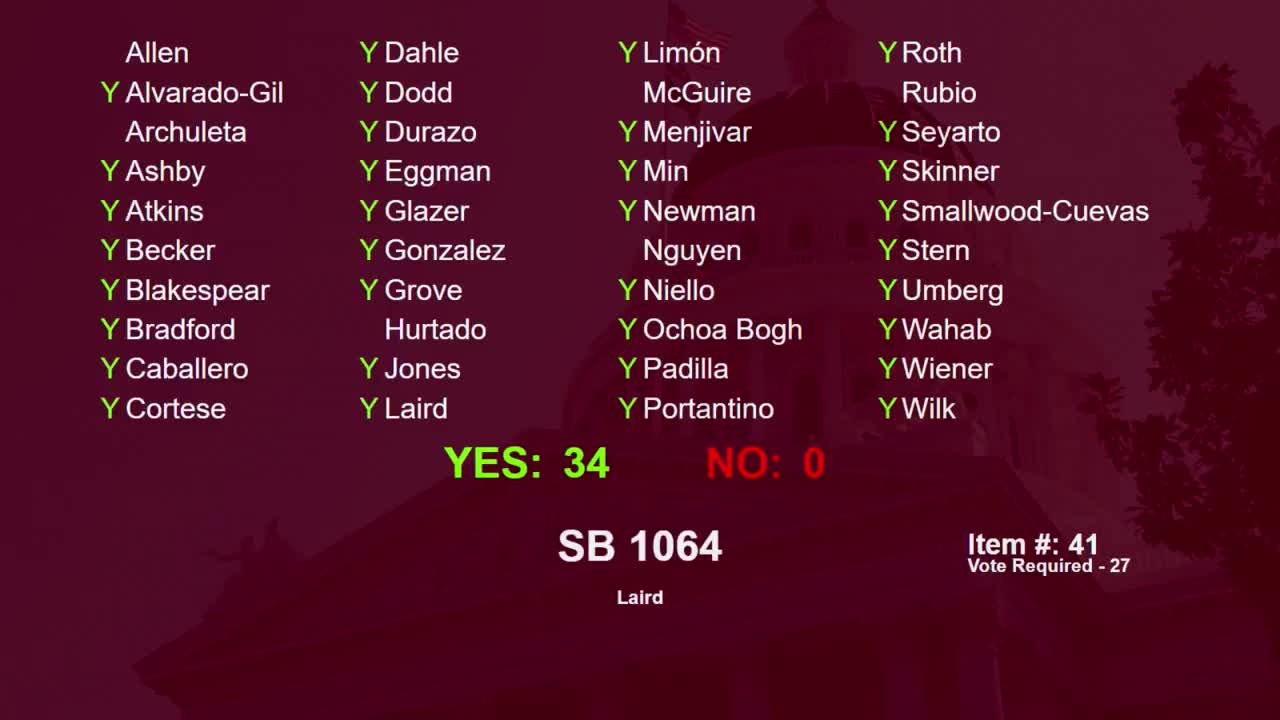
Bill Author
Bill Co-Author(s):