SB 230: Income tax: health savings accounts.
- Session Year: 2023-2024
- House: Senate
- Latest Version Date: 2024-06-13
Current Status:
Failed
(2024-07-01: July 1 hearing. Held in committee and under submission.)
Introduced
In Committee
First Chamber
In Committee
Second Chamber
Enacted
The Personal Income Tax Law authorizes various deductions in computing income that is subject to tax under that law.
This bill, for taxable years beginning on or after January 1, 2024, 2025, and before January 1, 2029, 2030, would allow a deduction in computing adjusted gross income in connection with health savings accounts in modified conformity with federal law. In general, the deduction would be an amount equal to the aggregate amount paid in cash during the taxable year by, or on behalf of, an eligible individual, as defined, to a health savings account of that individual, as provided. The bill, for taxable years beginning on or after January 1, 2024, 2025, and before January 1, 2029, 2030, would also provide related conformity to that federal law with respect to the allowance of rollovers from Archer Medical Savings Accounts, health flexible spending arrangements, or health reimbursement accounts to a health savings account, and penalties in connection therewith.
Existing law requires a bill authorizing a new tax expenditure to contain, among other things, specific goals, purposes, and objectives the tax expenditure will achieve, detailed performance indicators, and data collection requirements.
This bill would include additional information required for any bill authorizing a new tax expenditure.
This bill would take effect immediately as a tax levy.
The Personal Income Tax Law authorizes various deductions in computing income that is subject to tax under that law.
This bill, for taxable years beginning on or after January 1, 2023, 2024, and before January 1, 2028, 2029, would allow a deduction in computing adjusted gross income in connection with health savings accounts in modified conformity with federal law. In general, the deduction would be an amount equal to the aggregate amount paid in cash during the taxable year by, or on behalf of, an eligible individual, as defined, to a health savings account of that individual, as provided. The bill, for taxable years beginning on or after January 1, 2023, 2024, and before January 1, 2028, 2029, would also provide related conformity to that federal law with respect to the allowance of rollovers from Archer Medical Savings Accounts, health flexible spending arrangements, or health reimbursement accounts to a health savings account, and penalties in connection therewith.
Existing law requires a bill authorizing a new tax expenditure to contain, among other things, specific goals, purposes, and objectives the tax expenditure will achieve, detailed performance indicators, and data collection requirements.
This bill would include additional information required for any bill authorizing a new tax expenditure.
This bill would take effect immediately as a tax levy.
The Personal Income Tax Law authorizes various deductions in computing income that is subject to tax under that law.
This bill, for taxable years beginning on or after January 1, 2023, and before January 1, 2028, would allow a deduction in computing adjusted gross income in connection with health savings accounts in modified conformity with federal law. In general, the deduction would be an amount equal to the aggregate amount paid in cash during the taxable year by, or on behalf of, an eligible individual, as defined, to a health savings account of that individual, as provided. The bill, for taxable years beginning on or after January 1, 2023, and before January 1, 2028, would also provide related conformity to that federal law with respect to the allowance of rollovers from Archer Medical Savings Accounts, health flexible spending arrangements, or health reimbursement accounts to a health savings account, and penalties in connection therewith.
Existing law requires a bill authorizing a new tax expenditure to contain, among other things, specific goals, purposes, and objectives the tax expenditure will achieve, detailed performance indicators, and data collection requirements.
This bill would include additional information required for any bill authorizing a new tax expenditure.
This bill would take effect immediately as a tax levy.
The Personal Income Tax Law authorizes various deductions in computing income that is subject to tax under that law.
This bill, for taxable years beginning on or after January 1, 2023, and before January 1, 2028, would allow a deduction in computing adjusted gross income in connection with health savings accounts in modified conformity with federal law. In general, the deduction would be an amount equal to the aggregate amount paid in cash during the taxable year by, or on behalf of, an eligible individual, as defined, to a health savings account of that individual, as provided. The bill, for taxable years beginning on or after January 1, 2023, and before January 1, 2028, would also provide related conformity to that federal law with respect to the allowance of rollovers from Archer Medical Savings Accounts, health flexible spending arrangements, or health reimbursement accounts to a health savings account, and penalties in connection therewith.
Existing law requires a bill authorizing a new tax expenditure to contain, among other things, specific goals, purposes, and objectives the tax expenditure will achieve, detailed performance indicators, and data collection requirements.
This bill would include additional information required for any bill authorizing a new tax expenditure.
This bill would take effect immediately as a tax levy.
The Personal Income Tax Law and the Corporation Tax Law, in modified conformity with federal income tax laws, generally allow various deductions in computing the income that is subject to tax imposed under those laws.This bill, for taxable years beginning on or after January 1, 2023, and before January 1, 2028, would allow a deduction in computing income for a taxpayer with 50 or fewer employees that makes an employer contribution to a health savings account, as specified. Existing law requires any bill authorizing a new tax expenditure to contain, among other things, specific goals, purposes, and objectives that the tax expenditure will achieve, detailed performance indicators, and data collection requirements.The bill would make specified findings detailing the goals, purposes, and objectives of the above-described tax expenditure, performance indicators for determining whether the tax expenditure meets those goals, purposes, and objectives, and data collection requirements. This bill would take effect immediately as a tax levy.The Personal Income Tax Law and the Corporation Tax Law, in modified conformity with federal income tax laws, generally allow various deductions in computing the income that is subject to tax imposed under those laws.
This bill, for taxable years beginning on or after January 1, 2023, and before January 1, 2028, would allow a deduction in computing income for a taxpayer with 50 or fewer employees that makes an employer contribution to a health savings account, as specified.
Existing law requires any bill authorizing a new tax expenditure to contain, among other things, specific goals, purposes, and objectives that the tax expenditure will achieve, detailed performance indicators, and data collection requirements.
The bill would make specified findings detailing the goals, purposes, and objectives of the above-described tax expenditure, performance indicators for determining whether the tax expenditure meets those goals, purposes, and objectives, and data collection requirements.
This bill would take effect immediately as a tax levy.
(a)Section 106(d) of the Internal Revenue Code, relating to contributions to health savings accounts, shall not apply.
(b)This section shall apply to taxable years beginning on or after January 1, 2005, and before January 1, 2024, 2025, and to taxable years beginning on or after January 1, 2029. 2030.
SEC. 2.Section 17131.5 of the Revenue and Taxation Code is amended to read:17131.5.(a)Section 125(d)(2)(D) of the Internal Revenue Code, relating to the exception for health savings accounts, shall not apply.
(b)This section shall apply to taxable years beginning on or after January 1, 2005, and before January 1, 2024, 2025, and to taxable years beginning on or after January 1, 2029. 2030.
SEC. 3.Section 17215.1 of the Revenue and Taxation Code is amended to read:17215.1.(a)Section 220(f)(5) of the Internal Revenue Code, relating to rollover contributions, shall not apply.
(b)This section shall apply to taxable years beginning on or after January 1, 2005, and before January 1, 2024, 2025, and to taxable years beginning on or after January 1, 2029. 2030.
SEC. 4.Section 17215.4 of the Revenue and Taxation Code is amended to read:17215.4.(a)Section 223 of the Internal Revenue Code, relating to health savings accounts, shall not apply.
(b)This section shall apply to taxable years beginning on or after January 1, 2005, and before January 1, 2024, 2025, and to taxable years beginning on or after January 1, 2029. 2030.
SEC. 5.Section 17217 is added to the Revenue and Taxation Code, to read:17217.(a)For taxable years beginning on or after January 1, 2024, 2025, and before January 1, 2029, 2030, all of the following shall apply:
(1)Section 223 of the Internal Revenue Code, relating to health savings accounts, shall apply, except as otherwise provided.
(2)(A)Section 223(c)(1)(A) of the Internal Revenue Code, relating to eligible individuals, shall be modified to provide, in addition to the existing requirements, that to be an eligible individual, a taxpayer must have adjusted gross income as follows:
(i)For spouses filing joint returns, heads of household, and surviving spouses, as defined in Section 17046, less than eighty-seven thousand dollars ($87,000).
(ii)For other individuals, less than forty-two thousand dollars ($42,000).
(B)For taxable years beginning on or after January 1, 2025, 2026, the adjusted gross income amounts in clauses (i) and (ii) of subparagraph (A) shall be recomputed annually in the same manner as the recomputation of income tax brackets under subdivision (h) of Section 17041.
(3)Section 223(e)(1) of the Internal Revenue Code, relating to tax treatment of accounts, shall be modified by substituting the phrase Section 17651 or 23731 for the phrase Section 511 (relating to imposition on tax of unrelated business income of charitable, etc. organizations) contained therein.
(4)Section 223(f)(2) of the Internal Revenue Code, relating to inclusion of amounts not used for qualified medical expenses, shall be modified by adding at the end of that paragraph the phrase this paragraph shall not apply to the extent that a distribution relates to funds contributed by or on behalf of the beneficiary where the taxpayer making that contribution was not eligible for a deduction at the time the contribution was made, but would have been eligible for a deduction if that contribution were made during a taxable year beginning on or after January 1, 2024, 2025, and before January 1, 2029. 2030.
(5)Section 223(f)(4)(A) of the Internal Revenue Code, relating to additional tax on distributions not used for qualified medical expenses, shall not apply. be modified by substituting 2.5 percent for 20 percent, contained therein.
(6)Section 223(h) of the Internal Revenue Code, relating to reports, shall not apply, and shall be substituted by the phrase, any person who provides an individual with a high deductible health plan shall make a report to the Franchise Tax Board and to the beneficiary with respect to that plan in the form and manner required by the Franchise Tax Board.
(b)(1)For purposes of complying with Section 41 as it relates to this section, and the amendments made to Sections 17131.4, 17131.5, 17215.1, and 17215.4 by the act adding this section, herein referred to as the deductions, the Legislature finds and declares the following:
(A)The specific goals, purposes, and objectives that the deductions will achieve are:
(i)To provide a tax incentive to motivate California families to open and contribute to a health savings account for the purpose of saving for future health expenses, thereby encouraging more Californians to pursue a means of preparing for future health-related expenses.
(ii)To reduce the amount of debt related to health care on a dollar-for-dollar basis, thereby increasing a persons ability to purchase other products that help stimulate economic activity.
(iii)To bring California into conformity with federal tax law regarding the treatment of health savings accounts.
(B)Detailed performance indicators for the Legislature to use in determining whether the deductions meet the goals, purposes, and objectives listed in subparagraph (A) are:
(i)The number of deductions allowed by the Franchise Tax Board pursuant to this act with respect to each taxable year for which this act is operative.
(ii)The total dollar amount of the deductions described in clause (i).
(2)(A)The Franchise Tax Board shall report the information described in subparagraph (B) of paragraph (1) to the Legislature, in compliance with Section 9795 of the Government Code, in every odd-numbered year during which the provisions of the act adding this section are operative.
(B)The disclosure provisions of this paragraph shall be treated as an exception to Section 19542.
(c)This section shall remain in effect only until December 1, 2029, and as of that date is repealed.
SEC. 6.This act provides for a tax levy within the meaning of Article IV of the California Constitution and shall go into immediate effect.
(a)Section 106(d) of the Internal Revenue Code, relating to contributions to health savings accounts, shall not apply.
(b)This section shall apply to taxable years beginning on or after January 1, 2005, and before January 1, 2023, 2024, and to taxable years beginning on or after January 1, 2028. 2029.
SEC. 2.Section 17131.5 of the Revenue and Taxation Code is amended to read:17131.5.(a)Section 125(d)(2)(D) of the Internal Revenue Code, relating to the exception for health savings accounts, shall not apply.
(b)This section shall apply to taxable years beginning on or after January 1, 2005, and before January 1, 2023, 2024, and to taxable years beginning on or after January 1, 2028. 2029.
SEC. 3.Section 17215.1 of the Revenue and Taxation Code is amended to read:17215.1.(a)Section 220(f)(5) of the Internal Revenue Code, relating to rollover contributions, shall not apply.
(b)This section shall apply to taxable years beginning on or after January 1, 2005, and before January 1, 2023, 2024, and to taxable years beginning on or after January 1, 2028. 2029.
SEC. 4.Section 17215.4 of the Revenue and Taxation Code is amended to read:17215.4.(a)Section 223 of the Internal Revenue Code, relating to health savings accounts, shall not apply.
(b)This section shall apply to taxable years beginning on or after January 1, 2005, and before January 1, 2023, 2024, and to taxable years beginning on or after January 1, 2028. 2029.
SEC. 5.Section 17217 is added to the Revenue and Taxation Code, to read:17217.(a)For taxable years beginning on or after January 1, 2023, 2024, and before January 1, 2028, 2029, all of the following shall apply:
(1)Section 223 of the Internal Revenue Code, relating to health savings accounts, shall apply, except as otherwise provided.
(2)(A)Section 223(c)(1)(A) of the Internal Revenue Code, relating to eligible individuals, shall be modified to provide, in addition to the existing requirements, that to be an eligible individual, a taxpayer must have adjusted gross income as follows:
(i)For spouses filing joint returns, heads of household, and surviving spouses, as defined in Section 17046, less than eighty-seven thousand dollars ($87,000).
(ii)For other individuals, less than forty-two thousand dollars ($42,000).
(B)For taxable years beginning on or after January 1, 2024, 2025, the adjusted gross income amounts in clauses (i) and (ii) of subparagraph (A) shall be recomputed annually in the same manner as the recomputation of income tax brackets under subdivision (h) of Section 17041.
(3)Section 223(e)(1) of the Internal Revenue Code, relating to tax treatment of accounts, shall be modified by substituting the phrase Section 17651 or 23731 for the phrase Section 511 (relating to imposition on tax of unrelated business income of charitable, etc. organizations) contained therein.
(4)Section 223(f)(2) of the Internal Revenue Code, relating to inclusion of amounts not used for qualified medical expenses, shall be modified by adding at the end of that paragraph the phrase this paragraph shall not apply to the extent that a distribution relates to funds contributed by or on behalf of the beneficiary where the taxpayer making that contribution was not eligible for a deduction at the time the contribution was made, but would have been eligible for a deduction if that contribution were made during a taxable year beginning on or after January 1, 2023, 2024, and before January 1, 2028. 2029.
(5)Section 223(f)(4)(A) of the Internal Revenue Code, relating to additional tax on distributions not used for qualified medical expenses, shall not apply.
(6)Section 223(h) of the Internal Revenue Code, relating to reports, shall not apply, and shall be substituted by the phrase, any person who provides an individual with a high deductible health plan shall make a report to the Franchise Tax Board and to the beneficiary with respect to that plan in the form and manner required by the Franchise Tax Board.
(b)(1)For purposes of complying with Section 41 as it relates to this section, and the amendments made to Sections 17131.4, 17131.5, 17215.1, and 17215.4 by the act adding this section, herein referred to as the deductions, the Legislature finds and declares the following:
(A)The specific goals, purposes, and objectives that the deductions will achieve are:
(i)To provide a tax incentive to motivate California families to open and contribute to a health savings account for the purpose of saving for future health expenses, thereby encouraging more Californians to pursue a means of preparing for future health-related expenses.
(ii)To reduce the amount of debt related to health care on a dollar-for-dollar basis, thereby increasing a persons ability to purchase other products that help stimulate economic activity.
(iii)To bring California into conformity with federal tax law regarding the treatment of health savings accounts.
(B)Detailed performance indicators for the Legislature to use in determining whether the deductions meet the goals, purposes, and objectives listed in subparagraph (A) are:
(i)The number of deductions allowed by the Franchise Tax Board pursuant to this act with respect to each taxable year for which this act is operative.
(ii)The total dollar amount of the deductions described in clause (i).
(2)(A)The Franchise Tax Board shall report the information described in subparagraph (B) of paragraph (1) to the Legislature, in compliance with Section 9795 of the Government Code, in every odd-numbered year during which the provisions of the act adding this section are operative.
(B)The disclosure provisions of this paragraph shall be treated as an exception to Section 19542.
(c)This section shall remain in effect only until December 1, 2028, 2029, and as of that date is repealed.
SEC. 6.This act provides for a tax levy within the meaning of Article IV of the California Constitution and shall go into immediate effect.
(a)Section 106(d) of the Internal Revenue Code, relating to contributions to health savings accounts, shall not apply.
(b)This section shall apply to taxable years beginning on or after January 1, 2005, and before January 1, 2023, and to taxable years beginning on or after January 1, 2028.
SEC. 2.Section 17131.5 of the Revenue and Taxation Code is amended to read:17131.5.(a)Section 125(d)(2)(D) of the Internal Revenue Code, relating to the exception for health savings accounts, shall not apply.
(b)This section shall apply to taxable years beginning on or after January 1, 2005, and before January 1, 2023, and to taxable years beginning on or after January 1, 2028.
SEC. 3.Section 17215.1 of the Revenue and Taxation Code is amended to read:17215.1.(a)Section 220(f)(5) of the Internal Revenue Code, relating to rollover contributions, shall not apply.
(b)This section shall apply to taxable years beginning on or after January 1, 2005, and before January 1, 2023, and to taxable years beginning on or after January 1, 2028.
SEC. 4.Section 17215.4 of the Revenue and Taxation Code is amended to read:17215.4.(a)Section 223 of the Internal Revenue Code, relating to health savings accounts, shall not apply.
(b)This section shall apply to taxable years beginning on or after January 1, 2005, and before January 1, 2023, and to taxable years beginning on or after January 1, 2028.
SEC. 5.Section 17217 is added to the Revenue and Taxation Code, to read:17217.(a)For taxable years beginning on or after January 1, 2023, and before January 1, 2028, all of the following shall apply:
(1)Section 223 of the Internal Revenue Code, relating to health savings accounts, shall apply, except as otherwise provided.
(2)(A)Section 223(c)(1)(A) of the Internal Revenue Code, relating to eligible individuals, shall be modified to provide, in addition to the existing requirements, that to be an eligible individual, a taxpayer must have adjusted gross income as follows:
(i)For spouses filing joint returns, heads of household, and surviving spouses, as defined in Section 17046, less than eighty-seven thousand dollars ($87,000).
(ii)For other individuals, less than forty-two thousand dollars ($42,000).
(B)For taxable years beginning on or after January 1, 2024, the adjusted gross income amounts in clauses (i) and (ii) of subparagraph (A) shall be recomputed annually in the same manner as the recomputation of income tax brackets under subdivision (h) of Section 17041.
(3)Section 223(e)(1) of the Internal Revenue Code, relating to tax treatment of accounts, shall be modified by substituting the phrase Section 17651 17651 or 23731 for the phrase Section 511 (relating to imposition on tax of unrelated business income of charitable, etc. organizations) contained therein.
(4)Section 223(f)(2) of the Internal Revenue Code, relating to inclusion of amounts not used for qualified medical expenses, shall be modified by adding at the end of that paragraph the phrase this paragraph shall not apply to the extent that a distribution relates to funds contributed by or on behalf of the beneficiary where the taxpayer making that contribution was not eligible for a deduction at the time the contribution was made, but would have been eligible for a deduction if that contribution were made during a taxable year beginning on or after January 1, 2023, and before January 1, 2028.
(5)Section 223(f)(4)(A) of the Internal Revenue Code, relating to additional tax on distributions not used for qualified medical expenses, shall not apply.
(6)Section 223(h) of the Internal Revenue Code, relating to reports, shall not apply, and shall be substituted by the phrase, any person who provides an individual with a high deductible health plan shall make a report to the Franchise Tax Board and to the beneficiary with respect to that plan in the form and manner required by the Franchise Tax Board.
(b)(1)For purposes of complying with Section 41 as it relates to this section, and the amendments made to Sections 17131.4, 17131.5, 17215.1, and 17215.4 by the act adding this section, herein referred to as the deductions, the Legislature finds and declares the following:
(A)The specific goals, purposes, and objectives that the deductions will achieve are:
(i)To provide a tax incentive to motivate California families to open and contribute to a health savings account for the purpose of saving for future health expenses, thereby encouraging more Californians to pursue a means of preparing for future health-related expenses.
(ii)To reduce the amount of debt related to health care on a dollar-for-dollar basis, thereby increasing a persons ability to purchase other products that help stimulate economic activity.
(iii)To bring California into conformity with federal tax law regarding the treatment of health savings accounts.
(B)Detailed performance indicators for the Legislature to use in determining whether the deductions meet the goals, purposes, and objectives listed in subparagraph (A) are:
(i)The number of deductions allowed by the Franchise Tax Board pursuant to this act with respect to each taxable year for which this act is operative.
(ii)The total dollar amount of the deductions described in clause (i).
(2)(A)The Franchise Tax Board shall report the information described in subparagraph (B) of paragraph (1) to the Legislature, in compliance with Section 9795 of the Government Code, in every odd-numbered year during which the provisions of the act adding this section are operative.
(B)The disclosure provisions of this paragraph shall be treated as an exception to Section 19542.
(c)This section shall remain in effect only until December 1, 2028, and as of that date is repealed.
SEC. 6.This act provides for a tax levy within the meaning of Article IV of the California Constitution and shall go into immediate effect.
(a)Section 106(d) of the Internal Revenue Code, relating to contributions to health savings accounts, shall not apply.
(b)This section shall apply to taxable years beginning on or after January 1, 2005, and before January 1, 2023, and to taxable years beginning on or after January 1, 2028.
SEC. 2.Section 17131.5 of the Revenue and Taxation Code is amended to read:17131.5.(a)Section 125(d)(2)(D) of the Internal Revenue Code, relating to the exception for health savings accounts, shall not apply.
(b)This section shall apply to taxable years beginning on or after January 1, 2005, and before January 1, 2023, and to taxable years beginning on or after January 1, 2028.
SEC. 3.Section 17215.1 of the Revenue and Taxation Code is amended to read:17215.1.(a)Section 220(f)(5) of the Internal Revenue Code, relating to rollover contributions, shall not apply.
(b)This section shall apply to taxable years beginning on or after January 1, 2005, and before January 1, 2023, and to taxable years beginning on or after January 1, 2028.
SEC. 4.Section 17215.4 of the Revenue and Taxation Code is amended to read:17215.4.(a)Section 223 of the Internal Revenue Code, relating to health savings accounts, shall not apply.
(b)This section shall apply to taxable years beginning on or after January 1, 2005, and before January 1, 2023, and to taxable years beginning on or after January 1, 2028.
SEC. 5.Section 17217 is added to the Revenue and Taxation Code, to read:17217.(a)For taxable years beginning on or after January 1, 2023, and before January 1, 2028, all of the following shall apply:
(1)Section 223 of the Internal Revenue Code, relating to health savings accounts, shall apply, except as otherwise provided.
(2)(A)Section 223(c)(1)(A) of the Internal Revenue Code, relating to eligible individuals, shall be modified to provide, in addition to the existing requirements, that to be an eligible individual, a taxpayer must have adjusted gross income as follows:
(i)For spouses filing joint returns, heads of household, and surviving spouses, as defined in Section 17046, less than eighty-seven thousand dollars ($87,000).
(ii)For other individuals, less than forty-two thousand dollars ($42,000).
(B)For taxable years beginning on or after January 1, 2024, the adjusted gross income amounts in clauses (i) and (ii) of subparagraph (A) shall be recomputed annually in the same manner as the recomputation of income tax brackets under subdivision (h) of Section 17041.
(3)Section 223(e)(1) of the Internal Revenue Code, relating to tax treatment of accounts, shall be modified by substituting the phrase Section 17651 for the phrase Section 511 (relating to imposition on tax of unrelated business income of charitable, etc. organizations) contained therein.
(4)Section 223(f)(2) of the Internal Revenue Code, relating to inclusion of amounts not used for qualified medical expenses, shall be modified by adding at the end of that paragraph the phrase this paragraph shall not apply to the extent that a distribution relates to funds contributed by or on behalf of the beneficiary where the taxpayer making that contribution was not eligible for a deduction at the time the contribution was made, but would have been eligible for a deduction if that contribution were made during a taxable year beginning on or after January 1, 2023, and before January 1, 2028.
(5)Section 223(f)(4)(A) of the Internal Revenue Code, relating to additional tax on distributions not used for qualified medical expenses, shall not apply.
(6)Section 223(h) of the Internal Revenue Code, relating to reports, shall not apply, and shall be substituted by the phrase, any person who provides an individual with a high deductible health plan shall make a report to the Franchise Tax Board and to the beneficiary with respect to that plan in the form and manner required by the Franchise Tax Board.
(b)(1)For purposes of complying with Section 41 as it relates to this section, and the amendments made to Sections 17131.4, 17131.5, 17215.1, and 17215.4 by the act adding this section, herein referred to as the deductions, the Legislature finds and declares the following:
(A)The specific goals, purposes, and objectives that the deductions will achieve are:
(i)To provide a tax incentive to motivate California families to open and contribute to a health savings account for the purpose of saving for future health expenses, thereby encouraging more Californians to pursue a means of preparing for future health-related expenses.
(ii)To reduce the amount of debt related to health care on a dollar-for-dollar basis, thereby increasing a persons ability to purchase other products that help stimulate economic activity.
(iii)To bring California into conformity with federal tax law regarding the treatment of health savings accounts.
(B)Detailed performance indicators for the Legislature to use in determining whether the deductions meet the goals, purposes, and objectives listed in subparagraph (A) are:
(i)The number of deductions allowed by the Franchise Tax Board pursuant to this act with respect to each taxable year for which this act is operative.
(ii)The total dollar amount of the deductions described in clause (i).
(2)(A)The Franchise Tax Board shall report the information described in subparagraph (B) of paragraph (1) to the Legislature, in compliance with Section 9795 of the Government Code, in every odd-numbered year during which the provisions of the act adding this section are operative.
(B)The disclosure provisions of this paragraph shall be treated as an exception to Section 19542.
(c)This section shall remain in effect only until December 1, 2028, and as of that date is repealed.
SEC. 6.This act provides for a tax levy within the meaning of Article IV of the California Constitution and shall go into immediate effect.
SECTION 1.Section 17215.5 is added to the Revenue and Taxation Code, to read:17215.5.(a)For taxable years beginning on or after January 1, 2023, and before January 1, 2028, a deduction shall be allowed for any employer contribution to a health savings account, as defined in Section 223 of the Internal Revenue Code, relating to health savings accounts, for the taxable year the contribution was made.(b)(1)For purposes of this section, employer means a taxpayer with 50 or fewer employees.(2)Employer shall not include a sole proprietor.(c)Any deduction otherwise allowed under this part for any amount paid or incurred by the taxpayer upon which the deduction under subdivision (a) is based shall be reduced by the amount of the deduction allowed under subdivision (a).(d)For purposes of complying with Section 41, with respect to this section and Section 24343.4, the Legislature finds and declares the following:(1)The specific goal, purpose, and objective is to increase access to health care through the following:(A)Creating an incentive for small business employers to offer some health benefit they may not otherwise offer due to their exemption from the employer mandate in the Affordable Care Act. (B)Creating an incentive to increase total small business employee compensation packages via employer health savings account contributions in order to better compensate for rising health care costs. (2)The detailed performance indicator for the Legislature to use in determining whether the deduction meets those goals, purposes, and objectives is the number of employers taking advantage of the deduction. (3)(A)The Legislative Analyst, on January 1, 2025, and annually thereafter, shall provide a report to the Legislature on the effectiveness of the tax deduction.(B)Notwithstanding Section 19542, the Franchise Tax Board shall provide any data requested by the Legislative Analyst for purposes of this paragraph. (e)This section shall remain in effect only until December 1, 2028, and as of that date is repealed.SEC. 2.Section 24343.4 is added to the Revenue and Taxation Code, to read:24343.4.(a)For taxable years beginning on or after January 1, 2023, and before January 1, 2028, a deduction shall be allowed for any employer contribution to a health savings account, as defined in Section 223 of the Internal Revenue Code, relating to health savings accounts, for the taxable year the contribution was made.(b)(1)For purposes of this section, employer means a taxpayer with 50 or fewer employees.(2)Employer shall not include a sole proprietor.(c)Any deduction otherwise allowed under this part for any amount paid or incurred by the taxpayer upon which the deduction under subdivision (a) is based shall be reduced by the amount of the deduction allowed under subdivision (a).(d)This section shall remain in effect only until December 1, 2028, and as of that date is repealed.SEC. 3.This act provides for a tax levy within the meaning of Article IV of the California Constitution and shall go into immediate effect.(a)For taxable years beginning on or after January 1, 2023, and before January 1, 2028, a deduction shall be allowed for any employer contribution to a health savings account, as defined in Section 223 of the Internal Revenue Code, relating to health savings accounts, for the taxable year the contribution was made.
(b)(1)For purposes of this section, employer means a taxpayer with 50 or fewer employees.
(2)Employer shall not include a sole proprietor.
(c)Any deduction otherwise allowed under this part for any amount paid or incurred by the taxpayer upon which the deduction under subdivision (a) is based shall be reduced by the amount of the deduction allowed under subdivision (a).
(d)For purposes of complying with Section 41, with respect to this section and Section 24343.4, the Legislature finds and declares the following:
(1)The specific goal, purpose, and objective is to increase access to health care through the following:
(A)Creating an incentive for small business employers to offer some health benefit they may not otherwise offer due to their exemption from the employer mandate in the Affordable Care Act.
(B)Creating an incentive to increase total small business employee compensation packages via employer health savings account contributions in order to better compensate for rising health care costs.
(2)The detailed performance indicator for the Legislature to use in determining whether the deduction meets those goals, purposes, and objectives is the number of employers taking advantage of the deduction.
(3)(A)The Legislative Analyst, on January 1, 2025, and annually thereafter, shall provide a report to the Legislature on the effectiveness of the tax deduction.
(B)Notwithstanding Section 19542, the Franchise Tax Board shall provide any data requested by the Legislative Analyst for purposes of this paragraph.
(e)This section shall remain in effect only until December 1, 2028, and as of that date is repealed.
SEC. 2.Section 24343.4 is added to the Revenue and Taxation Code, to read:24343.4.(a)For taxable years beginning on or after January 1, 2023, and before January 1, 2028, a deduction shall be allowed for any employer contribution to a health savings account, as defined in Section 223 of the Internal Revenue Code, relating to health savings accounts, for the taxable year the contribution was made.
(b)(1)For purposes of this section, employer means a taxpayer with 50 or fewer employees.
(2)Employer shall not include a sole proprietor.
(c)Any deduction otherwise allowed under this part for any amount paid or incurred by the taxpayer upon which the deduction under subdivision (a) is based shall be reduced by the amount of the deduction allowed under subdivision (a).
(d)This section shall remain in effect only until December 1, 2028, and as of that date is repealed.
SEC. 3.This act provides for a tax levy within the meaning of Article IV of the California Constitution and shall go into immediate effect.
|
Date
|
Status
|
|---|---|
| Jul 1, 2024 | July 1 hearing. Held in committee and under submission. |
| Jun 13, 2024 | From committee with author's amendments. Read second time and amended. Re-referred to Com. on REV. & TAX. |
| Jun 10, 2024 | June 10 set for first hearing. Placed on suspense file. |
| May 16, 2024 | From committee with author's amendments. Read second time and amended. Re-referred to Com. on REV. & TAX. |
| Apr 29, 2024 | Referred to Com. on REV. & TAX. |
| Jan 29, 2024 | In Assembly. Read first time. Held at Desk. |
| Jan 29, 2024 | Read third time. Passed. (Ayes 28. Noes 4. Page 3049.) Ordered to the Assembly. |
| Jan 22, 2024 | Read second time. Ordered to third reading. |
| Jan 18, 2024 | From committee: Do pass. (Ayes 5. Noes 1. Page 3011.) (January 18). |
| Jan 17, 2024 | Set for hearing January 18. |
| Jan 16, 2024 | January 16 hearing: Placed on APPR suspense file. |
| Jan 12, 2024 | Set for hearing January 16. |
| Jan 11, 2024 | Read second time and amended. Re-referred to Com. on APPR. |
| Jan 10, 2024 | From committee: Do pass as amended and re-refer to Com. on APPR. (Ayes 5. Noes 3. Page 2970.) (January 10). |
| Dec 21, 2023 | Set for hearing January 10. |
| May 3, 2023 | May 3 set for first hearing. Failed passage in committee. (Ayes 4. Noes 2. Page 992.) Reconsideration granted. |
| Apr 20, 2023 | Set for hearing May 3. |
| Mar 15, 2023 | From committee with author's amendments. Read second time and amended. Re-referred to Com. on GOV. & F. |
| Feb 1, 2023 | Referred to Com. on GOV. & F. |
| Jan 24, 2023 | From printer. May be acted upon on or after February 23. |
| Jan 23, 2023 | Introduced. Read first time. To Com. on RLS. for assignment. To print. |
|
Date
|
Description
|
Location
|
Votes
|
|
|---|---|---|---|---|
| Jan 29, 2024 | Senate 3rd Reading SB230 Seyarto et al. | Senate Floor |
Passed |
|
| Jan 18, 2024 | Do pass | Senate Standing Committee on Appropriations |
Passed |
|
| Jan 16, 2024 | Placed on suspense file | Senate Standing Committee on Appropriations |
Passed |
|
| Jan 10, 2024 | Do pass as amended, but first amend, and re-refer to the Committee on [Appropriations] | Senate Standing Committee on Governance and Finance |
Passed |
|
| May 3, 2023 | [First] hearing set for [05-03-2023]: Failed passage in Committee. Reconsideration granted | Senate Standing Committee on Governance and Finance |
Passed |
|
| May 3, 2023 | Do pass as amended, but first amend, and re-refer to the Committee on [Appropriations] | Senate Standing Committee on Governance and Finance |
Failed |
This list shows positions taken on this bill by organizations on the date displayed, which is linked to the original source.
Positions by individuals are not included.
|
Organization
|
Position
|
Date
|
|---|---|---|
| Aaron Read and Associates | * Support | Jun 11, 2024 |
| America First Policy Institute - California | ** Support | |
| American Federation Of State County And Municipal Employees, Afl-Cio | ** Against | |
| California Agents & Health Insurance Professionals | ** Support | |
| California Chapter of the American College of Emergency Physicians | ** Support | |
| California Federation Of Teachers | ** Against | |
| California Society Of Enrolled Agents | ** Support | |
| California State Council of Service Employees International Union | ** Against | |
| California Taxpayers Association | ** Support | |
| Elderly Care Everywhere | ** Support | |
| Greater Coachella Valley Chamber of Commerce | ** Support | |
| Health Access California | ** Against | |
| Independent Insurance Agents and Brokers of California | ** Support | |
| National Association Consumer Advocates | * Against | Jan 10, 2024 |
| National Association Of Insurance And Financial Advisors California | ** Support | |
| Southwest California Legislative Council | ** Support | |
| The Children's Partnership | * Support | Jan 16, 2024 |
Date of Hearing: July 1, 2024
ASSEMBLY COMMITTEE ON REVENUE AND TAXATION
Jacqui Irwin, Chair
SBPCA Bill Id:SB 230
Author:(Seyarto) – As Amended Ver:June 13, 2024
SUSPENSE
Majority vote. Tax levy. Fiscal committee.
SENATE VOTE: 28-4
SUBJECT: Income tax: health savings accounts
SUMMARY: Conforms California's Personal Income Tax (PIT) Law to federal tax law with respect to health savings accounts (HSAs), with modifications, for taxable years beginning on or after January 1, 2025, and before January 1, 2030. Specifically, this bill:
- Conforms to Internal Revenue Code (IRC) Section 223, relating to HSAs, and modifies the definition of an "eligible individual" to mean an individual who has an adjusted gross income (AGI) of:
- Less than $87,000 for spouses and domestic partners filing joint returns, heads of household, and surviving spouses; or,
- Less than $42,000 for other individuals.
- Allows an above-the-line deduction for contributions to an HSA by or on behalf of an eligible individual.
- Excludes from an employee's gross income any contributions to an HSA made by an employer on the employee's behalf, including salary reduction contributions made through a cafeteria plan.
- Includes HSAs as an approved option in a nontaxable cafeteria plan for employee benefits created by an employer.
- Allows a taxpayer to roll over the balance of an existing Archer medical savings account (Archer MSA) to an HSA without penalty.
- Imposes a 2.5% penalty on distributions from an HSA that are not used for qualified medical expenses.
- Finds and declares the following for the purposes of satisfying the requirements of Revenue and Taxation Code (R&TC) Section 41:
- The specific goals, purposes, and objectives of the deduction are as follows:
- Provide a tax incentive to motivate California families to open and contribute to an HSA for the purpose of saving for future health expenses, thereby encouraging more Californians to pursue a means of preparing for future health-related expenses;
- To reduce the amount of debt related to health care on a dollar-for-dollar basis, thereby increasing a person's ability to purchase other products that help stimulate economic activity; and,
- To bring California into conformity with federal tax law regarding the treatment of HSAs.
- To measure whether this bill achieves its intended purpose, the performance indicators are the number of taxpayers claiming the deduction and the average deduction allowed.
- The specific goals, purposes, and objectives of the deduction are as follows:
- Requires the Franchise Tax Board (FTB) to prepare a report on the number of taxpayers claiming the deduction and the average amount of the deduction allowed for each odd-numbered year during which the deduction is operative.
- Takes immediate effect as a tax levy.
- Sunsets these provisions on December 1, 2030.
EXISTING FEDERAL LAW:
- Defines an "HSA" as a tax-exempt trust or custodial account created exclusively to pay for the qualified medical expenses of the account holder and his/her spouse and dependents.
(IRC Section 223(d).) - Allows individuals with a high deductible health plan (HDHP), and no other health plan other than a plan that provides certain permitted coverage, to establish an HSA. (IRC Section 223(c)(1)(A).)
- Allows a deduction for contributions to HSAs when computing AGI, if made by an eligible individual. Distributions from an HSA for qualified "medical expenses" of the eligible individual, spouse or dependents are not includible in gross income. Any balance in an HSA grows on a tax-free basis. However, distributions made for non-qualified medical expenses are includible in gross income and are also subject to an additional 20% penalty, unless the distributions are made after death, disability, or after the individual attains the age of 65. (IRC Sections 62(a)(19), 223(c), 223(f), and 223(e).)
- Defines "qualified medical expenses" as medical expenses including expenses for diagnosis, cure, mitigation, treatment, or prevention of disease, including prescription drugs, transportation primarily for and to such care, and qualified long-term care expenses. (IRC Section 223(d)(2).)
- Specifies that medical expenses paid via distributions that are excludable from income may not be claimed as medical expenses for purposes of reporting itemized deductions. (IRC Section 223(f)(6).)
- Excludes contributions to an HSA from income and employment taxes if made by the employer. Eligible individuals include those covered by HDHPs and, in general, those not eligible for other health coverage. (IRC Sections 106(d) and 125(d).)
- Specifies the maximum aggregate annual contribution that may be made to an HSA by or on behalf of the eligible individual, which is $4,150 in the case of self-only coverage and $8,300 in the case of family coverage for the 2024 taxable year. Those limits are indexed for inflation. The maximum contribution is increased by $1,000 per year for catch-up contributions for persons over age 55. Contributions in excess of the maximum contribution amount are generally subject to a 6% excise tax. (IRC Section 223(d).)
- Defines a HDHP as a health plan that has an annual deductible, for the 2024 taxable year, that is at least $1,600 for self-only coverage or $3,200 for family coverage and that has an out-of-pocket expense limit that is no more than $8,050 in the case of self-only coverage and $16,100 in the case of family coverage. The maximum out-of-pocket expense limit is the most a person has to pay for covered services in a plan year. After reaching the maximum amount on deductibles, copayments, and coinsurance, the health plan pays 100% of the costs of coverage.[1] (IRC Section 223(c)(2).)
EXISTING STATE LAW does not conform to federal HSA provisions.
FISCAL EFFECT: The FTB estimates General Fund revenue losses of $1.9 million in fiscal year (FY) 2024-25, $1.3 million in FY 2025-26, and 1.3 million in FY 2026-27.
COMMENTS:
- The author has provided the following statement in support of this bill:
SB 230, in partial conformity with federal tax law, would allow income-eligible taxpayers to claim a tax deduction equal to the amount the taxpayer contributes to a Health Savings Account (HSA). As healthcare costs perpetually increase in the current inflationary environment, it is essential we provide Californians with affordability options and flexibility to suit their unique circumstances. SB 230 furthers this objective for Californians who are most at need by incorporating income limits to ensure that the new tax advantage associated with HSA contributions truly serves to offset medical costs as opposed to shielding discretionary income from taxation.
- A coalition of health insurance agents and broker associations writing in support of this bill, notes, in part:
HSAs have proven to be a great financial and medical benefit for employees and employers. California and New Jersey are the only states that currently tax contributions to HSAs. Employees throughout most of the nation enjoy both federal and state tax-free contributions to HSAs. This bill would ensure the same tax advantages enjoyed by workers nationally are provided to income-eligible Californians.
- Health Access California, writing in opposition to this bill, notes, in part:
The original idea for tax deductions at the federal level was that it would encourage uptake of HDHPs and that HSAs would work together to increase cost consciousness and reduce expenditures, this only created a regressive system with higher earning individuals being able to afford higher amounts of contributions to HSAs. While as amended, SB 230 has added income limits to those eligible for the tax deduction for their HSA contributions, this addresses the issue of higher earning individuals taking advantage of HSAs, but the bill as a whole does not address affordability within health care coverage provided by HDHPs since they are linked together.
- Committee Staff Comments:
- What is an HSA? Created by Congress in 2003, HSAs are tax-exempt trusts or custodial accounts established exclusively to pay for the qualified medical expenses of the account holder, their spouse and dependents. Within certain limits, contributions to an HSA are deductible for qualified taxpayers and unused contributions can be rolled over indefinitely. Further, HSAs are owned by the employee and are portable, meaning they are not linked to any one job or employer. In other words, an HSA is a savings account that provides for tax-deductible deposits, tax-free growth in the form of interest, and allows tax-free withdrawals as long as the funds are used for qualified medical expenses. In contrast, a traditional individual retirement account (IRA) allows tax-deductible contributions but subjects any distribution to income tax. Further, in the case of a Roth IRA, contributions to the account are taxable, but qualified distributions are tax-free. Both a traditional IRA and a Roth IRA have income limitations restricting eligibility. HSAs, on the other hand, have no income restrictions and provide a "rare triple-tax benefit".[2]
 Who is eligible for an HSA? To establish an HSA, Federal law requires an individual to be covered by a HDHP and not by other forms of health coverage. Vision, dental, disability, and other forms of specific insurance coverage do not disqualify an individual from establishing an HSA. Additionally, an HSA cannot be used by any person who is claimed as a dependent on another taxpayer's return. According to the Bureau of Labor Statistics, access to HSAs increased from 22% in March 2014 to 36% in March 2023 for private industry workers. In March 2014, 14% of workers in establishments with less than 100 workers had access to HSAs, increasing to 25% in March 2023. The percentage of workers with access to HSAs in establishments of 500 workers or more was 33% in March 2014 and 56% in March 2023.[3]
- What is an HDHP? As indicated in the chart above, about one-half of the nation's large employers are beginning to offer employees HDHPs as a way of reducing healthcare costs. HDHPs generally offer lower monthly premiums but require greater out-of-pocket costs before the insurance coverage begins. The high deductibles are designed to encourage employees to think twice before opting for expensive or unnecessary treatment and procedures. As compared to more comprehensive healthcare plans, HDHPs allow an employer to shift a large portion of the healthcare costs to their employees. HSAs are coupled with HDHPs to help offset the shift in cost that is borne by employees. By subsidizing contributions and distributions from an HSA, this bill may be encouraging more employers and employees to opt for HDHPs.
- Who benefits from HSAs? In its 2008 report, the Government Accountability Office (GAO) found that the median income of tax filers reporting an HSA contribution in 2005 was $139,000 and 59% of those tax filers contributing to HSAs had an AGI of $60,000 or more.[4] It appears that HSAs disproportionately benefit high-income individuals. According to the report, many HSA participants appear to be using their accounts purely or primarily as a tax shelter rather than paying for out-of-pocket health care costs. The GAO found that "a stunning 41% of tax filers reporting HSA contributions in 2005 did not withdraw any funds from their accounts at any time during the year." In Congressional testimony, the GAO stated that "this was consistent with the view held by industry experts that many HSA users are people who primarily use their HSAs as a tax-advantaged savings vehicle."
Unfortunately, HDHPs may sometimes discourage many individuals from getting necessary and even vital treatment; out-of-pocket spending limits can exceed $8,050 which, for many Californians, is a significant percentage of their take home pay.[5] As such, providing preferential tax treatment for HSAs does little for individuals with little or no discretionary income to contribute into their HSA. As noted earlier, the median income for tax filers reporting contributions to an HSA account was $139,000 in 2008. Although any person with a HDHP can have an HSA account, HSAs are clearly utilized much more frequently by higher income earners. To address these concerns, this bill imposes income limitations that would make the tax benefits of HSAs available only to individuals earning less than $42,000 ($87,000 for joint filers) annually.
- What is a "tax expenditure"? Existing law provides various credits, deductions, exclusions, and exemptions for particular taxpayer groups. In the late 1960s, U.S. Treasury officials began arguing that these features of the tax law should be referred to as "expenditures" since they are generally enacted to accomplish some governmental purpose and there is a determinable cost associated with each (in the form of foregone revenues).
As the Department of Finance notes in its annual Tax Expenditure Report, there are several key differences between tax expenditures and direct expenditures. First, tax expenditures are typically reviewed less frequently than direct expenditures. Second, there is generally no control over the amount of revenue losses associated with any given tax expenditure. Finally, it should also be noted that, once enacted, it takes a two-thirds vote to rescind an existing tax expenditure absent a sunset date. This effectively results in a "one-way ratchet" whereby tax expenditures can be conferred by majority vote, but cannot be rescinded, irrespective of their efficacy or cost, without a supermajority vote.
- Committee's tax expenditure policy: Both R&TC Section 41 and Committee policy require any tax expenditure bill to outline specific goals, purposes, and objectives that the tax expenditure will achieve, along with detailed performance indicators for the Legislature to use when measuring whether the tax expenditure meets those stated goals, purposes, and objectives. A tax expenditure bill will not be eligible for a Committee vote unless it has complied with these requirements.
In its current form, this bill states that the deduction and exclusions are intended to motivate California families to open and contribute to an HSA for the purpose of saving for future health expenses and reduce the amount of debt related to health care on a dollar-for-dollar basis. In addition, this bill provides that the expenditures' effectiveness shall be measured by the number of taxpayers claiming the deduction pursuant to this bill and the average dollar amount of allowed deductions. This bill requires the FTB to submit a report to the Legislature every odd-numbered year that the deduction is operative estimating the number of taxpayers claiming the deduction and the average dollar amount of the allowed deductions.
In addition to the R&TC Section 41 requirements, this Committee's policy also requires that all tax expenditure proposals contain an appropriate sunset provision to be eligible for a vote. According to this policy, an "appropriate sunset provision" means five years, except in the case of a tax expenditure measure providing relief to California veterans, in which case "appropriate sunset provision" means ten years. This bill contains a five-year sunset provision and therefore complies with the Committee's policy on sunset dates.
- Prior legislation:
- AB 727 (Choi), of the 2021-22 Legislative Session, was substantially similar to this bill. AB 727 was not heard by this Committee.
- AB 1140 (Obernolte), of the 2017-18 Legislative Session, was similar to this bill, but included a penalty on disqualified distributions from an HSA equal to 2.5% of the distribution. AB 1140 was not heard by this Committee.
- AB 989 (Cooper), of the 2017-18 Legislative Session, was substantially similar to AB 1140. AB 989 was held in the Assembly Appropriations Committee's Suspense File.
- Prior legislation:
REGISTERED SUPPORT / OPPOSITION:
Support
America First Policy Institute - California
California Agents & Health Insurance Professionals (CAHIP)
California Chapter of the American College of Emergency Physicians
California Society of Enrolled Agents
California Taxpayers Association
Elderly Care Everywhere
Greater Coachella Valley Chamber of Commerce
Independent Insurance Agents and Brokers of California (IIABCal)
National Association of Insurance and Financial Advisors of California (NAIFA-California)
Southwest California Legislative Council
Opposition
American Federation of State, County and Municipal Employees (AFSCME), AFL-CIO
California Federation of Teachers
California State Council of Service Employees International Union (SEIU California)
Health Access California
Analysis Prepared by: Wesley Whitaker / REV. & TAX. / (916) 319-2098
As an example of how maximum out-of-pocket limits work, assume that a person has a HDHP with a $1,600 deductible, 20% co-insurance, and $6,400 out-of-pocket maximum. If the person is billed $20,000 by a healthcare provider, the cost to the individual would be the $1,600 deductible plus 20% of the remaining balance (0.20 x $18,400 = $3,680), for a total cost of $5,280. Because this person's out-of-pocket maximum is $6,400, their insurance would not cover any of the $5,280 owed. However, if the amount owed by the person exceeded their out-of-pocket maximum, the insurance company would cover all costs above that amount. ↑
Winters, This investment account offers 'rare triple-tax benefits' that are easily overlooked—and you can contribute even more next year, CNBC (May 21, 2024). https://www.cnbc.com/2024/05/21/health-savings-accounts-offer-triple-tax-benefits.html. ↑
High deductible health plans and health savings accounts, Bureau of Labor Statistics (April 11, 2024). https://www.bls.gov/ebs/factsheets/high-deductible-health-plans-and-health-savings-accounts.htm. ↑
Dicken, Health Savings Accounts: Participation Grew, and Many HSA-Eligible Plan Enrollees Did Not Open HSAs while Individuals Who Did Had Higher Incomes, United States Government Accountability Office (GAO) (May 14, 2008). https://www.gao.gov/assets/gao-08-802t.pdf. ↑
Sood, Are High-Deductible Plans a Healthy Option for Patients?, University of Southern California Leonard D. Schaeffer Center for Health Policy & Economics (July 17, 2018). https://healthpolicy.usc.edu/research/are-high-deductible-plans-a-healthy-option-for-patients/. ↑
Date of Hearing: June 10, 2024
ASSEMBLY COMMITTEE ON REVENUE AND TAXATION
Jacqui Irwin, Chair
SBPCA Bill Id:SB 230
Author:(Seyarto) – As Amended Ver:May 16, 2024
Majority vote. Tax levy. Fiscal committee.
SENATE VOTE: 28-4
SUBJECT: Income tax: health savings accounts
SUMMARY: Conforms California's Personal Income Tax (PIT) Law to federal tax law with respect to health savings accounts (HSAs), with modifications, for taxable years beginning on or after January 1, 2024, and before January 1, 2029. Specifically, this bill:
- Conforms to Internal Revenue Code (IRC) Section 223, relating to HSAs, and modifies the definition of an "eligible individual" to mean an individual who has an adjusted gross income (AGI) of:
- Less than $87,000 for spouses and domestic partners filing joint returns, heads of household, and surviving spouses; or,
- Less than $42,000 for other individuals.
- Allows an above-the-line deduction for contributions to an HSA by or on behalf of an eligible individual.
- Excludes from an employee's gross income any contributions to an HSA made by an employer on the employee's behalf, including salary reduction contributions made through a cafeteria plan.
- Includes HSAs as an approved option in a nontaxable cafeteria plan for employee benefits created by an employer.
- Allows a taxpayer to roll over the balance of an existing Archer medical savings account (Archer MSA) to an HSA without penalty.
- Provides that no penalty is imposed on distributions from an HSA that are not used for qualified medical expenses.
- Finds and declares the following for the purposes of satisfying the requirements of Revenue and Taxation Code (R&TC) Section 41:
- The specific goals, purposes, and objectives of the deduction are as follows:
- Provide a tax incentive to motivate California families to open and contribute to an HSA for the purpose of saving for future health expenses, thereby encouraging more Californians to pursue a means of preparing for future health-related expenses;
- To reduce the amount of debt related to health care on a dollar-for-dollar basis, thereby increasing a person's ability to purchase other products that help stimulate economic activity; and,
- To bring California into conformity with federal tax law regarding the treatment of HSAs.
- To measure whether this bill achieves its intended purpose, the performance indicators are the number of taxpayers claiming the deduction and the average deduction allowed.
- The specific goals, purposes, and objectives of the deduction are as follows:
- Requires the Franchise Tax Board (FTB) to prepare a report on the number of taxpayers claiming the deduction and the average amount of the deduction allowed for each odd-numbered year during which the deduction is operative.
- Takes immediate effect as a tax levy.
- Sunsets these provisions on December 1, 2029.
EXISTING FEDERAL LAW:
- Defines an "HSA" as a tax-exempt trust or custodial account created exclusively to pay for the qualified medical expenses of the account holder and his/her spouse and dependents.
(IRC Section 223(d).) - Allows individuals with a high deductible health plan (HDHP), and no other health plan other than a plan that provides certain permitted coverage, to establish an HSA. (IRC Section 223(c)(1)(A).)
- Allows a deduction for contributions to HSAs when computing AGI, if made by an eligible individual. Distributions from an HSA for qualified "medical expenses" of the eligible individual, spouse or dependents are not includible in gross income. Any balance in an HSA grows on a tax-free basis. However, distributions made for non-qualified medical expenses are includible in gross income and are also subject to an additional 20% penalty, unless the distributions are made after death, disability, or after the individual attains the age of 65. (IRC Sections 62(a)(19), 223(c), 223(f), and 223(e).)
- Defines "qualified medical expenses" as medical expenses including expenses for diagnosis, cure, mitigation, treatment, or prevention of disease, including prescription drugs, transportation primarily for and to such care, and qualified long-term care expenses. (IRC Section 223(d)(2).)
- Specifies that medical expenses paid via distributions that are excludable from income may not be claimed as medical expenses for purposes of reporting itemized deductions. (IRC Section 223(f)(6).)
- Excludes contributions to an HSA from income and employment taxes if made by the employer. Eligible individuals include those covered by HDHPs and, in general, those not eligible for other health coverage. (IRC Sections 106(d) and 125(d).)
- Specifies the maximum aggregate annual contribution that may be made to an HSA by or on behalf of the eligible individual, which is $4,150 in the case of self-only coverage and $8,300 in the case of family coverage for the 2024 taxable year. Those limits are indexed for inflation. The maximum contribution is increased by $1,000 per year for catch-up contributions for persons over age 55. Contributions in excess of the maximum contribution amount are generally subject to a 6% excise tax. (IRC Section 223(d).)
- Defines a HDHP as a health plan that has an annual deductible, for the 2024 taxable year, that is at least $1,600 for self-only coverage or $3,200 for family coverage and that has an out-of-pocket expense limit that is no more than $8,050 in the case of self-only coverage and $16,100 in the case of family coverage. The maximum out-of-pocket expense limit is the most a person has to pay for covered services in a plan year. After reaching the maximum amount on deductibles, copayments, and coinsurance, the health plan pays 100% of the costs of coverage.[1] (IRC Section 223(c)(2).)
EXISTING STATE LAW does not conform to federal HSA provisions.
FISCAL EFFECT: The FTB estimates General Fund revenue losses of $1.9 million in fiscal year (FY) 2024-25, $1.3 million in FY 2025-26, and 1.3 million in FY 2026-27.
COMMENTS:
- The author has provided the following statement in support of this bill:
SB 230, in partial conformity with federal tax law, would allow income-eligible taxpayers to claim a tax deduction equal to the amount the taxpayer contributes to a Health Savings Account (HSA). As healthcare costs perpetually increase in the current inflationary environment, it is essential we provide Californians with affordability options and flexibility to suit their unique circumstances. SB 230 furthers this objective for Californians who are most at need by incorporating income limits to ensure that the new tax advantage associated with HSA contributions truly serves to offset medical costs as opposed to shielding discretionary income from taxation.
- A coalition of health insurance agents and broker associations writing in support of this bill, notes, in part:
HSAs have proven to be a great financial and medical benefit for employees and employers. California and New Jersey are the only states that currently tax contributions to HSAs. Employees throughout most of the nation enjoy both federal and state tax-free contributions to HSAs. This bill would ensure the same tax advantages enjoyed by workers nationally are provided to income-eligible Californians.
- Health Access California, writing in opposition to this bill, notes, in part:
The original idea for tax deductions at the federal level was that it would encourage uptake of HDHPs and that HSAs would work together to increase cost consciousness and reduce expenditures, this only created a regressive system with higher earning individuals being able to afford higher amounts of contributions to HSAs. While as amended, SB 230 has added income limits to those eligible for the tax deduction for their HSA contributions, this addresses the issue of higher earning individuals taking advantage of HSAs, but the bill as a whole does not address affordability within health care coverage provided by HDHPs since they are linked together.
- Committee Staff Comments:
- What is an HSA? Created by Congress in 2003, HSAs are tax-exempt trusts or custodial accounts established exclusively to pay for the qualified medical expenses of the account holder, their spouse and dependents. Within certain limits, contributions to an HSA are deductible for qualified taxpayers and unused contributions can be rolled over indefinitely. Further, HSAs are owned by the employee and are portable, meaning they are not linked to any one job or employer. In other words, an HSA is a savings account that provides for tax-deductible deposits, tax-free growth in the form of interest, and allows tax-free withdrawals as long as the funds are used for qualified medical expenses. In contrast, a traditional individual retirement account (IRA) allows tax-deductible contributions but subjects any distribution to income tax. Further, in the case of a Roth IRA, contributions to the account are taxable, but qualified distributions are tax-free. Both a traditional IRA and a Roth IRA have income limitations restricting eligibility. HSAs, on the other hand, have no income restrictions and provide a "rare triple-tax benefit".[2]
- Who is eligible for an HSA? To establish an HSA, Federal law requires an individual to be covered by a HDHP and not by other forms of health coverage. Vision, dental, disability, and other forms of specific insurance coverage do not disqualify an individual from establishing an HSA. Additionally, an HSA cannot be used by any person who is claimed as a dependent on another taxpayer's return. According to the Bureau of Labor Statistics, access to HSAs increased from 22% in March 2014 to 36% in March 2023 for private industry workers. In March 2014, 14% of workers in establishments with less than 100 workers had access to HSAs, increasing to 25% in March 2023. The percentage of workers with access to HSAs in establishments of 500 workers or more was 33% in March 2014 and 56% in March 2023.[3]
- What is an HDHP? As indicated in the chart above, about one-half of the nation's large employers are beginning to offer employees HDHPs as a way of reducing healthcare costs. HDHPs generally offer lower monthly premiums but require greater out-of-pocket costs before the insurance coverage begins. The high deductibles are designed to encourage employees to think twice before opting for expensive or unnecessary treatment and procedures. As compared to more comprehensive healthcare plans, HDHPs allow an employer to shift a large portion of the healthcare costs to their employees. HSAs are coupled with HDHPs to help offset the shift in cost that is borne by employees. By subsidizing contributions and distributions from an HSA, this bill may be encouraging more employers and employees to opt for HDHPs.
- Who benefits from HSAs? In its 2008 report, the Government Accountability Office (GAO) found that the median income of tax filers reporting an HSA contribution in 2005 was $139,000 and 59% of those tax filers contributing to HSAs had an AGI of $60,000 or more.[4] It appears that HSAs disproportionately benefit high-income individuals. According to the report, many HSA participants appear to be using their accounts purely or primarily as a tax shelter rather than paying for out-of-pocket health care costs. The GAO found that "a stunning 41% of tax filers reporting HSA contributions in 2005 did not withdraw any funds from their accounts at any time during the year." In Congressional testimony, the GAO stated that "this was consistent with the view held by industry experts that many HSA users are people who primarily use their HSAs as a tax-advantaged savings vehicle."
Unfortunately, HDHPs may sometimes discourage many individuals from getting necessary and even vital treatment; out-of-pocket spending limits can exceed $8,050 which, for many Californians, is a significant percentage of their take home pay.[5] As such, providing preferential tax treatment for HSAs does little for individuals with little or no discretionary income to contribute into their HSA. As noted earlier, the median income for tax filers reporting contributions to an HSA account was $139,000 in 2008. Although any person with a HDHP can have an HSA account, HSAs are clearly utilized much more frequently by higher income earners. To address these concerns, this bill imposes income limitations that would make the tax benefits of HSAs available only to individuals earning less than $42,000 ($87,000 for joint filers) annually.
- What is a "tax expenditure"? Existing law provides various credits, deductions, exclusions, and exemptions for particular taxpayer groups. In the late 1960s, U.S. Treasury officials began arguing that these features of the tax law should be referred to as "expenditures" since they are generally enacted to accomplish some governmental purpose and there is a determinable cost associated with each (in the form of foregone revenues).
As the Department of Finance notes in its annual Tax Expenditure Report, there are several key differences between tax expenditures and direct expenditures. First, tax expenditures are typically reviewed less frequently than direct expenditures. Second, there is generally no control over the amount of revenue losses associated with any given tax expenditure. Finally, it should also be noted that, once enacted, it takes a two-thirds vote to rescind an existing tax expenditure absent a sunset date. This effectively results in a "one-way ratchet" whereby tax expenditures can be conferred by majority vote, but cannot be rescinded, irrespective of their efficacy or cost, without a supermajority vote.
- Committee's tax expenditure policy: Both R&TC Section 41 and Committee policy require any tax expenditure bill to outline specific goals, purposes, and objectives that the tax expenditure will achieve, along with detailed performance indicators for the Legislature to use when measuring whether the tax expenditure meets those stated goals, purposes, and objectives. A tax expenditure bill will not be eligible for a Committee vote unless it has complied with these requirements.
In its current form, this bill states that the deduction and exclusions are intended to motivate California families to open and contribute to an HSA for the purpose of saving for future health expenses and reduce the amount of debt related to health care on a dollar-for-dollar basis. In addition, this bill provides that the expenditures' effectiveness shall be measured by the number of taxpayers claiming the deduction pursuant to this bill and the average dollar amount of allowed deductions. This bill requires the FTB to submit a report to the Legislature every odd-numbered year that the deduction is operative estimating the number of taxpayers claiming the deduction and the average dollar amount of the allowed deductions.
In addition to the R&TC Section 41 requirements, this Committee's policy also requires that all tax expenditure proposals contain an appropriate sunset provision to be eligible for a vote. According to this policy, an "appropriate sunset provision" means five years, except in the case of a tax expenditure measure providing relief to California veterans, in which case "appropriate sunset provision" means ten years. This bill contains a five-year sunset provision and therefore complies with the Committee's policy on sunset dates.
- Policy considerations:
- Lack of penalty for nonqualified distributions: When a taxpayer makes a disbursement from their HSA to pay for something other than qualified medical expenses, Federal law provides that that amount be included in the taxpayer's gross income. Federal law also imposes an additional tax of 20% on the amount that was used on nonqualified expenses. Together, these provisions help ensure that HSAs are used for their intended purpose of assisting eligible taxpayers defray the costs associated with a HDHP. As currently drafted, this bill provides that no penalty would apply to distributions for nonqualified expenses, which could result in taxpayers using HSAs as a tax-advantaged savings vehicle in a way that is unrelated to their healthcare expenses or needs.
- Retroactive application: Typically, tax expenditures are provided prospectively as a matter of legislative grace to encourage taxpayers to behave in ways they might not absent a financial incentive. This expenditure, in turn, is intended to encourage taxpayers to save for medical care and begins providing this deduction for taxable years beginning on January 1, 2024. Tax expenditures with retroactive application, however, cannot incentivize past behavior that has already occurred. If this is contrary to the author's intent, this bill should be amended to remove the retroactive application and provide the deduction prospectively.
- Prior legislation:
- AB 727 (Choi), of the 2021-22 Legislative Session, was substantially similar to this bill. AB 727 was not heard by this Committee.
- AB 1140 (Obernolte), of the 2017-18 Legislative Session, was similar to this bill, but included a penalty on disqualified distributions from an HSA equal to 2.5% of the distribution. AB 1140 was not heard by this Committee.
- AB 989 (Cooper), of the 2017-18 Legislative Session, was substantially similar to AB 1140. AB 989 was held in the Assembly Appropriations Committee's Suspense File.
- Policy considerations:
REGISTERED SUPPORT / OPPOSITION:
Support
America First Policy Institute - California
California Agents & Health Insurance Professionals (CAHIP)
California Chapter of the American College of Emergency Physicians
California Society of Enrolled Agents
California Taxpayers Association
Elderly Care Everywhere
Greater Coachella Valley Chamber of Commerce
Independent Insurance Agents and Brokers of California (IIABCal)
National Association of Insurance and Financial Advisors of California (NAIFA-California)
Southwest California Legislative Council
Opposition
American Federation of State, County and Municipal Employees (AFSCME), AFL-CIO
Health Access California
California State Council of Service Employees International Union (SEIU California)
Analysis Prepared by: Wesley Whitaker / REV. & TAX. / (916) 319-2098
As an example of how maximum out-of-pocket limits work, assume that a person has a HDHP with a $1,600 deductible, 20% co-insurance, and $6,400 out-of-pocket maximum. If the person is billed $20,000 by a healthcare provider, the cost to the individual would be the $1,600 deductible plus 20% of the remaining balance (0.20 x $18,400 = $3,680), for a total cost of $5,280. Because this person's out-of-pocket maximum is $6,400, their insurance would not cover any of the $5,280 owed. However, if the amount owed by the person exceeded their out-of-pocket maximum, the insurance company would cover all costs above that amount. ↑
Winters, This investment account offers 'rare triple-tax benefits' that are easily overlooked—and you can contribute even more next year, CNBC (May 21, 2024). https://www.cnbc.com/2024/05/21/health-savings-accounts-offer-triple-tax-benefits.html. ↑
High deductible health plans and health savings accounts, Bureau of Labor Statistics (April 11, 2024). https://www.bls.gov/ebs/factsheets/high-deductible-health-plans-and-health-savings-accounts.htm. ↑
Dicken, Health Savings Accounts: Participation Grew, and Many HSA-Eligible Plan Enrollees Did Not Open HSAs while Individuals Who Did Had Higher Incomes, United States Government Accountability Office (GAO) (May 14, 2008). https://www.gao.gov/assets/gao-08-802t.pdf. ↑
Sood, Are High-Deductible Plans a Healthy Option for Patients?, University of Southern California Leonard D. Schaeffer Center for Health Policy & Economics (July 17, 2018). https://healthpolicy.usc.edu/research/are-high-deductible-plans-a-healthy-option-for-patients/. ↑
SENATE RULES COMMITTEE Office of Senate Floor Analyses (916) 651-1520 Fax: (916) 327-4478 | SB 230 |
THIRD READING
Bill No: SB 230
Author: Seyarto (R), et al.
Amended: 1/11/24
Vote: 21- Urgency
SENATE GOVERNANCE & FIN. COMMITTEE: 4-2, 5/3/23 (FAIL)
AYES: Caballero, Seyarto, Dahle, Glazer
NOES: Skinner, Wiener
NO VOTE RECORDED: Blakespear, Durazo
SENATE GOVERNANCE & FIN. COMMITTEE: 5-3, 1/10/24
AYES: Caballero, Seyarto, Blakespear, Dahle, Glazer
NOES: Durazo, Skinner, Wiener
SENATE APPROPRIATIONS COMMITTEE: 5-1, 1/18/24
AYES: Portantino, Jones, Bradford, Seyarto, Wahab
NOES: Wiener
NO VOTE RECORDED: Ashby
SUBJECT: Income tax: health savings accounts
SOURCE: Author
DIGEST:
This bill allows similar tax treatment of Health Savings Accounts (HSAs) under state law that applies under federal law.
ANALYSIS:
Existing law:
- Allows various income tax credits, deductions, exemptions, and exclusions.
- Does not automatically conform to changes in federal tax law, except for specific retirement and real estate investment trust provisions; and provides that the Legislature must affirmatively conform to federal changes.
- Conforms to federal tax treatment of individual retirement accounts (IRAs) and Archer Medical Savings Accounts (MSAs).
- Does not conform to federal tax treatment of HSAs (AB 115, Klehs, Chapter 691, Statutes of 2005).
This bill:
- Conforms, partially, state law to provisions in federal law that provide tax advantages for HSAs, starting in the 2023 taxable year and ending after the 2027 taxable year, including to:
- Allow a deduction from Adjusted Gross Income (AGI) for contributions an income-eligible individual taxpayer makes to their HSA within limits specified in federal law.
- Enact an exclusion from AGI for contributions made by employers to an employee’s HSA to the extent they do not exceed federal limits.
- Allow a tax-free roll-over contribution from an Archer MSA to an HSA, and between HSAs.
- Conform to provisions related to cafeteria plans.
- Limits eligibility for its tax benefits to individuals who in 2023 had an AGI of less than $87,000 if filing jointly or as a head of household, or $42,000 if filing individually, indexed annually for inflation.
- Provides that the 20% penalty for HSA distributions not used for qualified medical expenses does not apply for state purposes.
- Makes additional technical and conforming changes.
- Makes legislative findings and declarations to comply with Section 41 of the Revenue and Taxation Code.
Background
Under federal law, eligible individuals may establish a HSA, which provides tax-favored treatment for current medical expenses, as well as the ability to save on a tax-favored basis for future medical expenses. Individuals use HSAs to pay for unreimbursed medical expenses of the account holder, their spouse, and dependents, such as deductibles, co-payments, coinsurance, and other services not covered by insurance. HSAs are tied to the individual, and account holders retain access to their accounts if they change employers, insurers, or subsequently become ineligible to contribute to the HSA.
Once created, federal law provides the following tax benefits for individuals with HSAs:
- Within limits, individuals can deduct contributions to an HSA from AGI. In the 2024 taxable year, individuals can deduct up to $4,150 in contributions annually for self-only coverage, and $8,300 for family coverage.
- Employees exclude contributions made by their employers to their HSAs from AGI for income and employment tax purposes.
- Earnings on amounts invested in HSAs are not taxable.
- Distributions from an HSA for qualified medical expenses are not includible in AGI; however, distributions made from an HSA an individual uses for non-qualified medical expenses are included in AGI and subject to an additional tax of 20%.
Generally, individuals can only form HSAs in conjunction with a high-deductible health plan (HDHP), and cannot have other health coverage. HDHPs have higher annual deductibles than typical health plans and a maximum limit on the sum of the annual deductible and out-of-pocket medical expenses that the employee pays for covered expenses. For taxable year 2024, an HDHP must have an annual deductible that is at least $1,600 for self-only coverage or $3,200 for family coverage, and annual out-of-pocket expense limits of less than or equal to $8,050 for self-only coverage and $16,100 for family coverage.
Congress of the United Sates (Congress) first enacted HSAs in the Medicare Prescription Drug, Improvement, and Modernization Act of 2003 (P.L. 108-173). When the Legislature enacted an omnibus tax conformity measure in 2005, it added four sections of law to state that federal tax treatment of HSAs does not apply for California income taxes. As a result, California taxpayers must increase AGI for state taxes by the amount of any federal HSA deduction, interest earned in the HSA, and employer contributions. Additionally, state law considers any earnings in an HSA taxable income in the taxable year in which the individual distributes amounts from the account. Further, while California conforms to federal tax treatment of IRAs, taxpayers must include in AGI any distribution from an IRA to an HSA. Taxpayers must also add to their AGI any distribution from an MSA rolled into an HSA, and pay the additional tax if the distribution for a non-qualified medical expense.
Comments
Congress created HSAs in 2003, but California has never conformed to federal tax benefits, rejecting several proposals over the years. Conformity opponents state that the high deductibles required by HDHPs are largely unaffordable. Other HSA critics argue that when healthy people separate from traditional group plans into HSAs and HDHPs, group insurance premiums rise because the remaining insured pool is less healthy. State conformity to changes in federal tax law, which SB 230 advances, generally eases taxpayer compliance and makes tax administration more efficient. However, doing so in this case may have health policy tradeoffs.
FISCAL EFFECT: Appropriation: No Fiscal Com.: Yes Local: No
According to the Senate Appropriations Committee, the Franchise Tax Board (FTB) estimated (in May 2023) that this bill would result in General Fund revenue losses of $1.2 million in 2024-25, and $1.3 million in 2025-26. FTB’s costs to implement this bill have yet to be determined.
SUPPORT: (Verified 1/18/24)
California Agents and Health Insurance Professionals
California Chapter of The American College of Emergency Physicians
California Taxpayers Association
Independent Insurance Agents & Brokers of California, Inc.
National Association of Insurance and Financial Advisors – California
OPPOSITION: (Verified 1/18/24)
Health Access California
ARGUMENTS IN SUPPORT: According to the author, “SB 230, in partial conformity with federal tax law, would allow income-eligible taxpayers to claim a tax deduction equal to the amount the taxpayer contributes to a HSA. As healthcare costs perpetually increase in the current inflationary environment, it is essential we provide Californians with affordability options and flexibility to suit their unique circumstances. SB 230 furthers this objective for Californians who are most at need by incorporating income limits to ensure that the new tax advantage associated with HSA contributions truly serves to offset medical costs as opposed to shielding discretionary income from taxation.”
ARGUMENTS IN OPPOSITION: According to Health Access California, “HSAs themselves do not provide health care coverage and are not a substitute for health care coverage, but they are linked to HDHPs which are often unaffordable as they have high amounts of share of costs. A consumer with a HDHP would have to pay at least $1,500 for covered health care services, before their HDHP coverage begins to pay anything and with a HDHP, the deductible is a minimum of $1,500 and in many cases is often higher. While as amended, SB 230 has added income limits to those eligible for the tax deduction for their HSA contributions, this addresses the issue of higher-earning individuals taking advantage of HSAs, but the bill as a whole does not address affordability within health care coverage provided by HDHPs since they are linked together.”
Prepared by: Colin Grinnell / GOV. & F. / (916) 651-4119
1/22/24 15:22:47
**** END ****
SENATE COMMITTEE ON APPROPRIATIONS
Senator Anthony Portantino, Chair
2023 - 2024 Regular Session
SB 230 (Seyarto) - Income tax: health savings accounts
Version: January 11, 2024 | Policy Vote: GOV. & F. 4 - 2, GOV. & F. 7 - 0, GOV. & F. 5 - 3 |
Urgency: No | Mandate: No |
Hearing Date: January 16, 2024 | Consultant: Robert Ingenito |
Bill Summary:
SB 230 would authorize similar tax treatment of Health Savings Accounts (HSAs) under state law that applies under current federal law.
Fiscal Impact:
The Franchise Tax Board (FTB) estimated (in May 2023) that this bill would result in General Fund revenue losses of $1.2 million in 2024-25, and $1.3 million in 2025-26. FTB’s costs to implement the bill have yet to be determined.
Background:
Tax expenditure programs (TEPs) are special tax provisions that reduce the amount of revenues the “basic” tax system would otherwise generate in order to provide (1) benefits to certain groups of taxpayers, and/or (2) incentives to encourage certain types of behavior and activities, such as charitable giving. Specifically, current law provides for, among other things, various income and corporation tax credits and deductions, as well as exemptions from the sales and use tax. The Department of Finance is required to publish a list of TEPs (currently totaling several hundred), which currently exceed $87 billion annually.
State tax law generally does not automatically conform to changes in federal tax law. Alternatively, the Legislature must affirmatively conform to federal changes, which can done in two ways. First, the Legislature can pass an individual tax bill that conforms to specific federal provisions. Second, the Legislature can pass an omnibus bill that provides that state law conforms to the Internal Revenue Code as of a specified date, currently January 1, 2015.
Under federal law, eligible individuals may establish an HSA, which provides (1) tax-favored treatment for current medical expenses, and (2) the ability to save on a tax-favored basis for future medical expenses. HSAs are tax-exempt trust or custodial accounts generally managed by financial institutions or insurance companies; as such, account holders often have a range of investment options. Individuals use HSAs to pay for unreimbursed medical expenses of themselves, their spouse, and dependents, such as deductibles, co-payments, coinsurance, and other services not covered by insurance. HSAs are tied to the individual, and account holders retain access to their accounts if they change employers, insurers, or subsequently become ineligible to contribute to the HSA. The Internal Revenue Service (IRS) estimated that 2.1 million tax returns filed nationwide in 2019 reported an HSA that received individual contributions (1.3 percent of returns), and 11.3 million tax returns reported an HSA that received employer contributions (7.1 percent of returns).
Once created, federal law provides the following tax benefits for individuals with HSAs:
- Within limits, individuals can deduct contributions to an HSA from adjusted gross income (AGI).
- Employees exclude contributions made by their employers to their HSAs from AGI for income and employment tax purposes.
- Earnings on amounts invested in HSAs are not taxable.
- Distributions from an HSA for qualified medical expenses are not includible in AGI; however, distributions made from an HSA an individual uses for non-qualified medical expenses are included in AGI and subject to an additional tax of 20 percent.
Consequently, HSAs are one of the most tax-advantaged forms of savings within specified limits. In taxable year 2024, individuals can deduct up to $4,150 in contributions annually for self-only coverage and $8,300 for family coverage; federal law applies these limits on a monthly basis and indexes them annually for inflation.
Generally, individuals can only form HSAs in conjunction with a high-deductible health plan (HDHP), and cannot have other health coverage. HDHPs have higher annual deductibles than typical health plans and a maximum limit on the sum of the annual deductible and out-of-pocket medical expenses that the employee pays for covered expenses. For taxable year 2024, an HDHP must have an annual deductible that is at least $1,600 for self-only coverage or $3,200 for family coverage, and annual out-of-pocket expense limits of less than or equal to $8,050 for self-only coverage and $16,100 for family coverage, similarly indexed for inflation. While payments made for in-network coverage count towards these limits, premium payments and payments made for out-of-network care generally do not.
Congress first enacted HSAs in 2003. When the Legislature enacted an omnibus tax conformity measure in 2005, it added four sections of law to explicitly state that federal tax treatment of HSAs do not apply for state taxes. Consequently, California taxpayers must increase their AGI for state taxes by the amount of any federal HSA deduction, interest earned in the HSA, and employer contributions. Additionally, state law considers any earnings in an HSA taxable income in the taxable year in which the individual distributes amounts from the account, similar to normal investment accounts. Further, while California conforms to federal tax treatment of individual retirement accounts (IRAs), taxpayers must include in AGI any distribution from an IRA to an HSA, and pay a 2.5 percent additional tax if the distribution is premature.
Proposed Law:
This bill would, among other things, provide that provisions in federal law that provide tax advantages for HSAs would apply under state law for taxable years 2023 through 2027. Specifically, this bill would (1) allow a deduction from AGI for contributions an individual taxpayer makes to their HSA within limits specified in federal law, (2) enact an exclusion from AGI for contributions made by employers to an employee's HSA to the extent they do not exceed federal limits, (3) allow a tax-free roll-over contribution from an Archer MSA to an HSA, and between HSAs, and (4) conform to provisions related to cafeteria plans, which are benefit arrangements established by employers where employees accept lower take-home pay in exchange for the difference being deposited in their HSA account, where contributions are not deductible.
Additionally, this bill would (1) limit eligibility for its tax benefits to individuals who in 2023 had an AGI of less than $42,000 if filing individually, or $87,000 if filing jointly or as a head of household (indexed annually for inflation), and (2) provide that the 20 percent penalty for HSA distributions not used for qualified medical expenses would not apply for state purposes.
Related Legislation:
This bill originally failed passage on May 3rd, 2023 in the Senate Committee on Governance and Finance, by a vote of 4 to 2. Additionally, the Legislature has failed to advance several measures over the years similar to SB 230. Specifically, AB 727 (Choi, 2022) and AB 1140 (Obernolte, 2018) were held in the Assembly Revenue & Taxation Committee. AB 989 (Cooper, 2017) was held under submission on the Suspense File of the Assembly Appropriations Committee.
Staff Comments:
This bill would direct FTB to prepare a report on the performance of the bill’s deduction in odd-numbered years. This would result in reports being prepared starting in 2025, which may not give the department sufficient time to collect data from taxable year 2024 returns, which generally are due April 15, 2025.
-- END --
SENATE COMMITTEE ON GOVERNANCE AND FINANCE
Senator Anna M. Caballero, Chair
2023 - 2024 Regular
Bill No: | SB 230 | Hearing Date: | 1/10/24 |
Author: | Seyarto | Tax Levy: | Yes |
Version: | 3/15/23 | Fiscal: | Yes |
Consultant: | Grinnell | ||
Income tax: health savings accounts
Allows similar tax treatment of Health Savings Accounts (HSAs) under state law that applies under federal law.
Background
Tax expenditures. California law allows various income tax credits, deductions, exemptions, and exclusions. The Legislature enacts such tax incentives either to compensate taxpayers for incurring certain expenses, such as child adoption, or to influence certain behaviors, such as charitable giving. The Legislature uses tax incentives to encourage taxpayers to do something that but for the tax credit, they would otherwise not do. The Department of Finance must annually publish a list of tax expenditures, currently totaling around $87 billion per year.
Conformity. State law does not automatically conform to changes in federal tax law, except for specific retirement and real estate investment trust provisions. Instead, the Legislature must affirmatively conform to federal changes, which it can do in two different ways. First, the Legislature can pass an individual tax bill that conforms to specific federal provisions, such as the Regulated Investment Company Modernization Act (AB 1423, Perea, 2011). Second, the Legislature can pass an omnibus bill that provides that state law conforms to the Internal Revenue Code as of a specified date, currently January 1, 2015 (AB 154, Ting, 2015).
Health Savings Account. Under federal law, eligible individuals may establish a Health Savings Account (HSA), which provides tax-favored treatment for current medical expenses, as well as the ability to save on a tax-favored basis for future medical expenses. HSAs are tax-exempt trust or custodial accounts generally managed by financial institutions or insurance companies, where account holders often have a range of investment options. Individuals use HSAs to pay for unreimbursed medical expenses of the account holder, their spouse, and dependents, such as deductibles, co-payments, coinsurance, and other services not covered by insurance. HSAs are tied to the individual, and account holders retain access to their accounts if they change employers, insurers, or subsequently become ineligible to contribute to the HSA. The Internal Revenue Service (IRS) estimated that 2.1 million tax returns filed nationwide in 2019 reported an HSA that received individual contributions (1.3% of returns) and 11.3 million tax returns reported an HSA that received employer contributions (7.1% of returns).
Once created, federal law provides the following tax benefits for individuals with HSAs:
- Within limits, individuals can deduct contributions to an HSA from adjusted gross income (AGI). The deduction is “above the line,” meaning that the deducted contribution reduces an individual’s AGI dollar for dollar, and applies regardless of whether the taxpayer itemizes their deductions “below the line.”
- Employees exclude contributions made by their employers to their HSAs from AGI for income and employment tax purposes.
- Earnings on amounts invested in HSAs are not taxable.
- Distributions from an HSA for qualified medical expenses are not includible in AGI; however, distributions made from an HSA an individual uses for non-qualified medical expenses are included in AGI and subject to an additional tax of 20%.
As a result, HSAs are one of the most tax-advantaged forms of savings within specified limits. In the 2024 taxable year, individuals can deduct up to $4,150 in contributions annually for self-only coverage and $8,300 for family coverage; federal law applies these limits on a monthly basis and indexes them annually for inflation. The limits apply regardless of whether the individual, the employer, or another individual contributes, but the taxpayer can only deduct contributions either they make or other individuals make on their behalf. Neither the employee nor the employer can deduct employer contributions made on behalf of employees, but they do not count toward employer or employee Social Security or Medicare taxes.
Generally, individuals can only form HSAs in conjunction with a high-deductible health plan (HDHP), and cannot have other health coverage. HDHPs have higher annual deductibles than typical health plans and a maximum limit on the sum of the annual deductible and out-of-pocket medical expenses that the employee pays for covered expenses. For taxable year 2024, an HDHP must have an annual deductible that is at least $1,600 for self-only coverage or $3,200 for family coverage, and annual out-of-pocket expense limits of less than or equal to $8,050 for self-only coverage and $16,100 for family coverage, similarly indexed for inflation. While payments made for in-network coverage count towards these limits, premium payments and payments made for out-of-network care generally do not.
Congress first enacted HSAs in the Medicare Prescription Drug, Improvement, and Modernization Act of 2003 (P.L. 108-173). When the Legislature enacted an omnibus tax conformity measure in 2005, it added four sections of law to explicitly state that federal tax treatment of HSAs do not apply for state taxes. As a result, California taxpayers must increase AGI for state taxes by the amount of any federal HSA deduction, interest earned in the HSA, and employer contributions. Additionally, state law considers any earnings in an HSA taxable income in the taxable year in which the individual distributes amounts from the account, similar to normal investment accounts. Further, while California conforms to federal tax treatment of individual retirement accounts (IRAs), taxpayers must include in AGI any distribution from an IRA to an HSA, and pay a 2.5% additional tax if the distribution is premature.
While California does not conform to the federal deductions allowed for HSAs, California does conform to the federal tax treatment for Archer Medical Savings Accounts (MSAs). With regard to MSAs, a taxpayer can take a deduction on their state tax return equal to the amount deducted by the taxpayer on their federal return for the same taxable year. California imposes a 12.5% additional tax, compared to a 20% additional federal tax, on distributions from an MSA used for non-qualified medical expenses. However, a rollover from an MSA to an HSA is taxable under state law. Therefore, taxpayers must add to their AGI any distribution from an MSA rolled into an HSA, and pay the additional tax if the distribution for a non-qualified medical expense.
Seeking to align current state law more closely with federal law, the author wants to allow an income tax deduction for contributions made to an HSA for or on behalf of certain individuals who meet specified AGI requirements, and make other conforming changes.
Proposed Law
Senate Bill 230 provides that provisions in federal law that provide tax advantages for HSAs apply from the 2023 taxable year until the 2027 taxable year, including to:
- Allow a deduction from AGI for contributions an individual taxpayer makes to their HSA within limits specified in federal law;
- Enact an exclusion from AGI for contributions made by employers to an employee’s HSA to the extent they do not exceed federal limits;
- Allow a tax-free roll-over contribution from an Archer MSA to an HSA, and between HSAs; and
- Conform to provisions related to cafeteria plans, which are benefit arrangements established by employers where employees accept lower take-home pay in exchange for the difference being deposited in their HSA account, where contributions are not deductible.
SB 230 limits eligibility for its tax benefits to individuals who in 2023 had an AGI of less than $87,000 if filing jointly or as a head of household, or $42,000 if filing individually, indexed annually for inflation. SB 230 provides that the 20% penalty for HSA distributions not used for qualified medical expenses does not apply for state purposes. The measure also makes additional technical and conforming changes, and includes legislative findings and declarations to comply with Section 41 of the Revenue and Taxation Code.
State Revenue Impact
The Franchise Tax Board estimates that SB 230 results in annual revenue losses of $1.9 million in 2023-24, $1.2 million in 2024-25, and $1.3 million in 2025-26; however, this estimate assumes a June 30, 2023 enactment date (see Comment #4 below).
Comments
1. Purpose of the bill. According to the author, “SB 230, in partial conformity with federal tax law, would allow income-eligible taxpayers to claim a tax deduction equal to the amount the taxpayer contributes to a Health Savings Account (HSA). As healthcare costs perpetually increase in the current inflationary environment, it is essential we provide Californians with affordability options and flexibility to suit their unique circumstances. SB 230 furthers this objective for Californians who are most at need by incorporating income limits to ensure that the new tax advantage associated with HSA contributions truly serves to offset medical costs as opposed to shielding discretionary income from taxation.”
2. Adverse selection. Congress created HSAs in 2003, but California has never conformed to federal tax benefits, rejecting several proposals over the years. Opponents to federal conformity for HSAs state that the high deductibles required by the HDHPs that generally must be formed with HSAs are largely unaffordable. Additionally, according to an article by the Center on Budget and Policy Priorities[1], HSAs may cause insurance group premiums to rise for those insured through a traditional plan. According to the study:
Adverse selection occurs when healthy people and less healthy people separate into different health insurance arrangements, and the cost of insurance for the less healthy consequently rises and places such individuals at greater risk of becoming uninsured or underinsured. Numerous health policy experts and economists have expressed concern that high-deductible plans attached to HSAs pose a significant risk of adverse selection, because such plans are likely to be disproportionately attractive to healthier individuals who do not need much in the way of health care and who consequently are less concerned about the higher out-of-pocket costs required under a high-deductible plan. If healthier individuals move to high-deductible plans attached to HSAs in large numbers over time while less healthy individuals remain in lower-deductible, comprehensive plans, then significant adverse selection will result and drive up health insurance premiums for the comprehensive plans.
State conformity to changes in federal tax law, which SB 230 advances, generally eases taxpayer compliance and makes tax administration more efficient. However, doing so in this case may increase the risk of adverse selection, resulting in higher premiums for more comprehensive plans. The Committee may wish to consider the health policy tradeoffs of conforming to federal tax benefits for HSAs.
3. Who benefits? In August 2022, the Congressional Research Service updated its report on HSAs. The Report included the following data findings based on IRS returns:
- 35% of workers had access to an HSA through their employer in 2021. Service industry workers were least likely to have access (18% of workers) and management, professional, and related workers were most likely to have access (50% of workers). Access generally increased as firm size increased and was higher for higher paying (on average) occupations.
- The IRS has estimated increases in both the number of tax returns reporting individual HSA contributions and the number of tax returns reporting employer HSA contributions from 2004 to 2019, though the number of returns reporting employer contributions has grown at a faster rate than the number of returns reporting individual contributions.
- When looking at contribution statistics by AGI, the estimated percentage of returns that indicated employer contributions increased as AGI increased up to the $200,000 to $499,999 AGI bracket, before decreasing as AGI increased above such bracket.
- With respect to individual contributions, the estimated percentage of returns within an AGI bracket that indicated individual contributions to HSAs increased as AGI increased. These percentages ranged from 0.1% in the lowest AGI bracket and increased to 7.9% in the highest AGI bracket.
While the above data indicates that the federal tax benefits accrue mostly to higher-income taxpayers, SB 230 limits its tax benefits to individuals with less than $42,000 in AGI, or $87,000 for those filing jointly or as heads of households, in the 2023 taxable year.
4. Timing is everything. Introduced in 2023, SB 230 allows state tax benefits for HSAs commencing in the 2023 taxable year. However, with 2023 taxable year returns due April 15, 2024, the measure’s effective dates should move back one year. Additionally, this bill directs FTB to prepare a report on the performance of the bill’s deduction in an odd-numbered year, which would mean reports starting in 2025, which may not be enough time to collect data from 2024 taxable year returns, which are due April 15, 2025.
5. Do it again. SB 230 failed passage in the Committee by a vote of 4 to 2 on May 3rd, 2023. Additionally, the Legislature has failed to advance several measures over the years similar to SB 230, including AB 727 (Choi, 2022), AB 1140 (Obernolte, 2018), and AB 989 (Cooper, 2017). AB 727 and AB 1140 were held in the Assembly Revenue & Taxation Committee. AB 989 was held in the Assembly Appropriations Committee.
6. Technicals. FTB and Committee staff recommends that the reference to “Section 17651” be removed and instead reference “Section 17651 or Section 23731” for the imposition of tax on unrelated business income of charitable organizations.
7. Section 41. Section 41 of the Revenue and Taxation Code requires any bill enacting a new tax expenditure to contain, among other things, specific goals, purposes, and objectives that the tax expenditure will achieve, detailed performance indicators, along with data collection and reporting requirements (SB 1335, Leno, 2014). SB 230 states that its purpose is to provide a tax incentive to motivate California families to open and contribute to a health savings account for the purpose of saving for future health expenses, thereby encouraging more Californians to pursue a means of preparing for future health-related expenses; to reduce the amount of debt related to health care on a dollar-for-dollar basis, thereby increasing a person’s ability to purchase other products that help stimulate economic activity, and to bring California into conformity with federal tax law regarding the treatment of health savings accounts.
To measure its impact, the bill directs FTB to prepare an annual report to the Legislature, in every odd-numbered year that includes both of the following:
- The number of deductions allowed by the FTB with respect to each taxable year, and;
- The total dollar amount of the deductions.
Support and Opposition
(1/5/24)
Support:
California Agents and Health Insurance Professionals
California Chapter of The American College of Emergency Physicians
California Taxpayers Association
Independent Insurance Agents & Brokers of California, INC.
National Association of Insurance and Financial Advisors - California
Opposition: Health Access California
-- END --
SENATE COMMITTEE ON GOVERNANCE AND FINANCE
Senator Anna M. Caballero, Chair
2023 - 2024 Regular
Bill No: | SB 230 | Hearing Date: | 5/3/23 |
Author: | Seyarto | Tax Levy: | Yes |
Version: | 3/15/23 | Fiscal: | Yes |
Consultant: | Deitchman | ||
Income tax: health savings accounts
Allows the same deduction on a California personal income tax return for contributions to a Health Savings Account (HSA) as a federal individual income tax return.
Background
Tax expenditures. California law allows various income tax credits, deductions, exemptions, and exclusions. The Legislature enacts such tax incentives either to compensate taxpayers for incurring certain expenses, such as child adoption, or to influence certain behavior, such as charitable giving. The Legislature uses tax incentives to encourage taxpayers to do something that but for the tax credit, they would otherwise not do. The Department of Finance is required annually to publish a list of tax expenditures, currently totaling around $87 billion per year.
Conformity. State law does not automatically conform to changes in federal tax law, except for specific retirement provisions. Instead, the Legislature must affirmatively conform to federal changes, which it can do in two different ways. First, the Legislature can pass an individual tax bill that conforms to a specific federal provision, such as the Regulated Investment Company Modernization Act (AB 1423, Perea, 2011). Second, the Legislature can pass one omnibus bill that provides that state law conforms to federal law as of a specified date. Currently state law generally conforms to federal tax law as of January 1, 2015 (AB 154, Ting, 2015).
Health Savings Account. Under federal law, eligible individuals may establish a Health Savings Account (HSA), which provides tax-favored treatment for current medical expenses, as well as the ability to save on a tax-favored basis for future medical expenses. An HSA is a tax-exempt trust or custodial account created exclusively to pay for the qualified medical expenses of the account holder and his or her spouse and dependents. Generally, individuals are eligible to establish an HSA when they are covered by a high-deductible health plan (HDHP) and have no other health coverage (with the exception of plans providing certain permitted benefits/coverage). Within limits, contributions to an HSA made by, or on behalf of, an eligible individual are deductible by the individual in determining adjusted gross income (AGI). Contributions to an HSA are excludable from income and employment taxes if made by the employer. Earnings on amounts in HSAs are not taxable. Distributions from an HSA for qualified medical expenses are not includible in gross income; however, distributions made from an HSA that are used for non-qualified medical expenses are includible in gross income and are subject to an additional tax of 20 percent. The 20 percent additional tax does not apply if the distribution is made after death, disability, or the individual attains the age of Medicare eligibility (i.e., age 65).
Generally, an employer’s contribution to an HSA on behalf of an employee must be the same amount or percent for all comparable participating employees with the same level of coverage (self-only or family coverage). For purposes of making contributions to HSAs of non-highly compensated employees, highly compensated employees are not treated as comparable participating employees. This means employers are permitted, but not required, to make larger contributions to HSAs of non-highly compensated employees than the employer makes to the HSAs of highly compensated employees. However, employer contributions to the HSAs of highly compensated employees may not exceed employer contributions to the HSAs of non-highly compensated employees. An employer may provide an HSA to their employees if the employee has a HDHP and no other coverage with exceptions. A HDHP has a higher annual deductible than typical health plans and a maximum limit on the sum of the annual deductible and out-of-pocket medical expenses that the employee pays for covered expenses (co-payments and other amounts, not including premiums).
For taxable year 2022, an HDHP is a health plan that has an annual deductible that is at least $1,400 for self-only coverage or $2,800 for family coverage and has an annual out-of-pocket expense limit less than or equal to $7,050 for self-only coverage and $14,100 for family coverage. Individuals who become covered under a HDHP in a month other than January can make the full deductible HSA contribution for the year rather than prorate the deduction based on the number of months the individual was enrolled in a HDHP.
The maximum aggregate annual contribution that can be made to an HSA is the sum of the monthly contribution limits. The monthly contribution limit is 1/12 of the indexed amount for coverage. For 2022, the indexed amount is $3,650 for self-only coverage and $7,300 for family coverage. The maximum contribution is increased by $1,000 per year for catch-up contributions for persons over age 55.
Although California has not conformed to the deduction allowed for HSAs, California law does conform to the federal rules for Medical Savings Accounts and allows a deduction equal to the amount deducted on the federal return for the same taxable year. California imposes a 12.5 percent additional tax rather than the 20 percent additional federal tax on distributions from a MSA used for non-qualified medical expenses.
Because a tax-free rollover from a MSA to a HSA is taxable under California law, any distribution from a MSA that is rolled into a HSA must be added to AGI on the taxpayer’s California return; and the distribution is subject to the MSA 12.5 percent additional tax as it is treated as being made for a purpose other than a qualified medical expense.
Additionally, a tax-free qualified HSA funding distribution is taxable under California law because California specifically does not conform to Internal Revenue Code (IRC) provisions relating to HSAs, even though California conforms to IRC section 408, relating to individual retirement accounts (IRAs). Any distribution from an IRA to a HSA must be added to income on the taxpayer’s California return and subject to a 2.5 percent additional tax under the rules for premature distributions.
Seeking to align current state law more closely with federal law, the author wants to allow an income tax deduction for contributions made to a HSA for or on behalf of certain individuals that meet the AGI requirements and make other confirming changes.
Proposed Law
Senate Bill 230, for taxable years beginning on or after January 1, 2023, and before January 1, 2028, conforms to federal law relating to HSAs, with the following modifications:
- Allows an exclusion from an employee's gross income for the amount of any contributions to a HSA (including salary reduction contributions made through a cafeteria plan) made on the employee's behalf by their employer;
- Allows employers to make a contribution to an employee’s HSA under a cafeteria plan and that contribution would not be considered a disqualified deferred compensation;
- Allows direct rollovers from MSAs to HSAs, as well as between HSAs, without penalty;
- Allows an above-the-line deduction for contributions to a HSA by or on behalf of an individual;
- Conforms to the federal rules regarding HSAs and modifies the definition of an “eligible individual” to mean an individual who has an AGI as follows:
- For spouses filing joint returns, heads of household, and surviving spouses (as defined) less than $87,000, as indexed by inflation;
- For other individuals, less than $42,000, as indexed by inflation.
- Allows the imposition of tax on unrelated business income HSAs that are trusts;
- Modifies the gross income inclusion for amounts not used for qualified medical expenses. Taxpayers who made a contribution for the HSA beneficiary and were not allowed to take the deduction at the time of the contribution would be able to exclude amounts not used for qualified medical expenses if they would be allowed a deduction during a taxable year beginning on or after January 1, 2023, and before January 1, 2028;
- The 20 percent additional tax on distributions not used for qualified medical expenses would not apply;
- Requires that reports be made by the HSA trustee or other person providing an individual with a HDHP to the Franchise Tax Board (FTB) and to the beneficiary, in the form and manner as FTB may require.
The bill measure contains legislative findings and declarations to comply with Section 41 of the Revenue and Taxation Code, and sunsets on December 1, 2028.
State Revenue Impact
Pending.
Comments
1. Purpose of the bill According to the author, “SB230, in partial conformity with federal tax law, would allow income-eligible taxpayers to claim a tax deduction equal to the amount the taxpayer contributes to a Health Savings Account (HSA). As healthcare costs perpetually increase in the current inflationary environment, it is essential we provide Californians with affordability options and flexibility to suit their unique circumstances. SB 230 furthers this objective for Californians who are most at need by incorporating income limits to ensure that the new tax advantage associated with HSA contributions truly serves to offset medical costs as opposed to shielding discretionary income from taxation.”
2. Adverse selection. According to an article by the Center on Budget and Policy Priorities[1], HSAs may cause insurance group premiums to rise for those insured through a traditional plan. According to the study:
Adverse selection occurs when healthy people and less healthy people separate into different health insurance arrangements, and the cost of insurance for the less healthy consequently rises and places such individuals at greater risk of becoming uninsured or underinsured. Numerous health policy experts and economists have expressed concern that high-deductible plans attached to HSAs pose a significant risk of adverse selection, because such plans are likely to be disproportionately attractive to healthier individuals who do not need much in the way of health care and who consequently are less concerned about the higher out-of-pocket costs required under a high-deductible plan. If healthier individuals move to high-deductible plans attached to HSAs in large numbers over time while less healthy individuals remain in lower-deductible, comprehensive plans, then significant adverse selection will result and drive up health insurance premiums for the comprehensive plans.
The Committee may wish to consider whether or not to conform to this deduction as it may impact the health plan costs for other Californians.
3. Revenue loss. Existing tax law provides various credits, deductions, exclusions, and exemptions for certain taxpayers. Since these items are enacted to accomplish some governmental purpose and determined to have a cost — in the form of foregone revenues — state law refers to them as "tax expenditures." This bill would create a new tax expenditure, costing the General Fund in foregone revenue. As a result, the state will have to reduce spending or increase taxes to match the foregone revenue. The Committee may wish to consider whether SB 230 is worth the tradeoff of spending cuts and/or raising taxes.
4. It’s all about timing. This bill requires the FTB to prepare a report on the performance of the bill’s deduction in an odd numbered year, which would mean taxable years beginning on or after January 1, 2023. In order to provide a report that contains complete information for the 2023 taxable year, the Committee may wish to consider amending the bill to include a report due date that is no earlier than May of 2025 to provide information for the 2023 taxable year.
5. Prior Legislation. AB 727 (Choi, 2022), AB 1140 (Obernolte, 2018), and AB 989 (Cooper, 2017), would have conformed California personal income tax law to the federal HSA deduction rules for individuals. AB 727 and AB 1140 were held in the Assembly Revenue & Taxation Committee. AB 989 was held in the Assembly Appropriations Committee.
6. Technicals. Committee staff recommends that the reference to “Section 17651” be removed and instead reference “Section 17651 or Section 23731” for the imposition of tax on unrelated business income of charitable, etc. organizations.
7. Section 41. To satisfy the requirements of Revenue and Taxation Code §41, as added by SB 1335 (Leno, 2014), SB 230 states that its purpose is to provide a tax incentive to motivate California families to open and contribute to a health savings account for the purpose of saving for future health expenses, thereby encouraging more Californians to pursue a means of preparing for future health-related expenses; to reduce the amount of debt related to health care on a dollar-for-dollar basis, thereby increasing a person’s ability to purchase other products that help stimulate economic activity, to bring California into conformity with federal tax law regarding the treatment of health savings accounts.
To measure its impact, the bill directs FTB to prepare an annual report to the Legislature, in every odd-numbered year that includes both of the following:
- The number of deductions allowed by the FTB with respect to each taxable year, and;
- The total dollar amount of the deductions.
Support and Opposition
(4/28/23)
Support: California Chapter of The American College of Emergency Physicians
California Taxpayers Association
Opposition: Health Access California
-- END --
Discussed in Hearing
 7MIN
Assembly Standing Committee on Revenue and Taxation
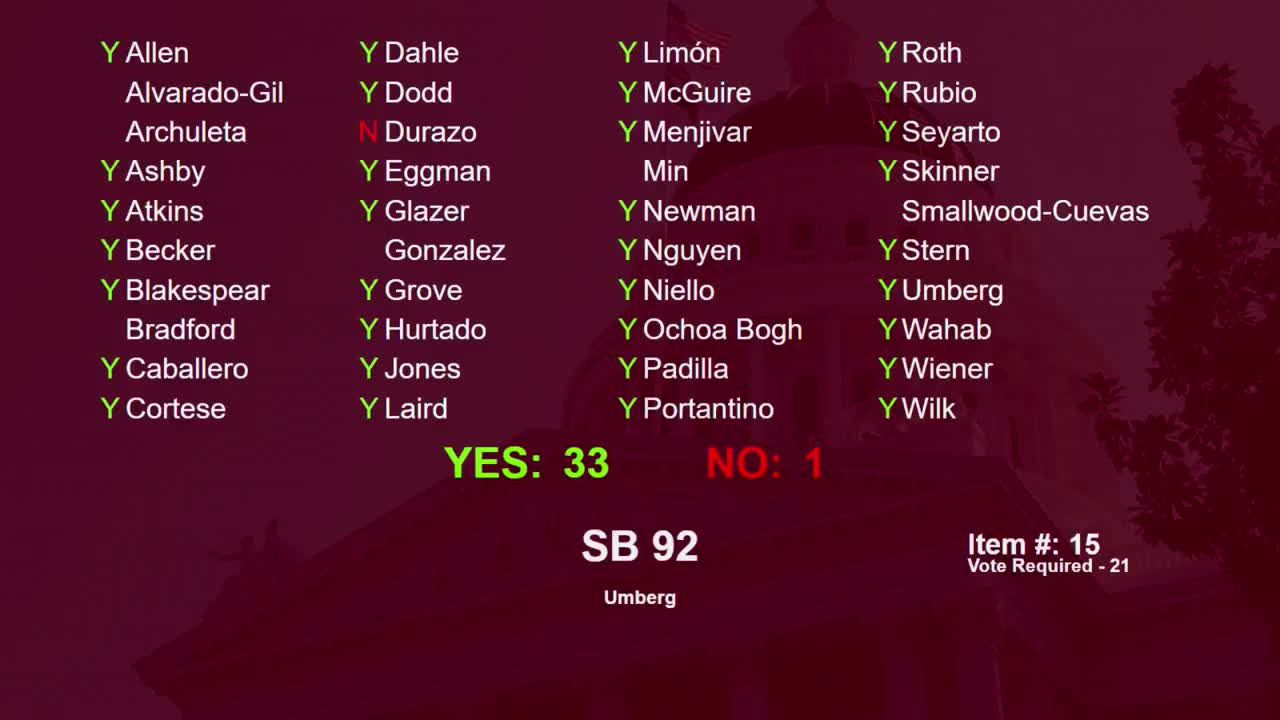 2MIN
Senate Floor
 1MIN
Senate Standing Committee on Appropriations
51SEC
Senate Standing Committee on Appropriations
 8MIN
Senate Standing Committee on Governance and Finance
 15MIN
Senate Standing Committee on Governance and Finance
Bill Author