SB 643: School safety: Safe-To-Tell Program.
- Session Year: 2023-2024
- House: Senate
- Latest Version Date: 2023-04-13
Current Status:
Failed
(2023-06-15: Referred to Com. on ED.)
Introduced
In Committee
First Chamber
In Committee
Second Chamber
Enacted
Existing law requires school districts and county offices of education to be responsible for the overall development of comprehensive school safety plans for its schools operating kindergarten or any of grades 1 to 12, inclusive. Existing law requires the schoolsite council, or the school safety committee if so designated, to consult with a representative from a law enforcement agency, a fire department, and other first responder entities in the writing and development of the comprehensive school safety plan, and requires the comprehensive school safety plan and any updates to the plan to be shared with the law enforcement agency, the fire department, and the other first responder entities. Existing law requires the school safety plan to include, among other things, procedures for conducting tactical responses to criminal incidents.
This bill would establish the School Safety Division within the State Department of Education for purposes of administering the Sate-To-Tell Program, which the bill would also establish. The bill would require the program to be administered by the Director of School Safety, who would be appointed by the Superintendent of Public Instruction, and who would be authorized to hire staff as appropriate. The bill would also establish the Safe-To-Tell Program Advisory Committee within the School Safety Division and would require the committee to annually report to the Governor and the Legislature, on or before December 31, specified information relating to the program. The bill would establish the Safe-To-Tell Account in the General Fund for purposes of implementing this chapter, and would require funds in the account to be used, upon appropriation by the Legislature, only for purposes of this chapter. The bill would provide that appropriations from the account shall not count towards satisfying the minimum funding obligation to school districts and community college districts imposed by Section 8 of Article XVI of the California Constitution.The bill would require the Director of School Safety to implement the program consistent with specified requirements, including, among others, that any person be able to anonymously report any dangerous, violent, or unlawful activity that is being conducted or threatened to be conducted on the property of a local educational agency, as defined, at an activity sponsored by the local educational agency, or on a schoolbus of a local educational agency, and that the program operate a crisis call center, internet website, mobile telephone application, and email address for its purposes. The bill would require the crisis call center to be staffed by individuals with evidence-based counseling and crisis intervention training, to be operational 24 hours per day, every day of the year, and to support and help facilitate a coordinated response by schools, public safety dispatchers, and sworn law enforcement agents to an identified crisis when such a response is to be reasonably expected.The bill would require all information received by the program to be strictly confidential and would require the School Safety Division to develop specified policies and procedures, including policies and procedures that ensure that if a report filed with the program is determined by the director to be a false report, information about the subject of the false report is immediately removed from the subject pupils record, if they are a pupil, including records held by the local educational agency and an individual school, and that the director shall notify any law enforcement agencies previously notified of the report. The bill would require law enforcement agencies notified by the director to remove the report from any records on the subject, unless the report is part of an active criminal investigation. By imposing additional duties on local educational agencies and local law enforcement agencies, the bill would impose a state-mandated local program.The bill would require each local educational agency to establish school-based teams of at least 3 members of the administrative staff at each of its schools for purposes of receiving notice of any report submitted to the program concerning a respective school. By imposing additional duties on local educational agencies, the bill would impose a state-mandated local program. The bill would require the School Safety Division to maintain a list of points of contact for each school-based team, local law enforcement dispatch, and law enforcement agencies, and to develop and provide training relating to the program, as specified.This bill would, upon appropriation by the Legislature for this purpose, require school districts, county offices of education, and charter schools to establish, on or before the 202425 school year, an anonymous reporting system, as defined, for any person to anonymously report any dangerous, violent, or unlawful activity that is being conducted or threatened to be conducted on the property of a local educational agency or at an activity sponsored by the local educational agency. The bill would require local educational agencies to prominently post information regarding the anonymous reporting system on each schoolsites internet website and ensure that a person who submits a report to have the option to remain anonymous. The bill would require local educational agencies to report specified information to the State Department of Education and would require the department to make the reported data available on its internet website, as provided. By imposing additional duties on local educational agencies, the bill would impose a state-mandated local program.
The California Constitution requires the state to reimburse local agencies and school districts for certain costs mandated by the state. Statutory provisions establish procedures for making that reimbursement.
This bill would provide that, if the Commission on State Mandates determines that the bill contains costs mandated by the state, reimbursement for those costs shall be made pursuant to the statutory provisions noted above.
Existing law requires school districts and county offices of education to be responsible for the overall development of comprehensive school safety plans for its schools operating kindergarten or any of grades 1 to 12, inclusive. Existing law requires the schoolsite council, or the school safety committee if so designated, to consult with a representative from a law enforcement agency, a fire department, and other first responder entities in the writing and development of the comprehensive school safety plan, and requires the comprehensive school safety plan and any updates to the plan to be shared with the law enforcement agency, the fire department, and the other first responder entities. Existing law requires the school safety plan to include, among other things, procedures for conducting tactical responses to criminal incidents.
This bill would establish the School Safety Division within the State Department of Education for purposes of administering the Sate-To-Tell Program, which the bill would also establish. The bill would require the program to be administered by the Director of School Safety, who would be appointed by the Superintendent of Public Instruction, and who would be authorized to hire staff as appropriate. The bill would also establish the Safe-To-Tell Program Advisory Committee within the School Safety Division and would require the committee to annually report to the Governor and the Legislature, on or before December 31, specified information relating to the program. The bill would establish the Safe-To-Tell Account in the General Fund for purposes of implementing this chapter, and would require funds in the account to be used, upon appropriation by the Legislature, only for purposes of this chapter. The bill would provide that appropriations from the account shall not count towards satisfying the minimum funding obligation to school districts and community college districts imposed by Section 8 of Article XVI of the California Constitution.
The bill would require the Director of School Safety to implement the program consistent with specified requirements, including, among others, that any person be able to anonymously report any dangerous, violent, or unlawful activity that is being conducted or threatened to be conducted on the property of a local educational agency, as defined, at an activity sponsored by the local educational agency, or on a schoolbus of a local educational agency, and that the program operate a crisis call center, internet website, mobile telephone application, and email address for its purposes. The bill would require the crisis call center to be staffed by individuals with evidence-based counseling and crisis intervention training, to be operational 24 hours per day, every day of the year, and to support and help facilitate a coordinated response by schools, public safety dispatchers, and sworn law enforcement agents to an identified crisis when such a response is to be reasonably expected.
The bill would require all information received by the program to be strictly confidential and would require the School Safety Division to develop specified policies and procedures, including policies and procedures that ensure that if a report filed with the program is determined by the director to be a false report, information about the subject of the false report is immediately removed from the subject pupils record, if they are a pupil, including records held by the local educational agency and an individual school, and that the director shall notify any law enforcement agencies previously notified of the report. The bill would require law enforcement agencies notified by the director to remove the report from any records on the subject, unless the report is part of an active criminal investigation. By imposing additional duties on local educational agencies and local law enforcement agencies, the bill would impose a state-mandated local program.
The bill would require each local educational agency to establish school-based teams of at least 3 members of the administrative staff at each of its schools for purposes of receiving notice of any report submitted to the program concerning a respective school. By imposing additional duties on local educational agencies, the bill would impose a state-mandated local program. The bill would require the School Safety Division to maintain a list of points of contact for each school-based team, local law enforcement dispatch, and law enforcement agencies, and to develop and provide training relating to the program, as specified.
The California Constitution requires the state to reimburse local agencies and school districts for certain costs mandated by the state. Statutory provisions establish procedures for making that reimbursement.
This bill would provide that, if the Commission on State Mandates determines that the bill contains costs mandated by the state, reimbursement for those costs shall be made pursuant to the statutory provisions noted above.
This chapter shall be known, and may be cited, as the Saugus Strong Act.
32257.For purposes of this chapter, the following definitions apply:
(a)Anonymous reporting system means a system that enables any person to submit an anonymous report, including, but not limited to, via a telephone number, call center, internet website, mobile telephone application, or email address.
(b)Local educational agency means a school district, county office of education, or charter school.
32258.(a)(1)On or before the 202425 school year, each local educational agency shall establish an anonymous reporting system for any person to anonymously report any dangerous, violent, or unlawful activity that is being conducted or threatened to be conducted on the property of a local educational agency or at an activity sponsored by the local educational agency.
(2)Information regarding the anonymous reporting system shall be prominently posted on each schoolsites internet website.
(3)A person who submits a report through the anonymous reporting system shall have the option to remain anonymous.
(b)A local educational agency may meet the requirement of paragraph (1) of subdivision (a) if the local educational agency has previously established an anonymous reporting system that additionally complies with paragraphs (2) and (3) of subdivision (a).
(c)If a local educational agency determines that a report is false and the subject of that report is a pupil, the information shall be immediately removed from the subject pupils record.
(d)Nothing in this chapter shall prohibit a local educational agency from contracting with a service to establish an anonymous reporting system or limit the ability of a local educational agency to contact law enforcement when there is an imminent threat to the safety of pupils, staff, or community members.
(e)On or before July 1, 2025, and on or before July 1 annually thereafter, each local educational agency shall report the following information to the department:
(1)Tips by type.
(2)Method by which the tip was received.
(3)The action taken by the public school to ensure the safety of pupils and school staff.
(4)The total number of false reports received.
(f)On or before August 31, 2025, and on or before August 31 annually thereafter, the department shall make the anonymous reporting data received pursuant to subdivision (e) available on its internet website.
(g)The implementation of this chapter is contingent upon an appropriation by the Legislature in the annual Budget Act or another statute for purposes of this chapter.
SEC. 2.If the Commission on State Mandates determines that this act contains costs mandated by the state, reimbursement to local agencies and school districts for those costs shall be made pursuant to Part 7 (commencing with Section 17500) of Division 4 of Title 2 of the Government Code.
SECTION 1.Chapter 2.4 (commencing with Section 32256) is added to Part 19 of Division 1 of Title 1 of the Education Code, to read:2.4.Safe-To-Tell Program32256.(a)This chapter shall be known, and may be cited, as the Saugus Strong Act.(b)The School Safety Division is hereby established within the department for purposes administering the Safe-To-Tell Program pursuant to this chapter.(c)The School Safety Division shall be administered by the Director of School Safety, who shall be appointed by the Superintendent and who may hire staff as appropriate to implement this chapter.(d)(1)The Safe-To-Tell account is hereby established in the General Fund for purposes of implementing this chapter. Funds in the account shall be used, upon appropriation by the Legislature, only for purposes of this chapter.(2)Funds appropriated for purposes of this chapter shall not count toward satisfying the minimum funding obligation to school districts and community college districts imposed by Section 8 of Article XVI of the California Constitution.32257.(a)The Safe-To-Tell Program is hereby established within the School Safety Division of the department pursuant to this chapter.(b)The Director of School Safety shall implement the Safe-To-Tell Program consistent with all of the following requirements:(1)(A)The program shall enable any person to anonymously report any dangerous, violent, or unlawful activity that is being conducted or threatened to be conducted on the property of a local educational agency, at an activity sponsored by the local educational agency, or on a schoolbus of a local educational agency.(B)The identity of a person who reports information to the program shall not be known by persons operating the program, shall not be disclosed to any person, and shall remain unknown to persons employed by, contracting with, volunteering with, or otherwise assisting any organization operating any program platform.(C)For purposes of this chapter, local educational agency means a school district, county office of education, charter school, or state special school.(2)(A)(i)The program shall operate a crisis call center, internet website, mobile telephone application, and email address for purposes of the program.(ii)The crisis call center, internet website, mobile telephone application, and email address shall be operated by the School Safety Division or the department may contract, consistent with the requirements of this chapter and state law, with a qualified organization to operate the crisis call center, internet website, mobile telephone application, or email address.(B)The crisis call center shall be staffed by individuals with evidence-based counseling and crisis intervention training and shall be operational 24 hours per day, every day of the year, and shall support and help facilitate a coordinated response by schools, public safety dispatchers, and sworn law enforcement agents to an identified crisis when such a response is to be reasonably expected.(3)The School Safety Division shall develop and implement a triage approach to disseminating anonymous tips based on the severity of the tip.(4)All information received by the program shall be strictly confidential and the School Safety Division shall develop policies and procedures to ensure all of the following:(A)All relevant information reported to the program is promptly forwarded to the appropriate public safety agencies and the appropriate school-based teams established pursuant to Section 32259.(B)A person shall not be compelled to produce or disclose any record or information provided to the program except upon a court order.(C)If a report filed with the program is determined by the Director of School Safety to be a false report, information about the subject of the false report shall be immediately removed from the subject pupils record, if they are a pupil, including records held by the local educational agency and an individual school, and the director shall notify any law enforcement agencies previously notified of the report. Law enforcement agencies notified by the director pursuant to this clause shall remove the report from any records on the subject, unless the report is part of an active criminal investigation.32258.(a)The Safe-To-Tell Program Advisory Committee is hereby established within the School Safety Division of the department.(b)Notwithstanding Section 10231.5 of the Government Code, the committee shall annually report to the Governor and the Legislature, on or before December 31, all of the following information:(1)The total number of tips received for the previous school year.(2)The total number of tips received since the program began, disaggregated by school and each of the following:(A)Tips by type.(B)Method by which the tip was received.(C)The total number of false reports received.(3)The total number of responses to incoming tips disaggregated by disciplinary actions, nondisciplinary actions, and interventions, as well as the gender and race of the pupil subject to the disciplinary action, nondisciplinary action, or intervention.32259.(a)Each local educational agency shall establish school-based teams of at least three members of the administrative staff at each of its schools for purposes of receiving notice of any report submitted to the program concerning the respective school.(b)The School Safety Division shall maintain a list of points of contact for each school-based team, local law enforcement dispatch, and law enforcement agencies.(c)The School Safety Division shall develop and provide training to all of the following:(1)Each member of a school-based team concerning the appropriate response to various types of tips.(2)Pupils and teachers on how to recognize and identify observable warning signs and signals of an individual or peer who may be at risk of harming themselves or others, the importance of taking threats seriously and seeking help, and how to make a report on one of the program platforms.(3)Law enforcement dispatchers as to how to receive notice of any report submitted to the program that requires response from sworn law enforcement.(d)Local educational agencies shall not be additionally liable as a result of their participation in the program.SEC. 2. If the Commission on State Mandates determines that this act contains costs mandated by the state, reimbursement to local agencies and school districts for those costs shall be made pursuant to Part 7 (commencing with Section 17500) of Division 4 of Title 2 of the Government Code.(a)This chapter shall be known, and may be cited, as the Saugus Strong Act.
(b)The School Safety Division is hereby established within the department for purposes administering the Safe-To-Tell Program pursuant to this chapter.
(c)The School Safety Division shall be administered by the Director of School Safety, who shall be appointed by the Superintendent and who may hire staff as appropriate to implement this chapter.
(d)(1)The Safe-To-Tell account is hereby established in the General Fund for purposes of implementing this chapter. Funds in the account shall be used, upon appropriation by the Legislature, only for purposes of this chapter.
(2)Funds appropriated for purposes of this chapter shall not count toward satisfying the minimum funding obligation to school districts and community college districts imposed by Section 8 of Article XVI of the California Constitution.
32257.(a)The Safe-To-Tell Program is hereby established within the School Safety Division of the department pursuant to this chapter.
(b)The Director of School Safety shall implement the Safe-To-Tell Program consistent with all of the following requirements:
(1)(A)The program shall enable any person to anonymously report any dangerous, violent, or unlawful activity that is being conducted or threatened to be conducted on the property of a local educational agency, at an activity sponsored by the local educational agency, or on a schoolbus of a local educational agency.
(B)The identity of a person who reports information to the program shall not be known by persons operating the program, shall not be disclosed to any person, and shall remain unknown to persons employed by, contracting with, volunteering with, or otherwise assisting any organization operating any program platform.
(C)For purposes of this chapter, local educational agency means a school district, county office of education, charter school, or state special school.
(2)(A)(i)The program shall operate a crisis call center, internet website, mobile telephone application, and email address for purposes of the program.
(ii)The crisis call center, internet website, mobile telephone application, and email address shall be operated by the School Safety Division or the department may contract, consistent with the requirements of this chapter and state law, with a qualified organization to operate the crisis call center, internet website, mobile telephone application, or email address.
(B)The crisis call center shall be staffed by individuals with evidence-based counseling and crisis intervention training and shall be operational 24 hours per day, every day of the year, and shall support and help facilitate a coordinated response by schools, public safety dispatchers, and sworn law enforcement agents to an identified crisis when such a response is to be reasonably expected.
(3)The School Safety Division shall develop and implement a triage approach to disseminating anonymous tips based on the severity of the tip.
(4)All information received by the program shall be strictly confidential and the School Safety Division shall develop policies and procedures to ensure all of the following:
(A)All relevant information reported to the program is promptly forwarded to the appropriate public safety agencies and the appropriate school-based teams established pursuant to Section 32259.
(B)A person shall not be compelled to produce or disclose any record or information provided to the program except upon a court order.
(C)If a report filed with the program is determined by the Director of School Safety to be a false report, information about the subject of the false report shall be immediately removed from the subject pupils record, if they are a pupil, including records held by the local educational agency and an individual school, and the director shall notify any law enforcement agencies previously notified of the report. Law enforcement agencies notified by the director pursuant to this clause shall remove the report from any records on the subject, unless the report is part of an active criminal investigation.
32258.(a)The Safe-To-Tell Program Advisory Committee is hereby established within the School Safety Division of the department.
(b)Notwithstanding Section 10231.5 of the Government Code, the committee shall annually report to the Governor and the Legislature, on or before December 31, all of the following information:
(1)The total number of tips received for the previous school year.
(2)The total number of tips received since the program began, disaggregated by school and each of the following:
(A)Tips by type.
(B)Method by which the tip was received.
(C)The total number of false reports received.
(3)The total number of responses to incoming tips disaggregated by disciplinary actions, nondisciplinary actions, and interventions, as well as the gender and race of the pupil subject to the disciplinary action, nondisciplinary action, or intervention.
32259.(a)Each local educational agency shall establish school-based teams of at least three members of the administrative staff at each of its schools for purposes of receiving notice of any report submitted to the program concerning the respective school.
(b)The School Safety Division shall maintain a list of points of contact for each school-based team, local law enforcement dispatch, and law enforcement agencies.
(c)The School Safety Division shall develop and provide training to all of the following:
(1)Each member of a school-based team concerning the appropriate response to various types of tips.
(2)Pupils and teachers on how to recognize and identify observable warning signs and signals of an individual or peer who may be at risk of harming themselves or others, the importance of taking threats seriously and seeking help, and how to make a report on one of the program platforms.
(3)Law enforcement dispatchers as to how to receive notice of any report submitted to the program that requires response from sworn law enforcement.
(d)Local educational agencies shall not be additionally liable as a result of their participation in the program.
SEC. 2.If the Commission on State Mandates determines that this act contains costs mandated by the state, reimbursement to local agencies and school districts for those costs shall be made pursuant to Part 7 (commencing with Section 17500) of Division 4 of Title 2 of the Government Code.
|
Date
|
Status
|
|---|---|
| Jun 15, 2023 | Referred to Com. on ED. |
| May 31, 2023 | In Assembly. Read first time. Held at Desk. |
| May 30, 2023 | Read third time. Passed. (Ayes 35. Noes 0. Page 1347.) Ordered to the Assembly. |
| May 18, 2023 | Read second time. Ordered to third reading. |
| May 18, 2023 | From committee: Do pass. (Ayes 6. Noes 0. Page 1178.) (May 18). |
| May 12, 2023 | Set for hearing May 18. |
| May 1, 2023 | May 1 hearing: Placed on APPR suspense file. |
| Apr 21, 2023 | Set for hearing May 1. |
| Apr 17, 2023 | Withdrawn from committee. |
| Apr 17, 2023 | Re-referred to Com. on APPR. |
| Apr 13, 2023 | Read second time and amended. Re-referred to Com. on PUB S. |
| Apr 12, 2023 | From committee: Do pass as amended and re-refer to Com. on PUB S. (Ayes 6. Noes 1. Page 682.) (April 12). |
| Apr 3, 2023 | Set for hearing April 12. |
| Mar 29, 2023 | March 29 hearing postponed by committee. |
| Mar 8, 2023 | Set for hearing March 29. |
| Mar 1, 2023 | Referred to Coms. on ED. and PUB S. |
| Feb 17, 2023 | From printer. May be acted upon on or after March 19. |
| Feb 16, 2023 | Introduced. Read first time. To Com. on RLS. for assignment. To print. |
|
Date
|
Description
|
Location
|
Votes
|
|
|---|---|---|---|---|
| May 30, 2023 | Senate 3rd Reading SB643 Wilk | Senate Floor |
Passed |
|
| May 18, 2023 | Do pass | Senate Standing Committee on Appropriations |
Passed |
|
| May 1, 2023 | Placed on suspense file | Senate Standing Committee on Appropriations |
Passed |
|
| Apr 12, 2023 | Do pass as amended, but first amend, and re-refer to the Committee on [Public Safety] | Senate Standing Committee on Education |
Passed |
This list shows positions taken on this bill by organizations on the date displayed, which is linked to the original source.
Positions by individuals are not included.
|
Organization
|
Position
|
Date
|
|---|---|---|
| Arcadia Police Officers' Association | ** Support | |
| Burbank Police Officers' Association | ** Support | |
| California Coalition of School Safety Professionals | ** Support | |
| CLAREMONT POLICE OFFICERS ASSOCIATION | ** Support | |
| Corona Police Officers Association | ** Support | |
| Culver City Police Officers' Association | ** Support | |
| Deputy Sheriffs Association of Monterey County | ** Support | |
| Fullerton Police Officers' Association | ** Support | |
| los angeles school police officers association | ** Support | |
| Murrieta Police Officers' Association | ** Support | |
| Newport Beach Police Association | ** Support | |
| Oakland Privacy | ** Against | |
| Palos Verdes Police Officers Association | ** Support | |
| Peace Officers Research Association Of California | ** Support | |
| PLACER COUNTY DEPUTY SHERIFFS ASSOCIATION | ** Support | |
| Pomona Police Officers' Association | ** Support | |
| RIVERSIDE POLICE OFFICERS ASSOCIATION | ** Support | |
| Riverside Sheriffs' Association | ** Support | |
| Santa Ana Police Officers Association | ** Support | |
| Upland Police Officers Association | ** Support |
SENATE RULES COMMITTEE Office of Senate Floor Analyses (916) 651-1520 Fax: (916) 327-4478 | SB 643 |
THIRD READING
Bill No: SB 643
Author: Wilk (R)
Amended: 4/13/23
Vote: 21
SENATE EDUCATION COMMITTEE: 6-1, 4/12/23
AYES: Newman, Ochoa Bogh, Cortese, Glazer, McGuire, Wilk
NOES: Smallwood-Cuevas
SENATE APPROPRIATIONS COMMITTEE: 6-0, 5/18/23
AYES: Portantino, Jones, Ashby, Bradford, Seyarto, Wiener
NO VOTE RECORDED: Wahab
SUBJECT: School safety: Safe-To-Tell Program
SOURCE: Author
DIGEST:
This bill, on or before the 2024-25 school year, requires local educational agencies (LEAs) to establish an anonymous reporting system to report dangerous, violent, or unlawful activity that is being conducted or threatened to be conducted on the property of an LEA or an activity sponsored by the LEA.
ANALYSIS:
Existing law:
- Requires each school district or county offices of education to be responsible for the overall development of all comprehensive school safety plans for its schools operating kindergarten or any of grades 1 through 12. (Education Code (EC) § 32281)
- Specifies that the schoolsite council or a school safety planning committee is responsible for developing the comprehensive school safety plan. (EC § 32281)
- Requires that the comprehensive school safety plans include an assessment of the current status of school crime committed on school campuses and at school-related functions and identification of appropriate strategies and programs to provide or maintain a high level of school safety and address the school’s procedures for complying with existing laws related to school safety, including child abuse reporting procedures; disaster procedures; an earthquake emergency procedure system; policies regarding pupils who commit specified acts that would lead to suspension or expulsion; procedures to notify teachers of dangerous pupils; a discrimination and harassment policy; the provisions of any schoolwide dress code; procedures for safe ingress and egress of pupils, parents, and school employees to and from school; a safe and orderly environment conducive to learning; and rules and procedures on school discipline. (EC § 32282)
- Requires the comprehensive school safety plan to be evaluated at least once a year. (EC § 32282)
- Encourages that, as school safety plans are reviewed, plans be updated to include clear guidelines for the roles and responsibilities of mental health professionals, community intervention professionals, school counselors, school resource officers, and police officers on school campuses, if the school district employs these professionals. (EC § 32282.1)
- Requires the comprehensive school safety plan to be submitted annually to the school district or county office of education for approval and requires a school district or county office of education to notify the CDE by October 15 of every year of any school that is not in compliance. (EC § 32288)
This bill:
- Requires a school district to establish an anonymous reporting system and to have it predominately displayed on its internet website on or before the 2024,-25 school year.
- Permits an LEA to contract out to establish an anonymous reporting system.
- Requires an anonymous reporting system to allow a person to remain anonymous.
- Specifies that nothing in this section prohibits from contact law enforcement where there is an imminent threat of pupils, school staff, or community members.
- Requires, if a report has been determined to be false about a student, the school district to immediately remove that information from the student’s records.
- Requires each school district, on or before July 31, 2025, and annually thereafter, to report tips by type, the method by which the tip was received, the action taken to ensure student and staff safety, and the total number of false reports to the CDE.
- Requires the CDE to make available the data from the reports on its website no later than August 31 and annually thereafter.
- Defines “school district” means a school, school district, county office of education, or charter school.
Comments
- Need for the bill. According to the author, “To address the concerning rise in violence on school campuses, multiple states have followed the U.S. Department of Homeland Security’s school safety recommendations by implementing statewide anonymous reporting programs. About 26 states have an anonymous reporting hotline specifically for students, and each participating state receives thousands of tips each year. Unfortunately, only a few school districts in California offer similar evidence-based anonymous reporting programs that provide students with safer school environments. SB 643 will help California’s school districts combat the rising trend in on campus violence by implementing a statewide, 24/7 crisis center to receive anonymous reports from any school district in the state. Furthermore, the important data collected will be compiled into categorical data that can be easily referenced.”
- Anonymous Tip Lines. School tip lines are structured systems that allow students, parents, school staff, or community members to report information about threats or potential threats to school authorities to ensure the safety of students, staff, and the community. Various forms of tip lines are available, including Web sites, computer applications, and telephone hotlines, which aim to prevent incidents posing a threat to school safety or student well-being. Although tip lines are used as a method to ensure school safety, very little is known about how widely they have been implemented and program used to report threats.
In California, some schools have already implemented anonymous reporting system. For example, Rescue Union School District and Murrieta Valley Unified School District both use a service called WeTip, “ a national nonprofit that takes anonymous tips over the phone or through an encrypted submission form on the organization’s website 24/7”. Yuba City Unified School District uses a software program, Catapult EMS, an emergency management system that allows for “real-time student accounting, reunification, staff location check-ins, threat report management, and more - all from a responsive, dependable, cloud-based system.” Meanwhile, Livermore School District uses a different service, Blackboard, to receive tips.
Other schools may not use a service to receive anonymous tips. For example, Merced Union High School District, Glendale Unified School District, Pleasanton Unified School District, Fullerton Joint Union School District, Castro Valley Unified School District, and William S. Hart School District have established either a mobile application or a telephone number for students, parents, and guardians to text. In other cases, some school districts use a website like Centinela Valley Union High School District, for students, parents, and guardians to report.
FISCAL EFFECT: Appropriation: No Fiscal Com.: Yes Local: Yes
According to the Senate Appropriations Committee, while this bill’s requirements would be contingent upon an appropriation, it could result in significant Proposition 98 General Fund cost pressure on the state. A precise amount is unknown and would be dependent on the scope of the reporting systems, but it could be in the millions to tens of millions of dollars each year for LEAs statewide. This bill’s requirement for the California Department of Education (CDE) to post the required data on its website is likely to be minor and absorbable within existing resources.
SUPPORT: (Verified 5/19/23)
Arcadia Police Officers' Association
Burbank Police Officers' Association
California Coalition of School Safety Professionals
Claremont Police Officers Association
Corona Police Officers Association
Culver City Police Officers' Association
Deputy Sheriffs' Association of Monterey County
Fullerton Police Officers' Association
Los Angeles School Police Officers Association
Murrieta Police Officers' Association
Newport Beach Police Association
Palos Verdes Police Officers Association
Peace Officers Research Association of California
Placer County Deputy Sheriffs' Association
Pomona Police Officers' Association
Riverside Police Officers Association
Riverside Sheriffs' Association
Santa Ana Police Officers Association
Upland Police Officers Association
OPPOSITION: (Verified 5/19/23)
Oakland Privacy
ARGUMENTS IN SUPPORT: According to the Peace Officers Research Association of California, “SB 643 would establish the School Safety Division within the State Department of Education for purposes of administering the Safe-To-Tell Program, which the bill would also establish. The bill would require the program to be administered by the Director of School Safety, who would be appointed by the Superintendent of Public Instruction, and who would be authorized to hire staff as appropriate. The bill would also establish the Safe-To-Tell Program Advisory Committee within the School Safety Division and would require the committee to annually report to the Governor and the Legislature, on or before December 31, specified information relating to the program. The bill would establish the Safe-To-Tell Account in the General Fund for purposes of implementing this chapter, and would require funds in the account to be used, upon appropriation by the Legislature, only for purposes of this chapter. Every parent should be able to send their children to school and not worry about their safety. Establishing a School Safety Division within the State Department of Education will go a long way to insuring that our children will be safe in school.”
ARGUMENTS IN OPPOSITION: According to Oakland Privacy “Firstly, Oakland Privacy would like to state that we appreciate the goal of the bill. Californians are weary of being told after another school shooting that the student shooter was a ‘kid everyone knew was going to explode’. If ‘everyone knew’, then it seems like the shooting should have been stopped before it happened – and somehow it wasn’t. The author is trying to proactively address that frustrating and tragic situation before it happens again. We share that goal, but have some concerns and wanted to alert the committee and author to them in the interests of making the bill better. We would suggest that one of two things needs to be true; a) if the Legislature wants this to happen then a budgetary allocation needs to be sufficient to allow school districts and charter schools to hire technical assistance or b) the tip line should not be characterized as anonymous, perhaps more ‘non-public’ or ‘private’ to connote that caller information will not be released, but not that a caller’s identity can never be tracked or traced in any way, when that is unlikely to be true.
“Secondly, we have concerns about the “false reports” provisions in the bill. We appreciate the author’s acknowledgment that there will be false reports. The bill’s current remedial provision is that blatantly false information will be removed from a child’s folder of records. While this is important, we think it might be understating the impact on a child of a blatantly false report that they are a danger to others, engaging in illegal activity or having mental health issues. We’d like to see some language in the bill about counseling for children or teens who are subjected to clearly false reports or characterizations and addresses emotional impacts, not just paperwork in a file.”
Prepared by: Kordell Hampton / ED. / (916) 651-4105
5/20/23 13:00:39
**** END ****
SENATE COMMITTEE ON APPROPRIATIONS
Senator Anthony Portantino, Chair
2023 - 2024 Regular Session
SB 643 (Wilk) - School safety: Safe-To-Tell Program
Version: April 13, 2023 | Policy Vote: ED. 6 - 1 |
Urgency: No | Mandate: Yes |
Hearing Date: May 1, 2023 | Consultant: Lenin Del Castillo |
Bill Summary:
This bill, on or before the 2024-25 school year, requires local educational agencies (LEAs) to establish an anonymous reporting system to report dangerous, violent, or unlawful activity that is being conducted or threatened to be conducted on the property of a LEA or an activity sponsored by the LEA.
Fiscal Impact:
- While the bill’s requirements would be contingent upon an appropriation, it could result in significant Proposition 98 General Fund cost pressure on the state. A precise amount is unknown and would be dependent on the scope of the reporting systems, but it could be in the millions to tens of millions of dollars each year for LEAs statewide.
- The bill’s requirement for the California Department of Education (CDE) to post the required data on its website is likely to be minor and absorbable within existing resources.
Background:
Existing law requires each school district or county offices of education to be responsible for the overall development of all comprehensive school safety plans for its schools operating kindergarten or any of grades 1 through 12. The law specifies that the schoolsite council or a school safety planning committee is responsible for developing the comprehensive school safety plan.
Existing law requires that the comprehensive school safety plans include an assessment of the current status of school crime committed on school campuses and at school-related functions and identification of appropriate strategies and programs to provide or maintain a high level of school safety and address the school’s procedures for complying with existing laws related to school safety, including child abuse reporting procedures; disaster procedures; an earthquake emergency procedure system; policies regarding pupils who commit specified acts that would lead to suspension or expulsion; procedures to notify teachers of dangerous pupils; a discrimination and harassment policy; the provisions of any schoolwide dress code; procedures for safe ingress and egress of pupils, parents, and school employees to and from school; a safe and orderly environment conducive to learning; and rules and procedures on school discipline. The law requires the comprehensive school safety plan to be evaluated at least once a year.
Existing law encourages that, as school safety plans are reviewed, plans be updated to include clear guidelines for the roles and responsibilities of mental health professionals, community intervention professionals, school counselors, school resource officers, and police officers on school campuses, if the school district employs these professionals.
Proposed Law:
This bill, on or before the 2024-25 school year, requires LEAs to establish an anonymous reporting system to anonymously report any dangerous, violent, or unlawful activity that is being conducted or threatened to be conducted on the property of a LEA or at an activity sponsored by the LEA. The bill permits an LEA to contract out to establish the system.
This bill provides that information regarding the system shall be prominently posted on each schools internet website, and that any person who submits a report through the anonymous reporting system shall have the option to remain anonymous.
This bill provides that an LEA may meet the bill’s requirements if it has previously established an anonymous reporting system, as specified.
This bill specifies that if an LEA determines that a report is false and the subject of that report is a student, the information shall immediately be removed from the student’s record.
This bill specifies that nothing in this section prohibit from contact law enforcement where there is an imminent threat of pupils, school staff, or community members.
This bill requires each LEA, on or before July 31, 2025, and annually thereafter, to report tips, by type, method by which the tip was received, the action taken to ensure student and staff safety, and the total number of false reports to the CDE. The bill requires CDE to make available the data from the reports on its website no later than August 31, and annually thereafter.
This bill provides that its implementation is contingent upon an appropriation.
Related Legislation:
AB 312 (Valladares, 2021) was similar to this bill and held on the Suspense File in this Committee.
SB 906 (Portantino, Chapter 144, Statutes of 2022) requires a school official who is alerted to or observes any threat or perceived threat, as defined, to immediately report the threat or perceived threat to law enforcement. The bill also requires the local law enforcement agency or the schoolsite police, as appropriate, with the support of the LEA, to immediately conduct an investigation and assessment of any threat or perceived threat.
AB 99 (Irwin, 2022) would have required LEAs to adopt policies for the establishment of a crisis intervention and targeted violence prevention program to assist in the identification and assessment of individuals who may be experiencing a crisis or whose behavior may indicate a threat to the health and safety of themselves, students, school staff, or other community members, and requires LEAs to provide referrals to appropriate services. AB 99 was held on the Senate inactive file.
Staff Comments:
The bill’s requirements would be contingent upon an appropriation, resulting in unknown but significant Proposition 98 General Fund cost pressure. The extent of these costs would be based on the scope of how the reporting systems are developed. The related activities may include developing and providing training to staff concerning the appropriate response to various types of tips as well as training students and teachers on how to recognize and identify observable warning signs and signals of an individual or peer who may be at risk of harming themselves or others. Additionally, LEAs may need to provide crisis intervention training and counseling and also operate the system 24 hours per day, every day of the year, which is not specified in the bill.
-- END --
SENATE COMMITTEE ON EDUCATION
Senator Josh Newman, Chair
2023 - 2024 Regular
Bill No: Hearing Date: April 12, 2023
Author: | Wilk | ||
Version: |
| ||
Urgency: | Fiscal: | ||
Consultant: | |||
Subject: .
NOTE: This bill has been referred to the Committees on Education and Public Safety. A "do pass" motion should include referral to the Committee on Public Safety.
SUMMARY
This bill a) establishes the School Safety Division (Division) within the California Department of Education (CDE); b) requires the Division to administer the Safe-To-Tell Program to receive anonymous reports of dangerous, violent, or unlawful activity; c) requires local educational agencies (LEAs) to establish school-based teams of at least three members of the administrative staff at each of its schools to receive notice of reports; and d) establishes the Safe-To-Tell Program Advisory Committee and requires the advisory committee to provide an annual report to the Governor and Legislature.
BACKGROUND
Existing Law
Education Code (EDC)
- Requires each school district or county offices of education to be responsible for the overall development of all comprehensive school safety plans for its schools operating kindergarten or any of grades 1 through 12. (EDC § 32281)
- Specifies that the schoolsite council or a school safety planning committee is responsible for developing the comprehensive school safety plan. (EDC § 32281)
- Requires that the comprehensive school safety plans include an assessment of the current status of school crime committed on school campuses and at school-related functions and identification of appropriate strategies and programs to provide or maintain a high level of school safety and address the school’s procedures for complying with existing laws related to school safety, including child abuse reporting procedures; disaster procedures; an earthquake emergency procedure system; policies regarding pupils who commit specified acts that would lead to suspension or expulsion; procedures to notify teachers of dangerous pupils; a discrimination and harassment policy; the provisions of any schoolwide dress code; procedures for safe ingress and egress of pupils, parents, and school employees to and from school; a safe and orderly environment conducive to learning; and rules and procedures on school discipline. (EDC § 32282)
- Requires the comprehensive school safety plan to be evaluated at least once a year. (EDC § 32282)
- Encourages that, as school safety plans are reviewed, plans be updated to include clear guidelines for the roles and responsibilities of mental health professionals, community intervention professionals, school counselors, school resource officers, and police officers on school campuses, if the school district employs these professionals. (EDC § 32282.1)
- Requires the comprehensive school safety plan to be submitted annually to the school district or county office of education for approval and requires a school district or county office of education to notify the CDE by October 15 of every year of any school that is not in compliance. (EDC § 32288)
ANALYSIS
This bill a) establishes the Division within the CDE; b) requires the Division to administer the Safe-To-Tell Program to receive anonymous reports of dangerous, violent, or unlawful activity; c) requires LEAs to establish school-based teams of at least three members of the administrative staff at each of its schools to receive notice of reports; and d) establishes the Safe-To-Tell Program Advisory Committee and requires the advisory committee to provide an annual report to the Governor and Legislature. Specifically, this bill:
CDE and the Safe-To-Tell Program
- Establishes the School Safety Division within the CDE for purposes of administering the Safe-To-Tell Program.
- Requires the Division to be administered by the Director of School Safety, who shall be appointed by the Superintendent of Public Instruction (SPI) and who may hire staff as appropriate to implement this bill.
- Establishes the Safe-To-Tell Program within the Division of the CDE.
- Requires the Director of the Division to implement the Safe-To-Tell Program consistent with all of the following requirements:
- Requires the program to enable any person to anonymously report any dangerous, violent, or unlawful activity that is being conducted or threatened to be conducted on the property of a LEA, at an activity sponsored by the LEA, or on a school bus of a LEA.
- Prohibits the identity of a person who reports information to the program from being known by persons operating the program, prohibits the identity from being disclosed to any person and requires the identity to remain unknown to persons employed by, contracting with, volunteering with, or otherwise assisting any organization operating any program platform.
- Requires the Safe-To-Tell Program to operate a crisis call center, website, mobile telephone application, and email address for purposes of the program.
- Requires the crisis call center, website, mobile telephone application, and email address to be operated by the Division, or authorizes CDE to contract with a qualified organization to operate the crisis call center, website, mobile telephone application, or email address.
- Requires the crisis call center to be staffed by individuals with evidence-based counseling and crisis intervention training and to be operational 24 hours per day, every day of the year.
- Requires the crisis call center to support and help facilitate a coordinated response by schools, public safety dispatchers, and sworn law enforcement agents to an identified crisis when such a response is to be reasonably expected.
- Requires the Division to develop and implement a triage approach to disseminating anonymous tips based on the severity of the tip.
- Requires that all information received by the program be strictly confidential and requires the Division to develop policies and procedures to ensure all of the following:
- All relevant information reported to the program is promptly forwarded to the appropriate public safety agencies and the appropriate school-based teams (see # 13 below).
- Prohibits a person from being compelled to produce or disclose any record or information provided to the program except upon a court order.
- Requires, if a report filed with the program is determined by the Director of the Division to be a false report, information about the subject of the false report to be immediately removed from the subject student’s record, if they are a student, including records held by the LEA and an individual school, and requires the Director to notify any law enforcement agencies previously notified of the report. This bill requires law enforcement agencies so notified by the Director to remove the report from any records on the subject, unless the report is part of an active criminal investigation.
- Requires the Division to maintain a list of points of contact for each school-based team, local law enforcement dispatch, and law enforcement agencies.
- Requires the Division to develop and provide training to all of the following:
- Each member of a school-based team concerning the appropriate response to various types of tips.
- Students and teachers on how to recognize and identify observable warning signs and signals of an individual or peer who may be at risk of harming themselves or others, the importance of taking threats seriously and seeking help, and how to make a report on one of the program platforms.
- Law enforcement dispatchers as to how to receive notice of any report submitted to the program that requires response from sworn law enforcement.
Local Educational Agencies
- Requires each LEA to establish school-based teams of at least three members of the administrative staff at each of its schools for purposes of receiving notice of any report submitted to the program concerning the respective school.
- Prohibits LEAs from being additionally liable as a result of their participation in the program.
Safe-To-Tell Program Advisory Committee
- Establishes the Safe-To-Tell Program Advisory Committee within the Division of CDE.
- Requires the advisory committee to annually report to the Governor and the Legislature, by December 31, all of the following information:
- The total number of tips received for the previous school year.
- The total number of tips received since the program began, disaggregated by school and each of the following:
- Tips by type.
- Method by which the tip was received.
- The total number of false reports received.
- The total number of responses to incoming tips disaggregated by disciplinary actions, non-disciplinary actions, and interventions, as well as the gender and race of the student subject to the disciplinary action, non-disciplinary action, or intervention.
General Provisions
- Establishes the Safe-To-Tell Program account in the General Fund for purposes of implementing this bill. This bill requires funds in the account to be used, upon appropriation by the Legislature, only for purposes of this bill.
- Prohibits funds appropriated for purposes of this bill from counting toward satisfying the minimum funding obligation to school districts and community college districts imposed by Section 8 of Article XVI of the California Constitution (Proposition 98).
- Defines “local educational agency” to mean a school district, county office of education, charter school, or state special school.
STAFF COMMENTS
- Need for the bill. According to the author “To address the concerning rise in violence on school campuses, multiple states have followed the U.S. Department of Homeland Security’s school safety recommendations by implementing statewide anonymous reporting programs. About 26 states have an anonymous reporting hotline specifically for students, and each participating state receives thousands of tips each year. Unfortunately, only a few school districts in California offer similar evidence-based anonymous reporting programs that provide students with safer school environments. SB 643 will help California’s school districts combat the rising trend in on campus violence by implementing a statewide, 24/7 crisis center to receive anonymous reports from any school district in the state. Furthermore, the important data collected will be compiled into categorical data that can be easily referenced.”
- Does the CDE Have Capacity To Operate the Safe –To-Tell To Program? This bill imposes a number of duties on CDE, including developing and providing training to a) each member of a school-based team concerning the appropriate response to various types of tips; b) students and teachers on how to recognize and identify observable warning signs and signals of an individual or peer who may be at risk of harming themselves or others, the importance of taking threats seriously and seeking help, and how to make a report on one of the program platforms; c) Law enforcement dispatchers as to how to receive notice of any report submitted to the program that requires response from sworn law enforcement.
This bill requires CDE to operate the crisis call center, website, mobile telephone application, and email address, or to contract with a qualified organization, and requires the crisis call center to be staffed by individuals with evidence-based counseling and crisis intervention training and to be operational 24 hours per day, every day of the year. This bill also requires the School Safety Division within CDE to develop and implement a triage approach to disseminating anonymous tips based on the severity of the tip. It is unlikely that CDE has the capacity to develop and provide training, or operate a crisis call center, website, mobile phone application, and email address, nor does CDE likely have staff qualified to do so.
This bill requires the CDE to establish the Division and requires the Division to disseminate anonymous tips and all relevant information to be promptly forwarded to the appropriate public safety agencies and the appropriate school-based teams at the LEA-level. This bill requires LEAs to establish school-based teams of at least three members of the administrative staff at each of its schools for purposes of receiving notice of any report submitted to the Safe-To-Tell Program concerning the respective school. While this bill does not specify what actions the school-based teams are to take, presumably, LEAs would need to investigate each tip, respond, coordinate with public safety agencies, and take action if appropriate. This bill requires CDE to provide training to each member of a school-based team concerning the appropriate response to various types of tips. This bill requires the call center to support and help facilitate a coordinated response by schools, public safety dispatchers, and sworn law enforcement agents to an identified crisis when such a response is to be reasonably expected; however, it is possible that not all LEAs have the staff or time necessary to investigate tips received at the state level, particularly in small school districts and schools.
The Committee may wish to consider whether it’s appropriate for the Legislature to dictate CDE’s organization and if the CDE has the capacity (qualified staff, resources, funding) to implement this program as required by this bill.
- Anonymous Tip Lines. School tip lines are structured systems that allow students, parents, school staff, or community members to report information about threats or potential threats, to school authorities to ensure the safety of students, staff, and the community. Various forms of tip lines are available, including Web sites, computer applications, and telephone hotlines, which aim to prevent incidents posing a threat to school safety or student well-being. Although tip lines are used as a method to ensure school safety, very little is known about how widely they have been implemented and program used to report threats.
In California, some schools have already implemented anonymous reporting system. For example, Rescue Union School District and Murrieta Valley Unified School District both use a service called WeTip, “ a national nonprofit that takes anonymous tips over the phone or through an encrypted submission form on the organization’s website 24/7”. Yuba City Unified School District uses a software program, Catapult EMS, an emergency management system that allows for “real-time student accounting, reunification, staff location check-ins, threat report management, and more - all from a responsive, dependable, cloud-based system.” Meanwhile, Livermore School District uses a different service, Blackboard, to receive tips.
Other schools may not use a service to receive anonymous tips. For example, Merced Union High School District, Glendale Unified School District, Pleasanton Unified School District, Fullerton Joint Union School District, Castro Valley Unified School District, and William S. Hart School District have established either a mobile application or a telephone number for students, parents, and guardians to text. In other cases, some school districts use a website like Centinela Valley Union High School District, for students, parents, and guardians to report.
The provisions of this bill would require the CDE to establish a new School Safety Division, the Safe – To – Tell Program. This program would be dedicated to receiving and forwarding anonymous reports, via a crisis call center, website, mobile telephone application, and email address, and to be staffed 24/7 by persons with evidence-based counseling and crisis intervention training. Some LEAs have already established anonymous reporting systems in some form and are staffed by school authorities, contracted entities, or nonprofits. The provisions of this bill appear to not only duplicate efforts already made by some LEAs to increase school safety, but also usurp local authority by establishing the Safe – To – Tell Program within CDE’s School Safety Division as the point of contact on all school threats. Further, it is unclear if both the Safe – To – Tell Program and local anonymous reporting programs already established can operate simultaneously. It should also be noted that , in theory, by establishing the Safe – To – Tell Program as the point of contact of all school related threats, response times to emergencies and threats would be delayed due to the Safe – To – Tell Program serving as a hub for reports to be processed and referred. The committee may wish to consider whether this approach to increasing school safety would be more beneficial at the local level.
It should also be noted that this bill, SB 643, is identical to a bill previously heard by this committee, AB 312 (Valladeres, 2022). The committee analysis for AB 312 (Valladeres, 2022) outlines similar concerns and questions posed to the committee regarding its provisions.
- Committee amendments: Staff recommends, and the author agrees, the following amendments:
- Removes all references related to the School Safety Division and instead, upon an appropriation, requires a school district to establish an anonymous reporting system, and to have it promintiately displayed on its internet website, on or before the 2024,-25 school year.
- Permits an LEA to contract out to establish an anonymous reporting system.
- Requires the anonymous reporting system to allow a person to remain anonymous.
- Specifies that nothing in this section prohibit from contact law enforcement where there is an imminent threat of pupils, school staff, or community members.
- Requires, if a report has been determined to be false, the school district to immediately remove that information from the student’s records.
- Requires each school district, on or before July 31, 2025, and annually thereafter, to report tips, by type, method by which the tip was received, the action taken to ensure student and staff safety, and the total number of false reports to the CDE.
- Requires the CDE to make available the data from the reports on its website no later than August 31, and annually thereafter
- Defines “school district” means a school, school district, county office of education, or charter school.
This bill, with the committee amendments, would, upon an appropriation, 1) require a school district, on or before the 2024-25 school year to establish an anonymous reporting system; 2) require a school district to report to CDE no later than July 31 each year, as specified; and 3) for the CDE to post that data on its website by August 31 annually.
- Related Legislation.
SB 906 (Portantino), Chapter 144, Statutes of 2022, required a school official who is alerted to or observes any threat or perceived threat, as defined, to immediately report the threat or perceived threat to law enforcement. SB 906 requires the local law enforcement agency or the schoolsite police, as appropriate, with the support of the LEA, to immediately conduct an investigation and assessment of any threat or perceived threat.
AB 312 (Valladares) of the 2021-22 Session, would have a) established the School Safety Division within the California Department of Education (CDE); b) required the Division to administer the Safe-To-Tell Program to receive anonymous reports of dangerous, violent, or unlawful activity; c) required local educational agencies (LEAs) to establish school-based teams of at least three members of the administrative staff at each of its schools to receive notice of reports; and d) established the Safe-To-Tell Program Advisory Committee and requires the advisory committee to provide an annual report to the Governor and Legislature. This bill was held in Senate Appropriations Committee.
AB 2384 (Valladeres, 2022) would have a) authorized a school district or charter school that serves pupils in any of grades 7 to 12, inclusive, to adopt an anonymous reporting program offered by a nonprofit organization and a threat assessment system offered by a nonprofit organization that meet specified requirements; b) required an anonymous reporting program adopted by a school district or charter school to, among other things, support 24/7 anonymous reporting, promptly forward reported information to the appropriate school-based team, and implement an evidence-based pupil violence prevention training for pupils and school personnel; c) required a threat assessment system adopted by a school district or charter school to, among other things, identify the types of threatening behavior that may represent a physical threat to the school community, identify members within the school community to whom threatening behavior should be reported and the steps to be taken afterwards, and offer threat assessment trainings; and d) authorized the above-described moneys to also be made available for the implementation and continued use of an anonymous reporting program and threat assessment system. This bill did not receive a hearing in hearing in Assembly Education Committee.
AB 99 (Irwin) of the 2021-22 Session would have required LEAs to adopt policies for the establishment of a crisis intervention and targeted violence prevention program to assist in the identification and assessment of individuals who may be experiencing a crisis or whose behavior may indicate a threat to the health and safety of themselves, students, school staff, or other community members, and requires LEAs to provide referrals to appropriate services. This bill was held in Senate Appropriations Committee.
SUPPORT
Arcadia Police Officers' Association
Burbank Police Officers' Association
California Coalition of School Safety Professionals
Claremont Police Officers Association
Corona Police Officers Association
Culver City Police Officers' Association
Deputy Sheriffs' Association of Monterey County
Fullerton Police Officers' Association
Los Angeles School Police Officers Association
Murrieta Police Officers' Association
Newport Beach Police Association
Palos Verdes Police Officers Association
Peace Officers Research Association of California
Placer County Deputy Sheriffs' Association
Pomona Police Officers' Association
Riverside Police Officers Association
Riverside Sheriffs' Association
Santa Ana Police Officers Association
Upland Police Officers Association
OPPOSITION
None received
-- END --
SENATE COMMITTEE ON EDUCATION
Senator Josh Newman, Chair
2023 - 2024 Regular
Bill No: Hearing Date: March 29, 2023
Author: | Wilk | ||
Version: |
| ||
Urgency: | Fiscal: | ||
Consultant: | |||
Subject: .
NOTE: This bill has been referred to the Committees on Education and Health. A "do pass" motion should include referral to the Committee on Public Safety.
SUMMARY
This bill a) establishes the School Safety Division (Division) within the California Department of Education (CDE); b) requires the Division to administer the Safe-To-Tell Program to receive anonymous reports of dangerous, violent, or unlawful activity; c) requires local educational agencies (LEAs) to establish school-based teams of at least three members of the administrative staff at each of its schools to receive notice of reports; and d) establishes the Safe-To-Tell Program Advisory Committee and requires the advisory committee to provide an annual report to the Governor and Legislature.
BACKGROUND
Existing Law
Education Code (EDC)
- Requires each school district or county offices of education to be responsible for the overall development of all comprehensive school safety plans for its schools operating kindergarten or any of grades 1 through 12. (EDC § 32281)
- Specifies that the schoolsite council or a school safety planning committee is responsible for developing the comprehensive school safety plan. (EDC § 32281)
- Requires that the comprehensive school safety plans include an assessment of the current status of school crime committed on school campuses and at school-related functions and identification of appropriate strategies and programs to provide or maintain a high level of school safety and address the school’s procedures for complying with existing laws related to school safety, including child abuse reporting procedures; disaster procedures; an earthquake emergency procedure system; policies regarding pupils who commit specified acts that would lead to suspension or expulsion; procedures to notify teachers of dangerous pupils; a discrimination and harassment policy; the provisions of any schoolwide dress code; procedures for safe ingress and egress of pupils, parents, and school employees to and from school; a safe and orderly environment conducive to learning; and rules and procedures on school discipline. (EDC § 32282)
- Requires the comprehensive school safety plan to be evaluated at least once a year. (EDC § 32282)
- Encourages that, as school safety plans are reviewed, plans be updated to include clear guidelines for the roles and responsibilities of mental health professionals, community intervention professionals, school counselors, school resource officers, and police officers on school campuses, if the school district employs these professionals. (EDC § 32282.1)
- Requires the comprehensive school safety plan to be submitted annually to the school district or county office of education for approval and requires a school district or county office of education to notify the CDE by October 15 of every year of any school that is not in compliance. (EDC § 32288)
ANALYSIS
This bill a) establishes the Division within the CDE; b) requires the Division to administer the Safe-To-Tell Program to receive anonymous reports of dangerous, violent, or unlawful activity; c) requires LEAs to establish school-based teams of at least three members of the administrative staff at each of its schools to receive notice of reports; and d) establishes the Safe-To-Tell Program Advisory Committee and requires the advisory committee to provide an annual report to the Governor and Legislature. Specifically, this bill:
CDE and the Safe-To-Tell Program
- Establishes the School Safety Division within the CDE for purposes of administering the Safe-To-Tell Program.
- Requires the Division to be administered by the Director of School Safety, who shall be appointed by the Superintendent of Public Instruction (SPI) and who may hire staff as appropriate to implement this bill.
- Establishes the Safe-To-Tell Program within the Division of the CDE.
- Requires the Director of the Division to implement the Safe-To-Tell Program consistent with all of the following requirements:
- Requires the program to enable any person to anonymously report any dangerous, violent, or unlawful activity that is being conducted or threatened to be conducted on the property of a LEA, at an activity sponsored by the LEA, or on a school bus of a LEA.
- Prohibits the identity of a person who reports information to the program from being known by persons operating the program, prohibits the identity from being disclosed to any person and requires the identity to remain unknown to persons employed by, contracting with, volunteering with, or otherwise assisting any organization operating any program platform.
- Requires the Safe-To-Tell Program to operate a crisis call center, website, mobile telephone application, and email address for purposes of the program.
- Requires the crisis call center, website, mobile telephone application, and email address to be operated by the Division, or authorizes CDE to contract with a qualified organization to operate the crisis call center, website, mobile telephone application, or email address.
- Requires the crisis call center to be staffed by individuals with evidence-based counseling and crisis intervention training and to be operational 24 hours per day, every day of the year.
- Requires the crisis call center to support and help facilitate a coordinated response by schools, public safety dispatchers, and sworn law enforcement agents to an identified crisis when such a response is to be reasonably expected.
- Requires the Division to develop and implement a triage approach to disseminating anonymous tips based on the severity of the tip.
- Requires that all information received by the program be strictly confidential and requires the Division to develop policies and procedures to ensure all of the following:
- All relevant information reported to the program is promptly forwarded to the appropriate public safety agencies and the appropriate school-based teams (see # 13 below).
- Prohibits a person from being compelled to produce or disclose any record or information provided to the program except upon a court order.
- Requires, if a report filed with the program is determined by the Director of the Division to be a false report, information about the subject of the false report to be immediately removed from the subject student’s record, if they are a student, including records held by the LEA and an individual school, and requires the Director to notify any law enforcement agencies previously notified of the report. This bill requires law enforcement agencies so notified by the Director to remove the report from any records on the subject, unless the report is part of an active criminal investigation.
- Requires the Division to maintain a list of points of contact for each school-based team, local law enforcement dispatch, and law enforcement agencies.
- Requires the Division to develop and provide training to all of the following:
- Each member of a school-based team concerning the appropriate response to various types of tips.
- Students and teachers on how to recognize and identify observable warning signs and signals of an individual or peer who may be at risk of harming themselves or others, the importance of taking threats seriously and seeking help, and how to make a report on one of the program platforms.
- Law enforcement dispatchers as to how to receive notice of any report submitted to the program that requires response from sworn law enforcement.
Local Educational Agencies
- Requires each LEA to establish school-based teams of at least three members of the administrative staff at each of its schools for purposes of receiving notice of any report submitted to the program concerning the respective school.
- Prohibits LEAs from being additionally liable as a result of their participation in the program.
Safe-To-Tell Program Advisory Committee
- Establishes the Safe-To-Tell Program Advisory Committee within the Division of CDE.
- Requires the advisory committee to annually report to the Governor and the Legislature, by December 31, all of the following information:
- The total number of tips received for the previous school year.
- The total number of tips received since the program began, disaggregated by school and each of the following:
- Tips by type.
- Method by which the tip was received.
- The total number of false reports received.
- The total number of responses to incoming tips disaggregated by disciplinary actions, non-disciplinary actions, and interventions, as well as the gender and race of the student subject to the disciplinary action, non-disciplinary action, or intervention.
General Provisions
- Establishes the Safe-To-Tell Program account in the General Fund for purposes of implementing this bill. This bill requires funds in the account to be used, upon appropriation by the Legislature, only for purposes of this bill.
- Prohibits funds appropriated for purposes of this bill from counting toward satisfying the minimum funding obligation to school districts and community college districts imposed by Section 8 of Article XVI of the California Constitution (Proposition 98).
- Defines “local educational agency” to mean a school district, county office of education, charter school, or state special school.
STAFF COMMENTS
- Need for the bill. According to the author “To address the concerning rise in violence on school campuses, multiple states have followed the U.S. Department of Homeland Security’s school safety recommendations by implementing statewide anonymous reporting programs. About 26 states have an anonymous reporting hotline specifically for students, and each participating state receives thousands of tips each year. Unfortunately, only a few school districts in California offer similar evidence-based anonymous reporting programs that provide students with safer school environments. SB 643 will help California’s school districts combat the rising trend in on campus violence by implementing a statewide, 24/7 crisis center to receive anonymous reports from any school district in the state. Furthermore, the important data collected will be compiled into categorical data that can be easily referenced.”
- Does the CDE Have Capacity To Operate the Safe –To-Tell To Program? This bill imposes a number of duties on CDE, including developing and providing training to a) each member of a school-based team concerning the appropriate response to various types of tips; b) students and teachers on how to recognize and identify observable warning signs and signals of an individual or peer who may be at risk of harming themselves or others, the importance of taking threats seriously and seeking help, and how to make a report on one of the program platforms; c) Law enforcement dispatchers as to how to receive notice of any report submitted to the program that requires response from sworn law enforcement.
This bill requires CDE to operate the crisis call center, website, mobile telephone application, and email address, or to contract with a qualified organization, and requires the crisis call center to be staffed by individuals with evidence-based counseling and crisis intervention training and to be operational 24 hours per day, every day of the year. This bill also requires the School Safety Division within CDE to develop and implement a triage approach to disseminating anonymous tips based on the severity of the tip. It is unlikely that CDE has the capacity to develop and provide training, or operate a crisis call center, website, mobile phone application, and email address, nor does CDE likely have staff qualified to do so.
This bill requires the CDE to establish the Division and requires the Division to disseminate anonymous tips and all relevant information to be promptly forwarded to the appropriate public safety agencies and the appropriate school-based teams at the LEA-level. This bill requires LEAs to establish school-based teams of at least three members of the administrative staff at each of its schools for purposes of receiving notice of any report submitted to the Safe-To-Tell Program concerning the respective school. While this bill does not specify what actions the school-based teams are to take, presumably, LEAs would need to investigate each tip, respond, coordinate with public safety agencies, and take action if appropriate. This bill requires CDE to provide training to each member of a school-based team concerning the appropriate response to various types of tips. This bill requires the call center to support and help facilitate a coordinated response by schools, public safety dispatchers, and sworn law enforcement agents to an identified crisis when such a response is to be reasonably expected; however, it is possible that not all LEAs have the staff or time necessary to investigate tips received at the state level, particularly in small school districts and schools.
The Committee may wish to consider whether it’s appropriate for the Legislature to dictate CDE’s organization and if the CDE has the capacity (qualified staff, resources, funding) to implement this program as required by this bill.
- Anonymous Tip Lines. School tip lines are structured systems that allow students, parents, school staff, or community members to report information about threats or potential threats, to school authorities to ensure the safety of students, staff, and the community. Various forms of tip lines are available, including Web sites, computer applications, and telephone hotlines, which aim to prevent incidents posing a threat to school safety or student well-being. Although tip lines are used as a method to ensure school safety, very little is known about how widely they have been implemented and program used to report threats.
In California, some schools have already implemented anonymous reporting system. For example, Rescue Union School District and Murrieta Valley Unified School District both use a service called WeTip, “ a national nonprofit that takes anonymous tips over the phone or through an encrypted submission form on the organization’s website 24/7”. Yuba City Unified School District uses a software program, Catapult EMS, an emergency management system that allows for “real-time student accounting, reunification, staff location check-ins, threat report management, and more - all from a responsive, dependable, cloud-based system.” Meanwhile, Livermore School District uses a different service, Blackboard, to receive tips.
Other schools may not use a service to receive anonymous tips. For example, Merced Union High School District, Glendale Unified School District, Pleasanton Unified School District, Fullerton Joint Union School District, Castro Valley Unified School District, and William S. Hart School District have established either a mobile application or a telephone number for students, parents, and guardians to text. In other cases, some school districts use a website like Centinela Valley Union High School District, for students, parents, and guardians to report.
The provisions of this bill would require the CDE to establish a new School Safety Division, the Safe – To – Tell Program. This program would be dedicated to receiving and forwarding anonymous reports, via a crisis call center, website, mobile telephone application, and email address, and to be staffed 24/7 by persons with evidence-based counseling and crisis intervention training. Some LEAs have already established anonymous reporting systems in some form and are staffed by school authorities, contracted entities, or nonprofits. The provisions of this bill appear to not only duplicate efforts already made by some LEAs to increase school safety, but also usurp local authority by establishing the Safe – To – Tell Program within CDE’s School Safety Division as the point of contact on all school threats. Further, it is unclear if both the Safe – To – Tell Program and local anonymous reporting programs already established can operate simultaneously. It should also be noted that , in theory, by establishing the Safe – To – Tell Program as the point of contact of all school related threats, response times to emergencies and threats would be delayed due to the Safe – To – Tell Program serving as a hub for reports to be processed and referred. The committee may wish to consider whether this approach to increasing school safety would be more beneficial at the local level.
It should also be noted that this bill, SB 643, is identical to a bill previously heard by this committee, AB 312 (Valladeres, 2022). The committee analysis for AB 312 (Valladeres, 2022) outlines similar concerns and questions posed to the committee regarding its provisions.
- Committee amendments: Staff recommends, and the author agrees, the following amendments:
- Removes all references related to the School Safety Division and instead, upon an appropriation, requires a school district to establish an anonymous reporting system, and to have it promintiately displayed on its internet website, on or before the 2024,-25 school year.
- Permits an LEA to contract out to establish an anonymous reporting system.
- Requires the anonymous reporting system to allow a person to remain anonymous.
- Specifies that nothing in this section prohibit from contact law enforcement where there is an imminent threat of pupils, school staff, or community members.
- Requires, if a report has been determined to be false, the school district to immediately remove that information from the student’s records.
- Requires each school district, on or before July 31, 2025, and annually thereafter, to report tips, by type, method by which the tip was received, the action taken to ensure student and staff safety, and the total number of false reports to the CDE.
- Requires the CDE to make available the data from the reports on its website no later than August 31, and annually thereafter
- Defines “school district” means a school, school district, county office of education, or charter school.
This bill, with the committee amendments, would, upon an appropriation, 1) require a school district, on or before the 2024-25 school year to establish an anonymous reporting system; 2) require a school district to report to CDE no later than July 31 each year, as specified; and 3) for the CDE to post that data on its website by August 31 annually.
- Related Legislation.
SB 906 (Portantino), Chapter 144, Statutes of 2022, required a school official who is alerted to or observes any threat or perceived threat, as defined, to immediately report the threat or perceived threat to law enforcement. SB 906 requires the local law enforcement agency or the schoolsite police, as appropriate, with the support of the LEA, to immediately conduct an investigation and assessment of any threat or perceived threat.
AB 312 (Valladares) of the 2021-22 Session, would have a) established the School Safety Division within the California Department of Education (CDE); b) required the Division to administer the Safe-To-Tell Program to receive anonymous reports of dangerous, violent, or unlawful activity; c) required local educational agencies (LEAs) to establish school-based teams of at least three members of the administrative staff at each of its schools to receive notice of reports; and d) established the Safe-To-Tell Program Advisory Committee and requires the advisory committee to provide an annual report to the Governor and Legislature. This bill was held in Senate Appropriations Committee.
AB 2384 (Valladeres, 2022) would have a) authorized a school district or charter school that serves pupils in any of grades 7 to 12, inclusive, to adopt an anonymous reporting program offered by a nonprofit organization and a threat assessment system offered by a nonprofit organization that meet specified requirements; b) required an anonymous reporting program adopted by a school district or charter school to, among other things, support 24/7 anonymous reporting, promptly forward reported information to the appropriate school-based team, and implement an evidence-based pupil violence prevention training for pupils and school personnel; c) required a threat assessment system adopted by a school district or charter school to, among other things, identify the types of threatening behavior that may represent a physical threat to the school community, identify members within the school community to whom threatening behavior should be reported and the steps to be taken afterwards, and offer threat assessment trainings; and d) authorized the above-described moneys to also be made available for the implementation and continued use of an anonymous reporting program and threat assessment system. This bill did not receive a hearing in hearing in Assembly Education Committee.
AB 99 (Irwin) of the 2021-22 Session would have required LEAs to adopt policies for the establishment of a crisis intervention and targeted violence prevention program to assist in the identification and assessment of individuals who may be experiencing a crisis or whose behavior may indicate a threat to the health and safety of themselves, students, school staff, or other community members, and requires LEAs to provide referrals to appropriate services. This bill was held in Senate Appropriations Committee.
SUPPORT
Arcadia Police Officers' Association
Burbank Police Officers' Association
California Coalition of School Safety Professionals
Claremont Police Officers Association
Corona Police Officers Association
Culver City Police Officers' Association
Deputy Sheriffs' Association of Monterey County
Fullerton Police Officers' Association
Los Angeles School Police Officers Association
Murrieta Police Officers' Association
Newport Beach Police Association
Palos Verdes Police Officers Association
Placer County Deputy Sheriffs' Association
Pomona Police Officers' Association
Riverside Police Officers Association
Riverside Sheriffs' Association
Santa Ana Police Officers Association
Upland Police Officers Association
OPPOSITION
None received
-- END --
Discussed in Hearing
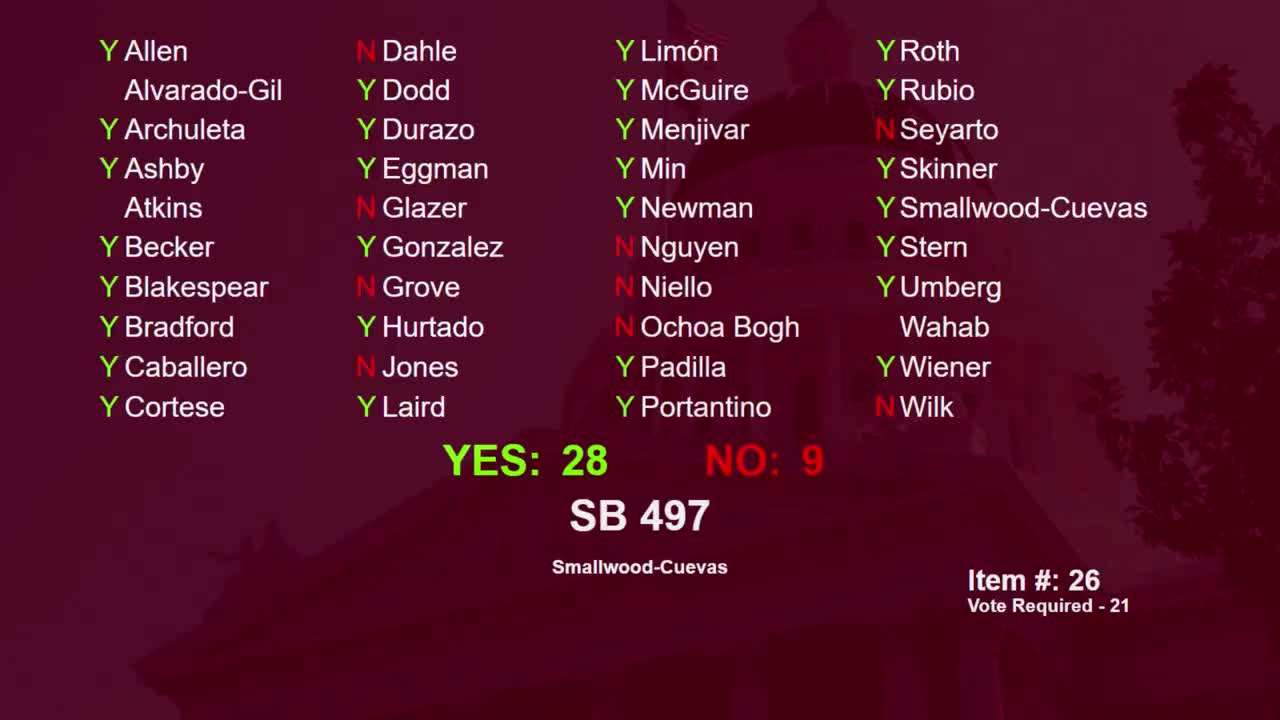 3MIN
Senate Floor
 5MIN
Senate Standing Committee on Education
5MIN
Senate Budget and Fiscal Review Subcommittee No. 1 on Education
Bill Author

Bill Co-Author(s):