SB 915: Local government: autonomous vehicle service.
- Session Year: 2023-2024
- House: Senate
- Latest Version Date: 2024-05-16
Current Status:
Failed
(2024-06-17: June 17 set for first hearing canceled at the request of author.)
Introduced
In Committee
First Chamber
In Committee
Second Chamber
Enacted
Existing law authorizes an autonomous vehicle, as defined, to be operated on public roads for testing purposes by a driver who possesses the proper class of license for the type of vehicle being operated if certain requirements are met, including that the vehicle is being operated solely by employees, contractors, or other persons designated by the manufacturer. Existing law prohibits an autonomous vehicle from being operated on public roads until the manufacturer submits an application to the Department of Motor Vehicles containing certain certifications regarding safety and other technological requirements and the department approves that application pursuant to adopted regulations. Existing law, commencing January 1, 2030, and to the extent authorized by federal law, prohibits the operation of certain new autonomous vehicles that are not zero-emission vehicles, as defined.
Existing law provides for the local regulation of certain types of transportation services, including taxicab companies. Existing law requires each city or county in which a taxicab company is substantially located to adopt an ordinance or resolution in regards to taxicab transportation service, that includes provisions for a permitting program for taxicab drivers. Under existing law, it is unlawful to operate a taxicab company without a valid permit to operate issued by each city or county in which the taxicab company is substantially located.
This bill would authorize each city, county, or city and county in which a city with a population of 250,000 or greater that an autonomous vehicle service, as defined, has received authorization by the Department of Motor Vehicles, the Public Utilities Commission, or any other applicable state agency to operate, to protect the public health, safety, and welfare by enacting an ordinance in regard to autonomous vehicle services within that jurisdiction. The bill would require each city, county, or city and county city that enacts an ordinance to include certain provisions within that ordinance. These would include a policy for entry into the business of providing autonomous vehicle services including a permitting program that includes, among other things, the establishment of reasonable vehicle caps and hours of service restrictions. The bill would authorize a city with a population of less than 250,000 that shares a border or is contiguous to a city that has enacted an autonomous vehicle services ordinance to enact an ordinance substantially consistent with that autonomous vehicle services ordinance.
The bill would authorize each city, county, or city and county city to levy service charges, fees, or assessments in the amount sufficient to pay for the costs of carrying out an ordinance enacted in regard to autonomous vehicle services. The bill would require a permitted prohibit an ordinance enacted pursuant to this bill from banning the safe operation of autonomous vehicle services.
This bill would require an autonomous vehicle service to include an interoperability or override system in each of its vehicles, as specified, and provide training for first responders on how to interact with the vehicles and the use of the override system. The bill would require an autonomous vehicle service conducting commercial passenger service to take various actions, including maintaining reasonable financial responsibility and keeping its vehicles in safe operating condition, as specified. The bill would also authorize a city, county, or city and county to enter into an agreement with another city, county, or city and county to form a joint powers authority or into an agreement with a transit agency for the purpose of regulating or administering autonomous vehicle services within jurisdictional boundaries.
The bill would include findings that changes proposed by this bill address a matter of statewide concern rather than a municipal affair and, therefore, apply to all cities, including charter cities.
Existing law authorizes an autonomous vehicle, as defined, to be operated on public roads for testing purposes by a driver who possesses the proper class of license for the type of vehicle being operated if certain requirements are met, including that the vehicle is being operated solely by employees, contractors, or other persons designated by the manufacturer. Existing law prohibits an autonomous vehicle from being operated on public roads until the manufacturer submits an application to the Department of Motor Vehicles containing certain certifications regarding safety and other technological requirements and the department approves that application pursuant to adopted regulations. Existing law, commencing January 1, 2030, and to the extent authorized by federal law, prohibits the operation of certain new autonomous vehicles that are not zero-emission vehicles, as defined.
Existing law provides for the local regulation of certain types of transportation services, including taxicab companies. Existing law requires each city or county in which a taxicab company is substantially located to adopt an ordinance or resolution in regards to taxicab transportation service, that includes provisions for a permitting program for taxicab drivers. Under existing law, it is unlawful to operate a taxicab company without a valid permit to operate issued by each city or county in which the taxicab company is substantially located.
This bill would prohibit an autonomous vehicle service, that has received approval to conduct commercial passenger service or engage in commercial activity using driverless vehicles by the Department of Motor Vehicles, the Public Utilities Commission, or another state agency, from commencing operation within a local jurisdiction until authorized by a local ordinance enacted pursuant to the bills provisions. The bill would authorize each city, county, or city and county in which an autonomous vehicle has received authorization by the Department of Motor Vehicles, the Public Utilities Commission, or any other applicable state agency to operate, to protect the public health, safety, and welfare by enacting an ordinance in regard to autonomous vehicle services within that jurisdiction. The bill would require each city, county, or city and county that enacts an ordinance to include certain provisions within that ordinance. These would include a policy for entry into the business of providing autonomous vehicle services including a permitting program that includes, among other things, the establishment of reasonable vehicle caps and hours of service restrictions.
The bill would authorize each city, county, or city and county to levy service charges, fees, or assessments in the amount sufficient to pay for the costs of carrying out an ordinance enacted in regard to autonomous vehicle services. The bill would require a permitted autonomous vehicle service conducting commercial passenger service to take various actions, including maintaining reasonable financial responsibility and keeping its vehicles in safe operating condition, as specified. The bill would make it unlawful to operate an autonomous vehicle service without a valid permit to operate issued by the local jurisdiction in which the service operates, with violations subject to administrative fines. The bill would also authorize a city, county, or city and county to enter into an agreement with another city, county, or city and county to form a joint powers authority or into an agreement with a transit agency for the purpose of regulating or administering autonomous vehicle services within jurisdictional boundaries. To the extent the bill would impose new duties on local jurisdictions, it would create a state-mandated local program.
The bill would include findings that changes proposed by this bill address a matter of statewide concern rather than a municipal affair and, therefore, apply to all cities, including charter cities.
The California Constitution requires the state to reimburse local agencies and school districts for certain costs mandated by the state. Statutory provisions establish procedures for making that reimbursement.This bill would provide that no reimbursement is required by this act for a specified reason.Existing law authorizes an autonomous vehicle, as defined, to be operated on public roads for testing purposes by a driver who possesses the proper class of license for the type of vehicle being operated if certain requirements are met, including that the vehicle is being operated solely by employees, contractors, or other persons designated by the manufacturer. Existing law prohibits an autonomous vehicle from being operated on public roads until the manufacturer submits an application to the Department of Motor Vehicles containing certain certifications regarding safety and other technological requirements and the department approves that application pursuant to adopted regulations. Existing law, commencing January 1, 2030, and to the extent authorized by federal law, prohibits the operation of certain new autonomous vehicles that are not zero-emission vehicles, as defined.
Existing law provides for the local regulation of certain types of transportation services, including taxicab companies. Existing law requires each city or county in which a taxicab company is substantially located to adopt an ordinance or resolution in regards to taxicab transportation service, which that includes provisions for a permitting program for taxicab drivers. Under existing law, it is unlawful to operate a taxicab company without a valid permit to operate issued by each city or county in which the taxicab company is substantially located.
This bill would prohibit an autonomous vehicle service, which that has received approval to conduct commercial passenger service or engage in commercial activity using driverless vehicles by the Department of Motor Vehicles, the Public Utilities Commission, or another state agency, from commencing operation within a local jurisdiction until authorized by a local ordinance enacted pursuant to the bills provisions. The bill would authorize each city, county, or city and county in which an autonomous vehicle has received authorization to operate, to protect the public health, safety, and welfare by adopting enacting an ordinance or resolution in regard to autonomous vehicle services within that jurisdiction. The bill would require each city, county, or city and county that adopts enacts an ordinance or resolution to include certain provisions within that ordinance or resolution. ordinance. These would include a policy for entry into the business of providing autonomous vehicle services including a permitting program, program that includes, among other things, the establishment of reasonable vehicle caps and hours of service restrictions, and the establishment of an interoperability or override system accessible by first responders in case of an emergency. restrictions.
The bill would authorize each city, county, or city and county to levy service charges, fees, or assessments in the amount sufficient to pay for the costs of carrying out an ordinance or resolution adopted enacted in regard to autonomous vehicle services. The bill would require a permitted autonomous vehicle service conducting commercial passenger service to take various actions, including maintaining reasonable financial responsibility and keeping its vehicles in safe operating condition, as specified. The bill would make it unlawful to operate an autonomous vehicle service without a valid permit to operate issued by the local jurisdiction in which the service is substantially located, operates, with violations subject to administrative fines. The bill would also authorize a city, county, or city and county to enter into an agreement with another city, county, or city and county to form a joint powers authority or into an agreement with a transit agency for the purpose of regulating or administering autonomous vehicle services within jurisdictional boundaries. To the extent the bill would impose new duties on local jurisdictions, it would create a state-mandated local program.
The bill would include findings that changes proposed by this bill address a matter of statewide concern rather than a municipal affair and, therefore, apply to all cities, including charter cities.
The California Constitution requires the state to reimburse local agencies and school districts for certain costs mandated by the state. Statutory provisions establish procedures for making that reimbursement.
This bill would provide that no reimbursement is required by this act for a specified reason.
Existing law authorizes an autonomous vehicle, as defined, to be operated on public roads for testing purposes by a driver who possesses the proper class of license for the type of vehicle being operated if certain requirements are met, including that the vehicle is being operated solely by employees, contractors, or other persons designated by the manufacturer. Existing law prohibits an autonomous vehicle from being operated on public roads until the manufacturer submits an application to the Department of Motor Vehicles containing certain certifications regarding safety and other technological requirements and the department approves that application pursuant to adopted regulations. Existing law, commencing January 1, 2030, and to the extent authorized by federal law, prohibits the operation of certain new autonomous vehicles that are not zero-emission vehicles, as defined.
Existing law provides for the local regulation of certain types of transportation services, including taxicab companies. Existing law requires each city or county in which a taxicab company is substantially located to adopt an ordinance or resolution in regards to taxicab transportation service, which includes provisions for a permitting program for taxicab drivers. Under existing law, it is unlawful to operate a taxicab company without a valid permit to operate issued by each city or county in which the taxicab company is substantially located.
This bill would prohibit an autonomous vehicle service, which has received approval to conduct commercial passenger service or engage in commercial activity using driverless vehicles by the Department of Motor Vehicles, the Public Utilities Commission, or another state agency, from commencing operation within a local jurisdiction until authorized by a local ordinance enacted pursuant to the bills provisions. The bill would authorize each city, county, or city and county in which an autonomous vehicle has received authorization to operate, to protect the public health, safety, and welfare by adopting an ordinance or resolution in regard to autonomous vehicle services within that jurisdiction. The bill would require each city, county, or city and county that adopts an ordinance or resolution to include certain provisions within that ordinance or resolution. These would include a policy for entry into the business of providing autonomous vehicle services including a permitting program, the establishment of reasonable vehicle caps and hours of service restrictions, and the establishment of an interoperability or override system accessible by first responders in case of an emergency.
The bill would authorize each city, county, or city and county to levy service charges, fees, or assessments in the amount sufficient to pay for the costs of carrying out an ordinance or resolution adopted in regard to autonomous vehicle services. The bill would require a permitted autonomous vehicle service conducting passenger service to take various actions, including maintaining reasonable financial responsibility and keeping its vehicles in safe operating condition, as specified. The bill would make it unlawful to operate an autonomous vehicle service without a valid permit to operate issued by the local jurisdiction in which the service is substantially located, with violations subject to administrative fines. The bill would also authorize a city, county, or city and county to enter into an agreement with another city, county, or city and county to form a joint powers authority or into an agreement with a transit agency for the purpose of regulating or administering autonomous vehicle services within jurisdictional boundaries. To the extent the bill would impose new duties on local jurisdictions, it would create a state-mandated local program.
The bill would include findings that changes proposed by this bill address a matter of statewide concern rather than a municipal affair and, therefore, apply to all cities, including charter cities.
The California Constitution requires the state to reimburse local agencies and school districts for certain costs mandated by the state. Statutory provisions establish procedures for making that reimbursement.
This bill would provide that no reimbursement is required by this act for a specified reason.
The Legislature finds and declares all of the following:
(a)California has witnessed the growth and expansion of autonomous vehicle services in urban areas across the state, including the bay area and Los Angeles.
(b)The approval and deployment of autonomous vehicle services in California is governed entirely by the Department of Motor Vehicles and the Public Utilities Commission, and currently allows for minimal local control or public input.
(c)The deployment of autonomous vehicle services, over the objections of local government, the general public, law enforcement, and emergency responders, has led to numerous accidents, injuries, and traffic congestion.
(d)The deployment of autonomous vehicle services without requirements to ensure that the services are fully accessible to people with disabilities has resulted in disabled Californians being unfairly and unlawfully excluded from those services.
(e)Given the localized nature of transportation, the deployment and regulation of autonomous vehicle services requires local approval and local control.
(f)This act shall be known as the Autonomous Vehicle Service Deployment and Data Transparency Act (AVS-DDTA).
(g)The purpose of this act is to prioritize local control in the decision to deploy autonomous vehicle services, where an entity has already received any deployment approval by the Department of Motor Vehicles, the Public Utilities Commission, or any other state agency.
SEC. 2.The heading of Chapter 1 (commencing with Section 38750) is added to Division 16.6 of the Vehicle Code, to read:1.GeneralSEC. 2.Section 53075.1 is added to the Government Code, to read:53075.1.SEC. 3.Chapter 2 (commencing with Section 38760) is added to Division 16.6 of the Vehicle Code, to read:2.Autonomous Vehicle Service38760.For purposes of this chapter:
(a)Autonomous vehicle service means any entity that has received authority to conduct commercial passenger service or engage in commercial activity using driverless vehicles by the Department of Motor Vehicles, the Public Utilities Commission, or any other state agency.
(b)City means a city or city and county.
(c)Reasonable vehicle caps shall mean that the allowable number of vehicles does not contribute to a significant and measurable increase in traffic congestion as determined by the local jurisdictions appropriate transportation agency.
38761.(a)(1)Notwithstanding Chapter 8 (commencing with Section 5351) of Division 2 of the Public Utilities Code, every city, county, or city and county in which a city with a population of 250,000 or greater that an autonomous vehicle service has received authorization by the Department of Motor Vehicles, the Public Utilities Commission, or any other applicable state agency to operate, may protect the public health, safety, and welfare by enacting an ordinance or ordinances in regard to autonomous vehicle services within the jurisdiction of the city, county, or city and county. that city.
(b)(2)Each city, county, or city and county city that enacts an ordinance pursuant to this section subdivision shall provide, at a minimum, a policy for entry into the business of providing autonomous vehicle services in that ordinance. The policy shall include, but not be limited to, a permitting program for autonomous vehicle services that includes all of the following provisions:
(1)(A)The establishment or registration of rates for the provision of an autonomous vehicle service conducting commercial passenger service that meets the following requirements:
(A)(i)The autonomous vehicle service may set fares or charge a flat rate. However, the city, county, or city and county city may set a maximum rate.
(B)(ii)The autonomous vehicle service may use any type of device or technology approved by the Division of Measurement Standards to calculate fares, including the use of Global Positioning System metering, provided that the device or technology complies with Section 12500.5 of the Business and Professions Code and with all regulations established pursuant to Section 12107 of the Business and Professions Code.
(C)(iii)The autonomous vehicle service shall disclose fares, fees, or rates to the customer. A permitted autonomous vehicle service may satisfy this requirement by disclosing fares, fees, or rates on its internet website, mobile telephone application, or telephone orders upon request by the customer. The rate may also be provided on the exterior of the vehicle or be clearly visible in either print or electronic form inside the vehicle.
(2)(B)The establishment of reasonable vehicle caps and hours of service restrictions.
(3)(C)The establishment of a fee schedule and disciplinary process for any moving violations or traffic obstruction caused during the operation of a vehicle by an autonomous vehicle service.
(b)Notwithstanding Chapter 8 (commencing with Section 5351) of Division 2 of the Public Utilities Code, a city with a population of less than 250,000 that shares a border or is contiguous to a city that has enacted an ordinance pursuant to subdivision (a) may enact an ordinance or ordinances in regard to autonomous vehicle services that are substantially consistent with the ordinance or ordinances of the city that has enacted an ordinance pursuant to subdivision (a).
(c)Each city, county, or city and county city may levy service charges, fees, or assessments in an amount sufficient to pay for the costs of carrying out an ordinance enacted in regard to autonomous vehicle services pursuant to this section.
(d)A permitted autonomous vehicle service conducting commercial passenger service shall do all of the following:(d)An ordinance enacted pursuant to this section shall not ban the safe operation of autonomous vehicle services.
38762.(a)Upon receiving authorization by the Department of Motor Vehicles, the Public Utilities Commission, or any other applicable state agency to operate, an autonomous vehicle service shall do both of the following:
(1)Include an interoperability or override system in each of its vehicles accessible by first responders in case of an emergency.
(2)Provide training for first responders on how to interact with the vehicles and the use of the override system. The training shall be updated when electronic updates that affect how the interoperability or override system operates are pushed to the vehicles.
(b)Upon receiving authorization by the Department of Motor Vehicles, the Public Utilities Commission, or any other applicable state agency to operate, an autonomous vehicle service conducting commercial passenger service shall do all of the following:
(1)Maintain reasonable financial responsibility to conduct passenger transportation services in accordance with the requirements of an ordinance enacted pursuant to this section. Section 38761.
(2)(A)Ensure that its service complies with the federal Americans with Disabilities Act of 1990, as amended (42 U.S.C. Sec. 12101 et seq.), the Unruh Civil Rights Act (Section 51 of the Civil Code), the Disabled Persons Act (Part 2.5 (commencing with Section 54) of Division 1 of the Civil Code), and all other applicable state and federal disability access laws.
(B)Maintain a disabled access education and training program to instruct its employees on compliance with the federal Americans with Disabilities Act of 1990 (42 U.S.C. Sec. 12101 et seq.) and amendments thereto, and state disability rights laws and regulations. The education and training program shall include instruction on the duty to provide equal access to passengers with various disabilities, including, but not limited to, all of the following:
(i)The obligation to provide service to those with service animals.
(ii)Providing effective communication, including the right to alternative formats and auxiliary aids and services.
(iii)Making reasonable accommodations or modifications to rules, policies, and practices where necessary to provide equal access to the autonomous vehicle service for a person with a disability.
(3)Use wheelchair-accessible vehicles or, if an autonomous vehicle service uses nonwheelchair-accessible vehicles, the autonomous vehicle service must demonstrate that it is providing wheelchair-accessible service that is equivalent to nonwheelchair-accessible service in terms of service area, response time, availability, and wait time.
(A)An autonomous vehicle service that uses nonwheelchair-accessible vehicles may provide wheelchair-accessible service by supplementing its fleet with its own wheelchair-accessible vehicles or by contracting with a third party to provide wheelchair-accessible service.
(B)An autonomous vehicle service that uses nonwheelchair-accessible vehicles shall collect and maintain records and data on trips provided, trips declined, trips canceled, wait times, response times, and service availability for rides requested by users needing wheelchair-accessible vehicles and for other users to establish that its wheelchair-accessible service is equivalent to its nonwheelchair-accessible service.
(C)An autonomous vehicle service shall maintain the records and data required by this paragraph for a minimum of five years and make anonymized data available to the public.
(4)Ensure that the autonomous vehicle services internet website, mobile application, customer service platforms, human-machine interface, and all other public-facing technologies are readily apparent and accessible to people with disabilities.
(A)All information provided on the autonomous vehicles internet website, mobile application, customer service platforms, human-machine interface, and public-facing technologies must be in plain language.
(B)The method for requesting a wheelchair-accessible vehicle shall be readily apparent on any internet website, mobile application, customer service platforms, human-machine interface, public-facing technologies, screens, or other interface where users may request a ride.
(5)Maintain its motor vehicles used in passenger transportation services in a safe operating condition, and in compliance with the Vehicle Code, subject to annual inspection by the city, county, or city and county in which it operates, at a facility that is certified by the National Institute for Automotive Service Excellence or a facility registered with the Bureau of Automotive Repair.
(6)Provide the city, county, or city and county Department of Motor Vehicles, the California Public Utilities Commission, or the city that has issued a permit under this section pursuant to Section 38761 an address of an office or terminal where documents supporting the factual matters specified in the showing required by this subdivision may be inspected by the permitting city, county, or city and county. city.
(7)(A)Include an interoperability or override system in each of its vehicles accessible by first responders in case of an emergency.(B)Provide training for first responders on how to interact with the vehicles and the use of the override system. The training shall be updated when electronic updates that affect how the interoperability or override system operates are pushed to the vehicles.(8)(7)Establish data transparency sharing agreements necessary to administer or carry out an ordinance enacted pursuant to this section. Section 38761.
(9)Comply with all provisions of an ordinance enacted pursuant to this section.(e)A city or county may do any of the following:(1)Enter into an agreement with any other city, county, or city and county to form a joint powers authority for the purpose of regulating or administering autonomous vehicle services that operate within the jurisdictional boundaries of the joint powers authority.(2)Enter into an agreement with a transit agency for the purpose of regulating or administering the autonomous vehicle service that operates within the jurisdictional boundaries of the transit agency. The transit agency may exercise all powers granted to the city or county that is a party to the agreement by this section in order to regulate or administer autonomous vehicle services within those boundaries.(f)For purposes of this section:(1)Autonomous vehicle service means any entity that has received authority to conduct commercial passenger service or engage in commercial activity using driverless vehicles by the Department of Motor Vehicles, the Public Utilities Commission, or any other state agency.(2)Reasonable vehicle caps shall mean that the allowable number of vehicles does not contribute to a significant and measurable increase in traffic congestion as determined by the local jurisdictions appropriate transportation agency.(g)38763.(a)Notwithstanding any other provision of this section, chapter, an airport operator shall have separate and ultimate authority to regulate autonomous vehicle service access to the airport and set access fees for autonomous vehicles at the airport.
(h)(b)Nothing in this section chapter shall affect the authority of a jurisdiction to regulate autonomous vehicle service to an airport it owns or operates and to set access fees or requirements.
SEC. 3.SEC. 4.The Legislature finds and declares that ensuring the safe operation of autonomous vehicles across the state is a matter of statewide concern and is not a municipal affair as that term is used in Section 5 of Article XI of the California Constitution. Therefore, Section 2 3 of this act adding Section 53075.1 to the Government Chapter 2 (commencing with Section 38760) to Division 16.6 of the Vehicle Code applies to all cities, including charter cities.
The Legislature finds and declares all of the following:
(a)California has witnessed the growth and expansion of autonomous vehicle services in urban areas across the state, including the bay area and Los Angeles.
(b)The approval and deployment of autonomous vehicle services in California is governed entirely by the Department of Motor Vehicles and the Public Utilities Commission, and currently allows for minimal local control or public input.
(c)The deployment of autonomous vehicle services, over the objections of local government, the general public, law enforcement, and emergency responders, has led to numerous accidents, injuries, and traffic congestion.
(d)The deployment of autonomous vehicle services without requirements to ensure that the services are fully accessible to people with disabilities has resulted in disabled Californians being unfairly and unlawfully excluded from those services.
(d)(e)Given the localized nature of transportation, the deployment and regulation of autonomous vehicle services requires local approval and local control.
(e)(f)This act shall be known as the Autonomous Vehicle Service Deployment and Data Transparency Act (AVS-DDTA).
(f)(g)The purpose of this act is to prioritize local control in the decision to deploy autonomous vehicle services, where an entity has already received any deployment approval by the Department of Motor Vehicles, the Public Utilities Commission, or any other state agency.
SEC. 2.Section 53075.1 is added to the Government Code, to read:53075.1.(a)Upon receiving approval to conduct commercial passenger service or engage in commercial activity using driverless vehicles by the Department of Motor Vehicles, the Public Utilities Commission, or any other state agency, an autonomous vehicle service shall not commence operation within a local jurisdiction until authorized by a local ordinance enacted pursuant to this section.(b)53075.1.(a)Notwithstanding Chapter 8 (commencing with Section 5351) of Division 2 of the Public Utilities Code, every city, county, or city and county in which an autonomous vehicle service has received authorization by the Department of Motor Vehicles, the Public Utilities Commission, or any other applicable state agency to operate, may protect the public health, safety, and welfare by enacting an ordinance or ordinances in regard to autonomous vehicle services within the jurisdiction of the city, county, or city and county.
(c)(b)Each city, county, or city and county that enacts an ordinance pursuant to this section shall provide, at a minimum, a policy for entry into the business of providing autonomous vehicle services in that ordinance. The policy shall include, but not be limited to, a permitting program for autonomous vehicle services that includes all of the following provisions:
(1)The establishment or registration of rates for the provision of an autonomous vehicle service conducting commercial passenger service that meets the following requirements:
(A)The autonomous vehicle service may set fares or charge a flat rate. However, the city, county, or city and county may set a maximum rate.
(B)The autonomous vehicle service may use any type of device or technology approved by the Division of Measurement Standards to calculate fares, including the use of Global Positioning System metering, provided that the device or technology complies with Section 12500.5 of the Business and Professions Code and with all regulations established pursuant to Section 12107 of the Business and Professions Code.
(C)The autonomous vehicle service shall disclose fares, fees, or rates to the customer. A permitted autonomous vehicle service may satisfy this requirement by disclosing fares, fees, or rates on its internet website, mobile telephone application, or telephone orders upon request by the customer. The rate may also be provided on the exterior of the vehicle or be clearly visible in either print or electronic form inside the vehicle.
(2)The establishment of reasonable vehicle caps and hours of service restrictions.
(3)The establishment of a fee schedule and disciplinary process for any moving violations or traffic obstruction caused during the operation of a vehicle by an autonomous vehicle service.
(d)(c)Each city, county, or city and county may levy service charges, fees, or assessments in an amount sufficient to pay for the costs of carrying out an ordinance enacted in regard to autonomous vehicle services pursuant to this section.
(e)(d)A permitted autonomous vehicle service conducting commercial passenger service shall do all of the following:
(1)Maintain reasonable financial responsibility to conduct passenger transportation services in accordance with the requirements of an ordinance enacted pursuant to this section.
(2)(A)Ensure that its service complies with the federal Americans with Disabilities Act of 1990, as amended (42 U.S.C. Sec. 12101 et seq.), the Unruh Civil Rights Act (Section 51 of the Civil Code), the Disabled Persons Act (Part 2.5 (commencing with Section 54) of Division 1 of the Civil Code), and all other applicable state and federal disability access laws.
(B)Maintain a disabled access education and training program to instruct its employees on compliance with the federal Americans with Disabilities Act of 1990 (42 U.S.C. Sec. 12101 et seq.) and amendments thereto, and state disability rights laws, including making clear that it is illegal to decline to serve a person with a disability or who has a service animal. laws and regulations. The education and training program shall include instruction on the duty to provide equal access to passengers with various disabilities, including, but not limited to, all of the following:
(i)The obligation to provide service to those with service animals.
(ii)Providing effective communication, including the right to alternative formats and auxiliary aids and services.
(iii)Making reasonable accommodations or modifications to rules, policies, and practices where necessary to provide equal access to the autonomous vehicle service for a person with a disability.
(3)Use wheelchair-accessible vehicles or, if an autonomous vehicle service uses nonwheelchair-accessible vehicles, the autonomous vehicle service must demonstrate that it is providing wheelchair-accessible service that is equivalent to nonwheelchair-accessible service in terms of service area, response time, availability, and wait time.
(A)An autonomous vehicle service that uses nonwheelchair-accessible vehicles may provide wheelchair-accessible service by supplementing its fleet with its own wheelchair-accessible vehicles or by contracting with a third party to provide wheelchair-accessible service.
(B)An autonomous vehicle service that uses nonwheelchair-accessible vehicles shall collect and maintain records and data on trips provided, trips declined, trips canceled, wait times, response times, and service availability for rides requested by users needing wheelchair-accessible vehicles and for other users to establish that its wheelchair-accessible service is equivalent to its nonwheelchair-accessible service.
(C)An autonomous vehicle service shall maintain the records and data required by this paragraph for a minimum of five years and make anonymized data available to the public.
(4)Ensure that the autonomous vehicle services internet website, mobile application, customer service platforms, human-machine interface, and all other public-facing technologies are readily apparent and accessible to people with disabilities.
(A)All information provided on the autonomous vehicles internet website, mobile application, customer service platforms, human-machine interface, and public-facing technologies must be in plain language.
(B)The method for requesting a wheelchair-accessible vehicle shall be readily apparent on any internet website, mobile application, customer service platforms, human-machine interface, public-facing technologies, screens, or other interface where users may request a ride.
(3)(5)Maintain its motor vehicles used in passenger transportation services in a safe operating condition, and in compliance with the Vehicle Code, subject to annual inspection by the city, county, or city and county in which it operates, at a facility that is certified by the National Institute for Automotive Service Excellence or a facility registered with the Bureau of Automotive Repair.
(4)(6)Provide the city, county, or city and county that has issued a permit under this section an address of an office or terminal where documents supporting the factual matters specified in the showing required by this subdivision may be inspected by the permitting city, county, or city and county.
(5)(7)(A)Include an interoperability or override system in each of its vehicles accessible by first responders in case of an emergency.
(B)Provide training for first responders on how to interact with the vehicles and the use of the override system. The training shall be updated when electronic updates that affect how the interoperability or override system operates are pushed to the vehicles.
(6)(8)Establish data transparency sharing agreements necessary to administer or carry out an ordinance enacted pursuant to this section.
(7)(9)Comply with all provisions of an ordinance enacted pursuant to this section.
(f)(1)It shall be unlawful to operate an autonomous vehicle service without a valid permit to operate issued by each city, county, or city and county in which the service operates.(2)The minimum fine for violation of paragraph (1) shall be five thousand dollars ($5,000) and may be imposed administratively by the permitting city, county, or city and county.(g)(e)A city or county may do any of the following:
(1)Enter into an agreement with any other city, county, or city and county to form a joint powers authority for the purpose of regulating or administering autonomous vehicle services that operate within the jurisdictional boundaries of the joint powers authority.
(2)Enter into an agreement with a transit agency for the purpose of regulating or administering the autonomous vehicle service that operates within the jurisdictional boundaries of the transit agency. The transit agency may exercise all powers granted to the city or county that is a party to the agreement by this section in order to regulate or administer autonomous vehicle services within those boundaries.
(h)(f)For purposes of this section:
(1)Autonomous vehicle service means any entity that has received authority to conduct commercial passenger service or engage in commercial activity using driverless vehicles by the Department of Motor Vehicles, the Public Utilities Commission, or any other state agency.
(2)Reasonable vehicle caps shall mean that the allowable number of vehicles does not contribute to a significant and measurable increase in traffic congestion as determined by the local jurisdictions appropriate transportation agency.
(i)(g)Notwithstanding any other provision of this section, an airport operator shall have separate and ultimate authority to regulate autonomous vehicle service access to the airport and set access fees for autonomous vehicles at the airport.
(j)(h)Nothing in this section shall affect the authority of a jurisdiction to regulate autonomous vehicle service to an airport it owns or operates and to set access fees or requirements.
SEC. 3.The Legislature finds and declares that ensuring the safe operation of autonomous vehicles across the state is a matter of statewide concern and is not a municipal affair as that term is used in Section 5 of Article XI of the California Constitution. Therefore, Section 2 of this act adding Section 53075.1 to the Government Code applies to all cities, including charter cities.
SEC. 4.No reimbursement is required by this act pursuant to Section 6 of Article XIIIB of the California Constitution because a local agency or school district has the authority to levy service charges, fees, or assessments sufficient to pay for the program or level of service mandated by this act, within the meaning of Section 17556 of the Government Code.The Legislature finds and declares all of the following:
(a)California has witnessed the growth and expansion of autonomous vehicle services in urban areas across the state, including the bay area and Los Angeles.
(b)The approval and deployment of autonomous vehicle services in California is governed entirely by the Department of Motor Vehicles and the Public Utilities Commission, and currently allows for minimal local control or public input.
(c)The deployment of autonomous vehicle services, over the objections of local government, the general public, law enforcement, and emergency responders, has led to numerous accidents, injuries, and traffic congestion.
(d)Given the localized nature of transportation, the deployment and regulation of autonomous vehicle services requires local approval and local control.
(e)This act shall be known as the Autonomous Vehicle Service Deployment and Data Transparency Act (AVS-DDTA).
(f)The purpose of this act is to prioritize local control in the decision to deploy autonomous vehicle services, where an entity has already received any deployment approval by the Department of Motor Vehicles, the Public Utilities Commission, or any other state agency.
SEC. 2.Section 53075.1 is added to the Government Code, to read:53075.1.(a)Upon receiving approval to conduct commercial passenger service or engage in commercial activity using driverless vehicles by the Department of Motor Vehicles, the Public Utilities Commission, or any other state agency, an autonomous vehicle service shall not commence operation within a local jurisdiction until authorized by a local ordinance enacted pursuant to this section.
(b)Notwithstanding Chapter 8 (commencing with Section 5351) of Division 2 of the Public Utilities Code, every city, county, or city and county in which an autonomous vehicle service has received authorization to operate, may protect the public health, safety, and welfare by adopting enacting an ordinance or resolution in regard to autonomous vehicle services within the jurisdiction of the city, county, or city and county.
(c)Each city, county, or city and county that adopts enacts an ordinance or resolution pursuant to subdivision (b) this section shall provide, at a minimum, a policy for entry into the business of providing autonomous vehicle services in that ordinance or resolution. ordinance. The policy shall include, but not be limited to, a permitting program for autonomous vehicle services that includes all of the following provisions:
(1)The establishment or registration of rates for the provision of an autonomous vehicle service conducting commercial passenger service that meets the following requirements:
(A)The autonomous vehicle service may set fares or charge a flat rate. However, the city, county, or city and county may set a maximum rate.
(B)The autonomous vehicle service may use any type of device or technology approved by the Division of Measurement Standards to calculate fares, including the use of Global Positioning System metering, provided that the device or technology complies with Section 12500.5 of the Business and Professions Code and with all regulations established pursuant to Section 12107 of the Business and Professions Code.
(C)The autonomous vehicle service shall disclose fares, fees, or rates to the customer. A permitted robotaxi company autonomous vehicle service may satisfy this requirement by disclosing fares, fees, or rates on its internet website, mobile telephone application, or telephone orders upon request by the customer. The rate may also be provided on the exterior of the vehicle or be clearly visible in either print or electronic form inside the robotaxi. vehicle.
(2)The establishment of reasonable vehicle caps and hours of service restrictions.
(3)The establishment of a certification process to ensure that all autonomous vehicle services comply with the state and federal disability access laws.(4)(3)The establishment of a fee schedule and disciplinary process for any moving violations or traffic obstruction caused during the operation of a vehicle by an autonomous vehicle service.
(5)The establishment of an interoperability or override system accessible by first responders in the case of an emergency. (6)The establishment of any data transparency of sharing agreements necessary to administer or carry out an ordinance adopted pursuant to subdivision (b).(d)Each city, county, or city and county may levy service charges, fees, or assessments in an amount sufficient to pay for the costs of carrying out an ordinance or resolution adopted enacted in regard to autonomous vehicle services pursuant to this section.
(e)A permitted autonomous vehicle service conducting commercial passenger service shall do all of the following:
(1)Maintain reasonable financial responsibility to conduct passenger transportation services in accordance with the requirements of an ordinance or resolution adopted enacted pursuant to subdivision (b). this section.
(2)(A)Ensure that its service complies with the state and federal disability access laws.
(2)(B)Maintain a disabled access education and training program to instruct its employees on compliance with the federal Americans with Disabilities Act of 1990 (42 U.S.C. Sec. 12101 et seq.) and amendments thereto, and state disability rights laws, including making clear that it is illegal to decline to serve a person with a disability or who has a service animal.
(3)Maintain its motor vehicles used in passenger transportation services in a safe operating condition, and in compliance with the Vehicle Code, subject to annual inspection by the city, county, or city and county in which it is substantially located, operates, at a facility that is certified by the National Institute for Automotive Service Excellence or a facility registered with the Bureau of Automotive Repair.
(4)Provide the city, county, or city and county that has issued a permit under this section an address of an office or terminal where documents supporting the factual matters specified in the showing required by this subdivision may be inspected by the permitting city, county, or city and county.
(5)(A)Include an interoperability or override system in each of its vehicles accessible by first responders in case of an emergency.
(B)Provide training for first responders on how to interact with the vehicles and the use of the override system. The training shall be updated when electronic updates that affect how the interoperability or override system operates are pushed to the vehicles.
(6)Establish data transparency sharing agreements necessary to administer or carry out an ordinance enacted pursuant to this section.
(5)(7)Comply with all provisions of an ordinance adopted enacted pursuant to this section.
(f)(1)It shall be unlawful to operate an autonomous vehicle service without a valid permit to operate issued by each city, county, or city and county in which the service is substantially located. operates.
(2)The minimum fine for violation of paragraph (1) shall be five thousand dollars ($5,000) and may be imposed administratively by the permitting city, county, or city and county.
(g) A city or county may do any of the following:
(1)Enter into an agreement with any other city, county, or city and county to form a joint powers authority for the purpose of regulating or administering autonomous vehicle services that are substantially located operate within the jurisdictional boundaries of the joint powers authority. For purposes of this paragraph, an autonomous vehicle service is substantially located within the jurisdictional boundaries of the joint powers authority if it is substantially located within one of the parties to the joint powers agreement.
(2)Enter into an agreement with a transit agency for the purpose of regulating or administering the autonomous vehicle service substantially located that operates within the jurisdictional boundaries of the transit agency. For purposes of this paragraph, an autonomous vehicle service is substantially located within the jurisdictional boundaries of the transit agency if it is substantially located within the city or county that enters into an agreement pursuant to this clause, and the The transit agency may exercise all powers granted to the city or county that is a party to the agreement by this section in order to regulate or administer robotaxi companies autonomous vehicle services within those boundaries.
(h)For purposes of this section:
(1)Autonomous vehicle service means any entity that has received authority to conduct commercial passenger service or engage in commercial activity using driverless vehicles by the Department of Motor Vehicles, the Public Utilities Commission, or any other state agency.
(2)Reasonable vehicle caps shall mean that the allowable number of vehicles does not contribute to a significant and measurable increase in traffic congestion as determined by the local jurisdictions appropriate transportation agency.
(3)Substantially located means in reference to a city or county, or city and county, that the autonomous vehicle service has been granted authority to conduct commercial passenger service or engage in commercial activity using driverless vehicles by the Department of Motor Vehicles, the Public Utilities Commission, or any other state agency.(i)Notwithstanding any other provision of this section, an airport operator shall have separate and ultimate authority to regulate autonomous vehicle service access to the airport and set access fees for autonomous vehicles at the airport.
(j)Nothing in this section shall affect the authority of a jurisdiction to regulate autonomous vehicle service to an airport it owns or operates and to set access fees or requirements.
SEC. 3.The Legislature finds and declares that Section 2 of this act adding Section 53075.1 to the Government Code addresses a matter of statewide concern rather than a municipal affair as that term is used in Section 5 of Article XI of the California Constitution. Therefore, Section 2 of this act applies to all cities, including charter cities.SEC. 3.The Legislature finds and declares that ensuring the safe operation of autonomous vehicles across the state is a matter of statewide concern and is not a municipal affair as that term is used in Section 5 of Article XI of the California Constitution. Therefore, Section 2 of this act adding Section 53075.1 to the Government Code applies to all cities, including charter cities.
SEC. 4.No reimbursement is required by this act pursuant to Section 6 of Article XIIIB of the California Constitution because a local agency or school district has the authority to levy service charges, fees, or assessments sufficient to pay for the program or level of service mandated by this act, within the meaning of Section 17556 of the Government Code.
The Legislature finds and declares all of the following:
(a)California has witnessed the growth and expansion of autonomous vehicle services in urban areas across the state, including the bay area and Los Angeles.
(b)The approval and deployment of autonomous vehicle services in California is governed entirely by the Department of Motor Vehicles and the Public Utilities Commission, and currently allows for minimal local control or public input.
(c)The deployment of autonomous vehicle services, over the objections of local government, the general public, law enforcement, and emergency responders, has led to numerous accidents, injuries, and traffic congestion.
(d)Given the localized nature of transportation, the deployment and regulation of autonomous vehicle services requires local approval and local control.
(e)This act shall be known as the Autonomous Vehicle Service Deployment and Data Transparency Act (AVS-DDTA).
(f)The purpose of this act is to prioritize local control in the decision to deploy autonomous vehicle services, where an entity has already received any deployment approval by the Department of Motor Vehicles, the Public Utilities Commission, or any other state agency.
SEC. 2.Section 53075.1 is added to the Government Code, to read:53075.1.(a)Upon receiving approval to conduct commercial passenger service or engage in commercial activity using driverless vehicles by the Department of Motor Vehicles, the Public Utilities Commission, or any other state agency, an autonomous vehicle service shall not commence operation within a local jurisdiction until authorized by a local ordinance enacted pursuant to this section.
(b)Notwithstanding Chapter 8 (commencing with Section 5351) of Division 2 of the Public Utilities Code, every city, county, or city and county in which an autonomous vehicle service has received authorization to operate, may protect the public health, safety, and welfare by adopting an ordinance or resolution in regard to autonomous vehicle services within the jurisdiction of the city, county, or city and county.
(c)Each city, county, or city and county that adopts an ordinance or resolution pursuant to subdivision (b) shall provide, at a minimum, a policy for entry into the business of providing autonomous vehicle services in that ordinance or resolution. The policy shall include, but not be limited to, a permitting program for autonomous vehicle services that includes all of the following provisions:
(1)The establishment or registration of rates for the provision of an autonomous vehicle service conducting commercial passenger service that meets the following requirements:
(A)The autonomous vehicle service may set fares or charge a flat rate. However, the city, county, or city and county may set a maximum rate.
(B)The autonomous vehicle service may use any type of device or technology approved by the Division of Measurement Standards to calculate fares, including the use of Global Positioning System metering, provided that the device or technology complies with Section 12500.5 of the Business and Professions Code and with all regulations established pursuant to Section 12107 of the Business and Professions Code.
(C)The autonomous vehicle service shall disclose fares, fees, or rates to the customer. A permitted robotaxi company may satisfy this requirement by disclosing fares, fees, or rates on its internet website, mobile telephone application, or telephone orders upon request by the customer. The rate may also be provided on the exterior of the vehicle or be clearly visible in either print or electronic form inside the robotaxi.
(2)The establishment of reasonable vehicle caps and hours of service restrictions.
(3)The establishment of a certification process to ensure that all autonomous vehicle services comply with the state and federal disability access laws.
(4)The establishment of a fee schedule and disciplinary process for any moving violations or traffic obstruction caused during the operation of a vehicle by an autonomous vehicle service.
(5)The establishment of an interoperability or override system accessible by first responders in the case of an emergency.
(6)The establishment of any data transparency of sharing agreements necessary to administer or carry out an ordinance adopted pursuant to subdivision (b).
(d)Each city, county, or city and county may levy service charges, fees, or assessments in an amount sufficient to pay for the costs of carrying out an ordinance or resolution adopted in regard to autonomous vehicle services pursuant to this section.
(e)A permitted autonomous vehicle service conducting passenger service shall do all of the following:
(1)Maintain reasonable financial responsibility to conduct passenger transportation services in accordance with the requirements of an ordinance or resolution adopted pursuant to subdivision (b).
(2)Maintain a disabled access education and training program to instruct its employees on compliance with the federal Americans with Disabilities Act of 1990 (42 U.S.C. Sec. 12101 et seq.) and amendments thereto, and state disability rights laws, including making clear that it is illegal to decline to serve a person with a disability or who has a service animal.
(3)Maintain its motor vehicles used in passenger transportation services in a safe operating condition, and in compliance with the Vehicle Code, subject to annual inspection by the city, county, or city and county in which it is substantially located, at a facility that is certified by the National Institute for Automotive Service Excellence or a facility registered with the Bureau of Automotive Repair.
(4)Provide the city, county, or city and county that has issued a permit under this section an address of an office or terminal where documents supporting the factual matters specified in the showing required by this subdivision may be inspected by the permitting city, county, or city and county.
(5)Comply with all provisions of an ordinance adopted pursuant to this section.
(f)(1)It shall be unlawful to operate an autonomous vehicle service without a valid permit to operate issued by each city, county, or city and county in which the service is substantially located.
(2)The minimum fine for violation of paragraph (1) shall be five thousand dollars ($5,000) and may be imposed administratively by the permitting city, county, or city and county.
(g)A city or county may do any of the following:
(1)Enter into an agreement with any other city, county, or city and county to form a joint powers authority for the purpose of regulating or administering autonomous vehicle services that are substantially located within the jurisdictional boundaries of the joint powers authority. For purposes of this paragraph, an autonomous vehicle service is substantially located within the jurisdictional boundaries of the joint powers authority if it is substantially located within one of the parties to the joint powers agreement.
(2)Enter into an agreement with a transit agency for the purpose of regulating or administering the autonomous vehicle service substantially located within the jurisdictional boundaries of the transit agency. For purposes of this paragraph, an autonomous vehicle service is substantially located within the jurisdictional boundaries of the transit agency if it is substantially located within the city or county that enters into an agreement pursuant to this clause, and the transit agency may exercise all powers granted to the city or county that is a party to the agreement by this section in order to regulate or administer robotaxi companies within those boundaries.
(h)For purposes of this section:
(1)Autonomous vehicle service means any entity that has received authority to conduct commercial passenger service or engage in commercial activity using driverless vehicles by the Department of Motor Vehicles, the Public Utilities Commission, or any other state agency.
(2)Reasonable vehicle caps shall mean that the allowable number of vehicles does not contribute to a significant and measurable increase in traffic congestion as determined by the local jurisdictions appropriate transportation agency.
(3)Substantially located means in reference to a city or county, or city and county, that the autonomous vehicle service has been granted authority to conduct commercial passenger service or engage in commercial activity using driverless vehicles by the Department of Motor Vehicles, the Public Utilities Commission, or any other state agency.
(i)Notwithstanding any other provision of this section, an airport operator shall have separate and ultimate authority to regulate autonomous vehicle service access to the airport and set access fees for autonomous vehicles at the airport.
(j)Nothing in this section shall affect the authority of a jurisdiction to regulate autonomous vehicle service to an airport it owns or operates and to set access fees or requirements.
SEC. 3.The Legislature finds and declares that Section 2 of this act adding Section 53075.1 to the Government Code addresses a matter of statewide concern rather than a municipal affair as that term is used in Section 5 of Article XI of the California Constitution. Therefore, Section 2 of this act applies to all cities, including charter cities.
SEC. 4.No reimbursement is required by this act pursuant to Section 6 of Article XIIIB of the California Constitution because a local agency or school district has the authority to levy service charges, fees, or assessments sufficient to pay for the program or level of service mandated by this act, within the meaning of Section 17556 of the Government Code.
|
Date
|
Status
|
|---|---|
| Jun 17, 2024 | June 17 set for first hearing canceled at the request of author. |
| Jun 3, 2024 | Referred to Coms. on TRANS. and C. & C. |
| May 22, 2024 | In Assembly. Read first time. Held at Desk. |
| May 21, 2024 | Read third time. Passed. (Ayes 26. Noes 9. Page 4059.) Ordered to the Assembly. |
| May 20, 2024 | Read second time. Ordered to third reading. |
| May 16, 2024 | Read second time and amended. Ordered to second reading. |
| May 16, 2024 | From committee: Do pass as amended. (Ayes 5. Noes 2. Page 3964.) (May 16). |
| May 10, 2024 | Set for hearing May 16. |
| May 6, 2024 | May 6 hearing: Placed on APPR suspense file. |
| Apr 26, 2024 | Set for hearing May 6. |
| Apr 24, 2024 | From committee: Do pass and re-refer to Com. on APPR. (Ayes 10. Noes 5. Page 3731.) (April 23). Re-referred to Com. on APPR. |
| Apr 17, 2024 | From committee: Do pass and re-refer to Com. on TRANS. (Ayes 4. Noes 2. Page 3663.) (April 17). Re-referred to Com. on TRANS. |
| Apr 16, 2024 | Set for hearing April 23 in TRANS. pending receipt. |
| Apr 11, 2024 | From committee with author's amendments. Read second time and amended. Re-referred to Com. on L. GOV. |
| Apr 5, 2024 | Set for hearing April 17. |
| Apr 2, 2024 | April 3 set for first hearing canceled at the request of author. |
| Apr 1, 2024 | From committee with author's amendments. Read second time and amended. Re-referred to Com. on L. GOV. |
| Mar 15, 2024 | Set for hearing April 3. |
| Feb 21, 2024 | Referred to Coms. on L. GOV. and TRANS. |
| Jan 10, 2024 | From printer. May be acted upon on or after February 9. |
| Jan 9, 2024 | Introduced. Read first time. To Com. on RLS. for assignment. To print. |
|
Date
|
Description
|
Location
|
Votes
|
|
|---|---|---|---|---|
| May 21, 2024 | Senate 3rd Reading SB915 Cortese et al. | Senate Floor |
Passed |
|
| May 16, 2024 | Do pass as amended | Senate Standing Committee on Appropriations |
Passed |
|
| May 6, 2024 | Placed on suspense file | Senate Standing Committee on Appropriations |
Passed |
|
| Apr 23, 2024 | Do pass, but first be re-referred to the Committee on [Appropriations] | Senate Standing Committee on Transportation |
Passed |
|
| Apr 17, 2024 | Do pass, but first be re-referred to the Committee on [Transportation] | Senate Standing Committee on Local Government |
Passed |
This list shows positions taken on this bill by organizations on the date displayed, which is linked to the original source.
Positions by individuals are not included.
|
Organization
|
Position
|
Date
|
|---|---|---|
| ACES Mobility Coalition | ** Against | |
| Afscme CA | ** Support | |
| Alliance for Automative Innovation | * Against | Apr 17, 2024 |
| Alliance For Automotive Innovation | ** Against | |
| Amalgamated Transit Union | * Support | Apr 23, 2024 |
| Aurora Innovation, INC. | ** Against | |
| Autonomous Vehicle Industry Association | ** Against | |
| AUVSI | ** Against | |
| Bay Area Council | ** Against | |
| Board of Supervisors for the City and County of San Francisco | ** Support | |
| California Alliance for Freight Innovation | ** Against | |
| California Asian Pacific Chamber Of Commerce | ** Against | |
| California Chamber Of Commerce | ** Against | |
| California Conference Board Of The Amalgamated Transit Union | ** Support | |
| California Conference Of Machinists | ** Support | |
| California Contract Cities Association | ** Support | |
| California Delivery Association | ** Against | |
| California Hispanic Chamber Of Commerce | ** Against | |
| California Labor Federation, Afl-Cio | ** Support | |
| California Manufacturers & Technology Association | ** Against | |
| California Professional Firefighters | ** Support | |
| California School Employees Association | ** Support | |
| California Teamsters Public Affairs Council | ** Support | |
| Central City Association Of Los Angeles | ** Against | |
| Central Valley Yemen Society | ** Against | |
| Chamber Of Progress | ** Against | |
| City and County of San Francisco | ** Support | |
| City Of Daly City | ** Support | |
| City Of Fresno | * Against | Apr 17, 2024 |
| City of Norwalk | ** Support | |
| City Of Oakland | ** Support | |
| City Of Palo Alto | ** Support | |
| City of Temple City | ** Support | |
| Coalition of California Chambers – Orange County | ** Against | |
| Coalition of Small & Disabled Veteran Businesses | ** Against | |
| Consumer Attorneys Of California | ** Support | |
| Consumer Technology Association | ** Against | |
| Contra Costa Transportation Authority | ** Against | |
| County Of Los Angeles | ** Support | |
| County of San Mateo | ** Support | |
| County of Santa Clara | ** Support | |
| daimler trucks north america | ** Against | |
| Disability Rights California | ** Support | |
| Drew Boyles, Mayor, City of El Segundo | ** Against | |
| Einride | ** Against | |
| Endless Pursuit Corporation | ** Against | |
| Engineers and Scientists of California, IFPTE Local 20, AFL-CIO | ** Support | |
| Family Business Association of California | ** Against | |
| Flasher Barricade Association | ** Against | |
| Ford Motor Company | * Against | Apr 17, 2024 |
| Foster City Chamber of Commerce | ** Against | |
| Gatik | ** Against | |
| Honorable Adam Schiff, Member of The United States Congress | ** Support | |
| Hugo Soto-Martinez, Councilmember, City of Los Angeles | ** Support | |
| Inland Empire Economic Partnership | ** Against | |
| Kodiak | ** Against | |
| Latin Business Association | ** Against | |
| League Of California Cities | ** Support | |
| London N. Breed, Mayor, City and County of San Francisco | ** Support | |
| Los Angeles Area Chamber Of Commerce | ** Against | |
| Los Angeles County Business Federation | ** Against | |
| Luminar | ** Against | |
| MEMA, the Vehicle Suppliers Association | ** Against | |
| Mission Street Neighbors | ** Support | |
| Motional | ** Against | |
| Mountain View Chamber of Commerce | ** Against | |
| National Federation Of Independent Business | ** Against | |
| National Federation Of The Blind Of California | ** Against | |
| Navistar, Inc. | ** Against | |
| Nuro | ** Against | |
| Nuro Inc | * Against | Apr 17, 2024 |
| Orange County Business Council | ** Against | |
| Orange County Employees Association | ** Support | |
| Palo Alto Chamber of Commerce | ** Against | |
| Plus AI | ** Against | |
| Relles Florist | ** Against | |
| Rural County Representatives of California | ** Support | |
| San Francisco County Transportation Authority | ** Support | |
| San Francisco Taxi Workers Alliance | ** Support | |
| San Juan Capistrano Chamber of Commerce | ** Against | |
| San Mateo County Chamber of Commerce | ** Against | |
| San Mateo County Economic Development Association | ** Against | |
| Santa Monica Chamber of Commerce | ** Against | |
| SAVE Coalition | ** Against | |
| Secure Justice | ** Support | |
| Si Se Puede | ** Against | |
| Si Se Puede! Fresno County | ** Against | |
| Si Se Puede! Kern County | ** Against | |
| Si Se Puede! Kings County | ** Against | |
| Si Se Puede! Tulare County | ** Against | |
| Silicon Valley Leadership Group | ** Against | |
| SMART - Transportation Division | ** Support | |
| Smith/CALIFORNIA State Legislative Board/Brotherhood Of Locomotive Engineers & Trainmen | * Support | Apr 23, 2024 |
| South Bay Cities Council of Governments | ** Support | |
| Spartan Radar | ** Against | |
| Stack AV | ** Against | |
| Star Milling Co | ** Against | |
| Steve McShane, City Councilman, City of Salinas | ** Against | |
| Technet | ** Against | |
| Tesla | ** Against | |
| Torc Robotics | ** Against | |
| Town of Danville | ** Against | |
| Transport Workers Union of America, AFL-CIO | ** Support | |
| Uber Technologies, Inc. | ** Against | |
| Unite Here International Union, Afl-Cio | ** Support | |
| United Spinal Association | ** Against | |
| Utility Workers Union of America | ** Support | |
| Valley Industry & Commerce Association | ** Against | |
| Volvo Autonomous Solutions | ** Against | |
| volvo group north america | ** Against | |
| Waabi Innovation Us Inc | ** Against | |
| Waymo | ** Against | |
| World Blind Union | ** Against | |
| Zoox Inc | * Against | Apr 17, 2024 |
| Zoox, INC. | ** Against |
Date of Hearing: June 17, 2024
ASSEMBLY COMMITTEE ON TRANSPORTATION
Lori D. Wilson, Chair
SBPCA Bill Id:SB 915
Author:(Cortese) – As Amended Ver:May 16, 2024
SENATE VOTE: 26-9
SUBJECT: Local government: autonomous vehicle service
SUMMARY: Authorizes cities with a population of 250,000 or greater to enact ordinances to protect public health, safety, and welfare as it relates to autonomous vehicle (AV) services within that jurisdiction. Specifically, this bill:
- Defines “autonomous vehicle services” to mean any entity that has received authority to conduct commercial passenger service or engage in commercial activity using driverless vehicles by the Department of Motor Vehicles (DMV), the Public Utility Commission (CPUC) or any other state agency.
- Requires the local ordinances to have all of the following:
- The establishment or registration of rates for the provision of an AV service conducting commercial passenger service that has all of the following requirements:
- The AV service may set fares to charge a flat rate, however the city may set a maximum rate.
- The AV service may use any type of device or technology approved by the Division of Measurement Standards to calculate fares, including the use of Global Position System (GPS) metering, as specified.
- Requires AV service to disclose fares, fees, or rates to the customer.
- Establish reasonable vehicle caps and hours of service restrictions; and,
- Establish a fee schedule and disciplinary process for any moving violations or traffic obstruction caused during the operation of a vehicle by an AV service.
- Authorizes a city with a population of less than 250,000 that shares a border or is contiguous to a city that has enacted an ordinance to enact an ordnance or ordinances in regard to AV services to enact an ordinance that is substantially consistent with the ordinance or the ordinances of the city that has enacted an ordinance pursuant to this bill.
- Prohibits an enacted ordinance from banning the safe operation of AVs.
- Requires an AV service to include an interoperability or override system in each of its vehicles accessible by first responders in case of an emergency.
- Requires an AV service to provide training for first responders on how to interact with the vehicles and use the override system.
- Requires an AV service providing commercial passenger service to maintain reasonable financial responsibility to conduct passenger transportation services in accordance with the requirements of an ordinance passed by a local jurisdiction.
- Requires an AV service providing commercial passenger service to comply with the federal Americans with Disabilities Act (ADA) of 1990.
- Requires an AV service providing commercial passenger service to maintain a disabled access education and training program to instruct its employees on compliance with the Federal ADA of 1990 and state disability rights laws and regulations. The education and training program must include instructions on the duty to provide equal access, including, but not limited to those with service animals, provide effective communication, including the right to alternative formats and auxiliary aids, and make reasonable accommodations or modifications to rules, policies, and practices where necessary to provide equal access to an AV service for a person with a disability.
- Requires an AV services providing commercial passenger service to provide wheelchair-accessible vehicles, or, if an AV service uses nonwheelchair-accessible vehicles, the AV service must demonstrate that it is providing wheelchair-accessible service that is equivalent to non-wheelchair-accessible service in terms of service area, response time, availability, and wait time. Authorizes an AV service to contract with another company to provide the wheelchair accessible vehicles. Requires an AV service to collect and maintain records and data on trips provided, trips declined, trips canceled, wait times, response times, and service availability for rides requested by users needing wheelchair-accessible vehicles and for other users to establish that its wheelchair-accessible service is equivalent to its nonwheelchair-accessible service.
- Requires an AV service providing commercial passenger service to maintain its motor vehicles used in passenger transportation services in a safe operating condition, and in compliance with the vehicle code, subject to annual inspection by the city, county, or city and county in which It operates, at a facility that is certified by the National Institute for Automotive Service Excellence or a facility registered with the Bureau of Automotive Repair.
- Provides an airport operator the authority to regulate AV service access to airports and to set fees for AVs at the airport.
EXISTING LAW:
- Authorizes the operation of AVs on public roads for testing purposes under certain circumstances specified in DMV regulations. (Vehicle Code (VEH) 38750).
- Defines “autonomous vehicle” to mean vehicle equipped with technology that makes it capable of operation that meets the definition of Levels 3, 4, or 5 of the Society of Automotive Engineers (SAE) International's Taxonomy and Testing of Autonomous Vehicles Definitions for Terms Related to Driving Automation Systems for On-Road Motor Vehicles, standard J3016 (APR 2021). (VEH 38750)
- Defines “autonomous technology” to mean technology that has the capability to drive a vehicle without the active physical control or monitoring by a human operator. (VEH 38750)
- States that an AV does not include a vehicle that is equipped with one or more collision avoidance systems, including, but not limited to, electronic blind spot assistance, automated emergency braking systems, park assist, adaptive cruise control, lane keep assist, lane departure warning, traffic jam and queuing assist, or other similar systems that enhance safety or provide driver assistance, but are not capable, collectively or singularly, of driving the vehicle without the active control or monitoring of a human operator. (VEH 38750)
- Prohibits the operation of AVs on public roads for non-testing purposes unless the vehicle manufacturer submits an application to DMV that is approved pursuant to DMV regulations. (VEH 38750)
- Requires DMV to approve an application submitted by a manufacturer for the operation of AVs for non-testing purposes if DMV finds that the applicant has submitted all information and completed testing necessary to satisfy that the AVs are safe to operate on public roads and the applicant has complied with all requirements specified in DMV regulations. (VEH 38750)
- Authorizes DMV to impose additional requirements it deems necessary to ensure the safe operation of AVs if those vehicles are capable of operating without the presence of a driver inside the vehicle. (VEH 38750)
Existing DMV regulations:
- Requires AV manufacturers to have a testing or deployment permit to operate an autonomous vehicle in California.
- Restricts the testing and deployment of autonomous vehicles to vehicles under 10,001 pounds and excludes motorcycles.
- Authorizes both the testing and deployment of AVs without a human operator inside the vehicle.
- Requires an AV with a testing permit (but not a deployment permit) to report collisions to DMV within 10 days of the collision if the collision resulted in damage of property or in bodily injury or death if they have a testing permit
- Requires AVs with a testing permit (but not a deployment permit) to report disengagements on an annual basis.
FISCAL EFFECT: According to the Senate Appropriations Committee, “The Department of Motor Vehicles (DMV) could incur costs in a future fiscal year, likely exceeding $100,000 and potentially reaching the low hundreds of thousands of dollars, to the extent local ordinances would require the department to revise AV regulations, conduct additional oversight of AVS permittees, and coordinate with local agencies. The timing and magnitude of costs would depend upon the content, timing, and number of ordinances enacted by local agencies. (Motor Vehicle Account)
In addition, the CPUC indicates that fiscal impacts to coordinate with local jurisdictions to prevent regulatory overlap, consider new reporting requirements, ensure CPUC staff is educated on new regulations, and address other unanticipated issues would be minor and absorbable at this time. CPUC notes, however, that it would eventually incur unabsorbable ongoing legal staffing costs of approximately $276,000 annually (1.0 PY), beginning in a future fiscal year, as more local ordinances are enacted and AV commercial passenger services expand throughout the state. (PUC Transportation Reimbursement Account)
COMMENTS:
In 2012, the Legislature passed SB 1298 (Padilla), Chapter 570 which permitted AVs to operate on public roads for testing by a driver under certain conditions. In 2014, DMV released regulations to allow for testing AVs with a test driver. In April 2018, DMV finalized regulations for the testing and deployment of AVs on public roads without a driver. About 35 companies currently have a testing permit with a driver and six companies have received an AV permit for testing without a driver. Only three companies currently have a valid driverless deployment permit. While this bill would apply to all autonomous vehicle manufacturers broadly – in testing with a driver, driverless testing, and full driverless deployment - most of the recent public attention has been focused on a limited number of companies that have fully deployed their driverless vehicles for commercial service under CPUC programs.
In 2018, the CPUC initially authorized two pilot programs for the private prearranged transportation of passengers AVs:
- The "Drivered AV Passenger Service" pilot program allows for the provision of passenger service in AVs with a driver in the vehicle. Under this pilot program, a safety driver is available to assist with operations if needed.
- The "Driverless AV Passenger Service" pilot program allows for the provision of passenger service in AVs without a driver in the vehicle. Under this pilot program, a communication link between passengers and "remote operators" of the vehicle must be available and maintained at all times during passenger service.
To be eligible to participate in the CPUC's AV Passenger Service pilot programs, participants must possess the appropriate corresponding Autonomous Vehicle Tester Program Manufacturer's Testing Permit from the DMV for and comply fully with DMV's AV testing regulations (California Code of Regulations, Title 13, Article 3.7). Under the AV Passenger Service pilot programs, monetary compensation may not be charged for any rides in test AVs. Currently, only one company (Waymo LLC), is authorized for full driverless deployment under the CPUC’s program. One other company (Zoox, Inc.) is authorized for driverless testing.
Taxi Regulations: This bill authorizes cities with a population of 250,000 or more to regulate AV services similarly to how they regulate taxis and mirrors statute enabling cities to regulate taxis. Two key differences are unlike current taxi statutes, this bill authorizes cities to regulate AV delivery services and also, extend to vehicles capable of carrying eight or more passengers.
According to the author, “Local governments adopt ordinances on any given week, nimbly and with local accountability. SB 915 returns control to the local communities who know their streets best. The emergence of commercial autonomous vehicles is an exciting technological development with massive potential upsides for safety and convenience. We must ensure this innovative technology rolls out safely. SB 915 strikes the right balance between responsible technology deployment, regional consistency, and public safety.”
According to the California Labor Federation, writing as a co-sponsor of this bill, “Right now, robotaxis and other autonomous vehicle services are operating in California communities without input from local government, concerned residents, emergency responders, or workers. Over the last year, driverless vehicles have delayed transport and medical care, blocked emergency vehicles, and interfered during active firefighting and crime scenes. First responders have been forced to relocate their emergency vehicles because of wayward AVs. The San Francisco Fire Department indicated that more than 70 driverless vehicles interfered with emergency responders in 2023 alone. Despite numerous examples of widespread technological failures, state regulators just approved expanded deployment across the San Francisco Bay Area and Los Angeles County.
SB 915 will bring much-needed local input to communities impacted by the deployment of robotaxis and other autonomous vehicle services. In California, only the CPUC and the DMV authorize and govern AV services, not local governments. SB 915 guarantees that local governments also have a say in regulating AVs operating on their streets, by allowing larger cities to enact ordinances that include important considerations like maximum fares, vehicle caps, and data transparency to customers."
According to Taxi Regulation in the Age of Uber, a journal article published by the New York University Journal of Legislation and Public Policy, there are five pillars of taxi regulation: limiting the number of taxis (medallion caps), taxi fares, health and safety regulations such as background checks and insurance requirements, regulations to protect the economic interests and health and safety of taxi drivers, and universal service requirements.
Medallion Caps. Under this bill, cities would be authorized to establish medallion caps to limit the number of AVs, both for passenger service and delivery service. Congestion may become an increasingly larger problem for autonomous vehicles. This problem has already been realized with Transportation Network Companies (TNCs) such as Uber and Lyft which lack medallion caps. According to a 2018 San Francisco County Transportation Authority report TNCs and Congestion, Uber, and Lyft resulted in a 51% increase in daily vehicle hours of delay between 2010 and 2016. During the same period, there was a 47% increase in the vehicle miles traveled during that same period. There was also a 55% average speed decline on roadways during the same period. On an absolute basis, TNCs comprised an estimated 25% of total vehicle congestion citywide and 36% in the downtown core.
According to Three Revolutions, Steering Automated, Shared, and Electric Vehicles to a Better Future, written by CARB board member and Director of University of California’s Institute of Transportation Studies Daniel Sperling, “In a study of urban passenger travel worldwide, researchers at the University of California, Davis, estimated that with driverless cars but with little pooling and electrification, GHG emissions would increase 50% and vehicle use 15 to 20% between now and 2050.”
While medallion caps were the tool of choice for reducing taxi congestion decades ago, there may be better means of reducing congestion today. According to Taxi Regulation in the Age of Uber, “Jurisdiction-wide caps are blunt tools that limit the number of taxis even in places and at times where there are no congestion concerns, such as the city outside the central business district or the airports. Perversely, these caps often lead taxis to concentrate in the areas of the city that are the most congested, because these also are the places where it is easiest for taxis to find passengers. The caps also create barriers to entry that may increase taxi fares, and reduce service quality and innovation.” Moreover, the report notes that taxis and TNCs may alleviate congestion if they are pooled. Three Revolutions notes that “where driverless cars are pooled and electrified, vehicle use would drop by 60% compared to business as usual, GHG emissions would drop by 80%, and overall cost of vehicles, fuel use, and infrastructure would drop by more than 40%-- representing a savings of $5 trillion per year.”
Taxi Regulation in the Age of Uber notes that a better way to address congestion would be to permit congestion charges. “The advent of e-hailing services such as Uber might provide the occasion for implementing congestion charging for taxis in specific areas such as an airport where traffic congestion is a major issue, and where taxis are a major contributor and a low-cost source of reductions. The technology that Uber uses for “surge pricing” could be adapted to implement a very sophisticated form of congestion charge for taxis. The charge could be varied based not only on where the vehicle is driving and when to reflect its contribution to congestion but also the number of passengers, to credit individuals who are reducing the number of vehicles on the road by pooling.”
Fare setting. Under this bill, locals would be allowed to set a maximum fare for AVs. According to Taxi Regulation in the Age of Uber, “Many cities historically have regulated the fare levels of taxi services. The standard justification for regulating the level of taxi fares for street-hailed taxis is imperfect information. When passengers hail taxis on the street, they are poorly positioned to assess whether a fare that a taxi is proposing is reasonable because riders lack essential information. The passenger will not know when the next taxi will come by and what it will charge, and searching for additional taxis to compare the prices that they would charge will be costly.”
Unlike taxis, AVs are hailed using apps. These apps display the price of the trip ahead of time. Moreover, with competition, a user will be able to better select the most affordable price by price shopping on the various apps, something previously not possible with taxis.
Health and safety regulations. Another pillar of taxi regulations that this bill authorizes is health and safety regulations. According to Taxi Regulation in the Age of Uber, “Cities regulate the attributes of taxi drivers, for example by requiring that they are a certain age; that they undergo training, drug testing, and criminal background checks; and that they are certified as fit for the job of taxi-driving by a physician. Cities also require that taxis are insured in case of accidents and that the vehicles meet certain specifications.”
Under this bill, cities are authorized to set separate insurance rates for AVs, creating different insurance requirements from city to city. DMV regulations already create a $5 million coverage requirement for AVs, five times the insurance coverage required for TNCs. Regulations related to driver safety are unnecessary, as AVs lack a driver. Service hour requirements, as permitted, are also unnecessary, as they are generally set to ensure drivers are not on the road too long, increasing the likelihood of a collision. AVs will be able to operate without such concerns.
The bill also empowers cities to conduct safety inspections for AVs. However, such a regulation can be done at a statewide level. CPUC regulations already require vehicles to be inspected by a facility licensed by the California Bureau of Automotive Repair upon introduction into service and every 12 months or 50,000 miles thereafter, whatever comes first.
Moving violations. There has been an open question by the San Francisco Police Department on whether they can issue a citation for a moving violation of an AV and to whom law enforcement can issue it. AB 1777 (Ting of 2024) clarifies when an AV is liable for a moving violation. The penalty for these moving violations would be the same for moving violations for driver-operated vehicles. Under this bill, locals are given the authority to establish their own fines for moving violations and the amount of the fine is not capped.
Without a cap, cities could be incentivized to write tickets to AVs for revenue purposes. According to a New York Times investigation The Demand for Money Behind Many Police Traffic Stops, “A hidden scaffolding of financial incentives underpins the policing of motorists in the United States, encouraging some communities to essentially repurpose armed officers as revenue agents searching for infractions largely unrelated to public safety.” According to the investigation, at least 20 states have evaluated police performance on the number of traffic stops per hour. Over 730 municipalities rely on fines and fees for at least 10% of their revenue.
Lack of trust in the regulator. The supporters of this bill lack trust in DMV and the CPUC as regulators of AVs and are looking for another entity to regulate AVs. The League of Cities, writing in support of this bill, argues “Currently, only the CPUC) and the DMV authorize and govern AV services, not local governments. As a result, Robotaxis and other AV services are operating in California communities without input from local government, concerned residents, or emergency responders.
As AVs have primarily been tested and deployed on public roads in San Francisco, we have seen AVs repeatedly create large traffic jams when they stop working in traffic lanes. AVs have also blocked emergency vehicles from responding to calls. Between January 2023 and February 2024, the San Francisco Fire Department reported at least 85 incidents in which AVs have negatively impacted firefighters' operations or interfered with emergency responses. SB 915 ensures that law enforcement, fire, and emergency responders can intervene in a wayward AV that interferes with a response to an emergency.”
As the supporters of this bill note, most AV testing and deployment in California has occurred in San Francisco. In January 2023, the San Francisco County Transportation Authority asked the CPUC to reject Google-owned Waymo’s request to allow commercial deployment throughout the city.
The incidents of driverless vehicles blocking traffic that San Francisco reported to the CPUC were only known to them because of 9-1-1 calls or posts on social media. These incidents were not reported to DMV because DMV only requires disengagement reports for vehicles with a testing permit, but not a deployment permit. Companies also do not consider disengagements where a human operator is not present in the vehicle as a reportable disengagement under DMV regulations, allowing AV companies using remote operators to take over AVs to avoid reports to the DMV about disengagements.
The General Motors-Cruise LLC vehicles involved in these types of incidents had a DMV deployment permit at the time of the incidents. To get this permit, a company must self-certify that the “autonomous technology is designed to detect and respond to roadway situations in compliance with all provisions of the California Vehicle Code and local regulation applicable to the performance of the dynamic driving task in the vehicle’s operational design domain, except when necessary to enhance the safety of the vehicle’s occupants and/ or other road users. DMV is permitted to suspend or revoke a deployment permit based on the performance of the vehicles if they determine the AVs are not safe for public operation. DMV had not suspended or revoked a testing or deployment permit for this reason, even after Cruise LLC in June of 2022 had to issue a recall for 80 vehicles after one of their vehicles got into a crash in San Francisco injuring two people after making an unprotected left turn (law enforcement contributed the other vehicle with mostly being at fault).
Instead, DMV approved the expansion of their hours of service, allowable operating speeds and their ability to test a vehicle incapable of being operated by a human operator.
The DMV only suspended Cruise’s permit 24 days after one of their vehicles drove over a pedestrian that had been struck by another vehicle. The Cruise vehicle had come to a complete stop after the crash but then proceeded to drive over the pedestrian. DMV took action against Cruise after it had discovered the company did not show them the entire video of the incident, stopping the video right after the initial crash.
The Autonomous Vehicle Industry Association and the California Chamber of Commerce believe the Legislature should trust existing regulations and oppose this bill. They argue that “SB 915 would nullify the decisions of California’s experienced state regulators. Under California’s comprehensive statutory and regulatory AV frameworks, the DMV has established robust regulations for the testing and deployment of AVs, imposing a range of obligations, including incident reporting requirements. The DMV issues permits to AV companies based on the agency’s experience regulating vehicle safety and operation, and the Department has the authority to suspend and revoke such permits upon determining an AV is not safe for operation on public roads. Moreover, the CPUC has established an additional layer of regulatory requirements for AV passenger services pursuant to its authority to regulate transportation network companies (“TNCs”). The CPUC has established four AV programs that, among other obligations, require AV passenger services to submit passenger safety plans and extensive trip-level information as part of their authorizations. These state regulatory frameworks are designed to adapt to the AV industry as it matures, and processes to establish and update the respective rules for AVs provide significant opportunities for public participation. SB 915 would throw away the decade of experience these agencies have spent regulating AVs by preventing an AV service that has been approved by the DMV and CPUC from operating in a city with an ordinance established under SB 915 that is onerous or inconsistent with other local ordinances.”
Committee concerns: There are legitimate concerns about the DMV and CPUC’s regulation of AVs. However, the solution to that issue is not to abandon state regulation in favor of local regulation, and moreover imposing an outdated scheme for the regulation of taxis to AVs is in appropriate. Local control of transportation-for-hire has largely been usurped with the rise of TNCs. Statewide regulation with CPUC has created an economic marketplace where transportation for-hire vehicles are more readily accessible for users at more affordable prices. As AVs expand, the Legislature should consider if it is more appropriate to continue to regulate the next generation of transportation for-hire at a state level or go back to the previous scheme of regulating vehicles at the local level that may have the result of diminished service.
As described above, medallion caps, fare regulation, and safety inspections are regulatory schemes that have largely been abandoned in the age of TNCs. App-based hailing that displays the price of a trip removes the imperative to give local control over fares. Medallion caps, which were generally favored to reduce congestion and negative impacts on the environment through fuel consumption are better dealt with through statewide electrification requirements (all AVs under 8,500 pounds will be required to be electric by model year 2031) encouraging pooling (San Francisco currently has the authority and does tax non-pooled rides at a higher rate to encourage riders to opt for pooled rides) and congestion pricing.
The state already has insurance requirements on AVs that are five times higher than TNCs insurance requirements and already requires vehicles to be inspected every year. Additional local regulations duplicating that effort are unnecessary. AVs lack a human operator, and as a result much of the taxi regulatory scheme about ensuring the safety of the driver, like background checks, is unnecessary.
Finally authorizing locals to be able to establish moving violation fines could set a dangerous precedent for policing for profit. California is one of the few states in the country that does not have a single city that receives more than 10% of its revenue from traffic tickets. Authorizing locals to set their fines for AVs could have a perverse incentive to over-police AVs to make up for lost revenue.
Proposed committee amendments. The Committee recommends striking the provisions of the bill related to imposing unnecessary local control of AVs. Specifically, the committee recommends the following amendments:
Strike section 1 of the bill related to findings and declarations. These provisions relate to findings and declarations related to unnecessary local control
Strike the definition of city and reasonable vehicle caps in VEH 38760 to conform with removing local control.
Strike 38761 in its entirety for authorizing locals to issue taxi-like regulations for AV services.
Strike VEH (38762(b)(1) authorizing locals to set insurance rates different from the one imposed by the state.
Strike 38762(b)(5) authorizing locals to require annual inspections of AVs, as CPUC requirements already require such inspections.
Strike 38762(b)(6)and (7) as sharing data with locals is no longer necessary to impose a local regulatory scheme.
Strike (VEH) 38763 as technical cleanup.
Related Legislation: AB 1777 (Ting) of 2024 places various requirements on manufacturers of autonomous vehicles (AVs) by July 1, 2026. That bill is pending before Senate Transportation Committee.
AB 2286 (Aguiar-Curry) of 2024 restricts an AV with a gross vehicle weight (GVW) of 10,001 pounds or more from being operated on public roads for testing purposes, transporting goods, or transporting passengers without a human safety operator physically present in the AV at the time of operation. That bill is pending before Senate Transportation Committee.
AB 3061 (Haney) of 2024 requires the manufacturers of AVs to report to the DMV any vehicle collision, traffic violation, or disengagement, or the assault or harassment of any passenger or safety driver that involves a manufacturer’s vehicle in California starting July 31, 2025. That bill is pending before Senate Transportation Committee.
AB 316 (Aguiar-Curry) of 2023 was substantially similar to AB 2286. That bill was vetoed by Governor Newsom.
SB 1298 (Padilla), Chapter 570, Statutes of 2012 established conditions for the operation of AVs upon public roadways.
AB 650 (Low) of 2016 would have prohibited cities and counties from creating additional rules and regulations on taxicab transportation services, as specified, and states the intent of the Legislature that the regulation of taxicab transportation services and taxicab drivers be consolidated with other modes of for-hire transportation regulated by the state. That bill was vetoed by the Governor.
REGISTERED SUPPORT / OPPOSITION:
Support
California Labor Federation, AFL-CIO (co-sponsor)
California Professional Firefighters (co-sponsor)
American Federation of State, County and Municipal Employees, AFL-CIO
Board of Supervisors for the City and County of San Francisco
California Democratic Party
California School Employees Association
City of Los Angeles
City of Oakland
City of Oceanside
City of Palo Alto
Consumer Attorneys of California
County of Los Angeles Board of Supervisors
County of Santa Clara
Disability Rights California
Honorable Adam Schiff, Member of The United States Congress
League of California Cities
Los Angeles City Council District 13
Los Angeles County
Mission Street Neighbors
Orange County Employees Association
Rural County Representatives of California
San Francisco Board of Supervisors
San Francisco County Transportation Authority
San Francisco Taxi Workers Alliance
Secure Justice
Transport Workers Union of America, AFL-CIO
Opposition
Alliance for Automotive Innovation
Association for Unmanned Vehicle Systems International
Aurora Innovation, INC.
Autonomous Vehicle Industry Association
Bay Area Council
California Asian Pacific Chamber of Commerce
California Chamber of Commerce
California Contract Cities Association
California Delivery Association
California Hispanic Chamber of Commerce
California Manufacturers & Technology Association
Campbell Chamber of Commerce
Central City Association of Los Angeles
Central Valley Yemen Society
Chamber of Progress
City of Norwalk
Coalition of California Chambers – Orange County
Coalition of Small and Disabled Veteran Businesses
Consumer Technology Association
Contra Costa Transportation Authority
City of Norwalk
Daimler Truck North America
Family Business Association of California
Flasher Barricade Association
Fremont Chamber of Commerce
Inland Empire Economic Partnership
Kodiak Robotics, INC.
Latin Business Association
Los Angeles Area Chamber of Commerce
Los Angeles Business Council
Los Angeles County Business Federation (BIZ-FED)
Motional
Mountain View Chamber of Commerce
National Federation of Independent Business - California
National Federation of the Blind of California
Navistar, INC.
Nuro
Orange County Business Council
Palo Alto Chamber of Commerce
Plus AI
San Diego Regional Chamber of Commerce
San Francisco Chamber of Commerce
Salinas Council Member Steve McShane
San Diego Regional Chamber of Commerce
San Francisco Chamber of Commerce
San Juan Capistrano Chamber of Commerce
San Mateo County Chamber of Commerce
San Mateo County Economic Development Association
Santa Monica Chamber of Commerce
Si Se Puede Fresno, Tulare, Kings & Kern
Silicon Valley Leadership Group
Spartan Radar
Stack AV
STAR Milling Co.
Steve McShane, Citcy Councilman, City of Salinas
Technet
Tesla
Tore Robotics
Town of Danville
Uber
United Spinal Association
Valley Industry and Commerce Association
Volvo Autonomous Solutions
Volvo Group North America
Waabi Innovation US Inc.
Waymo
Zoox
Analysis Prepared by: David Sforza / TRANS. / (916) 319-2093
SENATE COMMITTEE ON
Senator Anna Caballero, Chair
2023 - 2024 Regular Session
SB 915 (Cortese) - Local government: autonomous vehicles
Version: | Policy Vote: |
Urgency: | Mandate: |
Hearing Date: | Consultant: |
Bill Summary:
SB 915 would authorize cities and counties to enact an ordinance regulating certain aspects of autonomous vehicle service (AVS) operations, if an AVS has been granted authorization by a state agency to operate in their jurisdiction. The bill would also impose additional requirements on an AVS conducting commercial passenger service that has a permit issued by that jurisdiction, as specified.
*********** ANALYSIS ADDENDUM – SUSPENSE FILE ***********
The following information is revised to reflect amendments
adopted by the committee on May 16, 2024
Fiscal Impact:
- The Department of Motor Vehicles (DMV) could incur costs in a future fiscal year, likely exceeding $100,000 and potentially reaching the low hundreds of thousands of dollars, to the extent local ordinances would require the department to revise autonomous vehicle (AV) regulations, conduct additional oversight of AVS permittees, and coordinate with local agencies. The timing and magnitude of costs would depend upon the content, timing, and number of ordinances enacted by local agencies. (Motor Vehicle Account)
- The California Public Utilities Commission (CPUC) indicates that fiscal impacts to coordinate with local jurisdictions to prevent regulatory overlap, consider new reporting requirements, ensure CPUC staff is educated on new regulations, and address other unanticipated issues would be minor and absorbable at this time. CPUC notes, however, that it would eventually incur unabsorbable ongoing legal staffing costs of approximately $276,000 annually (1.0 PY), beginning in a future fiscal year, as more local ordinances are enacted and AV commercial passenger services expand throughout the state. (PUC Transportation Reimbursement Account)
Author Amendments:
- Move the bill’s provisions from the Government Code (near provisions authorizing local agencies to regulate taxi and ridesharing services) to Division 16.6 of the Vehicle Code, pertaining to AVs.
- Delete the authority for any city, county, or city and county to enact an ordinance regarding AV service, and instead limit that authority to a city, including a city and county, with a population of 250,000 or greater, as specified.
- Authorize a city with a population of less than 250,000 that is contiguous to a city that has enacted an ordinance to also enact an ordinance regarding AV service within its jurisdiction that is substantially consistent with the ordinance of that larger city.
- Prohibit any city ordinance enacted regarding AV service from banning the safe operation of AV services.
- Make clarifying changes.
-- END --
SENATE RULES COMMITTEE Office of Senate Floor Analyses (916) 651-1520 Fax: (916) 327-4478 | SB 915 |
THIRD READING
Bill No: SB 915
Author: Cortese (D), et al.
Amended: 5/16/24
Vote: 21
SENATE LOCAL GOVERNMENT COMMITTEE: 4-2, 4/17/24
AYES: Durazo, Skinner, Wahab, Wiener
NOES: Dahle, Glazer
NO VOTE RECORDED: Seyarto
SENATE TRANSPORTATION COMMITTEE: 10-5, 4/23/24
AYES: Cortese, Allen, Archuleta, Dodd, Gonzalez, Laird, Limón, Newman, Portantino, Umberg
NOES: Niello, Blakespear, Dahle, Nguyen, Seyarto
SENATE APPROPRIATIONS COMMITTEE: 5-2, 5/16/24
AYES: Caballero, Ashby, Becker, Bradford, Wahab
NOES: Jones, Seyarto
SUBJECT: Local government: autonomous vehicle service
SOURCE: California Conference Board of The Amalgamated Transit Union (co-source)
California Labor Federation, AFL-CIO (co-source)
California Professional Firefighters (co-source)
California Teamsters Public Affairs Council (co-source)
City of Oakland (co-source)
DIGEST:
This bill authorizes cities with populations of 250,000 or greater, and cities that share a border with those cities, to enact an ordinance regulating certain aspects of autonomous vehicle service operations, if a service has been granted authorization by a state agency to operate in their jurisdiction. The bill would also impose additional requirements on services, as specified.
ANALYSIS:
Existing Law:
- Authorizes the operation of autonomous vehicles (AVs) on public roads for testing purposes under certain circumstances specified in Department of Motor Vehicles (DMV) regulations.
- Defines “autonomous vehicle” to mean vehicles equipped with technology that makes it capable of operation that meets the definition of Levels 3, 4, or 5 of the Society of Automotive Engineers (SAE) International's Taxonomy and Testing of Autonomous Vehicles Definitions for Terms Related to Driving Automation Systems for On-Road Motor Vehicles, standard J3016 (APR 2021).
- Defines “autonomous technology” to mean technology that has the capability to drive a vehicle without the active physical control or monitoring by a human operator.
- Prohibits the operation of AVs on public roads for non-testing purposes without the DMVs approval.
- Requires the DMV, by January 1, 2015, to adopt regulations setting forth requirements for the application to operate AVs on public roads for non-testing purposes.
- Requires the DMV to approve an application submitted by a manufacturer for the operation of AVs for non-testing purposes if it finds that the applicant has submitted all information and completed testing necessary to satisfy that the AVs are safe to operate on public roads and the applicant has complied with all requirements specified in its regulations.
- Authorizes the DMV to impose additional requirements it deems necessary to ensure the safe operation of AVs if those vehicles are capable of operating without the presence of a driver inside the vehicle.
This bill:
- Makes numerous findings and declarations including naming the provisions the “Autonomous Vehicle Service Deployment and Data Transparency Act” and stating that its purpose is to prioritize local control in the decision to deploy autonomous vehicles where an entity has already received deployment approval from any state agency.
- Authorizes, but does not require, cities with a population or 250,000 or more where an autonomous vehicle service has been authorized by a state agency, to protect public health, safety, and welfare by enacting an ordinance with regard to the service within its jurisdiction.
- Requires every city that enacts an ordinance on autonomous vehicles to include, but not be limited to, a permitting program that establishes fare disclosure requirements, establishes caps on the number of vehicles and restricts hours of service, and establishes a disciplinary process for any moving violations or traffic obstructions.
- Allows a city with a population of less than 250,000 that shares a border with a city that has enacted an AV ordinance to enact an AV ordinance that is substantially consistent with the ordinance of the city with a population of 250,000 or more it borders.
- Prohibits an AV ordinance from banning the safe operation of AV service.
- Requires all AV services to include an interoperability or override system in each of its vehicles accessible by first responders in emergencies. AV services must provide training for first responders on how to interact with the vehicles and use the override system. AV services must update this training when electronic updates affecting how the interoperability or override system operates are pushed to the vehicle.
- Requires a permitted AV service that provides commercial passenger service shall:
- Maintain reasonable financial responsibility to conduct such service.
- Ensure the service complies with the Americans with Disabilities Act and all other state and federal disability access laws.
- Use wheelchair-accessible vehicles or otherwise demonstrate that it is providing wheel-chair accessible service that is equivalent to nonwheelchair-accessible service.
- Maintain its vehicles in safe operating condition, subject to annual inspection by the city, county, or city and county in which it operates by a certified facility, as defined.
- Establish data transparency sharing agreements.
- Defines “city” to include a city or a city and county.
Background
In October 2020, DMV allowed Cruise, an AV service that provides commercial passenger service, to operate in San Francisco. The CPUC approved Cruise’s PSP in June 2021. After commencing operation, Cruise became the subject of multiple public safety incidents. This included colliding with a fire truck, and trapping an individual under one of their vehicles. In response to these incidents, DMV suspended Cruise’s permit to operate AVs in October 2023, finding their vehicles were not safe for public operation, the company misrepresented its vehicles’ safety, and the vehicles posed an unreasonable risk to the public.
In September 2021, DMV approved Waymo, a subsidiary of Google, to operate in San Francisco and portions of San Mateo County. In August 2023, CPUC approved Waymo’s ability to operate commercial passenger service in these areas. In January 2024, DMV approved an application to expand Waymo’s operations to include additional parts of the Bay Area, and expand into Los Angeles. While many business and community groups supported the expansion, many local governments protested it. In March 2024, CPUC approved the expansion over these protests. The protests from local governments cited a lack of local stakeholder input in the process, public safety, and data transparency concerns. The CPUC responded that (1) DMV had already approved Waymo’s expansion, and CPUC was only responsible for ensuring the PSP aligned with the DMV’s approval, and (2) these policy issues should have been taken up through the CPUC’s rulemaking process.
Comments
- Purpose of the bill. According to the author:
“City councils and county boards of supervisors adopt ordinances on any given week, nimbly and with local accountability. SB 915 returns control to the local communities who know their streets best. The emergence of autonomous vehicles is an exciting technological development with massive potential upsides for safety and convenience. We must ensure this innovative technology rolls out safely. SB 915 strikes the right balance between responsible technology deployment and public safety. Under SB 915, the rules of the road will continue to be established and enforced by the people who live there.”
- Takin’ it to the streets. The principle of subsidiarity states that public policy issues should be dealt with at the lowest level that can provide for their resolution. So far, AV regulation has been handled entirely at the state level, but SB 915 gives local agencies a new regulatory role. In the case of AV services, local regulation may play an important role. While DMV assesses whether vehicles are safe to operate within the specific city or county, which includes requiring the AV service to develop a law enforcement interaction plan, it does not consider whether the city or county wants these vehicles operating in some areas but not others, or the hours they operate. Similarly, CPUC determines whether passengers in these services are protected, but it does not typically collaborate with specific cities or counties to assess whether local conditions require specific regulations. Also, CPUC has not exercised its authority to regulate the rates these services charge passengers. For example, neither DMV nor CPUC work with local agencies to determine whether there are certain areas with heavy pedestrian traffic, like schools and farmers markets, that AVs should avoid. It is unclear whether state agencies have the capacity and knowledge to adequately consider local conditions if they wanted to expand their regulations into these areas.
- Patchwork of regulations. A core benefit to state regulation is consistent application across the entire state. This can be particularly beneficial to emerging technologies that would otherwise have to go to each city and county to advocate for regulations to permit them to operate. Local regulation also brings variability into the process. AV services will have to figure out how to adapt their services when they cross into jurisdictions that have enacted AV ordinances. According to the AV services, this patchwork quilt of regulations could severely hamper the deployment of their innovative technology. They argue their technology is safer than human drivers, and slowing their deployment could result in more accidents than necessary. On the other hand, supporters of the bill argue that ensuring the technology can respond to and operate in different local conditions is necessary to protect residents. Does SB 915 successfully balance setting up a regulatory framework that allows AV technology to evolve with ensuring local preferences are adequately considered.
Related/Prior Legislation:
AB 1777 (Ting, 2024) creates requirements of the operation of AVs on public roadways regarding communications between an AV and emergency response officials and control of an AV in emergencies. The measure is currently pending on the Assembly Floor.
AB 2286 (Aguiar-Curry, 2024) restricts an autonomous vehicle with a gross vehicle weight of 10,000 pounds or more from being operated on public roads for testing purposes, transporting goods, or transporting passengers without a human safety operator physically present in the AV at the time of operation. The measure is similar to AB 316 (Aguiar-Curry, 2023), which the Governor vetoed. The measure is currently pending on the Assembly Floor.
AB 3061 (Haney, 2024) requires AV manufacturers to report to DMV specified information regarding any vehicle collision, traffic violation, or disengagement, or the assault or harassment of any passenger or safety driver, that involves a manufacturer’s vehicle in California. The measure is currently pending on the Assembly Floor.
FISCAL EFFECT: Appropriation: No Fiscal Com.: Yes Local: No
According to the Senate Appropriations Committee:
- The Department of Motor Vehicles (DMV) could incur costs in a future fiscal year, likely exceeding $100,000 and potentially reaching the low hundreds of thousands of dollars, to the extent local ordinances would require the department to revise autonomous vehicle (AV) regulations, conduct additional oversight of AVS permittees, and coordinate with local agencies. The timing and magnitude of costs would depend upon the content, timing, and number of ordinances enacted by local agencies. (Motor Vehicle Account)
- The California Public Utilities Commission (CPUC) indicates that fiscal impacts to coordinate with local jurisdictions to prevent regulatory overlap, consider new reporting requirements, ensure CPUC staff is educated on new regulations, and address other unanticipated issues would be minor and absorbable at this time. CPUC notes, however, that it would eventually incur unabsorbable ongoing legal staffing costs of approximately $276,000 annually (1.0 PY), beginning in a future fiscal year, as more local ordinances are enacted and AV commercial passenger services expand throughout the state. (PUC Transportation Reimbursement Account)
SUPPORT: (Verified 5/17/24)
California Conference Board of The Amalgamated Transit Union (Co-Source)
California Labor Federation, AFL-CIO (Co-Source)
California Professional Firefighters (Co-Source)
California Teamsters Public Affairs Council (Co-Source)
City of Oakland (Co-Source)
Honorable Adam Schiff, Member of The United States Congress
AFSCME CA
Hugo Soto-Martinez, Councilmember, City of Los Angeles
London Breed, Mayor, City and County of San Francisco
California Conference of Machinists
California Contract Cities Association
California School Employees Association
City and County of San Francisco
City of Daly City
City of Norwalk
City of Palo Alto
City of Temple City
Consumer Attorneys of California
County of Los Angeles
County of San Mateo
County of Santa Clara
Disability Rights California
Engineers and Scientists of California, IFPTE Local 20, AFL-CIO
League of California Cities
Mission Street Neighbors
Orange County Employees Association
Rural County Representatives of California
San Francisco County Transportation Authority
San Francisco Taxi Workers Alliance (SFTWA)
Secure Justice
Smart - Transportation Division (SMART-TD)
South Bay Cities Council of Governments
Transport Workers Union of America, AFL-CIO
Unite Here International Union, AFL-CIO
Utility Workers Union of America
14 Individuals
OPPOSITION: (Verified 5/17/24)
Drew Boyles, Mayor, City of El Segundo
Steve McShane, City Councilman, City of Salinas
ACES Mobility Coalition
Alliance for Automotive Innovation
Aurora Innovation, INC.
Autonomous Vehicle Industry Association
AUVSI
Bay Area Council
California Alliance for Freight Innovation
California Asian Pacific Chamber of Commerce
California Chamber of Commerce
California Delivery Association
California Hispanic Chamber of Commerce
California Manufacturers & Technology Association
Central City Association of Los Angeles
Central Valley Yemen Society
Chamber of Progress
Coalition of California Chambers – Orange County
Coalition of Small & Disabled Veteran Business
Consumer Technology Association
Daimler Truck North America
Einride
Endless Pursuit Corporation
Family Business Association of California
Flasher Barricade Association
Foster City Chamber of Commerce
Gatik
Inland Empire Economic Partnership
Kodiak
Latin Business Association
Los Angeles Area Chamber of Commerce
Los Angeles County Business Federation
Luminar
MEMA, The Vehicle Suppliers Association
Motional
Mountain View Chamber of Commerce
National Federation of Independent Business (NFIB)
National Federation of The Blind of California
Navistar, INC.
Nuro
Orange County Business Council
Palo Alto Chamber of Commerce
Plus AI
Relles Florist
San Juan Capistrano Chamber of Commerce
San Mateo County Chamber of Commerce
San Mateo County Economic Development Association
Santa Monica Chamber of Commerce
SAVE Coalition
Si Se Puede
Si Se Puede! Fresno County
Si Se Puede! Kern County
Si Se Puede! Kings County
Si Se Puede! Tulare County
Silicon Valley Leadership Group
Spartan Radar
Stack AV
STAR Milling Co.
Technet
Tesla
Torc Robotics
Town of Danville
Uber Technologies, INC.
United Spinal Association
Valley Industry & Commerce Association
Volvo Autonomous Solutions
Volvo Group North America
Waabi Innovation US Inc.
Waymo
World Blind Union
Zoox, INC.
Prepared by: Jonathan Peterson / L. GOV. / (916) 651-4119
5/18/24 12:26:51
**** END ****
SENATE COMMITTEE ON APPROPRIATIONS
Senator Anna Caballero, Chair
2023 - 2024 Regular Session
SB 915 (Cortese) - Local government: autonomous vehicles
Version: April 11, 2024 | Policy Vote: L. GOV. 4 - 2, TRANS. 10 - 5 |
Urgency: No | Mandate: No |
Hearing Date: May 6, 2024 | Consultant: Mark McKenzie |
Bill Summary:
SB 915 would authorize cities and counties to enact an ordinance regulating certain aspects of autonomous vehicle service (AVS) operations, if an AVS has been granted authorization by a state agency to operate in their jurisdiction. The bill would also impose additional requirements on an AVS conducting commercial passenger service that has a permit issued by that jurisdiction, as specified.
Fiscal Impact:
- The Department of Motor Vehicles (DMV) could incur costs in a future fiscal year, likely exceeding $100,000 and potentially reaching the low hundreds of thousands of dollars, to the extent local ordinances would require the department to revise autonomous vehicle (AV) regulations, conduct additional oversight of AVS permittees, and coordinate with local agencies. The timing and magnitude of costs would depend upon the content, timing, and number of ordinances enacted by local agencies. (Motor Vehicle Account)
- The California Public Utilities Commission (CPUC) indicates that fiscal impacts to coordinate with local jurisdictions to prevent regulatory overlap, consider new reporting requirements, ensure CPUC staff is educated on new regulations, and address other unanticipated issues would be minor and absorbable at this time. CPUC notes, however, that it would eventually incur unabsorbable ongoing legal staffing costs of approximately $276,000 annually (1.0 PY), beginning in a future fiscal year, as more local ordinances are enacted and AV commercial passenger services expand throughout the state. (PUC Transportation Reimbursement Account)
Background:
Existing law establishes the statutory framework for the DMV to test and approve the operation of all AVs within the state. In 2014, DMV adopted regulations to authorize the testing of light duty AVs (with a gross weight of 10,000 lbs or less) with a safety driver. The DMV established regulations to authorize the testing of light-duty AVs without a safety driver in 2018, and adopted additional regulations in 2022 to authorize the full deployment of light-duty AVs without a safety driver. In order to receive DMV’s approval to operate, an AV service must do all of the following:
- Identify the Operational Design Domain (ODD), or geographic location and conditions, in which the AVs are designed to operate.
- Establish that their technology can detect and respond to roadway situations.
- Establish that their vehicles meet federal motor vehicle safety standards.
- Certify the manufacturer has conducted tests to ensure the AVs are safe for deployment.
- Develop a law enforcement interaction plan to help first responders interact with the AVs.
- Meet specified insurance requirements.
If the AVS wants to make changes to its operations, including where it operates, it must submit an amended application to DMV. Based on this information, DMV makes a final determination of the location, weather conditions, and times of day the AVS can operate. The DMV’s website indicates that there are currently 35 companies authorized to test AVs with a safety driver, six companies authorized to test AVs without a safety driver, and three companies currently authorized to deploy AVs without a safety driver.
An AVS that conducts commercial passenger service must also receive CPUC approval to operate as a charter-party carrier that uses public highways for the transportation of passengers for compensation. To receive CPUC approval, the AVS must submit a Passenger Safety Plan (PSP) describing its policies and procedures to minimize risk for AV passengers. The PSP must do all of the following:
- Minimize safety risks to passengers traveling in a ride operated without a driver in the vehicle.
- Minimize safety risks to passengers traveling in a shared, driverless ride, including prevention and response to assaults and harassments.
- Respond to unsafe scenarios outside and within the vehicle, such as hostile individuals.
- Educate and orient passengers about the technology, experience, and safety procedures.
- Ensure customers can safely identify, enter, and exit the AV they requested.
- Enable passengers to contact the AV service provider during the ride and ensure the passengers receive a timely and complete response.
- Collect, respond to, and retain any passenger comments and complaints.
- Ensure the safety measures described above are accessible to and apply to all passengers, including those with limited mobility, vision impairments, or other disabilities.
After the CPUC approves the initial plan, CPUC staff can approve many subsequent changes, including expanding where an AVS can operate, without a vote of the Commission. To date, the CPUC has approved permits for seven companies to provide AVS with passengers, although some remain limited to piloting and testing their service, and one has since had their permit suspended.
Commercial on-demand passenger transportation is provided primarily by taxi services and transportation network companies (TNCs), such as Uber and Lyft. These service models provide equivalent servicers and compete for the same customers, but the regulatory requirements are substantially different, with taxis regulated at the local level and TNCs regulated by the state through the CPUC. One key difference is that taxis are rate-regulated while TNCs are not.
Proposed Law:
SB 915 would require each city and county in which an AVS has received authorization from the DMV, CPUC, or other state agency to operate to enact ordinances regarding AV services within its jurisdiction to protect the public health, safety, and welfare. Each ordinance must provide a policy for entry into the business of providing AVS, including a permitting program that establishes rates, includes fare disclosure requirements, establishes caps on the number of vehicles and restricts hours of service, and establishes a fee schedule and disciplinary process for any moving violations or traffic obstructions. The bill requires a permitted AVS that conducts commercial passenger service to do all of the following:
- Maintain reasonable financial responsibility to conduct such service.
- Ensure the service complies with the Americans with Disabilities Act and all other state and federal disability access laws, as specified.
- Use wheelchair-accessible vehicles or otherwise demonstrate that it is providing wheel-chair accessible service that is equivalent to nonwheelchair-accessible service, as specified.
- Ensure its website, mobile application, customer service platforms, human-machine interface, and public-facing technologies are readily apparent and accessible to people with disabilities, as specified.
- Maintain its vehicles in safe operating condition, subject to annual inspection by the city, county, or city and county in which it operates by a certified facility, as defined.
- Provide the local jurisdiction an address of an office or terminal where documents supporting factual matters may be inspected by the local jurisdiction.
- Include an interoperability or override system in each vehicle accessible by first responders in case of an emergency, and provide training to first responder on how to use that system.
- Establish data transparency sharing agreements, as specified.
- Comply with all provisions of the local ordinance.
AB 915 would authorize a city or county to do any of the following:
- Levy service charges, fees, or assessments in an amount sufficient to pay for costs of carrying out an AVS ordinance.
- Enter into an agreement with any other city or county to form a joint powers authority for regulating or administering AV services operating within the boundaries of the joint powers authority.
- Enter into an agreement with a transit agency for regulating or administering AV services operating within the boundaries of the transit agency, as specified.
The bill would also specify that an airport operator has separate and ultimate authority to regulate AVS access to the airport and to set access fees for AVs, as specified.
Related Legislation:
AB 1777 (Ting), which is currently pending in the Assembly Appropriations Committee, would require AV manufacturers to certify vehicle compliance with certain active geofencing protocols, subject an AV company to punishment and citations for traffic violations, ensure live communications between public safety and first responder personnel and the AV company, and require additional incident data reporting.
AB 2286 (Aguiar-Curry), which is currently pending in the Assembly Appropriations Committee, would prohibit the operation of an AV with a gross vehicle weight of over 10,000 pounds on public roads without a human safety operator physically present in the AV. This bill is similar to AB 316 (Aguiar-Curry), which was vetoed last year.
AB 3061 (Haney), which is currently pending in the Assembly Appropriations Committee, would require and AV manufacturer to report to the DMV on any vehicle collision, traffic violation, disengagement, or barrier to access or incident of discrimination for a passenger with a disability that involves a manufacturer’s vehicle.
SB 1298 (Padilla), Chap. 570/2012, established conditions for the operation of AVs on public roadways, and required DMV to develop AV regulations.
Staff Comments:
This bill authorizes each city and county to enact ordinances regulating the operation of an AVS if the AV company has received authority from the state to conduct commercial passenger service or engage in commercial activity using driverless vehicles within that jurisdiction. There are currently only three AV companies that have been granted the authority to operate commercial passenger services for a fee under DMV’s AV Deployment Program (collection of fares from passengers is not authorized under the testing permits). Waymo is currently the only company with DMV authorization to provide AVS at all times day and night, during inclement weather, rain, and fog, and at speeds up to 65 mph, and the company is authorized to operate in San Francisco, San Mateo, Santa Clara, and Los Angeles Counties, and in portions or all of a total of 48 cities within those counties. Full AVS operations are currently only active in a handful of these jurisdictions.
It is unclear how many local jurisdictions would adopt AVS ordinances in the near-term as a result of this bill. Staff notes that DMV and CPUC are not likely to incur significant costs over the next several fiscal years. To the extent more cities and counties adopt ordinances in future years, however, the likelihood of DMV and CPUC costs will increase as staff for each entity would need to coordinate with local agencies to prevent regulatory overlap, address conflicts, and to update state regulations and permitting processes.
-- END --
SENATE COMMITTEE ON TRANSPORTATION
Senator Dave Cortese, Chair
2023 - 2024 Regular
Bill No: SB 915 Hearing Date: 4/23/2024
Author: | Cortese | ||
Version: | 4/11/2024 Amended | ||
Urgency: | No | Fiscal: | Yes |
Consultant: | Randy Chinn | ||
SUBJECT: Local government: autonomous vehicles
DIGEST: This bill authorizes local governments to regulate autonomous vehicles.
ANALYSIS:
Existing law:
- Authorizes the operation of autonomous vehicles (AVs) on public roads for testing purposes under certain circumstances specified in Department of Motor Vehicles (DMV) regulations. (§38750 of the Vehicle Code)
- Defines “autonomous vehicle” to mean vehicles equipped with technology that makes it capable of operation that meets the definition of Levels 3, 4, or 5 of the Society of Automotive Engineers (SAE) International's Taxonomy and Testing of Autonomous Vehicles Definitions for Terms Related to Driving Automation Systems for On-Road Motor Vehicles, standard J3016 (APR 2021).
- Defines “autonomous technology” to mean technology that has the capability to drive a vehicle without the active physical control or monitoring by a human operator.
- Prohibits the operation of AVs on public roads for non-testing purposes without the DMVs approval.
- Requires the DMV, by January 1, 2015, to adopt regulations setting forth requirements for the application to operate AVs on public roads for non-testing purposes.
- Requires the DMV to approve an application submitted by a manufacturer for the operation of AVs for non-testing purposes if it finds that the applicant has submitted all information and completed testing necessary to satisfy that the AVs are safe to operate on public roads and the applicant has complied with all requirements specified in its regulations.
- Authorizes the DMV to impose additional requirements it deems necessary to ensure the safe operation of AVs if those vehicles are capable of operating without the presence of a driver inside the vehicle.
Existing DMV regulations:
- Requires AV manufacturers to have a testing or deployment permit to operate an autonomous vehicle in California.
- Restricts the testing and deployment of autonomous vehicles to vehicles under 10,001 pounds and excludes motorcycles.
- Authorizes both the testing and deployment of AVs without a human operator inside the vehicle.
This bill:
- Makes numerous findings and declarations including naming the provisions the “Autonomous Vehicle Service Deployment and Data Transparency Act” and stating that its purpose is to prioritize local control in the decision to deploy autonomous vehicles where an entity has already received deployment approval from any state agency.
- Authorizes, but does not require, every city, county, or city and county where an autonomous vehicle service has been authorized by a state agency, to protect public health, safety, and welfare by enacting an ordinance with regard to the service within its jurisdiction.
- Requires every city, county, or city and county that enacts an ordinance on autonomous vehicles to include, but not be limited to, a permitting program that establishes fare disclosure requirements, establishes caps on the number of vehicles and restricts hours of service, and establishes a disciplinary process for any moving violations or traffic obstructions.
- Requires a permitted AV service that provides commercial passenger service shall:
- Maintain reasonable financial responsibility to conduct such service.
- Ensure the service complies with the Americans with Disabilities Act and all other state and federal disability access laws.
- Use wheelchair-accessible vehicles or otherwise demonstrate that it is providing wheel-chair accessible service that is equivalent to nonwheelchair-accessible service.
- Maintain its vehicles in safe operating condition, subject to annual inspection by the city, county, or city and county in which it operates by a certified facility, as defined.
- Include an interoperability or override system in each vehicle accessible by first responders in case of an emergency, and provide training to first responder on how to use that system.
- Establish data transparency sharing agreements.
- Authorizes that a city or county may enter into an agreement with any other city, county, or city and county to form a joint powers authority for regulating AV services operating within the boundaries of the joint powers authority.
COMMENTS:
- Author’s Statement. “City councils and county boards of supervisors adopt ordinances on any given week, nimbly and with local accountability. SB 915 returns control to the local communities who know their streets best. The emergence of autonomous vehicles is an exciting technological development with massive potential upsides for safety and convenience. We must ensure this innovative technology rolls out safely. SB 915 strikes the right balance between responsible technology deployment and public safety. Under SB 915, the rules of the road will continue to be established and enforced by the people who live there.”
- AV Regulation in California. In 2012, the Legislature established the statutory framework for the DMV to test and approve the operation of all AVs. In 2014, the DMV established regulations to authorize the testing of AVs with gross vehicle weights of less than 10,001 pounds (e.g. light duty AVs) with safety drivers. In 2018, the DMV established regulations to authorize testing of light-duty AVs without safety drivers. In 2022, the DMV established regulations to authorize the deployment of light-duty AVs without safety drivers. The DMV has not established regulations for the deployment of medium- and heavy-duty (MHD) AVs.
- For AVs that are transporting passengers for a fee there is an additional regulatory check in the form of the California Public Utilities Commission (CPUC). Though not required as part of the 2012 legislation, the CPUC has been involved as a second layer of approval for light-duty AVs. This is because the AVs are carrying fare-paying passengers and the CPUC has the duty to ensure passenger safety. Unless specified in a new statute, the CPUC would have no role in the approval of AV trucks.
- The DMV testing process appears relatively thorough though reliant on reporting and self-assessment. Before an AV is allowed on a public road with a safety driver, the manufacturer must apply for a permit where they demonstrate that they have validated the technology. The safety driver must be properly trained and enrolled in the DMV’s commercial driver program that tracks driver safety and revokes the license of unsafe drivers (pull-notice program). Evidence of financial responsibility (e.g. insurance) by the manufacturer is required. Extensive reporting by the AV manufacturer is required including all collisions and disengagements of the AV system. As of February 2024, 36 companies are authorized to test with a safety driver.
- To test an AV without a safety driver the DMV looks at the performance of the manufacturer when testing with a safety driver. A real-time communication link between the AV and a remote operator must be maintained. A plan for interacting with law enforcement must be created, which is reviewed by the California Highway Patrol. As of October 2023, seven companies were authorized to test without a safety driver.
- To obtain final approval to deploy the AV the manufacturer must identify the geographic location and conditions under which the AV will operate, certify compliance with all applicable Federal Motor Vehicle Safety standards, equip the vehicle with data recorders, which capture all vehicle functions, and provide other safety-related certifications. As of January 2024, four companies were authorized to operate autonomously without a driver.
- It took the DMV nearly 10 years to produce its AV regulations but the result has been a relatively safe deployment. There had been no fatalities and few injuries from these AVs, until a tragic and notorious accident in San Francisco between a Cruise AV and a pedestrian resulted in severe injuries and raised questions about the adequacy of California AV regulations, despite the fact that the accident was caused by a hit-and-run driver. The subsequent lack of candor by Cruise executives to regulators resulted in a suspension of Cruise’s AV operating permits by the DMV and CPUC.
- State and Local Control. Bill supporters object to the lack of local input in the regulation and deployment of AVs. Local governments know what is best for their communities and develop policies that reflect the community interest, they contend. This bill addresses those concerns by authorizing local governments to regulate the provision of AV service after it has been authorized by the DMV and the CPUC. Supporters argue that the state has done an inadequate job ensuring that AVs do not jeopardize public safety, pointing to examples of AVs, which have blocked emergency vehicles responding to calls. This bill guarantees that local government has a say in when, where and how AVs are deployed in their communities.
- Opposition. Opponents are concerned that this bill allows local jurisdictions to override the decisions of the state regulatory agencies with the most experience in this area. It allows for a patchwork of inconsistent state and local regulations, hampering the widespread availability of AVs, which they believe will provide important mobility services to disabled individuals. They are concerned that this bill will delay the provision of mobility service that is safer than human drivers. Finally, opponents believe that the AV industry will create many good paying jobs without displacing current drivers.
- Public Safety Interaction. How can a police officer or firefighter interact with an AV in an emergency? The only requirement, contained in the DMV regulations, is that the EV manufacturer provides a copy of a law enforcement interaction plan that instructs first responders on how to interact with the vehicle (e.g. how does the officer know this is an AV? How can the vehicle be stopped or moved? How does the officer communicate with the remote monitor?). As more brands of AVs are on the road, first responders will need to understand how to interact with each and they may all be different. This may be an area where the state should weigh in and develop consistent protocols, signage, and controls for all AVs and not permit different local regulation.
- Comparable Regulation? Commercial on-demand passenger transportation is provided primarily by taxis and Transportation Network Companies (TNCs) such as Uber and Lyft. They offer equivalent services and are competitors, yet the regulatory requirements are substantially different. Taxis are regulated locally, TNCs are regulated by the state. Also, taxis are rate regulated while TNCs are not.
- This bill establishes a third regulatory structure for AVs which is state regulation with local governments authorized to impose more stringent regulation, including, but not limited to, rates, the number of vehicles allowed to operate in the jurisdiction, the hours the vehicle may operate, and a disciplinary process for moving violations or traffic obstructions. Similarly, there is no local control over the number of TNCs or their hours of operation. It may be appropriate to ensure consistent regulations among comparable, competing services.
- Americans with Disabilities Act (ADA) Compliance. This bill has numerous provisions regarding compliance with disability laws, which raises questions of how the ADA applies in the context of AVs. Do AVs have to be wheelchair accessible? Can AV companies instead provide an equivalent service? What is a reasonable accommodation? In 2018 the Legislature passed SB 1376 (Hill; Chapter 701) which required the CPUC to develop TNC accessibility regulations for people with disabilities. Though slower than legislation, the regulatory process is a more in-depth, fact-based process that often results in decisions that are more nuanced and reflective of the circumstances.
- Strengthening and Reforming State Oversight? Motivating this bill are concerns about the safety of AVs and the perceived lack of input by local governments on the particulars of AV deployment. Vehicle safety is currently the exclusive jurisdiction of the DMV and the federal government. (The CPUC’s jurisdiction is primarily consumer protection.) More proactive oversight by the DMV with less reliance on self-assessment and self-certification could mitigate the need for local regulation, particularly if supplemented by statutory clarity that traffic violations are the responsibility of the “driver” (e.g. the AV company) and that violations will continue to be enforced by local authorities and the CHP just like for drivered vehicles. Deployment issues (e.g. how many vehicles, when and where they operate) are harder to resolve. This is the purview of local governments in the context of taxis; it is the purview of the state in the context of TNCs. In the near term there is little danger of a flood of AV deployments as the vehicles are expensive and relatively rare.
- Commercial Vehicles Too. This bill deals with both light-duty vehicles as well as trucks and delivery vehicles. Because those vehicles deliver goods and not passengers, some of the provisions of the bill are inapplicable, such as rate regulation, fare disclosure, and hours of service restrictions. There is also a question of how local regulation will impact regional delivery. For example, if a city on Interstate 5 chose to regulate truck AVs, would an AV truck passing through the city on the freeway have to comply or else exit the freeway to avoid the city? Regulation of autonomous trucks is a contentious issue. Legislation to do so last year was vetoed, and the author has introduced a new bill to try again. The author may wish to consider whether the bill should continue to address truck AVs.
- Miscellaneous Potential Minor Amendments.
- The bill provides for AVs to operate with annual inspections by the permitting local government, but is isn’t clear if the annual inspections are mandatory or optional.
- The bill requires AVs to have an “interoperability or override system”. This would benefit from a clear definition.
Related Legislation:
AB 2287 (Aguiar-Curry) of 2024 establishes a process for authorizing autonomous trucks on public roads without a driver. This bill is pending in the Assembly Transportation Committee.
AB 316 (Aguiar-Curry) of 2023 establishes a process for authorizing autonomous trucks on public roads without a driver. This bill was vetoed by the Governor.
AB 2441 (Kalra) of 2022 requires a public transit district to provide written notice to an exclusive representative of the workforce affected by autonomous transit vehicle technology. This bill was vetoed by the Governor.
SB 336 (Dodd) of 2019 requires a transit operator on every fully-automated transit vehicle until January 1, 2025. Failed in the Assembly.
AB 1141 (Berman) of 2017 requires the DMV to adopt regulations setting standards for AVs operating freight by September 30, 2018. Failed in the Assembly.
AB 1069 (Low), Chapter 753 of 2017 reforms taxicab regulation so that cities shall regulate taxis only if they are substantially located within the jurisdiction.
SB 1298 (Padilla), Chapter 570, Statutes of 2012 establishes conditions for the operation of AVs upon public roadways.
FISCAL EFFECT: Appropriation: Fiscal Com.: Local:
POSITIONS: (Communicated to the committee before noon on Wednesday,
April 17th.)
Board of Supervisors for The City and County of San Francisco
California Labor Federation, Afl-cio
California School Employees Association
City of Oakland
Consumer Attorneys of California
County of Santa Clara
Disability Rights California
Honorable Adam Schiff, Member of The United States Congress
League of California Cities
Mission Street Neighbors
Norwalk; City of
San Francisco Board of Supervisors
San Francisco County Transportation Authority
San Francisco Taxi Workers Alliance (SFTWA)
Secure Justice
Transport Workers Union of America, Afl-cio
OPPOSITION:
Alliance for Automotive Innovation
Aurora Innovation, INC.
Autonomous Vehicle Industry Association
Bay Area Council
California Asian Pacific Chamber of Commerce
California Chamber of Commerce
California Delivery Association
California Hispanic Chamber of Commerce
California Manufacturers & Technology Association
Central City Association of Los Angeles
Central Valley Yemen Society
Chamber of Progress
Coalition of California Chambers – Orange County
Coalition of Small & Disabled Veteran Business
Consumer Technology Association
Contra Costa Transportation Authority
Daimler Truck North America
Family Business Association of California
Flasher Barricade Association
Inland Empire Economic Partnership
Latin Business Association
Motional
Mountain View Chamber of Commerce
National Federation of Independent Business (NFIB)
National Federation of The Blind of California
Navistar, INC.
Orange County Business Council
Salinas Council Member Steve Mcshane
San Juan Capistrano Chamber of Commerce
San Mateo County Chamber of Commerce
Santa Monica Chamber of Commerce
Si Se Puede
Silicon Valley Leadership Group
STAR Milling Co.
Technet
Tesla
Town of Danville
Uber Technologies, INC.
United Spinal Association
Valley Industry & Commerce Association
Valley Industry and Commerce Association (VICA)
Volvo Group North America
Waabi Innovation US Inc.
Waymo
Zoox, INC.
-- END --
SENATE COMMITTEE ON LOCAL GOVERNMENT
Senator María Elena Durazo, Chair
2023 - 2024 Regular
Bill No: | SB 915 | Hearing Date: | 4/17/24 |
Author: | Cortese | Fiscal: | Yes |
Version: | 4/11/24 | Consultant: | Peterson |
Local government: autonomous vehicles
Allows cities and counties to enact autonomous vehicle ordinances and imposes additional requirements on autonomous vehicle services.
Background
Police power. The California Constitution allows a city or county to “make and enforce within its limits, all local, police, sanitary, and other ordinances and regulations not in conflict with general laws,” known as the police power. It is from this fundamental power that local governments derive their authority to regulate behaviors, business operations, and land uses. Local agencies also use this police power to abate nuisances and protect public health, safety, and welfare. Cities exercise their police power within their jurisdictions, where not in conflict with state law, and counties exercise this power in unincorporated areas.
Joint Exercise of Powers. The Joint Exercise of Powers Act allows two or more public agencies to enter an agreement to jointly exercise any power held in common by the parties to the agreement. Each public agency must independently possess the authority to perform the activity that is to be performed jointly pursuant to a joint powers agreement. Sometimes an agreement creates a new, separate government called a joint powers authority (JPA).
Autonomous vehicle regulation. Autonomous vehicles (AVs) can operate in California if the Department of Motor Vehicles (DMV) certifies they are safe to operate. In 2012, SB 1298 (Padilla) required DMV to develop AV regulations. The DMV approved the first statewide AV regulations in April 2018. To receive DMV approval, the AV service (AVS) must:
- Identify the Operational Design Domain (ODD), or geographic location and conditions, in which the AVs are designed to operate;
- Establish that their technology can detect and respond to roadway situations;
- Establish that their vehicles meet federal motor vehicle safety standards;
- Certify the manufacturer has conducted tests to ensure the AVs are safe for deployment;
- Develop a law enforcement interaction plan to help first responders interact with the AVs; and
- Meet certain insurance requirements.
If the AVS wants to make changes to its operations, including where it operates, it must submit an amended application to DMV. Based on this information, DMV makes a final determination of the location, weather conditions, and times of day the AVS can operate. So far, DMV has approved:
- 35 companies to test their AVs with a driver in the car;
- 6 companies to test their AVs without a driver in the car; and
- 3 companies to deploy the AVs without a driver in the car.
An AVS that conducts commercial passenger service must also receive California Public Utilities Commission (CPUC) approval. This is because they are charter-party carriers, or services that use public highways for the transportation of passengers for compensation. To receive CPUC approval, the AVS must submit a Passenger Safety Plan (PSP) describing its policies and procedures to minimize risk for AV passengers. The PSP must:
- Minimize safety risks to passengers traveling in a ride operated without a driver in the vehicle;
- Minimize safety risks to passengers traveling in a shared, driverless ride, including prevention and response to assaults and harassments;
- Respond to unsafe scenarios outside and within the vehicle, such as hostile individuals;
- Educate and orient passengers about the technology, experience, and safety procedures;
- Ensure customers can safely identify, enter, and exit the AV they requested;
- Enable passengers to contact the AV service provider during the ride and ensure the passengers receive a timely and complete response;
- Collect, respond to, and retain any passenger comments and complaints; and
- Ensure the safety measures described above are accessible to and apply to all passengers, including those with limited mobility, vision impairments, or other disabilities.
After the CPUC approves the initial plan, CPUC staff can approve many subsequent changes, including expanding where an AVS can operate, without a vote of the Commission. So far, CPUC has approved permits for seven companies to provide AVS with passengers, although some remain limited to piloting their service, and one has since had their permit suspended.
Recent issues regarding AVs. In October 2020, DMV allowed Cruise, an AVS that provides commercial passenger service, to operate in San Francisco. The CPUC approved Cruise’s PSP in June 2021. After commencing operation, Cruise became the subject of multiple public safety incidents. This included colliding with a fire truck, and trapping an individual under one of their vehicles. In response to these incidents, DMV suspended Cruise’s permit to operate AVs in October 2023, finding their vehicles were not safe for public operation, the company misrepresented its vehicles’ safety, and the vehicles posed an unreasonable risk to the public.
In September 2021, DMV approved Waymo, a subsidiary of Google, to operate in San Francisco and portions of San Mateo County. In August 2023, CPUC approved Waymo’s ability to operate commercial passenger service in these areas. In January 2024, DMV approved an application to expand Waymo’s operations to include additional parts of the Bay Area, and expand into Los Angeles. While many business and community groups supported the expansion, many local governments protested it. In March 2024, CPUC approved the expansion over these protests. The protests from local governments cited a lack of local stakeholder input in the process, public safety, and data transparency concerns. The CPUC responded that (1) DMV had already approved Waymo’s expansion, and CPUC was only responsible for ensuring the PSP aligned with the DMV’s approval, and (2) these policy issues should have been taken up through the CPUC’s rulemaking process.
To give local governments more control over AVs in their jurisdiction, the author wants to allow local governments to enact ordinances to regulate AVs locally.
Proposed Law
Senate Bill 915 allows cities and counties where AVS have received state approval to conduct commercial activity, including passenger service, to pass an autonomous vehicle ordinance.
Such an ordinance must include a policy for AVS to enter into business in their jurisdiction, including a permitting program with all the following:
- For AVS that offer passenger services, establish rates. Rates can be set as fares or a flat rate, but the city or county can decide to cap the maximum rate. AVS can use any type of technology the Division of Measurement Standards in the California Department of Food and Agriculture approves to calculate rates provided it meets specified state standards. They must disclose fares, fees, or rates to the customer, which can be provided on the application the AVS uses or may be provided on, or clearly inside, the vehicle;
- Reasonable caps on the number of vehicles that can operate and the hours those vehicles provide service; and
- A fee schedule and disciplinary process for any moving violations or traffic obstruction caused during operation.
The measure allows cities and counties to levy service charges, fees, or assessments sufficient to carry out their ordinances.
SB 915 allows cities and counties to enter into agreements with other cities and counties to form a JPA to regulate AVS. They can also enter into an agreement with a transit agency, and that transit agency can exercise all powers granted to the city or county that is a party to the agreement to regulate AVS within its boundaries.
Outside of the requirements in local ordinances, SB 915 also requires AVS conducting passenger services to:
- Maintain reasonable financial responsibility to conduct passenger services;
- Ensure its services comply with the federal Americans with Disabilities Act of 1990, and other applicable state and federal disability access laws;
- Maintain a disabled access education and training program to instruct its employees on compliance with state and federal disability laws. The education and training program must include instruction on the duty to provide equal access to passengers with various disabilities, including providing service to individuals with service animals, providing effective communication, and to make reasonable accommodations to rules, policies, and practices where necessary to provide equal access to the AVS for a person with a disability;
- If an AVS uses non-wheelchair accessible vehicles, it must demonstrate it is providing wheelchair-accessible service equivalent to non-wheelchair accessible service in terms of service area, response time, availability, and wait time. This can include supplementing its fleet with its own wheelchair-accessible vehicles or by contracting with a third party to provide wheelchair-accessible service. AVS that do not exclusively use wheelchair-accessible vehicles must collect and maintain records and data on trips provided, trips declined, trips cancelled, wait times, response times, and service availability for rides requested by users needing wheelchair-accessible vehicles and for other users to establish that its provision of wheelchair-accessible service is equivalent to its provision of non-wheelchair accessible service. AVS must maintain these records and data for a minimum of five years and make anonymized data available to the public;
- Ensure the AVS’ platform is accessible to people with disabilities;
- Maintain its motor vehicles used in passenger services in safe operating condition, subject to annual inspection by the city or county where it operates at a certified facility;
- Provide the city or county that has issued a permit with an address where the city or county can inspect documents demonstrating compliance;
- Include an interoperability or override system accessible by first responders in an emergency, and provide training for first responders on how to interact with this system. The AVS must update the training whenever updates that affect the system are pushed to its vehicles;
- Establish any data transparency agreements necessary to administer an AV ordinance; and
- Comply with all provisions of AVS ordinances.
SB 915 provides that airport authorities have separate and ultimate authority to regulate AVS access to airports they own and operate. SB 915 further provides that none of its provisions can affect airport operators’ ability to regulate AVS.
The measure defines its terms and declares its intent.
Comments
1. Purpose of the bill. According to the author, “City councils and county boards of supervisors adopt ordinances on any given week, nimbly and with local accountability. SB 915 returns control to the local communities who know their streets best. The emergence of autonomous vehicles is an exciting technological development with massive potential upsides for safety and convenience. We must ensure this innovative technology rolls out safely. SB 915 strikes the right balance between responsible technology deployment and public safety. Under SB 915, the rules of the road will continue to be established and enforced by the people who live there.”
2. Takin’ it to the streets. The principle of subsidiarity states that public policy issues should be dealt with at the lowest level that can provide for their resolution. So far, AV regulation has been handled entirely at the state level, but SB 915 gives local agencies a new regulatory role. In the case of AVS, local regulation may play an important role. While DMV assesses whether vehicles are safe to operate within the specific city or county, which includes requiring the AVS to develop a law enforcement interaction plan, it does not consider whether the city or county wants these vehicles operating in some areas but not others, or the hours they operate. Similarly, CPUC determines whether passengers in these services are protected, but it does not typically collaborate with specific cities or counties to assess whether local conditions require specific regulations. Also, CPUC has not exercised its authority to regulate the rates these services charge passengers. For example, neither DMV nor CPUC work with local agencies to determine whether there are certain areas with heavy pedestrian traffic, like schools and farmers markets, that AVs should avoid. It is unclear whether state agencies have the capacity and knowledge to adequately consider local conditions if they wanted to expand their regulations into these areas.
3. Patchwork of regulations. A core benefit to state regulation is consistent application across the entire state. This can be particularly beneficial to emerging technologies that would otherwise have to go to each city and county to advocate for regulations to permit them to operate. Local regulation also brings variability into the process. AVS will have to figure out how to adapt their services when they cross jurisdictions to account for fare differences or different hours of operation. According to the AVS, this patchwork quilt of regulations could severely hamper the deployment of their innovative technology. They argue their technology is safer than human drivers, and slowing their deployment could result in more accidents than necessary. On the other hand, supporters of the bill argue that ensuring the technology can respond to and operate in different local conditions is necessary to protect residents. Does SB 915 successfully balance setting up a regulatory framework that allows AV technology to evolve with ensuring local preferences are adequately considered.
4. Not all the same. AV ordinances must include a permit program for all types of AVS – those that carry passengers and those that may only be carrying goods for delivery. An individual AVS carrying goods may have to navigate around jurisdictions that have enacted ordinances but the AVS has not received a permit, or if the AVS hits its cap on the number of vehicles it is permitted to operate in a particular jurisdiction, which could slow their operations. On the other hand, not all SB 915’s safety requirements for AVS that carry passengers, such as including an interoperability or override system accessible by first responders in an emergency, apply to AVS that do not carry passengers, which should make these services easier to deploy. Does SB 915 achieve the right balance of regulations for AVS that engage in commercial activity but do not carry passengers?
5. Who’s watching them? In addition to following the requirements in local ordinances, SB 915 also imposes a series of requirements on AVS that provide passenger service. This includes complying with state and federal disability laws, and offering training to first responders on how they can access the override system that must be in their vehicles. While the bill requires AVS to do these things, it does not specify who is responsible for making sure the AVS is complying with the law. Should a state agency or local officials review AVS’ compliance with these requirements?
6. For further consideration. SB 915 requires AVS to maintain its motor vehicles used in passenger services in safe operating condition, subject to annual inspection by the city or county where it operates at a certified facility. However, SB 915 does not explicitly require cities and counties to inspect vehicles on an annual basis. Does SB 915 adequately clarify what responsibilities cities and counties have to inspect AVs that carry passengers?
7. Learning from the past. This is not the first time that the Legislature has had to grapple with regulating emerging transportation technology:
- AB 1069 (Low, 2017), later amended by AB 939 (Low, 2018), requires each city and county where a taxi company is substantially located to adopt an ordinance with many similar requirements to SB 915 for AVs. This includes setting up a permit program, establishing rates, setting vehicle caps, and hours of operation. However, unlike SB 915, which applies to all cities and counties, the taxicab regulations only apply to cities and counties with a taxicab company substantially located in their jurisdiction. “Substantially located” means either (1) the company has its business address in the city or county, or (2) the total number of trips that originate within that city’s or county’s jurisdiction account for the largest share of the taxicab company’s total number of trips within each county where the taxicab company operated over the previous calendar year.
- SB 182 (Bradford, 2017) prohibits a local government from requiring business licenses from drivers for transportation network companies (TNCs), like Lyft and Uber, who do not reside in its jurisdiction. Like AVS, TNCs are considered charter party carriers, and are subject to CPUC regulation. However, cities and counties are not required to adopt ordinances for these companies to operate in their jurisdiction.
8. Related legislation. The Legislature is considering at least two other measures concerning AVs:
- AB 1777 (Ting, 2024) requires AV manufactures to certify their vehicles can comply with geofencing protocols, including having a working telephone number monitored at all times to enable communication with first responders. In addition, the measure allows AV manufacturers to be punished for violations of the Vehicle Code as infractions. The measure also allows DMV to use incremental enforcement measures before suspending or revoking a testing permit. The measure is currently pending in the Assembly Transportation Committee.
- AB 2286 (Aguiar-Curry, 2024) restricts an autonomous vehicle with a gross vehicle weight of 10,000 pounds or more from being operated on public roads for testing purposes, transporting goods, or transporting passengers without a human safety operator physically present in the AV at the time of operation. The measure is similar to AB 316 (Aguiar-Curry, 2023), which the Governor vetoed. The measure is currently pending in the Assembly Transportation Committee.
- AB 3061 (Haney, 2024) requires AV manufacturers to report to DMV specified information regarding any vehicle collision, traffic violation, or disengagement, or the assault or harassment of any passenger or safety driver, that involves a manufacturer’s vehicle in California. The measure is currently pending in the Assembly Transportation Committee.
9. Charter city. The California Constitution allows cities that adopt charters to control their own “municipal affairs.” In all other matters, charter cities must follow the general, statewide laws. Because the Constitution does not define “municipal affairs,” the courts determine whether a topic is a municipal affair or an issue of statewide concern. SB 915 says its statutory provisions apply to charter cities. To support this assertion, the bill includes a legislative finding that ensuring the safe operation of AVs across the state is a matter of statewide concern.
10. Coming and going. The Senate Rules Committee has ordered a double referral of SB 915: first to the Senate Local Government Committee to hear issues related to local government, and second to the Senate Transportation Committee.
Support and Opposition
(4/1/24)
Support: California Conference Board of The Amalgamated Transit Union (Co-Sponsor)
California Labor Federation, Afl-cio (Co-Sponsor)
California Professional Firefighters (Co-Sponsor)
California Teamsters Public Affairs Council (Co-Sponsor)
City of Oakland (Co-Sponsor)
Honorable Adam Schiff, Member of The United States Congress
Afscme CA
Board of Supervisors for The City and County of San Francisco
California Conference of Machinists
California Contract Cities Association
California School Employees Association
City of Daly City
City of Norwalk
City of Temple City
Consumer Attorneys of California
County of Los Angeles
County of San Mateo
Engineers and Scientists of California, Ifpte Local 20, Afl-cio
League of California Cities
Mission Street Neighbors
Orange County Employees Association
San Francisco County Transportation Authority
San Francisco Taxi Workers Alliance (SFTWA)
Secure Justice
Smart - Transportation Division (SMART-TD)
Transport Workers Union of America, Afl-cio
Unite Here International Union, Afl-cio
Utility Workers Union of America
14 Individuals
Opposition: Drew Boyles, Mayor, City of El Segundo
Steve McShane, City Councilman, City of Salinas
ACES Mobility Coalition
Alliance for Automotive Innovation
Aurora Innovation, INC.
Autonomous Vehicle Industry Association
AUVSI
Bay Area Council
California Alliance for Freight Innovation
California Asian Pacific Chamber of Commerce
California Chamber of Commerce
California Delivery Association
California Hispanic Chamber of Commerce
California Manufacturers & Technology Association
Central City Association of Los Angeles
Central Valley Yemen Society
Chamber of Progress
Coalition of California Chambers – Orange County
Coalition of Small & Disabled Veteran Business
Consumer Technology Association
Daimler Truck North America
Einride
Endless Pursuit Corporation
Family Business Association of California
Flasher Barricade Association
Foster City Chamber of Commerce
Gatik
Inland Empire Economic Partnership
Kodiak
Latin Business Association
Luminar
MEMA, The Vehicle Suppliers Association
Motional
Mountain View Chamber of Commerce
National Federation of Independent Business (NFIB)
National Federation of The Blind of California
Navistar, INC.
Nuro
Orange County Business Council
Palo Alto Chamber of Commerce
Plus AI
Relles Florist
San Juan Capistrano Chamber of Commerce
San Mateo County Chamber of Commerce
Santa Monica Chamber of Commerce
SAVE Coalition
Si Se Puede
Si Se Puede! Fresno County
Si Se Puede! Kern County
Si Se Puede! Kings County
Si Se Puede! Tulare County
Silicon Valley Leadership Group
Spartan Radar
Stack AV
STAR Milling Co.
Technet
Tesla
Torc Robotics
Town of Danville
Uber Technologies, INC.
United Spinal Association
Valley Industry & Commerce Association
Volvo Autonomous Solutions
Volvo Group North America
Waabi Innovation US Inc.
Waymo
World Blind Union
Zoox, INC.
-- END --
SENATE COMMITTEE ON LOCAL GOVERNMENT
Senator María Elena Durazo, Chair
2023 - 2024 Regular
Bill No: | SB 915 | Hearing Date: | 4/3/24 |
Author: | Cortese | Fiscal: | Yes |
Version: | 4/1/24 | Consultant: | Peterson |
Local government: autonomous vehicles
Prohibits autonomous vehicle services from operating until the city or county has adopted an autonomous vehicle ordinance, and imposes additional requirements on these services.
Background
Police power. The California Constitution allows a city or county to “make and enforce within its limits, all local, police, sanitary, and other ordinances and regulations not in conflict with general laws,” known as the police power. It is from this fundamental power that local governments derive their authority to regulate behaviors, business operations, and land uses. Local agencies also use this police power to abate nuisances and protect public health, safety, and welfare. Cities exercise their police power within their jurisdictions, where not in conflict with state law, and counties exercise this power in unincorporated areas.
Joint Exercise of Powers. The Joint Exercise of Powers Act allows two or more public agencies to enter an agreement to jointly exercise any power held in common by the parties to the agreement. Each public agency must independently possess the authority to perform the activity that is to be performed jointly pursuant to a joint powers agreement. Sometimes an agreement creates a new, separate government called a joint powers authority (JPA).
Autonomous vehicle regulation. Autonomous vehicles (AVs) can operate in California if the Department of Motor Vehicles (DMV) certifies they are safe to operate. In 2012, SB 1298 (Padilla) required DMV to develop AV regulations. The DMV approved the first statewide AV regulations in April 2018. To receive DMV approval, the AV service (AVS) must:
- Identify the Operational Design Domain (ODD), or geographic location and conditions, in which the AVs are designed to operate;
- Establish that their technology can detect and respond to roadway situations;
- Establish that their vehicles meet federal motor vehicle safety standards;
- Certify the manufacturer has conducted tests to ensure the AVs are safe for deployment;
- Develop a law enforcement interaction plan to help first responders interact with the AVs; and
- Meet certain insurance requirements.
If the AVS wants to make changes to its operations, including where it operates, it must submit an amended application to DMV. Based on this information, DMV makes a final determination of the location, weather conditions, and times of day the AVS can operate. So far, DMV has approved:
- 35 companies to test their AVs with a driver in the car;
- 6 companies to test their AVs without a driver in the car; and
- 3 companies to deploy the AVs without a driver in the car.
An AVS that conducts commercial passenger service must also receive California Public Utilities Commission (CPUC) approval. This is because they are charter-party carriers, or services that use public highways for the transportation of passengers for compensation. To receive CPUC approval, the AVS must submit a Passenger Safety Plan (PSP) describing its policies and procedures to minimize risk for AV passengers. The PSP must:
- Minimize safety risks to passengers traveling in a ride operated without a driver in the vehicle;
- Minimize safety risks to passengers traveling in a shared, driverless ride, including prevention and response to assaults and harassments;
- Respond to unsafe scenarios outside and within the vehicle, such as hostile individuals;
- Educate and orient passengers about the technology, experience, and safety procedures;
- Ensure customers can safely identify, enter, and exit the AV they requested;
- Enable passengers to contact the AV service provider during the ride and ensure the passengers receive a timely and complete response;
- Collect, respond to, and retain any passenger comments and complaints; and
- Ensure the safety measures described above are accessible to and apply to all passengers, including those with limited mobility, vision impairments, or other disabilities.
After the CPUC approves the initial plan, CPUC staff can approve many subsequent changes, including expanding where an AVS can operate, without a vote of the Commission. So far, CPUC has approved permits for seven companies to provide AVS with passengers, although some remain limited to piloting their service, and one has since had their permit suspended.
Recent issues regarding AVs. In October 2020, DMV allowed Cruise, an AVS that provides commercial passenger service, to operate in San Francisco. The CPUC approved Cruise’s PSP in June 2021. After commencing operation, Cruise became the subject of multiple public safety incidents. This included colliding with a fire truck, and trapping an individual under one of their vehicles. In response to these incidents, DMV suspended Cruise’s permit to operate AVs in October 2023, finding that their vehicles were not safe for public operation, the company misrepresented its vehicles’ safety, and the vehicles posed an unreasonable risk to the public.
In September 2021, DMV approved Waymo, a subsidiary of Google, to operate in San Francisco and portions of San Mateo County. In August 2023, CPUC approved Waymo’s ability to operate commercial passenger service in these areas. In January 2024, DMV approved an application to expand Waymo’s operations to include additional parts of the Bay Area, and expand into Los Angeles. While many business and community groups supported the expansion, many local governments protested it. In March 2024, CPUC approved the expansion over these protests. The protests from local governments cited a lack of local stakeholder input in the process, public safety, and data transparency concerns. The CPUC responded that (1) DMV had already approved Waymo’s expansion, and CPUC was only responsible for ensuring the PSP aligned with the DMV’s approval, and (2) these policy issues should have been taken up through the CPUC’s rulemaking process.
To give local governments more control over AVs in their jurisdiction, the author wants to require local governments to adopt an ordinance before any AVS approved by DMV and CPUC can operate in their jurisdiction.
Proposed Law
Senate Bill 915 prohibits AVS that have received state approval to conduct commercial activity, including passenger service, from operating until the city or county where it was approved to operate has passed an autonomous vehicle ordinance.
The ordinance must include a policy for AVS to enter into business in their jurisdiction, including a permitting program with all the following:
- For AVS that offer passenger services, establish rates. Rates can be set as fares or a flat rate, but the city or county can decide to cap the maximum rate. AVS can use any type of technology the Division of Measurement Standards in the California Department of Food and Agriculture approves to calculate rates provided it meets specified state standards. They must disclose fares, fees, or rates to the customer, which can be provided on the application the AVS uses or may be provided on, or clearly inside, the vehicle;
- Reasonable caps on the number of vehicles that can operate and the hours those vehicles provide service; and
- A fee schedule and disciplinary process for any moving violations or traffic obstruction caused during operation.
The measure allows cities and counties to levy service charges, fees, or assessments sufficient to carry out their ordinances.
SB 915 provides it is unlawful to operate an AVS without a valid permit in each city or county where the service operates. SB 915 sets the minimum administrative fine that a city or county can impose at $5,000 per violation.
SB 915 allows cities and counties to enter into agreements with other cities and counties to form a JPA to regulate AVS. They can also enter into an agreement with a transit agency, and that transit agency can exercise all powers granted to the city or county that is a party to the agreement to regulate AVS within its boundaries.
Outside of the requirements in local ordinances, SB 915 also requires AVS conducting passenger services to:
- Maintain reasonable financial responsibility to conduct passenger services;
- Ensure that its services comply with state and federal disability access laws;
- Maintain a disabled access education and training program to instruct its employees on compliance with state and federal disability laws, including making clear it is illegal to decline service to a person with a disability or who has a service animal;
- Maintain its motor vehicles used in passenger services in safe operating condition, subject to annual inspection by the city or county where it operates at a certified facility;
- Provide the city or county that has issued a permit an address where the city or county can inspect documents demonstrating compliance;
- Include an interoperability or override system accessible by first responders in an emergency, and provide training for first responders on how to interact with this system. The AVS must update the training whenever updates that affect the system are pushed to its vehicles;
- Establish any data transparency agreements necessary to administer an AV ordinance; and
- Comply with all provisions of AVS ordinances.
SB 915 provides that airport authorities have separate and ultimate authority to regulate AVS access to airports they own and operate. SB 915 further provides that none of its provisions can affect airport operators’ ability to regulate AVS.
The measure defines its terms and declares its intent.
Comments
1. Purpose of the bill. According to the author, “City councils and county boards of supervisors adopt ordinances on any given week, nimbly and with local accountability. SB 915 returns control to the local communities who know their streets best. The emergence of autonomous vehicles is an exciting technological development with massive potential upsides for safety and convenience. We must ensure this innovative technology rolls out safely. SB 915 strikes the right balance between responsible technology deployment and public safety. Under SB 915, the rules of the road will continue to be established and enforced by the people who live there.”
2. Not so fast. Despite receiving approval from DMV, and CPUC in the case of passenger services, SB 915 adds one more layer of approval: AVS could not operate until a local agency enacts an ordinance regulating their use. If a city or county wanted to stop AV deployment in their jurisdiction despite state approval, they could decide to never adopt, or even consider, an ordinance. Even in cities and counties not averse to AVs, it would take time, resources, and expertise to craft an ordinance that meets SB 915’s requirements. Even if a city or county did not want impose additional requirements on AVS that go beyond what DMV and CPUC requires, SB 915 would require the city or county to develop an ordinance that goes beyond the current statewide requirements. These obstacles could slow down the roll out AVs throughout the state. The Committee may wish to consider whether cities and counties should be required to enact ordinances to permit the use of AVS or whether they should simply have the option to do so.
3. Subsidiarity. The principle of subsidiarity states that public policy issues should be dealt with at the lowest level that can provide for their resolution. So far, AV regulation has been handled entirely at the state level, but SB 915 gives local agencies a new regulatory role. In the case of AVS, local regulation may play an important role. While DMV assesses whether vehicles are safe to operate within the specific city or county, which includes requiring the AVS to develop a law enforcement interaction plan, they do not consider whether the city or county wants these vehicles operating in some areas but not others, or the hours they operate. Similarly, CPUC determines whether passengers in these services are protected, but it does not typically collaborate with specific cities or counties to assess whether local conditions require specific regulations. Also, CPUC has not exercised its authority to regulate the rates these services charge passengers. For example, neither DMV or CPUC works with local agencies to determine whether there are certain areas with heavy pedestrian traffic, like schools and farmers markets, that AVs should avoid. It is unclear whether state agencies have the capacity and knowledge to adequately consider local conditions if they wanted to expand their regulations into these areas.
4. Patchwork of regulations. A core benefit to state regulation is consistent application across the entire state. This can be particularly beneficial to emerging technologies that would otherwise have to go to each city and county to advocate for regulations to permit them to operate. Local regulation also brings variability into the process. AVS will have to adapt their technology to avoid trips to locations where they do not have a permit to operate, or they risk being fined. Additionally, they will have to figure out how to adapt their services when they cross jurisdictions to account for fare differences or different hours of operation. According to the AVS, this patchwork quilt of regulations could severely hamper the deployment of their innovative technology. They argue their technology is safer than human drivers, and slowing their deployment could result in more accidents than necessary. On the other hand, supporters of the bill argue that ensuring the technology reflects local conditions is necessary to protect residents. The Committee may wish to consider how to balance setting up a regulatory framework that allows AV technology to evolve with ensuring local preferences are adequately considered.
5. Not all the same. While not all of SB 915’s provisions apply to AVS that engage in commercial activity but do not carry passengers, all AVS would need a permit to operate in each city and county where they provide their service. This could slow down operations if an AVS carrying goods has to navigate around jurisdictions that have not enacted ordinances, or if they hit their cap on the number of vehicles that the AVS can operate in a particular jurisdiction. Should AVS that engage in commercial activity but do not carry passengers be required to receive permits from each city and county in which they operate?
6. Who’s watching them? In addition to following the requirements in local ordinances, SB 915 also imposes a series of requirements on AVS that provide passenger service. This includes complying with state and federal disability laws, and offering training to first responders on how they can access the override system that must be in their vehicles. While the bill requires AVS to do these things, it does not specify who is responsible for making sure they follow through. The Committee may wish to consider whether a state agency or local officials should review AVS’ compliance with these requirements.
7. Learning from the past. This is not the first time that the Legislature has had to grapple with regulating emerging transportation technology:
- AB 1069 (Low, 2017), later amended by AB 939 (Low, 2018), requires each city and county where a taxi company is substantially located to adopt an ordinance with many similar requirements to SB 915 for AVs. This includes setting up a permit program, establishing rates, setting vehicle caps, and hours of operation. However, unlike SB 915 which applies to all cities and counties, the taxicab regulations only apply to cities and counties with a taxicab company substantially located in their jurisdiction. “Substantially located” means either (1) the company has its business address in the city or county, or (2) the total number of trips that originate within that city’s or county’s jurisdiction account for the largest share of the taxicab company’s total number of trips within each county where the taxicab company operated over the previous calendar year.
- SB 182 (Bradford, 2017) prohibits a local government from requiring business licenses from drivers for transportation network companies (TNCs), like Lyft and Uber, who do not reside in its jurisdiction. Like AVS, TNCs are considered charter party carriers, and are subject to CPUC regulation. However, cities and counties are not required to adopt ordinances for these companies to operate in their jurisdiction.
8. Related legislation. The Legislature is considering at least two other measures concerning AVs:
- AB 1777 (Ting, 2024) requires AV manufactures to certify that their vehicles can comply with geofencing protocols, includes a working telephone number monitored at all times to enable communication with first responders. In addition, the measure allows AV manufacturers to be punished for violations of the Vehicle Code as infractions. The measure also allows DMV to use incremental enforcement measures before suspending or revoking a testing permit. The measure is currently pending in the Assembly Transportation Committee.
- AB 2286 (Aguiar-Curry, 2024) restricts an autonomous vehicle with a gross vehicle weight of 10,000 pounds or more from being operated on public roads for testing purposes, transporting goods, or transporting passengers without a human safety operator physically present in the AV at the time of operation. The measure is similar to AB 316 (Aguiar-Curry, 2023), which the Governor vetoed. AB 2286 is currently pending in the Assembly Transportation Committee.
- AB 3061 (Haney, 2024) requires AV manufacturers to report to DMV specified information regarding any vehicle collision, traffic violation, or disengagement, or the assault or harassment of any passenger or safety driver, that involves a manufacturer’s vehicle in California. The measure is currently pending in the Assembly Transportation Committee.
9. Charter city. The California Constitution allows cities that adopt charters to control their own “municipal affairs.” In all other matters, charter cities must follow the general, statewide laws. Because the Constitution does not define “municipal affairs,” the courts determine whether a topic is a municipal affair or an issue of statewide concern. SB 915 says that its statutory provisions apply to charter cities. To support this assertion, the bill includes a legislative finding that ensuring the safe operation of AVs across the state is a matter of statewide concern.
10. Mandate. The California Constitution requires the state to reimburse local governments for the costs of new or expanded state mandated local programs. Because SB 915 adds to the duties of local officials, Legislative Counsel says that the bill imposes a new state mandate. But SB 915 disclaims the state's responsibility for providing reimbursement by citing local governments’ authority to charge for the costs of implementing the bill's provisions.
11. Coming and going. The Senate Rules Committee has ordered a double referral of SB 915: first to the Senate Local Government Committee to hear issues related to local government, and second to the Senate Transportation Committee.
Support and Opposition
(4/1/24)
Support: California Conference Board of The Amalgamated Transit Union (Co-Sponsor)
California Labor Federation, Afl-cio (Co-Sponsor)
California Professional Firefighters (Co-Sponsor)
California Teamsters Public Affairs Council (Co-Sponsor)
City of Oakland (Co-Sponsor)
Honorable Adam Schiff, Member of The United States Congress
Afscme CA
California Conference of Machinists
California Contract Cities Association
California School Employees Association
City of Daly City
City of Temple City
Consumer Attorneys of California
County of Los Angeles
County of San Mateo
Engineers and Scientists of California, Ifpte Local 20, Afl-cio
Orange County Employees Association
San Francisco Taxi Workers Alliance (SFTWA)
Secure Justice
Smart - Transportation Division (SMART-TD)
Transport Workers Union of America, Afl-cio
Unite Here International Union, Afl-cio
Utility Workers Union of America
3 Individuals
Opposition: Drew Boyles, Mayor, City of El Segundo
Steve McShane, City Councilman, City of Salinas
Alliance for Automotive Innovation
Aurora Innovation, INC.
Autonomous Vehicle Industry Association
Bay Area Council
California Asian Pacific Chamber of Commerce
California Chamber of Commerce
California Delivery Association
California Hispanic Chamber of Commerce
California Manufacturers & Technology Association
Central City Association of Los Angeles
Central Valley Yemen Society
Chamber of Progress
Coalition of California Chambers – Orange County
Coalition of Small & Disabled Veteran Business
Consumer Technology Association
Contra Costa Transportation Authority
Daimler Truck North America
Family Business Association of California
Flasher Barricade Association
Inland Empire Economic Partnership
Latin Business Association
Motional
Mountain View Chamber of Commerce
National Federation of Independent Business (NFIB)
National Federation of The Blind of California
Navistar, INC.
Orange County Business Council
San Juan Capistrano Chamber of Commerce
San Mateo County Chamber of Commerce
Santa Monica Chamber of Commerce
Si Se Puede
Silicon Valley Leadership Group
STAR Milling Co.
Technet
Tesla
Town of Danville
Uber Technologies, INC.
United Spinal Association
Valley Industry & Commerce Association
Volvo Group North America
Waabi Innovation US Inc.
Waymo
Zoox, INC.
-- END --
Discussed in Hearing
 4MIN
Senate Floor
 9MIN
Senate Standing Committee on Transportation
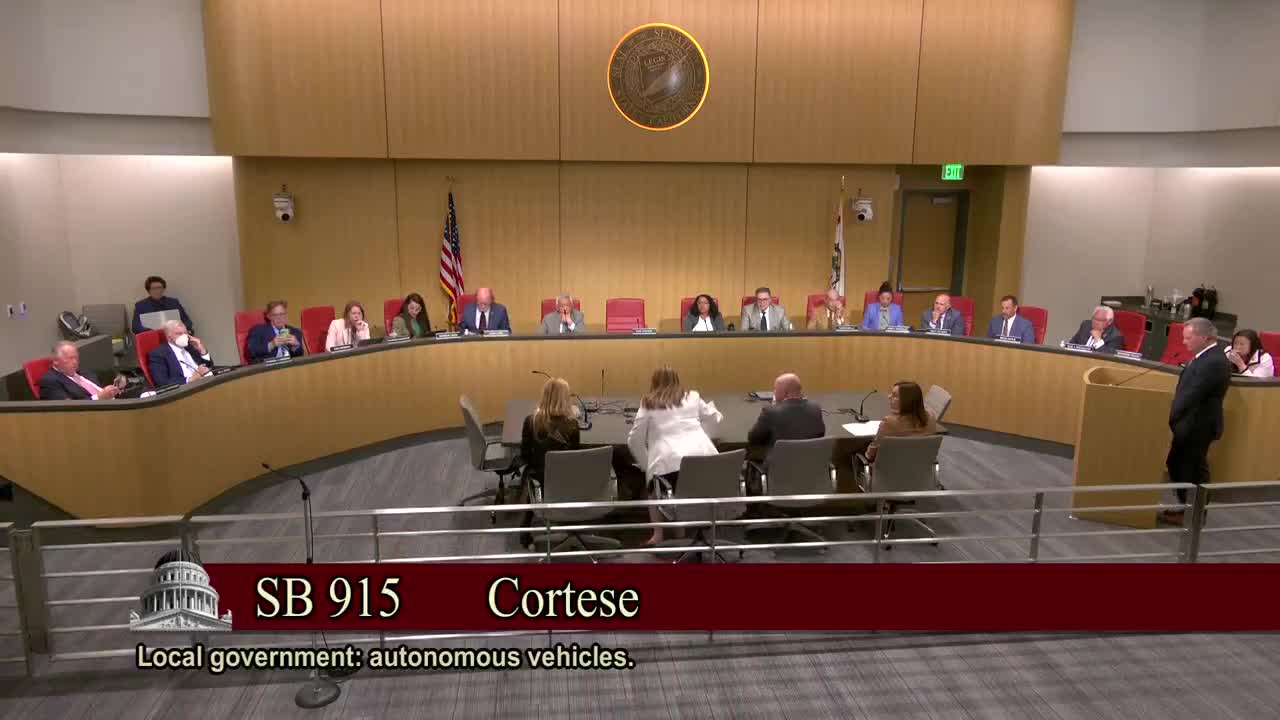 17SEC
Senate Standing Committee on Transportation
 37MIN
Senate Standing Committee on Local Government
Bill Author

Bill Co-Author(s):
