SB 935: Personal Income Tax Law: Corporation Tax Law: credits: educator housing.
- Session Year: 2023-2024
- House: Senate
- Latest Version Date: 2024-06-11
Current Status:
Failed
(2024-06-18: June 18 hearing postponed by committee.)
Introduced
In Committee
First Chamber
In Committee
Second Chamber
Enacted
What does this bill do?
This bill lets developers claim a state tax credit equal to 20% of the development costs when they build housing for school staff on land owned by a school district or local government. To qualify, the developer must have an agreement with the school district or local government and the housing must be reserved for full‑time school district employees. If the credit is larger than the tax owed it can be carried forward, and the Franchise Tax Board must report how many credits are claimed and the average credit amount to the Legislature.
The summary is provided by generative AI which can make mistakes. For original language, please view the details in the table below.
The Personal Income Tax Law and the Corporation Tax Law allow various credits against the taxes imposed by those laws, including, in modified conformity with federal tax laws, a credit to qualified low-income housing projects.
This bill would, for taxable years beginning on or after January 1, 2025, and before January 1, 2030, allow a credit against those taxes in an amount equal to 20% of the costs of development for a qualified school staff housing project, as defined, to a qualified taxpayer.
Existing law requires any bill authorizing a new tax expenditure, as defined to include tax credits, to contain, among other things, specific goals, purposes, and objectives that the tax credit will achieve, detailed performance indicators, and data collection requirements.
This bill would include findings and reporting requirements in compliance with this requirement.
This bill would take effect immediately as a tax levy.
The California Constitution allows hearsay testimony at preliminary hearings as prescribed by the Legislature. Existing law authorizes a law enforcement officer or honorably retired law enforcement officer with either 5 years of law enforcement experience or training in the investigation and reporting of cases and testifying at preliminary hearings to testify to the out-of-court statements of declarants offered for the truth of the matter asserted.This bill would additionally allow a honorably separated law enforcement officer with that experience or training to testify to the out-of-court statements of declarants offered for the truth of the matter asserted.The California Constitution allows hearsay testimony at preliminary hearings as prescribed by the Legislature. Existing law authorizes a law enforcement officer or honorably retired law enforcement officer with either 5 years of law enforcement experience or training in the investigation and reporting of cases and testifying at preliminary hearings to testify to the out-of-court statements of declarants offered for the truth of the matter asserted.
This bill would additionally allow a honorably separated law enforcement officer with that experience or training to testify to the out-of-court statements of declarants offered for the truth of the matter asserted.
Existing law defines certain acts as disorderly conduct, punishable as a misdemeanor. Under existing law, it is disorderly conduct to intentionally distribute or cause to be distributed the image of the intimate body part or parts of another identifiable person, or an image of the person depicted engaged in an act of sexual intercourse, sodomy, oral copulation, sexual penetration, or an image of masturbation by the person depicted or in which the person depicted participates, under circumstances in which the persons agree or understand that the image shall remain private, the person distributing the image knows or should know that distribution of the image will cause serious emotional distress, and the person depicted suffers that distress.This bill would make it a crime for a person to intentionally distribute or cause to be distributed any photo realistic image, digital image, electronic image, computer image, computer-generated image, or other pictorial representation of an intimate body part or parts of another identifiable person, or an image of the person depicted engaged in an act of sexual intercourse, sodomy, oral copulation, sexual penetration, or an image of masturbation by the person depicted or in which the person depicted participates that was created in a manner that would cause a reasonable person to believe the image is an authentic image of the person depicted, under circumstances which in which the person distributing the image knows or should know that distribution of the image will cause serious emotional distress, and the person depicted suffers that distress. By expanding the scope of a crime, this bill would impose a state-mandated local program.The California Constitution requires the state to reimburse local agencies and school districts for certain costs mandated by the state. Statutory provisions establish procedures for making that reimbursement.This bill would provide that no reimbursement is required by this act for a specified reason.Existing law defines certain acts as disorderly conduct, punishable as a misdemeanor. Under existing law, it is disorderly conduct to intentionally distribute or cause to be distributed the image of the intimate body part or parts of another identifiable person, or an image of the person depicted engaged in an act of sexual intercourse, sodomy, oral copulation, sexual penetration, or an image of masturbation by the person depicted or in which the person depicted participates, under circumstances in which the persons agree or understand that the image shall remain private, the person distributing the image knows or should know that distribution of the image will cause serious emotional distress, and the person depicted suffers that distress.
This bill would make it a crime for a person to intentionally distribute or cause to be distributed any photo realistic image, digital image, electronic image, computer image, computer-generated image, or other pictorial representation of an intimate body part or parts of another identifiable person, or an image of the person depicted engaged in an act of sexual intercourse, sodomy, oral copulation, sexual penetration, or an image of masturbation by the person depicted or in which the person depicted participates that was created in a manner that would cause a reasonable person to believe the image is an authentic image of the person depicted, under circumstances which in which the person distributing the image knows or should know that distribution of the image will cause serious emotional distress, and the person depicted suffers that distress. By expanding the scope of a crime, this bill would impose a state-mandated local program.
The California Constitution requires the state to reimburse local agencies and school districts for certain costs mandated by the state. Statutory provisions establish procedures for making that reimbursement.
This bill would provide that no reimbursement is required by this act for a specified reason.
Existing law establishes in state government, in the Business, Consumer Services, and Housing Agency, a Department of Consumer Affairs.This bill would make nonsubstantive changes to that provision.Existing law establishes in state government, in the Business, Consumer Services, and Housing Agency, a Department of Consumer Affairs.
This bill would make nonsubstantive changes to that provision.
(a)For each taxable year beginning on or after January 1, 2025, and before January 1, 2030, there shall be allowed a credit against the net tax, as defined in Section 17039, to a qualified taxpayer in an amount equal to 20 percent of the costs of development of a qualified school staff housing project.
(b)For purposes of this section, the following definitions apply:
(1)Qualified school staff housing project means a housing project that satisfies all of the following:
(A)Is located on land owned by a school district or local government.
(B)Is developed by a qualified taxpayer.
(C)Occupancy of the completed housing project is restricted to qualifying tenants.
(2)Qualified taxpayer means a developer that enters into an agreement with a school district or local government to develop a qualified school staff housing project.
(3)Qualifying tenant means a full-time employee of a school district.
(c)In the case where the credit allowed by this section exceeds the net tax, the excess may be carried over to reduce the net tax in the following year, and the succeeding four years if necessary, until the credit is exhausted.
(d)The Franchise Tax Board may prescribe rules, guidelines, or procedures necessary or appropriate to carry out the purposes of this section.
(e)(1)For purposes of complying with Section 41 as it pertains to the credit allowed by this section and Section 23631, the Legislature finds and declares the following:
(A)The goal of the credit is to provide more affordable housing for teachers and school employees.
(B)The performance indicators for the Legislature to use to determine whether the credit meets the stated goal are as follows:
(i)The number of taxpayers allowed a credit.
(ii)The average credit amount allowed.
(2)(A)The Franchise Tax Board, no later than May 1, 2027, and annually thereafter, shall submit a report to the to the Legislature, in compliance with Section 9795 of the Government Code, detailing the number of taxpayers allowed a credit and the average credit allowed.
(B)The disclosure requirements of this paragraph shall be treated as an exception to Section 19542.
(f)This section shall remain in effect only until December 1, 2030, and as of that date is repealed.
SEC. 2.Section 23631 is added to the Revenue and Taxation Code, to read:23631.(a)For each taxable year beginning on or after January 1, 2025, and before January 1, 2030, there shall be allowed a credit against the tax, as defined in Section 23036, to a qualified taxpayer in an amount equal to 20 percent of the costs of development of a qualified school staff housing project.
(b)For purposes of this section, the following definitions apply:
(1)Qualified school staff housing project means a housing project that satisfies all of the following:
(A)Is located on land owned by a school district or local government.
(B)Is developed by a qualified taxpayer.
(C)Occupancy of the completed housing project is restricted to qualifying tenants.
(2)Qualified taxpayer means a developer that enters into an agreement with a school district or local government to develop a qualified school staff housing project.
(3)Qualifying tenant means a full-time employee of a school district.
(c)In the case where the credit allowed by this section exceeds the net tax, the excess may be carried over to reduce the net tax in the following year, and the succeeding four years if necessary, until the credit is exhausted.
(d)The Franchise Tax Board may prescribe rules, guidelines, or procedures necessary or appropriate to carry out the purposes of this section.
(e)This section shall remain in effect only until December 1, 2030, and as of that date is repealed.
SEC. 3.This act provides for a tax levy within the meaning of Article IV of the California Constitution and shall go into immediate effect.
SECTION 1.Section 872 of the Penal Code is amended to read:872.(a)If, however, it appears from the examination that a public offense has been committed, and there is sufficient cause to believe that the defendant is guilty, the magistrate shall make or indorse on the complaint an order, signed by the magistrate, to the following effect: It appearing to me that the offense in the within complaint mentioned (or any offense, according to the fact, stating generally the nature thereof), has been committed, and that there is sufficient cause to believe that the within named A.B. is guilty, I order that he or she be held to answer to the same.(b)Notwithstanding Section 1200 of the Evidence Code, the finding of probable cause may be based in whole or in part upon the sworn testimony of a law enforcement officer or honorably retired or honorably separated law enforcement officer relating the statements of declarants made out of court offered for the truth of the matter asserted. An honorably retired or honorably separated law enforcement officer may only relate statements of declarants made out of court and offered for the truth of the matter asserted that were made when the honorably retired or honorably separated officer was an active law enforcement officer. Any law enforcement officer or honorably retired or honorably separated law enforcement officer testifying as to hearsay statements shall either have five years of law enforcement experience or have completed a training course certified by the Commission on Peace Officer Standards and Training that includes training in the investigation and reporting of cases and testifying at preliminary hearings.(c)For purposes of subdivision (b), a law enforcement officer is any officer or agent employed by a federal, state, or local government agency to whom all of the following apply:(1)Has either five years of law enforcement experience or who has completed a training course certified by the Commission on Peace Officer Standards and Training that includes training in the investigation and reporting of cases and testifying at preliminary hearings.(2)Whose primary responsibility is the enforcement of any law, the detection and apprehension of persons who have violated any law, or the investigation and preparation for prosecution of cases involving violation of laws.(a)If, however, it appears from the examination that a public offense has been committed, and there is sufficient cause to believe that the defendant is guilty, the magistrate shall make or indorse on the complaint an order, signed by him or her, the magistrate, to the following effect: It appearing to me that the offense in the within complaint mentioned (or any offense, according to the fact, stating generally the nature thereof), has been committed, and that there is sufficient cause to believe that the within named A.B. is guilty, I order that he or she be held to answer to the same.
(b)Notwithstanding Section 1200 of the Evidence Code, the finding of probable cause may be based in whole or in part upon the sworn testimony of a law enforcement officer or honorably retired or honorably separated law enforcement officer relating the statements of declarants made out of court offered for the truth of the matter asserted. An honorably retired or honorably separated law enforcement officer may only relate statements of declarants made out of court and offered for the truth of the matter asserted that were made when the honorably retired or honorably separated officer was an active law enforcement officer. Any law enforcement officer or honorably retired or honorably separated law enforcement officer testifying as to hearsay statements shall either have five years of law enforcement experience or have completed a training course certified by the Commission on Peace Officer Standards and Training that includes training in the investigation and reporting of cases and testifying at preliminary hearings.
(c)For purposes of subdivision (b), a law enforcement officer is any officer or agent employed by a federal, state, or local government agency to whom all of the following apply:
(1)Has either five years of law enforcement experience or who has completed a training course certified by the Commission on Peace Officer Standards and Training that includes training in the investigation and reporting of cases and testifying at preliminary hearings.
(2)Whose primary responsibility is the enforcement of any law, the detection and apprehension of persons who have violated any law, or the investigation and preparation for prosecution of cases involving violation of laws.
All matter omitted in this version of the bill appears in the bill as amended in the Senate, March 20, 2024. (JR11)Except as provided in paragraph (5) of subdivision (b) and subdivision (k), every person who commits any of the following acts is guilty of disorderly conduct, a misdemeanor:
(a)An individual who solicits anyone to engage in or who engages in lewd or dissolute conduct in any public place or in any place open to the public or exposed to public view.
(b)(1)An individual who solicits, or who agrees to engage in, or who engages in, any act of prostitution with the intent to receive compensation, money, or anything of value from another person. An individual agrees to engage in an act of prostitution when, with specific intent to so engage, the individual manifests an acceptance of an offer or solicitation by another person to so engage, regardless of whether the offer or solicitation was made by a person who also possessed the specific intent to engage in an act of prostitution.
(2)An individual who solicits, or who agrees to engage in, or who engages in, any act of prostitution with another person who is 18 years of age or older in exchange for the individual providing compensation, money, or anything of value to the other person. An individual agrees to engage in an act of prostitution when, with specific intent to so engage, the individual manifests an acceptance of an offer or solicitation by another person who is 18 years of age or older to so engage, regardless of whether the offer or solicitation was made by a person who also possessed the specific intent to engage in an act of prostitution.
(3)An individual who solicits, or who agrees to engage in, or who engages in, any act of prostitution with another person who is a minor in exchange for the individual providing compensation, money, or anything of value to the minor. An individual agrees to engage in an act of prostitution when, with specific intent to so engage, the individual manifests an acceptance of an offer or solicitation by someone who is a minor to so engage, regardless of whether the offer or solicitation was made by a minor who also possessed the specific intent to engage in an act of prostitution.
(4)A manifestation of acceptance of an offer or solicitation to engage in an act of prostitution does not constitute a violation of this subdivision unless some act, in addition to the manifestation of acceptance, is done within this state in furtherance of the commission of the act of prostitution by the person manifesting an acceptance of an offer or solicitation to engage in that act. As used in this subdivision, prostitution includes any lewd act between persons for money or other consideration.
(5)Notwithstanding paragraphs (1) to (3), inclusive, this subdivision does not apply to a child under 18 years of age who is alleged to have engaged in conduct to receive money or other consideration that would, if committed by an adult, violate this subdivision. A commercially exploited child under this paragraph may be adjudged a dependent child of the court pursuant to paragraph (2) of subdivision (b) of Section 300 of the Welfare and Institutions Code and may be taken into temporary custody pursuant to subdivision (a) of Section 305 of the Welfare and Institutions Code, if the conditions allowing temporary custody without warrant are met.
(c)Who accosts other persons in any public place or in any place open to the public for the purpose of begging or soliciting alms.
(d)Who loiters in or about any toilet open to the public for the purpose of engaging in or soliciting any lewd or lascivious or any unlawful act.
(e)Who lodges in any building, structure, vehicle, or place, whether public or private, without the permission of the owner or person entitled to the possession or in control of it.
(f)Who is found in any public place under the influence of intoxicating liquor, any drug, controlled substance, toluene, or any combination of any intoxicating liquor, drug, controlled substance, or toluene, in a condition that they are unable to exercise care for their own safety or the safety of others, or by reason of being under the influence of intoxicating liquor, any drug, controlled substance, toluene, or any combination of any intoxicating liquor, drug, or toluene, interferes with or obstructs or prevents the free use of any street, sidewalk, or other public way.
(g)If a person has violated subdivision (f), a peace officer, if reasonably able to do so, shall place the person, or cause the person to be placed, in civil protective custody. The person shall be taken to a facility, designated pursuant to Section 5170 of the Welfare and Institutions Code, for the 72-hour treatment and evaluation of inebriates. A peace officer may place a person in civil protective custody with that kind and degree of force authorized to effect an arrest for a misdemeanor without a warrant. A person who has been placed in civil protective custody shall not thereafter be subject to any criminal prosecution or juvenile court proceeding based on the facts giving rise to this placement. This subdivision does not apply to the following persons:
(1)A person who is under the influence of any drug, or under the combined influence of intoxicating liquor and any drug.
(2)A person who a peace officer has probable cause to believe has committed any felony, or who has committed any misdemeanor in addition to subdivision (f).
(3)A person who a peace officer in good faith believes will attempt escape or will be unreasonably difficult for medical personnel to control.
(h)Who loiters, prowls, or wanders upon the private property of another, at any time, without visible or lawful business with the owner or occupant. As used in this subdivision, loiter means to delay or linger without a lawful purpose for being on the property and for the purpose of committing a crime as opportunity may be discovered.
(i)Who, while loitering, prowling, or wandering upon the private property of another, at any time, peeks in the door or window of any inhabited building or structure, without visible or lawful business with the owner or occupant.
(j)(1)A person who looks through a hole or opening, into, or otherwise views, by means of any instrumentality, including, but not limited to, a periscope, telescope, binoculars, camera, motion picture camera, camcorder, mobile phone, electronic device, or unmanned aircraft system, the interior of a bedroom, bathroom, changing room, fitting room, dressing room, or tanning booth, or the interior of any other area in which the occupant has a reasonable expectation of privacy, with the intent to invade the privacy of a person or persons inside. This subdivision does not apply to those areas of a private business used to count currency or other negotiable instruments.
(2)A person who uses a concealed camcorder, motion picture camera, or photographic camera of any type, to secretly videotape, film, photograph, or record by electronic means, another identifiable person under or through the clothing being worn by that other person, for the purpose of viewing the body of, or the undergarments worn by, that other person, without the consent or knowledge of that other person, with the intent to arouse, appeal to, or gratify the lust, passions, or sexual desires of that person and invade the privacy of that other person, under circumstances in which the other person has a reasonable expectation of privacy. For the purposes of this paragraph, identifiable means capable of identification, or capable of being recognized, meaning that someone, including the victim, could identify or recognize the victim. It does not require the victims identity to actually be established.
(3)(A)A person who uses a concealed camcorder, motion picture camera, or photographic camera of any type, to secretly videotape, film, photograph, or record by electronic means, another identifiable person who may be in a state of full or partial undress, for the purpose of viewing the body of, or the undergarments worn by, that other person, without the consent or knowledge of that other person, in the interior of a bedroom, bathroom, changing room, fitting room, dressing room, or tanning booth, or the interior of any other area in which that other person has a reasonable expectation of privacy, with the intent to invade the privacy of that other person. For the purposes of this paragraph, identifiable means capable of identification, or capable of being recognized, meaning that someone, including the victim, could identify or recognize the victim. It does not require the victims identity to actually be established.
(B)Neither of the following is a defense to the crime specified in this paragraph:
(i)The defendant was a cohabitant, landlord, tenant, cotenant, employer, employee, or business partner or associate of the victim, or an agent of any of these.
(ii)The victim was not in a state of full or partial undress.
(4)(A)(i)A person who intentionally distributes or causes to be distributed the image of the intimate body part or parts of another identifiable person, or an image of the person depicted engaged in an act of sexual intercourse, sodomy, oral copulation, sexual penetration, or an image of masturbation by the person depicted or in which the person depicted participates, under circumstances in which the persons agree or understand that the image shall remain private, the person distributing the image knows or should know that distribution of the image will cause serious emotional distress, and the person depicted suffers that distress.
(ii)A person who intentionally distributes or causes to be distributed any photo realistic image, digital image, electronic image, computer image, computer-generated image, or other pictorial representation of an intimate body part or parts of another identifiable person, or an image of the person depicted engaged in an act of sexual intercourse, sodomy, oral copulation, sexual penetration, or an image of masturbation by the person depicted or in which the person depicted participates that was created in a manner that would cause a reasonable person to believe the image is an authentic image of the person depicted, under circumstances which in which the person distributing the image knows or should know that distribution of the image will cause serious emotional distress, and the person depicted suffers that distress.
(B)(i)A person intentionally distributes an image described in subparagraph (A) when that person personally distributes the image.
(ii)A person intentionally causes an image described in subparagraph (A) to be distributed when that person arranges, specifically requests, or intentionally causes another person to distribute the image.
(C)As used in this paragraph, the following terms have the following meanings:
(i)Distribute includes exhibiting in public or giving possession.
(ii)Identifiable has the same meaning as in paragraphs (2) and (3).
(iii)Intimate body part means any portion of the genitals, the anus and, in the case of a female, also includes any portion of the breasts below the top of the areola, that is either uncovered or clearly visible through clothing.
(D)It shall not be a violation of this paragraph to distribute an image described in subparagraph (A) if any of the following applies:
(i)The distribution is made in the course of reporting an unlawful activity.
(ii)The distribution is made in compliance with a subpoena or other court order for use in a legal proceeding.
(iii)The distribution is made in the course of a lawful public proceeding.
(iv)The distribution is related to a matter of public concern or public interest. Distribution is not a matter of public concern or public interest solely because the depicted individual is a public figure.
(5)This subdivision does not preclude punishment under any section of law providing for greater punishment.
(k)(1)A second or subsequent violation of subdivision (j) is punishable by imprisonment in a county jail not exceeding one year, or by a fine not exceeding two thousand dollars ($2,000), or by both that fine and imprisonment.
(2)If the victim of a violation of subdivision (j) was a minor at the time of the offense, the violation is punishable by imprisonment in a county jail not exceeding one year, or by a fine not exceeding two thousand dollars ($2,000), or by both that fine and imprisonment.
(l)(1)If a crime is committed in violation of subdivision (b) and the person who was solicited was a minor at the time of the offense, and if the defendant knew or should have known that the person who was solicited was a minor at the time of the offense, the violation is punishable by imprisonment in a county jail for not less than two days and not more than one year, or by a fine not exceeding ten thousand dollars ($10,000), or by both that fine and imprisonment.
(2)The court may, in unusual cases, when the interests of justice are best served, reduce or eliminate the mandatory two days of imprisonment in a county jail required by this subdivision. If the court reduces or eliminates the mandatory two days imprisonment, the court shall specify the reason on the record.
SEC. 2.No reimbursement is required by this act pursuant to Section 6 of Article XIIIB of the California Constitution because the only costs that may be incurred by a local agency or school district will be incurred because this act creates a new crime or infraction, eliminates a crime or infraction, or changes the penalty for a crime or infraction, within the meaning of Section 17556 of the Government Code, or changes the definition of a crime within the meaning of Section 6 of Article XIIIB of the California Constitution.
SECTION 1.Section 100 of the Business and Professions Code is amended to read:100.There is in state government, in the Business, Consumer Services, and Housing Agency, the Department of Consumer Affairs.There is in the state government, in the Business, Consumer Services, and Housing Agency, a the Department of Consumer Affairs.
|
Date
|
Status
|
|---|---|
| Jun 18, 2024 | June 18 hearing postponed by committee. |
| Jun 11, 2024 | From committee with author's amendments. Read second time and amended. Re-referred to Com. on PUB. S. |
| May 28, 2024 | Referred to Com. on PUB. S. |
| May 23, 2024 | In Assembly. Read first time. Held at Desk. |
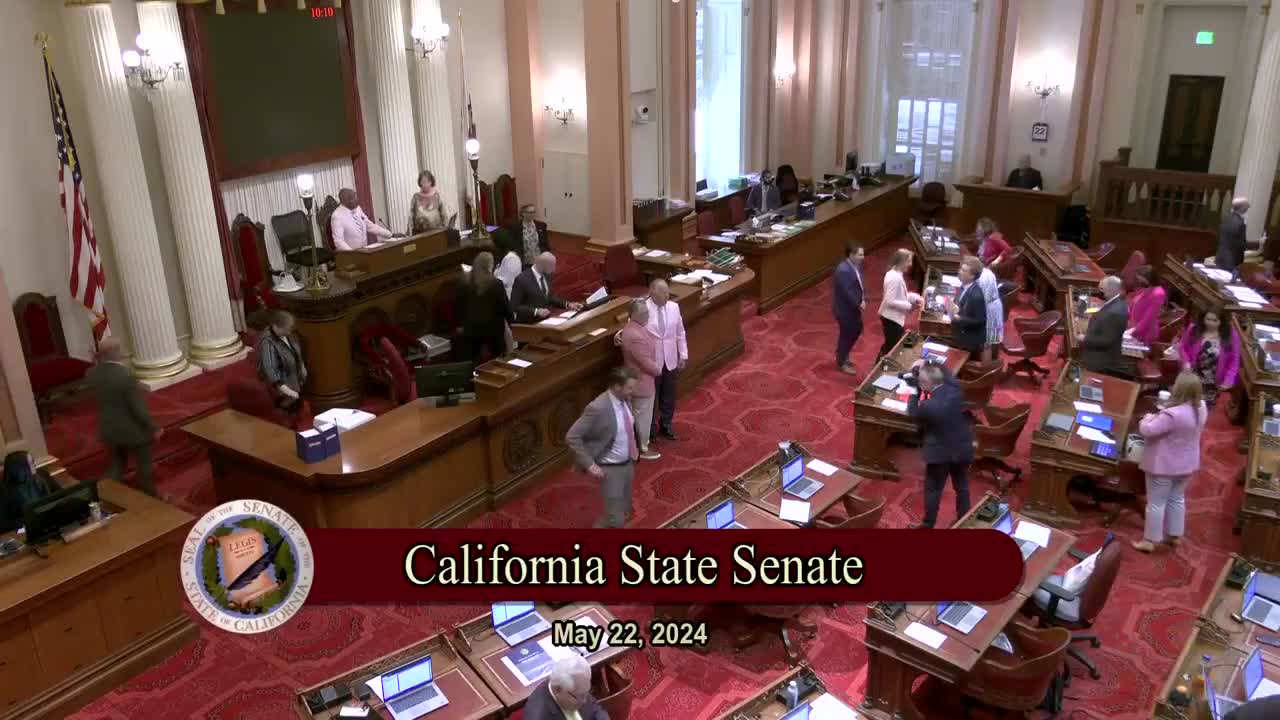
| May 22, 2024 | Read third time. Passed. (Ayes 39. Noes 0. Page 4131.) Ordered to the Assembly. |
| May 7, 2024 | Read second time. Ordered to third reading. |
| May 6, 2024 | From committee: Be ordered to second reading pursuant to Senate Rule 28.8. |
| Apr 26, 2024 | Set for hearing May 6. |
| Apr 24, 2024 | Read second time and amended. Re-referred to Com. on APPR. |
| Apr 23, 2024 | From committee: Do pass as amended and re-refer to Com. on APPR. (Ayes 4. Noes 0. Page 3730.) (April 23). |
| Apr 5, 2024 | Set for hearing April 23. |
| Apr 3, 2024 | Re-referred to Com. on PUB S. |
| Mar 20, 2024 | From committee with author's amendments. Read second time and amended. Re-referred to Com. on RLS. |
| Feb 14, 2024 | Referred to Com. on RLS. |
| Jan 17, 2024 | From printer. May be acted upon on or after February 16. |
| Jan 16, 2024 | Introduced. Read first time. To Com. on RLS. for assignment. To print. |
|
Date
|
Description
|
Location
|
Votes
|
|
|---|---|---|---|---|
| May 22, 2024 | Senate 3rd Reading SB935 Becker | Senate Floor |
Passed |
|
| Apr 23, 2024 | Do pass as amended, but first amend, and re-refer to the Committee on [Appropriations] | Senate Standing Committee on Public Safety |
Passed |
This list shows positions taken on this bill by organizations on the date displayed, which is linked to the original source.
Positions by individuals are not included.
|
Organization
|
Position
|
Date
|
|---|---|---|
| American Academy of Pediatrics | * Support | Apr 26, 2023 |
| American Cancer Society - Cancer Action Network | * Support | Apr 26, 2023 |
| American Federation Of State County Municipal Employees | * Support | Apr 26, 2023 |
| American Heart Association | * Support | Apr 26, 2023 |
| American Lung Association | * Support | Apr 26, 2023 |
| California Dental Association | * Support | Apr 26, 2023 |
| Los Angeles County District AttorneyS Office | ** Support | |
| Marin Medical Society | * Support | Apr 26, 2023 |
| Northeast Medical Services | * Support | Apr 26, 2023 |
| Union of American Physician and Dentists | * Support | Apr 26, 2023 |
SENATE RULES COMMITTEE Office of Senate Floor Analyses (916) 651-1520 Fax: (916) 327-4478 | SB 935 |
THIRD READING
Bill No: SB 935
Author: Becker (D)
Amended: 4/24/24
Vote: 21
SENATE PUBLIC SAFETY COMMITTEE: 4-0, 4/23/24
AYES: Wahab, Bradford, Skinner, Wiener
NO VOTE RECORDED: Seyarto
SENATE APPROPRIATIONS COMMITTEE: Senate Rule 28.8
SUBJECT: Criminal procedure: hearsay testimony at preliminary hearings
SOURCE: Author
DIGEST:
This bill authorizes an honorably separated police officer that meets specified length of service and training requirements to provide hearsay testimony at a preliminary hearing.
ANALYSIS:
Existing law:
- States that at the time the defendant appears for arraignment on a felony to which the defendant has not pleaded guilty, the magistrate, immediately upon the appearance of counsel shall set a time for the preliminary hearing and shall not allow less than two days for the district attorney and the defendant to prepare for the examination. (Pen. Code, § 859b.)
- States that if it appears from the examination that there is sufficient cause to believe that the defendant is guilty, the magistrate shall hold the defendant to answer on the charges. (Pen. Code, § 872, subd. (a).)
- Defines “hearsay evidence” as evidence of a statement that was made other than by a witness while testifying at the hearing and that is offered to prove the truth of the matter stated. (Pen. Code, § 1200, subd. (a).)
- Prohibits hearsay evidence from being admitted unless otherwise provided by law. (Pen. Code, § 1200, subd. (b).)
- Provides, notwithstanding the law that prohibits hearsay evidence, the finding of probable cause may be based in whole or in part upon the testimony of a law enforcement officer or honorably retired law enforcement officer relating the statements of declarants made out of court offered for the truth of the matter asserted. (Pen. Code, § 872, subd. (b), italics added for emphasis.)
- States that an honorably retired law enforcement officer may only relate statements of declarants made out of court and offered for the truth of the matter asserted that were made when the honorably retired officer was an active law enforcement officer. (Pen. Code, § 872, subd. (b), italics added for emphasis.)
- States that any law enforcement officer or honorably retired law enforcement officer testifying as to hearsay statements shall either have five years of law enforcement experience or have completed a training course certified by the Commission on Peace Officer Standards and Training that includes training in the investigation and reporting of cases and testifying at preliminary hearings. (Pen. Code, § 872, subd. (b), italics added for emphasis.)
- States that a law enforcement officer who may provide hearsay testimony at the preliminary hearing is any officer or agent employed by a federal, state, or local government agency to whom all of the following apply:
- Has either five years of law enforcement experience or who has completed a training course certified by the Commission on Peace Officer Standards and Training that includes training in the investigation and reporting of cases and testifying at preliminary hearings; or,
- Whose primary responsibility is the enforcement of any law, the detection and apprehension of persons who have violated any law, or the investigation and preparation for prosecution of cases involving violation of laws. (Pen. Code, § 872, subd. (c).)
This bill allows an honorably separated law enforcement officer to provide hearsay testimony at the preliminary hearing.
Background
When the district attorney files a felony complaint, a defendant is entitled to a preliminary hearing to ensure that there is enough evidence to hold the defendant to answer in the trial court. (Pen. Code, § 859b.) The preliminary hearing must be held within 10 court days of the date of arraignment or the date the defendant plead not guilty, whichever occurs later, unless time has been waived or good cause has been for a continuance has been found. (Pen. Code, § 859b.)
At the preliminary hearing, the prosecution must present sufficient evidence to convince the judge or magistrate that probable cause exists to believe that a crime has been committed and that the defendant committed it. (Pen. Code, § 872.) The prosecution can present live witnesses, hearsay from law enforcement witnesses, or a combination of both. The defense may call witnesses and cross-examine the prosecution’s witnesses.
Existing law, pursuant to Proposition 115, approved by California voters on June 6, 1990, authorized probable cause at a preliminary hearing to be found based whole or in part on law enforcement testimony that testifies to another declarant’s out of court statement offered for the truth of the matter stated. (Cal. Const., Art. I, sec. 30(b).) Prior to the passage of Proposition 115, victims had to testify at preliminary hearings because their statement made to a law enforcement officer would be hearsay if offered by the officer at a preliminary hearing.
Generally, hearsay evidence is inadmissible because it is inherently less reliable than testimony from a person who has personal knowledge of the events that occurred. When the evidence is in hearsay form, there is not a fair opportunity to challenge what is being said. However, there are many exceptions to the hearsay rule which are oftentimes based on the trustworthiness of the source and the necessity of the information. Allowing a law enforcement officer with certain qualifications to provide hearsay testimony at a preliminary hearing is one of such exceptions. In permitting only officers with lengthy experience or special training to testify regarding out-of-court statements, Penal Code Section 872, subd. (b) contemplates that the testifying officer will be capable of using their experience and expertise to assess the circumstances under which the statement is made and to accurately describe those circumstances to the magistrate so as to increase the reliability of the underlying evidence. (Whitman v. Superior Court (1991) 54 Cal.3d 1063, 1070.) However, multiple hearsay is not allowed, meaning the officer could relate what another person told them directly, but could not testify as to what a witness told another officer. (Id. at p. 1074.)
Existing law authorizes a current law enforcement officer as well as an honorably retired law enforcement officer to provide hearsay testimony at a preliminary hearing if that officer meets the length of service and training requirements in the statute. This bill would additionally allow an honorably separated law enforcement officer to provide hearsay testimony at a preliminary hearing.
According to the proponent of this bill, not all peace officers who leave their position under honorable conditions are actually “honorably retired” because there are conflicting definitions of what it means to be retired. One definition requires a retired person to be collecting a pension or retirement income. The other definition only requires that a person be eligible to collect a pension or retirement income but does not require the pension or retirement income to actually be collected in order to be considered retired.
FISCAL EFFECT: Appropriation: No Fiscal Com.: No Local: No
SUPPORT: (Verified 5/6/24)
Los Angeles County District Attorney’s Office
OPPOSITION: (Verified 5/6/24)
Prepared by: Stella Choe / PUB. S. /
5/22/24 9:42:21
**** END ****
SENATE RULES COMMITTEE Office of Senate Floor Analyses (916) 651-1520 Fax: (916) 327-4478 | SB 935 |
CONSENT
Bill No: SB 935
Author: Becker (D)
Amended: 4/24/24
Vote: 21
SENATE PUBLIC SAFETY COMMITTEE: 4-0, 4/23/24
AYES: Wahab, Bradford, Skinner, Wiener
NO VOTE RECORDED: Seyarto
SENATE APPROPRIATIONS COMMITTEE: Senate Rule 28.8
SUBJECT: Criminal procedure: hearsay testimony at preliminary hearings
SOURCE: Author
DIGEST:
This bill authorizes an honorably separated police officer that meets specified length of service and training requirements to provide hearsay testimony at a preliminary hearing.
ANALYSIS:
Existing law:
- States that at the time the defendant appears for arraignment on a felony to which the defendant has not pleaded guilty, the magistrate, immediately upon the appearance of counsel shall set a time for the preliminary hearing and shall not allow less than two days for the district attorney and the defendant to prepare for the examination. (Pen. Code, § 859b.)
- States that if it appears from the examination that there is sufficient cause to believe that the defendant is guilty, the magistrate shall hold the defendant to answer on the charges. (Pen. Code, § 872, subd. (a).)
- Defines “hearsay evidence” as evidence of a statement that was made other than by a witness while testifying at the hearing and that is offered to prove the truth of the matter stated. (Pen. Code, § 1200, subd. (a).)
- Prohibits hearsay evidence from being admitted unless otherwise provided by law. (Pen. Code, § 1200, subd. (b).)
- Provides, notwithstanding the law that prohibits hearsay evidence, the finding of probable cause may be based in whole or in part upon the testimony of a law enforcement officer or honorably retired law enforcement officer relating the statements of declarants made out of court offered for the truth of the matter asserted. (Pen. Code, § 872, subd. (b), italics added for emphasis.)
- States that an honorably retired law enforcement officer may only relate statements of declarants made out of court and offered for the truth of the matter asserted that were made when the honorably retired officer was an active law enforcement officer. (Pen. Code, § 872, subd. (b), italics added for emphasis.)
- States that any law enforcement officer or honorably retired law enforcement officer testifying as to hearsay statements shall either have five years of law enforcement experience or have completed a training course certified by the Commission on Peace Officer Standards and Training that includes training in the investigation and reporting of cases and testifying at preliminary hearings. (Pen. Code, § 872, subd. (b), italics added for emphasis.)
- States that a law enforcement officer who may provide hearsay testimony at the preliminary hearing is any officer or agent employed by a federal, state, or local government agency to whom all of the following apply:
- Has either five years of law enforcement experience or who has completed a training course certified by the Commission on Peace Officer Standards and Training that includes training in the investigation and reporting of cases and testifying at preliminary hearings; or,
- Whose primary responsibility is the enforcement of any law, the detection and apprehension of persons who have violated any law, or the investigation and preparation for prosecution of cases involving violation of laws. (Pen. Code, § 872, subd. (c).)
This bill allows an honorably separated law enforcement officer to provide hearsay testimony at the preliminary hearing.
Background
When the district attorney files a felony complaint, a defendant is entitled to a preliminary hearing to ensure that there is enough evidence to hold the defendant to answer in the trial court. (Pen. Code, § 859b.) The preliminary hearing must be held within 10 court days of the date of arraignment or the date the defendant plead not guilty, whichever occurs later, unless time has been waived or good cause has been for a continuance has been found. (Pen. Code, § 859b.)
At the preliminary hearing, the prosecution must present sufficient evidence to convince the judge or magistrate that probable cause exists to believe that a crime has been committed and that the defendant committed it. (Pen. Code, § 872.) The prosecution can present live witnesses, hearsay from law enforcement witnesses, or a combination of both. The defense may call witnesses and cross-examine the prosecution’s witnesses.
Existing law, pursuant to Proposition 115, approved by California voters on June 6, 1990, authorized probable cause at a preliminary hearing to be found based whole or in part on law enforcement testimony that testifies to another declarant’s out of court statement offered for the truth of the matter stated. (Cal. Const., Art. I, sec. 30(b).) Prior to the passage of Proposition 115, victims had to testify at preliminary hearings because their statement made to a law enforcement officer would be hearsay if offered by the officer at a preliminary hearing.
Generally, hearsay evidence is inadmissible because it is inherently less reliable than testimony from a person who has personal knowledge of the events that occurred. When the evidence is in hearsay form, there is not a fair opportunity to challenge what is being said. However, there are many exceptions to the hearsay rule which are oftentimes based on the trustworthiness of the source and the necessity of the information. Allowing a law enforcement officer with certain qualifications to provide hearsay testimony at a preliminary hearing is one of such exceptions. In permitting only officers with lengthy experience or special training to testify regarding out-of-court statements, Penal Code Section 872, subd. (b) contemplates that the testifying officer will be capable of using their experience and expertise to assess the circumstances under which the statement is made and to accurately describe those circumstances to the magistrate so as to increase the reliability of the underlying evidence. (Whitman v. Superior Court (1991) 54 Cal.3d 1063, 1070.) However, multiple hearsay is not allowed, meaning the officer could relate what another person told them directly, but could not testify as to what a witness told another officer. (Id. at p. 1074.)
Existing law authorizes a current law enforcement officer as well as an honorably retired law enforcement officer to provide hearsay testimony at a preliminary hearing if that officer meets the length of service and training requirements in the statute. This bill would additionally allow an honorably separated law enforcement officer to provide hearsay testimony at a preliminary hearing.
According to the proponent of this bill, not all peace officers who leave their position under honorable conditions are actually “honorably retired” because there are conflicting definitions of what it means to be retired. One definition requires a retired person to be collecting a pension or retirement income. The other definition only requires that a person be eligible to collect a pension or retirement income but does not require the pension or retirement income to actually be collected in order to be considered retired.
FISCAL EFFECT: Appropriation: No Fiscal Com.: No Local: No
SUPPORT: (Verified 5/6/24)
Los Angeles County District Attorney’s Office
OPPOSITION: (Verified 5/6/24)
Prepared by: Stella Choe / PUB. S. /
5/7/24 10:52:28
**** END ****
SENATE COMMITTEE ON PUBLIC SAFETY
Senator Aisha Wahab, Chair
2023 - 2024 Regular
Bill No: SB 935 Hearing Date: April 23, 2024
Author: | Becker | ||
Version: | March 20, 2024 | ||
Urgency: | No | Fiscal: | Yes |
Consultant: | SC | ||
Subject: Disorderly conduct: distribution of intimate images
HISTORY
Source: Author
Prior Legislation: AB 557 (Karnette), Ch. 18, Stats. 2005
Proposition 115, approved by California voters on June 6, 1990
Support: Los Angeles District Attorney’s Office
Opposition: None known
This Analysis Reflects the Bill as Proposed to Be Amended
PURPOSE
The purpose of this bill is to authorize an honorably separated police officer to provide hearsay testimony at a preliminary hearing.
Existing law states that at the time the defendant appears for arraignment on a felony to which the defendant has not pleaded guilty, the magistrate, immediately upon the appearance of counsel shall set a time for the preliminary hearing and shall not allow less than two days for the district attorney and the defendant to prepare for the examination. (Pen. Code, § 859b.)
Existing law states that if it appears from the examination that there is sufficient cause to believe that the defendant is guilty, the magistrate shall hold the defendant to answer on the charges. (Pen. Code, § 872, subd. (a).)
Existing law defines “hearsay evidence” as evidence of a statement that was made other than by a witness while testifying at the hearing and that is offered to prove the truth of the matter stated. (Pen. Code, § 1200, subd. (a).)
Existing law prohibits hearsay evidence from being admitted unless otherwise provided by law. (Pen. Code, § 1200, subd. (b).)
Existing law provides, notwithstanding the law that prohibits hearsay evidence, the finding of probable cause may be based in whole or in part upon the testimony of a law enforcement officer or honorably retired law enforcement officer relating the statements of declarants made out of court offered for the truth of the matter asserted. (Pen. Code, § 872, subd. (b), italics added for emphasis.)
Existing law states that an honorably retired law enforcement officer may only relate statements of declarants made out of court and offered for the truth of the matter asserted that were made when the honorably retired officer was an active law enforcement officer. (Pen. Code, § 872, subd. (b), italics added for emphasis.)
Existing law states that any law enforcement officer or honorably retired law enforcement officer testifying as to hearsay statements shall either have five years of law enforcement experience or have completed a training course certified by the Commission on Peace Officer Standards and Training that includes training in the investigation and reporting of cases and testifying at preliminary hearings. (Pen. Code, § 872, subd. (b), italics added for emphasis.)
Existing law states that a law enforcement officer who may provide hearsay testimony at the preliminary hearing is any officer or agent employed by a federal, state, or local government agency to whom all of the following apply:
- Has either five years of law enforcement experience or who has completed a training course certified by the Commission on Peace Officer Standards and Training that includes training in the investigation and reporting of cases and testifying at preliminary hearings; or,
- Whose primary responsibility is the enforcement of any law, the detection and apprehension of persons who have violated any law, or the investigation and preparation for prosecution of cases involving violation of laws. (Pen. Code, § 872, subd. (c).)
This bill would additionally allow an honorably separated law enforcement officer to provide hearsay testimony at the preliminary hearing.
COMMENTS
- Need for This Bill
According to the author of this bill:
In 2005, California enacted AB 557 (Karnette) (Ch. 18/Statutes of 2005) which allowed an honorably retired peace officer to testify to hearsay statements at a preliminary hearing. For nearly 20 years this statute operated with no controversies or problems. However, a recent case brought to light a technical deficiency in current law.
The technical deficiency is not all peace officers who leave their position under honorable conditions are actually “honorably retired”. According to the Senate Labor, Public Employment and Retirement Committee staff there is conflicting definitions of what it means to be retired. One definition requires a retired person to be collecting a pension/retirement income. The other definition only requires that a person be eligible to collect a pension/retirement income but does not require the pension/retirement income to actually be collected in order to be considered retired.
In a recent case, a peace officer resigned their position with the LAPD after a 20+ year career. The former officer has not reached the age of 50 yet however so they are not eligible to collect their police pension. There was no disciplinary reasons pending that caused the individual to resign their position. At the time of their resignation the officer was serving as a detective. The decision to resign was rather abrupt however and did not provide enough time for another detective to take over the pending investigations. This detective was needed at a preliminary hearing and the prosecutor wanted the individual to provide Prop 115 testimony at the hearing. However because the former detective wasn’t collecting their pension yet there was an issue whether or not the former detective was “honorably retired”. In order to remedy this issue, it was determined that Penal Code Section 872(b) should include a reference to an “honorably retired or honorably separated” peace officer.
- Law Enforcement Officer Hearsay Testimony at Preliminary Hearings
When the district attorney files a felony complaint, a defendant is entitled to a preliminary hearing to ensure that there is enough evidence to hold the defendant to answer in the trial court. (Pen. Code, § 859b.) The preliminary hearing must be held within 10 court days of the date of arraignment or the date the defendant plead not guilty, whichever occurs later, unless time has been waived or good cause has been for a continuance has been found. (Pen. Code, § 859b.)
At the preliminary hearing, the prosecution must present sufficient evidence to convince the judge or magistrate that probable cause exists to believe that a crime has been committed and that the defendant committed it. (Pen. Code, § 872.) The prosecution can present live witnesses, hearsay from law enforcement witnesses, or a combination of both. The defense may call witnesses and cross-examine the prosecution’s witnesses.
Existing law, pursuant to Proposition 115, approved by California voters on June 6, 1990, authorized probable cause at a preliminary hearing to be found based whole or in part on law enforcement testimony that testifies to another declarant’s out of court statement offered for the truth of the matter stated. (Cal. Const., Art. I, sec. 30(b).) Prior to the passage of Proposition 115, victims had to testify at preliminary hearings because their statement made to a law enforcement officer would be hearsay if offered by the officer at a preliminary hearing.
Generally, hearsay evidence is inadmissible because it is inherently less reliable than testimony from a person who has personal knowledge of the events that occurred. When the evidence is in hearsay form, there is not a fair opportunity to challenge what is being said. However, there are many exceptions to the hearsay rule which are oftentimes based on the trustworthiness of the source and the necessity of the information. Allowing a law enforcement officer with certain qualifications to provide hearsay testimony at a preliminary hearing is one of such exceptions. In permitting only officers with lengthy experience or special training to testify regarding out-of-court statements, Penal Code Section 872, subd. (b) contemplates that the testifying officer will be capable of using their experience and expertise to assess the circumstances under which the statement is made and to accurately describe those circumstances to the magistrate so as to increase the reliability of the underlying evidence. (Whitman v. Superior Court (1991) 54 Cal.3d 1063, 1070.) However, multiple hearsay is not allowed, meaning the officer could relate what another person told them directly, but could not testify as to what a witness told another officer. (Id. at p. 1074.)
Existing law authorizes a current law enforcement officer as well as an honorably retired law enforcement officer to provide hearsay testimony at a preliminary hearing if that officer meets the length of service and training requirements in the statute. This bill would additionally allow an honorably separated law enforcement officer to provide hearsay testimony at a preliminary hearing.
According to the proponent of this bill, not all peace officers who leave their position under honorable conditions are actually “honorably retired” because there are conflicting definitions of what it means to be retired. One definition requires a retired person to be collecting a pension or retirement income. The other definition only requires that a person be eligible to collect a pension or retirement income but does not require the pension or retirement income to actually be collected in order to be considered retired.
- Confrontation Clause
A criminal defendant has the right under both the federal and state Constitutions to confront the witnesses against him or her. (U.S. Const., 6th Amend.; Cal. Const., art. 1, § 15.) In Crawford v. Washington (2004) 541 U.S. 36, 68, the United States Supreme Court held that "where testimonial hearsay is at issue," the Sixth Amendments forbids the prosecution from introducing it unless the declarant testifies at trial or the right to confrontation is otherwise honored. "Testimonial evidence" has been defined as including "statements that were made under circumstances which would lead an objective witness reasonably to believe that the statement would be available for use at a later trial." (Id. at p. 52.) This description appears to match the hearsay introduced by investigating officers at preliminary hearings.
However, the California Supreme Court has held that the California Constitution does not require confrontation at a preliminary hearing. In doing so, the court recognized that the confrontation clause does not bar all hearsay evidence, and that the United States Supreme Court has repeatedly held that confrontation is a trial right. (Whitman, supra, at pp. 1077 and 1079.) Recently, the Ninth Circuit reconsidered this proposition in light of Crawford, supra, and for the same reasons came to the same conclusion. (Peterson v. California (9th Cir. 2010) 604 F.3d 1166, 1170.)
-- END –
Discussed in Hearing
 2MIN
Senate Floor
 3MIN
Senate Standing Committee on Public Safety
 49SEC
Senate Standing Committee on Public Safety
 9MIN
Assembly Standing Committee on Governmental Organization
Bill Author
Bill Co-Author(s):