AB 1035: Community colleges: California College Promise: fee waiver eligibility.
- Session Year: 2025-2026
- House: Assembly
- Latest Version Date: 2025-02-20
Current Status:
Failed
(2026-02-02: From committee: Filed with the Chief Clerk pursuant to Joint Rule 56.)
Introduced
In Committee
Awaiting First Chamber Vote
Passed First Chamber
In Committee
Awaiting Second Chamber Vote
Passed Second Chamber
Enacted
Existing law establishes the California College Promise, under the administration of the Chancellor of the California Community Colleges, to provide funding, upon appropriation by the Legislature, to each community college meeting prescribed requirements. Existing law authorizes a community college to use that funding to waive some or all of the fees for 2 academic years for first-time community college students and returning community college students, as defined, who are enrolled in 12 or more semester units or the equivalent, or less for students certified as full time, as specified, and who complete and submit either a Free Application for Federal Student Aid or a California Dream Act application, except as provided.
This bill would authorize extending the term of eligibility of the California College Promise for an additional 2 academic years for first-time community college students and returning community college students who matriculate into upper division coursework of a community college baccalaureate degree program, as specified.
The Legislature finds and declares all of the following:
(a)As of 2023, California ranks in the top one-third of states in the nation for average student loan debt held by borrowers at $37,400.
(b)According to data from the Integrated Public Use Microdata Series, by 2019, less than 15 percent of Latinx Californians and less than 30 percent of Black Californians had attained a baccalaureate degree, while more than 40 percent of White Californians had attained a baccalaureate degree.
(c)According to data from the California Community Colleges, the California College Promise provides free tuition to approximately 1,000,000 community college students; nearly one-half of the 2,100,000 students enrolled at the California Community Colleges.
(d)In the 202223 academic year, 60 percent of all undergraduate students enrolled at the California State University, and 55 percent of all undergraduate students enrolled at the University of California, had their full cost of tuition covered by grants, scholarships, or waivers.
(e)The California Community Colleges currently offer 39 baccalaureate degree programs in an effort to make earning a four-year degree more attainable for all Californians.
(f)The Public Policy Institute of California has identified the need for more than 1,000,000 additional baccalaureate degree holders in California by 2030.
SEC. 2.Section 76396.3 of the Education Code is amended to read:76396.3.(a)A community college that has been certified by the chancellor as meeting the conditions established under Section 76396.2 shall receive funding pursuant to Section 76396.
(b)(1)The community college may use funding appropriated pursuant to this article to waive some or all of the fees for first-time community college students and returning community college students who are enrolled at the college full time, and who complete and submit either a Free Application for Federal Student Aid or a California Dream Act application, except that a student who has previously earned a degree or certificate from a postsecondary educational institution is not eligible for this fee waiver. A fee waiver that a first-time community college student or returning community college student receives pursuant to this subdivision shall only be for two academic years, and fees shall only be waived for the summer term and each semester or quarter of an academic year in which the student maintains full-time status. A fee waiver provided pursuant to this subdivision shall not be available to a student who is charged a tuition fee pursuant to Section 76140.
(2)Notwithstanding paragraph (1), a student who is a member of the Armed Forces of the United States and is called to duty compelling the student to take a leave of absence pursuant to provisions of Title 10, Title 14, or Title 32 of the United States Code, or to state-funded active duty on order of the Governor, may withdraw from participation in the California College Promise and resume participation in the program upon the students return from duty without losing eligibility for the fee waiver or any other benefit of the program. The time during which the student was obliged to withdraw because of active duty shall not count toward the limit of the period of that students eligibility for participation in the California College Promise.
(3)Notwithstanding paragraph (1), a high school pupil who enrolls in community college pursuant to Section 48800, 52620, or 76004 shall be considered a first-time community college student for purposes of paragraph (1) upon the students enrollment in community college after high school graduation.
(4)Notwithstanding paragraph (1), a first-time community college student or a returning community college student who is enrolled full time and who matriculates into upper division coursework of a community college baccalaureate degree program may receive a fee waiver pursuant to paragraph (1) for fees, including, but not limited to, fees for coursework in a baccalaureate degree program described in paragraph (4) of subdivision (g) of Section 78042 and upper division baccalaureate coursework fees described in paragraph (5) of subdivision (g) of Section 78042 for only an additional two academic years.
(c)For purposes of this section, the following terms have the following meanings:
(1)Academic year means the total of the summer term that immediately precedes the first semester or quarter of the fall term, and the two consecutive semesters or three quarters that immediately follow that summer term. Each semester or quarter is approximately the same length.
(2)Armed Forces of the United States means the United States Air Force, Army, Coast Guard, Marine Corps, Space Force, and Navy, and the reserve components of each of those forces, and the California National Guard, the California State Guard, and the California Naval Militia.
(3)(A)Except as provided in subparagraph (B), full time means 12 or more semester units or the equivalent.
(B)A student enrolled in fewer than 12 units may be deemed full time at the discretion of the institution if the student has been certified as full time by a staff person in the disabled student services program at the institution who is qualified to make such a designation.
(4)Returning community college student means a student who has taken a break of one or more semesters, or the equivalent quarters.
(d)It is the intent of the Legislature that funding provided to support the California College Promise be used by the community college to advance the goals outlined in Section 76396.1.
(e)On or before July 1, 2024, the chancellors office shall submit a report to the Legislature in compliance with Section 9795 of the Government Code evaluating the use of funding for the California College Promise to waive student fees. The report shall determine whether the goals outlined in Section 76396.1 are being met.
(f)The chancellors office may require community colleges and community college districts receiving funding pursuant to this article to report on an annual basis the use of these funds consistent with the conditions of Section 76396.2. Funding during the following academic year may only be distributed to those community colleges and community college districts that provided this information, if required by the chancellors office, in a timely manner during the prior academic year and demonstrated compliance with the requirements of Section 76396.2 and this subdivision.
REVISIONS: HeadingLine 2.|
Date
|
Status
|
|---|---|
| Feb 2, 2026 | From committee: Filed with the Chief Clerk pursuant to Joint Rule 56. |
| Jan 31, 2026 | Died pursuant to Art. IV, Sec. 10(c) of the Constitution. |
| May 23, 2025 | In committee: Held under submission. |
| Apr 23, 2025 | In committee: Set, first hearing. Referred to suspense file. |
| Apr 9, 2025 | Coauthors revised. |
| Apr 9, 2025 | From committee: Do pass and re-refer to Com. on APPR. (Ayes 8. Noes 2.) (April 8). Re-referred to Com. on APPR. |
| Mar 10, 2025 | Referred to Com. on HIGHER ED. |
| Feb 21, 2025 | From printer. May be heard in committee March 23. |
| Feb 20, 2025 | Read first time. To print. |
|
Date
|
Description
|
Location
|
Votes
|
|
|---|---|---|---|---|
| Apr 8, 2025 | Do pass and be re-referred to the Committee on [Appropriations] | Assembly Standing Committee on Higher Education |
Passed |
This list shows positions taken on this bill by organizations on the date displayed, which is linked to the original source.
Positions by individuals are not included.
|
Organization
|
Position
|
Date
|
|---|---|---|
| Antelope Valley Community College District | ** Support | |
| California Community College Baccalaureate Association | ** Support | |
| Faculty Association Of California Community Colleges | ** Support | |
| Foothill-De Anza Community College District | ** Support | |
| Kern Community College District | ** Support | |
| Los Angeles Pierce College | ** Support | |
| Mt. San Antonio College | ** Support | |
| North Orange County Community College District | ** Support | |
| San Bernardino Community College District | ** Support | |
| San Diego Community College District | ** Support | |
| San Jose-Evergreen Community College District | ** Support | |
| Santiago Canyon College, Orange, CA | ** Support |
Date of Hearing: April 23, 2025
ASSEMBLY COMMITTEE ON APPROPRIATIONS
Buffy Wicks, Chair
ABPCA Bill Id:AB 1035
Author:(Mark González) – As Introduced Ver:February 20, 2025
Policy Committee: | Higher Education | Vote: | 8 - 2 |
|
| ||
|
|
Urgency: No State Mandated Local Program: No Reimbursable: No
SUMMARY:
This bill authorizes the California Community Colleges (CCCs) to provide “Free College” program eligibility for two additional years for first-time CCC students and returning CCC students who matriculate into upper division coursework of a CCC baccalaureate degree program.
FISCAL EFFECT:
Ongoing Proposition 98 General Fund cost pressures, likely in the low millions of dollars annually, to the extent CCC districts provide fee waivers to students enrolled in CCC baccalaureate degree programs.
For the 2022-23 academic year, 1,596 students were enrolled in a baccalaureate degree program. Assuming all students are enrolled in 12 units and received a fee waiver (charged at $130 per unit, or $1,260 for all 12 units), total costs would be $2 million annually. To the extent additional campuses of the CCCs establish baccalaureate degree programs and additional students enroll in these programs, costs would increase.
COMMENTS:
- Purpose. According to the author:
Current law does not provide tuition assistance for students pursuing a bachelor’s degree at a community college. It is vital to continue financially supporting low-income students throughout their journey in pursuing a college degree. This bill will offer a pathway to debt-free college by providing an additional two-years of tuition free college specifically for students pursuing a bachelor’s degree at a community college.
- Background. Established in 2017, the California College Promise program authorizes CCCs to waive CCC enrollment fees for first-time, full-time students without demonstrated financial need for their first year of college. Since that time, the Legislature expanded the program to authorize CCCs to waive enrollment fees for the first two years of college for eligible students.
This bill expands the California College Promise program to include a third and fourth year of enrollment fee waivers for students participating in a baccalaureate degree program offered at a CCC campus.
- Prior Legislation. AB 2093 (Santiago), of the 2023-24 Legislative Session, was substantially similar to this bill. The Governor vetoed AB 2093 and, in his veto message, cited creation of significant General Fund cost pressures not included within the Budget Act of 2024 and the availability of Cal Grants or Middle Class Scholarships for students who demonstrate need.
Analysis Prepared by: Aaron Heredia / APPR. / (916) 319-2081
Date of Hearing: April 8, 2025
ASSEMBLY COMMITTEE ON HIGHER EDUCATION
Mike Fong, Chair
ABPCA Bill Id:AB 1035 (
Author:Mark González) – As Introduced Ver:February 20, 2025
SUBJECT: Community colleges: California College Promise: fee waiver eligibility
SUMMARY: Authorizes the expansion of the community college enrollment fee waiver that students are eligible for under the California College Promise by an additional two years of full-time attendance for a student enrolled in a community college baccalaureate degree program for a total of four years of eligibility. Specifically, this bill:
- Authorizes eligibility for the California Promise Program to a first-time community college student or a returning community college student who is enrolled full-time and who matriculates into upper division coursework of a community college baccalaureate degree program to receive a fee waiver for any fees and for an additional two academic years.
- Finds and declares that:
- As of 2023, California ranks in the top one-third of states in the nation for average student loan debt held by borrowers at $37,400;
- According to data from the Integrated Public Use Microdata Series, by 2019, less than 15 percent of Latinx Californians and less than 30 percent of Black Californians had attained a baccalaureate degree, while more than 40 percent of White Californians had attained a baccalaureate degree;
- According to data from the California Community Colleges (CCC), the California College Promise provides free tuition to approximately 1,000,000 community college students; nearly one-half of the 2,100,000 students enrolled at the CCC
- In the 2022–23 academic year, 60 percent of all undergraduate students enrolled at the California State University (CSU), and 55 percent of all undergraduate students enrolled at the University of California (UC), had their full cost of tuition covered by grants, scholarships, or waivers;
- The CCCs currently offer 39 baccalaureate degree programs in an effort to make earning a four-year degree more attainable for all Californians; and,
- The Public Policy Institute of California has identified the need for more than 1,000,000 additional baccalaureate degree holders in California by 2030.
EXISTING LAW:
- Establishes a $46 per unit fee for students at the CCC. (Education Code (EDC) Section 76300)
- Provides for a waiver of fees for certain types of students, including those who meet minimum academic and progress standards adopted by the CCC Board of Governors (BOG) and have household incomes below certain thresholds established by the BOG or have demonstrated financial need pursuant to federal law. (EDC Section 76300)
- Establishes the Community Colleges Student Success Completion Grant (SSCG), which supplements the Cal Grant B access award by up to $1,298 annually for a student enrolled in 12, 13 or 14 units per semester and up to $4,000 annually for a student taking 15 or more units per semester. (EDC Section 88931)
- Establishes the California College Promise, under the administration of the Chancellor of the CCC, to provide funding, upon appropriation by the Legislature, to each community college meeting prescribed requirements. Additionally, existing law:
- Authorizes a community college to use that funding to waive some or all of the fees for two academic years for first-time community college students and returning community college students, as defined, who are enrolled in 12 or more semester units or the equivalent, or less for students certified as “full time,” as specified, and who complete and submit either a Free Application for Federal Student Aid (FAFSA) or a California Dream Act (CADA) application, except as provided;
- Requires the chancellor to establish a funding formula that advances the goals of the program; and,
- Requires the funding formula to include, for funding appropriated for the program in excess of the funding needed to waive all student fees, the number of full-time equivalent students at a community college and the number of students at a community college who satisfy the requirements to receive federal Pell Grants and the requirements to receive a specified exemption from paying nonresident tuition. (EDC Sections 76396-76396.4)
- Authorizes the BOG of the CCC to establish permanent district baccalaureate degree programs, and provided that only 15 baccalaureate degree programs are approved during each application period allowing for a total of 30 baccalaureate degree programs per academic year. Additionally, existing law:
- Requires the Chancellor of the CCC to consult with and seek feedback from the Chancellor of the CSU, the President of the UC, and the President of the Association of Independent California Colleges and Universities (AICCU) on proposed baccalaureate degree programs, as specified, and establishes a mechanism for the assessment, consultation, and approval of programs where duplication is identified, as specified;
- Requires a community college districts (CCD) to continue to offer an associate degree program in the same academic subject for which a baccalaureate degree program has been approved, unless the CCD has received approval from the chancellor to eliminate the associate degree program, as specified; and,
- Specifies that the total number of baccalaureate degree programs offered by a CCD, at any time, does not exceed 25 percent of the total number of associate degree programs offered by the CCD, including associate degrees for transfer. (EDC Section 78040 et seq.)
FISCAL EFFECT: Unknown.
COMMENTS: Purpose. According to the author, “existing law establishes the California College Promise program, which provides tuition-free education at a CCC for up to two academic years for all full-time students. The Promise program provides students an opportunity to obtain an associate’s degree.”
Additionally, the author stated that “Current law does not provide tuition assistance for students pursuing a bachelor’s degree at a community college. It is vital to continue financially supporting low-income students throughout their journey in pursuing a college degree. This bill will offer a pathway to debt-free college by providing an additional two-years of tuition free college specifically for students pursuing a bachelor’s degree at a community college… providing an additional two years of tuition-free education following the completion of their associate’s degree will continue to remove financial barriers for many low-income students who want to pursue a bachelor’s degree.
Community college fee waiver programs. The BOG fee waiver has existed since the inception of CCC enrollment fees, and waives the per unit enrollment fee (currently $46 per unit) for any CCC student who demonstrates financial need. The BOG fee waiver has been renamed as the California College Promise Grant (not to be confused with the separate California College Promise program). AB 19 (Santiago, Chapter 735, Statutes of 2017) established a new program, the California College Promise program, which authorizes but does not require CCCs to waive fees for first-time, full-time students without financial need for their first two years of college. To be eligible for these waivers, students must have no prior postsecondary coursework, enroll in 12 or more units per semester, and submit a FAFSA or a California Dream Act application. This bill expands the California College Promise program to include a third and fourth year for students participating in CCCs offered by a CCC campus.
Baccalaureate Degrees. SB 850 (Block), Chapter 747, Statutes of 2014, authorized the CCC BOG, in consultation with the CSU and the UC, to establish a baccalaureate degree pilot program. The pilot program allowed up to 15 participating CCDs to offer one baccalaureate degree program each to meet local workforce needs as long as it was not duplicating a baccalaureate degree program already offered by the CSU or the UC. The Legislative Analyst's Office (LAO) conducted interim and final evaluations of the pilot program. This pilot program was expanded and authorized indefinitely by AB 927 (Medina), Chapter 565, Statutes of 2021, and since then the CCC has approved a total of 47 programs across 38 colleges.
Financial Aid. Eligible students can receive a Cal Grant award or Middle Class Scholarship to cover supplemental baccalaureate program fees. The Cal Grant program, the state’s largest financial aid program, is intended to help students with financial need cover college tuition and, in some cases, other college costs. The Middle Class Scholarship provides undergraduate students with a scholarship to account for cost of attendance to attend a UC, CSU, or community college baccalaureate degree program. Students with a family income and assets up to $226,000 may be eligible.
Non-need based financial aid. While the Legislature has crossed this bridge by establishing a non-need based financial aid program through AB 19 (Santiago, Chapter 735, 2017) and AB 74 (Ting, Chapter 23, 2019), the following policy questions remain:
- Should financial aid be allocated specifically to students with high levels of financial need rather than as an entitlement to all students?
- Does the requirement for a student to be enrolled full-time to be eligible for the California College Promise fee waiver disadvantage students who cannot afford to fully cover access costs such as textbooks, transportation, food, and housing and therefore need to work more hours at the expense taking a full load of courses?
- Does providing financial aid to non-needy students come at the expense of expanding financial aid for needy students, such as the Cal Grant program, to include aid for the total cost of attendance?
Arguments in support. A coalition that includes five community college districts and the California Community College Baccalaureate Degree Association wrote that, “while community college baccalaureate degrees are less expensive than that of the [California State University] or [University of California], cost continues to remain a barrier as students continue to have costs associated with living expenses, textbooks, and tools for these courses. The annual State of Higher Education report from Gallup and the Lumina Foundation found that 85% of prospective students reported significant or moderate barriers to enrollment relating to the costs of degrees and certifications. Given the current trends in the labor market, California’s future economy is unable to meet the demand for individuals with an advanced education. We must recognize that an educated workforce is one of the greatest contributing factors towards a healthy population and a vibrant economy.”
“Student loan debt in the United States has grown enormously in recent years and is now one of the largest forms of consumer borrowing in the country. AB 1035 provides a pathway to achieving a debt-free college degree by eliminating enrollment fees while encouraging students to attend full-time. The state’s investment in our community college system is ultimately an investment in our economic growth.
Prior legislation. AB 2093 (Santiago), of 2024, was substantively similar to AB 1035 (Gonzalez). AB 2093 (Santiago) was vetoed by the Governor, who wrote in part that:
“This bill extends the California College Promise program's potential term of eligibility by an additional two academic years for first-time community college students and returning community college students who matriculate into upper division coursework of a community college baccalaureate degree program. I admire the author's commitment to college affordability. Unfortunately, this bill could create significant ongoing and increasing General Fund cost pressures and was not included in the 2024 Budget Act. Further, community college students pursuing baccalaureate degrees may receive a California College Promise Grant, a Cal Grant, or a Middle Class Scholarship award if they meet eligibility requirements.”
“In partnership with the Legislature this year, my Administration has enacted a balanced budget that avoids deep program cuts to vital services and protected investments in education, health care, climate, public safety, housing, and social service programs that millions of Californians rely on. It is important to remain disciplined when considering bills with significant fiscal implications that are not included in the budget, such as this measure.”
AB 927 (Medina and Choi), Chapter 565, Statutes of 2021, removed the cap on the total number of baccalaureate degree programs allowed within the CCC system and eliminates the January 1, 2027, sunset date of the statewide baccalaureate degree pilot program, thereby permanently authorizing the offering of baccalaureate degree programs at CCCs.
AB 74 (Ting) Chapter 23, 2019, added a second academic year to the California College Promise.
AB 19 (Santiago) Chapter 735, 2017 established, under the administration of the CCC Chancellor, the California College Promise.
SB 850 (Block), Chapter 747, Statutes of 2014, authorized the CCC BOG, in consultation with the CSU and the UC, to establish a baccalaureate degree pilot program. The pilot program allows up to 15 participating community college districts to offer one baccalaureate degree program each to meet local workforce needs as long as it does not duplicate a baccalaureate degree program already offered by the CSU or the UC.
REGISTERED SUPPORT / OPPOSITION:
Support
Antelope Valley Community College District
California Community College Baccalaureate Association
Faculty Association of California Community Colleges
Foothill-de Anza Community College District
Kern Community College District
Los Angeles Pierce College
Mt. San Antonio College
North Orange County Community College District
San Bernardino Community College District
San Diego Community College District
San Jose-evergreen Community College District
Santiago Canyon College, Orange, CA
Opposition
None on file.
Analysis Prepared by: Kevin J. Powers / HIGHER ED. / (916) 319-3960
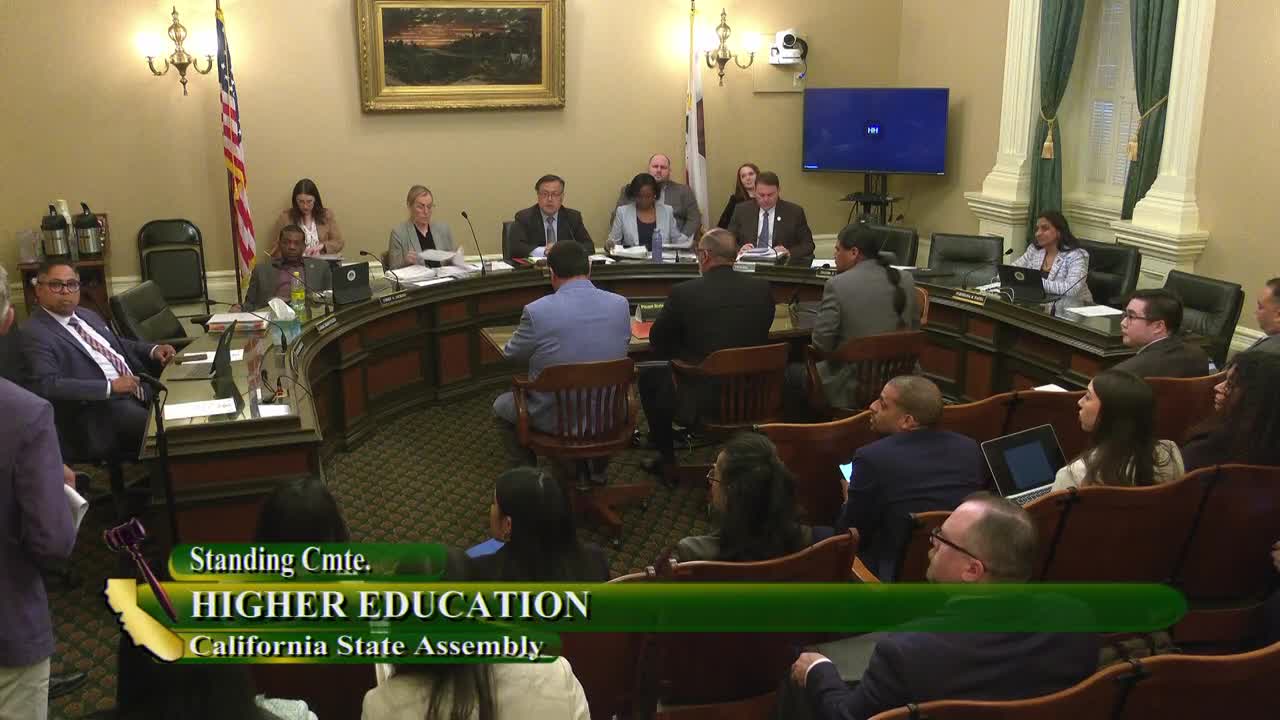
Discussed in Hearing
 29MIN
Assembly Standing Committee on Higher Education
Bill Author