AB 1243: Polluters Pay Climate Superfund Act of 2025.
- Session Year: 2025-2026
- House: Assembly
- Latest Version Date: 2025-04-10
Current Status:
Failed
(2026-02-02: From committee: Filed with the Chief Clerk pursuant to Joint Rule 56.)
Introduced
In Committee
Awaiting First Chamber Vote
Passed First Chamber
In Committee
Awaiting Second Chamber Vote
Passed Second Chamber
Enacted
The California Global Warming Solutions Act of 2006, until January 1, 2031, authorizes the State Air Resources Board to adopt a regulation establishing a system of market-based declining aggregate emissions limits for sources or categories of sources that emit greenhouse gases (market-based compliance mechanism) that meets certain requirements. Existing law establishes the Greenhouse Gas Reduction Fund and requires all moneys, except for fines and penalties, collected by the state board from the auction or sales of allowances as a part of a market-based compliance mechanism to be deposited into the fund and requires the Legislature to appropriate moneys in the fund for the purpose of reducing greenhouse gas emissions in the state, as provided.
Existing law, the California Climate Crisis Act, declares that it is the policy of the state both to achieve net-zero greenhouse gas emissions as soon as possible, but no later than 2045, and achieve and maintain net-negative greenhouse gas emissions thereafter, and to ensure that by 2045, statewide anthropogenic greenhouse gas emissions are reduced to at least 85% below the 1990 levels.
This bill would enact the Polluters Pay Climate Superfund Act of 2025 and would establish the Polluters Pay Climate Superfund Program to be administered by the California Environmental Protection Agency to require fossil fuel polluters to pay their fair share of the damage caused by greenhouse gases released into the atmosphere during the covered period, which the bill would define as the time period between the 1990 and 2024 calendar years, inclusive, resulting from the extraction, production, refining, sale, or combustion of fossil fuels or petroleum products, to relieve a portion of the burden to address cost borne by current and future California taxpayers. The bill would require the agency, within 90 days of the effective date of the act, to determine and publish a list of responsible parties, which the bill would define as an entity with a majority ownership interest in a business engaged in extracting or refining fossil fuels that, during the covered period, did business in the state or otherwise had sufficient contact with the state, and is determined by the agency to be responsible for more than 1,000,000,000 metric tons of covered fossil fuel emissions, as defined, in aggregate globally, during the covered period.
This bill would require the agency, within one year of the effective date of the act, to conduct and complete a climate cost study to, among other things, quantify the total damage amount, which the bill would define as all past and future climate harms and damages to the state from January 1, 1990, through December 31, 2045, inclusive. The bill would require the agency to update the climate cost study, not less frequently than every 5 years, through January 1, 2045, as provided. The bill would require the agency, within 60 days of the completion of the climate cost study, to determine and assess, as provided, a cost recovery demand for each responsible party listed, which represents the responsible partys proportionate share of the total damage amount. The bill would require responsible parties to pay their cost recovery demand, as provided. The bill would require the collected cost recovery demands to be deposited in the Polluters Pay Climate Superfund, which the bill would create in the State Treasury. The bill would, upon appropriation by the Legislature, require moneys in the Polluters Pay Climate Superfund fund be expended for, among other things, qualifying expenditures, which the bill would define to include expenditures for projects and programs to mitigate, adapt, or respond to the damages and costs caused to the state from climate change. The bill would require all interest earned on moneys that have been deposited into the fund to be retained in the fund for use in implementing the program. The bill would require the agency to determine the initial implementation costs for the act, as provided, and would require the agency to assess an amount allocated equitably among responsible parties to cover those costs.
This bill would require the Director of Finance, within 45 days of the effective date of the act, to perform an initial assessment of the reasonable and appropriate initial implementation costs that will be incurred by the agency.
This bill would declare that it is to take effect immediately as an urgency statute.
The California Global Warming Solutions Act of 2006, until January 1, 2031, authorizes the State Air Resources Board to adopt a regulation establishing a system of market-based declining aggregate emissions limits for sources or categories of sources that emit greenhouse gases (market-based compliance mechanism) that meets certain requirements. Existing law establishes the Greenhouse Gas Reduction Fund and requires all moneys, except for fines and penalties, collected by the state board from the auction or sales of allowances as a part of a market-based compliance mechanism to be deposited into the fund and requires the Legislature to appropriate moneys in the fund for the purpose of reducing greenhouse gas emissions in the state, as provided.
Existing law, the California Climate Crisis Act, declares that it is the policy of the state both to achieve net-zero greenhouse gas emissions as soon as possible, but no later than 2045, and achieve and maintain net-negative greenhouse gas emissions thereafter, and to ensure that by 2045, statewide anthropogenic greenhouse gas emissions are reduced to at least 85% below the 1990 levels.
This bill would enact the Polluters Pay Climate Superfund Act of 2025 and would establish the Polluters Pay Climate Superfund Program to be administered by the California Environmental Protection Agency to require fossil fuel polluters to pay their fair share of the damage caused by greenhouse gases released into the atmosphere during the covered period, which the bill would define as the time period between the 1990 and 2024 calendar years, inclusive, resulting from the extraction, production, refining, sale, or combustion of fossil fuels or petroleum products, to relieve a portion of the burden to address cost borne by current and future California taxpayers. The bill would require the agency, within 90 days of the effective date of the act, to determine and publish a list of responsible parties, which the bill would define as an entity with a majority ownership interest in a business engaged in extracting or refining fossil fuels that, during the covered period, did business in the state or otherwise had sufficient contact with the state, and is determined by the agency to be responsible for more than 1,000,000,000 metric tons of covered fossil fuel emissions, as defined, in aggregate globally, during the covered period.
This bill would require the agency, within one year of the effective date of the act, to conduct and complete a climate cost study to, among other things, quantify the total damage amount, which the bill would define as all past and future climate harms and damages to the state from January 1, 1990, through December 31, 2045, inclusive. The bill would require the agency to update the climate cost study, not less frequently than every 5 years, through January 1, 2045, as provided. The bill would require the agency, within 60 days of the completion of the climate cost study, to determine and assess, as provided, a cost recovery demand for each responsible party listed, which represents the responsible partys proportionate share of the total damage amount. The bill would require responsible parties to pay their cost recovery demand, as provided. The bill would require the collected cost recovery demands to be deposited in the Polluters Pay Climate Superfund Fund, Superfund, which the bill would create in the State Treasury. The bill would, upon appropriation by the Legislature, require moneys in the fund Polluters Pay Climate Superfund be expended for, among other things, qualifying expenditures, which the bill would define to include expenditures for projects and programs to mitigate, adapt, or respond to the damages and costs caused to the state from climate change. The bill would require the agency to determine the initial implementation costs for the act, as provided, and would require the agency to assess an amount allocated equitably among responsible parties to cover those costs.
This bill would require the Director of Finance, within 45 days of the effective date of the act, to perform an initial assessment of the reasonable and appropriate initial implementation costs that will be incurred by the agency.
This bill would declare that it is to take effect immediately as an urgency statute.
The California Global Warming Solutions Act of 2006, until January 1, 2031, authorizes the State Air Resources Board to adopt a regulation establishing a system of market-based declining aggregate emissions limits for sources or categories of sources that emit greenhouse gases (market-based compliance mechanism) that meets certain requirements. Existing law establishes the Greenhouse Gas Reduction Fund and requires all moneys, except for fines and penalties, collected by the state board from the auction or sales of allowances as a part of a market-based compliance mechanism to be deposited into the fund and requires the Legislature to appropriate moneys in the fund for the purpose of reducing greenhouse gas emissions in the state, as provided.
Existing law, the California Climate Crisis Act, declares that it is the policy of the state both to achieve net-zero greenhouse gas emissions as soon as possible, but no later than 2045, and achieve and maintain net-negative greenhouse gas emissions thereafter, and to ensure that by 2045, statewide anthropogenic greenhouse gas emissions are reduced to at least 85% below the 1990 levels.
This bill would enact the Polluters Pay Climate Superfund Act of 2025 and would establish the Polluters Pay Climate Superfund Program to be administered by the California Environmental Protection Agency to require fossil fuel polluters to pay their fair share of the damage caused by greenhouse gases released into the atmosphere during the covered period, which the bill would define as the time period between the 1990 and 2024 calendar years, inclusive, resulting from the extraction, production, refining, sale, or combustion of fossil fuels or petroleum products, to relieve a portion of the burden to address cost borne by current and future California taxpayers. The bill would require the agency, within 90 days of the effective date of the act, to determine and publish a list of responsible parties, which the bill would define as an entity with a majority ownership interest in a business engaged in extracting or refining fossil fuels that, during the covered period, did business in the state or otherwise had sufficient contact with the state, and is determined by the agency to be responsible for more than 1,000,000,000 metric tons of covered fossil fuel emissions, as defined, in aggregate globally, during the covered period.
This bill would require the agency, within one year of the effective date of the act, to conduct and complete a climate cost study to, among other things, quantify the total damage amount, which the bill would define as all past and future climate harms and damages to the state from January 1, 1990, through December 31, 2045, inclusive. The bill would require the agency to update the climate cost study, not less frequently than every 5 years, through January 1, 2045, as provided. The bill would require the agency, within 60 days of the completion of the climate cost study, to determine and assess, as provided, a cost recovery demand for each responsible party listed, which represents the responsible partys proportionate share of the total damage amount. The bill would require responsible parties to pay their cost recovery demand, as provided. The bill would require the collected cost recovery demands to be deposited in the Polluters Pay Climate Superfund Fund, which the bill would create in the State Treasury. The bill would, upon appropriation by the Legislature, require moneys in the fund be expended for, among other things, qualifying expenditures, which the bill would define to include expenditures for projects and programs to mitigate, adapt, or respond to the damages and costs caused to the state from climate change. The bill would require the agency to determine the initial implementation costs for the act, as provided, and would require the agency to assess an amount allocated equitably among responsible parties to cover those costs.
This bill would require the Director of Finance, within 45 days of the effective date of the act, to perform an initial assessment of the reasonable and appropriate initial implementation costs that will be incurred by the agency.
This bill would declare that it is to take effect immediately as an urgency statute.
This act shall be known, and may be cited, as the Polluters Pay Climate Superfund Act of 2025.
SEC. 2.(a)The Legislature finds and declares all of the following:
(1)Climate change, resulting primarily from the combustion of fossil fuels, is an immediate, grave threat to the people, communities, biodiversity, environment, and economy of the state.
(2)Severe consequences of climate change, including rising sea levels, increasing temperatures, intensifying droughts, wildfires, flooding, heat waves, loss of biodiversity, and other climate change-driven ecosystem threats and extreme weather events, have already materialized, are costing Californians billions of dollars, and constitute an emergency for the state, which must now take urgent action to prevent further damages, protect California residents and communities, and transition to clean renewable energy.
(3)Californians, especially Californias most vulnerable populations, low-income communities and communities of color, children, and the elderly, are harmed by the climate emergency and climate-related costs, including escalating costs of utilities, housing, health care, and insurance.
(4)The state must develop and implement protective measures to counteract the adverse effects of climate change.
(5)Protective measures necessary to mitigate climate change, adapt to the adverse effects of climate change, and expedite the transition away from fossil fuels will require significant new investment.
(6)Peer-reviewed research has determined with great accuracy the share of carbon dioxide and methane released into the atmosphere by the operations and products of specific fossil fuel companies.
(7)Existing accounting of climate damage costs is known to be significantly undercounted because scientific modeling to calculate damage amounts is conservative by design and continually being refined, and because certain damages are difficult to monetize, including impacts to culture, health, and communities.
(8)The fees imposed by this act represent only a subset of the extraordinary costs from climate-driven harms currently borne by state, local, and tribal governments and California residents.
(9)The legislative purposes of the fees and the act are designed to have a meaningful impact on the burden borne by taxpayers while being justly and fairly proportional to a fraction of actual historic emissions by the fossil fuel industry. This industry, despite its massive profits of $2,800,000,000 per day for the last 50 years, has thus far externalized its pollution costs on state, local, and tribal governments and California residents.
(7)(10)The fossil fuel industry should now contribute its fair share to government expenditures to protect the state from climate disaster.
(b)In enacting this act, it is not the intent of the Legislature for either of the following:
(1)For the act to be a determination of fault.
(2)For the act to have any impact on the ability of any person or entity to hold polluters accountable for harms caused.
(c)It is the intent of the Legislature for this act, the program created by this act, and the programs and projects funded by this act to benefit disadvantaged communities and to do no harm to these communities.
SEC. 3.Part 4.8 (commencing with Section 71370) is added to Division 34 of the Public Resources Code, to read:4.8.Polluters Pay Climate Superfund Act of 20251.Definitions71370.For purposes of this part, the following definitions apply:
(a)Agency means the California Environmental Protection Agency.
(b)Annual payment date means the date, as determined by the agency, not later than October 1 of each calendar year, by which a responsible party shall pay its cost recovery demand.
(c)Climate cost study means a study conducted pursuant to Section 71371.3.
(d)Cost recovery demand means a charge assessed against a responsible party for compensatory cost recovery payments, as determined pursuant to Section 71371.4.
(e)Costs means direct and indirect costs in current dollars to the state, local and tribal governments, and California residents incurred and projected to be incurred into the future to prepare for, prevent, adapt, or respond to the damages and harms associated with the impacts of covered fossil fuel emissions.
(f)Covered fossil fuel emissions means the total quantity of greenhouse gases released into the atmosphere during the covered period, expressed in metric tons of carbon dioxide equivalent, attributable to the extraction, production, refining, sale, or combustion, including by third parties, of fossil fuels or petroleum products.
(g)Covered period means the time period between January 1, 1990, and December 31, 2024, inclusive.
(h)Fossil fuel means coal, crude oil, petroleum products, or fuel gases, or their byproducts.
(i)Fuel gas includes, but is not limited to, methane, natural gas, liquefied natural gas, and manufactured fuel gas.
(j)Fund means the Polluters Pay Climate Superfund established pursuant to Section 71372.
(k)Greenhouse gas has the same meaning as set forth in Section 38505 of the Health and Safety Code.
(l)Notice of cost recovery demand means a written or electronic communication informing a responsible party of the amount of cost recovery demand due, payable to the fund.
(m)Petroleum products means a liquid hydrocarbon at atmospheric temperature and pressure that is the product of the fractionation, distillation, or other refining or processing of crude oil and that is used as, useable as, or may be refined as, a fuel or fuel blendstock, including, but not limited to, gasoline, diesel fuel, aviation fuel, bunker fuel, and renewable fuels containing more than 5 percent petroleum products.
(n)Program means the Polluters Pay Climate Superfund Program established pursuant to Section 71371.
(o)(1)Qualifying expenditures means expenditures for projects and programs within the state to mitigate, adapt, or respond to the damages and harms from climate change, as well as ongoing operation and maintenance for those projects or programs that satisfy the regulations adopted pursuant to Section 71373.2.
(2)Qualifying expenditures shall include all reasonable costs incurred by the agency and other public agencies for administering and implementing projects or programs financed by the fund. Administrative costs shall not exceed 10 percent for any project or program financed by the fund.
(3)Qualifying expenditures shall include expenditures for projects and programs that mitigate or adapt to climate change and its impact to the state, local and tribal governments, and California residents. Qualifying expenditures may include, but are not limited to, investments in any of the following:
(A)Community disaster preparedness, response, and recovery, that includes including, but not limited to, any of the following:
(i)Hardening of structures in existing, at-risk, and recovering communities.
(ii)Evacuation planning and design.
(iii)Postdisaster soil and water remediation.
(iv)Emergency housing, health, transportation, and medical response.
(v)Sustainable community planning and infrastructure, including community resilience centers, affordable infill housing, and public services funding to support emergency services and disaster response. response, including support for local and tribal governments and public agency operational continuity during and after climate-related events.
(B)Energy efficiency and resiliency, including, but not limited to, climate-resilient schools, electric school buses, vehicle-to-grid bidirectionality, microgrids, community solar, accelerating the transition to clean energy sources, building and infrastructure decarbonization, and maintaining, enhancing, and expanding zero-emission infrastructure, including public transit, or building and infrastructure decarbonization. transit operations, to increase ridership and transition to zero-emission fleets.
(C)Green workforce development and development, job training, and support for first responders and essential workers during responding to climate disasters, and financial support programs for workers whose livelihoods are impacted by climate change.
(D)Regenerative agricultural practices.
(E)Natural system protections, such as preservation or nonextractive restoration of shrublands, forests, grasslands, deserts, or riparian areas, or groundwater recharge or recharge, storage, or instream flow projects.
(p)Responsible party means an entity, including, but not limited to, an individual, trustee, agent, partnership, association, corporation, or other legal organization, including a foreign nation, that satisfies all of the following conditions:
(1)(A)The entity holds or held a majority ownership interest in a business engaged in extracting or refining fossil fuels during the covered period or is a successor in interest to the entity.
(B)For purpose purposes of subparagraph (A), entities in a commonly controlled group, as defined in Section 25105 of the Revenue and Taxation Code, shall be treated as a single entity for purposes of this subdivision and shall be jointly and severally liable for the payment of any cost recovery demand owed by any entity in the commonly controlled group.
(2)During any part of the covered period, the entity did business in the state or otherwise had sufficient contacts with the state to give the state jurisdiction over the entity pursuant to Section 410.10 of the Code of Civil Procedure.
(3)The agency determines that more than one billion 1,000,000,000 metric tons of covered fossil fuel emissions, in aggregate globally, are attributable to the entity during the covered period.
(q)Total damage amount means the costs determined by the agency in its climate cost study of past and future climate damages and harms from January 1, 1990, up to, and including, December 31, 2045, attributable to covered fossil fuel emissions.
2.Polluters Pay Climate Superfund Program71371.(a)There is hereby established the Polluters Pay Climate Superfund Program to be administered by the agency.
(b)The purpose of the program is to require fossil fuel polluters to pay their fair share of the damage caused by covered fossil fuel emissions, thereby relieving a portion of the burden to address costs otherwise borne by current and future California taxpayers.
71371.1.(a)A responsible party, as determined by the agency pursuant to Section 71371.2, shall be strictly liable for a cost recovery demand.
(b)Beginning January 1, 2026, each responsible party shall pay to the agency its cost recovery demand established pursuant to Section 71371.4.
71371.2.Within 90 days of the effective date of this part, the agency shall determine and publish on its internet website a list of responsible parties subject to this part. The agency may update the list from time to time, as appropriate.
71371.3.(a)The agency shall conduct or commission a climate cost study and the study shall be completed within one year of the effective date of this part.
(b)The climate cost study shall include, at a minimum, an evaluation of all of the following:
(1)(A)The cost-driving effects of covered fossil fuel emissions on the state, local and tribal governments, and California residents, including effects on public health and safety, biodiversity and ecosystems, agriculture and food systems, water, wildfire, the built environment, economic development, and any other effects that may be relevant.
(B)The evaluation shall be based on a review of existing best peer-reviewed and publicly available science on climate impacts and costs, including climate attribution science and methodologies, Californias Fourth Climate Change Assessment, information available from Californias ongoing Fifth Climate Change Assessment, and any future relevant assessments.
(C)Climate impacts, including, but not limited to, extreme weather events, such as heat waves, droughts, and flooding, sea level rise, air and water temperature shifts, changes in wildfire, such as to area burned, smoke, air quality, and damage to communities, and related economic impacts, such as agricultural and food system costs, health costs, housing insurability, affordability, and access, shall be considered in the evaluation.
(2)A calculation of the costs incurred since January 1, 1990, and projected to be incurred into the future up to, and including, December 31, 2045, within the state for effects identified under paragraph (1).
(3)A list to identify potential harms and impacts incurred since January 1, 1990, and projected to be incurred into the future up to, and including, December 31, 2045, within the state attributable to covered fossil fuel emissions, that are not yet quantifiable using current best available scientific methodologies, for consideration in future updates as science and quantification methods evolve.
(4)A calculation of the total damage amount.
(5)An assessment of potential qualifying expenditures meeting the requirements of Section 71371.6.
(6)An analysis of climate impacts to local and tribal government budgets, including, but not limited to, increased costs for infrastructure maintenance, emergency services, natural disaster recovery, and public health, and how potential qualifying expenditures could be used to offset those costs.
(c)The agency shall update the climate cost study using the best publicly available peer-reviewed science, data, and methodology, not less frequently than every five years, through January 1, 2045.
(d)The agency shall, in accordance with Section 9795 of the Government Code, submit to the Legislature the climate cost study and update.
71371.4.(a)Within 60 days of the completion of the climate cost study, the agency shall determine and assess a cost recovery demand upon each responsible party by doing all of the following:
(1)Quantify covered fossil fuel emissions attributable to each responsible party based on publicly reported data on the operations and production of the fossil fuel industry and the best available and most up-to-date Intergovernmental Panel on Climate Change emissions factors for greenhouse gas inventories.
(2)Establish the proportionate share percentage of each responsible party as equal to the ratio of the responsible partys covered fossil fuel emissions to covered fossil fuel emissions globally.
(3)Establish a cost recovery demand for each responsible party in an amount equal to the proportionate share percentage of the responsible party as determined pursuant to paragraph (2) multiplied by the total damage amount determined pursuant to the climate study or its update prepared pursuant to Section 71371.3.
(b)Within 60 days of an update of the climate cost study, the agency shall update and adjust, as necessary, the quantification and determinations made pursuant to subdivision (a).
(c)(1)The notice of cost recovery demand shall inform the responsible party of its obligation to remit the cost recovery demand, or any adjustment to the cost recovery demand, in full, on or before the annual payment date of the calendar year in which the notice is issued or the next calendar year if the provided notice is issued less than 60 days before the annual payment date.
(2)A responsible party may elect to pay its cost recovery demand in 20 installments by providing written notice of its election and submission of at least 10 percent of the cost recovery demand on or before the annual payment date of the calendar year in which the initial notice is issued or the next calendar year if the notice is issued less than 60 days before the annual payment date. The remaining balance shall be paid in equal installments that are due on or before the annual payment of each calendar year after the initial payment.
(3)The unpaid balance of all remaining installments shall become due immediately if any of the following occurs:
(A)The responsible party fails to pay any installment by the due date pursuant to this subdivision.
(B)Except as provided in paragraph (4), there is a liquidation or sale of substantially all the assets of the responsible party.
(C)The responsible party ceases to do business.
(4)In the case of a sale of substantially all the assets of a responsible party, the remaining installments shall not become due immediately if the buyer enters into an agreement with the agency under which the buyer assumes liability for the remaining installments due under paragraph (2) in the same manner as if the buyer was the responsible party.
(5)If an update to the climate cost study results in an adjustment to the responsible partys cost recovery demand, the agency shall, within 60 days, issue a revised written notice of cost recovery demand notifying the responsible party of the adjusted payment due.
(6)Payment of the cost recovery demand may be stayed by the agency or a court pending administrative or judicial resolution, as applicable, of a challenge filed under Section 71371.5.
71371.5.(a)The agency shall establish procedures for an entity to challenge its designation as a responsible party under Section 71371.2 or its cost recovery demand established pursuant to Section 71371.4.
(b)The agency may adjust a responsible partys cost recovery demand if the responsible party establishes, to the satisfaction of the agency, both of the following:
(1)A portion of its cost recovery demand amount is attributable to fossil fuel extracted by another responsible party.
(2)The fossil fuel extracted by the other responsible party was accounted for when the agency determined the cost recovery demand amount for the other responsible party.
(c)This section does not limit a real partys right to seek judicial review of a determination made by the agency, except that no civil action shall be maintained under this part unless it is commenced within 30 days after the claim accrued.
71371.6.The agency shall establish funding criteria and guidelines in accordance with the climate cost study for programs and projects that are eligible as qualifying expenditures funded from moneys collected pursuant to this chapter.
71371.7.Until December 31, 2045, every five years after the effective date of this part, the Legislative Analysts Office shall conduct an independent evaluation of the Polluters Pay Climate Superfund Program to be provided to the Governor, the President pro Tempore of the Senate, and the Speaker of the Assembly. The purpose of this evaluation shall be to determine the effectiveness of the program in achieving its purposes as described in this chapter and to provide recommendations for improving program administration.
3.Polluters Pay Climate Superfund71372.(a)There is hereby established the Polluters Pay Climate Superfund in the State Treasury. Moneys in the fund shall, upon appropriation by the Legislature, be used to implement the program pursuant to Chapter 2 (commencing with Section 71371), including qualifying expenditures, and to reimburse any outstanding loan made from other funds used to finance the initial costs of the agencys activities in implementing this part. Moneys in the fund shall not be expended for any purposes not specified in this part.
(b)Moneys collected pursuant to Chapter 2 (commencing with Section 71371) or Chapter 4 (commencing with Section 71373) shall be deposited into the fund.
(c)All interest earned on the moneys that have been deposited into the fund shall be retained in the fund for use in implementing the Polluters Pay Climate Superfund Program.
71372.1.Moneys in the fund shall be expended on qualifying expenditures in accordance with the findings of the climate cost study and updates to the study and guidelines and criteria established pursuant to Section 71371.6 so that both of the following occur:
(a)Not less than 40 percent of the moneys are expended for projects and programs that directly benefit disadvantaged communities, as defined by the agency, agency pursuant to Section 39711 of the Health and Safety Code, facing climate impacts.
(b)Programs and projects funded by the fund include the assessment and implementation of strategies to increase employment opportunities and improve job quality.
71372.2.If any expenditure of moneys from the fund for any project or program is determined by a court to be inconsistent with law, the funding for the remaining projects or programs shall be severable and shall not be affected by the determination.
4.Miscellaneous Provisions71373.Within 45 days of the effective date of this part, the Director of Finance shall perform an initial assessment of the reasonable and appropriate initial implementation costs as described in Section 71373.3.
71373.1.In implementing this part, the agency shall conduct regular consultations with the Integrated Climate Adaptation and Resiliency Program, the State Air Resources Board and the Environmental Justice Advisory Committee of that state board, the State Water Resources Control Board, the Natural Resources Agency, the State Energy Resources Conservation and Development Commission, the Office of Emergency Services, the Strategic Growth Council, the State Department of Public Health, the Office of Environmental Health Hazard Assessment, the California Coastal Commission, the Public Utilities Commission, the Attorney General, and other appropriate public agencies and nongovernmental entities.
71373.2.(a)Within 180 days of the effective date of this part, the agency shall adopt all regulations, including those establishing requirements for projects and programs eligible for funding from the fund, necessary to carry out this part.
(b)The agency may prescribe, adopt, and enforce any emergency regulations as necessary to implement, administer, and enforce its duties under this part. Emergency regulations prescribed, adopted, or enforced pursuant to this part shall be adopted in accordance with Chapter 3.5 (commencing with Section 11340) of Part 1 of Division 3 of Title 2 of the Government Code, and, for purposes of that chapter, including Sections 11349.1 and 11349.6 of the Government Code, the adoption of the regulation is an emergency and shall be considered by the Office of Administrative Law as necessary for the immediate preservation of the public peace, health and safety, and general welfare. Notwithstanding any other law, the emergency regulations adopted by the California Environmental Protection Agency may remain in effect for two years from adoption.
71373.3.(a)Within 120 days of the effective date of this part, the agency shall determine the initial implementation costs, including the costs of the initial climate cost study, the development and adoption of regulations to implement this part, and other appropriate initial program implementation costs.
(b)The agency shall equitably assess a charge on the responsible parties for the full amount of the agencys initial implementation costs determined pursuant to subdivision (a). The agency shall notify responsible parties of the charge.
(c)Within 60 days of the notification, each responsible party shall remit the charge to the agency for deposit into the fund.
(d)A responsible partys payment of the charge may be stayed by the agency or a court pending administrative or judicial resolution, as applicable, of a challenge filed under Section 71371.5.
71373.4.The agency and the Attorney General shall have the authority to enforce the requirements of this part and to assess fees for late payments of cost recovery demands pursuant to Chapter 2 (commencing with Section 71371) or the charge assessed under Section 71373.3. The late fees shall accrue daily, assessed at the rate of 10 percent per annum, on amounts remaining due.
71373.5.The Secretary of State shall have the authority to revoke or suspend the business license of a responsible party that fails to comply with this part.
71373.6.(a)This part does not do either of the following:
(1)Relieve the liability of an entity for damages resulting from climate change, as provided by law.
(2)Preempt, displace, or restrict any rights or remedies of a person, the state, units of local government, or tribal government under law relating to a past, present, or future allegation of any of the following:
(A)Deception concerning the effects of fossil fuels on climate change.
(B)Damage or injury resulting from the role of fossil fuels in contributing to climate change.
(C)Failure to avoid damage or injury related to climate change, including claims for nuisance, trespass, battery, design defect, negligence, failure to warn, or deceptive or unfair practices and claims for injunctive, declaratory, monetary, or other relief.
(b)This part does not preempt or supersede any state law or local ordinance, regulation, policy, or program, including, but not limited to, those that do any of the following:
(1)Limit, set, or enforce standards for emissions of greenhouse gases.
(2)Monitor, report, or keep records of emissions of greenhouse gases.
(3)Collect revenue through fees or levy taxes.
(4)Conduct or support investigations.
71373.7.The remedies provided in this part are in addition to other remedies provided by law. This part does not limit a partys right, including the agency, other governmental bodies, or private individuals, from pursuing civil action or other remedies provided by law, or to capture additional costs not recovered by this part.
71374.The provisions of this part are severable. If any provision of this part or its application is held invalid, that invalidity shall not affect other provisions or applications that can be given effect without the invalid provision or application.
SEC. 4.This act is an urgency statute necessary for the immediate preservation of the public peace, health, or safety within the meaning of Article IV of the California Constitution and shall go into immediate effect. The facts constituting the necessity are:
To fund and implement measures to address the immediate, ongoing threats to public safety, and the health and welfare of the people, the environment, and the State of California from climate change, it is necessary for this act to take effect immediately.
REVISIONS: HeadingLines 2 and 3.This act shall be known, and may be cited, as the Polluters Pay Climate Superfund Act of 2025.
SEC. 2.(a)The Legislature finds and declares all of the following:
(1)Climate change, resulting primarily from the combustion of fossil fuels, is an immediate, grave threat to the people, communities, biodiversity, environment, and economy of the state.
(2)Severe consequences of climate change, including rising sea levels, increasing temperatures, intensifying droughts, wildfires, flooding, heat waves, loss of biodiversity, and other climate change-driven ecosystem threats and extreme weather events, have already materialized, are costing Californians billions of dollars, and constitute an emergency for the state, which must now take urgent action to prevent further damages, protect California residents and communities, and transition to clean renewable energy.
(3)Californians, especially Californias most vulnerable populations, including low-income communities and communities of color, children, and the elderly, are disproportionately harmed by the climate emergency. emergency and climate-related costs, including escalating costs of utilities, housing, health care, and insurance.
(4)The state must develop and implement protective measures to counteract the adverse effects of climate change.
(5)Protective measures necessary to mitigate climate change, adapt to the adverse effects of climate change, and expedite the transition away from fossil fuels will require significant new investment.
(6)Peer-reviewed research has determined with great accuracy the share of carbon dioxide and methane released into the atmosphere by the operations and products of specific fossil fuel companies.
(7)The fossil fuel industry should now contribute its fair share to government expenditures to protect the state from climate disaster.
(b)In enacting this act, it is not the intent of the Legislature for either of the following:
(1)For the act to be a determination of fault.
(2)For the act to have any impact on the ability of any person or entity to hold polluters accountable for harms caused.
SEC. 3.Part 4.8 (commencing with Section 71370) is added to Division 34 of the Public Resources Code, to read:4.8.Polluters Pay Climate Superfund Act of 20251.Definitions71370.For purposes of this part, the following definitions apply:
(a)Agency means the California Environmental Protection Agency.
(b)Annual payment date means the date, as determined by the agency, not later than October 1 of each calendar year, by which a responsible party shall pay its cost recovery demand.
(c)Climate cost study means a study conducted pursuant to Section 71371.3.
(d)Cost recovery demand means a charge assessed against a responsible party for compensatory cost recovery payments, as determined pursuant to Section 71371.4.
(e)Costs means direct and indirect costs in current dollars to the state, local, local and tribal governments governments, and California residents incurred and projected to be incurred into the future to prepare for, prevent, adapt, or respond to the damages and harms associated with the impacts of covered fossil fuel emissions.
(f)Covered fossil fuel emissions means the quantity of greenhouse gases released into the atmosphere during the covered period, expressed in metric tons of carbon dioxide equivalent, resulting from attributable to the extraction, production, refining, sale, or combustion combustion, including by third parties, of fossil fuels or petroleum products.
(g)Covered period means the time period between January 1, 1990, and December 31, 2024, inclusive.
(h)Fossil fuel means coal, crude oil, petroleum products, or fuel gases, or their byproducts.
(i)Fuel gas includes, but is not limited to, methane, natural gas, liquefied natural gas, and manufactured fuel gas.
(j)Fund means the Polluters Pay Superfund Fund established pursuant to Section 71372.
(k)Greenhouse gas has the same meaning as set forth in Section 38505 of the Health and Safety Code.
(l)Notice of cost recovery demand means a written or electronic communication informing a responsible party of the amount of cost recovery demand due, payable to the fund.
(m)Petroleum products means a liquid hydrocarbon at atmospheric temperature and pressure that is the product of the fractionation, distillation, or other refining or processing of crude oil and that is used as, useable as, or may be refined as, a fuel or fuel blendstock, including, but not limited to, gasoline, diesel fuel, aviation fuel, bunker fuel, and renewable fuels containing more than 5 percent petroleum products.
(n)Program means the Polluters Pay Climate Superfund Program established pursuant to Section 71371.
(o)(1)Qualifying expenditures means expenditures for projects and programs within the state to mitigate, adapt, or respond to the damages and harms from climate change, as well as ongoing operation and maintenance for those projects or programs that satisfy the regulations adopted pursuant to Section 71373.2.
(2)Qualifying expenditures shall include all reasonable costs incurred by the agency and other public agencies for administering and implementing projects or programs financed by the fund. Administrative costs shall not exceed 10 percent for any project or program financed by the fund.
(3)Qualifying expenditures shall include, but are not limited to, include expenditures for projects and programs that do mitigate or adapt to climate change and its impact to the state, local and tribal governments, and California residents. Qualifying expenditures include, but are not limited to, investments in any of the following:
(A)Mitigate climate change and its impacts to state, local, and tribal governments and California residents, such as through energy efficiency, natural systems climate resilience, accelerating the transition to clean energy sources, building and infrastructure decarbonization, distributed energy generation and storage, or zero-emission transportation and infrastructure, including public transit.(B)Adapt to climate change and its impacts to state, local, and tribal governments and California residents, such as through sustainable community infrastructure, green workforce development, sustainable agricultural practices, or financial support programs for workers whose livelihoods are impacted by climate change, or job training and support for workers who provide essential services during climate disaster.(C)Address climate-fueled disaster response and climate-resilient recovery.(A)Community disaster preparedness, response, and recovery, that includes any of the following:
(i)Hardening of structures in existing, at-risk, and recovering communities.
(ii)Evacuation planning and design.
(iii)Postdisaster soil and water remediation.
(iv)Emergency housing, health, and medical response.
(v)Sustainable community planning and infrastructure, including community resilience centers, affordable infill housing, and public services funding to support emergency services and disaster response.
(B)Energy efficiency and resiliency, including, climate-resilient schools, electric school buses, vehicle-to-grid bidirectionality, microgrids, community solar, accelerating the transition to clean energy sources, zero-emission infrastructure, including public transit, or building and infrastructure decarbonization.
(C)Green workforce development and job training, and support for first responders and essential workers during climate disasters, financial support programs for workers whose livelihoods are impacted by climate change.
(D)Regenerative agricultural practices.
(E)Natural system protections, such as preservation or nonextractive restoration of shrublands, forests, grasslands, deserts, or riparian areas, groundwater recharge or storage, or instream flow projects.
(p)Responsible party means an entity, including, but not limited to, an individual, trustee, agent, partnership, association, corporation, or other legal organization, including a foreign nation, that satisfies all of the following conditions:
(1)(A)The entity holds or held a majority ownership interest in a business engaged in extracting or refining fossil fuels during the covered period or is a successor in interest to the entity.
(B)For purpose of subparagraph (A), entities in a commonly controlled group, as defined in Section 25105 of the Revenue and Taxation Code, shall be treated as a single entity for purposes of this subdivision and shall be jointly and severally liable for the payment of any cost recovery demand owed by any entity in the commonly controlled group.
(2)During any part of the covered period, the entity did business in the state or otherwise had sufficient contacts with the state to give the state jurisdiction over the entity pursuant to Section 410.10 of the Code of Civil Procedure.
(3)The agency determines that the entity is responsible for more than one billion metric tons of covered fossil fuel emissions, in aggregate globally, are attributable to the entity during the covered period.
(q)Total damage amount means the costs determined by the agency in its climate cost study of past and future climate damages and harms from January 1, 1990, up to, and including, December 31, 2045, resulting from attributable to covered fossil fuel emissions.
2.Polluters Pay Climate Superfund Program71371.(a)There is hereby established the Polluters Pay Climate Superfund Program to be administered by the agency.
(b)The purpose of the program is to require fossil fuel polluters to pay their fair share of the damage caused by covered fossil fuel emissions, thereby relieving a portion of the burden to address costs otherwise borne by current and future California taxpayers.
71371.1.(a)A responsible party, as determined by the agency pursuant to Section 71371.2, shall be strictly liable for a cost recovery demand.
(b)Beginning January 1, 2026, each responsible party shall pay to the agency its cost recovery demand established pursuant to Section 71371.4.
71371.2.Within 90 days of the effective date of this part, the agency shall determine and publish on its internet website a list of responsible parties subject to this part. The agency may update the list from time to time, as appropriate.
71371.3.(a)The agency shall conduct or commission a climate cost study and the study shall be completed within one year of the effective date of this part.
(b)The climate cost study shall include, at a minimum, an evaluation of all of the following:
(1)(A)The cost-driving effects of covered fossil fuel emissions on the state, local, local and tribal governments governments, and California residents, including effects on public health and safety, biodiversity and ecosystems, agriculture and food systems, water, wildfire, the built environment, economic development, and any other effects that may be relevant.
(B)The evaluation shall be based on a review of existing best peer-reviewed and publicly available science on climate impacts and costs, including climate attribution science and methodologies, Californias Fourth Climate Change Assessment, information available from the Californias ongoing Fifth National Climate Change Assessment, and any future relevant assessments.
(C)Climate impacts, including, but not limited to, extreme weather events, such as heat waves, droughts, and flooding, sea level rise, air and water temperature shifts, changes in wildfire, such as to area burned, smoke, air quality, and damage to communities, and related economic impacts, such as agricultural and food system costs, health costs, housing insurability, affordability, and access, shall be considered in the evaluation.
(2)A calculation of the costs incurred since January 1, 1990, and projected to be incurred into the future up to, and including, December 31, 2045, within the state for effects identified under paragraph (1).
(3)A list to identify potential harms and impacts incurred since January 1, 1990, and projected to be incurred into the future up to, and including, December 31, 2045, within the state from attributable to covered fossil fuel emissions, that are not yet quantifiable using current best available scientific methodologies, for consideration in future updates as science and quantification methods evolve.
(4)A calculation of the total damage amount.
(5)An assessment of potential qualifying expenditures meeting the requirements of Section 71371.6.
(c)The agency shall update the climate cost study using the best publicly available peer-reviewed science, data, and methodology, not less frequently than every five years, through January 1, 2045.
(d)The agency shall, in accordance with Section 9795 of the Government Code, submit to the Legislature the climate cost study and update.
71371.4.(a)Within 60 days of the completion of the climate cost study, the agency shall determine and assess a cost recovery demand upon each responsible party by doing all of the following:
(1)Quantify covered fossil fuel emissions attributable to each responsible party based on publicly reported data on the operations and production of the fossil fuel industry and the best available and most up-to-date Intergovernmental Panel on Climate Change emissions factors for greenhouse gas inventories.
(2)Establish the proportionate share percentage of each responsible party as equal to the ratio of the responsible partys covered fossil fuel emissions to covered fossil fuel emissions globally.
(3)Establish a cost recovery demand for each responsible party in an amount equal to the proportionate share percentage of the responsible party as determined pursuant to paragraph (2) multiplied by the total damage amount determined pursuant to the climate study or its update prepared pursuant to Section 71371.3.
(b)Within 60 days of an update of the climate cost study, the agency shall update and adjust, as necessary, the quantification and determinations made pursuant to subdivision (a).
(c)(1)The notice of cost recovery demand shall inform the responsible party of its obligation to remit the cost recovery demand, or any adjustment to the cost recovery demand, in full, on or before the annual payment date of the calendar year in which the notice is issued or the next calendar year if the provided notice is issued less than 60 days before the annual payment date.
(2)A responsible party may elect to pay its cost recovery demand in 20 installments by providing written notice of its election and submission of at least 10 percent of the cost recovery demand on or before the annual payment date of the calendar year in which the initial notice is issued or the next calendar year if the notice is issued less than 60 days before the annual payment date. The remaining balance shall be paid in equal installments that are due on or before the annual payment of each calendar year after the initial payment.
(3)The unpaid balance of all remaining installments shall become due immediately if any of the following occurs:
(A)The responsible party fails to pay any installment by the due date pursuant to this subdivision.
(B)Except as provided in paragraph (4), there is a liquidation or sale of substantially all the assets of the responsible party.
(C)The responsible party ceases to do business.
(4)In the case of a sale of substantially all the assets of a responsible party, the remaining installments shall not become due immediately if the buyer enters into an agreement with the agency under which the buyer assumes liability for the remaining installments due under paragraph (2) in the same manner as if the buyer was the responsible party.
(5)If an update to the climate cost study results in an adjustment to the responsible partys cost recovery demand, the agency shall, within 60 days, issue a revised written notice of cost recovery demand notifying the responsible party of the adjusted payment due.
(6)Payment of the cost recovery demand may be stayed by the agency or a court pending administrative or judicial resolution, as applicable, of a challenge filed under Section 71371.5.
71371.5.(a)The agency shall establish procedures for an entity to challenge its designation as a responsible party under Section 71371.2 or its cost recovery demand established pursuant to Section 71371.4.
(b)The agency may adjust a responsible partys cost recovery demand if the responsible party establishes, to the satisfaction of the agency, both of the following:
(1)A portion of the its cost recovery demand amount is attributable to the refining of crude oil fossil fuel extracted by another responsible party.
(2)The crude oil fossil fuel extracted by the other entity responsible party was accounted for when the agency determined the cost recovery demand amount for the other entity or the successor in interest of the other entity. responsible party.
(c)This section does not limit a real partys right to seek judicial review of a determination made by the agency, except that no civil action shall be maintained under this part unless it is commenced within 30 days after the claim accrued.
71371.6.The agency shall establish funding criteria and guidelines in accordance with the climate cost study for programs and projects that are eligible as qualifying expenditures funded from moneys collected pursuant to this chapter.
71371.7.Until December 31, 2045, every five years after the effective date of this part, the Legislative Analysts Office shall conduct an independent evaluation of the Polluters Pay Climate Superfund Program to be provided to the Governor, the President pro Tempore of the Senate, and the Speaker of the Assembly. The purpose of this evaluation shall be to determine the effectiveness of the program in achieving its purposes as described in this chapter and to provide recommendations for improving program administration.
3.Polluters Pay Climate Superfund Fund71372.(a)There is hereby established the Polluters Pay Climate Superfund Fund in the State Treasury. Moneys in the fund shall, upon appropriation by the Legislature, be used to implement the program pursuant to Chapter 2 (commencing with Section 71371), including qualifying expenditures, and to reimburse any outstanding loan made from other funds used to finance the initial costs of the agencys activities in implementing this part. Moneys in the fund shall not be expended for any purposes not specified in this part.
(b)Moneys collected pursuant to Chapter 2 (commencing with Section 71371) or Chapter 4 (commencing with Section 71373) shall be deposited into the fund.
71372.1.Moneys in the fund shall be expended on qualifying expenditures in accordance with the findings of the climate cost study and updates to the study and guidelines and criteria established pursuant to Section 71371.6 so that both of the following occur:
(a)Not less than 40 percent of the moneys are expended for projects and programs that directly benefit disadvantaged communities, as defined by the agency, facing climate impacts.
(b)Programs and projects funded by the fund include the assessment and implementation of strategies to increase employment opportunities and improve job quality.
4.Miscellaneous Provisions71373.Within 45 days of the effective date of this part, the Director of Finance shall perform an initial assessment of the reasonable and appropriate initial implementation costs as described in Section 71373.3.
71373.1.In implementing this part, the agency shall conduct regular consultations with the Integrated Climate Adaptation and Resiliency Program, the State Air Resources Board and the Environmental Justice Advisory Committee of that state board, the State Water Resources Control Board, the Natural Resources Agency, the State Energy Resources Conservation and Development Commission, the Office of Emergency Services, the Strategic Growth Council, the State Department of Public Health, the Office of Environmental Health Hazard Assessment, the California Coastal Commission, the Public Utilities Commission, the Attorney General, and other appropriate public agencies and nongovernmental entities.
71373.2.(a)Within 180 days of the effective date of this part, the agency shall adopt all regulations, including those establishing requirements for projects and programs eligible for funding from the fund, necessary to carry out this part.
(b)The agency may prescribe, adopt, and enforce any emergency regulations as necessary to implement, administer, and enforce its duties under this part. Emergency regulations prescribed, adopted, or enforced pursuant to this part shall be adopted in accordance with Chapter 3.5 (commencing with Section 11340) of Part 1 of Division 3 of Title 2 of the Government Code, and, for purposes of that chapter, including Sections 11349.1 and 11349.6 of the Government Code, the adoption of the regulation is an emergency and shall be considered by the Office of Administrative Law as necessary for the immediate preservation of the public peace, health and safety, and general welfare. Notwithstanding any other law, the emergency regulations adopted by the California Environmental Protection Agency may remain in effect for two years from adoption.
71373.3.(a)Within 120 days of the effective date of this part, the agency shall determine the initial implementation costs, including the costs of the initial climate cost study, the development and adoption of regulations to implement this part, and other appropriate initial program implementation costs.
(b)The agency shall equitably assess a charge on the responsible parties for the full amount of the agencys initial implementation costs determined pursuant to subdivision (a). The agency shall notify responsible parties of the charge.
(c)Within 60 days of the notification, each responsible party shall remit the charge to the agency for deposit into the fund.
(d)A responsible partys payment of the charge may be stayed by the agency or a court pending administrative or judicial resolution, as applicable, of a challenge filed under Section 71371.5.
71373.4.The agency and the Attorney General shall have the authority to enforce the requirements of this part and to assess fees for late payments of cost recovery demands pursuant to Chapter 2 (commencing with Section 71371) or the charge assessed under Section 71373.3. The late fees shall accrue daily, assessed at the rate of 10 percent per annum, on amounts remaining due.
71373.5.The Secretary of State shall have the authority to revoke or suspend the business license of a responsible party that fails to comply with this part.
71373.6.(a)This part does not do either of the following:
(1)Relieve the liability of an entity for damages resulting from climate change, as provided by law.
(2)Preempt, displace, or restrict any rights or remedies of a person, the state, units of local government, or tribal government under law relating to a past, present, or future allegation of any of the following:
(A)Deception concerning the effects of fossil fuels on climate change.
(B)Damage or injury resulting from the role of fossil fuels in contributing to climate change.
(C)Failure to avoid damage or injury related to climate change, including claims for nuisance, trespass, battery, design defect, negligence, failure to warn, or deceptive or unfair practices and claims for injunctive, declaratory, monetary, or other relief.
(b)This part does not preempt or supersede any state law or local ordinance, regulation, policy, or program, including, but not limited to, those that do any of the following:
(1)Limit, set, or enforce standards for emissions of greenhouse gases.
(2)Monitor, report, or keep records of emissions of greenhouse gases.
(3)Collect revenue through fees or levy taxes.
(4)Conduct or support investigations.
71373.7.The remedies provided in this part are in addition to other remedies provided by law. This part does not limit a partys right, including the agency, other governmental bodies, or private individuals, from pursuing civil action or other remedies provided by law, or to capture additional costs not recovered by this part.
71374.The provisions of this part are severable. If any provision of this part or its application is held invalid, that invalidity shall not affect other provisions or applications that can be given effect without the invalid provision or application.
SEC. 4.This act is an urgency statute necessary for the immediate preservation of the public peace, health, or safety within the meaning of Article IV of the California Constitution and shall go into immediate effect. The facts constituting the necessity are:
To fund and implement measures to address the immediate, ongoing threats to public safety, and the health and welfare of the people, the environment, and the State of California from climate change, it is necessary for this act to take effect immediately.
This act shall be known, and may be cited, as the Polluters Pay Climate Superfund Act of 2025.
SEC. 2.(a)The Legislature finds and declares all of the following:
(1)Climate change, resulting primarily from the combustion of fossil fuels, is an immediate, grave threat to the people, communities, biodiversity, environment, and economy of the state.
(2)Severe consequences of climate change, including rising sea levels, increasing temperatures, intensifying droughts, wildfires, flooding, heat waves, loss of biodiversity, and other climate change-driven ecosystem threats and extreme weather events, have already materialized, are costing Californians billions of dollars, and constitute an emergency for the state, which must now take urgent action to prevent further damages, protect California residents and communities, and transition to clean renewable energy.
(3)Californias most vulnerable populations, including low-income communities and communities of color, children, and the elderly, are disproportionately harmed by the climate emergency.
(4)The state must develop and implement protective measures to counteract the adverse effects of climate change.
(5)Protective measures necessary to mitigate climate change, adapt to the adverse effects of climate change, and expedite the transition away from fossil fuels will require significant new investment.
(6)Peer-reviewed research has determined with great accuracy the share of carbon dioxide and methane released into the atmosphere by the operations and products of specific fossil fuel companies.
(7)The fossil fuel industry should now contribute its fair share to government expenditures to protect the state from climate disaster.
(b)In enacting this act, it is not the intent of the Legislature for either of the following:
(1)For the act to be a determination of fault.
(2)For the act to have any impact on the ability of any person or entity to hold polluters accountable for harms caused.
SEC. 3.Part 4.8 (commencing with Section 71370) is added to Division 34 of the Public Resources Code, to read:4.8.Polluters Pay Climate Superfund Act of 20251.Definitions71370.For purposes of this part, the following definitions apply:
(a)Agency means the California Environmental Protection Agency.
(b)Annual payment date means the date, as determined by the agency, not later than October 1 of each calendar year, by which a responsible party shall pay its cost recovery demand.
(c)Climate cost study means a study conducted pursuant to Section 71371.3.
(d)Cost recovery demand means a charge assessed against a responsible party for compensatory cost recovery payments, as determined pursuant to Section 71371.4.
(e)Costs means direct and indirect costs in current dollars to state, local, and tribal governments and California residents incurred and projected to be incurred into the future to prepare for, prevent, adapt, or respond to the damages and harms associated with the impacts of covered fossil fuel emissions.
(f)Covered fossil fuel emissions means the quantity of greenhouse gases released into the atmosphere during the covered period, expressed in metric tons of carbon dioxide equivalent, resulting from the extraction, production, refining, sale, or combustion of fossil fuels or petroleum products.
(g)Covered period means the time period between January 1, 1990, and December 31, 2024, inclusive.
(h)Fossil fuel means coal, crude oil, petroleum products, or fuel gases, or their byproducts.
(i)Fuel gas includes, but is not limited to, methane, natural gas, liquefied natural gas, and manufactured fuel gas.
(j)Fund means the Polluters Pay Superfund Fund established pursuant to Section 71372.
(k)Greenhouse gas has the same meaning as set forth in Section 38505 of the Health and Safety Code.
(l)Notice of cost recovery demand means a written or electronic communication informing a responsible party of the amount of cost recovery demand due, payable to the fund.
(m)Petroleum products means a liquid hydrocarbon at atmospheric temperature and pressure that is the product of the fractionation, distillation, or other refining or processing of crude oil and that is used as, useable as, or may be refined as, a fuel or fuel blendstock, including, but not limited to, gasoline, diesel fuel, aviation fuel, bunker fuel, and renewable fuels containing more than 5 percent petroleum products.
(n)Program means the Polluters Pay Climate Superfund Program established pursuant to Section 71371.
(o)(1)Qualifying expenditures means expenditures for projects and programs within the state to mitigate, adapt, or respond to the damages and harms from climate change, as well as ongoing operation and maintenance for those projects or programs that satisfy the regulations adopted pursuant to Section 71373.2.
(2)Qualifying expenditures shall include all reasonable costs incurred by the agency and other public agencies for administering and implementing projects or programs financed by the fund. Administrative costs shall not exceed 10 percent for any project or program financed by the fund.
(3)Qualifying expenditures shall include, but are not limited to, expenditures for projects and programs that do any of the following:
(A)Mitigate climate change and its impacts to state, local, and tribal governments and California residents, such as through energy efficiency, natural systems climate resilience, accelerating the transition to clean energy sources, building and infrastructure decarbonization, distributed energy generation and storage, or zero-emission transportation and infrastructure, including public transit.
(B)Adapt to climate change and its impacts to state, local, and tribal governments and California residents, such as through sustainable community infrastructure, green workforce development, sustainable agricultural practices, or financial support programs for workers whose livelihoods are impacted by climate change, or job training and support for workers who provide essential services during climate disaster.
(C)Address climate-fueled disaster response and climate-resilient recovery.
(p)Responsible party means an entity, including, but not limited to, an individual, trustee, agent, partnership, association, corporation, or other legal organization, including a foreign nation, that satisfies all of the following conditions:
(1)(A)The entity holds or held a majority ownership interest in a business engaged in extracting or refining fossil fuels during the covered period or is a successor in interest to the entity.
(B)For purpose of subparagraph (A), entities in a commonly controlled group, as defined in Section 25105 of the Revenue and Taxation Code, shall be treated as a single entity for purposes of this subdivision and shall be jointly and severally liable for the payment of any cost recovery demand owed by any entity in the commonly controlled group.
(2)During any part of the covered period, the entity did business in the state or otherwise had sufficient contacts with the state to give the state jurisdiction over the entity pursuant to Section 410.10 of the Code of Civil Procedure.
(3)The agency determines that the entity is responsible for more than one billion metric tons of covered fossil fuel emissions, in aggregate globally, during the covered period.
(q)Total damage amount means the costs determined by the agency in its climate cost study of past and future climate damages and harms from January 1, 1990, up to, and including, December 31, 2045, resulting from covered fossil fuel emissions.
2.Polluters Pay Climate Superfund Program71371.(a)There is hereby established the Polluters Pay Climate Superfund Program to be administered by the agency.
(b)The purpose of the program is to require fossil fuel polluters to pay their fair share of the damage caused by covered fossil fuel emissions, thereby relieving a portion of the burden to address costs otherwise borne by current and future California taxpayers.
71371.1.(a)A responsible party, as determined by the agency pursuant to Section 71371.2, shall be strictly liable for a cost recovery demand.
(b)Beginning January 1, 2026, each responsible party shall pay to the agency its cost recovery demand established pursuant to Section 71371.4.
71371.2.Within 90 days of the effective date of this part, the agency shall determine and publish on its internet website a list of responsible parties subject to this part. The agency may update the list from time to time, as appropriate.
71371.3.(a)The agency shall conduct or commission a climate cost study and the study shall be completed within one year of the effective date of this part.
(b)The climate cost study shall include, at a minimum, an evaluation of all of the following:
(1)(A)The cost-driving effects of covered fossil fuel emissions on state, local, and tribal governments and California residents, including effects on public health and safety, biodiversity and ecosystems, agriculture and food systems, water, wildfire, the built environment, economic development, and any other effects that may be relevant.
(B)The evaluation shall be based on a review of existing best peer-reviewed and publicly available science on climate impacts and costs, including climate attribution science and methodologies, Californias Fourth Climate Change Assessment, information available from the ongoing Fifth National Climate Assessment, and any future relevant assessments.
(C)Climate impacts, including, but not limited to, extreme weather events, such as heat waves, droughts, and flooding, sea level rise, air and water temperature shifts, changes in wildfire, such as to area burned, smoke, air quality, and damage to communities, and related economic impacts, such as agricultural and food system costs, health costs, housing insurability, affordability, and access, shall be considered in the evaluation.
(2)A calculation of the costs incurred since January 1, 1990, and projected to be incurred into the future up to, and including, December 31, 2045, within the state for effects identified under paragraph (1).
(3)A list to identify potential harms and impacts incurred since January 1, 1990, and projected to be incurred into the future up to, and including, December 31, 2045, within the state from covered fossil fuel emissions, that are not yet quantifiable using current best available scientific methodologies, for consideration in future updates as science and quantification methods evolve.
(4)A calculation of the total damage amount.
(5)An assessment of potential qualifying expenditures meeting the requirements of Section 71371.6.
(c)The agency shall update the climate cost study using the best publicly available peer-reviewed science, data, and methodology, not less frequently than every five years, through January 1, 2045.
(d)The agency shall, in accordance with Section 9795 of the Government Code, submit to the Legislature the climate cost study and update.
71371.4.(a)Within 60 days of the completion of the climate cost study, the agency shall determine and assess a cost recovery demand upon each responsible party by doing all of the following:
(1)Quantify covered fossil fuel emissions attributable to each responsible party based on publicly reported data on the operations and production of the fossil fuel industry and the best available and most up-to-date Intergovernmental Panel on Climate Change emissions factors for greenhouse gas inventories.
(2)Establish the proportionate share percentage of each responsible party as equal to the ratio of the responsible partys covered fossil fuel emissions to covered fossil fuel emissions globally.
(3)Establish a cost recovery demand for each responsible party in an amount equal to the proportionate share percentage of the responsible party as determined pursuant to paragraph (2) multiplied by the total damage amount determined pursuant to the climate study or its update prepared pursuant to Section 71371.3.
(b)Within 60 days of an update of the climate cost study, the agency shall update and adjust, as necessary, the quantification and determinations made pursuant to subdivision (a).
(c)(1)The notice of cost recovery demand shall inform the responsible party of its obligation to remit the cost recovery demand, or any adjustment to the cost recovery demand, in full, on or before the annual payment date of the calendar year in which the notice is issued or the next calendar year if the provided notice is issued less than 60 days before the annual payment date.
(2)A responsible party may elect to pay its cost recovery demand in 20 installments by providing written notice of its election and submission of at least 10 percent of the cost recovery demand on or before the annual payment date of the calendar year in which the initial notice is issued or the next calendar year if the notice is issued less than 60 days before the annual payment date. The remaining balance shall be paid in equal installments that are due on or before the annual payment of each calendar year after the initial payment.
(3)The unpaid balance of all remaining installments shall become due immediately if any of the following occurs:
(A)The responsible party fails to pay any installment by the due date pursuant to this subdivision.
(B)Except as provided in paragraph (4), there is a liquidation or sale of substantially all the assets of the responsible party.
(C)The responsible party ceases to do business.
(4)In the case of a sale of substantially all the assets of a responsible party, the remaining installments shall not become due immediately if the buyer enters into an agreement with the agency under which the buyer assumes liability for the remaining installments due under paragraph (2) in the same manner as if the buyer was the responsible party.
(5)If an update to the climate cost study results in an adjustment to the responsible partys cost recovery demand, the agency shall, within 60 days, issue a revised written notice of cost recovery demand notifying the responsible party of the adjusted payment due.
(6)Payment of the cost recovery demand may be stayed by the agency or a court pending administrative or judicial resolution, as applicable, of a challenge filed under Section 71371.5.
71371.5.(a)The agency shall establish procedures for an entity to challenge its designation as a responsible party under Section 71371.2 or its cost recovery demand established pursuant to Section 71371.4.
(b)The agency may adjust a responsible partys cost recovery demand if the responsible party establishes, to the satisfaction of the agency, both of the following:
(1)A portion of the cost recovery demand amount is attributable to the refining of crude oil extracted by another responsible party.
(2)The crude oil extracted by the other entity was accounted for when the agency determined the cost recovery demand amount for the other entity or the successor in interest of the other entity.
(c)This section does not limit a real partys right to seek judicial review of a determination made by the agency, except that no civil action shall be maintained under this part unless it is commenced within 30 days after the claim accrued.
71371.6.The agency shall establish funding criteria and guidelines in accordance with the climate cost study for programs and projects that are eligible as qualifying expenditures funded from moneys collected pursuant to this chapter.
71371.7.Until December 31, 2045, every five years after the effective date of this part, the Legislative Analysts Office shall conduct an independent evaluation of the Polluters Pay Climate Superfund Program to be provided to the Governor, the President pro Tempore of the Senate, and the Speaker of the Assembly. The purpose of this evaluation shall be to determine the effectiveness of the program in achieving its purposes as described in this chapter and to provide recommendations for improving program administration.
3.Polluters Pay Climate Superfund Fund71372.(a)There is hereby established the Polluters Pay Climate Superfund Fund in the State Treasury. Moneys in the fund shall, upon appropriation by the Legislature, be used to implement the program pursuant to Chapter 2 (commencing with Section 71371), including qualifying expenditures, and to reimburse any outstanding loan made from other funds used to finance the initial costs of the agencys activities in implementing this part. Moneys in the fund shall not be expended for any purposes not specified in this part.
(b)Moneys collected pursuant to Chapter 2 (commencing with Section 71371) or Chapter 4 (commencing with Section 71373) shall be deposited into the fund.
71372.1.Moneys in the fund shall be expended on qualifying expenditures in accordance with the findings of the climate cost study and updates to the study and guidelines and criteria established pursuant to Section 71371.6 so that both of the following occur:
(a)Not less than 40 percent of the moneys are expended for projects and programs that directly benefit disadvantaged communities, as defined by the agency, facing climate impacts.
(b)Programs and projects funded by the fund include the assessment and implementation of strategies to increase employment opportunities and improve job quality.
4.Miscellaneous Provisions71373.Within 45 days of the effective date of this part, the Director of Finance shall perform an initial assessment of the reasonable and appropriate initial implementation costs as described in Section 71373.3.
71373.1.In implementing this part, the agency shall conduct regular consultations with the Integrated Climate Adaptation and Resiliency Program, the State Air Resources Board and the Environmental Justice Advisory Committee of that state board, the State Water Resources Control Board, the Natural Resources Agency, the State Energy Resources Conservation and Development Commission, the Office of Emergency Services, the Strategic Growth Council, the State Department of Public Health, the Office of Environmental Health Hazard Assessment, the California Coastal Commission, the Attorney General, and other appropriate public agencies and nongovernmental entities.
71373.2.(a)Within 180 days of the effective date of this part, the agency shall adopt all regulations, including those establishing requirements for projects and programs eligible for funding from the fund, necessary to carry out this part.
(b)The agency may prescribe, adopt, and enforce any emergency regulations as necessary to implement, administer, and enforce its duties under this part. Emergency regulations prescribed, adopted, or enforced pursuant to this part shall be adopted in accordance with Chapter 3.5 (commencing with Section 11340) of Part 1 of Division 3 of Title 2 of the Government Code, and, for purposes of that chapter, including Sections 11349.1 and 11349.6 of the Government Code, the adoption of the regulation is an emergency and shall be considered by the Office of Administrative Law as necessary for the immediate preservation of the public peace, health and safety, and general welfare. Notwithstanding any other law, the emergency regulations adopted by the California Environmental Protection Agency may remain in effect for two years from adoption.
71373.3.(a)Within 120 days of the effective date of this part, the agency shall determine the initial implementation costs, including the costs of the initial climate cost study, the development and adoption of regulations to implement this part, and other appropriate initial program implementation costs.
(b)The agency shall equitably assess a charge on the responsible parties for the full amount of the agencys initial implementation costs determined pursuant to subdivision (a). The agency shall notify responsible parties of the charge.
(c)Within 60 days of the notification, each responsible party shall remit the charge to the agency for deposit into the fund.
(d)A responsible partys payment of the charge may be stayed by the agency or a court pending administrative or judicial resolution, as applicable, of a challenge filed under Section 71371.5.
71373.4.The agency and the Attorney General shall have the authority to enforce the requirements of this part and to assess fees for late payments of cost recovery demands pursuant to Chapter 2 (commencing with Section 71371) or the charge assessed under Section 71373.3. The late fees shall accrue daily, assessed at the rate of 10 percent per annum, on amounts remaining due.
71373.5.The Secretary of State shall have the authority to revoke or suspend the business license of a responsible party that fails to comply with this part.
71373.6.(a)This part does not do either of the following:
(1)Relieve the liability of an entity for damages resulting from climate change, as provided by law.
(2)Preempt, displace, or restrict any rights or remedies of a person, the state, units of local government, or tribal government under law relating to a past, present, or future allegation of any of the following:
(A)Deception concerning the effects of fossil fuels on climate change.
(B)Damage or injury resulting from the role of fossil fuels in contributing to climate change.
(C)Failure to avoid damage or injury related to climate change, including claims for nuisance, trespass, battery, design defect, negligence, failure to warn, or deceptive or unfair practices and claims for injunctive, declaratory, monetary, or other relief.
(b)This part does not preempt or supersede any state law or local ordinance, regulation, policy, or program, including, but not limited to, those that do any of the following:
(1)Limit, set, or enforce standards for emissions of greenhouse gases.
(2)Monitor, report, or keep records of emissions of greenhouse gases.
(3)Collect revenue through fees or levy taxes.
(4)Conduct or support investigations.
71373.7.The remedies provided in this part are in addition to other remedies provided by law. This part does not limit a partys right, including the agency, other governmental bodies, or private individuals, from pursuing civil action or other remedies provided by law, or to capture additional costs not recovered by this part.
71374.The provisions of this part are severable. If any provision of this part or its application is held invalid, that invalidity shall not affect other provisions or applications that can be given effect without the invalid provision or application.
SEC. 4.This act is an urgency statute necessary for the immediate preservation of the public peace, health, or safety within the meaning of Article IV of the California Constitution and shall go into immediate effect. The facts constituting the necessity are:
To fund and implement measures to address the immediate, ongoing threats to public safety, and the health and welfare of the people, the environment, and the State of California from climate change, it is necessary for this act to take effect immediately.
|
Date
|
Status
|
|---|---|
| Feb 2, 2026 | From committee: Filed with the Chief Clerk pursuant to Joint Rule 56. |
| Jan 31, 2026 | Died pursuant to Art. IV, Sec. 10(c) of the Constitution. |
| Apr 29, 2025 | In committee: Set, first hearing. Hearing canceled at the request of author. |
| Apr 22, 2025 | Coauthors revised. |
| Apr 22, 2025 | From committee: Do pass and re-refer to Com. on JUD. (Ayes 9. Noes 4.) (April 21). Re-referred to Com. on JUD. |
| Apr 21, 2025 | Re-referred to Com. on NAT. RES. |
| Apr 10, 2025 | From committee chair, with author's amendments: Amend, and re-refer to Com. on NAT. RES. Read second time and amended. |
| Apr 8, 2025 | Re-referred to Com. on NAT. RES. |
| Apr 7, 2025 | From committee chair, with author's amendments: Amend, and re-refer to Com. on NAT. RES. Read second time and amended. |
| Mar 28, 2025 | Referred to Coms. on NAT. RES. and JUD. |
| Feb 24, 2025 | Read first time. |
| Feb 22, 2025 | From printer. May be heard in committee March 24. |
| Feb 21, 2025 | Introduced. To print. |
|
Date
|
Description
|
Location
|
Votes
|
|
|---|---|---|---|---|
| Apr 21, 2025 | Do pass and be re-referred to the Committee on [Judiciary] | Assembly Standing Committee on Natural Resources |
Passed |
This list shows positions taken on this bill by organizations on the date displayed, which is linked to the original source.
Positions by individuals are not included.
|
Organization
|
Position
|
Date
|
|---|---|---|
| Murrieta Wildomar Chamber of Commerce | ** Against | |
| 1000 Grandmothers | ** Support | |
| 198 Methods | ** Support | |
| 350 Bay Area Action | ** Support | |
| 350 Contra Costa Action | ** Support | |
| 350 Humboldt | ** Support | |
| 350 Marin | ** Support | |
| 350 Sacramento | ** Support | |
| 350 San Francisco | ** Support | |
| 350 Santa Barbara | ** Support | |
| 350 Southland Legislative Alliance | ** Support | |
| 350 Ventura County Climate Hub | ** Support | |
| 350.org | ** Support | |
| Action for the Climate Emergency | ** Support | |
| Active San Gabriel Valley | ** Support | |
| African American Farmers of California | ** Against | |
| Aft 1521 | ** Support | |
| Alliance Of Californians For Community Empowerment | ** Support | |
| American Academy Of Pediatrics, California | ** Support | |
| American Chemistry Council | ** Against | |
| American Federation Of State, County And Municipal Employees, Afl-Cio | ** Support | |
| American Forest & Paper Association | ** Against | |
| American Lung Association | ** Support | |
| Asian Pacific Environmental Network | ** Support | |
| Associated General Contractors Of California | ** Against | |
| Avaaz | ** Support | |
| Azul | ** Support | |
| Ballona Institute | ** Support | |
| Bay Area Council | ** Against | |
| Bay Area Regional Health Inequities Initiative | ** Support | |
| Bay Area-System Change Not Climate Change | ** Support | |
| Benioff Ocean Science Laboratory | ** Support | |
| Better APC | ** Support | |
| Better Future Project | ** Support | |
| Beyond Extreme Energy | ** Support | |
| Bicycling Monterey | ** Support | |
| Biofuelwatch | ** Support | |
| Black Women For Wellness Action Project | ** Support | |
| Breast Cancer Prevention Partners | ** Support | |
| CA Youth Vs Big Oil | ** Support | |
| California Association of Professional Employees | ** Support | |
| California Business Properties Association | ** Against | |
| California Businesses for Climate Justice | ** Support | |
| California Calls | ** Support | |
| California Cement Manufacturers Environmental Coalition | ** Against | |
| California Chamber Of Commerce | ** Against | |
| California Climate Voters | ** Support | |
| California Council For Environmental And Economic Balance | ** Against | |
| California Environmental Justice Alliance Action | ** Support | |
| California Environmental Voters | ** Support | |
| California Federation Of Teachers | ** Support | |
| California Fuels And Convenience Alliance | ** Against | |
| California Green New Deal Coalition | ** Support | |
| California Hispanic Chamber Of Commerce | ** Against | |
| California Independent Petroleum Association | ** Against | |
| California Institute for Biodiversity | ** Support | |
| California Interfaith Power & Light | ** Support | |
| California League of Food Producers | ** Against | |
| California Manufacturers & Technology Association | ** Against | |
| California National Organization For Women | ** Support | |
| California Native Vote Project | ** Support | |
| California Nurses Association | ** Support | |
| California Nurses for Environmental Health and Justice | ** Support | |
| California Retailers Association | ** Against | |
| California State Council Of Laborers | ** Against | |
| California Sustainable Cement Manufacturing & Environment | ** Against | |
| California Taxpayers Association | ** Against | |
| California Working Families Party | ** Support | |
| California-Nevada Conference Of Operating Engineers | ** Against | |
| Californians Against Waste | ** Support | |
| CALPIRG Students | ** Support | |
| Campaign for A Safe and Healthy California | ** Support | |
| Carbon Cycle Institute | ** Support | |
| Ccan Action Fund | ** Support | |
| Center For Biological Diversity | ** Support | |
| Center for Community Action and Environmental Justice | ** Support | |
| Center for Developing Leadership in Science | ** Support | |
| Center For Environmental Health | ** Support | |
| Center on Race, Poverty and the Environment | ** Support | |
| Central California Asthma Collaborative | ** Support | |
| Central California Environmental Justice Network | ** Support | |
| Central Valley Business Federation | ** Against | |
| CERBAT | ** Support | |
| CFT- a Union of Educators & Classified Professionals, Aft, Afl-cio | ** Support | |
| Church and Society of First Presbyterian Church of San Anselmo | ** Support | |
| Church and Society, First Presbyterian | ** Support | |
| City of San Jose | ** Support | |
| Civil Justice Association Of California | ** Against | |
| Clean Water Action California | ** Support | |
| cleanearth4kids.org | ** Support | |
| Climate Action California | ** Support | |
| Climate Action Campaign | ** Support | |
| Climate Defenders | ** Support | |
| Climate Equity Policy Center | ** Support | |
| Climate First: Replacing Oil & Gas | ** Support | |
| Climate Hawks Vote | ** Support | |
| Climate Health Now | ** Support | |
| Climate Justice Group, First Unitarian Universalist Church of San Diego | ** Support | |
| Climate Reality Project - San Francisco Bay Area | ** Support | |
| Climate Reality Project San Diego | ** Support | |
| Climate Reality Project San Francisco Bay Area Chapter | ** Support | |
| Climate Reality Project Silicon Valley Chapter | ** Support | |
| Climate Reality Project, California Coalition | ** Support | |
| Climate Reality Project, Orange County | ** Support | |
| Climate Reality Project: San Fernando Valley Chapter | ** Support | |
| Clue-SB Environmental Justice | ** Support | |
| Coalition For Clean Air | ** Support | |
| Coalition for Humane Immigrant Rights | ** Support | |
| Coastal Defenders | ** Support | |
| Coastal Energy Alliance | ** Against | |
| Coastal Lands Action Network | ** Support | |
| Communities for a Better Environment | ** Support | |
| Conejo Climate Coalition | ** Support | |
| Consumer Attorneys Of California | ** Support | |
| Consumer Watchdog | ** Support | |
| Courage California | ** Support | |
| Culver City Democratic Club | ** Support | |
| Dayenu: A Jewish Call to Climate Action | ** Support | |
| Defend Ballona Wetlands | ** Support | |
| Democratic Club of Claremont | ** Support | |
| Democrats of Rossmoor | ** Support | |
| District Council Of Iron Workers Of The State Of California And Vicinity | ** Against | |
| Dr. Bronner'S | ** Support | |
| Earth Ethics, INC | ** Support | |
| East Bay Leadership Council | ** Against | |
| Eco Office of Asuc Senator China Duff | ** Support | |
| EKO | ** Support | |
| Elders Climate Action | ** Support | |
| Elected Officials to Protect America | ** Support | |
| Endangered Habitats League | ** Support | |
| Environmental Center of San Diego | ** Support | |
| Environmental Defense Center | ** Support | |
| Equal Rights Advocates | ** Support | |
| Evergreen Action | ** Support | |
| Extinction Rebellion San Francisco Bay Area | ** Support | |
| Facts Families Advocating for Chemical and Toxics Safety | ** Support | |
| Food & Water Watch | ** Support | |
| Fossil Free California | ** Support | |
| Fossil Free Media | ** Support | |
| FracTracker Alliance | ** Support | |
| Fridays for Future Sacramento | ** Support | |
| Friends Committee On Legislation Of California | ** Support | |
| Friends Of The Earth | ** Support | |
| Friends of the River | ** Support | |
| Glendale Environmental Coalition | ** Support | |
| Good Neighbor Steering Committee of Benicia | ** Support | |
| Great Basin Land & Water | ** Support | |
| Greater Coachella Valley Chamber of Commerce | ** Against | |
| Greenfaith | ** Support | |
| Greenpeace Usa | ** Support | |
| Grid Alternatives | ** Support | |
| Hispanic 100 | ** Against | |
| Human Impact Partners | ** Support | |
| ILWU-Northern California District Council | ** Support | |
| Immaculate Heart Community Environmental Commission | ** Support | |
| Independent Energy Producers Association | ** Against | |
| Individual Climate Scientists & Environmental Science Experts | ** Support | |
| Individual Economists | ** Support | |
| Indivisible Ca Statestrong | ** Support | |
| Indivisible East Bay | ** Support | |
| Indivisible Marin | ** Support | |
| Industrial Association of Contra Costa County | ** Against | |
| Initiate Justice | ** Support | |
| Inland Empire Economic Partnership | ** Against | |
| International Brotherhood of Boilermakers | ** Against | |
| Lake Elsinore Valley Chamber of Commerce | ** Against | |
| Latin Business Association | ** Against | |
| Little Manila Rising | ** Support | |
| Long Beach Alliance for Clean Energy | ** Support | |
| Los Angeles Climate Reality Project | ** Support | |
| Los Angeles County Democratic Party | ** Support | |
| Los Angeles Faith & Ecology Network | ** Support | |
| Make Polluters Pay National Campaign | ** Support | |
| Marie Harrison Community Foundation | ** Support | |
| Martin Luther King Democratic Club | ** Support | |
| Mill Valley Seniors for Peace | ** Support | |
| Mothers Out Front - Silicon Valley | ** Support | |
| Move LA | ** Support | |
| Multicultural Business Alliance | ** Against | |
| NAIOP of California | ** Against | |
| Natural Resources Defense Council | ** Support | |
| NextGen California | ** Support | |
| Nisei Farmers League | ** Against | |
| No Drilling Contra Costa | ** Support | |
| Norcal Elder Climate Action | ** Support | |
| Oil & Gas Action Network | ** Support | |
| Oil Change International | ** Support | |
| Orange County Business Council | ** Against | |
| our revolution | ** Support | |
| Our Time to Act | ** Support | |
| Oxfam America | ** Support | |
| Pacific Environment | ** Support | |
| Painters & Allied Trades | ** Against | |
| Physicians for Social Responsibility - Los Angeles | ** Support | |
| Physicians for Social Responsibility - Pennsylvania | ** Support | |
| Physicians for Social Responsibility - Sacramento Chapter | ** Support | |
| Physicians for Social Responsibility-San Francisco Bay Area Chapter | ** Support | |
| PODER | ** Support | |
| Port Hueneme Chamber Of Commerce | ** Against | |
| Presente.org | ** Support | |
| Prevention Institute | ** Support | |
| Progressive Democratic Club of Los Angeles County | ** Support | |
| Protect Monterey County | ** Support | |
| Protect Playa Now | ** Support | |
| Public Citizen | ** Support | |
| Public Health Advocates | ** Support | |
| Quitcarbon | ** Support | |
| Reclaim Our Power | ** Support | |
| Redeemer Community Partnership | ** Support | |
| Regional Asthma Management & Prevention | ** Support | |
| Resilient Palisades | ** Support | |
| Rise Economy | ** Support | |
| Rising Sun Center for Opportunity | ** Support | |
| RootsAction.org | ** Support | |
| Sacramento Splash | ** Support | |
| San Diego 350 | ** Support | |
| San Diego Pediatricians for Clean Air | ** Support | |
| San Francisco Baykeeper | ** Support | |
| Santa Barbara Taxpayers Advocacy Center | ** Against | |
| Santa Cruz Climate Action Network | ** Support | |
| Santa Cruz County Democratic Central Committee | ** Support | |
| Santa Monica Democratic Club | ** Support | |
| Seventh Generation | ** Support | |
| Si Se Puede | ** Against | |
| Sierra Club California | ** Support | |
| Silicon Valley Youth Climate Action | ** Support | |
| SLO County Citizens' Climate Education | ** Support | |
| SoCal 350 Climate Action | ** Support | |
| SoCal Elders Climate Action | ** Support | |
| Social Eco Education | ** Support | |
| Society of Native Nations | ** Support | |
| South County Chambers of Commerce | ** Against | |
| Southern California Public Health Association | ** Support | |
| Southwest California Legislative Council | ** Against | |
| Spottswoode Winery, Inc. | ** Support | |
| Stand.earth | ** Support | |
| State Building & Construction Trades Council Of California | ** Against | |
| Strategic Concepts in Organizing and Policy Education | ** Support | |
| Sunflower Alliance | ** Support | |
| Sunnyvale Safe Streets | ** Support | |
| Sunrise Bay Area | ** Support | |
| Sunrise Movement | ** Support | |
| Sunrise Movement LA | ** Support | |
| Sustainable Mill Valley | ** Support | |
| Sustainable Rossmoor | ** Support | |
| Synergistic Solutions | ** Support | |
| The Aquarian Minyan | ** Support | |
| The Climate Center | ** Support | |
| the greater coachella valley chamber of commerce | ** Against | |
| The Phoenix Group | ** Support | |
| The Story of Stuff Project | ** Support | |
| The Wendy and Eric Schmidt Center Data Science and Environment At UC Berkeley | ** Support | |
| Third ACT | ** Support | |
| Third Act Bay Area | ** Support | |
| Third Act Sacramento | ** Support | |
| Third ACT SoCal | ** Support | |
| Third ACT Upstate New York | ** Support | |
| TIAA-Divest! | ** Support | |
| Transition Sebastopol | ** Support | |
| Unidos Network INC | ** Support | |
| Union Of Concerned Scientists | ** Support | |
| Ventura Climate Coalition | ** Support | |
| Ventura County Coalition of Labor, Agriculture and Business | ** Against | |
| Ventura County YIMBY | ** Support | |
| Vote Solar | ** Support | |
| Voters of Tomorrow | ** Support | |
| Voting 4 Climate & Health | ** Support | |
| Wellness Equity Alliance | ** Support | |
| West Berkeley Alliance for Clean Air and Safe Jobs | ** Support | |
| Western Propane Gas Association | ** Against | |
| Western States Petroleum Association | ** Against | |
| Wild Earth Guardians | ** Support | |
| Youth for Earth | ** Support | |
| Youth v. Oil | ** Support | |
| Youth Will | ** Support | |
| Youth4climate | ** Support | |
| 350 Conejo / San Fernando Valley | ** Support |
Date of Hearing: April 29, 2025
ASSEMBLY COMMITTEE ON JUDICIARY
Ash Kalra, Chair
ABPCA Bill Id:AB 1243
Author:(Addis) – As Amended Ver:April 10, 2025
As Proposed to be Amended
SUBJECT: Polluters Pay Climate Superfund Act of 2025
KEY ISSUE: should the state establish a Polluters Pay Climate Superfund Program whereby climate polluters would be required to pay the state damages for all climate harms accruing since January 1, 1990?
SYNOPSIS
In the late 1970s, climate scientists employed by some of the world’s largest oil and gas companies began issuing warnings to corporate leaders about the growing threat of climate change driven by the economy’s dependence on burning hydrocarbon fuels. Despite these warnings, fossil fuel companies waged an all-out assault on public-sector and non-profit scientists and others raising concerns over greenhouse gas emissions and climate change. Not until 2006, did California lawmakers begin to take serious action to combat climate change by adopting the state’s Cap-and-Trade program with the passage of AB 32 (Nunez) Chap. 488, Stats. 2006. Nonetheless, by the time AB 32 passed, decades of environmental harms had been inflicted on California as a result of burning fossil fuels.
Building on other successful polluter pay models, including the federal government’s Comprehensive Environmental Response, Compensation, and Liability Act (aka the Superfund Law), this bill would establish the Polluters Pay Climate Superfund. The bill would task the California Environmental Protection Agency with studying the emissions of various covered entities then assessing damages on those entities related to the proportional share of emissions those entities caused. Proposed amendments will cap this cost recovery at no more than five percent of a responsible party’s cumulative net income for the covered period. The bill then directs those funds to be reinvested into California communities to mitigate the impacts of climate change. Recognizing the impacts this bill may have on labor markets, proposed amendments ensure that all projects funded by the bill utilize a skilled and trained workforce that is paid prevailing wages.
This bill is co-sponsored by the Center for Biological Diversity, California Environmental Voters, and the Campaign for a Safe and Healthy California, and is supported by a sweeping coalition of environmental advocates, labor organizations, environmental justice advocates, some local governments, and immigrant advocates. The proponents of the bill highlight the massive socialized costs this state has already had to absorb to mitigate the worst impacts of climate change. This bill is stridently opposed by a similarly large coalition of business organizations, labor, oil and gas producers, and agricultural interests. The opponents contend this bill will place new cost pressures on California’s already fragile economy and will violate several constitutional provisions protecting the rights of the oil and gas companies that would be forced to contribute to the Superfund as a result of this bill. This measure was previously heard and approved by the Committee on Natural Resources by a vote of 9 to 4.
SUMMARY: Establishes the Polluters Pay Climate Superfund Act of 2025 and requires responsible parties to pay the state for all damages associated with climate harms accrued since January 1, 1990. Specifically, this bill:
- Establishes the Polluters Pay Climate Superfund Program to be administered by the California Environmental Protection Agency.
- Provides that the purpose of the Polluters Pay Climate Superfund Program is to require fossil fuel polluters to pay their fair share of the damage caused by covered fossil fuel emissions, thereby relieving a portion of the burden to address costs otherwise borne by current and future California taxpayers.
- Provides that a responsible party, as established by the California Environmental Protection Agency, is strictly liable to the state for a cost recovery demand associated with the responsible party’s fossil fuel emissions since 1990.
- Requires, within 90 days of the effective date of the bill, the California Environmental Protection Agency to determine and publish on its internet website a list of responsible parties subject to this bill.
- Requires, within one year of the effective date of this bill, the California Environmental Protection Agency to conduct or commission a climate cost study that includes, at minimum, the following:
- The cost-driving effects of covered fossil fuel emissions on the state, local and tribal governments, and California residents, including effects on public health and safety, biodiversity and ecosystems, agriculture and food systems, water, wildfire, the built environment, economic development, and any other effects that may be relevant, as specified;
- A calculation of the costs incurred since January 1, 1990, and projected to be incurred into the future up to, and including, December 31, 2045, within the state for effects identified pursuant to a);
- A list to identify potential harms and impacts incurred since January 1, 1990, and projected to be incurred into the future up to, and including, December 31, 2045, within the state attributable to covered fossil fuel emissions, that are not yet quantifiable using current best available scientific methodologies, for consideration in future updates as science and quantification methods evolve;
- A calculation of the total damage amount;
- An assessment of potential qualifying expenditures for the utilization of the funds recovered, as specified; and
- An analysis of climate impacts to local and tribal government budgets, including, but not limited to, increased costs for infrastructure maintenance, emergency services, natural disaster recovery, and public health, and how potential qualifying expenditures could be used to offset those costs.
- Requires the California Environmental Protection Agency to update the climate cost study using the best publicly available peer-reviewed science, data, and methodology, not less frequently than every five years, through January 1, 2045, and submit the study to the Legislature, as specified.
- Requires, within 60 days of the completion of the study required by 5), the California Environmental Protection Agency to determine and assess a cost recovery demand upon each responsible party by doing all of the following:
- Quantify covered fossil fuel emissions attributable to each responsible party based on publicly reported data on the operations and production of the fossil fuel industry and the best available and most up-to-date Intergovernmental Panel on Climate Change emissions factors for greenhouse gas inventories;
- Establish the proportionate share percentage of each responsible party as equal to the ratio of the responsible party’s covered fossil fuel emissions to covered fossil fuel emissions globally; and
- Establish a cost recovery demand for each responsible party in an amount equal to the lesser amount of either the proportionate share percentage of the responsible party as determined pursuant to b) multiplied by the total damage amount determined pursuant to the climate study or its update, or five percent of a responsible party’s cumulative net income as reported to the U.S. Securities and Exchange Commission.
- Requires the notice of cost recovery demand to inform the responsible party of its obligation to remit the cost recovery demand, or any adjustment to the cost recovery demand, in full, on or before the annual payment date of the calendar year in which the notice is issued or the next calendar year if the provided notice is issued less than 60 days before the annual payment date.
- Authorizes a responsible party to elect to pay its cost recovery demand in 20 installments by providing written notice of its election and submission of at least 10 percent of the cost recovery demand on or before the annual payment date of the calendar year in which the initial notice is issued or the next calendar year if the notice is issued less than 60 days before the annual payment date, as specified.
- Requires any unpaid balance of installment payments to become due immediately if any of the following occurs:
- The responsible party fails to pay any installment by the due date;
- There is a liquidation or sale of substantially all the assets of the responsible party, as specified;
- The responsible party ceases to do business.
- Requires, if an update to the climate cost study results in an adjustment to the responsible party’s cost recovery demand, the California Environmental Protection Agency to issue a revised written notice of cost recovery demand notifying the responsible party of the adjusted payment due within 60 days.
- Permits a court to stay the cost recovery demand pending an administrative or judicial proceeding instituted in accordance with 13) or 15).
- Requires the California Environmental Protection Agency to establish procedures for an entity to challenge its designation as a responsible party or its cost recovery demand.
- Authorizes the California Environmental Protection Agency to adjust a responsible party’s cost recovery demand if the responsible party establishes, to the satisfaction of the Agency, both of the following:
- A portion of its cost recovery demand amount is attributable to fossil fuel extracted by another responsible party;
- The fossil fuel extracted by the other responsible party was accounted for when the agency determined the cost recovery demand amount for the other responsible party.
- Provides that nothing in 13) limits a party’s right to seek judicial review of a determination made by the California Environmental Protection Agency, except that no civil action can be maintained unless it is commenced within 30 days after the claim accrued.
- Requires the California Environmental Protection Agency to establish funding criteria and guidelines in accordance with the climate cost study for programs and projects that are eligible as qualifying expenditures funded from moneys collected pursuant to the bill.
- Establishes the Polluters Pay Climate Superfund in the State Treasury.
- Provides that all monies deposited into the Polluters Pay Climate Superfund, as well as all interest accrued on the fund, are to be expended on qualifying expenditures in accordance with the findings of the climate cost study and updates to the study and guidelines and criteria.
- Requires that no less than 40 percent of the funds in the Polluters Pay Climate Superfund expended for projects and programs directly benefit disadvantaged communities, as specified.
- Requires infrastructure and capital projects funded by the Polluters Pay Climate Superfund to comply with the following:
- All projects must be completed using a skilled and trained workforce or a workforce operating under a collective bargaining agreement, as specified; and
- The project must either be deemed a public work project, as specified, or if the project is a non-public work project then the project must pay prevailing wages.
- Provides that if any expenditure of moneys from the fund for any project or program is determined by a court to be inconsistent with law, the funding for the remaining projects or programs are to be severable and not be affected by the determination.
- Requires the Department of Finance, within 45 days of the effective date of the bill to perform an initial assessment of the reasonable and appropriate initial implementation costs implementing the bill.
- Requires, in implementing the bill, the California Environmental Protection Agency to conduct regular consultations with the Integrated Climate Adaptation and Resiliency Program, the State Air Resources Board and the Environmental Justice Advisory Committee of that state board, the State Water Resources Control Board, the Natural Resources Agency, the State Energy Resources Conservation and Development Commission, the Office of Emergency Services, the Strategic Growth Council, the State Department of Public Health, the Office of Environmental Health Hazard Assessment, the California Coastal Commission, the Public Utilities Commission, the Attorney General, and other appropriate public agencies and nongovernmental entities.
- Requires, within 180 days of the effective date of the bill, the California Environmental Protection Agency to adopt all regulations, including those establishing requirements for projects and programs eligible for funding from the fund, necessary to carry out the bill.
- Authorizes the California Environmental Protection Agency to adopt Emergency Regulations as necessary.
- Requires the California Environmental Protection Agency to assess a charge on the responsible parties for the full amount of the Agency’s initial implementation costs to be paid within 60 days.
- Authorizes the California Environmental Protection Agency and the Attorney General to enforce the requirements of this bill and to assess fees for late payments of cost recovery demands or the initial implementation charges at a rate of 10 percent per annum.
- Provides that nothing in this bill:
- Relieve a responsible party from other liability for damages resulting from climate change, as specified;
- Preempt, displace, or restrict any rights or remedies of a person, the state, units of local government, or tribal government under law relating to a past, present, or future allegation of deception concerning the effect of fossil fuel, damage from the use of fossil fuel, or failure to avoid damage or injury related to climate change, including claims for nuisance, trespass, battery, design defect, negligence, failure to warn, or deceptive or unfair practices and claims for injunctive, declaratory, monetary, or other relief.
- Provides that nothing in the bill preempts or supersedes any state law or local ordinance, regulation, policy, or program, including, but not limited to, those that do any of the following:
- Limit, set, or enforce standards for emissions of greenhouse gases;
- Monitor, report, or keep records of emissions of greenhouse gases;
- Collect revenue through fees or levy taxes; or
- Conduct or support investigations.
- Defines the numerous terms, including the following:
- “Cost recovery demand” means a charge assessed against a responsible party for compensatory cost recovery payments;
- “Costs” means direct and indirect costs in current dollars to the state, local and tribal governments, and California residents incurred and projected to be incurred into the future to prepare for, prevent, adapt, or respond to the damages and harms associated with the impacts of covered fossil fuel emissions;
- “Covered fossil fuel emissions” means the total quantity of greenhouse gases released into the atmosphere during the covered period, expressed in metric tons of carbon dioxide equivalent, attributable to the extraction, production, refining, sale, or combustion, including by third parties, of fossil fuels or petroleum products;
- “Covered period” means the time period between January 1, 1990, and December 31, 2024, inclusive;
- “Fossil fuel” means coal, crude oil, petroleum products, or fuel gases, or their byproducts;
- “Petroleum products” means a liquid hydrocarbon at atmospheric temperature and pressure that is the product of the fractionation, distillation, or other refining or processing of crude oil and that is used as, useable as, or may be refined as, a fuel or fuel blendstock, including, but not limited to, gasoline, diesel fuel, aviation fuel, bunker fuel, and renewable fuels containing more than 5 percent petroleum products;
- “Qualifying expenditures” means expenditures for projects and programs within the state to mitigate, adapt, or respond to the damages and harms from climate change, as well as ongoing operation and maintenance for those projects or programs, as specified; and
- “Responsible party” means an entity, including, but not limited to, an individual, trustee, agent, partnership, association, corporation, or other legal organization, including a foreign nation, that satisfies all of the following conditions:
- The entity holds or held a majority ownership interest in a business engaged in extracting or refining fossil fuels during the covered period or is a successor in interest to the entity;
- During any part of the covered period, the entity did business in the state or otherwise had sufficient contacts with the state to give the state jurisdiction over the entity, as specified; and
- The California Environmental Protection Agency determines that more than one billion 1,000,000,000 metric tons of covered fossil fuel emissions, in aggregate globally, are attributable to the entity during the covered period.
- Adopts various findings, including stating the intent of the Legislature that any costs associated with this bill not be passed onto consumers.
- Adopts a savings, a severability, and an urgency clause.
EXISTING LAW:
- Establishes the Air Resources Board and tasks the Board with, among other duties, to control emissions from a wide array of mobile sources and coordinate, encourage, and review the efforts of all levels of government as they affect air quality. (Health & Safety Code Section 39500 et seq.)
- Requires, pursuant to the California Global Warming Solutions Act of 2006, the Air Resources Board to adopt a statewide greenhouse gas emissions limit equivalent to 1990 levels by 2020, to ensure that statewide greenhouse gas emissions are reduced to at least 40% below the 2020 statewide limit no later than December 31, 2030, and to adopt rules and regulations to achieve maximum technologically feasible and cost-effective greenhouse gas emission reductions. (Health & Safety Code Sections 38550, 38562 & 38566.)
- Requires the Air Resources Board to adopt regulations that, among other things, require monitoring and annual reporting of greenhouse gas emissions from greenhouse gas emission sources within the state, beginning with the sources or categories of sources that contribute the most to statewide emissions; and provides that, for the cap-and-trade program, entities that voluntarily participated in the California Climate Action Registry prior to December 31, 2006, and had developed a greenhouse gas emission reporting program would not be required to significantly alter their reporting or verification program except as necessary for compliance. (Health & Safety Code Section 38530.)
- Requires the Air Resources Board to make available, and update annually, the emissions of greenhouse gasses, criteria pollutants, and toxic air contaminants from each facility that reports to the Air Resources Board, and requires the Air Resources Board to make an annual report to the Joint Legislative Committee on Climate Change Policies on the reported emissions of greenhouse gases, criteria pollutants, and toxic air contaminants from all sectors covered by its scoping plan. (Health & Safety Code Section 38531.)
- Establishes a fee on the manufacturers and other persons formerly, presently, or both formerly and presently engaged in the stream of commerce of lead or products containing lead, or who are otherwise responsible for identifiable sources of lead that have significantly contributed historically, currently contribute, or both have significantly contributed historically and contribute currently to environmental lead contamination to be based on the manufacturer or other persons share of the lead products market. (Health and Safety Code Section 105310 (a).)
- Authorizes monies collected pursuant to 5) to be deposited in the Childhood Lead Poisoning Prevention Fund and allocated to remediate lead contamination in the state. (Health and Safety Code Section 105310 (e).)
- Provides that civil actions, without exception, can only be commenced within the periods prescribed in the Code of Civil Procedure, after the cause of action has accrued, unless where, in special cases, a different limitation is prescribed by statute. (Code of Civil Procedure Section 312.)
- Establishes the Administrative Procedure Act to govern the adoption of regulations by agencies of this state. (Government Code Section 11340 et seq.)
- Authorizes the adoption of emergency regulations for a limited period of time on an expedited basis. (Government Code Section 11349.6.)
- Provides that no person shall be deprived of life, liberty, or property without due process of law. (U.S. Const., 5th & 14th Amends.; Cal. Const., art. I, Sec. 7.)
- Prohibits the passage of a bill of attainder, ex post facto law, or law impairing the obligation of contracts. (Cal. Const. art I, Sec. 9.)
FISCAL EFFECT: As currently in print this bill is keyed fiscal.
COMMENTS: Dating back to the Obama Administration, federal officials have attempted to quantify the social cost of carbon emissions. The social cost of carbon reflects the estimated cost of the damage done by each additional ton of carbon emissions. In 2022, the Biden Administration updated the social cost of carbon emissions to note that each ton of carbon emitted cost $51. (Asdourian & Wessel, What is the social cost of carbon?, The Brookings Institute (Mar. 14, 2023) available at: https://www.brookings.edu/articles/what-is-the-social-cost-of-carbon/.) Given that the United States emits 6,343 million metric tons of carbon annually (https://www.epa.gov/ghgemissions/inventory-us-greenhouse-gas-emissions-and-sinks#:~:text=Key%20findings%20from%20the%20latest,sequestration%20from%20the%20land%20sector), the social cost of these emissions is staggering.
This bill recognizes that for most of the last century the cost of carbon emissions has been socialized while the profits associated with oil and gas productions have been privatized. Accordingly, this bill proposes to create the Polluters Pay Climate Superfund. The bill tasks the California Environmental Protection Agency with determining various responsible parties share of carbon emissions since 1990 and seeks to recover the societal costs of those emissions. In support of this ambitious measure, the author states:
The Central Coast has faced the devastating impacts of climate change, from floods and wildfires to coastal erosion. These risks and impacts are escalating; inaction and delay increases the risks and costs to the state, local and tribal governments, and Californians. This year’s fires in Los Angeles serve as a stark reminder that collective inaction has catastrophic consequences for all Californians. AB 1243 will provide critical relief to impacted communities, workers, and businesses. We cannot ignore the challenges we face. AB 1243 is a fiscally responsible, urgent, and necessary solution to invest in California’s future, protect communities, build more resilient neighborhoods and businesses, and support a strong workforce, including essential workers and first responders.
It should be noted that many of the issues raised by proponents and opponents of this bill, including the impact on oil and gas refining markets, workforce development investments, and economy-wide impacts on costs fall outside of the expertise of this Committee. Accordingly, the majority of the remainder of this analysis will focus on the legal, liability, and interstate commerce issues falling within the jurisdiction of this Committee.
The societal cost of carbon. Climate change, largely driven by carbon emissions, is resulting in more severe weather outcomes. In the past decade, this state has witnessed horrific wildfire, floods, and drought, all made worse by climate change. These disasters cost California taxpayers millions of dollars annually. While California’s unique climate may put the state on the frontlines of combatting climate change, problems associated with the societal costs associated with global warming are not unique to California. Indeed, the World Economic Forum notes that between 2000 and 2019 climate change cost the global economy $143 billion annually. (Paige Bennett, Climate change is costing the world $16 million per hour: study, World Economic Forum (Oct. 12, 2023) available at: https://www.weforum.org/stories/2023/10/climate-loss-and-damage-cost-16-million-per-hour/#:~:text=Writer%2C%20EcoWatch-,The%20global%20cost%20of%20climate%20change%20damage%20is%20estimated%20to,climate%20change%20become%20more%20severe.) More troubling is the fact that by 2050, the World Economic Forum estimates the annual cost of carbon emissions will exceed $1.7 trillion. (Ibid.)
California has been a leader in attempting to address the social cost of carbon emissions. The state’s Cap & Trade program, originally enacted by AB 32 (Nunez) Chap. 488, Stats. 2006, requires carbon emitters to purchase credits from the state to emit carbon. The state then uses the proceeds of these credits to invest in projects to boost environmental protection and remediation in the state. As successful as the state’s Cap-and- Trade program has been at funding critical programs, with an estimated $11 billion in projects funded by Cap & Trade revenue since 2014 (Cal. Air Resources Board, California Climate Investments Using Cap‑and‑Trade Auction Proceeds (2024) available at: https://ww2.arb.ca.gov/sites/default/files/auction-proceeds/cci_annual_report_2024.pdf.), the proponents of this measure argue that more must be done to offset the statewide impact of carbon pollution.
This bill would adopt the Polluters Pay Climate Superfund. In order to create the fund, the bill tasks the California Environmental Protection Agency to identify all “responsible parties” for carbon emissions within 90 days of the effective date of this bill. Within 180 days of the effective date of the bill, the California Environmental Protection Agency must adopt implementing regulations for this bill. This activity must occur simultaneously with the Agency commissioning a study that, among other topics, would determine the cost of carbon emissions since 1990 and the damages those emissions caused state and local governments. The bill would then require the California Environmental Protection Agency to recover each responsible party’s proportionate share of the cost of carbon not to exceed five percent of the responsible party’s cumulative net income. The bill permits responsible parties to pay the state in installments. The bill would require ongoing study of the cost of carbon and the continued payment to the fund by responsible parties through 2045.
Of most relevance to this Committee, the bill would require, as a part of the adoption of the implementing regulations, the California Environmental Protection Agency to develop rules for collecting the responsible party’s payments as well as procedures for objecting to the Agency’s cost determination. The bill provides that any responsible party that objects to the California Environmental Protection Agency’s cost recovery demand may file a lawsuit within 30 days of the accrual of the claim against the Agency. Absent a challenge to the California Environmental Protection Agency’s decision, the bill essentially imposes strict liability on responsible parties to pay the damages determined by the state.
Lastly, the bill also outlines how fund proceeds are to be spent and what type of programs and projects may be eligible to receive funding from the Polluters Pay Climate Superfund. The bill specifically requires all infrastructure and capital projects funded by the bill to be public works projects or to pay prevailing wages and to use a skilled and trained workforce.
The implementation timelines contemplated by this bill may pose difficulties for state regulators. Recognizing that the impacts of climate change worsen each year, this bill proposes an ambitious implementation timeline for the superfund program. Within 180 days of the enactment of this bill, the California Environmental Protection Agency must stand-up the implementing regulations for the program and complete the first study of carbon costs within one year. While the rapid implementation timeline is understandable, it may not be feasible for the Agency, especially given that this bill does not come with any prior appropriations. Indeed, state agencies needing funding to implement bills typically do not receive the funding until at least six months after the effective date of a bill, when the next fiscal year’s budget takes effect. Should that pattern hold for this bill that would mean that the California Environmental Protection Agency would be required to use existing resources to develop the regulations and potentially limit the actual time to study the cost of carbon to six months. These challenges are in addition to the concern, which is largely outside this Committee’s scope of expertise, as to whether or not one year is a sufficient amount of time to complete the study contemplated by this bill.
Accordingly, should this bill advance, the author and sponsors are encouraged to work with the Newsom Administration and the California Environmental Protection Agency to determine an implementation timeline that balances the need for efficiency while ensuring that the program can be successfully implemented.
Despite the contention of the opposition, courts have upheld laws seeking retroactive repayment of the costs associated with the environmental harms caused by private activity. Unsurprisingly, the oil and gas industry and the broader business community vehemently oppose this bill. The opponents first contend that the look back provisions of the bill, assessing the monetary value of polluter’s damage to the environment since 1990, are punishing these companies for lawful content. The opposition coalition argues, “From a legal standpoint, penalizing conduct that was lawful and compliant with existing laws and regulations at the time it occurred raises constitutional questions including, but not limited to, violations of due process.”
If one only took a cursory look at the provisions of this bill, the opposition’s position would have merit. However, examining the case law on the topic and various other statutory scheme undercut this argument. For example, the United States Supreme Court has held that it is, “well established that legislative Acts adjusting the burdens and benefits of economic life come to the Court with a presumption of constitutionality, and that the burden is on one complaining of a due process violation to establish that the legislature has acted in an arbitrary and irrational way.” (Pension Benefit Guarantee Corp. v. R.A. Gray & Co. (1984) 467 U.S. 717, 729.) The Court further surmised that, “This is true even though the effect of the legislation is to impose a new duty or liability based on past acts.” (Id. at 730.)
Although not Supreme Court precedent, the United States Court of Appeals for the Federal Circuit articulated a legal test for the retroactive application of statutes seeking compensation for prior, legal, acts. The Federal Circuit held:
[W]e perceive that the imposition of even severe retroactive obligations for past acts will be found rational and will be held constitutional under the Due Process Clause if two conditions are satisfied: (1) Congress reasonably concluded that the party subjected to retroactive obligations benefited from activity that contributed to a societal problem, and liability is not disproportionately imposed on that party; and (2) the imposition of retroactive liability would not be contrary to that party's reasonable expectations. (Commonwealth Edison Co. v. United States (2001) 271 F.3d 1327, 1346.)
Applying the Commonwealth Edison test to this bill, the Polluters Pay Climate Superfund appears to pass constitutional muster. As it relates to the first prong of the test, that oil and gas companies benefitted from the activity causing societal problems, industry earning reports appear to demonstrate significant benefit to the industry. Indeed, if one only looks at the last three years, the world’s four largest oil producers each made over $50 billion in revenues, with Exxon Mobil taking in an astonishing $114.7 billion in revenue since 2021. (https://www.statista.com/chart/27887/big-oil-sees-profits-increase/.) Although the Federal Circuit never specifically defined “benefited” one can only assume that billions of dollars in revenue is a sufficient benefit to meet the first prong of the Commonwealth Edison test.
As it relates to the second prong of the test, that oil and gas companies could have reasonably expected the imposition of liability, one can look to industry’s own studies to recognize that the oil and gas industry knew about the climate impacts of their products. For example, as early as 1977, Exxon Mobile scientists knew of the risk posed to the climate from the use of oil and gas. Exxon senior scientist James Black wrote to company leaders, “In the first place, there is general scientific agreement that the most likely manner in which mankind is influencing the global climate is through carbon dioxide release from the burning of fossil fuels.” (Shannon Hall, Exxon Knew about Climate Change almost 40 years ago, Scientific American (Oct. 26, 2015) available at: https://www.scientificamerican.com/article/exxon-knew-about-climate-change-almost-40-years-ago/.) He then warned company executives that doubling carbon emissions would increase the global temperature by two to three degrees. (Ibid.) Given that the leadership of the largest oil and gas producers knew of the risk of climate change in the late-1970s, one has to assume that company attorneys were thus aware of potential liability. In fact, one could even argue that in accordance with the holding in Commonwealth Edison this bill could legally seek to impose an additional decade of liability on oil and gas companies as compared to the bill in print.
Beyond the specific legal theories that support this bill, proponents also highlight previously enacted programs to remediate environmental harms that impose retroactive liability. In California the Childhood Lead Poisoning Prevention Act of 1991 (Heath and Safety Code Section 105275 et seq.) imposes retroactive liability on manufacturers who utilized lead in products to help fund remediation efforts. That statutory scheme survived a court challenge. (Equilon Enterprises LLC v. Board of Equalization (2010) 189 Cal.App.4th 865.) Similarly, the federal “Superfund” law (the Comprehensive Environmental Response, Compensation, and Liability Act) has been in place since 1980 and has survived numerous legal challenges despite charging polluters for conduct that was legal at the time it occurred. (see, 68th Street Site Work Group v. Alban Tractor Co., Inc., et al. (2024) 105 F.4th 222.) Accordingly, while this bill is certainly ambitious and wide-ranging it is unlikely to violate the due process rights of entities required to pay into the Polluters Pay Climate Superfund.
The opposition contends this measure violates the “structure” of the Constitution, specifically the Dormant Commerce Clause, however, this bill does not appear to discriminate against out-of-state interests or impede interstate commerce. In addition to the above discussed due process concerns, the opponents of this measure contend that the bill “violates the structure of the US Constitution.” This reference to the “structure” of the Constitution appears to be referencing the Supreme Court’s inference of a “Dormant” Commerce Clause designed to ensure states cannot discriminate in interstate commerce. Modern case law surrounding the Dormant Commerce Clause generally prohibits state actions that do one of the following three actions: 1) adopt “simple economic protectionism;” 2) unreasonably “burdens interstate commerce;” or 3) imposes regulations on commerce that takes place wholly outside of the state. (Robin Feldman and Gideon Schor, Lochner Revenant: The Dormant Commerce Clause & Extraterritoriality (2022) 16 NYU J.L & Liberty 209, 226-228.)
This bill certainly appears to avoid affecting the first prong of the Dormant Commerce Clause, as the oppositions’ own coalition letter is littered with references to this bill harming California’s economy, thus this analysis will focus on the second and third prongs of the Dormant Commerce Clause. As it relates to the second prong of the Dormant Commerce Clause which invalidates legislation that unreasonably burdens interstate commerce, the controlling law in the area applies the “Pike Balancing Test.” This balance test requires the court to weigh the burden on interstate commerce with the asserted local benefits and uphold state laws, “unless the burden imposed on such commerce is clearly excessive in relation to the putative local benefits.” (Pike v. Bruce Church Co. (1970) 397 US 137, 142.) This analysis, largely, comes down to whether or not the state law’s impact on interstate commerce is merely “incidental.” (Ibid.) While the Supreme Court has never clearly defined incidental, the case law appears to give significant leeway to state laws that exercise valid police powers to address local problems. (See, International Dairy Foods Association v. Boggs (2010) 622 F.3d 628.) Given that the opposition to this bill, specifically the Western States Petroleum Association, frequently highlights California’s status as an “oil island” in its public advertisements (https://www.wspa.org/about/state-issues/california-issues/#:~:text=California%20effectively%20is%20an%20%E2%80%9Coil,on%20domestic%20and%20international%20sources) this bill appears to have little impact on out-of-state interests. Thus, on balance, it appears that California’s interest in remediating climate harms outweighs any tangential impact on interstate commerce.
Given that this measure is unlikely to run afoul of the second prong of the Dormant Commerce Clause the opposition appears to rest its case on the third. The third area of unlawful legislation under the Dormant Commerce Clause, prohibiting regulations on commerce that takes place wholly outside of a given state, is the least well defined having only been discussed by the Supreme Court in three cases. (Robin Feldman and Gideon Schor, Lochner Revenant: The Dormant Commerce Clause & Extraterritoriality, supra, at p. 235.) This body of law has been utilized to strike down several statutes, mostly from New York, where in-state price setting laws sought to regulate the market of other states. (Brown-Forman Distillers Corp. v. New York State Liquor Authority (1986) 476 US 573.) While the Brown-Foreman case was a fairly clear-cut decision, the New York law required local distillers to seek state approval before selling spirits out of state at a price lower than the price in New York, the court adopted language in the decision cast doubt on any state statute that, “directly regulates or discriminates against interstate commerce.” (Id. at 579, emphasis added.) The Supreme Court further refined this “extraterritorial effect” doctrine in 1989 when invalidating a Connecticut statute that required out-of-state beer distributors to provide the state price information in order to assist in-state brewers. There the court clarified the doctrine applies when a state “projects its legislation” into another. (Healy v. Beer Institute Inc. (1989) 491 US 324.) Unfortunately, in the nearly 40 years since Healy, the Supreme Court has not since opined on the “extraterritorial effect” doctrine. When comparing this bill to the statutes stuck down in Brown-Foreman and Healy it is difficult to see how the doctrine would apply to this bill. While the bill does focus on emissions that occur both in and out of state, the bill does not seek to prop up California oil and gas operators at the expense of another jurisdiction nor does this bill control the actions of out-of-state actors. While the bill may impact the share prices of companies based out of this state, one could argue that almost every bill passed by every state legislature in the nation may have such an impact. Given that the court has never recognized share prices as a factor in Dormant Commerce Clause jurisprudence, this should not be an issue.
However, two states that recently passed climate change related superfund bills are now being sued by oil, gas and coal producing states. Indeed, West Virginia is one of several states now suing New York and Vermont arguing, among other issues, their superfund laws discriminate against West Virginia companies in violation of the Dormant Commerce Clause. Given the unpredictable nature of the present Supreme Court, should this bill advance, the author and sponsors are strongly encouraged to monitor the out-of-state superfund litigation and modify this bill to adhere to any federal court rulings that may come from that litigation.
Opponents contend this bill constitutes a taking. The opponents of this measure also contend imposing cost recovery on their business would constitute an illegal taking under the U.S. and California Constitution. However, to the extent this bill can be treated as an analogue to the federal Comprehensive Environmental Response, Compensation, and Liability Act this argument fails to hold weight. In upholding the federal Superfund law, federal courts have held that, “evaluating a regulation's constitutionality [under the Takings Clause] involves an examination of the 'justice and fairness' of the government action.” (Eastern Enterprises v. Commissioner of Social Security, et al. (1999) 524 US 498, 523.) As it relates to environmental harms, the court then looks to see if the imposition of liability can be “predicated on the link between [the alleged polluter’s] activities and the environmental harms.” (United States v. Alcan Aluminum Corp. (1999) 49 F.Supp.2d 96, 100.) As discussed above there certainly appears to be a clear link between oil and gas extraction, refining, and use, and the growing harms of climate change. While the present Supreme Court has been more than willing to reverse longstanding precedent in recent years, in light of the present case law, the bill does not appear to constitute a taking.
Opponents claim this bill will increase costs; however, economic volatility is increasing costs across industries. The opposition to this measure contends the bill will drive up cost for California consumers and small businesses. The opposition writes:
The broad financial pressures created by AB 1243 would ripple across California’s economy, creating affordability challenges that extend beyond energy costs alone. Small businesses, which often operate on tight profit margins, would face disproportionately severe consequences. Increased costs of energy and transportation directly raise expenses in day-to-day operations, such as fuel for delivery trucks, electricity for refrigeration, or heating costs for retail spaces.
Although this bill may result in some cost pressures, this bill is far from the only pending or contemplated governmental actions presently driving up costs for businesses and consumers. Indeed, President Trump’s proposed tariffs are estimated to cost businesses $5.2 trillion over the next ten years. (Lysle Boller, et al, The Economic Effects of President Trump’s Tariffs, The University of Pennsylvania- Wharton School of Business (Apr. 10, 2025) available at: https://budgetmodel.wharton.upenn.edu/issues/2025/4/10/economic-effects-of-president-trumps-tariffs.) These tariffs pose the economic equivalent of raising the corporate tax rate from 21 to 36 percent. (Ibid.) Additionally, recent reports suggest the recent efforts of the “Department” of Government Efficiency failed to cut costs and instead cost federal taxpayers, including corporations, $135 billion. (Elizabeth Williamson, What Elon Musk Didn’t Budget For: Firing Workers Costs Money, Too, New York Times (Apr. 24, 2025) available at: https://www.nytimes.com/2025/04/24/us/politics/musk-cuts.html.)
Although this Committee does not profess an expertise in the state’s economy or corporate finances, it is difficult to believe that this bill would impose costs on businesses anywhere close to the costs being imposed by federal actions, federal actions many of the opponents of this measure do not appear to oppose as stridently as this measure. Nonetheless, recognizing the potential impacts to the state, as discussed below, the author is proposing amendments to limit the potential cost impacts of this bill.
Proposed authors amendments seek to enhance labor protections and limit cost impacts on consumers and small businesses. In response to opposition concerns regarding this bill’s impact on skilled labor and consumer prices, the author is proposing several amendments to be adopted in this Committee. First, in recognition of the potential impacts to the workforce in the oil and gas industry, the author is proposing to amend this bill to ensure that Fund proceeds are spent on projects that utilize well trained and properly compensated workers. To that end the author is proposing to require that projects funded by the bill utilize a skilled and trained workforce that is paid prevailing wages. Accordingly, a new subdivision (c) of the proposed Public Resources Code Section 71372.1 will added to read:
(c) All infrastructure and capital projects funded by the fund shall comply with the following:
(1)_All projects are completed using a skilled and trained workforce, as defined in subdivision (d) of Public Contract Code Section 2601 or a collective bargaining agreement.
(2) All projects that are a public work for purposes of Chapter 1 (commencing with Section 1720) of Part 7 of Division 2 of the Labor Code shall comply with the requirements of that chapter and projects that are not a public works project for the purposes of that chapter shall require all construction workers employed in the execution of the project to be paid at least the general prevailing rate of per diem wages for the type of work and geographic area, as determined by the Director of Industrial Relations pursuant to Sections 1773 and 1773.9 of the Labor Code.
Additionally, seeking to lower costs to consumers, small business, and the responsible parties, the author is proposing to cap the total amount of money to be owed to the state as the actual damages caused by the responsible parry’s behavior or five percent of their cumulative net income, whichever is less. Thus subdivision (a) of the proposed Public Resources Code Section 71371.4 will be amended to read:
(a) Within 60 days of the completion of the climate cost study, the agency shall determine and assess a cost recovery demand upon each responsible party by doing all of the following:
(1) Quantify covered fossil fuel emissions attributable to each responsible party based on publicly reported data on the operations and production of the fossil fuel industry and the best available and most up-to-date Intergovernmental Panel on Climate Change emissions factors for greenhouse gas inventories.
(2) Establish the proportionate share percentage of each responsible party as equal to the ratio of the responsible party’s covered fossil fuel emissions to covered fossil fuel emissions globally.
(3) Establish a cost recovery demand for each responsible party in an amount equal to the lesser of the following:
(i) The the proportionate share percentage of the responsible party as determined pursuant to paragraph (2) multiplied by the total damage amount determined pursuant to the climate study or its update prepared pursuant to Section 71371.3; or
(ii) 5 percent of a responsible party’s cumulative net income, as reported to the Securities and Exchange Commission or in equivalent public financial records, for all years of the covered period.
Additional confirming changes to the definition of “qualifying expenditures” will be adopted to synchronize the definition with the above described amendments. Finally, proposed amendments also modify the findings to state the Legislative intent that any cost pressures resulting from the bill not be passed onto consumers.
ARGUMENTS IN SUPPORT: This bill is co-sponsored by the Center for Biological Diversity, California Environmental Voters, and the Campaign for a Safe and Healthy California, and is supported by a vast coalition of environmental and labor advocates. A coalition letter supporting this bill states:
The Climate Superfund Act will ease the burden California taxpayers and families face while struggling to rebuild from climate disasters. It requires the world’s biggest fossil fuel polluters to use their global profits to pay for damage their products caused the state. These polluters are overwhelmingly responsible for climate devastation; for decades they knew their products and actions posed catastrophic risks to humanity, yet they continued to spread disinformation and block critical climate action, while raking in record profits.
This bill requires the state to quantify climate damage costs to California, local and tribal governments, and residents. The state would then assess compensatory fees proportional to a polluter’s past emissions. Polluters identified as responsible parties would also be assessed to cover administration costs (which are capped at 10%).) The bill sets a high threshold; it only applies to those entities that emitted more than one billion metric tons of greenhouse gases from 1990 through 2024.
These fees would fund state investments to recover from, adapt to, and mitigate climate damage. Such investments could include disaster recovery and response; clean energy and transportation infrastructure; community and school resilience; energy efficiency and building decarbonization to reduce family utility costs; and support for essential workers and first responders. The aim of the bill is to dedicate at least 40% of the funds to benefit frontline, environmental justice communities hit hardest by fossil fuel pollution. This legislation could raise hundreds of billions of dollars to protect Californians and invest in affordable, resilient, and sustainable communities.
Our groups collectively represent hundreds of thousands of Californians who are harmed by and at risk of further climate disasters. As horrific as they were, the Los Angeles fires were just the latest climate catastrophe Californians have endured. From fires to floods, rising sea levels, atmospheric rivers, extreme heat, and prolonged drought, fossil-fueled climate disruption is wreaking havoc across California, costing Californians billions.
ARGUMENTS IN OPPOSITION: An equally sizable coalition of business organizations, labor groups, oil and gas producers, and agricultural interest oppose this measure. In addition to the above stated concerns, the opposition’s coalition letter states:
By punishing businesses for past activities conducted legally, AB 1243 would discourage investment in, and hinder the economic growth of, California. If AB 1243 (or other future bills like it) are enacted into law, that means businesses must anticipate that their completely legal activities may someday become the basis for substantial liabilities imposed retroactively by the State.
Business cannot confidently make long-term investment plans in such a legal and regulatory environment. The uncertainty AB 1243 creates would extend far beyond the specific context of greenhouse gas emissions as businesses wonder what activity the State will seek to impose retroactive liability on next.
Particularly damning of AB 1243 is that many of the same entities which the bill would deem “responsible parties” have already paid the State billions of dollars for their GHG emissions under California’s Cap-and-Trade program. Specifically, they have already paid through the purchase of “allowances.” The message AB 1243 sends to the business community is that even strict adherence to the State’s compliance programs is not enough to avoid retroactive penalties down the road.
By forcing companies to pay again for emissions they have already paid for through Cap-and-Trade, AB 1243 signals a move away from transparent, rules-based environmental regulation businesses can integrate into long-term planning toward un-anticipatable, retrospective cost recovery frameworks.
AB 1243 structure presents serious economic, legal, and practical problems that cannot be overlooked. It would retroactively impose open-ended financial liabilities on businesses for decades-old, lawful conduct, creating severe regulatory uncertainty that threatens investment, job creation, and California’s broader economic competitiveness. The bill would raise costs for consumers and small businesses, complicate mergers and lending, and would be unconstitutional.
REGISTERED SUPPORT / OPPOSITION:
Support
1000 Grandmothers
198 Methods
350 Bay Area Action
350 Conejo / San Fernando Valley
350 Contra Costa Action
350 Humboldt
350 Marin
350 Sacramento
350 San Francisco
350 Santa Barbara
350 Southland Legislative Alliance
350 Ventura County Climate Hub
350.org
Action for the Climate Emergency
Active San Gabriel Valley
AFT 1521
Alliance of Californians for Community Empowerment
American Academy of Pediatrics, California
American Federation of State, County and Municipal Employees, AFL-CIO
American Lung Association
Asian Pacific Environmental Network
Avaaz
Azul
Ballona Institute
Bay Area Regional Health Inequities Initiative
Bay Area-system Change Not Climate Change
Benioff Ocean Science Laboratory
Better APC
Better Future Project
Beyond Extreme Energy
Bicycling Monterey
Biofuelwatch
Black Women for Wellness Action Project
Breast Cancer Prevention Partners
CA Youth Vs. Big Oil
California Association of Professional Employees
California Businesses for Climate Justice
California Calls
California Climate Voters
California Environmental Justice Alliance Action
California Environmental Voters
California Federation of Teachers
California Green New Deal Coalition
California Institute for Biodiversity
California Interfaith Power & Light
California National Organization for Women
California Native Vote Project
California Nurses Association
California Nurses for Environmental Health and Justice
California Working Families Party
Californians Against Waste
Calpirg Students
Campaign for a Safe and Healthy California
Carbon Cycle Institute
CCAN Action Fund
Center for Biological Diversity
Center for Community Action and Environmental Justice (CCAEJ)
Center for Developing Leadership in Science
Center for Environmental Health
Center on Race, Poverty and the Environment
Central California Asthma Collaborative
Central California Environmental Justice Network
Cerbat
CFT- a Union of Educators & Classified Professionals, Aft, AFL-CIO
Church and Society of First Presbyterian Church of San Anselmo
City of San Jose
Clean Water Action California
Cleanearth4kids.org
Climate Action California
Climate Action Campaign
Climate Defenders
Climate Equity Policy Center
Climate First: Replacing Oil & Gas (CFROG)
Climate Hawks Vote
Climate Health Now
Climate Justice Group, First Unitarian Universalist Church of San Diego
Climate Reality Project - San Francisco Bay Area
Climate Reality Project - Silicon Valley Chapter
Climate Reality Project San Diego
Climate Reality Project San Fernando Valley Chapter
Climate Reality Project San Francisco Bay Area Chapter
Climate Reality Project, California Coalition
Climate Reality Project, Orange County
Clue-SB Environmental Justice
Coalition for Clean Air
Coalition for Humane Immigrant Rights
Coastal Defenders
Coastal Lands Action Network
Communities for a Better Environment
Conejo Climate Coalition
Consumer Attorneys of California
Consumer Watchdog
Courage California
Culver City Democratic Club
Dayenu: a Jewish Call to Climate Action
Defend Ballona Wetlands
Democratic Club of Claremont
Democrats of Rossmoor
Dr. Bronner's
Earth Ethics, INC
Eco Office of Asuc Senator China Duff
Eko
Elders Climate Action
Elected Officials to Protect America
Endangered Habitats League
Environmental Center of San Diego
Environmental Defense Center
Equal Rights Advocates
Evergreen Action
Extinction Rebellion San Francisco Bay Area
Facts Families Advocating for Chemical and Toxics Safety
Food & Water Watch
Fossil Free California
Fossil Free Media
Fractracker Alliance
Fridays for Future Sacramento
Friends Committee on Legislation of California
Friends of the Earth
Friends of the River
Glendale Environmental Coalition
Good Neighbor Steering Committee of Benicia
Great Basin Land & Water
Greenfaith
Greenpeace USA
Grid Alternatives
Human Impact Partners
ILWU Northern California District Council
Immaculate Heart Community Environmental Commission
Individual Climate Scientists & Environmental Science Experts
Individual Economists
Indivisible CA Statestrong
Indivisible East Bay
Indivisible Marin
Initiate Justice
Little Manila Rising
Long Beach Alliance for Clean Energy
Los Angeles Climate Reality Project
Los Angeles County Democratic Party
Los Angeles Faith & Ecology Network
Make Polluters Pay National Campaign
Marie Harrison Community Foundation
Martin Luther King Democratic Club
Mill Valley Seniors for Peace
Mothers Out Front Silicon Valley
Move LA
Natural Resources Defense Council
Nextgen California
No Drilling Contra Costa
NorCal Elder Climate Action
Oil & Gas Action Network
Oil Change International
Our Revolution
Our Time to ACT
Oxfam America
Pacific Environment
Physicians for Social Responsibility - Los Angeles
Physicians for Social Responsibility - Pennsylvania
Physicians for Social Responsibility - Sacramento Chapter
Physicians for Social Responsibility - San Francisco Bay Area Chapter
Poder
Presente.org
Prevention Institute
Progressive Democratic Club of Los Angeles County
Protect Monterey County
Protect Playa Now
Public Citizen
Public Health Advocates
Quitcarbon
Reclaim Our Power!
Redeemer Community Partnership
Regional Asthma Management & Prevention
Resilient Palisades
Rise Economy
Rising Sun Center for Opportunity
Rootsaction.org
Sacramento Splash
San Diego 350
San Diego Pediatricians for Clean Air
San Francisco Baykeeper
Santa Cruz Climate Action Network
Santa Cruz County Democratic Central Committee
Santa Monica Democratic Club
Social Eco Education
Seventh Generation
Sierra Club California
Silicon Valley Youth Climate Action
SLO County Citizens' Climate Education
SoCal 350 Climate Action
SoCal Elders Climate Action
Society of Native Nations
Southern California Public Health Association
Spottswoode Winery, Inc.
Stand.earth
Strategic Concepts in Organizing and Policy Education (SCOPE)
Sunflower Alliance
Sunnyvale Safe Streets
Sunrise Bay Area
Sunrise Movement
Sunrise Movement LA
Sustainable Mill Valley
Sustainable Rossmoor
Synergistic Solutions
The Aquarian Minyan
The Climate Center
The Phoenix Group
The Story of Stuff Project
The Wendy and Eric Schmidt Center Data Science and Environment At UC Berkeley
Third ACT
Third ACT Bay Area
Third ACT Sacramento
Third ACT SoCal
Third ACT Upstate New York
TIAA-divest!
Transition Sebastopol
Unidos Network INC
Union of Concerned Scientists
Ventura Climate Coalition
Ventura County YIMBY
Vote Solar
Voters of Tomorrow
Voting 4 Climate & Health
Wellness Equity Alliance
West Berkeley Alliance for Clean Air and Safe Jobs
Wildearth Guardians
Youth for Earth
Youth V. Oil
Youth Will
Youth4climate
3 Individuals
Opposition
African American Farmers of California
American Chemistry Council
American Forest & Paper Association
Associated General Contractors of California
Bay Area Council
California-Nevada Conference of Operating Engineers
California Business Properties Association
California Cement Manufacturers Environmental Coalition
California Chamber of Commerce
California Council for Environmental and Economic Balance
California Fuels and Convenience Alliance
California Hispanic Chamber of Commerce
California Independent Petroleum Association
California League of Food Producers
California Manufacturers & Technology Association
California Retailers Association
California State Council of Laborers
California Sustainable Cement Manufacturing & Environment
California Taxpayers Association
Central Valley Business Federation
Civil Justice Association of California
Coastal Energy Alliance
District Council of Iron Workers of the State of California and Vicinity
East Bay Leadership Council
Greater Coachella Valley Chamber of Commerce
Hispanic 100
Independent Energy Producers Association
Industrial Association of Contra Costa County
Inland Empire Economic Partnership
International Brotherhood of Boilermakers
Lake Elsinore Valley Chamber of Commerce
Latin Business Association
Multicultural Business Alliance
Murrieta Wildomar Chamber of Commerce
NAIOP of California
Nisei Farmers League
Orange County Business Council
Painters & Allied Trades
Port Hueneme Chamber of Commerce
Santa Barbara Taxpayers Advocacy Center
Si Se Puede
South County Chambers of Commerce
Southwest California Legislative Council
State Building & Construction Trades Council of California
The Greater Coachella Valley Chamber of Commerce
Ventura County Coalition of Labor, Agriculture and Business
Western Propane Gas Association
Western States Petroleum Association
One individual
Analysis Prepared by: Nicholas Liedtke / JUD. / (916) 319-2334
Date of Hearing: April 29, 2025
ASSEMBLY COMMITTEE ON JUDICIARY
Ash Kalra, Chair
ABPCA Bill Id:AB 1243
Author:(Addis) – As Amended Ver:April 10, 2025
As Proposed to be Amended
SUBJECT: Polluters Pay Climate Superfund Act of 2025
KEY ISSUE: should the state establish a Polluters Pay Climate Superfund Program whereby climate polluters would be required to pay the state damages for all climate harms accruing since January 1, 1990?
SYNOPSIS
In the late 1970s, climate scientists employed by some of the world’s largest oil and gas companies began issuing warnings to corporate leaders about the growing threat of climate change driven by the economy’s dependence on burning hydrocarbon fuels. Despite these warnings, fossil fuel companies waged an all-out assault on public-sector and non-profit scientists and others raising concerns over greenhouse gas emissions and climate change. Not until 2006, did California lawmakers begin to take serious action to combat climate change by adopting the state’s Cap-and-Trade program with the passage of AB 32 (Nunez) Chap. 488, Stats. 2006. Nonetheless, by the time AB 32 passed, decades of environmental harms had been inflicted on California as a result of burning fossil fuels.
Building on other successful polluter pay models, including the federal government’s Comprehensive Environmental Response, Compensation, and Liability Act (aka the Superfund Law), this bill would establish the Polluters Pay Climate Superfund. The bill would task the California Environmental Protection Agency with studying the emissions of various covered entities then assessing damages on those entities related to the proportional share of emissions those entities caused. Proposed amendments will cap this cost recovery at no more than five percent of a responsible party’s annual earnings. The bill then directs those funds to be reinvested into California communities to mitigate the impacts of climate change. Recognizing the impacts this bill may have on labor markets, proposed amendments ensure that all projects funded by the bill utilize a skilled and trained workforce that is paid prevailing wages.
This bill is co-sponsored by the Center for Biological Diversity, California Environmental Voters, and the Campaign for a Safe and Healthy California, and is supported by a sweeping coalition of environmental advocates, labor organizations, environmental justice advocates, some local governments, and immigrant advocates. The proponents of the bill highlight the massive socialized costs this state has already had to absorb to mitigate the worst impacts of climate change. This bill is stridently opposed by a similarly large coalition of business organizations, labor, oil and gas producers, and agricultural interests. The opponents contend this bill will place new cost pressures on California’s already fragile economy and will violate several constitutional provisions protecting the rights of the oil and gas companies that would be forced to contribute to the Superfund as a result of this bill. This measure was previously heard and approved by the Committee on Natural Resources by a vote of 9 to 4.
SUMMARY: Establishes the Polluters Pay Climate Superfund Act of 2025 and requires responsible parties to pay the state for all damages associated with climate harms accrued since January 1, 1990. Specifically, this bill:
- Establishes the Polluters Pay Climate Superfund Program to be administered by the California Environmental Protection Agency.
- Provides that the purpose of the Polluters Pay Climate Superfund Program is to require fossil fuel polluters to pay their fair share of the damage caused by covered fossil fuel emissions, thereby relieving a portion of the burden to address costs otherwise borne by current and future California taxpayers.
- Provides that a responsible party, as established by the California Environmental Protection Agency, is strictly liable to the state for a cost recovery demand associated with the responsible party’s fossil fuel emissions since 1990.
- Requires, within 90 days of the effective date of the bill, the California Environmental Protection Agency to determine and publish on its internet website a list of responsible parties subject to this bill.
- Requires, within one year of the effective date of this bill, the California Environmental Protection Agency to conduct or commission a climate cost study that includes, at minimum, the following:
- The cost-driving effects of covered fossil fuel emissions on the state, local and tribal governments, and California residents, including effects on public health and safety, biodiversity and ecosystems, agriculture and food systems, water, wildfire, the built environment, economic development, and any other effects that may be relevant, as specified;
- A calculation of the costs incurred since January 1, 1990, and projected to be incurred into the future up to, and including, December 31, 2045, within the state for effects identified pursuant to a);
- A list to identify potential harms and impacts incurred since January 1, 1990, and projected to be incurred into the future up to, and including, December 31, 2045, within the state attributable to covered fossil fuel emissions, that are not yet quantifiable using current best available scientific methodologies, for consideration in future updates as science and quantification methods evolve;
- A calculation of the total damage amount;
- An assessment of potential qualifying expenditures for the utilization of the funds recovered, as specified; and
- An analysis of climate impacts to local and tribal government budgets, including, but not limited to, increased costs for infrastructure maintenance, emergency services, natural disaster recovery, and public health, and how potential qualifying expenditures could be used to offset those costs.
- Requires the California Environmental Protection Agency to update the climate cost study using the best publicly available peer-reviewed science, data, and methodology, not less frequently than every five years, through January 1, 2045, and submit the study to the Legislature, as specified.
- Requires, within 60 days of the completion of the study required by 5), the California Environmental Protection Agency to determine and assess a cost recovery demand upon each responsible party by doing all of the following:
- Quantify covered fossil fuel emissions attributable to each responsible party based on publicly reported data on the operations and production of the fossil fuel industry and the best available and most up-to-date Intergovernmental Panel on Climate Change emissions factors for greenhouse gas inventories;
- Establish the proportionate share percentage of each responsible party as equal to the ratio of the responsible party’s covered fossil fuel emissions to covered fossil fuel emissions globally; and
- Establish a cost recovery demand for each responsible party in an amount equal to the lesser amount of either the proportionate share percentage of the responsible party as determined pursuant to b) multiplied by the total damage amount determined pursuant to the climate study or its update, or five percent of a responsible party’s cumulative net income as reported to the U.S. Securities and Exchange Commission.
- Requires the notice of cost recovery demand to inform the responsible party of its obligation to remit the cost recovery demand, or any adjustment to the cost recovery demand, in full, on or before the annual payment date of the calendar year in which the notice is issued or the next calendar year if the provided notice is issued less than 60 days before the annual payment date.
- Authorizes a responsible party to elect to pay its cost recovery demand in 20 installments by providing written notice of its election and submission of at least 10 percent of the cost recovery demand on or before the annual payment date of the calendar year in which the initial notice is issued or the next calendar year if the notice is issued less than 60 days before the annual payment date, as specified.
- Requires any unpaid balance of installment payments to become due immediately if any of the following occurs:
- The responsible party fails to pay any installment by the due date;
- There is a liquidation or sale of substantially all the assets of the responsible party, as specified;
- The responsible party ceases to do business.
- Requires, if an update to the climate cost study results in an adjustment to the responsible party’s cost recovery demand, the California Environmental Protection Agency to issue a revised written notice of cost recovery demand notifying the responsible party of the adjusted payment due within 60 days.
- Permits a court to stay the cost recovery demand pending an administrative or judicial proceeding instituted in accordance with 13) or 15).
- Requires the California Environmental Protection Agency to establish procedures for an entity to challenge its designation as a responsible party or its cost recovery demand.
- Authorizes the California Environmental Protection Agency to adjust a responsible party’s cost recovery demand if the responsible party establishes, to the satisfaction of the Agency, both of the following:
- A portion of its cost recovery demand amount is attributable to fossil fuel extracted by another responsible party;
- The fossil fuel extracted by the other responsible party was accounted for when the agency determined the cost recovery demand amount for the other responsible party.
- Provides that nothing in 13) limits a party’s right to seek judicial review of a determination made by the California Environmental Protection Agency, except that no civil action can be maintained unless it is commenced within 30 days after the claim accrued.
- Requires the California Environmental Protection Agency to establish funding criteria and guidelines in accordance with the climate cost study for programs and projects that are eligible as qualifying expenditures funded from moneys collected pursuant to the bill.
- Establishes the Polluters Pay Climate Superfund in the State Treasury.
- Provides that all monies deposited into the Polluters Pay Climate Superfund, as well as all interest accrued on the fund, are to be expended on qualifying expenditures in accordance with the findings of the climate cost study and updates to the study and guidelines and criteria.
- Requires that no less than 40 percent of the funds in the Polluters Pay Climate Superfund expended for projects and programs directly benefit disadvantaged communities, as specified.
- Requires infrastructure and capital projects funded by the Polluters Pay Climate Superfund to comply with the following:
- All projects must be completed using a skilled and trained workforce or a workforce operating under a collective bargaining agreement, as specified; and
- The project must either be deemed a public work project, as specified, or if the project is a non-public work project then the project must pay prevailing wages.
- Provides that if any expenditure of moneys from the fund for any project or program is determined by a court to be inconsistent with law, the funding for the remaining projects or programs are to be severable and not be affected by the determination.
- Requires the Department of Finance, within 45 days of the effective date of the bill to perform an initial assessment of the reasonable and appropriate initial implementation costs implementing the bill.
- Requires, in implementing the bill, the California Environmental Protection Agency to conduct regular consultations with the Integrated Climate Adaptation and Resiliency Program, the State Air Resources Board and the Environmental Justice Advisory Committee of that state board, the State Water Resources Control Board, the Natural Resources Agency, the State Energy Resources Conservation and Development Commission, the Office of Emergency Services, the Strategic Growth Council, the State Department of Public Health, the Office of Environmental Health Hazard Assessment, the California Coastal Commission, the Public Utilities Commission, the Attorney General, and other appropriate public agencies and nongovernmental entities.
- Requires, within 180 days of the effective date of the bill, the California Environmental Protection Agency to adopt all regulations, including those establishing requirements for projects and programs eligible for funding from the fund, necessary to carry out the bill.
- Authorizes the California Environmental Protection Agency to adopt Emergency Regulations as necessary.
- Requires the California Environmental Protection Agency to assess a charge on the responsible parties for the full amount of the Agency’s initial implementation costs to be paid within 60 days.
- Authorizes the California Environmental Protection Agency and the Attorney General to enforce the requirements of this bill and to assess fees for late payments of cost recovery demands or the initial implementation charges at a rate of 10 percent per annum.
- Provides that nothing in this bill:
- Relieve a responsible party from other liability for damages resulting from climate change, as specified;
- Preempt, displace, or restrict any rights or remedies of a person, the state, units of local government, or tribal government under law relating to a past, present, or future allegation of deception concerning the effect of fossil fuel, damage from the use of fossil fuel, or failure to avoid damage or injury related to climate change, including claims for nuisance, trespass, battery, design defect, negligence, failure to warn, or deceptive or unfair practices and claims for injunctive, declaratory, monetary, or other relief.
- Provides that nothing in the bill preempts or supersedes any state law or local ordinance, regulation, policy, or program, including, but not limited to, those that do any of the following:
- Limit, set, or enforce standards for emissions of greenhouse gases;
- Monitor, report, or keep records of emissions of greenhouse gases;
- Collect revenue through fees or levy taxes; or
- Conduct or support investigations.
- Defines the numerous terms, including the following:
- “Cost recovery demand” means a charge assessed against a responsible party for compensatory cost recovery payments;
- “Costs” means direct and indirect costs in current dollars to the state, local and tribal governments, and California residents incurred and projected to be incurred into the future to prepare for, prevent, adapt, or respond to the damages and harms associated with the impacts of covered fossil fuel emissions;
- “Covered fossil fuel emissions” means the total quantity of greenhouse gases released into the atmosphere during the covered period, expressed in metric tons of carbon dioxide equivalent, attributable to the extraction, production, refining, sale, or combustion, including by third parties, of fossil fuels or petroleum products;
- “Covered period” means the time period between January 1, 1990, and December 31, 2024, inclusive;
- “Fossil fuel” means coal, crude oil, petroleum products, or fuel gases, or their byproducts;
- “Petroleum products” means a liquid hydrocarbon at atmospheric temperature and pressure that is the product of the fractionation, distillation, or other refining or processing of crude oil and that is used as, useable as, or may be refined as, a fuel or fuel blendstock, including, but not limited to, gasoline, diesel fuel, aviation fuel, bunker fuel, and renewable fuels containing more than 5 percent petroleum products;
- “Qualifying expenditures” means expenditures for projects and programs within the state to mitigate, adapt, or respond to the damages and harms from climate change, as well as ongoing operation and maintenance for those projects or programs, as specified; and
- “Responsible party” means an entity, including, but not limited to, an individual, trustee, agent, partnership, association, corporation, or other legal organization, including a foreign nation, that satisfies all of the following conditions:
- The entity holds or held a majority ownership interest in a business engaged in extracting or refining fossil fuels during the covered period or is a successor in interest to the entity;
- During any part of the covered period, the entity did business in the state or otherwise had sufficient contacts with the state to give the state jurisdiction over the entity, as specified; and
- The California Environmental Protection Agency determines that more than one billion 1,000,000,000 metric tons of covered fossil fuel emissions, in aggregate globally, are attributable to the entity during the covered period.
- Adopts various findings, including stating the intent of the Legislature that any costs associated with this bill not be passed onto consumers.
- Adopts a savings, a severability, and an urgency clause.
EXISTING LAW:
- Establishes the Air Resources Board and tasks the Board with, among other duties, to control emissions from a wide array of mobile sources and coordinate, encourage, and review the efforts of all levels of government as they affect air quality. (Health & Safety Code Section 39500 et seq.)
- Requires, pursuant to the California Global Warming Solutions Act of 2006, the Air Resources Board to adopt a statewide greenhouse gas emissions limit equivalent to 1990 levels by 2020, to ensure that statewide greenhouse gas emissions are reduced to at least 40% below the 2020 statewide limit no later than December 31, 2030, and to adopt rules and regulations to achieve maximum technologically feasible and cost-effective greenhouse gas emission reductions. (Health & Safety Code Sections 38550, 38562 & 38566.)
- Requires the Air Resources Board to adopt regulations that, among other things, require monitoring and annual reporting of greenhouse gas emissions from greenhouse gas emission sources within the state, beginning with the sources or categories of sources that contribute the most to statewide emissions; and provides that, for the cap-and-trade program, entities that voluntarily participated in the California Climate Action Registry prior to December 31, 2006, and had developed a greenhouse gas emission reporting program would not be required to significantly alter their reporting or verification program except as necessary for compliance. (Health & Safety Code Section 38530.)
- Requires the Air Resources Board to make available, and update annually, the emissions of greenhouse gasses, criteria pollutants, and toxic air contaminants from each facility that reports to the Air Resources Board, and requires the Air Resources Board to make an annual report to the Joint Legislative Committee on Climate Change Policies on the reported emissions of greenhouse gases, criteria pollutants, and toxic air contaminants from all sectors covered by its scoping plan. (Health & Safety Code Section 38531.)
- Establishes a fee on the manufacturers and other persons formerly, presently, or both formerly and presently engaged in the stream of commerce of lead or products containing lead, or who are otherwise responsible for identifiable sources of lead that have significantly contributed historically, currently contribute, or both have significantly contributed historically and contribute currently to environmental lead contamination to be based on the manufacturer or other persons share of the lead products market. (Health and Safety Code Section 105310 (a).)
- Authorizes monies collected pursuant to 5) to be deposited in the Childhood Lead Poisoning Prevention Fund and allocated to remediate lead contamination in the state. (Health and Safety Code Section 105310 (e).)
- Provides that civil actions, without exception, can only be commenced within the periods prescribed in the Code of Civil Procedure, after the cause of action has accrued, unless where, in special cases, a different limitation is prescribed by statute. (Code of Civil Procedure Section 312.)
- Establishes the Administrative Procedure Act to govern the adoption of regulations by agencies of this state. (Government Code Section 11340 et seq.)
- Authorizes the adoption of emergency regulations for a limited period of time on an expedited basis. (Government Code Section 11349.6.)
- Provides that no person shall be deprived of life, liberty, or property without due process of law. (U.S. Const., 5th & 14th Amends.; Cal. Const., art. I, Sec. 7.)
- Prohibits the passage of a bill of attainder, ex post facto law, or law impairing the obligation of contracts. (Cal. Const. art I, Sec. 9.)
FISCAL EFFECT: As currently in print this bill is keyed fiscal.
COMMENTS: Dating back to the Obama Administration, federal officials have attempted to quantify the social cost of carbon emissions. The social cost of carbon reflects the estimated cost of the damage done by each additional ton of carbon emissions. In 2022, the Biden Administration updated the social cost of carbon emissions to note that each ton of carbon emitted cost $51. (Asdourian & Wessel, What is the social cost of carbon?, The Brookings Institute (Mar. 14, 2023) available at: https://www.brookings.edu/articles/what-is-the-social-cost-of-carbon/.) Given that the United States emits 6,343 million metric tons of carbon annually (https://www.epa.gov/ghgemissions/inventory-us-greenhouse-gas-emissions-and-sinks#:~:text=Key%20findings%20from%20the%20latest,sequestration%20from%20the%20land%20sector), the social cost of these emissions is staggering.
This bill recognizes that for most of the last century the cost of carbon emissions has been socialized while the profits associated with oil and gas productions have been privatized. Accordingly, this bill proposes to create the Polluters Pay Climate Superfund. The bill tasks the California Environmental Protection Agency with determining various responsible parties share of carbon emissions since 1990 and seeks to recover the societal costs of those emissions. In support of this ambitious measure, the author states:
The Central Coast has faced the devastating impacts of climate change, from floods and wildfires to coastal erosion. These risks and impacts are escalating; inaction and delay increases the risks and costs to the state, local and tribal governments, and Californians. This year’s fires in Los Angeles serve as a stark reminder that collective inaction has catastrophic consequences for all Californians. AB 1243 will provide critical relief to impacted communities, workers, and businesses. We cannot ignore the challenges we face. AB 1243 is a fiscally responsible, urgent, and necessary solution to invest in California’s future, protect communities, build more resilient neighborhoods and businesses, and support a strong workforce, including essential workers and first responders.
It should be noted that many of the issues raised by proponents and opponents of this bill, including the impact on oil and gas refining markets, workforce development investments, and economy-wide impacts on costs fall outside of the expertise of this Committee. Accordingly, the majority of the remainder of this analysis will focus on the legal, liability, and interstate commerce issues falling within the jurisdiction of this Committee.
The societal cost of carbon. Climate change, largely driven by carbon emissions, is resulting in more severe weather outcomes. In the past decade, this state has witnessed horrific wildfire, floods, and drought, all made worse by climate change. These disasters cost California taxpayers millions of dollars annually. While California’s unique climate may put the state on the frontlines of combatting climate change, problems associated with the societal costs associated with global warming are not unique to California. Indeed, the World Economic Forum notes that between 2000 and 2019 climate change cost the global economy $143 billion annually. (Paige Bennett, Climate change is costing the world $16 million per hour: study, World Economic Forum (Oct. 12, 2023) available at: https://www.weforum.org/stories/2023/10/climate-loss-and-damage-cost-16-million-per-hour/#:~:text=Writer%2C%20EcoWatch-,The%20global%20cost%20of%20climate%20change%20damage%20is%20estimated%20to,climate%20change%20become%20more%20severe.) More troubling is the fact that by 2050, the World Economic Forum estimates the annual cost of carbon emissions will exceed $1.7 trillion. (Ibid.)
California has been a leader in attempting to address the social cost of carbon emissions. The state’s Cap & Trade program, originally enacted by AB 32 (Nunez) Chap. 488, Stats. 2006, requires carbon emitters to purchase credits from the state to emit carbon. The state then uses the proceeds of these credits to invest in projects to boost environmental protection and remediation in the state. As successful as the state’s Cap-and- Trade program has been at funding critical programs, with an estimated $11 billion in projects funded by Cap & Trade revenue since 2014 (Cal. Air Resources Board, California Climate Investments Using Cap‑and‑Trade Auction Proceeds (2024) available at: https://ww2.arb.ca.gov/sites/default/files/auction-proceeds/cci_annual_report_2024.pdf.), the proponents of this measure argue that more must be done to offset the statewide impact of carbon pollution.
This bill would adopt the Polluters Pay Climate Superfund. In order to create the fund, the bill tasks the California Environmental Protection Agency to identify all “responsible parties” for carbon emissions within 90 days of the effective date of this bill. Within 180 days of the effective date of the bill, the California Environmental Protection Agency must adopt implementing regulations for this bill. This activity must occur simultaneously with the Agency commissioning a study that, among other topics, would determine the cost of carbon emissions since 1990 and the damages those emissions caused state and local governments. The bill would then require the California Environmental Protection Agency to recover each responsible party’s proportionate share of the cost of carbon not to exceed five percent of the responsible party’s annual earnings. The bill permits responsible parties to pay the state in installments. The bill would require ongoing study of the cost of carbon and the continued payment to the fund by responsible parties through 2045.
Of most relevance to this Committee, the bill would require, as a part of the adoption of the implementing regulations, the California Environmental Protection Agency to develop rules for collecting the responsible party’s payments as well as procedures for objecting to the Agency’s cost determination. The bill provides that any responsible party that objects to the California Environmental Protection Agency’s cost recovery demand may file a lawsuit within 30 days of the accrual of the claim against the Agency. Absent a challenge to the California Environmental Protection Agency’s decision, the bill essentially imposes strict liability on responsible parties to pay the damages determined by the state.
Lastly, the bill also outlines how fund proceeds are to be spent and what type of programs and projects may be eligible to receive funding from the Polluters Pay Climate Superfund. The bill specifically requires all infrastructure and capital projects funded by the bill to be public works projects or to pay prevailing wages and to use a skilled and trained workforce.
The implementation timelines contemplated by this bill may pose difficulties for state regulators. Recognizing that the impacts of climate change worsen each year, this bill proposes an ambitious implementation timeline for the superfund program. Within 180 days of the enactment of this bill, the California Environmental Protection Agency must stand-up the implementing regulations for the program and complete the first study of carbon costs within one year. While the rapid implementation timeline is understandable, it may not be feasible for the Agency, especially given that this bill does not come with any prior appropriations. Indeed, state agencies needing funding to implement bills typically do not receive the funding until at least six months after the effective date of a bill, when the next fiscal year’s budget takes effect. Should that pattern hold for this bill that would mean that the California Environmental Protection Agency would be required to use existing resources to develop the regulations and potentially limit the actual time to study the cost of carbon to six months. These challenges are in addition to the concern, which is largely outside this Committee’s scope of expertise, as to whether or not one year is a sufficient amount of time to complete the study contemplated by this bill.
Accordingly, should this bill advance, the author and sponsors are encouraged to work with the Newsom Administration and the California Environmental Protection Agency to determine an implementation timeline that balances the need for efficiency while ensuring that the program can be successfully implemented.
Despite the contention of the oppositions, courts have upheld laws seeking retroactive repayment of the costs associated with the environmental harms caused by private activity. Unsurprisingly, the oil and gas industry and the broader business community vehemently oppose this bill. The opponents first contend that the look back provisions of the bill, assessing the monetary value of polluter’s damage to the environment since 1990, are punishing these companies for lawful content. The opposition coalition argues, “From a legal standpoint, penalizing conduct that was lawful and compliant with existing laws and regulations at the time it occurred raises constitutional questions including, but not limited to, violations of due process.”
If one only took a cursory look at the provisions of this bill, the opposition’s position would have merit. However, examining the case law on the topic and various other statutory scheme undercut this argument. For example, the United States Supreme Court has held that it is, “well established that legislative Acts adjusting the burdens and benefits of economic life come to the Court with a presumption of constitutionality, and that the burden is on one complaining of a due process violation to establish that the legislature has acted in an arbitrary and irrational way.” (Pension Benefit Guarantee Corp. v. R.A. Gray & Co. (1984) 467 U.S. 717, 729.) The Court further surmised that, “This is true even though the effect of the legislation is to impose a new duty or liability based on past acts.” (Id. at 730.)
Although not Supreme Court precedent, the United States Court of Appeals for the Federal Circuit articulated a legal test for the retroactive application of statutes seeking compensation for prior, legal, acts. The Federal Circuit held:
[W]e perceive that the imposition of even severe retroactive obligations for past acts will be found rational and will be held constitutional under the Due Process Clause if two conditions are satisfied: (1) Congress reasonably concluded that the party subjected to retroactive obligations benefited from activity that contributed to a societal problem, and liability is not disproportionately imposed on that party; and (2) the imposition of retroactive liability would not be contrary to that party's reasonable expectations. (Commonwealth Edison Co. v. United States (2001) 271 F.3d 1327, 1346.)
Applying the Commonwealth Edison test to this bill, the Polluters Pay Climate Superfund appears to pass constitutional muster. As it relates to the first prong of the test, that oil and gas companies benefitted from the activity causing societal problems, industry earning reports appear to demonstrate significant benefit to the industry. Indeed, if one only looks at the last three years, the world’s four largest oil producers each made over $50 billion in revenues, with Exxon Mobil taking in an astonishing $114.7 billion in revenue since 2021. (https://www.statista.com/chart/27887/big-oil-sees-profits-increase/.) Although the Federal Circuit never specifically defined “benefited” one can only assume that billions of dollars in revenue is a sufficient benefit to meet the first prong of the Commonwealth Edison test.
As it relates to the second prong of the test, that oil and gas companies could have reasonably expected the imposition of liability, one can look to industry’s own studies to recognize that the oil and gas industry knew about the climate impacts of their products. For example, as early as 1977, Exxon Mobile scientists knew of the risk posed to the climate from the use of oil and gas. Exxon senior scientist James Black wrote to company leaders, “In the first place, there is general scientific agreement that the most likely manner in which mankind is influencing the global climate is through carbon dioxide release from the burning of fossil fuels.” (Shannon Hall, Exxon Knew about Climate Change almost 40 years ago, Scientific American (Oct. 26, 2015) available at: https://www.scientificamerican.com/article/exxon-knew-about-climate-change-almost-40-years-ago/.) He then warned company executives that doubling carbon emissions would increase the global temperature by two to three degrees. (Ibid.) Given that the leadership of the largest oil and gas producers knew of the risk of climate change in the late-1970s, one has to assume that company attorneys were thus aware of potential liability. In fact, one could even argue that in accordance with the holding in Commonwealth Edison this bill could legally seek to impose an additional decade of liability on oil and gas companies as compared to the bill in print.
Beyond the specific legal theories that support this bill, proponents also highlight previously enacted programs to remediate environmental harms that impose retroactive liability. In California the Childhood Lead Poisoning Prevention Act of 1991 (Heath and Safety Code Section 105275 et seq.) imposes retroactive liability on manufacturers who utilized lead in products to help fund remediation efforts. That statutory scheme survived a court challenge. (Equilon Enterprises LLC v. Board of Equalization (2010) 189 Cal.App.4th 865.) Similarly, the federal “Superfund” law (the Comprehensive Environmental Response, Compensation, and Liability Act) has been in place since 1980 and has survived numerous legal challenges despite charging polluters for conduct that was legal at the time it occurred. (see, 68th Street Site Work Group v. Alban Tractor Co., Inc., et al. (2024) 105 F.4th 222.) Accordingly, while this bill is certainly ambitious and wide-ranging it is unlikely to violate the due process rights of entities required to pay into the Polluters Pay Climate Superfund.
The opposition contends this measure violates the “structure” of the Constitution, specifically the Dormant Commerce Clause, however, this bill does not appear to discriminate against out-of-state interests or impede interstate commerce. In addition to the above discussed due process concerns, the opponents of this measure contend that the bill “violates the structure of the US Constitution.” This reference to the “structure” of the Constitution appears to be referencing the Supreme Court’s inference of a “Dormant” Commerce Clause designed to ensure states cannot discriminate in interstate commerce. Modern case law surrounding the Dormant Commerce Clause generally prohibits state actions that do one of the following three actions: 1) adopt “simple economic protectionism;” 2) unreasonably “burdens interstate commerce;” or 3) imposes regulations on commerce that takes place wholly outside of the state. (Robin Feldman and Gideon Schor, Lochner Revenant: The Dormant Commerce Clause & Extraterritoriality (2022) 16 NYU J.L & Liberty 209, 226-228.)
This bill certainly appears to avoid affecting the first prong of the Dormant Commerce Clause, as the oppositions’ own coalition letter is littered with references to this bill harming California’s economy, thus this analysis will focus on the second and third prongs of the Dormant Commerce Clause. As it relates to the second prong of the Dormant Commerce Clause which invalidates legislation that unreasonably burdens interstate commerce, the controlling law in the area applies the “Pike Balancing Test.” This balance test requires the court to weigh the burden on interstate commerce with the asserted local benefits and uphold state laws, “unless the burden imposed on such commerce is clearly excessive in relation to the putative local benefits.” (Pike v. Bruce Church Co. (1970) 397 US 137, 142.) This analysis, largely, comes down to whether or not the state law’s impact on interstate commerce is merely “incidental.” (Ibid.) While the Supreme Court has never clearly defined incidental, the case law appears to give significant leeway to state laws that exercise valid police powers to address local problems. (See, International Dairy Foods Association v. Boggs (2010) 622 F.3d 628.) Given that the opposition to this bill, specifically the Western States Petroleum Association, frequently highlights California’s status as an “oil island” in its public advertisements (https://www.wspa.org/about/state-issues/california-issues/#:~:text=California%20effectively%20is%20an%20%E2%80%9Coil,on%20domestic%20and%20international%20sources) this bill appears to have little impact on out-of-state interests. Thus, on balance, it appears that California’s interest in remediating climate harms outweighs any tangential impact on interstate commerce.
Given that this measure is unlikely to run afoul of the second prong of the Dormant Commerce Clause the opposition appears to rest its case on the third. The third area of unlawful legislation under the Dormant Commerce Clause, prohibiting regulations on commerce that takes place wholly outside of a given state, is the least well defined having only been discussed by the Supreme Court in three cases. (Robin Feldman and Gideon Schor, Lochner Revenant: The Dormant Commerce Clause & Extraterritoriality, supra, at p. 235.) This body of law has been utilized to strike down several statutes, mostly from New York, where in-state price setting laws sought to regulate the market of other states. (Brown-Forman Distillers Corp. v. New York State Liquor Authority (1986) 476 US 573.) While the Brown-Foreman case was a fairly clear-cut decision, the New York law required local distillers to seek state approval before selling spirits out of state at a price lower than the price in New York, the court adopted language in the decision cast doubt on any state statute that, “directly regulates or discriminates against interstate commerce.” (Id. at 579, emphasis added.) The Supreme Court further refined this “extraterritorial effect” doctrine in 1989 when invalidating a Connecticut statute that required out-of-state beer distributors to provide the state price information in order to assist in-state brewers. There the court clarified the doctrine applies when a state “projects its legislation” into another. (Healy v. Beer Institute Inc. (1989) 491 US 324.) Unfortunately, in the nearly 40 years since Healy, the Supreme Court has not since opined on the “extraterritorial effect” doctrine. When comparing this bill to the statutes stuck down in Brown-Foreman and Healy it is difficult to see how the doctrine would apply to this bill. While the bill does focus on emissions that occur both in and out of state, the bill does not seek to prop up California oil and gas operators at the expense of another jurisdiction nor does this bill control the actions of out-of-state actors. While the bill may impact the share prices of companies based out of this state, one could argue that almost every bill passed by every state legislature in the nation may have such an impact. Given that the court has never recognized share prices as a factor in Dormant Commerce Clause jurisprudence, this should not be an issue.
However, two states that recently passed climate change related superfund bills are now being sued by oil, gas and coal producing states. Indeed, West Virginia is one of several states now suing New York and Vermont arguing, among other issues, their superfund laws discriminate against West Virginia companies in violation of the Dormant Commerce Clause. Given the unpredictable nature of the present Supreme Court, should this bill advance, the author and sponsors are strongly encouraged to monitor the out-of-state superfund litigation and modify this bill to adhere to any federal court rulings that may come from that litigation.
Opponents contend this bill constitutes a taking. The opponents of this measure also contend imposing cost recovery on their business would constitute an illegal taking under the U.S. and California Constitution. However, to the extent this bill can be treated as an analogue to the federal Comprehensive Environmental Response, Compensation, and Liability Act this argument fails to hold weight. In upholding the federal Superfund law, federal courts have held that, “evaluating a regulation's constitutionality [under the Takings Clause] involves an examination of the 'justice and fairness' of the government action.” (Eastern Enterprises v. Commissioner of Social Security, et al. (1999) 524 US 498, 523.) As it relates to environmental harms, the court then looks to see if the imposition of liability can be “predicated on the link between [the alleged polluter’s] activities and the environmental harms.” (United States v. Alcan Aluminum Corp. (1999) 49 F.Supp.2d 96, 100.) As discussed above there certainly appears to be a clear link between oil and gas extraction, refining, and use, and the growing harms of climate change. While the present Supreme Court has been more than willing to reverse longstanding precedent in recent years, in light of the present case law, the bill does not appear to constitute a taking.
Opponents claim this bill will increase costs; however, economic volatility is increasing costs across industries. The opposition to this measure contends the bill will drive up cost for California consumers and small businesses. The opposition writes:
The broad financial pressures created by AB 1243 would ripple across California’s economy, creating affordability challenges that extend beyond energy costs alone. Small businesses, which often operate on tight profit margins, would face disproportionately severe consequences. Increased costs of energy and transportation directly raise expenses in day-to-day operations, such as fuel for delivery trucks, electricity for refrigeration, or heating costs for retail spaces.
Although this bill may result in some cost pressures, this bill is far from the only pending or contemplated governmental actions presently driving up costs for businesses and consumers. Indeed, President Trump’s proposed tariffs are estimated to cost businesses $5.2 trillion over the next ten years. (Lysle Boller, et al, The Economic Effects of President Trump’s Tariffs, The University of Pennsylvania- Wharton School of Business (Apr. 10, 2025) available at: https://budgetmodel.wharton.upenn.edu/issues/2025/4/10/economic-effects-of-president-trumps-tariffs.) These tariffs pose the economic equivalent of raising the corporate tax rate from 21 to 36 percent. (Ibid.) Additionally, recent reports suggest the recent efforts of the “Department” of Government Efficiency failed to cut costs and instead cost federal taxpayers, including corporations, $135 billion. (Elizabeth Williamson, What Elon Musk Didn’t Budget For: Firing Workers Costs Money, Too, New York Times (Apr. 24, 2025) available at: https://www.nytimes.com/2025/04/24/us/politics/musk-cuts.html.)
Although this Committee does not profess an expertise in the state’s economy or corporate finances, it is difficult to believe that this bill would impose costs on businesses anywhere close to the costs being imposed by federal actions, federal actions many of the opponents of this measure do not appear to oppose as stridently as this measure. Nonetheless, recognizing the potential impacts to the state, as discussed below, the author is proposing amendments to limit the potential cost impacts of this bill.
Proposed authors amendments seek to enhance labor protections and limit cost impacts on consumers and small businesses. In response to opposition concerns regarding this bill’s impact on skilled labor and consumer prices, the author is proposing several amendments to be adopted in this Committee. First, in recognition of the potential impacts to the workforce in the oil and gas industry, the author is proposing to amend this bill to ensure that Fund proceeds are spent on projects that utilize well trained and properly compensated workers. To that end the author is proposing to require that projects funded by the bill utilize a skilled and trained workforce that is paid prevailing wages. Accordingly, a new subdivision (c) of the proposed Public Resources Code Section 71372.1 will added to read:
(c) All infrastructure and capital projects funded by the fund shall comply with the following:
(1)_All projects are completed using a skilled and trained workforce, as defined in subdivision (d) of Public Contract Code Section 2601 or a collective bargaining agreement.
(2) All projects that are a public work for purposes of Chapter 1 (commencing with Section 1720) of Part 7 of Division 2 of the Labor Code shall comply with the requirements of that chapter and projects that are not a public works project for the purposes of that chapter shall require all construction workers employed in the execution of the project to be paid at least the general prevailing rate of per diem wages for the type of work and geographic area, as determined by the Director of Industrial Relations pursuant to Sections 1773 and 1773.9 of the Labor Code.
Additionally, seeking to lower costs to consumers, small business, and the responsible parties, the author is proposing to cap the total amount of money to be owed to the state as the actual damages caused by the responsible parry’s behavior or five percent of their annual revenue, whichever is less. Thus subdivision (a) of the proposed Public Resources Code Section 71371.4 will be amended to read:
(a) Within 60 days of the completion of the climate cost study, the agency shall determine and assess a cost recovery demand upon each responsible party by doing all of the following:
(1) Quantify covered fossil fuel emissions attributable to each responsible party based on publicly reported data on the operations and production of the fossil fuel industry and the best available and most up-to-date Intergovernmental Panel on Climate Change emissions factors for greenhouse gas inventories.
(2) Establish the proportionate share percentage of each responsible party as equal to the ratio of the responsible party’s covered fossil fuel emissions to covered fossil fuel emissions globally.
(3) Establish a cost recovery demand for each responsible party in an amount equal to the lesser of the following:
(i) The the proportionate share percentage of the responsible party as determined pursuant to paragraph (2) multiplied by the total damage amount determined pursuant to the climate study or its update prepared pursuant to Section 71371.3; or
(ii) 5 percent of a responsible party’s cumulative net income, as reported to the Securities and Exchange Commission or in equivalent public financial records, for all years of the covered period.
Additional confirming changes to the definition of “qualifying expenditures” will be adopted to synchronize the definition with the above described amendments. Finally, proposed amendments also modify the findings to state the Legislative intent that any cost pressures resulting from the bill not be passed onto consumers.
ARGUMENTS IN SUPPORT: This bill is co-sponsored by the Center for Biological Diversity, California Environmental Voters, and the Campaign for a Safe and Healthy California, and is supported by a vast coalition of environmental and labor advocates. A coalition letter supporting this bill states:
The Climate Superfund Act will ease the burden California taxpayers and families face while struggling to rebuild from climate disasters. It requires the world’s biggest fossil fuel polluters to use their global profits to pay for damage their products caused the state. These polluters are overwhelmingly responsible for climate devastation; for decades they knew their products and actions posed catastrophic risks to humanity, yet they continued to spread disinformation and block critical climate action, while raking in record profits.
This bill requires the state to quantify climate damage costs to California, local and tribal governments, and residents. The state would then assess compensatory fees proportional to a polluter’s past emissions. Polluters identified as responsible parties would also be assessed to cover administration costs (which are capped at 10%).) The bill sets a high threshold; it only applies to those entities that emitted more than one billion metric tons of greenhouse gases from 1990 through 2024.
These fees would fund state investments to recover from, adapt to, and mitigate climate damage. Such investments could include disaster recovery and response; clean energy and transportation infrastructure; community and school resilience; energy efficiency and building decarbonization to reduce family utility costs; and support for essential workers and first responders. The aim of the bill is to dedicate at least 40% of the funds to benefit frontline, environmental justice communities hit hardest by fossil fuel pollution. This legislation could raise hundreds of billions of dollars to protect Californians and invest in affordable, resilient, and sustainable communities.
Our groups collectively represent hundreds of thousands of Californians who are harmed by and at risk of further climate disasters. As horrific as they were, the Los Angeles fires were just the latest climate catastrophe Californians have endured. From fires to floods, rising sea levels, atmospheric rivers, extreme heat, and prolonged drought, fossil-fueled climate disruption is wreaking havoc across California, costing Californians billions.
ARGUMENTS IN OPPOSITION: An equally sizable coalition of business organizations, labor groups, oil and gas producers, and agricultural interest oppose this measure. In addition to the above stated concerns, the opposition’s coalition letter states:
By punishing businesses for past activities conducted legally, AB 1243 would discourage investment in, and hinder the economic growth of, California. If AB 1243 (or other future bills like it) are enacted into law, that means businesses must anticipate that their completely legal activities may someday become the basis for substantial liabilities imposed retroactively by the State.
Business cannot confidently make long-term investment plans in such a legal and regulatory environment. The uncertainty AB 1243 creates would extend far beyond the specific context of greenhouse gas emissions as businesses wonder what activity the State will seek to impose retroactive liability on next.
Particularly damning of AB 1243 is that many of the same entities which the bill would deem “responsible parties” have already paid the State billions of dollars for their GHG emissions under California’s Cap-and-Trade program. Specifically, they have already paid through the purchase of “allowances.” The message AB 1243 sends to the business community is that even strict adherence to the State’s compliance programs is not enough to avoid retroactive penalties down the road.
By forcing companies to pay again for emissions they have already paid for through Cap-and-Trade, AB 1243 signals a move away from transparent, rules-based environmental regulation businesses can integrate into long-term planning toward un-anticipatable, retrospective cost recovery frameworks.
AB 1243 structure presents serious economic, legal, and practical problems that cannot be overlooked. It would retroactively impose open-ended financial liabilities on businesses for decades-old, lawful conduct, creating severe regulatory uncertainty that threatens investment, job creation, and California’s broader economic competitiveness. The bill would raise costs for consumers and small businesses, complicate mergers and lending, and would be unconstitutional.
REGISTERED SUPPORT / OPPOSITION:
Support
1000 Grandmothers
198 Methods
350 Bay Area Action
350 Conejo / San Fernando Valley
350 Contra Costa Action
350 Humboldt
350 Marin
350 Sacramento
350 San Francisco
350 Santa Barbara
350 Southland Legislative Alliance
350 Ventura County Climate Hub
350.org
Action for the Climate Emergency
Active San Gabriel Valley
AFT 1521
Alliance of Californians for Community Empowerment
American Academy of Pediatrics, California
American Federation of State, County and Municipal Employees, AFL-CIO
American Lung Association
Asian Pacific Environmental Network
Avaaz
Azul
Ballona Institute
Bay Area Regional Health Inequities Initiative
Bay Area-system Change Not Climate Change
Benioff Ocean Science Laboratory
Better APC
Better Future Project
Beyond Extreme Energy
Bicycling Monterey
Biofuelwatch
Black Women for Wellness Action Project
Breast Cancer Prevention Partners
CA Youth Vs. Big Oil
California Association of Professional Employees
California Businesses for Climate Justice
California Calls
California Climate Voters
California Environmental Justice Alliance Action
California Environmental Voters
California Federation of Teachers
California Green New Deal Coalition
California Institute for Biodiversity
California Interfaith Power & Light
California National Organization for Women
California Native Vote Project
California Nurses Association
California Nurses for Environmental Health and Justice
California Working Families Party
Californians Against Waste
Calpirg Students
Campaign for a Safe and Healthy California
Carbon Cycle Institute
CCAN Action Fund
Center for Biological Diversity
Center for Community Action and Environmental Justice (CCAEJ)
Center for Developing Leadership in Science
Center for Environmental Health
Center on Race, Poverty and the Environment
Central California Asthma Collaborative
Central California Environmental Justice Network
Cerbat
CFT- a Union of Educators & Classified Professionals, Aft, AFL-CIO
Church and Society of First Presbyterian Church of San Anselmo
City of San Jose
Clean Water Action California
Cleanearth4kids.org
Climate Action California
Climate Action Campaign
Climate Defenders
Climate Equity Policy Center
Climate First: Replacing Oil & Gas (CFROG)
Climate Hawks Vote
Climate Health Now
Climate Justice Group, First Unitarian Universalist Church of San Diego
Climate Reality Project - San Francisco Bay Area
Climate Reality Project - Silicon Valley Chapter
Climate Reality Project San Diego
Climate Reality Project San Fernando Valley Chapter
Climate Reality Project San Francisco Bay Area Chapter
Climate Reality Project, California Coalition
Climate Reality Project, Orange County
Clue-SB Environmental Justice
Coalition for Clean Air
Coalition for Humane Immigrant Rights
Coastal Defenders
Coastal Lands Action Network
Communities for a Better Environment
Conejo Climate Coalition
Consumer Attorneys of California
Consumer Watchdog
Courage California
Culver City Democratic Club
Dayenu: a Jewish Call to Climate Action
Defend Ballona Wetlands
Democratic Club of Claremont
Democrats of Rossmoor
Dr. Bronner's
Earth Ethics, INC
Eco Office of Asuc Senator China Duff
Eko
Elders Climate Action
Elected Officials to Protect America
Endangered Habitats League
Environmental Center of San Diego
Environmental Defense Center
Equal Rights Advocates
Evergreen Action
Extinction Rebellion San Francisco Bay Area
Facts Families Advocating for Chemical and Toxics Safety
Food & Water Watch
Fossil Free California
Fossil Free Media
Fractracker Alliance
Fridays for Future Sacramento
Friends Committee on Legislation of California
Friends of the Earth
Friends of the River
Glendale Environmental Coalition
Good Neighbor Steering Committee of Benicia
Great Basin Land & Water
Greenfaith
Greenpeace USA
Grid Alternatives
Human Impact Partners
ILWU Northern California District Council
Immaculate Heart Community Environmental Commission
Individual Climate Scientists & Environmental Science Experts
Individual Economists
Indivisible CA Statestrong
Indivisible East Bay
Indivisible Marin
Initiate Justice
Little Manila Rising
Long Beach Alliance for Clean Energy
Los Angeles Climate Reality Project
Los Angeles County Democratic Party
Los Angeles Faith & Ecology Network
Make Polluters Pay National Campaign
Marie Harrison Community Foundation
Martin Luther King Democratic Club
Mill Valley Seniors for Peace
Mothers Out Front Silicon Valley
Move LA
Natural Resources Defense Council
Nextgen California
No Drilling Contra Costa
NorCal Elder Climate Action
Oil & Gas Action Network
Oil Change International
Our Revolution
Our Time to ACT
Oxfam America
Pacific Environment
Physicians for Social Responsibility - Los Angeles
Physicians for Social Responsibility - Pennsylvania
Physicians for Social Responsibility - Sacramento Chapter
Physicians for Social Responsibility - San Francisco Bay Area Chapter
Poder
Presente.org
Prevention Institute
Progressive Democratic Club of Los Angeles County
Protect Monterey County
Protect Playa Now
Public Citizen
Public Health Advocates
Quitcarbon
Reclaim Our Power!
Redeemer Community Partnership
Regional Asthma Management & Prevention
Resilient Palisades
Rise Economy
Rising Sun Center for Opportunity
Rootsaction.org
Sacramento Splash
San Diego 350
San Diego Pediatricians for Clean Air
San Francisco Baykeeper
Santa Cruz Climate Action Network
Santa Cruz County Democratic Central Committee
Santa Monica Democratic Club
Social Eco Education
Seventh Generation
Sierra Club California
Silicon Valley Youth Climate Action
SLO County Citizens' Climate Education
SoCal 350 Climate Action
SoCal Elders Climate Action
Society of Native Nations
Southern California Public Health Association
Spottswoode Winery, Inc.
Stand.earth
Strategic Concepts in Organizing and Policy Education (SCOPE)
Sunflower Alliance
Sunnyvale Safe Streets
Sunrise Bay Area
Sunrise Movement
Sunrise Movement LA
Sustainable Mill Valley
Sustainable Rossmoor
Synergistic Solutions
The Aquarian Minyan
The Climate Center
The Phoenix Group
The Story of Stuff Project
The Wendy and Eric Schmidt Center Data Science and Environment At UC Berkeley
Third ACT
Third ACT Bay Area
Third ACT Sacramento
Third ACT SoCal
Third ACT Upstate New York
TIAA-divest!
Transition Sebastopol
Unidos Network INC
Union of Concerned Scientists
Ventura Climate Coalition
Ventura County YIMBY
Vote Solar
Voters of Tomorrow
Voting 4 Climate & Health
Wellness Equity Alliance
West Berkeley Alliance for Clean Air and Safe Jobs
Wildearth Guardians
Youth for Earth
Youth V. Oil
Youth Will
Youth4climate
3 Individuals
Opposition
African American Farmers of California
American Chemistry Council
American Forest & Paper Association
Associated General Contractors of California
Bay Area Council
California-Nevada Conference of Operating Engineers
California Business Properties Association
California Cement Manufacturers Environmental Coalition
California Chamber of Commerce
California Council for Environmental and Economic Balance
California Fuels and Convenience Alliance
California Hispanic Chamber of Commerce
California Independent Petroleum Association
California League of Food Producers
California Manufacturers & Technology Association
California Retailers Association
California State Council of Laborers
California Sustainable Cement Manufacturing & Environment
California Taxpayers Association
Central Valley Business Federation
Civil Justice Association of California
Coastal Energy Alliance
District Council of Iron Workers of the State of California and Vicinity
East Bay Leadership Council
Greater Coachella Valley Chamber of Commerce
Hispanic 100
Independent Energy Producers Association
Industrial Association of Contra Costa County
Inland Empire Economic Partnership
International Brotherhood of Boilermakers
Lake Elsinore Valley Chamber of Commerce
Latin Business Association
Multicultural Business Alliance
Murrieta Wildomar Chamber of Commerce
NAIOP of California
Nisei Farmers League
Orange County Business Council
Painters & Allied Trades
Port Hueneme Chamber of Commerce
Santa Barbara Taxpayers Advocacy Center
Si Se Puede
South County Chambers of Commerce
Southwest California Legislative Council
State Building & Construction Trades Council of California
The Greater Coachella Valley Chamber of Commerce
Ventura County Coalition of Labor, Agriculture and Business
Western Propane Gas Association
Western States Petroleum Association
One individual
Analysis Prepared by: Nicholas Liedtke / JUD. / (916) 319-2334
Date of Hearing: April 21, 2025
ASSEMBLY COMMITTEE ON NATURAL RESOURCES
Isaac G. Bryan, Chair
ABPCA Bill Id:AB 1243 (
Author:Addis) – As Amended Ver:April 10, 2025
SUBJECT: Polluters Pay Climate Superfund Act of 2025
SUMMARY: Establishes the Polluters Pay Climate Superfund Program (Program). Requires the California Environmental Protection Agency (CalEPA) to determining the total amount of damage caused to the state by covered fossil fuel emissions from 1990 to 2045, and assess a cost recovery demand against responsible parties to be used to fund the Program to be used to fund qualifying expenditures, as specified.
EXISTING LAW:
- Under federal law:
- Establishes, under the Comprehensive Environmental Response, Compensation, and Liability Act (CERCLA), a Federal “Superfund” to clean up uncontrolled or abandoned hazardous waste sites, as well as accidents, spills, and other emergency releases of pollutants and contaminants into the environment. Authorizes the United States Environmental Protection Agency (US EPA) to seek out parties responsible for any release and assure their cooperation in the cleanup. (42 United States Code (USC) 9601 et seq.)
- Establishes, under the Comprehensive Environmental Response, Compensation, and Liability Act (CERCLA), a Federal “Superfund” to clean up uncontrolled or abandoned hazardous waste sites, as well as accidents, spills, and other emergency releases of pollutants and contaminants into the environment. Authorizes the United States Environmental Protection Agency (US EPA) to seek out parties responsible for any release and assure their cooperation in the cleanup. (42 United States Code (USC) 9601 et seq.)
- Under state law:
- Requires the Air Resources Board (ARB), pursuant to California Global Warming Solutions Act of 2006 [AB 32 (Núñez), Chapter 488, Statutes of 2006], to:
- Adopt a statewide greenhouse gas (GHG) emissions limit equivalent to 40% below 1990 levels by 2030 and to 85% below 1990 levels by 2045.
- Authorizes ARB to adopt a regulation that establishes a system of market-based declining annual aggregate emission limits for sources or categories of sources that emit GHG emissions, applicable until December 31, 2030. Under this authority, ARB adopted a cap and trade regulation that applies to large industrial facilities and electricity generators emitting more than 25,000 metric tons of carbon dioxide equivalent per year, as well as distributors of fuels, including gasoline, diesel, and natural gas.
- Requires any reduction of GHG emissions used for compliance purposes to be real, permanent, quantifiable, verifiable, enforceable, and additional. (Health & Safety Code (HSC) 38500 et seq.)
- States, under the California Climate Crisis Act, that it is the policy of the state to achieve net zero GHG emissions no later than 2045, and to ensure that by 2045 statewide anthropogenic GHG emissions are reduced to at least 85% below the 1990 level. (HSC 38562.2 et seq.)
- Establishes the Greenhouse Gas Reduction Fund (GGRF) to receive the moneys raised through the auction of allowances under cap-and-trade, and to be appropriated annually by the Legislature for the purpose of reducing GHG emissions in the state. (HSC 39719)
- Requires the Air Resources Board (ARB), pursuant to California Global Warming Solutions Act of 2006 [AB 32 (Núñez), Chapter 488, Statutes of 2006], to:
THIS BILL establishes the Polluters Pay Climate Superfund Act (Act), which:
- Defines terms used in the Act, including:
- “Cost recovery demand” as a charge assessed against a responsible party for compensatory cost recovery payments.
- “Costs” as direct and indirect costs in current dollars to the state, local and tribal governments, and California residents incurred and projected to be incurred into the future to prepare for, prevent, adapt, or respond to the damages and harms associated with the impacts of covered fossil fuel emissions.
- “Covered fossil fuel emissions” as the total quantity of GHG emissions released into the atmosphere during the covered period, expressed in metric tons of carbon dioxide equivalent, attributable to the extraction, production, refining, sale, or combustion, including by third parties, of fossil fuels or petroleum products.
- “Covered period” as the time between January 1, 1990 and December 21, 2024.
- “Notice of cost recovery demand” as the written or electronic communication informing a responsible party of the amount of cost recovery demand due.
- “Qualifying expenditures” as expenditures for projects and programs within the state to mitigate, adapt, or respond to the damages and harms from climate change, as well as ongoing operation and maintenance for specified projects or programs. Qualifying expenditures include expenditures for projects and programs that mitigate or adapt to climate change and its impacts to the state, local and tribal governments, and California residents, including:
- Community disaster preparedness, including structure hardening, evacuation planning, remediation, emergency response, and planning;
- Energy efficiency and resiliency;
- Green workforce development and job training;
- Regenerative agricultural practices; and,
- Natural system protections.
- “Responsible party” as an entity, as specified, that:
- Holds or held a majority ownership or interest in a business engaged in extracting or refining fossil fuels during the covered period or is a successor in interest to the entity;
- Did business in the state during any part of the covered period; and,
- CalEPA determines that more than one billion metric tons of covered fossil fuel emissions, in aggregate globally, are attributable to the entity during the covered period.
- “Total damage amount” as the costs determined by CalEPA in its climate cost study of past and future climate damages and harms from January 1, 1990, up to, and including, December 31, 2045, attributable to covered fossil fuel emissions.
- Establishes the Program to require fossil fuel polluters to pay their fair share of the damage caused by covered fossil fuel emissions, thereby relieving a portion of the burden to address costs otherwise borne by current and future California taxpayers. The Program:
- Requires a responsible party, as determined by CalEPA, to be strictly liable for a cost recovery demand.
- Each responsible party to pay its cost recovery demand to CalEPA on and after January 1, 2026.
- Requires CalEPA to determine and publish a list of responsible parties within 90 days of the effective date of the bill.
- Requires CalEPA to conduct or commission a climate cost study to be completed within one year of the effective date of the bill, which:
- Includes the cost-driving effects of covered fossil fuel emissions on the state, local and tribal governments, and California residents, as specified;
- Includes a calculation of the costs incurred since January 1, 1990, and projected to be incurred into the future through December 31, 2045, as specified;
- A list to identify potential harms and incurred since January 1, 1990, and protected to be incurred into the future through December 31, 2045;
- A calculation of the total damage amount;
- An assessment of potential qualifying expenditures meeting specified requirements; and,
- An analysis of climate impacts to local and tribal government budgets, including increased costs for infrastructure maintenance, emergency services, natural disaster recovery, and public health.
- Requires CalEPA to determine and assess a cost recovery demand for each responsible party based on publicly reported data on the operations and production of the fossil fuel industry and the best available and most up-to-date Intergovernmental Panel on Climate Change emissions factors for GHG inventories within 60 days of completion of the climate cost study based on the proportionate share percentage of each responsible party, as specified. Requires CalEPA to update the climate cost study not less than every five years.
- Requires CalEPA to establish procedures for an entity to challenge its designation as a responsible party or its cost recovery demand.
- Authorizes CalEPA to adjust a responsible party’s cost recovery demand if the party establishes that a portion of its cost recovery demand is attributable to another responsible party or the fossil fuel extracted by another responsible party was accounted for by the other responsible party.
- Requires CalEPA to establish funding criteria and guidelines in accordance with the climate cost study for programs and projects that are eligible as qualifying expenditures funded from moneys collected pursuant to the bill.
- Requires, every five years until December 31, 2045, the Legislative Analyst’s Office to conduct an independent evaluation of the Program to be provided to the Governor, the President pro Tempore of the Senate, and the Speaker of the Assembly to determine the effectiveness of the Program.
- Establishes the Fund, which, upon appropriation, shall be used to implement the Program. Specifies that moneys in the Fund be expended on qualifying expenditures in accordance with the climate cost study, updates to the study, and guidelines and criteria established pursuant to the bill so that:
- Not less than 40% of the moneys are expended for projects and programs that directly benefit disadvantaged communities facing climate impacts; and,
- Programs and projects include an assessment and implementation of strategies to increase employment opportunities and job quality.
- Requires CalEPA to conduct regular consultations with the Integrated Climate Adaptation and Resiliency Program, ARB, the Environmental Justice Advisory Committee, the State Water Resources Control Board, the Natural Resources Agency, the State Energy Resources Conservation and Development Commission, the Office of Emergency Services, the Strategic Growth Council, the State Department of Public Health, the Office of Environmental Health Hazard Assessment, the California Coastal Commission, the Public Utilities Commission, the Attorney General, and other appropriate public agencies and nongovernmental entities.
- Requires CalEPA to adopt regulations to implement the Act within 180 days of the effective date of the bill.
- Authorizes CalEPA to prescribe, adopt, and enforce any emergency regulations as necessary to implement, administer, and enforce its duties under the bill.
- Authorize CalEPA and the Attorney General to enforce the requirements of the Act and to assess fees for late payments of cost recovery demands.
- Authorizes the Secretary of State to revoke or suspend the business license of a responsible party that fails to comply with the Act.
- Specifies that the Act does not relieve the liability of an entity for damages resulting from climate change or preempt, displace, or restrict the rights or remedies of a person, the state, local governments, or tribal governments under law relating to specified allegations.
- Specifies that the Act does not preempt or supersede any state law, local ordinance, regulation, policy, or program, as specified.
- Specifies that any remedies provided in the Act are in addition to other remedies provided by law, as specified.
- Specifies that the provisions of the Act are severable.
- States related legislative findings and declarations.
- Contains an urgency clause.
FISCAL EFFECT: Unknown
COMMENTS:
- Climate impacts in California. California is already experiencing the harmful effects of climate change, including an increase in extreme heat events, drought, floods, wildfire, and sea level rise. According to the most recent California Climate Change Assessment, by 2100, the average annual maximum daily temperature is projected to increase by 3.1 - 4.9°C (5.6 - 8.8°F), water supply from snowpack is projected to decline by two-thirds, the average area burned in wildfires could increase by 77%, and up to 67% of Southern California beaches may completely erode due to sea level rise without large-scale human intervention.
- Climate costs. The consequences of climate change come with a huge, and increasing, price tag. In 2020, wildfires in California amounted to economic losses of over $19 billion. A February 2025 report estimated the cost of property damage alone from the 2025 Los Angeles wildfires to be between $28.0 and $53.8 billion. Costs associated with environmental damage, loss of life, healthcare, business disruptions, and other economic impacts are estimated to be between $250 billion to $275 billion.
The Natural Resources Defense Council (NRDC) estimates that under a business-as-usual scenario, between the years 2025 and 2100, the cost of providing water to the western states in the US will increase from $200 billion to $950 billion per year, nearly 1% of the United States gross domestic product.
A 2015 economic assessment by the Risky Business Project estimated that if current global GHG emission trends continue, between $8 billion and $10 billion of existing property in California is likely to be underwater by 2050, due to sea level rise. Moreover, a study by researchers from the United States Geological Survey (USGS) estimates that by 2100, roughly six feet of sea level rise and recurring annual storms could impact more than 480,000 California residents (based on 2010 census data) and $119 billion in property value (in 2010 dollars).
Climate change has effects beyond economic losses that are impossible to quantify. Physical health, mental health, food security, and other impacts affect people and communities. The monumental costs of inaction far outweigh the costs of efforts to mitigate climate change.
- Legal precedents. This bill is modeled after other laws that are designed to mitigate the costs of environmental damage.
CERCLA, or Superfund, provides a Federal “Superfund” to finance the cleanup of hazardous waste sites. Under CERCLA, the US EPA has the authority to identify responsible parties to either perform cleanups or reimburse the government for US EPA-led cleanup efforts. Where there is no viable responsible party, CERLA provides for funding and authority for the US EPA to preform cleanup work.
CERLA liability is retroactive, meaning parties may be held liable for acts that happened before CERCLA’s enactment in 1980, joint and several (any one potentially responsible party may be held liable for the entire cleanup of the site when the harm caused by multiple parties cannot be separated), and strict (a responsible party cannot simply say that it was not negligent or that it was operating according to industry standards; if a responsible party sent some amount of the hazardous waste found at the site, that party is liable).
The Childhood Lead Poisoning Prevention Act assesses compensatory fees against lead paint and leaded gas producers to fund programs to screen and treat lead poisoning in children. The program requires the Department of Public Health to collect the fee annually, based on the polluter’s market share responsibility for environmental lead contamination. In a challenge by a petroleum company to its allocation, the California Court of Appeals found “there was a reasonable basis for the department to allocate the lead program fee in the manner it did, based on the gasoline industry’s responsibility for contaminating the environment with lead.”
In the last year, New York and Vermont have enacted their own Climate Superfund laws. Vermont’s law, the Climate Superfund Act, allows the state to recover financial damages from fossil fuel companies for the impacts of climate change to Vermont. Funds collected will support climate adaptation projects. The implementation strategy for the law is expected by July 1, 2025, and the formal rulemaking process is expected to begin in early 2026.
New York’s Climate Change Superfund Act, establishes a cost recovery program that requires companies that have significantly contributed to the buildup of GHGs in the atmosphere to bear a share of the costs for needed infrastructure investments to adapt to climate change.
Similar legislation has been introduced in Maryland (HB 1438 and SB 958), Massachusetts (HB 872 and SB 481), and New Jersey (AB 4696 and SB 3545). Last year Senator Menjivar introduced SB 1147, which was substantially similar to this bill.
- Carbon majors. Carbon Majors is a database of historical production data from 180 of the world’s largest fossil fuel and cement producers operated by InfluenceMap, a nonprofit think tank. First published first in 2013 by Richard Heede, the Carbon Majors report describes the GHG contributions attributable to major fossil fuel companies. According to the April 2024 report:
This project was undertaken to trace the origin of anthropogenic CO2 and methane to the world’s largest extant producers of carbon fuels and cement. The primary driver of climate change is not current emissions, but cumulative (historic) emissions. This project quantifies and traces for the first time the lion’s share of cumulative global CO2 and methane emissions since the industrial revolution began to the largest multinational and state-owned producers of crude oil, natural gas, coal, and cement. These fuels, used as intended by billions of consumers, have led to the most rapid increase in atmospheric CO2 of the last 3 million years and the highest concentration of CO2 of the last 800,000 years.
The report found that just 90 fossil fuel-producing entities (the so-called “carbon majors”) were responsible for 63.4% of global industrial GHG emissions between 1751 and 2010.
- Attribution science: Developments in recent years in a new type of research called “attribution science” (or “even attribution”) can help determine if climate change made extreme weather and weather-related events more severe and more likely to occur, and if so, by how much. Extreme weather events have always existed, but climate change is increasing the frequency, number, and severity of these events. Attribution science is intended to quantify climate change’s relative influence on these events.
In implementing Vermont’s Climate Superfund, a recent feasibility report produced by the Vermont Agency of Natural Resources reports that attribution science has developed in the past two decades, enabling researchers to link the emissions of individual actors to damages on a national level, with experts describing a full causal chain from emissions to impacts. Further development of this science will be necessary to address the full scope of climate impacts covered in Vermont by the Climate Superfund.
- Paying the price. The costs of climate change, including the costs of climate disaster recovery, adaptation, and mitigation will continue to climb and must be paid. Should those costs be borne by the companies most involved in the production and sale of fossil fuels, or by the Californians unlucky enough to live through the disasters that result? This bill is intended to require those who profited from the production of fossil fuels to cover the costs of the damage done to the climate by their use.
According to the Carbon Majors dataset, there are only 133 global entities that have ever produced over a billion tons of CO2-equivalent GHG emissions (through a combination of their own operations as well as those associated with the combustion of their products). Of those 133, only 26 operate in the United States. Of those 26, it is not apparent which have generated over one billion metric tons of GHG emissions or have done business in California. Regardless, this bill will likely impact relatively few entities as responsible parties.
- This bill. This bill is intended to shift the burden of paying for the high costs of climate change from California taxpayers to the businesses that have profited off the fossil fuel industry.
- Author’s statement:
The Central Coast has faced the devastating impacts of climate change, from floods and wildfires to coastal erosion. This year’s fires in Los Angeles serve as a stark reminder that collective inaction has catastrophic consequences for all Californians. AB 1243 will provide critical relief to impacted communities. We can’t deny that climate change is real, and we must take action now to prepare and rebuild after these devastating events.
- Double referral. This bill has also been referred to the Assembly Judiciary Committee.
- Related legislation.
SB 684 (Menjivar) is substantially similar to this bill. SB 684 has been referred to the Senate Judiciary Committee.
SB 1497 (Menjivar, 2024) was substantially similar to this bill. It was held on the Senate Inactive File.
REGISTERED SUPPORT / OPPOSITION:
Support
1000 Grandmothers
198 Methods
350 Bay Area Action
350 Conejo/San Fernando Valley
350 Contra Costa Action
350 Humboldt
350 Marin
350 Sacramento
350 Santa Barbara
350 Southland Legislative Alliance
350 Ventura County Climate Hub
350.org
Action for the Climate Emergency
Active San Gabriel Valley
Alliance of Californians for Community Empowerment
American Academy of Pediatrics, California
American Federation of State, County and Municipal Employees
American Lung Association
Asian Pacific Environmental Network
Avaaz
Azul
Ballona Institute
Bay Area-System Change Not Climate Change
Benioff Ocean Science Laboratory
Better APC
Better Future Project
Beyond Extreme Energy
Bicycling Monterey
Biofuelwatch
Black Women for Wellness Action Project
CA Youth Vs. Big Oil
California Association of Professional Employees
California Businesses for Climate Justice
California Calls
California Climate Voters
California Environmental Justice Alliance Action
California Environmental Voters
California Federation of Teachers
California Green New Deal Coalition
California Institute for Biodiversity
California Interfaith Power & Light
California National Organization for Women
California Nurses Association
California Nurses for Environmental Health and Justice
California Working Families Party
Californians Against Waste
Campaign for a Safe and Healthy California
Carbon Cycle Institute
CCAN Action Fund
Center for Biological Diversity
Center for Community Action and Environmental Justice
Center for Developing Leadership in Science
Center for Environmental Health
Center on Race, Poverty and the Environment
Central California Asthma Collaborative
Central California Environmental Justice Network
Cerbat
CFT- a Union of Educators & Classified Professionals, AFT, AFL-CIO
Church and Society of First Presbyterian Church of San Anselmo
Church and Society, First Presbyterian
Clean Water Action California
Cleanearth4kids.org
Climate Action California
Climate Action Campaign
Climate Defenders
Climate Equity Policy Center
Climate First: Replacing Oil & Gas
Climate Hawks Vote
Climate Health Now
Climate Reality Project San Diego
Climate Reality Project San Fernando Valley Chapter
Climate Reality Project San Francisco Bay Area Chapter
Climate Reality Project, California Coalition
Climate Reality Project, Orange County
Coalition for Clean Air
Coalition for Humane Immigrant Rights
Coastal Defenders
Coastal Lands Action Network
Communities for a Better Environment
Conejo Climate Coalition
Consumer Attorneys of California
Consumer Watchdog
Courage California
Culver City Democratic Club
Dayenu: a Jewish Call to Climate Action
Defend Ballona Wetlands
Democrats of Rossmoor
Dr. Bronner's
Earth Ethics, INC
Eco Office of ASUC Senator China Duff
Eko
Elders Climate Action
Elected Officials to Protect America
Endangered Habitats League
Environmental Center of San Diego
Environmental Defense Center
Evergreen Action
Extinction Rebellion San Francisco Bay Area
Facts Families Advocating for Chemical and Toxics Safety
Food & Water Watch
Fossil Free California
Fossil Free Media
Fractracker Alliance
Fridays for Future Sacramento
Friends Committee on Legislation of California
Friends of the Earth
Friends of the River
Glendale Environmental Coalition
Good Neighbor Steering Committee of Benicia
Great Basin Land & Water
Greenfaith
Greenpeace USA
Grid Alternatives
Human Impact Partners
ILWU Northern California District Council
Immaculate Heart Community Environmental Commission
Individual Climate Scientists & Environmental Science Experts
Individual Economists
Indivisible CA Statestrong
Indivisible Marin
Little Manila Rising
Long Beach Alliance for Clean Energy
Los Angeles Climate Reality Project
Los Angeles County Democratic Party
Los Angeles Faith & Ecology Network
Make Polluters Pay National Campaign
Mill Valley Seniors for Peace
Mothers Out Front Silicon Valley
Move LA
Natural Resources Defense Council
NextGen California
No Drilling Contra Costa
NorCal Elder Climate Action
Oil & Gas Action Network
Oil Change International
Our Revolution
Our Time to ACT
Oxfam America
Pacific Environment
Physicians for Social Responsibility - Los Angeles
Physicians for Social Responsibility - Pennsylvania
Physicians for Social Responsibility - Sacramento Chapter
Physicians for Social Responsibility - San Francisco Bay Area Chapter
Poder
Presente.org
Protect Monterey County
Protect Playa Now
Public Citizen
Reclaim Our Power!
Redeemer Community Partnership
Regional Asthma Management & Prevention
Resilient Palisades
Rise Economy
Rising Sun Center for Opportunity
Rootsaction.org
Sacramento Splash
San Diego 350
San Diego Pediatricians for Clean Air
San Francisco Baykeeper
Santa Cruz Climate Action Network
Santa Cruz County Democratic Central Committee
Social Eco Education
Seventh Generation
Sierra Club California
SoCal 350 Climate Action
SoCal Elders Climate Action
Society of Native Nations
Southern California Public Health Association
Spottswoode Winery, INC.
Stand.earth
Strategic Concepts in Organizing and Policy Education
Sunflower Alliance
Sunrise Bay Area
Sunrise Movement
Sunrise Movement LA
Sustainable Mill Valley
Sustainable Rossmoor
Synergistic Solutions
The Aquarian Minyan
The Climate Center
The Phoenix Group
The Story of Stuff Project
The Wendy and Eric Schmidt Center Data Science and Environment At UC Berkeley
Third ACT
Third ACT Bay Area
Third ACT Sacramento
Third ACT SoCal
Third ACT Upstate New York
Tiaa-divest!
Transition Sebastopol
Unidos Network INC
Union of Concerned Scientists
Vote Solar
Voters of Tomorrow
Voting 4 Climate & Health
Wellness Equity Alliance
West Berkeley Alliance for Clean Air and Safe Jobs
Wildearth Guardians
Youth for Earth
Youth V. Oil
Youth Will
Youth4Climate
Opposition
African American Farmers of California
American Chemistry Council
American Forest & Paper Association
Bay Area Council
California-Nevada Conference of Operating Engineers
California Business Properties Association
California Cement Manufacturers Environmental Coalition
California Chamber of Commerce
California Fuels and Convenience Alliance
California Hispanic Chamber of Commerce
California Independent Petroleum Association
California League of Food Producers
California Manufacturers & Technology Association
California Retailers Association
California State Council of Laborers
California Sustainable Cement Manufacturing & Environment
California Taxpayers Association
Central Valley Business Federation
Civil Justice Association of California
Coastal Energy Alliance
District Council of Iron Workers of the State of California and Vicinity
East Bay Leadership Council
Greater Coachella Valley Chamber of Commerce
Hispanic 100
Independent Energy Producers Association
Industrial Association of Contra Costa County
Inland Empire Economic Partnership
International Brotherhood of Boilermakers
Lake Elsinore Valley Chamber of Commerce
Latin Business Association
Multicultural Business Alliance
Murrieta Wildomar Chamber of Commerce
Naiop of California
Nisei Farmers League
Orange County Business Council
Painters & Allied Trades
Port Hueneme Chamber of Commerce
Santa Barbara Taxpayers Advocacy Center
Si Se Puede
South County Chambers of Commerce
State Building & Construction Trades Council of California
Ventura County Coalition of Labor, Agriculture and Business
Western Propane Gas Association
WSPA
Analysis Prepared by: Elizabeth MacMillan / NAT. RES. /
Discussed in Hearing
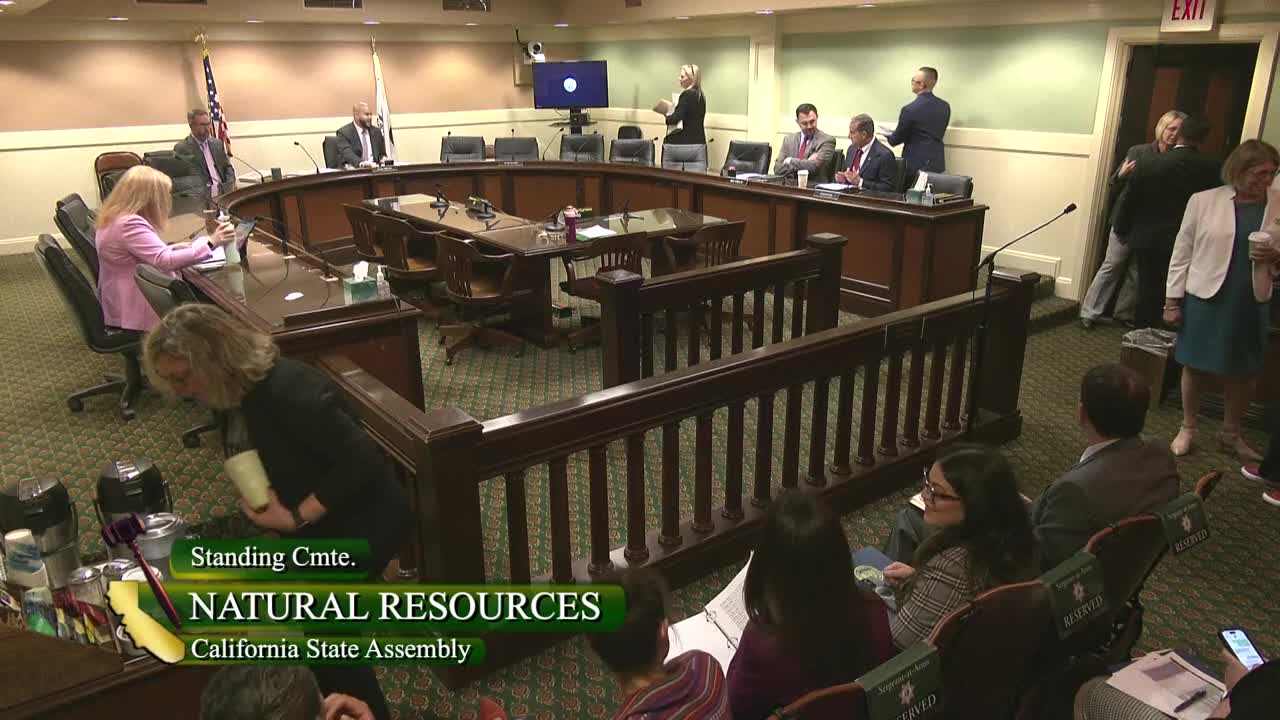 1H
Assembly Standing Committee on Natural Resources
Bill Author