AB 622: Parole: minimum eligible date.
- Session Year: 2025-2026
- House: Assembly
- Latest Version Date: 2025-05-22
Current Status:
Failed
(2026-02-02: From committee: Filed with the Chief Clerk pursuant to Joint Rule 56.)
Introduced
In Committee
Awaiting First Chamber Vote
Passed First Chamber
In Committee
Awaiting Second Chamber Vote
Passed Second Chamber
Enacted
What does this bill do?
The bill requires the Secretary of the Department of Corrections and Rehabilitation to apply all earned credits—such as good-behavior and approved education or rehabilitation credits—to reduce the minimum time a person serving one or more life sentences must serve before becoming eligible for parole. It also requires the Board of Parole Hearings to consider probation officer reports, along with statements from the judge, district attorney, and sheriff, when deciding parole.
The summary is provided by generative AI which can make mistakes. For original language, please view the details in the table below.
Existing law punishes specified crimes, including, among others, some forms of murder and rape, with imprisonment in the state prison for life with the possibility of parole. Existing law states that an inmate imprisoned under a life sentence shall not be paroled until they have served the greater of either 7 years or the minimum term set in their sentence. Existing law, for defendants sentenced for murder, states that specified statutory provisions granting credits to reduce the term of imprisonment shall not apply to reduce the minimum term of imprisonment before the defendant may be paroled. Existing constitutional provisions grant the Department of Corrections and Rehabilitation authority to award credits for good behavior and approved rehabilitative or educational achievements.
This bill would require the Secretary of the Department of Corrections and Rehabilitation to apply all applicable credits under those constitutional provisions to reduce the minimum term or minimum period of confinement of a person imprisoned under one or more life sentences.
Existing law requires the Board of Parole Hearings, when considering a parole for an inmate, to consider, among other things, all statements and recommendations that may have been submitted by the judge, district attorney, and sheriff, as specified.
This bill would additionally require the Board of Parole Hearings to consider any reports filed by the probation officer.
Existing law punishes specified crimes, including, among others, some forms of murder and rape, with imprisonment in the state prison for life with the possibility of parole. Existing law states that an inmate imprisoned under a life sentence shall not be paroled until they have served the greater of either 7 years or the minimum term set in their sentence. Existing law, for defendants sentenced for murder, states that specified statutory provisions granting credits to reduce the term of imprisonment shall not apply to reduce the minimum term of imprisonment before the defendant may be paroled. Existing constitutional provisions grant the Department of Corrections and Rehabilitation authority to award credits for good behavior and approved rehabilitative or educational achievements.
This bill would require the Secretary of the Department of Corrections and Rehabilitation to apply all applicable credits under those constitutional provisions to reduce the minimum term or minimum period of confinement of a person imprisoned under one or more life sentences.
Existing law requires the Department of Corrections and Rehabilitation, when amending or adopting regulations that may impact the visitation of inmates, to recognize and consider the value of visiting as a means to improve prison safety, the important role of inmate visitation in maintaining connection with family and community, and the role of inmate visitation in preparing for successful release.This bill would make a technical, nonsubstantive change to these provisions.Existing law requires the Department of Corrections and Rehabilitation, when amending or adopting regulations that may impact the visitation of inmates, to recognize and consider the value of visiting as a means to improve prison safety, the important role of inmate visitation in maintaining connection with family and community, and the role of inmate visitation in preparing for successful release.
This bill would make a technical, nonsubstantive change to these provisions.
(a)An inmate imprisoned under a life sentence shall not be paroled until they have served the greater of the following:
(1)A term of at least seven calendar years.
(2)A term as established pursuant to any other law that establishes a minimum term or minimum period of confinement under a life sentence before eligibility for parole.
(b)If two or more life sentences are ordered to run consecutively to each other pursuant to Section 669, an inmate so imprisoned shall not be paroled until they have served the term specified in subdivision (a) on each of the life sentences that are ordered to run consecutively.
(c)Notwithstanding subdivisions (a) and (b), an inmate found suitable for parole pursuant to a youth offender parole hearing as described in Section 3051 or an elderly parole hearing as described in Section 3055 shall be paroled regardless of the manner in which the board set release dates pursuant to subdivision (a) of Section 3041, subject to subdivision (b) of Section 3041 and Sections 3041.1 and 3041.2, as applicable.
(d)The Board of Parole Hearings shall, in considering a parole for an inmate, consider all statements and recommendations which that may have been submitted by the judge, district attorney, and sheriff, and any reports filed by the probation officer, pursuant to Section 1203.01, or in response to notices given under Section 3042, and recommendations of other persons interested in the granting or denying of parole. The board shall enter on its order granting or denying parole to these inmates, the fact that the statements and recommendations have been considered by it.
(e)In setting the minimum term or minimum period of confinement for a person imprisoned under one or more life sentences, as described in paragraphs (1) and (2) of subdivision (a), the Secretary of the Department of Corrections and Rehabilitation shall apply all applicable credits promulgated pursuant to the secretarys authority under subdivision (b) of Section 32 of Article I of the California Constitution.
(a)An inmate imprisoned under a life sentence shall not be paroled until he or she has they have served the greater of the following:
(1)A term of at least seven calendar years.
(2)A term as established pursuant to any other law that establishes a minimum term or minimum period of confinement under a life sentence before eligibility for parole.
(b)If two or more life sentences are ordered to run consecutively to each other pursuant to Section 669, an inmate so imprisoned shall not be paroled until he or she has they have served the term specified in subdivision (a) on each of the life sentences that are ordered to run consecutively.
(c)Notwithstanding subdivisions (a) and (b), an inmate found suitable for parole pursuant to a youth offender parole hearing as described in Section 3051 or an elderly parole hearing as described in Section 3055 shall be paroled regardless of the manner in which the board set release dates pursuant to subdivision (a) of Section 3041, subject to subdivision (b) of Section 3041 and Sections 3041.1 and 3041.2, as applicable.
(d)The Board of Parole Hearings shall, in considering a parole for an inmate, consider all statements and recommendations which may have been submitted by the judge, district attorney, and sheriff, pursuant to Section 1203.01, or in response to notices given under Section 3042, and recommendations of other persons interested in the granting or denying of parole. The board shall enter on its order granting or denying parole to these inmates, the fact that the statements and recommendations have been considered by it.
(e)In setting the minimum term or minimum period of confinement for a person imprisoned under one or more life sentences, as described in paragraphs (1) and (2) of subdivision (a), the Secretary of the Department of Corrections and Rehabilitation shall apply all applicable credits promulgated pursuant to the secretarys authority under subdivision (b) of Section 32 of Article I of the California Constitution.
SECTION 1.Section 6400 of the Penal Code is amended to read:6400.Any amendments to existing regulations and any future regulations adopted by the Department of Corrections and Rehabilitation that may impact the visitation of inmates shall do all of the following:(a)Recognize and consider the value of visiting as a means to improve the safety of prisons for both staff and inmates.(b)Recognize and consider the important role of inmate visitation in establishing and maintaining a meaningful connection with family and community.(c)Recognize and consider the important role of inmate visitation in preparing an inmate for successful release and rehabilitation.Any amendments to existing regulations and any future regulations adopted by the Department of Corrections which and Rehabilitation that may impact the visitation of inmates shall do all of the following:
(a)Recognize and consider the value of visiting as a means to improve the safety of prisons for both staff and inmates.
(b)Recognize and consider the important role of inmate visitation in establishing and maintaining a meaningful connection with family and community.
(c)Recognize and consider the important role of inmate visitation in preparing an inmate for successful release and rehabilitation.
|
Date
|
Status
|
|---|---|
| Feb 2, 2026 | From committee: Filed with the Chief Clerk pursuant to Joint Rule 56. |
| Jan 31, 2026 | Died pursuant to Art. IV, Sec. 10(c) of the Constitution. |
| May 22, 2025 | Re-referred to Com. on RLS. pursuant to Assembly Rule 77.2. |
| May 22, 2025 | Read third time and amended. Ordered to third reading. (Page 1638.) |
| Apr 24, 2025 | Read second time. Ordered to third reading. |
| Apr 23, 2025 | From committee: Do pass. (Ayes 10. Noes 4.) (April 23). |
| Apr 9, 2025 | From committee: Do pass and re-refer to Com. on APPR. (Ayes 5. Noes 0.) (April 8). Re-referred to Com. on APPR. |
| Mar 18, 2025 | Re-referred to Com. on PUB. S. |
| Mar 17, 2025 | From committee chair, with author's amendments: Amend, and re-refer to Com. on PUB. S. Read second time and amended. |
| Mar 17, 2025 | Referred to Com. on PUB. S. |
| Feb 14, 2025 | From printer. May be heard in committee March 16. |
| Feb 13, 2025 | Read first time. To print. |
|
Date
|
Description
|
Location
|
Votes
|
|
|---|---|---|---|---|
| Apr 23, 2025 | Do pass. | Assembly Standing Committee on Appropriations |
Passed |
|
| Apr 8, 2025 | Do pass and be re-referred to the Committee on [Appropriations] | Assembly Standing Committee on Public Safety |
Passed |
This list shows positions taken on this bill by organizations on the date displayed, which is linked to the original source.
Positions by individuals are not included.
|
Organization
|
Position
|
Date
|
|---|---|---|
| A New PATH | ** Support | |
| A New Way of Life Re-Entry Project | ** Support | |
| Aclu California Action | ** Support | |
| All of Us or None Los Angeles | ** Support | |
| Alliance for Boys and Men of Color | ** Support | |
| Alliance Of Californians For Community Empowerment | ** Support | |
| American Friends Service Committee | ** Support | |
| Asian Americans Advancing Justice Southern California | ** Support | |
| Bend the Arc: Jewish Action California | ** Support | |
| Black Women For Wellness Action Project | ** Support | |
| Bridges of Hope CA | ** Support | |
| Buen Vecino | ** Support | |
| C.H.A.N.G.E.S | ** Support | |
| California Coalition for Women Prisoners | ** Support | |
| California District Attorneys Association | ** Against | |
| California Public Defenders Association | ** Support | |
| Californians for Safety and Justice | ** Support | |
| Californians United for a Responsible Budget | ** Support | |
| Center on Juvenile and Criminal Justice | ** Support | |
| Community Health Project LA | ** Support | |
| Courage California | ** Support | |
| Criminal Justice Legal Foundation | ** Against | |
| Critical Resistance | ** Support | |
| Critical Resistance Los Angeles | ** Support | |
| Disability Rights California | ** Support | |
| Drug Policy Alliance | ** Support | |
| Ella Baker Center For Human Rights | ** Support | |
| Empowering Women Impacted by Incarceration | ** Support | |
| Fair Chance Project | ** Support | |
| Famm | ** Support | |
| Felony Murder Elimination Project | ** Support | |
| Friends Committee On Legislation Of California | ** Support | |
| Grip Training Institute | ** Support | |
| Indivisible Ca Statestrong | ** Support | |
| Initiate Justice | ** Support | |
| Initiate Justice Action | ** Support | |
| Inland Coalition for Immigrant Justice | ** Support | |
| Justice2jobs Coalition | ** Support | |
| LA Defensa | ** Support | |
| Lawyers' Committee for Civil Rights of the San Francisco Bay Area | ** Support | |
| Legal Services for Prisoners with Children | ** Support | |
| Local 148 La County Public Defenders Union | ** Support | |
| Milpa Collective | ** Support | |
| Pillars of the Community | ** Support | |
| Prison Law Office | ** Support | |
| Prison Policy Initiative | ** Support | |
| Restoring Hope California | ** Support | |
| Riverside County District Attorney | ** Against | |
| Ryse Center | ** Support | |
| Sacred Purpose LLC | ** Support | |
| San Diego County District Attorney's Office | ** Against | |
| San Francisco Public Defender | ** Support | |
| Showing Up for Racial Justice Santa Cruz County | ** Support | |
| Silicon Valley De-Bug | ** Support | |
| Smart Justice California, a project of Tides Advocacy | ** Support | |
| Southeast Asia Resource Action Center | ** Support | |
| Stand Up for Victims | ** Against | |
| Starting Over Inc. | ** Support | |
| The Change Parallel Project | ** Support | |
| Uncommon Law | ** Support | |
| Vera Institute Of Justice | ** Support | |
| White People 4 Black Lives | ** Support | |
| Youth Forward | ** Support |
ASSEMBLY THIRD READING
ATR Bill Id:AB 622
Author:(Kalra)
As Amended Ver:May 22, 2025
Majority vote
SUMMARY
Requires the Secretary of the California Department of Corrections and Rehabilitation (CDCR), in setting the minimum term or minimum period of confinement for a person imprisoned under one or more life sentences, to apply all applicable credits promulgated under CDCR's constitutional authority; and adds reports filed by a probation officer to the list of statements and recommendations the Board of Parole Hearings must consider when determining whether an incarcerated person is suitable for parole.
Major Provisions
COMMENTS
According to the Author
"Under existing law, people incarcerated with an indeterminate sentence can earn credits for good conduct and completing rehabilitative programming. These credits allow them the opportunity to advance their "minimum eligible parole date" (MEPD) and appear before the Board of Parole Hearings, where they undergo an exceptionally rigorous, evidence-based process that prioritizes public safety. In 2024, BPH approved on 14.4% of cases that were scheduled for a hearing.
"However, despite the success of credit-earning programs and the strict parole review process, recent litigation has resulted in CDCR being unable to parole individuals who worked hard to earn a hearing date and demonstrated to the board that they could be safely released to parole supervision. This is contrary to current legal processes and has created unnecessary, costly delays in parole.
"AB 622 reaffirms CDCR's authority to issue credits that would allow someone who has completed the most significant rehabilitative programming to advance their MEPD and be eligible to go before the Board of Parole Hearings. By clarifying that CDCR is permitted to issue these credits, as they have done for years, this bill encourages rehabilitation, ensures fairness in the parole process, and reduces wasteful spending."
Arguments in Support
According to Initiate Justice, a co-sponsor of the bill: "We know from firsthand experience the importance of incentivized programming and the positive impact it has not only on the individuals participating, but on the environment inside and the incarcerated community as a whole. Additionally, we know that those who are serving indeterminate sentences can often serve as role models, leaders, and peer mentors for others in the population due to the significant lengths of time they have been living inside. When these individuals are motivated to participate in programming and educational opportunities, their peers are positively influenced to pursue the same course of action. This bill will ensure these positive paths continue.
"Under the California constitution, people incarcerated with a life sentence with the possibility of parole can earn credits for good conduct and completing educational and other programs. Per CDCR's regulations, people with an indeterminate sentence, which requires appearing before, and receiving approval from, the parole board to determine if release is appropriate, can advance their 'minimum eligible parole date' (MEPD) with these credits.
"From 2017 until the middle of 2024, credits were used to determine when someone with a life sentence was eligible for consideration for release. No one with an indeterminate sentence was released until the Board of Parole Hearings determined they did not pose an 'unreasonable risk of danger to society if released from prison.' This is an exceptionally rigorous, evidence-based process that prioritizes public safety. Between 2018 and 2023, only 11% of people eligible for their first parole hearing were approved by the Board of Parole Hearings.
"The Committee on Revision of the Penal Code also cited in their 2024 annual report that between Fiscal Years 2011–12 and 2018–19, the parole board approved 5,248 people for release. Of those individuals, less than 3% had a new conviction of any kind within 3 years of release, and less than half of a percent had a new felony conviction for an offense against a person. Despite the success of these credit-earning programs, recent litigation has resulted in CDCR being unable to release people with indeterminate sentences who had earned earlier parole eligibility dates with these credits and were approved for release by the parole board. This is contrary to current legal processes and has created unnecessary, costly delays in parole.
"AB 622 simply reaffirms CDCR's authority to issue credits that would allow someone to advance their MEPD and be eligible to go before the Board of Parole Hearings. This bill will enable the individuals who have completed the most significant rehabilitative programming and were found by the parole board to be suitable to re-enter society under parole supervision and reentry programming. By simply restating CDCR's existing statutory authority to issue these credits, AB 622 ensures fairness in the parole process, reduces wasteful spending, and asserts the Legislature's commitment to rehabilitation."
Arguments in Opposition
According to the California District Attorneys Association, "Indeterminate terms are reserved for significant criminal acts, and the vast majority are imposed for murder and significant sexual assaults. These populations represent a significant danger to the safety of Californians and do not warrant a reduction in sentence. After all, the vast majority of conduct credits are granted for following prison rules which should be the bare minimum expectation. It is not evidence of rehabilitation.
"In summary AB 622:
- Undermines Sentencing Certainty – The current parole structure ensures that individuals serving life sentences meet their minimum confinement requirements as determined by the courts. Allowing conduct credit reductions to affect these terms diminishes sentencing integrity and erodes public confidence in the criminal justice system.
- Threatens Public Safety – Life sentences are reserved for the most serious offenses and for major recidivist offenders. Reducing the minimum time served for these individuals risks the premature release of dangerous offenders, increasing the risk of recidivism and harm to victims and communities.
- Contradicts Existing Statutory and Voter-Approved Measures – The exclusion of credit reductions for murderers and violent and habitual sex offenders were enacted to ensure accountability for the most heinous crimes. AB 622 attempts to circumvent these protections, contradicting voter intent and sound prior public policy decisions. As a result, AB 622 will be the subject of substantial litigation and will not likely serve its intended purpose.
"Specifically, the bill incorporates the provision of conduct credits promulgated by the Secretary of CDCR that have never been shown to protect and enhance public safety. CDCR has never even attempted to provide any evidence that the increased credits promulgated under article I, section 32, subdivision (b) "protect and enhance public safety." In fact, CDCR has taken the legal position that they need not provide any such evidence. Further this bill's lack of concern over whether CDCR's credits proclamations do anything other than assist in emptying the prisons of violent criminals is concerning. The voters placed considerable trust in CDCR with their vote for Proposition 57 (General Election (Gen. Elec.), Nov. 8, 2016), but it [sic] hardly likely they would have approved if they knew CDCR would simply declare public safety improvements without a shred of evidence in support of them.
"Further, AB 622 contradicts several prior voter directives that have limited, or outright repealed, credits that the bill attempts to restore. This lack of acknowledgment of prior voter initiatives, some of which did not provide for legislative amendment at all, will both generate unnecessary litigation and appears to be dismissive of voter priorities. Specifically, Proposition 222 in 1996 (Primary Election, June 2, 1998) and Proposition 83 (Gen. Elec., Nov. 7, 2006) deleted the then existing good conduct credit earning regimes for murderers and major sex crimes that that had previously been in place. Proposition 184 (Gen. Elec., Nov. 8, 1994) limited conduct credits, a limit in which CDCR has simply brushed aside with no evidence that public safety is enhanced.
"Finally, the bill ignores why we have minimum terms. Minimum terms ensure that the most reprehensible conduct in society will result in no less than a particular sanction. This bill will benefit those who have committed the most vile of crimes, murder and major sexual assaults. It also targets its benefits to proven recidivists. Whittling away at those minimum terms, especially when the only thing the inmate must do is comply with prison rules, serves to undermine our constitutional requirement of truth in sentencing. (California's Constitution, article I, Section 28, subdivision. (f)(5).) Following prison rules should be the minimum expected, but CDCR rewards the minimum with very generous credits, in some cases up to 66.6%."
FISCAL COMMENTS
According to the Assembly Appropriations Committee, "Cost savings (General Fund) to CDCR in the tens millions of dollars annually in the next few years and potentially ongoing thereafter. According to data from the Board of Parole Hearings (Board) analyzed by this bill's sponsors, there are approximately 129 people who have been granted parole but must each spend three additional years in prison, on average, due to the court order described below. The Legislative Analyst's Office estimates the average annual cost to incarcerate one person in prison is $133,000. Under this bill, those 129 people would be eligible for release now, resulting in cost savings to CDCR of approximately $51.4 million over the next three years. Future cost savings will depend on the number of people granted parole at an earlier date due to credit earning, the amount of time they would otherwise have been required to serve in prison, and the result of the ongoing litigation described below.
"Under this bill, CDCR will also avoid significant workload costs otherwise required to comply with the court order. According to CDCR's legal filings, the department anticipates over 50,000 hours of staff work needed to manually recalculate affected people's parole eligibility dates, plus additional significant workload to cancel and reschedule parole hearings and other parole processes in compliance with the court order."
VOTES
ASM PUBLIC SAFETY: 5-0-4
YES: Schultz, Mark González, Haney, Harabedian, Sharp-Collins
ABS, ABST OR NV: Alanis, Lackey, Nguyen, Ramos
ASM APPROPRIATIONS: 10-4-1
YES: Wicks, Arambula, Calderon, Caloza, Elhawary, Fong, Mark González, Hart, Pellerin, Solache
NO: Sanchez, Dixon, Ta, Tangipa
ABS, ABST OR NV: Pacheco
UPDATED
VERSION: May 22, 2025
CONSULTANT: Andrew Ironside / PUB. S. / (916) 319-3744 FN: 0000487
ASSEMBLY THIRD READING
ATR Bill Id:AB 622
Author:(Kalra)
As Amended Ver:March 17, 2025
Majority vote
SUMMARY
Requires the Secretary of the California Department of Corrections and Rehabilitation (CDCR), in setting the minimum term or minimum period of confinement for a person imprisoned under one or more life sentences, to apply all applicable credits promulgated under CDCR's constitutional authority.
Major Provisions
COMMENTS
According to the Author
"Under existing law, people incarcerated with an indeterminate sentence can earn credits for good conduct and completing rehabilitative programming. These credits allow them the opportunity to advance their "minimum eligible parole date" (MEPD) and appear before the Board of Parole Hearings, where they undergo an exceptionally rigorous, evidence-based process that prioritizes public safety. In 2024, BPH approved on 14.4% of cases that were scheduled for a hearing.
"However, despite the success of credit-earning programs and the strict parole review process, recent litigation has resulted in CDCR being unable to parole individuals who worked hard to earn a hearing date and demonstrated to the board that they could be safely released to parole supervision. This is contrary to current legal processes and has created unnecessary, costly delays in parole.
"AB 622 reaffirms CDCR's authority to issue credits that would allow someone who has completed the most significant rehabilitative programming to advance their MEPD and be eligible to go before the Board of Parole Hearings. By clarifying that CDCR is permitted to issue these credits, as they have done for years, this bill encourages rehabilitation, ensures fairness in the parole process, and reduces wasteful spending."
Arguments in Support
According to Initiate Justice, a co-sponsor of the bill: "We know from firsthand experience the importance of incentivized programming and the positive impact it has not only on the individuals participating, but on the environment inside and the incarcerated community as a whole. Additionally, we know that those who are serving indeterminate sentences can often serve as role models, leaders, and peer mentors for others in the population due to the significant lengths of time they have been living inside. When these individuals are motivated to participate in programming and educational opportunities, their peers are positively influenced to pursue the same course of action. This bill will ensure these positive paths continue.
"Under the California constitution, people incarcerated with a life sentence with the possibility of parole can earn credits for good conduct and completing educational and other programs. Per CDCR's regulations, people with an indeterminate sentence, which requires appearing before, and receiving approval from, the parole board to determine if release is appropriate, can advance their 'minimum eligible parole date' (MEPD) with these credits.
"From 2017 until the middle of 2024, credits were used to determine when someone with a life sentence was eligible for consideration for release. No one with an indeterminate sentence was released until the Board of Parole Hearings determined they did not pose an 'unreasonable risk of danger to society if released from prison.' This is an exceptionally rigorous, evidence-based process that prioritizes public safety. Between 2018 and 2023, only 11% of people eligible for their first parole hearing were approved by the Board of Parole Hearings.
"The Committee on Revision of the Penal Code also cited in their 2024 annual report that between Fiscal Years 2011–12 and 2018–19, the parole board approved 5,248 people for release. Of those individuals, less than 3% had a new conviction of any kind within 3 years of release, and less than half of a percent had a new felony conviction for an offense against a person. Despite the success of these credit-earning programs, recent litigation has resulted in CDCR being unable to release people with indeterminate sentences who had earned earlier parole eligibility dates with these credits and were approved for release by the parole board. This is contrary to current legal processes and has created unnecessary, costly delays in parole.
"AB 622 simply reaffirms CDCR's authority to issue credits that would allow someone to advance their MEPD and be eligible to go before the Board of Parole Hearings. This bill will enable the individuals who have completed the most significant rehabilitative programming and were found by the parole board to be suitable to re-enter society under parole supervision and reentry programming. By simply restating CDCR's existing statutory authority to issue these credits, AB 622 ensures fairness in the parole process, reduces wasteful spending, and asserts the Legislature's commitment to rehabilitation."
Arguments in Opposition
According to the California District Attorneys Association, "Indeterminate terms are reserved for significant criminal acts, and the vast majority are imposed for murder and significant sexual assaults. These populations represent a significant danger to the safety of Californians and do not warrant a reduction in sentence. After all, the vast majority of conduct credits are granted for following prison rules which should be the bare minimum expectation. It is not evidence of rehabilitation.
"In summary AB 622:
- Undermines Sentencing Certainty – The current parole structure ensures that individuals serving life sentences meet their minimum confinement requirements as determined by the courts. Allowing conduct credit reductions to affect these terms diminishes sentencing integrity and erodes public confidence in the criminal justice system.
- Threatens Public Safety – Life sentences are reserved for the most serious offenses and for major recidivist offenders. Reducing the minimum time served for these individuals risks the premature release of dangerous offenders, increasing the risk of recidivism and harm to victims and communities.
- Contradicts Existing Statutory and Voter-Approved Measures – The exclusion of credit reductions for murderers and violent and habitual sex offenders were enacted to ensure accountability for the most heinous crimes. AB 622 attempts to circumvent these protections, contradicting voter intent and sound prior public policy decisions. As a result, AB 622 will be the subject of substantial litigation and will not likely serve its intended purpose.
"Specifically, the bill incorporates the provision of conduct credits promulgated by the Secretary of CDCR that have never been shown to protect and enhance public safety. CDCR has never even attempted to provide any evidence that the increased credits promulgated under article I, section 32, subdivision (b) "protect and enhance public safety." In fact, CDCR has taken the legal position that they need not provide any such evidence. Further this bill's lack of concern over whether CDCR's credits proclamations do anything other than assist in emptying the prisons of violent criminals is concerning. The voters placed considerable trust in CDCR with their vote for Proposition 57 (General Election (Gen. Elec.), Nov. 8, 2016), but it [sic] hardly likely they would have approved if they knew CDCR would simply declare public safety improvements without a shred of evidence in support of them.
"Further, AB 622 contradicts several prior voter directives that have limited, or outright repealed, credits that the bill attempts to restore. This lack of acknowledgment of prior voter initiatives, some of which did not provide for legislative amendment at all, will both generate unnecessary litigation and appears to be dismissive of voter priorities. Specifically, Proposition 222 in 1996 (Primary Election, June 2, 1998) and Proposition 83 (Gen. Elec., Nov. 7, 2006) deleted the then existing good conduct credit earning regimes for murderers and major sex crimes that that had previously been in place. Proposition 184 (Gen. Elec., Nov. 8, 1994) limited conduct credits, a limit in which CDCR has simply brushed aside with no evidence that public safety is enhanced.
"Finally, the bill ignores why we have minimum terms. Minimum terms ensure that the most reprehensible conduct in society will result in no less than a particular sanction. This bill will benefit those who have committed the most vile of crimes, murder and major sexual assaults. It also targets its benefits to proven recidivists. Whittling away at those minimum terms, especially when the only thing the inmate must do is comply with prison rules, serves to undermine our constitutional requirement of truth in sentencing. (California's Constitution, article I, Section 28, subdivision. (f)(5).) Following prison rules should be the minimum expected, but CDCR rewards the minimum with very generous credits, in some cases up to 66.6%."
FISCAL COMMENTS
According to the Assembly Appropriations Committee, "Cost savings (General Fund) to CDCR in the tens millions of dollars annually in the next few years and potentially ongoing thereafter. According to data from the Board of Parole Hearings (Board) analyzed by this bill's sponsors, there are approximately 129 people who have been granted parole but must each spend three additional years in prison, on average, due to the court order described below. The Legislative Analyst's Office estimates the average annual cost to incarcerate one person in prison is $133,000. Under this bill, those 129 people would be eligible for release now, resulting in cost savings to CDCR of approximately $51.4 million over the next three years. Future cost savings will depend on the number of people granted parole at an earlier date due to credit earning, the amount of time they would otherwise have been required to serve in prison, and the result of the ongoing litigation described below.
"Under this bill, CDCR will also avoid significant workload costs otherwise required to comply with the court order. According to CDCR's legal filings, the department anticipates over 50,000 hours of staff work needed to manually recalculate affected people's parole eligibility dates, plus additional significant workload to cancel and reschedule parole hearings and other parole processes in compliance with the court order."
VOTES
ASM PUBLIC SAFETY: 5-0-4
YES: Schultz, Mark González, Haney, Harabedian, Sharp-Collins
ABS, ABST OR NV: Alanis, Lackey, Nguyen, Ramos
ASM APPROPRIATIONS: 10-4-1
YES: Wicks, Arambula, Calderon, Caloza, Elhawary, Fong, Mark González, Hart, Pellerin, Solache
NO: Sanchez, Dixon, Ta, Tangipa
ABS, ABST OR NV: Pacheco
UPDATED
VERSION: March 17, 2025
CONSULTANT: Andrew Ironside / PUB. S. / (916) 319-3744 FN: 0000261
Date of Hearing: April 23, 2025
ASSEMBLY COMMITTEE ON APPROPRIATIONS
Buffy Wicks, Chair
ABPCA Bill Id:AB 622
Author:(Kalra) – As Amended Ver:March 17, 2025
Policy Committee: | Public Safety | Vote: | 5 - 0 |
|
| ||
|
|
Urgency: No State Mandated Local Program: No Reimbursable: No
SUMMARY:
This bill authorizes the California Department of Corrections and Rehabilitation (CDCR) to apply certain credits to advance the minimum eligible parole date of a person serving an indeterminate sentence in CDCR custody.
FISCAL EFFECT:
Cost savings (General Fund) to CDCR in the tens millions of dollars annually in the next few years and potentially ongoing thereafter. According to data from the Board of Parole Hearings (Board) analyzed by this bill’s sponsors, there are approximately 129 people who have been granted parole but must each spend three additional years in prison, on average, due to the court order described below. The Legislative Analyst’s Office estimates the average annual cost to incarcerate one person in prison is $133,000. Under this bill, those 129 people would be eligible for release now, resulting in cost savings to CDCR of approximately $51.4 million over the next three years. Future cost savings will depend on the number of people granted parole at an earlier date due to credit earning, the amount of time they would otherwise have been required to serve in prison, and the result of the ongoing litigation described below.
Under this bill, CDCR will also avoid significant workload costs otherwise required to comply with the court order. According to CDCR’s legal filings, the department anticipates over 50,000 hours of staff work needed to manually recalculate affected people’s parole eligibility dates, plus additional significant workload to cancel and reschedule parole hearings and other parole processes in compliance with the court order.
COMMENTS:
In California, most crimes are subject to determinate sentencing, meaning a person is sentenced to a fixed term of incarceration. When the term is complete, the person is released from custody. Some crimes – including murder and kidnapping – are subject to indeterminate sentencing. Under indeterminate sentencing, a person has no fixed release date. Instead, the person remains in custody indefinitely until their release is approved by the Board. For example, a person may be sentenced to 15 years to life. Traditionally, after serving a period of time set by statute, the person would become eligible for parole consideration by the Board. The date upon which a person is eligible for release on parole is called their “minimum eligible parole date” (MEPD). Under California law, the Board must determine whether a person who is eligible for parole currently poses an unreasonable risk to public safety if released.
In 2016, voters passed Proposition 57, which, in pertinent part, amended the California Constitution to give CDCR authority to award credits for good behavior and approved achievements by incarcerated people. As required by Proposition 57, CDCR promulgated regulations that allow the department to award a variety of credits, including for good conduct, milestone completion, rehabilitative achievement, educational merit, and extraordinary conduct. Under its regulations, CDCR issued credits to some indeterminately-sentenced people, which moved their MEPDs earlier and made them eligible for parole consideration by the Board earlier than they would have been before Proposition 57. Some of those people were deemed suitable for release by the Board at their parole hearings.
However, a Sacramento superior court recently held CDCR’s Proposition 57 regulations exceeded the department’s authority, and ordered CDCR to stop releasing people whose MEPD was advanced by Proposition 57 credits. CDCR is appealing the court’s decision. But in the meantime, 129 people are stuck in prison despite the Board’s determination that they are suitable for parole – they earned credits to advance their MEPD and were granted parole by the Board, but they have not yet reached their statutory release date, and CDCR cannot release them in violation of the court order.
This bill requires CDCR to apply any pertinent credits to advance an indeterminately-sentenced person’s MEPD, including Proposition 57 credits. This will allow the 129 people referenced above to be released on parole, and will permit CDCR to resume providing earlier parole consideration to indeterminately-sentenced people who earn specified rehabilitative credits.
Analysis Prepared by: Annika Carlson / APPR. / (916) 319-2081
Date of Hearing:
Chief Counsel: Andrew Ironside
ASSEMBLY COMMITTEE ON PUBLIC SAFETY
Nick Schultz, Chair
ABPCA Bill Id:AB 622
Author:(Kalra) – As Amended Ver:March 17, 2025
SUMMARY:
Requires the Secretary of the California Department of Corrections and Rehabilitation (CDCR), in setting the minimum term or minimum period of confinement for a person imprisoned under one or more life sentences, to apply all applicable credits promulgated under CDCR’s constitutional authority.
EXISTING LAW:
- Provides that CDCR has the authority to award credits earned for good behavior and approved rehabilitative or education achievements. (Cal. Const., art. I, § 32, subd. (a), par. (2).)
- Requires the Board of Parole Hearings (BPH) to meet with each inmate during the sixth year before the inmate’s minimum eligible parole date for the purposes of reviewing and documenting the inmate’s activities and conduct pertinent to parole eligibility. (Pen. Code, § 3041, subd. (a)(1).)
- Requires BPH, during this consultation, to provide the inmate information about the parole hearing process legal factors relevant to their suitability or unsuitability for parole, and individualized recommendations for the inmate regarding their work assignments, rehabilitative programs, and institutional behavior. (Pen. Code, § 3041, subd. (a)(1).)
- Provides that one year before the inmate’s minimum eligible parole date a panel of two or more commissioners or deputy commissioners shall meeting with the inmate and shall normally grant parole, as specified. (Pen. Code, § 3041, subd. (a)(2).)
- Prohibits an incarcerated person imprisoned under a life sentence from being paroled until they have served the greater of the following:
- A term of at least seven calendar years; or,
- A term as established under any other law that establishes a minimum term or minimum period of confinement under a life sentence before eligibility for parole. (Pen. Code, § 3046, subd. (a).)
- A term of at least seven calendar years; or,
- Prohibits, if two or more life sentences are ordered to run consecutively to each other, as specified, an incarcerated person so imprisoned from being paroled until they have served the term above on each of the life sentences that are ordered to run consecutively. (Pen. Code, § 3046, subd. (b).)
- Requires an incarcerated person found suitable for parole following a youth offender parole hearing or an elderly parole hearing, as specified, to be paroled regardless of the manner in which the board sets release dates. (Pen. Code, § 3046, subd. (c).)
- Requires the BPH, in considering parole for an incarcerated person, to consider all statements and recommendations which may have been submitted by the judge, district attorney, and sheriff, or in response to specified notifications, and recommendations of other persons interested in the granting or denying of parole. (Pen. Code, § 3046, subd. (d).)
- Requires BPH to enter on its order granting or denying parole to these incarcerated people, the fact that the statements and recommendations have been considered by it. (Pen. Code, § 3046, subd. (d).)
- Provides that incarcerated persons are expected to work or participate in rehabilitative programs and activities to prepare for their eventual return to society. (Cal. Code Regs., tit. 15, § 3043, subd. (a).)
- Provides that incarcerated persons who comply with CDCR regulations and rules and perform the duties assigned to them shall be eligible to earn Good Conduct Credit, as specified. (Cal. Code Regs., tit. 15, § 3043, subd. (a); § 3043.2, subd. (b).)
- Provides that all incarcerated persons who participate in approved rehabilitative programs and activities, including incarcerated persons housed in restricted housing units or in other restricted housing, shall be eligible to earn Milestone Completion Credit, Rehabilitative Achievement Credit, and Educational Merit Credit, as specified. (Cal. Code Regs., tit. 15, § 3043, subd. (a).)
- Provides that the award of these credits, as well as Extraordinary Conduct Credit as specified, shall advance an incarcerated person's release date if sentenced to a determinate term or an incarcerated person's initial parole hearing date if sentenced to an indeterminate term with the possibility of parole. (Cal. Code Regs., tit. 15, § 3043, subd. (a).)
- Provides that incarcerated persons who do not comply with CDCR regulations and rules or who do not perform the duties assigned to them shall be subject to credit forfeiture, as specified. (Cal. Code Regs., tit. 15, § 3043, subd. (a).)
FISCAL EFFECT:
Unknown
COMMENTS:
- Author's Statement: According to the author, “Under existing law, people incarcerated with an indeterminate sentence can earn credits for good conduct and completing rehabilitative programming. These credits allow them the opportunity to advance their “minimum eligible parole date” (MEPD) and appear before the Board of Parole Hearings, where they undergo an exceptionally rigorous, evidence-based process that prioritizes public safety. In 2024, BPH approved on 14.4% of cases that were scheduled for a hearing.
“However, despite the success of credit-earning programs and the strict parole review process, recent litigation has resulted in CDCR being unable to parole individuals who worked hard to earn a hearing date and demonstrated to the board that they could be safely released to parole supervision. This is contrary to current legal processes and has created unnecessary, costly delays in parole.
“AB 622 reaffirms CDCR’s authority to issue credits that would allow someone who has completed the most significant rehabilitative programming to advance their MEPD and be eligible to go before the Board of Parole Hearings. By clarifying that CDCR is permitted to issue these credits, as they have done for years, this bill encourages rehabilitation, ensures fairness in the parole process, and reduces wasteful spending.” - Need for the Bill: Proposition 57 was passed by the electorate (Ballot Pamp., Gen. Elec. Nov. 8, 2016) and implemented as Article I, section 32 of the California Constitution. Section 32, subdivision (a)(2) of Article I, states: “Credit Earning: The Department of Corrections and Rehabilitation shall have authority to award credits earned for good behavior and approved rehabilitative or educational achievements.” Proposition 57 gave CDCR the authority to create its own credit rules.[1] “By its plain terms, article I, section 32, subdivision (a)(2) authorizes the Department to award—or to not award—conduct credits as it sees fit.” (In re Canady (2020) 57 Cal.App.5th 1022, 1034, citing Brown v. Superior Court (2016) 63 Cal.4th 335, 359, 361 (dis. opn. of Chin, J.) “The broad and permissive language of article I, section 32, subdivision (a)(2) suggests that the voters intended for the Department to have substantial discretion in determining how credits are applied to early parole consideration….” (In re Canady, supra, 57 Cal. App.5th at p. 1034.)
In May 2017, CDCR promulgated new credit-earning regulations that, among other things, provided any person sentenced to an indeterminate term the opportunity to earn credits to advance their minimum eligible parole date. These regulations provide that “all incarcerated persons who participate in approved rehabilitative programs and activities, including incarcerated persons housed in restricted housing units or in other restricted housing, shall be eligible” for credits “advance[ing] an incarcerated person's initial parole hearing date…if sentenced to an indeterminate term with the possibility of parole.” (Cal. Code Regs., tit. 15, § 3043, subd. (a).) By receiving good conduct credits and participating in rehabilitative opportunities, persons sentenced to indeterminate terms could appear before the BPH sooner.
But this did not guarantee their release. Even if eligible for parole, the BPH still must find that person suitable for parole, which requires finding that the individual does not pose an unreasonable risk to public safety.[2] And, even if released, an individual is still subject to parole supervision and must comply with specific parole conditions. Violation of those conditions could result in that individual being reincarcerated.
Notwithstanding this process, a person serving an indeterminate term that BPH has found suitable for parole is no longer eligible for release. Recent litigation has called into question CDCR’s authority to advance the minimum eligible parole date for persons with indeterminate terms. In December 2023, a superior court ruled that CDCR had exceeded its authority under Prop. 57. Accordingly, CDCR states, “Pursuant to a December 13, 2023 ruling and January 26, 2024 judgment by the Sacramento County Superior Court, CDCR is currently prohibited from releasing on parole, indeterminately sentenced people who had a parole hearing conducted based on a Minimum Parole Eligibility Date that was advanced (made earlier) based on Proposition 57 credit earning.”[3] CDCR has appealed the ruling.
While the issue makes its way through the courts, CDCR has been forced to modify its procedures for dealing with persons serving indeterminate terms. According to CDCR, the people impacted by the litigation are “[p]eople who (1) the Board of Parole Hearings has found suitable for parole; and (2) are indeterminately sentenced; and (3) were eligible for their parole hearing because minimum eligible parole date (MEPD) was advanced (made earlier) by application of Prop. 57 credits.”[4] For people already found suitable for parole, “CDCR will recalculate the [minimum eligible parole date] by removing Prop 57 credits” but “only after someone is granted parole.” [5] CDCR states that “[t]he parole grant will remain in place and you will be eligible for release on your newly calculated [minimum eligible parole date], or earliest parole eligible date.”[6] The Board of Parole Hearings “will continue to conduct parole hearings based on” an incarcerated persons minimum eligible parole date based on Prop. 57 credits.[7]
This bill would clarify in statute that CDCR does have the authority to apply all applicable credits promulgated under its constitutional authority to persons sentenced to indeterminate terms. - Committee on Revision on the Penal Code Recommendation: The Committee on Revision of the Penal Code (CRPC) was established to study and recommend statutory reforms to the criminal law, with “the goals of improving public safety, reducing unnecessary incarceration, improving equity, and addressing racial disparities in the criminal legal system.[8] In its most recent report, CRPC stated:
The Committee has concluded that the Legislature should clarify to the maximum extent possible in the Penal Code that credits promulgated by CDCR under its constitutional authority apply to MEPDs. Doing so would improve public safety by allowing sentence-reducing credits to incentive [sic] rehabilitation for people in prison. It would asl save the state significant money by allowing the release of people who present a very low risk to the public.[9]
CRPC noted that less than .5% of persons BPH approved for parole between 2011 and 2019 were convicted of an offense against a person, and that credit earning may reduce recidivism.[10] As a result, CRPC recommended that the Legislature “[s]pecify in the Penal Code that the credits created under Proposition 57’s constitutional provisions should continue to be applied to minimum eligible parole dates.”[11]
- Prison Overcrowding: In January 2010, a three-judge panel issued a ruling ordering the State of California to reduce its prison population to 137.5% of design capacity because overcrowding was the primary reason that CDCR was unable to provide inmates with constitutionally adequate healthcare. After continued litigation, on February 10, 2014, the federal court ordered California to reduce its in-state adult institution population to 137.5% of design capacity by February 28, 2016, as follows: 143% of design bed capacity by June 30, 2014; 141.5% of design bed capacity by February 28, 2015; and, 137.5% of design bed capacity by February 28, 2016.
CDCR’s most recent monthly report on the prison population notes that the state prison population is at 87,660. CDCR’s institutional design capacity is 71,656 as of March 26, 2025. Accordingly, CDCR is currently occupying 122.3 percent of design capacity.[12]
Thus, while CDCR is currently in compliance with the three-judge panel’s order on the prison population, the state needs to maintain a “durable solution” to prison overcrowding “consistently demanded” by the court.[13] In addition, the State’s commitment to closing prisons[14] demands that the Legislature is judicious about measures that will result in increased prison population.
CDCR has identified that part of this “durable remedy” is “increased credit-earning opportunities for all incarcerated persons except the condemned and those serving life without parole.”[15] The recent court order halted part of CDCR’s efforts to reduce prison populations by providing credit-earning opportunities to persons serving indeterminate sentences. This bill would confirm in statute CDCR’s constitutional authority to provide those opportunities.
- Argument in Support: According to Initiate Justice, a co-sponsor of the bill: “We know from firsthand experience the importance of incentivized programming and the positive impact it has not only on the individuals participating, but on the environment inside and the incarcerated community as a whole. Additionally, we know that those who are serving indeterminate sentences can often serve as role models, leaders, and peer mentors for others in the population due to the significant lengths of time they have been living inside. When these individuals are motivated to participate in programming and educational opportunities, their peers are positively influenced to pursue the same course of action. This bill will ensure these positive paths continue.
“Under the California constitution, people incarcerated with a life sentence with the possibility of parole can earn credits for good conduct and completing educational and other programs. Per CDCR’s regulations, people with an indeterminate sentence, which requires appearing before, and receiving approval from, the parole board to determine if release is appropriate, can advance their ‘minimum eligible parole date’ (MEPD) with these credits.
“From 2017 until the middle of 2024, credits were used to determine when someone with a life sentence was eligible for consideration for release. No one with an indeterminate sentence was released until the Board of Parole Hearings determined they did not pose an ‘unreasonable risk of danger to society if released from prison.’ This is an exceptionally rigorous, evidence-based process that prioritizes public safety. Between 2018 and 2023, only 11% of people eligible for their first parole hearing were approved by the Board of Parole Hearings.
“The Committee on Revision of the Penal Code also cited in their 2024 annual report that between Fiscal Years 2011–12 and 2018–19, the parole board approved 5,248 people for release. Of those individuals, less than 3% had a new conviction of any kind within 3 years of release, and less than half of a percent had a new felony conviction for an offense against a person. Despite the success of these credit-earning programs, recent litigation has resulted in CDCR being unable to release people with indeterminate sentences who had earned earlier parole eligibility dates with these credits and were approved for release by the parole board. This is contrary to current legal processes and has created unnecessary, costly delays in parole.
“AB 622 simply reaffirms CDCR’s authority to issue credits that would allow someone to advance their MEPD and be eligible to go before the Board of Parole Hearings. This bill will enable the individuals who have completed the most significant rehabilitative programming and were found by the parole board to be suitable to re-enter society under parole supervision and reentry programming. By simply restating CDCR’s existing statutory authority to issue these credits, AB 622 ensures fairness in the parole process, reduces wasteful spending, and asserts the Legislature’s commitment to rehabilitation.” - Argument in Opposition: According to the California District Attorneys Association, “Indeterminate terms are reserved for significant criminal acts, and the vast majority are imposed for murder and significant sexual assaults. These populations represent a significant danger to the safety of Californians and do not warrant a reduction in sentence. After all, the vast majority of conduct credits are granted for following prison rules which should be the bare minimum expectation. It is not evidence of rehabilitation.
“In summary AB 622:
- Undermines Sentencing Certainty – The current parole structure ensures that individuals serving life sentences meet their minimum confinement requirements as determined by the courts. Allowing conduct credit reductions to affect these terms diminishes sentencing integrity and erodes public confidence in the criminal justice system.
- Threatens Public Safety – Life sentences are reserved for the most serious offenses and for major recidivist offenders. Reducing the minimum time served for these individuals risks the premature release of dangerous offenders, increasing the risk of recidivism and harm to victims and communities.
- Contradicts Existing Statutory and Voter-Approved Measures – The exclusion of credit reductions for murderers and violent and habitual sex offenders were enacted to ensure accountability for the most heinous crimes. AB 622 attempts to circumvent these protections, contradicting voter intent and sound prior public policy decisions. As a result, AB 622 will be the subject of substantial litigation and will not likely serve its intended purpose.
“Specifically, the bill incorporates the provision of conduct credits promulgated by the Secretary of CDCR that have never been shown to protect and enhance public safety. CDCR has never even attempted to provide any evidence that the increased credits promulgated under article I, section 32, subdivision (b) “protect and enhance public safety.” In fact, CDCR has taken the legal position that they need not provide any such evidence. Further this bill’s lack of concern over whether CDCR’s credits proclamations do anything other than assist in emptying the prisons of violent criminals is concerning. The voters placed considerable trust in CDCR with their vote for Proposition 57 (Gen. Elec., Nov. 8, 2016), but it [sic] hardly likely they would have approved if they knew CDCR would simply declare public safety improvements without a shred of evidence in support of them.
“Further, AB 622 contradicts several prior voter directives that have limited, or outright repealed, credits that the bill attempts to restore. This lack of acknowledgment of prior voter initiatives, some of which did not provide for legislative amendment at all, will both generate unnecessary litigation and appears to be dismissive of voter priorities. Specifically, Proposition 222 in 1996 (Primary Elec., June 2, 1998) and Proposition 83 (Gen. Elec., Nov. 7, 2006) deleted the then existing good conduct credit earning regimes for murderers and major sex crimes that that had previously been in place. Proposition 184 (Gen. Elec., Nov. 8, 1994) limited conduct credits, a limit in which CDCR has simply brushed aside with no evidence that public safety is enhanced.
“Finally, the bill ignores why we have minimum terms. Minimum terms ensure that the most reprehensible conduct in society will result in no less than a particular sanction. This bill will benefit those who have committed the most vile of crimes, murder and major sexual assaults. It also targets its benefits to proven recidivists. Whittling away at those minimum terms, especially when the only thing the inmate must do is comply with prison rules, serves to undermine our constitutional requirement of truth in sentencing. (Cal. Const., art. I, § 28, subd. (f)(5).) Following prison rules should be the minimum expected, but CDCR rewards the minimum with very generous credits, in some cases up to 66.6 percent.”
- Related Legislation:
- AB 47 (Nguyen) would exempt from the Elderly Parole Program persons convicted of specified sex offenses or persons convicted of crimes requiring registration as a sex offender. AB 47 is pending a hearing in this committee.
- AB 1011 (Hoover) would makes any person convicted of specific child neglect offenses ineligible to earn credits for their service as an inmate firefighter. AB 1011 is scheduled for hearing today in this committee.
- AB 1094 (Bains) would require any person convicted of torture where the victim is 14 years of age or younger and the person is in care or custody of the victim, to serve a minimum term of 20 years before being eligible for release. AB 1094 is pending hearing in the Assembly Appropriations Committee.
- AB 47 (Nguyen) would exempt from the Elderly Parole Program persons convicted of specified sex offenses or persons convicted of crimes requiring registration as a sex offender. AB 47 is pending a hearing in this committee.
- Prior Legislation:
- AB 1898 (Flora), of the 2023-2024 Legislative Session, would prohibit a person convicted of specified child pornography offenses, who previously has been convicted of and has served two or more separate prior prison terms for specified offenses, from receiving release credits. AB 1898 was held in suspense in the Assembly Appropriations Committee.
- AB 2341 (V. Fong), of the 2023-2024 Legislative Session, would prohibit the granting of release credits to an inmate serving a sentence for a fentanyl-related offense, as specified. The hearing on AB 2341 was cancelled at the request of the author.
- SB 359 (Umberg), of the 2023-2024 Legislative Session, would have required CDCR to compile data related to credits awarded to incarcerated persons, as specified, and to submit an annual report to the Legislature on or before January 1, 2025. SB 359 failed passage in this committee.
- SB 445 (Jones), of the 2021-2022 Legislative Session, would have excluded “one strike” sex offenses from the Elderly Parole Program. SB 445 failed passage in the Senate Public Safety Committee.
- SB 411 (Jones), of the 2019-2020 Legislative Session, was nearly identical to SB 445 above. SB 411 failed passage in the Senate Public Safety Committee.
- AB 1448 (Weber), Chapter 676, Statutes of 2017, codified the Elderly Parole Program to be administered by the BPH.
- AB 1898 (Flora), of the 2023-2024 Legislative Session, would prohibit a person convicted of specified child pornography offenses, who previously has been convicted of and has served two or more separate prior prison terms for specified offenses, from receiving release credits. AB 1898 was held in suspense in the Assembly Appropriations Committee.
REGISTERED SUPPORT / OPPOSITION:
Support
A New Path
A New Way of Life Re-entry Project
ACLU California Action
All of Us or None Los Angeles
Alliance for Boys and Men of Color
Alliance of Californians for Community Empowerment (acce Action)
American Friends Service Committee
Asian Americans Advancing Justice Southern California
Bend the Arc: Jewish Action California
Black Women for Wellness Action Project
Bridges of Hope CA
Buen Vecino
C.h.a.n.g.e.s
California Coalition for Women Prisoners
California Public Defenders Association (CPDA)
Californians for Safety and Justice
Californians United for A Responsible Budget
Center on Juvenile and Criminal Justice
Community Health Project LA
Courage California
Critical Resistance
Critical Resistance, Los Angeles
Disability Rights California
Drug Policy Alliance
Ella Baker Center for Human Rights
Empowering Women Impacted by Incarceration
Fair Chance Project
Famm
Felony Murder Elimination Project
Friends Committee on Legislation of California
Grip Training Institute
Indivisible CA Statestrong
Initiate Justice
Initiate Justice Action
Inland Coalition for Immigrant Justice
Justice2jobs Coalition
LA Defensa
Lawyers' Committee for Civil Rights of The San Francisco Bay Area
Legal Services for Prisoners With Children
Local 148 LA County Public Defenders Union
Milpa Collective
Pillars of The Community
Prison Law Office
Prison Policy Initiative
Restoring Hope California
Ryse Center
Sacred Purpose LLC
San Francisco Public Defender
Showing Up for Racial Justice Santa Cruz County
Silicon Valley De-bug
Smart Justice California, a Project of Tides Advocacy
Southeast Asia Resource Action Center
Starting Over INC.
The Change Parallel Project
Uncommon Law
Vera Institute of Justice
White People 4 Black Lives
Youth Forward
53 private individuals
Oppose
California District Attorneys Association
Criminal Justice Legal Foundation
Riverside County District Attorney
San Diego County District Attorney's Office
Stand Up for Victims
Analysis Prepared by:
Andrew Ironside / PUB. S. / (916) 319-3744
See https://www.capolicylab.org/wp-content/uploads/2022/08/Three-Strikes-in-California.pdf at p. 8. ↑
https://www.cdcr.ca.gov/bph/parole-suitability-hearings-overview/information-considered-at-a-parole-suitability-hearing/ ↑
https://www.cdcr.ca.gov/bph/wp-content/uploads/sites/161/2024/07/Fact-Sheet-CJLF-Litigation-Impact-to-Release-Dates.pdf ↑
Id. at p. 2. ↑
Id. at p. 2. ↑
Id. at p. 2. ↑
Id. at p. 3. ↑
Committee on Revision of the Penal Code, 2024 Annual Report (Dec. 2024) at p. 3 <https://clrc.ca.gov/CRPC/Pub/Reports/CRPC_AR2024.pdf> [last visited Mar. 31, 2025]. ↑
Id. at p. 53. ↑
Id. at p. 54. ↑
Committee on Revision of the Penal Code, 2024 Annual Report (Dec. 2024) at p. 52 <https://clrc.ca.gov/CRPC/Pub/Reports/CRPC_AR2024.pdf> [last visited Mar. 31, 2025]. ↑
Opinion Re: Order Granting in Part and Denying in Part Defendants’ Request For Extension of December 31, 2013 Deadline, NO. 2:90-cv-0520 LKK DAD (PC), 3-Judge Court, Coleman v. Brown, Plata v. Brown (2-10-14).) ↑
11) LAO, The 2024-25 Budget, California Department of Corrections and Rehabilitation. Available at: <https://lao.ca.gov/Publications/Report/4852#Prison_Capacity_Reduction>. see also, Penal Code section 17.5 [criminal justice policies that rely on building and operating more prisons to address community safety concerns are not sustainable, and will not result in improved public safety]. ↑
https://www.cdcr.ca.gov/3-judge-court-update/#cc7a5a69-6fa6-4036-8a4f-27e459004d88-link ↑
Discussed in Hearing
 13MIN
Assembly Standing Committee on Appropriations
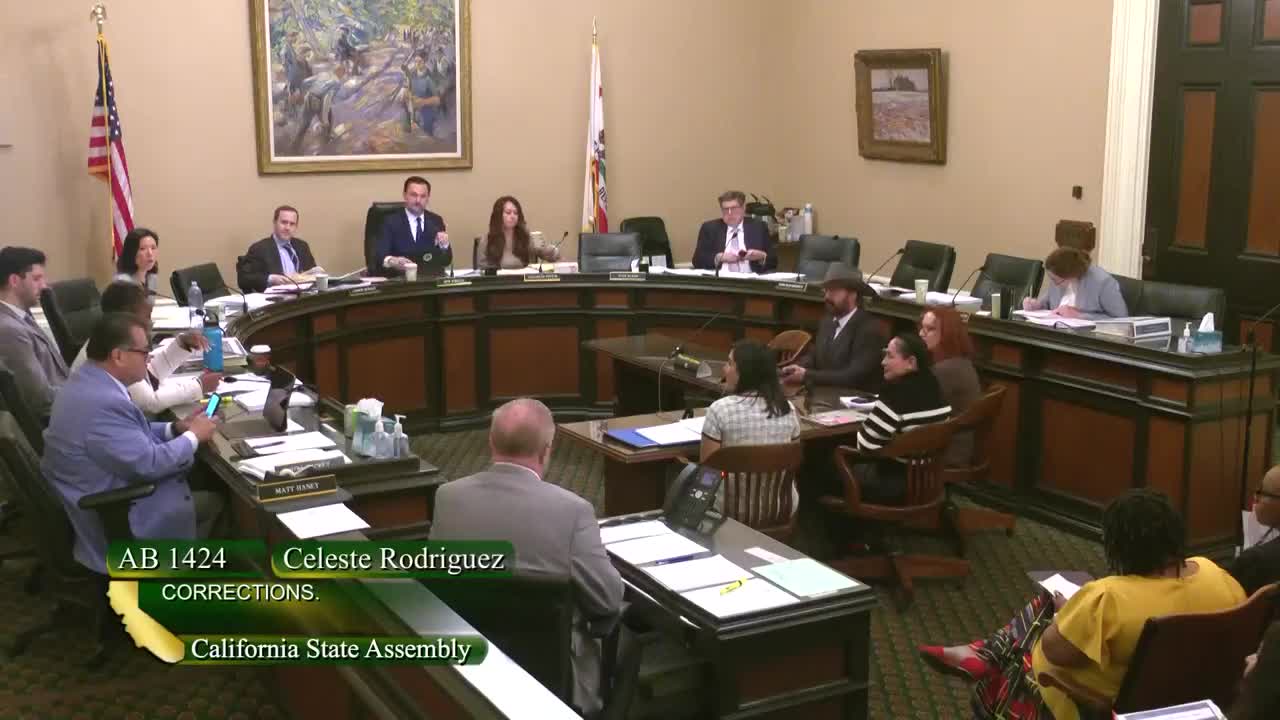 20MIN
Assembly Standing Committee on Public Safety
Bill Author

Bill Co-Author(s):