AB 2288: Labor Code Private Attorneys General Act of 2004.
- Session Year: 2023-2024
- House: Assembly
- Latest Version Date: 2024-07-01
Current Status:
Passed
(2024-07-01: Chaptered by Secretary of State - Chapter 44, Statutes of 2024.)
Introduced
In Committee
First Chamber
In Committee
Second Chamber
Enacted
What does this bill do?
This bill changes how California’s Private Attorneys General Act (PAGA) works, affecting employers and workers by changing who can bring representative claims and how civil penalties are calculated. For employers with employees it makes $100 the default penalty per affected employee per pay period, but cuts that to $25 or $50 for certain wage-statement mistakes or short, isolated errors and keeps $200 for repeat or malicious violations. Courts can sharply reduce penalties if employers took reasonable steps to comply (down to about 15% or 30%), recovered penalties are split 65% to the Labor and Workforce Development Agency and 35% to workers, and qualified nonprofit legal-aid groups may serve as counsel in PAGA cases.
The summary is provided by generative AI which can make mistakes. For original language, please view the details in the table below.
Existing law, the Labor Code Private Attorneys General Act of 2004 (PAGA), authorizes an aggrieved employee, as defined, to bring a civil action, on behalf of that employee and other current or former employees, to enforce a violation of any provision of the Labor Code that provides for a civil penalty to be assessed and collected by the Labor and Workforce Development Agency or any of its departments, divisions, commissions, boards, agencies, or employees pursuant to certain notice and cure provisions, as prescribed.
This bill would, among other things, instead authorize an aggrieved employee to bring a civil action as described above on behalf of the employee and other current or former employees against whom a violation of the same provision was committed.
With respect to a violation by a person of a provision that does not provide for a civil penalty, PAGA makes that person liable for a civil penalty of $500 if, at the time of the alleged violation, the person does not employ one or more employees. If, at the time of the alleged violation, the person employed one or more employees, PAGA makes that person liable for a civil penalty of $100 for each aggrieved employee per pay period for the initial violation and $200 for each aggrieved employee per pay period for each subsequent violation. PAGA requires 75% of civil penalties recovered by aggrieved employees to be distributed to the Labor and Workforce Development Agency for enforcement of labor laws, including the administration of PAGA, and for education of employers and employees about their rights and responsibilities under the Labor Code, as specified, and requires 25% of civil penalties recovered by aggrieved employees to be distributed to the aggrieved employees, except as prescribed.
This bill would instead, if, at the time of the alleged violation, the person employed one or more employees, make that person liable for a civil penalty of $100 for each aggrieved employee per pay period, except if certain mitigating factors apply, including that the alleged violation resulted from an isolated, nonrecurring event that did not extend beyond the lesser of 30 consecutive days or 4 consecutive pay periods, in which case the bill would make the civil penalty $25 or $50, except as provided. The bill would, subject to an exception, also reduce the civil penalties prescribed by PAGA by 15% or 30%, as specified, if a person accused of a violation has taken all reasonable steps to comply with the provisions alleged to have been violated in the required notice provided by the aggrieved employee, as prescribed.
This bill would apply its provisions to a civil action brought on or after June 19, 2024, except as specified.
This bill would become operative only if SB 92 of the 202324 Regular Session is enacted and takes effect on or before January 1, 2025.
This bill would declare that it is to take effect immediately as an urgency statute.
Existing law, the Labor Code Private Attorneys General Act of 2004, authorizes an aggrieved employee, on behalf of themselves and other current or former employees, to bring a civil action pursuant to specified procedures for a violation of a provision of the Labor Code that provides for a civil penalty to be assessed and collected by the Labor and Workforce Development Agency. Existing law establishes a civil penalty for provisions of the Labor Code for which a civil penalty is not specifically provided, and, with specified exceptions, similarly authorizes an aggrieved employee to recover that civil penalty in a civil action. Existing law, for its purposes, authorizes a court, whenever the agency has discretion to assess a civil penalty, to exercise the same discretion, as prescribed.This bill would additionally authorize the award of injunctive relief.Existing law, the Labor Code Private Attorneys General Act of 2004, authorizes an aggrieved employee, on behalf of themselves and other current or former employees, to bring a civil action pursuant to specified procedures for a violation of a provision of the Labor Code that provides for a civil penalty to be assessed and collected by the Labor and Workforce Development Agency. Existing law establishes a civil penalty for provisions of the Labor Code for which a civil penalty is not specifically provided, and, with specified exceptions, similarly authorizes an aggrieved employee to recover that civil penalty in a civil action. Existing law, for its purposes, authorizes a court, whenever the agency has discretion to assess a civil penalty, to exercise the same discretion, as prescribed.
This bill would additionally authorize the award of injunctive or declaratory relief.
Existing law, the Labor Code Private Attorneys General Act of 2004, authorizes an aggrieved employee, on behalf of themselves and other current or former employees, to bring a civil action pursuant to specified procedures for a violation of a provision of the Labor Code that provides for a civil penalty to be assessed and collected by the Labor and Workforce Development Agency. Existing law establishes a civil penalty for provisions of the Labor Code for which a civil penalty is not specifically provided, and, with specified exceptions, similarly authorizes an aggrieved employee to recover that civil penalty in a civil action. Existing law, for its purposes, authorizes a court, whenever the agency has discretion to assess a civil penalty, to exercise the same discretion, as prescribed.
This bill would additionally authorize the award of injunctive or declaratory relief.
The California Constitution vests the judicial power of the state in the Supreme Court, courts of appeal, and superior courts, and establishes the Judicial Council to, among other things, adopt rules of court and perform functions prescribed by statute. Existing law authorizes the Judicial Council to publish and distribute manuals, guides, checklists, and other materials designed to assist the judiciary.This bill would authorize the Judicial Council to publish these materials on its internet website or a superior court to publish the documents on the individual courts website.The California Constitution vests the judicial power of the state in the Supreme Court, courts of appeal, and superior courts, and establishes the Judicial Council to, among other things, adopt rules of court and perform functions prescribed by statute. Existing law authorizes the Judicial Council to publish and distribute manuals, guides, checklists, and other materials designed to assist the judiciary.
This bill would authorize the Judicial Council to publish these materials on its internet website or a superior court to publish the documents on the individual courts website.
(a)Notwithstanding any other provision of law, any provision of this code that provides for a civil penalty to be assessed and collected by the Labor and Workforce Development Agency or any of its departments, divisions, commissions, boards, agencies, or employees, for a violation of this code, may, as an alternative, be recovered through a civil action brought by an aggrieved employee on behalf of the employee and other current or former employees against whom a violation of the same provision was committed pursuant to the procedures specified in Section 2699.3.
(b)For purposes of this part, person has the same meaning as defined in Section 18.
(c)(1)For purposes of this part, aggrieved employee means any person who was employed by the alleged violator and personally suffered each of the violations alleged during the period prescribed under Section 340 of the Code of Civil Procedure, except that for purposes of actions brought pursuant to paragraph (2), aggrieved employee means any person who was employed by the alleged violator against whom one or more of the alleged violations was committed within the period prescribed under Section 340 of the Code of Civil Procedure.
(2)Notwithstanding paragraph (1), a nonprofit legal aid organization that has obtained Section 501(c)(3) tax-exempt status, is a qualified legal services project or qualified support center, as defined in Section 6213 of the Business and Professions Code, and has served as counsel of record in civil actions under this part for at least five years prior to January 1, 2025, may file a civil action pursuant to this part as counsel of record for an aggrieved employee on behalf of the employee and one or more current or former employees against whom one or more of the alleged violations was committed. Nothing in this provision establishes standing for the nonprofit legal aid organization as a party in the civil action.
(d)(1)For purposes of subdivisions (c) and (f) of Section 2699.3, and except for violations of subdivision (a) of Section 226, cure means that the employer corrects the violation alleged by the aggrieved employee, is in compliance with the underlying statutes specified in the notice required by this part, and each aggrieved employee is made whole. An employee who is owed wages is made whole when the employee has received an amount sufficient to recover any owed unpaid wages due under the underlying statutes specified in the notice dating back three years from the date of the notice, plus 7 percent interest, any liquidated damages as required by statute, and reasonable lodestar attorneys fees and costs to be determined by the agency or the court. In case of a dispute over the amount of unpaid wages due, nothing in this part prohibits an employer from curing the alleged violations by paying amounts sufficient to cover any unpaid wages that the agency or court determine could reasonably be owed to the aggrieved employees based on the violations alleged in notice.
(2)(A)A violation of paragraph (8) of subdivision (a) of Section 226 shall be considered cured only upon a showing that the employer has provided written notice of the correct information to each aggrieved employee. Such notice may be provided in summary form but shall identify correct information for each pay period in which a violation occurred.
(B)A violation of paragraphs (1) to (7), inclusive, and (9) of subdivision (a) of Section 226 shall be considered cured only upon a showing that the employer has provided, at no cost to the employee, a fully compliant, itemized wage statement or, if such information is customarily provided in digital form, reasonable access to a digital or computer-generated record or records maintained in the ordinary course of business containing the same information required on a fully compliant, itemized wage statement, to each aggrieved employee for each pay period during which the violation occurred during the three years prior to the date of the notice. Nothing in this subdivision will impact any right the employee has to request copies of employment records pursuant to Sections 226, 432, and 1198.5.
(e)(1)For purposes of this part, whenever the Labor and Workforce Development Agency, or any of its departments, divisions, commissions, boards, agencies, or employees, has discretion to assess a civil penalty or seek injunctive relief, a court is authorized to exercise the same discretion, subject to the same limitations and conditions, to assess a civil penalty and award injunctive relief.
(2)In any action by an aggrieved employee seeking recovery of a civil penalty available under subdivision (a) or (f), a court may award a lesser amount than the maximum civil penalty amount specified by this part, including the penalty amounts in subdivisions (g) and (h), or may, notwithstanding the limitations set forth in subdivisions (g) and (h) exceed the limitations set forth in those subdivisions, if, based on the facts and circumstances of the particular case, to do otherwise would result in an award that is unjust, arbitrary and oppressive, or confiscatory.
(f)For all provisions of this code except those for which a civil penalty is specifically provided, there is established a civil penalty for a violation of these provisions, as follows:
(1)If, at the time of the alleged violation, the person does not employ one or more employees, the civil penalty is five hundred dollars ($500).
(2)If, at the time of the alleged violation, the person employs one or more employees, the civil penalty is as follows:
(A)One hundred dollars ($100) for each aggrieved employee per pay period, except that:
(i)If, at the time of the alleged violation, the person employs one or more employees, and the alleged violation is a violation of paragraphs (1) to (7), inclusive, or paragraph (9) of subdivision (a) of Section 226, the only civil penalty applicable under this part is twenty-five dollars ($25) for each aggrieved employee per pay period if the employee could promptly and easily determine from the wage statement alone the accurate information specified by subdivision (a) of Section 226. If the alleged violation is a violation of paragraph (8) of subdivision (a) of Section 226, the civil penalty applicable under this part for the violation is twenty-five dollars ($25) for each aggrieved employee per pay period if the employee would not be confused or misled about the correct identity of their employer or, if their employer is a farm labor contractor, the legal entity that secured the services of that employer. This subdivision does not apply if the employer has failed to provide an itemized payroll statement during any of the pay periods at issue.
(ii)The civil penalty is fifty ($50) for each aggrieved employee per pay period if the alleged violation resulted from an isolated, nonrecurring event that did not extend beyond the lesser of 30 consecutive days or four consecutive pay periods.
(B)The civil penalty is two hundred dollars ($200) for each aggrieved employee per pay period if either of the following are met:
(i)Within the five years preceding the alleged violation, the agency or any court issued a finding or determination to the employer that its policy or practice giving rise to the violation was unlawful.
(ii)The court determines that the employers conduct giving rise to the violation was malicious, fraudulent, or oppressive.
(3)If the alleged violation is a failure to act by the Labor and Workforce Development Agency, or any of its departments, divisions, commissions, boards, agencies, or employees, there shall be no civil penalty.
(g)(1)In any civil action under this part for an alleged violation of this code, if, prior to receiving the notice of violation required by Section 2699.3, or prior to receiving a request for records pursuant to Section 226, 432, or 1198.5 from the aggrieved employee or the employees counsel, the person alleged to have committed the noticed violation has taken all reasonable steps to be in compliance with all provisions identified in the notice, the civil penalty that may be recovered in a civil action pursuant to this part shall not be more than 15 percent of the penalty sought under subdivision (a) or (f).
(2)For purposes of paragraph (1), all reasonable steps may include, but are not limited to, any of the following: conducted periodic payroll audits and took action in response to the results of the audit, disseminated lawful written policies, trained supervisors on applicable Labor Code and wage order compliance, or took appropriate corrective action with regard to supervisors. Whether the employers conduct was reasonable shall be evaluated by the totality of the circumstances and take into consideration the size and resources available to the employer, and the nature, severity and duration of the alleged violations. The existence of a violation, despite the steps taken, is insufficient to establish that an employer failed to take all reasonable steps.
(3)Paragraph (1) does not apply if the civil penalty recovered is recovered pursuant to subparagraph (B) of paragraph (2) of subdivision (f).
(h)(1)In any civil action under this part for an alleged violation of this code, if within 60 days after receiving the notice of violation required by Section 2699.3, the person alleged to have committed the noticed violation has taken all reasonable steps to prospectively be in compliance with all provisions identified in the notice, the civil penalty that may be recovered in a civil action under this part shall not be more than 30 percent of the penalty sought under subdivision (a) or (f).
(2)For purposes of paragraph (1), all reasonable steps may include, but are not limited to, taking an action to initiate any of the following: conduct an audit of the alleged violations and take action in response to the results of the audit, disseminate lawful written policies as to the alleged violations, train supervisors on applicable Labor Code and wage order compliance, or take appropriate corrective action with regard to supervisors. Whether the employers conduct was reasonable shall be evaluated by the totality of the circumstances and take into consideration the size and resources available to the employer, and the nature, severity and duration of the alleged violations. The existence of a violation, despite the steps taken, is insufficient to establish that an employer failed to take all reasonable steps.
(3)Paragraph (1) does not apply if the civil penalty recovered is recovered pursuant to subparagraph (B) of paragraph (2) of subdivision (f).
(i)An aggrieved employee shall not collect a civil penalty for any violation of Sections 201, 202, 203, of the Labor Code, or for a violation of Section 204 that is neither willful or intentional, or a violation of Section 226 that is neither knowing or intentional nor a failure to provide a wage statement, that is in addition to the civil penalty collected by that aggrieved employee for the underlying unpaid wage violation. Nothing in this part or in paragraph (2) of subdivision (e) shall prevent a court, in awarding a civil penalty, from reducing the penalty for any alleged violation if the same conduct or omission resulted in multiple violations of this code.
(j)An employer who satisfies subdivision (g) or (h) and cures a violation shall not be required to pay a civil penalty for that violation. An employer who cures a violation of subdivision (a) of Section 226 as set forth above shall not be required to pay a civil penalty for that violation. Any other employer shall pay a civil penalty of no more than fifteen dollars ($15) per employee per pay period for the statute of limitations set forth in Section 340 of the Code of Civil Procedure for any violations that the employer cures.
(k)(1)Except as provided in paragraph (2), an aggrieved employee may recover the civil penalty described in subdivision (f) and may be awarded injunctive relief in a civil action pursuant to the procedures specified in Section 2699.3 filed on behalf of the employee and other current or former employees against whom a violation of the same provision was committed. Any employee who prevails in any action shall be entitled to an award of reasonable attorneys fees and costs, including any filing fee paid pursuant to subparagraph (B) of paragraph (1) of subdivision (a) or subparagraph (B) of paragraph (1) of subdivision (c) of Section 2699.3. Nothing in this part shall operate to limit an employees right to pursue or recover other remedies available under state or federal law, either separately or concurrently with an action taken under this part.
(2)No action shall be brought under this part for any violation of a posting, notice, agency reporting, or filing requirement of this code, except if the filing or reporting requirement involves mandatory payroll or workplace injury reporting.
(l)No action may be brought under this section by an aggrieved employee if the agency or any of its departments, divisions, commissions, boards, agencies, or employees, on the same facts and theories, cites a person within the timeframes set forth in Section 2699.3 for a violation of the same section or sections of the Labor Code under which the aggrieved employee is attempting to recover a civil penalty on behalf of the employee or others or initiates a proceeding pursuant to Section 98.3.
(m)Except as provided in subdivision (n), civil penalties recovered by aggrieved employees shall be distributed as follows: 65 percent to the Labor and Workforce Development Agency for enforcement of labor laws, including the administration of this part, and for education of employers and employees about their rights and responsibilities under this code, to be continuously appropriated to supplement and not supplant the funding to the agency for those purposes; and 35 percent to the aggrieved employees.
(n)Civil penalties recovered under paragraph (1) of subdivision (f) shall be distributed to the Labor and Workforce Development Agency for enforcement of labor laws, including the administration of this part, and for education of employers and employees about their rights and responsibilities under this code, to be continuously appropriated to supplement and not supplant the funding to the agency for those purposes.
(o)For purposes of this section, the penalty recovered pursuant to this part shall be reduced by one-half if the employees regular pay period is weekly rather than biweekly or semimonthly.
(p)The superior court may limit the evidence to be presented at trial or otherwise limit the scope of any claim filed pursuant to this part to ensure that the claim can be effectively tried.
(q)Nothing in this part shall prevent a court from consolidating or coordinating civil actions filed pursuant to this part alleging legally or factually overlapping violations against the same employer.
(r)Nothing contained in this part is intended to alter or otherwise affect the exclusive remedy provided by the workers compensation provisions of this code for liability against an employer for the compensation for any injury to or death of an employee arising out of and in the course of employment.
(s)(1)For cases filed on or after July 1, 2016, the aggrieved employee or representative shall, within 10 days following commencement of a civil action pursuant to this part, provide the Labor and Workforce Development Agency with a file-stamped copy of the complaint that includes the case number assigned by the court.
(2)The superior court shall review and approve any settlement of any civil action filed pursuant to this part. The proposed settlement shall be submitted to the agency at the same time that it is submitted to the court.
(3)A copy of the superior courts judgment in any civil action filed pursuant to this part and any other order in that action that either provides for or denies an award of civil penalties under this code shall be submitted to the agency within 10 days after entry of the judgment or order.
(4)Items required to be submitted to the Labor and Workforce Development Agency under this subdivision or to the Division of Occupational Safety and Health pursuant to paragraph (4) of subdivision (b) of Section 2699.3, shall be transmitted online through the same system established for the filing of notices and requests under subdivisions (a) and (c) of Section 2699.3.
(t)This section shall not apply to the recovery of administrative and civil penalties in connection with the workers compensation law as contained in Division 1 (commencing with Section 50) and Division 4 (commencing with Section 3200), including, but not limited to, Sections 129.5 and 132a.
(u)The agency or any of its departments, divisions, commissions, boards, or agencies may promulgate regulations to implement the provisions of this part.
(v)(1)Except as provided in paragraph (2), the amendments made to this section by the act adding this subdivision shall apply to a civil action brought on or after June 19, 2024.
(2)The amendments made to this section by the act adding this subdivision shall not apply to a civil action with respect to which the notice required by subparagraph (A) of paragraph (1) of subdivision (a), paragraph (1) of subdivision (b), or subparagraph (A) of paragraph (1) of subdivision (c) of Section 2699.3 was filed before June 19, 2024.
SEC. 2.This act shall become operative only if Senate Bill 92 of the 202324 Regular Session is enacted and takes effect on or before January 1, 2025.
SEC. 3.This act is an urgency statute necessary for the immediate preservation of the public peace, health, or safety within the meaning of Article IV of the California Constitution and shall go into immediate effect. The facts constituting the necessity are:
In order to further the purpose and intent of the Labor Code Private Attorneys General Act of 2004 to protect workers from labor violations and address a pending ballot measure, it is necessary for this statute to take effect immediately.
(a)Notwithstanding any other provision of law, any provision of this code that provides for a civil penalty to be assessed and collected by the Labor and Workforce Development Agency or any of its departments, divisions, commissions, boards, agencies, or employees, for a violation of this code, may, as an alternative, be recovered through a civil action brought by an aggrieved employee on behalf of himself or herself the employee and other current or former employees against whom a violation of the same provision was committed pursuant to the procedures specified in Section 2699.3.
(b)For purposes of this part, person has the same meaning as defined in Section 18.
(c)(1)For purposes of this part, aggrieved employee means any person who was employed by the alleged violator and against whom one or more of the alleged violations was committed. personally suffered each of the violations alleged during the period prescribed under Section 340 of the Code of Civil Procedure, except that for purposes of actions brought pursuant to paragraph (2), aggrieved employee means any person who was employed by the alleged violator against whom one or more of the alleged violations was committed within the period prescribed under Section 340 of the Code of Civil Procedure.
(d)For purposes of this part, cure means that the employer abates each violation alleged by any aggrieved employee, the employer is in compliance with the underlying statutes as specified in the notice required by this part, and any aggrieved employee is made whole. A violation of paragraph (6) or (8) of subdivision (a) of Section 226 shall only be considered cured upon a showing that the employer has provided a fully compliant, itemized wage statement to each aggrieved employee for each pay period for the three-year period prior to the date of the written notice sent pursuant to paragraph (1) of subdivision (c) of Section 2699.3.(2)Notwithstanding paragraph (1), a nonprofit legal aid organization that has obtained Section 501(c)(3) tax-exempt status, is a qualified legal services project or qualified support center, as defined in Section 6213 of the Business and Professions Code, and has served as counsel of record in civil actions under this part for at least five years prior to January 1, 2025, may file a civil action pursuant to this part as counsel of record for an aggrieved employee on behalf of the employee and one or more current or former employees against whom one or more of the alleged violations was committed. Nothing in this provision establishes standing for the nonprofit legal aid organization as a party in the civil action.
(d)(1)For purposes of subdivisions (c) and (f) of Section 2699.3, and except for violations of subdivision (a) of Section 226, cure means that the employer corrects the violation alleged by the aggrieved employee, is in compliance with the underlying statutes specified in the notice required by this part, and each aggrieved employee is made whole. An employee who is owed wages is made whole when the employee has received an amount sufficient to recover any owed unpaid wages due under the underlying statutes specified in the notice dating back three years from the date of the notice, plus 7 percent interest, any liquidated damages as required by statute, and reasonable lodestar attorneys fees and costs to be determined by the agency or the court. In case of a dispute over the amount of unpaid wages due, nothing in this part prohibits an employer from curing the alleged violations by paying amounts sufficient to cover any unpaid wages that the agency or court determine could reasonably be owed to the aggrieved employees based on the violations alleged in notice.
(2)(A)A violation of paragraph (8) of subdivision (a) of Section 226 shall be considered cured only upon a showing that the employer has provided written notice of the correct information to each aggrieved employee. Such notice may be provided in summary form but shall identify correct information for each pay period in which a violation occurred.
(B)A violation of paragraphs (1) to (7), inclusive, and (9) of subdivision (a) of Section 226 shall be considered cured only upon a showing that the employer has provided, at no cost to the employee, a fully compliant, itemized wage statement or, if such information is customarily provided in digital form, reasonable access to a digital or computer-generated record or records maintained in the ordinary course of business containing the same information required on a fully compliant, itemized wage statement, to each aggrieved employee for each pay period during which the violation occurred during the three years prior to the date of the notice. Nothing in this subdivision will impact any right the employee has to request copies of employment records pursuant to Sections 226, 432, and 1198.5.
(e)(1)For purposes of this part, whenever the Labor and Workforce Development Agency, or any of its departments, divisions, commissions, boards, agencies, or employees, has discretion to assess a civil penalty, penalty or seek injunctive relief, a court is authorized to exercise the same discretion, subject to the same limitations and conditions, to assess a civil penalty. penalty and award injunctive relief.
(2)In any action by an aggrieved employee seeking recovery of a civil penalty available under subdivision (a) or (f), a court may award a lesser amount than the maximum civil penalty amount specified by this part part, including the penalty amounts in subdivisions (g) and (h), or may, notwithstanding the limitations set forth in subdivisions (g) and (h) exceed the limitations set forth in those subdivisions, if, based on the facts and circumstances of the particular case, to do otherwise would result in an award that is unjust, arbitrary and oppressive, or confiscatory.
(f)For all provisions of this code except those for which a civil penalty is specifically provided, there is established a civil penalty for a violation of these provisions, as follows:
(1)If, at the time of the alleged violation, the person does not employ one or more employees, the civil penalty is five hundred dollars ($500).
(2)If, at the time of the alleged violation, the person employs one or more employees, the civil penalty is one hundred dollars ($100) for each aggrieved employee per pay period for the initial violation and two hundred dollars ($200) for each aggrieved employee per pay period for each subsequent violation. as follows:
(A)One hundred dollars ($100) for each aggrieved employee per pay period, except that:
(i)If, at the time of the alleged violation, the person employs one or more employees, and the alleged violation is a violation of paragraphs (1) to (7), inclusive, or paragraph (9) of subdivision (a) of Section 226, the only civil penalty applicable under this part is twenty-five dollars ($25) for each aggrieved employee per pay period if the employee could promptly and easily determine from the wage statement alone the accurate information specified by subdivision (a) of Section 226. If the alleged violation is a violation of paragraph (8) of subdivision (a) of Section 226, the civil penalty applicable under this part for the violation is twenty-five dollars ($25) for each aggrieved employee per pay period if the employee would not be confused or misled about the correct identity of their employer or, if their employer is a farm labor contractor, the legal entity that secured the services of that employer. This subdivision does not apply if the employer has failed to provide an itemized payroll statement during any of the pay periods at issue.
(ii)The civil penalty is fifty ($50) for each aggrieved employee per pay period if the alleged violation resulted from an isolated, nonrecurring event that did not extend beyond the lesser of 30 consecutive days or four consecutive pay periods.
(B)The civil penalty is two hundred dollars ($200) for each aggrieved employee per pay period if either of the following are met:
(i)Within the five years preceding the alleged violation, the agency or any court issued a finding or determination to the employer that its policy or practice giving rise to the violation was unlawful.
(ii)The court determines that the employers conduct giving rise to the violation was malicious, fraudulent, or oppressive.
(3)If the alleged violation is a failure to act by the Labor and Workplace Workforce Development Agency, or any of its departments, divisions, commissions, boards, agencies, or employees, there shall be no civil penalty.
(g)(1)In any civil action under this part for an alleged violation of this code, if, prior to receiving the notice of violation required by Section 2699.3, or prior to receiving a request for records pursuant to Section 226, 432, or 1198.5 from the aggrieved employee or the employees counsel, the person alleged to have committed the noticed violation has taken all reasonable steps to be in compliance with all provisions identified in the notice, the civil penalty that may be recovered in a civil action pursuant to this part shall not be more than 15 percent of the penalty sought under subdivision (a) or (f).
(2)For purposes of paragraph (1), all reasonable steps may include, but are not limited to, any of the following: conducted periodic payroll audits and took action in response to the results of the audit, disseminated lawful written policies, trained supervisors on applicable Labor Code and wage order compliance, or took appropriate corrective action with regard to supervisors. Whether the employers conduct was reasonable shall be evaluated by the totality of the circumstances and take into consideration the size and resources available to the employer, and the nature, severity and duration of the alleged violations. The existence of a violation, despite the steps taken, is insufficient to establish that an employer failed to take all reasonable steps.
(3)Paragraph (1) does not apply if the civil penalty recovered is recovered pursuant to subparagraph (B) of paragraph (2) of subdivision (f).
(h)(1)In any civil action under this part for an alleged violation of this code, if within 60 days after receiving the notice of violation required by Section 2699.3, the person alleged to have committed the noticed violation has taken all reasonable steps to prospectively be in compliance with all provisions identified in the notice, the civil penalty that may be recovered in a civil action under this part shall not be more than 30 percent of the penalty sought under subdivision (a) or (f).
(2)For purposes of paragraph (1), all reasonable steps may include, but are not limited to, taking an action to initiate any of the following: conduct an audit of the alleged violations and take action in response to the results of the audit, disseminate lawful written policies as to the alleged violations, train supervisors on applicable Labor Code and wage order compliance, or take appropriate corrective action with regard to supervisors. Whether the employers conduct was reasonable shall be evaluated by the totality of the circumstances and take into consideration the size and resources available to the employer, and the nature, severity and duration of the alleged violations. The existence of a violation, despite the steps taken, is insufficient to establish that an employer failed to take all reasonable steps.
(3)Paragraph (1) does not apply if the civil penalty recovered is recovered pursuant to subparagraph (B) of paragraph (2) of subdivision (f).
(i)An aggrieved employee shall not collect a civil penalty for any violation of Sections 201, 202, 203, of the Labor Code, or for a violation of Section 204 that is neither willful or intentional, or a violation of Section 226 that is neither knowing or intentional nor a failure to provide a wage statement, that is in addition to the civil penalty collected by that aggrieved employee for the underlying unpaid wage violation. Nothing in this part or in paragraph (2) of subdivision (e) shall prevent a court, in awarding a civil penalty, from reducing the penalty for any alleged violation if the same conduct or omission resulted in multiple violations of this code.
(j)An employer who satisfies subdivision (g) or (h) and cures a violation shall not be required to pay a civil penalty for that violation. An employer who cures a violation of subdivision (a) of Section 226 as set forth above shall not be required to pay a civil penalty for that violation. Any other employer shall pay a civil penalty of no more than fifteen dollars ($15) per employee per pay period for the statute of limitations set forth in Section 340 of the Code of Civil Procedure for any violations that the employer cures.
(g)(k)(1)Except as provided in paragraph (2), an aggrieved employee may recover the civil penalty described in subdivision (f) and may be awarded injunctive relief in a civil action pursuant to the procedures specified in Section 2699.3 filed on behalf of himself or herself the employee and other current or former employees against whom one or more of the alleged violations a violation of the same provision was committed. Any employee who prevails in any action shall be entitled to an award of reasonable attorneys fees and costs, including any filing fee paid pursuant to subparagraph (B) of paragraph (1) of subdivision (a) or subparagraph (B) of paragraph (1) of subdivision (c) of Section 2699.3. Nothing in this part shall operate to limit an employees right to pursue or recover other remedies available under state or federal law, either separately or concurrently with an action taken under this part.
(2)No action shall be brought under this part for any violation of a posting, notice, agency reporting, or filing requirement of this code, except where if the filing or reporting requirement involves mandatory payroll or workplace injury reporting.
(h)(l)No action may be brought under this section by an aggrieved employee if the agency or any of its departments, divisions, commissions, boards, agencies, or employees, on the same facts and theories, cites a person within the timeframes set forth in Section 2699.3 for a violation of the same section or sections of the Labor Code under which the aggrieved employee is attempting to recover a civil penalty on behalf of himself or herself the employee or others or initiates a proceeding pursuant to Section 98.3.
(i)(m)Except as provided in subdivision (j), (n), civil penalties recovered by aggrieved employees shall be distributed as follows: 75 65 percent to the Labor and Workforce Development Agency for enforcement of labor laws, including the administration of this part, and for education of employers and employees about their rights and responsibilities under this code, to be continuously appropriated to supplement and not supplant the funding to the agency for those purposes; and 25 35 percent to the aggrieved employees.
(j)(n)Civil penalties recovered under paragraph (1) of subdivision (f) shall be distributed to the Labor and Workforce Development Agency for enforcement of labor laws, including the administration of this part, and for education of employers and employees about their rights and responsibilities under this code, to be continuously appropriated to supplement and not supplant the funding to the agency for those purposes.
(o)For purposes of this section, the penalty recovered pursuant to this part shall be reduced by one-half if the employees regular pay period is weekly rather than biweekly or semimonthly.
(p)The superior court may limit the evidence to be presented at trial or otherwise limit the scope of any claim filed pursuant to this part to ensure that the claim can be effectively tried.
(q)Nothing in this part shall prevent a court from consolidating or coordinating civil actions filed pursuant to this part alleging legally or factually overlapping violations against the same employer.
(k)(r)Nothing contained in this part is intended to alter or otherwise affect the exclusive remedy provided by the workers compensation provisions of this code for liability against an employer for the compensation for any injury to or death of an employee arising out of and in the course of employment.
(l)(s)(1)For cases filed on or after July 1, 2016, the aggrieved employee or representative shall, within 10 days following commencement of a civil action pursuant to this part, provide the Labor and Workforce Development Agency with a file-stamped copy of the complaint that includes the case number assigned by the court.
(2)The superior court shall review and approve any settlement of any civil action filed pursuant to this part. The proposed settlement shall be submitted to the agency at the same time that it is submitted to the court.
(3)A copy of the superior courts judgment in any civil action filed pursuant to this part and any other order in that action that either provides for or denies an award of civil penalties under this code shall be submitted to the agency within 10 days after entry of the judgment or order.
(4)Items required to be submitted to the Labor and Workforce Development Agency under this subdivision or to the Division of Occupational Safety and Health pursuant to paragraph (4) of subdivision (b) of Section 2699.3, shall be transmitted online through the same system established for the filing of notices and requests under subdivisions (a) and (c) of Section 2699.3.
(m)(t)This section shall not apply to the recovery of administrative and civil penalties in connection with the workers compensation law as contained in Division 1 (commencing with Section 50) and Division 4 (commencing with Section 3200), including, but not limited to, Sections 129.5 and 132a.
(n)(u)The agency or any of its departments, divisions, commissions, boards, or agencies may promulgate regulations to implement the provisions of this part.
(v)(1)Except as provided in paragraph (2), the amendments made to this section by the act adding this subdivision shall apply to a civil action brought on or after June 19, 2024.
(2)The amendments made to this section by the act adding this subdivision shall not apply to a civil action with respect to which the notice required by subparagraph (A) of paragraph (1) of subdivision (a), paragraph (1) of subdivision (b), or subparagraph (A) of paragraph (1) of subdivision (c) of Section 2699.3 was filed before June 19, 2024.
SEC. 2.This act shall become operative only if Senate Bill 92 of the 202324 Regular Session is enacted and takes effect on or before January 1, 2025.
SEC. 3.This act is an urgency statute necessary for the immediate preservation of the public peace, health, or safety within the meaning of Article IV of the California Constitution and shall go into immediate effect. The facts constituting the necessity are:
In order to further the purpose and intent of the Labor Code Private Attorneys General Act of 2004 to protect workers from labor violations and address a pending ballot measure, it is necessary for this statute to take effect immediately.
SECTION 1.Section 2699 of the Labor Code is amended to read:2699.(a)Notwithstanding any other law, a provision of this code that provides for a civil penalty to be assessed and collected by the Labor and Workforce Development Agency or any of its departments, divisions, commissions, boards, agencies, or employees, for a violation of this code, may, as an alternative, be recovered through a civil action brought by an aggrieved employee on behalf of themselves and other current or former employees pursuant to the procedures specified in Section 2699.3.(b)For purposes of this part, person has the same meaning as defined in Section 18.(c)For purposes of this part, aggrieved employee means any person who was employed by the alleged violator and against whom one or more of the alleged violations was committed.(d)For purposes of this part, cure means that the employer abates each violation alleged by any aggrieved employee, the employer is in compliance with the underlying statutes as specified in the notice required by this part, and any aggrieved employee is made whole. A violation of paragraph (6) or (8) of subdivision (a) of Section 226 shall only be considered cured upon a showing that the employer has provided a fully compliant, itemized wage statement to each aggrieved employee for each pay period for the three-year period prior to the date of the written notice sent pursuant to paragraph (1) of subdivision (c) of Section 2699.3.(e)(1)For purposes of this part, whenever the Labor and Workforce Development Agency, or any of its departments, divisions, commissions, boards, agencies, or employees, has discretion to assess a civil penalty or award injunctive relief, a court is authorized to exercise the same discretion, subject to the same limitations and conditions, to assess a civil penalty or award injunctive relief.(2)In any action by an aggrieved employee seeking recovery of a civil penalty available under subdivision (a) or (f), a court may award a lesser amount than the maximum civil penalty amount specified by this part if, based on the facts and circumstances of the particular case, to do otherwise would result in an award that is unjust, arbitrary and oppressive, or confiscatory.(f)For all provisions of this code except those for which a civil penalty is specifically provided, there is established a civil penalty for a violation of these provisions, as follows:(1)If, at the time of the alleged violation, the person does not employ one or more employees, the civil penalty is five hundred dollars ($500).(2)If, at the time of the alleged violation, the person employs one or more employees, the civil penalty is one hundred dollars ($100) for each aggrieved employee per pay period for the initial violation and two hundred dollars ($200) for each aggrieved employee per pay period for each subsequent violation.(3)If the alleged violation is a failure to act by the Labor and Workplace Development Agency, or any of its departments, divisions, commissions, boards, agencies, or employees, there shall be no civil penalty.(g)(1)Except as provided in paragraph (2), an aggrieved employee may recover the civil penalty described in subdivision (f) and may be awarded injunctive relief in a civil action pursuant to the procedures specified in Section 2699.3 filed on behalf of themselves and other current or former employees against whom one or more of the alleged violations was committed. Any employee who prevails in any action shall be entitled to an award of reasonable attorneys fees and costs, including any filing fee paid pursuant to subparagraph (B) of paragraph (1) of subdivision (a) or subparagraph (B) of paragraph (1) of subdivision (c) of Section 2699.3. Nothing in this part shall operate to limit an employees right to pursue or recover other remedies available under state or federal law, either separately or concurrently with an action taken under this part.(2)No action shall be brought under this part for any violation of a posting, notice, agency reporting, or filing requirement of this code, except where the filing or reporting requirement involves mandatory payroll or workplace injury reporting.(h)No action may be brought under this section by an aggrieved employee if the agency or any of its departments, divisions, commissions, boards, agencies, or employees, on the same facts and theories, cites a person within the timeframes set forth in Section 2699.3 for a violation of the same section or sections of the Labor Code under which the aggrieved employee is attempting to recover a civil penalty on behalf of themselves or others or initiates a proceeding pursuant to Section 98.3.(i)Except as provided in subdivision (j), civil penalties recovered by aggrieved employees shall be distributed as follows: 75 percent to the Labor and Workforce Development Agency for enforcement of labor laws, including the administration of this part, and for education of employers and employees about their rights and responsibilities under this code, to be continuously appropriated to supplement and not supplant the funding to the agency for those purposes; and 25 percent to the aggrieved employees.(j)Civil penalties recovered under paragraph (1) of subdivision (f) shall be distributed to the Labor and Workforce Development Agency for enforcement of labor laws, including the administration of this part, and for education of employers and employees about their rights and responsibilities under this code, to be continuously appropriated to supplement and not supplant the funding to the agency for those purposes.(k)Nothing contained in this part is intended to alter or otherwise affect the exclusive remedy provided by the workers compensation provisions of this code for liability against an employer for the compensation for any injury to or death of an employee arising out of and in the course of employment.(l)(1)For cases filed on or after July 1, 2016, the aggrieved employee or representative shall, within 10 days following commencement of a civil action pursuant to this part, provide the Labor and Workforce Development Agency with a file-stamped copy of the complaint that includes the case number assigned by the court.(2)The superior court shall review and approve any settlement of any civil action filed pursuant to this part. The proposed settlement shall be submitted to the agency at the same time that it is submitted to the court.(3)A copy of the superior courts judgment in any civil action filed pursuant to this part and any other order in that action that either provides for or denies an award of civil penalties under this code shall be submitted to the agency within 10 days after entry of the judgment or order.(4)Items required to be submitted to the Labor and Workforce Development Agency under this subdivision or to the Division of Occupational Safety and Health pursuant to paragraph (4) of subdivision (b) of Section 2699.3, shall be transmitted online through the same system established for the filing of notices and requests under subdivisions (a) and (c) of Section 2699.3.(m)This section shall not apply to the recovery of administrative and civil penalties in connection with the workers compensation law as contained in Division 1 (commencing with Section 50) and Division 4 (commencing with Section 3200), including, but not limited to, Sections 129.5 and 132a.(n)The agency or any of its departments, divisions, commissions, boards, or agencies may promulgate regulations to implement this part.(a)Notwithstanding any other law, a provision of this code that provides for a civil penalty to be assessed and collected by the Labor and Workforce Development Agency or any of its departments, divisions, commissions, boards, agencies, or employees, for a violation of this code, may, as an alternative, be recovered through a civil action brought by an aggrieved employee on behalf of themselves and other current or former employees pursuant to the procedures specified in Section 2699.3.
(b)For purposes of this part, person has the same meaning as defined in Section 18.
(c)For purposes of this part, aggrieved employee means any person who was employed by the alleged violator and against whom one or more of the alleged violations was committed.
(d)For purposes of this part, cure means that the employer abates each violation alleged by any aggrieved employee, the employer is in compliance with the underlying statutes as specified in the notice required by this part, and any aggrieved employee is made whole. A violation of paragraph (6) or (8) of subdivision (a) of Section 226 shall only be considered cured upon a showing that the employer has provided a fully compliant, itemized wage statement to each aggrieved employee for each pay period for the three-year period prior to the date of the written notice sent pursuant to paragraph (1) of subdivision (c) of Section 2699.3.
(e)(1)For purposes of this part, whenever the Labor and Workforce Development Agency, or any of its departments, divisions, commissions, boards, agencies, or employees, has discretion to assess a civil penalty or award injunctive or declaratory relief, a court is authorized to exercise the same discretion, subject to the same limitations and conditions, to assess a civil penalty or award injunctive or declaratory relief.
(2)In any action by an aggrieved employee seeking recovery of a civil penalty available under subdivision (a) or (f), a court may award a lesser amount than the maximum civil penalty amount specified by this part if, based on the facts and circumstances of the particular case, to do otherwise would result in an award that is unjust, arbitrary and oppressive, or confiscatory.
(f)For all provisions of this code except those for which a civil penalty is specifically provided, there is established a civil penalty for a violation of these provisions, as follows:
(1)If, at the time of the alleged violation, the person does not employ one or more employees, the civil penalty is five hundred dollars ($500).
(2)If, at the time of the alleged violation, the person employs one or more employees, the civil penalty is one hundred dollars ($100) for each aggrieved employee per pay period for the initial violation and two hundred dollars ($200) for each aggrieved employee per pay period for each subsequent violation.
(3)If the alleged violation is a failure to act by the Labor and Workplace Development Agency, or any of its departments, divisions, commissions, boards, agencies, or employees, there shall be no civil penalty.
(g)(1)Except as provided in paragraph (2), an aggrieved employee may recover the civil penalty described in subdivision (f) and may be awarded injunctive or declaratory relief in a civil action pursuant to the procedures specified in Section 2699.3 filed on behalf of themselves and other current or former employees against whom one or more of the alleged violations was committed. Any employee who prevails in any action shall be entitled to an award of reasonable attorneys fees and costs, including any filing fee paid pursuant to subparagraph (B) of paragraph (1) of subdivision (a) or subparagraph (B) of paragraph (1) of subdivision (c) of Section 2699.3. Nothing in this part shall operate to limit an employees right to pursue or recover other remedies available under state or federal law, either separately or concurrently with an action taken under this part.
(2)No action shall be brought under this part for any violation of a posting, notice, agency reporting, or filing requirement of this code, except where the filing or reporting requirement involves mandatory payroll or workplace injury reporting.
(h)No action may be brought under this section by an aggrieved employee if the agency or any of its departments, divisions, commissions, boards, agencies, or employees, on the same facts and theories, cites a person within the timeframes set forth in Section 2699.3 for a violation of the same section or sections of the Labor Code under which the aggrieved employee is attempting to recover a civil penalty on behalf of themselves or others or initiates a proceeding pursuant to Section 98.3.
(i)Except as provided in subdivision (j), civil penalties recovered by aggrieved employees shall be distributed as follows: 75 percent to the Labor and Workforce Development Agency for enforcement of labor laws, including the administration of this part, and for education of employers and employees about their rights and responsibilities under this code, to be continuously appropriated to supplement and not supplant the funding to the agency for those purposes; and 25 percent to the aggrieved employees.
(j)Civil penalties recovered under paragraph (1) of subdivision (f) shall be distributed to the Labor and Workforce Development Agency for enforcement of labor laws, including the administration of this part, and for education of employers and employees about their rights and responsibilities under this code, to be continuously appropriated to supplement and not supplant the funding to the agency for those purposes.
(k)Nothing contained in this part is intended to alter or otherwise affect the exclusive remedy provided by the workers compensation provisions of this code for liability against an employer for the compensation for any injury to or death of an employee arising out of and in the course of employment.
(l)(1)For cases filed on or after July 1, 2016, the aggrieved employee or representative shall, within 10 days following commencement of a civil action pursuant to this part, provide the Labor and Workforce Development Agency with a file-stamped copy of the complaint that includes the case number assigned by the court.
(2)The superior court shall review and approve any settlement of any civil action filed pursuant to this part. The proposed settlement shall be submitted to the agency at the same time that it is submitted to the court.
(3)A copy of the superior courts judgment in any civil action filed pursuant to this part and any other order in that action that either provides for or denies an award of civil penalties under this code shall be submitted to the agency within 10 days after entry of the judgment or order.
(4)Items required to be submitted to the Labor and Workforce Development Agency under this subdivision or to the Division of Occupational Safety and Health pursuant to paragraph (4) of subdivision (b) of Section 2699.3, shall be transmitted online through the same system established for the filing of notices and requests under subdivisions (a) and (c) of Section 2699.3.
(m)This section shall not apply to the recovery of administrative and civil penalties in connection with the workers compensation law as contained in Division 1 (commencing with Section 50) and Division 4 (commencing with Section 3200), including, but not limited to, Sections 129.5 and 132a.
(n)The agency or any of its departments, divisions, commissions, boards, or agencies may promulgate regulations to implement this part.
(a)Notwithstanding any other provision of law, any a provision of this code that provides for a civil penalty to be assessed and collected by the Labor and Workforce Development Agency or any of its departments, divisions, commissions, boards, agencies, or employees, for a violation of this code, may, as an alternative, be recovered through a civil action brought by an aggrieved employee on behalf of himself or herself themselves and other current or former employees pursuant to the procedures specified in Section 2699.3.
(b)For purposes of this part, person has the same meaning as defined in Section 18.
(c)For purposes of this part, aggrieved employee means any person who was employed by the alleged violator and against whom one or more of the alleged violations was committed.
(d)For purposes of this part, cure means that the employer abates each violation alleged by any aggrieved employee, the employer is in compliance with the underlying statutes as specified in the notice required by this part, and any aggrieved employee is made whole. A violation of paragraph (6) or (8) of subdivision (a) of Section 226 shall only be considered cured upon a showing that the employer has provided a fully compliant, itemized wage statement to each aggrieved employee for each pay period for the three-year period prior to the date of the written notice sent pursuant to paragraph (1) of subdivision (c) of Section 2699.3.
(e)(1)For purposes of this part, whenever the Labor and Workforce Development Agency, or any of its departments, divisions, commissions, boards, agencies, or employees, has discretion to assess a civil penalty, penalty or award injunctive or declaratory relief, a court is authorized to exercise the same discretion, subject to the same limitations and conditions, to assess a civil penalty. penalty or award injunctive or declaratory relief.
(2)In any action by an aggrieved employee seeking recovery of a civil penalty available under subdivision (a) or (f), a court may award a lesser amount than the maximum civil penalty amount specified by this part if, based on the facts and circumstances of the particular case, to do otherwise would result in an award that is unjust, arbitrary and oppressive, or confiscatory.
(f)For all provisions of this code except those for which a civil penalty is specifically provided, there is established a civil penalty for a violation of these provisions, as follows:
(1)If, at the time of the alleged violation, the person does not employ one or more employees, the civil penalty is five hundred dollars ($500).
(2)If, at the time of the alleged violation, the person employs one or more employees, the civil penalty is one hundred dollars ($100) for each aggrieved employee per pay period for the initial violation and two hundred dollars ($200) for each aggrieved employee per pay period for each subsequent violation.
(3)If the alleged violation is a failure to act by the Labor and Workplace Development Agency, or any of its departments, divisions, commissions, boards, agencies, or employees, there shall be no civil penalty.
(g)(1)Except as provided in paragraph (2), an aggrieved employee may recover the civil penalty described in subdivision (f) and may be awarded injunctive or declaratory relief in a civil action pursuant to the procedures specified in Section 2699.3 filed on behalf of himself or herself themselves and other current or former employees against whom one or more of the alleged violations was committed. Any employee who prevails in any action shall be entitled to an award of reasonable attorneys fees and costs, including any filing fee paid pursuant to subparagraph (B) of paragraph (1) of subdivision (a) or subparagraph (B) of paragraph (1) of subdivision (c) of Section 2699.3. Nothing in this part shall operate to limit an employees right to pursue or recover other remedies available under state or federal law, either separately or concurrently with an action taken under this part.
(2)No action shall be brought under this part for any violation of a posting, notice, agency reporting, or filing requirement of this code, except where the filing or reporting requirement involves mandatory payroll or workplace injury reporting.
(h)No action may be brought under this section by an aggrieved employee if the agency or any of its departments, divisions, commissions, boards, agencies, or employees, on the same facts and theories, cites a person within the timeframes set forth in Section 2699.3 for a violation of the same section or sections of the Labor Code under which the aggrieved employee is attempting to recover a civil penalty on behalf of himself themselves or herself or others or initiates a proceeding pursuant to Section 98.3.
(i)Except as provided in subdivision (j), civil penalties recovered by aggrieved employees shall be distributed as follows: 75 percent to the Labor and Workforce Development Agency for enforcement of labor laws, including the administration of this part, and for education of employers and employees about their rights and responsibilities under this code, to be continuously appropriated to supplement and not supplant the funding to the agency for those purposes; and 25 percent to the aggrieved employees.
(j)Civil penalties recovered under paragraph (1) of subdivision (f) shall be distributed to the Labor and Workforce Development Agency for enforcement of labor laws, including the administration of this part, and for education of employers and employees about their rights and responsibilities under this code, to be continuously appropriated to supplement and not supplant the funding to the agency for those purposes.
(k)Nothing contained in this part is intended to alter or otherwise affect the exclusive remedy provided by the workers compensation provisions of this code for liability against an employer for the compensation for any injury to or death of an employee arising out of and in the course of employment.
(l)(1)For cases filed on or after July 1, 2016, the aggrieved employee or representative shall, within 10 days following commencement of a civil action pursuant to this part, provide the Labor and Workforce Development Agency with a file-stamped copy of the complaint that includes the case number assigned by the court.
(2)The superior court shall review and approve any settlement of any civil action filed pursuant to this part. The proposed settlement shall be submitted to the agency at the same time that it is submitted to the court.
(3)A copy of the superior courts judgment in any civil action filed pursuant to this part and any other order in that action that either provides for or denies an award of civil penalties under this code shall be submitted to the agency within 10 days after entry of the judgment or order.
(4)Items required to be submitted to the Labor and Workforce Development Agency under this subdivision or to the Division of Occupational Safety and Health pursuant to paragraph (4) of subdivision (b) of Section 2699.3, shall be transmitted online through the same system established for the filing of notices and requests under subdivisions (a) and (c) of Section 2699.3.
(m)This section shall not apply to the recovery of administrative and civil penalties in connection with the workers compensation law as contained in Division 1 (commencing with Section 50) and Division 4 (commencing with Section 3200), including, but not limited to, Sections 129.5 and 132a.
(n)The agency or any of its departments, divisions, commissions, boards, or agencies may promulgate regulations to implement the provisions of this part.
SECTION 1.Section 68552 of the Government Code is amended to read:68552.(a)In carrying out its duties under this article, the Judicial Council may publish and distribute manuals, guides, checklists, and other materials designed to assist the judiciary.(b)The Judicial Council may publish the materials produced pursuant to subdivision (a) on its internet website or a superior court may publish the materials on the individual courts website. REVISIONS: HeadingLine 2.(a)In carrying out its duties under this article, the Judicial Council may publish and distribute manuals, guides, checklists checklists, and other materials designed to assist the judiciary.
(b)The Judicial Council may publish the materials produced pursuant to subdivision (a) on its internet website or a superior court may publish the materials on the individual courts website.
|
Date
|
Status
|
|---|---|
| Jul 1, 2024 | Chaptered by Secretary of State - Chapter 44, Statutes of 2024. |
| Jul 1, 2024 | Approved by the Governor. |
| Jun 27, 2024 | Enrolled and presented to the Governor at 2 p.m. |
| Jun 27, 2024 | Urgency clause adopted. Senate amendments concurred in. To Engrossing and Enrolling. (Ayes 77. Noes 0. Page 6084.). |
| Jun 27, 2024 | In Assembly. Concurrence in Senate amendments pending. May be considered on or after June 29 pursuant to Assembly Rule 77. |
| Jun 27, 2024 | Assembly Rule 77 suspended. (Page 2288.) |
| Jun 27, 2024 | Assembly Rule 63 suspended. |
| Jun 27, 2024 | Read third time. Urgency clause adopted. Passed. Ordered to the Assembly. (Ayes 39. Noes 0.). |
| Jun 26, 2024 | Read second time. Ordered to third reading. |
| Jun 26, 2024 | From committee: Do pass and re-refer to Com. on APPR. (Ayes 11. Noes 0.) (June 25). Re-referred to Com. on APPR. |
| Jun 26, 2024 | From committee: Do pass. (Ayes 7. Noes 0.) (June 26). |
| Jun 24, 2024 | Joint Rule 62(a) suspended. (Ayes 30. Noes 6. Page 4666.) |
| Jun 21, 2024 | From committee chair, with author's amendments: Amend, and re-refer to committee. Read second time, amended, and re-referred to Com. on JUD. |
| Jun 20, 2024 | In committee: Hearing postponed by committee. |
| Jun 19, 2024 | From committee: Do pass and re-refer to Com. on JUD. (Ayes 4. Noes 1.) (June 19). Re-referred to Com. on JUD. |
| May 29, 2024 | In committee: Set, first hearing. Hearing canceled at the request of author. |
| May 22, 2024 | Referred to Coms. on L., P.E. & R. and JUD. |
| May 13, 2024 | In Senate. Read first time. To Com. on RLS. for assignment. |
| May 13, 2024 | Read third time. Passed. Ordered to the Senate. (Ayes 44. Noes 21. Page 5193.) |
| May 9, 2024 | Read third time and amended. Ordered to third reading. (Page 5147.) |
| May 2, 2024 | Read second time. Ordered to third reading. |
| May 1, 2024 | From committee: Do pass. (Ayes 10. Noes 3.) (May 1). |
| Apr 23, 2024 | From committee: Do pass and re-refer to Com. on APPR. (Ayes 7. Noes 2.) (April 23). Re-referred to Com. on APPR. |
| Apr 23, 2024 | Coauthors revised. |
| Feb 29, 2024 | Re-referred to Com. on JUD. |
| Feb 28, 2024 | From committee chair, with author's amendments: Amend, and re-refer to Com. on JUD. Read second time and amended. |
| Feb 26, 2024 | Referred to Com. on JUD. |
| Feb 9, 2024 | From printer. May be heard in committee March 10. |
| Feb 8, 2024 | Read first time. To print. |
|
Date
|
Description
|
Location
|
Votes
|
|
|---|---|---|---|---|
| Jun 27, 2024 | AB 2288 KALRA Concurrence - Urgency Added | Assembly Floor |
Passed |
|
| Jun 27, 2024 | Assembly 3rd Reading AB2288 Kalra et al. By Umberg Urgency Clause | Senate Floor |
Passed |
|
| Jun 26, 2024 | Do pass | Senate Standing Committee on Appropriations |
Passed |
|
| Jun 25, 2024 | Do pass, but first be re-referred to the Committee on [Appropriations] | Senate Standing Committee on Judiciary |
Passed |
|
| Jun 19, 2024 | Do pass, but first be re-referred to the Committee on [Judiciary] | Senate Standing Committee on Labor, Public Employment and Retirement |
Passed |
|
| May 13, 2024 | AB 2288 Kalra Assembly Third Reading | Assembly Floor |
Passed |
|
| May 1, 2024 | Do pass. | Assembly Standing Committee on Appropriations |
Passed |
|
| Apr 23, 2024 | Do pass and be re-referred to the Committee on [Appropriations] | Assembly Standing Committee on Judiciary |
Passed |
This list shows positions taken on this bill by organizations on the date displayed, which is linked to the original source.
Positions by individuals are not included.
|
Organization
|
Position
|
Date
|
|---|---|---|
| Acclamation Insurance Management Services | ** Support | |
| Actors Equity Association | ** Support | |
| Adjoin | ** Support | |
| African American Farmers of California | ** Support | |
| Agricultural Council Of California | ** Support | |
| Airlines for America | ** Support | |
| Allied Managed Care | ** Support | |
| Amalgamated Transit Union | * Support | Jun 25, 2024 |
| American Council of Engineering Companies of California | ** Against | |
| American Federation of State, County & Municipal Employees of California | ** Support | |
| American Petroleum and Convenience Store Association | ** Support | |
| American Property Casualty Insurance Association | ** Against | |
| American Staffing Association | ** Support | |
| Associated Equipment Distributers | ** Support | |
| Associated General Contractors | ** Support | |
| Association | ** Support | |
| Association of California Goodwill | * Support | Jun 25, 2024 |
| Association of California Goodwills | ** Against | |
| Bay Area Council | ** Support | |
| BizFed | ** Support | |
| Building Owners and Managers Association | ** Against | |
| CalBroadband | ** Against | |
| California Agricultural Aircraft Association | ** Support | |
| California Alliance For Retired Americans | ** Support | |
| California Alliance of Family Owned Businesses | ** Support | |
| California Apartment Association | ** Support | |
| California Applicants' Attorneys Association | ** Support | |
| California Assisted Living Association | ** Against | |
| California Association For Health Services At Home | ** Against | |
| California Association Of Health Facilities | ** Against | |
| California Association Of Licensed Security Agencies, Guards & Associates | ** Support | |
| California Association of Parks and Attractions | * Against | Apr 23, 2024 |
| California Association of Sheet Metal & Air Conditioning Contractors National | ** Support | |
| California Association of Winegrowers | ** Support | |
| California Attractions And Parks Association | ** Support | |
| California Automotive Wholesalers Association | * Against | Apr 23, 2024 |
| California Bankers Association | ** Support | |
| California Beer And Beverage Distributers | ** Support | |
| California Building Industry Association | ** Support | |
| California Business Properties Association | * Against | Jun 21, 2024 |
| California Business Roundtable | ** Against | |
| California Chamber Of Commerce | ** Support | |
| California Citrus Mutual | ** Support | |
| California Coalition For Worker Power | * Support | Jun 21, 2024 |
| California Community Living Network | ** Support | |
| California Conference Board Of The Amalgamated Transit Union | ** Support | |
| California Conference Of Machinists | ** Support | |
| California Construction And Industrial Materials Association | ** Support | |
| California Cotton Ginners and Growers Association | ** Support | |
| California Credit Union League | ** Support | |
| California Employment Law Council | * Against | Apr 23, 2024 |
| California Employment Lawyers | ** Support | |
| California Farm Bureau | ** Support | |
| California Federation Of Teachers | ** Support | |
| California Financial Service Providers | ** Against | |
| California Financial Services Association | ** Against | |
| California Fitness Alliance | ** Support | |
| California Fresh Fruit Association | ** Support | |
| California Goodwills | * Against | Apr 23, 2024 |
| California Grocers Association | ** Support | |
| California Growers Assocation | * Support | Jun 26, 2024 |
| California Hispanic Chambers Of Commerce | ** Support | |
| California Hospital Association | * Against | Jun 21, 2024 |
| California Hotel and Lodging Association | * Support | Jun 25, 2024 |
| California Iatse Council | ** Support | |
| California Labor Federation, Afl-Cio | ** Support | |
| California League of Food Processors | * Against | Jun 21, 2024 |
| California League of Food Producers | ** Support | |
| California Low-Income Consumer Coalition | * Support | Apr 23, 2024 |
| California Manufacturers & Technology Association | ** Support | |
| California Mortgage Bankers Association | ** Support | |
| California New Car Dealers Association | ** Support | |
| California New Car Dealers Association | * Support | Jun 26, 2024 |
| California Nurses Association | ** Support | |
| California Professional Firefighters | ** Support | |
| California Professional Firefighters | * Support | Jun 26, 2024 |
| California Restaurant Association | ** Support | |
| California Retailers Association | ** Support | |
| California Rice Commission | ** Support | |
| California Rural Legal Assistance Foundation | ** Support | |
| California School Employees Association | * Support | Jun 25, 2024 |
| California State Council of SHRM | ** Support | |
| California State University Employees Union, SEIU, Local 2579 | ** Support | |
| California Teamsters Public Affairs Council | ** Support | |
| California Thoroughbred Breeders Association | ** Support | |
| California Travel Association | ** Support | |
| California Truckers Association | ** Support | |
| California Trucking Association | * Against | Apr 23, 2024 |
| California Walnut Commission | ** Support | |
| CALSHRM | * Support | Jun 25, 2024 |
| Carlsbad Chamber of Commerce | ** Support | |
| Center for Employment Opportunities, INC. | ** Against | |
| CFT, AFT, AFL-CIO | ** Support | |
| Chamber of Commerce Los Angeles | * Against | May 1, 2024 |
| Chinese Progressive Association | ** Support | |
| Chino Valley Chamber of Commerce | ** Support | |
| Chrysalis | * Against | Apr 23, 2024 |
| Citrus Valley Management Services, Inc. | ** Support | |
| Coalition of Small and Disabled Veteran Businesses | ** Support | |
| Community Legal Services in East Palo Alto | ** Support | |
| Construction Employers' Association | ** Against | |
| Consumer Attorneys Of California | ** Support | |
| Corona Chamber of Commerce | ** Support | |
| Cupertino Chamber of Commerce | ** Against | |
| Danville Area Chamber of Commerce | ** Support | |
| Downtown Women's Center | ** Against | |
| Engineers & Scientists of California, IFPTE Local 20 | ** Support | |
| Equal Rights Advocates | ** Support | |
| Family Business Association of California | ** Support | |
| Family Winemakers Of California | ** Against | |
| Flasher Barricade Association | ** Support | |
| Folsom Chamber Of Commerce | ** Support | |
| Fresno Chamber of Commerce of Commerce | ** Support | |
| Gateway Chambers Alliance | ** Against | |
| Glendora Chamber of Commerce | ** Support | |
| Goodwill Industries Sacramento Valley | ** Against | |
| Goodwill Orange County | ** Against | |
| Goodwill San Diego | ** Against | |
| Goodwill San Francisco Bay | ** Against | |
| Goodwill Southern California | ** Against | |
| Greater Coachella Valley Chamber of Commerce | ** Support | |
| Greater Conejo Valley Chamber of Commerce | ** Support | |
| Greater High Desert Chamber of Commerce | ** Support | |
| Greater Riverside Chambers of Commerce | ** Support | |
| Greater Stockton Chamber of Commerce | ** Against | |
| Grower-Shipper Association of Central California | ** Support | |
| Hispanic Chambers Of Commerce Of San Francisco | ** Support | |
| Home Care Association Of America | ** Support | |
| Homeboy Industries | ** Against | |
| Housing Contractors Of California | ** Support | |
| Ideal Care SLS, Christina Grant | ** Support | |
| Industry Business Council | ** Support | |
| International Franchise Association | ** Against | |
| Juma Ventures | ** Against | |
| kiwa | ** Support | |
| La Canada Flintridge Chamber of Commerce, Pat Anderson | ** Support | |
| La Verne Chamber of Commerce | ** Support | |
| LeadingAge California | ** Support | |
| Legal Aid At Work | ** Support | |
| livermore valley chamber of commerce | ** Against | |
| Los Angeles Area Chamber Of Commerce | ** Support | Jun 25, 2024 |
| Los Angeles Area Chamber of Commerce National Association of Theater Owners of California | ** Support | |
| Los Angeles Conservation Corps | ** Against | |
| Los Angeles County Business Federation | ** Against | |
| Mad Duck Craft Restaurants & Brewery Nisei Farmers League | ** Support | |
| Multicultural Business Alliance | ** Support | |
| Murrieta/Wildomar Chamber of Commerce | ** Support | |
| Naiop California | ** Against | |
| National Association of Theatre Owners of California | ** Against | |
| National Federation Of Independent Business | * Support | Jun 25, 2024 |
| National Union Of Healthcare Workers | ** Support | |
| Newport Beach Chamber of Commerce | ** Against | |
| North San Diego Business Chamber | ** Support | |
| Norwalk Chamber Of Commerce | ** Against | |
| Oceanside Chamber of Commerce | ** Against | |
| Palos Verdes Peninsula Chamber Of Commerce | ** Support | |
| Paso Robles & Templeton Chamber of Commerce | ** Against | |
| Pilipino Workers Center of Southern California | ** Support | |
| Prism | * Against | Apr 23, 2024 |
| Rancho Cordova Chamber of Commerce | ** Support | |
| Rancho Mirage Chamber of Commerce | ** Support | |
| Redf | * Against | Jun 21, 2024 |
| Roberts Enterprise Defense Fund | * Against | Apr 23, 2024 |
| Roseville Chamber Of Commerce | ** Support | |
| Sacramento Metro Chamber of Commerce | ** Support | |
| San Diego Regional Chamber Of Commerce | ** Support | |
| San Francisco Filipino American Chamber of Commerce | ** Support | |
| san joaquin partnership | ** Support | |
| San Jose Chamber of Commerce | ** Support | |
| San Juan Capistrano Chamber of Commerce | ** Against | |
| San Marcos Chamber Of Commerce | ** Support | |
| Santa Clara County Wage Theft Coalition | ** Support | |
| Santa Clarita Valley Chamber of Commerce | ** Support | |
| Santa Maria Valley Chamber of Commerce | ** Support | |
| Santa Rosa Metro Chamber | ** Support | |
| SEIU California State Council | ** Support | |
| Simi Valley Chamber of Commerce | ** Support | |
| SMART - Transportation Division | ** Support | |
| State Building & Construction Trades Council Of California | ** Support | |
| The Chrysalis Center | ** Against | |
| Torrance Area Chamber of Commerce | ** Support | |
| Transport Workers Union of America, AFL-CIO | ** Support | |
| True Blue | ** Support | |
| Tulare Chamber of Commerce | ** Against | |
| UCLA Labor Center | * Support | Apr 23, 2024 |
| Unite Here! | ** Support | |
| united ag | ** Support | |
| United Auto Workers | ** Support | |
| United Food & Commercial Workers, Western States Council | ** Support | |
| United Steelworkers District 12 | ** Support | |
| Utility Workers Union of America | ** Support | |
| Vacaville Chamber of Commerce | ** Against | |
| VALLEY INDUSTRY AND COMMERCE ASSOCIATION | ** Against | |
| Vista Chamber Of Commerce | ** Support | |
| Warehouse Worker Resource Center | ** Support | |
| West Ventura County Business Alliance | ** Support | |
| Western Agricultural Processors Association | ** Support | |
| Western Carwash Association | ** Support | |
| Western Electrical Contractors Association | ** Against | |
| Western Growers | * Support | Jun 26, 2024 |
| Western Growers Association | ** Support | |
| Western State Council | * Support | Jun 25, 2024 |
| Wine Institute | ** Support | |
| Worksafe | ** Support | |
| Yorba Linda Chamber of Commerce | ** Against |
(Without Reference to File)
CONCURRENCE IN SENATE AMENDMENTS
CSA1 Bill Id:AB 2288
Author:(Kalra)
As Amended Ver:June 21, 2024
2/3 vote. Urgency
SUMMARY
Codifies negotiated reforms to the California Labor Code's Private Attorneys General Act of 2004 (PAGA) to further the purpose and intent of PAGA to protect workers from labor code violations.
Senate Amendments
- Provides that notwithstanding any other provision of law, any provision of the Labor Code that provides for a civil penalty to be assessed and collected by the Labor and Workforce Development Agency (Agency) or any of its departments, divisions, commissions, boards, agencies, or employees, for a violation of the Labor Code, may, as an alternative, be recovered through a civil action brought by an aggrieved employee on behalf of the employee and other current or former employees against whom a violation of the same provision was committed pursuant to the procedures of existing law and provided in SB 92 (Umberg, 2024).
- Defines "aggrieved employee" as any person who was employed by the alleged violator and personally suffered each of the violations alleged, except that for purposes of actions brought pursuant to 3) "aggrieved employee" means any person who was employed by the alleged violator against whom one or more of the alleged violation was committed within the period of time in which the violation is alleged.
- Provides that notwithstanding 2), a nonprofit legal aid organization, as defined, and has served as counsel of record in civil actions under PAGA for at least five years prior to January 1, 2025, may file a civil action pursuant to PAGA as counsel of record for an aggrieved employee on behalf of the employee and one or more current or former employees against whom one or more of the alleged violations was committed. Specifies that nothing in this provision establishes standing for the nonprofit legal aid organization as a party in the civil action.
- Provides that for specified purposes, including the provisions of SB 92 (Umberg, 2024) "cure" means that the employer corrects the violation alleged by the aggrieved employee, is in compliance with the underlying statutes specified in the notice required by PAGA, and each aggrieved employee is made whole. Provides that an employee who is owed wages is made whole when the employee has received an amount sufficient to recover any owed unpaid wages due under the underlying statutes specified in the notice dating back three years from the date of the notice, plus 7% interest, any liquidated damages as required by statute, and reasonable lodestar attorney's fees and costs to be determined by the Agency or the court. Provides that in case of a dispute over the amount of unpaid wages due, nothing in PAGA prohibits an employer from curing the alleged violations by paying amounts sufficient to cover any unpaid wages that the Agency or court determine could reasonably be owed to the aggrieved employees based on the violations alleged in the notice.
- Provides that a violation of pay stub-related laws is cured only upon a showing that the employer has provided written notice of the correct information to each aggrieved employee, as specified.
- Provides that for purposes of PAGA, whenever the Agency, or any of its departments, divisions, commissions, boards, agencies, or employees, has discretion to assess a civil penalty or seek injunctive relief, a court is authorized to exercise the same discretion, subject to the same limitations and conditions, to assess a civil penalty and award injunctive relief.
- Provides that in any action by an aggrieved employee seeking recovery of a civil penalty available under specified provisions of PAGA, a court may award a lesser amount than the maximum civil penalty amount specified by PAGA, if, based on the facts and circumstances of the particular case, to do otherwise would result in an award that is unjust, arbitrary and oppressive, or confiscatory, as specified.
- Establishes that for all provisions of the Labor Code except those for which a civil penalty is specifically provided, the civil penalty is $500 for a violation of a Labor Code provision, if, at the time of the alleged violation, the person does not employ one or more employees.
- Establishes that for all provisions of the Labor Code except those for which a civil penalty is specifically provided, the civil penalty is $200 for each aggrieved employee per pay period, for a violation of a Labor Code provision, if, at the time of the alleged violation, the person employs one or more employees, and within the five years preceding the alleged violation, the agency or any court issued a finding or determination to the employer that its policy or practice giving rise to the violation was unlawful.
- Establishes that for all provisions of the Labor Code except those for which a civil penalty is specifically provided, the civil penalty is $200 for each aggrieved employee per pay period, for a violation of a Labor Code provision, if, at the time of the alleged violation, the person employs one or more employees, and the court determines that the employer’s conduct giving rise to the violation was malicious, fraudulent, or oppressive.
- Establishes that for all provisions of the Labor Code except those for which a civil penalty is specifically provided, the civil penalty for a violation of a Labor Code provision, is $100 for each aggrieved employee per pay period, if the person employs one or more employees, except that if, the alleged violation is a violation of Labor Code Section 226(a)(1) - (a)(9), the only civil penalty applicable under PAGA is $25 for each aggrieved employee per pay period if the employee could promptly and easily determine from the wage statement alone the accurate information specified by Labor Code Section 226(a). If the alleged violation is a violation of Labor Code Section 226(a)(8), the civil penalty applicable under PAGA for the violation is $25 for each aggrieved employee per pay period if the employee would not be confused or misled about the correct identity of their employer or, if their employer is a farm labor contractor, the legal entity that secured the services of that employer. This reduced penalty does not apply if the employer has failed to provide an itemized payroll statement during any of the pay periods at issue. The civil penalty is $50 for each aggrieved employee per pay period if the alleged violation resulted from an isolated, nonrecurring event that did not extend beyond the lesser of 30 consecutive days or four consecutive pay periods.
- Provides that if the alleged violation is a failure to act by the Agency, or any of its departments, divisions, commissions, boards, agencies, or employees, there shall be no civil penalty.
- Revises and recasts the amounts of civil penalties that may be collected pursuant to PAGA, as specified.
- Continues to provide that nothing in PAGA limits an employee's right to pursue or recover other remedies available under state or federal law, either separately or concurrently with an action taken under PAGA.
- Provides that except as provided, civil penalties recovered by aggrieved employees shall be distributed as follows: 65% to the Agency for enforcement of labor laws, including the administration of PAGA, and for education of employers and employees about their rights and responsibilities under the Labor Code, to be continuously appropriated to supplement and not supplant the funding to the Agency for those purposes; and 35% to the aggrieved employees.
- Provides that the superior court may limit the evidence to be presented at trial or otherwise limit the scope of any claim filed pursuant to PAGA to ensure that the claim can be effectively tried.
- Provides that nothing in PAGA shall prevent a court from consolidating or coordinating civil actions filed pursuant to PAGA alleging legally or factually overlapping violations against the same employer.
- Specifies that amendments made to PAGA through this bill shall apply to a civil action brought on or after June 19, 2024, except that the amendments made to PAGA through this bill shall not apply to a civil action with respect to which the notice required by Labor Code Section 2699.3(a)(1)(A), (b)(1), or (c)(1)(A) was filed before June 19, 2024.
- Provides that the provisions of this bill only become operative if SB 92 (Umberg) is enacted and takes effect on or before January 1, 2025.
- Provides that this is an urgency statute and shall go into immediate effect and the facts constituting the necessity of the urgency are as follows: in order to further the purpose and interest of PAGA to protect workers from labor violations and address a pending ballot measure, it is necessary for this statute to take effect immediately.
COMMENTS
This measure reflects one half of the PAGA compromise struck between the business community, organized labor, and labor litigators. The bill preserves PAGA as a vehicle for an employee to bring a representative action for civil penalties to enforce the Labor Code even where the employee has signed an arbitration agreement that would otherwise prevent the employee from pursuing such claims in any forum. In Iskanian v. CLS Transportation Los Angeles, LLC, 59 Cal. 4th 348 (2014), the California Supreme Court held PAGA claims are unwaivable and that an arbitration agreement requiring an employee as a condition of employment to forfeit the right to pursue a representative PAGA action in any forum is contrary to public policy and unenforceable. AB 2288 does not impact this holding. It will remain the case, after AB 2288 is signed into law, that contractual waivers of the right to pursue representative PAGA actions are void. It will also remain the case, as the Supreme Court held in Adolph v. Uber Technologies, Inc., 14 Cal. 5th 1104 (2023), that an aggrieved employee does not lose standing to pursue the individual and non-individual components of that employee's representative PAGA claim on behalf of the Agency and other employees even if an arbitration agreement or other contract requires the employee to pursue those otherwise integrated components of the employee's PAGA claim in separate forums.
The bill limits standing for PAGA plaintiffs to where the employee personally suffered a violation of the same code section as those alleged for other employees. AB 2288 preserves standing for an employee represented by a non-profit legal aid, including a qualified legal services project or a qualified support center, who suffered one or more of the violations alleged. The non-profit must have 5 years of pursuing civil actions and must be a counsel of record. The bill defines what constitutes a "cure" under the new Agency process, new early conference process, and existing 226 cure. The definition of cure and the reduced penalty for cured violations are limited to the cure process and timelines provided in the bill for either the Agency process or the early evaluation conference process. The bill adds a new remedy of injunctive relief to stop illegal practices and order appropriate relief to remedy violations. The bill creates new reduced penalty tiers of $25 and $50 for paystub violations where a worker can still determine that they were paid properly and what grower contracted with the Farm Labor Contractor and for isolated violations that last less than 30 days or 4 pay periods, whichever is less. The bill creates two ways to reach higher penalty tier: employer who act maliciously, fraudulently or oppressively or who are issued a finding or determination from any agency or court that their practice is unlawful. The bill creates a lower penalty for employers who take "all reasonable steps" to come into compliance pre-PAGA notice (15%) or post-PAGA notice (30%) but expressly provides judicial discretion to go above or below the cap to avoid an unjust outcome. The bill limits derivative claims under specified provisions, but excludes willful violations of 204 and knowing violations of 226. The bill reduces penalties by half for companies that pay weekly because currently companies that pay weekly pay twice as many penalties since PAGA penalties are by pay period. Lastly, the bill gives workers a slightly higher share of civil penalties from 25% to 35%, reducing the Agency share from 75% to 65%.
According to the Author
Since 2004, the Private Attorneys General Act (PAGA) has been one of the most powerful tools workers in California have to enforce their labor rights. However, a February 2024 report by the UCLA Labor Center highlighted the continued rampant levels of wage theft California workers face, with nearly 600,000 workers experiencing a wage violation, totaling almost $2 billion in losses annually. Unfortunately, only $40 million, or 2% of those lost wages, are recovered through the Labor Commissioner's wage claim process.
Combined with existing constraints imposed by forced arbitration and the State's limited enforcement resources, PAGA remains one of the only tools workers have to take collective action to remedy violations of their rights. AB 2288 makes several reforms to PAGA to improve its effectiveness as a vital tool to enforce workers' rights, promote making workers whole, and incentivize employer compliance. Specifically, this bill adds injunctive relief as a remedy, adjusts penalty rates to incentivize employers to either take reasonable steps to quickly come into compliance or receive higher penalties for bad actors who act maliciously, and increases a worker's ability to get back wages. Together, these provisions ensure that PAGA can continue to help enforce California's labor laws and will ultimately protect workers.
Arguments in Support
In support of the overall PAGA reform package, the California Labor Federation and a coalition of labor organizations note:
The reforms we negotiated with the California Chamber of Commerce are all aimed at incentivizing compliance and ensuring workers are made whole for wage theft. With these reforms, PAGA will not only allow for penalties when employers break the law, but it will also increase a worker's ability to get back wages with interest, stop illegal practices, and get a bigger share of civil penalties. This bill expands PAGA remedies by adding injunctive relief. It will also make it easier to hold bad actors accountable, with new ways to get to a higher penalty tier and additional judicial discretion to increase penalties where the outcome would otherwise be unjust.
Additionally, the California Chamber of Commerce and a coalition of business organizations state:
Together, SB 92 and AB 2288 brings long overdue reform to the Private Attorneys General Act (PAGA). This law, which was intended to bolster labor law enforcement, has unfortunately been manipulated over its 20-year history by certain trial attorneys as a money-making scheme. SB 92 and AB 2288 will ensure that workers are having claims resolved more quickly and that businesses and non-profits that comply with the law are not penalized.
Arguments in Opposition
No opposition on file.
FISCAL COMMENTS
Unknown
VOTES:
ASM JUDICIARY: 7-2-3
YES: Kalra, Bryan, Connolly, Haney, Maienschein, McKinnor, Reyes
NO: Dixon, Sanchez
ABS, ABST OR NV: Bauer-Kahan, Pacheco, Waldron
ASM APPROPRIATIONS: 10-3-2
YES: Wicks, Arambula, Bryan, Calderon, Wendy Carrillo, Mike Fong, Grayson, Haney, Hart, Pellerin
NO: Sanchez, Dixon, Ta
ABS, ABST OR NV: Jim Patterson, Villapudua
ASSEMBLY FLOOR: 44-21-15
YES: Addis, Aguiar-Curry, Arambula, Bennett, Berman, Boerner, Bonta, Bryan, Calderon, Wendy Carrillo, Cervantes, Connolly, Mike Fong, Friedman, Gabriel, Garcia, Haney, Hart, Holden, Jackson, Jones-Sawyer, Kalra, Lee, Low, Lowenthal, Maienschein, McCarty, McKinnor, Muratsuchi, Ortega, Papan, Pellerin, Rendon, Reyes, Luz Rivas, Santiago, Schiavo, Ting, Ward, Weber, Wicks, Wood, Zbur, Robert Rivas
NO: Alanis, Bains, Chen, Davies, Dixon, Essayli, Flora, Vince Fong, Gallagher, Hoover, Irwin, Lackey, Pacheco, Jim Patterson, Joe Patterson, Petrie-Norris, Sanchez, Ta, Villapudua, Waldron, Wallis
ABS, ABST OR NV: Alvarez, Bauer-Kahan, Juan Carrillo, Megan Dahle, Gipson, Grayson, Mathis, Stephanie Nguyen, Quirk-Silva, Ramos, Rodriguez, Blanca Rubio, Soria, Valencia, Wilson
UPDATED
VERSION: June 21, 2024
CONSULTANT: Nicholas Liedtke / JUD. / (916) 319-2334 FN: 0003644
SENATE COMMITTEE ON APPROPRIATIONS
Senator Anna Caballero, Chair
2023 - 2024 Regular Session
AB 2288 (Kalra) - Labor Code Private Attorneys General Act of 2004
Version: June 21, 2024 | Policy Vote: L., P.E. & R. 4 - 1, JUD. 11 - 0 |
Urgency: Yes | Mandate: No |
Hearing Date: June 26, 2024 | Consultant: Robert Ingenito |
Bill Summary:
AB 2288 would codify negotiated reforms to the California Labor Code’s Private Attorneys General Act of 2004 (PAGA), as specified.
Fiscal Impact:
- As noted in the Staff Comments section of this analysis, this bill is one of two (SB 92, Umberg) that collectively represent a PAGA reform deal that, upon enactment, would result in the removal of a related initiative from the 2024 General Election ballot. The Department of Industrial Relations (DIR) preliminarily indicates that it would incur an increase in annual enforcement and administrative costs in the tens of millions of dollars to implement both bills (Labor Enforcement and Compliance Fund).
- This bill would lower penalties for less serious violations of the Labor Code, and increase penalties for more serious violations. Additionally, the bill would reduce penalties for employers who quickly come into compliance before or after they receive a notice. Finally, this bill would lower the share of PAGA penalty revenue received by the State. Overall, this bill would likely result in a reduction in penalty revenue to the State; the magnitude is unknown, but potentially in the hundreds of thousands of dollars annually (Labor and Workforce Development Fund).
Background:
As summarized by the Legislative Analyst’s Office, the California Labor Code consists of laws that employers must follow with respect to employee wages, hours, breaks, and working conditions. Examples include the state minimum hourly wage, when employees must receive overtime pay, when meal and rest breaks must be provided, what information must be included on pay stubs, and what steps employers must take to provide a safe and healthy workplace.
Common violations of the Labor Code include failing to pay the minimum wage, failure to pay overtime, delayed payment, and unreimbursed business expenses. Although employers are responsible for providing unpaid wages to employees when the employer has violated a wage law, some Labor Code violations also result in penalties that employers must pay. For example, there is a $250 penalty for each pay period the state’s minimum wage is not met. Such penalties are assessed by state agencies, typically paid to the State, and intended to improve compliance with labor law by making violations costlier for employers.
One way employees may seek unpaid wages is by filing a wage claim with the Labor Commissioner’s Office (within DIR), which enforces state laws related to pay, hours, meal and rest breaks, employee classification, and payroll recordkeeping. (A separate office within DIR enforces workplace health and safety laws.) Employees file tens of thousands of wage claims each year. When an employee files a claim with the Labor Commissioner, staff hold an informal conference with the employee and employer to resolve the dispute. If it cannot be resolved informally, a formal administrative hearing is held and a final determination is made. Either party may appeal the final determination to the courts. (For nonwage technical violations, such as incomplete pay stubs, employees cannot submit wage claims and therefore must directly file a lawsuit against their employer in court. They can also file a lawsuit against their employer for wage-related violations as an alternative to filing a claim with the Labor Commissioner.)
Prior to 2004, employees could seek unpaid wages from their employer by filing a lawsuit in court to recover the wages (as they still can today), but they could not seek additional penalties in these cases, as state agencies were exclusively authorized to assess penalties. This changed in 2004 when the state enacted PAGA, which allows employees to sue their employers to collect a share of penalties associated with the violations. The intent of PAGA is to improve enforcement of the State’s labor laws by offering an alternative to state-lead enforcement that could be used, for example, when the Labor Commissioner lacks the resources to enforce fully all alleged Labor Code violations.
Employees who wish to pursue a PAGA lawsuit against an employer must first notify the State of the alleged violation and their intent to pursue a lawsuit. If the state does not investigate or if the investigation does not lead to a citation, the employee may proceed with the lawsuit. The state receives around 5,000 PAGA notices annually; it only investigates a minority of these notices.
PAGA allows employees to seek a penalty—$200 per pay period per violation—for each Labor Code violation that occurred, not just for Labor Code violations that carry a specified penalty under state law.
Under PAGA, employees can seek penalties for violations that affected them personally and for violations that affected other employees. For instance, if a plaintiff was not adequately paid for overtime hours, the plaintiff could represent other employees whose overtime hours also were underpaid. In this way, PAGA cases are similar to class-action lawsuits, where individuals join one lawsuit instead of filing separate suits. Unlike class actions, however, an employee who files a PAGA lawsuit may include in the lawsuit violations that he or she did not personally suffer but that were allegedly suffered by other, represented, employees.
Unlike penalties collected by the Labor Commissioner, penalties paid under PAGA are distributed 75 percent to the State (to the Labor and Workforce Development Fund (LWDF), to be used for labor law enforcement activities and to educate employees and employers about their rights and responsibilities under the Labor Code) and 25 percent to the affected employees. PAGA penalty revenue deposited into LWDF has totaled in the millions of dollars annually in recent years. The State receives about 5,000 PAGA notices annually.
Few PAGA lawsuits go to trial. Instead, employees and employers typically reach a settlement agreement after initial legal proceedings have begun but before the trial begins. The settlement award typically includes a small penalty portion.
Concern has been raised that some employers incur substantial legal costs to defend against PAGA claims that allege what could be viewed as relatively minor labor law violations. On the other hand, concern has also been raised that PAGA settlements may not achieve the same level of wage recovery and civil penalties that might have occurred had state entities investigated.
Proposed Law:
This bill, among other things, would do the following:
- Provide that notwithstanding any other provision of law, any provision of the Labor Code that provides for a civil penalty to be assessed and collected by the Labor and Workforce Development Agency (LWDA) or any of its departments, divisions, commissions, boards, agencies, or employees, for a violation of the Labor code, may, as an alternative, be recovered through a civil action brought by an aggrieved employee (as defined) on behalf of the employee and other current or former employees against whom a violation of the same provision was committed pursuant to the procedures specified in Labor Code § 2699.3..
- Provide that for purposes of 2699.3 (c) and (f), and except for violations of 226 (a), “cure” means that the employer corrects the violation alleged by the aggrieved employee, is in compliance with the underlying statutes specified in the notice required by PAGA, and each aggrieved employee is made whole. Provide that an employee who is owed wages is made whole when the employee has received an amount sufficient to recover any owed unpaid wages due under the underlying statutes specified in the notice dating back three years from the date of the notice, plus 7 percent interest, any liquidated damages as required by statute, and reasonable lodestar attorney’s fees and costs to be determined by LWDA or the court. Provide that in case of a dispute over the amount of unpaid wages due, nothing in PAGA prohibits an employer from curing the alleged violations by paying amounts sufficient to cover any unpaid wages that LWDA or the court determine could reasonably be owed to the aggrieved employees based on the violations alleged in the notice.
- Provide that a violation of Labor Code § 226 (a)(8) shall be considered cured only upon a showing that the employer has provided written notice of the correct information to each aggrieved employee, as specified.
- Provide that a violation of Labor Code § 226 (a) (1) through (7) and § 226 (a)(9) shall be considered cured only upon a showing that the employer has provided, at no cost to the employee, a fully compliant, itemized wage statement or, if such information is customarily provided in digital form, reasonable access to a digital or computer-generated record or records maintained in the ordinary course of business containing the same information required on a fully compliant, itemized wage statement, to each aggrieved employee for each pay period during which the violation occurred during the three years prior to the date of the notice. Provide that this bill does not impact any right the employee has to request copies of employment records pursuant to Labor Code sections §§ 226, 432, and 1198.5.
- Provide that for purposes of PAGA, whenever LWDA, or any of its departments, divisions, commissions, boards, agencies, or employees, has discretion to assess a civil penalty or seek injunctive relief, a court is authorized to exercise the same discretion, subject to the same limitations and conditions, to assess a civil penalty and award injunctive relief.
- Provide that in any action by an aggrieved employee seeking recovery of a civil penalty available under Labor Code § 2699 (a) or Labor Code § 2699 (f), a court may award a lesser amount than the maximum civil penalty amount specified by PAGA, including the penalty amounts in (g) and (h), or may, notwithstanding the limitations set forth in (g) and (h) exceed the limitations set forth in those subdivisions, if, based on the facts and circumstances of the particular case, to do otherwise would result in an award that is unjust, arbitrary and oppressive, or confiscatory.
- Establish that for all provisions of the Labor code except those for which a civil penalty is specifically provided, the civil penalty is $500 for a violation of a Labor code provision, if, at the time of the alleged violation, the person does not employ one or more employees.
- Establish that for all provisions of the Labor Code except those for which a civil penalty is specifically provided, the civil penalty is $200 for each aggrieved employee per pay period, for a violation of a Labor code provision, if, at the time of the alleged violation, the person employs one or more employees, and within the five years preceding the alleged violation, the agency or any court issued a finding or determination to the employer that its policy or practice giving rise to the violation was unlawful.
- Establish that for all provisions of the Labor Code except those for which a civil penalty is specifically provided, the civil penalty is $200 for each aggrieved employee per pay period, for a violation of a Labor code provision, if, at the time of the alleged violation, the person employs one or more employees, and the court determines that the employer’s conduct giving rise to the violation was malicious, fraudulent, or oppressive.
- Establish that for all provisions of the Labor Code except those for which a civil penalty is specifically provided, the civil penalty for a violation of a Labor code provision, is $100 for each aggrieved employee per pay period, if the person employs one or more employees, except that if, the alleged violation is a violation of Labor Code § 226 (a)(1) through (7) and § 226 (a)(9), the only civil penalty applicable under PAGA is $25 for each aggrieved employee per pay period if the employee could promptly and easily determine from the wage statement alone the accurate information specified by Labor Code § 226 (a). If the alleged violation is a violation of Labor Code § 226 (a)(8), the civil penalty applicable under PAGA for the violation is $25 for each aggrieved employee per pay period if the employee would not be confused or misled about the correct identity of their employer or, if their employer is a farm labor contractor, the legal entity that secured the services of that employer. This reduced penalty does not apply if the employer has failed to provide an itemized payroll statement during any of the pay periods at issue. The civil penalty is $50 for each aggrieved employee per pay period if the alleged violation resulted from an isolated, nonrecurring event that did not extend beyond the lesser of 30 consecutive days or four consecutive pay periods.
- Provide that if the alleged violation is a failure to act by LWDA, or any of its departments, divisions, commissions, boards, agencies, or employees, there shall be no civil penalty.
- Provide that in any civil action under PAGA for an alleged violation of the Labor code, if, prior to receiving the notice of violation required by Section 2699.3, or prior to receiving a request for records pursuant to Labor Code §§ 226, 432, or 1198.5 from the aggrieved employee or the employee’s counsel, the person alleged to have committed the noticed violation has taken all reasonable steps, as defined, to be in compliance with all provisions identified in the notice, the civil penalty that may be recovered in a civil action pursuant to these specific provisions shall not be more than 15 percent of the penalty sought under subdivision Labor Code § 2699 (a) or (f). Whether the employer’s conduct was reasonable shall be evaluated by the totality of the circumstances and take into consideration the size and resources available to the employer, and the nature, severity and duration of the alleged violations. This reduction to 15 percent does not apply if the civil penalty recovered is recovered pursuant to Labor Code § 2699 (f)(2)(B).
- Provide that in any civil action under PAGA for an alleged violation of the Labor Code, if within 60 days after receiving the notice of violation required by Labor Code § 2699.3, the person alleged to have committed the noticed violation has taken all reasonable steps, as defined, to prospectively be in compliance with all provisions identified in the notice, the civil penalty that may be recovered in a civil action under PAGA shall not be more than 30 percent of the penalty sought under Labor Code § 2699 (a) or (f). Whether the employer’s conduct was reasonable shall be evaluated by the totality of the circumstances and take into consideration the size and resources available to the employer, and the nature, severity and duration of the alleged violations. This reduction to 30 percent does not apply if the civil penalty recovered is recovered pursuant to Labor Code § 2699 (f)(2)(B).
- Specify that an aggrieved employee shall not collect a civil penalty for any violation of Labor Code §§ 201, 202, 203, or for a violation of Labor Code § 204 that is neither willful or intentional, or a violation of Labor Code § 226 that is neither knowing or intentional nor a failure to provide a wage statement, that is in addition to the civil penalty collected by that aggrieved employee for the underlying unpaid wage violation. Provides that nothing in PAGA or in Labor Code § 2699 (e)(2) shall prevent a court, in awarding a civil penalty, from reducing the penalty for any alleged violation if the same conduct or omission resulted in multiple violations of this code.
- Provide that an employer who satisfies Labor Code § 2699 (g) or (h) and cures a violation shall not be required to pay a civil penalty for that violation. Provides that an employer who cures a violation of Labor Code § 226 (a) as set forth above shall not be required to pay a civil penalty for that violation. Provides that any other employer shall pay a civil penalty of no more than $15 per employee per pay period for the statute of limitations set forth in Code of Civil Procedure § 340 for any violations that the employer cures.
- Specify that except as provided below, an aggrieved employee may recover the civil penalty described in Labor Code § 2699 (f) and may be awarded injunctive relief in a civil action pursuant to the procedures specified in Labor Code § 2699.3 filed on behalf of the employee and other current or former employees against whom a violation of the same provision was committed. Provides that any employee who prevails in any action shall be entitled to an award of reasonable attorney’s fees and costs, including any filing fee paid pursuant to Labor Code § 2699.3 (a)(1)(B) or Labor Code § 2699.3 (c)(1)(B).
- Provide that except as provided in Labor Code § 2699 (n), civil penalties recovered by aggrieved employees shall be distributed as follows: 65 percent to the LWDA for enforcement of labor laws, including the administration of PAGA, and for education of employers and employees about their rights and responsibilities under the Labor code, to be continuously appropriated to supplement and not supplant the funding to LWDA for those purposes; and 35 percent to the aggrieved employees.
- Specify that for purposes of Labor Code section 2699, the penalty recovered pursuant to PAGA shall be reduced by one-half if the employees’ regular pay period is weekly rather than biweekly or semimonthly.
- Provide that the superior court may limit the evidence to be presented at trial or otherwise limit the scope of any claim filed pursuant to PAGA to ensure that the claim can be effectively tried.
- Provide that nothing in PAGA shall prevent a court from consolidating or coordinating civil actions filed pursuant to PAGA alleging legally or factually overlapping violations against the same employer.
- Specify that amendments made to PAGA through this bill shall apply to a civil action brought on or after June 19, 2024, except that, the amendments made to PAGA through this bill shall not apply to a civil action with respect to which the notice required by Labor Code § 2699.3 (a)(1)(A), (b)(1), or (c)(1)(A) was filed before June 19, 2024.
- Provide that the provisions of this bill only become operative if SB 92 (Umberg) is enacted and take effect on or before January 1, 2025.
Related Legislation:
- SB 92 (Umberg), among other things, would (1) authorize, on or after October 1, 2024, an employer that employed fewer than 100 employees in total during the period covered by the required notice to, within 33 days of receipt of the notice submit to the Agency a confidential proposal to cure one or more of the alleged violations and, upon completing the cure, provide a sworn notification to the employee and agency that the cure is completed, as prescribed, (2) require the Agency to verify whether the cure is complete within 20 days of receiving the employer’s notification, as specified, (3) authorize an employer who employed at least 100 employees in total during the period covered by the required notice to, upon being served with a summons and complaint asserting a claim under PAGA, file a request and participate in, as prescribed, an early evaluation conference in the proceedings of the claim and a request for a stay of court proceedings before, or simultaneous with, that defendant’s responsive pleading or other initial appearance in the action that includes the claim, and (4) apply its provisions to civil actions brought on or after June 19, 2024, except as specified. The bill is currently pending in the Assembly Appropriations Committee.
- AB 594 (Maienschein, Chapter 659, Statutes of 2023) until January 1, 2029, clarified and expanded public prosecutors’ authority to enforce the violation of specified labor laws through civil or criminal actions without specific authorization from the DLSE. Clarified who has this authority, that the authority is limited to the prosecutor’s geographic jurisdiction, except as specified, and made other changes relating to enforcement of employee misclassification violations.
- SB 836 (Committee on Budget and Fiscal Review, Chapter 31, Statutes of 2016) made various revisions to PAGA. Included a $75 filing fee for new case notices and any employer response to such notice, and requires online filing and transmission of all items submitted to the Labor Workforce Development Agency. This bill also requires a copy of a proposed settlement to be submitted to the Agency at the same that it is submitted to court, and requires parties to provide the Agency with a copy of the court’s judgement. This bill also extends various time lines, including the time the Agency reviews new cases from 30 to 60 days, the time for the Agency to notify parties of intent to investigate violation from 33 to 65 days, and provides the Agency with the option to send notice to extend the 120 day time limit for investigating and citing the employer by an additional 60 days. This bill sunsets the 60 day extension provision on July 1, 2021.
- SB 796 (Dunn, Chapter 906, Statutes of 2003) enacted the Labor Code Private Attorneys General Act of 2004 established an alternative private attorney general system for labor law enforcement that allowed employees to pursue civil penalties for employment law violations.
Staff Comments: As noted earlier, this bill is part of a PAGA reform deal that was negotiated by stakeholders. A ballot initiative that (with voter approval) would have amended PAGA was scheduled to be voted on during the November 2024 General Election; however, the proponents of the initiative have agreed to withdraw the initiative when AB 2288 and SB 92 are signed into law.
-- END --
SENATE RULES COMMITTEE Office of Senate Floor Analyses (916) 651-1520 Fax: (916) 327-4478 | AB 2288 |
THIRD READING
Bill No: AB 2288
Author: Kalra (D), et al.
Amended: 6/21/24 in Senate
Vote: 27 - Urgency
SENATE LABOR, PUB. EMP. & RET. COMMITTEE: 4-1, 6/19/24
AYES: Smallwood-Cuevas, Cortese, Gonzalez, Laird
NOES: Wilk
SENATE JUDICIARY COMMITTEE: 11-0, 6/25/24
AYES: Umberg, Wilk, Allen, Ashby, Caballero, Durazo, Laird, Niello, Roth, Stern, Wahab
SENATE APPROPRIATIONS COMMITTEE: 7-0, 6/26/24
AYES: Caballero, Jones, Ashby, Becker, Bradford, Seyarto, Wahab
ASSEMBLY FLOOR: 44-21, 5/13/24 - See last page for vote
SUBJECT: Labor Code Private Attorneys General Act of 2004
SOURCE: Author
DIGEST:
This bill codifies negotiated reforms to the California Labor Code’s Private Attorneys General Act of 2004 (PAGA) to further the purpose and intent of PAGA to protect workers from labor code violations. Other negotiated reforms to PAGA are in SB 92 (Umberg, 2024). This bill will become operative only if SB 92 is enacted and takes effect on or before January 1, 2025. This bill contains an urgency clause.
ANALYSIS: Existing law establishes the Labor Code Private Attorneys General Act of 2004, which provides, among other things that notwithstanding any other provision of law, any provision of the Labor Code that provides for a civil penalty to be assessed and collected by the Agency or any of its departments, divisions, commissions, boards, agencies, or employees, for a violation of the Labor Code, may, as an alternative, be recovered through a civil action brought by an aggrieved employee on behalf of the employee and other current or former employees pursuant to the procedures specified in Labor Code § 2699.3. (Labor Code §§ 2698-2699.8)
This bill:
- Codifies negotiated reforms to the PAGA to further the purpose and intent of PAGA to protect workers from labor code violations. Other negotiated reforms to PAGA are in SB 92 (Umberg, 2024). This bill will become operative only if SB 92 is enacted and takes effect on or before January 1, 2025. This bill contains an urgency clause.
- Preserves PAGA as a vehicle for an employee to bring a representative action for civil penalties to enforce the Labor Code even where the employee has signed an arbitration agreement that would otherwise prevent the employee from pursuing such claims in any forum. In Iskanian v. CLS Transportation Los Angeles, LLC, 59 Cal. 4th 348 (2014), the California Supreme Court held PAGA claims are unwaivable and that an arbitration agreement requiring an employee as a condition of employment to forfeit the right to pursue a representative PAGA action in any forum is contrary to public policy and unenforceable. This bill does not impact this holding. It will remain the case, after this bill is signed into law, that contractual waivers of the right to pursue representative PAGA actions are void. It will also remain the case, as the Supreme Court held in Adolph v. Uber Technologies, Inc., 14 Cal. 5th 1104 (2023), that an aggrieved employee does not lose standing to pursue the individual and non-individual components of that employee’s representative PAGA claim on behalf of the Agency and other employees even if an arbitration agreement or other contract requires the employee to pursue those otherwise integrated components of the employee’s PAGA claim in separate forums.
- Limits standing for PAGA plaintiffs to where the employee personally suffered a violation of the same code section as those alleged for other employees.
- Preserves standing for an employee represented by a non-profit legal aid, including a qualified legal services project or a qualified support center, who suffered one or more of the violations alleged. The non-profit must have five years of pursuing civil actions and must be a counsel of record.
- Defines what constitutes a “cure” under the new Agency process, new early conference process, and existing 226 cure. The definition of cure and the reduced penalty for cured violations are limited to the cure process and timelines provided in this bill for either the Agency process or the early evaluation conference process.
- Adds a new remedy of injunctive relief to stop illegal practices and order appropriate relief to remedy violations.
- Creates new reduced penalty tiers of $25 and $50 for paystub violations where a worker can still determine that they were paid properly and what grower contracted with the Farm Labor Contractor and for isolated violations that last less than 30 days or 4 pay periods, whichever is less.
- Creates two ways to reach higher penalty tier: employer engaged who act maliciously, fraudulently or oppressively or who are issued a finding or determination from any agency or court that their practice is unlawful.
- Creates a lower penalty for employers who take “all reasonable steps” to come into compliance pre-PAGA notice (15%) or post-PAGA notice (30%) but expressly provides judicial discretion to go above or below the cap to avoid an unjust outcome.
- Limits derivative claims under specified provisions, but excludes willful violations of 204 and knowing violations of 226.
- Reduces penalties by half for companies that pay weekly because currently companies that pay weekly pay twice as many penalties since PAGA penalties are by pay period.
- Gives workers a slightly higher share of civil penalties from 25% to 35%, reducing the Agency share from 75% to 65%.
Comments
According to the author:
Since 2004, the Private Attorneys General Act (PAGA) has been one of the most powerful tools workers in California have to enforce their labor rights. However, a February 2024 report by the UCLA Labor Center highlighted the continued rampant levels of wage theft California workers face, with nearly 600,000 workers experiencing a wage violation, totaling almost $2 billion in losses annually. Unfortunately, only $40 million, or 2% of those lost wages, are recovered through the Labor Commissioner’s wage claim process.
Combined with existing constraints imposed by forced arbitration and the State’s limited enforcement resources, PAGA remains one of the only tools workers have to take collective action to remedy violations of their rights. AB 2288 makes several reforms to PAGA to improve its effectiveness as a vital tool to enforce workers’ rights, promote making workers whole, and incentivize employer compliance. Specifically, this bill adds injunctive relief as a remedy, adjusts penalty rates to incentivize employers to either take reasonable steps to quickly come into compliance or receive higher penalties for bad actors who act maliciously, and increases a worker’s ability to get back wages. Together, these provisions ensure that PAGA can continue to help enforce California’s labor laws and will ultimately protect workers.
PAGA was enacted in 2004 to protect workers by authorizing individual workers to step into the role of the Labor and Workforce Development Agency (Agency) and bring lawsuits against employers and recover civil penalties on behalf of the State. SB 796 (Dunn, Chapter 906, Statutes of 2003) which enacted PAGA, was sponsored by the California Labor Federation, AFL, CIO and the California Rural Legal Assistance Foundation. PAGA allows employees to obtain 25% of civil penalties imposed on employers. The other 75% is allocated to the Agency for the purposes of enforcement and education. Employees are not entitled to seek injunctive relief under PAGA. It has been 22 since the enactment of PAGA. This bill updates and strengthens several provisions in PAGA to provide a more effective tool for labor law enforcement. In the decades since its passage, California workers have seen a dramatic rise in the use of forced arbitration, expanded contingent work, and a resulting increase in the reliance on PAGA to hold employers accountable who violate worker rights. These changes that will be codified through this bill further the original goal of the statute, allowing a worker to stand in the shoes of the state and sue on behalf of all workers who suffered a violation, while updating its provisions to address changes to the economy and the enforcement landscape. It increases the role of the Agency and better incorporates the available remedies, processes, and outcomes utilized or sought by the Agency in its enforcement efforts. This bill improves PAGA in the following ways: this bill adds injunctive relief; this bill decreases penalties for less serious violations of the Labor Code and increases penalties for more serious violations of the Labor Code; this bill reduces penalties for employers who quickly come into compliance before or after they receive a notice; this bill defines “cure” to mean an employer corrects each violation alleged and is in compliance with the underlying statutes specified, workers are repaid all back wages for three years plus interest, liquidated damages are ordered as required by statute, reasonable lodestar attorney fees are ordered, and that the cure is completed within the specified period after an employer receives a notice; this bill limits standing to an employee who has suffered the same types of violations alleged but maintains broad standing for employees represented by non-profit legal service providers in an effort to ensure the protection of undocumented workers and other vulnerable workers; this bill increases the proportion of penalties that are granted to workers from 25% to 35% and decreases the proportion of penalties that are granted to the Agency from 75% to 65%; and this bill allows more judicial discretion so that the courts can raise penalties or lower penalties in order to avoid unjust outcomes.
As described by the California Labor Federation, AFL-CIO, the PAGA agreement will: preserve PAGA as a unique tool for enforcement; encourage employer compliance; promote making workers whole; improve outcomes; make changes to standing; reduce penalties; and strengthen state enforcement. As described by the California Chamber of Commerce, these reforms “will ensure that workers are having claims resolved more quickly and that businesses and non-profits that comply with the law are not penalized.” This bill is supported by the California Labor Federation, AFL-CIO, and many organizations that represent workers, as well as the California Chamber of Commerce, and many organizations that represent employers. The Committee received no opposition to this bill.
Related/Prior Legislation
SB 92 (Umberg, 2024) updates PAGA, is the companion bill to this bill, and will not take effect unless this bill is enacted.
AB 594 (Maienschein, Chapter 659, Statutes of 2023) clarified and expanded, until January 1, 2029, public prosecutors’ authority to enforce the violation of specified labor laws through civil or criminal actions without specific authorization from the Division of Labor Standards Enforcement. The bill clarified who has this authority, that the authority is limited to the prosecutor’s geographic jurisdiction, except as specified, and made other changes relating to enforcement of employee misclassification violations.
SB 836 (Senate Budget and Fiscal Review Committee, Chapter 31, Statutes of 2016) established various revisions to PAGA. Included a $75 filing fee for new case notices and any employer response to such notice, and requires online filing and transmission of all items submitted to the Labor Workforce Development Agency. The bill also requires a copy of a proposed settlement to be submitted to the Agency at the same that it is submitted to court, and requires parties to provide the Agency with a copy of the court’s judgement. The bill also extends various time lines, including the time the Agency reviews new cases from 30 to 60 days, the time for the Agency to notify parties of intent to investigate violation from 33 to 65 days, and provides the Agency with the option to send notice to extend the 120 day time limit for investigating and citing the employer by an additional 60 days. The bill sunsets the 60 day extension provision on July 1, 2021.
SB 796 (Dunn, Chapter 906, Statutes of 2003) enacted the Labor Code Private Attorneys General Act of 2004 established an alternative private attorney general system for labor law enforcement that allowed employees to pursue civil penalties for employment law violations.
AB 2985 (Assembly Labor and Private Employment Committee, Chapter 662, Statutes of 2002) required the Labor and Workforce Development Agency to contract with independent research organization to study the most effective ways to enforce wage and hour laws, and to identify all available state and federal resources available for enforcement. The study needed to be submitted to the Legislature by December 31, 2003.
FISCAL EFFECT: Appropriation: No Fiscal Com.: Yes Local: No
SUPPORT: (Verified 6/24/24)
California Labor Federation, AFL-CIO
California Chamber of Commerce
Acclamation Insurance Management Services
Adjoin
African American Farmers of California
Agricultural Council of California
Airlines for America
Allied Managed Care
American Federation of State, County, & Municipal Employees, California
American Petroleum and Convenience Store Association
American Staffing Association
Associated Equipment Distributers
Associated General Contractors
Bay Area Council
Bizfed
California Agricultural Aircraft Association
California Alliance for Retired Americans
California Alliance of Family Owned Businesses
California Apartment Association
California Association of Licensed Security Agencies, Guards & Associates
California Association of Sheet Metal and Air Conditioning Contractors National
Association
California Association of Winegrowers
California Attractions and Parks Association
California Bankers Association
California Beer and Beverage Distributers
California Building Industry Association
California Citrus Mutual
California Community Living Network
California Conference Board of the Amalgamated Transit Union
California Conference of Machinists
California Construction and Industrial Materials Association
California Cotton Ginners and Growers Association
California Credit Unions League
California Employment Lawyers
California Federation of Teachers
California Fitness Alliance
California IATSE Council
California League of Food Producers
California Nurses Association
California Professional Firefighters
California Rural Legal Assistance Foundation
California State Council of SHRM
California State University Employees Union, SEIU, Local 2579
California Teamsters Public Affairs Council
California Thoroughbred Breeders Association
California Farm Bureau
California Fresh Fruit Association
California Grocers Association
California Hispanic Chambers of Commerce
California Manufacturers & Technology Association
California Mortgage Bankers Association
California New Car Dealers Association
California Restaurant Association
California Retailers Association
California Rice Commission
California Rural Legal Assistance Foundation
California Travel Association
California Truckers Association
California Walnut Commission
Carlsbad Chamber of Commerce
CFT, AFT, AFL-CIO
Chino Valley Chamber of Commerce
Citrus Valley Management Services, Inc.
Coalition of Small and Disabled Veteran Businesses
Consumer Attorneys of California
Corona Chamber of Commerce
Danville Area Chamber of Commerce
Engineers & Scientists of California, IFPTE, Local 20
Family Business Association of California
Flasher Barricade Association
Folsom Chamber of Commerce
Fresno Chamber of Commerce of Commerce
Glendora Chamber of Commerce
Greater Coachella Valley Chamber of Commerce
Greater Conejo Valley Chamber of Commerce
Greater High Desert Chamber of Commerce
Greater Riverside Chambers of Commerce
Grower-Shipper Association of Central California
Hispanic Chambers of Commerce of San Francisco
Home Care Association of America
Housing Contractors of California
Ideal Care SLS, Christina Grant
Industry Business Council
La Canada Flintridge Chamber of Commerce, Pat Anderson
La Verne Chamber of Commerce
LeadingAge California
Los Angeles Area Chamber of Commerce National Association of Theater Owners of California
Mad Duck Craft Restaurants & Brewery Nisei Farmers League
Multicultural Business Alliance
Murrieta/Wildomar Chamber of Commerce
North San Diego Business Chamber
Palos Verdes Peninsula Chamber of Commerce
Rancho Cordova Chamber of Commerce
Rancho Mirage Chamber of Commerce
Roseville Chamber of Commerce
Sacramento Metro Chamber of Commerce
San Diego Regional Chamber of Commerce
San Francisco Filipino American Chamber of Commerce
San Joaquin Partnership
San Jose Chamber of Commerce
San Marcos Chamber of Commerce
Santa Clarita Valley Chamber of Commerce
Santa Maria Valley Chamber of Commerce
Santa Rosa metro Chamber
SEIU, California State Council
Simi Valley Chamber of Commerce
SMART – Transportation Division
Torrance Area Chamber of Commerce
True Blue
United Ag
UNITE HERE!
United Auto Workers
United Food & Commercial Workers, Western State Council
Utility Workers Union of America
Vista Chamber of Commerce
West Ventura County Business Alliance
Western Agricultural Processors Association
Western Carwash Association
Western Growers Association
Wine Institute
OPPOSITION: (Verified 6/24/24)
None received
ASSEMBLY FLOOR: 44-21, 5/13/24
AYES: Addis, Aguiar-Curry, Arambula, Bennett, Berman, Boerner, Bonta, Bryan, Calderon, Wendy Carrillo, Cervantes, Connolly, Mike Fong, Friedman, Gabriel, Garcia, Haney, Hart, Holden, Jackson, Jones-Sawyer, Kalra, Lee, Low, Lowenthal, Maienschein, McCarty, McKinnor, Muratsuchi, Ortega, Papan, Pellerin, Rendon, Reyes, Luz Rivas, Santiago, Schiavo, Ting, Ward, Weber, Wicks, Wood, Zbur, Robert Rivas
NOES: Alanis, Bains, Chen, Davies, Dixon, Essayli, Flora, Vince Fong, Gallagher, Hoover, Irwin, Lackey, Pacheco, Jim Patterson, Joe Patterson, Petrie-Norris, Sanchez, Ta, Villapudua, Waldron, Wallis
NO VOTE RECORDED: Alvarez, Bauer-Kahan, Juan Carrillo, Megan Dahle, Gipson, Grayson, Mathis, Stephanie Nguyen, Quirk-Silva, Ramos, Rodriguez, Blanca Rubio, Soria, Valencia, Wilson
Prepared by: Margie Estrada / JUD. / (916) 651-4113
6/26/24 20:19:51
**** END ****
Senator Thomas Umberg, Chair
2023-2024 Regular Session
Bill No: AB 2288 (Author:Kalra)
Version: June 21, 2024
Hearing Date: June 25, 2024
Fiscal: Yes
Urgency: Yes
Consultant: ME
SUBJECT
Labor Code enforcement: private civil actions
DIGEST
This bill codifies negotiated reforms to the California Labor Code’s Private Attorneys General Act of 2004 (PAGA) to further the purpose and intent of PAGA to protect workers from labor code violations. Other negotiated reforms to PAGA are in SB 92 (Umberg, 2024). AB 2288 will become operative only if SB 92 is enacted and takes effect on or before January 1, 2025. AB 2288 contains an urgency clause.
EXECUTIVE SUMMARY
PAGA was enacted in 2004 to protect workers by authorizing individual workers to step into the role of the Labor and Workforce Development Agency (Agency) and bring lawsuits against employers and recover civil penalties on behalf of the State. The bill that enacted PAGA was sponsored by the California Labor Federation, AFL, CIO and the California Rural Legal Assistance Foundation.
PAGA allows employees to obtain 25% of civil penalties imposed on employers. The other 75% is allocated to the Agency for the purposes of enforcement and education. Employees are not entitled to seek injunctive relief under PAGA.
It has been twenty years since the enactment of PAGA. AB 2288 updates and strengthens several provisions in PAGA to provide a more effective tool for labor law enforcement. In the decades since its passage, California workers have seen a dramatic rise in the use of forced arbitration, expanded contingent work, and a resulting increase in the reliance on PAGA to hold employers accountable who violate worker rights. These changes that will be codified through AB 2288 further the original goal of the statute, allowing a worker to stand in the shoes of the state and sue on behalf of all workers who suffered a violation, while updating its provisions to address changes to the economy and the enforcement landscape. It increases the role of the Agency and better incorporates the available remedies, processes, and outcomes utilized or sought by the Agency in its enforcement efforts. This bill improves PAGA in the following ways: the bill add injunctive relief; the bill decreases penalties for less serious violations of the Labor Code and increases penalties for more serious violations of the Labor Code; the bill reduces penalties for employers who quickly come into compliance before or after they receive a notice; the bill defines “cure” to mean an employer corrects each violation alleged and is in compliance with the underlying statutes specified, workers are repaid all back wages for three years plus interest, liquidated damages are ordered as required by statute, reasonable lodestar attorney fees are ordered, and that the cure is completed within the specified period after an employer receives a notice; the bill limits standing to an employee who has suffered the same types of violations alleged but maintains broad standing for employees represented by non-profit legal service providers in an effort to ensure the protection of undocumented workers and other vulnerable workers; the bill increases the proportion of penalties that are granted to workers from 25% to 35% and decreases the proportion of penalties that are granted to the Agency from 75% to 65%; and the bill allows more judicial discretion so that the courts can raise penalties or lower penalties in order to avoid unjust outcomes.
As described by the California Labor Federation, AFL-CIO, the PAGA agreement will: preserve PAGA as a unique tool for enforcement; encourage employer compliance; promote making workers whole; improve outcomes; make changes to standing; reduce penalties; and strengthen state enforcement. As described by the California Chamber of Commerce, these reforms “will ensure that workers are having claims resolved more quickly and that businesses and non-profits that comply with the law are not penalized.”
The bill is supported by the California Labor Federation, AFL-CIO, and many organizations that represent workers, as well as the California Chamber of Commerce, and many organizations that represent employers. The Committee received no opposition to AB 2288.
PROPOSED CHANGES TO THE LAW
Existing law:
- Provides that notwithstanding any other provision of law, any provision of the Labor Code that provides for a civil penalty to be assessed and collected by the Agency or any of its departments, divisions, commissions, boards, agencies, or employees, for a violation of the Labor Code, may, as an alternative, be recovered through a civil action brought by an aggrieved employee on behalf of the employee and other current or former employees pursuant to the procedures specified in Labor Code § 2699.3. (Labor Code § 2699 (a).)
- Defines “person” as having the same meaning as defined in Labor Code § 18, which defines “person” as “any person, association, organization, partnership, business trust, limited liability company, or corporation.” (Labor Code § 2699 (b).)
- Defines “aggrieved employee” as any person who was employed by the alleged violator and against whom one or more of the alleged violations was committed. (Labor Code § 2699 (c).)
- Defines “cure” as meaning that the employer abates each violation alleged by any aggrieved employee, the employer is in compliance with the underlying statutes as specified in the notice required by PAGA, and any aggrieved employee is made whole. (Labor Code § 2699 (d).)
- Provides that a violation of Labor Code § 226 (a)(6) and (a)(8) shall only be considered cured upon a showing that the employer has provided a fully compliant, itemized wage statement to each aggrieved employee for each pay period for the three-year period prior to the date of the written notice sent pursuant to Labor Code § 2699.3 (c)(1). (Labor Code § 2699 (d).)
- Provides that for purposes of PAGA, whenever the Agency, or any of its departments, divisions, commissions, boards, agencies, or employees, has discretion to assess a civil penalty, a court is authorized to exercise the same discretion, subject to the same limitations and conditions, to assess a civil penalty. (Labor Code § 2699 (e).)
- Provides that in any action by an aggrieved employee seeking recovery of a civil penalty available under Labor Code § 2699 (a) or Labor Code § 2699 (f), a court may award a lesser amount than the maximum civil penalty amount specified by PAGA if, based on the facts and circumstances of the particular case, to do otherwise would result in an award that is unjust, arbitrary and oppressive, or confiscatory. (Labor Code § 2699 (e).)
- Provides that for all provisions of the Labor code except those for which a civil penalty is specifically provided, there is established a civil penalty for a violation of these provisions, as follows: if, at the time of the alleged violation, the person does not employ one or more employees, the civil penalty is $500; if, at the time of the alleged violation, the person employs one or more employees, the civil penalty is $100 for each aggrieved employee per pay period for the initial violation and $200 for each aggrieved employee per pay period for each subsequent violation; and if the alleged violation is a failure to act by the Agency, or any of its departments, divisions, commissions, boards, agencies, or employees, there shall be no civil penalty. (Labor Code § 2699 (f).)
- Specifies that except as provided in Labor Code § 2699 (g)(2), an aggrieved employee may recover the civil penalty described in Labor Code § 2699 (f) in a civil action pursuant to the procedures specified in Labor Code § 2699.3 filed on behalf of themselves and other current or former employees against whom one or more of the alleged violations was committed. (Labor Code § 2699 (g).)
- Provides that any employee who prevails in any action shall be entitled to an award of reasonable attorney’s fees and costs, including any filing fee paid pursuant to Labor Code § 2699.3 (a)(1)(B) or Labor Code § 2699.3 (c)(1)(B). (Labor Code § 2699 (g).)
- Provides that nothing in PAGA shall operate to limit an employee’s right to pursue or recover other remedies available under state or federal law, either separately or concurrently with an action taken under PAGA. (Labor Code § 2699 (g).)
- Provides that no action shall be brought under PAGA for any violation of a posting, notice, agency reporting, or filing requirement of the Labor Code, except where the filing or reporting requirement involves mandatory payroll or workplace injury reporting. (Labor Code § 2699 (g)(2).)
- Specifies that no action may be brought under Labor Code § 2699 by an aggrieved employee if the Agency or any of its departments, divisions, commissions, boards, agencies, or employees, on the same facts and theories, cites a person within the timeframes set forth in Labor Code § 2699.3 for a violation of the same section or sections of the Labor Code under which the aggrieved employee is attempting to recover a civil penalty on behalf of themselves or others or initiates a proceeding pursuant to Labor Code § 98.3. (Labor Code § 2699 (h).)
- Provides that except as provided in Labor Code § 2699 (j), civil penalties recovered by aggrieved employees shall be distributed as follows: 75 percent to the Agency for enforcement of labor laws, including the administration of PAGA, and for education of employers and employees about their rights and responsibilities under the Labor Code, to be continuously appropriated to supplement and not supplant the funding to the agency for those purposes; and 25 percent to the aggrieved employees. (Labor Code § 2699 (i).)
- Provides that civil penalties recovered under Labor Code § 2699 (f)(1) shall be distributed to the Agency for enforcement of labor laws, including the administration of PAGA, and for education of employers and employees about their rights and responsibilities under the Labor Code, to be continuously appropriated to supplement and not supplant the funding to the Agency for those purposes. (Labor Code § 2699 (j).)
- Specifies that nothing in PAGA is intended to alter or otherwise affect the exclusive remedy provided by the workers’ compensation provisions of the Labor Code for liability against an employer for the compensation for any injury to or death of an employee arising out of and in the course of employment. (Labor Code § 2699 (k).)
- Provides that for cases filed on or after July 1, 2016, the aggrieved employee or representative shall, within 10 days following commencement of a civil action pursuant to PAGA, provide the Agency with a file-stamped copy of the complaint that includes the case number assigned by the court. (Labor Code § 2699 (l)(1).)
- Requires that the superior court review and approve any settlement of any civil action filed pursuant to PAGA and that the proposed settlement shall be submitted to the Agency at the same time that it is submitted to the court. (Labor Code § 2699 (l)(2).)
- Requires a copy of the superior court’s judgment in any civil action filed pursuant to PAGA and any other order in that action that either provides for or denies an award of civil penalties under the Labor Code to be submitted to the Agency within 10 days after entry of the judgment or order. (Labor Code § 2699 (l)(3).)
- Provides that items required to be submitted to the Agency under Labor Code § 2699 (k) or to the Division of Occupational Safety and Health pursuant to Labor Code § 2699.3 (b)(4), shall be transmitted online through the same system established for the filing of notices and requests under Labor Code § 2699.3 (a) and (c). (Labor Code § 2699 (l)(4).)
- Specifies that Labor Code § 2699 shall not apply to the recovery of administrative and civil penalties in connection with the workers’ compensation law. (Labor Code § 2699 (m).)
- Allows the Agency or any of its departments, divisions, commissions, boards, or agencies to promulgate regulations to implement PAGA. (Labor Code § 2699 (n).)
- Provides that the Commissioner may prosecute all actions for the collection of wages, penalties, and demands of persons who in the judgment of the Commissioner are financially unable to employ counsel and the Commissioner believes have claims which are valid and enforceable. Provides that the Commissioner may also prosecute actions for the return of worker’s tools which are in the illegal possession of another person. Provides that the Commissioner may prosecute an action for the collection of wages and other moneys payable to employees or to the state arising out of an employment relationship or order of the Industrial Welfare Commission. Provides that the Commissioner may also prosecute actions for wages or other monetary benefits that are due the Industrial Relations Unpaid Wage Fund. (Labor Code § 98.3.)
- Identifies notice requirements a plaintiff must complete prior to initiating a PAGA claim for specified violations of the Labor Code, including giving written notice by online filing to the Agency and by certified mail to the employer of the specific provisions alleged to have been violated, including the facts and theories to support the alleged violation. (Labor Code § 2699.3 (a).)
- Identifies notice requirements a plaintiff must complete prior to initiating a PAGA claim for specified violations of the Labor Code, including giving notice by online filing with the Division of Occupational Safety and Health and by certified mail to the employer, with a copy to the Agency, of the specific provisions alleged to have been violated, including the facts and theories to support the alleged violation. (Labor Code § 2699.3 (b).)
- Authorizes the Labor Commissioner to investigate employee complaints and to provide for a hearing in any action to recover wages, penalties, and other demands for compensation, including liquidated damages if the complaint alleges payment of a wage less than the minimum wage fixed by an order of the Industrial Welfare Commission or by statute, properly before the division or the Commissioner, including orders of the Industrial Welfare Commission, and shall determine all matters arising under their jurisdiction. Further authorizes the Commissioner to provide for a hearing to recover civil penalties due against any employer or other person acting on behalf of an employer. States that it is the intent of the Legislature that hearings held pursuant to this section be conducted in an informal setting preserving the rights of the parties. (Labor Code § 98 (a).)
This bill:
- Provides that notwithstanding any other provision of law, any provision of the Labor Code that provides for a civil penalty to be assessed and collected by the Agency or any of its departments, divisions, commissions, boards, agencies, or employees, for a violation of the Labor code, may, as an alternative, be recovered through a civil action brought by an aggrieved employee on behalf of the employee and other current or former employees against whom a violation of the same provision was committed pursuant to the procedures specified in Labor Code § 2699.3.
- Defines “aggrieved employee” as any person who was employed by the alleged violator and personally suffered each of the violations alleged during the period prescribed under Civil Procedure Code § 340, except that for purposes of actions brought pursuant to 3), below, “aggrieved employee” means any person who was employed by the alleged violator against whom one or more of the alleged violation was committed within the period prescribed under Civil Procedure Code § 340.
- Provides that notwithstanding 2), above, a nonprofit legal aid organization, as defined, and has served as counsel of record in civil actions under PAGA for at least five years prior to January 1, 2025, may file a civil action pursuant to PAGA as counsel of record for an aggrieved employee on behalf of the employee and one or more current or former employees against whom one or more of the alleged violations was committed. Specifies that nothing in this provision establishes standing for the nonprofit legal aid organization as a party in the civil action.
- Provides that for purposes of 2699.3 (c) and (f), and except for violations of 226 (a), “cure” means that the employer corrects the violation alleged by the aggrieved employee, is in compliance with the underlying statutes specified in the notice required by PAGA, and each aggrieved employee is made whole. Provides that an employee who is owed wages is made whole when the employee has received an amount sufficient to recover any owed unpaid wages due under the underlying statutes specified in the notice dating back three years from the date of the notice, plus 7 percent interest, any liquidated damages as required by statute, and reasonable lodestar attorney’s fees and costs to be determined by the Agency or the court. Provides that in case of a dispute over the amount of unpaid wages due, nothing in PAGA prohibits an employer from curing the alleged violations by paying amounts sufficient to cover any unpaid wages that the Agency or court determine could reasonably be owed to the aggrieved employees based on the violations alleged in the notice.
- Provides that a violation of Labor Code § 226 (a)(8) shall be considered cured only upon a showing that the employer has provided written notice of the correct information to each aggrieved employee. Specifies that such notice may be provided in summary form but shall identify correct information for each pay period in which a violation occurred.
- Provides that a violation of Labor Code § 226 (a) (1) through (7) and § 226 (a)(9) shall be considered cured only upon a showing that the employer has provided, at no cost to the employee, a fully compliant, itemized wage statement or, if such information is customarily provided in digital form, reasonable access to a digital or computer-generated record or records maintained in the ordinary course of business containing the same information required on a fully compliant, itemized wage statement, to each aggrieved employee for each pay period during which the violation occurred during the three years prior to the date of the notice. Provides that this bill does not impact any right the employee has to request copies of employment records pursuant to Labor Code sections §§ 226, 432, and 1198.5.
- Provides that for purposes of PAGA, whenever the Agency, or any of its departments, divisions, commissions, boards, agencies, or employees, has discretion to assess a civil penalty or seek injunctive relief, a court is authorized to exercise the same discretion, subject to the same limitations and conditions, to assess a civil penalty and award injunctive relief.
- Provides that in any action by an aggrieved employee seeking recovery of a civil penalty available under Labor Code § 2699 (a) or Labor Code § 2699 (f), a court may award a lesser amount than the maximum civil penalty amount specified by PAGA, including the penalty amounts in (g) and (h), or may, notwithstanding the limitations set forth in (g) and (h) exceed the limitations set forth in those subdivisions, if, based on the facts and circumstances of the particular case, to do otherwise would result in an award that is unjust, arbitrary and oppressive, or confiscatory.
- Establishes that for all provisions of the Labor code except those for which a civil penalty is specifically provided, the civil penalty is $500 for a violation of a Labor code provision, if, at the time of the alleged violation, the person does not employ one or more employees.
- Establishes that for all provisions of the Labor Code except those for which a civil penalty is specifically provided, the civil penalty is $200 for each aggrieved employee per pay period, for a violation of a Labor code provision, if, at the time of the alleged violation, the person employs one or more employees, and within the five years preceding the alleged violation, the agency or any court issued a finding or determination to the employer that its policy or practice giving rise to the violation was unlawful
- Establishes that for all provisions of the Labor Code except those for which a civil penalty is specifically provided, the civil penalty is $200 for each aggrieved employee per pay period, for a violation of a Labor code provision, if, at the time of the alleged violation, the person employs one or more employees, and the court determines that the employer’s conduct giving rise to the violation was malicious, fraudulent, or oppressive.
- Establishes that for all provisions of the Labor Code except those for which a civil penalty is specifically provided, the civil penalty for a violation of a Labor code provision, is $100 for each aggrieved employee per pay period, if the person employs one or more employees, except that if, the alleged violation is a violation of Labor Code § 226 (a)(1) through (7) and § 226 (a)(9), the only civil penalty applicable under PAGA is $25 for each aggrieved employee per pay period if the employee could promptly and easily determine from the wage statement alone the accurate information specified by Labor Code § 226 (a). If the alleged violation is a violation of Labor Code § 226 (a)(8), the civil penalty applicable under PAGA for the violation is $25 for each aggrieved employee per pay period if the employee would not be confused or misled about the correct identity of their employer or, if their employer is a farm labor contractor, the legal entity that secured the services of that employer. This reduced penalty does not apply if the employer has failed to provide an itemized payroll statement during any of the pay periods at issue. The civil penalty is $50 for each aggrieved employee per pay period if the alleged violation resulted from an isolated, nonrecurring event that did not extend beyond the lesser of 30 consecutive days or four consecutive pay periods.
- Provides that if the alleged violation is a failure to act by the Agency, or any of its departments, divisions, commissions, boards, agencies, or employees, there shall be no civil penalty.
- Provides that in any civil action under PAGA for an alleged violation of the Labor code, if, prior to receiving the notice of violation required by Section 2699.3, or prior to receiving a request for records pursuant to Labor Code §§ 226, 432, or 1198.5 from the aggrieved employee or the employee’s counsel, the person alleged to have committed the noticed violation has taken all reasonable steps, as defined, to be in compliance with all provisions identified in the notice, the civil penalty that may be recovered in a civil action pursuant to these specific provisions shall not be more than 15% of the penalty sought under subdivision Labor Code § 2699 (a) or (f). Whether the employer’s conduct was reasonable shall be evaluated by the totality of the circumstances and take into consideration the size and resources available to the employer, and the nature, severity and duration of the alleged violations. This reduction to 15 percent does not apply if the civil penalty recovered is recovered pursuant to Labor Code § 2699 (f)(2)(B).
- Provides that in any civil action under PAGA for an alleged violation of the Labor Code, if within 60 days after receiving the notice of violation required by Labor Code § 2699.3, the person alleged to have committed the noticed violation has taken all reasonable steps, as defined, to prospectively be in compliance with all provisions identified in the notice, the civil penalty that may be recovered in a civil action under PAGA shall not be more than 30 percent of the penalty sought under Labor Code § 2699 (a) or (f). Whether the employer’s conduct was reasonable shall be evaluated by the totality of the circumstances and take into consideration the size and resources available to the employer, and the nature, severity and duration of the alleged violations. This reduction to 30% does not apply if the civil penalty recovered is recovered pursuant to Labor Code § 2699 (f)(2)(B).
- Specifies that an aggrieved employee shall not collect a civil penalty for any violation of Labor Code §§ 201, 202, 203, or for a violation of Labor Code § 204 that is neither willful or intentional, or a violation of Labor Code § 226 that is neither knowing or intentional nor a failure to provide a wage statement, that is in addition to the civil penalty collected by that aggrieved employee for the underlying unpaid wage violation. Provides that nothing in PAGA or in Labor Code § 2699 (e)(2) shall prevent a court, in awarding a civil penalty, from reducing the penalty for any alleged violation if the same conduct or omission resulted in multiple violations of this code.
- Provides that an employer who satisfies Labor Code § 2699 (g) or (h) and cures a violation shall not be required to pay a civil penalty for that violation. Provides that an employer who cures a violation of Labor Code § 226 (a) as set forth above shall not be required to pay a civil penalty for that violation. Provides that any other employer shall pay a civil penalty of no more than $15 per employee per pay period for the statute of limitations set forth in Code of Civil Procedure § 340 for any violations that the employer cures.
- Specifies that except as provided in 20), below, an aggrieved employee may recover the civil penalty described in Labor Code § 2699 (f) and may be awarded injunctive relief in a civil action pursuant to the procedures specified in Labor Code § 2699.3 filed on behalf of the employee and other current or former employees against whom a violation of the same provision was committed. Provides that any employee who prevails in any action shall be entitled to an award of reasonable attorney’s fees and costs, including any filing fee paid pursuant to Labor Code § 2699.3 (a)(1)(B) or Labor Code § 2699.3 (c)(1)(B).
- Continues to provide that nothing in PAGA shall operate to limit an employee’s right to pursue or recover other remedies available under state or federal law, either separately or concurrently with an action taken under PAGA. (Labor Code § 2699 (g).)
- Continues to provide that no action shall be brought under PAGA for any violation of a posting, notice, agency reporting, or filing requirement of the Labor Code, except where the filing or reporting requirement involves mandatory payroll or workplace injury reporting.
- Continues to specify that no action may be brought under Labor Code § 2699 by an aggrieved employee if the Agency or any of its departments, divisions, commissions, boards, agencies, or employees, on the same facts and theories, cites a person within the timeframes set forth in Labor Code § 2699.3 for a violation of the same section or sections of the Labor Code under which the aggrieved employee is attempting to recover a civil penalty on behalf of the employee or others or initiates a proceeding pursuant to Labor Code § 98.3.
- Provides that except as provided in Labor Code § 2699 (n), which is 23), below, civil penalties recovered by aggrieved employees shall be distributed as follows: 65 percent to the Agency for enforcement of labor laws, including the administration of PAGA, and for education of employers and employees about their rights and responsibilities under the Labor code, to be continuously appropriated to supplement and not supplant the funding to the Agency for those purposes; and 35 percent to the aggrieved employees.
- Continues to provide that civil penalties recovered under Labor Code § 2699 (f)(1) shall be distributed to the Agency for enforcement of labor laws, including the administration of PAGA, and for education of employers and employees about their rights and responsibilities under the Labor Code, to be continuously appropriated to supplement and not supplant the funding to the agency for those purposes.
- Continues to specify that nothing in PAGA is intended to alter or otherwise affect the exclusive remedy provided by the workers’ compensation provisions of the Labor Code for liability against an employer for the compensation for any injury to or death of an employee arising out of and in the course of employment.
- Continues to provide that for cases filed on or after July 1, 2016, the aggrieved employee or representative shall, within 10 days following commencement of a civil action pursuant to PAGA, provide the Agency with a file-stamped copy of the complaint that includes the case number assigned by the court.
- Continues to require that the superior court review and approve any settlement of any civil action filed pursuant to PAGA and that the proposed settlement shall be submitted to the Agency at the same time that it is submitted to the court.
- Continues to require a copy of the superior court’s judgment in any civil action filed pursuant to PAGA and any other order in that action that either provides for or denies an award of civil penalties under the Labor Code to be submitted to the Agency within 10 days after entry of the judgment or order.
- Continues to provide that items required to be submitted to the Agency under Labor Code § 2699 (k) or to the Division of Occupational Safety and Health pursuant to Labor Code § 2699.3 (b)(4), shall be transmitted online through the same system established for the filing of notices and requests under Labor Code § 2699.3 (a) and (c).
- Continues to specify that Labor Code § 2699 shall not apply to the recovery of administrative and civil penalties in connection with the workers’ compensation law.
- Continues to allow the Agency or any of its departments, divisions, commissions, boards, or agencies to promulgate regulations to implement PAGA.
- Specifies that for purposes of Labor Code section 2699, the penalty recovered pursuant to PAGA shall be reduced by one-half if the employees’ regular pay period is weekly rather than biweekly or semimonthly.
- Provides that the superior court may limit the evidence to be presented at trial or otherwise limit the scope of any claim filed pursuant to PAGA to ensure that the claim can be effectively tried.
- Provides that nothing in PAGA shall prevent a court from consolidating or coordinating civil actions filed pursuant to PAGA alleging legally or factually overlapping violations against the same employer.
- Specifies that amendments made to PAGA through this bill shall apply to a civil action brought on or after June 19, 2024, except that, the amendments made to PAGA through this bill shall not apply to a civil action with respect to which the notice required by Labor Code § 2699.3 (a)(1)(A), (b)(1), or (c)(1)(A) was filed before June 19, 2024.
- Provides that the provisions of this bill only become operative if SB 92 (Umberg) is enacted and takes effect on or before January 1, 2025.
- Provides that this is an urgency statute and shall go into immediate effect and the facts constituting the necessity of the urgency are as follows: in order to further the purpose and interest of PAGA to protect workers from labor violations and address a pending ballot measure, it is necessary for this statute to take effect immediately.
COMMENTS
- Stated need for this bill
According to the author:
Since 2004, the Private Attorneys General Act (PAGA) has been one of the most powerful tools workers in California have to enforce their labor rights. However, a February 2024 report by the UCLA Labor Center highlighted the continued rampant levels of wage theft California workers face, with nearly 600,000 workers experiencing a wage violation, totaling almost $2 billion in losses annually. Unfortunately, only $40 million, or 2% of those lost wages, are recovered through the Labor Commissioner’s wage claim process.
Combined with existing constraints imposed by forced arbitration and the State’s limited enforcement resources, PAGA remains one of the only tools workers have to take collective action to remedy violations of their rights. AB 2288 makes several reforms to PAGA to improve its effectiveness as a vital tool to enforce workers’ rights, promote making workers whole, and incentivize employer compliance. Specifically, this bill adds injunctive relief as a remedy, adjusts penalty rates to incentivize employers to either take reasonable steps to quickly come into compliance or receive higher penalties for bad actors who act maliciously, and increases a worker’s ability to get back wages. Together, these provisions ensure that PAGA can continue to help enforce California’s labor laws and will ultimately protect workers.
According to Governor Gavin Newsom:[1]
We came to the table and hammered out a deal that works for both businesses and workers, and it will bring needed improvements to this system. This proposal maintains strong protections for workers, provides incentives for businesses to comply with labor laws and reduces litigation.
2. From the perspective of organized labor and employer organizations
The California Labor Federation, AFL-CIO and a number of organizations that support workers writes the following in support of the bill:
The California Labor Federation and the undersigned unions support AB 2288 (Kalra) and SB 92 (Umberg), which make reforms to the Private Attorneys General Act (PAGA) while preserving this essential tool for enforcing state labor laws. The reforms we negotiated with the California Chamber of Commerce are all aimed at incentivizing compliance and ensuring workers are made whole for wage theft. With these reforms, PAGA will not only allow for penalties when employers break the law, but it will also increase a worker’s ability to get back wages with interest, stop illegal practices, and get a bigger share of civil penalties. This bill expands PAGA remedies by adding injunctive relief. It will also make it easier to hold bad actors accountable, with new ways to get to a higher penalty tier and additional judicial discretion to increase penalties where the outcome would otherwise be unjust.
Together, these bills will:
- Preserve PAGA as a unique tool for enforcement
- Protect the only law that allows one worker to sue on behalf of all co-workers who suffered similar labor law violations.
- Maintain the ability of a worker who signed a forced arbitration agreement to use PAGA to enforce labor laws while standing in the shoes of the state.
- Encourage employer compliance
- Reduce penalties on employers who take all reasonable steps to quickly come into compliance, fix policies and practices, and make workers whole after receiving a PAGA notice, as well as on employers that take action to comply with the Labor Code before receiving a PAGA notice.
- Expand higher penalties for employers who act maliciously, fraudulently, or oppressively or who are issued a finding or determination from any agency or court that their practice is unlawful.
- Promote making workers whole
- Require that an employer seeking to cure must come into compliance, pay all wages back with interest for previous three years, plus liquidated damages and reasonable attorney’s fees.
- Expand which Labor Code sections can be cured to reduce the need for litigation and make employees whole quickly. Violations under Labor Code Section 2699.5 that are now curable: Section 226, Sections 226.7, 227, 227.3, 510, 512, 513, 1194, 1197, 1197.1, 2800, and 2802.
- Offer employers of less than 100 [employees] a new right to cure process through the Labor and Workforce Development Agency (LWDA).
- Create an early conference process after a case is filed where large employers can seek to cure violations or reach early settlement.
- Lower penalty where employer cures the violation to $15, and if they took all reasonable steps to come into compliance before or after receiving a PAGA notice, there is no penalty.
- Simplify right to cure process for paystub violations to allow a summary document or a digital record while maintaining the right of a worker to request a copy.
- Improve outcomes
- Add injunctive relief so that workers can actually stop illegal practices.
- Change the split of PAGA penalties from 75% to state/25% to worker to 65% to state/35% to worker.
- Give courts additional discretion to increase or decrease penalties to prevent unjust outcomes.
- Codify that courts may limit the scope of claims presented at trial to ensure cases can be managed effectively.
- Allow courts to consolidate multiple, overlapping cases against the same employer.
- Make changes to standing
- Require the employee who files a PAGA case to have personally experienced violations of the same code sections as alleged in a claim.
- Preserve broader standing for non-profit legal services so that a worker need only have suffered one or more of the alleged violations.
- Reduce Penalties
- Create lower penalty for paystub violations where a worker was able to verify proper payment and employer.
- Create lower penalty for isolated violations that last for less than four pay periods.
- Limit derivative penalties for specified Code sections.
- Reduce penalties for employers who pay weekly to make the total owed equal to overall penalties paid by employers who pay biweekly.
- Strengthen state enforcement
- Give the Department of Industrial Relations (DIR) expedited hiring authority to fill vacancies at the Labor Commissioner and Cal/OSHA to improve enforcement.
- Preserve all existing authority and penalty levels for state agency enforcement.
The California Chamber of Commerce and various employer organizations write the following in support of AB 2288:
[ . . . ] SB 92 and AB 2288 will ensure that workers are having claims resolved more quickly and that businesses and non-profits that comply with the law are not penalized. Those reforms include:
Standing Reforms
• Supersedes holdings in Huff and Johnson decisions [citations omitted] by requiring an aggrieved employee to have personally suffered the alleged violations within the one-year statute of limitations.
Penalty Reforms
• Provides higher share of the civil penalty recovered to employees
• Caps the penalty for employers who have proactively taken steps to comply with the Labor Code
• Caps the penalty for employers who take proactive steps to be in compliance after receiving a PAGA notice
• Reduces the maximum penalty for a wage statement violation or a violation that was short in duration
• Addresses derivative claims
• Levels the playing field for employers who pay weekly by ensuring they are not penalized at a higher rate
• Specifies that the $200 penalty only applies where a court or the agency issued a finding or determination against that employer or where the employer acted maliciously, fraudulently, or oppressively
Broadens Right to Cure
• Expands which Labor Code sections may be cured, so employees are made whole quickly
• Protects small employers by providing a more robust right to cure processes through the agency
• Provides an opportunity for early resolution in court
Judicial Discretion
• Codifies that the court may limit evidence presented or the scope of the claim to ensure the claim can be effectively tried
We are also supportive of efforts to give the California Department of Industrial Relations the ability to expedite hiring and fill vacancies to improve enforcement and implement the cure process for small employers.
The California Rural Legal Assistance Foundation writes that they are pleased that AB 2288 “preserved broad standing for farm worker clients” like theirs. They write the following in support of the bill:
On behalf of our farm worker clients, we write in support of AB 2288 (Kalra), as amended, and SB 92 (Umberg), as amended, which make changes to the Labor Code Private Attorneys General Act (PAGA). These changes were negotiated by the California Labor Federation with the California Chamber of Commerce and were aimed at incentivizing compliance and ensuring that workers are made whole for wage theft, among other things.
The CRLA Foundation co-sponsored PAGA with the Labor Federation in 2003 (SB 796; Dunn) in order to ensure that legal services organizations could adequately represent the largely undocumented farm labor force of the agricultural underground economy. Then, as now, many of these vulnerable farm workers were fearful of complaining about widespread labor law violations because of well-founded fears of being outed to INS/ICE, blacklisted from future work, and seeing their friends and associates (or family members) retaliated against.
PAGA’s representative cause of action—allowing a single worker to act on behalf of herself and others who have been aggrieved by labor code violations—made it possible for State Bar IOLTA-funded qualified legal services projects and support centers (like the CRLA Foundation) to represent a single brave worker willing to come forward to try to remedy what were always workforce-wide violations involving all workers.
We and other rural legal services programs have made widespread and effective use of this broad PAGA standing provision since 2003. We have been able, often with the help of private counsel, to seek justice for tens of thousands of farm workers whose exploitation would have gone unremedied but for PAGA.
3. PAGA
PAGA was enacted in 2004 through legislation brought by then Chair of Senate Judiciary Committee, Senator Joe Dunn. (SB 796, Dunn, Ch. 906, Stats. 2003). Senator Dunn stated:
This bill is critical to the enforcement of worker’s rights. California has some important worker protections in statute – some of the strongest in the nation. However, these laws are meaningless if they are not enforced. Workers must be able to seek redress against employers who break the law.
SB 796 established the "Labor Code Private Attorneys General Act of 2004.” It was crafted to be an alternative "private attorney general" system for labor law enforcement that allowed employees to pursue civil penalties for labor law violations. PAGA established a civil penalty where one was not specifically provided under the Labor Code of $100 for each aggrieved employee per pay period for an initial violation, and $200 for each aggrieved employee per pay period for subsequent violations. The penalty was $500 per violation for a violator who is not an employer. PAGA specified that where the Agency or any of its subdivisions has discretion to assess civil penalties, a court could exercise the same discretion with respect to the civil penalties established by PAGA. The civil penalties did not apply if the alleged violation was a failure to act by the Agency or any of its subdivisions. PAGA authorized aggrieved employees to sue to recover civil penalties under the Labor Code in an action brought on behalf of themselves and other current or former employees against whom one or more of the alleged violations was committed. However, no private action could be maintained where the Agency or any of its subdivisions initiated proceedings against the alleged violator on the same facts and theories and under the same section or sections of the Labor Code. PAGA defined an "aggrieved employee" as any person who was employed by the alleged violator and against whom one or more of the alleged violations was committed. PAGA specified that an employee would receive 25% of civil penalties recovered against a person that employs one or more employees. Civil penalties recovered against persons that did not employ one or more employees were to entirely go to the State. PAGA provided for the award of reasonable attorney's fees and costs to an aggrieved employee who prevails in such an action. PAGA also was not intended to affect the exclusive remedy provided by workers' compensation provisions of existing law.
As further explained by the Senate Labor Committee in their analysis for this bill:
Private Attorneys General Act of 2004:
Enacted in 2004 in response to a growing underground economy and the State’s lack of staffing resources to adequately enforce Labor Code violations, PAGA authorizes an aggrieved employee to recover civil penalties normally assessed and collected by the [Agency] through a private right of action. PAGA authorizes individual workers to step into the role of the State’s labor enforcement entity and bring a lawsuit against their employer on behalf of themselves, other employees, and the State of California for violations of the Labor Code.
Under PAGA, an aggrieved employee must file a notice with the [Agency] detailing Labor Code violations and, depending on the violations alleged, the [Agency] and/or responsible division within the [Department of Industrial Relations] must act within set time limits. Failure to do so permits the employee to proceed with a PAGA lawsuit. Lawsuits under PAGA proceed only after the State declines to investigate or if the investigation does not lead to a citation. PAGA provisions limit an aggrieved employee’s recovery of remedies to a civil penalty; they are not authorized to collect damages or back pay, nor are they entitled to seek injunctive relief. Civil penalties recovered through a PAGA action are split between the employees and the State, with the [Agency] receiving 75 percent of the amount and the employee bringing the action receiving 25 percent as well as attorney’s fees and costs.
Civil penalties recovered and directed to the [Agency] must be used for enforcement of labor laws, including the administration of PAGA, and for education of employers and employees about their rights and responsibilities under the Labor Code. According to the Legislative Analyst’s Office, the state receives around 5,000 PAGA notices annually.[2]
4. What AB 2288 (Kalra) does
This bill preserves PAGA as a vehicle for an employee to bring a representative action for civil penalties to enforce the Labor Code even where the employee has signed an arbitration agreement that would otherwise prevent the employee from pursuing such claims in any forum. In Iskanian v. CLS Transportation Los Angeles, LLC, 59 Cal. 4th 348 (2014), the California Supreme Court held PAGA claims are unwaivable and that an arbitration agreement requiring an employee as a condition of employment to forfeit the right to pursue a representative PAGA action in any forum is contrary to public policy and unenforceable. AB 2288 does not impact this holding. It will remain the case, after AB 2288 is signed into law, that contractual waivers of the right to pursue representative PAGA actions are void. It will also remain the case, as the Supreme Court held in Adolph v. Uber Technologies, Inc., 14 Cal. 5th 1104 (2023), that an aggrieved employee does not lose standing to pursue the individual and non-individual components of that employee’s representative PAGA claim on behalf of the Agency and other employees even if an arbitration agreement or other contract requires the employee to pursue those otherwise integrated components of the employee’s PAGA claim in separate forums.
The bill limits standing for PAGA plaintiffs to where the employee personally suffered a violation of the same code section as those alleged for other employees. AB 2288 preserves standing for an employee represented by a non-profit legal aid, including a qualified legal services project or a qualified support center, who suffered one or more of the violations alleged. The non-profit must have 5 years of pursuing civil actions and must be a counsel of record. The bill defines what constitutes a “cure” under the new Agency process, new early conference process, and existing 226 cure. The definition of cure and the reduced penalty for cured violations are limited to the cure process and timelines provided in the bill for either the Agency process or the early evaluation conference process. The bill adds a new remedy of injunctive relief to stop illegal practices and order appropriate relief to remedy violations. The bill creates new reduced penalty tiers of $25 and $50 for paystub violations where a worker can still determine that they were paid properly and what grower contracted with the Farm Labor Contractor and for isolated violations that last less than 30 days or 4 pay periods, whichever is less. The bill creates two ways to reach higher penalty tier: employer engaged who act maliciously, fraudulently or oppressively or who are issued a finding or determination from any agency or court that their practice is unlawful. The bill creates a lower penalty for employers who take “all reasonable steps” to come into compliance pre-PAGA notice (15%) or post-PAGA notice (30%) but expressly provides judicial discretion to go above or below the cap to avoid an unjust outcome. The bill limits derivative claims under specified provisions, but excludes willful violations of 204 and knowing violations of 226. The bill reduces penalties by half for companies that pay weekly because currently companies that pay weekly pay twice as many penalties since PAGA penalties are by pay period. Lastly, the bill gives workers a slightly higher share of civil penalties from 25% to 35%, reducing the Agency share from 75% to 65%.
5. SB 92 (Umberg, 2024) needs to be implemented in order for AB 2288 to take effect
As explained in Comment 1, this bill is part of a deal of PAGA reform that was negotiated by stakeholders. The impetus for this bill is a ballot initiative that would have amended PAGA if the voters were to approve the initiative. That initiative was scheduled to be voted on during the November 2024 election; however, the proponents of the initiative have agreed to withdraw the initiative when AB 2288 and SB 92 are signed into law.
In broad strokes, SB 92 (Umberg), among other things, authorizes, on or after October 1, 2024, an employer that employed fewer than 100 employees in total during the period covered by the required notice to, within 33 days of receipt of the notice submit to the Agency a confidential proposal to cure one or more of the alleged violations and, upon completing the cure, provide a sworn notification to the employee and agency that the cure is completed, as prescribed. The bill requires the Agency to verify whether the cure is complete within 20 days of receiving the employer’s notification, as specified. This bill also authorizes an employer who employed at least 100 employees in total during the period covered by the required notice to, upon being served with a summons and complaint asserting a claim under PAGA, file a request and participate in, as prescribed, an early evaluation conference in the proceedings of the claim and a request for a stay of court proceedings before, or simultaneous with, that defendant’s responsive pleading or other initial appearance in the action that includes the claim. SB 92 applies its provisions to civil actions brought on or after June 19, 2024, except as specified.
SB 92 is expected to be heard in the Assembly Judiciary Committee on the same day as AB 2288 is heard.
SUPPORT
California Chamber of Commerce
California Labor Federation, AFL-CIO
Acclamation Insurance Management Services
African American Farmers of California
Agricultural Council of California
Airlines for America
Allied Managed Care
American Federation of State, County, & Municipal Employees, California
American Petroleum and Convenience Store Association
Associated Equipment Distributers
Associated General Contractors
Bay Area Council
California Agricultural Aircraft Association
California Alliance for Retired Americans
California Alliance of Family Owned Businesses
California Apartment Association
California Association of Licensed Security Agencies, Guards & Associates
California Association of Sheet Metal and Air Conditioning Contractors National
Association
California Association of Winegrowers
California Beer and Beverage Distributers
California Building Industry Association
California Citrus Mutual
California Conference Board of the Amalgamated Transit Union
California Conference of Machinists
California Cotton Ginners and Growers Association
California Credit Unions League
California Employment Lawyers
California Federation of Teachers
California IATSE Council
California Nurses Association
California Professional Firefighters
California Rural Legal Assistance Foundation
California State University Employees Union, SEIU, Local 2579
California Teamsters Public Affairs Council
California Farm Bureau
California Fresh Fruit Association
California Grocers Association
California Hispanic Chambers of Commerce
California Manufacturers & Technology Association
California Mortgage Bankers Association
California New Car Dealers Association
California Restaurant Association
California Retailers Association
California Rice Commission
California Rural Legal Assistance Foundation
California Travel Association
California Truckers Association
California Walnut Commission
CFT, AFT, AFL-CIO
Chino Valley Chamber of Commerce
Coalition of Small and Disabled Veteran Businesses
Consumer Attorneys of California
Corona Chamber of Commerce
Engineers & Scientists of California, IFPTE, Local 20
Flasher Barricade Association
Folsom Chamber of Commerce
Fresno Chamber of Commerce of Commerce
Greater Conejo Valley Chamber of Commerce
Greater High Desert Chamber of Commerce
Greater Riverside Chambers of Commerce
Grower-Shipper Association of Central California
Housing Contractors of California
Industry Business Council
LeadingAge California
National Association of Theater Owners of California
Nisei Farmers League
North San Diego Business Chamber
Palos Verdes Peninsula Chamber of Commerce
Rancho Cordova Chamber of Commerce
Rancho Mirage Chamber of Commerce
Sacramento Metro Chamber of Commerce
San Diego Regional Chamber of Commerce
San Jose Chamber of Commerce
San Marcos Chamber of Commerce
Santa Maria Valley Chamber of Commerce
SEIU, California State Council
Simi Valley Chamber of Commerce
SMART – Transportation Division
Torrance Area Chamber of Commerce
True Blue
United Ag
UNITE HERE!
United Auto Workers
United Food & Commercial Workers, Western State Council
Utility Workers Union of America
Vista Chamber of Commerce
West Ventura County Business Alliance
Western Agricultural Processors Association
Western Carwash Association
Western Growers Association
Wine Institute
OPPOSITION
None known
RELATED LEGISLATION
Pending Legislation: SB 92 (Umberg, 2024) see Comment 5, above. SB 92 is expected to be heard in the Assembly Judiciary Committee on the same day as AB 2288.
Prior Legislation:
AB 594 (Maienschein, Ch. 659, Stats. 2023) until January 1, 2029, clarified and expanded public prosecutors’ authority to enforce the violation of specified labor laws through civil or criminal actions without specific authorization from the DLSE. Clarified who has this authority, that the authority is limited to the prosecutor’s geographic jurisdiction, except as specified, and made other changes relating to enforcement of employee misclassification violations.
SB 836 (Committee on Budget and Fiscal Review, Ch. 31, Stats. 2016) made various revisions to PAGA. Included a $75 filing fee for new case notices and any employer response to such notice, and requires online filing and transmission of all items submitted to the Labor Workforce Development Agency. This bill also requires a copy of a proposed settlement to be submitted to the Agency at the same that it is submitted to court, and requires parties to provide the Agency with a copy of the court’s judgement. This bill also extends various time lines, including the time the Agency reviews new cases from 30 to 60 days, the time for the Agency to notify parties of intent to investigate violation from 33 to 65 days, and provides the Agency with the option to send notice to extend the 120 day time limit for investigating and citing the employer by an additional 60 days. This bill sunsets the 60 day extension provision on July 1, 2021.
SB 796 (Dunn, Ch. 906, Stats. 2003) enacted the Labor Code Private Attorneys General Act of 2004 established an alternative private attorney general system for labor law enforcement that allowed employees to pursue civil penalties for employment law violations.
AB 2985 (Committee on Labor and Private Employment, Ch. 662, Stats. 2002) required the Labor and Workforce Development Agency to contract with independent research organization to study the most effective ways to enforce wage and hour laws, and to identify all available state and federal resources available for enforcement. The study needed to be submitted to the Legislature by December 31, 2003.
PRIOR VOTES:
Senate Labor, Public Employment and Retirement Committee (Ayes 4, Noes 1)
Assembly Floor (Ayes 44, Noes 21)
Assembly Appropriations Committee (Ayes 10, Noes 3)
Assembly Judiciary Committee (Ayes 7, Noes 2)
**************
“Governor Newsom & legislative leaders announce agreement on PAGA reform” (June 18, 2024) available at Governor Newsom & legislative leaders announce agreement on PAGA reform | Governor of California. ↑
https://oag.ca.gov/system/files/initiatives/pdfs/fiscal-impact-estimate-report%2821-0027A1%29.pdf ↑
SENATE COMMITTEE ON LABOR, PUBLIC EMPLOYMENT AND RETIREMENT
Senator Lola Smallwood-Cuevas, Chair
2023 - 2024 Regular
Bill No: AB 2288 Hearing Date: June 19, 2024
Author: | Kalra | ||
Version: | May 9, 2024 | ||
Urgency: | No | Fiscal: | Yes |
Consultant: | Alma Perez-Schwab | ||
SUBJECT: Labor Code enforcement: private civil actions
KEY ISSUE
This bill authorizes an award of injunctive relief in proceedings brought against an employer pursuant to the Private Attorneys General Act (PAGA) for violations of specified Labor Code provisions.
ANALYSIS
Existing law:
- Establishes a comprehensive set of protections for employees, including a time-sure minimum wage, meal and rest periods, overtime, prevailing wages on public works projects, and a broad series of occupational health and safety protective orders.
(Labor Code §§201, 226.7, 246, 511, 512, 1182.12, 1771, & 6300) - Establishes the Department of Industrial Relations (DIR) in the Labor and Workforce Development Agency (LWDA) and vests it with various powers and duties to foster, promote, and develop the welfare of the wage earners of California, to improve their working conditions, and to advance their opportunities for profitable employment. (Labor Code §50.5)
- Establishes within the DIR, various entities including the Division of Labor Standards Enforcement (DLSE) under the direction of the Labor Commissioner (LC), and empowers the LC with ensuring a just day’s pay in every workplace through robust enforcement of labor laws. (Labor Code §79-107)
- Authorizes the Labor Commissioner to investigate employee complaints and to provide for a hearing in any action to recover wages, penalties, and other demands for compensation, including liquidated damages if the complaint alleges payment of a wage less than the minimum wage fixed by an order of the Industrial Welfare Commission or by statute, as specified. (Labor Code §98)
- Further authorizes the Labor Commissioner to provide for a hearing to recover civil penalties due against any employer or other person acting on behalf of an employer and states that it is the intent of the Legislature that hearings held pursuant to these provisions be conducted in an informal setting preserving the rights of the parties. (Labor Code §98)
- Authorizes the Labor Commissioner to prosecute all actions for the collections of wages, penalties, and demands of persons who in the judgment of the Labor Commissioner are financially unable to employ counsel and the Labor Commissioner believes have claims which are valid and enforceable. (Labor Code §98.3)
- Establishes the Private Attorneys General Act (PAGA) of 2004, which permits aggrieved employees to pursue civil actions to recover civil penalties on behalf of themselves, other employees, and the State of California for specified Labor Code violations. (Labor Code §2698-2699.8)
- PAGA specifies that, notwithstanding any other provision of law, any provision of the Labor Code that provides for a civil penalty to be assessed and collected by the Labor and Workforce Development Agency (LWDA) or any of its departments, divisions, commissions, boards, agencies, or employees, for a violation of the Labor Code, may, as an alternative, be recovered through a civil action pursuant to specified procedures. (Labor Code §2699(a))
- Defines the following for purposes of PAGA:
- “Person” means any person, association, organization, partnership, business trust, limited liability company, or corporation;
- “Aggrieved employee” means any person who was employed by the alleged violator and against whom one or more of the alleged violations was committed;
- “Cure” means that the employer abates each violation alleged by any aggrieved employee, the employer is in compliance with the underlying statutes as specified in the notice required by this part, and any aggrieved employee is made whole. Specifies certain violations can only be considered cured upon a showing that the employer has provided a fully compliant, itemized wage statement to each aggrieved employee for each pay period for the three-year period prior to the date of the written notice sent pursuant to the specified section. (Labor Code §2699 (b) – (d))
- Establishes that, for purposes of PAGA, whenever the Labor and Workforce Development Agency, or any of its departments, divisions, commissions, boards, agencies, or employees, has discretion to assess a civil penalty, a court is authorized to exercise the same discretion, subject to the same limitations and conditions. (Labor Code §2699 (e)(1))
- Grants a court, in an action by an aggrieved employee seeking recovery of a civil penalty, as specified, the discretion to award a lesser amount than the maximum civil penalty amount specified if, based on the facts and circumstances of the particular case, to do otherwise would result in an award that is unjust, arbitrary and oppressive, or confiscatory. Any employee who prevails in any action is entitled to an award of reasonable attorney’s fees and costs, including any filing fee paid, as specified. (Labor Code §2699 (e) and (g))
- Establishes the following civil penalties for all provisions of the Labor Code except those for which a civil penalty is specifically provided:
- If, at the time of the alleged violation, the person does not employ one or more employees, the civil penalty is $500;
- If, at the time of the alleged violation, the person employs one or more employees, the civil penalty is $100 for each aggrieved employee per pay period for the initial violation and $200 for each aggrieved employee per pay period for each subsequent violation;
- If the alleged violation is a failure to act by the Labor and Workplace Development agency, or any of its departments, divisions, commissions, boards, agencies, or employees, there shall be no civil penalty. (Labor Code §2699 (f))
- Prohibits any action from being brought under PAGA for any violation of a posting, notice, agency reporting, or filing requirement of the Labor Code, except where the filing or reporting requirement involves mandatory payroll or workplace injury reporting. (Labor Code §2699 (g)(2))
- Provides notice requirements a plaintiff must complete prior to initiating a PAGA claim for specified violations of the Labor Code, including giving written notice by online filing to the Labor and Workforce Development Agency and by certified mail to the employer of the specific provisions alleged to have been violated, including the facts and theories to support the alleged violation. (Labor Code §2699.3 (a) and (b))
- Prohibits an action from being brought under PAGA by an aggrieved employee if the agency or any of its departments, divisions, commissions, boards, agencies, or employees, on the same facts and theories, cites a person within the timeframes set forth in law, as specified, under which the aggrieved employee is attempting to recover a civil penalty on behalf of himself or herself or others or initiates proceedings. (Labor Code §2699 (h))
- Requires civil penalties recovered by aggrieved employees to be distributed as follows, except as specified: 75 percent to the Labor and Workforce Development Agency for enforcement of labor laws, including the administration of PAGA, and for education of employers and employees about their rights and responsibilities under this code, to be continuously appropriated to supplement and not supplant the funding to the agency for those purposes; and 25 percent to the aggrieved employees. (Labor Code §2699 (i))
This bill:
- Expands remedies available under PAGA by authorizing the award of injunctive relief as follows:
- Authorizes the Labor and Workforce Development Agency, or any of its departments, divisions, commissions, boards, agencies, or employees discretion to award injunctive relief, in addition to existing civil penalties, for specified Labor Code violations.
- Authorizes a court, whenever the LWDA, or any of its departments, divisions, commissions, boards, agencies, or employees has discretion to award injunctive relief, to exercise the same discretion, subject to the same limitations and conditions, to award injunctive relief.
COMMENTS
1. Background:
Wage theft is a problem that has plagued California and the country for a long time. According to the Economic Policy Institute, workers in California are cheated out of an estimated $2 billion in stolen wages every year.[1] A worker experiencing wage theft can file a wage claim with DIR’s Division of Labor Standards Enforcement, led by the Labor Commissioner and referred to as the Labor Commissioner’s Office. As noted above, the DLSE is tasked with ensuring a just day’s pay in every workplace through robust enforcement of labor laws. The LC is authorized to investigate employee complaints and to provide for a hearing in any action to recover wages, and penalties owed.
Private Attorneys General Act of 2004:
Enacted in 2004 in response to a growing underground economy and the State’s lack of staffing resources to adequately enforce Labor Code violations, PAGA authorizes an aggrieved employee to recover civil penalties normally assessed and collected by the Labor and Workforce Development Agency (LWDA) through a private right of action. PAGA authorizes individual workers to step into the role of the State’s labor enforcement entity and bring a lawsuit against their employer on behalf of themselves, other employees, and the State of California for violations of the Labor Code.
Under PAGA, an aggrieved employee must file a notice with the LWDA detailing Labor Code violations and, depending on the violations alleged, the LWDA and/or responsible division within DIR must act within set time limits. Failure to do so permits the employee to proceed with a PAGA lawsuit. Lawsuits under PAGA proceed only after the State declines to investigate or if the investigation does not lead to a citation. PAGA provisions limit an aggrieved employee’s recovery of remedies to a civil penalty; they are not authorized to collect damages or back pay, nor are they entitled to seek injunctive relief. Civil penalties recovered through a PAGA action are split between the employees and the State, with the LWDA receiving 75 percent of the amount and the employee bringing the action receiving 25 percent as well as attorney’s fees and costs.
Civil penalties recovered and directed to the LWDA must be used for enforcement of labor laws, including the administration of PAGA, and for education of employers and employees about their rights and responsibilities under the Labor Code. According to the Legislative Analyst’s Office (LAO), the state receives around 5,000 PAGA notices annually.[2]
CA State Auditor Report on the California Labor Commissioner’s Office:
The impetus behind the enactment of PAGA in 2003 was the lack of sufficient staff at the Labor Commissioner’s office necessary to adequately enforce labor laws and adjudicate claims of violations. Unfortunately, this problem continues, as evidenced by a recent California State Auditor report on the LC’s office. According to a California State Auditor report, Inadequate Staffing and Poor Oversight Have Weakened Protections for Workers,” released in May 2024, a review of several years’ worth of claims revealed that the LC office is not providing timely adjudication of wage claims for workers primarily because of insufficient staffing to process those claims. According to the audit, the LC’s office had 47,000 backlogged claims at the end of fiscal year 2022-23.[3] The audit additionally, reported that:
- Although state law requires the LC’s office to issue a decision on a wage claim within a maximum of 135 days after it is filed, as of the end of fiscal year 2022-23, the agency had taken a median of 854 days to issue decisions – more than six times longer than the law allows.
- As of November 1, 2023, more than 2,800 claims had been open for five years or more; these claims equated to more than $63.9 million in unpaid wages.
- Between January 2018 and November 2023, about 28 percent of employers did not make LC’s office ordered payments. The LCO consequently obtained judgments against those employers. In roughly 24 percent of judgments during that time, or about 5,000 cases, the workers referred their judgments to the Enforcement Unit. The unit successfully collected the entire judgment amount in only 12 percent of those judgments, or in about 600 cases.[4]
In response to this problem, the Legislature enacted AB 594 (Maienschein, Chapter 659, Statutes of 2023) clarifying and expanding, until January 1, 2029, a public prosecutors’ authority to enforce the violation of specified labor laws through civil or criminal actions without specific authorization from the DLSE (Labor Commissioner’s office). Filing a claim with the DLSE, public prosecutor enforcement, and PAGA lawsuits are a worker’s only avenue to pursue the recovery of owed wages.
PAGA Initiative on the November 2024 Ballot:
While PAGA has given thousands of workers additional recourse to pursue actions against their employers for violations of law, lawsuits remain a costly and time-intensive process. A coalition of employer associations (including, among others, the California Chamber of Commerce, the California New Car Dealers Association and the California Manufacturers and Technology Association), formed as the Californians for Fair Pay and Accountability, have qualified an initiative, the “Fair Pay and Employer Accountability Act of 2022,” Initiative # 21-0027, to essentially repeal PAGA. According to the Secretary of State, the Initiative proposes the following:
- Repeals 2004 law allowing employees to file lawsuits on behalf of themselves and other employees against employers to recover monetary penalties for certain state labor-law violations.
- Requires that the Labor Commissioner retain authority to enforce labor laws and impose penalties.
- Eliminates Labor Commissioner’s authority to contract with private organizations or attorneys to assist with enforcement.
- Requires the Legislature to provide funding of unspecified amount for Labor Commissioner enforcement.
- Requires the Labor Commissioner to provide pre-enforcement advice; allows employers to correct identified labor-law violations without penalties.
- Authorizes increased penalties for willful violations.
According to the summarized estimate by the LAO and Director of Finance of the Initiative’s fiscal impact on state and local governments, the Initiative would likely increase state labor enforcement costs to more than $100 million per year, while also reducing state penalty revenue used for labor law enforcement by tens of millions of dollars annually.[5]
This bill (AB 2288):
This bill would authorize the LWDA and a court to issue injunctive relief in a claim brought under PAGA. Injunctive relief, or an order directing one or more parties to comply with a certain directive, would allow the LWDA or a court to order an employer to commence or cease a certain behavior or behaviors relating to the litigation. Injunctive relief provides courts a potentially more effective avenue for preventing employers’ future labor violations, further benefitting the impacted workers.
2. Need for this bill?
According to the author:
“Since its enactment, PAGA has served as a critical enforcement tool, reflecting the reality that the State’s labor enforcement agencies often lack the resources to investigate and take action against every violation. A February 2024 report by the UCLA Labor Center highlighted the rampant levels of wage theft California workers face. Every year, nearly 600,000 workers in California experience a wage violation, totaling almost $2 billion in losses annually. However, only $40 million, or 2% of those lost wages, are recovered by the Labor Commissioner’s wage claim process.
In addition to limited public enforcement resources, the increased use of arbitration clauses has prevented aggrieved workers from filing individual or class action lawsuits against their employer, instead requiring them to go through arbitration, which has historically favored employers. Courts have also ruled that workers cannot even pursue individual wage adjudication claims through the Labor Commissioner if they have signed a forced arbitration clause. Researchers estimate that as high as 80% of private-sector, non-union workers are subject to these clauses, frequently leaving PAGA as their only option for recourse.
Under PAGA, if an employer is ruled to have violated state law, the judge will require them to pay significant fines and come into compliance. However, while an aggrieved employee may win their case and the employer is fined, the existing law does not ensure that the worker will not have to face the same violation they sued over moving forward.
Given the existing constraints on workers imposed by forced arbitration and the State’s limited enforcement resources, remedies like injunctive relief need to be available to improve PAGA’s effectiveness. An injunction is an order requiring an individual to refrain from a particular act, which may be granted and enforced by the court. In the context of PAGA, injunctive relief would enable courts to order employers to make meaningful changes in the workplace. For example, if an employer fails to provide workers with paid sick days, the court could order injunctive relief requiring the employer to establish a lawful paid sick day policy.”
3. Proponent Arguments:
According to the sponsors of the measure, the California Labor Federation, the California Employment Lawyers Association, the California Rural Legal Assistance Foundation, and the Consumer Attorneys of California:
“Contrary to what PAGA critics have claimed, PAGA suits are filed to address major labor code violations, including wage theft and other serious unlawful conduct. It is important to note that what are often characterized as ‘trivial violations,’ like employers inadvertently getting the name or dates wrong on a paystub, are in fact curable under PAGA. The employer has 33 days to cure the violation before any civil action may commence.
The reality is ‘more than nine out of ten (91%) PAGA claims allege wage theft, including overtime violations (79% of cases) and failure to pay for all hours worked (76% of cases). A smaller but still significant share involves violations of earned sick leave rights (18%), fraudulent misclassification of employees as independent contractors (11%) and retaliation (13%).’
Currently under PAGA, workers may only recover monetary penalties on behalf of themselves and their co-workers whose rights have been violated. PAGA’s unique process, which deputizes aggrieved workers to bring an enforcement action on behalf of the state, is what allows workers to access the public justice system rather than being forced to individually take their claim to arbitration. However, it is precisely because PAGA is considered a public enforcement action that remedies are restricted for those workers covered by the PAGA lawsuit. For example, workers may recover only a portion (25%) of the civil penalties that are collected from lawbreaking employers4, the rest of the penalties go to the state (75%). In addition, workers may not recover ‘victim specific relief’ (e.g., unpaid wages) under PAGA when the workers are bound by a forced arbitration agreement, because the Federal Arbitration Act (FAA) mandates that any recovery for an individual (as opposed to recovery for the state) must go through private arbitration.
Given the constraints of forced arbitration on workers’ ability to obtain redress for labor code violations, providing additional remedies under PAGA that would not run afoul of the FAA is imperative. Indeed, allowing workers to obtain injunctive relief under PAGA will ensure that PAGA can be used not just to punish employers that have engage in unlawful conduct, but to ensure that they comply with the law or take proactive steps to remedy their unlawful conduct moving forward.”
They conclude by stating that, “Given this background of California’s labor compliance crisis and the rise of forced arbitration, workers need more tools to enforce their workplace rights. PAGA now stands as one of the last remaining tools for workers to take collective action to remedy violations of their rights under the Labor Code. If we want to ensure lawbreaking employers change their unlawful practices, workers must be able to obtain injunctive relief through this vital tool.”
4. Opponent Arguments:
A large coalition of employers, including the California Chamber of Commerce, are opposed to the measure and write:
“PAGA is broken. We support meaningful reforms to PAGA to ensure workers get their claims resolved faster, to provide workers more money from labor claims, to punish true bad actors, and to stop the significant frivolous claims that are plaguing small businesses and all employers. Unfortunately, AB 2288 would take us in the wrong direction and make a bad problem worse. Much worse.
A law intended to bolster labor law enforcement has been grossly manipulated by trial attorneys as a money-making scheme. These pseudo class actions have no procedural guardrails and steep penalties. Lawyers are incentivized to plead as many claims as possible, regardless of their merit, to get a big settlement check. They know that employers cannot afford to litigate these monstrous lawsuits, so they will be forced to settle. Indeed, there has been $10 billion in PAGA settlements since 2013 that we are aware of. That figure does not include settlements paid out in response to demand letters that are not reported to the LWDA. A recent court decision also confirmed that these attorneys have nothing to lose – if they lose at trial, California pays the bill.
Most troubling is that the settlement money is not going to workers. Instead, it is going into the attorneys’ pockets. As the LWDA itself has said:
‘Seventy-five percent of the 1,546 settlement agreements reviewed by the PAGA Unit in fiscal years 2016/17 and 2017/18 received a grade of fail or marginal pass, reflecting the failure of many private plaintiffs’ attorneys to fully protect the interests of the aggrieved employees and the state.’ (emphasis added).
Attorneys walk away with hundreds of thousands or millions of dollars while the employees each receive very little. Data from the LWDA shows that the average employee is worse off when their claim is handled through a PAGA lawsuit than if it were handled through the LWDA. The average employee award received in a PAGA lawsuit is three times less than the average award received in cases decided by the LWDA. The LWDA also resolves cases more quickly.
The abuse of PAGA is no secret. The LWDA has told the Legislature in its BCPs that the ‘substantial majority’ of PAGA settlements ‘fell short’ of protecting the state and workers. The Legislature has carved out two industries at the request of labor unions. Those unions sought carve outs because PAGA puts “enormous pressure on employers to settle claims regardless of the validity of those claims.” (emphasis added).
AB 2288 invites more PAGA litigation by authorizing a court to award injunctive relief in addition to penalties. This bill is moving in the wrong direction. Now is the time to fix PAGA, not expand it. Our smallest businesses, nonprofits, and public entities depend on it.”
5. Double Referral:
This bill has been double referred and if approved by our committee today, will be sent to Senate Judiciary Committee for a hearing.
6. Prior Legislation:
SB 330 (Niello, 2023) would have made several changes to PAGA, including 1) requiring an aggrieved employee when pursuing a claim, to include in their written notice to the LWDA and to the employer providing the alleged Labor Code violations to additionally include a statement setting forth the relevant facts, legal contentions, and authorities supporting each alleged violation; 2) requiring the plaintiff to include an estimate of the number of current and former employees against whom the alleged violations were committed and on whose behalf relief is being sought; and 3) would have required this notice to be verified, under penalty of perjury, when an aggrieved employee or representative is seeking relief on behalf of 10 or more employees. SB 330 failed passage in this Committee.
SUPPORT
California Employment Lawyers Association (Co-Sponsor)
California Labor Federation (Co-Sponsor)
California Rural Legal Assistance Foundation (Co-Sponsor)
Consumer Attorneys of California (Co-Sponsor)
Actors’ Equity Association
AFSCME California
Alameda Labor Council
California Alliance for Retired Americans
California Applicants' Attorneys Association
California Coalition for Worker Power
California Conference Board of The Amalgamated Transit Union
California Conference of Machinists
California Federation of Teachers
California Nurses Association
California School Employees Association
California State Association of Electrical Workers
California State Pipe Trades Council
California Teamsters Public Affairs Council
Chinese Progressive Association
Community Legal Services in East Palo Alto
Contra Costa Labor Council
Engineers & Scientists of California, IFPTE, Local 20
Equal Rights Advocates
Fresno, Madera, Tulare & Kings Labor Council, AFL-CIO
IBEW Local 1245
Inland Empire Labor Council
KIWA Workers for Justice
Legal Aid At Work
Los Angeles County Labor Federation
Monterey Bay Central Labor Council
National Union of Healthcare Workers
North Valley Labor Federation
Orange County Labor Federation
Pilipino Workers Center of Southern California
Sacramento Central Labor Council
San Diego and Imperial Counties Labor Council
San Francisco Labor Council
San Mateo County Central Labor Council
Santa Clara County Wage Theft Coalition
SEIU California
SMART - Transportation Division, CA State Legislative Board
South Bay Labor Council
State Building & Construction Trades Council of California
Transport Workers Union of America
UFCW - Western States Council
Unite Here Local 11
UNITE-HERE!
United Auto Workers, Local 2865
United Food and Commercial Workers, Western States Council
United Steelworkers, District 12
United Workers Union of America
Utility Workers Union of America
Warehouse Worker Resource Center
Western States Council of Sheet Metal, Air, Rail, & Transportation
Worksafe
OPPOSITION
Acclamation Insurance Management Services
Allied Managed Care
American Council of Engineering Companies of California
American Petroleum and Convenience Store Association
American Property Casualty Insurance Association
Association of California Goodwills
Building Owners and Managers Association
CalBroadband
Calforests
California Alliance of Family Owned Businesses
California Apartment Association
California Assisted Living Association
California Association for Health Services At Home
California Association of Health Facilities
California Association of Local Conservation Corps
California Attractions and Parks Association
California Builders Alliance
California Building Industry Association
California Business Properties Association
California Business Roundtable
California Chamber of Commerce
California Credit Union League
California Disability Services Association
California Farm Bureau
California Farm Labor Contractor Association
California Financial Service Providers
California Financial Services Association
California Grocers Association
California Hospital Association
California Hotel & Lodging Association
California Landscape Contractors Association
California League of Food Producers
California Manufacturers and Technology Association
California New Car Dealers Association
California Restaurant Association
California Retailers Association
California Travel Association
Carlsbad Chamber of Commerce
CAWA - Representing the Automotive Parts Industry
Center for Employment Opportunities, INC.
Chino Valley Chamber of Commerce
Chrysalis Center
Civicorps
Coalition of Small and Disabled Veteran Businesses
Construction Employers' Association
Cupertino Chamber of Commerce
Downtown Women's Center
Family Business Association of California
Family Winemakers of California
Flasher Barricade Association
Gateway Chambers Alliance
Goodwill Industries Sacramento Valley
Goodwill Orange County
Goodwill Redwood Empire
Goodwill San Diego
Goodwill San Francisco Bay
Goodwill Southern California
Goodwill Southern Los Angeles County
Greater High Desert Chamber of Commerce
Greater Riverside Chambers of Commerce
Greater Stockton Chamber of Commerce
Homeboy Industries
Housing Contractors of California
International Franchise Association
Juma Ventures
La Cañada Flintridge Chamber of Commerce
LeadingAge California
Livermore Valley Chamber of Commerce
Los Angeles Area Chamber of Commerce
Los Angeles Conservation Corps
Los Angeles County Business Federation (BIZ-FED)
NAIOP California
National Association of Theatre Owners of California
National Federation of Independent Business
Newport Beach Chamber of Commerce
Norwalk Chamber of Commerce
Oceanside Chamber of Commerce
Orange County Business Council
Pacific Association of Building Service Contractors
Paso Robles Templeton Chamber of Commerce
Public Risk Innovation, Solutions, and Management (PRISM)
Rancho Cordova Area Chamber of Commerce
REDF
Sacramento Metropolitan Chamber of Commerce
Sacramento Regional Builders Exchange
San Diego Regional Chamber of Commerce
San Juan Capistrano Chamber of Commerce
Simi Valley Chamber of Commerce
The Arc of California
Torrance Area Chamber of Commerce
Tulare Chamber of Commerce
Vacaville Chamber of Commerce
Valley Industry and Commerce Association (VICA)
Vested Solutions
West Ventura County Business Alliance
Western Car Wash Association
Western Electrical Contractors Association
Western Growers Association
Yorba Linda Chamber of Commerce
-- END --
Economic Policy Institute, “Employers steal billions from workers’ paychecks each year.” May 10, 2017. https://www.courts.ca.gov/opinions/links/S241812-LINK1.PDF#page=11 ↑
https://oag.ca.gov/system/files/initiatives/pdfs/fiscal-impact-estimate-report%2821-0027A1%29.pdf ↑
CA State Auditor, The California Labor Commissioner, Inadequate Staffing and Poor Oversight Have Weakened Protections for Workers, May 29, 2024. Report Number 2023-104. https://www.auditor.ca.gov/reports/the-california-labor-commissioners-office/
Ibid. ↑
https://www.sos.ca.gov/elections/ballot-measures/initiative-and-referendum-status/eligible-statewide-initiative-measures ↑
ASSEMBLY THIRD READING
ATR Bill Id:AB 2288
Author:(Kalra)
As Amended Ver:May 9, 2024
Majority vote
SUMMARY
Authorizes an award of injunctive relief in proceedings pursuant to the Private Attorneys General Act.
Major Provisions
- Authorizes a court, whenever the Labor and Workforce Development Agency, or any of its departments, divisions, commissions, boards, agencies, or employees has discretion to award injunctive relief, to exercise the same discretion, subject to the same limitations and conditions, to award injunctive relief.
- Except as specified relating to violations of posting, notice, reporting, or filing requirements, authorizes an aggrieved employee to be awarded injunctive relief in a civil action pursuant to the procedures filed in the relevant Section of the Labor Code.
COMMENTS
The California Labor Code's Private Attorneys General Act (PAGA) was enacted in 2004 to address the state's labor enforcement entities' lack of resources sufficient to enforce the state's Labor Code. PAGA authorizes individual workers to step into the role of the state's labor enforcement entity, the Labor and Workforce Development Agency (Agency) and bring a lawsuit against their employer. Notably, a PAGA action is intended, not to make the affected worker or workers whole, but rather to recover civil penalties on behalf of the State.
Perhaps surprisingly in light of constant opposition to PAGA, the statute is actually quite circumspect in authorizing potential remedies. Under PAGA, a plaintiff is not authorized to collect damages or back pay, and is limited instead to collection of 25% of the civil penalty imposed, with the remaining 75% being directed to the Agency for enforcement and educational purposes. Additionally, workers are not entitled to any injunctive relief.
This bill authorizes courts to issue injunctive relief in a claim brought under PAGA. Despite the fact that some may describe "PAGA [as] designed primarily to benefit the general public, not the party bringing the action," due to the unavailability of damages, injunctive relief is notably missing from the list of potential remedies. (Kim v. Reins International California Incorporated, 9 Cal.5th 73, 82.) Injunctive relief, or an order from the court directing one or more parties to comply with a certain directive, would allow a court to order an employer to commence or cease a certain behavior or behaviors relating to the litigation. By its nature, injunctive relief provides courts a potentially more effective avenue for preventing employers' future labor violations, further benefitting the general public.
Two examples illustrate the potential impact of authorizing injunctive relief under PAGA. In December of last year, workers brought a lawsuit under PAGA against Google, claiming a number of violations, including that the company prohibited the workers from discussing wage information and reporting safety and discrimination concerns. The settlement totaled $27 million, and according to a statement by the Agency, "achieved significant labor law enforcement in inducing Google to change its policies which allegedly violated fundamental rights of employees to converse about their compensation and conditions of employment and including a notice to employees of their rights under the allegedly violated statutes." (Joyce E. Cutler, Google Pays California, Workers Largest PAGA-Only Settlement, Bloomerg Law (December 5, 2023) available at: https://news.bloomberglaw.com/litigation/google-pays-california-workers-largest-paga-only-settlement.) In this case, the pure cost of the PAGA settlement seems to have been sufficient to entice Google to change its practices, even without authority for the court to order injunctive relief directing them to do so. However, it is unlikely that most PAGA cases, which do not come near the $27 million issued in the case against Google, would have the same impact.
Earlier this year, San Francisco City Attorney David Chiu announced a similarly groundbreaking settlement in litigation against Qwick. (Chiu secures $2.1 million deal requiring gig economy company to reclassify workers as employees, City Attorney of San Francisco (February 22, 2024) available at: https://www.sfcityattorney.org/2024/02/22/chiu-secures-2-1-million-deal-requiring-gig-economy-company-to-reclassify-workers-as-employees/.) In the litigation, the City Attorney alleged that Qwick, a private company that provides on-demand staffing in the hospitality industry, had misclassified its workers as independent contractors, thereby depriving them of labor protections they should have received as employees. In addition to $1.5 million in restitution, the proposed settlement also included an injunction directing Qwick to permanently reclassify thousands of workers. Despite the lower overall settlement amount as compared to the settlement with Google, Qwick workers will have a similarly important change in their day-to-day experiences at work due to the availability of injunctive relief.
Opponents seem to cite concern with PAGA in general, rather than with the bill's proposals. In a letter, the coalition opposing this measure state "PAGA is broken. We support meaningful reforms to PAGA to ensure workers get their claims resolved faster, to provide workers more money from labor claims, to punish true bad actors, and to stop the frivolous claims that are plaguing small businesses and all employers." They identify concerns with the number and size of settlements stemming from PAGA litigation and contend that, "[this bill] invites more PAGA litigation by authorizing a court to award injunctive or declaratory relief in addition to penalties."
While reasonable minds can differ on the efficacy of PAGA in its current form, it is unclear how authorizing injunctive relief will increase the number of PAGA claims. Unlike other legislative proposals that create new worker protections enforceable through civil penalties, and therefore new statutes under which to litigate a PAGA claim, this measure simply provides a new remedy available for the court to issue if it deems appropriate. In fact, considering that injunctive relief may be more likely to help stop larger companies from continuing to commit Labor Code violations as compared to awards of civil penalties or settlements, it seems that making such relief available may actually help decrease both the amount of workplace harms and resulting monetary liability of employers, and the amount of PAGA litigation in general.
According to the Author
Since 2004, the Private Attorneys General Act (PAGA) has been one of the most powerful tools that workers in California have to enforce their labor rights and combat wage theft. However, a February 2024 report by the UCLA Labor Center highlighted the continued rampant levels of wage theft California workers face with nearly 600,000 workers experience a wage violation, totaling almost $2 billion in losses annually. Unfortunately, only $40 million, or 2% of those lost wages, are recovered through the Labor Commissioner's wage claim process.
Combined with the existing constraints on workers imposed by forced arbitration and the State's limited enforcement resources, remedies like injunctive relief need to be available to improve PAGA's effectiveness. [This bill] builds upon PAGA's role as a vital tool to enforce workers' rights and strengthens its impact by allowing courts to order injunctive relief in a PAGA claim. PAGA remains one of the only tools workers have to take collective action to remedy violations of their. This bill will further supplement the State's labor enforcement and ensure workers see meaningful relief to the unlawful practices they are experiencing in the workplace.
Arguments in Support
This bill is sponsored by the Consumer Attorneys of California (CAOC), the California Employment Lawyers Association (CELA), the California Labor Federation (CLF), and the California Rural Legal Assistance Foundation (CRLAF). It is supported by a broad coalition of workers' rights advocates and labor unions. In support of the measure CLF writes:
PAGA has been immensely successful at supplementing the State's labor enforcement and continues to be a vital tool for vulnerable workers. Labor law violations are especially prevalent in low-wage sectors where immigrants, people of color, youth, and women comprise most of the workforce.1 California workers who have their rights violated file about 5,200 PAGA cases each year.2 Despite critics' claims, these suits are not frivolous. PAGA suits allege serious labor violations: 91% of PAGA claims are for wage theft, including overtime violations (79%) and failure to pay for all hours worked (76%).3
While these important cases are filed, their effect in the workplace is currently limited because PAGA only allows for civil penalties. In other words, when a worker demonstrates that their employer ignored the Labor Code, the most the court can do is squeeze an employer's wallet by imposing a fine. This means that an aggrieved employee who is brave enough to sue their employer may win their case but returns to work only to face the very same violations they sued over. That is unacceptable. [This bill] will fix this gap in the law by allowing courts to order crooked employers to comply with the Labor Code.
In addition to ensuring that California's most vulnerable workers are not subjected to continued abuse, adding injunctive relief to PAGA will benefit the state and law-abiding businesses. In 2022, it was estimated that the underground economy – businesses which operate outside the state's tax, licensing, and labor laws – robs the state of $8.5 to $10 billion annually in uncollected revenue.4 This does not include the cost to law-abiding employers who lose out on business due to scofflaw firms offering lower prices due to illegal labor practices. [This bill] will help rein in California's underground economy by allowing courts to order violators to comply with applicable regulations and compete on the same playing field as law-abiding businesses. Given PAGA's deputization of aggrieved workers, this level of labor law enforcement and revenue enhancement comes at no cost to the state.
Opponents often claim that California's strong labor laws are bad for the economy. The facts tell a different story. California's gross domestic product (GDP) grew by 17.2% between 2011-2016, a period in which the State enacted 51 statutes the Chamber of Commerce characterized as "job killers"; by comparison, the average GDP growth during this period in states with "business friendly" policies was 9.8%.5 When California's workers are protected by the state's basic pay, sick leave, and occupational safety protections, the entire economy thrives.
Arguments in Opposition
This bill is opposed by a coalition of business advocates, local chambers of commerce, and the California Chamber of Commerce. They submit:
PAGA is broken. We support meaningful reforms to PAGA to ensure workers get their claims resolved faster, to provide workers more money from labor claims, to punish true bad actors, and to stop the significant frivolous claims that are plaguing small businesses and all employers.
Unfortunately, [this bill] would take us in the wrong direction and make a bad problem worse. Much worse.
A law intended to bolster labor law enforcement has been grossly manipulated by trial attorneys as a money-making scheme. These pseudo class actions have no procedural guardrails and steep penalties. Lawyers are incentivized to plead as many claims as possible, regardless of their merit, to get a big settlement check. They know that employers cannot afford to litigate these monstrous lawsuits, so they will be forced to settle. Indeed, there has been $10 billion in PAGA settlements since 2013 that we are aware of. That figure does not include settlements paid out in response to demand letters that are not reported to the LWDA. A recent court decision also confirmed that these attorneys have nothing to lose – if they lose at trial, California pays the bill.
Most troubling is that the settlement money is not going to workers. Instead, it is going into the attorneys’ pockets. As the LWDA itself has said:
"Seventy-five percent of the 1,546 settlement agreements reviewed by the PAGA Unit in fiscal years 2016/17 and 2017/18 received a grade of fail or marginal pass, reflecting the failure of many private plaintiffs' attorneys to fully protect the interests of the aggrieved employees and the state." (emphasis added).
Attorneys walk away with hundreds of thousands or millions of dollars while the employees each receive very little. Data from the LWDA shows that the average employee is worse off when their claim is handled through a PAGA lawsuit than if it were handled through the LWDA.6 The average employee award received in a PAGA lawsuit is three times less than the average award received in cases decided by the LWDA. The LWDA also resolves cases more quickly.7
The abuse of PAGA is no secret. The LWDA has told the Legislature in its BCPs that the "substantial majority" of PAGA settlements "fell short" of protecting the state and workers.8 The Legislature has carved out two industries at the request of labor unions.9 Those unions sought carve outs because PAGA puts "enormous pressure on employers to settle claims regardless of the validity of those claims."10 (emphasis added).
[This bill] invites more PAGA litigation by authorizing a court to award injunctive or declaratory relief in addition to penalties. This bill is moving in the wrong direction. Now is the time to fix PAGA, not expand it. Our smallest businesses, nonprofits, and public entities depend on it.
FISCAL COMMENTS
According to the Assembly Appropriations analysis, likely no significant state costs.
VOTES
ASM JUDICIARY: 7-2-3
YES: Kalra, Bryan, Connolly, Haney, Maienschein, McKinnor, Reyes
NO: Dixon, Sanchez
ABS, ABST OR NV: Bauer-Kahan, Pacheco, Waldron
ASM APPROPRIATIONS: 10-3-2
YES: Wicks, Arambula, Bryan, Calderon, Wendy Carrillo, Mike Fong, Grayson, Haney, Hart, Pellerin
NO: Sanchez, Dixon, Ta
ABS, ABST OR NV: Jim Patterson, Villapudua
UPDATED
VERSION: May 9, 2024
CONSULTANT: Manuela Boucher / JUD. / (916) 319-2334 FN: 0002878
ASSEMBLY THIRD READING
ATR Bill Id:AB 2288
Author:(Kalra)
As Amended Ver:February 28, 2024
Majority vote
SUMMARY
Authorizes an award of injunctive or declaratory relief in proceedings pursuant to the Private Attorneys General Act.
Major Provisions
- Authorizes a court, whenever the Labor and Workforce Development Agency, or any of its departments, divisions, commissions, boards, agencies, or employees has discretion to award injunctive or declaratory relief, to exercise the same discretion, subject to the same limitations and conditions, to award injunctive or declaratory relief.
- Except as specified relating to violations of posting, notice, reporting, or filing requirements, authorizes an aggrieved employee to be awarded injunctive or declaratory relief in a civil action pursuant to the procedures filed in the relevant Section of the Labor Code.
COMMENTS
The California Labor Code's Private Attorneys General Act (PAGA) was enacted in 2004 to address the state's labor enforcement entities' lack of resources sufficient to enforce the state's Labor Code. PAGA authorizes individual workers to step into the role of the state's labor enforcement entity, the Labor and Workforce Development Agency (Agency) and bring a lawsuit against their employer. Notably, a PAGA action is intended, not to make the affected worker or workers whole, but rather to recover civil penalties on behalf of the State.
Perhaps surprisingly in light of constant opposition to PAGA, the statute is actually quite circumspect in authorizing potential remedies. Under PAGA, a plaintiff is not authorized to collect damages or back pay, and is limited instead to collection of 25% of the civil penalty imposed, with the remaining 75% being directed to the Agency for enforcement and educational purposes. Additionally, workers are not entitled to any injunctive relief.
This bill authorizes courts to issue injunctive or declaratory relief in a claim brought under PAGA. Despite the fact that some may describe "PAGA [as] designed primarily to benefit the general public, not the party bringing the action," due to the unavailability of damages, injunctive relief is notably missing from the list of potential remedies. (Kim v. Reins International California Incorporated, 9 Cal.5th 73, 82.) Injunctive relief, or an order from the court directing one or more parties to comply with a certain directive, would allow a court to order an employer to commence or cease a certain behavior or behaviors relating to the litigation. By its nature, injunctive relief provides courts a potentially more effective avenue for preventing employers' future labor violations, further benefitting the general public.
Two examples illustrate the potential impact of authorizing injunctive relief under PAGA. In December of last year, workers brought a lawsuit under PAGA against Google, claiming a number of violations, including that the company prohibited the workers from discussing wage information and reporting safety and discrimination concerns. The settlement totaled $27 million, and according to a statement by the Agency, "achieved significant labor law enforcement in inducing Google to change its policies which allegedly violated fundamental rights of employees to converse about their compensation and conditions of employment and including a notice to employees of their rights under the allegedly violated statutes." (Joyce E. Cutler, Google Pays California, Workers Largest PAGA-Only Settlement, Bloomerg Law (December 5, 2023) available at: https://news.bloomberglaw.com/litigation/google-pays-california-workers-largest-paga-only-settlement.) In this case, the pure cost of the PAGA settlement seems to have been sufficient to entice Google to change its practices, even without authority for the court to order injunctive relief directing them to do so. However, it is unlikely that most PAGA cases, which do not come near the $27 million issued in the case against Google, would have the same impact.
Earlier this year, San Francisco City Attorney David Chiu announced a similarly groundbreaking settlement in litigation against Qwick. (Chiu secures $2.1 million deal requiring gig economy company to reclassify workers as employees, City Attorney of San Francisco (February 22, 2024) available at: https://www.sfcityattorney.org/2024/02/22/chiu-secures-2-1-million-deal-requiring-gig-economy-company-to-reclassify-workers-as-employees/.) In the litigation, the City Attorney alleged that Qwick, a private company that provides on-demand staffing in the hospitality industry, had misclassified its workers as independent contractors, thereby depriving them of labor protections they should have received as employees. In addition to $1.5 million in restitution, the proposed settlement also included an injunction directing Qwick to permanently reclassify thousands of workers. Despite the lower overall settlement amount as compared to the settlement with Google, Qwick workers will have a similarly important change in their day-to-day experiences at work due to the availability of injunctive relief.
Opponents seem to cite concern with PAGA in general, rather than with the bill's proposals. In a letter, the coalition opposing this measure state "PAGA is broken. We support meaningful reforms to PAGA to ensure workers get their claims resolved faster, to provide workers more money from labor claims, to punish true bad actors, and to stop the frivolous claims that are plaguing small businesses and all employers." They identify concerns with the number and size of settlements stemming from PAGA litigation and contend that, "[this bill] invites more PAGA litigation by authorizing a court to award injunctive or declaratory relief in addition to penalties."
While reasonable minds can differ on the efficacy of PAGA in its current form, it is unclear how authorizing injunctive relief will increase the number of PAGA claims. Unlike other legislative proposals that create new worker protections enforceable through civil penalties, and therefore new statutes under which to litigate a PAGA claim, this measure simply provides a new remedy available for the court to issue if it deems appropriate. In fact, considering that injunctive relief may be more likely to help stop larger companies from continuing to commit Labor Code violations as compared to awards of civil penalties or settlements, it seems that making such relief available may actually help decrease both the amount of workplace harms and resulting monetary liability of employers, and the amount of PAGA litigation in general.
According to the Author
Since 2004, the Private Attorneys General Act (PAGA) has been one of the most powerful tools that workers in California have to enforce their labor rights and combat wage theft. However, a February 2024 report by the UCLA Labor Center highlighted the continued rampant levels of wage theft California workers face with nearly 600,000 workers experience a wage violation, totaling almost $2 billion in losses annually. Unfortunately, only $40 million, or 2% of those lost wages, are recovered through the Labor Commissioner's wage claim process.
Combined with the existing constraints on workers imposed by forced arbitration and the State's limited enforcement resources, remedies like injunctive relief need to be available to improve PAGA's effectiveness. [This bill] builds upon PAGA's role as a vital tool to enforce workers' rights and strengthens its impact by allowing courts to order injunctive relief in a PAGA claim. PAGA remains one of the only tools workers have to take collective action to remedy violations of their. This bill will further supplement the State’s labor enforcement and ensure workers see meaningful relief to the unlawful practices they are experiencing in the workplace.
Arguments in Support
This bill is sponsored by the Consumer Attorneys of California (CAOC), the California Employment Lawyers Association (CELA), the California Labor Federation (CLF), and the California Rural Legal Assistance Foundation (CRLAF). It is supported by a broad coalition of workers' rights advocates and labor unions. In support of the measure CLF writes:
PAGA has been immensely successful at supplementing the State's labor enforcement and continues to be a vital tool for vulnerable workers. Labor law violations are especially prevalent in low-wage sectors where immigrants, people of color, youth, and women comprise most of the workforce.1 California workers who have their rights violated file about 5,200 PAGA cases each year.2 Despite critics' claims, these suits are not frivolous. PAGA suits allege serious labor violations: 91% of PAGA claims are for wage theft, including overtime violations (79%) and failure to pay for all hours worked (76%).3
While these important cases are filed, their effect in the workplace is currently limited because PAGA only allows for civil penalties. In other words, when a worker demonstrates that their employer ignored the Labor Code, the most the court can do is squeeze an employer's wallet by imposing a fine. This means that an aggrieved employee who is brave enough to sue their employer may win their case but returns to work only to face the very same violations they sued over. That is unacceptable. [This bill] will fix this gap in the law by allowing courts to order crooked employers to comply with the Labor Code.
In addition to ensuring that California's most vulnerable workers are not subjected to continued abuse, adding injunctive relief to PAGA will benefit the state and law-abiding businesses. In 2022, it was estimated that the underground economy – businesses which operate outside the state's tax, licensing, and labor laws – robs the state of $8.5 to $10 billion annually in uncollected revenue.4 This does not include the cost to law-abiding employers who lose out on business due to scofflaw firms offering lower prices due to illegal labor practices. [This bill] will help rein in California's underground economy by allowing courts to order violators to comply with applicable regulations and compete on the same playing field as law-abiding businesses. Given PAGA's deputization of aggrieved workers, this level of labor law enforcement and revenue enhancement comes at no cost to the state.
Opponents often claim that California's strong labor laws are bad for the economy. The facts tell a different story. California's gross domestic product (GDP) grew by 17.2% between 2011-2016, a period in which the State enacted 51 statutes the Chamber of Commerce characterized as "job killers"; by comparison, the average GDP growth during this period in states with "business friendly" policies was 9.8%.5 When California's workers are protected by the state's basic pay, sick leave, and occupational safety protections, the entire economy thrives.
Arguments in Opposition
This bill is opposed by a coalition of business advocates, local chambers of commerce, and the California Chamber of Commerce. They submit:
PAGA is broken. We support meaningful reforms to PAGA to ensure workers get their claims resolved faster, to provide workers more money from labor claims, to punish true bad actors, and to stop the significant frivolous claims that are plaguing small businesses and all employers.
Unfortunately, [this bill] would take us in the wrong direction and make a bad problem worse. Much worse.
A law intended to bolster labor law enforcement has been grossly manipulated by trial attorneys as a money-making scheme. These pseudo class actions have no procedural guardrails and steep penalties. Lawyers are incentivized to plead as many claims as possible, regardless of their merit, to get a big settlement check. They know that employers cannot afford to litigate these monstrous lawsuits, so they will be forced to settle. Indeed, there has been $10 billion in PAGA settlements since 2013 that we are aware of. That figure does not include settlements paid out in response to demand letters that are not reported to the LWDA. A recent court decision also confirmed that these attorneys have nothing to lose – if they lose at trial, California pays the bill.
Most troubling is that the settlement money is not going to workers. Instead, it is going into the attorneys’ pockets. As the LWDA itself has said:
"Seventy-five percent of the 1,546 settlement agreements reviewed by the PAGA Unit in fiscal years 2016/17 and 2017/18 received a grade of fail or marginal pass, reflecting the failure of many private plaintiffs' attorneys to fully protect the interests of the aggrieved employees and the state." (emphasis added).
Attorneys walk away with hundreds of thousands or millions of dollars while the employees each receive very little. Data from the LWDA shows that the average employee is worse off when their claim is handled through a PAGA lawsuit than if it were handled through the LWDA.6 The average employee award received in a PAGA lawsuit is three times less than the average award received in cases decided by the LWDA. The LWDA also resolves cases more quickly.7
The abuse of PAGA is no secret. The LWDA has told the Legislature in its BCPs that the "substantial majority" of PAGA settlements "fell short" of protecting the state and workers.8 The Legislature has carved out two industries at the request of labor unions.9 Those unions sought carve outs because PAGA puts "enormous pressure on employers to settle claims regardless of the validity of those claims."10 (emphasis added).
[This bill] invites more PAGA litigation by authorizing a court to award injunctive or declaratory relief in addition to penalties. This bill is moving in the wrong direction. Now is the time to fix PAGA, not expand it. Our smallest businesses, nonprofits, and public entities depend on it.
FISCAL COMMENTS
According to the Assembly Appropriations analysis, likely no significant state costs.
VOTES
ASM JUDICIARY: 7-2-3
YES: Kalra, Bryan, Connolly, Haney, Maienschein, McKinnor, Reyes
NO: Dixon, Sanchez
ABS, ABST OR NV: Bauer-Kahan, Pacheco, Waldron
ASM APPROPRIATIONS: 10-3-2
YES: Wicks, Arambula, Bryan, Calderon, Wendy Carrillo, Mike Fong, Grayson, Haney, Hart, Pellerin
NO: Sanchez, Dixon, Ta
ABS, ABST OR NV: Jim Patterson, Villapudua
UPDATED
VERSION: February 28, 2024
CONSULTANT: Manuela Boucher / JUD. / (916) 319-2334 FN: 0002822
Date of Hearing: April 23, 2024
ASSEMBLY COMMITTEE ON JUDICIARY
Ash Kalra, Chair
ABPCA Bill Id:AB 2288
Author:(Kalra) – As Amended Ver:February 28, 2024
SUBJECT: Labor Code enforcement: private civil actions
KEY ISSUE: SHOULD PLAINTIFFS BE AUTHORIZED TO SEEK INJUNCTIVE RELIEF IN A CLAIM BROUGHT UNDER THE PRIVATE ATTORNEYs GENERAL ACT?
SYNOPSIS
The California Labor Code’s Private Attorneys General Act (PAGA) was enacted in 2004 to address the state’s labor enforcement entities’ lack of resources sufficient to enforce the state’s Labor Code. PAGA authorizes individual workers to step into the role of the state’s labor enforcement entity, the Labor and Workforce Development Agency (Agency), and bring a lawsuit against their employer. Notably, a PAGA action is intended, not to make the affected worker or workers whole, but rather to recover civil penalties on behalf of the State.
Perhaps surprisingly in light of constant opposition to PAGA, the statute is actually quite circumspect in its authorization of potential remedies. Under PAGA, a plaintiff is not authorized to collect damages or back pay, and is limited instead to collection of 25% of the civil penalty imposed, with the remaining 75% being directed to the Agency for enforcement and educational purposes. Additionally, plaintiffs are not entitled to any injunctive relief, which can provide necessary and effective solutions to issues at the center of the PAGA litigation. This bill would authorize courts to issue injunctive or declaratory relief in a claim brought under PAGA.
This bill is sponsored by the Consumer Attorneys of California (CAOC), the California Employment Lawyers Association (CELA), the California Labor Federation (CLF), and the California Rural Legal Assistance Foundation (CRLAF). It is opposed by a coalition of business advocates, local chambers of commerce, and the California Chamber of Commerce.
SUMMARY: Authorizes an award of injunctive or declaratory relief in proceedings pursuant to the Private Attorneys General Act. Specifically, this bill:
- Authorizes a court, whenever the Labor and Workforce Development Agency, or any of its departments, divisions, commissions, boards, agencies, or employees has discretion to award injunctive or declaratory relief, to exercise the same discretion, subject to the same limitations and conditions, to award injunctive or declaratory relief.
- Except as specified relating to violations of posting, notice, reporting, or filing requirements, authorizes an aggrieved employee to be awarded injunctive or declaratory relief in a civil action pursuant to the procedures filed in the relevant Section of the Labor Code.
EXISTING LAW:
- Establishes the Labor Code Private Attorneys General Act (PAGA) of 2004. (Labor Code Section 2698. Unless otherwise specified, all further statutory references are to the Labor Code.)
- Authorizes a provision of this code that provides for a civil penalty to be assessed and collected by the Labor and Workforce Development Agency or any of its departments, divisions, commissions, boards, agencies, or employees, for a violation of the Labor Code, to be alternatively recovered thorough a civil action brought by an aggrieved employee on behalf of themselves and other current or former employees pursuant to specified procedures. (Section 2699 (a).)
- Defines the following for purposes of PAGA:
- “Person” means any person, association, organization, partnership, business trust, limited liability company, or corporation;
- “Aggrieved employee” means any person who was employed by the alleged violator and against whom one or more of the alleged violations was committed;
- “Cure” means that the employer abates each violation alleged by any aggrieved employee, the employer is in compliance with the underlying statutes as specified in the notice required by this part, and any aggrieved employee is made whole. Specifies certain violations can only be considered cured upon a showing that the employer has provided a fully compliant, itemized wage statement to each aggrieved employee for each pay period for the three-year period prior to the date of the written notice sent pursuant to the specified section. (Section 2699 (b) – (d).)
- Establishes that, for purposes of PAGA, whenever the Labor and Workforce Development Agency, or any of its departments, divisions, commissions, boards, agencies, or employees, has discretion to assess a civil penalty, a court is authorized to exercise the same discretion, subject to the same limitations and conditions, to assess a civil penalty. (Section 2699 (e)(1).)
- Grants a court, in an action by an aggrieved employee seeking recovery of a civil penalty pursuant to 2) or 6), the discretion to award a lesser amount than the maximum civil penalty amount specified if, based on the facts and circumstances of the particular case, to do otherwise would result in an award that is unjust, arbitrary and oppressive, or confiscatory. (Section 2699 (e)(2).)
- Establishes the following civil penalties for all provisions of the Labor Code except those for which a civil penalty is specifically provided:
- If, at the time of the alleged violation, the person does not employ one or more employees, the civil penalty is $500;
- If, at the time of the alleged violation, the person employs one or more employees, the civil penalty is $100 for each aggrieved employee per pay period for the initial violation and $200 for each aggrieved employee per pay period for each subsequent violation;
- If the alleged violation is a failure to act by the Labor and Workplace Development agency, or any of its departments, divisions, commissions, boards, agencies, or employees, there shall be no civil penalty. (Section 2699 (f).)
- Except as provided in 8), an aggrieved employee may recover the civil penalty described in 6) in a civil action pursuant to the procedures specified in 13) or 14), whichever applies, filed on behalf of himself or herself and other current or former employees against whom one or more of the alleged violations was committed. Any employee who prevails in any action is entitled to an award of reasonable attorney’s fees and costs, including any filing fee paid pursuant to 13) or 14), whichever applies. Prohibits anything in PAGA from operating to limit an employee’s right to pursue or recover other remedies available under state or federal law, either separately or concurrently with an action taken under PAGA. (Section 2699 (g)(1).)
- Prohibits any action from being brought under PAGA for any violation of a posting, notice, agency reporting, or filing requirement of the Labor Code, except where the filing or reporting requirement involves mandatory payroll or workplace injury reporting. (Section 2699 (g)(2).)
- Prohibits an action from being brought under PAGA by an aggrieved employee if the agency or any of its departments, divisions, commissions, boards, agencies, or employees, on the same facts and theories, cites a person within the timeframes set forth in 13) or 14), whichever applies for a violation of the same section or sections of the Labor Code under which the aggrieved employee is attempting to recover a civil penalty on behalf of himself or herself or others or initiates proceedings pursuant to 12). (Section 2699 (h).)
- Requires civil penalties recovered by aggrieved employees to be distributed as follows, except as provided in 11): 75% to the Labor and Workforce Development Agency for enforcement of labor laws, including the administration of this part, and for education of employers and employees about their rights and responsibilities under this code, to be continuously appropriated to supplement and not supplant the funding to the agency for those purposes; and 25% to the aggrieved employees. (Section 2699 (i).)
- Requires civil penalties recovered under 6a) to be distributed to the Agency for enforcement of labor laws, including the administration of PAGA, and for education of employers and employees about their rights and responsibilities under the Labor Code, to be continuously appropriated to supplement and not supplant the funding to the agency for those purposes. (Section 2699 (j).)
- Requires the aggrieved employee or representative provide the Agency with a file-stamped copy of the complaint that includes the case number assigned in court within 10 days following commencement of a civil action brought under PAGA. (Section 2699 (l).)
- Identifies notice requirements a plaintiff must complete prior to initiating a PAGA claim for specified violations of the Labor Code, including giving written notice by online filing to the Labor and Workforce Development Agency and by certified mail to the employer of the specific provisions alleged to have been violated, including the facts and theories to support the alleged violation. (Section 2699.3 (a).)
- Identifies notice requirements a plaintiff must complete prior to initiating a PAGA claim for specified violations of the Labor Code, including giving notice by online filing with the Division of Occupational Safety and Health (DOSH) and by certified mail to the employer, with a copy to the Labor and Workforce Development Agency, of the specific provisions alleged to have been violated, including the facts and theories to support the alleged violation. (Section 2699.3 (b).)
- Authorizes the Labor Commissioner to investigate employee complaints and to provide for a hearing in any action to recover wages, penalties, and other demands for compensation, including liquidated damages if the complaint alleges payment of a wage less than the minimum wage fixed by an order of the Industrial Welfare Commission or by statute, properly before the division or the Labor Commissioner, including orders of the Industrial Welfare Commission, and shall determine all matters arising under his or her jurisdiction. Further authorizes the Labor Commissioner to provide for a hearing to recover civil penalties due against any employer or other person acting on behalf of an employer. States that it is the intent of the Legislature that hearings held pursuant to this section be conducted in an informal setting preserving the rights of the parties. (Section 98 (a).)
- Authorizes the Labor Commissioner to prosecute all actions for the collections of wages, penalties, and demands of persons who in the judgment of the Labor Commissioner are financially unable to employ counsel and the Labor Commissioner believes have claims which are valid and enforceable. (Section 98.3.)
FISCAL EFFECT: As currently in print this bill is keyed fiscal.
COMMENTS: The California Labor Code’s Private Attorneys General Act (PAGA) was enacted in 2004 to address the state’s labor enforcement entities’ lack of resources sufficient to enforce the state’s Labor Code. PAGA authorizes individual workers to step into the role of the state’s labor enforcement entity, the Labor and Workforce Development Agency (Agency) and bring a lawsuit against their employer. Notably, a PAGA action is intended, not to make the affected worker or workers whole, but rather to recover civil penalties on behalf of the State.
Perhaps surprisingly in light of constant opposition to PAGA, the statute is actually quite circumspect in authorizing potential remedies. Under PAGA, a plaintiff is not authorized to collect damages or back pay, and is limited instead to collection of 25% of the civil penalty imposed, with the remaining 75% being directed to the Agency for enforcement and educational purposes. Additionally, workers are not entitled to any injunctive relief. According to the author:
Since 2004, the Private Attorneys General Act (PAGA) has been one of the most powerful tools that workers in California have to enforce their labor rights and combat wage theft. However, a February 2024 report by the UCLA Labor Center highlighted the continued rampant levels of wage theft California workers face with nearly 600,000 workers experience a wage violation, totaling almost $2 billion in losses annually. Unfortunately, only $40 million, or 2% of those lost wages, are recovered through the Labor Commissioner’s wage claim process.
Combined with the existing constraints on workers imposed by forced arbitration and the State’s limited enforcement resources, remedies like injunctive relief need to be available to improve PAGA’s effectiveness. AB 2288 builds upon PAGA’s role as a vital tool to enforce workers’ rights and strengthens its impact by allowing courts to order injunctive relief in a PAGA claim. PAGA remains one of the only tools workers have to take collective action to remedy violations of their. This bill will further supplement the State’s labor enforcement and ensure workers see meaningful relief to the unlawful practices they are experiencing in the workplace.
This bill would authorize courts to issue injunctive or declaratory relief in a claim brought under PAGA. Despite the fact that some may describe “PAGA [as] designed primarily to benefit the general public, not the party bringing the action,” due to the unavailability of damages, injunctive relief is notably missing from the list of potential remedies. (Kim v. Reins International California Incorporated, 9 Cal.5th 73, 82.) Injunctive relief, or an order from the court directing one or more parties to comply with a certain directive, would in the case of PAGA, allow a court to order an employer to commence or cease a certain behavior or behaviors relating to the litigation. By its nature, injunctive relief provides courts a potentially more effective avenue for preventing employers’ future labor violations, further benefitting the general public.
Two examples illustrate the potential impact of authorizing injunctive relief under PAGA. In December of last year, workers brought a lawsuit under PAGA against Google, claiming a number of violations, including that the company prohibited the workers from discussing wage information and reporting safety and discrimination concerns. The settlement totaled $27 million, and according to a statement by the Agency, “achieved significant labor law enforcement in inducing Google to change its policies which allegedly violated fundamental rights of employees to converse about their compensation and conditions of employment and including a notice to employees of their rights under the allegedly violated statutes.” (Joyce E. Cutler, Google Pays California, Workers Largest PAGA-Only Settlement, Bloomerg Law (December 5, 2023) available at: https://news.bloomberglaw.com/litigation/google-pays-california-workers-largest-paga-only-settlement.) In this case, the pure cost of the PAGA settlement seems to have been sufficient to entice Google to change its practices, even without authority for the court to order injunctive relief directing them to do so. However, it is unlikely that most PAGA cases, which do not come near the $27 million issued in the case against Google, would have the same impact.
Earlier this year, San Francisco City Attorney David Chiu announced a similarly groundbreaking settlement in litigation against Qwick. (Chiu secures $2.1 million deal requiring gig economy company to reclassify workers as employees, City Attorney of San Francisco (February 22, 2024) available at: https://www.sfcityattorney.org/2024/02/22/chiu-secures-2-1-million-deal-requiring-gig-economy-company-to-reclassify-workers-as-employees/.) In the litigation, the City Attorney alleged that Qwick, a private company that provides on-demand staffing in the hospitality industry, had misclassified its workers as independent contractors, thereby depriving them of labor protections they should have received as employees. In addition to $1.5 million in restitution, the proposed settlement also included an injunction directing Qwick to permanently reclassify thousands of workers. Despite the lower overall settlement amount as compared to the settlement with Google, Qwick workers will have a similarly important change in their day-to-day experiences at work due to the availability of injunctive relief.
Opponents seem to cite concern with PAGA in general, rather than with the bill’s proposals. In a letter submitted to the Committee, the coalition opposing this measure state “PAGA is broken. We support meaningful reforms to PAGA to ensure workers get their claims resolved faster, to provide workers more money from labor claims, to punish true bad actors, and to stop the frivolous claims that are plaguing small businesses and all employers.” They identify concerns with the number and size of settlements stemming from PAGA litigation and contend that, “AB 2288 invites more PAGA litigation by authorizing a court to award injunctive or declaratory relief in addition to penalties.”
While reasonable minds can differ on the efficacy of PAGA in its current form, it is unclear how authorizing injunctive relief will increase the number of PAGA claims. Unlike other legislative proposals that create new worker protections enforceable through civil penalties, and therefore new statutes under which to litigate a PAGA claim, this measure simply provides a new remedy available for the court to issue if it deems appropriate. In fact, considering that injunctive relief may be more likely to help stop larger companies from continuing to commit Labor Code violations as compared to awards of civil penalties or settlements, it seems that making such relief available may actually help decrease both the amount of workplace harms and resulting monetary liability of employers, and the amount PAGA litigation in general.
ARGUMENTS IN SUPPORT: This bill is sponsored by the Consumer Attorneys of California (CAOC), the California Employment Lawyers Association (CELA), the California Labor Federation (CLF), and the California Rural Legal Assistance Foundation (CRLAF). It is supported by a broad coalition of workers’ rights advocates and labor unions. In support of the measure CLF writes:
PAGA has been immensely successful at supplementing the State’s labor enforcement and continues to be a vital tool for vulnerable workers. Labor law violations are especially prevalent in low-wage sectors where immigrants, people of color, youth, and women comprise most of the workforce.1 California workers who have their rights violated file about 5,200 PAGA cases each year.2 Despite critics’ claims, these suits are not frivolous. PAGA suits allege serious labor violations: 91% of PAGA claims are for wage theft, including overtime violations (79%) and failure to pay for all hours worked (76%).3
While these important cases are filed, their effect in the workplace is currently limited because PAGA only allows for civil penalties. In other words, when a worker demonstrates that their employer ignored the Labor Code, the most the court can do is squeeze an employer’s wallet by imposing a fine. This means that an aggrieved employee who is brave enough to sue their employer may win their case but returns to work only to face the very same violations they sued over. That is unacceptable. AB 2288 will fix this gap in the law by allowing courts to order crooked employers to comply with the Labor Code.
In addition to ensuring that California’s most vulnerable workers are not subjected to continued abuse, adding injunctive relief to PAGA will benefit the state and law-abiding businesses. In 2022, it was estimated that the underground economy – businesses which operate outside the state’s tax, licensing, and labor laws – robs the state of $8.5 to $10 billion annually in uncollected revenue.4 This does not include the cost to law-abiding employers who lose out on business due to scofflaw firms offering lower prices due to illegal labor practices. AB 2288 will help rein in California’s underground economy by allowing courts to order violators to comply with applicable regulations and compete on the same playing field as law-abiding businesses. Given PAGA’s deputization of aggrieved workers, this level of labor law enforcement and revenue enhancement comes at no cost to the state.
Opponents often claim that California’s strong labor laws are bad for the economy. The facts tell a different story. California’s gross domestic product (GDP) grew by 17.2% between 2011-2016, a period in which the State enacted 51 statutes the Chamber of Commerce characterized as “job killers”; by comparison, the average GDP growth during this period in states with “business friendly” policies was 9.8%.5 When California’s workers are protected by the state’s basic pay, sick leave, and occupational safety protections, the entire economy thrives.
In light of the confusion caused by the opposition’s misinformation, it is important to note what this bill does not do. AB 2288 does not expand the sections of the Labor Code which are enforceable via PAGA. AB 2288 does not increase the amount of civil penalties available under PAGA. And AB 2288 does not inflate attorneys’ ability to use standard contingency fee arrangements, which are essential to the financial viability of any civil suit. Rather, under this bill, workers will be able to directly force employers to follow the Labor Code, reducing the need for aggrieved workers to pursue fines to indirectly motivate employers to abide by our laws. When opponents complain that AB 2288 “amplifies” PAGA, what they are actually complaining about is having to amplify their compliance with the labor laws this Legislature has worked tirelessly to pass.
ARGUMENTS IN OPPOSITION: This bill is opposed by a coalition of business advocates, local chambers of commerce, and the California Chamber of Commerce. They submit:
PAGA is broken. We support meaningful reforms to PAGA to ensure workers get their claims resolved faster, to provide workers more money from labor claims, to punish true bad actors, and to stop the significant frivolous claims that are plaguing small businesses and all employers.
Unfortunately, AB 2288 would take us in the wrong direction and make a bad problem worse. Much worse.
A law intended to bolster labor law enforcement has been grossly manipulated by trial attorneys as a money-making scheme. These pseudo class actions have no procedural guardrails and steep penalties. Lawyers are incentivized to plead as many claims as possible, regardless of their merit, to get a big settlement check. They know that employers cannot afford to litigate these monstrous lawsuits, so they will be forced to settle. Indeed, there has been $10 billion in PAGA settlements since 2013 that we are aware of. That figure does not include settlements paid out in response to demand letters that are not reported to the LWDA. A recent court decision also confirmed that these attorneys have nothing to lose – if they lose at trial, California pays the bill.
Most troubling is that the settlement money is not going to workers. Instead, it is going into the attorneys’ pockets. As the LWDA itself has said:
“Seventy-five percent of the 1,546 settlement agreements reviewed by the PAGA Unit in fiscal years 2016/17 and 2017/18 received a grade of fail or marginal pass, reflecting the failure of many private plaintiffs’ attorneys to fully protect the interests of the aggrieved employees and the state.” (emphasis added).
Attorneys walk away with hundreds of thousands or millions of dollars while the employees each receive very little. Data from the LWDA shows that the average employee is worse off when their claim is handled through a PAGA lawsuit than if it were handled through the LWDA.6 The average employee award received in a PAGA lawsuit is three times less than the average award received in cases decided by the LWDA. The LWDA also resolves cases more quickly.7
The abuse of PAGA is no secret. The LWDA has told the Legislature in its BCPs that the “substantial majority” of PAGA settlements “fell short” of protecting the state and workers.8 The Legislature has carved out two industries at the request of labor unions.9 Those unions sought carve outs because PAGA puts “enormous pressure on employers to settle claims regardless of the validity of those claims.”10 (emphasis added).
AB 2288 invites more PAGA litigation by authorizing a court to award injunctive or declaratory relief in addition to penalties. This bill is moving in the wrong direction. Now is the time to fix PAGA, not expand it. Our smallest businesses, nonprofits, and public entities depend on it.
REGISTERED SUPPORT / OPPOSITION:
Support
Consumer Attorneys of California (co-sponsor)
California Employment Lawyers Association (co-sponsor)
California Labor Federation, AFL-CIO (co-sponsor)
California Rural Legal Assistance Foundation (co-sponsor)
Actors Equity Association
AFSCME California
California Alliance for Retired Americans
California Applicants' Attorneys Association
California Coalition for Worker Power
California Conference Board of The Amalgamated Transit Union
California Conference of Machinists
California Federation of Teachers
California Nurses Association
California School Employees Association
California State Legislative Board of The Smart - Transportation Division
California Teamsters Public Affairs Council
Chinese Progressive Association
Community Legal Services in East Palo Alto
Engineers & Scientists of California, Local 20, IFPTE, AFL-CIO
Equal Rights Advocates
KIWA
Legal Aid At Work
National Union of Healthcare Workers
Pilipino Workers Center of Southern California
Santa Clara County Wage Theft Coalition
SEIU California
State Building & Construction Trades Council of California
Transport Workers Union of America, AFL-CIO
Unite-here, AFL-CIO
United Food and Commercial Workers, Western States Council
United Steelworkers District 12
Utility Workers Union of America
Warehouse Worker Resource Center
Worksafe
Opposition
Acclamation Insurance Management Services
Allied Managed Care
American Council of Engineering Companies of California
American Petroleum and Convenience Store Association
American Property Casualty Insurance Association
Association of California Goodwills
Building Owners and Managers Association
CalBroadband
California Apartment Association
California Assisted Living Association
California Association for Health Services At Home
California Association of Health Facilities
California Attractions and Parks Association
California Building Industry Association
California Business Properties Association
California Business Roundtable
California Chamber of Commerce
California Credit Union League
California Farm Bureau
California Farm Labor Contractor Association
California Financial Service Providers
California Financial Services Association
California Grocers Association
California Hospital Association
California Hotel & Lodging Association
California League of Food Producers
California Manufacturers and Technology Association
California New Car Dealers Association
California Restaurant Association
California Retailers Association
California Travel Association
Carlsbad Chamber of Commerce
Center for Employment Opportunities, INC.
Chino Valley Chamber of Commerce
Coalition of Small and Disabled Veteran Businesses
Construction Employers' Association
Cupertino Chamber of Commerce
Downtown Women's Center
Family Business Association of California
Family Winemakers of California
Flasher Barricade Association
Gateway Chambers Alliance
Goodwill Industries Sacramento Valley
Goodwill Orange County
Goodwill San Diego
Goodwill San Francisco Bay
Goodwill Southern California
Greater High Desert Chamber of Commerce
Greater Riverside Chambers of Commerce
Greater Stockton Chamber of Commerce
Homeboy Industries
Housing Contractors of California
International Franchise Association
Juma Ventures
LA Canada Flintridge Chamber of Commerce
LeadingAge California
Livermore Valley Chamber of Commerce
Los Angeles Area Chamber of Commerce
Los Angeles Conservation Corps
Los Angeles County Business Federation (BIZ-FED)
NAIOP California
National Association of Theatre Owners of California
National Federation of Independent Business
Newport Beach Chamber of Commerce
Norwalk Chamber of Commerce
Oceanside Chamber of Commerce
Paso Robles Templeton Chamber of Commerce
Rancho Cordova Area Chamber of Commerce
REDF
Sacramento Metropolitan Chamber of Commerce
San Juan Capistrano Chamber of Commerce
Simi Valley Chamber of Commerce
The Chrysalis Center
Torrance Area Chamber of Commerce
Tulare Chamber of Commerce
Vacaville Chamber of Commerce
Valley Industry and Commerce Association (VICA)
West Ventura County Business Alliance
Western Car Wash Association
Western Electrical Contractors Association
Western Growers Association
Yorba Linda Chamber of Commerce
Analysis Prepared by: Manuela Boucher-de la Cadena / JUD. / (916) 319-2334
Date of Hearing: May 1, 2024
ASSEMBLY COMMITTEE ON APPROPRIATIONS
Buffy Wicks, Chair
ABPCA Bill Id:AB 2288
Author:(Kalra) – As Amended Ver:February 28, 2024
Policy Committee: | Judiciary | Vote: | 7 - 2 |
|
| ||
|
|
Urgency: No State Mandated Local Program: No Reimbursable: No
SUMMARY:
This bill authorizes a court to award injunctive or declaratory relief in a lawsuit filed under the Private Attorneys General Act (PAGA).
FISCAL EFFECT:
Likely no significant state costs.
COMMENTS:
- Purpose. According to the author:
Combined with the existing constraints on workers imposed by forced arbitration and the State’s limited enforcement resources, remedies like injunctive relief need to be available to improve PAGA’s effectiveness. AB 2288 builds upon PAGA’s role as a vital tool to enforce workers’ rights and strengthens its impact by allowing courts to order injunctive relief in a PAGA claim. PAGA remains one of the only tools workers have to take collective action to remedy violations of their. This bill will further supplement the State’s labor enforcement and ensure workers see meaningful relief to the unlawful practices they are experiencing in the workplace.
- Background. PAGA allows an employee to bring a lawsuit to recover civil penalties on behalf of themselves, fellow employees and the State of California as a means of private enforcement of Labor Code violations. Enacted in 2003, PAGA reflects the reality that the state’s labor enforcement agencies lack the resources to investigate and take action against every violation. Under PAGA, an employee who brings a successful claim receives 25% of any civil penalty imposed, with the other 75% going to the Labor and Workforce Development Agency for enforcement and educational purposes.
This bill authorizes additional remedies under PAGA: injunctive relief (when the court orders a party to do something or stop doing something) and declaratory relief (when the court declares the rights of the parties without ordering any party to take a specific action). Absent compelling evidence to the contrary, it seems unlikely that expanding the remedies available under PAGA will significantly increase the number of lawsuits filed under the act.
Analysis Prepared by: Annika Carlson / APPR. / (916) 319-2081
Date of Hearing: April 23, 2024
ASSEMBLY COMMITTEE ON JUDICIARY
Ash Kalra, Chair
ABPCA Bill Id:AB 2288
Author:(Kalra) – As Amended Ver:February 28, 2024
SUBJECT: Labor Code enforcement: private civil actions
KEY ISSUE: SHOULD PLAINTIFFS BE AUTHORIZED TO SEEK INJUNCTIVE RELIEF IN A CLAIM BROUGHT UNDER THE PRIVATE ATTORNEYs GENERAL ACT?
SYNOPSIS
The California Labor Code’s Private Attorneys General Act (PAGA) was enacted in 2004 to address the state’s labor enforcement entities’ lack of resources sufficient to enforce the state’s Labor Code. PAGA authorizes individual workers to step into the role of the state’s labor enforcement entity, the Labor and Workforce Development Agency (Agency), and bring a lawsuit against their employer. Notably, a PAGA action is intended, not to make the affected worker or workers whole, but rather to recover civil penalties on behalf of the State.
Perhaps surprisingly in light of constant opposition to PAGA, the statute is actually quite circumspect in its authorization of potential remedies. Under PAGA, a plaintiff is not authorized to collect damages or back pay, and is limited instead to collection of 25% of the civil penalty imposed, with the remaining 75% being directed to the Agency for enforcement and educational purposes. Additionally, plaintiffs are not entitled to any injunctive relief, which can provide necessary and effective solutions to issues at the center of the PAGA litigation. This bill would authorize courts to issue injunctive or declaratory relief in a claim brought under PAGA.
This bill is sponsored by the Consumer Attorneys of California (CAOC) and the California Labor Federation (CLF). It is opposed by a coalition of business advocates, local chambers of commerce, and the California Chamber of Commerce.
SUMMARY: Authorizes an award of injunctive or declaratory relief in proceedings pursuant to the Private Attorneys General Act. Specifically, this bill:
- Authorizes a court, whenever the Labor and Workforce Development Agency, or any of its departments, divisions, commissions, boards, agencies, or employees has discretion to award injunctive or declaratory relief, to exercise the same discretion, subject to the same limitations and conditions, to award injunctive or declaratory relief.
- Except as specified relating to violations of posting, notice, reporting, or filing requirements, authorizes an aggrieved employee to be awarded injunctive or declaratory relief in a civil action pursuant to the procedures filed in the relevant Section of the Labor Code.
EXISTING LAW:
- Establishes the Labor Code Private Attorneys General Act (PAGA) of 2004. (Labor Code Section 2698. Unless otherwise specified, all further statutory references are to the Labor Code.)
- Authorizes a provision of this code that provides for a civil penalty to be assessed and collected by the Labor and Workforce Development Agency or any of its departments, divisions, commissions, boards, agencies, or employees, for a violation of the Labor Code, to be alternatively recovered thorough a civil action brought by an aggrieved employee on behalf of themselves and other current or former employees pursuant to specified procedures. (Section 2699 (a).)
- Defines the following for purposes of PAGA:
- “Person” means any person, association, organization, partnership, business trust, limited liability company, or corporation;
- “Aggrieved employee” means any person who was employed by the alleged violator and against whom one or more of the alleged violations was committed;
- “Cure” means that the employer abates each violation alleged by any aggrieved employee, the employer is in compliance with the underlying statutes as specified in the notice required by this part, and any aggrieved employee is made whole. Specifies certain violations can only be considered cured upon a showing that the employer has provided a fully compliant, itemized wage statement to each aggrieved employee for each pay period for the three-year period prior to the date of the written notice sent pursuant to the specified section. (Section 2699 (b) – (d).)
- Establishes that, for purposes of PAGA, whenever the Labor and Workforce Development Agency, or any of its departments, divisions, commissions, boards, agencies, or employees, has discretion to assess a civil penalty, a court is authorized to exercise the same discretion, subject to the same limitations and conditions, to assess a civil penalty. (Section 2699 (e)(1).)
- Grants a court, in an action by an aggrieved employee seeking recovery of a civil penalty pursuant to 2) or 6), the discretion to award a lesser amount than the maximum civil penalty amount specified if, based on the facts and circumstances of the particular case, to do otherwise would result in an award that is unjust, arbitrary and oppressive, or confiscatory. (Section 2699 (e)(2).)
- Establishes the following civil penalties for all provisions of the Labor Code except those for which a civil penalty is specifically provided:
- If, at the time of the alleged violation, the person does not employ one or more employees, the civil penalty is $500;
- If, at the time of the alleged violation, the person employs one or more employees, the civil penalty is $100 for each aggrieved employee per pay period for the initial violation and $200 for each aggrieved employee per pay period for each subsequent violation;
- If the alleged violation is a failure to act by the Labor and Workplace Development agency, or any of its departments, divisions, commissions, boards, agencies, or employees, there shall be no civil penalty. (Section 2699 (f).)
- Except as provided in 8), an aggrieved employee may recover the civil penalty described in 6) in a civil action pursuant to the procedures specified in 13) or 14), whichever applies, filed on behalf of himself or herself and other current or former employees against whom one or more of the alleged violations was committed. Any employee who prevails in any action is entitled to an award of reasonable attorney’s fees and costs, including any filing fee paid pursuant to 13) or 14), whichever applies. Prohibits anything in PAGA from operating to limit an employee’s right to pursue or recover other remedies available under state or federal law, either separately or concurrently with an action taken under PAGA. (Section 2699 (g)(1).)
- Prohibits any action from being brought under PAGA for any violation of a posting, notice, agency reporting, or filing requirement of the Labor Code, except where the filing or reporting requirement involves mandatory payroll or workplace injury reporting. (Section 2699 (g)(2).)
- Prohibits an action from being brought under PAGA by an aggrieved employee if the agency or any of its departments, divisions, commissions, boards, agencies, or employees, on the same facts and theories, cites a person within the timeframes set forth in 13) or 14), whichever applies for a violation of the same section or sections of the Labor Code under which the aggrieved employee is attempting to recover a civil penalty on behalf of himself or herself or others or initiates proceedings pursuant to 12). (Section 2699 (h).)
- Requires civil penalties recovered by aggrieved employees to be distributed as follows, except as provided in 11): 75% to the Labor and Workforce Development Agency for enforcement of labor laws, including the administration of this part, and for education of employers and employees about their rights and responsibilities under this code, to be continuously appropriated to supplement and not supplant the funding to the agency for those purposes; and 25% to the aggrieved employees. (Section 2699 (i).)
- Requires civil penalties recovered under 6a) to be distributed to the Agency for enforcement of labor laws, including the administration of PAGA, and for education of employers and employees about their rights and responsibilities under the Labor Code, to be continuously appropriated to supplement and not supplant the funding to the agency for those purposes. (Section 2699 (j).)
- Requires the aggrieved employee or representative provide the Agency with a file-stamped copy of the complaint that includes the case number assigned in court within 10 days following commencement of a civil action brought under PAGA. (Section 2699 (l).)
- Identifies notice requirements a plaintiff must complete prior to initiating a PAGA claim for specified violations of the Labor Code, including giving written notice by online filing to the Labor and Workforce Development Agency and by certified mail to the employer of the specific provisions alleged to have been violated, including the facts and theories to support the alleged violation. (Section 2699.3 (a).)
- Identifies notice requirements a plaintiff must complete prior to initiating a PAGA claim for specified violations of the Labor Code, including giving notice by online filing with the Division of Occupational Safety and Health (DOSH) and by certified mail to the employer, with a copy to the Labor and Workforce Development Agency, of the specific provisions alleged to have been violated, including the facts and theories to support the alleged violation. (Section 2699.3 (b).)
- Authorizes the Labor Commissioner to investigate employee complaints and to provide for a hearing in any action to recover wages, penalties, and other demands for compensation, including liquidated damages if the complaint alleges payment of a wage less than the minimum wage fixed by an order of the Industrial Welfare Commission or by statute, properly before the division or the Labor Commissioner, including orders of the Industrial Welfare Commission, and shall determine all matters arising under his or her jurisdiction. Further authorizes the Labor Commissioner to provide for a hearing to recover civil penalties due against any employer or other person acting on behalf of an employer. States that it is the intent of the Legislature that hearings held pursuant to this section be conducted in an informal setting preserving the rights of the parties. (Section 98 (a).)
- Authorizes the Labor Commissioner to prosecute all actions for the collections of wages, penalties, and demands of persons who in the judgment of the Labor Commissioner are financially unable to employ counsel and the Labor Commissioner believes have claims which are valid and enforceable. (Section 98.3.)
FISCAL EFFECT: As currently in print this bill is keyed fiscal.
COMMENTS: The California Labor Code’s Private Attorneys General Act (PAGA) was enacted in 2004 to address the state’s labor enforcement entities’ lack of resources sufficient to enforce the state’s Labor Code. PAGA authorizes individual workers to step into the role of the state’s labor enforcement entity, the Labor and Workforce Development Agency (Agency) and bring a lawsuit against their employer. Notably, a PAGA action is intended, not to make the affected worker or workers whole, but rather to recover civil penalties on behalf of the State.
Perhaps surprisingly in light of constant opposition to PAGA, the statute is actually quite circumspect in authorizing potential remedies. Under PAGA, a plaintiff is not authorized to collect damages or back pay, and is limited instead to collection of 25% of the civil penalty imposed, with the remaining 75% being directed to the Agency for enforcement and educational purposes. Additionally, workers are not entitled to any injunctive relief. According to the author:
Since 2004, the Private Attorneys General Act (PAGA) has been one of the most powerful tools that workers in California have to enforce their labor rights and combat wage theft. However, a February 2024 report by the UCLA Labor Center highlighted the continued rampant levels of wage theft California workers face with nearly 600,000 workers experience a wage violation, totaling almost $2 billion in losses annually. Unfortunately, only $40 million, or 2% of those lost wages, are recovered through the Labor Commissioner’s wage claim process.
Combined with the existing constraints on workers imposed by forced arbitration and the State’s limited enforcement resources, remedies like injunctive relief need to be available to improve PAGA’s effectiveness. AB 2288 builds upon PAGA’s role as a vital tool to enforce workers’ rights and strengthens its impact by allowing courts to order injunctive relief in a PAGA claim. PAGA remains one of the only tools workers have to take collective action to remedy violations of their. This bill will further supplement the State’s labor enforcement and ensure workers see meaningful relief to the unlawful practices they are experiencing in the workplace.
This bill would authorize courts to issue injunctive or declaratory relief in a claim brought under PAGA. Despite the fact that some may describe “PAGA [as] designed primarily to benefit the general public, not the party bringing the action,” due to the unavailability of damages, injunctive relief is notably missing from the list of potential remedies. (Kim v. Reins International California Incorporated, 9 Cal.5th 73, 82.) Injunctive relief, or an order from the court directing one or more parties to comply with a certain directive, would in the case of PAGA, allow a court to order an employer to commence or cease a certain behavior or behaviors relating to the litigation. By its nature, injunctive relief provides courts a potentially more effective avenue for preventing employers’ future labor violations, further benefitting the general public.
Two examples illustrate the potential impact of authorizing injunctive relief under PAGA. In December of last year, workers brought a lawsuit under PAGA against Google, claiming a number of violations, including that the company prohibited the workers from discussing wage information and reporting safety and discrimination concerns. The settlement totaled $27 million, and according to a statement by the Agency, “achieved significant labor law enforcement in inducing Google to change its policies which allegedly violated fundamental rights of employees to converse about their compensation and conditions of employment and including a notice to employees of their rights under the allegedly violated statutes.” (Joyce E. Cutler, Google Pays California, Workers Largest PAGA-Only Settlement, Bloomerg Law (December 5, 2023) available at: https://news.bloomberglaw.com/litigation/google-pays-california-workers-largest-paga-only-settlement.) In this case, the pure cost of the PAGA settlement seems to have been sufficient to entice Google to change its practices, even without authority for the court to order injunctive relief directing them to do so. However, it is unlikely that most PAGA cases, which do not come near the $27 million issued in the case against Google, would have the same impact.
Earlier this year, San Francisco City Attorney David Chiu announced a similarly groundbreaking settlement in litigation against Qwick. (Chiu secures $2.1 million deal requiring gig economy company to reclassify workers as employees, City Attorney of San Francisco (February 22, 2024) available at: https://www.sfcityattorney.org/2024/02/22/chiu-secures-2-1-million-deal-requiring-gig-economy-company-to-reclassify-workers-as-employees/.) In the litigation, the City Attorney alleged that Qwick, a private company that provides on-demand staffing in the hospitality industry, had misclassified its workers as independent contractors, thereby depriving them of labor protections they should have received as employees. In addition to $1.5 million in restitution, the proposed settlement also included an injunction directing Qwick to permanently reclassify thousands of workers. Despite the lower overall settlement amount as compared to the settlement with Google, Qwick workers will have a similarly important change in their day-to-day experiences at work due to the availability of injunctive relief.
Opponents seem to cite concern with PAGA in general, rather than with the bill’s proposals. In a letter submitted to the Committee, the coalition opposing this measure state “PAGA is broken. We support meaningful reforms to PAGA to ensure workers get their claims resolved faster, to provide workers more money from labor claims, to punish true bad actors, and to stop the frivolous claims that are plaguing small businesses and all employers.” They identify concerns with the number and size of settlements stemming from PAGA litigation and contend that, “AB 2288 invites more PAGA litigation by authorizing a court to award injunctive or declaratory relief in addition to penalties.”
While reasonable minds can differ on the efficacy of PAGA in its current form, it is unclear how authorizing injunctive relief will increase the number of PAGA claims. Unlike other legislative proposals that create new worker protections enforceable through civil penalties, and therefore new statutes under which to litigate a PAGA claim, this measure simply provides a new remedy available for the court to issue if it deems appropriate. In fact, considering that injunctive relief may be more likely to help stop larger companies from continuing to commit Labor Code violations as compared to awards of civil penalties or settlements, it seems that making such relief available may actually help decrease both the amount of workplace harms and resulting monetary liability of employers, and the amount PAGA litigation in general.
ARGUMENTS IN SUPPORT: This bill is sponsored by the Consumer Attorneys of California (CAOC) and the California Labor Federation (CLF). It is supported by a broad coalition of workers’ rights advocates and labor unions. In support of the measure CLF writes:
PAGA has been immensely successful at supplementing the State’s labor enforcement and continues to be a vital tool for vulnerable workers. Labor law violations are especially prevalent in low-wage sectors where immigrants, people of color, youth, and women comprise most of the workforce.1 California workers who have their rights violated file about 5,200 PAGA cases each year.2 Despite critics’ claims, these suits are not frivolous. PAGA suits allege serious labor violations: 91% of PAGA claims are for wage theft, including overtime violations (79%) and failure to pay for all hours worked (76%).3
While these important cases are filed, their effect in the workplace is currently limited because PAGA only allows for civil penalties. In other words, when a worker demonstrates that their employer ignored the Labor Code, the most the court can do is squeeze an employer’s wallet by imposing a fine. This means that an aggrieved employee who is brave enough to sue their employer may win their case but returns to work only to face the very same violations they sued over. That is unacceptable. AB 2288 will fix this gap in the law by allowing courts to order crooked employers to comply with the Labor Code.
In addition to ensuring that California’s most vulnerable workers are not subjected to continued abuse, adding injunctive relief to PAGA will benefit the state and law-abiding businesses. In 2022, it was estimated that the underground economy – businesses which operate outside the state’s tax, licensing, and labor laws – robs the state of $8.5 to $10 billion annually in uncollected revenue.4 This does not include the cost to law-abiding employers who lose out on business due to scofflaw firms offering lower prices due to illegal labor practices. AB 2288 will help rein in California’s underground economy by allowing courts to order violators to comply with applicable regulations and compete on the same playing field as law-abiding businesses. Given PAGA’s deputization of aggrieved workers, this level of labor law enforcement and revenue enhancement comes at no cost to the state.
Opponents often claim that California’s strong labor laws are bad for the economy. The facts tell a different story. California’s gross domestic product (GDP) grew by 17.2% between 2011-2016, a period in which the State enacted 51 statutes the Chamber of Commerce characterized as “job killers”; by comparison, the average GDP growth during this period in states with “business friendly” policies was 9.8%.5 When California’s workers are protected by the state’s basic pay, sick leave, and occupational safety protections, the entire economy thrives.
In light of the confusion caused by the opposition’s misinformation, it is important to note what this bill does not do. AB 2288 does not expand the sections of the Labor Code which are enforceable via PAGA. AB 2288 does not increase the amount of civil penalties available under PAGA. And AB 2288 does not inflate attorneys’ ability to use standard contingency fee arrangements, which are essential to the financial viability of any civil suit. Rather, under this bill, workers will be able to directly force employers to follow the Labor Code, reducing the need for aggrieved workers to pursue fines to indirectly motivate employers to abide by our laws. When opponents complain that AB 2288 “amplifies” PAGA, what they are actually complaining about is having to amplify their compliance with the labor laws this Legislature has worked tirelessly to pass.
ARGUMENTS IN OPPOSITION: This bill is opposed by a coalition of business advocates, local chambers of commerce, and the California Chamber of Commerce. They submit:
PAGA is broken. We support meaningful reforms to PAGA to ensure workers get their claims resolved faster, to provide workers more money from labor claims, to punish true bad actors, and to stop the significant frivolous claims that are plaguing small businesses and all employers.
Unfortunately, AB 2288 would take us in the wrong direction and make a bad problem worse. Much worse.
A law intended to bolster labor law enforcement has been grossly manipulated by trial attorneys as a money-making scheme. These pseudo class actions have no procedural guardrails and steep penalties. Lawyers are incentivized to plead as many claims as possible, regardless of their merit, to get a big settlement check. They know that employers cannot afford to litigate these monstrous lawsuits, so they will be forced to settle. Indeed, there has been $10 billion in PAGA settlements since 2013 that we are aware of. That figure does not include settlements paid out in response to demand letters that are not reported to the LWDA. A recent court decision also confirmed that these attorneys have nothing to lose – if they lose at trial, California pays the bill.
Most troubling is that the settlement money is not going to workers. Instead, it is going into the attorneys’ pockets. As the LWDA itself has said:
“Seventy-five percent of the 1,546 settlement agreements reviewed by the PAGA Unit in fiscal years 2016/17 and 2017/18 received a grade of fail or marginal pass, reflecting the failure of many private plaintiffs’ attorneys to fully protect the interests of the aggrieved employees and the state.” (emphasis added).
Attorneys walk away with hundreds of thousands or millions of dollars while the employees each receive very little. Data from the LWDA shows that the average employee is worse off when their claim is handled through a PAGA lawsuit than if it were handled through the LWDA.6 The average employee award received in a PAGA lawsuit is three times less than the average award received in cases decided by the LWDA. The LWDA also resolves cases more quickly.7
The abuse of PAGA is no secret. The LWDA has told the Legislature in its BCPs that the “substantial majority” of PAGA settlements “fell short” of protecting the state and workers.8 The Legislature has carved out two industries at the request of labor unions.9 Those unions sought carve outs because PAGA puts “enormous pressure on employers to settle claims regardless of the validity of those claims.”10 (emphasis added).
AB 2288 invites more PAGA litigation by authorizing a court to award injunctive or declaratory relief in addition to penalties. This bill is moving in the wrong direction. Now is the time to fix PAGA, not expand it. Our smallest businesses, nonprofits, and public entities depend on it.
REGISTERED SUPPORT / OPPOSITION:
Support
California Labor Federation, AFL-CIO (co-sponsor)
Consumer Attorneys of California (co-sponsor)
Actors Equity Association
AFSCME California
California Alliance for Retired Americans
California Applicants' Attorneys Association
California Coalition for Worker Power
California Conference Board of The Amalgamated Transit Union
California Conference of Machinists
California Federation of Teachers
California Nurses Association
California Rural Legal Assistance Foundation
California School Employees Association
California State Legislative Board of The Smart - Transportation Division
California Teamsters Public Affairs Council
Chinese Progressive Association
Community Legal Services in East Palo Alto
Engineers & Scientists of California, Local 20, IFPTE, AFL-CIO
Equal Rights Advocates
KIWA
Legal Aid At Work
National Union of Healthcare Workers
Pilipino Workers Center of Southern California
Santa Clara County Wage Theft Coalition
SEIU California
State Building & Construction Trades Council of California
Transport Workers Union of America, AFL-CIO
Unite-here, AFL-CIO
United Food and Commercial Workers, Western States Council
United Steelworkers District 12
Utility Workers Union of America
Warehouse Worker Resource Center
Worksafe
Opposition
Acclamation Insurance Management Services
Allied Managed Care
American Council of Engineering Companies of California
American Petroleum and Convenience Store Association
American Property Casualty Insurance Association
Association of California Goodwills
Building Owners and Managers Association
CalBroadband
California Apartment Association
California Assisted Living Association
California Association for Health Services At Home
California Association of Health Facilities
California Attractions and Parks Association
California Building Industry Association
California Business Properties Association
California Business Roundtable
California Chamber of Commerce
California Credit Union League
California Farm Bureau
California Farm Labor Contractor Association
California Financial Service Providers
California Financial Services Association
California Grocers Association
California Hospital Association
California Hotel & Lodging Association
California League of Food Producers
California Manufacturers and Technology Association
California New Car Dealers Association
California Restaurant Association
California Retailers Association
California Travel Association
Carlsbad Chamber of Commerce
Center for Employment Opportunities, INC.
Chino Valley Chamber of Commerce
Coalition of Small and Disabled Veteran Businesses
Construction Employers' Association
Cupertino Chamber of Commerce
Downtown Women's Center
Family Business Association of California
Family Winemakers of California
Flasher Barricade Association
Gateway Chambers Alliance
Goodwill Industries Sacramento Valley
Goodwill Orange County
Goodwill San Diego
Goodwill San Francisco Bay
Goodwill Southern California
Greater High Desert Chamber of Commerce
Greater Riverside Chambers of Commerce
Greater Stockton Chamber of Commerce
Homeboy Industries
Housing Contractors of California
International Franchise Association
Juma Ventures
LA Canada Flintridge Chamber of Commerce
LeadingAge California
Livermore Valley Chamber of Commerce
Los Angeles Area Chamber of Commerce
Los Angeles Conservation Corps
Los Angeles County Business Federation (BIZ-FED)
NAIOP California
National Association of Theatre Owners of California
National Federation of Independent Business
Newport Beach Chamber of Commerce
Norwalk Chamber of Commerce
Oceanside Chamber of Commerce
Paso Robles Templeton Chamber of Commerce
Rancho Cordova Area Chamber of Commerce
REDF
Sacramento Metropolitan Chamber of Commerce
San Juan Capistrano Chamber of Commerce
Simi Valley Chamber of Commerce
The Chrysalis Center
Torrance Area Chamber of Commerce
Tulare Chamber of Commerce
Vacaville Chamber of Commerce
Valley Industry and Commerce Association (VICA)
West Ventura County Business Alliance
Western Car Wash Association
Western Electrical Contractors Association
Western Growers Association
Yorba Linda Chamber of Commerce
Analysis Prepared by: Manuela Boucher-de la Cadena / JUD. / (916) 319-2334
Discussed in Hearing
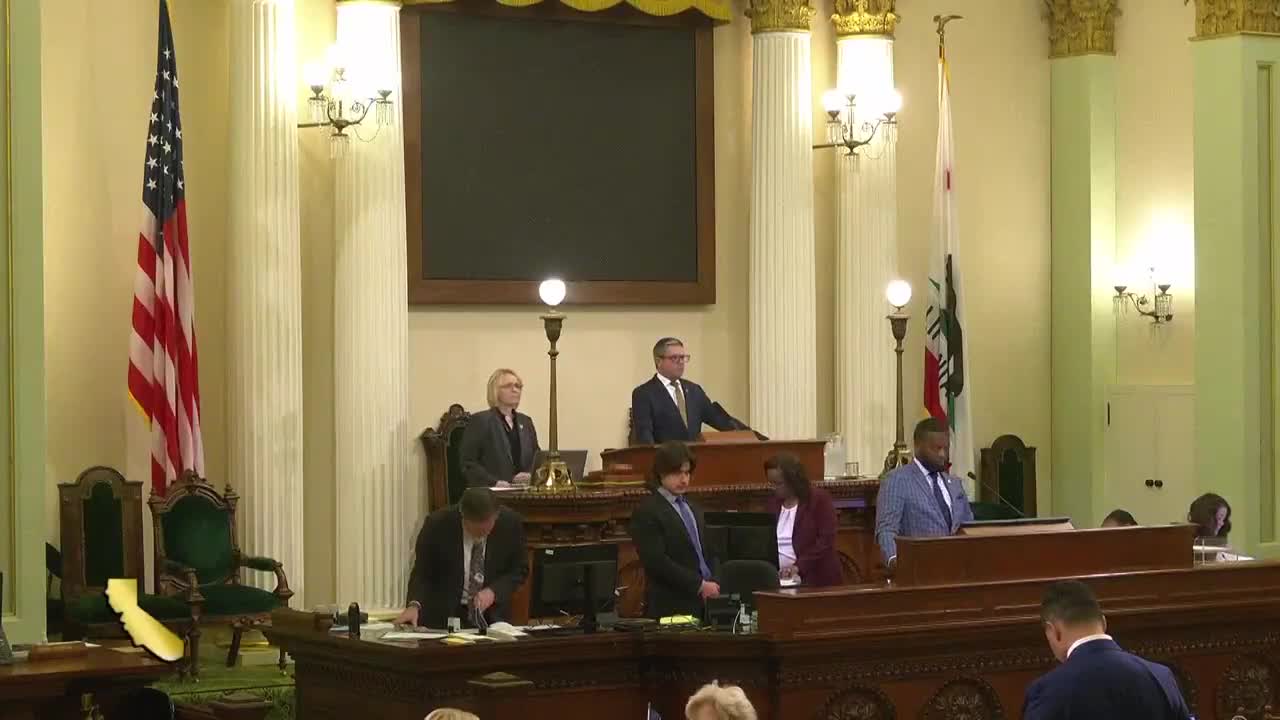 2MIN
Assembly Floor
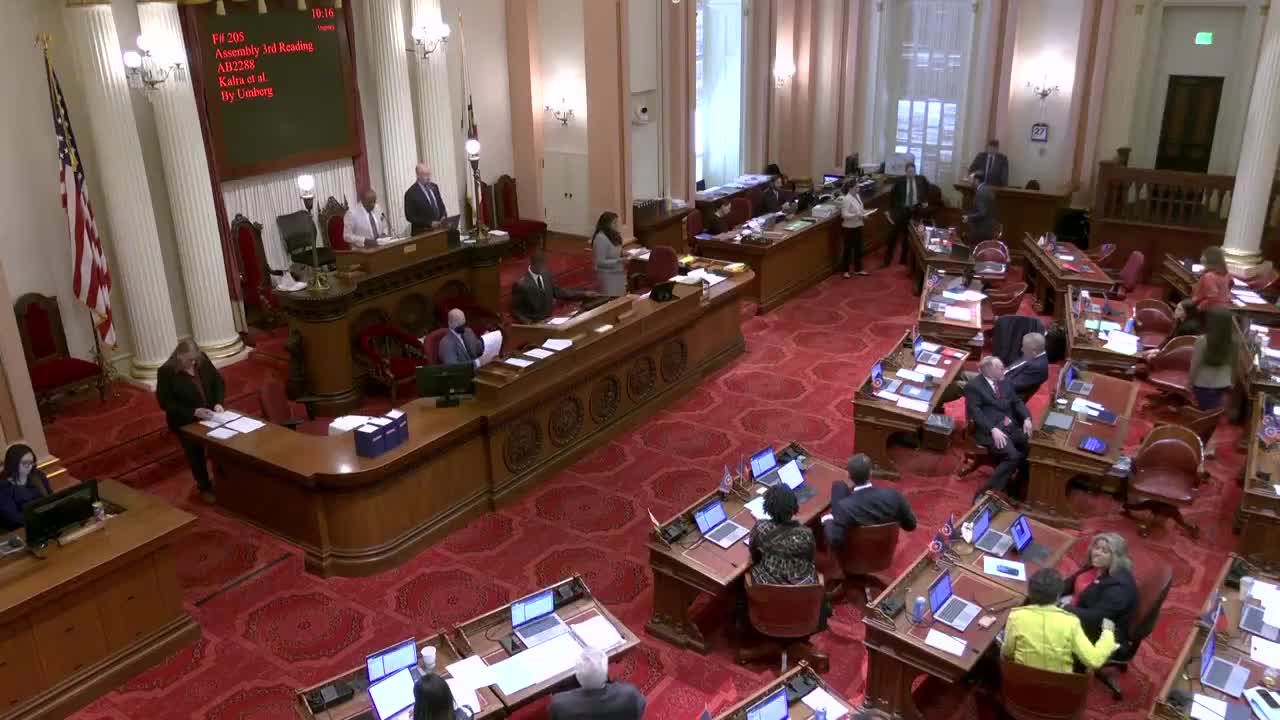 4MIN
Senate Floor
 5MIN
Senate Standing Committee on Appropriations
 14MIN
Senate Standing Committee on Judiciary
 6MIN
Senate Standing Committee on Labor, Public Employment and Retirement
 4MIN
Assembly Floor
1MIN
Assembly Floor
 34SEC
Assembly Floor
Bill Author

Bill Co-Author(s):