AB 797: Local government: police review boards.
- Session Year: 2023-2024
- House: Assembly
- Latest Version Date: 2024-01-03
Current Status:
Failed
(2024-02-01: From committee: Filed with the Chief Clerk pursuant to Joint Rule 56.)
Introduced
In Committee
First Chamber
In Committee
Second Chamber
Enacted
Existing law requires each department or agency in this state that employs peace officers to establish a procedure to investigate complaints by members of the public against the personnel of these departments or agencies, and to make a written description of this procedure available to the public. Existing law also requires each department or agency to keep and maintain records of complaints and investigations, as specified.
This bill would require the governing body of each city and county to, by January 15, 2025, January 1, 2026, create an independent community-based commission on law enforcement officer practices. The bill would authorize each commission to, among other things, conduct independent investigations of complaints against a police officer or sheriff alleging physical injury to a person, including injuries resulting in a persons death. The bill would require the commission to prepare a report after an investigation and include the results of the investigation and a recommended course of action, if any, to be taken by the governing body regarding the law enforcement officer investigated by the commission. By increasing the duties of local officials, this bill would impose a state-mandated local program.
The California Constitution requires the state to reimburse local agencies and school districts for certain costs mandated by the state. Statutory provisions establish procedures for making that reimbursement.
This bill would provide that, if the Commission on State Mandates determines that the bill contains costs mandated by the state, reimbursement for those costs shall be made pursuant to the statutory provisions noted above.
Existing law requires each department or agency in this state that employs peace officers to establish a procedure to investigate complaints by members of the public against the personnel of these departments or agencies, and to make a written description of this procedure available to the public. Existing law also requires each department or agency to keep and maintain records of complaints and investigations, as specified.
This bill would express the intent of the Legislature to enact legislation requiring the governing body of each city and county to create and maintain independent, community-based boards to conduct independent investigations of citizen complaints against peace officers.This bill would require the governing body of each city and county to, by January 15, 2025, create an independent community-based commission on law enforcement officer practices. The bill would authorize each commission to, among other things, conduct independent investigations of complaints against a police officer or sheriff alleging physical injury to a person, including injuries resulting in a persons death. The bill would require the commission to prepare a report after an investigation and include the results of the investigation and a recommended course of action, if any, to be taken by the governing body regarding the law enforcement officer investigated by the commission. By increasing the duties of local officials, this would impose a state-mandated local program.
The California Constitution requires the state to reimburse local agencies and school districts for certain costs mandated by the state. Statutory provisions establish procedures for making that reimbursement.
This bill would provide that, if the Commission on State Mandates determines that the bill contains costs mandated by the state, reimbursement for those costs shall be made pursuant to the statutory provisions noted above.
Existing law requires each department or agency in this state that employs peace officers to establish a procedure to investigate complaints by members of the public against the personnel of these departments or agencies, and to make a written description of this procedure available to the public. Existing law also requires each department or agency to keep and maintain records of complaints and investigations, as specified.
This bill would express the intent of the Legislature to enact legislation requiring the governing body of each city and county to create and maintain independent, community-based boards to conduct independent investigations of citizen complaints against peace officers.
(a)The governing body of each city and county shall, by January 15, 2025, January 1, 2026, create an independent community-based commission on law enforcement officer practices.
(b)Each commission shall be comprised of all of the following:
(1)An executive director appointed by the mayor or the chair of the board of supervisors. director. The executive director shall recruit and recommend selection of independent investigators, legal counsel, and support staff to the mayor or the chair of the board of supervisors. governing body of each city and county.
(2)Independent investigators.
(3)Independent legal counsel. The legal counsel shall not, in other legal matters, concurrently represent the governing body which has employed or contracted with the law enforcement officer under investigation by the commission.
(4)Commissioners. In the case of a city commission, one commissioner shall be appointed by the mayor and the other commissioners shall be appointed by the city council. In the case of a county commission, one commissioner shall be appointed by the chair of the board of supervisors and the other commissioners shall be appointed by the board of supervisors.
(5)Support staff.
(c)Each commission shall be authorized to do all of the following:
(1)Conduct independent investigations of complaints against a police officer or sheriff alleging physical injury to a person, including injuries resulting in a persons death.
(2)Issue and enforce compliance of subpoenas compelling production of all evidence and testimony of witnesses a commission may require in the course of its investigations.
(d)Each commission shall prepare a report after an investigation and include the results of the investigation and a recommended course of action, if any, to be taken by the governing body regarding the law enforcement officer investigated by the commission.
SEC. 2.If the Commission on State Mandates determines that this act contains costs mandated by the state, reimbursement to local agencies and school districts for those costs shall be made pursuant to Part 7 (commencing with Section 17500) of Division 4 of Title 2 of the Government Code.
(a)The governing body of each city and county shall, by January 15, 2025, create an independent community-based commission on law enforcement officer practices.
(b)Each commission shall be comprised of all of the following:
(1)An executive director appointed by the mayor or the chair of the board of supervisors. The executive director shall recruit and recommend selection of independent investigators, legal counsel, and support staff to the mayor or the chair of the board of supervisors.
(2)Independent investigators.
(3)Independent legal counsel. The legal counsel shall not, in other legal matters, concurrently represent the governing body which has employed or contracted with the law enforcement officer under investigation by the commission.
(4)Commissioners. In the case of a city commission, one commissioner shall be appointed by the mayor and the other commissioners shall be appointed by the city council. In the case of a county commission, one commissioner shall be appointed by the chair of the board of supervisors and the other commissioners shall be appointed by the board of supervisors.
(5)Support staff.
(c)Each commission shall be authorized to do all of the following:
(1)Conduct independent investigations of complaints against a police officer or sheriff alleging physical injury to a person, including injuries resulting in a persons death.
(2)Issue and enforce compliance of subpoenas compelling production of all evidence and testimony of witnesses a commission may require in the course of its investigations.
(d)Each commission shall prepare a report after an investigation and include the results of the investigation and a recommended course of action, if any, to be taken by the governing body regarding the law enforcement officer investigated by the commission.
SEC. 2.If the Commission on State Mandates determines that this act contains costs mandated by the state, reimbursement to local agencies and school districts for those costs shall be made pursuant to Part 7 (commencing with Section 17500) of Division 4 of Title 2 of the Government Code.
SECTION 1.It is the intent of the Legislature to enact legislation requiring the governing body of each city and county to create and maintain independent, community-based boards to conduct independent investigations of citizen complaints against peace officers.It is the intent of the Legislature to enact legislation requiring the governing body of each city and county to create and maintain independent, community-based boards to conduct independent investigations of citizen complaints against peace officers.
|
Date
|
Status
|
|---|---|
| Feb 1, 2024 | From committee: Filed with the Chief Clerk pursuant to Joint Rule 56. |
| Jan 31, 2024 | Died pursuant to Art. IV, Sec. 10(c) of the Constitution. |
| Jan 18, 2024 | In committee: Held under submission. |
| Jan 18, 2024 | In committee: Set, first hearing. Referred to APPR. suspense file. |
| Jan 9, 2024 | From committee: Do pass and re-refer to Com. on APPR. (Ayes 5. Noes 2.) (January 9). Re-referred to Com. on APPR. |
| Jan 4, 2024 | Re-referred to Com. on PUB. S. |
| Jan 3, 2024 | From committee chair, with author's amendments: Amend, and re-refer to Com. on PUB. S. Read second time and amended. |
| Apr 19, 2023 | In committee: Set, second hearing. Hearing canceled at the request of author. |
| Apr 18, 2023 | In committee: Set, first hearing. Hearing canceled at the request of author. |
| Mar 27, 2023 | Re-referred to Com. on PUB. S. |
| Mar 23, 2023 | From committee chair, with author's amendments: Amend, and re-refer to Com. on PUB. S. Read second time and amended. |
| Mar 23, 2023 | Referred to Com. on PUB. S. |
| Feb 14, 2023 | From printer. May be heard in committee March 16. |
| Feb 13, 2023 | Read first time. To print. |
|
Date
|
Description
|
Location
|
Votes
|
|
|---|---|---|---|---|
| Jan 9, 2024 | Do pass and be re-referred to the Committee on [Appropriations] | Assembly Standing Committee on Public Safety |
Passed |
This list shows positions taken on this bill by organizations on the date displayed, which is linked to the original source.
Positions by individuals are not included.
|
Organization
|
Position
|
Date
|
|---|---|---|
| Aaron Read & Associates | * Against | Jan 9, 2024 |
| Alameda County Offices of Education | * Support | Jan 9, 2024 |
| Arcadia Police Officers' Association | ** Against | |
| Burbank Police Officers' Association | ** Against | |
| California Police Chiefs Association | * Against | Jan 9, 2024 |
| California Association of Black Lawyers | * Support | Jan 9, 2024 |
| California Attorneys For Criminal Justice | * Support | Jan 9, 2024 |
| California Coalition of School Safety Professionals | ** Against | |
| California Peace Officers Association | ** Against | |
| California Public Defender Association | * Support | Jan 9, 2024 |
| California Reserve Peace Officers Association | * Against | Jan 9, 2024 |
| California State Sheriffs' Association | * Against | Jan 9, 2024 |
| Center for Policing Equity | * Support | Jan 9, 2024 |
| City of Chino | ** Against | |
| Corona Police Officers Association | ** Against | |
| Deputy Sheriff's Association of Monterey County | * Against | Jan 9, 2024 |
| Deputy Sheriff's Association of Placer County | * Against | Jan 9, 2024 |
| Earl B. Gilliam Bar Association | ** Support | |
| Fresno County Board of Supervisors | * Against | Jan 9, 2024 |
| Initiate Justice | * Support | Jan 9, 2024 |
| Los Angeles County Professional Peace Officers Association | ** Against | |
| Murrieta Police Officers' Association | ** Against | |
| National College Players Association | ** Support | |
| Novato Police Officers Association | ** Against | |
| Oakland Privacy | ** Support | |
| Outside Solutions Consulting | * Support | Jan 9, 2024 |
| Police Officers Association of Arcadia | * Against | Jan 9, 2024 |
| Police Officers Association of Burbank | * Against | Jan 9, 2024 |
| Police Officers Association of Claremont | * Against | Jan 9, 2024 |
| Police Officers Association of Corona | * Against | Jan 9, 2024 |
| Police Officers Association of Culver City | * Against | Jan 9, 2024 |
| Police Officers Association of Fullerton | * Against | Jan 9, 2024 |
| Police Officers Association of Marietta | * Against | Jan 9, 2024 |
| Police Officers Association of Nevada | * Against | Jan 9, 2024 |
| Police Officers Association of Newport Beach | * Against | Jan 9, 2024 |
| Police Officers Association of Palos Verdes | * Against | Jan 9, 2024 |
| Police Officers Association of Pomona | * Against | Jan 9, 2024 |
| Police Officers Association of Riverside | * Against | Jan 9, 2024 |
| Police Officers Association of Santa Ana | * Against | Jan 9, 2024 |
| Police Officers Association of Upland | * Against | Jan 9, 2024 |
| Pomona Police Officers' Association | ** Against | |
| PORAC | * Against | Jan 9, 2024 |
| Prison From the Inside Out | * Support | Jan 9, 2024 |
| Riverside County Sheriff'S Department | * Against | Jan 9, 2024 |
| RIVERSIDE POLICE OFFICERS ASSOCIATION | ** Against | |
| Riverside Sheriff's Association | * Against | Jan 9, 2024 |
| San Diegans for Justice | ** Support | |
| San Francisco POA | * Against | Jan 9, 2024 |
| San Jose State University Black Student Athlete Association | ** Support | |
| Santa Ana Police Officers Association | ** Against | |
| The San Diego Black American Political Association | ** Support | |
| Wiley Manuel Bar Association | ** Support |
Date of Hearing: January 18, 2024
ASSEMBLY COMMITTEE ON APPROPRIATIONS
Chris Holden, Chair
ABPCA Bill Id:AB 797
Author:(Weber) – As Amended Ver:January 3, 2024
Policy Committee: | Public Safety | Vote: | 5 - 2 |
|
| ||
|
|
Urgency: No State Mandated Local Program: Yes Reimbursable: Yes
SUMMARY:
This bill requires each city and county to establish an independent community-based commission on law enforcement oversight and authorizes each commission to investigate complaints against a police officer or sheriff alleging physical injury to a person.
FISCAL EFFECT:
Significant ongoing costs (local funds, General Fund) for each municipality that establishes and operates a commission under this bill. Total costs statewide will depend on the number of new commissions that must be established, each commission’s staffing needs, and other costs associated with conducting investigations. The bill specifies certain staffing requirements for each commission, likely resulting in costs in the low hundreds of thousands of dollars to millions of dollars annually per commission. Total costs statewide may be in the hundreds of millions of dollars annually. General Fund costs will depend on whether the duties imposed by this bill constitute a reimbursable state mandate, as determined by the Commission on State Mandates.
COMMENTS:
- Purpose. According to the author:
Many California counties and cities currently have no community based commissions to review and make such recommendations; or the commissions that have been established are ineffective, as they lack sufficient resources to adequately review such complaints and make effective disciplinary recommendations when such complaints are justified. Community distrust of internal law enforcement review of its own personnel’s actions against individuals creates unnecessary tension between the communities and law enforcement, leads to costly civil unrest, and unfortunately sometimes creates unnecessary and avoidable damages and losses to individuals and to the business community during protests. By creating independent, community based commissions to review complaints against law enforcement actions taken against individuals, this bill will restore community confidence in the integrity of the review and recommendation process regarding these complaints.
- Background. In recent years, following high-profile incidents of police misconduct and use of force, California has enacted multiple measures intended to increase transparency into and oversight of police misconduct. AB 1185 (McCarty), Statutes of 2020, authorized a county to create an oversight board to conduct investigations into the county sheriff’s department. SB 1421 (Skinner), Statutes of 2018, and SB 16 (Skinner), Statutes of 2021, required public disclosure of certain records of incidents of peace officer use of force and misconduct, including law enforcement investigative records that had previously been exempt from disclosure to the public. Still other legislation required the Department of Justice to conduct investigations into incidents in which a peace officer shot and killed an unarmed civilian, and empowered the Peace Officer Standards and Training Commission to decertify a peace officer based on specified criminal convictions or findings of serious misconduct. Despite these efforts, egregious incidents of police misconduct and use of force continue to occur, particularly against people of color.
This bill requires each city and county to create an independent community-based commission on law enforcement practices and authorizes each commission to investigate complaints alleging physical injury to a person. The bill specifies that each commission must be comprised of an executive director, independent investigators, independent legal counsel, commissioners, and support staff. This level of staffing alone would likely cost each commission hundreds of thousands of dollars annually. Additional costs will depend on the number and complexity of investigations undertaken by each commission. According to Oakland Privacy, writing in support of this bill, there are currently 27 civilian oversight bodies in California. It is not clear whether these existing bodies comply with the requirements of this bill or if they would need additional resources to come into compliance. Regardless, with 58 counties and more than 400 cities in the state, this bill would require a significant financial investment to establish and maintain the required commissions.
Analysis Prepared by: Annika Carlson / APPR. / (916) 319-2081
Date of Hearing: January 9, 2024
Counsel: Andrew Ironside
ASSEMBLY COMMITTEE ON
Kevin McCarty, Chair
ABPCA Bill Id:
Author:() – As Ver:
SUMMARY:
Requires cities and counties to establish independent community-based commission to investigate excessive force complaints against law enforcement officers. Specifically, this bill:
- Requires the governing body of each city and county to create an independent community-based commission on law enforcement officer practices by January 15, 2026.
- Requires each commission to be comprised of an executive director, independent investigators, independent legal counsel, commissioners, and support staff.
- Requires the executive director to recruit and recommend selection of independent investigators, legal counsel, and support staff to the governing body of each city and county.
- Prohibits the appointed independent legal counsel from concurrently representing in other legal matters the governing body that has employed or contracted with the law enforcement officer under investigation by the commission.
- Authorizes independent commissions on law enforcement practices to do all of the following:
- Conduct independent investigations of complaints against a police officer or sheriff alleging physical injury to a person, including injury resulting in a person’s death; and,
- Issue and enforce compliance of subpoenas compelling production of all evidence and testimony of witnesses a commission may require in the course of its investigations.
- Conduct independent investigations of complaints against a police officer or sheriff alleging physical injury to a person, including injury resulting in a person’s death; and,
- Requires each commission to prepare a report after an investigation and to include the results of the investigation and a recommended course of action, if any, to be taken by the governing body regarding the law enforcement officer investigated by the commission.
EXISTING LAW:
- Authorizes a county to create a sheriff oversight board, either by action of the board of supervisors or through a vote of county residents, comprised of civilians to assist the board of supervisors to supervise the official conduct of all county officers. (Gov. Code, § 25303.7, subd. (a)(1).)
- Requires the board of supervisors to appoint the members of the sheriff oversight board. (Gov. Code, § 25303.7, subd. (a)(2).)
- Requires the board of supervisors to designate one member of the oversight board to serve as the chairperson. (Gov. Code, § 25303.7, subd. (a)(2).)
- States that each law enforcement agency shall make a record of any investigations of misconduct involving a peace officer in their general personnel file or a separate file designated by the department or agency. (Pen. Code, § 832.12, subd. (a).)
- Authorizes a peace officer who has reasonable cause to believe that a person to be arrested has committed a public offense to use objectively reasonable force to effect the arrest, to prevent escape, or to overcome resistance. (Pen. Code, § 835a, subd. (b).)
- Authorizes a peace officer to use deadly force when the officer believes, based on the totality of the circumstances, that such force is necessary for either of the following reasons:
- To defend against an imminent threat of death or serious bodily injury to the officer or to another person; or,
- To apprehend a fleeing person for any felony that threatened or resulted in death or serious bodily injury, if the officer reasonably believes that the person will cause death or serious bodily injury to another unless immediately apprehended. Where feasible, a peace officer shall, prior to the use of force, make reasonable efforts to identify themselves as a peace officer and to warn that deadly force may be used, unless the officer has objectively reasonable grounds to believe the person is aware of those facts. (Pen. Code, § 835a, subd. (c)(1)(A) & (B).)
- To defend against an imminent threat of death or serious bodily injury to the officer or to another person; or,
- Prohibits a peace officer from using deadly force against a person based on the danger that person poses to themselves, if an objectively reasonable officer would believe the person does not pose an imminent threat of death or serious bodily injury to the peace officer or to another person. (Pen. Code, § 835a, subd. (c)(2).)
- Defines “deadly force” as any use of force that creates a substantial risk of causing death or serious bodily injury, including, but not limited to, the discharge of a firearm. (Pen. Code, § 835a, subd. (e)(1).)
- Provides that an arrest is made by an actual restraint of the person, or by submission to the custody of an officer, and that the person arrested may be subjected to such restraint as is reasonable for their arrest and detention. (Pen. Code, § 835.)
- Permits a peace officer who is authorized to make an arrest and who has stated their intention to do so, to use all necessary means to effect the arrest if the person to be arrested either flees or forcibly resists. (Pen. Code, § 843.)
- Requires peace officers to immediately report all uses of force by the officer to the officer’s department or agency. (Pen. Code, § 832.13.)
- Requires that each law enforcement agency maintain a policy that provides a minimum standard on the use of force. (Gov. Code, § 7286, subd. (g).)
- Requires the Commission on Peace Officers Standards and Training (POST) to implement a course or courses of instruction for the regular and periodic training of law enforcement officers in the use of force and to develop uniform, minimum guidelines for adoption and promulgation by California law enforcement agencies for use of force. (Pen. Code, § 13519.10, subd. (a).)
FISCAL EFFECT:
Unknown
COMMENTS:
- Author's Statement: According to the author, “This bill will remedy inadequate, non-transparent review of complaints against law enforcement actions taken against individuals and eliminate ineffective or non-existent disciplinary recommendations even when such complaints are justified. Many California counties and cities currently have no community based commissions to review and make such recommendations; or the commissions that have been established are ineffective, as they lack sufficient resources to adequately review such complaints and make effective disciplinary recommendations when such complaints are justified. Community distrust of internal law enforcement review of its own personnel’s actions against individuals creates unnecessary tension between the communities and law enforcement, leads to costly civil unrest, and unfortunately sometimes creates unnecessary and avoidable damages and losses to individuals and to the business community during protests. By creating independent, community based commissions to review complaints against law enforcement actions taken against individuals, this bill will restore community confidence in the integrity of the review and recommendation process regarding these complaints.”
- Civilian Oversight Commissions: This bill would require cities and counties to establish independent community-based commissions to investigate physical injury complaints against law enforcement officers. According to one report:
Variously referred to as citizen oversight, civilian review, external review and citizen review boards, this form of police accountability is often focused on creating a framework that allows non-police actors to provide input into police department operations, with a historical—and often primary—focus on the citizen complaint process. Civilian oversight may be defined as one or more individuals outside the sworn chain of command of a police department whose work focuses on holding that department and its officers and employees accountable. In some jurisdictions, members of the public review, audit or monitor complaint investigations that were conducted by police internal affairs investigators. In other jurisdictions, civilians conduct independent investigations of allegations of misconduct lodged against sworn law enforcement officers. Civilian oversight can also be accomplished through the creation of oversight mechanisms that are authorized to review and comment on police policies, practices, training and systemic conduct. Some mechanisms involve a combination of systemic analysis and complaint handling or review.
Civilian oversight mechanisms are usually implemented based on the assumption that members of the community do not have faith in the ability of a police or sheriff’s department to police itself. When the public believes that officers are not being held accountable for violating the law or department policy, then a consensus may develop that misconduct allegations can be more effectively handled by a civilian organization external to the police. Underlying this view is the belief that having non-police actors play a role within the process for handling complaints can lead to more thorough, complete and impartial investigations and findings. A second common assumption is that involving non-sworn individuals in the oversight of the police has the potential to increase public confidence and trust in the police, or at least trust in local government more generally.
(De Angelis et al., Civilian Oversight of Law Enforcement: Assessing the Evidence, National Association for Civil Oversight of Law Enforcement (Sept. 2016) p. 13.)
Generally, there are three models of civilian oversight of law enforcement—investigation-focused models, review-focused models, and auditor/monitor-focused models:
Investigation-focused Models. A form of oversight that operates separately from the local police or sheriff’s department. While the structure, resources and authority of these types of agencies can vary among jurisdictions, these agencies are tied together by their ability to conduct independent investigations of allegations of misconduct against police officers.
Review-focused Models. A type of oversight that focuses its work on reviewing the quality of completed internal affairs investigations. Many review agencies take the form of volunteer review boards or commissions and are designed around the goal of providing community input into the internal investigations process. Instead of conducting independent investigations, review agencies may evaluate completed internal affairs investigations, hear appeals, hold public forums, make recommendations for further investigation and conduct community outreach.
Auditor/monitor-focused Agencies. One of the newest forms of police oversight. While there can be variation in the organization structure of this type of civilian oversight, auditor/monitor agencies tend to focus on promoting large-scale, systemic reform of police organizations while often also monitoring or reviewing individual critical incident or complaint investigations.
(De Angelis et al., supra, at p. 7.) The type of oversight body may impact how often law enforcement agencies accept the body’s recommendations. “Some models of oversight may be more effective at getting recommendations implemented. Almost all of the oversight agencies reported that police executives listened carefully to the recommendations made by oversight staff (78 percent). However, auditor/monitor agencies were much more likely to report that police or sheriff’s agencies implemented their recommendations frequently or very frequently (72 percent) as compared to investigative (42 percent) and review agencies (34 percent).” (Id. at p. 10)
This bill would require all California cities and counties to adopt an investigation-focused model. To that end, this bill would require commissions to have both independent investigators and independent legal counsel. It also would grant commissions subpoena power to compel the production of all evidence and testimony of witnesses when investigating use-of-force complaints.
- Argument in Support: According to the Caalifornia Association of Black Lawyers, the bill’s sponsor, “A.B. 797 would require the governing body of each city and county, by January, 2025, to create an independent, community-based commission on law enforcement officer practices. Each community-based commission would be authorized to:
(1) Conduct independent investigations of complaints against a police officer or sheriff alleging physical injury to a person, including injuries resulting in a person’s death.
(2) Issue and enforce compliance of subpoenas compelling production of all evidence and testimony of witnesses a commission may require in the course of its investigations.
“A.B. 797 would assist in decreasing unnecessary tension created between communities and law enforcement. This is particularly evident based on well-documented community distrust of law enforcement agencies’ internal investigations of complaints against their own personnel, and where there is either ineffective and even non-existent independent, community-based review of complaints against law enforcement officers.
“This bill would also strengthen existing independent, community-based commissions by providing adequate resources to enable them to be effective. This would include the hiring of an executive director, who shall recruit and recommend selection of independent investigators, independent legal counsel, and support staff to the governing body, mayor or the chair of the board of supervisors. This bill would thus promote and strengthen community – law enforcement relationships throughout California in a manner never before experienced by either side. It would promote sorely needed community trust in the integrity of investigation of any person’s complaint involving serious physical injury or death, while at the same time providing an authorized and effectively functioning commission structure advised by independent counsel to ensure fairness and due process to the law enforcement officers named in any such complaint.
“All commissioners would be chosen only pursuant to local governing bodies’ procedures adopted in the context of their own unique needs and priorities. Each commission would prepare a report after an investigation and include the results of the investigation and a recommended course of action, if any, to be taken by the governing body regarding the law enforcement officer investigated by the commission. This recommended course of action, if any, is to be seriously and carefully considered, but is non-binding on the governing body.”
- Arguments in Opposition:
- According to the City of Chino, “The Chino Police Department has taken significant efforts to work collaboratively with the Chino community. The Chino Police Department believes it cannot effectively police and protect Chino residents without the trust and understanding of the community. To that end, the Chino Police Department commits time and resources to build valuable programs that support collaborative, community policing…
“Beyond public outreach programs, the Chino Police Department takes pride in holding its personnel to the highest standards of professionalism and integrity. In the rare moments where the Chino Police Department has been made aware of its employees falling below this standard, the response has been swift, transparent, and decisive. Although the bill intends to increase transparency, it does not consider the trust that may already exist between a community and its police department. Rather, it appears to unfortunately be a wholesale reaction to the decisions of other police departments that has no bearing on the Chino Police Department and its commitment to the Chino community.” - According to the California State Sheriff’s Association, “AB 797 ignores the significant oversight of law enforcement that is already in place. In addition to the opportunities for oversight provided to voters in electing the sheriff, significant oversight of the sheriff’s office already exists. The state and federal Departments of Justice, the Board of State and Community Corrections, state and federal courts, county grand juries, district attorneys, and civilian review entities, including the sheriff oversight boards and inspector general offices created as a result of AB 1185 of 2020, all exercise oversight authority related to the office of the sheriff.
“AB 797 is also duplicative of existing law in terms of the charge of the commissions contemplated by this bill. Every law enforcement agency is required by current law to establish a procedure to investigate complaints by members of the public against law enforcement personnel. If the complainant is unsatisfied by the outcome of that process and the complaint involves an alleged criminal act, the complainant can seek redress from the district attorney. If neither of those paths are satisfactory, the complainant can file a complaint with the state Attorney General’s Office. In terms of subpoenas, AB 1185 allows sheriff oversight boards and inspector general offices to issue subpoenas to compel testimony and the production of evidence, and county counsels and grand juries already hold subpoena powers.
“This bill is an unnecessary, duplicative, and unfunded mandate.”
- According to the City of Chino, “The Chino Police Department has taken significant efforts to work collaboratively with the Chino community. The Chino Police Department believes it cannot effectively police and protect Chino residents without the trust and understanding of the community. To that end, the Chino Police Department commits time and resources to build valuable programs that support collaborative, community policing…
- Related Legislation: AB 1725 (McCarty), requires cities and counties to post financial details about law enforcement use-of-force settlements and judgments on their internet websites, including how much each settlement cost and how the state and municipalities will pay for each settlement. AB 1725 will be heard in this committee today.
- Prior Legislation:
- AB 807 (McCarty), of the 2023-2024 Legislative Session, would have required a state prosecutor to investigate incidents in which the use of force by a peace officer results in the death of a civilian. AB 807 was held on the Assembly Appropriations Committee Suspense File.
- SB 838 (Menjivar), of the 2023-2024 Legislative Session, would have revised the definition of “crime” for purposes of the Victim Compensation Program to include an incident in which an individual sustains serious bodily injury or death as the result of a law enforcement officer’s use of force and make changes to eligibility factors as they would apply to these types of claims. SB 838 was held in the Senate Appropriations Committee Suspense File.
- AB 26 (Holden), Chapter 403, Statutes of 2021, requires use of force policies for law enforcement agencies to include the requirement that officers immediately report potential excessive force, and specifies the requirement to “intercede” if another officer uses excessive force.
- SB 2 (Bradford), Chapter 409, Statutes of 2021, grants new powers to POST by creating a process to investigate and determine the fitness of a person to be a peace officer, and to decertify peace officers who are found to have engaged in “serious misconduct.” Makes changes to the Tom Bane Civil Rights Act by eliminating specified immunity provisions.
- AB 1022 (Holden), of the 2019-2020 Legislative Session, would have clarified and strengthened policies related to law enforcement officers’ duty to intervene when excessive force is used. AB 1022 was held on the Senate Appropriations Suspense File.
- SB 731 (Bradford), of the 2019-2020 Legislative Session, would have created a process for decertification of police officers. SB 731 was never heard on the Assembly Floor.
- AB 1022 (Holden), of the 2019-2020 Legislative Session, would have disqualified a person from being a peace officer if they have been found by a law enforcement agency that employees them to have either used excessive force that resulted in great bodily injury or death or to have failed to intercede in that incident as required by a law enforcement agency’s policies. AB 1022 was held on the Senate Appropriations Suspense File.
- SB 230, (Caballero), Chapter 285, Statutes of 2019, requires each law enforcement agency to maintain a policy that provides guidelines on the use of force, utilizing de-escalation techniques and other alternatives to force when feasible, specific guidelines for the application of deadly force, and factors for evaluating and reviewing all use of force incidents, among other things.
- AB 1506 (McCarty), Chapter 326, Statutes of 2020, requires a state prosecutor to investigate incidents of an officer-involved shooting resulting in the death of an unarmed civilian, as defined.
- AB 2327 (Quirk), Chapter 966, Statutes of 2018, requires a peace officer seeking employment with a law enforcement agency to give written permission for the hiring law enforcement agency to view his or her general personnel file and any separate disciplinary file. Requires each law enforcement agency to make a record of any investigations of misconduct involving a peace officer in his or her general personnel file or a separate file designated by the department or agency.
- AB 619 (Weber), of the 2015-2016 Legislative Session, would have required law enforcement agencies to report use of force incidents to the Attorney General (AG) and would have required the AG to annually issue a report containing this information. AB 619 was held in the Assembly Appropriations Committee.
- AB 807 (McCarty), of the 2023-2024 Legislative Session, would have required a state prosecutor to investigate incidents in which the use of force by a peace officer results in the death of a civilian. AB 807 was held on the Assembly Appropriations Committee Suspense File.
REGISTERED SUPPORT / OPPOSITION:
Support
California Association of Black Lawyers
California Public Defenders Association
Center for Policing Equity
Earl B. Gilliam Bar Association
National College Players Association
Oakland Privacy
San Diegans for Justice
San Jose State University Black Student Athlete Association
The San Diego Black American Political Association
Wiley Manuel Bar Association
5 Private Individuals
Opposition
Arcadia Police Officers' Association
Burbank Police Officers' Association
California Coalition of School Safety Professionals
California Peace Officers Association
California Police Chiefs Association
California Reserve Peace Officers Association
California State Sheriffs' Association
City of Chino
Claremont Police Officers Association
Corona Police Officers Association
Culver City Police Officers' Association
Deputy Sheriffs' Association of Monterey County
Fullerton Police Officers' Association
Los Angeles County Professional Peace Officers Association
Murrieta Police Officers' Association
Newport Beach Police Association
Novato Police Officers Association
Palos Verdes Police Officers Association
Peace Officers Research Association of California (PORAC)
Placer County Deputy Sheriffs' Assocation
Pomona Police Officers' Association
Riverside Police Officers Association
Riverside Sheriffs' Association
Santa Ana Police Officers Association
Upland Police Officers Association
Analysis Prepared by:
Date of Hearing: April 18, 2023
Counsel: Andrew Ironside
ASSEMBLY COMMITTEE ON
Reginald Byron Jones-Sawyer, Sr., Chair
ABPCA Bill Id:
Author:() – As Ver:
CORRECTED
SUMMARY:
Requires cities and counties to establish independent community-based commissions to investigate complaints alleging physical injury resulting from conduct by law enforcement officers. Specifically, this bill:
- Requires the governing body of each city and county to create an independent community-based commission on law enforcement officer practices by January 15, 2025.
- Requires each commission to be comprised of an executive director, independent investigators, independent legal counsel, commissioners, and support staff.
- Requires the mayor or the chair of the board of supervisors to appoint the executive director of the commission.
- Provides that, in the case of a city commission, one commissioner shall be appointed by the mayor and the other commissioners shall be appointed by the city council.
- Provides that, in the case of a county commission, one commissioner shall be appointed by the chair of the board of supervisors and the other commissioners shall be appointed by the board of supervisors.
- Prohibits the appointed independent legal counsel from, in other legal matters, concurrently representing the governing body that has employed or contracted with the law enforcement officer under investigation by the commission.
- Authorizes independent commissions on law enforcement practices to do all of the following:
- Conduct independent investigations of complaints against a police officer or sheriff alleging physical injury to a person, including injury resulting in a person’s death; and,
- Issue and enforce compliance of subpoenas compelling production of all evidence and testimony of witnesses a commission may require in the course of its investigations.
- Conduct independent investigations of complaints against a police officer or sheriff alleging physical injury to a person, including injury resulting in a person’s death; and,
- Requires each commission to prepare a report after an investigation and to include the results of the investigation and a recommended course of action, if any, to be taken by the governing body regarding the law enforcement officer investigated by the commission.
EXISTING LAW:
- States that each law enforcement agency shall make a record of any investigations of misconduct involving a peace officer in his or her general personnel file or a separate file designated by the department or agency. (Pen. Code, § 832.12, subd. (a).)
- Authorizes a peace officer who has reasonable cause to believe that a person to be arrested has committed a public offense to use objectively reasonable force to effect the arrest, to prevent escape, or to overcome resistance. (Pen. Code, § 835a, subd. (b).)
- Authorizes a peace officer to use deadly force when the officer believes, based on the totality of the circumstances, that such force is necessary for either of the following reasons:
- To defend against an imminent threat of death or serious bodily injury to the officer or to another person; or
- To apprehend a fleeing person for any felony that threatened or resulted in death or serious bodily injury, if the officer reasonably believes that the person will cause death or serious bodily injury to another unless immediately apprehended. Where feasible, a peace officer shall, prior to the use of force, make reasonable efforts to identify themselves as a peace officer and to warn that deadly force may be used, unless the officer has objectively reasonable grounds to believe the person is aware of those facts. (Pen. Code, § 835a, subd. (c)(1)(A) & (B).)
- To defend against an imminent threat of death or serious bodily injury to the officer or to another person; or
- Prohibits a peace officer from using deadly force against a person based on the danger that person poses to themselves, if an objectively reasonable officer would believe the person does not pose an imminent threat of death or serious bodily injury to the peace officer or to another person. (Pen. Code, § 835a, subd. (c)(2).)
- Defines “deadly force” as any use of force that creates a substantial risk of causing death or serious bodily injury, including, but not limited to, the discharge of a firearm. (Pen. Code, § 835a, subd. (e)(1).)
- Provides that an arrest is made by an actual restraint of the person, or by submission to the custody of an officer, and that the person arrested may be subjected to such restraint as is reasonable for their arrest and detention. (Pen. Code, § 835.)
- Permits a peace officer who is authorized to make an arrest and who has stated their intention to do so, to use all necessary means to effect the arrest if the person to be arrested either flees or forcibly resists. (Pen. Code, § 843.)
- Requires peace officers to immediately report all uses of force by the officer to the officer’s department or agency. (Pen. Code, § 832.13.)
- Requires that each law enforcement agency shall maintain a policy that provides a minimum standard on the use of force. (Gov. Code, § 7286, subd. (g).)
- Requires the Commission on Peace Officers Standards and Training (POST) to implement a course or courses of instruction for the regular and periodic training of law enforcement officers in the use of force and shall also develop uniform, minimum guidelines for adoption and promulgation by California law enforcement agencies for use of force. (Pen. Code, § 13519.10, subd. (a).)
FISCAL EFFECT:
Unknown
COMMENTS:
- Author's Statement: According to the author, “This bill will remedy inadequate, non-transparent review of complaints against law enforcement actions taken against individuals and eliminate ineffective or non-existent disciplinary recommendations even when such complaints are justified. Many California counties and cities currently have no community based commissions to review and make such recommendations; or the commissions that have been established are ineffective, as they lack sufficient resources to adequately review such complaints and make effective disciplinary recommendations when such complaints are justified. Community distrust of internal law enforcement review of its own personnel’s actions against individuals creates unnecessary tension between the communities and law enforcement, leads to costly civil unrest, and unfortunately sometimes creates unnecessary and avoidable damages and losses to individuals and to the business community during protests. By creating independent, community based commissions to review complaints against law enforcement actions taken against individuals, this bill will restore community confidence in the integrity of the review and recommendation process regarding these complaints.”
- Civil Oversight Commissions: This bill would require cities and counties to establish independent community-based commissions to investigate physical injury complaints against law enforcement officers. According to one report:
Variously referred to as citizen oversight, civilian review, external review and citizen review boards, this form of police accountability is often focused on creating a framework that allows non-police actors to provide input into police department operations, with a historical—and often primary—focus on the citizen complaint process. Civilian oversight may be defined as one or more individuals outside the sworn chain of command of a police department whose work focuses on holding that department and its officers and employees accountable. In some jurisdictions, members of the public review, audit or monitor complaint investigations that were conducted by police internal affairs investigators. In other jurisdictions, civilians conduct independent investigations of allegations of misconduct lodged against sworn law enforcement officers. Civilian oversight can also be accomplished through the creation of oversight mechanisms that are authorized to review and comment on police policies, practices, training and systemic conduct. Some mechanisms involve a combination of systemic analysis and complaint handling or review.
Civilian oversight mechanisms are usually implemented based on the assumption that members of the community do not have faith in the ability of a police or sheriff’s department to police itself. When the public believes that officers are not being held accountable for violating the law or department policy, then a consensus may develop that misconduct allegations can be more effectively handled by a civilian organization external to the police. Underlying this view is the belief that having non-police actors play a role within the process for handling complaints can lead to more thorough, complete and impartial investigations and findings. A second common assumption is that involving non-sworn individuals in the oversight of the police has the potential to increase public confidence and trust in the police, or at least trust in local government more generally.
(De Angelis et al., Civilian Oversight of Law Enforcement: Assessing the Evidence, National Association for Civil Oversight of Law Enforcement (Sept. 2016) p. 13.)
Generally, there are three models of civilian oversight of law enforcement—investigation-focused models, review-focused models, and auditor/monitor-focused models:
Investigation-focused Models. A form of oversight that operates separately from the local police or sheriff’s department. While the structure, resources and authority of these types of agencies can vary among jurisdictions, these agencies are tied together by their ability to conduct independent investigations of allegations of misconduct against police officers.
Review-focused Models. A type of oversight that focuses its work on reviewing the quality of completed internal affairs investigations. Many review agencies take the form of volunteer review boards or commissions and are designed around the goal of providing community input into the internal investigations process. Instead of conducting independent investigations, review agencies may evaluate completed internal affairs investigations, hear appeals, hold public forums, make recommendations for further investigation and conduct community outreach.
Auditor/monitor-focused Agencies. One of the newest forms of police oversight. While there can be variation in the organization structure of this type of civilian oversight, auditor/monitor agencies tend to focus on promoting large-scale, systemic reform of police organizations while often also monitoring or reviewing individual critical incident or complaint investigations.
(De Angelis et al., supra, at p. 7.) The type of oversight body may impact how often law enforcement agencies accept the body’s recommendations. “Some models of oversight may be more effective at getting recommendations implemented. Almost all of the oversight agencies reported that police executives listened carefully to the recommendations made by oversight staff (78 percent). However, auditor/monitor agencies were much more likely to report that police or sheriff’s agencies implemented their recommendations frequently or very frequently (72 percent) as compared to investigative (42 percent) and review agencies (34 percent).” (Id. at p. 10)
This bill would require all California cities and counties to adopt an investigation-focused model.
- Practical Concerns: This bill would require cities and counties to establish independent community-based commission to investigate physical injury complaints against law enforcement officers. Some communities already have police oversight commissions, but they may not comply with the requirements established by this bill. For example, the City of Berkeley’s city charter establishes the Police Accountability Board and Director of Police Accountability. The charter requires, “To the extent possible, the City Manager shall recommend three (3) candidates for consideration by the City Council. The City Council shall appoint the Director of Police Accountability at a noticed public meeting.” (https://berkeley.municipal.codes/Charter/125). The Board of Supervisors appoints the executive director of County of Los Angeles Civilian Oversight Commission. (https://coc.lacounty.gov/our-work/) However, this bill requires a city’s mayor or a county’s chair of the board of supervisors to appoint the director of the commission.
Would cities have to abandon established processes, often part of their city’s charter, to comply with the requirements established by this bill?
Moreover, this bill has no transparency measures. Cities with existing commissions often provide for some level of transparency or public participation. Oakland, for example, requires the Director of the Community Police Review Agency to “respond[] to questions and issues raised by the public[.]” (https://library.municode.com/ca/oakland/codes/code_of_ordinances?nodeId=TIT2ADPE_CH2.46COPOREAG) The Berkeley city charter requires, among other things, that the city council “appoint the Director of Police Accountability at a noticed public meeting,” and requires the Director to “prepare an annual report to the public.” (https://berkeley.municipal.codes/Charter/125) Although a commission would have to prepare a report after an investigation, this bill does not require public disclosure of the report. Nor does this bill require public notice of or public comment on appointments. Indeed, there is nothing in this bill preventing a city’s commission from acting in complete secrecy.
Finally, this bill would be authorize each commission to conduct investigations of complaints against a law enforcement officer alleging physical injury to a person, even a minor injury. A law enforcement officer may use objectively reasonable force to effect an arrest, to prevent escape, or to overcome resistance. (Pen. Code, § 835a.) Reasonable force occasionally causes physical injury. Under this bill, each commission could investigate a complaint alleging physical injury even when there has not been an allegation that the injury was the result of excessive force—even when there is no question that a law enforcement officer acted lawfully. Typically, civil oversight commissions have the authority to investigate or audit law enforcement misconduct. But an allegation of misconduct by an officer is not required by this bill. - Argument in Support: According to Oakland Privacy, “Assembly Bill 797 continues the Legislature’s work towards law enforcement oversight and increasing transparency, accountability and community responsibility in policing. As with Assemblymember McCarty’s work on civilian deaths at the hands of police, AB 797 asserts that police overseeing themselves has not worked in California.
“There is plenty of evidence to support that assertion, from allegations of destroying evidence in police shootings in Vallejo to racist text messages in police departments from San Francisco to Torrance to Antioch, and ongoing law enforcement gang scandals.
“While the state Department of Justice is making an effort to independently investigate the deaths of unarmed civilians at the hands of police, and that program may be expanded (AB 807), 6 there are a large number of other incidents that should be independently investigated. These include the use of excessive force and misconduct that are subject to no independent investigation at all, if a police oversight body is not present.
“According to the Bad Apple database, there are approximately 27 civilian police oversight bodies in the state, with approximately 130 located in the other 49 states. California has over 400 different law enforcement agencies.
“NACOLE, the national association of civilian police oversight professionals, which provides resources, training and peer support to members of police oversight bodies, provides a list of 13 benefits of civilian oversight of law enforcement agencies including:
- Complainants are given a place to voice concerns outside of the law enforcement agency.
- The community at large can be reassured that discipline is being imposed when appropriate, while also increasing the transparency of the disciplinary process.
- Oversight agencies can improve department policies and procedures.
- Oversight agencies can assist a jurisdiction in liability management and reduce the likelihood of costly litigation by identifying problems and proposing corrective measures before a lawsuit is filed.
“Academic studies of the success and failures of existing law enforcement civilian oversight agencies have established a mixed record of success, hinging largely on whether the bodies had the tools needed to perform effective oversight, or were handicapped by significant limitations.
“AB 797 identifies two of the most common limitations that weaken the performance of oversight bodies: lack of subpoena power and lack of access to independent legal counsel.
“Without subpoena power, the investigations conducted by investigatory agencies are necessarily insufficient, lacking the power to compel the testimony of witnesses or the records that are relevant to investigating a complaint.
“Voters across California have recently acted to provide subpoena power to oversight commissions, including ballot initiatives in Sonoma County, San Diego, Berkeley and San Francisco. The Legislature themselves endorsed the notion that sheriff oversight agencies should have subpoena power when it passed, and the governor signed, AB 1185.
“When oversight commissions are dependent on City Attorneys for legal guidance, there are frequent potential conflicts of interest. A city attorney or county counsel is contractually obligated to perform in the best interests of the city or county and all of its participant agencies and departments. This includes the law enforcement agencies that are being investigated. The potential conflicts of interest are significant and an independent legal counsel is a best practice that eliminates this concern.
“AB 979 wisely attempts to empower all existing civilian police oversight bodies, and the hundreds of new ones that it seeks to create, with the tools needed for successful performance.
“We are sure there will be financial concerns regarding the bill, especially from smaller cities and counties. We want to be clear that misconduct payouts from municipal coffers are immense. Reductions in those amounts are beneficial to local government finances. Even in cities and counties that have not had significant payouts, we would argue that they are only one unfortunate incident away from a large settlement.
“While oversight commissions cannot always prevent civil lawsuits, they can prevent repeated settlements from policies, practices and cultures that may need changing. Additionally, in our experience, many individuals who bring complaints against police departments for excessive force or unconstitutional policing practices don’t necessarily want to file lawsuits. It is difficult to find lawyers, the process is always long in duration, emotionally draining and can be expensive. The motivation is one of wanting to keep what happened to them from happening to another person, to change policies, practices and cultures, to see appropriate discipline meted out, and to achieve justice.”
- Arguments in Opposition:
- According to the City of Chino, “The Chino Police Department has taken significant efforts to work collaboratively with the Chino community. The Chino Police Department believes it cannot effectively police and protect Chino residents without the trust and understanding of the community. To that end, the Chino Police Department commits time and resources to build valuable programs that support collaborative, community policing…
“Beyond public outreach programs, the Chino Police Department takes pride in holding its personnel to the highest standards of professionalism and integrity. In the rare moments where the Chino Police Department has been made aware of its employees falling below this standard, the response has been swift, transparent, and decisive. Although the bill intends to increase transparency, it does not consider the trust that may already exist between a community and its police department. Rather, it appears to unfortunately be a wholesale reaction to the decisions of other police departments that has no bearing on the Chino Police Department and its commitment to the Chino community.” - According to the California State Sheriff’s Association, “AB 797 ignores the significant oversight of law enforcement that is already in place. In addition to the opportunities for oversight provided to voters in electing the sheriff, significant oversight of the sheriff’s office already exists. The state and federal Departments of Justice, the Board of State and Community Corrections, state and federal courts, county grand juries, district attorneys, and civilian review entities, including the sheriff oversight boards and inspector general offices created as a result of AB 1185 of 2020, all exercise oversight authority related to the office of the sheriff.
“AB 797 is also duplicative of existing law in terms of the charge of the commissions contemplated by this bill. Every law enforcement agency is required by current law to establish a procedure to investigate complaints by members of the public against law enforcement personnel. If the complainant is unsatisfied by the outcome of that process and the complaint involves an alleged criminal act, the complainant can seek redress from the district attorney. If neither of those paths are satisfactory, the complainant can file a complaint with the state Attorney General’s Office. In terms of subpoenas, AB 1185 allows sheriff oversight boards and inspector general offices to issue subpoenas to compel testimony and the production of evidence, and county counsels and grand juries already hold subpoena powers.
“This bill is an unnecessary, duplicative, and unfunded mandate.”
- According to the City of Chino, “The Chino Police Department has taken significant efforts to work collaboratively with the Chino community. The Chino Police Department believes it cannot effectively police and protect Chino residents without the trust and understanding of the community. To that end, the Chino Police Department commits time and resources to build valuable programs that support collaborative, community policing…
- Related Legislation:
- AB 1291 (McCarty), requires cities and counties to post financial details about law enforcement use-of-force settlements and judgments on their internet websites, including how much each settlement cost and how the state and municipalities will pay for each settlement. AB 1291 is pending hearing the Assembly Appropriations Committee.
- AB 807 (McCarty), would require a state prosecutor to investigate incidents in which the use of force by a peace officer results in the death of a civilian. AB 807 is pending hearing in the Assembly Appropriations Committee.
- SB 838 (Menjivar), would revise the definition of “crime” for purposes of the Victim Compensation Program to include an incident in which an individual sustains serious bodily injury or death as the result of a law enforcement officer’s use of force and make changes to eligibility factors as they would apply to these types of claims. SB 838 has been placed on the Senate Appropriations Committee suspense file.
- AB 1291 (McCarty), requires cities and counties to post financial details about law enforcement use-of-force settlements and judgments on their internet websites, including how much each settlement cost and how the state and municipalities will pay for each settlement. AB 1291 is pending hearing the Assembly Appropriations Committee.
- Prior Legislation:
- AB 26 (Holden), Chapter 403, Statutes of 2021, requires use of force policies for law enforcement agencies to include the requirement that officers immediately report potential excessive force, and specifies the requirement to “intercede” if another officer uses excessive force.
- SB 2 (Bradford), Chapter 409, Statutes of 2021, grants new powers to the Commission on Peace Officers Standards and Training (POST) by creating a process to investigate and determine the fitness of a person to be a peace officer, and to decertify peace officers who are found to have engaged in “serious misconduct.” Makes changes to the Tom Bane Civil Rights Act by eliminating specified immunity provisions.
- AB 1022 (Holden), of the 2019-2020 Legislative Session, would have clarified and strengthened policies related to law enforcement officers’ duty to intervene when excessive force is used. AB 1022 was held on the Senate Appropriations Suspense File.
- SB 731 (Bradford), of the 2019-2020 Legislative Session, would have created a process for decertification of police officers. SB 731 was never heard on the Assembly Floor.
- AB 1022 (Holden), of the 2019-2020 Legislative Session, would have disqualified a person from being a peace officer if they have been found by a law enforcement agency that employees them to have either used excessive force that resulted in great bodily injury or death or to have failed to intercede in that incident as required by a law enforcement agency’s policies. AB 1022 was held on the Senate Appropriations Suspense File.
- SB 230, Caballero, Chapter 285, Statutes of 2019, requires each law enforcement agency to maintain a policy that provides guidelines on the use of force, utilizing de-escalation techniques and other alternatives to force when feasible, specific guidelines for the application of deadly force, and factors for evaluating and reviewing all use of force incidents, among other things.
- AB 1506 (McCarty), Chapter 326, Statutes of 2020, requires a state prosecutor to investigate incidents of an officer-involved shooting resulting in the death of an unarmed civilian, as defined.
- AB 2327 (Quirk), Chapter 966, Statutes of 2018, requires a peace officer seeking employment with a law enforcement agency to give written permission for the hiring law enforcement agency to view his or her general personnel file and any separate disciplinary file. Requires each law enforcement agency to make a record of any investigations of misconduct involving a peace officer in his or her general personnel file or a separate file designated by the department or agency.
- AB 619 (Weber), of the 2015-2016 Legislative Session, would have required law enforcement agencies to report use of force incidents to the Attorney General (AG) and would have required the AG to annually issue a report containing this information. AB 619 was held in the Assembly Appropriations Committee.
- AB 26 (Holden), Chapter 403, Statutes of 2021, requires use of force policies for law enforcement agencies to include the requirement that officers immediately report potential excessive force, and specifies the requirement to “intercede” if another officer uses excessive force.
REGISTERED SUPPORT / OPPOSITION:
Support
California Public Defenders Association (CPDA)
National College Players Association
Oakland Privacy
San Jose State University Black Student Athlete Association
Opposition
Arcadia Police Officers' Association
Burbank Police Officers' Association
California Peace Officers Association
California State Sheriffs' Association
City of Chino
Claremont Police Officers Association
Corona Police Officers Association
Culver City Police Officers' Association
Deputy Sheriffs' Association of Monterey County
Fullerton Police Officers' Association
Los Angeles County Professional Peace Officers Association
Murrieta Police Officers' Association
Newport Beach Police Association
Palos Verdes Police Officers Association
Peace Officers Research Association of California (PORAC)
Placer County Deputy Sheriffs' Association
Pomona Police Officers' Association
Riverside Police Officers Association
Riverside Sheriffs' Association
Santa Ana Police Officers Association
Upland Police Officers Association
Analysis Prepared by:
Date of Hearing: April 18, 2023
Counsel: Andrew Ironside
ASSEMBLY COMMITTEE ON
Reginald Byron Jones-Sawyer, Sr., Chair
ABPCA Bill Id:
Author:() – As Ver:
SUMMARY:
Requires cities and counties to establish independent community-based commission to investigate excessive force complaints against law enforcement officers. Specifically, this bill:
- Requires the governing body of each city and county to create an independent community-based commission on law enforcement officer practices by January 15, 2025.
- Requires each commission to be comprised of an executive director, independent investigators, independent legal counsel, commissioners, and support staff.
- Requires the mayor or the chair of the board of supervisors to appoint the executive director of the commission.
- Provides that, in the case of a city commission, one commissioner shall be appointed by the mayor and the other commissioners shall be appointed by the city council.
- Provides that, in the case of a county commission, one commissioner shall be appointed by the chair of the board of supervisors and the other commissioners shall be appointed by the board of supervisors.
- Prohibits the appointed independent legal counsel from, in other legal matters, concurrently representing the governing body that has employed or contracted with the law enforcement officer under investigation by the commission.
- Authorizes independent commissions on law enforcement practices to do all of the following:
- Conduct independent investigations of complaints against a police officer or sheriff alleging physical injury to a person, including injury resulting in a person’s death; and,
- Issue and enforce compliance of subpoenas compelling production of all evidence and testimony of witnesses a commission may require in the course of its investigations.
- Conduct independent investigations of complaints against a police officer or sheriff alleging physical injury to a person, including injury resulting in a person’s death; and,
- Requires each commission to prepare a report after an investigation and to include the results of the investigation and a recommended course of action, if any, to be taken by the governing body regarding the law enforcement officer investigated by the commission.
EXISTING LAW:
- States that each law enforcement agency shall make a record of any investigations of misconduct involving a peace officer in his or her general personnel file or a separate file designated by the department or agency. (Pen. Code, § 832.12, subd. (a).)
- Authorizes a peace officer who has reasonable cause to believe that a person to be arrested has committed a public offense to use objectively reasonable force to effect the arrest, to prevent escape, or to overcome resistance. (Pen. Code, § 835a, subd. (b).)
- Authorizes a peace officer to use deadly force when the officer believes, based on the totality of the circumstances, that such force is necessary for either of the following reasons:
- To defend against an imminent threat of death or serious bodily injury to the officer or to another person; or
- To apprehend a fleeing person for any felony that threatened or resulted in death or serious bodily injury, if the officer reasonably believes that the person will cause death or serious bodily injury to another unless immediately apprehended. Where feasible, a peace officer shall, prior to the use of force, make reasonable efforts to identify themselves as a peace officer and to warn that deadly force may be used, unless the officer has objectively reasonable grounds to believe the person is aware of those facts. (Pen. Code, § 835a, subd. (c)(1)(A) & (B).)
- To defend against an imminent threat of death or serious bodily injury to the officer or to another person; or
- Prohibits a peace officer from using deadly force against a person based on the danger that person poses to themselves, if an objectively reasonable officer would believe the person does not pose an imminent threat of death or serious bodily injury to the peace officer or to another person. (Pen. Code, § 835a, subd. (c)(2).)
- Defines “deadly force” as any use of force that creates a substantial risk of causing death or serious bodily injury, including, but not limited to, the discharge of a firearm. (Pen. Code, § 835a, subd. (e)(1).)
- Provides that an arrest is made by an actual restraint of the person, or by submission to the custody of an officer, and that the person arrested may be subjected to such restraint as is reasonable for their arrest and detention. (Pen. Code, § 835.)
- Permits a peace officer who is authorized to make an arrest and who has stated their intention to do so, to use all necessary means to effect the arrest if the person to be arrested either flees or forcibly resists. (Pen. Code, § 843.)
- Requires peace officers to immediately report all uses of force by the officer to the officer’s department or agency. (Pen. Code, § 832.13.)
- Requires that each law enforcement agency shall maintain a policy that provides a minimum standard on the use of force. (Gov. Code, § 7286, subd. (g).)
- Requires the Commission on Peace Officers Standards and Training (POST) to implement a course or courses of instruction for the regular and periodic training of law enforcement officers in the use of force and shall also develop uniform, minimum guidelines for adoption and promulgation by California law enforcement agencies for use of force. (Pen. Code, § 13519.10, subd. (a).)
FISCAL EFFECT:
Unknown
COMMENTS:
- Author's Statement: According to the author, “This bill will remedy inadequate, non-transparent review of complaints against law enforcement actions taken against individuals and eliminate ineffective or non-existent disciplinary recommendations even when such complaints are justified. Many California counties and cities currently have no community based commissions to review and make such recommendations; or the commissions that have been established are ineffective, as they lack sufficient resources to adequately review such complaints and make effective disciplinary recommendations when such complaints are justified. Community distrust of internal law enforcement review of its own personnel’s actions against individuals creates unnecessary tension between the communities and law enforcement, leads to costly civil unrest, and unfortunately sometimes creates unnecessary and avoidable damages and losses to individuals and to the business community during protests. By creating independent, community based commissions to review complaints against law enforcement actions taken against individuals, this bill will restore community confidence in the integrity of the review and recommendation process regarding these complaints.”
- Civil Oversight Commissions: This bill would require cities and counties to establish independent community-based commissions to investigate physical injury complaints against law enforcement officers. According to one report:
Variously referred to as citizen oversight, civilian review, external review and citizen review boards, this form of police accountability is often focused on creating a framework that allows non-police actors to provide input into police department operations, with a historical—and often primary—focus on the citizen complaint process. Civilian oversight may be defined as one or more individuals outside the sworn chain of command of a police department whose work focuses on holding that department and its officers and employees accountable. In some jurisdictions, members of the public review, audit or monitor complaint investigations that were conducted by police internal affairs investigators. In other jurisdictions, civilians conduct independent investigations of allegations of misconduct lodged against sworn law enforcement officers. Civilian oversight can also be accomplished through the creation of oversight mechanisms that are authorized to review and comment on police policies, practices, training and systemic conduct. Some mechanisms involve a combination of systemic analysis and complaint handling or review.
Civilian oversight mechanisms are usually implemented based on the assumption that members of the community do not have faith in the ability of a police or sheriff’s department to police itself. When the public believes that officers are not being held accountable for violating the law or department policy, then a consensus may develop that misconduct allegations can be more effectively handled by a civilian organization external to the police. Underlying this view is the belief that having non-police actors play a role within the process for handling complaints can lead to more thorough, complete and impartial investigations and findings. A second common assumption is that involving non-sworn individuals in the oversight of the police has the potential to increase public confidence and trust in the police, or at least trust in local government more generally.
(De Angelis et al., Civilian Oversight of Law Enforcement: Assessing the Evidence, National Association for Civil Oversight of Law Enforcement (Sept. 2016) p. 13.)
Generally, there are three models of civilian oversight of law enforcement—investigation-focused models, review-focused models, and auditor/monitor-focused models:
Investigation-focused Models. A form of oversight that operates separately from the local police or sheriff’s department. While the structure, resources and authority of these types of agencies can vary among jurisdictions, these agencies are tied together by their ability to conduct independent investigations of allegations of misconduct against police officers.
Review-focused Models. A type of oversight that focuses its work on reviewing the quality of completed internal affairs investigations. Many review agencies take the form of volunteer review boards or commissions and are designed around the goal of providing community input into the internal investigations process. Instead of conducting independent investigations, review agencies may evaluate completed internal affairs investigations, hear appeals, hold public forums, make recommendations for further investigation and conduct community outreach.
Auditor/monitor-focused Agencies. One of the newest forms of police oversight. While there can be variation in the organization structure of this type of civilian oversight, auditor/monitor agencies tend to focus on promoting large-scale, systemic reform of police organizations while often also monitoring or reviewing individual critical incident or complaint investigations.
(De Angelis et al., supra, at p. 7.) The type of oversight body may impact how often law enforcement agencies accept the body’s recommendations. “Some models of oversight may be more effective at getting recommendations implemented. Almost all of the oversight agencies reported that police executives listened carefully to the recommendations made by oversight staff (78 percent). However, auditor/monitor agencies were much more likely to report that police or sheriff’s agencies implemented their recommendations frequently or very frequently (72 percent) as compared to investigative (42 percent) and review agencies (34 percent).” (Id. at p. 10)
This bill would require all California cities and counties to adopt an investigation-focused model.
- Practical Concerns: This bill would require cities and counties to establish independent community-based commission to investigate physical injury complaints against law enforcement officers. Some communities already have police oversight commissions, but they may not comply with the requirements established by this bill. For example, the City of Berkeley’s city charter establishes the Police Accountability Board and Director of Police Accountability. The charter requires, “To the extent possible, the City Manager shall recommend three (3) candidates for consideration by the City Council. The City Council shall appoint the Director of Police Accountability at a noticed public meeting.” (https://berkeley.municipal.codes/Charter/125). The Board of Supervisors appoints the executive director of County of Los Angeles Civilian Oversight Commission. (https://coc.lacounty.gov/our-work/) However, this bill requires a city’s mayor or a county’s chair of the board of supervisors to appoint the director of the commission.
Would cities have to abandon established processes, often part of their city’s charter, to comply with the requirements established by this bill?
Moreover, this bill has no transparency measures. Cities with existing commissions often provide for some level of transparency or public participation. Oakland, for example, requires the Director of the Community Police Review Agency to “respond[] to questions and issues raised by the public[.]” (https://library.municode.com/ca/oakland/codes/code_of_ordinances?nodeId=TIT2ADPE_CH2.46COPOREAG) The Berkeley city charter requires, among other things, that the city council “appoint the Director of Police Accountability at a noticed public meeting,” and requires the Director to “prepare an annual report to the public.” (https://berkeley.municipal.codes/Charter/125) Although a commission would have to prepare a report after an investigation, this bill does not require public disclosure of the report. Nor does this bill require public notice of or public comment on appointments. Indeed, there is nothing in this bill preventing a city’s commission from acting in complete secrecy.
Finally, this bill would be authorize each commission to conduct investigations of complaints against a law enforcement officer alleging physical injury to a person, even a minor injury. A law enforcement officer may use objectively reasonable force to effect an arrest, to prevent escape, or to overcome resistance. (Pen. Code, § 835a.) Reasonable force occasionally causes physical injury. Under this bill, each commission could investigate a complaint alleging physical injury even when there has not been an allegation that the injury was the result of excessive force—even when there is no question that a law enforcement officer acted lawfully. Typically, civil oversight commissions have the authority to investigate or audit law enforcement misconduct. But an allegation of misconduct by an officer is not required by this bill. - Argument in Support: According to Oakland Privacy, “Assembly Bill 797 continues the Legislature’s work towards law enforcement oversight and increasing transparency, accountability and community responsibility in policing. As with Assemblymember McCarty’s work on civilian deaths at the hands of police, AB 797 asserts that police overseeing themselves has not worked in California.
“There is plenty of evidence to support that assertion, from allegations of destroying evidence in police shootings in Vallejo to racist text messages in police departments from San Francisco to Torrance to Antioch, and ongoing law enforcement gang scandals.
“While the state Department of Justice is making an effort to independently investigate the deaths of unarmed civilians at the hands of police, and that program may be expanded (AB 807), 6 there are a large number of other incidents that should be independently investigated. These include the use of excessive force and misconduct that are subject to no independent investigation at all, if a police oversight body is not present.
“According to the Bad Apple database, there are approximately 27 civilian police oversight bodies in the state, with approximately 130 located in the other 49 states. California has over 400 different law enforcement agencies.
“NACOLE, the national association of civilian police oversight professionals, which provides resources, training and peer support to members of police oversight bodies, provides a list of 13 benefits of civilian oversight of law enforcement agencies including:
- Complainants are given a place to voice concerns outside of the law enforcement agency.
- The community at large can be reassured that discipline is being imposed when appropriate, while also increasing the transparency of the disciplinary process.
- Oversight agencies can improve department policies and procedures.
- Oversight agencies can assist a jurisdiction in liability management and reduce the likelihood of costly litigation by identifying problems and proposing corrective measures before a lawsuit is filed.
“Academic studies of the success and failures of existing law enforcement civilian oversight agencies have established a mixed record of success, hinging largely on whether the bodies had the tools needed to perform effective oversight, or were handicapped by significant limitations.
“AB 797 identifies two of the most common limitations that weaken the performance of oversight bodies: lack of subpoena power and lack of access to independent legal counsel.
“Without subpoena power, the investigations conducted by investigatory agencies are necessarily insufficient, lacking the power to compel the testimony of witnesses or the records that are relevant to investigating a complaint.
“Voters across California have recently acted to provide subpoena power to oversight commissions, including ballot initiatives in Sonoma County, San Diego, Berkeley and San Francisco. The Legislature themselves endorsed the notion that sheriff oversight agencies should have subpoena power when it passed, and the governor signed, AB 1185.
“When oversight commissions are dependent on City Attorneys for legal guidance, there are frequent potential conflicts of interest. A city attorney or county counsel is contractually obligated to perform in the best interests of the city or county and all of its participant agencies and departments. This includes the law enforcement agencies that are being investigated. The potential conflicts of interest are significant and an independent legal counsel is a best practice that eliminates this concern.
“AB 979 wisely attempts to empower all existing civilian police oversight bodies, and the hundreds of new ones that it seeks to create, with the tools needed for successful performance.
“We are sure there will be financial concerns regarding the bill, especially from smaller cities and counties. We want to be clear that misconduct payouts from municipal coffers are immense. Reductions in those amounts are beneficial to local government finances. Even in cities and counties that have not had significant payouts, we would argue that they are only one unfortunate incident away from a large settlement.
“While oversight commissions cannot always prevent civil lawsuits, they can prevent repeated settlements from policies, practices and cultures that may need changing. Additionally, in our experience, many individuals who bring complaints against police departments for excessive force or unconstitutional policing practices don’t necessarily want to file lawsuits. It is difficult to find lawyers, the process is always long in duration, emotionally draining and can be expensive. The motivation is one of wanting to keep what happened to them from happening to another person, to change policies, practices and cultures, to see appropriate discipline meted out, and to achieve justice.”
- Arguments in Opposition:
- According to the City of Chino, “The Chino Police Department has taken significant efforts to work collaboratively with the Chino community. The Chino Police Department believes it cannot effectively police and protect Chino residents without the trust and understanding of the community. To that end, the Chino Police Department commits time and resources to build valuable programs that support collaborative, community policing…
“Beyond public outreach programs, the Chino Police Department takes pride in holding its personnel to the highest standards of professionalism and integrity. In the rare moments where the Chino Police Department has been made aware of its employees falling below this standard, the response has been swift, transparent, and decisive. Although the bill intends to increase transparency, it does not consider the trust that may already exist between a community and its police department. Rather, it appears to unfortunately be a wholesale reaction to the decisions of other police departments that has no bearing on the Chino Police Department and its commitment to the Chino community.” - According to the California State Sheriff’s Association, “AB 797 ignores the significant oversight of law enforcement that is already in place. In addition to the opportunities for oversight provided to voters in electing the sheriff, significant oversight of the sheriff’s office already exists. The state and federal Departments of Justice, the Board of State and Community Corrections, state and federal courts, county grand juries, district attorneys, and civilian review entities, including the sheriff oversight boards and inspector general offices created as a result of AB 1185 of 2020, all exercise oversight authority related to the office of the sheriff.
“AB 797 is also duplicative of existing law in terms of the charge of the commissions contemplated by this bill. Every law enforcement agency is required by current law to establish a procedure to investigate complaints by members of the public against law enforcement personnel. If the complainant is unsatisfied by the outcome of that process and the complaint involves an alleged criminal act, the complainant can seek redress from the district attorney. If neither of those paths are satisfactory, the complainant can file a complaint with the state Attorney General’s Office. In terms of subpoenas, AB 1185 allows sheriff oversight boards and inspector general offices to issue subpoenas to compel testimony and the production of evidence, and county counsels and grand juries already hold subpoena powers.
“This bill is an unnecessary, duplicative, and unfunded mandate.”
- According to the City of Chino, “The Chino Police Department has taken significant efforts to work collaboratively with the Chino community. The Chino Police Department believes it cannot effectively police and protect Chino residents without the trust and understanding of the community. To that end, the Chino Police Department commits time and resources to build valuable programs that support collaborative, community policing…
- Related Legislation:
- AB 1291 (McCarty), requires cities and counties to post financial details about law enforcement use-of-force settlements and judgments on their internet websites, including how much each settlement cost and how the state and municipalities will pay for each settlement. AB 1291 is pending hearing the Assembly Appropriations Committee.
- AB 807 (McCarty), would require a state prosecutor to investigate incidents in which the use of force by a peace officer results in the death of a civilian. AB 807 is pending hearing in the Assembly Appropriations Committee.
- SB 838 (Menjivar), would revise the definition of “crime” for purposes of the Victim Compensation Program to include an incident in which an individual sustains serious bodily injury or death as the result of a law enforcement officer’s use of force and make changes to eligibility factors as they would apply to these types of claims. SB 838 has been placed on the Senate Appropriations Committee suspense file.
- AB 1291 (McCarty), requires cities and counties to post financial details about law enforcement use-of-force settlements and judgments on their internet websites, including how much each settlement cost and how the state and municipalities will pay for each settlement. AB 1291 is pending hearing the Assembly Appropriations Committee.
- Prior Legislation:
- AB 26 (Holden), Chapter 403, Statutes of 2021, requires use of force policies for law enforcement agencies to include the requirement that officers immediately report potential excessive force, and specifies the requirement to “intercede” if another officer uses excessive force.
- SB 2 (Bradford), Chapter 409, Statutes of 2021, grants new powers to the Commission on Peace Officers Standards and Training (POST) by creating a process to investigate and determine the fitness of a person to be a peace officer, and to decertify peace officers who are found to have engaged in “serious misconduct.” Makes changes to the Tom Bane Civil Rights Act by eliminating specified immunity provisions.
- AB 1022 (Holden), of the 2019-2020 Legislative Session, would have clarified and strengthened policies related to law enforcement officers’ duty to intervene when excessive force is used. AB 1022 was held on the Senate Appropriations Suspense File.
- SB 731 (Bradford), of the 2019-2020 Legislative Session, would have created a process for decertification of police officers. SB 731 was never heard on the Assembly Floor.
- AB 1022 (Holden), of the 2019-2020 Legislative Session, would have disqualified a person from being a peace officer if they have been found by a law enforcement agency that employees them to have either used excessive force that resulted in great bodily injury or death or to have failed to intercede in that incident as required by a law enforcement agency’s policies. AB 1022 was held on the Senate Appropriations Suspense File.
- SB 230, Caballero, Chapter 285, Statutes of 2019, requires each law enforcement agency to maintain a policy that provides guidelines on the use of force, utilizing de-escalation techniques and other alternatives to force when feasible, specific guidelines for the application of deadly force, and factors for evaluating and reviewing all use of force incidents, among other things.
- AB 1506 (McCarty), Chapter 326, Statutes of 2020, requires a state prosecutor to investigate incidents of an officer-involved shooting resulting in the death of an unarmed civilian, as defined.
- AB 2327 (Quirk), Chapter 966, Statutes of 2018, requires a peace officer seeking employment with a law enforcement agency to give written permission for the hiring law enforcement agency to view his or her general personnel file and any separate disciplinary file. Requires each law enforcement agency to make a record of any investigations of misconduct involving a peace officer in his or her general personnel file or a separate file designated by the department or agency.
- AB 619 (Weber), of the 2015-2016 Legislative Session, would have required law enforcement agencies to report use of force incidents to the Attorney General (AG) and would have required the AG to annually issue a report containing this information. AB 619 was held in the Assembly Appropriations Committee.
- AB 26 (Holden), Chapter 403, Statutes of 2021, requires use of force policies for law enforcement agencies to include the requirement that officers immediately report potential excessive force, and specifies the requirement to “intercede” if another officer uses excessive force.
REGISTERED SUPPORT / OPPOSITION:
Support
California Public Defenders Association (CPDA)
National College Players Association
Oakland Privacy
San Jose State University Black Student Athlete Association
Opposition
Arcadia Police Officers' Association
Burbank Police Officers' Association
California Peace Officers Association
California State Sheriffs' Association
City of Chino
Claremont Police Officers Association
Corona Police Officers Association
Culver City Police Officers' Association
Deputy Sheriffs' Association of Monterey County
Fullerton Police Officers' Association
Los Angeles County Professional Peace Officers Association
Murrieta Police Officers' Association
Newport Beach Police Association
Palos Verdes Police Officers Association
Peace Officers Research Association of California (PORAC)
Placer County Deputy Sheriffs' Association
Pomona Police Officers' Association
Riverside Police Officers Association
Riverside Sheriffs' Association
Santa Ana Police Officers Association
Upland Police Officers Association
Analysis Prepared by:
Discussed in Hearing
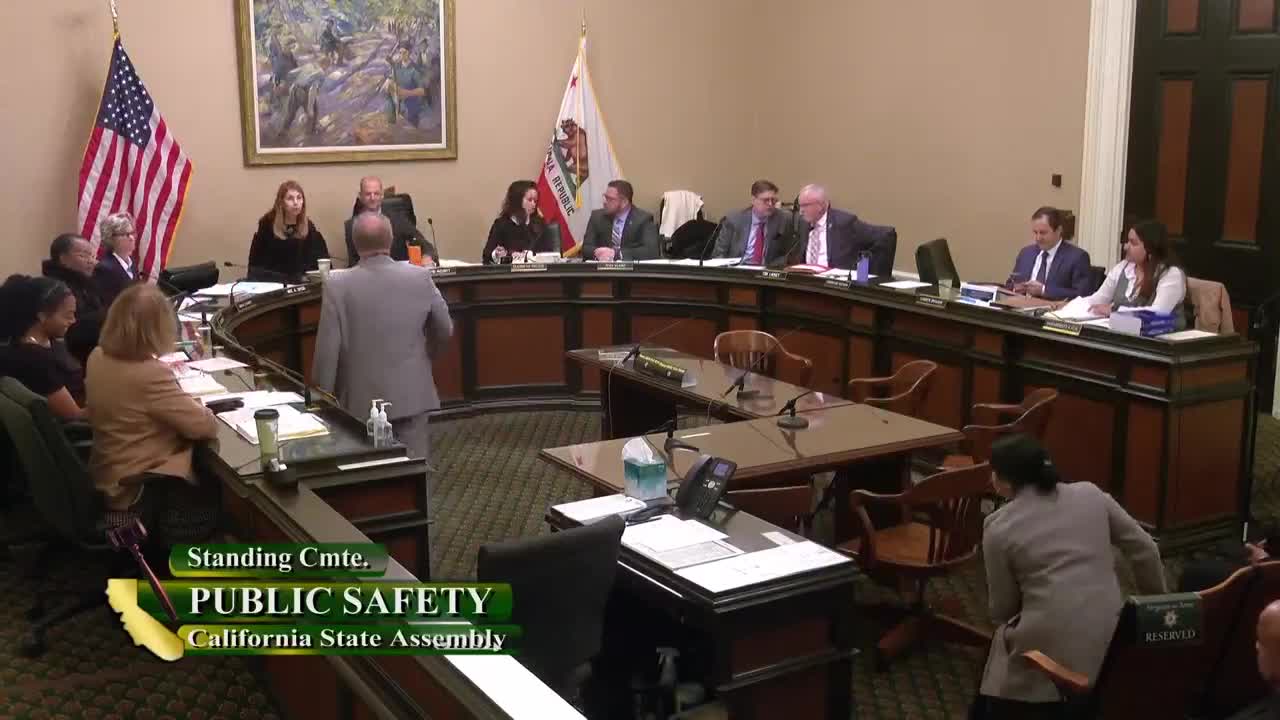 21MIN
Assembly Standing Committee on Public Safety
Bill Author

Bill Co-Author(s):