AB 2092: Early Childhood Integrated Data System.
- Session Year: 2025-2026
- House: Assembly
- Latest Version Date: 2026-04-23
Current Status:
In Progress
(2026-05-14: Joint Rule 62(a), file notice suspended. (Page 5030.))
Introduced
In Committee
Awaiting First Chamber Vote
Passed First Chamber
In Committee
Awaiting Second Chamber Vote
Passed Second Chamber
Enacted
Existing law places with the State Department of Social Services responsibility for various programs, services, and systems relating to early learning and care, including, among others, various childcare and development programs, the California Child Care Initiative Project, the Child Development Management Information System, and other related data systems, as specified.
This bill would establish the statewide Early Childhood Integrated Data System under the department to, among other things, link data across programs serving children from birth to 5 years of age. The bill would require the department to establish the Interagency Early Childhood Data Task Force to coordinate efforts on development and implementation of the system, as specified.
The bill would require the task force to annually submit a report to the Legislature on the progress in developing, establishing, and operating the data system. system, with the report containing certain recommendations. The bill would require the department to collect specified data. ingest data, sourced from administrative data systems maintained by each data provider, to be implemented in 2 phases, as specified. The bill would set forth certain conditions on the department relating to the collection, ingestion, deletion, use, and sharing of the data.
Existing law places with the State Department of Social Services responsibility for various programs, services, and systems relating to early learning and care, including, among others, various childcare and development programs, the California Child Care Initiative project and Project, the Child Development Management Information System System, and other related data systems, as specified.
This bill would establish the statewide Early Childhood Integrated Data System under the State Department of Social Services department to, among other things, link data across programs serving children from birth to five 5 years of age. The bill would require the department to establish the Interagency Early Childhood Data Task force Force to coordinate efforts on development and implementation of the system, as specified, and would specified.
The bill would require the task force to annually submit a report to the Legislature on the progress in developing, establishing, and operating the data system. The bill would require the department to establish memoranda of understanding for data sharing with specified state entities, and would require the department to collect specified data. The bill would set forth certain conditions on the department relating to the collection, deletion, use, and sharing of the data.
Existing law places with the State Department of Social Services responsibility for various programs, services, and systems relating to early learning and care, including, among others, various childcare and development programs, the California Child Care Initiative project and the Child Development Management Information System and other related data systems, as specified.
This bill would establish the statewide Early Childhood Integrated Data System under the State Department of Social Services to, among other things, link data across programs serving children from birth to five years of age. The bill would require the department to establish the Interagency Early Childhood Data Task force to coordinate efforts on development and implementation of the system, as specified, and would require the task force to annually submit a report to the Legislature on the progress in developing, establishing, and operating the data system. The bill would require the department to establish memoranda of understanding for data sharing with specified state entities, and would require the department to collect specified data.
The Legislature finds and declares all of the following:
(a)Californias early childhood data systems are fragmented across multiple agencies, limiting the states ability to identify gaps in access, evaluate and improve program quality, strategically direct investments, and ensure equitable outcomes for children and families.
(b)According to Child Trends, a leading research organization, integrated early childhood data enable states to use data to increase equitable access to programs, monitor outcomes, and inform policy decisions that close disparities in school readiness and long-term achievement.
(c)Establishing a comprehensive early childhood integrated data system will allow California to do all of the following:
(1)Link data across programs serving children from birth to five years of age.
(2)Provide actionable insights to improve access, quality, and equity.
(3)Support longitudinal analysis by connecting early childhood data to the California Cradle-to-Career Data System. across state entities. The data may be used in the future to support the California Cradle-to-Career Data System through subsequent legislation.
(d)The new data system will prioritize equity and inclusion by ensuring that data collection and reporting illuminate disparities and inform targeted interventions.
(e)A state-led governance structure, supported by dedicated funding and interagency collaboration, is essential to implement the new data system and protect the privacy and rights of children and families.
(f)By investing in the new data system, California will strengthen its early learning system, improve outcomes for children, and advance the states commitment to equity and transparency.
SEC. 2.Section 10209.9 is added to the Welfare and Institutions Code, to read:10209.9.(a)The statewide Early Childhood Integrated Data System is hereby established under the State Department of Social Services, and the department shall assume statewide leadership and coordination of the data system. The system shall do all of the following:
(1)Link data across programs serving children from birth to five years of age.
(2)Provide actionable insights to improve access, quality, and equity.
(3)Support longitudinal analysis by connecting early childhood data to the California Cradle-to-Career Data System.(3)Provide necessary linked data to conduct audits and evaluations of federal- or state-supported early childhood programs, to enforce or comply with legal requirements that relate to those programs, and to allow for the creation of deidentified datasets for accountability, transparency, improvement of programs, and other public purposes, subject to all applicable privacy laws, including, but not limited to, the federal Health Insurance Portability and Accountability Act of 1996 (42 U.S.C. Sec. 1320d et seq.), the federal Family Educational Rights and Privacy Act (20 U.S.C. Sec. 1232g), the Confidentiality of Medical Information Act (Part 2.6 (commencing with Section 56) of Division 1 of the Civil Code), and the Information Practices Act of 1977 (Chapter 1 (commencing with Section 1798) of Title 1.8 of Part 4 of Division 3 of the Civil Code).
(b)(1)The department shall establish the Interagency Early Childhood Data Task Force to coordinate efforts on development and implementation of the system.
(2)The task force shall be composed of a data privacy expert and a representative from all of the following entities:
(A)The California Health and Human Services Agency.
(B)The State Department of Social Services.
(C)The State Department of Education.
(D)The State Department of Developmental Services.
(E)The State Department of Public Health.
(F)The Commission on Teacher Credentialing.
(G)The State Board of Education.
(H)The Office of Cradle-to-Career Data.
(I)First 5 California.
(3)The task force shall provide information and advise the department on early learning and care data by doing all of the following:
(A)Conduct a comprehensive landscape analysis scan, for which the task force may leverage any applicable published early-learning landscape analysis, that outlines all of the following:
(i)Existing zero to five years of age data elements across data providers and state entities.
(ii)Existing early childhood workforce data elements across data providers and state entities.
(iii)Existing early childhood program and site data elements across data providers and state entities.
(iv)Data-collection gaps Existing data-collection gaps across data providers and state entities to answer how children are moving through the education pipeline and how best to understand both regional and statewide needs.
(v)Current data-sharing agreements amongst the state entities represented in the task force.
(vi)Functionality of the data system.
(vii)The need for state funding and full-time equivalent state-funded staff needed to implement the data system.
(B)Guide decisions regarding strategic planning, data-collection data-ingestion procedures, including pertinent data elements to be collected, ingested by the data system, security policies, and metrics to track progress toward state goals.
(C)Facilitate the sharing of existing data from early childhood programs across state agencies to do both entities to do all of the following:
(i)Inform policy related to early childhood programs at the state level.
(ii)Guide improvements to early childhood programs to provide better outcomes for children and families.
(iii)Enable ongoing evaluation in support of accountability and transparency around Californias early childhood programs.
(D)Develop and implement a stakeholder engagement plan. an interest-holder engagement plan that outlines a process to consider and respond to public input.
(E)Develop the data system in a manner that allows the state to do all of the following:
(i)Identify gaps in services.
(ii)Identify opportunities to align services and programs.
(iii)Coordinate needs across services and programs.
(iv)Design and monitor equitable reimbursement structures that reflect the true cost of care and promote quality improvement.
(v)Further implement the Master Plan on Early Learning and Care.
(vi)Comply with all applicable privacy laws.
(4)(A)The department and task force members shall establish data-sharing agreements that capture shared intent to collaborate and develop the data system. system and that capture data-sharing purposes, specifications, and methodologies that meet all applicable state and federal privacy laws.
(B)The task force members shall share their respective early childhood data described in this section with the department. department, subject to compliance with all applicable privacy laws.
(C)Only reviewed and approved uses of the data by the state entity from which the data originated shall be allowed.
(C)(D)The task force members shall meet at least quarterly until the data system is implemented. The task force members shall continue to share data pursuant to this section even after the data system is implemented. implemented in accordance with their data-sharing agreements.
(5)(A)The task force shall annually submit a report to the Legislature on the progress in developing, establishing, and operating the data system. The report shall include both of the following:
(i)Specific recommendations for the ongoing engagement of community interest holders.
(ii)Recommendations regarding the permanent governance structure of the data system. These recommendations shall address the sustained oversight, data privacy protections, and the technical evolution of the system after its initial establishment to ensure the systems long-term viability and utility.
(B)A report to be submitted pursuant to subparagraph (A) shall be submitted in compliance with Section 9795 of the Government Code.
(c)(1)The department shall collect data, which shall include data on childrens state and federal programs, such as the type of education program, health, food, teacher credentialing, income, address, age, learning milestones, hours in care, language use and access, and any other data elements determined to be pertinent by the task force pursuant to subdivision (b).(c)(1)The department shall ingest data, sourced from administrative data systems maintained by each data provider, which shall be limited to the following, as specified in each data-sharing agreement:
(A)Credentialing Automation System for Education.
(B)California Statewide Assignment Accountability System.
(C)Accreditation Data System.
(D)California Longitudinal Pupil Achievement Data System.
(E)Migrant Student Information Network.
(F)After School Support and Information System.
(G)California Preschool Data Collection System.
(H)Child Development Management Information System.
(I)Preschool Language Information System.
(2)(A)This section shall not be construed as requiring state entities to collect new data. Instead, the state entities are urged to furnish the department with existing data to answer specific questions needed to produce a more comprehensive understanding of early learning and care experiences, workforce, and needs in California.
(B)Data ingestion under this section shall be implemented pursuant to the following two phases:
(i)Phase 1: personally identifiable information shall only be used in the initial stage of data sharing in order to link records across currently separate datasets needed to answer specific research questions, not to follow individuals. As with other similar current cross-agency data-sharing procedures, this linkage process shall occur in a highly secure environment, and the separation principle shall apply, under which an individuals personally identifiable information shall be kept separate from information about the services that they received or other analytically relevant information. The Legislature finds that this is standard practice in the case of many existing cross-agency data-sharing projects, such as the California Health and Human Services Agency Record Reconciliation Data and Dashboard and the System of Care Foster Youth Cross-System Landscape Analysis that is generated pursuant to Section 16521.6.
(ii)Phase 2: once the probabilistic match is complete, the records shall be stripped of identifying information, leaving only an encrypted linkage key and source record identifiers facilitating integration with analytic information. This confidential research file shall then be pushed to a separate analytic environment, where it shall be made available to entities on the task force for analysis and aggregation.
(C)Similarly to other state data systems, all data made available for analysis in the Early Childhood Integrated Data System shall be deidentified and presented as summary data or in the aggregate, such as rates, percentages, averages, or other statistics that provide information about a collection, services, or group of individuals. The personally identifiable information shall not be analyzed or used for any purpose other than the linking described in subparagraph (B).
(2)(3)(A)The department shall retain collected data within the system only as long as reasonably necessary to fulfill the specific purpose for which the data were collected. submitted to the system. The department shall delete the data using reasonable measures to protect against unauthorized access to, or use or disclosure of, the data when the specific purpose for which the data were collected within the system is accomplished.
(B)The department shall only collect ingest the data necessary to accomplish the purpose. The department shall not collect ingest data that significantly differ from the data specified and authorized in this section without prior authorization from the Legislature.
(C)The department shall not use the data for any purpose other than the purpose for which they were collected. ingested. The department shall not sell the data. The department shall not share the data beyond the purpose for which they were collected. ingested.
(3)(4)The department shall enforce data privacy and protection policies with all participating entities.
REVISIONS: HeadingLine 2.The Legislature finds and declares all of the following:
(a)Californias early childhood data systems are fragmented across multiple agencies, limiting the states ability to identify gaps in access, improve program quality, strategically direct investments, and ensure equitable outcomes for children and families.
(b)According to Child Trends, a leading research organization, integrated early childhood data enable states to use data to increase equitable access to programs, monitor outcomes, and inform policy decisions that close disparities in school readiness and long-term achievement.
(c)Establishing a comprehensive early childhood integrated data system will allow California to do all of the following:
(1)Link data across programs serving children from birth to five years of age.
(2)Provide actionable insights to improve access, quality, and equity.
(3)Support longitudinal analysis by connecting early childhood data to the California Cradle-to-Career Data System.
(d)The new data system will prioritize equity and inclusion by ensuring that data collection and reporting illuminate disparities and inform targeted interventions.
(e)A state-led governance structure, supported by dedicated funding and interagency collaboration, is essential to implement the new data system and protect the privacy and rights of children and families.
(f)By investing in the new data system, California will strengthen its early learning system, improve outcomes for children, and advance the states commitment to equity and transparency.
SEC. 2.Section 10209.9 is added to the Welfare and Institutions Code, to read:10209.9.(a)The statewide Early Childhood Integrated Data System is hereby established under the State Department of Social Services, and the department shall assume statewide leadership and coordination of the data system. The system shall do all of the following:
(1)Link data across programs serving children from birth to five years of age.
(2)Provide actionable insights to improve access, quality, and equity.
(3)Support longitudinal analysis by connecting early childhood data to the California Cradle-to-Career Data System.
(b)(1)The department shall establish the Interagency Early Childhood Data Task Force to coordinate efforts on development and implementation of the system.
(2)The task force shall be composed of a data privacy expert and a representative from all of the following entities:
(A)The California Health and Human Services Agency.
(B)The State Department of Social Services.
(C)The State Department of Education.
(D)The State Department of Developmental Services.
(E)The State Department of Public Health.
(E)(F)The Commission on Teacher Credentialing.
(F)(G)The State Board of Education.
(G)(H)The Office of Cradle-to-Career Data.
(H)(I)First 5 California.
(3)The task force shall provide information and advise the department on early learning and care data by doing all of the following:
(A)Conduct a comprehensive landscape analysis scan scan, for which the task force may leverage any applicable published early-learning landscape analysis, that outlines all of the following:
(i)Existing zero to five years of age data elements across data providers and state entities.
(ii)Existing early childhood workforce data elements across data providers and state entities.
(iii)Existing early childhood program and site data elements across data providers and state entities.
(ii)Data collection(iv)Data-collection gaps to answer how children are moving through the education pipeline and how best to understand both regional and statewide needs.
(iii)(v)Current data sharing data-sharing agreements amongst the state entities represented in the task force and described in subdivision (c). force.
(iv)(vi)Functionality of the data system.
(v)(vii)The need for state funding and full-time equivalent state-funded staff needed to implement the data system.
(B)Guide decisions regarding strategic planning, data collection data-collection procedures, including pertinent data elements to be collected, security policies, and metrics to track progress toward state goals.
(C)Facilitate the sharing of data from early childhood programs across state agencies to do both of the following:
(i)Inform policy related to early childhood programs at the state level.
(ii)Guide improvements to early childhood programs to provide better outcomes for children and families.
(D)Develop and implement a stakeholder engagement plan.
(E)Develop the data system in a manner that allows the state to do all of the following:
(i)Identify gaps in services.
(ii)Identify opportunities to align services and programs.
(iii)Coordinate needs across services and programs.
(iv)Design and monitor equitable reimbursement structures that reflect the true cost of care and promote quality improvement.
(v)Further implement the Master Plan on Early Learning and Care.
(4)(A)The department and task force members shall establish participatory agreements through memoranda of understanding data-sharing agreements that capture shared intent to collaborate and develop the data system.
(B)The task force members shall share their respective early childhood data described in this section with the department.
(C)The task force members shall meet at least quarterly until the data system is implemented. The task force members shall continue to share data pursuant to this section even after the data system is implemented.
(5)(A)The task force shall annually submit a report to the Legislature on the progress in developing, establishing, and operating the data system.
(B)A report to be submitted pursuant to subparagraph (A) shall be submitted in compliance with Section 9795 of the Government Code.
(c)The department shall establish memoranda of understanding for data sharing with all of the following entities:(1)The Department of Rehabilitation.(2)The Department of Child Support Services.(3)The Department of Housing and Community Development.(4)The Employment Development Department.(5)The Student Aid Commission.(6)The office of the Chancellor of the California Community Colleges.(7)The Office of the Surgeon General.(8)The California State Library.(d)(c)(1)The department shall collect data, which shall include data on childrens state and federal programs, such as the type of education program, health, food, teacher credentialing, income, address, age, learning milestones, hours in care, language use and access, and any other data elements determined to be pertinent by the task force pursuant to subdivision (b). The department shall not collect data elements that significantly differ from the data elements specified and authorized in this section without prior authorization from the Legislature.
(2)The department shall only collect and share the minimum amount of data necessary to achieve the intent of this section. The department shall not use the data collected pursuant to this section for any other purpose, except as specified in this section.(2)(A)The department shall retain collected data only as long as reasonably necessary to fulfill the specific purpose for which the data were collected. The department shall delete the data using reasonable measures to protect against unauthorized access to, or use or disclosure of, the data when the specific purpose for which the data were collected is accomplished.
(B)The department shall only collect the data necessary to accomplish the purpose. The department shall not collect data that significantly differ from the data specified and authorized in this section without prior authorization from the Legislature.
(C)The department shall not use the data for any purpose other than the purpose for which they were collected. The department shall not sell the data. The department shall not share the data beyond the purpose for which they were collected.
(3)The department shall enforce data privacy and protection policies with all participating entities.
The Legislature finds and declares all of the following:
(a)Californias early childhood data systems are fragmented across multiple agencies, limiting the states ability to identify gaps in access, improve program quality, strategically direct investments, and ensure equitable outcomes for children and families.
(b)According to Child Trends, a leading research organization, integrated early childhood data enable states to use data to increase equitable access to programs, monitor outcomes, and inform policy decisions that close disparities in school readiness and long-term achievement.
(c)Establishing a comprehensive early childhood integrated data system will allow California to do all of the following:
(1)Link data across programs serving children from birth to five years of age.
(2)Provide actionable insights to improve access, quality, and equity.
(3)Support longitudinal analysis by connecting early childhood data to the California Cradle-to-Career Data System.
(d)The new data system will prioritize equity and inclusion by ensuring that data collection and reporting illuminate disparities and inform targeted interventions.
(e)A state-led governance structure, supported by dedicated funding and interagency collaboration, is essential to implement the new data system and protect the privacy and rights of children and families.
(f)By investing in the new data system, California will strengthen its early learning system, improve outcomes for children, and advance the states commitment to equity and transparency.
SEC. 2.Section 10209.9 is added to the Welfare and Institutions Code, to read:10209.9.(a)The statewide Early Childhood Integrated Data System is hereby established under the State Department of Social Services, and the department shall assume statewide leadership and coordination of the data system. The system shall do all of the following:
(1)Link data across programs serving children from birth to five years of age.
(2)Provide actionable insights to improve access, quality, and equity.
(3)Support longitudinal analysis by connecting early childhood data to the California Cradle-to-Career Data System.
(b)(1)The department shall establish the Interagency Early Childhood Data Task Force to coordinate efforts on development and implementation of the system.
(2)The task force shall be composed of a data privacy expert and a representative from all of the following entities:
(A)The California Health and Human Services Agency.
(B)The State Department of Social Services.
(C)The State Department of Education.
(D)The State Department of Developmental Services.
(E)The Commission on Teacher Credentialing.
(F)The State Board of Education.
(G)The Office of Cradle-to-Career Data.
(H)First 5 California.
(3)The task force shall provide information and advise the department on early learning and care data by doing all of the following:
(A)Conduct a comprehensive landscape analysis scan that outlines all of the following:
(i)Existing zero to five years of age data elements across data providers and state entities.
(ii)Data collection gaps to answer how children are moving through the education pipeline and how best to understand both regional and statewide needs.
(iii)Current data sharing agreements amongst the state entities represented in the task force and described in subdivision (c).
(iv)Functionality of the data system.
(v)The need for state funding and full-time equivalent state-funded staff needed to implement the data system.
(B)Guide decisions regarding strategic planning, data collection procedures, including pertinent data elements to be collected, security policies, and metrics to track progress toward state goals.
(C)Facilitate the sharing of data from early childhood programs across state agencies to do both of the following:
(i)Inform policy related to early childhood programs at the state level.
(ii)Guide improvements to early childhood programs to provide better outcomes for children and families.
(D)Develop and implement a stakeholder engagement plan.
(E)Develop the data system in a manner that allows the state to do all of the following:
(i)Identify gaps in services.
(ii)Identify opportunities to align services and programs.
(iii)Coordinate needs across services and programs.
(iv)Design and monitor equitable reimbursement structures that reflect the true cost of care and promote quality improvement.
(v)Further implement the Master Plan on Early Learning and Care.
(4)The department and task force members shall establish participatory agreements through memoranda of understanding that capture shared intent to collaborate and develop the data system.
(5)(A)The task force shall annually submit a report to the Legislature on the progress in developing, establishing, and operating the data system.
(B)A report to be submitted pursuant to subparagraph (A) shall be submitted in compliance with Section 9795 of the Government Code.
(c)The department shall establish memoranda of understanding for data sharing with all of the following entities:
(1)The Department of Rehabilitation.
(2)The Department of Child Support Services.
(3)The Department of Housing and Community Development.
(4)The Employment Development Department.
(5)The Student Aid Commission.
(6)The office of the Chancellor of the California Community Colleges.
(7)The Office of the Surgeon General.
(8)The California State Library.
(d)(1)The department shall collect data, which shall include data on childrens state and federal programs, such as the type of education program, health, food, teacher credentialing, income, address, age, learning milestones, hours in care, and any other data elements determined to be pertinent by the task force pursuant to subdivision (b). The department shall not collect data elements that significantly differ from the data elements specified and authorized in this section without prior authorization from the Legislature.
(2)The department shall only collect and share the minimum amount of data necessary to achieve the intent of this section. The department shall not use the data collected pursuant to this section for any other purpose, except as specified in this section.
(3)The department shall enforce data privacy and protection policies with all participating entities.
|
Date
|
Status
|
|---|---|
| May 14, 2026 | Coauthors revised. |
| May 14, 2026 | In committee: Held under submission. |
| May 14, 2026 | Joint Rule 62(a), file notice suspended. |
| May 14, 2026 | Joint Rule 62(a), file notice suspended. (Page 5030.) |
| May 13, 2026 | In committee: Set, first hearing. Referred to APPR. suspense file. |
| Apr 27, 2026 | Re-referred to Com. on APPR. |
| Apr 23, 2026 | Read second time and amended. |
| Apr 22, 2026 | From committee: Amend, and do pass as amended and re-refer to Com. on APPR. (Ayes 15. Noes 0.) (April 21). |
| Apr 6, 2026 | Re-referred to Com. on P. & C.P. |
| Mar 31, 2026 | In committee: Hearing postponed by committee. |
| Mar 26, 2026 | From committee chair, with author's amendments: Amend, and re-refer to Com. on P. & C.P. Read second time and amended. |
| Mar 25, 2026 | From committee: Do pass and re-refer to Com. on P. & C.P. (Ayes 7. Noes 0.) (March 24). Re-referred to Com. on P. & C.P. |
| Mar 9, 2026 | Referred to Coms. on HUM. S. and P. & C.P. |
| Feb 19, 2026 | From printer. May be heard in committee March 21. |
| Feb 18, 2026 | Read first time. To print. |
|
Date
|
Description
|
Location
|
Votes
|
|
|---|---|---|---|---|
| Apr 21, 2026 | Do pass as amended and be re-referred to the Committee on [Appropriations] | Assembly Standing Committee on Privacy and Consumer Protection |
Passed |
|
| Mar 24, 2026 | Do pass and be re-referred to the Committee on [Privacy and Consumer Protection] | Assembly Standing Committee on Human Services |
Passed |
This list shows positions taken on this bill by organizations on the date displayed, which is linked to the original source.
Positions by individuals are not included.
|
Organization
|
Position
|
Date
|
|---|---|---|
| AdvancED Consulting, LLC | ** Support | |
| Alameda County Office Of Education | ** Support | |
| Ap-od | ** Support | |
| Association Of Regional Center Agencies | ** Support | |
| Bay Area Council | ** Support | |
| BLU Educational Foundation | ** Support | |
| California Family Resource Association | ** Support | |
| Californians Together | ** Support | |
| CCWRO | ** Support | |
| Child Abuse Prevention Center | ** Support | |
| Children Now | ** Support | |
| Early Edge California | ** Support | |
| EdTrust-West | ** Support | |
| EveryChild California | ** Support | |
| Families In Schools | ** Support | |
| First 5 Association Of California | ** Support | |
| Kidango | ** Support | |
| Legislative Action Committee - Santa Clara County School Boards Association | ** Support | |
| Multilingual Promise | ** Support | |
| Oakland Privacy | ** Against | |
| Para Los Ninos | ** Support | |
| Parent Institute for Quality Education | ** Support | |
| parent organization network | ** Support | |
| Prevent Child Abuse California | ** Support | |
| Safe Kids California | ** Support | |
| Seal | ** Support | |
| Sobrato Early Academic Language (SEAL) | ** Support | |
| The Education Trust - West (Sponsor) | ** Support | |
| Unidosus | ** Support |
Date of Hearing: May 13, 2026
ASSEMBLY COMMITTEE ON APPROPRIATIONS
Buffy Wicks, Chair
ABPCA Bill Id:AB 2092
Author:(Bonta) – As Amended Ver:April 23, 2026
Policy Committee: | Human Services | Vote: | 7 - 0 |
Privacy and Consumer Protection | 15 - 0 | ||
|
|
Urgency: No State Mandated Local Program: No Reimbursable: No
SUMMARY:
This bill establishes the Early Childhood Integrated Data System (ECIDS) under the California Department of Social Services (CDSS) to link data across programs serving children from birth to five years of age. The bill requires CDSS to convene a task force to guide system development and implementation of the system and to annually report to the Legislature on its progress.
Specifically, this bill:
- Establishes the statewide ECIDS under CDSS and requires CDSS to assume statewide leadership and coordination of the data system. Requires the system to link data across programs serving children from birth to five year of age, provide actionable insights, and provide necessary linked data to conduct audits and evaluations of federal- or state-supported early childhood programs, to enforce or comply with legal requirements that relate to those programs, and to allow for the creation of deidentified datasets for public purposes, subject to all applicable privacy laws.
- Requires the taskforce to be composed of a data privacy expert and a representative from specified state departments and relevant entities.
- Requires the taskforce to provide information and advise CDSS on early learning and care data by, among other tasks: (a) conducting a comprehensive landscape analysis, (b) guiding decisions regarding strategic planning, data-ingestion procedures, security policies, and metrics, (c) facilitating the sharing of existing data across state entities, (d) developing and implementing an interest-holder engagement plan, and (e) developing a data system.
- Requires CDSS and taskforce members to establish data-sharing agreements through memoranda of understanding (MOU) that capture shared intent to collaborate and develop the data system, as specified.
- Requires the taskforce to meet at least quarterly until the data system is implemented and to annually report to the Legislature on the progress in developing, establishing, and operating the data system.
- Requires CDSS to ingest data, sourced from administrative data systems maintained by each data provider, and limit as specified.
FISCAL EFFECT:
CDSS estimates ongoing General Fund costs of $3.5 million annually for seven IT specialists required to build out the systems and ensure security for the new data system, seven staff research data specialists to conduct research and analysis, implement data linkages, and collaborate on the task force, and two additional analysts to draft ongoing legislative reports, help develop data sharing agreements, and obtain internal and external feedback needed to develop the agreements.
The Legislative Analyst’s Office recently warned of General Fund structural deficits of around $35 billion per year in the 2027-28 fiscal year and ongoing.
COMMENTS:
- Purpose. According to the author:
Currently, California’s early childhood data are siloed within multiple individual agencies, meaning agencies cannot track how children are doing across programs and are unable to serve children appropriately. CDSS, the Department of Education (CDE), and the Health and Human Services Agency (CalHHS) all collect early childhood data. However, no one agency has the authority to gather the data from the other agencies. This leaves us with a disjointed system, where we cannot track how our children are doing holistically. [This bill] addresses this issue by giving statutory authority to DSS to gather all early childhood data across agencies and develop the Early Childhood Integrated Data System (ECIDS) to track these data.
- ECIDS. California administers early childhood programs serving children from birth to five years of age through multiple state agencies, including CDSS, the California Department of Education, the California Department of Developmental Services, and various health and human services programs. Each agency collects and maintains its own data systems to administer services such as subsidized childcare, preschool, developmental services, health programs, and nutrition assistance. Because these systems were developed independently, they often operate separately and rely on different data standards, definitions, and reporting structures. As a result, the state lacks a unified system to consistently link or analyze data across early childhood programs. This fragmentation limits the state’s ability to understand how children and families move between programs, identify gaps in access to services, and assess how different services collectively support early childhood development and influence longer-term outcomes.
ECIDS are designed to address these challenges by linking data across programs and agencies that serve young children and their families. By integrating data from multiple sources, states can better understand service utilization and how participation in early childhood programs influences developmental, educational, and family outcomes. Research organizations, such as Child Trends, find that ECIDS can help identify disparities in access, monitor outcomes, improve coordination, and reduce duplication. Consistent with these findings, California’s 2020 Master Plan for Early Learning and Care identified the development of a statewide ECIDS as a key strategy to strengthen the state’s early learning infrastructure.
- Opposition. Recent amendments alleviated most of the concerns of the opposition, Oakland Privacy, who has moved to an oppose unless amended position and indicates they continue to work with the author.
Analysis Prepared by: Jennifer Swenson / APPR. / (916) 319-2081
Date of Hearing: April 21, 2026
Fiscal:
ASSEMBLY COMMITTEE ON PRIVACY AND CONSUMER PROTECTION
Rebecca Bauer-Kahan, Chair
ABPCA Bill Id:AB 2092 (
Author:Bonta) – As Amended Ver:March 26, 2026
PROPOSED AMENDMENTS
SUBJECT: Early Childhood Integrated Data System
SYNOPSIS
This bill gives statutory authority to the Department of Social Services (CDSS) to gather all early childhood data across state agencies and develop the Early Childhood Integrated Data System (ECIDS) to track these data. In other words, this bill establishes a taskforce to develop ECIDS and gives them the authority to request CDSS collect any and all data they deem necessary to develop detailed profiles on all children in California from birth to age five, their families, and their teachers.
As currently drafted, the bill does not contain adequate privacy protection measures, including data minimization. The sheer breadth of data that this would allow CDSS to collect and link to individual families is breathtaking. The taskforce in the bill could determine that they need reproductive healthcare information on women with children under five. They could also gather income tax and employment information on parents, immigration status, criminal records, and any child welfare information to combine in it all in a comprehensive profile. All without the consent of the parents.
The Committee amendments, described in Comment #4 will require that the taskforce and CDSS comply with all applicable privacy laws and limits the data that CDSS can access to nine existing early-childhood education and K-12 databases. If more data is needed for ECIDS, the taskforce will need to return to the Legislature.
This bill is sponsored by EdTrust-West and supported by a number of educational organizations and social just organizations, including the Alameda County Office of Education and Children Now. It is opposed by Oakland Privacy.
This bill was previously heard by the Human Services Committee, where it passed on a 7-0 vote
EXISTING LAW:
- Establishes the Family Educational Rights and Privacy Act (FERPA), which protects the privacy of student education records. The law applies to all schools that receive funds under an applicable program of the U.S. Department of Education. (20 U.S.C. § 1232g; 34 C.F.R. Part 99.)
- Establishes under federal law, the Health Information Portability and Accountability Act of 1996 (HIPAA), which sets standards for the privacy of individually identifiable health information and security standards for the protection of electronic protected health information, including, through regulations, that a HIPAA-covered entity may not condition the provision of treatment, payment, enrollment in a health plan, or eligibility for benefits on the provision of an authorization, except under specified circumstances. Provides that if HIPAA’s provisions conflict with state law, the provision that is most protective of patient privacy prevails. (42 U.S.C. § 1320d, et seq.; 45 Code Fed. Regs. Part 164.)
- Provides, pursuant to the California Constitution, that all people are by nature free and independent and have inalienable rights. Among these the fundamental right to privacy. (Cal. Const. art. I, § 1.)
- Establishes the Information Practices Act (IPA) of 1977, which generally enumerates the requirements applicable to state agencies that collect, maintain, and disclose personal information from California residents, including limitations on permissible disclosure, the rights of residents to know and access the information, and required accounting of disclosures of the information. (Civ. Code §§ 1798, et seq.)
- States, in the IPA, that the “right to privacy is a personal and fundamental right protected by Section 1 of Article I of the Constitution of California and by the United States Constitution and that all individuals have a right of privacy in information pertaining to them.” Further states these findings of the Legislature:
- The right to privacy is being threatened by the indiscriminate collection, maintenance, and dissemination of personal information and the lack of effective laws and legal remedies.
- The increasing use of computers and other sophisticated information technology has greatly magnified the potential risk to individual privacy that can occur from the maintenance of personal information.
- In order to protect the privacy of individuals, it is necessary that the maintenance and dissemination of personal information be subject to strict limits. (Civ. Code § 1798.1.)
- Requires that each state agency maintain in its records only personal information that is relevant and necessary to accomplish the purpose of the agency. (Civ. Code § 1798.14.)
- Requires that each agency collect personal information to the greatest extent practicable directly from the individual who is the subject of the information rather than from another source. (Civ. Code § 1798.15.)
- Prohibits an individual’s name and address from being distributed for commercial purposes, sold, or rented by an agency unless such action is specifically authorized by law. (Civ. Code § 1798.60.)
- Defines “personal information,” for purposes of the IPA, as any information that is maintained by an agency that identifies or describes an individual, including, but not limited to, the individual’s name, social security number, physical description, home address, home telephone number, education, financial matters, and medical or employment history. (Civ. Code § 1798.3(a).)
- Establishes the California C2C Data Systems Act, which expresses legislative intent to build a data system that serves students and families by identifying and tracking predictive indicators to enable parents, teachers, health and human services providers, and policymakers to provide appropriate interventions and supports to address disparities in opportunities and improve outcomes for all students. (Ed. Code §§ 10850 et seq.)
- Establishes the Early Childhood Development Act of 2020, transferring specified early learning and care programs from CDE to CDSS and expresses legislative intent to implement a phased approach to achieving the goals of the Master Plan for Early Learning Care, including integrating childcare programs with other benefits and services. (Welf. and Inst. Code §§ 10200 et seq.)
- Requires CDE to collect pupil-level data for children enrolled in California State Preschool Programs operated by local educational agencies, as well as data on preschool educators, to better understand program participation and outcomes and align early learning data with the state’s K-12 longitudinal data systems. (Ed. Code §§ 60910 et seq.)
THIS BILL:
- Establishes the Early Childhood Integrated Data System (ECIDS) under the California Department of Social Services (CDSS) to link data across programs serving children from birth to five years of age and connect to the California Cradle-to-Career (C2C) Data System. Requires CDSS to convene an Interagency Early Childhood Data Taskforce to guide system development, data sharing, privacy protections, and stakeholder engagement. Authorizes CDSS to collect and share limited early childhood program data to improve access, coordination, equity, and outcomes for children and families. Specifically, this bill:
- Establishes the statewide ECIDS under CDSS and requires CDSS to assume statewide leadership and coordination of the data system. Requires the system to do all of the following:
- Link data across programs serving children from birth to five years of age.
- Provide actionable insights to improve access, quality, and equity.
- Support longitudinal analysis by connecting early childhood data to the C2C data system.
- Requires CDSS to establish the Interagency Early Childhood Data Taskforce (taskforce) to coordinate efforts on development and implementation of ECIDS.
- Requires the taskforce to be composed of a data privacy expert and a representative from all the following entities:
- The California Health and Human Services Agency.
- CDSS.
- The California Department of Education (CDE).
- The California Department of Developmental Services (DDS).
- The Commission on Teacher Credentialing.
- The State Board of Education.
- The Office of C2C Data.
- First 5 California.
- Requires the taskforce to provide information and advise CDSS on early learning and care data by doing all of the following:
- Conduct a comprehensive landscape analysis scan that outlines all of the following:
- Existing zero to five years of age data elements across data providers and state entities.
- Data collection gaps to answer how children are moving through the education pipeline and how best to understand both regional and statewide needs.
- Current data sharing agreements amongst the state entities represented in the taskforce.
- Functionality of the data system.
- The need for state funding and full-time equivalent state-funded staff needed to implement the data system.
- Guide decisions regarding strategic planning, data collection procedures, including pertinent data elements to be collected, security policies, and metrics to track progress toward state goals.
- Facilitate the sharing of data from early childhood programs across state agencies to do both of the following:
- Inform policy related to early childhood programs at the state level.
- Guide improvements to early childhood programs to provide better outcomes for children and families.
- Develop and implement a stakeholder engagement plan.
- Develop ECIDS in a manner that allows the state to do all of the following:
- Identify gaps in services.
- Identify opportunities to align services and programs.
- Coordinate needs across services and programs.
- Design and monitor equitable reimbursement structures that reflect the true cost of care and promote quality improvement.
- Further implement the Master Plan on Early Learning and Care.
- Conduct a comprehensive landscape analysis scan that outlines all of the following:
- Requires CDSS and taskforce members to establish participatory agreements through memoranda of understanding (MOU) that capture shared intent to collaborate and develop the data system.
- Requires the taskforce to annually submit a report to the Legislature on the progress in developing, establishing, and operating the data system.
- Requires the report to be submitted in compliance with state law.
- Requires CDSS to collect data, which shall include data on children’s state and federal programs, such as the type of education program, health, food, teacher credentialing, income, address, age, learning milestones, hours in care, and any other data elements determined to be pertinent by the taskforce.
- Prohibits CDSS from collecting data elements that significantly differ from the data elements specified and authorized in these provisions without prior authorization from the Legislature.
- Requires CDSS to only collect and share the minimum amount of data necessary to achieve the intent of this section. Prohibits CDSS from using the data collected pursuant to these provisions for any other purpose, except as specified.
- Requires CDSS to enforce data privacy and protection policies with all participating entities.
COMMENTS:
1) Author’s statement. According to the author:
Currently, California’s early childhood data are siloed within multiple individual agencies, meaning agencies cannot track how children are doing across programs and are unable to serve children appropriately. The Department of Social Services (DSS), the Department of Education (CDE), and the Health and Human Services Agency (CalHHS) all collect early childhood data. However, no one agency has the authority to gather the data from the other agencies. This leaves us with a disjointed system, where we cannot track how our children are doing holistically. AB 2092 addresses this issue by giving statutory authority to DSS to gather all early childhood data across agencies and develop the Early Childhood Integrated Data System (ECIDS) to track these data. In addition to integrating with the Cradle-to-Career data system, ECIDS will help CDE, CDSS, and CalHHS coordinate immediate services for families, such as identifying enrollment gaps or streamlining eligibility across different early learning and care programs. The state has invested billions of dollars into early childhood programs, from universal pre-kindergarten to transitional kindergarten. The legislature must track children across these programs to understand how those investments are working and what needs additional change. California’s children deserve services that meet their needs; we can only deliver these services if we have the data to understand those needs.
2) Early Childhood Integrated Data Systems. The Human Services Committee provides the following background:
California administers early childhood programs serving children from birth to five years of age through multiple state agencies, including CDSS, CDE, DDS, and various health and human services programs. Each agency collects and maintains its own data systems to administer services such as subsidized childcare, preschool, developmental services, health programs, and nutrition assistance. Because these systems were developed independently, they often operate separately and rely on different data standards, definitions, and reporting structures. As a result, the state lacks a unified system to consistently link or analyze data across early childhood programs. This fragmentation limits the state’s ability to understand how children and families move between programs, identify gaps in access to services, and assess how different services collectively support early childhood development and influence longer-term outcomes.
ECIDS are designed to address these challenges by linking data across programs and agencies that serve young children and their families. By integrating data from multiple sources, states can better understand service utilization and how participation in early childhood programs influences developmental, educational, and family outcomes. Research organizations, such as Child Trends, find that ECIDS can help identify disparities in access, monitor outcomes, improve coordination, and reduce duplication. Consistent with these findings, California’s 2020 Master Plan for Early Learning and Care[1] identified the development of a statewide ECIDS as a key strategy to strengthen the state’s early learning infrastructure.
A 2018 nationwide survey by the Early Childhood Data Collaborative[2] found that 22 states link data across some or all early childhood programs, with Georgia and Mississippi reporting full integration across programs. Of these, 18 states have implemented ECIDS, while 12 states, including California, reported plans to do so, and 16 states reported no linkage or plans. States identified challenges with data integration, including data-sharing agreements, agency policies that restrict data exchange, and privacy concerns. Among states with linked data systems, integration is most common for subsidized childcare, state prekindergarten, preschool special education, and early intervention, and less common for home visiting and Head Start programs.
3) Analysis. The value of creating a longitudinal database that creates profiles on all of California’s infants and toddlers (ages 0 to 5) is primarily the responsibility of the Human Services Committee. However, because this bill authorizes the widespread sharing of data across state departments with the intention of linking them to young children and by extension their families and teachers, the concern of this Committee is to ensure that there are sufficient privacy protections, cybersecurity requirements, and data minimization. Toward that end, the bill contains the following protections:
- Requires that a privacy expert be included on the taskforce.
- Requires CDSS to only collect the data necessary to accomplish the purpose.
- Prohibits CDSS from collecting data that significantly differs from the data specified in the bill.
- Prohibits CDSS from using the data it collects for any other purpose and prohibits them from sharing or selling the data.
- Requires CDSS to enforce data privacy and protection policies with all participating entities.
However, the bill also contains significant weaknesses that may put the most sensitive information about children and families at risk.
- Despite the non-specific prohibition on collecting data that significantly differs from the data listed, the bill allows the following:
The department shall collect data, which shall include data on children’s state and federal programs, such as the type of education program, health, food, teacher credentialing, income, address, age, learning milestones, hours in care, language use and access, and any other data elements determined to be pertinent by the taskforce.
Not only are these data categories non-specific, but they are also very sensitive including data on the parents’ income, the child’s home address, and the child’s primary language. Additionally, the language allows CDSS to access any additional data the stakeholders request.
- Beyond requiring the taskforce to guide decisions regarding data collection procedures, including security policies. The bill does not require that the data be encrypted or that a robust cybersecurity plan be in place prior to gathering all of the required data or at any point.
- The bill is silent on who will be able to access the child and family profiles and whether the data can be downloaded and shared.
- The bill does not contemplate requiring the consent of the parents and other adults before sharing and linking their personal information and that of their young children. An important principle of privacy protection is understanding that just because a person provides their personal information for one purpose, that does not mean that they have given away their right to determine how that information is used. This bill, arguably, presumes that the information should no longer be protected because it was included in a government database.
- The bill does not contemplate a process that would allow parents or other adults to review the profiles that have been created and request their deletion.
- The bill does not require anonymization of the data before it is accessed by the people who will be using the database.
In short, the language in this bill, despite including some blanket protections, does not adequately protect the data given the sensitive information likely included in the database they will be accessing.
4) Amendments. To strengthen the protections in the bill, the author has agreed to amend the bill to do the following:
- Clarify that data sharing will be done in accordance with all applicable privacy laws, including the Information Practices Act, the Family Educational Rights and Privacy Act, (FERPA) and the Confidentiality of Medical Information Act.
- Several updates were added by the author to make sure ECIDS is compliant with FERPA.
- Restricts CDSS to only using data available in nine education databases.
- Allows the agency from which the data originated to approve its uses.
- Require the data linkage to be conducted in two phases:
- Phase 1 – Personally identifiable information (PII) will only be used in the initial stage of data sharing to link records across currently separate datasets needed to answer specific research questions, not to follow individuals.
The separation principle will apply: an individual’s PII will always be kept separate from information about the services they received or other analytically-relevant information.
- Phase 2 – Once the probabilistic match is complete, the records will be stripped of identifying information, leaving only an encrypted linkage key and source record identifiers facilitating integration with analytic information.
- Other conforming and technical changes.
ARGUMENTS IN SUPPORT: EdTrust-West, sponsors of the bill, along with a coalition of supporters write:
AB 2092 (Bonta) represents a crucial step toward ensuring that every child has access to quality early learning experiences that build a strong foundation for lifelong learning and success. Our policy brief, Equitable and Accessible Early Learning and Care in California Starts with an Early Childhood Integrated Data System (ECIDS), shows how the current early learning and care landscape is fragmented, with key data siloed across multiple agencies and programs. This lack of integration makes it difficult for decisionmakers and providers to evaluate programs, identify where gaps in early childhood services exist, and how to best support our youngest learners.
Local models prove this vision is achievable. According to the Learning Policy Institute, cities like San Francisco and Long Beach have already started to successfully leverage integrated data systems. By implementing centralized enrollment hubs and integrated data tools, these programs can identify unserved children in real-time and streamline the application process for families. While these local successes provide a roadmap, California has yet to realize the full potential of a scalable, statewide ECIDS to serve as a vital tool for advancing equity and scaling successful early learning models. AB 2092 (Bonta) builds on California’s ongoing efforts to identify inequities and roadblocks to success while also recognizing where things are going well, especially for children of color, those living in poverty, children with disabilities, and multilingual learners. Specifically, this bill would: (1) establish the CDSS as the lead agency with statutory authority to manage the ECIDS; and (2) create an interagency taskforce to oversee data governance, enforce data privacy policies, and update necessary Memorandums of Understanding (MOUs).
ARGUMENTS IN OPPOSITION: In opposition to the bill, Oakland Privacy argues:
We want to be clear that we have had conversations with the author’s office and we know further amendments are in the works. The intent here is to express that the language is currently not quite where we think it should be. We do understand this proposal is in its beginning phases and the primary purpose of this bill is an authorization to begin by assembling a task force. We very much appreciate the author’s inclusion of a data privacy expert on the task force. We would just like to make a few suggestions regarding the enabling language in the bill.
In general, while a broad statement in a bill that all privacy policies and laws will be followed is good, it is better to be specific about what privacy laws are being referred to. While the list does not need to be exclusive and should leave room for project-specific privacy policies that might be developed, the bill language should at least reference the Information Practices Act and the Confidentiality of Medical Information Act. We would suggest that “ including but not limited to” would be appropriate language here.
The bill’s current language, as well as the Information Practices Act itself, refer to the purpose of the information transfer. In order to operationalize these clauses, it would be good to articulate the specific purpose or purposes clearly, so it is possible to determine what is outside of scope. The bill identifies three purposes at the moment:
(1) Link data across programs serving children from birth to five years of age.
(2) Provide actionable insights to improve access, quality, and equity.
(3) Support longitudinal analysis by connecting early childhood data to the California Cradle-to-Career Data System.
With regard to the third purpose, we note that one of the stated purposes of the Cradle to Career Data System is to provide researchers with data for studies of educational outcomes and the impacts of education policy. If the data in ECIDS is intended to connect with CTC, then it seems clear that research would need to be enunciated as a purpose, unless the intent is for ECIDS data to be segregated from the confidential research data provisions in CTC.
We found the current language in the bill a bit confusing about what entities will be enacting data sharing agreements under the bill. One part of the bill language seems to suggest that only the entities that are participating in the task force – a list of nine entities – will be executing data sharing agreements. Another part of the language in the bill seems to suggest a larger number of data sharing agreements. One of the reasons we think this should be specified is that last year there was a proposal, many years after the enabling legislation, for the CTC database to receive income information directly from the Franchise Tax Board with regard to taxpayers who collected dependent child credits of the state. We objected to the proposal as inconsistent with taxpayer confidentiality laws and it did not go forward. It is helpful to define the entities at this early stage.
To the extent possible, we also think it is desirable to assign some characteristics to the data sharing agreements, which should include the data elements being shared, the assignation of purpose or purposes, the retention protocol, any access limitations (i.e. confidential or public data) and where the agreement will be stored. We also believe executed data sharing agreements should be available as public records.
REGISTERED SUPPORT / OPPOSITION:
Support
EdTrust-West (Sponsor)
Advanced Consulting, LLC
Alameda County Office of Education
Ap-od
Association of Regional Center Agencies
Bay Area Council
Blu Educational Foundation
Californians Together
Ccwro
Children Now
Early Edge California
Everychild California
Families in Schools
First 5 Association of California
Kidango
Legislative Action Committee - Santa Clara County School Boards Association
Multilingual Promise
Para Los Ninos
Parent Organization Network
Seal
Sobrato Early Academic Language (SEAL)
Unidosus
Opposition
Oakland Privacy
Analysis Prepared by: Julie Salley / P. & C.P. / (916) 319-2200
Date of Hearing: March 24, 2026
ASSEMBLY COMMITTEE ON HUMAN SERVICES
Alex Lee, Chair
ABPCA Bill Id:AB 2092 (
Author:Bonta) – As Introduced Ver:February 18, 2026
SUBJECT: Early Childhood Integrated Data System
SUMMARY: Establishes the Early Childhood Integrated Data System (ECIDS) under the California Department of Social Services (CDSS) to link data across programs serving children from birth to five years of age and connect to the California Cradle-to-Career (C2C) Data System. Requires CDSS to convene an Interagency Early Childhood Data Task Force to guide system development, data sharing, privacy protections, and stakeholder engagement. Authorizes CDSS to collect and share limited early childhood program data to improve access, coordination, equity, and outcomes for children and families. Specifically, this bill:
- Establishes the statewide ECIDS under CDSS and requires CDSS to assume statewide leadership and coordination of the data system. Requires the system to do all of the following:
- Link data across programs serving children from birth to five years of age;
- Provide actionable insights to improve access, quality, and equity; and,
- Support longitudinal analysis by connecting early childhood data to the C2C data system.
- Requires CDSS to establish the Interagency Early Childhood Data Task Force (task force) to coordinate efforts on development and implementation of ECIDS.
- Requires the task force to be composed of a data privacy expert and a representative from all of the following entities:
- The California Health and Human Services Agency;
- CDSS;
- The California Department of Education (CDE);
- The California Department of Developmental Services (DDS);
- The Commission on Teacher Credentialing;
- The State Board of Education;
- The Office of C2C Data; and,
- First 5 California.
- Requires the task force to provide information and advise CDSS on early learning and care data by doing all of the following:
- Conduct a comprehensive landscape analysis scan that outlines all of the following:
- Existing zero to five years of age data elements across data providers and state entities;
- Data collection gaps to answer how children are moving through the education pipeline and how best to understand both regional and statewide needs;
- Current data sharing agreements amongst the state entities represented in the task force and described in 7) below;
- Functionality of the data system; and,
- The need for state funding and full-time equivalent state-funded staff needed to implement the data system.
- Data collection gaps to answer how children are moving through the education pipeline and how best to understand both regional and statewide needs;
- Guide decisions regarding strategic planning, data collection procedures, including pertinent data elements to be collected, security policies, and metrics to track progress toward state goals;
- Facilitate the sharing of data from early childhood programs across state agencies to do both of the following:
- Inform policy related to early childhood programs at the state level; and,
- Guide improvements to early childhood programs to provide better outcomes for children and families.
- Develop and implement a stakeholder engagement plan; and,
- Develop ECIDS in a manner that allows the state to do all of the following:
- Identify gaps in services;
- Identify opportunities to align services and programs;
- Coordinate needs across services and programs;
- Design and monitor equitable reimbursement structures that reflect the true cost of care and promote quality improvement; and,
- Further implement the Master Plan on Early Learning and Care.
- Identify opportunities to align services and programs;
- Requires CDSS and task force members to establish participatory agreements through memoranda of understanding (MOU) that capture shared intent to collaborate and develop the data system.
- Requires the task force to annually submit a report to the Legislature on the progress in developing, establishing, and operating the data system.
- Requires a report to be submitted pursuant 6) above, to be submitted in compliance with state law.
- Requires CDSS to establish an MOU for data sharing with all of the following entities:
- The California Department of Rehabilitation;
- The California Department of Child Support Services;
- The California Department of Housing and Community Development;
- The California Employment Development Department;
- The Student Aid Commission;
- The Office of the Chancellor of the California Community Colleges;
- The Office of the Surgeon General; and,
- The California State Library.
- Requires CDSS to collect data, which shall include data on children’s state and federal programs, such as the type of education program, health, food, teacher credentialing, income, address, age, learning milestones, hours in care, and any other data elements determined to be pertinent by the task force.
- Prohibits CDSS from collecting data elements that significantly differ from the data elements specified and authorized in these provisions without prior authorization from the Legislature.
- Requires CDSS to only collect and share the minimum amount of data necessary to achieve the intent of this section. Prohibits CDSS from using the data collected pursuant to these provisions for any other purpose, except as specified.
- Requires CDSS to enforce data privacy and protection policies with all participating entities.
- Makes the following legislative findings and declarations:
- California’s early childhood data systems are fragmented across multiple agencies, limiting the state’s ability to identify gaps in access, improve program quality, strategically direct investments, and ensure equitable outcomes for children and families;
- According to Child Trends, a leading research organization, integrated early childhood data enable states to use data to increase equitable access to programs, monitor outcomes, and inform policy decisions that close disparities in school readiness and long-term achievement;
- Establishing a comprehensive ECIDS will allow California to do all of the following:
- Link data across programs serving children from birth to five years of age;
- Provide actionable insights to improve access, quality, and equity; and,
- Support longitudinal analysis by connecting early childhood data to the C2C data system.
- Provide actionable insights to improve access, quality, and equity; and,
- The new data system will prioritize equity and inclusion by ensuring that data collection and reporting illuminate disparities and inform targeted interventions;
- A state-led governance structure, supported by dedicated funding and interagency collaboration, is essential to implement the new data system and protect the privacy and rights of children and families; and,
- By investing in the new data system, California will strengthen its early learning system, improve outcomes for children, and advance the state’s commitment to equity and transparency.
EXISTING LAW:
- Establishes the California C2C Data Systems Act, which expresses legislative intent to build a data system that serves students and families by identifying and tracking predictive indicators to enable parents, teachers, health and human services providers, and policymakers to provide appropriate interventions and supports to address disparities in opportunities and improve outcomes for all students. (Education Code [EDC] § 10850 et seq.)
- Establishes the Early Childhood Development Act of 2020, transferring specified early learning and care programs from CDE to CDSS and expresses legislative intent to implement a phased approach to achieving the goals of the Master Plan for Early Learning Care, including integrating childcare programs with other benefits and services. (Welfare and Institutions Code § 10200 et seq.)
- Requires CDE to collect pupil-level data for children enrolled in California State Preschool Programs operated by local educational agencies, as well as data on preschool educators, to better understand program participation and outcomes and align early learning data with the state’s K-12 longitudinal data systems. (EDC § 60910 et seq.)
FISCAL EFFECT: Unknown, this bill has not been analyzed by a fiscal committee.
COMMENTS:
Background: Early Childhood Integrated Data Systems. California administers early childhood programs serving children from birth to five years of age through multiple state agencies, including CDSS, CDE, DDS, and various health and human services programs. Each agency collects and maintains its own data systems to administer services such as subsidized childcare, preschool, developmental services, health programs, and nutrition assistance. Because these systems were developed independently, they often operate separately and rely on different data standards, definitions, and reporting structures. As a result, the state lacks a unified system to consistently link or analyze data across early childhood programs. This fragmentation limits the state’s ability to understand how children and families move between programs, identify gaps in access to services, and assess how different services collectively support early childhood development and influence longer-term outcomes.
ECIDS are designed to address these challenges by linking data across programs and agencies that serve young children and their families. By integrating data from multiple sources, states can better understand service utilization and how participation in early childhood programs influences developmental, educational, and family outcomes. Research organizations, such as Child Trends, find that ECIDS can help identify disparities in access, monitor outcomes, improve coordination, and reduce duplication. Consistent with these findings, California’s 2020 Master Plan for Early Learning and Care[1] identified the development of a statewide ECIDS as a key strategy to strengthen the state’s early learning infrastructure.
A 2018 nationwide survey by the Early Childhood Data Collaborative[2] found that 22 states link data across some or all early childhood programs, with Georgia and Mississippi reporting full integration across programs. Of these, 18 states have implemented ECIDS, while 12 states, including California, reported plans to do so, and 16 states reported no linkage or plans. States identified challenges with data integration, including data-sharing agreements, agency policies that restrict data exchange, and privacy concerns. Among states with linked data systems, integration is most common for subsidized childcare, state prekindergarten, preschool special education, and early intervention, and less common for home visiting and Head Start programs.
California Cradle-to-Career Data System. California has taken steps to improve cross-sector data integration through the C2C Data System, authorized in 2019 and established in statute in through AB 132 (Committee on Budget), Chapter 144, Statutes of 2021. C2C is a statewide longitudinal data system[3] that links existing data across early learning K-12 education, higher education, workforce, and related systems to provide actionable information that supports student guidance, informs research and policymaking, and identifies disparities in outcomes. The system does not collect new data but instead, integrates data from 16 participating entities.
C2C is administered by the Office of Cradle-to-Career Data within the Government Operations Agency and is governed by a 21-member multiagency board, supported by two 16-member advisory boards. Data providers retain control over their data through participation agreements that specify how data may be shared and used. The system also supports public-facing tools, including dashboards and query tools, as well as resources to streamline college and financial aid processes.
Since its inception, C2C has executed data-sharing agreements, integrated more than one billion data points, and launched its first public dashboard. According to its September 2025 Legislative Report,[4] C2C completed the first phase of its data infrastructure by integrating more than a decade of records from nine different state agencies. Because these data systems were not designed to connect, linking data required complex matching methods, resulting in an integrated dataset that supports cross-sector analysis and evidence-based decision making. However, C2C does not fully capture key early childhood program data. For example, certain data elements, such as age of entry into subsidized childcare, duration of enrollment, and hours in care, are not currently integrated from CDSS. See the table below for other indicators that were integrated.

Early Childhood Integrated Data System vs California Cradle-to-Career. The primary distinction between ECIDS and C2C is their scope.[5] C2C spans multiple sectors to analyze outcomes across the education-to-employment pipeline, but it is not designed to coordinate program-level data across early childhood programs. In contrast, ECIDS focuses specifically on children from birth to five years of age by integrating data across early childhood programs and agencies to identify service gaps, improve coordination, and inform early childhood policy. Many states develop systems concurrently, with ECIDS serving as the birth-to-five data layer that can later connect to broader longitudinal systems like C2C.
An ECIDS focuses specifically on children from birth to five years of age by integrating data across early childhood programs and agencies. The goal of ECIDS is to identify service gaps, improve coordination among programs, and inform policies that support early childhood development. In contrast, the C2C spans multiple sectors to answer broader cross-sector policy and research questions. For this reason, many states develop these systems concurrently, with ECIDS serving as the birth-to-five data layer that can connect later to a broader statewide longitudinal data system like C2C.

To improve coordination of early childhood program data, this bill establishes a statewide ECIDS within CDSS to link data across programs serving children from birth to five years of age and connect that data with C2C. This bill requires CDSS to lead development of the system and convene an interagency task force, including a data privacy expert, to guide system design, data collection, governance, and stakeholder engagement.
This bill authorizes the collection and sharing of specified early childhood program data elements, including program participation, health, nutrition, workforce, and demographic information, to inform policy and improve outcomes for children and families. This bill also requires CDSS to enter into interagency data-sharing agreements and implement privacy protections that limit data use to the minimum necessary, while the task force is required to conduct a landscape analysis of existing systems, and report annually to the Legislature on implementation progress.
Author’s Statement: According to the Author, “Currently, California’s early childhood data are siloed within multiple individual agencies, meaning agencies cannot track how children are doing across programs and are unable to serve children appropriately. The Department of Social Services (DSS), the Department of Education (CDE), and the Health and Human Services Agency (CalHHS) all collect early childhood data. However, no one agency has the authority to gather the data from the other agencies. This leaves us with a disjointed system, where we cannot track how our children are doing holistically. [This bill] addresses this issue by giving statutory authority to DSS to gather all early childhood data across agencies and develop the Early Childhood Integrated Data System (ECIDS) to track these data. In addition to integrating with the C2C data system, ECIDS will help CDE, CDSS, and CalHHS coordinate immediate services for families, such as identifying enrollment gaps or streamlining eligibility across different early learning and care programs. The state has invested billions of dollars into early childhood programs, from universal pre-kindergarten to transitional kindergarten. The legislature must track children across these programs to understand how those investments are working and what needs additional change. California’s children deserve services that meet their needs; we can only deliver these services if we have the data to understand those needs.”
Equity Implications: Early childhood programs serving low-income families, children with disabilities, and children from historically underserved communities are administered across multiple agencies and systems, making it difficult for the state to fully understand who is being served and where gaps in services exist. By integrating data across programs serving children from birth to five years of age, this bill may help to identify disparities in access to childcare, early learning, health, and developmental services, as well as differences in outcomes across regions and populations.
Improved data integration may also support more equitable policymaking by allowing the state to better target resources and interventions to communities with the greatest needs. For example, linking program data could help to identify geographic areas with limited childcare supply, communities where families are less likely to access early intervention services, or populations experiencing lower participation in early learning programs.
Double referral: Should this bill pass out of this committee, it will be referred to the Assembly Committee on Privacy and Consumer Protection.
Policy Considerations: The Committee notes that the Author intends to include the following amendments in the Assembly Committee on Privacy and Consumer Protection:
- Add the California Department of Public Health to the task force.
- Expand MOU requirements between CDSS and task force members to include data sharing, in addition to collaboration and system development.
- Remove the requirement for CDSS to establish MOUs with additional specified agencies outside the taskforce.
- Authorize CDSS to seek additional data-sharing authority if needed to include other agencies.
- Revise data-sharing parameters.
- Permit the taskforce to use First 5 California’s existing early learning landscape analysis.
- Require the task force to meet at least quarterly until the data system is implemented.
ARGUMENTS IN SUPPORT: According to Early Edge California, “Local efforts show that integrated ELC data systems are achievable. San Francisco and Long Beach have implemented centralized enrollment hubs and integrated data tools that help identify unserved children in real time and simplify applications for families. Despite these successes, California does not have a scalable, statewide Early Childhood Integrated Data System (ECIDS) to guide policy and decision making. [This bill] aims to address this gap by strengthening the state’s ability to identify barriers and expand what works, particularly for children of color, children living in poverty, children with disabilities, and multilingual learners.”
ARGUMENTS IN OPPOSITION: None on file.
RELATED AND PRIOR LEGISLATION:
AB 132 (Committee on Budget), Chapter 144, Statutes of 2021, established the C2C to link data on student progress through education, workforce training, employment, health and social services; establishes a governing board comprised of 21 members; and, establishes the Office of C2C Data within Government Operations Agency until July 1, 2026, among other things.
SB 169 (Committee on Budget and Fiscal Review), Chapter 262 of 2021, required any data managed under the C2C that meets the definition of personal information not to be used or disclosed except for purposes consistent with the act and would require all data to be deidentified before being released to the public.
REGISTERED SUPPORT / OPPOSITION:
Support
The Education Trust - West (Sponsor)
Advanced Consulting, LLC
Alameda County Office of Education
Bay Area Council
Blu Educational Foundation
California Family Resource Association
Californians Together
Child Abuse Prevention Center and its Affiliates Safe Kids California, Prevent Child Abuse California and the California Family Resource Association;
Children Now
Early Edge California
EdTrust-West
Families in Schools
Multilingual Promise
Para Los Ninos
Parent Institute for Quality Education
Opposition
None on file.
Analysis Prepared by: Bri-Ann Hernández-Mengual / HUM. S. / (916) 319-2089
https://californiaforallkids.chhs.ca.gov/strategy/Integrated%20Data%20System ↑
https://cms.childtrends.org/wp-content/uploads/2018/09/ECDC-50-state-survey-9.25.pdf ↑
https://c2c.ca.gov/ ↑
https://c2c.ca.gov/wp-content/uploads/2025/08/C2C-2024-25-Report-to-Legislature.pdf ↑
https://slds.ed.gov/services/PDCService.svc/GetPDCDocumentFile?fileId=44426 ↑
Discussed in Hearing
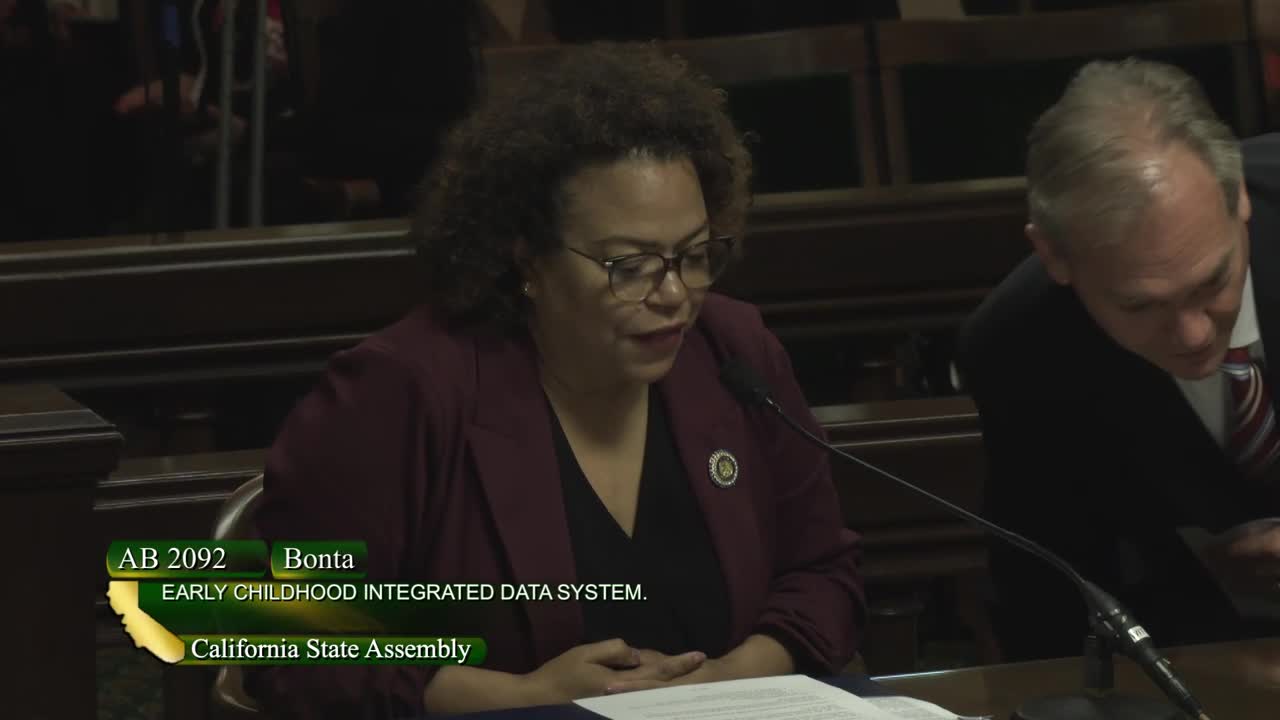 16MIN
Assembly Standing Committee on Privacy and Consumer Protection
 9MIN
Assembly Standing Committee on Human Services
Bill Author

Bill Co-Author(s):
