SB 370: California Music Festival Preservation Grant Program.
- Session Year: 2025-2026
- House: Senate
- Latest Version Date: 2025-03-25
Current Status:
Failed
(2026-02-02: Returned to Secretary of Senate pursuant to Joint Rule 56.)
Introduced
In Committee
Awaiting First Chamber Vote
Passed First Chamber
In Committee
Awaiting Second Chamber Vote
Passed Second Chamber
Enacted
What does this bill do?
The bill creates the California Music Festival Preservation Grant Program in the state Office of Small Business Advocate to award grants to independent live-music event promoters. To qualify, promoters must be a business or nonprofit that mainly runs ticketed events that pay performers and that earn at least 70% of their revenue from ticket sales, production fees, or event food, drink, and merchandise; the program would allocate $20 million in grants.
The summary is provided by generative AI which can make mistakes. For original language, please view the details in the table below.
Existing law establishes the Office of Small Business Advocate within the Governors Office of Business and Economic Development, also known as GO-Biz, to serve the Governor as the lead entity for economic strategy and the marketing of California on issues relating to business development, private sector investment, and economic growth, among other duties. Existing law establishes various programs and offices within GO-Biz to assist business development. and provides for the appointment by the Governor of the Small Business Advocate, also known as the Director of the Office of Small Business Advocate, to, among other things, serve as the principal advocate in the state on behalf of small businesses.
This bill would state the intent of the Legislature to enact legislation that would provide equitable access and economic development opportunities for music festivals. The bill would include findings and declarations relating to these provisions. establish the California Music Festival Preservation Grant Program within the office, under the direct authority of the director, to provide grants to eligible independent live music events promoters to support their continued ability to provide equitable access to the arts for all Californians. The bill would specify requirements for eligibility and, subject to appropriation by the Legislature, would require the office to allocate the sum of $20,000,000 in grants to eligible independent live music events promoters that meet those requirements.
Existing law establishes the Governors Office of Business and Economic Development, also known as GO-Biz, to serve the Governor as the lead entity for economic strategy and the marketing of California on issues relating to business development, private sector investment, and economic growth, among other duties. Existing law establishes various programs and offices within GO-Biz to assist business development.
This bill would state the intent of the Legislature to enact legislation that would provide equitable access and economic development opportunities for music festivals. The bill would include findings and declarations relating to these provisions.
(a)The California Music Festival Preservation Grant Program is hereby established within the office.
(b)The program shall be under the direct authority of the director, and the office shall administer grants to eligible independent live music events promoters in accordance with this section.
(c)The purpose of the program is to provide grants to eligible independent live music events promoters in order to support their continued ability to provide equitable access to the arts for all Californians.
(d)For purposes of this section, eligible independent live music events promoter means an entity that satisfies all of the following:
(1)It is a sole proprietor, C-corporation, S-corporation, cooperative, limited liability company, partnership, limited partnership, or a nonprofit organization that is exempt from federal income taxation pursuant to Section 501(c)(3) of the Internal Revenue Code of 1986.
(2)It, as a principal business activity, organizes, promotes, produces, manages, or hosts live concerts, festivals, or other events featuring performing artists at an eligible venue where both of the following take place:
(A)A cover charge through ticketing or front door entrance fee is applied.
(B)Performers are paid.
(3)At least 70 percent of the earned revenue of the entity is generated through cover charges or ticket sales, production fees, or production reimbursements, or the sale of event beverages, food, or merchandise.
(e)Subject to appropriation by the Legislature:
(1)The office shall allocate grants to eligible independent live music events promoters that meet the requirements of this section.
(2)The amount of twenty million dollars ($20,000,000) shall be allocated in one or more rounds to eligible independent live music events promoters.
SECTION 1.(a)It is the intent of the Legislature to enact legislation that would provide equitable access and economic development opportunities for music festivals.(b)The Legislature finds and declares all of the following regarding enhancing equitable access to music festivals:(1)Music festivals and large community gatherings have a significant economic impact on local cities and the State of California.(2)In 2023, a study found that 34 percent of surveyed adults in the United States had attended a music festival more than once.(3)Music festivals attract visitors, which increases sales at local businesses, including restaurants, hotels, retails shops, transportation businesses, and other services.(4)Music festivals create temporary and permanent jobs, such as security, catering, vendors, transportation, event staff, and artists.(5)The success of music festivals attracts investments in real estate, local businesses, and other sectors in cities that host music festivals.(6)Music festivals attract businesses throughout the host city and serve as national and international tourist destinations.(a)It is the intent of the Legislature to enact legislation that would provide equitable access and economic development opportunities for music festivals.
(b)The Legislature finds and declares all of the following regarding enhancing equitable access to music festivals:
(1)Music festivals and large community gatherings have a significant economic impact on local cities and the State of California.
(2)In 2023, a study found that 34 percent of surveyed adults in the United States had attended a music festival more than once.
(3)Music festivals attract visitors, which increases sales at local businesses, including restaurants, hotels, retails shops, transportation businesses, and other services.
(4)Music festivals create temporary and permanent jobs, such as security, catering, vendors, transportation, event staff, and artists.
(5)The success of music festivals attracts investments in real estate, local businesses, and other sectors in cities that host music festivals.
(6)Music festivals attract businesses throughout the host city and serve as national and international tourist destinations.
|
Date
|
Status
|
|---|---|
| Feb 2, 2026 | Returned to Secretary of Senate pursuant to Joint Rule 56. |
| May 23, 2025 | May 23 hearing: Held in committee and under submission. |
| May 16, 2025 | Set for hearing May 23. |
| May 12, 2025 | May 12 hearing: Placed on APPR. suspense file. |
| May 2, 2025 | Set for hearing May 12. |
| Apr 28, 2025 | From committee: Do pass and re-refer to Com. on APPR. (Ayes 10. Noes 0. Page 916.) (April 28). Re-referred to Com. on APPR. |
| Apr 3, 2025 | Set for hearing April 28. |
| Apr 2, 2025 | Re-referred to Com. on B. P. & E.D. |
| Mar 25, 2025 | From committee with author's amendments. Read second time and amended. Re-referred to Com. on RLS. |
| Feb 26, 2025 | Referred to Com. on RLS. |
| Feb 14, 2025 | From printer. May be acted upon on or after March 16. |
| Feb 13, 2025 | Introduced. Read first time. To Com. on RLS. for assignment. To print. |
|
Date
|
Description
|
Location
|
Votes
|
|
|---|---|---|---|---|
| May 12, 2025 | Placed on suspense file | Senate Standing Committee on Appropriations |
Passed |
|
| Apr 28, 2025 | Do pass, but first be re-referred to the Committee on [Appropriations] | Senate Standing Committee on Business, Professions and Economic Development |
Passed |
This list shows positions taken on this bill by organizations on the date displayed, which is linked to the original source.
Positions by individuals are not included.
|
Organization
|
Position
|
Date
|
|---|---|---|
| California Travel Association | ** Support | |
| City Of Sacramento | ** Support |
SENATE COMMITTEE ON APPROPRIATIONS
Senator Anna Caballero, Chair
2025 - 2026 Regular Session
SB 370 (Ashby) - California Music Festival Preservation Grant Program
Version: March 25, 2025 | Policy Vote: B., P. & E.D. 10 - 0 |
Urgency: No | Mandate: No |
Hearing Date: May 12, 2025 | Consultant: Robert Ingenito |
Bill Summary:
SB 370 would establish the California Music Festival Preservation Grant Program, as specified.
Fiscal Impact:
This bill would result in a $20 million cost pressure to the Governor’s Office of Business and Economic Development (GO-Biz) to establish the Program and allocate grant funding. Of this amount, GO-Biz indicates that it would request $1 million to contract with a third-party fiscal agent and program partner for implementation and program outreach. Additionally GO-Biz would require $260,000 in 2026-27 and 2027-28 to fund one limit-term position to support the Program’s implementation. The fund source is not specified in the bill, but presumably would be the General Fund.
Background:
The State has had various economic development departments through the decades. Prior to 2003, the majority of the State’s economic development programs were housed within the Technology, Trade, and Commerce Agency. The 2003 04 Budget Act abolished both the Agency and state funding for many of its programs designed to encourage economic development.
GO Biz was established statutorily in 2011 to be the lead entity for economic strategy and the marketing of California on issues relating to business development, private sector investment, and economic growth. GO-Biz staff provide a wide range of advisory and coordinating roles across the administration related to economic development. Several units of GO Biz serve as points of contact for businesses considering relocating to or expanding in California. For example, CalOSBA provides resources for small businesses and financial assistance for small business advisory centers. Other units assist international investors, help businesses obtain information about business permits, administer the California Competes Tax Credit Program, and administer the Cannabis Local Equity Grant Program. Additionally, the California Film Commission, Travel and Tourism Commission, and the Infrastructure and Economic Development Bank have been assigned for oversight purposes to GO Biz.
Proposed Law:
This bill, among other things, would do the following:
- Establish the California Music Festival Preservation Grant Program under GO-Biz.
- Require GO-Biz to administer grants to eligible independent live music events promoters.
- Specify that an eligible independent live music events promoter is an entity that satisfies all of the following: (1) it is a sole proprietor, C-corporation, S-corporation, cooperative, limited liability company, partnership, limited partnership, or a nonprofit organization, (2) it, as a principal business activity, organizes, promotes, produces, manages, or hosts live concerts, festivals, or other events featuring performing artists at an eligible venue where a cover charge through ticketing or front door entrance fee is applied and performers are paid, and (3) at least 70 percent of the entity's revenue is generated through cover charges or ticket sales, production fees, or production reimbursements, or the sale of event beverages, food, or merchandise.
- Allocate, upon appropriation by the Legislature, $20 million in one or more rounds to eligible independent live music events promoters.
Staff Comments:
This bill is modeled after the California Venues Program, established in the 2021-22 state budget (SB 151, Committee on Budget and Fiscal Review, Chapter 74, Statutes of 2021), which provided grants to eligible independent live events affected by COVID-19 in order to support their continued operation. A total of $150 million was allocated to eligible independent live events. CalOSBA reported that the first round of the California Venues Grant Program distributed more than $111.5 million in the fall of 2021 to nearly 830 eligible independent live events venues, including more than 150 women-owned businesses and 587 small businesses in low-income areas.
-- END --
SENATE COMMITTEE ON
BUSINESS, PROFESSIONS AND ECONOMIC DEVELOPMENT
Senator Angelique Ashby, Chair
2025 - 2026 Regular
Bill No: Hearing Date: April 28, 2025
Author: | |||
Version: | March 25, 2025 | ||
Urgency: | No | Fiscal: | Yes |
Consultant: | Sarah Mason | ||
Subject:
SUMMARY:
Establishes the California Music Festival Preservation Grant Program within the Governor’s Office of Business and Economic Development (GO-Biz) to provide grants to eligible independent live music events promoters in order to support their continued ability to provide equitable access to the arts for all Californians.
Existing law:
- Authorizes GO-Biz as the lead entity for economic strategy and the marketing of California on issues relating to business development, private sector investment, and economic growth. Authorizes GO-Biz, in this capacity, to coordinate the development of policies and criteria to ensure that federal grants administered or directly expended by state government advance statewide economic goals and objectives. Authorizes GO-Biz to market the business and investment opportunities available in California by working in partnership with local, regional, federal, and other state public and private institutions to encourage business development and investment in the state. Authorizes GO-Biz to support small businesses by providing information about accessing capital, complying with regulations, and supporting state initiatives that support small business. (Government Code (GC) §§ 12096 et. seq.)
- Requires the Governor to appoint a Small Business Advocate who is Director of the Office of Small Business Advocate (OSBA) and outlines the duties and functions of the Small Business Advocate (GC §§ 12098-12098.7)
- Establishes the California Arts Council (CAC) tasked with various responsibilities, including but not limited to:
- Encouraging artistic awareness, participation and expression.
- Helping independent local groups develop their own art programs.
- Promoting the employment of artists and those skilled in crafts in both the public and private sector.
- Establishing grant application criteria and procedure.
- Awarding prizes or direct grants to individuals or organizations in accordance with such regulations as the council may prescribe. In awarding prizes or directing grants, the council shall notify the offices of the legislators in whose district the recipient resides. (GC §§ 8751 and 8753).
- Prohibits the CAC from making any grants or fund any program which has not been established pursuant to the powers granted to it by the Government Code. (GC § 8753.5).
This bill:
- Establishes the California Music Festival Preservation Grant Program under the direct authority of the Director of GO-Biz. Requires GO-Biz to administer grants to eligible independent live music events promoters in order to support their continued ability to provide equitable access to the arts for all Californians.
- Specifies that an eligible independent live music events promoter is an entity that satisfies all of the following:
- It is a sole proprietor, C-corporation, S-corporation, cooperative, limited liability company, partnership, limited partnership, or a nonprofit organization.
- It, as a principal business activity, organizes, promotes, produces, manages, or hosts live concerts, festivals, or other events featuring performing artists at an eligible venue where a cover charge through ticketing or front door entrance fee is applied and performers are paid.
- At least 70 percent of the entity’s revenue is generated through cover charges or ticket sales, production fees, or production reimbursements, or the sale of event beverages, food, or merchandise.
- Allocates $20 million in one or more rounds to eligible independent live music events promoters.
FISCAL EFFECT:
Unknown. This bill is keyed fiscal by Legislative Counsel.
COMMENTS:
- Purpose. The Author is the Sponsor of this bill. According to the Author, “Music festivals have a profound economic impact on cities throughout California. They attract thousands of visitors each year, generate millions in economic activity, create jobs, and contribute significant tax revenues that bolster local economies. However, music festivals face significant challenges including high production costs and long-term unsustainable funding. This forces promoters to choose between increasing costs for consumers or canceling events altogether. Without taking action now, California risks losing the unparalleled economic opportunities these festivals provide to other states.
SB 370 addresses these issues by establishing a funding source for multi-day independent live music festivals that significantly impact local economies – ensuring California maintains its ability to attract events such as Aftershock and Golden Sky in Sacramento, BottleRock in Napa, and Outside Lands in San Francisco. It is critical that we invest in the creative economy, and multi-day music festivals are a clear driver of opportunity and success for communities across California."
- Background.
Music Festivals. Music festivals attract thousands of visitors each year, generate millions in economic activity, create jobs, and contribute significant tax revenues that bolster local economies.
For example, in 2024, two Sacramento music festivals – Aftershock and Golden Sky – generated an estimated impact of $44.6 million and supported over 13,000 jobs including lodging, food and beverage, transportation, facility management, audio visual services, retail, and security. Local sales tax revenue from just these two events alone was over $230,000, and state sales tax contributions were $1.1 million.1
The economic impact of just one music festival – Outside Lands – generated $66.8 million in economic activity for the city of San Francisco, and $75 million for the entire Bay Area. The festival also created the equivalent of 700 full time year-long jobs, and paid over $9.4 million in state and local taxes.2
Music festivals have a profound economic impact on regions throughout California. The Legislature must take necessary steps to preserve music festivals and help them remain here in the Golden State.
Music festivals face challenges, with many events canceled both in the U.S. and internationally. Key drivers include escalating production costs, softening consumer demand, and broader shifts in social and technological habits that impact festival attendance. Rising costs of essentials including venue, security, safety, sanitation, staff, artists, advertisement, and insurance fees have also strained festival budgets. Many of these costs must be covered well in advance of the event leaving promoters largely reliant on ticket and vendor sales to recoup costs. With fewer upfront revenue streams, festivals take on significant financial risks. This forces promoters to choose between increasing costs for consumers or canceling events altogether. Many festivals operate on thin margins, and as inflation drives up expenses, ticket prices also rise –which has deterred consumers. Festival promoters are reluctant to increase ticket costs further, wary of pricing out attendees, which has led to festival promoters canceling events.
Given the significant boon for local economies music festivals can bring, states and local governments have explored ways to support these events. For example, Kentucky just passed legislation to provide music festivals in specified jurisdictions with a tax rebate if they run a minimum of two straight days and attract 60,000 attendees. Music festivals meeting these requirements will receive half of the Kentucky sales taxes generated by concessions and festival tickets.
GO-Biz. In February 2010, the Little Hoover Commission undertook a review of the state's economic and workforce development programs. In its final report, Making up for Lost Ground: Creating a Governor's Office of Economic Development, it analyzed the status and effectiveness of current programs since the 2003 demise of the Technology, Trade and Commerce Agency and recommended the creation of a new governmental entity to fill the void left by the dismantled agency.
The report called for a single entity that would promote greater economic development, foster job creation, serve as a policy advisor and deliver specific services (i.e., permitting, tax, regulatory, and other information) directly to the California business community. In April 2010, Governor Schwarzenegger issued Executive Order S-05-10 as a means to operationalize the report recommendations, including the creation of the Governor's Office of Economic Development (GOED).
In October 2011, the Governor signed AB 29 (John A. Pérez, Chapter 475, Statutes of 2011), which effectively codified GOED and changed its name to GO-Biz. Since its inception, the office has served thousands of businesses, 95 percent of which are small businesses. The most frequent types of assistance include help with permit streamlining, starting a business, relocation and expansion of businesses, and regulatory challenges.
In March 2012, Governor Brown initiated a reorganization process to realign the state's administrative structure. Key changes include dismantling of the Business, Transportation and Housing Agency and the shifting of a number of key programs to GO-Biz including the Small Business Loan Guarantee Program, the California Travel and Tourism Commission, the California Film Commission, the Film California First Program, and the Infrastructure and Economic Development Bank (IBank). Currently, GO-Biz administers the following programs and units:
- Made In California program for the purpose of encouraging consumer product awareness and to foster the purchases of products manufactured in California.
- The California Inclusive Innovation Hub Program (iHub2) to incubate and/or accelerate technology and science-based firms, with a focus on underserved regions and communities.
- The California Competes Tax Credit Program under which “businesses who want to come to California or stay and grow in California” can receive an income tax credit.
- The California Business Investment Services Unit, which provides no-fee, tailored site selection services to employers and others who may be considering California for relocation or expansion.
- The California Business Portal, which provides information to California businesses about common questions, permitting, financial options, and more.
- The California Community Reinvestment Grants Program, which was included in Proposition 64, authorized GO-Biz to award grants to local health departments and certain nonprofit organizations to support communities disproportionately affected by the War on Drugs.
- OSBA which provides information and assistance to small businesses.
- The Zero Emission Vehicles (ZEV) Infrastructure Unit which works to accelerate the deployment of ZEV infrastructure.
- The International Affairs and Business Development Unit, which serves as California’s primary point of contact for expanding international trade and investment relations. This unit focuses on foreign direct investment (services for foreign investors, foreign investment technical assistance, and the EB-5 Investor Visa Program), international trade promotion (STEP program, trade missions, export assistance, and the California-China Trade Office), and international agreements.
OSBA. Since its inception, GO-Biz has served thousands of businesses, 95 percent of which are small businesses. The most frequent types of assistance include help with permit streamlining, starting a business, relocation and expansion of businesses, and regulatory challenges. In addition to economic development programs, GO-Biz is responsible for specialized assistance to small businesses through the OSBA. OSBA directly serves the small business community through hosting summits, forums, and interagency meetings; maintaining resources for technical assistance, financing, and state procurement; holding webinars, and other outreach methods. OSBA oversees the Capital Infusion Program, which enables the California Small Business Development Center Networks to expand their one-to-one, no-cost, confidential consulting to small business owners. From its inception in 2014 to 2016, the Capital Infusion Program resulted in roughly $379 million in documented capital infusion and served over 20,000 small business owners across the state. In 2015, GO-Biz launched a new California Business Portal; the site includes a Business Navigator feature, which provides custom information regarding permits, licenses, and incentives that relate specifically to the user’s business. OSBA also provides emergency preparedness resources on its website, and is involved in facilitating disaster relief financing efforts for small businesses due to California wildfires. OSBA has also administered numerous grants programs to support small businesses and respond to specific issues impacting small businesses, including coordinating California Microbusiness ($2,500) and Small Business ($5,000 - $25,000) COVID-19 Relief Grants which were used to help support California’s nonprofit and cultural and arts programs recover from the impacts of the pandemic.
California Venues Program. This bill is modeled after the California Venues Program, established in the 2021 budget (SB 151, Committee on Budget and Fiscal Review, Chapter 74, Statutes of 2021) which provided grants to eligible independent live events affected by COVID-19 in order to support their continued operation. $150 million was allocated to eligible independent live events – OSBA reported that the first round of the California Venues Grant Program distributed more than $111.5 million in the fall of 2021 to nearly 830 eligible independent live events venues, including more than 150 women-owned businesses and 587 small businesses in low-income areas.
California Arts Council. The CAC was signed into law by then-Governor Jerry Brown under the Dixon-Zenovich-Maddy California Arts Act of 1975. The CAC began operations in January 1976 with a budget of $700,000, seven council members, a director and two deputies. The CAC mission is to strengthen arts, culture, and creative expression as the tools to cultivate a better California for all. As a state agency, the CAC supports local arts infrastructure and programming statewide through grants, programs, and services. The CAC offers a wide range of grants to arts programs to support arts education, diversity and inclusion within the arts, COVID-19 relief for arts and cultural organizations, local arts investments, and individual artists. Over the last four decades, the CAC has awarded thousands of grants with a total investment of more than $400 million.
Examples of programs the CAC has offered over the years include:
- Artists in Schools – Support for arts organizations that partner with schools and/or school districts to facilitate artists-in-residence activities in the classroom and afterschool programs.
- Creating Public Value – Support for arts organizations in rural or underserved areas to implement projects making a positive contribution to their communities.
- Statewide Service Networks – Support for discipline-based arts service organizations and statewide arts networks to strengthen their constituencies and promote the public value of the arts in their communities.
- State-Local Partnerships – Support for local arts agencies designated by county boards of supervisors to provide arts in local communities.
- My California Story Slam – Encourages educators to explore creative writing in their high school classrooms and to draw upon the expressive skills of their students.
- Poetry Out Loud – National recitation contest that encourages high school students to experience poetry through memorization, performance, and competition. Poetry Out Loud is an initiative of the National Endowment for the Arts (NEA).
- California Music Project – To help restore music education in public schools, K-12.
- Convenings – Annual statewide arts conference, professional development sessions, with the multicultural infrastructure and statewide service network organizations.
- Poet Laureate – Overview, nomination process, eligibility and criteria for two-year gubernatorial appointment to the position of Poet Laureate and related literary tour.
- Marketing: Public Awareness – Using social change models, marketing & advocacy to reframe the arts as a public value--essential to a healthy society, as critical as free speech.
- Cultural District Programs – Marketing program for local cultural districts which are well-recognized, labeled areas of a city and in which a high concentration of cultural facilities and programs serve as the main anchor of attraction and business development.
- Arguments in Support. According to the California Travel Association, “From Outsidelands in San Francisco to Aftershock and Golden Sky in Sacramento and Coachella in Indio, California’s home-grown music festivals attract thousands of visitors from all over the world. Attendees fill hotels, generate millions in economic activity, and contribute significant tax revenues that bolster local economies.”
The City of Sacramento supports this bill, noting “Over the years Sacramento has established itself as the ‘City of Festivals,’ drawing attention as a tourism destination through events such as the Farm-to-Fork Festival, Aftershock, GoldenSky and more. These iconic events generate substantial economic benefits:In 2024, for example, Aftershock and GoldenSky together contributed $44.6 million to the economy, supported 13,384 jobs, and generated $1.3 million in local and state sales tax revenues. Those same events increased hotel occupancy, with 87,646 visitors from outside the region and 111,286 room nights in 2024 alone, and a corresponding return on transient occupancy tax of $2.27 million. And this is data from only two of the iconic music festivals that have called Sacramento home…Unfortunately, several challenges exist in the current music festival environment. Rising production costs, inflation, and shifting consumer habits have led to financial struggles for festivals. Costs for security, insurance, and artist pay, combined with hesitant consumer spending, have forced many festivals to reduce operations or cancel entirely. The City has taken steps recently to financially support iconic events production. SB 370 would provide additional support for such events and support the City’s and state’s creative economies.”
SUPPORT AND OPPOSITION:
Support:
California Travel Association
City of Sacramento
Opposition:
None received
-- END --
Discussed in Hearing
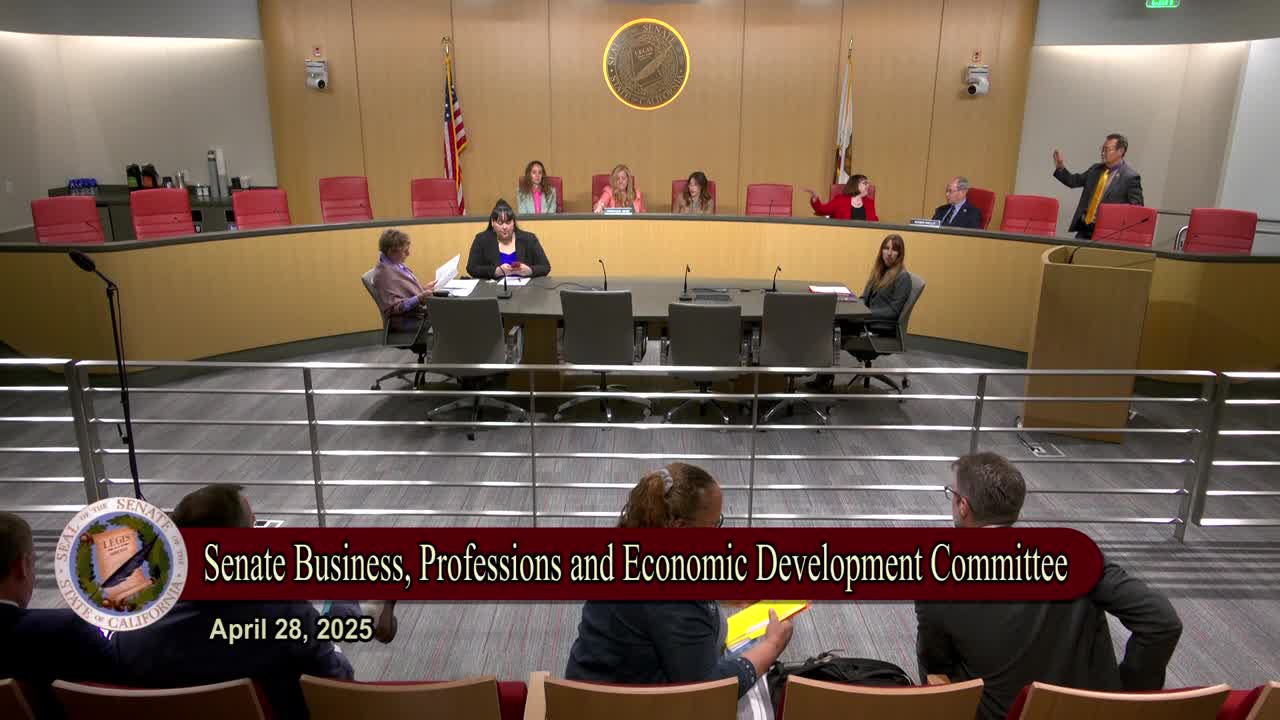 22MIN
Senate Standing Committee on Business, Professions and Economic Development
Bill Author

Bill Co-Author(s):