AB 595: Animal shelters: 72-hour public notice: euthanasia: study.
- Session Year: 2023-2024
- House: Assembly
- Latest Version Date: 2023-04-12
Current Status:
Failed
(2024-02-01: From committee: Filed with the Chief Clerk pursuant to Joint Rule 56.)
Introduced
In Committee
First Chamber
In Committee
Second Chamber
Enacted
What does this bill do?
The bill requires animal shelters (public animal control agencies, SPCA, and humane society shelters) to post on their website at least 72 hours before euthanizing any dog, cat, or rabbit, saying the animal is subject to euthanasia and providing information about the animal and its availability for adoption. Shelters may shorten that notice if they decide it is in the animal’s or the shelter’s best interest but must document the reason and keep the record for public inspection for three years. The bill also directs the Department of Food and Agriculture to study shelter overcrowding and the feasibility of a statewide dogs-and-cats database and report to the Legislature.
The summary is provided by generative AI which can make mistakes. For original language, please view the details in the table below.
Existing law declares that it is the policy of the state that no adoptable animal should be euthanized if it can be adopted into a suitable home. Existing law also declares that it is the policy of the state that no treatable animal should be euthanized. Existing law provides that a violation of the Food and Agricultural Code is a misdemeanor, unless a different penalty is expressly provided.
This bill, Bowies Law, would require all animal shelters, as defined, to provide public notice on their internet website at least 72 hours before euthanizing any animal and include the date that an animal is scheduled to be euthanized, except as provided. By creating new requirements regarding this public notice, the violation of which would be a crime, and by dog, cat, or rabbit, except as provided. The bill would require that notice to indicate that the animal is subject to euthanasia and to include information about the animal and its availability for adoption. The bill would authorize an animal shelter to provide this public notice for less than 72 hours if the animal shelter makes certain determinations. The bill would, for each instance where the animal shelter provides public notice for less than 72 hours, require the animal shelter to document the reason and to keep it on file and available for public inspection, as provided. By imposing new requirements on a public animal control agency or shelter, the bill would constitute a state-mandated local program.
The bill would also require the Department of Food and Agriculture to conduct a study on the overcrowding of Californias animal shelters, the ways in which the state might address animal shelter overcrowding, and the feasibility of a statewide database of dogs and cats that provides public notice and information at the statewide level, as specified. The bill would require the department to, on or before January 1, 2026, submit a report on its study findings to the Legislature, as provided. The bill would repeal these study and reporting requirements on January 1, 2027.
The California Constitution requires the state to reimburse local agencies and school districts for certain costs mandated by the state. Statutory provisions establish procedures for making that reimbursement.This bill would provide that with regard to certain mandates no reimbursement is required by this act for a specified reason.With regard to any other mandates, this bill would provide that, if the Commission on State Mandates determines that the bill contains costs so mandated by the state, reimbursement for those costs shall be made pursuant to the statutory provisions noted above.The California Constitution requires the state to reimburse local agencies and school districts for certain costs mandated by the state. Statutory provisions establish procedures for making that reimbursement.
This bill would provide that, if the Commission on State Mandates determines that the bill contains costs mandated by the state, reimbursement for those costs shall be made pursuant to the statutory provisions noted above.
Existing law declares that it is the policy of the state that no adoptable animal should be euthanized if it can be adopted into a suitable home. Existing law also declares that it is the policy of the state that no treatable animal should be euthanized. Existing law provides that a violation of the Food and Agricultural Code is a misdemeanor, unless a different penalty is expressly provided.
This bill bill, Bowies Law, would require all animal shelters, as defined, to provide public notice on their internet website at least 72 hours before euthanizing an adoptable dog or cat, as defined, any animal and include the date that an adoptable dog or cat animal is scheduled to be euthanized, except as provided. By creating new requirements regarding this public notice, the violation of which would be a crime, and by imposing new requirements on a public animal control agency or shelter, the bill would constitute a state-mandated local program.
The bill would also require the Department of Food and Agriculture to conduct a study on the overcrowding of Californias animal shelters, the ways in which the state might address animal shelter overcrowding, and the feasibility of a statewide database of adoptable dogs or cats, as specified. dogs and cats that provides public notice and information at the statewide level, as specified. The bill would require the department to, on or before January 1, 2026, submit a report on its study findings to the Legislature, as provided. The bill would repeal these study and reporting requirements on January 1, 2027.
The California Constitution requires the state to reimburse local agencies and school districts for certain costs mandated by the state. Statutory provisions establish procedures for making that reimbursement.This bill would provide that no reimbursement is required by this act for a specified reason.The California Constitution requires the state to reimburse local agencies and school districts for certain costs mandated by the state. Statutory provisions establish procedures for making that reimbursement.
This bill would provide that with regard to certain mandates no reimbursement is required by this act for a specified reason.
With regard to any other mandates, this bill would provide that, if the Commission on State Mandates determines that the bill contains costs so mandated by the state, reimbursement for those costs shall be made pursuant to the statutory provisions noted above.
Existing law declares that it is the policy of the state that no adoptable animal should be euthanized if it can be adopted into a suitable home. Existing law also declares that it is the policy of the state that no treatable animal should be euthanized. Existing law provides that a violation of the Food and Agricultural Code is a misdemeanor, unless a different penalty is expressly provided.
This bill would require all animal shelters, as defined, to provide public notice on their internet website at least 72 hours before euthanizing an adoptable dog or cat, as defined, and include the date that an adoptable dog or cat is scheduled to be euthanized, as provided. By creating new requirements regarding this public notice, the violation of which would be a crime, the bill would constitute a state-mandated local program.
The bill would also require the Department of Food and Agriculture to conduct a study on the overcrowding of Californias animal shelters, the ways in which the state might address animal shelter overcrowding, and the feasibility of a statewide database of adoptable dogs or cats, as specified. The bill would require the department to, on or before January 1, 2026, submit a report on its study findings to the Legislature, as provided. The bill would repeal these study and reporting requirements on January 1, 2027.
The California Constitution requires the state to reimburse local agencies and school districts for certain costs mandated by the state. Statutory provisions establish procedures for making that reimbursement.
This bill would provide that no reimbursement is required by this act for a specified reason.
This act shall be known, and may be cited, as Bowies Law.
SEC. 2.Section 32004 is added to the Food and Agricultural Code, to read:32004.(a)Except for an animal irremediably suffering from a serious illness or severe injury pursuant to Section 17006, newborn animals that need maternal care and have been impounded without their mothers pursuant to Section 17006, and dogs with a history of vicious or dangerous behavior documented by the agency charged with enforcing state and local animal laws pursuant to subdivision (b) of Section 31108.5, an animal shelter shall provide public notice on its internet website at least 72 hours before euthanizing any animal dog, cat, or rabbit. That notice shall indicate that the animal is subject to euthanasia and shall include information that includes, but is not limited to, the date that an animal is scheduled to be euthanized. about the animal and its availability for adoption.
(b)(1)An animal shelter may provide the public notice required by subdivision (a) for less than 72 hours if the animal shelter determines that doing so is in the best interest of the animal or the general animal population at the animal shelter.
(2)For each instance where an animal shelter provides a public notice for less than 72 hours pursuant to paragraph (1), the animal shelter shall document the reason and shall keep it on file and available for public inspection for at least three years.
(b)(c)As used in this section, animal shelter means a public animal control agency or shelter, society for the prevention of cruelty to animals shelter, or humane society shelter.
(d)Section 9 shall not apply to this section.
SEC. 3.Section 32005 is added to the Food and Agricultural Code, to read:32005.(a)The department shall conduct a study on all of the following topics:
(1)The overcrowding of Californias animal shelters.
(2)The ways in which the state might address animal shelter overcrowding.
(3)The feasibility of a statewide database of dogs and cats that provides public notice and information at the statewide level in a manner consistent with Section 32004, including, but not limited to, by pursuing a public-private partnership.
(b)On or before January 1, 2026, the department shall submit a report on its study findings pursuant to subdivision (a) to the Legislature in compliance with Section 9795 of the Government Code.
(c)As used in this section, animal shelter means a public animal control agency or shelter, society for the prevention of cruelty to animals shelter, or humane society shelter.
(d)This section shall remain in effect only until January 1, 2027, and as of that date is repealed.
SEC. 4.No reimbursement is required by this act pursuant to Section 6 of Article XIIIB of the California Constitution for certain costs that may be incurred by a local agency or school district because, in that regard, this act creates a new crime or infraction, eliminates a crime or infraction, or changes the penalty for a crime or infraction, within the meaning of Section 17556 of the Government Code, or changes the definition of a crime within the meaning of Section 6 of Article XIIIB of the California Constitution.However, if the Commission on State Mandates determines that this act contains other costs mandated by the state, reimbursement to local agencies and school districts for those costs shall be made pursuant to Part 7 (commencing with Section 17500) of Division 4 of Title 2 of the Government Code.SEC. 4.If the Commission on State Mandates determines that this act contains costs mandated by the state, reimbursement to local agencies and school districts for those costs shall be made pursuant to Part 7 (commencing with Section 17500) of Division 4 of Title 2 of the Government Code.
This act shall be known, and may be cited, as Bowies Law.
SECTION 1.SEC. 2.Section 32004 is added to the Food and Agricultural Code, to read:32004.(a)All Except for an animal irremediably suffering from a serious illness or severe injury pursuant to Section 17006, newborn animals that need maternal care and have been impounded without their mothers pursuant to Section 17006, and dogs with a history of vicious or dangerous behavior documented by the agency charged with enforcing state and local animal laws pursuant to subdivision (b) of Section 31108.5, an animal shelters shelter shall provide public notice on their its internet website at least 72 hours before euthanizing an adoptable dog or cat any animal and shall include information that includes, but is not limited to, the date that an adoptable dog or cat an animal is scheduled to be euthanized.
(b)As used in this section, the following terms have the following meanings: animal shelter means a public animal control agency or shelter, society for the prevention of cruelty to animals shelter, or humane society shelter.
(1)Adoptable dog or cat means a dog or cat eight weeks of age or older that, at or subsequent to the time the animal is impounded or otherwise taken into possession, has manifested no sign of a behavioral or temperamental defect that could pose a health or safety risk, and has manifested no sign of disease, injury, or congenital or hereditary condition that adversely affects the health of the animal or that is likely to adversely affect the animals health in the future.(2)Animal shelter means a public animal control agency or shelter, society for the prevention of cruelty to animals shelter, humane society shelter, or rescue group.(3)Rescue group means a for-profit or not-for-profit entity or a collaboration of individuals that removes dogs or cats, or both, from a public animal control agency or shelter, society for the prevention of cruelty to animals shelter, or humane shelter, or rehomes a dog or cat, or both, that has been previously owned by any person other than the original breeder.SEC. 2.SEC. 3.Section 32005 is added to the Food and Agricultural Code, to read:32005.(a)The department shall conduct a study on all of the following topics:
(1)The overcrowding of Californias animal shelters.
(2)The ways in which the state might address animal shelter overcrowding.
(3)The feasibility of a statewide database of adoptable dogs or and cats that provides public notice and information at the statewide level in a manner consistent with Section 32004, including, but not limited to, by pursuing a public-private partnership.
(b)On or before January 1, 2026, the department shall submit a report on its study findings pursuant to subdivision (a) to the Legislature in compliance with Section 9795 of the Government Code.
(c)As used in this section, the following terms have the following meanings: animal shelter means a public animal control agency or shelter, society for the prevention of cruelty to animals shelter, or humane society shelter.
(1)Adoptable dog or cat means a dog or cat eight weeks of age or older that, at or subsequent to the time the animal is impounded or otherwise taken into possession, has manifested no sign of a behavioral or temperamental defect that could pose a health or safety risk, and has manifested no sign of disease, injury, or congenital or hereditary condition that adversely affects the health of the animal or that is likely to adversely affect the animals health in the future.(2)Animal shelter means a public animal control agency or shelter, society for the prevention of cruelty to animals shelter, humane society shelter, or rescue group.(3)Rescue group means a for-profit or not-for-profit entity or a collaboration of individuals that removes dogs or cats, or both, from a public animal control agency or shelter, society for the prevention of cruelty to animals shelter, or humane shelter, or rehomes a dog or cat, or both, that has been previously owned by any person other than the original breeder.(d)This section shall remain in effect only until January 1, 2027, and as of that date is repealed.
SEC. 3.No reimbursement is required by this act pursuant to Section 6 of Article XIIIB of the California Constitution because the only costs that may be incurred by a local agency or school district will be incurred because this act creates a new crime or infraction, eliminates a crime or infraction, or changes the penalty for a crime or infraction, within the meaning of Section 17556 of the Government Code, or changes the definition of a crime within the meaning of Section 6 of Article XIIIB of the California Constitution.SEC. 4.No reimbursement is required by this act pursuant to Section 6 of Article XIIIB of the California Constitution for certain costs that may be incurred by a local agency or school district because, in that regard, this act creates a new crime or infraction, eliminates a crime or infraction, or changes the penalty for a crime or infraction, within the meaning of Section 17556 of the Government Code, or changes the definition of a crime within the meaning of Section 6 of Article XIIIB of the California Constitution.
However, if the Commission on State Mandates determines that this act contains other costs mandated by the state, reimbursement to local agencies and school districts for those costs shall be made pursuant to Part 7 (commencing with Section 17500) of Division 4 of Title 2 of the Government Code.
(a)All animal shelters shall provide public notice on their internet website at least 72 hours before euthanizing an adoptable dog or cat and shall include information that includes, but is not limited to, the date that an adoptable dog or cat is scheduled to be euthanized.
(b)As used in this section, the following terms have the following meanings:
(1)Adoptable dog or cat means a dog or cat eight weeks of age or older that, at or subsequent to the time the animal is impounded or otherwise taken into possession, has manifested no sign of a behavioral or temperamental defect that could pose a health or safety risk, and has manifested no sign of disease, injury, or congenital or hereditary condition that adversely affects the health of the animal or that is likely to adversely affect the animals health in the future.
(2)Animal shelter means a public animal control agency or shelter, society for the prevention of cruelty to animals shelter, humane society shelter, or rescue group.
(3)Rescue group means a for-profit or not-for-profit entity or a collaboration of individuals that removes dogs or cats, or both, from a public animal control agency or shelter, society for the prevention of cruelty to animals shelter, or humane shelter, or rehomes a dog or cat, or both, that has been previously owned by any person other than the original breeder.
SEC. 2.Section 32005 is added to the Food and Agricultural Code, to read:32005.(a)The department shall conduct a study on all of the following topics:
(1)The overcrowding of Californias animal shelters.
(2)The ways in which the state might address animal shelter overcrowding.
(3)The feasibility of a statewide database of adoptable dogs or cats that provides public notice and information at the statewide level in a manner consistent with Section 32004, including, but not limited to, by pursuing a public-private partnership.
(b)On or before January 1, 2026, the department shall submit a report on its study findings pursuant to subdivision (a) to the Legislature in compliance with Section 9795 of the Government Code.
(c)As used in this section, the following terms have the following meanings:
(1)Adoptable dog or cat means a dog or cat eight weeks of age or older that, at or subsequent to the time the animal is impounded or otherwise taken into possession, has manifested no sign of a behavioral or temperamental defect that could pose a health or safety risk, and has manifested no sign of disease, injury, or congenital or hereditary condition that adversely affects the health of the animal or that is likely to adversely affect the animals health in the future.
(2)Animal shelter means a public animal control agency or shelter, society for the prevention of cruelty to animals shelter, humane society shelter, or rescue group.
(3)Rescue group means a for-profit or not-for-profit entity or a collaboration of individuals that removes dogs or cats, or both, from a public animal control agency or shelter, society for the prevention of cruelty to animals shelter, or humane shelter, or rehomes a dog or cat, or both, that has been previously owned by any person other than the original breeder.
(d)This section shall remain in effect only until January 1, 2027, and as of that date is repealed.
SEC. 3.No reimbursement is required by this act pursuant to Section 6 of Article XIIIB of the California Constitution because the only costs that may be incurred by a local agency or school district will be incurred because this act creates a new crime or infraction, eliminates a crime or infraction, or changes the penalty for a crime or infraction, within the meaning of Section 17556 of the Government Code, or changes the definition of a crime within the meaning of Section 6 of Article XIIIB of the California Constitution.
|
Date
|
Status
|
|---|---|
| Feb 1, 2024 | From committee: Filed with the Chief Clerk pursuant to Joint Rule 56. |
| Jan 31, 2024 | Died pursuant to Art. IV, Sec. 10(c) of the Constitution. |
| May 18, 2023 | In committee: Held under submission. |
| Apr 26, 2023 | In committee: Set, first hearing. Referred to APPR. suspense file. |
| Apr 17, 2023 | Re-referred to Com. on APPR. |
| Apr 12, 2023 | Read second time and amended. |
| Apr 11, 2023 | From committee: Amend, and do pass as amended and re-refer to Com. on APPR. (Ayes 16. Noes 0.) (April 11). |
| Mar 22, 2023 | Re-referred to Com. on B. & P. |
| Mar 21, 2023 | From committee chair, with author's amendments: Amend, and re-refer to Com. on B. & P. Read second time and amended. |
| Feb 17, 2023 | Referred to Com. on B. & P. |
| Feb 10, 2023 | From printer. May be heard in committee March 12. |
| Feb 9, 2023 | Read first time. To print. |
|
Date
|
Description
|
Location
|
Votes
|
|
|---|---|---|---|---|
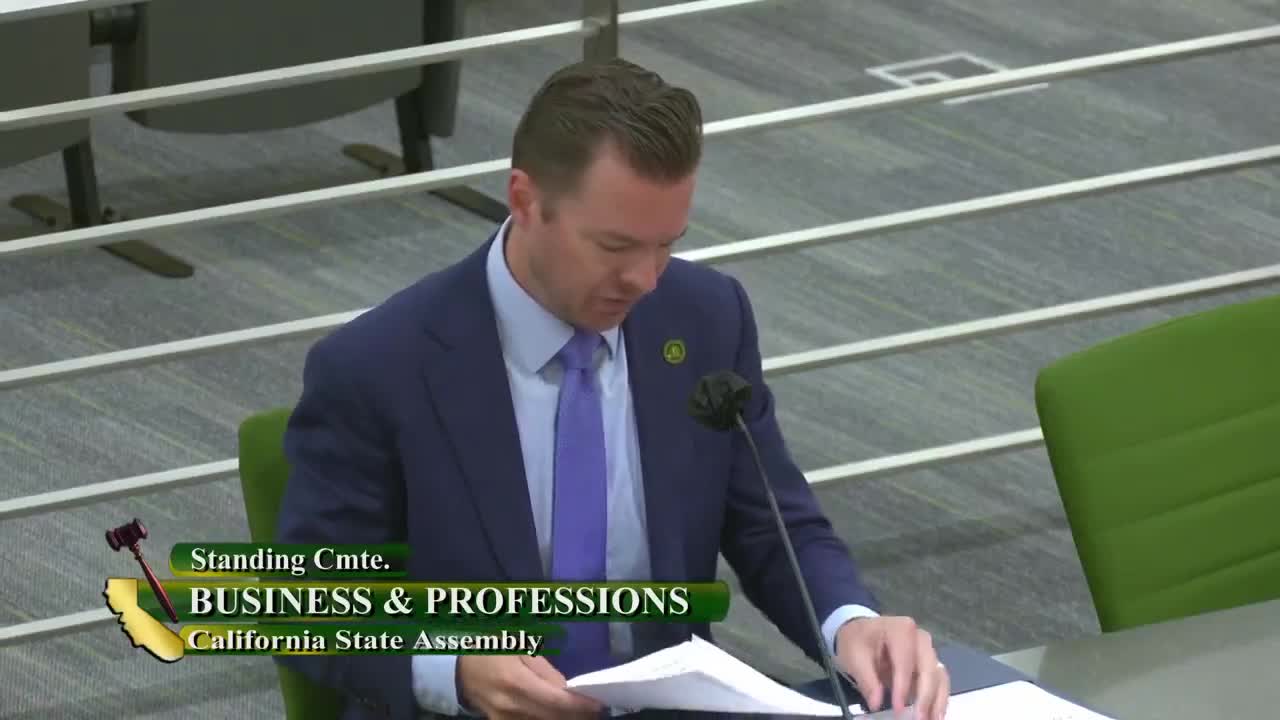
| Apr 11, 2023 | Do pass as amended and be re-referred to the Committee on [Appropriations] | Assembly Standing Committee on Business and Professions |
Passed |
This list shows positions taken on this bill by organizations on the date displayed, which is linked to the original source.
Positions by individuals are not included.
|
Organization
|
Position
|
Date
|
|---|---|---|
| Amador County Animal Control | ** Against | |
| American Society For The Prevention Of Cruelty To Animals | * Against | Apr 11, 2023 |
| Animal Rescue Foundation | ** Against | |
| Animal Samaritans SPCA | ** Against | |
| animal shelter assistance program | ** Against | |
| Antioch Animal Services | ** Against | |
| Bakersfield SPCA | ** Against | |
| Barstow Humane Society | ** Against | |
| Berkeley-East Bay Humane Society | ** Against | |
| Best Friends Animal Society | ** Against | |
| Butte Humane Society | ** Against | |
| Calaveras County Animal Services | ** Against | |
| California Animal Welfare Association | * Against | Apr 11, 2023 |
| California State Association Of Counties | * Against | Apr 11, 2023 |
| California Teamsters Public Affairs Council | ** Against | |
| Carmel Police Department Animal Control | ** Against | |
| Central California SPCA | ** Against | |
| Chula Vista Animal Services | ** Against | |
| City of Bakersfield Animal Control | ** Against | |
| City of Burbank Animal Shelter | ** Against | |
| City of Fontana | ** Against | |
| City of Gridley Animal Control Department | ** Against | |
| City of Lodi Animal Services | ** Against | |
| City of Norco Animal Control Services | ** Against | |
| City of Palo Alto Animal Services | ** Against | |
| City of Perris Animal Control | ** Against | |
| City of Rancho Cucamonga Animal Center | ** Against | |
| City of Roseville Police Department | ** Against | |
| City Of Sacramento | * Against | Apr 11, 2023 |
| City of San Jose | ** Against | |
| City of Shafter Animal Control Services | ** Against | |
| City of Shasta Lake Animal Shelter | ** Against | |
| City of Stockton Animal Services | ** Against | |
| Colusa County Sheriff’s Animal Control Services | ** Against | |
| County Of Kern | ** Against | |
| County of Monterey Health Department | ** Against | |
| County of Napa | ** Against | |
| County of San Luis Obispo Division of Animal Services | ** Against | |
| East Bay SPCA | ** Against | |
| fresno humane animal services | ** Against | |
| Friends of Colusa County Animal Shelter | ** Against | |
| Friends of the Alameda Animal Shelter | ** Against | |
| Friends of Upland Animal Shelter | ** Against | |
| Front Street Animal Shelter - City of Sacramento | ** Against | |
| Gimme Love Animal Shelter | ** Against | |
| Haven Humane Society | ** Against | |
| Hayward Animal Services Bureau | ** Against | |
| Hayward Animal Shelter | ** Against | |
| Hollister Animal Shelter | ** Against | |
| Humane Society of Imperial County | ** Against | |
| Humane Society of Sonoma County | ** Against | |
| Humane Society of Truckee-Tahoe | ** Against | |
| Humane Society of Ventura County | ** Against | |
| humane society silicon valley | ** Against | |
| Inland Valley Humane Society & SPCA | ** Against | |
| Kern County Animal Services | ** Against | |
| Lake County Animal Care and Control | ** Against | |
| League Of California Cities | * Against | Apr 11, 2023 |
| Madera County Animal Services | ** Against | |
| Madera County Animal Shelter | ** Against | |
| Marin Humane | ** Against | |
| Mendocino County Animal Care Services | ** Against | |
| Michelson Center For Public Policy | ** Against | |
| Napa County Animal Shelter | ** Against | |
| National Animal Care & Control Association | ** Against | |
| Nevada County Animal Control | ** Against | |
| Newport Beach Animal Control | ** Against | |
| No Kill Advocacy Center | ** Support | |
| No Kill Advocacy Center | * Support | Apr 11, 2023 |
| North Bay Animal Services | ** Against | |
| oakland animal services | ** Against | |
| Palm Springs Animal Control | ** Against | |
| Palo Alto Humane Society | ** Against | |
| Pasadena Humane Society | ** Against | |
| Peninsula Humane Society & SPCA | ** Against | |
| Placer County Animal Services | ** Against | |
| Placer SPCA | ** Against | |
| Rancho Coastal Humane Society | ** Against | |
| Ridgecrest Animal Shelter | ** Against | |
| Rural County Represenatatives of California | * Against | Apr 11, 2023 |
| San Diego County Department of Animal Services | ** Against | |
| San Diego Humane Society | ** Against | |
| San Diego Humane Society And Spca | ** Against | |
| San Francisco Animal Care and Control | ** Against | |
| San Francisco Spca | ** Against | |
| San Gabriel Valley Humane Society | ** Against | |
| Santa Barbara Humane Society | ** Against | |
| Santa Cruz SPCA | ** Against | |
| SEAACA Animal Control | ** Against | |
| Social Compassion In Legislation | * Support | Apr 11, 2023 |
| Solano County Animal Care Services | ** Against | |
| SPCA Los Angeles | ** Against | |
| SPCA Monterey County | ** Against | |
| The Urban Counties of California | * Against | Apr 11, 2023 |
| Tulare Animal Services | ** Against | |
| Tuolumne County Animal Control | ** Against | |
| Valley Humane Society | ** Against | |
| Ventura County Animal Services | ** Against | |
| Visalia Animal Services | ** Against | |
| Woods Humane Society | ** Against | |
| Yolo County Sheriff’s Office Animal Services | ** Against |
Date of Hearing: April 26, 2023
ASSEMBLY COMMITTEE ON APPROPRIATIONS
Chris Holden, Chair
ABPCA Bill Id:AB 595
Author:(Essayli) – As Amended Ver:April 12, 2023
Policy Committee: | Business and Professions | Vote: | 16 - 0 |
|
| ||
|
|
Urgency: No State Mandated Local Program: Yes Reimbursable: Yes
SUMMARY:
This bill requires every animal shelter to provide public notice at least 72 hours before euthanizing any dog, cat, or rabbit, with information that includes the scheduled euthanasia date and availability for adoption, except as specified. This bill also requires the Department of Food and Agriculture (CDFA) to conduct a study on animal shelter overcrowding and the feasibility of a statewide database for animals scheduled to be euthanized.
FISCAL EFFECT:
CDFA estimates its Animal Health Branch would require one veterinarian specialist and operating expenses (including information technology), at costs of $680,000 in fiscal year (FY) 2023-24, and $215,000 annually, until the provisions sunset in 2027 (General Fund).
CDFA notes the statewide database feasibility study would require the Department’s Office of Information Technology Services (OITS) to undertake a year-long evaluation process that would require CDFA to conduct a statewide shelter survey and data analysis, stakeholder impact analysis, solution feasibility analysis, and other activities to assess the viability of implementing a statewide database to provide notices and euthanasia data that can interface with individual animal shelters and be updated in real-time. CDFA states the deadline in the bill would likely need to be extended another year in order to accommodate the technology approval process.
Costs to animal shelters could be in the tens of millions of dollars, possibly exceeding $100 million per year. Although total shelter costs are not known, opponents of the bill provided the following information: 23 shelters, of approximately 200 shelters in California, estimated a combined total of $15 million annually to implement the mandated 72-hour hold period for dogs, cats, and rabbits. The shelters were asked to consider staffing resources and administrative costs, including website functionality, when developing their estimates.
If the Commission on State Mandates determines provisions of this bill constitute a state-mandated local program, the state would be required to reimburse local governments for the costs of implementing this bill (General Fund).
COMMENTS:
- Purpose. This bill is sponsored by the author. According to the author:
Unfortunately, far too often, perfectly healthy, loving animals are euthanized before they have a chance to be adopted. Last year, an innocent puppy named Bowie was wrongfully euthanized, and AB 595 would have prevented this tragedy from occurring.
- Background. In 1998, the Legislature enacted Senate Bill 1785 by Senator Tom Hayden, which formally established that the State of California’s policy is “no adoptable animal should be euthanized if it can be adopted into a suitable home” and “no treatable animal should be euthanized.” The Hayden Law required shelters to hold animals for a minimum of four to six days before euthanizing them, giving owners a chance to reclaim their pets or allowing animals to be adopted.
This bill requires an animal shelter to wait an additional 72 hours before euthanizing certain types of animals, while it provides public notice that includes the scheduled euthanasia date. This requirement would be in effect even if a pet had been generally advertised as available for adoption for weeks prior.
- Related Legislation. AB 332 (Lee) requires the California Department of Public Health to collect specified data from public animal shelters as part of their annual rabies control activities reporting. AB 332 is pending in this committee.
- Prior Legislation.
- ACR 153 (Santiago), Chapter 72, Statutes of 2018, urged communities in California, by 2025, to implement policies that support the adoption of healthy cats and dogs from shelters.
- AB 2791 (Muratsuchi), Chapter 194, Statutes of 2018, permitted a puppy or kitten that is reasonably believed to be unowned and is impounded in a shelter to be immediately made available for release to a nonprofit animal rescue or adoption organization before euthanasia.
- ACR 153 (Santiago), Chapter 72, Statutes of 2018, urged communities in California, by 2025, to implement policies that support the adoption of healthy cats and dogs from shelters.
Analysis Prepared by: Allegra Kim / APPR. / (916) 319-2081
Date of Hearing: April 11, 2023
ASSEMBLY COMMITTEE ON BUSINESS AND PROFESSIONS
Marc Berman, Chair
ABPCA Bill Id:AB 595
Author:(Essayli) – As Amended Ver:March 21, 2023
SUBJECT: Animal shelters: 72-hour public notice: euthanasia: study.
SUMMARY: Requires that all animal shelters provide public notice at least 72 hours before euthanizing any animal with information that includes the scheduled euthanasia date, and requires the Department of Food and Agriculture (CDFA) to conduct a study on animal shelter overcrowding and the feasibility of a statewide database for animals scheduled to be euthanized.
EXISTING LAW:
- Governs the operation of animal shelters by, among other things, setting a minimum holding period for stray dogs, cats, and other animals, and requiring animal shelters to ensure that those animals, if adopted, are spayed or neutered and, with exceptions, microchipped. (Food and Agricultural Code (FAC) §§ 30501 et seq.; § 31108.3; §§ 31751 et seq.; §§ 32000 et seq.)
- Requires that during the shelter’s holding period and prior to adoption or euthanasia of a dog, a public or private shelter shall scan the dog for a microchip that identifies the owner of that dog and shall make reasonable efforts to contact the owner and notify them that their dog is impounded and is available for redemption. (FAC § 31108)
- Requires that during the shelter’s holding period and prior to adoption or euthanasia of a cat, a public or private shelter shall scan the cat for a microchip that identifies the owner of that cat and shall make reasonable efforts to contact the owner and notify them that their cat is impounded and is available for redemption. (FAC § 31752)
- Requires all public animal shelters operated by societies for the prevention of cruelty to animals, and humane shelters that perform public animal control services, to provide the owners of lost animals and those who find lost animals with all of the following:
- Ability to list the animals they have lost or found on “Lost and Found” lists maintained by the animal shelter.
- Referrals to animals listed that may be the animals the owners or finders have lost or found.
- The telephone numbers and addresses of other animal shelters in the same vicinity.
- Advice as to means of publishing and disseminating information regarding lost animals.
- The telephone numbers and addresses of volunteer groups that may be of assistance in locating lost animals.
(FAC § 32001)
- Requires all public and private animal shelters to keep accurate records on each animal taken up, medically treated, or impounded, which shall include all of the following information and any other information required by the Veterinary Medical Board of California:
- The date the animal was taken up, medically treated, euthanized, or impounded.
- The circumstances under which the animal was taken up, medically treated, euthanized, or impounded.
- The names of the personnel who took up, medically treated, euthanized, or impounded the animal.
- A description of any medical treatment provided to the animal and the name of the veterinarian of record.
- The final disposition of the animal, including the name of the person who euthanized the animal or the name and address of the adopting party. These records shall be maintained for three years after the date on which the animal’s impoundment ends.
(FAC § 32003)
THIS BILL:
- Requires an animal shelter to provide public notice on its website at least 72 hours before euthanizing an animal.
- Requires the public notice provided by an animal shelter to include information that includes, but is not limited to, the date that an animal is scheduled to be euthanized.
- Exempts an animal that is irremediably suffering from a serious illness or severe injury, newborn animals needing maternal care that were impounded without their mothers, and dogs with a history of vicious or dangerous behavior from the 72 hour notice requirement.
- Defines “animal shelter” as a public animal control agency or shelter, society for the prevention of cruelty to animals shelter, or humane society shelter.
- Requires the CDFA to conduct a study on the overcrowding of California’s animal shelters, the ways in which the state might address animal shelter overcrowding, and the feasibility of a statewide database of dogs and cats that provides public notice and information at the statewide level about animals scheduled for euthanasia.
- Requires the CDFA to submit a report on its study findings on or before January 1, 2026.
- Provides that the statutes enacted by the bill shall be known and cited as Bowie’s Law.
FISCAL EFFECT: Unknown; this bill is keyed fiscal by the Legislative Counsel.
COMMENTS:
Purpose. This bill is sponsored by the author. According to the author:
“Unfortunately, far too often, perfectly healthy, loving animals are euthanized before they have a chance to be adopted. Last year, an innocent puppy named Bowie was wrongfully euthanized, and AB 595 would have prevented this tragedy from occurring.”
Background.
Efforts to Reduce Euthanasia at California Animal Shelters. The California State Assembly declared in 2015 that the official State Pet is the shelter pet. According to information provided by the ASCPA in 2019, approximately 6.5 million companion animals enter animal shelters in the United States every year. While animal shelters play a critical role in caring for homeless pets, the number of animals entering shelters each year often exceeds the available resources and capacity to care for them, resulting in overcrowding. One of the options that shelters may consider is euthanasia as a means of managing the number of animals in their care.
In 1998, the Legislature enacted Senate Bill 1785 by Senator Tom Hayden, which formally established that the State of California’s policy is “that no adoptable animal should be euthanized if it can be adopted into a suitable home” and “that no treatable animal should be euthanized.” The Hayden Law required shelters to hold animals for a minimum of four to six days before euthanizing them, giving owners a chance to reclaim their pets or allowing animals to be adopted. Key provisions in the Hayden Law to support that policy included requirements that animal shelters do all of the following:
- Work to increase the number of animals reunited with owners by increasing the holding period for sheltered animals.
- Establish minimum holding periods for all owner-relinquished animals.
- Postpone euthanasia for any animal until after the expiration of the minimum holding period, with exceptions only for injured or very sick.
- Release animals slated for euthanasia to rescue groups upon request.
- Provide prompt and necessary veterinary care, nutrition, and shelter.
- Maintain a system of record keeping essential for reuniting lost animals with owners, managing housing, and documenting holding times and medical care.
Despite the efforts resulting from enactment of the Hayden Law, however, euthanasia rates in California animal shelters has remained high. According to data from the California Department of Public Health, 165,213 dogs and cats were euthanized in 2020. While it should be noted that this number is meaningfully lower than in previous years, there has been a call for action to further reduce euthanasia rates in California.
Language enacted as part of the Budget Act of 2021 established the Animal Shelter Assistance Act. This legislation provided $50 million in competitive grants for outreach, regional conferences and resources on best practices for improving animal health and care in animal shelters, and in person assessments and training for local animal control agencies or shelters, societies for prevention of cruelty to animals, and humane societies. The Budget Act also required the University of California to submit a report by March 31, 2023 on the use of funds, activities supported, a list of grantees, and analysis of the programs impact.
In February of 2022, the California for All Animals program was launched to advance marketing and outreach efforts designed to engage shelters in every region of the state that met the goals outlined in the Animal Shelter Assistance Act. $15.5 million in grant awards has since been awarded, along with $12.5 million for in-person visits, trainings, outreach, and program expenses. Grant funding is prioritized for programs to increase low-cost and free spay/neuter services, access to low cost and free veterinary care to prevent owner relinquishment to animal shelters, and programs that reunite lost pets with their owners and incentivize making adoption accessible for all communities.
In its report to the Legislature dated March 22, 2023, the University of California provided an overview of the state’s efforts to reduce euthanasia within animal shelters. The report noted that “over 180,000 animals still lost their lives in animal shelters two decades after SB 1785 was enacted and this trend has recently accelerated.” The University of California further explained:
“Prior to the COVID-19 pandemic, programs were in place to help keep pets out of shelters, which included free and low-cost veterinary care, spay/neuter services, and supplies to keep pets in homes; however, the COVID-19 pandemic drastically reduced the availability of affordable and accessible spay/neuter services and growing economic hardship has led to an increase in animals brought to shelters. In particular, animal shelters are taking in puppies and large dogs at a rate that has not been seen in many years.”
Bowie. In December of 2022, the Los Angeles Times reported that a terrier puppy named Bowie had been euthanized at an animal shelter in Baldwin Park, California. The article reported that Bowie had been at the shelter for more than three weeks, during which time he “exhibited extreme fear and fearful aggression.” While Bowie was featured on the agency’s website as available for rescue, the notice did not specifically mention that he would be euthanized if no one adopted him.
According to the Times article, a rescue group called Underdog Heroes reached out to the agency inquiring about adopting Bowie, but somehow the communication was not received or relayed to the appropriate individuals at the agency. Bowie was put down shortly thereafter, reportedly at the decision of one employee. This led to outcry among animal advocates, who believed that Bowie was unnecessarily euthanized due to inadequate efforts by the agency to find him a home.
Several weeks later, the Los Angeles County Board of Supervisors voted to order the agency to investigate the dog’s death “in collaboration with rescue partners and animal welfare stakeholders.” In addition, the Board of Supervisors voted approved a motion directing the Los Angeles County Department of Animal Care and Control Services to provide a five-year plan to reduce the number and percentage of animals who are euthanized.
The author of this bill introduced this bill in direct response to the incident that occurred in Los Angeles County, and has formally titled the legislation “Bowie’s Law.” The bill would require all animal shelters to provide public notice on their internet websites at least 72 hours before euthanizing any animal. That public notice would be required to include information that includes, but is not limited to, the date that an animal is scheduled to be euthanized. This bill would also require the CDFA to conduct a study on topics relating to the overcrowding of California’s animal shelters and ways that the state might address animal shelter overcrowding. The bill specifically directs the CDFA to consider the feasibility of a statewide database of dogs and cats that provides public notice and information at the statewide level in the same manner that the bill would require at each individual animal shelter.
Ultimately, the effect of Bowie’s Law would be a requirement that an animal shelter wait an additional 72 hours before euthanizing any animal, during which time it must provide public notice that includes the scheduled euthanasia date. This requirement would be in effect even if a pet had been generally advertised as available for adoption for weeks prior, as was the case with Bowie. The author believes that if the agency in Los Angeles had acted consistent with the requirements of this bill, Bowie would not have been unnecessarily euthanized.
Current Related Legislation. AB 332 (Lee) requires the California Department of Public Health to collect specified data from public animal shelters as part of their annual rabies control activities reporting. This bill is pending in this committee.
Prior Related Legislation. AB 1881 (Santiago) from 2022 would have required every public animal control agency, shelter, or rescue group to conspicuously post or provide a copy of a Dog and Cat Bill of Rights. This bill died on the Senate Floor.
AB 2723 (Holden, Chapter 549, Statutes of 2022) established additional requirements on various types of public animal shelters related to microchip registration and the release of dogs and cats.
AB 588 (Chen, Chapter 430, Statutes of 2019) required any shelter or rescue group in California to disclose when a dog with a bite history when it is being adopted out.
ACR 153 (Santiago, Chapter 72, 2018) urged communities in California to implement policies that support the adoption of healthy cats and dogs from shelters by 2025.
AB 2791 (Muratsuchi, Chapter 194, Statutes of 2018) permitted a puppy or kitten that is reasonably believed to be unowned and is impounded in a shelter to be immediately made available for release to a nonprofit animal rescue or adoption organization before euthanasia.
SB 1785 (Hayden, Chapter 752, Statutes of 1998) established that the State of California’s policy is that no adoptable animal should be euthanized if it can be adopted into a suitable home.
ARGUMENTS IN SUPPORT:
This bill is supported by Social Compassion in Legislation (SCIL). According to SCIL: “As California’s animal shelters continue to remain full of many adoptable animals, the need for predictable, systematic communication between the shelters and the public, including rescue organizations, is imperative.” SCIL argues that “recognizing that some shelters will have to implement new procedures to comply with the provisions of AB 595, the requirement to post for at least 72 hours before euthanizing a dog or cat is a crucial step in bridging communication gaps between animal shelters and the public. This requirement will give rescues around the state and the general public the information and time they need to save as many animals as possible.”
The No Kill Advocacy Center also supports this bill, writing: “When animal welfare organizations work collaboratively, more lives are saved, wasteful taxpayer expenditures are reduced, revenues for municipal and private shelters increase, and community economic and social benefits ensue. Shelters would not incur additional costs to implement AB 595 because notice can be done on an existing website and automated using freely-available shelter management software. Indeed, the bill will result in overall savings, as more animals are sent to nonprofit organizations, shifting the cost of care from taxpayer to private philanthropy and eliminating expenses associated with killing animals and disposing of their dead bodies.”
ARGUMENTS IN OPPOSITION:
The California Animal Welfare Association and a coalition of 89 organizations representing animal care and control agencies, SPCAs, humane societies, rescues, and other animal welfare organizations has submitted a letter in opposition to this bill. The coalition letter states: “The practical effect of AB 595 is a mandate on additional holding times for animals in shelters. Already overcrowded and underfunded shelters will have to make significant changes to their current operations to meet the mandate – changes that will not lead to better lifesaving outcomes. AB 595 isn’t just about “planning ahead” or being more transparent; it’s about a one-size-fits-all mandate that will have negative consequences in many circumstances and communities. Unfortunately, shelters need to pivot quickly when intake outpaces space.” The coalition argues that “shelter environments, regardless of how advanced the facility, are stressful. The ultimate goal for unclaimed animals is to move them out of the shelter as quickly as possible. Ideally this is through adoption or rescue transfers, but many shelters also have robust foster networks. It is also important to note that most shelters in California utilize every available opportunity to increase live outcomes and reduce unnecessary animal intake and euthanasia.”
The California State Association of Counties, Urban Counties of California, the League of California Cities, and the Rural County Representatives of California also submitted a joint letter in opposition to this bill. The representatives of local government write: “AB 595 will require shelters to make significant changes to their current processes in ways that run counter to long-standing best practices in shelter management. Currently, shelters can operate at capacity and only end up euthanizing as a last resort in emergent situations. When shelters are presented with new animals they are statutorily required to admit, such as owned strays, victims of hoarding or animal abuse, or animals that require temporary safe keeping when owners are arrested or hospitalized, staff must find ways to make space for all of these animals within their limited capacity. In order to meet the 72-hour requirement in this bill, shelters may end up needing to euthanize animals sooner than they otherwise would have to ensure there is space to accommodate new animals when they arrive, which is obviously an undesirable outcome.”
POLICY ISSUE(S) FOR CONSIDERATION:
Overinclusion of Animal Species. This bill would currently require animal shelters to provide the public notice at least 72 hours in advance of the scheduled euthanasia for “any animal.” While dogs and cats are the most common animals held and potentially euthanized at animal shelters, opposition has noted that this bill would now also apply to “fighting cocks, snakes, horses, farm animals, Guinea pigs, hamsters, and in some cases, wildlife.” This could potentially necessitate more problematic unanticipated space needs for shelters that are not equipped to hold those animals for 72 hours after determining that euthanasia is appropriate. The author may wish to narrow the bill to only certain species of animals—for example, “dogs, cats, and rabbits,” which would be consistent with the state’s ban on retail sales of specified animals.
Date of Euthanasia. The only specific information this bill currently requires be included in the 72-hour public notice is the date that the animal is scheduled to be euthanized. While alerting the public that an animal is slated to be put down can be an effective strategy when publishing a plea for adoption, it is not necessarily an appropriate tactic to require in every instance. The author may wish to consider amending the bill to instead simply require the public notice to indicate that the animal is subject to euthanasia and provide information about its availability for adoption.
Lack of Flexibility. This bill currently only provides for very limited exemptions to the 72-hour public notice rule. Animal shelters are not required to provide public notice for an animal irremediably suffering from a serious illness or severe injury, newborn animals that need maternal care and have been impounded without their mothers, or dogs with a history of vicious or dangerous behavior documented by the agency charged with enforcing state and local animal laws. However, there may be other circumstances where an animal shelter determines that providing the 72-hour public notice is not in the best interest of either the animal scheduled to be euthanized or the general animal population at the shelter. The author may wish to provide animal shelters with discretion to determine when this is the case and to provide public notice for less than 72 hours. The bill could potentially require an animal shelter to document the reason for providing less than 72 hours’ notice for each instance where it utilizes this exemption, with that documentation available for inspection by the public.
Criminal Penalties. Currently, violations of this bill would be punishable as a misdemeanor. This is not due to specific language in the bill, but generally applicable language contained in Section 9 of the Food and Agricultural Code, which states that “unless a different penalty is expressly provided, a violation of any provision of this code is a misdemeanor.” As the opposition has noted, it may not be appropriate to punish shelter employees as criminals for failing to comply with the provisions of this bill. The author may therefore wish to exempt this bill from the misdemeanor provision contained in Section 9.
AMENDMENTS:
- Narrow the bill’s 72-hour public notice requirement to apply only to dogs, cats, and rabbits.
- Strike the requirement that an animal shelter’s public notice include the date that an animal is scheduled to be euthanized and instead require that the notice indicate that the animal is subject to euthanasia and include information about the animal its availability for adoption.
- Authorize an animal shelter to provide public notice for less than 72 hours if the animal shelter determines that doing so is in the best interest of the animal or the general animal population at the shelter.
- Require an animal shelter that provides public notice for less than 72 hours to document the reason and keep it on file and available for public inspection for at least three years.
- Provide that violations of the bill do not constitute a crime punishable as a misdemeanor.
REGISTERED SUPPORT:
No Kill Advocacy Center
Social Compassion in Legislation
REGISTERED OPPOSITION:
Amador County Animal Control
American Society for the Prevention of Cruelty to Animals
Animal Rescue Foundation
Animal Samaritans SPCA
Animal Shelter Assistance Program
Antioch Animal Services
Bakersfield SPCA
Barstow Humane Society
Berkeley-East Bay Humane Society
Best Friends Animal Society
Butte Humane Society
Calaveras County Animal Services
California Animal Welfare Association
California State Association of Counties
California Teamsters Public Affairs Council
Carmel Police Department Animal Control
Central California SPCA
Chula Vista Animal Services
City of Bakersfield Animal Control
City of Burbank Animal Shelter
City of Fontana
City of Gridley Animal Control Department
City of Lodi Animal Services
City of Norco Animal Control Services
City of Palo Alto Animal Services
City of Perris Animal Control
City of Rancho Cucamonga Animal Center
City of Roseville Police Department
City of Sacramento
City of San Jose
City of Shafter Animal Control Services
City of Shasta Lake Animal Shelter
City of Stockton Animal Services
Colusa County Sheriff’s Animal Control Services
County of Kern
County of Monterey Health Department
County of Napa
County of San Luis Obispo Division of Animal Services
East Bay SPCA
Fresno Humane Animal Services
Friends of Colusa County Animal Shelter
Friends of the Alameda Animal Shelter
Friends of Upland Animal Shelter
Front Street Animal Shelter - City of Sacramento
Gimme Love Animal Shelter
Haven Humane Society
Hayward Animal Services Bureau
Hayward Animal Shelter
Hollister Animal Shelter
Humane Society of Imperial County
Humane Society of Sonoma County
Humane Society of Truckee-Tahoe
Humane Society of Ventura County
Humane Society Silicon Valley
Inland Valley Humane Society & SPCA
Kern County Animal Services
Lake County Animal Care and Control
League of California Cities
Madera County Animal Services
Madera County Animal Shelter
Marin Humane
Mendocino County Animal Care Services
Michelson Center for Public Policy
Napa County Animal Shelter
National Animal Care & Control Association
Nevada County Animal Control
Newport Beach Animal Control
North Bay Animal Services
Oakland Animal Services
Palm Springs Animal Control
Palo Alto Humane Society
Pasadena Humane Society
Peninsula Humane Society & SPCA
Placer County Animal Services
Placer SPCA
Rancho Coastal Humane Society
Ridgecrest Animal Shelter
Rural County Representatives of California
San Diego County Department of Animal Services
San Diego Humane Society
San Diego Humane Society and SPCA
San Francisco Animal Care and Control
San Francisco SPCA
San Gabriel Valley Humane Society
Santa Barbara Humane Society
Santa Cruz SPCA
SEAACA Animal Control
Solano County Animal Care Services
SPCA Monterey County
SPCA Los Angeles
Tulare Animal Services
Tuolumne County Animal Control
Urban Counties of California
Valley Humane Society
Ventura County Animal Services
Visalia Animal Services
Woods Humane Society
Yolo County Sheriff’s Office Animal Services
Analysis Prepared by: Robert Sumner / B. & P. / (916) 319-3301
Discussed in Hearing
 29MIN