AB 62: Statewide water storage: expansion.
- Session Year: 2023-2024
- House: Assembly
- Latest Version Date: 2023-04-20
Current Status:
Failed
(2024-02-01: From committee: Filed with the Chief Clerk pursuant to Joint Rule 56.)
Introduced
In Committee
First Chamber
In Committee
Second Chamber
Enacted
Existing law declares that the protection of the public interest in the development of the water resources of the state is of vital concern to the people of the state and that the state shall determine in what way the water of the state, both surface and underground, should be developed for the greatest public benefit.
Existing law establishes within the Natural Resources Agency the State Water Resources Control Board and the California regional water quality control boards. Existing law requires the work of the state board to be divided into at least 2 divisions, known as the Division of Water Rights and the Division of Water Quality.
This bill would establish a statewide goal to increase above- and below-ground water storage capacity by a total of 3,700,000 acre-feet by the year 2030 and a total of 4,000,000 acre-feet by the year 2040. The bill would require the state board, in consultation with the Department of Water Resources, to design and implement measures to increase statewide water storage Department of Water Resources, in consultation with the state board, to take reasonable actions to promote or assist efforts to achieve the statewide goal. goal, as provided. The bill would require the state board, department, beginning July 1, 2027, and on or before July 1 every 2 years thereafter until January 1, 2043, in consultation with the department, state board, to prepare and submit a report to the Legislature on the progress made in designing and implementing measures to achieve the statewide goal.
Existing law declares that the protection of the public interest in the development of the water resources of the state is of vital concern to the people of the state and that the state shall determine in what way the water of the state, both surface and underground, should be developed for the greatest public benefit.
Existing law establishes within the Natural Resources Agency the State Water Resources Control Board and the California regional water quality control boards. Existing law requires the work of the state board to be divided into at least 2 divisions, known as the Division of Water Rights and the Division of Water Quality.
This bill would establish a statewide goal to increase above- and below-ground water storage capacity by a total of 3,700,000 acre-feet by the year 2030 and a total of 4,000,000 acre-feet by the year 2040. The bill would require the state board, in consultation with the Department of Water Resources, to design and implement measures to increase statewide water storage to achieve the statewide goal. The bill would require the state board, beginning July 1, 2027, and on or before July 1 every 2 years thereafter until January 1, 2043, in consultation with the department, to prepare and submit a report to the Legislature on the progress made in designing and implementing measures to achieve the statewide goal.
(a)This part establishes a statewide goal to increase above- and below-ground water storage capacity by a total of 3,700,000 acre-feet by the year 2030 and a total of 4,000,000 acre-feet by the year 2040, consistent with the August 2022 report Californias Water Supply Strategy: Adapting to a Hotter, Drier Future released by the Natural Resources Agency.
(b)The board, in consultation with the department, shall design and implement measures to increase statewide water storage through a variety of diversion, storage, and conveyance techniques department, in consultation with the board, shall take reasonable actions consistent with the August 2022 report and Californias environmental goals to promote or assist the efforts of participating entities to achieve the statewide goal to increase above- and below-ground water storage capacity, established in subdivision (a).
(c)Beginning Notwithstanding Section 10231.5 of the Government Code, beginning July 1, 2027, and on or before July 1 every two years thereafter, the board, in consultation with the department, department, in consultation with the board, shall prepare and submit to the Legislature a report on the progress made in designing and implementing measures to increase above- and below-ground water storage capacity by a total of 3,700,000 acre-feet by the year 2030 and a total of 4,000,000 acre-feet by the year 2040.
(d)A report to be submitted pursuant to subdivision (c) shall be submitted in compliance with Section 9795 of the Government Code.
10609.91.This part shall remain in effect only until January 1, 2043, and as of that date is repealed.
This act shall be known, and may be cited, as the Keeping Your Promise Act.
SECTION 1.SEC. 2.Part 2.57 (commencing with Section 10609.90) is added to Division 6 of the Water Code, to read:2.57.Expansion of Statewide Water Storage Capacity10609.90.(a)This part establishes a statewide goal to increase above- and below-ground water storage capacity by a total of 3,700,000 acre-feet by the year 2030 and a total of 4,000,000 acre-feet by the year 2040, consistent with the August 2022 report Californias Water Supply Strategy: Adapting to a Hotter, Drier Future released by the Natural Resources Agency.
(b)The board, in consultation with the department, shall design and implement measures to increase statewide water storage through a variety of diversion, storage, and conveyance techniques to achieve the statewide goal to increase above- and below-ground water storage capacity, established in subdivision (a).
(c)Beginning July 1, 2027, and on or before July 1 every two years thereafter, the board, in consultation with the department, shall prepare and submit to the Legislature a report on the progress made in designing and implementing measures to increase above- and below-ground water storage capacity by a total of 3,700,000 acre-feet by the year 2030 and a total of 4,000,000 acre-feet by the year 2040.
(d)A report to be submitted pursuant to subdivision (c) shall be submitted in compliance with Section 9795 of the Government Code.
10609.91.This part shall remain in effect only until January 1, 2043, and as of that date is repealed.
(a)This part establishes a statewide goal to increase above- and below-ground water storage capacity by a total of 3,700,000 acre-feet by the year 2030 and a total of 4,000,000 acre-feet by the year 2040, consistent with the August 2022 report Californias Water Supply Strategy: Adapting to a Hotter, Drier Future released by the Natural Resources Agency.
(b)The board, in consultation with the department, shall design and implement measures to increase statewide water storage through a variety of diversion, storage, and conveyance techniques to achieve the statewide goal to increase above- and below-ground water storage capacity, established in subdivision (a).
(c)Beginning July 1, 2027, and on or before July 1 every two years thereafter, the board, in consultation with the department, shall prepare and submit to the Legislature a report on the progress made in designing and implementing measures to increase above- and below-ground water storage capacity by a total of 3,700,000 acre-feet by the year 2030 and a total of 4,000,000 acre-feet by the year 2040.
(d)A report to be submitted pursuant to subdivision (c) shall be submitted in compliance with Section 9795 of the Government Code.
10609.91.This part shall remain in effect only until January 1, 2043, and as of that date is repealed.
|
Date
|
Status
|
|---|---|
| Feb 1, 2024 | From committee: Filed with the Chief Clerk pursuant to Joint Rule 56. |
| Jan 31, 2024 | Died pursuant to Art. IV, Sec. 10(c) of the Constitution. |
| May 18, 2023 | In committee: Held under submission. |
| May 10, 2023 | In committee: Set, first hearing. Referred to APPR. suspense file. |
| Apr 24, 2023 | Re-referred to Com. on APPR. |
| Apr 20, 2023 | Read second time and amended. |
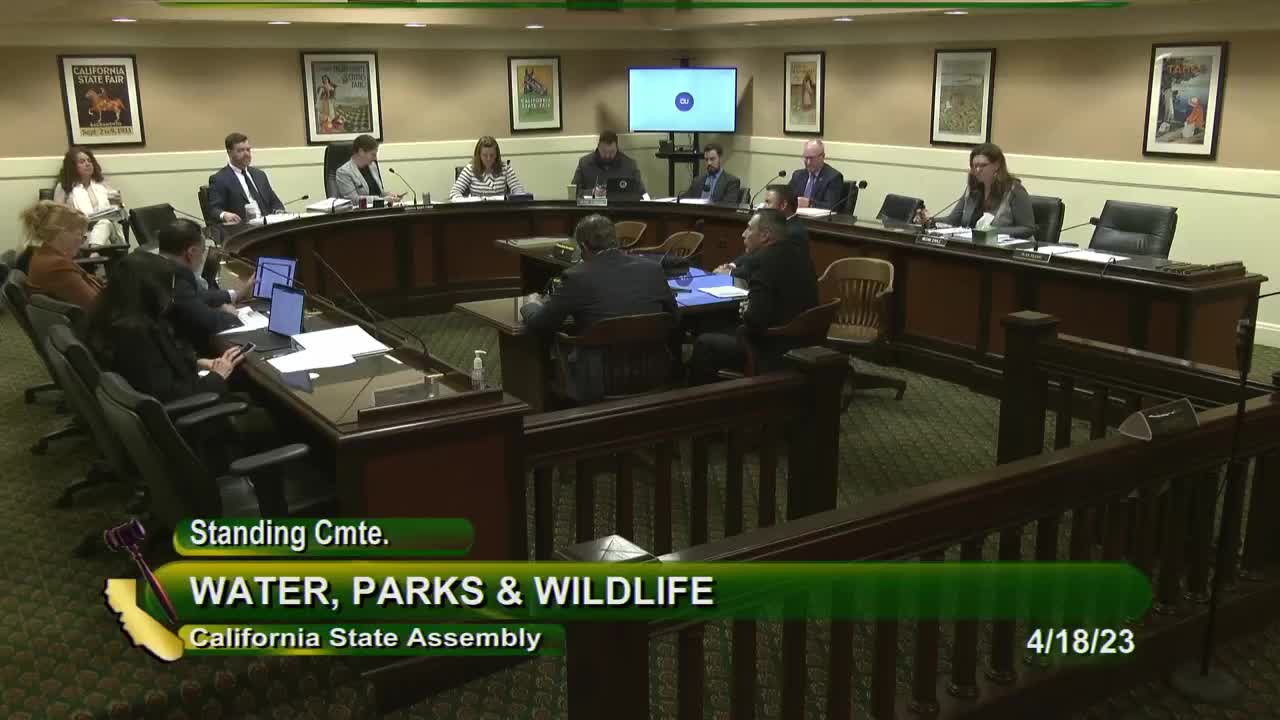
| Apr 19, 2023 | From committee: Amend, and do pass as amended and re-refer to Com. on APPR. (Ayes 14. Noes 0.) (April 18). |
| Feb 28, 2023 | Re-referred to Com. on W., P., & W. |
| Feb 27, 2023 | From committee chair, with author's amendments: Amend, and re-refer to Com. on W., P., & W. Read second time and amended. |
| Jan 26, 2023 | Referred to Com. on W., P., & W. |
| Jan 4, 2023 | Read first time. |
| Dec 7, 2022 | From printer. May be heard in committee January 6. |
| Dec 6, 2022 | Introduced. To print. |
|
Date
|
Description
|
Location
|
Votes
|
|
|---|---|---|---|---|
| Apr 18, 2023 | Do pass as amended and be re-referred to the Committee on [Appropriations] | Assembly Standing Committee on Water, Parks, and Wildlife |
Passed |
This list shows positions taken on this bill by organizations on the date displayed, which is linked to the original source.
Positions by individuals are not included.
|
Organization
|
Position
|
Date
|
|---|---|---|
| Association Of California Water Agencies | * Support | Apr 18, 2023 |
| Bay Area Council | ** Support | |
| California Association Of Realtors | ** Support | |
| California Citrus Mutual | ** Support | |
| Sierra Club California | * Against | Apr 18, 2023 |
| Tulare Chamber of Commerce | ** Support | |
| Upper San Gabriel Valley Municipal Water District | * Support | Apr 18, 2023 |
| Visalia Chamber of Commerce | ** Support | |
| Yorba Linda Water District | * For If Amend | Apr 18, 2023 |
Date of Hearing: May 10, 2023
ASSEMBLY COMMITTEE ON APPROPRIATIONS
Chris Holden, Chair
ABPCA Bill Id:AB 62
Author:(Mathis) – As Amended Ver:April 20, 2023
Policy Committee: | Water, Parks and Wildlife | Vote: | 14 - 0 |
|
| ||
|
|
Urgency: No State Mandated Local Program: No Reimbursable: No
SUMMARY:
This bill establishes a statewide goal to increase above- and below-ground water storage capacity.
Specifically, this bill, among other things:
1) Establishes a statewide goal to increase above- and below-ground water storage capacity by 3.7 million acre-feet by 2030 and four million acre-feet by 2040, consistent with the “California’s Water Supply Strategy: Adapting to a Hotter, Drier Future” report released by the California Natural Resources Agency (CNRA) in 2022.
2) Requires the Department of Water Resources (DWR), in consultation with the State Water Resources Control Board (State Water Board), to take reasonable actions consistent with the CNRA report and the state’s environmental goals to promote or assist the efforts of participating entities to achieve the goal established in subdivision 1).
3) Requires DWR, in consultation with the State Water Board, beginning July 1, 2027, and on or before July 1 every two years thereafter, to prepare and submit to the Legislature a report on the progress made to achieve the goal established in 1).
FISCAL EFFECT:
1) The State Water Board estimates ongoing annual costs of approximately $2.7 million to implement this bill (Water Rights Fund and General Fund). The State Water Board notes that if this bill’s goals are to be achieved, the state will need a substantial increase in the rate of groundwater recharge and other water diversion projects. This will lead to an increase in standard and temporary water rights applications submitted to the State Water Board for review and approval. In addition to an increase in staffing resources to review applications, the State Water Board notes it would require additional staff to handle increased public noticing of permits, provide project proponents with technical assistance and help them address deficiencies with their applications, and manage objections to applications. As part of its consultation role, State Water Board staff would also assist DWR with planning and outreach efforts to identify possible projects and better understand roadblocks to project readiness.
2) DWR estimates ongoing annual costs of approximately $150,000 for one position to identify storage-capable regions and to track, compile, and report information to the Legislature every two years (General Fund).
COMMENTS:
1) Purpose. According to the author:
Without a proactive approach, California’s water infrastructure, including our natural environmental ecosystems, will ultimately fail; this failure will catastrophically jeopardize public health, the environment, and economic stability.
2) Background. In August 2022, CNRA published “California Water Supply Strategy: Adapting to a Hotter, Drier Future” to address a projected 10% reduction in the state’s water supply by 2040 as a result of hotter and drier weather conditions spurred by climate change. The strategy – which prioritizes actions to capture, recycle, de-salt, and conserve more water – includes a goal of creating storage space for up to four million acre-feet of water to allow the state to capitalize on big storms when they do occur and store water for dry periods. The strategy states:
While creating more space to store water in reservoirs and aquifers does not create more precipitation, and though having enough rain and snowfall to fill storage space is out of our control, we need diversion infrastructure, more places to park runoff, and the conveyance to eventually move the water to where it is needed to take advantage of fast-moving storms. Expanding storage capacity improves the ability to capture runoff when diversions cause the least harm to the environment. Furthermore, apart from a hotter and drier climate, capturing water runoff is needed to help correct decades of over-pumping of groundwater basins.
As part of the water storage goal, the strategy includes several actions, including:
- Expanding average annual groundwater recharge by at least 500,000 acre-feet with the help of incentives, regulatory streamlining, and other tactics.
- Working with local proponents to complete seven storage projects – which could increase the state’s overall capacity to store water by 2.77 million acre-feet – that are on track to receive $2.7 billion in state funding from Proposition 1 (a 2014 water bond) and consider funding other viable surface storage projects.
- Expanding San Luis Reservoir by 135,000 acre-feet.
- Rehabilitating dams to regain storage capacity. 112 dams in the state are rated “less than satisfactory” by state dam inspectors, and the reservoirs behind 41 of these dams cannot be filled beyond a certain level in order to protect public safety.
- Supporting local stormwater capture projects in cities and towns with the goal to increase annual supply capacity by at least 250,000 acre-feet by 2030 and 500,000 acre-feet by 2040.
Writing in opposition, the Natural Resources Defense Council states:
Because dams and other storage projects divert water that would naturally flow down California’s rivers and streams, they have dramatically reduced environmental flows and have contributed to the ecosystem collapse in the Bay-Delta watershed. In addition, new storage projects may not necessarily make environmental and economic sense, as the amount of water that could sustainably be diverted to storage may not result in an economically feasible project… California law generally requires that water storage and conveyance projects be paid for by the water districts and businesses that would benefit from the water supply of these projects. However, AB 62 does not authorize the State to force the water districts that would benefit from these projects to pay for these projects, raising significant questions as to who would pay to fund the implementation of these projects, and whether projects that are not considered economically feasible must still be implemented.
Analysis Prepared by: Nikita Koraddi / APPR. / (916) 319-2081
Date of Hearing: April 18, 2023
ASSEMBLY COMMITTEE ON WATER, PARKS, AND WILDLIFE
Rebecca Bauer-Kahan, Chair
ABPCA Bill Id:AB 62 (
Author:Mathis) – As Amended Ver:February 27, 2023
SUBJECT: Statewide water storage: expansion
SUMMARY: Establishes a statewide goal to increase above- and below-ground water storage capacity by a total of 3.7 million acre-feet (MAF) by the year 2030 and a total of 4.0 MAF by the year 2040. Specifically, this bill:
- Establishes this goal in keeping with the August 2022 report “California’s Water Supply Strategy: Adapting to a Hotter, Drier Future” released by the Natural Resources Agency.
- Requires the State Water Resources Control Board (State Water Board) and the Department of Water Resources (DWR) to design and implement measures through a variety of diversion, storage, and conveyance techniques to achieve the statewide goal.
- Requires that every two years, beginning on July 1, 2027, the State Water Board in consultation with DWR to submit a report to the Legislature on the progress of designing and implementing measures to increase water storage capacity to achieve the goal.
EXISTING LAW:
- Establishes the Water Quality, Supply, and Infrastructure Improvement Act of 2014 (Proposition 1) (Water Code §§ 79700–79798).
- Provides $2.7 billion to the California Water Commission (CWC) for the public benefits associated with water storage projects that improve the operation of the state water system, are cost effective, and provide a net improvement to the ecosystem and water quality conditions (Water Code § 79750).
- Defines the public benefits associated with Proposition 1 water storage projects eligible for funding, including ecosystem improvement, water quality improvement, flood control benefits, emergency water management, and recreational purposes (Water Code § 79753).
- Requires the CWC in consultation with the Department of Fish and Wildlife (DFW), the State Water Board, and DWR, to develop and adopt, by regulation, methods of quantification and management of the public benefits (Water Code § 79754).
- Prevents the CWC from allocating funds unless numerous requirements are met and reported on to the Legislature, including that CWC adopted regulations, the project applicant has entered into contract with parties that will derive and administer the public benefit, there was an opportunity for public review and comment, and that feasibility and environmental studies are completed (Water Code § 79755).
- Requires that DWR shall give priority to projects that implement actions to improve water quality and protect water level conditions in San Luis Reservoir to achieve the goals of the Interim Water Reliable Supply and Water Quality Infrastructure management Program (Water Code § 79205.10).
- Provides $65 million for planning and feasibility studies related to the existing and potential future needs for California’s water supply, conveyance, and flood control systems, which includes multi-benefit approaches to maximize public benefits as a part of Proposition 84 [Public Resource Code (PRC) § 75041].
- Makes funding available to maximize opportunities to recharge vulnerable, high-use groundwater basins and optimize ground water supplies; groundwater recharge in flood plains; and groundwater recharge with surface water, stormwater, and other conjunctive use projects as a part of Proposition 68 (PRC § 80140 et seq).
- Provides $825 million for the implementation of the CALFED Bay-Delta Program, which includes allocations for surface water storage planning and feasibility studies, water supply reliability projects, and ecosystem restoration program implementation as a part of Proposition 50 (Water Code § 79550).
FISCAL EFFECT: Unknown. This bill is keyed fiscal.
COMMENTS:
- Purpose of this bill. This bill codifies the above- and below- ground storage goals found in the August 2022 report, “California’s Water Supply Strategy: Adapting to a Hotter, Drier Future.” According to the author, “Without a proactive approach, California’s water infrastructure, including our natural environmental ecosystems, will ultimately fail; this failure will catastrophically jeopardize public health, the environment, and economic stability.”
- Background. Today, evidence overwhelmingly reveals that the modern California climate is already different than the climate of a century ago. Since the beginning of the 21st century, average temperatures have risen almost 3°F in California with the hottest six years on record occurring since 2014 (2014, 2015, 2016, 2017, 2018, and 2020).[1] Likewise, California has experienced its two most severe dry periods on record since 2000 (2012–2016 and 2020–present) and researchers now report that the state has, in fact, been experiencing a “megadrought” since the turn of the century. Indeed, this “megadrought” appears to be the worst such drought since the year 800 and its severity is due, in large part, to climate change.[2] Along with “megadrought,” concepts like low-to-no-snow future,[3] “aridification,” and “megaflood”[4] have entered the lexicon of California water management. It is increasingly clear that climate change will stress water resources and its management like no other time in recorded history. The volume of water used by people in California for agriculture, urban, and environmental purposes ranges from 60–90 MAF per year. An acre-foot of water is enough water to cover an acre of land 1-foot deep (326,000 gallons of water). An acre-foot of water is generally enough to supply five California’s for the year.
California’s Water Supply Strategy: Adapting to a Hotter Drier Climate. In August 2022, Governor Newsom released this strategy to address a projected 10% decrease in water supply (6–9 MAF of water per year) by 2040 due to climate change.[5] To address this shortfall, the strategy sets targets and outlines actions for increased water recycling, desalination, stormwater capture, and water conservation as well as an expansion of surface and underground storage (4 MAF by 2040). Achieving the targets laid out in the strategy would “close the evaporative gap” that is tied to the warmer average temperatures.
Water storage. Dams play a crucial role in California’s water management. The state’s dry summers and frequent droughts require abundant storage to meet water demands. On average, more than 60% of the water used by cities and farms comes from rivers, and dams play a key role in regulating this supply. And in California’s highly managed water system, flow releases from dams are essential to meet the habitat needs of fish and wildlife.[6] California’s nearly 1,500 reservoirs are part of the state’s water grid, which includes groundwater basins and thousands of miles of conveyance facilities to move stored water to where it is needed. Most dams and their reservoirs are owned and operated by local agencies and private companies. But state and federal agencies manage 240 large reservoirs that account for 60% of the state’s storage capacity.[7]
California’s groundwater basins are immense natural assets that allow communities, industries, and agriculture to prosper despite extreme swings in precipitation. These underground reservoirs also feed rivers and streams in ways crucial to fish and wildlife. Groundwater accounts for around 40% of California’s total water supply on an average annual basis – but nearly 60% in a critically dry year. California’s groundwater basins can hold more than 850 MAF, far more than the 50 MAF of storage capacity in major reservoirs. Groundwater recharge is a means of replenishing underground reservoirs either directly through injection, or by allowing water to percolate into the ground, spreading basins, or some stormwater capture. Surface storage can be operated with groundwater storage to increase opportunities for groundwater recharge during high flow periods.[8]
It is critical to note that additional storage capacity does not immediately equate to a similar volume of new water supply. The quantity of water stored is highly dependent on the water year and the water rights and permits granted for each purpose.
Proposition 1. In 2014, the California voters approved Proposition 1 to boost public investment in California’s water infrastructure. While the $7.5-billion bond measure included various funding elements such as water recycling, cleaning up groundwater contamination, watershed protection, and improving drinking water quality, the bond act allocated a significant portion of the funds to water storage projects. Proposition 1’s Water Storage Investment Program (WSIP) dedicated $2.7 billion to such projects. WSIP aimed to create a novel funding mechanism that paid for only the public benefit portion of water projects.[9]
Progress in water storage. In 2018, the CWC approved to support construction of a new reservoir, Sites, the expansion of two others, Pacheco and Los Vaqueros, and ground water storage projects, Chino Basin, Harvest Water, Kern Fan, and Willow Springs (the Temperance Flat Reservoir Project was originally approved, but withdrew from the WSIP in October 2020). Although Proposition 1 was passed in 2014, not until 2023 will any of the projects begin construction (Kern Fan and Harvest Water) (Figure 1).
Figure . The timeline for final award hearing, construction, and operation for the seven projects. SOURCE: CWC.
There has been some frustration in perceived delay of progress on these projects, which generally does not appreciate the complexity, scale, and novelty of the projects and managing them appropriately (Figure 2). The CWC developed a rigorous selection process and technical references, and a ‘strike team’ was created to support permit streamlining. Proposition 1 set a single deadline for the water storage program: By January 1, 2022, all project proponents must have completed feasibility studies, released a draft version of their environmental documents for public review, provided documentation of commitments for at least 75% of the non-public benefit funding, and have the Commission find that their project is feasible. Seven of the projects came before the Commission in 2021. All were found feasible and remain eligible to continue in the program.
Figure . Recent timeline of Proposition 1 project development [10]
Under Proposition 1, before any project can receive its final award of funding, proponents must submit to the Commission completed environmental documents, permits, non-public benefit cost share contracts, and contracts with state agencies for the administration of public benefits. The Commission remains ready to award final funding as soon as these requirements are met. While there is no statutory deadline for a project to compete these requirements, the Commission does have the discretion to determine a project is not making sufficient progress and rescind its bond funding.[11]
Other projects addressed in the Water Supply Strategy for storage capacity. Other projects addressed in the 2022 Water Supply Strategy report include:
- Expanding annual ground water recharge by at least 500,000 acre-feet. The 500,000 acre-feet expected from ground water recharge projects is a “reasonable estimate” based on the 340 proposed projects submitted by local agencies. DWR has already begun advancing these local projects through financial assistance. In 2021 and 2022, DWR awarded $68 million to 42 groundwater recharge projects that provide nearly 117,000 acre-feet of potential recharge capacity. DWR will award additional grants in 2023 based on available funding. So far, applications for this funding include 52 proposed groundwater recharge projects, totaling $211 million in cost. These projects, once vetted, permitted, and constructed, will increase the potential capacity of getting more water underground. DWR is investing $12 million in Proposition 68 funding to conduct helicopter surveys – called aerial electromagnetic surveys – to scan the earth’s surface, like an MRI, to understand where the most suitable locations exist for groundwater recharge.
- Expanding San Luis reservoir by 135,000 acre-feet. San Luis Reservoir is one of the largest reservoirs in California and has a total capacity of more than two MAF. San Luis Reservoir was constructed and is owned by the Bureau of Reclamation and operated by DWR. In March 2022, the Department of the Interior announced a $100 million investment for the dam safety project as a part of the Bipartisan Infrastructure Law which will raise the dam by 10 feet by 2032.[12]
- Rehabilitating dams to regain storage capacity by around 350,000 acre-feet per year. The 2022–2023 includes $100 million for local dam safety projects and flood management over 2023 and 2024.
- Supporting increases stormwater capture by 500,000 acre-feet by 2040. The state will work to incentivize local groups to pursue these projects and the State Water Board will hire a contractor to track progress.
- Other Progress. Following Governor Newsom’s executive order in February, the U.S. Bureau of Reclamation was allowed to divert over 600,000 acre-feet for water for wildlife refuges, underground storage, and ground water recharge. Since December 2022, the State Water Board has authorized nearly 790,000 acre-feet in diversions for groundwater recharge among other purposes. The State Water Board streamlined the permitting process for temporary groundwater storage permits to fast-track efforts to capture floodwater to recharge groundwater basins (authorizing at least 186,000 acre-feet for recharge just this winter). DWR has also awarded funds to 42 ground water recharge projects, as mentioned above. Since 2020, the State Water Board has provided funds for 13 projects to increase the state’s water supply by 88,000 acre-feet per year.
- Possible committee amendments. This bill tasks DWR and the State Water Board to “design and implement measures to increase statewide water storage though a variety of diversion, storage and conveyance techniques” to increase statewide storage capacity. This language is broad and will cause confusion about the role of the state in the progress of these projects. DWR and the State Water Board are not responsible to design, implement, or construct the projects related to increased storage capacity. As noted in the Water Supply Strategy, the role of these entities is to provide regulatory assistance, technical support, and incentives, to the local agencies to support navigation of critical steps like permitting and impact analysis. Generally, in the Water Code, “implementation of measures” is not used to refer to actions of an agency but a project or program (e.g., Water Code §§ 79205.8, 378, 79746, 10827, 10609.25, 79114). This bill specifically suggests measures such as diversions, storage, and conveyance techniques—activities that are being conducted by local agencies and the federal government.
Additionally, as DWR is advised by the CWC and is responsible for the California Water Plan, it is logical to have the actions and report required in this bill to be conducted primarily by DWR, in coordination with the State Water Board, which is concerned with water quality and water rights.
The CWC, which is responsible for administering the funding for the Proposition 1 WSIP, has on its website quarterly reports for each of the projects. It’s important to remember that completion of these projects does not immediately mean 2.77 MAF of water will be available. For example, once construction is complete Sites Reservoir will need to undergo rigorous engineering and safety evaluations before water storage can begin—and the rate at which water may be stored is highly dependent on hydrological conditions.
According to the author’s statement, there is a need for a “proactive approach” towards water infrastructure. It is unclear how this bill is further promoting or facilitating the goals already listed in the Water Supply Strategy report and, in fact, may only increase confusion about the role and responsibility of the state in these projects.
Finally, the title of this bill is “the Keeping Your Promises Act.” This political posturing is inappropriate in statue. There may be frustration that these projects did not begin decades ago so that they would have been able to collect the incredible amount of water from the storms early this year, however, these projects are on track to be operational between 2030–2040.
The Committee may wish to adopt the following amendments:
Amendment 1 – Strike the title
Amendment 2 – Amend Section 10609.90 of the Water Code to read:
(b) The department, in consultation with the board, board, in consultation with the department, shall design and implement measures take reasonable actions consistent with the August 2022 report and California’s environmental goals to promote or assist the efforts of participating entities to increase statewide water storage through a variety of diversion, storage, and conveyance techniques to achieve the statewide goal to increase above- and below-ground water storage capacity, established in subdivision (a).
(c) Beginning July 1, 2027, and on or before July 1 every two years thereafter, the department, in consultation with the board, board, in consultation with the department, shall prepare and submit to the Legislature a report on the progress made in designing and implementing measures to increase above- and below-ground water storage capacity by a total of 3,700,000 acre-feet by the year 2030 and a total of 4,000,000 acre-feet by the year 2040.
- Arguments in support. Several organization write in support of this bill citing the role of the additional storage capacity in promoting the states climate adaptation goals as reported in the August 2022 Water Supply Strategy.
- Arguments in opposition. The Sierra Club writes in opposition arguing that above-ground water storage infrastructure is not the most effective solution to California’s drought due to unreliable precipitation, cost of projects, and potential of some projects to impact on water quality and species decline.
- Related legislation. SB 366 (Caballero) of the current legislative session, among other things, requires DWR, the State Water Board, and the CWC to develop “The California Water Plan,” which shall include a water supply planning target of 10 MAF by 2040 and 15 MAF by 2050. SB 366 has been referred the Senate Natural Resources and Water Committee.
SB 659 (Ashby) of the current legislative session establishes the California Water Supply Solutions Act of 2023 and requires DWR, the State Water Board, and the regional water quality control boards to provide actionable recommendations to result in achieving a 10 MAF annual increase of groundwater recharge by December 31, 2035. SB 659 has been passed out of Senate Natural Resources and Water Committee and referred to the Rules Committee.
AB 2278 (Kalra), Chapter 349, Statutes of 2022, codified Executive Order No. N-82-20 by Governor Gavin Newsom directed the Natural Resources Agency to combat the biodiversity and climate crises by, among other things, establishing the California Biodiversity Collaborative and conserving at least 30% of the state’s lands and coastal waters by 2030.
AB 638 (Gray) of 2019 would have required DWR, as part of the update to the California Water Plan every five years, to identify water storage facilities vulnerable to climate change impacts and the mitigation strategies for anticipated adverse impacts. AB 638 was vetoed by the Governor.
SB 5 (De León), Chapter 852, Statutes of 2017, established the California Drought, Water, Parks, Climate, Coastal Protection, and Outdoor Access For All Act of 2018, which includes funding that may be used for water storage.
AB 1369 (Gray) of 2017 in addition to requiring the DWR to increase water storage capacity statewide by 25%, would have also require the department to identify the current statewide water storage capacity. AB 1369 was never heard and died in the Assembly Water, Parks, and Wildlife Committee.
AB 1649 (Salas) of 2016 would have required DWR to develop a state water policy that gives priority to the formation of joint powers authorities that are formed to address critical surface water storage needs. AB 1649 died in the Senate Natural Resources and Water Committee.
AB 1242 (Gray) of 2015 would have required the DWR to increase the state’s total water storage capacity by 25% by 2025 and by 50% by 2050. AB 1242 died in Senate Rules.
AB 1482 (Gordon), Chapter 603, Statutes of 2015, requires the Natural Resources Agency to update every three years the state’s climate adaptation strategy including vulnerabilities in the water supply sector to climate change.
SB 1370 (Galgiani) of 2014 would have created the Water Storage Development Account to provide funds for eligible surface water storage projects including Sites reservoir and the expansion of the San Luis Reservoir. AB 1370 was held in the Senate Natural Resources and Water Committee.
AB 1471 (Rendon), Chapter 188, Statutes of 2014, was a water bond measure (Proposition 1) approved by the voters in November 2014. The $7.12 billion bond measure included $2.7 billion for water storage projects including dams, reservoirs, and groundwater storage projects.
AB 673 (Cortese), Chapter 187, Statues of 1991, establishes the Water Recycling Act of 1991 that includes a statewide goal to recycle a total of 1.0 MAF of water per year by 2010.
REGISTERED SUPPORT / OPPOSITION:
Support
Association of California Water Agencies
Bay Area Council
California Association of Realtors
California Citrus Mutual
Tulare Chamber of Commerce
Upper San Gabriel Valley Municipal Water District
Visalia Chamber of Commerce
Opposition
Sierra Club California
Analysis Prepared by: Stephanie Mitchell / W., P., & W. / (916) 319-2096
Rebekah Frankson, Laura E. Stevens, and Kenneth E. Kunkel et al, “California State Climate Summary 2022,” NOAA Technical Report NESDIS 150-CA, (2022): 6, https://statesummaries.ncics.org/chapter/ca/. ↑
A. Park Williams, Edward Cook, and Jason Smerdon et al, “Large contribution from anthropogenic warming to an emerging North American megadrought,” Science 368, 6488 (2020): 314-318, DOI: 10.1126/science.aaz9600 ↑
Erica Siirila Woodburn, Alan Rhoades, and Benjamin Hatchett et al, “A low-to-no snow future and its impacts on water resources in the Western United States,” Nature Reviews Earth & Environment, 2 (2021): 800—819, https://www.nature.com/articles/s43017-021-00219-y. ↑
Xingying Huang and Daniel Swain, “Climate change is increasing the risk of a California megaflood,” Science Advances, 8, 31 (2022): eabq0995, https://www.science.org/doi/10.1126/sciadv.abq0995. ↑
DWR estimates a 10% reduction in water supply by 2040. ↑
Escriva-Bou, A., Mount, J., Jezdimirovic, J. Public Policy Institute of California, Dams in California, September 2019. ↑
Ibid. ↑
Sencan, G. and Mount J. Public Policy Institute of California, Storing Water for the Environment, Technical Appendix C. August 2022. ↑
Sencan, G. and Mount J. Public Policy Institute of California, Storing Water for the Environment, Technical Appendix C. August 2022. ↑
California Water Commission, Water Storage. https://cwc.ca.gov/Water-Storage ↑
B.F. Sisk Dam Safety of Dams Modification Project. https://www.usbr.gov/mp/sod/projects/sisk/ ↑
Discussed in Hearing
 2MIN
Senate Floor
 5MIN