SB 724: Political Reform Act of 1974: communications.
- Session Year: 2023-2024
- House: Senate
- Latest Version Date: 2023-08-28
Current Status:
Failed
(2024-08-15: August 15 hearing: Held in committee and under submission.)
Introduced
In Committee
First Chamber
In Committee
Second Chamber
Enacted
What does this bill do?
The bill requires people or groups who pay $25,000 or more for a communication that clearly names an elected state officer and educates the public about that officer’s past votes or campaign donors, and that is published within 150 days of an election, to disclose who paid. It also requires anyone who receives $5,000 or more to make such a communication to report those payments, unless they are a business hired to provide goods or services.
The summary is provided by generative AI which can make mistakes. For original language, please view the details in the table below.
The Political Reform Act of 1974, among other things, requires the disclosure of certain payments of or promises to pay $50,000 or more for a communication that clearly identifies a candidate for elective state office, but does not expressly advocate the election or defeat of the candidate, and that is disseminated, broadcast, or otherwise published within 45 days of an election, as specified. The Act also requires disclosure by any person who receives or is promised a payment totaling $5,000 or more for the purpose of making such a communication, unless the person who receives the payment is in the business of providing goods or services and receives or is promised the payment for the purpose of providing those goods or services.
This bill would also require the disclosure of any payment of or promise to pay $25,000 or more for a communication that clearly identifies an elective elected state officer, with the intent to influence the officer or public opinion, and educates the public about the previous votes cast by the elected state officer or about the source of campaign donations received by the elected state officer, and that is disseminated, broadcast, or otherwise published within 150 days of an election, as specified. The bill also would require disclosure by any person who receives or is promised a payment totaling $5,000 or more for the purpose of making such a communication, unless the person who receives the payment is in the business of providing goods or services and receives or is promised the payment for the purpose of providing those goods or services.
Existing law makes a knowing or willful violation of the Political Reform Act of 1974 a misdemeanor and subjects offenders to criminal penalties. By expanding the scope of an existing crime, this bill would impose a state-mandated local program.
The California Constitution requires the state to reimburse local agencies and school districts for certain costs mandated by the state. Statutory provisions establish procedures for making that reimbursement.
This bill would provide that no reimbursement is required by this act for a specified reason.
The Political Reform Act of 1974, an initiative measure, provides that the Legislature may amend the act to further the acts purposes upon a 2/3 vote of each house of the Legislature and compliance with specified procedural requirements.
This bill would declare that it furthers the purposes of the act.
The Political Reform Act of 1974, among other things, requires the disclosure of certain payments of or promises to pay $50,000 or more for a communication that clearly identifies a candidate for elective state office, but does not expressly advocate the election or defeat of the candidate, and that is disseminated, broadcast, or otherwise published within 45 days of an election, as specified. The Act also requires disclosure by any person who receives or is promised a payment totaling $5,000 or more for the purpose of making such a communication, unless the person who receives the payment is in the business of providing goods or services and receives or is promised the payment for the purpose of providing those goods or services.
This bill would also require the disclosure of any payment of or promise to pay $25,000 or more for a communication that clearly identifies an elective state officer, with the intent to influence the officer or public opinion, and that is disseminated, broadcast, or otherwise published within 150 days of an election, as specified. The bill also would require disclosure by any person who receives or is promised a payment totaling $5,000 or more for the purpose of making such a communication, unless the person who receives the payment is in the business of providing goods or services and receives or is promised the payment for the purpose of providing those goods or services.
Existing law makes a knowing or willful violation of the Political Reform Act of 1974 a misdemeanor and subjects offenders to criminal penalties. By expanding the scope of an existing crime, this bill would impose a state-mandated local program.
The California Constitution requires the state to reimburse local agencies and school districts for certain costs mandated by the state. Statutory provisions establish procedures for making that reimbursement.
This bill would provide that no reimbursement is required by this act for a specified reason.
The Political Reform Act of 1974, an initiative measure, provides that the Legislature may amend the act to further the acts purposes upon a 2/3 vote of each house of the Legislature and compliance with specified procedural requirements.
This bill would declare that it furthers the purposes of the act.
The Legislature finds and declares all of the following:
(a)Disclosure of who, or which interest, paid for a communication to influence public opinion will help the public better evaluate the arguments to which they are being subjected and will create a more informed public.
(b)A Stanford University study showed that more than 80 percent of middle school pupils struggled to distinguish advertisements from news stories.
(c)The public is growing less satisfied with how democracy is working and does not believe the government is run for the benefit of all.
(d)According to a Pew Research Center survey, public respondents cited the influence of special interest money on elected officials as the biggest problem with elected officials in the federal government.
(e)According to a Pew Research Center survey, public respondents cited that money has a greater role on politics than in the past.
(f)The public deserves to know who is paying for communications to influence their opinion and the opinions of elected officials to preserve integrity and transparency in our democracy.
(g)Communications depicting elected officials should not intentionally deceive the public about the identity of who, or which interest, is trying to persuade their opinion.
(h)According to the Sacramento Bee, more than 1,000 businesses, advocacy groups or others spent at least $100,000 lobbying the state government in 2022, and data from the Secretary of State shows that 56 entities spent more than $1 million.
(i)This legislation seeks to address a gap within the existing reporting requirements for advertisements identifying an elected state officer that attempt to educate the public on the previous votes cast by the elected state officer or about the source of campaign donations received by the elected state officer.
(j)While the content of these types of advertisements may have an indirect connection to an election or particular legislative action, these advertisements nevertheless have the potential to impact the officeholders future election prospects and the outcome of issues on which they may be voting.
(k)It is in the publics interest to know the source of, and the amount of money spent on, these advertisements.
SECTION 1.SEC. 2.Section 85311 is added to the Government Code, to read:85311.(a)Any person who makes a payment or a promise of payment totaling twenty-five thousand dollars ($25,000) or more for a communication that clearly identifies an elected state officer, and educates the public about the previous votes cast by the elected state officer or about the source of campaign donations received by the elected state officer, with the intent to influence the officer or public opinion, and that is disseminated, broadcast, or otherwise published within 150 days of an election, shall file online or electronically with the Secretary of State a report disclosing the name of the person, address, occupation, and employer, and amount of the payment. The report shall be filed within 48 hours of making the payment or the promise to make the payment.
(b)(1)Except as provided in paragraph (2), if any person has received a payment or a promise of a payment from other persons totaling five thousand dollars ($5,000) or more for the purpose of making a communication described in subdivision (a), the person receiving the payments shall submit a report as required under that subdivision and disclose on the report the name, address, occupation and employer, and date and amount received from the person.
(2)A person who receives or is promised a payment that is otherwise reportable under paragraph (1) is not required to report the payment if the person is in the business of providing goods or services and receives or is promised the payment for the purpose of providing those goods or services.
(c)This section is not intended to modify the definitions of contribution or expenditure under this division or to modify the obligations of any person whose activity otherwise meets those definitions.
SEC. 2.SEC. 3.No reimbursement is required by this act pursuant to Section 6 of Article XIIIB of the California Constitution because the only costs that may be incurred by a local agency or school district will be incurred because this act creates a new crime or infraction, eliminates a crime or infraction, or changes the penalty for a crime or infraction, within the meaning of Section 17556 of the Government Code, or changes the definition of a crime within the meaning of Section 6 of Article XIIIB of the California Constitution.
SEC. 3.SEC. 4.The Legislature finds and declares that this bill furthers the purposes of the Political Reform Act of 1974 within the meaning of subdivision (a) of Section 81012 of the Government Code.
(a)Any person who makes a payment or a promise of payment totaling twenty-five thousand dollars ($25,000) or more for a communication that clearly identifies an elected state officer, with the intent to influence the officer or public opinion, and that is disseminated, broadcast, or otherwise published within 150 days of an election, shall file online or electronically with the Secretary of State a report disclosing the name of the person, address, occupation, and employer, and amount of the payment. The report shall be filed within 48 hours of making the payment or the promise to make the payment.
(b)(1)Except as provided in paragraph (2), if any person has received a payment or a promise of a payment from other persons totaling five thousand dollars ($5,000) or more for the purpose of making a communication described in subdivision (a), the person receiving the payments shall submit a report as required under that subdivision and disclose on the report the name, address, occupation and employer, and date and amount received from the person.
(2)A person who receives or is promised a payment that is otherwise reportable under paragraph (1) is not required to report the payment if the person is in the business of providing goods or services and receives or is promised the payment for the purpose of providing those goods or services.
(c)This section is not intended to modify the definitions of contribution or expenditure under this division or to modify the obligations of any person whose activity otherwise meets those definitions.
SEC. 2.No reimbursement is required by this act pursuant to Section 6 of Article XIIIB of the California Constitution because the only costs that may be incurred by a local agency or school district will be incurred because this act creates a new crime or infraction, eliminates a crime or infraction, or changes the penalty for a crime or infraction, within the meaning of Section 17556 of the Government Code, or changes the definition of a crime within the meaning of Section 6 of Article XIIIB of the California Constitution.
SEC. 3.The Legislature finds and declares that this bill furthers the purposes of the Political Reform Act of 1974 within the meaning of subdivision (a) of Section 81012 of the Government Code.
|
Date
|
Status
|
|---|---|
| Aug 15, 2024 | August 15 hearing: Held in committee and under submission. |
| Sep 1, 2023 | September 1 hearing postponed by committee. |
| Aug 28, 2023 | From committee with author's amendments. Read second time and amended. Re-referred to Com. on APPR. |
| Aug 23, 2023 | August 23 set for first hearing. Placed on suspense file. |
| Jul 6, 2023 | From committee: Do pass and re-refer to Com. on APPR. (Ayes 6. Noes 0.) (July 5). Re-referred to Com. on APPR. |
| Jun 1, 2023 | Referred to Com. on ELECTIONS. |
| May 25, 2023 | In Assembly. Read first time. Held at Desk. |
| May 24, 2023 | Read third time. Passed. (Ayes 32. Noes 0. Page 1260.) Ordered to the Assembly. |
| May 18, 2023 | Read second time. Ordered to third reading. |
| May 18, 2023 | From committee: Do pass. (Ayes 5. Noes 1. Page 1181.) (May 18). |
| May 12, 2023 | Set for hearing May 18. |
| Apr 10, 2023 | April 10 hearing: Placed on APPR suspense file. |
| Mar 28, 2023 | Set for hearing April 10. |
| Mar 21, 2023 | From committee: Do pass and re-refer to Com. on APPR. (Ayes 6. Noes 0. Page 424.) (March 21). Re-referred to Com. on APPR. |
| Mar 13, 2023 | Set for hearing March 21. |
| Mar 1, 2023 | Referred to Com. on E. & C.A. |
| Feb 17, 2023 | From printer. May be acted upon on or after March 19. |
| Feb 16, 2023 | Introduced. Read first time. To Com. on RLS. for assignment. To print. |
|
Date
|
Description
|
Location
|
Votes
|
|
|---|---|---|---|---|
| Jul 5, 2023 | Do pass and be re-referred to the Committee on [Appropriations] | Assembly Standing Committee on Elections |
Passed |
|
| May 24, 2023 | Senate 3rd Reading SB724 Glazer et al. | Senate Floor |
Passed |
|
| May 18, 2023 | Do pass | Senate Standing Committee on Appropriations |
Passed |
|
| Apr 10, 2023 | Placed on suspense file | Senate Standing Committee on Appropriations |
Passed |
|
| Mar 21, 2023 | Do pass, but first be re-referred to the Committee on [Appropriations] | Senate Standing Committee on Elections and Constitutional Amendments |
Passed |
This list shows positions taken on this bill by organizations on the date displayed, which is linked to the original source.
Positions by individuals are not included.
|
Organization
|
Position
|
Date
|
|---|---|---|
| Rebuild California | * Against | Jul 5, 2023 |
Date of Hearing: August 23, 2023
ASSEMBLY COMMITTEE ON APPROPRIATIONS
Chris Holden, Chair
SBPCA Bill Id:SB 724
Author:(Glazer) – As Introduced Ver:February 16, 2023
Policy Committee: | Elections | Vote: | 6 - 0 |
|
| ||
|
|
Urgency: No State Mandated Local Program: Yes Reimbursable: No
SUMMARY:
This bill requires the disclosure of any payment, or promise of payment, of $25,000 or more for a communication that clearly identifies an elective state officer, with the intent to influence the officer or public opinion, disseminated within 150 days of an election.
Any person making such a payment must file a report with the Secretary of State (SOS) within 48 hours of making the payment. This bill also requires the disclosure of any person who receives a payment, or is promised a payment, of $5,000 or more for the purpose of making such a communication.
FISCAL EFFECT:
- Costs of approximately $127,000 in the first year and $120,000 annually thereafter to the Fair Political Practices Commission (FPPC) for an additional staff position to enforce this new contribution limit (General Fund (GF)). The FPPC also notes additional potential expenses of approximately $200,000 for litigation costs due to a potential constitutional challenge, further discussed below in comment 2.
- Minor and absorbable costs to the SOS to update an existing filing form to capture the information required under this bill. However, the SOS also anticipates costs of an unknown, but potentially significant, amount to update the CAL-ACCESS Replacement System (CARS) to incorporate this new filing requirement into the ongoing information technology project. The SOS notes it is too early in the project to estimate these downstream costs.
COMMENTS:
- Purpose. According to the author:
[I]t is unclear whether communication that does not advocate for a specific action (i.e. an issue lobbying advertisement) for elected state officials who are not candidates at an upcoming election requires a disclosure of who is funding the communication.
This bill is a modest approach that only targets large spenders of these types of communication. For state officials, these types of communication do not specifically mention an action but influences future legislation action. Californians deserve to know who is trying to influence legislators and this bill seeks to provide that information.
- Background.
Advertisements Identifying State Officials. According to the author, this bill is a response to online advertisements appearing in the summer of 2022 identifying six legislators, five of whom were candidates in the November 2022 election, which generally referred to the legislators’ votes on an issue, but did not mention specific legislation or encourage any action regarding the legislators or legislation. The Political Reform Act requires a person to file a disclosure report if the person spends $50,000 or more on a communication that clearly identifies a candidate for elective state office, but does not advocate for the election or defeat of the candidate. However, this rule applies only if the communication is disseminated within 45 days of an election, which the advertisements in question were not. Similarly, SB 459 (Allen), Chapter 873, Statutes of 2022, was not in effect when the advertisements in question appeared, but also would not have likely applied. Although SB 459, once implemented, requires disclosure of funding information for an issue lobbying advertisement, the advertisement must be made for purposes of influencing a clearly identified legislative or administrative action. In attempt to capture the advertisements in question, this bill requires a person to file a disclosure report if the person spends $20,000 or more on a communication that clearly identifies a candidate, but does not clearly identify a legislative or administrative action, within 150 days of an election.
Constitutional Issues. As noted in the Assembly Elections Committee analysis of this bill, “This bill raises significant constitutional concerns and could be susceptible to a challenge on the grounds that it violates the guarantees of free speech and freedom of association under the United States (US) Constitution” as “this bill likely will require disclosure reports to be filed in connection with communications that do not seek to influence the legislative or electoral process.” The analysis concludes, “Given the broad applicability of this bill, it remains uncertain whether a court would find a substantial relation between its disclosure requirements and a sufficiently important governmental interest.”
Analysis Prepared by: Irene Ho / APPR. / (916) 319-2081
Date of Hearing: July 5, 2023
ASSEMBLY COMMITTEE ON ELECTIONS
Gail Pellerin, Chair
SBPCA Bill Id:SB 724
Author:(Glazer) – As Introduced Ver:February 16, 2023
SENATE VOTE: 32-0
SUBJECT: Political Reform Act of 1974: communications.
SUMMARY: Requires a person who spends $25,000 or more on a communication that identifies an elected state official within 150 days of an election to file a public disclosure report, and requires the report to include the identity of any person who paid $5,000 or more for the purpose of making that communication. Specifically, this bill:
- Requires any person who makes or promises a payment of $25,000 or more for a communication that clearly identifies an elected state officer to file a report with the Secretary of State (SOS) that discloses the person’s name, address, occupation, employer, and the amount of the payment within 48 hours if both of the following are true:
- The communication is made with the intent to influence the officer or public opinion; and,
- The communication is disseminated, broadcast, or otherwise published within 150 days of an election.
- The communication is made with the intent to influence the officer or public opinion; and,
- Requires a person who receives or is promised a payment of $5,000 or more from another person for the purpose of making a communication described above in 1) to submit a report as described above, and to disclose on the report the name, address, occupation, and employer of, and date and amount received from, the person. Provides that this requirement does not apply to a person who is in the business of providing goods or services and receives or is promised the payment for the purpose of providing those goods or services.
- Specifies that this bill is not intended to modify the definitions of contribution or expenditure under the Political Reform Act (PRA) or to modify the obligations of any person whose activity otherwise meets those definitions.
EXISTING LAW:
- Creates the Fair Political Practices Commission (FPPC), and makes it responsible for the impartial, effective administration and implementation of the PRA. (Government Code §§83100, 83111)
- Requires any person who makes a payment of $50,000 or more, as specified, for a communication that clearly identifies a candidate for elective state office, but that does not expressly advocate the election or defeat of the candidate, and that is disseminated within 45 days of an election, to file a disclosure report with the SOS disclosing specified information about the person and the payment. Requires a person who receives or is promised a payment of $5,000 or more from another person for the purpose of making such a communication to submit a report as described above, and to disclose on the report the name, address, occupation, and employer of, and date and amount received from, the person. Provides that this requirement does not apply to a person who is in the business of providing goods or services and receives or is promised the payment for the purpose of providing those goods or services. (Government Code §85310)
- Requires the SOS, in consultation with the FPPC, to develop and certify a new online filing and disclosure system for public use that provides public disclosure of campaign finance and lobbying information in a user-friendly, easily understandable format, as specified. This system commonly is referred to as the Cal-Access Replacement System (CARS). (Government Code §84602(b))
- Requires an issue lobbying advertisement to clearly and conspicuously identify the person that authorized and paid for the advertisement, as specified. Requires a person that pays or makes enforceable promises to pay $5,000 or more during a calendar quarter for issue lobbying advertisements to file a report with the SOS within 72 hours, as specified. Defines “issue lobbying advertisement,” for the purpose of these provisions, as any advertisement made for purposes of influencing a clearly identified legislative or administrative action, including an advertisement soliciting or urging a person to communicate directly with an elective state official, agency official, or legislative official for the primary purpose of attempting to influence a clearly identified state legislative or administrative action, except as specified. Provides that these provisions shall become operative one year after the SOS certifies that the CARS system is operational, or January 1, 2023, whichever is later. (Government Code §§84602, 86119; Section 7 of Chapter 873 of the Statutes of 2022)
FISCAL EFFECT: According to the Senate Appropriations Committee:
- The FPPC indicates that it would incur first-year costs of $127,000, and $120,000 annually thereafter, to fund one position to implement the provisions of the bill (General Fund). FPPC also notes the potential of up to $200,000 for litigation costs due to potential Constitutional challenge.
- The bill would result in initial General Fund costs to the SOS of $722,000, with ongoing costs annual costs of $277,000.
COMMENTS:
- Purpose of the Bill: According to the author:
This bill seeks to close a gap in California’s transparency and disclosure laws. Under current law, a disclosure is required for communication that clearly identifies a candidate for elective state office, but does not advocate for the election or defeat of the candidate within 45 days of an election. Additionally, an issue lobbying advertisement is an advertisement made for purposes of influencing a clearly identified legislative or administrative action, including an advertisement soliciting or urging a person to communicate directly with an elective state official, agency official, or legislative official for the primary purpose of attempting to influence a clearly identified state legislative or administrative action. As a result, it is unclear whether communication that does not advocate for a specific action (i.e. an issue lobbying advertisement) for elected state officials who are not candidates at an upcoming election requires a disclosure of who is funding the communication.
This bill is a modest approach that only targets large spenders of these types of communication. For state officials, these types of communication do not specifically mention an action but influences future legislation action. Californians deserve to know who is trying to influence legislators and this bill seeks to provide that information.
- Advertisements Identifying State Officials: According to background information provided by the author, this bill is a response to online advertisements that appeared in the summer of 2022. These advertisements identified six legislators, five of whom were candidates for elective state office at the November 2022 statewide general election. The advertisements did not mention the election or the legislators’ candidacies. While the advertisements referred in a general manner to the legislators’ votes on legislation related to a topic, it did not mention specific bills or encourage any action regarding the legislators or legislation.
As detailed above, the PRA requires a person to file a disclosure report with the SOS if the person spends $50,000 or more on a communication that clearly identifies a candidate for elective state office, but does not advocate for the election or defeat of the candidate, but only if the communication is disseminated within 45 days of an election. Since the advertisements that prompted this bill were disseminated more than 45 days before the November 2022 general election, the entity responsible for those advertisements was not required to file a public disclosure report under that law.
Last year, the Legislature passed and the Governor signed SB 459 (Allen), Chapter 873, Statutes of 2022. That bill will require an issue lobbying advertisement, as defined, to include a disclosure of the person who authorized and paid for the advertisement. Additionally, that bill will require a person that pays $5,000 or more in a calendar quarter for issue lobbying advertisements to file a disclosure report with the SOS within 72 hours. SB 459 was not in effect at the time the advertisements ran. Even if it had been effect, it is unlikely that the advertisements identified by the author would have triggered the requirements of SB 459, since it applies only to advertisements made for purposes of influencing a clearly identified legislative or administrative action. Moreover, SB 459 will not become effective until one year after the SOS certifies that CARS is operational. The SOS does not expect to fully deploy CARS until late 2026 at the earliest. - Constitutional Issues: This bill raises significant constitutional concerns and could be susceptible to a challenge on the grounds that it violates the guarantees of free speech and freedom of association under the United States (US) Constitution. Courts have consistently recognized that laws that compel a person to disclose information can impact First Amendment rights, because the associated burden and penalties for noncompliance may discourage people from speaking altogether.
Regarding laws that compel disclosure, the US Supreme Court generally has held that such laws must survive exacting scrutiny, a standard that requires “a substantial relation between the disclosure requirement and a sufficiently important governmental interest.” Doe v. Reed (2010), 561 US 186, 196 (internal quotation marks omitted). Under that standard, the Supreme Court has upheld requirements that people who pay for campaign advertisements and electioneering communications must file public disclosure reports with a federal agency, finding that providing the electorate with information about the sources of election-related spending is a sufficiently important governmental interest. (Buckley v. Valeo (1974) 424 US 1; Citizens United v. Federal Election Commission (2010) 558 U.S. 310.) Similarly, the Court has upheld registration and disclosure requirements for lobbyists, finding an important governmental interest in allowing public officials and the public to know “who is being hired, who is putting up the money, and how much” is being spent to influence legislation. (United States v. Harriss (1954), 347 US 612, 625.)
However, it is unclear whether a court would uphold the disclosure requirements outlined in this bill. First, the bill lacks a clear statement regarding the specific governmental interest it aims to promote. The author’s statement suggests that the governmental interest may lie in providing information about those who spend money to influence the legislative process (arguing that “Californians deserve to know who is trying to influence legislators”). Some elements of the bill seem to be drafted with such a governmental interest in mind, such as its application to communications that clearly identify an elected state officer, regardless of whether that officer is a candidate or will appear on the ballot at a future election.
On the other hand, other elements of the bill suggest that the governmental interest relates to providing information about those who are seeking to influence elections, as evidenced by this bill’s requirements for disclosure of communications that are made within a specific time frame around elections. Without a clear statement regarding the governmental interest that this bill seeks to further, it is challenging to assess whether a court would find that there is a substantial relation between this bill’s disclosure requirements and a sufficiently important governmental interest. Accordingly, this bill may benefit from the addition of findings and declarations that clearly identify the governmental interest being served by the new disclosure requirements.
Even if there is a sufficiently important governmental interest underlying this bill’s disclosure requirements, it remains unclear whether a substantial relation exists between the disclosure and the governmental interest. If the governmental interest involves providing information about efforts to influence the legislative process, it is not clear that there is a substantial relation to the disclosure requirement given that this bill is not limited to advertisements that mention pending legislative action or that encourage contacting elected officials regarding legislative matters. Furthermore, the bill may not apply to many communications that seek to influence legislative matters if they are made in odd-numbered years.
If the governmental interest relates to providing information about efforts to affect elections, this bill’s disclosure requirements similarly will cover many communications that are unrelated to that interest. For instance, the disclosure requirements are not limited to advertisements that identify a candidate who will appear on the ballot. Relatedly, the requirements apply to communications that occur five months before an election, when those communications are considerably less likely to have an impact on the electoral process.
This bill’s scope encompasses a broad range of communications, subject to four main conditions triggering reporting requirements:
(1) The communication must clearly identify an elected state officer;
(2) A person must make a payment or promise of a payment of $25,000 or more for the communication;
(3) The purpose of the communication is to influence the elected state officer or public opinion; and,
(4) The communication must be disseminated, broadcast, or published within 150 days of an election.
While the first two conditions effectively limit the number of communications triggering reporting obligations, the latter two conditions do little to narrow the scope of regulated communications. Advertising generally aims to influence public opinion, so it is unclear whether the third condition excludes any communications from falling under the purview of this bill. Finally, depending on how the fourth condition is interpreted and applied, it could encompass anywhere from 40% of a four-year period (if interpreted to mean only the 150-day period immediately before a statewide primary or general election) to the entirety of a four-year period (if interpreted to mean the 150-day period before and after any election in the state).
Consequently, this bill likely will require disclosure reports to be filed in connection with communications that do not seek to influence the legislative or electoral processes. For instance, a public service announcement (PSA) featuring an elected state officer encouraging donations for disaster relief could trigger reporting requirements if payments totaling $25,000 or more are made for the production and dissemination of that PSA. Similarly, during Arnold Schwarzenegger's tenure as Governor, advertisements funded by the California Travel & Tourism Commission promoting California as a global tourism destination, in which he appeared, would likely have triggered reporting requirements had this bill been in effect, even when Governor Schwarzenegger was not a candidate for any other office. Given the broad applicability of this bill, it remains uncertain whether a court would find a substantial relation between its disclosure requirements and a sufficiently important governmental interest.
Notably, the US Supreme Court ruled two years ago that a California disclosure law was unconstitutional due to its burden on First Amendment rights, despite addressing an important governmental interest. Specifically in Americans for Prosperity v. Bonta (2021), 141 S. Ct. 2373, the Court found that a California law mandating charitable organizations that solicit funds in California to disclose their major donors to the state Attorney General (AG) was unconstitutional.
In that case, the Court acknowledged that preventing fraud by charities was a substantial governmental interest, stating that the court “do[es] not doubt that California has an important interest in preventing wrongdoing by charitable organizations.” (Id. at 2385-86.) Nonetheless, the Court found that the “disclosure requirement imposes a widespread burden on donors’ associational rights,” that “cannot be justified on the ground that the regime is narrowly tailored to investigating charitable wrongdoing, or that the State’s interest in administrative convenience is sufficiently important.” (Id. at 2389.) It is worth noting that the disclosure at issue in Americans for Prosperity (unlike the disclosure in this bill) was confidential and not publicly available, though the Court noted that potential donors would be reasonably justified in fearing their identities could become public in light of prior security breaches in the AG’s office resulting in the disclosure of confidential information. - Amendments Requested: Although she does not have an official position on the bill, Secretary of State Shirley N. Weber, Ph.D. has requested that this bill be amended to delay its implementation until the CARS system is certified. In her letter to the committee, Secretary Weber writes:
In recent years, similar amendments have been added to legislative measures that seek to create new online reporting within the CAL-ACCESS financial disclosure system. Senate Bill 459 (Allen - Ch. 873, St. of 2022), which would have created a new electronic CAL-ACCESS filing, was amended to state," ... this act shall not become operative until one year after the date the Secretary of State certifies an online filing and disclosure system pursuant to paragraph (7) of subdivision (b) of Section 84602 of the Government Code or January 1, 2023, whichever is later." In addition, Assembly Bill 2528 (Bigelow - Ch. 500, St. of 2022) included language that delayed implementation of its new online filing requirement until January 1 following certification by the Secretary of State that CAL-ACCESS is modified to accommodate these additional filings.
If implementation cannot be delayed, an alternative filing process with the form being filed in paper format by electronic mail would need to be established for SB 724 until CARS is certified. Additional language would be needed to allow the SOS to accept a new form by paper. However, this option presents additional costs because it requires immediate paper-based filings and would still entail costs necessary to include in CARS the filing required by SB 724. In addition, information collected on a paper form cannot be integrally displayed in CAL-ACCESS and, unlike filings processed through CAL-ACCESS or, in the future, through CARS, would not have searchable features including links to candidates. A paper filing could still be posted to the SOS website.
- Previous Legislation: AB 1217 (Mullin) of 2019 would have required certain advertisements that are issue ads or electioneering communications to include disclosure statements identifying the entity responsible for the ads and the entity's major funders. AB 1217 was approved by the Assembly Elections & Redistricting Committee (the predecessor to this committee) on a 6-0 vote, and on the Assembly Floor by a 65-4 vote, but was never heard in committee in the Senate.
- Political Reform Act of 1974: California voters passed an initiative, Proposition 9, in 1974 that created the FPPC and codified significant restrictions and prohibitions on candidates, officeholders, and lobbyists. That initiative is commonly known as the PRA. Amendments to the PRA that are not submitted to the voters, such as those contained in this bill, must further the purposes of the initiative and require a two-thirds vote of both houses of the Legislature.
REGISTERED SUPPORT / OPPOSITION:
Support
None on file.
Opposition
None on file.
Analysis Prepared by: Ethan Jones / ELECTIONS / (916) 319-2094
SENATE RULES COMMITTEE Office of Senate Floor Analyses (916) 651-1520 Fax: (916) 327-4478 | SB 724 |
THIRD READING
Bill No: SB 724
Author: Glazer (D), et al.
Introduced: 2/16/23
Vote: 27
SENATE ELECTIONS & C.A. COMMITTEE: 6-0, 3/21/23
AYES: Glazer, Allen, McGuire, Menjivar, Newman, Umberg
NO VOTE RECORDED: Nguyen
SENATE APPROPRIATIONS COMMITTEE: 5-1, 5/18/23
AYES: Portantino, Ashby, Bradford, Wahab, Wiener
NOES: Jones
NO VOTE RECORDED: Seyarto
SUBJECT: Political Reform Act of 1974: communications
SOURCE: Author
DIGEST:
This bill requires that any person who makes a payment or a promise of payment totaling $25,000 or more for a communication that clearly identifies an elected state officer, with the intent to influence the officer or public opinion, and that is disseminated, broadcast, or otherwise published within 150 days of an election, to file online or electronically with the Secretary of State (SOS) a report disclosing the name of the person, address, occupation, and employer, and amount of the payment.
ANALYSIS:
Existing law:
- Creates the Fair Political Practices Commission (FPPC) and makes it responsible for the impartial, effective administration and implementation of the Political Reform Act of 1974 (PRA).
- Requires any person who makes a payment or a promise of payment totaling $50,000 or more for a communication that clearly identifies a candidate for elective state office, but does not expressly advocate the election or defeat of the candidate, and that is disseminated, broadcast, or otherwise published within 45 days of an election, to file online or electronically with the SOS a report disclosing the name of the person, address, occupation, employer, and amount of the payment. Requires the report be filed within 48 hours of making the payment or the promise to make the payment.
- Provides if any person has received a payment or a promise of a payment from other persons totaling $5,000 or more for the purpose of making a communication, the person receiving the payments shall disclose on the report the name, address, occupation and employer, and date and amount received from the person, as specified. Provides that a person who receives or is promised a payment that is otherwise reportable, as specified, is not required to report the payment if the person is in the business of providing goods or services and receives or is promised the payment for the purpose of providing those goods or services. Provides that any payment received by a person who makes a communication described is subject to the specified limits if the communication is made at the behest of the clearly identified candidate, as specified.
- Requires the disclosure reports a lobbying firm is required to file under existing law to indicate each legislative or administrative action, with regard to which specified members or officers of a lobbying firm engaged in direct communication with an elective state official, agency official, or legislative official on behalf of the lobbyist employer to influence legislative or administrative action during the reporting period, either by reference to its identification number, or by the official title, popular name, or description of the action instead of requiring the lobbying firm to provide a description of the lobbying interests of the person, as specified.
- Prohibits lobbying disclosure reports from including legislative or administrative actions that the lobbying firm is only watching or monitoring, or has not attempted to influence during the reporting period.
- Requires a lobbyist employer or person spending $5,000 or more to influence legislative or administrative action ($5,000 filer), as specified, who is required to file periodic disclosure reports, to include the following:
- An indication of each legislative or administrative action as specified above. Permits a lobbyist employer or $5,000 filer, in manner authorized by the FPPC, to refer to and incorporate by reference the information contained in a report filed by the person's lobbying firm to meet this requirement.
- An indication, for any payment to influence legislative or administrative action totaling $2,500 or more to a payee during a reporting period that was made in connection with an issue lobbying advertisement, of the identification number, or the official title, popular name, or description of any legislative or administrative action clearly referred to in the issue lobbying advertisement, and one of the following descriptions of the position of the filer who paid for the advertisement: support; oppose; support if amended; oppose unless amended; neutral; neutral seeking amendment; neutral expressing concern; no position, or a similar description.
- Requires a lobbyist employer or $5,000 filer, during the period beginning 60 days before the Legislature is scheduled to adjourn for the interim recess or final recess, to file a report within 48 hours of paying or incurring an enforceable promise to pay $5,000 or more to a lobbying firm to influence legislative action if the lobbying firm was not employed on the day immediately preceding the 60-day period. Requires the report to be made publicly available directly by the filer through the SOS’ online filing and disclosure system or, if the online filing system will not accommodate direct filing, requires the report to be made publically available by the SOS through electronic means within 24 hours of receiving the filing.
- Defines “advertisement,” for the purposes of the PRA, as any general or public communication that is authorized and paid for by a committee for the purpose of supporting or opposing a candidate or candidates for elective office or a ballot measure or ballot measures, except as specified.
- Requires advertisements that support or oppose candidates or ballot measures to include disclosure statements in specified circumstances. Requires these disclosures to comply with certain formatting, display, legibility, and audibility requirements.
- Defines "issue lobbying advertisement" to mean any advertisement, as specified, made for purposes of influencing a clearly identified legislative or administrative action, including an advertisement soliciting or urging a person to communicate directly with an elective state official, agency official, or legislative official for the primary purpose of attempting to influence a clearly identified state legislative or administrative action, except as specified.
- Requires an issue lobbying advertisement to clearly and conspicuously identify the person that authorized and paid for the advertisement by either of the following:
- Including the words "Paid for by" or "Ad paid for by" followed by the legal name of the person who authorized and paid for the advertisement in a manner that is easily readable by the average viewer, as specified.
- Satisfying the existing campaign advertisement disclosure requirements under current law for the applicable medium of distributing the advertisement, except that top contributors to the person funding the advertisement do not need to be disclosed on issue lobbying advertisements.
- Requires a person that pays or makes enforceable promises to pay $5,000 or more during a calendar quarter for issue lobbying advertisements to file a disclosure report with the SOS within 72 hours, as specified, and requires that report be made publically available. Requires the report to be filed by online or electronic transmission only using the online filing system.
- Provides that lobbying disclosure reporting requirements added by this bill do not apply to a placement agent, as defined pursuant to existing law.
This bill:
- Requires that any person who makes a payment or a promise of payment totaling $25,000 or more for a communication that clearly identifies an elected state officer, with the intent to influence the officer or public opinion, and that is disseminated, broadcast, or otherwise published within 150 days of an election, to file online or electronically with the SOS a report disclosing the name of the person, address, occupation, and employer, and amount of the payment. Requires that this report be filed within 48 hours of making the payment or the promise to make the payment.
- Provides that if any person has received a payment or a promise of a payment from other persons totaling $5,000 or more for the purpose of making a communication, the person receiving the payments shall submit a report as required under that subdivision and disclose on the report the name, address, occupation and employer, and date and amount received from the person, as specified.
- Provides that a person who receives or is promised a payment that is otherwise reportable is not required to report the payment if the person is in the business of providing goods or services and receives or is promised the payment for the purpose of providing those goods or services, as specified.
- Provides that the provisions of this bill are not intended to modify the definitions of contribution or expenditure, or to modify the obligations of any person whose activity otherwise meets those definitions, as specified.
Background
Political Reform Act of 1974. In 1974, California voters passed Proposition 9, an initiative commonly known as the PRA. Proposition 9 created the FPPC and codified significant restrictions and prohibitions on candidates, officeholders, and lobbyists. The Legislature is permitted to amend the PRA, but the amendments must further the purposes of the PRA and requires a two-thirds vote of both houses of the Legislature.
Proposition 34 and Growth of Independent Expenditures. In 2000, the Legislature passed, and the Governor signed SB 1223 (Burton, Chapter 102, Statutes of 2000) which became Proposition 34 on the November 2000 General Election ballot. The proposition, which passed with 60 percent of the vote, made numerous substantive changes to the PRA, including enacting new campaign disclosure requirements and establishing new campaign contribution limits, limiting the amount that individuals could contribute to state campaigns (ranging from $3,000 to $20,000 per election at the time, depending on the office).
Proposition 34 placed the current reporting provisions for any person who makes a payment or a promise of payment totaling $50,000 or more for a communication that clearly identifies a candidate for elective state office, but does not expressly advocate the election or defeat of the candidate, and that is disseminated, broadcast, or otherwise published within 45 days of an election.
The Disclose Act and Other Previous Legislation. Four years ago, the Legislature approved and the Governor signed AB 249 (Mullin, Chapter 546, Statutes of 2017) which significantly changed the content and format of disclosure statements required on specified campaign advertisements, including video and electronic media advertisements, in a manner that generally required such disclosures to be more prominent. AB 249 also established new requirements for determining when contributions are considered to be earmarked, and imposed new disclosure requirements for earmarked contributions to ensure that committees are able to determine which contributors must be listed on campaign advertisements. AB 249 is commonly known as the "Disclose Act."
Since AB 249’s enactment, there have been several other bills that have modified the content and format of the disclosure statements created by that legislation. Notably, AB 2188 (Mullin, Chapter 754, Statutes of 2018) required online platforms that sell political ads to make specified information about those political ads available to the public and made various changes to the format for disclosures required on electronic media ads.
AB 201 (Cervantes, Chapter 555, Statutes of 2019) required a text message that supports or opposes a candidate or ballot measure to disclose the name of the candidate or committee that paid for the text message and, in certain circumstances, the top contributors to the committee.
Comments
- According to the author, this bill seeks to close a gap in California’s transparency and disclosure laws. Under current law, a disclosure is required for communication that clearly identifies a candidate for elective state office, but does not advocate for the election or defeat of the candidate within 45 days of an election. Additionally, an issue lobbying advertisement is an advertisement made for purposes of influencing a clearly identified legislative or administrative action, including an advertisement soliciting or urging a person to communicate directly with an elective state official, agency official, or legislative official for the primary purpose of attempting to influence a clearly identified state legislative or administrative action. As a result, it is unclear whether communication that does not advocate for a specific action (i.e. an issue lobbying advertisement) for elected state officials who are not candidates at an upcoming election requires a disclosure of who is funding the communication.
This bill is a modest approach that only targets large spenders of these types of communication. For state officials, these types of communication do not specifically mention an action but influences future legislation action. Californians deserve to know who is trying to influence legislators and this bill seeks to provide that information.
- Need for the bill. According to the author, this bill stemmed from online communications/ads that appeared more than 45 days before the November 2022 general election, identified elected state officials, and did not specify a particular action. Five of the six targeted members were candidates for office at the upcoming November 2022 general election and it was unclear whether these types of communication were attempting to influence legislation or election of the official, especially if one of the officials targeted was not on the November 2022 ballot.
Related/Prior Legislation
SB 459 (Allen, Chapter 873, Statutes of 2022) among other provisions relating to lobbying disclosures and reports, required an issue lobbying advertisement to include a disclosure of the person who authorized and paid for the advertisement, as specified.
SB 1223 (Burton, Chapter 102, Statutes of 2000) made numerous substantive changes to the PRA, including enacting new campaign disclosure requirements and establishing new campaign contribution limits, limiting the amount that individuals could contribute to state campaigns. This includes the current reporting provisions for any person who makes a payment or a promise of payment totaling $50,000 or more for a communication that clearly identifies a candidate for elective state office, but does not expressly advocate the election or defeat of the candidate, and that is disseminated, broadcast, or otherwise published within 45 days of an election.
FISCAL EFFECT: Appropriation: No Fiscal Com.: Yes Local: Yes
According to the Senate Appropriations Committee:
- The Fair Political Practices Commission (FPPC) indicates that it would incur first-year costs of $127,000, and $120,000 annually thereafter, to fund one position to implement the provisions of the bill (General Fund). FPPC also notes the potential of up to $200,000 for litigation costs due to potential Constitutional challenge.
- The bill would result in initial General Fund costs to the Secretary of State (SOS) of $722,000, with ongoing costs annual costs of $277,000.
SUPPORT: (Verified 5/18/23)
None received
OPPOSITION: (Verified 5/18/23)
Prepared by: Scott Matsumoto / E. & C.A. / (916) 651-4106
5/20/23 13:05:38
**** END ****
SENATE COMMITTEE ON
Senator Anthony Portantino, Chair
2023 - 2024 Regular Session
SB 724 (Glazer) - Political Reform Act of 1974: communications
Version: | Policy Vote: |
Urgency: | Mandate: |
Hearing Date: | Consultant: |
Bill Summary:
SB 724 would require new political disclosure filings for communications identifying an elected state officer under specified criteria.
Fiscal Impact:
- The Fair Political Practices Commission (FPPC) indicates that it would incur first-year costs of $127,000, and $120,000 annually thereafter, to fund one position to implement the provisions of the bill (General Fund). FPPC also notes the potential of up to $200,000 for litigation costs due to potential Constitutional challenge.
- The bill would result in initial General Fund costs to the Secretary of State (SOS) of $722,000, with ongoing costs annual costs of $277,000.
Background:
In 1974, California voters passed Proposition 9, commonly known as the Political Reform Act (PRA). The PRA created FPPC and codified significant restrictions and prohibitions on candidates, officeholders, and lobbyists. The Legislature may amend the PRA, but the amendments (1) must further the purposes of the PRA, and (2) require a two-thirds vote of both houses of the Legislature.
In 2000, the Legislature passed, and the Governor signed SB 1223 (Burton, Chapter 102, Statutes of 2000), which became Proposition 34 on the November 2000 General Election ballot. This proposition made numerous substantive changes to the PRA, including enacting new campaign disclosure requirements and establishing new campaign contribution limits, limiting the amount that individuals could contribute to state campaigns (ranging from $3,000 to $20,000 per election at the time, depending on the office).
Proposition 34 placed the current reporting provisions for any person who makes a payment or a promise of payment totaling $50,000 or more for a communication that clearly identifies a candidate for elective state office, but does not expressly advocate the election or defeat of the candidate, and that is disseminated, broadcast, or otherwise published within 45 days of an election.
Four years ago, AB 249 (Mullin, Chapter 546, Statutes of 2017) became law. AB 249 significantly changed the content and format of disclosure statements required on specified campaign advertisements, including video and electronic media advertisements, in a manner that generally required such disclosures to be more prominent. AB 249 also established new requirements for determining when contributions are considered to be earmarked, and imposed new disclosure requirements for earmarked contributions to ensure that committees are able to determine which contributors must be listed on campaign advertisements. AB 249 is commonly known as the "Disclose Act."
Since AB 249’s enactment, there have been several other bills that have modified the content and format of the disclosure statements created by that legislation. Notably, AB 2188 (Mullin, Chapter 754, Statutes of 2018), required online platforms that sell political ads to make specified information about those political ads available to the public and made various changes to the format for disclosures required on electronic media ads.
AB 201 (Cervantes, Chapter 555, Statutes of 2019), required a text message that supports or opposes a candidate or ballot measure to disclose the name of the candidate or committee that paid for the text message and, in certain circumstances, the top contributors to the committee.
Proposed Law:
This bill would, among other things, do the following:
- Require that any person who makes a payment or a promise of payment totaling $25,000 or more for a communication that clearly identifies an elected state officer, with the intent to influence the officer or public opinion, and that is disseminated, broadcast, or otherwise published within 150 days of an election, to file online or electronically with the SOS a report disclosing the name of the person, address, occupation, and employer, and amount of the payment. Requires that this report be filed within 48 hours of making the payment or the promise to make the payment.
- Provide that if any person has received a payment or a promise of a payment from other persons totaling $5,000 or more for the purpose of making a communication, the person receiving the payments shall submit a report as required under that subdivision and disclose on the report the name, address, occupation and employer, and date and amount received from the person, as specified.
- Provide that a person who receives or is promised a payment that is otherwise reportable is not required to report the payment if the person is in the business of providing goods or services and receives or is promised the payment for the purpose of providing those goods or services, as specified.
Related Legislation:
SB 459 (Allen, Chapter 873, Statutes of 2022) among other provisions relating to lobbying disclosures and reports, required an issue lobbying advertisement to include a disclosure of the person who authorized and paid for the advertisement, as specified.
Staff Comments:
As noted earlier, this bill would require new political disclosure filings for communications identifying an elected state officer under the following criteria: (1) the payment involves payment or promise to pay $25,000 or more, or a recipient is promised $5,000 or more, for the communication, (2) the communication clearly identifies an elected state officer, (3) the intent of the communication is to influence an officer or public opinion, and (4) the communication is published within 150 days of an election.
SOS notes that the bill would require a new form to be filed online or electronically within 48 hours of the payment or promise. This report must include the name of the person, address, occupation, employer, and amount of the payment. Consequently, the bill would impact its Political Reform Division and related units.
SOS anticipates first-year costs of $722,000 for staff and one-time project related technology costs related to the CAL-ACCESS Replacement System. Because the bill would broaden the scope of which types of paid political communications would trigger disclosure, SOS anticipates that the bill would require at least 2,000 working hours and two new positions ongoing to handle the increased workload that would result.
-- END --
SENATE COMMITTEE ON
ELECTIONS AND CONSTITUTIONAL AMENDMENTS
Senator Steven Glazer, Chair
2023 - 2024 Regular
Bill No: 724 Hearing Date: 3/21/23
Author: | Glazer | ||
Version: |
| ||
Urgency: | Fiscal: | ||
Consultant: | |||
Subject:
DIGEST
This bill requires that any person who makes a payment or a promise of payment totaling $25,000 or more for a communication that clearly identifies an elected state officer, with the intent to influence the officer or public opinion, and that is disseminated, broadcast, or otherwise published within 150 days of an election, to file online or electronically with the Secretary of State (SOS) a report disclosing the name of the person, address, occupation, and employer, and amount of the payment.
ANALYSIS
Existing law:
- Creates the Fair Political Practices Commission (FPPC) and makes it responsible for the impartial, effective administration and implementation of the Political Reform Act of 1974 (PRA).
- Requires any person who makes a payment or a promise of payment totaling $50,000 or more for a communication that clearly identifies a candidate for elective state office, but does not expressly advocate the election or defeat of the candidate, and that is disseminated, broadcast, or otherwise published within 45 days of an election, to file online or electronically with the SOS a report disclosing the name of the person, address, occupation, employer, and amount of the payment. Requires the report be filed within 48 hours of making the payment or the promise to make the payment.
- Provides if any person has received a payment or a promise of a payment from other persons totaling $5,000 or more for the purpose of making a communication, the person receiving the payments shall disclose on the report the name, address, occupation and employer, and date and amount received from the person, as specified. Provides that a person who receives or is promised a payment that is otherwise reportable, as specified, is not required to report the payment if the person is in the business of providing goods or services and receives or is promised the payment for the purpose of providing those goods or services. Provides that any payment received by a person who makes a communication described is subject to the specified limits if the communication is made at the behest of the clearly identified candidate, as specified.
- Requires the disclosure reports a lobbying firm is required to file under existing law to indicate each legislative or administrative action, with regard to which specified members or officers of a lobbying firm engaged in direct communication with an elective state official, agency official, or legislative official on behalf of the lobbyist employer to influence legislative or administrative action during the reporting period, either by reference to its identification number, or by the official title, popular name, or description of the action instead of requiring the lobbying firm to provide a description of the lobbying interests of the person, as specified.
- Prohibits lobbying disclosure reports from including legislative or administrative actions that the lobbying firm is only watching or monitoring, or has not attempted to influence during the reporting period.
- Requires a lobbyist employer or person spending $5,000 or more to influence legislative or administrative action ($5,000 filer), as specified, who is required to file periodic disclosure reports, to include the following:
- An indication of each legislative or administrative action as specified above. Permits a lobbyist employer or $5,000 filer, in manner authorized by the FPPC, to refer to and incorporate by reference the information contained in a report filed by the person's lobbying firm to meet this requirement.
- An indication, for any payment to influence legislative or administrative action totaling $2,500 or more to a payee during a reporting period that was made in connection with an issue lobbying advertisement, of the identification number, or the official title, popular name, or description of any legislative or administrative action clearly referred to in the issue lobbying advertisement, and one of the following descriptions of the position of the filer who paid for the advertisement: support; oppose; support if amended; oppose unless amended; neutral; neutral seeking amendment; neutral expressing concern; no position, or a similar description.
- Requires a lobbyist employer or $5,000 filer, during the period beginning 60 days before the Legislature is scheduled to adjourn for the interim recess or final recess, to file a report within 48 hours of paying or incurring an enforceable promise to pay $5,000 or more to a lobbying firm to influence legislative action if the lobbying firm was not employed on the day immediately preceding the 60-day period. Requires the report to be made publicly available directly by the filer through the SOS’ online filing and disclosure system or, if the online filing system will not accommodate direct filing, requires the report to be made publically available by the SOS through electronic means within 24 hours of receiving the filing.
- Defines “advertisement,” for the purposes of the PRA, as any general or public communication that is authorized and paid for by a committee for the purpose of supporting or opposing a candidate or candidates for elective office or a ballot measure or ballot measures, except as specified.
- Requires advertisements that support or oppose candidates or ballot measures to include disclosure statements in specified circumstances. Requires these disclosures to comply with certain formatting, display, legibility, and audibility requirements.
- Defines "issue lobbying advertisement" to mean any advertisement, as specified, made for purposes of influencing a clearly identified legislative or administrative action, including an advertisement soliciting or urging a person to communicate directly with an elective state official, agency official, or legislative official for the primary purpose of attempting to influence a clearly identified state legislative or administrative action, except as specified.
- Requires an issue lobbying advertisement to clearly and conspicuously identify the person that authorized and paid for the advertisement by either of the following:
- Including the words "Paid for by" or "Ad paid for by" followed by the legal name of the person who authorized and paid for the advertisement in a manner that is easily readable by the average viewer, as specified.
- Satisfying the existing campaign advertisement disclosure requirements under current law for the applicable medium of distributing the advertisement, except that top contributors to the person funding the advertisement do not need to be disclosed on issue lobbying advertisements.
- Requires a person that pays or makes enforceable promises to pay $5,000 or more during a calendar quarter for issue lobbying advertisements to file a disclosure report with the SOS within 72 hours, as specified, and requires that report be made publically available. Requires the report to be filed by online or electronic transmission only using the online filing system.
- Provides that lobbying disclosure reporting requirements added by this bill do not apply to a placement agent, as defined pursuant to existing law.
This bill:
- Requires that any person who makes a payment or a promise of payment totaling $25,000 or more for a communication that clearly identifies an elected state officer, with the intent to influence the officer or public opinion, and that is disseminated, broadcast, or otherwise published within 150 days of an election, to file online or electronically with the SOS a report disclosing the name of the person, address, occupation, and employer, and amount of the payment. Requires that this report be filed within 48 hours of making the payment or the promise to make the payment.
- Provides that if any person has received a payment or a promise of a payment from other persons totaling $5,000 or more for the purpose of making a communication, the person receiving the payments shall submit a report as required under that subdivision and disclose on the report the name, address, occupation and employer, and date and amount received from the person, as specified.
- Provides that a person who receives or is promised a payment that is otherwise reportable is not required to report the payment if the person is in the business of providing goods or services and receives or is promised the payment for the purpose of providing those goods or services, as specified.
- Provides that the provisions of this bill are not intended to modify the definitions of contribution or expenditure, or to modify the obligations of any person whose activity otherwise meets those definitions, as specified.
BACKGROUND
Political Reform Act of 1974. In 1974, California voters passed Proposition 9, an initiative commonly known as the PRA. Proposition 9 created the FPPC and codified significant restrictions and prohibitions on candidates, officeholders, and lobbyists. The Legislature is permitted to amend the PRA, but the amendments must further the purposes of the PRA and requires a two-thirds vote of both houses of the Legislature.
Proposition 34 and Growth of Independent Expenditures: In 2000, the Legislature passed, and the Governor signed SB 1223 (Burton), Chapter 102, Statutes of 2000, which became Proposition 34 on the November 2000 General Election ballot. The proposition, which passed with 60 percent of the vote, made numerous substantive changes to the PRA, including enacting new campaign disclosure requirements and establishing new campaign contribution limits, limiting the amount that individuals could contribute to state campaigns (ranging from $3,000 to $20,000 per election at the time, depending on the office).
Proposition 34 placed the current reporting provisions for any person who makes a payment or a promise of payment totaling $50,000 or more for a communication that clearly identifies a candidate for elective state office, but does not expressly advocate the election or defeat of the candidate, and that is disseminated, broadcast, or otherwise published within 45 days of an election.
The Disclose Act and Other Previous Legislation. Four years ago, the Legislature approved and the Governor signed AB 249 (Mullin), Chapter 546, Statutes of 2017, which significantly changed the content and format of disclosure statements required on specified campaign advertisements, including video and electronic media advertisements, in a manner that generally required such disclosures to be more prominent. AB 249 also established new requirements for determining when contributions are considered to be earmarked, and imposed new disclosure requirements for earmarked contributions to ensure that committees are able to determine which contributors must be listed on campaign advertisements. AB 249 is commonly known as the "Disclose Act."
Since AB 249’s enactment, there have been several other bills that have modified the content and format of the disclosure statements created by that legislation. Notably, AB 2188 (Mullin), Chapter 754, Statutes of 2018, required online platforms that sell political ads to make specified information about those political ads available to the public and made various changes to the format for disclosures required on electronic media ads.
AB 201 (Cervantes), Chapter 555, Statutes of 2019, required a text message that supports or opposes a candidate or ballot measure to disclose the name of the candidate or committee that paid for the text message and, in certain circumstances, the top contributors to the committee.
COMMENTS
- According to the author: This bill seeks to close a gap in California’s transparency and disclosure laws. Under current law, a disclosure is required for communication that clearly identifies a candidate for elective state office, but does not advocate for the election or defeat of the candidate within 45 days of an election. Additionally, an issue lobbying advertisement is an advertisement made for purposes of influencing a clearly identified legislative or administrative action, including an advertisement soliciting or urging a person to communicate directly with an elective state official, agency official, or legislative official for the primary purpose of attempting to influence a clearly identified state legislative or administrative action. As a result, it is unclear whether communication that does not advocate for a specific action (i.e. an issue lobbying advertisement) for elected state officials who are not candidates at an upcoming election requires a disclosure of who is funding the communication.
This bill is a modest approach that only targets large spenders of these types of communication. For state officials, these types of communication do not specifically mention an action but influences future legislation action. Californians deserve to know who is trying to influence legislators and this bill seeks to provide that information.
- Need for the Bill. According to the author, this bill stemmed from online communications/ads that appeared more than 45 days before the November 2022 general election, identified elected state officials, and did not specify a particular action. Five of the six targeted members were candidates for office at the upcoming November 2022 general election and it was unclear whether these types of communication were attempting to influence legislation or election of the official, especially if one of the officials targeted was not on the November 2022 ballot.
RELATED/PRIOR LEGISLATION
SB 459 (Allen), Chapter 873, Statutes of 2022, among other provisions relating to lobbying disclosures and reports, required an issue lobbying advertisement to include a disclosure of the person who authorized and paid for the advertisement, as specified.
SB 1223 (Burton), Chapter 102, Statutes of 2000, made numerous substantive changes to the PRA, including enacting new campaign disclosure requirements and establishing new campaign contribution limits, limiting the amount that individuals could contribute to state campaigns. This includes the current reporting provisions for any person who makes a payment or a promise of payment totaling $50,000 or more for a communication that clearly identifies a candidate for elective state office, but does not expressly advocate the election or defeat of the candidate, and that is disseminated, broadcast, or otherwise published within 45 days of an election.
POSITIONS
Sponsor: Author
Support: None received
Oppose: None received
-- END --
Discussed in Hearing
 13MIN
Assembly Standing Committee on Elections
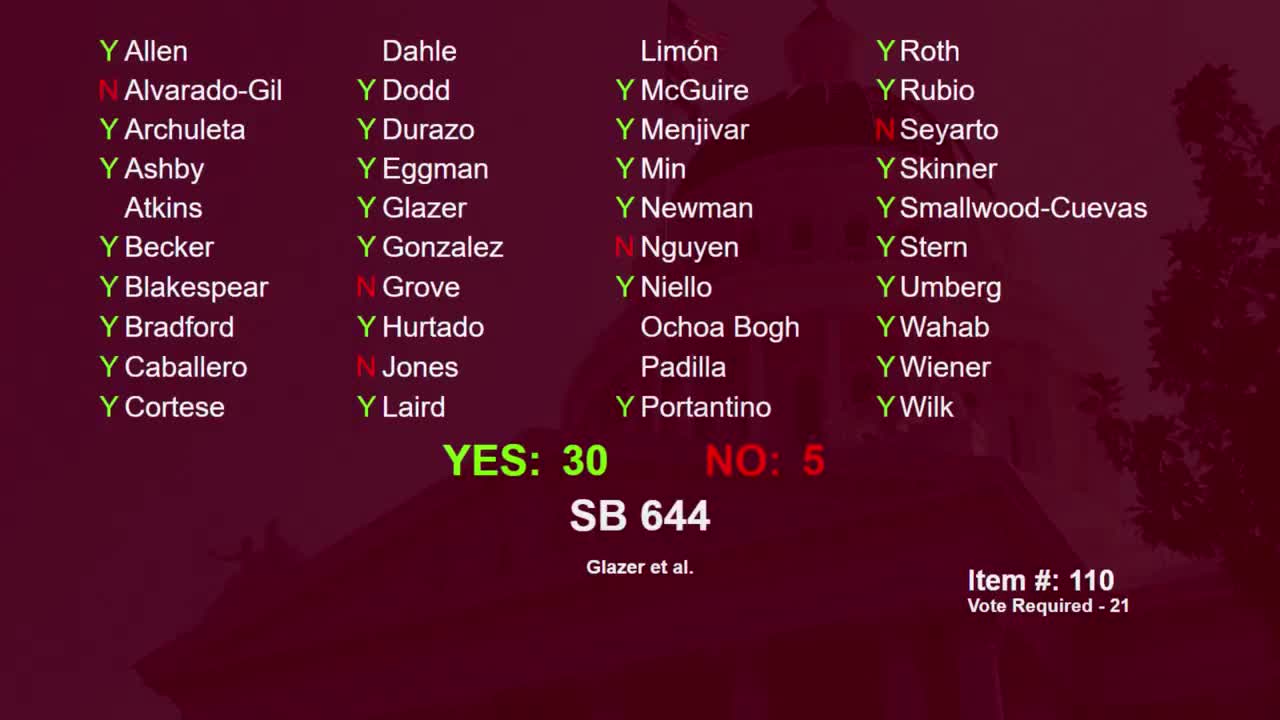 3MIN
Senate Floor
 3MIN
Senate Standing Committee on Elections and Constitutional Amendments
Bill Author

Bill Co-Author(s):
