SB 999: Health coverage: mental health and substance use disorders.
- Session Year: 2023-2024
- House: Senate
- Latest Version Date: 2024-04-08
Current Status:
Failed
(2024-08-15: August 15 hearing: Held in committee and under submission.)
Introduced
In Committee
First Chamber
In Committee
Second Chamber
Enacted
What does this bill do?
The bill requires health plans and disability insurers (and their contractors) to base medical-necessity and utilization-review decisions for mental health and substance use disorder care on current, generally accepted clinical standards and the latest specialty treatment criteria. It also requires plans and insurers to keep phone or direct access during California business hours for providers to request authorizations and hold peer-to-peer discussions, disclose the reviewer’s name, credentials and guideline citations for denials, provide free training and clinical criteria to providers and patients, and run reliability testing with at least a 90% agreement rate.
The summary is provided by generative AI which can make mistakes. For original language, please view the details in the table below.
Existing law, the Knox-Keene Health Care Service Plan Act of 1975, requires the Department of Managed Health Care to license and regulate health care service plans and makes a willful violation of the act a crime. Existing law also requires the Department of Insurance to regulate health insurers. Existing law requires a health care service plan or disability insurer, as specified, to base medical necessity determinations and the utilization review criteria the plan or insurer, and any entity acting on the plans or insurers behalf, applies to determine the medical necessity of health care services and benefits for the diagnosis, prevention, and treatment of mental health and substance use disorders, on current generally accepted standards of mental health and substance use disorder care.
This bill would require a health care service plan and a disability insurer, and an entity acting on a plans or insurers behalf, to ensure compliance with specific requirements for utilization review, including maintaining telephone access and other direct communication access during California business hours for a health care provider to request authorization for mental health and substance use disorder care and conducting peer-to-peer discussions regarding specific patient issues related to treatment. Because a willful violation of these provisions by a health care service plan would be a crime, the bill would impose a state-mandated local program.
The California Constitution requires the state to reimburse local agencies and school districts for certain costs mandated by the state. Statutory provisions establish procedures for making that reimbursement.
This bill would provide that no reimbursement is required by this act for a specified reason.
Existing law, the Knox-Keene Health Care Service Plan Act of 1975, requires the Department of Managed Health Care to license and regulate health care service plans and makes a willful violation of the act a crime. Existing law also requires the Department of Insurance to regulate health insurers. Existing law requires a health care service plan or disability insurer, as specified, to base medical necessity determinations and the utilization review criteria the plan or insurer, and any entity acting on the plans or insurers behalf, applies to determine the medical necessity of health care services and benefits for the diagnosis, prevention, and treatment of mental health and substance use disorders, on current generally accepted standards of mental health and substance use disorder care.
This bill would require a health care service plan and a disability insurer, and an entity acting on a plans or insurers behalf, to ensure compliance with specific requirements for utilization review, including maintaining telephone access during California business hours for a health care provider to request authorization for mental health and substance use disorder care and conducting peer-to-peer discussions regarding specific patient issues related to treatment. Because a willful violation of these provisions by a health care service plan would be a crime, the bill would impose a state-mandated local program.
The California Constitution requires the state to reimburse local agencies and school districts for certain costs mandated by the state. Statutory provisions establish procedures for making that reimbursement.
This bill would provide that no reimbursement is required by this act for a specified reason.
This act shall be known, and may be cited, as the California Mental Health and Substance Use Disorder Treatment Patient Safety and Fairness Act.
SEC. 2.The Legislature finds and declares all of the following:
(a)The federal Patient Protection and Affordable Care Act (PPACA) includes mental health and addiction coverage as one of the 10 essential health benefits, but it does not contain a definition for medical necessity, and despite the PPACA, needed mental health and addiction coverage can be denied through overly restrictive medical necessity determinations.
(b)When medically necessary mental health and substance use disorder care is not covered, individuals with mental health and substance use disorders often have their conditions worsen, ending up on Medicaid, in the criminal justice system, or on the streets, resulting in harm to individuals and communities and higher costs to taxpayers.
(c)In two court decisions, Harlick v. Blue Shield of California (9th Cir. 2012) 686 F.3d. 699, cert. den., (2013) 133 S.Ct. 1492, and Rea v. Blue Shield of California (2014) 226 Cal.App.4th 1209, 1227, the California Mental Health Parity Act was interpreted to require coverage of medically necessary residential treatment.
(d)Coverage of intermediate levels of care such as residential treatment, which are essential components of the level of care continuum called for by nonprofit organizations, and clinical specialty associations such as the American Society of Addiction Medicine, are often denied through overly restrictive medical necessity determinations.
(e)California law defines medically necessary treatment of a mental health or substance use disorder and generally accepted standards of mental health and substance use disorder care, and prohibits health care service plans and health insurers from limiting benefits or coverage to short-term or acute treatment. California law establishes requirements on plans for conducting utilization review of covered health care services and benefits for the diagnosis, prevention, and treatment of mental health and substance use disorders. These requirements also apply to any entity acting on the plans or insurers behalf.
SEC. 3.Section 1374.721 of the Health and Safety Code is amended to read:1374.721.(a)A health care service plan that provides hospital, medical, or surgical coverage shall base any medical necessity determination or the utilization review criteria that the plan, and any entity acting on the plans behalf, applies to determine the medical necessity of health care services and benefits for the diagnosis, prevention, and treatment of mental health and substance use disorders on current generally accepted standards of mental health and substance use disorder care.
(b)In conducting utilization review of all covered health care services and benefits for the diagnosis, prevention, and treatment of mental health and substance use disorders in children, adolescents, and adults, a health care service plan shall apply the criteria and guidelines set forth in the most recent versions of treatment criteria developed by the nonprofit professional association for the relevant clinical specialty.
(c)In conducting utilization review involving level of care placement decisions or any other patient care decisions that are within the scope of the sources specified in subdivision (b), a health care service plan shall not apply different, additional, conflicting, or more restrictive utilization review criteria than the criteria and guidelines set forth in those sources. This subdivision does not prohibit a health care service plan from applying utilization review criteria to health care services and benefits for mental health and substance use disorders that meet either of the following criteria:
(1)Are outside the scope of the criteria and guidelines set forth in the sources specified in subdivision (b), provided the utilization review criteria were developed in accordance with subdivision (a).
(2)Relate to advancements in technology or types of care that are not covered in the most recent versions of the sources specified in subdivision (b), provided that the utilization review criteria were developed in accordance with subdivision (a).
(d)If a health care service plan purchases or licenses utilization review criteria pursuant to paragraph (1) or (2) of subdivision (c), the plan shall verify and document before use that the criteria were developed in accordance with subdivision (a).
(e)To ensure the proper use of the criteria described in subdivision (b), every health care service plan shall do all of the following:
(1)Sponsor a formal education program by nonprofit clinical specialty associations to educate the health care service plans staff, including any third parties contracted with the health care service plan to review claims, conduct utilization reviews, or make medical necessity determinations about the clinical review criteria.
(2)Make the education program available to other stakeholders, including the health care service plans participating providers and covered lives. Participating providers shall not be required to participate in the education program.
(3)Provide, at no cost, the clinical review criteria and any training material or resources to providers and health care service plan enrollees.
(4)Track, identify, and analyze how the clinical review criteria are used to certify care, deny care, and support the appeals process.
(5)Conduct interrater reliability testing to ensure consistency in utilization review decisionmaking covering how medical necessity decisions are made. This assessment shall cover all aspects of utilization review as defined in paragraph (3) of subdivision (f).
(6)Run interrater reliability reports about how the clinical guidelines are used in conjunction with the utilization management process and parity compliance activities.
(7)Achieve interrater reliability pass rates of at least 90 percent and, if this threshold is not met, immediately provide for the remediation of poor interrater reliability and interrater reliability testing for all new staff before they can conduct utilization review without supervision.
(f)The following definitions apply for purposes of this section:
(1)Generally accepted standards of mental health and substance use disorder care means standards of care and clinical practice that are generally recognized by health care providers practicing in relevant clinical specialties such as psychiatry, psychology, clinical sociology, addiction medicine and counseling, and behavioral health treatment pursuant to Section 1374.73. Valid, evidence-based sources establishing generally accepted standards of mental health and substance use disorder care include peer-reviewed scientific studies and medical literature, clinical practice guidelines and recommendations of nonprofit health care provider professional associations, specialty societies and federal government agencies, and drug labeling approved by the United States Food and Drug Administration.
(2)Mental health and substance use disorders has the same meaning as defined in paragraph (2) of subdivision (a) of Section 1374.72.
(3)Utilization review means either of the following:
(A)Prospectively, retrospectively, or concurrently reviewing and approving, modifying, delaying, or denying, based in whole or in part on medical necessity, requests by health care providers, enrollees, or their authorized representatives for coverage of health care services before, after, or concurrent with, the provision of health care services to enrollees.
(B)Evaluating the medical necessity, appropriateness, level of care, service intensity, efficacy, or efficiency of health care services, benefits, procedures, or settings, under any circumstances, to determine whether a health care service or benefit subject to a medical necessity coverage requirement in a health care service plan contract is covered as medically necessary for an enrollee.
(4)Utilization review criteria means any criteria, standards, protocols, or guidelines used by a health care service plan to conduct utilization review.
(g)This section applies to all health care services and benefits for the diagnosis, prevention, and treatment of mental health and substance use disorders covered by a health care service plan contract, including prescription drugs.
(h)This section applies to a health care service plan that conducts utilization review as defined in this section, and any entity or contracting provider that performs utilization review or utilization management functions on behalf of a health care service plan.
(i)The director may assess administrative penalties for violations of this section as provided for in Section 1368.04, in addition to any other remedies permitted by law.
(j)A health care service plan shall not adopt, impose, or enforce terms in its plan contracts or provider agreements, in writing or in operation, that undermine, alter, or conflict with the requirements of this section.
(k)A health care service plan, and an entity acting on a plans behalf, shall ensure compliance with all of the following:
(1)Utilization review determinations, including initial determinations and appeals, shall be made by a health care provider practicing in the relevant clinical specialty with the same level of education, training, and experience in the relevant diagnosis or field of expertise, and holding the same applicable certification as the health care provider requesting the authorization. that has appropriate training and relevant experience in the clinical specialty and diagnosis. To the extent available, a health care provider conducting utilization review determinations shall complete training provided by formal education programs of nonprofit clinical specialty associations, pursuant to subdivisions (b) and (e).
(2)The health care service plan, or an entity acting on the plans behalf, shall maintain telephone access and any other direct communication access used for utilization review during California business hours for a health care provider to request authorization for mental health and substance use disorder care and conduct peer-to-peer discussions regarding patient issues, including the appropriateness of a requested treatment, modification of a treatment request, or obtaining additional information needed to make a medical necessity determination.
(3)An individual or health care provider performing utilization review shall disclose to the treating health care provider and the enrollee the name and credentials of the individual or health care provider performing utilization review, the health care service plans basis for a denial, including a citation to the clinical guidelines reviewed, and an analysis of why the enrollee did not meet the clinical criteria.
(4)This section does not preclude Section 1367.01.
(l)This section does not apply to contracts entered into pursuant to Chapter 7 (commencing with Section 14000) or Chapter 8 (commencing with Section 14200) of Part 3 of Division 9 of the Welfare and Institutions Code, between the State Department of Health Care Services and a health care service plan for enrolled Medi-Cal beneficiaries.
SEC. 4.Section 10144.52 of the Insurance Code is amended to read:10144.52.(a)A disability insurer that provides hospital, medical, or surgical coverage shall base any medical necessity determination or the utilization review criteria that the insurer, and any entity acting on the insurers behalf, applies to determine the medical necessity of health care services and benefits for the diagnosis, prevention, and treatment of mental health and substance use disorders on current generally accepted standards of mental health and substance use disorder care.
(b)In conducting utilization review of all covered health care services and benefits for the diagnosis, prevention, and treatment of mental health and substance use disorders in children, adolescents, and adults, a disability insurer shall apply the criteria and guidelines set forth in the most recent versions of the treatment criteria developed by the nonprofit professional association for the relevant clinical specialty.
(c)In conducting utilization review involving level of care placement decisions or any other patient care decisions that are within the scope of the sources specified in subdivision (b), a disability insurer shall not apply different, additional, conflicting, or more restrictive utilization review criteria than the criteria and guidelines set forth in those sources. This subdivision does not prohibit a disability insurer from applying utilization review criteria to health care services and benefits for mental health and substance use disorders that meet either of the following criteria:
(1)Are outside the scope of the criteria and guidelines set forth in the sources specified in subdivision (b), provided the utilization review criteria were developed in accordance with subdivision (a).
(2)Relate to advancements in technology or types of care that are not covered in the most recent versions of the sources specified in subdivision (b), provided that the utilization review criteria were developed in accordance with subdivision (a).
(d)If a disability insurer purchases or licenses utilization review criteria pursuant to paragraph (1) or (2) of subdivision (c), the insurer shall verify and document before use that the criteria were developed in accordance with subdivision (a).
(e)To ensure the proper use of the criteria described in subdivision (b), every disability insurer shall do all of the following:
(1)Sponsor a formal education program by nonprofit clinical specialty associations to educate the disability insurers staff, including any third parties contracted with the disability insurer to review claims, conduct utilization reviews, or make medical necessity determinations about the clinical review criteria.
(2)Make the education program available to other stakeholders, including the insurers participating providers and covered lives.
(3)Provide, at no cost, the clinical review criteria and any training material or resources to providers and insured patients.
(4)Track, identify, and analyze how the clinical review criteria are used to certify care, deny care, and support the appeals process.
(5)Conduct interrater reliability testing to ensure consistency in utilization review decisionmaking covering how medical necessity decisions are made. This assessment shall cover all aspects of utilization review as defined in paragraph (3) of subdivision (f).
(6)Run interrater reliability reports about how the clinical guidelines are used in conjunction with the utilization management process and parity compliance activities.
(7)Achieve interrater reliability pass rates of at least 90 percent and, if this threshold is not met, immediately provide for the remediation of poor interrater reliability and interrater reliability testing for all new staff before they can conduct utilization review without supervision.
(f)The following definitions apply for purposes of this section:
(1)Generally accepted standards of mental health and substance use disorder care means standards of care and clinical practice that are generally recognized by health care providers practicing in relevant clinical specialties such as psychiatry, psychology, clinical sociology, addiction medicine and counseling, and behavioral health treatment pursuant to Section 10144.51. Valid, evidence-based sources establishing generally accepted standards of mental health and substance use disorder care include peer-reviewed scientific studies and medical literature, clinical practice guidelines and recommendations of nonprofit health care provider professional associations, specialty societies and federal government agencies, and drug labeling approved by the United States Food and Drug Administration.
(2)Mental health and substance use disorders has the same meaning as defined in paragraph (2) of subdivision (a) of Section 10144.5.
(3)Utilization review means either of the following:
(A)Prospectively, retrospectively, or concurrently reviewing and approving, modifying, delaying, or denying, based in whole or in part on medical necessity, requests by health care providers, insureds, or their authorized representatives for coverage of health care services before, after, or concurrent with, the provision of health care services to insureds.
(B)Evaluating the medical necessity, appropriateness, level of care, service intensity, efficacy, or efficiency of health care services, benefits, procedures, or settings, under any circumstances, to determine whether a health care service or benefit subject to a medical necessity coverage requirement in a disability insurance policy is covered as medically necessary for an insured.
(4)Utilization review criteria means any criteria, standards, protocols, or guidelines used by a disability insurer to conduct utilization review.
(g)This section applies to all health care services and benefits for the diagnosis, prevention, and treatment of mental health and substance use disorders covered by a disability insurance policy, including prescription drugs.
(h)This section applies to a disability insurer that covers hospital, medical, or surgical expenses and conducts utilization review as defined in this section, and any entity or contracting provider that performs utilization review or utilization management functions on an insurers behalf.
(i)If the commissioner determines that a disability insurer has violated this section, the commissioner may, after appropriate notice and opportunity for hearing in accordance with the Administrative Procedure Act (Chapter 5 (commencing with Section 11500) of Part 1 of Division 3 of Title 2 of the Government Code), by order, assess a civil penalty not to exceed five thousand dollars ($5,000) for each violation, or, if a violation was willful, a civil penalty not to exceed ten thousand dollars ($10,000) for each violation.
(j)A disability insurer shall not adopt, impose, or enforce terms in its policies or provider agreements, in writing or in operation, that undermine, alter, or conflict with the requirements of this section.
(k)A disability insurer, and an entity acting on an insurers behalf, shall ensure compliance with all of the following:
(1)Utilization review determinations, including initial determinations and appeals, shall be made by a health care provider practicing in the relevant clinical specialty with the same level of education, training, and experience in the relevant diagnosis or field of expertise, and holding the same applicable certification as the health care provider requesting the authorization. that has appropriate training and relevant experience in the clinical specialty and diagnosis. To the extent available, a health care provider conducting utilization review determinations shall complete training provided by formal education programs of nonprofit clinical specialty associations, pursuant to subdivisions (b) and (e).
(2)The disability insurer, or an entity acting on the insurers behalf, shall maintain telephone access and any other direct communication access used for utilization review during California business hours for a health care provider to request authorization for mental health and substance use disorder care and conduct peer-to-peer discussions regarding patient issues, including the appropriateness of a requested treatment, modification of a treatment request, or obtaining additional information needed to make a medical necessity determination.
(3)An individual or health care provider performing utilization review shall disclose to the treating health care provider and the insured the name and credentials of the individual or health care provider performing utilization review, the disability insurers basis for a denial, including a citation to the clinical guidelines reviewed, and an analysis of why the insured did not meet the clinical criteria.
(4)This section does not preclude Section 10123.135.
(l)This section does not apply to accident-only, specified disease, hospital indemnity, Medicare supplement, dental-only, or vision-only insurance policies.
SEC. 5.No reimbursement is required by this act pursuant to Section 6 of Article XIIIB of the California Constitution because the only costs that may be incurred by a local agency or school district will be incurred because this act creates a new crime or infraction, eliminates a crime or infraction, or changes the penalty for a crime or infraction, within the meaning of Section 17556 of the Government Code, or changes the definition of a crime within the meaning of Section 6 of Article XIIIB of the California Constitution.
This act shall be known, and may be cited, as the California Mental Health and Substance Use Disorder Treatment Patient Safety and Fairness Act.
SEC. 2.The Legislature finds and declares all of the following:
(a)The federal Patient Protection and Affordable Care Act (PPACA) includes mental health and addiction coverage as one of the 10 essential health benefits, but it does not contain a definition for medical necessity, and despite the PPACA, needed mental health and addiction coverage can be denied through overly restrictive medical necessity determinations.
(b)When medically necessary mental health and substance use disorder care is not covered, individuals with mental health and substance use disorders often have their conditions worsen, ending up on Medicaid, in the criminal justice system, or on the streets, resulting in harm to individuals and communities and higher costs to taxpayers.
(c)In two court decisions, Harlick v. Blue Shield of California (9th Cir. 2012) 686 F.3d. 699, cert. den., (2013) 133 S.Ct. 1492, and Rea v. Blue Shield of California (2014) 226 Cal.App.4th 1209, 1227, the California Mental Health Parity Act was interpreted to require coverage of medically necessary residential treatment.
(d)Coverage of intermediate levels of care such as residential treatment, which are essential components of the level of care continuum called for by nonprofit organizations, and clinical specialty associations such as the American Society of Addiction Medicine, are often denied through overly restrictive medical necessity determinations.
(e)California law defines medically necessary treatment of a mental health or substance use disorder and generally accepted standards of mental health and substance use disorder care, and prohibits health care service plans and health insurers from limiting benefits or coverage to short-term or acute treatment. California law establishes requirements on plans for conducting utilization review of covered health care services and benefits for the diagnosis, prevention, and treatment of mental health and substance use disorders. These requirements also apply to any entity acting on the plans or insurers behalf.
SEC. 3.Section 1374.721 of the Health and Safety Code is amended to read:1374.721.(a)A health care service plan that provides hospital, medical, or surgical coverage shall base any medical necessity determination or the utilization review criteria that the plan, and any entity acting on the plans behalf, applies to determine the medical necessity of health care services and benefits for the diagnosis, prevention, and treatment of mental health and substance use disorders on current generally accepted standards of mental health and substance use disorder care.
(b)In conducting utilization review of all covered health care services and benefits for the diagnosis, prevention, and treatment of mental health and substance use disorders in children, adolescents, and adults, a health care service plan shall apply the criteria and guidelines set forth in the most recent versions of treatment criteria developed by the nonprofit professional association for the relevant clinical specialty.
(c)In conducting utilization review involving level of care placement decisions or any other patient care decisions that are within the scope of the sources specified in subdivision (b), a health care service plan shall not apply different, additional, conflicting, or more restrictive utilization review criteria than the criteria and guidelines set forth in those sources. This subdivision does not prohibit a health care service plan from applying utilization review criteria to health care services and benefits for mental health and substance use disorders that meet either of the following criteria:
(1)Are outside the scope of the criteria and guidelines set forth in the sources specified in subdivision (b), provided the utilization review criteria were developed in accordance with subdivision (a).
(2)Relate to advancements in technology or types of care that are not covered in the most recent versions of the sources specified in subdivision (b), provided that the utilization review criteria were developed in accordance with subdivision (a).
(d)If a health care service plan purchases or licenses utilization review criteria pursuant to paragraph (1) or (2) of subdivision (c), the plan shall verify and document before use that the criteria were developed in accordance with subdivision (a).
(e)To ensure the proper use of the criteria described in subdivision (b), every health care service plan shall do all of the following:
(1)Sponsor a formal education program by nonprofit clinical specialty associations to educate the health care service plans staff, including any third parties contracted with the health care service plan to review claims, conduct utilization reviews, or make medical necessity determinations about the clinical review criteria.
(2)Make the education program available to other stakeholders, including the health care service plans participating providers and covered lives. Participating providers shall not be required to participate in the education program.
(3)Provide, at no cost, the clinical review criteria and any training material or resources to providers and health care service plan enrollees.
(4)Track, identify, and analyze how the clinical review criteria are used to certify care, deny care, and support the appeals process.
(5)Conduct interrater reliability testing to ensure consistency in utilization review decisionmaking covering how medical necessity decisions are made. This assessment shall cover all aspects of utilization review as defined in paragraph (3) of subdivision (f).
(6)Run interrater reliability reports about how the clinical guidelines are used in conjunction with the utilization management process and parity compliance activities.
(7)Achieve interrater reliability pass rates of at least 90 percent and, if this threshold is not met, immediately provide for the remediation of poor interrater reliability and interrater reliability testing for all new staff before they can conduct utilization review without supervision.
(f)The following definitions apply for purposes of this section:
(1)Generally accepted standards of mental health and substance use disorder care means standards of care and clinical practice that are generally recognized by health care providers practicing in relevant clinical specialties such as psychiatry, psychology, clinical sociology, addiction medicine and counseling, and behavioral health treatment pursuant to Section 1374.73. Valid, evidence-based sources establishing generally accepted standards of mental health and substance use disorder care include peer-reviewed scientific studies and medical literature, clinical practice guidelines and recommendations of nonprofit health care provider professional associations, specialty societies and federal government agencies, and drug labeling approved by the United States Food and Drug Administration.
(2)Mental health and substance use disorders has the same meaning as defined in paragraph (2) of subdivision (a) of Section 1374.72.
(3)Utilization review means either of the following:
(A)Prospectively, retrospectively, or concurrently reviewing and approving, modifying, delaying, or denying, based in whole or in part on medical necessity, requests by health care providers, enrollees, or their authorized representatives for coverage of health care services before, after, or concurrent with, the provision of health care services to enrollees.
(B)Evaluating the medical necessity, appropriateness, level of care, service intensity, efficacy, or efficiency of health care services, benefits, procedures, or settings, under any circumstances, to determine whether a health care service or benefit subject to a medical necessity coverage requirement in a health care service plan contract is covered as medically necessary for an enrollee.
(4)Utilization review criteria means any criteria, standards, protocols, or guidelines used by a health care service plan to conduct utilization review.
(g)This section applies to all health care services and benefits for the diagnosis, prevention, and treatment of mental health and substance use disorders covered by a health care service plan contract, including prescription drugs.
(h)This section applies to a health care service plan that conducts utilization review as defined in this section, and any entity or contracting provider that performs utilization review or utilization management functions on behalf of a health care service plan.
(i)The director may assess administrative penalties for violations of this section as provided for in Section 1368.04, in addition to any other remedies permitted by law.
(j)A health care service plan shall not adopt, impose, or enforce terms in its plan contracts or provider agreements, in writing or in operation, that undermine, alter, or conflict with the requirements of this section.
(k)A health care service plan, and an entity acting on a plans behalf, shall ensure compliance with all of the following:
(1)Utilization review determinations, including initial determinations and appeals, shall be made by a health care provider practicing in the relevant clinical specialty with the same level of education, training, and experience in the relevant diagnosis or field of expertise, and holding the same applicable certification as the health care provider requesting the authorization.
(2)The health care service plan, or an entity acting on the plans behalf, shall maintain telephone access and any other direct communication access used for utilization review during California business hours for a health care provider to request authorization for mental health and substance use disorder care and conduct peer-to-peer discussions regarding patient issues, including the appropriateness of a requested treatment, modification of a treatment request, or obtaining additional information needed to make a medical necessity determination.
(3)An individual or health care provider performing utilization review shall disclose to the treating health care provider and the enrollee the name and credentials of the individual or health care provider performing utilization review, the health care service plans basis for a denial, including a citation to the clinical guidelines reviewed, and an analysis of why the enrollee did not meet the clinical criteria.
(l)This section does not apply to contracts entered into pursuant to Chapter 7 (commencing with Section 14000) or Chapter 8 (commencing with Section 14200) of Part 3 of Division 9 of the Welfare and Institutions Code, between the State Department of Health Care Services and a health care service plan for enrolled Medi-Cal beneficiaries.
SEC. 4.Section 10144.52 of the Insurance Code is amended to read:10144.52.(a)A disability insurer that provides hospital, medical, or surgical coverage shall base any medical necessity determination or the utilization review criteria that the insurer, and any entity acting on the insurers behalf, applies to determine the medical necessity of health care services and benefits for the diagnosis, prevention, and treatment of mental health and substance use disorders on current generally accepted standards of mental health and substance use disorder care.
(b)In conducting utilization review of all covered health care services and benefits for the diagnosis, prevention, and treatment of mental health and substance use disorders in children, adolescents, and adults, a disability insurer shall apply the criteria and guidelines set forth in the most recent versions of the treatment criteria developed by the nonprofit professional association for the relevant clinical specialty.
(c)In conducting utilization review involving level of care placement decisions or any other patient care decisions that are within the scope of the sources specified in subdivision (b), a disability insurer shall not apply different, additional, conflicting, or more restrictive utilization review criteria than the criteria and guidelines set forth in those sources. This subdivision does not prohibit a disability insurer from applying utilization review criteria to health care services and benefits for mental health and substance use disorders that meet either of the following criteria:
(1)Are outside the scope of the criteria and guidelines set forth in the sources specified in subdivision (b), provided the utilization review criteria were developed in accordance with subdivision (a).
(2)Relate to advancements in technology or types of care that are not covered in the most recent versions of the sources specified in subdivision (b), provided that the utilization review criteria were developed in accordance with subdivision (a).
(d)If a disability insurer purchases or licenses utilization review criteria pursuant to paragraph (1) or (2) of subdivision (c), the insurer shall verify and document before use that the criteria were developed in accordance with subdivision (a).
(e)To ensure the proper use of the criteria described in subdivision (b), every disability insurer shall do all of the following:
(1)Sponsor a formal education program by nonprofit clinical specialty associations to educate the disability insurers staff, including any third parties contracted with the disability insurer to review claims, conduct utilization reviews, or make medical necessity determinations about the clinical review criteria.
(2)Make the education program available to other stakeholders, including the insurers participating providers and covered lives.
(3)Provide, at no cost, the clinical review criteria and any training material or resources to providers and insured patients.
(4)Track, identify, and analyze how the clinical review criteria are used to certify care, deny care, and support the appeals process.
(5)Conduct interrater reliability testing to ensure consistency in utilization review decisionmaking covering how medical necessity decisions are made. This assessment shall cover all aspects of utilization review as defined in paragraph (3) of subdivision (f).
(6)Run interrater reliability reports about how the clinical guidelines are used in conjunction with the utilization management process and parity compliance activities.
(7)Achieve interrater reliability pass rates of at least 90 percent and, if this threshold is not met, immediately provide for the remediation of poor interrater reliability and interrater reliability testing for all new staff before they can conduct utilization review without supervision.
(f)The following definitions apply for purposes of this section:
(1)Generally accepted standards of mental health and substance use disorder care means standards of care and clinical practice that are generally recognized by health care providers practicing in relevant clinical specialties such as psychiatry, psychology, clinical sociology, addiction medicine and counseling, and behavioral health treatment pursuant to Section 10144.51. Valid, evidence-based sources establishing generally accepted standards of mental health and substance use disorder care include peer-reviewed scientific studies and medical literature, clinical practice guidelines and recommendations of nonprofit health care provider professional associations, specialty societies and federal government agencies, and drug labeling approved by the United States Food and Drug Administration.
(2)Mental health and substance use disorders has the same meaning as defined in paragraph (2) of subdivision (a) of Section 10144.5.
(3)Utilization review means either of the following:
(A)Prospectively, retrospectively, or concurrently reviewing and approving, modifying, delaying, or denying, based in whole or in part on medical necessity, requests by health care providers, insureds, or their authorized representatives for coverage of health care services before, after, or concurrent with, the provision of health care services to insureds.
(B)Evaluating the medical necessity, appropriateness, level of care, service intensity, efficacy, or efficiency of health care services, benefits, procedures, or settings, under any circumstances, to determine whether a health care service or benefit subject to a medical necessity coverage requirement in a disability insurance policy is covered as medically necessary for an insured.
(4)Utilization review criteria means any criteria, standards, protocols, or guidelines used by a disability insurer to conduct utilization review.
(g)This section applies to all health care services and benefits for the diagnosis, prevention, and treatment of mental health and substance use disorders covered by a disability insurance policy, including prescription drugs.
(h)This section applies to a disability insurer that covers hospital, medical, or surgical expenses and conducts utilization review as defined in this section, and any entity or contracting provider that performs utilization review or utilization management functions on an insurers behalf.
(i)If the commissioner determines that a disability insurer has violated this section, the commissioner may, after appropriate notice and opportunity for hearing in accordance with the Administrative Procedure Act (Chapter 5 (commencing with Section 11500) of Part 1 of Division 3 of Title 2 of the Government Code), by order, assess a civil penalty not to exceed five thousand dollars ($5,000) for each violation, or, if a violation was willful, a civil penalty not to exceed ten thousand dollars ($10,000) for each violation.
(j)A disability insurer shall not adopt, impose, or enforce terms in its policies or provider agreements, in writing or in operation, that undermine, alter, or conflict with the requirements of this section.
(k)A disability insurer, and an entity acting on an insurers behalf, shall ensure compliance with all of the following:
(1)Utilization review determinations, including initial determinations and appeals, shall be made by a health care provider practicing in the relevant clinical specialty with the same level of education, training, and experience in the relevant diagnosis or field of expertise, and holding the same applicable certification as the health care provider requesting the authorization.
(2)The disability insurer, or an entity acting on the insurers behalf, shall maintain telephone access and any other direct communication access used for utilization review during California business hours for a health care provider to request authorization for mental health and substance use disorder care and conduct peer-to-peer discussions regarding patient issues, including the appropriateness of a requested treatment, modification of a treatment request, or obtaining additional information needed to make a medical necessity determination.
(3)An individual or health care provider performing utilization review shall disclose to the treating health care provider and the insured the name and credentials of the individual or health care provider performing utilization review, the disability insurers basis for a denial, including a citation to the clinical guidelines reviewed, and an analysis of why the insured did not meet the clinical criteria.
(l)This section does not apply to accident-only, specified disease, hospital indemnity, Medicare supplement, dental-only, or vision-only insurance policies.
SEC. 5.No reimbursement is required by this act pursuant to Section 6 of Article XIIIB of the California Constitution because the only costs that may be incurred by a local agency or school district will be incurred because this act creates a new crime or infraction, eliminates a crime or infraction, or changes the penalty for a crime or infraction, within the meaning of Section 17556 of the Government Code, or changes the definition of a crime within the meaning of Section 6 of Article XIIIB of the California Constitution.
This act shall be known, and may be cited, as the California Mental Health and Substance Use Disorder Treatment Patient Safety and Fairness Act.
SEC. 2.The Legislature finds and declares all of the following:
(a)The federal Patient Protection and Affordable Care Act (PPACA) includes mental health and addiction coverage as one of the 10 essential health benefits, but it does not contain a definition for medical necessity, and despite the PPACA, needed mental health and addiction coverage can be denied through overly restrictive medical necessity determinations.
(b)When medically necessary mental health and substance use disorder care is not covered, individuals with mental health and substance use disorders often have their conditions worsen, ending up on Medicaid, in the criminal justice system, or on the streets, resulting in harm to individuals and communities and higher costs to taxpayers.
(c)In two court decisions, Harlick v. Blue Shield of California (9th Cir. 2012) 686 F.3d. 699, cert. den., (2013) 133 S.Ct. 1492, and Rea v. Blue Shield of California (2014) 226 Cal.App.4th 1209, 1227, the California Mental Health Parity Act was interpreted to require coverage of medically necessary residential treatment.
(d)Coverage of intermediate levels of care such as residential treatment, which are essential components of the level of care continuum called for by nonprofit organizations, and clinical specialty associations such as the American Society of Addiction Medicine, are often denied through overly restrictive medical necessity determinations.
SEC. 3.Section 1374.721 of the Health and Safety Code is amended to read:1374.721.(a)A health care service plan that provides hospital, medical, or surgical coverage shall base any medical necessity determination or the utilization review criteria that the plan, and any entity acting on the plans behalf, applies to determine the medical necessity of health care services and benefits for the diagnosis, prevention, and treatment of mental health and substance use disorders on current generally accepted standards of mental health and substance use disorder care.
(b)In conducting utilization review of all covered health care services and benefits for the diagnosis, prevention, and treatment of mental health and substance use disorders in children, adolescents, and adults, a health care service plan shall apply the criteria and guidelines set forth in the most recent versions of treatment criteria developed by the nonprofit professional association for the relevant clinical specialty.
(c)In conducting utilization review involving level of care placement decisions or any other patient care decisions that are within the scope of the sources specified in subdivision (b), a health care service plan shall not apply different, additional, conflicting, or more restrictive utilization review criteria than the criteria and guidelines set forth in those sources. This subdivision does not prohibit a health care service plan from applying utilization review criteria to health care services and benefits for mental health and substance use disorders that meet either of the following criteria:
(1)Are outside the scope of the criteria and guidelines set forth in the sources specified in subdivision (b), provided the utilization review criteria were developed in accordance with subdivision (a).
(2)Relate to advancements in technology or types of care that are not covered in the most recent versions of the sources specified in subdivision (b), provided that the utilization review criteria were developed in accordance with subdivision (a).
(d)If a health care service plan purchases or licenses utilization review criteria pursuant to paragraph (1) or (2) of subdivision (c), the plan shall verify and document before use that the criteria were developed in accordance with subdivision (a).
(e)To ensure the proper use of the criteria described in subdivision (b), every health care service plan shall do all of the following:
(1)Sponsor a formal education program by nonprofit clinical specialty associations to educate the health care service plans staff, including any third parties contracted with the health care service plan to review claims, conduct utilization reviews, or make medical necessity determinations about the clinical review criteria.
(2)Make the education program available to other stakeholders, including the health care service plans participating providers and covered lives. Participating providers shall not be required to participate in the education program.
(3)Provide, at no cost, the clinical review criteria and any training material or resources to providers and health care service plan enrollees.
(4)Track, identify, and analyze how the clinical review criteria are used to certify care, deny care, and support the appeals process.
(5)Conduct interrater reliability testing to ensure consistency in utilization review decisionmaking covering how medical necessity decisions are made. This assessment shall cover all aspects of utilization review as defined in paragraph (3) of subdivision (f).
(6)Run interrater reliability reports about how the clinical guidelines are used in conjunction with the utilization management process and parity compliance activities.
(7)Achieve interrater reliability pass rates of at least 90 percent and, if this threshold is not met, immediately provide for the remediation of poor interrater reliability and interrater reliability testing for all new staff before they can conduct utilization review without supervision.
(f)The following definitions apply for purposes of this section:
(1)Generally accepted standards of mental health and substance use disorder care means standards of care and clinical practice that are generally recognized by health care providers practicing in relevant clinical specialties such as psychiatry, psychology, clinical sociology, addiction medicine and counseling, and behavioral health treatment pursuant to Section 1374.73. Valid, evidence-based sources establishing generally accepted standards of mental health and substance use disorder care include peer-reviewed scientific studies and medical literature, clinical practice guidelines and recommendations of nonprofit health care provider professional associations, specialty societies and federal government agencies, and drug labeling approved by the United States Food and Drug Administration.
(2)Mental health and substance use disorders has the same meaning as defined in paragraph (2) of subdivision (a) of Section 1374.72.
(3)Utilization review means either of the following:
(A)Prospectively, retrospectively, or concurrently reviewing and approving, modifying, delaying, or denying, based in whole or in part on medical necessity, requests by health care providers, enrollees, or their authorized representatives for coverage of health care services prior to, retrospectively before, after, or concurrent with with, the provision of health care services to enrollees.
(B)Evaluating the medical necessity, appropriateness, level of care, service intensity, efficacy, or efficiency of health care services, benefits, procedures, or settings, under any circumstances, to determine whether a health care service or benefit subject to a medical necessity coverage requirement in a health care service plan contract is covered as medically necessary for an enrollee.
(4)Utilization review criteria means any criteria, standards, protocols, or guidelines used by a health care service plan to conduct utilization review.
(g)This section applies to all health care services and benefits for the diagnosis, prevention, and treatment of mental health and substance use disorders covered by a health care service plan contract, including prescription drugs.
(h)This section applies to a health care service plan that conducts utilization review as defined in this section, and any entity or contracting provider that performs utilization review or utilization management functions on behalf of a health care service plan.
(i)The director may assess administrative penalties for violations of this section as provided for in Section 1368.04, in addition to any other remedies permitted by law.
(j)A health care service plan shall not adopt, impose, or enforce terms in its plan contracts or provider agreements, in writing or in operation, that undermine, alter, or conflict with the requirements of this section.
(k)A health care service plan, and an entity acting on a plans behalf, shall ensure compliance with all of the following:
(1)Utilization review determinations, including initial determinations and appeals, shall be made by a health care provider practicing in the relevant clinical specialty with the same level of education, training, and experience in the relevant diagnosis or field of expertise, and holding the same applicable certification as the health care provider requesting the authorization.
(2)The health care service plan, or an entity acting on the plans behalf, shall maintain telephone access during California business hours for a health care provider to request authorization for mental health and substance use disorder care and conduct peer-to-peer discussions regarding patient issues, including the appropriateness of a requested treatment, modification of a treatment request, or obtaining additional information needed to make a medical necessity determination.
(3)An individual or health care provider performing utilization review shall disclose to the treating health care provider and the enrollee the health care service plans basis for a denial, including a citation to the clinical guidelines reviewed, and an analysis of why the enrollee did not meet the clinical criteria.
(k)(l)This section does not apply to contracts entered into pursuant to Chapter 7 (commencing with Section 14000) or Chapter 8 (commencing with Section 14200) of Part 3 of Division 9 of the Welfare and Institutions Code, between the State Department of Health Care Services and a health care service plan for enrolled Medi-Cal beneficiaries.
SEC. 4.Section 10144.52 of the Insurance Code is amended to read:10144.52.(a)A disability insurer that provides hospital, medical, or surgical coverage shall base any medical necessity determination or the utilization review criteria that the insurer, and any entity acting on the insurers behalf, applies to determine the medical necessity of health care services and benefits for the diagnosis, prevention, and treatment of mental health and substance use disorders on current generally accepted standards of mental health and substance use disorder care.
(b)In conducting utilization review of all covered health care services and benefits for the diagnosis, prevention, and treatment of mental health and substance use disorders in children, adolescents, and adults, a disability insurer shall apply the criteria and guidelines set forth in the most recent versions of the treatment criteria developed by the nonprofit professional association for the relevant clinical specialty.
(c)In conducting utilization review involving level of care placement decisions or any other patient care decisions that are within the scope of the sources specified in subdivision (b), a disability insurer shall not apply different, additional, conflicting, or more restrictive utilization review criteria than the criteria and guidelines set forth in those sources. This subdivision does not prohibit a disability insurer from applying utilization review criteria to health care services and benefits for mental health and substance use disorders that meet either of the following criteria:
(1)Are outside the scope of the criteria and guidelines set forth in the sources specified in subdivision (b), provided the utilization review criteria were developed in accordance with subdivision (a).
(2)Relate to advancements in technology or types of care that are not covered in the most recent versions of the sources specified in subdivision (b), provided that the utilization review criteria were developed in accordance with subdivision (a).
(d)If a disability insurer purchases or licenses utilization review criteria pursuant to paragraph (1) or (2) of subdivision (c), the insurer shall verify and document before use that the criteria were developed in accordance with subdivision (a).
(e)To ensure the proper use of the criteria described in subdivision (b), every disability insurer shall do all of the following:
(1)Sponsor a formal education program by nonprofit clinical specialty associations to educate the disability insurers staff, including any third parties contracted with the disability insurer to review claims, conduct utilization reviews, or make medical necessity determinations about the clinical review criteria.
(2)Make the education program available to other stakeholders, including the insurers participating providers and covered lives.
(3)Provide, at no cost, the clinical review criteria and any training material or resources to providers and insured patients.
(4)Track, identify, and analyze how the clinical review criteria are used to certify care, deny care, and support the appeals process.
(5)Conduct interrater reliability testing to ensure consistency in utilization review decisionmaking covering how medical necessity decisions are made. This assessment shall cover all aspects of utilization review as defined in paragraph (3) of subdivision (f).
(6)Run interrater reliability reports about how the clinical guidelines are used in conjunction with the utilization management process and parity compliance activities.
(7)Achieve interrater reliability pass rates of at least 90 percent and, if this threshold is not met, immediately provide for the remediation of poor interrater reliability and interrater reliability testing for all new staff before they can conduct utilization review without supervision.
(f)The following definitions apply for purposes of this section:
(1)Generally accepted standards of mental health and substance use disorder care means standards of care and clinical practice that are generally recognized by health care providers practicing in relevant clinical specialties such as psychiatry, psychology, clinical sociology, addiction medicine and counseling, and behavioral health treatment pursuant to Section 10144.51. Valid, evidence-based sources establishing generally accepted standards of mental health and substance use disorder care include peer-reviewed scientific studies and medical literature, clinical practice guidelines and recommendations of nonprofit health care provider professional associations, specialty societies and federal government agencies, and drug labeling approved by the United States Food and Drug Administration.
(2)Mental health and substance use disorders has the same meaning as defined in paragraph (2) of subdivision (a) of Section 10144.5.
(3)Utilization review means either of the following:
(A)Prospectively, retrospectively, or concurrently reviewing and approving, modifying, delaying, or denying, based in whole or in part on medical necessity, requests by health care providers, insureds, or their authorized representatives for coverage of health care services prior to, retrospectively before, after, or concurrent with with, the provision of health care services to insureds.
(B)Evaluating the medical necessity, appropriateness, level of care, service intensity, efficacy, or efficiency of health care services, benefits, procedures, or settings, under any circumstances, to determine whether a health care service or benefit subject to a medical necessity coverage requirement in a disability insurance policy is covered as medically necessary for an insured.
(4)Utilization review criteria means any criteria, standards, protocols, or guidelines used by a disability insurer to conduct utilization review.
(g)This section applies to all health care services and benefits for the diagnosis, prevention, and treatment of mental health and substance use disorders covered by a disability insurance policy, including prescription drugs.
(h)This section applies to a disability insurer that covers hospital, medical, or surgical expenses and conducts utilization review as defined in this section, and any entity or contracting provider that performs utilization review or utilization management functions on an insurers behalf.
(i)If the commissioner determines that a disability insurer has violated this section, the commissioner may, after appropriate notice and opportunity for hearing in accordance with the Administrative Procedure Act (Chapter 5 (commencing with Section 11500) of Part 1 of Division 3 of Title 2 of the Government Code), by order, assess a civil penalty not to exceed five thousand dollars ($5,000) for each violation, or, if a violation was willful, a civil penalty not to exceed ten thousand dollars ($10,000) for each violation.
(j)A disability insurer shall not adopt, impose, or enforce terms in its policies or provider agreements, in writing or in operation, that undermine, alter, or conflict with the requirements of this section.
(k)A disability insurer, and an entity acting on an insurers behalf, shall ensure compliance with all of the following:
(1)Utilization review determinations, including initial determinations and appeals, shall be made by a health care provider practicing in the relevant clinical specialty with the same level of education, training, and experience in the relevant diagnosis or field of expertise, and holding the same applicable certification as the health care provider requesting the authorization.
(2)The disability insurer, or an entity acting on the insurers behalf, shall maintain telephone access during California business hours for a health care provider to request authorization for mental health and substance use disorder care and conduct peer-to-peer discussions regarding patient issues, including the appropriateness of a requested treatment, modification of a treatment request, or obtaining additional information needed to make a medical necessity determination.
(3)An individual or health care provider performing utilization review shall disclose to the treating health care provider and the insured the disability insurers basis for a denial, including a citation to the clinical guidelines reviewed, and an analysis of why the insured did not meet the clinical criteria.
(k)(l)This section does not apply to accident-only, specified disease, hospital indemnity, Medicare supplement, dental-only, or vision-only insurance policies.
SEC. 5.No reimbursement is required by this act pursuant to Section 6 of Article XIIIB of the California Constitution because the only costs that may be incurred by a local agency or school district will be incurred because this act creates a new crime or infraction, eliminates a crime or infraction, or changes the penalty for a crime or infraction, within the meaning of Section 17556 of the Government Code, or changes the definition of a crime within the meaning of Section 6 of Article XIIIB of the California Constitution.
|
Date
|
Status
|
|---|---|
| Aug 15, 2024 | August 15 hearing: Held in committee and under submission. |
| Aug 7, 2024 | August 7 set for first hearing. Placed on suspense file. |
| Jun 12, 2024 | From committee: Do pass and re-refer to Com. on APPR. (Ayes 14. Noes 1.) (June 11). Re-referred to Com. on APPR. |
| May 28, 2024 | Referred to Com. on HEALTH. |
| May 22, 2024 | In Assembly. Read first time. Held at Desk. |
| May 21, 2024 | Read third time. Passed. (Ayes 31. Noes 7. Page 4062.) Ordered to the Assembly. |
| May 16, 2024 | Read second time. Ordered to third reading. |
| May 16, 2024 | From committee: Do pass. (Ayes 5. Noes 2. Page 3967.) (May 16). |
| May 10, 2024 | Set for hearing May 16. |
| May 6, 2024 | May 6 hearing: Placed on APPR suspense file. |
| Apr 26, 2024 | Set for hearing May 6. |
| Apr 25, 2024 | From committee: Do pass and re-refer to Com. on APPR. (Ayes 9. Noes 1. Page 3755.) (April 24). Re-referred to Com. on APPR. |
| Apr 8, 2024 | From committee with author's amendments. Read second time and amended. Re-referred to Com. on HEALTH. |
| Apr 5, 2024 | Set for hearing April 24. |
| Mar 20, 2024 | March 20 hearing postponed by committee. |
| Mar 7, 2024 | From committee with author's amendments. Read second time and amended. Re-referred to Com. on HEALTH. |
| Mar 1, 2024 | Set for hearing March 20. |
| Feb 14, 2024 | Referred to Com. on HEALTH. |
| Feb 2, 2024 | From printer. May be acted upon on or after March 3. |
| Feb 1, 2024 | Introduced. Read first time. To Com. on RLS. for assignment. To print. |
|
Date
|
Description
|
Location
|
Votes
|
|
|---|---|---|---|---|
| Jun 11, 2024 | Do pass and be re-referred to the Committee on [Appropriations] | Assembly Standing Committee on Health |
Passed |
|
| May 21, 2024 | Senate 3rd Reading SB999 Cortese et al. | Senate Floor |
Passed |
|
| May 16, 2024 | Do pass | Senate Standing Committee on Appropriations |
Passed |
|
| May 6, 2024 | Placed on suspense file | Senate Standing Committee on Appropriations |
Passed |
|
| Apr 24, 2024 | Do pass, but first be re-referred to the Committee on [Appropriations] | Senate Standing Committee on Health |
Passed |
This list shows positions taken on this bill by organizations on the date displayed, which is linked to the original source.
Positions by individuals are not included.
|
Organization
|
Position
|
Date
|
|---|---|---|
| Addiction Therapeutic Services | ** Support | |
| Aegis Treatment Centers | * Support | Apr 24, 2024 |
| Alum Rock Counseling Center | ** Support | |
| American Foundation for Suicide Prevention | * Support | Jun 11, 2024 |
| AmericaS Health Insurance Plans | * Against | Jun 11, 2024 |
| Anaheim Family Chiropractic | ** Support | |
| Anaheim Lighthouse | ** Support | |
| Asian Americans for Community Involvement | ** Support | |
| Association Of California Life And Health Insurance Companies | * Against | Jun 13, 2024 |
| AToN Center | ** Support | |
| Aubico Inc | ** Support | |
| Autism Speaks | ** Support | Jun 13, 2024 |
| Bill Wilson Center | ** Support | |
| Buckeye Recovery Network | ** Support | |
| California Academy Of Family Physicians | * Support | Jun 11, 2024 |
| California Alliance for State Advocacy | ** Support | |
| California Alliance Of Child And Family Services | * Support | Apr 24, 2024 |
| California Association of Alcohol and Drug Program Executives | ** Support | |
| California Association Of Health Plans | ** Against | |
| California Association of Social Rehabilitation Agencies | ** Support | |
| California Commission on Aging | ** Support | |
| California Consortium of Addiction Programs and Professionals | * Support | Jun 11, 2024 |
| California Council Of Community Behavioral Health Agencies | ** Support | |
| California County Superintendents | ** Support | |
| California Dental Association | * Support | Jun 11, 2024 |
| California Federation Of Teachers | ** Support | |
| California Foundation For Independent Living Centers | * Support | Jun 11, 2024 |
| California Hospital Association | * Support | Jun 13, 2024 |
| California Life Sciences | * Support | Jun 11, 2024 |
| California Medical Association | * Support | Jun 11, 2024 |
| California Primary Care Association | * Support | Jun 13, 2024 |
| California Psychological Association | * Support | Jun 11, 2024 |
| California School-Based Health Alliance | ** Support | |
| California Teachers Association | ** Support | |
| Cambridge Healthcare Management Services, LLC | ** Support | |
| Capo by the Sea | ** Support | |
| CleanQuest, LLC | ** Support | |
| Clearly Clinical | ** Support | |
| CNV Detox | ** Support | |
| Community Social Model Advocates, Inc. | ** Support | |
| Council of Autism Service Providers | ** Support | Jun 13, 2024 |
| Covenant Hills Treatment Centers | ** Support | |
| Davis Healthcare Management Group | ** Support | |
| Design for Change | ** Support | |
| DIR Floortime Coalition of California | ** Support | |
| Dolorosa Operations, Inc. | ** Support | |
| Ella Baker Center For Human Rights | * Support | Jun 11, 2024 |
| Embodied Recovery | ** Support | |
| First Responder Wellness | ** Support | |
| First Responders Recovery Malibu | ** Support | |
| Greenhouse Therapy Center | ** Support | |
| Health Access California | * Support | Jun 11, 2024 |
| Healthcare Consulting and Advocacy Group | ** Support | |
| Inseparable | ** Support | |
| Intervention 911 | ** Support | |
| JMG Recovery, Harmony Place | ** Support | |
| Mental Health America of California | * Support | Jun 11, 2024 |
| Mental Health Association for Chinese Community | * Support | Jun 11, 2024 |
| National Alliance on Mental Illness California | * Support | Jun 11, 2024 |
| National Union Of Healthcare Workers | ** Support | |
| New Found Life Treatment Center | ** Support | |
| Opus Health | ** Support | |
| Orange County Recovery Collaboration | ** Support | |
| Planned Parenthood Affiliates Of California | * Support | Jun 11, 2024 |
| Psychiatric Physicians Alliance of California | * Support | Jun 13, 2024 |
| Recovery Advocacy Project | ** Support | |
| Rume Medical Group | ** Support | |
| San Diego County Dental Association | ** Support | |
| Santa Clara County Office Of Education | ** Support | |
| Santa Clara County Offices of Education | * Support | Apr 24, 2024 |
| Santa Clara County School Boards Association | ** Support | |
| Santa Clara County Superintendent | * Support | Jun 11, 2024 |
| Shatterproof | ** Support | |
| Steinberg Institute | * Support | Jun 11, 2024 |
| Summit Estate Recovery Center | ** Support | |
| Sun Street Centers | ** Support | |
| Synthesis Recovery | ** Support | |
| The Kennedy Forum | ** Support | |
| The Law Foundation Of Silicon Valley | ** Support | |
| The Purpose of Recovery | ** Support | |
| The Recovery Advocacy Project | ** Support | |
| The Villa Center, Inc. | ** Support | |
| Valley Restoration Center | ** Support | |
| West Los Angeles Recovery | ** Support | |
| Young People In Recovery | ** Support |
Date of Hearing: August 7, 2024
ASSEMBLY COMMITTEE ON APPROPRIATIONS
Buffy Wicks, Chair
SBPCA Bill Id:SB 999
Author:(Cortese) – As Amended Ver:April 8, 2024
Policy Committee: | Health | Vote: | 14 - 1 |
|
| ||
|
|
Urgency: No State Mandated Local Program: Yes Reimbursable: Yes
SUMMARY:
This bill requires a health care service plan, disability insurer, and an entity acting on a health plan’s or insurer’s behalf, to ensure compliance with specific requirements for utilization review (UR) for a health care provider requesting authorization for mental health and substance use disorder (known collectively as behavioral health (BH)) care.
Specifically, this bill:
- Requires a health plan, health insurer, and an entity acting on a plan or insurer’s behalf, to ensure all of the following:
- UR determinations, including initial determinations and appeals, are made by a health care provider that has appropriate training and relevant experience in the clinical specialty and diagnosis, including, to the extent available, training provided by formal education programs of nonprofit professional association for the relevant clinical specialty, and training provided by the health plan or insurer to ensure consistency in UR, pursuant to existing law.
- The health plan or insurer, or an entity acting on the plan or insurer’s behalf, maintains telephone access and any other direct communication access used for UR during California business hours for a health care provider to request authorization for BH care and conduct peer-to-peer discussions regarding patient care.
- An individual performing UR discloses their name and credentials to the treating health care provider and the enrollee or insured, the health plan or insurer’s basis for a denial, including a citation to the clinical guidelines reviewed, and an analysis of why the enrollee or insured did not meet the clinical criteria.
- Clarifies that the bill does not preclude specified statute pertaining to UR or utilization management.
- Makes findings and declarations.
FISCAL EFFECT:
- The Department of Managed Health Care (DMHC) reports the total costs of this bill as follows:
- $1,621,000 in fiscal year (FY) 2024-25.
- $4,374,000 in FY 2025-26.
- $4,149,000 in FY 2026-27.
- $3,951,000 in FY 2027-28.
- $3,955,000 in FY 2028-29 and annually thereafter (Managed Care Fund).
These costs would be incurred to do the following: revise survey methodology and develop tools to assess health plan compliance; review health plan filings of utilization management and other health plan documents; address an estimated 15 referrals per year with enforcement actions, including trial-related activities; modernize the Survey Management System; provide information technology services and software licensing; and provide administrative support for new employees, among other things.
DMHC notes that generally, and depending on final enrollment data, a $1 million increase to the Managed Care Fund could result in a 2-cent increase per enrollee on assessments to full-service health plans and a 1-cent increase per enrollee to specialized health plans. To the extent this bill and others result in an additional assessment on health plans, consumers could face increased premiums.
- The Department of Insurance (CDI) estimates costs of $13,000 in FY 2025-26 (Insurance Fund). The author’s office and advocates state CDI recently drafted regulations that generally incorporate the requirements of this bill.
COMMENTS:
- Purpose. According to the author:
This bill will ensure that Californians suffering from mental health and substance use disorders are able to receive timely treatment that is consistent with nonprofit professional clinical associations – including criteria developed by the American Society of Addiction Medicine (ASAM) for addiction care. While existing law does require health plans and disability insurers to comply with critical treatment and placement standards, inappropriate utilization review practices are still commonly used to avoid paying for care. This leaves insured patients unable to access treatment that they need to make full and lasting recoveries. SB 999 will remedy this by requiring that utilization review determinations be performed by a reviewer with appropriate training and relevant experience in the clinical specialty.
- Background.
Behavioral Health Parity and UR. Federal law requires a health plan, if it includes services for BH as part of its benefits, to provide BH services under the same terms and conditions as other medical services. In California, SB 855 (Wiener), Chapter 151, Statutes of 2020, requires commercial health plans and insurers to provide full coverage for the treatment of all BH conditions and establishes specific standards for medically necessary treatment and criteria for the use of clinical guidelines. SB 855 requires a health plan and insurer to apply the most recent criteria and guidelines developed by a nonprofit professional association for the relevant clinical specialty when conducting UR of BH treatment. Further, health plans and insurers must sponsor a formal education program to educate all plan staff and any third parties contracted to review claims, conduct UR, or make medical necessity determinations. SB 855 also requires plans to measure the consistency in decision making by individuals authorized to determine whether services are medically necessary. This bill requires a health plan or insurer to ensure it complies with specified provisions of SB 855.
SB 855 regulations. Both DMHC and CDI issued regulations to implement SB 855. DMHC’s regulations specify health plans must issue a written communication to enrollees outlining the basis for the delay, denial, or modification of a requested treatment. According to the author, CDI’s recently released proposed regulations for SB 855 include components for UR that are outlined in this bill. - Related Legislation.
- SB 1397 (Eggman) requires a health plan or insurance policy to comply with rate and timely reimbursement requirements for services delivered by a county behavioral health agency under the Full Service Partnership category, and to apply in-network cost sharing to such services. SB 1397 is pending in this committee.
- SB 294 (Wiener) requires a health plan or disability insurer that upholds a decision to modify, delay, or deny a health care service relating to a BH condition based on medical necessity to treat that decision as a grievance, and to automatically refer the decision to independent medical review if it is for a person age 26 years or younger. SB 294 is pending in this committee.
- Prior Legislation. SB 999 (Cortese) of 2022 was similar to this bill. Governor Newsom vetoed SB 999, stating, in part:
…Two years ago, I signed SB 855, a landmark update to California's MH parity statutes. SB 855 and forthcoming regulations implementing the law seek to address the issues targeted by this bill by requiring the use of unbiased MH and SUD clinical standards in coverage reviews and mandating the appropriate training and oversight of staff performing those reviews. Implementation of SB 855 is underway, and the industry is in the process of adapting to California's stringent new requirements. As such, this bill is premature and unnecessary at this time.
Analysis Prepared by: Allegra Kim / APPR. / (916) 319-2081
Date of Hearing: June 11, 2024
ASSEMBLY COMMITTEE ON HEALTH
Mia Bonta, Chair
SBPCA Bill Id:SB 999
Author:(Cortese) – As Amended Ver:April 8, 2024
SENATE VOTE: 31-7
SUBJECT: Health coverage: mental health and substance use disorders.
SUMMARY: Establishes the California Mental Health (MH) and Substance Use Disorder (SUD) Treatment Patient Safety and Fairness Act. Requires a health plan or disability insurer to comply with utilization review (UR) determination requirements related to MH and SUD treatment. Specifically, this bill:
- Requires a health plan or disability insurer, and an entity acting on a plan or insurer’s behalf, to ensure compliance with all of the following:
- UR determinations, including initial determinations and appeals, to be made by a health care provider that has appropriate training and relevant experience in the clinical specialty and diagnosis. Requires, to the extent available, a health care provider conducting UR determinations to complete training provided by formal education programs of nonprofit clinical specialty associations, as specified;
- Requires the health plan or insurer, or an entity acting on the plan or insurer’s behalf, to maintain telephone access and any other direct communication access used for UR during California business hours for a health care provider to request authorization for MH and SUD care and conduct peer-to-peer discussions regarding patient issues, including the appropriateness of a requested treatment, modification of a treatment request, or obtaining additional information needed to make a medical necessity determination; and,
- Requires an individual or health care provider performing UR to disclose to the treating health care provider and the enrollee or insured, the name and credentials of the individual or health care provider performing UR, the health plan or insurer’s basis for a denial, including a citation to the clinical guidelines reviewed, and an analysis of why the enrollee or insured did not meet the clinical criteria.
- Specifies that this bill does not preclude existing law as it relates to UR or utilization management (UM).
- Makes findings and declarations including that coverage of intermediate levels of care such as residential treatment, which are essential components of the level of care continuum called for by nonprofit organizations, and clinical specialty associations such as the American Society of Addiction Medicine (ASAM), are often denied through overly restrictive medical necessity determinations.
EXISTING LAW:
- Establishes the Department of Managed Health Care (DMHC) to regulate health plans and California Department of Insurance (CDI) to regulate health insurance. [Health and Safety Code (HSC) §1340, et seq. and Insurance Code (INS) §106, et seq.]
- Establishes as California's essential health benefits (EHBs) benchmark under the Patient protection and Affordable Care Act (ACA), the Kaiser Small Group Health Maintenance Organization, existing California health insurance mandates, and the 10 ACA mandated benefits, including MH and SUD coverage. [HSC §1367.005 and INS §10112.27]
- Requires every health plan contract and insurance policy that provides hospital, medical, or surgical coverage to provide coverage for medically necessary treatment of MH and SUDs under the same terms and conditions applied to other medical conditions, as specified. [HSC §1374.72 and INS §10144.5]
- Requires a health plan or insurer to base any medical necessity determination or the UR criteria that the plan, and any entity acting on the plan’s behalf, applies to determine the medical necessity of health care services and benefits for the diagnosis, prevention, and treatment of MH and SUDs on current generally accepted standards of MH and SUD care, as specified. Requires a health plan or insurer to apply the criteria and guidelines set forth in the most recent versions of treatment criteria developed by the nonprofit professional association for the relevant clinical specialty in conducting UR of all covered health care services and benefits for the diagnosis, prevention, and treatment of MH and SUDs in children, adolescents, and adults. [HSC §1374.721 and INS §10144.52]
- Requires the criteria or guidelines used by health plans and insurers, or any entities with which plans or insurers contract for UR or UM functions, to determine whether to authorize, modify, or deny health care services to:
- Be developed with involvement from actively practicing health care providers;
- Be consistent with sound clinical principles and processes;
- Be evaluated, and updated if necessary, at least annually;
- If used as the basis of a decision to modify, delay, or deny services in a specified case under review, be disclosed to the provider and the enrollee or insured in that specified case; and,
- Be available to the public upon request. [HSC §1363.5 and INS §10123.135]
- Requires a health plan to employ or designate a medical director who holds an unrestricted license to practice medicine in this state, as specified, or, if the plan is a specialized health plan, a clinical director with California licensure in a clinical area appropriate to the type of care provided by the specialized health plan, for purposes of UR or UM functions. Requires the medical director or clinical director to ensure that the process by which the plan reviews and approves, modifies, or denies, based in whole or in part on medical necessity, requests by providers prior to, retrospectively, or concurrent with the provision of health care services to enrollees. Specifies that no individual, other than a licensed physician or a licensed health care professional who is competent to evaluate the specific clinical issues involved in the health care services requested by the provider, may deny or modify requests for authorization of health care services for an enrollee for reasons of medical necessity. [HSC §1367.01]
- Establishes the Independent Medical Review (IMR) process as part of the DMHC appeal process when a health plan denies, changes or delays a request for medical services, denies payment for emergency treatment, or refuses to cover experimental or investigational treatment for a serious medical condition. Requires medical professionals selected by the IMR organizations to review medical treatment decisions to be physicians or other appropriate providers that meet specified minimum requirements, including, that the medical professional must hold an nonrestricted license in any state and for physicians, a current certification by a recognized American medical specialty board in the area or areas appropriate to the condition or treatment under review. Requires the IMR organization to give preference to the use of a California licensed physician as the reviewer, except when training and experience with the issue under review reasonably requires the use of an out-of-state reviewer. [HSC §1374.30]
- Requires reviews, for purposes of IMR, to determine whether the disputed health care service was medically necessary based on the specific medical needs of the enrollee or insured and any of the following:
- Peer-reviewed scientific and medical evidence regarding the effectiveness of the disputed service;
- Nationally recognized professional standards;
- Expert opinion;
- Generally accepted standards of medical practice; or,
- Treatments that are likely to provide a benefit to a patient for conditions for which other treatments are not clinically efficacious. [HSC §1374.33 and INS §10169.3]
- Requires a health plan or insurer to maintain telephone access for providers to request authorization for health care services. Specifies that any written communication to a physician or other health care provider of a denial, delay, or modification of a request include the name and phone number of the health care professional responsible for the denial, delay, or modification and that the phone number provided by a direct number or an extension, to allow the physician or health care provider easily to contact the professional responsible for the denial, delay, or modification. [HSC §1367.01 and INS §10123.135]
FISCAL EFFECT: According to the Senate Appropriations Committee, DMHC estimates costs to be approximately $1,621,000 in 2024-25, $4,374,000 in 2025-26, $4,149,000 in 2026-27, $3,951,000 in 2027-28, and $3,955,000 in 2028-29 and annually thereafter for state administration (Managed Care Fund). CDI estimates costs of $13,000 in 2025-26 for state administration (Insurance Fund).
COMMENTS:
- PURPOSE OF THIS BILL. According to the author, this bill will ensure that Californians suffering from MH and SUDs are able to receive timely treatment that is consistent with nonprofit professional clinical associations, including criteria developed by ASAM for addiction care. While existing law does require health plans and disability insurers to comply with critical treatment and placement standards, inappropriate UR practices are still commonly used to avoid paying for care. This leaves insured patients unable to access treatment that they need to make full and lasting recoveries. The author states that this bill will remedy this by requiring that UR determinations be performed by a reviewer with appropriate training and relevant experience in the clinical specialty. By implementing the correct clinical and UR criteria for SUD treatment, there is the opportunity to save lives by addressing the escalating rates of overdose deaths and suicides. The author concludes that denials of medically necessary MH and SUD treatment during escalating youth MH, overdose, and suicide rates constitute a life-threatening failure of our health systems.
- BACKGROUND.
- MH Parity. The Federal MH Parity law requires, if health plans include services for MH and SUDs as part of their benefits, the provision of MH services under the same terms and conditions as other medical services. The ACA also specified coverage of the 10 EHBs, including MH and SUD treatment services and preventive and wellness services. According to a 2015 Health Affairs Health Policy Brief, the ACA went beyond existing federal law by mandating coverage instead of requiring parity only if coverage is provided.
SB 855 (Wiener), Chapter 151, Statutes of 2020, requires commercial health plans and insurers to provide full coverage for the treatment of all MH conditions and SUDs. SB 855 also establishes specific standards for what constitutes medically necessary treatment and criteria for the use of clinical guidelines. SB 855 applies to all state-regulated health plans and insurers that provide hospital, medical, or surgical coverage, and to any entity acting on the plan or insurer's behalf. A health plan cannot limit benefits or coverage for MH or SUD treatments or services when medically necessary.
- UR. Prior authorization is a decision by a health plan that a health care service, treatment plan, prescription drug, or durable medical equipment is medically necessary. The health plan may require preauthorization for certain services before an individual receives them, except in an emergency. Health plans are subject to various requirements in California, as stated in existing law above, including an obligation to file policies and procedures that describe UR or UM functions, used to authorize, modify, or deny health care services under the benefits provided by the health plan. Additionally, existing law requires these policies and procedures to ensure that decisions based on the medical necessity of proposed health care services are consistent with criteria or guidelines that are supported by clinical principles and processes.
- SB 855 UR. Notably, SB 855 requires plans to base medical necessity determinations or UR criteria on current generally accepted standards of MH and SUD. Additionally, plans must apply the most recent criteria and guidelines developed by the nonprofit professional association for the relevant clinical specialty when conducting UR of treatment of MH and SUDs. Further, plans must sponsor a formal education program by nonprofit clinical specialty associations to educate all plan staff and any third parties contracted to review claims, conduct UR, or make medical necessity determinations. SB 855 also requires plans to conduct interrater reliability testing and run reports to achieve an interrater reliability pass rate of at least 90%. Interrater reliability testing measures the consistency in decision making by individuals authorized to determine whether services are medically necessary.
- SB 855 regulations. Both DMHC and CDI issued regulations related to SB 855. DMHC’s regulations specify that health plans must issue a written communication to enrollees outlining the basis for the delay, denial, or modification of a requested treatment. According to the author, CDI’s recently released proposed regulations for SB 855 include components for UR that are outlined in this bill. CDI regulations require that denials are made only by a licensed physician or other licensed health care provider with appropriate training and relevant experience in the clinical specialty that is involved in the coverage determination. CDI also defines appropriate training and relevant experience in addiction care to include active clinical practice in the treatment of patients with SUDs at the level of care or service intensity that is under review.
- UR. Prior authorization is a decision by a health plan that a health care service, treatment plan, prescription drug, or durable medical equipment is medically necessary. The health plan may require preauthorization for certain services before an individual receives them, except in an emergency. Health plans are subject to various requirements in California, as stated in existing law above, including an obligation to file policies and procedures that describe UR or UM functions, used to authorize, modify, or deny health care services under the benefits provided by the health plan. Additionally, existing law requires these policies and procedures to ensure that decisions based on the medical necessity of proposed health care services are consistent with criteria or guidelines that are supported by clinical principles and processes.
The author states that this bill requires UR reviewers to disclose their name, credentials, and basis for denial, including a citation to the clinical guidelines reviewed. According to the author, this provision will allow advocates, plans, and regulators to better track UR trends.
- SUPPORT. Santa Clara County Office of Education, cosponsor, writes that although federal and state law require health plans and disability insurers to cover medically necessary MH and SUD treatment, plans regularly deny coverage of treatments prescribed by patients’ physician or psychologist. These health plans employ staff without appropriate medical expertise to conduct URs and deny physician-prescribed care. Data from the DMHC’s annual IMR report show that 67.5% of denials are overturned when independent medical experts review the UR. The Kennedy Forum and Steinberg Institute, cosponsors, state that this bill brings important transparency components to the practice of UR. Utilization reviewers should be able to demonstrate the necessary experience and training to apply the generally accepted standards of care correctly, hold certifications and licenses for the states in which they are reviewing claims, and maintain access hours during California business hours. It is imperative that well-qualified reviewers handle these time-sensitive and often lifesaving claims.
- OPPOSITION. The California Association of Health Plans, the Association of California Life and Health Insurance Companies, and America’s Health Insurance Plans are concerned that this bill will allow enrollees to access the personal information and credentials of the health care provider who is making the UR determination. This could unnecessarily expose the provider performing the UR to inappropriate and potentially abusive communication from the enrollee should they disagree with the decision. Current law provides that, when an enrollee disagrees with a UR decision, the enrollee can file a grievance with the health plan regarding the decision. The opposition states that the existing grievance process provides enrollees with a robust and timely process for resolving disputed decisions in a way that also protects the clinical decision-making of the determining provider. Additionally, the opposition has concerns around the proposed communication expectations from health plans/insurers in the bill. Currently, health plans/insurers typically provide the basis for a denial. The opposition is unclear if the intent of this bill is to also require health plans/insurers to share this information verbally or electronically in addition to the issuance of a denial letter and requests that more clarity be added to this bill to ensure health plan/insurer compliance.
- RELATED LEGISLATION.
- SB 294 (Wiener) requires a health plan or a disability insurer that upholds its decision to modify, delay, or deny a health care service in response to a grievance or has a grievance that is otherwise pending or unresolved upon expiration of the relevant timeframe to automatically submit within 24 hours a decision regarding a disputed health care service to the IMR System, relating to MH or SUD conditions for an enrollee or insured up to 26 years of age. SB 294 is pending in the Assembly Appropriations Committee.
- AB 2556 (Jackson) requires a health plan or insurer to provide to each subscriber or policyholder of an patient, 10 to 18 years or age, a written or electronic notice regarding the benefits of a behavioral health and wellness screening. AB 2556 is pending in Senate Health Committee.
- PREVIOUS LEGISLATION.
- SB 999 (Cortese) of 2022 was similar to this bill. SB 999 was vetoed by Governor Newsom who stated in part:
“I share the author's goal of ensuring that patients are able to receive the behavioral health care they need, when they need it. Two years ago, I signed SB 855, a landmark update to California's MH parity statutes. SB 855 and forthcoming regulations implementing the law seek to address the issues targeted by this bill by requiring the use of unbiased MH and SUD clinical standards in coverage reviews and mandating the appropriate training and oversight of staff performing those reviews. Implementation of SB 855 is underway, and the industry is in the process of adapting to California's stringent new requirements. As such, this bill is premature and unnecessary at this time.”
- AB 1880 (Arambula) of 2022 would have required a health plan or insurer's UM process to ensure that an appeal of a denial, is reviewed by a clinical peer, as specified. Would have defined clinical peer as a physician or other health professional who holds an unrestricted license or certification from any state and whose practice is in the same or a similar specialty as the medical condition, procedures, or treatment under review. AB 1880 was vetoed by Governor Newsom who stated in part:
“Health plans and health insurers should make every effort to streamline UM processes and reduce barriers to all medically necessary care. However, the bill's requirements, which are limited to denied authorizations for prescription drugs, are duplicative of California's existing IMR requirements, which provide enrollees, insureds, and their designated representatives with the opportunity to request an external review from an independent provider. I encourage the Legislature to pursue options that leverage existing requirements and resources, rather than creating duplicative new processes.”
- SB 855 revises and recasts California’s MH Parity provisions, and requires a health plan contract or disability insurance policy issued, amended, or renewed on or after January 1, 2021, to provide coverage for medically necessary treatment of MH and SUD, as defined, under the same terms and conditions applied to other medical conditions and prohibits a health plan or disability insurer from limiting benefits or coverage for MH and SUD to short-term or acute treatment.
REGISTERED SUPPORT / OPPOSITION:
Support
California Consortium of Addiction Programs and Professionals (cosponsor)
Santa Clara County Office of Education (cosponsor)
Summit Estate Recovery Center (cosponsor)
The Kennedy Forum (cosponsor)
The Steinberg Institute (cosponsor)
Addiction Therapeutic Services
Alum Rock Counseling Center
Anaheim Family Chiropractic
Anaheim Lighthouse
Asian Americans for Community Involvement
AToN Center
AUBICO INC
Autism Speaks
Bill Wilson Center
Buckeye Recovery Network
California Alliance for State Advocacy
California Association of Social Rehabilitation Agencies
California Commission on Aging
California Council of Community Behavioral Health Agencies
California County Superintendents
California Dental Association
California Hospital Association
California Life Sciences
California Medical Association
California Psychological Association
California School-based Health Alliance
California Teachers Association
Cambridge Healthcare Management Services, LLC
Capo by The Sea
CFT- a Union of Educators & Classified Professionals, AFT, AFL-CIO
Cleanquest, LLC
Clearly Clinical
CNV Detox
Community Social Model Advocates, INC.
Council of Autism Service Providers (CASP)
Covenant Hills Treatment Center
CPCA Advocates, Subsidiary of The California Primary Care Association
Davis Healthcare Management Group
Design for Change
DIR/floortime Coalition of California
Dolorosa Operations INC.
Embodied Recovery
First Responder Wellness
First Responders Recovery Malibu
Greenhouse Therapy Center
Health Access California
New Found Life Treatment Center
Healthcare Consulting and Advocacy Group INC
Inseparable
Intervention 911
JMG Investments Harmony Place
Mental Health America of California
National Alliance on Mental Illness (NAMI-CA)
National Union of Healthcare Workers (NUHW)
New Found Life Treatment Center
Opus Health
Orange County Recovery Collaboration
Recovery Advocacy Project California
Rume Medical Group
San Diego County Dental Association
Santa Clara County School Boards Association
Shatterproof
Steinberg Institute
Sun Street Centers
Synthesis Recovery
The American Foundation for Suicide Prevention
The Council of Autism Service Providers
The Law Foundation of Silicon Valley
The Purpose of Recovery
The Recovery Advocacy Project
The Villa Center, INC.
Valley Restoration Center
West Los Angeles Recovery
Young People in Recovery
Opposition
America's Health Insurance Plans (AHIP)
Association of California Life & Health Insurance Companies
California Association of Health Plans
Analysis Prepared by: Kristene Mapile / HEALTH / (916) 319-2097
SENATE RULES COMMITTEE Office of Senate Floor Analyses (916) 651-1520 Fax: (916) 327-4478 | SB 999 |
THIRD READING
Bill No: SB 999
Author: Cortese (D), et al.
Amended: 4/8/24
Vote: 21
SENATE HEALTH COMMITTEE: 9-1, 4/24/24
AYES: Roth, Glazer, Gonzalez, Hurtado, Limón, Menjivar, Rubio, Smallwood-Cuevas, Wiener
NOES: Grove
NO VOTE RECORDED: Nguyen
SENATE APPROPRIATIONS COMMITTEE: 5-2, 5/16/24
AYES: Caballero, Ashby, Becker, Bradford, Wahab
NOES: Jones, Seyarto
SUBJECT: Health coverage: mental health and substance use disorders
SOURCE: California Consortium of Addiction Programs and Professionals
The Kennedy Forum
The Steinberg Institute
Summit Estate Recovery Center
Santa Clara County Office of Education
DIGEST:
This bill requires health plans and insurers that provide coverage for medically necessary treatment of mental health and substance use disorders to (1) ensure that utilization review determinations and appeals are determined by a health care provider that has appropriate training and relevant experience in the clinical specialty and diagnosis; (2) maintain telephone and other direct access during California business hours for a provider to request authorization and conduct peer-to-peer discussions; and, (3) disclose the name and credentials of the reviewer, the basis for a denial, including a citation to the clinical guidelines reviewed, and, an analysis of why the patient did not meet the clinical criteria.
ANALYSIS:
Existing law:
- Establishes the Department of Managed Health Care (DMHC) to regulate health plans under the Knox-Keene Health Care Service Plan Act of 1975 (Knox-Keene Act) and the California Department of Insurance (CDI) to regulate health insurers. [HSC §1340, et seq. and INS §106, et seq.]
- Prohibits an individual, other than a licensed physician or a licensed health care professional who is competent to evaluate the specific clinical issues involved in the health care services requested by the provider, from denying or modifying requests for authorization of health care services for an enrollee or insured for reasons of medical necessity, and requires the decision to be made and communicated as specified in the law in a timely fashion appropriate for the nature of the enrollee’s or insured’s condition, as specified. Requires insurers to maintain telephone access for providers to request authorization for health care services. Requires plans to provide the direct number or extension to allow the physician or health provider to easily contact the professional responsible for a denial, delay, or modification. [HSC 1367.01 and INS §10123.135]
- Requires the plans and insurers that offer contracts and policies that provides hospital, medical, or surgical coverage to provide coverage for medically necessary treatment of mental health and substance use disorders to base any medical necessity determination or utilization review criteria used to determine medical necessity on current generally accepted standards of mental health and substance use disorder care. Requires the utilization review criteria and guidelines to be based on the most recent versions of treatment guidelines for the specialty; and, prohibits, for those decisions involving level of care placement or other patient care within this scope of care, from applying different, additional, conflicting, or more restrictive utilization review criteria, as specified. [HSC §1374.721 and INS §10144.52]
This bill:
- Requires a health plan or disability insurer, and an entity acting on a plan’s or insurer’s behalf, to ensure compliance with all of the following:
- Utilization review determinations, including requiring initial determinations and appeals, to be made by a health care provider that has appropriate training and relevant experience in the clinical specialty and diagnosis. Requires, to the extent available, a health care provider conducting utilization review determinations to complete training provided by formal education programs of nonprofit clinical specialty associations, as specified;
- Maintenance of telephone access and any other direct communication access used for utilization review during California business hours for a health care provider to request authorization for mental health and substance use disorder care and conduct peer-to-peer discussions regarding patient issues, including the appropriateness of a requested treatment, modification of a treatment request, or obtaining additional information needed to make a medical necessity determination; and,
- Disclosure to the treating health care provider and the enrollee or insured: the name and credentials of the individual or health care provider performing utilization review; the health plan’s or insurer’s basis for a denial, including a citation to the clinical guidelines reviewed; and, an analysis of why the enrollee or insured did not meet the clinical criteria.
- Adds that existing law, which describes general utilization review requirements, is not precluded by the sections of law that this bill amends specific to utilization review for mental health and substance use disorder services.
Comments
Author’s statement. According to the author, this bill will ensure that Californians suffering from substance use disorders and addiction are able to receive timely treatment that is consistent with specific criteria developed by the American Society of Addiction Medicine (ASAM). While existing law does require health plans and disability insurers to comply with critical treatment and placement standards, inappropriate utilization review practices are still commonly used to avoid paying for care. This leaves insured substance use disorder patients unable to access treatment that they need to make full and lasting recoveries. By implementing the correct clinical and utilization review criteria for substance use disorder treatment, we have the opportunity to save lives by addressing the escalating rates of overdose deaths and suicides. Denials of medically necessary substance use treatment during our fentanyl and opioid epidemic could constitute a life-threatening failure of our health systems.
Mental health and substance use disorder utilization review. SB 855 (Wiener, Chapter 151, Statutes of 2020), among other provisions, creates utilization review requirements specific to mental health and substance use disorder treatment that include as criteria the appropriateness, level of care, service intensity, efficacy, or efficiency of health care services, benefits, procedures, or settings, under any circumstances, to determine whether a health care service or benefit is covered as medically necessary for an enrollee or insured.
DMHC All Plan Letter. On January 5, 2021, DMHC issued guidance on SB 855 that requires, effective January 1, 2021, plans to apply criteria and guidelines for utilization review in the “most recent versions of treatment criteria developed by the nonprofit professional association for the relevant clinical specialty.” DMHC compiled a list of criteria and organizations in Attachment A and requires plans to ensure proper use of Attachment A Criteria (and any other criteria required in the law approved for use by DMHC) by sponsoring formal education programs by the nonprofit clinical specialty associations, distributed and made available as described in the law. The guidance allows plans to develop these education programs separately or through a coordinated effort.
SB 855 regulations. Regulations promulgated by DMHC, effective April 1, 2024, require plans to cover the full range of levels of care pursuant to SB 855 and not limit benefits or coverage to short-term or acute treatment. These regulations include as basic health care services short-, intermediate-, and long-term services and levels of intensity of residential treatment services as well as ASAM residential levels of care. With regard to utilization review criteria, a health plan is responsible for ensuring compliance regardless of contracting and/or delegation arrangements. Plans are required to use clinical criteria developed by specified nonprofit professional associations, or successor organizations, including ASAM. Plans must include a description of the process for determining the criteria and guidelines that are consistent with generally accepted standards of care, as specified. For a contracted entity or delegate conducting utilization review on a plan’s behalf, the plan must file specific information such as the name of the entity, a complete list of all the nonprofit professional association criteria the company will use, the policies and procedures, the plan’s contract with the organization, and the plan’s policies and procedures for overseeing the organization. The regulations also list specific instruments that, if used, will be in compliance with the law. For any delays, denials or modifications the plan must issue a written communication to the provider and enrollee that includes the condition, clinical specialty at issue, a list of the criteria or guidelines, as specified, a summary of reasons for deviating from criteria, and a summary of the clinical reasons for its decision providing full details of the plan or contracted entity’s application of and/or scoring. CDI has not promulgated regulations at this time.
Behavioral health investigations. DMHC behavioral health investigations of full-service commercial health plans found issues with appointment availability and timely access to care and utilization management violations. Specifically, there was inconsistent application of utilization management criteria, and delays in enrollee and provider notification. Plans were given an opportunity to develop corrective action plans and the violations have been referred for corrective and enforcement actions.
Related/Prior Legislation
SB 999 (Cortese, 2022), similar to this bill, would have required additional rules for utilization review related to reviewer qualifications and disclosures, and telephone and peer access during authorization requests. SB 999 was vetoed by the Governor, who stated:
This bill would require health plans and health insurers that review coverage requests for mental health and substance use disorder treatment to employ reviewers having the same experience and credentials as the requesting provider in these cases.
I share the author's goal of ensuring that patients are able to receive the behavioral health care they need, when they need it. Two years ago, I signed SB 855 (Wiener, Chapter 151, Statutes of 2020), a landmark update to California's mental health parity statutes. SB 855 and forthcoming regulations implementing the law seek to address the issues targeted by this bill by requiring the use of unbiased mental health and substance use disorder clinical standards in coverage reviews and mandating the appropriate training and oversight of staff performing those reviews. Implementation of SB 855 is underway, and the industry is in the process of adapting to California's stringent new requirements. As such, this bill is premature and unnecessary at this time.
FISCAL EFFECT: Appropriation: No Fiscal Com.: Yes Local: Yes
According to the Senate Appropriations Committee, DMHC estimates costs to be approximately $1,621,000 in 2024-25, $4,374,000 in 2025-26, $4,149,000 in 2026-27, $3,951,000 in 2027-28, and $3,955,000 in 2028-29 and annually thereafter for state administration (Managed Care Fund). CDI estimates costs of $13,000 in 2025-26 for state administration (Insurance Fund).
SUPPORT: (Verified 4/30/24)
California Consortium of Addiction Programs and Professionals (co-source)
Santa Clara County Office of Education (co-source)
Summit Estate Recovery Center (co-source)
The Kennedy Forum (co-source)
The Steinberg Institute (co-source)
Addiction Therapeutic Services
Alum Rock Counseling Center
American Foundation for Suicide Prevention
Anaheim Lighthouse
Anaheim Family Chiropractic
Asian Americans for Community Involvement
AToN Center
Aubico Inc
Autism Speaks
Bill Wilson Center
Buckeye Recovery Network
California Alliance for State Advocacy
California Association of Alcohol and Drug Program Executives
California Association of Social Rehabilitation Agencies
California Commission on Aging
California Council of Community Behavioral Health Agencies
California County Superintendents
California Dental Association
California Federation of Teachers
California Hospital Association
California Life Sciences
California Medical Association
California Primary Care Association
California Psychological Association
California School-Based Health Alliance
California Teachers Association
Cambridge Healthcare Management Services, LLC
Capo by the Sea
CleanQuest, LLC
Clearly Clinical
CNV Detox
Community Social Model Advocates, Inc.
Covenant Hills Treatment Centers
Davis Healthcare Management Group
Design for Change
DIR/ Floortime Coalition of California
Dolorosa Operations, Inc.
Embodied Recovery
First Responder Wellness
First Responders Recovery Malibu
Greenhouse Therapy Center
Health Access California
Healthcare Consulting and Advocacy Group
Inseparable
Intervention 911
JMG Recovery, Harmony Place
Mental Health America of California
National Alliance on Mental Illness
National Union of Healthcare Workers
New Found Life Treatment Center
Opus Health
Orange County Recovery Collaboration
Recovery Advocacy Project
Rume Medical Group
San Diego County Dental Association
Santa Clara County Office of Education
Santa Clara County School Boards Association
Shatterproof
Sun Street Centers
Synthesis Recovery
The American Foundation for Suicide Prevention
The Council of Autism Service Providers
The Law Foundation of Silicon Valley
The Purpose of Recovery
The Recovery Advocacy Project
The Villa Center, Inc.
Valley Restoration Center
West Los Angeles Recovery
Young People in Recovery
2 individuals
OPPOSITION: (Verified 4/30/24)
American’s Health Insurance Plans
Association of California Life and Health Insurance Companies
California Association of Health Plans
ARGUMENTS IN SUPPORT: Proponents write that health plans and disability insurers are not complying with existing law relating to residential substance use disorder placement criteria and treatment and are using inappropriate utilization review practices to avoid paying for care. It is unacceptable that insured individuals cannot access the critical substance use disorder and addiction recovery services they desperately need commensurate with the amount of time necessary to achieve clinical benchmarks and lasting recovery. By implementing the correct clinical and utilization review criteria for substance use disorder treatment, we can save lives by addressing the escalating rates of overdose deaths and suicides. Denials of necessary substance use treatment during our fentanyl and opioid epidemic could constitute a life-threatening failure of our health systems. The Council of Autism Service Providers writes that Applied Behavior Analysis (ABA) therapy is seen as the gold standard for treating individuals with autism spectrum disorder. ABA therapy is typically provided by Board Certified Behavior Analysts. However, many health plans utilize different providers to review ABA treatment plans submitted for authorization. A lack of experience and understanding by a reviewer who is not well versed in ABA or autism spectrum disorder can adversely impact decisions on care and lead to delays in treatment. Ensuring peer reviews occur between treating providers and utilization review decision makers with the same clinical expertise, certification, and/or license will increase access to medically necessary services and ensure standards of care are met. The California School Based Health Alliance writes that although federal and state law have established that health plans and insurers are required to cover medically necessary treatment for mental health and substance use disorders, treatments prescribed by patients’ physicians or psychologists are regularly denied. These health plans employ staff without the appropriate medical expertise to conduct utilization reviews and in turn deny medically necessary care. Data from DMHC’s annual IMR shows that 67.5% of denials are overturned when independent medical experts conduct a review.
ARGUMENTS IN OPPOSITION: America’s Health Insurance Plans, the Association of California Life and Health Insurance Companies, and the California Association of Health Plans (opponents) write that this bill creates a new and complicated utilization management process for mental health services despite the presence of existing laws and regulations addressing this issue. Opponents indicate that existing law clearly specifies that no individual, other than a licensed physician or a licensed health care professional who is competent to evaluate the specific clinical issues involved in the health care services requested by the provider, may deny or modify requests for authorization of health care services based on medical necessity. Furthermore, with respect to utilization review, the newly approved DMHC regulations require plans, when there is a denial and/or modification, to include several specified items within any written communication including a list of all criteria or guidelines (e.g., CALOCUS for Mental Health Disorders in Patients Under the Age of Eighteen) used, including any nonprofit criteria, criteria outside the scope of the nonprofit criteria or criteria that relate to advancements in technology or types of care not covered in the most recent versions of the nonprofit criteria. This along with the requirement that plans demonstrate, at the request of DMHC, that they are making determinations pursuant to the laws is intended to ensure not only that the plan is following the guidelines set forth in existing law, but also that the individual enrollee/insured is fully informed as to why a modification or denial was issued. Opponents say this along with another requirement is intended to ensure not only that the plan is following the guidelines set forth in law, but also that the individual enrollee/insured is fully informed as to why a modification or denial was issued.
Prepared by: Teri Boughton / HEALTH / (916) 651-4111
5/17/24 10:09:16
**** END ****
SENATE COMMITTEE ON
Senator Anna Caballero, Chair
2023 - 2024 Regular Session
SB 999 (Cortese) - Health coverage: mental health and substance use disorders
Version: | Policy Vote: |
Urgency: | Mandate: |
Hearing Date: | Consultant: |
Bill Summary:
SB 999 would require health plans and insurers that provide coverage for medically necessary treatment of mental health and substance use disorders to comply with specific requirements related to utilization review.
Fiscal Impact:
- The Department of Managed Health Care (DMHC) estimates costs to be approximately $1,621,000 in 2024-25, $4,374,000 in 2025-26, $4,149,000 in 2026-27, $3,951,000 in 2027-28, and $3,955,000 in 2028-29 and annually thereafter for state administration (Managed Care Fund).
- The California Department of Insurance (CDI) estimates costs of $13,000 in 2025-26 for state administration (Insurance Fund).
Background:
The DMHC regulates health plans under the Knox-Keene Act and the California Department of Insurance CDI regulates health insurance. Current law prohibits an individual, other than a licensed physician or a licensed health care professional who is competent to evaluate the specific clinical issues involved in the health care services requested by the provider, from denying or modifying requests for authorization of health care services for an enrollee or insured for reasons of medical necessity, and requires the decision to be made and communicated as specified in the law in a timely fashion appropriate for the nature of the enrollee’s or insured’s condition, as specified.
Current law requires every health plan contract and insurance policy that provides hospital, medical, or surgical coverage to provide coverage for medically necessary treatment of mental health and substance use disorders under the same terms and conditions applied to other medical conditions, as specified. Current law requires the plans and insurers that offer contracts and policies to base any medical necessity determination or utilization review criteria used to determine medical necessity on current generally accepted standards of mental health and substance use disorder care. The utilization review criteria and guidelines must be based on the most recent versions of treatment guidelines for the specialty; and, prohibits, for those decisions involving level of care placement or other patient care within this scope of care, from applying different, additional, conflicting, or more restrictive utilization review criteria, as specified.
Proposed Law:
SB 999 would require health plans and insurers that provide coverage for medically necessary treatment of mental health and substance use disorders to comply with the following:
- Utilization review determinations, including initial determinations and appeals, must be made by a health care provider that has appropriate training and relevant experience in the clinical specialty and diagnosis. To the extent available, a health care provider conducting utilization review determinations must complete training, as specified.
- The health plan/insurer, or an entity acting on the plan’s/insurer’s behalf, must maintain telephone access and any other direct communication access used for utilization review during California business hours for a health care provider to request authorization for mental health and substance use disorder care and conduct peer-to-peer discussions regarding patient issues, including the appropriateness of a requested treatment, modification of a treatment request, or obtaining additional information needed to make a medical necessity determination.
- An individual or health care provider performing utilization review must disclose to the treating health care provider and the enrollee the name and credentials of the individual or health care provider performing utilization review, the health plan’s/insurer’s basis for a denial, including a citation to the clinical guidelines reviewed, and an analysis of why the enrollee did not meet the clinical criteria.
Related Legislation:
SB 999 (Cortese, 2022) was similar to this bill. The bill was vetoed by the Governor.
-- END --
SENATE COMMITTEE ON HEALTH
Senator Richard Roth, Chair
BILL NO: SB 999
AUTHOR: | Cortese | ||
VERSION: | April 8, 2024 | ||
HEARING DATE: | April 24, 2024 | ||
CONSULTANT: | Teri Boughton | ||
SUBJECT: Health coverage: mental health and substance use disorders
SUMMARY:
Requires health plans and insurers that provide coverage for medically necessary treatment of mental health and substance use disorders to ensure that utilization review determinations and appeals are determined by a health care provider that has appropriate training and relevant experience in the clinical specialty and diagnosis; maintain telephone and other direct access during California business hours for a provider to request authorization and conduct peer-to-peer discussions; and, disclose the name and credentials of the reviewer, the basis for a denial, including a citation to the clinical guidelines reviewed, and, an analysis of why the patient did not meet the clinical criteria.
Existing law:
- Establishes the Department of Managed Health Care (DMHC) to regulate health plans under the Knox-Keene Health Care Service Plan Act of 1975 (Knox-Keene Act) and the California Department of Insurance (CDI) to regulate health insurers. [HSC §1340, et seq. and INS §106, et seq.]
- Prohibits an individual, other than a licensed physician or a licensed health care professional who is competent to evaluate the specific clinical issues involved in the health care services requested by the provider, from denying or modifying requests for authorization of health care services for an enrollee or insured for reasons of medical necessity, and requires the decision to be made and communicated as specified in the law in a timely fashion appropriate for the nature of the enrollee’s or insured’s condition, as specified. Requires insurers to maintain telephone access for providers to request authorization for health care services. Requires plans to provide the direct number or extension to allow the physician or health provider to easily contact the professional responsible for a denial, delay, or modification. [HSC 1367.01 and INS §10123.135]
- Requires every health plan contract and insurance policy that provides hospital, medical, or surgical coverage to provide coverage for medically necessary treatment of mental health and substance use disorders under the same terms and conditions applied to other medical conditions, as specified. [HSC §1374.72 and INS §10144.5]
- Requires the plans and insurers that offer contracts and policies described in 3) above to base any medical necessity determination or utilization review criteria used to determine medical necessity on current generally accepted standards of mental health and substance use disorder care. Requires the utilization review criteria and guidelines to be based on the most recent versions of treatment guidelines for the specialty; and, prohibits, for those decisions involving level of care placement or other patient care within this scope of care, from applying different, additional, conflicting, or more restrictive utilization review criteria, as specified. [HSC §1374.721 and INS §10144.52]
- Defines generally accepted standards of mental health and substance use disorder care to mean standards of care and clinical practice that are generally recognized by health care providers practicing in relevant clinical specialties such as psychiatry, psychology, clinical sociology, addiction medicine and counseling, and behavioral health treatment. Valid, evidence-based sources establishing generally accepted standards of mental health and substance use disorder care include peer-reviewed scientific studies and medical literature, clinical practice guidelines and recommendations of nonprofit health care provider professional associations, specialty societies and federal government agencies, and drug labeling approved by the United States Food and Drug Administration. [HSC §1374.721 and INS §10144.52]
This bill:
- Requires a health plan or disability insurer, and an entity acting on a plan’s or insurer’s behalf, to ensure compliance with all of the following:
- Utilization review determinations, including requiring initial determinations and appeals, to be made by a health care provider that has appropriate training and relevant experience in the clinical specialty and diagnosis. Requires, to the extent available, a health care provider conducting utilization review determinations to complete training provided by formal education programs of nonprofit clinical specialty associations, as specified;
- Maintenance of telephone access and any other direct communication access used for utilization review during California business hours for a health care provider to request authorization for mental health and substance use disorder care and conduct peer-to-peer discussions regarding patient issues, including the appropriateness of a requested treatment, modification of a treatment request, or obtaining additional information needed to make a medical necessity determination; and,
- Disclosure to the treating health care provider and the enrollee or insured: the name and credentials of the individual or health care provider performing utilization review; the health plan’s or insurer’s basis for a denial, including a citation to the clinical guidelines reviewed; and, an analysis of why the enrollee or insured did not meet the clinical criteria.
- Adds that existing law, which describes general utilization review requirements, is not precluded by the sections of law that this bill amends specific to utilization review for mental health and substance use disorder services.
FISCAL EFFECT:
This bill has not been analyzed by a fiscal committee.
COMMENTS:
- Author’s statement. According to the author, this bill will ensure that Californians suffering from substance use disorders and addiction are able to receive timely treatment that is consistent with specific criteria developed by the American Society of Addiction Medicine (ASAM). While existing law does require health plans and disability insurers to comply with critical treatment and placement standards, inappropriate utilization review practices are still commonly used to avoid paying for care. This leaves insured substance use disorder patients unable to access treatment that they need to make full and lasting recoveries. By implementing the correct clinical and utilization review criteria for substance use disorder treatment, we have the opportunity to save lives by addressing the escalating rates of overdose deaths and suicides. Denials of medically necessary substance use treatment during our fentanyl and opioid epidemic could constitute a life-threatening failure of our health systems.
- General utilization review. Existing law requires prior authorization or concurrent review decisions to be made within five business days from the plan’s receipt of the information and within 30 business days for retrospective reviews. If the condition is such that the insured or enrollee faces an imminent and serious threat to his or her health, including, but not limited to, the potential loss of life, limb, or other major bodily functions, or, if the normal timeframe for the decision making process would be detrimental to the insured’s life or health or could jeopardize the insured’s or enrollee’s ability to regain maximum function, decisions must not exceed 72 hours or shorter if required under federal law, and any subsequent rules or regulations issued thereunder, after the receipt of the information reasonably necessary and requested by the insurer or plan to make the determination. Existing law requires the decision to be communicated to the requesting provider within 24 hours and to the enrollee (in writing) within two business days. In the case of concurrent review, care cannot be discontinued until the treating provider has been notified and has agreed to a care plan that is appropriate for the medical needs of the patient.
- Mental health and substance use disorder utilization review. SB 855 (Wiener, Chapter 151, Statutes of 2020), among other provisions, creates utilization review requirements specific to mental health and substance use disorder treatment that include as criteria the appropriateness, level of care, service intensity, efficacy, or efficiency of health care services, benefits, procedures, or settings, under any circumstances, to determine whether a health care service or benefit is covered as medically necessary for an enrollee or insured.
- DMHC All Plan Letter. On January 5, 2021, DMHC issued guidance on SB 855 that requires, effective January 1, 2021, plans to apply criteria and guidelines for utilization review in the “most recent versions of treatment criteria developed by the nonprofit professional association for the relevant clinical specialty.” DMHC compiled a list of criteria and organizations in Attachment A and requires plans to ensure proper use of Attachment A Criteria (and any other criteria required in the law approved for use by DMHC) by sponsoring formal education programs by the nonprofit clinical specialty associations, distributed and made available as described in the law. The guidance allows plans to develop these education programs separately or through a coordinated effort.
- SB 855 regulations. The Office of Administrative Law has recently approved regulations promulgated by DMHC, effective April 1, 2024, to elaborate on the process of when a health plan must provide and arrange coverage for mental health and substance use disorder services from an out-of-network provider and for determining medical necessity of services. The regulations require plans to cover the full range of levels of care pursuant to SB 855 and not limit benefits or coverage to short-term or acute treatment. These regulations include as basic health care services short-, intermediate-, and long-term services and levels of intensity of residential treatment services as well as ASAM residential levels of care. With regard to utilization review criteria, a health plan is responsible for ensuring compliance regardless of contracting and/or delegation arrangements. Plans are required to use clinical criteria developed by specified nonprofit professional associations, or successor organizations, including ASAM. Plans must include a description of the process for determining the criteria and guidelines that are consistent with generally accepted standards of care, as specified. For a contracted entity or delegate conducting utilization review on a plan’s behalf, the plan must file specific information such as the name of the entity, a complete list of all the nonprofit professional association criteria the company will use, the policies and procedures, the plan’s contract with the organization, and the plan’s policies and procedures for overseeing the organization. The regulations also list specific instruments that, if used, will be in compliance with the law. For any delays, denials or modifications the plan must issue a written communication to the provider and enrollee that includes the condition, clinical specialty at issue, a list of the criteria or guidelines, as specified, a summary of reasons for deviating from criteria, and a summary of the clinical reasons for its decision providing full details of the plan or contracted entity’s application of and/or scoring. CDI has not promulgated regulations at this time.
- Behavioral health investigations. DMHC is conducting behavioral health investigations of full-service commercial health plans, with the intent to investigate an average of five health plans per year, to understand challenges enrollees are experiencing accessing behavioral health services. By focusing on health plan operations specific to behavioral health care and exploring the enrollee and provider experience, DMHC intends to identify any violations of law as well as other barriers experienced by enrollees when obtaining, and experienced by providers in delivering, medically necessary behavioral health care services. The investigations are separate from DMHC’s routine medical surveys, or audits, which are conducted every three years. In its first phase investigation, DMHC found issues with appointment availability and timely access to care and utilization management violations. Specifically, there was inconsistent application of utilization management criteria, and delays in enrollee and provider notification. There were also violations of grievance and appeals and cultural competency issues found. Plans were given an opportunity to develop corrective action plans and the violations have been referred for corrective and enforcement actions.
- Substance use treatment in California. According to the 2022 edition of the California HealthCare Foundation Almanac, approximately 2.9 million Californians age 12 and older had a substance use disorder in the past year. Repeated use of alcohol or other drugs can lead to substance use disorders that can cause health problems, disability, and failure to meet responsibilities at work, school, or home. Substance use disorders can be prevented, treated and managed. Behavioral therapy, peer support, and medication-assisted services can be provided on an outpatient or hospital inpatient basis, or through residential programs, or detoxification, and narcotic treatment programs, depending upon the substance and diagnosis. In California, 86% of treatment is received in outpatient settings, including for 95% of youth clients. Another 13% is received in residential care and less than 1% is received as hospital care. According to the Almanac, the health care system is moving toward acknowledging substance use disorders as chronic illnesses, yet only about 10% of people with a substance use disorder in the last year received treatment. Between 2017 and 2019, the number of facilities offering residential care for substance use treatment grew by 68%, and the number of facilities offering hospital inpatient care more than doubled. In 2019, 88% of California substance use disorder treatment facilities were privately owned. Approximately 40% of commercial HMO and PPO health plan members with an alcohol or other drug dependence diagnosis received care that met the national quality standard of an initial treatment visit within 14 days of diagnosis. Only one in eight commercial health plan members received ongoing care (at least two follow-up visits within 30 days of initial treatment). California and the U.S. had similar rates. Although new health plan standards and parity laws are expanding substance use disorder coverage, Medicare and private payers are still projected to spend a considerably smaller share on substance use disorders than they did on overall health care services. Medicaid and other public payers, including federal and state grants funding, accounted for two-thirds of substance use disorder treatment spending. Counties provide the majority of substance use disorder treatment services to Californians who are enrolled in Medi-Cal or who are uninsured, Medi-Cal managed care plans have only limited responsibility for substance use disorder services.
- Abuses and fraud. CDI has issued multiple press releases in recent years announcing investigations into various individuals in the substance use disorder treatment industry prompted by insurance fraud concerns. In November 2016, one investigation involved the operators of some Southern California sober living homes, operated as Community Recovery of Los Angeles (CRLA). The operators were arrested on several felony counts of grand theft and identity theft for allegedly conspiring to defraud clients and insurers out of more than $176 million. Affected insurers paid nearly $44 million before discovering the suspected fraud and stopping payments to CRLA, which was accused of luring people with treatment marketing schemes and stealing patient identities to buy health insurance policies for people without their knowledge, as well as committing such acts as submitting claims for services not provided, falsely representing CRLA as a licensed residential treatment facility while not being licensed as such, and filing fraudulent health insurance policy applications. In March 2018, the Orange County Register subsequently reported that one of the operators of CRLA plead guilty to 46 felony counts involving the insurance billing scheme and received 11 years in state prison following a plea to 28 counts of money laundering, seven counts of grand theft, six counts of identity theft, and five counts of insurance fraud. In January 2020, CDI, through a joint effort with the Orange County District Attorney’s Office, shut down an alleged $3.2 million health care fraud ring, which preyed on those with substance use disorders in order to bilk insurance companies out of millions. Several individuals were charged with multiple felony counts including insurance fraud and money laundering in connection with the scheme. Most recently, in June 2020, CDI issued another press release announcing the arrests of five more suspects who are alleged to have been conspiring with suspects arrested earlier in the year. The new defendants face up to 21 years in prison for their alleged involvement in a scheme that resulted in $60 million in fraudulent billing and $11.7 million in insurance losses.
- Related legislation. SB 1120 (Becker) requires a denial, delay, or modification of health care services based on medical necessity to be made by a licensed physician or other health care provider competent to evaluate the specific clinical issues involved in the health care services requested by the provider and with the same or similar specialty as the requesting provider, as provided in existing law, by considering the requesting provider’s recommendation and based on the enrollee’s medical history and individual clinical circumstances. SB 1120 is set to be heard in the Senate Appropriations Committee on April 22, 2024.
SB 294 (Wiener) establishes an automatic grievance process and automatic Independent Medical Review (IMR) process, commencing July 1, 2025, when a health plan or disability insurer that provides treatment for medically necessary mental health or substance use disorders modifies, delays, or denies an authorization request for coverage of treatment for a mental health or substance use disorder for an enrollee or insured who is younger than 26 years of age. SB 294 is pending at the Assembly desk.
SB 238 (Wiener), similar to SB 294, requires a health plan or a disability insurer that modifies, delays, or denies a mental health or substance use disorder service based on medical necessity, to submit within 24 hours the decision to the IMR System, without requiring the enrollee or insured to file a grievance, for an enrollee or insured up to 26 years of age. SB 238 was held on the Assembly Appropriations Committee suspense file.
- Prior legislation. SB 999 (Cortese of 2022), similar to this bill, would have required additional rules for utilization review related to reviewer qualifications and disclosures, and telephone and peer access during authorization requests. SB 999 was vetoed by the Governor, who stated:
This bill would require health plans and health insurers that review coverage requests for mental health and substance use disorder treatment to employ reviewers having the same experience and credentials as the requesting provider in these cases.
I share the author's goal of ensuring that patients are able to receive the behavioral health care they need, when they need it. Two years ago, I signed
SB 855 (Wiener, Chapter 151, Statutes of 2020), a landmark update to California's mental health parity statutes. SB 855 and forthcoming regulations implementing the law seek to address the issues targeted by this bill by requiring the use of unbiased mental health and substance use disorder clinical standards in coverage reviews and mandating the appropriate training and oversight of staff performing those reviews. Implementation of SB 855 is underway, and the industry is in the process of adapting to California's stringent new requirements. As such, this bill is premature and unnecessary at this time.
AB 1880 (Arambula of 2022) would have required a health plan or health insurer's utilization management process to ensure that an appeal of a denial, is reviewed by a clinical peer, as specified. AB 1880 would have defined “clinical peer” as a physician or other health professional who holds an unrestricted license or certification from any state and whose practice is in the same or a similar specialty as the medical condition, procedures, or treatment under review. AB 1880 would have required health plans and insurers that require step therapy or prior authorization to maintain specified information, including, but not limited to, the number of step therapy exception requests and prior authorization requests received by the plan or insurer, and, upon request, to provide the information in a deidentified format to the DMHC or the CDI commissioner, as appropriate. AB 1880 was vetoed by the Governor, who stated:
This bill would require a health plan or insurer to have a clinical peer review when a provider appeals a denial of requests for step therapy exception, exception requests for coverage of nonformulary drugs, and prior authorization of prescription drugs.
Health plans and health insurers should make every effort to streamline utilization management processes and reduce barriers to all medically necessary care. However, the bill’s requirements, which are limited to denied authorizations for prescription drugs, are duplicative of California’s existing Independent Medical Review requirements, which provide enrollees, insureds, and their designated representatives with the opportunity to request an external review from an independent provider. I encourage the Legislature to pursue options that leverage existing requirements and resources, rather than creating duplicative new processes.
SB 855 (Wiener, Chapter 151, Statutes of 2020) repeals California’s mental health parity law and replaces it with a broader requirement on health plans and disability insurers to cover medically necessary treatment of mental health and substance use disorders under the same terms and conditions applied to other medical conditions; establishes new requirements for medically necessary care determinations and utilization review; and bans discretionary clauses in health plan contracts.
- Support. Proponents write that health plans and disability insurers are not complying with existing law relating to residential substance use disorder placement criteria and treatment and are using inappropriate utilization review practices to avoid paying for care. It is unacceptable that insured individuals cannot access the critical substance use disorder and addiction recovery services they desperately need commensurate with the amount of time necessary to achieve clinical benchmarks and lasting recovery. By implementing the correct clinical and utilization review criteria for substance use disorder treatment, we can save lives by addressing the escalating rates of overdose deaths and suicides. Denials of necessary substance use treatment during our fentanyl and opioid epidemic could constitute a life-threatening failure of our health systems. The Council of Autism Service Providers writes that Applied Behavior Analysis (ABA) therapy is seen as the gold standard for treating individuals with autism spectrum disorder. ABA therapy is typically provided by Board Certified Behavior Analysts. However, many health plans utilize different providers to review ABA treatment plans submitted for authorization. A lack of experience and understanding by a reviewer who is not well versed in ABA or autism spectrum disorder can adversely impact decisions on care and lead to delays in treatment. Ensuring peer reviews occur between treating providers and utilization review decision makers with the same clinical expertise, certification, and/or license will increase access to medically necessary services and ensure standards of care are met. The California School Based Health Alliance writes that although federal and state law have established that health plans and insurers are required to cover medically necessary treatment for mental health and substance use disorders, treatments prescribed by patients’ physicians or psychologists are regularly denied. These health plans employ staff without the appropriate medical expertise to conduct utilization reviews and in turn deny medically necessary care. Data from DMHC’s annual IMR shows that 67.5% of denials are overturned when independent medical experts conduct a review.
- Oppose. America’s Health Insurance Plans, the Association of California Life and Health Insurance Companies, and the California Association of Health Plans (opponents) write that this bill creates a new and complicated utilization management process for mental health services despite the presence of existing laws and regulations addressing this issue. Opponents indicate that existing law clearly specifies that no individual, other than a licensed physician or a licensed health care professional who is competent to evaluate the specific clinical issues involved in the health care services requested by the provider, may deny or modify requests for authorization of health care services based on medical necessity. Furthermore, with respect to utilization review, the newly approved DMHC regulations require plans, when there is a denial and/or modification, to include several specified items within any written communication including a list of all criteria or guidelines (e.g., CALOCUS for Mental Health Disorders in Patients Under the Age of Eighteen) used, including any nonprofit criteria, criteria outside the scope of the nonprofit criteria or criteria that relate to advancements in technology or types of care not covered in the most recent versions of the nonprofit criteria. This along with the requirement that plans demonstrate, at the request of DMHC, that they are making determinations pursuant to the laws is intended to ensure not only that the plan is following the guidelines set forth in existing law, but also that the individual enrollee/insured is fully informed as to why a modification or denial was issued. Opponents say this along with another requirement is intended to ensure not only that the plan is following the guidelines set forth in law, but also that the individual enrollee/insured is fully informed as to why a modification or denial was issued.
SUPPORT AND OPPOSITION:
Support: California Consortium of Addiction Programs and Professionals (cosponsor)
The Kennedy Forum (cosponsor)
The Steinberg Institute (cosponsor)
Summit Estate Recovery Center (cosponsor)
Santa Clara County Office of Education (cosponsor)
Addiction Therapeutic Services
Alum Rock Counseling Center
American Foundation for Suicide Prevention
Anaheim Lighthouse
Anaheim Family Chiropractic
Asian Americans for Community Involvement
AToN Center
Aubico Inc
Autism Speaks
Bill Wilson Center
Buckeye Recovery Network
California Alliance for State Advocacy
California Association of Alcohol and Drug Program Executives
California Association of Social Rehabilitation Agencies
California Commission on Aging
California Council of Community Behavioral Health Agencies
California County Superintendents
California Dental Association
California Federation of Teachers
California Hospital Association
California Life Sciences
California Medical Association
California School-Based Health Alliance
California Teachers Association
California Psychological Association
Cambridge Healthcare Management Services, LLC
Capo by the Sea
CleanQuest, LLC
Clearly Clinical
CNV Detox
Community Social Model Advocates, Inc.
Covenant Hills Treatment Centers
Davis Healthcare Management Group
Design for Change
Dolorosa Operations, Inc.
Embodied Recovery
First Responder Wellness
First Responders Recovery Malibu
Health Access California
Inseparable
Intervention 911
JMG Recovery, Harmony Place
Mental Health America of California
National Union of Healthcare Workers
New Found Life Treatment Center
Opus Health
Orange County Recovery Collaboration
Rume Medical Group
San Diego County Dental Association
Santa Clara County Office of Education
Santa Clara County School Boards Association
Sun Street Centers
Synthesis Recovery
The American Foundation for Suicide Prevention
The Council of Autism Service Providers
The Law Foundation of Silicon Valley
The Purpose of Recovery
The Villa Center, Inc.
Valley Restoration Center
West Los Angeles Recovery
Young People in Recovery
Two individuals
Oppose: American’s Health Insurance Plans
Association of California Life and Health Insurance Companies
California Association of Health Plans
-- END --
SENATE COMMITTEE ON HEALTH
Senator Richard Roth, Chair
BILL NO: SB 999
AUTHOR: | Cortese | ||
VERSION: | March 7, 2024 | ||
HEARING DATE: | March 20, 2024 | ||
CONSULTANT: | Teri Boughton | ||
SUBJECT: Health coverage: mental health and substance use disorders
SUMMARY:
Requires health plans and insurers that provide coverage for medically necessary treatment of mental health and substance use disorders to ensure that utilization review determinations and appeals are determined by a health care provider practicing in the relevant clinical specialty with the same level of education, training, and experience in the relevant diagnosis; maintain telephone and other direct access during California business hours for a provider to request authorization and conduct peer-to-peer discussions; and, disclose the name and credentials of the reviewer, the basis for a denial, including a citation to the clinical guidelines reviewed, and, an analysis of why the patient did not meet the clinical criteria.
Existing law:
- Establishes the Department of Managed Health Care (DMHC) to regulate health plans under the Knox-Keene Health Care Service Plan Act of 1975 (Knox-Keene Act) and the California Department of Insurance (CDI) to regulate health insurers. [HSC §1340, et seq. and INS §106, et seq.]
- Prohibits an individual, other than a licensed physician or a licensed health care professional who is competent to evaluate the specific clinical issues involved in the health care services requested by the provider, from denying or modifying requests for authorization of health care services for an enrollee or insured for reasons of medical necessity, and requires the decision to be made and communicated as specified in the law in a timely fashion appropriate for the nature of the enrollee’s or insured’s condition, as specified. Requires insurers to maintain telephone access for providers to request authorization for health care services. Requires plans to provide the direct number or extension to allow the physician or health provider to easily contact the professional responsible for a denial, delay, or modification. [HSC 1367.01 and INS §10123.135]
- Requires every health plan contract and insurance policy that provides hospital, medical, or surgical coverage to provide coverage for medically necessary treatment of mental health and substance use disorders under the same terms and conditions applied to other medical conditions, as specified. [HSC §1374.72 and INS §10144.5]
- Requires the plans and insurers that offer contracts and policies described in 3) above to base any medical necessity determination or utilization review criteria used to determine medical necessity on current generally accepted standards of mental health and substance use disorder care. Requires the utilization review criteria and guidelines to be based on the most recent versions of treatment guidelines for the specialty; and, prohibits, for those decisions involving level of care placement or other patient care within this scope of care, from applying different, additional, conflicting, or more restrictive utilization review criteria, as specified. [HSC §1374.721 and INS §10144.52]
- Defines generally accepted standards of mental health and substance use disorder care to mean standards of care and clinical practice that are generally recognized by health care providers practicing in relevant clinical specialties such as psychiatry, psychology, clinical sociology, addiction medicine and counseling, and behavioral health treatment. Valid, evidence-based sources establishing generally accepted standards of mental health and substance use disorder care include peer-reviewed scientific studies and medical literature, clinical practice guidelines and recommendations of nonprofit health care provider professional associations, specialty societies and federal government agencies, and drug labeling approved by the United States Food and Drug Administration. [HSC §1374.721 and INS §10144.52]
This bill: Requires a health plan or disability insurer, and an entity acting on a plan’s or insurer’s behalf, to ensure compliance with all of the following:
- Utilization review determinations, including requiring initial determinations and appeals, to be made by a health care provider practicing in the relevant clinical specialty with the same level of education, training, and experience in the relevant diagnosis or field of expertise, and holding the same applicable certification as the health care provider requesting the authorization;
- Maintenance of telephone access and any other direct communication access used for utilization review during California business hours for a health care provider to request authorization for mental health and substance use disorder care and conduct peer-to-peer discussions regarding patient issues, including the appropriateness of a requested treatment, modification of a treatment request, or obtaining additional information needed to make a medical necessity determination; and,
- Disclosure to the treating health care provider and the enrollee or insured: the name and credentials of the individual or health care provider performing utilization review; the health plan’s or insurer’s basis for a denial, including a citation to the clinical guidelines reviewed; and, an analysis of why the enrollee or insured did not meet the clinical criteria.
FISCAL EFFECT:
This bill has not been analyzed by a fiscal committee.
COMMENTS:
- Author’s statement. According to the author, this bill will ensure that Californians suffering from substance use disorders and addiction are able to receive timely treatment that is consistent with specific criteria developed by the American Society of Addiction Medicine (ASAM). While existing law does require health plans and disability insurers to comply with critical treatment and placement standards, inappropriate utilization review practices are still commonly used to avoid paying for care. This leaves insured substance use disorder patients unable to access treatment that they need to make full and lasting recoveries. By implementing the correct clinical and utilization review criteria for substance use disorder treatment, we have the opportunity to save lives by addressing the escalating rates of overdose deaths and suicides. Denials of medically necessary substance use treatment during our fentanyl and opioid epidemic could constitute a life-threatening failure of our health systems.
- General utilization review. Existing law requires prior authorization or concurrent review decisions to be made within five business days from the plan’s receipt of the information and within 30 business days for retrospective reviews. If the condition is such that the insured or enrollee faces an imminent and serious threat to his or her health, including, but not limited to, the potential loss of life, limb, or other major bodily function, or, if the normal timeframe for the decision making process would be detrimental to the insured’s life or health or could jeopardize the insured’s or enrollee’s ability to regain maximum function, decisions to must not to exceed 72 hours or shorter if required under federal law, and any subsequent rules or regulations issued thereunder, after the receipt of the information reasonably necessary and requested by the insurer or plan to make the determination. Existing law requires the decision to be communicated to the requesting provider within 24 hours, and to the enrollee (in writing) within two business days. In the case of concurrent review, care cannot be discontinued until the treating provider has been notified and has agreed to a care plan that is appropriate for the medical needs of the patient.
- Mental health and substance use disorder utilization review. SB 855 (Wiener, Chapter 151, Statutes of 2020) creates utilization review requirements specific to mental health and substance use disorder treatment that include as criteria the appropriateness, level of care, service intensity, efficacy, or efficiency of health care services, benefits, procedures, or settings, under any circumstances, to determine whether a health care service or benefit is covered as medically necessary for an enrollee or insured.
- SB 855 regulations. The Office of Administrative Law has recently approved regulations promulgated by DMHC, which will be effective April 1, 2024, to elaborate on the process when a health plan must provide and arrange coverage for mental health and substance use disorder services from an out-of-network provider and for determining medical necessity of services. The regulations require plans to cover the full range of levels of care pursuant to SB 855 and not limit benefits or coverage to short-term or acute treatment. These regulations include as basic health care services short-, intermediate-, and long-term services and levels of intensity of residential treatments services as well as ASAM residential levels of care. With regard to utilization review criteria, a health plan is responsible for ensuring compliance regardless of contracting and/or delegation arrangements. Plans are required to use clinical criteria developed by specified nonprofit professional associations, or successor organizations, including ASAM. Plans must include a description of the process for determining the criteria and guidelines that are consistent with generally accepted standards of care, as specified. For a contracted entity or delegate conducting utilization review on a plan’s behalf, the plan must file specific information such as the name of the entity, a complete list of all the nonprofit professional association criteria the company will use, the policies and procedures, the plan’s contract with the organization, and the plan’s policies and procedures for overseeing the organization. The regulations also list specific instruments that, if used, will be in compliance with the law. For any delays, denials or modifications the plan must issue a written communication to the provider and enrollee that includes the condition, clinical specialty at issue, a list of the criteria or guidelines, as specified, a summary of reasons for deviating from criteria, and a summary of the clinical reason’s for its decision providing full details of the plan or contracted entity’s application of and/or scoring. CDI has not promulgated regulations at this time.
- Behavioral health investigations. DMHC is conducting behavioral health investigations of full-service commercial health plans, with the intent to investigate an average of five health plans per year, to understand challenges enrollees are experiencing accessing behavioral health services. By focusing on health plan operations specific to behavioral health care and exploring the enrollee and provider experience, DMHC intends to identify any violations of law as well as other barriers experienced by enrollees when obtaining, and experienced by providers in delivering, medically necessary behavioral health care services. The investigations are separate from DMHC’s routine medical surveys, or audits, which are conducted every three years. In its first phase investigation, DMHC found issues with appointment availability and timely access to care and utilization management violations. Specifically, there was inconsistent application of utilization management criteria, and delays in enrollee and provider notification. There were also violations of grievance and appeals and cultural competency issues found. Plans were given an opportunity to develop corrective action plans and the violations have been referred for corrective and enforcement actions.
- Substance use treatment in California. According to the 2022 edition of the California HealthCare Foundation Almanac, approximately 2.9 million Californians age 12 and older had a substance use disorder in the past year. Repeated use of alcohol or other drugs can lead to substance use disorders that can cause health problems, disability, and failure to meet responsibilities at work, school, or home. Substance use disorders can be prevented, treated and managed. Behavioral therapy, peer support, and medication assisted services can be provided on outpatient or hospital inpatient basis, or through residential programs, or detoxification, and narcotic treatment programs, depending upon the substance and diagnosis. In California, 86% of treatment is received in outpatient settings, including for 95% of youth clients. Another 13% is received in residential care and less than 1% is received as hospital care. According to the Almanac, the health care system is moving toward acknowledging substance use disorders as chronic illnesses, yet only about 10% of people with a substance use disorder in the last year received treatment. Between 2017 and 2019 the number of facilities offering residential care for substance use treatment grew by 68%, and the number of facilities offering hospital inpatient care more than doubled. In 2019, 88% of California substance use disorder treatment facilities were privately owned. Approximately 40% of commercial HMO and PPO health plan members with an alcohol or other drug dependence diagnosis received care that met the national quality standard of an initial treatment visit within 14 days of diagnosis. Only one in eight commercial health plan members received ongoing care (at least two follow-up visits within 30 days of initial treatment). California and the U.S. had similar rates. Although new health plan standards and parity laws are expanding substance use disorder coverage, Medicare and private payers are still projected to spend a considerably smaller share on substance use disorders than they did on overall health care services. Medicaid and other public payers, including federal and state grants funding, accounted for two-thirds of substance use disorder treatment spending. Counties provide the majority of substance use disorder treatment services to Californians who are enrolled in Medi-Cal or who are uninsured, Medi-Cal managed care plans have only limited responsibility for substance use disorder services.
- Abuses and fraud. CDI has issued multiple press releases in recent years announcing investigations into various individuals in the substance use disorder treatment industry prompted by insurance fraud concerns. In November 2016, one investigation involved the operators of some Southern California sober living homes, operated as Community Recovery of Los Angeles (CRLA). The operators were arrested on several felony counts of grand theft and identity theft for allegedly conspiring to defraud clients and insurers out of more than $176 million. Affected insurers paid nearly $44 million before discovering the suspected fraud and stopping payments to CRLA, which was accused of luring people with treatment marketing schemes and stealing patient identities to buy health insurance policies for people without their knowledge, as well as committing such acts as submitting claims for services not provided, falsely representing CRLA as a licensed residential treatment facility while not being licensed as such, and filing fraudulent health insurance policy applications. In March 2018, the Orange County Register subsequently reported that one of the operators of CRLA plead guilty to 46 felony counts involving the insurance billing scheme and received 11 years in state prison following a plea to 28 counts of money laundering, seven counts of grand theft, six counts of identity theft, and five counts of insurance fraud. In January 2020, CDI, through a joint effort with the Orange County District Attorney’s Office, shut down an alleged $3.2 million health care fraud ring which preyed on those with substance use disorders in order to bilk insurance companies out of millions. Several individuals were charged with multiple felony counts including insurance fraud and money laundering in connection with the scheme. Most recently, in June 2020, CDI issued another press release announcing the arrests of five more suspects who are alleged to have been conspiring with suspects arrested earlier in the year. The new defendants face up to 21 years in prison for their alleged involvement in a scheme that resulted in $60 million in fraudulent billing and $11.7 million in insurance losses.
- Related legislation. SB 294 (Wiener) establishes an automatic grievance process and automatic Independent Medical Review (IMR) process, commencing July 1, 2025, when a health plan or disability insurer that provides treatment for medically necessary mental health or substance use disorders modifies, delays, or denies an authorization request for coverage of treatment for a mental health or substance use disorder for an enrollee or insured who is younger than 26 years of age. SB 294 is pending at the Assembly desk.
SB 238 (Wiener), similar to SB 294, requires a health plan or a disability insurer that modifies, delays, or denies a mental health or substance use disorder service based on medical necessity, to submit within 24 hours the decision to the IMR System, without requiring the enrollee or insured to file a grievance, for an enrollee or insured up to 26 years of age. SB 238 was held on the Assembly Appropriations Committee suspense file.
- Prior legislation. SB 999 (Cortese of 2022), similar to this bill, would have required additional rules for utilization review related to reviewer qualifications and disclosures, and telephone and peer access during authorization requests. SB 999 was vetoed by the Governor, who stated:
This bill would require health plans and health insurers that review coverage requests for mental health and substance use disorder treatment to employ reviewers having the same experience and credentials as the requesting provider in these cases.
I share the author's goal of ensuring that patients are able to receive the behavioral health care they need, when they need it. Two years ago, I signed
SB 855 (Wiener, Chapter 151, Statutes of 2020), a landmark update to California's mental health parity statutes. SB 855 and forthcoming regulations implementing the law seek to address the issues targeted by this bill by requiring the use of unbiased mental health and substance use disorder clinical standards in coverage reviews and mandating the appropriate training and oversight of staff performing those reviews. Implementation of SB 855 is underway, and the industry is in the process of adapting to California's stringent new requirements. As such, this bill is premature and unnecessary at this time.
AB 1880 (Arambula of 2022) would have required a health plan or health insurer's utilization management process to ensure that an appeal of a denial, is reviewed by a clinical peer, as specified. AB 1880 would have defined “clinical peer” as a physician or other health professional who holds an unrestricted license or certification from any state and whose practice is in the same or a similar specialty as the medical condition, procedures, or treatment under review. AB 1880 would have required health plans and insurers that require step therapy or prior authorization to maintain specified information, including, but not limited to, the number of step therapy exception requests and prior authorization requests received by the plan or insurer, and, upon request, to provide the information in a deidentified format to the DMHC or the CDI commissioner, as appropriate. AB 1880 was vetoed by the Governor, who stated:
This bill would require a health plan or insurer to have a clinical peer review when a provider appeals a denial of requests for step therapy exception, exception requests for coverage of nonformulary drugs, and prior authorization of prescription drugs.
Health plans and health insurers should make every effort to streamline utilization management processes and reduce barriers to all medically necessary care. However, the bill’s requirements, which are limited to denied authorizations for prescription drugs, are duplicative of California’s existing Independent Medical Review requirements, which provide enrollees, insureds, and their designated representatives with the opportunity to request an external review from an independent provider. I encourage the Legislature to pursue options that leverage existing requirements and resources, rather than creating duplicative new processes.
SB 855 (Wiener, Chapter 151, Statutes of 2020) repeals California’s mental health parity law and replaces it with a broader requirement on health plans and disability insurers to cover medically necessary treatment of mental health and substance use disorders under the same terms and conditions applied to other medical conditions; establishes new requirements for medically necessary care determinations and utilization review; and bans discretionary clauses in health plan contracts.
- Support. Proponents write that health plans and disability insurers are not complying with existing law relating to residential substance use disorder placement criteria and treatment and are using inappropriate utilization review practices to avoid paying for care. It is unacceptable that insured individuals cannot access the critical substance use disorder and addiction recovery services they desperately need commensurate with the amount of time necessary to achieve clinical benchmarks and lasting recovery. By implementing the correct clinical and utilization review criteria for substance use disorder treatment, we can save lives by addressing the escalating rates of overdose deaths and suicides. Denials of necessary substance use treatment during our fentanyl and opioid epidemic could constitute a life-threatening failure of our health systems. The Council of Autism Service Providers writes that Applied Behavior Analysis (ABA) therapy is seen as the gold standard for treating individuals with autism spectrum disorder. ABA therapy is typically provided by Board Certified Behavior Analysts. However, many health plans utilize different providers to review ABA treatment plans submitted for authorization. A lack of experience and understanding by a reviewer who is not well versed in ABA or autism spectrum disorder can adversely impact decisions on care and lead to delays in treatment. Ensuring peer reviews occur between treating providers and utilization review decision makers with the same clinical expertise, certification, and/or license will increase access to medically necessary services and ensure standards of care are met. The California School Based Health Alliance writes that although federal and state law have established that health plans and insurers are required to cover medically necessary treatment for mental health and substance use disorders, treatments prescribed by patients’ physicians or psychologists are regularly denied. These health plans employ staff without the appropriate medical expertise to conduct utilization reviews and in turn deny medically necessary care. Data from DMHC’s annual IMR shows that 67.5% of denials are overturned when independent medical experts conduct a review.
- Oppose. America’s Health Insurance Plans, the Association of California Life and Health Insurance Companies, and the California Association of Health Plans (opponents) write that this bill creates a new and complicated utilization management process for mental health services despite the presence of existing laws and regulations addressing this issue. Opponents indicate that existing law clearly specifies that no individual, other than a licensed physician or a licensed health care professional who is competent to evaluate the specific clinical issues involved in the health care services requested by the provider, may deny or modify requests for authorization of health care services based on medical necessity. Furthermore, with respect to utilization review, the newly approved DMHC regulations require plans, when there is a denial and/or modification, to include several specified items within any written communication including a list of all criteria or guidelines (e.g., CALOCUS for Mental Health Disorders in Patients Under the Age of Eighteen) used, including any nonprofit criteria, criteria outside the scope of the nonprofit criteria or criteria that relate to advancements in technology or types of care not covered in the most recent versions of the nonprofit criteria. This along with the requirement that plans demonstrate, at the request of DMHC, that they are making determinations pursuant to the laws is intended to ensure not only that the plan is following the guidelines set forth in existing law, but also that the individual enrollee/insured is fully informed as to why a modification or denial was issued. Opponents say this along with another requirement is intended to ensure not only that the plan is following the guidelines set forth in law, but also that the individual enrollee/insured is fully informed as to why a modification or denial was issued.
- Policy comment. Requirements on plans and insurers to ensure utilization reviewers have the same experience and certifications as the requesting behavioral health providers may create additional stresses on the behavioral health professional shortage that exists today. The committee may wish to consider amendments to find middle ground between existing requirements that utilization reviewers be “competent to evaluate the clinical issues” vs. having the “same level of education, training, and experience in the relevant diagnosis or field of expertise, and holding the same applicable certification as the requesting provider.”
SUPPORT AND OPPOSITION:
Support: California Consortium of Addiction Programs and Professionals (cosponsor)
The Kennedy Forum (cosponsor)
The Steinberg Institute (cosponsor)
Summit Estate Recovery Center (cosponsor)
Santa Clara County Office of Education (cosponsor)
Alum Rock Counseling Center
Anaheim Family Chiropractic
Asian Americans for Community Involvement
Aubico Inc
Autism Speaks
Bill Wilson Center
California Association of Alcohol and Drug Program Executives
California Association of Social Rehabilitation Agencies
California Council of Community Behavioral Health Agencies
California County Superintendents
California Hospital Association
California School-Based Health Alliance
Cambridge Healthcare Management Services, LLC
Clearly Clinical
Davis Healthcare Management Group
Embodied Recovery
First Responder Wellness
Health Access California
Inseparable
National Union of Healthcare Workers
Synthesis Recovery
The Council of Autism Service Providers
The Law Foundation of Silicon Valley
Oppose: American’s Health Insurance Plans
Association of California Life and Health Insurance Companies
California Association of Health Plans
-- END --
Discussed in Hearing
 16MIN
Assembly Standing Committee on Health
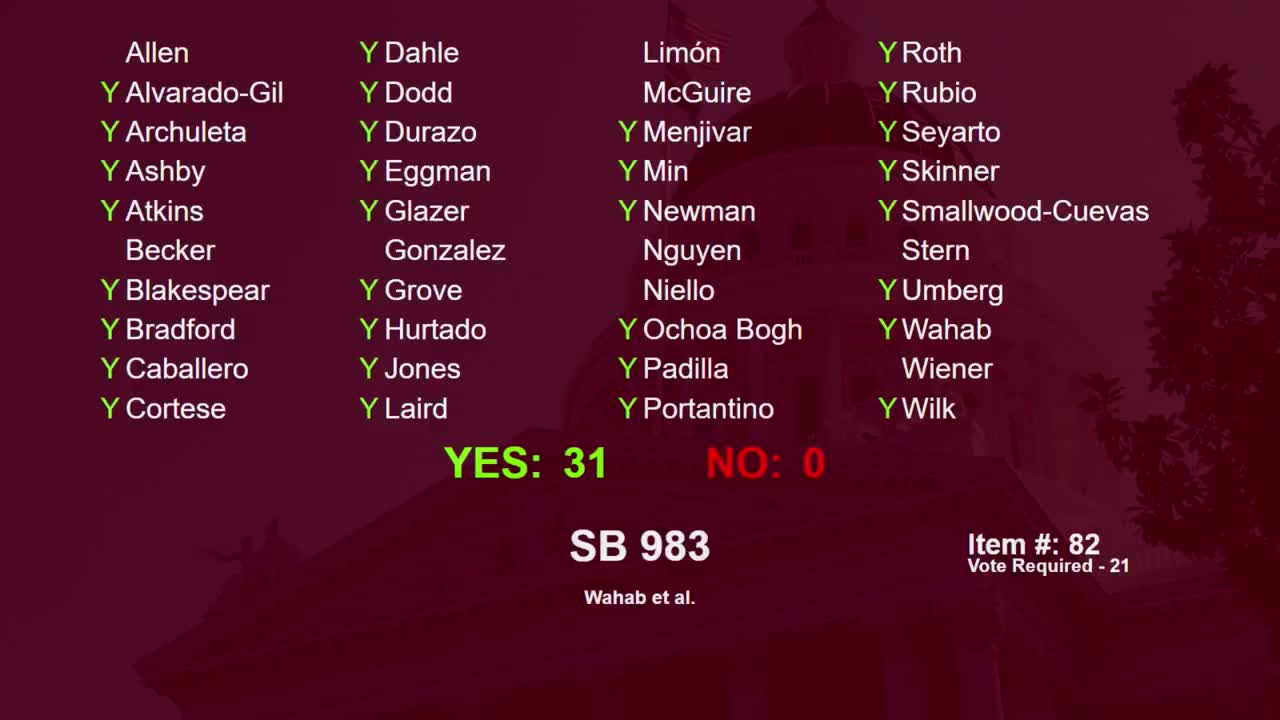 3MIN
Senate Floor
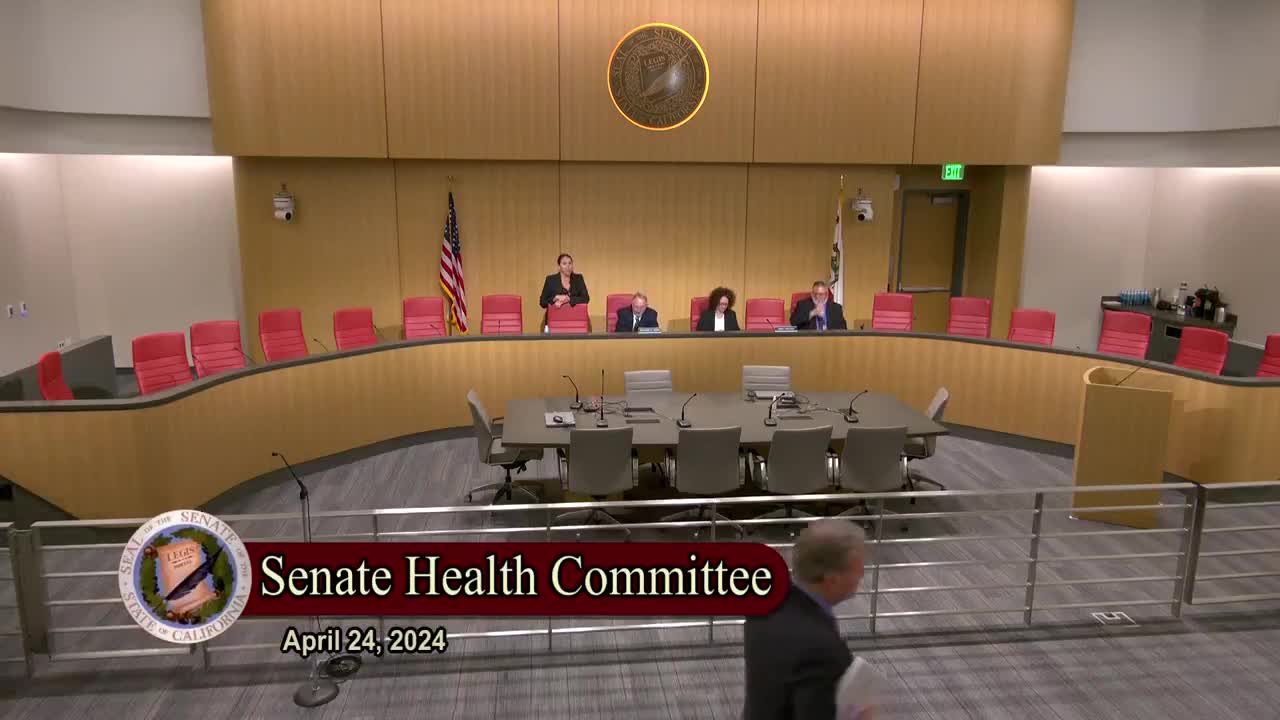 14MIN
Senate Standing Committee on Health
Bill Author