SB 448: Trespassing: removal of trespassers on residential property.
- Session Year: 2025-2026
- House: Senate
- Latest Version Date: 2025-04-09
Current Status:
Failed
(2026-02-02: Returned to Secretary of Senate pursuant to Joint Rule 56.)
Introduced
In Committee
Awaiting First Chamber Vote
Passed First Chamber
In Committee
Awaiting Second Chamber Vote
Passed Second Chamber
Enacted
Existing law prohibits the tenant of a property to remain on a property after the lawful termination of a lease agreement, as specified. Existing law prescribes a procedure for obtaining a judgment against such a tenant and for effecting the eviction of that tenant.
Existing law prohibits entering or occupying real property or structures without the consent of the owner.
This bill would define a squatter as somebody who unlawfully enters and remains in a residential property and, upon request, refuses to leave or falsely claims a legal right of possession.
This bill would prescribe a procedure for the notice and removal of a squatter by a local law enforcement agency. The bill would authorize a property owner or their agent to serve a demand to vacate, as specified, upon a squatter. The bill would authorize the owner or agent, after service of the demand, to submit a request, signed under penalty of perjury, to the local law enforcement agency with primary jurisdiction where the property is located, as specified.
By expanding the crime of perjury, this bill would impose a state-mandate local program.
This bill would require the law enforcement agency, upon receipt of the request, to verify the request and, upon verification, to remove the unlawful occupants from the property without unreasonable delay, as specified. The bill would describe the duties of local law enforcement personnel during a removal.
By imposing new duties on local law enforcement agencies, this bill would impose a state-mandated local program.
This bill would authorize a local law enforcement agency to assess a fee for processing a request and conducting a removal. The bill would also provide a local law enforcement agency with immunity from liability arising from a removal conducted in good faith, as specified.
This bill would prohibit a person from fraudulently causing or attempting to cause the removal of another person pursuant to these provisions and would prohibit a squatter from fraudulently interfering with a removal by knowingly presenting false information or documentation to law enforcement purporting to give them a lawful right of possession. provisions. A violation of these prohibitions this prohibition would be punishable as a misdemeanor or felony.
By creating new crimes, this bill would impose a state-mandated local program.
The bill would also create a civil cause of action for damages and restoration of possession against a person who fraudulently causes the removal of a person pursuant to the provisions, by the person who was removed.
This bill would state that, notwithstanding any other state or local law, it is intended to provide the remedy for unlawful occupation of a residential property by a squatter and would specify that it applies only to situations involving a squatter and not situations involving a tenant or other person with a bona fide claim to tenancy or title.
The California Constitution requires the state to reimburse local agencies and school districts for certain costs mandated by the state. Statutory provisions establish procedures for making that reimbursement.
This bill would provide that, with regard to certain mandates, no reimbursement is required by this act for a specified reason.
With regard to any other mandates, this bill would provide that, if the Commission on State Mandates determines that the bill contains costs so mandated by the state, reimbursement for those costs shall be made pursuant to the statutory provisions noted above.
Existing law prohibits the tenant of a property to remain on a property after the lawful termination of a lease agreement, as specified. Existing law prescribes a procedure for obtaining a judgment against such a tenant and for effecting the eviction of that tenant.
Existing law prohibits entering or occupying real property or structures without the consent of the owner.
This bill would define a squatter as somebody who unlawfully enters and remains in a residential property and, upon request, refuses to leave or falsely claims a legal right of possession.
This bill would prescribe a procedure for the notice and removal of a squatter by a local law enforcement agency. The bill would authorize a property owner or their agent to serve a demand to vacate, as specified, upon a squatter. The bill would authorize the owner or agent, after service of the demand, to submit a request, signed under penalty of perjury, to the local law enforcement agency with primary jurisdiction where the property is located, as specified.
By expanding the crime of perjury, this bill would impose a state-mandate local program.
This bill would require the law enforcement agency, upon receipt of the request, to verify the request and, upon verification, to remove the unlawful occupants from the property without unreasonable delay, as specified. The bill would describe the duties of local law enforcement personnel during a removal.
By imposing new duties on local law enforcement agencies, this bill would impose a state-mandated local program.
This bill would authorize a local law enforcement agency to assess a fee for processing a request and conducting a removal. The bill would also provide a local law enforcement agency with immunity from liability arising from a removal conducted in good faith, as specified.
This bill would prohibit a person from fraudulently causing or attempting to cause the removal of another person pursuant to these provisions and would prohibit a squatter from fraudulently interfering with a removal by knowingly presenting false information or documentation to law enforcement purporting to give them a lawful right of possession. A violation of these prohibitions would be punishable as a felony.
By creating new crimes, this bill would impose a state-mandated local program.
The bill would also create a civil cause of action for damages and restoration of possession against a person who fraudulently causes the removal of a person pursuant to the provisions, by the person who was removed.
This bill would state that, notwithstanding any other state or local law, it is intended to provide the remedy for unlawful occupation of a residential property by a squatter and would specify that it applies only to situations involving a squatter and not situations involving a tenant or other person with a bona fide claim to tenancy or title.
The California Constitution requires the state to reimburse local agencies and school districts for certain costs mandated by the state. Statutory provisions establish procedures for making that reimbursement.
This bill would provide that, with regard to certain mandates, no reimbursement is required by this act for a specified reason.
With regard to any other mandates, this bill would provide that, if the Commission on State Mandates determines that the bill contains costs so mandated by the state, reimbursement for those costs shall be made pursuant to the statutory provisions noted above.
(a)Except as provided in subdivision (b), the following procedure may be used for the removal of a squatter from a property:
(1)The If the property owner previously filed a notarized request form provided by a law enforcement agency pursuant to subdivision (o) of Section 602, the property owner may serve a demand to vacate on a squatter on the property.
(A)The demand to vacate shall include the following heading, printed in at least 16-point type: Demand to Immediately Vacate the Property.
(B)The demand to vacate shall be addressed to all unauthorized persons in possession and shall include the full mailing address and assessors parcel number of the property, including, if applicable, a unit or apartment number, printed in at least a 16-point type.
(C)The demand to vacate shall include the name, title, telephone number, and email address of the property owner, printed in at least a 16-point type.
(D)The demand to vacate shall include the following statement printed in at least 12-point type: You are trespassing on the property described in this notice. You are not an authorized occupant of the property. You must vacate the property and remove all personal possessions within 72 hours after service of this notice. Failure to comply with this demand will result in forcible removal from this property by local law enforcement.
(E)Service may be effectuated by either personal delivery to any occupant of the property who is at least 18 years of age, or by the conspicuous posting of the demand at the property and thereafter mailing a copy of the demand by first-class mail, to the address where the demand was posted.
(2)No sooner than 72 hours after the service of the demand to vacate, the property owner may file a request for removal with local law enforcement agency having primary jurisdiction where the property is located.
(A)The request for removal shall include all of the following:
(i)A written request for the removal of unauthorized persons from the property.
(ii)The street address and assessors parcel number of the property.
(iii)The name, address, and telephone number of the person making the request and proof of ownership of the property, which may be established by a copy of the recorded deed, or proof of agency, which may be established by a written authorization from, or executed contract with, the legal owner of the property.
(iv)A copy of the demand described in paragraph (1), including proof of service of the demand.
(v)A statement, signed under penalty of perjury, that the person submitting the request is the owner of the property or authorized agent thereof, that the persons residing on present at the subject property are unauthorized persons, that all information provided in the request is accurate and true to the best of their knowledge, and that the request is being made in good faith and in compliance with all of the provisions of this section.
(vi)The request for removal may, but is not required to, include additional evidence of the unauthorized occupancy, including, but not limited to, restrictions of access such as boarded-up doors and windows, posted signs regarding construction or prohibition of trespassing, video or security camera footage of the unauthorized person or persons entering or accessing the property through windows or locked or broken doors.
(B)A local law enforcement agency may prescribe the form and manner of submission for the request described in this paragraph.
(C)A local law enforcement agency may charge a reasonable fee to cover the costs of processing a request for removal and conducting a removal, including any standby time.
(3)Upon receipt of a request described in paragraph (2), local law enforcement shall verify the request and, if valid, shall remove the unauthorized persons from the property without unreasonable delay.
(A)The local law enforcement agency shall provide the requester with reasonable notice of the date and time of the scheduled removal and may require the requester to be present.
(B)The responsibility of the local law enforcement agency at the time of removal shall be to make entry into the property and to remove unauthorized persons from the property. Upon the request of the owner, the law enforcement agency shall stand by for a reasonable time while any personal property is removed from the property and the locks are changed.
(b)The local law enforcement agency performing a removal pursuant to this section in good faith shall be immune from liability to the property owner, to persons removed from the property, or to any third party due to the loss, damage, or destruction of property or for wrongful eviction or arrest.(c)(b)(1)A person who fraudulently causes or attempts to cause the removal of another person from property pursuant to this section is guilty of a felony punishable a crime punishable by imprisonment in a county jail for up to one year or pursuant to subdivision (h) of Section 1170.
(2)An unauthorized person who fraudulently contests or interferes with their lawful removal pursuant to this section by knowingly presenting false information or documentation to law enforcement officials purporting to give that person a lawful right to tenancy or possession of the property is guilty of a felony punishable pursuant to subdivision (h) of Section 1170.(3)(2)An occupant who has been removed from a property pursuant to this section under circumstances in which the owner acted fraudulently or in bad faith may file a civil action for restoration of possession, damages equal to three months of rent, expenses incurred as a result of the removal, and reasonable attorneys fees incurred in that action.
(4)(3)This section does not limit the authority of local law enforcement to make an arrest or take other legal action for a related violation of law, including, without limitation, trespassing, burglary, theft, vandalism, possession of controlled substances or weapons, or resisting or obstructing a peace officer.
(d)(c)(1)Notwithstanding any other law or local ordinance, this section is intended to provide the remedies for the unauthorized occupation of residential property by squatters.
(2)This section shall apply only to unauthorized persons. This section does not apply to a tenant, former tenant who is in an active dispute with the owner, holdover tenant, or a person with a bona fide claim of tenancy or title, including title by adverse possession.
(e)(d)As used in this section, the following terms are defined as follows:
(1)Demand means a demand to vacate a property described in paragraph (1) of subdivision (a).
(2)Owner means the legal owner of the property or an agent thereof, including a property manager.
(3)Property means a dwelling structure or a dwelling unit within a structure, including, without limitation, a house, mobilehome, condominium, or apartment. apartment, or dwelling structure or dwelling unit located on federally recognized tribal lands.
(4)Squatter or unauthorized person means a person who has unlawfully entered and is occupying a property without the consent of the owner and refuses to leave upon request or fraudulently claims a lawful right of possession.
SEC. 2.No reimbursement is required by this act pursuant to Section 6 of Article XIIIB of the California Constitution because a local agency or school district has the authority to levy service charges, fees, or assessments sufficient to pay for the program or level of service mandated by this act or because costs that may be incurred by a local agency or school district will be incurred because this act creates a new crime or infraction, eliminates a crime or infraction, or changes the penalty for a crime or infraction, within the meaning of Section 17556 of the Government Code, or changes the definition of a crime within the meaning of Section 6 of Article XIIIB of the California Constitution.
However, if the Commission on State Mandates determines that this act contains other costs mandated by the state, reimbursement to local agencies and school districts for those costs shall be made pursuant to Part 7 (commencing with Section 17500) of Division 4 of Title 2 of the Government Code.
(a)Except as provided in subdivision (b), the following procedure may be used for the removal of a squatter from a property:
(1)The property owner may serve a demand to vacate on a squatter on the property.
(A)The demand to vacate shall include the following heading, printed in at least 16-point type: Demand to Immediately Vacate the Property.
(B)The demand to vacate shall be addressed to all unauthorized persons in possession and shall include the full mailing address and assessors parcel number of the property, including, if applicable, a unit or apartment number, printed in at least a 16-point type.
(C)The demand to vacate shall include the name, title, telephone number, and email address of the property owner, printed in at least a 16-point type.
(D)The demand to vacate shall include the following statement printed in at least 12-point type: You are trespassing on the property described in this notice. You are not an authorized occupant of the property. You must vacate the property and remove all personal possessions within 72 hours after service of this notice. Failure to comply with this demand will result in forcible removal from this property by local law enforcement.
(E)Service may be effectuated by either personal delivery to any occupant of the property who is at least 18 years of age, or by the conspicuous posting of the demand at the property and thereafter mailing a copy of the demand by first-class mail, to the address where the demand was posted.
(2)No sooner than 72 hours after the service of the demand to vacate, the property owner may file a request for removal with local law enforcement agency having primary jurisdiction where the property is located.
(A)The request for removal shall include all of the following:
(i)A written request for the removal of unauthorized persons from the property.
(ii)The street address and assessors parcel number of the property.
(iii)The name, address, and telephone number of the person making the request and proof of ownership of the property, which may be established by a copy of the recorded deed, or proof of agency, which may be established by a written authorization from, or executed contract with, the legal owner of the property.
(iv)A copy of the demand described in paragraph (1), including proof of service of the demand.
(v)A statement, signed under penalty of perjury, that the person submitting the request is the owner of the property or authorized agent thereof, that the persons residing on the subject property are unauthorized persons, that all information provided in the request is accurate and true to the best of their knowledge, and that the request is being made in good faith and in compliance with all of the provisions of this section.
(B)A local law enforcement agency may prescribe the form and manner of submission for the request described in this paragraph.
(C)A local law enforcement agency may charge a reasonable fee to cover the costs of processing a request for removal and conducting a removal, including any standby time.
(3)Upon receipt of a request described in paragraph (2), local law enforcement shall verify the request and, if valid, shall remove the unauthorized persons from the property without unreasonable delay.
(A)The local law enforcement agency shall provide the requester with reasonable notice of the date and time of the scheduled removal and may require the requester to be present.
(B)The responsibility of the local law enforcement agency at the time of removal shall be to make entry into the property and to remove unauthorized persons from the property. Upon the request of the owner, the law enforcement agency shall stand by for a reasonable time while any personal property is removed from the property and the locks are changed.
(b)The local law enforcement agency performing a removal pursuant to this section in good faith shall be immune from liability to the property owner, to persons removed from the property, or to any third party due to the loss, damage, or destruction of property or for wrongful eviction or arrest.
(c)(1)A person who fraudulently causes or attempts to cause the removal of another person from property pursuant to this section is guilty of a felony punishable pursuant to subdivision (h) of Section 1170.
(2)An unauthorized person who fraudulently contests or interferes with their lawful removal pursuant to this section by knowingly presenting false information or documentation to law enforcement officials purporting to give that person a lawful right to tenancy or possession of the property is guilty of a felony punishable pursuant to subdivision (h) of Section 1170.
(3)An occupant who has been removed from a property pursuant to this section under circumstances in which the owner acted fraudulently or in bad faith may file a civil action for restoration of possession, damages equal to three months of rent, expenses incurred as a result of the removal, and reasonable attorneys fees incurred in that action.
(4)This section does not limit the authority of local law enforcement to make an arrest or take other legal action for a related violation of law, including, without limitation, trespassing, burglary, theft, vandalism, possession of controlled substances or weapons, or resisting or obstructing a peace officer.
(d)(1)Notwithstanding any other law or local ordinance, this section is intended to provide the remedies for the unauthorized occupation of residential property by squatters.
(2)This section shall apply only to unauthorized persons. This section does not apply to a tenant, former tenant who is in an active dispute with the owner, holdover tenant, or a person with a bona fide claim of tenancy or title, including title by adverse possession.
(e)As used in this section, the following terms are defined as follows:
(1)Demand means a demand to vacate a property described in paragraph (1) of subdivision (a).
(2)Owner means the legal owner of the property or an agent thereof, including a property manager.
(3)Property means a dwelling structure or a dwelling unit within a structure, including, without limitation, a house, mobilehome, condominium, or apartment.
(4)Squatter or unauthorized person means a person who has unlawfully entered and is occupying a property without the consent of the owner and refuses to leave upon request or fraudulently claims a lawful right of possession.
SEC. 2.No reimbursement is required by this act pursuant to Section 6 of Article XIIIB of the California Constitution because a local agency or school district has the authority to levy service charges, fees, or assessments sufficient to pay for the program or level of service mandated by this act or because costs that may be incurred by a local agency or school district will be incurred because this act creates a new crime or infraction, eliminates a crime or infraction, or changes the penalty for a crime or infraction, within the meaning of Section 17556 of the Government Code, or changes the definition of a crime within the meaning of Section 6 of Article XIIIB of the California Constitution.
However, if the Commission on State Mandates determines that this act contains other costs mandated by the state, reimbursement to local agencies and school districts for those costs shall be made pursuant to Part 7 (commencing with Section 17500) of Division 4 of Title 2 of the Government Code.
|
Date
|
Status
|
|---|---|
| Feb 2, 2026 | Returned to Secretary of Senate pursuant to Joint Rule 56. |
| May 23, 2025 | May 23 hearing: Held in committee and under submission. |
| May 16, 2025 | Set for hearing May 23. |
| May 12, 2025 | May 12 hearing: Placed on APPR. suspense file. |
| May 2, 2025 | Set for hearing May 12. |
| Apr 30, 2025 | From committee: Do pass and re-refer to Com. on APPR. (Ayes 13. Noes 0. Page 940.) (April 29). Re-referred to Com. on APPR. |
| Apr 11, 2025 | Set for hearing April 29. |
| Apr 9, 2025 | Read second time and amended. Re-referred to Com. on JUD. |
| Apr 8, 2025 | From committee: Do pass as amended and re-refer to Com. on JUD. (Ayes 6. Noes 0. Page 709.) (April 8). |
| Mar 27, 2025 | Set for hearing April 8. |
| Feb 26, 2025 | Referred to Coms. on PUB. S. and JUD. |
| Feb 19, 2025 | From printer. May be acted upon on or after March 21. |
| Feb 18, 2025 | Introduced. Read first time. To Com. on RLS. for assignment. To print. |
|
Date
|
Description
|
Location
|
Votes
|
|
|---|---|---|---|---|
| May 12, 2025 | Placed on suspense file | Senate Standing Committee on Appropriations |
Passed |
|
| Apr 29, 2025 | Do pass, but first be re-referred to the Committee on [Appropriations] | Senate Standing Committee on Judiciary |
Passed |
|
| Apr 8, 2025 | Do pass as amended, but first amend, and re-refer to the Committee on [Judiciary] | Senate Standing Committee on Public Safety |
Passed |
This list shows positions taken on this bill by organizations on the date displayed, which is linked to the original source.
Positions by individuals are not included.
|
Organization
|
Position
|
Date
|
|---|---|---|
| Aclu California Action | ** Against | |
| Affordable Housing Management Association-Pacific Southwest | ** Support | |
| Alliance for Community Empowerment | ** Against | |
| Apartment Association of Greater Los Angeles | ** Support | |
| Apartment Association Of Orange County | ** Support | |
| Arcadia Police Officers' Association | ** Support | |
| BASTA Universal | ** Against | |
| Berkeley Property Owners Association | ** Support | |
| Brea Police Association | ** Support | |
| Burbank Police Officers' Association | ** Support | |
| California Business Properties Association | ** Support | |
| California Public Defenders Association | ** Against | |
| California Rental Housing Association | ** Support | |
| California Reserve Peace Officers Association | ** Support | |
| California Rural Legal Assistance Foundation | ** Against | |
| California State Firefighters Association | ** Support | |
| California State Sheriffs' Association | ** Support | |
| City of Corona | ** Support | |
| CLAREMONT POLICE OFFICERS ASSOCIATION | ** Support | |
| Courage California | ** Against | |
| Culver City Police Officers' Association | ** Support | |
| Disability Rights Education & Defense Fund | ** Against | |
| East Bay Community Law Center | ** Against | |
| East Bay Rental Housing Association | ** Support | |
| Fullerton Police Officers' Association | ** Support | |
| Garden Grove Chamber Of Commerce | ** Support | |
| Grace Institute - End Child Poverty in Ca | ** Against | |
| Housing and Economic Rights Advocates | ** Against | |
| Howard Jarvis Taxpayers Association | ** Support | |
| Leadership Counsel for Justice & Accountability | ** Against | |
| Legal Services for Prisoners with Children | ** Against | |
| Los Angeles School Police Management Association | ** Support | |
| los angeles school police officers association | ** Support | |
| Movement Legal | ** Against | |
| Murrieta Police Officers' Association | ** Support | |
| National Housing Law Project | ** Against | |
| Newport Beach Police Association | ** Support | |
| Nor Cal Rental Property Association | ** Support | |
| North Valley Property Owners Association | ** Support | |
| Open Door Legal | ** Against | |
| Pacific Legal Foundation | ** Support | |
| Palos Verdes Police Officers Association | ** Support | |
| Peace Officers Research Association Of California | ** Support | |
| PLACER COUNTY DEPUTY SHERIFFS ASSOCIATION | ** Support | |
| Pomona Police Officers' Association | ** Support | |
| Public Advocates | ** Against | |
| RIVERSIDE POLICE OFFICERS ASSOCIATION | ** Support | |
| Riverside Sheriffs' Association | ** Support | |
| San Francisco Public Defender | ** Against | |
| San Jose Police Officers Association | ** Support | |
| Santa Ana Police Officers Association | ** Support | |
| Santa Barbara Rental Property Association | ** Support | |
| Santa Cruz for Bernie | ** Against | |
| Small Property Owners of San Francisco Institute | ** Support | |
| Southern California Rental Housing Association | ** Support | |
| Southern California Rental Property Association | ** Support | |
| Squatter Squad LLC | ** Support | |
| Tenants Together | ** Against | |
| Western Center on Law & Poverty, INC. | ** Against |
SENATE COMMITTEE ON APPROPRIATIONS
Senator Anna Caballero, Chair
2025 - 2026 Regular Session
SB 448 (Umberg) - Trespassing: removal of trespassers on residential property
Version: April 9, 2025 | Policy Vote: PUB. S. 6 - 0, JUD. 13 - 0 |
Urgency: No | Mandate: Yes |
Hearing Date: May 12, 2025 | Consultant: Liah Burnley |
Bill Summary:
SB 448 establishes procedures that authorize law enforcement officers to remove persons occupying property without a prior opportunity to be heard.
Fiscal Impact:
- Unknown, potentially significant reimbursable costs (local funds, General Funds) to local law enforcement agencies to fulfill the requirements of this bill. This bill shifts a traditionally judicial function of adjudicating property rights to law enforcement, which will require law enforcement agencies to develop and administer a new process for receiving, reviewing, and verifying removal requests and by removing persons from property. This bill would impose new operational responsibilities on local law enforcement agencies that will substantially increase costs for local jurisdictions. While the bill authorizes the recovery of fees from property owners, these fees are unlikely to fully offset law enforcement costs. Law enforcement agencies may incur additional liabilities as this bill requires them to make entry into properties and remove the occupant, to stand by while property is removed and locks are changed. The California Constitution requires the state to reimburse local agencies for certain costs mandated by the state. To the extent the Commission on State Mandates determines that the provisions of this bill create a new program or impose a higher level of service on counties may claim reimbursement of those costs. (See Staff Comments)
- Unknown, potentially significant costs (local funds, General Fund) to the counties to incarcerate people for the crime created by this bill. The average annual cost to incarcerate one person in county jail is approximately $77,252 per year. Actual incarceration costs to counties will depend on the number of convictions and the length of each sentence. Although county incarceration costs are generally not considered reimbursable state mandates pursuant to Proposition 30 (2012), overcrowding in county jails creates cost pressure on the General Fund because the state has historically granted new funding to counties to offset overcrowding resulting from 2011 public safety realignment. (See Staff Comments)
- Unknown, potentially significant costs (General Fund) to the Department of Corrections and Rehabilitation (CDCR). While many individuals incarcerated under this bill will serve their sentences in county jail, this bill specifies that violations are punishable “pursuant to subdivision (h) of Section 1170.” Under subdivision (h) of Section 1170, if the defendant has specified prior felony convictions, the sentence for a felony shall be served in the state prison. The Legislative Analyst’s Office (LAO) estimates the average annual cost to incarcerate one person in state prison is $133,000. Even if just one person is sentenced to state prison for one year under this bill, it will add significant costs pressures to CDCR. The Governor’s budget estimates that Proposition 36 (2024), which increased punishment for various theft and drug crimes, will cause the average daily prison population to be about 1% higher in 2024‑25 and 4% higher in 2025‑26, adding costs pressures to the department. Also, given the prevalence of mental health needs among incarcerated people, legislation that sends more people to state prison adds significant costs to CDCR for the delivery of mental health care. About one‑third of the prison population has a diagnosed mental health need. The annual cost of operating a mental health crisis bed at CDCR is around $400,000. As part of the ongoing Coleman court case, CDCR has been incurring fines monthly since April 2023 for failing to reduce vacancy rates for five mental health classifications. The state has paid over $200 million in fines to date, and is still accruing fines.
- Potential cost pressures (General Fund) to the Department of State Hospitals (DSH), in order to adequately house, treat, and care for persons committed to DSH that otherwise would not. Cost pressures to DSH are connected with an increase in state prison sentences. Creating a new crime will increase the number of defendants declared incompetent to stand trial (IST), or committed to DSH due to their being not guilty by reason of insanity. DSH’s proposed budget for fiscal year 2025-26 totals $3.4 billion – an increase of $3.4 million from the 2024 Budget Act. An increase the DSH population would result in the need for additional funding.
- Unknown, potentially significant costs to the state funded trial court system (Trial Court Trust Fund, General Fund) to adjudicate civil and criminal actions. Creating a new causes of action for the restoration of possession, which authorizes the recovery of damages equal to three months of rent, expenses, and attorney’s fees, could further strain already overburdened court dockets. Additionally, trial court costs pressures will arise because of the new crime created by this bill. Defendants are constitutionally guaranteed certain rights during criminal proceedings, including the right to a jury trial and the right to counsel (at public expense if the defendants are unable to afford the costs of representation). Increasing penalties leads to lengthier and more complex court proceedings with attendant workload and resource costs to the court. As discussed below, this bill raises significant constitutional concerns. As a result, this bill may result in additional trial court costs to the extent that cases are filed to litigate its constitutionality.
The fiscal impact of this bill to the courts will depend on many unknown factors, including the number of cases filed and the factors unique to each case. An eight-hour court day costs approximately $10,500 in staff in workload. If court days exceed 10, costs to the trial courts could reach hundreds of thousands of dollars. In 2023–24, over 4.8 million cases were filed statewide in the superior courts. Filings increased over the past year, driven mostly by misdemeanors and infractions, and civil limited cases. The increase in filings from the previous year is greater than 5% for civil limited and unlimited, appellate division appeals, juvenile delinquency, misdemeanors and infractions, and probate. While the courts are not funded on a workload basis, an increase in workload could result in delayed court services and would put pressure on the General Fund to fund additional staff and resources and to increase the amount appropriated to backfill for trial court operations. The Governor’s 2025-26 budget proposes a $40 million ongoing increase in discretionary funding from the General Fund to help pay for increased trial court operation costs beginning in 2025-26.
Background:
Remedies for criminal trespass: Under existing law, a person is guilty of misdemeanor trespass, punishable by a county jail term of up to six months, a fine of up to $1,000 or both, if they enter without permission, any other person’s property and refuse or fail to leave immediately upon being requested to do so. The law allows for prosecution against any person who refuses or fails to leave property or a structure that belongs to or is lawfully occupied by another and is not open to the general public, upon being requested to leave by a peace officer at the request of the owner and upon being informed by the peace officer that the officer is acting with such authority.
Under existing law, owners of private property may request law enforcement assistance in ejecting trespassers from their property. Generally, a property owner must request law enforcement assistance each time assistance is needed, subject to an exception under which a single request may be valid for a year. This request for law enforcement assistance in enforcing trespass laws is generally made via a “Trespass Letter of Authority.” These letters – also known as “602 Letters” – which authorize local authorities to enter the premises to enforce trespass laws in the owner’s absence.
Trespass letters of authorization are not without controversy. Critics argue that trespass letters of authorization exacerbate homelessness by unfairly punishing homeless individuals. They “enable police, local businesses, public services, and even homelessness service providers to work together to control the movements of unhoused people and exclude them from both public and private spaces.”[1] In a case study conducted in Laguna Beach, the ACLU found that of 97 citations issued to unhoused people, 67 resulted from trespass letters of authorization. And, police have recently considered more harshly enforcing trespassing laws as a way to deal with the homelessness crisis. In Bakersfield, California, county officials proposed a program to fight homelessness by more aggressively prosecuting and incarcerating trespassers.[2] Strict enforcement of trespass laws create a cycle of arrests, hearings, and fines that make emerging from homelessness all the more difficult.[3] This bill could contribute to these problems.
Existing civil remedies for squatters: Trespass, by definition, requires a willful entry onto property without the owner's consent, followed by a refusal to leave. Trespassers differ from "squatters" in that they do not assert any legal claim or right to occupy the premises. Squatting is not illegal in California. This bill applies to “squatters”—i.e., individuals who do not leave a property under a claim of lawful right of possession.
In California, the law has long been clear: a person claiming lawful right of possession can be removed from property only after a court judgment and the issuance of a writ of possession.[4] Absent a voluntary surrender of the premises by the tenant or “squatter”, a landlord or owner may enforce their right of reentry only through judicial process—not through self-help.
Historically, the original forcible entry and detainer statute, enacted in England in 1381[5], imposed criminal penalties for forcible entry. The statute's purpose was to preserve public peace by preventing violent conflicts over land possession. This early prohibition on self-help applied even to those legally entitled to possession and promoted the use of orderly court proceedings.[6]
Under California law today, only a Sheriff, Marshal, or their deputies may lawfully evict a tenant. No other individual—including police officers, landlords, property managers, or realtors—may remove a tenant or compel them to vacate. Landlords are strictly prohibited from engaging in "self-help" evictions, which include changing locks, shutting off utilities, or removing personal property. These actions are unlawful and can carry serious legal consequences. Notably, landlords may not evict tenants through such means even if the tenant is behind on rent, has received a notice of eviction, or is violating the lease. In all cases, landlords must proceed through the courts. This rule is essential to maintain an ordered society.
The distinction between an unlawful self-help eviction and a lawful eviction under a writ of possession lies not in whether force is used, but in whether the force is judicially authorized. Courts have recognized that society may tolerate forcible evictions only when they are necessary and legally sanctioned.[7] “Regardless of who has the right to possession, orderly procedure and preservation of the peace require that actual possession shall not be disturbed except by legal process.”[8]
A valid writ of execution is the indispensable instrument through which a party entitled to possession may lawfully recover it. Allowing landlords to act without a writ, would undermine the essential legal conditions for the use of force: judicial oversight and necessity. The writ process is designed to avoid unnecessary force. Once a writ of possession is served, the occupants are given time vacate voluntarily. Only after this period can the levying officer remove the occupants by force and return possession to the landlord. The writ serves to notify all parties—including the occupants and the officer executing the writ—that the eviction is court-authorized.
In Bedi v. McMullan (1984) 160 Cal.App.3d 272, the defendants attempted to evict tenants without a valid writ. The court made clear that until a writ is issued, tenants are entitled to peaceful possession of the premises and have the right to exclude anyone—including the landlord.[9]
Proposed Law:
This bill creates a summary eviction process without prior court involvement, as follows:
- Establishes a procedure to remove a squatter from a property:
- If the property owner previously filed a Section 602 form with law enforcement, the property owner may serve a demand to vacate on a squatter on the property. The demand to vacate shall include the following:
- Heading, printed in at least 16-point type:
- If the property owner previously filed a Section 602 form with law enforcement, the property owner may serve a demand to vacate on a squatter on the property. The demand to vacate shall include the following:
“Demand to Immediately Vacate the Property.”
- Be addressed to all unauthorized persons in possession;
- The full mailing address and assessor’s parcel number of the property, including, if applicable, a unit or apartment number, printed in at least a 16-point type;
- The name, title, telephone number, and email address of the property owner, printed in at least a 16-point type;
- The following statement printed in at least 12-point type:
“You are trespassing on the property described in this notice. You are not an authorized occupant of the property. You must vacate the property and remove all personal possessions within 72 hours after service of this notice. Failure to comply with this demand will result in forcible removal from this property by local law enforcement.”
- Service of the demand to vacate, by either personal delivery to any occupant of the property who is at least 18 years of age, or by the conspicuous posting of the demand at the property and thereafter mailing a copy of the demand by first-class mail, to the address where the demand was posted.
- 72 hours after the service of the demand to vacate, the property owner may file a request for removal with local law enforcement agency having primary jurisdiction where the property is located.
- The request for removal shall include all of the following:
- A written request for the removal of unauthorized persons from the property;
- The street address and assessor’s parcel number of the property;
- The name, address, and telephone number of the person making the request and proof of ownership of the property, which may be established by a copy of the recorded deed, or proof of agency, which may be established by a written authorization from, or executed contract with, the legal owner of the property;
- A copy of the demand including proof of service of the demand;
- A statement, signed under penalty of perjury, that the person submitting the request is the owner of the property or authorized agent thereof, that the persons present at the subject property are unauthorized persons, that all information provided in the request is accurate and true to the best of their knowledge, and that the request is being made in good faith and in compliance with all of the provisions of this section; and,
- The request for removal may, but is not required to, include additional evidence of the unauthorized occupancy.
- Upon receipt of a request, local law enforcement shall verify the request and, if valid, shall remove the unauthorized persons from the property without unreasonable delay.
- The local law enforcement agency shall provide the requester with reasonable notice of the date and time of the scheduled removal and may require the requester to be present.
- The responsibility of the local law enforcement agency at the time of removal shall be to make entry into the property and to remove unauthorized persons from the property.
- Upon the request of the owner, the law enforcement agency shall stand by for a reasonable time while any personal property is removed from the property and the locks are changed.
- Creates a new crime:
- A person who fraudulently causes or attempts to cause the removal of another person from property is guilty of a crime.
- Punishable as a misdemeanor imprisonment in a county jail for up to one year or as a felony.
- Provides that an occupant who has been removed from a property under circumstances in which the owner acted fraudulently or in bad faith may file a civil action for restoration of possession, damages equal to three months of rent, expenses incurred as a result of the removal, and reasonable attorney’s fees incurred in that action.
- Provides that these provisions only apply only to unauthorized persons. They do not apply to a tenant, former tenant who is in an active dispute with the owner, holdover tenant, or a person with a bona fide claim of tenancy or title, including title by adverse possession.
- Defines the following:
- “Demand” means a demand to vacate a property.
- “Owner” means the legal owner of the property or an agent thereof, including a property manager.
- “Property” means a dwelling structure or a dwelling unit within a structure, including, without limitation, a house, mobilehome, condominium, or apartment, or dwelling structure or dwelling unit located on federally recognized tribal lands.
- “Squatter” or “unauthorized person” means a person who has unlawfully entered and is occupying a property without the consent of the owner and refuses to leave upon request or fraudulently claims a lawful right of possession.
Staff Comments: This bill raises significant legal, policy, and constitutional concerns with fiscal implications for local law enforcement agencies and the state funded trial courts.
This bill could lead to significant deprivations of due process:
Under both the U.S. Constitution and the California Constitution, no person can be deprived of their property without due process of law—including notice, a hearing, and a neutral arbiter. This bill authorizes summary removals from property based on an owner’s affidavit, without requiring judicial review or giving the occupant a chance to respond. The bill gives law enforcement sweeping discretion to decide what counts as "sufficient" proof of ownership, whether someone is a "squatter" or a tenant, and whether an occupant has a "bona fide" claim to possession. This unchecked discretion invites abuse and selective enforcement. It creates opportunities for landlord retaliation, wrongful removals, or biased policing—particularly against informal tenants without written leases, undocumented residents, domestic violence survivors hiding from abusers, and unhoused individuals in transitional living situations. Lawful tenants may not always have ready proof that they live in the unit. Verbal agreements are common, and many tenants do not have a written lease or rent receipts. This is a textbook violation of due process because it allows a forced eviction, at the hands of law enforcement, before the facts are adjudicated. Using the power of the state to remove a person, without an opportunity to be heard, is plainly undemocratic[10] —it requires a judicial process, not review by a cop. Without clear legal standards or procedural safeguards, the bill risks violating equal protection and civil rights laws, opening cities and counties to liability under both state and federal law—an added cost pressure.
This bill raises a separation of powers doctrine issue:
This bill blurs the line between executive and judicial powers by requiring law enforcement officers to adjudicate property rights—a responsibility that has always belonged to the courts. Courts alone are empowered to adjudicate contested claims to property. California courts have warned against informal or extrajudicial evictions. As discussed above, this state already has a well-established statutory framework for evictions, i.e., unlawful detainer actions, which require judicial process, specific notice periods, a court hearing, and enforcement by a sheriff. This bill would allow property owners to circumvent the courts and the unlawful detainer process entirely and to use the law enforcement officers to remove occupants without a judicial order.
Police officers are part of the executive branch: they enforce laws, they do not interpret or adjudicate them. Yet, this bill requires them to do just that—to determine whether someone is lawfully in possession of a home, whether a tenancy is valid, or whether someone has a bona fide claim of title or occupancy. This bill sidesteps the judicial process and gives police departments the de facto power to decide complex legal disputes—such as oral tenancy agreements, claims of adverse possession, or family inheritance issues—on the spot and without judicial oversight. Police officers would be expected to interpret deeds, rental contracts, and property claims like trained civil judges. This is not just legally questionable; it is operationally unsustainable. This is entirely outside their training, scope, and legal authority. Officers are not trained in landlord-tenant law, contract disputes, property law, or equitable interests. Legal and factual decisions would be made by individuals with no legal training, under without the benefit of evidentiary rules. The bill turns officers into judges, juries, and executioners, without giving them the legal tools, procedural safeguards, or institutional authority to make such determinations, which will create significant workload cost pressures to local law enforcement agents.
This bill erodes tenant protections:
This bill represents a significant shift by bypassing traditional unlawful detainer procedures and permitting direct law enforcement involvement in the removal of unauthorized occupants. This raises concerns about potential overreach and the erosion of tenant protections.
Provisions in this bill, taken together, could disproportionately favor landlords and wealthy property owners, potentially leading to abuses where individuals, particularly those from marginalized communities, are removed without sufficient legal recourse who are more likely to face housing instability. Without adequate legal protections, including an opportunity to be heard before a neutral arbitrator prior to eviction, these groups could be vulnerable to unjust evictions and further marginalization.
Victims of domestic violence often face challenges in securing stable housing. This bill could inadvertently penalize these individuals, particularly if they are unable to assert their occupancy rights promptly, for example, against an abusive partner, leading to potential wrongful removals. Individuals with legitimate claims to tenancy or property ownership, including those asserting rights through adverse possession, may find their rights undermined by the bill's provisions. The lack of a requirement for judicial review before removal could result in the displacement of rightful occupants, and contribute to homelessness.
By allowing police to remove people without judicial process, the bill will chill the exercise of legitimate property rights. Occupants may fear that asserting a claim—such as rent control protections, habitability complaints, or inheritance rights—could lead to immediate eviction by police. It also enables bad-actor landlords to sidestep the courts entirely. Rather than file a proper unlawful detainer action, they could simply file paperwork with the police and claim someone is a squatter. Innocent occupants—including tenants with oral agreements, longtime residents, heirs, or cohabitants—could be wrongly removed, and only given a chance to contest the removal after the fact, in civil court.
This bill also allows wrongfully evicted occupants to sue after they have been displaced. Post-removal remedies are no substitute for due process-especially for people who are displaced as a result of this bill. Moreover, creating new causes of actions leads to increased caseloads for already overburdened trial courts, which is a General Fund cost pressure.
This bill is ripe for abuse:
This bill raises fundamental questions about the rule of law and democratic principles. Notably, this bill provides that it is the “responsibility” of law enforcement to “make entry onto property” and remove unauthorized persons. By making it the duty of law enforcement to forcefully remove individuals from property at the whim of an alleged property owner, without prior judicial oversight, this bill will erode public trust in legal institutions and the fairness of the justice system.
In addition, this bill raises serious implications for privacy and the Fourth Amendment. If officers are required to enter property, would that be considered a search without a warrant? Could law enforcement and property owners collude so that law enforcement can enter property to conduct warrantless searches and effectuate arrests? What of law enforcement officers who have made it clear that they intend to cooperate with ICE for immigration purposes?[11] The potential for abuse and the undermining of due process protections are antithetical to democratic values that prioritize individual rights and equitable treatment under the law.
To deter misuse, the bill creates a new crime for property owners who fraudulently evict someone using this process. But, this is a solution proposed for the problems entirely created by this bill, and comes with a cost. Increasing incarceration—especially for conduct that should be resolved in civil court—contributes to the expansion of California’s criminal justice system. Mass incarceration in California did not occur in a vacuum; it was the result of decades of cumulative policy decisions—often well-intentioned on their own—that collectively expanded the scope and severity of the criminal justice system. Although individual pieces of legislation like this bill, and many others introduced this legislative session, may appear narrow or incremental, their combined effect will significantly increase incarceration rates. California has a well-documented history of prison overcrowding, which culminated in federal court intervention and a U.S. Supreme Court ruling in Brown v. Plata (2011) that found the state’s prison conditions unconstitutional due to severe overcrowding. Returning to such conditions would undermine fiscal sustainability, public safety, and rehabilitation goals.
-- END --
Outside the Law: The Legal War against Unhoused People, ACLU California (Oct. 2021) <https://www.aclusocal.org/sites/default/files/outsidethelaw-aclufdnsca-report.pdf> [May 18, 2023].) ↑
Throwing People in Jail on Drug Charges? That’s Bakersfield’s Idea to Fight Homelessness, LA Times (Sept. 27, 2019) <https://www.latimes.com/california/story/2019-09-26/homeless-bakersfield-jail-misdemeanor-drug-trespassing> [May 18, 2023]; see also Cities Try to Arrest Their Way Out of Homeless Problems, ABC News (June 29, 2020) <https://web.archive.org/web/20220625011111/https://abcnews.go.com/US/wireStory/cities-arrest-homeless-problems-71511969> [May 18, 2023].) ↑
Throwing People in Jail on Drug Charges? That’s Bakersfield’s Idea to Fight Homelessness, LA Times (Sept. 27, 2019) <https://www.latimes.com/california/story/2019-09-26/homeless-bakersfield-jail-misdemeanor-drug-trespassing> [May 18, 2023]; see also Cities Try to Arrest Their Way Out of Homeless Problems, ABC News (June 29, 2020) <https://web.archive.org/web/20220625011111/https://abcnews.go.com/US/wireStory/cities-arrest-homeless-problems-71511969> [May 18, 2023].) ↑
See Code Civ. Proc., §§ 712.010, 715.010 et seq., 1159 et seq.; Civ. Code § 789.3; Penal Code § 418. ↑
5 Richard II ch. 7; see Dickinson v. Maguire (1858) 9 Cal. 46, 50–51 ↑
See 2 Taylor, Landlord and Tenant 412 [9th ed.]; Dickinson v. Maguire, supra; 1 Harper & James, The Law of Torts, p. 260. ↑
See Comment, Defects in the Current Forcible Entry and Detainer Laws of the United States and England (1978) 25 UCLA L.Rev. 1067, 1089–1090; Jordan v. Talbot (1961) 55 Cal.2d 597, 604. ↑
Id. at p. 605. ↑
See also, Jordan v. Talbot, supra, 55 Cal.2d at pp. 604–605. ↑
It has long been recognized that “fairness can rarely be obtained by secret, one-sided determination of facts decisive of rights. And no better instrument has been devised for arriving at truth than to give a person in jeopardy of serious loss notice of the case against him and opportunity to meet it.” (Joint Anti-Fascist Refugee Committee v. McGrath (341 U.S. 123, 341 (Frankfurter, J., concurring).) ↑
CalMatters, We asked all 58 California sheriffs about immigration enforcement under Trump. Here’s what they said. (Jan. 20, 2025) https://calmatters.org/politics/2025/01/california-sheriffs-immigration-ice-tracker/; Spectrum News, California sheriff to work with ICE, but other state authorities say legally they can't. (April 1, 2025) https://spectrumnews1.com/ca/southern-california/public-safety/2025/04/01/ice-state-law-amador-sheriff-immigration-enforcement; Statement from Sheriff Barnes regarding Federal Immigration Enforcement (Jan. 27, 2025) https://ocsheriff.gov/news/statement-sheriff-barnes-regarding-federal-immigration-enforcement; Report of the Implementation of the California Values Act (March 2019) [finding that sheriff’s detain people in jails for immigration enforcement purposes; provide space to ICE in
Jail facilities for their exclusive use; and perform the activities of immigration detention officers and
patrol the border.] https://www.advancingjustice-alc.org/wp-content/uploads/2019/03/SB54-Report_FINAL.pdf ↑
Senator Thomas Umberg, Chair
2025-2026 Regular Session
Bill No: SB 448 (Author:Umberg)
Version: April 9, 2025
Hearing Date: April 29, 2025
Fiscal: Yes
Urgency: No
Consultant: ID
SUBJECT
Trespassing: removal of trespassers on residential property
DIGEST
This bill creates a process by which a property owner may forcibly remove a squatter or unauthorized person from their property.
EXECUTIVE SUMMARY
In order to tackle the issue of squatters who illegally reside on a property owner’s property, SB 448 creates a process through which a property owner may remove a squatter with the assistance of law enforcement. SB 448 would apply only to property owners who have filed a specified, notarized request for assistance from law enforcement for a period of time for property that is a fire hazard, from which the owner is absent, or is closed to the public, as specified. SB 448 would permit such a property owner to serve the unauthorized person on their property with a demand to vacate that demands the person vacate the property within 72 hours. It would allow the property owner to make a request to remove an occupant to the local law enforcement agency for the area of the property after this 72-hour period. If the law enforcement agency determines that the request is valid, it must remove the unauthorized occupants of the property without reasonable delay. SB 448 would provide that a person who fraudulently causes or attempts to cause the removal of another person from property under these provisions is guilty of a crime punishable by imprisonment in a county jail for up to one year. It also permits an occupant removed due to a property owner who acted fraudulently or in bad faith to file a civil action for restoration of possession, damages equal to three months’ rent, expenses incurred due to the removal, and for reasonable attorney’s fees. SB 448 is sponsored by the California Rental Housing Association, and is supported by a variety of apartment, property, and law enforcement associations, and the City of Corona, and is opposed by numerous civil and tenant’s rights groups. It previously passed out of the Senate Public Safety Committee by a vote of 6 to 0.
PROPOSED CHANGES TO THE LAW
Existing law:
- Makes the refusal or failure to leave land, real property, or structures belonging to or lawfully occupied by another and not open to the general public, when requested to leave by a peace officer or the property owner or person in lawful possession, the misdemeanor crime of trespassing. (Pen. Code § 602(o).)
- Prohibits a landlord, with the intent to terminate the occupancy of a tenant under any lease or other tenancy or estate at will, to willfully cause the interruption or termination of any utility service furnished to the tenant, or to willfully prevent the tenant from gaining reasonable access to the property by changing the locks or using a bootlock or any other similar method or device, removing outside doors or windows, or by removing from the premises the tenant’s personal property, furnishings, or any other items without the written consent of the tenant, as provided. (Civ. Code § 789.3.)
- Makes it unlawful for a landlord to do any of the following for the purposes of influencing a tenant to vacate a dwelling: engage in the conduct of theft; extort a tenant; use or threaten to use force, willful threats, or menacing conduct interfering with a tenant’s quiet enjoyment of the premises; intentionally commits a significant violation of the laws regarding when a landlord may enter the leased premises; or threaten to disclose a tenant’s immigration status or citizenship. Makes a tenant who prevails against a landlord for such actions entitled to a civil penalty of $2,000. (Civ. Code § 1954.)
- Provides for a summary proceedings process by which a landlord may initiate an unlawful detainer action to recover possession of their property from a tenant, specifying an expedited time period within which a tenant must answer the complaint, the notice required to be provided the tenant of such a proceeding, and the process by which a default judgment may be requested and entered by the judge when a tenant fails to respond, among other provisions. (Code Civ. Proc. §§ 1159 et seq.)
- Requires entry of default and default judgment against the defendant in an unlawful detainer action if they fail to appear and defend against the unlawful detainer action, if upon written application of the plaintiff with proof of service of the summons and complaint. Provides that the court must issue a writ of execution, and thereafter the plaintiff may apply to the court for any other relief demanded in the complaint, including costs. (Code Civ. Proc. 1169.)
- Specifies that a judgment for possession of real property for a plaintiff landlord may be enforced by a writ of possession, which must be served on the occupant of the property, and that, if the occupant does not vacate the premises within five days of service of the writ of possession, law enforcement may forcibly remove the tenant. (Code Civ. Proc. § 715.020.)
This bill:
- Specifies that, if a property owner has previously filed a notarized request for assistance from law enforcement for their property for no more than a twelve-month period due to it being vacant, a fire hazard, or closed to the public, the property owner may serve a demand to vacate on a squatter on the property.
- Specifies that the demand to vacate must: include a heading, as specified; be addressed to all unauthorized persons in possession of the premises; include the mailing address and assessor’s parcel number of the property; include the name and contact information of the property owner; and include a statement that the occupant is trespassing, and must vacate the premises within 72 hours.
- Requires the demand to vacate be served upon the unauthorized person by either personal delivery to any occupant above 18 years of age, or by posting it conspicuously on the property and mailing a copy to the address of the property by first-class mail.
- Permits the property owner to file, no sooner than 72 hours after serving the demand to vacate, a request for removal of the occupants with the local law enforcement agency having primary jurisdiction over the property’s location.
- Specifies that this request for removal must include:
- a written request for the removal of the unauthorized persons on the property;
- the street address and assessor’s parcel number of the property;
- the name and contact information of the person making the request, along with proof of ownership of the property, such as a copy of the recorded deed or proof of agency;
- a copy of the demand to vacate served on the occupants, with the proof of service; and
- a statement, signed under penalty of perjury, that the requestor is the owner of the property or authorized agent of the owner, that the occupants are unauthorized persons, that all information in the request is accurate and true to the best of the requester’s knowledge, and that the request is being made in good faith and in compliance with all provisions of this bill.
- Specifies that the request for removal may, but is not required to, include additional evidence of the unauthorized occupancy, as specified.
- Permits a local law enforcement agency to prescribe a form and manner of submission for a request for removal, and permits a local law enforcement agency to charge a reasonable fee to cover the costs of processing and conducting the request for removal, including of any standby time.
- Requires the local law enforcement agency, upon receipt of a request for removal, to verify the request, and remove the unauthorized persons from the property without reasonable delay if the request is valid.
- Requires the law enforcement agency to provide the requestor with reasonable notice of the date and time of the scheduled removal, and permits them to require the requestor to be present for the removal.
- Specifies that it is the responsibility of the law enforcement agency during the removal to enter the property and remove the unauthorized persons, but that the law enforcement agency must stand by for a reasonable time while any personal property is removed from the property and the locks are changed.
- Specifies that a person who fraudulently causes or attempts to cause the removal of another person from property under these provisions is guilty of a crime punishable by imprisonment in a county jail for up to one year, as specified.
- Permits an occupant who has been removed from property when the property owner acted fraudulently or in bad faith to file a civil action for restoration of possession, damages equal to three months’ rent, expenses incurred due to the removal, and reasonable attorney’s fees for such an action.
- Specifies that its provisions do not limit the authority of local law enforcement to make an arrest or take other legal action for a related legal violation, including trespassing, burglary, theft, vandalism, possession of controlled substances or weapons, or resisting or obstructing a peace officer.
- Specifies that its provisions are intended to provide remedies for the unauthorized occupation of residential property by squatters, and that its provisions do not apply to a tenant, former tenant who is in an active dispute with the owner, holdover tenant, or a person with a bona fide claim of tenancy or title, including by adverse possession.
- Defines, for the purposes of its provisions, the following:
- “demand” to mean a demand to vacate the property;
- “owner” to mean the legal owner of the property or agent thereof, including a property manager;
- “property” to mean a dwelling structure or unit, including a house, mobilehome, condominium, apartment, or a dwelling structure on federally recognized tribal lands; and
- “squatter” or “unauthorized person” to mean a person who has unlawfully entered and is occupying a property without the consent of the owner and who refuses to leave upon request, or who fraudulently claims a lawful right of possession.
COMMENTS
- Author’s statement
According to the author:
SB 448 will help ensure that quality, affordable housing remains accessible to lawful renters and that our communities are protected from the dangers and disruptions caused by illegal trespassing. In the wake of natural disasters, displaced residents often find themselves unable to return to their homes due to structural damage, safety concerns, or prolonged rebuilding efforts. During this vulnerable period, vacant homes become prime targets for squatters, who unlawfully occupy these properties, making it more difficult for disaster victims to reclaim their residences when they are ready to return. This legislation is timely and imperative in protecting property rights and delivers a comprehensive process for our residents and law enforcement partners to tackle the issue of illegal squatting.
- SB 448 creates a process through which a property owner can remove a squatter from their property through the police
SB 448 aims at tackling the issue of squatters who are illegally residing on a property owner’s property. It provides a process through which the property owner may remove a squatter through the assistance of law enforcement. For this process, a “squatter” or “unauthorized person” is a person who has unlawfully entered and is occupying a property without the consent of the owner and who refuses to leave, or fraudulently claims a lawful right of possession. SB 448’s process only applies when a property owner has previously filed a notarized request form with a law enforcement agency, as specified in current law, for assistance with trespassing on the property for a twelve month period while the property is a fire hazard, the owner is absent from the property, or it is closed to the public.
First, an owner of property must serve a demand to vacate the premises to the squatter on the property that is addressed to each squatter, describes the property, includes the name and contact number of the property owner, and contains a specific statement that the occupant must vacate the premises within 72 hours of service of the notice or be forcibly removed. This notice must be personally served on any occupant on the property who is at least 18 years old, or by conspicuously posting the notice at the property and mailing a copy by first-class mail to the property’s address. After 72 hours from the service of this notice, the property owner may file a request for removal with local law enforcement to have the occupants forcibly removed.
This request must be provided on a form designed by the law enforcement agency, and must include: a written request for the removal of the unauthorized persons; the street address and assessor’s parcel number for the property; the name and contact information of the person making the request, with proof that they own the property; and a copy of the demand to vacate provided to the occupants. The request must also include a statement signed under penalty of perjury by the requestor that: they are the owner or authorized agent of the owner of the property; that the persons present on the property are unauthorized persons; that all information in the request is accurate and true to the best of the requestors’ knowledge; and that the request is being made in good faith and in compliance with all of the bill’s provisions. The request may, but is not required to, include additional evidence regarding the unauthorized occupancy of the property. The law enforcement agency may charge a reasonable fee to cover the costs of processing such a request.
Once the law enforcement agency has received such a request, they must verify it and, if it is a valid request, remove the unauthorized persons without unreasonable delay. Law enforcement must provide the requestor with a reasonable notice of the date and time of the scheduled removal, and may require that the requestor be present for the occupant’s removal. When the law enforcement officer executes the removal, they must enter the property and remove the unauthorized occupants, though they must stand by for a reasonable amount of time to allow for personal property to be removed and the locks changed at the request of the owner.
SB 448 specifies that a person who fraudulently causes or attempts cause the removal of a person from property under its provisions is guilty of a crime punishable by imprisonment in county jail for up to one year. If an occupant is removed due to the property owner acting fraudulently or in bad faith, the removed occupant may file a civil action for restoration of possession of the property, damages of up to three months’ rent, the expenses incurred because of the removal, and their reasonable attorney’s fees. SB 448 states that it does not apply to a tenant, a former tenant who is in an active dispute with the owner, a holdover tenant, or a person with a bona fide claim of tenancy or title, including by adverse possession.
- Arguments in support
According to the California Rental Housing Association, which is the sponsor of SB 448:
SB 448 is a much-needed solution that establishes a streamlined process for property owners and homeowners to remove trespassers (also known as squatters) and reclaim their properties. The bill provides for a balanced approach that gives Law Enforcement the tools they need to ensure owners are not left powerless against those who unlawfully seize and occupy their properties, and protects property owners from risk of harm. At the same time, it increases protection for lawful tenants.
Especially in the wake of the recent wildfires and other natural disasters affecting Californians, displaced residents often find themselves unable to return to their homes due to structural damage, safety concerns, or prolonged rebuilding efforts. During this vulnerable period, vacant homes become prime targets for squatters who unlawfully occupy properties, making it more difficult for disaster victims to reclaim their residences when they are ready to return. SB 448 would provide essential protections for disaster victims by enabling law enforcement to remove illegal trespassers safely and prevent homeowners from incurring added financial burdens, particularly at a time they are already struggling with the costs of repairs and displacement.
- Arguments in opposition
According to the Western Center on Law and Poverty, which is opposed to SB 448:
This bill will undermine essential tenant protections by empowering landlords to forcibly remove alleged “unauthorized occupants” without due process. The bill would substantially change landlord-tenant law by bypassing tenants’ most basic due process right – the opportunity to be heard in court – and allowing unscrupulous landlords to evade the lawful eviction process when removing tenants, wasting taxpayer-funded law enforcement resources in the process.
The stated intent of the bill, as detailed in the fact sheet provided by your office, is to “address the rising problem of trespassers unlawfully occupying properties across California” by creating a criminal process for law enforcement to forcibly remove a person from a “vacant property.” However, the effect of this bill will be to put innocent tenants with a legitimate claim to possession at risk of being forcibly removed from their home. Under current law, and in compliance with the constitutional right to due process, when two parties have a dispute over a property, both parties are authorized to go to court, present their claims, and seek a ruling. This bill would allow a landlord to have tenants forcibly removed after providing only a brief 72-hour notice. Even a landlord who believes a tenant to be an unlawful occupant may be legally incorrect. Nonetheless, after 72 hours, a landlord would simply need to make a written request to law enforcement to effectuate the removal of the household. No impartial decision maker with training in the law is required to review the decision. Instead, this bill will permit law enforcement to make an on-the-spot determination about whether a tenant has a valid claim to the property. That is the role of a court, not law enforcement. A tenant’s only recourse will be to affirmatively file a lawsuit to regain possession after they have lost their housing. As a practical matter, that is no recourse at all. The right to one’s home is too fundamental to ignore constitutional due process.
Legal services attorneys routinely represent lawful tenants who were illegally locked out or forcibly removed from their property, even under current law. Because California’s legal aid safety net is severely under-resourced, the cases it does see likely represent only a small fraction of illegal tenant removals. Further, attempts to illegally remove tenants typically increase during crises. For example, during the COVID-19 pandemic, California tenants were subject to a wave of illegal lockouts, especially in predominantly Black and Latino communities already disproportionately bearing the pandemic’s health and economic impacts. As a result, many tenants were denied due process and made homeless while law enforcement was forced to waste precious time and taxpayer resources responding to lockouts. There has been a resurgence in this kind of activity in the wake of the Los Angeles wildfires. During the foreclosure crisis, we saw numerous examples of new owners purchasing properties and then claiming existing residents are unauthorized occupants, and we are starting to see a resurgence in these kinds of post-sale cases.
Further encouraging these illegal removals by stripping away constitutional safeguards, especially given the state’s crushing shortage of affordable housing, will only lead to increased homelessness. This bill, while intended to address unlawful occupancy, will harm lawful occupant tenants by creating a climate of fear and leading to unjust and illegal evictions, especially when tenants struggle to prove their legitimate occupancy.
SUPPORT
California Rental Housing Association
Apartment Association of Greater Los Angeles
Apartment Association of Orange County
Arcadia Police Officers' Association
Berkeley Property Owner's Association
Brea Police Association
Burbank Police Officers' Association
California Business Properties Association
California Reserve Peace Officers Association
California State Sheriffs' Association
City of Corona
Claremont Police Officers Association
Culver City Police Officers' Association
East Bay Rental Housing Association
Fullerton Police Officers' Association
Garden Grove Chamber of Commerce
Los Angeles School Police Management Association
Los Angeles School Police Officers Association
Murrieta Police Officers' Association
Newport Beach Police Association
Nor Cal Rental Property Association
North Valley Property Owners Association
Pacific Legal Foundation
Palos Verdes Police Officers Association
Peace Officers Research Association of California (PORAC)
Placer County Deputy Sheriffs' Association
Pomona Police Officers' Association
Riverside Police Officers Association
Riverside Sheriffs' Association
Santa Ana Police Officers Association
Santa Barbara Rental Property Association
Small Property Owners of San Francisco Institute
Southern California Rental Property Association
OPPOSITION
Alliance for Community Empowerment
Basta Universal
California Rural Legal Assistance Foundation (CRLA Foundation)
Courage California
Disability Rights Education & Defense Fund (DREDF)
East Bay Community Law Center
Grace Institute - End Child Poverty in CA
Housing and Economic Rights Advocates
Leadership Counsel for Justice & Accountability
Legal Services for Prisoner With Children
Movement Legal
National Housing Law Project
Open Door Legal
Public Advocates
San Francisco Public Defender
Santa Cruz for Bernie
Tenants Together
Western Center on Law & Poverty, Inc.
RELATED LEGISLATION
Pending Legislation:
AB 897 (DeMaio, 2025) makes a person guilty of unlawful squatting when they enter upon the land or premises of another and reside on that land for any period of time, knowingly acting without the knowledge or consent of the owner, rightful occupant, or the owner’s representative, and requires a law enforcement agency that receives a complaint of a violation of these provisions to issue a citation. Provides that, if an occupant who attempts to show a lawful entry does so fraudulently or with improper documentation, the occupant can be removed from the premises. AB 897 is currently pending before the Assembly Public Safety Committee.
Prior Legislation:
SB 602 (Archuleta, Ch. , Stats. 2023) extended the period of time for a single request for assistance from law enforcement regarding a property that is a fire hazard or vacant to be valid for up to twelve months, as specified.
SB 468 (Seyarto, 2023) would have authorized a single request for assistance from law enforcement regarding a vacant property or a property closed to the public to be valid for up to three years for properties that are closed to the public, as specified. SB 468 died in the Senate Public Safety Committee.
SB 1110 (Melendez, 2022) would have authorized a single request for assistance from law enforcement regarding a vacant property or a property closed to the public to be valid for up to three years for properties that are closed to the public, as specified.
SB 1110 died on the Assembly floor.
PRIOR VOTES:
Senate Public Safety Committee (Ayes 6, Noes 0)
**************
SENATE COMMITTEE ON PUBLIC SAFETY
Senator Jesse Arreguín, Chair
2025 - 2026 Regular
Bill No: SB 448 Hearing Date: April 8, 2025
Author: | Umberg | ||
Version: | February 18, 2025 | ||
Urgency: | No | Fiscal: | Yes |
Consultant: | SJ | ||
Subject: Trespassing: removal of trespassers on residential property
HISTORY
Source: California Rental Housing Association
Prior Legislation: AB 602 (Archuleta), Ch. 404, Stats. of 2023
AB 1686 (Medina), Ch. 473 Stats. of 2014
SB 1295 (Block), Ch. 373, Stats. of 2013
AB 668 (Lieu) Ch. 531, Stats. 2010
AB 924 (Maldonado), Ch. 101, Stats. of 2003
SB 1486 (Schiff) Ch. 563, Stats. 2000
Support: Affordable Housing Management Association- Pacific Southwest; Apartment Association of Greater Los Angeles; Apartment Association of Orange County; Arcadia Police Officers’ Association; Berkeley Property Owner’s Association; Brea Police Association; Burbank Police Officers’ Association; California Reserve Peace Officers Association; California State Firefighters’ Association; California State Sheriffs’ Association; Claremont Police Officers Association; Culver City Police Officers’ Association; East Bay Rental Housing Association; Fullerton Police Officers’ Association; Howard Jarvis Taxpayers Association; Los Angeles School Police Management Association; Los Angeles School Police Officers Association; Murrieta Police Officers’ Association; Newport Beach Police Association; Nor Cal Rental Property Association; North Valley Property Owners Association; Pacific Legal Foundation; Palos Verdes Police Officers Association; Peace Officers Research Association of California; Placer County Deputy Sheriffs’ Association; Pomona Police Officers’ Association; Riverside Police Officers Association; Riverside Sheriffs’ Association; San Jose Police Officers’ Association; Santa Ana Police Officers Association; Santa Barbara Rental Property Association; Small Property Owners of San Francisco Institute; Southern California Rental Housing Association; Southern California Rental Property Association; Squatter Squad LLC
Opposition: ACLU California Action; California Public Defenders Association; San Francisco Public Defender
PURPOSE
The purpose of this bill is to establish a new process for the removal of squatters from private property, and to create two new felonies related to that process for fraudulently causing or attempting to cause the removal of another person from property, and for fraudulently contesting or interfering with a lawful removal by knowingly presenting false information or documentation to law enforcement that claims to give the person a lawful right to tenancy or possession of the property.
Existing law provides that a person is guilty of misdemeanor trespass, punishable by a county jail term of up to six months, a fine of up to $1,000 or both, if they enter, without written permission, any other person’s cultivated or fenced land, or they enter uncultivated or unenclosed lands where signs forbidding trespass are displayed at intervals not less than three to the mile along exterior boundaries and at all roads and trails entering the lands, and do any of the following:
- Refuse or fail to leave immediately upon being requested to do so by the owner, owner’s agent, or by the person in lawful possession;
- Tear down, mutilate, or destroy any sign or notice forbidding trespass or hunting;
- Remove or tamper with any lock on any gate on or leading into the lands; or,
- Discharge a firearm. (Pen. Code, § 602, subd. (l).)
Existing law makes it a misdemeanor to willfully commit a trespass by entering and occupying real property or structures of any kind without the consent of the owner, the owner’s agent, or the person in lawful possession. (Pen. Code, § 602, subd. (m).)
Existing law provides that any person who without the written permission of the landowner, the owner’s agent, or the person in lawful possession of the land, willfully enters any lands under cultivation or enclosed by fence, belonging to, or occupied by, another, or who willfully enters upon uncultivated or unenclosed lands where signs forbidding trespass are displayed at intervals not less than three to the mile along all exterior boundaries and at all roads and trails entering the lands, is guilty of a public offense. (Pen. Code, § 602.8, subd. (a).)
Existing law makes it a misdemeanor to willfully commit a trespass by entering upon private property, including contiguous land, real property, or structures thereon belonging to the same owner, whether or not generally open to the public, after having been informed by a peace officer at the request of the owner, the owner’s agent, or the person in lawful possession, and upon being informed by the peace officer that the peace officer is acting at the request of the owner, the owner’s agent, or the person in lawful possession, that the property is not open to the particular person; or refusing or failing to leave the property upon being asked to leave the property as specified. Applies only to a person who has been convicted of a crime committed upon the particular private property. Applies without time limitation where the person has been convicted of a violent felony; for no more than five years from the date of conviction where the person has been convicted of any other felony; and no more than two years from the date of conviction where the person has been convicted of a misdemeanor. (Pen. Code, § 602, subd. (t).)
Existing law makes it a misdemeanor to willfully commit a trespass by refusing or failing to leave land, real property, or structures belonging to, or lawfully occupied by, another and not open to the general public, upon being requested to leave by (1) a peace officer at the request of the owner, the owner’s agent, or the person in lawful possession, and upon being informed by the peace officer that they are acting at the request of the owner, the owner’s agent, or the person in lawful possession, or (2) the owner, the owner’s agent, or the person in lawful possession. (Pen. Code, § 602, subd. (o)(1).)
Existing law requires the owner, the owner’s agent, or the person in lawful possession to make a separate request to the peace officer on each occasion when the peace officer’s assistance in dealing with a trespass is requested. Provides that a single request for a peace officer’s assistance, made in a notarized writing on a form provided by the law enforcement agency, may be made to cover a limited period of time not to exceed a time period determined by local ordinance or 12 months, whichever is shorter, and identified by specific dates, during which there is a fire hazard or the owner, owner’s agent, or person in lawful possession is absent from the premises or property. Provides that a single request for a peace officer’s assistance, made in a notarized writing on a form provided by the law enforcement agency, may be made for a period not to exceed 12 months when the premises or property is closed to the public and posted as being closed. (Pen. Code, § 602, subd. (o)(1).)
Existing law requires the requestor to inform the law enforcement agency to which the request was made, in writing, when the assistance is no longer desired, before the period not exceeding 12 months expires. (Pen. Code, § 602, subd. (o)(1).)
Existing law provides that a request for a peace officer’s assistance expires upon transfer of ownership of the property or upon a change in the person in lawful possession. (Pen. Code, § 602, subd. (o)(2).)
Existing law provides a request for a peace officer’s assistance in dealing with a trespass may be submitted electronically. (Pen. Code, § 602, subd. (o)(3).)
Existing law provides that every person other than a public officer or employee acting within the course and scope of his or her employment in performance of a duty imposed by law, who enters or remains in any noncommercial dwelling house, apartment, or other residential place without consent of the owner, his or her agent, or the person in lawful possession, is guilty of a misdemeanor. (Pen. Code, § 602.5, subd. (a).)
Existing law provides that every person other than a public officer or an employee acting within the course and scope of his employment in performance of a duty imposed by law, who, without the consent of the owner, his or her agent, or the person in lawful possession, enters or remains in any noncommercial dwelling house, apartment, or other residential place while a resident, or another person authorized to be in the dwelling, is present at any time during the course of the incident is guilty of aggravated trespass which is punishable by imprisonment in a county jail for not more than one year or by a fine of not more than $1,000, or both. (Pen. Code, § 602.5, subd. (b).)
Existing law requires the sentencing court, when a person has been convicted of aggravated trespass, to consider issuing an order restraining the defendant from any contact with the victim, that may be valid for up to three years, as determined by the court. (Pen. Code, § 602.5, subd. (d).)
Existing law provides that every person who enters any house, room, apartment, tenement, shop, warehouse, store, mill, barn, stable, outhouse or other building, tent, vessel, floating home, railroad car, locked or sealed cargo container, whether or not mounted on a vehicle, trailer coach, any house car, inhabited camper, vehicle when the doors are locked, aircraft, or mine or any underground portion thereof, with intent to commit grand or petit larceny or any felony is guilty of burglary. Provides that “inhabited” means currently being used for dwelling purposes, whether occupied or not. Provides that a house, trailer, vessel designed for habitation, or portion of a building is currently being used for dwelling purposes if, at the time of the burglary, it was not occupied solely because a natural or other disaster caused the occupants to leave the premises. (Pen. Code, § 459.)
This bill provides, except as stated, that the following procedure may be used for the removal of a squatter from a property:
- The property owner may serve a demand to vacate on a squatter on the property.
- No sooner than 72 hours after the service of the demand to vacate, the property owner may file a request for removal with local law enforcement agency having primary jurisdiction where the property is located.
- Upon receipt of a removal request, local law enforcement must verify the request and, if valid, must remove the unauthorized persons from the property without unreasonable delay.
This bill requires the demand to vacate to comply with the following:
- Includes the following heading, printed in at least 16-point type: “Demand to Immediately Vacate the Property.”
- Addressed to all unauthorized persons in possession and shall include the full mailing address and assessor’s parcel number of the property, including, if applicable, a unit or apartment number, printed in at least a 16-point type.
- Includes the name, title, telephone number, and email address of the property owner, printed in at least a 16-point type.
- Includes the following statement printed in at least 12-point type: “You are trespassing on the property described in this notice. You are not an authorized occupant of the property. You must vacate the property and remove all personal possessions within 72 hours after service of this notice. Failure to comply with this demand will result in forcible removal from this property by local law enforcement.”
- Allows for service to be effectuated by either personal delivery to any occupant of the property who is at least 18 years of age, or by the conspicuous posting of the demand at the property and thereafter mailing a copy of the demand by first-class mail, to the address where the demand was posted.
This bill requires the request for removal to include all of the following:
- A written request for the removal of unauthorized persons from the property.
- The street address and assessor’s parcel number of the property.
- The name, address, and telephone number of the person making the request and proof of ownership of the property, which may be established by a copy of the recorded deed, or proof of agency, which may be established by a written authorization from, or executed contract with, the legal owner of the property.
- A copy of the demand, including proof of service of the demand.
- A statement, signed under penalty of perjury, that the person submitting the request is the owner of the property or authorized agent thereof, that the persons residing on the subject property are unauthorized persons, that all information provided in the request is accurate and true to the best of their knowledge, and that the request is being made in good faith and in compliance with all of the provisions of this section.
This bill authorizes a local law enforcement agency to prescribe the form and manner of submission for the request for removal.
This bill authorizes a local law enforcement agency to charge a reasonable fee to cover the costs of processing a request for removal and conducting a removal, including any standby time.
This bill requires the local law enforcement agency to provide the requester with reasonable notice of the date and time of the scheduled removal and may require the requester to be present.
This bill provides that the responsibility of the local law enforcement agency at the time of removal is to make entry into the property and to remove unauthorized persons from the property. Requires the law enforcement agency, upon the request of the owner, to stand by for a reasonable time while any personal property is removed from the property and the locks are changed.
This bill establishes immunity for the local law enforcement agency from liability to the property owner, to persons removed from the property, or to any third party due to the loss, damage, or destruction of property or for wrongful eviction or arrest, when the agency performs a removal in good faith.
This bill provides that a person who fraudulently causes or attempts to cause the removal of another person from property pursuant to the provisions of this bill is guilty of a felony (for which the sentence will be served in county jail).
This bill provides that an unauthorized person who fraudulently contests or interferes with their lawful removal by knowingly presenting false information or documentation to law enforcement officials purporting to give that person a lawful right to tenancy or possession of the property is guilty of a felony (for which the sentence will be served in county jail).
This bill provides that an occupant who has been removed from a property in which the owner acted fraudulently or in bad faith may file a civil action for restoration of possession, damages equal to three months of rent, expenses incurred as a result of the removal, and reasonable attorney’s fees incurred in that action.
This bill provides that its provisions do not limit the authority of local law enforcement to make an arrest or take other legal action for a related violation of law, including, without limitation, trespassing, burglary, theft, vandalism, possession of controlled substances or weapons, or resisting or obstructing a peace officer.
This bill provides, notwithstanding any other law or local ordinance, that its provisions are intended to provide the remedies for the unauthorized occupation of residential property by squatters.
This bill provides that its provisions apply only to unauthorized persons. Specifies that it does not apply to a tenant, former tenant who is in an active dispute with the owner, holdover tenant, or a person with a bona fide claim of tenancy or title, including title by adverse possession.
This bill includes the following definitions:
- “Demand” means a demand to vacate a property.
- “Owner” means the legal owner of the property or the legal property owner’s agent, including a property manager.
- “Property” means a dwelling structure or a dwelling unit within a structure, including, without limitation, a house, mobilehome, condominium, or apartment.
- “Squatter” or “unauthorized person” means a person who has unlawfully entered and is occupying a property without the consent of the owner and refuses to leave upon request or fraudulently claims a lawful right of possession.
COMMENTS
- Need For This Bill
According to the author:
SB 448 will help ensure that quality, affordable housing remains accessible to lawful renters and that our communities are protected from the dangers and disruptions caused by illegal trespassing. In the wake of natural disasters, displaced residents often find themselves unable to return to their homes due to structural damage, safety concerns, or prolonged rebuilding efforts. During this vulnerable period, vacant homes become prime targets for squatters, who unlawfully occupy these properties, making it more difficult for disaster victims to reclaim their residences when they are ready to return. This legislation is timely and imperative in protecting property rights and delivers a comprehensive process for our residents and law enforcement partners to tackle the issue of illegal squatting.
- Trespass Laws
Several code sections address trespassing, each with different crimes with separate elements. Trespassing is generally punished as a misdemeanor, although state law does include a felony for aggravated trespass. (Pen. Code, §§ 602, 602.5.) Of the more than 30 discrete acts that constitute criminal trespassing, some of the most common are:
- Entering someone else’s property with the intent to damage that property.
- Entering someone else’s property with the intent to interfere with or obstruct the business activities conducted on the property.
- Entering and “occupying” another’s property without permission.
- Refusing to leave private property after being asked to do so.
Under existing law, owners of private property may request law enforcement assistance in ejecting trespassers from their property. If the property is not posted as being closed to the public, the property owner must request law enforcement assistance each time assistance is needed, subject to an exception under which a single request may be valid for a limited period of time not to exceed a time period determined by local ordinance or 12 months, whichever is shorter, and identified by specific dates, during which there is a fire hazard or the owner, owner’s agent, or person in lawful possession is absent from the premises or property. (Pen. Code, § 602, subd. (o)(1).) If the property is posted as closed to the public, a single request for law enforcement assistance in ejecting trespassers is effective for 12 months. (Pen. Code, § 602, subd. (o)(1).) The request for law enforcement assistance in enforcing trespass laws is generally made via a “Trespass Letter of Authority.” These letters—also known as “602 Letters”—authorize local authorities to enter the premises to enforce trespass laws in the owner’s absence.
- Squatting
Squatting refers to the practice of taking up residence in a private property that is not owned by that person and to which the person does not have a legal right to possess. The property owner typically does not know—at least, for some period of time—that someone is squatting in their property. Vacant properties (e.g., a house that is for sale and for which the owner or renter has vacated) are particularly vulnerable to squatting. The increase in the prevalence of squatting has received much attention in the last several years. (See Max Resnik, Sacramento realtors say squatting is on the rise (Jul. 14, 2017) available at <https://www.kcra.com/article/sacramento-realtors-say-squatting-is-on-the-rise/10309574>; Ashley Riegle et al., Rise in homeowners vs. squatters incidents prompts action from lawmakers (Mar. 29, 2024) available at <https://www.abcnews.go.com/US/rise-homeowners-squatters-incidents-prompts-action-lawmakers/story?id=108503701>; Jim Avila, Squatters move into empty houses across San Diego (Nov. 14, 2024) available at <https://www.10news.com/news/we-follow-through/squatters-move-into-empty-houses-across-san-deigo>.)
This bill establishes a new, streamlined process for removing squatters from private property. Specifically, this bill allows a property owner to serve a demand to vacate on a squatter, authorizes the property owner to file a request for removal with a local law enforcement agency that has jurisdiction where the property is located within 72 hours after the service of the demand to vacate, and requires the local law enforcement agency to remove the unauthorized persons from the property without unreasonable delay after the request has been verified as valid.
This bill creates two new felonies. First, it creates a felony for fraudulently causing or attempting to cause the removal of another person from property pursuant to the provisions of this bill. Second, it creates a felony when an unauthorized person fraudulently contests or interferes with their lawful removal by knowingly presenting false information or documentation to law enforcement officials purporting to give that person a lawful right to tenancy or possession of the property. These felonies would carry penalties of up to 3 years in county jail. (Pen. Code, § 1170, subd. (h)(1).)
This bill also provides for civil remedies in the case of an occupant who has been removed from a property in which the owner acted fraudulently or in bad faith. Specifically, the person may file a civil action for restoration of possession, damages equal to three months of rent, expenses incurred as a result of the removal, and reasonable attorney’s fees incurred in that action. This bill additionally states that its provisions apply only to unauthorized persons and do not apply to a tenant, former tenant who is in an active dispute with the owner, holdover tenant, or a person with a bona fide claim of tenancy or title, including title by adverse possession.
It is not clear that current law under Penal Code section 602 is insufficient to address the issue of squatters. Proponents of the bill argue that current law is too onerous and expensive for property owners seeking to remove squatters. Opponents of the bill counter that this bill is unnecessary and creates opportunities for abuse by landlords seeking to improperly remove tenants. To that end, committee members may wish to consider whether the remedies in the bill available to a person who was unlawfully removed from a property are sufficient when the person has lost their housing. On a related note, members may wish to consider how enforcement of the felony for fraudulently causing or attempting to cause the removal of another person from property will operate in practice in the case of a corporate landlord given the challenges sometimes faced with respect to prosecuting individual officers of a company.
- Argument in Support
According to the bill’s sponsor, the California Rental Housing Association:
SB 448 is a much-needed solution that establishes a streamlined process for property owners and homeowners to remove trespassers (also known as squatters) and reclaim their properties. The bill provides a balanced approach that gives law enforcement the tools they need to ensure owners are not left powerless against those who unlawfully seize and occupy their properties, and protects property owners from risk of harm. At the same time, it increases protection for lawful tenants.
Especially in the wake of recent wildfires and other natural disasters affecting Californians, displaced residents often find themselves unable to return to their homes due to structural damage, safety concerns, or prolonged rebuilding efforts. During this vulnerable period, vacant homes become prime targets for squatters who unlawfully occupy properties, making it more difficult for disaster victims to reclaim their residences when they are ready to return. SB 448 would provide essential protections for disaster victims by enabling law enforcement to remove illegal trespassers safely and prevent homeowners from incurring added financial burdens, particularly at a time when they are already struggling with the costs of repairs and displacement.
- Argument in Opposition
The California Public Defenders write:
Under current law, when two parties have a dispute over property, both parties are authorized to go to court, present their claims, and seek a ruling. As a practical matter, because large landlords like banks have access to legal resources and funds that most Californians do not, this process, more often than not, favors the wealthy.
While SB 448 claims to protect the individuals who suffered property damage in the Los Angeles wildfire, it would actually tip the scales in favor of the wealthy - allowing banks and other purported landlords to direct the police to forcibly remove a homeowner or tenant from property, even when the dispute over property ownership and occupancy has not been reviewed or resolved by a court.
Worse, SB 448 creates a new felony offense if a person targeted by such a landlord “falsely” claims that they have a legal right to reside on the property–raising the very real possibility that homeowners or tenants will be forcibly evicted from their homes and then arrested and charged with felonies based on the unsubstantiated or legally erroneous claims of an unscrupulous landlord.
Consider the following scenario that would be authorized by SB 448:
A wealthy landlord wishes to close an apartment complex and convert the units to condominiums, but the families living there do not wish to leave. The landlord posts a notice notifying the tenants that they are trespassing if they remain on the property. Then to avoid court review, the landlord files a claim under SB 448 with the police, asserting that he has ended the leases at issue, that the families are therefore there illegally, and that they therefore must be forcibly removed “promptly” by the police.
Even though each of the tenants has a legal defense to the eviction sought by the landlord, they are not lawyers and are unaware of that defense and have not been given an opportunity to consult with an attorney or present their claims in court. Nonetheless, because SB 448 does not require court review of any sort prior to the forcible eviction of the targeted tenants, each family is evicted.
During the eviction, the tenants tell the police officers that they have a legal right to be there. Unaware of the nuances of landlord-tenant law or the specific facts of the case at issue, the officers arrest the tenants for a felony violation of SB 448’s new “false information” provision. Subdivision (d) of proposed Penal Code section 602.15 states that the law is meant to apply to squatters and not tenants or former tenants or holdover tenants but there is no way for an officer to ascertain whether the tenants have a legal right to be on the property.
SB 448 is a poorly constructed instrument that is ripe for abuse by the powerful, deliberately avoids court review, and promises to imprison people for years based on statements made during the course of a routine property dispute. It is bad public policy, wastes taxpayer resources and punishes poor people.
-- END --
Discussed in Hearing
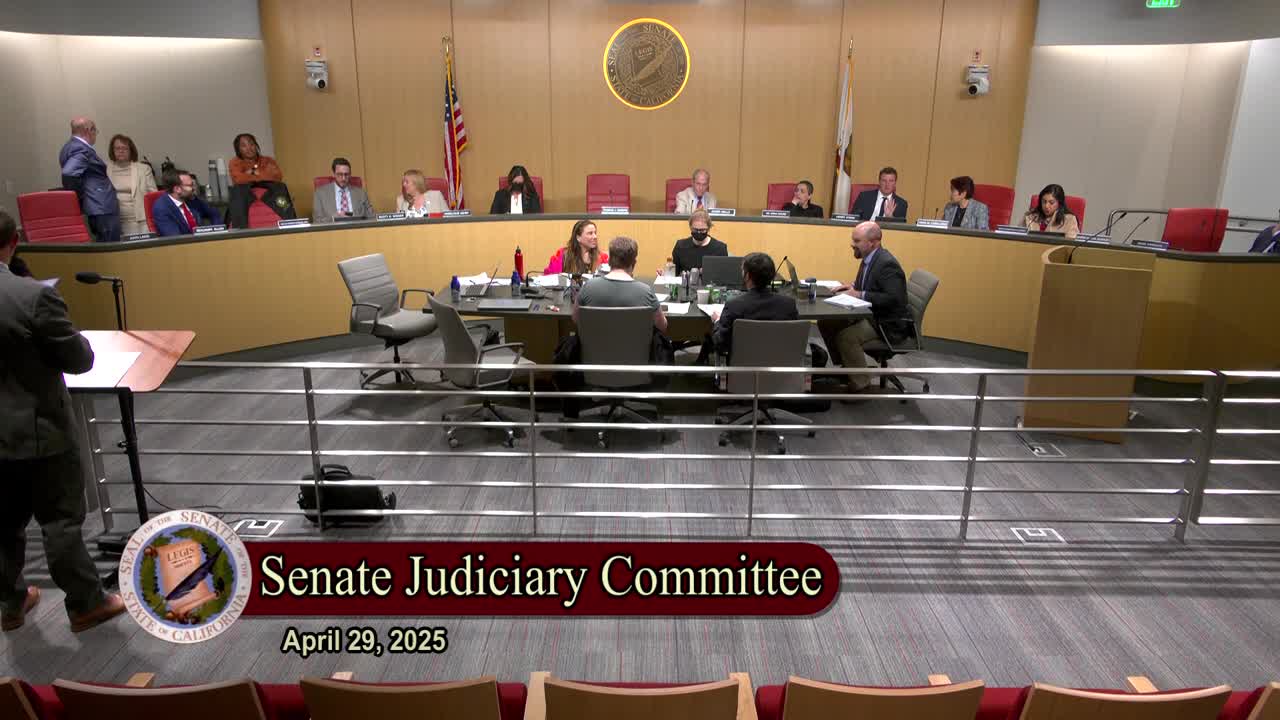 12MIN
Senate Standing Committee on Judiciary
 15MIN
Senate Standing Committee on Public Safety
Bill Author

Bill Co-Author(s):