SB 294: Health care coverage: independent medical review.
- Session Year: 2023-2024
- House: Senate
- Latest Version Date: 2024-05-24
Current Status:
Failed
(2024-08-15: August 15 hearing: Held in committee and under submission.)
Introduced
In Committee
First Chamber
In Committee
Second Chamber
Enacted
Existing law, the Knox-Keene Health Care Service Plan Act of 1975, provides for the licensure and regulation of health care service plans by the Department of Managed Health Care, and makes a willful violation of the act a crime. Existing law provides for the regulation of disability insurers by the Department of Insurance. Existing law establishes the Independent Medical Review System within each department, under which an enrollee or insured may seek review if a health care service has been denied, modified, or delayed by a health care service plan or disability insurer and the enrollee or insured has previously filed a grievance that remains unresolved after 30 days.
This bill, commencing July 1, 2025, January 1, 2026, would require a health care service plan or a disability insurer that upholds its decision to modify, delay, or deny a health care service in response to a grievance or has a grievance that is otherwise pending or unresolved upon expiration of the relevant timeframe to automatically submit within 24 hours a decision regarding a disputed health care service to the Independent Medical Review System, as well as the information that informed its decision, if the decision is to deny, modify, or delay specified services relating to mental health or substance use disorder conditions for an enrollee or insured up to 26 years of age. The bill would require a health care service plan or disability insurer, within 24 hours after submitting its decision to the Independent Medical Review System to provide notice to the appropriate department, the enrollee or insured or their representative, if any, and the enrollees or insureds provider. The bill would require the notice to include notification to the enrollee or insured that they or their representative may cancel the independent medical review at any time before a determination, as specified.
This bill, commencing July 1, 2025, January 1, 2026, would require a health care service plan or disability insurer that provides coverage for mental health or substance use disorders to treat a modification, delay, or denial issued in response to an authorization request for coverage of treatment for a mental health or substance use disorder for an insured up to 26 years of age as if the modification, delay, or denial is also a grievance submitted by the enrollee or insured. The bill would require a plan or insurer to provide a written acknowledgment of a grievance that is automatically generated and would specify the circumstances under which that grievance is required to be submitted automatically to independent medical review.
The bill would apply specified existing provisions relating to mental health and substance use disorders for purposes of its provisions, and would be subject to relevant provisions relating to the Independent Medical Review System that do not otherwise conflict with the express requirements of the bill. With respect to health care service plans, the bill would specify that its provisions do not apply to Medi-Cal managed care plan contracts. The bill would authorize the Director of Managed Health Care and the Insurance Commissioner to promulgate regulations subject to the Administrative Procedure Act to implement and enforce the bill, and to issue interim guidance, as specified.
Because a willful violation of this provision by a health care service plan would be a crime, the bill would impose a state-mandated local program.
The California Constitution requires the state to reimburse local agencies and school districts for certain costs mandated by the state. Statutory provisions establish procedures for making that reimbursement.
This bill would provide that no reimbursement is required by this act for a specified reason.
Existing law, the Knox-Keene Health Care Service Plan Act of 1975, provides for the licensure and regulation of health care service plans by the Department of Managed Health Care, and makes a willful violation of the act a crime. Existing law provides for the regulation of disability insurers by the Department of Insurance. Existing law establishes the Independent Medical Review System within each department, under which an enrollee or insured may seek review if a health care service has been denied, modified, or delayed by a health care service plan or disability insurer and the enrollee or insured has previously filed a grievance that remains unresolved after 30 days.
This bill, commencing July 1, 2025, would require a health care service plan or a disability insurer that upholds its decision to modify, delay, or deny a health care service in response to a grievance or has a grievance that is otherwise pending or unresolved upon expiration of the relevant timeframe to automatically submit within 24 hours a decision regarding a disputed health care service to the Independent Medical Review System, as well as the information that informed its decision, if the decision is to deny, modify, or delay specified services relating to mental health or substance use disorder conditions for an enrollee or insured up to 26 years of age. The bill would require a health care service plan or disability insurer, within 24 hours after submitting its decision to the Independent Medical Review System to provide notice to the appropriate department, the enrollee or insured or their representative, if any, and the enrollees or insureds provider. The bill would require the notice to include notification to the enrollee or insured that they or their representative may cancel the independent medical review at any time before a determination, as specified.
This bill, commencing July 1, 2025, would require a health care service plan or disability insurer that provides treatment coverage for mental health or substance use disorders to treat a modification, delay, or denial issued in response to an authorization request for coverage of treatment for a mental health or substance use disorder for an insured up to 26 years of age as if the modification, delay, or denial is also a grievance submitted by the enrollee or insured. The bill would require a plan or insurer to provide a written acknowledgment of a grievance that is automatically generated and would specify the circumstances under which that grievance is required to be submitted automatically to independent medical review.
The bill would apply specified existing provisions relating to mental health and substance use disorders for purposes of its provisions, and would be subject to relevant provisions relating to the Independent Medical Review System that do not otherwise conflict with the express requirements of the bill. With respect to health care service plans, the bill would specify that its provisions do not apply to Medi-Cal managed care plan contracts.
Because a willful violation of this provision by a health care service plan would be a crime, the bill would impose a state-mandated local program.
The California Constitution requires the state to reimburse local agencies and school districts for certain costs mandated by the state. Statutory provisions establish procedures for making that reimbursement.
This bill would provide that no reimbursement is required by this act for a specified reason.
Existing law, the Knox-Keene Health Care Service Plan Act of 1975, provides for the licensure and regulation of health care service plans by the Department of Managed Health Care, and makes a willful violation of the act a crime. Existing law provides for the regulation of disability insurers by the Department of Insurance. Existing law establishes the Independent Medical Review System within each department, under which an enrollee or insured may seek review if a health care service has been denied, modified, or delayed by a health care service plan or disability insurer and the enrollee or insured has previously filed a grievance that remains unresolved after 30 days.
This bill, commencing July 1, 2025, would require a health care service plan or a disability insurer that upholds its decision to modify, delay, or deny a health care service in response to a grievance or has a grievance that is otherwise pending or unresolved upon expiration of the relevant timeframe to automatically submit within 24 hours a decision regarding a disputed health care service to the Independent Medical Review System, as well as the information that informed its decision, if the decision is to deny, modify, or delay specified services relating to mental health or substance use disorder conditions for an enrollee or insured up to 26 years of age. The bill would require a health care service plan or disability insurer, within 24 hours after submitting its decision to the Independent Medical Review System to provide notice to the appropriate department, the enrollee or insured or their representative, if any, and the enrollees or insureds provider. The bill would require the notice to include notification to the enrollee or insured that they or their representative may cancel the independent medical review at any time before a determination, as specified.
This bill, commencing July 1, 2025, would require a health care service plan or disability insurer that provides treatment for mental health or substance use disorders to treat a modification, delay, or denial issued in response to an authorization request for coverage of treatment for a mental health or substance use disorder for an insured up to 26 years of age as if the modification, delay, or denial is also a grievance submitted by the enrollee or insured. The bill would require a plan or insurer to provide a written acknowledgment of a grievance that is automatically generated and would specify the circumstances under which that grievance is required to be submitted automatically to independent medical review.
The bill would apply specified existing provisions relating to mental health and substance use disorders for purposes of its provisions, and would be subject to relevant provisions relating to the Independent Medical Review System that do not otherwise conflict with the express requirements of the bill. With respect to health care service plans, the bill would specify that its provisions do not apply to Medi-Cal managed care plan contracts.
Because a willful violation of this provision by a health care service plan would be a crime, the bill would impose a state-mandated local program.
The California Constitution requires the state to reimburse local agencies and school districts for certain costs mandated by the state. Statutory provisions establish procedures for making that reimbursement.
This bill would provide that no reimbursement is required by this act for a specified reason.
Existing law requires the Secretary of Government Operations to develop a coordinated plan to, among other things, investigate the feasibility of, and obstacles to, developing standards and technologies for state departments to determine digital content provenance. For the purpose of informing that coordinated plan, existing law requires the secretary to evaluate, among other things, the impact of the proliferation of deepfakes, defined to mean audio or visual content that has been generated or manipulated by artificial intelligence that would falsely appear to be authentic or truthful and that features depictions of people appearing to say or do things they did not say or do without their consent, on state government, California-based businesses, and residents of the state.This bill would express the intent of the Legislature to enact legislation related to artificial intelligence that would relate to, among other things, establishing standards and requirements for the safe development, secure deployment, and responsible scaling of frontier AI models in the California market by, among other things, establishing a framework of disclosure requirements for AI models, as specified.Existing law requires the Secretary of Government Operations to develop a coordinated plan to, among other things, investigate the feasibility of, and obstacles to, developing standards and technologies for state departments to determine digital content provenance. For the purpose of informing that coordinated plan, existing law requires the secretary to evaluate, among other things, the impact of the proliferation of deepfakes, defined to mean audio or visual content that has been generated or manipulated by artificial intelligence that would falsely appear to be authentic or truthful and that features depictions of people appearing to say or do things they did not say or do without their consent, on state government, California-based businesses, and residents of the state.
This bill would express the intent of the Legislature to enact legislation related to artificial intelligence that would relate to, among other things, establishing standards and requirements for the safe development, secure deployment, and responsible scaling of frontier AI models in the California market by, among other things, establishing a framework of disclosure requirements for AI models, as specified.
The Planning and Zoning Law requires a city or county to adopt a general plan for land use development within its boundaries that includes, among other things, a housing element. Existing law prohibits a local agency, as defined, from imposing a floor area ratio standard that is less than 1.0 on a housing development project that consists of 3 to 7 units, or less than 1.25 on a housing development project that consists of 8 to 10 units. Existing law prohibits a local agency from imposing a lot coverage requirement that would physically preclude a housing development project of not more than 10 units from achieving the floor area ratios described above.This bill would delete the 10-unit maximum for eligible projects, and would prohibit a local agency from imposing a floor area ratio standard that is less than 2.5 on a housing development project that consists of 11 to 20 units. The bill would prohibit a local agency from imposing a floor area ratio standard that is less than 1.25 for every ten housing units, rounded to the nearest ten units, on a housing development project that consists of more than 20 units. By imposing new duties on local governments reviewing these housing development projects, the bill would impose a state-mandated local program.The California Constitution requires the state to reimburse local agencies and school districts for certain costs mandated by the state. Statutory provisions establish procedures for making that reimbursement.This bill would provide that no reimbursement is required by this act for a specified reason.The Planning and Zoning Law requires a city or county to adopt a general plan for land use development within its boundaries that includes, among other things, a housing element. Existing law prohibits a local agency, as defined, from imposing a floor area ratio standard that is less than 1.0 on a housing development project that consists of 3 to 7 units, or less than 1.25 on a housing development project that consists of 8 to 10 units. Existing law prohibits a local agency from imposing a lot coverage requirement that would physically preclude a housing development project of not more than 10 units from achieving the floor area ratios described above.
This bill would delete the 10-unit maximum for eligible projects, and would prohibit a local agency from imposing a floor area ratio standard that is less than 2.5 on a housing development project that consists of 11 to 20 units. The bill would prohibit a local agency from imposing a floor area ratio standard that is less than 1.25 for every ten housing units, rounded to the nearest ten units, on a housing development project that consists of more than 20 units. By imposing new duties on local governments reviewing these housing development projects, the bill would impose a state-mandated local program.
The California Constitution requires the state to reimburse local agencies and school districts for certain costs mandated by the state. Statutory provisions establish procedures for making that reimbursement.
This bill would provide that no reimbursement is required by this act for a specified reason.
The Legislature finds and declares all of the following:
(a)Disputed health care service decisions under commercial health care coverage are already subject to review like the states Independent Medical Review System, but appeals must be initiated by enrollees and insureds.
(b)Mental health resources in California are disproportionately hard to access for low-income and minority children, and the online form to file an independent medical review is in English and Spanish only.
(c)The Legislature recently approved Chapter 151 of the Statutes of 2020, a mental health parity law that requires commercial health care service plan contracts and disability insurance policies to provide medically necessary mental health treatment.
(d)In California, 13 percent of children 3 to 17 years of age, inclusive, reported having at least one mental, emotional, developmental, or behavioral health problem, and 8 percent of children have a serious emotional disturbance that limits participation in daily activity.
(e)In 2021, mental health disorder diagnosis cases made up 48 percent of all total youth independent medical reviews, up from 36 percent in 2017.
(f)Since 2017, the percentage of health care service plan and disability insurer decisions about youth mental health disorders that were overturned by the Independent Medical Review System has more than doubled to 79 percent.
(g)Like older adults, children and youth represent a vulnerable population. However, children and youth covered by commercial health care coverage do not have the protections afforded by Medicare procedures. If a Medicare Advantage (Part C) health plan upholds its initial adverse organization determination to deny a drug or service, the plan must automatically submit the case file and its decision for review by the Part C Independent Review Entity.
SEC. 2.Section 1368.012 is added to the Health and Safety Code, to read:1368.012.(a)Commencing July 1, 2025, January 1, 2026, a health care service plan that provides coverage for mental health or substance use disorders pursuant to Section 1374.72 shall treat a modification, delay, or denial issued in response to an authorization request for coverage of treatment for a mental health or substance use disorder for an enrollee up to 26 years of age as if the modification, delay, or denial is also a grievance submitted by the enrollee in accordance with Sections 1368, 1368.01, and 1368.015.
(b)(1)A grievance automatically generated pursuant to subdivision (a) shall be treated by the plan and the department in the same manner as a grievance seeking to appeal the decision of the health care service plan to modify, delay, or deny the requested treatment for the enrollee, and shall be considered to have been submitted by the enrollee or the enrollees representative to the plan on the same date as the decision to modify, delay, or deny the requested treatment is issued by the plan. The plan shall not require the enrollee or the enrollees representative to take any additional action to initiate or continue the grievance processing procedure.
(2)The plan shall provide a written acknowledgment of the grievance generated pursuant to subdivision (a) as required pursuant to paragraph (4) of subdivision (a) of Section 1368 concurrent with the notification to the enrollee of the decision to modify, delay, or deny the requested treatment. The acknowledgment shall include an explanation of the grievance process and relevant timeframes for completion, criteria under subdivision (c) of Section 1374.33 for treatment of a grievance as an expedited case, including whether the present grievance is to be processed on an expedited basis and automatically submitted to the independent medical review system under Section 1374.37, contact information for the plan, including a telephone number through which the enrollee may receive a status update on the grievance or withdraw the automatically generated grievance, and contact information for the department.
(c)The acknowledgment described in subdivision (b) shall include a statement that the enrollee may choose to withdraw the automatically generated grievance. A withdrawal by the enrollee or their representative of a grievance automatically generated pursuant to this section before the health care service plans determination on the grievance shall not, by itself, disqualify the enrollee or their representative from later submitting a grievance related to the same underlying modification, delay, or denial of the requested mental health or substance use disorder treatment.
(d)Grievances automatically generated pursuant to subdivision (a) that are pending or unresolved upon expiration of the relevant timeframe specified in Sections 1368.01 and 1374.30 or for which the health care service plan upholds its decision to modify, delay, or deny the requested treatment are subject to automatic submission to independent medical review pursuant to Section 1374.37.
(e)This section does not apply to Medi-Cal managed care plan contracts entered into with the State Department of Health Care Services pursuant to Chapter 7 (commencing with Section 14000) or Chapter 8 (commencing with Section 14200) of Part 3 of Division 9 of the Welfare and Institutions Code.
(f)The director may issue instructions to health care service plans regarding compliance with this section, including the required contents of the acknowledgment to be provided to enrollees pursuant to subdivision (b). These instructions shall not be subject to the Administrative Procedure Act (Chapter 3.5 (commencing with Section 11340) of Part 1 of Division 3 of Title 2 of the Government Code). Instructions issued pursuant to this subdivision shall be effective only until the director adopts regulations pursuant to the Administrative Procedure Act, which shall be no later than January 1, 2027.
SEC. 3.Section 1374.37 is added to the Health and Safety Code, to read:1374.37.(a)(1)Commencing July 1, 2025, January 1, 2026, a health care service plan that, itself or through its delegates, upholds its decision, in whole or in part, to modify, delay, or deny a health care service in response to a grievance submitted by an enrollee or processed pursuant to Section 1368.012, or has a grievance that is otherwise pending or unresolved upon expiration of the relevant timeframe specified in Sections 1368.01 and 1374.30, shall automatically submit within 24 hours a decision regarding a disputed health care service to the Independent Medical Review System and all information that informed the health care service plans conclusion if the health care service plans decision is to deny, modify, or delay either of the following with respect to an enrollee up to 26 years of age:
(A)A mental health care or substance use disorder service based on the lack of medical necessity of the requested covered health care service, in whole or in part.
(B)The use of experimental or investigational therapies, drugs, devices, procedures, or other therapies, if the enrollee has a seriously debilitating or life-threatening mental health or substance use disorder condition, as defined in Section 1370.4. The independent medical review for experimental or investigational therapies, drugs, devices, procedures, or other therapies shall be consistent with Section 1370.4.
(2)An independent medical review required under this subdivision is subject to any relevant provisions of this article that do not otherwise conflict with the express requirements of this section, including notice requirements, the assessment fee system under Section 1374.35, and provisions regarding the departments authority to determine the nature of a grievance as a matter of coverage or medical necessity, in whole or in part.
(3)The requirement that an enrollee complete the health care service plan grievance process before automatic submission of a decision to the Independent Medical Review System pursuant to paragraph (1) shall not apply to cases involving an imminent and serious threat to the health of the enrollee, as described in subparagraph (A) of paragraph (1) of subdivision (b) of Section 1368. In those circumstances, the health care service plan shall immediately submit the case to the Independent Medical Review System and coordinate with the enrollee or the enrollees representative on the submission of all information and documentation required by the department to process the expedited independent medical review.
(b)(1)Within 24 hours after submitting its decision to the Independent Medical Review System pursuant to subdivision (a), the health care service plan shall provide notice to the department, the enrollee, the enrollees representative, if any, and the enrollees provider. The notice shall include both of the following:
(A)Notification to the enrollee that the enrollee or their representative may cancel the independent medical review at any time before the rendering of a determination and may provide additional information or documentation as described in paragraph (3) of subdivision (m) of Section 1374.30.
(B)Instructions for canceling the independent medical review and submitting additional information or documentation.
(C)The departments application for independent medical review.
(D)Any other content that is required by the department.
(2)Concurrent with the notice specified in paragraph (1), the health care service plan shall provide the enrollee and the enrollees provider with copies of all documents described in subdivision (n) of Section 1374.30. The health care service plan shall coordinate with the enrollee and provider for the completion of a signed independent medical review application that includes consent to release medical records and, if necessary, an authorized representative form.
(3)The department may close independent medical review cases submitted automatically pursuant to this section if the enrollee or authorized representative fails to complete an independent medical review application within 30 days of the department notifying the enrollee or authorized representative and provider of the incomplete application.
(c)Sections 1374.72, 1374.721, 1374.724, and 1374.73 apply for purposes of this section.
(d)If an enrollee or their representative cancels the independent medical review consistent with this section, they may seek an independent medical review consistent with Section 1370.4 or this article.
(e)This section does not apply to Medi-Cal managed care plan contracts entered into with the State Department of Health Care Services pursuant to Chapter 7 (commencing with Section 14000) or Chapter 8 (commencing with Section 14200) of Part 3 of Division 9 of the Welfare and Institutions Code.
(f)The director may issue instructions to health care service plans regarding compliance with this section, including the required contents of the notice to be provided to enrollees pursuant to subdivision (b) and requirements on the submission of medical records and other information by health care service plans when automatically submitting a decision to the Independent Medical Review System pursuant to subdivision (a). These instructions shall not be subject to the Administrative Procedure Act (Chapter 3.5 (commencing with Section 11340) of Part 1 of Division 3 of Title 2 of the Government Code). Instructions issued pursuant to this subdivision shall be effective only until the director adopts regulations pursuant to the Administrative Procedure Act, which shall be no later than January 1, 2027.
(f)(g)The department shall provide a quarterly public report on the number of automatic independent medical review cases that are received, the number of automatic independent medical review cases that are resolved, the outcome of resolved cases, and the number of automatic independent medical review cases that are canceled and closed.
SEC. 4.Section 10169.4 is added to the Insurance Code, to read:10169.4.(a)Commencing July 1, 2025, January 1, 2026, a disability insurer that provides coverage for mental health or substance use disorders pursuant to Section 10144.5 shall treat a modification, delay, or denial issued in response to an authorization request for coverage of treatment for a mental health or substance use disorder for an insured up to 26 years of age as if the modification, delay, or denial is also a grievance submitted by the insured in accordance with this article.
(b)(1)A grievance automatically generated pursuant to subdivision (a) shall be treated by the insurer and the department in the same manner as a grievance seeking to appeal the decision of the disability insurer to modify, delay, or deny the requested treatment for the insured, and shall be considered to have been submitted by the insured or the insureds representative to the insurer on the same date as the decision to modify, delay, or deny the requested treatment is issued by the insurer. The insurer shall not require the insured or the insureds representative to take any additional action to initiate or continue the grievance processing procedure.
(2)The insurer shall provide a written acknowledgment of the grievance generated pursuant to subdivision (a) concurrent with the notification to the insured under subdivision (h) of Section 10123.135 of the decision to modify, delay, or deny the requested treatment. The acknowledgment shall include an explanation of the grievance process and relevant timeframes for completion, criteria under subdivision (c) of Section 10169.3 for treatment of a grievance as an expedited case, including whether the present grievance is to be processed on an expedited basis and automatically submitted to the Independent Medical Review System under Section 10169.6, contact information for the insurer, including a telephone number through which the insured may receive a status update on the grievance or withdraw the automatically generated grievance, and contact information for the department.
(c)The acknowledgment described in subdivision (b) shall include a statement that the insured may choose to withdraw the automatically generated grievance. A withdrawal by the insured or their representative of a grievance automatically generated pursuant to this section before the disability insurers determination on the grievance shall not, by itself, disqualify the insured or their representative from later submitting a grievance related to the same underlying modification, delay, or denial of the requested mental health or substance use disorder treatment.
(d)Grievances automatically generated pursuant to subdivision (a) that are pending or unresolved upon expiration of the relevant timeframe specified in Section 10169 or for which the disability insurer upholds its decision to modify, delay, or deny the requested treatment are subject to automatic submission to independent medical review pursuant to Section 10169.6.
(e)The commissioner may issue instructions to disability insurers regarding compliance with this section, including the required contents of the acknowledgment to be provided to insureds pursuant to subdivision (b). These instructions shall not be subject to the Administrative Procedure Act (Chapter 3.5 (commencing with Section 11340) of Part 1 of Division 3 of Title 2 of the Government Code). Instructions issued pursuant to this subdivision shall be effective only until the department adopts regulations pursuant to the Administrative Procedure Act, which shall be no later than January 1, 2027.
SEC. 5.Section 10169.6 is added to the Insurance Code, immediately following Section 10169.5, to read:10169.6.(a)(1)Commencing July 1, 2025, January 1, 2026, a disability insurer that, itself or through its delegates, upholds its decision, in whole or in part, to modify, delay, or deny a health care service in response to a grievance submitted by an insured or processed pursuant to Section 10169.4, or has a grievance that is otherwise pending or unresolved upon expiration of the relevant timeframe specified in Section 10169, shall automatically submit within 24 hours a decision regarding a disputed health care service to the Independent Medical Review System and all information that informed the disability insurers conclusion if the disability insurers decision is to deny, modify, or delay either of the following with respect to an insured up to 26 years of age:
(A)A mental health care or substance use disorder service based on the lack of medical necessity of the requested covered health care service, in whole or in part.
(B)The use of experimental or investigational therapies, drugs, devices, procedures, or other therapies, if the insured has a seriously debilitating or life-threatening mental health or substance use disorder condition, as defined in Section 10145.3. The independent medical review for experimental or investigational therapies, drugs, devices, procedures, or other therapies shall be consistent with Section 10145.3.
(2)An independent medical review required under this subdivision is subject to any relevant provisions of this article that do not otherwise conflict with the express requirements of this section, including notice requirements, the assessment fee system under Section 10169.5, and provisions regarding the departments authority to determine the nature of a grievance as a matter of coverage or medical necessity, in whole or in part.
(3)The requirement that an insured complete the disability insurer grievance process before automatic submission of a decision to the Independent Medical Review System pursuant to paragraph (1) shall not apply to cases involving an imminent and serious threat to the health of the insured, as described in subdivision (c) of Section 10169.3. In those circumstances, the disability insurer shall immediately submit the case to the Independent Medical Review System and coordinate with the insured or the insureds representative on the submission of all information and documentation required by the department to process the expedited independent medical review.
(b)(1)Within 24 hours after submitting its decision to the Independent Medical Review System pursuant to subdivision (a), the disability insurer shall provide notice to the department, the insured, the insureds representative, if any, and the insureds provider. The notice shall include both of the following:
(A)Notification to the insured that the insured or their representative may cancel the independent medical review at any time before the rendering of a determination and may provide additional information or documentation as described in paragraph (3) of subdivision (m) of Section 10169.
(B)Instructions for canceling the independent medical review and submitting additional information or documentation.
(C)The departments application for independent medical review.
(D)Any other content that is required by the department.
(2)Concurrent with the notice specified in paragraph (1), the disability insurer shall provide the insured and the insureds provider with copies of all documents described in subdivision (n) of Section 10169. The insurer shall coordinate with the insured and provider for the completion of a signed independent medical review application that includes consent to release medical records and, if necessary, an authorized representative form.
(3)The department may close independent medical review cases submitted automatically pursuant to this section if the insured or authorized representative fails to complete an independent medical review application within 30 days of the department notifying the insured or authorized representative and provider of the incomplete application.
(c)Sections 10144.5, 10144.51, 10144.52, and 10144.57 apply for purposes of this section.
(d)If an insured or their representative cancels the independent medical review consistent with this section, they may seek an independent medical review consistent with Section 10145.3 or this article.
(e)(1)The commissioner may issue guidance regarding compliance with this section, no later than January 1, 2027. The guidance shall not be subject to the Administrative Procedure Act (Chapter 3.5 (commencing with Section 11340) of Part 1 of Division 3 of Title 2 of the Government Code). Guidance issued pursuant to this paragraph shall remain in effect until the commissioner promulgates regulations pursuant to paragraph (2).
(e)(2)The commissioner may promulgate regulations subject to the Administrative Procedure Act (Chapter 3.5 (commencing with Section 11340) of Part 1 of Division 3 of Title 2 of the Government Code) to implement and enforce this section and Section 10169.4. section.
(f)The department shall provide a quarterly public report on the number of automatic independent medical review cases that are received, the number of automatic independent medical review cases that are resolved, the outcome of resolved cases, and the number of automatic independent medical review cases that are canceled and closed.
SEC. 6.No reimbursement is required by this act pursuant to Section 6 of Article XIIIB of the California Constitution because the only costs that may be incurred by a local agency or school district will be incurred because this act creates a new crime or infraction, eliminates a crime or infraction, or changes the penalty for a crime or infraction, within the meaning of Section 17556 of the Government Code, or changes the definition of a crime within the meaning of Section 6 of Article XIIIB of the California Constitution.
The Legislature finds and declares all of the following:
(a)Disputed health care service decisions under commercial health care coverage are already subject to review like the states Independent Medical Review System, but appeals must be initiated by enrollees and insureds.
(b)Mental health resources in California are disproportionately hard to access for low-income and minority children, and the online form to file an independent medical review is in English and Spanish only.
(c)The Legislature recently approved Chapter 151 of the Statutes of 2020, a mental health parity law that requires commercial health care service plan contracts and disability insurance policies to provide medically necessary mental health treatment.
(d)In California, 13 percent of children 3 to 17 years of age, inclusive, reported having at least one mental, emotional, developmental, or behavioral health problem, and 8 percent of children have a serious emotional disturbance that limits participation in daily activity.
(e)In 2021, mental health disorder diagnosis cases made up 48 percent of all total youth independent medical reviews, up from 36 percent in 2017.
(f)Since 2017, the percentage of health care service plan and disability insurer decisions about youth mental health disorders that were overturned by the Independent Medical Review System has more than doubled to 79 percent.
(g)Like older adults, children and youth represent a vulnerable population. However, children and youth covered by commercial health care coverage do not have the protections afforded by Medicare procedures. If a Medicare Advantage (Part C) health plan upholds its initial adverse organization determination to deny a drug or service, the plan must automatically submit the case file and its decision for review by the Part C Independent Review Entity.
SEC. 2.Section 1368.012 is added to the Health and Safety Code, to read:1368.012.(a)Commencing July 1, 2025, a health care service plan that provides treatment coverage for mental health or substance use disorders pursuant to Section 1374.72 shall treat a modification, delay, or denial issued in response to an authorization request for coverage of treatment for a mental health or substance use disorder for an enrollee up to 26 years of age as if the modification, delay, or denial is also a grievance submitted by the enrollee in accordance with Sections 1368, 1368.01, and 1368.015.
(b)(1)A grievance automatically generated pursuant to subdivision (a) shall be treated by the plan and the department in the same manner as a grievance seeking to appeal the decision of the health care service plan to modify, delay, or deny the requested treatment for the enrollee, and shall be considered to have been submitted by the enrollee or the enrollees representative to the plan on the same date as the decision to modify, delay, or deny the requested treatment is issued by the plan. The plan shall not require the enrollee or the enrollees representative to take any additional action to initiate or continue the grievance processing procedure. The
(2)The plan shall provide the a written acknowledgment of the grievance generated pursuant to subdivision (a) as required pursuant to paragraph (4) of subdivision (a) of Section 1368 concurrent with the notification to the enrollee of the decision to modify, delay, or deny the requested treatment. The acknowledgment shall include an explanation of the grievance process and relevant timeframes for completion, criteria under subdivision (c) of Section 1374.33 for treatment of a grievance as an expedited case, including whether the present grievance is to be processed on an expedited basis, basis and automatically submitted to the independent medical review system under Section 1374.37, contact information for the plan, including a telephone number through which the enrollee may receive a status update on the grievance or withdraw the automatically generated grievance, and contact information for the department.
(c)The acknowledgment described in subdivision (b) shall include a statement that the enrollee may choose to withdraw the automatically generated grievance. A withdrawal by the enrollee or their representative of a grievance automatically generated pursuant to this section before the health care service plans determination on the grievance shall not, by itself, disqualify the enrollee or their representative from later submitting a grievance related to the same underlying modification, delay, or denial of the requested mental health or substance use disorder treatment.
(d)Grievances automatically generated pursuant to subdivision (a) that are pending or unresolved upon expiration of the relevant timeframe specified in Sections 1368.01 and 1374.30 or for which the health care service plan upholds its decision to modify, delay, or deny the requested treatment are subject to automatic submission to independent medical review pursuant to Section 1374.37.
(e)This section does not apply to Medi-Cal managed care plan contracts entered into with the State Department of Health Care Services pursuant to Chapter 7 (commencing with Section 14000) or Chapter 8 (commencing with Section 14200) of Part 3 of Division 9 of the Welfare and Institutions Code.
SEC. 3.Section 1374.37 is added to the Health and Safety Code, to read:1374.37.(a)(1)Commencing July 1, 2025, a health care service plan that, itself or through its delegates, upholds its decision, in whole or in part, to modify, delay, or deny a health care service in response to a grievance submitted by an enrollee or processed pursuant to Section 1368.012, or has a grievance that is otherwise pending or unresolved upon expiration of the relevant timeframe specified in Sections 1368.01 and 1374.30, shall automatically submit within 24 hours a decision regarding a disputed health care service to the Independent Medical Review System and all information that informed the health care service plans conclusion if the health care service plans decision is to deny, modify, or delay either of the following with respect to an enrollee up to 26 years of age:
(A)A mental health care or substance use disorder service based on the lack of medical necessity of the requested covered health care service, in whole or in part.
(B)The use of experimental or investigational therapies, drugs, devices, procedures, or other therapies, if the enrollee has a seriously debilitating or life-threatening mental health or substance use disorder condition, as defined in Section 1370.4. The independent medical review for experimental or investigational therapies, drugs, devices, procedures, or other therapies shall be consistent with Section 1370.4.
(2)An independent medical review required under this subdivision is subject to any relevant provisions of this article that do not otherwise conflict with the express requirements of this section, including notice requirements requirements, the assessment fee system under Section 1374.35, and provisions regarding the departments authority to determine the nature of a grievance as a matter of coverage or medical necessity, in whole or in part.
(3)The requirement that an enrollee complete the health care service plan grievance process before automatic submission of a decision to the Independent Medical Review System pursuant to paragraph (1) shall not apply to cases involving an imminent and serious threat to the health of the patient, enrollee, as described in subparagraph (A) of paragraph (1) of subdivision (b) of Section 1368. In those circumstances, the health care service plan shall immediately submit the case to the Independent Medical Review System and coordinate with the enrollee or the enrollees representative on the submission of all information and documentation required by the department to process the expedited independent medical review.
(b)(1)Within 24 hours after submitting its decision to the Independent Medical Review System pursuant to subdivision (a), the health care service plan shall provide notice to the department, the enrollee, the enrollees representative, if any, and the enrollees provider. The notice shall include both of the following:
(A)Notification to the enrollee that the enrollee or their representative may cancel the independent medical review at any time before the rendering of a determination and may provide additional information or documentation as described in paragraph (3) of subdivision (m) of Section 1374.30.
(B)Instructions for canceling the independent medical review and submitting additional information or documentation.
(C)The departments application for independent medical review.
(D)Any other content that is required by the department.
(2)Concurrent with the notice specified in paragraph (1), the health care service plan shall provide the enrollee and the enrollees provider with copies of all documents described in subdivision (n) of Section 1374.30. The health care service plan shall coordinate with the enrollee and provider for the completion of a signed independent medical review application that includes consent to release medical records and, if necessary, an authorized assistant representative form.
(3)The department may close independent medical review cases submitted automatically pursuant to this section if the enrollee or authorized assistant representative fails to complete an independent medical review application within 30 days of the department notifying the enrollee or authorized assistant representative and provider of the incomplete application.
(c)Sections 1374.72, 1374.721, 1374.724, and 1374.73 apply for purposes of this section.
(d)If an enrollee or their representative cancels the independent medical review consistent with this section, they may seek an independent medical review consistent with Section 1370.4 or this article.
(e)This section does not apply to Medi-Cal managed care plan contracts entered into with the State Department of Health Care Services pursuant to Chapter 7 (commencing with Section 14000) or Chapter 8 (commencing with Section 14200) of Part 3 of Division 9 of the Welfare and Institutions Code.
(f)The department shall provide a quarterly public report on the number of automatic grievance cases, independent medical review cases that are received, the number of automatic grievance cases resolved and closed, and the number of Independent Medical Review applications sent from the Department of Managed Health Care and returned to the Department of Managed Health Care. independent medical review cases that are resolved, the outcome of resolved cases, and the number of automatic independent medical review cases that are canceled and closed.
SEC. 4.Section 10169.4 is added to the Insurance Code, to read:10169.4.(a)Commencing July 1, 2025, a disability insurer that provides treatment coverage for mental health or substance use disorders pursuant to Section 1374.72 10144.5 shall treat a modification, delay, or denial issued in response to an authorization request for coverage of treatment for a mental health or substance use disorder for an insured up to 26 years of age as if the modification, delay, or denial is also a grievance submitted by the insured in accordance with this article.
(b)(1)A grievance automatically generated pursuant to subdivision (a) shall be treated by the insurer and the department in the same manner as a grievance seeking to appeal the decision of the disability insurer to modify, delay, or deny the requested treatment for the insured, and shall be considered to have been submitted by the insured or the insureds representative to the insurer on the same date as the decision to modify, delay, or deny the requested treatment is issued by the insurer. The insurer shall not require the insured or the insureds representative to take any additional action to initiate or continue the grievance processing procedure. The
(2)The insurer shall provide the a written acknowledgment of the grievance generated pursuant to subdivision (a) concurrent with the notification to the insured under subdivision (h) of Section 10123.135 of the decision to modify, delay, or deny the requested treatment. The acknowledgment shall include an explanation of the grievance process and relevant timeframes for completion, criteria under subdivision (c) of Section 10169.3 for treatment of a grievance as an expedited case, including whether the present grievance is to be processed on an expedited basis, basis and automatically submitted to the Independent Medical Review System under Section 10169.6, contact information for the insurer, including a telephone number through which the insured may receive a status update on the grievance or withdraw the automatically generated grievance, and contact information for the department.
(c)The acknowledgment described in subdivision (b) shall include a statement that the insured may choose to withdraw the automatically generated grievance. A withdrawal by the insured or their representative of a grievance automatically generated pursuant to this section before the disability insurers determination on the grievance shall not, by itself, disqualify the insured or their representative from later submitting a grievance related to the same underlying modification, delay, or denial of the requested mental health or substance use disorder treatment.
(d)Grievances automatically generated pursuant to subdivision (a) that are pending or unresolved upon expiration of the relevant timeframe specified in Section 10169 or for which the disability insurer upholds its decision to modify, delay, or deny the requested treatment are subject to automatic submission to independent medical review pursuant to Section 10169.6.
SEC. 5.Section 10169.6 is added to the Insurance Code, immediately following Section 10169.5, to read:10169.6.(a)(1)Commencing July 1, 2025, a disability insurer that, itself or through its delegates, upholds its decision, in whole or in part, to modify, delay, or deny a health care service in response to a grievance submitted by an insured or processed pursuant to Section 10169.4, or has a grievance that is otherwise pending or unresolved upon expiration of the relevant timeframe specified in Section 10169, shall automatically submit within 24 hours a decision regarding a disputed health care service to the Independent Medical Review System and all information that informed the disability insurers conclusion if the disability insurers decision is to deny, modify, or delay either of the following with respect to an insured up to 26 years of age:
(A)A mental health care or substance use disorder service based on the lack of medical necessity of the requested covered health care service, in whole or in part.
(B)The use of experimental or investigational therapies, drugs, devices, procedures, or other therapies, if the insured has a seriously debilitating or life-threatening mental health or substance use disorder condition, as defined in Section 10145.3. The independent medical review for experimental or investigational therapies, drugs, devices, procedures, or other therapies shall be consistent with Section 10145.3.
(2)An independent medical review required under this subdivision is subject to any relevant provisions of this article that do not otherwise conflict with the express requirements of this section, including notice requirements requirements, the assessment fee system under Section 10169.5, and provisions regarding the departments authority to determine the nature of a grievance as a matter of coverage or medical necessity, in whole or in part.
(3)The requirement that an insured complete the disability insurer grievance process before automatic submission of a decision to the Independent Medical Review System pursuant to paragraph (1) shall not apply to cases involving an imminent and serious threat to the health of the patient, insured, as described in subdivision (c) of Section 10169.3. In those circumstances, the disability insurer shall immediately submit the case to the Independent Medical Review System and coordinate with the insured or the insureds representative on the submission of all information and documentation required by the department to process the expedited independent medical review.
(b)(1)Within 24 hours after submitting its decision to the Independent Medical Review System pursuant to subdivision (a), the disability insurer shall provide notice to the department, the insured, the insureds representative, if any, and the insureds provider. The notice shall include both of the following:
(A)Notification to the insured that the insured or their representative may cancel the independent medical review at any time before the rendering of a determination and may provide additional information or documentation as described in paragraph (3) of subdivision (m) of Section 10169.
(B)Instructions for canceling the independent medical review and submitting additional information or documentation.
(C)The departments application for independent medical review.
(D)Any other content that is required by the department.
(2)Concurrent with the notice specified in paragraph (1), the disability insurer shall provide the insured and the insureds provider with copies of all documents described in subdivision (n) of Section 10169. The disability insurer shall coordinate with the insured and provider for the completion of a signed independent medical review application that includes consent to release medical records and, if necessary, an authorized assistant representative form.
(3)The department may close independent medical review cases submitted automatically pursuant to this section if the insured or authorized assistant representative fails to complete an independent medical review application within 30 days of the department notifying the insured or authorized assistant representative and provider of the incomplete application.
(c)Sections 10144.5, 10144.51, 10144.52, and 10144.57 apply for purposes of this section.
(d)If an insured or their representative cancels the independent medical review consistent with this section, they may seek an independent medical review consistent with Section 10145.3 or this article.
(e)The commissioner may promulgate regulations subject to the Administrative Procedure Act (Chapter 3.5 (commencing with Section 11340) of Part 1 of Division 3 of Title 2 of the Government Code) to implement and enforce this section. section and Section 10169.4.
(f)The department shall provide a quarterly public report on the number of automatic grievance cases, independent medical review cases that are received, the number of automatic grievance cases resolved and closed, and the number of Independent Medical Review applications sent from the Department of Managed Health Care and returned to the Department of Managed Health Care. independent medical review cases that are resolved, the outcome of resolved cases, and the number of automatic independent medical review cases that are canceled and closed.
SEC. 6.No reimbursement is required by this act pursuant to Section 6 of Article XIIIB of the California Constitution because the only costs that may be incurred by a local agency or school district will be incurred because this act creates a new crime or infraction, eliminates a crime or infraction, or changes the penalty for a crime or infraction, within the meaning of Section 17556 of the Government Code, or changes the definition of a crime within the meaning of Section 6 of Article XIIIB of the California Constitution.
The Legislature finds and declares all of the following:
(a)Disputed health care service decisions under commercial health care coverage are already subject to review like the states Independent Medical Review System, but appeals must be initiated by enrollees and insureds.
(b)Mental health resources in California are disproportionately hard to access for low-income and minority children, and the online form to file an independent medical review is in English and Spanish only.
(c)The Legislature recently approved Chapter 151 of the Statutes of 2020, a mental health parity law that requires commercial health care service plan contracts and disability insurance policies to provide medically necessary mental health treatment.
(d)In California, 13 percent of children 3 to 17 years of age, inclusive, reported having at least one mental, emotional, developmental, or behavioral health problem, and 8 percent of children have a serious emotional disturbance that limits participation in daily activity.
(e)In 2021, mental health disorder diagnosis cases made up 48 percent of all total youth independent medical reviews, up from 36 percent in 2017.
(f)Since 2017, the percentage of health care service plan and disability insurer decisions about youth mental health disorders that were overturned by the Independent Medical Review System has more than doubled to 79 percent.
(g)Like older adults, children and youth represent a vulnerable population. However, children and youth covered by commercial health care coverage do not have the protections afforded by Medicare procedures. If a Medicare Advantage (Part C) health plan upholds its initial adverse organization determination to deny a drug or service, the plan must automatically submit the case file and its decision for review by the Part C Independent Review Entity.
SEC. 2.Section 1368.012 is added to the Health and Safety Code, to read:1368.012.(a)Commencing July 1, 2025, a health care service plan that provides treatment for mental health or substance use disorders pursuant to Section 1374.72 shall treat a modification, delay, or denial issued in response to an authorization request for coverage of treatment for a mental health or substance use disorder for an enrollee up to 26 years of age as if the modification, delay, or denial is also a grievance submitted by the enrollee in accordance with Sections 1368, 1368.01, and 1368.015.
(b)A grievance automatically generated pursuant to subdivision (a) shall be treated by the plan and the department in the same manner as a grievance seeking to appeal the decision of the health care service plan to modify, delay, or deny the requested treatment for the enrollee, and shall be considered to have been submitted by the enrollee or the enrollees representative to the plan on the same date as the decision to modify, delay, or deny the requested treatment is issued by the plan. The plan shall not require the enrollee or the enrollees representative to take any additional action to initiate or continue the grievance processing procedure. The plan shall provide the written acknowledgment of the grievance generated pursuant to subdivision (a) as required pursuant to paragraph (4) of subdivision (a) of Section 1368 concurrent with the notification to the enrollee of the decision to modify, delay, or deny the requested treatment. The acknowledgment shall include an explanation of the grievance process and relevant timeframes for completion, criteria for treatment of a grievance as an expedited case, including whether the present grievance is to be processed on an expedited basis, contact information for the plan, including a telephone number through which the enrollee may receive a status update on the grievance or withdraw the automatically generated grievance, and contact information for the department.
(c)The acknowledgment described in subdivision (b) shall include a statement that the enrollee may choose to withdraw the automatically generated grievance. A withdrawal by the enrollee or their representative of a grievance automatically generated pursuant to this section before the health care service plans determination on the grievance shall not, by itself, disqualify the enrollee or their representative from later submitting a grievance related to the same underlying modification, delay, or denial of the requested mental health or substance use disorder treatment.
(d)Grievances automatically generated pursuant to subdivision (a) that are pending or unresolved upon expiration of the relevant timeframe specified in Sections 1368.01 and 1374.30 or for which the health care service plan upholds its decision to modify, delay, or deny the requested treatment are subject to automatic submission to independent medical review pursuant to Section 1374.37.
(e)This section does not apply to Medi-Cal managed care plan contracts entered into with the State Department of Health Care Services pursuant to Chapter 7 (commencing with Section 14000) or Chapter 8 (commencing with Section 14200) of Part 3 of Division 9 of the Welfare and Institutions Code.
SEC. 3.Section 1374.37 is added to the Health and Safety Code, to read:1374.37.(a)(1)Commencing July 1, 2025, a health care service plan that, itself or through its delegates, upholds its decision, in whole or in part, to modify, delay, or deny a health care service in response to a grievance submitted by an enrollee or processed pursuant to Section 1368.012, or has a grievance that is otherwise pending or unresolved upon expiration of the relevant timeframe specified in Sections 1368.01 and 1374.30, shall automatically submit within 24 hours a decision regarding a disputed health care service to the Independent Medical Review System and all information that informed the health care service plans conclusion if the health care service plans decision is to deny, modify, or delay either of the following with respect to an enrollee up to 26 years of age:
(A)A mental health care or substance use disorder service based on the lack of medical necessity of the requested covered health care service, in whole or in part.
(B)The use of experimental or investigational therapies, drugs, devices, procedures, or other therapies, if the enrollee has a seriously debilitating or life-threatening mental health or substance use disorder condition, as defined in Section 1370.4. The independent medical review for experimental or investigational therapies, drugs, devices, procedures, or other therapies shall be consistent with Section 1370.4.
(2)An independent medical review required under this subdivision is subject to any relevant provisions of this article that do not otherwise conflict with the express requirements of this section, including notice requirements and provisions regarding the departments authority to determine the nature of a grievance as a matter of coverage or medical necessity, in whole or in part.
(3)The requirement that an enrollee complete the health care service plan grievance process before automatic submission of a decision to the Independent Medical Review System pursuant to paragraph (1) shall not apply to cases involving an imminent and serious threat to the health of the patient, as described in subparagraph (A) of paragraph (1) of subdivision (b) of Section 1368. In those circumstances, the health care service plan shall immediately submit the case to the Independent Medical Review System and coordinate with the enrollee or the enrollees representative on the submission of all information and documentation required by the department to process the expedited independent medical review.
(b)(1)Within 24 hours after submitting its decision to the Independent Medical Review System pursuant to subdivision (a), the health care service plan shall provide notice to the department, the enrollee, the enrollees representative, if any, and the enrollees provider. The notice shall include both of the following:
(A)Notification to the enrollee that the enrollee or their representative may cancel the independent medical review at any time before the rendering of a determination and may provide additional information or documentation as described in paragraph (3) of subdivision (m) of Section 1374.30.
(B)Instructions for canceling the independent medical review and submitting additional information or documentation.
(2)Concurrent with the notice specified in paragraph (1), the health care service plan shall provide the enrollee and the enrollees provider with copies of all documents described in subdivision (n) of Section 1374.30. The health care service plan shall coordinate with the enrollee and provider for the completion of a signed independent medical review application and, if necessary, an authorized assistant form.
(3)The department may close independent medical review cases submitted automatically pursuant to this section if the enrollee or authorized assistant fails to complete an independent medical review application within 30 days of the department notifying the enrollee or authorized assistant and provider of the incomplete application.
(c)Sections 1374.72, 1374.721, 1374.724, and 1374.73 apply for purposes of this section.
(d)If an enrollee or their representative cancels the independent medical review consistent with this section, they may seek an independent medical review consistent with Section 1370.4 or this article.
(e)This section does not apply to Medi-Cal managed care plan contracts entered into with the State Department of Health Care Services pursuant to Chapter 7 (commencing with Section 14000) or Chapter 8 (commencing with Section 14200) of Part 3 of Division 9 of the Welfare and Institutions Code.
(f)The department shall provide a quarterly public report on the number of automatic grievance cases, the number of automatic grievance cases resolved and closed, and the number of Independent Medical Review applications sent from the Department of Managed Health Care and returned to the Department of Managed Health Care.
SEC. 4.Section 10169.4 is added to the Insurance Code, to read:10169.4.(a)Commencing July 1, 2025, a disability insurer that provides treatment for mental health or substance use disorders pursuant to Section 1374.72 shall treat a modification, delay, or denial issued in response to an authorization request for coverage of treatment for a mental health or substance use disorder for an insured up to 26 years of age as if the modification, delay, or denial is also a grievance submitted by the insured in accordance with this article.
(b)A grievance automatically generated pursuant to subdivision (a) shall be treated by the insurer and the department in the same manner as a grievance seeking to appeal the decision of the disability insurer to modify, delay, or deny the requested treatment for the insured, and shall be considered to have been submitted by the insured or the insureds representative to the insurer on the same date as the decision to modify, delay, or deny the requested treatment is issued by the insurer. The insurer shall not require the insured or the insureds representative to take any additional action to initiate or continue the grievance processing procedure. The insurer shall provide the written acknowledgment of the grievance generated pursuant to subdivision (a) concurrent with the notification to the insured of the decision to modify, delay, or deny the requested treatment. The acknowledgment shall include an explanation of the grievance process and relevant timeframes for completion, criteria for treatment of a grievance as an expedited case, including whether the present grievance is to be processed on an expedited basis, contact information for the insurer, including a telephone number through which the insured may receive a status update on the grievance or withdraw the automatically generated grievance, and contact information for the department.
(c)The acknowledgment described in subdivision (b) shall include a statement that the insured may choose to withdraw the automatically generated grievance. A withdrawal by the insured or their representative of a grievance automatically generated pursuant to this section before the disability insurers determination on the grievance shall not, by itself, disqualify the insured or their representative from later submitting a grievance related to the same underlying modification, delay, or denial of the requested mental health or substance use disorder treatment.
(d)Grievances automatically generated pursuant to subdivision (a) that are pending or unresolved upon expiration of the relevant timeframe specified in Section 10169 or for which the disability insurer upholds its decision to modify, delay, or deny the requested treatment are subject to automatic submission to independent medical review pursuant to Section 10169.6.
SEC. 5.Section 10169.6 is added to the Insurance Code, immediately following Section 10169.5, to read:10169.6.(a)(1)Commencing July 1, 2025, a disability insurer that, itself or through its delegates, upholds its decision, in whole or in part, to modify, delay, or deny a health care service in response to a grievance submitted by an insured or processed pursuant to Section 10169.4, or has a grievance that is otherwise pending or unresolved upon expiration of the relevant timeframe specified in Section 10169, shall automatically submit within 24 hours a decision regarding a disputed health care service to the Independent Medical Review System and all information that informed the disability insurers conclusion if the disability insurers decision is to deny, modify, or delay either of the following with respect to an insured up to 26 years of age:
(A)A mental health care or substance use disorder service based on the lack of medical necessity of the requested covered health care service, in whole or in part.
(B)The use of experimental or investigational therapies, drugs, devices, procedures, or other therapies, if the insured has a seriously debilitating or life-threatening mental health or substance use disorder condition, as defined in Section 10145.3. The independent medical review for experimental or investigational therapies, drugs, devices, procedures, or other therapies shall be consistent with Section 10145.3.
(2)An independent medical review required under this subdivision is subject to any relevant provisions of this article that do not otherwise conflict with the express requirements of this section, including notice requirements and provisions regarding the departments authority to determine the nature of a grievance as a matter of coverage or medical necessity, in whole or in part.
(3)The requirement that an insured complete the disability insurer grievance process before automatic submission of a decision to the Independent Medical Review System pursuant to paragraph (1) shall not apply to cases involving an imminent and serious threat to the health of the patient, as described in subdivision (c) of Section 10169.3. In those circumstances, the disability insurer shall immediately submit the case to the Independent Medical Review System and coordinate with the insured or the insureds representative on the submission of all information and documentation required by the department to process the expedited independent medical review.
(b)(1)Within 24 hours after submitting its decision to the Independent Medical Review System pursuant to subdivision (a), the disability insurer shall provide notice to the department, the insured, the insureds representative, if any, and the insureds provider. The notice shall include both of the following:
(A)Notification to the insured that the insured or their representative may cancel the independent medical review at any time before the rendering of a determination and may provide additional information or documentation as described in paragraph (3) of subdivision (m) of Section 10169.
(B)Instructions for canceling the independent medical review and submitting additional information or documentation.
(2)Concurrent with the notice specified in paragraph (1), the disability insurer shall provide the insured and the insureds provider with copies of all documents described in subdivision (n) of Section 10169. The disability insurer shall coordinate with the insured and provider for the completion of a signed independent medical review application and, if necessary, an authorized assistant form.
(3)The department may close independent medical review cases submitted automatically pursuant to this section if the insured or authorized assistant fails to complete an independent medical review application within 30 days of the department notifying the insured or authorized assistant and provider of the incomplete application.
(c)Sections 10144.5, 10144.51, 10144.52, and 10144.57 apply for purposes of this section.
(d)If an insured or their representative cancels the independent medical review consistent with this section, they may seek an independent medical review consistent with Section 10145.3 or this article.
(e)The commissioner may promulgate regulations subject to the Administrative Procedure Act (Chapter 3.5 (commencing with Section 11340) of Part 1 of Division 3 of Title 2 of the Government Code) to implement and enforce this section.
(f)The department shall provide a quarterly public report on the number of automatic grievance cases, the number of automatic grievance cases resolved and closed, and the number of Independent Medical Review applications sent from the Department of Managed Health Care and returned to the Department of Managed Health Care.
SEC. 6.No reimbursement is required by this act pursuant to Section 6 of Article XIIIB of the California Constitution because the only costs that may be incurred by a local agency or school district will be incurred because this act creates a new crime or infraction, eliminates a crime or infraction, or changes the penalty for a crime or infraction, within the meaning of Section 17556 of the Government Code, or changes the definition of a crime within the meaning of Section 6 of Article XIIIB of the California Constitution.
SECTION 1.(a)The Legislature finds and declares all of the following:(1)The Legislature is aware of rapid advancements in artificial intelligence (AI), specifically regarding large language models and other foundation models developed at the frontier of the discipline, that have demonstrated remarkable abilities and proficiency across various domains, including passing the bar exam and other professional and academic examinations, producing text that plausibly imitates the style of particular individuals, producing highly realistic images, and writing working computer code.(2)The Legislature is aware of AIs potential to improve peoples lives by widening access to, and substantially improving the quality of, medical care, education, software development tools, mental health services, translation services, academic research, and other applications no one has yet anticipated.(3)The Legislature is cautious about the potential of these frontier AI models, and their future versions and variants, to be used for automated cybercrime, large-scale social engineering and propaganda campaigns, or biological weapon design, as well as other unforeseen malicious uses. The Legislature is aware that in some cases, companies have released large language models that demonstrated early versions of these and other dangerous capabilities despite guardrails intended to prevent these behaviors. Additionally, the Legislature understands that even leading experts are unable to fully account for how frontier AI models execute complex tasks or thoroughly predict the emergent capabilities future variants of the technology are likely to display.(4)The Legislature is concerned about the potential for dangerous or even catastrophic unintended consequences to arise from the development or deployment of future frontier AI models.(5)The Legislature anticipates that, due to the unique potential for self-reinforcing feedback loops, the rapid pace of technical advancements in AI requires a legislative approach that is proactive in anticipating the risks that current and future variants of the technology present to public safety in order to enable the safe harnessing of the technologys full potential for public benefit.(6)The Legislature acknowledges the importance of ensuring that measures intended to safeguard the interests of society at large do not also, inadvertently, concentrate power in the hands of a select few corporations, stifle broad-based innovation, or make new beneficial medical, educational, and myriad other technologies inaccessible or less affordable to those who need them.(b)It is the intent of the Legislature to enact legislation that would relate to all of the following:(1)Establishing standards and requirements for the safe development, secure deployment, and responsible scaling of frontier AI models in the California market. This will be achieved by establishing a framework of disclosure requirements for AI models developed using a quantity of computation above a level to be specified either via legislation, or via guidance from an existing or new public agency, intended to apply exclusively to models on the cutting edge of current capabilities. This framework may include, but is not limited to, requirements that companies and AI laboratories submit concrete plans for responsible scaling of new models when increasing the scale of training computation used beyond that of the largest models currently available, detailed analyses of the risks their models could pose to public safety by malicious use or unintended consequence, the safeguards they have in place to lower these risks, analysis of whether there are levels of AI capabilities that current safeguards arent sufficient for, details on what tests they run and how frequently those tests are run in order to get early warnings of those capabilities emerging, and roadmaps for how safeguards would need to improve if risks increase over time. Under those requirements, evidence about model capabilities, risks, and safeguards may be required in advance of model development, at checkpoints during model development for very large model training runs, and at regular intervals throughout the process in light of additional advancements in tooling and fine-tuning techniques. The reviewing body would have authority to conduct further audits of laboratories whose analysis is not satisfactory.(2)Measures to ensure that frontier AI models are subject to high standards of precautions against harm to society, including both of the following:(A)Information security requirements in order to ensure that frontier AI models are protected from advanced persistent threats, including foreign state actors.(B)Establishing liability for those who fail to take appropriate precautions to prevent both malicious uses and unintended consequences that threaten public safety, to be specified by this legislation or accompanying agency guidance, against significant harm. Measures to this effect may include data retention requirements to ensure that the role of cutting-edge AI models in damaging incidents can be investigated and understood and that liability for harms can be shared between malicious actors and parties that foreseeably made powerful AI systems available to those actors without appropriate safeguards.(3)Requiring that commercial cloud-computing vendors implement prudent Know Your Customer practices for offerings powerful enough to be used in the development of the most advanced models.(4)Taking additional steps to ensure that the economic impacts of a transition to a world with highly capable AI systems do not intensify already severe economic inequality and painful workforce dislocation and that the economic benefits of this new technology are widely distributed.(5)Leveraging Californias world-leading public university and community college systems to advance research into the safe and secure development of AI systems. With appropriate security protocols in place, a state-level version of a national research cloud could help ensure that California plays a globally central role in the rigorous evaluation and development of AI systems. CalCompute would be a collaboration between academics, policymakers, and industry experts from large institutions to guide the development of AI in responsible and secure directions and ensure the benefits of this technology are spread widely.(a)The Legislature finds and declares all of the following:
(1)The Legislature is aware of rapid advancements in artificial intelligence (AI), specifically regarding large language models and other foundation models developed at the frontier of the discipline, that have demonstrated remarkable abilities and proficiency across various domains, including passing the bar exam and other professional and academic examinations, producing text that plausibly imitates the style of particular individuals, producing highly realistic images, and writing working computer code.
(2)The Legislature is aware of AIs potential to improve peoples lives by widening access to, and substantially improving the quality of, medical care, education, software development tools, mental health services, translation services, academic research, and other applications no one has yet anticipated.
(3)The Legislature is cautious about the potential of these frontier AI models, and their future versions and variants, to be used for automated cybercrime, large-scale social engineering and propaganda campaigns, or biological weapon design, as well as other unforeseen malicious uses. The Legislature is aware that in some cases, companies have released large language models that demonstrated early versions of these and other dangerous capabilities despite guardrails intended to prevent these behaviors. Additionally, the Legislature understands that even leading experts are unable to fully account for how frontier AI models execute complex tasks or thoroughly predict the emergent capabilities future variants of the technology are likely to display.
(4)The Legislature is concerned about the potential for dangerous or even catastrophic unintended consequences to arise from the development or deployment of future frontier AI models.
(5)The Legislature anticipates that, due to the unique potential for self-reinforcing feedback loops, the rapid pace of technical advancements in AI requires a legislative approach that is proactive in anticipating the risks that current and future variants of the technology present to public safety in order to enable the safe harnessing of the technologys full potential for public benefit.
(6)The Legislature acknowledges the importance of ensuring that measures intended to safeguard the interests of society at large do not also, inadvertently, concentrate power in the hands of a select few corporations, stifle broad-based innovation, or make new beneficial medical, educational, and myriad other technologies inaccessible or less affordable to those who need them.
(b)It is the intent of the Legislature to enact legislation that would relate to all of the following:
(1)Establishing standards and requirements for the safe development, secure deployment, and responsible scaling of frontier AI models in the California market. This will be achieved by establishing a framework of disclosure requirements for AI models developed using a quantity of computation above a level to be specified either via legislation, or via guidance from an existing or new public agency, intended to apply exclusively to models on the cutting edge of current capabilities. This framework may include, but is not limited to, requirements that companies and AI laboratories submit concrete plans for responsible scaling of new models when increasing the scale of training computation used beyond that of the largest models currently available, detailed analyses of the risks their models could pose to public safety by malicious use or unintended consequence, the safeguards they have in place to lower these risks, analysis of whether there are levels of AI capabilities that current safeguards arent sufficient for, details on what tests they run and how frequently those tests are run in order to get early warnings of those capabilities emerging, and roadmaps for how safeguards would need to improve if risks increase over time. Under those requirements, evidence about model capabilities, risks, and safeguards may be required in advance of model development, at checkpoints during model development for very large model training runs, and at regular intervals throughout the process in light of additional advancements in tooling and fine-tuning techniques. The reviewing body would have authority to conduct further audits of laboratories whose analysis is not satisfactory.
(2)Measures to ensure that frontier AI models are subject to high standards of precautions against harm to society, including both of the following:
(A)Information security requirements in order to ensure that frontier AI models are protected from advanced persistent threats, including foreign state actors.
(B)Establishing liability for those who fail to take appropriate precautions to prevent both malicious uses and unintended consequences that threaten public safety, to be specified by this legislation or accompanying agency guidance, against significant harm. Measures to this effect may include data retention requirements to ensure that the role of cutting-edge AI models in damaging incidents can be investigated and understood and that liability for harms can be shared between malicious actors and parties that foreseeably made powerful AI systems available to those actors without appropriate safeguards.
(3)Requiring that commercial cloud-computing vendors implement prudent Know Your Customer practices for offerings powerful enough to be used in the development of the most advanced models.
(4)Taking additional steps to ensure that the economic impacts of a transition to a world with highly capable AI systems do not intensify already severe economic inequality and painful workforce dislocation and that the economic benefits of this new technology are widely distributed.
(5)Leveraging Californias world-leading public university and community college systems to advance research into the safe and secure development of AI systems. With appropriate security protocols in place, a state-level version of a national research cloud could help ensure that California plays a globally central role in the rigorous evaluation and development of AI systems. CalCompute would be a collaboration between academics, policymakers, and industry experts from large institutions to guide the development of AI in responsible and secure directions and ensure the benefits of this technology are spread widely.
SECTION 1.Section 65913.11 of the Government Code is amended to read:65913.11.(a)With respect to a housing development project that meets the requirements of subdivision (b), a local agency shall not do any of the following:(1)For a housing development project consisting of three to seven units, impose a floor area ratio standard that is less than 1.0.(2)For a housing development project consisting of 8 to 10 units, impose a floor area ratio standard that is less than 1.25.(3)For a housing development project consisting of 11 to 20 units, impose a floor area ratio standard that is less than 2.5.(4)For a housing development project consisting of more than 20 units, impose a floor area ratio standard that is less than 1.25 for every ten units, rounded to the nearest ten units. (5)Deny a housing development project proposed to be developed on an existing legal parcel solely on the basis that the lot area of that existing parcel does not meet the local agencys requirements for minimum lot size.(b)To be eligible for the provisions in subdivision (a), a housing development project shall meet all of the following conditions:(1)The project consists of at least 3 units.(2)The project is located in a multifamily residential zone or a mixed-use zone, as designated by the local agency, and is not located in either of the following:(A)Within a single-family zone.(B)Within a historic district or property included on the State Historic Resources Inventory, as defined in Section 5020.1 of the Public Resources Code, or within a site that is designated or listed as a city or county landmark or historic property or district pursuant to a city or county ordinance.(3)The project is located on a legal parcel or parcels located in a city if, and only if, the city boundaries include some portion of either an urbanized area or urban cluster, as designated by the United States Census Bureau, or, for unincorporated areas, a legal parcel or parcels wholly within the boundaries of an urbanized area or urban cluster, as designated by the United States Census Bureau.(c)(1)This section shall not be construed to prohibit a local agency from imposing any zoning or design standards, including, but not limited to, building height and setbacks, on a housing development project that meets the requirements of subdivision (b), other than zoning or design standards that establish floor area ratios or lot size requirements that expressly conflict with the standards in subdivision (a).(2)Notwithstanding paragraph (1), a local agency may not impose a lot coverage requirement that would physically preclude a housing development project that meets the requirements established in subdivision (b) from achieving the floor area ratio allowed in subdivision (a).(d)As used in this section:(1)Housing development project means a housing development project as defined in paragraph (2) of subdivision (h) of Section 65589.5.(2)Local agency means a county, city, or city and county, including a charter city, or city and county.(3)Unit means a unit of housing, but shall not include an accessory dwelling unit or a junior accessory dwelling unit.SEC. 2.No reimbursement is required by this act pursuant to Section 6 of Article XIIIB of the California Constitution because a local agency or school district has the authority to levy service charges, fees, or assessments sufficient to pay for the program or level of service mandated by this act, within the meaning of Section 17556 of the Government Code.(a)With respect to a housing development project that meets the requirements of subdivision (b), a local agency shall not do any of the following:
(1)For a housing development project consisting of three to seven units, impose a floor area ratio standard that is less than 1.0.
(2)For a housing development project consisting of 8 to 10 units, impose a floor area ratio standard that is less than 1.25.
(3)For a housing development project consisting of 11 to 20 units, impose a floor area ratio standard that is less than 2.5.
(4)For a housing development project consisting of more than 20 units, impose a floor area ratio standard that is less than 1.25 for every ten units, rounded to the nearest ten units.
(3)(5)Deny a housing development project proposed to be developed on an existing legal parcel solely on the basis that the lot area of that existing parcel does not meet the local agencys requirements for minimum lot size.
(b)To be eligible for the provisions in subdivision (a), a housing development project shall meet all of the following conditions:
(1)The project consists of at least 3, but not more than 10, 3 units.
(2)The project is located in a multifamily residential zone or a mixed-use zone, as designated by the local agency, and is not located in either of the following:
(A)Within a single-family zone.
(B)Within a historic district or property included on the State Historic Resources Inventory, as defined in Section 5020.1 of the Public Resources Code, or within a site that is designated or listed as a city or county landmark or historic property or district pursuant to a city or county ordinance.
(3)The project is located on a legal parcel or parcels located in a city if, and only if, the city boundaries include some portion of either an urbanized area or urban cluster, as designated by the United States Census Bureau, or, for unincorporated areas, a legal parcel or parcels wholly within the boundaries of an urbanized area or urban cluster, as designated by the United States Census Bureau.
(c)(1)This section shall not be construed to prohibit a local agency from imposing any zoning or design standards, including, but not limited to, building height and setbacks, on a housing development project that meets the requirements of subdivision (b), other than zoning or design standards that establish floor area ratios or lot size requirements that expressly conflict with the standards in subdivision (a).
(2)Notwithstanding paragraph (1), a local agency may not impose a lot coverage requirement that would physically preclude a housing development project that meets the requirements established in subdivision (b) from achieving the floor area ratio allowed in subdivision (a).
(d)As used in this section:
(1)Housing development project means a housing development project as defined in paragraph (2) of subdivision (h) of Section 65589.5.
(2)Local agency means a county, city, or city and county, including a charter city, or city and county.
(3)Unit means a unit of housing, but shall not include an accessory dwelling unit or a junior accessory dwelling unit.
SEC. 2.No reimbursement is required by this act pursuant to Section 6 of Article XIIIB of the California Constitution because a local agency or school district has the authority to levy service charges, fees, or assessments sufficient to pay for the program or level of service mandated by this act, within the meaning of Section 17556 of the Government Code.
|
Date
|
Status
|
|---|---|
| Aug 15, 2024 | August 15 hearing: Held in committee and under submission. |
| Jul 2, 2024 | July 2 set for first hearing. Placed on suspense file. |
| Jun 26, 2024 | June 26 hearing postponed by committee. |
| Jun 5, 2024 | From committee: Do pass and re-refer to Com. on APPR. (Ayes 12. Noes 3.) (June 4). Re-referred to Com. on APPR. |
| May 24, 2024 | From committee with author's amendments. Read second time and amended. Re-referred to Com. on HEALTH. |
| Apr 29, 2024 | Referred to Com. on HEALTH. |
| Jan 29, 2024 | In Assembly. Read first time. Held at Desk. |
| Jan 29, 2024 | Read third time. Passed. (Ayes 31. Noes 7. Page 3049.) Ordered to the Assembly. |
| Jan 22, 2024 | Read second time. Ordered to third reading. |
| Jan 18, 2024 | From committee: Do pass. (Ayes 4. Noes 2. Page 3011.) (January 18). |
| Jan 17, 2024 | Set for hearing January 18. |
| Jan 16, 2024 | January 16 hearing: Placed on APPR suspense file. |
| Jan 12, 2024 | Set for hearing January 16. |
| Jan 11, 2024 | Read second time and amended. Re-referred to Com. on APPR. |
| Jan 10, 2024 | From committee: Do pass as amended and re-refer to Com. on APPR. (Ayes 9. Noes 2. Page 2970.) (January 10). |
| Jan 4, 2024 | Set for hearing January 10. |
| Jan 3, 2024 | Re-referred to Com. on HEALTH. |
| Jan 3, 2024 | From committee with author's amendments. Read second time and amended. Re-referred to Com. on RLS. |
| Sep 14, 2023 | Withdrawn from committee. |
| Sep 14, 2023 | Re-referred to Com. on RLS. |
| Sep 13, 2023 | Senate rules suspended. |
| Sep 13, 2023 | From committee with author's amendments. Read second time and amended. Re-referred to Com. on GOV. & F. |
| Feb 15, 2023 | Referred to Coms. on GOV. & F. and HOUSING. |
| Feb 3, 2023 | From printer. May be acted upon on or after March 5. |
| Feb 2, 2023 | Introduced. Read first time. To Com. on RLS. for assignment. To print. |
|
Date
|
Description
|
Location
|
Votes
|
|
|---|---|---|---|---|
| Jun 4, 2024 | Do pass and be re-referred to the Committee on [Appropriations] | Assembly Standing Committee on Health |
Passed |
|
| Jan 29, 2024 | Senate 3rd Reading SB294 Wiener | Senate Floor |
Passed |
|
| Jan 18, 2024 | Do pass | Senate Standing Committee on Appropriations |
Passed |
|
| Jan 16, 2024 | Placed on suspense file | Senate Standing Committee on Appropriations |
Passed |
|
| Jan 10, 2024 | Do pass as amended, but first amend, and re-refer to the Committee on [Appropriations] | Senate Standing Committee on Health |
Passed |
This list shows positions taken on this bill by organizations on the date displayed, which is linked to the original source.
Positions by individuals are not included.
|
Organization
|
Position
|
Date
|
|---|---|---|
| AFSCME | * Support | Jan 10, 2024 |
| America'S Health Insurance Plans | * Against | Jun 5, 2024 |
| American Academy Of Pediatrics, California | ** Support | |
| Association Of California Life And Health Insurance Companies | * Against | Jun 5, 2024 |
| Autism Speaks | * Support | Jun 5, 2024 |
| California Academy of Child and Adolescent Psychiatry | * Support | Jun 4, 2024 |
| California Alliance Of Child And Family Services | * Support | Jun 4, 2024 |
| California Association of Alcohol and Drug Program Executives | * Support | Jun 4, 2024 |
| California Association Of Health Plans | * Against | Jun 5, 2024 |
| California Association of Social Rehabilitation Agencies | ** Support | |
| California ChildrenS Hospital Association | ** Support | |
| California Health Access | * Support | Jun 4, 2024 |
| California Hospital Association | * Support | Jun 4, 2024 |
| California Medical Association | * Support | Jun 4, 2024 |
| California Pan-Ethnic Health Network | * Support | Jun 4, 2024 |
| California Psychological Association | * Support | Jun 4, 2024 |
| California State Association of Psychiatrists | * Support | Jun 4, 2024 |
| Children Now | * Support | Jul 2, 2024 |
| Council of Autism Service Providers | * Support | Jun 5, 2024 |
| County Of San Diego | * Support | Jul 2, 2024 |
| Courage California | ** Support | |
| Foster Care Counts | ** Support | |
| Friends Committee On Legislation Of California | ** Support | |
| Jewish Family and Children’s Services of San Francisco Bay Area | ** Support | |
| National Health Law Program | ** Support | |
| Santa Clara County | * Support | Jul 2, 2024 |
| Steinberg Institute | * Support | Jun 4, 2024 |
| The Kennedy Forum | ** Support | |
| The Western Center on Law and Poverty | * Support | Jun 4, 2024 |
Date of Hearing: July 2, 2024
ASSEMBLY COMMITTEE ON APPROPRIATIONS
Buffy Wicks, Chair
SBPCA Bill Id:SB 294
Author:(Wiener) – As Amended Ver:May 24, 2024
Policy Committee: | Health | Vote: | 12 - 3 |
|
| ||
|
|
Urgency: No State Mandated Local Program: Yes Reimbursable: No
SUMMARY:
This bill requires a health plan or disability insurer that upholds a decision to modify, delay, or deny a health care service relating to a behavioral health (BH) condition based on medical necessity to treat that decision as a grievance, and to automatically refer the decision to independent medical review (IMR) if it is for a person age 26 years or younger.
Specifically, this bill:
- Requires, beginning January 1, 2026, a health plan or disability insurer that provides coverage for mental health or substance use disorders (“BH conditions”) to treat a modification, delay, or denial issued in response to a request for coverage of treatment for a BH condition for an enrollee up to 26 years of age as a grievance submitted by the enrollee.
- Requires the Department of Managed Health Care (DMHC), Department of Insurance (CDI), a health plan, and disability insurer to treat a health plan’s or insurer’s decision in 1, above, as a grievance seeking to appeal the decision of the health plan or insurer, submitted by the enrollee on the date of the decision, without requiring further action by the enrollee.
- Requires the health plan or insurer to provide a written acknowledgment of the grievance generated pursuant to 1, above, concurrent with the notification to the enrollee of the decision. Requires the written acknowledgment to include an explanation of the grievance process, including a statement that the enrollee may withdraw the grievance, and a telephone number the enrollee may call to withdraw the automatically generated grievance, among other information.
- Requires, beginning January 1, 2026, a health plan or insurer that upholds its decision, in whole or in part, to modify, delay, or deny a health service in response to a grievance submitted by an enrollee or pursuant to 1, above, or has a grievance that is pending or unresolved upon expiration of the statutorily defined timeframe, to automatically submit, within 24 hours, a decision regarding the disputed health service to the IMR system, and all the information that informed the health plan’s decision, if the decision is based on either: (a) lack of medical necessity for a BH service or (b) use of experimental or investigational therapies, if the enrollee has a seriously debilitating or life-threatening BH condition, as defined.
- Requires, for a case that involves an imminent and serious threat to the health of the enrollee, as defined, a health plan or insurer to exempt the case from the grievance process and to immediately submit the case to the IMR system.
- Requires a health plan or insurer, within 24 hours of submitting a decision to the IMR system pursuant to 4 and 5, above, to provide notice to DMHC or CDI, the enrollee and their representative, if any, and the enrollee’s health care provider. Requires the notice include the enrollee’s ability to cancel the IMR and instructions to do so, DMHC’s or CDI’s application for IMR, and other items.
- Authorizes DMHC and CDI to close an IMR case if the enrollee or their representative fails to complete an IMR application within 30 days of DMHC or CDI notifying an enrollee or provider of the incomplete application.
- Requires the DMHC director (director) and authorizes the Insurance Commissioner (commissioner) to promulgate regulations by January 1, 2027. Authorizes the director and commissioner to issue instructions to health plans and insurers that are exempt from the Administrative Procedures Act and effective only until the regulations take effect.
- Requires DMHC and CDI to each provide a quarterly public report on the number of automatic IMR cases received and resolved, outcomes of resolved cases, and the number of IMR cases canceled and closed.
- Exempts Medi-Cal managed care plan contracts from the provisions of this bill.
- Makes findings and declarations.
FISCAL EFFECT:
- DMHC estimates the total cost of this bill as follows:
- $1.3 million for five person-years (PYs) in fiscal year (FY) 2024-25.
- $13.0 million for 26 PYs and consultant and other costs in FY 2025-26.
- $90.2 million for 340 PYs and consultant and other costs in FY 2026-27.
- $92.3 million for 340 PYs and consultant and other costs in FY 2027-28.
- $87.6 million for 340 PYs and consultant and other costs in FY 2028-29 and annually thereafter (Managed Care Fund).
While various offices within DMHC would have costs associated with this bill, the majority of these costs would be incurred by three offices. DMHC’s Help Center will incur costs to review an increased volume of consumer complaints and an anticipated tripling in its volume of IMRs – DMHC estimates approximately 10,000 additional IMRs as a result of this bill. DMHC’s Office of Technology and Innovation also anticipates short-term workload to modernize the consumer complaint system and provider complaint system, as well as additional administrative support services. Finally, DMHC’s Office of Enforcement anticipates additional workload to address an estimated 553 additional enforcement referrals annually from the Help Center and Office of Plan Monitoring beginning in FY 2026-27.
DMHC assumed a population of 4.3 million enrollees age 26 years and younger, and of these, DMHC assumed 25% would seek BH care services, and about 1%, or 10,750 of those seeking BH care would have a grievance referred to DMHC for IMR. The National Center for Health Statistics reports that in the U.S. in 2021, 11% of children age 5-11 years had received BH treatment in the past year. Thus, especially for enrollees 11 years and younger, DMHC’s estimate may be based on an overestimate of how many children will seek BH care.
DMHC notes that generally, a $1 million increase to the Managed Care Fund could result in a 2-cent increase per enrollee on assessments to full-service health plans and a 1-cent increase per enrollee to specialized health plans. To the extent this bill and others result in additional assessments on health plans, consumers could face higher premiums.
DMHC states it anticipates significant challenges to implement the provisions of the bill with a January 1, 2026 effective date and is concerned that issuing instructions to plans for compliance without a longer Administrative Procedures Act exemption will be difficult.
- CDI estimates this bill will require $2.3 million for eight PYs in FY 2025-26, and $1.2 million for 4.6 PYs in FY 2026-27 and ongoing (Insurance Fund).
COMMENTS:
- Purpose. This bill is sponsored by Children Now and the County of Santa Clara. According to the author:
Senate Bill 294 will ensure that young people receive faster access to treatment by requiring mental health treatment denials made by commercial insurance plans for children and young people under the age of 26 in California to automatically be referred to the state’s existing [IMR] process in life threatening cases and to an auto-grievance process followed by an IMR review if treatment is still denied in non-life threatening cases. Unfortunately, many young people are denied mental health coverage by their insurance companies, but a very high percentage of those who seek review get their denial overturned. Nearly all families that do seek review are English speakers, signifying that almost no multilingual speakers are seeking review. By requiring automatic review of denials, SB 294 will remove burdensome barriers that prevent families from accessing care and will ensure no child is denied care because of an insurance company’s decision to maximize its profits at their expense.
- Background.
Health Plan Grievances and IMR. Under state law, if a health plan or insurer denies, changes, or delays a request for medical services, denies payment for emergency treatment or refuses to cover experimental or investigational treatment for a serious medical condition, an enrollee must first file a grievance with the health plan or insurer before filing an IMR with the regulator (DMHC or CDI). If the issue has not been resolved within 30 days or the enrollee is not satisfied with the decision, the enrollee may file an IMR application with the DMHC or CDI. This bill removes the requirement that an enrollee apply for an IMR and instead requires a health plan or insurer that upholds a denial, modification, or delay of a BH service for a youth to automatically submit the request to IMR.
DMHC regulates health plans under the Knox-Keene Act and CDI regulates insurance. Existing law establishes, in DMHC and CDI, the IMR system, which reviews disputed health care services a health plan or insurer determines is not medically necessary. An enrollee or insured may apply for IMR when a provider has recommended a health care service as medically necessary, and the health plan or insurer denies, modifies, or delays the health care service based on a determination that it is not medically necessary, the enrollee or insured has filed a grievance with the plan, provider, or insurer and the decision was upheld or remains unresolved after 30 days. Health care providers who are not affiliated with the health plan or insurer then review the case and determine whether the service should be provided. Health plans and insurers must abide by the decision of IMR providers.
According to DMHC, if the enrollee’s health problem is not urgent, an IMR is usually decided within 45 days after receipt of the supporting documentation from the enrollee, the physician, and the health plan or insurer.
Expedited IMR. If an enrollee’s health problem is urgent – defined as a serious and immediate threat to the individual’s health – DMHC states an IMR is usually decided within seven days after DMHC receives all of the supporting documentation. The enrollee must send DMHC written documentation that their health problem is urgent. This bill specifies that in cases involving an imminent and serious threat to the enrollee’s health, the enrollee is not required to file a grievance prior to a plan’s automatic submission of a decision to IMR.
State law also requires each health plan and insurer to provide an external IMR process to examine the health plan’s or insurer’s coverage decisions regarding experimental or investigational therapies for enrollees and insureds who meet specified criteria.
- Related Legislation.
- AB 3260 (Pellerin), of the current legislative session, requires a determination of urgency by a health care provider, with respect to a decision to approve a health care service for prior authorization, to be binding on a health plan and entitles an enrollee to automatically proceed with a grievance if the health plan fails to make a decision to approve, modify, or deny the request for authorization within timeframes specified in existing law. AB 3260 requires the health plan or insurer to provide specified correspondence and documents to an enrollee or insured if the enrollee or insured has submitted a grievance concerning a disputed health care service or coverage decision to DMHC or CDI. AB 3260 is pending in Senate Health Committee.
- SB 238 (Wiener), of the current legislative session, is similar to this bill. SB 238 was held on this committee’s suspense file.
- Prior Legislation. SB 855 (Wiener), Chapter 151, Statutes of 2020, revises and recasts California’s mental health parity provisions, requires a health plan contract or disability insurance policy to provide coverage for medically necessary treatment of BH disorders under the same terms and conditions applied to other medical conditions, and prohibits a health plan or disability insurer from limiting benefits or coverage for BH services to short-term or acute treatment. If medically necessary BH services are not available in network within the existing geographic and timely access standards, then SB 855 requires a health plan or insurer to arrange coverage to ensure the delivery of medically necessary out-of-network services and any medically necessary follow-up services, as specified.
Analysis Prepared by: Allegra Kim / APPR. / (916) 319-2081
Date of Hearing: June 4, 2024
ASSEMBLY COMMITTEE ON HEALTH
Mia Bonta, Chair
SBPCA Bill Id:SB 294
Author:(Wiener) – As Amended Ver:May 24, 2024
SENATE VOTE: 31-7
SUBJECT: Health care coverage: independent medical review.
SUMMARY: Requires a health plan or disability insurer that provides coverage for mental health (MH) or substance use disorders (SUDs) to treat a modification, delay, or denial issued in response to an authorization request for coverage of treatment for a MH or SUD for an enrollee or insured up to 26 years of age as if the modification, delay, or denial is also a grievance submitted by the enrollee or insured. Requires a health plan or insurer that upholds its decision to modify, delay, or deny a health care service in response to a grievance to automatically submit within 24 hours a decision regarding a disputed health care service to the independent medical review (IMR) System, if the decision is to deny, modify, or delay specified services relating to MH or SUD conditions for an enrollee or insured up to 26 years of age. Specifically, this bill:
- Requires a health plan or insurer, commencing January 1, 2026, that provides coverage for MH or SUDs to treat a modification, delay, or denial issued in response to an authorization request for coverage of treatment for a MH or SUD for an enrollee or insured up to 26 years of age as if the modification, delay, or denial is also a grievance submitted by the enrollee or insured, as specified.
- Requires a grievance automatically generated pursuant to 1) above to be treated by the plan or insurer and the Department of Managed Health Care (DMHC) or California Department of Insurance (CDI) in the same manner as a grievance, and to be considered to have been submitted by the enrollee or insured or their representative to the plan or insurer on the same date as the decision to modify, delay, or deny the requested treatment is issued by the plan or insurer. Prohibits the plan or insurer from requiring the enrollee or insured or their representative to take any additional action to initiate or continue the grievance processing procedure.
- Requires the plan or insurer to provide a written acknowledgment of the grievance generated concurrent with the notification to the enrollee or insured of 1) above and requires the acknowledgment to include an explanation of the grievance process and relevant timeframes for completion, specified criteria for treatment of a grievance as an expedited case, including whether the present grievance is to be processed on an expedited basis and automatically submitted to the IMR system, contact information for the plan or insurer, including a telephone number through which the enrollee or insured may receive a status update on the grievance or withdraw the automatically generated grievance, and contact information for the DMHC or CDI.
- Requires the acknowledgment described in 3) above to include a statement that the enrollee or insured may choose to withdraw the automatically generated grievance. Prohibits a withdrawal by the enrollee or insured from, by itself, disqualifying the enrollee or insured or their representative from later submitting a grievance related to the same underlying modification, delay, or denial of the requested MH or SUD treatment.
- Provides that grievances automatically generated pursuant to 1) above are subject to automatic submission to IMR, commencing January 1, 2026, within 24 hours of a decision regarding a disputed health care service to the IMR System and justification if the health plan or insurer’s decision is to deny, modify, or delay either of the following with respect to an enrollee or insured up to 26 years of age:
- A MH or SUD service based on the lack of medical necessity of the requested covered health care service, in whole or in part; or,
- The use of experimental or investigational therapies, drugs, devices, procedures, or other therapies, if the enrollee or insured has a seriously debilitating or life-threatening MH or SUD condition, as defined. Specifies that the IMR for experimental or investigational therapies, drugs, devices, procedures, or other therapies be consistent with existing law.
- Provides that an IMR required under this bill is subject to any relevant provisions of existing law that do not otherwise conflict, including notice requirements, the assessment fee system, and provisions regarding the DMHC or CDI’s authority to determine the nature of a grievance as a matter of coverage or medical necessity, in whole or in part.
- Prohibits the requirement that an enrollee or insured complete the health plan or insurer grievance process before automatic submission of a decision to the IMR System to cases involving an imminent and serious threat to the health of the enrollee or insured, as described in existing law. Requires the health plan or insurer to immediately submit the case to the IMR System and coordinate with the enrollee or insured or representative on the submission of all information and documentation required by the DMHC or CDI to process the expedited IMR.
- Requires the health plan or insurer to provide notice to the DMHC or CDI, the enrollee or insured, their representative, if any, and their provider within 24 hours after submitting its decision to the IMR System pursuant to 7) above. Requires the notice to include the following:
- Notification to the enrollee or insured that they may cancel the IMR at any time before the rendering of a determination and may provide additional information or documentation as described;
- Instructions for canceling the IMR and submitting additional information or documentation;
- The DMHC or CDI’s application for IMR; and,
- Any other content that is required by the DMHC or CDI.
- Requires the health plan or insurer to, concurrent with the notice specified in 8) above, provide the enrollee or insured and the provider with copies of all documents, as described. Requires the health plan or insurer to coordinate with the enrollee or insured and provider for the completion of a signed IMR application that includes consent to release medical records and, if necessary, an authorized representative form.
- Authorizes the DMHC or CDI to close IMR cases submitted automatically pursuant to this bill if the enrollee or insured or authorized representative fails to complete an IMR application within 30 days of the DMHC or CDI notifying the enrollee or insured or authorized representative and provider of the incomplete application.
- Authorizes the DMHC Director or CDI Commissioner to issue instructions to health plans or insurers regarding compliance with this bill. Provides that such instructions be not subject to the Administrative Procedure Act (APA) until regulations are adopted pursuant to the APA.
- Requires the DMHC or CDI to provide a quarterly public report on the number of automatic IMR cases that are received, the number of automatic IMR cases that are resolved, the outcome of resolved cases, and the number of automatic IMR cases that are canceled and closed.
- Exempts Medi-Cal managed care plan contracts, as specified.
- Makes various findings and declarations, including the following:
- In 2021, MH disorder diagnosis cases made up 48% of all total youth IMRs, up from 36% in 2017;
- Since 2017, the percentage of health plan and insurer decisions about youth MH disorders that were overturned by the IMR System has more than doubled to 79%; and,
- Like older adults, children and youth represent a vulnerable population. However, children and youth covered by commercial health care coverage do not have the protections afforded by Medicare procedures. If a Medicare Advantage (Part C) health plan upholds its initial adverse organization determination to deny a drug or service, the plan must automatically submit the case file and its decision for review by the Part C Independent Review Entity.
EXISTING LAW:
- Establishes the DMHC to regulate health plans under the Knox-Keene Health Care Service Plan Act of 1975 and CDI to regulate health insurers under the Insurance Code. [Health and Safety Code (HSC) §1340, et seq., and Insurance Code (INS) §106, et seq.]
- Establishes as California's Essential Health Benefits benchmark under the Patient Protection and Affordable Care Act (ACA), the Kaiser Small Group Health Maintenance Organization, existing California health insurance mandates, and the 10 ACA mandated benefits, including MH and SUD coverage. [HSC §1367.005 and INS §10112.27]
- Requires every disability insurance policy and health plan that provides hospital, medical, or surgical coverage to provide coverage for medically necessary treatment of MH and SUDs, under the same terms and conditions applied to other medical conditions, as specified. [HSC §1374.72 and INS §10144.5]
- Requires a health plan or insurer that provides hospital, medical, or surgical coverage to base any medical necessity determination or the utilization review criteria that the plan, and any entity acting on the plan’s behalf, applies to determine the medical necessity of health care services and benefits for the diagnosis, prevention, and treatment of MH and SUDs on current generally accepted standards of MH and SUD care, as specified. Requires a health plan or insurer to apply the criteria and guidelines set forth in the most recent versions of treatment criteria developed by the nonprofit professional association for the relevant clinical specialty in conducting utilization review of all covered health care services and benefits for the diagnosis, prevention, and treatment of MH and SUDs in children, adolescents, and adults. [HSC §1374.721 and INS §10144.52]
- Requires the criteria or guidelines used by health plans and insurers, or any entities with which plans or insurers contract for utilization review or utilization management functions, to determine whether to authorize, modify, or deny health care services to:
- Be developed with involvement from actively practicing health care providers;
- Be consistent with sound clinical principles and processes;
- Be evaluated, and updated if necessary, at least annually;
- If used as the basis of a decision to modify, delay, or deny services in a specified case under review, to be disclosed to the provider and the enrollee or insured in that specified case; and,
- Be available to the public upon request. [HSC §1363.5 and INS §10123.135]
- Requires every health plan to establish and maintain a grievance system approved by the DMHC under which enrollees may submit grievances to the plan. Requires a plan’s response to also comply with federal requirements. Requires, in regulations, that a plan’s grievance system be established in writing and provide for procedures that will receive, review and resolve grievances within 30 calendar days of receipt by the plan, or any provider or entity with delegated authority to administer and resolve the plan’s grievance system. Defines grievance as a written or oral expression of dissatisfaction regarding the plan and/or provider. [HSC §1368]
- Allows a subscriber or enrollee to submit a grievance to DMHC for review after completing the plan’s grievance process for at least 30 days, unless determined by the DMHC to be a case involving an imminent and serious threat to the health of the patient, including, but not limited to, severe pain, the potential loss of life, limb, or major bodily function, cancellations, rescissions, or the nonrenewal of a health plan contract, or in any other case where the DMHC determines that an earlier review is warranted. [ibid.]
- Requires reviews, for purposes of IMR, to determine whether the disputed health care service was medically necessary based on the specific medical needs of the enrollee or insured and any of the following:
- Peer-reviewed scientific and medical evidence regarding the effectiveness of the disputed service;
- Nationally recognized professional standards;
- Expert opinion;
- Generally accepted standards of medical practice; or,
- Treatments that are likely to provide a benefit to a patient for conditions for which other treatments are not clinically efficacious. [HSC §1374.33 and INS §10169.3]
- Requires health plans and disability insurers to provide an external IMR to examine the insurer’s or plan’s coverage decisions regarding experimental or investigational therapies for an individual with a life-threatening or seriously debilitating condition, as specified.
- Requires, if there is an imminent and serious threat to the health of the insured or enrollee, all necessary information and documents to be delivered to an IMR organization within 24 hours of approval of the request for review. Defines “seriously debilitating” as diseases or conditions that cause major irreversible morbidity. Defines “life-threatening” as either or both of the following:
- Diseases or conditions where the likelihood of death is high unless the course of the disease is interrupted; or,
- Diseases or conditions with potentially fatal outcomes, where the end point of clinical intervention is survival. [HSC §1370.4 and INS §10145.3]
Requires DMHC or CDI to expeditiously review IMR requests and immediately notify the insured or enrollee if the request has been approved, in whole or in part, and, if not, the reasons for the denial. Requires the plan or insurer to promptly issue a notification to the enrollee or insured, after submitting all of the required material to the IMR organization, including an annotated list of documents submitted and offer the enrollee or insured the opportunity to request copies of those documents. Requires any request for IMR not approved by DMHC or CDI to be treated as an immediate request to review the grievance. [HSC §1374.31 and INS §10169.1]
FISCAL EFFECT: According to the Senate Appropriations Committee,
- Unknown ongoing costs to DMHC for staffing and resources due to an increase in the number of IMRs to be processed under this bill, likely in the low tens of millions annually (Managed Care Fund).
- Unknown ongoing costs to CDI, likely hundreds of thousands, for state administration (Insurance Fund).
COMMENTS:
- PURPOSE OF THIS BILL. According to the author, this bill will ensure that young people receive faster access to treatment by requiring MH treatment denials made by commercial insurance plans for children and young people under the age of 26 in California to automatically be referred to the state’s existing IMR process in life threatening cases and to an auto-grievance process followed by an IMR review if treatment is still denied in non-life threatening cases. Unfortunately, many young people are denied MH coverage by their insurance companies, but a very high percentage of those who seek review get their denial overturned. Nearly all families that do seek review are English speakers, signifying that almost no multilingual speakers are seeking review. By requiring automatic review of denials, this bill will remove burdensome barriers that prevent families from accessing care and will ensure no child is denied care because of an insurance company’s decision to maximize its profits at their expense.
- BACKGROUND.
- MH and Children. In a July 2022 California Health Care Foundation (CHCF) publication entitled, “Mental Health in California: Waiting for Care,” CHCF reported that nearly one in seven adults (an estimated 4.4 million individuals) statewide experiences a mental illness of some kind. One in 26 (an estimated 1.2 million individuals) has a Serious Mental Illness that makes it difficult to carry out daily activities. Additionally one in 14 (an estimated 621,000) children has a Serious Emotional Disturbance (SED) that limits functioning in family, school, or community. The CHCF report found that SED in California children varied slightly by race/ethnicity. SED is more common among children in families with lower incomes. One in 10 children in families below the federal poverty level experienced a SED. In 2018 and 2019, approximately 6% of California children experienced anxiety and about 3% experienced depression. Between 2015–16 and 2018–19, the percentage of adolescents reporting a major depressive episode (MDE) increased in California and the United States. One in seven adolescents reported experiencing an MDE in the past year in 2018–19. Approximately 70% of teens who have an MDE experience functional limitations that meet criteria for severe impairment. According to Mental Health America, in 2022-23, 16.39% of youth aged 12-17 reported suffering from at least one depressive episode. Further, nearly 12% of youth experienced severe major depression and nearly 60% of youths suffering from MDE did not receive MH treatment. In California, 114,000 youths were not treated for their MDE. Only 28% of youth with severe depression received some consistent treatment.
- Grievance and appeals under California law. Under state law, if an enrollee’s health plan denies, changes, or delays a request for medical services, denies payment for emergency treatment or refuses to cover experimental or investigational treatment for a serious medical condition, an enrollee can apply for an IMR. Before filing an IMR with the regulator, enrollees are first required to file a grievance with the health plan (absent an emergency). Once an enrollee has participated in the 30-day process with the health plan, if the issue has not been resolved or an enrollee is not satisfied with the decision, an enrollee can proceed with filing an IMR application with the DMHC. This bill removes the requirement that an enrollee has to apply for an IMR and instead requires a health plan that upholds a medical necessity denial on appeal for a MH or SUD condition for a child to automatically submit the request to IMR.
- Non-urgent. According to the DMHC, if the enrollee’s health problem is not urgent, an IMR is usually decided within 45 days after receipt of the supporting documentation from the enrollee, the doctor, and the health plan. An IMR can take longer if DMHC does not receive all of the medical records needed from the enrollee or treating doctor. The health plan is required to get copies of an enrollee’s medical records from doctors who are in the network.
- Urgent. According to the DMHC, if an enrollee’s health problem is urgent, an IMR is usually decided within seven days after DMHC receives the supporting documentation from the enrollee, the doctor, and the health plan. This is called an expedited IMR. A health problem is urgent if it is a serious and immediate threat to an individual’s health. The enrollee must send DMHC written documentation that the enrollee’s health problem is urgent. This bill specifies that enrollees are not required to appeal a denial prior a plan’s automatic submission of a decision to IMR in cases involving an imminent and serious threat to the enrollee’s health.
- DMHC IMRs. The author and sponsors of this bill provided information detailing that through the IMR process, the MH diagnosis category has increased for youth under the age of 21, especially from 2017-2022. In 2021, more than 50% of all youth IMR cases were for a MH diagnosis. According to the DMHC Annual Report, approximately 67.5% of enrollees that submitted IMR requests in 2021 received the service(s) or treatment(s) they requested. Of those decisions, 19% were reversed by the health plan before being reviewed, 49% of cases denied by health plans were overturned by IMR providers, and 32% were upheld. In 2023, the author notes that 76% of health plan denials were overturned by IMR for children and youth to age 20. Since 2017, the percentage of IMRs overturning health plans’ decisions has more than doubled.
- SUPPORT. Children Now, a cosponsor, writes that while the IMR process allows for greater oversight of health plans, it places the burden on the consumer and delays or prevents children and youth in California from accessing critical, timely MH treatment. Language barriers, health literacy, and demanding jobs may prevent some parents from filing IMRs, furthering MH access inequities. The cosponsor states that because MH resources are disproportionately hard to access for low-income and minority children, MH treatment denials for urgent services for children and youth in California should automatically be sent to the IMR process, while non-life threatening denials should be filed as a grievance. This policy change would ensure that plan denials do not go unnoticed or unchallenged due to health equity and literacy barriers. The County of Santa Clara (County), also a cosponsor, write that counties serve as backstop for those who are underserved or inappropriately served by commercial plans, providing for individuals through crisis care, school-based services, and other specialty services. Insufficient care by commercial plans too frequently causes behavioral health conditions to deteriorate, with severe consequences to enrollees and impacts that are felt across the broader safety nets provided by counties. The County’s Behavioral Health Services Department provides treatment for residents experiencing serious MH disorder or SED. Last year, roughly half the County’s MH clients were 26 years old or younger, reflecting a broader trend showing a rise in the rates of behavioral health disorders for children and youths. The County values this bill as an important step forward to ensure more timely review and minimize barriers faced by children and young adults and their families trying to access the care they need. Given that approximately 50% of all MH disorders begin by age 14, and 75% by age 24, eliminating barriers and delays to care is vital. Shifting the responsibility and burden of escalating grievances away from parents, empowers families and prevents unnecessary delays and barriers to accessing care.
- OPPOSITION. The California Association of Health Plans, the Association of California Life and Health Insurance Companies, and America’s Health Insurance Plans (opposition) write that this bill proposes to create a new, bifurcated review process which requires health plans and insurers to automatically review all youth related MH services when the plan has issued an initial denial, delay or modification. While many initial denials, delays or modifications can be resolved through a plans/insurers’ internal review process, the opposition believes that is excessive to require that every modification or denial should automatically be submitted for review regardless of merit. The opposition contends that it is critical to acknowledge that should a grievance move forward, the success of these reviews are dependent on the engagement of the individual patient and/or physician. This bill expressly prohibits health plans and insurers from requiring that the patient or provider take any action to initiate or continue the grievance processing procedure. Without their involvement, the grievance process will likely result in an increase in unnecessary adverse benefit determinations due to lack of involvement or input. The opposition is also concerned that this bill may unintentionally create patient privacy concerns. Currently, the federal Health Insurance Portability and Accountability Act (HIPAA) of 1996 Privacy Rule expressly prohibits covered entities from sharing psychotherapy notes without direct consent from the enrollee. Psychotherapy notes may be required for health plans and insurers to adequately assess medical necessity. The opposition writes that automatically referring cases to IMR and requiring plans/insurers to provide clinical notes, without the explicit authorization of the patient, puts health plans and insurers in the untenable position of violating federal HIPAA laws while attempting to comply with the requirements of this bill.
- RELATED LEGISLATION. AB 3260 (Pellerin) requires a determination of urgency by a health care provider, with respect to a decision to approve a health care service for prior authorization, to be binding on the health plan. Entitles an enrollee to automatically proceed with a grievance, if the health plan fails to make a decision to approve, modify, or deny the request for authorization within the specified timeframes in existing law. Makes a determination of urgency by an enrollee's health care provider to be binding on a health plan, for grievances. Requires the health plan or insurer to provide specified correspondence and documents to an enrollee or insured if the enrollee or insured has submitted a grievance concerning a disputed health care service or coverage decision to DMHC or CDI. AB 3260 is pending in Senate Rules Committee.
- PREVIOUS LEGISLATION.
- SB 238 (Wiener) of 2023 was similar to this bill. SB 238 was held in Assembly Appropriations Committee.
- SB 855 (Wiener), Chapter 151, Statutes of 2020, revises and recasts California’s MH Parity provisions, and requires a health plan contract or disability insurance policy issued, amended, or renewed on or after January 1, 2021, to provide coverage for medically necessary treatment of MH and SUD, as defined, under the same terms and conditions applied to other medical conditions and prohibits a health plan or disability insurer from limiting benefits or coverage for MH and SUD to short-term or acute treatment. Specifies that if services for the medically necessary treatment of a MH and SUD are not available in network within the geographic and timely access standards in existing law, the health plan or insurer is required to arrange coverage to ensure the delivery of medically necessary out of network services and any medically necessary follow up services, as specified.
- COMMENT. This bill establishes a new appeal process for enrollees up to 26 years old who have received a denial of MH or SUD services. This bill also excludes Medi-Cal managed care plans. However, denials are also occurring in other health care services that are subject to IMR. Given the consumer impact of these denials, it may be prudent for the Legislature to consider a broader review of the timeframe associated with all IMRs to ensure continuity and timely access to health care services.
REGISTERED SUPPORT / OPPOSITION:
Support
Children Now (sponsor)
County of Santa Clara (sponsor)
Alliance of Californians for Community Empowerment (ACCE) Action
American Academy of Pediatrics, California
Asian Americans Advancing Justice-southern California
Autism Behavior Services INC.
Autism Speaks
Autism Speaks
Bay Area Council
Board of Behavioral Sciences
California Academy of Child and Adolescent Psychiatry
California Alliance of Child and Family Services
California Association of Social Rehabilitation Agencies
California Children's Hospital Assn
California Coalition for Pans/pandas Advocacy
California Hospital Association
California Medical Association
California Pan - Ethnic Health Network
California Psychological Association
California School-based Health Alliance
California Yimby
Children's Specialty Care Coalition
Council of Autism Service Providers (CASP)
County Behavioral Health Directors Association of California
County of San Diego
Courage California
Culver City Democratic Club
Democrats for Israel - CA
Democrats for Israel Los Angeles
Didi Hirsch Mental Health Services
Dir/floortime Coalition of California
Etta
Foster Care Counts
Friends Committee on Legislation of California
Greenhouse Therapy Center
Hadassah
Health Access California
Holocaust Museum LA
Jcrc Bay Area
Jewish Center for Justice
Jewish Community Federation and Endowment Fund
Jewish Democratic Club of Marin
Jewish Democratic Club of Solano County
Jewish Democratic Club of the Bay Area
Jewish Family and Children's Service of Long Beach and Orange County
Jewish Family and Children's Services of San Francisco, the Peninsula, Marin and Sonoma Counties
Jewish Family Service of Los Angeles
Jewish Family Service of San Diego
Jewish Family Service of The Desert
Jewish Family Services of Silicon Valley
Jewish Federation of Greater Los Angeles, the
Jewish Federation of The Greater San Gabriel and Pomona Valleys
Jewish Long Beach
Jewish Public Affairs Committee
Jewish Silicon Valley
Jvs Socal
Latino Coalition for A Healthy California
Mental Health America of California
National Health Law Program
Progressive Zionists of California
San Diego; County of
Santa Clara County Office of Education
Seneca Family of Agencies
South Pasadena Residents for Responsible Growth
Steinberg Institute
Sunrise Silicon Valley
The Children's Partnership
The Council of Autism Service Providers
The Kennedy Forum
Western Center on Law & Poverty, INC.
Opposition
America's Health Insurance Plans
Association of California Life & Health Insurance Companies
California Association of Health Plans
Analysis Prepared by: Kristene Mapile / HEALTH / (916) 319-2097
SENATE RULES COMMITTEE Office of Senate Floor Analyses (916) 651-1520 Fax: (916) 327-4478 | SB 294 |
THIRD READING
Bill No: SB 294
Author: Wiener (D)
Amended: 1/11/24
Vote: 21
SENATE HEALTH COMMITTEE: 9-2, 1/10/24
AYES: Eggman, Glazer, Gonzalez, Hurtado, Limón, Menjivar, Rubio, Wahab, Wiener
NOES: Nguyen, Grove
NO VOTE RECORDED: Roth
SENATE APPROPRIATIONS COMMITTEE: 4-2, 1/18/24
AYES: Portantino, Bradford, Wahab, Wiener
NOES: Jones, Seyarto
NO VOTE RECORDED: Ashby
SUBJECT: Health care coverage: independent medical review
SOURCE: Children Now
DIGEST:
This bill establishes an automatic grievance process and automatic Independent Medical Review process, commencing July 1, 2025, when a health plan or disability insurer that provides coverage for medically necessary mental health or substance use disorders modifies, delays, or denies an authorization request for coverage of treatment for a mental health or substance use disorder for an enrollee or insured who is younger than 26 years of age.
ANALYSIS:
Existing law:
- Establishes the Department of Managed Health Care (DMHC) to regulate health plans under the Knox-Keene Health Care Service Plan Act of 1975 (Knox-Keene Act), the California Department of Insurance (CDI) to regulate health and other insurers, and, the Department of Health Care Services (DHCS) to administer the Medi-Cal program. (HSC §1340, et seq., INS §106, et seq., and WIC §14000, et seq.)
- Requires every health plan to establish and maintain a grievance system, including an online process, and acknowledge in writing within five calendar days receipt of the grievance, with some exceptions based on the nature of the grievance. Grievances generally should be resolved by the plan within 30 days, and grievances may be appealed to DMHC. (HSC §1368, §1368.01, and §1368.015)
- Establishes, in DMHC and CDI, the Independent Medical Review (IMR) System which reviews disputed health care services that a plan, or one of its contracting entities, or insurer determines is not medically necessary.
This bill:
- Requires, commencing July 1, 2025, a health plan or disability insurer that provides coverage for medically necessary mental health or substance use disorders to treat a modification, delay, or denial issued in response to an authorization request for coverage of treatment for a mental health or substance use disorder for an enrollee up to age 26 years of age, as a grievance, as specified.
- Requires the automatically generated grievance to be treated by the plan and DMHC, or insurer and CDI, in the same manner as a grievance seeking to appeal the decision of the plan or insurer, to be considered to have been submitted on the same date as the decision of the plan or insurer, and require no additional action by the enrollee, insured, or representative. Requires a written acknowledgment by the plan or insurer, as specified, including a description of the process and timeframes, and information on how the grievance can be withdrawn.
- Requires these automatically generated grievances that are pending or unresolved upon expiration of the relevant timeframe, as specified, or for which the plan or insurer upholds its decision, to be subject to automatic submission to IMR.
- Requires, commencing July 1, 2025, a health plan or insurer, either itself or through a delegate that upholds its decision to modify, delay, or deny a health care service in response to a grievance submitted by an enrollee or insured or processed pursuant to 1) through 3) immediately above, or, when the grievance is otherwise pending or unresolved upon the expiration of the relevant timeframes, as specified, to automatically submit within 24 hours a decision regarding a disputed health care service to the IMR and all information that informed the plan’s or insurer’s conclusion with respect to an enrollee or insured up to 26 years of age:
- A mental health care or substance use disorder service based on the lack of medical necessity of the requested covered health care service, in whole or in part; and,
- The use of experimental or investigational therapies, drugs, devices, procedures, or other therapies, if the enrollee has a seriously debilitating or life-threatening mental health or substance use disorder condition, as defined.
- Requires an IMR subject to this bill to also be subject to any relevant provisions of law that do not conflict with this bill, including notice requirements.
- Exempts cases involving an imminent and serious threat to the health of the patient from the requirement to complete the grievance process before automatic submission to IMR.
- Requires a plan or insurer to provide notice to DMHC or CDI, the enrollee or insured, the enrollee’s or insured’s representative, if any, and the enrollee’s or insured’s provider within 24 hours after submitting its decision to the IMR system. Requires the notice to the enrollee, insured, or representative that the IMR may be canceled by the enrollee, insured, or representative at any time before the rendering of a determination, how to provide additional information, as specified, how to cancel the IMR, and concurrent with the notice, copies of specified document, such as medical records, that the plan or insurer is required to send DMHC or CDI.
- Requires the plan or insurer to coordinate with the insured and provider for the completion of a signed IMR application that includes consent to release medical records and if necessary, an authorized assistant form.
- Permits DMHC or CDI to close the automatic IMR if the enrollee, insured or authorized assistant fails to complete an IMR application within 30 days of notification from DMHC or CDI that the application is incomplete.
Comments
Author’s statement. According to the author, this bill will ensure that young people receive faster access to treatment by requiring mental health treatment denials made by commercial insurance plans for children and young people under the age of 26 in California to automatically be referred to the state’s existing IMR process in life threatening cases and to an auto-grievance process followed by an IMR review if treatment is still denied in non-life threatening cases. Unfortunately, many young people are denied mental health coverage by their insurance companies, but a very high percentage of those who seek review get their denial overturned. Nearly all families that do seek review are English speakers, signifying that almost no multilingual speakers are seeking review. By requiring automatic review of denials, this bill will remove burdensome barriers that prevent families from accessing care and will ensure no child is denied care because of an insurance company’s decision to maximize its profits at their expense.
IMR Process. An enrollee or insured can apply for IMR when they have filed a grievance with the plan, provider or insurer and the decision was upheld or remains unresolved after 30 days. A grievance requiring expedited review can go to IMR after three days of the grievance process. Enrollees and insureds can apply for IMR when 1) the provider has recommended a health care service as medically necessary; 2) the enrollee or insured has received urgent care or emergency services that a provider determined was medically necessary; 3) the enrollee has received experimental or investigational treatment for a serious condition; or, 4) the enrollee or insured has been seen by an in-network provider for the diagnosis or treatment of the medical condition and the disputed health care service has been denied, modified, or delayed by the plan or insurer or by one of its contracting providers, based on a decision that it is not medical necessary. IMR is free to the enrollee or insured, and in most cases decided within 30 days of IMR qualification and receipt of all required documentation. For more urgent situations, an expedited IMR can be requested and is usually decided within seven days after the supporting documentation is provided. If the IMR decision is in favor of the enrollee, the health plan must authorize the service or treatment within five business days. Both health plans and insurers must comply with the IMR requirements.
Related/Prior Legislation
SB 238 (Wiener, 2023) requires a health plan or a disability insurer that modifies, delays, or denies a mental health or substance use disorder service based on medical necessity, to submit within 24 hours the decision to the IMR System, without requiring the enrollee or insured to file a grievance, for an enrollee or insured up to 26 years of age. (SB 238 is in the Assembly Appropriations Committee suspense file)
FISCAL EFFECT: Appropriation: No Fiscal Com.: Yes Local: Yes
According to the Senate Appropriations Committee:
- Unknown ongoing costs for DMHC for staffing and resources due to an increase in the number of IMRs to be processed under this bill, likely in the low tens of millions annually (Managed Care Fund).
- Unknown ongoing costs for CDI, likely hundreds of thousands, for state administration (Insurance Fund).
SUPPORT: (Verified 1/18/24)
Children Now (source)
American Academy of Pediatrics, California
California Alliance of Child and Family Services
California Association of Social Rehabilitation Agencies
California Children’s Hospital Association
California Pan-Ethnic Health Network
Courage California
Foster Care Counts
Friends Committee on Legislation of California
Health Access California
Jewish Family and Children’s Services of San Francisco Bay Area
National Health Law Program
Steinberg Institute
The Kennedy Forum
Western Center on Law & Poverty, Inc.
OPPOSITION: (Verified 1/18/24)
Americas Health Insurance Plans
Association of California Life and Health Insurance Companies
California Association of Health Plans
ARGUMENTS IN SUPPORT: Children Now, the sponsor of this bill, argues that too many families must fight health plans to get mental health care for their children, and while the IMR process is available, a consumer must first file a grievance/complaint with their health plan and participate in a 30-day process. If the issue is not resolved, consumers may file an IMR/complaint. The number of IMRs for the diagnosis category “Mental Disorder” has steadily increased in 2017-2022 for youth ages 0-20 years. In 2021, more than 50% of all youth IMR cases were for a “mental disorder” diagnosis. While the IMR process allows for greater oversight of health plans, it places the burden on the consumer and delays or prevents children and youth in California from accessing critical, timely mental health treatment. Language barriers, health literacy, and demanding jobs may prevent some parents from filing IMRs, furthering mental health access inequities. Health Access California argues in support that they would support future efforts to expand the requirement of automatic IMRs beyond children and youth as well as for other health service denials beyond behavioral health but believes that this bill is a place to start to ensure that children and youth seeking behavioral health treatment with CDI-regulated and DMHC-regulated plans can access IMRs to appeal denial of treatment for behavioral health conditions. Health Access would also support expansion of automatic IMRs to consumers with coverage through Medi-Cal. The Steinberg Institute argues that in 2019, 13% of California’s children three to 17 years of age reported having at least one mental, emotional, developmental, or behavioral health problem, and eight percent of children have a serious emotional disturbance that limits participation in daily activity. This bill is fiscally sound allowing minimal additional costs to the state. Under current law all IMR costs are to be borne by health plans; therefore, special fund costs to both departments will be offset.
ARGUMENTS IN OPPOSITION: The California Association of Health Plans, Association of California Life and Health Insurance Companies, and America’s Health Insurance Plans argue that they are concerned that this bill will substantially alter a health plan/insurer’s internal review structure by creating a new bifurcated process for the purpose of reviewing youth mental health services. As drafted, this bill creates a unique two-tiered review system which requires health plans/insurers to automatically review all youth related mental health services when the plan has issued an initial denial and/or modification. They are also concerned that this bill lacks consideration with respect to patient privacy. Currently, the federal Privacy Rule expressly prohibits covered entities from sharing psychotherapy notes without direct consent from the enrollee. Psychotherapy notes may be required for plans/insurers to adequately assess medical necessity. Automatically referring cases to IMR and requiring the plans to provide clinical notes, which may include psychotherapy notes, may not be something the patient is comfortable with. Lastly, opponents believe this bill is premature, as there has been a considerable amount of work done in this area the last few years related to the recent requirements for plan/insurers to cover services originated from 988 calls, CARE Court, as well as the imminent implementation of the Children and Youth Behavioral Health Initiative, which will alter the way that children/youth access care, these mandates
require plan/insurers to cover mental health and substance use disorder services without prior authorization and zero cost share.
Prepared by: Teri Boughton / HEALTH / (916) 651-4111
1/22/24 15:22:45
**** END ****
SENATE COMMITTEE ON
Senator Anthony Portantino, Chair
2023 - 2024 Regular Session
SB 294 (Wiener) - Health care coverage: independent medical review
Version: | Policy Vote: |
Urgency: | Mandate: |
Hearing Date: | Consultant: |
Bill Summary:
SB 294 would establish an automatic grievance process and automatic Independent Medical Review (IMR) process when a health plan or insurer that provides coverage for medically necessary mental health or substance use disorders modifies, delays, or denies an authorization request for coverage of treatment for a mental health or substance use disorder for an enrollee or insured who is younger than 26 years of age.
Fiscal Impact:
- Unknown ongoing costs for the Department of Managed Health Care (DMHC) for staffing and resources due to an increase in the number of IMRs to be processed under the bill, likely in the low tens of millions annually (Managed Care Fund).
- Unknown ongoing costs for the California Department of Insurance (CDI), likely hundreds of thousands, for state administration (Insurance Fund).
Background:
The DMHC regulates health plans under the Knox-Keene Act and the CDI regulates health insurance. Existing law establishes, in DMHC and CDI, the IMR system which reviews disputed health care services that a plan, or one of its contracting entities, or insurer determines is not medically necessary. Enrollees and insureds may apply for IMR when all of the following conditions are met:
a) The provider has recommended a health care service as medically necessary;
b) The enrollee or insured has received urgent care or emergency services that a provider determined was medically necessary; or, has been seen by an in-plan provider for the diagnosis or treatment of the medical condition;
c) The disputed health care service has been denied, modified, or delayed by the plan, or by one of its contracting providers, or insurer based on a decision that it is not medically necessary; and,
d) The enrollee or insured has filed a grievance with the plan, provider, or insurer and the decision was upheld or remains unresolved after 30 days. Permits a grievance requiring expedited review to go to IMR after three days of the grievance process.
Current law also requires every health plan and insurer to provide an external, IMR review process to examine the plan’s or insurer’s coverage decisions regarding experimental or investigational therapies for enrollees and insureds who meet specified criteria.
Proposed Law:
Specific provisions of the bill would:
- Require a health plan or disability insurer that provides coverage for medically necessary mental health or substance use disorders to treat a modification, delay, or denial issued in response to an authorization request for coverage of treatment for a mental health or substance use disorder for an enrollee up to age 26 years of age, as a grievance, as specified.
- Require a health plan or insurer, either itself or through a delegate that upholds its decision to modify, delay, or deny a health care service in response to a grievance submitted by an enrollee or insured, or, when the grievance is otherwise pending or unresolved upon the expiration of the relevant timeframes, as specified, to automatically submit within 24 hours a decision regarding a disputed health care service to the IMR and all information that informed the plan’s or insurer’s conclusion if the plan’s or insurer’s decision is to deny, modify, or delay either of the following with respect to an enrollee or insured up to 26 years of age:
- A mental health care or substance use disorder service based on the lack of medical necessity of the requested covered health care service, in whole or in part.
- The use of experimental or investigational therapies, drugs, devices, procedures, or other therapies, if the enrollee has a seriously debilitating or life-threatening mental health or substance use disorder condition, as defined.
- Require the health plan or insurer to provide notice, as specified, to the DMHC or CDI, the enrollee or insured, the enrollee’s or insured’s representative, if any, and the enrollee’s or insured’s provider within 24 hours after submitting its decision to the IMR system.
- Require DMHC and CDI to provide a quarterly public report on the automatic IMR cases, as specified.
- Exempt Medi-Cal managed care plan contracts from this bill.
Related Legislation:
SB 238 (Wiener, 2023) included provisions similar to this bill. The bill was held on the suspense file in the Assembly Appropriations Committee.
-- END --
SENATE COMMITTEE ON HEALTH
Senator Dr. Susan Talamantes Eggman, Chair
BILL NO: SB 294
AUTHOR: | Wiener | ||
VERSION: | January 3, 2024 | ||
HEARING DATE: | January 10, 2024 | ||
CONSULTANT: | Teri Boughton | ||
SUBJECT: Health care coverage: independent medical review.
SUMMARY:
- Establishes an automatic grievance process and automatic Independent Medical Review process, commencing July 1, 2025, when a health plan or disability insurer that provides treatment for medically necessary mental health or substance use disorders modifies, delays, or denies an authorization request for coverage of treatment for a mental health or substance use disorder for an enrollee or insured who is younger than 26 years of age.
Existing law:
- Establishes the Department of Managed Health Care (DMHC) to regulate health plans under the Knox-Keene Health Care Service Plan Act of 1975 (Knox-Keene Act), the California Department of Insurance (CDI) to regulate health and other insurers, and, the Department of Health Care Services (DHCS) to administer the Medi-Cal program. [HSC §1340, et seq., INS §106, et seq., and WIC §14000, et seq.]
- Requires the criteria or guidelines used by health plans and insurers, or any entities with which plans or insurers contract for utilization review or utilization management functions, to determine whether to authorize, modify, or deny health care services to:
- Be developed with involvement from actively practicing health care providers;
- Be consistent with sound clinical principles and processes;
- Be evaluated, and updated if necessary, at least annually;
- If used as the basis of a decision to modify, delay, or deny services in a specified case under review, be disclosed to the provider and the enrollee or insured in that specified case; and,
- Be available to the public upon request. [HSC §1363.5 and INS §10123.135]
- Defines medically necessary treatment of mental health or substance use disorder to include that the service or product is in accordance with generally accepted standards of mental health or substance use disorder care, clinically appropriate in terms of type, frequency, extent, site, and duration. [HSC §1374.72 and INS §10144.5]
- Requires a health plan or insurer that provides hospital, medical, or surgical coverage to base any medical necessity determination or the utilization review criteria on current generally accepted standards of mental health and substance use disorder care, as specified. Requires medical necessity determinations concerning service intensity, level of care placement, continued stay, and transfer or discharge of enrollees or insureds diagnosed with mental health and substance use disorders to be conducted in accordance with the requirements in 5) below. [HSC §1374.72 and INS §10144.5]
- Requires a health plan or insurer to apply the criteria and guidelines set forth in the most recent versions of treatment criteria developed by the nonprofit professional association for the relevant clinical specialty in conducting utilization review of all covered health care services and benefits for the diagnosis, prevention, and treatment of mental health and substance use disorders in children, adolescents, and adults. [HSC §1374.721 and INS §10144.52]
- Requires health plan contracts and health insurance policies issued, amended, renewed or delivered on or after January 1, 2024, that are required to provide coverage for medically necessary treatment of mental health and substance use disorders for an individual 25 years of age or younger, as specified, to cover the provision of the services identified in the fee-for-service reimbursement schedule published by DHCS when those services are delivered at school sites, regardless of the network status of the local educational agency, institution of higher education, or health care provider. [HSC §1374.722, INS §10144.53 ]
- Prohibits services provided pursuant to 6) above from being subject to copayment, coinsurance, deductible, or any other form of cost sharing. [HSC §1374.722, INS §10144.53]
- Requires the DMHC Director and CDI Commissioner, no later than December 31, 2023, to issue guidance to health plans and health insurers regarding compliance with 6) and 7) above, and exempts this guidance from the regulatory rulemaking requirements of the Administrative Procedure Act. Requires any guidance issued to be effective only until regulations are adopted. [HSC §1374.722, INS §10144.53 ]
- Requires coverage without prior authorization of mental health and substance use disorder treatment, including but not limited to behavioral health crisis services provided to an insured or enrollee by a 988 center or mobile crisis team, regardless of whether service is provided by an in-network or out-of-network provider. [HSC §1374.724 and INS §10144.57]
- Requires every health plan contract that provides hospital, medical, or surgical coverage to also provide coverage for behavioral health treatment for pervasive developmental disorder or autism, as specified. [HSC §1374.73 and INS §10144.51]
- Requires every health plan to establish and maintain a grievance system, including an online process, and acknowledge in writing within five calendar days receipt of the grievance, with some exceptions based on the nature of the grievance. Grievances generally should be resolved by the plan within 30 days, and grievances may be appealed to DMHC. [HSC §1368, §1368.01, and §1368.015]
- Establishes, in DMHC and CDI, the Independent Medical Review (IMR) System which reviews disputed health care services that a plan, or one of its contracting entities, or insurer determines is not medically necessary. Permits enrollees and insureds to apply for IMR when all of the following conditions are met:
- The provider has recommended a health care service as medically necessary;
- The enrollee or insured has received urgent care or emergency services that a provider determined was medically necessary; or, has been seen by an in-plan provider for the diagnosis or treatment of the medical condition;
- The disputed health care service has been denied, modified, or delayed by the plan, or by one of its contracting providers, or insurer based on a decision that it is not medically necessary; and,
- The enrollee or insured has filed a grievance with the plan, provider, or insurer and the decision was upheld or remains unresolved after 30 days. Permits a grievance requiring expedited review to go to IMR after three days of the grievance process. [HSC §1374.30 and INS §10169]
- Requires an enrollee or insured to fill out a one-page IMR application form that includes several notifications including that a decision not to participate in the IMR process may cause the enrollee to forfeit any statutory right to pursue legal action against the plan or insurer regarding the disputed health care service. [HSC §1374.30 and INS §10169]
- Requires, if there is an imminent and serious threat to the health of the insured or enrollee, all necessary information and documents to be delivered to an IMR organization within 24 hours of approval of the request for review. Requires the use of medical and scientific evidence from specified sources. [INS §10145.3 and 10169 and HSC 1370.4]
- Requires CDI or DMHC to expeditiously review IMR requests and immediately notify the insured or enrollee if the request has been approved, in whole or in part, and, if not, the reasons for the denial. Requires the insurer or plan to promptly issue a notification to the insured or enrollee, after submitting all of the required material to the IMR organization, including an annotated list of documents submitted and offer the insured or enrollee the opportunity to request copies of those documents. Requires any request for IMR not approved by CDI or DMHC to be treated as an immediate request for CDI or DMHC to review the grievance. [HSC §1374.31 and INS §10169.1]
- Requires, upon receipt of information and documents related to a case, the IMR medical professional reviewer or reviewers to promptly review all pertinent medical, provider reports, or any other information provided. Requires, if reviewers request information from any of the parties, a copy of the request and the response to be provided to all of the parties. Requires an IMR determination within 30 days of the receipt of the application and supporting documentation to the maximum extent practical, or within three days if the provider, DMHC or CDI certifies an imminent and serious threat to the health of the enrollee or insured, as specified. [HSC §1374.33 and INS §10169.3]
- Requires every health plan and insurer to provide an external, IMR review process to examine the plan’s or insurer’s coverage decisions regarding experimental or investigational therapies for enrollees and insureds who meet specified criteria. [HSC §1370.4 and INS §10145.3]
- Establishes under federal law the Health Insurance Portability and Accountability Act (HIPAA), which establishes standards for protecting patient health information (PHI) held by “covered entities” and any “business associates” that a covered entity engages to help it carry out its health care activities. Covered entities can be a provider, a health plan, or a health care clearinghouse that processes health information it receives from another entity. While HIPAA establishes a federal floor for minimum privacy protections of individually identifiable health information, states are permitted to enact laws that provide greater privacy protections or rights. [42 CFR 164.500 et seq.]
This bill:
- Requires, commencing July 1, 2025, a health plan or disability insurer that provides treatment for medically necessary mental health or substance use disorders to treat a modification, delay, or denial issued in response to an authorization request for coverage of treatment for a mental health or substance use disorder for an enrollee up to age 26 years of age, as a grievance, as specified.
- Requires the automatically generated grievance to be treated by the plan and DMHC, or insurer and CDI, in the same manner as a grievance seeking to appeal the decision of the plan or insurer, to be considered to have been submitted on the same date as the decision of the plan or insurer, and require no additional action by the enrollee, insured, or representative. Requires a written acknowledgment by the plan or insurer, as specified, including a description of the process and timeframes, and information on how the grievance can be withdrawn.
- Requires these automatically generated grievances that are pending or unresolved upon expiration of the relevant timeframe, as specified, or for which the plan or insurer upholds its decision, to be subject to automatic submission to IMR.
- Requires, commencing July 1, 2025, a health plan or insurer, either itself or through a delegate that upholds its decision to modify, delay, or deny a health care service in response to a grievance submitted by an enrollee or insured or processed pursuant to 1) through 3) immediately above, or, when the grievance is otherwise pending or unresolved upon the expiration of the relevant timeframes, as specified, to automatically submit within 24 hours a decision regarding a disputed health care service to the IMR and all information that informed the plan’s or insurer’s conclusion with respect to an enrollee or insured up to 26 years of age:
- A mental health care or substance use disorder service based on the lack of medical necessity of the requested covered health care service, in whole or in part; and,
- The use of experimental or investigational therapies, drugs, devices, procedures, or other therapies, if the enrollee has a seriously debilitating or life-threatening mental health or substance use disorder condition, as defined.
- Requires an IMR subject to this bill to also be subject to any relevant provisions of law that do not conflict with this bill, including notice requirements.
- Exempts cases involving an imminent and serious threat to the health of the patient from the requirement to complete the grievance process before automatic submission to IMR.
- Requires a plan or insurer to provide notice to DMHC or CDI, the enrollee or insured, the enrollee’s or insured’s representative, if any, and the enrollee’s or insured’s provider within 24 hours after submitting its decision to the IMR system. Requires the notice to the enrollee, insured, or representative that the IMR may be canceled by the enrollee, insured, or representative at any time before the rendering of a determination, how to provide additional information, as specified, how to cancel the IMR, and concurrent with the notice, copies of specified document, such as medical records, that the plan or insurer is required to send DMHC or CDI.
- Requires the plan or insurer to coordinate with the insured and provider for the completion of a signed IMR application and if necessary, an authorized assistant form.
- Permits DMHC or CDI to close the automatic IMR if the enrollee, insured or authorized assistant fails to complete an IMR application within 30 days of notification from DMHC or CDI that the application is incomplete.
- Permits an enrollee, insured or their representative to seek an IMR under this bill and existing law, even if an IMR was previously canceled.
- Exempts Medi-Cal managed care plan contracts.
- Requires DMHC and CDI to provide a quarterly public report on the number of automatic grievances cases, the number of automatic grievances cases resolved and closed, and the number of IMR applications sent from DMHC and returned to DMHC.
FISCAL EFFECT:
According to the Assembly Appropriations Committee analysis of SB 238 (Wiener of 2023), a substantially similar bill:
- CDI estimates this bill will cost $572,000 in fiscal year (FY) 2023-24, $898,000 in FY 2024-25, and $450,000 in FY 2025-26 and ongoing (Insurance Fund).
- DMHC states the bill would have a substantial impact on DMHC’s IMR program, although DMHC is unable to estimate the volume of IMR increases over the existing system. DMHC expects a large increase in the number of IMRs to be processed under the bill, requiring significant staffing and resources, likely totaling at least in the low tens of millions of dollars annually (Managed Care Fund (MCF)). DMHC adds that generally, and depending on final enrollment data, a $1 million dollar increase to the MCF could result in a 2-cent increase per enrollee on assessments to full-service health plans and a 1-cent increase per enrollee to specialized health plans.
COMMENTS:
- Author’s statement. According to the author, this bill will ensure that young people receive faster access to treatment by requiring mental health treatment denials made by commercial insurance plans for children and young people under the age of 26 in California to automatically be referred to the state’s existing IMR process in life threatening cases and to an auto-grievance process followed by an IMR review if treatment is still denied in non-life threatening cases. Unfortunately, many young people are denied mental health coverage by their insurance companies, but a very high percentage of those who seek review get their denial overturned. Nearly all families that do seek review are English speakers, signifying that almost no multilingual speakers are seeking review. By requiring automatic review of denials, this bill will remove burdensome barriers that prevent families from accessing care and will ensure no child is denied care because of an insurance company’s decision to maximize its profits at their expense.
- IMR Process. An enrollee or insured can apply for IMR when they have filed a grievance with the plan, provider or insurer and the decision was upheld or remains unresolved after 30 days. A grievance requiring expedited review can go to IMR after three days of the grievance process. Enrollees and insureds can apply for IMR when a) the provider has recommended a health care service as medically necessary; b) the enrollee or insured has received urgent care or emergency services that a provider determined was medically necessary; c) the enrollee has received experimental or investigational treatment for a serious condition; or, d) the enrollee or insured has been seen by an in-network provider for the diagnosis or treatment of the medical condition and the disputed health care service has been denied, modified, or delayed by the plan or insurer or by one of its contracting providers, based on a decision that it is not medical necessary. IMR is free to the enrollee or insured, and in most cases decided within 30 days of IMR qualification and receipt of all required documentation. For more urgent situations, an expedited IMR can be requested and is usually decided within seven days after the supporting documentation is provided. If the IMR decision is in favor of the enrollee, the health plan must authorize the service or treatment within five business days. Both health plans and insurers must comply with the IMR requirements.
- DMHC regulations. Regulations promulgated by DMHC require a health plan to respond to grievances within five calendar days of receipt, and requires the plan’s resolution, containing a written response to the grievance, to be sent to the complainant within thirty calendar days of receipt. Grievances received over the telephone that are not coverage disputes, disputed health care services involving medical necessity or experimental or investigational treatment, and that are resolved by the close of the next business day, are exempt from the requirement to send a written acknowledgment and response.
- Federal law. Under 42 U.S.C. §300gg-19, a group health plan and a health insurance issuer offering group or individual health insurance coverage is required to implement an effective appeals process for appeals of coverage determinations and claims, including an internal claims appeal process with notices in a culturally and linguistically appropriate manner, of available internal and external appeals process. The law and regulations establish processes and timelines for internal and external reviews. For example, urgent care claims notification of the plan's benefit determination (whether adverse or not) are required as soon as possible, taking into account the medical exigencies, but not later than 72 hours after the receipt of the claim. The regulations require the plan or issuer to defer to the attending provider for a claim involving urgent care, as specified.
- IMR statistics. According to the DMHC Annual Report, in 2022 the DMHC Help Center assisted 128,405 health care consumers, and handled 12,266 complaints and 3,240 IMRs. Approximately 68% of consumers that qualified for an IMR request to the DMHC Help Center received the service or treatment they requested, 19% of IMR cases were reversed by the plan after the DMHC received the IMR application, 49% of cases previously denied by the plan were overturned by the IMR organization, and, 32% of cases were upheld. CDI’s Annual Report indicates a total number of 197 IMR cases for 2022, in which 118 (60%) were overturned in favor of the insured. According to an analysis conducted by this bill’s sponsor, Children Now, in the first quarter of 2022, over 90% of mental health IMRs were overturned or reversed; in the second quarter, it was 82%. Since 2017, the percentage of IMRs overturning health plans’ decisions has more than doubled.
- Related legislation. SB 238 requires a health plan or a disability insurer that modifies, delays, or denies a mental health or substance use disorder service based on medical necessity, to submit within 24 hours the decision to the IMR System, without requiring the enrollee or insured to file a grievance, for an enrollee or insured up to 26 years of age. SB 238 was held on the Assembly Appropriations Committee suspense file.
- Prior legislation. AB 988 (Bauer-Kahan, Chapter 747, Statutes of 2022), establishes requirements associated with 988 suicide and behavioral health crisis assistance, including requiring health plan and insurer coverage of 988 center services when medically necessary and without prior authorization.
AB 133 (Committee on Budget, Chapter 143, Statutes of 2021) included the Children and Youth Behavioral Health Initiative (CYBHI) which requires, starting January 1, 2024, a health plan contract or insurance policy that is required to provide coverage for medically necessary treatment of mental health and substance use disorders to cover the provision of specified services when delivered at school sites, regardless of the network status of the LEA or health care provider. It requires the plan or insurer to reimburse the entity that provided the services at the Medi-Cal rate and requires the services to be provided without prior authorization or cost-sharing. AB 133 also requires DHCS to set a fee structure for behavioral health services provided at school sites for Medi-Cal managed care plans and requires DHCS to set up an incentive program for qualifying Medi-Cal managed care plans providing behavioral health services at school sites.
SB 855 (Weiner, Chapter 151, Statutes of 2020) expands California’s mental health parity law with broader requirements on health plans and disability insurers to cover medically necessary treatment of mental health and substance use disorders under the same terms and conditions applied to other medical conditions; establishes new requirements for medically necessary care determinations and utilization review; and bans discretionary clauses in health plan contracts.
- Support. Children Now is the sponsor of this bill and writes that too many families must fight health plans to get mental health care for their children, and while the IMR process is available, a consumer must first file a grievance/complaint with their health plan and participate in a 30-day process. If the issue is not resolved, consumers may file an IMR/complaint. The number of IMRs for the diagnosis category “Mental Disorder” has steadily increased in 2017-2022 for youth ages 0-20 years. In 2021, more than 50% of all youth IMR cases were for a “mental disorder” diagnosis. While the IMR process allows for greater oversight of health plans, it places the burden on the consumer and delays or prevents children and youth in California from accessing critical, timely mental health treatment. Language barriers, health literacy, and demanding jobs may prevent some parents from filing IMRs, furthering mental health access inequities. Health Access California writes in support that they would support future efforts to expand the requirement of automatic IMRs beyond children and youth as well as for other health service denials beyond behavioral health but believes that this bill is a place to start to ensure that children and youth seeking behavioral health treatment with CDI-regulated and DMHC-regulated plans can access IMRs to appeal denial of treatment for behavioral health conditions. Health Access would also support expansion of automatic IMRs to consumers with coverage through Medi-Cal. The Steinberg Institute writes that in 2019, 13% of California’s children three to 17 years of age reported having at least one mental, emotional, developmental, or behavioral health problem, and eight percent of children have a serious emotional disturbance that limits participation in daily activity. This bill is fiscally sound allowing minimal additional costs to the state. Under current law all IMR costs are to be borne by health plans; therefore, special fund costs to both departments will be offset.
- Opposition. The California Association of Health Plans, Association of California Life and Health Insurance Companies, and America’s Health Insurance Plans write that they are concerned that this bill will substantially alter a health plan/insurer’s internal review structure by creating a new bifurcated process for the purpose of reviewing youth mental health services. As drafted, this bill creates a unique two-tiered review system which requires health plans/insurers to automatically review all youth related mental health services when the plan has issued an initial denial and/or modification. They are also concerned that this bill lacks consideration with respect to patient privacy. Currently, the HIPAA Privacy Rule expressly prohibits covered entities from sharing psychotherapy notes without direct consent from the enrollee. Psychotherapy notes may be required for plans/insurers to adequately assess medical necessity. Automatically referring cases to IMR and requiring the plans to provide clinical notes, which may include psychotherapy notes, may not be something the patient is comfortable with. It also puts the plans in between compliance with the federal HIPAA requirements and the requirements regarding providing documentation to IMR. Opponents believe it is critical that the patient fully appreciate the privacy rights this bill is attempting to waive on their behalf. Understanding that it’s common within the patient/provider relationship for a patient to waive HIPAA so that a provider can act as their agent and/or to allow a provider to process claims payments, it is equally uncommon for a patient to preemptively waive HIPAA so that a plan/insurer can release their PHI to a third-party entity if/when a plan issues an adverse determination related to a mental health service. This is especially concerning as the patient may not truly realize what they are agreeing to. Lastly, opponents believe this bill is premature, as there has been a considerable amount of work done in this area the last few years related to the recent requirements for plan/insurers to cover services originated from 988 calls, CARE Court, as well as the imminent implementation of the CYBHI, which will alter the way that children/youth access care, these mandates require plan/insurers to cover mental health and substance use disorder services without prior authorization and zero cost share.
- Policy comments. Amendments are needed to address some technical and potentially substantive issues with this bill. Technical assistance provided by CDI identified some incorrect citations and references. Additionally, CDI has raised the following more substantive issues:
- The bill’s implementation needs to be delayed to July 1, 2026 in order to update the CDI’s electronic intake system for IMRs to receive insurer initiated requests under this bill, renegotiate changes to the IMR organization contract, and establish necessary fees.
- There is no process for an enrollee or insured to authorize the release of medical records as part of these automatic IMRs and as such delays in automatic IMR can occur while authorization is obtained. CDI recommends waiving authorization in these instances.
- CDI is requesting authority to implement the bill using guidance that is exempt from the Administrative Procedure Act.
- Amendments. The author has agreed to take some of the technical amendments suggested by CDI and to clarify that the application for automatic IMR includes consent to release medical records.
SUPPORT AND OPPOSITION:
Support: Children Now (sponsor)
California Alliance of Child and Family Services
California Children’s Hospital Association
Courage California
Friends Committee on Legislation of California
Health Access California
Jewish Family and Children’s Services of San Francisco
National Health Law Program
Steinberg Institute
The Kennedy Forum
Western Center on Law & Poverty, Inc.
Oppose: Americas Health Insurance Plans
Association of California Life and Health Insurance Companies
California Association of Health Plans
-- END --
Discussed in Hearing
 4MIN
Assembly Standing Committee on Appropriations
 19MIN
Assembly Standing Committee on Health
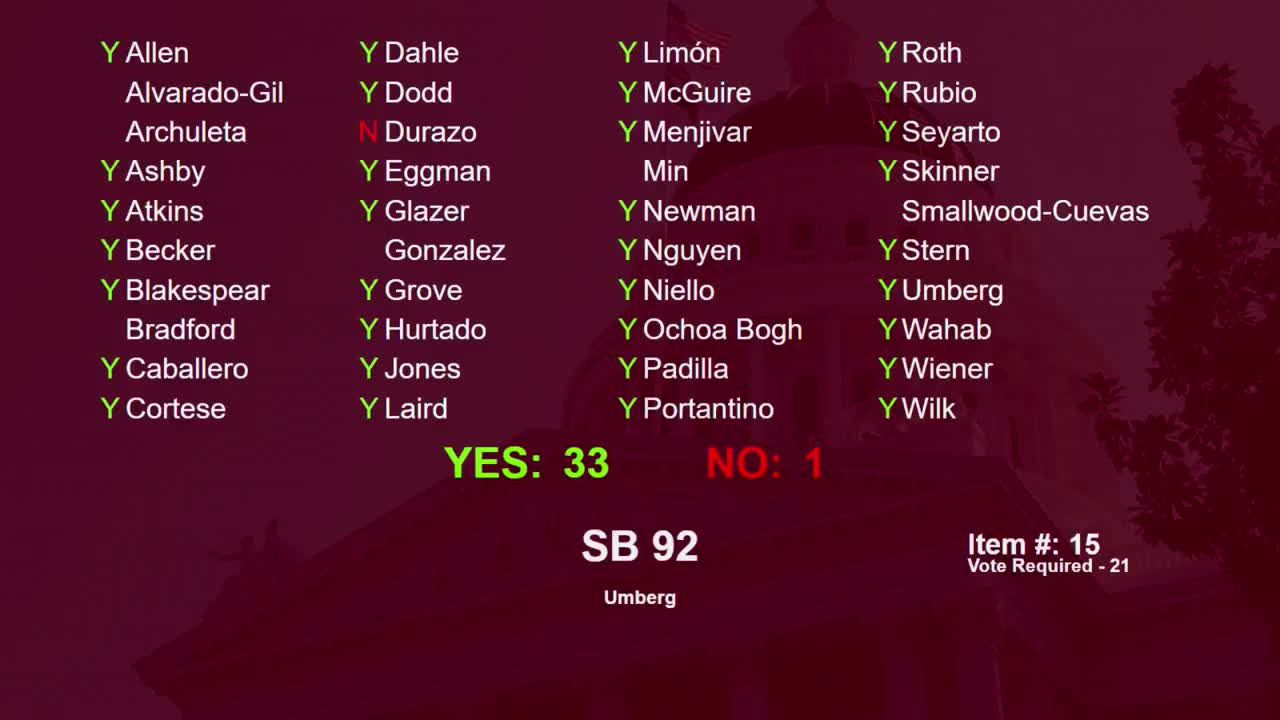 2MIN
Senate Floor
 17MIN
Senate Standing Committee on Health
Bill Author