SB 735: San Francisco Bay Area Regional Housing Finance Act: expenditure of funds: public works.
- Session Year: 2023-2024
- House: Senate
- Latest Version Date: 2024-06-27
Current Status:
Failed
(2024-08-15: August 15 hearing: Held in committee and under submission.)
Introduced
In Committee
First Chamber
In Committee
Second Chamber
Enacted
What does this bill do?
The bill requires any construction or renovation project that gets funding from the regional housing finance program to be treated as a public work and to pay prevailing wages to workers. Projects of 40 or more units can only receive that funding if all work is covered by a project labor agreement—a contract that sets wages, hiring rules, and other job terms—matching the BART Major Projects Project Stabilization Agreement. A regional or countywide project labor agreement negotiated with the authority and the local building trades also qualifies, and the housing finance authority may negotiate and sign such agreements.
The summary is provided by generative AI which can make mistakes. For original language, please view the details in the table below.
Existing law, the San Francisco Bay Area Regional Housing Finance Act, establishes the Bay Area Housing Finance Authority to raise, administer, and allocate funding for affordable housing in the San Francisco Bay area, as defined, and provide technical assistance at a regional level for tenant protection, affordable housing preservation, and new affordable housing production. The act vests the authority with various powers, including authorizing it to place a measure on the ballot to raise revenue and allocate funds throughout the San Francisco Bay area, apply for and receive grants or loans from public and private entities, incur and issue bonds and other indebtedness, and otherwise incur liabilities or obligations, as specified. The act authorizes the authority to allocate and deploy financing to cities, counties, other public agencies within the San Francisco Bay area, and private affordable housing developers to finance affordable housing development, as specified. The act requires revenue generated pursuant to the act be used for the construction of new affordable housing, affordable housing preservation, tenant protection programs, planning and technical assistance related to affordable housing, and for infrastructure to support housing and other purposes, as specified.
This bill would limit the expenditure of revenue generated under the act funding or financing new construction or rehabilitation work for projects of 40 or more units.Existing law defines public works, for the purposes of regulating public works contracts, as, among other things, construction, alteration, demolition, installation, or repair work done under contract and paid for, in whole or in part, out of public funds. Existing law further requires that, except as specified, not less than the general prevailing rate of per diem wages be paid to workers employed on public works and imposes misdemeanor penalties for a willful violation of this requirement.
Under this bill, a construction or rehabilitation project receiving funding or financing from revenue under the act, as specified, would constitute a public work for which prevailing wages are required to be paid pursuant to existing law. The bill would require that certain projects with 40 units or more be eligible to receive funding or financing from revenue generated under the act only if all construction and rehabilitation will be subject to a project labor agreement, as defined, with the same terms as the San Francisco Bay Area Rapid Transit District Major Projects Project Stabilization Agreement, as specified and defined, except that if a regional or countywide project labor agreement, as defined, that meets certain requirements is negotiated, then the bill would provide that those projects are eligible for funding or financing from the agency only if all construction and rehabilitation is subject to that project labor agreement. The bill would authorize the authority to negotiate and enter into project labor agreements for projects receiving funding or financing from revenue generated under the act.
Because the willful violation of prevailing wage requirements when engaged in these public works projects would result in the imposition of misdemeanor penalties, this bill would impose a state-mandated local program.
The California Constitution requires the state to reimburse local agencies and school districts for certain costs mandated by the state. Statutory provisions establish procedures for making that reimbursement.
This bill would provide that no reimbursement is required by this act for a specified reason.
Existing law, the San Francisco Bay Area Regional Housing Finance Act, establishes the Bay Area Housing Finance Authority to raise, administer, and allocate funding for affordable housing in the San Francisco Bay area, as defined, and provide technical assistance at a regional level for tenant protection, affordable housing preservation, and new affordable housing production. The act vests the authority with various powers, including authorizing it to place a measure on the ballot to raise revenue and allocate funds throughout the San Francisco Bay area, apply for and receive grants or loans from public and private entities, incur and issue bonds and other indebtedness, and otherwise incur liabilities or obligations, as specified. The act authorizes the authority to allocate and deploy financing to cities, counties, other public agencies within the San Francisco Bay area, and private affordable housing developers to finance affordable housing development, as specified. The act requires revenue generated pursuant to the act be used for the construction of new affordable housing, affordable housing preservation, tenant protection programs, planning and technical assistance related to affordable housing, and for infrastructure to support housing and other purposes, as specified.
This bill would limit the expenditure of revenue generated under the act funding or financing new construction or rehabilitation work for projects of 40 or more units.
Existing law defines public works, for the purposes of regulating public works contracts, as, among other things, construction, alteration, demolition, installation, or repair work done under contract and paid for, in whole or in part, out of public funds. Existing law further requires that, except as specified, not less than the general prevailing rate of per diem wages be paid to workers employed on public works and imposes misdemeanor penalties for a willful violation of this requirement.
Under this bill, a construction or rehabilitation project receiving funding or financing from revenue under the act, as specified, would constitute a public work for which prevailing wages are required to be paid pursuant to existing law. The bill would require that certain projects with 40 units or more be eligible to receive funding or financing from revenue generated under the act only if all construction and rehabilitation will be subject to a project labor agreement, as defined, with the same terms as the San Francisco Bay Area Rapid Transit District Major Projects Project Stabilization Agreement, as specified and defined, except that if a regional or countywide project labor agreement, as defined, that meets certain requirements is negotiated, then the bill would provide that those projects are eligible for funding or financing from the agency only if all construction and rehabilitation is subject to that project labor agreement. The bill would authorize the authority to negotiate and enter into project labor agreements for projects receiving funding or financing from revenue generated under the act.
Because the willful violation of prevailing wage requirements when engaged in these public works projects would result in the imposition of misdemeanor penalties, this bill would impose a state-mandated local program.
The California Constitution requires the state to reimburse local agencies and school districts for certain costs mandated by the state. Statutory provisions establish procedures for making that reimbursement.
This bill would provide that no reimbursement is required by this act for a specified reason.
Existing law grants the Division of Occupational Safety and Health, which is within the Department of Industrial Relations, jurisdiction over all employment and places of employment, with the power necessary to enforce and administer all occupational health and safety laws and standards. The Occupational Safety and Health Standards Board, an independent entity within the department, has the exclusive authority to adopt occupational safety and health standards within the state. Existing law, the California Occupational Safety and Health Act of 1973, requires employers to comply with certain standards ensuring healthy and safe working conditions, as specified, and charges the division with enforcement of the act. Other existing law relating to occupational safety imposes special provisions on certain industries and charges the division with enforcement of these provisions.This bill would establish the Safety on Productions Pilot Program. The bill, commencing July 1, 2025, and until June 30, 2030, inclusive, would require that an employer for a motion picture production that receives a specified motion picture tax credit, for that motion picture production, hire or assign a qualified safety advisor for California filming activities to perform a risk assessment and, if required under the bill, a specific risk assessment, as specified. The bill would require a dedicated safety advisor to be present on every motion picture production in the pilot program who is assigned exclusively to that motion picture production. The bill would require assessments to be accessible to specified affected persons and safety advisor access to locations and relevant facilities and items to ensure safety. The bill would require production to conduct a daily safety meeting, including, but not limited to, a safety meeting required when firearms are involved in a scene. The bill would require a safety advisor to participate in daily safety meetings, as specified. The bill would require an employer to identify a person for performers, crew, labor organization representatives, and the division to contact for issues regarding compliance. The bill would require the safety advisor to prepare a final safety evaluation report based on the actual risk and compliance experience. The bill would require the safety advisor, within 60 days following completion of filming activities, to provide the final safety evaluation report to the Industry-Wide Labor-Management Safety Committee and the California Film Commission. The bill would require the committee and the California Film Commission to jointly select an organization or firm to perform a written evaluation of the pilot program. The bill would require the selected organization or firm to review and assess the final safety evaluation reports on or before June 30, 2029, and make a nonbinding set of recommendations to the Legislature, as prescribed. These pilot program provisions would be repealed as of January 1, 2031.This bill would allow the use of a firearm or blank on motion picture productions only for specified purposes and under specified safety conditions. The bill would require a qualified property master, armorer, or assistant property master handling a firearm in the course of the motion picture production to have a specified state permit, to have completed certain training in firearms, and to have a specified federal document for the possession and custody of the firearm. The bill would specifically impose prescribed reporting requirements on employers engaged in motion picture production. The bill would specifically authorize the division to investigate, inspect, and cite employers, as prescribed.This bill would prohibit ammunition on a motion picture production, except in prescribed circumstances, subject to certain safety rules and laws. The bill would require an employer to require that any employee responsible for handling, or in proximity to, firearms on set completes a specific firearm training or equivalent training, as prescribed. The bill would require an employer to comply with the bill and any applicable safety standard. The bill would establish exemptions from its provisions for specified registered security guards and peace officers when they are on the perimeter of a set where motion picture production is happening.This bill would require the division to enforce its provisions. The bill would define terms for its purposes. The bills provisions would become operative on January 1, 2025.Existing law grants the Division of Occupational Safety and Health, which is within the Department of Industrial Relations, jurisdiction over all employment and places of employment, with the power necessary to enforce and administer all occupational health and safety laws and standards. The Occupational Safety and Health Standards Board, an independent entity within the department, has the exclusive authority to adopt occupational safety and health standards within the state. Existing law, the California Occupational Safety and Health Act of 1973, requires employers to comply with certain standards ensuring healthy and safe working conditions, as specified, and charges the division with enforcement of the act. Other existing law relating to occupational safety imposes special provisions on certain industries and charges the division with enforcement of these provisions.
This bill would establish the Safety on Set Productions Pilot Program. The bill, commencing July 1, 2025, and until June 30, 2030, inclusive, would require that an employer for a motion picture production that receives a specified motion picture tax credit to credit, for that motion picture production, hire or assign a qualified safety advisor for California filming activities to perform a risk assessment and, if required under the bill, a specific risk assessment, as specified. The bill would require a dedicated safety advisor to be present on every motion picture production. production in the pilot program who is assigned exclusively to that motion picture production. The bill would require assessments to be accessible to specified affected persons and safety advisor access to locations and relevant facilities and items to ensure safety. The bill would require production to conduct a daily safety meeting, including, but not limited to, a safety meeting required when firearms are involved in a scene. The bill would require a safety advisor to participate in daily safety meetings, as specified. The bill would require an employer to identify a person for performers, crew, labor organization representatives, and the division to contact for issues regarding compliance. The bill would require an employer to select an independent evaluator, as prescribed, the safety advisor to prepare a postproduction final safety evaluation report based on the actual risk and compliance experience. The bill would require the independent evaluator, safety advisor, within 60 days after postproduction, following completion of filming activities, to provide its the final safety evaluation report to the Industry-Wide Labor-Management Safety Committee. Committee and the California Film Commission. The bill would require the California Film Commission, in collaboration with the committee, on or before January 1, 2029, to provide a nonbinding set of recommendations to the Legislature as to whether the pilot program should be implemented on a permanent basis, and whether to extend its application to all motion picture productions in this state, whether participating in state motion picture tax credits or not. committee and the California Film Commission to jointly select an organization or firm to perform a written evaluation of the pilot program. The bill would require the selected organization or firm to review and assess the final safety evaluation reports on or before June 30, 2029, and make a nonbinding set of recommendations to the Legislature, as prescribed. These pilot program provisions would be repealed as of January 1, 2031.
This bill would allow the use of a firearm and or blank on motion picture productions only for specified purposes and under specified safety conditions. The bill would require a qualified property master, armorer, or assistant property master handling a firearm in the course of the motion picture production to have a specified state permit, to have completed certain training in firearms, and to have a specified federal document for the possession and custody of the firearm. The bill would specifically impose prescribed reporting requirements on employers engaged in motion picture production. The bill would specifically authorize the division to investigate, inspect, and cite employers, as prescribed.
This bill would prohibit ammunition on a motion picture production, except in prescribed circumstances, subject to certain safety rules and laws. The bill would require an employer to ensure require that any employee responsible for handling, or in proximity to, firearms on set completes a specific firearm training or equivalent training, as prescribed. The bill would require an employer to comply with the bill and any applicable safety standard. The bill would establish exemptions from its provisions for specified registered security guards and peace officers when they are on the perimeter of a set where motion picture production is happening.
This bill would require the division to enforce its provisions. The bill would define terms for its purposes. The bills provisions would become operative on January 1, 2025.
Existing law grants the Division of Occupational Safety and Health, which is within the Department of Industrial Relations, jurisdiction over all employment and places of employment, with the power necessary to enforce and administer all occupational health and safety laws and standards. The Occupational Safety and Health Standards Board, an independent entity within the department, has the exclusive authority to adopt occupational safety and health standards within the state. Existing law, the California Occupational Safety and Health Act of 1973, requires employers to comply with certain standards ensuring healthy and safe working conditions, as specified, and charges the division with enforcement of the act. Other existing law relating to occupational safety imposes special provisions on certain industries and charges the division with enforcement of these provisions.
This bill would establish the Safety on Set Pilot Program. The bill, commencing July 1, 2025, and until June 30, 2030, inclusive, would require an employer that receives a specified motion picture tax credit to hire or assign a qualified safety advisor to perform a risk assessment and, if required under the bill, a specific risk assessment, as specified. The bill would require a dedicated safety advisor to be present on every motion picture production. The bill would require assessments to be accessible to specified affected persons and safety advisor access to locations and relevant facilities and items to ensure safety. The bill would require production to conduct a daily safety meeting, including, but not limited to, a safety meeting required when firearms are involved in a scene. The bill would require a safety advisor to participate in safety meetings, as specified. The bill would require an employer to identify a person for performers, crew, labor organization representatives, and the division to contact for issues regarding compliance. The bill would require an employer to select an independent evaluator, as prescribed, to prepare a postproduction final safety evaluation report based on the actual risk and compliance experience. The bill would require the independent evaluator, within 60 days after postproduction, to provide its final safety evaluation report to the Industry-Wide Labor-Management Safety Committee. The bill would require the California Film Commission, in collaboration with the committee, on or before January 1, 2029, to provide a nonbinding set of recommendations to the Legislature as to whether the pilot program should be implemented on a permanent basis, and whether to extend its application to all motion picture productions in this state, whether participating in state motion picture tax credits or not. These pilot program provisions would be repealed as of January 1, 2031.
This bill would allow the use of a firearm and blank on motion picture productions only for specified purposes and under specified safety conditions. The bill would require a qualified property master, armorer, or assistant property master handling a firearm in the course of the motion picture production to have a specified state permit, to have completed certain training in firearms, and to have a specified federal document for the possession and custody of the firearm. The bill would specifically impose prescribed reporting requirements on employers engaged in motion picture production. The bill would specifically authorize the division to investigate, inspect, and cite employers, as prescribed.
This bill would prohibit ammunition on a motion picture production, except in prescribed circumstances, subject to certain safety rules and laws. The bill would require an employer to ensure that any employee responsible for handling, or in proximity to, firearms on set completes a specific firearm training or equivalent training, as prescribed. The bill would require an employer to comply with the bill and any applicable safety standard. The bill would establish exemptions from its provisions for specified registered security guards and peace officers when they are on the perimeter of a set where motion picture production is happening.
This bill would require the division to enforce its provisions. The bill would define terms for its purposes. The bills provisions would become operative on January 1, 2025.
Existing law grants the Division of Occupational Safety and Health, which is within the Department of Industrial Relations, jurisdiction over all employment and places of employment, with the power necessary to enforce and administer all occupational health and safety laws and standards. The Occupational Safety and Health Standards Board, an independent entity within the department, has the exclusive authority to adopt occupational safety and health standards within the state. Existing law, the California Occupational Safety and Health Act of 1973, requires employers to comply with certain standards ensuring healthy and safe working conditions, as specified, and charges the division with enforcement of the act. Other existing law relating to occupational safety imposes special provisions on certain industries and charges the division with enforcement of these provisions.
This bill would establish the Safety on Set Pilot Program. The bill, commencing July 1, 2025, and until June 30, 2030, inclusive, would require a motion picture production an employer that receives a specified motion picture tax credit to hire or assign a qualified safety supervisor for all motion picture productions to perform a risk assessment to be completed in advance of principal photography of a feature, an episode of a series, or a program, and to be on set daily to ensure cast and crew are not engaged in or exposed to an environment or activity that puts workers health and safety at risk. The bill would also require an employer to hire a qualified safety supervisor to complete a specific risk assessment to be created and, if necessary, modified, if circumstances change or there is new information that would change the risk assessment. advisor to perform a risk assessment and, if required under the bill, a specific risk assessment, as specified. The bill would require a dedicated safety advisor to be present on every motion picture production. The bill would establish requirements for risk assessments and specific risk assessments, including documentation. require assessments to be accessible to specified affected persons and safety advisor access to locations and relevant facilities and items to ensure safety. The bill would require production to conduct a daily safety meeting on set, meeting, including, but not limited to, a safety meeting required when firearms are involved in a scene. The bill would require a safety supervisor advisor to participate in the safety meetings. meetings, as specified. The bill would require an employer to identify a person to ensure compliance with the bill and would require a safety supervisor to be present every day during production. for performers, crew, labor organization representatives, and the division to contact for issues regarding compliance. The bill would require an employer to select an independent evaluator, as prescribed, to prepare a postproduction final safety evaluation report based on the actual risk and compliance experience. The bill would require the independent evaluator, within 60 days after postproduction, to provide its final safety evaluation report to the Industry-Wide Labor-Management Safety Committee. The bill would require the California Film Commission, in collaboration with the committee, on or before January 1, 2029, to provide a nonbinding set of recommendations to the Legislature as to whether the pilot program should be implemented on a permanent basis, and whether to extend its application to all motion picture productions in this state, whether participating in state motion picture tax credits or not. These pilot program provisions would be repealed as of January 1, 2031.
TheThis bill would allow the use of a firearm and blank ammunition containing gunpowder or other explosive charge on motion picture productions only for specified purposes and under specified safety conditions. The bill would require a qualified armorer, property master, or designee property master, armorer, or assistant property master handling a firearm in the course of the motion picture production to have a specified state permit, to have completed certain training in firearms, and to have a specified federal document for the possession and custody of the firearm. The bill would require an employer to document and report any safety incident that occurs during a film or television production, as prescribed. specifically impose prescribed reporting requirements on employers engaged in motion picture production. The bill would specifically authorize the division to investigate, inspect, and cite employers, as prescribed.
This bill would prohibit ammunition on film, television, and commercial sets, a motion picture production, except in prescribed circumstances, subject to certain safety rules and laws. The bill would require an employer to ensure that any employee responsible for handling, or in proximity to, firearms on set completes a specific firearm training or equivalent training, as prescribed. The bill would require an employer to comply with the bill and any applicable safety standard. The bill would establish exemptions from its provisions for specified registered security guards and peace officers when they are on the perimeter of a set where motion picture production is happening.
This bill would require the division to enforce its provisions. The bill would establish civil penalties for specified violations. The bill would define terms for its purposes. The bills provisions would become operative on January 1, 2025.
Existing law grants the Division of Occupational Safety and Health, which is within the Department of Industrial Relations, jurisdiction over all employment and places of employment, with the power necessary to enforce and administer all occupational health and safety laws and standards. The Occupational Safety and Health Standards Board, an independent entity within the department, has the exclusive authority to adopt occupational safety and health standards within the state. Existing law, the California Occupational Safety and Health Act of 1973, requires employers to comply with certain standards ensuring healthy and safe working conditions, as specified, and charges the division with enforcement of the act. Other existing law relating to occupational safety imposes special provisions on certain industries and charges the division with enforcement of these provisions.
This bill would require a motion picture production employer to hire a qualified safety supervisor for all motion picture productions to perform a risk assessment to be completed in advance of principal photography of a feature, an episode of a series, or a program, and to be on set daily to ensure cast and crew are not engaged in or exposed to an environment or activity that puts workers health and safety at risk. The bill would also require an employer to hire a qualified safety supervisor to complete a specific risk assessment to be created and, if necessary, modified, if circumstances change or there is new information that would change the risk assessment. The bill would establish requirements for risk assessments and specific risk assessments, including documentation. The bill would require production to conduct a daily safety meeting on set, including, but not limited to, a safety meeting required when firearms are involved in a scene. The bill would require a safety supervisor to participate in the safety meetings. The bill would require an employer to identify a person to ensure compliance with the bill and would require a safety supervisor to be present every day during production.
The bill would allow the use of a firearm and blank ammunition containing gunpowder or other explosive charge on motion picture productions only for specified purposes and under specified safety conditions. The bill would require a qualified armorer, property master, or designee handling a firearm in the course of the motion picture production to have a specified state permit, to have completed certain training in firearms, and to have a specified federal document for the possession and custody of the firearm. The bill would require an employer to document and report any safety incident that occurs during a film or television production, as prescribed.
This bill would prohibit ammunition on film, television, and commercial sets, except in prescribed circumstances, subject to certain safety rules and laws. The bill would require an employer to ensure that any employee responsible for handling, or in proximity to, firearms on set completes a specific firearm training or equivalent training, as prescribed. The bill would require an employer to comply with the bill and any applicable safety standard. The bill would establish exemptions from its provisions for specified registered security guards and peace officers when they are on the perimeter of a set where motion picture production is happening.
This bill would require the division to enforce its provisions. The bill would establish civil penalties for specified violations. The bill would define terms for its purposes.
(a)Any construction or rehabilitation project receiving funding or financing from revenue generated pursuant to this part, including, but not limited to, a project with under 40 units, shall constitute a public work for which prevailing wages shall be paid for purposes of Chapter 1 (commencing with Section 1720) of Part 7 of Division 2 of the Labor Code.
(b)Except as otherwise provided in subdivisions (c) and (d), a project with 40 units or more is eligible to receive funding or financing from revenue generated pursuant to this part only if all construction and rehabilitation will be subject to a project labor agreement with the same terms as the BART Major Projects Project Stabilization Agreement. For purposes of this subdivision and subdivisions (c) and (d), the number of units means the maximum number of units authorized in an entitlement granted by the land use permitting authority for the development project, regardless of whether construction or rehabilitation proceeds in phases or ownership is divided.
(c)Notwithstanding subdivision (b), if a regional project labor agreement is negotiated with mutual agreement between the authority and the relevant building and construction trade councils, then a project with 40 units or more is also eligible to receive funding or financing from revenue generated pursuant to this part if all construction and rehabilitation will be subject to the terms of that regional project labor agreement.
(d)Notwithstanding subdivision (b), if a countywide project labor agreement is negotiated with mutual agreement between the authority and the relevant building and construction trades council, then a project with 40 units or more shall also be eligible to receive funding and financing from revenue generated pursuant to this part if all construction and rehabilitation will be subject to the specific countywide project labor agreement.
(e)The authority may negotiate and enter into project labor agreements for projects receiving funding or financing from revenue generated pursuant to this part.
(f)For purposes of this section:
(1)BART Major Projects Project Stabilization Agreement means the Major Projects Project Stabilization Agreement for the San Francisco Bay Area Rapid Transit District entered into by the district on March 10, 2016.
(2)Project labor agreement has the same meaning as in paragraph (1) of subdivision (b) of Section 2500 of the Public Contract Code.
SEC. 2.Section 64650.6 is added to the Government Code, to read:64650.6.Revenue generated pursuant to this part may be used to fund or finance new construction or rehabilitation work only for projects of 40 or more units.SEC. 3.SEC. 2.No reimbursement is required by this act pursuant to Section 6 of Article XIIIB of the California Constitution because the only costs that may be incurred by a local agency or school district will be incurred because this act creates a new crime or infraction, eliminates a crime or infraction, or changes the penalty for a crime or infraction, within the meaning of Section 17556 of the Government Code, or changes the definition of a crime within the meaning of Section 6 of Article XIIIB of the California Constitution.
(a)Any construction or rehabilitation project receiving funding or financing from revenue generated pursuant to this part, including, but not limited to, a project with under 40 units, shall constitute a public work for which prevailing wages shall be paid for purposes of Chapter 1 (commencing with Section 1720) of Part 7 of Division 2 of the Labor Code.
(b)Except as otherwise provided in subdivisions (c) and (d), a project with 40 units or more is eligible to receive funding or financing from revenue generated pursuant to this part only if all construction and rehabilitation will be subject to a project labor agreement with the same terms as the BART Major Projects Project Stabilization Agreement. For purposes of this subdivision and subdivisions (c) and (d), the number of units means the maximum number of units authorized in an entitlement granted by the land use permitting authority for the development project, regardless of whether construction or rehabilitation proceeds in phases or ownership is divided.
(c)Notwithstanding subdivision (b), if a regional project labor agreement is negotiated with mutual agreement between the authority and the relevant building and construction trade councils, then a project with 40 units or more is also eligible to receive funding or financing from revenue generated pursuant to this part if all construction and rehabilitation will be subject to the terms of that regional project labor agreement.
(d)Notwithstanding subdivision (b), if a countywide project labor agreement is negotiated with mutual agreement between the authority and the relevant building and construction trades council, then a project with 40 units or more shall also be eligible to receive funding and financing from revenue generated pursuant to this part if all construction and rehabilitation will be subject to the specific countywide project labor agreement.
(e)The authority may negotiate and enter into project labor agreements for projects receiving funding or financing from revenue generated pursuant to this part.
(f)For purposes of this section:
(1)BART Major Projects Project Stabilization Agreement means the Major Projects Project Stabilization Agreement for the San Francisco Bay Area Rapid Transit District entered into by the district on March 10, 2016.
(2)Project labor agreement has the same meaning as in paragraph (1) of subdivision (b) of Section 2500 of the Public Contract Code.
SEC. 2.Section 64650.6 is added to the Government Code, to read:64650.6.Revenue generated pursuant to this part may be used to fund or finance new construction or rehabilitation work only for projects of 40 or more units.
SEC. 3.No reimbursement is required by this act pursuant to Section 6 of Article XIIIB of the California Constitution because the only costs that may be incurred by a local agency or school district will be incurred because this act creates a new crime or infraction, eliminates a crime or infraction, or changes the penalty for a crime or infraction, within the meaning of Section 17556 of the Government Code, or changes the definition of a crime within the meaning of Section 6 of Article XIIIB of the California Constitution.
SECTION 1.Part 13 (commencing with Section 9150) is added to Division 5 of the Labor Code, to read:13.SAFETY IN MOTION PICTURE PRODUCTIONS9150.(a)The Legislature finds and declares the following:(1)All workers deserve a safe and healthy workplace. Because the sets of motion picture productions have potential hazards, proactive planning and oversight of the workplace are key to worker safety.(2)The growing popularity of a diverse array of media platforms and reality television and increased customer demand for new content and new production has increased the need for safety on sets.(3)Improving the overall health and safety on motion picture production sets is especially critical for the safe handling of firearms. (4)The primary protections for the cast and crew in a motion picture production, including when firearms are used, are found in voluntary safety standards developed by the Industry-Wide Labor-Management Safety Committee for use in motion picture production.(b)It is the intent of the Legislature to do the following:(1)Establish a pilot program to address the implementation and oversight of safety practices and procedures in motion picture productions participating in the pilot program.(2)Require the productions in the pilot program to employ a safety advisor to oversee production safety and complete detailed, script-specific general and, if applicable, specific risk assessments as part of this pilot program.(3)Establish training requirements and safety standards that focus on the safe handling of firearms and blanks in all motion picture production in California.(4)Prohibit, except in the most limited circumstances, the use of live ammunition in motion picture production in California.(c)It is not the intent of the Legislature in enacting this part to do either of the following:(1)Adversely impact the employment or retention of craft employees responsible for handling firearms used in motion picture productions.(2)Preclude the use of firearms, blanks, replicas, simulated firearms, or inert prop firearms or to influence content in motion picture productions.9151.As used in this part:(a)Ammunition means one or more loaded cartridges consisting of a primed case, propellant, and with one or more projectiles. Ammunition does not include blanks.(b)Blank means a cartridge consisting of a primer cap, a shell case, and a quantity of gunpowder, but that does not contain a projectile.(c)Division means the Division of Occupational Safety and Health.(d)Employer means an employer engaged in producing a motion picture production. (e)Filming activities includes principal photography and any subsequent filming, such as reshoots or additional scenes, as well as the construction and breakdown of sets and loading equipment, but does not include postproduction activity, including, but not limited to, editing, sound mixing, additional dialogue, or visual effects unrelated to reshoots. (f)Firearm means a device, designed to expel through a barrel a projectile by the force of an explosion or other form of combustion, including the frame or receiver of the device. Firearm does not include a replica or simulated firearm or a special effects device.(g)Industry-Wide Labor-Management Safety Committee or committee means the California group composed of union, guild, and employer representatives that establishes safety guidelines for motion picture production and that meets regularly. (h)Motion picture production means the development or creation of motion pictures, television programs, streaming productions, commercial advertisements, music videos, or any other moving images, including, but not limited to, productions made for entertainment, commercial, religious, or educational purposes.(i)Pilot program means the Safety on Productions Pilot Program established in Sections 9152 and 9152.5.(j)Risk assessment is a detailed written review of a script and production plan prepared in accordance with Section 9152.5.(k)Safety advisor means a person who works in tandem with, but independent of, performers and crew and who is not employed for any other role on the motion picture production; who reports to the unit production manager, or a person or persons having overall responsibility for the safety program, but retains autonomy to address production-related risk, including, as a last resort, the authority to temporarily halt production until a thorough examination of the potential hazard or hazards and the mitigation plan can take place among the decisionmakers on productions; and who meets the following qualifications:(1)One of the following:(A)At least two years experience primarily performing safety-related work in the entertainment industry as a department head, foreperson, or in a production safety position within motion picture production.(B)At least 500 verifiable days in another crew position in motion picture production, so long as they possess an appropriate breadth of specialist knowledge, experience, and expertise aimed at minimizing risks to both performers and crew.(C)Five or more years of safety-related work, where safety was a primary role and responsibility, in another industry, so long as they possess an appropriate breadth of specialist knowledge, experience, and expertise aimed at minimizing risks to workers and the public.(2)Completion of a joint labor and management training on industry protocols, state and federal law, and safety practices in motion picture production.(3)Completion of an OSHA 30-hour training for general industry.(l)Specific risk assessment means a risk assessment for identified high-risk activities or situations prepared in accordance with Section 9152.5.9152.(a)The Safety on Productions Pilot Program is hereby established. Commencing July 1, 2025, until June 30, 2030, inclusive, an employer for a motion picture production that receives a motion picture tax credit pursuant to a tax credit program that succeeds, on or after July 1, 2025, the tax credit program established in Section 17053.98 or 23698 of the Revenue and Taxation Code shall, for that motion picture production, hire or assign a safety advisor for California filming activities by the time the department heads start the preproduction process of planning for construction or high-risk activities to perform a risk assessment and, if required under this part, a specific risk assessment, to be completed in collaboration and consultation with appropriate production personnel, including, but not limited to, department heads and those with specialized knowledge. There shall be a dedicated safety advisor present on every motion picture production in the pilot program who is assigned exclusively to that motion picture production. The safety advisor shall have the authority to determine which worksite is most appropriate to have a physical presence on when multiple production-related activities are taking place in multiple locations.(b)Any specific risk assessment shall be revised if there are meaningful changes to the proposed activity or location that would change the specific risk assessment or mitigation plan.(c)All risk assessments shall be accessible via electronic transmission, upon request, to performers, crew, and labor organization representatives.(d)The safety advisor shall have access to, and the opportunity to inspect, all locations, facilities, equipment, supplies, materials, and props to safeguard the safety of the performers and crew members. Access or inspection by a safety advisor pursuant to this subdivision does not include handling or otherwise touching a firearm.(e)Production shall conduct a daily safety meeting, including, but not limited to, the meeting required in paragraph (4) of subdivision (a) of Section 9153.(f)The safety advisor shall participate in daily safety meetings when occurring at the safety advisors selected worksite or worksites, if there are multiple production-related activities taking place in multiple locations. (g)The employer shall identify a person for performers, crew, labor organization representatives, and the division to contact for issues regarding compliance.(h)The safety advisor shall prepare a final safety evaluation report based on the actual risk and compliance experience, as set forth in subdivisions (a) to (e), inclusive. Within 60 days following completion of filming activities, the safety advisor shall provide the final safety evaluation report to the Industry-Wide Labor-Management Safety Committee and the California Film Commission. Unplanned or unknown reshoots or additional scenes filmed after the submission of the initial report shall require an addendum report.(i)(1)The Industry-Wide Labor-Management Safety Committee and the California Film Commission shall jointly select an organization or firm to perform a written evaluation of the pilot program. The selected organization or firm shall review and assess the final safety evaluation reports on or before June 30, 2029, and make a nonbinding set of recommendations to the Legislature as to whether the pilot program should be implemented on a permanent basis and to what other motion pictures productions in this state it should, or should not, be extended.(2)The report submitted pursuant to paragraph (1) shall be submitted in compliance with Section 9795 of the Government Code.(j)This section shall remain in effect only until January 1, 2031, and as of that date is repealed.9152.5.Risk assessments shall be performed in accordance with the following:(a)A risk assessment shall be written and shall be a script and production plan that identifies and evaluates preproduction and production activity or production locations that may pose a risk and hazard to employees and sets forth a mitigation plan of those risks and hazards. Department heads and those with specialized knowledge shall be involved in creating a plan to mitigate risk. The process for developing the risk assessment shall commence once the department heads start preproduction planning for construction or high-risk activities.(b)A specific risk assessment shall be written and shall comply with the following:(1)Be focused on identified high-risk activities or situations.(2)Include detailed and specific risk mitigation plans and procedures to identify and evaluate workplace hazards that have an elevated risk factor or factors or a combination of multiple risk factors.(3)Identify the precautions and controls to be taken to mitigate that risk and reevaluate the level of risk assuming those controls are implemented or if no steps are taken to mitigate that risk.(4)Identify the group of employees affected by the assessed risk.(c)A specific risk assessment shall be performed for the use of the following:(1)Firearms.(2)Major pyrotechnics and explosives.(3)Major stunts.(4)Process shot moves.(5)Aircraft or trains.(6)Vehicles off road.(7)Watercraft in open water and for individuals under water for prolonged periods.(8)Workweeks of more than 60 hours.(d)A safety advisor shall have the authority to determine if, and when, a specific risk assessment is necessary for both on and off set activities and situations, including the following:(1)Overhead rigging.(2)Rugged outdoor locations.(3)Inclement weather.(4)Animals.(5)Heights.(6)Intermittent traffic control.(7)Night shoots.(8)Other high-risk activities or situations as identified by the safety advisor.(e)This section shall remain in effect only until January 1, 2031, and as of that date is repealed.9153.(a)A firearm or blank shall only be permitted on motion picture productions, for the purposes of rehearsal, actor training, the filming of an on-camera sequence, or other development of content of the motion picture production with individuals of the performers or crew, under the following conditions:(1)Under the custody and control of a qualified property master, armorer, or assistant property master.(2)While handling the firearm, the property master, armorer, or assistant property master is the only person who can hand that firearm to the performer or cast or crew member standing in for that performer during the scene. Only the property master, armorer, or assistant property master shall collect the firearm upon completion of the activity.(3)A property master, armorer, or assistant property master shall have no other duties, responsibilities, or obligations during the time the property master, armorer, or assistant property master is preparing for the use of a firearm and that a firearm is in the possession of the performer. It remains their sole responsibility until firearms are no longer in use and have been locked away.(4)As indicated in safety bulletins of the Industry-Wide Labor-Management Safety Committee, a safety meeting shall be conducted when firearms are involved in a scene. (5)The employer shall identify a person for performers, crew, labor organization representatives, and the division to contact for issues regarding compliance.(6)The employer has ensured sufficient staffing of qualified property masters, armorers, or assistant property masters.(b)A qualified property master, armorer, or assistant property master handling a firearm in the course of the motion picture production shall have all of the following:(1)A current entertainment firearms permit or current dangerous weapons permit or license issued by the California Department of Justice.(2)A joint entertainment industry labor-management firearm safety industry-specific training course certificate with training on industry protocols, state and federal law, and best practices on safety.(3)One of the following: (A)A signed rental sheet or copy of a completed Bureau of Alcohol, Tobacco, Firearms and Explosives ATF Form 4473, stating the lawful transfer of Title 1 Firearms to that property master, armorer, or assistant property master or a copy of a current Federal Firearms License (FFL) establishing the property master, armorer, or assistant property master as the lawful possessor of the firearms who may obtain and retain custody of all firearms used in motion picture productions. (B)In the event of the use of restricted firearms classified under the Bureau of Alcohol, Tobacco, Firearms and Explosives National Firearms Act Division (ATF NFA) rules, and including assault weapons, as defined by California law, a set of current dangerous weapons permits issued by the Department of Justice, or in the absence of such permits, a clearly dated extension letter for 120 days from the Department of Justice Bureau of Firearms permitting the property master, armorer, or assistant property master to continue their activities with restricted firearms, and a signed rental sheet from the federally licensed armory providing the firearms, or a current FFL and current ATF Special Occupational Tax Stamp establishing lawful possession of restricted firearms by that property master, armorer, or assistant property master shall be presented for the property master, armorer, or assistant property master to obtain and retain custody of NFA firearms. In such a case, the dangerous weapons permits issued by the Department of Justice shall supersede the entertainment firearms permit.9154.(a)Employers engaged in motion picture production shall report to the division any serious injury or illness, or death, of an employee occurring in a place of employment or in connection with any employment pursuant to Section 342 of Title 8 of the California Code of Regulations. Pursuant to Section 6309, if the division learns or has reason to believe that an employment or place of employment is not safe or is injurious to the welfare of an employee, the division, on its own motion or upon complaint, may summarily investigate the employment or place of employment. Every inspection conducted by the division shall include an evaluation of the employers injury prevention program established pursuant to Section 6401.7 and any risk assessment for those participating in the pilot program established pursuant to Sections 9152 and 9152.5.(b)Pursuant to Sections 6314 and 6317, if, upon inspection or investigation, the division determines that an employer has violated any standard, rule, order, regulation or these provisions, the division may with reasonable promptness issue a citation to the employer.9155.(a)Ammunition shall not be permitted on a motion picture production, except as follows:(1)In the controlled and supervised environment of a shooting range or equivalent and for the purposes of actor training or postproduction gunfire sound recording, a documentary, except reenactments, or firearms education.(2)Where ammunition is essential to the subject matter of the work, such as a competitive reality show, a documentary, except dramatic reenactments, or a firearms education and safety training production.(3)While filming footage of trained military or police personnel firing weapons in a controlled military or police facility.(b) In the exceptions set forth in subdivision (a), all range safety rules, federal, state, and local laws, and Industry-Wide Labor-Management Safety Committee Safety Bulletins #1 and #2 shall be followed under the supervision of the property master, armorer, or qualified assistant property master. Appropriate medical personnel shall be available.9156.Every employer shall require that any employee responsible for handling, or in proximity to, firearms on set completes a Contract Services Administration Trust Fund (CSATF) Firearms Safety Course for the Entertainment Industry, or an equivalent training, as determined by the Industry-Wide Labor-Management Safety Committee. This training requirement shall be paid for by the employer and is not limited to crew or guild members.9157.An employer shall comply with this part and any applicable safety standard.9158.This part does not apply to the following persons when they are on the perimeter of a set where motion picture production is happening:(a)A registered security guard carrying a firearm in compliance with security guard firearms qualifications established in Sections 7583.2 to 7583.5, inclusive, of the Business and Professions Code, who is employed to provide security to the motion picture production and who, in the scope and the course of that employment, is at all times in possession and control of the firearm.(b)A sworn peace officer, as defined in Chapter 4.5 (commencing with Section 830) of Title 3 of Part 2 of the Penal Code, or sworn federal law enforcement officer, who is authorized to carry a firearm in the course and scope of the officers duties and who, in the scope and the course of their duties, is at all times in possession and control of the firearm.9159.The division shall enforce this part.9160.This part shall not prevent or limit employer adoption of stricter safety standards.9161.This part shall become operative on January 1, 2025.(a)The Legislature finds and declares the following:
(1)All workers deserve a safe and healthy workplace. Because the sets of motion picture productions have a number and variety of potential hazards, proactive planning and oversight on the ground of the workplace are key to ensuring worker safety.
(2)The growing popularity of a diverse array of media platforms and reality television and increased customer demand for new content and new production has increased the need to ensure for safety on sets.
(3)Ensuring Improving the overall health and safety on motion picture production sets is especially critical for the safe handling of firearms.
(4)The primary protections for the cast and crew in a motion picture production, including when firearms are used, are found in voluntary safety standards developed by the Industry-Wide Labor-Management Safety Committee for use in motion picture production.
(b)It is the intent of the Legislature to do the following:
(1)Establish a pilot program to address the implementation and oversight of safety practices and procedures in motion picture production. productions participating in the pilot program.
(2)Mandate the employment of Require the productions in the pilot program to employ a safety advisor to ensure that the overall safety in production is safe and to oversee production safety and complete detailed, script-specific general and, if applicable, specific risk assessments as part of this pilot. pilot program.
(3)Establish training requirements and safety standards to ensure that focus on the safe handling of prop firearms and blanks in all motion picture production in California.
(4)Prohibit, except in the most limited circumstances, the use of live ammunition in motion picture production in California.
(c)It is not the intent of the Legislature in enacting this part to do either of the following:
(1)Adversely impact the employment or retention of craft employees responsible for handling firearms used in motion picture productions.
(2)Preclude the use of firearms or replica, simulated, firearms, blanks, replicas, simulated firearms, or inert prop firearms or to influence content in motion picture productions.
9151.As used in this part:
(a)Ammunition means one or more loaded cartridges consisting of a primed case, propellant, and with one or more projectiles. Ammunition does not include blanks.
(b)Blank means a cartridge consisting of a primer cap, a shell case, and a quantity of gunpowder, but that does not contain a projectile.
(c)Division means the Division of Occupational Safety and Health.
(d)Employer means an employer engaged in producing a motion picture production.
(e)Filming activities includes principal photography and any subsequent filming, such as reshoots or additional scenes, as well as the construction and breakdown of sets and loading equipment, but does not include postproduction activity, including, but not limited to, editing, sound mixing, additional dialogue, or visual effects unrelated to reshoots.
(e)(f)Firearm means a device, designed to expel through a barrel a projectile by the force of an explosion or other form of combustion, including the frame or receiver of the device. Firearm does not include a replica or simulated firearm or a special effects device.
(f)(g)Industry-Wide Labor-Management Safety Committee or committee means the California group composed of union, guild, and employer representatives that establishes best practice safety guidelines for motion picture production and that meets regularly.
(g)(h)Motion picture production means the development or creation of motion pictures, television programs, streaming productions, commercial advertisements, music videos, or any other moving images, including, but not limited to, productions made for entertainment, commercial, religious, or educational purposes.
(i)Pilot program means the Safety on Productions Pilot Program established in Sections 9152 and 9152.5.
(h)(j)Risk assessment is a detailed written review of a script and production plan prepared in accordance with Section 9152.5.
(i)(k)Safety advisor means a person who works in tandem with, but independent of, performers and crew and who is not employed for any other role on the motion picture production; who reports to the unit production manager, or a person or persons having overall responsibility for the safety program, but retains autonomy to address production-related risk, including, as a last resort, the authority to temporarily halt production until a thorough examination of the potential hazard or hazards and the mitigation plan can take place among the decisionmakers on productions; and who meets the following qualifications:
(1)One of the following:
(A)At least two years experience primarily performing safety-related work in the entertainment industry as a department head, foreperson, or in a production safety position within motion picture production.
(B)At least 500 verifiable days in another crew position in motion picture production, so long as they possess an appropriate breadth of specialist knowledge, experience, and expertise aimed at minimizing risks to both performers and crew.
(C)Five or more years of safety-related work, where safety was a primary role and responsibility, in another industry, so long as they possess an appropriate breadth of specialist knowledge, experience, and expertise aimed at minimizing risks to workers and the public.
(2)Completion of a joint labor and management training on industry protocols, state and federal law, and safety practices in motion picture production.
(3)Completion of a an OSHA 30-hour training program authorized by the division (OSHA-30 training). for general industry.
(j)(l)Specific risk assessment means a specific risk assessment for identified high-risk activities or situations prepared in accordance with Section 9152.5.
9152.(a)The Safety on Set Productions Pilot Program is hereby established. Commencing July 1, 2025, until June 30, 2030, inclusive, an employer for a motion picture production that receives a motion picture tax credit pursuant to a tax credit program that succeeds, on or after July 1, 2025, the tax credit program established in Section 17053.98 or 23698 of the Revenue and Taxation Code shall shall, for that motion picture production, hire or assign a safety advisor for California filming activities by the time the department heads start the preproduction process of planning for construction or high-risk activities to perform a risk assessment and, if required under this part, a specific risk assessment, to be completed in collaboration and consultation with appropriate production personnel, including, but not limited to, department heads and those with specialized knowledge. There shall be a dedicated safety advisor present on every motion picture production. production in the pilot program who is assigned exclusively to that motion picture production. The safety advisor shall have the authority to determine which worksite is most appropriate to have a physical presence on when multiple production-related activities are taking place in multiple locations.
(b)Any specific risk assessment shall be revised if there are meaningful changes to the proposed activity or location that would change the specific risk assessment or mitigation plan.
(c)All risk assessments shall be accessible via electronic transmission, upon request, to performers, crew, and labor organization representatives.
(d)The safety advisor shall have access to, and the opportunity to inspect inspect, all locations, facilities, equipment, supplies, materials, and props to ensure safeguard the safety of the performers and crew members. Access or inspection by a safety advisor pursuant to this subdivision does not include handling or otherwise touching a firearm.
(e)Production shall conduct a daily safety meeting, including, but not limited to, the meeting required in paragraph (4) of subdivision (a) of Section 9153. The safety advisor shall participate in the safety meetings.
(f)The safety advisor shall participate in daily safety meetings when occurring at the safety advisors selected worksite or worksites, if there are multiple production-related activities taking place in multiple locations.
(g)The employer shall identify a person for performers, crew, labor organization representatives, and the division to contact for issues regarding compliance.
(h)The employer shall select an independent evaluator, from a qualified list of evaluators established by the California Film Commission in collaboration with the Industry-Wide Labor-Management Safety Committee, to safety advisor shall prepare a postproduction final safety evaluation report based on the actual risk and compliance experience, as set forth in subdivisions (a) to (e), inclusive. Within 60 days after postproduction, the independent evaluator following completion of filming activities, the safety advisor shall provide its the final safety evaluation report to the Industry-Wide Labor-Management Safety Committee. Committee and the California Film Commission. Unplanned or unknown reshoots or additional scenes filmed after the submission of the initial report shall require an addendum report.
(i)(1)On or before January 1, 2029, the California Film Commission, in collaboration with the Industry-Wide Labor-Management Safety Committee, shall provide a nonbinding set of recommendations to the Legislature as to whether the pilot program should be implemented on a permanent basis, and whether to extend its application to all motion picture productions in this state, whether participating in state motion picture tax credits or not. The Industry-Wide Labor-Management Safety Committee and the California Film Commission shall jointly select an organization or firm to perform a written evaluation of the pilot program. The selected organization or firm shall review and assess the final safety evaluation reports on or before June 30, 2029, and make a nonbinding set of recommendations to the Legislature as to whether the pilot program should be implemented on a permanent basis and to what other motion pictures productions in this state it should, or should not, be extended.
(2)The report submitted pursuant to paragraph (1) shall be submitted in compliance with Section 9795 of the Government Code.
(j)This section shall remain in effect only until January 1, 2031, and as of that date is repealed.
9152.5.Risk assessments shall be performed in accordance with the following:
(a)A risk assessment shall be written and shall be a script and production plan that identifies and evaluates preproduction and production activity or production locations that may pose a reasonable risk and hazard to employees and sets forth a mitigation plan of those risks and hazards. Department heads and those with specialized knowledge shall be involved in creating a plan to mitigate risk. The process for developing the risk assessment shall commence once the department heads start preproduction planning for construction or high-risk activities.
(b)A specific risk assessment shall be written and shall comply with the following:
(1)Be focused on identified high-risk activities or situations.
(2)Include detailed and specific risk mitigation plans and procedures to identify and evaluate workplace hazards that have an elevated risk factor or factors or a combination of multiple risk factors.
(3)Spell out Identify the precautions and controls to be taken to mitigate that risk and reevaluate the level of risk assuming those controls are implemented or if no steps are taken. taken to mitigate that risk.
(4)Identify the group of employees affected by the assessed risk.
(c)A specific risk assessment shall be performed for the use of the following:
(1)Firearms.
(2)Major pyrotechnics and explosives.
(3)Major stunts.
(4)Process shot moves.
(5)Helicopters Aircraft or trains.
(6)Vehicles off road.
(7)Watercraft in open water. water and for individuals under water for prolonged periods.
(8)Workweeks of 60 hours or more. more than 60 hours.
(d)A safety advisor shall have the authority to determine if, and when, a specific risk assessment is necessary for both on and off set activities and situations, including the following:
(1)Overhead rigging.
(2)Rugged outdoor locations.
(3)Inclement weather.
(4)Animals.
(5)Heights.
(6)Intermittent traffic control.
(7)Night shoots.
(8)Other high-risk activities or situations as identified by the safety advisor.
(e)This section shall remain in effect only until January 1, 2031, and as of that date is repealed.
9153.(a)A firearm and or blank shall only be permitted on motion picture productions, for the purposes of rehearsal, actor training, the filming of an on-camera sequence, or other development of content of the motion picture production with individuals of the performers or crew, under the following conditions:
(1)Under the custody and control of a qualified property master, armorer, or assistant property master.
(2)While handling the firearm, the property master, armorer, or assistant property master is the only person who can hand that firearm to the performer or cast or crew member standing in for that performer during the scene. Only the property master, armorer, or assistant property master shall collect the firearm upon completion of the activity.
(3)A property master, armorer, or assistant property master shall have no other duties, responsibilities, or obligations during the time the property master, armorer, or assistant property master is preparing for the use of a firearm and that a firearm is in the possession of the performer. It remains their sole responsibility until firearms are no longer in use and have been locked away.
(4)As indicated in safety bulletins of the Industry-Wide Labor-Management Safety Committee, a safety meeting shall be conducted when firearms are involved in a scene.
(5)The employer shall identify a person for performers, crew, labor organization representatives, and the division to contact for issues regarding compliance.
(6)The employer has ensured sufficient staffing of qualified property masters, armorers, or assistant property masters, reflective of the scene risk assessment. masters.
(b)A qualified property master, armorer, or assistant property master handling a firearm in the course of the motion picture production shall have all of the following:
(1)A current entertainment firearms permit or current dangerous weapons permit or license issued by the California Department of Justice.
(2)A joint entertainment industry labor-management firearm safety industry-specific training course certificate with training on industry protocols, state and federal law, and best practices on safety.
(3)One of the following:
(A)A signed rental sheet or copy of a completed Bureau of Alcohol, Tobacco, Firearms and Explosives ATF Form 4473, stating the lawful transfer of Title 1 Firearms to that property master, armorer, or assistant property master or a copy of a current Federal Firearms License (FFL) establishing the property master, armorer, or assistant property master as the lawful possessor of the firearms who may obtain and retain custody of all firearms used in motion picture productions.
(B)In the event of the use of restricted firearms classified under the Bureau of Alcohol, Tobacco, Firearms and Explosives National Firearms Act Division (ATF NFA) rules, and including assault weapons, as defined by California law, a set of current dangerous weapons permits issued by the Department of Justice, or in the absence of such permits, a clearly dated extension letter for 120 days from the Department of Justice Bureau of Firearms permitting the property master, armorer, or assistant property master to continue their activities with restricted firearms, and a signed rental sheet from the federally licensed armory providing the firearms, or a current FFL and current ATF Special Occupational Tax Stamp establishing lawful possession of restricted firearms by that property master, armorer, or assistant property master shall be presented for the property master, armorer, or assistant property master to obtain and retain custody of NFA firearms. In such a case, the dangerous weapons permits issued by the Department of Justice shall supersede the entertainment firearms permit.
9154.(a)Employers engaged in motion picture production shall report to the division any serious injury or illness, or death, of an employee occurring in a place of employment or in connection with any employment pursuant to Section 342 of Title 8 of the California Code of Regulations. Pursuant to Section 6309, if the division learns or has reason to believe that an employment or place of employment is not safe or is injurious to the welfare of an employee, the division, on its own motion or upon complaint, may summarily investigate the employment or place of employment. Every inspection conducted by the division shall include an evaluation of the employers injury prevention program established pursuant to Section 6401.7 and any risk assessment for those participating in the pilot program established pursuant to Section 9151. Sections 9152 and 9152.5.
(b)Pursuant to Sections 6314 and 6317, if, upon inspection or investigation, the division determines that an employer has violated any standard, rule, order, regulation or these provisions, the division may with reasonable promptness issue a citation to the employer.
9155.(a)Ammunition shall not be permitted on a motion picture production, except as follows:
(1)In the controlled and supervised environment of a shooting range or equivalent and for the purposes of actor training or postproduction gunfire sound recording, a documentary, except reenactments, or firearms education.
(2)Where ammunition is essential to the subject matter of the work, such as a competitive reality show, a documentary, except dramatic reenactments, or a firearms education and safety training production.
(3)While filming footage of trained military or police personnel firing weapons in a controlled military or police facility.
(b) In the exceptions set forth in subdivision (a), all range safety rules, federal, state, and local laws, and Industry-Wide Labor-Management Safety Committee Safety Bulletins #1 and #2 shall be followed under the supervision of the property master, armorer, or qualified assistant property master. Appropriate medical personnel shall be available.
9156.Every employer shall ensure require that any employee responsible for handling, or in proximity to, firearms on set completes the a Contract Services Administration Trust Fund (CSATF) Firearms Safety Course for the Entertainment Industry, or an equivalent training, as determined by the committee. Industry-Wide Labor-Management Safety Committee. This training requirement shall be paid for by the employer and is not limited to crew or guild members.
9157.An employer shall comply with this part and any applicable safety standard.
9158.This part does not apply to the following persons when they are on the perimeter of a set where motion picture production is happening:
(a)A registered security guard carrying a firearm in compliance with security guard firearms qualifications established in Sections 7583.2 to 7583.5, inclusive, of the Business and Professions Code, who is employed to provide security to the motion picture production and who, in the scope and the course of that employment, is at all times in possession and control of the firearm.
(b)A sworn peace officer, as defined in Chapter 4.5 (commencing with Section 830) of Title 3 of Part 2 of the Penal Code, or sworn federal law enforcement officer, who is authorized to carry a firearm in the course and scope of the officers duties and who, in the scope and the course of their duties, is at all times in possession and control of the firearm.
9159.The division shall enforce this part.
9160.This part shall not prevent or limit employer adoption of stricter safety standards.
9161.This part shall become operative on January 1, 2025.
(a)The Legislature finds and declares the following:
(1)All workers deserve a safe and healthy workplace. Because the sets of motion picture productions have a number and variety of potential hazards, proactive planning and oversight on the ground are key to ensuring safety.
(2)The growing popularity of a diverse array of media platforms and reality television and increased customer demand for new content and new production has increased the need to ensure safety on sets.
(3)Ensuring the overall health and safety on motion picture production sets is especially critical for the safe handling of firearms.
(4)The primary protections for the cast and crew in a motion picture production, including when firearms are used, are found in voluntary safety standards developed by the Industry-Wide Labor-Management Safety Committee for use in motion picture production.
(b)It is the intent of the Legislature to do the following:
(1)Establish a pilot program to address the implementation and oversight of safety practices and procedures in motion picture production.
(2)Mandate the employment of a safety advisor to ensure that the overall safety in production is safe and to complete detailed, script-specific general and, if applicable, specific risk assessments as part of this pilot.
(3)Establish training requirements and safety standards to ensure the safe handling of prop firearms and blanks in motion picture production in California.
(4)Prohibit, except in the most limited circumstances, the use of ammunition in motion picture production in California.
(c)It is not the intent of the Legislature in enacting this part to do either of the following:
(1)Adversely impact the employment or retention of craft employees responsible for handling firearms used in motion picture productions.
(2)Preclude the use of firearms or replica, simulated, or inert prop firearms or to influence content in motion picture productions.
9151.As used in this part:
(a)Ammunition means one or more loaded cartridges consisting of a primed case, propellant, and with one or more projectiles. Ammunition does not include blanks.
(b)Blank means a cartridge consisting of a primer cap, a shell case, and a quantity of gunpowder, but that does not contain a projectile.
(c)Division means the Division of Occupational Safety and Health.
(d)Employer means an employer engaged in producing a motion picture production.
(e)Firearm means a device, designed to expel through a barrel a projectile by the force of an explosion or other form of combustion, including the frame or receiver of the device. Firearm does not include a replica or simulated firearm or a special effects device.
(f)Industry-Wide Labor-Management Safety Committee or committee means the California group composed of union, guild, and employer representatives that establishes best practice safety guidelines for motion picture production and that meets regularly.
(g)Motion picture production means the development or creation of motion pictures, television programs, streaming productions, commercial advertisements, music videos, or any other moving images, including, but not limited to, productions made for entertainment, commercial, religious, or educational purposes.
(h)Risk assessment is a detailed written review of a script and production plan prepared in accordance with Section 9152.5.
(i)Safety advisor means a person who works in tandem with, but independent of, performers and crew and who is not employed for any other role on the motion picture production; who reports to the unit production manager, or a person or persons having overall responsibility for the safety program, but retains autonomy to address production-related risk, including, as a last resort, the authority to temporarily halt production until a thorough examination of the potential hazard or hazards and the mitigation plan can take place among the decisionmakers on productions; and who meets the following qualifications:
(1)One of the following:
(A)At least two years experience primarily performing safety-related work in the entertainment industry as a department head, foreperson, or in a production safety position within motion picture production.
(B)At least 500 verifiable days in another crew position in motion picture production, so long as they possess an appropriate breadth of specialist knowledge, experience, and expertise aimed at minimizing risks to both performers and crew.
(C)Five or more years of safety-related work, where safety was a primary role and responsibility, in another industry, so long as they possess an appropriate breadth of specialist knowledge, experience, and expertise aimed at minimizing risks to workers and the public.
(2)Completion of a joint labor and management training on industry protocols, state and federal law, and safety practices in motion picture production.
(3)Completion of a 30-hour training program authorized by the division (OSHA-30 training).
(j)Specific risk assessment means a specific risk assessment for identified high-risk activities or situations prepared in accordance with Section 9152.5.
9152.(a)The Safety on Set Pilot Program is hereby established. Commencing July 1, 2025, until June 30, 2030, inclusive, an employer that receives a motion picture credit pursuant to Section 17053.98 or 23698 of the Revenue and Taxation Code shall hire or assign a safety advisor by the time the department heads start the preproduction process of planning for construction or high-risk activities to perform a risk assessment and, if required under this part, a specific risk assessment, to be completed in collaboration and consultation with appropriate production personnel, including, but not limited to, department heads and those with specialized knowledge. There shall be a dedicated safety advisor present on every motion picture production. The safety advisor shall have the authority to determine which worksite is most appropriate to have a physical presence on when multiple production-related activities are taking place in multiple locations.
(b)Any specific risk assessment shall be revised if there are meaningful changes to the proposed activity or location that would change the specific risk assessment or mitigation plan.
(c)All risk assessments shall be accessible via electronic transmission, upon request, to performers, crew, and labor organization representatives.
(d)The safety advisor shall have access to, and the opportunity to inspect all locations, facilities, equipment, supplies, materials, and props to ensure the safety of the performers and crew members.
(e)Production shall conduct a daily safety meeting, including, but not limited to, the meeting required in paragraph (4) of subdivision (a) of Section 9153. The safety advisor shall participate in the safety meetings.
(f)The safety advisor shall participate in daily safety meetings when occurring at the safety advisors selected worksite or worksites, if there are multiple production-related activities taking place in multiple locations.
(g)The employer shall identify a person for performers, crew, labor organization representatives, and the division to contact for issues regarding compliance.
(h)The employer shall select an independent evaluator, from a qualified list of evaluators established by the California Film Commission in collaboration with the Industry-Wide Labor-Management Safety Committee, to prepare a postproduction final safety evaluation report based on the actual risk and compliance experience, as set forth in subdivisions (a) to (e), inclusive. Within 60 days after postproduction, the independent evaluator shall provide its final safety evaluation report to the Industry-Wide Labor-Management Safety Committee.
(i)(1)On or before January 1, 2029, the California Film Commission, in collaboration with the Industry-Wide Labor-Management Safety Committee, shall provide a nonbinding set of recommendations to the Legislature as to whether the pilot program should be implemented on a permanent basis, and whether to extend its application to all motion picture productions in this state, whether participating in state motion picture tax credits or not.
(2)The report submitted pursuant to paragraph (1) shall be submitted in compliance with Section 9795 of the Government Code.
(j)This section shall remain in effect only until January 1, 2031, and as of that date is repealed.
9152.5.Risk assessments shall be performed in accordance with the following:
(a)A risk assessment shall be written and shall be a script and production plan that identifies and evaluates preproduction and production activity or production locations that may pose a reasonable risk and hazard to employees and sets forth a mitigation plan of those risks and hazards. Department heads and those with specialized knowledge shall be involved in creating a plan to mitigate risk. The process for developing the risk assessment shall commence once the department heads start preproduction planning for construction or high-risk activities.
(b)A specific risk assessment shall be written and shall comply with the following:
(1)Be focused on identified high-risk activities or situations.
(2)Include detailed and specific risk mitigation plans and procedures to identify and evaluate workplace hazards that have an elevated risk factor or factors or a combination of multiple risk factors.
(3)Spell out the precautions and controls to be taken to mitigate that risk and reevaluate the level of risk assuming those controls are implemented or if no steps are taken.
(4)Identify the group of employees affected by the assessed risk.
(c)A specific risk assessment shall be performed for the use of the following:
(1)Firearms.
(2)Major pyrotechnics and explosives.
(3)Major stunts.
(4)Process shot moves.
(5)Helicopters or trains.
(6)Vehicles off road.
(7)Watercraft in open water.
(8)Workweeks of 60 hours or more.
(d)A safety advisor shall have the authority to determine if, and when, a specific risk assessment is necessary for both on and off set activities and situations, including the following:
(1)Overhead rigging.
(2)Rugged outdoor locations.
(3)Inclement weather.
(4)Animals.
(5)Heights.
(6)Intermittent traffic control.
(7)Night shoots.
(8)Other high-risk activities or situations as identified by the safety advisor.
9153.(a)A firearm and blank shall only be permitted on motion picture productions, for the purposes of rehearsal, actor training, the filming of an on-camera sequence, or other development of content of the motion picture production with individuals of the performers or crew, under the following conditions:
(1)Under the custody and control of a qualified property master, armorer, or assistant property master.
(2)While handling the firearm, the property master, armorer, or assistant property master is the only person who can hand that firearm to the performer or cast or crew member standing in for that performer during the scene. Only the property master, armorer, or assistant property master shall collect the firearm upon completion of the activity.
(3)A property master, armorer, or assistant property master shall have no other duties, responsibilities, or obligations during the time the property master, armorer, or assistant property master is preparing for the use of a firearm and that a firearm is in the possession of the performer. It remains their sole responsibility until firearms are no longer in use and have been locked away.
(4)As indicated in safety bulletins of the Industry-Wide Labor-Management Safety Committee, a safety meeting shall be conducted when firearms are involved in a scene.
(5)The employer shall identify a person for performers, crew, labor organization representatives, and the division to contact for issues regarding compliance.
(6)The employer has ensured sufficient staffing of qualified property masters, armorers, or assistant property masters, reflective of the scene risk assessment.
(b)A qualified property master, armorer, or assistant property master handling a firearm in the course of the motion picture production shall have all of the following:
(1)A current entertainment firearms permit or current dangerous weapons permit or license issued by the California Department of Justice.
(2)A joint entertainment industry labor-management firearm safety industry-specific training course certificate with training on industry protocols, state and federal law, and best practices on safety.
(3)One of the following:
(A)A signed rental sheet or copy of a completed Bureau of Alcohol, Tobacco, Firearms and Explosives ATF Form 4473, stating the lawful transfer of Title 1 Firearms to that property master, armorer, or assistant property master or a copy of a current Federal Firearms License (FFL) establishing the property master, armorer, or assistant property master as the lawful possessor of the firearms who may obtain and retain custody of all firearms used in motion picture productions.
(B)In the event of the use of restricted firearms classified under the Bureau of Alcohol, Tobacco, Firearms and Explosives National Firearms Act Division (ATF NFA) rules, and including assault weapons, as defined by California law, a set of current dangerous weapons permits issued by the Department of Justice, or in the absence of such permits, a clearly dated extension letter for 120 days from the Department of Justice Bureau of Firearms permitting the property master, armorer, or assistant property master to continue their activities with restricted firearms, and a signed rental sheet from the federally licensed armory providing the firearms, or a current FFL and current ATF Special Occupational Tax Stamp establishing lawful possession of restricted firearms by that property master, armorer, or assistant property master shall be presented for the property master, armorer, or assistant property master to obtain and retain custody of NFA firearms. In such a case, the dangerous weapons permits issued by the Department of Justice shall supersede the entertainment firearms permit.
9154.(a)Employers engaged in motion picture production shall report to the division any serious injury or illness, or death, of an employee occurring in a place of employment or in connection with any employment pursuant to Section 342 of Title 8 of the California Code of Regulations. Pursuant to Section 6309, if the division learns or has reason to believe that an employment or place of employment is not safe or is injurious to the welfare of an employee, the division, on its own motion or upon complaint, may summarily investigate the employment or place of employment. Every inspection conducted by the division shall include an evaluation of the employers injury prevention program established pursuant to Section 6401.7 and any risk assessment for those participating in the pilot established pursuant to Section 9151.
(b)Pursuant to Sections 6314 and 6317, if, upon inspection or investigation, the division determines that an employer has violated any standard, rule, order, regulation or these provisions, the division may with reasonable promptness issue a citation to the employer.
9155.(a)Ammunition shall not be permitted on a motion picture production, except as follows:
(1)In the controlled and supervised environment of a shooting range or equivalent and for the purposes of actor training or postproduction gunfire sound recording, a documentary, except reenactments, or firearms education.
(2)Where ammunition is essential to the subject matter of the work, such as a competitive reality show, a documentary, except dramatic reenactments, or a firearms education and safety training production.
(3)While filming footage of trained military or police personnel firing weapons in a controlled military or police facility.
(b) In the exceptions set forth in subdivision (a), all range safety rules, federal, state, and local laws, and Industry-Wide Labor-Management Safety Committee Safety Bulletins #1 and #2 shall be followed under the supervision of the property master, armorer, or qualified assistant property master. Appropriate medical personnel shall be available.
9156.Every employer shall ensure that any employee responsible for handling, or in proximity to, firearms on set completes the Contract Services Administration Trust Fund (CSATF) Firearms Safety Course for the Entertainment Industry, or an equivalent training, as determined by the committee. This training requirement shall be paid for by the employer and is not limited to crew or guild members.
9157.An employer shall comply with this part and any applicable safety standard.
9158.This part does not apply to the following persons when they are on the perimeter of a set where motion picture production is happening:
(a)A registered security guard carrying a firearm in compliance with security guard firearms qualifications established in Sections 7583.2 to 7583.5, inclusive, of the Business and Professions Code, who is employed to provide security to the motion picture production and who, in the scope and the course of that employment, is at all times in possession and control of the firearm.
(b)A sworn peace officer, as defined in Chapter 4.5 (commencing with Section 830) of Title 3 of Part 2 of the Penal Code, or sworn federal law enforcement officer, who is authorized to carry a firearm in the course and scope of the officers duties and who, in the scope and the course of their duties, is at all times in possession and control of the firearm.
9159.The division shall enforce this part.
9160.(a)This part shall not prevent or limit employer adoption of stricter safety standards.
(b)Nothing in this section shall limit, supersede, or eliminate any criminal or civil liability provided under any local, state, or federal law.9161.This part shall become operative on January 1, 2025.
(a)The Legislature finds and declares the following:
(1)All workers deserve a safe and healthy workplace. Because the sets of motion picture production sets are particularly challenging, as a result of the productions have a number and variety of potential hazards, proactive planning and oversight on the ground are key to ensuring safety.
(2)The growing popularity of a diverse array of media platforms and reality television and increased customer demand for new content and new production has only increased the need to ensure safety on sets.
(3)Ensuring the overall health and safety on motion picture production sets is especially critical for the safe handling of firearms.
(4)The introduction of a mandatory safety supervisor will ensure that overall safety on sets is a priority. (5)(4)The primary protections for the cast and crew in a motion picture production, including when firearms are used, are found in voluntary safety standards developed by the Industry-Wide Labor-Management Safety Committee for use in the motion picture and television industry. production.
(6)The safety standards in the firearm safety bulletins of the Industry-Wide Labor-Management Safety Committee are detailed recommendations for safety with firearms and the use of blanks and ammunition.(7)Tragic incidents like the one that occurred on the set of Rust are preventable, but only when the safety measures are followed by trained, experienced, certified, and professional entertainment industry armorers hired by the employer to oversee the firearms used on a production.(b)It is the intent of the Legislature, in enacting this part, to raise safety standards on sets and regulate ammunition, blanks, and firearms that are capable of firing ammunition or blanks.(b)It is the intent of the Legislature to do the following:
(1)Establish a pilot program to address the implementation and oversight of safety practices and procedures in motion picture production.
(2)Mandate the employment of a safety advisor to ensure that the overall safety in production is safe and to complete detailed, script-specific general and, if applicable, specific risk assessments as part of this pilot.
(3)Establish training requirements and safety standards to ensure the safe handling of prop firearms and blanks in motion picture production in California.
(4)Prohibit, except in the most limited circumstances, the use of ammunition in motion picture production in California.
(c)It is not the intent of the Legislature in enacting this part to do either of the following:
(1)Adversely impact the employment or retention of craft employees responsible for handling firearms used in motion picture productions.
(2)Preclude the use of firearms, firearms or replica, simulated, or inert prop firearms or to influence content in motion picture productions.
9151.As used in this part:
(a)Ammunition means one or more loaded cartridges consisting of a primed case, propellant, and with one or more projectiles. Ammunition does not include blanks.
(b)Blank means an ammunition a cartridge designed to be used in a firearm to, when fired, create an explosive sound, muzzle flash, or recoil, or to cycle the action of the firearm, but which consisting of a primer cap, a shell case, and a quantity of gunpowder, but that does not contain a bullet or projectile that is expelled from the barrel when fired, although a paper or plastic wad may be expelled. projectile.
(c)Division means the Division of Occupational Safety and Health.
(d)Employer means an employer engaged in producing a motion picture production.
(e)Firearm means a device, designed to expel through a barrel a projectile by the force of an explosion or other form of combustion, including the frame or receiver of the device. Firearm does not include a replica or simulated firearm or a special effects device.
(f)Industry-Wide Labor-Management Safety Committee or committee means the California group composed of union, guild, and employer representatives that establishes best practice safety guidelines for motion picture production and that meets regularly.
(f)(g)Motion picture production means the development, creation, presentation, or broadcasting of theatrical, televised, or streamed motion picture, television program, development or creation of motion pictures, television programs, streaming productions, commercial advertisements, music videos, or any other moving images, including, but not limited to, productions made for entertainment, commercial, religious, or educational purposes, whether these productions are presented by means of film, tape, live broadcast, cable, satellite transmission, internet, or any other technology that is now in use or may be adopted in the future. purposes.
(g)(h)Risk assessment is a detailed written review of a shooting script, specific event, or production plan. This risk assessment is developed during preproduction and shall cover the entire scope of the production, identifying potential risks and hazards in the workplace or to the public. This risk assessment shall include a description of the work that poses a potential risk, identify which employees are at risk, and determine the level of risk if no steps are taken. script and production plan prepared in accordance with Section 9152.5.
(h)(i)Safety supervisor advisor means a person who works in tandem with, but independent of the cast of, performers and crew and who is not employed for any other role on the project; motion picture production; who reports to the unit production manager manager, or a person or persons having overall responsibility for the safety program, but retains autonomy when it comes to addressing risk on the ground, to address production-related risk, including, as a last resort, the authority to temporarily halt production until a thorough examination of the potential hazard or hazards and the mitigation plan can take place among the decisionmakers on set; productions; and who meets, at a minimum, all of meets the following qualifications:
(1)At least five years experience on set in the film and television industry.(1)One of the following:
(A)At least two years experience primarily performing safety-related work in the entertainment industry as a department head, foreperson, or in a production safety position within motion picture production.
(B)At least 500 verifiable days in another crew position in motion picture production, so long as they possess an appropriate breadth of specialist knowledge, experience, and expertise aimed at minimizing risks to both performers and crew.
(C)Five or more years of safety-related work, where safety was a primary role and responsibility, in another industry, so long as they possess an appropriate breadth of specialist knowledge, experience, and expertise aimed at minimizing risks to workers and the public.
(2)Completion of a joint labor and management training on industry protocols, state and federal law, and best practices on safety or equivalent accredited training. practices in motion picture production.
(3)Completion of a 30-hour training program authorized by the federal Occupational Safety and Health Administration division (OSHA-30 training).
(4)Qualified in assessing and mitigating workplace risk in the entertainment industry.(i)(j)Specific risk assessment is focused on identified high-risk activities or situations. The specific risk assessment shall include detailed and specific risk mitigation plans to address any identified risks and hazards, spell out the precautions and controls to be taken to mitigate that risk, and reevaluate the level of risk assuming those controls are implemented. A specific risk assessment shall be performed for the use of firearms, major pyrotechnics and explosions, stunts, process moves, use of helicopters, trains, off-road vehicles, or boats, overhead rigging, rugged outdoor locations, inclement weather, atmospheric chemicals, animals, heights, intermittent traffic control, workweeks more than 60 hours, and night shoots. means a specific risk assessment for identified high-risk activities or situations prepared in accordance with Section 9152.5.
9152.(a)An The Safety on Set Pilot Program is hereby established. Commencing July 1, 2025, until June 30, 2030, inclusive, an employer that receives a motion picture credit pursuant to Section 17053.98 or 23698 of the Revenue and Taxation Code shall hire or assign a qualified safety supervisor for all motion picture productions advisor by the time the department heads start the preproduction process of planning for construction or high-risk activities to perform a risk assessment and, if required under this part, a specific risk assessment, to be completed in advance of principal photography of a feature, an episode of a series, or a program, and to be on set daily to ensure cast and crew are not engaged in or exposed to an environment or activity that puts workers health and safety at risk. in collaboration and consultation with appropriate production personnel, including, but not limited to, department heads and those with specialized knowledge. There shall be a dedicated safety advisor present on every motion picture production. The safety advisor shall have the authority to determine which worksite is most appropriate to have a physical presence on when multiple production-related activities are taking place in multiple locations.
(b)An employer shall hire a qualified safety supervisor to complete a specific risk assessment to be created and, if necessary, modified, if circumstances change or there is new information that would change the risk assessment. It is not required that a specific risk assessment be complete by the start of principal photography.(c)The safety supervisor shall make best efforts to ensure that the risk assessment and specific risk assessment, if required pursuant to subdivision (b), is detailed and accurate. The safety supervisor shall develop risk assessment and specific risk assessment documents in coordination and collaboration with the production department heads and other subject matter experts on production. The safety supervisor shall be responsible for producing final written documents, which may be updated as circumstances change or there is new information. These documents shall be readily available to cast, crew, and labor organizations.(b)Any specific risk assessment shall be revised if there are meaningful changes to the proposed activity or location that would change the specific risk assessment or mitigation plan.
(c)All risk assessments shall be accessible via electronic transmission, upon request, to performers, crew, and labor organization representatives.
(d)The safety advisor shall have access to, and the opportunity to inspect all locations, facilities, equipment, supplies, materials, and props to ensure the safety of the performers and crew members.
(d)(e)Production shall conduct a daily safety meeting on set, meeting, including, but not limited to, the meeting required in paragraph (4) of subdivision (a) of Section 9153. The safety supervisor advisor shall participate in the safety meetings.
(f)The safety advisor shall participate in daily safety meetings when occurring at the safety advisors selected worksite or worksites, if there are multiple production-related activities taking place in multiple locations.
(e)(g)The employer shall identify a person to ensure compliance with this part. The safety supervisor shall be present every day during production. for performers, crew, labor organization representatives, and the division to contact for issues regarding compliance.
(h)The employer shall select an independent evaluator, from a qualified list of evaluators established by the California Film Commission in collaboration with the Industry-Wide Labor-Management Safety Committee, to prepare a postproduction final safety evaluation report based on the actual risk and compliance experience, as set forth in subdivisions (a) to (e), inclusive. Within 60 days after postproduction, the independent evaluator shall provide its final safety evaluation report to the Industry-Wide Labor-Management Safety Committee.
(i)(1)On or before January 1, 2029, the California Film Commission, in collaboration with the Industry-Wide Labor-Management Safety Committee, shall provide a nonbinding set of recommendations to the Legislature as to whether the pilot program should be implemented on a permanent basis, and whether to extend its application to all motion picture productions in this state, whether participating in state motion picture tax credits or not.
(2)The report submitted pursuant to paragraph (1) shall be submitted in compliance with Section 9795 of the Government Code.
(j)This section shall remain in effect only until January 1, 2031, and as of that date is repealed.
9152.5.Risk assessments shall be performed in accordance with the following:
(a)A risk assessment shall be written and shall be a script and production plan that identifies and evaluates preproduction and production activity or production locations that may pose a reasonable risk and hazard to employees and sets forth a mitigation plan of those risks and hazards. Department heads and those with specialized knowledge shall be involved in creating a plan to mitigate risk. The process for developing the risk assessment shall commence once the department heads start preproduction planning for construction or high-risk activities.
(b)A specific risk assessment shall be written and shall comply with the following:
(1)Be focused on identified high-risk activities or situations.
(2)Include detailed and specific risk mitigation plans and procedures to identify and evaluate workplace hazards that have an elevated risk factor or factors or a combination of multiple risk factors.
(3)Spell out the precautions and controls to be taken to mitigate that risk and reevaluate the level of risk assuming those controls are implemented or if no steps are taken.
(4)Identify the group of employees affected by the assessed risk.
(c)A specific risk assessment shall be performed for the use of the following:
(1)Firearms.
(2)Major pyrotechnics and explosives.
(3)Major stunts.
(4)Process shot moves.
(5)Helicopters or trains.
(6)Vehicles off road.
(7)Watercraft in open water.
(8)Workweeks of 60 hours or more.
(d)A safety advisor shall have the authority to determine if, and when, a specific risk assessment is necessary for both on and off set activities and situations, including the following:
(1)Overhead rigging.
(2)Rugged outdoor locations.
(3)Inclement weather.
(4)Animals.
(5)Heights.
(6)Intermittent traffic control.
(7)Night shoots.
(8)Other high-risk activities or situations as identified by the safety advisor.
9153.(a)A firearm and blank ammunition containing gunpowder or other explosive charge shall only be permitted on motion picture productions, for the purposes of rehearsal, actor training, the filming of an on-camera sequence, or other development of content of the motion picture production with individuals of the cast performers or crew, under the following conditions:
(1)Under the custody and control of a qualified armorer, property master, or designee, as specified. property master, armorer, or assistant property master.
(2)While handling the firearm, the armorer or the property master, if acting as armorer, property master, armorer, or assistant property master is the only person who can hand that firearm to the performer or cast or crew member standing in for that performer during the scene. Only the armorer or property master property master, armorer, or assistant property master shall collect the firearm upon completion of the activity.
(3)An armorer, property master, or designee, A property master, armorer, or assistant property master shall have no other duties, responsibilities, or obligations during the time the armorer, property master, or designee property master, armorer, or assistant property master is preparing for the use of a firearm and that a firearm is in the possession of the performer. It remains their sole responsibility until firearms are no longer in use and have been locked away.
(4)As indicated in safety bulletins of the Industry-Wide Labor-Management Safety Committee, a safety meeting shall be conducted when firearms are involved in a scene.
(5)The employer shall identify a person to ensure compliance with this part. for performers, crew, labor organization representatives, and the division to contact for issues regarding compliance.
(6)The employer has ensured sufficient staffing of qualified armorers, property masters, or designees, as specified, property masters, armorers, or assistant property masters, reflective of the amount of firearm use in any particular scene. scene risk assessment.
(b)A qualified armorer, property master, or designee property master, armorer, or assistant property master handling a firearm in the course of the motion picture production shall have all of the following:
(1)A current entertainment firearms permit or current dangerous weapons permit or license issued by the California Department of Justice.
(2)A joint entertainment industry labor-management firearm safety industry-specific training course certificate or equivalent recognized by the entertainment industry. with training on industry protocols, state and federal law, and best practices on safety.
(3)One of the following:
(A)A signed rental sheet or copy of a completed Bureau of Alcohol, Tobacco, Firearms and Explosives ATF Form 4473, stating the lawful transfer of Title 1 Firearms to that armorer or property master, property master, armorer, or assistant property master or a copy of a current Federal Firearms License (FFL) establishing the armorer or property master property master, armorer, or assistant property master as the lawful possessor of the firearms who may obtain and retain custody of all firearms used in film, television, and commercial motion picture productions.
(B)In the event of the use of restricted firearms classified under the Bureau of Alcohol, Tobacco, Firearms and Explosives National Firearms Act Division (ATF NFA) rules, and including assault weapons, as defined by California law, a set of current dangerous weapons permits issued by the Department of Justice, or in the absence of such permits, a clearly dated extension letter for 120 days from the Department of Justice Bureau of Firearms permitting the armorer or property master property master, armorer, or assistant property master to continue their activities with restricted firearms, and a signed rental sheet from the federally licensed armory providing the firearms, or a current FFL and current ATF Special Occupational Tax Stamp establishing lawful possession of restricted firearms by that armorer or property master must property master, armorer, or assistant property master shall be presented for the armorer or property master property master, armorer, or assistant property master to obtain and retain custody of NFA firearms. In such a case, the dangerous weapons permits issued by the Department of Justice shall supersede the entertainment firearms permit.
9154.The employer shall document and report in accordance with this section any safety incident that occurs during a film or television production in accordance with division safety incident reporting requirements and in consultation with experts, regardless of whether the incident results in injury. The employer shall submit the report to the motion picture production safety department, the safety supervisor, and any bona fide labor organization representing workers at the production. The employer shall also notify the division of the incident and the notice shall contain the same information as would be required in an incident report in a Cal/OSHA Form 300 injury and illness log, unless the information is inapplicable or unknown to the employer.9154.(a)Employers engaged in motion picture production shall report to the division any serious injury or illness, or death, of an employee occurring in a place of employment or in connection with any employment pursuant to Section 342 of Title 8 of the California Code of Regulations. Pursuant to Section 6309, if the division learns or has reason to believe that an employment or place of employment is not safe or is injurious to the welfare of an employee, the division, on its own motion or upon complaint, may summarily investigate the employment or place of employment. Every inspection conducted by the division shall include an evaluation of the employers injury prevention program established pursuant to Section 6401.7 and any risk assessment for those participating in the pilot established pursuant to Section 9151.
(b)Pursuant to Sections 6314 and 6317, if, upon inspection or investigation, the division determines that an employer has violated any standard, rule, order, regulation or these provisions, the division may with reasonable promptness issue a citation to the employer.
9155.(a)Ammunition shall not be permitted on film, television, and commercial sets, a motion picture production, except as follows:
(1)In the controlled and supervised environment of a shooting range or equivalent and for the purposes of actor training or postproduction gunfire sound recording, a documentary, except reenactments, or firearms education.
(2)While filming a show, Where ammunition is essential to the subject matter of which is actual gunfire or where actual gunfire is essential to the subject matter of the work, such as a competitive reality show, a documentary, except dramatic reenactments, or a firearms education and safety training production.
(3)While filming footage of trained military or police personnel firing weapons in a controlled military or police facility.
(b) In the exceptions set forth in subdivision (a), all range safety rules, federal, state, and local laws, and Industry-Wide Labor-Management Safety Committee Safety Bulletin Bulletins #1 and #2 shall be followed under the supervision of the armorer, property master, or designee. A medic also shall be present. property master, armorer, or qualified assistant property master. Appropriate medical personnel shall be available.
9156.Every employer shall ensure that any employee responsible for handling, or in proximity to, firearms on set completes the Contract Services Administration Trust Fund (CSATF) Firearms Safety Course for the Entertainment Industry, or an equivalent training. training, as determined by the committee. This training requirement shall be paid for by the employer and is not limited to crew or guild members.
9157.An employer shall comply with this part and any applicable safety standard.
9158.This part does not apply to the following persons when they are on the perimeter of a set where motion picture production is happening:
(a)A registered security guard carrying a firearm in compliance with security guard firearms qualifications established in Sections 7583.2 to 7583.5, inclusive, of the Business and Professions Code, who is employed to provide security to the motion picture production and who, in the scope and the course of that employment, is at all times in possession and control of the firearm.
(b)A sworn peace officer, as defined in Chapter 4.5 (commencing with Section 830) of Title 3 of Part 2 of the Penal Code, or sworn federal law enforcement officer, who is authorized to carry a firearm in the course and scope of the officers duties and who, in the scope and the course of their duties, is at all times in possession and control of the firearm.
9159.(a)Any employer who violates Section 9152, 9153, 9155, or 9156, and the violation is specifically determined not to be of a serious nature, shall be assessed a civil penalty of up to thirteen thousand two hundred seventy-seven dollars ($13,277) for each violation.(b)Any employer who violates Section 9153, if the division determines the violation to be a serious violation pursuant to Section 6432, shall be assessed a civil penalty of up to twenty-five thousand dollars ($25,000) for each violation.(c)Any employer who willfully or repeatedly violates Section 9153 shall be assessed a civil penalty of up to one hundred thirty-two thousand seven hundred sixty-five dollars ($132,765) for each violation.(d)Any employer who fails to correct a violation of Section 9153, within the period permitted for its correction, shall be assessed a civil penalty of up to twenty-five thousand dollars ($25,000) for each violation for each day during which the failure or violation continues.(e)Commencing January 1, 2023, and each January 1 thereafter, the maximum penalty amounts specified in this section shall be increased based on the percentage increase in the Consumer Price Index for All Urban Consumers (CPI-U), not seasonally adjusted, for the month of October immediately preceding the date of the adjustment, as compared to the prior years October CPI-U. Any regulation issued pursuant to this section increasing penalty amounts based on the annual increase in the CPI-U shall be exempt from the rulemaking provisions of the Administrative Procedure Act (Chapter 3.5 (commencing with Section 11340) of Part 1 of Division 3 of Title 2 of the Government Code), except that the regulation shall be filed with the Office of Administrative Law for publication in the California Code of Regulations. Any penalty shall be calculated using the penalty amounts in effect during the calendar year in which the citation was issued.(f)Nothing in this section shall limit, supersede, or eliminate any criminal or civil liability provided under any local, state, or federal law.9160. 9159.The division shall enforce this part.
9161. 9160.(a)This part shall not prevent or limit employer adoption of stricter safety standards.
(b)Nothing in this section shall limit, supersede, or eliminate any criminal or civil liability provided under any local, state, or federal law.
9161.This part shall become operative on January 1, 2025.
(a)The Legislature finds and declares the following:
(1)All workers deserve a safe and healthy workplace. Because motion picture production sets are particularly challenging, as a result of the number and variety of potential hazards, proactive planning and oversight on the ground are key to ensuring safety.
(2)The growing popularity of a diverse array of media platforms and reality television has only increased the need to ensure safety on sets.
(3)Ensuring the overall health and safety on motion picture production sets is especially critical for the safe handling of firearms.
(4)The introduction of a mandatory safety supervisor will ensure that overall safety on sets is a priority.
(5)The primary protections for the cast and crew in a motion picture production, including when firearms are used, are found in voluntary safety standards developed by the Industry-Wide Labor-Management Safety Committee for use in the motion picture and television industry.
(6)The safety standards in the firearm safety bulletins of the Industry-Wide Labor-Management Safety Committee are detailed recommendations for safety with firearms and the use of blanks and ammunition.
(7)Tragic incidents like the one that occurred on the set of Rust are preventable, but only when the safety measures are followed by trained, experienced, certified, and professional entertainment industry armorers hired by the employer to oversee the firearms used on a production.
(b)It is the intent of the Legislature, in enacting this part, to raise safety standards on sets and regulate ammunition, blanks, and firearms that are capable of firing ammunition or blanks.
(c)It is not the intent of the Legislature in enacting this part to do either of the following:
(1)Adversely impact the employment or retention of craft employees responsible for handling firearms used in motion picture productions.
(2)Preclude the use of firearms, replica, simulated, or inert prop firearms or to influence content in motion picture productions.
9151.As used in this part:
(a)Ammunition means one or more loaded cartridges consisting of a primed case, propellant, and with one or more projectiles. Ammunition does not include blanks.
(b)Blank means an ammunition cartridge designed to be used in a firearm to, when fired, create an explosive sound, muzzle flash, or recoil, or to cycle the action of the firearm, but which does not contain a bullet or projectile that is expelled from the barrel when fired, although a paper or plastic wad may be expelled.
(c)Division means the Division of Occupational Safety and Health.
(d)Employer means an employer engaged in producing a motion picture production.
(e)Firearm means a device, designed to expel through a barrel a projectile by the force of an explosion or other form of combustion, including the frame or receiver of the device. Firearm does not include a replica or simulated firearm or a special effects device.
(f)Motion picture production means the development, creation, presentation, or broadcasting of theatrical, televised, or streamed motion picture, television program, commercial advertisements, music videos, or any other moving images, including, but not limited to, productions made for entertainment, commercial, religious, or educational purposes, whether these productions are presented by means of film, tape, live broadcast, cable, satellite transmission, internet, or any other technology that is now in use or may be adopted in the future.
(g)Risk assessment is a detailed review of a shooting script, specific event, or production plan. This risk assessment is developed during preproduction and shall cover the entire scope of the production, identifying potential risks and hazards in the workplace or to the public. This risk assessment shall include a description of the work that poses a potential risk, identify which employees are at risk, and determine the level of risk if no steps are taken.
(h)Safety supervisor means a person independent of the cast and crew who is not employed for any other role on the project; who reports to the unit production manager but retains autonomy when it comes to addressing risk on the ground, including, as a last resort, the authority to temporarily halt production until a thorough examination of the potential hazard and mitigation plan can take place among the decisionmakers on set; and who meets, at a minimum, all of the following qualifications:
(1)At least five years experience on set in the film and television industry.
(2)Completion of a joint labor and management training on industry protocols, state and federal law, and best practices on safety or equivalent accredited training.
(3)Completion of a 30-hour training program authorized by the federal Occupational Safety and Health Administration (OSHA-30 training).
(4)Qualified in assessing and mitigating workplace risk in the entertainment industry.
(i)Specific risk assessment is focused on identified high-risk activities or situations. The specific risk assessment shall include detailed and specific risk mitigation plans to address any identified risks and hazards, spell out the precautions and controls to be taken to mitigate that risk, and reevaluate the level of risk assuming those controls are implemented. A specific risk assessment shall be performed for the use of firearms, major pyrotechnics and explosions, stunts, process moves, use of helicopters, trains, off-road vehicles, or boats, overhead rigging, rugged outdoor locations, inclement weather, atmospheric chemicals, animals, heights, intermittent traffic control, workweeks more than 60 hours, and night shoots.
9152.(a)An employer shall hire a qualified safety supervisor for all motion picture productions to perform a risk assessment to be completed in advance of principal photography of a feature, an episode of a series, or a program, and to be on set daily to ensure cast and crew are not engaged in or exposed to an environment or activity that puts workers health and safety at risk.
(b)An employer shall hire a qualified safety supervisor to complete a specific risk assessment to be created and, if necessary, modified, if circumstances change or there is new information that would change the risk assessment. It is not required that a specific risk assessment be complete by the start of principal photography.
(c)The safety supervisor shall make best efforts to ensure that the risk assessment and specific risk assessment, if required pursuant to subdivision (b), is detailed and accurate. The safety supervisor shall develop risk assessment and specific risk assessment documents in coordination and collaboration with the production department heads and other subject matter experts on production. The safety supervisor shall be responsible for producing final written documents, which may be updated as circumstances change or there is new information. These documents shall be readily available to cast, crew, and labor organizations.
(d)Production shall conduct a daily safety meeting on set, including, but not limited to, the meeting required in paragraph (4) of subdivision (a) of Section 9153. The safety supervisor shall participate in the safety meetings.
(e)The employer shall identify a person to ensure compliance with this part. The safety supervisor shall be present every day during production.
9153.(a)A firearm and blank ammunition containing gunpowder or other explosive charge shall only be permitted on motion picture productions, for the purposes of rehearsal, the filming of an on-camera sequence, or other development of content of the motion picture production with individuals of the cast or crew, under the following conditions:
(1)Under the custody and control of a qualified armorer, property master, or designee, as specified.
(2)While handling the firearm, the armorer or the property master, if acting as armorer, is the only person who can hand that firearm to the performer or cast or crew member standing in for that performer during the scene. Only the armorer or property master shall collect the firearm upon completion of the activity.
(3)An armorer, property master, or designee, shall have no other duties, responsibilities, or obligations during the time the armorer, property master, or designee is preparing for the use of a firearm and that a firearm is in the possession of the performer. It remains their sole responsibility until firearms are no longer in use and have been locked away.
(4)As indicated in safety bulletins of the Industry-Wide Labor-Management Safety Committee, a safety meeting shall be conducted when firearms are involved in a scene.
(5)The employer shall identify a person to ensure compliance with this part.
(6)The employer has ensured sufficient staffing of qualified armorers, property masters, or designees, as specified, reflective of the amount of firearm use in any particular scene.
(b)A qualified armorer, property master, or designee handling a firearm in the course of the motion picture production shall have all of the following:
(1)A current entertainment firearms permit or current dangerous weapons permit or license issued by the Department of Justice.
(2)A joint entertainment industry labor-management firearm safety training course certificate or equivalent recognized by the entertainment industry.
(3)One of the following:
(A)A signed rental sheet or copy of a completed Bureau of Alcohol, Tobacco, Firearms and Explosives ATF Form 4473, stating the lawful transfer of Title 1 Firearms to that armorer or property master, or a copy of a current Federal Firearms License (FFL) establishing the armorer or property master as the lawful possessor of the firearms who may obtain and retain custody of all firearms used in film, television, and commercial productions.
(B)In the event of the use of restricted firearms classified under the Bureau of Alcohol, Tobacco, Firearms and Explosives National Firearms Act Division (ATF NFA) rules, and including assault weapons, as defined by California law, a set of current dangerous weapons permits issued by the Department of Justice, or in the absence of such permits, a clearly dated extension letter for 120 days from the Department of Justice Bureau of Firearms permitting the armorer or property master to continue their activities with restricted firearms, and a signed rental sheet from the federally licensed armory providing the firearms, or a current FFL and current ATF Special Occupational Tax Stamp establishing lawful possession of restricted firearms by that armorer or property master must be presented for the armorer or property master to obtain and retain custody of NFA firearms. In such a case, the dangerous weapons permits issued by the Department of Justice shall supersede the entertainment firearms permit.
9154.The employer shall document and report in accordance with this section any safety incident that occurs during a film or television production in accordance with division safety incident reporting requirements and in consultation with experts, regardless of whether the incident results in injury. The employer shall submit the report to the motion picture production safety department, the safety supervisor, and any bona fide labor organization representing workers at the production. The employer shall also notify the division of the incident and the notice shall contain the same information as would be required in an incident report in a Cal/OSHA Form 300 injury and illness log, unless the information is inapplicable or unknown to the employer.
9155.(a)Ammunition shall not be permitted on film, television, and commercial sets, except as follows:
(1)In the controlled and supervised environment of a shooting range or equivalent and for the purposes of actor training or postproduction gunfire sound recording, a documentary, except reenactments, or firearms education.
(2)While filming a show, the subject matter of which is actual gunfire or where actual gunfire is essential to the subject matter of the work, such as a competitive reality show, a documentary, except dramatic reenactments, or a firearms education and safety training production.
(3)While filming footage of trained military or police personnel firing weapons in a controlled military or police facility.
(b) In the exceptions set forth in subdivision (a), all range safety rules, federal, state, and local laws, and Industry-Wide Labor-Management Safety Committee Safety Bulletin #2 shall be followed under the supervision of the armorer, property master, or designee. A medic also shall be present.
9156.Every employer shall ensure that any employee responsible for handling, or in proximity to, firearms on set completes the Contract Services Administration Trust Fund (CSATF) Firearms Safety Course for the Entertainment Industry, or an equivalent training. This training requirement shall be paid for by the employer and is not limited to crew or guild members.
9157.An employer shall comply with this part and any applicable safety standard.
9158.This part does not apply to the following persons when they are on the perimeter of a set where motion picture production is happening:
(a)A registered security guard carrying a firearm in compliance with security guard firearms qualifications established in Sections 7583.2 to 7583.5, inclusive, of the Business and Professions Code, who is employed to provide security to the motion picture production and who, in the scope and the course of that employment, is at all times in possession and control of the firearm.
(b)A sworn peace officer, as defined in Chapter 4.5 (commencing with Section 830) of Title 3 of Part 2 of the Penal Code, or sworn federal law enforcement officer, who is authorized to carry a firearm in the course and scope of the officers duties and who, in the scope and the course of their duties, is at all times in possession and control of the firearm.
9159.(a)Any employer who violates Section 9152, 9153, 9155, or 9156, and the violation is specifically determined not to be of a serious nature, shall be assessed a civil penalty of up to thirteen thousand two hundred seventy-seven dollars ($13,277) for each violation.
(b)Any employer who violates Section 9153, if the division determines the violation to be a serious violation pursuant to Section 6432, shall be assessed a civil penalty of up to twenty-five thousand dollars ($25,000) for each violation.
(c)Any employer who willfully or repeatedly violates Section 9153 shall be assessed a civil penalty of up to one hundred thirty-two thousand seven hundred sixty-five dollars ($132,765) for each violation.
(d)Any employer who fails to correct a violation of Section 9153, within the period permitted for its correction, shall be assessed a civil penalty of up to twenty-five thousand dollars ($25,000) for each violation for each day during which the failure or violation continues.
(e)Commencing January 1, 2023, and each January 1 thereafter, the maximum penalty amounts specified in this section shall be increased based on the percentage increase in the Consumer Price Index for All Urban Consumers (CPI-U), not seasonally adjusted, for the month of October immediately preceding the date of the adjustment, as compared to the prior years October CPI-U. Any regulation issued pursuant to this section increasing penalty amounts based on the annual increase in the CPI-U shall be exempt from the rulemaking provisions of the Administrative Procedure Act (Chapter 3.5 (commencing with Section 11340) of Part 1 of Division 3 of Title 2 of the Government Code), except that the regulation shall be filed with the Office of Administrative Law for publication in the California Code of Regulations. Any penalty shall be calculated using the penalty amounts in effect during the calendar year in which the citation was issued.
(f)Nothing in this section shall limit, supersede, or eliminate any criminal or civil liability provided under any local, state, or federal law.
9160.The division shall enforce this part.
9161.This part shall not prevent or limit employer adoption of stricter safety standards.
|
Date
|
Status
|
|---|---|
| Aug 15, 2024 | August 15 hearing: Held in committee and under submission. |
| Aug 7, 2024 | August 7 set for first hearing. Placed on suspense file. |
| Jun 27, 2024 | Read second time and amended. Re-referred to Com. on APPR. |
| Jun 26, 2024 | From committee: Do pass as amended and re-refer to Com. on APPR. (Ayes 7. Noes 1.) (June 26). |
| Jun 13, 2024 | Re-referred to Com. on H. & C.D. pursuant to Assembly Rule 96. |
| Jun 11, 2024 | From committee with author's amendments. Read second time and amended. Re-referred to Com. on L. & E. |
| Jun 1, 2023 | Referred to Com. on L. & E. |
| May 25, 2023 | In Assembly. Read first time. Held at Desk. |
| May 24, 2023 | Read third time. Passed. (Ayes 33. Noes 4. Page 1273.) Ordered to the Assembly. |
| May 22, 2023 | Read second time. Ordered to third reading. |
| May 18, 2023 | From committee: Do pass as amended. (Ayes 5. Noes 2. Page 1182.) (May 18). |
| May 18, 2023 | Read second time and amended. Ordered to second reading. |
| May 12, 2023 | Set for hearing May 18. |
| May 8, 2023 | May 8 hearing: Placed on APPR suspense file. |
| May 1, 2023 | Set for hearing May 8. |
| Apr 25, 2023 | Withdrawn from committee. |
| Apr 25, 2023 | Re-referred to Com. on APPR. |
| Apr 24, 2023 | Read second time and amended. Re-referred to Com. on JUD. |
| Apr 20, 2023 | From committee: Do pass as amended and re-refer to Com. on JUD. (Ayes 5. Noes 0. Page 834.) (April 19). |
| Apr 13, 2023 | From committee with author's amendments. Read second time and amended. Re-referred to Com. on L., P.E. & R. |
| Apr 11, 2023 | Set for hearing April 19. |
| Mar 1, 2023 | Referred to Coms. on L., P.E. & R. and JUD. |
| Feb 21, 2023 | From printer. May be acted upon on or after March 20. |
| Feb 17, 2023 | Introduced. Read first time. To Com. on RLS. for assignment. To print. |
|
Date
|
Description
|
Location
|
Votes
|
|
|---|---|---|---|---|
| Jun 26, 2024 | Do pass as amended and be re-referred to the Committee on [Appropriations] | Assembly Standing Committee on Housing and Community Development |
Passed |
|
| May 24, 2023 | Senate 3rd Reading SB735 Cortese et al. | Senate Floor |
Passed |
|
| May 18, 2023 | Do pass as amended | Senate Standing Committee on Appropriations |
Passed |
|
| May 8, 2023 | Placed on suspense file | Senate Standing Committee on Appropriations |
Passed |
|
| Apr 19, 2023 | Do pass as amended, but first amend, and re-refer to the Committee on [Judiciary] | Senate Standing Committee on Labor, Public Employment and Retirement |
Passed |
This list shows positions taken on this bill by organizations on the date displayed, which is linked to the original source.
Positions by individuals are not included.
|
Organization
|
Position
|
Date
|
|---|---|---|
| Alliance of Special Effects and Pyrotechnic Operators | ** Against | |
| Associated General Contractors | * Against | Jun 26, 2024 |
| Associated Roofing Contractors | ** Against | |
| California Chamber Of Commerce | ** Against | |
| California Conference of Carpenters | * Against | Jun 26, 2024 |
| California Housing Consortium | * Against | Jun 26, 2024 |
| California Housing Partnership | * Against | Jun 26, 2024 |
| California Iatse Council | ** Support | |
| California Labor Federation | * Support | Jun 26, 2024 |
| California State Association Of Electrical Workers | * Support | Jun 26, 2024 |
| California State Building and Construction Trades Council | * Support | Jun 26, 2024 |
| California State Pipe Trades Council | * Support | Jun 26, 2024 |
| Coalition of California Utility Employees | * Support | Jun 26, 2024 |
| Construction Employers Association | * Against | Jun 26, 2024 |
| Directors Guild Of America, Inc. | ** Support | |
| District Council of Ironworkers | * Support | Jun 26, 2024 |
| Entertainment Union Coalition | ** Support | |
| Housing California | * Against | Jun 26, 2024 |
| Housing Contractors Of California | ** Against | |
| IATSE Local 33 | ** Support | |
| IATSE Local 600 | ** Support | |
| IATSE Local 695 | ** Support | |
| Iatse Local 705 | ** Support | |
| IATSE Local 728 | ** Support | |
| IATSE Local 729 | ** Support | |
| IATSE Local 80 | ** Support | |
| IATSE Local 871 | ** Support | |
| IATSE Local 884 | ** Support | |
| Motion Picture Association Of America | * Support | Apr 19, 2023 |
| NorCal Carpenters Union | * Against | Jun 26, 2024 |
| Sacramento-Sierra's Building & Construction Trades Council | * Support | Jun 26, 2024 |
| SAG-AFTRA | * Support | Apr 19, 2023 |
| Teamsters Local 399 | * Support | Apr 19, 2023 |
| U.A. Local 343 | ** Support | |
| Western Electrical Contractors Association | ** Against | |
| Western States Council Of Sheet Metal Workers | * Support | Jun 26, 2024 |
Date of Hearing: August 7, 2024
ASSEMBLY COMMITTEE ON APPROPRIATIONS
Buffy Wicks, Chair
SBPCA Bill Id:SB 735
Author:(Cortese) – As Amended Ver:June 27, 2024
Policy Committee: | Housing and Community Development | Vote: | 7 - 1 |
|
| ||
|
|
Urgency: No State Mandated Local Program: Yes Reimbursable: No
SUMMARY:
This bill provides that any construction or rehabilitative project receiving funding from the Bay Area Housing Finance Agency (BAHFA) is a public work and subject to prevailing wage or a project labor agreement (PLA), as specified.
Specifically, this bill:
- Requires projects that are 40 units or less that receive funding or financing from BAHFA be considered a public work and subject to prevailing wages.
- Requires projects of 40 units or more that receive funding from BAHFA be subject to a PLA with the same terms as the BART Major Projects Project Stabilization Agreement. Specifies the number of units to mean the maximum number of units authorized in an entitlement granted by the land use permitting authority for the development project, regardless of whether construction or rehabilitation proceeds in phases or ownership is divided.
- Provides if a regional or countywide PLA is negotiated with mutual agreement between BAHFA and the relevant building and construction trade councils, then a project with 40 units or more is also eligible to receive funding or financing from BAHFA if the project is subject to the regional or countywide PLA.
- Authorizes BAHFA to negotiate and enter into PLAs for projects receiving funding or financing from revenue generated pursuant to BAHFA.
FISCAL EFFECT:
- Ongoing costs of an unknown, but potentially significant, amount to the Department of Industrial Relations (DIR) for increased oversight of new public works projects (Labor Enforcement and Compliance Fund). The Division of Labor Standards Enforcement investigates complaints and imposes penalties, while DIR’s Office of the Director’s Legal Unit hears appeals. Although it is unknown how many projects may become public works as a result of this bill, there will likely be additional complaints of violations and resulting enforcement and appeal workload.
- To the extent prevailing wage requirements and PLAs increase project costs, this bill may increase General Fund cost pressures to increase funding for state housing financing programs and tax credit programs utilized by such projects.
According to the Legislative Analyst’s Office, the General Fund faces a structural deficit in the tens of billions of dollars over the next several fiscal years.
COMMENTS:
- Purpose. According to the author:
Project Labor Agreements provide numerous benefits, including ensuring that projects are built on time and avoid any work stoppages because of a strike. A PLA also is the only mechanism to ensure that goals are established for disadvantaged communities and provide work opportunities for people of color, women, and veterans to obtain middle class jobs in the communities where they live. PLAs also provide for apprenticeship opportunities for workers to achieve entry into the middle class. The bill doesn’t reinvent the wheel and instead applies an existing standard established by a current Bay Area PLA covering housing.
- Background. BAHFA. AB 1487 (Chiu), Chapter 598, Statutes of 2019, authorized the creation of BAHFA, a nine-county financing authority housed within the Association of Bay Area Governments (ABAG) and the Metropolitan Transportation Commission (MTC), with a separate board, to fund affordable housing production. BAHFA is authorized to place revenue measures on the ballot, including general obligation bonds and revenue bonds funded by special taxes to support affordable housing production, affordable housing preservation, and tenant protections. A minimum of two-thirds of the funding generated by BAHFA must be used to preserve or produce affordable housing. At least 80% of the revenue received by BAHFA must remain in the county that generated the revenue. The remaining 20% goes to BAHFA for regional projects.
BAHFA statute does not include specific labor standards. However, ABAG and MTC voted to apply the labor standards in AB 2011 (Wicks), Chapter 647, Statutes of 2022, requiring workers be paid prevailing wage and provided health care benefits, to the regional portion of revenues generated by BAHFA. The BAHFA board recently voted to place a $20 billion bond on the November 5, 2024, ballot, which includes the AB 2011 labor standards.
This bill requires projects of 40 units or less that receive BAFHA funding to pay prevailing wages and meet other labor requirements similar to those in AB 2011. However, this bill also requires developments of 40 units or more receiving BAHFA funding to comply with an existing PLA for Bay Area Rapid Transit (BART) major projects unless a regional or county level PLA is negotiated between BAHFA and the relevant building and construction trade councils. The BART PLA is with the Building and Construction Trades Council.
This bill is modeled after SB 679 (Kamlager), Chapter 661, Statutes of 2022, which created the Los Angeles County Affordable Housing Solutions Agency (LACAHSA), a housing finance entity in LA County with bonding authority. SB 679 included a PLA requirement for projects with 40 units or more receiving funding from the agency.
Prevailing Wage and PLAs. The prevailing wage rate is determined by DIR and generally based on the basic hourly rate paid on public works projects to a majority of workers engaged in a particular craft or classification within a locality. Existing law requires payment of prevailing wage to all workers employed on a public works project valued over $1,000, such as publicly funded construction, alteration, demolition, installation, maintenance, or repair work done under contract.
A PLA is a pre-hire collective bargaining agreement with one or more labor unions that establishes the terms and conditions of employment for a specific construction project or projects. The terms of the agreement apply to all contractors and subcontractors who successfully bid on the project.
The Legislature has recently approved several measures to streamline the approval of housing developments that include a percentage of affordable housing units and meet specified labor standards. None of these bills require a PLA, but rather require workers be paid prevailing wage and provided health care benefits. SB 679 (Kamlager) was an exception and included a PLA requirement. SB 679 applied to only Los Angeles County and had broad-based support from county labor organizations.
- Arguments in Support: This bill is supported by the State Building and Construction Trades Council of California and California Labor Federation who state:
A PLA is a win-win solution because not only does it ensure the fair and equitable compensation of construction workers, but it has many other benefits including certainty around work stoppages due to labor disputes and greater certainty on the timely completion of projects. Using the best practices and lessons learned from the successful rollout of the LACAHSA under SB 679, [this bill] offers a tested framework for maximizing the benefits of the investments that will be made under BAHFA.
Arguments in Opposition. This bill is opposed by affordable housing and contractor associations and certain trade organizations. The Nor Cal Carpenters Union argues:
There is no precedent for a one-size-fits-all PLA mandate for a multi-county bond measure paid for by all regional property taxpayers. [This bill’s] sponsors reference SB 679 as a “successful model” and “proven roadmap” for utilizing PLAs with affordable housing projects in California. This comparison is off base. SB 679 covers regional housing revenues for the single county of Los Angeles, not nine counties. [Further,] the authors and sponsors of [this bill] ignore the reality of vastly different rates of unionization of residential contractors and workers across the nine county Bay Area. Implementing a region-wide PLA requirement would create challenges in less urbanized Bay Area localities, for certain specialty trades, and for rehabilitation work. A one-size-fits-all mandate would limit the ability of BAHFA and the direct-allocation counties to distribute funding equitably and efficiently.
A coalition of affordable housing advocates is concerned, because workers meeting the workforce criteria under a PLA are not necessarily available in every Bay Area community, this bill will significantly increase construction costs, thereby impacting affordable housing developers' ability to house low-income families. They caution, “This was exactly the result seen in Los Angeles, where a peer-reviewed Rand Corporation study found large cost increases on affordable housing projects with a governmental PLA requirement.”
Analysis Prepared by: Jennifer Swenson / APPR. / (916) 319-2081
Date of Hearing: June 26, 2024
ASSEMBLY COMMITTEE ON HOUSING AND COMMUNITY DEVELOPMENT
Christopher M. Ward, Chair
SBPCA Bill Id:SB 735
Author:(Cortese) – As Amended Ver:June 11, 2024
SENATE VOTE: Not relevant
SUBJECT: San Francisco Bay Area Regional Housing Finance Act: expenditure of funds: public works
SUMMARY: Provides that any construction or rehabilitative project receiving funding from the Bay Area Housing Finance Agency (BAHFA) is a public work and subject to prevailing wage or a project labor agreement (PLA), as specified. Specifically, this bill:
- Includes the following definitions:
- “BART Major Projects Project Stabilization Agreement” means the Major Projects Project Stabilization Agreement for the San Francisco Bay Area Rapid Transit District entered into by the district on March 10, 2016.
- “Project labor agreement” has the same meaning as in paragraph (1) of subdivision (b) of Section 2500 of the Public Contract Code.
- Requires projects that are 40 units or less that receive funding from BAHFA be considered a public work and subject to prevailing wages.
- Requires projects of 40 units or more to be subject to a PLA with the same terms as the BART Major Projects Project Stabilization Agreement. Provides that the number of units means the maximum number of units authorized in an entitlement granted by the land use permitting authority for the development project, regardless of whether construction or rehabilitation proceeds in phases or ownership is divided.
- Provides that if a regional PLA is negotiated with mutual agreement between BAHFA and the relevant building and construction trade councils, then a project with 40 units or more can be subject to the regional PLA.
- Provides that if a countywide PLA is negotiated with mutual agreement between BAHFA and the relevant building and construction trade councils, then a project with 40 units or more can be subject to the regional PLA.
- Authorizes BAHFA to negotiate and enter into PLAs for projects receiving funding or financing from revenue generated pursuant to BAHFA.
- Prohibits BAHFA from funding or financing projects of less than 40 units.
- Provides that no reimbursement is required by this Act pursuant to Section 6 of Article XIII B of the California Constitution.
EXISTING LAW:
- Establishes BAHFA within jurisdictions extending throughout the San Francisco Bay Area, governed by the same board that governs the Metropolitan Transportation Commission (MTC) to raise, administer, and allocate funding and provide technical assistance at a regional level for tenant protection, affordable housing preservation, and new affordable housing production. (Government Code (GC) Code 64510)
- Authorizes BAHFA to do all of the following:
- Subject to the approval of the executive board, place a measure on the ballot to raise revenue and allocate funds throughout the San Francisco Bay area;
- Apply for and receive grants or loans from public and private entities;
- Solicit and accept gifts, fees, grants, loans, and other allocations from public and private entities;
- Deposit or invest moneys generated by BAHFA in banks or financial institutions, including the investment of any money that is not required for the immediate necessities of the authority, as determined by the authority;
- Sue and be sued, except as otherwise provided by law, in all actions and proceedings, in all courts and tribunals of competent jurisdiction;
- Engage counsel and other professional services;
- Enter into and perform all necessary contracts;
- Enter into joint powers agreements;
- Hire staff, define their qualifications and duties, and provide a schedule of compensation for the performance of their duties;
- Utilize staff employed by the MTC;
- Allocate and deploy capital and generated fees or income in the form of grants, loans, equity, interest rate subsidies, and other financing tools to the cities, counties, other public agencies within the San Francisco Bay area, and private affordable housing developers to finance affordable housing development, preserve and enhance existing affordable housing, and fund tenant protection programs;
- Establish and modify the terms of potential capital investments deployed by BAHFA, including waiving or forgiving interest or principal payments;
- Collect data on housing production and monitor progress on meeting regional and state housing goals;
- Provide support and technical assistance to local governments in relation to producing and preserving affordable housing and providing tenant protections; and
- Provide public information about the authority’s housing programs and policies;
- Incur and issue bonds and other indebtedness, and otherwise incur liabilities or obligations. (GC 64520)
- Authoirzes BAHFA, subject to approval by the executive board, to raise and allocate new revenue through both of the following mechanisms:
- A special tax, subject to voter approval, as follows:
- A parcel tax;
- A gross receipts business license tax;
- A special business tax; and
- A commercial linkage fee. (GC 64600(a))
- A special tax, subject to voter approval, as follows:
- Authorizes BAHFA to place any funding mechanism or combination of funding mechanisms that requires voter approval pursuant to the California Constitution or specified laws on the ballot in all or a subset of the nine counties in the San Francisco Bay area, but in no case shall it be placed on the ballot in fewer than four counties. A measure placed on the ballot in a subset of those nine counties shall apply only in those counties in which the measure was submitted to the voters. (GC 64600(b))
FISCAL EFFECT: Unknown.
COMMENTS:
Author’s Statement: According to the author, “This bill applies the same labor standard to BAHFA that was established in a similar measure, AB 679, passed by the legislature and signed into law in 2022, which established a local housing bond authority in Los Angeles County. Workers in the Bay Area deserve the same standards that workers in LA County will receive. Project Labor Agreements provide numerous benefits, including ensuring that projects are built on time and avoid any work stoppages because of a strike. A PLA also is the only mechanism to ensure that goals are established for disadvantaged communities and provide work opportunities for people of color, women, and veterans to obtain middle class jobs in the communities where they live. PLAs also provide for apprenticeship opportunities for workers to achieve entry into the middle class. The bill doesn’t reinvent the wheel and instead applies an existing standard established by a current Bay Area PLA covering housing.”
BAHFA: AB 1487 (Chiu), Chapter 598, Statutes of 2019 authorized the creation of BAHFA, a nine-county financing authority housed within the Association of Bay Area Governments (ABAG) and MTC, with a separate board, to fund affordable housing production. BAHFA is authorized to place revenue measures on the ballot, including general obligation bonds and revenue bonds funded by special taxes to support affordable housing production, affordable housing preservation, and tenant protections. A minimum of two-thirds of the funding generated by BAHFA must be used to preserve or produce affordable housing. At least 80% of the revenue received by BAHFA must be allocated to the county that generated the revenue. For example, if a parcel tax is placed on homes in a county then 80% of revenues generated by the tax must be returned to the jurisdiction to spend on affordable housing activities in the community. ABAG/MTC, the parent entity to BAHFA, voted to apply the same labor standards as in AB 2011 (Wicks), Chapter 647, Statutes of 2022, to the county portion of revenues generated by BAHFA. On June 26, 2024, BAHFA is scheduled to vote to place a likely $20 billion bond on the November 5, 2024 which will include the previously-adopted labor standards.
Labor Standards: The authorizing statute for BAHFA does not require housing development projects that receive funding to comply with specific labor standards. This bill would require developments that receive funding from BAHFA in the nine counties in the Bay Area to comply with an existing PLA for BART major projects unless a regional or county level PLA is negotiated between BAHFA and the relevant building and construction trade councils. In addition, the bill would prohibit BAHFA from funding any projects that are less than 40 units. The BART PLA is with the Building and Construction Trade Councils. Not all labor unions are members of the Building Trades and therefore were not part of the negotiations for that PLA.
The Legislature has approved recent bills that streamline housing developments with a portion of affordable housing that pay prevailing wages and provide health care for their construction workforce. AB 2011 (Wicks), SB 4 (Wiener), Chapter 771, Statutes of 2023 and SB 423 (Wiener), Chapter 778, Statutes of 2023 all require local governments to streamline housing developments, meaning they are exempt from CEQA review, if they include a percentage of affordable housing and meet specified labor standards. None of these bills require a PLA, but rather require workers be paid prevailing wage and provided health care benefits. These bills also provide for the enforcement of these standards.
The Legislature did approve a LA county specific housing finance agency which included a PLA. SB 679 (Kamlager), Chapter 661, Statutes of 2022 authorized the creation of the Los Angeles County Affordable Housing Solutions Agency (LACAHSA), a housing finance entity in LA County with bonding authority. The Legislature agreed to include a PLA in SB 679 because it had broad-based support from labor organizations in the county. Los Angeles County also has a larger labor pool than the Bay Area.
Labor Challenges: According to US Census Data, there are about 920,000 construction industry workers in California’s labor force; 123,000 workers completed apprenticeship programs – including non-union programs – between the years 2000 and 2021. According to the Nor Cal Carpenters Union, this means that less than 1 in every 7 California construction workers has completed an apprenticeship program in the last 21 years. Because most apprenticeship program graduates work on nonresidential buildings, the Nor Cal Carpenters estimate that less than 1 in every 10 blue-collar residential worker meets the “skilled and trained” workforce criteria. In addition, workers are not necessarily available in every community of the Bay Area. Requiring specified trades to work on housing developments funded by BAHFA could prohibit certain workers and contractors from performing work on affordable housing developments, and could stop desperately needed affordable housing units from being built when time is of the essence.
Costs to PLA: A PLA is a pre-bid contract governing construction on a project or set of projects agreed to between the funding entity and area construction unions. In order for a contractor to win a contract for a covered project, the contractor must become a signatory to the PLA. A PLA specifies a variety of rules concerning hiring authority, worker ratios (both union and nonunion workers and journey- and apprentice-level union workers), clauses guaranteeing no strikes or lockouts, grievance and arbitration procedures, and in some cases, targeted hiring provisions requiring the employment of local and/or historically disadvantaged workers on the project. In 2016, Los Angeles voters passed Proposition HHH, directing $1.2 billion in bond funds to support the construction of a pipeline of housing for people experiencing homelessness. Although the bond did not include labor standards, the LA City Council voted to apply a PLA to certain projects funded by HHH. Projects over 65 units were required to comply with the PLA, those under were not. The Rand Corporation analyzed projects funded by HHH and found that developers disproportionally proposed housing projects that fell below the 65-unit threshold. In total, 22 of the 98 new construction projects funded by HHH were between 60 to 64 units. There was one proposed project falling between 65 and 69 units. The per-unit construction costs were approximately $43,000 higher for projects covered by the PLA.
Arguments in Support: According to supporters, the State Building and Construction Trades Council of California and California Labor Federation, “A PLA is a win-win solution because not only does it ensure the fair and equitable compensation of construction workers, but it has many other benefits including certainty around work stoppages due to labor disputes and greater certainty on the timely completion of projects. A PLA also includes local hire provisions to ensure that local workers build the homes in the communities where they live. They also provide apprenticeship requirements so that the next generation of workers can reach the middle class. A typical PLA also delivers on opportunity and equity goals that otherwise wouldn’t happen by ensuring that people of color, veterans, and disadvantaged workers are hired on construction projects. This bill doesn’t reinvent the wheel. It simply applies the same labor standard that was previously approved by the legislature with SB 679 and uses an existing and proven housing PLA with the Bay Area Rapid Transit District (BART). The BART Major Projects Project Stabilization Agreement has governed the construction of several housing developments at the MacArthur and Millbrae BART Station and other future housing projects in the East Bay, including the North Berkeley BART Station, West Oakland BART Station, and the Lake Merritt BART Station. The PLA has led to projects using the best practices and lessons learned from the successful rollout of the LACAHSA under SB 679, SB 735 offers a tested framework for maximizing the benefits of the investments that will be made under BAHFA. By empowering BAHFA with the authority to enforce strong labor standards, via the use of a PLA, we can both safeguard the rights of workers and enhance local hire goals to create pathways to the middle class through construction careers.”
Arguments in Opposition: According to Northern California Carpenters Union, “First, there is no precedent for a one-size-fits-all Project Labor Agreement mandate for a multi-county bond measure paid for by all regional property taxpayers. SB 735’s sponsors reference SB 679 (Kamlager 2022) as a “successful model” and “proven roadmap” for utilizing PLAs with affordable housing projects in California. This comparison is off base. SB 679 covers regional housing revenues for the single county of Los Angeles, not nine counties, via the Los Angeles County Affordable Housing Solutions Agency (LACAHSA). LA County-wide voter support for LACAHSA and its PLA requirement has not yet been tested. The sales tax revenue measure that will be on the November 2024 ballot requires support from only a simple majority of voters, not a super-majority. The untested LACAHSA statute took its 40-unit PLA threshold from the “ULA” ballot measure in 2022 that received 58% support from City of Los Angeles voters. Several issues distinguish that ballot measure from an upcoming Bay Area housing bond ballot measure. First, Bay Area regional bond measure voters will have more “skin in the game” than ULA voters did. ULA’s funding mechanism is a real estate transfer tax collected from the minority of commercial and residential property owners who sell properties for $5 million or more. The BAHFA bonds, in contrast, will be financed by an “ad valorem” tax (estimated to be $19 per $100,000 of assessed value) on every parcel within the region’s nine counties every year.
Second, the authors and sponsors of SB 735 ignore the reality of vastly different rates of unionization of residential contractors and workers across the nine county Bay Area. Implementing a region-wide PLA requirement would create challenges in less urbanized Bay Area localities, for certain specialty trades, and for rehabilitation work. In each of those cases, unionized contractors can be rarities. A one-size-fits-all mandate would limit the ability of BAHFA and the direct-allocation counties to distribute its funding equitably and efficiently.
Finally, SB 735 as currently written would create needless conflicts with approved plans that would be necessary to overcome to pass the bond measure in November. SB 735’s mandate for all funded rehabilitation and new construction projects to be at least 40-units may force amendments of BAHFA’s Business and Regional Expenditure Plans, which were set for final approval on June 26th. This potentially upsets an already tight timeline for the measure. SB 735 also threatens to drive wedges within the coalition that supports the Bay Area regional housing bond and may embolden parochial anti-tax activists.”
Committee Amendments:
This bill would prohibit BAHFA from funding projects that are less than 40 units. This provision should be deleted from the bill to ensure that projects of all sizes can be funded.
Related Legislation:
SB 4 (Wiener), Chapter 771, Statutes of 2023 and SB 423 (Wiener), Chapter 778, Statutes of 2023: Require local governments to streamline certain housing developments if they include a percentage of affordable housing and meet specified labor standards that require workers be paid prevailing wage and provided health care benefits. These bills also provide for the enforcement of these standards.
SB 679 (Kamlager), Chapter 661, Statutes of 2022: Authorized the creation of LACAHSA, a housing finance entity in LA County with bonding authority.
AB 2011 (Wicks), Chapter 647, Statutes of 2022: Require local governments to streamline certain housing developments on commercial sites if they include a percentage of affordable housing and meet specified labor standards requiring workers be paid prevailing wage and provided health care benefits. The bill also provides for the enforcement of these standards.
AB 1487 (Chiu), Chapter 598, Statutes of 2019: Authorized the creation of BAHFA, a nine-county financing authority housed within ABAG/MTC, with a separate board, to fund affordable housing production.
REGISTERED SUPPORT / OPPOSITION:
Support
California State Association of Electrical Workers
California State Pipe Trades Council
Coalition of California Utility Employees
State Building & Construction Trades Council of California
U.A. Local 343
Western States Council Sheet Metal, Air, Rail and Transportation
Opposition
Associated General Contractors of California
Associated Roofing Contractors
California Chamber of Commerce
Construction Employers' Association
Housing Contractors of California
Western Electrical Contractors Association
Oppose Unless Amended
Nor Cal Carpenters Union
Analysis Prepared by: Lisa Engel / H. & C.D. / (916) 319-2085
SENATE RULES COMMITTEE Office of Senate Floor Analyses (916) 651-1520 Fax: (916) 327-4478 | SB 735 |
THIRD READING
Bill No: SB 735
Author: Cortese (D) and Portantino (D), et al.
Amended: 5/18/23
Vote: 21
SENATE LABOR, PUB. EMP. & RET. COMMITTEE: 5-0, 4/19/23
AYES: Cortese, Wilk, Durazo, Laird, Smallwood-Cuevas
SENATE APPROPRIATIONS COMMITTEE: 5-2, 5/18/23
AYES: Portantino, Ashby, Bradford, Wahab, Wiener
NOES: Jones, Seyarto
SUBJECT: Motion picture productions: safety: firearms: ammunition
SOURCE: California IATSE Council
DIGEST:
This bill establishes the Safety on Sets Pilot Program, a five year pilot program for motion picture productions receiving a motion picture tax credit to, among other things, 1) require motion picture production employers to hire a qualified set safety advisor to perform an overall risk assessment(s) and to be on set daily; 2) restrict and regulate the conditions under which firearms and ammunition may be permitted on motion picture productions to help ensure the safety of all actors and crewmembers; and 3) require the evaluation of the pilot and consideration by the Legislature as to whether or not it should be implemented on a permanent basis.
ANALYSIS:
Existing law:
- Assures, under the California Occupational Safety and Health Act, safe and healthful working conditions for all California workers by authorizing the enforcement of effective standards, assisting and encouraging employers to maintain safe and healthful working conditions, and by providing for research, information, education, training, and enforcement in the field of occupational safety and health. (Labor Code §6300)
- Establishes the Division of Occupational Safety and Health (known as Cal/OSHA) within the Department of Industrial Relations (DIR) to, among other things, propose, administer, and enforce occupational safety and health standards. (Labor Code §6300 et seq.)
- Establishes the Occupational Safety and Health Standards Board, within DIR, to promote, adopt, and maintain reasonable and enforceable standards that will ensure a safe and healthful workplace for workers. (Labor Code §140-147.6)
- Requires employers to establish, implement and maintain an effective Injury and Illness Prevention Program (IIPP) that must include, among other things, a system for identifying and evaluating workplace hazards, including scheduled periodic inspections to identify unsafe conditions and work practices and the employer’s methods and procedures for correcting those unsafe or unhealthy conditions and work practices in a timely manner. (Labor Code §6401.7):
- Requires every employer to file a complete report with Cal/OSHA of every occupational injury or occupational illness to each employee which results in lost time beyond the date of the injury or illness, or which requires medical treatment beyond first aid. (Labor Code §6409.1)
- Authorizes citations to be issued to employers when Cal/OSHA has evidence that an employee was exposed to a hazard in violation of any requirement enforceable by the division, including the exposing, creating and controlling employer. (Labor Code §6400)
- Prohibits a person from discharging or in any manner discriminating against any employee because the employee reported a work-related fatality, injury, or illness, requested access to occupational injury or illness reports and records, or exercised any other rights protected by the federal Occupational Safety and Health Act (29 U.S.C. Sec. 651 et seq.), as specified. (Labor Code §6310)
- Prohibits an employee from being laid off or discharged for refusing to perform work in violation of prescribed safety standards, where the violation would create a real and apparent hazard to the employee or his or her fellow employees. (Labor Code §6311)
- Regulates the duties and responsibilities of firearm owners and requires them to comply with federal, state and local laws regarding firearm ownership, use and storage in the home as well as specified purposes where the California Department of Justice (DOJ) can permit the use of a firearm. (Penal Code §23500-34370)
- Provides that any person who is at least 21 years of age may apply for an entertainment firearms permit from the Department of Justice which authorizes the permitholder to possess firearms loaned to the permitholder for use solely as a prop in a motion picture, television, video, theatrical, or other entertainment production or event. (Penal Code §29500 - §29530)
This bill:
- Provides several findings and declarations specifying, among other things, that the growing popularity of a diverse array of media platforms and reality television and increased demand for new content and new production has increased the need to ensure safety on sets.
- Establishes the Safety on Set Pilot Program, commencing July 1, 2025, and until June 30, 2030, requiring an employer that receives a motion picture credit, pursuant to specified existing provisions, to hire or assign a safety advisor by the time the department heads start the preproduction process of planning for construction or high-risk activities to perform a risk assessment and, if required under this part, a specific risk assessment, as specified.
- Requires that there be a dedicated safety advisor, with qualifications as specified, present on every motion picture production in the pilot program who is assigned exclusively to that motion picture production. If multiple productions are taking placer, the advisor has authority to determine which worksite is most appropriate to have a physical presence on.
- Grants the safety advisor access to, and the opportunity to inspect all locations, facilities, equipment, supplies, materials, and props to safeguard the safety of the performers and crew. Access or inspection by a safety advisor does not include handling or otherwise touching a firearm.
- Requires production to conduct a daily safety meeting, as specified, and requires the safety advisor to participate, as specified.
- Requires the risk assessment to be completed in collaboration and consultation with appropriate production personnel, as specified.
- Requires risk assessments to be revised if there are meaningful changes to the proposed activity or location, as specified, and to be accessible via electronic transmission to performers, crew, and labor organization representatives.
- Requires risk assessments to be performed in accordance with the following:
- Written to be a script and production plan that identifies and evaluates preproduction and production activity or locations that may pose a risk and hazard to employees and sets forth a mitigation plan.
- Requires a specific risk assessment, as specified, to be performed for the use of the following:
- Firearms
- Major pyrotechnics and explosives
- Major stunts
- Process shot moves
- Aircraft or trains
- Vehicles off road
- Watercraft in open water and for individuals under water
- Workweeks of more than 60 hours
- Grants a safety advisor the authority to determine if, and when, a specific risk assessment is necessary for both on and off set activities and situations.
- Specifies that these provisions shall remain in effect only until January 1, 2031.
- Specifies that a firearm or blank shall only be permitted on motion picture productions, for purposes as specified, under the following conditions:
- Under the custody and control of a qualified property master, armorer, or assistant property master.
- While handling the firearm, the property master, armorer, or assistant property master is the only person who can hand that firearm to the performer or cast or crew member standing in for that performer during the scene and only those individuals shall collect the firearm upon completion of the activity.
- A property master, armorer, or assistant property master shall have no other duties, responsibilities, or obligations during the time that they are preparing for the use of a firearm and that a firearm is in the possession of the performer. It remains their sole responsibility until firearms are no longer in use and have been locked away.
- As indicated in Safety Committee bulletins, a safety meeting shall be conducted when firearms are involved in a scene.
- Employer has ensured sufficient staffing of qualified property masters, armorers, or assistant property masters.
- Requires a qualified property master, armorer, or assistant property master handling a firearm in the course of the motion picture production to have specified firearms permits, trainings certificates and licenses, as specified.
- Prohibits ammunition on a motion picture production, except as follows:
- In the controlled and supervised environment of a shooting range or equivalent and for the purposes of actor training or postproduction gunfire sound recording, a documentary, except reenactments, or firearms education and requires appropriate medical personnel to be available.
- Where ammunition is essential to the subject matter of the work, such as a competitive reality show, a documentary, except dramatic reenactments, or a firearms education and safety training production.
- While filming footage of trained military or police personnel firing weapons in a controlled military or police facility.
- Directs every employer to require that any employee responsible for handling, or in proximity to, firearms on set completes the Contract Services Administration Trust Fund (CSATF) Firearms Safety Course for the Entertainment Industry, or an equivalent training, as determined by the Safety Committee. This training requirement shall be paid for by the employer and is not limited to crew or guild members.
- Provides that these provisions do not apply to the following persons when they are on the perimeter of a set where motion picture production is happening:
- A registered security guard carrying a firearm in compliance with security guard firearms qualifications, as defined, who is employed to provide security to the motion picture production and who, as specified.
- A sworn peace officer, as defined, or sworn federal law enforcement officer, who is authorized to carry a firearm in the course and scope of the officer’s duties, as specified.
- Requires the employer to identify a person for performers, crew, labor organization representatives, and the division to contact for issues regarding compliance.
- Requires that Cal/OSHA enforce these provisions, pursuant to existing labor law, and if, upon inspection or investigation, Cal/OSHA determines that an employer has violated any standard, rule, order, regulation or these provisions, Cal/OSHA may issue a citation to the employer.
- Requires employers engaged in motion picture production to report to Cal/OSHA any serious injury or illness, or death, of an employee occurring in, or in connection with, any employment, as specified, and requires the division to investigate, per existing law.
- Provides that these provisions shall not prevent or limit employer adoption of stricter safety standards.
- Requires the safety advisor to prepare a final safety evaluation report based on the actual risk and compliance experience, as specified, within 60 days following completion of filming activities and provide the evaluation to the Industry-Wide Labor-Management Safety Committee and the California Film Commission. Unplanned or unknown reshoots or additional scenes filmed after the submission of the initial report shall require an addendum report.
- Requires the Industry-Wide Labor-Management Safety Committee and the CA Film Commission to jointly select an organization or firm to perform a written evaluation of the pilot program and the selected organization or firm must review and assess the final reports on or before June 30, 2029 and make nonbinding recommendations to the Legislature as to whether the pilot program should be implemented on a permanent basis, as specified.
- Delays the operative date on all these provisions to January 1, 2025 and specifies that the pilot program provisions sunset on January 1, 2031.
Background
Although existing law requires employers to have an effective Injury and Illness Prevention Plan (IIPP) that includes training and instruction on safe work practices, nothing in existing law explicitly regulates the safe use of firearms and ammunition on entertainment productions or more specifically addresses the complexities of sets. Despite the absence of a clear regulatory framework, the motion picture and television industries operate under a series of published best practices, or “safety bulletins,” which are researched, written and distributed by the Industry-Wide Labor-Management Safety Committee. The Industry-Wide Labor-Management Safety Committee is composed of union, guild, and employer representatives active in industry safety and health issues. The Safety Bulletins provide guidelines on a broad range of areas, including the safe use of firearms on an entertainment production set. These voluntary guidelines are recommended and not binding laws or regulations for which Cal/OSHA can ensure compliance.
[NOTE: Please see the Senate Labor, Public Employment and Retirement Committee analysis on this bill for more background information on the Safety Bulletins and information on the shooting at the “Rust” film set.]
Related/Prior Legislation
SB 831 (Cortese, 2022) would have restricted the use of ammunition on movie productions and codified minimum training standards for individuals responsible for overseeing firearms on and off sets. SB 735 scales back provisions in SB 831 and instead creates a pilot program. The bill died in the Senate Appropriations Committee.
SB 829 (Portantino, 2022) would have similarly established requirements regarding the safe use of firearms, blanks and live ammunition in motion picture productions. The bill died in the Senate Appropriations Committee.
FISCAL EFFECT: Appropriation: No Fiscal Com.: Yes Local: No
According to the Senate Appropriations Committee, DIR would incur minor and absorbable administrative costs. This bill would result in unknown, potentially significant costs to the California Film Commission.
SUPPORT: (Verified 5/19/23)
California IATSE Council (source)
California Labor Federation, AFL-CIO
Directors Guild of America, Inc.
Entertainment Union Coalition
IATSE Local 33
IATSE Local 80
IATSE Local 600
IATSE Local 695
IATSE Local 705
IATSE Local 728
IATSE Local 729
IATSE Local 871
IATSE Local 884
OPPOSITION: (Verified 5/19/23)
Alliance of Special Effects and Pyrotechnic Operators
68 individual
ARGUMENTS IN SUPPORT: According to the sponsors of this bill, the California IATSE Council, “Each professional on a set is uniquely focused on their job—armorers for firearm safety, stunt coordinators for stunts, lighting crew, rigging, hair and makeup, drivers and so on. However, there is no designated person on the production whose sole responsibility is to ensure the overall safety of the cast and crew. This bill requires employers to have a trained and qualified Safety Advisor on all productions participating in the California Film & Television Tax Credit Program 4.0, beginning in 2025. They will be on board from pre-production construction, and they will undertake an overall risk assessment in conjunction with the department heads and on-set production experts such as armorers, special effects, and stunt coordinators. They will conduct an additional “specific” risk assessment for activities they deem to be particularly hazardous. Most importantly, they will be on the production every day to ensure the health and safety of cast, crew, and everyone involved in that production.”
ARGUMENTS IN OPPOSITION: The Alliance of Special Effects and Pyrotechnic Operators are in opposition writing, “While the initial “pilot program” under SB-735 applies only to those productions benefiting from California tax incentives, the endgame is insurmountable. The bill will require evolving an army
of thousands of highly qualified advisors and independent evaluators supported by an infrastructure implemented by the California Film Commission, the Industry-Wide Labor-Management Safety Committee, CalOSHA, and the motion picture producers, all for a program that might or might not be fully implemented state-wide in 2030. If fully implemented, tens of thousands of jobs will leave California. Anyone who claims otherwise is not considering California’s history on this matter. A great deal of production has already been lost due to burdensome California regulations and the incentives offered by other states, taking jobs away from the most experienced production center in the country and resulting in many workers having to relocate to other states in order to follow the work.”
Prepared by: Alma Perez-Schwab / L., P.E. & R. / (916) 651-1556
5/23/23 13:28:33
**** END ****
SENATE COMMITTEE ON APPROPRIATIONS
Senator Anthony Portantino, Chair
2023 - 2024 Regular Session
SB 735 (Cortese) - Motion picture productions: safety: firearms: ammunition
Version: April 24, 2023 | Policy Vote: L., P.E. & R. 5 - 0 |
Urgency: No | Mandate: No |
Hearing Date: May 18, 2023 | Consultant: Robert Ingenito |
Bill Summary:
SB 735 would make specified changes related to firearm use in the motion picture industry.
*********** ANALYSIS ADDENDUM – SUSPENSE FILE ***********
The following information is revised to reflect amendments
adopted by the committee on May 18, 2023
Fiscal Impact:
- The Department of Industrial Relations (DIR) would incur minor and absorbable administrative costs.
- The bill would result in unknown, potentially significant costs to the the California Film Commission.
Author Amendments:
:
- Require the safety advisor to prepare the final written safety report instead of an independent evaluator selected by the employer.
- Clarify the safety advisor can only be assigned to one production at a time.
- Requires the California Film Commission and the Industry-Wide Labor-Management Committee to jointly select an organization to prepare the evaluation of the pilot program including recommendations to the Legislature instead of mandating the Film Commission and the Industry-Wide Labor-Management Committee to prepare the recommendations and an evaluation.
- Strike postproduction and impose a deadline for when the safety advisor shall complete the written safety evaluation of a production – 60 day after the completion of filming activities.
- Clarify that the pilot mandate only applies to the new motion picture tax credit program commencing after July 1, 2025, and that it does not include productions using a tax credit from a prior motion picture tax credit program.
- Clarify that the requirement for a safety advisor and risk assessment is only for a production for which the employer is receiving the tax credit -- not all productions for an employer who receives the production tax credit.
- Make technical changes.
Committee Amendments:
Add a joint author.
-- END --
SENATE COMMITTEE ON APPROPRIATIONS
Senator Anthony Portantino, Chair
2023 - 2024 Regular Session
SB 735 (Cortese) - Motion picture productions: safety: firearms: ammunition
Version: April 24, 2023 | Policy Vote: L., P.E. & R. 5 - 0 |
Urgency: No | Mandate: No |
Hearing Date: May 8, 2023 | Consultant: Robert Ingenito |
Bill Summary:
SB 735 would make specified changes related to firearm use in the motion picture industry.
Fiscal Impact:
- The Department of Industrial Relations (DIR) would incur minor and absorbable administrative costs.
- The bill would result in new costs to the California Film Commission to (1) provide a nonbinding set of recommendations to the Legislature as to whether the pilot program should be implemented on a permanent basis, and (2) whether to extend its application to all motion picture productions in this state, whether participating in state motion picture tax credits or not. The magnitude of these costs is unknown, but potentially significant.
Background:
In California, every employer has a legal obligation to provide and maintain a safe and healthful workplace for their employees. Employers must have a written Injury and Illness Prevention Program (IIPP). Additionally, Cal/OSHA has a duty and authority to investigate workplaces for the safety and welfare of employees, either on its own motion or upon complaints. Cal/OSHA is also required to annually compile data pertaining to complaints received and citations issued and post it on its website. Although existing law requires employers to have an effective IIPP that includes training and instruction on safe work practices, nothing in existing law explicitly regulates the safe use of firearms and ammunition on entertainment productions or more specifically addresses the complexities of sets.
Despite the absence of a clear regulatory framework, the motion picture and television industries operate under a series of published best practices, or “safety bulletins,” which are researched, written and distributed by the Industry-Wide Labor-Management Safety Committee. The Industry-Wide Labor-Management Safety Committee is composed of union, guild, and employer representatives active in industry safety and health issues. The Safety Bulletins provide guidelines on a broad range of areas, including the safe use of firearms on an entertainment production set. These voluntary guidelines are often developed in response to incidents that occur on set. Sets are often outside and subject to various weather and terrain conditions. Workers are involved in stunts, climbing, rigging, complex electrical set ups, special effects and other potential threats to their safety on sets, many of which cannot be planned for in advance and all of which can create dangerous situations for workers. These Safety Bulletins are only recommended guidelines and are not binding laws or regulations for which Cal/OSHA can ensure compliance.
Proposed Law: This bill would, among other things, do the following:
- Commencing July 1, 2025, and until June 30, 2030, inclusive, require an employer that receives a specified motion picture tax credit to hire or assign a qualified safety advisor to perform a risk assessment and, if required under the bill, a specific risk assessment, as specified.
- Require a dedicated safety advisor to be present on every motion picture production.
- Require assessments to be accessible to specified affected persons and safety advisor access to locations and relevant facilities and items to ensure safety.
- Require production to conduct a daily safety meeting, including, but not limited to, a safety meeting required when firearms are involved in a scene. The bill would require a safety advisor to participate in safety meetings, as specified.
- Require an employer to identify a person for performers, crew, labor organization representatives, and the division to contact for issues regarding compliance.
- Require an employer to select an independent evaluator, as prescribed, to prepare a postproduction final safety evaluation report based on the actual risk and compliance experience.
- Require the independent evaluator, within 60 days after postproduction, to provide its final safety evaluation report to the Industry-Wide Labor-Management Safety Committee.
- Require the California Film Commission, as specified, on or before January 1, 2029, to provide a nonbinding set of recommendations to the Legislature as to whether the pilot program should be implemented on a permanent basis, and whether to extend its application to all motion picture productions in this state, whether participating in state motion picture tax credits or not. These pilot program provisions would be repealed as of January 1, 2031.
- Allow the use of a firearm and blank on motion picture productions only for specified purposes and under specified safety conditions. Require a qualified property master, armorer, or assistant property master handling a firearm in the course of the motion picture production to have a specified state permit, to have completed certain training in firearms, and to have a specified federal document for the possession and custody of the firearm. Impose prescribed reporting requirements on employers engaged in motion picture production. The bill would specifically authorize DIR to investigate, inspect, and cite employers, as prescribed.
- Prohibit ammunition on a motion picture production, except in prescribed circumstances, subject to certain safety rules and laws. Require an employer to ensure that any employee responsible for handling, or in proximity to, firearms on set completes a specific firearm training or equivalent training, as prescribed. Require an employer to comply with the bill and any applicable safety standard. Establish exemptions from its provisions for specified registered security guards and peace officers when they are on the perimeter of a set where motion picture production is happening.
Related Legislation:
- SB 831 (Cortese, 2022) would have restricted the use of ammunition on movie productions and codified minimum training standards for individuals responsible for overseeing firearms on and off sets. SB 735 scales back provisions in SB 831 related to mandating that all employers hire an independent Safety Supervisor and conduct a written risk assessment for each production. Instead, SB 735 creates a 5-year pilot that mandates any employer who receives the motion picture tax credit to employ Safety Advisor and conduct a risk assessments, as prescribed. The bill was held under submission on the Suspense File of this Committee.
- SB 829 (Portantino, 2022) would similarly establish requirements regarding the safe use of firearms, blanks and live ammunition in motion picture productions. Specifically, the bill would require an employer to ensure that a fire code official is present on any production during the time that firearms and blanks are used; requires the Office of the State Fire Marshal to develop training courses for armorers and specified employees who handle and use firearms; and would prohibit employers from employing armorers who have not completed an approved safety course. The bill was held under submission on the Suspense File of this Committee.
-- END --
SENATE COMMITTEE ON LABOR, PUBLIC EMPLOYMENT AND RETIREMENT
Senator Dave Cortese, Chair
2023 - 2024 Regular
Bill No: SB 735 Hearing Date: April 19, 2023
Author: | Cortese | ||
Version: | April 13, 2023 | ||
Urgency: | No | Fiscal: | Yes |
Consultant: | Alma Perez-Schwab | ||
SUBJECT: Motion picture productions: safety: firearms: ammunition
KEY ISSUES
Should motion picture production employers be required to hire a qualified set safety advisor to perform an overall risk assessment, specific risk assessments and to be on set daily?
Should these requirements exist as a five year pilot program for motion picture productions receiving a motion picture tax credit?
Should the Legislature restrict and regulate the conditions under which firearms and ammunition may be permitted on motion picture productions to help ensure the safety of all actors and crewmembers – including the requirement of meeting specified staffing levels of qualified personnel as well as having a medic on set when firearms are to be used?
Should firearms and blanks only be permitted on motion picture productions under the custody and control of a qualified property master, armorer or assistant property master meeting specified permitting and training requirements?
Should the pilot program be evaluated by the California Film Commission, in collaboration with the Industry-Wide Labor-Management Safety Committee, and recommendations made to the Legislature as to whether the pilot program should be implemented on a permanent basis?
ANALYSIS
Existing law:
- The California Occupational Safety and Health Act, assures safe and healthful working conditions for all California workers by authorizing the enforcement of effective standards, assisting and encouraging employers to maintain safe and healthful working conditions, and by providing for research, information, education, training, and enforcement in the field of occupational safety and health. (Labor Code §6300)
- Establishes the Division of Occupational Safety and Health (known as Cal/OSHA) within the Department of Industrial Relations (DIR) to, among other things, propose, administer, and enforce occupational safety and health standards. (Labor Code §6300 et seq.)
- Establishes the Occupational Safety and Health Standards Board, within DIR, to promote, adopt, and maintain reasonable and enforceable standards that will ensure a safe and healthful workplace for workers. (Labor Code §140-147.6)
- Requires employers to establish, implement and maintain an effective Injury and Illness Prevention Program (IIPP) that must include, among other things, a system for identifying and evaluating workplace hazards, including scheduled periodic inspections to identify unsafe conditions and work practices and the employer’s methods and procedures for correcting those unsafe or unhealthy conditions and work practices in a timely manner. The IIPP must also include the employer’s system for communicating with employees on occupational health and safety matters. (Labor Code §6401.7):
- Requires every employer to file a complete report with Cal/OSHA of every occupational injury or occupational illness to each employee which results in lost time beyond the date of the injury or illness, or which requires medical treatment beyond first aid. A report must be filed within five days after the employer obtains knowledge of the injury or illness. In addition to this report, in every case involving a serious injury or illness, or death, the employer is required to make an immediate report to Cal/OSHA by telephone or email. (Labor Code §6409.1)
- Requires Cal/OSHA, if the division learns or has reason to believe that an employment or place of employment is not safe or is injurious to the welfare of an employee, it may, on its own motion, or upon complaint, summarily investigate the employment or place of employment, with or without notice or hearings. Certain timeframes exist if a complaint is deemed to allege a serious violation. (Labor Code §6309)
- Authorizes citations to be issued to employers when Cal/OSHA has evidence that an employee was exposed to a hazard in violation of any requirement enforceable by the division, including the exposing, creating and controlling employer. (Labor Code §6400)
- Prohibits a person from discharging or in any manner discriminating against any employee because the employee, among other things, reported a work-related fatality, injury, or illness, requested access to occupational injury or illness reports and records, or exercised any other rights protected by the federal Occupational Safety and Health Act (29 U.S.C. Sec. 651 et seq.), as specified. (Labor Code §6310)
- Prohibits an employee from being laid off or discharged for refusing to perform work in violation of prescribed safety standards, where the violation would create a real and apparent hazard to the employee or his or her fellow employees. Any employee who is laid off or discharged in violation of this right shall have a right of action for lost wages for the time the employee is without work as a result of the layoff or discharge.
(Labor Code §6311)
- Regulates the duties and responsibilities of firearm owners and requires them to comply with federal, state and local laws regarding firearm ownership, use and storage in the home as well as specified purposes where the California Department of Justice (DOJ) can permit the use of a firearm. (Penal Code §23500-34370)
- Any person who is at least 21 years of age may apply for an entertainment firearms permit from the Department of Justice. An entertainment firearms permit authorizes the permitholder to possess firearms loaned to the permitholder for use solely as a prop in a motion picture, television, video, theatrical, or other entertainment production or event.
(Penal Code §29500)
- Requires that applications for entertainment firearms permits include specified information as well as an application fee, specified by the Department of Justice, and requires the DOJ to issue an entertainment firearms permit only if records indicate that the applicant is not prohibited from possessing or receiving firearms pursuant to any federal, state or local law. (Penal Code §29505, §29510 & §29515)
- Provides that an entertainment firearms permit issued by the DOJ shall be valid for 1 year, and, if at any time during that year the permit holder becomes prohibited from possessing or receiving firearms pursuant to any law, the permit shall no longer be valid. (Pen. Code §29530(a), (b).)
This bill:
- Provides several findings and declarations specifying, among other things, that the growing popularity of a diverse array of media platforms and reality television and increased demand for new content and new production has increased the need to ensure safety on sets.
- Establishes new Labor Code provisions to regulate safety in motion picture productions.
- Provides, among others, the following definitions:
- “Ammunition” means one or more loaded cartridges consisting of a primed case, propellant, and with one or more projectiles, but does not include blanks.
- “Blank” means a cartridge consisting of a primer cap, a shell case, and a quantity of gunpowder, but that does not contain a projectile.
- “Firearm” means a device, designed to expel through a barrel a projectile by the force of an explosion or other form of combustion, including the frame or receiver of the device. Does not include a replica, simulated firearm or a special effects device.
- “Industry-Wide Labor-Management Safety Committee” (Safety Committee) means the California group composed of union, guild, and employer representatives that establishes best practice safety guidelines for motion picture production and that meets regularly.
- “Motion picture production” means the development or creation of motion pictures, television programs, streaming productions, commercial advertisements, music videos, or any other moving images, including, but not limited to, productions made for entertainment, commercial, religious, or educational purposes.
- “Risk assessment” is a detailed written review of a script and production plan prepared in accordance with Section 9152.5 (provision in the bill).
- “Safety advisor” means a person who works in tandem with, but independent of, performers and crew and who is not employed for any other role on the motion picture production; who reports to the unit production manager, or a person or persons having overall responsibility for the safety program, but retains autonomy to address production-related risk, including, as a last resort, the authority to temporarily halt production until a thorough examination of the potential hazard or hazards and the mitigation plan can take place among the decisionmakers on productions; and who meets the following qualifications:
- One of the following:
- At least two years’ experience primarily performing safety-related work in the entertainment industry as a department head, foreperson, or in a production safety position within motion picture production.
- At least 500 verifiable days in another crew position in motion picture production, so long as they possess an appropriate breadth of specialist knowledge, experience, and expertise aimed at minimizing risks to both performers and crew.
- Five or more years of safety-related work, where safety was a primary role and responsibility, in another industry, so long as they possess an appropriate breadth of specialist knowledge, experience, and expertise aimed at minimizing risks to workers and the public.
- Completion of a joint labor and management training on industry protocols, state and federal law, and safety practices in motion picture production.
- Completion of a 30-hour training program authorized by the division (OSHA-30 training).
- One of the following:
- “Specific risk assessment” means a specific risk assessment for identified high-risk activities or situations prepared in accordance with Section 9152.5 (in the bill).
Pilot Establishment
- Establishes the Safety on Set Pilot Program, commencing July 1, 2025 and until June 30, 2030, requiring an employer that receives a motion picture credit, pursuant to specified existing provisions, to hire or assign a safety advisor by the time the department heads start the preproduction process of planning for construction or high-risk activities to perform a risk assessment and, if required under this part, a specific risk assessment, as specified.
Safety Advisor
- Requires that there be a dedicated safety advisor present on every motion picture production with the authority to determine which worksite is most appropriate to have a physical presence on when multiple production-related activities are taking place.
- Grants the safety advisor access to, and the opportunity to inspect all locations, facilities, equipment, supplies, materials, and props to ensure safety of the performers and crew.
- Requires production to conduct a daily safety meeting, as specified, and requires the safety advisor to participate in the safety meetings, as specified.
Risk Assessment(s)
- Requires the risk assessment to be completed in collaboration and consultation with appropriate production personnel, including, but not limited to, department heads and those with specialized knowledge and to commence once the department heads start preproduction planning for construction or high-risk activities.
- Requires risk assessments to be revised if there are meaningful changes to the proposed activity or location that would change the specific risk assessment or mitigation plan.
- Requires all risk assessments to be accessible via electronic transmission, upon request, to performers, crew, and labor organization representatives.
- Requires risk assessments to be performed in accordance with the following:
- Written to be a script and production plan that identifies and evaluates preproduction and production activity or production locations that may pose a reasonable risk and hazard to employees and sets forth a mitigation plan of those risks and hazards.
- Requires a specific risk assessment to be performed for the use of the following:
- Firearms
- Major pyrotechnics and explosives
- Major stunts
- Process shot moves
- Helicopters or trains
- Vehicles off road
- Watercraft in open water
- Workweeks of 60 hours or more.
- A specific risk assessment shall be written and shall comply with the following:
- Be focused on identified high-risk activities or situations.
- Include detailed and specific risk mitigation plans and procedures to identify and evaluate workplace hazards that have an elevated risk factor(s) or a combination of multiple risk factors.
- Spell out the precautions and controls to be taken to mitigate that risk and reevaluate the level of risk assuming those controls are implemented or not taken.
- Identify the group of employees affected by the assessed risk.
- Grants a safety advisor the authority to determine if, and when, a specific risk assessment is necessary for both on and off set activities and situations, including the following:
- Overhead rigging
- Rugged outdoor locations
- Inclement weather
- Animals
- Heights
- Intermittent traffic control
- Night shoots
- Other high-risk activities or situations as identified by the safety advisor
Firearms, Blanks and Ammunition
- Specifies that a firearm and blank shall only be permitted on motion picture productions, for purposes as specified, under the following conditions:
- Under the custody and control of a qualified property master, armorer, or assistant property master.
- While handling the firearm, the property master, armorer, or assistant property master is the only person who can hand that firearm to the performer or cast or crew member standing in for that performer during the scene and only those individuals shall collect the firearm upon completion of the activity.
- A property master, armorer, or assistant property master shall have no other duties, responsibilities, or obligations during the time that they are preparing for the use of a firearm and that a firearm is in the possession of the performer. It remains their sole responsibility until firearms are no longer in use and have been locked away.
- As indicated in Safety Committee bulletins, a safety meeting shall be conducted when firearms are involved in a scene.
- The employer shall identify a person for performers, crew, labor organization representatives, and the division to contact for issues regarding compliance.
- The employer has ensured sufficient staffing of qualified property masters, armorers, or assistant property masters, reflective of the scene risk assessment.
- Requires a qualified property master, armorer, or assistant property master handling a firearm in the course of the motion picture production to have specified firearms permits, trainings certificates and licenses, as specified.
- Prohibits ammunition on a motion picture production, except as follows:
- In the controlled and supervised environment of a shooting range or equivalent and for the purposes of actor training or postproduction gunfire sound recording, a documentary, except reenactments, or firearms education.
- Specifies that all range safety rules, federal, state and local laws, and Industry-Wide Labor-Management Safety Committee Safety Bulletins #1 and #2 shall be followed under the supervision of the property master, armorer, or qualified assistant property master.
- Requires appropriate medical personnel to be available.
- Where ammunition is essential to the subject matter of the work, such as a competitive reality show, a documentary, except dramatic reenactments, or a firearms education and safety training production.
- While filming footage of trained military or police personnel firing weapons in a controlled military or police facility.
- In the controlled and supervised environment of a shooting range or equivalent and for the purposes of actor training or postproduction gunfire sound recording, a documentary, except reenactments, or firearms education.
- Requires every employer to ensure that any employee responsible for handling, or in proximity to, firearms on set completes the Contract Services Administration Trust Fund (CSATF) Firearms Safety Course for the Entertainment Industry, or an equivalent training, as determined by the Safety Committee. This training requirement shall be paid for by the employer and is not limited to crew or guild members.
- Provides that these provisions do not apply to the following persons when they are on the perimeter of a set where motion picture production is happening:
- A registered security guard carrying a firearm in compliance with security guard firearms qualifications, as defined, who is employed to provide security to the motion picture production and who, as specified.
- A sworn peace officer, as defined, or sworn federal law enforcement officer, who is authorized to carry a firearm in the course and scope of the officer’s duties, as specified.
General Safety and Enforcement Provisions
- Requires the employer to identify a person for performers, crew, labor organization representatives, and the division to contact for issues regarding compliance.
- Requires that Cal/OSHA enforce these provisions.
- Requires employers engaged in motion picture production to report to Cal/OSHA any serious injury or illness, or death, of an employee occurring in, or in connection with, any employment, as specified, and requires the division to investigate, per existing law.
- Requires every Cal/OSHA inspection to include an evaluation of the employer’s injury prevention program and any risk assessment for those participating in the pilot.
- Provides that, pursuant to existing labor law, if, upon inspection or investigation, Cal/OSHA determines that an employer has violated any standard, rule, order, regulation or these provisions, Cal/OSHA may issue a citation to the employer.
- Provides that these provisions shall not prevent or limit employer adoption of stricter safety standards.
- Provides that nothing in these provisions limit, supersede, or eliminate any criminal or civil liability provided under any local, state, or federal law.
Evaluation of the Pilot
- Requires the employer to select an independent evaluator, from a qualified list of evaluators established by the California Film Commission in collaboration with the Industry-Wide Labor-Management Safety Committee, to prepare a postproduction final safety evaluation report, within 60 days after postproduction, based on the actual risk and compliance experience, as specified.
- On or before January 1, 2029, the California Film Commission, in collaboration with the Safety Committee, shall provide a nonbinding set of recommendations to the Legislature as to whether the pilot program should be implemented on a permanent basis, and whether to extend its application to all motion picture productions in this state, whether participating in state motion picture tax credits or not.
- Specifies that the report be submitted pursuant to existing government reporting requirements and specifies that the pilot program provisions sunset on January 1, 2031.
- Delays the operative date on all these provisions to January 1, 2025.
COMMENTS
1. 2021 Shooting on “Rust” Film Set:
On October 21, 2021, while filming the movie “Rust” in New Mexico, actor Alec Baldwin fired a revolver used as a prop that had been loaded with a live round injuring the director, Joel Souza, and killing cinematographer Halyna Hutchins. Halyna Hutchins left behind her husband and 9-year-old son. According to an affidavit filed by a deputy with the Santa Fe County Sheriff’s Office, an assistant director grabbed one of three prop guns that the film’s armorer had placed on set and yelled “cold gun,” indicating to the cast and crew that the firearm did not contain a live round. He then handed the gun to Baldwin. When Baldwin drew the gun from a holster to rehearse the scene, it fired a round in the direction of Hutchins and Souza. Baldwin maintains that he never pulled the trigger.[1]
New Mexico investigators have stated there appears to have been “some complacency” in how weapons were handled on the “Rust” set.[2] Several accounts from crew members have described the unsafe working conditions on set of the film, including long work hours, insufficient and 50-mile commute housing accommodations, shortcomings in the production’s firearms safety protocols and under-qualified hires. In fact, there are reports that prior to the October 21 shooting, there had been two prop guns that had unintentionally discharged three times, two of which occurred when the guns had previously been declared “cold.” [3] Just hours before the shooting, several crew members had walked off the set in protest of the unsafe work conditions.[4]
After over a year of investigation, in January 2023, prosecutors formally charged several individuals involved in the accident, including actor Alec Baldwin and the set’s armorer, Hannah Gutierrez-Reed with involuntary manslaughter felony charges. In February 2023, the charges were downgraded. Several lawsuits have been filed in response to the incident, including one filed on February 15, 2022 in Santa Fe District court by the family of Halyna Hutchins against Alec Baldwin and others alleging a wrongful death and loss of consortium (D-101-CV-202200244).
2. Background: Safety in Motion Picture Production Sets
In California, every employer has a legal obligation to provide and maintain a safe and healthful workplace for their employees. Employers must have a written Injury and Illness Prevention Program (IIPP). Additionally, Cal/OSHA has a duty and authority to investigate workplaces for the safety and welfare of employees, either on its own motion or upon complaints. Cal/OSHA is also required to annually compile data pertaining to complaints received and citations issued and post it on its website. Although existing law requires employers to have an effective IIPP that includes training and instruction on safe work practices, nothing in existing law explicitly regulates the safe use of firearms and ammunition on entertainment productions or more specifically addresses the complexities of sets.
Safety Bulletins
Despite the absence of a clear regulatory framework, the motion picture and television industries operate under a series of published best practices, or “safety bulletins,” which are researched, written and distributed by the Industry-Wide Labor-Management Safety Committee. The Industry-Wide Labor-Management Safety Committee is composed of union, guild, and employer representatives active in industry safety and health issues. The Safety Bulletins provide guidelines on a broad range of areas, including the safe use of firearms on an entertainment production set. These voluntary guidelines are often developed in response to incidents that occur on set. Sets are often outside and subject to various weather and terrain conditions. Workers are involved in stunts, climbing, rigging, complex electrical set ups, special effects and other potential threats to their safety on sets, many of which cannot be planned for in advance and all of which can create dangerous situations for workers. As noted above, these Safety Bulletins are only recommended guidelines and are not binding laws or regulations for which Cal/OSHA can ensure compliance.
Safety Bulletin #1 Recommendations for Safety with Firearms and Use of “Blank Ammunition” and Bulletin #2 Special Use of “Live Ammunition” provide guidelines regarding the use of firearms and special circumstances under which live ammunition may be used.[5] This bill would adopt some of these safety recommendations and restrictions on the use of firearms in entertainment productions.
3. Need for this bill?
According to the author, “All workers deserve a safe and healthy workplace. Because motion picture productions sets have a number and variety of potential hazards, proactive planning and oversight on the ground are key to ensuring safety. Ensuring the overall health and safety on motion picture production sets is especially critical for the safe handling of firearms.
Tragic incidents like the one that occurred on the set of “Rust” are preventable, but only when the safety measures are followed by trained, experienced, certified, and professional entertainment industry experts hired by the employer to oversee the firearms used on a production. California must ensure that there are clear laws and guidelines around safety on motion picture productions; ones that facilitate a safety strategy that is preventative rather than reactive. Creating safety bulletins or passing laws once an accident happens is not enough; we should be proactive in raising standards and preventing injuries. Workers in the entertainment industry deserve to go to work and be safe while making a living.”
4. Proponent Arguments:
According to the sponsors of the measure, the California IATSE Council, this bill is “landmark legislation that puts in place the enforcement of safety standards to address the wide range of complex safety issues faced by workers on every film and television production.” They argue, “Dangers on sets go beyond what might appear the most obvious. Shooting is often outside and subject to all kinds of weather and terrain conditions. Workers are involved in stunts, climbing, rigging, complex electrical set-up, explosions, car chases, loading and unloading heavy equipment and other potential threats to safety, many of which cannot be planned for in advance, and all of which can create potentially dangerous situations for workers. The growing popularity of and demand for programming on a diverse array of media platforms has compressed schedules and increased the pressure to meet too often unrealistic delivery dates, making sets less safe.”
According to the sponsors, “Each professional on a set is uniquely focused on their job—armorers for firearm safety, stunt coordinators for stunts, lighting crew, rigging, hair and makeup, drivers and so on. However, there is no designated person on the production whose sole responsibility is to ensure the overall safety of the cast and crew. This bill requires employers to have a trained and qualified Safety Advisor on all productions participating in the California Film & Television Tax Credit Program 4.0, beginning in 2025. They will be on board from pre-production construction, and they will undertake an overall risk assessment in conjunction with the department heads and on-set production experts such as armorers, special effects, and stunt coordinators. They will conduct an additional “specific” risk assessment for activities they deem to be particularly hazardous. Most importantly, they will be on the production every day to ensure the health and safety of cast, crew, and everyone involved in that production.”
They conclude stating that, “By codifying proven safety measures created and approved by the industry stakeholders and requiring a critical new safety position, SB 735 sets up a first-in-the-nation on set production structure to keep workers safe and hold employers accountable. By making it a pilot program, beginning in 2025, this legislation provides the motion picture industry led time to get prepared and enables it to use the five-year pilot as an opportunity to create the most effective safety regime in the United States. With this legislation, California becomes the leading force on motion picture production set safety in this country.”
Additional support from the Directors Guild of America notes, “SB 735 appreciates the need for a structural solution and imports long-standing safety protections employed in the United Kingdom and Australia. California is the Nation’s leader in film and TV production. Thus, it should also be the leader in workplace safety for the many Californians who show up to work in this industry each day.”
5. Opponent Arguments:
The Alliance of Special Effects and Pyrotechnic Operators are in opposition writing,
“it is of great concern to us that new legislation is attempting to impose upon us
draconian Laws that are trying to solve problems that exist outside of our state. Studios in
California already implement mandatory safety training. We already employ professional
safety departments that are very skilled at identifying and mitigating the risks of potentially
dangerous operations. Our department heads and subject matter experts already must
collaborate with safety department executives to address all risk bearing activities. Our
system works and the results speak for themselves.”
6. Author Amendment:
Recent amendments taken April 13th, removed the penalty scheme that applied to the bill before it was narrowed to a pilot program. The pilot program will be enforced per existing law and Cal/OSHA’s existing oversight and enforcement mechanisms. It appears that a remnant of the previous penalty scheme was inadvertedly left in the bill. The author would like to amend the bill in committee today to remove the following section, no longer necessary with the penalty scheme removed.
Amendment
9160. (a) This part shall not prevent or limit employer adoption of stricter safety standards. (b) Nothing in this section shall limit, supersede, or eliminate any criminal or civil
liability provided under any local, state, or federal law.
7. Double Referral:
This bill has been double referred and should it pass our hearing today, will be sent to Senate Judiciary Committee.
8. Prior Legislation:
SB 831 (Cortese, 2022) would have restricted the use of ammunition on movie productions and codified minimum training standards for individuals responsible for overseeing firearms on and off sets. SB 735 scales back provisions in SB 831 related to mandating that all employers hire an independent Safety Supervisor and conduct a written risk assessment for each production. Instead, SB 735 creates a 5-year pilot that mandates any employer who receives the motion picture tax credit to employ Safety Advisor and conduct a risk assessments, as prescribed. SB 831 died in Senate Appropriations Committee.
SB 829 (Portantino, 2022) would similarly establish requirements regarding the safe use of firearms, blanks and live ammunition in motion picture productions. Specifically, the bill would require an employer to ensure that a fire code official is present on any production during the time that firearms and blanks are used; requires the Office of the State Fire Marshal to develop training courses for armorers and specified employees who handle and use firearms; and would prohibit employers from employing armorers who have not completed an approved safety course. SB 829 died in Senate Appropriations Committee.
SUPPORT
California IATSE Council (Sponsor)
California Labor Federation, AFL-CIO
Directors Guild of America, INC.
Entertainment Union Coalition
IATSE Local 33
IATSE Local 600
IATSE Local 695
IATSE Local 705
IATSE Local 728
IATSE Local 729
IATSE Local 80
IATSE Local 871
IATSE Local 884
OPPOSITION
Alliance of Special Effects and Pyrotechnic Operators
-- END --
“Alec Baldwin Was Told Gun in Fatal Shooting on Set Was Safe, Officials Say.” New York Times. 21 October 2021. https://www.nytimes.com/2021/10/21/us/alec-baldwin-shooting-rust-movie.html ↑
“Family of cinematographer killed on movie set sues Alec Baldwin and ‘Rust’ producers.” NPR. February 15, 2022. https://www.npr.org/2022/02/15/1080862149/alec-baldwin-halyna-hutchins-rust-lawsuit ↑
“’Rust’ crew describes on-set gun safety issues and misfires days before fatal shooting.” Los Angeles Times. 22 October 2021. https://www.latimes.com/entertainment-arts/business/story/2021-10-22/alec-baldwin-rust-camera-crew-walked-off-set ; “What We Know About the Fatal Shooting on Alec Baldwin’s New Mexico Movie Set.” New York Times. 16 February 2022. https://www.nytimes.com/article/alec-baldwin-shooting-investigation.html ↑
“Alec Baldwin on ‘Rust’ shooting: ‘Someone is responsible…but I know it’s not me’.” ABC News. December 2, 2021. https://abcnews.go.com/Entertainment/alec-baldwin-rust-shooting-responsible/story?id=81490389 ↑
“Safety Bulletin #1: Recommendations for Safety with Firearms and Use of Blank Ammunition.” Industry-Wide Labor-Management Safety Committee. Revised 16 April 2003. https://www.csatf.org/wp-content/uploads/2018/05/01FIREARMS.pdf ; “Safety Bulletin #2: Special Use of Live Ammunition.” Industry-Wide Labor-Management Safety Committee. Issued 16 April 2003. https://www.csatf.org/wp-content/uploads/2018/05/02LIVE_AMMUNITION.pdf ↑
Discussed in Hearing
 31MIN
Assembly Standing Committee on Housing and Community Development
 3MIN
Senate Floor
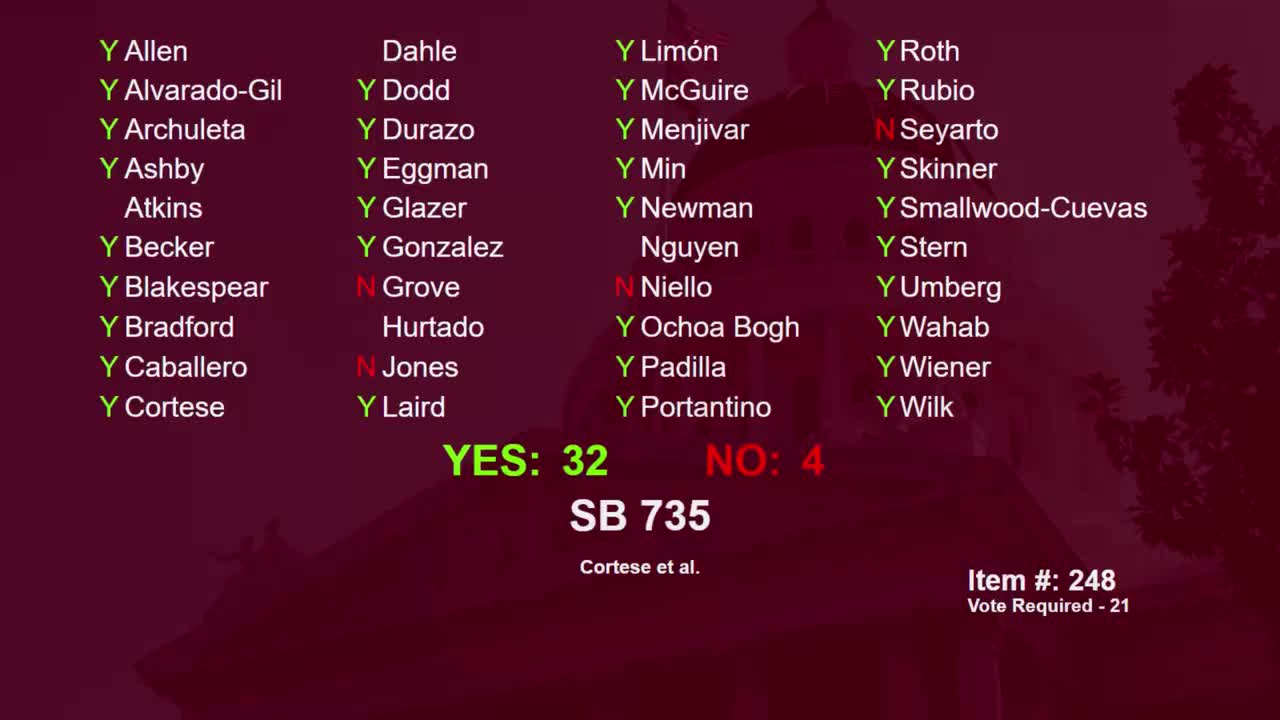 1MIN
Senate Floor
 19MIN