AB 1127: Domestic and family violence: Sacramento County.
- Session Year: 2015-2016
- House: Assembly
- Latest Version Date: 2015-04-06
Existing law requires the collection of fees for issuing marriage licenses and for providing certified copies of vital records, including marriage certificates, birth certificates, fetal death records, and death records. Existing law provides for the establishment of county domestic violence program special funds for the purpose of funding local domestic violence programs. Certain fees payable at the time a marriage license or a certified copy of any of the above vital records is issued may be collected by the county clerks for deposit into these funds.
This bill would, until January 1, 2021, authorize the Sacramento County Board of Supervisors, upon making certain findings and declarations, to authorize an increase in fees for marriage licenses and confidential marriage licenses and for certified copies of certain vital records, up to $4. This bill would further authorize the Sacramento County Board of Supervisors to make further increases in fees each year, as specified. This bill would require the fees to be allocated for purposes relating to domestic and family violence prevention, intervention, and prosecution. This bill would require the Sacramento County Board of Supervisors, by July 1, 2017, to submit a report on funds received and expended in connection with the fee increases, and the outcome of activities associated with the act, to the Assembly Committee on Judiciary and the Senate Committee on Judiciary. Legislature.
This bill would make legislative findings and declarations as to the necessity of a special statute for the County of Sacramento.
Existing law requires the collection of fees for issuing marriage licenses and for providing certified copies of vital records, including marriage certificates, birth certificates, fetal death records, and death records. Existing law provides for the establishment of county domestic violence program special funds for the purpose of funding local domestic violence programs. Certain fees payable at the time a marriage license or a certified copy of any of the above vital records is issued may be collected by the county clerks for deposit into these funds.
This bill would, until January 1, 2021, authorize the Sacramento County Board of Supervisors, upon making certain findings and declarations, to authorize an increase in fees for marriage licenses and confidential marriage licenses and for certified copies of certain vital records, up to $4. This bill would further authorize the Sacramento County Board of Supervisors to make further increases in fees each year, as specified. This bill would require the fees to be allocated for purposes relating to domestic and family violence prevention, intervention, and prosecution. This bill would require the Sacramento County Board of Supervisors, by July 1, 2017, to submit a report on funds received and expended in connection with the fee increases, and the outcome of activities associated with the act, to the Assembly Committee on Judiciary and the Senate Committee on Judiciary.
This bill would make legislative findings and declarations as to the necessity of a special statute for the County of Sacramento.
The Legislature finds and declares all of the following:
(a)Since 2005, over 150 individuals have died in homicides related to domestic violence. This number includes children, one as young as two years old.
(b)In 2013 alone, a total of 18,000 domestic violence-related calls were reported by law enforcement entities within Sacramento County, with over 4,000 adult cases arrested and over 2,400 cases filed and prosecuted.
(c)More than 21,000 crisis calls are made to the three domestic violence shelter programs in Sacramento County every year.
(d)Domestic violence has many hidden costs. These costs include exposing children to recruitment by human traffickers. Currently in Sacramento, 76 percent of the children screened by the juvenile court are found to be involved with, or vulnerable for recruitment to, human trafficking have a family history with child protective services, and 20 percent have an open case with child protective services.
(d)
(e)Sacramento has a high rate of human trafficking, and in 2013, the FBI Human trafficking task force, in a multiday sweep involving Sacramento, rescued the sixth highest total of underage trafficking victims in the country.
(e)
(f)Domestic violence is ubiquitous, it cuts across all economic and education levels, all age groups, ethnicities, and other social and community characteristics.
(f)
(g)Domestic violence is insidious, it is characterized by a predictable, repetitious cycle that can result in injury or death of victims, including children.
(g)
(h)Domestic violence puts children at risk. Children in homes that domestic violence occurs are physically abused or seriously neglected at a rate significantly higher than the national average in the general population.
(h)
(i)Domestic violence is learned and generational. Studies show that boys who witness family violence are more likely to batter their female partners as adults than boys raised in nonviolent homes. Girls who witness their mothers abuse have higher rates of being battered as adults and it is often a precursor to becoming a victim of human trafficking. Over 80 percent of victims of human trafficking either suffered abuse in their homes or witnessed such abuse between parents.
(i)
(j)Substance abuse is a significant factor contributing to, although not necessarily a cause of, domestic violence. Many domestic violence offenders have documented histories of substance abuse or were under the influence of drugs or alcohol at the time a felony crime was committed. Over 80 percent of human trafficking victims had parents that abused substances.
(j)
(k)Domestic violence is costly, both in human and organizational terms. The results of domestic violence have many hidden costs, such as job turnover, loss of productivity, school absenteeism, low school performance, in addition to the high cost of law enforcement, civil and criminal justice, health services, mental health services, substance abuse treatment, human services, and community-based services.
(k)
(l)The domestic violence prevention, intervention, and prosecution system is complex and multifaceted, spanning civil, criminal, health, and social service sectors, and in order to be effective, there must be an alignment in the objectives, protocols, policies, and activities of each sector.
SEC. 2.This act shall be known and may be cited as the Sacramento County Zero Tolerance for Family Violence and Human Trafficking Act.SEC. 3.Section 26840.12 is added to the Government Code, to read:26840.12.(a)The Sacramento County Board of Supervisors, upon making findings and declarations for the need for governmental oversight and coordination of the multiple agencies dealing with domestic violence, may authorize an increase in the fees for marriage licenses and confidential marriage licences, up to a maximum increase of four dollars ($4).
(b)Effective July 1 of each year, the Sacramento County Board of Supervisors may authorize an increase in these fees by an amount equal to the increase of the California Consumer Price Index for the preceding calendar year, rounded to the nearest one-half dollar ($0.50). These fees shall be allocated pursuant to Section 18309.7 of the Welfare and Institutions Code.
(c)In addition to the fee prescribed by Section 26840.1, in Sacramento County, the person issuing authorization for the performance of a marriage or confidential marriage, or the county clerk upon providing a blank authorization form pursuant to Part 4 (commencing with Section 500) of Division 3 of the Family Code, shall collect the fees in subdivision (a), at the time of providing the authorization.
(d)The Sacramento County Board of Supervisors shall submit to the Assembly Committee on Judiciary and the Senate Committee on Judiciary, no later than July 1, 2017, a report containing the following information:
(1)The annual amounts of funds received and expended from fee increases for the purpose of governmental oversight and coordination of domestic violence prevention, intervention, and prosecution efforts in the county.
(2)Outcomes achieved as a result of the activities associated with the Zero Tolerance for Family Violence and Human Trafficking Act.
(e)This section shall remain in effect only until January 1, 2021, and as of that date is repealed, unless a later enacted statute, that is enacted before January 1, 2021, deletes or extends that date.
SEC. 4.SEC. 3.Section 103628.7 is added to the Health and Safety Code, to read:103628.7.(a)The Sacramento County Board of Supervisors, upon making findings and declarations for the need for governmental oversight and coordination of the multiple agencies dealing with domestic violence, may authorize an increase in the fees for certified copies of marriage certificates, birth certificates, fetal death records, and death records, up to a maximum increase of two four dollars ($2). ($4).
(b)Effective July 1 of each year, the Sacramento County Board of Supervisors may authorize an increase in these fees by an amount equal to the increase in the California Consumer Price Index for the preceding calendar year, rounded to the nearest one-half dollar ($0.50). The fees shall be allocated pursuant to Section 18309.1 of the Welfare and Institutions Code.
(c)In addition to the fees prescribed by subdivisions (a) and (b), anyAn applicant for a certified copy of a marriage certificate, birth certificate, a fetal death record, or death record in Sacramento County shall pay an additional fee to the local registrar, county recorder, or county clerk as the fees established by the Sacramento County Board of Supervisors pursuant to subdivisions (a) and b).
(d)(1)The Sacramento County Board of Supervisors shall submit to the Legislature, no later than July 1, 2017, a report containing the following information:
(A)The total annual amount of funds received and expended from fee increases for the purpose of governmental oversight and coordination of domestic violence prevention, intervention, and prosecution efforts in the county.
(B)Outcomes achieved as a result of the activities associated with the Sacramento County Zero Tolerance for Family Violence and Human Trafficking Act.
(2)A report to be submitted pursuant to paragraph (1) shall be submitted in compliance with Section 9795 of the Government Code.
(d)
(e)This section shall remain in effect only until January 1, 2021, and as of that date is repealed, unless a later enacted statute that is enacted before January 1, 2021, deletes or extends that date.
SEC. 5.SEC. 4.Section 18309.1 is added to the Welfare and Institutions Code, to read:18309.1.(a)The Sacramento County Board of Supervisors shall direct the local registrar, county recorder, and county clerk to deposit fees collected pursuant to Section 26840.12 of the Government Code and Section 103628.7 of the Health and Safety Code into a special fund. The county may retain up to 4 percent of the fund for administrative costs associated with the collection and segregation of the additional fees and the deposit of these fees into the special fund. Proceeds from the fund shall be used for governmental oversight and coordination of domestic violence and family violence prevention, intervention, and prosecution efforts among the court system, the district attorneys office, the public defenders office, law enforcement, the probation department, mental health, substance abuse, child welfare services, adult protective services, and community-based organizations and other agencies working in Sacramento County in order to increase the effectiveness of prevention, early intervention, and prosecution of domestic and family violence.
(b)This section shall remain in effect only until January 1, 2021, and as of that date is repealed, unless a later enacted statute that is enacted before January 1, 2021, deletes or extends that date.
SEC. 6.SEC. 5.The Legislature finds and declares that a special law is necessary and that a general law cannot be made applicable within the meaning of Section 16 of Article IV of the California Constitution because of the unique circumstances of the County of Sacramento with respect to domestic violence and human trafficking.
The Legislature finds and declares all of the following:
(a)Since 2005, over 150 individuals have died in homicides related to domestic violence. This number includes children, one as young as two years old.
(b)In 2013 alone, a total of 18,000 domestic violence-related calls were reported by law enforcement entities within Sacramento County, with over 4,000 adult cases arrested and over 2,400 cases filed and prosecuted.
(c)More than 21,000 crisis calls are made to the three domestic violence shelter programs in Sacramento County every year.
(d)Sacramento has a high rate of human trafficking, in 2013, the FBI Human trafficking task force, in a multiday sweep involving Sacramento, rescued the sixth highest total of underage trafficking victims in the country.
(e)Domestic violence is ubiquitous, it cuts across all economic and education levels, all age groups, ethnicities, and other social and community characteristics.
(f)Domestic violence is insidious, it is characterized by a predictable, repetitious cycle that can result in injury or death of victims, including children.
(g)Domestic violence puts children at risk. Children in homes that domestic violence occurs are physically abused or seriously neglected at a rate significantly higher than the national average in the general population.
(h)Domestic violence is learned and generational. Studies show that boys who witness family violence are more likely to batter their female partners as adults than boys raised in nonviolent homes. Girls who witness their mothers abuse have higher rates of being battered as adults and it is often a precursor to becoming a victim of human trafficking. Over 80 percent of victims of human trafficking either suffered abuse in their homes or witnessed such abuse between parents.
(i)Substance abuse is a significant factor contributing to, although not necessarily a cause of, domestic violence. Many domestic violence offenders have documented histories of substance abuse or were under the influence of drugs or alcohol at the time a felony crime was committed. Over 80 percent of human trafficking victims had parents that abused substances.
(j)Domestic violence is costly, both in human and organizational terms. The results of domestic violence have many hidden costs, such as job turnover, loss of productivity, school absenteeism, low school performance, in addition to the high cost of law enforcement, civil and criminal justice, health services, mental health services, substance abuse treatment, human services, and community-based services.
(k)The domestic violence prevention, intervention, and prosecution system is complex and multifaceted, spanning civil, criminal, health, and social service sectors, and in order to be effective, there must be an alignment in the objectives, protocols, policies, and activities of each sector.
SEC. 2.This act shall be known and may be cited as the Sacramento County Zero Tolerance for Family Violence and Human Trafficking Act.SEC. 3.Section 26840.12 is added to the Government Code, to read:26840.12.(a)The Sacramento County Board of Supervisors, upon making findings and declarations for the need for governmental oversight and coordination of the multiple agencies dealing with domestic violence, may authorize an increase in the fees for marriage licenses and confidential marriage licences, up to a maximum increase of four dollars ($4).
(b)Effective July 1 of each year, the Sacramento County Board of Supervisors may authorize an increase in these fees by an amount equal to the increase of the California Consumer Price Index for the preceding calendar year, rounded to the nearest one-half dollar ($0.50). These fees shall be allocated pursuant to Section 18309.7 of the Welfare and Institutions Code.
(c)In addition to the fee prescribed by Section 26840.1, in Sacramento County, the person issuing authorization for the performance of a marriage or confidential marriage, or the county clerk upon providing a blank authorization form pursuant to Part 4 (commencing with Section 500) of Division 3 of the Family Code, shall collect the fees in subdivision (a), at the time of providing the authorization.
(d)The Sacramento County Board of Supervisors shall submit to the Assembly Committee on Judiciary and the Senate Committee on Judiciary, no later than July 1, 2017, a report containing the following information:
(1)The annual amounts of funds received and expended from fee increases for the purpose of governmental oversight and coordination of domestic violence prevention, intervention, and prosecution efforts in the county.
(2)Outcomes achieved as a result of the activities associated with the Zero Tolerance for Family Violence and Human Trafficking Act.
(e)This section shall remain in effect only until January 1, 2021, and as of that date is repealed, unless a later enacted statute, that is enacted before January 1, 2021, deletes or extends that date.
SEC. 4.Section 103628.7 is added to the Health and Safety Code, to read:103628.7.(a)The Sacramento County Board of Supervisors, upon making findings and declarations for the need for governmental oversight and coordination of the multiple agencies dealing with domestic violence, may authorize an increase in the fees for certified copies of marriage certificates, birth certificates, fetal death records, and death records, up to a maximum increase of two dollars ($2).
(b)Effective July 1 of each year, the Sacramento County Board of Supervisors may authorize an increase in these fees by an amount equal to the increase in the California Consumer Price Index for the preceding calendar year, rounded to the nearest one-half dollar ($0.50). The fees shall be allocated pursuant to Section 18309.1 of the Welfare and Institutions Code.
(c)In addition to the fees prescribed by subdivisions (a) and (b), any applicant for a certified copy of a birth certificate, a fetal death record, or death record in Sacramento County shall pay an additional fee to the local registrar, county recorder, or county clerk as established by the Sacramento County Board of Supervisors.
(d)This section shall remain in effect only until January 1, 2021, and as of that date is repealed, unless a later enacted statute that is enacted before January 1, 2021, deletes or extends that date.
SEC. 5.Section 18309.1 is added to the Welfare and Institutions Code, to read:18309.1.(a)The Sacramento County Board of Supervisors shall direct the local registrar, county recorder, and county clerk to deposit fees collected pursuant to Section 26840.12 of the Government Code and Section 103628.7 of the Health and Safety Code into a special fund. The county may retain up to 4 percent of the fund for administrative costs associated with the collection and segregation of the additional fees and the deposit of these fees into the special fund. Proceeds from the fund shall be used for governmental oversight and coordination of domestic violence and family violence prevention, intervention, and prosecution efforts among the court system, the district attorneys office, the public defenders office, law enforcement, the probation department, mental health, substance abuse, child welfare services, adult protective services, and community-based organizations and other agencies working in Sacramento County in order to increase the effectiveness of prevention, early intervention, and prosecution of domestic and family violence.
(b)This section shall remain in effect only until January 1, 2021, and as of that date is repealed, unless a later enacted statute that is enacted before January 1, 2021, deletes or extends that date.
SEC. 6.The Legislature finds and declares that a special law is necessary and that a general law cannot be made applicable within the meaning of Section 16 of Article IV of the California Constitution because of the unique circumstances of the County of Sacramento with respect to domestic violence and human trafficking.
|
Date
|
Status
|
|---|---|
| Feb 27, 2015 | Introduced. To print. |
| Mar 1, 2015 | From printer. May be heard in committee March 31. |
| Mar 2, 2015 | Read first time. |
| Mar 19, 2015 | Referred to Coms. on L. GOV. and JUD. |
| Apr 6, 2015 | From committee chair, with author's amendments: Amend, and re-refer to Com. on L. GOV. Read second time and amended. |
| Apr 7, 2015 | Re-referred to Com. on L. GOV. |
| Apr 15, 2015 | In committee: Set, first hearing. Hearing canceled at the request of author. |
| May 7, 2015 | From committee: Do pass and re-refer to Com. on JUD. (Ayes 5. Noes 3.) (May 6). Re-referred to Com. on JUD. |
| May 12, 2015 | From committee: Do pass. (Ayes 7. Noes 3.) (May 12). |
| May 13, 2015 | Read second time. Ordered to third reading. |
| May 18, 2015 | In Senate. Read first time. To Com. on RLS. for assignment. |
| May 18, 2015 | Read third time. Passed. Ordered to the Senate. |
| May 18, 2015 | Read third time. Passed. Ordered to the Senate. (Ayes 49. Noes 26. Page 1483.) |
| May 28, 2015 | Referred to Coms. on GOV. & F. and JUD. |
|
Date
|
Description
|
Location
|
Votes
|
|
|---|---|---|---|---|
| May 18, 2015 | AB 1127 COOLEY Assembly Third Reading | Assembly Floor |
Passed |
|
| May 12, 2015 | Do pass. | Assembly Standing Committee on Judiciary |
Passed |
|
| May 6, 2015 | Do pass and be re-referred to the Committee on [Judiciary] | Assembly Standing Committee on Local Government |
Passed |
This list shows positions taken on this bill by organizations on the date displayed, which is linked to the original source.
Positions by individuals are not included.
|
Organization
|
Position
|
Date
|
|---|---|---|
| A Community for Peace | ** Support | May 12, 2015 |
| California District Attorneys Association | ** Support | May 12, 2015 |
| California Police Chiefs Association | ** Support | May 12, 2015 |
| California Taxpayers' Association | ** Against | May 12, 2015 |
| Howard Jarvis Taxpayers Association | ** Against | May 12, 2015 |
| My Sister's House | ** Support | May 12, 2015 |
| Sacramento County Board of Supervisors | ** Support | May 12, 2015 |
| Sacramento County Board of Supervisors [CO-SPONSOR] | ** Support | May 6, 2015 |
| Sacramento County District Attorney | ** Support | May 12, 2015 |
| WEAVE | ** Support | May 12, 2015 |
AB 1127
Page 6
ASSEMBLY THIRD READING
AB 1127
(Cooley)
As Amended April 6, 2015
Majority vote
Committee |
Votes |
Ayes |
Noes |
Local Government |
5-3 |
Gonzalez, Alejo, Chiu, Cooley, Holden |
Maienschein, Linder, Waldron |
Judiciary |
7-3 |
Mark Stone, Alejo, Chau, Chiu, Cristina Garcia, Holden, O'Donnell |
Wagner, Gallagher, Maienschein |
SUMMARY: Allows Sacramento County to increase fees by up to $4 for certified copies of marriage certificates, birth certificates, fetal death records, and death records to fund domestic and family violence prevention, intervention, and prosecution. Specifically, this bill:
Establishes the Sacramento County Zero Tolerance for Family Violence and Human Trafficking Act.
Allows the Sacramento County Board of Supervisors (Board), upon making findings and declarations for the need for governmental oversight and coordination of the multiple agencies dealing with domestic violence, to authorize an increase in the fees for certified copies of marriage certificates, birth certificates, fetal death records, and death records, up to a maximum increase of $4.
Allows the Board, effective July 1 of each year, to authorize an increase in these fees by an amount equal to the increase in the California Consumer Price Index (CPI) for the preceding calendar year, rounded to the nearest $0.50. The fees shall be allocated pursuant to the provisions outlined in 7) through 9) below.
Requires an applicant for a certified copy of a marriage certificate, birth certificate, a fetal death record, or death record in Sacramento County to pay to the local registrar, county recorder, or county clerk the fees established by the Board pursuant to 2) and 3) above.
Requires the Board to submit to the Legislature, no later than July 1, 2017, a report containing the following information:
The total annual amount of funds received and expended from fee increases for the purpose of governmental oversight and coordination of domestic violence prevention, intervention, and prosecution efforts in the county; and,
Outcomes achieved as a result of the activities associated with the Sacramento County Zero Tolerance for Family Violence and Human Trafficking Act.
Requires the report described above to be submitted in compliance with existing law governing the process for submitting reports to the Legislature.
Requires the Board to direct the local registrar, county recorder, and county clerk to deposit fees collected pursuant to the provisions described, above, into a special fund.
Requires proceeds from the fund to be used for governmental oversight and coordination of domestic violence and family violence prevention, intervention, and prosecution efforts among the court system, the district attorney's office, the public defender's office, law enforcement, the probation department, mental health, substance abuse, child welfare services, adult protective services, and community-based organizations and other agencies working in Sacramento County in order to increase the effectiveness of prevention, early intervention, and prosecution of domestic and family violence.
Allows Sacramento County to retain up to 4% of the fund for administrative costs associated with the collection and segregation of the additional fees and the deposit of these fees into the special fund.
Makes the following findings and declarations:
Since 2005, over 150 individuals have died in homicides related to domestic violence. This number includes children, one as young as two years old;
In 2013 alone, a total of 18,000 domestic violence-related calls were reported by law enforcement entities within Sacramento County, with over 4,000 adult cases arrested and over 2,400 cases filed and prosecuted;
More than 21,000 crisis calls are made to the three domestic violence shelter programs in Sacramento County every year;
Domestic violence has many hidden costs. These costs include exposing children to recruitment by human traffickers. Currently in Sacramento, 76% of the children screened by the juvenile court are found to be involved with, or vulnerable for recruitment to, human trafficking have a family history with child protective services, and 20% have an open case with child protective services;
Sacramento has a high rate of human trafficking, and in 2013, the Federal Bureau of Investigation (FBI) Human Trafficking Task Force, in a multiday sweep involving Sacramento, rescued the sixth highest total of underage trafficking victims in the country;
Domestic violence is ubiquitous, it cuts across all economic and education levels, all age groups, ethnicities, and other social and community characteristics;
Domestic violence is insidious, it is characterized by a predictable, repetitious cycle that can result in injury or death of victims, including children;
Domestic violence puts children at risk. Children in homes where domestic violence occurs are physically abused or seriously neglected at a rate significantly higher than the national average in the general population;
Domestic violence is learned and generational. Studies show that boys who witness family violence are more likely to batter their female partners as adults than boys raised in nonviolent homes. Girls who witness their mothers' abuse have higher rates of being battered as adults and it is often a precursor to becoming a victim of human trafficking. Over 80% of victims of human trafficking either suffered abuse in their homes or witnessed such abuse between parents;
Substance abuse is a significant factor contributing to, although not necessarily a cause of, domestic violence. Many domestic violence offenders have documented histories of substance abuse or were under the influence of drugs or alcohol at the time a felony crime was committed. Over 80% of human trafficking victims had parents that abused substances;
Domestic violence is costly, both in human and organizational terms. The results of domestic violence have many hidden costs, such as job turnover, loss of productivity, school absenteeism, low school performance, in addition to the high cost of law enforcement, civil and criminal justice, health services, mental health services, substance abuse treatment, human services, and community-based services;
The domestic violence prevention, intervention, and prosecution system is complex and multifaceted, spanning civil, criminal, health, and social service sectors, and in order to be effective, there must be an alignment in the objectives, protocols, policies, and activities of each sector; and,
A special law is necessary and a general law cannot be made applicable within the meaning of California Constitution Article IV, Section 16 because of the unique circumstances of Sacramento County with respect to domestic violence and human trafficking.
Provides that this bill shall remain in effect only until January 1, 2021, and as of that date is repealed, unless a later enacted statute that is enacted before January 1, 2021, deletes or extends that date.
EXISTING LAW allows the following local jurisdictions to increase fees for copies of marriage certificates, birth certificates, fetal death records, and death records to fund governmental oversight and coordination of domestic violence prevention, intervention, and prosecution programs: the City of Berkeley (birth and death records only) and the Counties of Alameda, Contra Costa, Solano, Sonoma, and Stanislaus.
FISCAL EFFECT: None
COMMENTS:
Bill Summary. This bill allows Sacramento County to increase fees by up to $4 for certified copies of marriage certificates, birth certificates, fetal death records, and death records to fund domestic and family violence prevention, intervention, and prosecution. The Board must submit a report to the Legislature by July 1, 2017, a report containing the following information:
The total annual amount of funds received and expended from fee increases for the purpose of governmental oversight and coordination of domestic violence prevention, intervention, and prosecution efforts in the county; and,
Outcomes achieved as a result of the activities associated with the Sacramento County Zero Tolerance for Family Violence and Human Trafficking Act.
This bill is sponsored by the Board and the Sacramento County District Attorney.
Author's Statement. According to the author, "In 2013 alone, a total of 18,000 domestic violence-related calls were reported by law enforcement entities within Sacramento County. More than 21,000 crisis calls are made to the three domestic violence shelter programs in Sacramento County every year.
"Domestic violence puts children at risk. Children in homes where domestic violence occurs are physically abused or seriously neglected at a rate significantly higher than the national average. Children in these homes are more vulnerable to recruitment to human traffickers. Currently, in Sacramento, 76 percent of children screened by the Juvenile Court and found to be involved or vulnerable for recruitment to trafficking have a family history with Child Protective Services (CPS). Twenty percent have an open case with CPS.
"The domestic violence prevention, intervention, and prosecution system is complex and multi-faceted. It spans the civil, criminal, health and social service sectors. To ensure the effectiveness of the efforts to address domestic violence in these sectors, it is necessary to ensure that their objectives, protocols, policies, and activities are aligned."
Background. The Legislature has allowed the following local jurisdictions to increase fees for copies of marriage certificates, birth certificates, fetal death records, and death records to fund governmental oversight and coordination of domestic violence prevention, intervention, and prosecution programs: the City of Berkeley (birth and death records only) and the Counties of Alameda, Contra Costa, Solano, Sonoma, and Stanislaus.
Contra Costa is allowed an increase of $4, while all other jurisdictions are allowed a $2 increase. All jurisdictions may approve additional increases based on the CPI for the San Francisco metropolitan area. These programs were initially established on a pilot basis and were made permanent after submitting required reports on their effectiveness to the Legislature (with the exception of Stanislaus County, which has a sunset date of January 1, 2016).
This bill establishes in a nearly identical fashion the same authority for Sacramento County, which estimates additional revenue of $500,000 annually from the bill's authority. Sacramento County's current fees for these records range from $11 to $28, depending on the type or record requested and the type of requestor (a government agency or a member of the public). Sacramento County would like to use funds generated by the fee increases to assist in establishing a Family Justice Center.
Sacramento County Family Justice Center. According to Sacramento County's Web site, "In 2011, the national Family Justice Center Alliance chose Sacramento County to receive initial funds to launch a Family Justice Center (FJC). The FJC will be available to serve victims of family violence and sexual assaults, including victims of marital and dating violence, elder and child abuse and human trafficking. The FJC collaborative will include government agencies and community based organizations working together with one central facility where victims and their families can come to access almost all services available in the county.
"Services will include immediate crisis intervention, safety planning, social service eligibility, counseling, child advocacy, emergency food and transportation, and many other support services designed to keep them from falling back into the hands of the accused. Services will be either housed at the center or linked via video. Although there are currently 15 FJCs throughout California, the Sacramento center will be a first-of-its-kind in the state because it will integrate Sacramento State as a key partner. The center will provide unique learning and research opportunities for both students and faculty members."
Proposition 26 (2010). In the November 2010 election, California voters approved Proposition 26, which amended the California Constitution to expand the definitions of local taxes and tax increases that require voter approval. Under Proposition 26, any levy, charge, or exaction of any kind imposed by a local government is a tax, requiring voter approval, except for:
A charge for a benefit or privilege conveyed directly to the payor and not conveyed to those not charged;
A charge for a service or product provided directly to the payor and not provided to those not charged;
A fee to cover certain costs of regulation;
Entrance fees for state or local property;
Fines imposed by a court or a local government;
A charge imposed as a condition of property development; and,
Assessments and property-related fees governed by Proposition 218 (1996).
It is not clear that local fees on vital records to fund the coordination of domestic violence prevention efforts qualify as fees under any of Proposition 26's exceptions. Instead, they may be local special taxes, which must be approved by two-thirds of voters before they can be added to the charges for copies of vital records.
Policy Considerations. This bill establishes the Sacramento County Zero Tolerance for Family Violence and Human Trafficking Act. While the provisions of this bill are nearly identical to existing programs for a handful of other local jurisdictions in California, including the purposes for which funds generated by increased fees must be allocated, the inclusion of human trafficking in these statutes is new. While the prevention of human trafficking is laudable, the Legislature may wish to consider whether the statutes governing the authority of local jurisdictions to increase fees for the support of programs addressing domestic violence should include human trafficking in the language.
Previous Legislation. AB 1852 (Campos) of 2012 would have allowed a county board of supervisors, or a city council of a city with a local registrar, to increase fees for certified copies of marriage certificates, birth certificates, fetal death records, and death records by up to $5. AB 1852 was vetoed with the following message:
Domestic violence and child abuse prevention programs are well worth the investment of public funds, but seeking a fee increase on vital records, when the fee is already going up by $6 for some of these records, would burden people of modest means.
AB 1770 (Galgiani), Chapter 578, Statutes of 2010, established a similar domestic violence prevention funding pilot program in Stanislaus County until January 1, 2016.
SB 635 (Wiggins), Chapter 356, Statutes of 2009, established a similar domestic violence prevention funding pilot program in Sonoma County until January 1, 2015. SB 154 (Wolk), Chapter 120, Statutes of 2011, repealed the sunset date, making the program permanent.
SB 425 (Torlakson), Chapter 90, Statutes of 2001, established a similar domestic violence prevention funding pilot program in Contra Costa County. SB 968 (Torlakson), Chapter 635, Statutes of 2006, repealed the sunset date, making Contra Costa's program effective indefinitely.
AB 2010 (Hancock), Chapter 830, Statutes of 2004, established the pilot programs in Alameda County and Solano County. AB 1712 (Hancock), Chapter 545, Statutes of 2005, authorized the City of Berkeley, within Alameda County, to also participate in the pilot program. AB 73 (Hayashi), Chapter 215, Statutes of 2009, repealed the sunset date, making Alameda's and Berkeley's programs effective indefinitely.
Arguments in Support. The Board and the Sacramento County District Attorney, sponsors of this bill, write, "Research done by the Family Justice Center Alliance found that 'survivors… benefitted from a comprehensive service approach that considered the context of a safe and supportive environment, in an all-in-one service approach that included the therapeutic and legal needs of survivors, and individualized services that emphasized emotional support and survivors getting the help they need.'
"The service model contemplated in Sacramento County would serve victims of not only domestic violence, but also family violence including child abuse victims as well as survivors of human trafficking. This comprehensive approach to service delivery is vital to producing more positive outcomes and making the receipt of services easier for victims.
"The family justice center model has seen significant successes across the state. Since adopting this model, Alameda County has had a 20 percent reduction in domestic violence case dismissals; improved inter-agency collaboration; a dramatic reduction in domestic violence homicides (from 31 in 2001 to 3 in 2007); and, provided over 20,000 coordinated client services since opening. Sacramento County wishes to be counted among these successes."
Arguments in Opposition. The Howard Jarvis Taxpayers Association, in opposition, states, "While the purpose of this tax – to provide a source of funding for domestic violence programs – is laudable, the means to that end is flatly illegal and will only engender expensive and protracted litigation. AB 1127, simply stated, violates Proposition 26… (which) lists a series of five regulatory fee exemptions that allow levies to not be termed tax increases. Of these, only one is really even debatable. [California Constitution] Article XIII C, section 1(e)(3) exempts 'A charge imposed for the reasonable regulatory costs to a local government for issuing licenses and permits, performing investigations, inspections, and audits,... and the administrative enforcement and adjudication thereof.'
"This exemption is also inapplicable because the revenue from the AB 1127 fee is not being used to regulate the payers of the fee. There is no proof that marriage, for example (much less birth or death) leads to domestic violence. In fact, the opposite is true. Empirical studies show that married couples are less likely candidates for domestic violence than persons in unmarried relationships. Therefore, most payers will never be covered by the funded programs.
"Moreover, local governments simply do not regulate marriages. They do not conduct regulatory inspections or audits to enforce rules on married households. The exemption was obviously intended by voters to refer to regulated business activities, not marriages. In sum, because of the lack of an appropriate regulatory nexus, AB 1127 purports to authorize a special tax without the requisite two-thirds vote."
Analysis Prepared by: Angela Mapp / L. GOV. / (916) 319-3958 FN: 0000374
AB 1127
Page 7
Date of Hearing: May 12, 2015
ASSEMBLY COMMITTEE ON JUDICIARY
Mark Stone, Chair
AB 1127
(Cooley) – As Amended April 6, 2015
SUBJECT: SACRAMENTO DOMESTIC VIOLENCE FUNDING: VITAL RECORDS FEES
KEY ISSUE: IN ORDER TO COMBAT DOMESTIC VIOLENCE AND HUMAN TRAFFICKING IN SACRAMENTO COUNTY, SHOULD FEES FOR SPECIFIED VITAL RECORDS BE RAISED TO SUPPORT CREATION OF A ONE-STOP FAMILY JUSTICE CENTER?
SYNOPSIS
Over the last decade, the Legislature has authorized, on a pilot basis, five counties to increase fees for copies of various vital records to fund governmental oversight and coordination of domestic violence prevention, intervention, and prosecution programs. Many of these programs have been highly successful in combating domestic violence through creation of one-stop family justice centers (FJCs); and the Legislature, after reviewing program reports required as a condition of the pilots, made the programs in Alameda, Contra Costa and Solano Counties, and the City of Berkeley permanent. Last year, the Legislature defined FJCs in state law and defined key aspects of their operations. (AB 1623 (Atkins), Chap. 85, Stats. 2014.)
This bill, sponsored by the Sacramento County Board of Supervisors and the Sacramento District Attorney, is modeled after similar programs in Alameda and Contra Costa counties. Sacramento County intends to use the increased fees to create a one-stop FJC to help combat domestic violence and human trafficking. This bill requires the Board of Supervisors to report back to the Legislature on the activities funded by the fee increases and the outcomes of those activities. The program sunsets as of January 1, 2021.
Supporters, including WEAVE, My Sister's House and the California District Attorneys Association, state that the proposed FJC will create a single place for the delivery of comprehensive support services to domestic violence victims, which in turn will lead to improved outcomes for victims, improved offender accountability and improved operational efficiencies. It is opposed by the California Taxpayers Association and the Howard Jarvis Taxpayers Association who argue that the fee increase is a special tax that, under Proposition 26, requires approval by a two-thirds vote. This bill passed the Local Government Committee last week on a vote of 5-3.
SUMMARY: Creates, as a pilot program, the Sacramento County Zero Tolerance for Family Violence and Human Trafficking Act, which authorizes the Sacramento County Board of Supervisors to increase specified fees to fund domestic violence and human trafficking prevention programs. Specifically, this bill:
Authorizes, until January 1, 2021, the Sacramento County Board of Supervisors (Board), upon making specified findings and declarations to increase the fees for certified copies of marriage certificates, birth certificates, fetal death records, and death records, up to a maximum increase of $4, with further increases permitted annually based on the California Consumer Price Index (CPI), as specified.
Requires proceeds from the fee increase to be used for governmental oversight and coordination of domestic violence and family violence prevention, intervention, and prosecution efforts among the court system, the district attorney’s office, the public defender’s office, law enforcement, the probation department, mental health, substance abuse, child welfare services, adult protective services, and community-based organizations and other agencies working in Sacramento County in order to increase the effectiveness of prevention, early intervention, and prosecution of domestic and family violence.
Allows Sacramento County to retain up to 4 percent of the fees for administrative costs associated with the collection and segregation of the additional fees and the deposit of these fees into the required special fund, as specified.
Requires the Board to submit to the Legislature, no later than July 1, 2017, a report about the annual amounts of funds received and expended from the fee increases and the outcomes achieved.
Makes specified findings and declarations, including:
In 2013, 18,000 domestic violence-related calls were reported by law enforcement entities within Sacramento County, with over 4,000 adult cases arrested and over 2,400 cases filed and prosecuted. More than 21,000 crisis calls are made to the three domestic violence shelter programs in Sacramento County every year.
Sacramento has a high rate of human trafficking, and in 2013, the FBI Human Trafficking Task Force, in a multiday sweep involving Sacramento, rescued the sixth highest total of underage trafficking victims in the country.
Domestic violence is ubiquitous, it cuts across all economic and education levels, all age groups, ethnicities, and other social and community characteristics.
Domestic violence puts children at risk. Children in homes where domestic violence occurs are physically abused or seriously neglected at a rate significantly higher than the national average in the general population.
Domestic violence is learned and generational. Studies show that boys who witness family violence are more likely to batter their female partners as adults than boys raised in nonviolent homes. Girls who witness their mothers’ abuse have higher rates of being battered as adults and it is often a precursor to becoming a victim of human trafficking. Over 80 percent of victims of human trafficking either suffered abuse in their homes or witnessed such abuse between parents.
EXISTING LAW:
Authorizes the Contra Costa Board of Supervisors to increase the fee by up to $4 (subject to CPI increases) for certified copies of marriage certificates, birth certificates, and death records to provide funding for governmental oversight and coordination of domestic violence prevention, intervention, and prosecution efforts in Contra Costa County. (Health and Safety Code Section 103626; Welfare and Institutions Code Section 18308.)
Authorizes the Alameda, Solano and the Stanislaus County Boards of Supervisors, and the Berkeley City Council, upon making specified findings and declarations, to increase the fees for marriage licenses and confidential marriage licenses, as well as certified copies of marriage, birth, and death certificates, by up to $2, with further CPI increases permitted on an annual basis. The authorization for Stanislaus expires on January 1, 2016. Directs that the fees be deposited into a special fund to be used for governmental oversight and coordination of domestic violence and family violence prevention, intervention, and prosecution efforts. (Government Code Sections 26840.10 and 26840.11; Health and Safety Code Sections 103627, 103627, 103628, 103628.6; Welfare and Institutions Code Sections 18309, 18309.5 and 18309.8.)
Authorizes a city, county, city and county, or community-based nonprofit organization to establish a family justice center (FJC), as defined, to assist victims of domestic violence, sexual assault, elder and dependent adult abuse, and human trafficking to ensure victims of abuse are able to access all needed services in one location. (Penal Code section 13750.)
FISCAL EFFECT: As currently in print this bill is keyed non-fiscal.
COMMENTS: Over the last decade, the Legislature has authorized, on a pilot basis, five counties to increase fees for marriage licenses and for marriage, birth and death certificates to fund governmental oversight and coordination of domestic violence prevention, intervention, and prosecution programs. These programs have been highly successful and have led to the creation of a family justice center in Alameda County, a youth intervention program in the City of Berkeley and significantly greater coordination of services in Contra Costa County. As a result of their successes, the Legislature, after reviewing program reports required as a condition of the pilots, made the programs in Alameda, Contra Costa and Solano Counties and the City of Berkeley permanent.
This bill, sponsored by the Sacramento County Board of Supervisors and the Sacramento District Attorney, is modeled after the programs in Alameda and Contra Costa counties and allows the Sacramento Board of Supervisors, on a pilot basis, the ability to raise fees for certified copies of marriage and birth certificates and death records by up to $4 in order to fund governmental oversight and coordination of domestic violence prevention and intervention. The fee would increase annually based on the CPI. Sacramento County intends to use the increased fees to create a one-stop FJC to help combat domestic violence and human trafficking. This bill requires the Board to report back to the Legislature on the activities funded by the fee increases and the outcomes of those activities. This bill sunsets the program as of January 1, 2021.
The author explains the need for the bill: "To ensure the effectiveness of the efforts of those working to address [d]omestic violence, it is necessary to ensure that their objects, protocols, policies, and activities are aligned. AB 1127 allows the Sacramento County Board of Supervisors to increase the fees charged for providing copies of vital records to fund a domestic violence resource center/family justice center."
The bill's sponsors add:
Research done by the Family Justice Center Alliance found that "survivors…benefitted from a comprehensive service approach that considered the context of a safe and supportive environment, in an all-in-one service approach that included the therapeutic and legal needs of survivors, and individualized services that emphasized emotional support and survivors getting the help they need." The service model contemplated in Sacramento County would serve victims of not only domestic violence, but also family violence including child abuse victims as well as survivors of human trafficking. This comprehensive approach to service delivery is vital to producing more positive outcomes and making the receipt of services easier for victims. (Footnote omitted.)
Devastating Effects of Domestic Violence on Women and Families. Domestic violence is a serious criminal justice and public health problem most often perpetrated against women. (Extent, Nature and Consequences of Intimate Partner Violence: Findings from the National Violence against Women Survey, U.S. Department of Justice (2001).) Prevalence of domestic violence at the national level ranges from 960,000 to three million women each year who are physically abused by their husbands or boyfriends. While the numbers are staggering, they only include those cases of reported domestic violence. In fact, according to a 1998 Commonwealth Fund survey of women’s health, nearly 31% of American women report being physically or sexually abused by a husband or boyfriend at some point in their lives. (Health Concerns Across a Woman’s Lifespan: 1998 Survey of Women’s Health, The Commonwealth Fund (May 1999).)
Domestic violence continues to be a significant problem in California. In 2005, the Attorney General's Task Force on Domestic Violence reported that:
The health consequences of physical and psychological domestic violence can be significant and long lasting, for both victims and their children. . . . A study by the California Department of Health Services of women's health issues found that nearly six percent of women, or about 620,000 women per year, experienced violence or physical abuse by their intimate partners. Women living in households where children are present experienced domestic violence at much higher rates than women living in households without children: domestic violence occurred in more than 436,000 households per year in which children were present, potentially exposing approximately 916,000 children to violence in their homes every year.
(Report to the California Attorney General from the Task Force on Local Criminal Justice Response to Domestic Violence, Keeping the Promise: Victim Safety and Batterer Accountability (June 2005) (footnotes omitted).)
That report discovered numerous significant and troubling problems in the implementation of statutory directives aimed at preventing domestic violence, including failing to enter restraining orders into CLETS (California Law Enforcement Telecommunications System) and failing to ensure that batterers attend mandated treatment programs.
Human Trafficking is a Significant Problem in Sacramento County. According to a report by the California Child Welfare Council, California is a magnet for commercial exploitation of children, and many of those children are also involved with the child welfare system:
Youth in the child welfare system are particularly vulnerable to [commercial sexual exploitation]. Abuse and neglect, unstable placements, and lack of positive relationships create vulnerabilities that exploiters target. "One recovered youth told me 'being in foster care was the perfect training for commercial sexual exploitation. I was used to being moved without warning, without any say, not knowing where I was going or whether I was allowed to pack my clothes. After years in foster care, I didn’t think anyone would want to take care of me unless they were paid. So, when my pimp expected me to make money to support 'the family,' it made sense to me.'"
(Kate Walker, Ending the Commercial Sexual Exploitation of Children: A Call for Multi-System Collaboration in California 5-6 (California Child Welfare Council 2013) (footnote omitted).) A one-stop FJC would bring together not only law enforcement, but also child welfare and community services necessary to support these young victims.
According to the sponsors, Sacramento has a particularly high rate of human trafficking. An FBI national sweep to stop human trafficking rescued the sixth highest number of underage human trafficking victims in Sacramento.
Successful Pilot Programs to Combat Domestic Violence Made Permanent. While initially begun as pilots, the programs in Alameda, Contra Costa and Solano Counties and the City of Berkeley have now been made permanent. In support of making those programs permanent, the Alameda County Board of Supervisors wrote that the funds from the fee increases have played a vital role in funding the coordination costs and have "changed the way systems and service providers are delivering essential and critical services to victims of domestic violence and their children." The Board noted that domestic violence deaths in the county dropped from 26 in 2001 to 3 in 2006, with a goal of zero deaths going forward.
The Alameda County District Attorney's Office agreed, stating that as a result of the Family Justice Center in the county built, in part, with funds provided by the fee increases, "there is a new (or re-newed) confidence on the part of Victims that the legal systems work for them and that there are resources and service providers who will work together to protect, support and empower them and their children to have lives free of interpersonal violence."
The Berkeley City Council told the Legislature that it uses these funds for youth intervention in the schools to promote healthy relationships and prevent domestic violence, modeled after "extremely successful peer health educator programs."
As a result of the increased funding, Contra Costa County has been able to, among other things, increase funding for a coordinated system and for individual agencies; increase systemwide accountability; increase batterer accountability; and increase protections for victims and children. Prior to the fee increase, individual agencies had not worked together smoothly, but the funding increase has permitted the county to operate an efficient and coordinated system.
Family Justice Center Model for Combating Domestic Violence. The FJC model was originally developed in San Diego, which opened a center in 2002. The idea behind the FJC model is to create a coordinated, single-point-of-access center offering comprehensive services for victims of domestic violence, thereby reducing the number of locations a victim must visit in order to receive critical services. The United States Department of Justice, through its Office on Violence Against Women (OVW), has identified the FJC model as a best practice in the field of domestic violence. According to the OVW, FJC outcomes include a reduction in the rate of homicide; increased victim safety; improved offender prosecution; reduced fear and anxiety for victims and their children; increased efficiency among service providers through the provision of collaborative services; and increased community support for the provision of services to victims and their children. (Casey Gwinn and Gael Strack, Hope for Hurting Families: Creating Family Justice Centers Across America (Volcano Press 2006).)
In 2011 the Legislature passed SB 557 (Kehoe), Chap. 262, which directed the establishment of four FJCs to assist victims of domestic violence, sexual assault, stalking, cyberstalking, cyberbullying, human trafficking, and elder or dependent adult abuse. An evaluation of the FJCs, mandated by that bill, found that the centers "successfully served a significant number of survivors and addressed multiple service needs, supporting the need for co-located multi-agency service models." Last year, the Legislature in AB 1623 (Atkins), Chap. 85, Stats. 2014, sought to further improve the operation of FJCs across the state by defining FJCs in state law and setting forth key aspects of their operations. There are almost 20 FJCs operating in California today.
This Bill Will Allow Sacramento County to Fund a Family Justice Center. According to the sponsors, this bill will allow Sacramento County to open a one-stop FJC to help address family violence and human trafficking. According to Sacramento County's website, "In 2011, the national Family Justice Center Alliance chose Sacramento County to receive initial funds to launch a Family Justice Center (FJC). The FJC will be available to serve victims of family violence and sexual assaults, including victims of marital and dating violence, elder and child abuse and human trafficking. The FJC collaborative will include government agencies and community based organizations working together with one central facility where victims and their families can come to access almost all services available in the county." Sacramento County estimates it will raise $500,000 annually from the increased fees for vital records.
Opposition Raises Proposition 26 Tax Concern. The Howard Jarvis Taxpayers Association, in opposition, states that while "the purpose of this tax – to provide a source of funding for domestic violence programs – is laudable, the means to that end is flatly illegal and will only engender expensive and protracted litigation. AB 1127, simply stated, violates Proposition 26." The Association writes that the bill lacks an appropriate regulatory nexus between the fee increase and its use and therefore the bill "purports to authorize a special tax without the requisite two-thirds vote."
California voters approved Proposition 26 in 2012, an initiative constitutional amendment that expanded the definition of a "tax" to include many state and local government assessments previously classified as "fees." Among other provisions, Proposition 26 amended Article XIII C, Section 1 of the California Constitution to define the term "tax" as any levy, charge, or exaction of any kind imposed by a local government, with seven specific exemptions. If the extension of the fee increase does not fall into one of those exemptions, it will likely require approval by local voters. However, since this bill does not mandate the fee extension, but simply allows the county to extend the fee increase, it does not require a two-thirds vote in the Legislature.
The California Taxpayer Association adds that a fee on records "merely should cover the reasonable administrative costs of processing and printing the license or record, as well as any administrative staff time used to cover the cost of providing such a service. While we commend the author for seeking solutions to prevent domestic and family violence, the county should instead consider other funding alternatives for such programs."
Previous Legislation. AB 1852 (Campos), 2012, would have allowed a county board of supervisors, or a city council of a city with a local registrar, to increase fees for certified copies of marriage certificates, birth certificates, fetal death records, and death records by up to $5. AB 1852 was vetoed. AB 1883 (Evans), 2010, which would have allowed a county board of supervisors, or a city council of a city with a local registrar, to increase similar fees, was held in the Senate.
AB 1770 (Galgiani), Chap. 578, Stats. 2010, established a similar domestic violence prevention funding pilot program in Stanislaus County until January 1, 2016.
SB 635 (Wiggins), Chap. 356, Stats. 2009, established a similar domestic violence prevention funding pilot program in Sonoma County until January 1, 2015.
SB 425 (Torlakson), Chap. 90, Stats. 2001, established a similar domestic violence prevention funding pilot program in Contra Costa County. SB 968 (Torlakson), Chap. 635, Stats. 2006, repealed the sunset date, making Contra Costa’s program effective indefinitely.
AB 2010 (Hancock), Chap. 830, Stats. 2004, established the pilot programs in Alameda County and Solano County. AB 1712 (Hancock), Chap. 545, Stats. 2005, authorized the City of Berkeley, within Alameda County, to also participate in the pilot program. AB 73 (Hayashi), Chap. 215, Stats. 2009, repealed the sunset date, making Alameda’s and Berkeley’s programs effective indefinitely; and SB 154 (Wolk), Chap. 120, Stats. 2011, made the Solano County program permanent.
REGISTERED SUPPORT / OPPOSITION:
Support
Sacramento County Board of Supervisors (co-sponsor)
Sacramento County District Attorney (co-sponsor)
A Community for Peace
California District Attorneys Association
California Police Chiefs Association
My Sister's House
WEAVE
Opposition
California Taxpayers Association
Howard Jarvis Taxpayers Association
Analysis Prepared by: Leora Gershenzon / JUD. / (916) 319-2334
AB 1127
Page 7
Date of Hearing: May 6, 2015
ASSEMBLY COMMITTEE ON LOCAL GOVERNMENT
Brian Maienschein, Chair
AB 1127 (
Cooley) – As Amended April 6, 2015
SUBJECT: Domestic and family violence: Sacramento County.
SUMMARY: Allows Sacramento County to increase fees by up to $4 for certified copies of marriage certificates, birth certificates, fetal death records, and death records to fund domestic and family violence prevention, intervention, and prosecution. Specifically, this bill:
Establishes the Sacramento County Zero Tolerance for Family Violence and Human Trafficking Act.
Allows the Sacramento County Board of Supervisors (Board), upon making findings and declarations for the need for governmental oversight and coordination of the multiple agencies dealing with domestic violence, to authorize an increase in the fees for certified copies of marriage certificates, birth certificates, fetal death records, and death records, up to a maximum increase of $4.
Allows the Board, effective July 1 of each year, to authorize an increase in these fees by an amount equal to the increase in the California Consumer Price Index (CPI) for the preceding calendar year, rounded to the nearest 50 cents. The fees shall be allocated pursuant to the provisions outlined in 7) through 9), below.
Requires an applicant for a certified copy of a marriage certificate, birth certificate, a fetal death record, or death record in Sacramento County to pay to the local registrar, county recorder, or county clerk the fees established by the Board pursuant to 2) and 3), above.
Requires the Board to submit to the Legislature, no later than July 1, 2017, a report containing the following information:
The total annual amount of funds received and expended from fee increases for the purpose of governmental oversight and coordination of domestic violence prevention, intervention, and prosecution efforts in the county; and,
Outcomes achieved as a result of the activities associated with the Sacramento County Zero Tolerance for Family Violence and Human Trafficking Act.
Requires the report described above to be submitted in compliance with existing law governing the process for submitting reports to the Legislature.
Requires the Board to direct the local registrar, county recorder, and county clerk to deposit fees collected pursuant to the provisions described, above, into a special fund.
Requires proceeds from the fund to be used for governmental oversight and coordination of domestic violence and family violence prevention, intervention, and prosecution efforts among the court system, the district attorney’s office, the public defender’s office, law enforcement, the probation department, mental health, substance abuse, child welfare services, adult protective services, and community-based organizations and other agencies working in Sacramento County in order to increase the effectiveness of prevention, early intervention, and prosecution of domestic and family violence.
Allows Sacramento County to retain up to 4 percent of the fund for administrative costs associated with the collection and segregation of the additional fees and the deposit of these fees into the special fund.
Makes the following findings and declarations:
Since 2005, over 150 individuals have died in homicides related to domestic violence. This number includes children, one as young as two years old;
In 2013 alone, a total of 18,000 domestic violence-related calls were reported by law enforcement entities within Sacramento County, with over 4,000 adult cases arrested and over 2,400 cases filed and prosecuted;
More than 21,000 crisis calls are made to the three domestic violence shelter programs in Sacramento County every year;
Domestic violence has many hidden costs. These costs include exposing children to recruitment by human traffickers. Currently in Sacramento, 76 percent of the children screened by the juvenile court are found to be involved with, or vulnerable for recruitment to, human trafficking have a family history with child protective services, and 20 percent have an open case with child protective services;
Sacramento has a high rate of human trafficking, and in 2013, the FBI Human Trafficking Task Force, in a multiday sweep involving Sacramento, rescued the sixth highest total of underage trafficking victims in the country;
Domestic violence is ubiquitous, it cuts across all economic and education levels, all age groups, ethnicities, and other social and community characteristics;
Domestic violence is insidious, it is characterized by a predictable, repetitious cycle that can result in injury or death of victims, including children;
Domestic violence puts children at risk. Children in homes where domestic violence occurs are physically abused or seriously neglected at a rate significantly higher than the national average in the general population;
Domestic violence is learned and generational. Studies show that boys who witness family violence are more likely to batter their female partners as adults than boys raised in nonviolent homes. Girls who witness their mothers’ abuse have higher rates of being battered as adults and it is often a precursor to becoming a victim of human trafficking. Over 80 percent of victims of human trafficking either suffered abuse in their homes or witnessed such abuse between parents;
Substance abuse is a significant factor contributing to, although not necessarily a cause of, domestic violence. Many domestic violence offenders have documented histories of substance abuse or were under the influence of drugs or alcohol at the time a felony crime was committed. Over 80 percent of human trafficking victims had parents that abused substances;
Domestic violence is costly, both in human and organizational terms. The results of domestic violence have many hidden costs, such as job turnover, loss of productivity, school absenteeism, low school performance, in addition to the high cost of law enforcement, civil and criminal justice, health services, mental health services, substance abuse treatment, human services, and community-based services;
The domestic violence prevention, intervention, and prosecution system is complex and multifaceted, spanning civil, criminal, health, and social service sectors, and in order to be effective, there must be an alignment in the objectives, protocols, policies, and activities of each sector; and,
A special law is necessary and a general law cannot be made applicable within the meaning of Section 16 of Article IV of the California Constitution because of the unique circumstances of Sacramento County with respect to domestic violence and human trafficking.
Provides that this bill shall remain in effect only until January 1, 2021, and as of that date is repealed, unless a later enacted statute that is enacted before January 1, 2021, deletes or extends that date.
EXISTING LAW allows the following local jurisdictions to increase fees for copies of marriage certificates, birth certificates, fetal death records, and death records to fund governmental oversight and coordination of domestic violence prevention, intervention, and prosecution programs: the City of Berkeley (birth and death records only) and the Counties of Alameda, Contra Costa, Solano, Sonoma, and Stanislaus.
FISCAL EFFECT: None
COMMENTS:
Bill Summary. This bill allows Sacramento County to increase fees by up to $4 for certified copies of marriage certificates, birth certificates, fetal death records, and death records to fund domestic and family violence prevention, intervention, and prosecution. The Board must submit a report to the Legislature by July 1, 2017, a report containing the following information:
The total annual amount of funds received and expended from fee increases for the purpose of governmental oversight and coordination of domestic violence prevention, intervention, and prosecution efforts in the county; and,
Outcomes achieved as a result of the activities associated with the Sacramento County Zero Tolerance for Family Violence and Human Trafficking Act.
This bill is sponsored by the Sacramento County Board of Supervisors and the Sacramento County District Attorney.
Author's Statement. According to the author, "In 2013 alone, a total of 18,000 domestic violence-related calls were reported by law enforcement entities within Sacramento County. More than 21,000 crisis calls are made to the three domestic violence shelter programs in Sacramento County every year.
"Domestic violence puts children at risk. Children in homes where domestic violence occurs are physically abused or seriously neglected at a rate significantly higher than the national average. Children in these homes are more vulnerable to recruitment to human traffickers. Currently, in Sacramento, 76 percent of children screened by the Juvenile Court and found to be involved or vulnerable for recruitment to trafficking have a family history with Child Protective Services (CPS). Twenty percent have an open case with CPS.
"The domestic violence prevention, intervention, and prosecution system is complex and multi-faceted. It spans the civil, criminal, health and social service sectors. To ensure the effectiveness of the efforts to address domestic violence in these sectors, it is necessary to ensure that their objectives, protocols, policies, and activities are aligned."
Background. The Legislature has allowed the following local jurisdictions to increase fees for copies of marriage certificates, birth certificates, fetal death records, and death records to fund governmental oversight and coordination of domestic violence prevention, intervention, and prosecution programs: the City of Berkeley (birth and death records only) and the Counties of Alameda, Contra Costa, Solano, Sonoma, and Stanislaus.
Contra Costa is allowed an increase of $4, while all other jurisdictions are allowed a $2 increase. All jurisdictions may approve additional increases based on the CPI for the San Francisco metropolitan area. These programs were initially established on a pilot basis and were made permanent after submitting required reports on their effectiveness to the Legislature (with the exception of Stanislaus County, which has a sunset date of January 1, 2016).
This bill establishes in a nearly identical fashion the same authority for Sacramento County, which estimates additional revenue of $500,000 annually from the bill's authority. Sacramento County's current fees for these records range from $11 to $28, depending on the type or record requested and the type of requestor (a government agency or a member of the public). Sacramento County would like to use funds generated by the fee increases to assist in establishing a Family Justice Center.
Sacramento County Family Justice Center. According to Sacramento County's website, "In 2011, the national Family Justice Center Alliance chose Sacramento County to receive initial funds to launch a Family Justice Center (FJC). The FJC will be available to serve victims of family violence and sexual assaults, including victims of marital and dating violence, elder and child abuse and human trafficking. The FJC collaborative will include government agencies and community based organizations working together with one central facility where victims and their families can come to access almost all services available in the county.
"Services will include immediate crisis intervention, safety planning, social service eligibility, counseling, child advocacy, emergency food and transportation, and many other support services designed to keep them from falling back into the hands of the accused. Services will be either housed at the center or linked via video. Although there are currently 15 FJCs throughout California, the Sacramento center will be a first-of-its-kind in the state because it will integrate Sacramento State as a key partner. The center will provide unique learning and research opportunities for both students and faculty members."
Proposition 26. In the November 2010 election, California voters approved Proposition 26, which amended the California Constitution to expand the definitions of local taxes and tax increases that require voter approval. Under Proposition 26, any levy, charge, or exaction
of any kind imposed by a local government is a tax, requiring voter approval, except for:
A charge for a benefit or privilege conveyed directly to the payor and not conveyed to those not charged;
A charge for a service or product provided directly to the payor and not provided to those not charged;
A fee to cover certain costs of regulation;
Entrance fees for state or local property;
Fines imposed by a court or a local government;
A charge imposed as a condition of property development; and,
Assessments and property-related fees governed by Proposition 218.
It is not clear that local fees on vital records to fund the coordination of domestic violence prevention efforts qualify as fees under any of Proposition 26’s exceptions. Instead, they may be local special taxes, which must be approved by two-thirds of voters before they can be added to the charges for copies of vital records.
Policy Considerations. This bill establishes the Sacramento County Zero Tolerance for Family Violence and Human Trafficking Act. While the provisions of this bill are nearly identical to existing programs for a handful of other local jurisdictions in California, including the purposes for which funds generated by increased fees must be allocated, the inclusion of human trafficking in these statutes is new. While the prevention of human trafficking is laudable, the Committee may wish to consider whether the statutes governing the authority of local jurisdictions to increase fees for the support of programs addressing domestic violence should include human trafficking in the language.
Previous Legislation. AB 1852 (Campos) of 2012 would have allowed a county board
of supervisors, or a city council of a city with a local registrar, to increase fees for certified copies of marriage certificates, birth certificates, fetal death records, and death records by up to $5. AB 1852 was vetoed with the following message:
"Domestic violence and child abuse prevention programs are well worth the investment of public funds, but seeking a fee increase on vital records, when the fee is already going up by $6 for some of these records, would burden people of modest means."
AB 1770 (Galgiani), Chapter 578, Statutes of 2010, established a similar domestic violence prevention funding pilot program in Stanislaus County until January 1, 2016.
SB 635 (Wiggins), Chapter 356, Statutes of 2009, established a similar domestic violence prevention funding pilot program in Sonoma County until January 1, 2015. SB 154 (Wolk), Chapter 120, Statutes of 2011, repealed the sunset date, making the program permanent.
SB 425 (Torlakson), Chapter 90, Statutes of 2001, established a similar domestic violence prevention funding pilot program in Contra Costa County. SB 968 (Torlakson), Chapter 635, Statutes of 2006, repealed the sunset date, making Contra Costa’s program effective indefinitely.
AB 2010 (Hancock), Chapter 830, Statutes of 2004, established the pilot programs in Alameda County and Solano County. AB 1712 (Hancock), Chapter 545, Statutes of 2005, authorized the City of Berkeley, within Alameda County, to also participate in the pilot program. AB 73 (Hayashi), Chapter 215, Statutes of 2009, repealed the sunset date, making Alameda’s and Berkeley’s programs effective indefinitely.
Arguments in Support. The Sacramento County Board of Supervisors and the Sacramento County District Attorney, sponsors of this measure, write, "Research done by the Family Justice Center Alliance found that 'survivors…benefitted from a comprehensive service approach that considered the context of a safe and supportive environment, in an all-in-one service approach that included the therapeutic and legal needs of survivors, and individualized services that emphasized emotional support and survivors getting the help they need.'
"The service model contemplated in Sacramento County would serve victims of not only domestic violence, but also family violence including child abuse victims as well as survivors of human trafficking. This comprehensive approach to service delivery is vital to producing more positive outcomes and making the receipt of services easier for victims.
"The family justice center model has seen significant successes across the state. Since adopting this model, Alameda County has had a 20 percent reduction in domestic violence case dismissals; improved inter-agency collaboration; a dramatic reduction in domestic violence homicides (from 31 in 2001 to 3 in 2007); and, provided over 20,000 coordinated client services since opening. Sacramento County wishes to be counted among these successes."
Arguments in Opposition. The Howard Jarvis Taxpayers Association, in opposition, states, "While the purpose of this tax – to provide a source of funding for domestic violence programs – is laudable, the means to that end is flatly illegal and will only engender expensive and protracted litigation. AB 1127, simply stated, violates Proposition 26…(which) lists a series of five regulatory fee exemptions that allow levies to not be termed tax increases. Of these, only one is really even debatable. Article XIII C, section 1(e)(3)
exempts 'A charge imposed for the reasonable regulatory costs to a local government for issuing licenses and permits, performing investigations, inspections, and audits, ... and the administrative enforcement and adjudication thereof.'
"This exemption is also inapplicable because the revenue from the AB 1127 fee is not being used to regulate the payers of the fee. There is no proof that marriage, for example (much less birth or death) leads to domestic violence. In fact, the opposite is true. Empirical studies show that married couples are less likely candidates for domestic violence than persons in unmarried relationships. Therefore, most payers will never be covered by the funded programs.
"Moreover, local governments simply do not regulate marriages. They do not conduct regulatory inspections or audits to enforce rules on married households. The exemption was obviously intended by voters to refer to regulated business activities, not marriages. In sum, because of the lack of an appropriate regulatory nexus, AB 1127 purports to authorize a special tax without the requisite two-thirds vote."
Double-Referral. This bill is double-referred to the Judiciary Committee.
REGISTERED SUPPORT / OPPOSITION:
Support
Sacramento County Board of Supervisors [CO-SPONSOR]
Sacramento County District Attorney [CO-SPONSOR]
A Community for Peace
California District Attorneys Association
My Sister's House
WEAVE
Opposition
CalTax
Howard Jarvis Taxpayers Association
Analysis Prepared by: Angela Mapp / L. GOV. / (916) 319-3958
AB 1127
Page 7
Date of Hearing: April 15, 2015
ASSEMBLY COMMITTEE ON LOCAL GOVERNMENT
Brian Maienschein, Chair
AB 1127
(Cooley) – As Amended April 6, 2015
SUBJECT: Domestic and family violence: Sacramento County.
SUMMARY: Allows Sacramento County to increase fees by up to $4 for certified copies of marriage certificates, birth certificates, fetal death records, and death records to fund domestic and family violence prevention, intervention, and prosecution. Specifically, this bill:
Establishes the Sacramento County Zero Tolerance for Family Violence and Human Trafficking Act.
Allows the Sacramento County Board of Supervisors (Board), upon making findings and declarations for the need for governmental oversight and coordination of the multiple agencies dealing with domestic violence, to authorize an increase in the fees for certified copies of marriage certificates, birth certificates, fetal death records, and death records, up to a maximum increase of $4.
Allows the Board, effective July 1 of each year, to authorize an increase in these fees by an amount equal to the increase in the California Consumer Price Index (CPI) for the preceding calendar year, rounded to the nearest 50 cents. The fees shall be allocated pursuant to the provisions outlined in 7) through 9), below.
Requires an applicant for a certified copy of a marriage certificate, birth certificate, a fetal death record, or death record in Sacramento County to pay to the local registrar, county recorder, or county clerk the fees established by the Board pursuant to 2) and 3), above.
Requires the Board to submit to the Legislature, no later than July 1, 2017, a report containing the following information:
The total annual amount of funds received and expended from fee increases for the purpose of governmental oversight and coordination of domestic violence prevention, intervention, and prosecution efforts in the county; and,
Outcomes achieved as a result of the activities associated with the Sacramento County Zero Tolerance for Family Violence and Human Trafficking Act.
Requires the report described above to be submitted in compliance with existing law governing the process for submitting reports to the Legislature.
Requires the Board to direct the local registrar, county recorder, and county clerk to deposit fees collected pursuant to the provisions described, above, into a special fund.
Requires proceeds from the fund to be used for governmental oversight and coordination of domestic violence and family violence prevention, intervention, and prosecution efforts among the court system, the district attorney’s office, the public defender’s office, law enforcement, the probation department, mental health, substance abuse, child welfare services, adult protective services, and community-based organizations and other agencies working in Sacramento County in order to increase the effectiveness of prevention, early intervention, and prosecution of domestic and family violence.
Allows Sacramento County to retain up to 4 percent of the fund for administrative costs associated with the collection and segregation of the additional fees and the deposit of these fees into the special fund.
Makes the following findings and declarations:
Since 2005, over 150 individuals have died in homicides related to domestic violence. This number includes children, one as young as two years old;
In 2013 alone, a total of 18,000 domestic violence-related calls were reported by law enforcement entities within Sacramento County, with over 4,000 adult cases arrested and over 2,400 cases filed and prosecuted;
More than 21,000 crisis calls are made to the three domestic violence shelter programs in Sacramento County every year;
Domestic violence has many hidden costs. These costs include exposing children to recruitment by human traffickers. Currently in Sacramento, 76 percent of the children screened by the juvenile court are found to be involved with, or vulnerable for recruitment to, human trafficking have a family history with child protective services, and 20 percent have an open case with child protective services;
Sacramento has a high rate of human trafficking, and in 2013, the FBI Human Trafficking Task Force, in a multiday sweep involving Sacramento, rescued the sixth highest total of underage trafficking victims in the country;
Domestic violence is ubiquitous, it cuts across all economic and education levels, all age groups, ethnicities, and other social and community characteristics;
Domestic violence is insidious, it is characterized by a predictable, repetitious cycle that can result in injury or death of victims, including children;
Domestic violence puts children at risk. Children in homes where domestic violence occurs are physically abused or seriously neglected at a rate significantly higher than the national average in the general population;
Domestic violence is learned and generational. Studies show that boys who witness family violence are more likely to batter their female partners as adults than boys raised in nonviolent homes. Girls who witness their mothers’ abuse have higher rates of being battered as adults and it is often a precursor to becoming a victim of human trafficking. Over 80 percent of victims of human trafficking either suffered abuse in their homes or witnessed such abuse between parents;
Substance abuse is a significant factor contributing to, although not necessarily a cause of, domestic violence. Many domestic violence offenders have documented histories of substance abuse or were under the influence of drugs or alcohol at the time a felony crime was committed. Over 80 percent of human trafficking victims had parents that abused substances;
Domestic violence is costly, both in human and organizational terms. The results of domestic violence have many hidden costs, such as job turnover, loss of productivity, school absenteeism, low school performance, in addition to the high cost of law enforcement, civil and criminal justice, health services, mental health services, substance abuse treatment, human services, and community-based services;
The domestic violence prevention, intervention, and prosecution system is complex and multifaceted, spanning civil, criminal, health, and social service sectors, and in order to be effective, there must be an alignment in the objectives, protocols, policies, and activities of each sector; and,
A special law is necessary and a general law cannot be made applicable within the meaning of Section 16 of Article IV of the California Constitution because of the unique circumstances of Sacramento County with respect to domestic violence and human trafficking.
Provides that this bill shall remain in effect only until January 1, 2021, and as of that date is repealed, unless a later enacted statute that is enacted before January 1, 2021, deletes or extends that date.
EXISTING LAW allows the following local jurisdictions to increase fees for copies of marriage certificates, birth certificates, fetal death records, and death records to fund governmental oversight and coordination of domestic violence prevention, intervention, and prosecution programs: the City of Berkeley (birth and death records only) and the Counties of Alameda, Contra Costa, Solano, Sonoma, and Stanislaus.
FISCAL EFFECT: None
COMMENTS:
Bill Summary. This bill allows Sacramento County to increase fees by up to $4 for certified copies of marriage certificates, birth certificates, fetal death records, and death records to fund domestic and family violence prevention, intervention, and prosecution. The Board must submit a report to the Legislature by July 1, 2017, a report containing the following information:
The total annual amount of funds received and expended from fee increases for the purpose of governmental oversight and coordination of domestic violence prevention, intervention, and prosecution efforts in the county; and,
Outcomes achieved as a result of the activities associated with the Sacramento County Zero Tolerance for Family Violence and Human Trafficking Act.
This bill is sponsored by the Sacramento County Board of Supervisors and the Sacramento County District Attorney.
Author's Statement. According to the author, "In 2013 alone, a total of 18,000 domestic violence-related calls were reported by law enforcement entities within Sacramento County. More than 21,000 crisis calls are made to the three domestic violence shelter programs in Sacramento County every year.
"Domestic violence puts children at risk. Children in homes where domestic violence occurs are physically abused or seriously neglected at a rate significantly higher than the national average. Children in these homes are more vulnerable to recruitment to human traffickers. Currently, in Sacramento, 76 percent of children screened by the Juvenile Court and found to be involved or vulnerable for recruitment to trafficking have a family history with Child Protective Services (CPS). Twenty percent have an open case with CPS.
"The domestic violence prevention, intervention, and prosecution system is complex and multi-faceted. It spans the civil, criminal, health and social service sectors. To ensure the effectiveness of the efforts to address domestic violence in these sectors, it is necessary to ensure that their objectives, protocols, policies, and activities are aligned."
Background. The Legislature has allowed the following local jurisdictions to increase fees for copies of marriage certificates, birth certificates, fetal death records, and death records to fund governmental oversight and coordination of domestic violence prevention, intervention, and prosecution programs: the City of Berkeley (birth and death records only) and the Counties of Alameda, Contra Costa, Solano, Sonoma, and Stanislaus.
Contra Costa is allowed an increase of $4, while all other jurisdictions are allowed a $2 increase. All jurisdictions may approve additional increases based on the CPI for the San Francisco metropolitan area. These programs were initially established on a pilot basis and were made permanent after submitting required reports on their effectiveness to the Legislature (with the exception of Stanislaus County, which has a sunset date of January 1, 2016).
This bill establishes in a nearly identical fashion the same authority for Sacramento County, which estimates additional revenue of $500,000 annually from the bill's authority. Sacramento County's current fees for these records range from $11 to $28, depending on the type or record requested and the type of requestor (a government agency or a member of the public). Sacramento County would like to use funds generated by the fee increases to assist in establishing a Family Justice Center.
Sacramento County Family Justice Center. According to Sacramento County's website, "In 2011, the national Family Justice Center Alliance chose Sacramento County to receive initial funds to launch a Family Justice Center (FJC). The FJC will be available to serve victims of family violence and sexual assaults, including victims of marital and dating violence, elder and child abuse and human trafficking. The FJC collaborative will include government agencies and community based organizations working together with one central facility where victims and their families can come to access almost all services available in the county.
"Services will include immediate crisis intervention, safety planning, social service eligibility, counseling, child advocacy, emergency food and transportation, and many other support services designed to keep them from falling back into the hands of the accused. Services will be either housed at the center or linked via video. Although there are currently 15 FJCs throughout California, the Sacramento center will be a first-of-its-kind in the state because it will integrate Sacramento State as a key partner. The center will provide unique learning and research opportunities for both students and faculty members."
Proposition 26. In the November 2010 election, California voters approved Proposition 26, which amended the California Constitution to expand the definitions of local taxes and tax increases that require voter approval. Under Proposition 26, any levy, charge, or exaction
of any kind imposed by a local government is a tax, requiring voter approval, except for:
A charge for a benefit or privilege conveyed directly to the payor and not conveyed to those not charged;
A charge for a service or product provided directly to the payor and not provided to those not charged;
A fee to cover certain costs of regulation;
Entrance fees for state or local property;
Fines imposed by a court or a local government;
A charge imposed as a condition of property development; and,
Assessments and property-related fees governed by Proposition 218.
It is not clear that local fees on vital records to fund the coordination of domestic violence prevention efforts qualify as fees under any of Proposition 26’s exceptions. Instead, they may be local special taxes, which must be approved by two-thirds of voters before they can be added to the charges for copies of vital records.
Policy Considerations. This bill establishes the Sacramento County Zero Tolerance for Family Violence and Human Trafficking Act. While the provisions of this bill are nearly identical to existing programs for a handful of other local jurisdictions in California, including the purposes for which funds generated by increased fees must be allocated, the inclusion of human trafficking in these statutes is new. While the prevention of human trafficking is laudable, the Committee may wish to consider whether the statutes governing the authority of local jurisdictions to increase fees for the support of programs addressing domestic violence should include human trafficking in the language.
Previous Legislation. AB 1852 (Campos) of 2012 would have allowed a county board
of supervisors, or a city council of a city with a local registrar, to increase fees for certified copies of marriage certificates, birth certificates, fetal death records, and death records by up to $5. AB 1852 was vetoed with the following message:
"Domestic violence and child abuse prevention programs are well worth the investment of public funds, but seeking a fee increase on vital records, when the fee is already going up by $6 for some of these records, would burden people of modest means."
AB 1770 (Galgiani), Chapter 578, Statutes of 2010, established a similar domestic violence prevention funding pilot program in Stanislaus County until January 1, 2016.
SB 635 (Wiggins), Chapter 356, Statutes of 2009, established a similar domestic violence prevention funding pilot program in Sonoma County until January 1, 2015. SB 154 (Wolk), Chapter 120, Statutes of 2011, repealed the sunset date, making the program permanent.
SB 425 (Torlakson), Chapter 90, Statutes of 2001, established a similar domestic violence prevention funding pilot program in Contra Costa County. SB 968 (Torlakson), Chapter 635, Statutes of 2006, repealed the sunset date, making Contra Costa’s program effective indefinitely.
AB 2010 (Hancock), Chapter 830, Statutes of 2004, established the pilot programs in Alameda County and Solano County. AB 1712 (Hancock), Chapter 545, Statutes of 2005, authorized the City of Berkeley, within Alameda County, to also participate in the pilot program. AB 73 (Hayashi), Chapter 215, Statutes of 2009, repealed the sunset date, making Alameda’s and Berkeley’s programs effective indefinitely.
Arguments in Support. The Sacramento County Board of Supervisors and the Sacramento County District Attorney, sponsors of this measure, write, "Research done by the Family Justice Center Alliance found that 'survivors…benefitted from a comprehensive service approach that considered the context of a safe and supportive environment, in an all-in-one service approach that included the therapeutic and legal needs of survivors, and individualized services that emphasized emotional support and survivors getting the help they need.'
"The service model contemplated in Sacramento County would serve victims of not only domestic violence, but also family violence including child abuse victims as well as survivors of human trafficking. This comprehensive approach to service delivery is vital to producing more positive outcomes and making the receipt of services easier for victims.
"The family justice center model has seen significant successes across the state. Since adopting this model, Alameda County has had a 20 percent reduction in domestic violence case dismissals; improved inter-agency collaboration; a dramatic reduction in domestic violence homicides (from 31 in 2001 to 3 in 2007); and, provided over 20,000 coordinated client services since opening. Sacramento County wishes to be counted among these successes."
Arguments in Opposition. The Howard Jarvis Taxpayers Association, in opposition, states, "While the purpose of this tax – to provide a source of funding for domestic violence programs – is laudable, the means to that end is flatly illegal and will only engender expensive and protracted litigation. AB 1127, simply stated, violates Proposition 26…(which) lists a series of five regulatory fee exemptions that allow levies to not be termed tax increases. Of these, only one is really even debatable. Article XIII C, section 1(e)(3)
exempts 'A charge imposed for the reasonable regulatory costs to a local government for issuing licenses and permits, performing investigations, inspections, and audits, ... and the administrative enforcement and adjudication thereof.'
"This exemption is also inapplicable because the revenue from the AB 1127 fee is not being used to regulate the payers of the fee. There is no proof that marriage, for example (much less birth or death) leads to domestic violence. In fact, the opposite is true. Empirical studies show that married couples are less likely candidates for domestic violence than persons in unmarried relationships. Therefore, most payers will never be covered by the funded programs.
"Moreover, local governments simply do not regulate marriages. They do not conduct regulatory inspections or audits to enforce rules on married households. The exemption was obviously intended by voters to refer to regulated business activities, not marriages. In sum, because of the lack of an appropriate regulatory nexus, AB 1127 purports to authorize a special tax without the requisite two-thirds vote."
Double-Referral. This bill is double-referred to the Judiciary Committee.
REGISTERED SUPPORT / OPPOSITION:
Support
Sacramento County Board of Supervisors [CO-SPONSOR]
Sacramento County District Attorney [CO-SPONSOR]
A Community for Peace
California District Attorneys Association
My Sister's House
WEAVE
Opposition
CalTax
Howard Jarvis Taxpayers Association
Analysis Prepared by: Angela Mapp / L. GOV. / (916) 319-3958
Discussed in Hearing
 1MIN
Assembly Floor
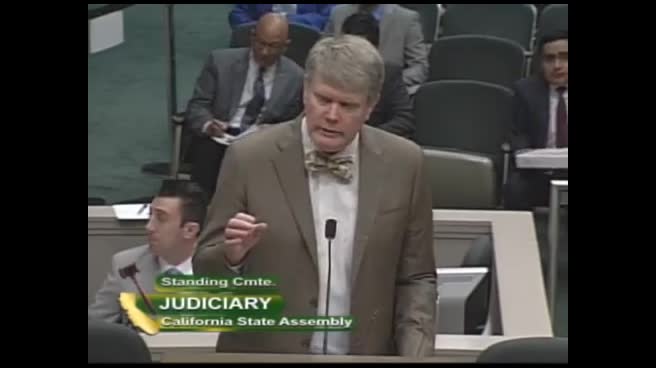 8MIN
Assembly Standing Committee on Judiciary
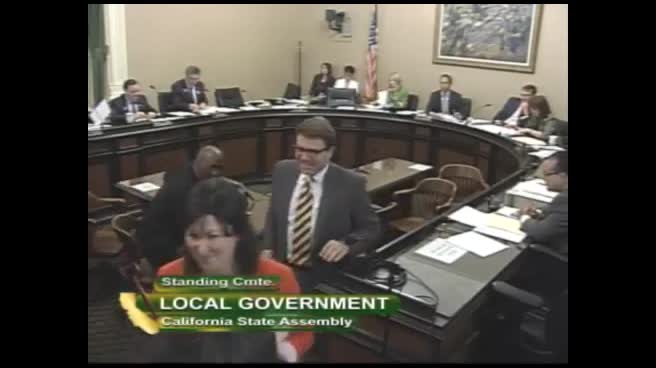 9MIN
Assembly Standing Committee on Local Government
Bill Author

Bill Co-Author(s):