AB 2050: Health care coverage: prescription drugs: refills.
- Session Year: 2015-2016
- House: Assembly
- Latest Version Date: 2016-06-06
Existing law, the Knox-Keene Health Care Service Plan Act of 1975, provides for the licensure and regulation of health care service plans by the Department of Managed Health Care and makes a willful violation of the act a crime. Existing law also provides for the regulation of health insurers by the Department of Insurance. Existing law imposes various requirements on contracts and policies that cover prescription drug benefits. Existing law, the Pharmacy Law, provides for the licensure and regulation of pharmacists by the California State Board of Pharmacy and prohibits the refilling of a prescription without the authorization of the prescriber, except as specified.
This bill would require a health care service plan contract or health insurance policy issued, amended, or renewed on or after January 1, 2017, that provides coverage for prescription drug benefits to implement a medication synchronization policy program for the dispensing of prescription drugs by a single retail network pharmacy so that prescriptions that are refilled at the same frequency may be filled concurrently. concurrently for the purpose of improving medication adherence or if it is in the best interest of the enrollee or insured, as specified. Because a willful violation of the bills requirements by a health care service plan would be a crime, the bill would impose a state-mandated local program.
The California Constitution requires the state to reimburse local agencies and school districts for certain costs mandated by the state. Statutory provisions establish procedures for making that reimbursement.
This bill would provide that no reimbursement is required by this act for a specified reason.
Existing law, the Knox-Keene Health Care Service Plan Act of 1975, provides for the licensure and regulation of health care service plans by the Department of Managed Health Care and makes a willful violation of the act a crime. Existing law also provides for the regulation of health insurers by the Department of Insurance. Existing law imposes various requirements on contracts and policies that cover prescription drug benefits. Existing law, the Pharmacy Law, provides for the licensure and regulation of pharmacists by the California State Board of Pharmacy and prohibits the refilling of a prescription without the authorization of the prescriber, except as specified.
This bill would require a health care service plan contract or health insurance policy issued, amended, or renewed on or after January 1, 2017, that provides coverage for prescription drug benefits to implement a medication synchronization policy for the dispensing of prescription drugs so that prescriptions that are refilled at the same frequency may be filled concurrently. Because a willful violation of the bills requirements by a health care service plan would be a crime, the bill would impose a state-mandated local program.
The California Constitution requires the state to reimburse local agencies and school districts for certain costs mandated by the state. Statutory provisions establish procedures for making that reimbursement.
This bill would provide that no reimbursement is required by this act for a specified reason.
The Community Redevelopment Law authorizes the establishment of redevelopment agencies in communities to address the effects of blight, as defined, and requires that not less than 20% of taxes allocated to an agency be dedicated for the provision of low- and moderate-income housing. Existing law requires that every redevelopment plan adopted or amended after January 1, 1977, to expand a project area contain a provision that affordable housing units destroyed or removed from the low- and moderate-income housing market as part of a redevelopment project be replaced with dwelling units at affordable cost, as described.
Existing law dissolved redevelopment agencies as of February 1, 2012, and designates successor agencies to act as successor entities to the dissolved redevelopment agencies. Existing law provides for the continued application of specified provisions of the Community Redevelopment Law under certain circumstances.
This bill would make nonsubstantive changes to the provision of the Community Redevelopment Law requiring the replacement of affordable housing units.
The Community Redevelopment Law authorizes the establishment of redevelopment agencies in communities to address the effects of blight, as defined, and requires that not less than 20% of taxes allocated to an agency be dedicated for the provision of low- and moderate-income housing. Existing law requires that every redevelopment plan adopted or amended after January 1, 1977, to expand a project area contain a provision that affordable housing units destroyed or removed from the low- and moderate-income housing market as part of a redevelopment project be replaced with dwelling units at affordable cost, as described.
Existing law dissolved redevelopment agencies as of February 1, 2012, and designates successor agencies to act as successor entities to the dissolved redevelopment agencies. Existing law provides for the continued application of specified provisions of the Community Redevelopment Law under certain circumstances.
This bill would make nonsubstantive changes to the provision of the Community Redevelopment Law requiring the replacement of affordable housing units.
(a)A health care service plan contract issued, amended, or renewed on or after January 1, 2017, that provides coverage for prescription drug benefits shall implement a synchronization policy program for the dispensing of prescription drugs to the plans enrollees.
(b)For purposes of this section, synchronization policy means a procedure for aligning the refill dates of an enrollees prescription drugs so that prescriptions that are refilled at the same frequency may be refilled concurrently.
(b)In implementing the synchronization program pursuant to this section, all of the following shall apply:
(1)The plan shall not deny coverage for a prescription drug covered by the health care service plan contract that is dispensed by a network pharmacy for less than the standard refill amount for the purpose of improving medication adherence or if the enrollee agrees that synchronizing his or her medications is in his or her best interest.
(2)The plan shall accept early refill and short-fill requests for prescription drugs using the submission clarification and message codes adopted by the National Council for Prescription Drug Programs or alternative codes provided by the plan.
(3)The plan may apply a prorated daily cost-sharing rate for maintenance prescription drugs that are dispensed by a network pharmacy for the purpose of synchronizing the enrollees medications.
(4)The plan may impose a limit on the number of synchronization attempts in a contract year. The limit may be established by the plan in an amount of not less than four attempts per year.
(c)For purposes of this section, synchronization program means a procedure for aligning the refill dates of an enrollees prescription drugs that are being dispensed by a single retail network pharmacy so that prescriptions that are refilled at the same frequency may be refilled concurrently for the purpose of improving medication adherence or if it is in the best interest of the enrollee.
(d)This section does not apply to any of the following:
(1)A prescription drug that is in unit-of-use packaging for which synchronization is not possible.
(2)A prescription drug that is subject to quantity limits or other utilization management controls that are inconsistent with the synchronization program, including, but not limited to, controlled substance prescribing and special dispensing requirements or guidelines intended to prevent misuse or abuse.
(3)A prescription drug that the patient has been taking for less than 90 consecutive calendar days.
(e)The coverage required by this section may be limited by formulary restrictions applied to a prescription drug by a health care service plan.
SEC. 2.Section 10123.208 is added to the Insurance Code, to read:10123.208.(a)A health insurance policy issued, amended, or renewed on or after January 1, 2017, that provides coverage for prescription drug benefits shall implement a synchronization policy program for the dispensing of prescription drugs to the policys insured insureds.
(b)For purposes of this section, synchronization policy means a procedure for aligning the refill dates of an insureds prescription drugs so that prescriptions that are refilled at the same frequency may be refilled concurrently.
(b)In implementing the synchronization program pursuant to this section, all of the following shall apply:
(1)The insurer shall not deny coverage for a prescription drug covered by the health insurance policy that is dispensed by a network pharmacy for less than the standard refill amount for the purpose of improving medication adherence or if the insured agrees that synchronizing his or her medications is in his or her best interest.
(2)The insurer shall accept early refill and short-fill requests for prescription drugs using the submission clarification and message codes adopted by the National Council for Prescription Drug Programs or alternative codes provided by the insurer.
(3)The insurer may apply a prorated daily cost-sharing rate for maintenance prescription drugs that are dispensed by a network pharmacy for the purpose of synchronizing the insureds medications.
(4)The insurer may impose a limit on the number of synchronization attempts in a contract year. The limit may be established by the insurer in an amount of not less than four attempts per year.
(c)For purposes of this section, synchronization program means a procedure for aligning the refill dates of an insureds prescription drugs that are being dispensed by a single retail network pharmacy so that prescriptions that are refilled at the same frequency may be refilled concurrently for the purpose of improving medication adherence or if it is in the best interest of the insured.
(d)This section does not apply to any of the following:
(1)A prescription drug that is in unit-of-use packaging for which synchronization is not possible.
(2)A prescription drug that is subject to quantity limits or other utilization management controls that are inconsistent with the synchronization program, including, but not limited to, controlled substance prescribing and special dispensing requirements or guidelines intended to prevent misuse or abuse.
(3)A prescription drug that the patient has been taking for less than 90 consecutive calendar days.
(e)The coverage required by this section may be limited by formulary restrictions applied to a prescription drug by a health insurer.
SEC. 3.No reimbursement is required by this act pursuant to Section 6 of Article XIIIB of the California Constitution because the only costs that may be incurred by a local agency or school district will be incurred because this act creates a new crime or infraction, eliminates a crime or infraction, or changes the penalty for a crime or infraction, within the meaning of Section 17556 of the Government Code, or changes the definition of a crime within the meaning of Section 6 of Article XIIIB of the California Constitution.
(a)A health care service plan contract issued, amended, or renewed on or after January 1, 2017, that provides coverage for prescription drug benefits shall implement a synchronization policy for the dispensing of prescription drugs to the plans enrollees.
(b)For purposes of this section, synchronization policy means a procedure for aligning the refill dates of an enrollees prescription drugs so that prescriptions that are refilled at the same frequency may be refilled concurrently.
SEC. 2.Section 10123.208 is added to the Insurance Code, to read:10123.208.(a)A health insurance policy issued, amended, or renewed on or after January 1, 2017, that provides coverage for prescription drug benefits shall implement a synchronization policy for the dispensing of prescription drugs to the policys insured.
(b)For purposes of this section, synchronization policy means a procedure for aligning the refill dates of an insureds prescription drugs so that prescriptions that are refilled at the same frequency may be refilled concurrently.
SEC. 3.No reimbursement is required by this act pursuant to Section 6 of Article XIIIB of the California Constitution because the only costs that may be incurred by a local agency or school district will be incurred because this act creates a new crime or infraction, eliminates a crime or infraction, or changes the penalty for a crime or infraction, within the meaning of Section 17556 of the Government Code, or changes the definition of a crime within the meaning of Section 6 of Article XIIIB of the California Constitution.
SECTION 1.Section 33334.5 of the Health and Safety Code is amended to read:33334.5.A redevelopment plan adopted or amended to expand the project area after January 1, 1977, shall contain a provision that whenever dwelling units housing persons and families of low or moderate income are destroyed or removed from the low- and moderate-income housing market as part of a redevelopment project, the agency shall, within four years of that destruction or removal, rehabilitate, develop, or construct, or cause to be rehabilitated, developed, or constructed, for rental or sale to persons and families of low or moderate income an equal number of replacement dwelling units at affordable housing costs, as defined by Section 50052.5, within the project area or within the territorial jurisdiction of the agency, in accordance with Sections 33413 and 33413.5.
Every A redevelopment plan adopted or amended to expand the project area after January 1, 1977, shall contain a provision that whenever dwelling units housing persons and families of low or moderate income are destroyed or removed from the low- and moderate-income housing market as part of a redevelopment project, the agency shall, within four years of such that destruction or removal, rehabilitate, develop, or construct, or cause to be rehabilitated, developed, or constructed, for rental or sale to persons and families of low or moderate income an equal number of replacement dwelling units at affordable housing costs, as defined by Section 50052.5, within the project area or within the territorial jurisdiction of the agency, in accordance with all of the provisions of Sections 33413 and 33413.5.
|
Date
|
Status
|
|---|---|
| Feb 17, 2016 | Read first time. To print. |
| Feb 18, 2016 | From printer. May be heard in committee March 19. |
| Mar 17, 2016 | Referred to Com. on HEALTH. |
| Mar 18, 2016 | From committee chair, with author's amendments: Amend, and re-refer to Com. on HEALTH. Read second time and amended. |
| Mar 28, 2016 | Re-referred to Com. on HEALTH. |
| Apr 20, 2016 | From committee: Do pass and re-refer to Com. on APPR. (Ayes 18. Noes 0.) (April 19). Re-referred to Com. on APPR. |
| May 4, 2016 | From committee: Do pass. To Consent Calendar. (Ayes 20. Noes 0.) (May 4). |
| May 5, 2016 | Read second time. Ordered to Consent Calendar. |
| May 12, 2016 | In Senate. Read first time. To Com. on RLS. for assignment. |
| May 12, 2016 | Read third time. Passed. Ordered to the Senate. |
| May 12, 2016 | Read third time. Passed. Ordered to the Senate. (Ayes 78. Noes 0. Page 4787.) |
| May 12, 2016 | Read third time. Passed. Ordered to the Senate. (Ayes 78. Noes 0.) |
| May 19, 2016 | Referred to Com. on HEALTH. |
| Jun 6, 2016 | From committee chair, with author's amendments: Amend, and re-refer to committee. Read second time, amended, and re-referred to Com. on HEALTH. |
| Jun 9, 2016 | In committee: Set, first hearing. Hearing canceled at the request of author. |
|
Date
|
Description
|
Location
|
Votes
|
|
|---|---|---|---|---|
| May 12, 2016 | AB 2050 STEINORTH Consent Calendar Second Day Regular Session | Assembly Floor |
Passed |
|
| May 4, 2016 | Do pass. To Consent Calendar. | Assembly Standing Committee on Appropriations |
Passed |
|
| Apr 19, 2016 | Do pass and be re-referred to the Committee on [Appropriations] | Assembly Standing Committee on Health |
Passed |
This list shows positions taken on this bill by organizations on the date displayed, which is linked to the original source.
Positions by individuals are not included.
|
Organization
|
Position
|
Date
|
|---|---|---|
| Association Of California Water Agencies | * Support | Jun 27, 2018 |
| California Association of Local Agency Formation Commissions (CALAFCO) | * Support | Jun 27, 2018 |
| California Association Of Mutual Water Companies | * Support | Jun 27, 2018 |
| California Chronic Care Coalition | ** Support | Apr 19, 2016 |
| California Municipal Utilities Association | * Support | Jun 27, 2018 |
| California Pharmacist Association | * Support | Apr 19, 2016 |
| California Pharmacists Association | * Support | Apr 19, 2016 |
| California Special District Association | * Support | Jun 20, 2018 |
| Center For Environmental Health | * Support | Jun 27, 2018 |
| City Of Sacramento | * Support | Jun 27, 2018 |
| Clean Water Action | * Against | Jun 27, 2018 |
| Community Water Center | * Against | Jun 20, 2018 |
| Congress of California Seniors | ** Support | Apr 19, 2016 |
| Eastern Municipal Water District | * Support | Jun 20, 2018 |
| Howard Jarvis Tax Payers Association | * Against | Jun 27, 2018 |
| Inland Empire Utilities Agency | * Support | Jun 27, 2018 |
| Irvine Ranch Water District | * Support | Jun 27, 2018 |
| Las Virgenes Municipal Water District | * Support | Jun 20, 2018 |
| Long Beach Water Department | * Support | Jun 20, 2018 |
| Mesa Water District | * Support | Jun 27, 2018 |
| Metropolitan Water District Of Southern California | * Support | Jun 27, 2018 |
| Northern California Water Association | * Support | Jun 20, 2018 |
| Orange County Water District | * Support | Jun 27, 2018 |
| Pharmacists State of California | * Support | Apr 19, 2016 |
| Rural County Represenatatives of California | * Support | Jun 20, 2018 |
| San Diego County Water Authority | * Support | Jun 20, 2018 |
| Santa Clara Valley Water District | * Support | Jun 27, 2018 |
| Western Municipal Water District | * Support | Jun 27, 2018 |
Date of Hearing: May 4, 2016
ASSEMBLY COMMITTEE ON APPROPRIATIONS
Lorena Gonzalez, Chair
ABPCA Bill Id:AB 2050
Author:(Steinorth) – As Amended Ver:March 18, 2016
Policy Committee: | Health | Vote: | 18 - 0 |
Urgency: No State Mandated Local Program: Yes Reimbursable: No
SUMMARY:
This bill requires health plans and insurers to implement a procedure for aligning the refill dates of an enrollee’s prescription drugs so that prescriptions that are refilled at the same frequency may be refilled concurrently.
FISCAL EFFECT:
- According to the California Health Benefits Review Program (CHBRP), minimal impact to premiums in state-funded programs and the privately funded market. CHBRP analyzed a similar mandate as included in AB 2418 (Bonilla) of 2014.
- Costs to monitor compliance are expected to be minor and absorbable for the Department of Managed Health Care (Managed Care Fund), and $35,000 over the first two years and $5,000 ongoing to the California Department of Insurance (Insurance Fund).
COMMENTS:
- Purpose. This bill is intended to encourage medication adherence and increase convenience to patients who may have multiple medications with different refill dates.
- Background. Adherence to a medication regimen is generally defined as the extent to which patients take medications as prescribed by their health care providers. Prescription drugs are important for controlling chronic conditions, but many patients do not take medications as prescribed. There is some, albeit minor, evidence that medication synchronization can improve adherence to medication regimens. Beginning in 2014, Medicare Part D (prescription durg) plans were required to cover "short refills" in order to make it easier to have prescription medications synchronized, or refilled all at the same time.
- Support. This bill is sponsored by the California Pharmacists Association and has no opposition. The National Association of Chain Drugs Stores seek an amendment to clarify pharmacies will still receive a dispensing fee when short filled medications are used.
- Prior Legislation. AB 2418 (Bonilla) of 2014 required health plan contracts and health insurance policies to allow for the synchronization of prescription refills and permit refill of topical ophthalmic medications at 70% of the predicted days of use. It also required plans and insurers to apply a prorated daily cost-sharing rate to the refills of prescriptions that are dispensed by a participating pharmacy for purposes of synchronization. AB 2418 was vetoed by Governor Brown, who stated the bill lacked explicit patient consent before changes are made to refills and it did not address supportive elements that have made synchronization programs anecdotally successful. AB 2050 does not appear to address the veto message, but does offer more flexibility to plans to design synchronization procedures than AB 2418.
Analysis Prepared by: Lisa Murawski / APPR. / (916) 319-2081
Date of Hearing: April 19, 2016
ASSEMBLY COMMITTEE ON HEALTH
Jim Wood, Chair
ABPCA Bill Id:AB 2050 (
Author:Steinorth) – As Amended Ver:March 18, 2016
SUBJECT: Health care coverage: prescription drugs: refills.
SUMMARY: Requires a health care service plan (health plan) contract or insurance policy that provides prescription drug coverage, to implement a medication synchronization policy. Specifically, this bill:
- Requires a health plan contract or insurance policy, issued, amended, or renewed on or after January 1, 2017, that provides coverage for prescription drug benefits shall implement a synchronization policy for the dispensing of prescription drugs to the plan’s enrollees.
- Defines synchronization policy as a procedure for aligning the refill dates of an enrollee’s or insured’s prescription drugs so that prescriptions are refilled at the same frequency may be refilled concurrently.
EXISTING LAW:
- Requires health care service plans to be regulated by the Department of Managed Health Care and health insurers to be regulated by the California Department of Insurance.
- Provides for the licensure and regulation of pharmacists by the California State Board of Pharmacy and prohibits the refilling of a prescription without the authorization of the prescriber, except as specified.
- Requires health plans and health insurers that cover prescription drug benefits to provide notice in the evidence of coverage and disclosure form to enrollees or insureds regarding whether the plan uses a formulary.
- Mandates the ten federally required Essential Health Benefits (EHBs) including prescription drug coverage and establishes Kaiser Small Group health plan as California’s EHB benchmark plan for non-grandfathered individual and small group health plan contracts and insurance policies.
- Requires, under regulations, a plan that provides coverage for prescription drugs through a mail order pharmacy to have written policies and procedures documenting that the plan's mail order arrangements are in compliance with applicable California and federal laws regarding pharmacists and pharmacy services.
- Requires, under regulations, the mail order pharmacy process to conform effectively and efficiently to a plan's processes for prior authorization for coverage of medically necessary drugs as required, and to include standards for timely delivery and a contingency mechanism for providing the drug if a mail order provider fails to meet the delivery standards.
FISCAL EFFECT: This bill has yet to be analyzed by a fiscal committee.
COMMENTS:
- PURPOSE OF THIS BILL. The author states that existing law does not require health plans or insurers to establish policies for prescription refill synchronization. Synchronization is possible, but typically, a pharmacist does a partial-fill of a prescription in order to synchronize the fill date with the next medication (from then on, it can be filled regularly). According to the author, the partial-fill often triggers a sort of “red flag” to insurance plans, who then have to go through an approval process to allow the partial-fill. This is burdensome and time consuming for both pharmacists as well as insurance providers, discouraging pharmacists to offer synchronization services to patients. Additionally, health plans do not currently offer pro-rated co-payments for patients receiving a partial fill, unless they are covered under Medicare Part D, under which it is required. This causes patients to pay an additional, full co-payment, even though they are not receiving any additional medication.
The lack of a streamlined process makes it difficult for pharmacists and other healthcare providers to synchronize refill dates, and results in increased out-of-pocket costs to patients. Streamlining prescription refill synchronization makes it more convenient for patients to pick up all their chronic medications on one trip to the pharmacy. Establishing one monthly refill date also enhances the ability of pharmacists to assist patients in understanding and monitoring their medications. According to the author, patients enrolled in a refill synchronization program have been shown to be three to six times more likely to remain adherent in taking their medications.
Furthermore, the author states that medication non-adherence has become a major public health issue in California and in the United States. Studies show that 30 to 50 percent of Americans with prescriptions for chronic illnesses do not take their medications as prescribed. Poor medication adherence significantly increases the risks of hospitalization, outpatient visits and death particularly among patients with chronic diseases such as diabetes, hypertension and heart disease. - BACKGROUND. A 2015 Journal of Managed Care & Specialty Pharmacy study provided by the author to the Committee found that appointment-based medication synchronization is associated with greater adherence and persistence in patients who had been taking chronic medications for at least six months. The study also found that after controlling for prior adherence behavior between appointment-based medication synchronization and patients without the synchronization, the results still showed significant improvement in adherence and persistence.
- Other states. Twelve states have passed legislation that requires health insurance companies to offer prescription refill synchronization programs (Arizona, Connecticut, Colorado, Kentucky, Maine, North Carolina, New Jersey, New Mexico, Oregon, Utah, Vermont, and Washington). In addition, several states currently have bills related to synchronization for 2016.
- Medicare Part D. Beginning in 2014, Medicare Part D Plans were required by Centers for Medicare & Medicaid Services (CMS) to cover short refills and to prorate patient copayments. CMS states that it has taken a meaningful step forward in its commitment to improving medication adherence by making it easier for patients to have their prescription medications “synchronized,” or refilled all at the same time. By coordinating all of a patient’s medications to be refilled on the same day each month, pharmacists are able to prevent gaps in therapy and look for cost-saving alternatives, both of which can improve adherence.
- California Health Benefits Review Program (CHBRP) analysis. AB 1996 (Thomson), Chapter 795, Statutes of 2002, requests the University of California to assess legislation proposing a mandated benefit or service and prepare a written analysis with relevant data on the medical, economic, and public health impacts of proposed health plan and health insurance benefit mandate legislation. CHBRP was created in response to AB 1996. SB 125 (Ed Hernandez), Chapter 9, Statutes of 2015, added an impact assessment on EHBs, and legislation that impacts health insurance benefit designs, cost sharing, premiums, and other health insurance topics.
AB 2418 (Bonilla and Skinner) of 2014 is substantially similar to the provisions of this bill and would have required health plans and insurers to cover prescription drug refills intended to synchronize refill dates. As part of CHBRP’s analysis of AB 2418, CHBRP defined medication adherence as “...the extent to which patients take medications as prescribed by their health care providers”. Direct measurement of adherence is very difficult as it requires either observation of the patients actually taking their medication or measurement of a metabolite of the medication through laboratory testing. CHBRP finds insufficient evidence to suggest that any of the provisions in AB 2418, (which included opt-outs from mandatory mail order, refill synchronization, or early refills for topical ophthalmic products) would improve medication adherence.
The Committee requested CHBRP to provide an updated analysis on this bill and it found the evidence to be insufficient to make a determination on effectiveness. CHBRP also noted that the additional statewide cost in the first post mandate year for refill schedule synchronizing would be minimal.
- Other states. Twelve states have passed legislation that requires health insurance companies to offer prescription refill synchronization programs (Arizona, Connecticut, Colorado, Kentucky, Maine, North Carolina, New Jersey, New Mexico, Oregon, Utah, Vermont, and Washington). In addition, several states currently have bills related to synchronization for 2016.
- SUPPORT. The California Pharmacists Association (CPhA), the sponsor of this bill, states that one of the many problems with medication non‐adherence for individuals taking multiple medications is that the refill schedule often has different dates for different prescriptions resulting in multiple trips to the pharmacy causing patient frustration and failure to refill one or more medications. According to CPhA, poor medication adherence significantly increases the risks of hospitalization, outpatient visits and death particularly among patients with chronic diseases such as diabetes, hypertension and heart disease. Additionally, CPhA notes that refill synchronization aligns with the Appointment Based Model in which pharmacists are able to perform a comprehensive review of all their patients’ medications each month which provides the opportunity to identify therapeutic and compliance issues that a chronic patient may be encountering. Furthermore, CPhA points out that in response to the CMS requirement, the National Council for Prescription Drug Programs (NCPDP) which is the entity that establishes all pharmacy coding for health insurance plans and pharmacy benefit managers (PBMs), established universal clarification codes to help meet the market needs for prescription refill synchronization. Because the NCPDP codes are in place, all commercial health plans in California should implement this functionality to support medication synchronization for their beneficiaries or enrollees.
Congress of California Seniors (CCS) states that many seniors take multiple medications prescribed by different specialists during visits throughout the month, requiring several trips to the pharmacy. CCS contends that often seniors have limited options for transportation making it difficult to get to the pharmacy frequently and causing dangerous delays or lapses in treatment. Furthermore, CCS notes that about half of patients with chronic health conditions such as heart disease, diabetes, and glaucoma, do not take their medications as directed. As such, they do not benefit from prescribed treatments and are more likely to experience deteriorating health and complications that require hospitalization, leading to increased healthcare spending and a loss of independence. - SUPPORT IF AMENDED. The National Association of Chain Drug Stores (NACDS) and the California Retailers Association (CRA) are seeking an amendment to clarify that pharmacies would continue to receive a dispensing fee when short filled medications are used in synchronization. NACDS and CRA state that refill synchronization is a new methodology that will allow for pharmacists to prescribe a partial prescription so that the next refill will synchronize with existing medications and its benefit includes enhancing the ability of pharmacists to assist patients in monitoring and understanding the prescribed medications.
- PREVIOUS LEGISLATION.
- AB 339 (Gordon), Chapter 619, Statutes of 2015, requires health plans and health insurers that provide coverage for outpatient prescription drugs to have formularies that do not discourage the enrollment of individuals with health conditions, and requires combination antiretroviral drug treatment coverage of a single-tablet that is as effective as a multitablet regimen for treatment of Human immunodeficiency virus infection and acquired immune deficiency syndrome, as specified. AB 339 places in state law, federal requirements related to pharmacy and therapeutics committees, access to in-network retail pharmacies, standardized formulary requirements, formulary tier requirements similar to those required of health plans and insurers participating in Covered California and copayment caps of $250 and $500 for a supply of up to 30 days for an individual prescription, as specified.
- AB 2418 (Bonilla and Skinner) of 2014 would have required health plans and insurers to apply a prorated daily cost-sharing rate to the refills of certain medications if the prescriber or pharmacist indicates it is in the best interest of the patient and it is for the purpose of synchronizing refill dates for the patient's medications. AB 2418 also allows for early refills of covered eye products. AB 2418 was vetoed by the Governor indicating that it lacked explicit patient consent before changes are made to refills; nor did it speak to the supportive elements that have made synchronization programs anecdotally successful.
- AB 1917 (Gordon) of 2014 would have established limits on the copayment, coinsurance, or any other form of cost sharing for a covered outpatient prescription drug for an individual prescription of 1/12 (equivalent to $529 for 2014) or half ($3,175 for 2014) of the annual out-of-pocket limit (which is $6,350 for 2014), as specified under the federal Patient Protection and Affordable Care Act with respect to a non-grandfathered individual or group health plan contract or insurance policy. AB 1917 died in the Senate.
- SB 1176 (Steinberg) of 2014 required a health plan or health insurer to track the accumulation of cost sharing for covered EHBs and makes a health plan or insurer responsible for notifying the enrollee or insured when the maximum accrual limit has been reached and requires the plan or insurer to reimburse the enrollee or insured if cost sharing exceeds annual limits. SB 1176 died in the Assembly.
- AB 299 (Holden) of 2013 would have prohibited a pharmacy that delivers prescriptions via mail, from entering into, or being a party to, an agreement with a health care service plan or disability insurer that requires a plan enrollee or insured to utilize mail order services or that requires a plan enrollee or insured to opt out of a mail order process. AB 299 was held on the Assembly Appropriations Committee Suspense File.
- AB 219 (Perea), Chapter 661, Statutes of 2013, limits the total amount of copayments and coinsurance an enrollee or insured is required to pay for orally administered anticancer medications to $200 for an individual prescription of up to a 30-day supply. AB 219 also provided that the provisions would repeal on January 1, 2019. Governor Brown wrote in signing message approving AB 219 that this policy is not without the potential for unintended consequences and that placing a price cap on a specific class of drugs for a specific class of diseases might not be a policy for the ages. A sunset on the bill allows for examination of intended and unintended consequences before embracing the policy long term.
- SB 1301 (Ed Hernandez), Chapter 455, Statutes of 2012, authorizes a pharmacist to dispense not more than a 90-day supply of a dangerous drug other than a controlled substance pursuant to a valid prescription, except for psychotropic medication or drugs or controlled substances, as specified.
- SB 1195 (Price), Chapter 706, Statutes of 2012, requires a contract that is issued, amended, or renewed on or after January 1, 2013, between a pharmacy and a carrier or a PBM to provide pharmacy services to beneficiaries of a health benefit plan to comply with standards and audit requirements.
- AB 299 (Holden) of 2013 would have prohibited a pharmacy that delivers prescriptions via mail, from entering into, or being a party to, an agreement with a health care service plan or disability insurer that requires a plan enrollee or insured to utilize mail order services or that requires a plan enrollee or insured to opt out of a mail order process. AB 299 was held on the Assembly Appropriations Committee Suspense File.
- POLICY COMMENTS. The author notes that potential amendments are being discussed to address the issues with respect to cost-sharing and health plan’s abilities to pro-rate cost sharing for partially-filled prescriptions, and for health plans to implement a system with expedited approval when claims are submitted with the correct submission clarification code for synchronization. Since Medicare Part D already addressed and implements this pro-rated cost sharing, the author is confident that these features are possible for plans to implement without significant burdens.
REGISTERED SUPPORT / OPPOSITION:
Support
California Chronic Care Coalition
California Pharmacists Association
Congress of California Seniors
Opposition
None on file.
Analysis Prepared by: Kristene Mapile / HEALTH / (916) 319-2097
Discussed in Hearing
 20MIN
Senate Standing Committee on Governance and Finance
 21MIN
Senate Standing Committee on Environmental Quality
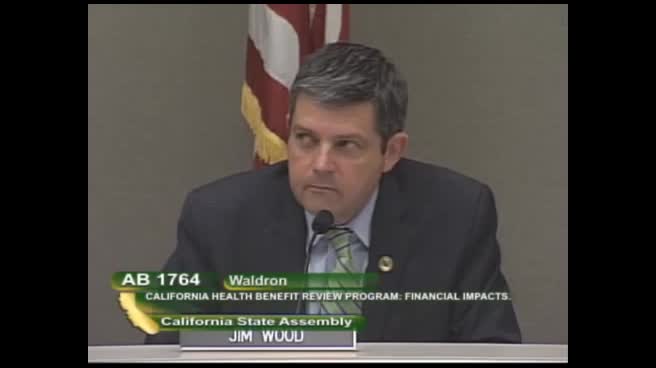 4MIN
Assembly Standing Committee on Health
Bill Author

Bill Co-Author(s):