AB 2429: School district and community college district bonds.
- Session Year: 2015-2016
- House: Assembly
- Latest Version Date: 2016-03-18
(1)Existing law authorizes the governing board of any school district or community college district to order an election and submit to the electors of the district the question of whether the bonds of the district shall be issued and sold to raise money for specified purposes. Existing law generally requires, to pass a school bond measure, that either at least 2/3 of the votes cast on the proposition of issuing bonds be in favor of issuing the bonds to pass the measure, or, if certain conditions are met, at least 55% of the votes cast on the proposition of issuing bonds be in favor of issuing the bonds.
Existing law prohibits the total amount of bonds issued by a school district or community college district from exceeding 1.25% of the taxable property of the district, only if the tax rate levied to meet specified requirements of the California Constitution in the case of indebtedness incurred by a school district, at a single election, would not exceed $30 per year per $100,000 of taxable property, as specified.
This bill would raise that limit to 2%.
(2)Existing law authorizes a unified school district to issue bonds receiving at least 55% of the votes cast on the proposition of issuing the bonds that, in aggregation with bonds issued with a 2/3 favorable vote, do not exceed 2.5% of the taxable property of the district, but only if the tax rate levied to meet specified requirements of the California Constitution in the case of indebtedness incurred by a school district, at a single election, would not exceed $60 per year per $100,000 of taxable property, as specified.
This bill would raise that limit to 4%. The bill would make a similar percentage increase for community college districts.
Existing law provides, for the purposes of school bonds, how the value of taxable property will be determined.
This bill would make nonsubstantive changes to that provision.
Existing law provides, for the purposes of school bonds, how the value of taxable property will be determined.
This bill would make nonsubstantive changes to that provision.
The total amount of bonds issued pursuant to this chapter and Chapter 1.5 (commencing with Section 15264) shall not exceed 1.25 2 percent of the taxable property of the school district or community college district, or the school facilities improvement district, if applicable, as shown by the last equalized assessment of the county or counties in which the district is located. For purposes of this section, the taxable property of a district for any fiscal year shall be calculated to include, but not be limited to, the assessed value of all unitary and operating nonunitary property of the district, which shall be derived by dividing the gross assessed value of the unitary and operating nonunitary property within the district for the 198788 fiscal year by the gross assessed value of all unitary and operating nonunitary property within the county in which the district is located for the 198788 fiscal year, and multiplying that result by the gross assessed value of all unitary and operating nonunitary property of the county on the last equalized assessment roll.
SEC. 2.Section 15106 of the Education Code is amended to read:15106.(a)A unified school district or community college district may issue bonds that, in aggregation with bonds issued pursuant to Section 15270, shall not exceed 2.5 4 percent of the taxable property of the school district or community college district, or the school facilities improvement district, if applicable, as shown by the last equalized assessment of the county or counties in which the district is located.
In
(b)In computing the outstanding bonded indebtedness of a unified school district or community college district for all purposes of this section, any outstanding bonds shall be deemed to have been issued for elementary school purposes, high school purposes, and community college purposes, respectively, in the respective amounts that the proceeds of the sale of those outstanding bonds, excluding any premium and accrued interest received on that sale, were or have been allocated by the governing board of the unified school district or community college district to each of those purposes respectively.
(a)
(c)For the purposes of the State School Building Aid Law of 1952 (Chapter 6 (commencing with Section 16000)) with respect to applications for apportionments and apportionments filed or made prior to before September 15, 1961, and to the repayment thereof, Chapter 4 (commencing with Section 15700), inclusive, only, a unified school district shall be considered to have a bonding capacity in the amount permitted by law for an elementary school district and a bonding capacity in the amount permitted by law for a high school district.
(b)
(d)For purposes of this section, the taxable property of a district for a fiscal year shall be calculated to include, but not be limited to, the assessed value of all unitary and operating nonunitary property of the district, which shall be derived by dividing the gross assessed value of the unitary and operating nonunitary property within the district for the 198788 fiscal year by the gross assessed value of all unitary and operating nonunitary property within the county in which the district is located for the 198788 fiscal year, and multiplying the result by the gross assessed value of all unitary and operating nonunitary property of the county on the last equalized assessment roll. In the event of the unification of two or more school districts or community college districts subsequent to the 198788 fiscal year, the assessed value of all unitary and operating nonunitary property of the unified district or community college district shall be deemed to be the total of the assessed value of the taxable property of each of the unifying districts as that assessed value would be determined under Section 15102.
SEC. 3.Section 15268 of the Education Code is amended to read:15268.The total amount of bonds issued, including bonds issued pursuant to Chapter 1 (commencing with Section 15100), shall not exceed 1.25 2 percent of the taxable property of the district as shown by the last equalized assessment of the county or counties in which the district is located. The bonds may only be issued if the tax rate levied to meet the requirements of Section 18 of Article XVI of the California Constitution in the case of indebtedness incurred by a school district pursuant to this chapter, at a single election, would not exceed thirty dollars ($30) per year per one hundred thousand dollars ($100,000) of taxable property when assessed valuation is projected by the district to increase in accordance with Article XIIIA of the California Constitution. For purposes of this section, the taxable property of a district for any fiscal year shall be calculated to include, but not be limited to, the assessed value of all unitary and operating nonunitary property of the district, which shall be derived by dividing the gross assessed value of the unitary and operating nonunitary property within the district for the 198788 fiscal year by the gross assessed value of all unitary and operating nonunitary property within the county in which the district is located for the 198788 fiscal year, and multiplying that result by the gross assessed value of all unitary and operating nonunitary property of the county on the last equalized assessment roll.
SEC. 4.Section 15270 of the Education Code is amended to read:15270.(a)Notwithstanding Sections 15102 and 15268, any unified school district may issue bonds pursuant to this article that, in aggregation with bonds issued pursuant to Chapter 1 (commencing with Section 15100), may not exceed 2.5 4 percent of the taxable property of the district as shown by the last equalized assessment of the county or counties in which the district is located. The bonds may only be issued if the tax rate levied to meet the requirements of Section 18 of Article XVI of the California Constitution in the case of indebtedness incurred pursuant to this chapter at a single election, by a unified school district, would not exceed sixty dollars ($60) per year per one hundred thousand dollars ($100,000) of taxable property when assessed valuation is projected by the district to increase in accordance with Article XIIIA of the California Constitution.
(b)Notwithstanding Sections 15102 and 15268, any community college district may issue bonds pursuant to this article that, in aggregation with bonds issued pursuant to Chapter 1 (commencing with Section 15100), may not exceed 2.5 4 percent of the taxable property of the district as shown by the last equalized assessment of the county or counties in which the district is located. The bonds may only be issued if the tax rate levied to meet the requirements of Section 18 of Article XVI of the California Constitution in the case of indebtedness incurred pursuant to this chapter at a single election, by a community college district, would not exceed twenty-five dollars ($25) per year per one hundred thousand dollars ($100,000) of taxable property when assessed valuation is projected by the district to increase in accordance with Article XIIIA of the California Constitution.
(c)In computing the outstanding bonded indebtedness of any unified school district or community college district for all purposes of this section, any outstanding bonds shall be deemed to have been issued for elementary school purposes, high school purposes, and community college purposes, respectively, in the respective amounts that the proceeds of the sale of those outstanding bonds, excluding any premium and accrued interest received on that sale, were or have been allocated by the governing board of the unified school district or community college district to each of those purposes respectively.
(d)For purposes of this section, the taxable property of a district for any fiscal year shall be calculated to include, but not be limited to, the assessed value of all unitary and operating nonunitary property of the district, which shall be derived by dividing the gross assessed value of the unitary and operating nonunitary property within the district for the 198788 fiscal year by the gross assessed value of all unitary and operating nonunitary property within the county in which the district is located for the 198788 fiscal year, and multiplying the result by the gross assessed value of all unitary and operating nonunitary property of the county on the last equalized assessment roll. In the event of the unification of two or more school districts subsequent to the 198788 fiscal year, the assessed value of all unitary and operating nonunitary property of the unified district shall be deemed to be the total of the assessed value of the taxable property of each of the unifying districts as that assessed value would be determined under Section 15268.
(e)For the purposes of this article, general obligation bonds, as that term is used in Section 18 of Article XVI of the California Constitution, means bonds of a school district or community college district the repayment of which is provided for by this chapter and Chapter 1 (commencing with Section 15100) of Part 10, and includes bonds of a school facilities improvement district the repayment of which is provided for by this chapter and Chapter 2 (commencing with Section 15300).
SECTION 1.Section 15103 of the Education Code is amended to read:15103.Notwithstanding any other law, for the purpose of computing the limit on the amount of bonds that may be issued by a district pursuant to the provisions of this chapter, the taxable property of the district shall be determined upon the basis that the districts assessed value has not been reduced by the exemption of the assessed value of business inventories in the district or reduced by the homeowners property tax exemption.
Notwithstanding any other provision of law, for the purpose of computing the limit on the amount of bonds which that may be issued by a district pursuant to the provisions of this chapter, the taxable property of the district shall be determined upon the basis that the districts assessed value has not been reduced by the exemption of the assessed value of business inventories in the district or reduced by the homeowners property tax exemption.
|
Date
|
Status
|
|---|---|
| Feb 19, 2016 | Introduced. To print. |
| Feb 21, 2016 | From printer. May be heard in committee March 22. |
| Feb 22, 2016 | Read first time. |
| Mar 17, 2016 | Referred to Coms. on ED. and REV. & TAX. |
| Mar 18, 2016 | From committee chair, with author's amendments: Amend, and re-refer to Com. on ED. Read second time and amended. |
| Mar 28, 2016 | Re-referred to Com. on ED. |
| Apr 14, 2016 | From committee: Do pass and re-refer to Com. on REV. & TAX. (Ayes 5. Noes 2.) (April 13). Re-referred to Com. on REV. & TAX. |
| Apr 26, 2016 | From committee: Do pass. (Ayes 5. Noes 3.) (April 25). |
| Apr 27, 2016 | Read second time. Ordered to third reading. |
| May 16, 2016 | In Senate. Read first time. To Com. on RLS. for assignment. |
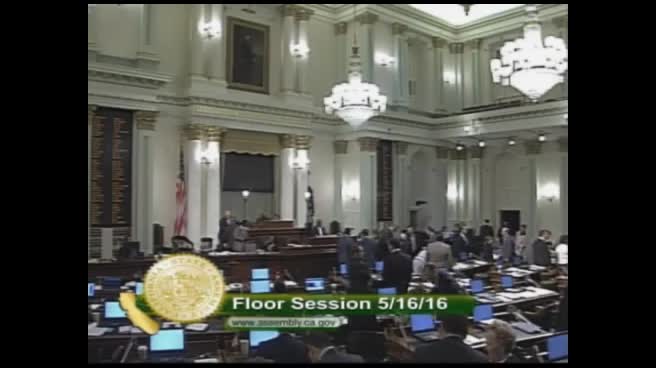
| May 16, 2016 | Read third time. Passed. Ordered to the Senate. |
| May 16, 2016 | Read third time. Passed. Ordered to the Senate. (Ayes 48. Noes 28. Page 4815.) |
| May 26, 2016 | Referred to Coms. on ED. and GOV. & F. |
| Jun 8, 2016 | In committee: Set, first hearing. Hearing canceled at the request of author. |
|
Date
|
Description
|
Location
|
Votes
|
|
|---|---|---|---|---|
| May 16, 2016 | AB 2429 THURMOND Assembly Third Reading | Assembly Floor |
Passed |
|
| Apr 25, 2016 | Do pass. | Assembly Standing Committee on Revenue and Taxation |
Passed |
|
| Apr 13, 2016 | Do pass and be re-referred to the Committee on [Revenue and Taxation] | Assembly Standing Committee on Education |
Passed |
This list shows positions taken on this bill by organizations on the date displayed, which is linked to the original source.
Positions by individuals are not included.
|
Organization
|
Position
|
Date
|
|---|---|---|
| Howard Jarvis Association | ** Against | May 16, 2016 |
SENATE COMMITTEE ON EDUCATION
Senator Carol Liu, Chair
2015 - 2016 Regular
Bill No:
Author: | Thurmond | ||
Version: | Hearing Date: June 8, 2016 | ||
Urgency: | Fiscal: | ||
Consultant: | |||
Subject:
NOTE: This measure has been referred to the Committees on Education and
Governance and Finance. A "do pass" motion should include referral to the
Governance and Finance Committee.
SUMMARY
This bill increases the cap on bonded indebtedness for school districts and community college districts.
BACKGROUND
Existing law authorizes school districts and community college districts to issue general obligation (GO) bonds upon approval by voters and establishes a process and guidelines for such issuances under the Education Code. Existing law also authorizes any city, county, city and county, school district, community college district, or special district to issue GO bonds, secured by the levy of ad valorem taxes, and establishes a process for such issuances under the Government Code.
(Education Code § 15100, et seq. and Government Code § 53506, et seq.)
Existing law cap the total amount of bonds issued by a school district at 1.25% of the taxable property of the district and caps the tax rate at $30 per $100,000 of taxable property. (EC § 15102 and § 15268)
Existing law caps the total amount of bonds issued by a unified school district and a community college district at 2.5% of the taxable property of the district and caps the tax rate at $60 per $100,000 of taxable property for a unified school district and $25 per $100,000 of taxable property for a community college district.
(EC § 15106 and § 15270)
ANALYSIS
This bill increases the level of bonded indebtedness for school districts and community college districts. Specifically, it:
- Increases the cap on bonded indebtedness for elementary and high school districts from 1.25% to 2% of the taxable property of the district.
- Increases the cap on bonded indebtedness for unified and community college districts from 2.5% to 4% of the taxable property of the district.
STAFF COMMENTS
- Intent of the bill. Current law grants any school district governing board the authority to request a waiver of all or part of any section of the Education Code or any regulation adopted by the Board to implement state law, with specified exceptions (Education Code Section 33050-33053). Under these provisions, school districts can and do apply for waivers of the existing statutory bond indebtedness caps. According to the author, this bill is intended to reduce administrative costs to applicant school districts and the State Board while also increasing the ability to generate revenue for school facilities construction and renovations at the local level.
- Is there a statewide need? K-12 districts have sought and received waivers to increase their percentage of bonded indebtedness beyond the statutory limits. From 2001-2015, the State Board received and approved 52 such waiver requests. While the State Board has not denied any requests, it has established conditions for the approvals, such as limiting the waiver for a specified number of years. The approved waivers are generally within those proposed by this bill, although some exceed the proposed cap. There is currently no process for waiver of these Education Code provisions for community colleges.
It is unclear how many districts have reached their cap for bond indebtedness under current law. It is also unclear whether districts could use the expanded authority since any increased issuance of bonds would still be subject to voter approval.
Given the existence of a waiver process that appears to be working, as well as the limited number of districts that have requested such waivers, is a permanent statutory change necessary?
- Related Governor’s Actions. Amid concerns about the complexity and structure of the current program and the state's increasing debt service obligations, the Governor’s 2015 and 2016 budget proposals discussed significant changes to the way school facilities are funded. Among other things, the Governor proposed to expand revenue generation tools at the local level by expanding local funding capacity and increasing caps on local bond indebtedness. The Governor also proposed to restructure developer fees to set one level for all projects at a level between existing Level II and Level III fees subject to local negotiation. The Governor has also noted that he is prepared to engage with the Legislature and education stakeholders to shape a future state program that is focused on districts with the greatest need, including communities with low property values and few borrowing options, as well as overcrowded schools.
- One leg of a three-legged stool? Under current law, funding for new construction and modernization of school facilities comes from both state and local sources. Current law establishes the School Facility Program (SFP) under which the state provides general obligation bond funding for various school construction projects. Local funding comes from a variety of sources including local general obligation bonds, Mello-Roos bonds and developer fees. This bill would make changes to facilitate the ability to generate revenue from local general obligation bonds.
State bond funds are essentially exhausted. Since 2009, the State Allocation Board (SAB) has been making "unfunded approvals" which represented approved projects waiting to convert to funding apportionments when bonds are sold and cash becomes available. In addition, since November 1, 2012, the SAB has maintained an "Applications Received Beyond Bond Authority" list. At its May 25th meeting, the SAB took action to declare that new construction funds/apportionments were no longer available, thereby authorizing districts to impose Level 3 developer fees.
The same day, the California Building Industry Association (CBIA) filed a legal challenge to the SAB action in Sacramento Superior Court. A temporary restraining order (TRO) was imposed until the court holds a hearing (currently scheduled for July 1, 2016) to decide whether a preliminary injunction should be issued.
Additionally, as noted in staff comment #3, this administration has proposed significant changes to the state’s role in funding school facilities.
Should a change in the capacity to incur local bond debt be authorized absent a broader discussion of the need for accompanying changes to developer fees or the role of state general obligation bond revenues?
SUPPORT
Alameda County Office of Education
Albany Unified School District Board of Education
OPPOSITION
California Charter Schools Association Advocates
Howard Jarvis Taxpayers Association
-- END --
ASSEMBLY THIRD READING
ATR Bill Id:
Author:(Thurmond)
As Amended Ver:March 18, 2016
Majority vote
Committee | Votes | Ayes | Noes |
Education | 5-2 | O'Donnell, McCarty, Santiago, Thurmond, Weber | Olsen, Kim |
Revenue & Taxation | 5-3 | Ridley-Thomas, Dababneh, Gipson, Mullin, O'Donnell | Brough, Patterson, Wagner |
SUMMARY: Increases the level of bonded indebtedness for school districts and community college districts. Specifically, this bill:
- Increases the cap on bonded indebtedness for elementary and high school districts from 1.25% to 2% of the taxable property of the district.
- Increases the cap on bonded indebtedness for unified and community college districts from 2.5% to 4% of the taxable property of the district.
FISCAL EFFECT: None. This bill is keyed non-fiscal by the Legislative Counsel.
COMMENTS: School districts and community college districts pay for the construction and rehabilitation of school and community college facilities through a combination of state education bond funds, developer fees, and local bond funds. General obligation (GO) bonds must be approved by voters, who agree to an ad valorem (per assessed value of property) tax to pay for the bonds. School districts in California had traditionally financed their operations through local property taxes. However, Proposition 13 (1978) limited the property tax rate to 1% of the full cash value of the property, which resulted in cuts across districts and curtailed districts' ability to raise revenues. Parcel taxes, as a special district tax, can generally be used by school districts for any purpose; but those taxes require two-thirds voter approval. Prior to 2001, passage of a local bond required a 2/3 supermajority vote. In 2000, voters approved Proposition 39, which provided an option for approval of a local education bond based on a 55% vote rather than a 2/3 vote. Concurrent to the initiative, the Legislature passed AB 1908 (Lempert), Chapter 44, Statutes of 2000, an accountability measure that required school districts to appoint a local bond citizens' oversight committee to oversee bond expenditures and imposed limitations on bonded indebtedness and tax rates as follows:
Limit on Bonded Indebtedness | Limit on Tax Rate per Assessed Valuation | |
Elementary and High School Districts | 1.25% of taxable property | $30/$100,000 |
Unified School Districts | 2.5% of taxable property | $60/$100,000 |
Community College Districts | 2.5% of taxable property | $25/$100,000 |
Once bonds are authorized or approved by voters, districts can issue or sell the bonds. The amount of bonds a district can sell at any given time is limited by the caps on bonded indebtedness and the limits on tax rates. These limits affect the amount of revenue that can be generated because they are based on the assessed valuation of the properties in the district. When the economy is good and property values are high, a district is able to sell more bonds. When property values are depressed, the amount that can be generated is less. Therefore, bonds approved by voters can sometimes take a number of years to issue. Smaller districts and districts with lower assessed valuations are more likely to reach the caps before larger school districts and/or districts with higher assessed valuations.
K-12 school districts can seek a waiver from the State Board of Education (SBE) to waive the limits. Since 2001, the SBE has approved approximately 60 waiver requests to increase a school district's level of bonded indebtedness. The SBE has not denied a request, but has established conditions for the approvals, such as limiting the waiver for a specified number of years. The approved waivers are generally within those proposed by this bill, although some exceed the proposed caps. The SBE has never approved a waiver to increase a school district's tax rate.
This bill increases the statutory bonded indebtedness limits from 1.25% to 2% for an elementary and high school district and from 2.5% to 4% for a unified school district and a community college district. This bill does not alter the limits on tax rates. If enacted, this bill will enable districts to generate revenue up to the new limits for bonds approved by voters without seeking a SBE waiver, thereby reducing administrative costs for the SBE and for districts.
Over the past two budget cycles, the Governor has indicated unwillingness to support a state bond and has instead expressed support for expanding a district's ability to generate funds locally. One of the tools identified by the Governor is to increase the caps by the rate of inflation since they were established in 2000. The proposed adjustments in this bill are consistent with an inflation adjustment from 2000.
Supporters state that the bill will provide certainty and give school districts the ability to make longer-term plans. Opposition states that there is no need to make the change statutorily since the SBE waiver process works.
Analysis Prepared by: Sophia Kwong / ED. / (916) 319-2087 FN: 0002792
Date of Hearing: April 25, 2016
ASSEMBLY COMMITTEE ON REVENUE AND TAXATION
Sebastian Ridley-Thomas, Chair
ABPCA Bill Id:AB 2429 (
Author:Thurmond) – As Amended Ver:March 18, 2016
Majority vote. Non-fiscal.
SUBJECT: School district and community college district bonds
SUMMARY: Increases the level of bonded indebtedness for school districts and community college districts. Specifically, this bill:
- Increases the cap on bonded indebtedness for elementary and high school districts from 1.25% to 2% of the taxable property of the district.
- Increases the cap on bonded indebtedness for unified and community college districts from 2.5% to 4% of the taxable property of the district.
EXISTING LAW:
- Authorizes school districts and community college districts to issue general obligation (GO) bonds upon approval by voters and establishes a process and guidelines for such issuances under the Education Code. Authorizes any city, county, city and county, school district, community college district, or special district to issue GO bonds, secured by the levy of ad valorem taxes, and establishes a process for such issuances under the Government Code. (Education Code (EC) Section 15100 et seq. and Government Code Section 53506 et seq.)
- Specifies that the total amount of bonds issued by a school district shall not exceed 1.25% of the taxable property of the district and that the tax rate shall not exceed $30 per $100,000 of taxable property. (EC Sections 15102 and 15268)
- Specifies that the total amount of bonds issued by a unified school district and a community college district shall not exceed 2.5% of the taxable property of the district and that the tax rate shall not exceed $60 per $100,000 of taxable property for a unified school district and $25 per $100,000 of taxable property for a community college district. (EC Sections 15106 and 15270)
FISCAL EFFECT: None.
COMMENTS:
- Author's Statement. The author has provided the following statement in support of this bill:
"Our school districts and state will highly benefit from AB 2429. By increasing the caps on bonded indebtedness districts will be able to generate revenue up to the new limits for bonds approved by voters without seeking a State Board of Education waiver, thereby reducing administrative costs for the State Board of Education and for districts. I will also emphasize that this bill does not change the limits on tax rates and leaves intact the process to seek a State Board of Education waiver." - Arguments in Opposition. The opponents state that individual "school districts already have the ability to seek a waiver from the Department of Education … and many successfully have." The opponents argue that a statewide solution of increasing the caps on the total amount of bonds issued by school districts and community college districts "establishes a negative precedent and is unwarranted." Furthermore, the opponents point out that the State Board of Education already is authorized to raise the statutory rates on bonded indebtedness for districts that seek a waiver. Finally, they underscore that tens of billions of dollars statewide are already authorized but not expended, and some school districts have
so little demand for these funds that they are seeking to remove them from the County Treasury in order to invest them in longer term instruments." All in all, the opponents believe that "taxpayers are better protected by the status quo of continuing to authorize individual school districts to be granted a higher percentage of bond debt, and not applying this in a blanket fashion." - School Bonds: Background. Funding for construction of new schools and modernization of old schools comes from both state and local sources. State funding comes from voter-approved GO bonds, which require the approval of a majority of the state's voters.[1] Local funding comes from a variety of sources including local parcel taxes, GO bonds, Mello-Roos bonds and developer fees. School districts in California had traditionally financed their operations through local property taxes. However, Proposition 13 (1978) limited the property tax rate to 1% of the full cash value of the property, which resulted in cuts across districts and curtailed districts' ability to raise revenues. Parcel taxes, as a special district tax, can generally be used by school districts for any purpose; but those taxes require two-thirds voter approval. Prior to 2001, the California Constitution required that local GO bonds for schools and community colleges also be approved by a two-thirds vote of the local electorate. With the passage of Proposition 39 in 2000, a local education bond may now be approved by 55% of the local electorate.[2] This lower voter threshold has contributed to increased passage rates for local school bond measures. According to the California Debt and Investment Advisory Commission (CDIAC), state and local government entities have issued more than $1.5 trillion in debt over the last 30 years. In particular, schools issue more new debt than any other local governments, with K-14 school and community college districts issuing more than $12.7 billion in debt for facilities and equipment in just the last year alone.
In order for a community college or school district to issue bonds, it must order an election and approve ballot measure language. Subsequently, the county registrar must distribute a sample ballot containing the text of the measure, a projection of tax rates needed to repay the bond prepared by the district, a legal analysis from the county counsel, and arguments for and against the bond measure. If voters approve the measure, then the district may pass a resolution to sell the bonds. - Limitations on the Issuance of Local School Bonds. In anticipation of the passage of Proposition 39, the Legislature enacted the Strict Accountability in Local School Construction Bonds Act of 2000 (Act) [AB 1908 (Lempert), Chapter 44, Statutes of 2000]. This Act placed a number of restrictions on the usage of the 55% approval option for local school bonds, required school districts to appoint a local bond citizens' oversight committee to oversee bond expenditures and imposed limitations on bonded indebtedness and tax rates. Specifically, existing law prohibits a community college or a school district from issuing bonds where the total amount of bonds exceeds 1.25% of the taxable property of the district, as shown by the last equalized assessment of the county or counties in which the district is located. The property includes all unitary and operating non-unitary property of the district.
Existing law also limits the tax rate levied to meet the requirements of Section 18, Article XVI of the California Constitution[3] in the case of indebtedness incurred by a school district to $30 per $100,000 of taxable property within the district. In the case of a unified school district or community college district, the aggregate amount of bonds that may be issued may not exceed 2.5% of the taxable property of the district. In that case, the tax rate may not exceed $60 (or, for a community college district $25) per $100,000 of assessed valuation for a school district.
Local school bonds are limited to use for infrastructure and technology projects and are secured by a promise to levy property taxes necessary to pay the debt service due each year. These property tax revenues are distinct from general property tax collections and are dedicated solely for debt service.
- What is the Problem? The caps on bonded indebtedness and tax rates affect the amount of revenues that may be generated by a district because both of the caps are based on the assessed valuation of taxable properties in the district. As noted in the analysis of this bill by the Assembly Committee on Education, when the economy is good and property values are high, a district is able to sell more bonds. Conversely, when property values are depressed, the revenues that may be generated by the bonds decrease. If the assessed valuation of a district's properties does not meet the applicable requirements (i.e., too low), bonds approved by voters in one year may not be issued until years later. Smaller districts and districts with lower assessed valuations are more likely to reach the assessed valuation and bonded indebtedness caps before larger school districts, or districts with higher assessed valuations.
Although property values California state are finally back on the rise, declines in assessed valuation during the recession resulted in many school districts unable to sell bonds in amounts for which they planned as the tax rate necessary to meet debt service payments would have exceeded its limit. In response, many districts issued capital appreciation bonds (CABs) that defer payment of principal and interest for up to 20 years[4], thereby allowing districts to issue more debt than with conventional bonds, but with significantly higher interest costs shifted onto future taxpayers who may not have had a say in the matter.
- Proposed Solution. This bill proposes to increase the statutory bonded indebtedness limits from 1.25% to 2% of taxable property in the district for elementary and high school districts and from 2.5% to 4% of taxable property in the district for unified school districts and community college districts.
- Increasing Tools for Local Control: Governor's Suggestions. Governor Brown has indicated his unwillingness to support a state bond. The 2016-17 Budget Proposal states that a proposed $9 billion school bond for the November 2016 ballot makes no changes to the existing school facilities program and adds an additional $500 million per year in debt service.[5] Instead, the Administration suggested continuing a dialogue with the Legislature and education stakeholders to shape a future state program focused on districts with the greatest need, while providing substantial new flexibility for districts to raise the necessary resources for their facilities' needs. In the 2015-16 Budget Proposal, Governor Brown identified tools for increasing local control and generating funds locally.[6] In particular, the Governor suggested increasing the caps on local bonded indebtedness issued by school districts (with the 55% voter approval) at minimum by the rate of inflation since 2000. According to the Assembly Committee on Education, the adjustments proposed by this bill are consistent with an inflation adjustment from 2000.
- Increasing Debt Capacity. GO bonds have historically provided issuers with the lowest borrowing costs because its broad security pledge yields high bond ratings and wide investor acceptance. Property taxes securing GO bonds are levied on all non-exempt property in the school district's jurisdiction even if the owner of the property does not directly benefit from the project to be funded by the bond.
As discussed, unified and community college school districts have a 2.5% bonding capacity, and elementary and high school districts have a 1.25% bonding capacity, as a percentage of assessed value of all taxable property. Debt capacity signifies the amount of debt a local agency[7] can issue without overextending its ability to pay and enables government officials to effectively prioritize projects during the capital planning and budgeting process, as well as consciously plan for the future. Even though voters may have chosen to issue a certain amount of indebtedness, a local agency may not be able to issue bonds if its outstanding debt is near or exceeds its statutory debt limit. Additionally, since all local agencies can levy their own GO bonds, each can be within their legal limit while still imposing a combined increased burden on property owners.
Increasing the debt limit for schools may allow school districts that are close to their bonding capacity to issue more bonds, accelerate the issuance of bonds before their assessed valuation decreases, and avoid other more expensive financing to complete started projects. However, increasing the debt limit may also lead to proponents of a capital project increasing projected costs, de-prioritization of other spending projects by voters, and affect the school district's credit rating making other borrowing more difficult. In light of these potential unintended consequences, the Committee may wish to consider whether school districts should inform voters of updated plans if the debt limit is to be increased, or whether the debt limit should be increased based on regional inflation instead of statewide inflation. - State Board of Education (SBE) Waivers. While existing law limits the statutory bonded indebtedness to 1.25% and 2.5% for school districts and community college districts, respectively, it allows K-12 school districts to seek a waiver from the SBE. If enacted, this bill would allow districts to generate revenue up to the new limits for bonds approved by voters without seeking a SBE waiver. Out of the 58 waiver requests from 2000 to 2015, 55 requests were approved and three requests were withdrawn. One entity – the West Contra Costa Unified School District – made four waiver requests, which were all approved, asking to exceed the threshold by almost $1.5 million. According to the California Policy Center, California law is inadequate in its current requirements regarding bond indebtedness waivers for school districts and there should be "serious deliberation about whether school districts should even have the right to request and get waivers from state limits on debt and taxes."[8] The Committee may wish to consider whether, in light of the 100% waiver approval rating, this bill is necessary and whether the SBE is better positioned to make case-by-case decisions regarding the need to increase caps for local bonded indebtedness. Alternatively, if the level of bonded indebtedness is increased by statute on a statewide basis, as proposed by this bill, the Committee may wish to consider whether the SBE waiver authority should be limited or repealed.
- Limits on Bond Indebtedness in Other States. The majority of states have constitutional or statutory limitations for bond indebtedness. For example, the State of Washington has statutory debt limits set below its constitutional debt limits to what is currently perceived to be safe and reasonable. School districts have a 0.375% limit on GO debt that is not approved by voters and a general 5% limit on total GO debt. The State of Illinois has a 6.9% debt limit for elementary and high school districts and a 13.8% limit for unified districts. The State of North Dakota limits school district debt to 10%.
However, California has a more laissez-faire approach to local debt issuance than many other states. David Gamage, Professor of Law at UC Berkeley, and Darien Shanske, Professor of Law at UC Davis, write that policymakers should be concerned about local debt issuance because smaller districts lack expertise in municipal finance, tend to pay higher borrowing costs, and are more susceptible to the related problem of pay-to-play arrangements where bond underwriters seeking contracts with local agencies finance bond campaigns[9]. Gamage and Shanske recommend liberalizing the ability of local governments to issue debt as local taxpayers have the right incentives to ensure good use of their tax dollars and that state-level monitoring of local debt should be increased. For example, the North Carolina Local Government Commission must approve all local bond issues, and New York requires the State Comptroller to approve any local bonds not sold in public sales. The Committee may wish to consider whether CDIAC or another state entity should have greater oversight of local bonds.
- Double Referral. This bill was double-referred to the Assembly Committee on Education. This bill passed the Assembly Committee on Education on a 5 – 2 vote on April 13, 2016. For additional discussion of this bill's provisions, please refer to that committee's analysis.
REGISTERED SUPPORT / OPPOSITION:
Support
None on file
Opposition
Howard Jarvis Association
California Association of County Treasurers and Tax Collectors
Analysis Prepared by: Oksana Jaffe - Irene Ho / REV. & TAX. / (916) 319-2098, Irene Ho / REV. & TAX. / (916) 319-2098
For example, Proposition 1D, officially the Kindergarten-University Public Education Facilities Bond Act of 2006, was placed on the November 2006 ballot as a result of Governor Schwarzenegger signing Assembly Bill 127 (Chapter 35, Statutes of 2006) into law on May 20, 2006. Proposition 1D was approved by 56.9% of the voters providing $10.416 billion in GO bonds for educational facilities, of which $7.329 billion is earmarked for kindergarten through twelfth-grade projects. ↑
California Constitution, Article XIII A, Section 1(b)(3). ↑
In addition to its statutory limits, Article XVI, Section 18 of the California Constitution prohibits cities, counties, and school districts from entering into indebtedness or liability that in any year exceeds income and revenue for that year, unless the two-thirds of voters approve the obligation. ↑
Under a CAB, the district waits up to 20 years to assess the tax, during which time deferred principal and interest compound, increasing the ration of debt payments to principal. The district hopes that assessed valuation will have rebounded sufficiently to repay bondholders the higher amounts. ↑
Governor's Budget Summary – 2016-17, p. 10. The Summary states that California needs a new school facilities program that provides enhanced local flexibility and reflects the major changes in demographics and lower local bond authorization thresholds of recent years. ↑
Governor's Budget Summary - 2015-16, p. 23. ↑
General law cities have a 3.75% bonding capacity and counties generally have a 1.25% bonding capacity, except that water conservation, flood control, and select county roads projects have a 3.75% bonding capacity. Charter cities can set their own limits – for example, the City of San Jose's charter provides for a 15% GO bond debt limit. ↑
California Policy Center, Debt and Tax Limits Always Waived When School Districts Want to Borrow More Money, March 30, 2015. ↑
David Gamage and Darien Shanske, "The Case for a State Level Debt-Financing Authority." State Tax Notes. January 21, 2013. ↑
Date of Hearing: April 13, 2016
ASSEMBLY COMMITTEE ON EDUCATION
Patrick O'Donnell, Chair
ABPCA Bill Id:AB 2429 (
Author:Thurmond) – As Amended Ver:March 18, 2016
[Note: This bill is double-referred to the Revenue & Taxation Committee and will be heard by that Committee as it relates to issues under its jurisdiction.]
SUBJECT: School district and community college district bonds
SUMMARY: Increases the level of bonded indebtedness for school districts and community college districts. Specifically, this bill:
- Increases the cap on bonded indebtedness for elementary and high school districts from 1.25% to 2% of the taxable property of the district.
- Increases the cap on bonded indebtedness for unified and community college districts from 2.5% to 4% of the taxable property of the district.
EXISTING LAW:
- Authorizes school districts and community college districts to issue general obligation (GO) bonds upon approval by voters and establishes a process and guidelines for such issuances under the Education Code. Authorizes any city, county, city and county, school district, community college district, or special district to issue GO bonds, secured by the levy of ad valorem taxes, and establishes a process for such issuances under the Government Code. (Education Code (EC) Section 15100 et seq. and Government Code Section 53506 et seq.)
- Specifies that the total amount of bonds issued by a school district shall not exceed 1.25% of the taxable property of the district and that the tax rate shall not exceed $30 per $100,000 of taxable property. (EC Sections 15102 and 15268)
- Specifies that the total amount of bonds issued by a unified school district and a community college district shall not exceed 2.5% of the taxable property of the district and that the tax rate shall not exceed $60 per $100,000 of taxable property for a unified school district and $25 per $100,000 of taxable property for a community college district. (EC Sections 15106 and 15270)
FISCAL EFFECT: None. This bill is keyed non-fiscal by the Legislative Counsel.
COMMENTS: Background. School districts and community college districts pay for the construction and rehabilitation of school and community college facilities through a combination of state education bond funds, developer fees, and local bond funds. GO bonds must be approved by voters, who agree to an ad valorem (per assessed value of property) tax to pay for the bonds. Prior to 2001, passage of a local bond required a 2/3 supermajority vote. In 2000, voters approved Proposition 39, which provided an option for approval of a local education bond based on a 55% vote rather than a 2/3 vote. Concurrent to the initiative, the Legislature passed AB 1908 (Lempert), Chapter 44, Statutes of 2000, an accountability measure that required school districts to appoint a local bond citizens' oversight committee to oversee bond expenditures and imposed limitations on bonded indebtedness and tax rates as follows:
Limit on Bonded Indebtedness | Limit on Tax Rate per Assessed Valuation | |
Elementary and High School Districts | 1.25% of taxable property | $30/$100,000 |
Unified School Districts | 2.5% of taxable property | $60/$100,000 |
Community College Districts | 2.5% of taxable property | $25/$100,000 |
Once bonds are authorized or approved by voters, districts can issue or sell the bonds. The amount of bonds a district can sell at any given time is limited by the caps on bonded indebtedness and the limits on tax rates. These limits affect the amount of revenue that can be generated because they are based on the assessed valuation of the properties in the district. When the economy is good and property values are high, a district is able to sell more bonds. When property values are depressed, the amount that can be generated is less. Therefore, bonds approved by voters can sometimes take a number of years to issue. Smaller districts and districts with lower assessed valuations are more likely to reach the caps before larger school districts and/or districts with higher assessed valuations.
State Board of Education (SBE) waivers. K-12 school districts can seek a waiver from the SBE to waive the limits. Since 2001, the SBE has approved approximately 60 waiver requests to increase a school district's level of bonded indebtedness. The SBE has not denied a request, but has established conditions for the approvals, such as limiting the waiver for a specified number of years. The approved waivers are generally within those proposed by this bill, although some exceed the proposed caps. The SBE has never approved a waiver to increase a school district's tax rate.
What does this bill do? This bill increases the statutory bonded indebtedness limits from 1.25% to 2% for an elementary and high school district and from 2.5% to 4% for a unified school district and a community college district. This bill does not alter the limits on tax rates. If enacted, this bill will enable districts to generate revenue up to the new limits for bonds approved by voters without seeking a SBE waiver, thereby reducing administrative costs for the SBE and for districts.
Governor's budget. Over the past two budget cycles, the Governor has indicated unwillingness to support a state bond and has instead expressed support for expanding a district's ability to generate funds locally. One of the tools identified by the Governor is to increase the caps by the rate of inflation since they were established in 2000. The proposed adjustments in this bill are consistent with an inflation adjustment from 2000.
REGISTERED SUPPORT / OPPOSITION:
Support
None on file
Opposition
None on file
Analysis Prepared by: Sophia Kwong Kim / ED. / (916) 319-2087
Bill Author

Bill Co-Author(s):