AB 2441: Housing: Workforce Housing Pilot Program.
- Session Year: 2015-2016
- House: Assembly
- Latest Version Date: 2016-06-30
Existing law, among several affordable housing programs, establishes the Local Housing Trust Fund Matching Grant Program, administered by the Department of Housing and Community Development, for the purpose of supporting local housing trust funds dedicated to the creation or preservation of affordable housing. Existing law authorizes the department to make matching grants available to cities and counties, or a city and county, and existing charitable nonprofit organizations that have created, funded, and operated housing trust funds.
This bill would create the Workforce Housing Pilot Program, pursuant to which the department, subject to the appropriation of funds for that purpose, would award grant funding to eligible recipients, as defined, for the predevelopment costs, acquisition, construction, or rehabilitation of rental housing projects or units within rental housing projects that serve, and for providing downpayment assistance to, persons and families of low or moderate income. The bill would require all grant funds to be matched on a dollar-for-dollar basis, unless the eligible recipient is suffering a hardship and is unable to generate the matching funds. The bill would require the Department of Finance to determine whether an eligible recipient is suffering a hardship. The bill would require the department, Department of Housing and Community Development, on or before December 31 of each year in which grant funds are awarded, to provide a report to the Legislature regarding the number of grants awarded, a description of the projects funded, the number of units funded, and the amount of matching funds received. The bill would require the pilot program to operate until all appropriated funds have been awarded. The bill, upon the depletion of appropriated funds, would require the department to submit a report to the Assembly and Senate committees on appropriations evaluating the need for housing of persons and families of low or moderate income in areas that received grant funds and a recommendation on whether the pilot program should continue.
Existing law, among several affordable housing programs, establishes the Local Housing Trust Fund Matching Grant Program, administered by the Department of Housing and Community Development, for the purpose of supporting local housing trust funds dedicated to the creation or preservation of affordable housing. Existing law authorizes the department to make matching grants available to cities and counties, or a city and county, and existing charitable nonprofit organizations that have created, funded, and operated housing trust funds.
This bill would create the Workforce Housing Pilot Program, pursuant to which the department, subject to the appropriation of funds for that purpose, would award grant funding to eligible cities or cities and counties located in high-cost counties, as specified, recipients, as defined, for the predevelopment costs, acquisition, construction, or rehabilitation of rental housing projects or units within rental housing projects that serve, and for providing downpayment assistance to, persons and families of low or moderate income. The bill would require all grant funds to be matched on a dollar-for-dollar basis, unless the eligible city or city and county recipient is suffering a hardship and is unable to generate the matching funds. The bill would require the department, on or before December 31 of each year in which grant funds are awarded, to provide a report to the Legislature regarding the number of grants awarded, a description of the projects funded, the number of units funded, and the amount of matching funds received. The bill would require the pilot program to operate until all appropriated funds have been awarded. The bill, upon the depletion of appropriated funds, would require the department to submit a report to the Assembly and Senate committees on appropriations evaluating the need for housing of persons and families of low or moderate income in cities or cities and counties areas that received grant funds and a recommendation on whether the pilot program should continue.
Existing law, among several affordable housing programs, establishes the Local Housing Trust Fund Matching Grant Program, administered by the Department of Housing and Community Development, for the purpose of supporting local housing trust funds dedicated to the creation or preservation of affordable housing. Existing law authorizes the department to make matching grants available to cities and counties, or a city and county, and existing charitable nonprofit organizations that have created, funded, and operated housing trust funds.
This bill would create the Workforce Housing Pilot Program, pursuant to which the department department, subject to the appropriation of funds for that purpose, would award grant funding to eligible cities or cities and counties located in high-cost counties, as specified, for the predevelopment costs, acquisition, construction, or rehabilitation of rental housing projects or units within rental housing projects that serve, and for providing downpayment assistance to, persons and families of low or moderate income. The bill would require all grant funds to be matched on a dollar-for-dollar basis, unless the eligible city or city and county is suffering a hardship and is unable to generate the matching funds. The bill would require the department, on or before December 31 of each year in which grant funds are awarded, to provide a report to the Legislature regarding the number of grants awarded, a description of the projects funded, the number of units funded, and the amount of matching funds received. The bill would require the pilot program to operate until all appropriated funds have been awarded. The bill, upon the depletion of appropriated funds, would require the department to submit a report to the Assembly and Senate committees on appropriations evaluating the need for housing of persons and families of low or moderate income in cities or cities and counties that received grant funds and a recommendation on whether the pilot program should continue.
Existing law, among several affordable housing programs, establishes the Local Housing Trust Fund Matching Grant Program, administered by the Department of Housing and Community Development, for the purpose of supporting local housing trust funds dedicated to the creation or preservation of affordable housing. Existing law authorizes the department to make matching grants available to cities and counties, or a city and county, and existing charitable nonprofit organizations that have created, funded, and operated housing trust funds.
This bill would create the Workforce Housing in High-Cost Areas Pilot Program, pursuant to which the department would award grant funding to eligible cities or cities and counties located in a high-cost counties, as specified, for the predevelopment costs, acquisition, construction, or rehabilitation of rental housing projects or units within rental housing projects, the affordability of which shall be restricted for a period of at least 55 years. projects that serve, and for providing downpayment assistance to, persons and families of low or moderate income. The bill would require all grant funds to be matched on a dollar-for-dollar basis, unless the eligible city or city and county is suffering a hardship and is unable to generate the matching funds. The bill would require the department, on or before December 31st 31 of each year in which grant funds are awarded, to provide a report to the Legislature regarding the number of grants awarded, a description of the projects funded, the number of units funded, and the amount of matching funds received. The bill would require the pilot program to operate until all appropriated funds have been awarded. The bill would require that bill, upon the depletion of appropriated funds, would require the department shall to submit a report to the Assembly and Senate committees on appropriations evaluating the need for housing of persons and families of low and or moderate income in cities or cities and counties that received grant funds and a recommendation on whether the pilot program should continue.
Existing law, among several affordable housing programs, establishes the Local Housing Trust Fund Matching Grant Program, administered by the Department of Housing and Community Development, for the purpose of supporting local housing trust funds dedicated to the creation or preservation of affordable housing. Existing law authorizes the department to make matching grants available to cities and counties, or a city and county, and existing charitable nonprofit organizations that have created, funded, and operated housing trust funds.
This bill would create the Workforce Housing in High-Cost Areas Pilot Program, pursuant to which the department would award grant funding to eligible cities or cities and counties located in a high-cost counties, as specified, for the predevelopment costs, acquisition, construction, or rehabilitation of rental housing projects or units within rental housing projects, the affordability of which shall be restricted for a period of at least 55 years. The bill would require the department, on or before December 31st of each year in which funds are awarded, to provide a report to the Legislature regarding the number of grants awarded, a description of the projects funded, the number of units funded, and the amount of matching funds received. The bill would require the pilot program to operate until all appropriated funds have been awarded. The bill would require that upon the depletion of appropriated funds, the department shall submit a report to the Assembly and Senate committees on appropriations evaluating the need for housing of persons and families of low and moderate income in cities or cities and counties that received grant funds and a recommendation on whether the pilot program should continue.
Existing law requires the State Department of Social Services to develop a plan for the ongoing oversight and coordination of health care services for a child in a foster care placement in consultation with pediatricians, other health care experts, and experts in, and recipients of, child welfare services. Existing law requires the plan to ensure a coordinated strategy to identify and respond to the health care needs of foster children, consistent with federal law.
This bill would make technical, nonsubstantive changes to that provision.
It is the intent of the Legislature in enacting this chapter to ensure that funds allocated to eligible recipients and administered by the Department of Housing and Community Development be of maximum benefit in meeting the needs of persons and families of low or moderate income. It is the intent of the Legislature to support Californians residing in areas where housing prices have risen to levels that are unaffordable. The Legislature intends that these funds be provided to eligible recipients in areas that are experiencing a rise in home prices and rental prices so that they may assist individuals who are not able to live where they work.
50897.1.As used in this chapter:
(a)Eligible recipient means any of the following:
(1)A city that resides within a county that is defined by the United States Department of Housing and Urban Development as a high-cost county.
(2)A city that does not reside within a county that is defined by the United States Department of Housing and Urban Development as a high-cost county but has been determined by the department to be experiencing a rise in home prices and rental prices such that persons and families of low or moderate income are unable to live where they work.
(3)A charitable nonprofit organization organized under Section 501(c)(3) of the Internal Revenue Code that has created and is operating or will operate a housing trust fund and that applies jointly with a city described in this subdivision.
(b)Notice of funding availability or NOFA means a public announcement that an estimated amount of funding will be awarded by a department program according to specified criteria and schedules.
(c)Persons and families of low or moderate income means persons and families whose incomes do not exceed 120 percent of the area median income, adjusted for family size.
(d)Department means the Department of Housing and Community Development.
50897.2.(a)There is hereby established the Workforce Housing Pilot Program.
(b)Subject to the appropriation of funds for purposes of this chapter, the department shall award grant funding pursuant to the issuance of a notice of funding availability (NOFA) to eligible recipients that apply for financing. The department shall determine the appropriate amount of the grant for the purposes of accomplishing the intent of the Legislature.
(c)An eligible recipient shall do all of the following:
(1)Use the grant funds awarded to it for the predevelopment costs, acquisition, construction, or rehabilitation of rental housing projects or units within rental housing projects that serve persons and families of low or moderate income. The affordability of all units assisted shall be restricted for a period of at least 55 years.
(2)Hold a public hearing to discuss and describe the project that will be financed pursuant to this chapter. The meeting shall be held pursuant to the Ralph M. Brown Act (Chapter 9 (commencing with Section 54950) of Part 1 of Division 2 of Title 5 of the Government Code). If a charitable nonprofit organization described in paragraph (3) of subdivision (a) is awarded grant funds pursuant to this chapter, the city that applied jointly with the charitable nonprofit organization shall hold the public hearing.
(3)File periodic reports with the department regarding the use of grant funds provided pursuant to this chapter.
(d)(1)An eligible recipient may use the grant funds to provide downpayment assistance to persons and families of low or moderate income.
(2)The department shall set limits on the amount of downpayment assistance that may be provided pursuant to paragraph (1) in order to maximize the use of the grant funds.
(e)(1)All grant funds awarded pursuant to this chapter shall be matched on a dollar-for-dollar basis.
(2)(A)Paragraph (1) shall not apply to an eligible recipient that is suffering a hardship and is unable to generate the matching funds.
(B)An eligible recipient shall demonstrate the hardship to the Department of Finance, and the Department of Finance shall determine whether the eligible recipient is suffering a hardship. The eligible recipient shall submit any information requested by the Department of Finance for purposes of determining whether a hardship exists.
(f)On or before December 31 of each year in which funds are awarded pursuant to this chapter, the department shall provide a report to the Legislature regarding the number of grants awarded, a description of the projects funded, the number of units funded, and the amount of matching funds received.
(g)The program shall operate until all appropriated funds have been awarded.
(h)(1)Upon the depletion of appropriated funds and the termination of the pilot program pursuant to subdivision (g), the department shall submit a report to the Assembly and Senate committees on appropriations. The report shall evaluate the need for housing of persons and families of low or moderate income in areas that received grant funds pursuant to this chapter. The report shall also include, but not be limited to, a recommendation on whether the pilot program should continue.
(2)The requirement for submitting a report imposed under this subdivision is inoperative four years after the report becomes due.
(i)The reports to be submitted pursuant to subdivisions (f) and (h) shall be submitted in compliance with Section 9795 of the Government Code.
It is the intent of the Legislature in enacting this chapter to ensure that funds allocated to eligible cities and cities and counties recipients and administered by the Department of Housing and Community Development be of maximum benefit in meeting the needs of persons and families of low or moderate income. It is the intent of the Legislature to support Californians residing in high-cost counties areas where housing prices have risen to levels that are unaffordable. The Legislature intends that these funds be provided to eligible cities and cities and counties in high-cost counties recipients in areas that are experiencing a rise in home prices and rental prices so that they may assist individuals who are not able to live where they work.
50897.1.As used in this chapter:
(a)Eligible city or city and county recipient means a any of the following:
(1)A city that resides within a county that is defined by the United States Department of Housing and Urban Development as a high-cost county.
(2)A city that does not reside within a county that is defined by the United States Department of Housing and Urban Development as a high-cost county but has been determined by the department to be experiencing a rise in home prices and rental prices such that persons and families of low or moderate income are unable to live where they work.
(3)A charitable nonprofit organization organized under Section 501(c)(3) of the Internal Revenue Code that has created and is operating or will operate a housing trust fund and that applies jointly with a city described in this subdivision.
(b)Notice of funding availability or NOFA means a public announcement that an estimated amount of funding will be awarded by a department program according to specified criteria and schedules.
(c)Persons and families of low or moderate income means persons and families whose incomes do not exceed 120 percent of the area median income, adjusted for family size.
(d)Department means the Department of Housing and Community Development.
50897.2.(a)There is hereby established the Workforce Housing Pilot Program.
(b)Subject to the appropriation of funds for purposes of this chapter, the department shall award grant funding pursuant to the issuance of a notice of funding availability (NOFA) to eligible cities or cities and counties recipients that apply for financing. The department shall determine the appropriate amount of the grant for the purposes of accomplishing the intent of the Legislature.
(c)An eligible city or city and county recipient shall do all of the following:
(1)Use the grant funds awarded to it for the predevelopment costs, acquisition, construction, or rehabilitation of rental housing projects or units within rental housing projects that serve persons and families of low or moderate income. The affordability of all units assisted shall be restricted for a period of at least 55 years.
(2)Hold a public hearing to discuss and describe the project that will be financed pursuant to this chapter. The meeting shall be held pursuant to the Ralph M. Brown Act (Chapter 9 (commencing with Section 54950) of Part 1 of Division 2 of Title 5 of the Government Code). If a charitable nonprofit organization described in paragraph (3) of subdivision (a) is awarded grant funds pursuant to this chapter, the city that applied jointly with the charitable nonprofit organization shall hold the public hearing.
(3)File periodic reports with the department regarding the use of grant funds provided pursuant to this chapter.
(d)(1)An eligible city or city and county recipient may use the grant funds to provide downpayment assistance to persons and families of low or moderate income.
(2)The department shall set limits on the amount of downpayment assistance that may be provided pursuant to paragraph (1) in order to maximize the use of the grant funds.
(e)(1)All grant funds awarded pursuant to this chapter shall be matched on a dollar-for-dollar basis.
(2)Paragraph (1) shall not apply to an eligible city or city and county recipient that is suffering a hardship and is unable to generate the matching funds.
(f)On or before December 31 of each year in which funds are awarded pursuant to this chapter, the department shall provide a report to the Legislature regarding the number of grants awarded, a description of the projects funded, the number of units funded, and the amount of matching funds received.
(g)The program shall operate until all appropriated funds have been awarded.
(h)(1)Upon the depletion of appropriated funds and the termination of the pilot program pursuant to subdivision (g), the department shall submit a report to the Assembly and Senate committees on appropriations. The report shall evaluate the need for housing of persons and families of low or moderate income in cities or cities and counties areas that received grant funds pursuant to this chapter. The report shall also include, but not be limited to, a recommendation on whether the pilot program should continue.
(2)The requirement for submitting a report imposed under this subdivision is inoperative four years after the report becomes due.
(i)The reports to be submitted pursuant to subdivisions (f) and (h) shall be submitted in compliance with Section 9795 of the Government Code.
It is the intent of the Legislature in enacting this chapter to ensure that funds allocated to eligible cities and cities and counties and administered by the Department of Housing and Community Development be of maximum benefit in meeting the needs of persons and families of low or moderate income. It is the intent of the Legislature to support Californians residing in high-cost counties where housing prices have risen to levels that are unaffordable. The Legislature intends that these funds be provided to eligible cities and cities and counties in high-cost counties that are experiencing a rise in home prices and rental prices so that they may assist individuals who are not able to live where they work.
50897.1.As used in this chapter:
(a)Eligible city or city and county means a city that resides within a county that is defined by the United States Department of Housing and Urban Development as a high-cost county.
(b)Notice of funding availability or NOFA means a public announcement that an estimated amount of funding will be awarded by a department program according to specified criteria and schedules.
(c)Persons and families of low or moderate income means persons and families whose incomes do not exceed 120 percent of the area median income, adjusted for family size.
(d)Department means the Department of Housing and Community Development.
50897.2.(a)There is hereby established the Workforce Housing in High-Cost Areas Pilot Program.
(b)Subject to the availability of funding, appropriation of funds for purposes of this chapter, the department shall award grant funding pursuant to the issuance of a notice of funding availability (NOFA) to eligible cities or cities and counties that apply for financing. The department shall determine the appropriate amount of the grant for the purposes of accomplishing the intent of the Legislature.
(c)An eligible city or city and county shall do all of the following:
(1)Use the grant funds awarded to it for the predevelopment costs, acquisition, construction, or rehabilitation of rental housing projects or units within rental housing projects that serve persons and families of low or moderate income. The affordability of all units assisted shall be restricted for a period of at least 55 years.
(2)Hold a public hearing to discuss and describe the project that will be financed pursuant to this chapter. The meeting shall be held pursuant to the Ralph M. Brown Act (Chapter 9 (commencing with Section 54950) of Part 1 of Division 2 of Title 5 of the Government Code).
(3)File periodic reports with the department regarding the use of grant funds provided pursuant to this chapter.
(d)(1)An eligible city or city and county may use the grant funds to provide downpayment assistance to persons and families of low or moderate income.
(2)The department shall set limits on the amount of downpayment assistance that may be provided pursuant to paragraph (1) in order to maximize the use of the grant funds.
(e)(1)All grant funds awarded pursuant to this chapter shall be matched on a dollar-for-dollar basis.
(2)Paragraph (1) shall not apply to an eligible city or city and county that is suffering a hardship and is unable to generate the matching funds.
(f)On or before December 31 of each year in which funds are awarded pursuant to this chapter, the department shall provide a report to the Legislature regarding the number of grants awarded, a description of the projects funded, the number of units funded, and the amount of matching funds received.
(g)The program shall operate until all appropriated funds have been awarded.
(h)(1)Upon the depletion of appropriated funds and the termination of the pilot program pursuant to subdivision (g), the department shall submit a report to the Assembly and Senate committees on appropriations. The report shall evaluate the need for housing of persons and families of low or moderate income in cities or cities and counties that received grant funds pursuant to this chapter. The report shall also include, but not be limited to, a recommendation on whether the pilot program should continue.
(2)The requirement for submitting a report imposed under this subdivision is inoperative four years after the report becomes due.
(i)The reports to be submitted pursuant to subdivisions (f) and (h) shall be submitted in compliance with Section 9795 of the Government Code.
It is the intent of the Legislature in enacting this chapter to ensure that funds allocated to eligible cities and cities and counties and administered by the Department of Housing and Community Development be of maximum benefit in meeting the needs of persons and families of low or moderate income. It is the intent of the Legislature to support Californians residing in high-cost areas counties where housing prices have risen to levels that are unaffordable for those individuals whose income is above 60 percent of area median income. unaffordable. The Legislature intends that these funds be provided to eligible cities and cities and counties in high-cost areas counties that are experiencing a rise in home prices and rental prices so that they may assist individuals who are not able to live where they work.
50897.1.As used in this chapter:
(a)Eligible city or city and county means a city that resides within a county that is defined by the United States Department of Housing and Urban Development as a high-cost county.
(b)Notice of funding availability or NOFA means a public announcement that an estimated amount of funding will be awarded by a department program according to specified criteria and schedules.
(c)Persons and families of low or moderate income means persons and families whose income exceeds 60 percent of the area median income, adjusted for family size, but no higher than 120 percent of area median income. incomes do not exceed 120 percent of the area median income, adjusted for family size.
(d)Department means the Department of Housing and Community Development.
50897.2.(a)There is hereby established the Workforce Housing in High-Cost Areas Pilot Program.
(b)Subject to the availability of funding, the department shall award grant funding pursuant to the issuance of a notice of funding availability (NOFA) to eligible cities or cities and counties that apply for financing. The department shall determine the appropriate amount of the grant for the purposes of accomplishing the intent of the Legislature.
(c)An eligible city or city and county shall do all of the following:
(1)Use the grant funds awarded to it for the predevelopment costs, acquisition, construction, or rehabilitation of rental housing projects or units within rental housing projects. projects that serve persons and families of low or moderate income. The affordability of all units assisted shall be restricted for a period of at least 55 years.
(2)Hold a public hearing to discuss and describe the project that will be financed pursuant to this chapter. The meeting shall be held pursuant to the Ralph M. Brown Act (Chapter 9 (commencing with Section 54950) of Part 1 of Division 2 of Title 5 of the Government Code).
(3)File periodic reports with the department regarding the use of grant funds provided pursuant to this chapter.
(d)(1)An eligible city or city and county may use the grant funds to provide downpayment assistance to persons and families of low or moderate income.
(2)The department shall set limits on the amount of downpayment assistance that may be provided pursuant to paragraph (1) in order to maximize the use of the grant funds.
(e)(1)All grant funds awarded pursuant to this chapter shall be matched on a dollar-for-dollar basis.
(2)Paragraph (1) shall not apply to an eligible city or city and county that is suffering a hardship and is unable to generate the matching funds.
(d)
(f)On or before December 31 of each year in which funds are awarded pursuant to this chapter, the department shall provide a report to the Legislature regarding the number of grants awarded, a description of the projects funded, the number of units funded, and the amount of matching funds received.
(e)
(g)The program shall operate until all appropriated funds have been awarded.
(f)
(h)(1)Upon the depletion of appropriated funds and the termination of the pilot program pursuant to subdivision (e), (g), the department shall submit a report to the Assembly and Senate committees on appropriations. The report shall evaluate the need for housing of persons and families of low and or moderate income in cities or cities and counties that received grant funds pursuant to this chapter. The report shall also include, but not be limited to, a recommendation on whether the pilot program should continue.
(2)The requirement for submitting a report imposed under this subdivision is inoperative four years after the report becomes due.
(g)
(i)The reports to be submitted pursuant to subdivisions (d) (f) and (f) (h) shall be submitted in compliance with Section 9795 of the Government Code.
It is the intent of the Legislature in enacting this chapter to ensure that funds allocated to cities and administered by the Department of Housing and Community Development be of maximum benefit in meeting the needs of persons and families of low or moderate income. It is the intent of the Legislature to support Californians residing in high-cost areas where housing prices have risen to levels that are unaffordable for those individuals whose income is above 60 percent of area median income. The Legislature intends that these funds be provided to eligible cities in high-cost areas that are experiencing a rise in home prices and rental prices so that they may assist individuals who are not able to live where they work.
50897.1.As used in this chapter:
(a)Eligible city or city and county means a city that resides within a county that is defined by the United States Department of Housing and Urban Development as a high-cost county.
(b)Notice of funding availability or NOFA means a public announcement that an estimated amount of funding will be awarded by a department program according to specified criteria and schedules.
(c)Persons and families of low or moderate income means persons and families whose income exceeds 60 percent of the area median income, adjusted for family size, but no higher than 120 percent of area median income.
(d)Department means the Department of Housing and Community Development.
50897.2.(a)There is hereby established the Workforce Housing in High-Cost Areas Pilot Program.
(b)Subject to the availability of funding, the department shall award grant funding pursuant to the issuance of a notice of funding availability (NOFA) to eligible cities or cities and counties that apply for financing. The department shall determine the appropriate amount of the grant for the purposes of accomplishing the intent of the Legislature.
(c)An eligible city or city and county shall do all of the following:
(1)Use the grant funds awarded to it for the predevelopment costs, acquisition, construction, or rehabilitation of rental housing projects or units within rental housing projects. The affordability of all units assisted shall be restricted for a period of at least 55 years.
(2)Hold a public hearing to discuss and describe the project that will be financed pursuant to this chapter. The meeting shall be held pursuant to the Ralph M. Brown Act (Chapter 9 (commencing with Section 54950) of Part 1 of Division 2 of Title 5 of the Government Code).
(3)File periodic reports with the department regarding the use of funds provided pursuant to this chapter.
(d)On or before December 31 of each year in which funds are awarded pursuant to this chapter, the department shall provide a report to the Legislature regarding the number of grants awarded, a description of the projects funded, the number of units funded, and the amount of matching funds received.
(e)The program shall operate until all appropriated funds have been awarded.
(f)(1)Upon the depletion of appropriated funds and the termination of the pilot program pursuant to subdivision (e), the department shall submit a report to the Assembly and Senate committees on appropriations. The report shall evaluate the need for housing of persons and families of low and moderate income in cities or cities and counties that received funds pursuant to this chapter. The report shall also include, but not be limited to, a recommendation on whether the pilot program should continue.
(2)The requirement for submitting a report imposed under this subdivision is inoperative four years after the report becomes due.
(g)The reports to be submitted pursuant to subdivisions (d) and (f) shall be submitted in compliance with Section 9795 of the Government Code.
SECTION 1.Section 16010.2 of the Welfare and Institutions Code is amended to read:16010.2.The department, in consultation with pediatricians, other health care experts, including public health nurses, and experts in, and recipients of, child welfare services, including parents, shall develop a plan for the ongoing oversight and coordination of health care services for a child in a foster care placement. The plan shall ensure a coordinated strategy to identify and respond to the health care needs of foster children, including mental health and dental needs, consistent with Section 205 of the federal Fostering Connections to Success and Increasing Adoptions Act of 2008 (Public Law 110-351).
The department, in consultation with pediatricians, other health care experts, including public health nurses, and experts in in, and recipients of of, child welfare services, including parents, shall develop a plan for the ongoing oversight and coordination of health care services for a child in a foster care placement. The plan shall ensure a coordinated strategy to identify and respond to the health care needs of foster children, including mental health and dental needs, consistent with Section 205 of the federal Fostering Connections to Success and Increasing Adoptions Act of 2008 (Public Law 110-351).
|
Date
|
Status
|
|---|---|
| May 31, 2016 | Read second time and amended. Ordered returned to second reading. |
| Aug 11, 2016 | In committee: Held under submission. |
| Aug 1, 2016 | In committee: Referred to APPR. suspense file. |
| Jun 30, 2016 | Read second time and amended. Re-referred to Com. on APPR. |
| Jun 29, 2016 | From committee: Amend, and do pass as amended and re-refer to Com. on APPR. (Ayes 9. Noes 2.) (June 28). |
| Jun 20, 2016 | From committee chair, with author's amendments: Amend, and re-refer to committee. Read second time, amended, and re-referred to Com. on T. & H. |
| Jun 9, 2016 | Referred to Com. on T. & H. |
| Jun 6, 2016 | In Senate. Read first time. To Com. on RLS. for assignment. |
| Jun 2, 2016 | Read third time. Passed. Ordered to the Senate. (Ayes 56. Noes 19.) |
| Jun 2, 2016 | Read third time. Passed. Ordered to the Senate. (Ayes 56. Noes 19. Page 5192.) |
| Jun 2, 2016 | Read third time. Passed. Ordered to the Senate. |
| Jun 1, 2016 | Read second time. Ordered to third reading. |
| Feb 19, 2016 | Introduced. To print. |
| May 27, 2016 | From committee: Amend, and do pass as amended. (Ayes 14. Noes 2.) (May 27). |
| May 18, 2016 | In committee: Set, first hearing. Referred to APPR. suspense file. |
| Apr 27, 2016 | Re-referred to Com. on APPR. |
| Apr 26, 2016 | Read second time and amended. |
| Apr 25, 2016 | From committee: Amend, and do pass as amended and re-refer to Com. on APPR. (Ayes 6. Noes 1.) (April 20). |
| Mar 28, 2016 | Re-referred to Com. on H. & C.D. |
| Mar 18, 2016 | From committee chair, with author's amendments: Amend, and re-refer to Com. on H. & C.D. Read second time and amended. |
| Mar 17, 2016 | Referred to Com. on H. & C.D. |
| Feb 22, 2016 | Read first time. |
| Feb 21, 2016 | From printer. May be heard in committee March 22. |
|
Date
|
Description
|
Location
|
Votes
|
|
|---|---|---|---|---|
| Aug 1, 2016 | Placed on suspense file | Senate Standing Committee on Appropriations |
Passed |
|
| Jun 28, 2016 | Do pass as amended, but first amend, and re-refer to the Committee on [Appropriations] | Senate Standing Committee on Transportation and Housing |
Passed |
|
| Jun 2, 2016 | AB 2441 THURMOND Assembly Third Reading | Assembly Floor |
Passed |
|
| May 27, 2016 | Do pass as amended. | Assembly Standing Committee on Appropriations |
Passed |
|
| Apr 20, 2016 | Do pass as amended and be re-referred to the Committee on [Appropriations] | Assembly Standing Committee on Housing and Community Development |
Passed |
This list shows positions taken on this bill by organizations on the date displayed, which is linked to the original source.
Positions by individuals are not included.
|
Organization
|
Position
|
Date
|
|---|---|---|
| American Federation of State, County and Municipal Employees | ** Support | Jun 28, 2016 |
| Apartment Association Of Orange County | ** Support | Jun 28, 2016 |
| Apartment Association, California Southern Cities | ** Support | Jun 28, 2016 |
| California Apartment Association | * Against | Jun 28, 2016 |
| California Association Of Realtors | * Support | Jun 28, 2016 |
| East Bay Rental Housing Association | ** Support | Jun 28, 2016 |
| Housting Trust Silicon Valley | * Support | Jun 28, 2016 |
| League Of California Cities | ** Support | Jun 28, 2016 |
| North Valley Property Owners Association | ** Support | Jun 28, 2016 |
| Richmond, City Of | * Support | Jun 28, 2016 |
| Santa Monica, City Of | * Support | Jun 28, 2016 |
SENATE COMMITTEE ON
Senator Ricardo Lara, Chair
2015 - 2016 Regular Session
AB 2441 (Thurmond) - Housing: Workforce Housing Pilot Program
Version: | Policy Vote: |
Urgency: | Mandate: |
Hearing Date: | Consultant: |
This bill meets the criteria for referral to the Suspense File.
Bill Summary:
AB 2441 would establish the Workforce Housing Pilot Program to provide grant funds to cities in “high-cost” counties and unaffordable areas for rental housing projects affordable to low- and moderate-income households, or downpayment assistance for those households, as specified. The program is subject to an appropriation of funds to the Department of Housing and Community Development (HCD) for those purposes.
Fiscal Impact:
- General fund cost pressures in the hundreds of millions to fund the Workforce Housing Pilot Program. The estimates noted below assume a $200 million program, with $150 million dedicated to rental housing projects and $50 million dedicated to downpayment assistance. Actual program and administrative costs would depend upon the amount of funding appropriated for the program.
- HCD estimates administrative costs of approximately $1.19 million and 8 PY of staff for the rental housing component, assuming 15 awards of $10 million each. (General Fund)
- HCD estimates administrative costs of $875,000 annually and 6 PY of staff for four years for the downpayment assistance component, assuming 20 awards of $50,000 each year. (General Fund)
- HCD estimates annual ongoing oversight and monitoring costs of approximately $345,000 and 2.4 PY of staff time. (General Fund)
- Unknown Department of Finance (DOF) costs, potentially exceeding $100,000 annually for several years, to establish criteria for evaluating hardship requests and process requests. (General Fund)
Background:
Existing law establishes a number of affordable housing programs, including the following:
1) Housing Enabled by Local Partnerships (HELP) Program, administered by the California Housing Finance Agency, which provides deferred housing loans to local agencies to determine the specific housing activity and use of the funds in providing for the acquisition, development, rehabilitation, or preservation of affordable rental or ownership housing. This program funds up to 120% area median income (AMI) for homeownership and at or below 80% AMI for rental housing activities. This program is not currently funded.
2) Local Housing Trust Fund Matching Grant Program, administered by HCD, which offers competitive grants or loans to local housing trust funds that develop, own, lend, or invest in affordable housing and are used to create pilot programs to demonstrate innovative, cost-saving approaches to creating or preserving affordable housing. This program is not currently funded.
3) Multifamily Housing Program, administered by HCD, which assists the new construction, rehabilitation, and preservation of permanent and transitional rental housing for lower income households at or below 80% AMI through deferred payment loans. This program is not currently funded.
4) CalHome program, administered by HCD, which provides: grants to local public agencies or nonprofit corporations for first-time homebuyer downpayment assistance, home rehabilitation, including manufactured homes not on permanent foundations, acquisition and rehabilitation, homebuyer counseling, self-help mortgage assistance programs, or technical assistance for self-help homeownership; loans for real property acquisition, site development, predevelopment, construction period expenses of homeownership development projects, or permanent financing for mutual housing and cooperative developments; and assistance to individual households, in the form of deferred-payment loans, payable on sale or transfer of the homes, or when they cease to be owner-occupied, or at maturity. This program is not currently funded.
Proposed Law:
AB 2441 would establish the Workforce Housing Pilot Program. Specifically, this bill would:
- Define “eligible recipient” as a city within a specified “high-cost” county, a city that is not within a high-cost county but that has experienced rising home and rental prices that prevent low- and moderate-income households from living where they work, or a specified nonprofit that applies jointly with a city described above.
- Defines “persons or families of low or moderate income” to mean a person or household with an income that does not exceed 120% of the AMI, as specified.
- Require HCD, subject to an appropriation of funds, to award grant funds to eligible recipients, and require an eligible recipient to do all of the following:
- Use the grant funds for predevelopment costs, acquisition, construction, or rehabilitation of rental housing projects or units within rental housing projects that serve persons and families of low or moderate income. The affordability shall be restricted to at least 55 years.
- Hold a specified public hearing to discuss and describe the proposed project.
- File periodic reports with HCD regarding the use of grant funds.
- Authorize an eligible recipient to use the grant funds to provide downpayment assistance to persons or families of low or moderate income, and require HCD to set limits on the amounts of awards to maximize the use of grant funds.
- Require a dollar-for-dollar match for all grants, but provide an exemption from the matching requirements for an eligible recipient demonstrating to DOF that it is suffering a hardship.
- Require DOF to determine whether the eligible recipient is suffering a hardship, and require the eligible recipient to provide any information requested by DOF to make that determination.
- Require HCD to provide a report to the Legislature by December 31 of any year funds are awarded that specifies the number of grants awarded, a description of projects funded, the number of units funded, and the amount of matching funds received.
- Require HCD, upon the depletion of awarded funds and the termination of the pilot program, to submit a report to the Senate and Assembly Appropriations Committees that evaluates the need for housing of persons and families of low or moderate income in areas that received grants, and recommends whether the program should continue.
Staff Comments:
This program is similar to a proposal that was included in the $1.3 billion Assembly Democratic Caucus budget proposal for affordable housing purposes. Specifically, the budget request included a proposal to provide $200 million for the Local Funding Grants for Workforce Housing, which would provide funding to local governments for downpayment assistance, homeownership assistance, rental housing, and to address the displacement of individuals and families. The proposal was intended to provide assistance to families that make up to 120% of AMI. This proposal was not included as part of the enacted 2016-17 Budget.
While the program established by this bill has features that are similar to existing housing assistance programs administered by HCD, it is specifically designed to provide rental housing and assistance for low- and moderate-income individuals and households living in high-cost areas. Specifically, the bill directs funding to cities in certain designated “high-cost” counties and those in an area experiencing rising home and rental prices that HCD determines are unaffordable for low- and moderate-income households, as specified. The following counties are identified as “high-cost:” Alameda, Contra Costa, Los Angeles, Marin, Orange, San Benito, San Francisco, San Mateo, Santa Barbara, Santa Clara, and Santa Cruz.
-- END --
SENATE COMMITTEE ON TRANSPORTATION AND HOUSING
Senator Jim Beall, Chair
2015 - 2016 Regular
Bill No: AB 2441 Hearing Date: 6/28/2016
Author: | Thurmond | ||
Version: | 6/20/2016 | ||
Urgency: | No | Fiscal: | Yes |
Consultant: | Alison Dinmore | ||
SUBJECT: Housing: Workforce Housing Pilot Program
DIGEST: This bill creates the Workforce Housing Pilot Program under the Department of Housing and Community Development (HCD). Grant funds shall be used for the predevelopment costs, acquisition, construction, or rehabilitation of rental housing projects or units within rental housing projects or provide downpayment assistance to serve persons and families of low or moderate income.
ANALYSIS:
Existing California housing programs include:
1) Housing Enabled by Local Partnerships (HELP) Program, administered by the California Housing Finance Agency, which provides deferred housing loans to local agencies to determine the specific housing activity and use of the funds in providing for the acquisition, development, rehabilitation, or preservation of affordable rental or ownership housing. This program funds up to 120% area median income (AMI) for homeownership and at or below 80% AMI for rental housing activities. This program is not currently funded.
2) Local Housing Trust Fund Matching Grant Program, administered by HCD, which offers competitive grants or loans to local housing trust funds that develop, own, lend, or invest in affordable housing and are used to create pilot programs to demonstrate innovative, cost-saving approaches to creating or preserving affordable housing. This program is not currently funded.
3) Multifamily Housing Program, administered by HCD, which assists the new construction, rehabilitation, and preservation of permanent and transitional rental housing for lower income households at or below 80% AMI through deferred payment loans. This program is not currently funded.
4) CalHome program, administered by HCD, which provides: grants to local public agencies or nonprofit corporations for first-time homebuyer downpayment assistance, home rehabilitation, including manufactured homes not on permanent foundations, acquisition and rehabilitation, homebuyer counseling, self-help mortgage assistance programs, or technical assistance for self-help homeownership; loans for real property acquisition, site development, predevelopment, construction period expenses of homeownership development projects, or permanent financing for mutual housing and cooperative developments; and assistance to individual households, in the form of deferred-payment loans, payable on sale or transfer of the homes, or when they cease to be owner-occupied, or at maturity. This program is not currently funded.
This bill:
1) Establishes the Workforce Housing Pilot Program, which requires HCD to grand funding to eligible recipients and to determine the amount of the grant. An eligible recipient means a city that resides within a county that is defined by the U.S. Department of Housing and Urban Development as a “high-cost” county or a city operating a housing trust fund. A city that does not reside in a high-cost county, but is experiencing a rise in home prices and rental prices such that low- or moderate-income families are unable to live where they work, may also qualify.
2) Requires an eligible local government to do all of the following:
- Use the grant funds for predevelopment costs, acquisition, construction, or rehabilitation of rental housing projects or units within rental housing projects that serve persons and families of low or moderate income. The affordability shall be restricted to at least 55 years.
- Hold a public hearing, subject to the Brown Act, to discuss and describe the project that will be financed.
- File periodic reports with HCD regarding the use of grant funds.
3) An eligible recipient may use the grant funds to provide downpayment assistance to persons and families of low or moderate income. HCD shall set limits on the amount of downpayment assistance provided to maximize the use of the funds.
4) Requires all funds awarded to be matched dollar-for-dollar, except when an eligible recipient is suffering from a hardship and is unable to generate the matching funds.
5) Requires HCD, on or before December 31 of each year in which funds are awarded, to provide a report to the legislature regarding the number of grants awarded, a description of the projects funded, the number of units funded, and the amount of matching funds received.
6) Requires HCD, upon the depletion of awarded funds and the termination of the pilot program, to submit a report to the Senate and Assembly Appropriations Committees. The report shall evaluate the need for housing of persons and families of low or moderate income in areas that received grants and shall recommend whether the program should continue.
COMMENTS:
- Purpose of the bill. According to the author, housing costs are rising throughout the U.S., but are particularly high in California, which is home to five of the 10 most expensive large metropolitan housing markets. The author asserts that existing programs are not flexible enough to meet these growing needs. For multifamily housing, the only existing program which caps at above 60% area median income (AMI) is the Multifamily Housing Program. This program, however, is oversubscribed and as a result, the competitive advantage is given to lower-income developers such that no development above 60% AMI is funded. For homeownership programs, many state programs are capped at 80% AMI, and those that are capped at120% AMI have limitations that make them inadequate for high-cost areas. The author asserts that even though the homeownership programs are capped at a higher AMI, they are limited because they do not provide assistance to persons who own homes owned by a community land trust.
Upon appropriation, this bill would provide direct assistance to cities in high-cost areas for the creation of affordable housing. Eligible activities include downpayment assistance and the predevelopment costs, acquisition, construction, and rehabilitation of rental housing projects or units within rental housing projects.
- Existing programs. HCD and CalHFA already administer a number of housing programs that fund rental housing construction and downpayment assistance for low- to moderate-income households. Many housing developers, in order to fill funding gaps, rely upon federal and state housing tax credits. These programs, unlike some state housing programs, cap at 60% AMI. For this reason, many housing projects that apply for state funding provide housing to lower income levels (i.e., below 60% AMI) to access these tax credits.
This new program is nearly identical to, and provides similar flexibility to, local agencies as the existing HELP Program, which is administered by CalHFA, except that it is a loan program rather than a grant program as contemplated in this bill. The committee may wish to consider the need to create a new program when existing successful programs accomplish the same goals as the new program in this bill.
- Hardship? This bill provides that recipients shall match any state funds awarded under this new program to be matched dollar-for-dollar, but this requirement is not necessary if the recipient can demonstrate a “hardship.” It is not clear who determines that hardship. The author intended for a state agency to have the flexibility to make the determination of what constitutes a hardship and for an applicant to adequately demonstrate that hardship. HCD has no experience making such a determination.
When redevelopment agencies (RDAs) were dissolved, successor agencies were established to wind down their obligations and responsibilities. Generally, the city or county that formed the RDA serves as the successor agency. Successor agencies are required to receive a “finding of completion” from the Department of Finance (DOF), which requires undergoing due diligence reviews and making payments to DOF. Once it receives a finding of completion, a successor agency has additional discretion regarding former agency real property assets, loan repayments to the local government community that formed the agency, and use of proceeds from bonds issued by the former RDA. The author will accept an amendment requiring the applicant to demonstrate its hardship to the DOF and for the DOF to determine whether an applicant suffers a hardship.
Assembly Votes:
Floor: 56-19
Appr: 14-2
H&CD: 6-1
FISCAL EFFECT: Appropriation: Fiscal Com.: Local:
POSITIONS: (Communicated to the committee before noon on Wednesday,
June 22, 2016.)
SUPPORT:
American Federation of State, County and Municipal Employees
Apartment Association, California Southern Cities
Apartment Association of Orange County
California Association of Realtors
City of Santa Monica
East Bay Rental Housing Association
League of California Cities
North Valley Property Owners Association
State Building and Construction Trades Council
OPPOSITION:
None received
-- END --
ASSEMBLY THIRD READING
ATR Bill Id:AB 2441
Author:(Thurmond)
As Amended Ver:May 31, 2016
Majority vote
Committee | Votes | Ayes | Noes |
Housing | 6-1 | Chiu, Steinorth, Burke, Chau, Lopez, Mullin | Beth Gaines |
Appropriations | 14-2 | Gonzalez, Bloom, Bonilla, Bonta, Calderon, Daly, Eggman, Eduardo Garcia, Roger Hernández, Holden, Quirk, Santiago, Weber, Wood | Bigelow, Obernolte |
SUMMARY: Establishes the Workforce Housing Pilot Program administered by the Department of Housing and Community Development (HCD). Specifically, this bill:
- States the intent of the Legislature in enacting this bill that funds allocated to cities and administered by HCD be of maximum benefit in meeting the needs of persons and families of low- or moderate-income.
- Defines "eligible city or city and county" to mean a city that resides within a county that is defined by the United State Department of Housing Urban Development (HUD) as a high-cost county.
- Defines a "notice of funding available" (NOFA) to mean a public announcement that an estimated amount of funding will be awarded by a department program according to a specified criteria and schedules.
- Defines "persons and families of low or moderate income" to mean persons and families whose income does not exceed 120% of area median income (AMI), adjusted for family size.
- Requires HCD, subject to availability, to award grant funding to eligible cities and counties that apply for financing.
- Requires HCD to determine the appropriate amount of the grant for purposes of accomplishing the intent of the Legislature.
- Requires an eligible city or city and county to do all of the following:
- Use the grant funds awarded to it for the predevelopment costs, acquisition, construction, or rehabilitation of rental housing projects or units within rental housing projects restricted to affordable levels for 55 years;
- Hold a public hearing pursuant to the Ralph M. Brown Act to discuss and describe the project that will be financed; and
- File periodic reports with HCD regarding the use of funds.
- Allows an eligible city or city and county to use the funds to provide down payment assistance to low- or moderate income persons or families.
- Requires HCD to set limits on the amount of downpayment that may be provide a low or moderate income individual or family in order to maximize the funds.
- Requires an eligible city or a city and county to provide a match.
- Exempts a city that is suffering a hardship from providing matching funds.
- Require on or before December 31 of each year in which funds are awarded, HCD must provide a report to the Legislature regarding the number of grants awarded, a description of the projects funded, the number of units funded and the amount of matching funds received.
- Requires HCD, once all funds are appropriated and the pilot program is terminated, to provide a report to the Assembly and Senate Committees on Appropriations that evaluates the need for housing of persons and families of low and moderate income in cities or cities and counties that receive funds from this program. Requires the report to include a recommendation on whether or not the pilot program should continue.
- Makes the requirement to submit a report inoperative four years after the report becomes due.
FISCAL EFFECT: According to the Assembly Committee on Appropriations, implementation is contingent upon the appropriation of funds by the Legislature.
COMMENTS:
This bill creates the Workforce Housing Pilot Program to provide grants to cities in high cost counties, as defined by HUD, for predevelopment costs, acquisition, construction, or rehabilitation of rental housing projects or units within rental housing projects restricted to affordable levels for 55 years. The bill limits the program to high cost counties as defined by HUD. For purposes of setting national loan limits for Federal Housing Administration insured loans, HUD identifies the following California counties as high-cost: Alameda, Contra Costa, Los Angeles, Marin, Orange, San Benito, San Francisco, San Mateo, Santa Barbara, Santa Clara, and Santa Cruz.
The program created by this bill has features of the CalHOME program and the Local Housing Trust Fund program, both operated by HCD. The CalHOME program provides grants and loans to local governments and nonprofit organizations for rehabilitation of existing homes, mortgage assistance, real property acquisition, site development, predevelopment, and construction period expenses of homeownership development projects, or permanent financing for mutual housing and cooperative developments. The Local Housing Trust Fund program provides matching grants to cities, counties, and qualified non-profit organizations for loans for construction of rental housing projects with units restricted for at least 55 years to households earning less than 60% of AMI and for downpayment assistance to qualified first-time homebuyers. This bill creates a new, but similar, program that allows funding to be used for projects that serve up to 120% of AMI.
Purpose of this bill: According to the author, "A divergence between median rents and median income has led to greater housing unaffordability in such high-cost areas. To illustrate, this year alone the average rental price in Oakland has risen 13.7% to $2,806 per month. Such a high rent has come to put pressure on individuals who historically fall outside of state-subsidy. All state funds that subsidize the development of multi-family housing are capped at 60% AMI. In high-cost metropolitan areas, the free market does not naturally provide housing for many above that income designation. In sum, existing programs are not flexible to provide housing that meets the needs of a diverse and complex housing crisis. The result of programs with such gaps in coverage has been the displacement of workers from their communities. The displacement of workers is not only a detriment to communities themselves, but also to California as a whole, as economically diverse communities are undermined. As residents are displaced away from their jobs, commutes will increase as well as traffic in California's highways effectively undermining California's goals to reduce carbon emissions. Notwithstanding the strain of long commutes on family life, the importance of neighborhood and environment in preparing children from working families for success and social mobility cannot be understated. And for those who brave such steep rental housing costs, have their capacity to save income and move towards homeownership undercut.
Analysis Prepared by: Lisa Engel / H. & C.D. / (916) 319-2085 FN: 0003249
Date of Hearing: May 18, 2016
ASSEMBLY COMMITTEE ON APPROPRIATIONS
Lorena Gonzalez, Chair
ABPCA Bill Id:AB 2441
Author:(Thurmond) – As Amended Ver:April 26, 2016
Policy Committee: | Housing and Community Development | Vote: | 6 - 1 |
|
| ||
|
|
Urgency: No State Mandated Local Program: No Reimbursable: No
SUMMARY: The bill establishes the Workforce Housing Pilot Program administered by the Department of Housing and Community Development (HCD). Specifically, this bill:
- Requires HCD, subject to availability of funding, to award grant funding to eligible cities that apply for financing and to determine the appropriate amount of the grant to benefit persons and families of low or moderate income.
- Requires an eligible city to use the grant funds for the predevelopment costs, acquisition, construction, or rehabilitation of rental housing projects or units within rental housing projects that serve low or moderate income persons and families, and are restricted to affordable levels for 55 years;
- Allows an eligible city to use the grant funds to provide downpayment assistance to persons or families of low or moderate income.
- Requires all grant funds awarded to be matched on a dollar-for-dollar basis, except in hardship cases.
- Requires HCD to provide periodic reports to the Legislature including a report once all the appropriated funds are depleted and the program is terminated in order to recommend whether or not the program should continue.
FISCAL EFFECT:
- One-time cost of $200 million (GF) to provide grant funding for the program, assuming this bill will be funded in the same manner as a similar budget proposal. Of this, $150 million (75%) will be set aside for rental construction/rehabilitation and $50 million will be set aside for downpayment assistance.
- Rental housing: HCD estimates staffing costs of approximately $1.2 million (GF) annually to provide 15 awards of $10 million each.
- Downpayment Assistance: HCD estimates staffing costs of approximately $875,000 annually to provide 20 units with $50,000 each.
- Ongoing costs of approximately $345,000 for ongoing management and monitoring for both components.
- Unknown, but potentially significant costs to HCD for legal and contract services.
COMMENTS:
- Purpose. According to the author, "A divergence between median rents and median income has led to greater housing unaffordability in such high-cost areas. To illustrate, this year alone the average rental price in Oakland has risen 13.7 percent to $2,806 per month. Such a high rent has come to put pressure on individuals who historically fall outside of state-subsidy. All state funds that subsidize the development of multi-family housing are capped at 60% area medium income (AMI). In high-cost metropolitan areas, the free market does not naturally provide housing for many above that income designation. In sum, existing programs are not flexible to provide housing that meets the needs of a diverse and complex housing crisis. The result of programs with such gaps in coverage has been the displacement of workers from their communities."
- Background. The program created by this bill has features of the CalHOME program and the Local Housing Trust Fund program, both operated by HCD. The CalHOME program provides grants and loans to local governments and nonprofit organizations for rehabilitation of existing homes, mortgage assistance, real property acquisition, site development, predevelopment, and construction period expenses of homeownership development projects, or permanent financing for mutual housing and cooperative developments. The Local Housing Trust Fund program provides matching grants to cities, counties, and qualified non-profit organizations for loans for construction of rental housing projects with units restricted for at least 55 years to households earning less than 60% of AMI and for downpayment assistance to qualified first-time homebuyers.
This bill creates a new, but similar, program that allows funding to be used for projects that serve up to 120% of AMI.
- High Cost Counties. This bill limits the program to high cost counties as defined by HUD. For purposes of setting national loan limits for Federal Housing Administration insured loans, HUD identifies the following California counties as high-cost: Alameda, Contra Costa, Los Angeles, Marin, Orange, San Benito, San Francisco, San Mateo, Santa Barbara, Santa Clara, and Santa Cruz.
- Budget Proposal. The program proposed in this bill is similar to one described in the Assembly Democrats Housing Budget Request which allocates $200 million for the program and sets aside 75% ($150 million) for rental construction/rehabilitation and 25% ($50 million) for downpayment assistance.
- Technical Amendment Needed. The most recent amendments changed the name of the pilot program, but the change was missed in one place. On page 3, line 17, strike out "in High-Cost Areas"
Analysis Prepared by: Jennifer Swenson / APPR. / (916) 319-2081
Date of Hearing: April 20, 2016
ASSEMBLY COMMITTEE ON HOUSING AND COMMUNITY DEVELOPMENT
David Chiu, Chair
ABPCA Bill Id:AB 2441 (
Author:Thurmond) – As Amended Ver:March 18, 2016
SUBJECT: Housing: Workforce Housing in High-Cost Areas Pilot Program
SUMMARY: Establishes the Workforce Housing in High Cost Areas Pilot Program administered by the Department of Housing and Community Development (HCD). Specifically, this bill:
- States the intent of the Legislature in enacting this bill that funds allocated to cities and administered by HCD be of maximum benefit in meeting the needs of persons and families of low- or moderate-income.
- Defines "eligible city or city and county" to mean a city that resides within a county that is defined by the United State Department of Housing Urban Development (HUD) as a high-cost county.
- Defines a "notice of funding available" (NOFA) to mean a public announcement that an estimated amount of funding will be awarded by a department program according to a specified criteria and schedules.
- Defines "persons and families of low or moderate income" to mean persons and families whose income exceeds 60% percent of area median income (AMI), adjusted for family size, but no higher than 120% percent of AMI.
- Requires HCD, subject to availability, to award grant funding to eligible cities and counties that apply for financing.
- Requires HCD to determine the appropriate amount of the grant for purposes of accomplishing the intent of the Legislature.
- Requires an eligible city or city and county to do all of the following:
- Use the grant funds awarded to it for the predevelopment costs, acquisition, construction,or rehabilitation of rental housing projects or units within rental housing projects restricted to affordable levels for 55 years;
- Hold a public hearing pursuant to the Ralph M. Brown Act to discuss and describe the project that will be financed; and
- File periodic reports with HCD regarding the use of funds.
- Require on or before December 31 of each year in which funds are awarded, HCD must provide a report to the Legislature regarding the number of grants awarded, a description of the projects funded, the number of units funded and the amount of matching funds received.
- Requires the program to operate until all appropriated funds have been awarded.
- Requires HCD, once all funds are appropriated and the pilot program is terminated, to provide a report to the Assembly and Senate Committees on Appropriations that evaluates the need for housing of persons and families of low and moderate income in cities or cities and counties that receive funds from this program. Requires the report to include a recommendation on whether or not the pilot program should continue.
- Makes the requirement to submit a report inoperative four years after the report becomes due.
EXISTING LAW:
FISCAL EFFECT: Unknown.
COMMENTS:
This bill creates the Workforce Housing in High Cost Areas Pilot Program to provide grants to cities in high cost counties, as defined by HUD, for predevelopment costs, acquisition, construction, or rehabilitation of rental housing projects or units within rental housing projects restricted to affordable levels for 55 years. The bill limits the program to high cost counties as defined by HUD. For purposes of setting national loan limits for Federal Housing Administration insured loans, HUD identifies the following California counties as high-cost: Alameda, Contra Costa, Los Angeles, Marin, Orange, San Benito, San Francisco, San Mateo, Santa Barbara, Santa Clara, and Santa Cruz.
Purpose of this bill: According to the author, "A divergence between median rents and median income has led to greater housing unaffordability in such high-cost areas. To illustrate, this year alone the average rental price in Oakland has risen 13.7 percent to $2,806 per month. Such a high rent has come to put pressure on individuals who historically fall outside of state-subsidy. All state funds that subsidize the development of multi-family housing is capped at 60% AMI. In high-cost metropolitan areas, the free market does not naturally provide housing for many above that income designation. In sum, existing programs are not flexible to provide housing that meets the needs of a diverse and complex housing crisis. The result of programs with such gaps in coverage has been the displacement of workers from their communities. The displacement of workers is not only a detriment to communities themselves, but also to California as a whole, as economically diverse communities are undermined. As residents are displaced away from their jobs, commutes will increase as well as traffic in California’s highways effectively undermining California’s goals to reduce carbon emissions. Notwithstanding the strain of long commutes on family life, the importance of neighborhood and environment in preparing children from working families for success and social mobility cannot be understated. And for those who brave such steep rental housing costs, have their capacity to save income and move towards homeownership undercut."
Staff comments:
The Workforce Housing in High Cost Areas Pilot Program has elements of several different existing programs –the CalHOME program and the Local Housing Trust Fund program—operated by HCD. The CalHOME program provides grants and loans to local governments and nonprofit organizations for rehabilitation of existing homes, mortgage assistance, real property acquisition, site development, predevelopment, and construction period expenses of homeownership development projects, or permanent financing for mutual housing and cooperative developments. The Local Housing Trust Fund program provides matching grants to cities, counties, and qualified non-profit organizations for loans for construction of rental housing projects with units restricted for at least 55 years to households earning less than 60% of AMI and for downpayment assistance to qualified first-time homebuyers. The program proposed by this bill is different than both of those programs in that it allows the funding to be used for projects that serve up to 120% of AMI. To reduce the administrative cost of creating a new program, the author may wish to consider changing those programs to allow flexibility to serve families and individuals making 120% of AMI in high cost areas.
Committee amendments:
The committee may wish to consider the following amendments:
- Delete the requirement that funding go to projects that serve between 60% and 120% of AMI.
- Allow funding to go up to 120% of AMI in high cost areas as defined by the Department of Housing and Urban Development in their limits for FHA loans.
- Allow local governments to use the funds for downpayment assistance with limitations developed by HCD to maximize the use of the funds.
- Make clear that a local government must provide matching funds to qualify for the program.
- Change the name of the program to the Workforce Housing Pilot Program.
REGISTERED SUPPORT / OPPOSITION:
Support
None on File
Opposition
None on File
Analysis Prepared by: Lisa Engel / H. & C.D. / (916) 319-2085, Lisa Engel / H. & C.D. / (961) 319-2085
Discussed in Hearing
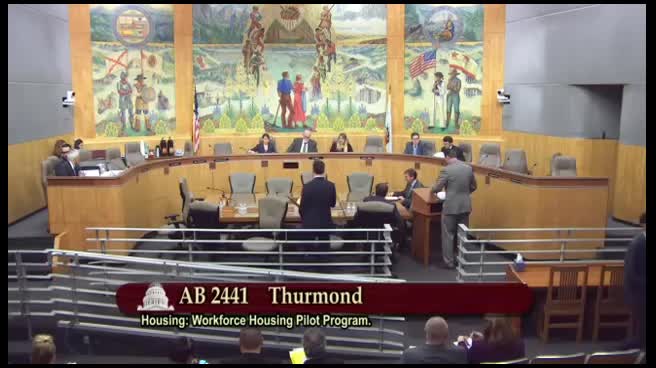 6MIN
Senate Standing Committee on Transportation and Housing
 2MIN
Assembly Floor
Bill Author

Bill Co-Author(s):