AB 2552: CalWORKs: relative caregivers.
- Session Year: 2015-2016
- House: Assembly
- Latest Version Date: 2016-05-27
Existing law requires each county to provide cash assistance and other social services to needy families through the California Work Opportunity and Responsibility to Kids (CalWORKs) program using federal Temporary Assistance to Needy Families (TANF) block grant program, state, and county funds. Existing law specifies the amounts of cash aid to be paid each month to CalWORKs recipients.
Existing law establishes the Aid to Families with Dependent Children-Foster Care (AFDC-FC) program, under which counties provide payments to foster care providers on behalf of qualified children in foster care. Under existing law, a child who is placed in the approved home of a relative is eligible for AFDC-FC if he or she is eligible for federal financial participation in the AFDC-FC payment, as specified. Existing law provides for benefits for a child who is placed in the approved home of a relative and who is ineligible for AFDC-FC pursuant to the CalWORKs program. Existing law establishes the Approved Relative Caregiver Funding Option Program in counties choosing to participate, for the purpose of making the amount paid to relative caregivers for the in-home care of children placed with them who are ineligible for AFDC-FC payments equal to the amount paid on behalf of children who are eligible for AFDC-FC payments.
This bill would require require, until January 1, 2020, and subject to the availability of funds, counties participating in the Approved Relative Caregiver Funding Option Program to pay to an approved relative caregiver, for each child eligible for benefits pursuant to the program, an annual clothing allowance of $240 for a cumulative total of three years.
Existing law continuously appropriates moneys from the General Fund to defray a portion of county costs under the CalWORKs program.
This bill would instead provide that the continuous appropriation would not be made for purposes of implementing the bill.
Existing law requires each county to provide cash assistance and other social services to needy families through the California Work Opportunity and Responsibility to Kids (CalWORKs) program using federal Temporary Assistance to Needy Families (TANF) block grant program, state, and county funds. Existing law specifies the amounts of cash aid to be paid each month to CalWORKs recipients.
Existing law establishes the Aid to Families with Dependent Children-Foster Care (AFDC-FC) program, under which counties provide payments to foster care providers on behalf of qualified children in foster care. Under existing law, a child who is placed in the approved home of a relative is eligible for AFDC-FC if he or she is eligible for federal financial participation in the AFDC-FC payment, as specified. Existing law provides for benefits for a child who is placed in the approved home of a relative and who is ineligible for AFDC-FC pursuant to the CalWORKs program. Existing law establishes the Approved Relative Caregiver Funding Option Program in counties choosing to participate, for the purpose of making the amount paid to relative caregivers for the in-home care of children placed with them who are ineligible for AFDC-FC payments equal to the amount paid on behalf of children who are eligible for AFDC-FC payments.
This bill would require counties participating in the Approved Relative Caregiver Funding Option Program to pay to an approved relative caregiver, for each child eligible for benefits pursuant to the program, an annual clothing allowance of $240 for a cumulative total of three years.
Existing law continuously appropriates moneys from the General Fund to defray a portion of county costs under the CalWORKs program.
This bill would instead provide that the continuous appropriation would not be made for purposes of implementing the bill.
(a)The Approved Relative Caregiver Funding Option Program is hereby established for the purpose of making the amount paid to approved relative caregivers for the in-home care of children placed with them who are ineligible for AFDC-FC payments equal to the amount paid on behalf of children who are eligible for AFDC-FC payments. This is an optional program for counties choosing to participate, and in so doing, participating counties agree to the terms of this section as a condition of their participation. It is the intent of the Legislature that the funding described in paragraph (1) of subdivision (g) for the Approved Relative Caregiver Funding Option Program be appropriated, and available for use from January through December of each year, unless otherwise specified.
(b)(1)Subject to subdivision (e), effective January 1, 2015, participating counties shall pay an approved relative caregiver a per child per month rate in return for the care and supervision, as defined in subdivision (b) of Section 11460, of a child that is placed with the relative caregiver that is equal to the basic rate paid to foster care providers pursuant to subdivision (g) of Section 11461, if both of the following conditions are met:
(A)The county with payment responsibility has notified the department in writing by October 1 of the year before participation begins of its decision to participate in the Approved Relative Caregiver Funding Option Program.
(B)The related child placed in the home meets all of the following requirements:
(i)The child resides in California.
(ii)The child is described by subdivision (b), (c), or (e) of Section 11401 and the county welfare department or the county probation department is responsible for the placement and care of the child.
(iii)The child is not eligible for AFDC-FC while placed with the approved relative caregiver because the child is not eligible for federal financial participation in the AFDC-FC payment.
(2)Participating Until January 1, 2020, and subject to the availability of funds, participating counties shall pay to an approved relative caregiver, for each child eligible for benefits pursuant to this section, an annual clothing allowance of two hundred forty dollars ($240). The clothing allowance shall be paid for a cumulative total of three years.
(c)Any income or benefits received by an eligible child or the approved relative caregiver on behalf of the eligible child that would be offset against the basic rate paid to a foster care provider pursuant to subdivision (g) of Section 11461, shall be offset from any funds that are not CalWORKs funds paid to the approved relative caregiver pursuant to this section.
(d)Participating counties shall recoup an overpayment in the Approved Relative Caregiver Funding Option Program received by an approved relative caregiver using the standards and processes for overpayment recoupment that are applicable to overpayments to an approved home of a relative, as specified in Section 11466.24. Recouped overpayments shall not be subject to remittance to the federal government. Any overpaid funds that are collected by the participating counties shall be remitted to the state after subtracting both of the following:
(1)An amount not to exceed the county share of the CalWORKs portion of the Approved Relative Caregiver Funding Option Program payment, if any.
(2)Any other county funds that were included in the Approved Relative Caregiver Funding Option Program payment.
(e)A countys election to participate in the Approved Relative Caregiver Funding Option Program shall affirmatively indicate that the county understands and agrees to all of the following conditions:
(1)Commencing October 1, 2014, the county shall notify the department in writing of its decision to participate in the Approved Relative Caregiver Funding Option Program. Failure to make timely notification, without good cause as determined by the department, shall preclude the county from participating in the program for the upcoming calendar year. Annually thereafter, any county not already participating who elects to do so shall notify the department in writing no later than October 1 of its decision to participate for the upcoming calendar year.
(2)The county shall confirm that it will make per child per month payments to all approved relative caregivers on behalf of eligible children in the amount specified in subdivision (b) for the duration of the participation of the county in this program.
(3)The county shall confirm that it will be solely responsible to pay any additional costs needed to make all payments pursuant to subdivision (b) if the state and federal funds allocated to the Approved Relative Caregiver Funding Option Program pursuant to paragraph (1) of subdivision (g) are insufficient to make all eligible payments.
(f)(1) A county deciding to opt out of the Approved Relative Caregiver Funding Option Program shall provide at least 120 days prior written notice of that decision to the department. Additionally, the county shall provide at least 90 days prior written notice to the approved relative caregiver or caregivers informing them that his or her per child per month payment will be reduced and the date that the reduction will occur.
(2)The department shall presume that all counties have opted out of the Approved Relative Caregiver Funding Option Program if the funding appropriated for the current 12-month period is reduced below the amount specified in subparagraph (B), subparagraph (C), or subparagraph (D) of paragraph (2) of subdivision (g) for that 12-month period, unless a county notifies the department in writing of its intent to opt in within 60 days of enactment of the State Budget. The counties shall provide at least 90 days prior written notice to the approved relative caregiver or caregivers informing them that his or her per child per month payment will be reduced, and the date that reduction will occur.
(3)Any reduction in payments received by an approved relative caregiver on behalf of a child under this section that results from a decision by a county, including the presumed opt-out pursuant to paragraph (2), to not participate in the Approved Relative Caregiver Funding Option Program shall be exempt from state hearing jurisdiction under Section 10950.
(g)(1) The following funding shall be used for the Approved Relative Caregiver Funding Option Program:
(A)The applicable regional per-child CalWORKs grant, in accordance with subdivision (a) of Section 11253.4.
(B) General Fund resources, as appropriated in paragraph (2).
(C)County funds only to the extent required under paragraph (3) of subdivision (e).
(D)Funding described in subparagraphs (A) and (B) is intended to fully fund the base caseload of approved relative caregivers, which is defined as the number of approved relative caregivers caring for a child who is not eligible to receive AFDC-FC payments, as of July 1, 2014.
(2)The following amount is hereby appropriated from the General Fund as follows:
(A)The sum of fifteen million dollars ($15,000,000), for the period of January 1, 2015, to June 30, 2015, inclusive.
(B)For the period of July 1, 2015, to June 30, 2016, inclusive, there shall be appropriated an amount equal to the sum of all of the following:
(i)Two times the amount appropriated pursuant to subparagraph (A), inclusive of any increase pursuant to paragraph (3).
(ii)The amount necessary to increase or decrease the CalWORKs funding associated with the base caseload described in subparagraph (D) of paragraph (1) to reflect any change from the prior fiscal year in the applicable regional per-child CalWORKs grant described in subparagraph (A) of paragraph (1).
(iii)The additional amount necessary to fully fund the base caseload described in subparagraph (D) of paragraph (1), reflective of the annual California Necessities Index increase to the basic rate paid to foster care providers.
(C)For every 12-month period thereafter, commencing with the period of July 1, 2016, to June 30, 2017, inclusive, the sum of all of the following shall be appropriated for purposes of this section:
(i)The total General Fund amount provided pursuant to this paragraph for the previous 12-month period.
(ii)The amount necessary to increase or decrease the CalWORKs funding associated with the base caseload described in subparagraph (D) of paragraph (1) to reflect any change from the prior fiscal year in the applicable regional per-child CalWORKs grant described in subparagraph (A) of paragraph (1).
(iii)The additional amount necessary to fully fund the base caseload described in subparagraph (D) of paragraph (1), reflective of the annual California Necessities Index increase to the basic rate paid to foster care providers.
(D) Notwithstanding clauses (ii) and (iii) of subparagraph (B) and clauses (ii) and (iii) of subparagraph (C), the total General Fund appropriation made pursuant to subparagraph (B) shall not be less than the greater of the following amounts:
(i)Thirty million dollars ($30,000,000).
(ii)Two times the amount appropriated pursuant to subparagraph (A), inclusive of any increase pursuant to paragraph (3).
(3)To the extent that the appropriation made by subparagraph (A) of paragraph (2) is insufficient to fully fund the base caseload of approved relative caregivers as of July 1, 2014, as described in subparagraph (D) of paragraph (1), for the period of January 1, 2015, to June 30, 2015, inclusive, as jointly determined by the department and the County Welfare Directors Association and approved by the Department of Finance on or before October 1, 2015, the amount specified in subparagraph (A) of paragraph (2) shall be increased by the amount necessary to fully fund that base caseload.
(4)Funds available pursuant to paragraph (2) shall be allocated to participating counties proportionate to the number of their approved relative caregiver placements, using a methodology and timing developed by the department, following consultation with county human services agencies and their representatives.
(5)Notwithstanding subdivision (e), if in any calendar year the entire amount of funding appropriated by the state for the Approved Relative Caregiver Funding Option Program has not been fully allocated to or utilized by participating counties, a participating county that has paid any funds pursuant to subparagraph (C) of paragraph (1) of subdivision (g) may request reimbursement for those funds from the department. The authority of the department to approve the requests shall be limited by the amount of available unallocated funds.
(h)An approved relative caregiver receiving payments on behalf of a child pursuant to this section shall not be eligible to receive additional CalWORKs payments on behalf of the same child under Section 11450.
(i)To the extent permitted by federal law, payments received by the approved relative caregiver from the Approved Relative Caregiver Funding Option Program shall not be considered income for the purpose of determining other public benefits.
(j)Prior to referral of any individual or recipient, or that persons case, to the local child support agency for child support services pursuant to Section 17415 of the Family Code, the county human services agency shall determine if an applicant or recipient has good cause for noncooperation, as set forth in Section 11477.04. If the applicant or recipient claims good cause exception at any subsequent time to the county human services agency or the local child support agency, the local child support agency shall suspend child support services until the county social services agency determines the good cause claim, as set forth in Section 11477.04. If good cause is determined to exist, the local child support agency shall suspend child support services until the applicant or recipient requests their resumption, and shall take other measures that are necessary to protect the applicant or recipient and the children. If the applicant or recipient is the parent of the child for whom aid is sought and the parent is found to have not cooperated without good cause as provided in Section 11477.04, the applicants or recipients family grant shall be reduced by 25 percent for the time the failure to cooperate lasts.
(k)Consistent with Section 17552 of the Family Code, if aid is paid under this chapter on behalf of a child who is under the jurisdiction of the juvenile court and whose parent or guardian is receiving reunification services, the county human services agency shall determine, prior to referral of the case to the local child support agency for child support services, whether the referral is in the best interest of the child, taking into account both of the following:
(1)Whether the payment of support by the parent will pose a barrier to the proposed reunification in that the payment of support will compromise the parents ability to meet the requirements of the parents reunification plan.
(2)Whether the payment of support by the parent will pose a barrier to the proposed reunification in that the payment of support will compromise the parents current or future ability to meet the financial needs of the child.
SEC. 2.No appropriation pursuant to Section 15200 of the Welfare and Institutions Code shall be made for purposes of implementing this act.
(a)The Approved Relative Caregiver Funding Option Program is hereby established for the purpose of making the amount paid to approved relative caregivers for the in-home care of children placed with them who are ineligible for AFDC-FC payments equal to the amount paid on behalf of children who are eligible for AFDC-FC payments. This is an optional program for counties choosing to participate, and in so doing, participating counties agree to the terms of this section as a condition of their participation. It is the intent of the Legislature that the funding described in paragraph (1) of subdivision (g) for the Approved Relative Caregiver Funding Option Program be appropriated, and available for use from January through December of each year, unless otherwise specified.
(b)(1)Subject to subdivision (e), effective January 1, 2015, participating counties shall pay an approved relative caregiver a per child per month rate in return for the care and supervision, as defined in subdivision (b) of Section 11460, of a child that is placed with the relative caregiver that is equal to the basic rate paid to foster care providers pursuant to subdivision (g) of Section 11461, if both of the following conditions are met:
(1)
(A)The county with payment responsibility has notified the department in writing by October 1 of the year before participation begins of its decision to participate in the Approved Relative Caregiver Funding Option Program.
(2)
(B)The related child placed in the home meets all of the following requirements:
(A)
(i)The child resides in California.
(B)
(ii)The child is described by subdivision (b), (c), or (e) of Section 11401 and the county welfare department or the county probation department is responsible for the placement and care of the child.
(C)
(iii)The child is not eligible for AFDC-FC while placed with the approved relative caregiver because the child is not eligible for federal financial participation in the AFDC-FC payment.
(2)Participating counties shall pay to an approved relative caregiver, for each child eligible for benefits pursuant to this section, an annual clothing allowance of two hundred forty dollars ($240). The clothing allowance shall be paid for a cumulative total of three years.
(c)Any income or benefits received by an eligible child or the approved relative caregiver on behalf of the eligible child that would be offset against the basic rate paid to a foster care provider pursuant to subdivision (g) of Section 11461, shall be offset from any funds that are not CalWORKs funds paid to the approved relative caregiver pursuant to this section.
(d)Participating counties shall recoup an overpayment in the Approved Relative Caregiver Funding Option Program received by an approved relative caregiver using the standards and processes for overpayment recoupment that are applicable to overpayments to an approved home of a relative, as specified in Section 11466.24. Recouped overpayments shall not be subject to remittance to the federal government. Any overpaid funds that are collected by the participating counties shall be remitted to the state after subtracting both of the following:
(1)An amount not to exceed the county share of the CalWORKs portion of the Approved Relative Caregiver Funding Option Program payment, if any.
(2)Any other county funds that were included in the Approved Relative Caregiver Funding Option Program payment.
(e)A countys election to participate in the Approved Relative Caregiver Funding Option Program shall affirmatively indicate that the county understands and agrees to all of the following conditions:
(1)Commencing October 1, 2014, the county shall notify the department in writing of its decision to participate in the Approved Relative Caregiver Funding Option Program. Failure to make timely notification, without good cause as determined by the department, shall preclude the county from participating in the program for the upcoming calendar year. Annually thereafter, any county not already participating who elects to do so shall notify the department in writing no later than October 1 of its decision to participate for the upcoming calendar year.
(2)The county shall confirm that it will make per child per month payments to all approved relative caregivers on behalf of eligible children in the amount specified in subdivision (b) for the duration of the participation of the county in this program.
(3)The county shall confirm that it will be solely responsible to pay any additional costs needed to make all payments pursuant to subdivision (b) if the state and federal funds allocated to the Approved Relative Caregiver Funding Option Program pursuant to paragraph (1) of subdivision(g) subdivision (g) are insufficient to make all eligible payments.
(f)(1) A county deciding to opt out of the Approved Relative Caregiver Funding Option Program shall provide at least 120 days prior written notice of that decision to the department. Additionally, the county shall provide at least 90 days prior written notice to the approved relative caregiver or caregivers informing them that his or her per child per month payment will be reduced and the date that the reduction will occur.
(2)The department shall presume that all counties have opted out of the Approved Relative Caregiver Funding Option Program if the funding appropriated for the current 12-month period is reduced below the amount specified in subparagraph (B), subparagraph (C), or subparagraph (D) of paragraph(2) of subdivision (g) for that 12-month period, unless a county notifies the department in writing of its intent to opt in within 60 days of enactment of the State Budget. The counties shall provide at least 90 days prior written notice to the approved relative caregiver or caregivers informing them that his or her per child per month payment will be reduced, and the date that reduction will occur.
(3)Any reduction in payments received by an approved relative caregiver on behalf of a child under this section that results from a decision by a county, including the presumed opt-out pursuant to paragraph (2), to not participate in the Approved Relative Caregiver Funding Option Program shall be exempt from state hearing jurisdiction under Section 10950.
(g)(1) The following funding shall be used for the Approved Relative Caregiver Funding Option Program:
(A)The applicable regional per-child CalWORKs grant, in accordance with subdivision (a) of Section 11253.4.
(B) General Fund resources, as appropriated in paragraph (2).
(C)County funds only to the extent required under paragraph (3) of subdivision (e).
(D)Funding described in subparagraphs (A) and (B) is intended to fully fund the base caseload of approved relative caregivers, which is defined as the number of approved relative caregivers caring for a child who is not eligible to receive AFDC-FC payments, as of July 1, 2014.
(2)The following amount is hereby appropriated from the General Fund as follows:
(A)The sum of fifteen million dollars ($15,000,000), for the period of January 1, 2015, to June 30, 2015, inclusive.
(B)For the period of July 1, 2015, to June 30, 2016, inclusive, there shall be appropriated an amount equal to the sum of all of the following:
(i)Two times the amount appropriated pursuant to subparagraph (A), inclusive of any increase pursuant to paragraph (3).
(ii)The amount necessary to increase or decrease the CalWORKs funding associated with the base caseload described in subparagraph (D) of paragraph (1) to reflect any change from the prior fiscal year in the applicable regional per-child CalWORKs grant described in subparagraph (A) of paragraph (1).
(iii)The additional amount necessary to fully fund the base caseload described in subparagraph (D) of paragraph (1), reflective of the annual California Necessities Index increase to the basic rate paid to foster care providers.
(C)For every 12-month period thereafter, commencing with the period of July 1, 2016, to June 30, 2017, inclusive, the sum of all of the following shall be appropriated for purposes of this section:
(i)The total General Fund amount provided pursuant to this paragraph for the previous 12-month period.
(ii)The amount necessary to increase or decrease the CalWORKs funding associated with the base caseload described in subparagraph (D) of paragraph (1) to reflect any change from the prior fiscal year in the applicable regional per-child CalWORKs grant described in subparagraph (A) of paragraph (1).
(iii)The additional amount necessary to fully fund the base caseload described in subparagraph (D) of paragraph (1), reflective of the annual California Necessities Index increase to the basic rate paid to foster care providers.
(D) Notwithstanding clauses (ii) and (iii) of subparagraph (B) and clauses (ii) and (iii) of subparagraph (C), the total General Fund appropriation made pursuant to subparagraph (B) shall not be less than the greater of the following amounts:
(i)Thirty million dollars ($30,000,000).
(ii)Two times the amount appropriated pursuant to subparagraph (A), inclusive of any increase pursuant to paragraph (3).
(3)To the extent that the appropriation made by subparagraph (A) of paragraph (2) is insufficient to fully fund the base caseload of approved relative caregivers as of July 1, 2014, as described in subparagraph (D) of paragraph (1), for the period of January 1, 2015, to June 30, 2015, inclusive, as jointly determined by the department and the County Welfare Directors Association and approved by the Department of Finance on or before October 1, 2015, the amount specified in subparagraph (A) of paragraph (2) shall be increased by the amount necessary to fully fund that base caseload.
(4)Funds available pursuant to paragraph (2) shall be allocated to participating counties proportionate to the number of their approved relative caregiver placements, using a methodology and timing developed by the department, following consultation with county human services agencies and their representatives.
(5)Notwithstanding subdivision (e), if in any calendar year the entire amount of funding appropriated by the state for the Approved Relative Caregiver Funding Option Program has not been fully allocated to or utilized by participating counties, a participating county that has paid any funds pursuant to subparagraph (C) of paragraph (1) of subdivision (g) may request reimbursement for those funds from the department. The authority of the department to approve the requests shall be limited by the amount of available unallocated funds.
(h)An approved relative caregiver receiving payments on behalf of a child pursuant to this section shall not be eligible to receive additional CalWORKs payments on behalf of the same child under Section 11450.
(i)To the extent permitted by federal law, payments received by the approved relative caregiver from the Approved Relative Caregiver Funding Option Program shall not be considered income for the purpose of determining other public benefits.
(j)Prior to referral of any individual or recipient, or that persons case, to the local child support agency for child support services pursuant to Section 17415 of the Family Code, the county human services agency shall determine if an applicant or recipient has good cause for noncooperation, as set forth in Section 11477.04. If the applicant or recipient claims good cause exception at any subsequent time to the county human services agency or the local child support agency, the local child support agency shall suspend child support services until the county social services agency determines the good cause claim, as set forth in Section 11477.04. If good cause is determined to exist, the local child support agency shall suspend child support services until the applicant or recipient requests their resumption, and shall take other measures that are necessary to protect the applicant or recipient and the children. If the applicant or recipient is the parent of the child for whom aid is sought and the parent is found to have not cooperated without good cause as provided in Section 11477.04, the applicants or recipients family grant shall be reduced by 25 percent for the time the failure to cooperate lasts.
(k)Consistent with Section 17552 of the Family Code, if aid is paid under this chapter on behalf of a child who is under the jurisdiction of the juvenile court and whose parent or guardian is receiving reunification services, the county human services agency shall determine, prior to referral of the case to the local child support agency for child support services, whether the referral is in the best interest of the child, taking into account both of the following:
(1)Whether the payment of support by the parent will pose a barrier to the proposed reunification in that the payment of support will compromise the parents ability to meet the requirements of the parents reunification plan.
(2)Whether the payment of support by the parent will pose a barrier to the proposed reunification in that the payment of support will compromise the parents current or future ability to meet the financial needs of the child.
SEC. 2.No appropriation pursuant to Section 15200 of the Welfare and Institutions Code shall be made for purposes of implementing this act.
|
Date
|
Status
|
|---|---|
| Feb 19, 2016 | Introduced. To print. |
| Feb 21, 2016 | From printer. May be heard in committee March 22. |
| Feb 22, 2016 | Read first time. |
| Mar 8, 2016 | Referred to Com. on HUM. S. |
| Apr 13, 2016 | From committee: Do pass and re-refer to Com. on APPR. (Ayes 7. Noes 0.) (April 12). Re-referred to Com. on APPR. |
| May 4, 2016 | In committee: Set, first hearing. Referred to APPR. suspense file. |
| May 27, 2016 | From committee: Amend, and do pass as amended. (Ayes 19. Noes 0.) (May 27). |
| May 27, 2016 | Read second time and amended. Ordered returned to second reading. |
| May 31, 2016 | Read second time. Ordered to third reading. |
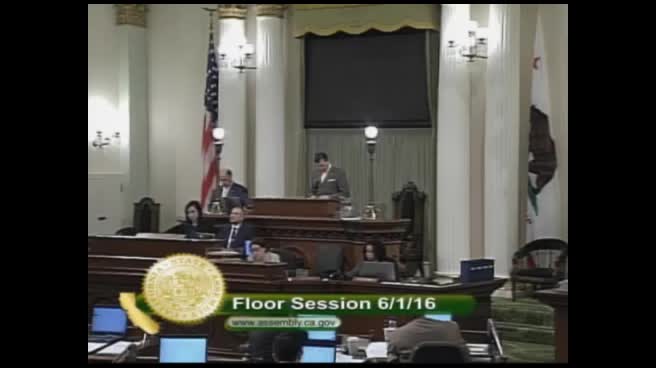
| Jun 1, 2016 | Read third time. Passed. Ordered to the Senate. |
| Jun 1, 2016 | Read third time. Passed. Ordered to the Senate. (Ayes 78. Noes 0. Page 5115.) |
| Jun 1, 2016 | Read third time. Passed. Ordered to the Senate. (Ayes 78. Noes 0.) |
| Jun 2, 2016 | In Senate. Read first time. To Com. on RLS. for assignment. |
| Jun 9, 2016 | Referred to Com. on HUMAN S. |
| Jun 21, 2016 | In committee: Set, first hearing. Hearing canceled at the request of author. |
|
Date
|
Description
|
Location
|
Votes
|
|
|---|---|---|---|---|
| Jun 1, 2016 | AB 2552 HOLDEN Assembly Third Reading | Assembly Floor |
Passed |
|
| May 27, 2016 | Do pass as amended. | Assembly Standing Committee on Appropriations |
Passed |
|
| Apr 12, 2016 | Do pass and be re-referred to the Committee on [Appropriations] | Assembly Standing Committee on Human Services |
Passed |
This list shows positions taken on this bill by organizations on the date displayed, which is linked to the original source.
Positions by individuals are not included.
|
Organization
|
Position
|
Date
|
|---|---|---|
| National Association of Social Workers, CA Chapter | ** Support | Jun 1, 2016 |
ASSEMBLY THIRD READING
ATR Bill Id:
Author:(Holden)
As Amended Ver:
Majority vote
Committee | Votes | Ayes | Noes |
Human Services | 7-0 | Bonilla, Grove, Calderon, Lopez, Maienschein, Mark Stone, Thurmond | |
Appropriations | 19-0 | Gonzalez, Bigelow, Bloom, Bonilla, Bonta, Calderon, Chang, Daly, Eggman, Eduardo Garcia, Roger Hernández, Holden, Jones, Obernolte, Quirk, Santiago, Wagner, Weber, Wood |
|
SUMMARY: Requires counties that participate in the Approved Relative Caregiver (ARC) Funding Option Program to pay approved relative caregivers an annual clothing allowance of $240 for each child eligible for benefits for a cumulative total of three years and with a sunset date of January 1, 2020.
EXISTING LAW:
- Establishes a state and local system of child welfare services, including foster care, for children who have been adjudged by the court to be at risk or have been abused or neglected, as specified. (Welfare and Institutions Code Section (WIC) 202)
- States the intent of the Legislature to preserve and strengthen a child’s family ties whenever possible and to reunify a foster youth with his or her biological family whenever possible, or to provide a permanent placement alternative, such as adoption or guardianship. (WIC 16000)
- Requires a social worker, within 30 days of taking a child into temporary custody or whenever appropriate to identify and locate all adults who are related to the child by blood, adoption, or affinity within the fifth degree of kinship and provide for the purposes of informing them of their right to participate in the care and placement of the child, as specified. (WIC Code 309(e))
- Establishes the ARC program as an optional program for counties to provide funding to non-federally eligible foster children equal to the rates paid to federally eligible foster children. (WIC 11461.3)
FISCAL EFFECT: According to the Assembly Appropriations Committee, this bill may result in potentially significant costs of approximately $750,000 (General Fund) beginning in 2016-17 and $1.5 million (General Fund) in 2017-18 and 2018-19 to provide the clothing allowance. The State General Fund appropriation for the ARC program is capped at $30 million. Currently ARC expenditures by counties do not use the entire amount of General Fund available and the unused portion is returned to the General Fund. If, including the clothing allowance, the total ARC payments do not exceed the $30 million available, a smaller amount would be returned to the General Fund, but the overall cost would already be accounted for in the state budget. If, however, the additional amount spent results in total ARC expenditures exceeding the amount of General Fund appropriation, the difference would be a General Fund cost since Proposition 30 requires any new benefits mandated by the State to be paid for by the State.
COMMENTS:
Child Welfare Services: The purpose of California's Child Welfare Services (CWS) system is to protect children from abuse and neglect and provide for their health and safety. The CWS system seeks to help children who have been removed from their homes reunify with their parents or guardians, whenever appropriate. There are currently over 62,000 children and youth in California's child welfare system; over 7,600 of these youth are between the ages of 18 and 20.
CalWORKs: The California Work Opportunity and Responsibility to Kids (CalWORKs) program provides monthly income assistance and employment-related services aimed at moving children out of poverty and helping families meet basic needs. Federal funding for CalWORKs comes from the Temporary Assistance for Needy Families (TANF) block grant. The average 2015-16 monthly cash grant for a family of three on CalWORKs (one parent and two children) is $506.55, and the maximum monthly grant amount for a family of three, if the family has no other income and lives in a high-cost county, is $704. According to recent data from the California Department of Social Services, over 497,000 families rely on CalWORKs, including over one million children. Nearly 60% of cases include children under 6 years old.
Aid for Dependent Children-Foster Care (AFDC-FC) and federally eligible vs. non-federally eligible foster youth: AFDC-FC provides foster care benefits to youth and can be either federally-funded or state-only funded. In order to be federally eligible for foster care, the home from which the child was removed must meet Aid for Dependent Children (AFDC) eligibility criteria from 1996 AFDC in the month the petition is filed or in any of the 6 months prior to the month the petition is filed. In 1996, the income limit for a family of 3 to qualify for AFDC was $723. Because some foster youth are ineligible to receive federally funded foster care benefits, the State of California created State AFDC-FC, which is a blend of State and County funds and provides funding to foster children placed with non-relative foster parents at the same rate as foster youth who are federally eligible. However, prior to 2014, all foster youth who were placed with relative caregivers and who were determined to be federally ineligible for AFDC-FC received CalWORKs benefits and were funded at much lower rates than their non-federally eligible counterparts who were placed with non-relative foster parents. In response to this discrepancy, the State created the Approved Relative Caregiver Program.
ARC Program: Established in 2014 by SB 855 (Budget and Fiscal Review Committee), Chapter 29, Statutes of 2014, the ARC program increased payments to children placed with relative caregivers who do not qualify for state or federal foster care benefits. Previously, these children were only eligible for CalWORKs benefit rate levels, which are much lower than foster care benefits. The ARC program is county-optional and provides State General Fund dollars for participating counties to increase the monthly payments to approved relative caregivers in an amount equal to the basic federal foster care rate. A county may opt out of the program at any time, but must meet notification and other requirements. Eligibility criteria require that relative caregivers must be approved and live in California and meet health and safety standards that mirror those for licensed foster parents; and children must be under the jurisdiction of the juvenile court in a county that has opted into the ARC program and not federally eligible under Title IV-E of the Social Security Act. Those participating in an ARC program do not receive special care increments, such as clothing allowances and infant care supplements. Currently 48 of California's 58 counties have opted into the ARC program and serve a total of approximately 6,252 adult relative caregivers. Los Angeles County serves nearly 54% of the program's caregivers with approximately 3,431 adult relative caregivers served, according to information from DSS.
Need for this bill: According to the author's office, "Relative caregivers are the backbone of our child welfare system. Relative foster placements are more cost effective, tend to lead to more long term placement stability, and offer better connections to the child’s community, but these children still don't receive funding equal to what they would receive with a non-relative. [This bill] lessens the discrepancy by providing additional funds to the families in the Approved Relative Caregiver Program, in the form of a clothing allowance. The clothing allowance would consist of an additional $240 a year for three years, distributed monthly, in counties that have opted into the program."
PRIOR LEGISLATION:
AB 1882 (Cooley) of 2014, would have required a county child welfare agency to determine whether relative foster caregivers are eligible for assistance under the CalWORKs program or through the Supplemental Security Income program. It died in the Senate Appropriations Committee.
SB 855 (Budget and Fiscal Review Committee), Chapter 29, Statutes of 2014, established the ARC Program and established that participation for counties is optional.
Analysis Prepared by: Kelsy Castillo / HUM. S. / (916) 319-2089 FN: 0003337
Date of Hearing: May 4, 2016
ASSEMBLY COMMITTEE ON APPROPRIATIONS
Lorena Gonzalez, Chair
ABPCA Bill Id:AB 2552
Author:(Holden) – As Introduced Ver:February 19, 2016
Policy Committee: | Human Services | Vote: | 7 - 0 |
|
| ||
|
|
Urgency: No State Mandated Local Program: No Reimbursable: No
SUMMARY:
This bill requires counties that participate in the Approved Relative Caregiver (ARC) Funding Option Program to pay approved relative caregivers an annual clothing allowance for a cumulative total of three years.
FISCAL EFFECT:
Potentially significant costs of approximately $750,000 (GF) beginning in 2016-17 and $1.5 million (GF) annually ongoing to provide the clothing allowance. The State General Fund appropriation for the ARC program is capped at $30 million. Currently, ARC expenditures by counties do not use the entire amount of GF available and the unused portion is returned to the GF. If, including the clothing allowance, the total ARC payments do not exceed the $30 million available, a smaller amount would be returned to the GF, but the overall cost would already be accounted for in the state budget. If, however, the additional amount spent results in total ARC expenditures exceeding the amount of GF appropriation, the difference would be a GF cost since Proposition 30 requires any new benefits mandated by the State to be paid for by the State.
COMMENTS:
- Need for this bill. According to the author’s office, “Relative caregivers are the backbone of our child welfare system. Relative foster placements are more cost effective, tend to lead to more long term placement stability, and offer better connections to the child’s community, but these children still don’t receive funding equal to what they would receive with a non-relative. This bill lessens the discrepancy by providing additional funds to the families in the Approved Relative Caregiver Program, in the form of a clothing allowance. The clothing allowance would consist of an additional $240 a year for three years, distributed monthly, in counties that have opted into the program.”
- Approved Relative Caregiver (ARC) Program. Established in 2014, by SB 855 (Committee on Budget and Fiscal Review), Chapter 29, Statutes of 2014, the ARC program increased payments to children placed with relative caregivers who do not qualify for state or federal foster care benefits. Previously, these children were only eligible for CalWORKs benefit rate levels, which are much lower than foster care benefits. The ARC program is county-optional and provides State General Fund dollars for participating counties to increase the monthly payments to approved relative caregivers in an amount equal to the basic federal foster care rate. A county may opt out of the program at any time, but must meet notification and other requirements.
Those participating in an ARC program do not receive special care increments, such as clothing allowances and infant care supplements. Currently 48 of California’s 58 counties have opted into the ARC program and serve approximately 6,252 foster children.
- Prior Legislation.
- AB 1882 (Cooley), 2014, would have required a county child welfare agency to determine whether relative foster caregivers are eligible for assistance under the CalWORKs program or through the Supplemental Security Income (SSI) program. It was held on the Senate Appropriations Committee’s Suspense file.
- SB 855 (Committee on Budget and Fiscal Review), Chapter 29, Statutes of 2014, established the Approved Relative Caregiver (ARC) Program and established that participation for counties is optional.
Analysis Prepared by: Jennifer Swenson / APPR. / (916) 319-2081
Date of Hearing: April 12, 2016
ASSEMBLY COMMITTEE ON HUMAN SERVICES
Susan Bonilla, Chair
ABPCA Bill Id:AB 2552 (
Author:Holden) – As Introduced Ver:February 19, 2016
SUBJECT: CalWORKs: relative caregivers.
SUMMARY: Requires counties that participate in the Approved Relative Caregiver (ARC) Funding Option Program to pay approved relative caregivers an annual clothing allowance, for a cumulative total of three years, of $240 for each child eligible for benefits.
EXISTING LAW:
- Establishes a state and local system of child welfare services, including foster care, for children who have been adjudged by the court to be at risk or have been abused or neglected, as specified. (WIC 202)
- States that the purpose of foster care law is to provide maximum safety and protection for children who are currently being physically, sexually, emotionally abused, neglected, or exploited, and to ensure the safety, protection, and physical and emotional well-being of children who are at risk of harm. (WIC 300.2)
- States the intent of the Legislature to preserve and strengthen a child’s family ties whenever possible and to reunify a foster youth with his or her biological family whenever possible, or to provide a permanent placement alternative, such as adoption or guardianship. (WIC 16000)
- Requires a social worker, within 30 days of taking a child into temporary custody or whenever appropriate to identify and locate all adults who are related to the child by blood, adoption, or affinity within the fifth degree of kinship and provide for the purposes of informing them of their right to participate in the care and placement of the child, as specified. (W&I Code 309(e))
- Requires preferential consideration be given to a request by a relative to have the child placed with the relative if the child has been removed from the physical custody of the child's parent(s). (W&I Code 361.3(a))
- Establishes the ARC program as an optional program for counties to provide funding to non-federally eligible foster children equal to the rates paid to federally eligible foster children. (WIC 11461.3)
FISCAL EFFECT: Unknown.
COMMENTS:
Child Welfare Services: The purpose of California’s Child Welfare Services (CWS) system is to protect children from abuse and neglect and provide for their health and safety. When children are identified as being at risk of abuse, neglect or abandonment, county juvenile courts hold legal jurisdiction and children are served by the CWS system through the appointment of a social worker. Through this system, there are multiple opportunities for the custody of the child, or his or her placement outside of the home, to be evaluated, reviewed and determined by the judicial system, in consultation with the child's social worker, to help provide the best possible services to the child. The CWS system seeks to help children who have been removed from their homes reunify with their parents or guardians, whenever appropriate, or unite them with other individuals they consider to be family. There are currently over 62,000 children and youth in California’s child welfare system; over 7,600 of these youth are between the ages of 18 and 20.
CalWORKs: The California Work Opportunity and Responsibility to Kids (CalWORKs) program provides monthly income assistance and employment-related services aimed at moving children out of poverty and helping families meet basic needs. Federal funding for CalWORKs comes from the Temporary Assistance for Needy Families (TANF) block grant. The average 2015-16 monthly cash grant for a family of three on CalWORKs (one parent and two children) is $506.55, and the maximum monthly grant amount for a family of three, if the family has no other income and lives in a high-cost county, is $704. According to recent data from the California Department of Social Services, over 497,000 families rely on CalWORKs, including over one million children. Nearly 60% of cases include children under 6 years old.
Maximum grant amounts in high-cost counties of $704 per month for a family of three with no other income means $23.46 per day, per family, or $7.82 per family member, per day to meet basic needs, including rent, clothing, utility bills, food, and anything else a family needs to ensure children can be cared for at home and safely remain with their families. This grant amount puts the annual household income at $8,448 per year, or 42% of poverty. Federal Poverty Guidelines for 2016 show that 100% of poverty for a family of three is $20,160 per year.
Aid for Dependent Children-Foster Care (AFDC-FC) and federally eligible vs. non-federally eligible foster youth: AFDC-FC provides foster care benefits to youth and can be either federally-funded or state-only funded. In order to be federally eligible for foster care, the home from which the child was removed must meet Aid for Dependent Children (AFDC) eligibility criteria from 1996 AFDC in the month the petition is filed or in any of the 6 months prior to the month the petition is filed. In 1996, the income limit for a family of 3 to qualify for AFDC was $723. Because some foster youth are ineligible to receive federally funded foster care benefits, the State of California created State AFDC-FC, which is a blend of State and County funds and provides funding to foster children placed with non-relative foster parents at the same rate as foster youth who are federally eligible. However, prior to 2014, all foster youth who were placed with relative caregivers and who were determined to be federally ineligible for AFDC-FC received CalWORKs benefits and were funded at much lower rates than their non-federally eligible counterparts who were placed with non-relative foster parents. In response to this discrepancy, the State created the Approved Relative Caregiver Program.
Approved Relative Caregiver (ARC) Program: Established in 2014 by SB 855 (Committee on Budget and Fiscal Review), Chapter 29, Statutes of 2014, the ARC program increased payments to children placed with relative caregivers who do not qualify for state or federal foster care benefits. Previously, these children were only eligible for CalWORKs benefit rate levels, which are much lower than foster care benefits. The ARC program is county-optional and provides State General Fund dollars for participating counties to increase the monthly payments to approved relative caregivers in an amount equal to the basic federal foster care rate. A county may opt out of the program at any time, but must meet notification and other requirements. Eligibility criteria require that relative caregivers must be approved and live in California and meet health and safety standards that mirror those for licensed foster parents; and children must be under the jurisdiction of the juvenile court in a county that has opted into the ARC program and not federally eligible under Title IV-E of the Social Security Act. Those participating in an ARC program do not receive special care increments, such as clothing allowances and infant care supplements. Currently 48 of California’s 58 counties have opted into the ARC program and serve a total of roughly 6,252 adult relative caregivers. Los Angeles County serves nearly 54% of the program’s caregivers with approximately 3,431 adult relative caregivers served, according to information from DSS.
Need for this bill: According to the author’s office, “Relative caregivers are the backbone of our child welfare system. Relative foster placements are more cost effective, tend to lead to more long term placement stability, and offer better connections to the child’s community, but these children still don’t receive funding equal to what they would receive with a non-relative. [This bill] lessens the discrepancy by providing additional funds to the families in the Approved Relative Caregiver Program, in the form of a clothing allowance. The clothing allowance would consist of an additional $240 a year for three years, distributed monthly, in counties that have opted into the program.”
PRIOR LEGISLATION:
AB 1882 (Cooley), 2014, would have required a county child welfare agency to determine whether relative foster caregivers are eligible for assistance under the CalWORKs program or through the Supplemental Security Income (SSI) program. It died in the Senate Appropriations Committee.
SB 855 (Committee on Budget and Fiscal Review), Chapter 29, Statutes of 2014, established the Approved Relative Caregiver (ARC) Program and established that participation for counties is optional.
REGISTERED SUPPORT / OPPOSITION:
Support
The Alliance for Children’s Rights
National Association of Social Workers, CA Chapter (NASW-CA)
Opposition
None on file.
Analysis Prepared by: Kelsy C. Castillo / HUM. S. / (916) 319-2089
Bill Author

Bill Co-Author(s):