AB 2617: Water efficiency measures.
- Session Year: 2015-2016
- House: Assembly
- Latest Version Date: 2016-05-27
The California Constitution requires that the water resources of the state be put to beneficial use to the fullest extent of which they are capable and that the waste or unreasonable use or unreasonable method of use of water be prevented. Existing law requires the State Energy Resources Conservation and Development Commission (Energy Commission), on a biennial basis, to conduct assessments and forecasts of all aspects of energy industry supply, production, transportation, delivery, and distribution. Existing law requires the Energy Commission, beginning November 1, 2003, and biennially thereafter, to adopt an integrated energy policy report containing an overview of major energy trends and issues facing the state.
This bill would require the Energy Commission Department of Water Resources to develop and solicit comments on a proposed report, in consultation with certain subject matter experts and in cooperation with experts at the University of California, the California State University, the State Water Resources Control Board and the Department of Water Resources, Board, the State Energy Resources Conservation and Development Commission, and local water districts, by December 1, 2017, and, by July 1, 2018, to issue a final report that contains, among other things, the projected benefits of recommended voluntary water efficiency measures and an analysis of any unintended adverse environmental impacts that would result from various water efficiency measures. recommendations to public entities to help them achieve water-resilient communities and prioritize cost-effective water efficiency measures with low adverse environmental impacts based on local conditions.
The California Constitution requires that the water resources of the state be put to beneficial use to the fullest extent of which they are capable and that the waste or unreasonable use or unreasonable method of use of water be prevented. Existing law requires the State Energy Resources Conservation and Development Commission (Energy Commission), on a biennial basis, to conduct assessments and forecasts of all aspects of energy industry supply, production, transportation, delivery, and distribution. Existing law requires the Energy Commission, beginning November 1, 2003, and biennially thereafter, to adopt an integrated energy policy report containing an overview of major energy trends and issues facing the state.
This bill would require the Energy Commission to develop and solicit comments on a proposed report, in consultation with certain subject matter experts and in cooperation with the State Water Resources Control Board and the Department of Water Resources, by December 1, 2017, and, by July 1, 2018, to issue a final report that contains, among other things, the projected benefits of recommended voluntary water efficiency measures and an analysis of any unintended adverse environmental impacts that would result from various water efficiency measures.
The California Constitution requires that the water resources of the state be put to beneficial use to the fullest extent of which they are capable and that the waste or unreasonable use or unreasonable method of use of water be prevented. Existing law requires the State Energy Resources Conservation and Development Commission (Energy Commission), on a biennial basis, to conduct assessments and forecasts of all aspects of energy industry supply, production, transportation, delivery, and distribution. Existing law requires the Energy Commission, beginning November 1, 2003, and biennially thereafter, to adopt an integrated energy policy report containing an overview of major energy trends and issues facing the state.
This bill would require the Energy Commission to develop and solicit comments on a proposed report, in consultation with certain subject matter experts, experts and in cooperation with the State Water Resources Control Board and the Department of Water Resources, by December 1, 2017, and, by July 1, 2018, to issue a final report that contains, among other things, the projected benefits of recommended voluntary water efficiency measures and an analysis of any unintended adverse environmental impacts that would result from various water efficiency measures.
The California Constitution requires that the water resources of the state be put to beneficial use to the fullest extent of which they are capable and that the waste or unreasonable use or unreasonable method of use of water be prevented. Existing law requires the State Energy Resources Conservation and Development Commission (Energy Commission), on a biennial basis, to conduct assessments and forecasts of all aspects of energy industry supply, production, transportation, delivery, and distribution. Existing law requires the Energy Commission, beginning November 1, 2003, and biennially thereafter, to adopt an integrated energy policy report containing an overview of major energy trends and issues facing the state.
This bill would require the Energy Commission to develop and solicit comments on a proposed report, in consultation with certain subject matter experts, by December 1, 2017, and, by July 1, 2018, to issue a final report that contains, among other things, the projected benefits of recommended voluntary water efficiency measures and an analysis of any unintended adverse environmental impacts that would result from various water efficiency measures.
It is the intent of the Legislature to promote water-resilient communities by having the state identify the relative cost-effectiveness of water efficiency measures and recommend those that have the potential to cost-effectively achieve the greatest reduction in water use, taking into consideration local conditions, and to produce net environmental benefits that outweigh any adverse environmental impacts.
391.As used in this chapter:
(a)Adverse environmental impacts include, but are not limited to, impacts on climate change, net effects on carbon sequestration, increased erosion, and impacts to stormwater runoff.
(b)Evapotranspiration means a loss of water from the soil, including losses resulting from evaporation and losses resulting from transpiration from the plants growing on the soil.
(c)Highly efficient consumer appliances and landscape systems include, but are not limited to, irrigation systems, toilets, showers, pool covers, and clothes washers.
(d)Public entity has the same meaning as defined in Section 375.
(e)Turfgrass means any living grass that is used in fields or yards at a residential or commercial property, private park, athletic field, or public school.
392.By December 1, 2017, the department, in consultation with persons that include, but are not limited to, subject matter experts at the University of California, the California State University, the board, the State Energy Resources Conservation and Development Commission, and local water districts, shall develop and solicit comments on a proposed report that contains all of the following:
(a)An analysis of the relative costs and benefits of incentives for various water efficiency measures, including the consideration of the impact of evapotranspiration rates in different hydrological regions of the state. The water efficiency measures considered shall include, but not be limited to, the following:
(1)Turfgrass removal and replacement with either drought-resistant turfgrass or artificial turf.
(2)Turfgrass removal and replacement with native or drought-tolerant plants.
(3)Non-native or high water using plant removal and replacement with native or drought-tolerant plants, drought-resistant turfgrass, or artificial turf.
(4)The use of conservation-based irrigation technology such as smart controllers.
(5)Investments in graywater infrastructure to supply water to outdoor landscapes.
(6)Rebates for highly efficient consumer appliances and landscape systems.
(b)An analysis of adverse environmental impacts that would result from the water efficiency measures considered pursuant to subdivision (a).
(c)The projected benefits of recommended voluntary water efficiency measures.
393.By July 1, 2018, the department shall issue a final report that contains both of the following:
(a)All material developed pursuant to Section 392, updated as appropriate to further the intent of this chapter.
(b)Recommendations to public entities to help them achieve water-resilient communities and prioritize cost-effective water efficiency measures with low adverse environmental impacts based on local conditions, such as education, granting incentives or rebates, or other voluntary measures.
SECTION 1.Chapter 7.8 (commencing with Section 25685) is added to Division 15 of the Public Resources Code, to read:7.8.Cost-Effective Water Efficiency Measures25685.It is the intent of the Legislature that the state identify and recommend the most cost-effective water efficiency measures that achieve the greatest reduction in water use and produce net environmental benefits that outweigh any unintended adverse environmental impacts.
25686.As used in this chapter:
(a)Evapotranspiration means a loss of water from the soil, including losses resulting from evaporation and losses resulting from transpiration from the plants growing on the soil.
(b)Highly efficient consumer appliances and landscape systems include, but are not limited to, irrigation systems, toilets, showers, pool covers, and clothes washers.
(c)Public entity has the same meaning as defined in Section 375 of the Water Code.
(d)Turfgrass means any living grass that is used in fields or yards at a residential or commercial property, private park, athletic field, or public school.
(e)Unintended adverse environmental impacts include, but are not limited to, impacts on climate change, net effect on carbon sequestration, increased erosion, and impacts to stormwater runoff.
25687.By December 1, 2017, the commission, in consultation with persons that include, but are not limited to, subject matter experts at the University of California, the California State University, and local water districts, and in cooperation with the State Water Resources Control Board and the Department of Water Resources, shall develop and solicit comments on a proposed report that contains all of the following:
(a)An analysis of the relative costs and benefits of incentives for various water efficiency measures, including the consideration of the impact of evapotranspiration rates in different hydrological regions of the state. The water efficiency measures considered shall include, but not be limited to, the following:
(1)Turfgrass removal and replacement with either drought-resistant turfgrass or artificial turf.
(2)Turfgrass removal and replacement with native or drought-tolerant plants.
(3)The use of conservation-based irrigation technology such as smart controllers.
(4)Investments in graywater infrastructure to supply water to outdoor landscapes.
(5)Rebates for highly efficient consumer appliances and landscape systems.
(b)An analysis of any unintended adverse environmental impacts that would result from the water efficiency measures considered pursuant to subdivision (a).
(c)The projected benefits of recommended voluntary water efficiency measures.
25688.By July 1, 2018, the commission shall issue a final report that contains all of the following:
(a)An identification of the most cost-effective incentives for water efficiency measures in terms of water use reduction per dollar spent.
(b)Recommendations to public entities to help them prioritize the most cost-effective solutions for granting incentives or rebates for water efficiency measures.
(c)An analysis of any unintended adverse environmental impacts that would result from the water efficiency measures considered pursuant to subdivision (a).
(d)The projected benefits of recommended voluntary water efficiency measures.
It is the intent of the Legislature that the state identify and recommend the most cost-effective water efficiency measures that achieve the greatest reduction in water use and avoid produce net environmental benefits that outweigh any unintended adverse environmental impacts.
25686.As used in this chapter:
(a)Evapotranspiration means a loss of water from the soil, including losses resulting from evaporation and losses resulting from transpiration from the plants growing on the soil.
(b)Highly efficient consumer appliances and landscape systems include, but are not limited to, irrigation systems, toilets, showers, pool covers, and clothes washers.
(c)Public entity has the same meaning as defined in Section 375 of the Water Code.
(d)Turfgrass means any living grass that is used in fields or yards at a residential or commercial property, private park, athletic field, or public school.
(e)Unintended adverse environmental impacts include, but are not limited to, impacts on climate change, net effect on carbon sequestration, increased erosion, and impacts to stormwater runoff.
25687.By December 1, 2017, the commission, in consultation with persons that include, but are not limited to, subject matter experts at the University of California, the California State University, and local water districts, and in cooperation with the State Water Resources Control Board and the Department of Water Resources, shall develop and solicit comments on a proposed report that contains all of the following:
(a)An analysis of the relative costs and benefits of incentives for various water efficiency measures, including the consideration of the impact of evapotranspiration rates in different hydrological regions of the state. The water efficiency measures considered shall include, but not be limited to, the following:
(1)Turfgrass removal and replacement with either drought-resistant turfgrass or artificial turf.
(2)Turfgrass removal and replacement with native or drought-tolerant plants.
(2)
(3)The use of conservation-based irrigation technology such as smart controllers.
(3)
(4)Investments in graywater infrastructure to supply water to outdoor landscapes.
(4)
(5)Rebates for highly efficient consumer appliances and landscape systems.
(b)An analysis of any unintended adverse environmental impacts that would result from the water efficiency measures considered pursuant to subdivision (a).
(c)The projected benefits of recommended voluntary water efficiency measures.
25688.By July 1, 2018, the commission shall issue a final report that contains all of the following:
(a)An identification of the most cost-effective incentives for water efficiency measures in terms of water use reduction per dollar spent.
(b)Recommendations to public entities to help them prioritize the most cost-effective solutions for granting incentives or rebates for water efficiency measures.
(c)An analysis of any unintended adverse environmental impacts that would result from the water efficiency measures considered pursuant to subdivision (a).
(d)The projected benefits of recommended voluntary water efficiency measures.
It is the intent of the Legislature that the state identify and recommend the most cost-effective water efficiency measures that achieve the greatest reduction in water use and avoid any unintended adverse environmental impacts.
25686.As used in this chapter:
(a)Evapotranspiration means a loss of water from the soil, including losses resulting from evaporation and losses resulting from transpiration from the plants growing on the soil.
(a)
(b)Highly efficient consumer appliances and landscape systems includes, but is include, but are not limited to, irrigation systems, toilets, showers, pool covers, and clothes washers.
(b)
(c)Public entity has the same meaning as defined in Section 375 of the Water Code.
(c)
(d)Turfgrass means any living grass that is used in fields or yards at a residential or commercial property, private park, athletic field, or public school.
(d)
(e)Unintended adverse environmental impacts include, but are not limited to, impacts on climate change, net effect on carbon sequestration, increased erosion, and impacts to stormwater runoff.
25687.By December 1, 2017, the commission, in consultation with persons that include, but are not limited to, subject matter experts at the University of California, the California State University, and local water districts, and in cooperation with the State Water Resources Control Board and the Department of Water Resources, shall develop and solicit comments on a proposed report that contains all of the following:
(a)An analysis of the relative costs and benefits of incentives for various water efficiency measures, including, but not limited to, turfgrass removal and replacement with either drought-resistant turfgrass or artificial turf, investments in graywater infrastructure to supply water to outdoor landscapes, and rebates for highly efficient consumer appliances and landscape systems. including the consideration of the impact of evapotranspiration rates in different hydrological regions of the state. The water efficiency measures considered shall include, but not be limited to, the following:
(1)Turfgrass removal and replacement with either drought-resistant turfgrass or artificial turf.
(2)The use of conservation-based irrigation technology such as smart controllers.
(3)Investments in graywater infrastructure to supply water to outdoor landscapes.
(4)Rebates for highly efficient consumer appliances and landscape systems.
(b)An analysis of any unintended adverse environmental impacts that would result from the water efficiency measures considered pursuant to subdivision (a).
(c)The projected benefits of recommended voluntary water efficiency measures.
25688.By July 1, 2018, the commission shall issue a final report that contains all of the following:
(a)An identification of the most cost-effective incentives for water efficiency measures in terms of water use reduction per dollar spent.
(b)Recommendations to public entities to help them prioritize the most cost-effective solutions for granting incentives or rebates for water efficiency measures.
(c)An analysis of any unintended adverse environmental impacts that would result from the water efficiency measures considered pursuant to subdivision (a).
(d)The projected benefits of recommended voluntary water efficiency measures.
It is the intent of the Legislature that the state identify and recommend the most cost-effective water efficiency measures that achieve the greatest reduction in water use and avoid any unintended adverse environmental impacts.
25686.As used in this chapter:
(a)Highly efficient consumer appliances and landscape systems includes, but is not limited to, irrigation systems, toilets, showers, and clothes washers.
(b)Public entity has the same meaning as defined in Section 375 of the Water Code.
(c)Turfgrass means any living grass that is used in fields or yards at a residential or commercial property, private park, athletic field, or public school.
(d)Unintended adverse environmental impacts include, but are not limited to, impacts on climate change, net effect on carbon sequestration, increased erosion, and impacts to stormwater runoff.
25687.By December 1, 2017, the commission, in consultation with persons that include, but are not limited to, subject matter experts at the University of California, the California State University, and local water districts, shall develop and solicit comments on a proposed report that contains all of the following:
(a)An analysis of the relative costs and benefits of incentives for various water efficiency measures, including, but not limited to, turfgrass removal and replacement with either drought-resistant turfgrass or artificial turf, investments in graywater infrastructure to supply water to outdoor landscapes, and rebates for highly efficient consumer appliances and landscape systems.
(b)An analysis of any unintended adverse environmental impacts that would result from the water efficiency measures considered pursuant to subdivision (a).
(c)The projected benefits of recommended voluntary water efficiency measures.
25688.By July 1, 2018, the commission shall issue a final report that contains all of the following:
(a)An identification of the most cost-effective incentives for water efficiency measures in terms of water use reduction per dollar spent.
(b)Recommendations to public entities to help them prioritize the most cost-effective solutions for granting incentives or rebates for water efficiency measures.
(c)An analysis of any unintended adverse environmental impacts that would result from the water efficiency measures considered pursuant to subdivision (a).
(d)The projected benefits of recommended voluntary water efficiency measures.
|
Date
|
Status
|
|---|---|
| Apr 14, 2016 | Read second time and amended. |
| Jun 9, 2016 | Referred to Com. on RLS. |
| Jun 2, 2016 | In Senate. Read first time. To Com. on RLS. for assignment. |
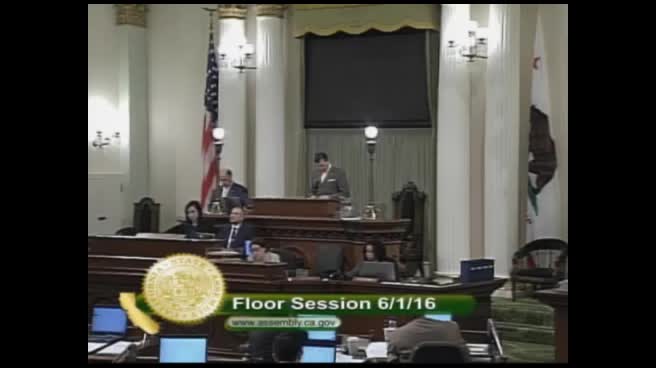
| Jun 1, 2016 | Read third time. Passed. Ordered to the Senate. (Ayes 80. Noes 0.) |
| Jun 1, 2016 | Read third time. Passed. Ordered to the Senate. (Ayes 80. Noes 0. Page 5117.) |
| Jun 1, 2016 | Read third time. Passed. Ordered to the Senate. |
| May 31, 2016 | Read second time. Ordered to third reading. |
| May 27, 2016 | Read second time and amended. Ordered returned to second reading. |
| May 27, 2016 | From committee: Amend, and do pass as amended. (Ayes 20. Noes 0.) (May 27). |
| May 11, 2016 | In committee: Set, first hearing. Referred to APPR. suspense file. |
| Apr 18, 2016 | Re-referred to Com. on APPR. |
| Feb 19, 2016 | Introduced. To print. |
| Apr 13, 2016 | From committee: Amend, and do pass as amended and re-refer to Com. on APPR. (Ayes 15. Noes 0.) (April 12). |
| Mar 29, 2016 | Re-referred to Com. on W., P., & W. |
| Mar 29, 2016 | Re-referred to Com. on NAT. RES. |
| Mar 28, 2016 | Re-referred to Com. on W., P., & W. pursuant to Assembly Rule 96. |
| Mar 28, 2016 | In committee: Hearing postponed by committee. |
| Mar 28, 2016 | From committee chair, with author's amendments: Amend, and re-refer to Com. on NAT. RES. Read second time and amended. |
| Mar 10, 2016 | Referred to Coms. on NAT. RES. and W., P., & W. |
| Feb 22, 2016 | Read first time. |
| Feb 21, 2016 | From printer. May be heard in committee March 22. |
|
Date
|
Description
|
Location
|
Votes
|
|
|---|---|---|---|---|
| Jun 1, 2016 | AB 2617 MAYES Assembly Third Reading | Assembly Floor |
Passed |
|
| May 27, 2016 | Do pass as amended. | Assembly Standing Committee on Appropriations |
Passed |
|
| Apr 12, 2016 | Do pass as amended and be re-referred to the Committee on [Appropriations] | Assembly Standing Committee on Water, Parks, and Wildlife |
Passed |
This list shows positions taken on this bill by organizations on the date displayed, which is linked to the original source.
Positions by individuals are not included.
|
Organization
|
Position
|
Date
|
|---|---|---|
| California Building Industry Association | ** Support | Jun 1, 2016 |
| California Pool and Spa Association | ** Support | Jun 1, 2016 |
| Irrigation Association | ** Support | Jun 1, 2016 |
| National Hispanic Landscape Alliance | ** Support | Jun 1, 2016 |
| Outdoor Power Equipment Institute | ** Support | Jun 1, 2016 |
| SFParks | ** Support | Jun 1, 2016 |
| Turfgrass Producers International | ** Support | Jun 1, 2016 |
ASSEMBLY THIRD READING
ATR Bill Id:AB 2617
Author:(Mayes)
As Amended Ver:May 27, 2016
Majority vote
Committee | Votes | Ayes | Noes |
Water | 15-0 | Levine, Gallagher, Bigelow, Dodd, Eggman, Cristina Garcia, Eduardo Garcia, Gomez, Harper, Lopez, Mathis, Medina, Olsen, Salas, Williams | |
Appropriations | 20-0 | Gonzalez, Bigelow, Bloom, Bonilla, Bonta, Calderon, Chang, Daly, Eggman, Gallagher, Eduardo Garcia, Roger Hernández, Holden, Jones, Obernolte, Quirk, Santiago, Wagner, Weber, Wood |
|
SUMMARY: Requires the Department of Water Resources (DWR) to prepare a report analyzing the costs and benefits of incentives for certain water efficiency measures. Specifically, this bill:
- Requires the DWR, by December 1, 2017, in consultation with experts at the University of California, California State University, the State Water Resources Control Board (Water Board), the State Energy Resources Conservation and Development Commission, and local water districts, to develop and solicit comments on a proposed report that contains an analysis of the relative costs and benefits of incentives for various water efficiency measures, including the impact of evapotranspiration rates in different hydrological regions of the state.
- Requires that the water efficiency measures considered in the proposed report include but not be limited to the following measures:
- Turfgrass removal and replacement with drought-resistant turfgrass or artificial turf.
- Turfgrass removal and replacement with native or drought-tolerant plants.
- Non-native or high water using plant removal and replacement with native or drought-tolerant plants, drought-resistant turfgrass, or artificial turf.
- Use of conservation-based irrigation technology such as smart controllers.
- Investments in graywater infrastructure to supply water for outdoor landscapes.
- Rebates for highly efficient consumer appliances and landscape systems. Highly efficient consumer appliances and landscape systems are defined to include, but are not limited to, irrigation systems, toilets, showers, pool covers, and clothes washers.
- Requires that the proposed report include an analysis of adverse environmental impacts of the water efficiency measures considered, and the projected benefits of recommended voluntary water efficiency measures. Adverse environmental impacts are defined to include, but are not limited to, impacts on climate change, net effect on carbon sequestration, increased erosion, and impacts to stormwater runoff.
- Requires the DWR to issue a final report by July 1, 2018, that includes both of the following:
- All material developed for the report required by this bill, updated as appropriate to further the stated legislative intent.
- Recommendations to public entities to help them achieve water-resilient communities and prioritize cost-effective water efficiency measures with low adverse environmental impacts based on local conditions, such as education, granting incentives or rebates, or other voluntary measures.
- States legislative intent for the state to promote water-resilient communities by identifying the relative cost-effectiveness of water efficiency measures and recommending those that have the potential to cost-effectively achieve the greatest reduction in water use, taking into account local conditions, and to produce net environmental benefits that outweigh any adverse environmental impacts.
EXISTING LAW:
- Promotes landscape water conservation through water efficient landscape ordinances. Local agencies must have a water efficient landscape ordinance or the DWR's model water efficient landscape ordinance applies. The model ordinance addresses water conservation and appropriate plant use, encourages the capture and retention of stormwater, and encourages the use of economic incentives to promote the efficient use of water.
- Promotes landscape water conservation through urban water management planning. Under the Urban Water Management Planning Act, urban water agencies are required to develop and adopt urban water management plans. Among other things, urban water management plans are to describe water demand management measures including large landscape conservation programs and incentives.
FISCAL EFFECT: According to the Assembly Appropriations Committee:
- Unknown additional costs, likely in the $300,000 to $400,000 range for the DWR to develop the report.
- Increased costs for the Water Board to participate in the evaluations of water efficiency measures of approximately $70,000 per year.
COMMENTS: This bill requires the DWR, in consultation with other entities, to produce a report that analyzes various water efficiency incentive programs. The report would be required to include an analysis of specific water efficiency programs but could include others.
The author states that while millions of dollars have been spent on water efficiency incentives in response to California's drought, there is not an authoritative independent report comparing the relative costs and benefits of different incentive options. An audit of the Los Angeles Department of Water & Power's turfgrass replacement program released by the city controller in November 2015 found that the turf rebate program saved less water per dollar spent than other conservation programs, such as rebates on high-efficiency appliances, which yielded a water savings almost five times higher than turf replacement. This bill would direct the DWR to produce a report on water efficiency incentives and to consider any adverse environmental impacts. The report can serve as a guide to local water retailers as they evaluate which incentives make sense for their customers, and lead to greater increases in water efficiency at the lowest possible cost.
Water applied to landscapes is 50% of residential water consumption statewide, but varies considerably by region, from 30% in some coastal communities to 60% or more in some inland areas. According to the DWR's website, outdoor landscaping is the single largest use of residential water, and in most residential yards turfgrass is the largest consumer of water. Reducing or eliminating how much grass is present in residential landscapes can thus produce significant water savings. The Governor's Executive Order issued in April 2015 directed specific actions to reduce potable water use in the urban sector. Directive number 3 of the order called for 50 million square feet of turf to be replaced with drought-tolerant landscapes, to be accomplished by, among other things, a residential turf rebate program implemented by DWR.
The DWR operated a $24 million turf replacement program with rebates of $2 per square foot capped at $2,000 per household. The rebates are directed to local turf replacement programs. This is estimated to benefit more than 10,000 homes, with $12 million targeted to disadvantaged communities hardest hit by the drought. The program is projected to yield 1,200 acre feet of water savings annually, which is approximately equivalent to replacing 44,000 legacy toilets with high water efficiency toilets.
In recent years, a number of local governments and agencies have established rebate programs to encourage conservation. For example, in an effort to reduce water consumption, the Metropolitan Water District of Southern California offered a rebate based on each square foot of turf removed. The City of Sacramento also offered cash to help customers remove their front yard turf and replace it with native and drought tolerant plants. A report by the Public Policy Institute of California found that well installed drip irrigation can attain efficiency levels approaching 90-95%, and that low-water plants need only 20% of the evapotranspiration rate compared to 80% for lawns.
The sponsors of this bill assert that the environmental benefits of turfgrass include carbon sequestration. A 2008 research report commissioned by the sponsors entitled Technical Assessment of the Carbon Sequestration Potential of Managed Turfgrass in the United States by Dr. Ranajit Sahu found that one acre of managed turfgrass will hold about .46 tons or 920 lbs. of carbon in a year. After subtracting the amount of CO2 emitted by mowers, the study concluded that turfgrass produced a net carbon sink of 760 lbs. However, critics of the study have asserted that it failed to take into account the amount of CO2 emitted by lawn chemicals, the manufacture and transport of fertilizers, and the effects of irrigation. By comparison, temperate forests can hold 2,000 to 6,000 lbs. of carbon per year per acre, and native grasslands can sequester 2,400 to 3,000 lbs. per year. Studies show that different types of vegetation and how they are managed will sequester different quantities of CO2.
Analysis Prepared by: Diane Colborn / W., P., & W. / (916) 319-2096 FN: 0003318
Date of Hearing: May 11, 2016
ASSEMBLY COMMITTEE ON APPROPRIATIONS
Lorena Gonzalez, Chair
ABPCA Bill Id:AB 2617
Author:(Mayes) – As Amended Ver:April 14, 2016
Policy Committee: | Water, Parks and Wildlife | Vote: | 15 - 0 |
|
| ||
|
|
Urgency: No State Mandated Local Program: No Reimbursable: No
SUMMARY:
This bill requires the California Energy Commission (CEC) to develop a water efficiency cost-benefit analysis draft report by December 1, 2017, solicit comments, and finalize the report by July 1, 2018. Specifically, this bill:
- Requires CEC to consult with experts at the University of California, California State University, local water districts and others. Requires CEC to develop the report in cooperation with the State Water Resources Control Board (SWRCB) and the Department of Water Resources (DWR).
- Requires the CEC to issue a final report by July 1, 2018, that includes all of the following:
- Identification of the most cost-effective incentives for indoor and outdoor water efficiency measures, measured by the amount of water use reduction per dollar spent.
- Recommendations to public entities for prioritizing the most cost-effective measures.
- Analysis of any unintended adverse environmental impacts from the water efficiency measures. Unintended adverse environmental impacts is defined to include, but are not limited to, impacts on climate change, net effect on carbon sequestration, increased erosion, and impacts to stormwater runoff.
- Projected benefits of recommended voluntary water efficiency measures.
FISCAL EFFECT:
- Increased costs of $400,000 per year over a two-year period for CEC to hire additional staff or issue contracts to prepare the report (GF or special fund).
- Increased costs for SWRCB to participate in the evaluations of water efficiency measures of approximately $70,000 per year.
- Minor, absorbable costs for DWR to participate in the evaluations.
COMMENTS:
- Purpose. According to the author, while millions of dollars have been spent on water efficiency incentives in response to California's drought, there is not an authoritative independent report comparing the relative costs and benefits of different incentive options. The author intends the report required by this bill to serve as a guide to local water retailers as they evaluate which incentives lead to greater increases in water efficiency at the lowest possible cost.
- Water Efficiency and the Drought. Executive Order B-29-15 from April of 2015 directed: 1) the CEC to fund emerging water saving technologies; 2) the SWRCB to impose a 25% reduction in urban water use over 2013 levels; and 3) DWR to update the state model water efficient landscape ordinance to specifically increase water efficiency through more efficient irrigation standards.
Technology in landscape irrigation has advanced in recent years with numerous new efficient irrigation controls and moisture sensing devices coming to the market. The cost of water has increased significantly in the past decade and is projected to increase annually at a rate of 4% or higher. Consumers appear to be responding to these conditions as it has been reported that one of the largest areas of sales growth at home improvement stores has been efficient landscape irrigation equipment.
Water efficiency programs hold the potential to produce similar significant benefits. With nearly half of all urban water use occurring outdoors there is a clear need and opportunity to explore ways to improve landscape irrigation.
- Related Legislation. AB 2525 (Holden) requires DWR to create a program to encourage local economic incentives that promote water efficient landscapes. This bill will be heard today in this Committee.
AB 1928 (Campos) requires CEC to adopt landscape irrigation equipment performance standards and labeling requirements. This bill is on this Committee’s Suspense File.
Analysis Prepared by: Jennifer Galehouse / APPR. / (916) 319-2081
Date of Hearing: April 12, 2016
ASSEMBLY COMMITTEE ON WATER, PARKS, AND WILDLIFE
Marc Levine, Chair
ABPCA Bill Id:AB 2617 (
Author:Mayes) – As Amended Ver:March 28, 2016
SUBJECT: Water efficiency measures
SUMMARY: Requires the California Energy Commission (CEC) to prepare a report analyzing the costs and benefits of incentives for various specified water efficiency measures. Specifically, this bill:
- Requires the CEC, by December 1, 2017, in consultation with experts at the University of California, California State University, local water districts, and others, and in cooperation with the State Water Resources Control Board (Water Board) and the Department of Water Resources (DWR), to develop and solicit comments on a proposed report that contains an analysis of the relative costs and benefits of incentives for various water efficiency measures, including the impact of evapotranspiration rates in different hydrological regions of the state. Defines evapotranspiration for these purposes.
- Requires that the water efficiency measures considered in the proposed report include but not be limited to the following four measures:
- Turfgrass removal and replacement with drought-resistant turfgrass or artificial turf. Turfgrass is defined to mean any living grass that is used as specified.
- Use of conservation-based irrigation technology such as smart controllers.
- Investments in graywater infrastructure to supply water for outdoor landscapes.
- Rebates for highly efficient consumer appliances and landscape systems. Highly efficient consumer appliances and landscape systems are defined to include, but are not limited to, irrigation systems, toilets, showers, pool covers, and clothes washers.
- Requires that the proposed report include an analysis of unintended adverse environmental impacts of the water efficiency measures considered, and the projected benefits of recommended voluntary water efficiency measures.
- Requires the CEC to issue a final report by July 1, 2018, that includes all of the following:
- Identification of the most cost-effective incentives for water efficiency measures, measured by the amount of water use reduction per dollar spent.
- Recommendations to public entities for prioritizing the most cost-effective measures.
- Analysis of any unintended adverse environmental impacts from the water efficiency measures. Unintended adverse environmental impacts is defined to include, but are not limited to, impacts on climate change, net effect on carbon sequestration, increased erosion, and impacts to stormwater runoff.
- Projected benefits of recommended voluntary water efficiency measures.
- States that it is the intent of the Legislature that the state identify and recommend the most cost-effective water efficiency measures that achieve the greatest reduction in water use and avoid any unintended adverse environmental impacts.
- Defines various terms for purposes of this bill.
EXISTING LAW:
- Promotes landscape water conservation through water efficient landscape ordinances. Local agencies must have a water efficient landscape ordinance or DWR's model water efficient landscape ordinance applies. The model ordinance addresses water conservation and appropriate plant use, encourages the capture and retention of stormwater, and encourages the use of economic incentives to promote the efficient use of water.
- Promotes landscape water conservation through urban water management planning. Under the Urban Water Management Planning Act, urban water agencies are required to develop and adopt urban water management plans. Among other things, urban water management plans are to describe water demand management measures including large landscape conservation programs and incentives.
- Requires the CEC to carry out studies on energy efficiency, and to adopt energy and water efficiency standards for building design and construction. Requires the CEC, in consultation with DWR, to adopt by regulation performance standards and labeling requirements for landscape irrigation equipment, including irrigation controllers and moisture sensors to reduce energy and water consumption.
FISCAL EFFECT: Unknown
COMMENTS: This bill requires the CEC, in consultation with other entities, to produce a report that analyzes various water efficiency incentives programs. The report would be required to include an analysis of four specific water efficiency programs but could include others. The four measures required to be analyzed in the report include turfgrass removal and replacement with drought-tolerant turfgrass or artificial turf, conservation-based irrigation technology such as smart controllers, graywater infrastructure for outdoor landscaping, and rebates for high energy efficiency appliances and systems such as irrigation, toilets, showers, pool covers, and clothes washers.
- Author's Statement: The author states that while millions of dollars have been spent on water efficiency incentives in response to California's drought, there is not an authoritative independent report comparing the relative costs and benefits of different incentive options. An audit of the Los Angeles Department of Water & Power's turfgrass replacement program released by the city controller in November 2015 found that the turf rebate program saved less water per dollar spent than other conservation programs, such as rebates on high-efficiency appliances, which yielded a water savings almost five times higher than turf replacement. This bill would direct the CEC to produce a report on water efficiency incentives and to consider any unintended environmental impacts. The report can serve as a guide to local water retailers as they evaluate which incentives make sense for their customers, and lead to greater increases in water efficiency at the lowest possible cost.
- Background: Water applied to landscapes is 50% of residential water consumption statewide, but varies considerably by region, from 30% in some coastal communities to 60% or more in some inland areas. According to DWR's website, outdoor landscaping is the single largest use of residential water, and in most residential yards turfgrass is the largest consumer of water. Reducing or eliminating how much grass is present in residential landscapes can thus produce significant water savings. The Governor's Executive Order issued in April 2015 directed specific actions to reduce potable water use in the urban sector. Directive number 3 of the order called for 50 million square feet of turf to be replaced with drought-tolerant landscapes, to be accomplished by, among other things, a residential turf rebate program implemented by DWR.
The Department of Water Resources is operating a $24 million turf replacement program with rebates of $2 per square foot capped at $2,000 per household. The rebates are directed to local turf replacement programs. This is estimated to benefit more than 10,000 homes, with $12 million targeted to disadvantaged communities hardest hit by the drought. The program is projected to yield 1,200 acre feet of water savings annually. This is reportedly approximately equivalent to replacing 44,000 legacy toilets with high water efficiency toilets.
In recent years, a number of local governments and agencies have established rebate programs to encourage conservation. For example, in an effort to reduce water consumption, the Metropolitan Water District of Southern California offers a rebate based on each square foot of turf removed. The City of Sacramento is currently offering cash to help customers remove their front yard turf and replace it with native and drought tolerant plants.
A report by the Public Policy Institute of California (PPIC) found that well-installed drip irrigation can attain efficiency levels approaching 90-95%, and that low-water plants need only 20% of the evapotranspiration rate compared to 80% for lawns. Field studies conducted by the Southern Nevada Water Authority estimated conversion from turf to low-water landscaping plants brought water use down from 73 gallons per square foot to 17.2 gallons, for a 76% water savings.
The sponsors of this bill assert that the environmental benefits of turfgrass include carbon sequestration. A 2008 research report commissioned by the sponsors entitled "Technical Assessment of the Carbon Sequestration Potential of Managed Turfgrass in the United States" by Dr. Ranajit Sahu found that one acre of managed turfgrass will hold about .46 tons or 920 lbs. of carbon in a year. After subtracting the amount of CO2 emitted by mowers, the study concluded that turfgrass produced a net carbon sink of 760 lbs. However, critics of the study have asserted that it failed to take into account the amount of CO2 emitted by lawn chemicals, the manufacture and transport of fertilizers, and the effects of irrigation. By comparison, temperate forests can hold 2,000 to 6,000 lbs of carbon per year per acre, and native grasslands can sequester 2,400 to 3,000 lbs per year. Studies show that different types of vegetation and how they are managed will sequester different quantities of CO2.
A 2010 Florida study found that highly manicured and maintained lawn areas may actually emit more CO2 than they sequester. While Florida has a different climate and soils than California, the take home message of the study was that highly maintained lawns and trees sequester much less CO2 than more natural areas with little maintenance. With more lawn cover than tree canopy cover, the balance can actually shift to emitting CO2. The calculations of the study were simplified as they did not add the carbon cost of making and maintaining the power equipment or the carbon cost of growing and transporting sod. The study also did not calculate the emission of nitrous oxide (N2O) from fertilization applications, but noted that urban turfgrass typically emits N2O after fertilization and/or irrigation. According to the study, N2O has a worse global warming potential as its heat-absorbing potential is approximately 300 times more than CO2. Thus, urban open space that has a large amount of mowed, irrigated, fertilized lawns can be a source of CO2 rather than a sink. Because below-ground soil carbon sequestration was not calculated, the study cautioned that full carbon credit could not be assessed and that the above-ground numbers reported should therefore be regarded as a first look at the potential carbon value of urban greenspace. The study concluded that at this stage natural greenspaces in and around urban areas, with little to no maintenance, seem to be the best option for CO2 sequestration. Natural urban greenspaces also have other benefits, such as biodiversity conservation, reduced stormwater runoff, and reduced fertilizer applications. The study concluded that overall, the conservation of urban open space could play a role in reducing Florida's carbon footprint, but highly maintained urban greenspace could be regarded as a source of greenhouse gases.
- Prior and Related Legislation: AB 1881 (Laird) Chapter 559, Statues of 2006, established the Water Conservation in Landscaping Act.
AB 2525 (Holden) which was heard and passed by this committee on March 29, 2016, requires DWR to create a program to encourage local economic incentives that promote water efficient landscapes. AB 2525 requires DWR to create a program to fund the advancement of turf rebates, jobs, and education of eco-landscaping.
AB 1928 (Campos) requires the State Energy Resources Conservation and Development Commission to adopt landscape irrigation equipment performance standards and labeling requirements. AB 1928 was heard and passed by this committee on March 29, 2016.
Support Arguments: Supporters emphasize the CEC's experience in performing cost benefit analyses, and that industry, local government and the environmental community have worked cooperatively with the CEC in development of cost benefit analyses on energy efficiency building standards. Other supporters describe turfgrass as a resilient groundcover solution that sequesters carbon and air pollutants. They assert that large scale removal of turfgrass from lawns has detrimental environmental effects and is not the most cost effective water conservation tool. Supporters claim benefits provided by grass lawns include reducing stormwater runoff, filtering pollutants from water and air, reducing soil erosion, mitigating heat island effect, increasing human and pet health, diminishing noise and light pollution, and producing oxygen. - Opposition Arguments: None received.
- Suggested Amendments: This bill requires that the study look at four specific water efficiency measures, but does not specifically require that the option of turfgrass removal and replacement with native or drought-tolerant, low-water use plants be analyzed. In addition, this bill requires the CEC to analyze the unintended adverse environmental impacts that could result from the measures, but not the beneficial environmental impacts. The stated legislative intent in this bill includes avoiding any adverse environmental impacts, but the actual legislative intent might more accurately be described as producing a net result in which the beneficial environmental impacts of a chosen measure outweigh any adverse impacts. In order to better accomplish the author's stated intent, the following amendments are recommended:
On page 2, amend line 8 to read:
"that achieve the greatest reduction in water use and produce net environmental benefits that outweigh and avoid any unintended adverse environmental impacts."
On page 3, after line 14 insert:
"(2) Turfgrass removal and replacement with native or drought-tolerant plants."
REGISTERED SUPPORT / OPPOSITION:
Support
California Building Industry Association
California Pool and Spa Association
Irrigation Association
National Hispanic Landscape Alliance
Outdoor Power Equipment Institute
SFParks
Turfgrass Producers International
Opposition
None on file.
Analysis Prepared by: Diane Colborn / W., P., & W. / (916) 319-2096
Bill Author

Bill Co-Author(s):