AB 2827: Prisoners: mental health treatment.
- Session Year: 2015-2016
- House: Assembly
- Latest Version Date: 2016-06-15
Existing law prohibits a person from being tried, adjudged to punishment, or having his or her probation, mandatory supervision, postrelease community supervision, or parole revoked while that person is mentally incompetent. Existing law establishes a process by which a defendants mental competency is evaluated and by which the defendant receives treatment, including, if applicable, antipsychotic medication, with the goal of returning the defendant to competency. Existing law credits time spent by a defendant in a state hospital or other facility as a result of commitment during the process toward the term of any imprisonment for which the defendant is sentenced.
This bill, until January 1, 2021, for the Counties of Los Angeles and Santa Clara, would authorize a defendant who is or has been eligible for public mental health services due to a serious mental illness or who is eligible for Social Security Disability Insurance benefits due to a diagnosed mental illness to petition the court, after the defendants plea or conviction but prior to sentencing, for a sentence that includes mental health treatment. The bill would authorize a court, if it finds that the defendant has shown that he or she meets the criteria by a preponderance of the evidence, to order the Department of Corrections and Rehabilitation or the county authority to provide specified mental health service, including placement in a residential mental health treatment facility instead of state prison or county jail, placement in a mental health program within the state prison or county jail, or preparation of a postrelease mental health treatment plan. The bill would authorize the court, upon petition of the defendant or the prosecution, to recall a sentence that includes a mental health order and resentence the defendant to other mental health treatment or resentence the defendant without mental health treatment. The bill would provide that the defendant has the right to counsel for these proceedings. The bill would require the Legislative Analysts Office to submit a report to the Legislature and the Governor, as specified.
By imposing additional duties upon county jail authorities, this bill would create a state-mandated local program.
The California Constitution requires the state to reimburse local agencies and school districts for certain costs mandated by the state. Statutory provisions establish procedures for making that reimbursement.
This bill would provide that, if the Commission on State Mandates determines that the bill contains costs mandated by the state, reimbursement for those costs shall be made pursuant to these statutory provisions.
This bill would make legislative findings and declarations as to the necessity of a special statute for the Counties of Los Angeles and Santa Clara.
Existing law prohibits the sale or offering of sale in the state of any merchandise on which merchandise or on its container appears the words Made in U.S.A., Made in America, U.S.A., or similar words when the merchandise or any article, unit, or part thereof, has been entirely or substantially made, manufactured, or produced outside of the United States.
Existing law, the Consumers Legal Remedies Act, makes unlawful certain acts identified as unfair methods of competition and unfair or deceptive acts or practices undertaken by any person in a transaction intended to result or which results in the sale or lease of goods to any consumer.
This bill would include a violation of the Made in U.S.A. provisions as an unfair method of competition and unfair or deceptive act or practice under the Consumers Legal Remedies Act.
Existing law prohibits the sale or offering of sale in the state of any merchandise on which merchandise or on its container appears the words Made in U.S.A., Made in America, U.S.A., or similar words when the merchandise or any article, unit, or part thereof, has been entirely or substantially made, manufactured, or produced outside of the United States.
Existing law establishes the Made in California Program within the Governors Office of Business and Economic Development as a public and private collaboration to encourage consumer product awareness and to foster purchases of high-quality products made in this state. Under the program, in order to be eligible to represent that a product is made in this state, a company is required to, among other things, establish that the finished product could lawfully use the Made in U.S.A. label under the provisions set forth above.
Existing law, the Consumers Legal Remedies Act, makes unlawful certain acts identified as unfair methods of competition and unfair or deceptive acts or practices undertaken by any person in a transaction intended to result or which results in the sale or lease of goods to any consumer.
This bill would include a violation of the Made in U.S.A. provisions as an unfair method of competition and unfair or deceptive act or practice under the Consumers Legal Remedies Act.
This bill would prohibit a civil action against a person or business that is alleged to have violated the provisions of the Made in U.S.A. or Made in California statutes unless written notice of the alleged violations is provided and the person or business has not cured the alleged violation within 33 days of receiving the notice.
Existing law prohibits the sale or offering of sale in the state of any merchandise on which merchandise or on its container appears the words Made in U.S.A., Made in America, U.S.A., or similar words when the merchandise or any article, unit, or part thereof, has been entirely or substantially made, manufactured, or produced outside of the United States.
Existing law establishes the Made in California Program within the Governors Office of Business and Economic Development as a public and private collaboration to encourage consumer product awareness and to foster purchases of high-quality products made in this state. Under the program, in order to be eligible to represent that a product is made in this state, a company is required to, among other things, establish that the finished product could lawfully use the Made in U.S.A. label under the provisions set forth above.
Existing law, the Consumers Legal Remedies Act, makes unlawful certain acts identified as unfair methods of competition and unfair or deceptive acts or practices undertaken by any person in a transaction intended to result or which results in the sale or lease of goods to any consumer.
This bill would prohibit a civil action against a person or business that is alleged to have violated the provisions of the Made in U.S.A. or Made in California statutes unless written notice of the alleged violations is provided and the person or business has not cured the alleged violation within 33 days of receiving the notice.
Under existing law, a person may only be registered to vote as provided by state law or pursuant to a state court order.
This bill would make a technical, nonsubstantive change to that provision.
Under existing law, a person may only be registered to vote as provided by state law or pursuant to a state court order.
This bill would make a technical, nonsubstantive change to that provision.
This act shall be known and may be cited as the Mental Health Justice Pilot Project.
SEC. 2.The Legislature finds and declares the following:
(a)Exposure to violence increases the risk of developing a mental health condition such as post-traumatic stress disorder. Children in underserved communities are more likely to be exposed to violence than other children.
(b)Ten times as many people with mental illness are in prisons and jails today than are in mental health treatment facilities.
(c)Correctional facilities spend two to three times more money on adults with mental illnesses than they do on people who do not live with a mental illness.
(d)Despite overall decreasing prison populations, Californias prisons are experiencing an increasing demand for mental health treatment services as prison inmates require mental health treatment at higher rates. This number is anticipated to continue to increase in the next five years and beyond.
(e)In California, the annual prison cost for an inmate in the general population is $51,000, while the annual community housing and outpatient treatment costs for a person with mental illness are 60 percent less at $20,412.
(f)Nearly half of all prisoners in California are mentally ill and have received psychiatric treatment within the past year. This number has almost doubled in the last 15 years, making jails and prisons the de facto mental health system.
(g)Individuals with mental illnesses tend to stay longer in prison or jail and, when released, are at a higher risk of returning to prison or jail than those without these illnesses.
(h)Mental health court participants have a significantly lower recidivism rate (47 percent) compared to similar defendants in traditional court.
(i)Mental health courts allow for the consideration of a defendants mental health status during court proceedings and have shown to save $7 in costs for every $1 spent.
(j)According to federal court decisions, conditions in California prisons exacerbate mental health issues significantly. Offenders with mental illness are often subjected to higher rates of physical and sexual trauma, forced restraints, solitary confinement, and overmedication while incarcerated. Those who are kept in isolation are at higher risk for psychiatric injury, self-harm, and suicide.
(k)A defendants mental illness should inform case processing and the nature of any criminal charges, in alignment with public safety and a defendants constitutional rights.
(l)California must increase diversion programs to redirect defendants with mental illness away from prisons and jails, which exacerbate mental illnesses, impede treatment, and increase costs, and toward proven mental health treatment services.
SEC. 3.Chapter 16 (commencing with Section 1425) is added to Title 10 of Part 2 of the Penal Code, to read:16.Mental Health Treatment1425.(a)A defendant who has pleaded guilty or nolo contendere to, or was convicted of, a felony or misdemeanor and who currently is, or at any prior time was, eligible for public mental health services due to serious mental illness or who currently is, or at any prior time was, eligible for Social Security Disability Insurance benefits due to a diagnosed mental illness may petition the court for a sentence that includes mental health treatment. The petition shall be filed after the defendants plea or conviction, but before his or her sentencing.
(b)The defendant shall bear the burden of establishing by a preponderance of the evidence that he or she meets the criteria in subdivision (a).
(c)If the court determines that the defendant has met his or her burden, as described in subdivision (b), and that placement would not pose an unreasonable risk of danger to public safety and is in the interest of justice, the court may order that the defendants sentence include one or more of the following:
(1)(A)A requirement that the defendant serve, if the defendant agrees, all or a part of his or her sentence in a residential mental health treatment facility instead of in the state prison or a county jail.
(B)A defendant is not eligible for subparagraph (A) if his or her current plea or conviction is for a violent felony, as defined in subdivision (c) of Section 667.5, or if the defendant is required by an initiative statute to serve his or her entire sentence only in state prison.
(2)Regardless of the offense to which the defendant pleaded guilty or nolo contendere or for which the defendant was convicted, a requirement that the Department of Corrections and Rehabilitation or county jail authority, as applicable, place the defendant in a mental health program within the state prison or county jail system at a level of care determined to be appropriate by the departments mental health staff or county mental health staff, within 30 days of the defendants sentencing.
(3)Regardless of the offense to which the defendant pleaded guilty or nolo contendere or for which the defendant was convicted, a requirement that the Department of Corrections and Rehabilitation or the county jail authority, as applicable, prepare a postrelease mental health treatment plan six months prior to the defendants release from custody. The treatment plan shall specify the manner in which the defendant will receive mental health treatment services following release from custody and shall address, if applicable and at the discretion of the court, medication management, housing, and substance abuse treatment.
(d)At any time, upon a petition from the defendant or prosecutor, if it is in the public interest, the court may recall a sentence that includes a mental health treatment order issued under this section and either resentence the defendant to other mental health treatment authorized under subdivision (c) or resentence the defendant in the same manner as if he or she had not previously been sentenced with application of this section. The defendant shall receive credit for the time he or she served on the prior sentence and shall not be sentenced to a longer term than originally imposed.
(e)The defendant shall have the right to counsel for all proceedings under this section.
(f)This section shall apply only to the counties of Los Angeles and Santa Clara.
1425.5.On or before December 31, 2020, the Legislative Analysts Office shall submit a report to the Legislature and the Governor on the effectiveness of this chapter in treating mental illness, reducing prison populations, and public reducing costs.
1426.This chapter shall remain in effect only until January 1, 2021, and as of that date is repealed, unless a later enacted statute, that is enacted before January 1, 2021, deletes or extends that date.
SEC. 4.The Legislature finds and declares that a special law is necessary and that a general law cannot be made applicable within the meaning of Section 16 of Article IV of the California Constitution because the existing resources in Los Angeles and Santa Clara make those counties uniquely suited to implement the Mental Health Justice Pilot Project.
SEC. 5.If the Commission on State Mandates determines that this act contains costs mandated by the state, reimbursement to local agencies and school districts for those costs shall be made pursuant to Part 7 (commencing with Section 17500) of Division 4 of Title 2 of the Government Code.
SECTION 1.Section 1770 of the Civil Code is amended to read:1770.(a)The following unfair methods of competition and unfair or deceptive acts or practices undertaken by any person in a transaction intended to result or which results in the sale or lease of goods or services to any consumer are unlawful:
(1)Passing off goods or services as those of another.
(2)Misrepresenting the source, sponsorship, approval, or certification of goods or services.
(3)Misrepresenting the affiliation, connection, or association with, or certification by, another.
(4)Using deceptive representations or designations of geographic origin in connection with goods or services.
(5)Representing that goods or services have sponsorship, approval, characteristics, ingredients, uses, benefits, or quantities which they do not have or that a person has a sponsorship, approval, status, affiliation, or connection which he or she does not have.
(6)Representing that goods are original or new if they have deteriorated unreasonably or are altered, reconditioned, reclaimed, used, or secondhand.
(7)Representing that goods or services are of a particular standard, quality, or grade, or that goods are of a particular style or model, if they are of another.
(8)Disparaging the goods, services, or business of another by false or misleading representation of fact.
(9)Advertising goods or services with intent not to sell them as advertised.
(10)Advertising goods or services with intent not to supply reasonably expectable demand, unless the advertisement discloses a limitation of quantity.
(11)Advertising furniture without clearly indicating that it is unassembled if that is the case.
(12)Advertising the price of unassembled furniture without clearly indicating the assembled price of that furniture if the same furniture is available assembled from the seller.
(13)Making false or misleading statements of fact concerning reasons for, existence of, or amounts of price reductions.
(14)Representing that a transaction confers or involves rights, remedies, or obligations which it does not have or involve, or which are prohibited by law.
(15)Representing that a part, replacement, or repair service is needed when it is not.
(16)Representing that the subject of a transaction has been supplied in accordance with a previous representation when it has not.
(17)Representing that the consumer will receive a rebate, discount, or other economic benefit, if the earning of the benefit is contingent on an event to occur subsequent to the consummation of the transaction.
(18)Misrepresenting the authority of a salesperson, representative, or agent to negotiate the final terms of a transaction with a consumer.
(19)Inserting an unconscionable provision in the contract.
(20)Advertising that a product is being offered at a specific price plus a specific percentage of that price unless (A) the total price is set forth in the advertisement, which may include, but is not limited to, shelf tags, displays, and media advertising, in a size larger than any other price in that advertisement, and (B) the specific price plus a specific percentage of that price represents a markup from the sellers costs or from the wholesale price of the product. This subdivision shall not apply to in-store advertising by businesses which are open only to members or cooperative organizations organized pursuant to Division 3 (commencing with Section 12000) of Title 1 of the Corporations Code where more than 50 percent of purchases are made at the specific price set forth in the advertisement.
(21)Selling or leasing goods in violation of Chapter 4 (commencing with Section 1797.8) of Title 1.7.
(22)(A)Disseminating an unsolicited prerecorded message by telephone without an unrecorded, natural voice first informing the person answering the telephone of the name of the caller or the organization being represented, and either the address or the telephone number of the caller, and without obtaining the consent of that person to listen to the prerecorded message.
(B)This subdivision does not apply to a message disseminated to a business associate, customer, or other person having an established relationship with the person or organization making the call, to a call for the purpose of collecting an existing obligation, or to any call generated at the request of the recipient.
(23)(A)The home solicitation, as defined in subdivision (h) of Section 1761, of a consumer who is a senior citizen where a loan is made encumbering the primary residence of that consumer for the purposes of paying for home improvements and where the transaction is part of a pattern or practice in violation of either subsection (h) or (i) of Section 1639 of Title 15 of the United States Code or paragraphs (1), (2), and (4) of subdivision (a) of Section 226.34 of Title 12 of the Code of Federal Regulations.
(B)A third party shall not be liable under this subdivision unless (1) there was an agency relationship between the party who engaged in home solicitation and the third party or (2) the third party had actual knowledge of, or participated in, the unfair or deceptive transaction. A third party who is a holder in due course under a home solicitation transaction shall not be liable under this subdivision.
(24)(A)Charging or receiving an unreasonable fee to prepare, aid, or advise any prospective applicant, applicant, or recipient in the procurement, maintenance, or securing of public social services.
(B)For purposes of this paragraph, the following definitions shall apply:
(i)Public social services means those activities and functions of state and local government administered or supervised by the State Department of Health Care Services, the State Department of Public Health, or the State Department of Social Services, and involved in providing aid or services, or both, including health care services, and medical assistance, to those persons who, because of their economic circumstances or social condition, are in need of that aid or those services and may benefit from them.
(ii)Public social services also includes activities and functions administered or supervised by the United States Department of Veterans Affairs or the California Department of Veterans Affairs involved in providing aid or services, or both, to veterans, including pension benefits.
(iii)Unreasonable fee means a fee that is exorbitant and disproportionate to the services performed. Factors to be considered, when appropriate, in determining the reasonableness of a fee, are based on the circumstances existing at the time of the service and shall include, but not be limited to, all of the following:
(I)The time and effort required.
(II)The novelty and difficulty of the services.
(III)The skill required to perform the services.
(IV)The nature and length of the professional relationship.
(V)The experience, reputation, and ability of the person providing the services.
(C)This paragraph shall not apply to attorneys licensed to practice law in California, who are subject to the California Rules of Professional Conduct and to the mandatory fee arbitration provisions of Article 13 (commencing with Section 6200) of Chapter 4 of Division 3 of the Business and Professions Code, when the fees charged or received are for providing representation in administrative agency appeal proceedings or court proceedings for purposes of procuring, maintaining, or securing public social services on behalf of a person or group of persons.
(25)(A)Advertising or promoting any event, presentation, seminar, workshop, or other public gathering regarding veterans benefits or entitlements that does not include the following statement in the same type size and font as the term veteran or any variation of that term:
(i)I am not authorized to file an initial application for Veterans Aid and Attendance benefits on your behalf, or to represent you before the Board of Veterans Appeals within the United States Department of Veterans Affairs in any proceeding on any matter, including an application for such benefits. It would be illegal for me to accept a fee for preparing that application on your behalf. The requirements of this clause do not apply to a person licensed to act as an agent or attorney in proceedings before the Agency of Original Jurisdiction and the Board of Veterans Appeals within the United States Department of Veterans Affairs when that person is offering those services at the advertised event.
(ii)The statement in clause (i) shall also be disseminated, both orally and in writing, at the beginning of any event, presentation, seminar, workshop, or public gathering regarding veterans benefits or entitlements.
(B)Advertising or promoting any event, presentation, seminar, workshop, or other public gathering regarding veterans benefits or entitlements which is not sponsored by, or affiliated with, the United States Department of Veterans Affairs, the California Department of Veterans Affairs, or any other congressionally chartered or recognized organization of honorably discharged members of the Armed Forces of the United States, or any of their auxiliaries that does not include the following statement, in the same type size and font as the term veteran or the variation of that term:
This event is not sponsored by, or affiliated with, the United States Department of Veterans Affairs, the California Department of Veterans Affairs, or any other congressionally chartered or recognized organization of honorably discharged members of the Armed Forces of the United States, or any of their auxiliaries. None of the insurance products promoted at this sales event are endorsed by those organizations, all of which offer free advice to veterans about how to qualify and apply for benefits.
(i)The statement in this subparagraph shall be disseminated, both orally and in writing, at the beginning of any event, presentation, seminar, workshop, or public gathering regarding veterans benefits or entitlements.
(ii)The requirements of this subparagraph shall not apply in a case where the United States Department of Veterans Affairs, the California Department of Veterans Affairs, or other congressionally chartered or recognized organization of honorably discharged members of the Armed Forces of the United States, or any of their auxiliaries have granted written permission to the advertiser or promoter for the use of its name, symbol, or insignia to advertise or promote the event, presentation, seminar, workshop, or other public gathering.
(26)Advertising, offering for sale, or selling a financial product that is illegal under state or federal law, including any cash payment for the assignment to a third party of the consumers right to receive future pension or veterans benefits.
(27)Representing that a product is made in California by using a Made in California label created pursuant to Section 12098.10 of the Government Code, unless the product complies with Section 12098.10 of the Government Code.
(28)Representing that a product is made in the United States by using Made in U.S.A., Made in America, U.S.A., or similar words if the merchandise or any article, unit, or part thereof, has been entirely or substantially made, manufactured, or produced outside of the United States unless the product complies with Section 17533.7 of the Business and Professions Code.
(b)(1)It is an unfair or deceptive act or practice for a mortgage broker or lender, directly or indirectly, to use a home improvement contractor to negotiate the terms of any loan that is secured, whether in whole or in part, by the residence of the borrower and which is used to finance a home improvement contract or any portion of a home improvement contract. For purposes of this subdivision, mortgage broker or lender includes a finance lender licensed pursuant to the California Finance Lenders Law (Division 9 (commencing with Section 22000) of the Financial Code), a residential mortgage lender licensed pursuant to the California Residential Mortgage Lending Act (Division 20 (commencing with Section 50000) of the Financial Code), or a real estate broker licensed under the Real Estate Law (Division 4 (commencing with Section 10000) of the Business and Professions Code).
(2)This section shall not be construed to either authorize or prohibit a home improvement contractor from referring a consumer to a mortgage broker or lender by this subdivision. However, a home improvement contractor may refer a consumer to a mortgage lender or broker if that referral does not violate Section 7157 of the Business and Professions Code or any other law. A mortgage lender or broker may purchase an executed home improvement contract if that purchase does not violate Section 7157 of the Business and Professions Code or any other law. Nothing in this paragraph shall have any effect on the application of Chapter 1 (commencing with Section 1801) of Title 2 to a home improvement transaction or the financing of a home improvement transaction.
(a)The following unfair methods of competition and unfair or deceptive acts or practices undertaken by any person in a transaction intended to result or which results in the sale or lease of goods or services to any consumer are unlawful:
(1)Passing off goods or services as those of another.
(2)Misrepresenting the source, sponsorship, approval, or certification of goods or services.
(3)Misrepresenting the affiliation, connection, or association with, or certification by, another.
(4)Using deceptive representations or designations of geographic origin in connection with goods or services.
(5)Representing that goods or services have sponsorship, approval, characteristics, ingredients, uses, benefits, or quantities which they do not have or that a person has a sponsorship, approval, status, affiliation, or connection which he or she does not have.
(6)Representing that goods are original or new if they have deteriorated unreasonably or are altered, reconditioned, reclaimed, used, or secondhand.
(7)Representing that goods or services are of a particular standard, quality, or grade, or that goods are of a particular style or model, if they are of another.
(8)Disparaging the goods, services, or business of another by false or misleading representation of fact.
(9)Advertising goods or services with intent not to sell them as advertised.
(10)Advertising goods or services with intent not to supply reasonably expectable demand, unless the advertisement discloses a limitation of quantity.
(11)Advertising furniture without clearly indicating that it is unassembled if that is the case.
(12)Advertising the price of unassembled furniture without clearly indicating the assembled price of that furniture if the same furniture is available assembled from the seller.
(13)Making false or misleading statements of fact concerning reasons for, existence of, or amounts of price reductions.
(14)Representing that a transaction confers or involves rights, remedies, or obligations which it does not have or involve, or which are prohibited by law.
(15)Representing that a part, replacement, or repair service is needed when it is not.
(16)Representing that the subject of a transaction has been supplied in accordance with a previous representation when it has not.
(17)Representing that the consumer will receive a rebate, discount, or other economic benefit, if the earning of the benefit is contingent on an event to occur subsequent to the consummation of the transaction.
(18)Misrepresenting the authority of a salesperson, representative, or agent to negotiate the final terms of a transaction with a consumer.
(19)Inserting an unconscionable provision in the contract.
(20)Advertising that a product is being offered at a specific price plus a specific percentage of that price unless (A) the total price is set forth in the advertisement, which may include, but is not limited to, shelf tags, displays, and media advertising, in a size larger than any other price in that advertisement, and (B) the specific price plus a specific percentage of that price represents a markup from the sellers costs or from the wholesale price of the product. This subdivision shall not apply to in-store advertising by businesses which are open only to members or cooperative organizations organized pursuant to Division 3 (commencing with Section 12000) of Title 1 of the Corporations Code where more than 50 percent of purchases are made at the specific price set forth in the advertisement.
(21)Selling or leasing goods in violation of Chapter 4 (commencing with Section 1797.8) of Title 1.7.
(22)(A)Disseminating an unsolicited prerecorded message by telephone without an unrecorded, natural voice first informing the person answering the telephone of the name of the caller or the organization being represented, and either the address or the telephone number of the caller, and without obtaining the consent of that person to listen to the prerecorded message.
(B)This subdivision does not apply to a message disseminated to a business associate, customer, or other person having an established relationship with the person or organization making the call, to a call for the purpose of collecting an existing obligation, or to any call generated at the request of the recipient.
(23)(A)The home solicitation, as defined in subdivision (h) of Section 1761, of a consumer who is a senior citizen where a loan is made encumbering the primary residence of that consumer for the purposes of paying for home improvements and where the transaction is part of a pattern or practice in violation of either subsection (h) or (i) of Section 1639 of Title 15 of the United States Code or paragraphs (1), (2), and (4) of subdivision (a) of Section 226.34 of Title 12 of the Code of Federal Regulations.
(B)A third party shall not be liable under this subdivision unless (1) there was an agency relationship between the party who engaged in home solicitation and the third party or (2) the third party had actual knowledge of, or participated in, the unfair or deceptive transaction. A third party who is a holder in due course under a home solicitation transaction shall not be liable under this subdivision.
(24)(A)Charging or receiving an unreasonable fee to prepare, aid, or advise any prospective applicant, applicant, or recipient in the procurement, maintenance, or securing of public social services.
(B)For purposes of this paragraph, the following definitions shall apply:
(i)Public social services means those activities and functions of state and local government administered or supervised by the State Department of Health Care Services, the State Department of Public Health, or the State Department of Social Services, and involved in providing aid or services, or both, including health care services, and medical assistance, to those persons who, because of their economic circumstances or social condition, are in need of that aid or those services and may benefit from them.
(ii)Public social services also includes activities and functions administered or supervised by the United States Department of Veterans Affairs or the California Department of Veterans Affairs involved in providing aid or services, or both, to veterans, including pension benefits.
(iii)Unreasonable fee means a fee that is exorbitant and disproportionate to the services performed. Factors to be considered, when appropriate, in determining the reasonableness of a fee, are based on the circumstances existing at the time of the service and shall include, but not be limited to, all of the following:
(I)The time and effort required.
(II)The novelty and difficulty of the services.
(III)The skill required to perform the services.
(IV)The nature and length of the professional relationship.
(V)The experience, reputation, and ability of the person providing the services.
(C)This paragraph shall not apply to attorneys licensed to practice law in California, who are subject to the California Rules of Professional Conduct and to the mandatory fee arbitration provisions of Article 13 (commencing with Section 6200) of Chapter 4 of Division 3 of the Business and Professions Code, when the fees charged or received are for providing representation in administrative agency appeal proceedings or court proceedings for purposes of procuring, maintaining, or securing public social services on behalf of a person or group of persons.
(25)(A)Advertising or promoting any event, presentation, seminar, workshop, or other public gathering regarding veterans benefits or entitlements that does not include the following statement in the same type size and font as the term veteran or any variation of that term:
(i)I am not authorized to file an initial application for Veterans Aid and Attendance benefits on your behalf, or to represent you before the Board of Veterans Appeals within the United States Department of Veterans Affairs in any proceeding on any matter, including an application for such benefits. It would be illegal for me to accept a fee for preparing that application on your behalf. The requirements of this clause do not apply to a person licensed to act as an agent or attorney in proceedings before the Agency of Original Jurisdiction and the Board of Veterans Appeals within the United States Department of Veterans Affairs when that person is offering those services at the advertised event.
(ii)The statement in clause (i) shall also be disseminated, both orally and in writing, at the beginning of any event, presentation, seminar, workshop, or public gathering regarding veterans benefits or entitlements.
(B)Advertising or promoting any event, presentation, seminar, workshop, or other public gathering regarding veterans benefits or entitlements which is not sponsored by, or affiliated with, the United States Department of Veterans Affairs, the California Department of Veterans Affairs, or any other congressionally chartered or recognized organization of honorably discharged members of the Armed Forces of the United States, or any of their auxiliaries that does not include the following statement, in the same type size and font as the term veteran or the variation of that term:
This event is not sponsored by, or affiliated with, the United States Department of Veterans Affairs, the California Department of Veterans Affairs, or any other congressionally chartered or recognized organization of honorably discharged members of the Armed Forces of the United States, or any of their auxiliaries. None of the insurance products promoted at this sales event are endorsed by those organizations, all of which offer free advice to veterans about how to qualify and apply for benefits.
(i)The statement in this subparagraph shall be disseminated, both orally and in writing, at the beginning of any event, presentation, seminar, workshop, or public gathering regarding veterans benefits or entitlements.
(ii)The requirements of this subparagraph shall not apply in a case where the United States Department of Veterans Affairs, the California Department of Veterans Affairs, or other congressionally chartered or recognized organization of honorably discharged members of the Armed Forces of the United States, or any of their auxiliaries have granted written permission to the advertiser or promoter for the use of its name, symbol, or insignia to advertise or promote the event, presentation, seminar, workshop, or other public gathering.
(26)Advertising, offering for sale, or selling a financial product that is illegal under state or federal law, including any cash payment for the assignment to a third party of the consumers right to receive future pension or veterans benefits.
(27)Representing that a product is made in California by using a Made in California label created pursuant to Section 12098.10 of the Government Code, unless the product complies with Section 12098.10 of the Government Code.
(28)Representing that a product is made in the United States by using Made in U.S.A., Made in America, U.S.A., or similar words if the merchandise or any article, unit, or part thereof, has been entirely or substantially made, manufactured, or produced outside of the United States unless the product complies with Section 17533.7 of the Business and Professions Code.
(b)(1)It is an unfair or deceptive act or practice for a mortgage broker or lender, directly or indirectly, to use a home improvement contractor to negotiate the terms of any loan that is secured, whether in whole or in part, by the residence of the borrower and which is used to finance a home improvement contract or any portion of a home improvement contract. For purposes of this subdivision, mortgage broker or lender includes a finance lender licensed pursuant to the California Finance Lenders Law (Division 9 (commencing with Section 22000) of the Financial Code), a residential mortgage lender licensed pursuant to the California Residential Mortgage Lending Act (Division 20 (commencing with Section 50000) of the Financial Code), or a real estate broker licensed under the Real Estate Law (Division 4 (commencing with Section 10000) of the Business and Professions Code).
(2)This section shall not be construed to either authorize or prohibit a home improvement contractor from referring a consumer to a mortgage broker or lender by this subdivision. However, a home improvement contractor may refer a consumer to a mortgage lender or broker if that referral does not violate Section 7157 of the Business and Professions Code or any other law. A mortgage lender or broker may purchase an executed home improvement contract if that purchase does not violate Section 7157 of the Business and Professions Code or any other law. Nothing in this paragraph shall have any effect on the application of Chapter 1 (commencing with Section 1801) of Title 2 to a home improvement transaction or the financing of a home improvement transaction.
SECTION 1.Section 17533.75 is added to the Business and Professions Code, immediately following Section 17533.7, to read:17533.75.(a)Notwithstanding any law, including, but not limited to, Section 17200, 17500, or 17533.7, of this code or Section 12098.10 or 129098.11 of the Government Code, or the Consumers Legal Remedies Act (Title 1.5 (commencing with Section 1750) of Part 4 of Division 3 of the Civil Code), a person or business may cure an alleged de minumus violation of Section 17533.7 of this code or Section 12098.10 of the Government Code, within 33 days of receiving written notice of the alleged violation. The action taken to cure the violation may include, but is not limited to, the prospective discontinued use of the words Made in U.S.A., Made in California, or similar words and phrases as set forth in subdivision (a) of Section 17533.7 of this code or Section 12098.10 of the Government Code, on any merchandise, article, unit, or part thereof.
(b)Notwithstanding any law, no civil action may be commenced under this article, or the Consumers Legal Remedies Act (Title 1.5 (commencing with Section 1750) of Part 4 of Division 3 of the Civil Code), unless the person or business is provided written notice of the alleged violation and the person or business has not cured the violation within 33 days of receiving the notice.
(a)Notwithstanding any law, including, but not limited to, Section 17200, 17500, or 17533.7, of this code or Section 12098.10 or 129098.11 of the Government Code, or the Consumers Legal Remedies Act (Title 1.5 (commencing with Section 1750) of Part 4 of Division 3 of the Civil Code), a person or business may cure an alleged de minumus violation of Section 17533.7 of this code or Section 12098.10 of the Government Code, within 33 days of receiving written notice of the alleged violation. The action taken to cure the violation may include, but is not limited to, the prospective discontinued use of the words Made in U.S.A., Made in California, or similar words and phrases as set forth in subdivision (a) of Section 17533.7 of this code or Section 12098.10 of the Government Code, on any merchandise, article, unit, or part thereof.
(b)Notwithstanding any law, no civil action may be commenced under this article, or the Consumers Legal Remedies Act (Title 1.5 (commencing with Section 1750) of Part 4 of Division 3 of the Civil Code), unless the person or business is provided written notice of the alleged violation and the person or business has not cured the violation within 33 days of receiving the notice.
SECTION 1.Section 2100 of the Elections Code is amended to read:2100.A person shall not be registered except as provided in this chapter or Chapter 4.5, except upon the production and filing of a certified copy of a judgment of a superior court directing registration to be made.
A person shall not be registered except as provided in this chapter or Chapter 4.5, except upon the production and filing of a certified copy of a judgment of the a superior court directing registration to be made.
|
Date
|
Status
|
|---|---|
| May 5, 2016 | Read second time. Ordered to Consent Calendar. |
| Jun 16, 2016 | Withdrawn from committee. |
| Jun 16, 2016 | Re-referred to Com. on RLS. |
| Jun 15, 2016 | From committee chair, with author's amendments: Amend, and re-refer to committee. Read second time, amended, and re-referred to Com. on JUD. |
| Jun 13, 2016 | In committee: Set, first hearing. Hearing canceled at the request of author. |
| May 19, 2016 | Referred to Com. on JUD. |
| May 12, 2016 | Read third time. Passed. Ordered to the Senate. (Ayes 78. Noes 0.) |
| May 12, 2016 | Read third time. Passed. Ordered to the Senate. (Ayes 78. Noes 0. Page 4784.) |
| May 12, 2016 | Read third time. Passed. Ordered to the Senate. |
| May 12, 2016 | In Senate. Read first time. To Com. on RLS. for assignment. |
| Feb 19, 2016 | Introduced. To print. |
| May 4, 2016 | Read second time and amended. Ordered returned to second reading. |
| May 3, 2016 | From committee: Amend, and do pass as amended. To Consent Calendar. (Ayes 10. Noes 0.) (May 3). |
| Apr 26, 2016 | In committee: Set, first hearing. Testimony taken. |
| Mar 28, 2016 | Re-referred to Com. on JUD. |
| Mar 18, 2016 | From committee chair, with author's amendments: Amend, and re-refer to Com. on JUD. Read second time and amended. |
| Mar 17, 2016 | Referred to Com. on JUD. |
| Feb 22, 2016 | Read first time. |
| Feb 21, 2016 | From printer. May be heard in committee March 22. |
|
Date
|
Description
|
Location
|
Votes
|
|
|---|---|---|---|---|
| May 12, 2016 | AB 2827 LEVINE Consent Calendar Second Day | Assembly Floor |
Passed |
|
| May 3, 2016 | Do pass as amended. To Consent Calendar. | Assembly Standing Committee on Judiciary |
Passed |
This list shows positions taken on this bill by organizations on the date displayed, which is linked to the original source.
Positions by individuals are not included.
|
Organization
|
Position
|
Date
|
|---|---|---|
| California Chamber Of Commerce | ** Support | Apr 26, 2016 |
| California Conference Of Machinists | ** Against | Apr 26, 2016 |
| California Retailers Association | ** Support | Apr 26, 2016 |
| California Small Business Association | ** Support | Apr 26, 2016 |
| California Teamsters Public Affairs Council | ** Against | Apr 26, 2016 |
| Civil Justice Associations of California | ** Support | Apr 26, 2016 |
| Consumer Attorneys Of California | ** Against | Apr 26, 2016 |
Date of Hearing: May 3, 2016
ASSEMBLY COMMITTEE ON JUDICIARY
Mark Stone, Chair
ABPCA Bill Id:AB 2827
Author:(Levine) – As Amended Ver:March 18, 2016
As Proposed to be Amended
SUBJECT: ADVERTISING: MADE IN THE U.S.A. LABEL: VIOLATIONS: CURE
KEY ISSUE: Should violations of the state’s “made in the u.s.a,” and “made in america,” labeling laws be added to the consumer legal remedies act, which provides a potential defendant with the right to cure potential violations of the act?
SYNOPSIS
California’s “Made in U.S.A.” law, revised just last year in order to be more flexible, not only protects consumers against false or misleading advertising, but also protects domestic businesses and the market value of the “Made in America” label by ensuring that companies cannot gain a competitive advantage through false or misleading advertising. Until January 1, 2016, California was the only state in the nation that required product manufacturers to source 100 percent of their products domestically before using the “Made in USA” or “Made in America” label. This requirement applied to all components and subcomponents. Thus, the entire supply chain was required to be located within the United States. California departed from this historic and unique labeling requirement when it enacted Senate Bill 633 ((Hill), Chapter 238, Statutes of 2015) which relaxed the standards for use of the labels. SB 633 allows a manufacturer to use the Made in the U.S.A. label if 95 percent of its product is domestically-produced, or 90 percent if the remaining content could not be made or obtained within the United States.
The author claims that at least one attorney has been busy in the five months since SB 633 was enacted, stating that within days of SB 633 taking effect, “hundreds” of demand letters were sent out. The letters demand that the companies do the following: (1) cease and desist sales; (2) initiate a corrective action advertising campaign; and (3) pull all products off the shelves and refund purchases. The author further states that complying with these egregious demands would put the companies out of business. Further, although the letter invites companies to “enter into discussions to resolve the demands,” the author asserts that many companies view this as a shakedown. As currently in print, this bill provides that notwithstanding any other law, a person or business may cure an alleged “de minumus” violation of the “Made in U.S.A.” or “Made in California” statutes in existing law within 33 days of receiving written notice of the alleged violation. The original analysis of this bill pointed out a number of philosophical and practical problems with the bill as now in print, including but not limited to the fact that a crucial term, “de mimimis” was not defined. Those problems have largely been addressed by the author’s proposed amendments, which delete the content of the bill in its entirety and add violations of the state’s “Made in U.S.A.” law to the Consumer Legal Remedies Act (Civil Code Section 1770 et seq). The author’s proposed amendments are reflected in this analysis.
As currently in print, this bill is supported by a number of business groups, including the California Chamber of Commerce, and is opposed by consumer groups, labor unions, animal welfare organizations, and the Consumer Attorneys of California. As proposed to be amended, the bill has no known opposition.
SUMMARY: Adds a violation of the state’s “Made in U.S.A.” statute to the Consumer Legal Remedies Act (CLRA). Specifically, this bill:
- Specifies that it is a violation of the CLRA to represent that a product is made in the United States by using “Made in U.S.A.,” “Made in America,” “U.S.A.,” or similar words if the merchandise or any article, unit, or part thereof, has been entirely or substantially made, manufactured, or produced outside of the United States, unless the product complies with Section 17533.7 of the Business and Professions Code.
- Incorporates the notice and right to cure provisions of the CLRA to apply to Made in the U.S.A. claims made pursuant to the CLRA.
EXISTING LAW: Existing State Law:
- Makes it unlawful for any person, firm, corporation or association to sell or offer for sale in this state any merchandise on which merchandise or on its container there appears the words “Made in U.S.A.,” “Made in America,” “U.S.A.,” or similar words when the merchandise or any article, unit, or part thereof, has been entirely or substantially made, manufactured, or produced outside of the United States. (Business & Professions Code (BPC) Section 17533.7.)
- Provides that merchandise made, manufactured, or produced in the United States that has one or more articles, units, or parts from outside of the United States may be labeled “Made in U.S.A.,” “Made in America,” “U.S.A.,” or similar words if all of the articles, units, or parts of the merchandise obtained from outside the United States constitute not more than five percent of the final wholesale value of the manufactured product. (BPC Section 17533.7 (b).)
- Provides that merchandise made, manufactured, or produced in the United States that has one or more articles, units, or parts from outside of the United States may be labeled “Made in U.S.A.,” “Made in America,” “U.S.A.,” or similar words if both of the following apply:
- The manufacturer of the merchandise shows that it can neither produce the article, unit, or part within the United States nor obtain the article, unit, or part of the merchandise from a domestic source; and
- All of the articles, units, or parts of the merchandise obtained from outside the United States constitute not more than 10 percent of the final wholesale value of the manufactured product. (BPC Section17533.7 (c)(1)(A)(B).)
- Provides that California’s domestic origin labeling law shall not apply to merchandise sold for resale to consumers outside of the State of California. (BPC Section 17533.7 (d).)
- States that merchandise sold or offered for sale outside of the State of California shall not be deemed mislabeled if the label conforms to the law of the forum state or country within which they are sold or offered for sale. (BPC Section 17533.7 (e).)
- Prohibits, under the Consumer Legal Remedies Act (CLRA), any unfair methods of competition, acts or practices by any person which either results in or is intended to result in the sale or lease of goods or services to any consumer. (Civil Code Section 1770.)
- Provides, under the CLRA, that any consumer who suffers damage as a result of a practice declared to be unlawful under the CLRA may bring an action against that person to recover damages, as specified, and allows for a class action suit to be filed on behalf of a class of consumers adversely affected by an unfair method of competition, act or practice. (Civil Code Sections 1780, 1781.)
- Requires, under the CLRA, thirty days or more prior to the commencement of an action for damages, the consumer to do the following:
- Notify the person alleged to have employed or committed methods, acts, or practices that are alleged to be violations of the CLRA in writing (sent by certified or registered mail, return receipt requested, to the place where the transaction occurred or to the person’s principal place of business within California). (Civil Code Section 1782 (a).)
- Demand that the person correct, repair, replace, or otherwise rectify the goods or services alleged to be in violation of the CLRA. (Civil Code Section 1782 (a).)
- Prohibits, under the CLRA, any action for damages if an appropriate correction, repair, replacement, or other remedy is given, or agreed to be given within a reasonable time, to the consumer within 30 days after receipt of the notice. (Civil Code Section 1782 (b).)
- Prohibits, under the CLRA, any action for damages upon a showing by a person alleged to have employed or committed methods, acts, or practices declared unlawful by the CLRA that all of the following exist:
- All consumers similarly situated have been identified, or a reasonable effort to identify such other consumers has been made.
- All consumers so identified have been notified that upon their request the person shall make the appropriate correction, repair, replacement, or other remedy of the goods and services.
- The correction, repair, replacement, or other remedy requested by the consumers has been, or, in a reasonable time, shall be, given.
- The person has ceased from engaging, or if immediate cessation is impossible or unreasonably expensive under the circumstances, the person will, within a reasonable time, cease to engage, in the methods, act, or practices. (Civil Code Section 1782 (c).)
- Allows, under the CLRA, an action for injunctive relief to be commenced without compliance with 8), above, and allows a consumer to amend his or her complaint without leave of court to include a request for damages 30 days after the commencement of an action for injunctive relief after compliance with 8), above. (Civil Code Section 1782 (d).)
- Specifies that attempts to comply with the CLRA by a person receiving a demand shall be construed to be an offer to compromise and shall be inadmissible as evidence pursuant to Section 1152 of the Evidence Code, but that such attempts to comply with a demand shall not be considered an admission of engaging in an act or practice declared unlawful by the CLRA and that evidence of compliance or attempts to comply with this section may be introduced by a defendant for the purpose of establishing good faith or to show compliance with the CLRA. (Civil Code Section 1782 (d).)
- Makes it unlawful to represent that a product is made in California, by using a specified “Made in California” label, unless the product complies with the requirements of the Made in California Program established by the Governor’s Office of Business and Economic Development and registers for the program. (Government Code Section 12098.10.)
Existing Federal Law:
- Authorizes the Federal Trade Commission to regulate country of origin claims pursuant to authority granted to it under the Federal Trade Commission Act, which prohibits “unfair or deceptive acts or practices.” (15 U.S.C. Sec. 45.)
- Requires that a “Made in U.S.A.” label be consistent with orders and decisions of the Federal Trade Commission. (15 U.S.C. Sec. 45 (a).)
- Provides that a product may be labeled as “Made in U.S.A.” if the product is all or virtually all made in the United States, however a product using such a label may contain—in a negligible amount—components made outside of the United States. (Federal Trade Commission, Enforcement Policy Statement on U.S. Origin Claims, 62 Fed. Reg. 63756, 63765 (Dec. 2, 1997).)
FISCAL EFFECT: As currently in print this bill is keyed non-fiscal.
COMMENTS: The Legislature has long considered consumer protection to be a matter of high public importance. State law is replete with statutes aimed at protecting California consumers from unfair, dishonest, or harmful market practices. The CLRA (Civ. Code Sec. 1750 et seq.), for example, was enacted “to protect the statute’s beneficiaries from deceptive and unfair business practices,” and to provide aggrieved consumers with “strong remedial provisions for violations of the statute.” (Am. Online, Inc. v. Superior Court (2001) 90 Cal.App.4th 1, 11.) The CLRA defines a number of generic acts as “unfair methods of competition and unfair or
deceptive acts or practices” including “[m]isrepresenting the source, sponsorship, approval, or certification of goods or services” (Civil Code Section 1770(a)(2), as well as a number of specific acts, such as violating, the Made in California labeling law (Id, at (a)(27)). Similarly, California’s Unfair Practices Act (BPC Section 17000 et seq.) has protected California consumers from “unlawful, unfair or fraudulent business act[s] or practice[s]” for over 70 years. (BPC Section 17200.)
Until January 1, 2016, California was the only state in the nation that required product manufacturers to source 100 percent of their products domestically before using the “Made in USA” or “Made in America” label. This requirement applied to all components and subcomponents. Thus, the entire supply chain was required to be located within the United States. California departed from this historic and unique labeling requirement when it enacted Senate Bill 633 ((Hill), Chapter 238, Statutes of 2015) which relaxed the standards for use of the labels. SB 633 allows a manufacturer to use the Made in the U.S.A. label if 95 percent of its product is domestically-produced, or 90 percent if the remaining content could not be made or obtained within the United States.
Despite the relaxed labeling standards, consumer protection regarding country of origin labeling is a matter of important public policy. California consumers who care about truthful labels suffer an economic loss when they purchase a product they would not otherwise have purchased, had not the label accurately stated the product’s origins. Further, California’s “Made in U.S.A.” law protects domestic businesses and the market value of the “Made in America” label by ensuring that companies cannot gain a competitive advantage through false or misleading advertising.
The value of a “Made in America” label in the manufacturing sector is substantial. Studies show that Americans will pay a premium to purchase products exclusively manufactured in the United States and that consumers rely on the “Made in USA” or “Made in America” label to guide their purchases. Manufacturers seem to understand the value of these labels to consumers, as demonstrated by the fact that California’s largest corporation, Apple Inc., recently shifted production of its Mac Pro personal computer line to the United States as part of a “$100 million ‘made in the USA’ push.” (Burrows, Apple Kicks Off “Made in USA” Push with Mac Pro (Dec. 18, 2013) The San Francisco Chronicle <http://www.sfgate.com/technology/article/Apple-kicks-off-made-in-USA-push-with-Mac-Pro-5076631.php> (as of January 4, 2014).) Announcing the company’s shift to domestic production, Chief Executive Officer Tim Cook said “[w]e don't want to just assemble the Mac Pro here, we want to make the whole thing here. This is a big deal.” (Ibid.) Apple’s decision reflects the market reality that products advertised or labeled as “Made in U.S.A.” have a decisive marketplace advantage over their foreign counterparts. Indeed, an April 2013 Gallup poll found that 45 percent of Americans surveyed had made a recent special effort to buy products that were made in the U.S.A., and that 64 percent of those surveyed would pay more to buy an American-made product than a similar product made in another country. (Jones, Patriotism, Jobs Primary Motivations for 'Buying American’ (Apr. 30, 2013) Gallup Economy < http://www.gallup.com/poll/162110/patriotismjobs-primary-motivations-buying-american.aspx> (as of January 5, 2014).)
Author’s Stated Need for the Bill. The author claims that at least one attorney has been busy in the five months since SB 633 was enacted, stating that within days of SB 633 taking effect, “hundreds” of demand letters were sent out. The letters demand that the companies do the following: (1) cease and desist sales; (2) initiate a corrective action advertising campaign; and (3) pull all products off the shelves and refund purchases. The author further states that complying with these egregious demands would put the companies out of business. Further, although the letter invites companies to “enter into discussions to resolve the demands,” the author asserts that many companies view this as a shakedown.
Further, the author has given the Committee an example of a lotion manufacturer in his district whose principle market is overseas that was sued because its label complied with foreign labeling rules, but not California’s “Made in the U.S.A.” laws.
The author of this bill also states that SB 633 was not intended to require companies to pull all their products off the shelves. Rather, the intent of SB 633 was to “help promote manufacturing in California, to encourage the establishment of small businesses, and to help create jobs in the state and to make the “Made in U.S.A.” or “Made in California” labeling standard consistent with the “all or virtually all” standards used by all 49 other states and the federal government.”
Author’s Proposed Amendments. In response to the Committee’s concerns with the language of this bill as now in print, the author proposes to delete the content of the bill in its entirety and instead amend the CLRA by adding the following paragraph to subdivision (a) of Section 1770:
(28) Representing that a product is made in the United States by using “Made in U.S.A.,” “Made in America,” “U.S.A.,” or similar words if the merchandise or any article, unit, or part thereof, has been entirely or substantially made, manufactured, or produced outside of the United States, unless the product complies with Section 17533.7 of the Business and Professions Code.
It is noteworthy that paragraph (27) of subdivision (a) of Section 1770, added to the CLRA in 2013, as discussed below, addresses violations of the “Made in California” labeling law. Section 1770 (a)(27) provides as follows:
(27) Representing that a product is made in California by using a Made in California label created pursuant to Section 12098.10 of the Government Code, unless the product complies with Section 12098.10 of the Government Code.
It is also possible that Made in the U.S.A. violations are already governed by the CLRA, which lists “[m]isrepresenting the source, sponsorship, approval, or certification of goods or services” as an unfair method of competition and an unfair or deceptive act or practice. (Civil Code Section 1770 (a)(2).) In order to clarify the law and given that the Made in California labeling law is already incorporated into the CLRA, it seems appropriate to also incorporate the “Made in the U.S.A. ” law, set forth in BPC 17533.7, into the CLRA. And it seems particularly appropriate that the two similar provisions be listed sequentially in the CLRA.
Right to Cure Violations in the CLRA are More Protective of Consumers than Those of the bill in Print. Under existing law, a consumer who suffers damage as a result of an unlawful practice under the CLRA may bring a private right of action and recover actual damages; an order to enjoin the unlawful act; restitution; punitive damages; or any other relief that the court deems proper. (Civil Code Section 1780.) Notably, pursuant to Civil Code Section 1782 (b), the potential defendant has the ability to “cure” a violation within 30 days after receipt of the consumer’s claim seeking damages by correcting the problem. However, a consumer can still file an action for injunctive relief without having to wait the 30 days. Also, after waiting the 30 days, the consumer can amend the complaint to include a request for damages.
How does the “right to cure” provision in the CLRA adequately serve the interests of consumers in a way that the “right to cure” provision originally proposed in this bill did not? First, the requirements for the defendant to demonstrate that a violation has been “cured” are extensive and specific. Under the CLRA, a consumer’s claim for damages is only foreclosed upon the prospective defendant’s showing that all of the following exist: (1) all consumers similarly situated have been identified, or a reasonable effort to identify such other consumers has been made; (2) all consumers so identified have been notified that upon their request the person shall make the appropriate correction, repair, replacement, or other remedy of the goods and services; (3) the correction, repair, replacement, or other remedy requested by the consumers has been, or, in a reasonable time, shall be, given; and (4) the person has ceased from engaging, or if immediate cessation is impossible or unreasonably expensive under the circumstances, the person will, within a reasonable time, cease to engage, in the methods, act, or practices. (Civil Code Section 1782 (c).) Second, the CLRA specifically allows actions for injunctive relief to be filed without the notification requirement or the 30-day right to cure. Finally, the consumer’s civil action for damages is not foreclosed in a case where the defendant has failed to comply with all of the requirements, above. None of these requirements or specifications is present in the bill as it is now in print.
This bill, as proposed to be amended, would add violations of the “Made in the U.S.A.” law to the list of “unfair methods of competition and unfair or deceptive acts or practices” enumerated in the CLRA. By including the unlawful use of the “Made in the U.S.A” law under the CLRA, this bill would provide a private right of action for a consumer who suffers damage as a result of a product being labeled with “Made in U.S.A.,” “Made in America,” “U.S.A.,” or similar words if all of the articles, units, or parts of the merchandise obtained from outside the United States constitute more than five percent (or 10 percent in some cases) of the final wholesale value of the manufactured product. But it would also give businesses the opportunity to correct violations of the law within 30 days. Providing a business with an appropriate method of rectifying an otherwise mistaken use of the “Made in in the U.S.A” label under the conditions articulated in the CLRA arguably provides an appropriate balance between consumer protection and business concerns regarding the potential for frivolous litigation.
Violations of the Made in California Labeling Law are Already Incorporated into the CLRA. In 2013, violations of the Made in California labeling law were added to the list of “unfair methods of competition and unfair or deceptive acts or practices” enumerated in the CLRA when SB 12 (Corbett, Ch. 541, Stats. of 2013) was signed into law.
The analysis of SB 12 by the Senate Judiciary Committee quoted the California Small Business Association, as follows, in support of the bill:
We believe this bill will help small businesses be competitive by promoting the production of goods in California. We are proud to be Californians and should promote products made in California. The more production that takes place in California[,] the more jobs will be available.” While this bill aims to increase California product promotion, it also seeks to protect consumers and California businesses from improper use of the Made in California label. This bill would provide appropriate consumer protection by including the unlawful use of the Made in California label under the CLRA, and provide a private right of action against businesses that improperly utilize the label. Accordingly, businesses would be incentivized to participate in the program since proper compliance and usage of the Made in California label would help these businesses improve sales.
Presumably, the provisions of this bill, as it is proposed to be amended, would provide appropriate consumer protection to the public, by including the unlawful use of the words “Made in U.S.A.,” “Made in America,” “U.S.A.,” or similar words in the CLRA while protecting both businesses and consumers from misuse of those terms.
ARGUMENTS IN SUPPORT: In support of the bill as now in print, the California Small Business Association, states that:
Small businesses respect the law and will continue to do so. They have not intentally (sic) broken them but often the interpretation is at odds as well as information on new regulations not communicated to the small business owners. However, many of our small businesses have been subject to threats of frivolous lawsuits and shakedowns. This “right to cure” is a giant step forward.
In support of the bill as it is now in print, the California Manufacturers & Technology Association, states that:
Right-to-cure provisions represent a real, necessary protection from predatory lawsuits that ultimately cost California manufacturers to fight, win or lose.
The California Chamber of Commerce, states the following about the bill in print:
AB 2827 is a job creator as it will provide businesses with a limited time period in which to resolve alleged labeling violations regarding product “Made in the USA” or “Made in California” without facing devastating litigation. Consistent with other areas of the law, AB 2827 seeks to limit litigation for alleged de minimums violations regarding representation of where the product was made.
The Consumer Legal Remedies Act ( CLRA) allows consumers to pursue costly litigation against businesses for over 20 different “unfair methods of competition,” including deceptive representations as to the geographical source of the good. This financial threat of litigation has created an opportunity for attorneys to leverage businesses into quick monetary settlements for alleged misrepresentations on labels of goods that represent “Made in USA” or Made in California” or even a specific location in California. While certainly there are egregious examples of where a company has misrepresented the geographical source of a good, there are numerous examples of where all, or the majority of all ingredients, components or parts of the product are sourced in the geographical location identified and yet the threat of litigation is still leveraged against these businesses.
In support of the bill, as now in print, the Civil Justice Association of California, states that:
The right to cure concept is already found in a number of California statutes, including the Consumer Legal Remedies Act (see Civil Code § 1782), Private Attorneys General Act (PAGA) (see Labor Code § 26993(c)(2)), and Civil Code sections dealing with construction-related accessibility complaints (see Civil Code § 55.56.)
AB 2827 is necessary because California companies have recently received demand letters alleging violations of the California Government Code § 12098.10 and Business and Professions Code § 17533. These letters include demands that many companies would find impossible to meet without going bankrupt: the examples we have seen called for ending the sale of all disputed products, full recalls, refunds, and advertising campaigns to inform consumers of the “true nature” of disputed products. Companies must choose between meeting these unreasonable demands, settling out of court and providing the plaintiff attorneys with a financial windfall, or engaging in costly litigation to defend their labels. AB 2827 is a practical way to protect California manufacturers and businesses from abusive litigation by allowing a company to cure an alleged violation by including (but not limited to) changing the label going forward.
By allowing a prospective label change and time to cure prior to commencement of a civil action, this bill provides a means to act on genuine concern about the accuracy of information provided to consumers via origin labeling. At the same time the bill removes the incentive for abusive lawsuits intended to enrich litigators rather than protect consumers.
ARGUMENTS IN OPPOSITION: The Animal Legal Defense Fund writes the following in opposition to this bill now in print:
Giving businesses the right to “cure” errors on labels would not only undermine consumer confidence that their choices matter, it might also endanger the health of pets in California, the more immediate threat to which I refer above. You are likely aware that many pets died in 2007 after consuming adulterated products containing ingredients imported from China. Many concerned pet owners and guardians determined afterward to purchase only those products labeled Made in the USA, which they believe to be safer. While existing law enacted through S.B. 633 does permit a producer to use the Made in the USA label even for products in which 10% of the ingredients derive from foreign sources, the threat to animals arising from that policy choice is considerably less severe than the threat to animals that A.B. 2827 might create—namely, that dishonest producers, armed with a free pass, will peddle their products as American-made even while they might be substantially derived from foreign sources. Indeed, several lawsuits are currently working their way through federal courts in California against major pet food retailers alleged to have resorted to deceptive marketing. A.B. 2827 might enable these defendants to walk away, leaving the injuries of the California consumer-plaintiffs unredressed.
In opposition of the bill, as now in print, the California Teamsters Public Affairs Council states that:
This bill is premature given that California just enacted laws dealing with these two labeling statutes and requiring a new procedure to enforce them is not necessary. Further, the “right to cure” violations expressed in the bill is completely ambiguous. There is no definition of how a company would “cure” what is in essence fraud on the consumer.
In opposition of the bill, the Consumer Federation of California (CFC) states about the bill in print:
On January 1, 2016, Senate Bill 633 (Hill) became law. SB 633 lowered the standard to allow a product containing as much as 10% imported content to be lawfully offered for sale in California bearing a “Made in USA” or “Made in America” label. We believe the legislature should grant this brand new law a reasonable time period to operate before further weakening an important truth in advertising. This bill would create a perverse incentive for certain business to take advantage of a blanket immunity from enforcement of a consumer protection law.
SIMILAR PRIOR LEGISLATION: AB 2624 (Medina, 2014) would have made it unlawful to sell any product that contains the words “Made in North America,” “North American Made,” or similar words on the product or its container unless all or virtually all of the product was made in the United States, Canada, or Mexico. This bill would have also added misrepresenting a product as made in North America to the list of unfair methods of competition and unfair or deceptive acts or practices actionable under the Consumers Legal Remedies Act. This bill died on the Senate Inactive File.
SB 661 (Hill, 2014) would have provided that merchandise made, manufactured, or produced in the United States that has an article, unit, or part from outside of the United States may be labeled and sold in California as “Made in U.S.A.” or “Made in America” if the following requirements are met: (1) the manufacturer of the merchandise certifies that it can neither produce the article, unit, or part within the United States nor obtain the article, unit, or part of the merchandise from a domestic source; (2) the manufacturer’s determination that the article, unit, or part cannot be produced or obtained within the United States from a domestic source is not based on the cost of the article, unit, or part; and (3) the article, unit, or part of the merchandise obtained from outside the United States constitutes only a negligible part of the final manufactured product. This bill failed passage out of the Senate Judiciary Committee on a 2-5 vote.
AB 890 (Jones, 2013) would have provided that a product sold in California could carry the label “Made in U.S.A.” if it was substantially made, manufactured, or produced in the United States as measured by the following criteria: at least 90 percent of the components, parts, articles, or units of the merchandise were manufactured in the United States; United States manufacturing costs constitute at least 90 percent of the total manufacturing costs for the merchandise; and the merchandise was last substantially transformed or assembled in the United States. This bill failed passage out of the Senate Judiciary Committee on a 2-5 vote.
AB 858 (Jones, 2012) was substantially similar to SB 663 (Hill, 2015). This bill failed passage out of the Senate Judiciary Committee on a 2-3 vote.
ABX6 8 (Beall, 2010) identical to AB 858, this bill was introduced in the Sixth Extraordinary Session but was never referred to a policy committee.
SB 1004 (Holmdahl, Ch. 676, Stats. 1961) codified California’s “Made in the U.S.A.” law, making it unlawful for any person, firm, corporation, or association to sell or offer for sale any merchandise that advertises itself as being made or manufactured in the United States when any article, unit, or part of the merchandise has been entirely or substantially made, manufactured, or produced outside of the United States.
REGISTERED SUPPORT / OPPOSITION:
Support (for the bill as now in print)
California Chamber of Commerce
California Manufacturers & Technology Association
California Retailers Association
California Small Business Association
Civil Justice Associations of California
Opposition (for the bill as now in print)
Animal Legal Defense Fund
California Conference Board of the Amalgamated Transit Union
California Conference of Machinists
California Teamsters Public Affairs Council
Consumer Federation of California
Engineers & Scientists of California, Local 20, IFPTE Local 20, AFL-CIO
Professional & Technical Engineers, IFPTE Local 20, AFL-CIO
UNITE-HERE, AFL-CIO
Utilities Workers Union of America, Local 132, AFL-CIO
Analysis Prepared by: Alison Merrilees and Amanda Hall / JUD. / (916) 319-2334
Date of Hearing: April 26, 2016
ASSEMBLY COMMITTEE ON JUDICIARY
Mark Stone, Chair
ABPCA Bill Id:AB 2827
Author:(Levine) – As Amended Ver:March 18, 2016
SUBJECT: ADVERTISING: MADE IN THE U.S.A. LABEL: VIOLATIONS: CURE
KEY ISSUES:
- Should BUsinesses that label their products with “made in the u.s.a,” “made in america,” or “made in california” be given 33 days to cure “de Minimus” violations of the state law that governs use of those labels?
- SHOULD THE LEGISLATURE PROVIDE A RIGHT TO CURE “DE MINIMUS” VIOLATIONS of the labeling law even though there is no definition of the term “De Minimus,” no mechanism for deciding when violations have been “Cured,” no details about how labeling VIOLATIONs WOULD BE addressed for products THAT ARE in commerce or the supply chain at the TIME WHEN the 33-day period BEGINS, AND NO evidence that THE PROVISION WOULD SAVE judicial resources?
- SHOULD THE LEGISLATURE UNDERMINE A LESS THAN ONE-YEAR-OLD CONSUMER PROTECTION LAW ON A STATEWIDE BASIS IN REACTION TO REPORTS THAT ONE ATTORNEY MAY HAVE FILED HUNDREDS OF CIVIL CLAIMS WHEN OTHER LEGAL TOOLS ARE AVAILABLE TO END LITIGATION AND STOP VEXATIOUS LITIGIANTS AND UNETHICAL ATTORNEYS FROM FILING FRIVOLOUS LAWSUITS?
SYNOPSIS
California’s “Made in U.S.A.” law, revised just last year in order to be more flexible, not only protects consumers against false or misleading advertising, but also protects domestic businesses and the market value of the “Made in America” label by ensuring that companies cannot gain a competitive advantage through false or misleading advertising. Until January 1, 2016, California was the only state in the nation that required product manufacturers to source 100 percent of their products domestically before using the “Made in USA” or “Made in America” label. This requirement applied to all components and subcomponents. Thus, the entire supply chain was required to be located within the United States. California departed from this historic and unique labeling requirement when it enacted Senate Bill 633 ((Hill), Chapter 238, Statutes of 2015) which relaxed the standards for use of the labels. SB 633 allows a manufacturer to use the Made in the U.S.A. label if 95 percent of its product is domestically-produced, or 90 percent if the remaining content could not be made or obtained within the United States.
The author claims that at least one attorney has been busy in the five months since SB 633 was enacted, stating that within days of SB 633 taking effect, “hundreds” of demand letters were sent out. The letters demand that the companies do the following: (1) cease and desist sales; (2) initiate a corrective action advertising campaign; and (3) pull all products off the shelves and refund purchases. The author further states that complying with these egregious demands would put the companies out of business. Further, although the letter invites companies to “enter into discussions to resolve the demands,” the author asserts that many companies view this as a shakedown. This bill provides that notwithstanding any other law, a person or business may cure an alleged “de minumus” violation of the “Made in U.S.A.” or “Made in California” statutes in existing law within 33 days of receiving written notice of the alleged violation.
The analysis points out a number of philosophical and practical problems with the bill. First, there is no indication in the legislative history of SB 633 that the Legislature intended to make the labeling provisions irrelevant or unenforceable, despite the greater flexibility offered under the new legislation. Second, the problem appears to be extremely small in terms of numbers, involving possibly just one attorney. If even one thousand complaints (far more than the number estimated by the author) regarding labeling violations had been filed in the past year, those complaints would represent approximately one eighth of one percent (.12%) of the total number of lawsuits filed in the state. Third, there are many other more appropriate remedies to deal with vexatious litigants and unethical attorneys. A litigant (including an attorney) can be declared “vexatious” and required to overcome pre-filing hurdles before being allowed to file future lawsuits (such tactics have been implemented specifically to stop litigation of frivolous “Made in U.S.A.” or “Made in California” claims); attorneys who are deceptive, dishonest, or otherwise unethical are subject to discipline (including dis-barrment in extreme cases) by the State Bar; and once a case is before a court, there are myriad opportunities for the matter to be dismissed, on either a procedural or substantive basis. Fourth, the bill fails to define a crucial term, “de minimis,” making it impossible to determine what type of violation would trigger the 33-day right to cure a violation. Fifth, there are a number of practical questions about implementation, including the following: How would a business “cure” a labeling violation when there is no violation? Who decides that the violation has been cured? How, when, and by whom is that determination made? If the parties end up in court, how does this proposal save judicial resources? Would this bill, in fact, make litigation more expensive because there would be a new issue at trial about whether the defendant had been given an opportunity to cure, and whether the defendant had, in the 33-day period, cured all violations of the law? How would the “cure” be implemented on products that are already in the supply chain or in commerce?
This bill is distinguishable from the limited number of prior laws where the Legislature has offered some ability to reduce damages by taking corrective action. It is also distinguishable from prior legislature measures that have evened out the bargaining power between parties by favoring the “little guy.” Because of these distinctions and concerns, the Committee may wish to consider whether it is appropriate to weaken a consumer protection law that applies to the entire state, amended just one year ago, when the problem identified by the author seems to involve a very small number of attorneys who could be subject to either court order or State Bar discipline for repeatedly filing frivolous lawsuits and there are many mechanisms to dismiss meritless claims. This bill is supported by a number of business groups, including the California Chamber of Commerce, and is opposed by consumer groups, labor unions, animal welfare organizations, and the Consumer Attorneys of California.
SUMMARY: Prohibits a civil action against a person or business that is alleged to have violated the provisions of the “Made in U.S.A.” or “Made in California” statutes unless written notice of the alleged violations is provided and the person or business has not cured the alleged violation within 33 days of receiving the notice. Specifically, this bill:
- Provides that notwithstanding any other law, a person or business may cure an alleged “de minumus” violation of the “Made in U.S.A.” or “Made in California” statutes in existing law within 33 days of receiving written notice of the alleged violation.
- Provides that the action taken to cure the violation may include, but is not limited to, the prospective discontinued use of the words “Made in U.S.A.,” “Made in California,” or similar words and phrases on any merchandise, article, unit, or part thereof.
- Provides that notwithstanding any law, no civil action may be commenced unless the person or business is provided written notice of the alleged violation and the person or business has not cured the violation within 33 days of receiving the notice.
EXISTING LAW: Existing State Law:
- Protects consumers and competitors against unlawful, unfair or fraudulent business acts or practices and unfair, deceptive, untrue, or misleading advertising. (Business & Professions Code (BPC) Section 17200 et seq.)
- Makes it unlawful for any person, firm, corporation or association, or any employee thereof, to make or disseminate before the public in this state, in any newspaper or other publication or in any other manner or means whatever, any statement concerning personal property which is untrue or misleading, and which is known, or which by the exercise of reasonable care should be known, to be untrue or misleading. (BPC Section 17500 et seq.)
- Makes it unlawful for any person, firm, corporation or association to sell or offer for sale in this state any merchandise on which merchandise or on its container there appears the words “Made in U.S.A.,” “Made in America,” “U.S.A.,” or similar words when the merchandise or any article, unit, or part thereof, has been entirely or substantially made, manufactured, or produced outside of the United States. (BPC Section 17533.7.)
- Provides that merchandise made, manufactured, or produced in the United States that has one or more articles, units, or parts from outside of the United States may be labeled “Made in U.S.A.,” “Made in America,” “U.S.A.,” or similar words if all of the articles, units, or parts of the merchandise obtained from outside the United States constitute not more than five percent of the final wholesale value of the manufactured product. (BPC Section 17533.7 (b).)
- Provides that merchandise made, manufactured, or produced in the United States that has one or more articles, units, or parts from outside of the United States may be labeled “Made in U.S.A.,” “Made in America,” “U.S.A.,” or similar words if both of the following apply:
- The manufacturer of the merchandise shows that it can neither produce the article, unit, or part within the United States nor obtain the article, unit, or part of the merchandise from a domestic source; and
- All of the articles, units, or parts of the merchandise obtained from outside the United States constitute not more than 10 percent of the final wholesale value of the manufactured product. (BPC Section17533.7 (c)(1)(A)(B).)
- Provides that California’s domestic origin labeling law shall not apply to merchandise sold for resale to consumers outside of the State of California. (BPC Section 17533.7 (d).)
- States that merchandise sold or offered for sale outside of the State of California shall not be deemed mislabeled if the label conforms to the law of the forum state or country within which they are sold or offered for sale. (BPC Section 17533.7 (e).)
- Prohibits, under the Consumer Legal Remedies Act (CLRA), any unfair methods of competition, acts or practices by any person which either results in or is intended to result in the sale or lease of goods or services to any consumer. (Civil Code Section 1770.)
- Makes it unlawful to represent that a product is made in California, by using a specified “Made in California” label, unless the product complies with the requirements of the Made in California Program established by the Governor’s Office of Business and Economic Development and registers for the program and states that the purpose of the “Made in California” Program is to encourage consumer product awareness and foster purchases of high-quality products made in this state. (Government Code Section 12098.10.)
- Authorizes the Governor’s Office of Business and Economic Development to issue and make effective marketing agreements, including, but not limited to, issuance of a “Made in California” label that California companies can voluntarily participate via funding or in-kind contributions into the Made in California Program. (Government Code Section 12098.10 (d).)
- Ensures that the finished product is substantially made within California and that the product can lawfully use a “Made in U.S.A.” label and not violate Section 17533.7 of the Business and Professions Code. (Government Code Section 12098.10 (b)(1)(A)(B).)
- Defines “substantially made” as completing an act that adds at least 51% of a final product’s wholesale value by manufacture, assembly, fabrication, or production to create a final, recognizable product; and specifies that the definition does not include the act of packaging a product. (Government Code Section 12098.10 (b)(2).)
Existing Federal Law:
- Authorizes the Federal Trade Commission to regulate country of origin claims pursuant to authority granted to it under the Federal Trade Commission Act, which prohibits “unfair or deceptive acts or practices.” (15 U.S.C. Sec. 45.)
- Requires that a “Made in U.S.A.” label be consistent with orders and decisions of the Federal Trade Commission. (15 U.S.C. Sec. 45 (a).)
- Provides that a product may be labeled as “Made in U.S.A.” if the product is all or virtually all made in the United States, however a product using such a label may contain—in a negligible amount—components made outside of the United States. (Federal Trade Commission, Enforcement Policy Statement on U.S. Origin Claims, 62 Fed. Reg. 63756, 63765 (Dec. 2, 1997).)
FISCAL EFFECT: As currently in print this bill is keyed non-fiscal.
COMMENTS: The Legislature has long considered consumer protection to be a matter of high public importance. State law is replete with statutes aimed at protecting California consumers from unfair, dishonest, or harmful market practices. The Consumer Legal Remedies Act (Civ. Code Sec. 1750 et seq.), for example, was enacted “to protect the statute’s beneficiaries from deceptive and unfair business practices,” and to provide aggrieved consumers with “strong remedial provisions for violations of the statute.” (Am. Online, Inc. v. Superior Court (2001) 90 Cal.App.4th 1, 11.) Similarly, California’s Unfair Practices Act (BPC Section 17000 et seq.) has protected California consumers from “unlawful, unfair or fraudulent business act[s] or practice[s]” for over 70 years. (BPC Section 17200.)
Until January 1, 2016, California was the only state in the nation that required product manufacturers to source 100 percent of their products domestically before using the “Made in USA” or “Made in America” label. This requirement applied to all components and subcomponents. Thus, the entire supply chain was required to be located within the United States. California departed from this historic and unique labeling requirement when it enacted Senate Bill 633 ((Hill), Chapter 238, Statutes of 2015) which relaxed the standards for use of the labels. SB 633 allows a manufacturer to use the Made in the U.S.A. label if 95 percent of its product is domestically-produced, or 90 percent if the remaining content could not be made or obtained within the United States.
Despite the relaxed labeling standards, consumer protection regarding country of origin labeling is a matter of important public policy. California consumers who care about truthful labels suffer an economic loss when they purchase a product they would not otherwise have purchased, had not the label accurately stated the product’s origins. Further, California’s “Made in U.S.A.” law protects domestic businesses and the market value of the “Made in America” label by ensuring that companies cannot gain a competitive advantage through false or misleading advertising.
The value of a “Made in America” label in the manufacturing sector is substantial. Studies show that Americans will pay a premium to purchase products exclusively manufactured in the United States and that consumers rely on the “Made in USA” or “Made in America” label to guide their purchases. Manufacturers seem to understand the value of these labels to consumers, as demonstrated by the fact that California’s largest corporation, Apple Inc., recently shifted production of its Mac Pro personal computer line to the United States as part of a “$100 million ‘made in the USA’ push.” (Burrows, Apple Kicks Off “Made in USA” Push with Mac Pro (Dec. 18, 2013) The San Francisco Chronicle <http://www.sfgate.com/technology/article/Apple-kicks-off-made-in-USA-push-with-Mac-Pro-5076631.php> (as of January 4, 2014).) Announcing the company’s shift to domestic production, Chief Executive Officer Tim Cook said “[w]e don't want to just assemble the Mac Pro here, we want to make the whole thing here. This is a big deal.” (Ibid.) Apple’s decision reflects the market reality that products advertised or labeled as “Made in U.S.A.” have a decisive marketplace advantage over their foreign counterparts. Indeed, an April 2013 Gallup poll found that 45 percent of Americans surveyed had made a recent special effort to buy products that were made in the U.S.A., and that 64 percent of those surveyed would pay more to buy an American-made product than a similar product made in another country. (Jones, Patriotism, Jobs Primary Motivations for 'Buying American’ (Apr. 30, 2013) Gallup Economy < http://www.gallup.com/poll/162110/patriotismjobs-primary-motivations-buying-american.aspx> (as of January 5, 2014).)
Author’s Stated Need for the Bill. The author claims that at least one attorney has been busy in the five months since SB 633 was enacted, stating that within days of SB 633 taking effect, “hundreds” of demand letters were sent out. The letters demand that the companies do the following: (1) cease and desist sales; (2) initiate a corrective action advertising campaign; and (3) pull all products off the shelves and refund purchases. The author further states that complying with these egregious demands would put the companies out of business. Further, although the letter invites companies to “enter into discussions to resolve the demands,” the author asserts that many companies view this as a shakedown.
Further, the author has given the Committee an example of a lotion manufacturer in his district whose principle market is overseas that was sued because its label complied with foreign labeling rules, but not California’s “Made in the U.S.A.” laws.
The author of this bill also states that SB 633 was not intended to require companies to pull all their products off the shelves. Rather, the intent of SB 633 was to “help promote manufacturing in California, to encourage the establishment of small businesses, and to help create jobs in the state and to make the “Made in U.S.A.” or “Made in California” labeling standard consistent with the “all or virtually all” standards used by all 49 other states and the federal government.”
SB 633’s Goal to Provide Flexibility to Manufacturers of Products That are Virtually, but not Completely, 100% Made in California or the United States. It is curious that the author draws a connection between SB 633 and increased litigation when logic would dictate that the relaxed labeling standards in SB 633 would decrease, rather than increase, litigation. The author of SB 633 pointed out, in the background materials about that bill (according to the Assembly Privacy and Consumer Protection Committee analysis of SB 633), in the earlier, preceding opinion from the California Court of Appeal (Fourth District) in Benson v. Kwikset from June 2007, which upheld the trial court's narrow reading of the Made in the U.S.A. statute, the majority raised the possibility of a legislative solution:
We also share our dissenting colleague's angst about both the effect of this law, particularly in an age of global trade, and the potential for abuse that may arise under the unfair competition law. If we had the power to do so, we would rewrite the statute to address those concerns. But our Supreme Court has cautioned 'the judicial role in a democratic society is fundamentally to interpret laws, not to write them. The latter power belongs primarily to the people and the political branches of government. [Citation] It cannot be too often repeated that due respect for the political branches of our government requires us to interpret the laws in accordance with the expressed intention of the Legislature. This court has no power to rewrite the statute so as to make it conform to a presumed intention which is not expressed.
There is no indication in the legislative history of SB 633, however, that the Legislature intended to make the labeling provisions irrelevant or unenforceable, despite the greater flexibility offered under the new legislation.
Scope of the Reported Problem Appears to be Limited in Terms of the Numbers of Civil Claims and the Attorneys Responsible for Filing Them. According to the author, “[s]everal legal actions have recently been taken against businesses accused of misleading their customers by declaring that their products were Made in California or Made in America.” The plaintiffs' lawyer, according to the author, has sent letters to the businesses, demanding various remedies, including but not limited to the recall of all products for all product lines from the shelves of retail outlet, and has stated that “hundreds” of these letters were sent.
To put the figure of “hundreds” of lawsuits in perspective, a total of 800,091 lawsuits were filed in the state in 2013, according to the Judicial Council of California. Meanwhile, California has approximately 3.3 million small businesses. These figures mean that a miniscule portion of less than one percent of small businesses (and a far smaller percentage of all businesses) have been sued for “Made in U.S.A.” or “Made in California” labeling violations. If even one thousand complaints (far more than the number estimated by the author) regarding labeling violations had been filed in one year, those complaints would represent approximately one eighth of one percent (.12%) of the total number of lawsuits filed in the state.
Other Remedies Available to Deal with Vexatious Litigants and Unethical Attorneys. The law is replete with options for courts and parties to deal with vexatious litigants and unethical attorneys:
“Vexatious” litigants. A “vexatious litigant” is a person who repeatedly litigates unmeritorious claims, files unmeritorious motions, pleadings, or other papers, conducts unnecessary discovery, or engages in other tactics that are frivolous or solely intended to cause unnecessary delay. (See CCP Section 391 (b).) Once a person is found by a court to be a vexatious litigant, the person is subject to many barriers to bringing and pursuing new claims. The rationale is that because of the person’s history of bringing unmeritorious claims, he or she is presumed to not have valid claims in the future and should therefore have to overcome procedural hurdles before using court resources. For example, a defendant sued by a vexatious litigant may ask that the court order the plaintiff to furnish security or seek an order dismissing the litigation when there is evidence to show that the plaintiff is a vexatious litigant and that there is not a reasonable probability that he or she will prevail in the litigation against the moving defendant. (CCP Section 391.1.) The court may also, on its own motion or the motion of any party, enter a “prefiling order” which prohibits a vexatious litigant from filing any new litigation in the courts of this state without first obtaining leave of the presiding justice or presiding judge of the court where the litigation is proposed to be filed. (CCP Section 391.7(a).) The Judicial Council is required to maintain a record of vexatious litigants subject to those prefiling orders and shall annually disseminate a list of those persons to the clerks of the courts of this state. (CCP Section 391.7(f).)
In fact, such tactics have been implemented specifically to stop litigation of frivolous “Made in U.S.A.” or “Made in California” claims. A disbarred lawyer who has made it his mission to promote American-manufactured products is facing opposition that would block him from filing lawsuits in California. According to the National Law Journal, Joel Joseph, chairman of the Made in the USA Foundation in Los Angeles (who was disbarred in 2011 in Maryland) has continued to file suits as a pro se (on behalf of himself) plaintiff against companies like Costco Wholesale Corp., Trader Joe’s Co. and CVS Pharmacy Inc. over the labeling of ground meat and generic pharmaceuticals. The cases were filed in California, where Joseph used a private attorney general action under the state’s consumer laws to assert the products were mislabeled in violation of the Tariff Act or other federal laws. (http://www.nationallawjournal.com/id=1202750158962/Dogged-Made-in-USA-Advocate-is-Vexatious-CVS-Argues#ixzz46P6JaEcG.) After CVS Pharmacy, Inc. filed a motion to declare Mr. Joseph a “vexatious litigant,” based upon 10 matters in the past seven years that Mr. Joseph lost, plus “repeated frivolous, misleading, and dilatory tactics” in other cases, the court granted the motion and placed Mr. Joseph on the vexatious litigant list. (http://www.courts.ca.gov/documents/vexlit.pdf.)
Although vexatious litigants are generally not attorneys, an attorney can be found to be a vexatious litigant when he or she uses a client as a “strawman” plaintiff” while pursuing “obsessive, meritless litigation” that demonstrates “a pattern of using the judicial system as a weapon in an unrelenting quest to get advantages that he does not deserve, imposing onerous litigation costs on his opponents that he does not incur himself because he is a lawyer.” (In re Kinney (2011) 201 Cal. App. 4th 951, 959.) In Kinney, the court found that the attorney, who repeatedly sued his neighbors over property disputes was someone “for whom litigation has become a game” that he was no longer allowed to play. (Ibid.) Attorneys who file repeated, unmeritorious claims (on behalf of themselves or “straw clients”) for violations of the Made in the U.S.A. labeling law “as a weapon,” like Kinney, to extract settlements and impose onerous litigation costs on their opponents, could likewise be declared to be vexatious litigants.
Attorneys who are deceptive, dishonest, or otherwise unethical. The California Rules of Professional Conduct apply to attorneys and provide that attorneys are officers of the court and have an ethical obligation to advise the court of legal authority that is directly contrary to a claim being pressed. (Batt v. City and County of San Francisco (2007) 155 Cal.App.4th 65, 82, fn. 9, 65 Cal.Rptr.3d 716.) Rule 5–200 of the Rules of Professional Conduct addresses the issue and provides that, “[i]n presenting a matter to a tribunal, a member: (A) Shall employ ... such means only as are consistent with truth; [and] (B) Shall not seek to mislead the judge ... by an artifice or false statement of fact or law[.]” (See also Southern Pacific Transp. v. P.U.C. of State of Cal. (9th Cir.1983) 716 F.2d 1285, 1291 [failure to cite opposing authority is a “dereliction of duty to the court”].) An attorney is “bound by ethical considerations not to pursue unmeritorious or frivolous matters on behalf of a prospective client [citation omitted].) (In re Kinney, supra, 201 Cal. App. 4th at p. 959.) “In representing a client, a lawyer shall not use means that have no substantial purpose other than to embarrass, delay, or burden a third person, or use methods of obtaining evidence that violate the legal rights of such a person.” (Model Rules of Professional Conduct, Rule 4.4.) Attorneys who violate these rules are subject to discipline (including dis-barrment in extreme cases) by the State Bar. In 2014, the Bar opened approximately 4,000 attorney discipline cases and closed 5,000 cases (including approximately 1,000 opened prior to 2014).
Abundant Opportunities to Dismiss Meritless Claims Before and During Trial. Once a case is before a court, there are myriad opportunities for the matter to be dismissed, on either a procedural or substantive basis. For example, a defendant is entitled to summary judgment in his or her favor if “all the papers submitted show that there is no triable issue as to any material fact” alleged by the plaintiff. (CCP Section 437c (c).) A motion for summary judgment may be made any time after 60 days have elapsed since the general appearance in the action (CCP Section 437c (a)) or any time after the answer is filed upon giving five days’ notice (CCP Section 1170.7). Furthermore, it has long been recognized in this State that a court has inherent power, upon a sufficient factual showing, to dismiss an action “shown to be sham, fictitious or without merit in order to prevent abuse of the judicial process.” (Muller v. Tanner (1969) 2 Cal.App.3d 438, 443, 82 Cal.Rptr. 734, quoting from Lincoln v. Didak (1958) 162 Cal.App.2d 625, 629–630, 328 P.2d 498.)
This bill Fails to Define a Crucial Term, De Minimis, Making it Impossible to Determine What Type of Violation Would Trigger the 33-day Right to Cure. According to Merriam Webster, “de minimis means lacking significance or importance: so minor as to merit disregard. <de minimis fringe benefits.” (http://www.merriam-webster.com/dictionary/de%20minimis.) But what does it mean in relation to “Made in U.S.A.” or “Made in California” labeling requirements? It is impossible to say with certainty because the term is undefined in the bill. It would seem that the Legislature has already weighed in on what is a “de minimis” variation from products that are made completely and almost completely in the U.S.A. when it relaxed the manufacturing standards from 100% to 95 (or 90)% in last year’s SB 633. There is no indication in that legislation that the Legislature intended to provide additional leeway to businesses by allowing them to use a label when the percentage of domestic components is lower than those levels.
What does this term mean to the author? It is difficult to say. Despite repeated inquiries from the Committee, the author’s office has not provided a definition for the term “de minimis.” However, in response to inquiries from the Committee about some of the practical issues raised by the bill (discussed in detail below), the author provided the following information about when a business would be able to exercise its right to cure, shedding some light on the author’s intent. It appears that the author would allow the business to make any changes to the product or the packaging that it deemed necessary. “Remember, the bill only applies to de minimus violations. Curing a violation could be achieved in a number of ways depending on the cases. Change the labels, change the ingredients, etc., depending on the circumstances of the case.”
Questions about the Practical Effect of the bill: What the Right to Cure Means and Whether it Would Save Judicial Resources. In terms of implementation, there are a number of practical concerns and questions with this bill:
- How would a business “cure” a labeling violation when there is no violation? According to the author, the companies that have been sued “believe that they are already in full compliance with the law and that the demand letters are a form of a ‘shake down’. They believe that going to court to fight it would cost them more than paying a settlement.” In fact, it appears that the businesses have a very strong argument that they are in compliance with existing law. For example, according to the author, a manufacturer of lotion was sued for using a label that is required for export of the product overseas. BPC Section 17533.7 (e) specifies that “For purposes of this section, merchandise sold or offered for sale outside of California shall not be deemed mislabeled if the label conforms to the law of the forum state or country within which they are sold or offered for sale,” which seems to give the manufacturer a complete defense to the claim. Assuming that is the case, the defendant would certainly prevail at trial (or in a summary judgment motion). How would AB 2827 help such a defendant, if it were to become law? The manufacturer would have no violation to “cure” because the manufacturer would already be in compliance with the law.
- Who decides that the violation has been cured? By agreement of the parties? What if the plaintiff disagrees that the violation has been cured? Who has the burden of proving that the violation has been cured, or not? How, when, and by whom is that determination made? According to the author, “As with any potential litigation like this, the parties would decide whether there is compliance. If they cannot agree, they could pursue an action in court.” But why would a plaintiff who had gone to the trouble to file a meritless lawsuit agree, without going to court and without a financial settlement, that the violation had been cured? And if the parties end up in court, how does this proposal save judicial resources? Would this bill, in fact, make litigation more expensive because there would be a new issue at trial about whether the defendant had been given an opportunity to cure, and whether the defendant had, in the 33-day period, cured all violations of the law?
- How would the “cure” be implemented on products that are already in the supply chain or in commerce? If a manufacturer is sued, would the manufacturer issue a recall to all products that have been sent to distributers and retailers? If so, would the manufacturer be liable to distributors and retailers for the cost of removing products from shelves and returning them, and for the lost sales of products that cannot be sold? If a retailer is sued, who would be responsible for relabeling the product – the retailer, the distributor, or the manufacturer? And who would pay those costs? And is it even legal for a retailer or distributor to repackage or re-label a product when packaging or labels could be protected by trademark?
Other “Right to Cure” Laws. The author and supporters argue this bill is similar to other right-to-cure laws and thus justify providing new opportunities for the right-to-cure in other violations of the law. However, each cited law can be distinguished:
Civil Code Section 51.6 gives businesses a very limited opportunity to cure non-compliance with the requirement that they post a list of prices on the premises of their businesses.
- The business does not have an opportunity to cure the underlying discrimination claim (charging different prices based upon gender), however, and is liable for minimum statutory damages of $4,000 per violation pursuant to Civil Code §§ 51.6 (d), 52 (a).
- The “cure” (posting one sign) is much easier to comply with and verify than relabeling products that may or may not already be in the supply chain.
- It is also easy to verify whether or not a business has “cured” the violation. Either the sign is posted on the premises, or it’s not. If the business fails to comply with the requirement to post their price list within 30 days of receiving a written notice to do so, the business is liable for a civil penalty of $1,000.
Labor Code Section 2699 et seq. require an aggrieved worker to give notice to the Labor and Workforce Development Agency and the employer of the specific provisions of the Labor Code alleged to have been violated, including the facts and theories to support the alleged violation, and give the labor commissioner the opportunity to take action against the employer prior to filing an individual civil action against the employer for such violations.
- These provisions are distinguishable from this bill because violations of the Labor Code, unlike the Civil Code, are subject to enforcement by a statewide regulator with broad powers of inspection, citation, and discipline: the Commissioner of the Labor and Workforce Development Agency.
- Violations of “Made in the U.S.A.” or “Made in California,” on the other hand, are not enforced by a state or federal agency.
- Because there is no public entity regulator to inspect, cite, or discipline businesses who violate these laws, the only way to enforce the law is through the courts.
Civil Code Section 55.56 allows for reduced damages for construction-related accessibility standards when a small business has been previously inspected by certified accessibility specialist) is distinguishable from AB 2827.
- It does not relieve the defendant from liability. If a defendant resolves a construction related disability access violation their damages are merely reduced from $4,000 to $1,000.
- Although their damages are reduced, defendants are still held liable for the underlying violations.
Civil Code Section 1782 requires a thirty day notification by a consumer who suffers any damage as a result of the use or employment by any person of a method, act, or practice declared to be unlawful before commencing an action for damages is distinguishable from AB 2827.
- A consumer can still file an action for injunctive relief without having to wait the 30 days.
- After waiting the 30 days, the consumer can amend the complaint to include a request for damages.
On the other hand, this Committee (and the Legislature) has approved bills in the past that give a party the “right to cure” some contract violations when the party in breach of the contract is at a disadvantage in terms of bargaining power, such as franchisees and farm equipment dealers. In those cases, the Legislature decided that it needs to put its hand on the scale to even out the balance of power between the parties because it would be unfair to strictly enforce the contract. The following bills show how the Legislature is willing to provide a “Right to Cure” in such cases:
AB 525 (Atkins and Holden, Chap. 776, Stats. of 2015) gives franchisees a 60-day opportunity to cure a breach of their franchise agreement. Supporters reported that franchisees are often given as little as five days to cure noncompliance—an unreasonable amount of time depending on the nature of the cure needed—and therefore providing 60 days to cure is a reasonable solution common to many other commercial transactions.
AB 585 (Negrete McLeod, Chap. 712, Stats. of 2005) provides that in the case of a termination of a farm equipment dealership agreement with a farm equipment supplier based upon the dealer's consistent failure to meet and maintain the supplier's reasonable performance objectives, the supplier must give at least two years notice and the dealer would have that two-year period to attempt to cure.
This bill, on the other hand, does not provide any such similar help to “the little guy.” Its provisions do not focus on small businesses that are sued for these violations. Instead, it provides the right to cure to all businesses that are sued, regardless of their size and financial resources.
Because of all of the concerns described above, the Committee may wish to consider whether it is appropriate to weaken a consumer protection law that applies to the entire state, amended just one year ago, when the problem identified by the author seems to involve a very small number of attorneys who could be subject to either court order or State Bar discipline for repeatedly filing frivolous lawsuits and there are many mechanisms to dismiss meritless claims.
ARGUMENTS IN SUPPORT: In support of the bill, the California Small Business Association, states that:
Small businesses respect the law and will continue to do so. They have not intentally (sic) broken them but often the interpretation is at odds as well as information on new regulations not communicated to the small business owners. However, many of our small businesses have been subject to threats of frivolous lawsuits and shakedowns. This “right to cure” is a giant step forward.
In support of the bill, the California Manufacturers & Technology Association, states that:
Right-to-cure provisions represent a real, necessary protection from predatory lawsuits that ultimately cost California manufacturers to fight, win or lose.
The California Chamber of Commerce, states that:
AB 2827 is a job creator as it will provide businesses with a limited time period in which to resolve alleged labeling violations regarding product “Made in the USA” or “Made in California” without facing devastating litigation. Consistent with other areas of the law, AB 2827 seeks to limit litigation for alleged de minimums violations regarding representation of where the product was made.
The Consumer Legal Remedies Act ( CLRA) allows consumers to pursue costly litigation against businesses for over 20 different “unfair methods of competition,” including deceptive representations as to the geographical source of the good. This financial threat of litigation has created an opportunity for attorneys to leverage businesses into quick monetary settlements for alleged misrepresentations on labels of goods that represent “Made in USA” or Made in California” or even a specific location in California. While certainly there are egregious examples of where a company has misrepresented the geographical source of a good, there are numerous examples of where all, or the majority of all ingredients, components or parts of the product are sourced in the geographical location identified and yet the threat of litigation is still leveraged against these businesses.
In support of the bill, the Civil Justice Association of California, states that:
The right to cure concept is already found in a number of California statutes, including the Consumer Legal Remedies Act (see Civil Code § 1782), Private Attorneys General Act (PAGA) (see Labor Code § 26993(c)(2)), and Civil Code sections dealing with construction-related accessibility complaints (see Civil Code § 55.56.)
AB 2827 is necessary because California companies have recently received demand letters alleging violations of the California Government Code § 12098.10 and Business and Professions Code § 17533. These letters include demands that many companies would find impossible to meet without going bankrupt: the examples we have seen called for ending the sale of all disputed products, full recalls, refunds, and advertising campaigns to inform consumers of the “true nature” of disputed products. Companies must choose between meeting these unreasonable demands, settling out of court and providing the plaintiff attorneys with a financial windfall, or engaging in costly litigation to defend their labels. AB 2827 is a practical way to protect California manufacturers and businesses from abusive litigation by allowing a company to cure an alleged violation by including (but not limited to) changing the label going forward.
By allowing a prospective label change and time to cure prior to commencement of a civil action, this bill provides a means to act on genuine concern about the accuracy of information provided to consumers via origin labeling. At the same time the bill removes the incentive for abusive lawsuits intended to enrich litigators rather than protect consumers.
ARGUMENTS IN OPPOSITION: The Animal Legal Defense Fund writes the following in opposition to this bill:
Giving businesses the right to “cure” errors on labels would not only undermine consumer confidence that their choices matter, it might also endanger the health of pets in California, the more immediate threat to which I refer above. You are likely aware that many pets died in 2007 after consuming adulterated products containing ingredients imported from China. Many concerned pet owners and guardians determined afterward to purchase only those products labeled Made in the USA, which they believe to be safer. While existing law enacted through S.B. 633 does permit a producer to use the Made in the USA label even for products in which 10% of the ingredients derive from foreign sources, the threat to animals arising from that policy choice is considerably less severe than the threat to animals that A.B. 2827 might create—namely, that dishonest producers, armed with a free pass, will peddle their products as American-made even while they might be substantially derived from foreign sources. Indeed, several lawsuits are currently working their way through federal courts in California against major pet food retailers alleged to have resorted to deceptive marketing. A.B. 2827 might enable these defendants to walk away, leaving the injuries of the California consumer-plaintiffs unredressed.
In opposition of the bill, the California Teamsters Public Affairs Council states that:
This bill is premature given that California just enacted laws dealing with these two labeling statutes and requiring a new procedure to enforce them is not necessary. Further, the “right to cure” violations expressed in the bill is completely ambiguous. There is no definition of how a company would “cure” what is in essence fraud on the consumer.
In opposition of the bill, the Consumer Attorneys of California (CAOC) states:
This bill sets a bad precedent in the important area of consumer tort law and the Consumers Legal Remedies Act. The legislature passes laws with the intention that the laws be followed and enforced. We must have faith in the civil jury system to determine merit. CAOC opposes notice and opportunity to cure provisions on principle because other businesses (e.g. employers who violate prevailing wage laws) do not receive this special treatment to cure a violation of the law.
In opposition of the bill, the Consumer Federation of California (CFC) states:
On January 1, 2016, Senate Bill 633 (Hill) became law. SB 633 lowered the standard to allow a product containing as much as 10% imported content to be lawfully offered for sale in California bearing a “Made in USA” or “Made in America” label. We believe the legislature should grant this brand new law a reasonable time period to operate before further weakening an important truth in advertising. This bill would create a perverse incentive for certain business to take advantage of a blanket immunity from enforcement of a consumer protection law.
SIMILAR PRIOR LEGISLATION: AB 2624 (Medina, 2014) would have made it unlawful to sell any product that contains the words “Made in North America,” “North American Made,” or similar words on the product or its container unless all or virtually all of the product was made in the United States, Canada, or Mexico. This bill would have also added misrepresenting a product as made in North America to the list of unfair methods of competition and unfair or deceptive acts or practices actionable under the Consumers Legal Remedies Act. This bill died on the Senate Inactive File.
SB 661 (Hill, 2014) would have provided that merchandise made, manufactured, or produced in the United States that has an article, unit, or part from outside of the United States may be labeled and sold in California as “Made in U.S.A.” or “Made in America” if the following requirements are met: (1) the manufacturer of the merchandise certifies that it can neither produce the article, unit, or part within the United States nor obtain the article, unit, or part of the merchandise from a domestic source; (2) the manufacturer’s determination that the article, unit, or part cannot be produced or obtained within the United States from a domestic source is not based on the cost of the article, unit, or part; and (3) the article, unit, or part of the merchandise obtained from outside the United States constitutes only a negligible part of the final manufactured product. This bill failed passage out of the Senate Judiciary Committee on a 2-5 vote.
AB 890 (Jones, 2013) would have provided that a product sold in California could carry the label “Made in U.S.A.” if it was substantially made, manufactured, or produced in the United States as measured by the following criteria: at least 90 percent of the components, parts, articles, or units of the merchandise were manufactured in the United States; United States manufacturing costs constitute at least 90 percent of the total manufacturing costs for the merchandise; and the merchandise was last substantially transformed or assembled in the United States. This bill failed passage out of the Senate Judiciary Committee on a 2-5 vote.
AB 858 (Jones, 2012) was substantially similar to SB 663 (Hill, 2015). This bill failed passage out of the Senate Judiciary Committee on a 2-3 vote.
ABX6 8 (Beall, 2010) identical to AB 858, this bill was introduced in the Sixth Extraordinary Session but was never referred to a policy committee.
SB 1004 (Holmdahl, Ch. 676, Stats. 1961) codified California’s “Made in the U.S.A.” law, making it unlawful for any person, firm, corporation, or association to sell or offer for sale any merchandise that advertises itself as being made or manufactured in the United States when any article, unit, or part of the merchandise has been entirely or substantially made, manufactured, or produced outside of the United States.
REGISTERED SUPPORT / OPPOSITION:
Support
California Chamber of Commerce
California Manufacturers & Technology Association
California Retailers Association
California Small Business Association
Civil Justice Associations of California
Opposition
Animal Legal Defense Fund
California Conference Board of the Amalgamated Transit Union
California Conference of Machinists
California Teamsters Public Affairs Council
Consumer Attorneys of California
Consumer Federation of California
Engineers & Scientists of California, Local 20, IFPTE Local 20, AFL-CIO
Professional & Technical Engineers, IFPTE Local 20, AFL-CIO
UNITE-HERE, AFL-CIO
Utilities Workers Union of America, Local 132, AFL-CIO
Analysis Prepared by: Alison Merrilees / Amanda Hall / JUD. / (916) 319-2334
Discussed in Hearing
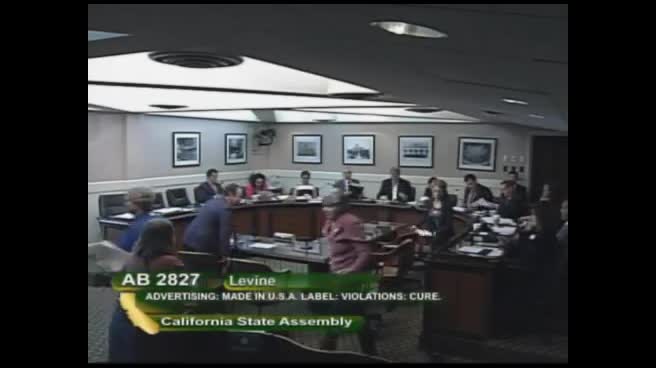 27MIN
Assembly Standing Committee on Judiciary



Bill Co-Author(s):