AB 2576: Diversion: attempted murder.
- Session Year: 2023-2024
- House: Assembly
- Latest Version Date: 2024-02-14
Current Status:
Failed
(2024-05-16: In committee: Held under submission.)
Introduced
In Committee
First Chamber
In Committee
Second Chamber
Enacted
Existing law authorizes a court to grant pretrial diversion to a defendant suffering from a mental disorder, on an accusatory pleading alleging the commission of a misdemeanor or felony offense, in order to allow the defendant to undergo mental health treatment. Existing law prohibits defendants charged with specified offenses, including murder, from being placed in this diversion program.
This bill would add attempted murder to the list of charged offenses that prohibit a defendant from being placed in this diversion program.
(a)On an accusatory pleading alleging the commission of a misdemeanor or felony offense not set forth in subdivision (d), the court may, in its discretion, and after considering the positions of the defense and prosecution, grant pretrial diversion to a defendant pursuant to this section if the defendant satisfies the eligibility requirements for pretrial diversion set forth in subdivision (b) and the court determines that the defendant is suitable for that diversion under the factors set forth in subdivision (c).
(b)A defendant is eligible for pretrial diversion pursuant to this section if both of the following criteria are met:
(1)The defendant has been diagnosed with a mental disorder as identified in the most recent edition of the Diagnostic and Statistical Manual of Mental Disorders, including, but not limited to, bipolar disorder, schizophrenia, schizoaffective disorder, or post-traumatic stress disorder, but excluding antisocial personality disorder and pedophilia. Evidence of the defendants mental disorder shall be provided by the defense and shall include a diagnosis or treatment for a diagnosed mental disorder within the last five years by a qualified mental health expert. In opining that a defendant suffers from a qualifying disorder, the qualified mental health expert may rely on an examination of the defendant, the defendants medical records, arrest reports, or any other relevant evidence.
(2)The defendants mental disorder was a significant factor in the commission of the charged offense. If the defendant has been diagnosed with a mental disorder, the court shall find that the defendants mental disorder was a significant factor in the commission of the offense unless there is clear and convincing evidence that it was not a motivating factor, causal factor, or contributing factor to the defendants involvement in the alleged offense. A court may consider any relevant and credible evidence, including, but not limited to, police reports, preliminary hearing transcripts, witness statements, statements by the defendants mental health treatment provider, medical records, records or reports by qualified medical experts, or evidence that the defendant displayed symptoms consistent with the relevant mental disorder at or near the time of the offense.
(c)For any defendant who satisfies the eligibility requirements in subdivision (b), the court must consider whether the defendant is suitable for pretrial diversion. A defendant is suitable for pretrial diversion if all of the following criteria are met:
(1)In the opinion of a qualified mental health expert, the defendants symptoms of the mental disorder causing, contributing to, or motivating the criminal behavior would respond to mental health treatment.
(2)The defendant consents to diversion and waives the defendants right to a speedy trial, unless a defendant has been found to be an appropriate candidate for diversion in lieu of commitment pursuant to clause (iv) of subparagraph (B) of paragraph (1) of subdivision (a) of Section 1370 and, as a result of the defendants mental incompetence, cannot consent to diversion or give a knowing and intelligent waiver of the defendants right to a speedy trial.
(3)The defendant agrees to comply with treatment as a condition of diversion, unless the defendant has been found to be an appropriate candidate for diversion in lieu of commitment for restoration of competency treatment pursuant to clause (iv) of subparagraph (B) of paragraph (1) of subdivision (a) of Section 1370 and, as a result of the defendants mental incompetence, cannot agree to comply with treatment.
(4)The defendant will not pose an unreasonable risk of danger to public safety, as defined in Section 1170.18, if treated in the community. The court may consider the opinions of the district attorney, the defense, or a qualified mental health expert, and may consider the defendants treatment plan, the defendants violence and criminal history, the current charged offense, and any other factors that the court deems appropriate.
(d)A defendant may not be placed into a diversion program, pursuant to this section, for the following current charged offenses:
(1)Murder Murder, attempted murder, or voluntary manslaughter.
(2)An offense for which a person, if convicted, would be required to register pursuant to Section 290, except for a violation of Section 314.
(3)Rape.
(4)Lewd or lascivious act on a child under 14 years of age.
(5)Assault with intent to commit rape, sodomy, or oral copulation, in violation of Section 220.
(6)Commission of rape or sexual penetration in concert with another person, in violation of Section 264.1.
(7)Continuous sexual abuse of a child, in violation of Section 288.5.
(8)A violation of subdivision (b) or (c) of Section 11418.
(e)At any stage of the proceedings, the court may require the defendant to make a prima facie showing that the defendant will meet the minimum requirements of eligibility for diversion and that the defendant and the offense are suitable for diversion. The hearing on the prima facie showing shall be informal and may proceed on offers of proof, reliable hearsay, and argument of counsel. If a prima facie showing is not made, the court may summarily deny the request for diversion or grant any other relief as may be deemed appropriate.
(f)As used in this chapter, the following terms have the following meanings:
(1)Pretrial diversion means the postponement of prosecution, either temporarily or permanently, at any point in the judicial process from the point at which the accused is charged until adjudication, to allow the defendant to undergo mental health treatment, subject to all of the following:
(A)(i)The court is satisfied that the recommended inpatient or outpatient program of mental health treatment will meet the specialized mental health treatment needs of the defendant.
(ii)The defendant may be referred to a program of mental health treatment utilizing existing inpatient or outpatient mental health resources. Before approving a proposed treatment program, the court shall consider the request of the defense, the request of the prosecution, the needs of the defendant, and the interests of the community. The treatment may be procured using private or public funds, and a referral may be made to a county mental health agency, existing collaborative courts, or assisted outpatient treatment only if that entity has agreed to accept responsibility for the treatment of the defendant, and mental health services are provided only to the extent that resources are available and the defendant is eligible for those services.
(iii)If the court refers the defendant to a county mental health agency pursuant to this section and the agency determines that it is unable to provide services to the defendant, the court shall accept a written declaration to that effect from the agency in lieu of requiring live testimony. That declaration shall serve only to establish that the program is unable to provide services to the defendant at that time and does not constitute evidence that the defendant is unqualified or unsuitable for diversion under this section.
(B)The provider of the mental health treatment program in which the defendant has been placed shall provide regular reports to the court, the defense, and the prosecutor on the defendants progress in treatment.
(C)The period during which criminal proceedings against the defendant may be diverted is limited as follows:
(i)If the defendant is charged with a felony, the period shall be no longer than two years.
(ii)If the defendant is charged with a misdemeanor, the period shall be no longer than one year.
(D)Upon request, the court shall conduct a hearing to determine whether restitution, as defined in subdivision (f) of Section 1202.4, is owed to any victim as a result of the diverted offense and, if owed, order its payment during the period of diversion. However, a defendants inability to pay restitution due to indigence or mental disorder shall not be grounds for denial of diversion or a finding that the defendant has failed to comply with the terms of diversion.
(2)Qualified mental health expert includes, but is not limited to, a psychiatrist, psychologist, a person described in Section 5751.2 of the Welfare and Institutions Code, or a person whose knowledge, skill, experience, training, or education qualifies them as an expert.
(g)If any of the following circumstances exists, the court shall, after notice to the defendant, defense counsel, and the prosecution, hold a hearing to determine whether the criminal proceedings should be reinstated, whether the treatment should be modified, or whether the defendant should be conserved and referred to the conservatorship investigator of the county of commitment to initiate conservatorship proceedings for the defendant pursuant to Chapter 3 (commencing with Section 5350) of Part 1 of Division 5 of the Welfare and Institutions Code:
(1)The defendant is charged with an additional misdemeanor allegedly committed during the pretrial diversion and that reflects the defendants propensity for violence.
(2)The defendant is charged with an additional felony allegedly committed during the pretrial diversion.
(3)The defendant is engaged in criminal conduct rendering the defendant unsuitable for diversion.
(4)Based on the opinion of a qualified mental health expert whom the court may deem appropriate, either of the following circumstances exists:
(A)The defendant is performing unsatisfactorily in the assigned program.
(B)The defendant is gravely disabled, as defined in subparagraph (B) of paragraph (1) of subdivision (h) of Section 5008 of the Welfare and Institutions Code. A defendant shall only be conserved and referred to the conservatorship investigator pursuant to this finding.
(h)If the defendant has performed satisfactorily in diversion, at the end of the period of diversion, the court shall dismiss the defendants criminal charges that were the subject of the criminal proceedings at the time of the initial diversion. A court may conclude that the defendant has performed satisfactorily if the defendant has substantially complied with the requirements of diversion, has avoided significant new violations of law unrelated to the defendants mental health condition, and has a plan in place for long-term mental health care. If the court dismisses the charges, the clerk of the court shall file a record with the Department of Justice indicating the disposition of the case diverted pursuant to this section. Upon successful completion of diversion, if the court dismisses the charges, the arrest upon which the diversion was based shall be deemed never to have occurred, and the court shall order access to the record of the arrest restricted in accordance with Section 1001.9, except as specified in subdivisions (j) and (k). The defendant who successfully completes diversion may indicate in response to any question concerning the defendants prior criminal record that the defendant was not arrested or diverted for the offense, except as specified in subdivision (j).
(i)A record pertaining to an arrest resulting in successful completion of diversion, or any record generated as a result of the defendants application for or participation in diversion, shall not, without the defendants consent, be used in any way that could result in the denial of any employment, benefit, license, or certificate.
(j)The defendant shall be advised that, regardless of the defendants completion of diversion, both of the following apply:
(1)The arrest upon which the diversion was based may be disclosed by the Department of Justice to any peace officer application request and that, notwithstanding subdivision (i), this section does not relieve the defendant of the obligation to disclose the arrest in response to any direct question contained in any questionnaire or application for a position as a peace officer, as defined in Section 830.
(2)An order to seal records pertaining to an arrest made pursuant to this section has no effect on a criminal justice agencys ability to access and use those sealed records and information regarding sealed arrests, as described in Section 851.92.
(k)A finding that the defendant suffers from a mental disorder, any progress reports concerning the defendants treatment, including, but not limited to, any finding that the defendant be prohibited from owning or controlling a firearm because they are a danger to themselves or others pursuant to subdivision (m), or any other records related to a mental disorder that were created as a result of participation in, or completion of, diversion pursuant to this section or for use at a hearing on the defendants eligibility for diversion under this section may not be used in any other proceeding without the defendants consent, unless that information is relevant evidence that is admissible under the standards described in paragraph (2) of subdivision (f) of Section 28 of Article I of the California Constitution. However, when determining whether to exercise its discretion to grant diversion under this section, a court may consider previous records of participation in diversion under this section.
(l)The county agency administering the diversion, the defendants mental health treatment providers, the public guardian or conservator, and the court shall, to the extent not prohibited by federal law, have access to the defendants medical and psychological records, including progress reports, during the defendants time in diversion, as needed, for the purpose of providing care and treatment and monitoring treatment for diversion or conservatorship.
(m)(1)The prosecution may request an order from the court that the defendant be prohibited from owning or possessing a firearm until they successfully complete diversion because they are a danger to themselves or others pursuant to subdivision (i) of Section 8103 of the Welfare and Institutions Code.
(2)The prosecution shall bear the burden of proving, by clear and convincing evidence, both of the following are true:
(A)The defendant poses a significant danger of causing personal injury to themselves or another by having in their custody or control, owning, purchasing, possessing, or receiving a firearm.
(B)The prohibition is necessary to prevent personal injury to the defendant or any other person because less restrictive alternatives either have been tried and found to be ineffective or are inadequate or inappropriate for the circumstances of the defendant.
(3)(A)If the court finds that the prosecution has not met that burden, the court shall not order that the person is prohibited from having, owning, purchasing, possessing, or receiving a firearm.
(B)If the court finds that the prosecution has met the burden, the court shall order that the person is prohibited, and shall inform the person that they are prohibited, from owning or controlling a firearm until they successfully complete diversion because they are a danger to themselves or others.
(4)An order imposed pursuant to this subdivision shall be in effect until the defendant has successfully completed diversion or until their firearm rights are restored pursuant to paragraph (4) of subdivision (g) of Section 8103 of the Welfare and Institutions Code.
(n)This section shall become operative on July 1, 2024.
|
Date
|
Status
|
|---|---|
| May 16, 2024 | In committee: Held under submission. |
| May 8, 2024 | In committee: Set, first hearing. Referred to APPR. suspense file. |
| Apr 24, 2024 | From committee: Do pass and re-refer to Com. on APPR. (Ayes 8. Noes 0.) (April 24). Re-referred to Com. on APPR. |
| Mar 4, 2024 | Referred to Com. on PUB. S. |
| Feb 15, 2024 | From printer. May be heard in committee March 16. |
| Feb 14, 2024 | Read first time. To print. |
|
Date
|
Description
|
Location
|
Votes
|
|
|---|---|---|---|---|
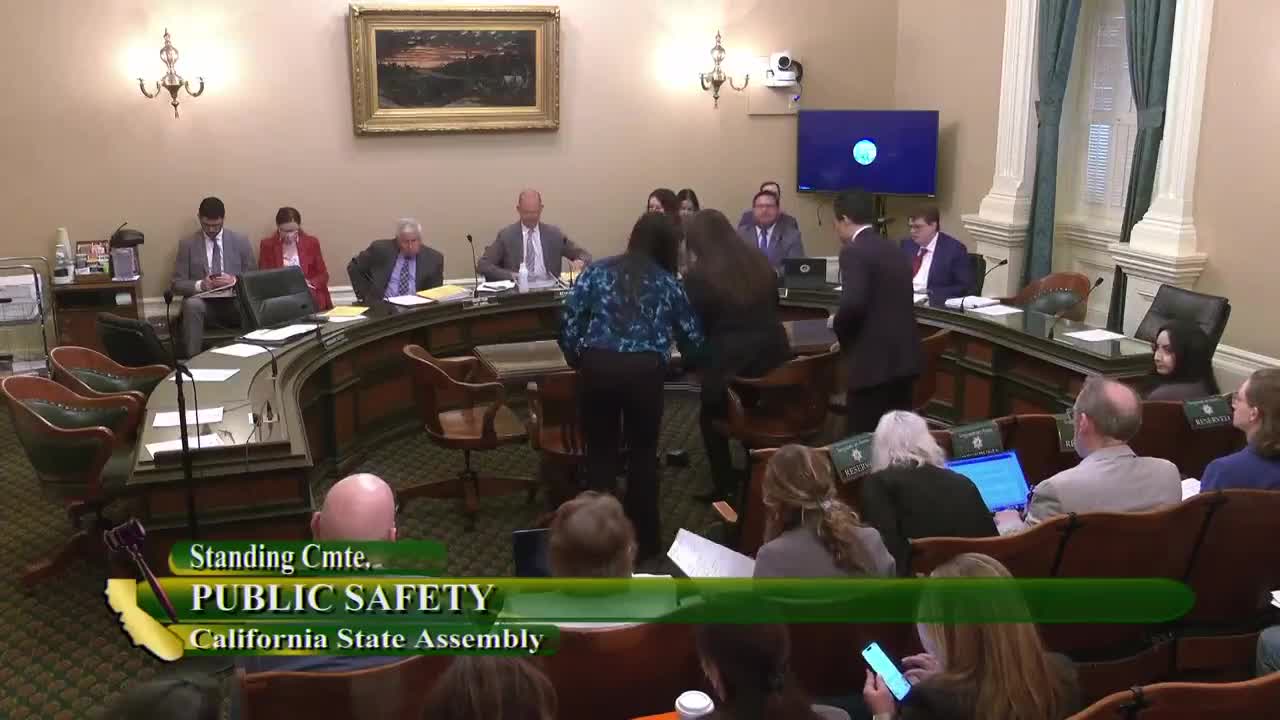
| Apr 24, 2024 | Do pass and be re-referred to the Committee on [Appropriations] | Assembly Standing Committee on Public Safety |
Passed |
This list shows positions taken on this bill by organizations on the date displayed, which is linked to the original source.
Positions by individuals are not included.
|
Organization
|
Position
|
Date
|
|---|---|---|
| Aclu California Action | * Against | Apr 24, 2024 |
| ACLU of Northern California | * Against | Apr 24, 2024 |
| All of Us or None | * Against | Apr 24, 2024 |
| Association For Los Angeles Deputy Sheriffs | ** Support | |
| California Alliance for Youth and Community Justice | ** Against | |
| California Association Of Highway Patrolmen | ** Support | |
| California Coalition for Women Prisoners | ** Against | |
| California for Safety and Justice | ** Against | |
| California Police Chiefs | * Support | Apr 24, 2024 |
| California Public Defenders Association | * Against | Apr 24, 2024 |
| California United for Responsible Budget | * Against | Apr 24, 2024 |
| CDAA | * Support | Apr 24, 2024 |
| Children's Defense Fund - CA | ** Against | |
| Communities United for Restorative Youth Justice | ** Against | |
| Crime Victims United Of California | ** Support | |
| Felony Murder Elimination Project | ** Against | |
| Friends Committee On Legislation Of California | ** Against | |
| Initiate Justice | * Against | Apr 24, 2024 |
| LA Defensa | ** Against | |
| Law Defense | * Against | Apr 24, 2024 |
| Legal Services for Prisoners with Children | * Against | Apr 24, 2024 |
| Los Angeles County Professional Peace Officers Association | ** Support | |
| Milpa Collective | ** Against | |
| Sacramento County Attorney | * Support | Apr 24, 2024 |
| San Francisco Public Defender's Office | * Against | Apr 24, 2024 |
| San Francisco Public Defenders Office | * Against | Apr 24, 2024 |
| Silicon Valley De-Bug | ** Against | |
| Smart Justice California | * Against | Apr 24, 2024 |
| Team Justice | ** Against | |
| Uncommon Law | ** Against | |
| Vera Institute Of Justice | * Against | Apr 24, 2024 |
| Witness Or Vulnerable Person Victim | * Support | Apr 24, 2024 |
| Young Women's Freedom Center | ** Against |
Date of Hearing:
ASSEMBLY COMMITTEE ON APPROPRIATIONS
Buffy Wicks, Chair
ABPCA Bill Id:AB 2576
Author:(Stephanie Nguyen) – As Introduced Ver:February 14, 2024
Policy Committee: | Public Safety | Vote: | 8 - 0 |
|
| ||
|
|
Urgency: No State Mandated Local Program: No Reimbursable: No
SUMMARY:
This bill makes a defendant charged with attempted murder ineligible for placement in mental health diversion.
FISCAL EFFECT:
Costs (General Fund) the California Department of Corrections and Rehabilitation to incarcerate people convicted of attempted murder who otherwise would have completed diversion. The actual number of such cases statewide is unknown, but given the high cost of incarceration the costs resulting from this measure may be significant. The Legislative Analyst’s Office (LAO) estimates the average annual cost to incarcerate one person in state prison is $133,000. Attempted murder is punishable by a term in state prison, ranging from five years to 7.5 years to life with the possibility of parole. If three people statewide are convicted of attempted murder instead of completing mental health diversion and must each serve nine years in state prison, the resulting incarceration costs would be approximately $3.6 million over nine years.
According to the LAO, the General Fund faces a structural deficit in the tens of billions of dollars over the next several fiscal years.
COMMENTS:
- Purpose. According to the author:
Attempted murder is a serious and violent offense that poses a significant threat to public safety. Currently, a loophole in state law allows individuals who attempt, but fail to kill someone, to be granted diversion for mental health treatment. This can result in their release into the community with minimal court supervision, and expungement of their criminal record upon completion of the program. AB 2576 addresses this issue by including attempted murder on the list of crimes ineligible for mental health diversion.
- Background. Mental health diversion is a form of pretrial diversion that suspends the criminal proceedings against a defendant while they complete a mental health program. If the defendant does not successfully complete the diversion program, criminal proceedings resume and the defendant may proceed to trial or enter a plea. If the defendant successfully completes diversion, the criminal charges against them are dismissed.
Under existing law, a court may place a criminal defendant in a mental health diversion program if the defendant has been deemed eligible and the following conditions are met: a qualified mental health expert must determine that the defendant’s mental health symptoms that contributed to their criminal behavior would respond to mental health treatment. The defendant must consent to diversion and waive certain rights. The defendant must agree to comply with treatment as a condition of diversion. And the court must determine that the defendant will not pose an unreasonable risk of danger to public safety if treated in the community. If all of these conditions are met, the court may – but is not required to – place a defendant in mental health diversion. However, if the defendant has been charged with certain serious offenses, they are ineligible for mental health diversion, including murder, voluntary manslaughter, and certain sex offenses.
This bill specifies that a defendant who has been charged with attempted murder may not be placed in mental health diversion.
Analysis Prepared by: Annika Carlson / APPR. / (916) 319-2081
Date of Hearing: April 23, 2024
Counsel: Andrew Ironside
ASSEMBLY COMMITTEE ON
Kevin McCarty, Chair
ABPCA Bill Id:
Author:() – As Ver:
SUMMARY:
Adds attempted murder to the list of crimes for which a defendant may not be placed in mental health diversion.
EXISTING LAW:
- Provides that murder is the unlawful killing of a human being with malice aforethought. (Pen Code, § 187, subd. (a).)
- Provides that malice may be either express or implied. (Pen Code, § 188, subd. (a).)
- Provides that malice is express when there is manifested a deliberate intention to unlawfully take away the life of a fellow creature. (Pen Code, § 188, subd. (a)(1).)
- Provides that malice is implied when no considerable provocation appears, or when the circumstances attending the killing show an abandoned and malignant heart. (Pen Code, § 187, subd. (a)(2).)
- Provides that all murder that is perpetrated by means of a destructive device or explosive, a weapon of mass destruction, knowing use of ammunition designed primarily to penetrate metal or armor, poison, lying in wait, torture, or by any other kind of willful, deliberate, and premeditated killing, or that is committed in the perpetration of, or attempt to perpetrate, arson, rape, carjacking, robbery, burglary, mayhem, kidnapping, train wrecking, or specified sex offenses, or murder that is perpetrated by means of discharging a firearm from a motor vehicle, intentionally at another person outside of the vehicle with the intent to inflict death, is murder of the first degree. (Pen Code, § 189, subd. (a).)
- Provides that all other kinds of murders are of the second degree. (Pen Code, § 189, subd. (b).)
- Provides that the attempt to commit a crime occurs when a person attempts, but fails, or is prevented or intercepted in its perpetration. (Pen Code, § 664.)
- Provides that, if the crime attempted is willful, deliberate, and premeditated murder, the person guilty of that attempt shall be punished by imprisonment in the state prison for life with the possibility of parole. (Pen Code, § 664, subd. (a).)
- Provides that all persons concerned in the commission of a crime, whether it be a felony or misdemeanor, and whether they directly commit the act constituting the offense, or aid and abet in its commission, or, not being present, have advised and encouraged its commission, and all persons counseling, advising, or encouraging children under the age of fourteen years, or persons who are mentally incapacitated, to commit any crime, or who, by fraud, contrivance, or force, occasion the drunkenness of another for the purpose of causing him to commit any crime, or who, by threats, menaces, command, or coercion, compel another to commit any crime, are principals in any crime so committed. (Pen Code, § 31.)
- Provides that the purpose of mental health diversion is all of the following:
- Increased diversion of individuals with mental disorders to mitigate the individuals’ entry and reentry into the criminal justice system while protecting public safety;
- Allowing local discretion and flexibility for counties in the development and implementation of diversion for individuals with mental disorders across a continuum of care settings;
- Providing diversion that meets the unique mental health treatment and support needs of individuals with mental disorders. (Pen Code, § 1001.35, subd. (a)-(c).)
- Increased diversion of individuals with mental disorders to mitigate the individuals’ entry and reentry into the criminal justice system while protecting public safety;
- Gives the court the discretion, after considering the positions of the defense and prosecution, to grant pretrial diversion to a defendant if the defendant satisfies the eligibility requirements for pretrial diversion and the court determines that the defendant is suitable for that diversion, unless the defendant has committed a prescribed crime. (Pen Code, § 1001.36, subd. (a)-(c).)
- A defendant is eligible for pretrial diversion if both of the following criteria are met:
- The defendant has been diagnosed with a mental disorder as identified in the most recent edition of the Diagnostic and Statistical Manual of Mental Disorders, including, but not limited to, bipolar disorder, schizophrenia, schizoaffective disorder, or post-traumatic stress disorder, but excluding antisocial personality disorder and pedophilia; and,
- The defendant’s mental disorder was a significant factor in the commission of the charged offense. (Pen. Code, § 1001.36, subd. (b)(1) & (2).)
- The defendant has been diagnosed with a mental disorder as identified in the most recent edition of the Diagnostic and Statistical Manual of Mental Disorders, including, but not limited to, bipolar disorder, schizophrenia, schizoaffective disorder, or post-traumatic stress disorder, but excluding antisocial personality disorder and pedophilia; and,
- Requires the defense to provide evidence of the defendant’s mental disorder including a diagnosis or treatment for a diagnosed mental disorder within the last five years by a qualified mental health expert. In opining that a defendant suffers from a qualifying disorder, the qualified mental health expert may rely on an examination of the defendant, the defendant’s medical records, arrest reports, or any other relevant evidence. (Pen. Code, § 1001.36, subd. (b)(1).)
- Requires the court, if the defendant has been diagnosed with a mental disorder, to find that the defendant’s mental disorder was a significant factor in the commission of the offense unless there is clear and convincing evidence that it was not a motivating factor, causal factor, or contributing factor to the defendant’s involvement in the alleged offense. (Pen. Code, § 1001.36, subd. (b)(2).)
- Authorizes a court, when determining whether the defendant’s mental disorder was a significant factor in the commission of the offense, to consider any relevant and credible evidence, including, but not limited to, police reports, preliminary hearing transcripts, witness statements, statements by the defendant’s mental health treatment provider, medical records, records or reports by qualified medical experts, or evidence that the defendant displayed symptoms consistent with the relevant mental disorder at or near the time of the offense. (Pen. Code, § 1001.36, subd. (b)(2).)
- Requires the court, for any defendant who satisfies the eligibility requirements, to consider whether the defendant is suitable for pretrial diversion. (Pen. Code, § 1001.36, subd. (c).)
- Provides that a defendant is suitable for pretrial diversion if all of the following criteria are met:
- In the opinion of a qualified mental health expert, the defendant’s symptoms of the mental disorder causing, contributing to, or motivating the criminal behavior would respond to mental health treatment.
- The defendant consents to diversion and waives the defendant’s right to a speedy trial, unless a defendant has been found to be an appropriate candidate for diversion in lieu of commitment and, as a result of the defendant’s mental incompetence, cannot consent to diversion or give a knowing and intelligent waiver of the defendant’s right to a speedy trial.
- The defendant agrees to comply with treatment as a condition of diversion, unless the defendant has been found to be an appropriate candidate for diversion in lieu of commitment for restoration of competency treatment and, as a result of the defendant’s mental incompetence, cannot agree to comply with treatment.
- The defendant will not pose an unreasonable risk of danger to public safety if treated in the community. The court may consider the opinions of the district attorney, the defense, or a qualified mental health expert, and may consider the defendant’s treatment plan, the defendant’s violence and criminal history, the current charged offense, and any other factors that the court deems appropriate. (Pen. Code, § 1001.36, subd. (c)(1)-(4).)
- In the opinion of a qualified mental health expert, the defendant’s symptoms of the mental disorder causing, contributing to, or motivating the criminal behavior would respond to mental health treatment.
- Prohibits the placement of a defendant into a mental health diversion program for the following current charged offenses:
- Murder or voluntary manslaughter;
- An offense for which a person, if convicted, would be required to register as a sex offender, except as specified;
- Rape;
- Lewd or lascivious act on a child under 14 years of age;
- Assault with intent to commit rape, sodomy, or oral copulation;
- Commission of rape or sexual penetration in concert with another person;
- Continuous sexual abuse of a child;
- A person who uses a weapon of mass destruction, as specified. (Pen. Code, § 1001.36, subd. (d).)
- Murder or voluntary manslaughter;
- Defines “unreasonable risk of danger to public safety” as an unreasonable risk that the petitioner will commit a new violent felony, as specified. (Pen. Code, §§ 1170.18, subd. (c) & 667, subd. (e)(2)(C)(iv).)
FISCAL EFFECT:
Unknown
COMMENTS:
- Author's Statement: According to the author, “Attempted murder is a serious and violent offense that poses a significant threat to public safety. Currently, a loophole in state law allows individuals who attempt, but fail to kill someone, to be granted diversion for mental health treatment. This can result in their release into the community with minimal court supervision, and expungement of their criminal record upon completion of the program.
“AB 2576 addresses this issue by including attempted murder on the list of crimes ineligible for mental health diversion. This prioritizes public safety and ensures that individuals who try to take another person's life are held accountable for their actions. AB 2576 aims to prevent anyone from escaping the consequences of attempted murder and to uphold paramount safety of our community.” - Mental Health Diversion: Existing law permits pretrial diversion programs. (Pen. Code, §1001.) Pre-trial diversion suspends the criminal proceedings without requiring the defendant to enter a plea. (Pen. Code, §§ 1001.1, 1001.3.) The defendant must successfully complete a program or other conditions imposed by the court. If a defendant does not successfully complete the diversion program, criminal proceedings resume but the defendant, having not entered a plea, may still proceed to trial or enter a plea. If diversion is successfully completed, the criminal charges are dismissed and the defendant may, with certain exceptions, legally answer that they have never been arrested or charged for the diverted offense. (Pen. Code, §§ 1001.7, 1001.9.)
A defendant must be both eligible and suitable for mental health diversion. A defendant is eligible for pretrial mental health diversion if they have been diagnosed with a mental disorder identified in the most recent edition of the DSM, including but not limited to bipolar disorder, schizophrenia, schizoaffective disorder, or PTSD, but excluding antisocial personality disorder and pedophilia. (Pen. Code, § 1001.36, subd. (b)(1).) The defendant’s mental disorder must also have been a significant factor in the commission of the charged offense; and the court must find that the defendant’s mental disorder was a significant factor in the commission of the offense unless there is clear and convincing evidence that it was not a motivating factor, causal factor, or contributing factor to the defendant’s involvement in the alleged offense. (Pen. Code, § 1001.36, subd. (b)(2).)
If eligible, the court must then consider whether the defendant is suitable for diversion. The defendant is suitable for diversion if, in the opinion of a qualified mental health expert, the defendant’s symptoms of the mental disorder causing, contributing to, or motivating criminal behavior would respond to treatment; the defendant consents to diversion, the defendant agrees to comply with treatment, and the defendant will not pose an unreasonable risk of danger to public safety if treated in the community. (Pen. Code, § 1001.36, subd. (c).) “[T]he risk of danger is narrowly confined to the likelihood the defendant will commit a limited subset of violent felonies,” specifically super strike offenses. (People v. Moine (2021) 62 Cal.App.5th 440, 450; see Pen. Code, § 667, subd. (e)(2)(C)(iv).) When evaluating whether a defendant poses an unreasonable risk of danger to public safety, the court may consider the opinion of the prosecutor, defense, the treatment plan, the defendant’s violence and criminal history, the opinions of qualified mental health professionals, and any other factors that the court deems appropriate. (Pen. Code, § 1001.36, subd. (c).) (emphasis added)
Importantly, even if eligible and suitable, the court may still in its discretion deny the defendant mental health diversion. (Pen. Code, § 1001.36, subd. (a); People v. Gerson (2022) 80 Cal.App.5th 1067, 1079, People v. Qualkinbush (2022) 79 Cal.App.5th 879, 888.) According to a recent decision,
Finally, even where defendants make a prima facie showing that they meet all the express statutory requirements, the court may still exercise its discretion to deny division. But this “residual” discretion must be exercised “‘consistent with the principles and purpose of the governing law.’” That purpose includes a strong legislative preference for treatment of mental health disorders because of the benefits of such treatment to both the offending individual and the community. Where the court chooses to exercise this residual discretion to deny diversion, its statement of reasons should reflect consideration of the underlying purpose of the statute and explain why diversion would not meet those goals.
(Sarmiento v. Superior Court (2024) 98 Cal.App.5th 882, 892-893.)
A defendant may not be granted mental health diversion if charged with murder, rape, other specified sex crimes, or any offenses requiring sex offender registration. (Pen. Code, § 1001.36, subd. (d).)
In addition, the mental health diversion statute provides:
- The court must be satisfied that the recommended mental health treatment will meet the needs of the specialized defendant. (Pen. Code, § 1001.36, subd. (f).)
- The provider of the mental health treatment must provide regular reports to the court. (Pen. Code, § 1001.36, subd. (f).)
- The court can reinstate criminal proceedings if the defendant is engaged in criminal conduct during diversion. (Pen. Code, § 1001.36, subd. (g).)
- The court can reinstate criminal proceedings if the defendant is performing unsatisfactorily during diversion. (Pen. Code, § 1001.36, subd. (g).)
The mental health diversion statute comports with other state efforts to keep persons with serious mental illnesses, even those who have attempted acts of violence against others, out of carceral settings and in treatment. For example, in 2002, the Legislature passed Laura’s Law, which sought to authorize assisted outpatient treatment to persons with severe mental illness, even ones who had made threats or attempts of serious violence. (See Pen Code, §§ 422 [criminal threats] and 664 [attempt to commit a crime].) Indeed, the statute expressly provides that a person is eligible for services if, among other things, “the person’s mental illness has resulted in one or more acts of serious and violent behavior toward…another, or threats, or attempts to cause serious physical harm…to another within the last 48 hours.” (Welf. & Inst. Code, § 5346, subd. (a)(4)(B).) Also similar to mental health diversion, a person must have had a “clinical determination that, in view of the person’s treatment history and current behavior...[t]he person is in need of assisted outpatient treatment in order to prevent a relapse or deterioration that would be likely to result in grave disability or serious harm…to others.” (Welf. & Inst. Code, § 5346, subd. (a)(3)(B).)
- Attempted Murder: Murder is the unlawful killing of a human being with malice aforethought. (Pen Code, § 187, subd. (a).) Malice may be either express or implied. (Pen Code, § 188, subd. (a).) Malice is express when there is manifested a deliberate intention to unlawfully take away the life of another. (Pen Code, § 188, subd. (a)(1).) Malice is implied when no considerable provocation appears, or when the circumstances attending the killing show an abandoned and malignant heart. (Pen Code, § 187, subd. (a)(2).)
An attempted murder is where a person attempts to kill another person with malice, but fails, or is prevented or intercepted in its perpetration from carrying out the killing. (Pen Code, § 664.)
For an attempt, the overt act must go beyond mere preparation and show that the killer is putting his or her plan into action; it need not be the last proximate or ultimate step toward commission of the crime or crimes nor need it satisfy any element of the crime. However, as we have explained, “[b]etween preparation for the attempt and the attempt itself, there is a wide difference. The preparation consists in devising or arranging the means or measures necessary for the commission of the offense; the attempt is the direct movement toward the commission after the preparations are made.” “‘[I]t is sufficient if it is the first or some subsequent act directed towards that end after the preparations are made.’ ”…
Although a definitive test has proved elusive, we have long recognized that “[w]henever the design of a person to commit crime is clearly shown, slight acts in furtherance of the design will constitute an attempt.”
(People v. Superior Court (Decker) (2007) 41 Cal.4th 1, 8 [internal citations omitted] [discussing slight-acts rule]; see e.g., People v. Morales (1992) 5 Cal.App.4th 917, 926 [attempted murder conviction affirmed where defendant threatened to kill somebody, loaded a gun, and was found outside their house with the gun].)) For example, attempting to hire somebody to kill another person is sufficient to sustain both a solicitation of murder charge and an attempted murder charge. (People v. Superior Court (Decker) (2007) 41 Cal.4th 1, 58.)
A person may be charged with attempted murder even if they are not the person made the actual attempt. Existing law provides that a person who aids and abets an attempted murder, or, not being present, has advised and encouraged its commission, is guilty of attempted murder. (Pen Code, § 31.) The California Supreme Court has observed:
Attempted murder requires the specific intent to kill and the commission of a direct but ineffectual act toward accomplishing the intended killing… [T]o be guilty of attempted murder as an aider and abettor, a person must give aid or encouragement [by words or gestures] with knowledge of the direct perpetrator’s intent to kill and with the purpose of facilitating the direct perpetrator’s accomplishment of the intended killing—which means that the person guilty of attempted murder as an aider and abettor must intend to kill.
(People v. Lee (2003) 31 Cal.4th 613, 623-624 [internal citations omitted])
The question raised by this bill is whether courts should retain the discretion to grant mental health diversion to persons charged with attempted murder in limited circumstances. One might also wonder whether adding a new crime to the list of crimes for which a person is prohibited from receiving mental health diversion is a first step towards drastic limitations on the availability of mental health diversion.
- Prevalence of Mentally Ill Offenders in Jails: According to the Los Angeles Sheriff’s Department (LASD), the overall jail population decreased in 2015, while the mentally ill population was on the rise. Between 2009 and 2016, LASD reports seeing a 60% increase in its mentally ill population. In early September 2016, a quarter of L.A. County's inmates received some form of mental health treatment. Because many of the mentally ill inmates need to be housed alone, it creates a bed shortage in the general population. (http://www.cnn.com/2016/09/22/us/lisa-ling-this-is-life-la-county-jail-by-the-numbers/index.html)
More recent statewide data suggests the problem is growing:
On the last day of any given month in 2009 there were roughly 80,000 people in jail custody throughout California and 15,500 people with an active mental health case. On the last day of any month in 2019 there were approximately 72,000 people in jail custody and 22,000 people with an open mental health case. This represents a 42 percent increase in the number of active mental health cases. In addition, the proportion of incarcerated people in California jails with an active mental health case rose by approximately 63 percent, rising from 19 percent in 2009 to 31 percent in 2019
(The Prevalence of Mental Illness in California Jails is Rising: An Analysis of Mental Health Cases & Psychotropic Medication Prescriptions, 2009-2019, California Health Policy Strategists (Feb. 2020) p. 1 < https://www.cdcr.ca.gov/ccjbh/wp-content/uploads/sites/172/2020/02/Jail_MentalHealth_JPSReport_02-03-2020.pdf> [last visited Apr. 16, 2024].)
The situation has not improved. According to the PPIC: “[T]he percentage of inmates with mental health needs has continued to climb, from around 20% in January 2010 to a staggering 53% in June 2023.” (Lofstrom, et al., County Jails House Fewer Inmates, but Over Half Face Mental Health Issues, PPIC (Oct. 25, 2023) < County Jails House Fewer Inmates, but Over Half Face Mental Health Issues - Public Policy Institute of California (ppic.org)> [last viewed Apr. 16, 2024].)
Housing mentally ill inmates in a custodial setting creates other difficulties, in addition to bed shortages. Jails are often not set up to provide effective mental health treatment and are not the best treatment option for the inmate. Mentally ill inmates are expensive to house. Mentally ill inmates cost more than other prisoners for a variety of reasons, including increased staffing needs. For example, “In Los Angeles, it costs approximately $180 per day to provide community-based housing and clinical care for people with serious mental health needs—versus $445-650 per day to hold them in the city’s jails.” (Bryant, The United States Criminalizes People Who Need Health Care and Housing, Vera Institute of Justice https://www.vera.org/news/the-united-states-criminalizes-people-who-need-health-care-and-housing [last visited Apr. 16, 2024].)
- Recommendations from Judicial Council Related to Diversion for Mentally Ill Defendants: The Judicial Council convened a task force to examine the issues related to mentally ill defendants within the court system. The task force published their final report in December of 2015. The report recommended the development of diversion programs for mentally ill defendants. The report stated that resources must be dedicated to identify individuals with mental illness who are involved or who are likely to become involved with the criminal justice system. The report went on to say that interventions and diversion possibilities must be developed and utilized at the earliest possible opportunity. (Mental Health Issues Implementation Task Force: Final Report, Judicial Council (Dec. 2015) p. 5 <https://www.courts.ca.gov/documents/MHIITF-Final-Report.pdf> [last visited Apr. 16, 2024].)
- Argument in Support: According to the Association for Los Angeles Deputy Sheriffs, “Existing law authorizes a court to grant pretrial diversion to a defendant suffering from a mental disorder, on an accusatory pleading alleging the commission of a misdemeanor or felony offense, in order to allow the defendant to undergo mental health treatment. Existing law prohibits defendants charged with specified offenses, including murder, from being placed in this diversion program.
“AB 2576 would add attempted murder to the list of charged offenses that prohibit a defendant from being placed in this diversion program. ALADS agrees that individuals who attempt to commit murder should be evaluated for diversion programs through the same lens as those who commit murder.” - Argument in Opposition: According to Motivating Individual Leadership for Public Advancement (MILPA), “The mental health diversion law allows a court to grant pretrial diversion if a defendant has been diagnosed with a mental disorder and the defendant’s mental disorder was a significant factor in the commission of the charged offense. The law does not mandate that a court grant diversion, it merely provides the court the ability to exercise its discretion, when appropriate, to divert a defendant for mental health treatment. In making their evaluation, courts consider the opinions of qualified mental health experts to determine if the defendant's symptoms of the mental disorder causing the criminal behavior would respond to mental health treatment. Mental health diversion is never appropriate if the defendant will pose a risk of danger to the public safety.
“This bill would categorically exclude the offense of attempted murder from consideration for the mental health diversion program. That change would constitute an error from the standpoint of good policy. It is unlikely that a defendant charged with attempted murder would make an appropriate candidate for mental health diversion. However, the fact that is unlikely does not mean that there will not be some cases that present circumstances for which mental health diversion will be an appropriate and preferable option to proceeding to a criminal conviction. Under current law, courts would only exercise their discretion to grant mental health diversion to a defendant that meets all the qualifying factors, would benefit from the provided mental health treatment, and does not present a risk to public safety.
“It is also not appropriate to add attempted murder to the list of offenses which currently exclude a defendant from consideration for mental health diversion, because the nature of an attempted murder charge reflects circumstances that are much easier to charge than other charges on the list which involve completed crimes. This bill creates the danger (and incentive) for a district attorney to add a charge of attempted murder to an assault case to preclude a court from considering the defendant for mental health diversion.” - Prior Legislation:
- AB 455 (Quirk-Silva), would have prohibited individuals in pretrial mental health diversion for a felony or specified misdemeanor charge from owning a firearm until they successfully complete diversion. AB 455 is pending in Assembly Appropriations Committee.
- AB 1412 (Hart), Chapter 687, Statutes of 2023, would remove borderline personality disorder (BPD) from the mental disorders excluding a defendant from eligibility for pretrial mental health diversion.
- SB 1223 (Becker), Chapter 735, Statutes of 2022, made changes to mental health diversion eligibility and suitability provisions.
- AB 1810 (Budget Committee) Chapter 34, Statutes of 2018, created mental health diversion.
- SB 142 (Beall), would have established the State Community Mental Health Performance Incentives Fund, which would provide monetary incentives for counties to avoid sending mentally ill offenders to prison. SB 142 was held in suspense in the Assembly Appropriations Committee.
- SB 215 (Beall), Chapter 1005, Statutes of 2018, made certain offenses ineligible for mental health diversion.
- AB 455 (Quirk-Silva), would have prohibited individuals in pretrial mental health diversion for a felony or specified misdemeanor charge from owning a firearm until they successfully complete diversion. AB 455 is pending in Assembly Appropriations Committee.
REGISTERED SUPPORT / OPPOSITION:
Support
Association for Los Angeles Deputy Sheriffs
California Association of Highway Patrolmen
California Police Chiefs Association
Crime Victims United of California
Los Angeles County Professional Peace Officers Association
Opposition
ACLU California Action
California Alliance for Youth and Community Justice
California Coalition for Women Prisoners
California for Safety and Justice
California Public Defenders Association
Californians United for A Responsible Budget
Children's Defense Fund - CA
Communities United for Restorative Youth Justice (CURYJ)
Felony Murder Elimination Project
Friends Committee on Legislation of California
Initiate Justice
LA Defensa
Milpa Collective
San Francisco Public Defender
Silicon Valley De-bug
Smart Justice California, a Project of Tides Advocacy
Team Justice
Uncommon Law
Vera Institute of Justice
Young Women's Freedom Center
Analysis Prepared by:
Discussed in Hearing
 22MIN