AB 1393: California Pollution Control Financing Authority.
- Session Year: 2015-2016
- House: Assembly
- Latest Version Date: 2015-06-30
The California Pollution Control Financing Authority Act establishes the California Pollution Control Financing Authority, with specified powers and duties, and authorizes the authority to approve financing for projects or pollution control facilities to prevent or reduce environmental pollution.
This bill would authorize the authority to lend financial assistance, including, but not limited to, grants, loans, credit enhancements, and other incentives. The bill also would authorize the authority to establish alternate provisions as necessary to enable the authority to participate in an alternative funding source program, including, but not limited to, implementing loan loss reserve programs to benefit any person, company, corporation, public agency, partnership, or firm engaged in activities in the state that require financing, and to adopt the policies of those alternative funding sources. The bill also would make conforming changes.
(a) The authority shall, in accordance with Chapter 3.5 (commencing with Section 11340) of Part 1 of Division 3 of Title 2 of the Government Code, adopt all necessary rules and regulations to carry out its powers and duties under this division. The authority may call upon any board or department of the state government for aid and assistance in the preparation of plans and specifications and in the development of technology necessary to effectively control pollution.
(b) Notwithstanding subdivision (a), the authority, or any other agency implementing a loan program or small business or brownfield site financing assistance program pursuant to an interagency agreement with the authority, may adopt regulations relating to the loans or small business or brownfield site financing as emergency regulations in accordance with the Administrative Procedure Act (Chapter 3.5 (commencing with Section 11340) of Part 1 of Division 3 of Title 2 of the Government Code). For purposes of the Administrative Procedure Act, including Section 11349.6 of the Government Code, the adoption of the regulations shall be considered by the Office of Administrative Law to be necessary for the immediate preservation of the public peace, health and safety, and general welfare. The regulations shall be repealed 180 days after their effective date, unless the adopting authority or agency complies with that Chapter 3.5.
SEC. 2.Section 44525 of the Health and Safety Code is amended to read:44525.The authority may charge reasonable application and project fees to reimburse the authority for costs incurred in administering applications for financing pursuant to this division and to support authority programs, including, but not limited to, the Capital Access Loan Program authorized by Article 8 (commencing with Section 44559), and grants and loans as authorized by subdivision (h) of Section 44526.
SEC. 3.Section 44525.7 of the Health and Safety Code, as added by Section 7 of Chapter 915 of the Statutes of 2000, is repealed.SEC. 4.Section 44525.7 is added to the Health and Safety Code, to read:44525.7.Notwithstanding Section 10231.5 of the Government Code, commencing in 2016 and annually thereafter, the authority shall submit a report to the Legislature, pursuant to Section 9795 of the Government Code, regarding alternative financing programs administrated under administered pursuant to subdivision (a) of Section 44526.
SEC. 5.Section 44526 of the Health and Safety Code is amended to read:44526.The authority may do any of the following:
(a)Determine the location and character of any project to be financed under the provisions of this division, lend financial assistance, including grants, loans, credit enhancements, and other incentives designed to leverage private capital, to any participating party, construct, reconstruct, renovate, replace, lease, as lessor or lessee, and regulate the same, and enter into contracts for the sale of any pollution control facilities, including installment sales or sales under conditional sales contracts, and make loans to participating parties to lend financial assistance in the acquisition, construction, or installation of a project.
(b)Issue bonds, notes, bond anticipation notes, and other obligations of the authority for any of its corporate purposes, and fund or refund the same, all as provided in this division.
(c)Fix fees and charges for pollution control facilities, or for the loan of moneys to finance pollution control facilities, and to revise from time to time those fees and charges, and collect rates, rents, fees, loan repayments, and charges for the use of and for any facilities or services furnished, or to be furnished, by a project or any part of a project and contract with any person, partnership, association, corporation, or public agency with respect to these matters, and to fix the terms and conditions upon which any pollution control facilities may be sold or disposed of, whether upon installment sales contracts or otherwise.
(d)Employ and fix the compensation of bond counsel, financial consultants, and advisers as may be necessary in its judgment in connection with the issuance and sale of any bonds, notes, bond anticipation notes, or other obligations of the authority; contract for engineering, architectural, accounting, or other services of appropriate agencies as may be necessary in the judgment of the authority for the successful development of any project; and pay the reasonable costs of consulting engineers, architects, accountants, and construction experts employed by any participating party if, in the judgment of the authority, those services are necessary to the successful development of any project, and those services are not obtainable from any public agency.
(e)Receive and accept loans, contributions, or grants, grants of money, moneys, property, labor, or other things of value, value for, or in aid of, the authority in carrying out the purposes of this division, from any source, including, but not limited to, the federal government, the state, or any agency of the state, any local government or agency thereof, or any nonprofit or for-profit private entity or individual.
(f)Apply for, and accept, subventions, grants, loans, advances, and contributions from any source, sources of money, moneys, property, labor, or other things of value. The sources may include, but are not limited to, bond proceeds, dedicated taxes, state appropriations, federal appropriations, federal grant and loan funds, public and private sector retirement system funds, and proceeds of loans from the Pooled Money Investment Account.
(g)[Reserved]
(h)(1)Provide a loan directly, or indirectly through one or more public or private sector intermediaries, to any city, county, school district, redevelopment agency, financial institution, as defined in subdivision (d) of Section 44559.1, for-profit or not-for-profit organization, or participating party, as defined in Section 44506, to assist in financing, among other things, the costs of performing or obtaining brownfield site assessments, remedial action plans and reports, technical assistance, the cleanup, remediation, or development of brownfield sites, or any other similar or related costs, subject to all applicable federal, state, and local laws, procedures, and regulations.
(2)The authority shall establish standards and criteria to ensure that a recipient of direct or indirect financing for cleanup or remediation pursuant to this subdivision has the necessary financial resources and expertise to successfully and appropriately complete the cleanup or remediation of the property.
(3)The authority may pay all, or a portion, of the associated program development and implementation costs of any public or private sector intermediaries through which a loan is made. A loan authorized by this subdivision is subject to both of the following:
(A)A loan may be used in connection with a brownfield site prior to a determination of whether the site has a reasonable potential for economically beneficial reuse.
(B)A loan may be made upon the terms determined by the authority and may provide for any rate of interest or no interest.
(4)The authority shall fund a loan made pursuant to this subdivision from any funds available to it, from any funds set aside for the authoritys administrative expenses, or from any small business assistance fund established for these purposes pursuant to Section 44548.
(5)The authority may waive repayment of all, or a portion, of any loan made pursuant to this subdivision upon conditions to be determined by the authority, and the amount so waived shall be deemed a grant to the recipient.
(i)Do all things generally necessary or convenient to carry out the purposes of this division.
SEC. 6.Section 44559.3 of the Health and Safety Code is amended to read:44559.3.(a) The authority shall establish a loss reserve account for each financial institution with which the authority makes a contract.
(b)The loss reserve account for a financial institution shall consist of moneys paid as fees by borrowers and the financial institution, moneys transferred to the account from a small business assistance fund, any matching federal moneys, and any other moneys provided by the authority or other source.
(c)Notwithstanding any other law, the authority may establish and maintain loss reserve accounts with any financial institution under any policies the authority may adopt, including the policies of other funding sources, pursuant to subdivision (b) of Section 44559.11.
(d)All moneys in a loss reserve account established pursuant to this article are the exclusive property of, and solely controlled by, the authority. Interest or income earned on moneys credited to the loss reserve account shall be deemed to be part of the loss reserve account. The authority may withdraw from the loss reserve account all, or a portion of, the interest or other income that has been credited to the loss reserve account. Any withdrawal made pursuant to this subdivision may be made prior to paying any claim and shall be used for the sole purpose of offsetting costs associated with carrying out the program, including administrative costs and loss reserve account contributions.
(e)The combined amount to be deposited by the participating financial institution into any individual loss reserve account over a three-year period, in connection with any single borrower or any group of borrowers among which a common enterprise exists, shall be not more than one hundred thousand dollars ($100,000).
SEC. 7.Section 44559.6 of the Health and Safety Code is amended to read:44559.6.(a)Notwithstanding Section 10231.5 of the Government Code, the authority shall annually prepare a report to the Governor and the Legislature that describes the financial condition and programmatic results of the capital access loan programs authorized under this article. Programmatic results shall include, but not be limited to, the total number of business, entities, and individuals served, jobs created, jobs retained, the geographic distribution of the loans, and the breakdown of businesses served by industry sector for all new loans issued since the report for the prior year.
(b)The report submitted to the Legislature shall be submitted in compliance with Section 9795 of the Government Code.
SEC. 8.Section 44559.11 of the Health and Safety Code is amended to read:44559.11.(a)It is the intent of the Legislature to ensure that the state, through the authority, may make maximum, efficient use of capital access programs enacted by all federal and state agencies, as well as funding available from any governmental program whose goals may be advanced by providing funding to the Capital Access Loan Program.
(b)In furtherance of this intent, and notwithstanding any other provision of this article, when the contributions required pursuant to Section 44559.4 are entirely funded by a source that is a public or quasi-public entity other than the authority, the authority may, by regulation adopted pursuant to subdivision (b) of Section 44520, establish alternate provisions as necessary to enable the authority to participate in the alternative funding source program, including implementing loan loss reserve programs to benefit any person, company, corporation, public agency, partnership, or firm engaged in activities in furtherance of the public or quasi-public entitys policy objectives in the state that require financing.
(a) The authority shall, in accordance with Chapter 3.5 (commencing with Section 11340) of Part 1 of Division 3 of Title 2 of the Government Code, adopt all necessary rules and regulations to carry out its powers and duties under this division. The authority may call upon any board or department of the state government for aid and assistance in the preparation of plans and specifications and in the development of technology necessary to effectively control pollution.
(b) Notwithstanding subdivision (a), the authority, or any other agency implementing a small business loan program or brownfield site financing assistance program pursuant to an interagency agreement with the authority, may adopt regulations relating to small business the loans or brownfield site financing as emergency regulations in accordance with the Administrative Procedure Act (Chapter 3.5 (commencing with Section 11340) of Part 1 of Division 3 of Title 2 of the Government Code). For purposes of the Administrative Procedure Act, including Section 11349.6 of the Government Code, the adoption of the regulations shall be considered by the Office of Administrative Law to be necessary for the immediate preservation of the public peace, health and safety, and general welfare. The regulations shall be repealed 180 days after their effective date, unless the adopting authority or agency complies with that Chapter 3.5.
SEC. 2.Section 44525 of the Health and Safety Code is amended to read:44525.The authority may charge reasonable application and project fees to reimburse the authority for costs incurred in administering applications for financing pursuant to this division and to support authority programs, including, but not limited to, the Capital Access Loan Program authorized by Article 8 (commencing with Section 44559), and grants and loans as authorized by subdivision (h) of Section 44526.
SEC. 3.Section 44525.7 of the Health and Safety Code, as added by Section 7 of Chapter 915 of the Statutes of 2000, is repealed.SEC. 4.Section 44525.7 is added to the Health and Safety Code, to read:44525.7.Notwithstanding Section 10231.5 of the Government Code, commencing in 2016 and annually thereafter, the authority shall submit a report to the Legislature, pursuant to Section 9795 of the Government Code, regarding alternative financing programs administrated under subdivision (a) of Section 44526.
SEC. 4.SEC. 5.Section 44526 of the Health and Safety Code is amended to read:44526.The authority may do any of the following:
(a)Determine the location and character of any project to be financed under the provisions of this division, lend financial assistance, including, but not limited to, including grants, loans, credit enhancements, and other incentives, incentives designed to leverage private capital, to any participating party, construct, reconstruct, renovate, replace, lease, as lessor or lessee, and regulate the same, and enter into contracts for the sale of any pollution control facilities, including installment sales or sales under conditional sales contracts, and make loans to participating parties to lend financial assistance in the acquisition, construction, or installation of a project.
(b)Issue bonds, notes, bond anticipation notes, and other obligations of the authority for any of its corporate purposes, and fund or refund the same, all as provided in this division.
(c)Fix fees and charges for pollution control facilities, or for the loan of moneys to finance pollution control facilities, and to revise from time to time those fees and charges, and collect rates, rents, fees, loan repayments, and charges for the use of and for any facilities or services furnished, or to be furnished, by a project or any part of a project and contract with any person, partnership, association, corporation, or public agency with respect to these matters, and to fix the terms and conditions upon which any pollution control facilities may be sold or disposed of, whether upon installment sales contracts or otherwise.
(d)Employ and fix the compensation of bond counsel, financial consultants, and advisers as may be necessary in its judgment in connection with the issuance and sale of any bonds, notes, bond anticipation notes, or other obligations of the authority; contract for engineering, architectural, accounting, or other services of appropriate agencies as may be necessary in the judgment of the authority for the successful development of any project; and pay the reasonable costs of consulting engineers, architects, accountants, and construction experts employed by any participating party if, in the judgment of the authority, those services are necessary to the successful development of any project, and those services are not obtainable from any public agency.
(e)Receive and accept loans, contributions, or grants, of money, property, labor, or other things of value, for, or in aid of, the authority in carrying out the purposes of this division, from any source, including, but not limited to, the federal government, the state, or any agency of the state, any local government or agency thereof, or any nonprofit or for-profit private entity or individual.
(f)Apply for, and accept, subventions, grants, loans, advances, and contributions from any source, of money, property, labor, or other things of value. The sources may include, but are not limited to, bond proceeds, dedicated taxes, state appropriations, federal appropriations, federal grant and loan funds, public and private sector retirement system funds, and proceeds of loans from the Pooled Money Investment Account.
(g)[Reserved]
(h)(1)Provide a loan directly, or indirectly through one or more public or private sector intermediaries, to any city, county, school district, redevelopment agency, financial institution, as defined in subdivision (d) of Section 44559.1, for-profit or not-for-profit organization, or participating party, as defined in Section 44506, to assist in financing, among other things, the costs of performing or obtaining brownfield site assessments, remedial action plans and reports, technical assistance, the cleanup, remediation, or development of brownfield sites, or any other similar or related costs, subject to all applicable federal, state, and local laws, procedures, and regulations.
(2)The authority shall establish standards and criteria to ensure that a recipient of direct or indirect financing for cleanup or remediation pursuant to this subdivision has the necessary financial resources and expertise to successfully and appropriately complete the cleanup or remediation of the property.
(3)The authority may pay all, or a portion, of the associated program development and implementation costs of any public or private sector intermediaries through which a loan is made. A loan authorized by this subdivision is subject to both of the following:
(A)A loan may be used in connection with a brownfield site prior to a determination of whether the site has a reasonable potential for economically beneficial reuse.
(B)A loan may be made upon the terms determined by the authority and may provide for any rate of interest or no interest.
(4)The authority shall fund a loan made pursuant to this subdivision from any funds available to it, from any funds set aside for the authoritys administrative expenses, or from any small business assistance fund established for these purposes pursuant to Section 44548.
(5)The authority may waive repayment of all, or a portion, of any loan made pursuant to this subdivision upon conditions to be determined by the authority, and the amount so waived shall be deemed a grant to the recipient.
(i)Do all things generally necessary or convenient to carry out the purposes of this division.
SEC. 5.SEC. 6.Section 44559.3 of the Health and Safety Code is amended to read:44559.3.(a) The authority shall establish a loss reserve account for each financial institution with which the authority makes a contract.
(b)The loss reserve account for a financial institution shall consist of moneys paid as fees by borrowers and the financial institution, moneys transferred to the account from a small business assistance fund, any matching federal moneys, and any other moneys provided by the authority or other source.
(c)Notwithstanding any other law, the authority may establish and maintain loss reserve accounts with any financial institution under any policies the authority may adopt, including the policies of other funding sources, pursuant to subdivision (b) of Section 44559.11.
(d)All moneys in a loss reserve account established pursuant to this article are the exclusive property of, and solely controlled by, the authority. Interest or income earned on moneys credited to the loss reserve account shall be deemed to be part of the loss reserve account. The authority may withdraw from the loss reserve account all, or a portion of, the interest or other income that has been credited to the loss reserve account. Any withdrawal made pursuant to this subdivision may be made prior to paying any claim and shall be used for the sole purpose of offsetting costs associated with carrying out the program, including administrative costs and loss reserve account contributions.
(e)The combined amount to be deposited by the participating financial institution into any individual loss reserve account over a three-year period, in connection with any single borrower or any group of borrowers among which a common enterprise exists, shall be not more than one hundred thousand dollars ($100,000).
SEC. 7.Section 44559.6 of the Health and Safety Code is amended to read:44559.6.The (a)Notwithstanding Section 10231.5 of the Government Code, the authority shall annually prepare a report to the Governor and the Legislature that describes the financial condition and programmatic results of the capital access loan program for small businesses programs authorized under this article. Programmatic results shall include, but not be limited to, the total number of businesses business, entities, and individuals served, jobs created, jobs retained, the geographic distribution of the loans, and the breakdown of businesses served by industry sector for all new loans issued since the report for the prior year.
(b)The report submitted to the Legislature shall be submitted in compliance with Section 9795 of the Government Code.
SEC. 6.SEC. 8.Section 44559.11 of the Health and Safety Code is amended to read:44559.11.(a)It is the intent of the Legislature to ensure that the state, through the authority, may make maximum, efficient use of capital access programs enacted by all federal and state agencies, as well as funding available from any governmental program whose goals may be advanced by providing funding to the Capital Access Loan Program.
(b)In furtherance of this intent, and notwithstanding any other provision of this article, when the contributions required pursuant to Section 44559.4 are entirely funded by a source that is a public or quasi-public entity other than the authority, the authority may, by regulation adopted pursuant to subdivision (b) of Section 44520, establish alternate provisions as necessary to enable the authority to participate in the alternative funding source program, including, but not limited to, including implementing loan loss reserve programs to benefit any person, company, corporation, public agency, partnership, or firm engaged in activities in furtherance of the public or quasi-public entitys policy objectives in the state that require financing.
(a) The authority shall, in accordance with Chapter 3.5 (commencing with Section 11340) of Part 1 of Division 3 of Title 2 of the Government Code, adopt all necessary rules and regulations to carry out its powers and duties under this division. The authority may call upon any board or department of the state government for aid and assistance in the preparation of plans and specifications and in the development of technology necessary to effectively control pollution.
(b) Notwithstanding subdivision (a), the authority, or any other agency implementing a small business or brownfield site financing assistance program pursuant to an interagency agreement with the authority, may adopt regulations relating to small business or brownfield site financing as emergency regulations in accordance with Chapter the Administrative Procedure Act (Chapter 3.5 (commencing with Section 11340) of Part 1 of Division 3 of Title 2 of the Government Code. Code). For purposes of that Chapter 3.5, the Administrative Procedure Act, including Section 11349.6 of the Government Code, the adoption of the regulations shall be considered by the Office of Administrative Law to be necessary for the immediate preservation of the public peace, health and safety, and general welfare. The regulations shall be repealed 180 days after their effective date, unless the adopting authority or agency complies with that Chapter 3.5.
(c) Notwithstanding subdivision (a), the authority, or any other agency implementing a loan program pursuant to an interagency agreement with the authority, may adopt regulations relating to the loans and grants authorized under subdivision (g) of Section 44526 as emergency regulations in accordance with Chapter 3.5 (commencing with Section 11340) of Part 1 of Division 3 of Title 2 of the Government Code. For purposes of that Chapter 3.5, including Section 11349.6 of the Government Code, the adoption of the regulations shall be considered by the Office of Administrative Law to be necessary for the immediate preservation of the public peace, health and safety, and general welfare. The regulations shall be repealed 180 days after their effective date, unless the adopting authority or agency complies with that Chapter 3.5.
SEC. 2.Section 44525 of the Health and Safety Code is amended to read:44525.The authority may charge reasonable application and project fees to reimburse the authority for costs incurred in administering applications for financing pursuant to this division and to support authority programs, including, but not limited to, the Capital Access Loan Program authorized by Article 8 (commencing with Section 44559), and grants and loans as authorized by subdivisions subdivision (h) and (g) of Section 44526.
SEC. 3.Section 44525.7 of the Health and Safety Code, as added by Section 7 of Chapter 915 of the Statutes of 2000, is repealed.44525.7.(a)Commencing in 2002, and annually thereafter, the authority shall submit a report to the Legislature regarding the loan program described in subdivision (g) of Section 44526.
(b)This section shall not become operative if Assembly Bill 779 of the 19992000 Regular Session is enacted.
SEC. 4.Section 44526 of the Health and Safety Code is amended to read:44526.The authority is authorized to may do any of the following:
(a)To determine Determine the location and character of any project to be financed under the provisions of this division, to lend financial assistance assistance, including, but not limited to, grants, loans, credit enhancements, and other incentives, to any participating party, to construct, reconstruct, renovate, replace, lease, as lessor or lessee, and regulate the same, and to enter into contracts for the sale of any pollution control facilities, including installment sales or sales under conditional sales contracts, and to make loans to participating parties to lend financial assistance in the acquisition, construction, or installation of a project.
(b)To issue Issue bonds, notes, bond anticipation notes, and other obligations of the authority for any of its corporate purposes, and to fund or refund the same, all as provided in this division.
(c)To fix Fix fees and charges for pollution control facilities, or for the loan of moneys to finance pollution control facilities, and to revise from time to time those fees and charges, and to collect rates, rents, fees, loan repayments, and charges for the use of and for any facilities or services furnished, or to be furnished, by a project or any part thereof of a project and to contract with any person, partnership, association, corporation, or public agency with respect thereto to these matters, and to fix the terms and conditions upon which any pollution control facilities may be sold or disposed of, whether upon installment sales contracts or otherwise.
(d)To employ Employ and fix the compensation of bond counsel, financial consultants, and advisers as may be necessary in its judgment in connection with the issuance and sale of any bonds, notes, bond anticipation notes, or other obligations of the authority; to contract for engineering, architectural, accounting, or other services of appropriate agencies as may be necessary in the judgment of the authority for the successful development of any project; and to pay the reasonable costs of consulting engineers, architects, accountants, and construction experts employed by any participating party if, in the judgment of the authority, those services are necessary to the successful development of any project, and those services are not obtainable from any public agency.
(e)To receive Receive and accept loans, contributions, or grants, of money, property, labor, or other things of value, for, or in aid of, the authority in carrying out the purposes of this division, from any source, including, but not limited to, the federal government, the state, or any agency of the state, any local government or agency thereof, or any nonprofit or for-profit private entity or individual.
(f)To apply Apply for, and accept, subventions, grants, loans, advances, and contributions from any source, of money, property, labor, or other things of value. The sources may include, but are not limited to, bond proceeds, dedicated taxes, state appropriations, federal appropriations, federal grant and loan funds, public and private sector retirement system funds, and proceeds of loans from the Pooled Money Investment Account.
(g)To provide grants and loans to any city or county deemed eligible by the authority. The grants and loans shall be used to assist California neighborhoods suffering from high poverty or unemployment levels, or from low-income levels, to assist cities and counties in developing and implementing growth policies and programs that reduce pollution hazards and the degradation of the environment, or to promote infill development to revitalize these communities. The grants and loans may be used to employ the technical expertise necessary to identify, assess, and complete applications for state, federal, and private economic assistance programs that develop and implement sustainable development and sound environmental policies and programs. Priority shall be given to applicants lacking the resources to identify, assess, and complete applications to economic assistance, and for those lacking the resources to develop and implement sustainable growth and other sound environmental policies and programs. The authority shall fund these grants and loans from any funds available to the authority or set aside for the authoritys administrative expenses. The authority may not award more than seven million five hundred thousand dollars ($7,500,000) in grants and loans pursuant to this subdivision. This subdivision shall remain operative only until January 1, 2012.
(g)[Reserved]
(h)(1)To provide Provide a loan directly, or indirectly through one or more public or private sector intermediaries, to any city, county, school district, redevelopment agency, financial institution, as defined in subdivision (d) of Section 44559.1, for-profit or not-for-profit organization, or participating party, as defined in Section 44506, to assist in financing, among other things, the costs of performing or obtaining brownfield site assessments, remedial action plans and reports, technical assistance, the cleanup, remediation, or development of brownfield sites, or any other similar or related costs, subject to all applicable federal, state, and local laws, procedures, and regulations.
(2)The authority shall establish standards and criteria to ensure that a recipient of direct or indirect financing for cleanup or remediation pursuant to this subdivision has the necessary financial resources and expertise to successfully and appropriately complete the cleanup or remediation of the property.
(3)The authority may pay all, or a portion, of the associated program development and implementation costs of any public or private sector intermediaries through which a loan is made. A loan authorized by this subdivision is subject to both of the following:
(A)A loan may be used in connection with a brownfield site prior to a determination of whether the site has a reasonable potential for economically beneficial reuse.
(B)A loan may be made upon the terms determined by the authority and may provide for any rate of interest or no interest.
(4)The authority shall fund a loan made pursuant to this subdivision from any funds available to it, from any funds set aside for the authoritys administrative expenses, or from any small business assistance fund established for these purposes pursuant to Section 44548.
(5)The authority may waive repayment of all, or a portion, of any loan made pursuant to this subdivision upon conditions to be determined by the authority, and the amount so waived shall be deemed a grant to the recipient.
(i)To do Do all things generally necessary or convenient to carry out the purposes of this division.
SEC. 5.Section 44559.3 of the Health and Safety Code is amended to read:44559.3.(a) The authority shall establish a loss reserve account for each financial institution with which the authority makes a contract.
(b)The loss reserve account for a financial institution shall consist of moneys paid as fees by borrowers and the financial institution, moneys transferred to the account from a small business assistance fund, any matching federal moneys, and any other moneys provided by the authority or other source.
(c)Notwithstanding any other law, the authority may establish and maintain loss reserve accounts with any financial institution under any policies the authority may adopt. adopt, including the policies of other funding sources, pursuant to subdivision (b) of Section 44559.11.
(d)All moneys in a loss reserve account established pursuant to this article are the exclusive property of, and solely controlled by, the authority. Interest or income earned on moneys credited to the loss reserve account shall be deemed to be part of the loss reserve account. The authority may withdraw from the loss reserve account all, or a portion of, the interest or other income that has been credited to the loss reserve account. Any withdrawal made pursuant to this subdivision may be made prior to paying any claim and shall be used for the sole purpose of offsetting costs associated with carrying out the program, including administrative costs and loss reserve account contributions.
(e)The combined amount to be deposited by the participating financial institution into any individual loss reserve account over a three-year period, in connection with any single borrower or any group of borrowers among which a common enterprise exists, shall be not more than one hundred thousand dollars ($100,000).
SEC. 6.Section 44559.11 of the Health and Safety Code is amended to read:44559.11.(a)It is the intent of the Legislature to ensure that the state, through the authority, may make maximum, efficient use of capital access programs enacted by all federal and state agencies, as well as funding available from any governmental program whose goals may be advanced by providing funding to the Capital Access Loan Program.
(b)In furtherance of this intent, and notwithstanding any other provision of this article, when the contributions required pursuant to Section 44559.4 are entirely funded by a source other than the authority, the authority may, by regulation adopted pursuant to subdivision (b) of Section 44520, establish alternate provisions as necessary to enable the authority to participate in the alternative funding source program. program, including, but not limited to, implementing loan loss reserve programs to benefit any person, company, corporation, public agency, partnership, or firm engaged in activities in the state that require financing.
|
Date
|
Status
|
|---|---|
| May 26, 2015 | Read third time. Passed. Ordered to the Senate. |
| Aug 27, 2015 | In committee: Held under submission. |
| Aug 24, 2015 | In committee: Referred to APPR. suspense file. |
| Aug 17, 2015 | In committee: Hearing postponed by committee. |
| Jul 8, 2015 | From committee: Do pass and re-refer to Com. on APPR. (Ayes 7. Noes 0.) (July 8). Re-referred to Com. on APPR. |
| Jun 30, 2015 | From committee chair, with author's amendments: Amend, and re-refer to committee. Read second time, amended, and re-referred to Com. on GOV. & F. |
| Jun 11, 2015 | Re-referred to Com. on GOV. & F. |
| Jun 10, 2015 | Withdrawn from committee. |
| Jun 10, 2015 | Re-referred to Com. on RLS. |
| Jun 8, 2015 | In committee: Hearing postponed by committee. |
| Jun 4, 2015 | Referred to Com. on E.Q. |
| May 26, 2015 | Read third time. Passed. Ordered to the Senate. (Ayes 76. Noes 0. Page 1596.) |
| Feb 27, 2015 | Introduced. To print. |
| May 26, 2015 | In Senate. Read first time. To Com. on RLS. for assignment. |
| May 21, 2015 | Read second time. Ordered to Consent Calendar. |
| May 20, 2015 | From committee: Do pass. To Consent Calendar. (Ayes 15. Noes 0.) (May 20). |
| May 19, 2015 | Re-referred to Com. on APPR. |
| May 18, 2015 | From committee chair, with author's amendments: Amend, and re-refer to Com. on APPR. Read second time and amended. |
| Apr 30, 2015 | From committee: Do pass and re-refer to Com. on APPR. (Ayes 8. Noes 0.) (April 29). Re-referred to Com. on APPR. |
| Apr 14, 2015 | From committee: Do pass and re-refer to Com. on J., E.D., & E. (Ayes 11. Noes 0.) (April 13). Re-referred to Com. on J., E.D., & E. |
| Mar 23, 2015 | Referred to Coms. on B. & F. and J., E.D., & E. |
| Mar 2, 2015 | Read first time. |
| Mar 1, 2015 | From printer. May be heard in committee March 31. |
|
Date
|
Description
|
Location
|
Votes
|
|
|---|---|---|---|---|
| Aug 24, 2015 | Placed on suspense file | Senate Standing Committee on Appropriations |
Passed |
|
| Jul 8, 2015 | Do pass, but first be re-referred to the Committee on [Appropriations] | Senate Standing Committee on Governance and Finance |
Passed |
|
| May 26, 2015 | AB 1393 BURKE Consent Calendar Second Day Regular Session | Assembly Floor |
Passed |
|
| May 20, 2015 | Do pass. To Consent Calendar. | Assembly Standing Committee on Appropriations |
Passed |
|
| Apr 29, 2015 | Do pass and be re-referred to the Committee on [Appropriations] | Assembly Standing Committee on Jobs, Economic Development, and the Economy |
Passed |
|
| Apr 13, 2015 | Do pass and be re-referred to the Committee on [Jobs, Economic Development, and the Economy] | Assembly 1st Extraordinary Session on Finance |
Passed |
This list shows positions taken on this bill by organizations on the date displayed, which is linked to the original source.
Positions by individuals are not included.
|
Organization
|
Position
|
Date
|
|---|---|---|
| California State Treasurer | ** Support | Apr 29, 2015 |
| Pollution Control Finance Authority | * Support | Aug 24, 2015 |
| Valley Clean Air Now | * Support | Aug 24, 2015 |
AB 1393 (Burke) Page 3 of 3
SENATE COMMITTEE ON APPROPRIATIONS
Senator Ricardo Lara, Chair
2015 - 2016 Regular Session
AB 1393 (Burke) - California Pollution Control Financing Authority
|
|
Version: June 30, 2015 |
Policy Vote: GOV. & F. 7 - 0 |
Urgency: No |
Mandate: No |
Hearing Date: August 24, 2015 |
Consultant: Mark McKenzie |
This bill meets the criteria for referral to the Suspense File.
Bill Summary:
AB 1393 would expand the statutory authority of the California Pollution Control Financing Authority (CPCFA) to participate in alternative funding source programs, as specified.
Fiscal Impact:
By authorizing new financing programs, this bill would likely result in increased participation and loan activity. To the extent that this bill resulted in nonabsorbable administrative workload for CPCFA, costs would be funded through interagency agreements, thereby increasing costs to those participating agencies, and the associated special funds. The amount is unknown, but is potentially in the low hundreds of thousands of dollars annually.
Background:
Created in 1972, and located in the State Treasurer’s Office, CPCFA provides financial assistance for participating parties seeking to build pollution control facilities. It administers the following programs:
The “Cal Reuse” program, which issues low-interest loans up to $500,000 to clean up contaminated sites.
The Rate Reduction Bond Program, which authorizes joint power authorities to issue rate reduction bonds to finance publicly owned utility projects until December 31, 2020
Conduit bond programs, whereby CPCFA issues bonds and lends the proceeds to businesses to acquire, construct, or install pollution control, waste disposal, and resource recovery facilities.
The California Capital Access Program, (CalCAP), which insures loans made by participating financial institutions to small businesses. CalCAP is a form of loan portfolio insurance which may provide up to full coverage on certain loan defaults. Each lender is entirely liable for its loan losses; however, those losses can be reimbursed from each lender’s loan loss reserve account, but the lender takes losses once their specific reserve account is depleted. The loss reserve accounts are built through contributions made by the borrower, lender, and CPCFA.
Prior to 2010, CalCAP was funded from small business assistance fees collected from its bond issuance; however, the Legislature appropriated $6 million to the program from the General Fund in 2010. CalCAP loans can be used to buy land, construct or renovate buildings, purchase equipment, and fund other projects and working capital. Maximum loan amounts are $2.5 million. In recent years, CalCAP has grown significantly due to federal funding under the State Small Business Credit Initiative: CPCFA received $27.8 million in 2011, the same amount again in 2013, and is likely to receive the same amount for the third time in 2015. In 2014, CalCAP recruited 10 new lenders to participate in the various programs, and 43 lenders enrolled loans. CalCAP lenders enrolled 3,491 loans totaling $247 million in 2014, an increase of about 8 percent in the number of loans and 20 percent in the amount of money loaned compared with 2013.
CPCFA also administers a loan loss reserve program funded by the Air Resources Board (ARB) to assist owners and operators of small fleets of heavy-duty diesel trucks achieve early compliance with ARB’s Statewide Truck and Bus Regulation designed to reduce diesel particulate matter emission. Additionally, the California Energy Commission selected CPCFA to provide financial incentives to both lenders and borrowers to purchase and install electric vehicle charging stations at California businesses. The program provides rebates to borrowers who participate, and may provide lenders with up to 100 percent coverage on certain loan defaults.
Proposed Law:
This bill would (1) specify that CPCFA can provide financial assistance in the form of loans, grants, credit enhancement, and any other incentive to leverage private capital, and (2) authorize CPCFA to provide loan loss reserves to any person, company, corporation, public agency, partnership, or firm engaged in activities in furtherance of a public or quasi-public entity’s policy objectives in the state that require financing. As part of its participation with financial institutions to provide loan loss reserves, the measure would allow CPCFA to adopt the policies of those financial institutions, which it must adopt publicly.
Staff Comments:
CPCFA is one of nine independent financing authorities, is chaired by the State Treasurer, and was part of the broader modernization of the State Treasurer's Office under Jesse Unruh. With the Tax Reform Act of 1986 and the rise in the use of private activity bonds, CPCFA played a major role in establishing a cost-effective means for using tax exempt bonds to fund important pollution control projects and facilities.
More recently, however, pollution control private activity bonds are not as much in demand and its own annual reports indicate that CPCFA's work on brownfields has lessened. The most active program at the CPCFA is CalCAP. This bill would leverage CalCAP's current statutory authority and financing expertise to help other public and private entities meet their respective financing needs. In implementing these statutory changes, CPCFA would obtain broad program authority in order to respond to current and potential future financial opportunities.
CalCAP was statutorily established in 1994 for the purpose of incentivizing financial institutions to provide small businesses with the capital to maintain and grow their business. The program uses a portfolio-based credit enhancement model, whereby a loss reserve fund is established with the participating lender to offset potential losses of enrolled small business loans.
Unlike a loan guarantee which ensures payment in the case of default on a certain percentage of the value of the loan, under the loss reserve fund model, the lender has access to the full loss reserve account and can recover 100 percent of the default, if the account has sufficient funds. The model encourages lenders to maintain good underwriting practices because using the loss reserve often can quickly draw-down the reserve leaving little for other potential defaults within the portfolio.
The State Treasurer is sponsoring this bill to authorize CPCFA to develop another financial arrangement with ARB. Specifically, CPCFA would administer an alternative funding source program involving residential customers. Under CPCFA's current statutory structure, the alternative funding source program could narrowly be interpreted to only allow small business loss reserve programs with only minor alternation. The bill would provide CPCFA with greater program flexibility to assist the ARB and other public and private entities. However, to the extent that increased workload results, increased CPCFA administration costs would be funded via interagency agreements, thus increasing costs to the corresponding partnering agencies, and the special funds associated with programs whose activities are funded through CPCFA..
-- END --
AB 1393 (Burke) 5/18/15 Page 3 of 3
SENATE COMMITTEE ON GOVERNANCE AND FINANCE
Senator Robert M. Hertzberg, Chair
2015 - 2016 Regular
Bill No: |
AB 1393 |
Hearing Date: |
7/8/15 |
Author: |
Burke |
Tax Levy: |
No |
Version: |
5/18/15 |
Fiscal: |
Yes |
Consultant: |
Grinnell |
||
California Pollution Control Financing Authority
Amends CPCFA’s statutes to implement new state lending programs
Background and Existing Law
Founded in 1972, and housed in the State Treasurer’s Office, the California Pollution Control Financing Authority (CPCFA) provides financial assistance for participating parties seeking to build pollution control facilities. CPCFA’s board is comprised of the State Treasurer, the State Controller, and the Director of Finance. CPCFA administers the following programs:
The “Cal Reuse” program to assist in the rejuvenation and development of brownfield sites by issuing low-interest loans up to $500,000,
The Rate Reduction Bond Program, which allows joint powers agencies to issue bonds to finance publicly, owned utility projects secured by utility property (AB 850, Nazarian, 2013).
Conduit bond programs, where by CPCFA issues bonds, and lends the proceeds to both large and small businesses to acquire, construct, or install pollution control, waste disposal, and resource recovery facilities. In 2014, CPCFA approved eight applications to issue $260 million in bonds.
The California Capital Access Program, (CalCAP), which insures loans made by participating financial institutions to small businesses. CalCAP is a form of loan portfolio insurance which may provide up to 100% coverage on certain loan defaults. Each lender is entirely liable for its loan losses; however, those losses can be reimbursed from each lender’s loan loss reserve account, but the lender takes losses once their specific reserve account is depleted. The loss reserve accounts are built through contributions made by the borrower, lender, and CPCFA AB 1496, Peace, 1993).
Historically, CalCAP was funded from small business assistance fees collected from its bond issuance, but the Legislature appropriated $6 million from the State General Fund to the program in 2010. CalCAP loans can be used to buy land, construct or renovate buildings, purchase equipment, and fund other projects and working capital. Maximum loan amounts are $2.5 million. In recent years, CalCAP has grown significantly due to federal funding under the State Small Business Credit Initiative: CPCFA received $27.8 million in 2011, the same amount again in 2013, and expect a third transfer of the same amount in 2015, half of the total allocated to the state (the other half went to the Governor’s Office of Business and Economic Development). In 2014, CalCAP recruited 10 new lenders to participate in the various programs, and 43 lenders enrolled loans. CalCAP lenders enrolled 3,491 loans totaling $247 million in 2014, an increase of about 8 percent in the number of loans and 20 percent in the amount of money loaned compared with 2013.
CPCFA also administers a loan loss reserve program funded by ARB to assist owners and operators of small fleets of heavy-duty diesel trucks achieve early compliance with California Air Resources Board’s (ARB’s) Statewide Truck and Bus Regulation designed to reduce diesel particulate matter emission. Additionally, the California Energy Commission selected CPCFA to provide financial incentives to both lenders and borrowers to purchase and install electric vehicle charging stations at California businesses. The program provides rebates to borrowers who participate, and may provide lenders with up to 100% coverage on certain loan defaults.
Currently, CPCFA is authorized to issue financial assistance to participating parties, including loan loss reserves. With the expansion of CalCAP funding, as well as the AB and CEC programs, CPCFA wants to amend its statutes to reflect its growing role in implementing small business credit programs, and provide flexibility should other agencies want them to help implement future programs.
Proposed Law
Assembly Bill 1393 amends CPCFA’s statutes to state that it can provide financial assistance in the form of loans, grants, credit enhancement, and any other incentive to leverage private capital. AB 1393 also allows CPCFA to provide loan loss reserves to any person, company, corporation, public agency, partnership, or firm engaged in activities in furtherance of a public or quasi-public entity’s policy objectives in the state that require financing. As part of its participation with financial institutions to provide loan loss reserves, the measure allows CPCFA to adopt the policies of those financial institutions, which it must adopt publicly. The measure requires a report to the Legislature each year regarding its alternative financing programs. The bill also makes technical and conforming changes.
State Revenue Impact
No estimate.
Comments
1. Purpose of the bill. According to the author, “CalCAP has been providing financial tools to allow for lending to consumers who wouldn’t qualify for traditional loans. To date, the financial assistance has been limited to small businesses – CalCAP partners with different state agencies to provide the financial mechanism for certain projects like the Air Resources Board heavy duty truck program, or the Energy Commission’s electric vehicle charging stations. AB 1393 allows CalCAP to also provide financial assistance for individuals – as programs like the Charge Ahead initiative or other programs designed to help individuals purchase cleaner vehicles, CalCAP can make it more attractive for financial institutions to provide the loans.
2. Alternatives. For the most part, AB 1393 makes technical changes to update CPCFA statutes. However, the measure does seek to provide the legal clarity needed to carry out yet to be implemented lending programs for individuals sponsored by other state agencies, such as electric and alternative fuel vehicles for low-income persons. While the authority can’t lend moneys out of the General Fund, and has very low loss rates, the measure broadens the population of parties CPCFA can assist to include anyone. Additionally, the measure states that its financial assistance can include “other incentives designed to leverage private capital.” CPCFA is governed by a three-member board consisting of the Treasurer, Controller, and Director of Finance, and meets and approves any policy changes or projects publicly; however, changing statute to allow CPCFA to provide credit to individuals expands its role. While the measure contains a reporting requirement, and CPCFA is subject to review in the budget process, the measure doesn’t contain a sunset clause on this additional authority should the Legislature want to more comprehensively assess CPCFA’s expanded role in the future. The Committee may wish to consider whether AB 1393 should include a sunset clause
3. My name is. CPCFA has evolved from an authority in the Treasurer’s Office for issuing conduit revenue bonds to finance pollution control facilities into the state’s small business credit provider, a role it partially shares with the Infrastructure and Economic Development Bank. While CPCFA is still in the bond business, it now finances a diverse array of small businesses under several programs, and could assist individuals should AB 1393 enacted. As such, should its name still include pollution control? The Committee may wish to consider CPCFA’s changing role, and whether its name should change too.
Assembly Actions
Assembly
Floor 76-0
Assembly Appropriations 15-0
Assembly
Jobs, Economic, Development and the Economy 8-0
Assembly
Banking and Finance 11-0
Support and Opposition
Support: State Treasurer John Chiang, Valley Clean Air Now.
Opposition Unknown
-- END --
AB 1393
Page 1
Date of Hearing: May 20, 2015
ASSEMBLY COMMITTEE ON APPROPRIATIONS
Jimmy Gomez, Chair
AB 1393
(Burke) – As Amended May 18, 2015
Policy Committee: |
Banking and Finance |
Vote: |
11 - 0 |
|
JEDE |
Vote: |
8 - 0 |
Urgency: No State Mandated Local Program: No Reimbursable: No
SUMMARY:
This bill clarifies the statutory authority of the California Pollution Control Financing Authority (CPCFA) to participate in alternative funding source programs, including loan loss reserve programs, to benefit individuals, companies, and public agencies, and offer greater financial assistance through use of grants, loans, and credit enhancements.
FISCAL EFFECT:
Minor and absorbable costs to CPCFA to administer program changes; possible increase in loan participation and volume over time as a result of implementing new funding programs.
COMMENTS:
1) Purpose. According to the sponsor, the California State Treasurer, CPCFA receives many requests from state agencies to develop and administer new alternative financing programs to encourage growth, provide economic relief, and leverage private capital. AB 1393 clarifies CPCFA has statutory authority to create a range of financing strategies, each of which could be adopted pursuant to program-specific rulemaking. The bill expands CPCFA's ability to offer a loan loss reserve program to lenders to enhance loans offered to individual consumers, permits joint powers authorities and other public entities to be the borrower or beneficiary of these programs, and creates credit enhancement programs that vary from standard loan loss reserve structures. The sponsor believes this authority will also help it provide loans to those that need the most help, including new wells for drought relief and support for clean, efficient cars for members of low-income communities.
2) California Pollution Control Financing Authority. CPCFA was established in 1975, and initially focused its efforts on issuing private activity bonds to fund pollution control projects. More recently, however, CPCFA has focused on its Capital Access Loan Program, which helps participating financial institutions extend credit to small businesses for start-up, expansion, and working capital. Recent examples of assistance include projects to purchase clean-air vehicles by waste management companies, construct and operate anaerobic digesters, recycle used oil, convert animal waste into clean fuel, and develop construction and demolition debris recycling programs. According to the Treasurer, CPCFA's current funds would not be impacted by the expansion of authority in this bill, but the Treasurer anticipates increased loan volume and participation in the expanded programs.
Analysis Prepared by: Joel Tashjian / APPR. / (916) 319-2081
AB 1393
Page 6
Date of Hearing: April 13, 2015
ASSEMBLY COMMITTEE ON BANKING AND FINANCE
Matthew Dababneh, Chair
AB 1393
(Burke) – As Introduced February 27, 2015
SUBJECT: California Pollution Control Financing Authority
SUMMARY: Expands the ability of the California Pollution Control Financing Authority (CPCFA) to offer loan loss reserve and other credit enhancements beyond small businesses. Specifically, this bill:
Allows the CPCFA to participate in an alternative funding source program which could include implementing loan loss reserve programs to benefit any person, company, corporation, public agency, partnership, or firm engaged in activities in California that requires financing.
Permits the CPCFA to offer financial assistance to include grants, loans, and credit enhancements.
Makes other conforming changes.
EXISTING LAW:
Establishes the CPCFA with specified powers and duties. (Health and Safety Code, Sections 44500 et seq.)
Provides that it is the intent of the Legislature to ensure that the state, through the CPCFA, may make maximum, efficient use of capital access programs enacted by all federal and state agencies, as well as funding available from any governmental program whose goals may be advanced by providing funding to the Capital Access Loan Program (CalCAP).
In furtherance of this intent, and notwithstanding any other provision of this article, when the contributions required pursuant to Health and Safety Code Section 44559.4 (read below) are entirely funded by a source other than the authority, the authority may, by regulation adopted pursuant to subdivision (b) of Section 44520, establish alternate provisions as necessary to enable the authority to participate in the alternative funding source program. (Health and Safety Code 44559.11)
Authorizes the CPCFA to establish loss reserve accounts for financial institutions to participate in the CalCAP which provides loans to qualifying small businesses. (Health and Safe Code, Section 44559.4)
Allows the CPCFA or any other agency implementing a small business or brownfield site financing assistance program pursuant to an interagency agreement with the CPCFA, may adopt regulations relating to small business or brownfield site financing as emergency regulations in accordance with Chapter 3.5 (commencing with Section 11340) of Part 1 of Division 3 of Title 2 of the Government Code. (Health and Safety Code 44520)
Defines "loss reserve account" as an account in the State Treasury or any financial institution that is established and maintained by the CPCFA for the benefit of a financial institution participating in CalCAP for the purposes of the following: (Health and Safety Code, 44559.1)
Depositing all required fees paid by the participating financial institution and the qualified business;
Depositing contributions made by the state and, if applicable, the federal government or other sources; and,
Covering losses on enrolled qualified loans sustained by the participating financial institution by disbursing funds accumulated in the loss reserve account.
FISCAL EFFECT: Unknown.
COMMENTS:
The CPCFA has been providing low-cost innovative financing to California businesses since 1972. As a “conduit issuer” of tax-exempt private activity bonds, CPCFA is able to facilitate low cost financing to qualified waste and recycling projects. Other projects to control pollution and improve water supply can qualify for tax-exempt financing as allowed by federal tax law. Examples of recent assistance include projects to purchase clean-air vehicles by waste companies, construct and operate anaerobic digesters, recycle used oil, convert animal waste to clean burning fuel, and develop construction and demolition debris recycling programs.
In addition, CPCFA
administers CalCAP which helps participating financial institutions
extend credit to small businesses through microloans and larger loans
for start-up, expansion and working capital up to $20 million. CalCAP
was established through legislation in 1994 (AB 253, Bronshvag).
The CalCAP loan loss reserve program established through AB 253 was principally funded from the CPCFA's own revenues from fees collected on its bond issuances, and the statute set forth eligibility criteria for qualified lenders, borrowers and loan purposes. In addition, as part of the CalCAP statute, CPCFA has the ability to modify the program structure and criteria if the funds are from a source entirely other than CPCFA’s own monies, known as an Independent Contributor. The regulations implementing the Independent Contributor permit the funding entity, which can be a public or private entity, to set program standards and modify the loan loss reserve criteria to further its policy objectives.
The Independent Contributor provisions have attracted federal and state agencies to CPCFA, to administer credit enhancement programs on their behalf. Examples include: $84 million allocated by the U.S. Treasury under the Federal State Small Business Credit Initiative: $54 million allocated by the Air Resources Board to fund the On-Road Heavy Duty Vehicle Air Quality Loan Program; $2 million (pending) allocated from the Energy Commission to establish the Electric Vehicle Charging Station Financing Program; and several others. These programs are examples of the ability of CPCFA to provide credit enhancement programs to mobilize private capital in support of state policy goals.
Need for the Bill
According to the sponsor, the California State Treasurer, John Chiang, the CPCFA fields requests from state agencies to administer new alternative financing and credit enhancement programs to encourage growth in the business sector, provide economic relief, or to leverage private capital. In particular, CPCFA has received repeated requests to develop pilot programs to incentivize consumer loans to individuals and loans to public or quasi-public entities. In addition, CPCFA has been examining the potential for state agencies to utilize financing structures which are different than loan loss reserves, but without clear statutory authority, CPCFA is reluctant to pursue additional financing options.
The objective of AB 1393 is to provide clarity regarding CPCFA's authority to set up loan loss reserve programs for individual consumers, to permit joint powers authorities and other public entities to be the borrower or beneficiary of these programs, and to create credit enhancement programs that vary from the standard loan loss reserve structure.
In addition, the
sponsor states, to maintain the success of CalCAP, it must broaden
its offerings to target and expand its reach to help more people. By
providing additional credit enhancements to not only businesses but
also individual consumers, CalCAP can provide loans to those that
need help the most, whether that is rural farmers that need new wells
for drought relief, or low income communities that could benefit from
clean efficient cars.
CalCAP
As of March 31, 2014:
Total Number Loans Enrolled Over Program Lifetime:
17,202
For the Period: 1/1/14 — 3/1/14: Total Loans All Programs
908 loans for $55,385,429
Micro-Loans Enrolled (Loans under $40,000)
438 loans for $8,084,947
Average CalCAP Loan Amount
$60,998
CalCAP Small Business Program Loans
285 loans for $10,774,213
CalCAP Collateral Support Program Loans
6 loans for
$5,950,000
CalCAP encourages banks and other financial institutions to make loans to small businesses that have difficulty obtaining financing. CalCAP is a form of loan portfolio insurance which may provide up to 100% coverage on certain loan defaults. By participating in CalCAP, lenders have available to them a proven financing mechanism to meet the financing needs of California's small businesses.
Program Flexibility
CalCAP offers
lenders a mechanism to provide loans to small businesses that have
difficulty obtaining financing. With CalCAP portfolio insurance, a
lender is able to cover portions of loans that exceed the risk
threshold normally set for business loans. The Program allows:
Almost any small business loan, with a few exceptions.
Insurance on a lender's portfolio of loans. Funds are placed in the loss reserve account as each CalCAP loan is enrolled.
A Lender to enroll all or a portion of a loan, enabling a lender to cover loans beyond its conventional risk threshold whether it is for the entire loan or only a portion.
Lenders to restructure loans by extending the terms of CalCAP loans, amending covenants or releasing collateral.
Lenders to enroll up $2.5 million for loans as large as $5 million.
A maximum lender/borrower contribution for any single borrower in a three year period of $100,000.
Eligible Uses of Loan Proceeds
CalCAP insures loans made to small businesses to assist them in growing their business. Loans can be used to finance the acquisition of land, construction or renovation of buildings, the purchase of equipment, other capital projects and working capital. There are limitations on real estate loans and loan refinancing.
Ineligible Uses of Loan Proceeds
CalCAP prohibits financing certain projects. Examples of ineligible uses of loan proceeds include gambling facilities, bars and adult entertainment businesses.
Terms
The maximum loan amount is $5 million and the maximum enrolled amount is $2.5 million. Each individual borrower is limited to a maximum $2.5 million enrolled over a 3 year period. Lenders set all the terms and conditions of the loans and decide which loans to enroll into CalCAP. Lenders determine the premium levels to be paid by the borrower and lender (within the parameters of the Program). Loans can be short- or long-term, have fixed or variable rates, be secured or unsecured, and bear any type of amortization schedule.
Eligible Lenders
Any federal or state-chartered bank, savings association, certified Community Development Financial Institutions (CDFI), or credit union is eligible to participate in CalCAP. A lender must certify that it is in good standing with its regulatory body (Federal Reserve, Federal Deposit Insurance Corporation (FDIC), Comptroller of Currency, Thrift Supervision, National Credit Union Administration (NCUA), or state banking authority). Other lenders, such as micro business lenders and finance companies may also be eligible.
How the Program Works
When a lender's first loan is enrolled, CalCAP establishes a loss reserve account for that lender. Each time a loan is enrolled under CalCAP, premiums are paid into the loss reserve account and CalCAP matches the premiums. For instance, if the lender and borrower each pay a 2% premium, CalCAP will typically pay 4%. For this one loan a total of 8% is added to the lender's loss reserve account for its entire CalCAP portfolio.
Loan enrollment applications must be received at CalCAP within 15 business days of the “Date of First Disbursement” (Date of Loan).
Businesses with addresses in High Unemployment Areas or Enterprise Zones are located within a Severely Affected Community (SAC). If the loan enrollment is for a business located within a SAC it may qualify for an additional premium equal to the amount of the lender premium.
The more loans a lender makes, the more dollars are deposited into the loss reserve account for its CalCAP portfolio.
How the Loss Reserve Account Grows
Over time, as more loans are enrolled, a loss reserve account grows, providing up to 17.5% (with addition of SAC premium) loss coverage on a portfolio of loans. For example, if a lender makes 10 loans totaling $500,000, the lender may have as much as $60,000 in its loss reserve account (using an average premium of 3% each from the lender and borrower, 6% from the Authority). If one loan of $50,000 defaults, the lender has immediate coverage of 100% of the loss. The lender must return recoveries from the borrower, less expenses, to the loss reserve account.
Eligible Small Businesses
The borrower's business must be in one of the industries listed in the qualified Standard Industry Classification (SIC) or the North American Industry Classification System (NAICS) codes list.
The borrower's primary business and at least 51% of its employees or business income, sales or payroll must be in California.
The business activity resulting from the bank's loan must be created and retained in California.
The small business must be classified as a small business under U.S. Small Business Administration guidelines (Title 13 of the Code of Federal Regulations) and have fewer than 500 employees.
Previous Legislation
AB 2749 (JEDE), Chapter 132, Statutes of 2014 made various technical changes.
AB 850 (Nazarian) Chapter 636, Statutes of 2013 authorized joint power authorities to issue rate reduction bonds to finance publicly owned utility projects until December 31, 2020. The bonds are to be secured by utility project property and repaid through a separate utility project charge imposed on the utility customers’ bills. While the bonds are issued by the local joint power authorities, AB 850 included an additional state review process by the CPCFA.
AB 981 (Hueso), Chapter 484, Statutes of 2011 provided additional incentives within CalCAP to encourage lenders to lend to small businesses.
AB 1632 (Blumenfield), Chapter 731, Statutes of 2010, specifies that severely affected communities includes areas with unemployment above 110 % of the statewide average for purposes of expending allocated funds. Also allows CalCAP to establish regulations necessary for participation in programs associated with funds from other sources.
SB 1311 (Simitian), Chapter 401, Statutes of 2008, permits CalCAP to contribute an equal amount to an enrolled loan’s loss reserve account as the lender, and to withdraw all accrued interest from enrolled loss reserve accounts to assist with administrative cost.
SB 1119 (Alarcon), Chapter 756, Statutes of 1999, authorized CPCFA to issue revenue bonds to assist responsible parties pay their liability toward the clean-up of federal Superfund sites. It also made other changes to improve small businesses’ access to capital under CPCFA’s program.
AB 253 (Bronshvag),
Chapter 1163, Statutes of 1994, expanded the CalCAP program to all
small businesses instead of only those industries with operations
that adversely affected the environment. Also, it provided greater
risk coverage for loans made to small businesses located in
geographic areas affected by military base closures or aerospace
downsizing.
Double Referral
This measure is double-referred to the Assembly Committee on Jobs, Economic Development and the Economy.
REGISTERED SUPPORT / OPPOSITION:
Support
California State Treasurer (Sponsor)
Opposition
None on file.
Analysis Prepared by: Kathleen O'Malley / B. & F. / (916) 319-3081
Discussed in Hearing
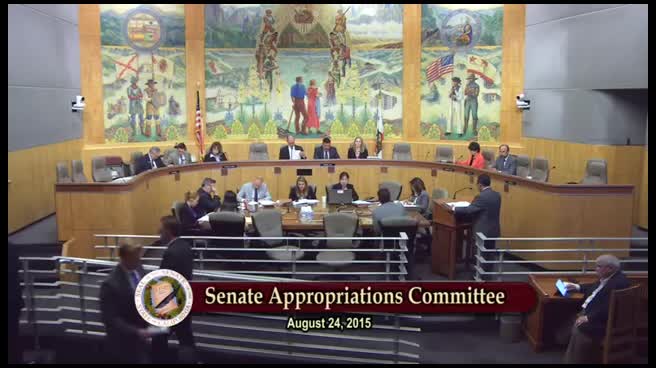 2MIN
Senate Standing Committee on Appropriations
 4MIN
Senate Standing Committee on Governance and Finance
 2MIN
Assembly Standing Committee on Jobs, Economic Development, and the Economy
Bill Author

Bill Co-Author(s):