AB 2757: Agricultural workers: wages, hours, and working conditions.
- Session Year: 2015-2016
- House: Assembly
- Latest Version Date: 2016-06-02
Existing law sets wage, hour, meal break requirements, and other working conditions for employees and requires an employer to pay overtime wages as specified to an employee who works in excess of a workday or workweek, as defined, and imposes criminal penalties for the violation of these requirements. Existing law exempts agricultural employees from these requirements. Under existing law, the function of the Department of Industrial Relations is to, among other things, foster, promote, and develop the welfare of the wage earners of California, to improve their working conditions, and to advance their opportunities for profitable employment.
This bill would remove the exemption for agricultural employees regarding hours, meal breaks, and other working conditions, including specified wage requirements, and would create a schedule that would phase in overtime requirements for agricultural workers, as defined, over the course of 4 years, from 2017 to 2020, 2019 to 2022, inclusive. Beginning January 1, 2020, 2022, the bill would require any work performed by a person, employed in an agricultural occupation, in excess of 12 hours in one day to be compensated at the rate of no less than twice the employees regular rate of pay. Under the bill, these overtime pay provisions would be phased in from 2019 to 2022, inclusive, for employers who employ 25 or fewer employees. The bill would authorize the Governor to delay the implementation of these overtime pay provisions if the Governor also suspends the implementation of a scheduled state minimum wage increase, as specified. The bill would require the Department of Industrial Relations to update a specified wage order for consistency with these provisions.
The bill would create a state-mandated local program by including agricultural employees as a class of employees protected by criminal penalties under existing law.
The California Constitution requires the state to reimburse local agencies and school districts for certain costs mandated by the state. Statutory provisions establish procedures for making that reimbursement.
This bill would provide that no reimbursement is required by this act for a specified reason.
Existing law sets wage, hour, meal break requirements, and other working conditions for employees and requires an employer to pay overtime wages as specified to an employee who works in excess of a workday or workweek, as defined, and imposes criminal penalties for the violation of these requirements. Existing law exempts agricultural employees from these requirements. Under existing law, the function of the Department of Industrial Relations is to, among other things, foster, promote, and develop the welfare of the wage earners of California, to improve their working conditions, and to advance their opportunities for profitable employment.
This bill would remove the exemption for agricultural employees regarding hours, meal breaks, and other working conditions, including specified wage requirements, and would create a schedule that would phase in overtime requirements for agricultural workers, as defined, over the course of 4 years, from 2017 to 2020, inclusive. Beginning January 1, 2020, the bill would require any work performed by a person, employed in an agricultural occupation, in excess of 12 hours in one day to be compensated at the rate of no less than twice the employees regular rate of pay. Under the bill, these overtime pay provisions would be phased in from 2019 to 2022, inclusive, for employers who employ 25 or fewer employees. The bill would authorize the Governor to delay the implementation of these overtime pay provisions if the Governor also suspends the implementation of a scheduled state minimum wage increase, as specified. The bill would require the Department of Industrial Relations to update a specified wage order for consistency with these provisions.
The bill would create a state-mandated local program by including agricultural employees as a class of employees protected by criminal penalties under existing law.
The California Constitution requires the state to reimburse local agencies and school districts for certain costs mandated by the state. Statutory provisions establish procedures for making that reimbursement.
This bill would provide that no reimbursement is required by this act for a specified reason.
Existing law sets wage, hour, meal break requirements, and other working conditions for employees and requires an employer to pay overtime wages as specified to an employee who works in excess of a workday or workweek, as defined, and imposes criminal penalties for the violation of these requirements. Existing law exempts agricultural employees from these requirements. Under existing law, the function of the Department of Industrial Relations is to, among other things, foster, promote, and develop the welfare of the wage earners of California, to improve their working conditions, and to advance their opportunities for profitable employment.
This bill would remove the exemption for agricultural employees regarding hours, meal breaks, and other working conditions, including specified wage requirements requirements, and would create a schedule that would phase-in phase in overtime requirements for agricultural workers, as defined, over the course of 4 years, from 2017 to 2020, inclusive. Beginning January 1, 2020, the bill would require any work performed by a person, employed in an agricultural occupation, in excess of 12 hours in one day to be compensated at the rate of no less than twice the employees regular rate of pay. The bill would require the Department of Industrial Relations to update a specified wage order for consistency with these provisions.
The bill would create a state-mandated local program by including agricultural employees as a class of employees protected by criminal penalties under existing law.
The California Constitution requires the state to reimburse local agencies and school districts for certain costs mandated by the state. Statutory provisions establish procedures for making that reimbursement.
This bill would provide that no reimbursement is required by this act for a specified reason.
Existing law sets wage, hour, meal break requirements, and other working conditions for employees and requires an employer to pay overtime wages as specified to an employee who works in excess of a workday or workweek, as defined, and imposes criminal penalties for the violation of these requirements. Existing law exempts agricultural employees from these requirements.
This bill would remove the exemption for agricultural employees regarding hours, meal breaks, and other working conditions, including specified wage requirements and would create a schedule that would phase-in overtime requirements for agricultural workers, as defined, over the course of 4 years, from 2017 to 2020, inclusive.
The bill would create a state-mandated local program by including agricultural employees as a class of employees protected by criminal penalties under existing law.
The California Constitution requires the state to reimburse local agencies and school districts for certain costs mandated by the state. Statutory provisions establish procedures for making that reimbursement.
This bill would provide that no reimbursement is required by this act for a specified reason.
(a)Sections 551 and 552 do not apply to cases of emergency or to work performed in the protection of life or property from loss or destruction, or to any common carrier engaged in or connected with the movement of trains. Nothing in this chapter shall be construed to prevent an accumulation of days of rest when the nature of the employment reasonably requires that the employee work seven or more consecutive days, if in each calendar month the employee receives days of rest equivalent to one days rest in seven. The requirement respecting the equivalent of one days rest in seven shall apply, notwithstanding the other provisions of this chapter relating to collective bargaining agreements, where the employer and a labor organization representing employees of the employer have entered into a valid collective bargaining agreement respecting the hours of work of the employees, unless the agreement expressly provides otherwise.
(b)In addition to the exceptions specified in subdivision (a), the Chief of the Division of Labor Standards Enforcement may, when in his or her judgment hardship will result, exempt any employer or employees from the provisions of Sections 551 and 552.
SEC. 2.Chapter 6 (commencing with Section 857) is added to Part 2 of Division 2 of the Labor Code, to read:6.Agriculture857.This chapter shall be known and may be cited as the Phase-In Overtime for Agricultural Workers Act of 2016.
858.The Legislature finds and declares all of the following:
(a)Agricultural employees engage in back-breaking work every day.
(b)Few occupations in todays America are as physically demanding and exhausting as agricultural work.
(c)In 1938, the United States Congress enacted the federal Fair Labor Standards Act of 1938 (29 U.S.C. Sec. 201 et seq.), which excluded agricultural workers from wage protections and overtime compensation requirements.
(d)It is the intent of the Legislature to enact the Phase-In Overtime for Agricultural Workers Act of 2016 to provide any person employed in an agricultural occupation in California, as defined in Order No. 14-2001 of the Industrial Welfare Commission (revised 07-2014) with an opportunity to earn overtime compensation under the same standards as millions of other Californians.
859.For purposes of this chapter, employed in an agricultural occupation has the same meaning as in Order No.14-2001 of the Industrial Welfare Commission (revised 07-2014).
860.Notwithstanding any other provision of law, including Chapter 1 (commencing with Section 500):
(a)(1)Commencing July 1, 2017, except as provided in paragraph (2), January 1, 2019, any person employed in an agricultural occupation shall not be employed more than nine and one-half hours in any one workday or work in excess of 55 hours in any one workweek, unless the employee receives one and one-half times that employees regular rate of pay for all hours worked over nine and one-half hours in any workday or over 55 hours in any workweek.
(2)This subdivision shall apply to an employer who employs 25 or fewer employees commencing January 1, 2019.
(b)(1)Commencing January 1, 2018, except as provided in paragraph (2), January 1, 2020, any person employed in an agricultural occupation shall not be employed more than nine hours in any one workday or work in excess of 50 hours in any one workweek, unless the employee receives one and one-half times that employees regular rate of pay for all hours worked over nine hours in any workday or over 50 hours in any workweek.
(2)This subdivision shall apply to an employer who employs 25 or fewer employees commencing January 1, 2020.
(c)(1)Commencing January 1, 2019, except as provided in paragraph (2), January 1, 2021, any person employed in an agricultural occupation shall not be employed more than eight and one-half hours in any one workday or work in excess of 45 hours in any one workweek, unless the employee receives one and one-half times that employees regular rate of pay for all hours worked over eight and one-half hours in any workday or over 45 hours in any workweek.
(2)This subdivision shall apply to an employer who employs 25 or fewer employees commencing January 1, 2021.
(d)(1)Commencing January 1, 2020, except as provided in paragraph (2), January 1, 2022, any person employed in an agricultural occupation shall not be employed more than eight hours in any one workday or work in excess of 40 hours in any one workweek, unless the employee receives one and one-half times that employees regular rate of pay for all hours worked over eight hours in any workday or over 40 hours in any workweek.
(2)This subdivision shall apply to an employer who employs 25 or fewer employees commencing January 1, 2022.
861.Except as set forth in Section 860 and subdivision (a) of Section 862, all other provisions of Chapter 1 (commencing with Section 500) regarding compensation for overtime work shall apply to workers in an agricultural occupation commencing January 1, 2017.
862.(a)Beginning January 1, 2020, except as provided in subdivision (c), January 1, 2022, and consistent with Section 510, any work performed by a person, employed in an agricultural occupation, in excess of 12 hours in one day shall be compensated at the rate of no less than twice the employees regular rate of pay.
(b)Consistent with Section 861, notwithstanding subdivision (a) or Section 863, the other provisions of Section 510 shall be applicable to workers in an agricultural occupation commencing January 1, 2017. 2019.
(c)Subdivision (a) shall apply to an employer who employs 25 or fewer employees commencing January 1, 2022.
863.(a)Notwithstanding Section 860 or 862, the Governor may temporarily suspend scheduled phase in overtime requirements set forth in subdivision (b), (c), or (d) of Section 860, or subdivision (a) or (c) of Section 862 only if the Governor suspends scheduled minimum wage increases pursuant to clause (i) of subparagraph (A) of, and subparagraph (B) of, paragraph (3) of subdivision (d) of Section 1182.12.
(b)If the Governor makes a final determination to temporarily suspend scheduled phase in overtime requirements set forth in subdivision (b), (c), or (d) of Section 860 or subdivision (a) or (c) of Section 862 for the following year, all implementation dates applicable to those subdivisions Section 860 and subdivision (a) of Section 862 that are suspended subsequent to the September 1 final determination date, consistent with clause (i) of subparagraph (A) of, and subparagraph (B) of, paragraph (3) of subdivision (d) of Section 1182.12, shall be postponed by an additional year, but the full implementation of the overtime requirements set forth in subdivision (b), (c), or (d) of Section 860 or subdivision (a) or (c) of Section 862 shall in no event be later than January 1, 2022. The Governors temporary suspension under this section shall be by proclamation.
(c)The Governors authority to suspend the scheduled overtime requirements under this section shall end upon the phase in of the overtime requirements contained in subdivision (d) of Section 860, 860 or the phase in of the overtime requirements contained in subdivision (c) of Section 862, or on January 1, 2022, whichever comes first. (a) of Section 862.
864.The Department of Industrial Relations shall update Wage Order No. 14-2001 to be consistent with this chapter. chapter, except that the Wage Order 14-2001 provision for payment of double the employees regular rate of pay for all hours worked over eight hours on the seventh day of work in the workweek shall continue to apply.
SEC. 3.No reimbursement is required by this act pursuant to Section 6 of Article XIIIB of the California Constitution because the only costs that may be incurred by a local agency or school district will be incurred because this act creates a new crime or infraction, eliminates a crime or infraction, or changes the penalty for a crime or infraction, within the meaning of Section 17556 of the Government Code, or changes the definition of a crime within the meaning of Section 6 of Article XIIIB of the California Constitution.
(a)Sections 551 and 552 do not apply to cases of emergency or to work performed in the protection of life or property from loss or destruction, or to any common carrier engaged in or connected with the movement of trains. Nothing in this chapter shall be construed to prevent an accumulation of days of rest when the nature of the employment reasonably requires that the employee work seven or more consecutive days, if in each calendar month the employee receives days of rest equivalent to one days rest in seven. The requirement respecting the equivalent of one days rest in seven shall apply, notwithstanding the other provisions of this chapter relating to collective bargaining agreements, where the employer and a labor organization representing employees of the employer have entered into a valid collective bargaining agreement respecting the hours of work of the employees, unless the agreement expressly provides otherwise.
(b)In addition to the exceptions specified in subdivision (a), the Chief of the Division of Labor Standards Enforcement may, when in his or her judgment hardship will result, exempt any employer or employees from the provisions of Sections 551 and 552.
SEC. 2.Chapter 6 (commencing with Section 857) is added to Part 2 of Division 2 of the Labor Code, to read:6.Agriculture857.This chapter shall be known and may be cited as the Phase-In Overtime for Agricultural Workers Act of 2016.
858.The Legislature finds and declares all of the following:
(a)Agricultural employees engage in back-breaking work every day.
(b)Few occupations in todays America are as physically demanding and exhausting as agricultural work.
(c)In 1938, the United States Congress enacted the federal Fair Labor Standards Act of 1938 (29 U.S.C. Sec. 201 et seq.), which excluded agricultural workers from wage protections and overtime compensation requirements.
(d)It is the intent of the Legislature to enact the Phase-In Overtime for Agricultural Workers Act of 2016 to provide any person employed in an agricultural occupation in California, as defined in Order No. 14-2001 of the Industrial Welfare Commission (revised 07-2014) with an opportunity to earn overtime compensation under the same standards as millions of other Californians.
859.For purposes of this chapter, employed in an agricultural occupation has the same meaning as in Order No.14-2001 of the Industrial Welfare Commission (revised 07-2014).
860.Notwithstanding any other provision of law, including Chapter 1 (commencing with Section 500):
(a)(1)Commencing July 1, 2017, except as provided in paragraph (2), any person employed in an agricultural occupation shall not be employed more than nine and one-half hours in any one workday or work in excess of 55 hours in any one workweek, unless the employee receives one and one-half times that employees regular rate of pay for all hours worked over nine and one-half hours in any workday or over 55 hours in any workweek.
(2)This subdivision shall apply to an employer who employs 25 or fewer employees commencing January 1, 2019.
(b)(1)Commencing January 1, 2018, except as provided in paragraph (2), any person employed in an agricultural occupation shall not be employed more than nine hours in any one workday or work in excess of 50 hours in any one workweek, unless the employee receives one and one-half times that employees regular rate of pay for all hours worked over nine hours in any workday or over 50 hours in any workweek.
(2)This subdivision shall apply to an employer who employs 25 or fewer employees commencing January 1, 2020.
(c)(1)Commencing January 1, 2019, except as provided in paragraph (2), any person employed in an agricultural occupation shall not be employed more than eight and one-half hours in any one workday or work in excess of 45 hours in any one workweek, unless the employee receives one and one-half times that employees regular rate of pay for all hours worked over eight and one-half hours in any workday or over 45 hours in any workweek.
(2)This subdivision shall apply to an employer who employs 25 or fewer employees commencing January 1, 2021.
(d)(1)Commencing January 1, 2020, except as provided in paragraph (2), any person employed in an agricultural occupation shall not be employed more than eight hours in any one workday or work in excess of 40 hours in any one workweek, unless the employee receives one and one-half times that employees regular rate of pay for all hours worked over eight hours in any workday or over 40 hours in any workweek.
(2)This subdivision shall apply to an employer who employs 25 or fewer employees commencing January 1, 2022.
861.Except as set forth in Section 860 and subdivision (a) of Section 862, all other provisions of Chapter 1 (commencing with Section 500) regarding compensation for overtime work shall apply to workers in an agricultural occupation commencing January 1, 2017.
862.(a)Beginning January 1, 2020, except as provided in subdivision (c), and consistent with Section 510, any work performed by a person, employed in an agricultural occupation, in excess of 12 hours in one day shall be compensated at the rate of no less than twice the employees regular rate of pay.
(b)Consistent with Section 861, notwithstanding subdivision (a), (a) or Section 863, the other provisions of Section 510 shall be applicable to workers in an agricultural occupation commencing January 1, 2017.
(c)Subdivision (a) shall apply to an employer who employs 25 or fewer employees commencing January 1, 2022.
863.(a)Notwithstanding Section 860 or 862, the Governor may temporarily suspend scheduled phase in overtime requirements set forth in subdivision (b), (c), or (d) of Section 860, or subdivision (a) or (c) of Section 862 only if the Governor suspends scheduled minimum wage increases pursuant to clause (i) of subparagraph (A) of, and subparagraph (B) of, paragraph (3) of subdivision (d) of Section 1182.12.
(b)If the Governor makes a final determination to temporarily suspend scheduled phase in overtime requirements set forth in subdivision (b), (c), or (d) of Section 860 or subdivision (a) or (c) of Section 862 for the following year, all implementation dates applicable to those subdivisions that are suspended subsequent to the September 1 final determination date, consistent with clause (i) of subparagraph (A) of, and subparagraph (B) of, paragraph (3) of subdivision (d) of Section 1182.12, shall be postponed by an additional year, but the full implementation of the overtime requirements set forth in subdivision (b), (c), or (d) of Section 860 or subdivision (a) or (c) of Section 862 shall in no event be later than January 1, 2022. The Governors temporary suspension under this section shall be by proclamation.
(c)The Governors authority to suspend the scheduled overtime requirements under this section shall end upon the phase in of the overtime requirements contained in subdivision (d) of Section 860, the phase in of the overtime requirements contained in subdivision (c) of Section 862, or on January 1, 2022, whichever comes first.
863.864.The Department of Industrial Relations shall update Wage Order No. 14-2001 to be consistent with this chapter.
SEC. 3.No reimbursement is required by this act pursuant to Section 6 of Article XIIIB of the California Constitution because the only costs that may be incurred by a local agency or school district will be incurred because this act creates a new crime or infraction, eliminates a crime or infraction, or changes the penalty for a crime or infraction, within the meaning of Section 17556 of the Government Code, or changes the definition of a crime within the meaning of Section 6 of Article XIIIB of the California Constitution.
(a)Sections 551 and 552 do not apply to cases of emergency or to work performed in the protection of life or property from loss or destruction, or to any common carrier engaged in or connected with the movement of trains. Nothing in this chapter shall be construed to prevent an accumulation of days of rest when the nature of the employment reasonably requires that the employee work seven or more consecutive days, if in each calendar month the employee receives days of rest equivalent to one days rest in seven. The requirement respecting the equivalent of one days rest in seven shall apply, notwithstanding the other provisions of this chapter relating to collective bargaining agreements, where the employer and a labor organization representing employees of the employer have entered into a valid collective bargaining agreement respecting the hours of work of the employees, unless the agreement expressly provides otherwise.
(b)In addition to the exceptions specified in subdivision (a), the Chief of the Division of Labor Standards Enforcement may, when in his or her judgment hardship will result, exempt any employer or employees from the provisions of Sections 551 and 552.
SEC. 2.Chapter 6 (commencing with Section 857) is added to Part 2 of Division 2 of the Labor Code, to read:6.Agriculture857.This chapter shall be known and may be cited as the Phase-In Overtime for Agricultural Workers Act of 2016.
858.The Legislature finds and declares all of the following:
(a)Agricultural employees engage in back-breaking work every day.
(b)Few occupations in todays America are as physically demanding and exhausting as agricultural work.
(c)In 1938, the United States Congress enacted the federal Fair Labor Standards Act of 1938 (29 U.S.C. Sec. 201 et seq.), which excluded agricultural workers from wage protections and overtime compensation requirements.
(d)It is the intent of the Legislature to enact the Phase-In Overtime for Agricultural Workers Act of 2016 to provide any person employed in an agricultural occupation in California, as defined in Order No. 14-2001 of the Industrial Welfare Commission (revised 07-2014) with an opportunity to earn overtime compensation under the same standards as millions of other Californians.
859.For purposes of this chapter, employed in an agricultural occupation has the same meaning as in Order No.14-2001 of the Industrial Welfare Commission (revised 07-2014).
860.Notwithstanding any other provision of law, including Chapter 1 (commencing with Section 500):
(a)Commencing July 1, 2017, any person employed in an agricultural occupation shall not be employed more than nine and one-half hours in any one workday or work in excess of 55 hours in any one workweek, unless the employee receives one and one-half times such that employees regular rate of pay for all hours worked over nine and one-half hours in any workday. workday or over 55 hours in any workweek.
(b)Commencing January 1, 2018, any person employed in an agricultural occupation shall not be employed more than nine hours in any one workday or work in excess of 50 hours in any one workweek, unless the employee receives one and one-half times such that employees regular rate of pay for all hours worked over nine hours in any workday. workday or over 50 hours in any workweek.
(c)Commencing January 1, 2019, any person employed in an agricultural occupation shall not be employed more than eight and one-half hours in any one workday or work in excess of 45 hours in any one workweek, unless the employee receives one and one-half times such that employees regular rate of pay for all hours worked over eight and one-half hours in any workday. workday or over 45 hours in any workweek.
(d)Commencing January 1, 2020, any person employed in an agricultural occupation shall not be employed more than eight hours in any one workday or work in excess of 40 hours in any one workweek, unless the employee receives one and one-half times such that employees regular rate of pay for all hours worked over eight hours in any workday. workday or over 40 hours in any workweek.
861.Except as set forth in Section 860, 860 and subdivision (a) of Section 862, all other provisions of Chapter 1 (commencing with Section 500) regarding compensation for overtime work shall apply to workers in an agricultural occupation commencing January 1, 2017.
862.(a)Beginning January 1, 2020, and consistent with Section 510, any work performed by a person, employed in an agricultural occupation, in excess of 12 hours in one day shall be compensated at the rate of no less than twice the employees regular rate of pay.
(b)Consistent with Section 861, notwithstanding subdivision (a), the other provisions of Section 510 shall be applicable to workers in an agricultural occupation commencing January 1, 2017.
863.The Department of Industrial Relations shall update Wage Order No. 14-2001 to be consistent with this chapter.
SEC. 3.No reimbursement is required by this act pursuant to Section 6 of Article XIIIB of the California Constitution because the only costs that may be incurred by a local agency or school district will be incurred because this act creates a new crime or infraction, eliminates a crime or infraction, or changes the penalty for a crime or infraction, within the meaning of Section 17556 of the Government Code, or changes the definition of a crime within the meaning of Section 6 of Article XIIIB of the California Constitution.
(a)Sections 551 and 552 shall do not apply to any cases of emergency nor or to work performed in the protection of life or property from loss or destruction, nor or to any common carrier engaged in or connected with the movement of trains. This chapter, with the exception of Section 558, shall not apply to any person employed in an agricultural occupation, as defined in Order No. 14-80 (operative January 1, 1998) of the Industrial Welfare Commission. Nothing in this chapter shall be construed to prevent an accumulation of days of rest when the nature of the employment reasonably requires that the employee work seven or more consecutive days, if in each calendar month the employee receives days of rest equivalent to one days rest in seven. The requirement respecting the equivalent of one days rest in seven shall apply, notwithstanding the other provisions of this chapter relating to collective bargaining agreements, where the employer and a labor organization representing employees of the employer have entered into a valid collective bargaining agreement respecting the hours of work of the employees, unless the agreement expressly provides otherwise.
(b)In addition to the exceptions specified in subdivision (a), the Chief of the Division of Labor Standards Enforcement may, when in his or her judgment hardship will result, exempt any employer or employees from the provisions of Sections 551 and 552.
SEC. 2.Chapter 6 (commencing with Section 857) is added to Part 2 of Division 2 of the Labor Code, to read:6.Agriculture857.This chapter shall be known and may be cited as the Phase-In Overtime for Agricultural Workers Act of 2016.
858.The Legislature finds and declares all of the following:
(a)Agricultural employees engage in back-breaking work every day.
(b)Few occupations in todays America are as physically demanding and exhausting as agricultural work.
(c)In 1938, the United States Congress enacted the federal Fair Labor Standards Act of 1938 (29 U.S.C. Sec. 201 et seq.), which excluded agricultural workers from wage protections and overtime compensation requirements.
(d)It is the intent of the Legislature to enact the Phase-In Overtime for Agricultural Workers Act of 2016 to provide any person employed in an agricultural occupation in California, as defined in Order No. 14-2001 of the Industrial Welfare Commission (revised 07-2014) with an opportunity to earn overtime compensation under the same standards as millions of other Californians.
859.For purposes of this chapter, employed in an agricultural occupation has the same meaning as in Order No.14-2001 of the Industrial Welfare Commission (revised 07-2014).
860.Notwithstanding any other provision of law, including Chapter 1 (commencing with Section 500):
(a)Commencing July 1, 2017, any person employed in an agricultural occupation shall not be employed more than nine and one-half hours in any one workday or work in excess of 55 hours in any one workweek, unless the employee receives one and one-half times such employees regular rate of pay for all hours worked over nine and one-half hours in any workday.
(b)Commencing January 1, 2018, any person employed in an agricultural occupation shall not be employed more than nine hours in any one workday or work in excess of 50 hours in any one workweek, unless the employee receives one and one-half times such employees regular rate of pay for all hours worked over nine hours in any workday.
(c)Commencing January 1, 2019, any person employed in an agricultural occupation shall not be employed more than eight and one-half hours in any one workday or work in excess of 45 hours in any one workweek, unless the employee receives one and one-half times such employees regular rate of pay for all hours worked over eight and one-half hours in any workday.
(d)Commencing January 1, 2020, any person employed in an agricultural occupation shall not be employed more than eight hours in any one workday or work in excess of 40 hours in any one workweek, unless the employee receives one and one-half times such employees regular rate of pay for all hours worked over eight hours in any workday.
861.Except as set forth in Section 860, all other provisions of Chapter 1 (commencing with Section 500) regarding compensation for overtime work shall apply to workers in an agricultural occupation commencing January 1, 2017.
SEC. 3.No reimbursement is required by this act pursuant to Section 6 of Article XIIIB of the California Constitution because the only costs that may be incurred by a local agency or school district will be incurred because this act creates a new crime or infraction, eliminates a crime or infraction, or changes the penalty for a crime or infraction, within the meaning of Section 17556 of the Government Code, or changes the definition of a crime within the meaning of Section 6 of Article XIIIB of the California Constitution.
|
Date
|
Status
|
|---|---|
| Jun 2, 2016 | Assembly Rule 63 suspended. |
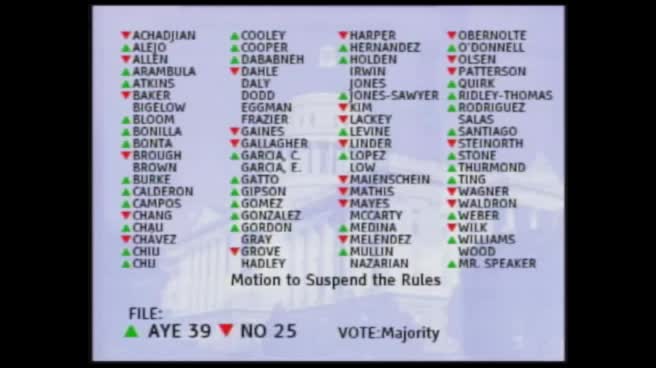
| Jun 2, 2016 | Read third time. Refused passage. (Ayes 38. Noes 35.). |
| Jun 2, 2016 | Read third time. Refused passage. (Ayes 38. Noes 35. Page 5218.). |
| Jun 2, 2016 | Read third time. Refused passage. |
| Jun 2, 2016 | Read third time and amended. Ordered to third reading. (Ayes 45. Noes 28.) |
| Jun 2, 2016 | Read third time and amended. Ordered to third reading. (Ayes 45. Noes 28. Page 5207.) |
| Jun 2, 2016 | Read third time and amended. Ordered to third reading. |
| Jun 2, 2016 | Read second time. Ordered to third reading. |
| Jun 2, 2016 | Assembly Rule 69 suspended. (Ayes 51. Noes 26. Page 5207.) |
| Jun 2, 2016 | Assembly Rule 69 suspended. |
| Jun 2, 2016 | Assembly Rule 63 suspended. (Page 5166.) |
| Feb 19, 2016 | Introduced. To print. |
| Jun 1, 2016 | Read second time and amended. Ordered returned to second reading. |
| May 31, 2016 | From committee: Amend, and do pass as amended. (Ayes 14. Noes 6.) (May 27). |
| Apr 20, 2016 | In committee: Set, first hearing. Referred to APPR. suspense file. |
| Apr 7, 2016 | From committee: Do pass and re-refer to Com. on APPR. (Ayes 5. Noes 2.) (April 6). Re-referred to Com. on APPR. |
| Mar 31, 2016 | Re-referred to Com. on L. & E. |
| Mar 30, 2016 | From committee chair, with author's amendments: Amend, and re-refer to Com. on L. & E. Read second time and amended. |
| Mar 10, 2016 | Referred to Com. on L. & E. |
| Feb 22, 2016 | Read first time. |
| Feb 21, 2016 | From printer. May be heard in committee March 22. |
|
Date
|
Description
|
Location
|
Votes
|
|
|---|---|---|---|---|
| Jun 2, 2016 | AB 2757 GONZALEZ Assembly Third Reading | Assembly Floor |
Failed |
|
| Jun 2, 2016 | AB 2757 GONZALEZ Assembly Third Reading Amend By GONZALEZ Set #1 | Assembly Floor |
Passed |
|
| May 27, 2016 | Do pass as amended. | Assembly Standing Committee on Appropriations |
Passed |
|
| Apr 6, 2016 | Do pass and be re-referred to the Committee on [Appropriations] | Assembly Standing Committee on Labor and Employment |
Passed |
This list shows positions taken on this bill by organizations on the date displayed, which is linked to the original source.
Positions by individuals are not included.
|
Organization
|
Position
|
Date
|
|---|---|---|
| Agricultural Council Of California | ** Against | Jun 2, 2016 |
| Almond Hullers & Processors Association | ** Against | Jun 2, 2016 |
| American Federation of State, County, and Municipal Employees | ** Support | Jun 2, 2016 |
| Asian Americans Advancing Justice -CA | ** Support | Jun 2, 2016 |
| CA Conference Board of Amalgamated Transit Union | ** Support | Jun 2, 2016 |
| CA Conference of Machinists | ** Support | Jun 2, 2016 |
| CA League of United Latin American Citizens | ** Support | Jun 2, 2016 |
| CA State Conference for NAACP | ** Support | Jun 2, 2016 |
| CA State Conference of the NAACP | ** Support | Jun 2, 2016 |
| California Agricultural Aircraft Association | ** Against | Jun 2, 2016 |
| California Association of Nurseries & Garden Centers | ** Against | Jun 2, 2016 |
| California Association Of Winegrape Growers | ** Against | Jun 2, 2016 |
| California Association Wheat Growers | ** Against | Jun 2, 2016 |
| California Blueberry Association | ** Against | Jun 2, 2016 |
| California Cattlemen'S Association | ** Against | Jun 2, 2016 |
| California Chamber Of Commerce | ** Against | Jun 2, 2016 |
| California Citrus Mutual | ** Against | Jun 2, 2016 |
| California Employment Lawyers Association | ** Support | Jun 2, 2016 |
| California Federation Of Teachers | ** Support | Jun 2, 2016 |
| California Immigration Policy Center | ** Support | Jun 2, 2016 |
| California Rural Legal Assistance Foundation, Inc. | ** Support | Jun 2, 2016 |
| California Teamsters Public Affairs Council | ** Support | Jun 2, 2016 |
| Center on Policy Initiatives | ** Support | Jun 2, 2016 |
| Coalition for Humane Immigrant Rights of Los Angeles | ** Support | Jun 2, 2016 |
| Consumer Attorneys Of California | ** Support | Jun 2, 2016 |
| Courage Campaign | ** Support | Jun 2, 2016 |
| Dolores Huerta Foundation | ** Support | Jun 2, 2016 |
| Engineers & Scientists of CA, IFPTE Local | ** Support | Jun 2, 2016 |
| Farmworker Justice | ** Support | Jun 2, 2016 |
| Hilary Rodham Clinton | ** Support | Jun 2, 2016 |
| Honorable Norma J. Torres, Member of Congress | ** Support | Jun 2, 2016 |
| Human Rights Watch | ** Support | Jun 2, 2016 |
| International Brotherhood of Teamsters | ** Support | Jun 2, 2016 |
| International Longshore and Warehouse Union | ** Support | Jun 2, 2016 |
| la Cooperativa Campesina de California | ** Support | Jun 2, 2016 |
| Los Angeles Alliance for a New Economy | ** Support | Jun 2, 2016 |
| Los Angeles Mayor, Eric Garcetti | ** Support | Jun 2, 2016 |
| Mexican American Legal Defense and Educational Fund | ** Support | Jun 2, 2016 |
| National Association of Social Workers - California Chapter | ** Support | Jun 2, 2016 |
| Professional and Technical Engineers, IFPTE Local 21 | ** Support | Jun 2, 2016 |
| Sacramento Central Labor Council | ** Support | Jun 2, 2016 |
| SAG-AFTRA | ** Support | Jun 2, 2016 |
| Service Employees International Union California | ** Support | Jun 2, 2016 |
| Unite Here | ** Support | Jun 2, 2016 |
| Unite Here Local 30 | ** Support | Jun 2, 2016 |
| United Farm Workers | ** Support | Jun 2, 2016 |
| United Food and Commercial Workers | ** Support | Jun 2, 2016 |
| Utility Worker Union of America, Local 132 | ** Support | Jun 2, 2016 |
ASSEMBLY THIRD READING
ATR Bill Id:AB 2757
Author:(Gonzalez, et al.)
As Amended Ver:June 2, 2016
Majority vote
Committee | Votes | Ayes | Noes |
Labor | 5-2 | Roger Hernández, Chu, McCarty, O'Donnell, Thurmond | Patterson, Linder |
Appropriations | 14-6 | Gonzalez, Bloom, Bonilla, Bonta, Calderon, Daly, Eggman, Eduardo Garcia, Roger Hernández, Holden, Quirk, Santiago, Weber, Wood | Bigelow, Chang, Gallagher, Jones, Obernolte, Wagner |
SUMMARY: Enacts the Phase-In Overtime for Agricultural Workers Act of 2016, as specified. Specifically, this bill:
- Provides that, beginning July 1, 2019, any person employed in an agricultural occupation shall not be employed more than nine and one-half hours in any one workday or work in excess of 55 hours in any one workweek, unless the employee receives one and one-half times that employee's regular rate of pay for all hours worked over nine and one-half hours in any workday or over 55 hours in any workweek.
- Provides that, beginning January 1, 2020, any person employed in an agricultural occupation shall not be employed more than nine hours in any one workday or work in excess of 50 hours in any one workweek, unless the employee receives one and one-half times that employee's regular rate of pay for all hours worked over nine hours in any workday or over 50 hours in any workweek.
- Provides that, beginning January 1, 2021, any person employed in an agricultural occupation shall not be employed more than eight and one-half hours in any one workday or work in excess of 45 hours in any one workweek, unless the employee receives one and one-half times that employee's regular rate of pay for all hours worked over eight and one-half hours in any workday or over 45 hours in any workweek.
- Provides that, beginning January 1, 2022, any person employed in an agricultural occupation shall not be employed more than eight hours in any one workday or work in excess of 40 hours in any one workweek, unless the employee receives one and one-half times that employee's regular rate of pay for all hours worked over eight hours in any workday or over 40 hours in any workweek.
- Provides that the term "employed in an agricultural occupation" has the same meaning as in a specified Wage Order of the Industrial Welfare Commission.
- Provides that, beginning January 1, 2022, any work performed by a person employed in an agricultural occupation in excess of 12 hours in one day shall be compensated at the rate of no less than twice the employee's regular rate of pay.
- Provides that all other provisions of existing law regarding compensation for overtime work shall apply to workers in an agricultural occupation beginning January 1, 2017.
- Beginning in 2018, authorizes the Governor to temporarily suspend the scheduled phase-in of overtime requirements set forth above if the Governor suspends scheduled minimum wage increases for specified "economic conditions" under provisions of law enacted this year pursuant to Senate Bill 3 (Leno), Chapter 4, Statutes of 2016. This authority shall end upon the final phase-in of overtime provisions or January 1, 2022, whichever comes first.
- Requires the Department of Industrial Relations to update Industrial Welfare Commission Wage Order 14 to be consistent with this bill, except that provisions of existing law applicable to persons employed in agriculture providing for double pay for all hours worked over eight in the seventh day of work shall continue to apply.
- Makes related legislative findings and declarations.
FISCAL EFFECT: According to the Assembly Appropriations Committee, this bill would result in administrative costs in the range of $326,000 to $586,000, assuming a 10-20% increase in wage claims annually during the four year implementation phase. Once the bill is fully implemented, costs are likely to range between $20,000 to $30,000 annually.
COMMENTS: This bill is sponsored by the United Farm Workers (UFW), who argues that farm workers engage in back-breaking work every day. Few occupations in today's America are as physically demanding and exhausting as farm work. Yet no job in America requiring such demand on the human body pays less for a long day's work than what this bill is asking for farm workers.
UFW states that is has been 77 years since farm workers were excluded from the wage protections and maximum hour standards through the enactment of the federal Fair Labor Standards Act. Excluding farm workers is part of our country's shameful legacy that initially targeted African-Americans who were farm workers in the 1930s. They argue that excluding farm workers from overtime was wrong in 1938, and is wrong today.
A coalition of agricultural employers and others opposes this bill, arguing that, because farmers, their employees and their operations are critically affected by the uncontrollable whims of nature and the seasonality of agricultural production, agriculture needs greater flexibility in scheduling work than do other industries. Opponents note that California is one of only a few states that require premium pay for overtime worked by farm workers. California's regulation is one of the most generous in its coverage and requires agricultural workers receive overtime pay for hours worked over 10 in a workday.
Opponents also believe this bill will backfire, hurting family farmers and cutting agricultural workers' paychecks. They contend that farmers will likely avoid the additional costs imposed by this bill by limiting worker hours and hiring more farm workers to make up the difference whenever possible.
Analysis Prepared by: Ben Ebbink / L. & E. / (916) 319-2091 FN: 0003401
Date of Hearing: April 20, 2016
ASSEMBLY COMMITTEE ON APPROPRIATIONS
Lorena Gonzalez, Chair
ABPCA Bill Id:AB 2757
Author:(Gonzalez) – As Amended Ver:March 30, 2016
Policy Committee: | Labor | Vote: | 5-2 |
|
|
Urgency: No State Mandated Local Program: Yes Reimbursable: No
SUMMARY:
This bill establishes the Phase-In Overtime for Agricultural Workers Act of 2016 to provide overtime pay incrementally to California farmworkers over four years so that by 2020, workers that work more than eight hours a day, or 40 hours a week, will be paid one and one-half times that employees regular rate of pay. Specifically, this bill:
- Requires, beginning July 1, 2017, any person employed in an agricultural occupation employed more than 9.5 hours in any one workday or working in excess of 55 hours in any one workweek, to receive one and one-half times that employee’s regular rate of pay for all hours worked over 9.5 hours in any workday or over 55 hours in any workweek.
- Requires, beginning January 1, 2018, any person employed in an agricultural occupation more than 9 hours in any one workday or working in excess of 50 hours in any one workweek, to receive one and one-half times that employee’s regular rate of pay for all hours worked over nine hours in any workday or over 50 hours in any workweek.
- Requires, beginning January 1, 2019, any person employed in an agricultural occupation more than 8.5 hours in any one workday or working in excess of 45 hours in any one workweek, to receive one and one-half times that employee’s regular rate of pay for all hours worked over eight and one-half hours in any workday or over 45 hours in any workweek.
- Requires, beginning January 1, 2020, any person employed in an agricultural occupation more than 8 hours in any one workday or working in excess of 40 hours in any one workweek, to receive one and one-half times that employee’s regular rate of pay for all hours worked over 8 hours in any workday or over 40 hours in any workweek.
- Defines "employed in an agricultural occupation" consistent with the Wage Order of the Industrial Welfare Commission affecting agricultural workers.
- Requires, beginning January 1, 2020, any work performed by a person employed in an agricultural occupation in excess of 12 hours in one day shall be compensated at the rate of no less than twice the employee's regular rate of pay.
- Requires all other provisions of existing law regarding compensation for overtime work to apply to workers in an agricultural occupation beginning January 1, 2017.
- Requires the Department of Industrial Relations (DIR) to update Industrial Welfare Commission Wage Order 14 to be consistent with this bill.
FISCAL EFFECT:
Administrative costs in the range of $326,000 to $586,000 (Labor Enforcement and Compliance Fund), assuming a 10-20% increase in wage claims annually during the four year implementation phase. These cost estimates reflect resources for additional staffing and outreach to employers and employees. The bill proposes a dramatic shift in the industry and since the hours and rates of pay change annually during the implementation phase, DIR notes that employees may not know their rights and employers may not know which timeframe applies for any given year. Once the bill is fully implemented, costs are likely to range between $20,000 to $30,000 annually.
COMMENTS:
- Purpose. This bill removes the exemption for agricultural workers that excludes them from the daily and weekly overtime requirements, which requires overtime compensation for working in excess of 8 hours in one workday or 40 hours in a workweek. The implementation of the updated overtime eligibility for agricultural workers will be phased-in over 4 years. According to the author, this bill extends fair overtime compensation to hundreds and thousands of agricultural workers, which continue to serve an important role in our State’s economy. Agricultural workers will join the millions of Californians that already benefit from the same protections that this bill seeks to provide.
- Background. The Federal Fair Labor Standards Act (FLSA) was established in 1938 and provides for minimum requirements with respect to certain labor standards, including minimum wage and overtime. The overtime provisions of the FLSA were not extended to agricultural employees. In 1941, the Legislature exempted all agricultural employees from the statutory requirements of overtime, similar to the FLSA. This statutory exemption was retained when the eight-hour day was codified in 1999.
Despite this statutory exemption, the Industrial Welfare Commission (IWC), under its authority, promulgated overtime provisions beyond the traditional eight-hour standard of California law. Currently, the applicable wage order for agricultural employees requires the payment of overtime wages when an agricultural employee works longer than 10 hours in a single day, and more than six days during any workweek.
- Support. This bill is sponsored by the United Farm Workers (UFW), who state that it has been 77 years since farm workers were excluded from the wage protections and maximum hour standards through the enactment of the FLSA. Excluding farm workers is part of our country's shameful legacy that initially targeted African-American who were farm workers in the 1930s. This bill rights a wrong that can no longer be justified or tolerated in a society where equal rights and equal justice are supposed to be more than academic theories or political rhetoric.
- Opposition. The Agricultural Council of California opposes this bill. They state that farmers, their employees and their operations are critically affected by the uncontrollable whims of nature and the seasonality of agricultural production. They argue that agriculture needs greater flexibility in scheduling work than do other industries and that state and federal laws currently recognize this reality. They state that California regulations are one of the most generous in the country with regard to overtime pay for agricultural workers. The opposition notes that the cost of farming in California has risen by 36% over the past few years. Consequently, farmers are likely to avoid the additional costs imposed by this bill by limiting worker hours and hiring more workers to make up the difference.
Analysis Prepared by: Misty Feusahrens / APPR. / (916) 319-2081
Date of Hearing: April 6, 2016
ASSEMBLY COMMITTEE ON LABOR AND EMPLOYMENT
Roger Hernández, Chair
ABPCA Bill Id:AB 2757 (
Author:Gonzalez) – As Amended Ver:March 30, 2016
SUBJECT: Agricultural Workers: wages, hours, and working conditions
SUMMARY: Enacts the Phase-In Overtime for Agricultural Workers Act of 2016, as specified. Specifically, this bill:
- Provides that, beginning July 1, 2017, any person employed in an agricultural occupation shall not be employed more than nine and one-half hours in any one workday or work in excess of 55 hours in any one workweek, unless the employee receives one and one-half times that employee’s regular rate of pay for all hours worked over nine and one-half hours in any workday or over 55 hours in any workweek.
- Provides that, beginning January 1, 2018, any person employed in an agricultural occupation shall not be employed more than nine hours in any one workday or work in excess of 50 hours in any one workweek, unless the employee receives one and one-half times that employee’s regular rate of pay for all hours worked over nine hours in any workday or over 50 hours in any workweek.
- Provides that, beginning January 1, 2019, any person employed in an agricultural occupation shall not be employed more than eight and one-half hours in any one workday or work in excess of 45 hours in any one workweek, unless the employee receives one and one-half times that employee’s regular rate of pay for all hours worked over eight and one-half hours in any workday or over 45 hours in any workweek.
- Provides that, beginning January 1, 2020, any person employed in an agricultural occupation shall not be employed more than eight hours in any one workday or work in excess of 40 hours in any one workweek, unless the employee receives one and one-half times that employee’s regular rate of pay for all hours worked over eight hours in any workday or over 40 hours in any workweek.
- Provides that the term "employed in an agricultural occupation" has the same meaning as in a specified Wage Order of the Industrial Welfare Commission.
- Provides that, beginning January 1, 2020, any work performed by a person employed in an agricultural occupation in excess of 12 hours in one day shall be compensated at the rate of no less than twice the employee's regular rate of pay.
- Provides that all other provisions of existing law regarding compensation for overtime work shall apply to workers in an agricultural occupation beginning January 1, 2017.
- Requires the Department of Industrial Relations to update Industrial Welfare Commission Wage Order 14 to be consistent with this bill.
- Makes related legislative findings and declarations.
FISCAL EFFECT: Unknown
COMMENTS: In 1938, Congress passed the Fair Labor Standards Act (FLSA), which established minimum requirements with respect to specified labor standards, including minimum wage and overtime. The overtime provisions of the FLSA were not extended to agricultural employees.
However, as with all provisions of the FLSA, states are allowed to exceed the requirements laid out in the federal law. The issue of overtime for agricultural employees in California was first dealt with in 1941. Previously, the law had been silent on this subject. But in 1941 the Legislature exempted all agricultural employees from the statutory requirements of overtime, similar to the FLSA. This statutory exemption was retained when the eight-hour day was codified in 1999.
This statutory exemption, however, did not prohibit the Industrial Welfare Commission (IWC) from legally promulgating overtime provisions beyond the traditional eight-hour standard of California law. Currently, the applicable wage order for agricultural employees requires the payment of overtime wages when an agricultural employee works longer than 10 hours in a single day, and more than six days during any workweek.
With respect to meal periods, the applicable wage order provides that every employer shall "authorize and permit" agricultural employees to take a meal period after five hours of work. This language differs from the statutory meal period language applicable to other employees that prohibits an employer from employing a worker longer than five hours without "providing" a meal period. In addition, the wage order does not require a second meal period after the tenth hour of work (as the statute requires for other employees).
ARGUMENTS IN SUPPORT:
This bill is sponsored by the United Farm Workers (UFW), who argues that farm workers engage in back-breaking work every day. Few occupations in today's America are as physically demanding and exhausting as farm work. Yet no job in America requiring such demand on the human body pays less for a long day's work than what this bill is asking for farm workers.
UFW states that is has been 77 years since farm workers were excluded from the wage protections and maximum hour standards through the enactment of the FLSA. Excluding farm workers is part of our country's shameful legacy that initially targeted African-American who were farm workers in the 1930s. They argue that excluding farm workers from overtime was wrong in 1938, and is wrong today.
UFW argues that this bill rights a wrong that can no longer be justified or tolerated in a society where equal rights and equal justice are supposed to be more than academic theories or political rhetoric.
Similarly, the Mexican American Legal Defense and Educational Fund MALDEF argues that, even though California’s farms workers perform some of the most physically-demanding jobs with pay and working conditions at levels that most Americans would not tolerate, they continue to be excluded from overtime laws enjoyed by most American workers. The enactment of the Fair Labor Standards Act of 1938 has excluded farm workers from wage protections and maximum hour standards for the last 78 years. This can no longer be justified or tolerated.
This bill is a commonsense solution that will make farm workers eligible for overtime pay like every other worker.
ARGUMENTS IN OPPOSITION:
A coalition of agricultural employers and others opposes this bill, arguing that, because farmers, their employees and their operations are critically affected by the uncontrollable whims of nature and the seasonality of agricultural production, agriculture needs greater flexibility in scheduling work than do other industries.
They contend that state and federal laws recognize this reality. There remains widespread agreement that wage laws in other industries and businesses cannot be equated with those in farming due to farming’s unpredictability, seasonality of work, and the dynamics of the weather and compressed harvest season. Federal law completely exempts persons employed in agriculture from overtime pay, but California long ago established an overtime pay requirement for agricultural employees.
Opponents note that California is one of only a few states that require premium pay for overtime worked by farm workers. California's regulation is one of the most generous in its coverage and requires agricultural workers receive overtime pay for hours worked over 10 in a workday. They state that California farmers value and respect their workers. In fact, many farmers voluntarily provide health benefits, vacation pay, and 401 (k) retirement plans for their employees.
Opponents believe this bill will backfire, hurting family farmers and cutting agricultural workers' paychecks. California's family farmers cannot successfully compete with other states and nations if they are forced to increase their production costs. Profit margins in agriculture are thin – farmers cannot remain successful if they must absorb these additional costs. They contend that the cost of farming has risen by 36 percent over the past few years; inputs like seeds, fertilizer and electricity have all become significantly more expensive. Consequently, farmers will likely avoid the additional costs imposed by this bill by limiting worker hours and hiring more farm workers to make up the difference whenever possible.
PRIOR RELATED LEGISLATION
AB 1313 (Allen) of 2012 proposed to extend the 8-hour daily overtime rule to agricultural employees. However, AB 1313 failed passage on concurrence on the Assembly Floor.
AB 1313 was similar to SB 1121 (Florez) from 2010, which was vetoed by Governor Schwarzenegger. The Governor's veto message stated (in part):
"Unfortunately, this measure, while well-intended, will not improve the lives of California's agricultural workers and instead will result in additional burdens on California businesses, increased unemployment, and lower wages. In order to remain competitive against other states that do not have such wage requirements, businesses will simply avoid paying overtime. Instead of working 10-hour days, multiple crews will be hired to work shorter shifts, resulting in lower take home pay for all workers. Businesses trying to compete under the new wage rules may become unprofitable and go out of business, resulting in further damage to our already fragile economy."
REGISTERED SUPPORT / OPPOSITION:
Support
American Federation of State, County, and Municipal Employees
Asian Americans Advancing Justice –CA
CA Conference Board of Amalgamated Transit Union
CA Conference of Machinists
CA League of United Latin American Citizens
CA State Conference for NAACP
CA State Conference of the NAACP
California Employment Lawyers Association
California Federation of Teachers
California Immigration Policy Center
California Labor Federation
California Rural Legal Assistance Foundation
California Teamsters Public Affairs Council
Center on Policy Initiatives
Coalition for Humane Immigrant Rights of Los Angeles
Consumer Attorneys of California
Courage Campaign
Dolores Huerta Foundation
Engineers & Scientists of CA, IFPTE Local
Farmworker Justice
Hilary Rodham Clinton
Honorable Norma J. Torres, Member of Congress
Human Rights Watch
International Brotherhood of Teamsters
International Longshore and Warehouse Union
La Cooperativa Campesina de California
Los Angeles Alliance for a New Economy
Los Angeles Mayor, Eric Garcetti
Mexican American Legal Defense and Educational Fund
National Association of Social Workers – California Chapter
Professional and Technical Engineers, IFPTE Local 21
Sacramento Central Labor Council
SAG-AFTRA
Service Employees International Union California
UNITE HERE
UNITE HERE Local 30
United Farm Workers
United Food and Commercial Workers
Utility Worker Union of America, Local 132
Western Center on Law & Poverty
Opposition
Agricultural Council of California
Almond Hullers & Processors Association
California Agricultural Aircraft Association
California Association of Nurseries & Garden Centers
California Association of Winegrape Growers
California Association Wheat Growers
California Blueberry Association
California Cattlemen's Association
California Chamber of Commerce
California Citrus Mutual
California Cotton Ginners Association
California Cotton Growers Association
California Dairies, Inc.
California Farm Bureau Federation
California Fresh Fruit Association
California Pear Growers Association
California Seed Association
California Tomato Growers Association
Family Winemakers of California
Far West Equipment Dealers Association
Nisei Farmers League
Western Agricultural Processors Association
Western Growers Association
Western Plant Health Association
Western United Dairymen
Wine Institute
Analysis Prepared by: Ben Ebbink / L. & E. / (916) 319-2091




Bill Co-Author(s):